1. Introduction
One of the most frequently recurring keywords in the language of public policy, territorial planning, and international development programs is “sustainability.” Its growing centrality reflects the urgency of addressing a global crisis that simultaneously involves climate change, biodiversity, social equity, and the resilience of local economies. In this context, sustainability is not conceived as a condition to be achieved, but rather as a dynamic process that requires informed political choices based on actual and effective data and consistent assessment tools capable of translating principles into concrete and measurable parameters, adaptable to different territories [
1].
From this perspective, the 2030 Agenda—adopted in 2015 by the United Nations (UN) [
2]—has provided a global framework based on 17 Sustainable Development Goals (SDGs), along with a set of economic, environmental, and social indicators related to sustainability to measure and monitor the progress level of each country towards the proposed SDGs achieved [
3]. In fact, each SDG is associated with a framework of indicators to assess the performance and the effectiveness of the policies and actions undertaken to reach the objectives.
The practical use of these economic, environmental, and social sustainability indicators is essential for transforming theoretical data into operational tools, intended as instruments to support public and private decision-making, and to guide administrative and planning strategies [
4]. In particular, in territorial governance, the indicators make it possible to more effectively address intervention plans starting from objective and quantitative information. These tools allow for (i) comparison between different territorial and socioeconomic contexts, supporting the identification of critical issues and best practices and (ii) the definition of targeted development measures, based on the specific characteristics of each local area.
In this regard, sustainability indicators play an active role in developing urban strategical operations, going beyond their descriptive function to become an essential part of territory management. The increasing availability of data and the use of advanced technologies, such as geographic information systems (GIS) and big data, are fundamental for expanding analytical abilities. As demonstrated by Locurcio et al. (2020) [
5], the GIS model implementation allows the integration of spatial data with economic, environmental, and social indicators, enhancing sustainability analysis in both the real estate sector and urban planning. Batty [
6] also highlights the emerging function of big data in smart city management, indicating how the combination of new technologies can make measurement tools more precise and adaptable to the needs of policymakers and local communities.
These notions are being translated into practical tools able to support urban policies in numerous cities: one of the most significant examples is Copenhagen (Denmark), which has joined in using sustainability indicators to improve city mobility and reduce environmental impact. Monitoring CO
2 emissions—both per capita and in relation to the percentage of renewable energy in the urban energy mix—has allowed the Danish capital to reduce these emissions by 42% between 2005 and 2020 [
7]. At the same time, through the use of sustainable mobility indicators, it has been possible to optimize the existing cycling infrastructure, resulting in 49% of residents using bicycles as their main means of transport. The strategic use of environmental and social indicators has enabled the city of Copenhagen to set the goal of becoming carbon-neutral by 2025, thus attesting to the effectiveness of a data-driven approach in urban planning [
4].
Another case of a successful integration between sustainability indicators comes from Germany, which has identified environmental measurement tools targeted at the transition to renewable energy. By monitoring the share of renewable energy in total national production, the country has increased the percentage of electricity produced from clean sources from 6% in 2000 to 50% in 2022 [
8]. The policies promoting photovoltaic and wind energy, supported by the use of environmental indicators, have helped the reduction of CO
2 emissions by 35% between 1990 and 2020 and have strengthened the use of the Energiewende model [
9].
Beijing (China), one of the cities with the highest levels of air pollution, applies the environmental indicators to monitor air quality: data on fine particulate matter (PM
2.5) emissions are employed to guide municipal programs and plans [
10]. Additionally, the Chinese government publishes daily air quality updates to limit the release of harmful substances. Thanks to this measure, between 2013 and 2020, Beijing has reduced PM
2.5 concentration by 35%, showing how the use of indicators can provide effective responses to environmental emergencies [
11].
Furthermore, Cape Town (South Africa) monitors the water resource management through the utilization of sustainability indicators: during the severe water crisis in 2018, the city used per capita water consumption data to introduce appropriate restrictions and implement rationing strategies [
12]. Daily consumption was reduced from 250 L in 2015 to less than 50 L in 2018, setting a replicable model for other cities facing water stress [
3].
In this framework, it should be highlighted that, despite progress shown in some cities and the mentioned positive examples, the practical applicability of indicators—especially at the urban scale—remains complex due to the variety of local contexts, fragmentation of accessible data, and the need to adapt global tools to heterogeneous territories [
9]. Faced with these challenges, a growing need to adopt a more holistic vision of sustainability that transcends sectoral approaches and captures the complexity of the relationships between the economy, environment, and society in urban contexts is pointed out.
In recent years, several international frameworks have been developed to systematically organize the urban indicators, including the International Organization for Standardization (ISO) 37120/37122/37123 standards [
13], the monitoring classifications proposed by the United Nations Human Settlements Programme (UN-Habitat) and the urban dashboards developed by the Organization for Economic Co-operation and Development (OECD). These tools serve as important references because they provide consolidated collections of indicators, thematic classification schemes, links to the SDGs, and comparable reporting procedures across cities. However, the specific-topic literature has highlighted several recurring limitations of these urban indicators’ frameworks: they rarely integrate economic, environmental, and social indicators explicitly within a single coherent theoretical model. Furthermore, they do not thoroughly distinguish between indicators designed for the national scale and those that are actually operational at the urban scale. In addition, a classification of the level of methodological standardization of the various indicators is not offered, further neglecting the development of a tool able to bring together, in an integrated way, units of measurement, formulas, sources, territorial scales, and potential policy uses. Although essential in the international scenario, these consolidated systems are therefore sometimes poorly adaptable to the needs of local contexts and do not provide an interpretative framework that clearly links indicators, policy tools, and expected outcomes.
To enhance coherency between sustainability indicators and policy actions, a conceptual backbone is strongly required. In this study, the indicators are consistent with the 3E (Economy–Environment–Equity) model, which aligns the sustainability metrics with the core dimensions of urban transformation. This structure supports the interpretation of indicators along a results–impact chain and facilitates the identification of policy levers that can generate more inclusive and coordinated interventions.
Such a perspective requires not only more integrated tools but also a significant change in measurement modalities: it is not enough to have data. It is crucial that these are interpreted within coherent analytical frameworks that can reflect territorial specificities without giving up comparative readability at a global scale [
14,
15].
Within this scenario, cities—as decision-intensive spaces—need indicators capable of adequately analyzing the dynamic interaction between environmental, economic, and social components. In recent years, there has been an increasing development of evaluation tools designed to support public action in pursuing sustainability goals and assessing their impact over time. Nevertheless, structural challenges remain: the proposed indicators are often heterogeneous in terms of methodology, scale, and sources. Their construction involves arbitrary choices, including variable selection, weighting, normalization methods, and aggregation criteria [
16]. Moreover, an excessive use of comparative rankings can lead to misleading simplifications, reducing the ability to take into account local specificities and, sometimes, turning the assessment tool into a communication driven, rather than a transformational, one. For this reason, the sustainability evaluation must be assumed not only as a technical operation but as a transformative process, helping cities define shared priorities, actively involve local stakeholders, and design more equitable and resilient strategies in the long term [
17]. By integrating the 3E conceptual model and the proposed indicator abacus, the research aims to bridge the gap between global sustainability targets and locally implementable strategies of urban transformation.
Gap and Contribution
Despite the growing attention given to the urban sustainability indicators, the reference literature still lacks an integrated framework capable of systematically combining their conceptual structure, methodological aspects, and conditions of applicability across different urban contexts [
18,
19,
20,
21,
22,
23,
24,
25,
26]. In this sense, existing studies tend to privilege sectoral approaches or thematic repertoires and indicators sets, without offering a unified perspective that would allow for a coherent interpretation of the relationships among the economic, environmental, and social spheres, nor for a comparable reading of the characteristics of the indicators for their operative uses.
To bridge the gap between the awareness of the issue and the availability of truly operational tools, the present study proposes an improvement upon the existing frameworks, translating the fragmentation found in the literature into an integrated methodological structure that is clear and applicable to different urban contexts.
From this perspective, integrating the indicators into the 3E conceptual model allows us to reconstruct an organic understanding of urban phenomena, moving beyond simple thematic aggregation and highlighting the structural relationships among economic, environmental, and social dimensions. The indicators’ framework developed in this research brings together in a single abacus the main characteristics of each indicator—units of measurement, calculation formulas, data requirements, and territorial application domains—making their structure more transparent.
The contribution of this work therefore lies in proposing a systematization of 85 indicators, organized according to the 3E model and articulated in families within each domain. This classification allows us to precisely identify which metrics are most consistent with different territorial scenarios and the measurement approaches, offering a methodological tool capable of (i) reducing the fragmentation highlighted in the literature and in the main international indicators’ frameworks and (ii) improving the readability, comparability, and adaptability of the indicators to local urban specificities.
2. Aim
The aim of the present study is to analyze and systematize the urban sustainability indicators found in the literature and ordinarily used at the international level. The research attempts to overcome the fragmentation caused by the multitude of indicators and to ensure a more coherent and standardized approach to support urban regeneration policies that, based on the detection and measurement of these indicators, should be oriented toward territorial interventions consistent with them.
This work does not merely catalog the existing urban sustainability indicators but also analyzes their effectiveness, highlighting limitations, distortions, and potential improvements to guarantee more reliable and transparent measurement tools [
27]. Critical aspects of current indicators and prospects for upgrading are examined, with particular attention to the integration of new technologies to support political, economic, and urban decision-making [
28]. Therefore, the capacity to transform available data into operational tools is fundamental to ensuring cities’ sustainable development programs and to preventing indicators from becoming exclusively marketing instruments or regulatory compliance checklists [
29].
To the described scope, this research highlights the central role of the urban sustainability indicators, which allow for (i) evaluating the potential of a specific site, (ii) identifying areas requiring urgent intervention, and (iii) guiding planned actions for urban enhancement and transformation.
The output of the critical analysis carried out is an abacus that includes the main sustainability indicators, classified according to their reference domain (economic, environmental, and social indicators). The term “abacus” refers to a structured framework of urban sustainability indicators, organized and systematized to support their practical use in sustainability assessment, urban analysis, and decision-making processes. This systematic overview represents a useful tool for decision-makers during: (i) the assessment of the current state of territories; and (ii) the selection of interventions to be implemented.
In order to support the achievement of the research’s purposes, the following research questions (RQs) are defined:
RQ1: Which sustainability indicators are most frequently adopted in the international literature for assessing urban environments?
RQ2: How can these indicators be systematized within a coherent and reproducible framework consistent with the three domains of sustainability (economic, environmental, social) conceptual model?
RQ3: To what extent are the selected indicators standardized in terms of data sources, measurement protocols, and comparability across cities?
RQ4: What share of existing indicators is fully operational at the city scale, and what adaptations are needed to improve the local applicability of those currently not implementable to this level?
RQ5: How can the resulting indicator framework support data-driven urban regeneration strategies and strengthen the link between measurement tools and policy-making?
In line with these RQs, the criteria used to analyze more in detail the indicators are defined as follows:
Indicator coverage: concerns the inclusion of each indicator in one of the three identified categories (according to the main dimensions of sustainability—economic, environmental, and social). It allows for the assessment of the balance and completeness of the reference system in representing the various components of sustainable development;
Standardization robustness: refers to the degree of methodological consistency and the soundness of the standardization criteria governing the construction and use of the indicators, ensuring their comparability and reliability over time and across different contexts;
Urban relevance: indicates the relevance of indicators to the urban dimension, i.e., their ability to represent phenomena and processes that occur at the city level, promoting an interpretation consistent with the dynamics of urban systems;
Policy usefulness: expresses the ability of the indicators framework to guide decision-making processes, linking each indicator to specific areas of intervention and enabling the development of targeted strategies that can be transferred between different territorial contexts.
The novelty of this study lies in the systematic consolidation of dispersed sustainability metrics into a unified and standardized framework specifically oriented toward urban sustainability assessment and territorial policies implementation. Unlike existing studies that address indicators in a sectoral and fragmented manner, the present work proposes an integrated classification applicable across the three main sustainability domains, with explicit operability on the city scale.
Building upon this conceptual framework, the proposed abacus also supports the alignment of a sustainability assessment with the 2030 Agenda objectives, as each indicator can be associated with relevant SDG targets within the economic (SDG 8 and 9), environmental (SDG 6, 7, 11, 12, 13, 14, and 15), and social domains (SDG 1, 3, 4, 5, 10, 11, and 16). This approach facilitates SDG localization, enabling cities to monitor their progress and improve the transparency and comparability of urban sustainability performance over time [
28]. In this perspective, the proposed abacus establishes a structured and strong connection with these targets, offering a practical and adaptable tool for integrating the local sustainability assessment with the global 2030 Agenda.
The following part of the work is structured into three sections.
Section 3 concerns the illustration of the methodology adopted for the analysis and classification of indicators, with attention to sources, selection criteria, and the setup of the final abacus.
Section 4 is dedicated to discussing the results, organized around the three main dimensions addressed (namely economic, environmental, and social sustainability): for each sphere, the most relevant indicators, emerging trends, as well as limitations and operational potential in the context of urban regeneration, are highlighted. Finally,
Section 5 presents conclusions and future developments, reflecting on the overall effectiveness of the proposed indicators’ systematic overview and recommendations for their more conscious and strategic application in planning urban transformations.
3. Methodology
The methodology adopted in the present study aims to provide a solid and up-to-date analytical framework of economic, environmental, and social sustainability indicators in order to guide the definition of interventions applied at the territorial and urban scale. The research has been carried out through a systematic review of the referenced academic and scientific literature, as well as the main current institutional and regulatory sources, to build a structured abacus capable of proposing a classification of indicators according to clear and standardized criteria.
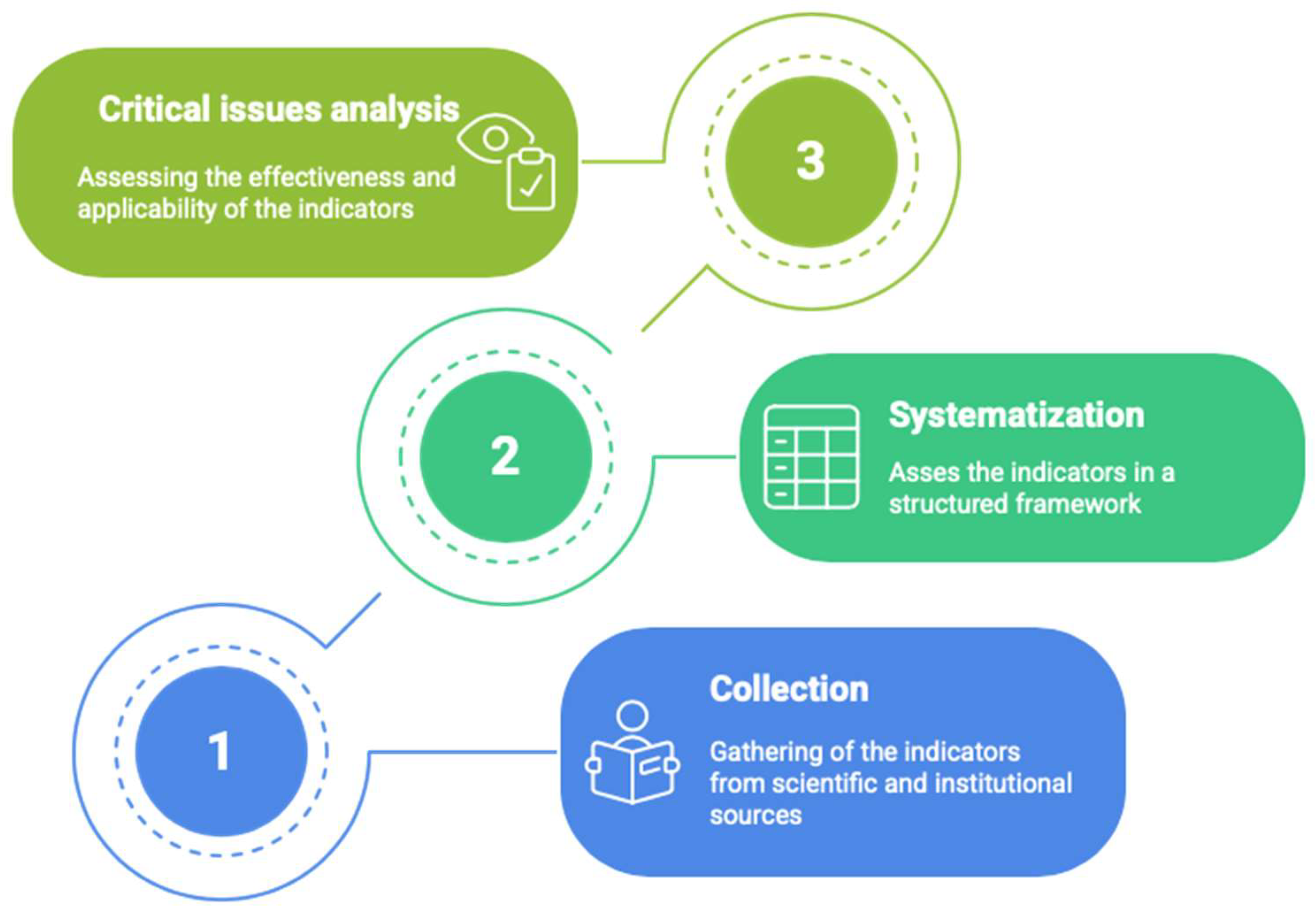
The methodological approach has been articulated into three phases:
- 1.
Collection of the most commonly used urban sustainability indicators at the international level and identification of information sources.
This phase involved the analysis of the most relevant literature and institutional and official documents in the field of sustainability measurement to collect adequate indicators to be included in the proposed set. The following have been considered:
academic research articles, obtained through the consultation of scientific databases such as Scopus and Google Scholar. In particular, the selected studies are focused on different methodologies for defining urban sustainability indicators;
official reports from international organizations;
global guidelines: the main International Organization for Standardization (ISO) standards applied to sustainability measurement have been considered to ensure methodological consistency among countries, i.e., to guarantee that selected indicators are developed according to internationally shared criteria, enabling comparison across different sectors and integration between heterogeneous sources.
Combinations of keywords have been used to narrow the scope of the investigation to the specific topic of urban sustainability assessment, with particular attention to the identification, classification, and evaluation of indicators. To refine the searches, Boolean operators (“AND”, “OR”) have been employed, allowing the combination and precise targeting of different thematic fields.
The following are the keywords used in this study: urban sustainability indicators, sustainable cities, environmental metrics, social well-being, economic performance, SDG 11, sustainability measurement, urban regeneration, urban governance, composite indicators, indicator standardization.
The selected studies, covering the period from 1984 to 2025, address the topic through different methodologies and scales of analysis. Some studies have proved directly useful for defining and comparing the main urban sustainability metrics, while others have been excluded because they were not consistent with the objectives or the scale of analysis adopted in this research.
The selection of studies has been carried out according to explicit inclusion criteria, established a priori to ensure maximum academic rigor, reliability, and methodological consistency. These criteria have allowed us to minimize the risk of bias in records selection:
i. Thematic relevance: only studies and sources explicitly addressing the measurement or assessment of urban sustainability through indicators in the economic, environmental, or social domains have been included.
ii. Methodological transparency: studies including indicators for which the methodology, data source, and calculation formula were clearly described, allowing reproducibility and comparability across different contexts, have been covered.
iii. Comparability and applicability: preference has been given to studies presenting standardized indicators or those already used by international reference institutions (UN, OECD, World Bank, European Commission, etc.) and indicators potentially applicable on the urban scale, including through adaptation of national datasets.
iv. Language: only studies written in English or Italian have been considered to ensure accurate understanding of content and data.
Regarding the exclusion criteria, the following aspects have been considered:
i. Incomplete or non-transparent data: studies lacking sufficient methodological information or not reporting data sources or units of measurement have been excluded.
ii. Inaccessibility: contributions not available in full text have been excluded.
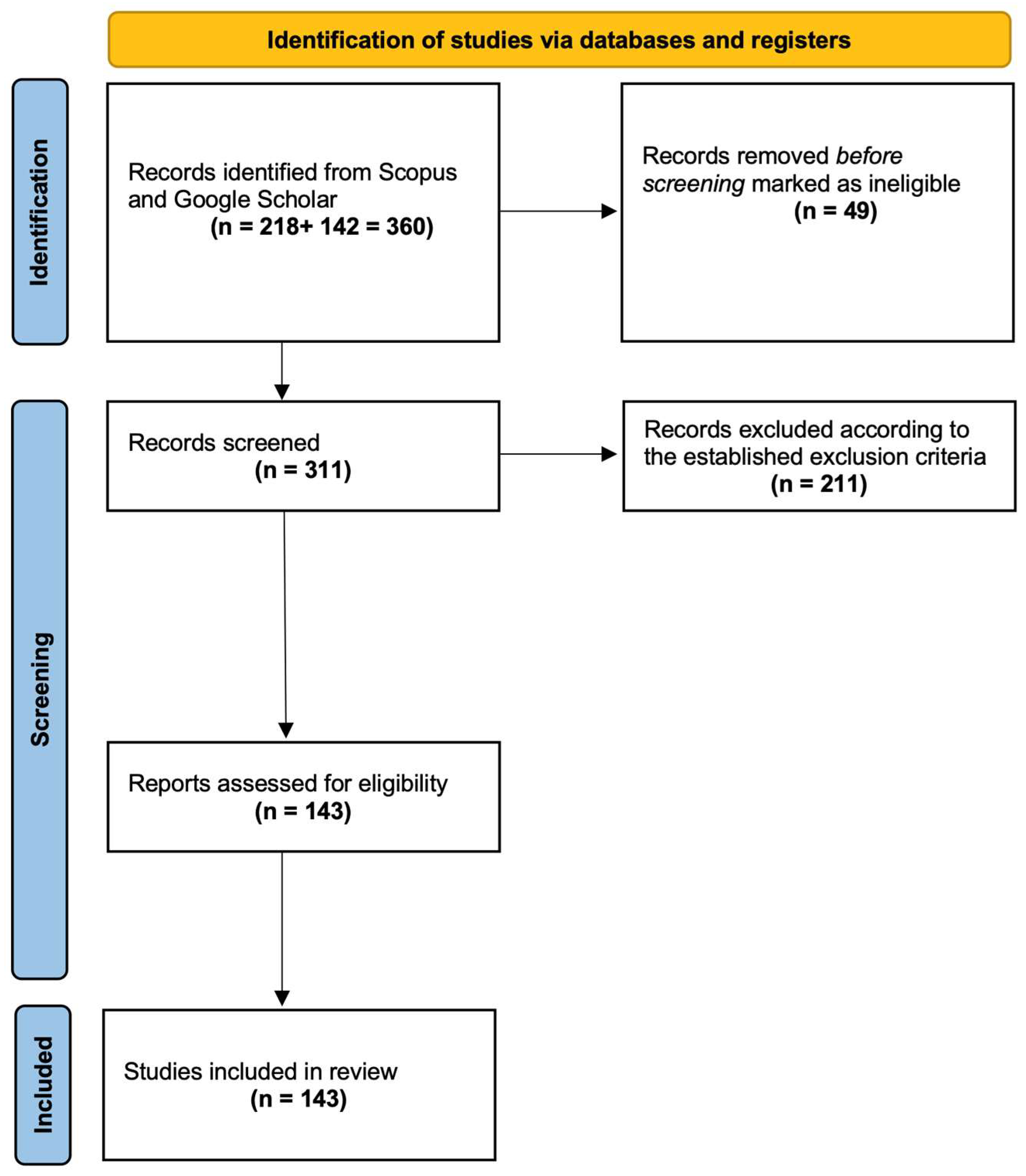
The identification and screening process for the selection of the studies to be analyzed is summarized in the PRISMA flow diagram (
Figure 1).
- 2.
Systematization of the identified indicators.
Once consolidated urban sustainability indicators—that are those widely used in the literature and institutional sources—have been recognized, a structured and systematized abacus has been developed to summarize and classify the information. The analytic framework includes:
category of each indicator based on classification into economic (27), environmental (36), and social (22) indicators;
denomination of the indicator;
brief description clarifying the indicator function and meaning;
calculation formula to specify the elaboration methodology;
utility of the indicator with reference to its practical applications in decision-making processes;
standardizability level, i.e., the possibility of applying the indicator in local, national, and global contexts. In order to ensure a transparent and repeatable process of assessment of the standardizability level, a quantitative scoring rubric has been introduced. The rubric is based on two weighted criteria and a penalization factor, aimed at evaluating both methodological robustness and the data availability of the indicator. The weighting for each criterion has been assigned equally, giving the same importance to each.
Criterion A—Methodological consistency (weight = 0.5)
0 = no recognized methodology
1 = only national guidelines
2 = widely used methodology but heterogeneous practices
3 = internationally standardized methodology (e.g., ISO, UN, OECD, EU)
Criterion B—Data availability (weight = 0.5)
0 = scarce or not regularly updated data
1 = partial or sector-specific availability
2 = consolidated national data, but limited systematic availability at city scale
3 = data related to city–regional–national–global level
When strong cross-country statistical heterogeneity is observed in data reporting or measurement, a −1 penalty is applied.
The final standardizability level score is calculated as follows:
The classification thresholds adopted are:
- −
Final score > 2 → High standardization
- −
1 ≤ Final score ≤ 2 → Moderate standardization
- −
Final score ≤ 1 → Low standardization
reference source for each indicator to ensure scientific traceability;
geographic scale of applicability, distinguishing indicators usable at urban, regional, national, or global levels.
The definition of the systematic overview of the collected urban sustainability indicators has been essential to identify similar indicators, methodological gaps in the construction procedure, and areas for improvement, contributing to a more complete and coherent outline for assessing economic, environmental, and social sustainability compared to the heterogeneity of currently existing and consulted sources.
- 3.
Analysis of the critical issues and strengths points of the identified indicators.
In this phase, each collected indicator has been investigated to assess its effectiveness and applicability across the different sustainability domains (economic, environmental, and social). Key aspects examined include:
the ability of indicators to capture multidimensional dynamics;
possible distortions arising from the impossibility of generalizing the applicability of the indicator as it is strongly connected to the local specificities of the context in which it has been developed;
difficulties in data collection and standardization.
Figure 2 shows the three phases that constitute the methodological approach implemented in the present research for the identification and analysis of urban sustainability indicators.
4. Discussion of the Results
Unlike several contributions found in the literature on the topic, which generally organizes indicators through thematic catalogs or sectoral macro-areas, the 3E model adopted in this study introduces an interpretative logic capable of representing the structural interdependencies among the economic, environmental, and social dimensions. This approach allows for an effective downscaling of the sustainability conceptual framework, providing an integrated understanding of urban phenomena and overcoming the methodological fragmentation observed in major international frameworks. Moreover, the comprehensive indicators framework proposed introduces a standardization rubric that specifies, for each indicator, units of measurement, formulas, level of operationality, and territorial scales of application, allowing a comparative assessment of their actual usability at the urban level—differing from most existing repertoires, which are limited to descriptive lists lacking such a systemic structure.
With reference to the identified 85 urban sustainability indicators, a systematic analysis has been carried out for each selected thematic category (economic, environmental, and social) to outline their main distinctive and functional aspects. In particular, the investigation has been performed by taking into account five fundamental dimensions: (i) the unit of measurement used for quantifying the indicator, (ii) the underlying calculation formula, (iii) the degree of usefulness with respect to the study’s objectives, (iv) the level of standardizability enabling comparative investigation across different contexts, and finally, (v) the geographic scale of reference to which the indicator is applicable. This integrated approach (i.e., which simultaneously considers different elements of the same indicator) has allowed not only a systematic description of each indicator but also an evaluation of its methodological coherence, practical relevance, and potential contribution within decision-making processes.
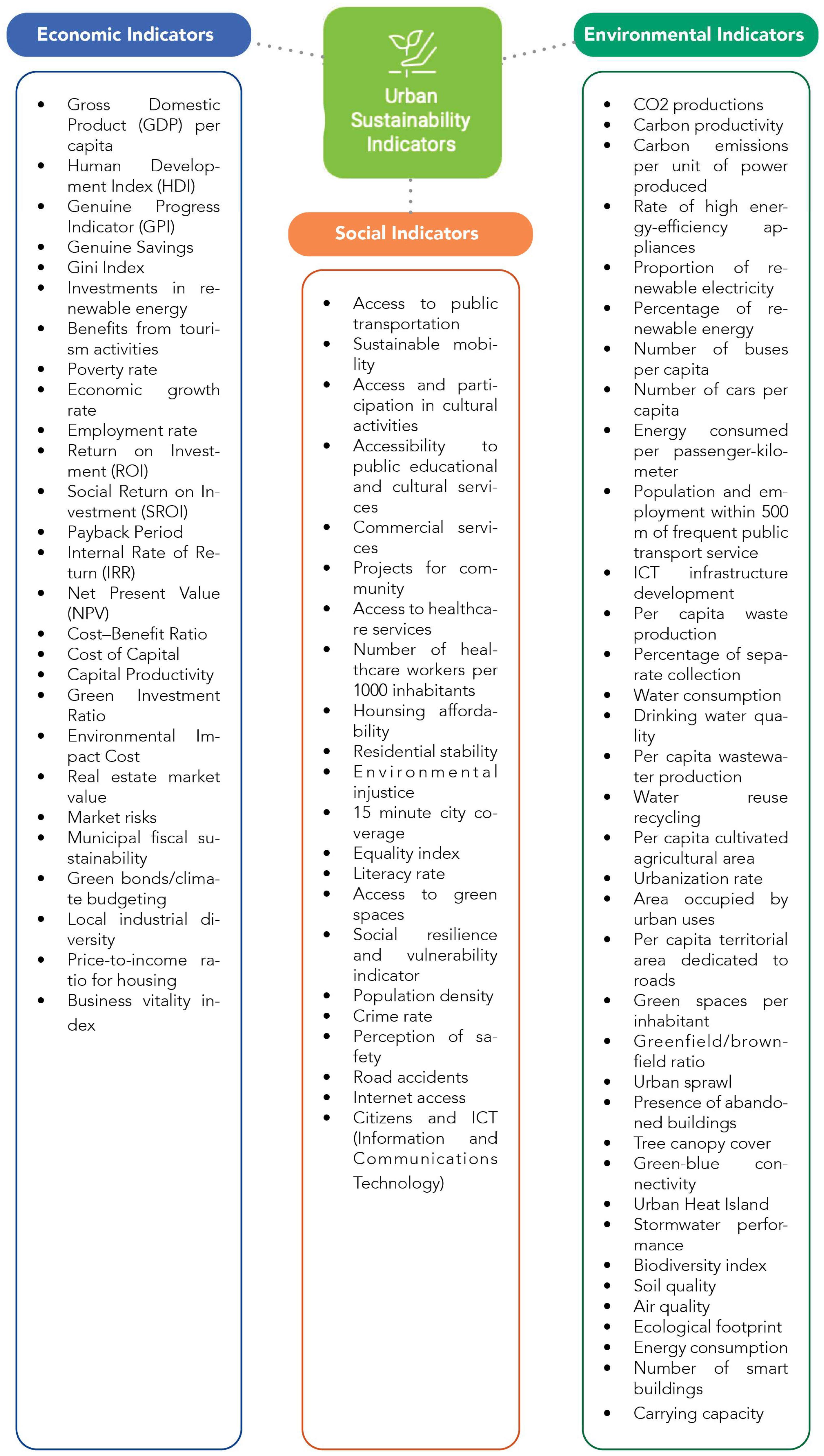
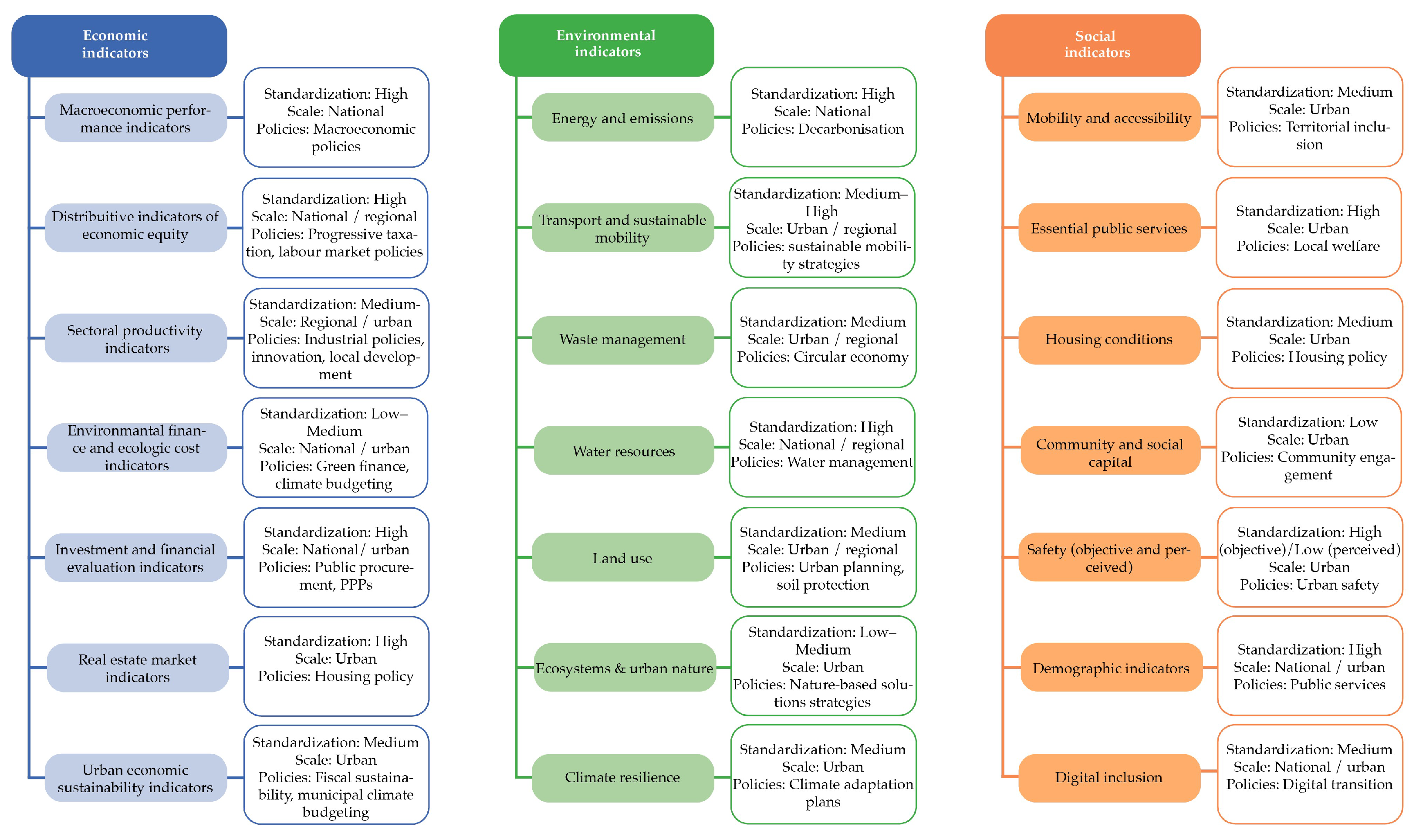
Figure 3 reports a comprehensive summary of the 85 indicators examined in this research, appropriately classified according to their respective thematic category. It should be pointed out that the denominations of the collected indicators derive from official sources and reference literature and are those generally used and consolidated regarding the reference to the specific indicator.
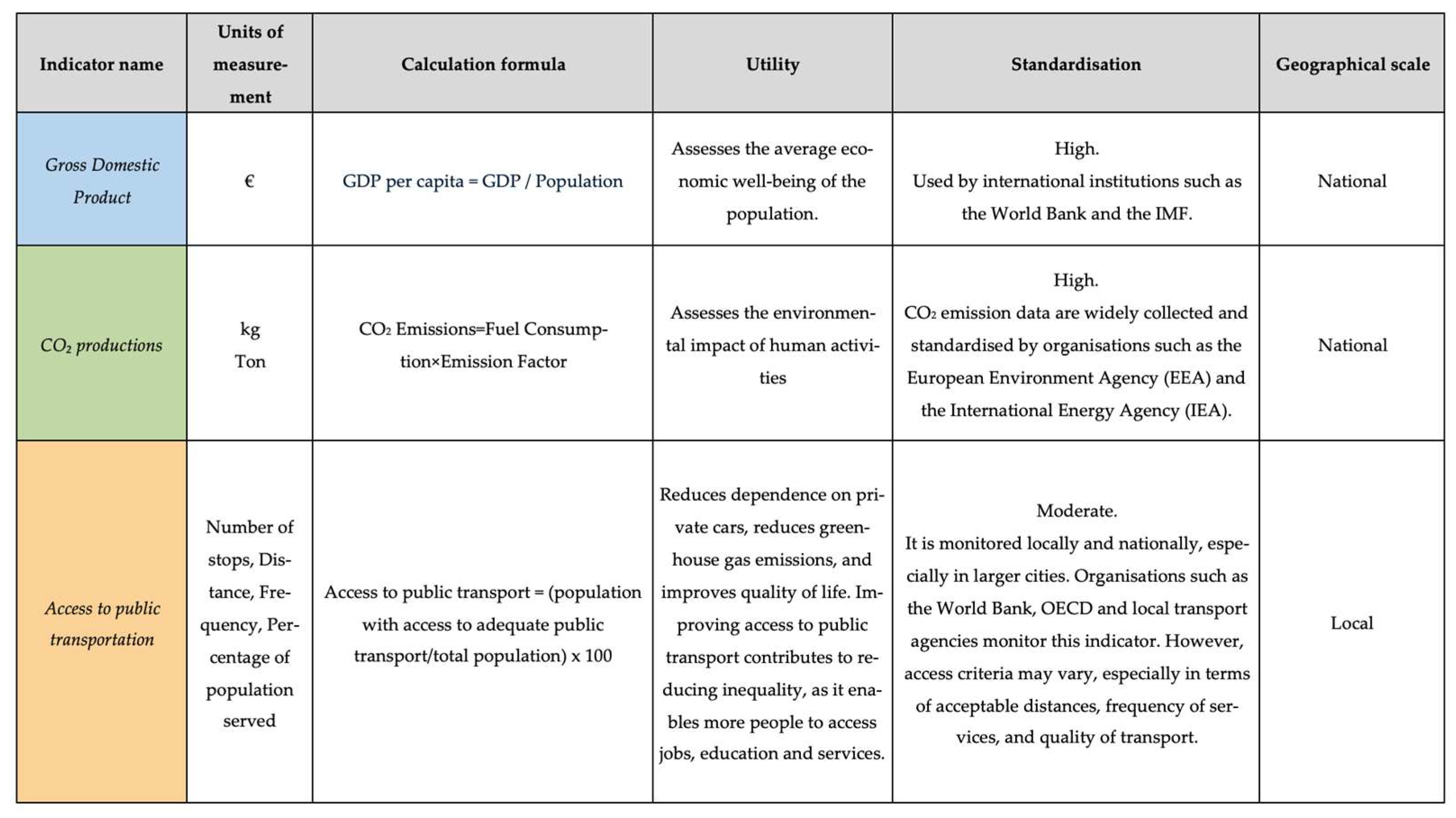
For illustrative purposes, three representative indicators—one for each sustainability dimension (economic, environmental, and social)—are shown in
Figure 4. These examples illustrate the main elements included in the abacus, such as the indicator name, unit of measurement, calculation formula, utility, standardizability level, and geographical scale of applicability. Furthermore, a detailed analysis of each indicator is provided in the “Indicator Card” in
Figure S1 of the
Supplementary File.
A critical aspect in the systematization of urban sustainability indicators concerns the issue of downscaling, that is, the adaptation of data originally available at larger scales—national or regional—to the urban or city level. Many sustainability indicators, such as those related to greenhouse gas emissions, energy consumption, or air quality, are collected and published at regional or national levels, and, therefore, do not directly reflect the specific dynamics of individual cities. The downscaling process involves the application of statistical and spatial methodologies to estimate the values consistent with the local scale, integrating secondary data and predictive models to obtain a more detailed and meaningful representation of urban sustainability. This step is essential to ensure that assessments of sustainability levels are accurate, comparable, and usable for urban planning, avoiding distortions resulting from the direct use of indicators at inappropriate scales.
However, downscaling also entails significant methodological challenges, including uncertainty associated with estimates, the availability of granular data, and the need to standardize aggregation criteria to ensure consistency across different cities.
The downscaling process is generally carried out based on various parameters specific to the urban context, such as the number of residents, the percentage of the population within specific income brackets, territorial characteristics, population density, impervious surface area, and other significant variables influencing the economic, environmental, and social performance of the city. These parameters allow the modulation of indicator values at the local scale, making them more consistent with urban specificities.
4.1. Economic Indicators
The abacus of economic indicators (
Table S1: Economic indicators in the
Supplementary File) shows a set of essential metrics suitable for analyzing the economic sustainability of a national territory, not only in terms of productive growth but also as a measure of social well-being.
Among the 27 selected economic indicators, the gross domestic product (GDP) per capita is the most consolidated over time, as it represents the average wealth produced by a country in a given period, usually one year. GDP is widely used to provide a clear and easily understandable indication of a nation’s economic condition, which is the main reason for which it is broadly adopted by institutions such as the World Bank and the International Monetary Fund (IMF) [
30]. Its high standardizability allows for direct and immediate comparisons between states and over time. However, as noted by Carra [
31], GDP per capita has significant limitations because it does not account for wealth distribution within the country nor the environmental impact of economic growth. In fact, for a nation with a high GDP but considerable social inequalities or serious environmental issues, this indicator would be less representative of the actual well-being of its citizens, as it is essentially aimed at evaluating the specific and unique wealth domain.
To address these shortcomings, the Human Development Index (HDI), which is defined as a macroeconomic development indicator introducing a broader perspective on national wealth through the integration of parameters related to health and education. In particular, the HDI aggregates four parameters: (i) life expectancy at birth, which represents the average expected lifespan of a newborn based on the mortality rates recorded in the year considered, (ii) mean years of schooling, i.e., the average number of years of education received by individuals aged 25 and over, (iii) expected years of schooling, i.e., the average number of years of education that a child entering the first grade is expected to receive based on current enrollment rates, and (iv) gross national income per capita at purchasing power parity.
This index—as reported by the article of Baumann [
32]—allows a more realistic evaluation of quality of life and shows a high degree of comparability, since it is calculated uniformly for all countries. Nevertheless, there is some subjectivity in assessing the input factors for the calculation: for example, the weight assigned to the education field compared to the health one can significantly influence the final result and raise questions about the actual comparability between nations with very different socio-economic contexts [
28].
A further step towards a more holistic vision of economic development is the Genuine Progress Indicator (GPI). The GPI differs from GDP because it subtracts the social and environmental costs associated with growth [
33]. However, the GPI struggles to gain global acceptance due to the lack of a unique and shared methodology, which limits its comparability and adoption by institutions [
34].
Similarly, the genuine savings indicator, developed by the World Bank [
35], measures the long-term economic sustainability by considering net savings, investments in human capital, and depreciation of natural resources over time. According to Mori and Christodoulou [
36], this approach helps us understand whether a nation is consuming its resources sustainably. Nevertheless, as with the GPI, international comparability remains a critical issue due to methodological difficulties and differences among national economic systems, which reduce the comparative effectiveness of these indicators.
When focusing on wealth distribution within a state, the Gini index is a consolidated and reliable tool for assessing economic inequality and how to demonstrate it by Pellegrino [
37]. It ranges from 0 (perfect equality) to 1 (maximum inequality). This index facilitates effective comparisons but does not explain the causes of inequality nor differentiate between various forms of economic disparity (e.g., disparities among regions, productive sectors, or age groups) [
38]. To overcome these limitations, the Gini index is often combined with other economic indicators, such as the poverty rate, which provide relevant information on the proportion of the population living below a minimum income threshold [
39]. Its comparability across national contexts is widely recognized, but the income factor alone does not capture the complexity of real economic conditions. Access to essential services, housing quality, local cost of living, and social support networks can vary significantly even with similar incomes, making an integrated approach to well-being assessment necessary [
40].
Closely related to income distribution is the employment rate, which measures the capacity of an economic system to absorb the labor force. While a high employment rate is generally interpreted positively, high attention is needed because the aggregate data include precarious, poorly paid, or involuntary part-time jobs, which do not guarantee stability or improved individual economic conditions. Although the indicator is standardized and shared by institutions such as the OECD, the International Labour Organization (ILO), and the World Bank, its “isolated” interpretation (not combined with other data) may be misleading regarding the overall quality of offered employment [
41].
In addition to these metrics, indicators related to specific productive sectors provide useful clues to understand current economic dynamics. Tourism, for example, represents a significant component of the economy in many parts of the world. Its impact is estimated through the economic multiplier, i.e., a coefficient used to evaluate the induced effect of tourist spending on the local system [
42]. The methodology proposed by the United Nations [
43] ensures a good level of standardization; however, the indicator remains sensitive to cyclical fluctuations and territorial policies that affect its comparative reliability.
In summary, economic performance over time continues to be measured primarily by the GDP growth rate, a parameter widely adopted by the IMF, the OECD, and the World Bank [
30,
44]. This standard metric quantifies the annual expansion of gross domestic product and allows coherent comparisons between economic systems. However, as emphasized by Shakir Hanna and Cesaretti [
45], high growth alone does not guarantee improved well-being. Economic expansion can coincide with increasing wealth concentration, declining stable employment, or environmental degradation. These ambiguities make it increasingly necessary to integrate growth rates with indicators that reflect the quality and sustainability of development.
In this regard, economic tools aimed at measuring ecological transition, such as the number of investments in renewable energy, are relevant. This indicator indicates the degree of transformation of the productive system towards low-emission models and serves as a strategic signal of the willingness to pursue sustainable reconversion paths [
46]. Nevertheless, international comparability remains limited due to market dynamics, public policies, and fiscal incentives that vary across countries [
47].
A broader measure of environmental finance is the green investment ratio, which expresses the percentage of capital allocated to projects with eco-compatible objectives. Despite the growing attention from governments and companies towards such investments, the lack of uniform criteria to define what truly qualifies as “green” limits the indicator’s comparative effectiveness. Differences in environmental reporting practices across countries and sectors contribute to reducing the clarity of the information provided. Moreover, this indicator is designed at the national scale and is difficult to apply at the urban scale [
48].
Finally, within the economic sphere of sustainability, the environmental impact cost estimates the economic amount necessary to compensate for or mitigate environmental damages related to an urban intervention. It includes expenses for remediation, cleanup, emissions trading mechanisms, and other balancing measures [
49,
50]. This metric is crucial to internalize negative environmental effects within economic evaluations, but its large-scale application remains complex. Damage quantification is often uncertain and highly dependent on the regulatory and technical context [
51].
In the field of economic investment evaluation, the analyzed literature highlights a series of “traditional” indicators capable of estimating the profitability and financial sustainability of both public and private projects. The Return on Investment (ROI) is one of the most commonly used indicators in the business field: it measures the profitability of an investment relative to the capital employed, providing easily interpretable data [
52]. Its standardized formula makes it suitable for direct comparisons between different projects. However, ROI does not consider the risk associated with the investment and can be strongly influenced by contextual factors such as market volatility or macroeconomic conditions [
53].
To broaden the evaluation to include benefits that are not only economic but also environmental and social, the Social Return on Investment (SROI) has been introduced. It assigns a monetary value to the positive impacts generated by a project in terms of collective well-being. This indicator is particularly useful for assessing initiatives in the social or environmental sectors, but its applicability remains limited due to the absence of a unique methodology and the variability of criteria adopted in different contexts [
54,
55].
In financial terms (i.e., from the private investor–initiative promoter point of view), the payback period (PbP) provides immediate information on the time required to recover the invested capital: although a simple and intuitive measure, it does not consider the time value of money and does not evaluate the overall profitability of an investment in the long term [
56]. To partly overcome these limitations, the payback period can be integrated with other indicators such as the internal rate of return (IRR). The IRR is widely used in project evaluation, as it represents the discount rate that nullifies the net present value (NPV) of the investment. As noted by Damodaran [
57], the IRR allows comparisons between projects of different scales and irregular cash flows and is extensively used in both public and private sectors. However, like the PbP, the IRR presents interpretative limits in the presence of multiple cash flow and sign changes, which can create ambiguity in identifying the correct value.
Complementary to the IRR, the NPV calculates the difference between the expected benefits and costs of a project discounted to present value (in fact, it is defined as discounted sum of the cash flows generated by the investment). This indicator, broadly used in corporate finance, while allowing the determination of an intervention’s economic convenience, is heavily influenced by the choice of discount rate, which is demonstrated by Arjunan [
58]. A related tool is the cost–benefit ratio, expressing the ratio between expected benefits and overall costs of an intervention. Mainly used to evaluate public interventions, this indicator has been adopted by, among others, Atkinson [
59] and Atkinson and Mourato [
50] to analyze the economic and environmental sustainability of infrastructure and environmental policies. The main limitation lies in the subjective component related to benefit monetization, which can introduce uncertainty margins in the final assessment. To improve robustness in policy evaluation, recent studies recommend adopting uncertainty treatment approaches such as shadow pricing ranges for environmental and social externalities, scenario-based discount rates, and sensitivity analysis bands. These methods enhance transparency and help avoid systematic underestimation of long-term impacts associated with urban sustainability policies [
60].
In investment management, it is also fundamental to consider the cost of capital, which represents the overall financing cost of a project, including both debt and equity components. This parameter is central to corporate decisions and is influenced by financial market conditions and specific characteristics of the company or promoting entity [
53].
Finally, the capital productivity indicator measures the efficiency with which capital is used to generate economic value [
61,
62]. Improving this indicator is considered a priority objective to ensure stable and sustainable economic growth, especially in contexts where financial and natural resources face increasingly stringent constraints. At the territorial level, the real estate market value is particularly relevant, as it reflects both the perceived quality of the built environment and expectations for future development. As noted by Des Rosiers [
63], property values integrate numerous economic, environmental, and infrastructural variables, thus representing a synthetic indicator of an area’s livability. Its evolution over time can provide indirect indications about the effectiveness of public policies, regeneration projects, or environmental mitigation interventions. For proper interpretation, advanced statistical tools such as hedonic analysis or spatial regression models should be adopted to isolate the effect of single factors [
64,
65].
In this framework, the market risks provide a measure of the economic instability associated with urban investments, especially in contexts prone to speculation. As highlighted by Orsi [
66], these risks may contribute to triggering unsustainable long-term dynamics such as real estate bubbles or excessive asset value fluctuations. Although difficult to predict exactly, monitoring these risks is essential to prevent systemic imbalances.
At this macro perspective that involves a larger scale (national and regional), an increasingly relevant shift in contemporary sustainability assessment concerns the operability of economic metrics at the urban scale. Municipal fiscal sustainability, for instance, enables the evaluation of a city’s ability to maintain structural balance over time, avoiding chronic deficit conditions that constrain transformation investment capacity [
67]. In parallel, climate budgeting practices and the deployment of municipal green bonds allow the observation of how local governments allocate public resources and financial instruments toward decarbonization and resilience strategies, making the ecological transition measurable at the city level [
68]. Local industrial diversity is also crucial, as it reflects the robustness of the territorial productive system in relation to sectoral shocks and cyclical fluctuations, while the price-to-income ratio provides a direct and tangible measure of housing affordability, linking income structure, real estate values, and distributive equity in access to housing [
69,
70]. Finally, entrepreneurial vitality—captured through business openings, closures, and turnover rates—offers a synthetic reading of the dynamism of the local economic tissue and its ability to generate innovation, employment, and distributed value [
71]. Together, these metrics expand the interpretative capacity of the economic sphere in urban sustainability assessments, moving beyond purely macro growth analyses and allowing the evaluation of the real capability of cities to sustain resilient, equitable, and transformative development pathways over time.
4.2. Environmental Indicators
The overview of environmental indicators (
Table S2: Environmental indicators in the
Supplementary File) shows a framework of the metrics used to assess environmental sustainability and the impact that human activities have on ecosystems. These tools are essential for monitoring the consumption of natural resources in a specific site, the energy efficiency of assets, air and water quality, waste management, and the level of accessibility to infrastructure. However, their effectiveness depends on the comparability level across countries, the availability of reliable data, and their applicability in strategic environmental and urban planning contexts. In the present analysis, 36 indicators belonging to this thematic category have been identified. To facilitate reading, the indicators are divided into topic subcategories: energy and emissions, transportation, land use, waste, water resources, biodiversity, environmental quality, and digital technologies.
Within the energy and emissions group, one of the most critical aspects of the environmental qualification of interventions in a specific site is CO
2 production, which measures the amount of carbon dioxide released into the atmosphere due to industrial activities, transportation, and energy production. This data, detected and monitored by institutions such as the European Environment Agency (EEA) and the International Energy Agency (IEA), demonstrated by Bărbulescu [
72] and Dincer [
73], is highly standardized and used to track governments’ progress towards emission reduction. However, this does not allow for an understanding of the overall global energy consumption of a nation; for this reason, other indicators are applied, such as carbon productivity, which relate GDP to CO
2 emissions, thereby evaluating the economic value generated for each ton of carbon emitted [
74]. This indicator is useful for comparing the sustainability of global economies but does not account for the phenomenon of production offshoring, which could reduce the internal emissions of a specific country at the expense of another [
75].
Detailed analysis of the environmental impact of energy production is generally carried out through the indicator of carbon emissions per unit of power produced, which relates CO
2 emissions to the energy generated. This value is significant for comparing different energy generation technologies and monitoring the transition towards renewable sources in different geographical contexts [
76,
77].
To improve energy efficiency and decrease emissions, it is essential to promote the most sustainable technologies through incentives. To this end, the usage rate of high energy-efficiency appliances evaluates the spread of low-consumption devices, although—as reported by Tol [
78], and Ringel et al. [
79] despite being a highly comparable indicator, it does not consider economic barriers limiting consumer access to these technologies and, as noted for other indicators, it has more of a regional than urban dimension.
In the field of energy transition, some very useful indicators are the proportion of renewable electricity—i.e., the ratio between electricity generated from sustainable sources compared to total production—and the percentage of renewable energy, which instead considers the entire energy consumption of the country (including industrial and transport sectors). Both indicators are essential for monitoring decarbonization [
80,
81], although they do not take into account the variability of renewable sources and issues related to energy storage [
82].
In the context of environmental indicators, the transport sector plays an important role, having a significant impact on environmental sustainability. The number of buses per capita and cars per capita provides information on the dependency on private transport and the actual availability of public transport means in a given territory. As reported in different studies [
83,
84,
85], even if these data are extremely comparable, they do not provide information on the quality and coverage of transport networks and should be used to compare very similar contexts.
Within this topic area, the indicator of energy consumed per passenger-kilometer allows analysis of the energy efficiency of different means of transport in relation to actual mobility. As indicated in the reports of the Higher Institute for Environmental Protection and Research (ISPRA) [
86,
87], this indicator helps plan sustainable systems, but its interpretation should consider vehicle load capacity and current occupancy rates. For a consistent comparison among transport modes, the energy consumption should be explicitly expressed in megajoules per passenger-kilometer or ton-kilometer and include load or occupancy factors to avoid methodological distortions.
According to SDG indicator 11.2.1 [
88], the share of population and employment located within 500 m of a frequent public transport stop constitutes a robust metric for assessing accessibility to mobility services at the urban scale. This indicator allows spatially explicit evaluations and provides a more realistic understanding of local travel opportunities, supporting planners in identifying underserved areas and prioritizing transport infrastructure investments. Its comparability across cities is increasing thanks to the availability of georeferenced datasets derived from local authorities and open digital platforms [
88,
89,
90].
In addition, the development of information and communication technologies (ICT) infrastructure is closely linked to economic growth and environmental development. Measuring the ICT infrastructure development indicator is crucial to estimate the degree of digitalization and the environmental impact of transport and industrial activities, aiming to reduce it through appropriate choice processes [
91]. However, its standardization is moderate, as measurement methodologies vary between countries and depend on development strategies linked to national policies [
92].
Regarding the waste management issue, the per capita waste production measures the amount of waste generated by each individual, while the percentage of separate collection provides information on the effectiveness of recycling policies adopted in each territorial area. While the first parameter (waste production) is a well-harmonized indicator, the second one (separate collection) varies significantly between countries due to different classification approaches, but it is more significant when referring to neighboring territories.
As demonstrated in studies by Ogbonna et al. [
93] and Marinello et al. [
94], waste management involves relevant environmental problems, influencing soil, air, and water quality, as well as the balance of climate-altering emissions. The choice of collection, disposal, and recycling systems directly influences the sustainability of the material cycle and the capacity of cities to reduce overall environmental impact [
95,
96].
In the mentioned framework and in current environmental contingence, managing water resources is central since water consumption is a key indicator for territorial planning. Studies by Corona [
97] compare international trends in environmental indicators and highlight water consumption dynamics. Indicators related to drinking water quality, per capita wastewater production, and water reuse recycling are the most reliable and are all basic elements for measuring water management sustainability [
98,
99,
100,
101,
102].
Land use also represents a fundamental aspect of environmental sustainability. The per capita cultivated agricultural area measures the amount of agricultural land available per inhabitant; it also provides indications about a nation’s self-sufficiency capacity and the balance between agriculture and urbanization. As reported in the study of Valmori et al. [
103], this indicator is widely used for implementing agricultural and demographic policies but can be influenced by climatic conditions and soil quality [
104].
On the other hand, the level of urbanization controls the growth of urban areas and migration flows from rural to urban areas, with related implications on natural resource management and infrastructure sustainability. In this sense, the urbanization rate is a synthetic indicator measuring the percentage of the population residing in urban areas relative to the national total. It is commonly used to evaluate settlement dynamics, ecosystem pressure, and the capacity of cities to absorb migration flows. As highlighted by Mwanza [
105] and Salvini [
106], a rising rate can reflect economic and infrastructural development but often leads to increased land consumption and territorial inequalities, requiring careful urban planning. Despite its widespread applicability, a certain heterogeneity critical issue in the statistical definition of “urban area” among different countries is attested.
Another structural indicator is the area occupied by urban uses, which quantifies the territorial extent dedicated to buildings, infrastructure, and urban functions. This indicator is fundamental for monitoring city expansion and the degree of soil artificialization and is frequently used in land take and soil consumption studies [
107]. Its measurement is useful for evaluations of urban density, land use efficiency, and the sustainability of urban growth. However, classification methods for urban uses may vary significantly depending on local databases and planning regulations, making international comparability complex. In this framework, research by Ronchi et al. [
108] provides historical data and analyses on urbanization dynamics in Italy and major European countries, highlighting differences in cities’ development models and land management. It is clear that urbanization has a significant impact on the natural environment and can be monitored through a set of indicators capable of quantifying the urban surface occupied, per capita territorial area dedicated to roads, and green spaces per inhabitant. Although these indicators provide essential information on the quality of life and anthropic pressure on the territory, their standardization shows the difficulties due to different methodologies in classifying urban areas.
Furthermore, the greenfield/brownfield ratio supports the assessment of the environmental impact of urban development, highlighting natural land consumption versus redevelopment of already urbanized areas. Studies by Passalacqua and Pozzo [
109] and Battisti et al. [
110] indicate methodological approaches to balance financial and environmental sustainability in urban redevelopment projects as well as the containment of uncontrolled urban expansion, promoting more coherent and sustainable land use.
In this perspective, urban sprawl provides information on population distribution and infrastructure sustainability. According to Merola’s analysis [
111], this indicator is fundamental for estimating settlement dynamics and their impact on urban resources [
112]. Moreover, the presence of abandoned buildings may be linked to urban decay phenomenon, and the identification of potential areas for redevelopment represents a crucial step in the definition of effective urban transformation operations to be carried out: the studies of Armondi [
113], as well as models developed by Bianchi [
114], provide interesting tools to detect environmental criticalities in urban areas and to determine the intervention priorities from a regenerative ecological and functional point of view.
Growing attention is being paid to the capacity of cities to maintain and regenerate ecological functions. For this purpose, the indicator of tree canopy cover is widely recognized as a key metric for urban ecological quality, as it supports biodiversity, mitigates noise and air pollution, and contributes to thermal comfort in densely built environments. A rising body of literature highlights its strong association with improved physical and mental health conditions, although standardized datasets are not always available at the municipal level due to heterogeneity in monitoring methodologies [
115].
The spatial structure of ecosystems within the city also plays a crucial role. Indicators assessing green–blue connectivity such as patch size, edge density, and landscape connectivity enable the quantification of the degree of fragmentation of nature-based systems. Their value lies in supporting ecological continuity, species movement, and the integration of water-sensitive infrastructure within compact urban forms. Nevertheless, varying classification criteria across countries may affect the cross-context comparability of these indicators [
116].
A complementary dimension of climate adaptation relates to the urban heat island (UHI) intensity, which measures temperature differences between urbanized and rural areas. UHI is one of the most critical phenomena affecting human health, energy consumption, and environmental comfort in cities. As emphasized by recent international studies, measurement protocols should consider factors such as seasonal variations, land cover characteristics, and local microclimates to allow more consistent benchmarking between cities [
117].
Finally, the indicator of stormwater performance evaluates the capability of urban drainage systems to reduce surface runoff and limit combined sewer overflow (CSO) events during extreme rainfall. This metric is critical for assessing resilience to climate change impacts and supporting sustainable water management in urban catchments. Despite its operational relevance, the availability of detailed data on runoff volumes and CSO frequency often depends on specific monitoring programs carried out by local utilities and agencies, leading to possible inconsistencies between territories [
118].
During the last decades, the question of ecosystem health has triggered an increasing scientific debate. This environmental aspect is generally monitored through the biodiversity index, which compares the number of current species with those historically present in a given habitat. In particular, the indicator makes it possible to evaluate conservation policies’ effectiveness, but its comparability is currently challenging, as data quality varies by region and monitoring tools used. Within the reference literature, for example, Campo [
119] explores methodologies to assess biodiversity from ecological and economic perspectives and highlights the need for standardized frameworks that integrate diverse data sources to improve the accuracy and comparability of biodiversity assessments across different territories [
120].
Another fundamental component for estimating environmental sustainability is the soil quality analysis, which depends on several factors such as the heavy metal concentration, soil biodiversity, and erosion index [
121,
122].
The environmental health is also influenced by the air quality: this indicator can be highly standardized thanks to guidelines issued by the World Health Organization (WHO) [
123] that provide clear thresholds and measurement protocols to ensure consistent and reliable assessment across different regions [
124].
By considering the global environmental impact—that is, the overall strain placed on ecosystems by communities through resource consumption and waste production—one of the most relevant indicators is the ecological footprint, which measures human demand for natural resources against the Earth’s capacity to regenerate them. Although it is a widely recognized concept, its standardization is still moderate, as calculation approaches can vary between nations [
125,
126].
With reference to the energy topic, a parameter closely linked to sustainability is energy consumption, which evaluates the efficiency of energy resource use and its environmental impact. Thanks to standardization provided by institutions such as the International Energy Agency (IEA) [
127], as well as studies by Ballucchi [
128], it is possible to compare consumption levels between countries, despite having to consider disparities in national energy mixes.
Innovative technologies adopted in the building sector are also monitored through the number of smart buildings, an indicator that reflects the level of innovation and sustainability of constructions. As described in studies by Agrosi [
129], smart buildings represent a key element of the transition toward more sustainable cities. Notwithstanding the existence of standards, such as Leadership in Energy and Environmental Design (LEED) [
130], that provide certification criteria, there is still not a globally uniform methodology to define smart buildings.
The balance between urban development and sustainability is also assessed through the carrying capacity indicator that measures the pressure exerted by human activities on a given ecosystem. This aspect is essential to ensure that economic growth, urbanization, and tourism expansion do not exceed natural resource limits and aims to prevent the overexploitation of ecosystems and excessive burden on infrastructure [
131,
132]. However, the comparability of this value is complex since the parameters to be considered vary depending on the environmental context and geographical specificities.
4.3. Social Indicators
The analysis of social indicators (reported in
Table S3: Social indicators in the
Supplementary File) allows for a comprehensive understanding of territorial sustainability by complementing economic and environmental aspects through the measurement of variables that reflect quality of life, equity in access to resources, community cohesion, and the resilience of urban systems. The 22 selected social indicators provide a multidimensional overview of well-being, highlighting both the material conditions of living and the relational, cultural, and perceptual dynamics that determine its sustainability over time.
As with urban environmental sustainability, the access to public transportation represents a cross-cutting factor in the social field: while in the former context (environmental) it contributes to emission reductions and focuses on energy efficiency, in the social sphere it assumes a different meaning, linked to the number of stops, the distance, the frequency, and the percentage of the population served by the existing system [
133,
134]. The ease of reaching essential services such as schools, hospitals, and workplaces directly impacts the socio-territorial inclusion levels. However, its comparability is often limited, as the measurement indicators vary significantly between urban contexts and countries.
Connected to this dimension, the indicator of sustainable mobility is used to (i) monitor the reduction in greenhouse gas emissions, (ii) identify areas for improvement in urban and interurban transport networks, and (iii) measure the current and planned accessibility level following the implementation of specific and targeted measures. Its standardization is moderate, as official data from censuses, reports and geographic information systems (GIS) can be utilized, but calculation methodologies may vary depending on the factors included and local priorities [
135,
136].
The indicators related to cultural life also play a significant role. To measure the level of access and participation in cultural activities, the indicator regarding the promotion of cultural events (number of events organized annually compared to the inhabitants’ number) is often used. It is useful for monitoring investments in culture within a specific geographic context and for identifying opportunities to improve the cultural offerings. However, its international comparability is limited, as data collection mainly occurs through local authorities and event organizers, with variations in calculation approaches [
137]. Furthermore, corrections based on the seasonality and scale within the local context, as well as participation or attendance at the cultural events rates, should be included to avoid overestimation in tourism-driven contexts and to ensure cross-city comparability. According to Landmann [
138], this parameter represents not only a quantitative signal of cultural attractiveness, but also a strategic baseline for evaluating cultural policy effectiveness, supporting the definition of new initiatives, and improving those already implemented. In addition, when interpreted through a sustainability-oriented lens, cultural participation indicators contribute to identifying distributional asymmetries in access to cultural infrastructure across different socio-economic groups, highlighting potential territorial inequalities that often remain implicit in aggregated economic measures. For this reason, the integration of cultural metrics within urban sustainability frameworks is increasingly essential, as they provide a relevant operational dimension for linking cultural ecosystems, local identity formation processes, and long-term regenerative strategies at the city scale.
An indicator directly connected to the cultural inclusion of a city is the accessibility to public educational and cultural services, which calculates the number of services per inhabitant. This is relevant for assessing the accessibility level of essential facilities and supporting the planning of investments in the specific (educational and cultural) sectors. Its uniformity is high since data can be gathered from local administrations and institutions such as the OECD [
139] or the United Nations Educational, Scientific and Cultural Organization (UNESCO) [
140], which provide standardized quality criteria.
From the economic point of view, the indicator related to the commercial services estimates the number of them per inhabitant, monitors the balance between demand and supply, and identifies possible shortages or overcrowding. It is highly standardized, as input data are available through business registries and commercial censuses and, moreover, the calculation methodology is unique and applicable across multiple geographic contexts. As highlighted by ISTAT [
141], measuring commercial services is strictly associated with quality of urban life, as it considers the presence of economic activities that meet the daily needs of the population, reducing the requirement for travel and contributing to the economic and social vitality of the neighborhood [
142]. Participation or utilization rates improve the interpretation of commercial services density, especially in areas influenced by temporary population flows.
The indicator on community projects aims to evaluate the effectiveness of public policies and private initiatives focused on collective well-being. Measured in terms of the number of projects completed per 1000 inhabitants, it facilitates monitoring community involvement and supports the strategic definition of targeted interventions [
143,
144]. Its replicability is generally moderate, as information collection depends on public reports, municipal budgets, and documentation from promoting organizations. In addition, the methodologies may vary depending on the specific objectives of each project that are strongly connected to the context specificities in which the initiative has been developed. According to the “Obiettivo Europa” portal, this indicator allows us to assess the success of social and community initiatives, providing a real indication of communities’ participation, the impact of interventions on the territory, and the effectiveness in addressing citizens’ needs.
The access to healthcare services and the number of healthcare workers per 1000 inhabitants are two highly standardized indicators that allow the evaluation of the globality of the healthcare system and identification of regional disparities or structural deficiencies [
145,
146]. Similarly to the investments in renewable energy in the environmental field, the presence of a widespread healthcare network represents a tangible signal of the commitment to guarantee fundamental collective rights [
147,
148].
In the same context of the sustainability social dimension, housing affordability represents a main dimension of urban equity and is commonly measured through rent-to-income or cost burden ratios, which indicate the proportion of household income reserved to housing expenses. This indicator is essential for detecting socioeconomic vulnerability and gentrification pressures, although comparability depends on census frequency and the transparency of rental market data [
149].
Housing affordability and residential stability are closely interrelated, as affordable housing options reduce the risk of frequent relocations, evictions, or forced mobility, thereby fostering stable living conditions. Stable housing, in turn, enhances community cohesion, supports long-term access to local services (including schools and healthcare), and contributes to overall social sustainability in urban areas. In particular, the residential stability can be assessed through out-migration rates or eviction rates, which serve as early warnings of displacement dynamics and spatial inequalities. The indicator gains relevance when georeferenced at the neighborhood scale [
150].
From a social sustainability perspective, housing affordability and residential stability are key factors influencing environmental injustice, since housing constraints can concentrate disadvantaged groups in environmentally burdened urban areas. Strengthening both aspects contributes to reducing inequities and fostering environmental justice. Specifically, environmental injustice assesses exposure differentials to pollutants and unequal access to green and healthy environments among groups distinguished by income, age, gender, or ethnicity. It enables the spatial identification of urban hotspots where multiple disadvantages overlap [
151].
In addition, the 15 min city coverage indicator emphasizes the equitable spatial access to essential urban services, measuring the share of residents who can reach essential daily services (e.g., education, healthcare, grocery stores, parks, workplaces) within a short walking or cycling distance. Ensuring that affordable and stable housing is located within well-connected, service-rich neighborhoods helps reduce social and environmental inequalities, supports healthier lifestyles, and strengthens the overall inclusiveness and resilience of urban systems. In these terms, the inherently spatial nature of this indicator supports proximity-based planning and territorial inclusion strategies [
152].
In parallel, the gender equality indicator highlights persistent inequalities in critical areas such as employment, education, and political sectors. Analogous to the Gini coefficient for wealth, the equality index offers a concise but meaningful reading of gaps between social groups, acting as a catalyst for targeted interventions [
153,
154].
Alongside structural aspects, human capital is evaluated through indicators such as the literacy rate, which constitutes an essential measure of cultural inclusion and the capacity for active citizen participation [
155]. The quality of education is reflected in the access to professional opportunities and in the spread of essential skills to face contemporary challenges, including digital and environmental transitions [
156].
Furthermore, the access to green spaces, already relevant from an environmental perspective, assumes a social function in the social field, as it is closely linked to psycho-physical health and quality of urban life. As observed for smart buildings in the environmental domain, the presence of accessible and well-maintained public spaces helps strengthen community ties and the sense of belonging [
157].
In territories characterized by sudden and critical shocks, such as environmental disasters, economic crises, or pandemics, the concept of social resilience—understood as the collective capacity to adapt and respond—becomes central [
158]. The vulnerability indicator is associated with this framework, and it is useful for identifying the areas most exposed to environmental or socio-economic risks and for calibrating mitigation policies. Although less standardized than other parameters, these indicators assume a growing role in integrated planning, especially in urban and territorial contexts. Studies by Graziano et al. [
159] and Cutter et al. [
160] point out how the territorial resilience is currently a strategic focus for risk management and strengthening social capital.
Complementary to this dimension, the analysis of the demographic structure of a city is represented by indicators such as the population density or the age group composition. In highly urbanized territories, these data guide the distribution of public services, whereas in peripheral or marginal areas, they allow counteracting depopulation and promoting social cohesion. With reference to their assessment phases, the availability of data through censuses and local registries ensures a high level of comparability [
161,
162].
Urban safety, both objectively and subjectively, constitutes another central dimension of collective well-being. The crime rate, based on official data, offers a standardized measurement of recorded incidents; alongside it, the perception of safety provides a more subjective but equally relevant reading of levels of trust, fear, and everyday life quality for the community. According to the Safety Perceptions Index 2023 [
163], the gap between actual and perceived data can significantly influence the urban space planning and the effectiveness of local targeted policies [
164]. Moreover, integrating both perceived and objective safety dimensions is essential to avoid misleading interpretations and policy mis-targeting. When the deviation between crime statistics and perceived risk becomes structurally high, this discrepancy can distort political priorities, redirect investments toward symbolic security interventions, and undermine the real allocation of resources needed for structural prevention and long-term resilience. Therefore, incorporating a deviation metric between objective crime values and perceived safety becomes a fundamental component to guide urban policies toward evidence-based and socially grounded actions, supporting not only crime reduction but also trust reconstruction, civic legitimacy, and inclusive access to public space.
Still on safety, the road accidents indicator, expressed in absolute value or rate per inhabitants, evaluates the infrastructure efficiency and orient the prevention policies to be implemented. As with other aspects of urban quality, for the Italian context the data analysis provided by ISTAT [
165] and law enforcement agencies allows reliable monitoring over time [
166,
167,
168].
With regard to the transition toward a digital society topic, an additional dimension of social sustainability has been introduced during the last decades. Internet access, measured by the proportion of the connected population, is today an indispensable indicator for assessing informational inclusion and the ability to use online services. Moreover, the perception of users regarding technology capacity, which investigates the perceived adequacy of digital solutions in relation to daily needs, is analyzed. As noted in the ISTAT Citizens [
169] and ICT reports [
170], this indicator helps identify cultural, cognitive, or infrastructural barriers that hinder digital equity, which is a new frontier of social justice.
Taken together, the mentioned indicators provide a complex and integrated framework of social well-being in territories, intertwining material and immaterial, structural, and perceptual dimensions. While some of them, such as literacy or access to healthcare, are already consolidated in comparative analysis, others, such as social resilience or safety perception, determine new methodological challenges but, at the same time, offer decisive insights for territorial planning and the inclusive policies definition [
171,
172]. Their integrated and combined use, in synergy with economic and environmental indicators, allows progress toward truly multidimensional sustainability models, which achieve a holistic and not sectoral and fragmented vision of contemporary cities.
4.4. Outcomes Summary
Figure 5 provides an overview of the three identified domains (economic, environmental, social), the main indicator families within each domain, their average levels of standardization, typical spatial scales, and the main policy linkages/uses. In particular, this summary allows for a clearer understanding of (i) the sustainability indicators abacus structure and (ii) their purposes, facilitating their comparison, interpretation, and potential use in guiding urban policy and planning decisions.
From a comparative perspective, the analysis carried out on the 85 sustainability indicators highlights significant operational differences compared to major international frameworks, such as the ISO 37120/37122/37123 series, UN-Habitat’s Global Urban Monitoring Framework, the OECD urban indicators, and the scientific literature on the topic. While these systems provide consolidated thematic collections, their structure does not allow for a systematic assessment of key technical aspects such as units of measurement, calculation formulas, the level of standardizability, or the territorial scale of application.
The systematic framework proposed in this study has allowed us to examine each indicator through a coherent set of analytical dimensions, making the internal structure of the metrics more transparent and facilitating an effective comparison between indicators belonging to different domains. Moreover, adopting the 3E model enables the interpretation of the results not as isolated values, but as part of interconnected urban processes, pointing out relationships that existing frameworks do not explicitly show.
The combination of the 3E model and the developed sustainability indicators’ abacus thus represents a methodological improvement over current classifications, providing a more comprehensive, transparent, and operationally applicable tool that can better support evidence-based urban policy and planning across diverse local contexts.
Furthermore, it can support the prioritization of strategies on territories and foster coordinated governance by clearly identifying which urban issues require urgent attention and which interventions are likely to be most effective.
5. Conclusions and Future Developments
In light of the growing international interest in the measurement of urban sustainability and the strategic role that economic, environmental, and social indicators play in supporting effective territorial policies, the present research has attempted to systematize and critically analyze the most recurrent evaluation metrics used to assess urban sustainability at a global level. In particular, the aim of the study has concerned the proposal of an organic and multidimensional overview of the economic, environmental, and social indicators (i.e., the three main dimensions of the sustainability concept), investigating their concrete ability to orient the urban regeneration processes and the policy decisions. The analysis has highlighted how the integrated use of the detected indicators is currently essential to address the challenges of urban sustainability. However, their effectiveness does not lie solely in the availability of reliable data, but also in the capacity to interpret them within coherent analytical frameworks that overcome the sectoral approach and translate them into strategic tools for the planning and evaluation of public strategies. The information synthesis and consistency, the methodological transparency, and the data accessibility thus emerge as essential prerequisites to ensure a responsible and transformative use of these tools [
173,
174].
Overall, this study provides a focused and original contribution by integrating 85 indicators within the 3E model, seeking to move beyond the traditional sectoral classifications found in major international frameworks and the reference literature.
The structured indicator abacus introduces methodological transparency, allowing clear comparison of units of measurement, calculation formulas, scales of application, and standardizability. By combining the conceptual model with a practical operational tool, the research not only enhances the interpretability of urban sustainability indicators but also provides a transferable framework that can support urban sustainability assessments for evidence-based policy decisions and comparative analyses across diverse urban territories.
A significant critical aspect that characterized the urban economic, environmental, and social sustainability indicators regards the technological evolution of measurement approaches. The expansion of real-time data and artificial intelligence and machine learning techniques now offer opportunities to make indicators more dynamic, predictive, and adaptive. Advanced tools such as digital twins, forecast models, and GIS can (i) support simulations of future scenarios, (ii) identify latent criticalities of planning alternatives, and (iii) guide urban governance towards more proactive and resilient approaches. For this potential to be translated into effective practices, however, a paradigm shift in urban sustainability governance is needed. A structured and continuous involvement of local stakeholders—institutions, businesses, communities—is required so that the construction and use of indicators become participatory processes. The measurement is never neutral: it reflects political priorities, methodological choices, and visions of the future. Particular attention should be paid to disaggregated data—by gender, age, social vulnerability—in order to ensure more inclusive readings and guide more equitable policies. Only through a methodological evolution capable of grasping the complexity of urban contexts will it be possible to build truly effective evaluation tools in the transition towards sustainable, resilient, and just cities. In this sense, future research developments may focus on proposing an innovative methodological approach aimed at defining a multicriteria composite index.
In this perspective, the methodological development of the abacus introduced in the present research will be structured according to a clear operational workflow including:
Definition of the assessment matrix, in which the indicators represent the evaluation criteria;
Quantitative validation, through correlations analyses;
Normalization of heterogeneous metrics, through the normalization methods commonly used in the Technique for Order Preference by Similarity to Ideal Solution (TOPSIS), both in terms of distributive and ideal normalization;
Weighting, through approaches based on the pairwise comparison, such as the Analytic Hierarchy Process (AHP), the Preference Ranking Organization Method for Enrichment Evaluation (PROMETHEE), entropy-based methods, or stakeholder Delphi techniques;
Aggregation, by applying compensatory techniques (Simple Additive Weighting), partially compensatory ones (Weighted Product Model), and non-compensatory ones (ELimination Et Choix Traduisant la REalité);
Uncertainty and sensitivity analyses to assess the robustness of the obtained results.
These methodological steps will enable the evolution of the current conceptual framework of urban sustainability indicators into a robust, decision-oriented sustainability assessment tool. The resulting index will integrate and combine various measured indicators to construct a synthetic and evaluative parameter of urban sustainability [
1]. Therefore, the developed assessment tool will effectively synthesize the multiple dimensions of sustainability, providing a comprehensive and comparable measure that supports more informed decision-making processes, thereby contributing to more effective urban governance and sustainable city development.
In conclusion, the mentioned methodological pathway lays the groundwork for a new generation of integrated and evidence-based tools capable of guiding urban transition processes toward sustainability. By combining quantitative rigor with participatory and multicriteria approaches, future research can expand the applicability of this framework to different urban contexts, scales, and policy domains. Ultimately, such an advancement will strengthen the link between scientific knowledge and practical decision-making, fostering resilient, inclusive, and sustainable urban transformations.
Accordingly, a further insight into this research may concern the application of the set of urban sustainability indicators outlined in this work to different cities, in order to test the validity of the abacus and to identify the specific sustainability level by taking into account the three main spheres (economic, environmental, and social). The assessment of each indicator for diverse geographical contexts and its subsequent aggregation into a composite index will help to inform and guide future urban and territorial policies. Moreover, applying this framework across multiple urban environments will provide opportunities to benchmark performance, uncover context-specific challenges, highlight priorities, and identify best practices that can be shared and adapted across cities in terms of actionable insights for local decision-makers. These analyses will support adaptive planning strategies, facilitate knowledge transfer among cities, and contribute to the development of more responsive and context-sensitive approaches to sustainable urban management.