




Spatial Distribution and Tourism Potential of Intangible Cultural Heritage and Historic and Cultural Cities—A Case Study of Anhui Province, China
Abstract
1. Introduction
1.1. Intangible Cultural Heritage (ICH)
1.1.1. Spatial Distribution and Place-Making
1.1.2. Cultural and Creative Transformation and Design Development
1.2. Material Spatial Elements
1.2.1. Definition and Implications of the Historical and Cultural City (HHC) Concept
1.2.2. The Formation of China’s HHC Protection System
1.3. The Relationship Between Intangible Cultural Heritage and Elements of Physical Space
2. Data and Methods
2.1. Field of Research
2.2. Data Acquisition and Processing
2.3. Analysis of Spatial Distribution Patterns
2.4. Kernel Density Estimation
2.5. The Correlation Measure Between ICH Tourism and HCC
2.6. Construction of the ICH Tourism and HCC Matrix
3. Results
3.1. The Quantity and the Type Structure Characteristics of ICH in Anhui Province
3.2. Spatial Distribution of Tourism Resources, ICH Tourism Resources, and HCC
3.3. Spatial Distribution of A-Level Scenic Spots, ICH A-Level Scenic Spots, and HCC Spots
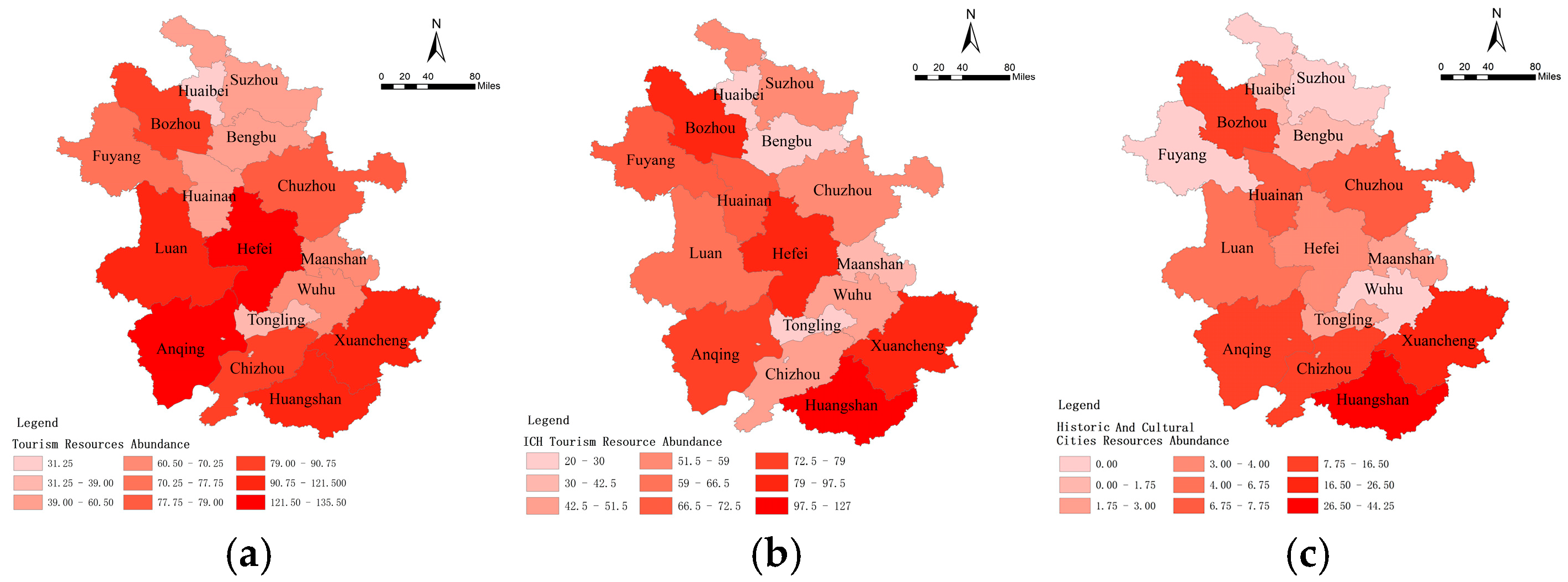
3.4. Spatial Distribution of the Richness of Tourism Resources, ICH Tourism Resources, and HCC
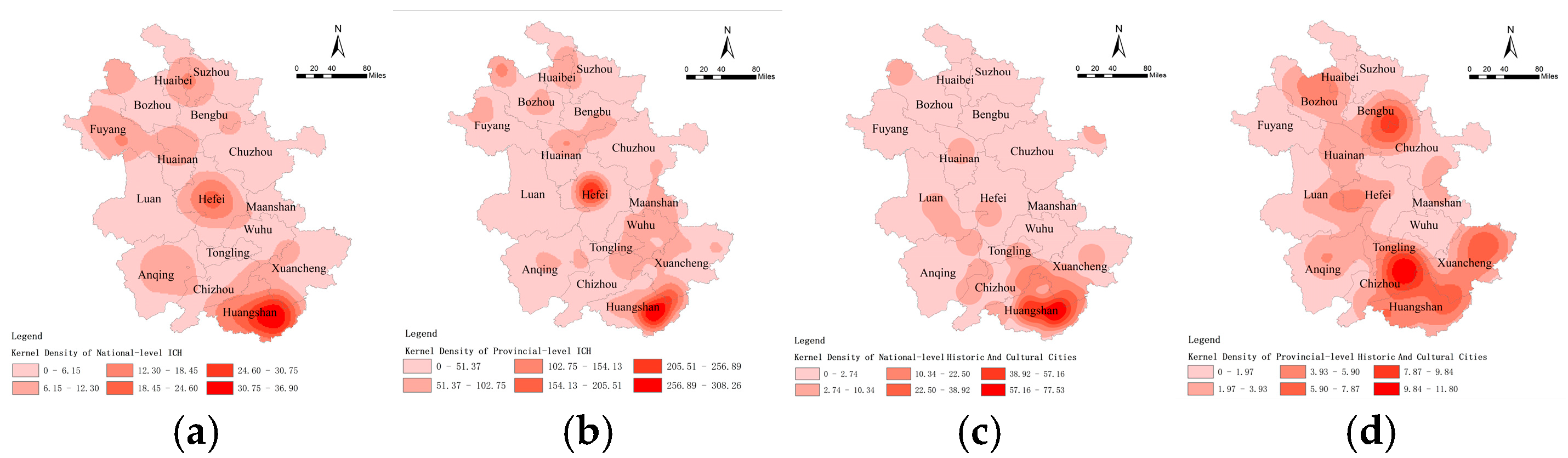
3.5. Kernel Density Distribution of ICH and HCC
3.6. Spatial Nearest Neighbor Characteristics of ICH Resources and HCC
3.7. Characteristics of ICH Tourism and HCCs in Anhui Province
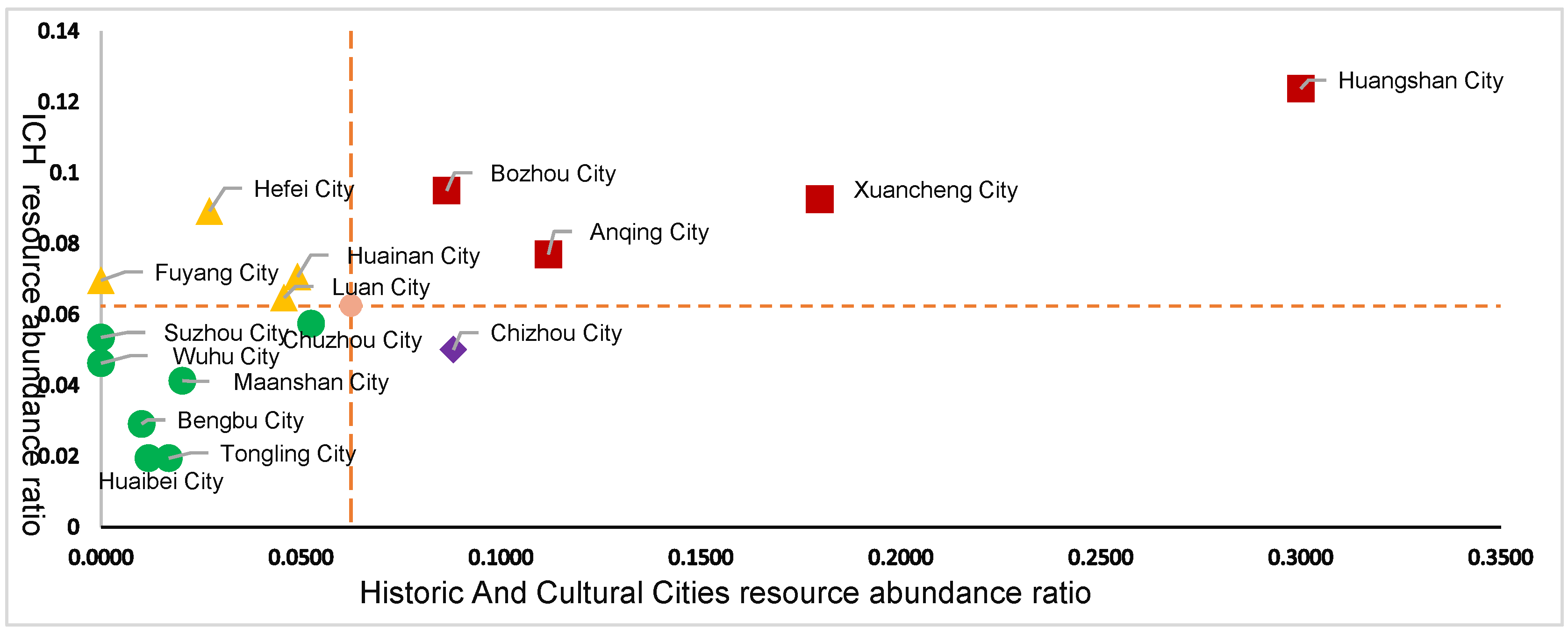
Establishing the Matrix of ICH Tourism and HCCs
4. Discussion
4.1. Interpretation of Key Findings
4.1.1. The Correlation Between Intangible Cultural Heritage and Material Spatial Elements
4.1.2. Urban Classification and Development Pathways Based on the “Resources-Potential” Model
4.2. Characteristics and Suggestions for ICH Tourism in 16 Cities in Anhui Province
4.2.1. Characteristics and Suggestions for “High-Potential ICH Tourism–High-Potential HCC” Cities
4.2.2. Characteristics and Suggestions for “High-Potential ICH–Tourism-Low-Potential HCC” Cities
4.2.3. Characteristics and Suggestions for “Low-Potential ICH Tourism–Low-Potential HCC” Cities
4.2.4. Characteristics and Suggestions for “Low-Potential ICH Tourism–High-Potential HCC” City
4.3. Limitations and Future Research
5. Conclusions
5.1. The Typological Structure of Intangible Cultural Heritage
5.2. Spatial Distribution of Material Cultural Elements
5.3. From Cultural Resources to Industrial Strengths
Author Contributions
Funding
Data Availability Statement
Conflicts of Interest
Abbreviations
| ICH | Intangible cultural heritage |
| HCC | Historic and cultural city |
| GIS | Geographic information system |
| VR | Virtual reality |
| AR | Augmented reality |
References
- Dong, B.; Bai, K.; Sun, X.; Wang, M.; Liu, Y. Spatial distribution and tourism competition of intangible cultural heritage: Take Guizhou, China as an example. Herit. Sci. 2023, 11, 64. [Google Scholar] [CrossRef]
- Schmitt, T.M. The UNESCO concept of safeguarding intangible cultural heritage: Its background and Marrakchi roots. In Cultural Heritage Rights; Routledge: Abingdon, UK, 2017; pp. 257–274. [Google Scholar]
- Cominelli, F.; Greffe, X. Intangible cultural heritage: Safeguarding for creativity. City Cult. Soc. 2012, 3, 245–250. [Google Scholar] [CrossRef]
- Jacobs, M. The spirit of the convention–Interlocking principles and ethics for safeguarding intangible cultural heritage. Int. J. Intang. Herit. 2016, 11, 72–87. [Google Scholar]
- Mitsche, N.; Vogt, F.; Knox, D.; Cooper, I.; Lombardi, P.; Ciaffi, D. Intangibles: Enhancing access to cities’ cultural heritage through interpretation. Int. J. Cult. Tour. Hosp. Res. 2013, 7, 68–77. [Google Scholar] [CrossRef]
- Arcos-Pumarola, J.; Paquin, A.G.; Sitges, M.H. The use of intangible heritage and creative industries as a tourism asset in the UNESCO creative cities network. Heliyon 2023, 9, e13106. [Google Scholar] [CrossRef]
- Gwerevende, S.; Mthombeni, Z.M. Safeguarding intangible cultural heritage: Exploring the synergies in the transmission of Indigenous languages, dance and music practices in Southern Africa. Int. J. Herit. Stud. 2023, 29, 398–412. [Google Scholar] [CrossRef]
- Xu, B.; Pan, J. Analysis of structural characteristics and spatial distribution of the national intangible cultural heritage in China and its policy implications. Sci. Cold Arid. Reg. 2019, 11, 389–406. [Google Scholar]
- Nie, X.; Xie, Y.; Xie, X.; Zheng, L. The characteristics and influencing factors of the spatial distribution of intangible cultural heritage in the Yellow River Basin of China. Herit. Sci. 2022, 10, 121. [Google Scholar] [CrossRef]
- Shao, D.; Zoh, K.J.; Xie, Y. The spatial differentiation mechanism of intangible cultural heritage and its integration with tourism development based on explainable machine learning and coupled coordination models: A case study of the Jiang-Zhe-Hu in China. Herit. Sci. 2024, 12, 414. [Google Scholar] [CrossRef]
- Li, X.; Zhu, R.; Shi, C.; Yang, X.; Chen, J.; Wei, K. Research on the construction of intangible cultural heritage corridors in the Yellow River Basin based on geographic information system (GIS) technology and the minimum cumulative resistance (MCR) model. Herit. Sci. 2024, 12, 271. [Google Scholar] [CrossRef]
- Lv, J.; Chai, Y.; Hu, X. Synergistic development of intangible cultural heritage and tourism industry: Empirical experiences from Jilin, China. PLoS ONE 2025, 20, e0313421. [Google Scholar] [CrossRef] [PubMed]
- Lei, H.; Zhou, Y. Conducting heritage tourism-Led urban renewal in Chinese historical and cultural urban spaces: A case study of Datong. Land 2022, 11, 2122. [Google Scholar] [CrossRef]
- Jiang, J.; Zang, T.; Xing, J.; Ikebe, K. Spatial distribution of urban heritage and landscape approach to urban contextual continuity: The case of Suzhou. Land 2023, 12, 150. [Google Scholar] [CrossRef]
- Tan, S.K.; Tan, S.H.; Kok, Y.S.; Choon, S.W. Sense of place and sustainability of intangible cultural heritage—The case of George Town and Melaka. Tour. Manag. 2018, 67, 376–387. [Google Scholar] [CrossRef]
- Ahmed, N. Residents support towards cultural heritage tourism: The relevance of heritage proximity and tourism perceived impacts. Rev. Tur. Stud. Cercet. Tur. 2023, 35. [Google Scholar] [CrossRef]
- Guo, Y.; Cao, Z.; Zhu, Z. The influence of ICH-narrator/self-congruity on tourist’s purchase intention of intangible cultural heritage products in a narrative context. J. Hosp. Tour. Manag. 2022, 52, 151–160. [Google Scholar] [CrossRef]
- Guo, Y.; Zhu, Z. Intangible cultural heritage souvenirs: Image congruity and brand influence on tourists’ purchase intention. Tour. Rev. 2023, 78, 1203–1216. [Google Scholar] [CrossRef]
- Su, J. A difficult integration of authenticity and intangible cultural heritage? The case of Yunnan, China. China Perspect. 2021, 2021/3, 29–39. [Google Scholar] [CrossRef]
- Zhang, Y.; Zheng, Q.; Huang, L.; Lee, T.J.; Hyun, S.S. Alienation and authenticity in intangible cultural heritage tourism. J. Sustain. Tour. 2024, 32, 2459–2478. [Google Scholar] [CrossRef]
- Qiu, Q. Identifying the role of intangible cultural heritage in distinguishing cities: A social media study of heritage, place, and sense in Guangzhou, China. J. Destin. Mark. Manag. 2023, 27, 100764. [Google Scholar] [CrossRef]
- Xie, J. Innovative design of artificial intelligence in intangible cultural heritage. Sci. Program. 2022, 2022, 6913046. [Google Scholar] [CrossRef]
- Liu, Y.; Chen, M.; Wang, Q. The impact of symmetry design of intangible cultural heritage souvenir on tourists’ aesthetic pleasure. Front. Psychol. 2022, 13, 987716. [Google Scholar] [CrossRef]
- Nie, X.; Ma, M.; Ji, J.; Zheng, L. The spatial distribution of traditional intangible cultural heritage medicine of China and its influencing factors. Herit. Sci. 2023, 11, 90. [Google Scholar] [CrossRef]
- Li, L. Cultural communication and diversity along the Grand Canal of China: A case study of folk songs in intangible cultural heritage. Herit. Sci. 2023, 11, 66. [Google Scholar] [CrossRef]
- Io, M.U. Understanding the core attractiveness of performing arts heritage to international tourists. Tour. Geogr. 2019, 21, 687–705. [Google Scholar] [CrossRef]
- Skublewska-Paszkowska, M.; Milosz, M.; Powroznik, P.; Lukasik, E. 3D technologies for intangible cultural heritage preservation—literature review for selected databases. Herit. Sci. 2022, 10, 3. [Google Scholar] [CrossRef] [PubMed]
- Chen, Z. Visualizing experiencescape–from the art of intangible cultural heritage. Curr. Issues Tour. 2022, 25, 559–578. [Google Scholar] [CrossRef]
- Buragohain, D.; Meng, Y.; Deng, C.; Li, Q.; Chaudhary, S. Digitalizing cultural heritage through metaverse applications: Challenges, opportunities, and strategies. Herit. Sci. 2024, 12, 295. [Google Scholar] [CrossRef]
- Chen, Z.; Suntikul, W.; King, B. Constructing an intangible cultural heritage experiencescape: The case of the Feast of the Drunken Dragon (Macau). Tour. Manag. Perspect. 2020, 34, 100659. [Google Scholar] [CrossRef]
- Chen, Y.S.; Wu, S.T. Social networking practices of Viennese coffeehouse culture and intangible heritage tourism. J. Tour. Cult. Change 2019, 17, 186–207. [Google Scholar] [CrossRef]
- Lamprakos, M. The idea of the historic city. Change Over Time 2014, 4, 8–38. [Google Scholar] [CrossRef]
- Zhao, Y.; Tang, W.; Long, L.; Wang, Z. Review and Prospect of Protection of Famous Historical and Cultural Towns and Villages in China. J. Archit. 2012, 6, 12–17. (In Chinese) [Google Scholar]
- Lee, S.L. Urban conservation policy and the preservation of historical and cultural heritage: The case of Singapore. Cities 1996, 13, 399–409. [Google Scholar] [CrossRef]
- Wang, J. Problems and solutions in the protection of historical urban areas. Front. Archit. Res. 2012, 1, 40–43. [Google Scholar] [CrossRef]
- Kakiuchi, E. Cultural heritage protection system in Japan: Current issues and prospects for the future. Gdańskie Stud. Azji Wschod. 2016, 10, 7–27. [Google Scholar] [CrossRef]
- Ragheb, A.; Aly, R.; Ahmed, G. Toward sustainable urban development of historical cities: Case study of Fouh City, Egypt. Ain Shams Eng. J. 2022, 13, 101520. [Google Scholar] [CrossRef]
- Fan, J.; Maliki, N.Z.; Zainal Abidin, N.A. Spatial patterns of historical and cultural blocks based on multisource data and protection and development strategies within the context of urban renewal: A case study of Xi’an, China. Landsc. Res. 2025, 50, 4–22. [Google Scholar] [CrossRef]
- Xu, Z.; Tian, G.; Wei, K.; Ma, Y.; Zhang, S.; Huang, Y.; Yao, X. The influence of environment on the distribution characteristics of historical buildings in the Songshan Region. Land 2022, 11, 2094. [Google Scholar] [CrossRef]
- Shao, J.; Liu, G.; Yuan, H.; Song, Q.; Yang, M.; Luo, D.; Zhang, X.; Tan, Y.; Zhang, Y. Evaluation and scale forecast of underground space resources of historical and cultural cities in China. ISPRS Int. J. Geo-Inf. 2022, 11, 31. [Google Scholar] [CrossRef]
- Zhou, L.; Ouyang, F.; Sun, Y.; Chen, W.; Li, Y.; Zhao, R. Integrated sustainable development of culture into tourist map design: A case from Foshan, China. Int. J. Environ. Res. Public Health 2022, 19, 14191. [Google Scholar] [CrossRef]
- Alvarez, M.D. Creative cities and cultural spaces: New perspectives for city tourism. Int. J. Cult. Tour. Hosp. Res. 2010, 4, 171–175. [Google Scholar] [CrossRef]
- García-Hernández, M.; De la Calle-Vaquero, M.; Yubero, C. Cultural heritage and urban tourism: Historic city centres under pressure. Sustainability 2017, 9, 1346. [Google Scholar] [CrossRef]
- Liang, F.; Pan, Y.; Gu, M.; Liu, Y.; Lei, L. Research on the paths and strategies of the integrated development of culture and tourism industry in urban historical blocks. Front. Public Health 2022, 10, 1016801. [Google Scholar] [CrossRef] [PubMed]
- Wang, J.; Fan, W.; You, J. Evaluation of tourism elements in historical and cultural blocks using machine learning: A case study of Taiping Street in Hunan Province. npj Herit. Sci. 2025, 13, 30. [Google Scholar] [CrossRef]
- Cheng, Y.; Chen, W. Cultural Perception of Tourism Heritage Landscapes via Multi-Label Deep Learning: A Study of Jingdezhen, the Porcelain Capital. Land 2025, 14, 559. [Google Scholar] [CrossRef]
- Panagiotopoulou, M.; Somarakis, G.; Stratigea, A. Smartening up participatory cultural tourism planning in historical city centers. J. Urban Technol. 2020, 27, 3–26. [Google Scholar] [CrossRef]
- Deng, K. Exploration of Renewal and Renovation Design of Historical and Cultural Protection Areas Based on Smart Cities. J. Civ. Eng. Urban Plan 2024, 6, 93–97. [Google Scholar]
- Huangshan Municipal Development and Reform Commission, Anhui Province. A Brief Analysis of the City’s Economic Performance in 2024. Available online: https://www.huangshan.gov.cn/zwgk/public/6615714/11718285.html (accessed on 8 February 2025).
- Rodzi, N.I.M.; Zaki, S.A.; Subli, S.M.H.S. Between tourism and intangible cultural heritage. Procedia-Soc. Behav. Sci. 2013, 85, 411–420. [Google Scholar] [CrossRef]
- Bucurescu, I. Managing tourism and cultural heritage in historic towns: Examples from Romania. J. Herit. Tour. 2015, 10, 248–262. [Google Scholar] [CrossRef]
- Lak, A.; Gheitasi, M.; Timothy, D.J. Urban regeneration through heritage tourism: Cultural policies and strategic management. J. Tour. Cult. Change 2020, 18, 386–403. [Google Scholar] [CrossRef]
- Wang, X.; Zhan, S. Exploring the spatial distribution of ICH by geographic information system (GIS). Mob. Inf. Syst. 2022, 2022, 8689113. [Google Scholar] [CrossRef]
- Han, Q.; Tao, F.; Hong, Z.; Qin, G.; Wei, Y.; Chen, Y.; Zhou, T. Research on the spatiotemporal distribution and factors influencing intangible cultural heritage in Fujian Province from a multiscale perspective. Herit. Sci. 2024, 12, 239. [Google Scholar] [CrossRef]
- Zhang, J.; Cenci, J.; Becue, V.; Koutra, S. Analysis of spatial structure and influencing factors of the distribution of national industrial heritage sites in China based on mathematical calculations. Environ. Sci. Pollut. Res. 2022, 29, 27124–27139. [Google Scholar] [CrossRef]
- Pang, L.; Wu, L. Distribution characteristics and influencing factors of intangible cultural heritage in Beijing-Tianjin-Hebei. Herit. Sci. 2023, 11, 19. [Google Scholar] [CrossRef]
- Collins, A. Tourism development and natural capital. Ann. Tour. Res. 1999, 26, 98–109. [Google Scholar] [CrossRef]
- Zhang, T.; Wang, Y.; Zhang, S.; Wang, Y.; Yu, H. Evaluation of ontological value of regional tourism resources: A case study of Hainan Island, China. J. Geogr. Sci. 2021, 31, 1015–1038. [Google Scholar] [CrossRef]
- Sun, G.N.; Yang, J. Effect of urbanization on the tourism development of Xi’an city over the recent 30 years. J. Shaanxi Norm. Univ. (Nat. Sci. Ed). 2014, 42, 78–84. (In Chinese) [Google Scholar]
- Lakićević, M.; Žarevac, M. Tourism thought as a factor of tourism development in Serbia. Hotel. Tour. Manag. 2014, 2, 29–37. [Google Scholar]

| Project Category | Folklore | Traditional Music | Traditional Dance | Traditional Drama | Quyi | Traditional Sports, Recreation and Acrobatics | Traditional Art | Traditional Craftsmanship | Traditional Medicine | Folk Custom |
|---|---|---|---|---|---|---|---|---|---|---|
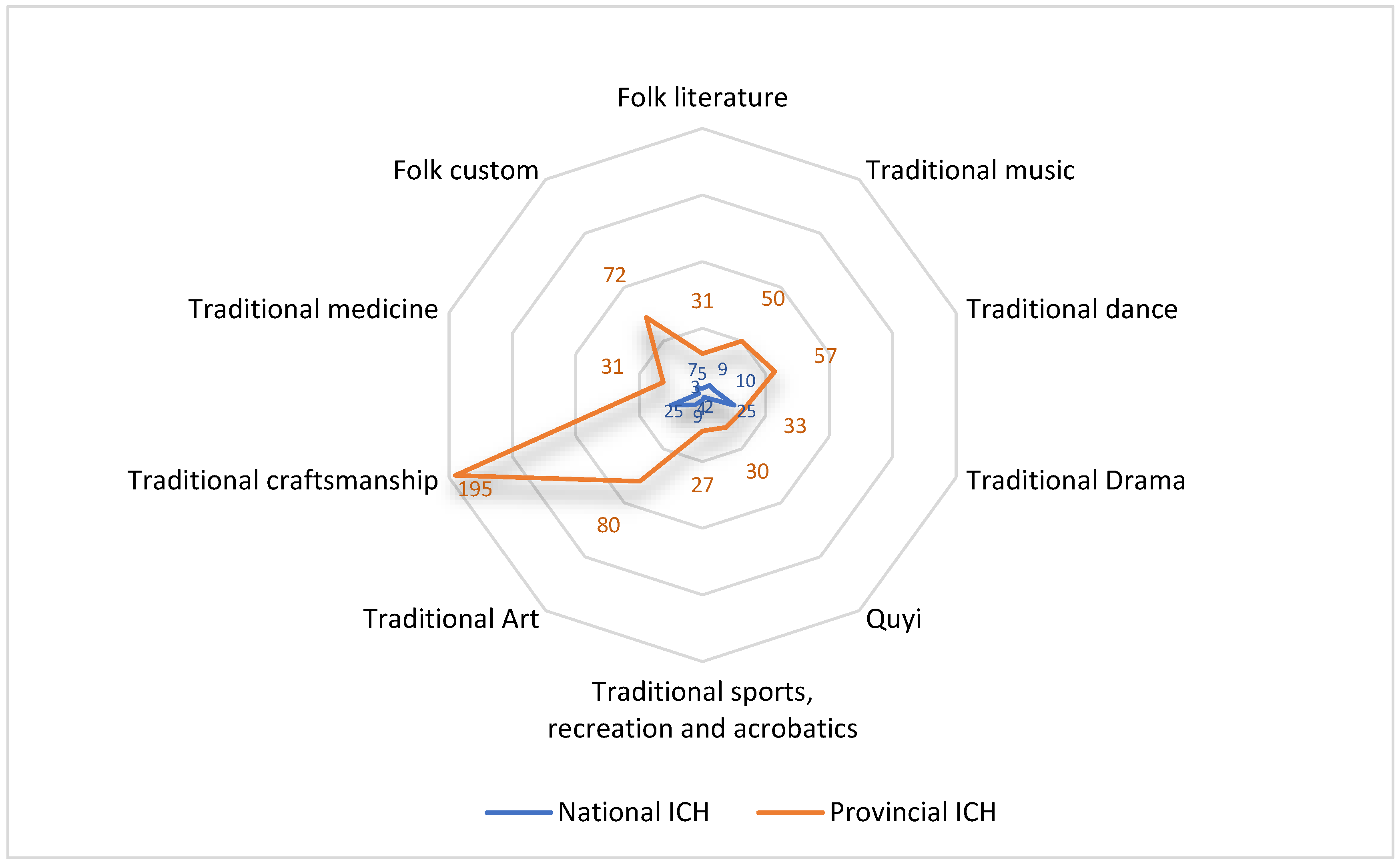
| National level | 5 | 9 | 10 | 25 | 2 | 4 | 9 | 25 | 3 | 7 |
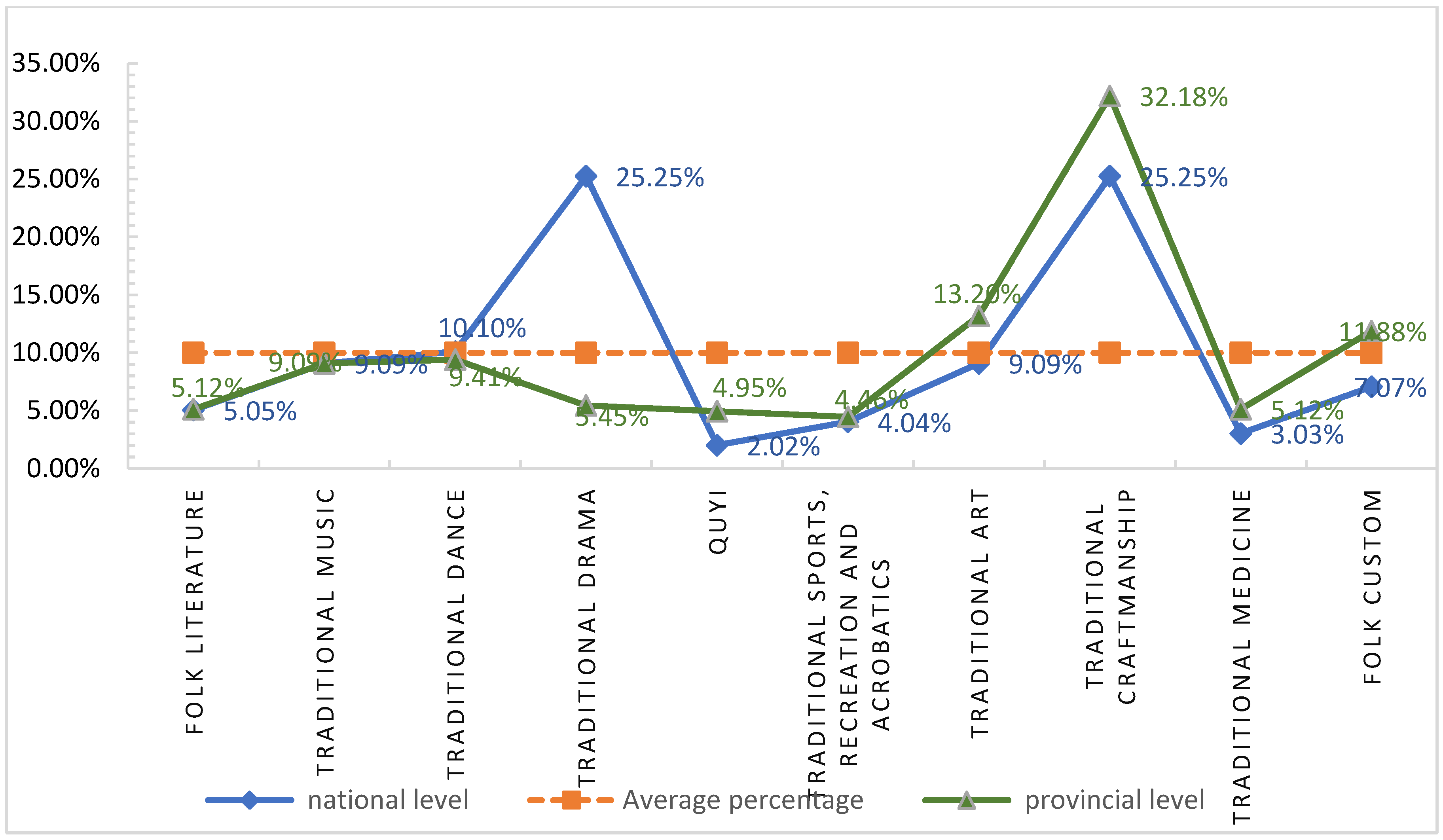
| Percentage at national level | 5.05% | 9.09% | 10.10% | 25.25% | 2.02% | 4.04% | 9.09% | 25.25% | 3.03% | 7.07% |
| Provincial level | 31 | 50 | 57 | 33 | 30 | 27 | 80 | 195 | 31 | 72 |
| Percentage at provincial level | 5.12% | 9.09% | 9.41% | 5.45% | 4.95% | 4.46% | 13.20% | 32.18% | 5.12% | 11.88% |
| Region | Hefei City | Huaibei City | Bozhou City | Suzhou City | Bengbu City | Fuyang City | Huainan City | Chuzhou City | Lu’an City | Maanshan City | Wuhu City | Tongling City | Chizhou City | Xuancheng City | Anqing City | Huangshan City |
|---|---|---|---|---|---|---|---|---|---|---|---|---|---|---|---|---|
| 5A-level scenic spot | 1 | 0 | 0 | 0 | 0 | 1 | 0 | 1 | 2 | 1 | 1 | 0 | 1 | 1 | 1 | 3 |
| 4A-level scenic spot | 27 | 3 | 9 | 7 | 6 | 8 | 8 | 7 | 26 | 8 | 11 | 9 | 17 | 23 | 23 | 21 |
| 3A-level scenic spot | 36 | 13 | 39 | 21 | 19 | 29 | 20 | 30 | 24 | 24 | 21 | 8 | 22 | 29 | 40 | 18 |
| 2A-level scenic spot | 0 | 2 | 0 | 0 | 11 | 4 | 11 | 8 | 9 | 0 | 2 | 5 | 2 | 7 | 6 | 11 |
| A-level scenic spot | 0 | 0 | 0 | 0 | 0 | 0 | 0 | 0 | 0 | 0 | 0 | 0 | 0 | 0 | 0 | 0 |
| 5A-level ICH scenic spot | 1 | 0 | 0 | 0 | 0 | 1 | 0 | 1 | 1 | 0 | 0 | 0 | 1 | 0 | 1 | 3 |
| 4A-level ICH scenic spot | 7 | 1 | 5 | 4 | 2 | 2 | 5 | 1 | 6 | 1 | 3 | 2 | 3 | 6 | 4 | 6 |
| 3A-level ICH scenic spot | 6 | 2 | 12 | 5 | 3 | 9 | 6 | 7 | 2 | 7 | 5 | 1 | 3 | 9 | 8 | 9 |
| 2A-level ICH scenic spot | 0 | 1 | 0 | 0 | 0 | 1 | 2 | 3 | 1 | 0 | 0 | 0 | 2 | 2 | 0 | 4 |
| A-level ICH scenic spot | 0 | 0 | 0 | 0 | 0 | 0 | 0 | 0 | 0 | 0 | 0 | 0 | 0 | 0 | 0 | 0 |
| Region | Hefei City | Huaibei City | Bozhou City | Suzhou City | Bengbu City | Fuyang City | Huainan City | Chuzhou City | Lu’an City | Maanshan City | Wuhu City | Tongling City | Chizhou City | Xuancheng City | Anqing City | Huangshan City |
|---|---|---|---|---|---|---|---|---|---|---|---|---|---|---|---|---|
| National-level ICH | 8 | 1 | 6 | 9 | 3 | 10 | 5 | 2 | 5 | 2 | 3 | 0 | 3 | 7 | 11 | 24 |
| Provincial-level ICH | 59 | 17 | 54 | 38 | 21 | 40 | 24 | 30 | 27 | 26 | 32 | 17 | 29 | 78 | 46 | 93 |
| N1-level HCC | 0 | 0 | 1 | 0 | 0 | 0 | 1 | 0 | 0 | 0 | 0 | 0 | 0 | 1 | 2 | 2 |
| N2-level HCC | 1 | 0 | 0 | 0 | 0 | 0 | 0 | 0 | 2 | 0 | 0 | 1 | 2 | 2 | 0 | 3 |
| N3-level HCC | 0 | 0 | 0 | 0 | 0 | 0 | 0 | 1 | 0 | 0 | 0 | 0 | 1 | 6 | 0 | 16 |
| P3-level HCC | 0 | 0 | 2 | 0 | 0 | 0 | 0 | 2 | 0 | 1 | 0 | 0 | 1 | 1 | 1 | 1 |
| P3-level HCC | 0 | 1 | 1 | 0 | 0 | 0 | 1 | 0 | 1 | 0 | 0 | 0 | 1 | 2 | 2 | 1 |
| P3-level HCC | 3 | 0 | 0 | 0 | 3 | 0 | 1 | 1 | 0 | 0 | 0 | 0 | 4 | 5 | 0 | 4 |
| Region | Hefei City | Huaibei City | Bozhou City | Suzhou City | Bengbu City | Fuyang City | Huainan City | Chuzhou City | Lu’an City | Maanshan City | Wuhu City | Tongling City | Chizhou City | Xuancheng City | Anqing City | Huangshan City |
|---|---|---|---|---|---|---|---|---|---|---|---|---|---|---|---|---|
| Tourism resource abundance | 135.5 | 31.25 | 90.75 | 54.25 | 53.75 | 77.75 | 60.5 | 79 | 121.5 | 67 | 70.25 | 39 | 87 | 116.75 | 135.5 | 104.5 |
| Tourism resource abundance ratio | 0.1023 | 0.0236 | 0.0685 | 0.041 | 0.0406 | 0.0587 | 0.0457 | 0.0597 | 0.0914 | 0.0506 | 0.053 | 0.0295 | 0.0657 | 0.0882 | 0.1023 | 0.0789 |
| Ranking of tourism resource abundance | 1 | 15 | 5 | 12 | 13 | 8 | 11 | 7 | 2 | 10 | 9 | 14 | 6 | 3 | 1 | 4 |
| ICH resource abundance | 91.5 | 20 | 97.5 | 55 | 30 | 71.5 | 72.5 | 59 | 66.5 | 42.5 | 47.5 | 20 | 51.5 | 95 | 79 | 127 |
| ICH resource abundance ratio | 0.0892 | 0.0195 | 0.095 | 0.0536 | 0.0292 | 0.0697 | 0.0707 | 0.0575 | 0.0648 | 0.0414 | 0.0463 | 0.0195 | 0.0501 | 0.0926 | 0.077 | 0.1238 |
| Ranking of ICH resource abundance | 4 | 15 | 2 | 10 | 14 | 7 | 6 | 9 | 8 | 13 | 12 | 15 | 11 | 3 | 5 | 1 |
| HCC resource abundance | 4 | 1.75 | 12.75 | 0 | 1.5 | 0 | 7.25 | 7.75 | 6.75 | 3 | 0 | 2.5 | 13 | 26.5 | 16.5 | 44.25 |
| HCC resource abundance ratio | 0.0271 | 0.0119 | 0.0864 | 0.0000 | 0.0102 | 0.0000 | 0.0492 | 0.0525 | 0.0458 | 0.0203 | 0.0000 | 0.0169 | 0.0881 | 0.1797 | 0.1119 | 0.3000 |
| Ranking of HCC resource abundance | 9 | 12 | 5 | 14 | 13 | 14 | 7 | 6 | 8 | 10 | 14 | 11 | 4 | 2 | 3 | 1 |
Disclaimer/Publisher’s Note: The statements, opinions and data contained in all publications are solely those of the individual author(s) and contributor(s) and not of MDPI and/or the editor(s). MDPI and/or the editor(s) disclaim responsibility for any injury to people or property resulting from any ideas, methods, instructions or products referred to in the content. |
© 2025 by the authors. Licensee MDPI, Basel, Switzerland. This article is an open access article distributed under the terms and conditions of the Creative Commons Attribution (CC BY) license (https://creativecommons.org/licenses/by/4.0/).
Share and Cite
Xu, Z.; Chai, L.; Wang, Y.; Chen, W.; Gu, D. Spatial Distribution and Tourism Potential of Intangible Cultural Heritage and Historic and Cultural Cities—A Case Study of Anhui Province, China. Land 2025, 14, 2360. https://doi.org/10.3390/land14122360
Xu Z, Chai L, Wang Y, Chen W, Gu D. Spatial Distribution and Tourism Potential of Intangible Cultural Heritage and Historic and Cultural Cities—A Case Study of Anhui Province, China. Land. 2025; 14(12):2360. https://doi.org/10.3390/land14122360
Chicago/Turabian StyleXu, Zhen, Liu Chai, Yuanxiang Wang, Wenjing Chen, and Dazhi Gu. 2025. "Spatial Distribution and Tourism Potential of Intangible Cultural Heritage and Historic and Cultural Cities—A Case Study of Anhui Province, China" Land 14, no. 12: 2360. https://doi.org/10.3390/land14122360
APA StyleXu, Z., Chai, L., Wang, Y., Chen, W., & Gu, D. (2025). Spatial Distribution and Tourism Potential of Intangible Cultural Heritage and Historic and Cultural Cities—A Case Study of Anhui Province, China. Land, 14(12), 2360. https://doi.org/10.3390/land14122360


