Article

A Multi-Agent Simulation-Based Decision Support Tool for Sustainable Tourism Land Use Planning in Rural China


1
College of City Construction, Jiangxi Normal University, Nanchang 330022, China
2
China Construction Bank Hainan Branch, Haikou 570125, China
3
University Library, Jiangxi Normal University, Nanchang 330022, China
*
Authors to whom correspondence should be addressed.
Land 2025, 14(12), 2342; https://doi.org/10.3390/land14122342
Submission received: 3 November 2025 / Revised: 24 November 2025 / Accepted: 25 November 2025 / Published: 28 November 2025

Abstract

The sustainable development of Rural Summer Health Tourism for the Urban Elderly (RSHTUE) is fundamentally tied to the rational utilization of rural land. Land use is a dynamic process involving multiple stakeholders; it requires predictive modeling of its evolution to ensure long-term sustainability. This study integrates key factors under rigid boundary constraints to establish decision-making rules for government, villager, and tourist agents. Taking Zhongyuan Township as a research site, we constructed a multi-agent simulation model by integrating environmental data processed in ArcGIS with decision-making rules encoded in NetLogo. Through scenario analysis, we simulate the evolution of tourism land use for 2028 and 2033 under three distinct development scenarios: tourism-led, ecological protection, and rural belt joint. The results demonstrate that each scenario leads to markedly different spatial patterns. The model developed in this study can directly simulate land use in RSHTUE destination villages while also being applicable to other types of rural tourism by adjusting relevant parameters. The model serves as a “policy laboratory” to simulate and compare the effects of different policy scenarios, thereby enabling the generation of land use strategies that balance multi-stakeholder sustainable development and providing an empirical basis for policy formulation and optimization.

1. Introduction

Against the backdrop of accelerating population aging in China, the silver economy is gradually emerging as a new engine for economic growth [1]. As a prime example of this trend, Rural Summer Health and Wellness Tourism for Urban Elderly (RSHTUE) is rapidly emerging and demonstrating immense potential. Since the 1990s, some urban retirees in China have spontaneously traveled to villages with comfortable temperatures to escape the summer heat [2]. Today, numerous rural regions with pleasant summer climates have developed RSHTUE into a pillar industry for rural revitalization, and this industry has now reached a considerable scale in many regions [3]. As the industry matures, its scope has expanded significantly, evolving from an early singular function of summer cooling to a comprehensive service system integrating ecological wellness, cultural experience, and agricultural leisure. This transformation poses new requirements and challenges for the sustainable use of rural land resources.
The Chinese government has placed rural leisure tourism in a prominent position. In the “Guiding Opinions on Promoting the Revitalization of Rural Industries,” the State Council explicitly designates it as a key industry for rural revitalization but has also outlined specific directions [2]. However, the rapid expansion of rural tourism has intensified long-standing land use conflicts, including irrational land use patterns, unregulated land expansion, the conflict between continuous growth of tourism land demand and limited supply of construction land, and the damage to traditional rural culture and the ecological environment [4,5]. Initially driven by villagers’ spontaneous initiatives, RSHTUE has further exacerbated the aforementioned conflicts due to the lack of effective government supervision and planning. In pursuit of short-term interests, some villagers have blindly expanded the scale of tourism reception and occupied unauthorized land resources [6]. Over time, such self-organized tourism activities have gradually evolved into disorderly expansion, ultimately leading to the waste of land resources and the degradation of ecosystems [7].
Addressing this dilemma and achieving sustainable rural tourism development urgently require scientific simulation tools for land use planning. Existing research often struggles to capture the complex interactions among multiple stakeholders and fails to effectively simulate the evolution of land use under different policy orientations. Although multi-agent simulation has shown unique advantages in the field of geographic simulation, its potential in rural tourism land research has not been fully explored. Firstly, existing models suffer from incomplete stakeholder representation, as most studies only consider villagers and government as core agents and fail to fully reflect the key roles of tourists in land use decisions [8]. Secondly, there is a lack of foresight in the time dimension, with a lack of simulation and multi-scenario deduction for the future, making it difficult to support future-oriented planning decisions [9]. Thirdly, the comprehensiveness of spatial constraints is insufficient, and rigid boundaries have not been integrated into the simulation environment [10]. These limitations render existing models inadequate for addressing the complex decision-making environment in sustainable rural tourism, which entails multi-agent interactions, multi-scenario planning, and multiple spatial constraints.
This study aims to address these gaps by making contributions in three key aspects. Firstly, it constructs a multi-agent simulation model for tourism land in the RSHTUE context for the first time. This model incorporates three types of stakeholders—government, villagers, and tourists—as agent layers and introduces the concept of rigid boundaries in the environmental layer, thereby optimizing the existing multi-agent land use simulation framework. Secondly, it proposes three distinct RSHTUE development scenarios aligned with different sustainability priorities and simulates tourism land use changes under each scenario. This addresses the limitation of existing multi-agent models that focus primarily on retrospective verification rather than prospective simulation and policy assessment for sustainable development. Thirdly, the model can be adapted to multi-agent land use simulation for other types of rural tourism, demonstrating significant potential for its promotion and application. It provides a scientific decision-making basis and practical path for guiding rural areas toward high-quality, sustainable development.

2. Literature Review

2.1. Research Status and Theoretical Foundation of Tourism Land Simulation

Simulating and predicting the evolution of tourism land is crucial for guiding its rational planning [11]. As an effective method, land use simulation helps understand how tourism influences future land changes [12], and its results can provide critical insights for formulating land development policies [13]. The theoretical foundation for simulating tourism land use, particularly in the context of RSHTUE, rests on the central role of stakeholder behavior: the government acts as the macro-regulator, playing a decisive role in coordinating rural land planning. At the micro level, as the main body of rural areas, villagers decide whether to adopt tourism as a means of livelihood, directly influencing the transformation of land use types. As the source of tourism demand, tourists’ decision-making behavior drives adjustments in rural tourism land planning. Furthermore, the concept of sustainable development mandates that rural land use planning adhere to the ecological function protection baseline, environmental quality and safety bottom line, and natural resource utilization ceiling. This is to ensure that the ecological environment remains undamaged and to meet the requirements of rural sustainable development. Therefore, the land use decision-making behaviors of stakeholders exert a significant impact on the development of tourism land use at the destination. In constructing simulation models for rural tourism land use, the interactions among stakeholders and between them and the environment are critical considerations [14].
Current research employs a variety of land use simulation models, including equation-based models, statistical models, the CLUE-s model [15,16], Cellular Automata (CA) models [17], the PLUS model [18], system dynamics models [19], the CA-Markov model [11], and multi-agent models [14]. A key limitation of equation-based and statistical models, which rely on historical experience and static equations, is their inability to effectively evaluate dynamic spatial information [20]. CA models and multi-agent models are widely applied in academia [21]. However, CA models struggle to incorporate the decision-making of individuals and organizations. In contrast, multi-agent systems provide a conceptual method for incorporating multi-agent behavior decisions into land use change models, which can effectively reflect the complexity of human factors and their interactions with the environment. The model developed through this method is suited to capture the complex interactions among the government, villagers, and tourists in land use decisions within the RSHTUE context.

2.2. Construction and Innovation of Multi-Agent Model for RSHTUE Land

Within multi-agent systems, agents represent stakeholders in real-world systems that interact with one another and with the environment, making decisions based on environmental changes and their own objectives, thereby simulating the dynamic evolution of complex systems [14,22]. Moreover, multi-agent models allow for dynamic learning through scenario analysis, thus holding great potential in guiding policy formulation [23]. While multi-agent models cover a broad research scope, their application in land use simulation remains limited. A systematic review of existing studies reveals that current research primarily focuses on simulating urban land use, such as in urban planning [20,24], urban expansion [25,26], and urban underground space development [14]. A limited number of studies focus on rural land use change [27], with some concentrating on the specific context of rural mining areas [28]. In particular, land use simulation research in the context of tourism villages has received relatively little attention. Liu and Xi [21] established a multi-agent model for the land use patterns of tourism rural settlements, providing a reference for this study. Nevertheless, this model was restricted to villagers and government as agent types, focused solely on verifying past land use changes, and lacked scenario-based analysis and future prediction. Therefore, when constructing a multi-agent simulation model for RSHTUE, it is necessary to clearly delimit the modeling scope with rigid boundaries that incorporate the “three constraints”. However, existing research rarely considers both the rigid boundary and environmental factors as the environmental layer of the multi-agent model. Furthermore, research on setting development scenarios to demonstrate rural development trends under different policies based on the characteristics and requirements of RSHTUE development has not been thoroughly explored. By incorporating various stakeholders, multi-agent models can simulate and predict land use conditions under different development scenarios within complex systems. This is significant for promoting the high-quality development of RSHTUE.
Based on this, this study analyzes the land use decision-making behaviors of the government, villagers, and tourists, clarifies the decision-making rules of each agent, and constructs a multi-agent simulation model for RSHTUE land use. Three distinct development scenarios are proposed: a tourism-led development scenario, an eco-protection development scenario, and a rural belt joint development scenario. The study conducts simulation and prediction of the future tourism land in Zhongyuan Township under each development scenario. This enables a comparison of the effects of corresponding policies under different development models, thereby providing decision-making references for managers to optimize and adjust policy schemes.

3. Multi-Agent Simulation Modeling of RSHTUE Land

The multi-agent system comprises a set of agents that interact within a spatial environment. These agents are capable of making autonomous decisions, adapting to and modifying their environment, and engaging in structured relationships [29]. The multi-agent simulation model for tourism land established in this study consists of three components: the agent layer, the environment layer, and the relationship layer (Figure 1).
Under the research context of RSHTUE, the industry initially emerged from the spontaneous actions of local villagers, who serve as the primary operators. Government policy guidance was gradually refined and formally implemented only after RSHTUE had reached a certain scale. Compared to regions with well-developed tourism, developer participation in typical rural RSHTUE areas is limited, exerting a relatively minor influence on tourism land use planning. Therefore, the main suppliers participating in RSHTUE development are the government and villagers, while tourists represent the demand side of this tourism market, influencing the industry’s development scale. Accordingly, this study identifies these three key stakeholder groups as the agent layer of the model.
The environment layer provides the spatial context and structural constraints for decision-making, dynamically participating in agent decisions in two ways. Firstly, rigid boundaries act as insurmountable spatial limits, constraining the development actions of both the government and villagers at the source and ensuring ecological baselines; secondly, environmental factors systematically guide their spatial choices by being incorporated into the utility functions of the various agents. Simultaneously, the model’s relationship layer defines the core interaction mechanisms that drive system evolution. These mechanisms are manifested through two types of feedback loops: one is the strategic interaction among agents, where government planning guides villagers’ investments, their development activities shape the tourism supply, and tourists’ market choices in turn provide feedback that influences subsequent government planning, forming a “policy-supply-demand” closed loop; the other is the bidirectional interaction between agents and the environment, whereby agents’ decisions alter the environmental state, which in turn forms the new context for the next round of decision-making.
In summary, the environment layer and the relationship layer together constitute a coupled simulation framework: the environment layer defines the structural context and parametric system for agent decision-making, while the relationship layer characterizes the behavioral rules and feedback mechanisms among agents and between agents and the environment. The outcomes of the interactions among the multi-agent layer, the environment layer, and the relationship layer are ultimately concretely manifested through the land use spatial entity. This spatial entity is represented in the model as an m × n two-dimensional grid system, serving as the direct carrier for various land use types. It is not only the ultimate object upon which all agent behaviors and decisions act, but its own state changes also directly constitute a crucial component of the environment layer, thereby becoming the spatial representation and quantitative manifestation of the various complex interactive relationships within the relationship layer. Through this framework, the model dynamically links the complex decision-making of micro-level agents with the macro-level spatial patterns of land use, thus enabling a more realistic simulation of the complex evolutionary process of RSHTUE land use.

3.1. Delineation of Areas Within Rigid Boundaries

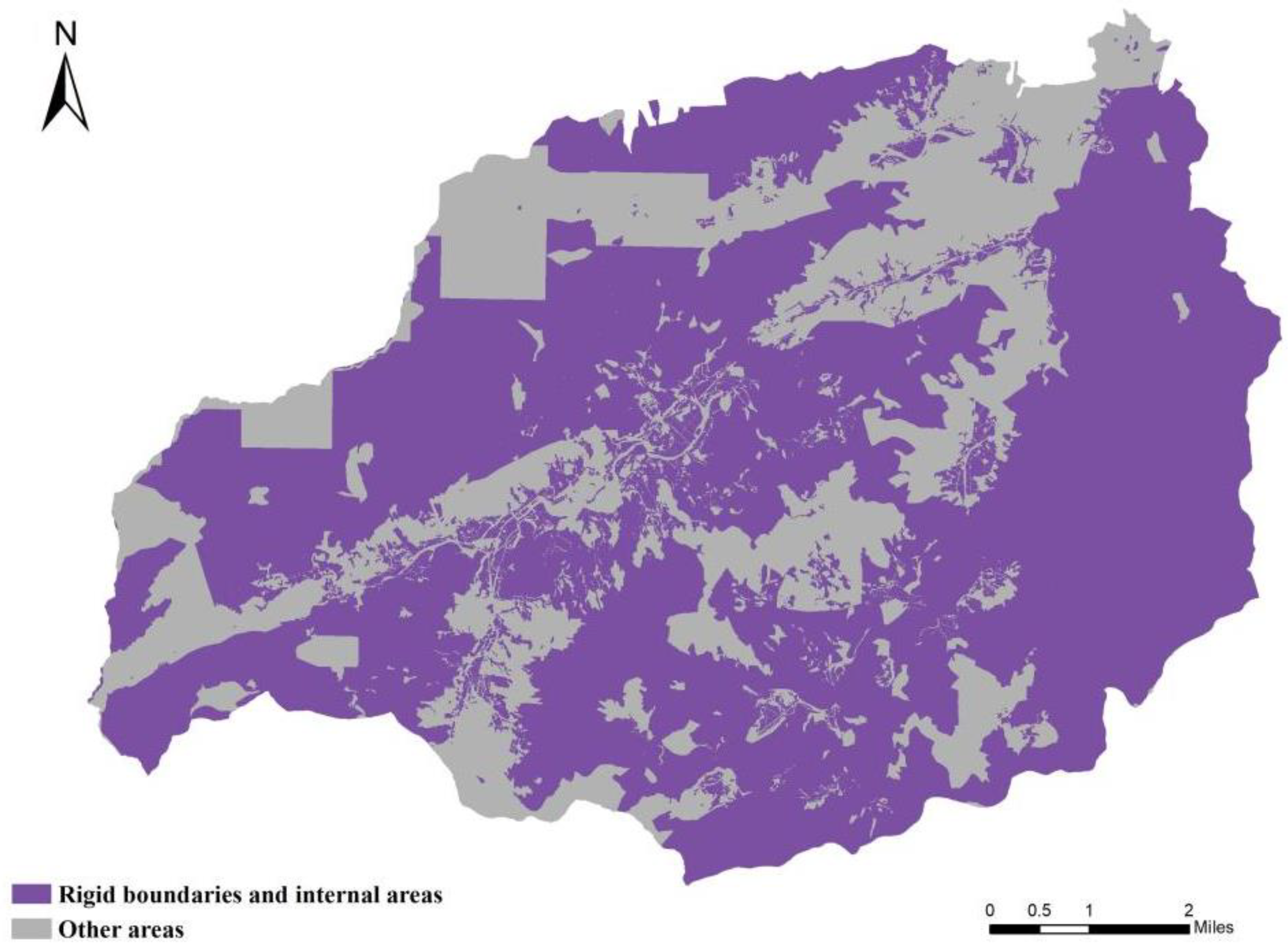
In land development, rigid boundaries represent insurmountable spatial limits. Delineating rigid boundaries helps define non-developable areas in the countryside, thereby facilitating the maintenance of ecological security and promoting sustainable land use patterns [30,31,32]. Guided by established rigid boundary delineation criteria and relevant indicators from ecological environment and tourism planning documents [33,34,35], the rigid boundaries of the study case are determined. Using ArcGIS 10.8, the rigid boundaries and internal areas of Zhongyuan Township are mapped (Figure 2), covering approximately 119.23 km2. In this study, the available space is therefore defined as areas outside these rigid boundaries.
On this spatial basis, environmental factors that influence the decision-making of each agent are taken into account. The selection of these factors will be detailed in the subsequent section on decision-making rules.

3.2. Decision-Making Rules of Government Agents

In the land use system, the government’s behavior exhibits the attribute of public management. In the model, unlike other agents, the government agents do not possess the spatial attribute of geographical location. In the context of RSHTUE, local governments adhere to the principle of rigid land use boundaries in accordance with relevant central government policies. Then, among the exploitable parcels, government agents evaluate and measure parcel utility to make land use decisions by integrating the actual local development status and the demands of other stakeholders. When the government conducts land use planning decisions, it is required to first determine whether the land unit (i,j) is located in the restricted area within the rigid boundary. A rigid boundary constraint factor P ( i ,   j ) con is introduced in this study, where the value is set to 0 for restricted areas and 1 for non-restricted areas. Due to the varying planning priorities of the government for different regions, key development zones and general development zones are usually demarcated. The guiding factor P ( i ,   j ) gui for key development zones is set to 0.8, while that for general development zones is 0.5. Additionally, the government agents need to consider whether the parcel has the conditions for tourism development, such as suitable slope [36], traffic accessibility [37], and elevation [38]. Building upon factors identified in previous studies [36,37,38,39] and the core objective of RSHTUE to offer summer respite services [3], this study selects slope, distance to main road, distance to river, elevation, and summer temperature to measure the utility U ( i ,   j ) ut of parcels from the government’s perspective. The parcel utility is given by
U i , j ut = α 1 W i , j t + α 2 H i , j t + α 3 P i , j t + α 4 G i , j t + α 5 R i , j t
In Equation (1), the superscript t denotes the time, and subscript (i,j) denotes the land unit. W ( i ,   j )   t , H ( i ,   j )   t , P ( i ,   j )   t , G ( i ,   j )   t and R ( i ,   j )   t represent summer temperature, elevation, slope, distance to main road, and distance to river of the land unit (i,j), respectively. α 1 , α 2 , α 3 , α 4 , α 5 are the preference weight coefficients of each factor.
This utility value is derived from the weighted sum of multiple environmental factors. However, the parcel with the highest utility value is not guaranteed to be selected. To reflect the uncertainty in the decision-making process, we convert the utility value into a selection probability. Assuming that government agents make decisions solely based on utility, the probability that each land unit is selected at time t is P ( i ,   j ) ut . P ( i ,   j ) ut is expressed as
P ( i ,   j ) ut = U i , j ut i = 1 , j = 1 m , n U i , j ut
In Equation (2), i = 1 , j = 1 m , n P i , j ut = 1 ,   ( i = 1 , 2 , , m ;   j = 1 , 2 , , n ) .
In the decision-making process, considering the influence relationship between parcels, a neighborhood influence factor P ( i ,   j ) nei is introduced. It investigates the influence on the central parcels caused by the utility situation of surrounding parcels developed into tourism land within the scope of a 3 × 3 land unit. P ( i ,   j ) nei is formulated as
P i , j nei = P i - 1 , j - 1 ut + P i - 1 , j ut + P i - 1 , j + 1 ut + P i , j - 1 ut + P i , j + 1 ut + P i + 1 , j - 1 ut + P i + 1 , j ut + P i + 1 , j + 1 ut 3 × 3 - 1
The land unit (i,j) can be selected as tourism land only after the government agents consider multiple aspects. This probability is denoted as P ( i ,   j ) gov , which determines the possibility of the parcels being selected by the government agents. When P ( i ,   j ) gov = 1, the calculation formula of P ( i ,   j ) gov is as follows.
P i , j gov = P i , j con + P i , j gui + P i , j ut + P i , j nei 4
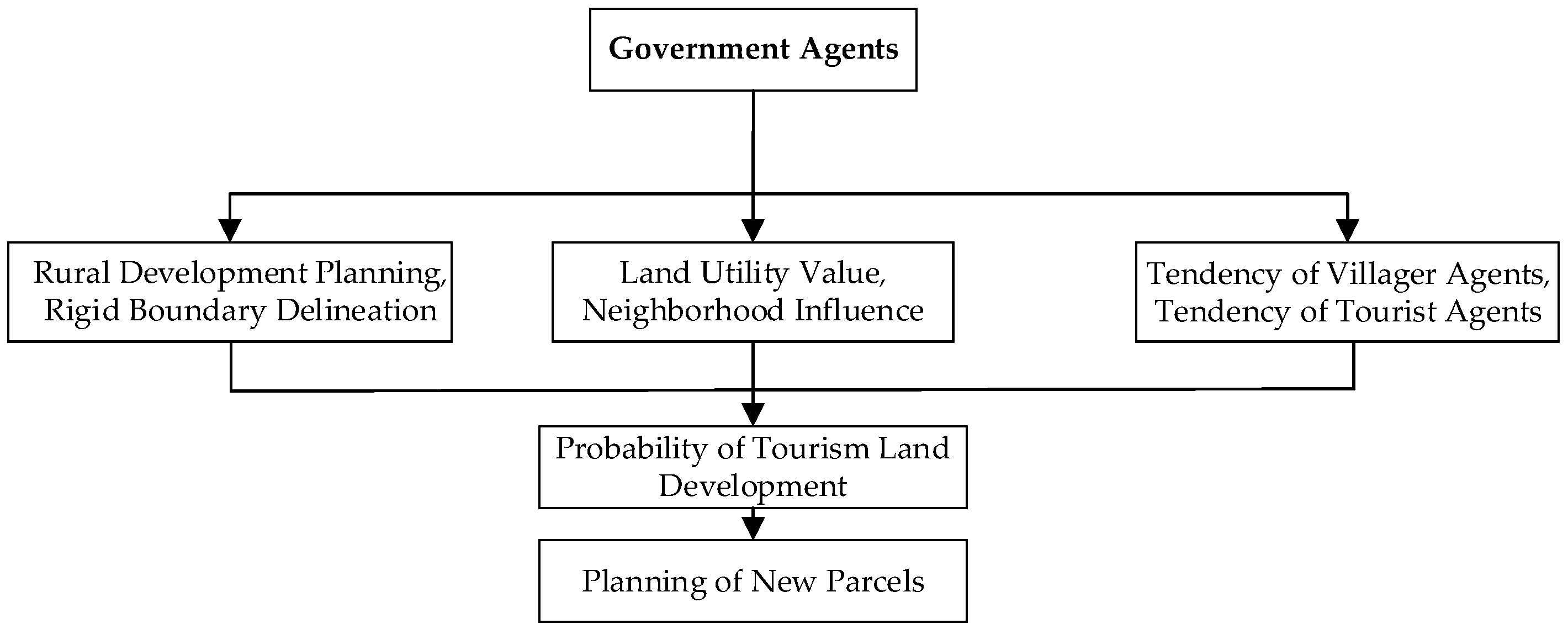
In summary, the decision-making process of the government’s land use behavior can be represented as Figure 3.

3.3. Decision-Making Rules of Villager Agents

The land use decision-making of villagers in tourism destinations are mainly manifested in two forms: conversion of land use functions and expansion of construction land [21]. With the development of the rural economy, many rural migrant workers have chosen to return to their hometowns to start businesses. This trend is reflected in the conversion of land use functions, as returning migrants utilize idle residential buildings for tourism operations. Additionally, the growing demand and changes in the household size of villagers driven by tourism development have also increased the demand for land, which is embodied in the expansion of construction land. Under China’s market economy, the core goal of villagers’ land use decision-making in tourism destinations is to maximize economic benefits. They determine the specific use of residential buildings based on factors such as economic capacity, actual needs, surrounding environment, and the operation status of neighboring properties. Whether villagers in tourism destinations choose to operate homestays must be decided under the planning and supervision of the government.
To maximize land utility, the villager agents consider factors including the traffic accessibility of land [21,37], environmental quality [40], and hydrology [41]. Drawing on the findings of previous studies [37,40,41], this research identifies the environmental factors related to villagers’ decision-making as follows: distance to main road, distance to hospital, suitability for agricultural products, and distance to river. Based on this, from the perspective of villagers, the utility value of parcels can be expressed as
U ( i ,   j ) rt = β 1 G ( i ,   j ) t + β 2 R ( i ,   j ) t + β 3 Y ( i ,   j ) t + β 4 Z ( i ,   j ) t
In Equation (5), G ( i ,   j )   t and R ( i ,   j )   t have the same meanings as previously defined; Y ( i ,   j )   t and Z ( i ,   j )   t represent the distance from the land unit (i,j) to the hospital and the suitability for agricultural product cultivation; β 1 , β 2 , β 3 , β 4 denote the preference weight coefficients of each factor, respectively.
When only parcel utility is considered, the selection probability of a government-decided parcel by villagers is calculated by the formula.
P i , j res = U i , j rt i = 1 , j = 1 m , n U i , j rt
Similarly, villagers’ decisions are also affected by the number of surrounding agritainment businesses. A neighborhood index is introduced to account for this neighborhood effect, with its calculation formula given by
P i , j lnei = N nong ( i , j ) 3 × 3 - 1
In Equation (7), N nong ( i , j ) refers to the number of parcels that have been selected by the government and occupied by villagers within the 3 × 3 area surrounding land unit (i,j).
Considering both aspects, land units will be selected by the villager agents if the probability of being chosen exceeds a predetermined threshold. The probability is formulated as
P ( i ,   j ) dev = P ( i ,   j ) res + P ( i ,   j ) lnei 2
The land use decision-making process of villagers is illustrated in Figure 4.

3.4. Decision-Making Rules for Tourist Agents

Tourists’ destination choice is a complex process influenced by a combination of social, economic, and natural factors. Tourists prefer destinations that satisfy their comprehensive comfort and wellness needs. Whether tourists select a destination reflects the market demand for that area. This demand, in turn, serves as a crucial driver for land-use planning and decisions by the government and villagers. Tourist decision-making behavior involves complex psychological activities of tourists and is affected by the combined influence of multiple factors [42]. In addition to objective factors of tourist destinations such as temperature [43], traffic accessibility [21], and travel distance [44], subjective factors like price perception also influence their choice of destinations [45]. Considering the characteristics of RSHTUE [3] and the research findings [21,43,44,45], this study defines the decision-making factors of tourists as follows: summer temperature, distance to main road, distance to river, distance to hospital, suitability for agricultural products, travel time to land parcels, accommodation prices, and tourists’ monthly income. These factors are collectively referred to as environmental factors in this paper. Tourists also adhere to the principle of rationality and will choose tourist destinations with greater utility based on these factors [46]. Thus, the utility value of land parcels from the perspective of tourists is expressed as
U i , j tt = γ 1 T i , j t + γ 2 G i , j t + γ 3 R i , j t + γ 4 Y i , j t + γ 5 W i , j t + γ 6 Z i , j t + γ 7 J i , j t + γ 8 S i , j t
In Equation (9), G ( i ,   j )   t , R ( i ,   j )   t , Y ( i ,   j )   t , W ( i ,   j )   t and Z ( i ,   j )   t have the same meanings as previously defined; J ( i ,   j )   t represents the accommodation price of land unit (i,j); T ( i ,   j )   t and S ( i ,   j )   t denote the travel time to the land parcels and tourists’ monthly income, respectively; γ 1 , γ 2 , γ 3 , γ 4 , γ 5 , γ 6 , γ 7 , γ 8 are the preference weight coefficients corresponding to each factor.
On the basis of land parcels initially identified as suitable by the government and villagers, tourists ultimately determine which ones are developed for tourism based on their own utility assessments. The selection probability of tourists is expressed as
P ( i ,   j ) tour = U i , j tt i = 1 , j = 1 m , n U i , j tt
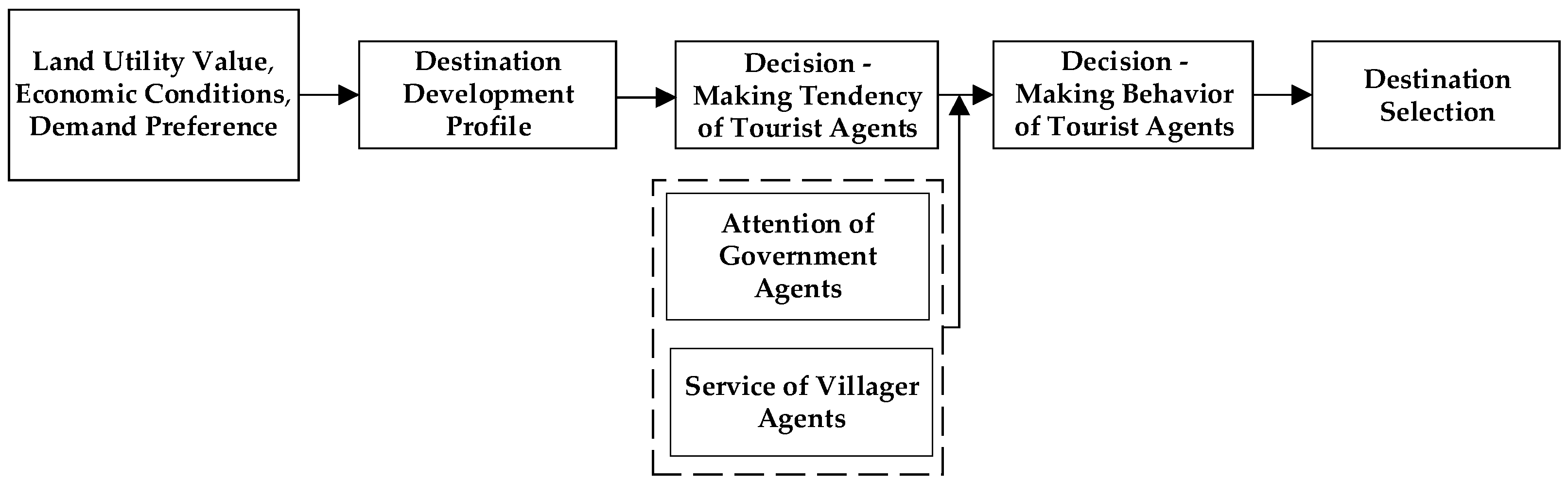
The decision-making process of tourist land parcel selection is illustrated in Figure 5.
In summary, the decision-making rules of the government, villagers, and tourists collectively form an integrated simulation chain for land use evolution. Within this model, the transformation of land into tourism use is not the product of a single, global optimization algorithm. Rather, it is an emergent macro-level phenomenon arising from the sequential decisions of these three agents, each acting according to its own objectives and rules. This process adheres to a distinct chain of logic: first, the government agent delineates a potential development zone based on rigid constraints and comprehensive utility. Next, villager agents make development decisions within this zone, guided by their individual utility and neighborhood effects. Ultimately, tourist agents determine which of these developed parcels realize their full tourism value through their destination choices. Consequently, the final land use pattern generated by the model essentially simulates a dynamic equilibrium, born from the interplay of mutual constraints and coordination among the preferences of multiple agents.

3.5. Scoring Rules for Environmental Factors

Based on relevant literature, the scoring rules for environmental factors that influence the utility of land parcels for the three types of agents are specified in Table 1.

3.6. Model Programming and Operation

To implement the multi-agent simulation framework, this study selected NetLogo 6.3.0 as the modeling platform. This platform is specifically designed for agent-based modeling, and its core functionalities are closely aligned with the requirements of this study for modeling autonomous agents, behavioral rules, and spatial interactions. Meanwhile, its built-in GIS extension enables seamless integration of environmentally processed data from ArcGIS, providing the model with an authentic geospatial environment layer. Compared to other platforms such as Repast Simphony or AnyLogic, which are more suitable for large-scale, computationally intensive simulations, NetLogo offers a better balance between modeling capability, development efficiency, and visualization clarity, making it more appropriate for the core objectives of this research.
In the model programming process, this study mainly includes the following steps. (1) Framework construction: Determining the model composition and internal relationships. (2) Importing data: After assigning values to environmental factor data processed in ArcGIS 10.8, inputting them into NetLogo 6.3.0 as land parcel attribute values through GIS to simulate the external environment. (3) Rule encoding: Based on the various agent rules described in the previous text, converting them into the buttons, sliders, and code language in NetLogo 6.3.0. (4) Model optimization: Testing an appropriate spatial extent to balance model efficiency and accuracy, while calibrating the interaction logic and decision rules among agents to verify robustness.
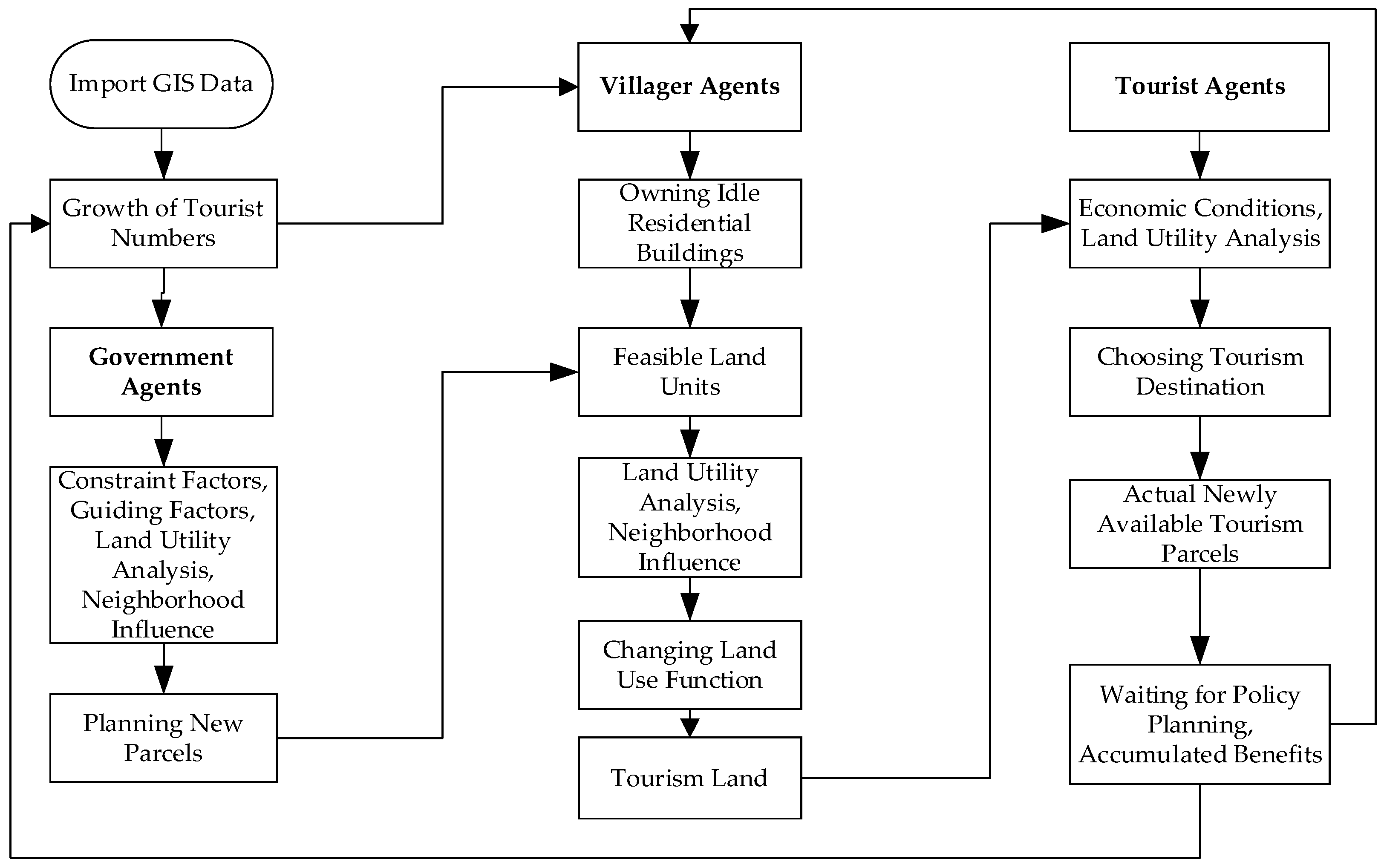
The operational logic of the model is illustrated in Figure 6. The process, which is predicated on agent decision-making within the constructed natural and tourism environments, is described below. (1) The government agents designate land parcels for planning based on tourist demand, rigid boundaries, land parcel utility, and neighborhood effects, changing eligible land parcels from gray to red. (2) Villager agents propose to convert eligible land parcels for tourism use. The government verifies whether the land parcels fall within the scope of eligible planned areas. If so, the villager agents convert the land parcels based on utility and neighborhood effects, further changing the land parcels from red to yellow. (3) Tourist agents select tourist destinations based on the utility of land parcels; the selected parcels are changed from yellow to blue, and these parcels are identified as those practically available for tourism development. (4) Changes resulting from the decision-making of tourist agents and villager agents in turn serve as the basis for the government agents’ land planning in the next cycle. This entire process is set to operate cyclically on an annual basis to complete the transformation to tourism land.

4. Empirical Study

4.1. Overview of the Research Site

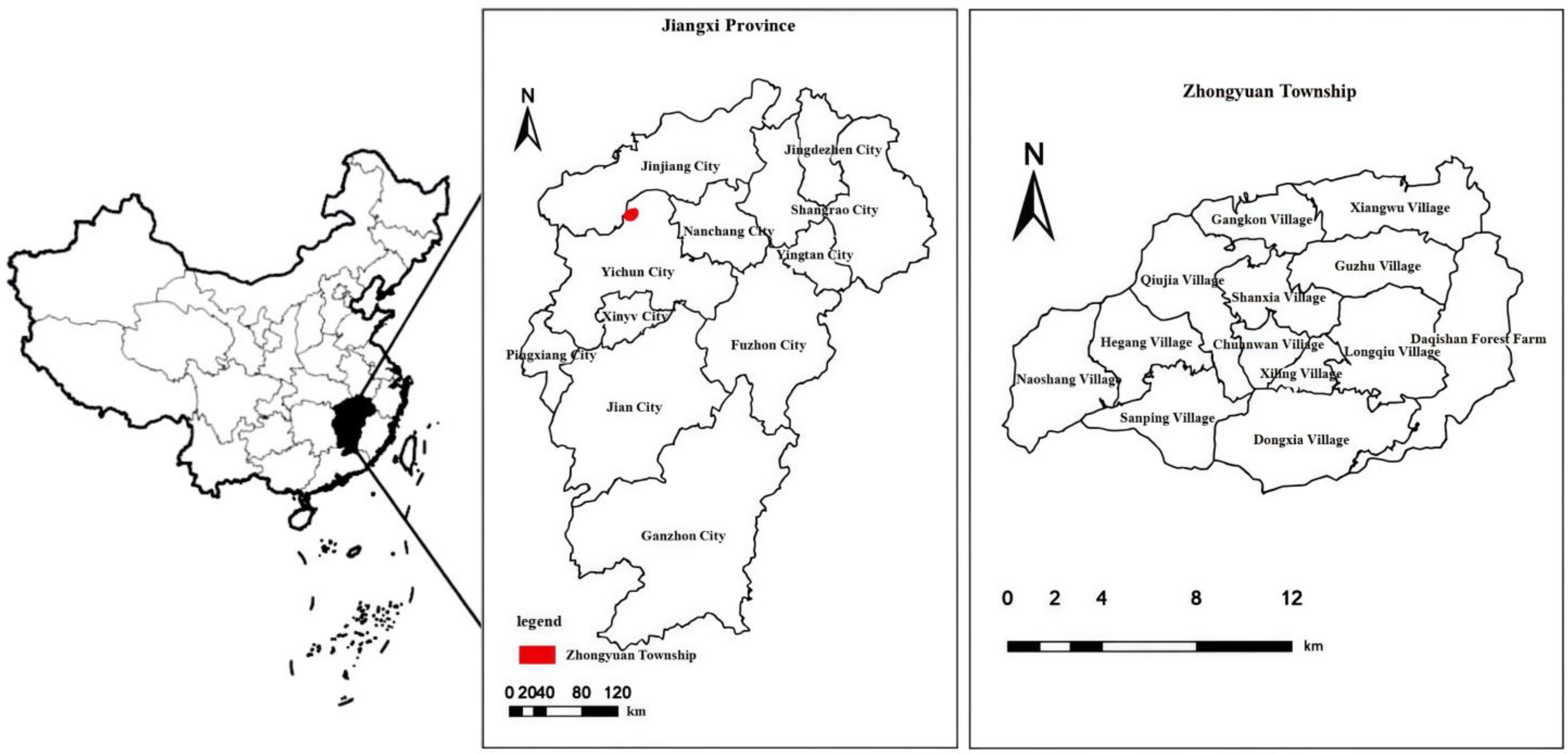
Zhongyuan Township, in the southwest of Jing’an County, Yichun City, Jiangxi Province, China, boasts 19 peaks with an elevation of over 1000 m. Its forest coverage rate reaches nearly 90%, and the concentration of negative oxygen ions in the air is as high as 100,000 ions/cm3. The unique landform endows the area with a cool and pleasant climate in summer, with an average temperature ranging from 18 °C to 22 °C. Leveraging its superior natural conditions, Zhongyuan Township has attracted a substantial population of elderly people from neighboring cities with high temperatures to come for summer health tourism. As of August 2023, there are more than 700 homestays in the area, over 3000 employees, and more than 1.2 million tourist arrivals annually for vacations, among which approximately 10,000 are long-stay tourists during the summer. The total tourism revenue exceeds 180 million yuan. Zhongyuan Township is a typical rural area for the development of RSHTUE. In recent years, the local government’s development policies have also been closely integrated with RSHTUE, necessitating rational planning of land available for tourism. The geographic location of Zhongyuan Township is shown in Figure 7.

4.2. Data Sources and Processing

The data required for this study include 30 m-resolution DEM data of Jing’an County, sourced from the Computer Network Information Center of the Chinese Academy of Sciences (http://www.gscloud.cn); an administrative division map and main road data of Zhongyuan Township, provided by the Institute of Geographic Sciences and Natural Resources Research, Chinese Academy of Sciences (https://www.resdc.cn/Default.aspx, accessed on 24 November 2025); relevant data obtained with the permission of the local government during the field survey.
The data processing of relevant factors on the ArcGIS 10.8 platform and the attribute setting in the model include the following contents. (1) DEM elevation and slope data: Raster data of elevation and slope in Zhongyuan Township are obtained using the “Extraction Analysis” tool. (2) Road and river data: River data are extracted through the “Hydrology Analysis” tool. The “Domain Analysis” tool is utilized to calculate the distance to the road and river using the center point of land parcels. (3) Distance to hospital: Distance to hospital is calculated using the “Feature to Point” and “Point Distance” tools. (4) Temperature: Temperature = −0.006 × Elevation + 30 °C [57]; the temperature of land parcels is estimated by combining historical temperature data of Zhongyuan Township. (5) Accommodation price: Summer homestays are regulated by the local government and homestay associations, with a unified pricing standard set at 2000 yuan per month. Additionally, homestay prices for 50 randomly selected parcels within the research site are randomly set within the scope, indicating the situation where homestay prices are adjusted slightly based on the quality in reality. (6) Tourists’ monthly income: To simulate the realistic diversity and uncertainty of tourist income sources inherent in the open RSHTUE market, the monthly income for tourists (level 1, 2, or 3) was assigned stochastically, with reference to the corresponding rules in Table 1. After multiple comparative experiments of the model on the NetLogo 6.3.0 platform, the simulation space scope in NetLogo of the Zhongyuan Township model is finally determined, with the maximum coordinates (x, y) set as (300, 260).

4.3. Development Scenario Planning

Scenario analysis is a method that reasonably infers multiple potential future development situations based on the historical context and current status of a subject, simulates the paths to achieve them, and derives future outcomes under different scenarios [28,58]. To better apply the model to practical contexts, this study employs scenario analysis to examine the potential development of RSHTUE, which is designated as the RSHTUE development scenario. In practice, different development scenarios represent distinct directions of local policies. Setting scenarios in advance for simulation facilitates the comparison, selection, and optimization of various policies. In the model setting, different development scenarios are mainly reflected in the varying preferences of three types of agents for various environmental elements, resulting in different simulated land use changes. Drawing on relevant literature [59,60] and the characteristics and needs of RSHTUE development, three scenarios are designed for Zhongyuan Township.
(1)
Tourism-led development scenario. It is pointed out in Yichun City’s development planning documents that efforts should be made to fully explore and leverage unique resource advantages in order to promote the vigorous growth of the emerging tourism and wellness industry [34]. The government work report of Zhongyuan Township in September 2023 also mentioned that shaping the tourism summer resort brand will be the strategic goal of the core work deployment in the future stage [61]. To achieve this, the government plans to promote and support the high-quality development of the tourism homestay industry from the aspects of planning layout and construction, infrastructure improvement and optimization, and financing channel expansion, as well as brand building and market promotion. Based on this, the study defines the first development scenario as a tourism-led development scenario, which refers to the future development model of the region guided by the tourism industry as its core.
(2)
Eco-protection development scenario. Under the guidance of ecological civilization and green development concepts, the comprehensive coordination of the protection of mountains, waters, forests, fields, lakes, and grasslands has become a key task [62]. Yichun City’s government emphasizes accelerating ecological zoning regulations and steadfast adherence to the principle of ecological priorities [34]. Jing’an County also clearly states that it is necessary to further strengthen the green advantages for high-quality and leapfrog development and proposes specific goals for ecological environment protection [35]. This scenario focuses on the preservation of ecological resources, takes low construction intensity and increased green coverage as its core concept, and plans regional development through strict ecological protection policies.
(3)
Rural belt joint development scenario. The integrated development of rural tourism can effectively facilitate reemployment, resource utilization, and the inheritance of rural traditional culture, making it a crucial approach to advancing rural economic revitalization [63]. To achieve sustainable tourism development, it is necessary to adopt a holistic mindset, break down administrative barriers between adjacent regions, and promote coordinated development [64]. Currently, some villages in Zhongyuan Township have been minimally positively impacted by the development of the RSHTUE industry, as they have not considered integrating their characteristic industries as extended projects in the RSHTUE industrial chain, resulting in fragmented development across regions. In order to focus on the coordinated coexistence of rural development in the new era and better meet the strategic requirements of rural revitalization, the third development scenario of Zhongyuan Township is set as the rural belt joint development scenario, which emphasizes the coordinated development of rural areas and aims to drive the development of the RSHTUE industry in relatively weak rural areas with better business development.
Based on the three aforementioned development scenarios, the weights of the environmental factors were determined using the Analytic Hierarchy Process (AHP) through a stratified sampling [65]. We invited 15 government officials, 15 villagers, and 15 tourists from Zhongyuan Township to score the importance of various environmental factors in land parcel utility evaluation for the government, villager, and tourist agents, respectively. The resulting weights are presented in Table 2.
According to the plan for the Zhongyuan Summer Resort in Jing’an County, Jiangxi Province, China, Sanping Village, Hegang Village, and Qiujia Village have been designated as key development zones. Therefore, the guidance factor for these three villages is set at 0.8, the remaining eight villages are classified as general development zones, with their guidance factor set at 0.5.

4.4. Scenario Prediction Results

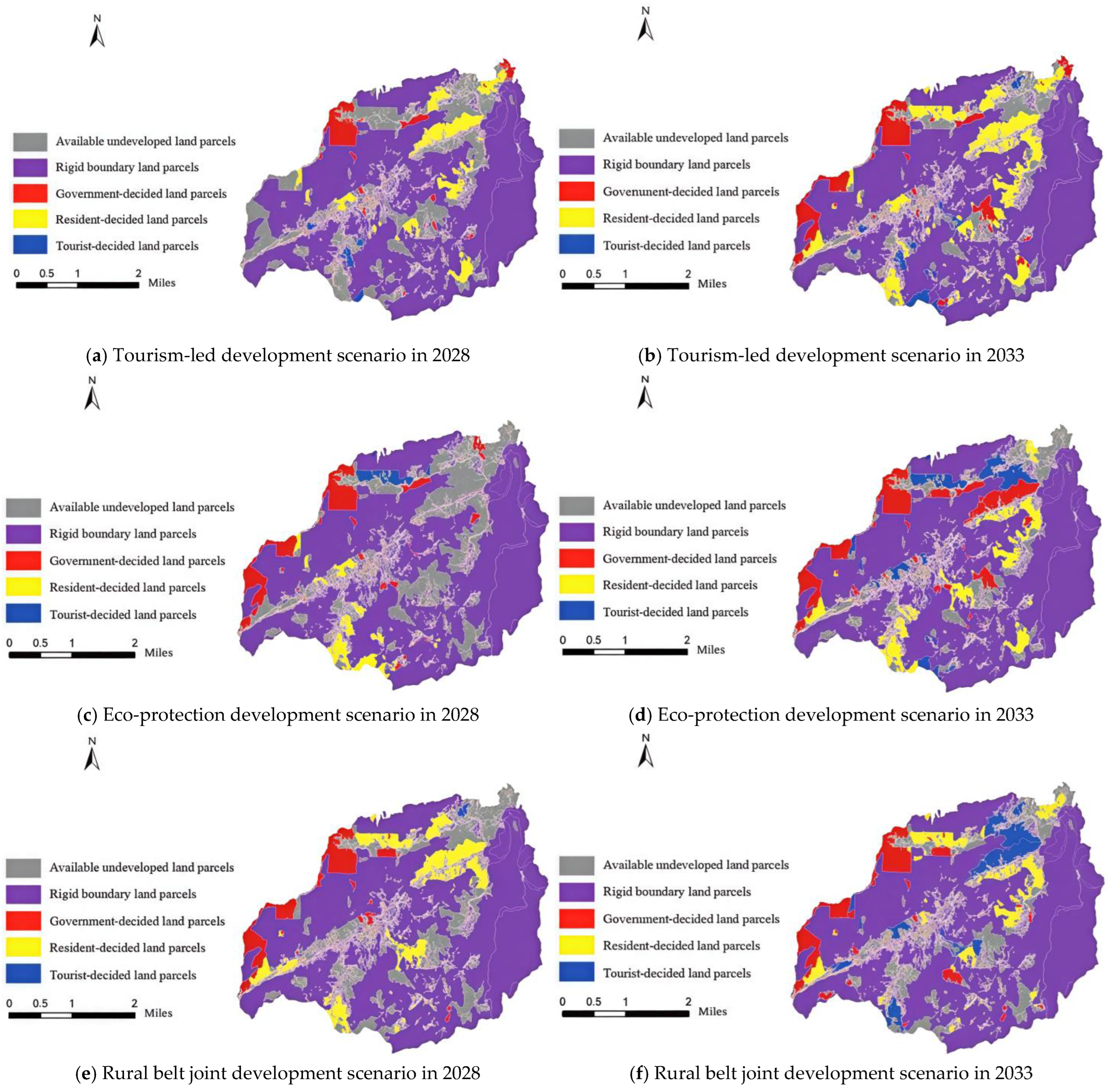
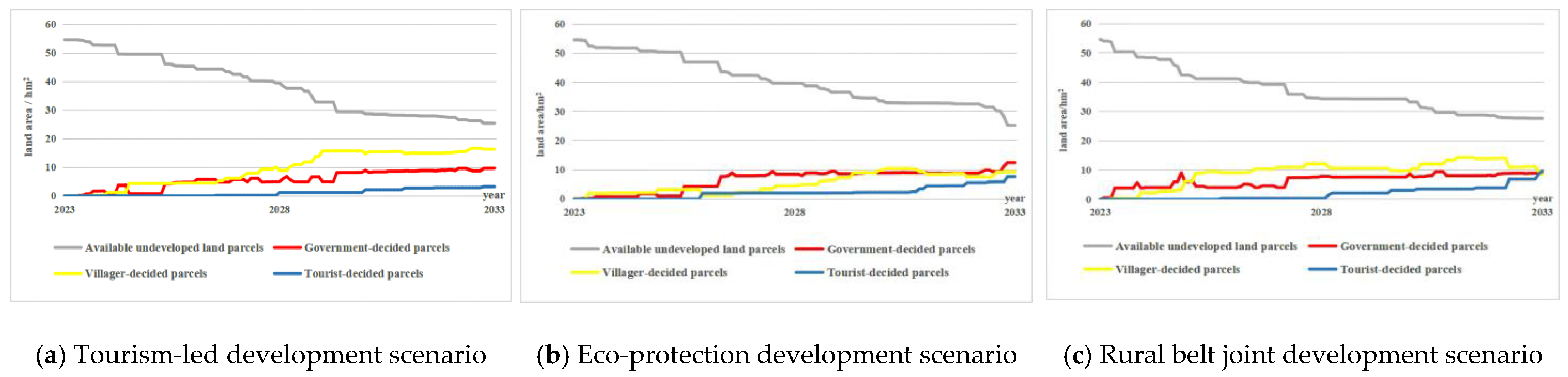
Using NetLogo 6.3.0, the scenario weight sliders are adjusted based on the settings of the three types of scenario planning. The model is run to conduct simulation predictions on the evolution of tourism land in Zhongyuan Township for the target years of 2028 and 2033. The land use simulation results under each development scenario (Figure 8), the changes in land use over time (Figure 9), and the statistics of land use during the decision-making process of the three types of agents (Table 3) are obtained.
From Figure 8, the following can be seen that from the perspective of development scenarios:
(1)
Under the tourism-led development scenario, the tourism land planned by the government is mainly concentrated in Qiujia Village, Naoshang Village, and Xiangwu Village. The tourism land identified by villagers is primarily distributed in Guzhu Village, Xiangwu Village, and Gangkou Village. The preferred areas for tourists are mainly Hegang Village and Sanping Village, followed by Naoshang Village, Chuanwan Village, Dongxia Village, and Xiangwu Village; these villages can be prioritized for development.
(2)
Under the eco-protection development scenario, the tourism land planned by the government is concentrated in Qiujia Village, Naoshang Village, and Guzhu Village. The tourism land selected by villagers is focused on Sanping Village and Guzhu Village. The areas preferred by tourists are mainly Gangkou Village, followed by Dongxia Village, Xiangwu Village, Hegang Village, and Qiujia Village; these villages have great development potential.
(3)
Under the rural belt joint development scenario, the key tourism lands planned by the government are located in Gangkou Village and Naoshang Village. The tourism land identified by villagers is mainly concentrated in Sanping Village, Xiangwu Village, and Guzhu Village. The areas selected by tourists are focused on Xiangwu Village, followed by Hegang Village, Sanping Village, and Chuanwan Village; these villages should be prioritized for development.
Based on the land change data presented in Figure 9 and Table 3, the number of tourism land decisions made by the three stakeholders shows an increasing trend year by year. Among them, the growth of land selected for development by the government is relatively stable, which is consistent with its relatively stable and prudent attitude in land use planning. Notably, while tourist-selected parcels are extremely limited in 2028 under the rural belt joint development scenario, their number surpasses that of the other two scenarios by 2033. Therefore, it can be foreseen that in the short term, the scenario of rural belt joint development may result in relatively fewer tourist choices due to the lack of brand effects and the low tourism participation and market awareness in other villages. In the long run, however, with gradual improvement of infrastructure, the emergence of brand effects, the formation of collaborative development advantages, and changes in tourist demand, the rural belt joint development scenario demonstrates strong attractiveness and competitiveness. This result highlights the potential and advantages of the rural belt joint development scenario in promoting the sustainable development of rural tourism. Moreover, the development trend indicates that the demand for tourism land among various stakeholders is dynamically changing. Given the finiteness and non-renewability of land resources, uninformed decision-making should be avoided in tourism planning. Instead, multiple factors should be comprehensively considered, land use should be allocated rationally, and sustainable and high-quality development should be regarded as the core goal.
The simulation results indicate that the three development scenarios shape significantly distinct spatial patterns and evolutionary trajectories of land use. These differences are not random but stem from fundamental distinctions in the core objectives and policy orientations defined by each scenario, which systematically influence the decision-making preferences of multiple stakeholders, thereby reshaping their spatial behaviors. Under the tourism-led scenario, the policy orientation prioritizes tourism development, directing both government planning and villager development actions towards parcels with superior foundational conditions. This leads to a land use pattern characterized by high clustering and intensive development, though it may also exert some pressure on ecological spaces. In the eco-protection scenario, the decision-making logic emphasizes maintaining ecological integrity and strictly limits the spatial scope available for development. As a result, tourism land use tends to be more dispersed and limited in scale, with total development significantly restrained, thereby effectively preserving the regional ecological baseline.
Under the rural belt joint development scenario, the policy priority is on regional coordination and industrial integration. This encourages development activities to extend beyond a few core villages, shifting toward the formation of multiple functionally complementary and interlinked nodes across a broader geographical area. A more balanced and networked spatial structure emerges gradually, a trend that is particularly evident in long-term simulation results.

5. Discussion

This study constructs a multi-agent simulation model for RSHTUE land use. The model analyzes changes in tourism land use from the perspective of decisions made by three key stakeholders and incorporates rigid boundaries into the environmental layer, aligned with sustainable land management requirements in China. In the study, different development scenarios are designed to illustrate the future trends of tourism land use under corresponding policies. Based on the results of the three simulation predictions, the research site can select a sustainable development path, optimize existing land use policies and allocate resources in a targeted manner, all in alignment with its actual development conditions.
While existing research has made remarkable achievements in the macro-simulation of urban expansion [22,23,24] and rural change [26], the models often treat tourism land as a homogeneous land use type. Consequently, it fails to reveal the endogenous evolutionary logic driven by specific market demands. In terms of model structure, this study achieves a structural breakthrough, moving from a purely supply-side model to a multi-agent system. Although existing models [7] include villagers and the government, they are essentially supply-side models. Within this framework, the decisions of villagers and the planning of the government constitute a closed loop. The model can only simulate passive adjustments under given resource endowments and policy constraints but cannot explain how fluctuations in market demand fundamentally reshape this pattern. This study introduces tourists as an independent demand-side agent, which completely alters the model’s dynamic mechanism and forms a clear decision-making chain. In this chain, the government’s planning first delineates the potential space for development; the villagers’ decisions are then transformed into a concrete supply of tourism services; and ultimately, the tourists’ choices validate the parcel’s market value. Therefore, the final land use pattern generated by the model does not originate from a single global optimization algorithm. Instead, it is a macro-level dynamic equilibrium that emerges from the sequential decisions made by these three types of agents, each acting according to its own rules.
By introducing scenario analysis, this study transforms the model from an analytical tool into a “policy laboratory,” fundamentally enhancing its practical relevance. This contrasts with the approach of some studies [20] that use scenario analysis for historical backcasting to validate theories. For policymakers, anticipating the future is far more urgent than validating the past. Therefore, rather than simply applying scenario analysis, this study is grounded in the practical challenges of China’s rural revitalization and innovatively proposes the rural belt joint development scenario. This scenario confronts a critical reality: the tourism boom in a single village often leads to industrial hollowing in adjacent areas, which has become the biggest obstacle to achieving common prosperity. The theoretical core of the rural belt joint development scenario is to explore a spatial spillover effect—converting the growth momentum of core areas into a driving force for the coordinated development of the entire region through land use planning. This move not only provides a concrete solution for RSHTUE areas but, more importantly, significantly expands the application boundaries of multi-agent simulation. It elevates the model’s function from pure simulation to serving the design for regional coordinated development.
These findings offer practical guidance for destinations using RSHTUE to achieve sustainable rural revitalization, and their core value lies more in that the methodological framework provides a transferable reference for modeling other types of rural tourism. Although the environmental factors and decision rules in our model are context-dependent, its core framework is transferable. Other rural tourism areas can apply this model through localized reconstruction. Firstly, by redefining the core agents and their behavioral objectives to accurately capture the unique local socio-economic characteristics; secondly, by constructing decision rules that align with the local context to make the local decision logic explicit and quantitative; finally, by identifying and quantifying key local environmental factors to provide realistic physical constraints for model evolution. Through these three interlinked steps, the general framework can be transformed into a highly customized scientific tool, thereby providing precise decision support for different regions to address their unique sustainable development challenges.
This study also has certain limitations. Since RSHTUE land is an emerging type of rural land, traditional rural land classification does not have a specialized category for this type of land. Consequently, this study lacks historical empirical data to validate the model. In the future, historical data on tourism land use could be manually collected through field interviews to verify the model.

6. Conclusions

RSHTUE has become a significant driver of rural socioeconomic development. However, its sustainable growth faces the dual constraints of limited land resources and complex multi-stakeholder interactions. To address these challenges, this study developed a multi-agent simulation model that integrates the decision-making behaviors of government, villagers, and tourists while incorporating rigid boundaries as key constraints. Applied to Zhongyuan Township, the model simulated tourism land use evolution under three distinct development scenarios for 2028 and 2033. The results reveal markedly different spatial patterns and evolutionary trajectories across scenarios, with important implications for sustainable spatial planning. The tourism-led scenario promotes economic expansion but risks ecological fragmentation; the eco-protection scenario prioritizes environmental conservation while limiting development intensity; and the rural belt joint scenario demonstrates the strongest potential for balanced, sustainable development by coordinating economic, social and ecological objectives. Theoretically, this study advances multi-agent modeling through its structural integration of three stakeholder behavior patterns and parameterized workflow design, thereby enriching the methodological framework for sustainable tourism land use simulation. Practically, the model serves as a “policy laboratory” to simulate and compare the effects of different policy scenarios, thereby enabling the precise generation of land use strategies that balance multi-stakeholder sustainable development and providing an empirical basis for the scientific formulation and dynamic optimization of regional policies.

Author Contributions

Conceptualization, P.Z., R.L. and L.W.; methodology, Z.F. and A.H.; software, Z.F. and L.W.; validation, P.Z., Z.F. and A.H.; formal analysis, Z.F.; investigation, P.Z., A.H., L.W., R.L. and Z.F.; resources, P.Z. and R.L.; data curation, A.H., L.W. and Z.F.; writing—original draft preparation, P.Z., A.H. and L.W.; writing—review and editing, P.Z., R.L. and Z.F.; visualization, A.H. and Z.F.; supervision, R.L.; project administration, P.Z.; funding acquisition, P.Z., R.L. and Z.F. All authors have read and agreed to the published version of the manuscript.

Funding

This research was funded by National Natural Science Foundation of China (grant number 72064020), Jiangxi Provincial Association of Social Sciences (grant number 23GL11) and Jiangxi Provincial Department of Education Graduate Student Innovation Fund Project (grant number YC2024-S196).

Data Availability Statement

The data presented in this study are publicly available at https://doi.org/10.6084/m9.figshare.30736103.

Conflicts of Interest

The authors declare no conflicts of interest.

References

  1. Li, X.; Xue, J.; Luo, J.; Yang, A. The silver-hair economy in the new era: Political economy perspectives on its dilemmas and solutions. Sustainability 2025, 17, 6760. [Google Scholar] [CrossRef]
  2. Zhang, P.; Wu, L.; Li, R. Development Drivers of Rural Summer Health Tourism for the Urban Elderly: A Demand- and Supply-Based Framework. Sustainability 2023, 15, 10686. [Google Scholar] [CrossRef]
  3. Zhang, P.; Liang, Q.; Li, R.; Guo, S. Differentiation of rural summer health tourism for urban elderly: Tourist segmentation based on tourism experience. J. Hosp. Tour. Manag. 2024, 59, 149–152. [Google Scholar] [CrossRef]
  4. Xi, J.; Zhao, M.; Ge, Q.; Kong, Q. Changes in land use of a village driven by over 25 years of tourism: The case of Gougezhuang village, China. Land Use Policy 2014, 40, 119–130. [Google Scholar] [CrossRef]
  5. Cheng, L.; Yang, X.; Pan, X.; An, J. Identification and classification of ecological restoration areas in the territorial land space of the Qaidam Basin, China. J. Arid Land 2025, 17, 1402–1424. [Google Scholar] [CrossRef]
  6. Zhang, Z.; Wang, X.; Zhang, Y.; Gao, Y. Simulating land use change for sustainable land management in rapid urbanization regions: A research site of the Yangtze River Delta region. Landsc. Ecol. 2023, 38, 1807–1830. [Google Scholar] [CrossRef]
  7. Meng, F.; Dong, L.; Zhang, Y. Spatiotemporal dynamic analysis and simulation prediction of land use and landscape patterns from the perspective of sustainable development in tourist cities. Sustainability 2023, 15, 14450. [Google Scholar] [CrossRef]
  8. Zhao, X.; Cai, B.; He, J.; Kong, X. Identifying potential rural residential areas for land consolidation using a data driven agent-based model. Land Use Policy 2024, 145, 107260. [Google Scholar] [CrossRef]
  9. Zhang, J.; Li, L.; Li, Q.; Chen, W.; Huang, J.; Guo, Y.; Ji, G. Multiscenario land use change simulation and its impact on ecosystem service function in Henan Province based on FLUS-InVEST model. Ecol. Evol. 2025, 15, e71111. [Google Scholar] [CrossRef] [PubMed]
  10. Yan, H.; Qiao, W.; Li, Y.; Li, C. Optimization of territorial ecological space under the constraint of ecosystem service externalities. Ecol. Indic. 2024, 168, 15. [Google Scholar] [CrossRef]
  11. Yang, W.; Zhang, Y.; Hou, K.; Wang, X. A hybrid cellular automaton model integrated with 3DCNN and LSTM for simulating land use/cover change. Int. J. Digit. Earth 2025, 18, 2447337. [Google Scholar] [CrossRef]
  12. Wang, M.; Feng, Y.; Chen, S.; Wang, R. Spatial scenario projection of soil organic carbon storage loss associated with land use change. Trans. GIS 2025, 29, e70104. [Google Scholar] [CrossRef]
  13. Pan, S.; Liang, J.; Guo, J.; Chen, W.; Ou, M.; De Vries, W.T. Climate change-based dynamic simulation of land use and carbon storage in urban agglomerations of the Yangtze River Economic Belt. J. Geogr. Sci. 2025, 35, 1432–1458. [Google Scholar] [CrossRef]
  14. Zheng, S.; Zhou, Y.; Yuan, J.; Liu, R.; Lyu, P.; Han, Z.; Zhang, C. Understanding Governments, ESCOs, and Clients’ Behavioral Strategies in Public Building Energy-Efficiency Renovation Based on Evolutionary Game Theory. J. Manag. Eng. 2025, 41, 04025018. [Google Scholar] [CrossRef]
  15. Xu, R.; Liu, L.; Liu, Y.; Yi, X.; Qiu, H. Multi-scenario modelling of urban spatial growth under water resources and aquatic ecological environmental constraints. Ecol. Indic. 2025, 177, 113803. [Google Scholar] [CrossRef]
  16. Zhang, M.; Gong, Q.; Liu, B.; Yu, S.; Yan, L.; Chen, Y.; Wu, J. Integrating linear programming and CLUE-S modeling for scenario-based land use optimization under eco-economic trade-offs in rapidly urbanizing regions. Land 2025, 14, 1690. [Google Scholar] [CrossRef]
  17. Hasan, F.; Liu, J.; Liu, X. Hybrid CA–Deep learning model for 3D urban growth simulation. Trans. GIS 2025, 29, e70139. [Google Scholar] [CrossRef]
  18. Wu, G.; Lin, Y.; Zhao, J.; Chen, Q. Identification of land use conflict based on multi-scenario simulation—Taking the central yunnan urban agglomeration as an example. Sustainability 2024, 16, 10043. [Google Scholar] [CrossRef]
  19. Qiao, X.; Liu, H.; Hao, Z.; Gong, P.; Liu, Y.; Yang, C.; Li, P. Simulating land use change for sustainability: A case study of the northern slope of Tianshan Mountains. Int. J. Digit. Earth 2025, 18, 2524055. [Google Scholar] [CrossRef]
  20. Jin, A.; Wang, P.; Zhang, G.; Shi, H.; Li, H. Ecological quality and spatial structure dynamics under future scenarios: A topological perspective from the Yellow River Basin. J. Clean. Prod. 2025, 522, 146346. [Google Scholar] [CrossRef]
  21. Liu, M.; Xi, J. A multi-agent model for simulation of rural settlement land use pattern: A research site of Gouge Village in Yesanpo Scenic Area. Tour. Trib. 2013, 34, 107–115. (In Chinese) [Google Scholar] [CrossRef]
  22. Zhang, W.; Cui, J.; Li, X.; Hou, X.; Li, Y.; Burgio, M.S.; Liu, H.; Yang, Q.; Liu, G. Understanding policy-volition interactions in urban ecological governance: A simulation framework based on SD-ABM coupling. J. Clean. Prod. 2025, 524, 146479. [Google Scholar] [CrossRef]
  23. Liu, J.; Xu, D.; Kong, X. Exploring the interaction mechanisms of behavioral options and policy regulation for construction waste and carbon reduction. Eng. Constr. Archit. Manag. 2025; ahead of print. [Google Scholar] [CrossRef]
  24. Xin, J.; Yang, J.; Ren, J.; Yu, W.; Shi, Z.; Cong, N.; Xiao, X.; Xia, J.; Qiao, Z. Enhancing urban resilience: Mitigating compound risk through multi-scenario land use optimization. Transportmetr. B Transp. Dyn. 2025, 13, 2552888. [Google Scholar] [CrossRef]
  25. Jia, Z.; Wang, H.; Xu, S.; He, Z.; Huang, G.; Liang, Y. Multiscenario simulation and prediction of land use in the urban agglomeration in the middle reaches of the Yangtze River considering urban expansion and shrinkage. J. Urban Plan. Dev. 2025, 151, 04025064. [Google Scholar] [CrossRef]
  26. Zhang, B.; Li, X.; Wang, H.; He, S.; Zeng, H.; Cao, X.; Hu, S. Modeling self-organized urban growth by incorporating stakeholders’ interactions into the neighborhood of cellular automata. Cities 2024, 149, 104976. [Google Scholar] [CrossRef]
  27. Hu, B.; Ni, Q.; Chen, Z.; Liu, X.; Liu, P.; Yuan, Z. Driving factors of rural land-use change from a multi-scale perspective: A case study of the Loess Plateau in China. Land 2025, 14, 617. [Google Scholar] [CrossRef]
  28. Guo, M.; Zhang, H.; Cui, Y.; Zhang, X.; Liu, Y. Uncovering stakeholders’ participation to better understand land use change using multi-agent modeling approach: An example of the coal mining area of Shanxi, China. Land 2022, 11, 2257. [Google Scholar] [CrossRef]
  29. Schück, F.; Arheimer, B.; Mazzoleni, M.; Brandimarte, L. A systematic mapping review of hydrological hazard management in agent-based systems. Environ. Res. Lett. 2025, 20, 113003. [Google Scholar] [CrossRef]
  30. Zheng, B.; Liu, G.; Wang, H.; Cheng, Y.; Lu, Z.; Liu, H.; Zhu, X.; Wang, M.; Yi, L. Study on the delimitation of the urban development boundary in a special economic zone: A case study of the central urban area of Doumen in Zhuhai, China. Sustainability 2018, 10, 756. [Google Scholar] [CrossRef]
  31. Turner, M.D.; Brottem, L.; Zaid, H.A.; Eggen, M.; Bourdjo, I.H. Connectivity and boundaries revisited: Livestock herders and parks in Central Africa. Bio. Conserv. 2025, 302, 110990. [Google Scholar] [CrossRef]
  32. Li, L.; Huang, X.; Yang, H. Scenario-based urban growth simulation by incorporating ecological-agricultural-urban suitability into a future land use simulation model. Cities 2023, 137, 104334. [Google Scholar] [CrossRef]
  33. Jiangxi Provincial People’s Government. Notice of Jiangxi Provincial People’s Government on Issuing the Ecological Protection Red Line of Jiangxi Province. Available online: https://www.jiangxi.gov.cn/jxsrmzf/ndqzd217/pc/content/content_1842786463259766784.html (accessed on 26 October 2025). (In Chinese)
  34. Yichun Municipal People’s Government. Yichun City’s 14th Five-Year Plan for Culture and Tourism Development. Available online: https://www.yichun.gov.cn/ycsrmzf/fzgh/202112/c7da77e642704727a1d7f709572dd42d.shtml (accessed on 17 October 2025). (In Chinese)
  35. Jing’an County People’s Government. Land Use Master Plan of Jing'an County (2006-2020): Integration of Two Plans. Available online: http://www.jxjaxzf.gov.cn/jaxrmzf/gytdkjgh/202304/768aad994a5d4b8393e6d974c1318b5c.shtml (accessed on 18 November 2025). (In Chinese)
  36. Bai, X.; Yan, H.; Pan, L.; Huang, H.Q. Multi-agent modeling and simulation of farmland use change in a farming–pastoral zone: A case study of Qianjingou town in Inner Mongolia, China. Sustainability 2015, 7, 14802–14833. [Google Scholar] [CrossRef]
  37. Wang, P.; Song, Y.; Zhang, J.; Yu, P.; Zhang, Y.; Zhang, X.; Wang, C. Research on factors affecting ecosystem health in Beijing-Tianjin-Hebei region and its multi-scenario simulation based on different spatial scales. Acta Ecol. Sin. 2025, 45, 1–14. (In Chinese) [Google Scholar] [CrossRef]
  38. Steiger, R.; Knowles, N.; Pöll, K.; Rutty, M. Impacts of climate change on mountain tourism: A review. J. Sustain. Tour. 2022, 32, 1984–2017. [Google Scholar] [CrossRef]
  39. EI Fartassi, I.; Milne, A.E.; Metcalfe, H.; El Alami, R.; Diarra, A.; Alonso-Chavez, V.; Zawadzka, J.; Waine, T.W.; Corstanje, R. An agent-based model of farmer decision making: Application to shared water resources in arid and semi-arid regions. Agric. Water Manag. 2025, 310, 109357. [Google Scholar] [CrossRef]
  40. Huang, Q.; Song, W.; Song, C. Consolidating the layout of rural settlements using system dynamics and the multi-agent system. J. Clean. Prod. 2020, 274, 123150. [Google Scholar] [CrossRef]
  41. Streefkerk, I.N.; de Bruijn, J.; Haer, T.; Van Loon, A.F.; Quichimbo, E.A.; Wens, M.; Hassaballah, K.; Aerts, J.C. A coupled agent-based model to analyse human-drought feedbacks for agropastoralists in dryland regions. Front. Water 2023, 4, 1037971. [Google Scholar] [CrossRef]
  42. Chen, J.; Wu, X.; Luo, Y.; Liu, K. The impact mechanism of social network information on tourism travel: An empirical analysis based on internet celebrity cities. Humanit. Soc. Sci. Commun. 2025, 12, 1623. [Google Scholar] [CrossRef]
  43. Omonijo, A.G.; Olutumise, A.I.; Adeyeye, J.A. Mapping the effects of thermal sensation and climate conditions on tourism in the Ondo State, Nigeria. Theor. Appl. Climatol. 2025, 156, 355. [Google Scholar] [CrossRef]
  44. Shang, Y.; Romagosa, F.; Pallares-Barbera, M. Tourists’ perception of distance: A thematic review and conceptual framework. Tour. Geogr. 2025, 27, 380–412. [Google Scholar] [CrossRef]
  45. Wang, L.; Yu, H.; Zhou, B. Formation mechanism of tourists’ pro-environmental behavior in plateau ecotourism destination. Humanit. Soc. Sci. Commun. 2025, 12, 71. [Google Scholar] [CrossRef]
  46. Zhang, X.; Wang, W.; Mao, S.; Ma, H. The impact of the adaptability between human capital and digital technology on farmers’ choice of modern management mode. J. Agrotech. Econ. 2025, 7, 4–19. (In Chinese) [Google Scholar] [CrossRef]
  47. Fang, X.; Hu, J. Study of the outdoor thermal comfort threshold of elderly people in hot and humid regions in summer. South Archit. 2019, 2, 5–12. (In Chinese) [Google Scholar] [CrossRef]
  48. Zhang, P.; Fu, L.; Wang, G.; Lu, Y.; Zhao, H. Analysis of the site selection evaluation system for rural leisure and pension projects. Bull. Surv. Mapp. 2022, 4, 106–110. (In Chinese) [Google Scholar] [CrossRef]
  49. Wang, Y. A Framework for Identifying Rural Summer Health Tourism Destinations Serving the Urban Elderly. Master’s Thesis, Jiangxi Normal University, Nanchang, China, 2023. (In Chinese). [Google Scholar]
  50. Gao, J.; Qiu, Y. GIS-based evaluation of resort site selection in scenic areas: A research site of Nan Kun Mountain, Guangdong Province. Hum. Geogr. 2009, 24, 82–85. (In Chinese) [Google Scholar] [CrossRef]
  51. Chen, R.; Yao, X.; Yan, C.; Peng, Y.; Zhang, Y.; Zhao, Y. Ecological function suitability assessment and regulation division based on GIS and combination weighting method: A research site of Yannan Village. Resour. Environ. Yangtze Basin 2012, 21, 720–725. (In Chinese) [Google Scholar]
  52. Li, S.; Song, Q.; Yuan, S. Research on the site selection of endowment real estate project based on GIS—Take Tianjin City as an example. J. Tianjin Univ. Soc. Sci. 2017, 19, 204–209. (In Chinese) [Google Scholar] [CrossRef]
  53. Liu, X.; Qin, T.; Cheng, L. Construction and application of Pingxiang double evaluation index system supported by GIS. Value Eng. 2023, 42, 5–7. (In Chinese) [Google Scholar] [CrossRef]
  54. Su, L.; Xu, C. An empirical study on the distance choice of urban residents’ recreation around the city: A research site of Changsha City. Tour. Sci. 2008, 22, 34–39. (In Chinese) [Google Scholar] [CrossRef]
  55. Xu, X.; Fu, G.; Wen, J. Study on relationship between consumption values and tourism consumption behavior. Enterp. Econ. 2023, 42, 121–133. (In Chinese) [Google Scholar] [CrossRef]
  56. Zhang, P.; Guo, S.; Zeng, W.; Wu, L. Development of the well-being scale for urban elderly tourists who travel in the countryside for summer health. Asia Pac. J. Tour. Res. 2023, 28, 191–211. (In Chinese) [Google Scholar] [CrossRef]
  57. Wang, Y.; Ma, R.; Li, J.; Qin, Y.; Chi, M.; Zeng, P.; Wang, H.; Pan, X.; Gao, Y. Study on influential factors of surface water quality using geographic detector: A case of Lvliang City, Shanxi Province. Acta Sci. Circumstantiae 2023, 43, 212–222. (In Chinese) [Google Scholar] [CrossRef]
  58. Liu, P.; Liu, Y.; Li, T.; Guo, W.; Yang, A.; Yang, X.; Li, E.; Wang, Z. Identification and trend analysis of ecological security pattern in Mudanjiang city based on MSPA-MCR-PLUS model. Sustainability 2024, 16, 9690. [Google Scholar] [CrossRef]
  59. Zhai, H.; Tang, X.; Wang, G.; Li, J.; Liu, K. Characteristic analyses, simulations and predictions of land use in poor mountainous cities: A case study in the central area of Chengde County, China. Environ. Earth Sci. 2018, 77, 585. [Google Scholar] [CrossRef]
  60. Wang, N.; Zhu, P.; Zhou, G.; Xing, X.; Zhang, Y. Multi-scenario simulation of land use and landscape ecological risk response based on planning control. Int. J. Environ. Res. Public Health 2022, 19, 14289. [Google Scholar] [CrossRef] [PubMed]
  61. Zhongyuan Township People’s Government. Government Work Report: Delivered at the Fifth Session of the 18th People’s Congress of Zhongyuan Township. Available online: http://www.jxjaxzf.gov.cn/jaxrmzf/fzghe5/202309/4366c74b90b045799d8ba41039853812.shtml (accessed on 20 September 2025). (In Chinese)
  62. Sun, Q.; Wu, M.; Du, P.; Qi, W.; Yu, X. Spatial layout optimization and simulation of cultivated land based on the life community theory in a mountainous and hilly area of China. Sustainability 2022, 14, 3821. [Google Scholar] [CrossRef]
  63. Kou, Y.; Xue, X. The influence of rural tourism landscape perception on tourists’ revisit intentions—A case study in Nangou village, China. Humanit. Soc. Sci. Commun. 2024, 11, 620. [Google Scholar] [CrossRef]
  64. Ministry of Culture and Tourism. Guiding Opinions on Promoting the Sustainable Development of Rural Tourism. Available online: https://www.gov.cn/zhengce/zhengceku/2018-12/31/content_5433069.htm (accessed on 28 September 2025). (In Chinese)
  65. Richards, D.; Yabar, H.; Mizunoya, T.; Koon Koon, R.; Tran, G.H.; Esopere, Y. Balancing stakeholders’ perspectives for sustainability: GIS-MCDM for onshore wind energy planning. Sustainability 2024, 16, 10079. [Google Scholar] [CrossRef]
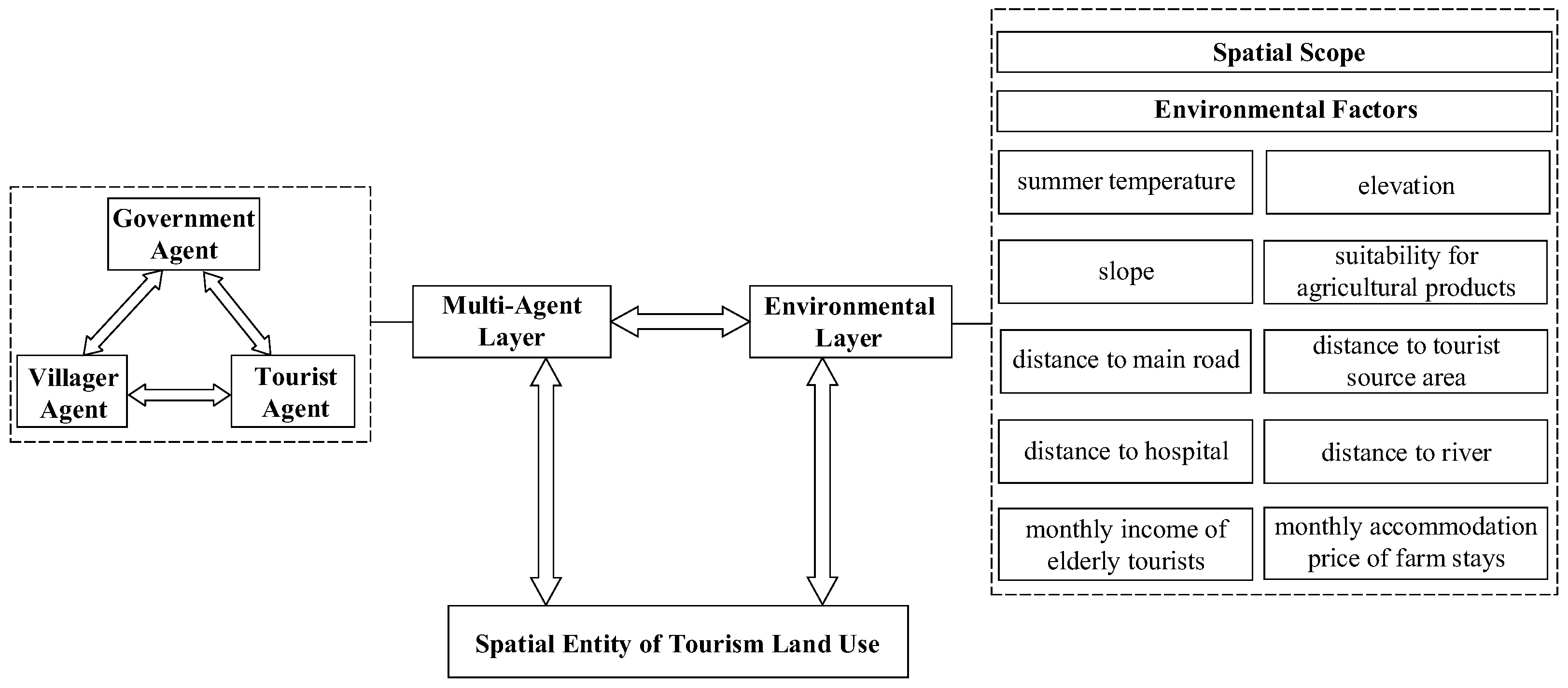
Figure 1. Framework of multi-agent simulation model for RSHTUE land.
Land 14 02342 g001
Figure 2. Delineation of areas within rigid boundaries.
Land 14 02342 g002
Figure 3. Land use decision-making process of government agents.
Land 14 02342 g003
Figure 4. Land use decision-making process of the villager agents.
Land 14 02342 g004
Figure 5. Decision-making process of tourist agents’ destination selection.
Land 14 02342 g005
Figure 6. Operational logic of the multi-agent land use simulation model.
Land 14 02342 g006
Figure 7. Geographic location of the research site.
Land 14 02342 g007
Figure 8. Simulation results of each development scenario in 2028 and 2033.
Land 14 02342 g008
Figure 9. Changes in land use area under each development scenario.
Land 14 02342 g009
Table 1. Scoring rules for environmental factors.
Environmental FactorScoring CriteriaSource
123
Summer temperature W ( i ,   j )   t <22.7 °C or >32.53 °C22.7–23.79 °C or 27.41–32.53 °C23.79–27.41 °CFang & Hu [47]
Elevation H ( i ,   j )   t <500 m or >1500 m500–800 m or 1000–1500 m800-1000 mZhang et al. [48]; Wang [49]
Slope P ( i ,   j )   t >27°14–27°<14°Gao & Qiu [50]
Distance to main road G ( i ,   j )   t <50 m50–100 m>100 mZhang et al. [48]
Distance to river R ( i ,   j )   t >100 m50–100 m<50 mChen et al. [51]
Distance to hospital Y ( i ,   j )   t >800 m500–800 m<500 mLi et al. [52]; Zhang et al. [48]
Suitability for agricultural products Z ( i ,   j )   t unsuitable areamoderately suitable areasuitable areaLiu et al. [53]; Field Survey Data
Travel time to land parcels T ( i ,   j )   t >3 h2–3 h<2 hSu & Xu [54]
Accommodation price J ( i ,   j )   t >2000 yuan2000 yuan<2000 yuanXu et al. [55]
Tourists’ monthly income S ( i ,   j )   t <3000 yuan3000–5000 yuan>5000 yuanZhang et al. [56]
Table 2. Weight values of environmental factors affecting land parcel utility under different development scenarios.
Development ScenarioWeight of Government AgentsWeight of Villager AgentsWeight of Tourist Agents
Tourism-led development scenario α 1 0.413 β 1 0.257 γ 1 0.108
α 2 0.185 β 2 0.181 γ 2 0.072
α 3 0.123 β 3 0.290 γ 3 0.085
α 4 0.147 β 4 0.272 γ 4 0.111
α 5 0.131 γ 5 0.215
γ 6 0.111
γ 7 0.159
γ 8 0.138
Eco-protection development scenario α 1 0.290 β 1 0.223 γ 1 0.095
α 2 0.170 β 2 0.261 γ 2 0.086
α 3 0.197 β 3 0.218 γ 3 0.131
α 4 0.178 β 4 0.298 γ 4 0.130
α 5 0.165 γ 5 0.206
γ 6 0.110
γ 7 0.119
γ 8 0.123
Rural belt joint development scenario α 1 0.269 β 1 0.282 γ 1 0.115
α 2 0.139 β 2 0.198 γ 2 0.085
α 3 0.164 β 3 0.240 γ 3 0.086
α 4 0.273 β 4 0.280 γ 4 0.122
α 5 0.154 γ 5 0.190
γ 6 0.097
γ 7 0.159
γ 8 0.145
Table 3. Statistics on land use area from decision-making of three types of agents.
Development ScenarioYearAvailable Undeveloped Land Area/hm2Government-Decide Land Area/hm2Villager-Decide Land Area/hm2Tourist-Decide Land Area/hm2
Tourism-led development scenario202839.5214.9178.9671.200
203325.3929.64216.3223.248
Eco-protection development scenario202839.7348.4034.4652.003
203325.23012.4479.2677.660
Rural belt joint development scenario202834.3197.80312.1360.346
203327.5198.9988.4339.654
Disclaimer/Publisher’s Note: The statements, opinions and data contained in all publications are solely those of the individual author(s) and contributor(s) and not of MDPI and/or the editor(s). MDPI and/or the editor(s) disclaim responsibility for any injury to people or property resulting from any ideas, methods, instructions or products referred to in the content.