Article

Inversion Estimation of Soil Organic Matter in Songnen Plain Based on Multispectral Analysis
School of Hydraulic and Electric Power, Heilongjiang University, Harbin 150080, China
*
Author to whom correspondence should be addressed.
Land 2022, 11(5), 608; https://doi.org/10.3390/land11050608
Submission received: 31 March 2022 / Revised: 14 April 2022 / Accepted: 19 April 2022 / Published: 21 April 2022
(This article belongs to the Special Issue Soil Management for Sustainable Agriculture and Ecosystem Services)

Abstract

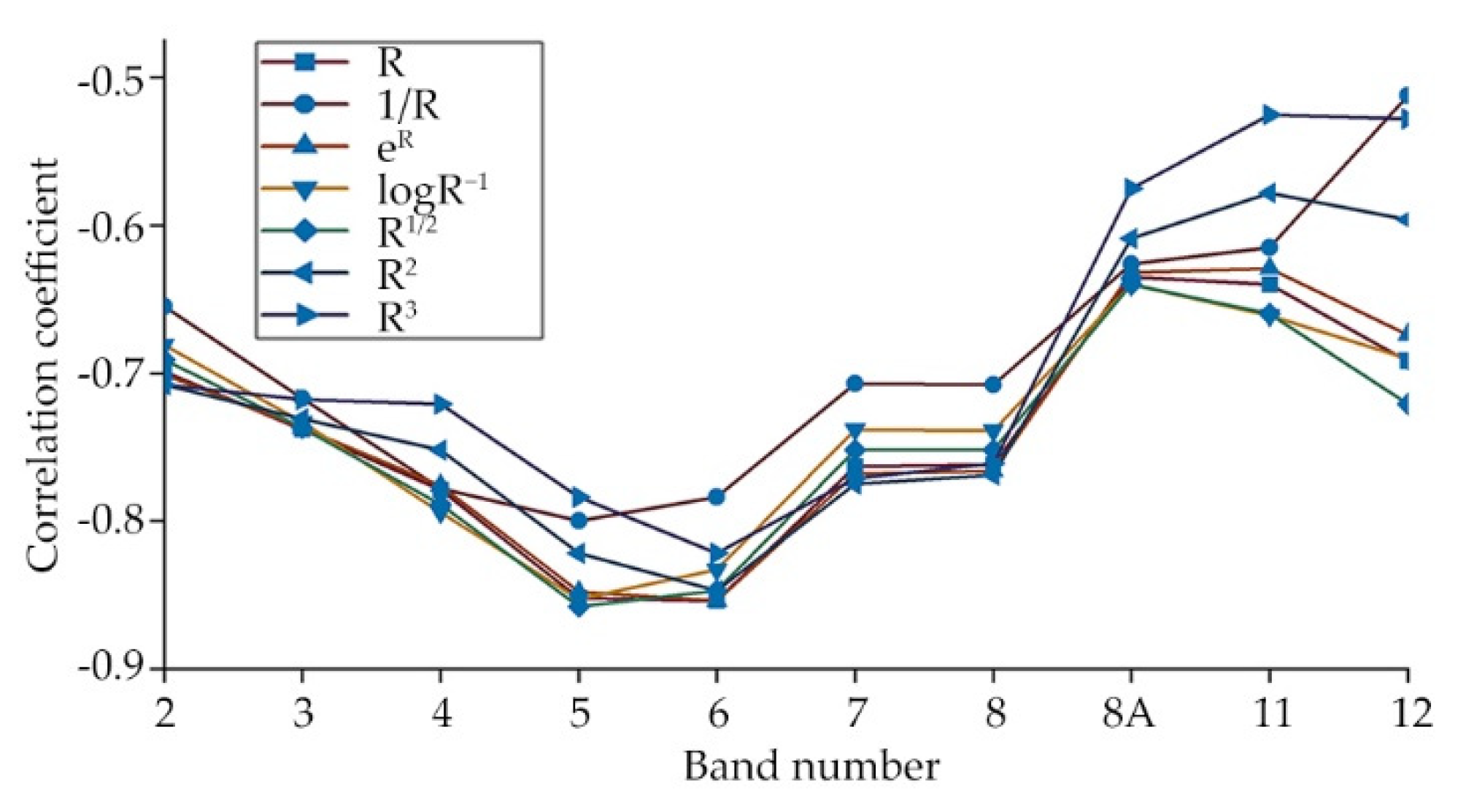
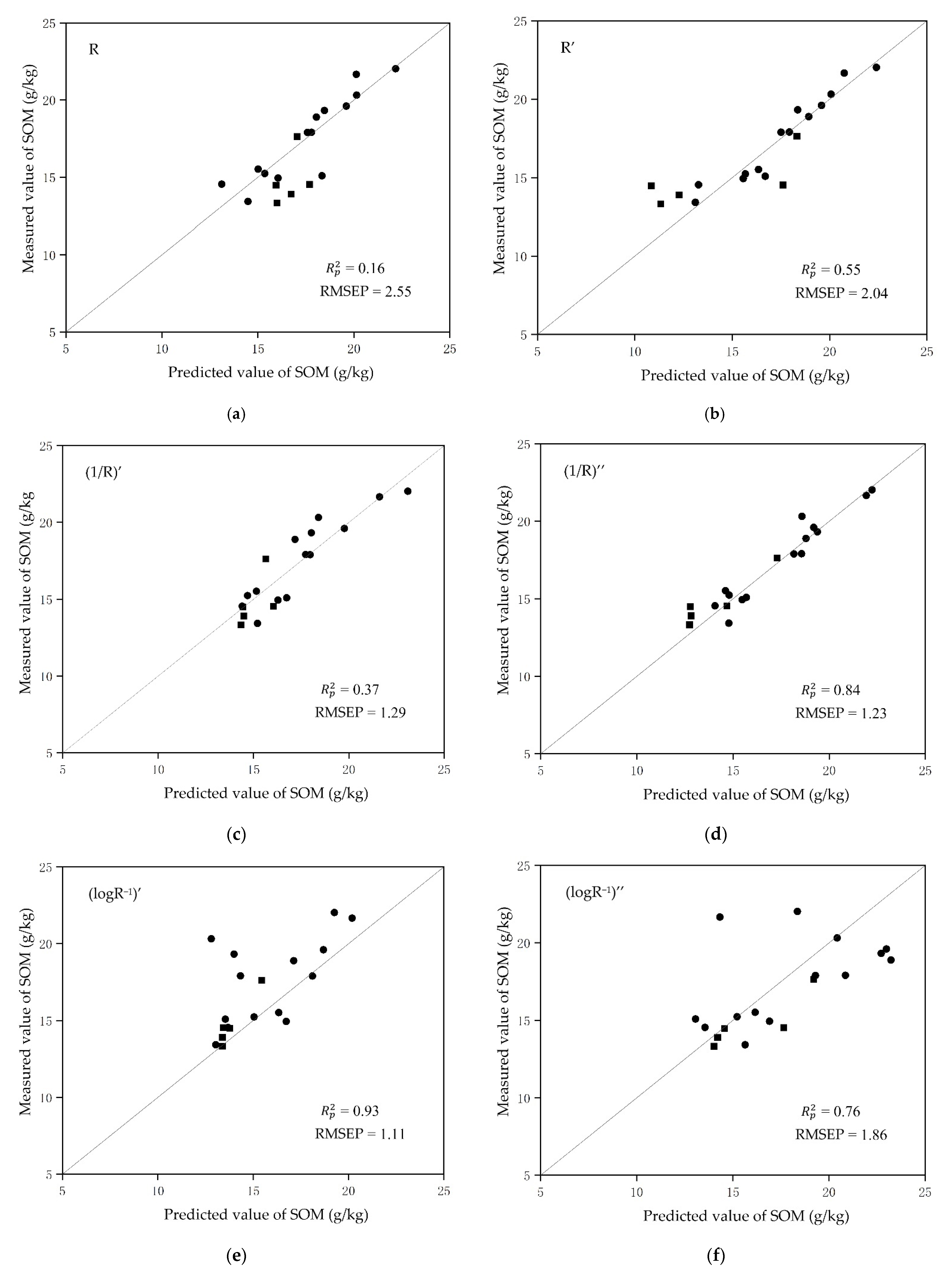
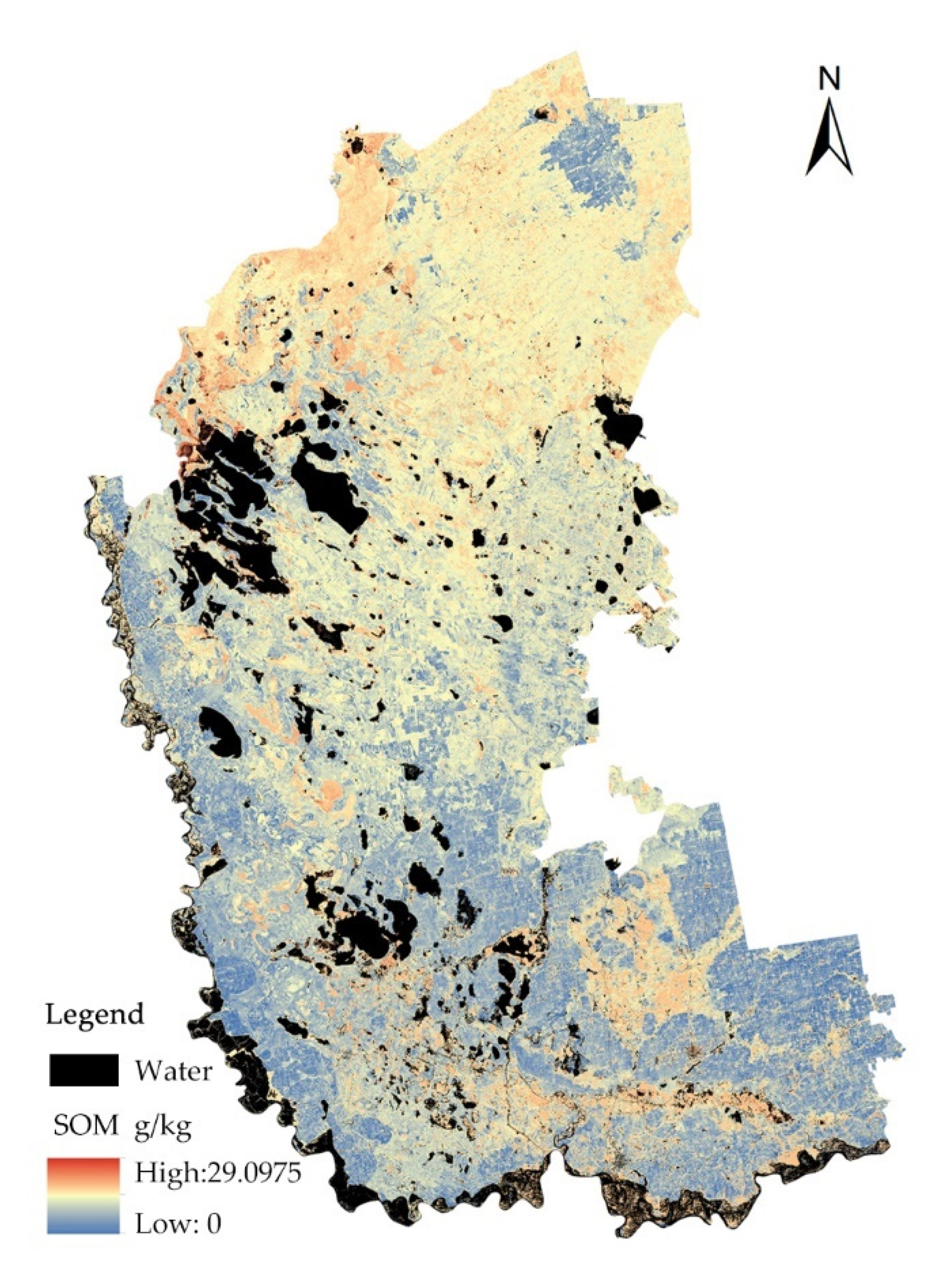
Sentinel-2A multi-spectral remote sensing image data underwent high-efficiency differential processing to extract spectral information, which was then matched to soil organic matter (SOM) laboratory test values from field samples. From this, multiple-linear stepwise regression (MLSR) and partial least square (PLSR) models were established based on a differential algorithm for surface SOM modeling. The original spectra were subjected to basic transformations with first- and second-derivative processing. MLSR and PLSR models were established based on these methods and the measured values, respectively. The results show that Sentinel-2A remote sensing imagery and SOM content correlated in some bands. The correlation between the spectral value and SOM content was significantly improved after mathematical transformation, especially square-root transformation. After differential processing, the multi-band model had better predictive ability (based on fitting accuracy) than single-band and unprocessed multi-band models. The MLSR and PLSR models of SOM had good prediction functionality. The reciprocal logarithm first-order differential MLSR regression model had the best prediction and inversion results (i.e., most consistent with the real-world data). The MLSR model is more stable and reliable for monitoring SOM content, and provides a feasible method and reference for SOM content-mapping of the study area.
Keywords: soil organic matter; Sentinel-2A; remote sensing; differential algorithm; multispectral modeling; PLSR soil organic matter; Sentinel-2A; remote sensing; differential algorithm; multispectral modeling; PLSR