Article

Does Rural Production–Living–Ecological Spaces Have a Preference for Regional Endowments? A Case of Beijing-Tianjin-Hebei, China

1
School of Architecture, Tianjin University, Tianjin 300272, China
2
Tianjin University Research Institute of Architectural Design & Urban Planning Co., Ltd., Tianjin 300350, China
3
School of Environmental Science and Engineering, Tianjin University, Tianjin 300350, China
*
Author to whom correspondence should be addressed.
Land 2021, 10(11), 1265; https://doi.org/10.3390/land10111265
Submission received: 13 October 2021 / Revised: 10 November 2021 / Accepted: 16 November 2021 / Published: 19 November 2021
(This article belongs to the Topic Climate Change and Environmental Sustainability)

Abstract

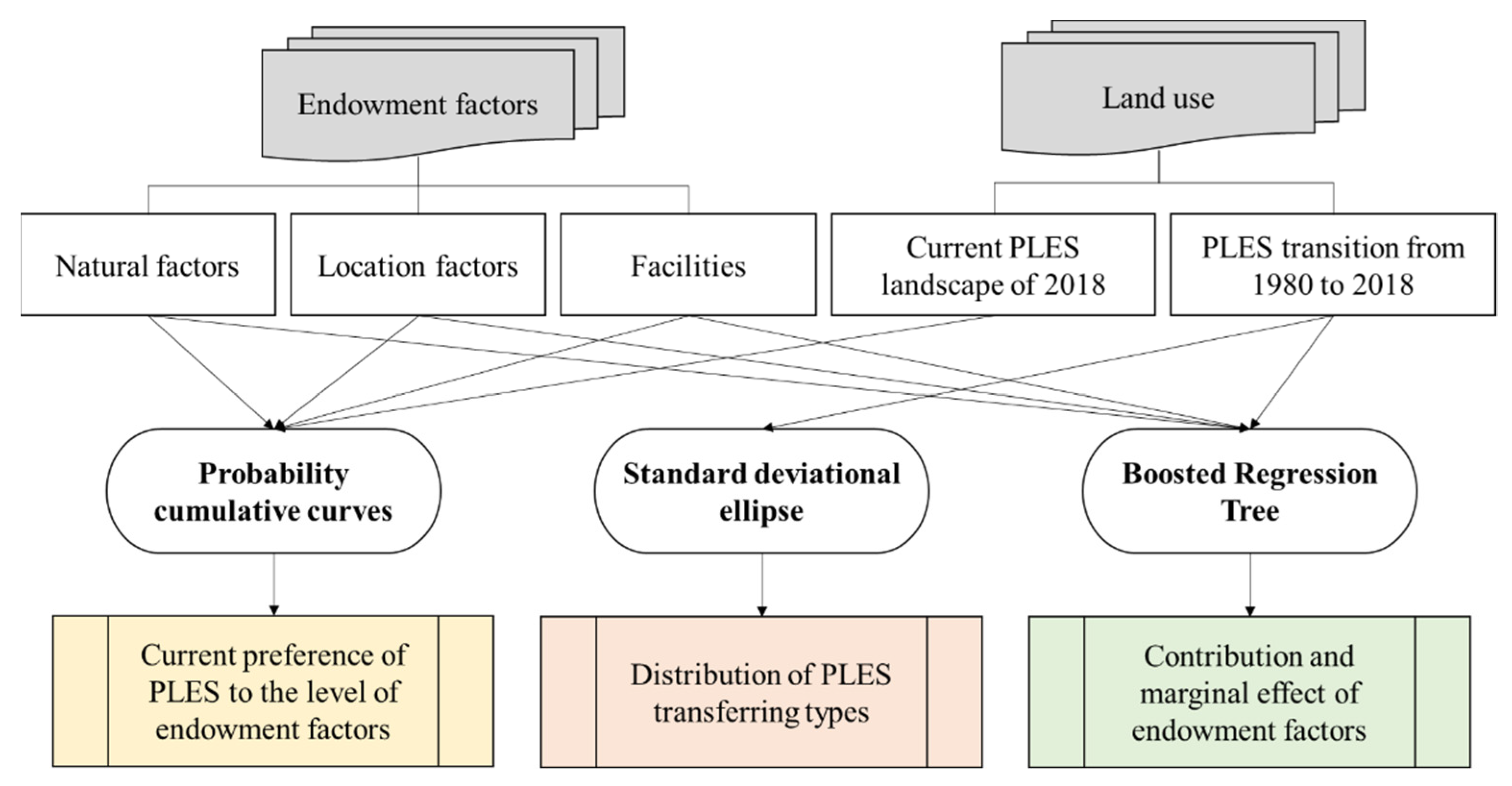
Production–Living–Ecological Space (PLES) is the functional projection of sustainable development in territory spatial planning. Its rational layout has become the most important task for developing countries to enhance ecological awareness and achieve sustainable goals. This study took the rural areas of Beijing-Tianjin-Hebei (BTH) as an example to analyze the relationship by means of quantitative cumulation between regional endowments (natural factors, location and facilities) and PLES to figure out the preference mechanism. The Boosted Regression Tree model (BRT) was used to obtain the contribution rate of factors and the internal marginal effect between 1980~2018. Our conclusions are as follows: Living space (LS) enjoyed the highest advantage of regional endowment level, followed by production space (PS). Except for the distance to water, other indicators were significantly different in the PLES, and the suitable range of various types was expanded from LS to PS and ecological space (ES). During the transfer, elevation had a universal effect. The process of increasing naturalness was affected by the distance of high-level urban areas, which verified the continuous effect of Chinese ecological civilization. This study clarified the selectivity of regional endowments to PLES, which will greatly guide the direction of regional territory spatial planning and the next step of regional sustainable development.
Keywords: rural Production–Living–Ecological Space (PLES); regional endowments; quantitative accumulation curve; Boosted Regression Tree model (BRT); Beijing-Tianjin-Hebei (BTH) rural Production–Living–Ecological Space (PLES); regional endowments; quantitative accumulation curve; Boosted Regression Tree model (BRT); Beijing-Tianjin-Hebei (BTH)