Article

Ecosystem Health of Andean–Amazonian Rivers: Integrating Macroinvertebrate Diversity, Microbiological Loads and Chemical Signatures Across Anthropogenic Gradients


by
Daniela Alvear-Sayavedra
1,2,
Daning Montaño-Ocampo
3,4,
Mariana V. Capparelli
5,6,
Jorge E. Celi
1,7,8,
Marcela Cabrera
3,7 and
Rodrigo Espinosa
2,3,*
1
Cátedra UNESCO Para el Manejo de Aguas Dulces Tropicales, Universidad Regional Amazónica Ikiam, Tena 150150, Ecuador
2
Grupo de Investigación de Biogeografía y Ecología Espacial–BioGeoE2, Universidad Regional Amazónica Ikiam, Tena 150150, Ecuador
3
Facultad de Ciencias de la Vida, Universidad Regional Amazónica Ikiam, Tena 150150, Ecuador
4
Programa de Bosques y Territorio, Fundación Pachamama, Quito 170184, Ecuador
5
Estación El Carmen, Instituto de Ciencias del Mar y Limnología, Universidad Nacional Autónoma de México, Carretera Carmen-Puerto Real km 9.5, Ciudad del Carmen 24157, Mexico
6
IMDEA Water Institute, Alcalá de Henares, 28805 Madrid, Spain
7
Grupo de Investigación de Recursos Hídricos y Acuáticos, Facultad de Ciencias de la Vida, Universidad Regional Amazónica Ikiam, Tena 150150, Ecuador
8
Facultad de Ciencias de La Tierra y Agua, Universidad Regional Amazónica Ikiam, Tena 150101, Ecuador
*
Author to whom correspondence should be addressed.
Water 2026, 18(9), 1106; https://doi.org/10.3390/w18091106 (registering DOI)
Submission received: 16 January 2026 / Revised: 19 February 2026 / Accepted: 25 February 2026 / Published: 5 May 2026
(This article belongs to the Section Biodiversity and Functionality of Aquatic Ecosystems)

Highlights

What are the main findings?
  • FT (Few Threats) sites showed high macroinvertebrate diversity and ecological integrity.
  • Gold mining caused near-defaunation, extreme turbidity, and toxic metal pollution.
  • Wastewater sites had critical fecal contamination and dominance of tolerant taxa.
  • Crop/aquaculture (CA) sites showed intermediate degradation and loss of sensitive families.
  • Average Score Per Taxon (ASPT) and Ecological Quality Ratio (EQR) outperformed Andean–Amazon Biotic Index (AAMBI) and the Biological Monitoring Working Party for Colombia (BMWP-Col) in detecting tolerant assemblages.
What are the implications of the main findings?
  • Multiple stressors are driving ecological degradation in the Upper Napo River Basin.
  • Multimetric biomonitoring is crucial for early detection of river ecosystem degradation.
  • Urban areas urgently need wastewater treatment to reduce contamination and protect biodiversity.
  • Conserving FT sites and river corridors is key to maintaining ecological connectivity.
  • Regional ecological baselines must be formalized and integrated into policy frameworks.

Abstract
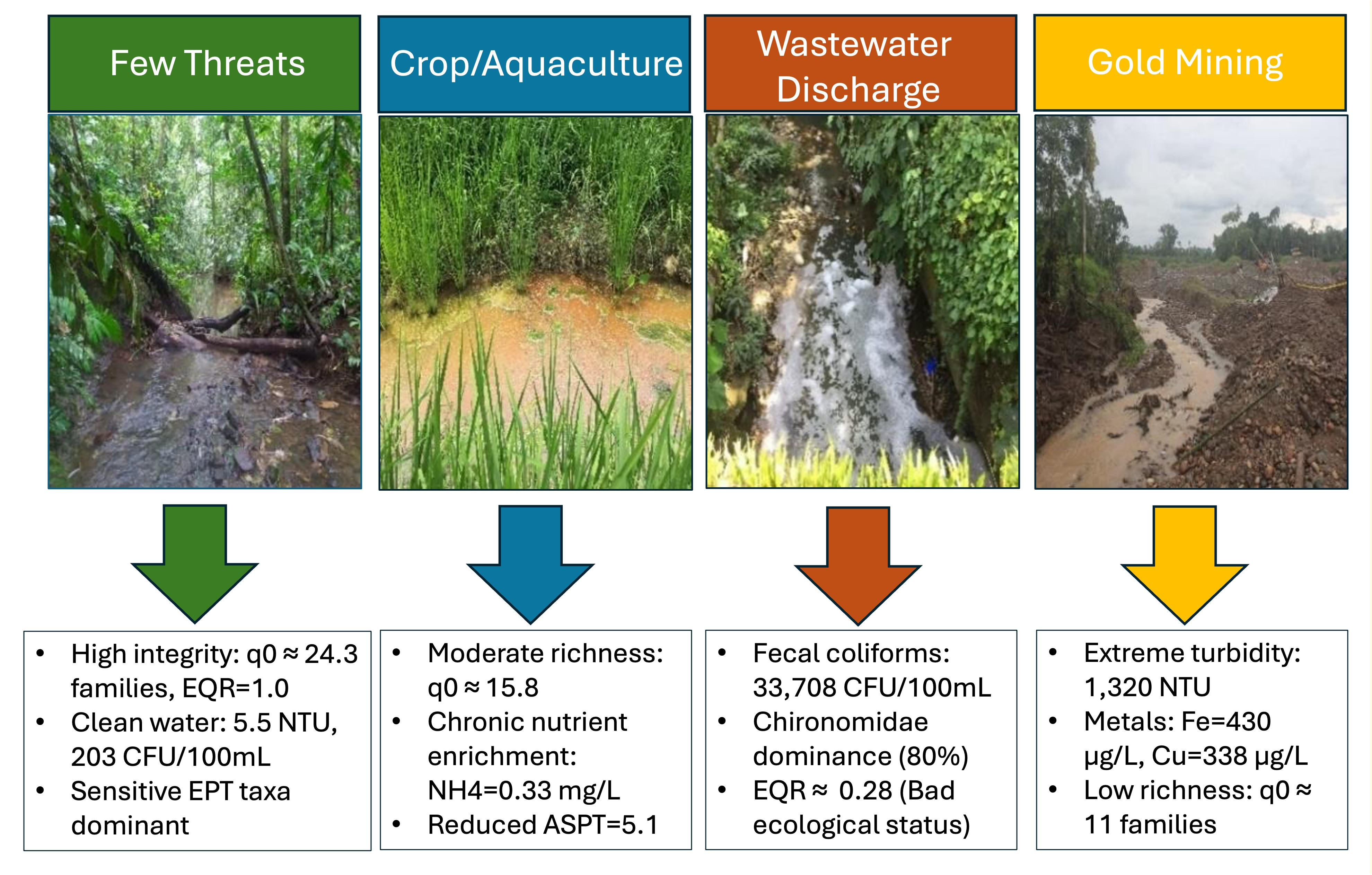
The Western Amazon is a global biodiversity hotspot, yet the Upper Napo River Basin (UNRB) remains understudied regarding aquatic ecosystem health along anthropogenic gradients. We integrated benthic macroinvertebrate assemblages with physicochemical and microbiological indicators across 45 sites to assess ecological quality under four impact scenarios: Few Threats (FT, reference sites; n = 6), Crop/Aquaculture (CA; n = 22), Gold Mining (GM; n = 10), and Wastewater Discharge (WD; n = 7). Analysis of 2285 individuals (62 families) revealed clear degradation across the anthropogenic gradient. Reference sites (FT) exhibited high integrity (q0 = 24.3 families), establishing the regional baseline for Andean–Amazonian freshwater ecosystems. In stark contrast, GM sites showed catastrophic defaunation (q0 = 9.9 families) coupled with extreme turbidity (1320 ± 1589 NTU) and heavy metal mobilization (Fe: 430 ± 229 µg/L; Cu: 338 ± 128 µg/L), placing these reaches in “Bad” ecological status (Ecological Quality Ratio, EQR ≤ 0.16). Wastewater sites reached critical fecal coliform levels (33,708 ± 58,047 CFU/100 mL)—165-fold higher than FT sites—indicating severe sanitary impairment and community collapse (EQR = 0.28, dominated by Chironomidae at 80%). The application of ASPT (Average Score Per Taxon) and EQR proved essential for detecting functional shifts toward tolerant assemblages even when raw biotic scores appeared moderate. Crop/Aquaculture sites showed intermediate degradation (EQR = 0.37–0.38), reflecting chronic pesticide exposure and habitat loss. We conclude that gold mining and wastewater discharge are the primary drivers pushing the UNRB toward ecological collapse, with GM exerting the most severe impact on aquatic biodiversity. Safeguarding this global freshwater stronghold requires immediate implementation of multimetric biomonitoring, enhanced mining regulation, wastewater treatment infrastructure, and establishment of Indigenous-led fluvial reserves to maintain long-term connectivity.

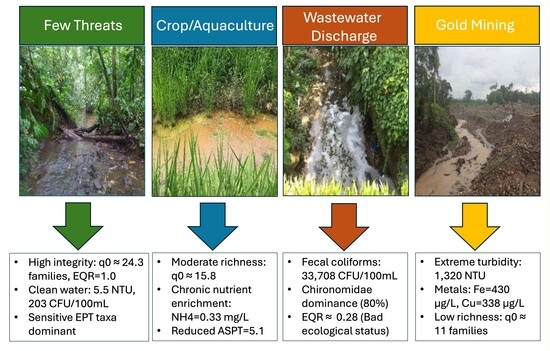
Graphical Abstract

1. Introduction

The quality of freshwater habitats is determinant of the richness, distribution, and abundance of aquatic organisms [1]. However, human activities such as mining, agriculture and lack of water treatment pose an increasing threat to aquatic ecosystems, jeopardizing their ecological health, and the benefits they provide to humanity [2,3]. As highlighted by recent research [4], the Western Amazon is critical for the basin’s integrity, harboring 74% of its fish biodiversity and contributing most of the sediment load that reaches the Atlantic Ocean. Despite this, the region is approaching a functional collapse threshold where deforestation and forest degradation could affect up to 47% of the total area by 2050 [5]. Rivers offer essential ecosystem services that underpin societal well-being, yet these depend on the environmental integrity and efficient management of water resources [6]. Sustainable water use practices and water quality monitoring are critical for ensuring these services, particularly in regions experiencing significant anthropogenic pressure [3,7].
Biological monitoring helps track changes in water quality through ecological responses of indicator species [7,8]. Standard physicochemical parameters often fail to capture the full extent of degradation, as biotic indices frequently identify ‘poor’ water quality even when chemical probes meet national standards [9]. This is especially critical given the extreme climatic events of 2023 and 2024, the hottest years on record, which led to severe droughts that concentrated pollutants in the Amazonian–Ecuadorian sector [10,11,12]. Owing to their sensitivity to pollutants, macroinvertebrates effectively reveal ecosystem alterations [13,14]. Biotic indices, including the Biological Monitoring Working Party-Colombia (BMWP-Col), Average Score Per Taxon (ASPT), and Andean–Amazon Biotic Index (AAMBI), have proven effective in distinguishing impacted sites in the Neotropics [14,15], highlighting biodiversity loss and shifts toward tolerant assemblages in polluted environments [16].
The Ecuadorian Amazon is a global biodiversity hotspot [17] and a crucial source of freshwater and climate regulation [18]. Historically shaped by oil and timber extraction, the region is currently facing a rapid expansion of illegal gold mining. By September 2024, confirmed mining expansion across the Amazon reached 37,109 hectares, with significant new fronts detected in Ecuador near the Cofán Bermejo Ecological Reserve [19]. In the Napo province, mining-related deforestation in the Punino area alone increased by 420 hectares during the first half of 2024, reaching a cumulative impact of 1422 hectares in 2019, particularly in the Punino and Anzu River areas [19]. This expansion is the primary driver of mercury contamination, with approximately 150 tons discharged annually into Amazonian rivers [11], threatening biodiversity as well as the health of both indigenous and local non-indigenous communities [9,20]. Simultaneously, agricultural expansion has further degraded these systems; studies in the Napo watershed show that streams in oil palm monocultures exhibit significantly lower family richness than traditional polycultures [21]. Additionally, untreated domestic wastewater in high-altitude Andean watersheds often leads to hypoxic conditions, with dissolved oxygen levels dropping below the 80% regulatory threshold [22].
The Napo River constitutes a significant binational aquatic system and a primary tributary of the Amazon River, acting as a vital corridor for the transport of Andean-derived sediments and nutrients toward the Atlantic [23]. The Napo River Basin (NRB) supplies water to more than 2.5 million people and supports 40% of Ecuador’s electrical energy [14]. Despite its importance, the NRB is threatened by a combination of riverbank deforestation, agricultural expansion, oil extraction, and mining [8,24]. Recent assessments report the severe influence of gold mining, urban discharges, and leachates from non-functional landfills on aquatic biota [25]. Furthermore, contamination by emerging pollutants and microplastics reflects inadequate waste management across the region [26,27,28].
While research in the NRB has historically focused on its main stems, the vast network of lower-order tributaries lacks systematic monitoring. This ecosystemic bias results in a significant knowledge gap regarding freshwater biodiversity and water quality in these critical headwaters. This knowledge gap constrains the assessment of human pressures on riverine ecosystems and hampers the development of effective management and restoration strategies [29]. Therefore, this study aimed to evaluate the ecological quality of the Upper Napo River Basin (UNRB) along an anthropogenic gradient, categorizing sites according to dominant pressures: Crop/Aquaculture (CA), Gold Mining (GM), Wastewater Discharge (WD), and Few Threats (FT). We integrated aquatic macroinvertebrate community assessments with comprehensive chemical and biological indicators. Specifically, we combined multi-taxa diversity indices with microbiological loads (fecal coliforms) to account for sanitary-related impacts, alongside nutrient enrichment and metal mobilization (iron and copper). By adopting the Ecological Quality Ratio (EQR) framework, this multi-proxy approach provides a high-resolution diagnostic baseline to identify areas of greatest impact and to assess how distinct biological and microbiological pressures threaten the health of Andean–Amazonian freshwater ecosystems, thereby supporting informed management and restoration efforts.

2. Materials and Methods

2.1. Study Area

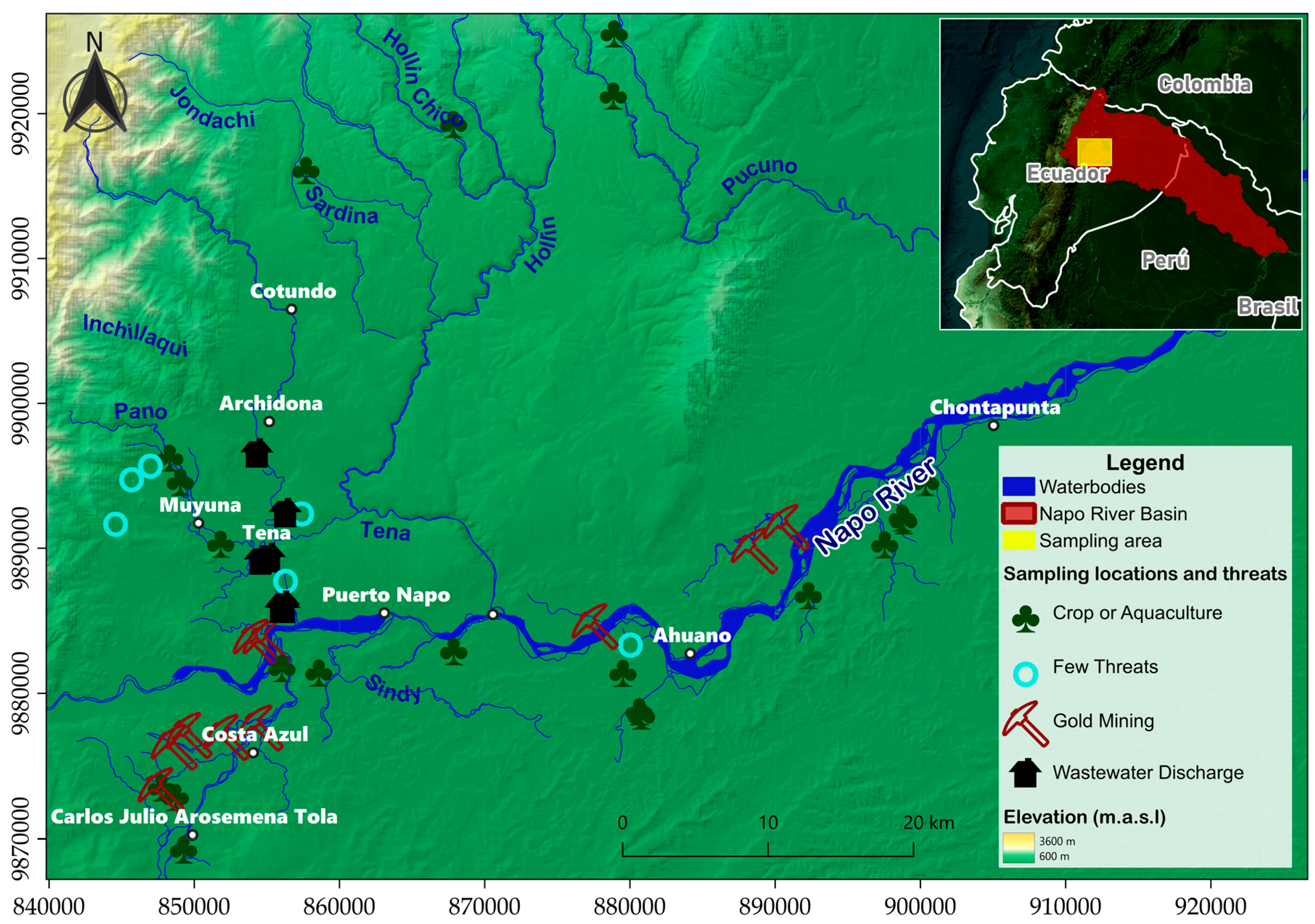
The Napo River Basin is a major transboundary watershed of approximately 100,520 km2 distributed among Ecuador (59.6%), Peru (40%), and Colombia (0.4%), and encompasses a marked altitudinal gradient from about 100 up to 6000 m above sea level. Roughly one third of this basin is situated between 200 and 6000 m a.s.l., where steep Andean slopes support a mosaic of high-gradient rivers and associated terrestrial ecosystems in the eastern cordillera of northern Ecuador and southern Colombia. Downstream, the fluvial network traverses extensive lowland rainforests in eastern Ecuador and northeastern Peru before joining the main course of the Amazon River near 100 m a.s.l. Within Ecuador, the basin intersects the Cordillera Real (Eastern Andes), a sector characterized by an abrupt drop in elevation from high mountains to foothills—on the order of several thousand meters over a horizontal distance of about 100 km—and occupying close to one fifth of the country’s eastern region [30,31,32]. This study focuses on the UNRB (~1918 km2), a sub-basin spanning diverse ecosystems from páramo to piedmont rainforest (Figure 1). Draining Andean rivers through protected areas into Amazon tributaries [33], the study sites follow an elevational gradient from 250 to 650 m a.s.l. [25,26,34]. The Napo contributes a mean annual discharge of ~6300 m3/s to the Amazon [32]. This basin is characterized by high precipitation rates, often exceeding 4000 mm/yr in the Andean foothills, which drives significant sediment transport and hydrological connectivity [4,25,26,27,28,35]. For comprehensive details on sampling sites and their anthropogenic impacts, see Table A1 in Appendix A.

2.2. Sampling and Dataset Integration

A total of 45 sampling sites were selected across the Upper Napo River Basin (UNRB) to represent a comprehensive gradient of anthropogenic pressure (Table A1). To ensure a robust regional assessment, this study integrated primary data from unpublished field surveys (21 sites) [35] with high-quality secondary data (24 sites) sourced from previous peer-reviewed studies conducted in the region [25,26,34]. All macroinvertebrate collections and physicochemical measurements across the 45 sites were conducted by the authors and co-authors of this study, ensuring consistent sampling protocols and taxonomic identification standards within the same research institution. To ensure environmental comparability and the validity of the Ecological Quality Ratio (EQR) framework, all sampled reaches were standardized to low-order streams (1st to 3rd order) with wetted widths not exceeding 10 m. Field campaigns were carried out between February and December 2020 and in November 2021, consistently scheduled at the onset of the dry season to avoid high river discharges, which can redistribute substrate material and transport aquatic macroinvertebrates, thereby altering their community composition. This study presents a novel multi-metric synthesis by integrating diverse biological and physicochemical datasets. While previous research in the region focused on specific stressors—such as pesticides [34], mining toxicity [26], or multi-line indices [25]—our approach expands upon these findings. We apply a unified framework using Hill numbers, Average Score per Taxon (ASPT), and Ecological Quality Ratio (EQR) to assess the entire anthropogenic gradient. This meta-analytical approach allows for the identification of ecological thresholds that were not detectable in the isolated assessments of the original studies. Sites were categorized into four distinct impact groups based on dominant surrounding activities: Few Threats (FT, n = 6), Crop or Aquaculture (CA, n = 22), Gold Mining (GM, n = 10), and Wastewater Discharge (WD, n = 7).
Environmental and biological data from 45 sites were harmonized by converting variables to common units and aggregating macroinvertebrates to the family level [36,37,38] to ensure consistency across datasets (Table A1). At each site, in situ physicochemical parameters (temperature, pH, electrical conductivity, and dissolved oxygen) were recorded using a calibrated YSI Professional Plus multiparameter probe (Yellow Springs Instruments, Yellow Springs, OH, USA). Additionally, surface water samples were collected for laboratory analysis of turbidity and fecal coliforms. Extended chemical and microbiological signatures—including nutrients, BOD, sulfates, iron, and trace metals—were integrated from previously published studies [25,26,34], where detailed laboratory protocols for these specific parameters are described. Macroinvertebrates were sampled using a standardized multi-habitat method with a 500 µm D-frame net over a 25-m stretch for 3 min, following established regional protocols [7,25,26,34,35,36].
To address uneven replication and missing values (denoted by ‘—’ in Table A2 and Table A3) typical of remote Amazonian hydrological conditions, we employed a Multiple Lines of Evidence (LOE) framework. This approach integrates high-resolution biotic responses—including Hill numbers, ASPT, and Ecological Quality Ratios (EQR)—with available chemical signatures. To ensure mathematically valid diversity comparisons, coverage-based rarefaction and extrapolation were applied, providing a robust diagnostic assessment of ecological thresholds across the anthropogenic gradient regardless of the unbalanced design.

2.3. Data Analysis

2.3.1. Ecological Water Quality Indices

Four biotic indices were calculated for each sampling site: AAMBI, BMWP-Col, EQR-A, and EQR-B. The Andean–Amazon Biotic Index (AAMBI) [13] assigned tolerance values to macroinvertebrate families from 1 (contamination-tolerant) to 10 (highly sensitive) [26,35], classifying water quality into five categories: excellent (>100), very good (75–90), good (50–74), regular (25–49), and bad (0–24) [14,25].
The Colombian adaptation of the Biological Monitoring Working Party index (BMWP-Col) was also applied, as Colombia and Ecuador share relatively similar environmental conditions, making this regional index an appropriate reference for ecological water quality assessments in Ecuadorian rivers. The BMWP-Col index, based on macroinvertebrate community composition, assigns each taxon a tolerance score, from 1 (for tolerant taxa) to 10 (for sensitive taxa); water quality is then classified as good (≥100), moderate (61–100), poor (36–60), bad (16–35), and very bad (0–15) [14,39]. Recent studies in Ecuadorian Andean and Amazonian watersheds have re-validated the use of BMWP-Col and AAMBI, demonstrating their high sensitivity in detecting organic and mining-related pollution gradients [9,22,25]. Additionally, the Average Score Per Taxon (ASPT) was calculated for both AAMBI and BMWP-Col by dividing the total index score by the number of families identified at each sampling site. The ASPT provides a normalized measure of taxonomic sensitivity that is less influenced by sampling effort or total richness, as it represents the average quality of the taxa present [9,14,25].
Finally, to ensure international comparability and alignment with the EU Water Framework Directive (WFD) guidelines, the ecological status of each site was expressed as an Ecological Quality Ratio (EQR). The EQR represents the relationship between the observed (O) values of the biological parameters (AAMBI and BMWP-Col) and the expected (E) values under reference conditions. Two sub-indices were calculated: EQR-A (Observed AAMBI/Expected AAMBI) and EQR-B (Observed BMWP-Col/Expected BMWP-Col). EQR values range from 0 to 1, where values close to 1 represent high ecological status (reference conditions) and values close to 0 indicate severe anthropogenic impact. Ecological status was classified into five classes: High (0.90–1.00), Good (0.75–0.89), Moderate (0.60–0.74), Poor (0.45–0.59), and Bad (<0.45) [40,41].

2.3.2. Statistical Analysis

To assess alpha diversity across anthropogenic gradients (CA, GM, FT, WD), macroinvertebrate family abundance data were analyzed using Hill numbers at three diversity orders: q = 0 (family richness), q = 1 (exponential of Shannon entropy), and q = 2 (inverse Simpson diversity). Hill numbers provide a unified framework expressing diversity in units of ‘effective family equivalents’. While sampling effort was standardized across all sites, we employed this framework following Chao & Jost [42] to ensure comparisons are based on sample completeness (coverage) rather than just sample size, accounting for inherent differences in community complexity. Sample completeness was evaluated through coverage-based rarefaction and extrapolation (R/E) curves. Diversity comparisons were standardized to the lowest observed sample coverage value, with 95% confidence intervals (CI) estimated via bootstrapping (999 iterations) to determine statistical significance [42,43,44,45]. Finally, community structure was characterized using rank-abundance curves based on the logarithm (Log10) of family abundances.
To examine the multivariate relationships between environmental parameters (temperature, DO%, turbidity, pH, and TDS), biological diversity (Hill numbers: q0, q1, and q2), and biotic indices (AAMBI, BMWP-Col), we performed a Principal Component Analysis (PCA) [46]. Other chemical parameters, such as nutrients and trace metals, were excluded from the PCA because they were not available for all 45 sites; their inclusion would have necessitated the exclusion of numerous sampling locations (listwise deletion), thereby reducing the statistical power and representative scope of the regional analysis. This exploratory approach allowed for the identification of the main gradients of variation and the correlation structure among variables. The number of significant principal components was determined by evaluating their respective eigenvalues, following the criteria for ecological data reduction [46,47].
Beyond this exploratory analysis, differences in community composition among impact categories were evaluated using a beta-diversity framework. We calculated Bray–Curtis dissimilarities from a community matrix with abundances square-root transformed to reduce the influence of dominant taxa. Multivariate structure was explored through non-metric multidimensional scaling (NMDS) with two dimensions (k = 2) and up to 200 random starts to ensure convergence. Ordination quality was assessed using Kruskal’s stress value. Statistical significance of these compositional differences was formally tested using a Permutational Multivariate Analysis of Variance (PERMANOVA) via the adonis2 function, based on 9999 permutations. Pairwise comparisons among land-use categories were subsequently performed, and p-values were adjusted using the Benjamini–Hochberg procedure to control the false discovery rate [48].
All statistical procedures were performed in R version 4.5.2 [49]. Hill numbers and R/E curves were generated using the iNEXT package (v3.0.2) [50]. Rank-abundance and community quantitative structure analyses were computed with the BiodiversityR package (v2.17-4) [51]. Multivariate environmental analyses were implemented via the prcomp() function from the base stats package and the PCA() function from the FactoMineR package (v2.12) [52]. Community composition differences were evaluated through NMDS and PERMANOVA using the vegan package (v2.7-2) [48]. One-way comparisons across disturbance categories used Kruskal–Wallis tests (non-parametric ANOVA) followed by Dunn’s post hoc tests (Bonferroni-adjusted vs. FT reference) implemented via kruskal.test() and dunnTest() (FSA package v0.9.5) [53]. For family-level macroinvertebrate abundances, additional pairwise contrasts among all impact categories were computed with p-values adjusted using the Benjamini–Hochberg procedure to control the false discovery rate with the emmeans package [54]. Detailed values for all monitored environmental parameters are provided in Appendix A Table A2 and Table A3, and the full taxonomic composition and mean abundances of aquatic macroinvertebrates across impact categories are summarized in Appendix A Table A4.

3. Results

The environmental characterization of the UNRB revealed distinct pollution signatures across the anthropogenic gradient (Table 1). Wastewater Discharge (WD) sites exhibited critical fecal coliform levels (33,708 ± 58,047 CFU/100 mL) and the highest variability in total dissolved solids (TDS), with extreme values reaching 2350 mg/L. In contrast, Gold Mining (GM) sites were characterized by extreme turbidity (1320.1 ± 1589.2 NTU) compared to reference conditions. Few Threats (FT) sites showed the lowest values for temperature (22.5 ± 1.6 °C), turbidity (5.5 ± 3.5 NTU), and fecal coliforms (203 ± 32 CFU/100 mL), justifying their selection as reference sites.

3.1. Benthic Macroinvertebrate Communities

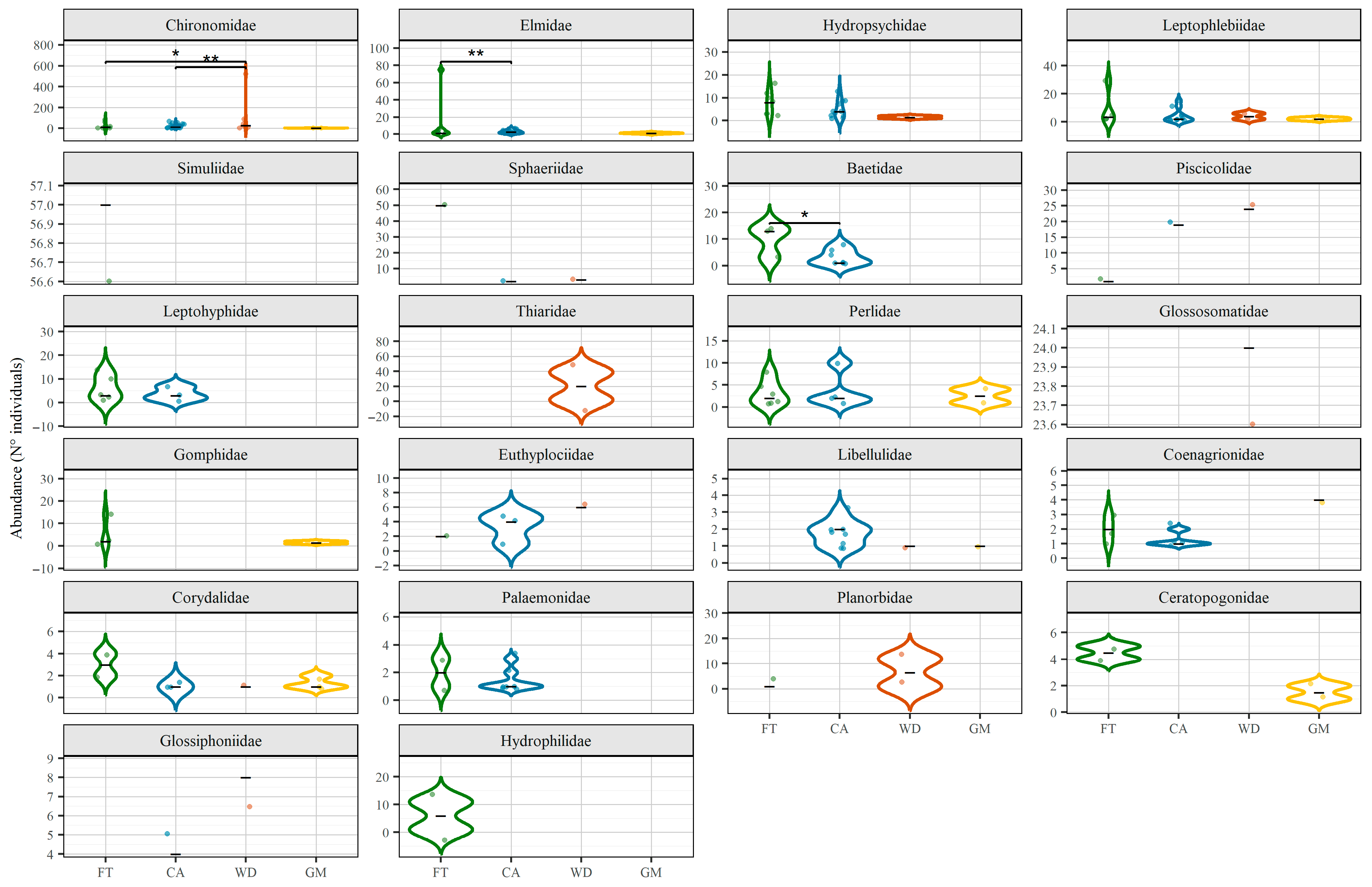
We examined 2285 individual benthic macroinvertebrates collected, identified, and enumerated across all study sites, representing 21 orders and 62 families. Specimens were predominantly in immature stages, consistent with typical Neotropical stream assemblages. Diptera was the dominant order, comprising 62.4% (1426 individuals) of total abundance, followed by Ephemeroptera (210 individuals, 9.2%) and Coleoptera (168 individuals, 7.4%). At the family level, Chironomidae was by far the most abundant taxon (1330 individuals, 58.2% of all specimens), with markedly higher densities at Wastewater Discharge (WD) sites than at Few Threats (FT) and Crop/Aquaculture (CA) sites, as indicated by significant pairwise differences in the Benjamini–Hochberg-adjusted post hoc tests (FT–WD, CA–WD, CA–GM; p_adj < 0.05; Figure 2). In contrast, sensitive families such as Elmidae and Leptophlebiidae reached their highest abundances at FT sites and were significantly reduced or nearly absent in GM and WD streams, reflecting the strong filtering imposed by mining and wastewater impacts (Figure 2). Other relatively common families, including Hydropsychidae and Baetidae, showed intermediate responses and persisted mainly in FT and CA categories, whereas GM sites were characterized by uniformly low abundances across most families. Additional details on family-level composition are provided in Appendix A, Table A4.

3.2. Ecological Water Quality

The ecological status of the sampling sites varied significantly across the anthropic gradient. FT sites exhibited the highest biological water quality, with mean AAMBI (82.3 ± 14.5) and BMWP-Col (88.0 ± 13.5) scores indicating “Very Good” and “Good” conditions, respectively (Table 2). The high ASPT values for both indices in these reference sites (ASPTAAMBI = 6.45 ± 1.12; ASPTBMWP = 7.25 ± 1.93) reflect a community dominated by highly sensitive taxa. These sites achieved an Ecological Quality Ratio (EQR) of 1.00, representing the regional baseline for high ecological integrity.
In contrast, GM and WD sites showed impairment. Gold mining (GM) sites were characterized by the lowest absolute richness, while wastewater discharge (WD) sites exhibited the lowest average sensitivity per taxon (ASPTAAMBI = 3.92 ± 1.35; ASPTBMWP = 4.03 ± 1.45), confirming the collapse of sensitive assemblages and the dominance of highly tolerant taxa (Table 2). Notably, CA sites showed a significant drop in ASPT compared to FT, although their raw scores remained in the “Regular” category. This dual-index ASPT approach enhanced the diagnostic resolution of the study by confirming that even when raw scores were moderate, the intrinsic quality of the remaining taxa was significantly degraded.
Nutrient analysis confirmed a eutrophication risk in WD and CA sites (Table 3). The N:P ratio in WD (0.22) and the high ammonium levels (1.71 ± 1.46 mg/L) represent a sewage signature that directly correlates with the dominance of tolerant macroinvertebrate families.

3.3. Alpha Diversity and Community Structure

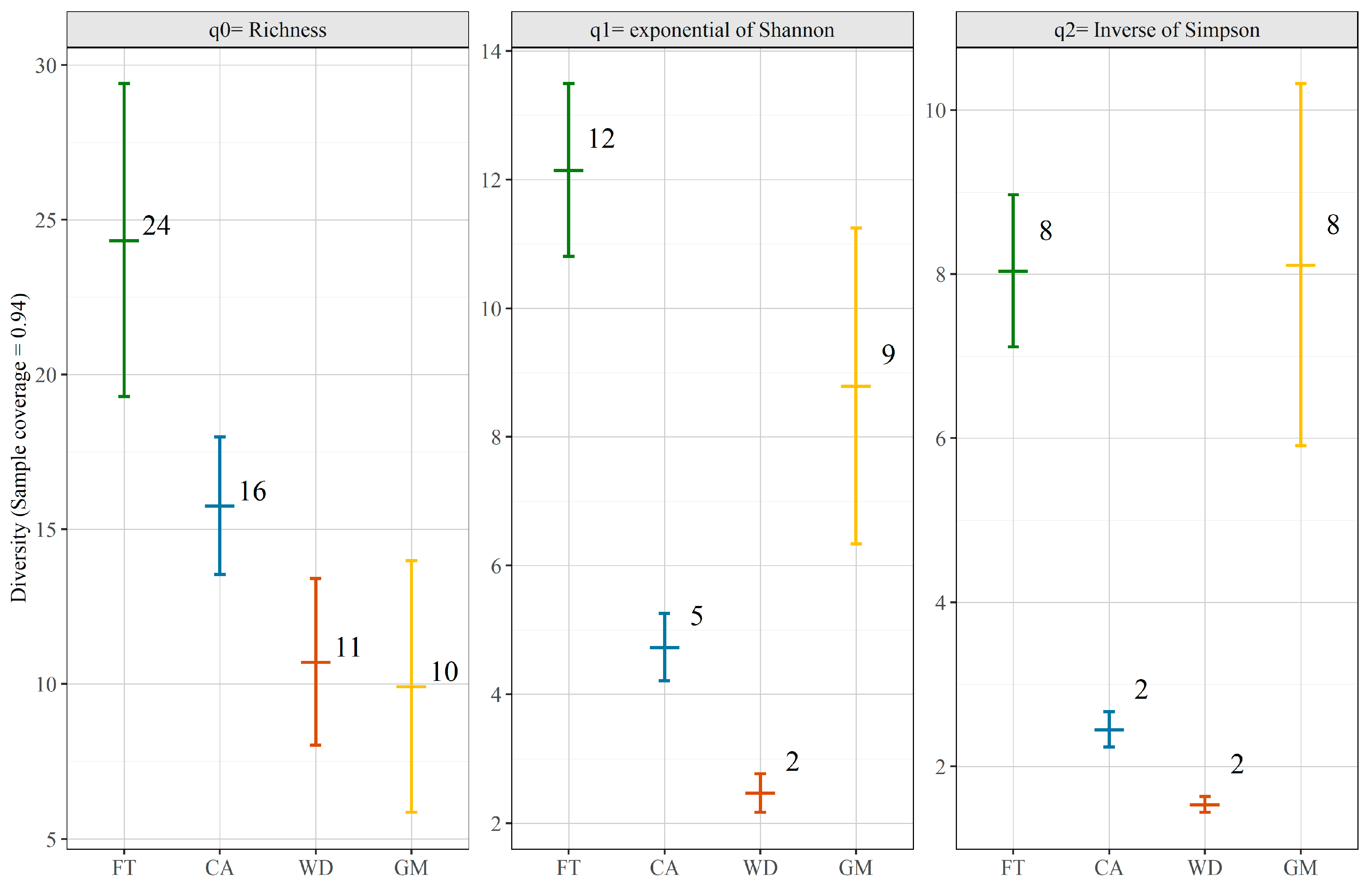
Sample completeness, assessed via coverage-based rarefaction, reached high values (C ≈ 0.99) across all impact categories, indicating that the sampling effort was sufficient to robustly characterize and compare macroinvertebrate communities. Alpha diversity metrics followed a clear anthropogenic gradient; the highest family richness (q = 0 ≈ 24.3) and Exponential Shannon diversity (q = 1 ≈ 12.1) were recorded at FT sites, reflecting stable and heterogeneous habitats. CA sites showed intermediate richness (q = 0 ≈ 15.8), whereas GM and WD sites exhibited the lowest taxonomic diversity (q = 0 ≈ 9.9 and 10.7, respectively) (Figure 3).
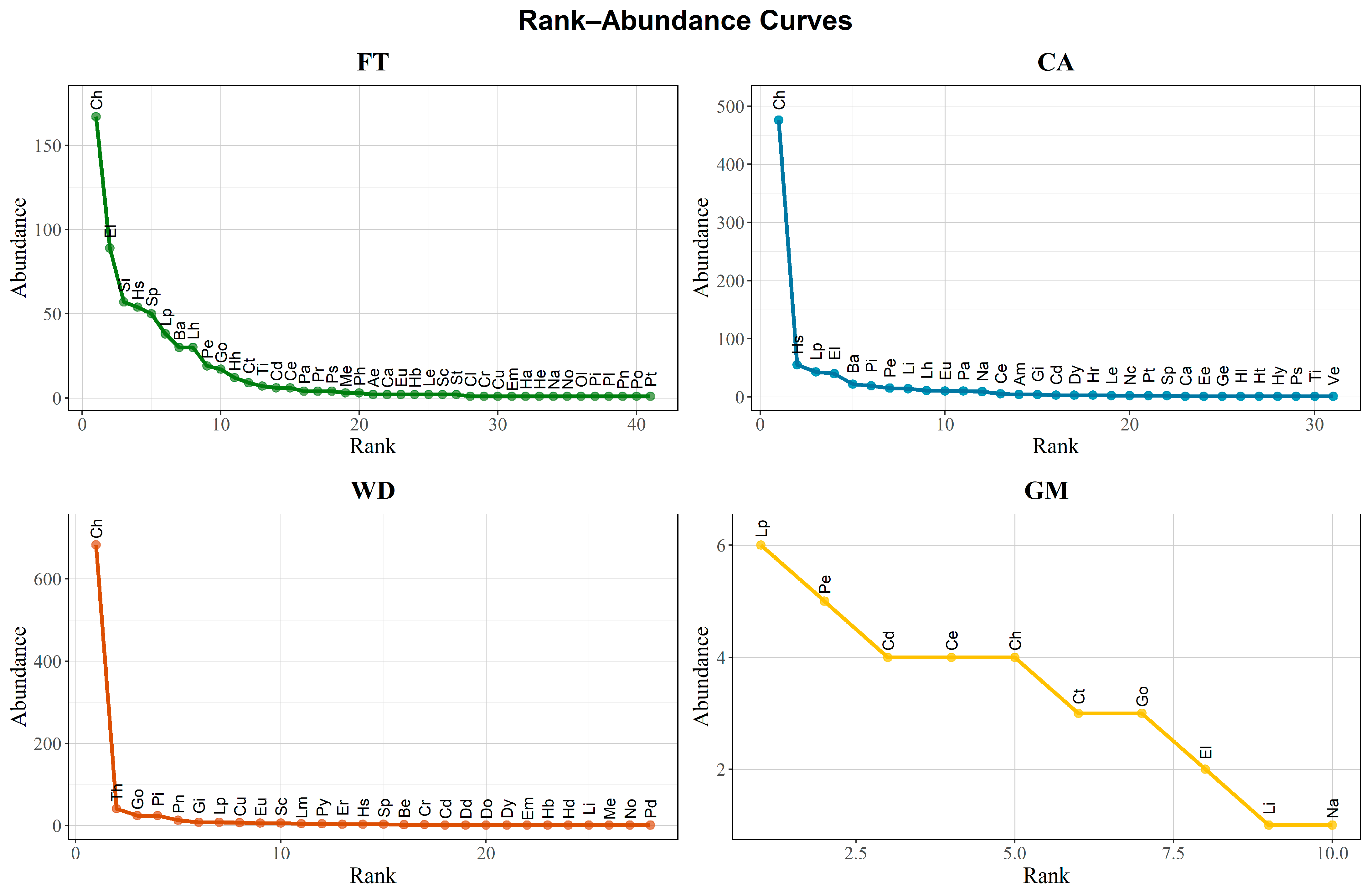
Community structure analysis through rank-abundance curves (Figure 4) revealed high dominance in WD sites (q = 2 ≈ 1.5), where Chironomidae accounted for nearly the entire assemblage. In contrast, GM sites showed relatively high evenness (q = 2 ≈ 8.1) despite their low richness. This pattern likely stems from the extremely low overall abundance (33 individuals total), which prevented any single taxon from achieving absolute dominance, possibly due to the limiting effects of sediment toxicity and extreme turbidity.

3.4. Multivariate Analysis of Environmental Drivers

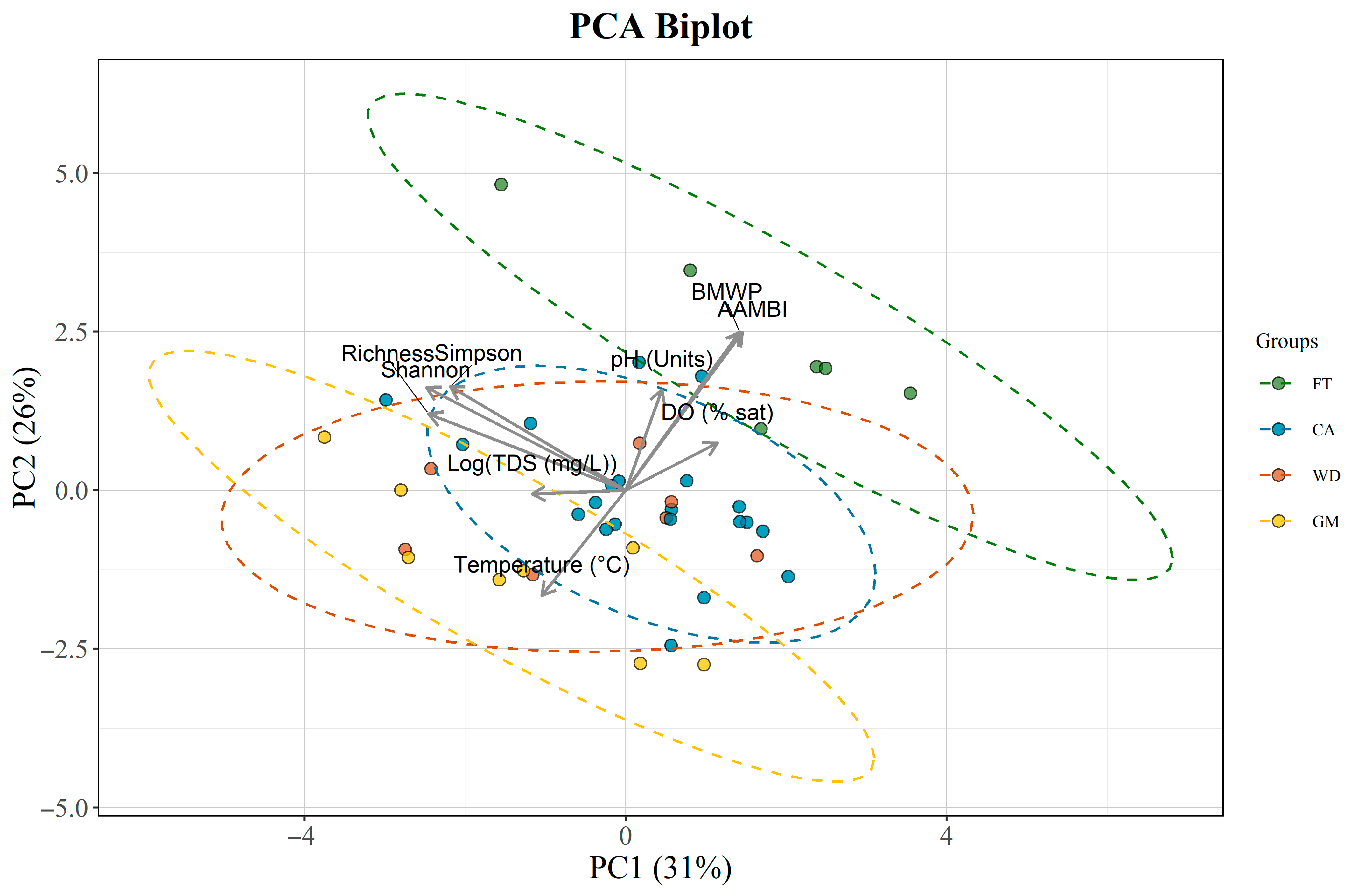
The PCA biplot (explaining 57% of the total variance) demonstrated a clear separation of FT sites along the positive PC1 axis, which was strongly associated with higher dissolved oxygen (DO) and family richness, as well as superior performance in biotic indices (Figure 5).
In contrast, CA, GM, and WD sites clustered toward the center and the negative PC1 axis, correlating with increased water temperature, total dissolved solids (TDS), and turbidity. The 95% confidence ellipses confirmed that FT sites constitute a distinct ecological group, whereas impacted categories exhibited significant overlap. This pattern indicates a homogenized response to cumulative anthropogenic stressors, specifically thermal stress, nutrient enrichment, and increased sediment loads.
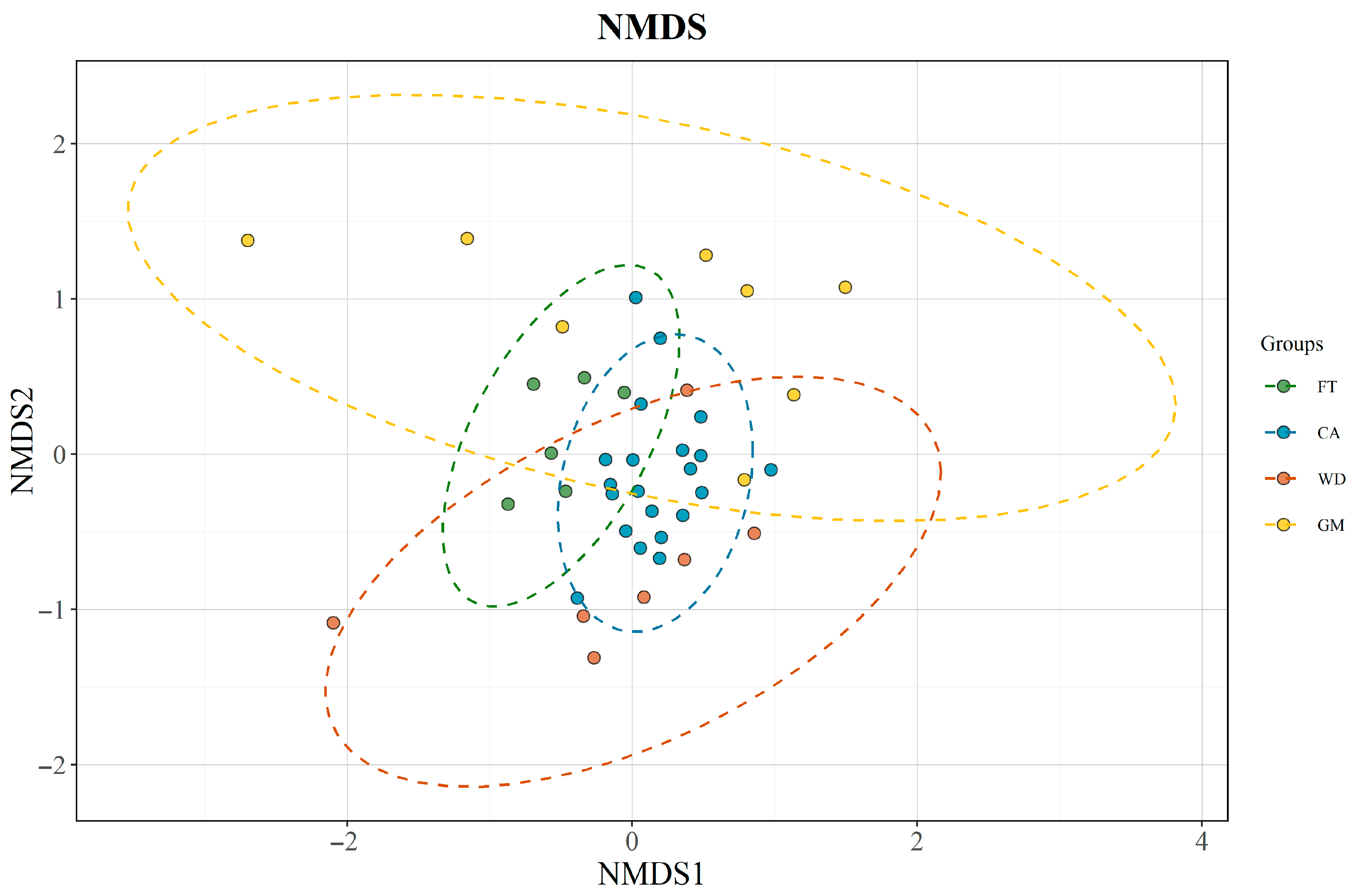
The Non-metric Multidimensional Scaling (NMDS) ordination (Stress = 0.14) showed a clear separation of macroinvertebrate community structure across the four sites (Figure 6). FT sites clustered tightly together, showing distinct composition relative to the more dispersed and overlapping clusters of CA, GM, and WD sites along the NMDS1 axis. PERMANOVA analysis confirmed significant differences in community composition among all groups (p < 0.05). Pairwise comparisons revealed the strongest differentiation between CA and GM (F = 5.32, R2 = 0.16, Padj = 0.0018) and between FT and CA (F = 2.90, R2 = 0.10, Padj = 0.006). In contrast, the comparison between CA and WD showed the lowest degree of variation (F = 2.13, R2 = 0.07, Padj = 0.0251), although it remained statistically significant.
The impact of gold mining (GM) was further corroborated by the significant mobilization of heavy metals (Table 4). Concentrations of iron (430 ± 229 µg/L) and copper (338 ± 128 µg/L) at GM sites were two to three times higher than in other categories. These elevated concentrations coincided with the lowest biotic index scores and the near-total loss of sensitive EPT taxa.

4. Discussion

Our multimetric assessment across the anthropogenic gradient (CA, GM, WD, FT) in the Upper Napo River Basin confirms that gold mining (extreme turbidity >1320 NTU; Fe 430 µg/L; Cu 338 µg/L) and wastewater discharge (fecal coliforms >33,708 CFU/100 mL) drive the most severe ecological degradation (EQR = 0.28, Bad status), with GM showing near-total defaunation (q0 = 9.9) and WD extreme Chironomidae dominance (q2 = 1.5). ASPT (≈4.0) and EQR outperformed raw AAMBI/BMWP-Col scores by detecting functional shifts toward tolerant taxa despite moderate raw values, validating our approach to address the research question of pressure-specific ecological baselines. These findings reveal clear diagnostic thresholds for Andean–Amazonian rivers, where FT sites establish regional reference conditions (EQR = 1.0, q0 = 24.3) now threatened by cumulative anthropogenic impacts.

4.1. Benthic Community Shifts and Taxonomic Loss Across the Disturbance Gradient

The macroinvertebrate assemblages in the UNRB showed a sharp decline in diversity along the studied anthropogenic gradient. Sites categorized as FT acted as regional references of high ecological integrity, supporting the highest richness (q0 ≈ 24.3) and a balanced community structure (q1 ≈ 12.1), dominated by sensitive taxa such as Elmidae and Leptophlebiidae (Figure 3, Table 2). These findings align with the recent 2025 baseline for Western Amazonian rivers, which identifies the region as an “ecological stronghold” harboring 74% of the basin’s ichthyofauna and providing critical connectivity for sediment and nutrient transport [4].
In contrast, the transition from FT to impacted sites (CA, GM, and WD) was marked by a predictable loss of sensitive EPT (Ephemeroptera, Plecoptera, Trichoptera) families and an increase in tolerant groups, particularly Chironomidae. This pattern confirms the sensitivity of benthic communities to land-use changes in the Neotropics, where the loss of riparian forest and increased nutrient loads disrupt the base of the aquatic food web [14].

4.2. Eutrophication Signatures and the Diagnostic Resolution of ASPT and EQR Indices

Wastewater Discharge (WD) sites exhibited the most extreme ecological impairment, characterized by an overwhelming dominance of Chironomidae (80%) and the lowest Exponential Shannon diversity (q1 ≈ 2.5). The integration of microbiological data revealed critical fecal coliform levels (33,708 ± 58,047 CFU/100 mL), which are 56 times higher than the Unified Text of Secondary Environmental Legislation of Ecuador (TULSMA) limit for human consumption (600 CFU/100 mL) and over 160 times higher than reference conditions (Table 1). A significant finding of this study is the enhanced diagnostic power provided by the simultaneous application of the ASPT and the EQR.
While raw AAMBI and BMWP-Col scores for WD sites suggested a state of “Bad” quality, it is the ASPT values (3.92 and 4.03, respectively) that provide the necessary normalization to confirm that the community is composed almost exclusively of highly tolerant taxa (Table 3). This filters out the richness-based bias where traditional indices might be slightly inflated by the presence of multiple tolerant groups. Furthermore, the EQR (0.28) effectively captures the severe magnitude of the deviation from the expected reference community. This multi-metric resolution has also been documented in other urbanized Ecuadorian Amazonian streams, such as the Orienco, where macroinvertebrates proved to be better indicators of long-term organic pollution than standard chemical analysis [10]. In the present study, the application of EQR and ASPT allowed for a deeper diagnostic resolution of the data originally reported by Galarza et al. [25], confirming that the 30% to 53% decline in ecological quality is driven by a functional shift toward tolerant taxa like Chironomidae, which dominate in systems characterized by severe hypoxia and untreated sewage [25].

4.3. Synergistic Physical and Chemical Impairment Driven by Alluvial Gold Mining

Gold mining (GM) represented the most detrimental impact in the UNRB, resulting in the lowest absolute abundance, with only 33 individuals collected across 10 sites. GM sites were characterized by extreme turbidity (NTU)—exceeding the TULSMA limit of 100 NTU by 13 times—and the mobilization of heavy metals, including iron (430 µg/L) and copper (338 µg/L), at concentrations 2.5 to 3 times higher than reference sites. The actual toxicity of these metals is intrinsically linked to the water’s physicochemical matrix; such extreme sediment loads suggest that suspended particles could act as a sink for Fe and Cu through adsorption, potentially limiting their dissolved bioavailable fraction. However, the magnitude of these concentrations indicates that even a partially bioavailable fraction may exert significant physiological stress on macroinvertebrates, especially when coupled with the physical destruction of their habitats [25,26]. The extreme reduction in macroinvertebrate abundance observed at GM sites is mechanistically explained by the high sediment toxicity and heavy metal mobilization (Fe and Cu) identified in the primary assessment of these locations [26]. Our integrated analysis confirms that the near-total defaunation is not merely a localized event but a systemic response to the toxicological threshold reached in mining-impacted sediments, as evidenced by previous bioassays in these same reaches [26]. Since dissolved organic matter (DOM) also regulates metal toxicity in Amazonian systems [57], its measurement should be prioritized in future assessments to define biogeochemical breakpoints. These findings are consistent with acid mine drainage (AMD) signatures and current reports on the rapid expansion of illegal gold mining across the Ecuadorian Amazon, including the Punino and Anzu sectors of Napo province (total impacted areas >1422 ha by late 2024) [19].
The near-complete absence of macroinvertebrates in GM sites is likely a synergistic effect of physical habitat destruction and indirect ecological constraints. High concentrations of suspended solids cause the clogging of interstitial spaces and the scouring of substrates; furthermore, increased turbidity limits light penetration, drastically reducing primary productivity and the availability of food sources for scraper and collector functional groups [58]. This physical degradation is compounded by chemical toxicity from mercury and other metals [59]. In the Ecuadorian Amazon, approximately 150 tons of mercury are discharged annually into river systems, posing an unprecedented threat to biodiversity and the health of riverside communities like the Kichwaruna [59]. Although mercury concentrations were not analyzed in the present study due to budgetary and logistical constraints for trace metal laboratory testing, its presence remains a primary concern in the UNRB. Given the extent of alluvial mining activities in the region, we strongly recommend that future biomonitoring programs incorporate mercury and other heavy metal analyses to better characterize the chemical stress on aquatic communities. This persistent contamination poses a risk not only to biodiversity but also to human health, as shown by detectable metal levels in clinical analyses of local populations [20].

4.4. Landscape Transformation and the Breach of Ecological Resilience Thresholds

Crop and Aquaculture (CA) sites presented an intermediate state of degradation. Although these sites retained some families from the EPT group, such as Baetidae and Hydropsychidae, these taxa are known to be more tolerant to moderate pollution compared to other sensitive EPT members [13,39]. Interestingly, while groups like Perlidae and Leptophlebiidae are highly sensitive to organic enrichment, they showed a persistent presence in some sites impacted by mining (GM) (Figure 4). This suggests that certain sensitive taxa may exhibit higher tolerance to metal-related stress than to organic pollution, provided that some microhabitat features remain available [60]. Nevertheless, the overall reduction in taxonomic richness observed at CA sites is consistent with the chronic pesticide exposure previously documented in these areas [34]. Reassessment of these biological assemblages through Hill numbers and EQR reveals that biological impairment closely parallels the chemical risk (ms-PAF) reported by Cabrera et al. [34], providing a clear biological signal of the chronic pressure exerted by fungicides and insecticides in the agricultural frontier. Recent studies in the Napo watershed (2024) specifically comparing streams in oil palm monocultures versus traditional polycultures (Kichwa chakras) found that monocultures consistently support lower macroinvertebrate richness due to the loss of buffer strips and pesticide runoff [21]. As agricultural expansion remains the dominant driver of deforestation in Ecuador, the Western Amazon is approaching an irreversible ecological threshold; models suggest that if current rates persist, up to 47% of the forest area could be degraded by 2050, permanently altering the region’s hydrological stability [5]. Furthermore, the resulting hypoxic conditions, with dissolved oxygen levels falling below the 80% regulatory threshold in impacted reaches, further limit the survival of stenothermic Andean–Amazonian taxa [22].

4.5. Policy Frameworks and Management Priorities for Basin-Wide Resilience

The consistent results across all lines of evidence underscore the urgent need for a shift in water management in the UNRB. First, the construction of wastewater treatment plants (WWTPs) in urban areas is an immediate priority to reduce the critical coliform and ammonium loads that currently collapse aquatic communities. Second, the declaration of Indigenous-led Fluvial Reserves, such as the one established in 2023 for the Nushiño-Curaray-Villano area, represents a viable strategy to maintain longitudinal connectivity and protect biodiversity refuges from mining and oil expansion [61], complemented by broader National System of Protected Areas (SNAP) protections.
However, it is equally imperative that units within the SNAP officially implement biological corridors and buffer zones, which are currently lacking in many Amazonian and Ecuadorian reserves. The absence of these transition zones exposes protected areas to the ‘hard edges’ of land-use change, evidenced by deforestation rates reaching up to 25.5% in 5-km buffer zones [62]. Adopting longitudinal fluvial connectivity models, such as the proposed Jondachi–Hollín–Misahuallí–Napo corridor by the Napo River Foundation and Ecuadorian Rivers Foundation (private foundations led by Napo residents), alongside terrestrial corridors like Sangay–Podocarpus and Llanganates–Sangay, is essential to link isolated SNAP patches and maintain biodiversity flow under increasing anthropogenic pressure [63].
Future monitoring programs should prioritize filling critical data gaps identified in this study by establishing long-term strategic monitoring at key sentinel sites across anthropogenic gradients. While family-level identification of macroinvertebrates, as used in this study, is a robust and cost-effective tool for regional assessments in the Neotropics [64], we recognize its limitations in detecting species-specific responses to environmental stress. In line with international standards, such as the European Water Framework Directive (WFD), species-level identification is often required to provide higher diagnostic resolution for biological quality elements [65]. Therefore, future research in Andean–Amazonian basins should strive to enhance taxonomic resolution through the development of regional keys and the integration of molecular tools (e.g., DNA metabarcoding). Multimetric biomonitoring frameworks combining taxonomic diversity (Hill numbers), Ecological Quality Ratios (EQR), and chemical stressors will provide robust baselines for adaptive management of these sensitive ecosystems [10,21].

5. Conclusions

This study establishes multimetric ecological baselines for Andean–Amazonian rivers, revealing critical degradation thresholds in the Upper Napo River Basin. Gold mining emerges as the primary driver of ecosystem collapse (EQR = 0.16, q0 = 9.9), followed by wastewater discharge (EQR = 0.28) and agricultural impacts (EQR = 0.37). Normalized indices (ASPT, EQR) provided superior diagnostic resolution over raw biotic scores, identifying functional collapse where physicochemical parameters appeared deceptively moderate.
These findings highlight three critical management priorities: (1) stringent regulation of legal and illegal alluvial gold mining, (2) construction of wastewater treatment infrastructure, and (3) establishment of Indigenous-led, private, and state-supported fluvial reserves featuring longitudinal connectivity corridors. Absent immediate intervention, ongoing deforestation and mining expansion risk permanently undermining this vital freshwater stronghold, jeopardizing essential ecosystem services for 2.5 million people dependent on Napo River waters. The ecological thresholds established in this study offer indispensable benchmarks for adaptive management and policy transformation across the Western Amazon.

Author Contributions

Conceptualization: D.A.-S. and R.E. Data curation: D.A.-S. Formal analysis: D.A.-S., D.M.-O. and R.E. Funding acquisition: M.V.C., M.C., J.E.C. and R.E. Investigation: D.A.-S., M.C., J.E.C. and M.V.C. Methodology: D.A.-S., D.M.-O. and R.E. Software: D.M.-O. and D.A.-S. Validation: R.E. Visualization: D.A.-S. and R.E. Writing—original draft: D.A.-S. and R.E. Writing—review and editing: D.A.-S., R.E., D.M.-O., M.C., J.E.C. and M.V.C. All authors have read and agreed to the published version of the manuscript.

Funding

This research was funded by the project “Creación e implementación de la Unidad de Ecotoxicología y Monitoreo Ambiental de Ikiam” (Grant number GIR-002-2020), co-funded by the European Union (EU), the Spanish Agency for International Development Cooperation (AECID), and the Universidad Regional Amazónica Ikiam.

Data Availability Statement

The data supporting the findings of this study are provided within the article and its associated Appendices (Table A1, Table A2, Table A3 and Table A4). Detailed R scripts and codes used for statistical analysis and biodiversity estimations are available from the corresponding author upon request to ensure full transparency and promote open science.

Acknowledgments

Macroinvertebrate sampling and physicochemical measurements in the UNRB were carried out by Melanie Vermeulen, Emily Galarza, Ángeles Ramos, and Daniela Alvear. This study was made possible through the support of the National Water Reference Laboratory of Ikiam and the valuable technical assistance of Daning Montaño-Ocampo, Marcela Cabrera, Mariana V. Capparelli, Jorge E. Celi, and Rodrigo Espinosa. During the preparation of this manuscript, the authors used DeepL for Spanish-to-English translation and editing. All the authors have reviewed and edited all outputs and take full responsibility for the content of this publication.

Conflicts of Interest

The authors declare that they have no known competing financial interests or personal relationships that could have appeared to influence the work reported in this paper.

Abbreviations

The following abbreviations are used in this manuscript:
AAMBIAndean-Amazon Biotic Index
AMDAcid Mine Drainage
ASPTAverage Score Per Taxon
BMWP-ColBiological Monitoring Working Party adapted for Colombia
BODBiochemical Oxygen Demand
CACrop or Aquaculture sampling category
CCMECanadian Council of Ministers of the Environment
CFUColony Forming Units
DODissolved Oxygen
EPTEphemeroptera, Plecoptera, and Trichoptera
EPSGEuropean Petroleum Survey Group
EQREcological Quality Ratio
FTFew Threats sampling category (Reference)
GMGold Mining sampling category
NMDSNon-metric Multidimensional Scaling
NRBNapo River Basin
NTUNephelometric Turbidity Units
PCAPrincipal Component Analysis
QGISQuantum Geographic Information System
R/ERarefaction and Extrapolation
TDSTotal Dissolved Solids
TULSMAUnified Text of Secondary Environmental Legislation (Ecuador)
UNRBUpper Napo River Basin
UTMUniversal Transverse Mercator
WDWastewater Discharge sampling category
WGS 84World Geodetic System 1984
WWTPWastewater Treatment Plant

Appendix A

Appendix A.1

Table A1. Detailed characterization of the 45 sampling sites in the Upper Napo River Basin. The table includes geographic coordinates (UTM Zone 18S, WGS84 datum), river/stream information, surrounding land-use activities, assigned anthropogenic impact categories, and the respective data sources (including both unpublished research and peer-reviewed literature).
Sample No.River/Stream InformationSurroundings ActivitiesAnthropic ImpactCoordinates (UTM 18S)Data Source
XY
S1Via AhuanoLittle Maize cropFew Threats2121689883964This study (unpublished)
S2Canuayaca/Via Ahuano Crop: Maize, Banana, Cacao, Yuca, SugarcaneCrop or Aquaculture2000089883394This study (unpublished)
S3Ahuano/San PedroCrop: Maize, Banana, Rice, CacaoCrop or Aquaculture2127869879281This study (unpublished)
S4ChontapuntaCrop: Rice, CacaoCrop or Aquaculture2324499895107This study (unpublished)
S5ChontapuntaCrop: Banana, CacaoCrop or Aquaculture2309539892469This study (unpublished)
S6ChontapuntaCrop: Banana, CacaoCrop or Aquaculture2296529890805This study (unpublished)
S7Comunidad Chambiro (vía Muyuna)Crop: Maize, Banana, Cacao, OrilloCrop or Aquaculture1839549890763This study (unpublished)
S8Puerto NapoCrop: Maize, Banana, Yuca, CacaoCrop or Aquaculture1907309881909This study (unpublished)
S9Pashimbi StreamCrop: OrilloCrop or Aquaculture1811749895042This study (unpublished)
S10Hatun SumakuCrop: NaranjillaCrop or Aquaculture2109839926019This study (unpublished)
S11Sumaco PucunoCrop: NaranjillaCrop or Aquaculture2109329921730This study (unpublished)
S12MarchángaraCrop: NaranjillaCrop or Aquaculture1999419919766This study (unpublished)
S13Cotundo (Sardina River)Crop: NaranjillaCrop or Aquaculture1897849916567This study (unpublished)
S14Arosemena TolaCrop: Banana, Cacao, Coffea, Guayaba, Lemon, Orange, TangerineCrop or Aquaculture1814379869740This study (unpublished)
S15Arosemena TolaCrop: CacaoCrop or Aquaculture1808749873331This study (unpublished)
S16Tributary stream of the Napo River: located in Puerto Napo, near the Jatunyacu riverFish FarmingCrop or Aquaculture1864199883804[25]
S17Tena River TributaryGold MiningGold Mining1804389896700[25]
S18Estero PaushiyacuUrban AreasWastewater Discharge 1871679889428[25]
S19Tena Landfill, Misahualli River TributaryLandfillWastewater Discharge1863119896648[25]
S20Pashimbi StreamWith few threats: Located within an agricultural matrix, but no direct point source identifiedCrop or Aquaculture1811729895033[25]
S21Morete CochaThe mining site was located within a forested area on a small stream that was heavily impacted by extraction activities. Effluents from the tailings pond were discharged directly into the channel, and both machinery and workers were operating at the time of sampling.Gold Mining1817939877381[26]
S22Estrella del OrienteThe sampling point was located upstream of an area where mining activity was replaced by tilapia pools. The vegetation on the banks is secondary.Crop or Aquaculture1799199873989[26]
S23Estrella del OrienteMining area: effluents from the tailings pond were being released into the stream, and both machinery and personnel were actively operating at the site during sampling.Gold Mining1798889873589[26]
S24Río ChumbiyacuA road has been built over the river, specifically constructed to provide access for the mining machinery.Gold Mining1807839876572[26]
S25ShiguacochaMining area: the sampling reach received runoff from upstream mining operations and corresponded to an abandoned extraction site, where vegetation was beginning to recolonize soils previously altered by mining activities.Gold Mining1843719877252[26]
S26Rio ChumbiyacuMining area: the sampling site received wastewater discharges from upstream mining operations.Gold Mining1866919877900[26]
S27Río HuambunoMining area: the sampling site is located upstream of an abandoned mining operation.Gold Mining2206829890162[26]
S28Río HuambunoMining area: the sampling site receives wastewater discharges from nearby mining operationsGold Mining2228779891792[26]
S29Río TuyanoMining area: the sampling reach was heavily impacted by mining activities; the riverbed had been completely reshaped to create tailings and settling ponds and to flush alluvial sediments. Heavy machinery was operating at the site during sampling.Gold Mining2097359884928[26]
S30Río Yutzupino: near Puerto Napo CityMining area: the sampling point receives the sewage from mining areasGold Mining1870889883802[26]
S31Toglo riverNative VegetationFew Threats1884319888314This study (Karst systems survey)
S32Castillo stream: Santa RosaTransition zone from rural to urban land use near a gas station. Potential impacts on the stream include runoff from a secondary road and discharges from the local sewer system.Wastewater Discharge1879939885936This study (Karst systems survey)
S33Castillo stream: Santa RosaThe site is situated adjacent to a highway and receives direct wastewater discharges caused by damaged sewer infrastructure.Wastewater Discharge1881559886152This study (Karst systems survey)
S34Toglo River: Santa Rosa Discharge: downstream of gold mining, dredging, agricultural activity, and sewage discharges Wastewater Discharge1881809885933This study (Karst systems survey)
S35Wamahurco: Norma Aguinda FamilyNatural SpringFew Threats1895319892965This study (Karst systems survey)
S36Wamahurco: Centro Comunitario Kichwa Tamia YuraVisible pressures on the site include agricultural activity, wastewater discharges, and tourism in and around the caveWastewater Discharge1882669892533This study (Karst systems survey)
S37Small stream, discharges directly into the Napo River; Nuevo Paraíso communityCorn CropCrop or Aquaculture2244059887295[34]
S38San Pedro de Sumino Community, Sumino RiverCorn CropCrop or Aquaculture2308519892654[34]
S39Seasonal stream: near the Arajuno RiverCorn CropCrop or Aquaculture2129419878992[34]
S40Puno river: Ahuano Corn CropCrop or Aquaculture2116569881921[34]
S41Small stream, discharges directly into the Anzu River; “Comunidad Intercultural Naranjalito” Corn CropCrop or Aquaculture1881899882211[34]
S42Estero MamallactaDischarge: sewage discharge on Pano RiverWastewater Discharge1865779889257[34]
S43Few Threats zone, near Kawsay Yaku spaPristine Zone, Few Threats zoneFew Threats1791069896248[34]
S44Colonso RiverPristine Zone, Few Threats zoneFew Threats1778149895309[34]
S45Lupi River; El Calvario-MuyunaPristine Zone Few Threats zoneFew Threats1767219892228[34]

Appendix A.2

Table A2. In situ physicochemical water quality parameters recorded across the sampling sites and compared with international regulatory standards.
Sampling ResearchSampling NumberAnthropic ImpactPhysicochemical ParametersFecal Coliforms (NMP/100 mL)
Temperature (°C)DO (% Sat)Turbidity (NTU)TDS (mg/L)pHConductivity (µS/cm)
S1S1FT24832.85177.4534-
S2CA24802.2649.57.390-
S3CA24.48055.8244.1148-
S4CA24.356.26.42287.6655.8-
S5CA25.390.42.44236.9148.5-
S6CA26.21022.4531.57.1163.1-
S7CA24.498.61.1115.37.930.6-
S8CA24.2105.150.88215.57.4731.3-
S9CA23106.40.37615.57.5731.5-
S10CA18.391.150.3311.37.7722.9-
S11CA19.594.750.57832.57.7664.8-
S12CA20.6841.2187.5935.2-
S13CA21.342.754.9275.4314.3-
S14CA23.188.422.313.57.3426.9-
S15CA27.252.51.556.36.4813-
S2S16CA24.990.14.5615.58.5-500
S17GM239540.3416.58.06-700
S18WD23.357.843.4697.53-10,000
S19WD24.91946.623508-1000
S20CA22.486.20.32622.47.8-100
S3S21GM23.380.676545.56.9167.6-
S22CA25.681.510.216.266.725.3-
S23GM307527714.956.5525-
S24GM28.376.22433.26.6753.8-
S25GM3178.424631.27.1752.1-
S26GM29.276.6145727.36.845.8-
S27GM3074.737.342.26.6170.9-
S28GM28.176.928.21158.06187.2-
S29GM26.556.533996.27.18152.3-
S30GM25.154.5502657.857.3788.6-
S4S31FT22.8107.34.46687.8130.7208
S32WD24.1107.953376.0372.1126
S33WD24.4134.315.7537.71104.8800
S34WD25.8115.616.357.57.77136.9501
S35FT22.8110.79.2847.93160.5197
S36WD21.9123.33.4317.57.98221.212
S5S37CA23.470-55.257.5183.3-
S38CA2582-30.557.746.6-
S39CA24.72.3-46.756.6884.8-
S40CA25.573.8-31.858.449.8-
S41CA22.774.1-28.37.6540.1-
S42WD2555.5-177.457.57432-
S43FT20.482.7-22.758.3632.2-
S44FT18.987.7-21.458.0829.6-
S45FT19.786-30.557.942.3-
CCME22.5-27.5>80-5006.5–8.5500No guideline
TULSMA22–28>80-10006.5–91000200
US EPA22–28>80-5006.5–9500200
Note: Bold values indicate concentrations that exceed the maximum permissible limits established by both Ecuadorian national regulations (TULSMA) and international water quality standards (US EPA and CCME).

Appendix A.3

Table A3. Detailed microbiological, nutrient, ion, and trace metal parameters in the upper Napo Basin.
SiteFecal ColiformNO3TPBODNH4NO2SO4NaKMgCaAsBBaCdCrCuFePbAgAlBeCoMnNiSe
S1-0.40.08-0.070.070.562.520.791.232.42---------------
S2-0.490-0.070.10.796.471.12.598.75---------------
S3-0.430.1-0.130.050.492.821.071.693.39---------------
S4-0.450.12-0.110.120.593.711.691.843.95---------------
S5-0.290.11-0.030.090.553.461.491.353.02---------------
S6-0.410.11-0.080.080.782.081.332.755.73---------------
S7-1.010.11-0.230.011.451.830.760.621.76---------------
S8-0.440-0.0600.691.270.61.122.25---------------
S9-0.430.12-0.120.021.622.810.420.461.99---------------
S10-0.490.09-0.140.070.740.830.880.531.42---------------
S11-0.330.13-0.160.023.284.762.811.294.9---------------
S12-0.280.09-0.090.021.092.181.040.862.37---------------
S13-0.340.1-0.140.021.290.320.390.280.61---------------
S14-0.090.2-1.430.430.110.240.150.070.17---------------
S15-0.020.04-00.190.071.50.380.762.22---------------
S165000.40.5730.45----------------------
S177001.20.68394.5----------------------
S1810,0000.41.8169----------------------
S1910000.012.63346.5----------------------
S201000.70.274.5----------------------
S21-----------2.2<4.0345.40.5<2.324.2371.96.10.2158.10.62.2456.35.80.7
S22-----------1.7<4.032.20.7<2.26228.910.5<0.0132.6<0.10.5140.53.30.6
S23-----------6.7<4.0113.10.22.624.2558.55.70.3287.70.21.9456.34.3<0.4
S24-----------1.4<4.060.50.2<2.26.4227.50.7<0.093.10.10.5105.52.3<0.4
S25-----------2.3<4.0153.80.2<2.28326.12.40.1231.20.21.8274.73.10.8
S26-----------1.8<4.0817.20.4<2.21223714.5<0.0377.60.44.5485.61.90.8
S27-----------3.4<4.046.10.2<2.25.6512.81.70.1146.9<0.10.449.45.80.9
S28-----------2.8<4.061.10.82.811.3547.61.70.8253.10.10.674.45.70.8
S29-----------2.7<4.0222.70.4<2.210.8536.32.4<0.0249.10.21.7513.24.90.8
S30-----------5.79.8938.90.5<2.29.43714.40.1350.30.97.7597.98.70.7
S312082.30.47----0.44.090.8422.81---------------
S321262.30.35----31.540.935.11---------------
S338000.60.13--0.0112-0.921.235.79---------------
S3450100.34--0.6-42.261.4212.12---------------
S35197-------------------------
S36120.80.79--0.010-0.420.9847.33---------------
S37----1.5---------------------
S38----1.76---------------------
S39----0.04---------------------
S40----0.15---------------------
S41----10.56---------------------
S42----9.12---------------------
S43----26.7---------------------
S44----130.27---------------------
S45----5.92---------------------
Note: Units for the parameters reported in this dataset are as follows: Fecal Coliform in Colony Forming Units per 100 mL (CFU/100 mL); Nutrients (Nitrates-NO3, Total Phosphate-TP, Ammonium-NH4, Nitrite-NO2, Sulfate-SO4), Biochemical Oxygen Demand (BOD), and Major Ions (Sodium-Na, Potassium-K, Magnesium-Mg, Calcium-Ca) in milligrams per liter (mg/L); and Heavy Metals/Trace Elements (As, B, Ba, Cd, Cr, Cu, Fe, Pb, Ag, Al, Be, Co, Mn, Ni, Se) in micrograms per liter (µg/L). The dash (-) denotes parameters that were not recorded at specific sites due to logistical accessibility constraints or technical limitations during field campaigns in remote Amazonian reaches. Heavy metal concentrations in sites affected by gold mining (GM) were analyzed to determine the multi-elemental signature of the activity.

Appendix A.4

Table A4. Taxonomic composition and mean abundance (Mean ± Standard Deviation) of aquatic macroinvertebrates across anthropogenic impact categories in the Upper Napo River Basin.
OrderFamilySample SitesTotal Collected
FT (n = 6)CA (n = 22)WD (n = 7)GM (n = 10)
SeriataPlanariidae0.67 (1.6)0004
TricladidaDendrocoelidae000.14 (0.4)01
BasommatophoraPhysidae0.17 (0.4)00.14 (0.4)02
SorbeoconchaHydrobiidae000.14 (0.4)01
NeotaenioglossaThiaridae005.86 (15.5)041
ArchitaeniglossaAmpullariidae00.18 (0.5)004
PulmonataPlanorbidae001.86 (4.9)013
SphaeriidaSphaeriidae8.33 (6.1)0.09 (0.3)0.43 (1.1)055
RhynchobdellidaGlossiphoniidae00.18 (0.5)1.14 (3.0)012
Piscicolidae0.17 (0.4)0.86 (1.9)3.43 (9.1)044
ArhynchobdellidaErpobdellidae000.43 (1.1)03
DecapodaPalaemonidae0.67 (1.2)0.45 (0.9)0014
AcariHydrachnidae0.17 (0.4)0.05 (0.2)002
EphemeropteraBaetidae5.00 (4.2)1.00 (1.4)0052
Caenidae0.33 (0.8)0.05 (0.2)003
Euthyplociidae0.33 (0.8)0.45 (1.2)0.86 (2.3)018
Leptohyphidae5.00 (4.5)0.50 (0.9)0041
Leptophlebiidae6.33 (5.7)1.95 (3.1)1.14 (2.1)0.60 (1.3)95
Oligoneuriidae0.17 (0.4)0001
OdonataAeshnidae0.33 (0.8)0002
Coenagrionidae1.00 (1.1)0.23 (0.6)00.40 (0.7)15
Gomphidae2.83 (2.1)000.30 (0.7)20
Libellulidae00.64 (1.5)0.14 (0.4)0.10 (0.3)16
Megapodagrionidae0.50 (0.8)00.14 (0.4)04
Platystictidae0.17 (0.4)0001
Polythotidae0.17 (0.4)0001
PlecopteraPerlidae3.17 (2.4)0.68 (1.2)00.50 (0.7)39
TrichopteraCalamoceratidae9.00 (11.2)2.50 (4.1)0.43 (1.1)01
Glossosomatidae0.17 (0.4)00024
Hydrobiosidae003.43 (9.1)03
Hydropsychidae0.33 (0.5)0.09 (0.3)00112
Hydroptilidae00.05 (0.2)001
Lepidostomatidae0.50 (0.8)0004
Philopotamidae0.33 (0.5)00.14 (0.4)03
HemipteraBelostomatidae000.29 (0.8)02
Gerridae00.05 (0.2)001
Hebridae0.17 (0.4)0001
Helotrephidae00.05 (0.2)001
Naucoridae0.17 (0.4)0.41 (1.1)00.10 (0.3)11
Notonectidae0.17 (0.4)00.14 (0.4)02
Veliidae00.05 (0.2)001
MegalopteraCorydalidae1.00 (1.1)0.14 (0.4)0.14 (0.4)0.40 (0.7)14
ColeopteraDytiscidae00.14 (0.5)0.14 (0.4)04
Elmidae14.83 (9.1)1.82 (2.4)00.20 (0.4)131
Hydrophilidae2.00 (1.8)00012
Hydroscaphidae00.14 (0.6)003
Psephenidae0.67 (0.8)0.05 (0.2)005
Ptilodactylidae0.17 (0.4)0.09 (0.3)003
Scirtidae0.33 (0.8)00.86 (2.3)08
Staphylinidae0.33 (0.5)0002
LepidopteraCrambidae0.17 (0.4)00.29 (0.8)03
Erebidae00.05 (0.2)001
Noctuidae00.09 (0.3)002
DipteraCeratopogonidae1.50 (2.4)000.30 (0.9)12
Chironomidae27.83 (10.5)21.64 (15.3)97.57 (52.4)0.40 (0.8)1330
Culicidae0.17 (0.4)01.00 (2.6)08
Dolichopodidae000.14 (0.4)01
Empididae0.17 (0.4)00.14 (0.4)02
Limoniidae000.57 (1.5)04
Psychodidae000.57 (1.5)04
Simuliidae9.50 (12.3)00057
Tipulidae1.17 (1.5)0.05 (0.2)008
Total abundance (individuals/site)106.17 (48.3)34.68 (25.1)121.71 (68.5)3.30 (2.1)2285
Richness (S) (Families/site)15.17 (4.1)7.50 (3.2)9.29 (2.8)2.10 (1.5)110
Note: CA: Crop/Aquaculture; FT: Few Threats (reference); GM: Gold Mining; WD: Wastewater Discharge (n = number of sampling sites per category). Except for ‘Total Collected’, values are mean individuals per site ± SD. Total Abundance and Richness (S) are category means of the sites within each sampling category.

References

  1. Sayer, C.A.; Fernando, E.; Jimenez, R.R.; Macfarlane, N.B.W.; Rapacciuolo, G.; Böhm, M.; Brooks, T.M.; Contreras-MacBeath, T.; Cox, N.A.; Harrison, I.; et al. One-quarter of freshwater fauna threatened with extinction. Nature 2025, 638, 138–145. [Google Scholar] [CrossRef]
  2. Garzón, J.C.; Szabo, I.; Risso, M.; Ramírez, M.F.; Alipaz, R.; Andrade, C.; Chermont, L.; Larrea, C.; Painter, L.; Zapata, M.; et al. The Disruptive Connectivity of Illegal Economies: Multidimensional Threats to Human and Ecological Systems in the Amazon. In Amazon Assessment Report 2025: Connectivity of the Amazon for a Living Planet; Peña-Claros, M., Nobre, C., Armenteras, D., Science Panel for the Amazon (SPA), Eds.; Science Panel for the Amazon (SPA): New York, NY, USA, 2025; Chapter 2; Available online: https://drive.google.com/file/d/17DUX16_HXWSqirjWreU4UryYjDUm7cIa/view (accessed on 9 February 2026).
  3. Hyytiäinen, K.; Bauer, B.; Joyce, K.B.; Ehrnsten, E.; Eilola, K.; Gustafsson, B.G.; Meier, H.E.M.; Norkko, A.; Saraiva, S.; Tomczak, M.; et al. Provision of aquatic ecosystem services as a consequence of societal changes: The case of the Baltic Sea. Popul. Ecol. 2021, 63, 61–74. [Google Scholar] [CrossRef]
  4. Anderson, E.P.; Encalada, A.C.; Couto, T.B.A.; Beveridge, C.F.; Herrera-R, G.A.; Heilpern, S.A.; Almeida, R.M.; Cañas-Alva, C.; Correa, S.B.; de Souza, L.S.; et al. A baseline for assessing the ecological integrity of Western Amazon rivers. Commun. Earth Environ. 2025, 6, 623. [Google Scholar] [CrossRef]
  5. Armenteras, D.; Ribas, C.C. Call to Action 1: Halt Amazon Deforestation and Degradation. In Amazon Assessment Report 2025—Connectivity of the Amazon for a Living Planet; Science Panel for the Amazon, Ed.; Sustainable Development Solutions Network: New York, NY, USA, 2025; Available online: https://www.sp-amazon.org/publications (accessed on 9 February 2026).
  6. Caballero-Serrano, V.; Alday, J.G.; Amigo, J.; Caballero, D.; Carrasco, J.C.; McLaren, B.; Onaindia, M. Social Perceptions of Biodiversity and Ecosystem Services in the Ecuadorian Amazon. Hum. Ecol. 2017, 45, 475–486. [Google Scholar] [CrossRef]
  7. Celi, J.; Guerra Arévalo, N.; Rodes Blanco, M. Guía de Evaluación del Estado de los Ríos; Universidad Regional Amazónica Ikiam: Tena, Ecuador, 2018; 34p, ISBN 978-9942-8638-3-6. [Google Scholar]
  8. Schummer, M.L.; Eason, K.M.; Hodges, T.J.; Farley, E.B.; Sime, K.R.; Coluccy, J.M.; Tozer, D.C. Response of aquatic macroinvertebrate density and diversity to wetland management and structure in the Montezuma Wetlands Complex, New York. J. Great Lakes Res. 2021, 47, 875–883. [Google Scholar] [CrossRef]
  9. Sinche, F.; Cabrera, M.; Vaca, L.; Segura, E.; Carrera, P. Determination of the ecological water quality in the Orienco stream using benthic macroinvertebrates. Integr. Environ. Assess. Manag. 2023, 19, 615–625. [Google Scholar] [CrossRef]
  10. Martínez-Castro, D.; Espinoza, J.-C.; Takahashi, K.; Andrade, M.O.; Herrera, D.A.; Centella-Artola, A.; Apaestegui, J.; Armijos, E.; Gutiérrez, R.; Wongchuig, S.; et al. Impact of Extreme Droughts on the Water Balance in the Peruvian–Ecuadorian Amazon Basin (2003–2024). Water 2025, 17, 3041. [Google Scholar] [CrossRef]
  11. Basta, P.C. Gold mining in the Amazon: The origin of the Yanomami health crisis. Cad. Saúde Pública 2023, 39, e00111823. [Google Scholar] [CrossRef]
  12. Libonati, R.; Bilbao, B.A. Reduce and Prevent Extreme Wildfires. In Amazon Assessment Report 2025—Connectivity of the Amazon for a Living Planet; Science Panel for the Amazon (SPA), Ed.; Sustainable Development Solutions Network: New York, NY, USA, 2025. [Google Scholar]
  13. Tonkin, J.D.; Arimoro, F.O.; Haase, P. Exploring stream communities in a tropical biodiversity hotspot. Biodivers. Conserv. 2016, 25, 975–993. [Google Scholar] [CrossRef]
  14. Encalada, A.C.; Guayasamin, J.M.; Suárez, E.; Mena, C.F.; Lessmann, J.; Sampedro, C.; Martínez, P.E.; Ochoa-Herrera, V.; Swing, K.; Celinšćak, M.; et al. Los Ríos de las Cuencas Andino-Amazónicas: Herramientas y Guía de Invertebrados Para el Diseño Efectivo de Programas de Monitoreo; Trama: Quito, Ecuador, 2019; p. 224. [Google Scholar]
  15. Cabrera, S.; Eurie Forio, M.A.; Lock, K.; Vandenbroucke, M.; Oña, T.; Gualoto, M.; Goethals, P.L.; Van der Heyden, C. Variations in benthic macroinvertebrate communities and biological quality in the Aguarico and Coca River Basins in the Ecuadorian Amazon. Water 2021, 13, 1692. [Google Scholar] [CrossRef]
  16. Masese, F.O.; Raburu, P.O. Improving the performance of the EPT Index to accommodate multiple stressors in Afrotropical streams. Afr. J. Aquat. Sci. 2017, 42, 219–233. [Google Scholar] [CrossRef]
  17. Myers, N.; Mittermeier, R.A.; Mittermeier, C.G.; da Fonseca, G.A.B.; Kent, J. Biodiversity hotspots for conservation priorities. Nature 2000, 403, 853–858. [Google Scholar] [CrossRef]
  18. Nobre, C.A.; Sampaio, G.; Borma, L.S.; Castilla-Rubio, J.C.; Silva, J.S.; Cardoso, M. Land-use and climate change risks in the Amazon and the need of a new sustainable development paradigm. Proc. Natl. Acad. Sci. USA 2016, 113, 10759–10768. [Google Scholar] [CrossRef]
  19. Amazon Conservation. MAAP #219: Illegal Mining Expansion in the Ecuadorian Amazon (Punino Area). Available online: https://www.maapprogram.org/maap-219-illegal-mining-expansion-in-the-ecuadorian-amazon-punino-area/ (accessed on 26 December 2025).
  20. Veiga, M.M.; Meech, J.A. Gold mining activities in the Amazon: Clean-up techniques and remedial procedures for mercury pollution. Ambio 1995, 24, 371–375. [Google Scholar]
  21. Andersen, E.C. Water Quality of the Napo River Basin: A Comparative Study of Streams in Polycultures and Oil Palm Monocultures; Comparative Ecology and Conservation: Quito, Ecuador, 2024; Volume 4, Available online: https://digitalcollections.sit.edu/ece/4 (accessed on 9 February 2026).
  22. Armijos-Arcos, F.; Salazar, C.; Beltrán-Dávalos, A.A.; Kurbatova, A.I.; Savenkova, E.V. Assessment of Water Quality and Ecological Integrity in an Ecuadorian Andean Watershed. Sustainability 2025, 17, 3684. [Google Scholar] [CrossRef]
  23. Wittmann, H.; von Blanckenburg, F.; Guyot, J.; Laraque, A.; Bernal, C.; Kubik, P. Sediment production and transport from in situ-produced cosmogenic 10Be and river loads in the Napo River basin. J. S. Am. Earth Sci. 2011, 31, 45–53. [Google Scholar] [CrossRef]
  24. Lessmann, J.; Troya, M.J.; Flecker, A.S.; Funk, W.C.; Guayasamin, J.M.; Ochoa-Herrera, V.; Poff, N.L.; Suárez, E.; Encalada, A.C. Validating anthropogenic threat maps as a tool for assessing river ecological integrity. PeerJ 2019, 7, e8060. [Google Scholar] [CrossRef]
  25. Galarza, E.; Cabrera, M.; Espinosa, R.; Espitia, E.; Moulatlet, G.M.; Capparelli, M.V. Assessing the quality of Amazon aquatic ecosystems with multiple lines of evidence: The case of the northeast Andean foothills of Ecuador. Bull. Environ. Contam. Toxicol. 2021, 107, 52–61. [Google Scholar] [CrossRef] [PubMed]
  26. Capparelli, M.V.; Moulatlet, G.M.; de Souza Abessa, D.M.; Lucas-Solis, O.; Rosero, B.; Galarza, E.; Tuba, D.; Carpintero, N.; Ochoa-Herrera, V.; Cipriani-Avila, I. An integrative approach to identify the impacts of multiple metal contamination sources on the eastern Andean foothills of the Ecuadorian Amazonia. Sci. Total Environ. 2020, 709, 136088. [Google Scholar] [CrossRef]
  27. Capparelli, M.V.; Cipriani-Avila, I.; Jara-Negrete, E.; Acosta-López, S.; Acosta, B.; Pérez-González, A.; de la Rosa, A.; Pérez, J.; Molinero, J.; Pinos-Vélez, V. Emerging contaminants in the northeast Andean foothills of Amazonia: The case of study of the city of Tena, Napo, Ecuador. Bull. Environ. Contam. Toxicol. 2021, 107, 2–10. [Google Scholar] [CrossRef]
  28. Lucas-Solis, O.; Moulatlet, G.M.; Guamangallo, J.; Yacelga, N.; Villegas, L.; Galarza, E.; Rosero, B.; Zurita, B.; Sabando, L.; Cabrera, M.; et al. Preliminary assessment of plastic litter and microplastic contamination in freshwater depositional areas: The case study of Puerto Misahualli, Ecuadorian Amazonia. Bull. Environ. Contam. Toxicol. 2021, 107, 45–51. [Google Scholar] [CrossRef]
  29. van Rees, C.B.; Geist, J.; Arthington, A.H. Grasping at water: A gap-oriented approach to bridging shortfalls in freshwater biodiversity conservation. Biol. Rev. 2025, 100, 1970–1993. [Google Scholar] [CrossRef]
  30. Laraque, A.; Bernal, C.; Bourrel, L.; Darrozes, J.; Christophoul, F.; Armijos, E.; Fraizy, P.; Pombosa, R.; Guyot, J.L. Sediment budget of the Napo River, Amazon basin, Ecuador and Peru. Hydrol. Process. 2009, 23, 3509–3524. [Google Scholar] [CrossRef]
  31. Montoya, J.V.; Ríos-Touma, B.; Lujan, N.K.; Sánchez, F.; Proaño, A.; Tejera, E.; Jimenes-Vargas, K.; Sánchez, L.; Cuesta, F. Spatiotemporal distributions and potential sources of sediment and waterborne heavy metals in lowland lakes and rivers of the Ecuadorian Amazon. Environ. Monit. Assess. 2025, 197, 1022. [Google Scholar] [CrossRef] [PubMed]
  32. Celi, J.E. Hydrological Controls of Riverine Ecosystems of the Napo River Amazon Basin: Implications for the Management and Conservation of Biodiversity. Ph.D. Thesis, Michigan State University, East Lansing, MI, USA, 2014. [Google Scholar]
  33. Grill, G.; Lehner, B.; Thieme, M.; Geenen, B.; Tickner, D.; Antonelli, F.; Babu, S.; Borrelli, P.; Cheng, L.; Crochetiere, H.; et al. Mapping the world’s free-flowing rivers. Nature 2019, 569, 215–221. [Google Scholar] [CrossRef] [PubMed]
  34. Cabrera, M.; Capparelli, M.V.; Ñacato-Ch, C.; Moulatlet, G.M.; López-Heras, I.; Díaz González, M.; Alvear-S, D.; Rico, A. Effects of intensive agriculture and urbanization on water quality and pesticide risks in freshwater ecosystems of the Ecuadorian Amazon. Chemosphere 2023, 337, 139286. [Google Scholar] [CrossRef] [PubMed]
  35. Alvear Sayavedra, C.D. Diversidad de Macroinvertebrados Acuáticos y Calidad del Agua a lo Largo de un Gradiente Antrópico en la Cuenca Alta del Río Napo. Bachelor’s Thesis, Universidad Regional Amazónica Ikiam, Tena, Ecuador, 2022. [Google Scholar]
  36. González, H.; Crespo, E.; Acosta, R.; Hampel, H. Guía Rápida Para la Identificación de Macroinvertebrados de los Ríos Altoandinos del Cantón Cuenca; ETAPA: Cuenca, Ecuador, 2019; 156p, Available online: https://geo.etapa.net.ec/monitoreoecohidrologico/files/docs/GUIA%20MACROINVERTEBRADOS.pdf (accessed on 6 February 2026).
  37. Domínguez, E.; Fernández, H.R. Macroinvertebrados Bentónicos Sudamericanos: Sistemática y Biología; Fundación Miguel Lillo: Tucumán, Argentina, 2009. [Google Scholar]
  38. Hamada, N.; Thorp, J.H.; Rogers, D.C. (Eds.) Thorp and Covich’s Freshwater Invertebrates, Volume 3: Keys to Neotropical Hexapoda, 4th ed.; Academic Press: London, UK, 2019. [Google Scholar]
  39. Roldán-Pérez, G. Bioindicación de la Calidad del Agua en Colombia: Propuesta Para el Uso del Método BMWP/Col; Editorial Universidad de Antioquia: Medellín, Colombia, 2003; pp. 1–170. [Google Scholar]
  40. European Commission. Overall Approach to the Classification of Ecological Status and Ecological Potential; Guidance Document No 13; Office for Official Publications of the European Communities: Luxembourg, 2003; pp. 1–46. [Google Scholar]
  41. van de Bund, W.; Solimini, A.G. Ecological Quality Ratios for Ecological Quality Assessment in Inland and Marine Waters; REBECCA Deliverable 10; EUR 22722 EN; Office for Official Publications of the European Communities: Luxembourg, 2007; JRC36757; pp. 1–24. Available online: https://publications.jrc.ec.europa.eu/repository/handle/JRC36757 (accessed on 10 February 2026).
  42. Chao, A.; Gotelli, N.J.; Hsieh, T.C.; Sander, E.L.; Ma, K.H.; Colwell, R.K.; Ellison, A.M. Rarefaction and extrapolation with Hill numbers: A framework for sampling and estimation in species diversity studies. Ecol. Monogr. 2014, 84, 45–67. [Google Scholar] [CrossRef]
  43. Chiu, C.H.; Chao, A. Estimating and comparing microbial diversity in the presence of sequencing errors. PeerJ 2016, 4, e1634. [Google Scholar] [CrossRef]
  44. Chao, A.; Jost, L. Coverage-based rarefaction and extrapolation: Standardizing samples by completeness rather than size. Ecology 2012, 93, 2533–2547. [Google Scholar] [CrossRef]
  45. Hsieh, T.C.; Ma, K.H.; Chao, A. iNEXT: An R package for rarefaction and extrapolation of species diversity (Hill numbers). Methods Ecol. Evol. 2016, 7, 1451–1456. [Google Scholar] [CrossRef]
  46. Jolliffe, I. Principal Component Analysis. In Wiley StatsRef: Statistics Reference Online; Balakrishnan, N., Colton, T., Everitt, B., Piegorsch, W., Ruggeri, F., Teugheis, J.L., Eds.; John Wiley & Sons, Ltd.: Chichester, UK, 2014. [Google Scholar] [CrossRef]
  47. Peres-Neto, P.R.; Jackson, D.A.; Somers, K.M. Giving meaningful interpretation to ordination axes: Assessing loading significance in principal component analysis. Ecology 2003, 84, 2347–2363. [Google Scholar] [CrossRef]
  48. Oksanen, J.; Blanchet, F.G.; Friendly, M.; Kindt, R.; Legendre, P.; McGlinn, D.; Minchin, P.R.; O’Hara, R.B.; Simpson, G.L.; Solymos, P.; et al. Vegan: Community Ecology Package. R Package Version 2.7-2. 2025. Available online: https://cran.r-project.org/web/packages/vegan/ (accessed on 10 February 2026).
  49. R Core Team. R: A Language and Environment for Statistical Computing; R Foundation for Statistical Computing: Vienna, Austria, 2025. [Google Scholar]
  50. Hsieh, T.C.; Ma, K.H.; Chao, A. iNEXT: iNterpolation and EXTrapolation for Species Diversity. R Package Version 3.0.2. 2025. Available online: https://cran.r-project.org/web/packages/iNEXT/index.html (accessed on 10 February 2026).
  51. Kindt, R.; Coe, R. Tree Diversity Analysis: A Manual and Software for Common Statistical Methods for Ecological and Biodiversity Studies; World Agroforestry Centre (ICRAF): Nairobi, Kenya, 2005; ISBN 92-9059-179-X. Available online: https://cran.r-project.org/package=BiodiversityR (accessed on 10 February 2026).
  52. Lê, S.; Josse, J.; Husson, F. FactoMineR: An R Package for Multivariate Analysis. J. Stat. Softw. 2008, 25, 1–18. [Google Scholar] [CrossRef]
  53. Ogle, D.H. FSA: Fisheries Stock Analysis; R Package Version 0.10.1. 2026. Available online: https://cran.r-project.org/web/packages/FSA/index.html (accessed on 13 January 2026).
  54. Lenth, R.V. Emmeans: Estimated Marginal Means, aka Least-Squares Means; R Package Version 2.0.1. 2025. Available online: https://cran.r-project.org/web/packages/emmeans/index.html (accessed on 10 February 2026).
  55. Ministerio del Ambiente del Ecuador. Norma de Calidad Ambiental y de Descarga de Efluentes: Recurso Agua. TULSMA Libro VI Anexo 1; Registro Oficial: Quito, Ecuador, 2015. [Google Scholar]
  56. Canadian Council of Ministers of the Environment (CCME). Canadian Environmental Quality Guidelines; Canadian Council of Ministers of the Environment: Winnipeg, MB, Canada, 2002.
  57. Yang, B.; Xu, W.; Zhao, W. Multi-scale Mechanisms and Environmental Implications of Dissolved Organic Matter-Metal Ions Interactions in Aquatic Environments: A Review. Water Res. 2025, 288, 124563. [Google Scholar] [CrossRef] [PubMed]
  58. Davies-Colley, R.J.; Hickey, C.W.; Quinn, J.M.; Ryan, P.A. Effects of clay discharges on streams: 1. Optical properties and epilithon. Hydrobiologia 1992, 248, 215–234. [Google Scholar] [CrossRef]
  59. Diálogo Américas. CCP’s Gold Rush in Latin America. 2025. Available online: https://thewatch-journal.com/2025/12/23/ccps-gold-rush-in-latin-america/ (accessed on 6 February 2026).
  60. Bere, T.; Dalu, T.; Mwedzi, T. Detecting the impact of heavy metal contaminated sediment on benthic macroinvertebrate communities in tropical streams. Sci. Total Environ. 2016, 572, 147–156. [Google Scholar] [CrossRef]
  61. The Nature Conservancy. In the Ecuadorian Amazon, An Indigenous-Led Example of Durable Freshwater Protection. 2025. Available online: https://www.nature.org/en-us/what-we-do/our-insights/perspectives/durable-freshwater-ecuador-amazon/ (accessed on 6 February 2026).
  62. Kleemann, J.; Zamora, C.; Villacis-Chiluisa, A.B.; Cuenca, P.; Koo, H.; Noh, J.K.; Fürst, C.; Thiel, M. Deforestation in Continental Ecuador with a Focus on Protected Areas. Land 2022, 11, 268. [Google Scholar] [CrossRef]
  63. MAATE. Acuerdo Ministerial No. MAAE-2020-019: Directrices Técnicas para el Establecimiento y Gestión de Corredores de Conectividad en Ecuador; Ministerio del Ambiente, Agua y Transición Ecológica: Quito, Ecuador, 2020.
  64. Buss, D.F.; Vitorino, A.S. Rapid bioassessment protocols using benthic macroinvertebrates in Brazil: Evaluation of taxonomic sufficiency. J. N. Am. Benthol. Soc. 2010, 29, 562–571. [Google Scholar] [CrossRef]
  65. Schmidt-Kloiber, A.; Hering, D. www.freshwaterecology.info—An online tool that unifies, standardises and codifies more than 20,000 European freshwater organisms and their ecological preferences. Ecol. Indic. 2015, 53, 271–282. [Google Scholar] [CrossRef]
Figure 1. Map of the Upper Napo River Basin showing the 45 sampling sites across the anthropogenic gradient. The spatial data were processed using QGIS (v. 3.22.3). Coordinates are projected in WGS 84/UTM Zone 18S (EPSG:32718) to ensure spatial accuracy within the Ecuadorian Amazon region.
Water 18 01106 g001
Figure 2. Number of individuals of the most abundant macroinvertebrate families (≥1% of total) across anthropogenic impact categories in the study streams (Few Threats, Crop/Aquaculture, Wastewater Discharge, Gold Mining). Differences among categories were evaluated using one-way ANOVA followed by pairwise post hoc comparisons with Benjamini–Hochberg adjustment of p-values; asterisks denote significant contrasts (* p < 0.05, ** p < 0.01).
Water 18 01106 g002
Figure 3. Alpha diversity metrics: q0 (species richness), q1 (exponential Shannon diversity), and q2 (inverse Simpson diversity). Axis x is the degree of completeness of the observed, rarefied, and extrapolated sample, and axis y is how the diversity of species behaved based on the Hill numbers for q0, q1, and q2.
Water 18 01106 g003
Figure 4. Rank–abundance curves for taxa recorded in streams affected by Crop/Aquaculture (CA), Gold Mining (GM), Wastewater Discharge (WD), and in Few Threats (FT) reference reaches. The initials of the macroinvertebrate families correspond to: Ch = Chironomidae, El = Elmidae, Hs = Hydropsychidae, Ba = Baetidae, Lp = Leptophlebiidae, Li = Libellulidae, Na = Naucoridae, Ce = Coenagrionidae, Pa = Palaemonidae, Eu = Euthyplociidae, Lh = Leptohyphidae, Pe = Perlidae, Cd = Corydalidae, Ps = Psephenidae, Ae = Aeshnidae, Ca = Caenidae, Cr = Crambidae, Em = Empididae, Ht = Hydroptilidae, Pl = Platystictidae, Pt = Ptilodactylidae, Si = Simuliidae, Ve = Veliidae, Dy = Dytiscidae, Hh = Hydrophilidae, Sc = Scirtidae, Ct = Ceratopogonidae, Cu = Culicidae, Be = Belostomatidae, He = Hebridae, No = Notonectidae, Th = Thiaridae, Go = Gomphidae, Me = Megapodagrionidae, Pn = Planorbidae, Gi = Glossiphoniidae, Pi = Piscicolidae, Pr = Planariidae, Hd = Hydrobiidae, Sp = Sphaeriidae, Cl = Calamoceratidae, Go = Glossosomatidae, Hb = Hydrobiosidae, Dd = Dendrocoelidae, Hr = Hydroscaphidae, Am = Ampullariidae, Le = Lepidostomatidae, Ti = Tipullidae, Hy = Hydracnidae, Ge = Gerridae, Nc = Noctuidae, Hl = Helotrephidae, Ee = Erebidae, Ol = Oligoneuriidae, Po = Polythotidae, Ph = Philopotamidae, Ha = Hydrachnidaea, St = Staphylinidae, Py = Psychodidae, Lm = Limoniidae, Do = Dolichopodidae, Er = Erpobdellidae, Pd = Physidae.
Water 18 01106 g004
Figure 5. Principal component analysis (PCA) clustering for the correlations between abiotic parameters and macroinvertebrate information (structure and ecological water quality indexes). The first two axes were plotted. Crop or Aquaculture (CA), Gold Mining (GM), Wastewater Discharge (WD), and sites with Few Threats (FT) zones were denoted by different colors and shapes in solid. The ellipses represent 95% confidence intervals for the same sites.
Water 18 01106 g005
Figure 6. Non-metric multidimensional scaling (NMDS) ordination based on Bray–Curtis dissimilarity for macroinvertebrate community composition. The stress value was 0.14. Crop or Aquaculture (CA), Gold Mining (GM), Wastewater Discharge (WD), and sites with Few Threats (FT). The ellipses represent 95% confidence intervals for the same sites.
Water 18 01106 g006
Table 1. Physicochemical and microbiological water quality parameters [Mean (SD)] across anthropogenic impact categories (Kruskal–Wallis and Dunn’s post hoc, p < 0.05) in Upper Napo River Basin.
Parameter (Unit)FT (n = 6)CA (n = 22)WD (n = 7)GM (n = 10)Regulatory Limit (ECU/CAN)
Temperature (°C)21.4 (2.0) *23.6 (2.2)24.2 (1.3)27.4 (2.9) * †Natural ± 3/Natural ± 3
Dissolved Oxygen (% sat)92.9 (12.7)78.7 (23.6)87.6 (43.4)74.4 (11.6)†≥80% sat (≥6 mg/L)/≥80% sat (≥6 mg/L)
pH7.9 (0.3) *7.2 (1.0) *7.5 (0.7)7.1 (0.5) *6.5–9.0/6.5–9.0
Turbidity (NTU)5.5 (3.3)6.9 (13.7)29.7 (20.4)824.0 (1543.3) * † #Natural + 5 NTU/Site-specific (+5 NTU)
TDS (mg/L)40.6 (28.2)24.4 (13.2)394.5 (863.8) * †48.0 (33.3)No specific/No specific
Conductivity (μS/cm)71.6 (58.3)45.3 (22.7)193.4 (144.5) *82.6 (53.2)Site-specific/Included in WQI
Fecal Coliform (CFU/100 mL)202.5 (7.8)300.0 (282.8)2073.2 (3901.8)700.0200 NMP/100 mL **/No guideline
Note: CA: Crop or Aquaculture; FT: Few Threats (reference); GM: Gold Mining; WD: Wastewater Discharge. Values are reported as Mean ± Standard Deviation (SD). For fecal coliforms in Gold Mining (GM), only one measurement was available (700 NMP/100 mL), thus no SD reported; SD omitted where single measurements preclude calculation. Statistical significance (p < 0.05): (*) indicates a significant difference compared to FT; (†) indicates a significant difference compared to CA; (#) indicates that the mean value exceeds at least one regulatory limit. Sources: TULSMA Book VI, Table 3 (criteria for freshwater flora/fauna preservation) [55]; Appendix 1 (additional limits) [55]; CAN = CCME, Canadian Water Quality Guidelines for the Protection of Freshwater Aquatic Life [56]. ** TULSMA Book VI, Appendix 1 assumes an approximate 1:1 equivalence (factor 0.9–1.1) between NMP/100 mL and CFU/100 mL for regulatory comparisons.
Table 2. Synthesis of ecological quality status based on biotic index scores, Average Score Per Taxon (ASPT), and Ecological Ratios (EQR) [Mean (SD)] across anthropogenic disturbance categories (n = 45) in the Upper Napo River Basin.
Index/CategoryMean (±SD)ASPT (Mean ± SD)EQR (O/E)Ecological Status
AAMBI
FT (Reference)82.3 (14.5)6.5 (1.1)1Excellent/Very Good
CA30.6 (16.5) *5.1 (1.9) *0.37Regular
WD23.4 (14.3) *3.9 (1.4) *0.28Bad
GM13.2 (14.4) *4.6 (2.8) *0.16Bad
BMWP-Col
FT (Reference)88.0 (13.5)7.3 (1.9)1Moderate/Good
CA33.5 (17.5) *5.0 (2.8) *0.38Bad/Regular
WD24.3 (15.6) *4.0 (1.5) *0.28Bad
GM12.1 (14.2) *4.9 (3.3) *0.14Very Bad
Note: FT = Few Threats; CA = Crop or Aquaculture; GM = Gold Mining; WD = Wastewater Discharge. ASPT (Average Score Per Taxon) is calculated as the total biotic score divided by the number of families present at each site. The asterisk (*) indicates a significant difference compared to the reference group (FT) at p < 0.05. EQR (Ecological Quality Ratio) was calculated as the ratio of the observed (O) mean of the category to the expected (E) reference mean from FT sites. AAMBI quality ranges: >100 Excellent, 75–90 Very Good, 50–74 Good, 25–49 Regular, <24 Bad. BMWP-Col quality ranges: ≥100 Good, 61–100 Moderate, 36–60 Poor, 16–35 Bad, <15 Very Bad.
Table 3. Nutrient enrichment and organic matter parameters [Mean (SD)] across anthropogenic disturbance categories (Kruskal–Wallis and Dunn’s post hoc, p < 0.05) and comparison with aquatic life standards.
Parameter (Unit)FT (n = 6)CA (n = 22)WD (n = 7)GM (n = 10)Ecological ThresholdRegulatory Limits (ECU/CAN)
Nitrates (mg/L)1.07 (1.00)0.50 (0.22)0.40 (0.17)0.73 (0.32)>2.0 (Moderate)No specific/No specific
Total Phosphate (mg/L)0.32 (0.17) *0.65 (0.56) #1.79 (1.15) * + #0.68>0.1 (Eutrophication)No specific/0.03 (CCME soft water)
Ammonium (mg/L)0.66 (0.36)0.33 (0.50)1.71 (1.46) * + #0.44 (0.22)>0.5 (Pollution)0.02/0.019 (CCME, cold water)
Nitrite (mg/L)0.01 (0.01) *0.11 (0.14) #0.30 (0.42) * + #0.09 (0.09)>0.1 (Pollution)0.06/0.06 (CCME)
BOD (mg/L)0.47 (0.33)5.83 (13.85) #0.58 (0.30)0.68>5.0 (Hypoxia Risk)No specific/No specific
Sulfate (mg/L)0.77 (0.39)1.14 (0.87)4.13 (0.22) * +1.16 (0.66)--No specific/No specific
N:P Ratio3.340.770.22 * +1.077.0–10.0 (Balanced)7.0–10.0 (Balanced)/10:1 (healthy aquatic ecosystems)
Note: CA = Crop/Aquaculture; FT = Few Threats (reference); GM = Gold Mining; WD = Wastewater Discharge. n = number of sampling sites per category. Values are presented as Mean ± SD. Significant differences were determined using Kruskal–Wallis followed by Dunn’s post hoc test (p < 0.05): (*) vs. FT; (+) vs. GM; (#) exceeds ≥1 aquatic life limit. Sources: ECU = Unified Text of Secondary Environmental Legislation of Ecuador (TULSMA 2015) [55], Book VI, Appendix 1, Table 3 [55]: Freshwater flora and fauna preservation; CAN = Canadian Council of Ministers of the Environment (CCME, Freshwater Aquatic Life Guidelines) [56]. N:P < 7.0 indicates N-limitation (P excess, eutrophication risk).
Table 4. Heavy metal concentrations, macroinvertebrate biotic and community structure indices [Mean (SD)] in relation to anthropogenic disturbance (n = 45 sites).
IndicatorFTCAWDGMAquatic Life Limits (TULSMA/CCME)
METALS (µg/L)
Iron-Fe--170 (153)--430 (229) * † #300/300
Copper-Cu--117 (60)--338 (128) * †20/2
Manganese-Mn------263 (161) * † #100/430
Aluminum-Al------230 (77) * † #100/5–100
Lead-Pb--8.3 (2.8)--7.5 (6.2)10/1–7
Cadmium-Cd--0.6 (0.2)--0.3 (0.2)1/0.09
BIOTIC INDICES
AAMBI85.3 (20.6) *25.5 (7.8)21.7 (17.2) †22.1 (14.3) †>100 (Excellent)
BMWP-Col90.5 (18.6) *27.3 (10.0)23.8 (18.2) †23.0 (15.9) †≥100 (Good)
EQR-A (AAMBI-based)1.0 (0.0) *0.8 (0.1)0.6 (0.1) † ‡0.8 (0.1) †~1.0 (Optimal)
EQR-B (BMWP-based)1.0 (0.0) *0.7 (0.1)0.5 (0.2) † ‡0.6 (0.2) †~1.0 (Optimal)
COMMUNITY STRUCTURE
Richness (families)41312711>40 (Ref)
Exp. Shannon Diversity exp(H’)12.14.72.58.8>10 (Ref)
Chironomidae (%)10%62%80% *30%<15%
EPT taxa (%)15%55% *9% †5% †>50%
Note: CA (Crop/Aquaculture); FT (Few Threats); GM (Gold Mining); WD (Wastewater Discharge). Mean ± SD. Kruskal–Wallis + Dunn’s vs. FT: (*) p < 0.05 vs. FT; (†) vs. CA; (‡) vs. GM; (#) exceeds ≥1 aquatic life limit. CCME guidelines for Cu, Mn, Pb, and Cd are hardness-dependent; values represent the most stringent criteria for soft water. Aluminum limits are pH-dependent (5 µg/L if pH < 6.5; 100 µg/L if pH ≥ 6.5). Aquatic Life Limits: Unified Text of Secondary Environmental Legislation of Ecuador (TULSMA 2015) [55], Book VI, Appendix 1, Table 3 [55] (Freshwater flora and fauna preservation); Canadian Council of Ministers of the Environment (CCME, Freshwater Aquatic Life Guidelines) [56]. AAMBI quality ranges: >100 Excellent, 75–90 Very Good, 50–74 Good, 25–49 Regular, <24 Bad. BMWP-Col quality ranges: ≥ 100 Good, 61–100 Moderate, 36–60 Poor, 16–35 Bad, <15 Very Bad. EQR based on Observed/Expected ratio (1.0 = reference condition).
Disclaimer/Publisher’s Note: The statements, opinions and data contained in all publications are solely those of the individual author(s) and contributor(s) and not of MDPI and/or the editor(s). MDPI and/or the editor(s) disclaim responsibility for any injury to people or property resulting from any ideas, methods, instructions or products referred to in the content.