Article

Mechanisms of Metal Particle Release from Pipe Scales in Ductile Iron Water Supply Pipelines: Control by Water Quality Parameters

1
College of Environmental Science and Engineering, Tongji University, Shanghai 200092, China
2
Department of Environmental Science and Engineering, Beijing University of Chemical Technology, Beijing 100029, China
3
State Key Laboratory of Pollution Control and Resource Reuse, Tongji University, Shanghai 200092, China
*
Authors to whom correspondence should be addressed.
Water 2026, 18(9), 1101; https://doi.org/10.3390/w18091101
Submission received: 26 March 2026 / Revised: 24 April 2026 / Accepted: 1 May 2026 / Published: 4 May 2026
(This article belongs to the Section Urban Water Management)

Abstract

To clarify the control mechanism of water quality parameters on metal particle release from pipe scales in aging ductile iron water supply pipelines (service life > 20 years), this study conducted single-factor experiments to explore the effects of pH, temperature, concentration of humic acid (HA) and Mn2+ on Fe, Mn, and Al particle release. Combined with inductively coupled plasma optical emission spectrometry (ICP-OES) for quantitative detection, first-order/second-order kinetic fitting, and X-ray diffraction (XRD) and scanning electron microscopy-energy dispersive spectrometry (SEM-EDS) characterization, the results showed that an increase in temperature generally promoted the aggregation and sedimentation of metal particles, among which Fe and Mn particles were more sensitive to temperature changes. pH affected the sedimentation process by controlling metal ion speciation and particle surface charge: low pH significantly accelerated pipe scale dissolution, while weakly alkaline conditions prolonged particle suspension time. Low-concentration HA (0.5 mg/L) promoted particle dissolution, whereas high-concentration HA (1.0–2.0 mg/L) extended particle retention time through surface coating. Mn2+ concentration exhibited an obvious concentration-dependent effect: the range of 20–50 μg/L enhanced particle suspension stability, while 80–100 μg/L accelerated particle aggregation and sedimentation. The pipe scales mainly consisted of Fe3O4, Fe2O3, Mn3O4, and Al2O3, with metal release regulated by the “element complexation–particle aggregation–crystal growth” pathway. Particle sedimentation followed first-order kinetics. Controlling pH at 7.0, temperature < 30 °C, and reducing HA/Mn2+ concentrations effectively weakened metal particle migration. This study reveals the coupled effect mechanism of water quality parameters, providing theoretical and technical support for optimizing water quality control and solving the “yellow water” problem.

1. Introduction

As the core infrastructure for urban water resource transportation, the operating status of water supply pipeline networks is directly related to residents’ water safety and public health security [1,2]. Many cities in China still extensively use aging water supply pipeline networks with a service life exceeding 20 years [3]. In China, drinking water quality is strictly regulated by the national standard GB 5749-2022 Standards for Drinking Water Quality, which sets clear limits for iron (Fe), manganese (Mn), and aluminum (Al) to ensure safe drinking water. Although water utilities comply with these norms through routine water treatment, disinfection, and monitoring, metal concentrations frequently exceed standard limits in old pipe networks, primarily due to the release and resuspension of metal particles from pipe scales rather than raw water quality.
As one of the main pipe materials for such networks, ductile iron pipes are prone to forming pipe scale deposits with iron, manganese, and aluminum oxides as the core components on their inner walls due to the combined effects of material properties and environmental erosion during long-term service [4,5,6]. Notably, unlined ductile iron pipes have been commonly used in early-built Chinese water supply systems, which differs from the European Union where cement-lined ductile iron pipes have been widely installed for at least 20–30 years to effectively reduce internal corrosion. During long-term service, these unlined ductile iron pipes are prone to forming dense pipe scale deposits with iron, manganese, and aluminum oxides as the core components on their inner walls due to material characteristics and environmental erosion. These pipe scales not only reduce pipeline capacity and increase flow resistance but also, more critically, release metal particles under fluctuating water quality or hydraulic conditions, triggering the “yellow water” phenomenon at the pipe network ends [7]. This leads to excessive Fe, Mn, and Al concentrations in drinking water, resulting in non-compliance with drinking water guidelines and seriously affecting water quality safety [8,9]. Previous studies have shown that excessive intake of iron and manganese compounds in water may cause discomfort in the human digestive system, and long-term exposure to aluminum may have potential impacts on the nervous system [10]. Therefore, research on the release mechanism and control technology of metal particles from pipe scales has become a key focus in the field of water supply and drainage.
Water quality parameters are the core external driving factors for the release of metal particles from pipe scales [11]. Their changes directly affect the stability and migration behavior of metal particles by controlling particle interfacial chemical properties, water physical characteristics, and reaction kinetic processes. As a core water chemical parameter, pH adjusts the electrostatic repulsion and hydroxyl bridging between particles by altering the distribution of metal ion speciation and the dissociation state of hydroxyl groups on particle surfaces, thereby affecting particle aggregation and sedimentation efficiency [12]. Temperature controls the intensity of particle Brownian motion and aggregation kinetic characteristics by changing water viscosity, molecular diffusion rate, and interfacial reaction activity [13]. Humic acid (HA), a macromolecular organic substance widely present in natural water bodies, contains functional groups such as carboxyl and phenolic hydroxyl groups that can undergo coordination complexation reactions with metal oxides, altering the surface charge characteristics and chemical stability of particles [14]. Mn2+, a common active metal ion in water, can induce the co-release of Fe and Al oxides through adsorption, autocatalytic oxidation, and other processes, forming a complex multiphase reaction system [15,16]. Although existing studies have separately explored the effects of single water quality parameters on pipe scale release, most have focused on new pipe materials or single metal elements [17,18,19,20]. Systematic research on the kinetic characteristics, concentration-dependent relationships, and action mechanisms of the synergistic release of Fe, Mn, and Al metal particles from typical pipe scales in aging ductile iron pipeline networks under the coupling of multiple water quality parameters is still insufficient. Meanwhile, existing studies lack in-depth analysis of the correlation between the evolution of pipe scale microstructure and macro release behavior under the influence of water quality parameters, making it difficult to fully reveal the intrinsic driving logic of the release process.
Based on the above research gaps, this study took pipe scales from aging ductile iron water supply pipelines with a service life exceeding 20 years in a city in China as the research object. A systematic investigation was conducted on the effects of four key water quality parameters—pH, water temperature, HA concentration, and Mn2+ concentration—on the release behaviors of Fe, Mn, and Al metal particles from the pipe scales. Through static simulation experiments, combined with technical means such as inductively coupled plasma optical emission spectrometry (ICP-OES), X-ray diffractometry (XRD), field emission scanning electron microscopy (SEM), and energy dispersive spectrometry (EDS), the release kinetic characteristics of metal particles under different water quality conditions were quantitatively analyzed. The evolution laws of the mineral phase composition and micromorphology of pipe scales were revealed, and the control mechanism of water quality parameters on metal release was clarified. Additionally, first-order and second-order kinetic models were used for fitting to establish a mathematical description method for the release and sedimentation of metal particles, providing theoretical basis and technical support for accurately predicting changes in pipeline network water quality and optimizing water quality control strategies. The results of this study have important theoretical value and practical engineering significance for solving the “yellow water” problem in aging water supply pipeline networks and improving the level of drinking water safety.

2. Materials and Methods

2.1. Collection and Pretreatment of Pipe Scale Samples

Pipe scale samples used in the experiments were collected from typical aging water supply pipeline networks in a city in China. The pipe material was ductile iron with a service life exceeding 20 years and a diameter of DN100. Representative pipe scale samples were obtained from the inner wall of the pipes using a stainless steel scraper, sealed in clean polyethylene bags, and transported back to the laboratory. To obtain homogeneous samples, a ball mill was used for sufficient grinding. The ground sample was placed in a 500 mL beaker, added with 200 mL of ultrapure water, and magnetically stirred for 30 min. Then, it was divided into centrifuge tubes and centrifuged at 4000 rpm for 5 min. The supernatant was discarded to remove soluble impurities, and only the bottom precipitates were retained. The pipe scale samples obtained were dried at 60 °C for 24 h and sealed for preservation. Before the experiment, approximately 1 mg of the sample was subjected to acid digestion. The digested solution was filtered through a 0.45 μm filter membrane and diluted to 30 mL, with 10 mL used for the determination of metal contents such as Fe, Mn, and Al.

2.2. The Release of Pipeline Scale Particles Is Affected by Different Water Quality

Typical water quality parameters in drinking water distribution systems generally include pH 6.5–8.5 and temperature 4–30 °C, which vary with seasons, regions, and operating conditions. These parameters can be controlled through water treatment processes, such as pH adjustment by acid/base dosing, and temperature management via source water selection and pipeline insulation. To systematically explore the effects of different water quality conditions on the release of metal particles from pipe scales, four groups of single-factor experiments were designed, including pH, HA, temperature, and Mn2+ concentration. All experiments were conducted using 1 L beakers, with 50 mg of homogeneous pipe scale samples and 800 mL of ultrapure water added to each group. Before the start of the experiment, the magnetic stirring speed was set to 200–250 rpm for approximately 30 s to ensure full contact and uniform dispersion of pipe scale particles and the reaction solution, after which the system reacted under static conditions. The sampling time points of the experiment were 10, 20, 30, 40, 50, 60, 120, 240, and 360 min. Each time, 20 mL of sample was taken: 10 mL of the sample was subjected to acid digestion and filtration to determine the total metal content, and the other 10 mL was filtered through a 0.45 μm filter membrane to determine the dissolved metal content. A 10 min static period before sampling was implemented to eliminate the impact of hydraulic disturbance on the experimental results, thereby more accurately reflecting the natural release characteristics under different water quality conditions.
Effect of pH: The pH values were set to 6.0, 7.0, 7.7 (ultrapure water), and a tap water control group (pH 6.7). The pH was adjusted to the target value using 0.1 mol/L HCl or NaOH.
Effect of temperature: A constant temperature water bath was used to control the reaction temperature, with four groups of conditions: 20 ± 1, 25 ± 1, 30 ± 1, and 35 ± 1 °C. The temperature was monitored in real time during the experiment to maintain constancy.
Effect of HA: The added concentrations of HA were 0.5, 1.0, 1.5, and 2.0 mg HA/L. The experimental group at 20 ± 1 °C served as the blank group data.
Effect of Mn2+: A 1 mg/L Mn2+ stock solution (MnSO4·H2O) was prepared with ultrapure water, its pH was adjusted to 2 ± 0.1 using 1 mol/L nitric acid, and reaction solutions with Mn2+ concentrations of 20, 50, 80, and 100 μg/L were prepared by gradient dilution. The Mn2+ reaction solution was freshly prepared before use, and the experimental group at 20 ± 1 °C served as the blank group data.

2.3. Water Quality Detection Items and Methods

The main physical and chemical indicators measured during the experiment included pH, temperature, Fe, Mn, and Al. pH and temperature were measured using a multi-parameter water quality analyzer (DR300, Hach, Loveland, CO, USA). Fe, Mn, and Al were analyzed using an ICP-OES (Avio 200, PerkinElmer, Cambridge, MA, USA), with a spike recovery rate of 94.4–97.2%. Each sample was tested in triplicate. The sample digestion method was as follows: 1 mL of water sample was mixed with an equal volume of digestion solution (a mixture of concentrated hydrochloric acid (HCl) and concentrated nitric acid (HNO3) at a volume ratio of 3:1), heated in a water bath at 150 °C for 30 min to completely dissolve the metal elements in the sample, and then diluted to the required volume after cooling.

2.4. Kinetic Fitting

To quantitatively describe the release and sedimentation processes of pipe scale metal particles (Mn, Fe, Al) under different water quality conditions, first-order and second-order kinetic models were used to fit the experimental data. Based on the relationship between the particulate metal concentration (Ct) at each time point and the initial concentration (C10) after 10 min, the reaction rate constant (K) and correlation coefficient (R2) were calculated to determine the model type that best reflects the variation characteristics of the system. The expressions of the first-order and second-order kinetic models are as follows [21,22].
First-order kinetic model:  L n ( C 10 C t ) = K 1 t .
Second-order kinetic model:  1 C t 1 C 0 = K 2 t .
Here, C0, C10, and Cₜ are the initial, 10 min post-initial, and time t particulate metal concentrations (mg/g), respectively; K1 and K2 are the first-order and second-order rate constants (min−1), respectively.

2.5. Pipe Scale Characterization Methods

Pipe scales under different water quality conditions were treated with a freeze dryer, ground into uniform powder using an agate mortar, and passed through a 200-mesh standard sieve. The powder sample was pressed into a flat sheet by the tablet pressing method and tested in an XRD (Bruker D8 Advance). The test conditions were Cu target Kα radiation (λ = 0.15406 nm), tube voltage of 40 kV, tube current of 40 mA, 2θ scanning range of 10~80°, step size of 0.2°, and scanning speed of 4°/min. The obtained diffraction data were matched with standard PDF crystal cards using Jade software to analyze the crystalline phase composition and crystallinity of metal oxides such as Fe, Mn, and Al in the pipe scales.
In addition, the micromorphology of pipe scale particles after sedimentation experiments under different water quality conditions was characterized by SEM (Hitachi SU8010) to reveal the effects of pH, temperature, Mn2+ and humic acid on particle surface structure and aggregation behavior. The test conditions were an acceleration voltage of 5~15 kV and a working distance of 8~12 mm. Different regions were selected to record the particle morphology, particle size distribution, surface roughness, and aggregation state of the pipe scales. Meanwhile, combined with the EDS module attached to the instrument, micro-area elemental scanning was performed on characteristic regions to analyze the distribution characteristics and relative contents of elements such as Fe, Mn, and Al.

3. Results and Discussion

3.1. Effect of Water Temperature on the Release Behavior of Pipe Scale Metals

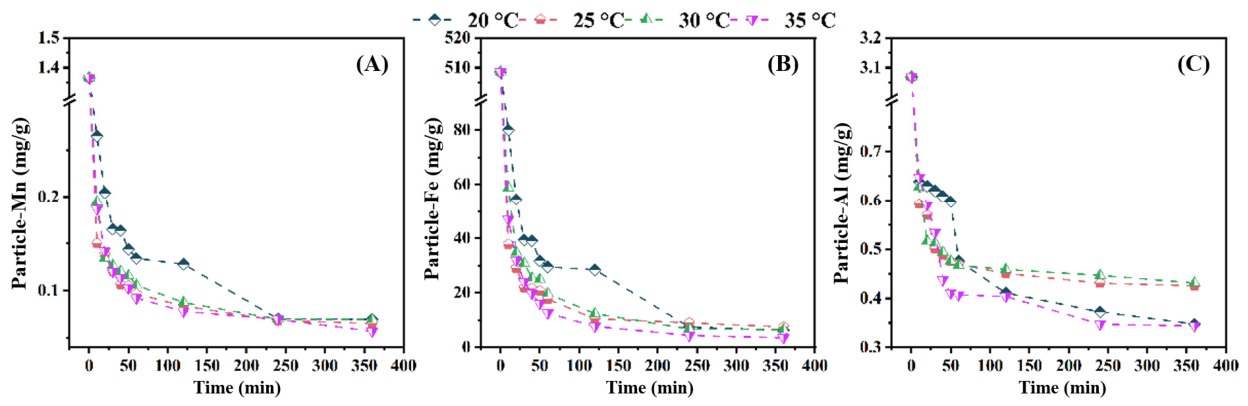
Temperature is an important environmental factor affecting the migration and sedimentation of particles in water. It can adjust the intensity of interactions between particles by changing water viscosity, diffusion rate, interfacial reaction activity, Brownian motion intensity, and interparticle collision rate, thereby influencing the sedimentation kinetic characteristics of the system [13]. The results in Figure 1 show that as the temperature increased from 20 °C to 35 °C, the contents of the three metal particles all showed a downward trend, and the system entered an equilibrium stage after approximately 120 min. Specifically, the Mn particle content (Figure 1A) also exhibited a continuous downward trend with increasing temperature, with the equilibrium concentration decreasing from 0.16 mg/g to 0.11 mg/g, indicating that an increase in temperature enhances particle surface reactions and mass transfer processes, thereby promoting particle aggregation and sedimentation. The Fe particle content (Figure 1B) gradually decreased from 39.07 mg/g (20 °C) to 19.73 mg/g (35 °C), demonstrating that increasing temperature significantly accelerates the aggregation and sedimentation of Fe particles. In contrast, the terminal content of Al particles varied considerably, decreasing from 0.64 mg/g to 0.44 mg/g. This may be attributed to the fact that Al3+ is prone to hydrolysis and polyhydroxy complexation [23], and increasing temperature can accelerate its polymerization reaction and enhance inter-particle bridging, thereby significantly increasing the sedimentation rate. Furthermore, kinetic analysis (Table 1) shows that the particle sedimentation process under each temperature condition can be fitted by the first-order kinetic model (R2 > 0.90), and the apparent rate constant k1 increases with increasing temperature, indicating that system sedimentation is jointly controlled by diffusion and interfacial reactions. The rate constant k1 of Fe particles increased from 1.26 to 2.40 × 10⁻² min−1; the rate of Mn particles reached the maximum at 30 °C (k1 = 2.87 × 10⁻² min−1), while at 35 °C, k1 decreased to 1.09 × 10⁻² min−1. This may be due to the fact that excessive temperature elevation intensifies particle Brownian motion and interparticle collision frequency. Although stronger collision initially promotes aggregation, overly intense movement also increases the shear force and breakup probability of newly formed aggregates. As a result, the net aggregation rate decreases, leading to a lower apparent sedimentation rate [24]. The k1 of Al particles increased from 1.48 × 10⁻² min−1 to 2.00 × 10⁻² min−1, indicating that increasing temperature generally promotes sedimentation. However, at 30 °C, k1 was the lowest (1.00 × 10⁻² min−1), suggesting that under this condition, further complexation may occur on the particle surface (e.g., Al3+ ↔ Al(OH)2+ ↔ Al(OH)2+ ↔ Al13(OH)327+) [23], which temporarily increases the proportion of polynuclear aluminum hydroxy complexes in the system, resulting in short-term particle retention and a low sedimentation rate. At 35 °C, polymerization acceleration, bridging, and bulk release dominate, leading to an increase in the release rate. Therefore, increasing temperature can effectively accelerate the aggregation and sedimentation rate of metal particles, among which Fe and Mn particles are more sensitive to temperature changes, while Al particles respond weakly due to chemical structure constraints. Moderate temperature elevation can promote particle aggregation and increase the release rate, but excessively high temperature may weaken the later migration process due to the densification of released substances or interfacial re-equilibrium [25]. Notably, the 120 min equilibrium observed in this study was obtained under static laboratory conditions. In actual drinking water distribution systems, water retention times are typically much longer, and intermittent flow, low velocity, and stagnation often occur. Under such realistic conditions, settled particles can be easily resuspended due to slight hydraulic disturbances or water quality fluctuations. Therefore, the present results emphasize that enhancing particle aggregation and stability is critical to suppress resuspension under long retention times, thereby effectively controlling discolored water.

3.2. Effect of pH on the Release Behavior of Pipe Scale Metals

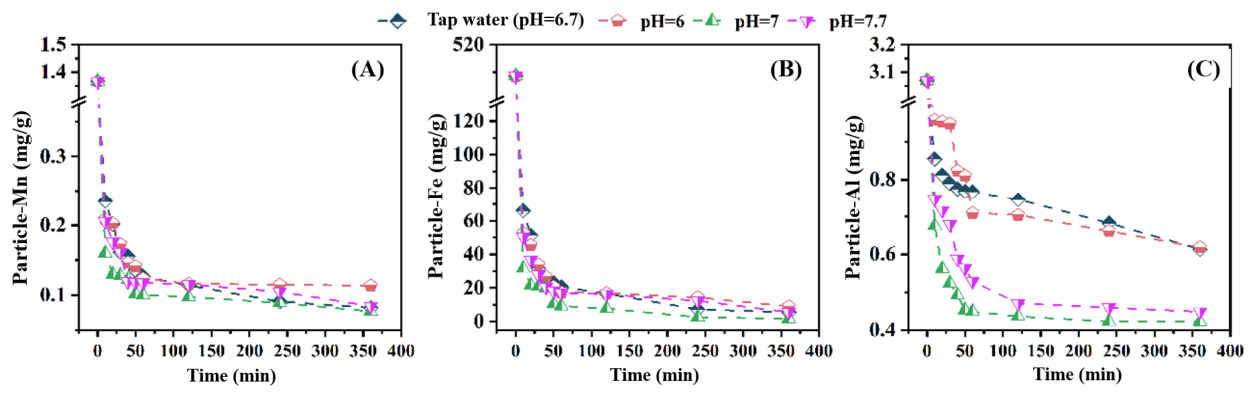
As a key water chemical parameter, pH controls the interfacial chemistry and aggregation process of metal particles. Changes in pH not only affect the distribution of metal ion speciation in the solution but also alter the surface charge and hydroxyl dissociation state of particles, thereby adjusting the electrostatic repulsion between particles. The research results in Figure 2 show that the suspension amounts of Fe and Mn particles decrease significantly with increasing pH (Figure 2A,B), and the system basically stabilizes after 120 min. The Fe particle content was 52.58 mg/g at pH 6.0, decreased to 21.57 mg/g when pH increased to 7.0, and then slightly rose to 27.82 mg/g at pH 7.7. This indicates that particles are positively charged on the surface under acidic conditions, exhibiting high colloidal stability. Under alkaline conditions, various inorganic Fe salts (α-, β-, γ-FeOOH) are formed on the surface of Fe particles [26], which in turn reduces the aggregation and sedimentation efficiency. The Mn particle content gradually decreased from 0.11 mg/g to 0.08 mg/g between pH 6.0 and 7.7, indicating that a neutral to slightly alkaline environment is conducive to the aggregation and sedimentation of Mn oxides. Notably, Al particles showed significantly different kinetic characteristics from the previous two (Figure 2C). Under tap water and pH 6.0 conditions, the concentration continued to decrease slowly even at 360 min, indicating that the system had not reached equilibrium. This suggests that Al particles may exist in the form of low polyhydroxy complexes under low pH conditions, with a loose particle structure leading to the limited sedimentation of Al particles. At pH 7.0, the hydrolysis reaction accelerates, generating polyhydroxy substances such as Al(OH)2+ or Al13(OH)327+, which promote particle bridging, thereby increasing the sedimentation rate. At pH 7.7, the inter-particle bridging process is strengthened, further enhancing the sedimentation of Al particles.
Kinetic analysis (Table 2) shows that the sedimentation of Mn, Fe, and Al particles is relatively consistent with the first-order kinetic law. The sedimentation rate constant of Mn particles decreases with increasing pH, from 1.34 × 10⁻² min−1 (R2 = 0.97) to 0.73 × 10⁻² min−1 (R2 = 0.63). The goodness of fit gradually decreases, and the second-order kinetic model does not show good explanatory power, indicating that the formation of Mn oxides may accelerate the aggregation and sedimentation of Mn particles through their catalytic oxidation [26]. The sedimentation process of Fe particles is faster in tap water and at pH 7.0, mainly driven by particle gravity aggregation and interfacial diffusion, with rate constants of 1.56 × 10⁻² min−1 and 1.68 × 10⁻² min−1, respectively. At pH 6.0, its sedimentation rate is hindered (0.97 × 10⁻² min−1, R2 = 0.71) due to metal particle dissolution. At pH 7.7, its k1 = 7.6 × 10⁻² min−1 (R2 = 0.76), indicating that the micro-particles generated by the hydrolysis of Fe particles re-disperse and affect the aggregation and sedimentation of Fe particles. The k1 of Al particles increased from 1.17 × 10⁻² min−1 (pH 6.0) to 2.60 × 10⁻² min−1 (pH 7.0), indicating that increasing pH enhances the inter-particle bridging effect. At pH 7.7, k1 = 1.78 × 10⁻² min−1, suggesting that the dissociation of surface hydroxyl groups in the system is enhanced, making the particles negatively charged and increasing electrostatic repulsion, thereby reducing the bridging ability between Al particles. Therefore, pH can jointly control the particle concentration in the system by affecting the metal ion dissolution process and the colloidal stability of the formed particles. Low pH enhances pipe scale dissolution and promotes the generation of metal particles; although weakly alkaline conditions reduce the final particle content, they can prolong their suspension process. Thus, the “yellow water” phenomenon in the pipeline network not only originates from the enrichment of re-oxidized particles after metal dissolution caused by the acidity of the pipeline network water, but also is related to the suspension of particles and difficulty in sedimentation under slightly alkaline conditions.

3.3. Effect of HA Content on the Release Behavior of Pipe Scale Metals

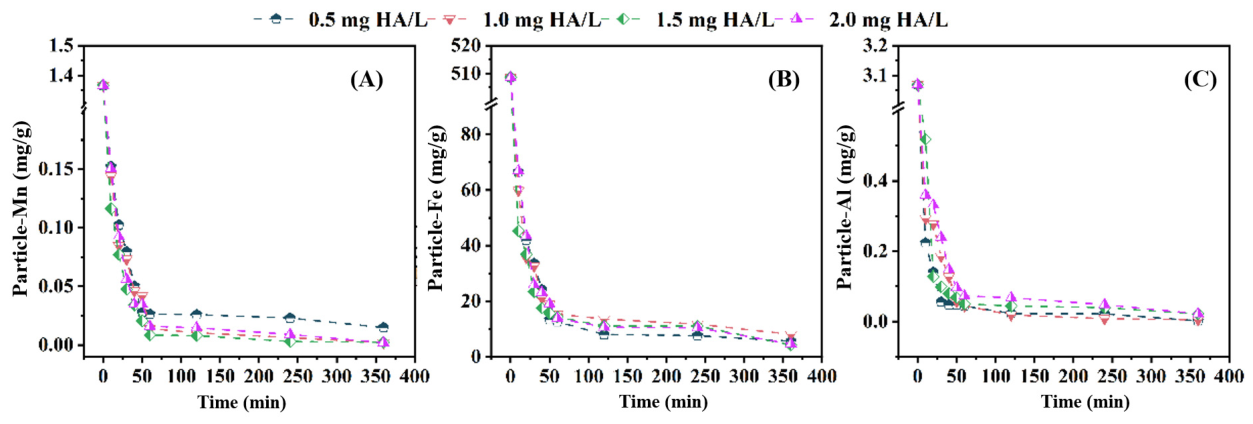
HA is a type of natural organic matter with coordinating groups such as multiple carboxyl and phenolic hydroxyl groups [27]. In water, it can undergo complexation reactions with the surfaces of metal oxides or hydroxides, thereby altering the surface charge characteristics and chemical stability of particles [28]. The results in Figure 3 show that after adding HA, the concentration of metal particles in the water sample generally decreased compared with the control group, and some samples even showed 0 mg/g (not detected, ND), indicating that obvious dissolution and depolymerization occurred in the system, and that HA destroyed the original stable state of particles. The concentration of Mn particles showed an overall downward trend with increasing HA concentration, indicating that the introduction of humic acid weakens the stability of Mn oxide particles. Figure 3A and Table 3 show that when the HA concentration was 0.5 mg/L, the particle concentration in the system decreased relatively slowly (k1 = 0.49 × 10⁻² min−1, R2 = 0.88), with an endpoint concentration of 0 mg/g. Under the conditions of 1.0–2.0 mg/L, the k1 values were 1.61 × 10⁻² min−1 (R2 = 0.83), 1.58 × 10⁻² min−1 (R2 = 0.90), and 1.10 × 10⁻² min−1 (R2 = 0.94), respectively, with endpoint concentrations of 0.002 mg/g and 0 mg/g. This indicates that low-concentration HA has the optimal effect of destroying particle stability and inducing further dissolution by complexing metal ions. Although high-concentration HA can also complex metal ions, when excess HA wraps metal particles, it instead weakens the complexation effect with metal ions. Fe particles are significantly affected by HA (Figure 3B), with the highest first-order fitting goodness of fit (R2 = 0.62–0.80, Table 3), but much lower than that of Mn and Al particles. This may be due to the fact that the content of Fe particles in the system is much higher than that of Mn and Al particles, allowing them to fully complex with HA, making it impossible to explain the process merely by particle diffusion behavior. However, when the HA dosage was 1.5 mg/L, the terminal Fe particle content in the system was the lowest, but the sedimentation rate was also the lowest (4.20 mg/g, k1 = 0.79 × 10⁻² min−1, R2 = 0.62), indicating that HA in the system can effectively undergo complexation reactions with the surface of metal particles. With a further increase in HA dosage, the terminal Fe particle content slightly increased and the sedimentation rate accelerated (4.59 mg/g, k1 = 1.01 × 10⁻² min−1, R2 = 0.69), suggesting that excess HA in the system covers metal particles, weakening the complexation reaction, but the formed sweeping effect accelerates particle aggregation and sedimentation. Al particles (Figure 3C and Table 3) fit the first-order kinetic model well under all concentration conditions, and the reaction process is mainly surface-controlled. Their rate constant gradually decreased from 2.24 × 10⁻² min−1 (R2 = 0.87) to 0.61 × 10⁻² min−1 (R2 = 0.80) with increasing HA concentration, showing an overall slowing trend, indicating that high-concentration HA significantly slows down the sedimentation process. However, under low-concentration HA (≤1 mg/L) conditions, the particle concentration in the system decreased to negative values within 40 min, indicating that humic acid undergoes strong coordination complexation with the surface of Al particles through carboxyl and phenolic hydroxyl groups, converting them into soluble organic complexes. This complexation and dissolution process weakens the structural stability of particles, leading to a rapid decrease in suspended particles in the system. As the HA concentration further increases, the particle surface is fully covered by organic molecules, forming a dense protective layer; the reaction rate decreases, dissolution is limited, and the system gradually transitions to a slow sedimentation process controlled by diffusion. Therefore, low-concentration HA (0.5 mg/L) promotes the dissolution of metal components in pipe scale particles through surface complexation, thus accelerating particle release into water. In contrast, high-concentration HA (1.0–2.0 mg/L) can be adsorbed onto particle surfaces in large quantities, forming a coating layer that increases particle electrostatic repulsion and colloidal stability. This significantly inhibits particle sedimentation and prolongs particle retention time in pipelines. Accordingly, fluctuations in low HA levels induce pipe scale dissolution and particle release, while sudden high HA loading hinders particle settling. These two distinct pathways both contribute to the occurrence of end-tap yellow water in distribution networks (Figure S1).

3.4. Effect of Mn2+ Content on the Release Behavior of Pipe Scale Metals

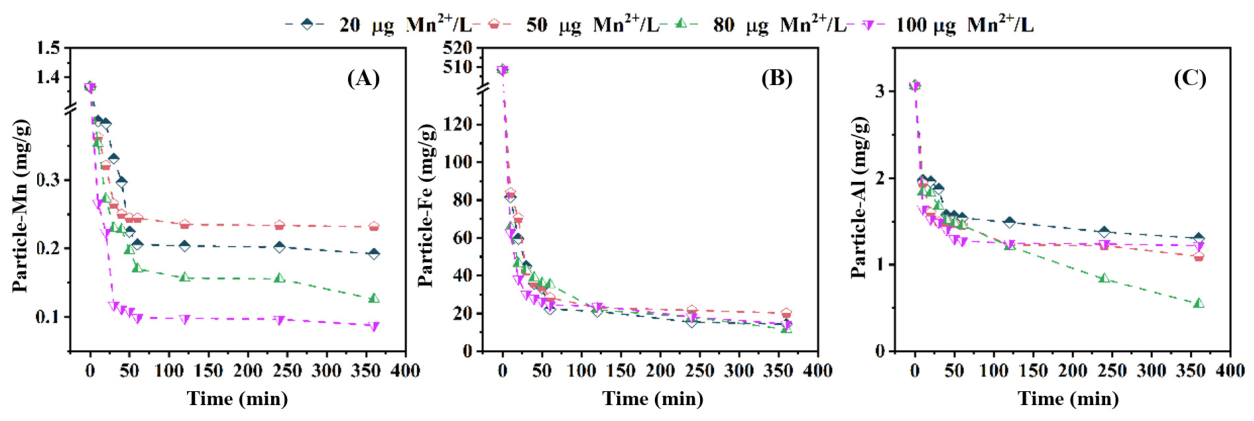
Mn2+ can be partially oxidized in oxygen-containing systems and co-released with Fe and Al oxides [29]. It has strong surface affinity and reaction activity in water, and can regulate inter-particle interactions through adsorption and surface transformation processes, thereby affecting the migration and release behavior of suspended particles. Figure 4 shows that under different Mn2+ dosages, the system reached approximate equilibrium after 120 min, and the particle suspension amount exhibited an obvious concentration-dependent effect. As the Mn2+ concentration increased from 20 μg/L to 50 μg/L, the Fe particle concentration slightly increased from 14.42 mg/g to 20.19 mg/g, and the Mn particle concentration increased from 0.19 mg/g to 0.23 mg/g. This indicates that a slight increase in the Mn2+ concentration in water can enhance the mutual adsorption between particles, causing some particles to remain in the suspended phase. When the concentration was further increased to 80 μg/L, the concentrations of Fe and Al particles decreased to their lowest levels (11.67 and 0.55 mg/g, respectively), indicating that high-concentration Mn2+ promotes particle aggregation and sedimentation. However, when the concentration was further increased to 100 μg/L, the Fe and Al particles increased to 14.36 and 1.22 mg/g, respectively, showing that the system reached a new release–resuspension equilibrium under excess Mn2+. For Mn particles, the addition of 80–100 μg/L Mn2+ stimulated the formation of Mn particles. The originally retained Mn oxides can autocatalytically oxidize Mn2+ to form larger particles, improving the aggregation and sedimentation capacity, thus the Mn particle concentration also decreased to its lowest level (0.09 mg/g).
For the sedimentation of Fe, Mn, and Al particles influenced by Mn2+ concentration, both first-order and second-order kinetic models were employed for fitting (Table 4). It can be observed that under most water quality conditions, the pseudo-first-order kinetic model exhibits higher fitting accuracy, demonstrating that the release of metal particles from pipe scales is mainly controlled by intra-particle diffusion. Nevertheless, at a high Mn2+ concentration of 100 μg/L, the pseudo-second-order model becomes superior. This result suggests that high Mn2+ levels alter the release pathway, and the surface reaction, adsorption and oxidation processes gradually dominate the particle release behavior instead of diffusion. For Fe particles, the first-order model yielded substantially higher R2 values (ranging from 0.89 to 0.97) compared with the second-order model (ranging from 0.10 to 0.51), indicating that the first-order kinetic model is more suitable for describing the real sedimentation behavior of the particles. Furthermore, the K1 of Fe particles decreases with increasing Mn2+ concentration, from 1.89 to 0.94 × 10⁻² min−1. This indicates that the dispersion process of Fe particles is affected by Mn2+, possibly because Mn2+ is adsorbed onto the particle surface, enhancing the repulsion between particles and leading to hindered aggregation and sedimentation [30]. Al particles have numerous and complex surface reaction sites. However, when the Mn2+ dosage increased from 20 μg/L to 80 μg/L, the rate constant gradually decreased (1.14 − 0.89 × 10⁻² min−1), indicating that the repulsion between particles caused by adsorption can affect the aggregation and sedimentation of Al particles. When the concentration was further increased to 100 μg/L, the aggregation and sedimentation rate significantly increased to 1.56 × 10⁻² min−1. Al particles themselves can catalyze the oxidation of Mn2+, converting Mn2+ adsorbed on the surface into Mn oxides, increasing the particle mass. When the gravitational effect on the particles is greater than the repulsion between particles, the Al particles accelerate aggregation and sedimentation. The effect of Mn2+ on Mn particles is more complex: Mn particles themselves can act as catalysts to oxidize and aggregate Mn2+, and Mn2+ oxides can catalyze the oxidation of Mn2+ again. This may be the reason why the k value is the largest (1.81 × 10⁻² min−1, R2 = 0.84) at a low dosage of 50 μg/L Mn2+, indicating that the Mn2+ concentration at this time can effectively control the sedimentation rate of Mn particles. However, when Mn2+ is further increased, none of the three fittings can provide an explanation. From the equilibrium state, it can be seen that Mn particles seem to be embedded or the number of sites that can interact with the surrounding environment is drastically reduced, leading to the retention of Mn particles in the water sample. This is because excess Mn2+ may form a dense surface layer or local oxide film [23]. Therefore, 20–50 μg/L Mn2+ promotes the suspension stability of Fe and Al particles, while 80–100 μg/L Mn2+ accelerates their aggregation and sedimentation. The sedimentation of Fe and Al particles conforms to the first-order kinetic law, and the sedimentation process is mainly affected by gravity, which can be regarded as a continuous attenuation process. In contrast, Mn particles exhibit autocatalytic oxidation characteristics, and the generated Mn oxides accelerate particle growth.

3.5. Changes in Pipe Scale Mineral Morphology Under Different Water Quality Conditions

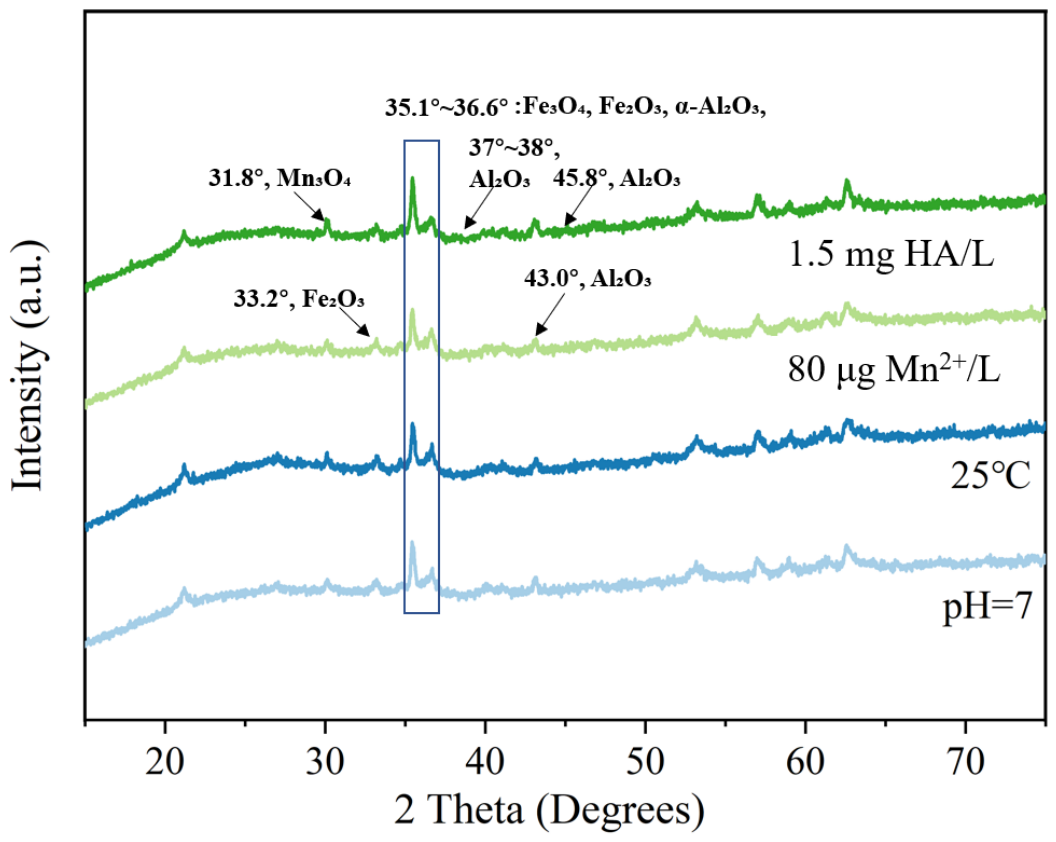
Figure 5 shows the XRD patterns of the pipe scale surface mineral structure under the conditions of HA, Mn2+, 25 °C, and pH = 7, respectively. According to Bragg’s law (nλ = 2dsinθ) and matching with standard PDF crystal cards, 30.1° corresponds to Fe3O4 (220 crystal plane), 31.8° corresponds to Mn3O4 (200 crystal plane), 33.2° corresponds to Fe2O3 (104 crystal plane), and the strong peak in the 35.1~35.6° region (key overlapping peak area) is the superimposed signal of Fe3O4 (311 crystal plane), Fe2O3 (110 crystal plane), and α-Al2O3 (104 crystal plane). Its high diffraction intensity is consistent with the previous conclusion that Fe, Al, and Mn oxides are the main components. The weak peaks in the 37~38° region correspond to γ-Al2O3 (311 crystal plane) and α-Al2O3 (110 crystal plane). Due to the low content of Al particles and their easy complexation with humic acid, the signal in this region is weak and slightly broadened. The Fe3O4 (400 crystal plane) peak at 43.0° and the γ-Al2O3 (400 crystal plane) peak at 45.8° further confirm the existence of the target crystalline phases. Among them, the characteristic peaks of Fe-based oxides are sharp with a high peak-to-background ratio, indicating good crystallinity. The broadening of Mn3O4 and Al2O3 peaks, combined with the mechanism of humic acid, can be attributed to the coordination of multiple carboxyl and phenolic hydroxyl groups of humic acid with metal ions, which inhibits crystal growth and causes lattice micro-distortion, consistent with the law in Scherrer’s formula that “peak width is inversely proportional to grain size”. The complexation of humic acid with Fe and Mn oxides is weak, which is consistent with the high intensity of Fe3O4 and Fe2O3 peaks in the pattern, while Al2O3 has low crystallinity due to strong complexation. In summary, the XRD pattern confirms that the main crystalline phases of the pipe scales are Fe3O4, Fe2O3, Mn3O4, and Al2O3, with Fe-based oxides as the dominant phases. The peak shape and intensity characteristics of the pattern are fully consistent with the pipe scale composition content and the humic acid action mechanism.

3.6. Changes in Pipe Scale Morphology Under Different Water Quality Conditions

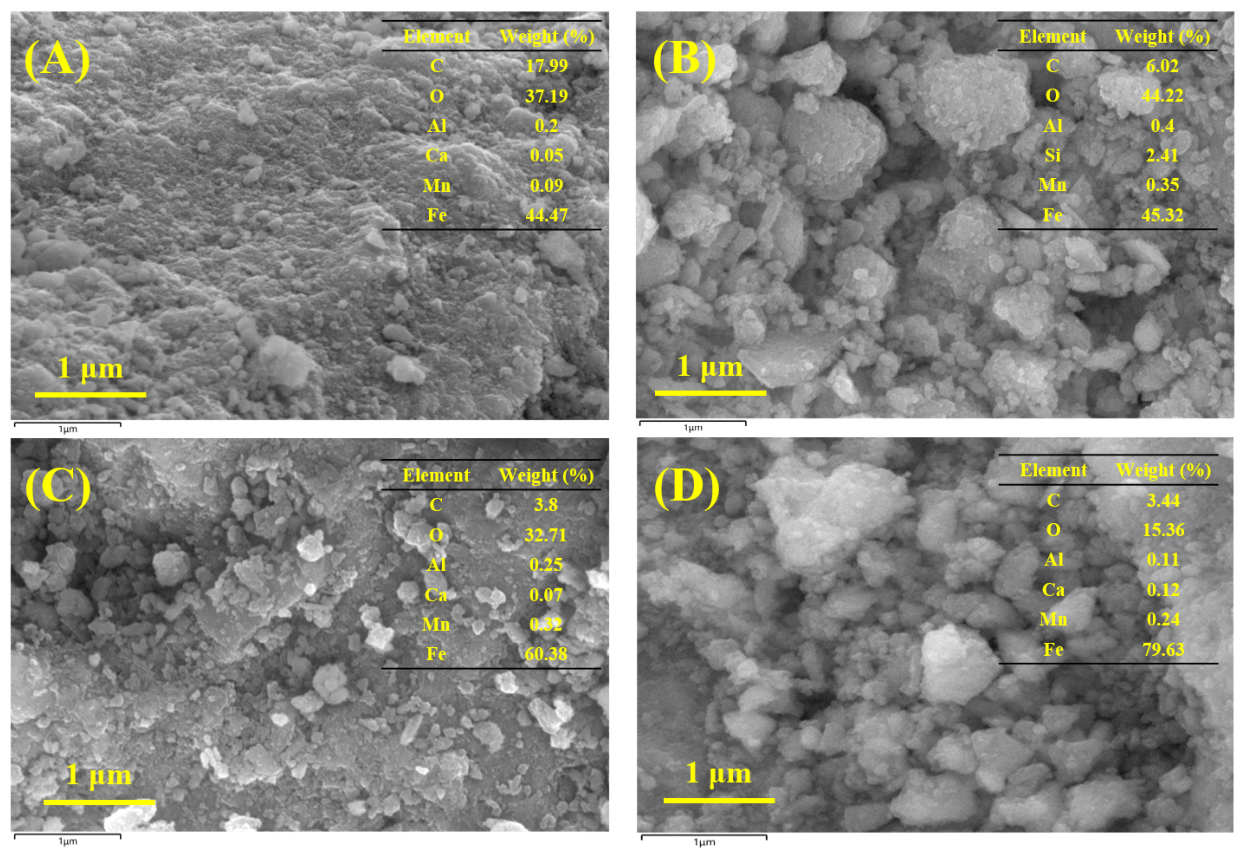
Figure 6 systematically presents the micromorphological characteristics and elemental composition laws of pipe scales under four key water quality conditions—pH = 7, 25 °C, presence of Mn2+, and presence of humic acid (HA)—through scanning electron microscopy (SEM) observation and energy dispersive elemental analysis. Figure 6A shows that under pH = 7, the elemental composition of the pipe scale is mainly Fe (44.47%) and O (37.19%), with Mn content only 0.09%. This is consistent with the previous conclusion that a neutral to slightly alkaline environment is conducive to the hydrolysis of Fe particles to form α-, β-, and γ-FeOOH, an enhanced hydroxyl bridging effect, and sufficient aggregation and sedimentation of Mn particles. Its micromorphology shows a relatively dense aggregated structure, which is due to the fact that pH reduces the electrostatic repulsion on the particle surface, promoting the ordered aggregation of Fe particles, and also consistent with the sharp characteristic peaks (high crystallinity) of Fe3O4 and Fe2O3 in Figure 5. Figure 6B shows that under 25 °C, the pipe scale elements are mainly Fe (45.32%) and O (17.99%), with 6.02% Si detected. The Fe content is slightly higher than that under pH = 7 but lower than that under the presence of Mn2+. The micromorphology is loose flocculent aggregation, corresponding to the medium level of metal particle sedimentation rate at 25 °C (Fe’s k1 = 1.62 × 10⁻² min−1) mentioned earlier. The system reaches equilibrium after 120 min but does not densify due to high temperature, reflecting the balanced state of water viscosity and particle diffusion rate at 25 °C, which not only ensures the basic release of Fe and Mn oxides but also avoids abnormal morphology caused by excessive particle Brownian motion or densification of released substances at high temperature. Figure 6C shows that under the presence of Mn2+, the Fe proportion in the pipe scale elements sharply increases to 79.63%, followed by O (15.36%) and Mn (0.25%), and the Al content is only 0.12%. This is consistent with the mechanism analyzed earlier that Mn2+ can induce the co-release of Fe-Mn-Al oxides. After Mn2+ is adsorbed on the surface of Fe particles, it undergoes autocatalytic oxidation to form Mn3O4, which not only increases the particle mass but also weakens the electrostatic repulsion between particles, promoting the massive aggregation and sedimentation of Fe particles. Its micromorphology presents large dense aggregates, which not only confirms the strengthening effect of Mn2+ on particle aggregation but also is consistent with the high peak-to-background ratio (excellent crystallinity) of Fe-based oxides in XRD, reflecting the control effect of active metal ions on crystal co-growth and aggregated structure. Figure 6D shows that under the presence of HA, the pipe scale elements are mainly Fe (60.38%) and O (32.71%), with Al content only 0.11%. The Fe content is lower than that under the presence of Mn2+, and Al release is significantly inhibited. This is because HA forms soluble organic complexes through the strong complexation of carboxyl and phenolic hydroxyl groups with Al particles, inhibiting Al release, and high-concentration HA wraps Fe particles to weaken aggregation. Its micromorphology is in the form of dispersed small particles without obvious large aggregated structures, which is attributed to the steric hindrance effect formed by HA molecules on the particle surface, preventing large-scale bridging and aggregation between particles. At the same time, the strong complexation of HA with Al reduces the participation of Al oxides as “bridging media”, further exacerbating particle dispersion. The differences in morphology and elemental composition of pipe scales under the four conditions in Figure 6 are essentially the intuitive manifestation of water quality parameters controlling the release behavior through the core pathway of “element complexation–particle aggregation–crystal growth”. Among them, pH and Mn2+ promote dense aggregation by enhancing particle bridging and co-release; 25 °C maintains balanced loose release; HA achieves particle dispersion through complexation and steric hindrance. These characteristics are mutually confirmed with the previous metal release kinetic analysis and XRD phase identification results, revealing the differentiated mechanism of pipe scale formation under different water quality conditions from the microcosmic perspective.
The above findings provide clear and operable water quality control strategies to mitigate the “yellow water” issue in aging ductile iron pipelines. Maintaining pH at around 7.0 stabilizes metal oxide surfaces and reduces particle resuspension. Keeping the water temperature below 30 °C avoids excessive particle release driven by high temperature. Meanwhile, appropriately lowering the concentrations of humic acid and Mn2+ in finished water can prevent particle stabilization and long-term suspension in the bulk water. Collectively, these optimized water quality conditions effectively inhibit the dissolution and resuspension of metal particles from pipe scales, thereby reducing the risk of “yellow water” at the distal ends of the distribution system.

4. Conclusions

(1)
Water temperature, pH, HA concentration, and Mn2+ concentration all significantly affect the release and sedimentation behaviors of Fe, Mn, and Al metal particles from aging ductile iron pipe scales. The control effects of each parameter on different metal particles are distinct, and the release and sedimentation processes of metal particles generally follow the first-order kinetic model, which is jointly controlled by diffusion and interfacial reactions.
(2)
An increase in water temperature, neutral to slightly alkaline pH, and a high concentration of Mn2+ (80–100 μg/L) are conducive to promoting the aggregation and sedimentation of metal particles; low pH and a low concentration of HA (0.5 mg/L) are prone to causing pipe scale dissolution; a high concentration of HA (1.0–2.0 mg/L) and a low concentration of Mn2+ (20–50 μg/L) will prolong the particle retention time and increase the risk of “yellow water”.
(3)
The pipe scales are mainly composed of Fe3O4, Fe2O3, Mn3O4, and Al2O3, with Fe-based oxides as the dominant phases. Water quality parameters alter the micromorphology of pipe scales (dense aggregation, loose flocculent, or dispersed particles) by controlling element complexation, particle aggregation, and crystal growth, thereby affecting the macro release behavior.
(4)
Controlling water quality conditions at pH 7.0, temperatures below 30 °C, and reducing HA and Mn2+ concentrations in the effluent can effectively reduce the migration capacity of metal particles in the pipeline network, thereby preventing the “yellow water” problem in the pipeline network.

Supplementary Materials

The following supporting information can be downloaded at: https://www.mdpi.com/article/10.3390/w18091101/s1, Figure S1: Mechanism of HA concentration on pipe scale; Table S1: Kinetic fitting results of metal release from pipe scales under different temperature conditions with 95% confidence intervals (corresponding to Table 1).

Author Contributions

Conceptualization, Y.C. and D.Z.; Methodology, Y.C., M.F. and D.Z.; Validation, D.Z.; Formal analysis, Y.C. and M.F.; Resources, Q.L.; Writing—original draft, Y.C.; Writing—review & editing, M.F., Q.L., D.Z. and W.L.; Project administration, W.L.; Funding acquisition, W.L. All authors have read and agreed to the published version of the manuscript.

Funding

This research was funded by the National Natural Science Foundation of China (52470012) and the National Key Research and Development Program of China (2024YFC3810901-03).

Data Availability Statement

The original contributions presented in this study are included in the article/supplementary material. Further inquiries can be directed to the corresponding authors.

Conflicts of Interest

The authors declare no conflict of interest.

References

  1. Sanjuan-Delmás, D.; Petit-Boix, A.; Gasol, C.M.; Villalba, G.; Suárez-Ojeda, M.E.; Gabarrell, X.; Josa, A.; Rieradevall, J. Environmental assessment of different pipelines for drinking water transport and distribution network in small to medium cities: A case from Betanzos, Spain. J. Clean. Prod. 2014, 66, 588–598. [Google Scholar] [CrossRef]
  2. Liu, X.; Zhang, Y.; Li, X.; Yang, Y.; Liu, D.; Ma, R.; Zhang, S.; Zou, M.; Wu, W. Risk assessment of urban gas pipeline networks considering regional resilience using a DOOBN framework. J. Pipeline Sci. Eng. 2025, 100351. [Google Scholar] [CrossRef]
  3. Hu, Y.; Li, R.; Bian, K.; Zhou, Q.; Pan, Y.; Ye, L.; Li, A.; Shi, P. Biofilm formation dynamics in long-distance water conveyance pipelines: Impacts of nutrient levels and metal stress. Water Res. 2025, 268, 122672. [Google Scholar] [CrossRef]
  4. Trajković, I.; Rakin, M.; Milošević, M.; Mitrović, N.; Travica, M.; Sedmak, A.; Medjo, B. Selective laser sintered Pipe Ring Notched Tension specimens for examination of fracture properties of pipeline materials. Eng. Fract. Mech. 2023, 292, 109573. [Google Scholar] [CrossRef]
  5. Dias, F.G.D.A.; Melo, E.A.; da CP Gomes, A.P.A.; da Costa, M.F.; da CP Gomes, J.A. Identifying sediment composition and microplastic formation in the production water of flexible pipelines. Reg. Stud. Mar. Sci. 2025, 89, 104348. [Google Scholar] [CrossRef]
  6. Bai, Y.; Xue, S.; Wu, Y.; Wang, H.; Wang, R.; Chang, L.; Chen, Z.; Hu, H. Pipe material significantly affected microbial regrowth and potential risks in reclaimed water distribution systems. J. Hazard. Mater. 2025, 499, 140116. [Google Scholar] [CrossRef] [PubMed]
  7. Ke, Y.; Sun, W.; Xue, Y.; Yuan, Z.; Zhu, Y.; Chen, X.; Yan, S.; Li, Y.; Xie, S. Pipe material and natural organic matter impact drinking water biofilm microbial community, pathogen profiles and antibiotic resistome deciphered by metagenomics assembly. Environ. Res. 2024, 262, 119964. [Google Scholar] [CrossRef] [PubMed]
  8. Wood, C.E.; Bauer, C.E.; Breef-Pilz, A.; Lewis, A.S.; Hammond, N.W.; McClure, R.P.; Verne, M.F.; Carey, C.C.; Schreiber, M.E. Preemptive activation of hypolimnetic oxygenation improves control of Fe and Mn in drinking water reservoirs. Water Res. 2026, 288, 124722. [Google Scholar] [CrossRef]
  9. He, W.; Li, J.; Chen, M.; Sun, H.; Zhang, L.; Lu, Y.; Jia, Y.; Zhang, H. A mathematical model to simulate the release of Fe and Mn from sediments in a drinking water reservoir. Environ. Res. 2023, 238, 117232. [Google Scholar] [CrossRef]
  10. Kritzberg, E.S.; Hasselquist, E.M.; Škerlep, M.; Löfgren, S.; Olsson, O.; Stadmark, J.; Valinia, S.; Hansson, L.-A.; Laudon, H. Browning of freshwaters: Consequences to ecosystem services, underlying drivers, and potential mitigation measures. AMBIO 2020, 49, 375–390. [Google Scholar] [CrossRef]
  11. Li, M.J.; Liu, Z.W.; Chen, Y.C.; Hai, Y. Characteristics of iron corrosion scales and water quality variations in drinking water distribution systems of different pipe materials. Water Res. 2016, 106, 593–603. [Google Scholar] [CrossRef]
  12. Deng, A.; Xie, R.; Gomez, M.; Adin, A.; Ong, C.N.; Hu, J. Impact of pH level and magnesium addition on corrosion of re-mineralized seawater reverse osmosis membrane (SWRO) product water on pipeline materials. Desalination 2014, 351, 171–183. [Google Scholar] [CrossRef]
  13. Engloner, A.I.; Németh, K. Exploring the combined effects of water temperature and flow on river water quality: Problems with highly variable data sets and possible solutions. Heliyon 2025, 11, e44193. [Google Scholar] [CrossRef]
  14. Xue, S.; Miao, Z.; Gao, M.; Wan, K. Structural analysis of lignite-derived humic acid and its microscopic interactions with heavy metal ions in aqueous solution. Sci. Total Environ. 2023, 897, 165385. [Google Scholar] [CrossRef]
  15. Li, G.; Su, Y.; Wu, B.; Chen, Q.; Yu, J.; Yang, M.; Shi, B. Chloramine Prevents Manganese Accumulation in Drinking Water Pipes Compared to Free Chlorine by Simultaneously Inhibiting Abiotic and Biotic Mn(II) Oxidation. Environ. Sci. Technol. 2022, 56, 12278–12287. [Google Scholar] [CrossRef]
  16. Zhou, X.; Kosaka, K.; Nakanishi, T.; Welfringer, T.; Itoh, S. Manganese accumulation on pipe surface in chlorinated drinking water distribution system: Contributions of physical and chemical pathways. Water Res. 2020, 184, 116201. [Google Scholar] [CrossRef]
  17. Bae, Y.; Pasteris, J.D.; Giammar, D.E. Impact of orthophosphate on lead release from pipe scale in high pH, low alkalinity water. Water Res. 2020, 177, 115764. [Google Scholar] [CrossRef]
  18. Ni, R.L.; Chu, X.X.; Liu, R.; Shan, J.L.; Tian, Y.M.; Zhao, W.G. Chromium immobilization and release by pipe scales in drinking water distribution systems: The impact of anions. Sci. Total Environ. 2024, 906, 167600. [Google Scholar] [CrossRef]
  19. Zhang, H.; Liu, Y.; Wang, L.; Liu, S. Iron release and characteristics of corrosion scales and bacterial communities in drinking water supply pipes of different materials with varied nitrate concentrations. Chemosphere 2022, 301, 134652. [Google Scholar] [CrossRef] [PubMed]
  20. Li, W.; Song, X.; Wang, Y.; Wen, D.; Zhou, Y.; Zhang, D. Iron-manganese inputs shape the coupling between deposit morphology and microbiome during the early-stage corrosion on cement mortar-lined pipe walls under drinking-water conditions. J. Environ. Manag. 2026, 398, 128468. [Google Scholar] [CrossRef]
  21. Wang, Y.; Li, P.; Li, L.; Liu, J.; Zheng, T. The phosphorus removal by dewatered-sludge-based flocculants during municipal wastewater treatment process: Parameter optimization and kinetic modelling of adsorption. J. Water Process Eng. 2025, 78, 108697. [Google Scholar] [CrossRef]
  22. Ramesh, S.B.; Tanubuddi, P.S.; Puttamreddy, S.; Nippatlapalli, N. Investigating adsorption behavior of methylene blue on nonmagnetic slag: An integrated evaluation of isotherm-kinetic frameworks. Chemosphere 2025, 388, 144681. [Google Scholar] [CrossRef]
  23. Li, G.W.; Zhao, Y.Y.; An, G.Y.; Shi, B.Y. Mn(II) Oxidation by Free Chlorine Catalyzed by the Hydrolytic Products of Ferric and Aluminum Species under Drinking Water Conditions. Environ. Sci. Technol. 2022, 56, 10775–10784. [Google Scholar] [CrossRef]
  24. Lorenzo, T.; Marco, L. Brownian dynamics simulations of shear-induced aggregation of charged colloidal particles in the presence of hydrodynamic interactions. J. Colloid Interface Sci. 2022, 624, 637–649. [Google Scholar] [CrossRef]
  25. Pacek, A.W.; Ding, P.; Utomo, A.T. Effect of energy density, pH and temperature on de-aggregation in nano-particles/water suspensions in high shear mixer. Powder Technol. 2007, 173, 203–210. [Google Scholar] [CrossRef]
  26. Li, G.; Su, Y.; Wu, B.; Han, G.; Yu, J.; Yang, M.; Shi, B. Initial Formation and Accumulation of Manganese Deposits inDrinking Water Pipes: Investigating the Role of Microbial-Mediated Processes. Environ. Sci. Technol. 2022, 56, 5497–5507. [Google Scholar] [CrossRef] [PubMed]
  27. Sun, J.; Ge, H.; Xu, Y.; Ma, Y.; Shan, S.; Liu, S.; Li, D. Enhanced humic acid removal via floc-based dynamic membrane for high-salinity water treatment. J. Environ. Chem. Eng. 2025, 13, 119795. [Google Scholar] [CrossRef]
  28. Zhang, H.; Liu, D.; Zhao, L.; Wang, J.; Xie, S.; Liu, S.; Lin, P.; Zhang, X.; Chen, C. Review on corrosion and corrosion scale formation upon unlined cast iron pipes in drinking water distribution systems. J. Environ. Sci. 2022, 117, 173–189. [Google Scholar] [CrossRef]
  29. Fish, K.E.; Collins, R.; Green, N.H.; Sharpe, R.L.; Douterelo, I.; Osborn, A.M.; Boxall, J.B. Characterisation of the Physical Composition and Microbial Community Structure of Biofilms within a Model Full-Scale Drinking Water Distribution System. PLoS ONE 2015, 10, e0115824. [Google Scholar] [CrossRef]
  30. Boxall, J.; Blokker, M.; Schaap, P.; Speight, V.; Husband, S. Managing discolouration in drinking water distribution systems by integrating understanding of material behaviour. Water Res. 2023, 243, 120416. [Google Scholar] [CrossRef] [PubMed]
Figure 1. Changes in the release of (A) particulate Mn, (B) particulate Fe, and (C) particulate Al in scale under different temperature conditions.
Water 18 01101 g001
Figure 2. Changes in the release of (A) particulate Mn, (B) particulate Fe, and (C) particulate Al in scale under different pH conditions.
Water 18 01101 g002
Figure 3. Changes in the release of (A) particulate Mn, (B) particulate Fe, and (C) particulate Al in scale at different HA contents.
Water 18 01101 g003
Figure 4. Changes in the release of (A) particulate Mn, (B) particulate Fe, and (C) particulate Al in scale at different Mn2+ contents.
Water 18 01101 g004
Figure 5. Influence of water quality conditions on mineral morphology of pipe scale surface.
Water 18 01101 g005
Figure 6. The influence of water quality conditions on the surface morphology of pipe scale: (A) pH = 7; (B) 25 °C; (C) Mn2+; (D) HA.
Water 18 01101 g006
Table 1. Kinetic fitting results of metal release from pipe scales under different temperature conditions.
ParticlesTemperature (°C)K1 (min−1)R2K2 (min−1)R2
Mn20 °C2.69 × 10−20.8916.380.81
25 °C1.65 × 10−20.992.710.44
30 °C2.87 × 10−20.9438.580.36
35 °C1.09 × 10−20.930.660.54
Fe20 °C1.81 × 10−20.910.67 × 10−20.23
25 °C1.52 × 10−20.960.58 × 10−20.47
30 °C2.40 × 10−20.983.15 × 10−20.28
35 °C1.84 × 10−20.991.00 × 10−20.32
Al20 °C1.47 × 10−20.970.340.33
25 °C1.62 × 10−20.971.590.50
30 °C1.00 × 10−20.910.520.50
35 °C2.00 × 10−20.922.270.16
Table 2. Kinetic fitting results of metal release from pipe scales under different pH conditions.
ParticlespH ValueK1 (min−1)R2K2 (min−1)R2
MnTap Water (6.7)1.34 × 10−20.970.890.90
pH 6.02.18 × 10−20.886.630.44
pH 7.00.88 × 10−20.840.630.51
pH 7.70.73 × 10−20.630.350.68
FeTap Water1.56 × 10−20.954.46 × 10−30.20
pH 6.00.97 × 10−20.711.52 × 10−30.60
pH 7.01.68 × 10−20.959.58 × 10−30.20
pH 7.70.77 × 10−20.771.10 × 10−30.73
AlTap Water0.65 × 10−20.979.77 × 10−20.32
pH 6.01.17 × 10−20.850.190.74
pH 7.02.60 × 10−20.9712.810.30
pH 7.71.78 × 10−20.930.800.26
Table 3. Kinetic fitting results of metal release from pipe scales under different HA contents.
ParticlesHA ConcentrationK1 (min−1)R2K2 (min−1)R2
Mn0.5 mg HA/L0.49 × 10−20.885.71 × 10−20.95
1.0 mg HA/L1.61 × 10−20.842.020.54
1.5 mg HA/L1.55 × 10−20.902.030.32
2.0 mg HA/L1.46 × 10−20.941.220.32
Fe0.5 mg HA/L1.58 × 10−20.784.72 × 10−30.46
1.0 mg HA/L1.01 × 10−20.802.29 × 10−30.46
1.5 mg HA/L0.79 × 10−20.621.23 × 10−30.60
2.0 mg HA/L1.01 × 10−20.691.56 × 10−30.52
Al0.5 mg HA/L2.24 × 10−20.870.970.12
1.0 mg HA/L2.14 × 10−20.951.870.12
1.5 mg HA/L1.28 × 10−20.900.260.48
2.0 mg HA/L0.61 × 10−20.803.03 × 10−20.53
Table 4. Kinetic fitting results of metal release from pipe scales under different Mn2+ contents.
ParticlesMn ConcentrationK1 (min−1)R2K2 (min−1)R2
Mn20 μg Mn2+/L1.53 × 10−20.610.950.85
50 μg Mn2+/L1.81 × 10−20.844.750.34
80 μg Mn2+/L0.95 × 10−20.710.300.42
100 μg Mn2+/L1.07 × 10−20.510.990.70
Fe20 μg Mn2+/L1.89 × 10−20.958.29 × 10−30.10
50 μg Mn2+/L1.74 × 10−20.895.88 × 10−30.35
80 μg Mn2+/L1.07 × 10−20.971.30 × 10−30.32
100 μg Mn2+/L0.94 × 10−20.922.02 × 10−30.51
Al20 μg Mn2+/L1.14 × 10−20.890.110.27
50 μg Mn2+/L0.95 × 10−20.817.04 × 10−20.49
80 μg Mn2+/L0.89 × 10−20.962.59 × 10−20.35
100 μg Mn2+/L1.56 × 10−20.800.520.89
Disclaimer/Publisher’s Note: The statements, opinions and data contained in all publications are solely those of the individual author(s) and contributor(s) and not of MDPI and/or the editor(s). MDPI and/or the editor(s) disclaim responsibility for any injury to people or property resulting from any ideas, methods, instructions or products referred to in the content.