Article

Assessing the Performance of a Tubular Solar Still in an Arid Region Using Various Water Types

by
Tamadhor Almahmoud
1,
Litty Mary Abraham
2,
Mohammad Abdullah Alolayan
2,* and
Bader Shafaqa Al-Anzi
2
1
Department of Laboratory Technology, College of Technological Studies, Public Authority for Applied Education and Training, P.O. Box 42325, Shuwaikh 70654, Kuwait
2
Department of Environmental Sciences, College of Life Sciences, Kuwait University, P.O. Box 5969, Safat 13060, Kuwait
*
Author to whom correspondence should be addressed.
Water 2026, 18(9), 1100; https://doi.org/10.3390/w18091100
Submission received: 14 March 2026 / Revised: 29 April 2026 / Accepted: 1 May 2026 / Published: 4 May 2026
(This article belongs to the Section Wastewater Treatment and Reuse)

Abstract

The performance of a tubular solar still in an arid region was evaluated for producing freshwater from various water sources. The water sources fed to the tubular solar still were blowdown from a seawater desalination plant, recovered water from an oil production facility, rejected seawater from a reverse osmosis treatment plant, seawater, and rejected groundwater from a reverse osmosis treatment plant. The TDS for these water sources ranged from 17,210 mg/L for groundwater to 221,710 mg/L for produced water. Compared with other water types, produced water had distinct characteristics: low pH, a petroleum-like odor, and a reddish-brown color. The estimated average production rates were 5.1, 5.9, 6.1, 6.6, and 6.8 L/m2·day for produced water, reverse osmosis-rejected water, desalination plant blowdown, seawater, and reverse osmosis-rejected groundwater. Different TSS designs were examined to determine whether production rates could be improved using tap water. Production increased slightly when a blackened basin, steel mesh, or both were applied as heat-absorption enhancements. Therefore, the tubular solar still without any enhancements was found to be a better option due to its lower cost and simpler design. The composition of the residual salts (65–73%) did not meet the 97% standard set by the FAO. The results of the study are promising for future upscaling projects aimed at enhancing water security in rural areas and arid regions.

1. Introduction

The increase in the world’s population, along with the contamination of existing water resources and the lack of a fresh water supply, has left many countries facing water scarcity [1,2]. This water stress is more severe in arid areas due to limited water resources. Despite the availability of seawater, the operation and maintenance of desalination techniques such as multi-stage flash distillation and reverse osmosis systems remain expensive [3]. This can be attributed to high energy consumption, complex procedures, and the need for a skilled labor force [4]. Therefore, countries located in arid and semi-arid regions face significant challenges in maintaining water security. On the other hand, there is an opportunity to harness solar energy in these areas, as they have a cloudless atmosphere for most of the year, long days of sunshine, and high irradiance [5]. For instance, the energy received by 1 m2 of land in Kuwait in one year is equivalent to 1.5 barrels of crude oil [6]. Also, 60–70% of domestic hot water at temperatures up to 60 °C can be provided by solar heating systems in areas with temperatures below 40° [7].
Conventional solar still distillation remains a promising point-of-use technology, particularly in remote areas, owing to its advantages, including fuel-free operation, simplicity, portability, and low capital, operating, and maintenance costs [4,8]. This technology relies on the fundamental processes of evaporation and condensation. When solar radiation passes through a glass cover and into a basin containing saline water, it induces evaporation. The vapor then condenses on the underside of the glass cover and flows down the inclined surface into a collection trough, leaving salt and other contaminants behind in the basin [4,8]. There are two kinds of solar stills, active and passive. An active solar still has additional components compared to a passive solar still, such as a condenser and a collector, to increase productivity [9]. However, passive solar stills have been shown to be more economically efficient [10]. The major drawback of both solar stills is their low productivity [10]. Nevertheless, upscaling solar stills could provide a good amount of water in an arid region (Table 1).
Previous research has shown that the productivity of solar stills depends on various parameters. Environmental factors, such as wind speed, ambient temperature, and solar radiation, cannot be controlled [7]. The controllable parameters include shape design, still orientation, material type, cover thickness, tilt angle, water depth, basin area, distance between the water surface and the cover, insulation material and its thickness, and the presence of reflectors [4,16]. In fact, the temperature difference between the water surface and the glass cover primarily determines the solar still’s efficiency [9]. Among several configurations, including double-basin, pyramidal, tubular, and spherical stills, combining tubular and pyramidal stills yielded superior performance compared to any configuration operated individually [17]. Several studies have demonstrated that the maximum yield of a solar still is achieved when the glass inclination is set equal to the site latitude. A prior investigation conducted in Jordan confirmed that the highest yield was achieved when the glass cover tilt angle was set to 35°, corresponding to the region’s latitude [18]. Consequently, another study showed that increasing the water depth reduced the unit’s productivity, driven by an increase in the water’s volumetric heat capacity and a decrease in its temperature, thereby lowering the evaporation rate [19]. The thickness of the glass cover significantly affects still performance, as confirmed by another study that used glasses of varying thicknesses, with the thinnest providing the highest yield [20]. A study examining the influence of insulation thickness on solar still productivity found that increasing its thickness from 3 to 6 mm increased productivity by 80% [21]. Additionally, minimizing the distance between the water surface and the apex of the glass cover increased the production rate, as a smaller volume of air needs to be saturated [4,22].
Climatological factors significantly affect solar still productivity, including wind speed, temperature, and the intensity of solar radiation [23]. The optimal sun angle affects the amount of distilled water produced by a solar still, thereby influencing the solar energy flux per unit area received. Also, the more sunshine hours per day in a given area and season, the more distillate water is produced.
In a study conducted in Kuwait, a micro-solar still unit was used in a multistage distillation process to separate saline feed water into fresh water, with two prototypes differing only in their wicking structures. The maximum yields were 900 and 1160 g of potable water from feed volumes of 3.7 and 4 kg, respectively [24]. Likewise, a study conducted in the hot–arid climate of the Islamic Republic of Iran found that combining an electric heater and a concentrating solar collector produced the highest water production rate, about 8.178 L/m2·day, when the water level in the basin was at its lowest [25]. A similar observation was noted in a study conducted in the Sultanate of Oman, in which the water depth was maintained at a minimum of 4 cm [23]. The still’s productivity was 2.680 L/m2·day, with an efficiency of 30%. Furthermore, adding a mirror to the same setup increased the still’s productivity to 3.075 L/m2·day, representing a 35% improvement in efficiency. In another study conducted in the United States to treat produced water using a single-slope solar still assisted by a carbon black and air-laid paper-based evaporator (CAPER) and polystyrene foam, an evaporation rate of 2.23 L/m2·day was achieved, representing a 165% higher evaporation rate with CAPER than without CAPER [26]. Given the water scarcity and limited natural water resources in Kuwait’s arid regions, it is crucial to adopt sustainable methods to increase water production.
This study assessed the performance of a tubular solar still (TSS) in producing fresh water under extremely high-temperature conditions by examining its ability to treat various water types. In addition, the study evaluated the effectiveness of various TSS designs in improving overall performance.

2. Methodology

The performance of TSSs was evaluated based on the production rate and recovery. The production rate is estimated as the amount of water collected per unit TSS surface area over 24 h, whereas the recovery is the ratio of the distillate quantity to the feed, expressed as a percentage. High TSS performance is associated with high freshwater production and high feed recovery. A high recovery indicates that a small quantity of feed water is needed. Therefore, for upscaling the TSS or when the water source is scarce, higher recovery means managing smaller amounts of feed water and producing more fresh water from the limited feed water source. However, increasing the feed volume decreases the production rate and recovery. This is attributed to water’s thermal properties, and its high heat capacity makes the temperature and evaporation rates inversely proportional to the quantity of feed water [27,28].

2.1. Meteorological Data

The experiments were conducted at Al-salam, Kuwait (29°17′47.09″ N, 48°0′48.24″ E), in August 2023, the month with the highest temperatures. Weather data were obtained from the Kuwait Meteorological Department and the Kuwait Environmental Protection Agency on a daily basis for the entire study period (Table 2) [29,30]. The experiments were run for 24 h, starting at 21:00. To capture climatic influences, 9 TSSs were used simultaneously in each experiment.

2.2. TSS Designs

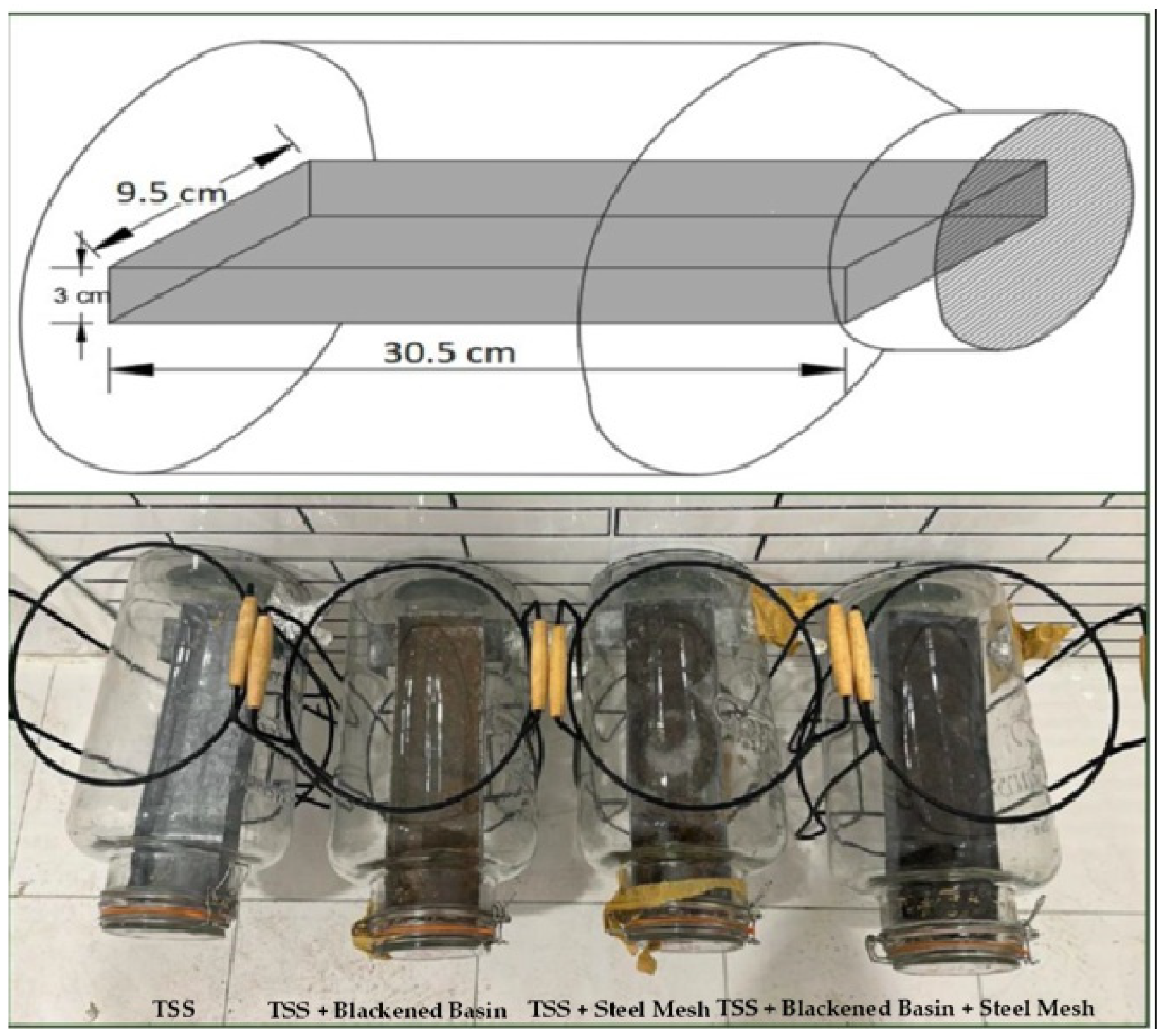
The TSS used in the study is a discrete tubular glass structure measuring 18 cm in diameter, 36 cm in length, and 0.6 cm in thickness. A stainless-steel basin measuring 9.5 cm × 30.5 cm × 3.0 cm, with an area of 0.029 m2 and a maximum capacity of 870 mL, was fitted into the tubular glass (Figure 1). The lower section of the tubular structure served as the distillate collector. The TSS was sealed to make it leak-proof before operation. To avoid obstructions or shading, the TSS was placed on an open, south-facing terrace. The volume of distillate collected from each experimental set was measured in milliliters using a graduated cylinder.
Heat-absorption enhancements were applied to the TSS to determine whether the production rate could be increased using tap water (TP). First, a black epoxy primer was applied to the basin. Second, the basin was filled with fine galvanized steel mesh. Lastly, a combination of a blackened basin and steel mesh was also tested (Figure 1).

2.3. Water Types

The TSS performance in producing fresh water from different sources was evaluated without a blackened basin or steel mesh. The water sources used to assess TSS performance were discharged water from a multi-stage flash seawater desalination plant (MSF) blowdown, recovered water from an oil production plant as produced water (PW), rejected water from a reverse osmosis seawater treatment plant (RO), seawater from the Arabian Gulf (SW), and rejected water from a reverse osmosis groundwater treatment plant (GW).

2.4. Analysis and Instrumentation

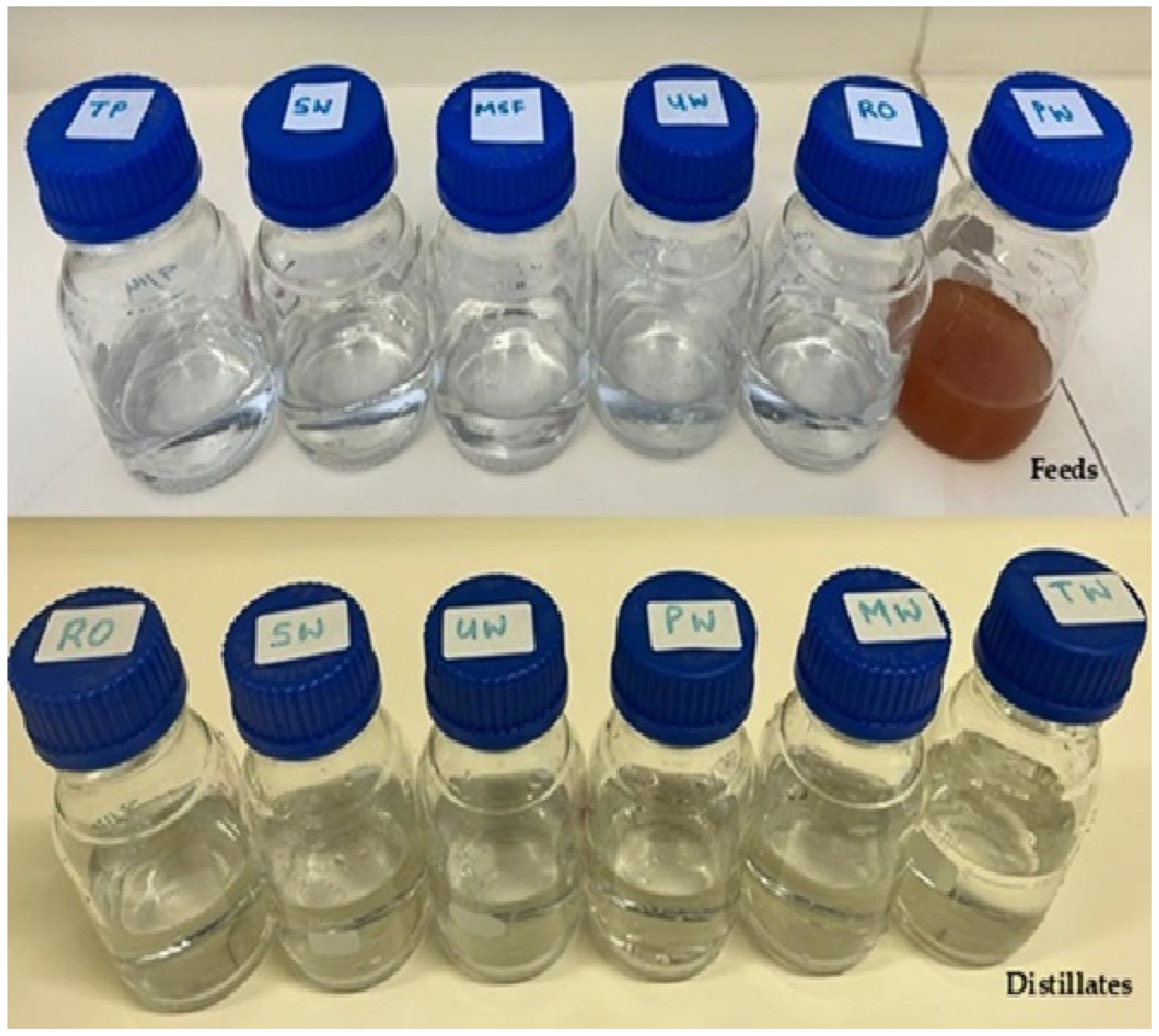
The quality of the feeds and distillates was analyzed for electrical conductivity, Total Dissolved Solids (TDSs), pH, total hardness, total organic carbon, alkalinity, and elemental analysis. Among these parameters, TDS and hardness varied across the water types. While most water types were colorless and odorless, with comparable pH, PW exhibited a reddish-brown color, a petroleum-like odor, and a lower pH (Figure 2).
Figure 1. TSS Designs.
Water 18 01100 g001
Figure 2. Feed and distillate samples.
Water 18 01100 g002
The pH, electrical conductivity, and alkalinity of the water samples were measured using Fisher Scientific (Accumet Research-AB200, Waltham, MA, USA), Fisher Scientific (Accumet Research-AR-50, Pandan Crescent, Singapore), and ICP-OES-Perkin Elmer (Optima 7300DV, Shelton, CT, USA), respectively. Total hardness and elemental metal content were analyzed using an Inductively Coupled Plasma-Optical Emission Spectrometer (PerkinElmer-Optima 7300, Shelton, CT, USA). Anionic concentrations were determined by ion chromatography–mass spectrometry (IC-MS; Metrohm 850, Herisau, Switzerland). Phosphates and ammonia were analyzed using Thermo Fisher-Ion Chromatography (ICS 5000 DIONEX, Sunnyvale, CA, USA) and (Lachat Quickchem-8500 Series II, Loveland, CO, USA). Total Organic Carbon (TOC) analysis was performed using Shimadzu (TOC-VCPH, Kyoto, Japan).

3. Results & Discussion

The production rate, recovery, and salt removal were estimated for all experiments (Table 3). The feed volumes used in the experiments increased from 250 to 800 mL. The recovery decreased as feed volume increased. This pattern is consistent with findings from previous studies. This is attributed to water’s thermal properties, and its high heat capacity makes the temperature and evaporation rates inversely proportional to the quantity of feed water. On the other hand, the production rates did not change with increasing feed volumes. This indicates that some of the evaporated water did not condense and was trapped in the TSS.

3.1. TSS Designs

The estimated average production rates for all designs range from 7.3 to 7.7 L/m2·day (Table 3). The average production rates increased slightly when the steel mesh, blackened basin, or both were applied, with the steel mesh yielding the greatest increase. A larger TSS or feed volume might be needed to increase the difference in production rates. Also, the high solar irradiance and ambient temperature in the arid region might dominate the effects of the additional designs. Based on these results, the TSS without a blackened basin or steel mesh is a simpler and more economical installation option.

3.2. Water Types

The estimated average production rates across all water types are between 5.1 and 7.3 L/m2·day, with salt removal exceeding 99% in all water types (Table 3). Notably, even the lowest production rate observed in this study exceeds the average daily productivity reported for various complex solar still designs in previous research [3]. The quality of all distillates, except PW and GW, meets the maximum allowable limits set by the WHO drinking water guidelines (Table 4 and Table 5). The EC and Cl in the PW distillate, and NH3 in the GW distillate, exceeded the guidelines. According to the WHO, the minimum daily water requirement per person is 7.5 L/day [31]. Considering this benchmark, upscaling the current design to a surface area of 1 m2 could meet 85% of an individual’s daily water needs.
While TP showed the highest production rates, PW had the lowest. This can be attributed to the salinity of TP and PW, which are the lowest and highest among the water types. The boiling point rises with salinity; therefore, less water will evaporate. Also, the PW pH was relatively lower than that of the other water types. This might be due to dissolved gases or the acid injection processes used in the oil industry to dissolve carbonate formations and enhance well productivity [32,33]. However, the PW distillates became alkaline. Moreover, the brownish color of PW did not appear in its distillate (Table 4).
Analytical results for all concentrations were lower than in the feed across all water types (Table 5). Additionally, Pb, Cd, and Cr were not detected in any sample. Notably, the higher Fe concentration in the PW input sample is reflected in its reddish-brown color, which turns colorless after the operation (Figure 2). However, lower Ca and Mg in the distillate indicate decreased hardness. Likewise, substantial decreases in Na and Cl in the distillate attest to the distillation unit’s efficiency in treating water of any characteristics. The metal content across all water types decreased, in compliance with WHO guidelines (Table 5). Although there are no WHO guidelines for TOC, the TOC level in the PW distillate was high. Therefore, the distillate’s quality may require further analyses, such as microbiological or radiological analyses, depending on the application. Accordingly, further treatment might be necessary.
The TDS and salt compositions of the remaining water for all types were estimated using mass balance. Both Na and Cl are the dominant elements (Table 6). The NaCl content in the results ranges from 65% to 73%. These results were below the 97% standard set by the Food and Agriculture Organization of the United Nations [34]. However, this salt may be repurposed for lower-value applications or used as a raw material for road de-icing, mining, or manufacturing.

4. Conclusions

The results demonstrated the TSS’s capability to treat the water sources used in the study and produce fresh water. The TSS without an enhancement was the simplest and most economical design. The estimated average production rates across the water types ranged from 5.1 to 7.3 L/m2·day. The distillate salinities were 99% lower than those of the feeds and met WHO guidelines for maximum allowable limits for drinking water across all water types. These estimates exceed those reported for non-arid regions and incorporate additional components into the solar still design. The estimated production rates are near the WHO’s minimal daily requirement for water per person of 7.5 L/day [31]. Additionally, further treatment of the distillates is required depending on the application.
Given the ongoing water crisis and the scarcity of natural water resources in arid regions, the solar still’s productivity in this study is promising. However, future projects to scale up the TSS will require further investigation into long-term testing, fouling, seasonal assessment, and economic evaluation. Also, a future study that addresses locations across different arid regions is recommended.

Supplementary Materials

The following supporting information can be downloaded at: https://www.mdpi.com/article/10.3390/w18091100/s1, Figure S1. TSS designs performance using Tap water; Figure S2. TSS performance under different feed volumes for all water types.

Author Contributions

Conceptualization, M.A.A.; methodology, M.A.A.; formal analysis, L.M.A.; investigation, M.A.A.; data curation, T.A.; writing—original draft preparation, T.A.; writing—review and editing, L.M.A. and B.S.A.-A.; supervision, B.S.A.-A.; funding acquisition, M.A.A. All authors have read and agreed to the published version of the manuscript.

Funding

This work was supported and funded by Kuwait University, Research Project/Grant No. (RF 01/24).

Data Availability Statement

The original contributions presented in this study are included in the article/Supplementary Material. Further inquiries can be directed to the corresponding author.

Acknowledgments

The authors gratefully acknowledge the General Facility Labs (Gs 02/01 and SRUL 01/13) at Kuwait University for carrying out the analysis.

Conflicts of Interest

The authors declare no conflict of interest.

References

  1. Panagopoulos, A.; Haralambous, K.-J.; Loizidou, M. Desalination Brine Disposal Methods and Treatment Technologies—A Review. Sci. Total Environ. 2019, 693, 133545. [Google Scholar] [CrossRef]
  2. Liu, X.; Wang, M.; Zhang, S.; Pan, B. Application Potential of Carbon Nanotubes in Water Treatment: A Review. J. Environ. Sci. 2013, 25, 1263–1280. [Google Scholar] [CrossRef] [PubMed]
  3. Kabeel, A.E.; Hamed, A.M.; El-Agouz, S.A. Cost Analysis of Different Solar Still Configurations. Energy 2010, 35, 2901–2908. [Google Scholar] [CrossRef]
  4. Narayanan, S.S.; Yadav, A.; Khaled, M.N. A Concise Review on Performance Improvement of Solar Stills. SN Appl. Sci. 2020, 2, 511. [Google Scholar] [CrossRef]
  5. Bou-Rabee, M.; Sulaiman, S.A.; Saleh, M.S.; Marafi, S. Using artificial neural networks to estimate solar radiation in Kuwait. Renew. Sustain. Energy Rev. 2017, 72, 434–438. [Google Scholar] [CrossRef]
  6. Alnaser, W.; Alnaser, N. The status of renewable energy in the GCC countries. Renew. Sustain. Energy Rev. 2011, 15, 3074–3098. [Google Scholar] [CrossRef]
  7. Majeed, M.H.; Alwan, N.T.; Shcheklein, S.E.; Yaqoob, S.J.; Lafta, S.; Farhan, S.L. Enhancing tilted solar still performance by improving evaporation with a cotton wick and condensation with thermoelectric cooling through experimental and economic analysis. Clean Energy 2026, 10, 32–45. [Google Scholar] [CrossRef]
  8. Eze, J.; Ojike, O. Comparative Evaluation of Rectangular and Pyramid-shaped Solar Stills Using Saline Water. Int. J. Phys. Sci. 2012, 7, 5202–5208. [Google Scholar] [CrossRef]
  9. Al-Tajer, A.M.; Alawee, W.H.; Dhahad, H.A.; Omara, Z.M. Advancing pyramid solar still productivity through combined thermoelectric and air cooling techniques. Clean Energy 2025, 9, 30–41. [Google Scholar] [CrossRef]
  10. Phukapak, C.; Phukapak, S.; Pawaree, N. Experimental investigation of the effects of different nanoparticles on the performance of single basin double-slope solar stills. Clean Energy 2024, 8, 96–119. [Google Scholar] [CrossRef]
  11. Bady, M.; Elazab, M.A.; Kabeel, A.E. Optimized Thermal Energy Storage in Conical Solar Stills: Enhancing Water Productivity with Flint Stone-based Heat Retention. Clean Energy 2025, 9, 42–55. [Google Scholar] [CrossRef]
  12. Samee, M.A.; Mirza, U.K.; Majeed, T.; Ahmad, N. Design and Performance of a Simple Single Basin Solar Still. Renew. Sustain. Energy Rev. 2007, 11, 543–549. [Google Scholar] [CrossRef]
  13. Ismail, B.I. Design and performance of a transportable hemispherical solar still. Renew. Energy 2008, 34, 145–150. [Google Scholar] [CrossRef]
  14. Kumar, V.; Bai, K. Performance study on solar still with enhanced condensation. Desalination 2008, 230, 51–61. [Google Scholar] [CrossRef]
  15. Díaz, J.; Méndez, M.; Monterde, L.; Salgado, B.A.; Rosas, N. Performance Evaluation of Solar Still in Veracruz, Mexico Gulf Coastline. Water 2022, 14, 1567. [Google Scholar] [CrossRef]
  16. Sivakumar, V.; Sundaram, E. Improvement Techniques of Solar Still Efficiency: A Review. Renew. Sustain. Energy Rev. 2013, 23, 246–264. [Google Scholar] [CrossRef]
  17. Kumar, T.A.; Kumar, K.V.; Ahsan, A.; Prakash, R.J.; Kumar, S. Experimental Study on Various Solar Still Designs. Int. Sch. Res. Not. 2012, 2012, 569381. [Google Scholar]
  18. Akash, B.A.; Mohsen, M.S.; Nayfeh, W. Experimental Study of the Basin Type Solar Still under Local Climate Conditions. Energy Convers. Manag. 2000, 41, 883–890. [Google Scholar] [CrossRef]
  19. Khalifa, A.J.N.; Hamood, A.M. On the Verification of the Effect of Water Depth on the Performance of Basin Type Solar Stills. Sol. Energy 2009, 83, 1312–1321. [Google Scholar] [CrossRef]
  20. Ghoneyem, A.; Ileri, A. Software to Analyze Solar Stills and an Experimental Study on the Effects of the Cover. Desalination 1997, 114, 37–44. [Google Scholar] [CrossRef]
  21. Khalifa, A.J.N.; Hamood, A.M. Effect of Insulation Thickness on the Productivity of Basin Type Solar Stills: An Experimental Verification under Local Climate. Energy Convers. Manag. 2009, 50, 2457–2461. [Google Scholar] [CrossRef]
  22. Samuel, A.; Brizuela, J.; Chang, K.-C.; Lin, C.-T. Design and Investigation of an Effective Solar Still Applicable to Remote Islands. Water 2022, 14, 703. [Google Scholar] [CrossRef]
  23. Al-Mezeini, S.S.S.; Siddiqui, M.A.; Mohammad, S.; Althagafi, T.M.; Ahmed, I.A.; Asif, M.; Alsufyani, S.J.; Algarni, S.A.; Ahamed, N.; Elamin, K.M.; et al. Design and Experimental Studies on a Single Slope Solar Still for Water Desalination. Water 2023, 15, 704. [Google Scholar] [CrossRef]
  24. Hamwi, H.; Al-Suwaidan, M.S.; Al-Naser, A.A.; Al-Odwani, A.; Al-Sammar, R.; Aldei, S.A. A Pilot Study of Micro Solar Still Technology in Kuwait. Energies 2022, 15, 8530. [Google Scholar] [CrossRef]
  25. Makkiabadi, M.; Hoseinzadeh, S.; Nezhad, M.M.; Sohani, A.; Groppi, D. Techno-Economic Study of a New Hybrid Solar Desalination System for Producing Fresh Water in a Hot–Arid Climate. Sustainability 2021, 13, 12676. [Google Scholar] [CrossRef]
  26. Chen, L.; Kota, K.; Kuravi, S.; Wang, H. Solar Distillation of Highly Saline Produced Water Using Low-Cost and High-Performance Carbon Black and Airlaid Paper-based Evaporator (CAPER). Chemosphere 2021, 269, 129372. [Google Scholar] [CrossRef] [PubMed]
  27. Abdullah, A.S.; Alawee, W.H.; Shanmugan, S. Techniques used to Maintain Minimum Water Depth of Solar Stills for Water Desalination—A Comparative Review. Results Eng. 2023, 19, 101301. [Google Scholar] [CrossRef]
  28. Al-Hinai, H.; Al-Nassri, M.S.; Jubran, B.A. Effect of Climatic, Design, and Operational Parameters on the Yield of a Simple Solar Still. Energy Convers. Manag. 2002, 43, 1639–1650. [Google Scholar] [CrossRef]
  29. The Directorate General of Civil Aviation Was Established. Meteorological Department. Available online: https://www.met.gov.kw/ (accessed on 1 August 2023).
  30. Kuwait Environment Public Authority. Environmental Protection Agency. Available online: https://epa.gov.kw/en-us/home (accessed on 1 August 2023).[Green Version]
  31. Howard, G.; Bartram, J.; Williams, A.; Overbo, A.; Fuente, D.; Geere, J. Domestic Water Quantity, Service Level, and Health. 20 December 2020. Available online: www.who.int/publications/i/item/9789240015241 (accessed on 15 August 2024).
  32. Martyushev, D.A.; Govindarajan, K.S.; Li, Y.; Yang, Y. Experimental Study of the Influence of the Content of Calcite and Dolomite in the Rock on the Efficiency of Acid Treatment. J. Pet. Sci. Eng. 2022, 208, 109770. [Google Scholar] [CrossRef]
  33. Emam, E.A.; Moawad, T.M.; Aboul-Gheit, N.A. Evaluating the Characteristics of Offshore Oilfield Produced Water. Pet. Coal 2014, 56, 363–372. [Google Scholar]
  34. Food and Agriculture Organization. Standard for Food Grade Salt; Food and Agriculture Organization of the United Nations: Rome, Italy, 2006. [Google Scholar]

Table 1. Comparative analysis of the performance of solar stills.
Solar Still TypeWater TypeCountryTemperatureSolar
Irradiance
Production Rate
Conical [11]Saline waterEl Oued,
Algeria
36–39 °C185–1006 W/m25.6 L/m2·day
Single
Basin [12]
Brackish to saline GroundwaterIslamabad,
Pakistan
32–42 °C-1.7 L/m2·day
Portable Hemispherical [13]Saline WaterDhahran,
Saudi Arabia
17–37 °C680–1000 W/m22.8–5.7 L/m2·day
Basin Type [14]Tap water, seawater, and dairy industry effluentMadurai,
India
34 °C-1.4 L/m2·day
Solar Still [15]Brackish SeawaterVeracruz,
Mexico
18–32 °C-1.57 L/m2·day
Table 2. Daily weather conditions during the experiment period.
ParameterMinMaxAverage
Wind Direction * (°)205317216
Max. Temp (°C)445148
Min. Temp (°C)283633
Max. Relative humidity (%)197541
Min. Relative humidity (%)52610
Max. Wind speed (m/s)61610
Avg. Wind speed (m/s)395
Min. Wind speed (m/s)131
Avg. Pressure (mbars)9931000997
Daylight (h/day)7129
Solar Radiation (kWh/m2·day)385.5
Avg. Irradiance (W/m2)5001042781
Note: * Based on Mode.
Table 3. Estimates for the TSS performance.
FeedwaterDesignProduction Rate
(L/m2·day)
Recovery
(%)
Salts
Removal
(%)
AverageSDRangeAverageSDRange
Tap WaterTSS7.30.965.9–11.0422123–96-
TSS + Blackened Basin7.40.905.5–8.5351320–60-
TSS + Steel Mesh7.70.916.2–8.6361323–60-
TSS + Blackened Basin + Steel Mesh7.50.766.0–8.5341022–50-
Multi-Stage Flash 6.10.964.5–7.6451726–7698.9
Produced Water5.10.724.1–6.6371121–6099.8
Reverse Osmosis5.91.134.1–7.6451915–7699.6
Seawater6.81.085.2–8.3502029–8499.9
Groundwater6.81.245.2–8.6512226–8898.9
Table 4. Characteristics of feed, distillate, and WHO guidelines on maximum allowable limits for drinking water quality.
Water TypeSource pHEC
(µS/cm)
TDS
(mg/L)
Hardness (mg/L)Alkalinity
(mg/L)
WHO6–8.54001000500200
Multistage-Flash (MSF)Rejected Brine from MSF seawater desalination plantFeed8.697,43072,59212,333240
Distillate6.61688217 *24
Produced Water (PW)Recovered water from oil production plantFeed4.8219,600221,71038,58550
Distillate8.310584768775
Reverse Osmosis (RO)Rejected Brine from seawater reverse osmosis treatment plantFeed7.7106,00078,50514,204197
Distillate7.61272827 *20
Seawater (SW)Arabian GulfFeed8.262,37342,8957519110
Distillate7.350030038 *25
Groundwater (GW)Rejected Brine from groundwater reverse osmosis treatment plantFeed8.025,07317,2105311175
Distillate7.21651906 *30
Tap Water (TW)Tap waterFeed9.02211006379
Distillate7.3137921 *25
Note: * Magnesium hardness, LOD: TDS = 4 mg/L; Hardness = 1 mg/L; Alkalinity = 2 mg/L. Accuracy: pH = ±0.002; EC = ±0.5%; TDS = ±0.01 mg/L; Hardness = ±0.001 mg/L; Alkalinity = ±0.001 mg/L.
Table 5. Chemical analysis for all water types and the maximum allowable limits of WHO drinking water (mg/L).
Water Type ClNaSO4CaMgZnFFeNH3NO3NO2BrTOCPO4
WHO250200250755031.50.31.5503---
MSFFeed37,86711,77758487652531-0.196--0.53-102377.8
Distillate42215-1.80.870.004-0.70.020.020.18-
PWFeed128,42624,56360711,5372374-0.97313582.30.60-6945276.1
Distillate3058422560.830.0030.32.00.020.041.415-
ROFeed42,39712,20766759022904-2.199--0.58-116378.0
Distillate32184-1.70.760.003-0.50.020.030.14-
SWFeed22,251875133685021522-1.343--1.61-58278.4
Distillate1385722-90.670.009-0.80.020.020.34-
GWFeed7613331925341307497-2.453--28.79-26377.5
Distillate36188-1.40.610.007-3.40.090.170.14-
TPFeed1811112220.40.02--0.11-0.1--
Distillate32183-0.30.370.003-0.90.020.020.15-
Note: Limit of detection: TOC ≤ 1.0, Ca ≤ 1.0, Zn ≤ 1.0, Br ≤ 0.01, Fe ≤ 1.0, NO2 ≤ 0.01, NH3 ≤ 0.005.
Table 6. Salt analysis for all remaining water types on a dry basis (ppm).
MSFPWROSWGW
TDS131,551351,641141,37383,73634,241
Cl68,940203,67276,44543,89215,384
Na21,43438,94022,00317,0296705
SO4 10,64896112,03671695124
Mg46093765523429621006
K2522----
Ca139418,298---
Br1861101208113ND
PO4142----
Fe-215---
Disclaimer/Publisher’s Note: The statements, opinions and data contained in all publications are solely those of the individual author(s) and contributor(s) and not of MDPI and/or the editor(s). MDPI and/or the editor(s) disclaim responsibility for any injury to people or property resulting from any ideas, methods, instructions or products referred to in the content.