Article

Fluorescence Properties and Sources of Dissolved Organic Matter in Xinghua River, a Typical Urban River

1
Institute of Water Ecology and Environment, China Academy of Environmental Sciences, Beijing 100012, China
2
College of Water Resources and Civil Engineering, Inner Mongolia Agricultural University, Hohhot 010018, China
3
Henan Province Key Laboratory for Water Pollution Prevention and Remediation, Pingdingshan 467036, China
*
Authors to whom correspondence should be addressed.
These authors contributed equally to this work.
Water 2026, 18(9), 1102; https://doi.org/10.3390/w18091102
Submission received: 1 April 2026 / Revised: 25 April 2026 / Accepted: 27 April 2026 / Published: 4 May 2026
(This article belongs to the Special Issue Water Environment Pollution and Control, 4th Edition)

Abstract

This work focused on the Xinghua River, a typical urbanizing river, to investigate how different anthropogenic activities affect the composition, sources, and environmental impact of dissolved organic matter (DOM) during urbanization. Using fluorescence spectroscopy combined with multivariate statistics, we systematically explored DOM characteristics and their response to urbanization. A total of four fluorescent components were identified, including protein-like components C1 and C3, and humic-like components C2 and C4, with protein-like substances constituting the major fraction of DOM. Fluorescence indices indicated that DOM in the Xinghua River was primarily derived from autochthonous sources (FI > 1.9), with a low degree of humification reflecting the dominance of fresh organic matter input during urbanization. Spatial analysis revealed that from upstream to downstream, the source of DOM gradually shifted from autochthonous dominance to increased allochthonous input, accompanied by increasing trends in both protein-like and humic-like components, indicating an accumulative effect of anthropogenic activities along the river. 2D-COS further revealed that the transformation sequence of DOM components along the flow direction was C3 → C1 → C4 → C2, suggesting that tyrosine/tryptophan-like substances were the most sensitive to anthropogenic disturbance. Redundancy analysis identified total phosphorus (TP), total dissolved solids (TDS), and permanganate index (CODMn) as the key environmental factors influencing DOM distribution, highlighting the synergistic regulatory roles of nitrogen and phosphorus nutrients and organic pollution loads on DOM composition. This study not only elucidates the gradient effects of human activities on DOM in the Xinghua River but also provides a scientific basis for water management in urban rivers worldwide, particularly for zone-based control and source-oriented management.

1. Introduction

As a critical link connecting the carbon cycles of terrestrial and aquatic ecosystems, the response of dissolved organic matter (DOM) to urbanization gradients has become a research hotspot in environmental science [1]. It is reported that approximately 2.9 Pg C of organic matter is released from terrestrial ecosystems into inland rivers annually, resulting in increased DOM concentrations, of which more than 40% is attributed to anthropogenic activities, for example, agricultural runoff and fertilization, urban surface runoff and solid waste leachate. A small fraction of this DOM is transported to the ocean, while the majority is stored as sediment or consumed through respiration [2]. For instance, organic carbon from plant and animal residues and soil organic matter enters water bodies as allochthonous DOM primarily through physical leaching, biological metabolism, and chemical degradation. In contrast, autochthonous DOM is mainly derived from microbial metabolism and algal degradation [1,2]. As a ubiquitous, complex, and heterogeneous mixture of soluble organic compounds in water bodies, DOM primarily consists of proteins, humic substances, and fulvic acids, serving as a crucial link connecting surface processes and aquatic ecosystems [3]. As a key carrier of nutrients, heavy metals, and other pollutants, DOM plays an important role in biogeochemical cycles [4], Its compositional characteristics sensitively reflect various environmental processes such as agricultural runoff, urban sewage discharge, and industrial pollution, and are therefore regarded as natural “fingerprints” and sensitive tracers for revealing watershed environmental evolution and pollution sources [5].
DOM, as a sensitive tracer of environmental changes in watersheds, is not uniformly transformed in rivers. Significant changes often occur at hydrogeomorphic discontinuities, where phytoplankton and salinity are also major explanatory variables. For example, in the Ter River–Sau Reservoir system in Spain, DOM components exhibited significant discontinuity, with allochthonous inputs dominating upstream and autochthonous sources dominating downstream [6]. In the Pearl River Estuary, the sharp changes in salinity and density at the freshwater plume front result in the accumulation of DOM characterized by low oxidation state, high saturation, and high sulfur content [7]. Previous studies have established that land use and anthropogenic activities regulate DOM input, transport, and degradation [8]. For example, urban runoff typically increases protein-like components, while agricultural drainage enriches humic-like substances. However, these conclusions are drawn largely from isolated snapshots—either single rivers or specific pollution sources—and rarely examine how DOM continuously transforms along a gradient of urbanization. Even among the few gradient-oriented studies, contradictory results exist: some report a monotonic increase in humification with urban intensity, whereas others find a peak at intermediate levels followed by a decline. This inconsistency suggests that the underlying mechanisms are not yet disentangled. Critically, previous studies suffer from three key limitations: discrete site sampling (missing gradual transitions along urbanization gradients), static compositional snapshots (unknown dynamic response sequence of DOM components), and neglect of key environmental drivers (e.g., nutrients, microbial activity). To address these gaps, our study integrates high-resolution spatial sampling, two-dimensional correlation spectroscopy (2D-COS), and multivariate analysis. With the increase in urbanization and agricultural land use, rivers become hotspots for DOM transformation, enhancing the seasonal variability of labile DOM, increasing protein-like components, and decreasing humic substances, which are primarily derived from external inputs (e.g., wastewater discharge) [9]. In urban rivers in China, TN (2.5–12 mg/L) and TP levels (0.01–0.92 mg/L) are higher than the national averages for lakes and rivers (TN: 2.72–6.17 mg/L; TP: 0.06–0.45 mg/L) [10,11]. Currently, nitrogen and phosphorus in water bodies act as nutrient sources that, by influencing microbial activities (e.g., iron reduction processes) and chemical reactions, shape the transformation pathways and final forms of DOM. Conversely, in other regions, DOM inputs also affect nitrogen and phosphorus levels in water bodies, a process mediated by phosphate-solubilizing bacteria that promote the release of phosphorus from sediments, thereby adjusting the nitrogen-to-phosphorus ratio in rivers [12]. Thus, DOM and nitrogen-phosphorus nutrients, with microorganisms as the link, constitute a mutually driven bidirectional regulatory mechanism in aquatic systems.
Traditional pollution source apportionment methods rely on complete source profiles and long-term hydrological and water quality data, which limits their application in urban rivers with complex and variable pollution sources [13]. Fluorescence spectroscopy offers a new solution to this challenge, among which EEMs-PARAFAC has become a core technique for DOM characterization [14]. This method enables non-destructive and efficient identification of fluorescent components with source-indicative significance [15], and reveals the linkages between DOM and microbial communities [16,17,18]. However, this technique primarily provides static compositional information and is limited in revealing the dynamic transformation processes of DOM. 2D-COS can effectively address this limitation. By analyzing the dynamic changes in fluorescence spectra under external perturbations, 2D-COS enables the identification of the sequential response of individual DOM components and elucidates the kinetic mechanisms of their internal transformation and interactions [19,20]. Performing 2D-COS analysis based on component loadings extracted from PARAFAC can further clarify the dynamic sequence and interaction relationships among DOM from different sources during mixing and transformation processes [21,22]. The present research integrates the aforementioned techniques to systematically characterize the composition, spatial differentiation, and dynamic responses of DOM in the Xinghua River, providing a scientific basis for precise source tracing and management of urban receiving rivers.
The Xinghua River is a typical urban receiving river flowing through Zouping City, bearing domestic, industrial, and agricultural discharges from urban and rural areas along its course. Its water environment status is highly representative of rapidly urbanizing regions. Therefore, to address the three gaps identified above, our investigation focuses on the Xinghua River and comprehensively employs EEMs-PARAFAC, 2D-COS, fluorescence indices, and multivariate statistical analysis to: (1) characterize the fluorescent components, spatial distribution patterns, and sources of DOM along the urbanization gradient—filling the first gap; (2) reveal the dynamic response sequence of DOM components along the river course—filling the second gap; and (3) identify the key environmental drivers influencing DOM distribution—filling the third gap. The findings are expected to provide scientific support for zone-based control and targeted management strategies for the Xinghua River and similar urban rivers. The findings are expected to provide scientific support for zone-based control and targeted management strategies for the Xinghua River and similar urban rivers.

2. Materials and Methods

2.1. Study Area

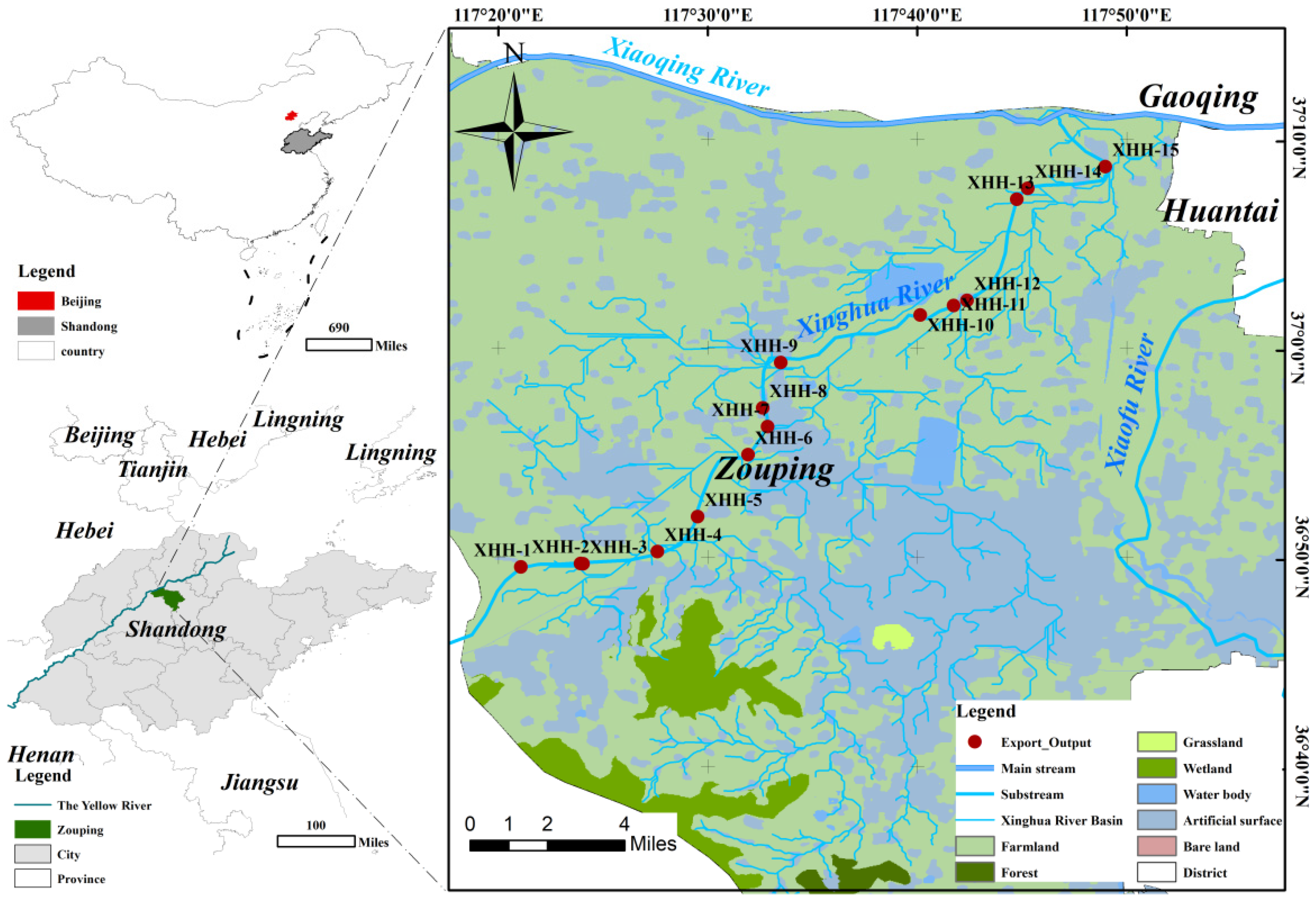
This study was conducted in the Xinghua River Basin, located in Zouping City, Shandong Province, China (Figure 1). The Xinghua River, a primary tributary of the Xiaoqing River, is the river with the largest wastewater discharge in Zouping City. It generally flows from west to east across the entire city. The main stream of the river is approximately 88 km in length, with a drainage area of 971 km2. Its major tributaries include the Daixi River, Sunggan Canal, Changbai Gou, Masigan Canal, and Liuliu River. Zouping City is located in a typical temperate monsoon climate zone with four distinct seasons, and its multi-year average temperature is approximately 13.5 °C. The multi-year average precipitation in Zouping City is about 632 mm, and the cultivated land area is 29,137 hectares. Pollution sources across the entire river basin involve industrial, agricultural, and urban domestic activities. In terms of pollution load, the main pollutants exceeding the standard are chemical oxygen demand (COD) and ammonia nitrogen. The Xinghua River serves as the primary receiving river for pollutants in Zouping City. Although the water quality in the upstream section is relatively good, it deteriorates significantly after flowing through Zouping City due to the complex and diverse pollution sources along its course and the river’s limited self-purification capacity. Despite efforts to control pollutant discharge in recent years, the water quality still fails to meet the Class V standard, imposing a substantial pollution burden on the downstream main stream of the Xiaoqing River [23].

2.2. Sample Collection and Processing

Based on the hydrological characteristics of the river channel and the distribution of pollution sources, our investigation set up a total of 14 sampling points throughout the entire basin of Xinghua River in March 2025 (Figure 1). Among these, six sampling sites (XHH1–XHH6) were located in the upstream section, serving primarily as a background reference area with relatively low population density and pollution load. Three sampling sites (XHH7–XHH9) were situated in the midstream section, characterized by industrial agglomeration and significant point-source pollution. The remaining five sampling sites (XHH10–XHH14) were located in the downstream section, where urban and agricultural activities dominate, contributing predominantly to non-point source pollution. Overlying water samples were collected using a stratified water sampler and stored in 500 mL polyethylene bottles sealed for preservation. During field sample collection, triplicate sampling should be performed at each sampling site, using ultrapure water as a blank control. The water samples were transported in an insulated container to ensure they were protected from light and sealed, and ice packs were added to maintain the temperature inside the container at 0–4 °C. Physicochemical parameters (pH, dissolved oxygen, water temperature, electrical conductivity, salinity, TDS, oxidation-reduction potential, and turbidity) were measured in situ using a portable multi-parameter water quality analyzer [24].
Laboratory analyses were conducted in strict accordance with national standard methods. CODMn was determined by the acidic potassium permanganate titration method. TN was measured using alkaline potassium persulfate digestion-UV spectrophotometry, NH3-N by Nessler’s reagent spectrophotometry, and TP by ammonium molybdate spectrophotometry. Additionally, water samples were filtered through 0.45 μm cellulose acetate membranes for subsequent spectroscopic analyses [17].

2.3. Analytical Methods

2.3.1. Three-Dimensional Fluorescence Spectroscopy Analysis

Water samples were filtered through 0.45 μm cellulose acetate membranes to obtain dissolved organic matter (DOM). Fluorescence EEMs were measured using a Hitachi F-7000 fluorescence spectrophotometer(Hitachi High-Tech Corporation, Tokyo, Japan). Prior to measurement, instrument baseline correction was performed using Milli-Q ultrapure water (Merck KGaA, Darmstadt, Germany) as a blank. The instrumental parameters were as follows: 150 W xenon arc lamp, photomultiplier tube voltage of 400 V, excitation wavelength (Ex) range of 200–450 nm, emission wavelength (Em) range of 280–550 nm, scanning interval of 5 nm, response time of 5 s, and scanning speed of 2400 nm/min. All EEM data were normalized for fluorescence intensity using a quinine sulfate solution (4 μg/L in 0.05 mol/L H2SO4) at Ex/Em = 350/450 nm, and inner filter effect correction was applied. During post-processing, the blank signal was subtracted, and Raman and Rayleigh scattering were manually removed [25]. The selected range of Ex = 200–450 nm and Em = 280–550 nm covers the characteristic regions of the main fluorescent components in freshwater DOM. According to Coble’s classification system, the characteristic peaks of tyrosine-like substances are located at Ex ~ 220–230/Em ~ 280–320 nm, and those of tryptophan-like substances are at Ex ~ 270–280/Em ~ 320–380 nm [26]; while according to the review by Fellman et al. (2010), the class of microbial humus is located at Ex ~ 250–300/Em ~ 380–480 nm, and the class of terrestrial humus is at Ex ~ 300–370/Em ~ 400–500 nm. This setting is consistent with the common scheme for analyzing freshwater DOM [27].
To ensure repeatability, the following calibration and verification steps were implemented: (i) Wavelength calibration: Before each measurement, the wavelength accuracy was verified using the characteristic peak at 350 nm of the xenon lamp and the Raman peak of Milli-Q water (excitation wavelength 350 nm, emission wavelength 365–450 nm). (ii) Fluorescence intensity normalization: Daily, the standardization was performed using the quinine sulfate solution (4 μg/L, dissolved in 0.05 mol/L H2SO4) at Ex/Em = 350/450 nm. (iii) Internal filter effect correction: The absorbance of each water sample at 254 nm and 365 nm was measured separately. (iv) Blank subtraction: Once every 10 samples, a Milli-Q water blank was inserted, and the blank signal was subtracted from the corresponding sample EEM. (v) Scattering removal: The Raman scattering and Rayleigh scattering regions were manually removed and filled with missing values.

2.3.2. Parallel Factor Analysis

The EEM data from the 14 samples were assembled into a three-dimensional array (excitation wavelength × emission wavelength × number of samples). PARAFAC modeling was performed using the drEEM toolbox (v0.6.6) on the MATLAB R2023b platform [28,29]. Specifically, the models with group numbers ranging from 2 to 7 were calculated one by one, and the optimal number of components was finally determined to be 4. The validation indicators of the model are as follows: the core consistency value is 92%, the split-half analysis passed the validation in all three independent subsets, the residuals were randomly distributed and showed no obvious structure. This four-component model explained 98.5% of the total variance of the entire EEM dataset. The relative content of each component was characterized by its maximum fluorescence intensity (Fmax) [30], and component identification and comparison were conducted using the OpenFluor database.

2.3.3. Two-Dimensional Correlation Analysis

2D-COS analysis was performed on the excitation wavelength series of DOM components using the 2D shige 1.3 developed by Kwansei Gakuin University [31]. Synchronous and asynchronous spectra were generated to elucidate the response sequence and interrelationships among different fluorescent components under external perturbations [32,33]. The perturbation applied in our investigation is the spatial gradient along the river flow direction, i.e., from upstream to downstream. The 2D-COS analysis was performed on the excitation wavelength series of the four PARAFAC components (C1–C4) across the 14 sampling sites, using the spatial order (upstream → midstream → downstream) as the external perturbation variable. This approach allows the identification of the sequential response of DOM components to hydrological transport and transformation processes.

2.3.4. Data Processing

The spatial distribution map of sampling sites was generated using ArcGIS 10.8. The relationship between DOM components and environmental factors was analyzed using redundancy analysis (RDA) in RStudio 4.5.3 Additional statistical analyses and graphical visualizations were performed using IBM SPSS Statistics 27 and Origin 2021, respectively.

3. Results

3.1. Characterization of Fluorescent DOM Components

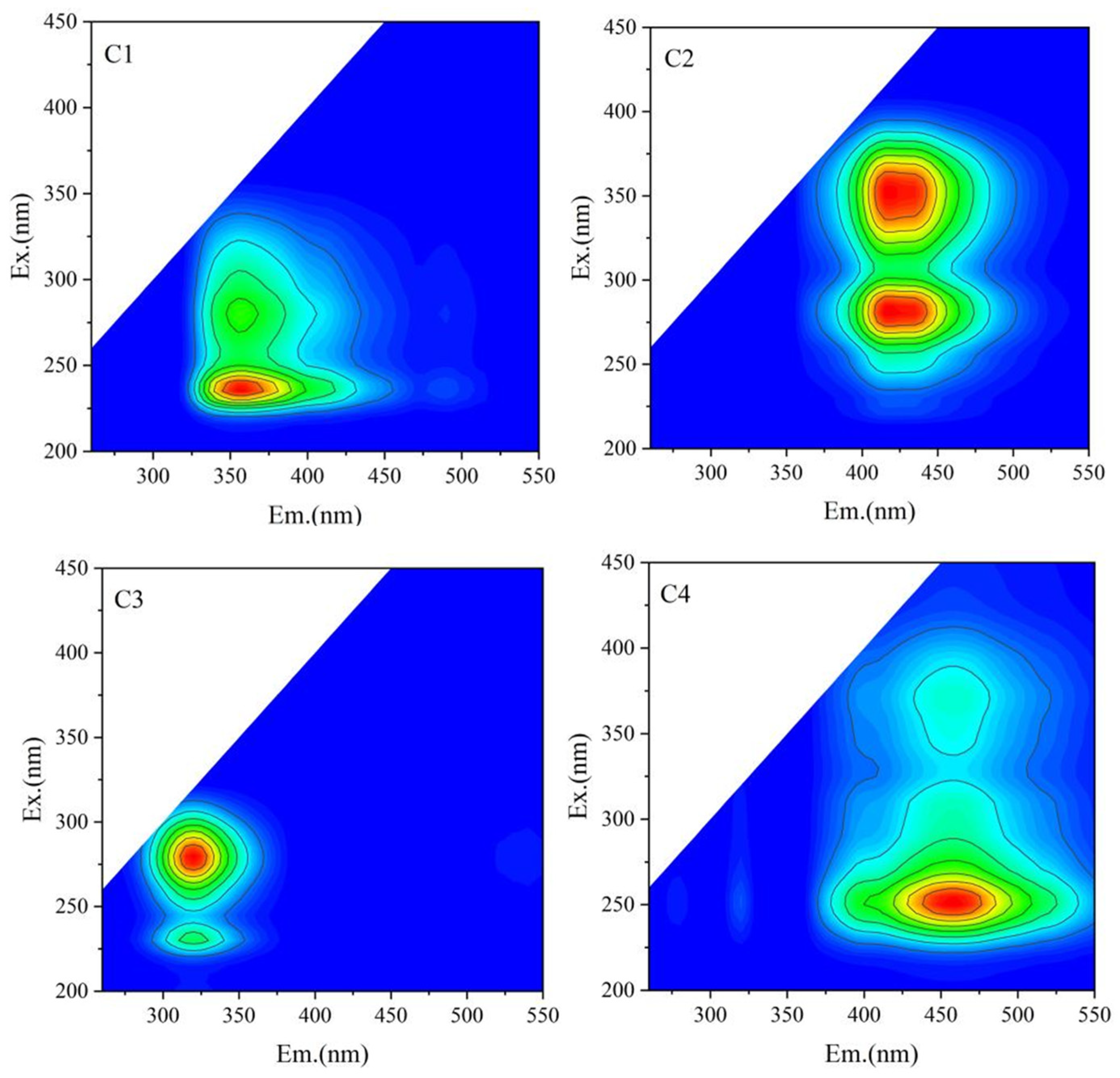
PARAFAC of the EEM spectra of water samples from the Xinghua River identified four major fluorescent DOM components (Figure 2) [34]. All four components exhibited high matching scores in the OpenFluor database (Tucker coefficients > 0.95), with detailed characteristics presented in Table 1 [35]. For instance, component C1 (235/355 nm) matched 33 protein-like components, indicating significant microbial or autochthonous characteristics [36,37]. Component C2 (Ex/Em = 280/420 nm) exhibited spectral features consistent with humic/fulvic acid-like substances [38], but matched only one component in the database, potentially reflecting the unique humic composition of this region. Component C3 (Ex/Em = 280/320 nm) showed high similarity (>0.95) to 25 database components and was assigned to tryptophan- or tyrosine-like proteinaceous materials, commonly associated with domestic sewage or agricultural discharge [10,39,40]. Component C4 (Ex/Em = 250/460 nm) was identified as a typical terrestrial humic-like substance, matching 100 components in the database and widely distributed in various aquatic environments [41,42,43]. Its primary sources include degradation products of terrestrial plants and soil leaching inputs. In summary, the DOM composition in the Xinghua River exhibited characteristics of both autochthonous and allochthonous inputs, with components C1 and C3 indicating the influence of microbial activity or anthropogenic pollution, while components C2 and C4 reflected contributions from natural terrestrial organic matter.
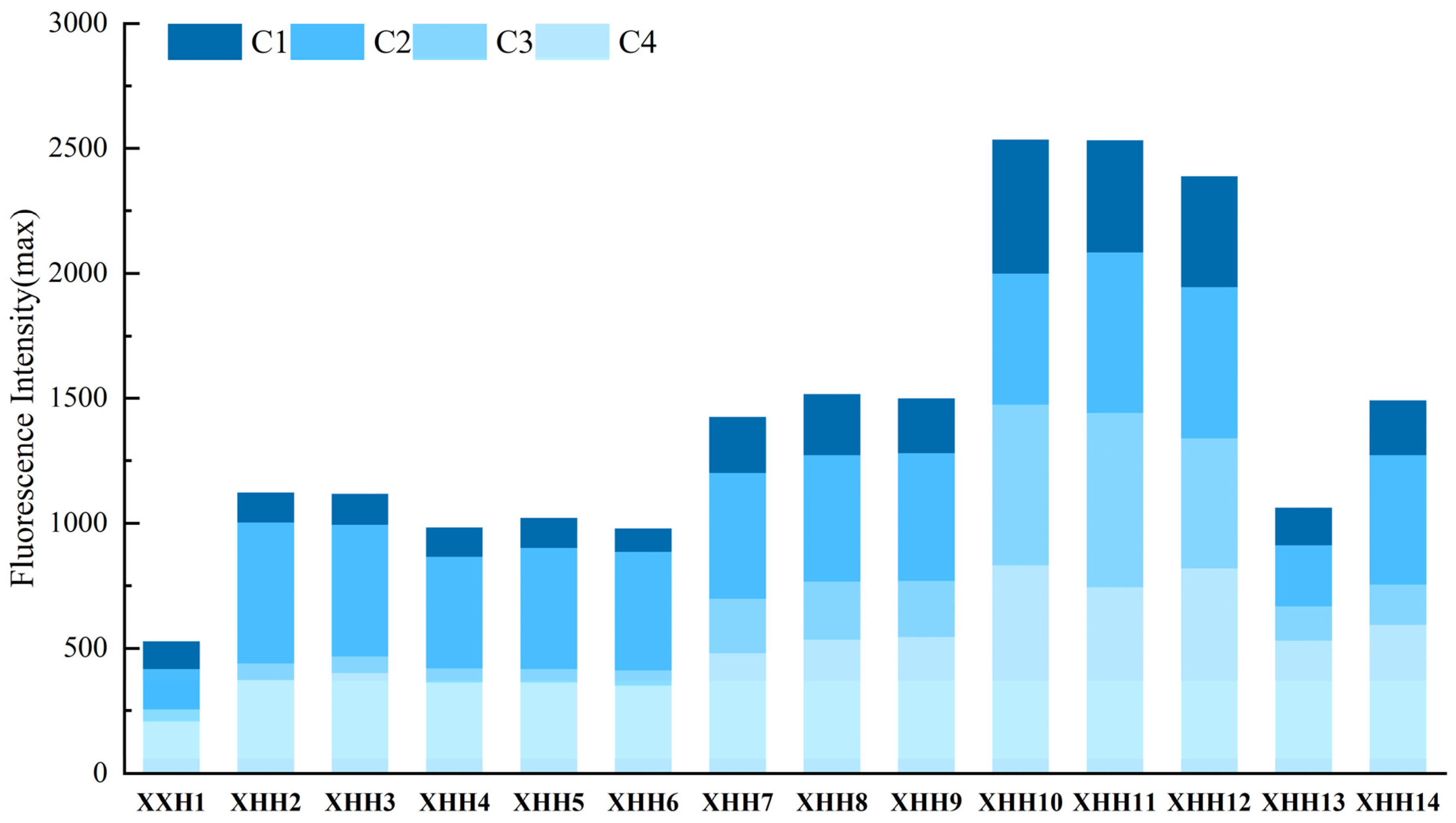
The maximum fluorescence intensity (Fmax) derived from parallel factor analysis (PARAFAC) effectively represents the relative abundance of the corresponding DOM components. The total Fmax values across all sampling sites in the Xinghua River Basin ranged from 531.68 to 2549.19, indicating significant spatial heterogeneity in fluorescent organic matter loading. Spatially, DOM fluorescence intensity exhibited a clear pattern of downstream > midstream > upstream (Figure 3). In the upstream section (XHH1–XHH6), the mean total Fmax was 964.8 ± 221.5; in the midstream section (XHH7–XHH9), it increased markedly to 1492.5 ± 55.7; and in the downstream section (XHH10–XHH14), it reached the highest value, with a mean of 2009.1 ± 686.1. This gradient clearly indicates the cumulative impact of anthropogenic activities on DOM loading in the river. Similarly, the Ankara River, as a typical urban river severely affected by industrial and domestic wastewater, also shows a spatial distribution trend of “downstream > upstream” for its pollutants [43].
In the upstream section, protein-like components dominated, with Fmax values in the following order: C3 (446.6 ± 149.7) > C1 (347.5 ± 68.2) > C4 (115.9 ± 3.7) > C2 (54.7 ± 3.5). Notably, component C3 exhibited not only the highest mean value but also a relatively large standard deviation (149.73), indicating strong spatial variability and suggesting the presence of dispersed pollution inputs with varying intensities. In contrast, the two humic-like components (C4 and C2) showed considerably lower abundances, and their small standard deviations indicate relatively stable sources and homogeneous spatial distribution in the upstream section. In the midstream section, the Fmax of all components increased significantly compared to upstream, with C1 (523.5 ± 29.6) and C3 (514.7 ± 10.8) being approximately twice as abundant as C4 and C2. This change is highly consistent with the dense point-source discharges from industrial areas in the midstream, indicating that industrial wastewater is an important source of DOM, particularly protein-like substances, in this river section. In the downstream section, the Fmax of all components reached their peak values, with the order: C1 (708 ± 136.4) > C3 (510.7 ± 158.8) > C2 (431.1 ± 269.1) > C4 (359.3 ± 165.7). Notably, the terrestrial humic-like components C2 and C4 were significantly enriched in this section, with abundances far exceeding those in the upstream and midstream sections. This comprehensively reflects the combined contributions of agricultural non-point source drainage and tributary inflows (potentially carrying soil leachates) to the DOM composition in the downstream section.
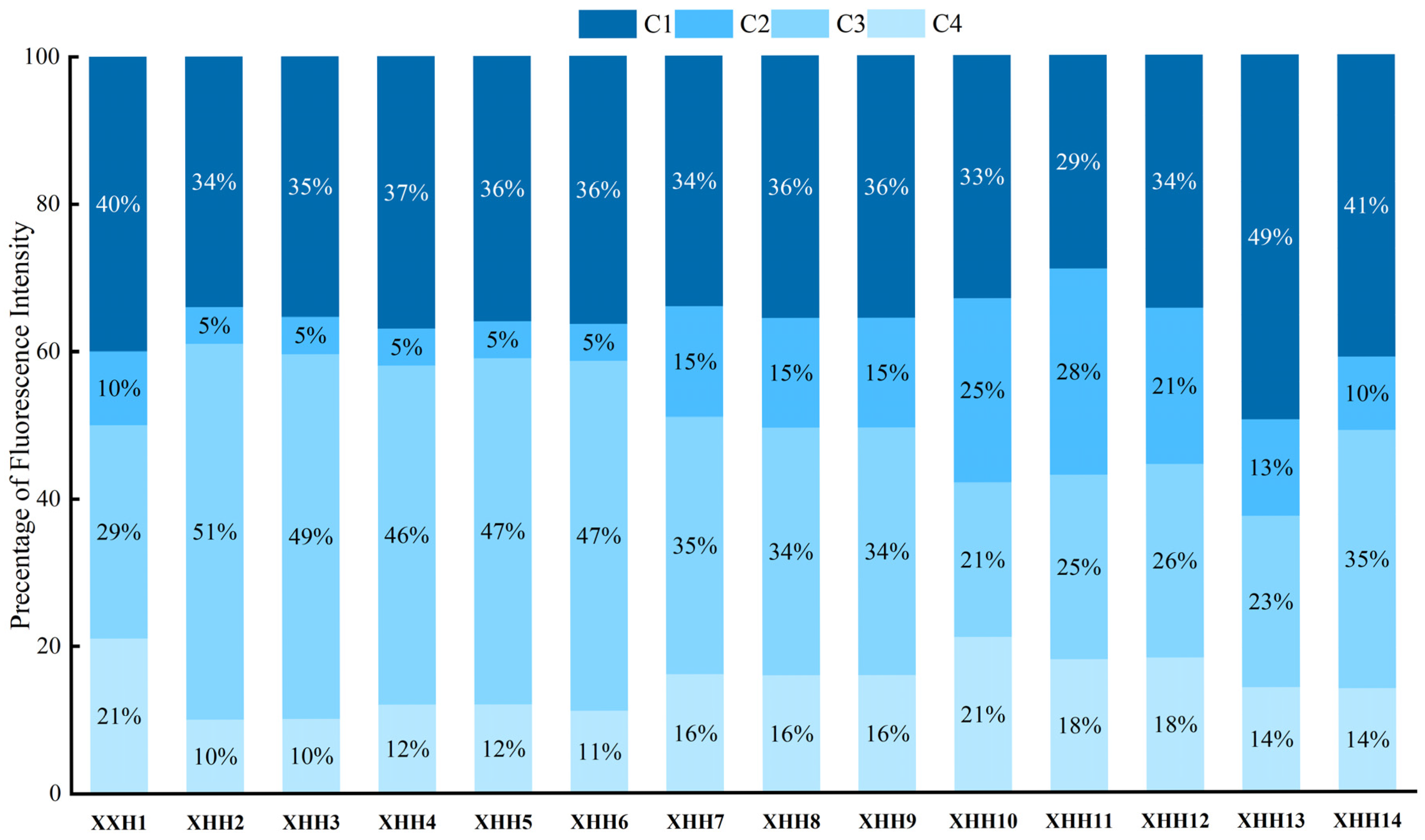
Component proportion analysis (Figure 4) revealed that protein-like substances (C1 + C3) were the dominant components of DOM in the Xinghua River, accounting for 50% to 78% of the total fluorescence intensity, further highlighting the profound impact of anthropogenic activities on the DOM composition in the water body. In contrast, humic-like substances (C2 + C4) accounted for a relatively lower proportion (16% to 49%); however, their marked increase in the downstream section indicates that exogenous inputs cannot be overlooked.

3.2. Analysis of DOM Sources and Characteristics Based on Fluorescence Indices

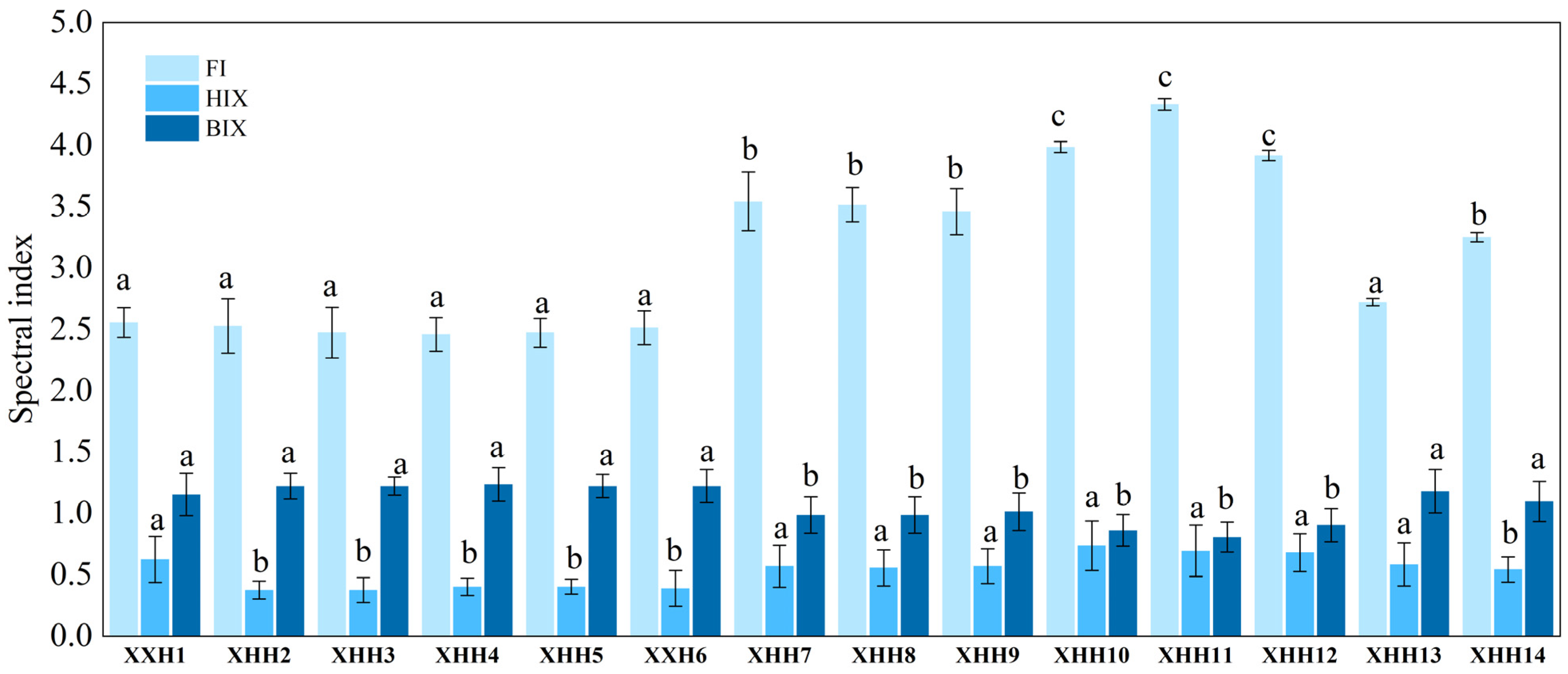
To elucidate the sources and properties of DOM in the Xinghua River, the present research employed a comprehensive analysis using the fluorescence index (FI), the biological index (BIX), and the humification index (HIX). Overall, FI values across all sampling sites ranged from 2.46 to 4.34, with an average of 3.13 (>1.9), indicating that DOM in the Xinghua River was primarily derived from autochthonous processes such as microbial metabolism. This characteristic is closely associated with the urbanization process in the watershed: the discharge of domestic sewage and industrial wastewater provides abundant organic substrates for heterotrophic microorganisms, significantly promoting microbial metabolic activities and consequently leading to an increased proportion of autochthonous components in DOM [44]. BIX values ranged from 0.800 to 1.241, with an average of 1.079 (>0.8), suggesting that DOM exhibited strong autochthonous characteristics and high bioavailability. During urbanization, nutrient enrichment in waters surrounding urban areas, such as nitrogen and phosphorus inputs from domestic sewage and agricultural non-point source pollution (e.g., suburban agricultural fertilization), flows into the river. These nutrients provide nourishment for the growth of autotrophs such as algae, stimulating their proliferation and thereby resulting in pronounced autochthonous characteristics of DOM [45]. HIX values ranged from 0.375 to 0.739, with all sites showing values below 4, reflecting a low overall degree of humification, and DOM was dominated by short-term organic matter derived from the decomposition of algae or bacteria [27].
From a spatial distribution perspective (Figure 5), the spectral indices exhibited distinct differences among the upstream, midstream, and downstream sections of the Xinghua River. Different letters (a, b, c) indicate significant differences at p < 0.05 (one-way ANOVA with Tukey‘s HSD post hoc test). FI values followed the order downstream (3.65) > midstream (3.51) > upstream (2.50), indicating that autochthonous characteristics increased along the flow direction. The relatively low FI value in the upstream section suggested that this area was less affected by urbanization, with relatively weak microbial metabolic activity. In contrast, FI values in the midstream and downstream sections were significantly higher; particularly in the downstream section, which is close to densely populated urban areas and receives substantial amounts of domestic sewage and industrial organic wastewater, microbial metabolism was more active [46]. FI can effectively distinguish the exogenous and endogenous characteristics of DOM. When FI > 1.8, it indicates that the DOM is mainly of microbial/algal origin; when FI < 1.4, it indicates that it is mainly of terrestrial/plant origin. In the present research, the FI values gradually increased from the upstream (2.50) to the downstream (3.65) along the flow direction, suggesting that the DOM source gradually shifted from partial terrestrial characteristics to endogenous dominance. This trend is highly consistent with the urbanization gradient research results: in the Tongtang River Basin of the Three Gorges Reservoir Area, the FI370 values were significantly positively correlated with the proportion of urban land use, indicating that the higher the degree of urbanization, the stronger the endogenous signal of DOM. The research by Jeon et al. further confirmed that FI and BIX are the most reliable optical tracers for assessing the contribution of unknown point sources of organic pollution in urban rivers, and can provide highly consistent estimation results with the measured pollution load data in the downstream area. Based on this, the significant increase in FI in the middle and lower reaches of Xinghua River directly indicates the controlling effect of urban domestic sewage and industrial organic wastewater input on the formation of endogenous DOM. BIX values exhibited the pattern upstream (1.214) > midstream (0.991) > downstream (0.969), with the most pronounced autochthonous characteristics observed upstream. The highest BIX value in the upstream section (1.214) may be attributed to the relatively clear water and favorable light conditions, which promote algal growth. The relatively lower BIX values in the midstream and downstream sections compared to upstream may be due to urbanization-induced expansion of urban construction, occupation of water areas, and reduced light availability, altering conditions for algal growth and resulting in less vigorous algal proliferation than in the upstream section. The BIX value is the highest in the upstream section, indicating that the DOM has significant auto-generated characteristics. BIX is an effective indicator for distinguishing the auto-generated contribution of DOM. When BIX > 1, it indicates that the DOM mainly originates from the recent metabolic activities of aquatic organisms such as algae and bacteria. The water body in the upstream section is clear, the flow rate is moderate, and the light conditions are good, which is conducive to the photosynthesis of phytoplankton (such as algae) and the generation of extracellular releases, thereby producing a large amount of proteinaceous auto-generated DOM. The BIX and FI analysis jointly indicate that the DOM is mainly contributed by endogenous microorganisms and the degradation of phytoplankton. In Taiwan’s subtropical small rivers, an increase in BIX was also observed accompanied by a decrease in HIX, indicating an increase in auto-generated contribution. Therefore, the high BIX value in the upstream section reflects the metabolic contribution of microbial metabolism based on algal photosynthesis, rather than the input of exogenous organic matter.
HIX values followed the trend of downstream (0.645) > midstream (0.563) > upstream (0.427). Notably, the HIX value at site XHH10 in the downstream section was markedly higher, which may be associated with the inflow from the Liuliu River carrying effluent from wastewater treatment plants and discharges from surrounding enterprises. As a background reference area, the upstream section experienced relatively minor anthropogenic disturbance, with DOM dominated by fresh organic matter and exhibiting the lowest degree of humification. Organic pollution inputs in the midstream industrial agglomeration zone promoted the transformation of some organic components, resulting in elevated HIX values [47]. Urbanization suppresses riverine humification primarily through two pathways: first, the destruction of riparian zones and reduction in wetlands weaken the input of terrestrial stable organic matter; second, the substantial input of fresh organic matter from domestic sewage and industrial wastewater dominates DOM composition, thereby hindering the natural accumulation of humic substances [9]. This low humification characteristic indicates that DOM in the Xinghua River is dominated by labile components with high biological activity, potentially exacerbating eutrophication and affecting microbial metabolic pathways, highlighting the significant anthropogenic perturbation of organic matter cycling processes in urbanizing rivers.
The results indicate that DOM in the watershed is predominantly derived from autochthonous inputs, with a low overall degree of humification and high biological activity, rendering it readily degradable by microorganisms and actively involved in material cycling within the water body [48]. The compositional structure of DOM exhibited pronounced spatial differentiation along the flow direction. From upstream to downstream, the abundances of both protein-like and humic-like components showed increasing trends, reflecting the cumulative impact of anthropogenic discharges on the riverine DOM pool. This variation pattern is highly consistent with the degree of urbanization and the intensity of human activities in the watershed [49].

3.3. Analysis of Longitudinal DOM Variations Based on Two-Dimensional Correlation Spectroscopy

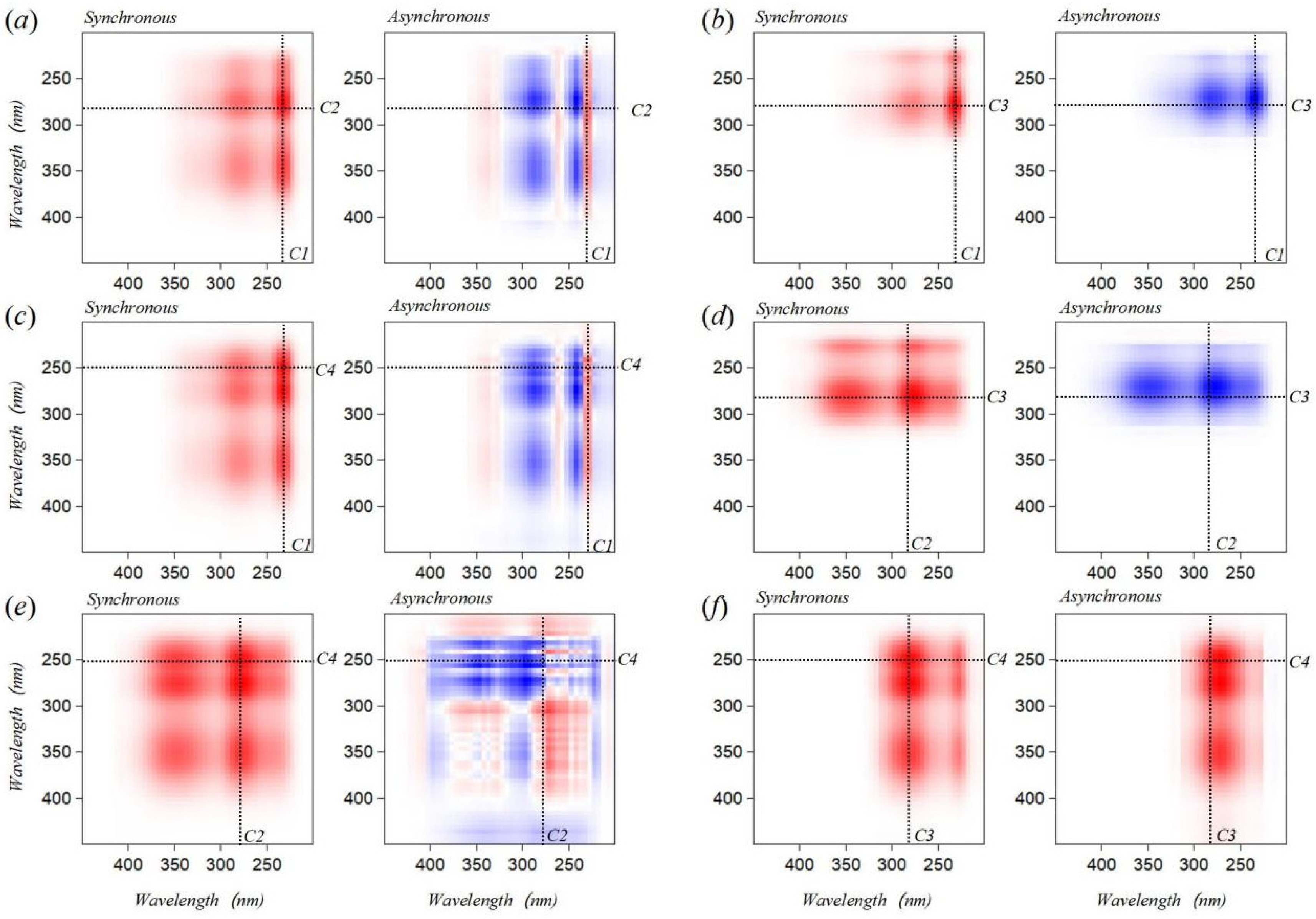
To investigate the influence of flow direction on the variations in fluorescent DOM components, this work employed 2D-COS [50]. The results revealed distinct response sequences of individual fluorescent components under hydrological disturbance, elucidating the spatial transformation patterns of DOM composition. As shown in Figure 6, component C1 (protein-like) and C3 (tyrosine/tryptophan-like) exhibited a positive correlation in the synchronous spectrum (red) and a negative correlation in the asynchronous spectrum (blue). According to Noda’s rules, when the synchronous cross-peak is positive, a negative asynchronous cross-peak indicates that the change in C3 occurs before that of C1 [28]; this sequence of changes was determined as C3 → C1. Similarly, the combinations of C2 (humic/fulvic acid-like) with C3, and C2 with C4 (terrestrial humic-like) also showed response sequences of C3 → C2 and C4 → C2, respectively. In contrast, the combinations of C1/C2, C1/C4, and C3/C4 exhibited positive correlations in both synchronous and asynchronous spectra, indicating that these components exhibited consistent trends under hydrological disturbance [51].
Based on all the two-dimensional related spectral information, the overall sequence of changes in the fluorescent DOM components in the Xinghua River was determined as C3 → C1 → C4 → C2. This sequence indicates that protein-like components, particularly C3, exhibited the highest sensitivity to changes in flow direction, with a magnitude of variation significantly greater than that of humic-like components. In the context of the actual conditions, this sequence carries clear environmental significance: tyrosine/tryptophan-like substances (C3), which are abundant in domestic sewage and industrial wastewater, undergo preferential transformation during riverine transport, subsequently inducing changes in protein-like components (C1), followed by effects on humic-like components (C4 and C2) [52]. This process reflects the degradation and transformation behavior of allochthonous organic inputs in rivers and further verifies the significant impact of anthropogenic discharges on DOM composition. Our investigation provides a new analytical perspective for understanding the transport and transformation of DOM in riverine ecosystems from the standpoint of molecular response sequences. The above sequence of changes (C3 → C1 → C4 → C2) has clear implications for environmental management. First, the C3 component (tyrosine/tryptophan-like substances) is the most sensitive to flow direction disturbances and lies at the beginning of the transformation sequence, indicating its potential as an early-warning biological indicator of anthropogenic impacts on DOM in urban rivers. In practical monitoring, spatial variations in C3 fluorescence intensity can be used to rapidly identify recent input points of domestic sewage or agricultural non-point sources. Second, because C3 transforms preferentially over other components, source reduction targeting this component is expected to more efficiently block the conversion of exogenous organic matter into humic components, thereby mitigating the accumulation of organic load in the river as a whole. Therefore, this work recommends incorporating the C3 component as a sensitive indicator factor in the ‘zonation-based management’ of the Xinghua River Basin, to prioritize the identification of highly disturbed river reaches and guide the spatial and temporal deployment of remediation measures.
This observation result is highly consistent with the existing studies. For instance, Wang et al. found that when using 2D-COS to analyze the removal effect of the artificial rapid infiltration-wetland system on the DOM of urban domestic sewage, the priority change sequence of fluorescent components was protein-like fluorescence (275 nm) → humic-like fluorescence (418 nm) → fulvic-like fluorescence (366 nm), indicating that protein-like substances could be removed preferentially, and the change in protein-like fluorescence was the most obvious throughout the treatment system [53]. In the study of stepped urban landscape rivers, SFS-2D-COS also revealed similar change patterns, with the change sequence of DOM components being TYRLF (class tyrosine) → TRPLF(class tryptophan) → HLF(land-derived humic matter) → MHLF (microbial-derived humic matter), where the change in the class tyrosine component was prior to that of the class tryptophan component. Additionally, Lin et al. reported a priority order of anthropogenic DOM components (C2, C4) under industrial wastewater discharge, which matches the sequence in our study: in both cases, protein-like components responded earlier than humic-like ones, confirming a shared dynamic evolution pattern of “priority response–gradual transformation–stabilization [54].

3.4. Correlation Analysis Between DOM Components and Environmental Factors

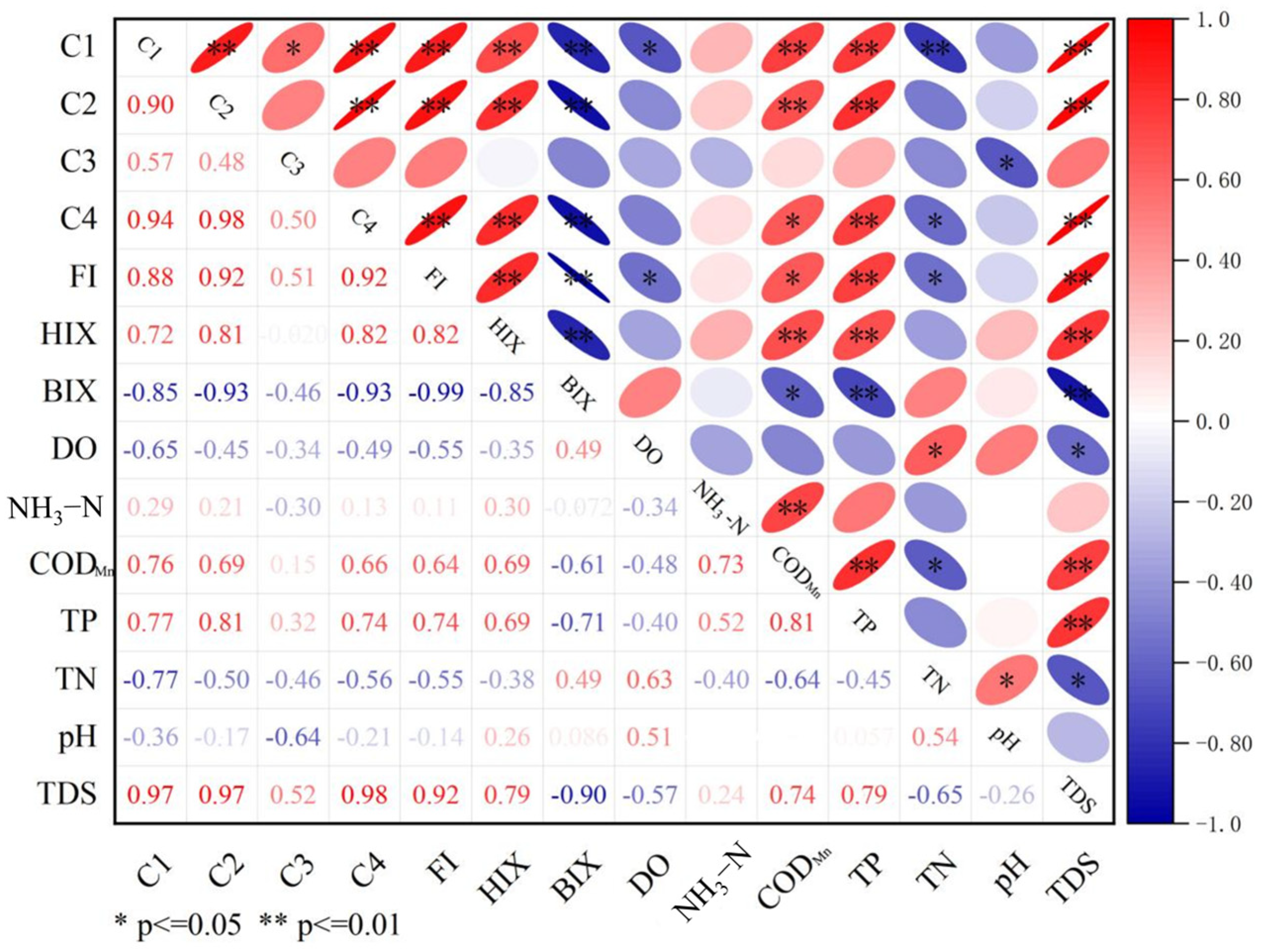
To identify the key environmental factors influencing DOM composition in the Xinghua River, this work systematically analyzed the intrinsic relationships among fluorescent components, optical indices, and water quality parameters using correlation analysis and RDA [55]. The correlation analysis results (Figure 7) showed that C2 and C4 exhibited an extremely significant positive correlation (p < 0.01), suggesting that they share a common origin, primarily from terrestrial humic substance inputs. C1 also showed significant correlations with C2 and C4. Quantitatively, the correlation coefficients between C1 and C2/C4 in this study (r = 0.58 and 0.69, respectively) are close to those reported by Zhao et al. in subtropical shrimp ponds (r = 0.63 and 0.71, difference < 0.05), indicating that protein-like and humic-like substances often exhibit synergistic variation in anthropogenically impacted waters [56]. Components C1, C2, and C3 were all extremely significantly positively correlated with CODMn and TDS, reflecting the combined influence of organic pollution loading and salinity on DOM components. Additionally, C1, C2, and C4 were significantly positively correlated with total phosphorus (TP), while C1 showed a significant negative correlation with total nitrogen (TN), highlighting the important role of nitrogen and phosphorus nutrient cycling in DOM transformation [57]. Dissolved oxygen (DO) was significantly negatively correlated with C1, which may be related to the regulation of microbial activity by DO levels, thereby affecting the degradation processes of protein-like substances. The fluorescence indices (FI, HIX) were significantly positively correlated with C1, C2, and C4, whereas BIX was significantly negatively correlated with these components, further confirming the intrinsic consistency between DOM sources and compositional characteristics [39].
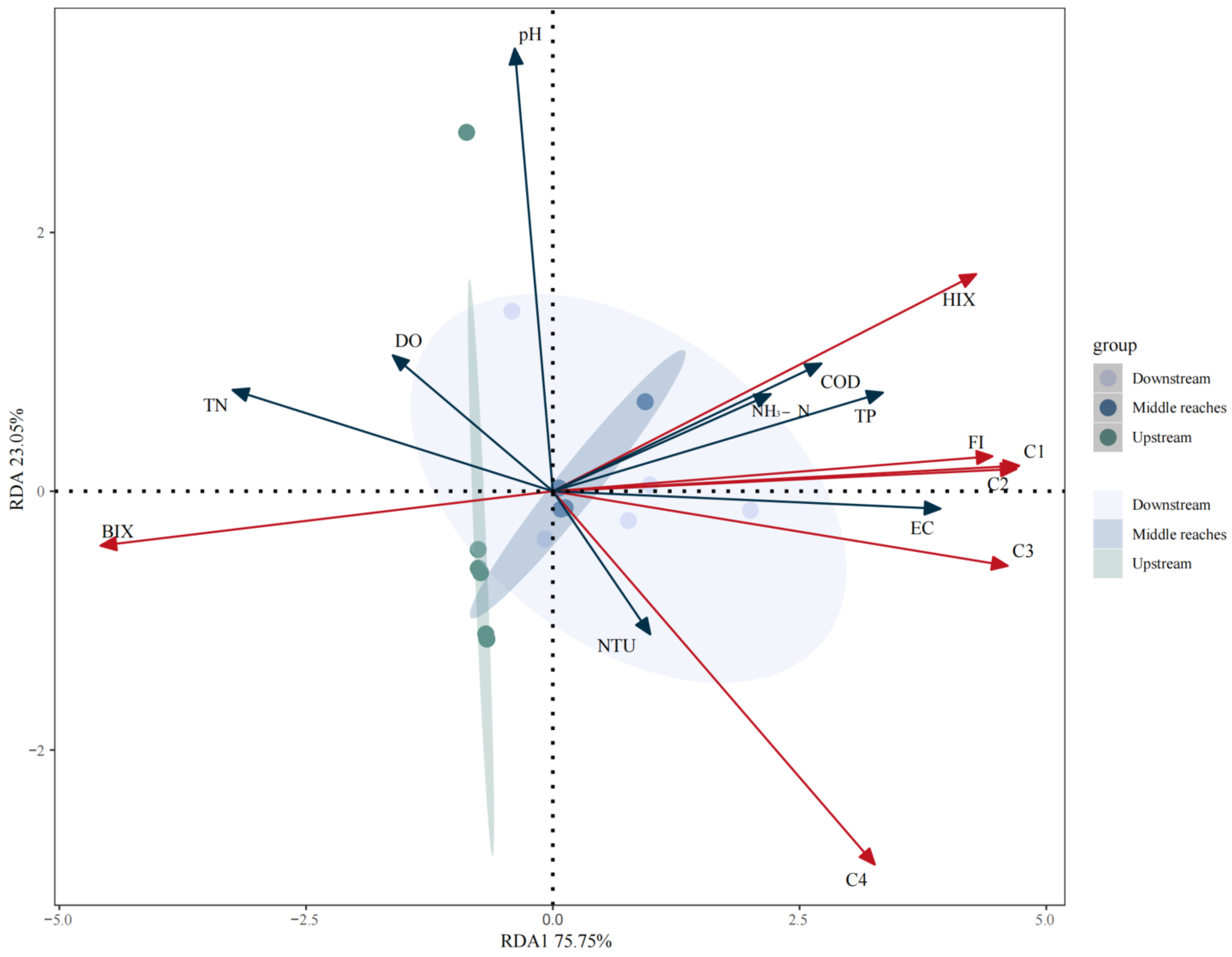
To identify the key environmental factors governing the spatial distribution of DOM, redundancy analysis (RDA) was performed. Based on the permutation test, the significance of the overall RDA model was evaluated. The p-value of the overall model was 0.001. The permutation tests were conducted for the first and second sorting axes, with RDA1: p = 0.001 and RDA2: p = 0.027. The results were significant. Using the variance inflation factor (VIF) to assess the multicollinearity among environmental variables, the VIF values of the variables retained in the RDA model are all less than 5, indicating that the collinearity is not severe. The results (Figure 8) showed that the first two RDA axes (RDA1 and RDA2) collectively explained 98.8% of the total variance. The red arrows represent the response variable, while the blue arrows represent the environmental explanatory variables. Divide the different points into three parts: upstream, middle and downstream. TP, TDS, and CODMn were identified as the most important environmental factors influencing DOM distribution, as indicated by their long arrows and small angles with most DOM components, suggesting significant positive correlations. Notably, component C2 exhibited the closest relationship with TP, TDS, and CODMn. Among them, as DOM is a component of TDS, humic substances rich in functional groups can bind inorganic ions and increase TDS, while the oxidizable organic matter in DOM, including proteins, polysaccharides, and certain humic substances, determines the content of CODMn [58]. BIX showed negative correlations with TN, DO, and pH, indicating that areas dominated by autochthonous DOM were often associated with lower nitrogen nutrient levels [59]. This is because protein-like components (tyrosine-like and tryptophan-like) are more sensitive to pH changes, exhibiting varying fluorescence intensities across different pH ranges. In contrast, when the pH shifts from neutral to weakly alkaline, the terrestrial humic-like components generally show an increase in fluorescence intensity in most cases [60]. The negative correlations between pH and C3/C4 observed in the figure are consistent with earlier findings in the Anatolia region. High salinity decreases pollutant solubility, causing pollutants to be retained in sediments and thereby increasing the risk of bioaccumulation [61]. In summary, the composition and distribution of DOM in the Xinghua River were synergistically regulated by multiple environmental factors, among which TP, TDS, and CODMn were the key drivers governing its spatial differentiation [62]. This finding clarifies the profound impact of anthropogenic nutrient inputs and organic pollution on the riverine DOM pool and provides a scientific basis for water environment management in the Xinghua River Basin, namely that priority should be given to controlling the discharge of nitrogen, phosphorus nutrients, and organic pollutants.

4. Conclusions

This study systematically elucidated the compositional characteristics, source transformation patterns, and environmental impact mechanisms of DOM in the Xinghua River in the context of urbanization. The DOM components exhibited significant spatial differentiation, with an overall distribution pattern of downstream > midstream > upstream, reflecting the spatial gradient of urbanization intensity. DOM was primarily derived from autochthonous sources and exhibited high bioavailability. With increasing urbanization intensity, the degree of humification increased, indicating that the influence of allochthonous inputs and transformation processes gradually became more prominent. Nutrients and organic pollution were identified as key environmental factors regulating DOM distribution. TP, TDS, and CODMn collectively explained a substantial proportion of the spatial variability in DOM, highlighting the strong indicative value of DOM composition for water quality parameters. The findings provide an important scientific basis for water environment management in the Xinghua River Basin.

Author Contributions

Conceptualization, F.Y.; methodology, S.C.; software, S.C.; validation, Y.W., W.L.; formal analysis, M.L.; investigation, G.C. and Z.J.; resources, W.L.; data curation, G.C.; writing—original draft preparation, Y.W.; writing—review and editing, F.Y. and Y.W.; visualization, S.C.; supervision, M.L.; project administration, F.Y.; funding acquisition, W.L. All authors have read and agreed to the published version of the manuscript.

Funding

This research was funded by Henan Key Laboratory of Water Pollution Control and Remediation, grant number CJSZ2025002, and the APC was funded by the same funder.

Data Availability Statement

The raw data supporting the conclusions of this article will be made available by the authors on request.

Conflicts of Interest

The authors declare no conflicts of interest.

Abbreviations

The following abbreviations are used in this manuscript:
DOMDissolved organic matter
TNtotal nitrogen
TPtotal phosphorus
2D-COSTwo-dimensional correlation spectroscopy
NH3-Nammonia nitrogen
EmEmission wavelength
ExExcitation wavelength
PARAFACParallel factor analysis
RDAredundancy analysis
EEMthe excitation–emission matrix
FIthe fluorescence index
HIXthe humification index
BIXthe Biological Index
TDStotal dissolved solids
DODissolved oxygen

References

  1. Abd El-Monaem, E.M.; Elshishini, H.M.; Bakr, S.S.; El-Aqapa, H.G.; Hosny, M.; Andaluri, G.; Eltaweil, A.S. A comprehensive review on LDH-based catalysts to activate persulfates for the degradation of organic pollutants. npj Clean Water 2023, 6, 34. [Google Scholar] [CrossRef]
  2. Begum, M.S.; Park, J.-H.; Yang, L.; Shin, K.H.; Hur, J. Optical and molecular indices of dissolved organic matter for estimating biodegradability and resulting carbon dioxide production in inland waters: A review. Water Res. 2023, 228, 119362. [Google Scholar] [CrossRef] [PubMed]
  3. Bian, R.; Cao, X.; Peng, J.; Qi, W. Impact of domestic and industrial effluent discharge on the microbiome of river sediments from the middle and lower reaches of the Yangtze River. Environ. Res. 2025, 285, 122611. [Google Scholar] [CrossRef]
  4. Li, L.; Dong, M.; He, L.; Chen, H.; Yu, M.; Gustave, W.; Li, B.; Zhang, X.; He, F. Interactions between lake dissolved organic matter and heavy metals: Implications for ecological risk assessment. Environ. Rev. 2026, 34, 1–17. [Google Scholar] [CrossRef]
  5. Chen, Y.; Li, Y.; Liang, X.; Lu, S.; Ren, J.; Zhang, Y.; Sun, K. Effects of microplastics on soil carbon pool and terrestrial plant performance. Carbon Res. 2024, 3, 37. [Google Scholar] [CrossRef]
  6. Cui, B.; Gao, H.-J.; Zheng, Z.-P.; Li, Y. Applying EEM coupled with 2D-COS to character structural composition of DOM and its spatial variations in an urban river. J. Ecol. Rural. Environ. 2021, 37, 369–377. [Google Scholar] [CrossRef]
  7. D’Andrilli, J.; Silverman, V.; Buckley, S.; Rosario-Ortiz, F.L. Inferring ecosystem function from dissolved organic matter optical properties: A critical review. Environ. Sci. Technol. 2022, 56, 11146–11161. [Google Scholar] [CrossRef]
  8. Drozdova, O.Y.; Aleshina, A.R.; Lapitskiy, S.A.; Pokrovsky, O.S. Transformation of dissolved organic matter and associated metals in boreal mire and river waters: Effects of biota and sunlight. Water Res. 2025, 282, 123756. [Google Scholar] [CrossRef]
  9. Duan, P.; Li, H.; Wang, Y.; Yan, H.; Li, A.; Zhang, J. Relationship between non-point source pollution and fluorescence fingerprint of riverine dissolved organic matter is season dependent. Sci. Total Environ. 2022, 823, 153617. [Google Scholar] [CrossRef]
  10. Fan, T.; Yao, X.; Sun, Z.; Sang, D.; Liu, L.; Deng, H.; Zhang, Y. Properties and metal binding behaviors of sediment dissolved organic matter (SDOM) in lakes with different trophic states along the Yangtze River Basin: A comparison and summary. Water Res. 2023, 231, 119605. [Google Scholar] [CrossRef]
  11. Fang, W.; Fan, T.; Wang, S.; Yu, X.; Lu, A.; Wang, X.; Zhang, L. Seasonal changes driving shifts in microbial community assembly and species coexistence in an urban river. Sci. Total Environ. 2023, 905, 167027. [Google Scholar] [CrossRef]
  12. Guan, Y.; Han, R.; Jia, N.; Yu, G.; Huo, D. Optical characteristics of dissolved organic matter in relation to phytoplankton in Lake Erhai, China. Process Saf. Environ. Prot. 2024, 186, 166–175. [Google Scholar] [CrossRef]
  13. Hu, Y.; Su, H.; Song, H.; Xiong, Q.; Zhou, Z.; Huang, B.; Wang, X.; Xiao, N.; Yu, M. Synergistic impacts of anthropogenic and climatic drivers on total phosphorus dynamics in a mega river basin. Environ. Technol. Innov. 2025, 39, 104259. [Google Scholar] [CrossRef]
  14. Jeon, M.H.; Jung, J.; Park, M.O.; Kim, M.; Kim, B.-K.; Kim, K. Tracing Circumpolar Deep Water and glacial meltwater using humic-like fluorescent dissolved organic matter in the Amundsen Sea, Antarctica. Mar. Chem. 2021, 235, 104008. [Google Scholar] [CrossRef]
  15. Ji, X.-Y.; Wang, S.-S.; Yang, K.; Zhang, X. Analysis of the spatiotemporal variation characteristics of total nitrogen concentration in China’s surface water from 2016 to 2020. J. Ecol. Environ. 2022, 31, 1184–1192. [Google Scholar] [CrossRef]
  16. Li, J.; Sha, H.; Ye, R.; Zhang, P.; Chen, S.; Zhu, G.; Tan, W. Chemodiversity and Molecular Mechanism Between Per-/Polyfluoroalkyl Substance Complexation Behavior of Humic Substances in Landfill Leachate. Water 2024, 16, 3527. [Google Scholar] [CrossRef]
  17. Johnson, M.S.; Couto, E.G.; Abdo, M.; Lehmann, J. Fluorescence index as an indicator of dissolved organic carbon quality in hydrologic flowpaths of forested tropical watersheds. Biogeochemistry 2011, 105, 149–157. [Google Scholar] [CrossRef]
  18. Kong, Y.; Zhang, J.; Zhang, X.; Gao, X.; Yin, J.; Wang, G.; Yuan, J. Applicability and limitation of compost maturity evaluation indicators: A review. Chem. Eng. J. 2024, 489, 151386. [Google Scholar] [CrossRef]
  19. Labelle, M.A.; Dold, P.L.; Gadbois, A.; Déléris, S.; Comeau, Y. Activated Sludge Production Parameters and Nutrient Content of Organic Sludge Components. Water Environ. Res. Res. Publ. Water Environ. Fed. 2017, 89, 51–61. [Google Scholar] [CrossRef]
  20. Liu, D.; Du, Y.; Yu, S.; Luo, J.; Duan, H. Human activities determine quantity and composition of dissolved organic matter in lakes along the Yangtze River. Water Res. 2020, 168, 115132. [Google Scholar] [CrossRef]
  21. Liu, D.; Gao, H.; Yu, H.; Song, Y. Applying EEM-PARAFAC combined with moving-window 2DCOS and structural equation modeling to characterize binding properties of Cu (II) with DOM from different sources in an urbanized river. Water Res. 2022, 227, 119317. [Google Scholar] [CrossRef] [PubMed]
  22. Liu, D.; Nie, L.; Xi, B.; Gao, H.; Yang, F.; Yu, H. A novel-approach for identifying sources of fluvial DOM using fluorescence spectroscopy and machine learning model. npj Clean Water 2024, 7, 79. [Google Scholar] [CrossRef]
  23. Li, W. Assessment of Ecological Health Level and Comprehensive Improvement Plan for Northern Rivers. Master’s Thesis, North China University of Water Resources and Electric Power, Zhengzhou, China, 2021. [Google Scholar] [CrossRef]
  24. Liu, S.; Hou, J.; Suo, C.; Chen, J.; Liu, X.; Fu, R.; Wu, F. Molecular-level composition of dissolved organic matter in distinct trophic states in Chinese lakes: Implications for eutrophic lake management and the global carbon cycle. Water Res. 2022, 217, 118438. [Google Scholar] [CrossRef]
  25. Liu, Y.-R.; Song, C.-X.; Qian, Q.; Zheng, J.-Y. Research progress on groundwater pollutant tracing in chemical industrial parks based on characteristic fingerprint. J. Ecol. Rural. Environ. 2025, 41, 1402–1411. [Google Scholar] [CrossRef]
  26. Coble, P.G. Characterization of marine and terrestrial DOM in seawater using excitation–emission matrix spectroscopy. Mar. Chem. 1996, 51, 325–346. [Google Scholar] [CrossRef]
  27. Fellman, J.B.; Hood, E.; Spencer, R.G.M. Fluorescence spectroscopy opens new windows into dissolved organic matter dynamics in freshwater ecosystems: A review. Limnol. Oceanogr. 2010, 55, 2452–2462. [Google Scholar] [CrossRef]
  28. Li, X.; Ao, H.; Chen, K.; Wu, C. Nitrogen-phosphorus stoichiometry and Cladophora growth affected by grass-sourced dissolved organic matter in the littoral zone of the Qinghai Lake, China. J. Hazard. Mater. 2025, 495, 138847. [Google Scholar] [CrossRef]
  29. Lu, K.; Gao, H.; Yu, H.; Li, Y. Insight into variations of DOM fractions in different latitudinal rural black-odor waterbodies of eastern China using fluorescence spectroscopy coupled with structure equation model. Sci. Total Environ. 2022, 816, 151531. [Google Scholar] [CrossRef]
  30. Ma, Z.; Chang, H.; Liang, Y.; Meng, Y.; Ren, L.; Liang, H. Research progress and trends on state-of-the-art membrane technologies in textile wastewater treatment. Sep. Purif. Technol. 2024, 333, 125853. [Google Scholar] [CrossRef]
  31. Chen, W.; Teng, C.-Y.; Qian, C.; Yu, H.-Q. Characterizing Properties and Environmental Behaviors of Dissolved Organic Matter Using Two-Dimensional Correlation Spectroscopic Analysis. Environ. Sci. Technol. 2019, 53, 4683–4694. [Google Scholar] [CrossRef] [PubMed]
  32. Marcé, R.; Verdura, L.; Leung, N. Dissolved organic matter spectroscopy reveals a hot spot of organic matter changes at the river–reservoir boundary. Aquat. Sci. 2021, 83, 67. [Google Scholar] [CrossRef]
  33. Niu, D.; Li, Y.; Tan, Y.; Ma, C.; Qi, Y.; Li, Y.; Tang, J. The impact of water-sediment regulation scheme (WSRS) on the chemistry of dissolved organic matter in the Yellow River estuary and adjacent waters. Water Res. 2025, 282, 123669. [Google Scholar] [CrossRef]
  34. Cabrera, J.M.; García, P.E.; Pedrozo, F.L.; Queimaliños, C.P. Dynamics of the dissolved organic matter in a stream-lake system within an extremely acid to neutral pH range: Agrio-Caviahue watershed. Spectrochim. Acta Part A Mol. Biomol. Spectrosc. 2020, 235, 118278. [Google Scholar] [CrossRef] [PubMed]
  35. Murphy, K.R.; Stedmon, C.A.; Wenig, P.; Bro, R. OpenFluor– an online spectral library of auto-fluorescence by organic compounds in the environment. Anal. Methods 2014, 6, 658–661. [Google Scholar] [CrossRef]
  36. Noda, I. Frontiers of two-dimensional correlation spectroscopy. Part 1. New concepts and noteworthy developments. J. Mol. Struct. 2014, 1069, 3–22. [Google Scholar] [CrossRef]
  37. Ouyang, Z.; Li, S.; Xue, J.; Liao, J.; Xiao, C.; Zhang, H.; Zhu, L. Dissolved organic matter derived from biodegradable microplastic promotes photo-aging of coexisting microplastics and alters microbial metabolism. J. Hazard. Mater. 2023, 445, 130564. [Google Scholar] [CrossRef] [PubMed]
  38. Pamuru, S.T.; Forgione, E.; Croft, K.; Kjellerup, B.V.; Davis, A.P. Chemical characterization of urban stormwater: Traditional and emerging contaminants. Sci. Total Environ. 2022, 813, 151887. [Google Scholar] [CrossRef]
  39. Park, Y.; Jin, S.; Noda, I.; Jung, Y.M. Continuing progress in the field of two-dimensional correlation spectroscopy (2D-COS): Part III. Versatile applications. Spectrochim. Acta Part A Mol. Biomol. Spectrosc. 2023, 284, 121636. [Google Scholar] [CrossRef]
  40. Peng, Y.; Niu, L.; Hu, Y.; Huo, C.; Shi, J.; Fan, Z.; Yan, Y.; Zhang, Z.; Wang, X. Long-term effects of nitrogen and phosphorus fertilization on profile distribution and characteristics of dissolved organic matter in fluvo-aquic soil. J. Environ. Manag. 2024, 366, 121834. [Google Scholar] [CrossRef]
  41. Qi, Y.; Cao, H.; Pan, W.; Wang, C.; Liang, Y. The role of dissolved organic matter during Per- and Polyfluorinated Substance (PFAS) adsorption, degradation, and plant uptake: A review. J. Hazard. Mater. 2022, 436, 129139. [Google Scholar] [CrossRef]
  42. Qiu, X.; Ma, S.; Pan, J.; Cui, Q.; Zheng, W.; Ding, L.; Rillig, M.C. Microbial metabolism influences microplastic perturbation of dissolved organic matter in agricultural soils. ISME J. 2024, 18, wrad017. [Google Scholar] [CrossRef]
  43. Sevin, S.; Kuzukiran, O.; Yurdakok-Dikmen, B.; Tutun, H.; Aydin, F.G.; Filazi, A. Selected persistent organic pollutants levels in the Ankara River by months. Environ. Monit. Assess. 2018, 190, 705. [Google Scholar] [CrossRef]
  44. Shang, Y.; Song, K.; Lai, F.; Lyu, L.; Liu, G.; Fang, C.; Wen, Z. Remote sensing of fluorescent humification levels and its potential environmental linkages in lakes across China. Water Res. 2023, 230, 119540. [Google Scholar] [CrossRef]
  45. Shang, Y.; Wen, Z.; Song, K.; Liu, G.; Lai, F.; Lyu, L.; Tao, H. Natural versus anthropogenic controls on the dissolved organic matter chemistry in lakes across China: Insights from optical and molecular level analyses. Water Res. 2022, 221, 118779. [Google Scholar] [CrossRef]
  46. She, W.; Yang, J.; Wu, G.; Jiang, H. The synergy of environmental and microbial variations caused by hydrologic management affects the carbon emission in the Three Gorges Reservoir. Sci. Total Environ. 2022, 821, 153446. [Google Scholar] [CrossRef] [PubMed]
  47. Chen, S.; Hale, R.L.; Hopkins, K.G.; Muñoz, L.O.; Kominoski, J.S.; Ledford, S.H.; Capps, K.A. Urbanization alters riverine fluorescent dissolved organic matter characteristics in a forested city—Metropolitan Atlanta, Georgia. Environ. Res. 2026, 297, 124085. [Google Scholar] [CrossRef]
  48. Sun, Y.; Li, X.; Li, X.; Wang, J. Deciphering the fingerprint of dissolved organic matter in the soil amended with biodegradable and conventional microplastics based on optical and molecular signatures. Environ. Sci. Technol. 2022, 56, 15746–15759. [Google Scholar] [CrossRef]
  49. Wang, D.-Y.; Han, J.-C.; Li, R.; Li, J.-F.; Xie, Y.-F. Changes in water body nutrient status and improvement strategies under extreme drought in Dongting Lake area in 2022. J. Lake Sci. 2023, 35, 1970–1980. [Google Scholar]
  50. Wang, J.; Yang, J.; Yang, L. Do natural resources play a role in economic development? Role of institutional quality, trade openness, and FDI. Resour. Policy 2023, 81, 103294. [Google Scholar] [CrossRef]
  51. Wang, S.-H.; Shi, X.-H.; Zhao, S.-N.; Li, S.-Y. Optical characteristics and source analysis of dissolved organic matter in hypersaline lakes in cold and arid regions. Environ. Sci. 2024, 45, 2670–2684. [Google Scholar]
  52. Wu, D.; Wei, Z.; Mohamed, T.A.; Zheng, G.; Qu, F.; Wang, F.; Song, C. Lignocellulose biomass bioconversion during composting: Mechanism of action of lignocellulase, pretreatment methods and future perspectives. Chemosphere 2022, 286, 131635. [Google Scholar] [CrossRef]
  53. Wang, G.; Liu, Y.; Dai, B.L. Removal of DOM from domestic wastewater by constructed rapid infiltration-wetland system. Environ. Sci. Technol. 2022, 45. [Google Scholar]
  54. Lin, Z.Y.; Lee, K.H.; Lim, J.Y.; Kim, J.H.; Eun, B.J.; Lee, S.J.; Park, J.Y.; Oh, H.S.; Oh, J.-M. Revealing spatial-temporal impact of industrial effluent towards DOM in Riverine employing PARAFAC and MW-2D COS. J. Environ. Chem. Eng. 2024, 12, 113412. [Google Scholar]
  55. Xu, J.; Wang, T.; Dahlgren, R.A.; Gao, F.; Sun, Y.; Xu, H.; Ma, Z. Revealing riverine DOM dynamics along an anthropogenic land-use gradient by integrating biogeochemical and hydrological processes. J. Hydrol. 2025, 662, 133963. [Google Scholar] [CrossRef]
  56. Yang, M.; Ding, L.; Wang, P.; Wu, Y.; Areeprasert, C.; Wang, M.; Yu, G. Formation of melanoidins and development of characterization techniques during thermal pretreatment of organic solid waste: A critical review. Fuel 2023, 334, 126790. [Google Scholar] [CrossRef]
  57. Yu, D.-Y.; Wang, Y.-H.; Ding, F.; Zhang, J.-Y. Comparison of methods for analyzing sources of soil heavy metal pollution in China over the past decade. Chin. J. Soil Sci. 2021, 52, 1000–1008. [Google Scholar] [CrossRef]
  58. Cheng, S.; Zhang, J.; Xue, H.; Yang, Q.; Liu, J.; Zhang, L.; Liu, N.; Wang, Y.; Meng, F. Potential Impact of DOM on Fish Biodiversity in the Jinshui River Basin Environment. Fishes 2024, 9, 489. [Google Scholar] [CrossRef]
  59. Zhang, X.; Li, Y.; Ye, J.; Chen, Z.; Ren, D.; Zhang, S. The spectral characteristics and cadmium complexation of soil dissolved organic matter in a wide range of forest lands. Environ. Pollut. 2022, 299, 118834. [Google Scholar] [CrossRef]
  60. Zhou, Y.; Yao, X.; Zhang, Y.; Shi, K.; Zhang, Y.; Jeppesen, E.; Gao, G.; Zhu, G.; Qin, B. Potential rainfall-intensity and pH-driven shifts in the apparent fluorescent composition of dissolved organic matter in rainwater. Environ. Pollut. 2017, 224, 638–648. [Google Scholar] [CrossRef]
  61. Simsek, I.; Kuzukiran, O.; Yurdakok-Dikmen, B.; Filazi, A. Assessment of Water Quality Dynamics in Relation to Selected Organic Pollutants. Water Air Soil Pollut. 2026, 237, 122. [Google Scholar] [CrossRef]
  62. Zhao, Z.; Xu, M.; Yan, Y.; Yan, S.; Lin, Q.; Xu, J.; Chen, Z. Identifying and quantifying multiple pollution sources in estuaries using fluorescence spectra and gradient-based deep learning. Mar. Pollut. Bull. 2024, 209, 117254. [Google Scholar] [CrossRef] [PubMed]
Figure 1. Distribution of sampling points.
Water 18 01102 g001
Figure 2. Four main fluorescent components and the corresponding excitation and emission spectra.
Water 18 01102 g002
Figure 3. Maximum fluorescence intensity of each component of Xinghua River.
Water 18 01102 g003
Figure 4. Percentage of content of each fluorescent component of DOM in Xinghua River.
Water 18 01102 g004
Figure 5. Three-dimensional fluorescence spectral index of DOM in the water body of Xinghua River.
Water 18 01102 g005
Figure 6. 2D correlation mapping of DOM change under water flow direction perturbation. (a). comparison between components C1 and C2. (b). comparison between components C1 and C3. (c). comparison between components C1 and C4. (d). comparison between components C2 and C3. (e). comparison between components C2 and C4. (f). comparison between components C3 and C4.
Water 18 01102 g006
Figure 7. Correlation between water quality parameters and fluorescence parameters of DOM samples.
Water 18 01102 g007
Figure 8. Plot of RDA based on the interaction of response variables and environmental explanatory variables.
Water 18 01102 g008
Table 1. Characterization of the four PARAFAC components.
ComponentEx/Em
(nm/nm)
Classification and DescriptionPrevious Studies
C1235/355Protein-like. Related to microbial activity and/or aquatic production[20,30]
C2280/420Humic- and fulvic-like material[32]
C3280/320Tyrosine-like
or tryptophan-like
[36,37]
C4250/460Terrestrial humic-like fluorophore[38,39]
Disclaimer/Publisher’s Note: The statements, opinions and data contained in all publications are solely those of the individual author(s) and contributor(s) and not of MDPI and/or the editor(s). MDPI and/or the editor(s) disclaim responsibility for any injury to people or property resulting from any ideas, methods, instructions or products referred to in the content.