Mechanisms of Metal Particle Release from Pipe Scales in Ductile Iron Water Supply Pipelines: Control by Water Quality Parameters


Abstract
1. Introduction
2. Materials and Methods
2.1. Collection and Pretreatment of Pipe Scale Samples
2.2. The Release of Pipeline Scale Particles Is Affected by Different Water Quality
2.3. Water Quality Detection Items and Methods
2.4. Kinetic Fitting
2.5. Pipe Scale Characterization Methods
3. Results and Discussion
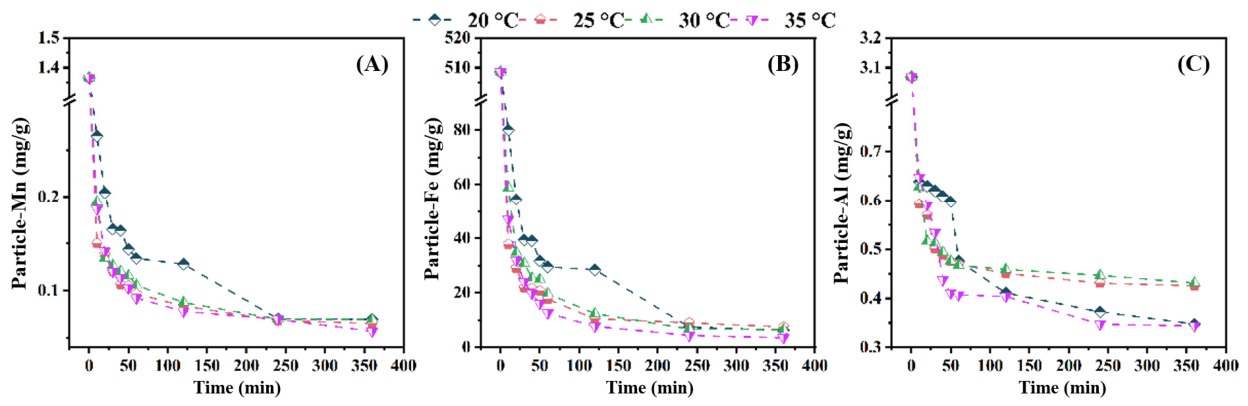
3.1. Effect of Water Temperature on the Release Behavior of Pipe Scale Metals
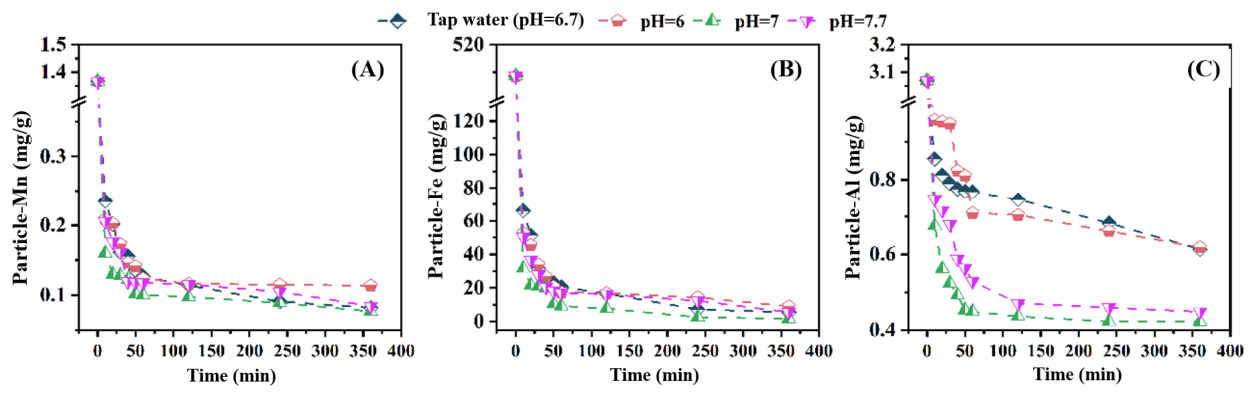
3.2. Effect of pH on the Release Behavior of Pipe Scale Metals
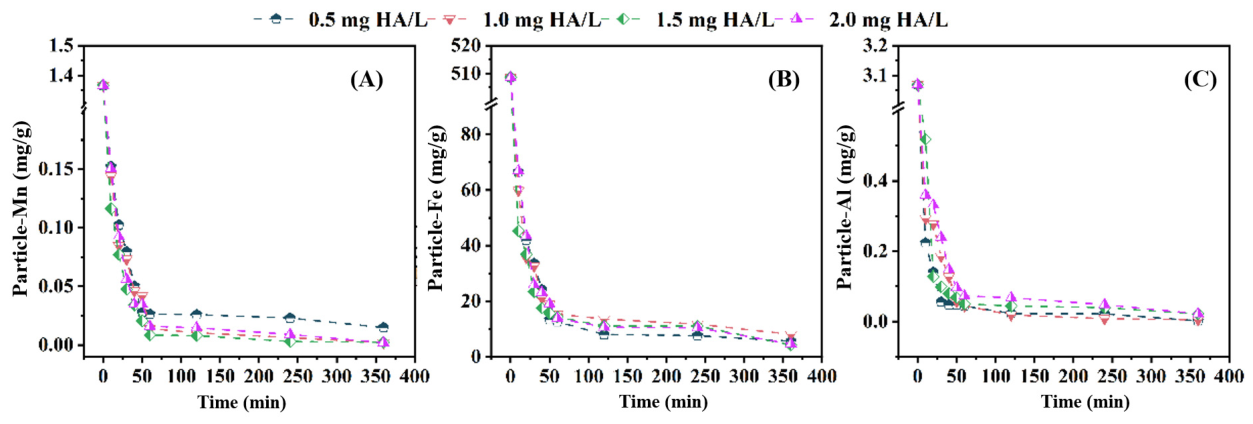
3.3. Effect of HA Content on the Release Behavior of Pipe Scale Metals
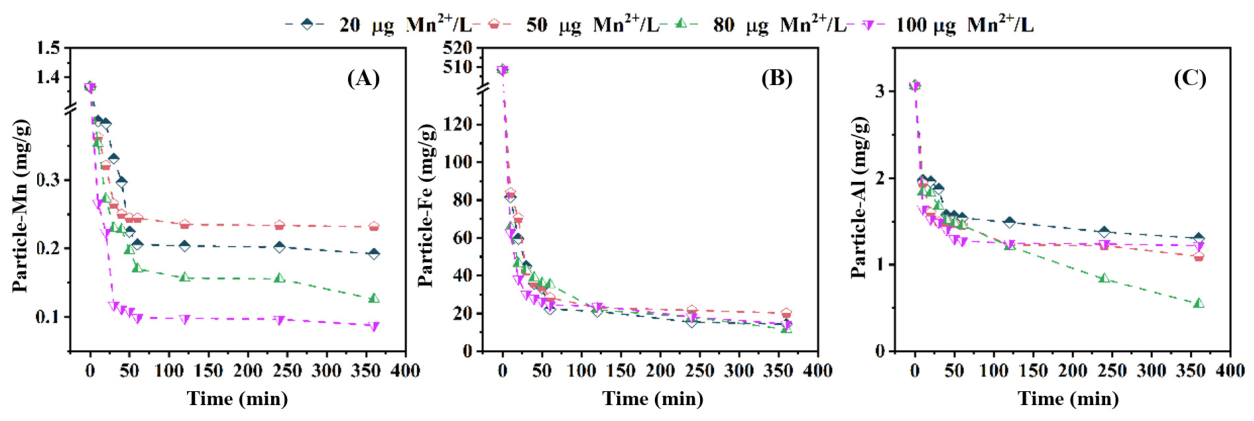
3.4. Effect of Mn2+ Content on the Release Behavior of Pipe Scale Metals
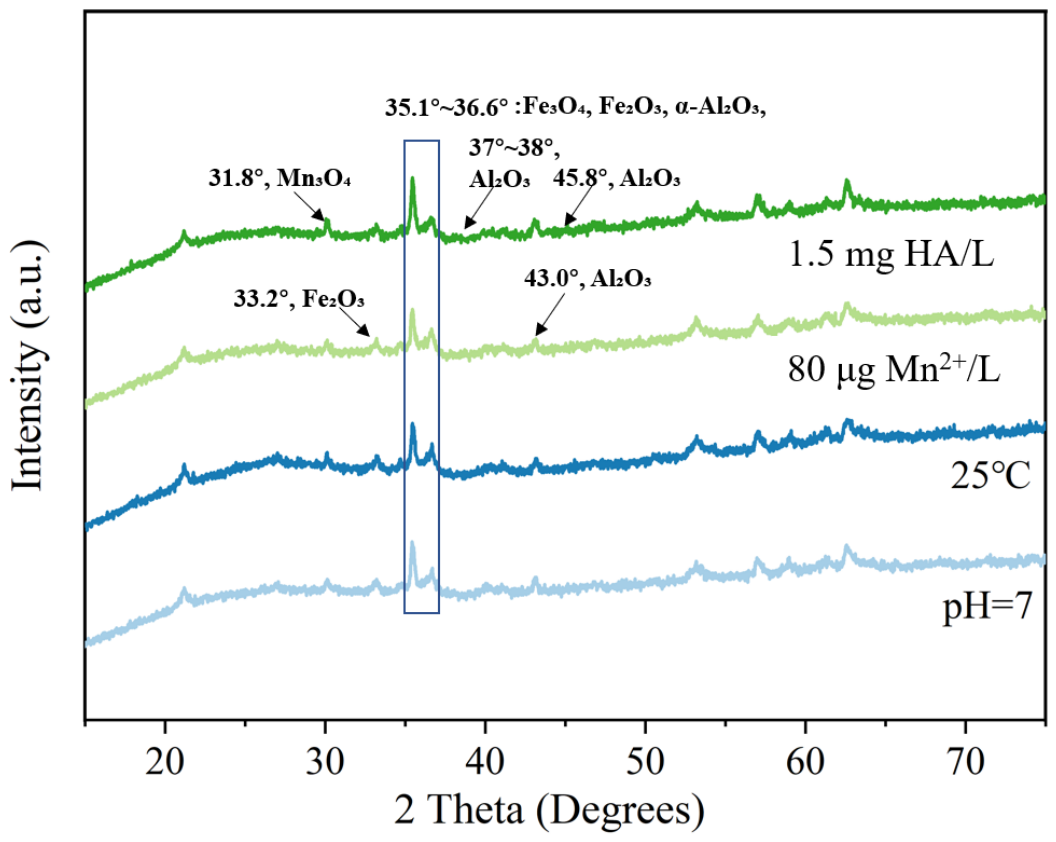
3.5. Changes in Pipe Scale Mineral Morphology Under Different Water Quality Conditions
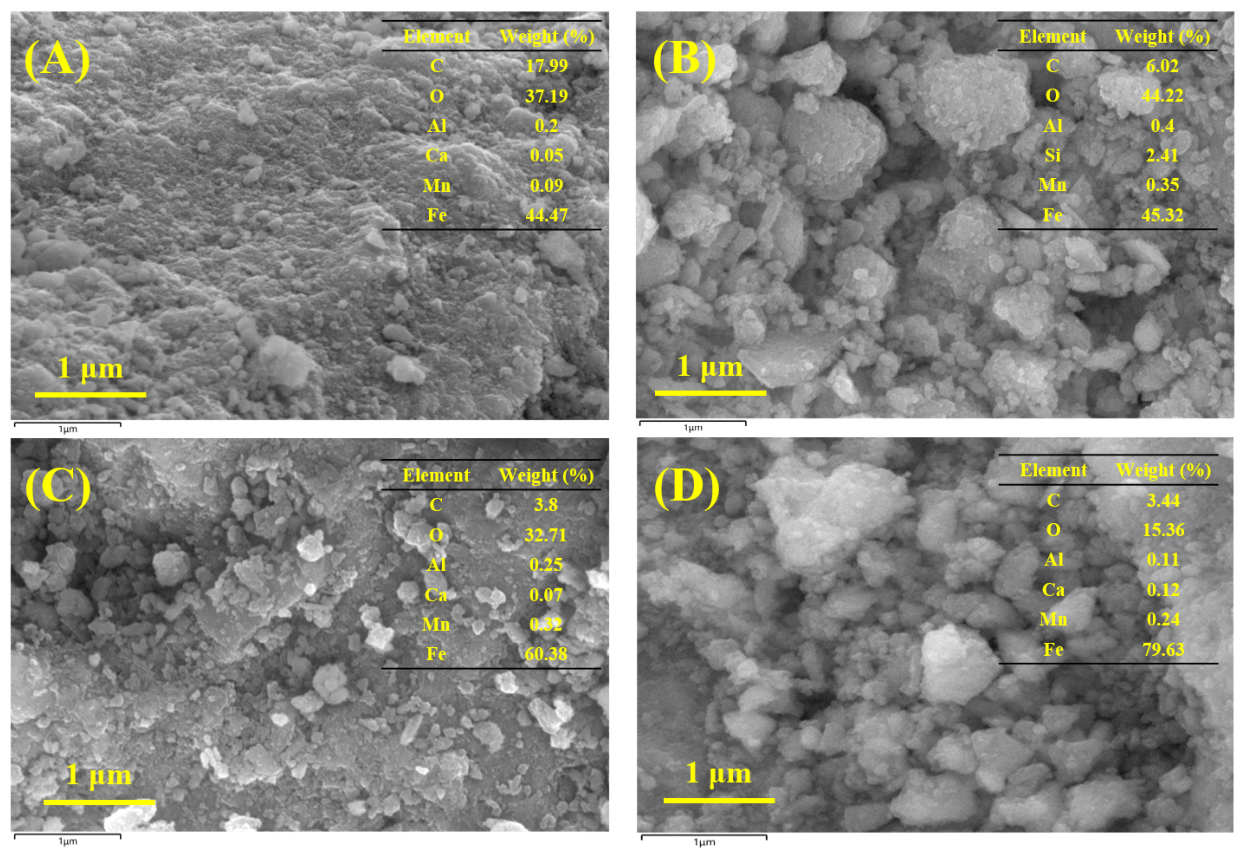
3.6. Changes in Pipe Scale Morphology Under Different Water Quality Conditions
4. Conclusions
- (1)
- Water temperature, pH, HA concentration, and Mn2+ concentration all significantly affect the release and sedimentation behaviors of Fe, Mn, and Al metal particles from aging ductile iron pipe scales. The control effects of each parameter on different metal particles are distinct, and the release and sedimentation processes of metal particles generally follow the first-order kinetic model, which is jointly controlled by diffusion and interfacial reactions.
- (2)
- An increase in water temperature, neutral to slightly alkaline pH, and a high concentration of Mn2+ (80–100 μg/L) are conducive to promoting the aggregation and sedimentation of metal particles; low pH and a low concentration of HA (0.5 mg/L) are prone to causing pipe scale dissolution; a high concentration of HA (1.0–2.0 mg/L) and a low concentration of Mn2+ (20–50 μg/L) will prolong the particle retention time and increase the risk of “yellow water”.
- (3)
- The pipe scales are mainly composed of Fe3O4, Fe2O3, Mn3O4, and Al2O3, with Fe-based oxides as the dominant phases. Water quality parameters alter the micromorphology of pipe scales (dense aggregation, loose flocculent, or dispersed particles) by controlling element complexation, particle aggregation, and crystal growth, thereby affecting the macro release behavior.
- (4)
- Controlling water quality conditions at pH 7.0, temperatures below 30 °C, and reducing HA and Mn2+ concentrations in the effluent can effectively reduce the migration capacity of metal particles in the pipeline network, thereby preventing the “yellow water” problem in the pipeline network.
Supplementary Materials
Author Contributions
Funding
Data Availability Statement
Conflicts of Interest
References
- Sanjuan-Delmás, D.; Petit-Boix, A.; Gasol, C.M.; Villalba, G.; Suárez-Ojeda, M.E.; Gabarrell, X.; Josa, A.; Rieradevall, J. Environmental assessment of different pipelines for drinking water transport and distribution network in small to medium cities: A case from Betanzos, Spain. J. Clean. Prod. 2014, 66, 588–598. [Google Scholar] [CrossRef]
- Liu, X.; Zhang, Y.; Li, X.; Yang, Y.; Liu, D.; Ma, R.; Zhang, S.; Zou, M.; Wu, W. Risk assessment of urban gas pipeline networks considering regional resilience using a DOOBN framework. J. Pipeline Sci. Eng. 2025, 100351. [Google Scholar] [CrossRef]
- Hu, Y.; Li, R.; Bian, K.; Zhou, Q.; Pan, Y.; Ye, L.; Li, A.; Shi, P. Biofilm formation dynamics in long-distance water conveyance pipelines: Impacts of nutrient levels and metal stress. Water Res. 2025, 268, 122672. [Google Scholar] [CrossRef]
- Trajković, I.; Rakin, M.; Milošević, M.; Mitrović, N.; Travica, M.; Sedmak, A.; Medjo, B. Selective laser sintered Pipe Ring Notched Tension specimens for examination of fracture properties of pipeline materials. Eng. Fract. Mech. 2023, 292, 109573. [Google Scholar] [CrossRef]
- Dias, F.G.D.A.; Melo, E.A.; da CP Gomes, A.P.A.; da Costa, M.F.; da CP Gomes, J.A. Identifying sediment composition and microplastic formation in the production water of flexible pipelines. Reg. Stud. Mar. Sci. 2025, 89, 104348. [Google Scholar] [CrossRef]
- Bai, Y.; Xue, S.; Wu, Y.; Wang, H.; Wang, R.; Chang, L.; Chen, Z.; Hu, H. Pipe material significantly affected microbial regrowth and potential risks in reclaimed water distribution systems. J. Hazard. Mater. 2025, 499, 140116. [Google Scholar] [CrossRef] [PubMed]
- Ke, Y.; Sun, W.; Xue, Y.; Yuan, Z.; Zhu, Y.; Chen, X.; Yan, S.; Li, Y.; Xie, S. Pipe material and natural organic matter impact drinking water biofilm microbial community, pathogen profiles and antibiotic resistome deciphered by metagenomics assembly. Environ. Res. 2024, 262, 119964. [Google Scholar] [CrossRef] [PubMed]
- Wood, C.E.; Bauer, C.E.; Breef-Pilz, A.; Lewis, A.S.; Hammond, N.W.; McClure, R.P.; Verne, M.F.; Carey, C.C.; Schreiber, M.E. Preemptive activation of hypolimnetic oxygenation improves control of Fe and Mn in drinking water reservoirs. Water Res. 2026, 288, 124722. [Google Scholar] [CrossRef]
- He, W.; Li, J.; Chen, M.; Sun, H.; Zhang, L.; Lu, Y.; Jia, Y.; Zhang, H. A mathematical model to simulate the release of Fe and Mn from sediments in a drinking water reservoir. Environ. Res. 2023, 238, 117232. [Google Scholar] [CrossRef]
- Kritzberg, E.S.; Hasselquist, E.M.; Škerlep, M.; Löfgren, S.; Olsson, O.; Stadmark, J.; Valinia, S.; Hansson, L.-A.; Laudon, H. Browning of freshwaters: Consequences to ecosystem services, underlying drivers, and potential mitigation measures. AMBIO 2020, 49, 375–390. [Google Scholar] [CrossRef]
- Li, M.J.; Liu, Z.W.; Chen, Y.C.; Hai, Y. Characteristics of iron corrosion scales and water quality variations in drinking water distribution systems of different pipe materials. Water Res. 2016, 106, 593–603. [Google Scholar] [CrossRef]
- Deng, A.; Xie, R.; Gomez, M.; Adin, A.; Ong, C.N.; Hu, J. Impact of pH level and magnesium addition on corrosion of re-mineralized seawater reverse osmosis membrane (SWRO) product water on pipeline materials. Desalination 2014, 351, 171–183. [Google Scholar] [CrossRef]
- Engloner, A.I.; Németh, K. Exploring the combined effects of water temperature and flow on river water quality: Problems with highly variable data sets and possible solutions. Heliyon 2025, 11, e44193. [Google Scholar] [CrossRef]
- Xue, S.; Miao, Z.; Gao, M.; Wan, K. Structural analysis of lignite-derived humic acid and its microscopic interactions with heavy metal ions in aqueous solution. Sci. Total Environ. 2023, 897, 165385. [Google Scholar] [CrossRef]
- Li, G.; Su, Y.; Wu, B.; Chen, Q.; Yu, J.; Yang, M.; Shi, B. Chloramine Prevents Manganese Accumulation in Drinking Water Pipes Compared to Free Chlorine by Simultaneously Inhibiting Abiotic and Biotic Mn(II) Oxidation. Environ. Sci. Technol. 2022, 56, 12278–12287. [Google Scholar] [CrossRef]
- Zhou, X.; Kosaka, K.; Nakanishi, T.; Welfringer, T.; Itoh, S. Manganese accumulation on pipe surface in chlorinated drinking water distribution system: Contributions of physical and chemical pathways. Water Res. 2020, 184, 116201. [Google Scholar] [CrossRef]
- Bae, Y.; Pasteris, J.D.; Giammar, D.E. Impact of orthophosphate on lead release from pipe scale in high pH, low alkalinity water. Water Res. 2020, 177, 115764. [Google Scholar] [CrossRef]
- Ni, R.L.; Chu, X.X.; Liu, R.; Shan, J.L.; Tian, Y.M.; Zhao, W.G. Chromium immobilization and release by pipe scales in drinking water distribution systems: The impact of anions. Sci. Total Environ. 2024, 906, 167600. [Google Scholar] [CrossRef]
- Zhang, H.; Liu, Y.; Wang, L.; Liu, S. Iron release and characteristics of corrosion scales and bacterial communities in drinking water supply pipes of different materials with varied nitrate concentrations. Chemosphere 2022, 301, 134652. [Google Scholar] [CrossRef] [PubMed]
- Li, W.; Song, X.; Wang, Y.; Wen, D.; Zhou, Y.; Zhang, D. Iron-manganese inputs shape the coupling between deposit morphology and microbiome during the early-stage corrosion on cement mortar-lined pipe walls under drinking-water conditions. J. Environ. Manag. 2026, 398, 128468. [Google Scholar] [CrossRef]
- Wang, Y.; Li, P.; Li, L.; Liu, J.; Zheng, T. The phosphorus removal by dewatered-sludge-based flocculants during municipal wastewater treatment process: Parameter optimization and kinetic modelling of adsorption. J. Water Process Eng. 2025, 78, 108697. [Google Scholar] [CrossRef]
- Ramesh, S.B.; Tanubuddi, P.S.; Puttamreddy, S.; Nippatlapalli, N. Investigating adsorption behavior of methylene blue on nonmagnetic slag: An integrated evaluation of isotherm-kinetic frameworks. Chemosphere 2025, 388, 144681. [Google Scholar] [CrossRef]
- Li, G.W.; Zhao, Y.Y.; An, G.Y.; Shi, B.Y. Mn(II) Oxidation by Free Chlorine Catalyzed by the Hydrolytic Products of Ferric and Aluminum Species under Drinking Water Conditions. Environ. Sci. Technol. 2022, 56, 10775–10784. [Google Scholar] [CrossRef]
- Lorenzo, T.; Marco, L. Brownian dynamics simulations of shear-induced aggregation of charged colloidal particles in the presence of hydrodynamic interactions. J. Colloid Interface Sci. 2022, 624, 637–649. [Google Scholar] [CrossRef]
- Pacek, A.W.; Ding, P.; Utomo, A.T. Effect of energy density, pH and temperature on de-aggregation in nano-particles/water suspensions in high shear mixer. Powder Technol. 2007, 173, 203–210. [Google Scholar] [CrossRef]
- Li, G.; Su, Y.; Wu, B.; Han, G.; Yu, J.; Yang, M.; Shi, B. Initial Formation and Accumulation of Manganese Deposits inDrinking Water Pipes: Investigating the Role of Microbial-Mediated Processes. Environ. Sci. Technol. 2022, 56, 5497–5507. [Google Scholar] [CrossRef] [PubMed]
- Sun, J.; Ge, H.; Xu, Y.; Ma, Y.; Shan, S.; Liu, S.; Li, D. Enhanced humic acid removal via floc-based dynamic membrane for high-salinity water treatment. J. Environ. Chem. Eng. 2025, 13, 119795. [Google Scholar] [CrossRef]
- Zhang, H.; Liu, D.; Zhao, L.; Wang, J.; Xie, S.; Liu, S.; Lin, P.; Zhang, X.; Chen, C. Review on corrosion and corrosion scale formation upon unlined cast iron pipes in drinking water distribution systems. J. Environ. Sci. 2022, 117, 173–189. [Google Scholar] [CrossRef]
- Fish, K.E.; Collins, R.; Green, N.H.; Sharpe, R.L.; Douterelo, I.; Osborn, A.M.; Boxall, J.B. Characterisation of the Physical Composition and Microbial Community Structure of Biofilms within a Model Full-Scale Drinking Water Distribution System. PLoS ONE 2015, 10, e0115824. [Google Scholar] [CrossRef]
- Boxall, J.; Blokker, M.; Schaap, P.; Speight, V.; Husband, S. Managing discolouration in drinking water distribution systems by integrating understanding of material behaviour. Water Res. 2023, 243, 120416. [Google Scholar] [CrossRef] [PubMed]



| Particles | Temperature (°C) | K1 (min−1) | R2 | K2 (min−1) | R2 |
|---|---|---|---|---|---|
| Mn | 20 °C | 2.69 × 10⁻² | 0.89 | 16.38 | 0.81 |
| 25 °C | 1.65 × 10⁻² | 0.99 | 2.71 | 0.44 | |
| 30 °C | 2.87 × 10⁻² | 0.94 | 38.58 | 0.36 | |
| 35 °C | 1.09 × 10⁻² | 0.93 | 0.66 | 0.54 | |
| Fe | 20 °C | 1.81 × 10⁻² | 0.91 | 0.67 × 10⁻² | 0.23 |
| 25 °C | 1.52 × 10⁻² | 0.96 | 0.58 × 10⁻² | 0.47 | |
| 30 °C | 2.40 × 10⁻² | 0.98 | 3.15 × 10⁻² | 0.28 | |
| 35 °C | 1.84 × 10⁻² | 0.99 | 1.00 × 10⁻² | 0.32 | |
| Al | 20 °C | 1.47 × 10⁻² | 0.97 | 0.34 | 0.33 |
| 25 °C | 1.62 × 10⁻² | 0.97 | 1.59 | 0.50 | |
| 30 °C | 1.00 × 10⁻² | 0.91 | 0.52 | 0.50 | |
| 35 °C | 2.00 × 10⁻² | 0.92 | 2.27 | 0.16 |
| Particles | pH Value | K1 (min−1) | R2 | K2 (min−1) | R2 |
|---|---|---|---|---|---|
| Mn | Tap Water (6.7) | 1.34 × 10⁻² | 0.97 | 0.89 | 0.90 |
| pH 6.0 | 2.18 × 10⁻² | 0.88 | 6.63 | 0.44 | |
| pH 7.0 | 0.88 × 10⁻² | 0.84 | 0.63 | 0.51 | |
| pH 7.7 | 0.73 × 10⁻² | 0.63 | 0.35 | 0.68 | |
| Fe | Tap Water | 1.56 × 10⁻² | 0.95 | 4.46 × 10⁻³ | 0.20 |
| pH 6.0 | 0.97 × 10⁻² | 0.71 | 1.52 × 10⁻³ | 0.60 | |
| pH 7.0 | 1.68 × 10⁻² | 0.95 | 9.58 × 10⁻³ | 0.20 | |
| pH 7.7 | 0.77 × 10⁻² | 0.77 | 1.10 × 10⁻³ | 0.73 | |
| Al | Tap Water | 0.65 × 10⁻² | 0.97 | 9.77 × 10⁻² | 0.32 |
| pH 6.0 | 1.17 × 10⁻² | 0.85 | 0.19 | 0.74 | |
| pH 7.0 | 2.60 × 10⁻² | 0.97 | 12.81 | 0.30 | |
| pH 7.7 | 1.78 × 10⁻² | 0.93 | 0.80 | 0.26 |
| Particles | HA Concentration | K1 (min−1) | R2 | K2 (min−1) | R2 |
|---|---|---|---|---|---|
| Mn | 0.5 mg HA/L | 0.49 × 10⁻² | 0.88 | 5.71 × 10⁻² | 0.95 |
| 1.0 mg HA/L | 1.61 × 10⁻² | 0.84 | 2.02 | 0.54 | |
| 1.5 mg HA/L | 1.55 × 10⁻² | 0.90 | 2.03 | 0.32 | |
| 2.0 mg HA/L | 1.46 × 10⁻² | 0.94 | 1.22 | 0.32 | |
| Fe | 0.5 mg HA/L | 1.58 × 10⁻² | 0.78 | 4.72 × 10⁻³ | 0.46 |
| 1.0 mg HA/L | 1.01 × 10⁻² | 0.80 | 2.29 × 10⁻³ | 0.46 | |
| 1.5 mg HA/L | 0.79 × 10⁻² | 0.62 | 1.23 × 10⁻³ | 0.60 | |
| 2.0 mg HA/L | 1.01 × 10⁻² | 0.69 | 1.56 × 10⁻³ | 0.52 | |
| Al | 0.5 mg HA/L | 2.24 × 10⁻² | 0.87 | 0.97 | 0.12 |
| 1.0 mg HA/L | 2.14 × 10⁻² | 0.95 | 1.87 | 0.12 | |
| 1.5 mg HA/L | 1.28 × 10⁻² | 0.90 | 0.26 | 0.48 | |
| 2.0 mg HA/L | 0.61 × 10⁻² | 0.80 | 3.03 × 10⁻² | 0.53 |
| Particles | Mn Concentration | K1 (min−1) | R2 | K2 (min−1) | R2 |
|---|---|---|---|---|---|
| Mn | 20 μg Mn2+/L | 1.53 × 10⁻² | 0.61 | 0.95 | 0.85 |
| 50 μg Mn2+/L | 1.81 × 10⁻² | 0.84 | 4.75 | 0.34 | |
| 80 μg Mn2+/L | 0.95 × 10⁻² | 0.71 | 0.30 | 0.42 | |
| 100 μg Mn2+/L | 1.07 × 10⁻² | 0.51 | 0.99 | 0.70 | |
| Fe | 20 μg Mn2+/L | 1.89 × 10⁻² | 0.95 | 8.29 × 10⁻³ | 0.10 |
| 50 μg Mn2+/L | 1.74 × 10⁻² | 0.89 | 5.88 × 10⁻³ | 0.35 | |
| 80 μg Mn2+/L | 1.07 × 10⁻² | 0.97 | 1.30 × 10⁻³ | 0.32 | |
| 100 μg Mn2+/L | 0.94 × 10⁻² | 0.92 | 2.02 × 10⁻³ | 0.51 | |
| Al | 20 μg Mn2+/L | 1.14 × 10⁻² | 0.89 | 0.11 | 0.27 |
| 50 μg Mn2+/L | 0.95 × 10⁻² | 0.81 | 7.04 × 10⁻² | 0.49 | |
| 80 μg Mn2+/L | 0.89 × 10⁻² | 0.96 | 2.59 × 10⁻² | 0.35 | |
| 100 μg Mn2+/L | 1.56 × 10⁻² | 0.80 | 0.52 | 0.89 |
Disclaimer/Publisher’s Note: The statements, opinions and data contained in all publications are solely those of the individual author(s) and contributor(s) and not of MDPI and/or the editor(s). MDPI and/or the editor(s) disclaim responsibility for any injury to people or property resulting from any ideas, methods, instructions or products referred to in the content. |
© 2026 by the authors. Licensee MDPI, Basel, Switzerland. This article is an open access article distributed under the terms and conditions of the Creative Commons Attribution (CC BY) license.
Share and Cite
Chang, Y.; Fang, M.; Lu, Q.; Zhang, D.; Li, W. Mechanisms of Metal Particle Release from Pipe Scales in Ductile Iron Water Supply Pipelines: Control by Water Quality Parameters. Water 2026, 18, 1101. https://doi.org/10.3390/w18091101
Chang Y, Fang M, Lu Q, Zhang D, Li W. Mechanisms of Metal Particle Release from Pipe Scales in Ductile Iron Water Supply Pipelines: Control by Water Quality Parameters. Water. 2026; 18(9):1101. https://doi.org/10.3390/w18091101
Chicago/Turabian StyleChang, Yu, Menghao Fang, Qing Lu, Dawei Zhang, and Weiying Li. 2026. "Mechanisms of Metal Particle Release from Pipe Scales in Ductile Iron Water Supply Pipelines: Control by Water Quality Parameters" Water 18, no. 9: 1101. https://doi.org/10.3390/w18091101
APA StyleChang, Y., Fang, M., Lu, Q., Zhang, D., & Li, W. (2026). Mechanisms of Metal Particle Release from Pipe Scales in Ductile Iron Water Supply Pipelines: Control by Water Quality Parameters. Water, 18(9), 1101. https://doi.org/10.3390/w18091101