1. Introduction
The progressive degradation of clay soils subjected to alternating wetting and drying cycles is one of the most relevant mechanisms controlling the loss of stability in near-surface slopes, particularly in expansive materials [
1,
2,
3]. In these soils, cyclic variations in water content induce volumetric changes, cracking, structural deterioration, and shear strength reduction, thereby promoting shallow failure mechanisms and the reactivation of pre-existing landslides [
4,
5]. Although this behavior has long been recognized in geotechnical engineering, an important methodological limitation remains: reproducing degraded states in the laboratory through multiple wet–dry cycles requires long testing times, strict experimental control, and considerable resources, which restricts its systematic application in slope stability studies [
6,
7].
From a mechanical standpoint, degradation induced by wetting and drying does not necessarily manifest as a uniform reduction in all strength parameters. In many clayey soils, strength loss is primarily associated with a marked decrease in effective cohesion, whereas the friction angle may exhibit only minor variations or follow nonlinear trends depending on the degree of structural alteration and the stress range considered [
6,
8]. This feature complicates comparisons among degraded states, because two different combinations of strength parameters may still produce similar stability responses when evaluated under stress conditions representative of the actual problem. Consequently, equivalence between degraded states should not be judged solely by the proximity between c′ and φ′, but rather by the overall system response expressed in terms of safety factor and failure mechanism.
In this context, Fully Softened Strength (
FSS) represents a conceptually attractive alternative for approximating advanced degraded states in clays [
9,
10]. The
FSS approach allows the material to be prepared in a reconstituted and highly softened condition, thereby avoiding the need to carry out complete wet–dry sequences [
11,
12,
13]. However, its use as an experimental substitute for degraded states obtained after several cycles cannot be assumed a priori. Agreement observed at a single test water content may simply reflect a case-specific coincidence rather than a reproducible relationship with a sound physical basis. To date, no study has systematically evaluated whether
FSS can reproduce the overall slope-stability response, rather than isolated shear-strength parameters, across a broad water-content domain using heterogeneous slope models with variable crack depths. Therefore, the problem is not merely to verify whether a given
FSS condition reproduces a reference case, but to determine whether a robust domain of water contents exists within which the stability response consistently converges toward that produced by cyclic degradation [
10,
12,
14].
This knowledge gap is particularly relevant for expansive clay slopes, where the depth of the fissured zone, the vertical distribution of degraded material, and the presence of suspended groundwater strongly influence the location and shape of the critical failure surface [
15,
16,
17,
18]. Changes in hydraulic properties induced by cyclic moisture variations further modulate this response [
19]. Under such conditions, degradation is generally concentrated in the near-surface layer, whereas the underlying material retains relatively higher strength. Consequently, the equivalence between
FSS and wet–dry cycles should be evaluated in terms of heterogeneous slope stability under representative shallow failure conditions, taking into account both crack depth and the possible influence of the water table on the system response [
20,
21].
Based on this framework, the present study proposes that
FSS may constitute a viable experimental substitute for five wet–dry cycles, provided that its validity is assessed using three complementary criteria: quantitative similarity of the stability response, physical consistency of the equivalent water content, and correspondence with the actual domain of shallow failures in expansive clays. The novelty of this work lies in transforming an isolated point-of-agreement approach into a systematic equivalence evaluation: the comparison is extended to fourteen water contents using heterogeneous slope models, a multi-criteria quantification framework based on
RMSE and prediction bias, and a sensitivity analysis with respect to normal stress level that defines the applicability domain of the method. The central hypothesis is that the equivalence between
FSS and five wet–dry cycles depends not on direct equality of strength parameters, but on convergence in the overall system response under shallow failure conditions—and that this equivalence is restricted to normal stress ranges compatible with actual shallow failure depths [
13,
15,
17].
Accordingly, the objective of this study is to evaluate the capability of FSS to serve as an experimental substitute for five wet–dry cycles in representing degraded states relevant to shallow slope stability in expansive clays. Shear strength parameters and slope stability response are compared under homogeneous and heterogeneous configurations, considering variable crack depths and suspended water table conditions. The equivalent water content that best reproduces the five-cycle response is identified, and the applicability range of the method is defined through sensitivity analysis with respect to normal stress level.
2. Materials and Methods
2.1. Soil Characterization and Methodological Design
The studied material is an expansive clay representative of the active moisture-variation zone in which shallow failures commonly develop. For its characterization, disturbed and undisturbed samples were collected at depths between 2.0 and 3.0 m. The tested material corresponded to expansive clay obtained from the Hefei River Diversion Project, K41+600, China, at a sampling depth of 2.0–3.0 m. During the visual–manual description, the material exhibited a dark gray to black color and a stiff plastic consistency, features consistent with a fine-grained cohesive soil sensitive to moisture changes.
As indicated in
Table 1, the physical characterization of the soil included the determination of natural water content, natural density, specific gravity, Atterberg limits, and void ratio. The tests were performed in accordance with standard procedures, including ASTM D2216 for water content, ASTM D7263 for natural density, ASTM D854 for specific gravity, and ASTM D4318 for Atterberg limits. In addition, the free expansion rate was evaluated according to the GB/T 50123 standard. The measured values were as follows: natural water content of 24%, natural density of 1.92 g/cm
3, specific gravity of 2.72, liquid limit of 42%, plastic limit of 19%, plasticity index of 23, and initial void ratio of 0.70. The free expansion rate was 60%, indicating a pronounced expansive response of the material.
According to the Unified Soil Classification System (USCS), the values of liquid limit and plasticity index classify the material as CL, that is, an inorganic clay of low to medium plasticity, in accordance with ASTM D2487. This classification does not contradict its expansive behavior, since swelling susceptibility does not depend solely on the position of the soil on the plasticity chart, but also on its response to water ingress and its mineralogical composition [
1,
3]. In this case, the previously reported mineralogy of this material includes montmorillonite and illite, which are associated with high water affinity and significant swelling potential, as well as kaolinite in smaller proportions. Accordingly, the behavior of the soil is interpreted based on the combined effects of plasticity, free expansion, and reported mineralogy.
Overall, the measured properties indicate that this is a fine-grained cohesive soil with marked sensitivity to moisture variation, surface cracking, and progressive degradation of shear strength. The plasticity index of 23 reflects an active clay fraction, whereas the free expansion rate of 60% confirms a significant volumetric response to water. Likewise, the difference between the natural water content of 24% and the liquid limit of 42% indicates that the material is in an unsaturated condition in its natural state, which favors its susceptibility to wetting, drying, and progressive softening. These characteristics justify the selection of this soil to evaluate degradation mechanisms relevant to shallow slope stability.
Based on these properties, a comparative methodological framework was developed to evaluate whether the Fully Softened Strength (FSS) condition can act as an experimental substitute for the degraded state induced by five wet–dry cycles in the analysis of shallow slope stability in expansive clays. The approach was designed to compare not only the shear strength parameters obtained from both experimental routes, but more importantly the overall system response in terms of safety factor, crack depth, and hydraulic condition.
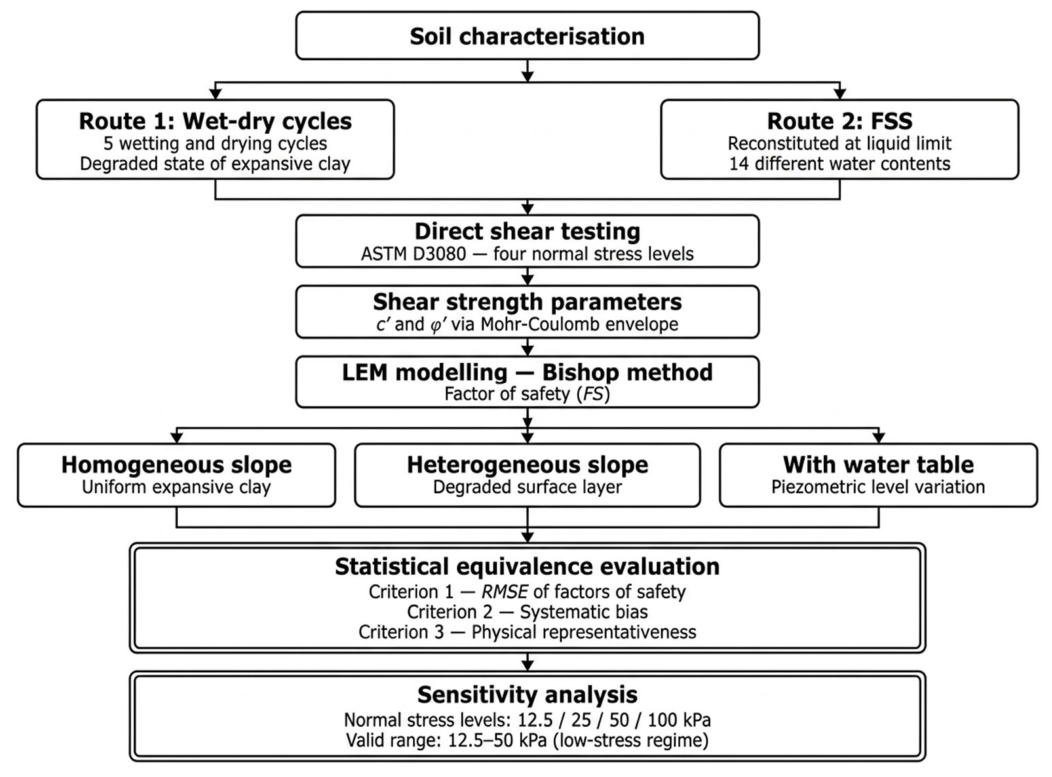
As shown in
Figure 1, the study was conducted through an integrated sequence comprising: (i) soil characterization; (ii) generation of two degraded states through different experimental routes; (iii) determination of strength parameters by direct shear testing; (iv) incorporation of these parameters into slope stability models using limit equilibrium analysis; and (v) evaluation of equivalence based on quantitative and physical criteria. The first experimental route corresponded to the reference degraded state obtained after five wet–dry cycles, whereas the second consisted of preparing the soil under
FSS conditions at fourteen experimentally established water contents.
Both routes fed the slope stability analysis, allowing the results to be compared from the standpoint of global mechanical behavior rather than solely from direct similarity between cohesion and friction angle. The comparison was quantified using the root mean square error (RMSE) and mean prediction bias, whereas the physical validity of the fit was interpreted based on the representativeness of the failure mechanism considered. Finally, a sensitivity analysis with respect to the normal stress level applied in the FSS tests was incorporated in order to define the applicability range of the method and distinguish among shallow, intermediate, and deep failure conditions.
Additional laboratory equipment identification records used during material characterization and preparation are provided in the supplementary dataset, including the Soiltest, Inc. unit model D-114 (Serial No. 671, Evanston, IL, USA) (Refer to Supplementary data,
https://doi.org/10.5281/zenodo.19229323).
2.2. Experimental Protocol of Five Wet–Dry Cycles
In order to reproduce in the laboratory, the progressive structural degradation induced by cyclic moisture variations, the soil was subjected to a controlled protocol of five wet–dry cycles. This experimental route was adopted as the reference degraded condition because it explicitly represents the cumulative loss of strength experienced by expansive clays when exposed to repeated alternations of wetting and drying [
7,
8,
10,
22]. In the present study, this reference condition was used to subsequently assess the ability of Fully Softened Strength (
FSS) to reproduce an equivalent system response.
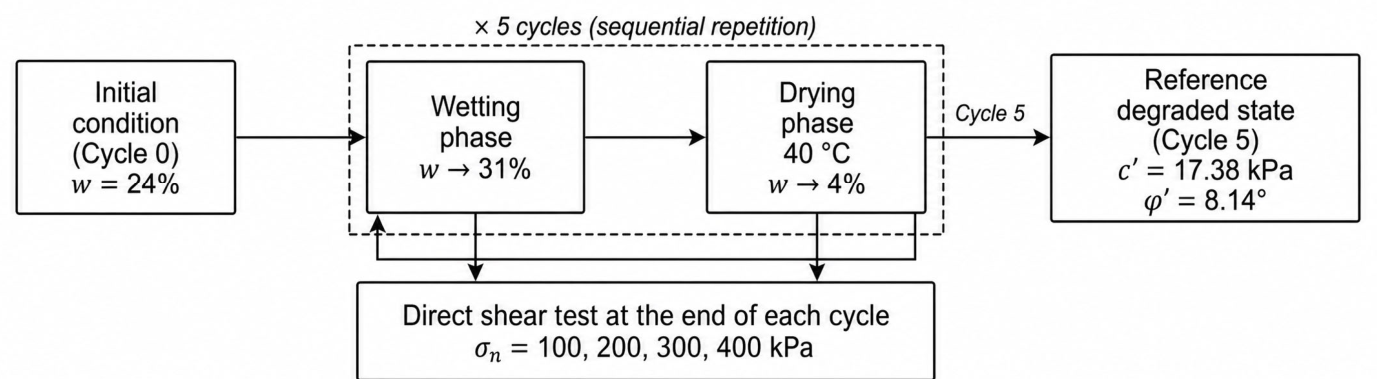
As shown in
Figure 2, each experimental cycle consisted of a wetting phase followed by a drying phase. The procedure began with the soil in its natural condition, with a gravimetric water content of approximately 24%, corresponding to the value obtained during material characterization. From this condition, the samples were wetted until reaching a maximum water content of approximately 31%, corresponding to a degree of saturation close to 95% and representing an extreme wetting condition rather than full saturation. The samples were then oven-dried at 40 °C until their water content was reduced to 4%.
To promote uniform wetting, the specimens were arranged in a laboratory-assembled stacked saturating device consisting of porous stone, filter paper, soil specimen, filter paper, and porous stone. The stacked system was clamped together for soaking and placed in a vacuum cylinder for 1–12 h during saturation. Saturation was continued until the degree of saturation was close to 95%.
The water-content limits adopted in the protocol were selected to represent a broad yet physically plausible range of moisture variation for the material. The drying temperature of 40 °C was chosen to avoid excessive thermal alteration of the soil microstructure and mineralogy, while still representing severe drying conditions. Likewise, the minimum water content of 4% was considered compatible with shrinkage and surface cracking in active clays. Overall, this experimental range made it possible to induce a sufficiently severe cyclic degradation process to evaluate the evolution of the mechanical behavior of the material.
The protocol was applied sequentially until five complete cycles had been completed. Before the treatment began, an initial reference condition, designated as cycle 0, was defined, corresponding to the soil with no prior wetting–drying exposure. At the end of each complete cycle, the material was subjected to direct shear testing in order to determine the evolution of its strength parameters. This strategy made it possible to track progressive degradation throughout the treatment rather than only in the final state, which was essential for selecting the fifth cycle as the comparison condition against the FSS approach.
Unlike the FSS procedure, which directly induces a reconstituted and highly softened state, the five-cycle protocol produces strength loss through a sequential process of expansion, contraction, particle rearrangement, and progressive deterioration of the initial soil structure. Accordingly, the state reached at the end of the fifth cycle was considered in this study to be the reference degraded condition representative of the alteration induced by repeated exposure to moisture variation.
The direct shear tests associated with this experimental route were performed at the end of each cycle using normal stresses of 100, 200, 300, and 400 kPa. This loading range was adopted to construct consistent strength envelopes within the Mohr–Coulomb framework and to track the evolution of effective cohesion and friction angle as cyclic degradation progressed. The detailed direct shear testing procedure and the processing of strength parameters are presented in the corresponding subsection; at this stage, the emphasis is placed exclusively on the controlled generation of the degraded state through the wet–dry sequence.
Although the major degradation trend had already been reached by cycle 3, five cycles were adopted as the reference degraded state because they ensured that the post-degradation response had entered a quasi-stationary regime, with only marginal additional changes in c′, φ′, and FS. In this sense, five cycles were not assumed a priori as the unique representative condition, but selected as a conservative stabilized reference state based on the observed attenuation pattern.
2.3. FSS Sample Preparation for Fourteen Water Contents
In order to evaluate the ability of the Fully Softened Strength (
FSS) condition to reproduce the reference degraded state obtained after five wet–dry cycles, a set of reconstituted samples was prepared over an extended domain of fourteen water contents experimentally determined in the laboratory. Unlike the protocol described in
Section 2.2, in which soil weakening was generated through a cyclic wetting–drying path, the
FSS approach aimed to directly reproduce a highly softened and structurally reconstituted state of the material [
10,
11,
12,
13,
14,
15,
22].
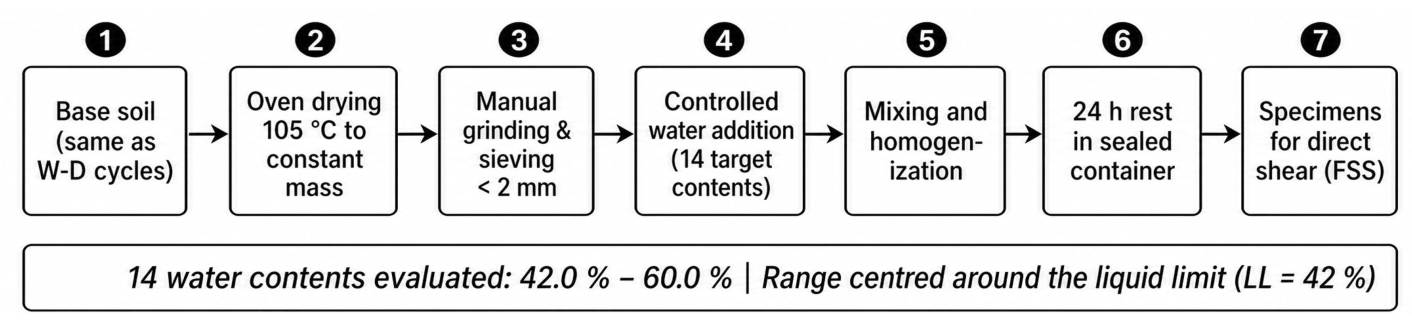
As shown in
Figure 3, the
FSS samples were prepared using the same base soil employed in the wet–dry cycle protocol. The material was first oven-dried at 105 °C to constant mass in order to remove natural water and establish a homogeneous initial condition for subsequent water addition. The dry soil was then manually crushed and sieved through a 2 mm mesh in order to remove the remaining natural structure and obtain a fine mass suitable for controlled reconstitution.
Once the dry soil had been homogenized, distilled water was added in pre-calculated amounts to reach each target water content. The experimental domain was centered around the liquid limit and extended toward higher values in order to examine the evolution of the FSS response over a sufficiently wide softening range. This domain included a water content of 50%, previously used as the baseline comparison case, together with thirteen additional values.
After water addition, each mixture was manually kneaded until a visually uniform distribution of moisture was achieved. The prepared material was then placed in airtight containers and allowed to rest for 24 h in order to promote internal redistribution of water and reduce local gradients prior to specimen preparation. It is important to note that the
FSS preparation does not aim to replicate the degradation pathway of wet–dry cycling, but rather to reproduce the final mechanical state of structural loss resulting from repeated wetting and drying exposure. This distinction between process equivalence and state equivalence is central to the study: as established by Skempton [
17] and Castellanos et al. [
13],
FSS represents the normally consolidated state from slurry, which constitutes the limiting structural condition toward which cyclic degradation progressively converges. Accordingly, the deliberate destruction of the original soil structure during oven-drying, crushing, and sieving should not be interpreted as a methodological weakness, but as a requirement of the
FSS concept itself, which seeks to reproduce a fully softened end state rather than the in situ degradation pathway.
The resulting samples were subsequently used in direct shear tests to determine shear strength parameters and to identify the equivalent water content capable of reproducing, with greater fidelity, the response of the degraded state obtained after five wet–dry cycles.
2.4. Direct Shear Test and Determination of Strength Parameters
The shear strength of the soil was determined by means of direct shear tests, from which the strength parameters required for the subsequent slope stability analysis were obtained. This test was selected because it allows construction of the material strength envelope over different normal stress levels and is applicable both to samples degraded by wet–dry cycles and to specimens reconstituted under Fully Softened Strength (
FSS) conditions. In the present study, this procedure constituted the experimental basis for deriving the strength parameter pairs subsequently used in limit equilibrium modeling [
15,
16].
As shown in
Figure 4, the tests were performed on samples derived from the two experimental routes described in
Section 2.2 and
Section 2.3. In the first route, corresponding to the five wet–dry cycle protocol, the material was tested at the end of each cycle in order to track the progressive evolution of shear strength and define the reference degraded state. In the second route, corresponding to the
FSS condition, the reconstituted samples were tested at each of the fourteen water contents experimentally established in the laboratory. In both cases, the test provided the strength parameters later incorporated into the stability analyses.
Direct shear tests were performed using a Soiltest D-114 direct shear unit (Serial No. 671, Soiltest, Inc., Evanston, IL, USA). All tests were conducted at a constant shearing rate of 0.8 mm/min in accordance with ASTM D3080.
Table 2 summarizes the test conditions applied to each experimental route. In the wet–dry cycle route, normal stresses of 100, 200, 300, and 400 kPa were used to construct consistent Mohr–Coulomb envelopes and track the evolution of strength parameters as cyclic degradation progressed. Specimens were tested at the end-of-cycle water-content state without additional wetting or drying. In the
FSS route, the baseline case was evaluated under normal stresses of 12.5, 25, 37.5, and 50 kPa, selected because they are representative of shallow-failure stress conditions in expansive clay slopes. The water content at testing corresponded to the gravimetrically verified target value established during specimen preparation (±0.5%).
For the sensitivity analysis, two additional normal stress levels were applied to the FSS route: an intermediate level of 50, 100, 150, and 200 kPa, and a high level of 100, 200, 300, and 400 kPa, coinciding with the wet–dry cycle range. This extension made it possible to examine the influence of normal stress level on the equivalence between both experimental routes and to distinguish among representative shallow, intermediate, and deep failure conditions.
During each test, the relationship between shear stress and horizontal displacement under the applied normal stress was recorded. From these curves, the shear strength corresponding to each load level was determined and, subsequently, the strength envelope of the material was constructed within the Mohr–Coulomb framework, expressed as:
where
τf is the shear strength at the moment of failure,
c′ is the effective cohesion,
σn is the applied normal pressure and
φ′ is the effective friction angle. Based on the linear adjustment of the shear strength as a function of normal pressure, the values of
c′ and
φ′ corresponding to each wet–dry cycle and to each water content tested in the
FSS condition were obtained.
The purpose of deriving the strength parameters was not to establish a direct parameter-by-parameter equivalence between the two experimental routes. Instead, these parameters were used as inputs to evaluate whether two distinct mechanical states could lead to an equivalent system response in terms of slope stability. This distinction made it possible to assess, first, which FSS water content best reproduces the response of the degraded state obtained after five cycles and, second, under which normal stress range this equivalence can be considered physically representative and mechanically consistent.
2.5. Slope Stability Analysis by Limit Equilibrium and Equivalence Criteria
The shear strength parameters obtained from the direct shear tests were incorporated into a slope stability analysis using the Limit Equilibrium Method (LEM). In this study, Bishop’s simplified method was adopted due to its wide acceptance for circular failure surfaces in fine-grained soils and its ability to evaluate the combined contribution of cohesion, friction, and pore pressure [
23,
24]. The analysis was formulated in terms of the factor of safety (
FS), defined as the ratio between the available resistance along the potential failure surface and the mobilizing forces. Modeling was carried out in LEM software using a two-dimensional model with the Mohr–Coulomb failure criterion; material properties were defined by unit weight, cohesion, and friction angle. For representative scenarios, results were cross-verified using the Strength Reduction Method (SRM), confirming the consistency of the
FS values and critical surface locations obtained with the LEM approach. Entry and exit positions for the critical surface search were established at the slope crest and toe, respectively; in hydraulic scenarios, pore pressure was represented by a piezometric line.
Circular failure surfaces were considered appropriate for the present study because the objective was to evaluate comparative response consistency across a fixed geometry and parameterization framework, rather than to exhaustively identify all possible failure mechanisms. In the representative cases cross-verified using SRM, the critical zones and safety levels remained consistent with the LEM results, and no evidence of a more critical non-circular mechanism was observed. Therefore, Bishop’s simplified method was considered suitable for the comparative equivalence analysis performed here.
As shown in
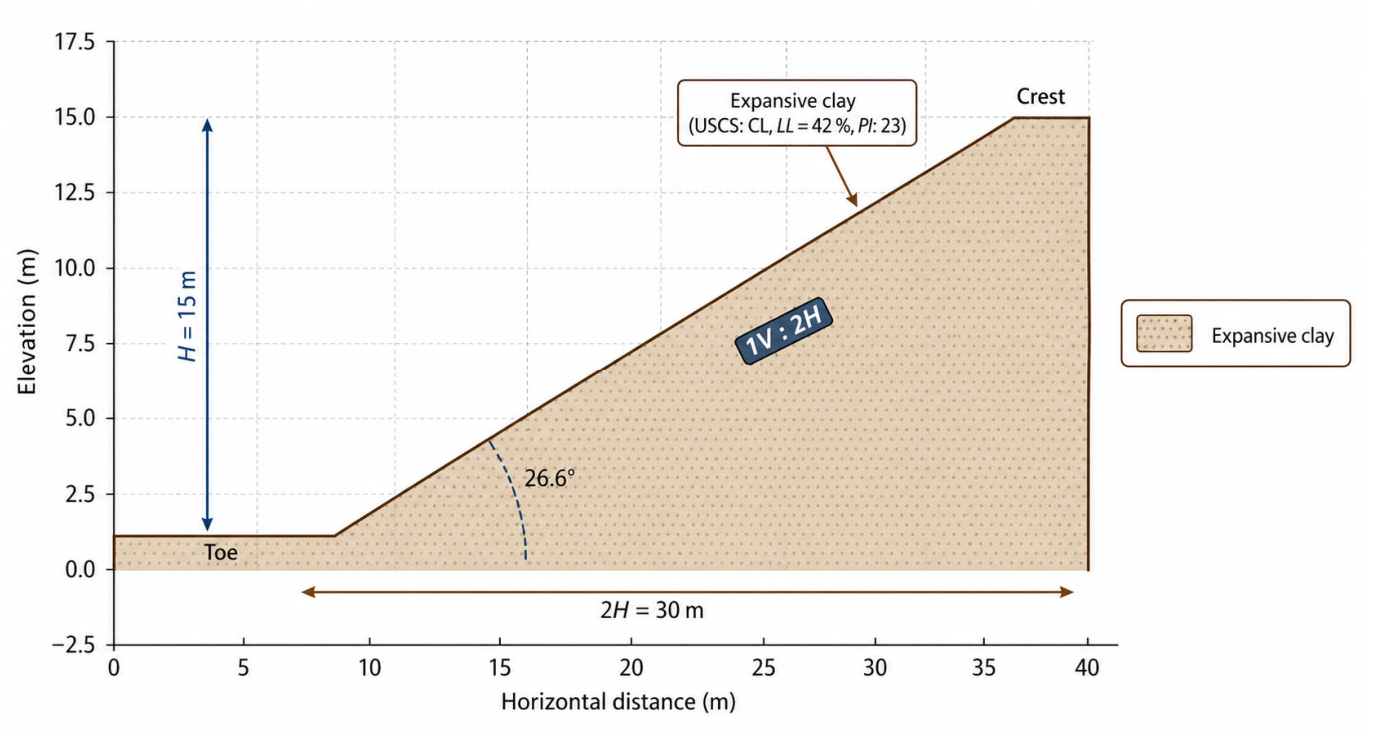
Figure 5, a slope model with a 15 m high slope face and a 1V:2H inclination was adopted within a two-dimensional domain 60 m wide and 25 m high. This configuration was used consistently in all analyzed scenarios in order to isolate the effect of material degradation, water content, and normal stress level, thereby preventing geometric variations from introducing additional dispersion into the interpretation of the results. Slope stability was evaluated considering circular failure surfaces and discretization into slices, according to the classical formulation of Bishop’s method.
The factor of safety was calculated using the iterative formulation of Bishop’s simplified method, in which the resistance mobilized in each slice depends on effective cohesion, effective friction angle, effective normal stress, and the self-weight of the material. The procedure was applied uniformly to all scenarios so that the differences observed between cases reflected only the soil parameters and the imposed hydraulic conditions, rather than changes in the calculation model.
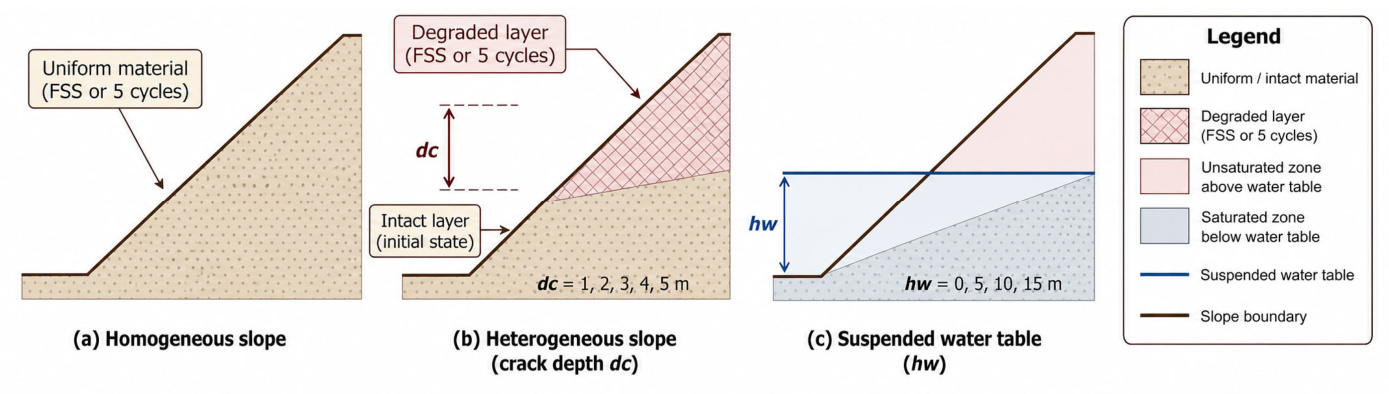
To transfer the experimental results to the geotechnical problem, two main slope representations were considered. The first corresponded to a homogeneous model, in which the entire slope mass was assigned a single set of strength parameters, either those derived from the degraded state after five wet–dry cycles or those obtained under the FSS condition for each evaluated water content. This scenario was included for exploratory purposes to examine the overall system response when degradation is assumed to be uniformly distributed throughout the slope mass.
The second representation corresponded to a heterogeneous model, considered the main configuration of the study because it is more consistent with the actual behavior of expansive clays subjected to surface degradation. In this case, the slope was idealized as two mechanically differentiated layers: a degraded upper layer, represented using the parameters obtained from the five-cycle state or from each
FSS condition, and a non-degraded lower layer, represented using the soil parameters in their initial condition. In this way, the model simulated a situation in which strength loss is concentrated in the active moisture-variation zone, while the underlying material retains greater structural integrity. It is acknowledged that in the field the transition between degraded and intact material is gradual rather than abrupt; however, the bi-layer idealization adopted here is a widely accepted conservative simplification for this class of problem [
24,
25], and its influence on equivalence evaluation is addressed in the Discussion.
Within the heterogeneous model, the depth of the degraded zone was parameterized by the variable
dc defined as the crack depth or thickness of the weakened surface layer. It is important to distinguish this model parameter from the sampling depth (2.0–3.0 m), which refers to the collection depth of the soil specimens:
dc represents a geometric descriptor of the degradation state in the slope model, not the depth from which the material was retrieved; soil collected at 2.0–3.0 m is representative of the active zone, and the degraded layer may extend from the surface to any depth within that active zone. As shown in
Figure 6, values of
dc = 1, 2, 3, 4, and 5 m were analyzed to represent progressive stages of surface degradation, ranging from scenarios dominated by the intact slope mass to scenarios where the degraded layer controls the location of the critical failure surface [
23,
24]. It is further noted that crack depth constitutes the primary geometric parameter controlling slope instability in expansive clays; crack spacing, aperture, and spatial distribution are additional descriptors that, while acknowledged as potentially influential, lie outside the scope of this parametric analysis and are identified as avenues for future work.
In addition to the contrast between homogeneous and heterogeneous models, an analysis of the effect of the hydraulic condition was incorporated through the introduction of a suspended water table. For this stage, the degraded depth was set at
dc = 4 m, as it was considered a representative condition within the transition to states close to instability. From this configuration, the water table was varied in four positions: 0, 5, 10 and 15 m, measured vertically from the base of the slope. This procedure allowed us to examine the sensitivity of the equivalence between
FSS and five cycles to the progressive increase in pore pressure and the reduction in effective stresses in the critical zone [
20,
21,
25]. The water table was analyzed in the range 0–15 m; for presentation purposes in the main text, the representative positions 0, 5, 10 and 15 m are highlighted.
In all scenarios, the strength parameters derived from the direct shear tests were directly assigned to the materials in the model. In the case of the five-cycle analysis, the parameters corresponding to the reference degraded state defined at the end of the cyclic treatment were used, while in the FSS route the parameters obtained for each of the fourteen water contents tested were used. This strategy allowed for construction of a family of FS–dc curves for the FSS condition and subsequent comparison of them with the reference curve derived from five cycles. The comparison was not limited to point values of the factor of safety, but instead considered the complete trajectory of the system response as degraded depth increased.
The equivalence between the Fully Softened Strength (
FSS) condition and the degraded state induced by five wet–dry cycles was formulated as a problem of comparing system response, rather than as a search for direct equality between the strength parameters (
c′,
φ′). This distinction was essential because both experimental routes generate mechanical states with different combinations of effective cohesion and friction angle, yet may still produce similar slope stability responses [
13,
15,
17]. Consequently, equivalence was assessed from the similarity between factor-of-safety curves as a function of crack depth, rather than from the simple proximity between strength parameters.
Although the wet–dry and FSS routes were initially characterized under different normal stress ranges, the comparison was considered mechanically meaningful because the objective of the study was not to establish full envelope equivalence over a common confinement domain, but to evaluate whether both routes could reproduce the same integrated slope-stability response within the shallow-failure stress regime actually mobilized in the field. The low-stress FSS range (12.5–50 kPa) was selected to represent the effective confinement associated with shallow failures of approximately 1–4 m, whereas the higher range used in the wet–dry route was retained to experimentally track degradation across the full cycle sequence. The subsequent sensitivity analysis was introduced precisely to test whether the apparent equivalence remained valid outside the shallow confinement domain. The observed deterioration of equivalence at medium and high stress levels confirms that the proposed substitution is valid only as a shallow-failure response equivalence, not as a general envelope equivalence across all confinement conditions.
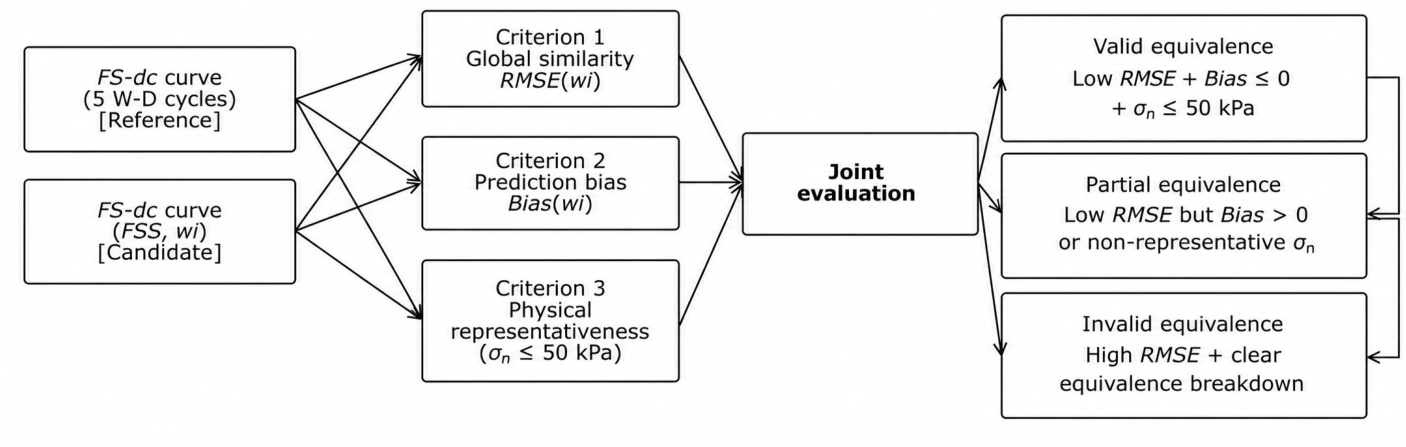
For this purpose, the curve obtained with the degraded state of five wet–dry cycles was adopted as an experimental reference of the system, while each of the curves generated with the FSS condition for the different water contents was treated as a candidate approximation. If the safety factor calculated for the five-cycle condition at the crack depth dcj is denoted by FS5c(dcj), and FSFSS(wi, dcj) denotes the safety factor obtained for the FSS condition with water content wi at the same depth, then the comparison between the two routes is made on the discrete set of depths dcj = 1, 2, 3, 4 and 5 m.
As shown in
Figure 7, the equivalence analysis was structured in three complementary criteria: global similarity of the curve, systematic prediction bias, and physical representativeness of the failure scenario. The first criterion corresponded to the root mean square error (
RMSE), defined for each water content
wi as:
where
n represents the number of crack depths evaluated. This indicator made it possible to measure the average distance between both response trajectories and, therefore, to identify the
FSS condition that best reproduced the stability curve of the degraded state for five cycles. In the present study, this magnitude was also defined as the objective function
J(wi), used to identify the equivalent water content
weq:
Under this formulation, the equivalent water content was defined as that which minimizes the overall error between the FS-dc curve obtained with FSS and the reference curve associated with five cycles.
The second criterion corresponded to the mean prediction bias, introduced in order to determine whether a given
FSS condition tended to systematically overestimate or underestimate stability with respect to the five-cycle reference. This indicator was calculated as:
A positive bias indicated overestimation of stability, whereas a negative bias indicated a conservative prediction relative to the reference. This criterion was particularly important for distinguishing between approximations with low global error and apparently favorable approximations resulting from error cancellation among different crack depths.
The third criterion corresponded to the physical representativeness of the failure scenario. In this work, the comparison between FSS and five cycles focused on shallow failures associated with expansive clays; therefore, the base level of normal pressures applied in the FSS condition was 12.5–50 kPa, representative of failure depths of the order of 1–4 m. Medium and high normal pressure levels were incorporated only as part of the sensitivity analysis, in order to examine whether the equivalence observed under low loads was maintained or deteriorated when moving to higher confinement conditions. Thus, the validity of equivalence was not defined solely by the minimum RMSE, but by the convergence of three simultaneous conditions: global proximity of the curve, absence of dangerous systematic bias, and physical consistency with the actual shallow-failure mechanism.
Based on the above, equivalence between FSS and five cycles was interpreted as valid when an FSS condition simultaneously exhibited a reduced RMSE relative to the reference curve, a null or negative bias, and correspondence with the range of normal stresses representative of shallow failures. By contrast, conditions showing an apparently favorable RMSE, but accompanied by systematic overestimation or associated with non-representative load levels, were interpreted as spurious fits or as having limited applicability. In this way, the adopted criterion made it possible to distinguish between purely numerical similarity and mechanically consistent equivalence.
2.6. Sensitivity Analysis with Respect to Normal Stress Level
In order to define the applicability range of the Fully Softened Strength (
FSS) condition as an experimental substitute for the degraded state induced by five wet–dry cycles, a sensitivity analysis was performed with respect to the normal stress level applied in the direct shear tests. The need for this analysis arises from the fact that the two experimental routes were not originally evaluated under the same range of normal stresses: whereas the five-cycle condition was characterized under pressures of 100, 200, 300, and 400 kPa, the baseline
FSS condition was evaluated under significantly lower loads of 12.5, 25, 37.5, and 50 kPa, representative of shallow failures. Consequently, it was necessary to examine whether the observed equivalence between the two routes remained valid when the confinement level applied to the
FSS condition was modified [
15].
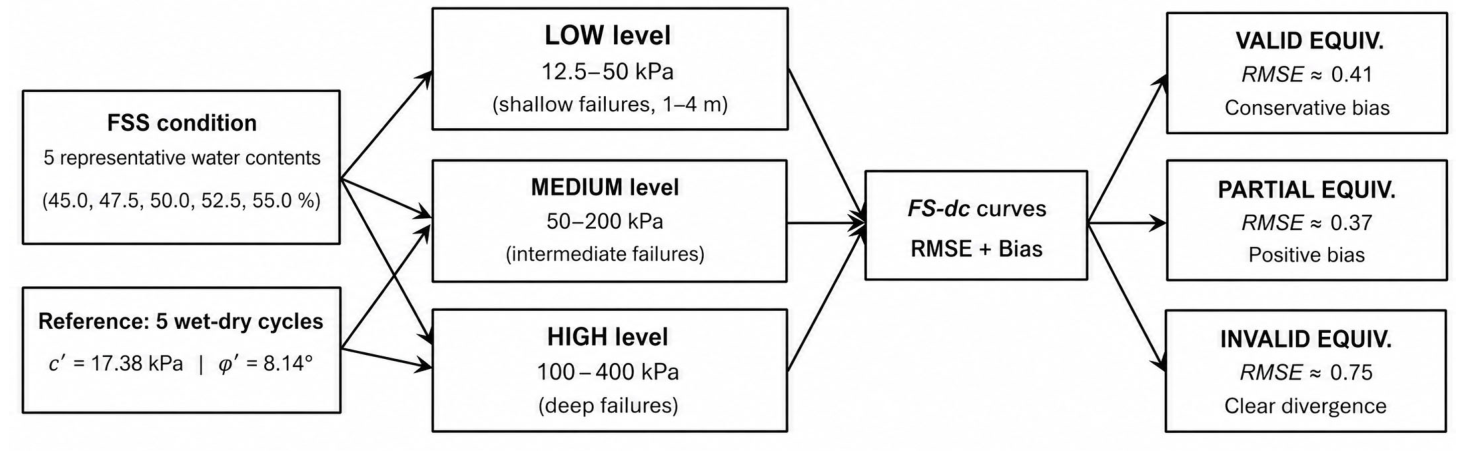
As summarized in
Figure 8, the sensitivity analysis was structured into three normal stress levels. The first corresponded to the low level, defined by normal stresses of 12.5, 25, 37.5, and 50 kPa, adopted as the baseline condition because of their representativeness of shallow failures on the order of 1–4 m in depth. The second corresponded to the medium level, with normal stresses of 50, 100, 150, and 200 kPa, incorporated to represent intermediate confinement conditions associated with greater depths. The third corresponded to the high level, with normal stresses of 100, 200, 300, and 400 kPa, coinciding with the range used in the five-cycle route and representative of considerably deeper stress states. This structure made it possible to examine the evolution of the equivalence between
FSS and five cycles as the normal stress applied during the determination of the strength parameters was progressively increased.
For this analysis, five representative water contents of the FSS condition were selected: 45.0, 47.5, 50.0, 52.5, and 55.0%. These conditions were used as a comparative subset of the FSS domain because they are concentrated around the interval initially considered most relevant for comparison with the baseline case. For the low stress level, strength parameters were obtained directly from direct shear tests conducted on those conditions. For the medium and high stress levels, FSS parameters were estimated from the strength–normal stress relationship derived from the low-level data, following the approach adopted to evaluate the sensitivity of the method to confinement. New FS–dc stability curves were then constructed, and the equivalence with respect to the five-cycle reference was reassessed.
Sensitivity to the normal stress level was evaluated using the same criteria defined in the previous subsection: global curve similarity, systematic prediction bias, and physical representativeness of the failure scenario. Within this framework, the RMSE and Bias values obtained for the selected water contents were analyzed at each load level in order to determine whether increasing confinement systematically modified the ability of the FSS condition to reproduce the response trajectory of the degraded state after five cycles.
The RMSE was used as a measure of the global distance between the curves generated with FSS and the five-cycle reference curve within each load level. However, this indicator was interpreted together with mean bias in order to determine whether a given condition tended to systematically overestimate or underestimate slope stability. A negative bias was considered favorable from a safety perspective, since it implied a conservative estimate of the factor of safety, whereas a positive bias was interpreted as a warning sign, indicating a tendency to overestimate stability relative to the reference condition.
In addition, each normal stress level was interpreted according to its physical consistency with the geotechnical problem under analysis. In this study, equivalence between FSS and five cycles was formulated specifically for the evaluation of shallow failures in expansive clays, where the active weakening depth is concentrated within the first few meters of the profile. Consequently, the low level was considered the normal stress range physically representative of the phenomenon of interest, whereas the medium and high levels were included only to explore the behavior of the method outside that domain. This methodological distinction was essential to prevent a numerically favorable fit under non-representative loading conditions from being mistakenly interpreted as evidence of general equivalence.
Based on these criteria, sensitivity to the normal stress level was used to classify the equivalence between FSS and five cycles into three methodological categories. Equivalence was considered valid when global curve proximity, non-hazardous bias, and physical consistency with shallow failures were simultaneously satisfied. It was considered partial or spurious when the statistical fit was acceptable but lacked sufficient physical support or exhibited a tendency to overestimate stability. Finally, it was considered invalid when increasing the load led to a clear loss of equivalence and to a mechanically inconsistent representation of the phenomenon. This classification made it possible to interpret the equivalence not as a universal property of the FSS method, but as a condition dependent on the range of normal stresses under which the material strength envelope is determined.
Accordingly, the proposed substitution should not be interpreted as a universal replacement of wet–dry cycling tests, but as a response-based approximation whose validity is restricted to shallow-failure stress regimes in expansive clays.
3. Results
3.1. Attenuation of Strength Parameters by Wet–Dry Cycles and Definition of the Reference Degraded State
Cyclic wetting and drying caused a pronounced reduction in soil shear strength, with a much stronger effect on effective cohesion than on friction angle. As shown in
Table 3, cohesion decreased from 58.69 kPa in the initial state to 17.38 kPa after five cycles, corresponding to a cumulative reduction of approximately 70.4%. In contrast, the effective friction angle decreased from 10.02° to 8.14°, equivalent to a reduction of 18.7%. This behavior indicates that cyclic degradation was governed primarily by the loss of the cohesive component, whereas the frictional component remained comparatively more stable.
Most of the degradation occurred during the first two cycles. Between the initial condition and cycle 1, cohesion had already decreased by 43.0%, and by cycle 2 the cumulative reduction reached 67.0%. From cycle 3 onward, both c′ and ϕ′ exhibited only minor variations, indicating that the degraded response had entered a quasi-stationary regime. In particular, the changes observed between cycles 3, 4, and 5 were marginal, supporting the selection of cycle 5 as the reference degraded condition for the subsequent comparative analysis.
This mechanical attenuation was also reflected in the global slope response under the homogeneous configuration. The factor of safety decreased from 2.02 in the initial state to 1.33 after cycle 1 and to 0.94 after cycle 2, thereby crossing the threshold of FS = 1.0. From cycle 3 onward, FS remained nearly constant between 0.89 and 0.88, in agreement with the stabilization observed in the strength parameters. At the same time, the slip depth decreased from 12.88 m in the initial state to 8.57 m from cycle 3 onward, indicating a progressive migration of the failure mechanism toward shallower levels as degradation advanced.
Overall, these results confirm that repeated exposure to severe wetting–drying conditions not only substantially weakens the soil shear strength but also shifts the global system response toward near-instability under shallow-failure conditions. Accordingly, the state reached after five wet–dry cycles was adopted as the reference degraded condition for all subsequent equivalence analyses.
3.2. Base Equivalence in Cracked Heterogeneous Slope
The equivalence analysis was focused on the heterogeneous slope model, since the methodology established that this configuration provides the most realistic representation of expansive clay slopes subjected to surface degradation. Within this framework, the comparison among 1 wet–dry cycle, 5 wet–dry cycles, and the FSS condition at w = 50% was carried out as a function of crack depth (dc = 1–5 m), in order to evaluate the evolution of factor of safety and slip depth as the degraded layer progressively gained mechanical control over the system response.
As shown in
Table 4, under the condition of 1 wet–dry cycle, the slope maintained relatively high safety factors throughout the analyzed interval, with values between 1.98 and 1.78. Although the slip depth decreased sharply to 4.40 m when
dc = 5 m, the overall response remained clearly more stable than that observed in the degraded reference state. This indicates that a single wet–dry cycle does not reproduce the level of weakening required to represent an advanced degraded state from the point of view of slope stability.
By contrast, the 5-cycle condition showed a progressive reduction in factor of safety from 1.96 at dc = 1 m to 1.06 in dc = 5 m, together with a transition from a deep-seated failure surface (11.80 m) toward shallow mechanisms on the order of 1.94–4.21 m. This evolution confirms that increasing crack depth progressively enhances the mechanical control of the degraded layer over the system response and drives the slope toward near-instability.
The FSS condition at w = 50% reproduced this general trend reasonably well. The safety factor decreased from 1.94 in dc = 1 m to 1.07 in dc = 5 m, while the slip depth shifted from 11.89 m to shallower values between 1.59 and 3.00 m for dc = 2–4 m, and from 2.83 m in dc = 5 m. In particular, the results of 5 cycles and FSS at 50% converged towards values close to FS ≈ 1 as crack depth increased, which constitutes the inherited base evidence of response equivalence identified in the preliminary analysis.
However, this base equivalence was not exact. At intermediate crack depths, especially at dc = 2 m and dc = 3 m, the FSS condition at 50% generated lower safety factors than those obtained after 5 cycles, indicating a more conservative response. Even so, both experimental routes converged on the mechanically essential feature of the problem: the emergence of shallow failure mechanisms and the progressive approach of the system toward the instability threshold as the degraded layer deepened. Therefore, the condition w = 50% should be interpreted as a useful inherited baseline case of approximate equivalence, rather than as the final equivalent water content identified in the study.
Overall, these results support two preliminary conclusions. First, one wet–dry cycle is insufficient to reproduce the reference degraded state in terms of slope stability. Second, the
FSS condition at 50% reasonably reproduces the overall response trajectory of the system in the heterogeneous model, although with systematic deviations that justify the subsequent extension of the water-content domain. This observation provides the basis for the broader equivalence analysis presented in
Section 3.4.
3.3. Response Under Suspended Water Table
The robustness of the equivalence between the degraded condition after five wet–dry cycles and the
FSS condition at w = 42.0%, identified in
Section 3.4 as the physically most representative equivalent water content, was evaluated under an unfavorable hydraulic condition by introducing a suspended water table into the heterogeneous slope model with
dc = 4 m. This assessment was conducted to verify whether the equivalence identified under dry conditions remained valid when pore-pressure effects were incorporated under representative shallow-failure conditions.
As shown in
Table 5, both experimental routes exhibited a progressive reduction in factor of safety as the water table rose from
hw = 0 m to
hw = 15 m. In the five-cycle reference condition,
FS decreased from 1.19 at
hw = 0 m to 0.96 at
hw = 15 m, with the slip surface height shifting between 8.60 m at
hw = 5 m and 15.00 m at the extreme positions, reflecting a change in the controlling failure mechanism as pore pressure increased.
The
FSS condition at w = 42.0% consistently produced safety factors slightly higher than those of the five-cycle reference at all analyzed water-table positions. The difference, defined as
ΔFS =
FSFSS −
FS5c, remained positive throughout the evaluated range, with values between +0.05 and +0.08. This behavior is consistent with the compensation mechanism identified in
Section 3.4: the higher effective friction angle of the
FSS condition at the liquid limit (ϕ′ = 23.55
°) appears to provide slightly greater frictional resistance than the reference state under reduced effective normal stress caused by pore pressure. As the water table rises and effective confinement decreases, the friction-dominated
FSS condition at
w = 42.0% appears to retain a slightly higher mobilized resistance than the five-cycle reference state (c′ = 17.38 kPa, ϕ′ = 8.14 °).
In terms of failure mechanism, both routes showed a comparable transition from deeper to shallower slip surfaces as the water table rose. In the five-cycle condition, the system approached the instability threshold at hw = 15 m (FS = 0.96). The FSS condition at w = 42.0% remained slightly above this threshold throughout, reaching FS = 1.01 at hw = 15 m. These results indicate a near-equivalent hydraulic response, although with a small positive deviation in stability relative to the reference condition.
Taken together, these results indicate that the equivalence between the five-cycle degraded state and the FSS condition at w = 42.0% is not restricted to dry scenarios, but remains reasonably stable under suspended groundwater conditions relevant to shallow failures in expansive clays. At the same time, the consistently positive ΔFS values show that the hydraulic response of the FSS condition at the liquid limit is slightly non-conservative relative to the five-cycle reference. Therefore, the hydraulic analysis supports the interpretation of w = 42.0% as the physically most representative equivalent water content, while also indicating that pore-pressure conditions introduce a small but systematic upward shift in predicted stability.
The consistently positive ΔFS values (range: +0.05 to +0.08) indicate that the FSS condition at w = 42.0% provides a slightly non-conservative estimate relative to the five-cycle reference under hydraulic loading. However, these differences remain small relative to the low-stress equivalence domain defined by the RMSE criterion, indicating that response-level equivalence is preserved under suspended groundwater conditions.
3.4. Extended Moisture Domain and Identification of Equivalent Water Content
In order to determine whether the initially observed equivalence for the FSS condition at w = 50% corresponded to a physically robust relationship or merely to a point-specific coincidence, the experimental water-content domain was systematically extended to fourteen values between 42.0% and 60.0%. This extension made it possible to evaluate the full evolution of the system response in the vicinity of the liquid limit and toward progressively more softened states.
As shown in
Table 6, the
FSS conditions closest to the reference degraded state were concentrated within the lower part of the explored domain, particularly between 42.0% and 46.25%. Within this interval, the
FS–
dc curves displayed the smallest separation from the five-cycle reference, whereas at higher water contents the response progressively diverged and increasingly underestimated the factor of safety.
The minimum global error was obtained at w = 43.5%, with RMSE = 0.3137, followed very closely by w = 42.0%, with RMSE = 0.3154. Both cases represent the strongest candidates for equivalence. However, the coincidence of w = 42.0% with the liquid limit of the material (LL = 42%) gives this condition a particularly robust physical interpretation. Accordingly, although w = 43.5% provided the best statistical fit, the physically most representative equivalent water content was identified in the vicinity of the liquid limit, with w = 42.0% emerging as the most meaningful condition from a mechanistic standpoint.
This result becomes more relevant when compared with the inherited baseline case of w = 50.0%, whose global error was 0.4479. Therefore, the systematic extension of the water-content range confirmed that the equivalence previously attributed to 50.0% did not represent the best achievable fit and that the most representative equivalent response is concentrated within a lower water-content interval, close to the liquid limit.
From an engineering perspective, these results indicate that the equivalence between FSS and five wet–dry cycles should not be interpreted as a coincidence at a single water content, but rather as a robust response domain centered approximately between 42.0% and 46.25%. Within this interval, RMSE values remain low and the stability curves preserve a shape compatible with the response of the system degraded by five wet–dry cycles. Outside this domain, the progressive increase in error indicates that the material enters an excessively softened regime and loses its ability to consistently reproduce the reference degraded condition.
Overall, this subsection provides the central evidence of the study. By extending the FSS domain from a single baseline case to a systematic fourteen-point water-content range, the analysis transformed an initially suggestive equivalence into a quantitatively and physically supported result, showing that an FSS condition prepared near the liquid limit can robustly reproduce the overall response of the system generated by five wet–dry cycles.
3.5. Sensitivity to the Normal Pressure Level and Limits of Applicability
In order to define the applicability range of the Fully Softened Strength (
FSS) condition as an experimental substitute for the degraded state induced by five wet–dry cycles, the sensitivity of the equivalence to the normal stress level used in direct shear testing was evaluated. Three loading levels were considered: low (12.5–50 kPa), medium (50–200 kPa), and high (100–400 kPa). The low level corresponds to the range originally used for the
FSS condition and represents shallow failures on the order of 1–4 m, which is the target geotechnical domain of this study. The medium level was associated with intermediate confinement conditions, whereas the high level reproduced the load range used in the five-cycle route and represents deeper stress conditions. The quantitative comparison among the three normal stress levels is summarized in
Table 7.
As summarized in
Table 7, the low stress level yielded an average
RMSE of 0.415, confirming a reasonably close approximation between the
FSS condition and the five-cycle reference within the domain of interest. Although this was not the numerically lowest
RMSE among the three evaluated levels, it corresponds to the only range that combines acceptable global agreement, conservative mean bias, and physical representativeness of shallow-failure conditions. Accordingly, this level constitutes the only case in which equivalence can be regarded as valid.
At the medium level, the average RMSE decreased to 0.367, which could initially suggest a better equivalence. However, this apparent improvement does not imply a mechanically reliable substitution. At this level, the stability curves begin to separate from the reference response at the most critical crack depths, and the average agreement is partly improved by compensation between positive and negative deviations. Therefore, the lower RMSE observed under intermediate confinement does not reflect a physically consistent reproduction of the degraded shallow-failure response. Instead, this level should be interpreted as a partial or spurious equivalence condition.
The high stress level showed the clearest loss of equivalence. The average RMSE increased to 0.752, approximately 81% higher than the baseline low-stress case, indicating a pronounced separation between the curves generated with FSS and the five-cycle reference response. Under this loading regime, the FSS condition no longer reproduces the trajectory of the system degraded by five cycles and instead reflects a response outside the shallow-failure domain that motivates the present study. Accordingly, the high stress level must be considered invalid for substitution purposes.
Overall, these results demonstrate that equivalence between FSS and five wet–dry cycles is not a universal property, but a condition that depends on the normal stress range under which the material strength envelope is determined. The proposed substitution can only be considered statistically, mechanically, and geotechnically valid when normal stresses are limited to ≤ 50 kPa, representative of shallow failures of approximately 1–4 m, which is precisely the characteristic condition of expansive clay slopes. This result clearly defines the applicability limit of the proposed method and closes the results section from an engineering standpoint.
4. Discussion
The present results indicate that the equivalence between the Fully Softened Strength (
FSS) condition and the degraded state induced by five wet–dry cycles should not be interpreted as an isolated numerical coincidence, but as a mechanically consistent relationship that emerges under specific water-content and confinement conditions. In the tested expansive clay, cyclic degradation produced a dominant reduction in effective cohesion, whereas the friction angle exhibited much smaller variations. This trend progressively shifted the system toward shallow instability and is consistent with previous studies on expansive and fine-grained soils subjected to wetting–drying cycles, where strength loss is more strongly associated with fissure development, structural degradation, and attenuation of the cohesive component than with major changes in frictional resistance [
7,
8,
18]. Likewise, previous experimental and numerical studies have shown that wetting–drying processes promote shallow failure, crack development, and reduced stability under infiltration, which agrees with the mechanical trajectory identified here [
2,
19,
25].
A further point that deserves emphasis is that the numerically lower average RMSE obtained at the intermediate stress level does not imply a more reliable equivalence. That apparent improvement is partly produced by compensation between positive and negative deviations across crack depths, whereas the low-stress domain more faithfully reproduces the mechanically relevant shallow-failure regime targeted in this study. From an engineering standpoint, this distinction is essential: a lower global error is not sufficient if it is obtained under a confinement range that does not represent the actual failure mechanism of expansive clay slopes. Therefore, the validity of the proposed substitution must be judged from combined statistical and physical criteria, rather than RMSE alone.
From this perspective, the most relevant finding of the study is that the
FSS condition prepared near the liquid limit can reproduce the overall system response generated by five wet–dry cycles, even though it does not reproduce the same pair of strength parameters. This distinction is fundamental. The equivalence identified here does not arise from direct equality between c′ and ϕ′, but from a mechanical compensation between the two parameters within the Mohr–Coulomb framework, capable of generating comparable
FS–
dc trajectories under the stress regime controlling shallow failures. In this sense, the problem should not be interpreted as one of strict constitutive equivalence, but as one of response-state equivalence. This interpretation is consistent with the classical use of fully softened shear strength for first-time failures in fissured clays, where the relevant mobilized resistance does not correspond either to the intact state or to the residual state, but to an intermediate degraded condition associated with restructuring and loss of structure [
9,
13,
15,
17].
Although no direct microstructural evidence from SEM or XRD analyses was generated in the present study, the observed convergence between the
FSS state and the five-cycle degraded state remains compatible with the known behavior of expansive clays containing montmorillonite and illite, in which repeated wetting and drying progressively drive the material toward a structurally weakened and normally consolidated-equivalent condition [
1,
3,
13]. Therefore, the equivalence demonstrated here has an indirect but coherent microstructural basis, grounded in the established relationship between active clay minerals, structural degradation, and the development of a fully softened state at water contents near the liquid limit.
A key result is that the physically most representative equivalent condition is concentrated at w = 42.0%, which coincides with the liquid limit of the soil. In the extended water-content domain, the condition w = 42.0% yielded
RMSE = 0.3154 and Bias = +0.0080, indicating a global response that is practically indistinguishable from the five-cycle reference. Although
w = 43.5% produced a slightly lower
RMSE (0.3137), it does not coincide with an intrinsic index property of the material. This distinction is important because it indicates that the optimum equivalent condition should not be selected solely from the minimum numerical error, but from the combined convergence of low global error, near-zero bias, and physical consistency with the intrinsic state of the soil. In this case, the coincidence between the equivalent water content and the liquid limit suggests that the representative degraded state is reached when the soil has lost most of its capacity to sustain effective cohesive strength, but before entering an excessively softened regime. This interpretation is consistent with studies that relate fully softened strength to the drained peak behavior of normally consolidated or structurally destroyed clays, as well as with studies linking fully softened strength to index properties such as liquid limit and plasticity index [
12,
13,
16,
17].
It should also be emphasized that w = 42.0% lies within the interpolated domain of the power-law relationship calibrated from the directly measured FSS points, rather than representing an extrapolation beyond the experimental range. Additional direct measurements in the 40–45% interval would certainly strengthen the result; however, the monotonic and well-behaved RMSE–w pattern in that interval, together with the physical significance of the liquid limit as an anchor point, provides sufficient support for identifying w = 42.0% as the physically most meaningful equivalent water content for the tested material.
Accordingly, in the present material the liquid limit acts not only as an index descriptor, but also as a physically meaningful reference for identifying the
FSS condition most representative of the degraded state induced by cyclic wetting and drying. This strengthens the interpretation that the observed equivalence is not fortuitous. Rather than arising from an isolated point coincidence, the results define an ordered response domain in which water contents close to the liquid limit (42.0–46.25%) consistently produce the smallest deviations from the five-cycle reference, whereas higher water contents progressively increase
RMSE and generate increasingly conservative but less equivalent responses [
8,
13,
15,
18].
Within this framework, the inherited baseline case of w = 50.0% still retains interpretive value, but it should no longer be regarded as the optimal condition of the study. In the extended evaluation, w = 50.0% produced RMSE = 0.4479, substantially higher than the values obtained at w = 42.0% and w = 43.5% and was also associated with a more conservative bias. This means that the equivalence initially identified at 50% was real in a preliminary sense, because it reproduced the overall trend toward FS ≈ 1 in the heterogeneous model, but it did not correspond to the best achievable fit within the FSS domain. Rather than confirming the inherited base case as final, the present study relocates the physically meaningful equivalence to a lower water-content interval near the liquid limit.
From an engineering standpoint, the best-fit RMSE of approximately 0.314 should be interpreted relative to the reference FS range (approximately 1.06–1.96), rather than as an isolated absolute deviation. The proposed substitution is not intended to reproduce point-by-point identity at every crack depth, but to capture the overall transition of the system from stable to near-critical shallow failure conditions. For this reason, RMSE was not used as a stand-alone acceptance criterion. Instead, equivalence was judged from the combined convergence of three conditions: low global error, non-dangerous bias, and correct representation of the shallow-failure stress regime. Under this framework, the agreement obtained for w = 43.5% and especially the near-zero-bias condition at w = 42.0% can be considered mechanically meaningful and practically acceptable for a response-based substitution strategy.
The sensitivity analysis further showed that the validity of the equivalence depends critically on the normal stress level under which the
FSS envelope is defined. Although the intermediate level (50–200 kPa) yielded an average
RMSE numerically lower than that of the low-stress level, the full analysis demonstrated that this apparent improvement was misleading because it was accompanied by positive bias and by overestimation at the most critical crack depths. By contrast, the low-stress level (12.5–50 kPa) was the only one that simultaneously combined reasonable fit, conservative bias, and physical consistency with shallow failure depths on the order of 1–4 m, which are precisely the conditions targeted by the present study. This result is consistent with the specialized literature on fully softened strength, which indicates that
FSS is appropriate for first-time and shallow failures in fissured clays, but should not be indiscriminately extrapolated to higher confinement regimes or deep-seated failure mechanisms [
9,
15,
23,
24].
In this sense, the present study does not demonstrate that
FSS can universally replace cyclic degradation tests. Rather, it demonstrates that the substitution is valid within a clearly defined domain: water contents close to the liquid limit and normal stresses ≤ 50 kPa, representative of shallow-failure conditions. Outside this domain, equivalence weakens or disappears, either because the material becomes excessively softened or because the confinement regime no longer represents the target physical mechanism. This restricted but explicit applicability domain enhances the practical value of the method because it transforms an initially localized experimental observation into a geotechnically usable tool with well-defined limits [
13,
17].
From a broader geotechnical perspective, this result also suggests a shift in how laboratory-based degradation processes may be interpreted in practice. Rather than attempting to reproduce the full temporal evolution of wet–dry cycles, which is often time-consuming and operationally demanding, the results indicate that it may be more relevant to identify representative mechanical states that capture the resulting system response. In this context, the use of FSS near the liquid limit provides a pragmatic pathway to approximate degradation effects through state equivalence, enabling more efficient preliminary stability assessments without explicitly simulating the entire degradation history.
The relationship between
FSS and residual shear strength also deserves explicit consideration, since residual strength is frequently used in the stability analysis of cracked clay slopes [
9,
22].These two parameters represent fundamentally different mechanical states. Residual strength corresponds to the minimum post-failure resistance mobilized along a pre-existing shear surface after large displacements and is therefore appropriate for reactivated landslides [
9].
FSS, by contrast, represents the drained peak strength of the material in a normally consolidated reconstituted state from slurry and is therefore appropriate for first-time failures in heavily overconsolidated or fissured clays, which is the scenario addressed here [
13,
17]. Because
FSS is systematically higher than residual strength, its use for first-time failure analysis provides a more realistic and less excessively conservative basis than adopting residual parameters for a problem in which no fully developed pre-existing shear surface is assumed.
The bi-layer idealization adopted in the heterogeneous model should likewise be interpreted within its proper scope. In reality, the transition between the degraded surface zone and the underlying intact material is gradual rather than abrupt. However, the sharp interface used here provides a conservative simplification that allows the influence of degraded depth to be isolated and compared consistently across scenarios. Under real field conditions, a gradual transition would be expected to produce intermediate responses between the homogeneous and idealized bi-layer cases, so the reported
FS–
dc trends may reasonably be interpreted as a conservative lower-bound representation of the expected system response under progressive degradation gradients. Likewise, crack depth was treated as the dominant geometric descriptor of degradation, whereas crack spacing, aperture, and spatial distribution were not explicitly modeled. These features may also influence slope response and therefore constitute meaningful topics for future research. Future work should also incorporate probabilistic and reliability-based slope stability assessment under hydraulic uncertainty [
6].
The agreement obtained between the limit equilibrium simulations and the representative SRM verification cases also supports the numerical robustness of the adopted framework. The consistency between both approaches indicates that the comparative trends identified in the manuscript are not merely an artifact of Bishop’s simplified method, but reflect a stable response pattern within the analyzed geometry and parameterization. This point is especially important because the central objective of the study is comparative response equivalence under a fixed geotechnical framework, rather than exhaustive exploration of all possible failure geometries.
The suspended water table analysis further strengthens the argument for equivalence by showing that the FSS condition at w = 42.0% remains reasonably close to the five-cycle reference under unfavorable hydraulic conditions. Both routes exhibited the expected reduction in factor of safety as the water table rose, confirming that pore-pressure effects destabilize the slope in the same general manner. At the same time, the FSS condition at w = 42.0% consistently produced slightly higher FS values than the five-cycle reference, with ΔFS between +0.05 and +0.08. This indicates that the hydraulic response of the liquid-limit FSS condition is near-equivalent, although slightly non-conservative relative to the reference condition. Mechanically, this tendency is consistent with the higher effective friction angle mobilized by the FSS condition at the liquid limit, which appears to provide slightly greater resistance as pore pressure reduces effective confinement. Therefore, the hydraulic analysis confirms that the equivalence identified under dry conditions remains robust under suspended groundwater, while also showing that this robustness should be interpreted as near-equivalence rather than strict conservatism.
Finally, the scope of the present conclusions should not be generalized beyond the tested material. The coincidence between the physically most representative equivalent water content and the liquid limit should not be interpreted as a universal rule for all expansive soils. The result was obtained for a single CL expansive clay with LL = 42, PI = 23, and montmorillonite–illite mineralogy. The same relationship may shift, weaken, or even disappear in soils with substantially different plasticity, mineralogical activity, cementation, hydraulic degradation pathways, or structural history. Therefore, the present finding is best interpreted as a material-specific but physically meaningful result that is expected to be most applicable to soils of comparable index and mineralogical characteristics.
The discussion confirms that the FSS condition prepared around w = 42.0%, coinciding with the liquid limit of the material, provides the most physically consistent representation of the degraded state induced by five wet–dry cycles within the analyzed problem. The case w = 50.0% should therefore be regarded only as a preliminary baseline, while the physically meaningful equivalence is clearly located within a narrower domain near the liquid limit. Importantly, the validity of the proposed substitution is restricted to normal stresses ≤ 50 kPa, representative of shallow failure conditions. Within this domain, the observed agreement does not reflect a numerical coincidence, but a mechanically coherent convergence in system response. From an applied perspective, this finding supports the use of FSS near the liquid limit as a practical and reproducible alternative for preliminary slope stability assessment in expansive clays, particularly in cases where full wet–dry cycling is not feasible.