Article

Spatial Variability of Air–Sea CO2 Flux and Their Carbon Sources During Early Spring in the Yangtze River Estuary and Adjacent Coastal Areas


1
Key Laboratory of Ecosystem Network Observation and Modeling, Institute of Geographic Sciences and Natural Resources Research, Chinese Academy of Sciences, Beijing 100101, China
2
College of Resources and Environment, University of Chinese Academy of Sciences, Beijing 101408, China
*
Author to whom correspondence should be addressed.
Water 2026, 18(9), 1078; https://doi.org/10.3390/w18091078
Submission received: 21 March 2026 / Revised: 25 April 2026 / Accepted: 28 April 2026 / Published: 30 April 2026
(This article belongs to the Section Ecohydrology)

Abstract

Air–sea CO2 flux (FCO2) in the estuary–coastal continuum plays a vital role in global carbon sequestration; however, the mechanisms governing FCO2 spatial heterogeneity during early spring remain poorly understood, particularly the roles of distinct dissolved inorganic carbon (DIC) sources. In March 2025, we investigated the FCO2 spatial variability and DIC sources across the Yangtze River estuary and adjacent coastal areas using DIC concentration, pH, and δ13CDIC analyses. The study area was a net CO2 source (7.3 ± 8.7 mmol m−2 d−1), with the intensity declining progressively from the inner estuary to offshore areas. Physical mixing of three principal water masses established the following pattern: high-pCO2 Changjiang Diluted Water and Yellow Sea Coastal Current drove CO2 outgassing, while low-pCO2 East China Sea Shelf Water weakened it. Quantitative apportionment revealed atmospheric CO2 invasion as the dominant DIC source, followed by carbonate dissolution and organic matter degradation, with the latter declining from the inner estuary to offshore areas. The spatial variation in DIC source contributions further confirms that, superimposed on the physical mixing, biogeochemical processes—particularly biological activity—modulated reginal source intensities. This early-spring case captures a critical transitional window and highlights the necessity of integrating multi-factor regulation with DIC source partitioning to resolve carbon dynamics in the estuarine–coastal continuum.

1. Introduction

The estuary–coastal continuum serves as a critical transition zone characterized by intense land–sea interactions, and functions as the gateway through which terrestrial materials are transported into the ocean [1,2]. Annually, global terrestrial ecosystems uptake approximately 4.1 Pg C yr−1 from the atmosphere, of which 0.95 Pg C yr−1 is transported via rivers into the estuary–coastal continuum. Of this influx, approximately 0.40 Pg C yr−1 is buried in sediment, while an equivalent amount is up taken by the air–sea interface, resulting in a net carbon transfer from the estuary–coastal continuum to the ocean of 0.95 Pg C yr−1 [3]. Despite the small proportion of this region in the global ocean surface area, its carbon sink capacity accounts for 17% of the global ocean carbon sink (2.8 ± 0.4 Pg C yr−1) [4]. The air–sea CO2 flux (FCO2) is primarily regulated by the CO2 transfer velocity (k) and the surface partial pressure of CO2 (pCO2), which together determine the strength of its carbon source or sink capacity [2,5]. The sources of dissolved inorganic carbon (DIC) and its equilibrium processes within the estuary–coastal continuum govern pCO2 in the water column, thereby influencing FCO2 (Figure S1) [5,6]. The interactions between the CO2 solubility pump, carbonate pump, and biological pump can further modulate the transformation processes of DIC, thereby driving the conversion between carbon sources and sinks in the estuary–coastal continuum [7].
Substantial uncertainties persist regarding the spatial distribution of FCO2 in the estuary–coastal continuum, due to the spatial variability of physical, chemical, and biological factors resulting from hydrological processes and wind speed [2,5]. K, as a major factor influencing FCO2, is primarily driven by turbulence at the aqueous boundary layer, which is generated by wind and increases with higher wind speeds [5]. pCO2 is primarily regulated by the carbonate chemistry balance, which is influenced by multiple physical and biogeochemical processes, including the CO2 solubility pump, carbonate pump, and biological pump [8,9]. Physical and chemical factors, such as the pH and temperature, can affect the carbonate buffer system via the CO2 solubility pump [10,11] and influence the dissolution and precipitation of carbonate via the carbonate pump [12]. The biological pump affects the absorption and release of CO2 through photosynthesis, respiration, and microbial degradation, which are affected by both physical and biological factors (e.g., chlorophyll a (Chla) and nutrient content) [13,14]. Riverine waters typically exhibit high pCO2 and nutrient concentrations, and the mixing between riverine and sea waters can both directly influence the spatial distribution of pCO2 and indirectly affect it through the biological pump [6,15]. Additionally, the spatial distributions of physical, chemical, and biological factors vary due to the vertical mixing driven by hydrological processes [15,16]. In particular, reduced river discharge, enhanced spring winds, and strong tidal forcing during spring can lead to significant vertical mixing in the estuary–coastal continuum, resulting in uncertain CO2 source or sink dynamics [5].
Diverse DIC sources in the estuary–coastal continuum play a fundamental role in regulating the FCO2 by modulating the carbonate chemistry balance, while their control mechanisms on FCO2 remain poorly understood [17,18]. The principal DIC sources, comprising atmospheric CO2 invasion, carbonate and silicate mineral weathering, and organic matter degradation (see conceptual framework in Figure S1) [17,19], elevate DIC concentrations and perturb the CO2(g)–DIC equilibrium. This perturbation directly alters the water-column pCO2, the key driver governing both the directionality (source vs. sink) and magnitude of FCO2 [17,18]. Previous research has indicated that the Yangtze River estuary and adjacent coastal areas are CO2 absorbers in spring, due to the biological uptake of CO2 [5,20], but act as CO2 sources in winter, due to the biological addition of DIC [15,21]. However, the relationships between specific DIC sources and the resultant FCO2 remain unclear, impeding prediction of the impacts of climate change on FCO2. Stable carbon isotope signatures (δ13CDIC) provide a vital means of partitioning the contributions of these sources, thereby revealing how the origins of DIC driven by these pumps govern DIC dynamics and ultimately influence FCO2 in the estuary–coastal continuum [22].
The Yangtze River estuary and adjacent coastal areas, as one of the world’s largest estuarine–shelf systems, are characterized by high biological production, complex circulation patterns, and intense land–sea interactions, exhibiting significant spatial differences in carbon sources and sinks [5]. The inner estuary typically acts as a carbon source of atmospheric CO2, driven by elevated pCO2 in inflowing freshwater, whereas the outer estuary and offshore areas exhibit marked seasonal uncertainty in their designation as either sinks or sources of atmospheric CO2 [5,23]. Hydrological conditions in this region exhibit marked seasonal variability, which in turn modulates the spatial distribution of FCO2 throughout the seasons [17,23]. Although air–sea CO2 exchange in the Yangtze River estuary and adjacent coastal areas has been widely investigated, important uncertainties remain regarding (1) how the spatial pattern of FCO2 is jointly shaped by water mass mixing and biogeochemical processes during early spring, and (2) how different DIC sources contribute to the observed source–sink mosaic across the estuary–coastal continuum [16,24]. Early spring represents a transitional hydrographic period characterized by strong water mass interactions; however, the corresponding carbon-source apportionment remains limited [12]. Therefore, this study is presented as an early-spring case study with strong regional significance for understanding seasonal carbon dynamics in this study region. Specifically, we investigated the DIC concentration, pH, and δ13CDIC in surface and bottom waters and calculated FCO2 across the Yangtze River estuary and adjacent coastal areas during the NORC2025-03 cruise. The specific objectives of this study were (1) to elucidate the synergistic controlling mechanisms governing the spatial variability of FCO2 under the combined influences of meteorological, physical, chemical, and biological factors, with particular emphasis on the early-spring transitional period; and (2) to quantify the proportional contributions of major DIC sources and evaluate how these sources modulate the spatial patterns of FCO2.

2. Materials and Methods

2.1. Characteristics of the Yangtze River Estuary and Adjacent Coastal Areas

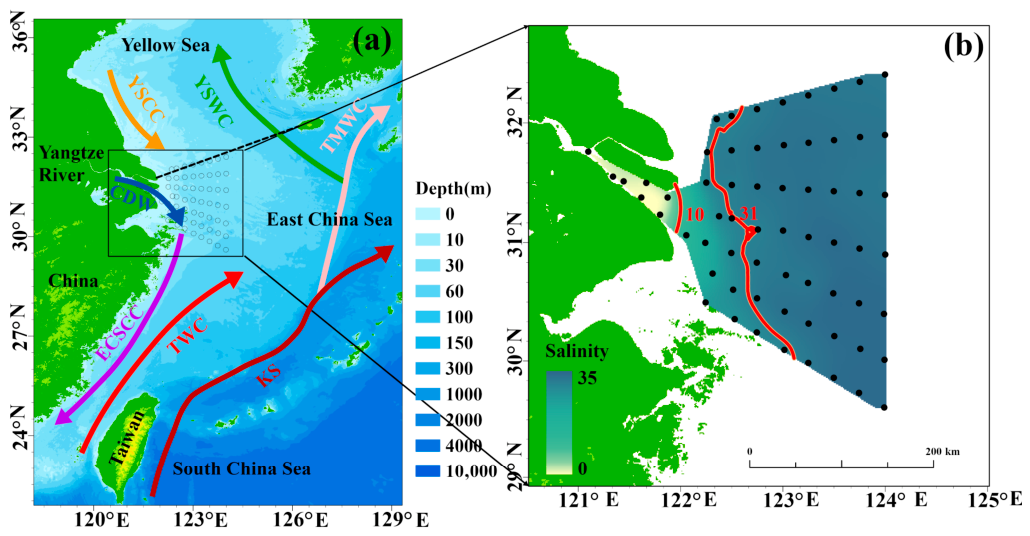
The study region covers an area ranging from 29.5 to 32.5° N and from 121 to 124° E (Figure 1), located in the Yangtze River estuary and adjacent coastal areas. Following the delineation of Zhai et al. [25], the area between 121° E (west of Chongming Island) and 122° E, where the surface salinity is typically <10, is defined as the inner Changjiang estuary. This inner estuary is bifurcated by Chongming Island into two main tributaries: the South Branch and the North Branch. Extending from the South Branch to the East China Sea, the system can be further subdivided based on the surface salinity: the outer estuary, where the salinity ranges from 10 to 31, and the offshore area of the East China Sea, where the salinity exceeds 31 [25]. The hydrodynamic conditions in this region are complex and exhibit pronounced seasonal variations, influenced jointly by the East Asian monsoon and the western boundary currents of the Pacific Ocean. In the Yangtze River estuary and adjacent coastal areas, the hydrodynamic conditions are primarily modulated by the Changjiang Diluted Water (CDW) sourced from Yangtze River freshwater [26], the East China Sea Coastal Current (ECSCC), Taiwan Warm Current (TWC), Yellow Sea Coastal Current (YSCC), and the Yellow Sea Warm Current (YSWC) [14,26]. During early March with the cold/dry climate, the area is dominated by the CDW, ECSCC, TWC, and YSCC, driven by the northeast East Asian monsoon [27].

2.2. Sample Collection and In Situ Measurements

Sample collections and field observations were conducted from 5 to 11 March 2025 across the Yangtze River estuary and adjacent coastal areas during the open research cruise NORC2025-03, supported by the NSFC Shiptime Sharing Project (Figure 1). At each sampling station, vertical profiles of the water depth, temperature, salinity, and turbidity were obtained using a shared CTD instrument (SBE 911plus CTD, Sea-Bird Scientific, Bellevue, WA, USA). Water samples were collected from the surface (2 m depth) and bottom (2 m above the seafloor) layers using Niskin bottles mounted on the CTD frame. Samples for pH determination were collected in 100 mL narrow-neck glass bottles. Dissolved oxygen (DO) samples were collected in 250 mL brown glass-stoppered bottles following the Winkler method. Samples for DIC analysis were collected in 250 mL borosilicate glass vials and poisoned immediately with 100 μL of saturated mercuric chloride (HgCl2) solution to halt the biological activity.

2.3. Laboratory Analysis

The concentrations of DIC were measured using a total organic carbon (TOC) analyzer (TOC-VCPH, Shimadzu Co., Kyoto, Japan). Samples were combusted at 680 °C in a combustion tube packed with a platinum catalyst. Certified reference materials (CRM) from Andrew G. Dickson’s lab at Scripps Institute of Oceanography were used for calibration and accuracy assessment, yielding a precision of ±2 µmol kg−1. δ13CDIC values were analyzed using a Finnigan MAT-252 mass spectrometer (Thermo Fisher Scientific, Darmstadt, Hesse, Germany), with a precision of 0.15‰. The pH was measured immediately onboard on an NBS scale using a FE28 pH meter (Mettler Toledo, Greifensee, Switzerland), with the accuracy monitored against seawater CRMs (also from A.G. Dickson’s laboratory, Scripps Institution of Oceanography). The precision of the pH measurements was ±0.01 units. For DO analysis, samples were fixed immediately after collection and titrated onboard following the classic Winkler titration procedure.
Concentrations of the major cations (Ca2+ and Mg2+) were measured via inductively coupled plasma optical emission spectrometry (ICP-OES, Optima 5300DV, PerkinElmer, Waltham, MA, USA), with an analytical precision of ±2%. For oxygen isotope (δ18O-H2O) analysis, 2 mL of filtered seawater was analyzed using a liquid water isotope analyzer (LWIA, Model DLT-100; Los Gatos Research Inc., San Jose, CA, USA). Calibration procedures were traceable to the primary isotopic reference material, Vienna Standard Mean Ocean Water (VSMOW), yielding an average analytical precision of ±0.20‰. For nutrient analysis (NO2, NO3, NH4+, PO43− and SiO32−), water samples were filtered through 0.45 μm cellulose acetate membranes, stored frozen, and analyzed in the laboratory using a Seal QUAATRO 39 automated nutrient analyzer (SEAL Analytical, Southampton, UK). For chlorophyll a (Chla) determination, a 300 mL water sample was filtered under low vacuum pressure through a Whatman GF/F glass fiber filter. The filter was extracted in a 9:1 (v/v) acetone: water solution for >12 h, followed by centrifugation at 4500 rpm. The supernatant was measured using a Hitachi F-7100 fluorescence spectrophotometer (Hitachi, Tokyo, Japan). Calibration was performed using a pure Chla standard (99%, Sigma-Aldrich, St. Louis, MO, USA).

2.4. Calculations of Air–Sea CO2 Flux

FCO2 (mmol CO2 m−2 d−1) was calculated using the following equation [5]:
F C O 2 = k ( c m   h 1 ) × k H ( m o l   L 1   a t m 1 ) × Δ p C O 2 ( μ a t m )                × 1 L 1000 c m 3 × 24 h 1 d a y × 1000 c m 2 1 m 2 × 1 m m o l e 1000 μ m o l e
where ΔpCO2 (μatm) represents the difference in pCO2 between the surface water and the atmosphere. The atmospheric CO2 concentration was obtained from the Tae-ahn Peninsula observation site (36.7376° N, 126.1328° E; Republic of Korea) (available at https://gml.noaa.gov/data/data.php, accessed on 20 December 2025), after correction for water vapor pressure to 100% humidity with in situ temperature and salinity data [5]. pCO2 and TA (total alkalinity) were calculated from the DIC (μmol kg−1) and pH based on the NBS scale using the Excel version of CO2SYS_v3.0_Err [29], with the carbonic acid dissociation constants K1 and K2 described by Lueker et al. [30], KHSO4 described by Dickson [31], and total boron described by Lee et al. [32], according to the recommendations from previous studies [13,33]. Based on the uncertainties associated with the DIC and pH measurements, the estimated uncertainty in the calculated pCO2 was approximately ±14 μatm. The solubility of CO2 (kH, mol L−1 atm−1) at a specific temperature (Tk, K) and salinity (S, PSU) was calculated using the following equation [34]:
l n k H C O 2 = 58.0931 + 90.5069 × 100 T k + 22.294 × l n T k 100       + S × ( 0.027766 0.025888 × ( T k / 100 ) + 0.0050578 × T k 100 2 )                      
The gas transfer velocity (k, cm h−1) mainly depends upon the wind stress and associated near-surface turbulence, ocean waves, bubble injection, surface–surfactant conditions, and the temperature and near-surface humidity [35]. The wind variability is a key driver of changes in many of these factors (e.g., turbulence and bubble injection) and is more widely measured than other variables; thus, k is typically parameterized as a function of the near-surface wind speed [35,36]. While the wind regime is the dominant factor influencing k in the open ocean, the situation is more complex in coastal and shallower estuaries, due to the effects of other factors such as the tidal currents, bottom stress, and water depth on k [5]. Given the limited measurements of k in estuaries, we estimated k based on the wind speed dependence in this study.
Given the lack of a universally accepted relationship between k and wind speed [5,6], we compared three proposed relationships in this study: Nightingale et al. [37] (hereafter referred to as N00), Ho et al. [36] (H06), and Wanninkhof et al. [35] (W19). N00 and H06 used dual-deliberate tracer methods of 3He and SF6 to directly estimate k, with N00’s experiments conducted in coastal seas and H06’s in the Southern Ocean. In contrast, W19 proposed using nonzero intercepts to account for zero wind speed gust environments or zero wind-driven processes and utilizing global bomb 14C constraint and literature data to determine k, which are well suited for deep-water bodies. The three relationships have been used to estimate the FCO2 in the Yangtze River estuary and adjacent coastal areas in previous studies [5,38]. Their respective equations are as follows:
N 00 :   k = 0.333 ×   μ + 0.222 × μ 2 × S c / 660 0.5
H 06 :   k = 0.266 × μ 2 × S c / 660 0.5
W 19 :   k = 0.251 × μ 2 × S c / 660 0.5
where μ is the monthly wind speed at 10 m height, calculated using the daily wind speed (m s−1) obtained from the Cross-Calibrated Multi-Platform (CCMP) analyses produced by Remote Sensing Systems, with a spatial resolution of 0.25° × 0.25° grids (available at http://www.remss.com/measurements/ccmp/, accessed on 20 December 2025).
The Schmidt number (Sc) CO2 in water was computed from in situ temperature data. In seawater, Sc is 660 at 20 °C with a salinity of 35, while in freshwater (salinity < 30), it is 600 at the same temperature. Sc is calculated by using the following equation [39]:
S c = 1923.6 125.06 T + 4.3773 T 2 0.085681 T 3 + 0.00070284 T 4

2.5. Three End-Member Mixing Models of Stable Isotope

2.5.1. The Impacts of Physical Mixing and Biogeochemical Processes on DIC and δ13CDIC

The DIC concentrations and δ13CDIC values in the Yangtze River estuary and adjacent coastal areas are influenced by multiple processes, including physical mixing, air–sea gas exchange, carbonate precipitation/dissolution, and biological activities. Water temperature is widely regarded as a relatively conservative parameter in marine carbonate systems, and its relationship with salinity can further indicate the mixing between freshwater and seawater end-members [17]. A temperature–salinity (T–S) diagram (Figure S2a) illustrates only CDW in the inner estuary and a three end-member mixing scheme of water masses in the outer estuary and offshore area, comprising CDW, YSCC, and the East China Sea Shelf Water (ECSSW) (Figure S2b). This distribution pattern is consistent with the previously reported observations [40]. Based on this framework, we established a three end-member mixing model with the following definitions in the outer estuary and offshore area: CDW, defined as water with salinity < 30.5; ECSSW, defined as water with salinity > 30.5 and temperature > 9 °C; YSCC, defined as water with salinity > 30.5 and temperature < 9 °C. Representative end-member stations were selected based on their distinct hydrographic characteristics. Station C, exhibiting the lowest salinity, was chosen as the CDW end-member. Station E, characterized by the highest temperature and salinity (attributable to the influence of the warm and saline Taiwan Warm Current), was selected as the ECSSW end-member. Station Y, with the lowest temperature and high salinity, was designated as the YSCC end-member. Detailed information on the end-member stations is provided in Table S1.
A three end-member mixing model, based on the mass conservation of temperature and salinity, is employed to predict the conservative concentrations of a chemical of interest in the outer estuary and offshore area [17]:
f C D W + f E C S S W + f Y S C C = 1
S C D W × f C D W + S E C S S W × f E C S S W + S Y S C C × f Y S C C = S o b s
T C D W × f C D W + T E C S S W × f E C S S W + T Y S C C × f Y S C C = T o b s
δ 18 O m i x = δ 18 O C D W × f C D W + δ 18 O E C S S W × f E C S S W + δ 18 O Y S C C × f Y S C C
C D I C m i x = C D I C C D W × f C D W + C D I C E C S S W × f E C S S W + C D I C Y S C C × f Y S C C
δ 13 C D I C m i x × C D I C m i x                         = δ 13 C D I C C D W × C D I C C D W × f C D W         + δ 13 C D I C E C S S W × C D I C E C S S W × f E C S S W      + δ 13 C D I C Y S C C × C D I C Y S C C × f Y S C C
where f denotes the mixing fraction. The subscripts obs and mix correspond to the measured value and the conservative mixing value of the sample, respectively. Equations (10)–(12) were used to predict the conservative mixing values for δ18O-H2O, DIC concentration (CDIC), and δ13CDIC. δ18O-H2O was used as a conservative tracer to validate the model prediction of the conservative mixing values. The strong agreement between the observed and predicted δ18O-H2O (Figure S3; R2 = 0.98, slope of the fitted line = 1.03) provided robust support for the validity of our model approach.
Deviations of the observed DIC concentrations and δ13CDIC signals from their predicted conservative mixing values represented the impact of processes other than physical mixing. This is because processes influencing the CDIC exhibit distinct δ13CDIC values and isotope fractionation. Specifically, carbonate and atmosphere CO2 dissolution results in increases in both CDIC and δ13CDIC. Primary production or CO2 outgassing leads to decreases in CDIC and increases in δ13CDIC. CaCO3 precipitation causes decreases in both CDIC and δ13CDIC. Conversely, organic carbon degradation results in increases in CDIC and decreases in δ13CDIC [22,41]. The deviations of the observed values from their conservative mixing values can be calculated using the following equations [17,22]:
C D I C = C D I C o b s C D I C m i x C D I C m i x
δ 13 C D I C = δ 13 C D I C o b s δ 13 C D I C m i x
where CDICmix and δ13CDICmix are given by the CDW end-member (Station C) in the inner estuary and by Equations (11) and (12) in the outer estuary and offshore area, respectively. The primary biogeochemical processes influencing the distributions of δ13CDIC and CDIC can be inferred from the slopes of the relationship between Δδ13CDIC and ΔCDIC.

2.5.2. Potential Sources Analysis of DIC

The principal sources of DIC in the Yangtze River estuary and adjacent coastal areas include atmospheric CO2 invasion, carbonate and silicate mineral weathering, and organic matter degradation [17,19]. Each of these sources imparts a distinct isotopic signature to the DIC pool, thereby influencing the observed δ13CDIC values. Atmospheric CO2 invasion occurs via air–sea gas exchange and the chemical weathering of carbonate and silicate minerals driven by atmospheric CO2. This process typically yields δ13CDIC values ranging from −6.3‰ to 0‰ [18]. Carbonate mineral weathering involves the dissolution of carbonate minerals by CO2 derived from the atmosphere or organic matter degradation. The resulting DIC thus carries a mixed isotopic signal, comprising both the CO2 source (atmospheric or organic) and the intrinsic δ13C signature of the carbonate minerals themselves. Organic matter degradation refers to the microbial breakdown of organic matter, producing CO2 that is incorporated into the DIC pool. This source primarily reflects the δ13C signatures of terrestrial and marine organic matter. To quantitatively apportion these three DIC sources, we constructed an isotopic mass balance model following the approach of Wang et al. [18]:
δ 13 C D I C x = δ 13 C a t m × f C a t m + δ 13 C c a r b × f C c a r b + δ 13 C o m × f C o m
f C a t m + f C c a r b + f C o m = 1
where δ13Catm represents the δ13C values of DIC sources from atmospheric CO2 invasion via air–sea CO2 exchange and chemical weathering and is assigned as −3.2 based on atmospheric CO2 dissolution [18]. δ13Ccarb represents the δ13C values of DIC sources from the intrinsic δ13C signature of the carbonate minerals during chemical weathering and is assigned as −8.5 (−11.7~−5.2‰), based on the δ13C values of particulate inorganic carbon (PIC) observed in this region [17,18]. δ13Com represents the δ13C values of DIC sources from organic matter degradation of river and seawater, with δ13Com as −24.27 (−26.7~−22.3‰) derived from the δ13C values of particulate organic carbon (POC) and surface sediment total organic carbon (TOC) in this region [42,43]. fCatm, fCcarb, and fCom denote the proportional contributions of these respective DIC sources.
Given the constraint that the end-member contributions should sum to 1, the isotopic mass balance model is described by two equations (Equations (14) and (15)), which is one fewer than the number of end-members. To solve this under-determined system, the Bayesian mixing model (MixSIAR, version 3.1.11) was employed to calculate the proportional contributions of each potential DIC source [44]. MixSIAR models provide probabilistic solutions to mixing systems [45] and have been successfully applied to quantify DIC sources in rivers and estuaries [11,17]. To ensure accurate results, the Gelman–Rubin and Geweke diagnostic tests were employed to assess the convergence of Markov chain Monte Carlo (MCMC) chains [46]. The MCMC run length was set to ‘long’ to enhance the robustness of the model output [11].

2.6. Statistical Analysis

The Mantel test was applied to evaluate the correlations between the FCO2 matrix and the factors matrix, and Pearson correlation analyses were employed to investigate the correlations among the factors. The Mantel test provided a preliminary understanding of the association strength without assuming causal directionality and was performed using the “mantel” function from the “vegan” and “LinkET” packages in RStudio 4.3.0 (RStudio, PBC, Boston, MA, USA) [47]. Multiple linear regression (MLR) was applied to evaluate the relative importance of k, water temperature, and pCO2 in explaining the spatial variance in FCO2. Meteorological, physical, chemical, and biological factors were selected for analysis based on their established ecological relevance in prior studies [2,5]. The meteorological factor primarily includes the wind speed, a key driver of turbulent gas transfer. Physical factors (salinity) reflect hydrodynamic conditions, water mass mixing, and water temperature, which affect the solubility of CO2 and the biological pump. Chemical factors comprise key carbonate system variables (pCO2, DIC, pH, and TA); nutrients (NO2, NO3, NH4+, PO43−) and DO as regulators of the biological pump; major cations (Ca2+ and Mg2+) indicative of chemical weathering; and SiO32−, which relates to both biological processes and chemical weathering. Biological factors mainly consist of Chla, a proxy for phytoplankton biomass. Simple linear regression was employed to examine the relationships between the variables in R studio 4.3.0. MLR was conducted using the SPSS Statistics 22.0 software (IBM Corp., Armonk, NY, USA).

3. Results

3.1. Spatial Distribution of Air–Sea CO2 Flux

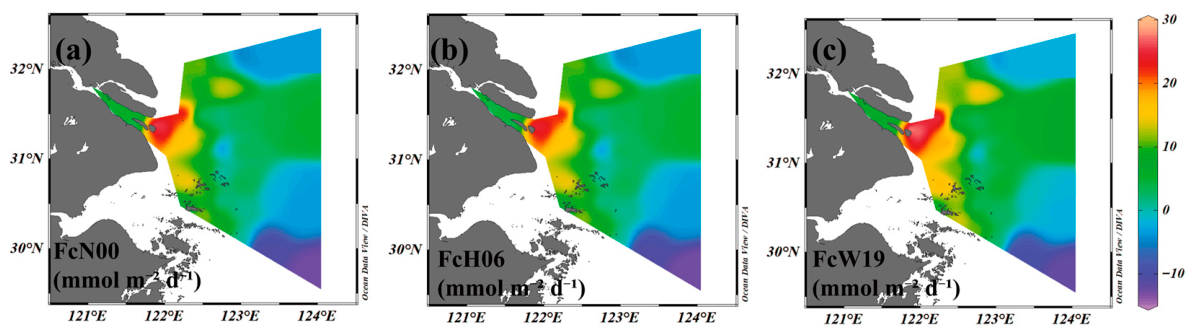
Figure 2 presents the spatial distributions of FCO2 in March 2025, calculated using the N00, H06, and W19 gas transfer velocity formulas. Table 1 further summarizes the FCO2 values for each water mass, for designated CO2 source and sink areas, and for the entire study area. The spatial patterns derived from the three formulas were broadly consistent, and the corresponding mean FCO2 values for the entire study areas were comparable. Overall, the entire study area functioned as a CO2 source, with an average flux of 7.3 ± 8.7 mmol m−2 d−1. A progressive decline in source strength was observed from the inner estuary to the outer estuary and offshore area. The mean fluxes were 11.0 ± 9.9 mmol m−2 d−1 in the inner estuary and 6.6 ± 8.5 mmol m−2 d−1 in the outer estuary and offshore area. Within the outer estuary and offshore area, individual water masses exhibited contrasting source magnitudes. The CDW displayed the strongest CO2 outgassing (14.2 ± 7.0 mmol m−2 d−1), with values substantially exceeding those recorded in the inner estuary. YSCC ranked second (8.6 ± 6.1 mmol m−2 d−1), whereas the ECSSW region acted as a weak CO2 source, with a mean flux of 1.8 ± 6.7 mmol m−2 d−1. Across the entire study region, areas characterized as CO2 sinks exhibited a mean flux of −4.6 ± 4.7 mmol m−2 d−1, while source areas averaged 9.9 ± 7.0 mmol m−2 d−1.

3.2. Multi-Factor Drivers of Air–Sea CO2 Flux Spatial Variability

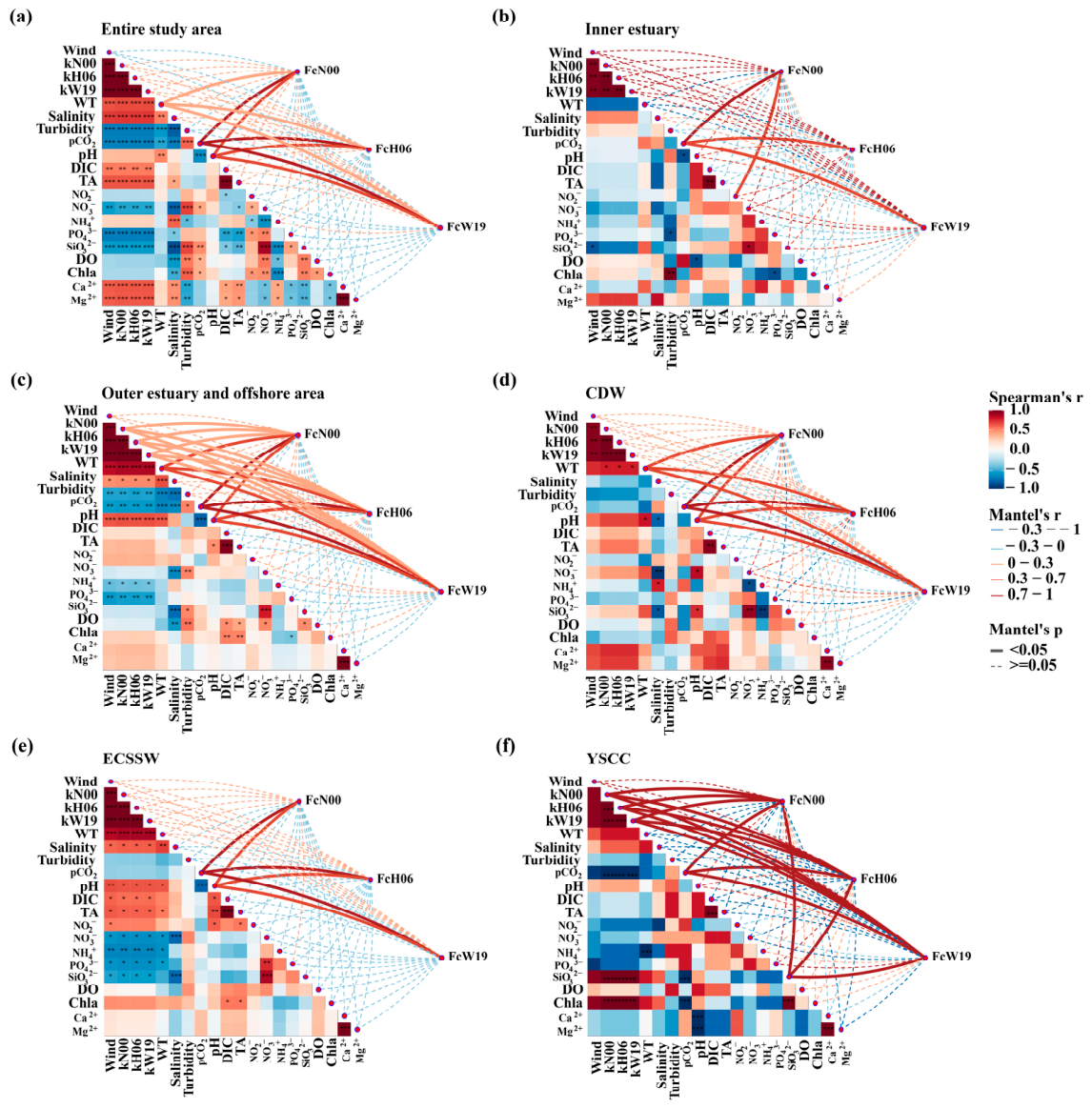
Figure 3 displays the correlations between FCO2 and meteorological, physical, chemical, and biological factors, examined across different regional settings and water mass regimes to assess their influence on the spatial variability of FCO2. Based on Equation (1), FCO2 is directly influenced by k, water temperature, and pCO2. Mantel tests revealed that pCO2 exhibited a significant positive correlation with FCO2 over the entire study area and within each sub-region (Figure 3). Multiple linear regression results (Table S2) further confirmed that pCO2 was the primary driver of FCO2 variability across the entire study area. In the entire study area, pCO2 showed significant positive correlations with turbidity, NO3, SiO32−, DO, and Chla and significant negative correlations with water temperature, salinity, and pH (Figure 3a). Within the outer estuary and offshore area, pCO2 was significantly positively correlated with turbidity and significantly negatively correlated with water temperature, salinity, and pH (Figure 3c). Examination of individual water masses revealed distinct controlling factors: in the ECSSW region, pCO2 displayed a significant negative correlation with pH (Figure 3e), whereas in the YSCC region, pCO2 was significantly negatively correlated with SiO32− and Chla (Figure 3f).

3.3. Potential Processes Controlling Dissolved Inorganic Carbon Spatial Variation

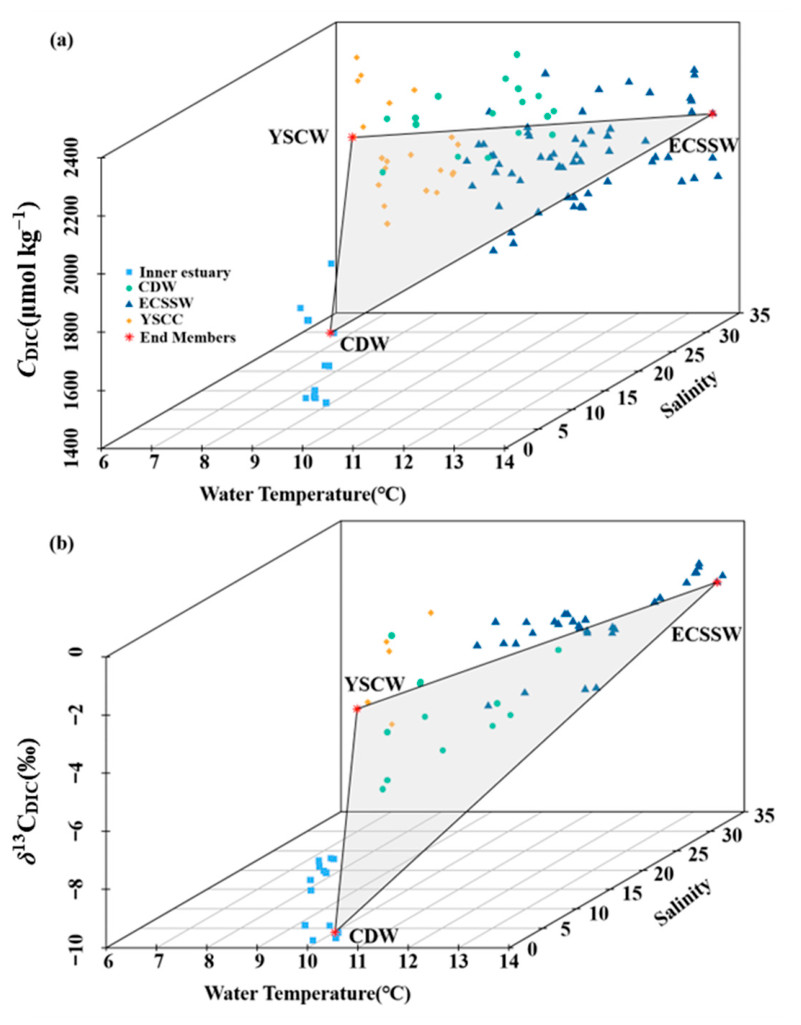
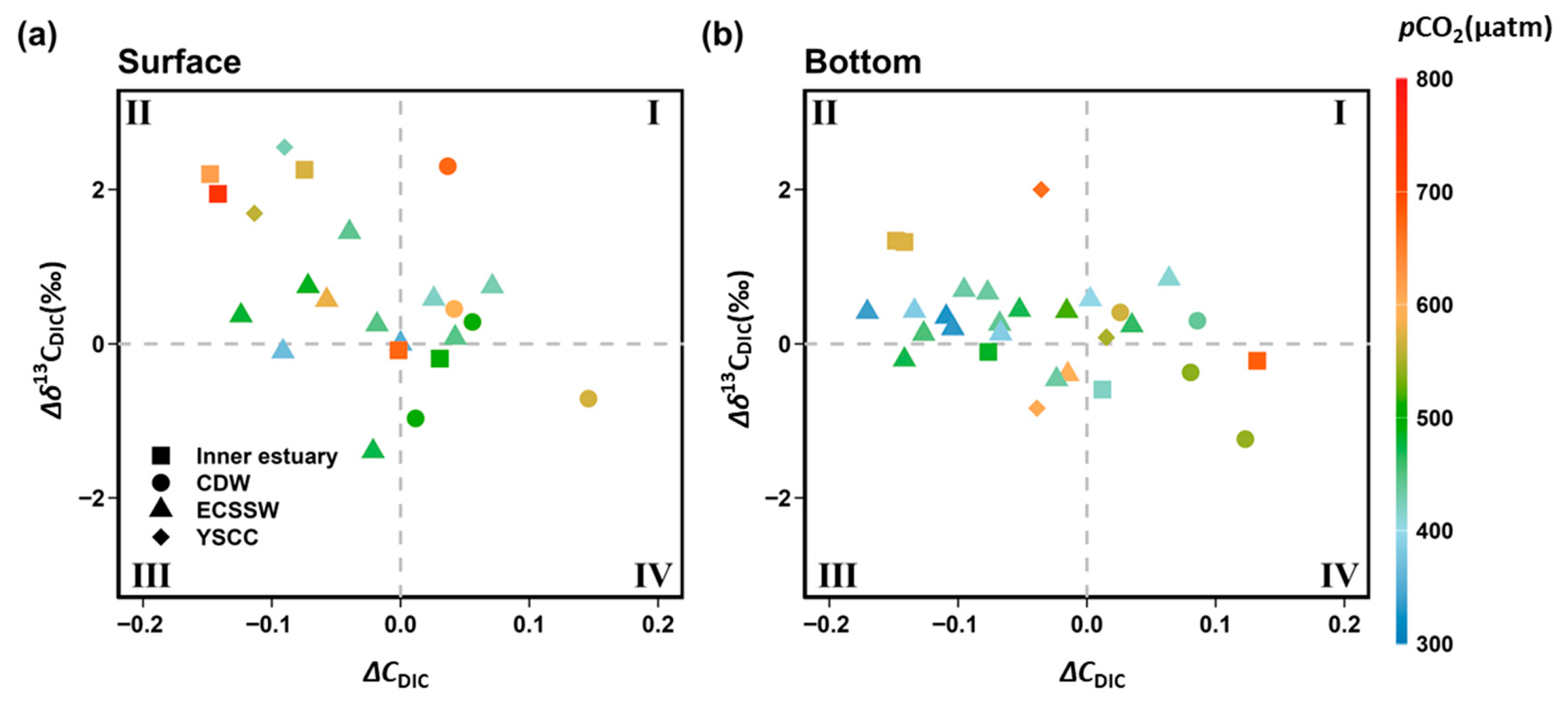
Three-dimensional scatter plots (Figure 4) revealed that the observed DIC concentrations deviated notably from the predicted conservative mixing values, with some samples exceeding and others falling below the theoretical mixing line (Figure 4a). Correspondingly, δ13CDIC values displayed bidirectional deviations, with a portion of samples enriched relative to the theoretical mixing line and others depleted (Figure 4b). A quadrant analysis of CDIC and δ13CDIC deviations (Figure 5) provided further insight into the dominant biogeochemical processes affecting the distributions of δ13CDIC and CDIC across different regions. In both surface and bottom waters, the majority of stations fell within Quadrant II (depleted in CDIC but enriched in δ13CDIC), suggesting the effects of primary production or CO2 outgassing. Some stations were located in Quadrant I (characterized by enrichment in both CDIC and δ13CDIC), indicating the predominant influence of carbonate mineral dissolution or atmospheric CO2 invasion. A small subset of surface stations in the ECSSW region fell within Quadrant III (depleted in both CDIC and δ13CDIC), indicative of carbonate precipitation. Conversely, a few surface stations in the inner estuary and CDW region occupied Quadrant IV (enriched in CDIC but depleted in δ13CDIC), pointing to organic matter degradation.
Regional patterns further illuminated the spatial heterogeneity of these processes. In the inner estuary, stations were predominantly distributed between Quadrants II and IV, suggesting a mixture of primary production or CO2 outgassing and organic matter degradation. In the CDW region, stations were mainly situated in Quadrants I and IV, reflecting the combined influences of carbonate dissolution or atmospheric CO2 invasion and organic matter degradation. In the ECSSW region, the vast majority of stations were located in Quadrants I, II, and III, reflecting the combined influences of carbonate dissolution or atmospheric CO2 invasion, primary production or CO2 outgassing, and carbonate precipitation. In the YSCC region, most stations fell within Quadrant II, indicating the importance of primary production or CO2 outgassing. Despite these qualitative insights, the relative contributions of the three key DIC-adding processes, carbonate dissolution, atmospheric CO2 invasion, and organic matter degradation, remain unresolved and warrant further quantitative investigation.

3.4. Potential Sources of Dissolved Inorganic Carbon

The relative contributions of potential DIC sources, quantified using an isotope mass balance model, are summarized in Table 2. Across the entire study area, atmospheric CO2 invasion via air–sea CO2 exchange and chemical weathering emerged as the dominant DIC source, contributing 62.3 ± 13.5% of the total DIC pool. Carbonate mineral dissolution and organic matter degradation accounted for 19.4 ± 6.1% and 18.2 ± 7.7%, respectively. A distinct spatial gradient was observed from the inner estuary to the outer estuary and offshore area. The contribution of atmospheric CO2 invasion increased progressively from 41.5 ± 5.4% in the inner estuary to 68.1 ± 8.2% in the outer estuary and offshore area. In contrast, the contributions of organic matter degradation and carbonate minerals dissolution declined along this gradient, from 30.1 ± 5.2% to 14.9 ± 4.2% and from 28.4 ± 1.2% to 16.9 ± 4.2%, respectively. Within the outer estuary and offshore area, further spatial heterogeneity was evident among individual water masses. The contributions of atmospheric CO2 invasion increased from 65.5 ± 9.8% in the CDW region to 69.5 ± 6.7% in the ECSSW region and 69.3 ± 8.0% in the YSCC region. Conversely, the contributions of carbonate minerals dissolution decreased from 18.4 ± 5.1% (CDW) to 15.6 ± 2.9% (ECSSW) and 16.8 ± 4.1% (YSCC). Similarly, the contributions of organic matter degradation declined from 16.0 ± 4.8% (CDW) to 15.0 ± 3.8% (ECSSW) and 13.9 ± 3.9% (YSCC). Notably, the contribution of atmospheric CO2 invasion increased from carbon source areas to carbon sink areas, while the contribution of carbonate minerals dissolution and organic matter degradation decreased.

4. Discussion

4.1. Controlling Mechanisms of Air–Sea CO2 Flux Spatial Variability

4.1.1. Effects of Water Mixing Processes on Air–Sea CO2 Flux Spatial Variability

The spatial variability of FCO2 in March was primarily governed by the physical mixing of three water masses—the CDW, the ECSSW, and the YSCC—consistent with previous findings that winter-to-spring carbonate dynamics in this region are mixing-dominated [28]. The inner estuary acted as a CO2 source due to elevated pCO2 in the Yangtze River discharge (Figures S4–S6), in line with its widely recognized role as a persistent CO2 outgassing zone [26,31]. In agreement with Li et al. [23], the outer estuary and offshore area exhibited a progressive decline in CO2 source intensity from CDW to ECSSW and YSCC. This may be high-pCO2 CDW- and YSCC-sustained CO2 outgassing, whereas the warmer low-pCO2 ECSSW functioned only as a weak source [20,21]. Lower-than-average March discharge (Figure S7) likely reduced the freshwater dilution and facilitated the intrusion of shelf waters, highlighting this early-spring case as a reference for how physical forcing preconditions subsequent biological CO2 drawdown [20].
Water mass mixing also indirectly influenced FCO2 by modulating the temperature, nutrients, and turbidity [23,48]. Despite reducing the CO2 solubility, the increase in water temperature from the inner estuary to the outer estuary and offshore area likely enhanced FCO2 through complex thermodynamic and biological feedbacks [10]. In the inner estuary and CDW region, elevated nutrients and terrigenous organic carbon input (Figure 5 and Figures S8 and S9) likely stimulated organic matter degradation, intensifying the CO2 source [6,14]. These linkages underscore that physical mixing establishes both the chemical and biogeochemical backdrop that modulates source–sink strength, an interplay especially pronounced in early spring before the phytoplankton bloom peak.

4.1.2. Influences of Biogeochemical Processes on Air–Sea CO2 Flux Spatial Variability

Given that pCO2 outweighed water temperature and k as the primary driver of FCO2, biogeochemical processes that alter DIC concentrations can profoundly modulate FCO2 in early spring [8,9]. The coexistence of positive and negative DIC concentrations deviations from conservative mixing lines (Figure 5) indicates that DIC-adding and DIC-removing processes operated simultaneously, a dual regulation that distinguishes early spring from late spring when biological uptake dominates [20,48]. In the inner estuary, terrestrial inputs of nutrients, minerals, and organic carbon likely stimulated organic matter degradation, carbonate dissolution, and atmospheric CO2 invasion, amplifying CO2 outgassing [6,14]. This aligns with the view that inner estuaries function as biogeochemical reactors, where terrestrial inputs are rapidly transformed into CO2, rather than merely acting as passive conduits [25]. In the CDW region, these DIC-adding processes persisted, in agreement with previous wintertime findings [23]. In the YSCC region, DIC concentrations dynamics were dominated by outgassing driven by high-pCO2 YSCC waters [20], whereas in the ECSSW region, they exhibited a balance between carbonate-related DIC addition and removal via primary production and carbonate precipitation [23]. Significant correlations of pCO2 with DO and nutrients across the entire study area (Figure 3a) further reinforce the role of biological processes in modulating FCO2 spatial variability [6,15]. Resolving which DIC sources primarily control FCO2 spatial variability, however, requires further quantitative source partitioning.

4.2. Effects of DIC Sources on Air–Water CO2 Flux Spatial Variability

Quantitative DIC source apportionment confirms that the spatial variability of FCO2 in early spring is governed by the interplay of water mass mixing and biological processes [17,49]. In the inner estuary, the CO2 source signature is largely inherited from the high-pCO2 river discharge, with atmospheric CO2 invasion and carbonate dissolution via chemical weathering constituting the dominant DIC sources (Table 2), consistent with earlier findings for the lower Yangtze River [49]. The higher contribution of organic matter degradation in the inner estuary relative to offshore waters (Table 2) indicates that terrestrial organic carbon inputs actively fuel remineralization, amplifying CO2 outgassing beyond conservative mixing expectations [50]. Primary production likely moderates this effect, explaining why the source intensity in the inner estuary remained weaker than in the CDW region [6,14]. In the CDW region, freshwater–seawater mixing reduces the nutrient availability, which may suppress primary production and thereby sustain stronger outgassing [23].
In the YSCC region, elevated pCO2 is sustained by DIC derived from long-term carbonate dissolution and atmospheric CO2 invasion via chemical weathering [18,49]. In the ECSSW region, the low-pCO2 reflects the offshore origin of this water mass from the East China Sea [21]. Here, the high total alkalinity and strong buffering capacity facilitate atmospheric CO2 uptake as the dominant DIC source [12]. Moreover, the elevated water temperatures likely enhance photosynthetic CO2 uptake, further weakening the CO2 source [10,11]. Although atmospheric CO2 and carbonate dissolution dominating the DIC pool is consistent with earlier work [18,49], relying solely on 13C without resolving isotopic differences between terrestrial and marine organic matter may introduce uncertainties and limitations [51]. Future studies in the Yangtze River estuary and adjacent coastal areas should consider using dual-isotope mass balance equations and accounting for the differences between terrestrial and marine organic matter δ13C.

4.3. A Comparison of Air–Sea CO2 Flux with Other Research

4.3.1. Uncertainty Analysis of Calculating Air–Sea CO2 Flux

Although the inner estuary acted as a CO2 source in our early spring survey (11.0 mmol m−2 d−1), consistent with Li et al. [23], for February and March, it was markedly lower than the April estimate (23.5 mmol m−2 d−1) of Zhai et al. [25]. This discrepancy may reflect reduced DIC inputs from declining nutrient and terrestrial organic matter loading, potentially linked to pollution control or hydrological shifts following the Three Gorges Dam construction [52]. For the outer estuary and offshore area, our March FCO2 (6.6 mmol m−2 d−1) was slightly higher than that of Li et al. [5] (2.58 mmol m−2 d−1; Table 3). The overall spatial variability of FCO2 in our study closely mirrored the findings of Li et al. [23].
Accurate FCO2 calculation depends on the surface water–atmosphere pCO2 gradient and k [2,5]. Here, pCO2 in water bodies was calculated via CO2SYS from DIC and pH measurements [33], with an uncertainty of approximately ±14 μatm, small compared to the magnitude of pCO2. Given the absence of region-specific k formulations, three wind speed-dependent formulas (N00, H06, and W19) were applied, yielding similar spatial distributions and comparable area-averaged fluxes (Table 1). At the relatively low wind speeds prevailing in March (7.5 ± 1.1 m s−1), W19 produced lower k values, due to its non-zero intercept term, resulting in slightly lower FCO2 (Table 1). While k primarily depends on wind regime in the open ocean, it is more complex in coastal and shallower estuaries, where other factors such as tidal currents, bottom stress, and water depth can also influence k [5]. The use of wind speed-driven models in the inner estuary area, neglecting the influence of hydrodynamics on k, may introduce certain uncertainties.
Monthly average wind speeds were used for the k calculation (inner estuary: 4.7 ± 0.88 m s−1; outer estuary and offshore area: 7.8 ± 0.59 m s−1; Table S3). The nonlinearity factor C2, representing sub-monthly wind variability effects on k, was 1.25 in the inner estuary and 1.18 in the outer estuary and offshore area (Figure S10 and Table S3), assuming that long-term winds follow a Raleigh (Weibull) distribution [54]. These values were slightly lower than the global average of 1.27 [35]. The highest C2 value in the three areas was 1.06- to 1.11-fold the lowest value in March, indicating that this variability did not induce significant intra-monthly changes in the calculated FCO2. Nevertheless, the variations in estimated FCO2 during early spring (Table 3) suggest that further work is needed to constrain the uncertainties associated with different estimation approaches and to incorporate multi-year observations [5,38]. Future research is required to validate the most appropriate gas transfer velocity model in the estuary systems with complex hydrodynamics. To improve FCO2 estimations in this region, high-frequency and long-term observations of pCO2 and supporting carbonate chemistry data are essential.

4.3.2. Seasonal Variations in Air–Sea CO2 Flux

Seasonal comparisons (Table 3) show that the inner estuary remains a perennial CO2 source sustained by high-pCO2 freshwater and terrestrial inputs [25,52], whereas the outer estuary and offshore area shifts from a carbon sink in late spring to a source in autumn, with transitional behavior in summer and winter. This seasonal pattern is largely regulated by the mixing of CDW, YSCC, and ECSSW in winter, spring, and autumn and primarily CDW and ECSSW in summer under elevated discharge [5]. The higher carbon sink capacity in April and May compared to March suggested the increased biological uptake of CO2, driven by rising nutrient inputs from CDW and increasing water temperature [54]. Our early-spring survey thus captures a critical transitional window, providing regionally meaningful evidence for understanding source–sink shifts along the estuary–coastal continuum. In summer, strong primary production supported by nutrient-rich CDW and warming temperatures drives net CO2 uptake [20]. Phytoplankton absorb CO2 from surface water through photosynthesis and transport it to deeper water via the biological pump, resulting in decreased surface pCO2 and increased atmospheric CO2 uptake [15,21]. In autumn, the net CO2 release may be related to the collapse of summer stratification and the autumn mixture between the surface water and high-pCO2 bottom water [5,20]. From autumn to winter, continued cooling and CO2 degassing may shift the region from a carbon source [20,23] to a carbon sink [14,48].
Anticipated anthropogenic and climatic perturbations may fundamentally alter the seasonal and spatial variation in FCO2 in the Yangtze River estuary and adjacent coastal areas [5]. Projected declines in freshwater discharge, driven by reservoir expansion and increased water consumption [5,23], could diminish summer plume stratification, enhancing the vertical advection of high-pCO2 subsurface waters [20], and reduce nutrient delivery, inhibiting phytoplankton production [2]. Warming trends and elevated terrestrial nutrient loads due to land-use changes or wastewater discharge [23] may exacerbate summer eutrophication, potentially altering the FCO2 [55]. Rising atmospheric CO2 levels may enhance atmospheric CO2 dissolution, influencing the long-term stability of estuarine carbon sinks, and leading to the acidification of this region. The resulting decrease in pH due to acidification may further increase CO2 dissolution in water bodies by altering the carbonate chemistry balance [3,24]. To enhance our understanding of the impacts of future human activities and climate change on carbon sources and sinks in this region, high-frequency high spatial resolution and long-term observations of pCO2 and supporting carbonate chemistry data are essential.

5. Conclusions

This study investigated the spatial variability of FCO2 and its controlling mechanisms in the Yangtze River estuary and adjacent coastal areas during early spring (March 2025) based on the NORC2025-03 cruise. The entire study area functioned as a net CO2 source, with an average flux of 7.3 ± 8.7 mmol m−2 d−1, with the source intensity declining progressively from the inner estuary to the outer estuary and offshore area. Within the outer estuary and offshore area, the CDW region exhibited the strongest outgassing, followed by the YSCC region, while the ECSSW region acted only as a weak CO2 source.
The spatial pattern of FCO2 was primarily set by the physical mixing of three water masses (CDW, ECSSW, and YSCC), with pCO2 as the dominant direct driver. Biogeochemical processes superimposed on this physical template further modulated the source intensity regionally, while water mass mixing also exerted indirect controls through temperature, nutrient availability, and turbidity, which in turn influenced organic matter degradation and biological production.
Quantitative source apportionment revealed that atmospheric CO2 invasion via air–sea exchange and chemical weathering dominated the DIC pool, followed by carbonate mineral dissolution and organic matter degradation. The enhanced FCO2 from the inner estuary to CDW region can be attributed to freshwater–seawater mixing, which reduces nutrient concentrations, diminishes primary production, and decreases the contribution of organic matter degradation. In the ECSSW region, elevated water temperatures likely enhance photosynthetic CO2 uptake, further weakening the CO2 source. These contrasting source contributions mechanistically link the carbon source–sink mosaic to distinct DIC supply pathways.
By capturing a transitional hydrographic window which is typically underrepresented in seasonal studies, this early-spring case provides regionally meaningful evidence on how physical forcing preconditions subsequent biological CO2 drawdown. The findings underscore the value of integrating multi-factor regulation and DIC source partitioning to resolve carbon dynamics in a large river-dominated estuary–coastal continuum. Future work should prioritize higher-frequency observations and assess the impacts of climate change and anthropogenic activities on regional carbon cycling.

Supplementary Materials

The following supporting information can be downloaded at: https://www.mdpi.com/article/10.3390/w18091078/s1, Figure S1: Transport and transformation processes of dissolved inorganic carbon (DIC) along the estuary-coastal continuum; Figure S2: Temperature vs salinity scheme (a) and distribution of water mixing characteristics (b) in the Yangtze River estuary and adjacent coastal areas; Figure S3: Relationship between the observed and model predicted δ18O with the three-endmember mixing models; Figure S4: Spatial distributions of (a) pCO2, (b) pH, (c) dissolved inorganic carbon concentration (CDIC), and (d) total alkalinity (TA) in the surface and (e) pCO2, (f) pH, (g) CDIC, and (h) TA in the bottom water layers of the Yangtze River estuary and adjacent coastal areas; Figure S5: Distributions of (a) FCO2, (b) pCO2, (c) DIC, (d) DO, (e) Chla, (f) NO2, (g) NO3, (h) NH4+, (i) PO43−, and (j) SiO32− against salinity in surface and bottom water layers; Figure S6: Spatial distributions of (a) water temperature, (b) salinity and (c) turbidity in the surface and (d) water temperature, (e) salinity and (f) turbidity in the bottom water layers of the Yangtze River estuary and adjacent coastal areas; Figure S7: Variation in runoff at the Datong Station in March during 2016–2025; Figure S8: Spatial distributions of nutrients ((a) NO2, (b) NO3, (c) NH4+, (d) PO43−, and (e) SiO32−) in the surface and ((f) NO2, (g) NO3, (h) NH4+, (i) PO43−, and (j) SiO32−) in the bottom water layers of the Yangtze River estuary and adjacent coastal areas; Figure S9: Spatial distributions of (a) dissolved oxygen (DO), and (b) Chlorophyta (Chla) in the surface and (c) DO, and (d) Chla in the bottom water layers of the Yangtze River estuary and adjacent coastal areas; Figure S10: (a) Monthly mean 10 m wind speeds calculated by daily wind speeds and (b) C2 values in the Yangtze River estuary and adjacent coastal areas (March 2025); Table S1: Summary information for the end-member stations used in the three end-member model; Table S2. Results of multiple linear regression models for FCO2 in the Yangtze River estuary and adjacent coastal areas (March 2025); Table S3: The mean, coefficient of variation (CV) and C2 values of wind speed in the Yangtze River estuary and adjacent coastal areas.

Author Contributions

Conceptualization, S.L. and X.W.; methodology, S.L. and W.L.; investigation, W.L.; writing—original draft preparation, W.L.; writing—review and editing, S.L. and X.W.; visualization, W.L.; supervision, S.L. and X.W. All authors have read and agreed to the published version of the manuscript.

Funding

This work was supported by the National Natural Science Foundation of China (42141015), the CAS (Chinese Academy of Sciences) Project for Young Scientists in Basic Research (YSBR-037), and the National Natural Science Foundation of China (42449903).

Data Availability Statement

The original contributions presented in this study are included in the article/Supplementary Material. Further inquiries can be directed to the corresponding author.

Acknowledgments

Data and samples were collected onboard of R/V “Runjiang 1” and/or “Zheyuke 2” implementing the open research cruise NORC2025-03.

Conflicts of Interest

The authors declare no conflicts of interest.

References

  1. Bauer, J.E.; Cai, W.J.; Raymond, P.A.; Bianchi, T.S.; Hopkinson, C.S.; Regnier, P.A. The changing carbon cycle of the coastal ocean. Nature 2013, 504, 61–70. [Google Scholar] [CrossRef] [PubMed]
  2. Shen, C.; Testa, J.M.; Li, M.; Chen, B.; Cai, W.J. Interannual variability of air-water CO2 flux in a large eutrophic estuary. Water Res. 2023, 244, 120523. [Google Scholar] [CrossRef]
  3. Regnier, P.; Resplandy, L.; Najjar, R.G.; Ciais, P. The land-to-ocean loops of the global carbon cycle. Nature 2022, 603, 401–410. [Google Scholar] [CrossRef]
  4. Friedlingstein, P.; O’Sullivan, M.; Jones, M.W.; Andrew, R.M.; Gregor, L.; Hauck, J.; Le Quéré, C.; Luijkx, I.T.; Olsen, A.; Peters, G.P.; et al. Global Carbon Budget 2022. Earth Syst. Sci. Data 2022, 14, 4811–4900. [Google Scholar] [CrossRef]
  5. Liu, J.; Bellerby, R.G.J.; Li, X.; Yang, A. Seasonal variability of the carbonate system and air–sea CO2 flux in the outer Changjiang estuary, East China Sea. Front. Mar. Sci. 2022, 8, 765564. [Google Scholar] [CrossRef]
  6. Chen, S.; Ran, L.; Duvert, C.; Liu, B.; Zhou, Y.; Yang, X.; Yang, Q.; Li, Y.; Li, S.L. Anthropogenic and hydroclimatic controls on the CO2 and CH4 dynamics in subtropical monsoon rivers. Water Resour. Res. 2024, 61, e2024WR038341. [Google Scholar] [CrossRef]
  7. Akhand, A.; Chanda, A.; Watanabe, K.; Das, S.; Tokoro, T.; Hazra, S.; Kuwae, T. Drivers of inorganic carbon dynamics and air–water CO2 fluxes in two large tropical estuaries: Insights from coupled radon (222Rn) and pCO2 surveys. Limnol. Oceanogr. 2022, 67, S118–S132. [Google Scholar] [CrossRef]
  8. Dai, M.; Cao, Z.; Guo, X.; Zhai, W.; Liu, Z.; Yin, Z.; Xu, Y.; Gan, J.; Hu, J.; Du, C. Why are some marginal seas sources of atmospheric CO2? Geophys. Res. Lett. 2013, 40, 2154–2158. [Google Scholar] [CrossRef]
  9. Khatiwala, S.; Schmittner, A.; Muglia, J. Air-sea disequilibrium enhances ocean carbon storage during glacial periods. Sci. Adv. 2019, 5, eaaw4981. [Google Scholar] [CrossRef] [PubMed]
  10. Gao, Y.; Li, J.; Wang, S.; Jia, J.; Wu, F.; Yu, G. Global inland water greenhouse gas (GHG) geographical patterns and escape mechanisms under different water level. Water Res. 2025, 269, 122808. [Google Scholar] [CrossRef] [PubMed]
  11. Song, X.; Lyu, S.; Sun, K.; Gao, Y.; Wen, X. Flux and source of dissolved inorganic carbon in a headwater stream in a subtropical plantation catchment. J. Hydrol. 2021, 600, 126511. [Google Scholar] [CrossRef]
  12. Tank, S.E.; Fellman, J.B.; Hood, E.; Kritzberg, E.S. Beyond respiration: Controls on lateral carbon fluxes across the terrestrial–aquatic interface. Limnol. Oceanogr. Lett. 2018, 3, 76–88. [Google Scholar] [CrossRef]
  13. Chen, B.; Cai, W.J.; Brodeur, J.R.; Hussain, N.; Testa, J.M.; Ni, W.; Li, Q. Seasonal and spatial variability in surface pCO2 and air–water CO2 flux in the Chesapeake Bay. Limnol. Oceanogr. 2020, 65, 3046–3065. [Google Scholar] [CrossRef]
  14. Han, L.; Wang, Y.; Xu, Y.; Wang, Y.; Zheng, Y.; Wu, J. Water- and base-extractable organic matter in sediments from lower Yangtze river–estuary–East China Sea continuum: Insight into accumulation of organic carbon in the river-dominated margin. Front. Mar. Sci. 2021, 8, 617241. [Google Scholar] [CrossRef]
  15. Chou, W.C.; Gong, G.C.; Cai, W.J.; Tseng, C.M. Seasonality of CO2 in coastal oceans altered by increasing anthropogenic nutrient delivery from large rivers: Evidence from the Changjiang–East China Sea system. Biogeosciences 2013, 10, 3889–3899. [Google Scholar] [CrossRef]
  16. Li, D.; Chen, J.; Ni, X.; Wang, K.; Zeng, D.; Wang, B.; Jin, H.; Huang, D.; Cai, W.J. Effects of biological production and vertical mixing on sea surface pCO2 variations in the Changjiang river plume during early autumn: A Buoy–based time series study. J. Geophys. Res. Ocean. 2018, 123, 6156–6173. [Google Scholar] [CrossRef]
  17. Wang, H.; Dai, M.; Liu, J.; Kao, S.J.; Zhang, C.; Cai, W.J.; Wang, G.; Qian, W.; Zhao, M.; Sun, Z. Eutrophication-driven hypoxia in the East China Sea off the Changjiang estuary. Environ. Sci. Technol. 2016, 50, 2255–2263. [Google Scholar] [CrossRef]
  18. Wang, X.; Luo, C.; Ge, T.; Xu, C.; Xue, Y. Controls on the sources and cycling of dissolved inorganic carbon in the Changjiang and Huanghe River estuaries, China: 14C and 13C studies. Limnol. Oceanogr. 2016, 61, 1358–1374. [Google Scholar] [CrossRef]
  19. Feely, R.A.; Sabine, C.L.; Lee, K.; Berelson, W.; Kleypas, J.; Fabry, V.J.; Millero, F.J. Impact of anthropogenic CO2 on the CaCO3 system in the oceans. Science 2004, 305, 362–366. [Google Scholar] [CrossRef]
  20. Li, X.; Song, J.; Yuan, H.; Li, N.; Duan, L.; Qu, B. CO2 flux and seasonal variability in the turbidity maximum zone and surrounding area in the Changjiang River estuary. Chin. J. Oceanol. Limnol. 2015, 33, 222–232. [Google Scholar] [CrossRef]
  21. Wu, X.; Tan, T.; Liu, C.; Li, T.; Liu, X.; Yang, G. Distributions and relationships of CO2, O2, and Dimethylsulfide in the Changjiang (Yangtze) Estuary and its adjacent waters in summer. J. Ocean Univ. China 2018, 17, 320–334. [Google Scholar] [CrossRef]
  22. Deng, X.; Li, Q.; Su, J.; Liu, C.Y.; Atekwana, E.; Cai, W.J. Performance evaluations and applications of a δ13C-DIC analyzer in seawater and estuarine waters. Sci. Total Environ. 2022, 833, 155013. [Google Scholar] [CrossRef] [PubMed]
  23. Li, B.-H.; Zhao, H.L.; Gong, J.C.; Wu, X.; Liu, C.Y.; Hu, J.W.; Yang, G.P. Emission of CO2 and its related carbonate system dynamics in a hotspot area during winter and summer: The Changjiang River estuary. Mar. Environ. Res. 2024, 198, 106496. [Google Scholar] [CrossRef]
  24. Wang, K.; Cai, K.; Chen, J.; Zhou, F.; Jin, H.; Li, H.; Xue, B.; Yu, P.; Zhang, Y. Seasonal variation of air–sea CO2 flux and contribution of biological processes to carbon source/sink in a large river–dominated shelf sea. J. Geophys. Res. Ocean. 2025, 130, e2025JC022329. [Google Scholar] [CrossRef]
  25. Zhai, W.; Dai, M.; Guo, X. Carbonate system and CO2 degassing fluxes in the inner estuary of Changjiang (Yangtze) River, China. Mar. Chem. 2007, 107, 342–356. [Google Scholar] [CrossRef]
  26. Zhao, B.; Yao, P.; Bianchi, T.S.; Wang, X.; Shields, M.R.; Schröder, C.; Yu, Z. Preferential preservation of pre-aged terrestrial organic carbon by reactive iron in estuarine particles and coastal sediments of a large river-dominated estuary. Geochim. Cosmochim. Acta 2023, 345, 34–49. [Google Scholar] [CrossRef]
  27. Zhai, W.D.; Chen, J.F.; Jin, H.Y.; Li, H.L.; Liu, J.W.; He, X.Q.; Bai, Y. Spring carbonate chemistry dynamics of surface waters in the northern East China Sea: Water mixing, biological uptake of CO2, and chemical buffering capacity. J. Geophys. Res. Ocean. 2014, 119, 5638–5653. [Google Scholar] [CrossRef]
  28. Chen, C.T.A. Chemical and physical fronts in the Bohai, Yellow and East China seas. J. Mar. Syst. 2009, 78, 394–410. [Google Scholar] [CrossRef]
  29. Pierrot, D. MS Excel Program Developed for CO2 System Calculations; Version 3.0; ORNL Environmental Sciences Division: Oak Ridge, TN, USA, 2021; Available online: https://github.com/dpierrot/co2sys_xl (accessed on 21 January 2025).
  30. Millero, F.J.; Graham, T.B.; Huang, F.; Bustos-Serrano, H.; Pierrot, D. Dissociation constants of carbonic acid in seawater as a function of salinity and temperature. Mar. Chem. 2006, 100, 80–94. [Google Scholar] [CrossRef]
  31. Dickson, A.G. Standard potential of the reaction: AgCl(s) + 12H2(g) = Ag(s) + HCl(aq), and and the standard acidity constant of the ion HSO4 in synthetic sea water from 273.15 to 318.15 K. J. Chem. Thermodyn. 1990, 22, 113–127. [Google Scholar] [CrossRef]
  32. Uppström, L.R. The boron/chlorinity ratio of deep-sea water from the Pacific Ocean. Deep Sea Res. Oceanogr. Abstr. 1974, 21, 161–162. [Google Scholar] [CrossRef]
  33. Orr, J.C.; Epitalon, J.M.; Dickson, A.G.; Gattuso, J.P. Routine uncertainty propagation for the marine carbon dioxide system. Mar. Chem. 2018, 207, 84–107. [Google Scholar] [CrossRef]
  34. Weiss, R.F. Carbon dioxide in water and seawater: The solubility of a non-ideal gas. Mar. Chem. 1974, 2, 203–215. [Google Scholar] [CrossRef]
  35. Wanninkhof, R.; Triñanes, J.; Park, G.H.; Gledhill, D.; Olsen, A. Large decadal changes in air–sea CO2 fluxes in the Caribbean sea. J. Geophys. Res. Ocean. 2019, 124, 6960–6982. [Google Scholar] [CrossRef]
  36. Ho, D.T.; Law, C.S.; Smith, M.J.; Schlosser, P.; Harvey, M.; Hill, P. Measurements of air-sea gas exchange at high wind speeds in the Southern Ocean: Implications for global parameterizations. Geophys. Res. Lett. 2006, 33, L16611. [Google Scholar]
  37. Nightingale, P.D.; Malin, G.; Law, C.S.; Watson, A.J.; Liss, P.S.; Liddicoat, M.I.; Boutin, J.; Upstill-Goddard, R.C. In situ evaluation of air-sea gas exchange parameterizations using novel conservative and volatile tracers. Glob. Biogeochem. Cycles 2000, 14, 373–387. [Google Scholar] [CrossRef]
  38. Song, S.; Bellerby, R.; Liu, J.; Guo, W.; Yu, P.; Ge, J.; Li, D. Impacts of an extreme Changjiang flood on variations in carbon cycle components in the Changjiang Estuary and adjacent East China sea. Cont. Shelf Res. 2023, 269, 105137. [Google Scholar] [CrossRef]
  39. Wanninkhof, R. Relationship between wind speed and gas exchange over the ocean. J. Geophys. Res. Ocean. 1992, 97, 7373–7382. [Google Scholar] [CrossRef]
  40. Li, X.; Wallhead, P.; Bellerby, R.G.J.; Liu, J.; Yang, A. The quantitative analysis of water mass during winter on the East China Sea Shelf using an extended OMP analysis. Water 2022, 14, 3214. [Google Scholar] [CrossRef]
  41. Zhao, Y.; Liu, J.; Uthaipan, K.; Song, X.; Xu, Y.; He, B.; Liu, H.; Gan, J.; Dai, M. Dynamics of inorganic carbon and pH in a large subtropical continental shelf system: Interaction between eutrophication, hypoxia, and ocean acidification. Limnol. Oceanogr. 2020, 65, 1359–1379. [Google Scholar] [CrossRef]
  42. Duan, L.Q.; Song, J.M.; Yuan, H.M.; Li, X.G.; Li, N.; Peng, Q.C. The use of sterols combined with isotope analyses as a tool to identify the origin of organic matter in the East China Sea. Ecol. Indic. 2017, 83, 144–157. [Google Scholar] [CrossRef]
  43. Liang, S.; Li, S.; Guo, J.; Yang, Y.; Xu, Z.; Zhang, M.; Li, H.; Yu, X.; Ma, H.; Wang, X. Source, composition, and reactivity of particulate organic matter along the Changjiang Estuary salinity gradient and adjacent sea. Mar. Chem. 2023, 252, 104245. [Google Scholar] [CrossRef]
  44. Stock, B.C.; Jackson, A.L.; Ward, E.J.; Parnell, A.C.; Phillips, D.L.; Semmens, B.X. Analyzing mixing systems using a new generation of Bayesian tracer mixing models. PeerJ 2018, 6, e5096. [Google Scholar] [CrossRef]
  45. Liu, J.; Han, G.; Zhang, Q.; Liu, M.; Li, X. Stable isotopes and Bayesian tracer mixing model reveal chemical weathering and CO2 release in the Jiulongjiang river basin, southeast China. Water Resour. Res. 2022, 58, e2021WR031738. [Google Scholar] [CrossRef]
  46. Fernández-i-Marín, X. ggmcmc: Analysis of MCMC samples and Bayesian inference. J. Stat. Softw. 2016, 70, 1–20. [Google Scholar] [CrossRef]
  47. Feng, T.; Zheng, H.; Wei, W.; Wang, P.; Bi, H.; Zhang, J.; Wei, T.; Wang, R.; Wang, L. Natural forests accelerate soil hydrological processes and enhance water–holding capacities compared to planted forests after long–term restoration. Water Resour. Res. 2025, 61, e2025WR040857. [Google Scholar] [CrossRef]
  48. Zhai, W.; Dai, M. On the seasonal variation of air–sea CO2 fluxes in the outer Changjiang (Yangtze River) Estuary, East China Sea. Mar. Chem. 2009, 117, 2–10. [Google Scholar] [CrossRef]
  49. Shan, S.; Luo, C.; Qi, Y.; Cai, W.J.; Sun, S.; Fan, D.; Wang, X. Carbon isotopic and lithologic constraints on the sources and cycling of inorganic carbon in four large rivers in China: Yangtze, Yellow, Pearl, and Heilongjiang. J. Geophys. Res. Biogeosci. 2021, 126, e2020JG005901. [Google Scholar] [CrossRef]
  50. Cao, Z.; Yang, W.; Zhao, Y.; Guo, X.; Yin, Z.; Du, C.; Zhao, H.; Dai, M. Diagnosis of CO2 dynamics and fluxes in global coastal oceans. Natl. Sci. Rev. 2020, 7, 786–797. [Google Scholar] [CrossRef] [PubMed]
  51. Lee, S.A.; Kim, T.H.; Kim, G. Tracing terrestrial versus marine sources of dissolved organic carbon in a coastal bay using stable carbon isotopes. Biogeosciences 2020, 17, 135–144. [Google Scholar] [CrossRef]
  52. Xuan, J.; Li, H.; Bai, Y.; Meng, Q.; Jin, H.; Pan, Y.; Li, Q.; Zhang, J.; He, Y.; Ma, Y.; et al. Trend of air–sea CO2 flux in the frontal zone of the East China Sea investigated by a remote–sensing data assimilation model. J. Geophys. Res. Ocean. 2025, 130, e2025JC022423. [Google Scholar] [CrossRef]
  53. Zhang, Y.; Li, D.; Wang, K.; Xue, B. Contribution of biological effects to the carbon sources/sinks and the trophic status of the ecosystem in the Changjiang (Yangtze) river estuary plume in summer as indicated by net ecosystem production variations. Water 2019, 11, 1264. [Google Scholar] [CrossRef]
  54. Guo, X.H.; Zhai, W.D.; Dai, M.H.; Zhang, C.; Bai, Y.; Xu, Y.; Li, Q.; Wang, G.Z. Air–sea CO2 fluxes in the East China Sea based on multiple-year underway observations. Biogeosciences 2015, 12, 5495–5514. [Google Scholar] [CrossRef]
  55. Zeng, C.; Li, D.; Wang, B.; Jin, H.; Ye, R.; Sun, Q.; Jiang, Z.; Tao, Y.; Ma, X.; Liu, Q.; et al. Influences of nutrients on summer algal bloom in the Changjiang plume revealed by high-resolution profiles. Mar. Environ. Res. 2025, 210, 107318. [Google Scholar] [CrossRef] [PubMed]
Figure 1. Distribution of (a) sampling stations and (b) salinity in the Yangtze estuary and adjacent waters in March 2025. Circles indicate water sampling stations. The blue arrow denotes the Changjiang Diluted Water (CDW). Other arrows sketch major currents in northeast monsoon seasons in this region [27,28], including the Kuroshio (KS), the East China Sea Coastal Current (ECSCC), TsushiMa Warm Current (TMWC), Yellow Sea Warm Current (YSWC), Yellow Sea Coastal Current (YSCC), and Taiwan Warm Current (TWC).
Water 18 01078 g001
Figure 2. Spatial distribution of air–sea CO2 flux (FCO2) calculated using the respective k-wind speed relationships of (a) N00 (FcN00), (b) H06 (FcH06), and (c) W19 (FcW19) in the Yangtze River estuary and adjacent coastal areas in March 2025.
Water 18 01078 g002
Figure 3. Correlations among air–sea CO2 flux (FCO2), and meteorological, physical, chemical and biological factors in the (a) Yangtze River estuary and adjacent coastal areas, (b) inner estuary, (c) outer estuary and offshore area, (d) Changjiang Diluted Water (CDW), (e) East China Sea Shelf Water (ECSSW), and (f) Yellow Sea Coastal Current (YSCC). FcN00, FcH06 and FcW19 mean the FCO2 calculated using three different gas transfer velocity formulas, including N00, H06 and W19. WT means water temperature, TA means total alkalinity, and DO means dissolved oxygen. In each subgraph, the colors of the lines represent the correlations between FCO2 and each variable (Mantel’s r). Solid lines indicate significant correlations, while dotted lines indicate nonsignificant correlations at p = 0.05 (Mantel’s p). The colors of the squares represent the correlations among variables (Spearman’s r value). ***, **, and * denote significant relationships at p = 0.001, 0.01, and 0.05 levels, respectively.
Water 18 01078 g003
Figure 4. (a) Three-dimensional scatter relationships between water temperature, salinity, and dissolved inorganic carbon (DIC) concentration (CDIC), and (b) three-dimensional scatter relationships between water temperature, salinity, and δ13CDIC. Shadowed patches in panels (a,b) represent the predicted conservative CDIC and δ13CDIC controlled solely by physical mixing processes.
Water 18 01078 g004
Figure 5. Variations in δ13CDICδ13CDIC) and DIC concentration (ΔCDIC) relative to the conservative mixing lines in (a) surface and (b) bottom layers water of the Yangtze River estuary and adjacent coastal areas (March 2025). The origin represents the data controlled solely by physical mixing. The figure is divided into four quadrants, each indicating the position of samples influenced by additional processes (non-physical mixing process). Quadrant I represents carbonate or atmospheric CO2 dissolution, where both CDIC and δ13CDIC increase; quadrant II represents primary production or CO2 outgassing, where CDIC decreases while δ13CDIC increases; quadrant III represents CaCO3 precipitation, where both CDIC and δ13CDIC decrease; quadrant IV represents organic matter degradation, where CDIC increases but δ13CDIC decreases.
Water 18 01078 g005
Table 1. Air–sea CO2 flux (FCO2) calculated using three different gas transfer velocity (k) formulas in the Yangtze River estuary and adjacent coastal areas (March 2025).
RegionWater TypesWind Speed (m s−1)k (cm h−1)Air–Sea CO2 Flux (mmol m−2 d−1)
kN00kH06kW19FcN00FcH06FcW19Mean
Inner estuary 4.7 ± 0.95.4 ± 25 ± 2.15 ± 1.211.8 ± 10.310.8 ± 10.110.2 ± 9.511 ± 9.9
Outer estuary and offshore areaAll7.8 ± 0.613.1 ± 2.413.2 ± 2.510.5 ± 1.96.7 ± 8.76.7 ± 8.66.3 ± 8.16.6 ± 8.5
CDW7.6 ± 0.412 ± 1.612 ± 1.79.6 ± 1.314.5 ± 7.214.4 ± 7.113.6 ± 6.714.2 ± 7
ECSSW7.9 ± 0.513.9 ± 2.114 ± 2.311.2 ± 1.71.9 ± 6.81.8 ± 6.81.7 ± 6.41.8 ± 6.7
YSCC7.1 ± 0.610.1 ± 1.810 ± 1.98.2 ± 1.48.8 ± 6.38.7 ± 6.28.2 ± 5.98.6 ± 6.1
Carbon sink 7.8 ± 0.513.5 ± 2.113.6 ± 2.210.8 ± 1.7−4.7 ± 4.7−4.7 ± 4.8−4.5 ± 4.5−4.6 ± 4.7
Carbon source 6.7 ± 1.39.9 ± 3.29.8 ± 3.48.1 ± 2.310.3 ± 7.210.1 ± 7.19.5 ± 6.79.9 ± 7
Entire study area 7.5 ± 1.112.2 ± 3.312.3 ± 3.69.9 ± 2.57.5 ± 97.3 ± 8.86.9 ± 8.37.3 ± 8.7
Table 2. Quantitative proportional contributions of DIC sources in the Yangtze River estuary and adjacent coastal areas.
RegionWater TypesAtmospheric CO2
Invasion
Carbonate Mineral DissolutionOrganic Matter Degradation
Inner estuary 50.3 ± 9.630.2 ± 6.519.5 ± 3.2
Outer estuary and offshore areaAll80.7 ± 6.610.0 ± 4.49.3 ± 2.4
CDW74.4 ± 7.214.3 ± 4.511.3 ± 2.7
ECSSW83.3 ± 4.58.2 ± 3.08.6 ± 1.8
YSCC82.1 ± 5.39.3 ± 3.38.6 ± 2.0
Carbon sink 82.4 ± 5.68.7 ± 3.88.9 ± 2.1
Carbon source 68.8 ± 15.817.8 ± 10.213.4 ± 5.7
Entire study area 74.0 ± 14.614.4 ± 9.711.6 ± 5.0
Note: The values in this table are in the form of mean ± SD.
Table 3. Comparisons of air–sea CO2 flux (FCO2) in the Yangtze River estuary and adjacent coastal areas across different seasons.
RegionSeasonYearMonthWind Speed (m s−1)FCO2 (mmol m−2 d−1)Reference
Inner estuarySpring2006April3.5 (2.7~7.2)23.5 (14~99)[25]
2014February–March 14.17 ± 9.93[23]
2025March4.7 ± 0.911.0 ± 9.9This study
Summer2003August5 (0~8.0)65.5 (0~168)[25]
2014July 26.04 ± 8.19[23]
2020August 17.5 ± 47.9[38]
Autumn2005October5 (1.7~8.2)33.7 (3.9~91)[25]
Winter2005December6 (2.4~9.0)37.8 (6.0~85)[25]
Outer estuary and offshore areaSpring2005–2008April5.6 ± 1.0−8.8 ± 5.8[48]
2012May5.47−9 (−26~11)[20]
2014February–March 2.58[23]
2018March3.43 ± 1.31−1.25 ± 1.7[5]
2025March7.8 ± 0.66.6 ± 8.5This study
Summer2003–2007August4.7 ± 1.1−4.9 ± 4.0[48]
2006August −0.12 ± 0.16[53]
2010August5.54−16 (−31~14)[20]
2014June3.2−4.7[21]
2018July3.64 ± 0.921.71 ± 5.9[5]
Autumn2006–2007September5.1 ± 0.52.9 ± 2.5[48]
2010November5.025 (−3~18)[20]
2018October4.27 ± 1.73.06 ± 4.1[5]
Winter2006January10.5 ± 1.2−10.4 ± 2.3[48]
2010February5.225 (−5~20)[20]
Note: The values in this table are in the form of mean ± SD or mean (Minimum~Maximum).
Disclaimer/Publisher’s Note: The statements, opinions and data contained in all publications are solely those of the individual author(s) and contributor(s) and not of MDPI and/or the editor(s). MDPI and/or the editor(s) disclaim responsibility for any injury to people or property resulting from any ideas, methods, instructions or products referred to in the content.