Effects of DEM Resolution on the Characterization of a Small Agroforestry Basin for Hydrological Modelling: The Case of Idanha—Portugal



Abstract
1. Introduction
2. Materials and Methods
2.1. Study Area
2.2. Methodology
2.2.1. Data Collection
2.2.2. Data Preprocessing
2.2.3. Basin Delineation Methodology
- Flow direction assignment: Each raster cell is assigned a flow direction based on the steepest downslope gradient, using the D8 algorithm, which routes flow toward one of the eight neighboring cells.
- Flow connectivity analysis: Cells are connected according to their assigned flow directions, thereby generating a continuous drainage network.
- Stream definition and ordering: A Strahler stream order classification scheme is assigned, whereby stream order (s) increases with flow convergence. Cells with stream order below a user-defined threshold (e.g., s < 6, determined from preliminary analysis) are excluded, as they typically represent hill-slope flow rather than permanent channels.
2.2.4. Sensitivity Analysis of Delineation Parameters
2.2.5. Hydrological Modelling
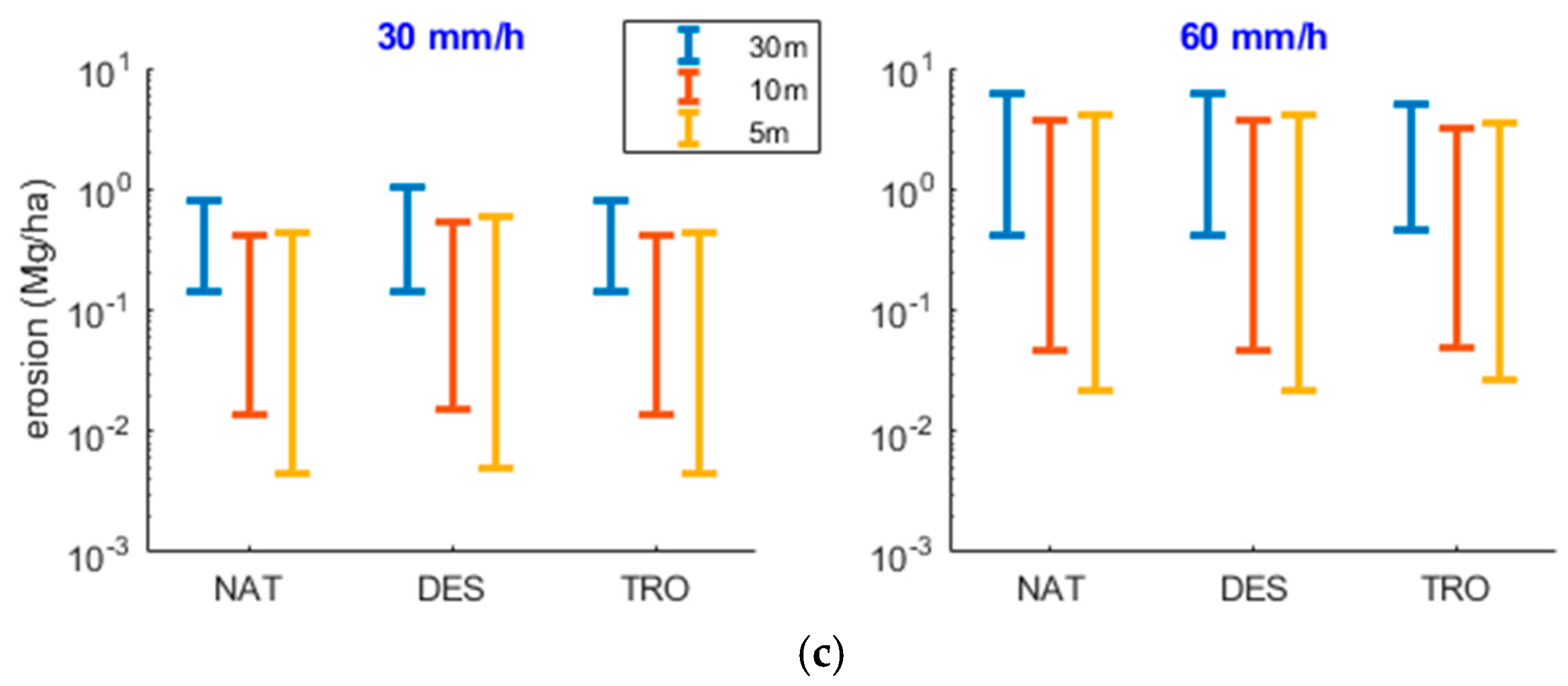
- NAT: naturalized conditions (rangeland; CN = 50);
- DES: degraded conditions typical of post-disturbance environments (e.g., post-fire), characterized by bare soil (CN = 70);
- TRO: “tropicalized” conditions, representing increased vegetation cover due to land abandonment and climate-driven shifts (forest; CN = 30).
3. Results
3.1. Basin Delineation
3.2. Hydrological Simulations
4. Discussion
5. Conclusions
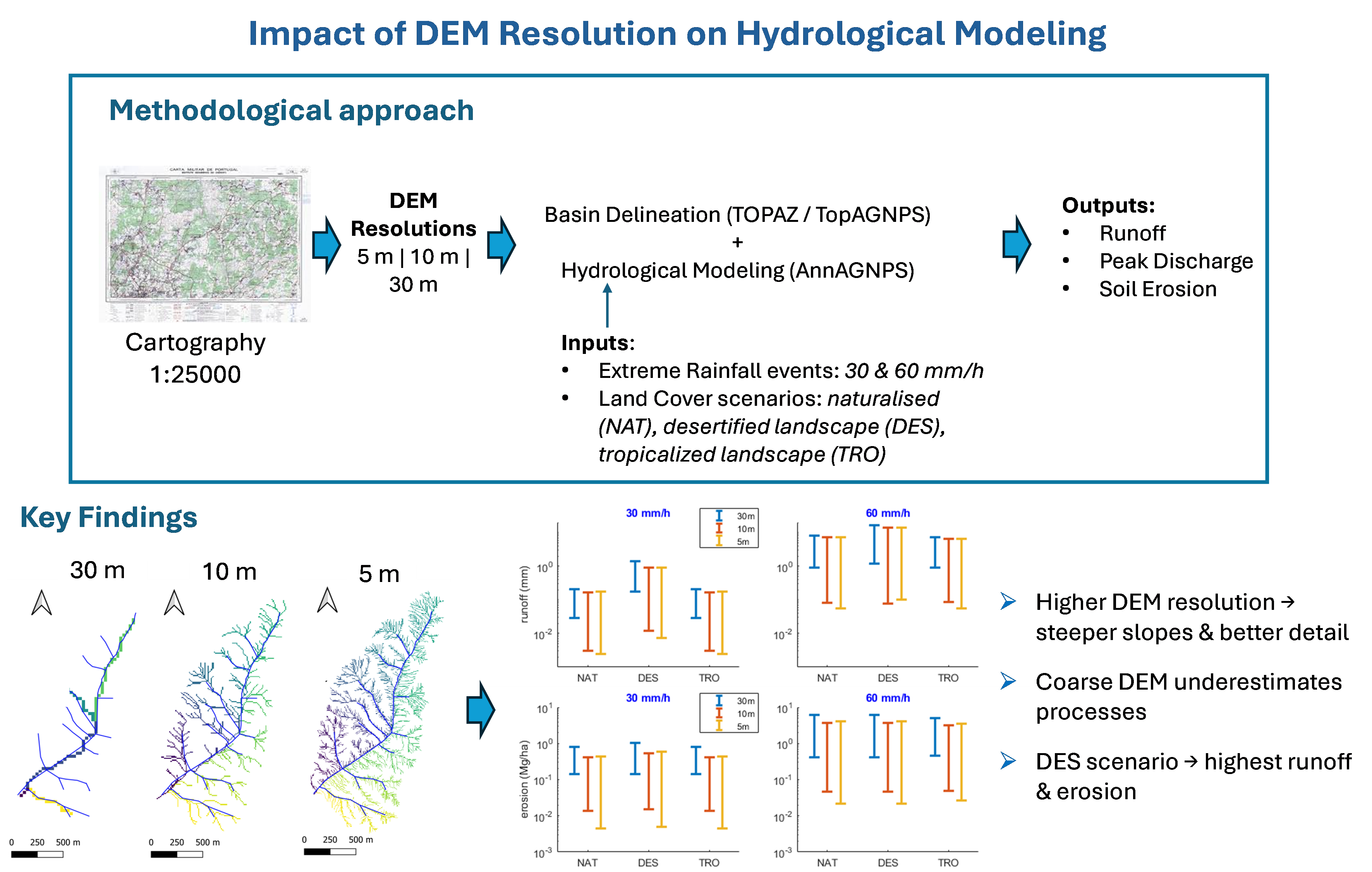
- Preprocessing sensitivity: DEM resolution and preprocessing choices can substantially affect derived topographic attributes, potentially introducing biases in both primary observations and secondary model outputs;
- Validation constraints: the validation of digitized terrain models remains challenging, as accurate delineation of reference stream networks and identification of channel initiation points require detailed local knowledge, often available only through field surveys.
Author Contributions
Funding
Data Availability Statement
Conflicts of Interest
References
- Kalantari, Z.; Ferreira, C.S.S.; Koutsouris, A.J.; Ahmer, A.K.; Cerdà, A.; Destouni, G. Assessing Flood Probability for Transportation Infrastructure Based on Catchment Characteristics, Sediment Connectivity and Remotely Sensed Soil Moisture. Sci. Total Environ. 2019, 661, 393–406. [Google Scholar] [CrossRef] [PubMed]
- Ferreira, C.S.S.; Keizer, J.J.; Santos, L.M.B.; Serpa, D.; Silva, V.; Cerqueira, M.; Ferreira, A.J.D.; Abrantes, N. Run-off, sediment and nutrient exports from a Mediterranean vineyard under integrated production: An experiment at plot scale. Agric. Ecosyst. Environ. 2018, 256, 184–193. [Google Scholar] [CrossRef]
- Butler, M.; Yellen, B.; Oyewumi, O.; Ouimet, W.; Richardson, J. Accumulation and transport of nutrient and pollutant elements in riparian soils, sediments, and river waters across the Thames River Watershed, Connecticut, USA. Sci. Total Environ. 2023, 899, 165630. [Google Scholar] [CrossRef]
- Stoof, C.R.; Ferreira, A.J.D.; Mol, W.; den Berg, J.V.; Kort, A.; Drooger, S.; Slingerland, E.C.; Mansholt, A.U.; Ferreira, C.S.S.; Ritsema, C.J. Soil surface changes increase run-off and erosion risk after a low-moderate severity fire. Geoderma 2015, 239–240, 58–67. [Google Scholar] [CrossRef]
- Han, Y.; Zhao, W.; Ding, J.; Ferreira, C.S.S. Soil erodibility for water and wind erosion and its relationship to vegetation and soil properties in China’s drylands. Sci. Total Environ. 2023, 903, 166639. [Google Scholar] [CrossRef]
- Czyzyk, K.; Mirossi, D.; Abdoulhak, A.; Hassani, S.; Niemann, J.D.; Gironás, J. Impacts of Channel Network Type on the Unit Hydrograph. Water 2020, 12, 669. [Google Scholar] [CrossRef]
- Rahmati, O.; Kalantari, Z.; Ferreira, C.S.; Chene, W.; Soleimanpourf, A.M.; Kapović-Solomun, M.; Ghajarnia, N.; Seifollahi-Aghmiunib, S.; Kazemabadyh, N.K.; Bui, D.T. Contribution of anthropogenic interventions to gully erosion in a semi-arid region of Iran. CATENA 2021, 210, 105925. [Google Scholar] [CrossRef]
- el Jeitany, J.; Nussbaum, M.; Pacetti, T.; Schroder, B.; Caporali, E. Landscape metrics as predictors of water-related ecosystem services: Insights from hydrological modeling and data-based approaches applied on the Arno River Basin, Italy. Sci. Total Environ. 2024, 954, 176567. [Google Scholar] [CrossRef] [PubMed]
- Jenson, S.K.; Domingue, J.O. Extracting Topographic Structure from Digital Elevation Data for Geographic Information System Analysis. Photogramm. Eng. Remote Sens. 1988, 54, 1593–1600. [Google Scholar]
- Sole, A.; Valanzano, A. Digital Terrain Modelling; Springer: Dordrecht, The Netherlands, 1996; pp. 175–194. [Google Scholar]
- SRTM. USGS EROS Archive—Digital Elevation—Shuttle Radar Topography Mission (SRTM). Available online: https://www.usgs.gov/centers/eros/science/usgs-eros-archive-digital-elevation-shuttle-radar-topography-mission-srtm (accessed on 1 December 2024).
- Gevaert, C.M.; Persello, C.; Nex, F.; Vosselman, G. A deep learning approach to DTM extraction from imagery using rule-based training labels. ISPRS J. Photogramm. Remote Sens. 2018, 142, 106–123. [Google Scholar] [CrossRef]
- Kwan, C.; Gribben, D.; Ayhan, B.; Larkin, J. Practical Digital Terrain Model Extraction Using Image Inpainting Techniques. In Recent Advances in Image Restoration with Applications to Real World Problems; IntechOpen: London, UK, 2020. [Google Scholar]
- Jiménez-Jiménez, S.I.; Ojeda-Bustamante, W.; Marcial-Pablo, M.D.J.; Enciso, J. Digital terrain models generated with low-cost UAV photogrammetry: Methodology and accuracy. ISPRS Int. J. Geo-Inf. 2021, 10, 285. [Google Scholar] [CrossRef]
- Rusli, N.; Majid, M.R.; Din, A.H.M. Google Earth’s derived digital elevation model: A comparative assessment with Aster and SRTM data. IOP Conf. Ser. Earth Environ. Sci. 2014, 18, 012065. [Google Scholar] [CrossRef]
- Freitas, H.R.; Freitas, C.; Rosim, S.; Oliveira, J.R. Drainage networks and watersheds delineation derived from TIN-based digital elevation models. Comput. Geosci. 2016, 92, 21–37. [Google Scholar] [CrossRef]
- Liao, C.; Tesfa, T.; Duan, Z.; Leung, L.R. Watershed delineation on a hexagonal mesh grid. Environ. Model. Softw. 2020, 128, 104702. [Google Scholar] [CrossRef]
- Hutchinson, M.F.; Xu, T.; Stein, J.A. Recent Progress in the ANUDEM Elevation Gridding Procedure. In Geomorphometry; Hengel, T., Evans, I.S., Wilson, J.P., Gould, M., Eds.; Geomorphometry.Org: Redlands, CA, USA, 2011; pp. 19–22. Available online: https://www.geomorphometry.org/uploads/pdf/pdf2011/HutchinsonXu2011geomorphometry.pdf (accessed on 1 April 2026).
- Duarte, A.C.; Ferreira, C.; Vitali, G. Use of simulation models to aid soil and water conservation actions for sustainable agro-forested systems. In Natural Resource Conservation and Advances for Sustainability; Jhariya, M.K., Meena, R.S., Banerjee, A., Meena, S.N., Eds.; Elsevier: Amsterdam, The Netherlands, 2021; pp. 389–412. [Google Scholar]
- Lovell, D.; Just, L.; Hovenbitzer, M. EuroDEM Pan-European Height Dataset at Medium Scale Specification—Version for EuroDEM. 2023. Available online: https://ome-download-data.s3.eu-west-1.amazonaws.com/euro-dem/documents/EuroDEM_2023_Specification.pdf (accessed on 1 July 2025).
- Paz, A.R.; Collischonn, W. River reach length and slope estimates for large-scale hydrological models based on a relatively high-resolution digital elevation model. J. Hydrol. 2007, 343, 127–139. [Google Scholar]
- Garbrecht, J.; Martz, L.W. Grid Size Dependency of Parameters Extracted from Digital Elevation Models. Comput. Geosci. 1994, 20, 85–87. [Google Scholar] [CrossRef]
- Sulis, M.; Paniconi, C.; Camporese, M. Impact of grid resolution on the integrated and distributed response of a coupled surface–subsurface hydrological model for the des Anglais catchment, Quebec. Hydrol. Process. 2011, 25, 1853–1865. [Google Scholar] [CrossRef]
- Singh, R.; Mal, B.C.; Tiwari, K.N. Effect of spatial resolution on watershed characteristics and the AGNPS model hydrologic simulations. In Proceedings of the 21st Century Watershed Technology Workshops: Improving Water Quality and the Environment, Bari, Italy, 27 May–1 June 2012; American Society of Agricultural and Biological Engineers: St. Joseph, MI, USA, 2012; p. 10. [Google Scholar]
- Wu, S.; Usery, E.L.; Finn, M.P.; Bosch, D.D. An assessment of the effects of cell size on AGNPS modeling of watershed run-off. Cartogr. Geogr. Inf. Sci. 2008, 35, 265–278. [Google Scholar]
- Bhuyan, S.J.; Mankin, K.R.; Koelliker, J.K.; Marzen, L.; Harrington, J.A. Effect of Cell Size on AGNPS Predictions. In Proceedings of the 2001 ASAE Annual Meeting, Sacramento, CA, USA, 29 July–1 August 2001. [Google Scholar] [CrossRef]
- Ferreira, C.S.S.; Mourato, S.; Ksanin-Grubin, M.; Ferreira, A.J.D.; Destouni, G.; Kalantari, Z. Effectiveness of Nature-Based Solutions in Mitigating Flood Hazard in a Mediterranean PeriUrban Catchment. Water 2020, 12, 2893. [Google Scholar] [CrossRef]
- Shekar, P.R.; Mathew, A. Morphometric analysis of watersheds: A comprehensive review of data sources, quality, and geospatial techniques. Watershed Ecol. Environ. 2024, 6, 13–25. [Google Scholar] [CrossRef]
- Ariza-Villaverde, A.B.; Jiménez-Hornero, F.J.; Gutiérrez de Ravé, E. Influence of DEM resolution on drainage network extraction: A multifractal analysis. Geomorphology 2015, 241, 243–254. [Google Scholar] [CrossRef]
- Wu, M.; Shi, P.; Chen, A.; Shen, C.; Wang, P.K. Impacts of DEM resolution and area threshold value uncertainty on the drainage network derived using SWAT. Water SA 2017, 43, 450–462. [Google Scholar] [CrossRef]
- Cheraghi, M.; Rinaldo, A.; Sander, G.C.; Perona, P.; Barry, D.A. Catchment drainage network scaling laws found experimentally in over-land flow morphologies. Geophys. Res. Lett. 2018, 45, 9614–9622. [Google Scholar] [CrossRef]
- Devak, M.; Dhanya, C.T. Sensitivity analysis of hydrological models: Review and way forward. J. Water Clim. Change 2017, 8, 557–575. [Google Scholar] [CrossRef]
- Jirasirichote, A.; Ninsawat, S.; Shrestha, S.; Tripathi, N.K. Performance of AnnAGNPS model in predicting run-off and sediment yields in Nan Province, Thailand. Heliyon 2021, 7, e08396. [Google Scholar] [CrossRef]
- Ongley, E.D. Control of Water Pollution from Agriculture; FAO Irrigation and Drainage Paper No. 55; FAO: Rome, Italy, 1996. [Google Scholar]
- Bingner, R.L.; Theurer, F.D. Topographic Factors for RUSLE in the continuous-Simulation, Watershed Model for Predicting Agricultural, Non-Point Source Pollutants (AnnAGNPS). In Proceedings of the Soil Erosion Research for the 21st Century, Honolulu, HI, USA, 3–5 January 2001. [Google Scholar]
- Duarte, A.C.; Mateos, L. How changes in cropping intensity affect water usage in an irrigated Mediterranean catchment. Agric. Water Manag. 2022, 260, 107274. [Google Scholar] [CrossRef]
- JAOHA. Junta Autónoma das Obras de Hidráulica Agrícola. Carta Militar de Portugal; Istituto Geogràfico do Exército: Lisbon, Portugal, 1998; sheets 6I and 7I. Available at: Arquivo National, Lisbon, Portugal. [Google Scholar]
- USGS. ASTER Global Digital Elevation Model V003. Available online: https://lpdaac.usgs.gov/products/astgtmv003 (accessed on 1 March 2024).
- JAXA. ALOS Data. Available online: https://www.eorc.jaxa.jp/ALOS/en/dataset/aw3d30/aw3d30_e.htm (accessed on 1 March 2024).
- GRASS. Available online: https://grasswiki.osgeo.org/wiki/Contour_lines_to_DEM (accessed on 1 August 2024).
- HDUS. SRTM Downloader. Available online: https://github.com/hdus/SRTM-Downloader (accessed on 1 March 2024).
- Samsonov, T.E. Automated conflation of digital elevation model with reference hydrographic lines. ISPRS Int. J. Geo-Inf. 2020, 9, 334. [Google Scholar] [CrossRef]
- GRASS-Hydro. Available online: https://grass.osgeo.org/grass84/manuals/topic_hydrology.html (accessed on 1 August 2024).
- SAGA-Hydro. Available online: https://saga-gis.sourceforge.io/saga_tool_doc/8.0.1/sim_hydrology.html (accessed on 1 March 2024).
- ArcGIS-Hydro. Available online: https://pro.arcgis.com/en/pro-app/latest/tool-reference/spatial-analyst/an-overview-of-the-hydrology-tools.htm (accessed on 1 August 2024).
- USDA_ARS. TOPAZ. Available online: https://www.ars.usda.gov/plains-area/el-reno-ok/ocparc/agroclimate-and-hydraulics-research-unit/docs/docs-from-anrr/docs/topaz/topaz-digital-landscape-parameterization/ (accessed on 1 July 2025).
- Bingner, R.L.; Darden, R.W.; Theurer, F.D.; Garbrecht, J. GIS-Based Generation of AGNPS Watershed Routing and Channel Parameters; ASAE Paper no. 97-2008; ASAE: St. Joseph, MI, USA, 1997; p. 4. [Google Scholar]
- Cronshey, R.G.; Theurer, F.G. AnnAGNPS-Non-Point Pollutant Loading Model. In Proceedings of the First Federal Interagency Hydrologic Modelling Conference N19, Las Vegas, NV, USA, 23 April 1998. [Google Scholar]
- Xiaoyan, W.; Qinhui, L. Impact of critical source area on AnnAGNPS simulation. Water Sci. Technol. 2011, 64, 1767–1773. [Google Scholar] [CrossRef] [PubMed]
- Pradhanang, S.M.; Briggs, R.D. Effects of critical source area on sediment yield and streamflow. Water Environ. J. 2014, 28, 222–232. [Google Scholar] [CrossRef]
- Ogwo, V.; Mbajiorgu, C.C.; Ndulue, E.L.; Onyekwelu, I.; Chinenye, A. Evaluation of Critical Source Area on AnnAGNPS Simulated run-off and Sediment Yield. Niger. J. Hydrol. Sci. 2020, 8, 116–127. [Google Scholar]
- Garbrecht, J.D.; Campbell, J.; Martz, L.W. TOPAZ User Manual-Updated Manual. Grazinglands Research Laboratory Miscellaneous Publication. 2004. Available online: https://www.ars.usda.gov/research/publications/publication/?seqNo115=171424 (accessed on 1 August 2024).
- AGNPS Software Download. Available online: http://www.ars.usda.gov/Research/docs.htm?docid=5199 (accessed on 1 November 2024).
- Bingner, R.L.; Theurer, F.D.; Yuan, Y.; Taguas, E.V. AGNPS Technical Processes Documentation—Ver 5.5. 2018. Available online: https://www.wcc.nrcs.usda.gov/ftpref/wntsc/H&H/AGNPS/downloads/AnnAGNPS_Technical_Documentation.pdf (accessed on 1 November 2024).
- Mishra, S.K.; Singh, V.P. SCS-CN Method. In Soil Conservation Service Curve Number (SCS-CN) Methodology; Water Science and Technology Library; Springer: Dordrecht, The Netherlands, 2003; Volume 42. [Google Scholar] [CrossRef]
- Renard, K.G.; Foster, G.R.; Weesies, G.A.; Porter, J.P. RUSLE: Revised universal soil loss equation. J. Soil Water Conserv. 1996, 46, 30–33. [Google Scholar] [CrossRef]
- Engman, E.T. Roughness coefficients for routing surface run-off. J. Irrig. Drain. Eng. 1983, 112, 39–53. [Google Scholar] [CrossRef]
- Zhang, W.; Montgomery, D.R. Digital elevation model grid size, landscape representation, and hydrologic simulations. Water Resour. Res. 1994, 30, 1019–1028. [Google Scholar] [CrossRef]
- Hancock, G.R. Digital elevation models and the characterisation of catchments over different grid scales. In AGU Fall Meeting Abstracts; AGU: Washington, DC, USA, 2003; Volume 2003, p. H42C-1103. [Google Scholar]
- Muthusamy, M.; Rivas Casado, M.; Butler, D.; Leinster, P. Understanding the effects of Digital Elevation Model resolution in urban fluvial flood modelling. J. Hydrol. 2021, 596, 126088. [Google Scholar] [CrossRef]
- Nazari-Sharabian, M.; Taheriyoun, M.; Karakouzian, M. Sensitivity Analysis of the DEM Resolution and Effective Parameters of run-off Yield in the SWAT Model: A Case Study. J. Water Supply Res. Technol. 2019, 69, 39–54. [Google Scholar] [CrossRef]
- Rocha, J.; Duarte, A.; Silva, M.; Fabres, S.; Vasques, J.; Revilla-Romero, B.; Quintela, A. The Importance of High Resolution Digital Elevation Models for Improved Hydrological Simulations of a Mediterranean Forested Catchment. Remote Sens. 2020, 12, 3287. [Google Scholar] [CrossRef]







| Resolution (m) | CSA (ha) | MSCL (m) |
|---|---|---|
| 5 | 0.05, 0.1, 0.2 | (5, 10, 20; 5, 10, 20; 10, 20, 50) |
| 10 | 0.1, 0.2, 0.5 | (10, 20, 50; 10, 20, 50; 20, 50, 100) |
| 30 | 1, 2, 5 | (50, 100, 200; 50, 100, 200; 100, 200, 500) |
| n | Surface Description |
|---|---|
| 0.02 | Bare, compacted soil (hardpan, crusted) |
| 0.05 | Rangeland (natural, sparse cork trees) |
| 0.13 | Forest |
| 30 mm/h | 60 mm/h | |||||
|---|---|---|---|---|---|---|
| sce | RES (m) | min | max | min | max | |
| Erosion (m3) | DES | 30 | 0.304 | 0.585 | 2.388 | 3.231 |
| 10 | 0.280 | 0.280 | 1.763 | 1.855 | ||
| 5 | 0.291 | 0.299 | 2.031 | 2.074 | ||
| NAT | 30 | 0.177 | 0.467 | 2.388 | 3.231 | |
| 10 | 0.210 | 0.210 | 1.763 | 1.855 | ||
| 5 | 0.217 | 0.226 | 2.031 | 2.074 | ||
| TRO | 30 | 0.177 | 0.467 | 1.877 | 2.785 | |
| 10 | 0.210 | 0.210 | 1.492 | 1.589 | ||
| 5 | 0.217 | 0.226 | 1.793 | 1.793 | ||
| Runoff (mm) | DES | 30 | 0.451 | 0.795 | 6.478 | 8.911 |
| 10 | 0.453 | 0.453 | 7.135 | 7.135 | ||
| 5 | 0.442 | 0.450 | 7.129 | 7.252 | ||
| NAT | 30 | 0.060 | 0.117 | 2.667 | 4.463 | |
| 10 | 0.081 | 0.084 | 3.477 | 3.620 | ||
| 5 | 0.082 | 0.087 | 3.592 | 3.704 | ||
| TRO | 30 | 0.060 | 0.117 | 2.286 | 4.101 | |
| 10 | 0.081 | 0.084 | 3.115 | 3.268 | ||
| 5 | 0.082 | 0.087 | 3.241 | 3.355 | ||
| Peak Flow (m3/s) | DES | 30 | 0.027 | 0.049 | 0.829 | 1.520 |
| 10 | 0.025 | 0.025 | 0.848 | 1.415 | ||
| 5 | 0.025 | 0.025 | 0.841 | 2.208 | ||
| NAT | 30 | 0.003 | 0.007 | 0.198 | 0.341 | |
| 10 | 0.005 | 0.005 | 0.231 | 0.345 | ||
| 5 | 0.005 | 0.005 | 0.216 | 0.437 | ||
| TRO | 30 | 0.003 | 0.007 | 0.208 | 0.363 | |
| 10 | 0.005 | 0.005 | 0.229 | 0.392 | ||
| 5 | 0.005 | 0.005 | 0.505 | 0.505 | ||
Disclaimer/Publisher’s Note: The statements, opinions and data contained in all publications are solely those of the individual author(s) and contributor(s) and not of MDPI and/or the editor(s). MDPI and/or the editor(s) disclaim responsibility for any injury to people or property resulting from any ideas, methods, instructions or products referred to in the content. |
© 2026 by the authors. Licensee MDPI, Basel, Switzerland. This article is an open access article distributed under the terms and conditions of the Creative Commons Attribution (CC BY) license.
Share and Cite
Duarte, A.C.; Ferreira, C.S.S.; Vitali, G. Effects of DEM Resolution on the Characterization of a Small Agroforestry Basin for Hydrological Modelling: The Case of Idanha—Portugal. Water 2026, 18, 1060. https://doi.org/10.3390/w18091060
Duarte AC, Ferreira CSS, Vitali G. Effects of DEM Resolution on the Characterization of a Small Agroforestry Basin for Hydrological Modelling: The Case of Idanha—Portugal. Water. 2026; 18(9):1060. https://doi.org/10.3390/w18091060
Chicago/Turabian StyleDuarte, Antonio C., Carla S. S. Ferreira, and Giuliano Vitali. 2026. "Effects of DEM Resolution on the Characterization of a Small Agroforestry Basin for Hydrological Modelling: The Case of Idanha—Portugal" Water 18, no. 9: 1060. https://doi.org/10.3390/w18091060
APA StyleDuarte, A. C., Ferreira, C. S. S., & Vitali, G. (2026). Effects of DEM Resolution on the Characterization of a Small Agroforestry Basin for Hydrological Modelling: The Case of Idanha—Portugal. Water, 18(9), 1060. https://doi.org/10.3390/w18091060