Article

Environmental Performance of Mature Precast Slabs in Permeable Pavements: Hydraulic Functionality and Pollutant Retention Under Real-Life Conditions


by
Darío Calzadilla-Cabrera
*,
Eduardo García-Haba
,
Carmen Hernández-Crespo
,
Miguel Martín
and
Ignacio Andrés-Doménech
Instituto Universitario de Investigación en Ingeniería del Agua y Medio Ambiente (IIAMA), Universitat Politècnica de València (UPV), Camino de Vera s/n, 46022 Valencia, Spain
*
Author to whom correspondence should be addressed.
Water 2026, 18(9), 1042; https://doi.org/10.3390/w18091042
Submission received: 25 March 2026 / Revised: 16 April 2026 / Accepted: 21 April 2026 / Published: 28 April 2026
(This article belongs to the Section Urban Water Management)

Abstract

Permeable pavements are increasingly integrated into urban environments as sustainable systems that enhance stormwater infiltration, mitigate runoff, and contribute to pollutant control. However, long-term accumulation of contaminants within their porous structure may impair hydraulic performance and environmental functionality, particularly regarding microplastics (MPs), an emerging pollutant of growing concern. This study investigates the five-year environmental performance of porous concrete pavement slabs operating under real urban conditions, focusing on infiltration capacity and retention of nutrients, suspended solids, and MPs. A dual methodology combining continuous on-site permeability monitoring with laboratory analyses of aged slabs was used to assess performance decline and recovery after maintenance. Results show a 48% reduction in infiltration over five years, while maintaining effective functionality, and a 42.5% recovery after pressure cleaning. Used slabs exhibited substantial pollutant accumulation relative to new slabs, including increases of +258% in COD, +123% in total phosphorus, +28% in total nitrogen, and +48% in suspended solids. MP abundance reached 10,272 ± 5829 MPs/m2, 7.5 times higher than in new slabs, dominated by fibers (~70%) and polymers such as PE, PP, and PET. These findings highlight the pavement surface layer as both hydraulic infrastructure and contaminant sink supporting improved maintenance and sustainable urban stormwater management.

1. Introduction

In the context of sustainable urban development, permeable pavements have become consolidated as a reliable nature-based solution to mitigate the environmental impacts of urbanization [1]. By enhancing infiltration and improving runoff quality, they contribute to restoring natural hydrological processes and reducing pollutant loads to receiving waters [2,3]. In addition, they can support aquifer recharge and reduce the urban heat island effect [4].
However, their long-term performance deteriorates due to progressive clogging of the pore structure, driven by the accumulation of sediments and organic matter [5,6]. While the hydraulic decline is well-documented, the long-term viability of these systems is also linked to the mechanical evolution of the concrete matrix under service conditions [7]. This process not only reduces infiltration capacity but may also alter the pathways and retention of contaminants within the pavement matrix. Despite numerous studies on hydraulic efficiency, few have jointly examined the long-term coupling between hydrological decline and pollutant dynamics under real operating conditions [8,9].
Beyond their hydrological role, permeable pavements act as reactive filters that retain sediments and dissolved contaminants through filtration, sedimentation, and adsorption processes [10]. Several studies have reported efficient removal of suspended solids and variable but generally positive efficiencies for nutrients such as nitrogen and phosphorus [11,12]. In addition, the accumulation of heavy metals (Cu, Pb, Zn) and hydrocarbons within pavement layers has been widely documented, highlighting the capacity of these systems to act as long-term sinks for a range of urban pollutants [13,14].
More recently, microplastics (MPs) have emerged as contaminants of growing global concern due to their persistence, ubiquity, and potential toxicity, with well-documented occurrence and environmental risks in aquatic systems [15,16]. Stormwater runoff has been identified as a major transport pathway for MPs from urban surfaces to drainage networks and receiving waters, constituting a significant terrestrial source of marine pollution [17,18]. Within this context, permeable pavements have gained attention as potential sinks for MPs by intercepting particles during infiltration and limiting their downstream transport [19,20]. However, the long-term fate of MPs within these systems, particularly in relation to pavement aging, clogging processes, and evolving hydraulic performance, remains poorly understood. It is still unclear whether the mechanisms responsible for permeability loss also control MP accumulation or remobilization, which is critical for assessing the long-term environmental role of permeable pavements as stormwater treatment systems and potential secondary sources of MPs.
This study investigates the performance of a full-scale permeable pavement installation after five years of continuous operation, focusing on the coupled evolution of hydraulic behavior and pollutant retention (suspended solids, nutrients, and microplastics). Two complementary approaches were adopted: on-site permeability monitoring over a two-year period and laboratory analyses of extracted pavement slabs, focusing exclusively on the concrete layer without considering underlying sub-layers, to evaluate pollutant accumulation, permeability recovery, and MPs retention.
By combining field-scale evidence with controlled laboratory analyses, this work provides novel insights into how physical degradation processes influence the fate of pollutants in aging permeable pavements. These findings contribute to a better understanding of the environmental effectiveness and long-term sustainability of this nature-based solution in urban stormwater management.

2. Materials and Methods

2.1. Site Description

The study was conducted in a 10,000 m2 pedestrian area located in Valencia (Spain), constructed in 2020. Approximately 3000 m2 are paved with porous concrete slabs, while the remaining surface consists of impervious concrete (Figure 1). The permeable pavement follows a standard structural design [21], except at the perimeter, where an infiltration trench configuration facilitates runoff infiltration.
The area is regularly used as a weekend open-air market, involving intense pedestrian flow and intermittent vehicular access for logistics and maintenance. These activities promote heterogeneous loading conditions and contribute to the accumulation of sediments and organic matter on the pavement surface. In addition, the proximity to urban roads and the coastline favors the deposition of airborne particles. The surface is mechanically swept after each market day, following municipal cleaning practices, without dedicated maintenance for permeable pavement systems.

2.2. Methodology

The methodology combined in situ permeability monitoring with complementary laboratory analyses on new and used pavement slabs. The permeable pavement system has been in operation since 2020, and its hydraulic performance was assessed through field infiltration tests conducted between January 2023 and December 2024 at multiple locations, allowing the evaluation of temporal evolution and spatial heterogeneity under real operating conditions. Laboratory analyses were performed exclusively to quantify the accumulation and release of pollutants and MPs retained within the slabs after five years of operation and were not used to derive permeability values. New slabs supplied directly by the manufacturer were used solely to characterize the initial hydraulic reference condition of the system, yielding permeability values consistent with manufacturer specifications, which were adopted to estimate permeability loss over time. Pressure washing was applied to both new and aged slabs, and the resulting wash water was collected to quantify contaminants retained on the slab surface and within the slab matrix, providing an integrated assessment of long-term pollutant retention.

2.2.1. In Situ Methodology

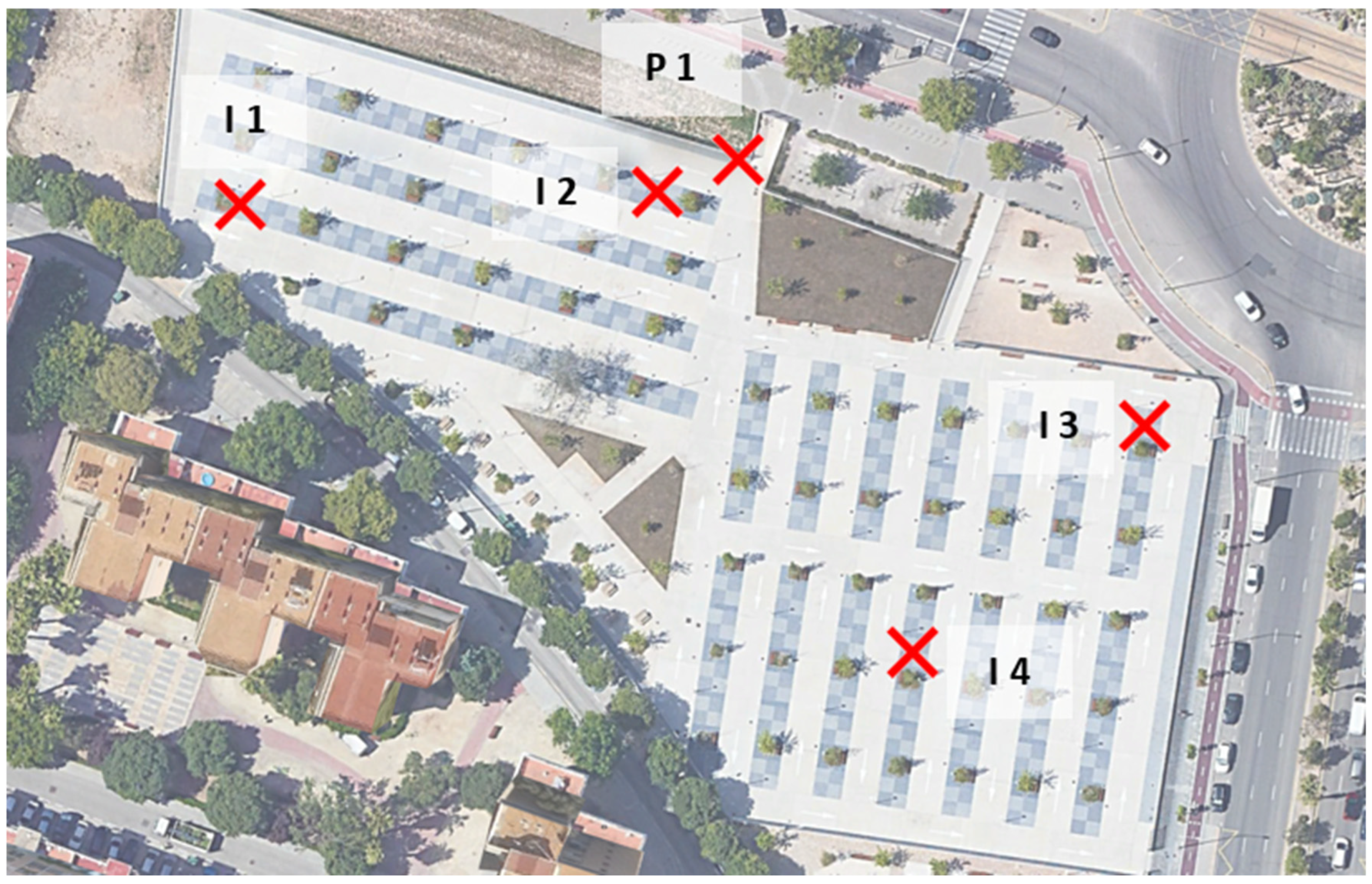
For in situ permeability measurements, 10 representative slabs were selected across five points, with two contiguous slabs tested at each point and duplicate readings performed on each slab. Eleven measurements were taken at each point over two years (bimonthly in the first year and quarterly in the second), resulting in a total of 220 permeability data points. An initial survey included 18 slabs across nine sites, but based on low variability observed in preliminary results, the number was reduced to focus on the most representative slabs, ensuring methodological consistency and feasibility (Figure 2). Small-format slabs were excluded, representing less than 10% of the total permeable surface.
The porous concrete slabs were designed to maintain a high proportion of interconnected voids (15–30%). The mix design is characterized by controlled-grading aggregates with 100% cubic geometry to maximize permeability and a high-strength cementitious matrix (complying with UNE-EN 1338 [22] Spanish standard for compression and abrasion) [23]. Permeability tests were performed following the NLT-327/00 [24] standard, based on a variable-head approach comparable to EN 12697-40 [25]. Each measurement consisted of a preliminary saturation followed by two consecutive readings at the same central point [26].
Although the standard does not specify sealing between the device and pavement, some authors recommend silicone sealants to prevent lateral leakage and improve accuracy [27]. However, other studies reported limited effectiveness in porous systems [28]. Therefore, no sealing was applied in this study, ensuring comparability with previous works. It is worth noting that variable-head methods can yield permeability values 50–90% higher than constant-head approaches [27,29].

2.2.2. Laboratory Methodology

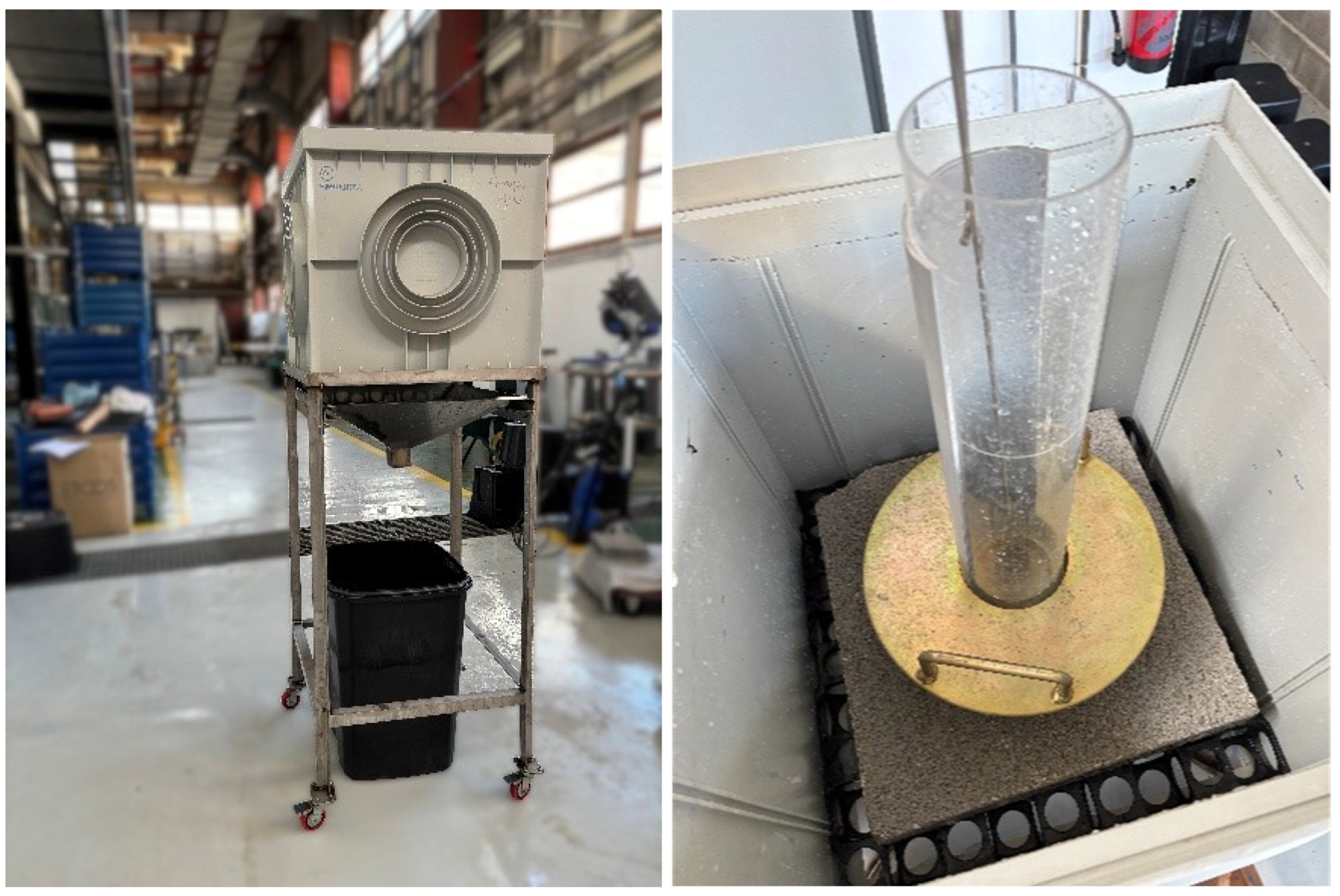
Laboratory tests were conducted on four slabs: two new (N) provided by the manufacturer, and two used (U) extracted directly from the site after five years of exposure. Each slab was placed on a drainage cell within a perforated-bottom chamber elevated on a metal frame (Figure 3). A 30 L container positioned underneath collected all effluent water.
The same permeability procedure described earlier was applied before and after pressure washing (140 bar, 1 min per side), following Andrés-Valeri et al. [30]. To maintain consistent conditions, 22 L of tap water were used per test. The resulting water was homogenized, and 1 L subsamples were taken for water quality analyses including pH, conductivity (WTW Multi 340i TetraCon® (WTW, Weilheim, Germany) and SenTix® 41 probes (WTW, Weilheim, Germany)), turbidity (TN100 Eutech, Thermo Fisher Scientific Inc., Waltham, MA, USA), chemical oxygen demand (COD), ammonium, nitrite, nitrate, total nitrogen, phosphate, and total phosphorus (Spectroquant® kits (Merck KGaA, Darmstadt, Germany) according to ISO standards), as well as total and volatile suspended solids (UNE-EN 872:2006 [31]; UNE 77034:2002 [32]).
The remaining volume was used for MPs analysis following Calzadilla-Cabrera et al. [33]. Samples were sieved through 425, 75, and 40 µm meshes to classify retained fractions by size. Each fraction underwent oxidation with 30% H2O2 and two-phase density separation (CaCl2 and KI). Filtered residues were then analyzed by stereomicroscopy and Raman spectroscopy for identification and classification.
Quality control was ensured through blank tests and recovery efficiency assessments. Laboratory blanks yielded negligible contamination (averaging 3–8 fibers), which was subtracted from the final results. Additionally, following the same protocol described in Calzadilla-Cabrera et al. [33], recovery efficiencies were 97.5% for fibers, 87.5% for fragments, and 75% for films.

2.2.3. Statistics

Statistical analyses were conducted using STATGRAPHICS Centurion 19 (version 19.1.2) to test specific hypotheses related to differences in contaminant and MPs accumulation between new and aged permeable pavement slabs. Normality was first verified, applying the t-test for comparison of means when assumptions were met, and the Kruskal–Wallis test otherwise. A significance level of p ≤ 0.05 was adopted in all tests.

3. Results and Discussion

3.1. Original Slab Permeability

The new slabs exhibited an average permeability of 3558 mm/h (consistent with the manufacturer’s specifications), below the minimum initial value of 4500 mm/h recommended by the local SUDS guideline for Valencia [34]. This value is also substantially lower than those reported for other porous concretes under laboratory conditions, which typically range from 14,400–33,500 mm/h [35] to 36,000–72,000 mm/h [36]. Such differences may be related to aggregate gradation, maximum particle size, and the aggregate-to-cement ratio, all of which control pore connectivity and effective porosity [36,37].
After pressure washing, permeability increased by approximately 32%, likely due to the removal of fine particles remaining from the manufacturing process. Nevertheless, even after cleaning, permeability values remained well below those typically recorded in real installations, where initial values can reach up to 24,480 mm/h [38] or even higher ranges, from 6000 to 76,000 mm/h [39,40].
These results highlight the variability among porous concretes depending on their mix design and manufacturing process, and suggest that factory residues may substantially limit initial infiltration performance.

3.2. In Situ Permeability Evolution

After five years of operation, the mean in situ permeability was 1659.9 mm/h, representing a reduction of approximately 48 ± 15% relative to the initial laboratory value. This decrease, while substantial, remains well above the design threshold of 450 mm/h established by the local SUDS guideline [34]. Thus, the observed decline appears moderate considering the site’s intense activity and exposure conditions.
The reduction in permeability can be attributed to progressive clogging caused by sediment deposition and limited maintenance frequency. Similar trends have been reported by García-Haba et al. [26] and Hernández-Crespo et al. [41], who emphasized that the nature of sediment, accumulation rate, and local climate strongly influence the rate of hydraulic decline. This evidence supports the applicability of a 2:1 impermeable-to-permeable surface ratio for sustained performance, as recommended in many SUDS guidelines.
The spatial variability observed across the test points (Table 1) can be attributed to differences in local exposure conditions and the specific position of each slab within the permeable pavement system. Previous studies have shown that permeability in permeable pavements is inherently heterogeneous and strongly influenced by site-specific use patterns and spatial location within the system [42]. In particular, enhanced permeability losses have been reported in peripheral areas and near system boundaries, where sediment accumulation and clogging processes tend to be more pronounced over time [43]. In the present study, lower permeability values at points I 1, I 2, and P 1 were consistently associated with areas of higher surface activity or proximity to walls, which promote sediment retention through a barrier effect [44]. Data from all sampling events are provided in Table S1.
Moreover, the NLT-327/00 method presented practical limitations, as water leakage occasionally occurred through the device–pavement interface, particularly in clogged areas. Alternative approaches, such as double-ring or embedded-ring infiltrometer configurations, have been shown to improve measurement reliability by minimizing lateral flow losses [45]. A revision of the standard to explicitly include perimeter sealing procedures could therefore enhance test reliability and inter-study comparability. Notably, existing standards for permeable pavements, such as ISO 17785-1 [46] and ACI PRC-522 [47], already recommend peripheral sealing to prevent leakage at the contact interface [48].
The Mediterranean climate is characterized by a highly heterogeneous precipitation regime, with prolonged dry periods interrupted by short-duration, high-intensity rainfall events. This marked temporal variability plays a critical role in the hydraulic performance of permeable pavements, as system efficiency is strongly conditioned by antecedent conditions and event characteristics rather than by clogging alone. In particular, several studies have shown that, in Mediterranean environments, the initial saturation state of the pavement, governed by prior rainfall history, can exert a stronger influence on infiltration efficiency during the early years of operation than physical clogging processes [8]. Prolonged antecedent dry periods promote drainage and evapotranspiration, restoring available storage capacity and enhancing volume and peak flow reduction during subsequent rainfall events [49,50]. Conversely, intense and short storm events, which are typical of this climatic region, generate high hydraulic loads and reduced residence times within the pavement matrix, limiting infiltration efficiency and peak attenuation when rainfall depth or intensity exceeds critical thresholds [41,50]. These climate-driven dynamics should therefore be explicitly considered when interpreting long-term performance and defining maintenance strategies for permeable pavement systems in Mediterranean regions.

3.3. Permeability Recovery Capacity

Laboratory cleaning tests on used slabs revealed a mean permeability recovery of 42.5%, increasing from 1076 to 1531 mm/h. Both samples showed similar behavior, indicating that clogging occurred mainly in the upper layer and was partially reversible. Although the cleaning was conducted under controlled conditions, these findings suggest that combining mechanical vacuuming and pressure washing in the field could substantially improve hydraulic recovery [28].
The permeability recovery observed in this study is consistent with previous findings for similar permeable pavement systems [26], although higher recovery rates, up to 123%, have been reported when pressure washing and vacuum suction are applied sequentially [51]. In general, the effectiveness of maintenance techniques depends strongly on pavement type, clogging degree, sediment characteristics, pore structure, and site-specific exposure conditions [30,52]. While most maintenance practices yield statistically significant improvements, they rarely restore permeability to original conditions once the system has aged. At the study site, routine mechanical sweeping is performed after each market day and is effective under dry conditions; however, under wet conditions this practice can markedly reduce infiltration capacity, by up to 59% in some cases, due to moisture-induced compaction and the formation of a cohesive surface crust that cannot be effectively removed by suction [53]. In contrast, the combined application of pressure washing and vacuum suction has consistently proven to be the most effective field-based technique for restoring permeability in porous concrete pavements, as it is capable of extracting sediments embedded within the fixed pore matrix [51]. Given the 48% permeability loss observed over 5 years, biennial vacuum-assisted pressure washing is recommended to complement existing weekly sweeping. This frequency ensures critical areas remain above the 450 mm/h regulatory threshold, maintaining a safety margin against Mediterranean torrential rainfall. When combined with routine maintenance practices, the periodic application of this technique may contribute to improved infiltration performance, in line with previous studies suggesting intensive cleaning at intervals of approximately 4–6 months to limit sediment migration into deeper layers where surface interventions become ineffective [54]. In this study, laboratory cleaning was intentionally limited to pressure washing in order to recover and quantify all material retained within the slabs during service life, noting that pressure washing without subsequent suction is not recommended in practice due to the risk of secondary pollutant release [55].
Overall, the results confirm that the permeability loss is not entirely irreversible and that maintenance interventions can partially restore hydraulic functionality, emphasizing the importance of periodic cleaning under Mediterranean conditions.

3.4. Pollutant Retention Capacity

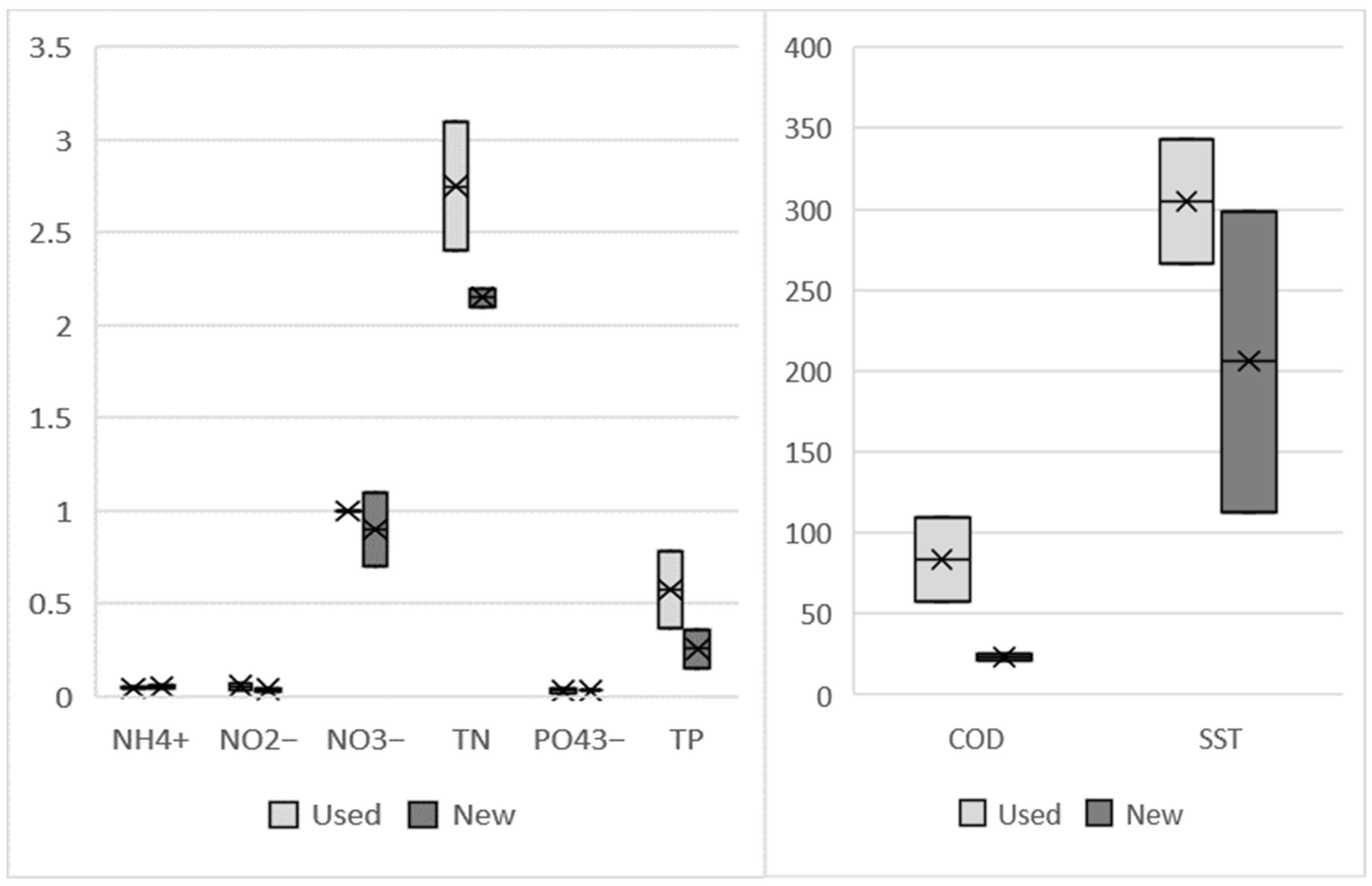
The results shown in Table 2 reveal clear differences between the new and used slabs after five years of operation, particularly in parameters related to the accumulation of solid and organic pollutants (p < 0.05). Used slabs exhibited increases of 258% in COD, 123% in total phosphorus, 28% in total nitrogen, a pattern that is consistent with previous studies reporting high TP removal efficiencies but more limited TN retention in permeable pavements [56] and 48% in total suspended solids, indicating a notable buildup of organic matter and particulate material within the porous structure. Turbidity was also higher in used slabs, while the relatively elevated values observed in new slabs may be associated with residual particles from the manufacturing process.
These findings provide clear evidence that permeable pavements can act as long-term sinks for pollutants in urban environments, contributing to the interception of contaminants before they reach receiving waters. The observed accumulation patterns suggest that pollutant retention is primarily associated with physical trapping and adsorption processes within the upper and intermediate layers of the slabs, in line with findings reported by Azad et al. [57]. Nevertheless, these mechanisms are less effective for dissolved pollutants, which are more likely to pass through the pore network with the infiltrating water (see Figure 4). Similar results have been reported in other field-scale studies, confirming the ability of these systems to retain suspended solids, organic matter, and nutrients over extended periods of operation [26,41,58].
The temporal evolution of pollutant retention did not strictly mirror the progressive decline in infiltration capacity observed as clogging developed. While permeability decreased monotonically over time in the absence of maintenance, the physical filtration of solid contaminants was maintained or even slightly enhanced during intermediate stages of clogging [59]. As pore spaces progressively narrowed, the pavement matrix effectively acted as a finer filter, increasing the capture of smaller particles within the upper layers. However, this behavior was limited to a critical threshold beyond which infiltration capacity declined to such an extent that water no longer percolated through the pavement structure. Under these conditions, surface runoff dominated, bypassing the pavement matrix and conveying contaminants directly to the sewer system without prior treatment.
Although this study did not directly estimate removal efficiencies at the system scale, the pollutant concentrations and loads retained within the slabs reflect the cumulative retention occurring in the pavement surface layer after five years of operation. Laboratory analyses were intentionally limited to the concrete slabs themselves, without considering underlying gravel or geotextile layers, which are known to provide additional filtration and retention capacity in complete permeable pavement systems [60,61]. Under Mediterranean climatic conditions, prolonged dry periods favor pollutant accumulation on pavement surfaces, leading to higher concentrations in the infiltrated water compared to wetter climates, as the mobilized contaminants are concentrated in a smaller water volume [41]. Short, high-intensity storms, while capable of mobilizing accumulated loads through the pavement matrix, pose a risk that, if the system’s infiltration capacity is exceeded, part of the flow bypasses the pavement, reducing contaminant retention and potentially re-mobilizing previously trapped fine particles, resulting in greater temporal variability in treatment performance depending on event characteristics.
These dynamics underline the relevance of preventive surface maintenance, particularly dry sweeping prior to intense rainfall following extended dry periods, as an effective strategy to limit pollutant mobilization and preserve treatment performance. At the same time, the results highlight the role of permeable pavements as decentralized infrastructures capable of intercepting particulate and nutrient pollution at the source. The observed gradual accumulation of solids and organic matter within the slabs indicates a progressive saturation of the porous matrix, which could eventually reduce both hydraulic conductivity and contaminant retention, emphasizing the need for long-term monitoring and maintenance to sustain their dual function of stormwater management and water quality improvement.

3.5. Microplastic Retention Capacity

The permeable pavement acted as a sink for MPs, with substantial accumulation observed after five years of operation under field conditions. In this study, used slabs accumulated 10,272 ± 5829 MPs/m2, about 7.5 times more than the load measured in new slabs (1343 ± 194 MPs/m2; p < 0.05). While based on two representative slabs selected to capture site heterogeneity, the magnitude of this 7.5-fold increase indicates a robust accumulation trend despite the limited number of replicates. This baseline contamination in pristine slabs is consistent with the ubiquitous presence of MPs in industrial environments, likely originating from atmospheric fallout, mechanical abrasion of production equipment, and packaging residues [62]. From these values we estimate an annual accumulation rate of 2054 MPs/m2/yr, representing a high-end reference for urban contexts subject to extreme plastic loading, such as intensive market activity, rather than typical residential areas.
The exceptionally high accumulation recorded here must be interpreted in light of the site context. The study area hosts a weekly flea market that concentrates intense pedestrian activity and generates abundant degraded plastic waste (toys, tarpaulins, textile debris) (see Figure S1), producing a local MP input far above typical residential or commercial areas. Several studies have estimated concentrations of MPs in urban runoff to better understand the inputs to these systems, finding values between 2 and 110 MP/L depending on basin characteristics and precipitation conditions [45,63]. The most representative estimate in relation to the present study is that of García-Haba et al. [64], with 24 ± 17 MP/L in runoff from an urban catchment in Valencia. Moreover, climatic and hydrological conditions also play a decisive role in MP dynamics. Kong et al. [65] demonstrated that MP retention efficiencies in porous pavements decline under high rainfall intensities. Together, these observations emphasize that both local emissions and climatic drivers determine the magnitude of MPs accumulation in permeable pavements under real operating conditions.
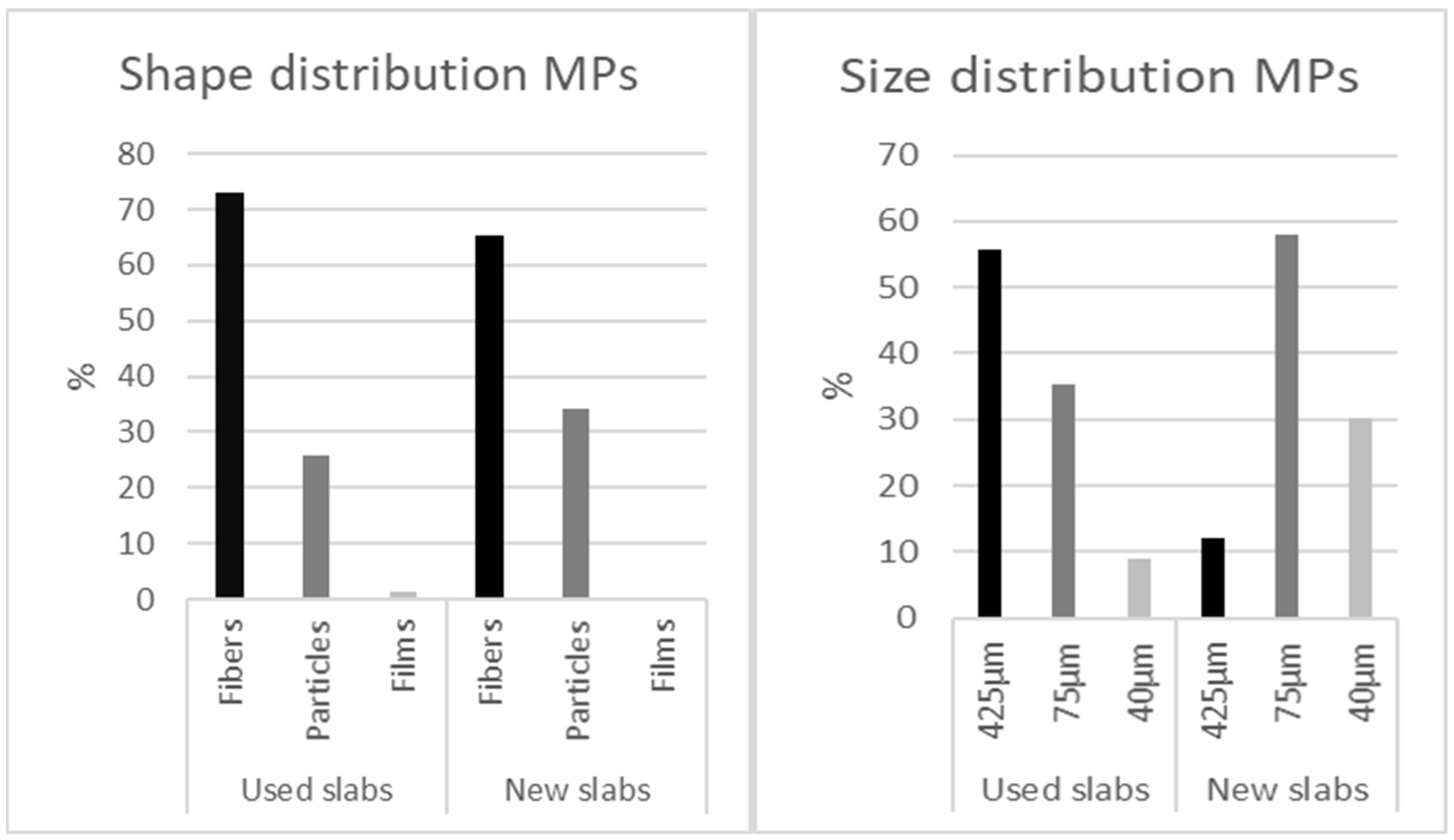
Morphological and size data provide mechanistic insight into MPs’ retention within the porous slabs (Figure 5). The retained fraction was dominated by fibers (73%), followed by particles (26%) and a negligible proportion of films (≤1%). Although particles are often the dominant form reported in urban runoff [45,63], several studies have shown that effluents from permeable pavements tend to contain a higher proportion of small particles [19,64], suggesting that fibers are more effectively retained within the pavement matrix. Their elongated and flexible morphology favors mechanical entanglement and physical trapping within the interstices of the porous concrete, whereas compact particles are more likely to migrate with advective flows unless captured by pore constrictions or by fines filling the voids.
In terms of size, the MPs retained in the slabs were mostly within the medium (75–425 µm) and large (>425 µm) fractions (Figure 5), indicating preferential capture of these classes. Conversely, fine particles (<75 µm) were less represented, aligning with the general tendency of smaller MPs to be more easily transported through permeable systems. Together, these patterns reveal that the porous pavement acts as an effective filter for medium- and large-sized fibers, while finer and more compact MPs are selectively transmitted through the system, as also reported by García-Haba et al. [64]. Notably, MPs within the intermediate size range retained or transmitted in this study correspond to those most frequently reported in urban runoff, making the observed patterns consistent with findings from other field-based studies [19,64].
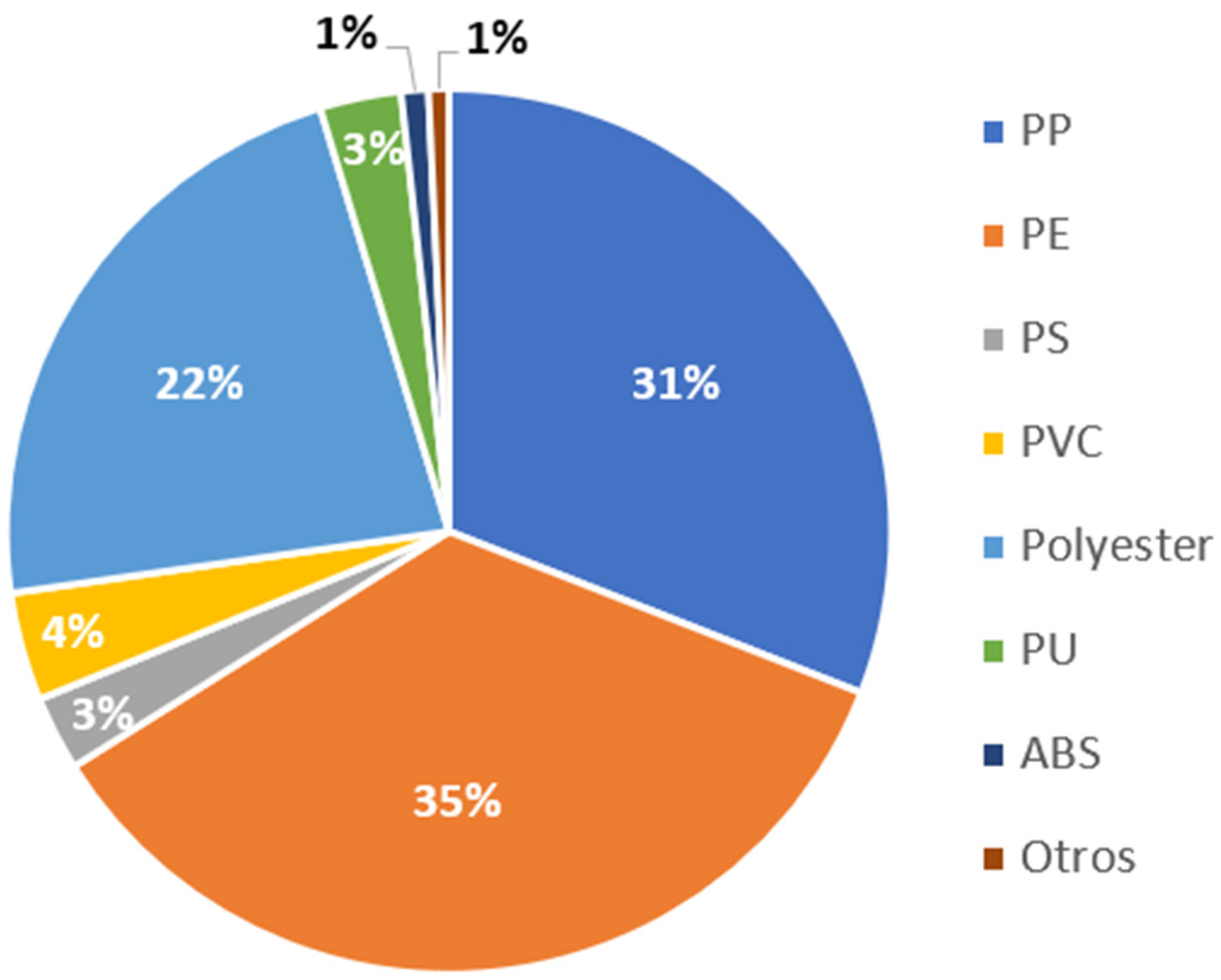
Polymeric composition (Figure 6) revealed PE (35%), PP (31%) and polyester (22%) as dominant, with minor PVC (4%), PS and PU (3% each) and trace ABS (1%). This composition mirrors global production and typical urban waste streams [19,63], and the relatively high polyester fraction is consistent with textile-derived fibers dominating in residential or pedestrian contexts. Notably, water-soluble polymers such as PVA reported in shorter-term studies [64] were almost absent here, plausibly due to dissolution or degradation during five years of exposure, an observation that underlines how service time alters polymer detectability and the residual MP fingerprint in aged infrastructures.
Comparative evidence highlights the role of pavement design and use patterns. Studies that include full system configurations (gravel, sand layers, geotextiles) often report high effluent removal efficiencies (>90%) for MPs [19,64]. However, high removal in the effluent implies internal trapping rather than elimination, thereby converting the pavement into a temporary sink. Over time, progressive accumulation increases the probability of secondary emissions during maintenance, extreme hydrological events, or material disturbance. Our data show clear long-term entrapment but also reveal limitations in capturing small and dissolved fractions, meaning pavements act as partial barriers that reduce but do not fully prevent MP export.
From an environmental management perspective, these results have several implications. First, permeable pavements can substantially reduce the load of medium and large MPs reaching downstream water bodies, particularly under moderate loading scenarios. Second, the site-specific nature of MP sources means that adoption of permeable pavements in high-pressure sites (markets, industrial yards) must be accompanied by adapted maintenance strategies and possibly upstream source control to avoid rapid matrix saturation. Third, design modifications, for example incorporating adsorptive amendments or additional fine filter layers [66], could enhance retention of smaller fractions and reduce the risk of pavements becoming secondary MP sources.
Limitations of this study must be acknowledged. Our estimates are site-specific and reflect an extreme loading context; extrapolation to other urban settings requires careful scaling with local emission rates and hydrological regimes. Also, while Raman spectroscopy provides robust polymer identification, weathering and biofouling can complicate spectra interpretation for certain polymers after long exposure. Future work should combine lower-size detection limits, tracer experiments, and targeted assessment of maintenance-related mobilization to better quantify the net fate of MPs in permeable pavement systems.
In sum, the evidence indicates that permeable pavements function as effective long-term sinks for medium-to-large MPs under real urban conditions, but their limited retention of fine fractions and potential for saturation demand integrated design and maintenance strategies to prevent the emergence of secondary pollution sources.

4. Conclusions

This study provides field-based evidence of the long-term behavior of the surface layer of full-scale permeable pavements operating for five years under high urban pollutant loads. The results demonstrate that the precast concrete slabs act as an effective primary barrier for the retention of suspended solids, organic matter, nutrients, and microplastics, despite a progressive reduction in permeability due to clogging. Laboratory restoration tests confirmed a high recovery potential, underscoring the critical role of maintenance in preserving hydraulic and treatment performance. Specifically, biennial high-pressure water washing with vacuum suction is proposed to complement routine sweeping, ensuring that critical areas remain above the 450 mm/h regulatory threshold.
While this study focuses on the concrete layer and represents a conservative estimate of the total system’s capacity, the marked accumulation of MPs, mainly polyethylene and polypropylene fibers, highlights the capacity of the porous matrix to retain emerging contaminants over extended timescales. These findings emphasize that microstructural attributes such as pore connectivity and tortuosity control both hydraulic decline and contaminant entrapment. Conducting laboratory analyses on aged field materials is therefore essential to constrain realistic long-term retention mechanisms.
The variability observed among new slabs also indicates that nominal permeability values should be interpreted as ranges rather than fixed design parameters, encouraging the development of certification frameworks that reflect manufacturing heterogeneity. The extreme loading context examined here provides a useful upper bound for assessing pavement resilience and defining operational limits under demanding urban conditions.
Overall, this work advances understanding of permeable pavements as multifunctional stormwater infrastructures capable of simultaneously managing runoff and contaminant loads. Ensuring their long-term sustainability will require design and maintenance strategies that explicitly integrate hydraulic capacity, pollutant retention, and durability under real-world exposure.
Altogether, the findings reinforce the utility of permeable pavements as multifunctional tools for stormwater management. However, to ensure long-term effectiveness, their design and regulation must increasingly consider aspects beyond hydraulic capacity, integrating contaminant retention, maintenance feasibility, and pollutant-specific behaviors into a holistic approach to sustainable urban infrastructure, which should also account for the environmental trade-offs of manufacturing and the adoption of low-carbon materials.

Supplementary Materials

The following supporting information can be downloaded at: https://www.mdpi.com/article/10.3390/w18091042/s1, Figure S1: Surface conditions of the study site during flea market activity. All photographs were taken by the author.; Table S1: Permeability values (mm/h) determined from the NLT-327/00 test for the selected slabs at the 5 points of the site, for each sampling campaign. In red, permeabilities below the minimum permeability threshold required in the València SUDS Design Guide [34].

Author Contributions

D.C.-C.: Data curation, formal analysis, investigation, methodology, visualization, writing. E.G.-H.: Data curation, investigation, methodology, supervision, validation. C.H.-C.: Methodology, resources, supervision, validation. M.M.: Funding acquisition, resources, supervision, validation. I.A.-D.: Funding acquisition, methodology, project administration, resources, supervision, validation. All authors have read and agreed to the published version of the manuscript.

Funding

This research is developed within the framework of the project SUDSLong-VLC Grant PID2021-122946OB-C32 funded by MICIU/AEI/10.13039/501100011033 and by “ERDF A way of making Europe”. Darío Calzadilla Cabrera appreciates the pre-doctoral contracts funding received for doctors training Grant PRE2022-102831 funded by MICIU/AEI/10.13039/501100011033 and by “ESF+”. Eduardo García Haba appreciates the pre-doctoral contracts funding received for doctors training Grant PRE2019-089409 funded by MICIU/AEI/10.13039/501100011033 and by “ESF Investing in your future”.

Data Availability Statement

The original contributions presented in this study are included in the article and Supplementary Materials. Further inquiries can be directed to the corresponding author.

Acknowledgments

The authors would like to thank the Valencia City Council, the construction company Bertolín, and the slab supplier Fenollar for their collaboration.

Conflicts of Interest

The authors declare that they have no known competing financial interests or personal relationships that could have appeared to influence the work reported in this paper.

References

  1. Zhang, C.; Luo, X.; Deng, Y.; Deng, Z.; Xu, R.; Amer, M.A.; Ali, E.A.E.; Jiang, J.; Chen, H. Insights into enhanced pollutant removal from road runoff by functional microorganisms in a field-scale bioretention facility. J. Water Process Eng. 2024, 62, 105294. [Google Scholar] [CrossRef]
  2. Chen, L.M.; Chen, J.W.; Chen, T.H.; Lecher, T.; Davidson, P.C. Measurement of permeability and comparison of pavements. Water 2019, 11, 444. [Google Scholar] [CrossRef]
  3. Castillo-Rodríguez, J.T.; Andrés-Doménech, I.; Martín, M.; Escuder-Bueno, I.; Perales-Momparler, S.; Mira-Peidro, J. Quantifying the impact on stormwater management of an innovative ceramic permeable pavement solution. Water Resour. Manag. 2021, 35, 1251–1271. [Google Scholar] [CrossRef]
  4. Halder, B.; Bandyopadhyay, J.; Banik, P. Monitoring the effect of urban development on urban heat island based on remote sensing and geo-spatial approach in Kolkata and adjacent areas, India. Sustain. Cities Soc. 2021, 74, 103186. [Google Scholar] [CrossRef]
  5. Rahman, T.; Tajudin, A.N.; Wulaningtyas, A.H.; Andika, N.; Irawan, M.Z.; Widyatmoko, I. Recent developments in mitigating clogging in permeable pavements: A state-of-the-art review. Innov. Infrastruct. Solut. 2025, 10, 80. [Google Scholar] [CrossRef]
  6. Franco, E.; Ghisi, E.; Vaz, I.C.M.; Thives, L.P. Permeable Pavements: An Integrative Review of Technical and Environmental Contributions to Sustainable Cities. Water 2025, 17, 3323. [Google Scholar] [CrossRef]
  7. Liu, Z.; Zhou, L.; Nie, F.; Hua, J.; Zhang, H.; Li, Y.; Liu, J. Study on the Evolution Law of Mechanical Properties of the Modified High Strength BF-RCC Subjected to High Temperature. Buildings 2025, 15, 2012. [Google Scholar] [CrossRef]
  8. Rodríguez-Rojas, M.I.; Huertas-Fernández, F.; Moreno, B.; Martínez, G. Middle-Term Evolution of Efficiency in Permeable Pavements: A Real Case Study in a Mediterranean climate. Int. J. Environ. Res. Public Health 2020, 17, 7774. [Google Scholar] [CrossRef]
  9. Qamhia, I.I.A.; Al-Qadi, I.L.; Ozer, H.; Golalipour, A. Permeable Pavement Systems: Sustainable Case Studies. In Pavement, Roadway, and Bridge Life Cycle Assessment; Flintsch, G.W., Amarh, E.A., Harvey, J., Al-Qadi, I.L., Ozer, H., Presti, D.L., Eds.; Springer Nature: Cham, Switzerland, 2024; Volume 51. [Google Scholar] [CrossRef]
  10. Raimondi, A.; Marrazzo, G.; Sanfilippo, U.; Becciu, G. A probabilistic approach to stormwater runoff control through permeable pavements beneath urban trees. Sci. Total Environ. 2023, 905, 167196. [Google Scholar] [CrossRef]
  11. Collins, K.A.; Hunt, W.F.; Hathaway, J.M. Side-by-side comparison of nitrogen species removal for four types of permeable pavement and standard asphalt in eastern North Carolina. J. Hydrol. Eng. 2010, 15, 512–521. [Google Scholar] [CrossRef]
  12. Huang, J.; Valeo, C.; He, J.; Chu, A. Winter performance of inter-locking pavers—Stormwater quantity and quality. Water 2012, 4, 995–1008. [Google Scholar] [CrossRef]
  13. Scholz, M.; Grabowiecki, P. Review of permeable pavement systems. Build. Environ. 2007, 42, 3830–3836. [Google Scholar] [CrossRef]
  14. Brown, C.; Chu, A.; Van Duin, B.; Valeo, C. Characteristics of sediment removal in two types of permeable pavement. Water Qual. Res. J. Can. 2009, 44, 59–70. [Google Scholar] [CrossRef]
  15. Auta, H.S.; Emenike, C.U.; Fauziah, S.H. Distribution and importance of microplastics in the marine environment: A review of the sources, fate, effects, and potential solutions. Environ. Int. 2017, 102, 165–176. [Google Scholar] [CrossRef]
  16. dos Santos, C.R.; Drumond, G.P.; Moreira, V.R.; de Souza Santos, L.V.; Amaral, M.C.S. Microplastics in surface water: Occurrence, ecological implications, quantification methods and remediation technologies. Chem. Eng. J. 2023, 474, 144936. [Google Scholar] [CrossRef]
  17. Wang, C.; O’Connor, D.; Wang, L.; Wu, W.-M.; Luo, J.; Hou, D. Microplastics in urban runoff: Global occurrence and fate. Water Res. 2022, 225, 119129. [Google Scholar] [CrossRef]
  18. Kwarciak-Kozłowska, A.; Madeła, M. The occurrence and removal of microplastics from stormwater using green infrastructure. Water 2025, 17, 2089. [Google Scholar] [CrossRef]
  19. Kong, J.; Lee, J.; Jeong, S. Distribution of microplastics in rainfall and their control by a permeable pavement in low-impact development facility. J. Environ. Manag. 2024, 351, 119710. [Google Scholar] [CrossRef]
  20. García-Haba, E.; Hernández-Crespo, C.; Martín, M.; Andrés-Doménech, I. The role of different sustainable urban drainage systems in removing microplastics from urban runoff: A review. J. Clean. Prod. 2023, 411, 137197. [Google Scholar] [CrossRef]
  21. Woods-Ballard, B.; Wilson, S.; Udale-Clarke, H.; Illman, S.; Scott, T.; Ashley, R.; Kellagher, R. The SuDS Manual; CIRIA: London, UK, 2015. [Google Scholar]
  22. UNE-EN 1338; Concrete Paving Blocks—Requirements and Test Methods. AENOR: Madrid, Spain, 2004.
  23. Elizondo-Martínez, E.-J.; Andrés-Valeri, V.-C.; Jato-Espino, D.; Rodriguez-Hernandez, J. Review of porous concrete as multifunctional and sustainable pavement. J. Build. Eng. 2020, 27, 100967. [Google Scholar] [CrossRef]
  24. NLT-327/00; Resistance to Plastic Deformation of Bituminous Mixtures Using the Wheel-Tracking Test. CEDEX: Madrid, Spain, 2000.
  25. EN 12697-40; Bituminous Mixtures—Test Methods—Part 40: In Situ Drainability. European Committee for Standardization (CEN): Brussels, Belgium, 2020.
  26. García-Haba, E.; Naves, J.; Hernández-Crespo, C.; Goya-Heredia, A.; Suárez, J.; Anta, J.; Andrés-Doménech, I. Influence of sediment characteristics on long-term hydrology and water quality behaviour during the clogging process of a permeable asphalt. J. Water Process Eng. 2023, 53, 103658. [Google Scholar] [CrossRef]
  27. Li, H.; Kayhanian, M.; Harvey, J.T. Comparative field permeability measurement of permeable pavements using ASTM C1701 and NCAT permeameter methods. J. Environ. Manag. 2013, 118, 144–152. [Google Scholar] [CrossRef]
  28. Winston, R.J.; Al-Rubaei, A.M.; Blecken, G.T.; Viklander, M.; Hunt, W.F. Maintenance measures for preservation and recovery of permeable pavement surface infiltration rate–The effects of street sweeping, vacuum cleaning, high pressure washing, and milling. J. Environ. Manag. 2016, 169, 132–144. [Google Scholar] [CrossRef]
  29. Qin, Y.; Yang, H.; Deng, Z.; He, J. Water Permeability of Pervious Concrete Is Dependent on the Applied Pressure and Testing Methods. Adv. Mater. Sci. Eng. 2015, 2015, 404136. [Google Scholar] [CrossRef]
  30. Andrés-Valeri, V.C.; Marchioni, M.; Sañudo-Fontaneda, L.A.; Giustozzi, F.; Becciu, G. Laboratory Assessment of the Infiltration Capacity Reduction in Clogged Porous Mixture Surfaces. Sustainability 2016, 8, 751. [Google Scholar] [CrossRef]
  31. UNE-EN 872:2006; Water Quality—Determination of Suspended Solids—Method by Filtration Through Glass Fibre Filters. AENOR: Madrid, Spain, 2006.
  32. UNE 77034:2002; Water Quality—Determination of Dissolved Oxygen—Iodometric Method. AENOR: Madrid, Spain, 2002.
  33. Calzadilla-Cabrera, D.; Wang, Q.; Martín, M.; Rajadel, N.O.; Rousseau, D.P.; Hernández-Crespo, C. Microplastics occurrence and fate in full-scale treatment wetlands. Water Res. 2023, 240, 120106. [Google Scholar] [CrossRef]
  34. de la Fuente García, L.; Momparler, S.P.; Cortés, M.R.; Andrés-Doménech, I.; Segura, J.M. Guía Básica para el Diseño de Sistemas Urbanos de Drenaje Sostenible en la Ciudad de València; Ajuntament de València: Valencia, Spain, 2021. [Google Scholar]
  35. Viana, E.A.; Mota, L.J.A.; Sandoval, G.F.B.; de Souza Risson, K.D.B. Mechanical and hydraulic performance of pervious concrete pavements: Experimental evaluation. Ing. Desarro. 2023, 41, 137–149. [Google Scholar] [CrossRef]
  36. Huang, B.; Wu, H.; Shu, X.; Burdette, E.G. Laboratory evaluation of permeability and strength of polymer-modified pervious concrete. Constr. Build. Mater. 2010, 24, 818–823. [Google Scholar] [CrossRef]
  37. Zhang, Y.; Li, H.; Abdelhady, A.; Yang, J.; Wang, H. Effects of specimen shape and size on the permeability and mechanical properties of porous concrete. Constr. Build. Mater. 2021, 266, 121074. [Google Scholar] [CrossRef]
  38. Sañudo-Fontaneda, L.A.; Andres-Valeri, V.C.; Costales-Campa, C.; Cabezon-Jimenez, I.; Cadenas-Fernandez, F. The Long-Term Hydrological Performance of Permeable Pavement Systems in Northern Spain: An Approach to the “End-of-Life” Concept. Water 2018, 10, 497. [Google Scholar] [CrossRef]
  39. Bean, E.Z.; Hunt, W.F.; Bidelspach, D.A. Field Survey of Permeable Pavement Surface Infiltration Rates. J. Irrig. Drain. Eng. 2007, 133, 249–255. [Google Scholar] [CrossRef]
  40. Razzaghmanesh, M.; Beecham, S. A review of permeable pavement clogging investigations and recommended maintenance regimes. Water 2018, 10, 337. [Google Scholar] [CrossRef]
  41. Hernández-Crespo, C.; Fernández-Gonzalvo, M.; Martín, M.; Andrés-Doménech, I. Influence of rainfall intensity and pollution build-up levels on water quality and quantity response of permeable pavements. Sci. Total Environ. 2019, 684, 303–313. [Google Scholar] [CrossRef]
  42. Kumar, K.; Kozak, J.; Hundal, L.; Cox, A.; Zhang, H.; Granato, T. In-situ infiltration performance of different permeable pavements in a employee used parking lot–A four-year study. J. Environ. Manag. 2016, 167, 8–14. [Google Scholar] [CrossRef]
  43. Chen, L.-M.; Chen, J.-W.; Lecher, T.; Chen, T.-H.; Davidson, P. Assessment of clogging of permeable pavements by measuring change in permeability. Sci. Total Environ. 2020, 749, 141352. [Google Scholar] [CrossRef]
  44. Donzelli, G.; Cioni, L.; Cancellieri, M.; Llopis-Morales, A.; Morales-Suárez-Varela, M. Relations between Air Quality and COVID-19 Lockdown Measures in Valencia, Spain. Int. J. Environ. Res. Public Health 2021, 18, 2296. [Google Scholar] [CrossRef]
  45. Zhang, J.; Ding, W.; Zou, G.; Wang, X.; Zhao, M.; Guo, S.; Chen, Y. Urban pipeline rainwater runoff is an important pathway for land-based microplastics transport to inland surface water: A case study in Beijing. Sci. Total Environ. 2023, 861, 160619. [Google Scholar] [CrossRef]
  46. ISO 17785-1; Testing Methods for Pervious Concrete—Part 1: Infiltration Rate. International Organization for Standardization: Geneva, Switzerland, 2016.
  47. ACI PRC-522-10; Report on Pervious Concrete. American Concrete Institute: Farmington Hills, MI, USA, 2010.
  48. Pieralisi, R.; Lofrano, F.C.; Mikami, R.J.; Sandoval, G.F.B. Permeability measurement and prediction of pervious concrete pavements. In Pervious Concrete Pavements; Elsevier: Amsterdam, The Netherlands, 2025; pp. 271–298. [Google Scholar] [CrossRef]
  49. Palla, A.; Gnecco, I. A continuous simulation approach to quantify the climate condition effect on the hydrologic performance of green roofs. Urban Water J. 2020, 17, 609–618. [Google Scholar] [CrossRef]
  50. Brunetti, G.; Šimůnek, J.; Piro, P. A comprehensive analysis of the variably saturated hydraulic behavior of a green roof in a mediterranean climate. Vadose Zone J. 2016, 15, vzj2016-04. [Google Scholar] [CrossRef]
  51. Danz, M.E.; Selbig, W.R.; Buer, N.H. Assessment of Restorative Maintenance Practices on the Infiltration Capacity of Permeable Pavement. Water 2020, 12, 1563. [Google Scholar] [CrossRef]
  52. Kia, A.; Wong, H.S.; Cheeseman, C.R. Clogging in permeable concrete: A review. J. Environ. Manag. 2017, 193, 221–233. [Google Scholar] [CrossRef]
  53. Simpson, I.M.; Winston, R.J.; Tirpak, R.A. Assessing maintenance techniques and in-situ pavement conditions to restore hydraulic function of permeable interlocking concrete pavements. J. Environ. Manag. 2021, 294, 112990. [Google Scholar] [CrossRef]
  54. Lamberti, L.; Piccilli, D.G.A.; Minetto, B.; Perius, C.F.; Tassi, R. Field investigation of clogging with different sediment types in a permeable pavement system with low-cost maintenance. Ciência Nat. 2023, 45, e84089. [Google Scholar] [CrossRef]
  55. Hu, N.; Zhang, J.; Xia, S.; Han, R.; Dai, Z.; She, R.; Cui, X.; Meng, B. A field performance evaluation of the periodic maintenance for pervious concrete pavement. J. Clean. Prod. 2020, 263, 121463. [Google Scholar] [CrossRef]
  56. Becker, N.; Pinheiro, I.G. Potencialidade dos pavimentos permeáveis na melhoria da qualidade da água do escoamento superficial: Uma revisão. Urbe Rev. Bras. Gest. Urbana 2019, 11, e20180009. [Google Scholar] [CrossRef]
  57. Azad, A.; Sheikh, M.N.; Hai, F.I. A critical review of the mechanisms, factors, and performance of pervious concrete to remove contaminants from stormwater runoff. Water Res. 2024, 251, 121101. [Google Scholar] [CrossRef]
  58. Liu, K.; Wang, X.; Fang, T.; Xu, P.; Zhu, L.; Li, D. Source and potential risk assessment of suspended atmospheric microplastics in Shanghai. Sci. Total Environ. 2019, 675, 462–471. [Google Scholar] [CrossRef]
  59. Nichols, P.W.B.; Lucke, T. A detailed analysis of sediment particle sizes and clogging in permeable pavements. CLEAN–Soil Air Water 2017, 45, 1700078. [Google Scholar] [CrossRef]
  60. Rowe, A.A.; Borst, M.; O’Connor, T.P. Pervious pavement system evaluation. In Low Impact Development for Urban Ecosystem and Habitat Protection; American Society of Civil Engineers: Reston, VA, USA, 2009; pp. 1–9. [Google Scholar] [CrossRef]
  61. Pezzaniti, D.; Beecham, S.; Kandasamy, J. Influence of clogging on the effective life of permeable pavements. In Proceedings of the Institution of Civil Engineers-Water Management; Thomas Telford Ltd.: London, UK, 2009; Volume 162, pp. 211–220. [Google Scholar] [CrossRef]
  62. Wang, S.; Lanau, M.; Österbring, M.; Wallbaum, H.; Rosado, L. Barriers to reducing, reusing, and recycling plastic waste in the construction sector: A European perspective for construction companies. Clean. Environ. Syst. 2026, 20, 100400. [Google Scholar] [CrossRef]
  63. Sang, W.; Chen, Z.; Mei, L.; Hao, S.; Zhan, C.; bin Zhang, W.; Li, M.; Liu, J. The abundance and characteristics of microplastics in rainwater pipelines in Wuhan, China. Sci. Total Environ. 2021, 755, 142606. [Google Scholar] [CrossRef]
  64. García-Haba, E.; Benito-Kaesbach, A.; Hernández-Crespo, C.; Sanz-Lazaro, C.; Martín, M.; Andrés-Doménech, I. Removal and fate of microplastics in permeable pavements: An experimental layer-by-layer analysis. Sci. Total Environ. 2024, 929, 172627. [Google Scholar] [CrossRef] [PubMed]
  65. Kong, J.; Jeong, S.; Lee, J.; Jeong, S. Permeable pavement blocks as a sustainable solution for managing microplastic pollution in urban stormwater. Sci. Total Environ. 2025, 966, 178649. [Google Scholar] [CrossRef] [PubMed]
  66. Chen, Z.; Fang, J.; Wei, W.; Ngo, H.H.; Guo, W.; Ni, B.-J. Emerging adsorbents for micro/nanoplastics removal from contaminated water: Advances and perspectives. J. Clean. Prod. 2022, 371, 133676. [Google Scholar] [CrossRef]
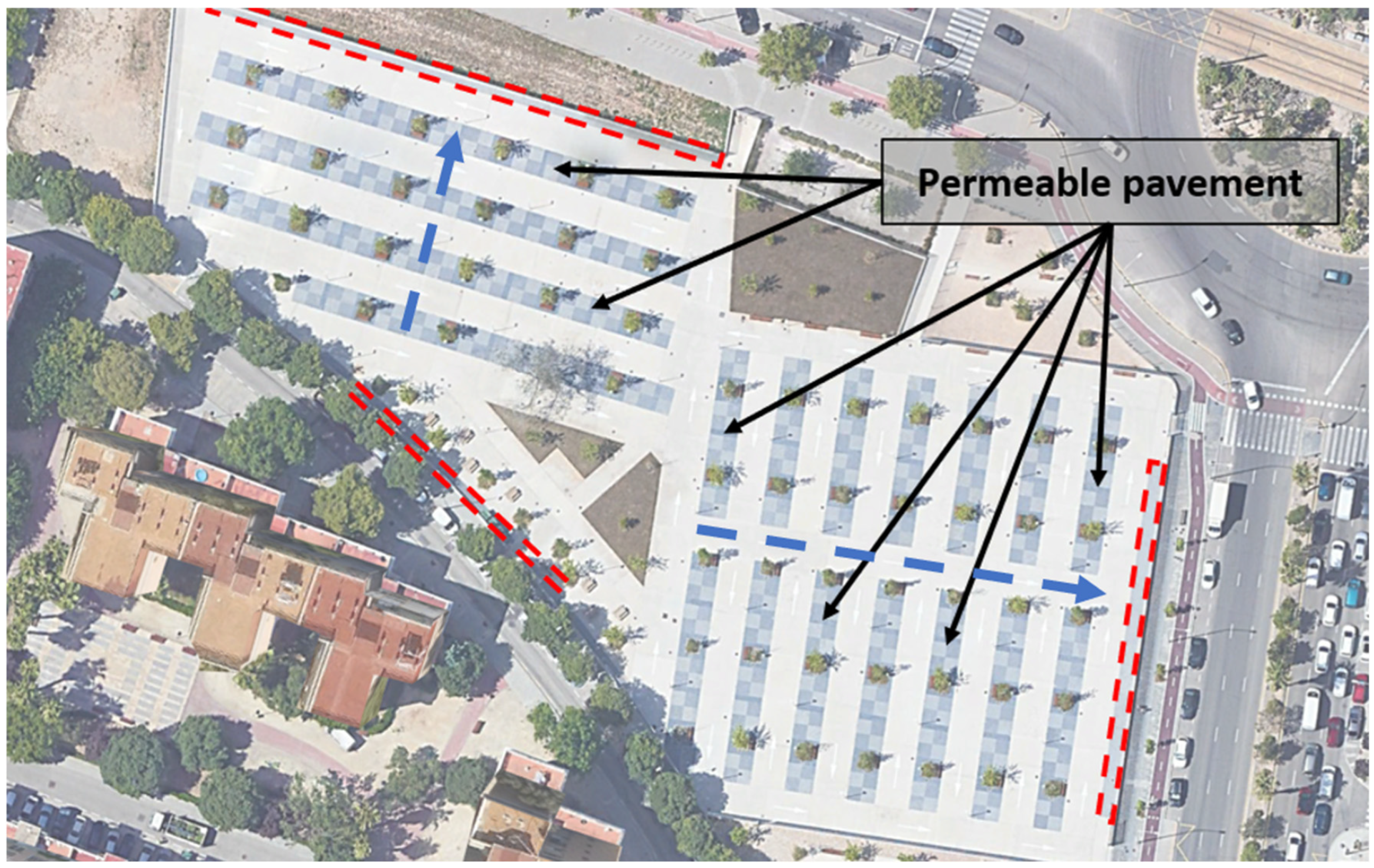
Figure 1. Aerial view of the site, showing the permeable pavement, the perimeter infiltration trenches (red dashed line), and the slope direction (blue dashed line). (Source of the image: Google Maps).
Water 18 01042 g001
Figure 2. Location of the points inside the site (I 1, I 2, I 3, I 4) and its perimeter (P 1), selected for the permeability study (Source of the image: Google Maps).
Water 18 01042 g002
Figure 3. Structure used to perform the permeability and washout tests of the slabs in the laboratory (left). Interior of chamber with perforated bottom and porous concrete slab supported on a drainage cell during the permeability test with the LCS permeameter (right).
Water 18 01042 g003
Figure 4. Box-and-whisker plots of nutrient, organic matter, and suspended solids concentrations (NH4+, NO2, NO3, TN, PO43−, TP, COD, and TSS) in new and used permeable pavement slabs.
Water 18 01042 g004
Figure 5. Distribution of MPs in the analyzed slabs by form and size (%).
Water 18 01042 g005
Figure 6. Components of the MPs found, in percentage, in the analyzed slabs.
Water 18 01042 g006
Table 1. Permeability values (mm/h) determined from the NLT-327/00 test, mean and standard deviation for the selected slabs at the 5 points of the site.
Permeability (mm/h)
I 1aI 1bI 2aI 2bI 3aI 3bI 4aI 4bP 1aP 1b
Mean323.81 1696.811656.781643.146845.831144.525763.933878.44231.08 1431.72 1
SE28.1854.14225.09204.10434.01130.01376.96269.1838.5042.16
Median316.64654.611473.821601.337041.111098.325772.884226.36252.05395.84
Min146.54498.80811.26722.774289.08588.823935.352470.8967.13219.67
Max466.311173.623203.332736.688888.491710.198058.104855.51413.52717.09
Notes: 1 Permeabilities below the minimum permeability threshold required in the València SUDS Design Guide [28]. Letters ‘a’ and ‘b’ denote the two contiguous slabs tested at each of the five selected points.
Table 2. Average concentrations and surface loads of pollutants per slab area.
Slab Id.Conductivity
µS/cm
Turbidity
NTU
COD
mg/L
NH4+
mg/L
NO2
mg/L
NO3
mg/L
TN
mg/L
PO43−
mg/L
TP
mg/L
TSS
mg/L
Used941127.583.50.050.0612.750.030.58304.8
New980.583.623.30.040.040.92.150.020.26205.9
COD
g/m2
NH4+
mg/m2
NO2
mg/m2
NO3
mg/m2
TN
mg/m2
PO43−
mg/m2
TP
mg/m2
TSS
g/m2
Used load 13.607.088.97158.84441.364.6394.0048.92
New load 3.176.814.97122.63292.944.0934.7428.05
Disclaimer/Publisher’s Note: The statements, opinions and data contained in all publications are solely those of the individual author(s) and contributor(s) and not of MDPI and/or the editor(s). MDPI and/or the editor(s) disclaim responsibility for any injury to people or property resulting from any ideas, methods, instructions or products referred to in the content.