Coal Mine Roof Water Inrush Prediction Based on Machine Learning Research

Abstract
1. Introduction
2. Methods
2.1. Selection of Early Warning Indicators for Roof Water Inrush
2.1.1. Microseismic Events
2.1.2. Monitoring Borehole Water Level
2.1.3. Self-Potential
2.1.4. Working Face Water Inflow
2.2. Selection of Primary Indicators and Response Relationships Among Multiple Monitoring Indicators
2.2.1. Engineering Background
2.2.2. Selection of Primary Indicators
2.2.3. Analysis of Response Relationships Among Multiple Monitoring Indicators
2.3. Prediction of Roof Fracture Height and Multiple Monitoring Indicators
2.3.1. Data Preprocessing
2.3.2. VMD Decomposition
2.3.3. LSTM Algorithm
2.3.4. VMD-LSTM Prediction
2.3.5. Calculation of Correlated Indicators
3. Results
3.1. Analysis of VMD-LSTM Prediction Results
3.2. Analysis of Correlated Indicator Calculation Results
4. Discussion
- (1)
- There is a significant correlation between the development state of water-conducting channels in the coal seam roof and microseismic events, self-potential, observation borehole water levels, and daily water inflow. During the development of water-conducting channels, microseismic frequency, roof fracture height, electrical method data, and daily water inflow exhibit an increasing trend, while observation borehole water levels decrease. Conversely, when the water-conducting channels close, all indicators show opposite trends.
- (2)
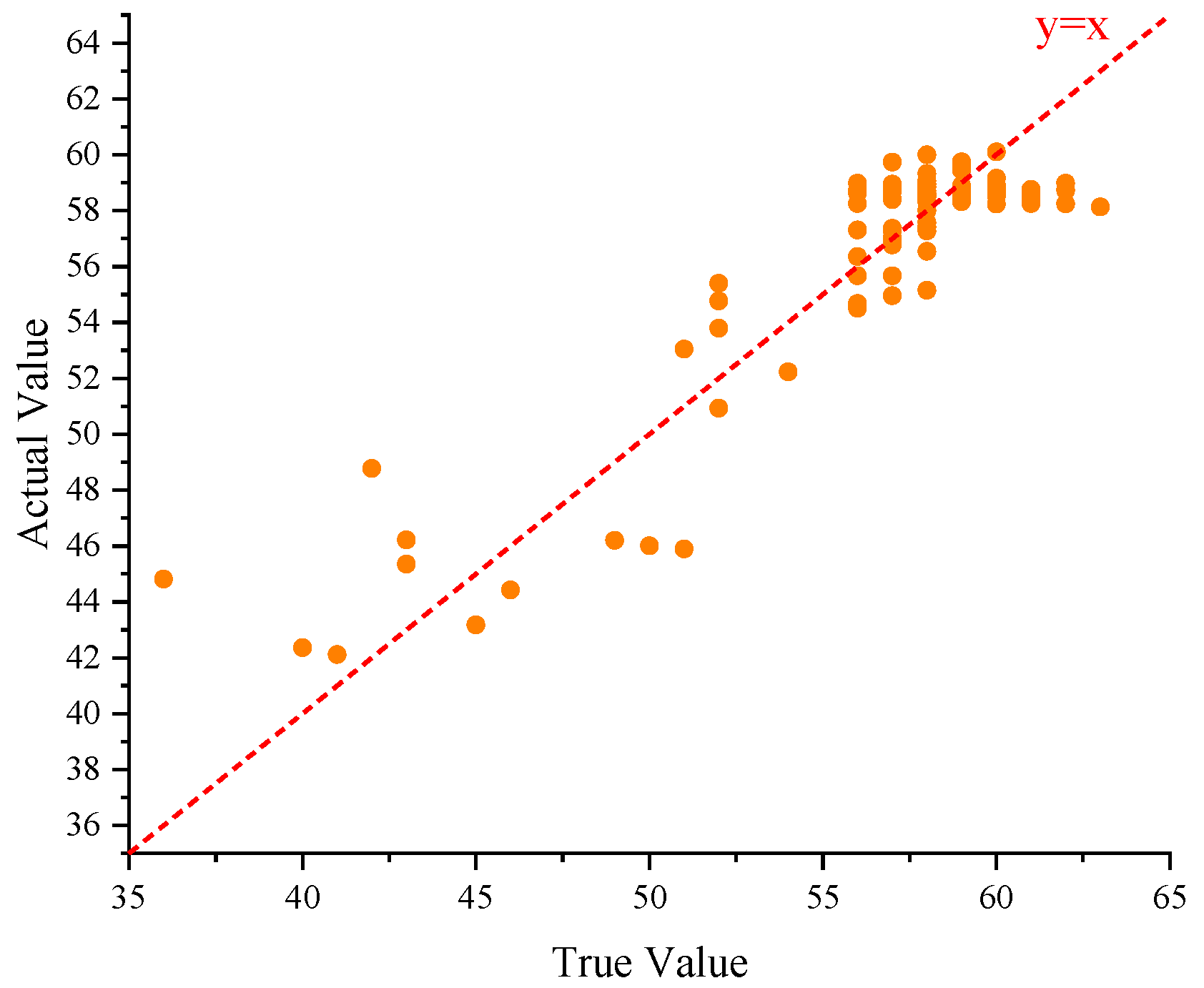
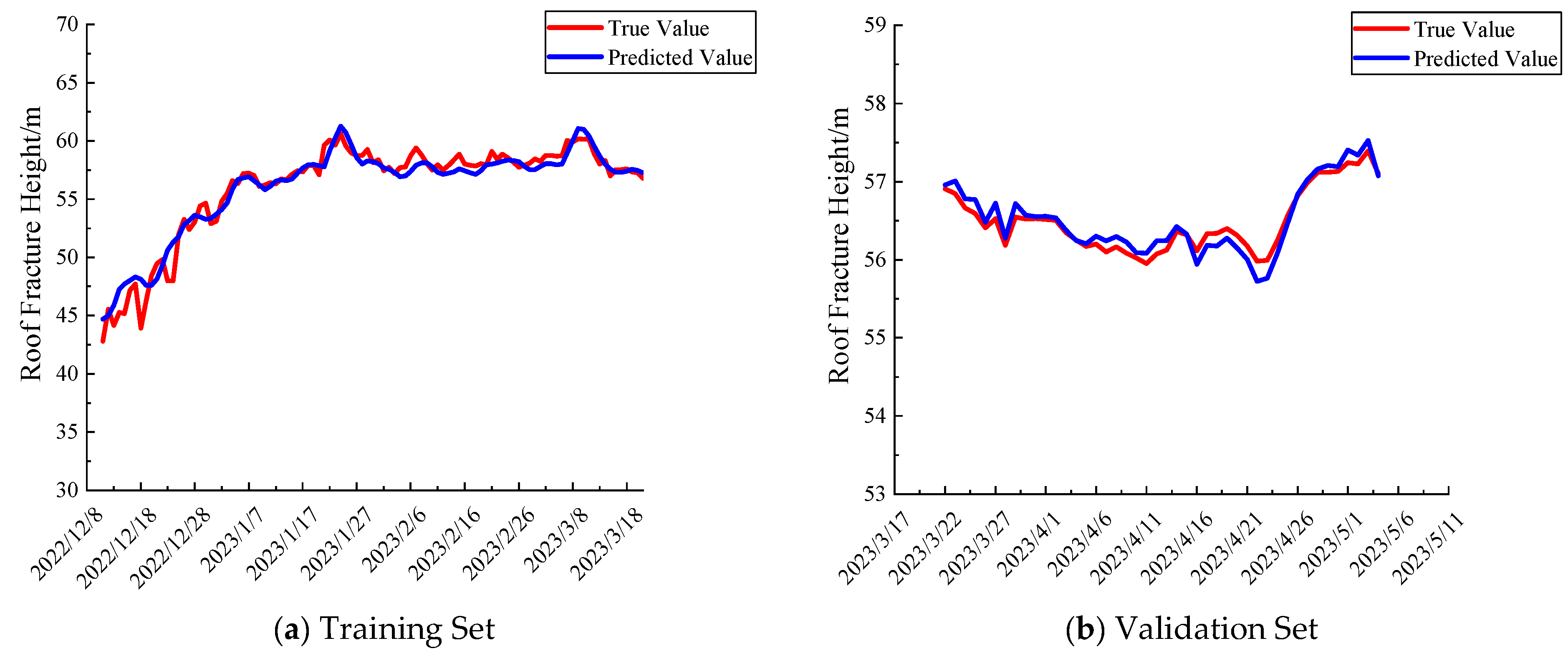
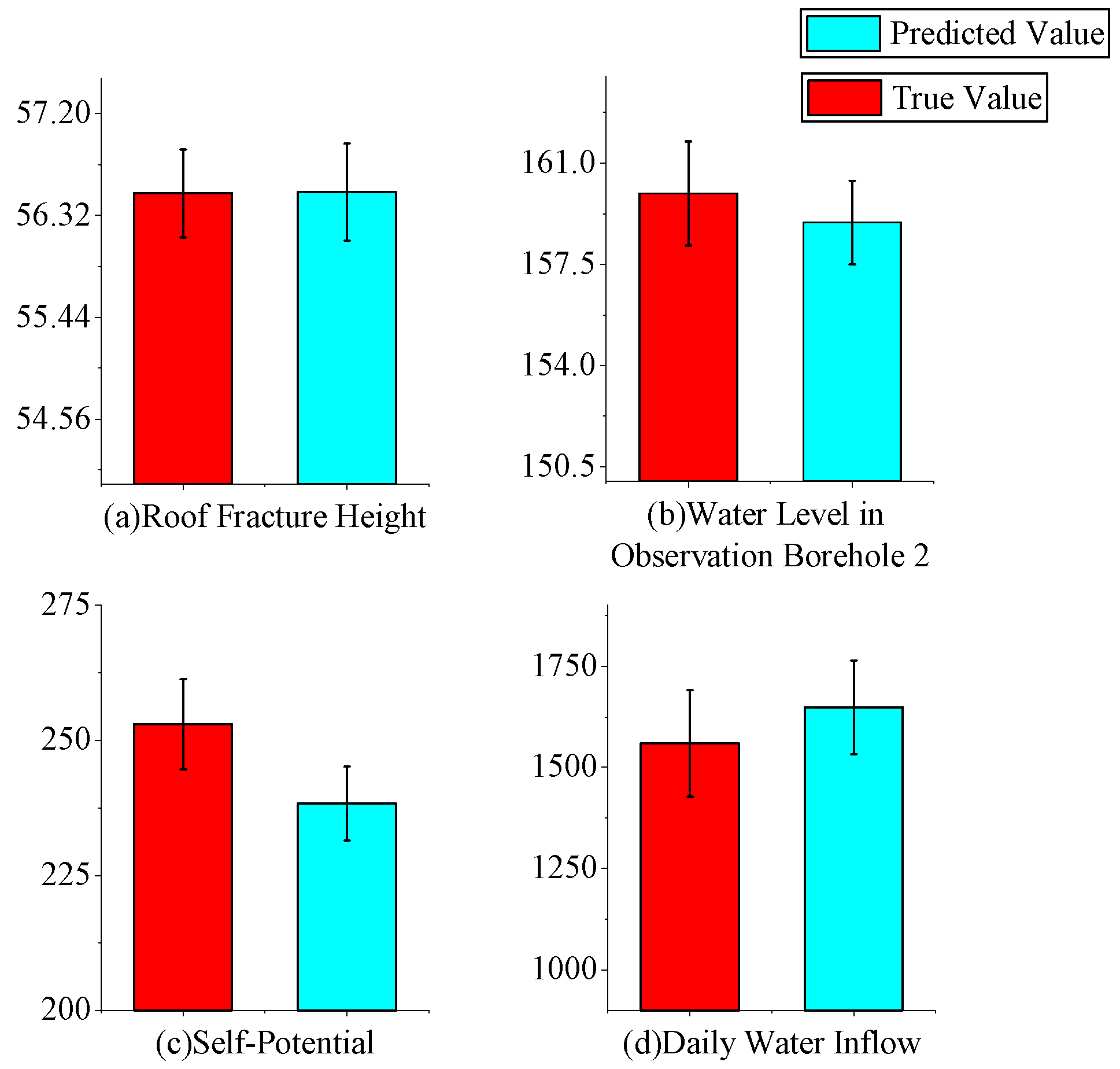
- The VMD-LSTM prediction model constructed based on microseismic data, electrical method data, observation borehole water level data, and working face water inflow data demonstrates good performance, achieving high prediction accuracy for roof fracture height (MAE = 0.11 m, MAPE = 0.19%, NSE = 0.93, HH = 0.21, GPI = 1.41). Compared with the traditional LSTM algorithm model, the VMD-LSTM algorithm model exhibits clear advantages in prediction accuracy: MAE decreases by 15.38%, MAPE decreases by 17.39%, NSE increases by 6.90%, HH decreases by 9.52%, and GPI decreases by 10.76%. Regression calculations were performed for water level in Observation Borehole 2, self-potential, and daily water inflow. The results show that the prediction errors for future central tendency are 0.63%, 4.67%, and 5.73%, respectively; the prediction errors for future confidence intervals are 7.22%, 7.53%, and 4.85%, respectively.
- (3)
- The multi-indicator early warning technical system constructed in this study, by introducing the Variational Mode Decomposition (VMD) algorithm to output high-quality components, improves the performance of the Long Short-Term Memory (LSTM) model, thereby providing a quantitative basis and technical support for early warning of coal seam roof water inrush. This system holds practical application value for enhancing roof disaster prevention capability and ensuring safe production in coal mines.
- (4)
- This study is applicable to near-horizontal coal seam working faces with online monitoring conditions, but its generalizability under complex geological conditions remains to be verified, and the medium- to long-term prediction accuracy still requires further optimization. Future work may involve constructing a unified dataset across multiple mines and under various operating conditions, and integrating explainable artificial intelligence methods to provide new insights for intelligent disaster prevention and control in mines.
Author Contributions
Funding
Data Availability Statement
Conflicts of Interest
References
- Zeng, Y.F.; Wu, Q.; Zhao, S.Q.; Miao, Y.W.; Zhang, Y.; Mei, A.S.; Meng, S.H.; Liu, X.X. Characteristics, Causes, and Prevention Measures of Coal Mine Water Hazard Accidents in China. Coal Sci. Technol. 2023, 51, 1–14. [Google Scholar]
- Peng, S.P. Current Status and Prospects of Research on Geological Assurance System for Coal Mine Safe and High Efficient Mining. J. China Coal Soc. 2020, 45, 2331–2345. [Google Scholar]
- Qiao, W.; Wang, Z.W.; Li, W.P.; Lv, Y.G.; Li, L.G.; Huang, Y.; He, J.H.; Li, X.Q.; Zhao, S.L.; Liu, M.N. Formation Mechanism, Disaster-Causing Mechanism and Prevention Technology of Roof Bed Separation Water Disaster in Coal Mines. J. China Coal Soc. 2021, 46, 507–522. [Google Scholar]
- Yin, S.X.; Ding, Y.Y.; Lian, H.Q.; Dong, D.L.; Du, T.; Yin, H.C.; Zhao, P.; Zhang, Y.A.; Wang, X. Research on Monitoring and Early Warning Systems for Mine Water: Progress and Prospects. Coal Geol. Explor. 2025, 53, 68–79. [Google Scholar]
- Anjom, K.F.; Toro, D.L.; Colombero, C. Fast and effective classification of landslide microseismicity: A machine learning perspective. Eng. Geol. 2026, 367, 108698. [Google Scholar] [CrossRef]
- Barthwal, H.; Shcherbakov, R. Unsupervised clustering of mining-induced microseismicity provides insights into source mechanisms. Int. J. Rock Mech. Min. Sci. 2024, 183, 105905. [Google Scholar] [CrossRef]
- Chtouki, T.; Petružálek, M.; Staněk, F.; Eisner, L.; Jechumtálová, Z.; Iqbal, N.; Bin Waheed, U. Effect of data filtering on source mechanisms inverted from surface microseismic monitoring array. J. Appl. Geophys. 2026, 245, 106070. [Google Scholar] [CrossRef]
- Konyukhov, G.; Yaskevich, S. Neural networks for source mechanism inversion from surface microseismic data. Comput. Geosci. 2024, 28, 1413–1424. [Google Scholar] [CrossRef]
- Samadi, H.; Suorineni, F. Development of a procedure for predicting real-time seismic wave velocity in underground mines using discrete physical laboratory modelling and explainable artificial intelligence (XAI). Int. J. Rock Mech. Min. Sci. 2026, 198, 106391. [Google Scholar] [CrossRef]
- Langet, N.; Wuestefeld, A.; Grindheim, B.; Li, C.C. Microseismic Monitoring of the Rock Mass During Full-Scale Uplift Tests of Rock Anchors. Rock Mech. Rock Eng. 2025, 58, 7691–7702. [Google Scholar] [CrossRef]
- Kumar, V.; Balasubramaniam, V.R. Long-term time-dependent deformation and stability analysis of the machine hall of an underground powerhouse cavern using microseismic monitoring. Near Surf. Geophys. 2025, 23, 69–86. [Google Scholar] [CrossRef]
- Naderloo, M.; Veltmeijer, A.; Pluymakers, A.; Jansen, J.D.; Barnhoorn, A. The Effect of Pressurization Rate and Pattern on Injection-Induced Seismicity in Highly Permeable Sandstone: An Experimental Study. J. Geophys. Res. Solid Earth 2025, 130, e2024JB029469. [Google Scholar] [CrossRef]
- Novikova, V.E.; Barishnikov, A.N.; Turuntaev, S.B.; Trimonova, M.A. Reconstruction of the Spatial Distribution of Filtration Properties of Heterogeneous Geological Media Based on Variations of Microseismicity Resulting from Fluid Injection. Izv. Phys. Solid Earth 2025, 61, 251–262. [Google Scholar] [CrossRef]
- Wang, S.; Xie, L.; Song, Y.; Liu, P.; Gao, Y.; Zhang, G.; Yuan, Y.; Jin, S.; Wang, Z. Approach for Microseismic Monitoring Data-Driven Rockburst Short-Term Prediction Using Deep Feature Extraction and Interpretable Coupling Neural Networks. Appl. Sci. 2025, 15, 11358. [Google Scholar] [CrossRef]
- Kadkhodaei, H.M.; Ghasemi, E. Interpretable real-time monitoring of short-term rockbursts in underground spaces based on microseismic activities. Sci. Rep. 2025, 15, 911. [Google Scholar] [CrossRef]
- Basnet, S.M.P.; Jin, A.; Mahtab, S. Applying machine learning approach in predicting short-term rockburst risks using microseismic information: A comparison of parametric and non-parametric models. Nat. Hazards 2024, 121, 731–758. [Google Scholar] [CrossRef]
- Yu, G.F.; Yuan, L.; Ren, B.; Li, L.C.; Cheng, G.W.; Han, Y.C.; Mu, W.Q.; Wang, S.X. Big Data Prediction and Early Warning Platform for Floor Water Inrush Disaster. J. China Coal Soc. 2021, 46, 3502–3514. [Google Scholar]
- Li, L.P.; Jia, C.; Sun, Z.Z.; Liu, H.L.; Cheng, S. Research Status and Development Trend of Major Engineering Disaster Prevention and Control Technology in Deep Underground. J. Cent. South Univ. (Sci. Technol.) 2021, 52, 2539–2556. [Google Scholar]
- Liu, Z.B.; Yan, J.S.; Wang, J.H.; Gao, Y.Q.; Yang, H.; Bai, B.J.; Lu, J.J.; Wang, H.W.; Wang, G. Transparent Prevention and Control System for Water Hazards in Mine Floors Under Empowerment Based on Spatiotemporal Information Fusion. Coal Geol. Explor. 2025, 53, 130–141. [Google Scholar]
- Chen, F.B.; Sun, X.D.; Wang, Y.J.; Feng, Y.J.; Sun, X.B.; Ma, Z.R.; Li, Y.; Liu, N. Research Status and Prospect of Microseismic Monitoring Technology in Coal Mines. Coal Eng. 2025, 57, 133–141. [Google Scholar]
- Darisma, D.; Mukuhira, Y.; Okamoto, K.; Aoyogi, N.; Uchide, T.; Ishibashi, T.; Asanuma, H.; Ito, T. Building the fracture network model for the Okuaizu geothermal field based on microseismic data analysis. Earth Planets Space 2024, 76, 107. [Google Scholar] [CrossRef]
- Kneipp, W.F.; Novotny, A.A.; Guzina, B.B. Full-waveform reconstruction of microseismic events via observations of acoustic pressure in the surrounding fluid. Inverse Probl. 2025, 41, 085011. [Google Scholar] [CrossRef]
- Pandey, A.; Tkalčić, H.; Ma, X. Investigating the Characteristics of Microseisms Using the Australian Seismic Arrays. J. Geophys. Res. Solid Earth 2025, 130, e2024JB031032. [Google Scholar] [CrossRef]
- Mohammadi, M.A. Dynamic Simulation and Conceptual Interaction Between Groundwater Level, Groundwater Pumping Costs, and Land Uplift in Abandoned Coal Mines in Germany. Min. Metall. Explor. 2025, 42, 2839–2862. [Google Scholar] [CrossRef]
- Wu, Q.; Wang, X.; Zhao, Y.; Zhang, X.; Jia, M. Simulation and Application of Mine Water Inrush Spreading Based on Water Balance in the Control Area of Coal Seam Floor Elevation. J. China Univ. Min. Technol. 2025, 54, 545–560. [Google Scholar]
- Cao, Y.C.; Fan, W.Q. Performance Analysis and Research of Mine Water Level Scale Recognition Based on Different Depth Recognition Algorithms. J. China Coal Soc. 2019, 44, 3529–3538. [Google Scholar]
- Liu, S.D.; Yang, C.; Zhang, J.; Li, C.Y.; Ren, C. Mine Microseismic and Electrical Coupling Monitoring Technology. J. China Coal Soc. 2024, 49, 586–600. [Google Scholar]
- Prakash, A.; Bharati, A.K. Implication of Electrical Resistivity Tomography for Precise Demarcation of Pothole Subsidence Potential Zone Over Shallow Depth Coal Mine Workings. J. Geol. Soc. India 2022, 98, 600–606. [Google Scholar] [CrossRef]
- Kulikov, V.A.; Yakovlev, A.G.; Polikarpova, V.A. Some Problems of Electrical Geophysical Prospecting Methods Used for Exploration of Ore Deposits. Geodyn. Tectonophys. 2021, 12, 731–747. [Google Scholar] [CrossRef]
- Mohand-Said, A.; Marquis, G.; Sambolian, S.; Girard, J.F.; Harrison, G.; Williard, E. Joint Inversion of Electromagnetic and Direct Current Resistivity Data Using Trust Regions. Application to Uranium Exploration in the Athabasca Basin. Geophys. Prospect. 2025, 73, e70079. [Google Scholar] [CrossRef]
- Vianney, J.M.; Hoth, N.; Moro, K.; Wardani, D.N.W.; Drebenstedt, C. Modeling of Water Inflow Zones in a Swedish Open-Pit Mine with ModelMuse and MODFLOW. Sustainability 2025, 17, 2466. [Google Scholar] [CrossRef]
- Ovchinnikov, N.P.; Zyryanov, I.V. Impact of Increased Water Inflow on Main Drainage System Efficiency in Mine. J. Min. Sci. 2023, 59, 342–347. [Google Scholar] [CrossRef]
- Yang, J.; Liang, X.Y.; Ding, X. Variation Characteristics of Mine Inflow During Mining of Deep Buried Coal Seams in Shaanxi and Inner Mongolia Contiguous Area. Coal Geol. Explor. 2017, 45, 97–101. [Google Scholar]
- Ahmadi, F.; Tohidi, M.; Sadrianzade, M. Streamflow prediction using a hybrid methodology based on variational mode decomposition (VMD) and machine learning approaches. Appl. Water Sci. 2023, 13, 135. [Google Scholar] [CrossRef]
- Ramezani, R.; Gheiby, A.; Malakooti, H.; Bazrafshan, O. An intelligent VMD-WTC-GRU hybrid framework with uncertainty quantification for forecasting extreme flood events in semi-arid regions. Ain Shams Eng. J. 2026, 17, 103960. [Google Scholar] [CrossRef]
- Kofi, A.S.; Yuan, Y.; Chen, Z.; Li, B.; Qin, Z.; Apolline, D.A. Study on Intelligent Early Prediction Method of Ground Pressure in Fully Mechanized Mining Face of Coal Mine Based on Random Forest and LSTM. Min. Metall. Explor. 2026, 43, 1099–1118. [Google Scholar] [CrossRef]
- Kumari, K.; Dey, P.; Kumar, C.; Pandit, D.; Mishra, S.S.; Kisku, V.; Chaulya, S.K.; Ray, S.K.; Prasad, G.M. UMAP and LSTM based fire status and explosibility prediction for sealed-off area in underground coal mine. Process Saf. Environ. Prot. 2021, 146, 837–852. [Google Scholar] [CrossRef]
- Aydin, M.C.; Gelberi, G.; Ulu, A.E. Investigation of recent level changes in Lake Van using water balance, LSTM and ANN approaches. Appl. Water Sci. 2024, 14, 41. [Google Scholar] [CrossRef]
- Mehdinejadiani, B. A novel inverse model insensitive to initial guesses for estimating parameters of continuous time random walk-truncated power law model. J. Hydrol. 2025, 658, 133206. [Google Scholar] [CrossRef]
- Maroufi, H.; Mehdinejadiani, B. A comparative study on using metaheuristic algorithms for simultaneously estimating parameters of space fractional advection-dispersion equation. J. Hydrol. 2021, 602, 126757. [Google Scholar] [CrossRef]



| Indicator | Mean (μ) | Standard Deviation (σ) | Coefficient of Variation (CV/%) |
|---|---|---|---|
| Roof Fracture Height | 55.65 m | 6.08 m | 10.93 |
| Microseismic Frequency | 43.63 times | 11.22 times | 25.72 |
| Water Level in Observation Borehole 1 | 5.71 m | 0.13 m | 2.28 |
| Water Level in Observation Borehole 2 | 157.85 m | 9.05 m | 5.73 |
| Self-Potential | 234.12 mA | 36.95 mA | 15.78 |
| Daily Water Inflow | 1574.59 m3 | 643.61 m3 | 40.87 |
| Indicator | Roof Fracture Height | Microseismic Frequency | Water Level in Observation Borehole 1 | Water Level in Observation Borehole 2 | Self- Potential | Daily Water Inflow |
|---|---|---|---|---|---|---|
| Roof Fracture Height | 1 | 0.47 | 0.42 | 0.84 | 0.79 | 0.8 |
| Microseismic Frequency | 0.47 | 1 | 0.2 | 0.34 | 0.32 | 0.38 |
| Water Level in Observation Borehole 1 | 0.42 | 0.2 | 1 | 0.56 | 0.13 | 0.81 |
| Water Level in Observation Borehole 2 | 0.84 | 0.34 | 0.56 | 1 | 0.56 | 0.84 |
| Self-Potential | 0.79 | 0.32 | 0.13 | 0.56 | 1 | 0.46 |
| Daily Water Inflow | 0.8 | 0.38 | 0.81 | 0.84 | 0.46 | 1 |
| Evaluation Dimension | Key Indicator | VMD | EMD | EEMD | CEEMDAN |
|---|---|---|---|---|---|
| Frequency Separation Accuracy | Modal Spectrum Overlap | 0.1% | 5% | 2% | 0.5% |
| Center Frequency Deviation Rate | 0.2% | 5.80% | 2.30% | 1.50% | |
| Full Width at Half Maximum | 0.02 Hz | 0.1 Hz | 0.05 Hz | 0.03 Hz | |
| Reconstruction Accuracy | RMSE | 0.12 m | 0.18 m | 0.12 m | 0.08 m |
| Engineering Applicability | Suitable for complex high-noise engineering data | Not suitable for complex noise environments | Not suitable for batch processing | Suitable for conventional engineering data | |
| Model | RMSE (m) | MAE (m) | MAPE (%) | R2 |
|---|---|---|---|---|
| LSTM | 1.76 | 1.09 | 2.13 | 0.93 |
| BP neural network | 1.48 | 0.91 | 1.74 | 0.91 |
| GRU | 1.73 | 1.29 | 2.44 | 0.87 |
| SVR | 1.46 | 1.02 | 1.89 | 0.91 |
| Indicator | Mean | 95% Confidence Interval |
|---|---|---|
| Water Level in Observation Borehole 2 | 158.94 m | ±1.28 m |
| Self-Potential | 238.30 mA | ±5.83 mA |
| Daily Water Inflow | 1648.27 m3 | ±106.40 m3 |
| DATA | VMD-LSTM | LSTM |
|---|---|---|
| MAE | 0.11 m | 0.13 m |
| MAPE | 0.19% | 0.23% |
| NSE | 0.93 | 0.87 |
| HH | 0.21 | 0.23 |
| GPI | 1.41 | 1.58 |
| Indicator | Mean Error (%) | Fluctuation Range Error of 95% Confidence Interval (%) |
|---|---|---|
| Water Level in Observation Borehole 2 | 0.63 | 7.22 |
| Self-Potential | 4.67 | 7.53 |
| Daily Water Inflow | 5.73 | 4.85 |
Disclaimer/Publisher’s Note: The statements, opinions and data contained in all publications are solely those of the individual author(s) and contributor(s) and not of MDPI and/or the editor(s). MDPI and/or the editor(s) disclaim responsibility for any injury to people or property resulting from any ideas, methods, instructions or products referred to in the content. |
© 2026 by the authors. Licensee MDPI, Basel, Switzerland. This article is an open access article distributed under the terms and conditions of the Creative Commons Attribution (CC BY) license.
Share and Cite
Chen, J.; Li, L.; Tan, W.; Qu, Z.; Mu, W.; Zhou, H.; Bai, J.; Wu, F. Coal Mine Roof Water Inrush Prediction Based on Machine Learning Research. Water 2026, 18, 1036. https://doi.org/10.3390/w18091036
Chen J, Li L, Tan W, Qu Z, Mu W, Zhou H, Bai J, Wu F. Coal Mine Roof Water Inrush Prediction Based on Machine Learning Research. Water. 2026; 18(9):1036. https://doi.org/10.3390/w18091036
Chicago/Turabian StyleChen, Juntao, Lu Li, Wenfeng Tan, Zhu Qu, Wenqiang Mu, Haoyu Zhou, Jiwen Bai, and Fangcan Wu. 2026. "Coal Mine Roof Water Inrush Prediction Based on Machine Learning Research" Water 18, no. 9: 1036. https://doi.org/10.3390/w18091036
APA StyleChen, J., Li, L., Tan, W., Qu, Z., Mu, W., Zhou, H., Bai, J., & Wu, F. (2026). Coal Mine Roof Water Inrush Prediction Based on Machine Learning Research. Water, 18(9), 1036. https://doi.org/10.3390/w18091036