Article

Turbulence and Energy Dissipation of Lateral Deflectors in Free-Surface Tunnel

1
Wuxi Municipal Center for River and Lake Governance and Water Resources Management, Wuxi 214000, China
2
College of Hydraulic & Environmental Engineering, China Three Gorges University, Yichang 443002, China
3
State Key Laboratory of Water Resources Engineering and Management, Changjiang Institute of Survey, Planning, Design and Research Corporation, Wuhan 430010, China
4
Henan Water & Power Engineering Consulting Co., Ltd., Zhengzhou 450016, China
*
Author to whom correspondence should be addressed.
Water 2026, 18(9), 1035; https://doi.org/10.3390/w18091035
Submission received: 2 February 2026 / Revised: 15 April 2026 / Accepted: 21 April 2026 / Published: 27 April 2026
(This article belongs to the Section Hydraulics and Hydrodynamics)

Abstract

In the deep and narrow valleys of southwestern China, free-surface spillways are widely adopted as auxiliary flood-discharge structures in water conservancy projects. Owing to the high water head upstream, tunnels are often plagued by problems including excessive velocity, cavitation damage, and insufficient downstream energy dissipation. Previous studies have demonstrated that the installation of novel lateral deflectors in tunnels can effectively regulate local flow patterns while providing additional energy dissipation capacity. In this study, physical model experiments combined with numerical simulations were employed to further compare the energy dissipation characteristics of lateral deflectors. The turbulent characteristics, the energy dissipation process, and the evolution of vortex structures were systematically analyzed based on turbulent kinetic energy, turbulence dissipation rate, fluctuating pressure coefficient, and Hilbert–Huang transform (HHT) spectral analysis. The results show that the novel lateral deflector significantly enhances local turbulence intensity and turbulent kinetic energy, promoting the conversion of mean kinetic energy into turbulent kinetic energy and its rapid dissipation within a shorter distance. Spectral energy reaches its peak in the jet impingement region, accompanied by a marked increase in high-frequency components, indicating an intensified energy transfer from large-scale vortices to small-scale vortices. These findings suggest that the novel deflector can serve as an effective internal energy dissipator in free-surface tunnels with shorter turbulent region and more local turbulence.

1. Introduction

China’s west-high and east-low topography endows the southwestern region with abundant hydropower resources. Owing to tectonic activity, climatic conditions, and complex lithology, the construction of hydraulic projects in this region frequently encounters challenging conditions, including high heads, large discharges, and narrow valleys [1]. Constrained by transportation and terrain, free-surface spillway tunnels partially embedded in mountain bodies are commonly adopted as auxiliary flood-discharge structures [2]. Among them, the dragon-tail spillway is most widely used, as the high-velocity flow is typically located in the downstream open channel section, as observed in the Xiluodu, Baihetan, Wudongde, Xiaowan, Shuangjiangkou, and Jinping hydropower stations. To prevent cavitation damage in gentle slope tunnel sections in the mountain and to alleviate downstream energy dissipation demands, aerators are usually required [3,4]. However, bottom aerators are prone to inducing cavity backwater blockage and impact waves [5,6,7]. In contrast, lateral aerators not only improve aeration efficiency but also provide additional energy dissipation capacity [8]. Previous studies have developed a novel deflector that enhances energy dissipation, reduces flow disturbances, and stabilizes hydraulic parameters while maintaining a stable flow pattern in the tunnel, thereby demonstrating its feasibility as a lightweight internal energy dissipator in spillway tunnels [9,10]. In addition, studies on concave-channel compressible flows have shown that abrupt geometric changes can induce shock-train-like structures, wall-pressure amplification, and strong flow separation, highlighting the important role of local flow restructuring in pressure fluctuation evolution and energy redistribution [11,12,13]. Nevertheless, the turbulence evolution and associated energy dissipation mechanisms of this structure remain unclear and merit further investigation.
The energy dissipation capacity of lateral deflectors has only been recognized in recent decades. Nie et al. [14] reported that air entrained into the flow through the cavity downstream of the deflector can significantly enhance energy dissipation, reduce the residual kinetic energy at the outlet of spillway tunnels, and alleviate downstream energy dissipation demands. Lucas et al. [15] demonstrated that when a lateral deflector is combined with a bottom aerator, most of the energy dissipation occurs in the jet impingement region, and the dissipation capacity increases with increasing contraction ratio and Froude number. Steiner et al. [16] derived empirical relationships for the energy dissipation rate based on the deflection angle and relative height of bottom deflectors. Although these studies have pinpointed the locations and influencing factors of energy loss, existing research has primarily remained at the macroscopic level of energy dissipation characteristics. The fundamental dissipation mechanisms, examined from the perspective of turbulent structure and their evolution, have yet to be thoroughly investigated. Recent perspective analyses have also emphasized that fluid-dynamic problems involving complex geometries, evolving methods, and unresolved conceptual limitations still require deeper investigation, especially when conventional simplified frameworks are insufficient to capture the underlying flow physics [17,18].
Spectral analysis, which decomposes fluctuating pressure signals into their constituent frequency components, is essential for the characterization of turbulence structure and the distribution of turbulent energy, which plays a pivotal role in elucidating the mechanisms of turbulence energy evolution [19,20]. In early hydraulic model studies, fluctuating signals were typically quantified using mean square deviations or standard deviations to evaluate turbulence intensity. However, such statistical indicators are unable to capture the time–frequency characteristics of pressure fluctuations and therefore cannot resolve the intrinsic turbulence structure or the associated energy distribution. The Fourier transform, widely adopted in earlier studies, can identify the frequency characteristics of pulsation sequences but is inherently limited when applied to non-stationary turbulent signals. The Hilbert–Huang transform (HHT), proposed by Huang et al., is an effective method for analyzing nonlinear and non-stationary signals [21,22,23,24]. Mou and Wang [25] applied the wavelet transform, short-time Fourier transform, and HHT to pressure pulsation signals, and their comparative analysis showed that the reliability of the former two methods strongly depends on the appropriate selection of basic functions and parameters, resulting in limited adaptivity. In contrast, HHT is adaptive, and its Hilbert spectrum provides a time–frequency representation that can be particularly informative for non-stationary signals such as those investigated here. Qu et al. [26] employed HHT to examine the stationarity of turbulent pressure signals in the time domain during studies of hydraulic gate vibration. The results demonstrated that HHT is applicable not only to linear and stationary time series but also to nonlinear and non-stationary signals. Moreover, HHT can effectively characterize the degree of signal non-stationarity, which is valuable for analyzing turbulent pressure fluctuations. In parallel, data-driven approaches have also been increasingly explored in broader civil and geotechnical engineering to address highly nonlinear engineering problems, particularly in prediction-oriented tasks such as pile bearing capacity and subgrade performance evaluation [27,28,29]. However, these studies mainly focused on empirical prediction, whereas the present study emphasizes mechanism-based hydraulic interpretation of local energy dissipation in free-surface tunnels.
Energy dissipators in spillway tunnels induce intense local flow variations that result in mechanical energy loss during the conversion of momentum and energy, ultimately dissipating as heat. This local irreversible mechanical energy loss is referred to as local energy dissipation. It consists of the energy consumed in overcoming wall friction and the work performed by turbulent stresses generated by turbulent vortex mixing [30,31]. Turbulence comprises vortices of varying scales undergoing nonlinear random motion. Small-scale vortices are nested within large-scale vortices to form a multiple-scale superposition of motions. During their internal transport, smaller vortices are partially dissipated by viscosity and partially merge with adjacent fluid or other eddies to form larger ones, which is the reason for turbulence energy dissipation. Large-scale vortices exhibit longer fluctuation periods, larger amplitudes, lower frequencies, and longer transport distances owing to the higher energy contained. During their movement and rotation, they break down into small-scale vortices as energy is dissipated, driving a cascading energy transfer to smaller scales. Conversely, small-scale vortices are characterized by short fluctuation periods, small amplitudes, high frequencies, and steep velocity gradients against surrounding flow. Consequently, the stronger viscous effects acting on small-scale vortices account for the major portion of the total energy loss [32]. The magnitude of energy dissipation depends on the work conducted by the flow to overcome resistance such as boundary friction and internal turbulent stresses. Therefore, the core of energy dissipation research lies in a systematic investigation of the turbulent structure, hydraulic characteristics, motion behavior, and mechanisms of energy conversion and dissipation in regions where structural changes occur [33]. Similar integrated experimental–numerical strategies have also been adopted in other complex engineering systems to resolve coupled performance mechanisms across multiple physical processes [34,35]. Accordingly, this study investigated the value of a novel lateral deflector for energy dissipation in a gentle-slope free-surface tunnel. The study first identifies the location of turbulence dissipation. Subsequently, the evolution of turbulent kinetic energy and vortex structures is examined by combining the calculation of streamwise fluctuating pressure intensity with Hilbert–Huang transform (HHT) spectrum analysis.

2. Experimental Methods

2.1. Physical Model

The hydraulic model tests were conducted on the sagging dragon tail spillway tunnel model at Wuhan University (Figure 1a). The study primarily focused on the gentle-slope free-surface tunnel section (Figure 1b), which features a width of B = 18.75 cm, a height of h = 17.75 cm, and a bottom slope of i = 3%. The corresponding scale falls into the range of 1/24~1/80 with regard to the typical width being 4.5~15 m of the high unit-width-discharge free-surface tunnels (e.g., Yele, Xiaowan, Xiluodu) in China [36]. Experimental studies adopting similar geometric scale or model tunnel width can be found in [37,38,39,40]. Inflow conditions were controlled at the cross-section x = 33.75 cm upstream of the deflectors. All measurements were obtained under the conditions of inflow depth hin = 11.25 cm and volume flow rate Qin = 57.65 L/s (Figure 1c), featuring a Reynolds number R e =   Q i n h i n R υ = 1.2 × 10⁵ (R represents the hydraulic diameter calculated as b h i n b + 2 h i n and υ = 1 × 10⁻⁶ m2/s is the kinematic viscosity of water). This R e value, being larger than 1 × 10⁵, indicates that the scale effect arising from viscous stress can be neglected according to [40]. In this study, the flow depth was measured using a fluviograph (accuracy ± 0.18 mm). The water discharge was monitored using an electromagnetic flowmeter (IFM4080K, Jiangsu Runyi Instrument Co., Ltd., Huai’an, Chian), featuring an accuracy of 0.1 L/s. To ensure the accuracy of hydraulic parameter measurements such as fluctuating pressure, it was essential to maintain the stability of the measuring instruments and minimize human interference. All instruments were mounted on a high-grade steel frame aligned parallel to the tunnel floor slope. This steel frame was equipped with high-wear-resistant 304 stainless steel laser-engraved scales along the streamwise, transverse, and vertical directions to prevent wear caused by the movement of the measurement devices on the rail (Figure 1d).
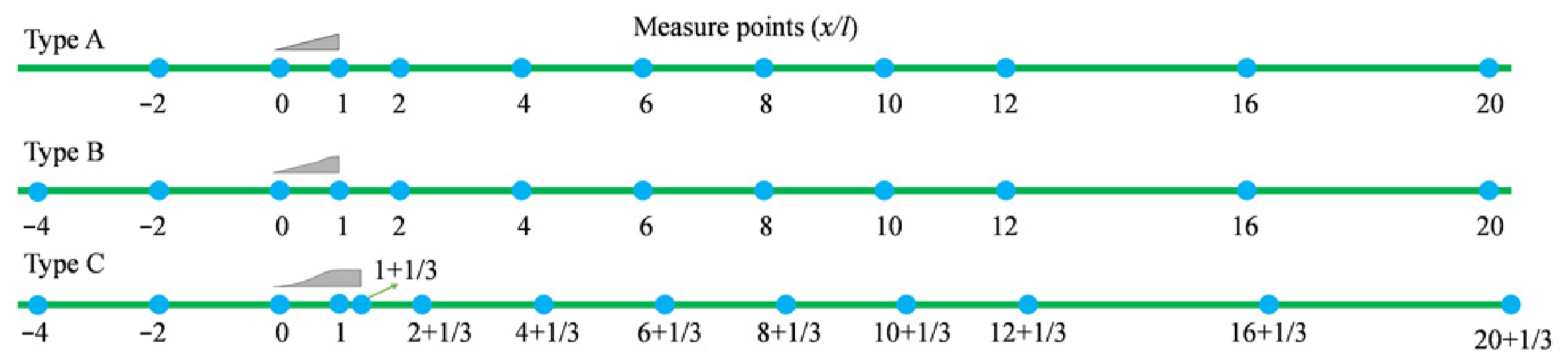
Fluctuating pressure was acquired using YPS300-L digital pressure sensors (Chengdu Aoteer Technology Co., Ltd., Chengdu, China), characterized by a range of −50 kPa to 100 kPa and an accuracy of 0.1% FS. To investigate the turbulence characteristics upstream and downstream of the deflectors, the measurement positions were defined relative to the start of the deflector at x = 0 cm with the streamwise direction defined as positive. Adopting the deflector length l = 3.75 cm as the reference length, fluctuating pressure was measured at the surface and mid depth at a near-wall point (approximately y = −8.4 cm). The potential effect of free-surface fluctuations on the free-surface pressure measurements was considered negligible for the time-averaged results due to the relatively small wave amplitude and long sampling duration. The specific measurement cross-sections corresponded to x/l = −4, −2, 0, 1, 2, 4, 6, 8, 10, 12, 16, and 20. Regarding the Type C deflector, which featured an additional straight section with a length of (1/3)l downstream, the measurement positions were shifted downstream by a dimensionless distance of 1/3 to facilitate a comparative analysis of downstream different deflectors, as shown in Figure 2. The data acquisition duration for all fluctuating pressure measurements was 190 s with a sampling frequency of 100 Hz. The initial 3 min of data were utilized for the final analysis. All measured parameters were determined based on statistical results derived from multiple measurements under steady flow conditions, that is, the relative error in the vertical velocity profile between three consecutive measurements remained below 5%. Consequently, the final results were obtained through the statistical analysis of more than three recorded measurement sets. Thus, all reported data satisfy a 5% repeatability uncertainty bound.

2.2. Numerical Model

Numerical simulations were performed using the commercial software Flow-3D [41,42,43]. The RNG k-ε turbulence model was employed for the calculations [44,45], and the Tru-VOF technique was utilized to track the free surface [46]. The Reynolds-Averaged Navier-Stokes (RANS) equations were solved based on a structured finite-difference grid, while the FAVOR technique was applied to handle complex geometric boundaries [47,48,49]. It should be noted that the numerical simulations serve as a complementary tool to support the analysis of time-averaged flow patterns, while the main conclusions are primarily drawn from experimental measurements.
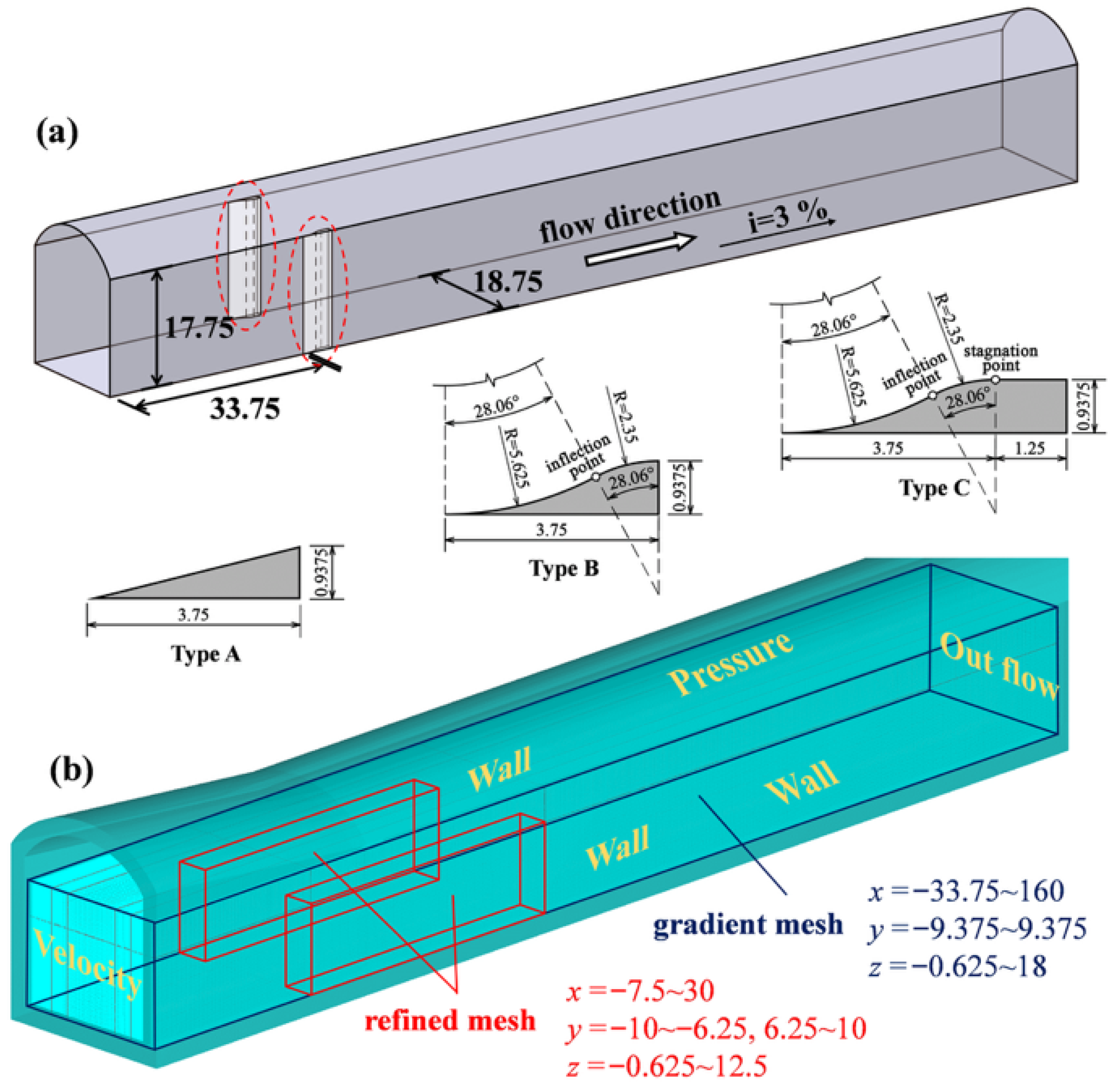
The computational domain extended longitudinally from x = −33.75 cm to x = 135 cm. The lateral deflector was positioned at x = 0 cm facing the approach flow, as detailed in Figure 3a. Three types of deflectors (Figure 1c) were investigated, the width b of which were all 0.94 cm and the streamwise length of deflectors A and B was 3.75 cm, while deflector C was further extended 1.25 cm downstream with a straight guiding line parallel to the side walls. The detailed geometries of the three types of deflectors are sketched in Figure 3a. Type A is the traditional triangular deflector, deflector B is composed of two arcs tangent to each other: one being negative and has a radius of 5.625 cm, and the other being positive and features a radius of 2.35 cm. As for deflector C, it was the same as deflector B except for the aforementioned additional straight line, whose dimensionless extension with regard to the streamwise length of the curved section l was 1/3.
A brief summary of the grid convergence analysis from our previous work [10] is provided here. Three mesh schemes were evaluated. The Grid Convergence Index (GCI) for the fine grid is 0.224%, which is an order of magnitude lower than that of the medium grid, indicating satisfactory convergence. The fine grid was therefore selected for all simulations. A structured mesh block with an average cell size of 0.34 cm × 0.125 cm × 0.2 cm (x × y × z) was applied to the main computational domain. Additionally, two refined meshes with an average cell size of 0.188 cm × 0.094 cm × 0.188 cm were implemented around the deflectors. A free outflow boundary condition was imposed at the outlet. The bottom and side walls were set as no-slip boundaries with an equivalent sand roughness of ks = 0.015 mm. The top boundary was defined as a specified pressure condition with a relative pressure of p = 0 Pa (i.e., atmospheric pressure). For the inlet, there was a velocity boundary condition that mapped all flow parameters from the cross-section at x = −33.75 cm in the global experimental simulation to the local computational domain (Figure 3b). Further details regarding grid convergence and calculation accuracy verification can be found in the preliminary study [10].
It is worth recalling that the numerical model employed in this study has been systematically validated in our previous work [10]. A brief summary of the validation results is provided here for completeness. Comparisons between the simulated and measured water surface profiles showed good agreement, with only small deviations observed near the deflector region. The simulated vertical velocity profiles closely matched the measured data at the flume centerline, while near the sidewall, the calculated velocities were approximately 10% lower than the experimental values due to the effects of the wall function. For the horizontal velocity distribution, the simulated velocities were generally consistent with the measurements. Overall, the numerical model achieved acceptable accuracy to support the analysis of flow patterns and energy dissipation characteristics in the present study.

2.3. HHT Spectral Analysis

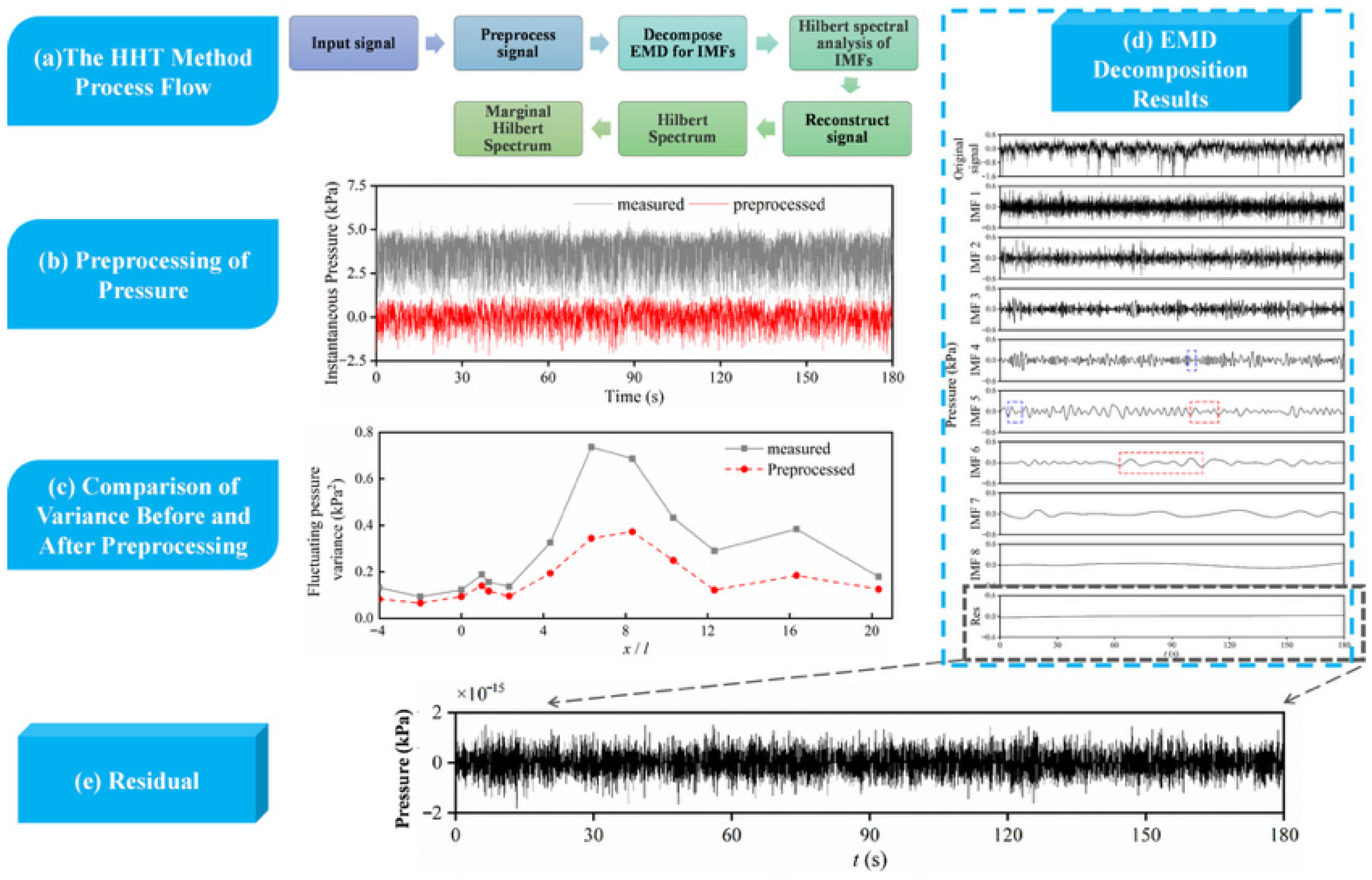
The procedure for applying the Hilbert–Huang transform (HHT) to analyze fluctuating pressure signals entails the decomposition of experimentally measured data, followed by the execution of the Hilbert transform and subsequent integration over time to yield the Hilbert marginal spectrum. The HHT method can be used for the stability test of fluctuating pressure, the extraction of vortex-scale structural information from Intrinsic Mode Function (IMF) components, and the retrieval of important turbulence characteristics from these decomposed signals. Fundamentally, the HHT methodology comprises two primary constituents: Empirical Mode Decomposition (EMD) and the Hilbert transform (HT) coupled with spectral analysis [22,50]. The comprehensive computational workflow is illustrated in Figure 4a.
The HHT method initially decomposes the signal adaptively into a series of Intrinsic Mode Functions (IMFs) through the Hilbert–Huang transform. Subsequently, a Hilbert transform was performed on each IMF to derive instantaneous frequency and instantaneous amplitude with physical significance, thereby capturing the temporal evolution of the signal’s frequency-domain characteristics [19,20]. In contrast to conventional signal processing approaches, the HHT does not necessitate preliminary analysis or the predefinition of any basis functions. Instead, it adaptively decomposes the original signal into a sum of several IMFs based on its inherent characteristics [51]. Each IMF component corresponds to specific frequency constituents within the original signal and is sequentially extracted from high to low frequencies [52,53].
Empirical Mode Decomposition (EMD) enables adaptive time–frequency localization analysis and effectively extracts characteristic information from the original signal. This method does not require the predefinition of harmonic basis functions and can mitigate interference from high-frequency signals. EMD provides an adaptive decomposition that does not require predefined basis functions. It can reflect the time-varying characteristics of frequency and amplitude. Since its decomposition basis is entirely dependent on the signal itself, it ensures that the derived instantaneous frequency retains physical meaning.
For a random time-series signal X(t), its Hilbert transform yields by Equation (1):
Y ( t ) = 1 π P V [ X ( τ ) / ( t τ ) ] d τ
where PV denotes the Cauchy principal value. Consequently, the analytic signal of the original time-series signal can be constructed from the complex conjugate pair.
Z ( t ) = X ( t ) + j Y ( t ) = a ( t ) e j θ ( t )
a ( t ) = [ X 2 ( t ) + Y 2 ( t ) ] 1 / 2
θ ( t ) = arctan [ Y ( t ) / X ( t ) ]
These functions contain the signal’s amplitude and phase information, where a(t) represents the amplitude function and θ(t) denotes the phase function.
EMD decomposes the complex signal into IMFs, which are approximately mono-component signals capable of yielding meaningful instantaneous frequencies. By applying the Hilbert transform, as shown in Equation (1) to each decomposed component, the reconstructed original signal can be expressed as Equation (5):
x ( t ) = Re i = 1 n a i ( t ) e j ω i ( t ) d t
where ai(t) is the amplitude function of the i-th IMF component, and ωi(t) is its instantaneous frequency function.
The instantaneous amplitude and instantaneous frequency obtained through the Hilbert transform are functions of time. When the amplitude is expressed as a function of both time and frequency, the resulting time–frequency distribution of the amplitude is termed the Hilbert spectrum, denoted as H(ω,t) [51]. Integrating the Hilbert spectrum over time yields the Hilbert marginal spectrum, expressed as Equation (6):
H ( ω ) = H ( ω , t ) d t
The Hilbert marginal spectrum represents the cumulative amplitude at each frequency over the entire time duration [54]. It reflects the contribution of each frequency to the overall energy (or amplitude) in a global sense, signifying the accumulated amplitude across all data points from a statistical perspective. For fluctuating pressure signals, the marginal spectrum accurately reflects the actual frequency components of the signal, with the peak of the marginal spectrum corresponding to its dominant frequency.

2.3.1. Preprocessing of Fluctuating Pressure Signals

In model experiments, fluctuating pressure signals measured by intrusive instruments are prone to deviations from their true values due to human interference, instrument disturbance, and other noise. Therefore, preprocessing is crucial for signal restoration, which adopted the least squares method followed by the five-point cubic smoothing method to effectively remove interference. The measured instantaneous total pressure is composed of instantaneous static pressure and dynamic pressure, which is a superposition of the time averaged component and the fluctuating component. To study the turbulence and energy characteristics, only the fluctuating component was retained after preprocessing.
Taking the measured fluctuating pressure at location x/l = 6 + 1/3 (where l = 3.75 cm is the deflector contraction length, consistent in this section) on the surface of deflector C as an example, the results before and after preprocessing are shown in Figure 4b. Removing the mean component reveals the fluctuating component, which more clearly illustrates the pattern and frequency of positive and negative pressure oscillations.
Taking the measuring points on the surface of deflector C as an example, the mean square error (variance) of both the measured and the preprocessed fluctuating signal are shown in Figure 4c, which are consistent in their streamwise distribution pattern. The difference upstream of the impingement region at x/l = 2 + 1/3 is minimal, while downstream, the discrepancy increases, with larger variances showing greater differences. This is because in the upstream of the impingement region, the turbulence intensity of the flow is relatively low and the measured signals are stable with less interference, resulting in very similar outcomes before and after preprocessing. In contrast, downstream of the impingement, the inherent turbulence of the flow intensifies, exerting a greater influence on the intrusive measurement instruments with increased vibration, noise generation, and more variable interfering components. Consequently, the true turbulent information contained in the measured signals is obscured, necessitating preprocessing to uncover the actual flow conditions.

2.3.2. Decomposition of Fluctuating Pressure Signals

Empirical Mode Decomposition (EMD) is an algorithm that decomposes a complex multi-component signal into several IMFs through a sifting process [21]. As it uses the original signal itself as the basis for decomposition, it is fully adaptive. Classical EMD is sufficient for this study because the analyzed signals showed clear frequency separation and the dominant IMFs were stable, as further confirmed by consistency with Fourier spectra. Any signal processed through this procedure is decomposed into multiple ci(t) components and a residual term rn(t), expressed by Equation (7).
X ( t ) = i = 1 n c i ( t ) + r n ( t )
Taking Type C as an example, the IMF components obtained from the EMD decomposition of the fluctuating pressure measured at the first point (x = −4l = −12 cm) on the surface are shown in Figure 4d. EMD decomposition extracts modal components from the original signal in sequence from high to low frequencies, corresponding to components from low-order to high-order. The final residual component (Res) represents the trend term of the original signal. Compared to the original signal, each modal component exhibits stronger periodic regularity. According to turbulence theory, the low-frequency part of the signal represents larger-scale vortices in the turbulence, while the high-frequency part represents smaller-scale vortices. Therefore, the main vortex scale represented by the components gradually increases from low-order to high-order [55]. A certain degree of mode mixing is present in the modal components, as illustrated by waveforms with similar characteristic time scales within the blue dashed rectangles in IMF4 to IMF5 and the red dashed rectangles in IMF5 to IMF6 in Figure 4d. This indicates that vortices of the same scale exist across different scale levels. The local amplitude within a single signal oscillates over time, signifying continuous variation in a specific vortex scale. This reflects the development, mixing, and decay processes of vortices with different scales within the vortex structure. The continuous diffusion and mixing of vortices between adjacent scale levels directly cause fluctuations in the pressure and are of significant importance for turbulent mixing and energy transfer [56].
The completeness of the signal decomposition, assessed by calculating the magnitude of the signal reconstruction error, serves as an important indicator for evaluating the decomposition effectiveness, as presented in Figure 4e. The reconstruction error is within the order of 10−15, which is sufficiently low, falling within the range of rounding errors associated with computational precision. From a numerical perspective, the signal decomposition satisfies the completeness criterion.

2.3.3. Hilbert Transform

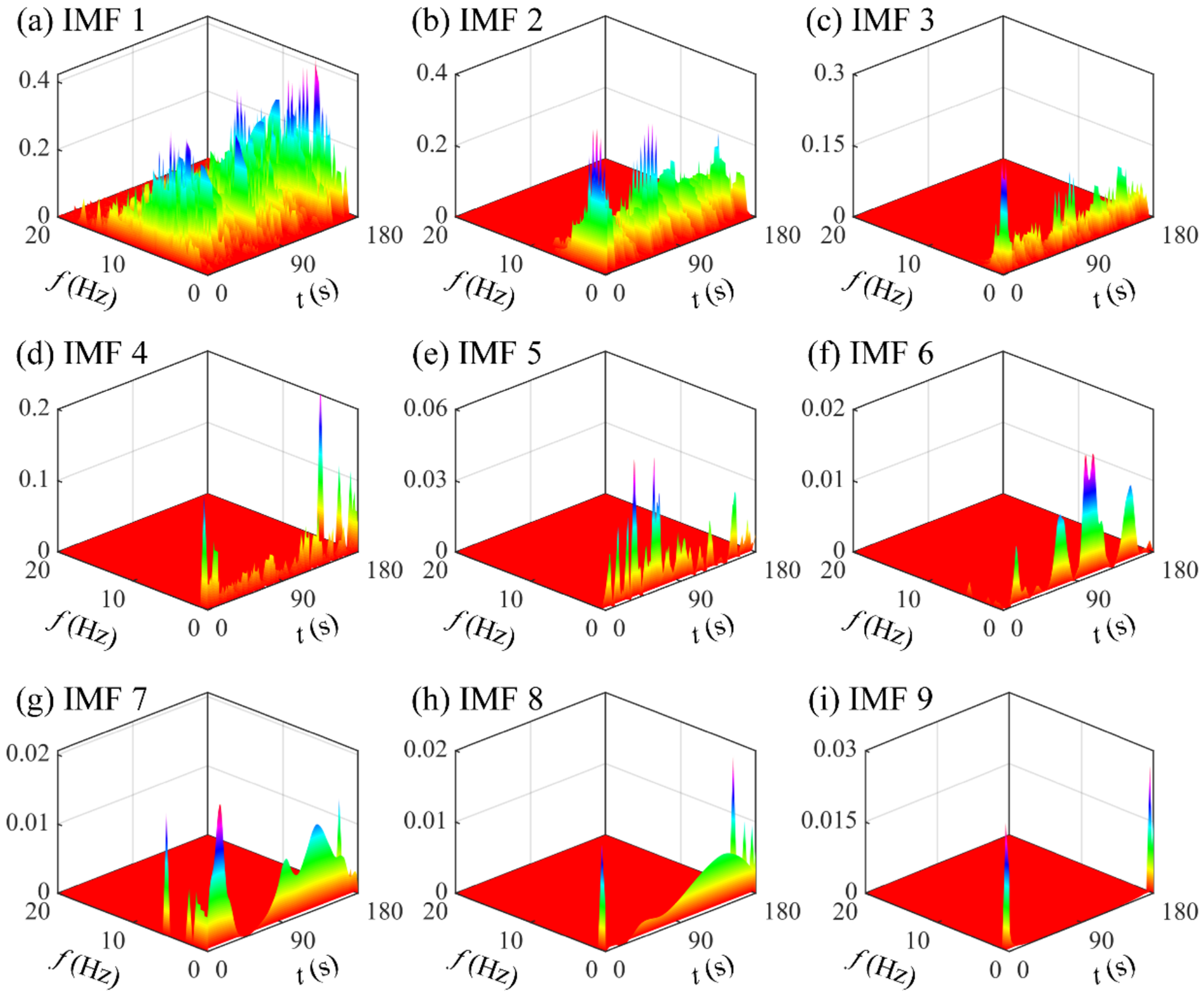
The Hilbert transform was applied to the IMF components to obtain instantaneous frequency and amplitude. Subsequently, the instantaneous frequencies of all components, weighted by their amplitudes, are presented on a time–frequency plane, generating a three-dimensional spectrogram of time, frequency, and amplitude (energy). Using the Hilbert spectrum at measurement point x/l = −4 for Type C as an example, the results are shown in Figure 5. With increasing decomposition order, the frequency bandwidth of higher-order components narrowed significantly, the Hilbert spectrum amplitude decreased gradually, and the Hilbert energy declined markedly. The first few high-frequency components contained most of the turbulent energy. Similar to this characteristic point, at other measurement locations, only the initial few IMF components exhibited substantial and distinctly variable Hilbert spectral energy. Subsequent components possessed narrow bandwidths and very low Hilbert spectral energy, making their visualization neither advantageous nor necessary. Consequently, the subsequent results in this study present only the Hilbert spectra of the first two components for each measurement point. In contrast to the Fourier spectrum, the Hilbert spectrum clearly resolves the time-localized spectral features associated with vortex impingement. The corresponding marginal spectrum thus provides a more reliable global frequency distribution for the present non-stationary signals.
The instantaneous frequency of each component varies randomly over time, and the Hilbert energy also oscillates randomly, with abrupt changes becoming more pronounced in higher-order components. The significant random oscillations of both frequency and energy amplitude with time reflect the non-stationary nature of the fluctuating pressure signal. The mixing of different frequency bands within each component corresponds to the mode mixing observed after EMD decomposition, which further indicates that the turbulent vortex structure encompasses multi-scale vortices. Their random diffusion and intermixing collectively drive the turbulent flow phenomena, accompanied by energy transfer and dissipation.
The marginal spectrum is derived by integrating the Hilbert spectrum over time, which transforms the three-dimensional time–frequency–amplitude (energy) representation into an amplitude–frequency plot. This facilitates the analysis of frequency distribution corresponding to amplitude (or energy) and the variation of total energy with frequency, as formulated in Equation (8).
h ( t ) = 0 T H ( t , f ) d t
The presence of energy at a specific frequency in the Hilbert marginal spectrum indicates the potential for vibration at that frequency. The frequency corresponding to the maximum amplitude in the marginal spectrum is the most probable vibration frequency, i.e., the dominant frequency, which is the primary focus of this study. The marginal spectrum directly reveals the dominant frequency and marginal spectral energy at each measurement point, which aids in interpreting the streamwise variation patterns of turbulent energy.

3. Results and Discussion

Before presenting the quantitative results, it is helpful to recall the distinct flow patterns observed with different deflector configurations in our previous study [10]. Compared to Types A and B, Type C performed better with unobservability of water-wing, downstream shock waves, and the air–water interface at the impingement region accompanied by extensive bubble entrainment. These phenomena suggest more turbulence in the impact zone of Type C, which is analyzed and demonstrated in the following section. Although our previous study preliminarily indicated the potential energy dissipation advantage of the Type C deflector through a comparative analysis of the cross-sectional distributions of turbulent kinetic energy and turbulence dissipation rate [10], the turbulence characteristics and energy dissipation mechanisms remain to be fully elucidated. Consequently, the main region of energy dissipation, the dynamics of the dissipation process, and the characteristics of the associated vortex structures are subjected to further analysis in this section.

3.1. Turbulent Dissipation

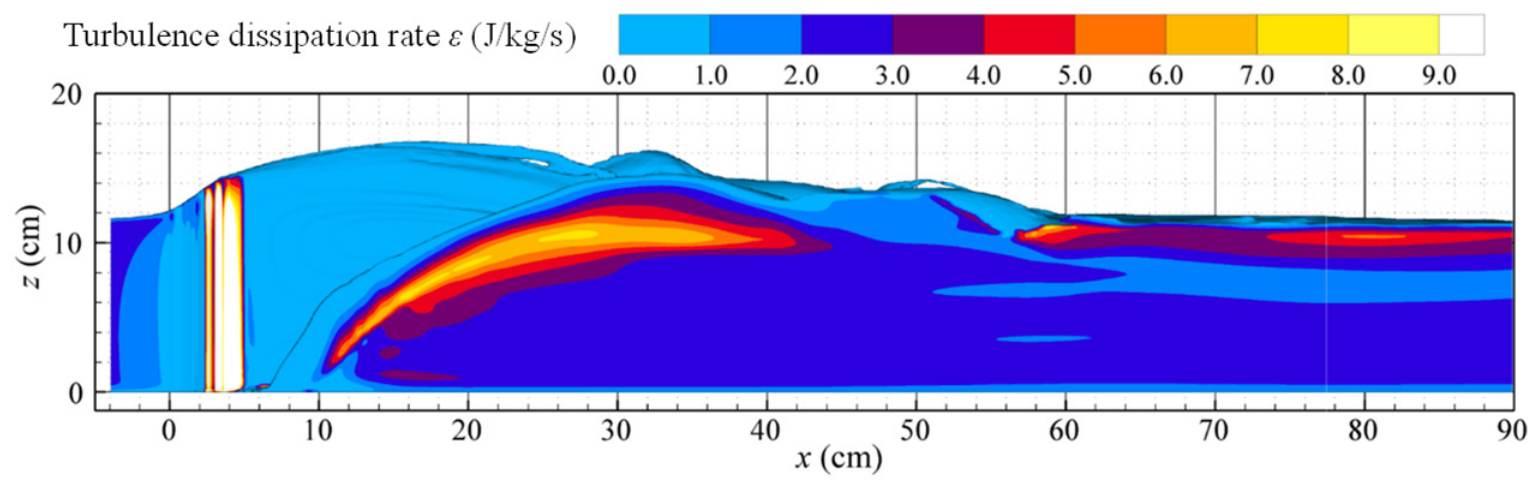
The results were obtained from numerical simulations. Theoretically, as the jet develops downstream of the deflector, it undergoes deceleration driven by viscous shear from the low-momentum fluid within the lateral separation zones, as well as by the hydrodynamic obstruction presented by the mainstream flow at the impingement region [57,58,59,60]. The spatial distribution of the turbulence dissipation rate, ε, along the sidewalls is presented in Figure 6. The results indicate that ε is predominantly concentrated in two key areas: the contraction section of the deflector and the downstream sidewall impingement region. In the contraction section, the dissipation rate peaks exceeded 9 J/(kg·s). While the peak magnitude in the impingement zone is approximately half of this value, the dissipation region extends significantly larger. This observation highlights a critical mechanism within large-scale separation flows: although the velocity gradient is steepest within the boundary layer and results in intense yet localized energy loss, its influence is essentially confined to the narrow near-wall region. In contrast, flow separation induces the formation of unsteady, large-scale vortical structures. These structures facilitate mixing with the mainstream, entraining substantial fluid mass into the separation zone where intense shear stresses dominate [57]. Furthermore, velocity deficits originating from viscous forces persist after ejection, which propagate downstream and interact with the mainstream, further exacerbating energy dissipation. Consequently, while distinct dissipation zones characterize both the contraction and impingement regions, the latter, dominated by flow separation dynamics, constitutes the primary contributor to the overall energy loss.

3.2. Fluctuating Pressure Coefficient

The results were directly computed from the experimental measurements. Denoised true fluctuating signal was obtained by signal preprocessing (Figure 4) to study the turbulence intensity. Deviating from the conventional root-mean-square characterization, the dimensionless fluctuating pressure coefficient was employed to quantify the intensity [49,61], as expressed in Equation (9). In this equation, p 2 ¯ represents the standard deviation of the fluctuating pressure, while u 1 ¯ denotes the mean flow velocity at the tunnel inlet cross-section.
C p = p 2 ¯ / 1 2 ρ u ¯ 1 2
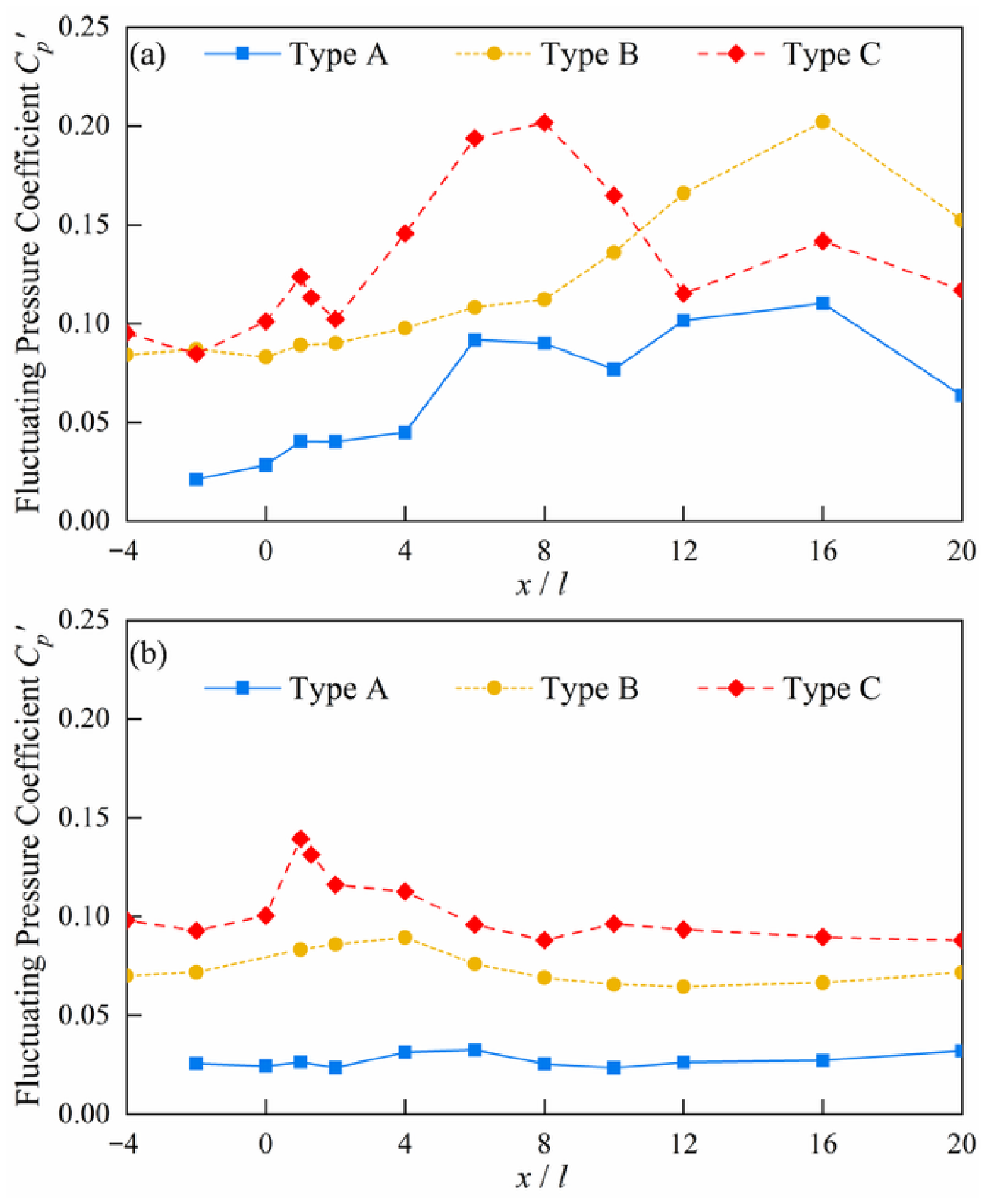
Figure 7a,b illustrates the streamwise distributions of the fluctuating pressure coefficient at the free surface and mid-depth, respectively. In general, the fluctuating pressure coefficient range of Types B and C was at the same level and double those of Type A in the vicinity of the deflectors (x/l = 0–1). This indicates that the contraction section of the double-arc deflectors significantly enhances flow turbulence. Regarding peak locations, Types A and B exhibited a maximum fluctuating pressure coefficient at x/l = 16. Conversely, the peak for type C shifted upstream to x/l = 8. This shift suggests a more rapid evolution of turbulence downstream of deflector C, characterized by a steeper growth gradient in the impingement region and a shortened turbulent zone. Consequently, this configuration facilitates the efficient dissipation of flow kinetic energy while effectively inhibiting the spread of flow disturbances.
As evident in Figure 7b, the fluctuation amplitude of the pressure coefficient at the mid-depth was markedly reduced. This attenuation confirms that flow turbulence is primarily concentrated near the free surface, corresponding to the impact-induced shock wave developing along the surface layer. Overall, the streamwise fluctuating pressure coefficient consistently followed the order of Geometry C > Geometry B > Geometry A. This trend indicates a significant enhancement of near-wall turbulence downstream of the double-arc deflectors. Furthermore, the incorporation of a straight line section induces intense fluid collision within the lateral cavity. This mechanism facilitates more fully developed turbulence over a shorter streamwise distance, which was identified as the likely primary cause of the observed energy dissipation.

3.3. Spectral Analysis of Fluctuating Pressure

The results were derived from the experimentally measured pressure signals via the Hilbert–Huang transform (HHT) method. The Hilbert and marginal spectra results obtained in this study demonstrate that both the Hilbert energy and marginal spectral energy were negligible at all measurement points for frequencies exceeding 20 Hz. The pressure signals were sampled at 100 Hz, giving a Nyquist frequency of 50 Hz, well above the dominant fluctuations. Most turbulent energy lay below 20 Hz, while higher frequencies contributed negligibly. Consequently, the analyzed frequency bandwidth was restricted to 0–20 Hz to more clearly elucidate the characteristics of energy distribution variation. Spectral convergence was confirmed by stable dominant peaks over the 190 s acquisition duration.

3.3.1. Analysis of Marginal Spectrum

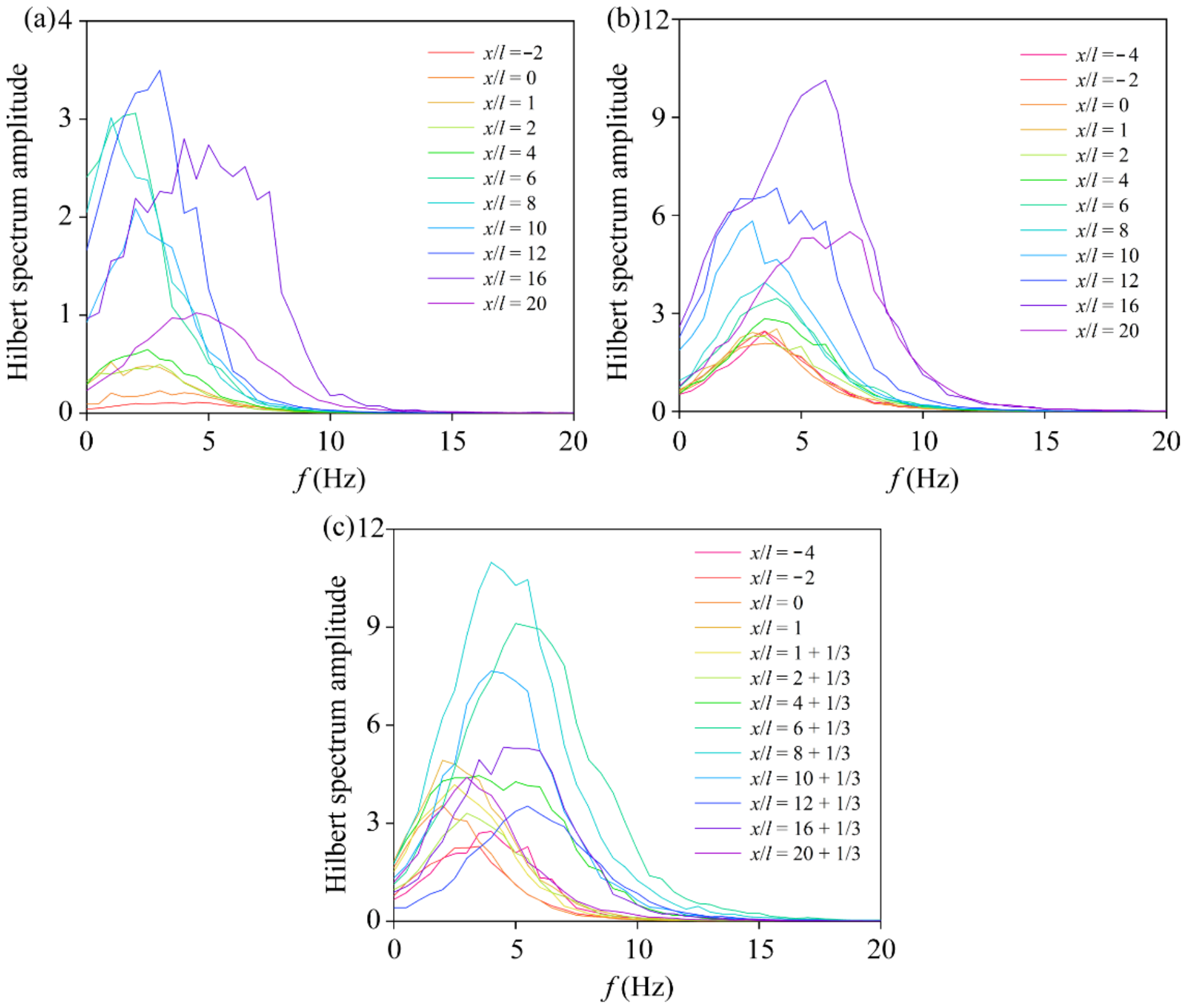
Figure 8 presents the Hilbert marginal spectra for the measurement points located on the flow surface. Given the different measurement points of the three deflectors, spectra corresponding to identical streamwise positions were plotted in the same color to facilitate a comparative analysis of the spectral energy distribution.
In general, the marginal spectral peaks of Types B and C were comparable and exceeded those of Type A by more than 200%, which is more pronounced in the contraction section (0 < x/l < 1) with the amplitude of Type C being approximately twice that of Type B and eight times that of Type C. This observation, corroborated by the results in Figure 7, reaffirms that the contraction section of the double-arc deflectors significantly enhances turbulence. Similar to the findings of [19], who identified maximum marginal spectral energy in the bottom jet impingement zone, the present study reveals that the spectral energy peaks at the lateral jet impingement location (x/l = 16 for Types A and B; x/l = 8 for Type C). Regarding frequency characteristics, the dominant frequency before ejection (x/l < 1) was consistently below 4 Hz. As the flow progressed downstream, the frequency bandwidth of the energy distribution broadened, and the dominant frequency rose above 5 Hz, indicating a marked increase in high-frequency components within the flow. This trend demonstrates that as the lateral jet develops and impacts the sidewall, turbulent energy intensifies. Furthermore, the turbulence structure transitions from being dominated by low-frequency, large-scale vortices to comprising high-frequency, small-scale eddies. This transition corresponds to the process where mean flow kinetic energy is converted into turbulent kinetic energy and subsequently dissipated.

3.3.2. Hilbert Spectrum Analysis

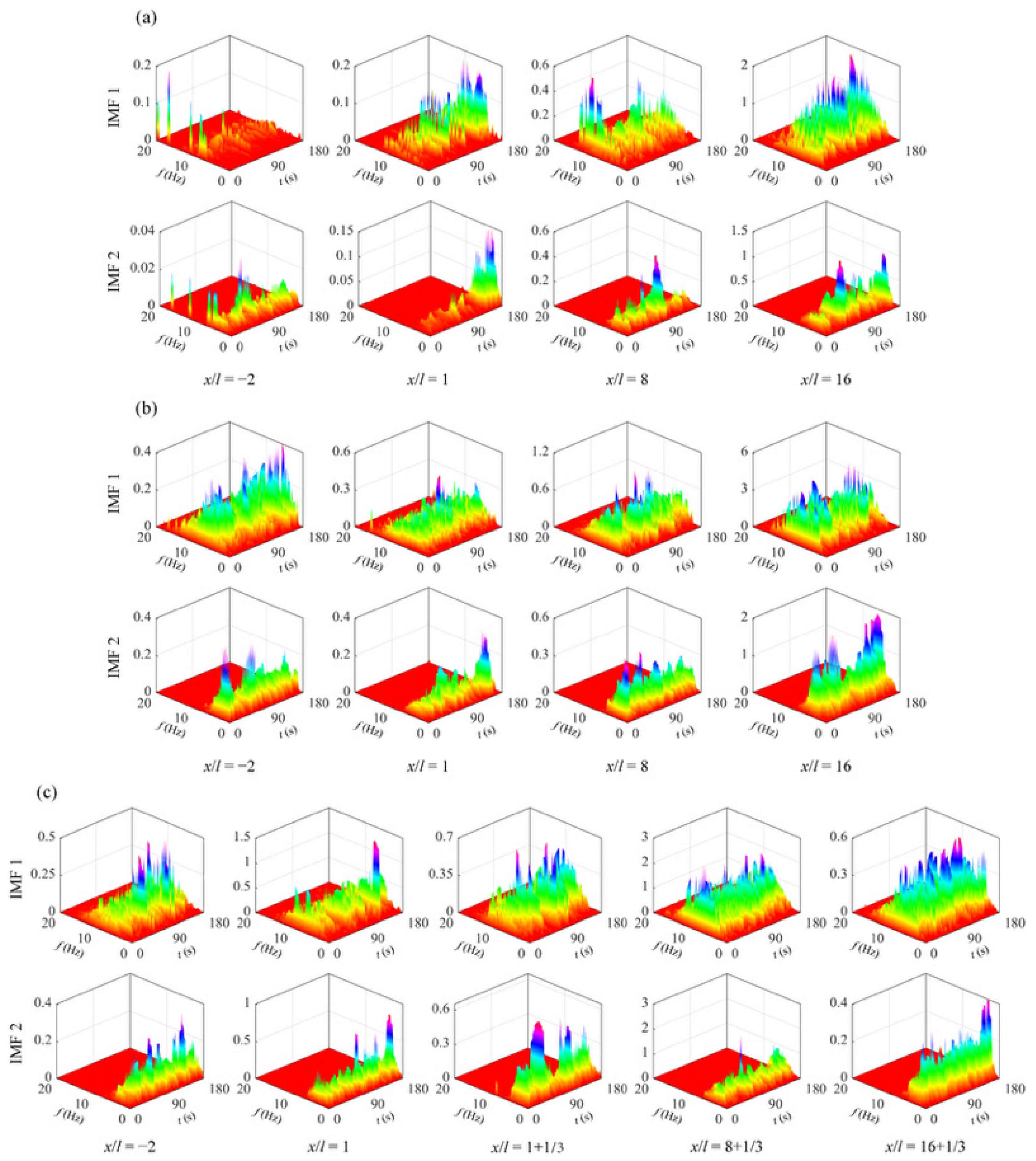
To further elucidate the turbulence structures and energy evolution, the time–frequency distribution of turbulent energy is presented for the following cross-sections: the inlet and outlet of the deflector, locations corresponding to x/l = 8 and 16, and the section upstream of the straight section for Type C. Figure 9 displays the Hilbert spectra of the low-order modal components of the fluctuating pressure signals at these characteristic points.
In general, the frequency content of the first two high-frequency modal components at all measurement points fell within 20 Hz and 10 Hz, respectively. As the decomposition order increased, the frequency bandwidth of higher-order components narrowed significantly, accompanied by a marked reduction in their energy content. The initial high-frequency components contained the majority of the turbulent energy, yet they also incorporated low-frequency elements. This phenomenon reflects the continuous intermixing and stochastic motion of vortices across different scales within the turbulence [19]. Furthermore, both the frequency and energy amplitude exhibited substantial random oscillations over time, highlighting the non-stationary nature of the hydrodynamic fluctuating pressure signal [20].
As shown in Figure 9a,b, the fluctuation energy upstream of the deflector (x/l < 0) was minimal, characterized by only sporadic high-frequency, high-energy components. Upon ejection at the deflector outlet (x/l = 1), the Hilbert spectrum amplitude showed little variation, but the temporal distribution of high-energy components became denser, indicating a slight increase in fluctuating energy. With the lateral expansion of the jet (x/l = 8), the Hilbert spectrum amplitude grew substantially, notably in the higher-order components, until it reached its maximum at the sidewall impingement location (x/l = 16). Conversely, Figure 9c clearly demonstrates that the Hilbert spectrum amplitude of Type C peaked at x/l = 8 and subsequently diminished to levels comparable to the pre-deflector flow by x/l = 16, which is consistent with the law of the marginal spectrum.

3.3.3. Contribution Ratio of IMF Components

The contribution ratio is defined as the ratio of the variance of an individual Intrinsic Mode Function (IMF) to the variance of the original signal. This metric serves to quantify the contribution of each IMF component to the overall fluctuation of the sequence, effectively characterizing the extent to which different frequency components influence the variability of the raw data [21,23]. Methodologically, the fluctuating signals at each measurement point were first subjected to complete decomposition. Subsequently, the variance of each resulting IMF component was calculated and normalized by the variance of the original signal. The final results, expressed as percentages, are summarized in Table 1.
The results indicate that the variance contribution ratios for the first four intrinsic mode functions (IMF1–IMF4) generally exceeded 10%, signifying that these components exert a dominant influence on the original signal compared to the remaining IMFs. Conversely, the contribution ratios of the final one or two modal components were typically minor, a finding that aligns with the HHT-based analysis of fluctuating pressure in stilling basins reported by Jia et al. [20]. A comparative analysis of the variance contribution ratios at the upstream location (x/l = −2) versus the downstream impingement zones (x/l = 16 for Types A and B; x/l = 8 + 1/3 for Type C) revealed a marked increase in the contribution of low-order, high-frequency components. This increase corresponds to a rise in both their fluctuation amplitude and their proportional share of the total fluctuation. Notably, the cumulative variance contribution ratio of the first three high-order components at these points significantly surpasses that of other locations, reaching 77.6%, 78.1%, and 74.3%, respectively, which account for the majority of the signal fluctuation, indicating a clear dominance of high-frequency constituents. This spectral shift signifies the turbulent cascade process where large-scale vortices break down into smaller scales, thereby facilitating rapid energy dissipation. Consequently, this mechanism provides the explanation for the observed high turbulent kinetic energy and elevated dissipation rates within the jet impingement region.
To facilitate comparison with existing studies, the dominant frequencies identified from the Hilbert spectrum were converted into Strouhal numbers: St = fL/U, where L = 18.75 cm (tunnel width) and U is the mean inflow velocity. The calculated Strouhal numbers for the dominant IMFs ranged from 0.27 to 0.34.

4. Conclusions

Based on experimentally measured fluctuating pressure, this study integrated hydraulic model experiments, numerical simulations, and spectral analysis to investigate the energy characteristics and dissipation mechanisms of a novel lateral deflector in free-surface tunnels. Compared with the traditional deflector, the two-arc deflector generates markedly higher turbulence intensity and turbulent kinetic energy. Stronger turbulence develops in the contraction section, while the impingement region forms more rapidly, creating a localized zone of high-intensity turbulence over a shorter streamwise distance. This flow configuration facilitates a more efficient conversion of mean flow kinetic energy into turbulent kinetic energy and its subsequent dissipation. Near the impingement region, the marginal spectrum energy reaches a pronounced peak, accompanied by increases in the dominant frequency, the contribution of low-order high-frequency components, high-frequency fluctuation intensity, and the contribution ratio of total variance. These spectral characteristics may indicate a transition of turbulence from low-frequency, large-scale vortices to high-frequency, small-scale vortices, corresponding to the process of kinetic energy transfer and dissipation. Replacing the straight contraction section with a two-arc profile approximately doubled the local turbulence intensity. Furthermore, the optimized geometry, incorporating a straight guiding segment with a length of 1/3l, shifted the impingement location upstream from x/l = 16 to x/l = 8, reducing the development length by about 50% and inducing earlier and more intense impingement within the lateral cavity. Overall, this study suggests, for the first time, the feasibility of independently applying a lateral contraction-type deflector as an internal energy dissipator in free-surface tunnels. The proposed configuration offers a potential solution to compensate for the lack of internal energy dissipation measures in free-surface tunnels and provides guidance for the hydraulic optimization of similar engineering structures.
The findings have direct implications for free-surface tunnel design and flood management. In tunnel plans, the proposed novel deflector can be implemented as a space-saving internal energy dissipator, particularly in mountainous terrain where conventional dissipators are impractical. For flood management, by promoting early energy dissipation within the tunnel, the deflector reduces downstream flow velocities and turbulence, thereby mitigating erosion and structural risks during high-discharge events.

Author Contributions

Conceptualization, J.D. and Z.D.; methodology, J.D. and Y.W.; software, J.D. and Y.W.; validation, J.D., Z.D. and F.Y.; formal analysis, F.Y. and Y.C.; investigation, J.D. and Y.W.; resources, Y.C.; data curation, F.Y. and Y.C.; writing—original draft preparation, J.D. and Y.W.; writing—review and editing, J.D., Z.D. and Y.W.; visualization, J.D. and Y.W.; supervision, Y.C.; project administration, J.D. and Y.C.; funding acquisition, Y.W. and Y.C. All authors have read and agreed to the published version of the manuscript.

Funding

This research was funded by the National Key R&D Program of China: Structural Design Technology of Large Navigation Construction under Complex Conditions (No. 2023YFC3206103).

Data Availability Statement

The original contributions presented in this study are included in the article. Further inquiries can be directed to the corresponding author.

Acknowledgments

Sincere gratitude is extended to the editor and the anonymous reviewers for their professional comments and corrections.

Conflicts of Interest

Zongshi Dong was employed by Changjiang Institute of Survey, Planning, Design and Research Corporation. Fan Yang was employed by Henan Water & Power Engineering Consulting Co., Ltd. The remaining authors declare that the research was conducted in the absence of any commercial or financial relationships that could be construed as potential conflicts of interest.

References

  1. Li, X.; Chen, Z.; Fan, X.; Cheng, Z. Hydropower development situation and prospects in China. Renew. Sustain. Energy Rev. 2018, 82, 232–239. [Google Scholar] [CrossRef]
  2. Cheng, Y.; Li, J.; Yang, J. Free surface-pressurized flow in ceiling-sloping tailrace tunnel of hydropower plant: Simulation by VOF model. J. Hydraul. Res. 2007, 45, 88–99. [Google Scholar] [CrossRef]
  3. Bai, R.; Liu, S.; Wang, W.; Zhang, F. Experimental investigation of the dissipation rate in a chute aerator flow. Exp. Therm. Fluid Sci. 2019, 101, 201–208. [Google Scholar] [CrossRef]
  4. Pagliara, S.; Hohermuth, B.; Boes, R.M.; Felder, S. High-velocity air–water flows in rough-walled tunnels. Phys. Fluids 2025, 37, 055105. [Google Scholar] [CrossRef]
  5. Li, S.; Zhang, J.; Xu, W.; Chen, J.; Peng, Y. Evolution of pressure and cavitation on side walls affected by lateral divergence angle and opening of radial gate. J. Hydraul. Eng. 2016, 142, 05016003. [Google Scholar] [CrossRef]
  6. Li, S.; Zhang, J.; Xu, W.; Chen, J.; Peng, Y.; Li, J.; He, X. Simulation and experiments of aerated flow in curve-connective tunnel with high head and large discharge. Int. J. Civ. Eng. 2016, 14, 23–33. [Google Scholar] [CrossRef]
  7. Hager, W.H.; Boes, R.M. Hydraulic structures: A positive outlook into the future. J. Hydraul. Res. 2014, 52, 299–310. [Google Scholar] [CrossRef]
  8. Wang, H.Y.; Yang, Q.; Dai, G.Q.; Liu, C. Study on hydraulic characteristic of aerator with side-walls sudden enlargement in free-flow spillway tunnel. Adv. Mater. Res. 2013, 614–615, 613–616. [Google Scholar] [CrossRef]
  9. Zheng, X.; Zhang, L.; Wu, S.; Song, K. Study on the shape of the aerator of high-head discharge tunnel with mild bottom slope. Water 2021, 13, 2128. [Google Scholar] [CrossRef]
  10. Da, J.; Wang, J.; Dong, Z.; Du, S. Hydraulic Characteristics of Lateral Deflectors with Different Geometries in Gentle-Slope Free-Surface Tunnels. Water 2022, 14, 2689. [Google Scholar] [CrossRef]
  11. Wang, Z.; Yao, K.; Xin, X.; Huang, R.; Chang, J. Experimental and Numerical Simulation of Shock Train Characteristics in the Concave Channel. J. Propuls. Power 2025, 41, 602–623. [Google Scholar] [CrossRef]
  12. Hu, D.; Xiang, X.; Huang, J.; Qi, K.; Li, Y.; Yang, X.; Liang, X. Calculation Methods for the Jacking Force of a Rectangular Pipe Jacking Tunnel: Overview and Prospects. J. Pipeline Syst. Eng. Pract. 2025, 16, 03125001. [Google Scholar]
  13. Zou, B.; Chen, Y.; Bao, Y.; Liu, Z.; Hu, B.; Ma, J.; Kuang, G.; Tang, C.; Sun, H.; Zaheer, Q.; et al. Impact of Tunneling Parameters on Disc Cutter Wear during Rock Breaking in Transient Conditions. Wear 2025, 560–561, 205620. [Google Scholar] [CrossRef]
  14. Nie, M.X.; Wu, G.G. Effect of the lateral deflector on cavity design. J. Tsinghua Univ. Sci. Technol. 2002, 42, 546–550. (In Chinese) [Google Scholar]
  15. Lucas, J.; Hager, W.H.; Boes, R.M. Deflector effect on chute flow. J. Hydraul. Eng. 2013, 139, 444–449. [Google Scholar] [CrossRef]
  16. Steiner, R.; Heller, V.; Hager Willi, H.; Minor, H. Deflector Ski Jump Hydraulics. J. Hydraul. Eng. 2008, 134, 562–571. [Google Scholar] [CrossRef]
  17. Garg, A.; Akkinepally, B.; Sarkar, J.; Pattanayek, S.K. Emerging perspectives in non-Newtonian fluid dynamics: Research gaps, evolving methods, and conceptual limitations. Phys. Fluids 2025, 37, 071401. [Google Scholar] [CrossRef]
  18. Kumar, P.; Sharma, N.; Pattanayek, S.K.; Garg, A. Computational comparison of passive control for cavitation suppression on cambered hydrofoils in sheet, cloud, and supercavitation regimes. Phys. Fluids 2024, 36, 104113. [Google Scholar] [CrossRef]
  19. Jia, W.; Diao, M.; Jiang, L.; Huang, G. Fluctuating characteristics of the stilling basin with a negative step based on Hilbert–Huang transform. Water 2021, 13, 2673. [Google Scholar]
  20. Jia, W.; Diao, M.; Jiang, L.; Huang, G. Time-frequency characteristics of fluctuating pressure on the bottom of the stilling basin with step-down floor based on Hilbert–Huang transform. Math. Probl. Eng. 2021, 2021, 7246488. [Google Scholar]
  21. Huang, N.E.; Shen, Z.; Long, S.R. A new view of nonlinear water waves: The Hilbert spectrum. Annu. Rev. Fluid Mech. 1999, 31, 417–457. [Google Scholar] [CrossRef]
  22. Huang, N.E.; Wu, Z.; Long, S.R. Hilbert–Huang transform. Scholarpedia 2008, 3, 2544. [Google Scholar] [CrossRef]
  23. Yang, J.N.; Lei, Y.; Pan, S.; Huang, N. System identification of linear structures based on Hilbert–Huang spectral analysis. Part 2: Complex modes. Earthq. Eng. Struct. Dyn. 2003, 32, 1533–1554. [Google Scholar] [CrossRef]
  24. Yang, J.N.; Lei, Y.; Lin, S.; Huang, N. Hilbert–Huang based approach for structural damage detection. J. Eng. Mech. 2004, 130, 85–95. [Google Scholar] [CrossRef]
  25. Mou, S.; Wang, Q. Feature extraction of hydraulic units’ low frequency pressure fluctuation signal based on Hilbert–Huang transform. J. Hubei Univ. Natl. Nat. Sci. 2010, 28, 187–190. (In Chinese) [Google Scholar]
  26. Qu, W.; Liu, S.; Wang, J.; Liu, J. HHT analysis of stochastic fluctuant pressure for flow-induced vibration in radial gate. J. Wuhan Univ. Technol. 2006, 28, 68–71. (In Chinese) [Google Scholar]
  27. Hassan, A.; Rashid, H. Estimation of Ultimate Bearing Capacity in Rock-Socketed Piles Using Optimized Machine Learning Approaches. Adv. Eng. Intell. Syst. 2023, 2, 107–120. [Google Scholar]
  28. Zhou, T. Developing a Machine Learning-Driven Model that Leverages Meta-Heuristic Algorithms to Forecast the Load-Bearing Capacity of Piles. J. Artif. Intell. Syst. Model 2023, 1, 1–14. [Google Scholar]
  29. Davies, L.; Jánošík, D. Enhanced Prediction of California Bearing Ratio (CBR) Values in Geotechnical Engineering Using Decision Tree Algorithm and Meta-Heuristic Optimizations. J. Artif. Intell. Syst. Model 2024, 2, 29–44. [Google Scholar]
  30. Gao, J.; Dong, X.; Liu, J. Research and application of eco-friendly energy dissipation technology-internal energy dissipation. Shuili Xuebao 2008, 39, 1176–1182. (In Chinese) [Google Scholar]
  31. Zhang, J.; Xu, W.; Liu, S.; Wang, W. Numerical simulation of turbulent flow in throat type energy dissipators. Shuili Xuebao 2004, 35, 27–33. (In Chinese) [Google Scholar]
  32. Kolmogorov, A.N. The local structure of turbulence in incompressible viscous fluid for very large Reynolds numbers. Proc. R. Soc. Lond. A 1991, 434, 9–13. [Google Scholar] [CrossRef]
  33. Watanabe, T.; da Silva, C.B.; Nagata, K. Non-dimensional energy dissipation rate near the turbulent/non-turbulent interfacial layer in free shear flows and shear free turbulence. J. Fluid Mech. 2019, 875, 321–344. [Google Scholar] [CrossRef]
  34. Barooni, M.; Velioglu Sogut, D.; Sedigh, P.; Bahrami, M. Novel Hybrid Deep Learning Model for Forecasting FOWT Power Output. Energies 2025, 18, 3532. [Google Scholar] [CrossRef]
  35. Gebrael, T.; Gamboa, A.R.; Hoque, M.J.; Aflatounian, S.; Huitink, D.; Pilawa-Podgurski, R.; Miljkovic, N. Thermally Conductive Electrically Insulating Electronics Packaging for Water Immersion Cooling. IEEE Trans. Compon. Packag. Manuf. Technol. 2025, 15, 1222–1236. [Google Scholar] [CrossRef]
  36. Suo, L.S.; Liu, N. Handbook of Hydraulic Structure Design, 2nd ed.; China WaterPower Press: Beijing, China, 2014. (In Chinese) [Google Scholar]
  37. Zhang, H.; Zhang, L.; Wu, S.; Wang, F.; Zhan, Z.; Zheng, X.; Zhang, H.; Bao, W. Research on flood discharge and energy dissipation of a tunnel group layout for a super-high rockfill dam in a high-altitude region. Water 2021, 13, 3408. [Google Scholar] [CrossRef]
  38. Yang, B.; Wang, Z.; Wu, M. Numerical simulation of naval ship’s roll damping based on cfd. Procedia Eng. 2012, 37, 287–293. [Google Scholar] [CrossRef]
  39. Zhang, W.; Wang, J.; Zhou, C.; Dong, Z.; Zhou, Z. Numerical simulation of hydraulic characteristics in a vortex drop shaft. Water 2018, 10, 1393. [Google Scholar] [CrossRef]
  40. Pfister, M.; Hager, W.H. Chute aerators. I: Air transport characteristics. J. Hydraul. Eng. 2010, 136, 352–359. [Google Scholar] [CrossRef]
  41. Pope, S.B. Turbulent Flows; Cambridge University Press: Cambridge, UK, 2000. [Google Scholar]
  42. Johnson, M.C.; Savage, B.M. Physical and numerical comparison of flow over ogee spillway in the presence of tailwater. J. Hydraul. Eng. 2006, 132, 1353–1357. [Google Scholar] [CrossRef]
  43. Stamou, A.I.; Chapsas, D.G.; Christodoulou, G.C. 3-D numerical modeling of supercritical flow in gradual expansions. J. Hydraul. Res. 2008, 46, 402–409. [Google Scholar] [CrossRef]
  44. Yakhot, V.; Orszag, S.A.; Thangam, S.; Gatski, T.B.; Speziale, C.G. Development of turbulence models for shear flows by a double expansion technique. Phys. Fluids A 1992, 4, 1510–1520. [Google Scholar] [CrossRef]
  45. Yakhot, V.; Orszag, S.A. Renormalization group analysis of turbulence. I. Basic theory. J. Sci. Comput. 1986, 1, 3–51. [Google Scholar] [CrossRef]
  46. Hirt, C.W.; Nichols, B.D. Volume of fluid (VOF) method for the dynamics of free boundaries. J. Comput. Phys. 1981, 39, 201–225. [Google Scholar] [CrossRef]
  47. Dong, Z.; Wang, J.; Vetsch, D.F.; Boes, R.M.; Tan, G. Numerical simulation of air–water two-phase flow on stepped spillways behind X-shaped flaring gate piers under very high unit discharge. Water 2019, 11, 1956. [Google Scholar] [CrossRef]
  48. Dong, Z.; Bürgler, M.; Hohermuth, B.; Vetsch, D.F. Density-based turbulence damping at large-scale interface for Reynolds-averaged two-fluid models. Chem. Eng. Sci. 2022, 247, 116975. [Google Scholar] [CrossRef]
  49. Valueva, E.P.; Kulik, A.A. The Damping Coefficient of a Pressure Wave under Conditions of Pulsating Turbulent Flow of Gas in a Channel. High Temp. 2003, 41, 486–491. [Google Scholar] [CrossRef]
  50. Khakhki, M.K.; Moghaddam, P.P.; Yazdanpanah, H.; Mansur, W.J. High-resolution time-frequency Hilbert transform using sparsity-aware weighting function. Earth Sci. Inform. 2021, 14, 1197–1212. [Google Scholar] [CrossRef]
  51. Javorskyj, I.; Yuzefovych, R.; Matsko, I.; Kurapov, P. Hilbert transform of a periodically non-stationary random signal: Low-frequency modulation. Digit. Signal Process. 2021, 116, 103113. [Google Scholar] [CrossRef]
  52. Zhou, X.; Liu, W.; Jiang, Z.; Ma, F. Improved HHT method and its applications in rotating machinery fault diagnosis. J. Vib. Shock 2020, 39, 189–195. (In Chinese) [Google Scholar]
  53. Fu, C.; Jiang, S.; Mou, H. Structural modal parameters identification method based on improved Hilbert–Huang transform. J. Basic Sci. Eng. 2011, 19, 583–590. (In Chinese) [Google Scholar]
  54. Feldman, M. Hilbert transform in vibration analysis. Mech. Syst. Signal Process. 2011, 25, 735–802. [Google Scholar] [CrossRef]
  55. Peng, X.; Guo, H.; Zhang, R. Wavelet analysis on flow fluctuating pressure acting on plunge pool slope. Shuili Xuebao 2003, 8, 26–31. (In Chinese) [Google Scholar]
  56. Ferreira, M.A.; Ganapathisubramani, B. Scale interactions in velocity and pressure within a turbulent boundary layer developing over a staggered-cube array. J. Fluid Mech. 2021, 910, A48. [Google Scholar] [CrossRef]
  57. Yang, J.; Teng, P.; Zhang, H. Experiments and CFD modeling of high-velocity two-phase flows in a large chute aerator facility. Eng. Appl. Comput. Fluid Mech. 2019, 13, 48–66. [Google Scholar] [CrossRef]
  58. Muppidi, S.; Mahesh, K. Study of trajectories of jets in crossflow using direct numerical simulations. J. Fluid Mech. 2005, 530, 81–100. [Google Scholar] [CrossRef]
  59. Camussi, R.; Guj, G.; Stella, A. Experimental study of a jet in a crossflow at very low Reynolds number. J. Fluid Mech. 2002, 454, 113–144. [Google Scholar] [CrossRef]
  60. Mahesh, K. The interaction of jets with crossflow. Annu. Rev. Fluid Mech. 2013, 45, 379–407. [Google Scholar] [CrossRef]
  61. Youn, C.; Inaba, S.; Kawashima, K.; Kagawa, T. Pressure loss coefficient of screwed elbow in pulsatile flow. J. Jpn. Fluid Power Syst. Soc. 2011, 42, 39–45. [Google Scholar]
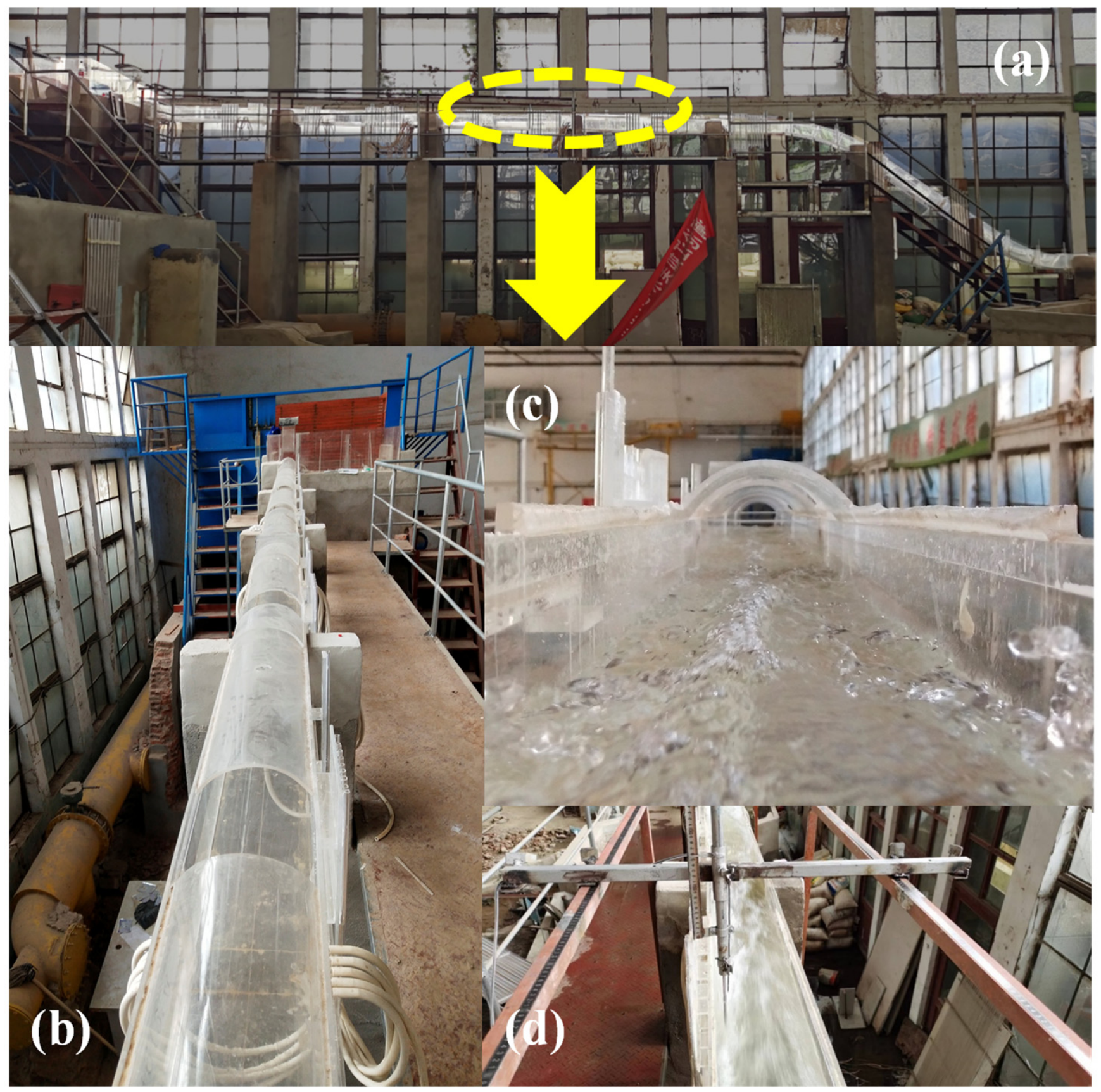
Figure 1. General view of the experimental model (a), tunnel section (b), typical working condition (c), and arrangement of measurement devices (d).
Water 18 01035 g001
Figure 2. Schematic representation of measurement point locations for the three deflector geometries. The gray elements are three deflectors to show the relative position of the measuring points.
Water 18 01035 g002
Figure 3. Numerical model configuration, dimensions of the numerical model and the deflector (a), boundary conditions and mesh arrangement (b). Note: all units are in cm.
Water 18 01035 g003
Figure 4. The HHT method process flow (a); preprocessing of pressure (b); comparison of variance before and after preprocessing (c); EMD decomposition results (d); residual (e).
Water 18 01035 g004
Figure 5. Hilbert spectra of each component at the characteristic point (ai) (IMF 1 to 9).
Water 18 01035 g005
Figure 6. Side view of the turbulence dissipation rate (ε) distribution.
Water 18 01035 g006
Figure 7. Streamwise distribution of the fluctuating pressure coefficient at (a) the free surface and (b) the mid-depth.
Water 18 01035 g007
Figure 8. Hilbert marginal spectra of fluctuating pressure at measurement points on the mainstream surface: (a) Type A; (b) Type B; (c) Type C.
Water 18 01035 g008
Figure 9. Hilbert spectra of IMF 1–2 components for fluctuating pressure at characteristic points: (a) Type A; (b) Type B; (c) Type C.
Water 18 01035 g009
Table 1. Contribution ratio of IMF components to the fluctuating pressure (%).
Typesx/lIMF
1
IMF
2
IMF
3
IMF
4
IMF
5
IMF
6
IMF
7
IMF
8
IMF
9
IMF
10
IMF
11
A−229.219.212.58.55.82.03.221.73.8--
118.317.415.012.63.57.64.41.517.80.5-
812.712.611.210.112.717.016.18.04.50.2-
1634.424.818.412.68.74.32.41.50.70.80.0
B−229.723.815.611.19.03.45.02.80.3--
126.423.918.912.88.53.71.90.40.40.3-
830.023.319.215.06.22.61.14.60.40.20.0
1638.525.214.412.76.13.64.92.30.70.00.1
C−221.820.518.211.68.46.95.21.80.51.50.3
123.622.218.712.46.23.811.53.30.50.0-
1 + 1/320.021.920.214.59.44.95.02.32.20.1-
8 + 1/336.823.314.28.56.25.12.10.80.30.00.0
16 + 1/325.921.621.415.46.94.61.43.01.60.1-
Disclaimer/Publisher’s Note: The statements, opinions and data contained in all publications are solely those of the individual author(s) and contributor(s) and not of MDPI and/or the editor(s). MDPI and/or the editor(s) disclaim responsibility for any injury to people or property resulting from any ideas, methods, instructions or products referred to in the content.