Article

Risk-Driven Multi-Objective Synergistic Optimization of Grey-Green Infrastructure in High-Density Urban Areas

1
School of Environmental Science and Engineering, Tianjin University, Tianjin 300350, China
2
School of Architecture, Tianjin University, Tianjin 300350, China
*
Author to whom correspondence should be addressed.
Water 2026, 18(8), 934; https://doi.org/10.3390/w18080934
Submission received: 1 March 2026 / Revised: 4 April 2026 / Accepted: 8 April 2026 / Published: 13 April 2026
(This article belongs to the Special Issue "Watershed–Urban" Flooding and Waterlogging Disasters)

Abstract

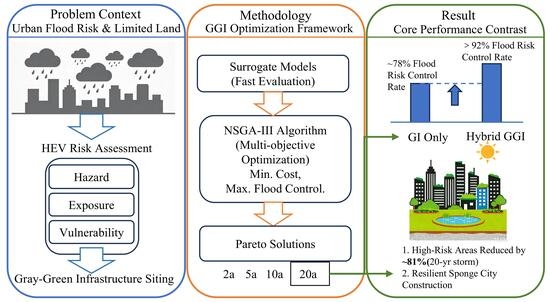
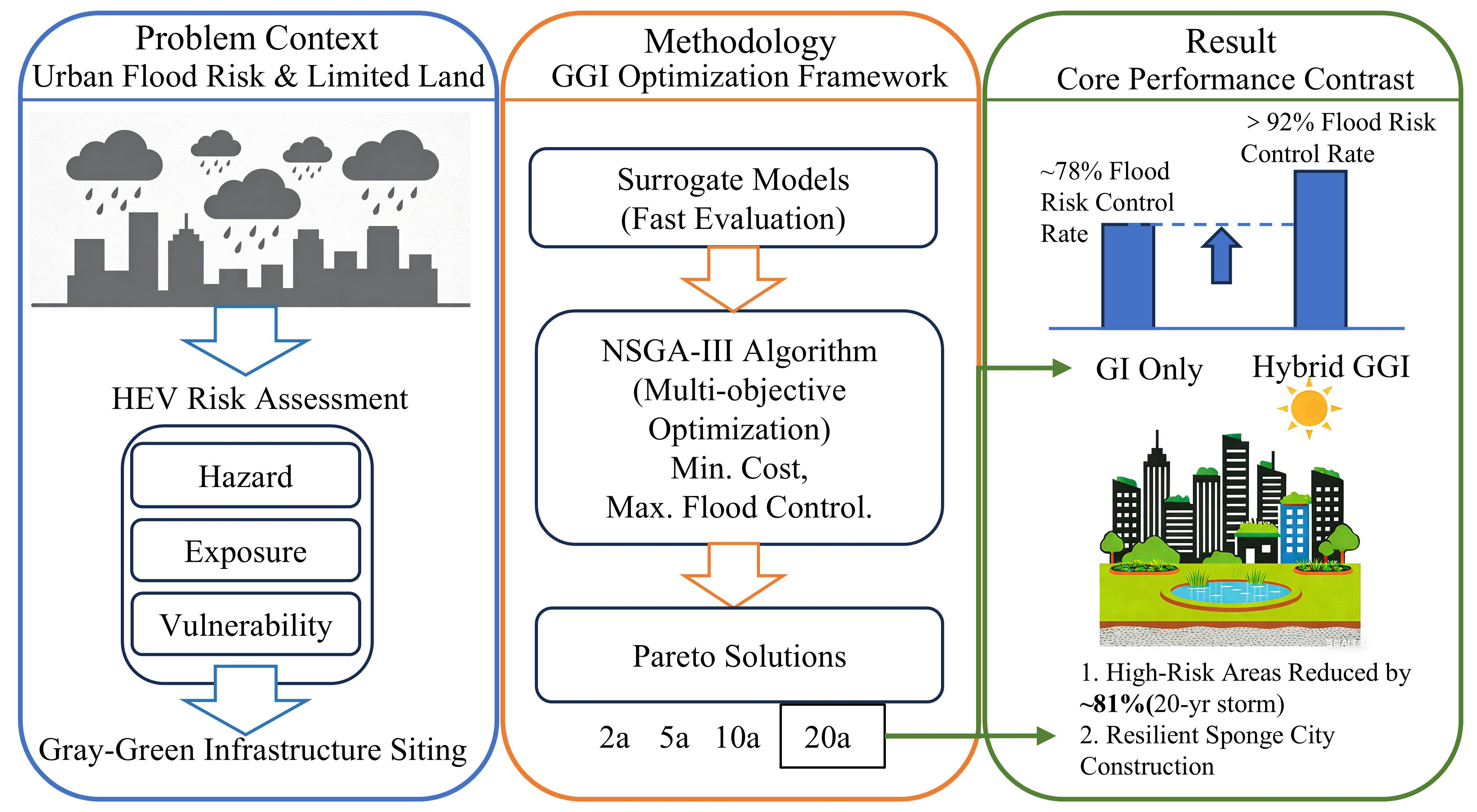
High-density urban areas face a critical trade-off between limited land resources and intensifying flood risks. This study develops a grey-green infrastructure (GGI) optimization framework that integrates hazard–exposure–vulnerability (H-E-V) risk assessment, surrogate modelling, and NSGA-III to simultaneously minimize cost, maximize flood control, and enhance water environmental benefits. The Suqian City case study reveals: (1) Grey-green coupling significantly outperforms single green infrastructure (GI), providing an additional 7.07–23.34 percentage points in flood risk control rate (FRCR). While GI reaches a performance bottleneck at 78.59% FRCR under extreme events, the GGI configuration maintains a high efficiency of >92.74%. (2) Risk-informed spatial targeting effectively reclassifies urban vulnerability. Under a 20-year return period, high-risk and medium-high risk areas are reduced by 80.99% and 52.15%, respectively. The validated surrogate models ensure high optimization efficiency with R 2 values exceeding 0.85. This framework provides a methodologically transferable decision-support tool for sponge city construction, demonstrating that strategic spatial allocation is as vital as infrastructure capacity for urban flood risk management.

Graphical Abstract

1. Introduction

Climate change and rapid urbanization have jointly intensified urban flood risks, posing a primary constraint on sustainable urban development [1,2]. This issue is particularly acute in highly urbanized areas—hubs of economic activity and population concentration—where complex interactions between infrastructure and social systems significantly increase exposure and vulnerability [3]. Traditional grey infrastructure, while facilitating rapid discharge, lacks the ecosystem services inherent in green infrastructure, such as runoff retention and pollution control [4]. Therefore, it is imperative to develop resilient, multifunctional flood management strategies that integrate grey and green infrastructure (GGI) to safeguard these vulnerable urban environments.
Grey infrastructure can efficiently convey and discharge short-duration intense rainfall, exhibiting superior conveyance capacity [5]. Since it is predominantly located underground and does not occupy surface space, constructing pipe networks in land-constrained urban centres is often more feasible than deploying large-scale green infrastructure (GI). However, grey infrastructure entails high construction costs, fails to reduce surface runoff at the source, and lacks ecological co-benefits [6]. In contrast, green infrastructure has attracted considerable attention due to its lower construction costs and relative ease of maintenance [7,8]. GI not only alleviates pressure on drainage systems but also improves water quality while providing diverse landscape and ecological services [9]. Nevertheless, GI is prone to saturation under extreme storm events, which significantly limits its ability to reduce peak runoff. Consequently, the integration of GGI enables functional complementarity: GI delays and attenuates initial runoff, while grey infrastructure manages the residual flow during high-intensity periods [10]. This synergistic approach represents a critical pathway toward building resilient and livable cities.
However, current research on GGI synergy still exhibits notable limitations. Most studies have focused on enhancing performance by increasing facility quantity or coverage, an approach that implicitly assumes sufficient available land. In high-density built-up areas, however, land is a scarce resource with high opportunity costs, rendering such quantity-driven strategies operationally infeasible [11]. Furthermore, conventional optimization methods typically determine facility layouts based solely on hydraulic indicators (e.g., runoff volume or inundation depth), without considering spatial heterogeneity in flood impacts. In reality, the consequences of flooding vary significantly across space: densely populated areas—such as transportation hubs, schools, and hospitals—suffer greater economic losses and service disruptions when inundated, while low-lying areas with high impervious ratios are physically more susceptible to waterlogging. This spatial variation suggests that, under land constraints, prioritizing high-impact areas for GGI deployment can maximize the returns on limited investment [12].
To this end, layout approaches that identify flood risk levels at different locations can provide a scientific basis for planning. Traditionally, urban flood risk assessments have relied on hazard-centric approaches that focus solely on physical flood characteristics—such as inundation depth and extent—simulated by hydrodynamic models [13], or on empirical statistical methods that depend on historical disaster records. However, these approaches fail to capture the complex socio-economic consequences of urban flooding and are increasingly inadequate in high-density urban environments, where rapid urbanization and climate change continuously alter runoff mechanisms, often rendering historical data insufficient or entirely absent [14]. To address these limitations, the hazard–exposure–vulnerability (H-E-V) framework—widely endorsed by the IPCC—offers a superior alternative by conceptualizing risk as the intersection of physical hazard, socio-economic exposure, and system vulnerability [15]. This framework enables the seamless coupling of hydrodynamic simulations (e.g., SWMM) with high-resolution GIS socio-economic data, shifting the objective from predicting absolute water depths to identifying true socio-economic risk hotspots. Recent empirical studies confirm that this integrated approach significantly enhances the spatial precision of risk identification in complex urban catchments [16], reduces subjective assessment bias, and provides actionable, risk-driven insights for space-constrained urban planning—making it an ideal foundation for the spatial optimization of GGI in this study. For example, Li et al. utilized the spatial distribution of flood risk to guide Low Impact Development (LID) configuration [17]; Wang et al. evaluated a multi-objective optimization framework for blue-green-grey infrastructure, prioritizing high-sensitivity areas such as schools and hospitals to minimize losses [18]. Therefore, in land-constrained highly urbanized areas, a risk-prioritized spatial allocation approach can optimize limited resources and maximize investment efficiency [19,20].
Moreover, GGI optimization is inherently multi-objective, involving trade-offs among cost, flood control, and environmental benefits [21]. Genetic algorithms, known for their global search capability, are widely used for such multi-objective problems [22]. This study employs the Non-dominated Sorting Genetic Algorithm III (NSGA-III) developed by Deb and Jain [23]. However, NSGA-III requires numerous iterations, each involving computationally expensive calls to hydrological-hydraulic models (e.g., SWMM), leading to substantial computational costs. Surrogate model-assisted optimization represents an efficient strategy to overcome this bottleneck [24,25]. For instance, Lu et al. adopted the DYCORS algorithm to reduce the number of simulations [26]; Yang et al. employed machine learning models, such as MLR, GRNN, and BPNN, as surrogates [27]. To address this, this study introduces a surrogate model to emulate the computationally expensive SWMM simulations, rapidly approximating the input-output relationships and thereby accelerating the optimization process.
To address the aforementioned gaps, this study develops a decision support framework based on multi-objective optimization, with three primary objectives: (1) to establish a multi-objective decision framework for stormwater systems under land-constrained high-density urban conditions; (2) to develop a preliminary layout approach based on urban flood risk prioritization; and (3) to determine optimal layout configurations targeting economic benefits and flood control performance under different rainfall return periods.

2. Materials and Methods

2.1. Model Development

2.1.1. Study Area

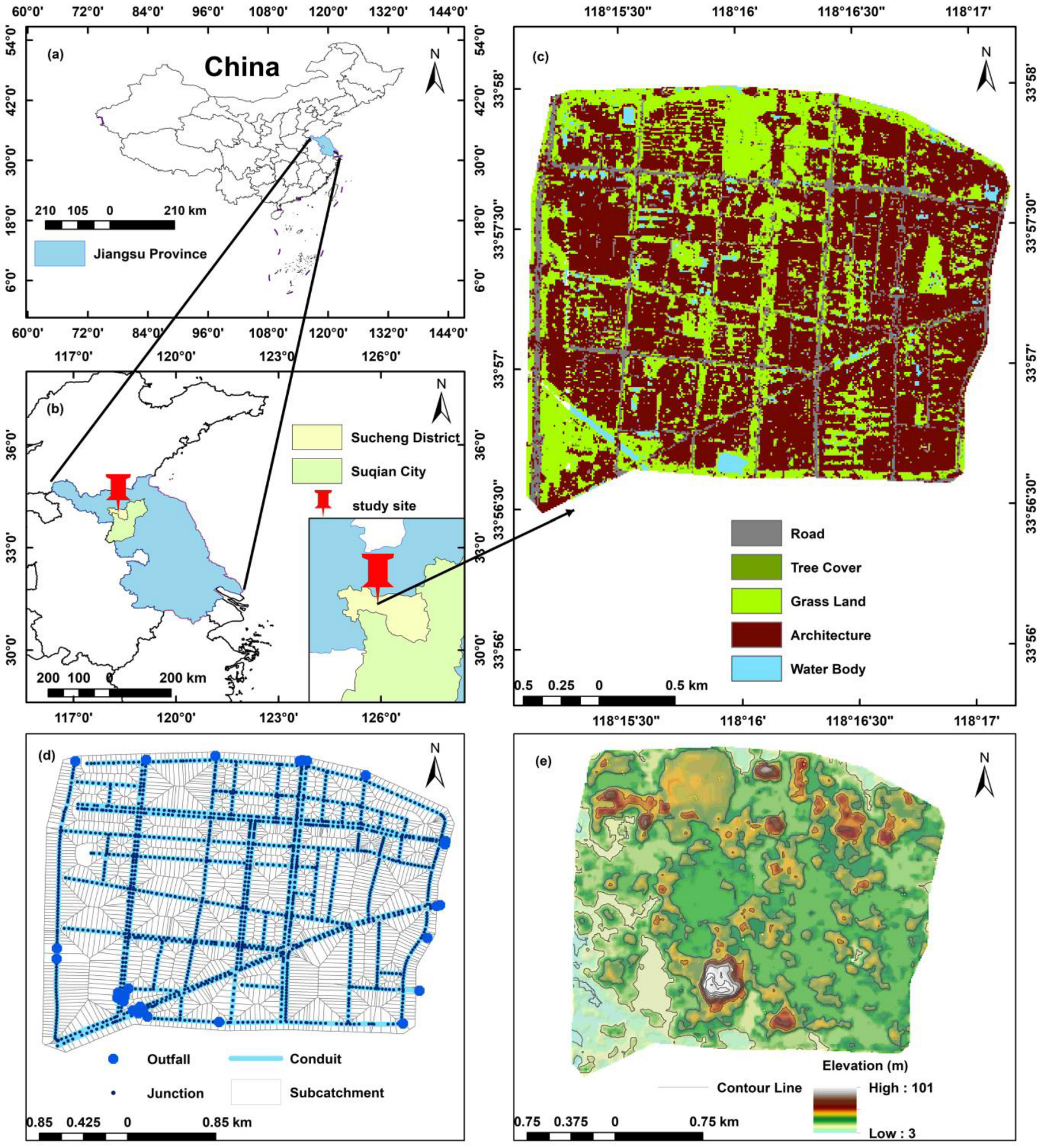
The study area is located in the central urban district of Sucheng District, Suqian City, Jiangsu Province, China, covering 7.52 km2 (Figure 1). Sucheng District lies in northern Jiangsu, about 120 km from the Yellow Sea coast, and sits on the Huanghuai Plain at an elevation of roughly 20 m above sea level. The land use distribution for the study area, illustrated in Figure 1c, was derived from the China 30 m annual land cover dataset (CLCD) and its dynamic change products [28]. This dataset, provided by the National Glaciations, Permafrost, and Desert Science Data Center (http://www.ncdc.ac.cn), features a spatial resolution of 30 m and covers a temporal span from 1985 to 2022.
The climate is warm temperate humid monsoon, with wet summers and dry springs and autumns. Local hydrology is dominated by the Hongze Lake–Luoma Lake watershed, and the area is bounded to the north and east by the Zhongyun Canal, which serves as the primary drainage boundary.
As a typical high-density built-up area with a high impervious surface ratio, the region experiences frequent pluvial flooding during the monsoon season. The underlying Quaternary loose alluvial deposits consist of silt and sandy loams with moderate permeability, a characteristic favourable for green infrastructure such as rain gardens and permeable pavements. Groundwater is shallow, with the water table typically at 2.0–3.0 m depth. The hydrographic network is dense and interlaced, including the Grand Canal and tributaries like the Ancient Yellow River and West Minbian River, with a drainage density of 1.0 km/km2.
Figure 1e presents the digital elevation model derived from ASTER GDEM (30 m resolution). The region slopes gently toward the southeast, and low-lying areas adjacent to rivers correspond to the zones of highest flood hazard identified in Section 3.1. Together, these conditions make the study area an ideal case for evaluating GGI optimization strategies [29,30].
For the hydrological simulation, we employed a SWMM-based model previously calibrated and validated by Qi et al. [31]. The study area was discretized into 1824 sub-catchments, each routed to a corresponding node and ultimately discharging through 28 outfalls.

2.1.2. Layout of Green and Grey Infrastructure

Based on the Sponge City Design Guidelines of Suqian City and the land use characteristics in Table 1, three types of green infrastructure (GI)—green roofs (GR), rain gardens (RG), and permeable pavements (PP)—were selected. In addition, to form an integrated grey-green infrastructure (GGI) system, storage tanks were also introduced as the grey component. Both GI and storage tanks were preferentially deployed within areas identified as high and medium-high risk based on the hazard–exposure–vulnerability (H-E-V) assessment (detailed in Section 2.2). Within these priority zones, GI facilities were further allocated according to land use types: GRs on building rooftops, PPs on road surfaces, and RGs within grassland areas. Storage tanks were sited at the nodes with the most severe ponding within the drainage pipe network, as identified by SWMM hydrological simulations (detailed in Section 2.2). This configuration served as the baseline scenario for subsequent optimization.

2.2. Spatial Site Selection Method for Facilities Based on the H-E-V Model

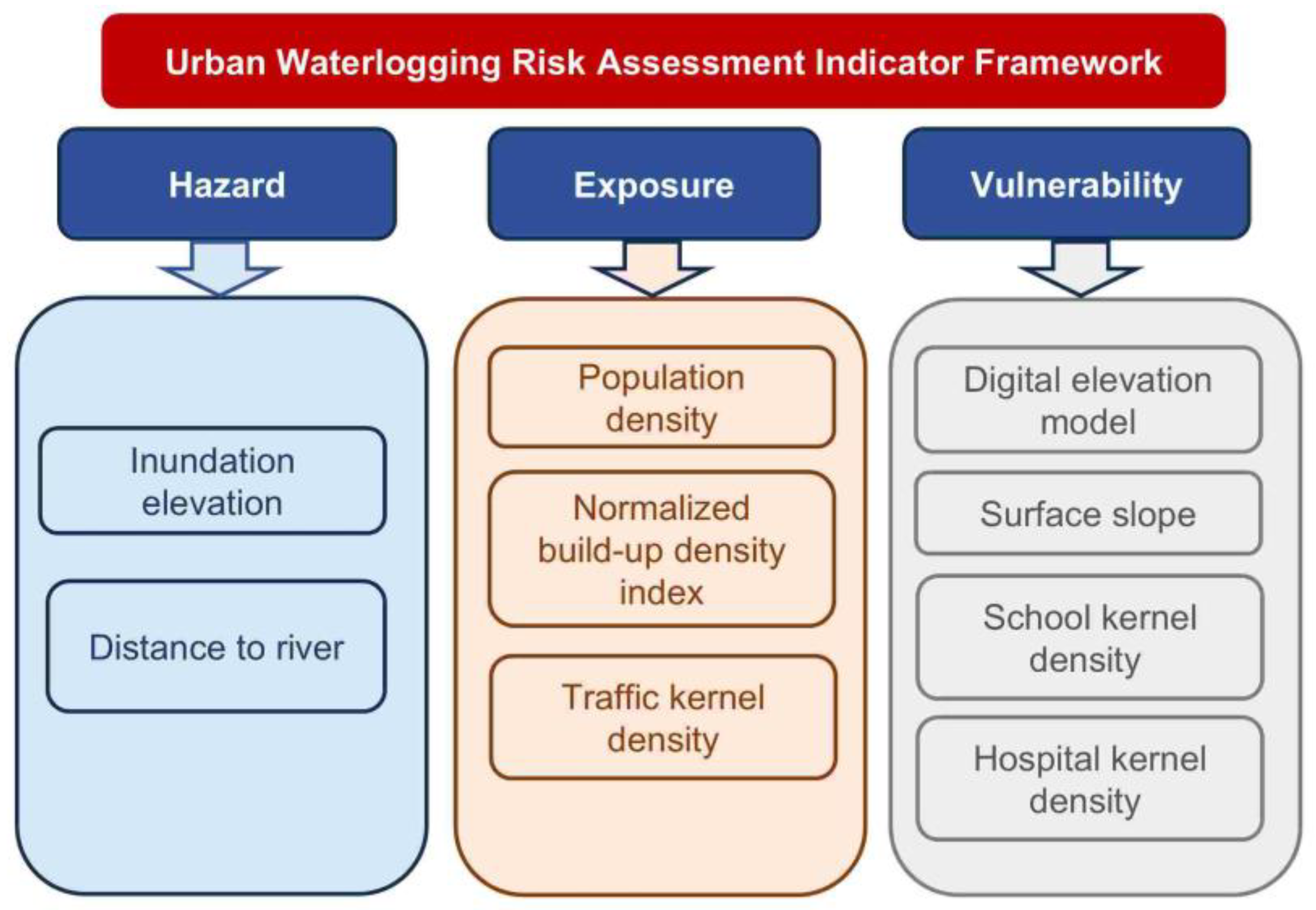
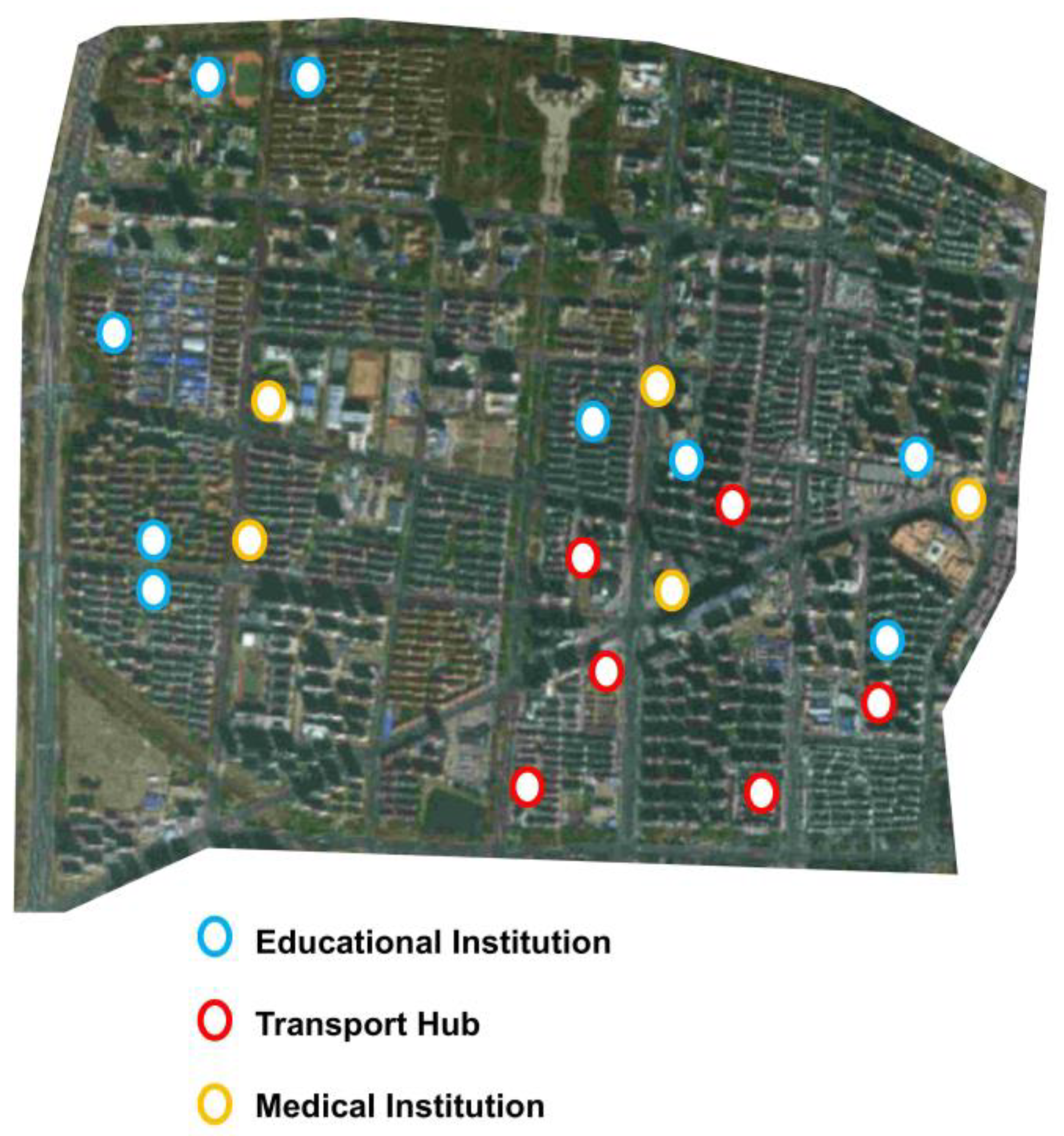
In highly urbanized areas, flood impacts vary spatially due to differences in hazard intensity, population exposure, and socioeconomic vulnerability. However, conventional optimization approaches often overlook such spatial heterogeneity, treating all locations equally without incorporating risk information into the decision-making process. This spatial complexity is exemplified in Figure 2, which illustrates the distribution of critical urban functional zones. To address this limitation, this study developed a flood risk assessment system based on the hazard–exposure–vulnerability (H-E-V) framework. The specific indicators are presented in Figure 3.
To eliminate subjective bias, the Spatial Principal Component Analysis (SPCA) method in ArcGIS 10.8 was employed to calculate objective weights. The Flood Risk Index (FRI) was calculated using the following weighted summation:
F R I   =   i = 1 n w H i H i +   j = 1 m w E j E j +   k = 1 p w V k V k
where FRI is the Flood Risk Index, H i , E j , and V k denote the standardized indicator values for hazard factors, exposure factors, and vulnerability factors, respectively, and w H i , w E j , and w V k represent the weighting of the i-th hazard indicator, j-th exposure indicator, and k-th vulnerability indicator. For this study, n = 2, m = 3, and p = 4.
The calculated weights for each indicator are presented in Table 1, along with their corresponding data sources.
Based on the flood risk assessment results, the study area was classified into five risk levels using the Natural Breaks method: low, medium-low, medium, medium-high, and high. These risk zones served as the spatial basis for facility siting. Specifically, green infrastructure—green roofs, rain gardens, and permeable pavements—was preferentially deployed within areas classified as medium-high and high risk, subject to land use constraints (i.e., GR on rooftops, PP on roads, and RG in grasslands). For grey infrastructure (storage tanks), siting was determined based on both flood risk zones and hydrological simulation results: tanks were placed at the nodes with the most severe ponding, as identified by SWMM, provided that these nodes were located within the same medium-high and high risk areas. This two-tiered siting strategy ensures that green infrastructure targets spatially continuous risk zones, while grey infrastructure addresses localized flooding hotspots within those priority zones.

2.3. Multi-Objective Optimization Method Based on Surrogate Models

A multi-objective optimization framework was developed to balance cost, environmental benefits, and risk control. By integrating surrogate models to bypass the computational intensity of direct SWMM simulations, the framework optimizes four decision variables: three green infrastructure deployment ratios and the total grey infrastructure storage volume.

2.3.1. Objective Functions

Three objective functions were selected: the Flood Risk Control Rate (FRCR), Water Environmental Benefit (WEB), and Life Cycle Cost (LCC). These three objectives represent the three foundational pillars of sustainable urban stormwater management: safety, environment, and economy. These three objectives are inherently conflicting, which makes multi-objective optimization both necessary and meaningful. Three objectives were defined in this study:
FRCR is used to quantify the system’s performance in reducing urban flood risk. Its value ranges from 0 to 1, where 1 indicates complete risk control (no overflow) and 0 indicates no risk control. FRCR was calculated using Equation (2):
F R C R = 1 V T F V T I × t f t b a s e
where V T F is the total overflow volume at all flooded nodes (m3); V T I is the total rainfall inflow volume in the study area (m3); t f is the average inundation duration at all flooded nodes (h); t b a s e is the inundation duration at flooded nodes under the baseline scenario without grey-green infrastructure (h).
WEB is a monetized indicator used to evaluate the comprehensive environmental performance of the system. The calculation model was adapted from Yao et al. [32]. This model includes water quality improvement benefits (through suspended solids reduction) and water quantity improvement benefits (through peak flow reduction). The WEB is calculated using Equation (3):
W E B = q s s Q s s × p s s + q peak × P
where q ss represents the reduction in suspended solids (SS) relative to the baseline scenario (kg); Q ss is the pollutant equivalence factor, set at 4 kg; p ss is the water pollution tax, set at 0.82 USD/equivalent (corresponding to 5.8 CNY [33]); q peak is the reduction in outlet peak flow (m3); P is the wastewater treatment fee, set at 0.15 USD/m3 (corresponding to 1.08 CNY/m3 [34]), based on local standards in Suqian City. (Note: Currency conversion in this study is based on the exchange rate as of 20 December 2025: 1 USD ≈ 7.04 CNY).
LCC is a cost-oriented objective function that covers the entire lifecycle costs of facilities from construction, operation and maintenance, to decommissioning [35]. LCC was calculated as follows:
L C C X = L C C G r e e n X + L C C G r e y X
where L C C ( X ) represents the life cycle cost under scenario X (USD); L C C Green ( X ) represents the LCC of green infrastructure under scenario X (USD); and L C C Grey ( X ) represents the LCC of grey infrastructure under scenario X (USD).
L C C G r e e n X = C construction + N V o & m t
C construction = i = 1 3 C i × A i
N V o & m t = i = 1 3 t = 1 30 C i × p i × 1 + r t 1 + w t
where C construction represents the construction cost of GI (USD); i is the type of green infrastructure; C i is the unit construction cost of green infrastructure type i (USD/m2); A i is the deployment area of green infrastructure type i (m2); N V o & m t is the operation and maintenance (O&M) cost in year t (USD); t is the design lifetime, set at 30 years [36]; p i is the percentage of O&M cost relative to construction cost for green infrastructure, set at 5% for rain gardens, 10% for green roofs, and 2% for permeable pavements; R is the inflation rate, set at 0.2%, and w is the discount rate, set at 2%.

2.3.2. Constraints

To ensure ecological function and system resilience, the following constraints were set based on studies by Zhou et al. [37] and Wang et al. [38]: (1) the SS reduction rate must be at least 40% for all return periods; (2) each green infrastructure type must cover at least 20% of the deployable area; and (3) the storage tank volume must account for at least 25% of the total storage demand.
The mathematical expressions are as follows:
R i 20 % R v 25 % α 40 %
where R i is the deployment ratio of the i-th type of green infrastructure (%); R v represents the total storage volume of the tank system as a percentage of the total design rainfall volume (%); α is the SS reduction rate (%).

2.3.3. Pareto Front Solution Based on NSGA-III

This study employed the NSGA-III algorithm to solve the three-objective optimization problem. By utilizing a reference point mechanism, the algorithm maintains population diversity and effectively addresses the premature convergence limitations of traditional multi-objective evolutionary algorithms in complex objective spaces. To generate a well-distributed Pareto-optimal solution set, the parameters were set as follows: initial population size (1000), generational population size (400), crossover probability (0.9), and mutation probability (0.1).

2.3.4. Surrogate Model Construction

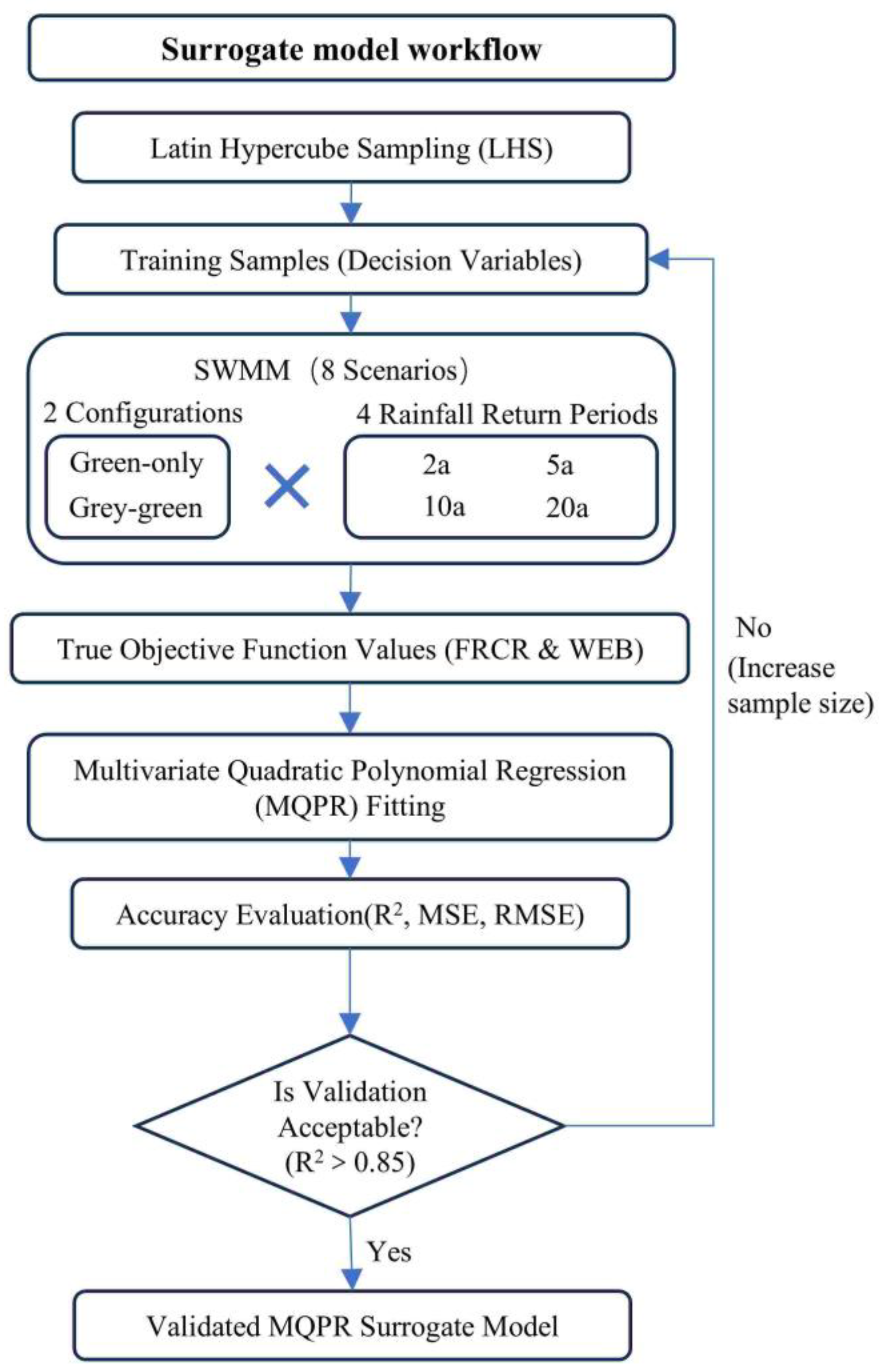
In multi-objective optimization, numerous evaluations are required, but physically based models like SWMM are computationally expensive. To address this, a surrogate model was employed to replace the complex simulations. A total of eight optimization scenarios were constructed, combining two infrastructure configurations—green-only and grey-green—under four rainfall return periods. For each scenario, 300 training samples were generated using Latin Hypercube Sampling, and a Multivariate Quadratic Polynomial Regression (MQPR) model was fitted to approximate the response surface between decision variables and objective functions (FRCR and WEB) through linear and interaction terms. The overall workflow of the proposed method is shown in Figure 4.
The accuracy of the surrogate models was evaluated using the coefficient of determination ( R 2 ) [39], mean squared error (MSE) [40], and root mean squared error (RMSE) [41]. The predictive performance was evaluated using the following metrics:
1.
Coefficient of Determination ( R 2 ): measures the global fit of the model.
R 2 = 1 i = 1 n y i y ^ i 2 i = 1 n y i y ¯ i 2
2.
Mean Squared Error (MSE): represents the average of the squares of the errors.
M S E = 1 n i = 1 n y i y ^ i 2
3.
Root Mean Squared Error (RMSE): provides the error magnitude in the same units as the response variable.
R M S E = 1 n i = 1 n y i y ^ i 2
where y i represents the SWMM simulation values, y ^ i denotes the surrogate model predictions, and n is the number of validation samples.
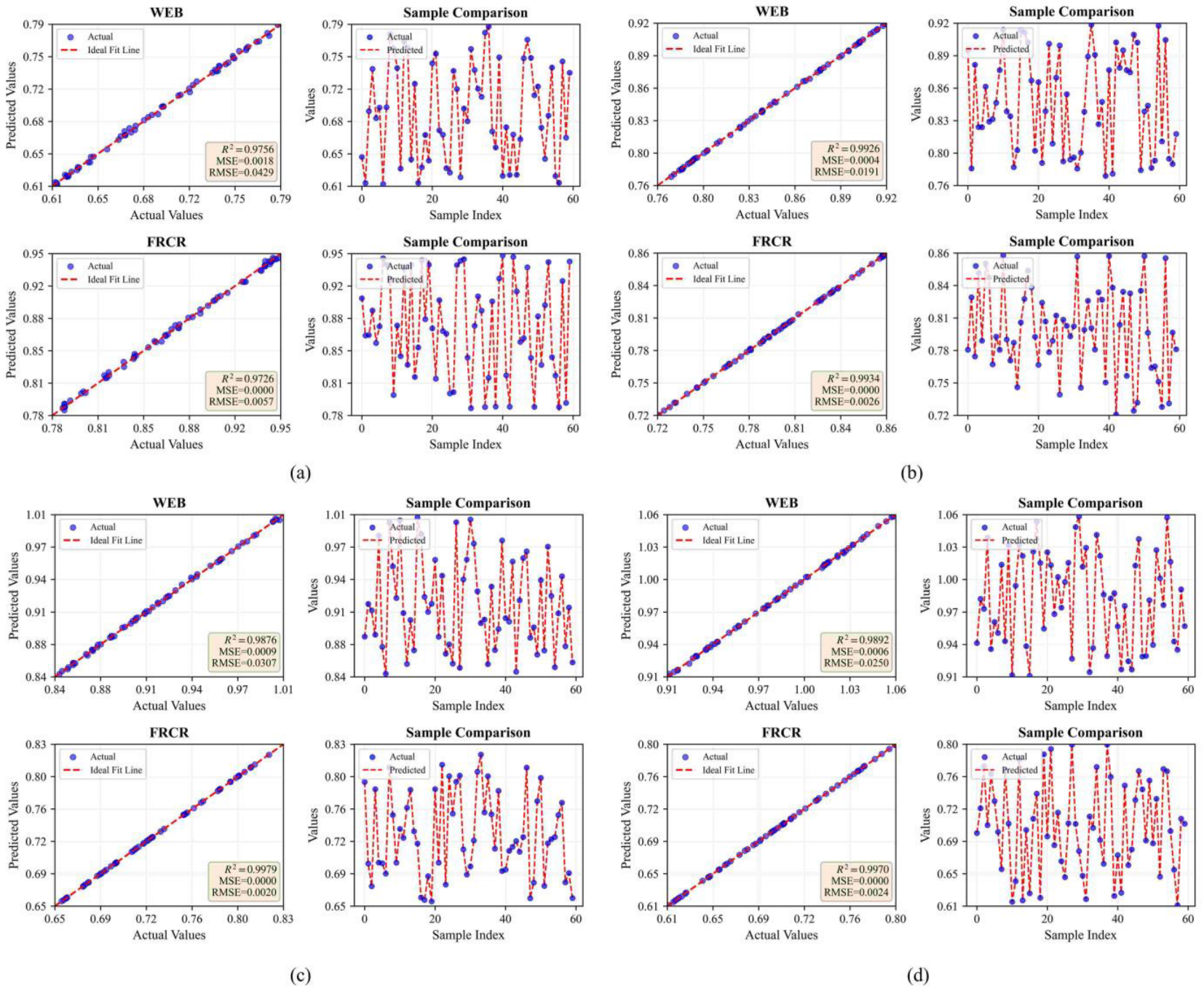
Figure 5 presents the validation results for green-only infrastructure under four return periods. In all scenarios, the surrogate predictions match the SWMM simulation results closely. The R 2 values remain consistently above 0.85, and the fitted curves show strong linear trends with very little scatter. These results confirm that our quadratic polynomial models accurately capture the relationships for green infrastructure.
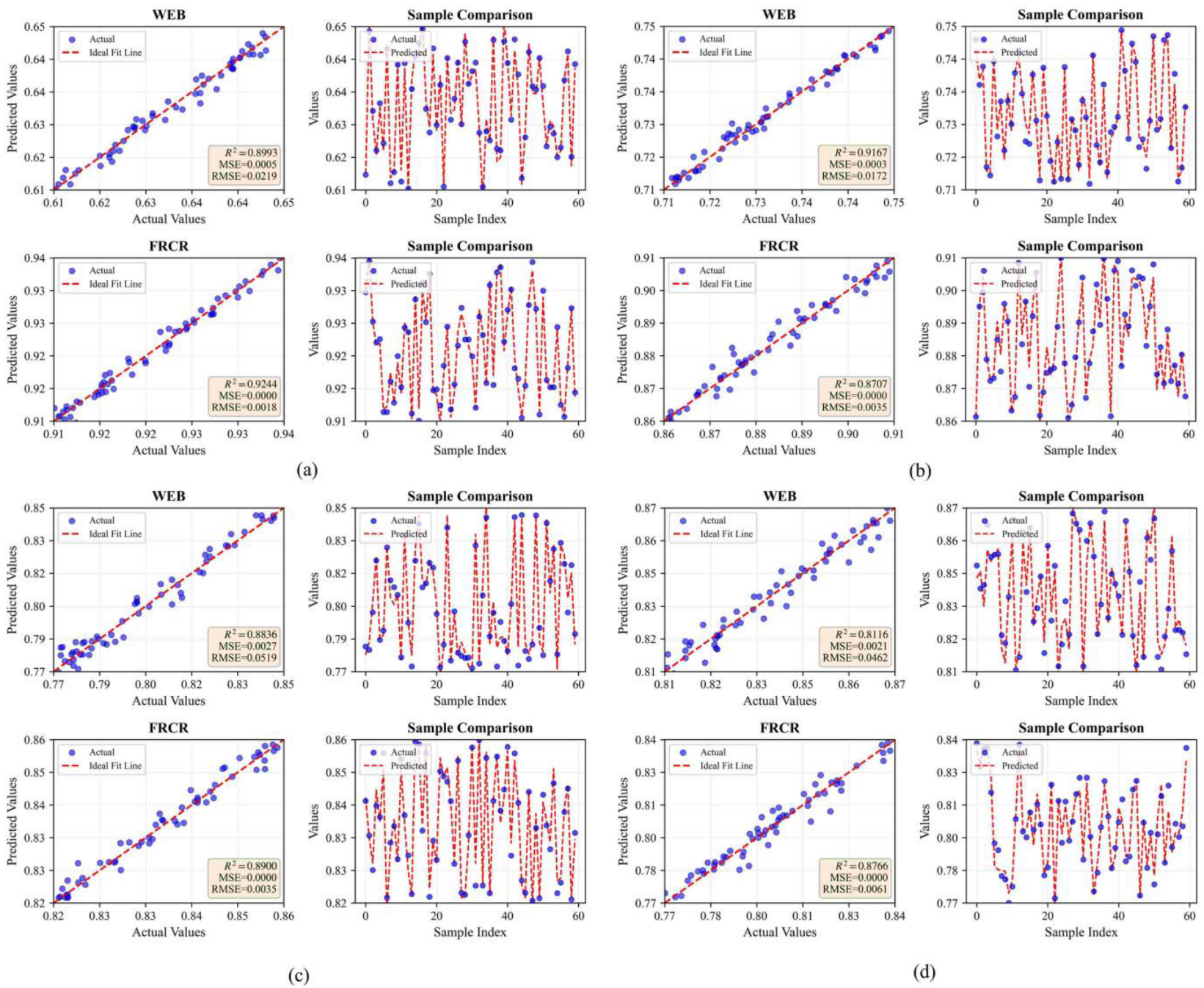
Building on these positive results, we further validated the surrogate models for the more complex grey-green infrastructure. As shown in Figure 6, these models also achieve high predictive accuracy. The R 2 values exceed 0.85, and most data points cluster tightly around the 1:1 line. Furthermore, the low error metrics (MSE and RMSE) demonstrate that the surrogates reliably reproduce the SWMM outputs. This consistent performance provides a solid foundation for the following multi-objective optimization [42].

3. Results

3.1. Urban Flood Risk Characteristics Under Baseline Scenario

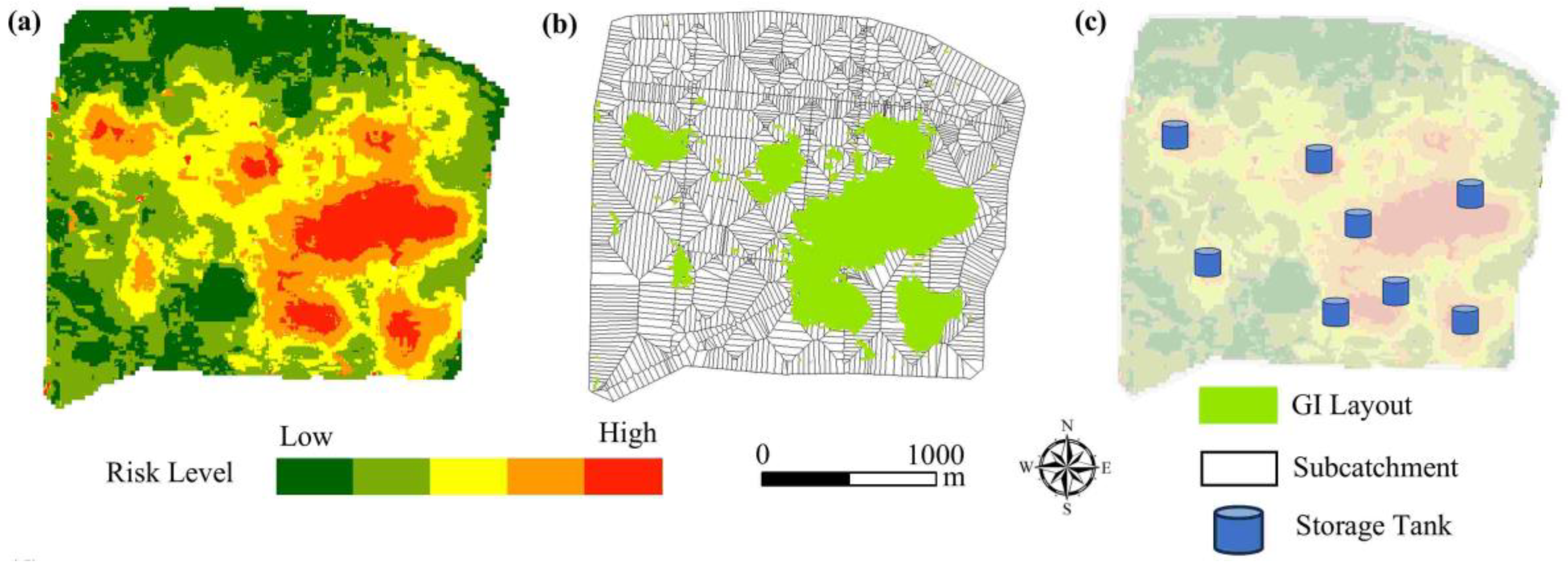
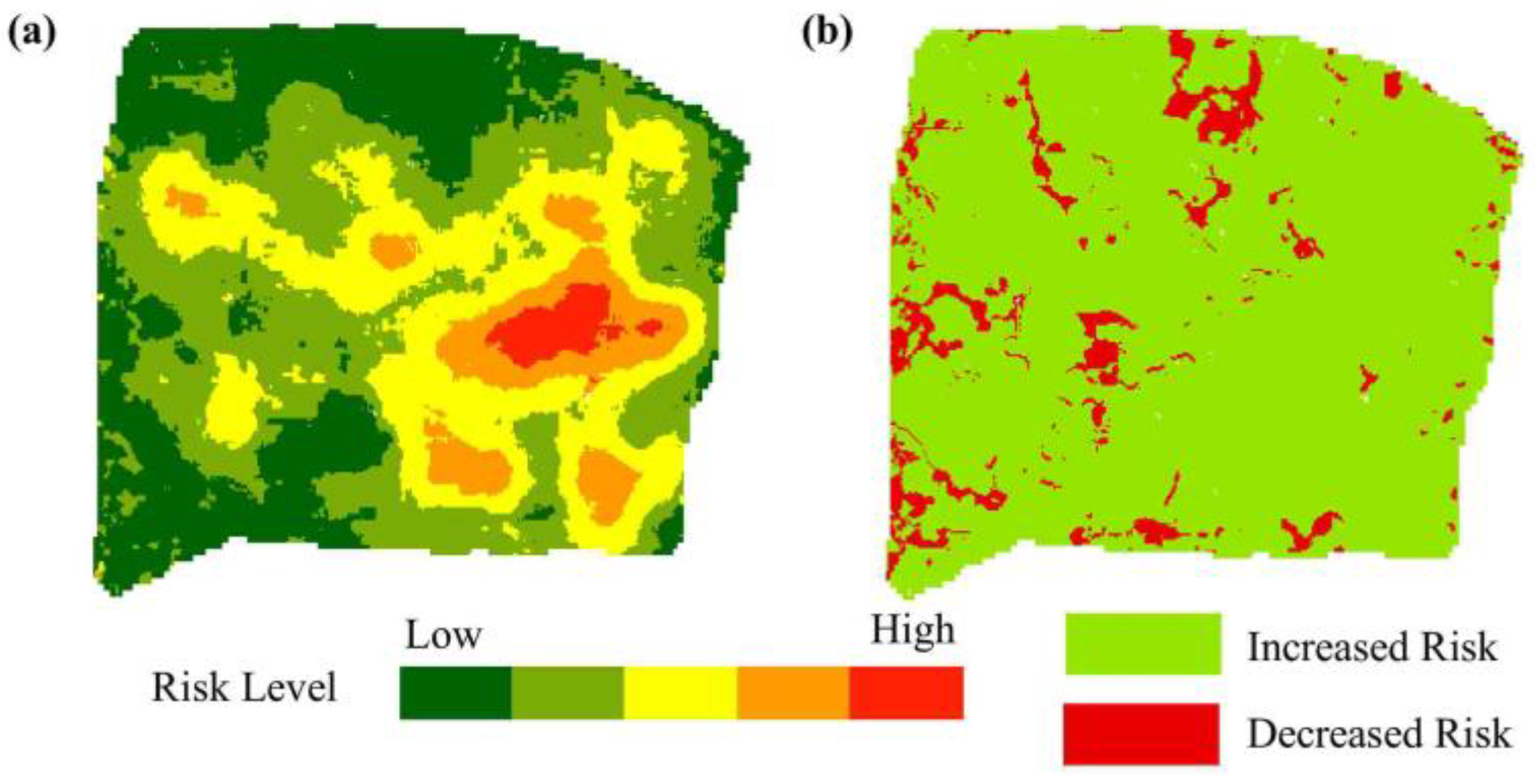
This study selected the 20-year return period rainfall event to evaluate changes in urban waterlogging risk distribution in Suqian City. As shown in Figure 7a, low, medium-low, and medium risk zones covered a total area of 4.45 km2, mainly distributed in non-critical functional areas near rivers with low population density. In contrast, high-risk and medium-high risk zones covered 1.21 km2 and 1.86 km2, respectively, totaling 3.07 km2. These higher-risk areas were concentrated in critical urban functional zones such as schools, hospitals, and transportation hubs, where flood exposure and potential losses were significantly higher.
To ensure the reliability of the proposed Flood Risk Index (FRI), we validated the spatial risk map using real-world flood data. While hydraulic models provide valuable simulations, historical waterlogging records offer the most direct empirical evidence for urban flood vulnerability. Therefore, we collected 8 documented historical waterlogging points from recent extreme rainfall events in the study area. We overlaid these actual flood locations onto our computed FRI map. The comparison reveals a high degree of spatial agreement. Specifically, 87.34% of the historical waterlogging points are located exactly within the ‘High’ and ‘Medium-High’ risk zones identified by our model. Only a negligible fraction falls into the low-risk areas. This strong alignment confirms that the FRI model successfully captures the true spatial distribution of urban flood risks. Consequently, the spatial prioritization strategy derived from this index is scientifically robust and practically reliable for guiding infrastructure deployment.
These risk assessment results directly informed the spatial deployment of grey-green infrastructure. For green infrastructure, the medium-high and high-risk areas were designated as priority deployment zones, with sub-catchments within these zones serving as the basic siting units. To account for runoff transmission pathways, upstream sub-catchments contributing flow to these priority zones were also included in the source reduction scope, resulting in a total of 581 sub-catchments identified as green infrastructure deployment areas (Figure 7b). Permeable pavements and rain gardens were preferentially allocated to sub-catchments with higher impervious surface ratios and greater runoff generation potential, while green roofs were prioritized for sub-catchments with a higher proportion of rooftop coverage.
As shown in Figure 7c, all seven storage tanks were sited at the most severely inundated critical nodes within the medium-high and high-risk zones. Seven nodes were selected, all located at drainage network confluences downstream of key functional zones, including schools, hospitals, and transportation hubs, as mapped in Figure 2, where the combination of high runoff accumulation and limited drainage capacity resulted in the most prolonged and severe inundation. Storage tanks at these locations intercept peak flows before they reach the most vulnerable areas, providing a complementary buffering capacity that green infrastructure alone cannot achieve at short response timescales.
Based on this spatial allocation scheme, the theoretical deployment capacity was further constrained by local land suitability requirements, with the specific location suitability criteria detailed in Table 2. The sub-categorization of architectural land into residential, commercial, office, and industrial areas—required for GI suitability assessment—was derived by integrating the original land use classification map with manual visual interpretation of satellite imagery sourced from the National Geographic Information Platform, Tianditu (http://www.tianditu.gov.cn). Specifically, the architectural category identified in the land use map was further disaggregated into functional sub-types through overlay analysis with Tianditu imagery dated April 2025, consistent with the study period, ensuring temporal alignment between the land use data and the simulation scenarios. It should be noted that minor delineation errors may exist but are considered negligible at the study scale. According to the Suqian Sponge City Construction Technical Guidelines, the maximum deployable areas within the priority zones were 2.78 km2 for permeable pavements, 1.23 km2 for green roofs, and 2.03 km2 for rain gardens. These values served as upper bounds for the subsequent multi-objective optimization. The following sections present the optimization results for different return periods.

3.2. Pareto Front Analysis

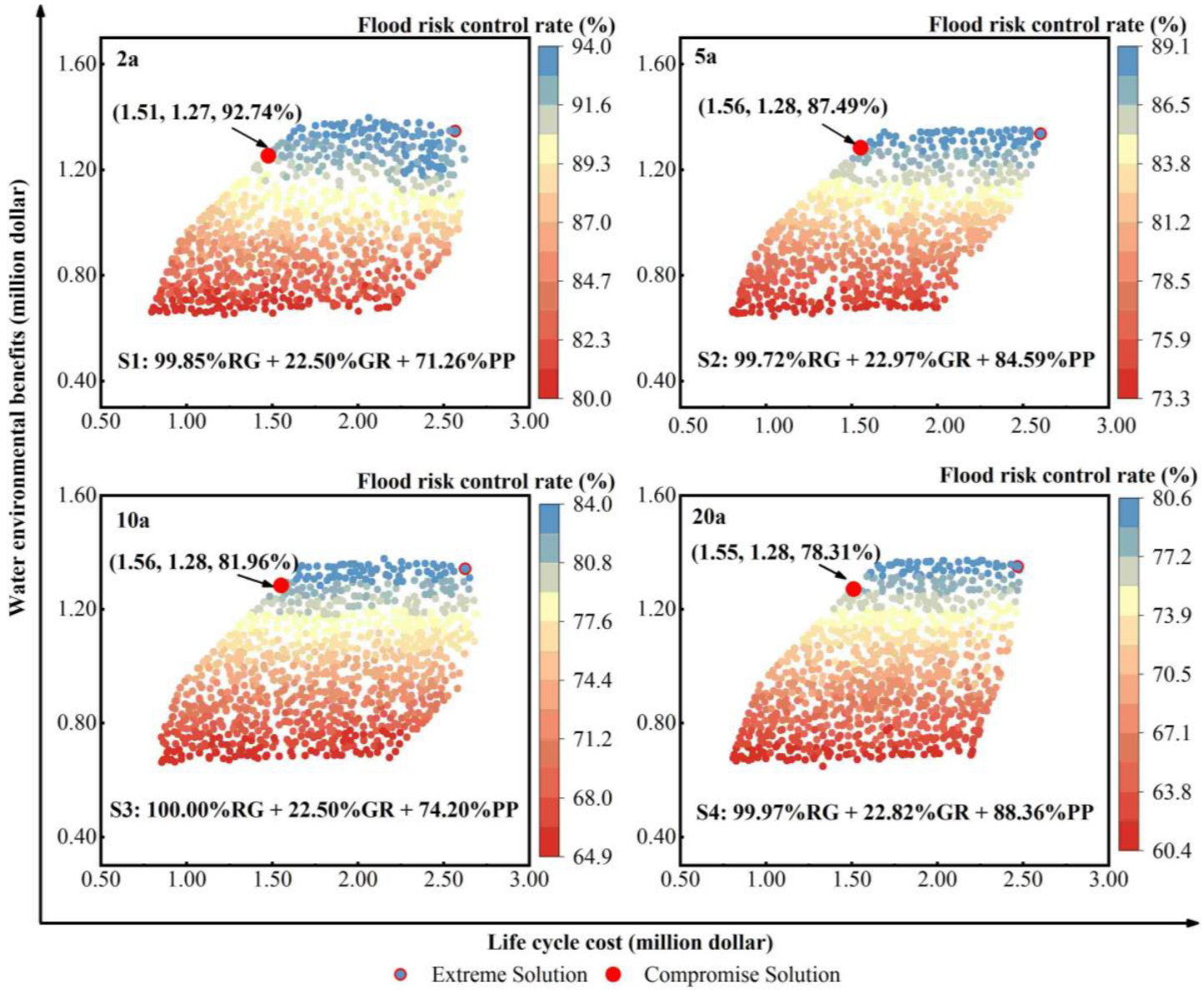
Based on the verified surrogate models, the Pareto fronts were generated, showing the optimization results for green infrastructure (GI) and grey-green infrastructure (GGI) under the 2-, 5-, 10-, and 20-year return periods. In each plot, the vertical axis shows water environmental benefits (WEB, million USD), the horizontal axis shows life cycle cost (LCC, million USD), and the colour gradient indicates the flood risk control rate (FRCR, %). To avoid subjective bias in solution selection, the Technique for Order Preference by Similarity to an Ideal Solution (TOPSIS) was employed to identify the best compromise solutions and their corresponding spatial layouts for the eight scenarios.

3.2.1. Green Infrastructure Pareto Front

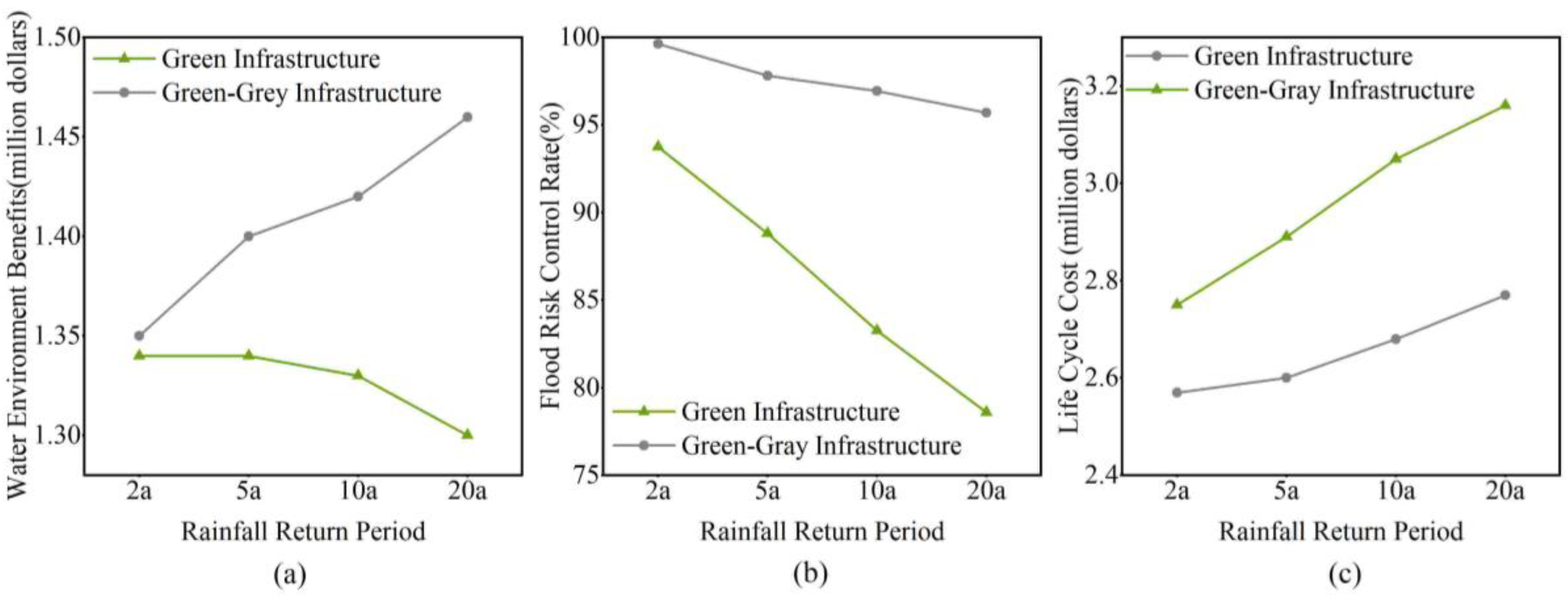
As shown in Figure 6, with increasing return periods, the Pareto front for green infrastructure progressively shifted to lower FRCR values, indicating reduced flood control efficiency under more extreme events. The upper boundary solutions of the Pareto fronts for the 2-, 5-, 10-, and 20-year return periods were extracted. These optimal solutions achieved LCC values of 2.57, 2.60, 2.68, and 2.77 million USD, with corresponding FRCR values of 93.06%, 88.79%, 83.26%, and 78.59%, and WEB values of 1.34, 1.34, 1.33, and 1.30 million USD, respectively. A direct comparison of these upper boundaries with the GGI results is presented in Figure 8. Comparing the 2-year and 20-year scenarios, LCC increased by 7.78% while WEB decreased by 7.91%, exhibiting similar relative changes. In contrast, the flood control rate declined by 14.25%, highlighting the rapidly diminishing marginal returns of GI investment for flood control under extreme rainfall conditions.
In addition to the upper boundary solutions, the best compromise solutions selected by TOPSIS further confirmed this pattern. GI demonstrated good flood control performance under low return period rainfall, but exhibited clear capacity bottlenecks under high return periods. The best compromise solutions further confirmed this pattern. Their LCC (1.51–1.56 million USD) and WEB (1.27–1.28 million USD) remained highly stable across return periods, while FRCR systematically decreased from 92.74% to 78.31%. This confirms that under extreme events, increasing GI investment yields diminishing returns for flood control, highlighting the need for supplementary grey infrastructure.
The facility composition of the best compromise solutions showed distinct type differences. In the single green infrastructure scenarios (S1–S4), rain gardens (RG) had the highest deployment ratio, approaching saturation across all return periods (99.72–100.00%). Permeable pavements (PP) maintained coverage rates of 71.26% to 88.36%, gradually increasing with return periods from 2 to 20 years. Green roofs (GR) remained stable at relatively low levels of 22.50% to 22.97%.

3.2.2. Grey-Green Infrastructure Pareto Front

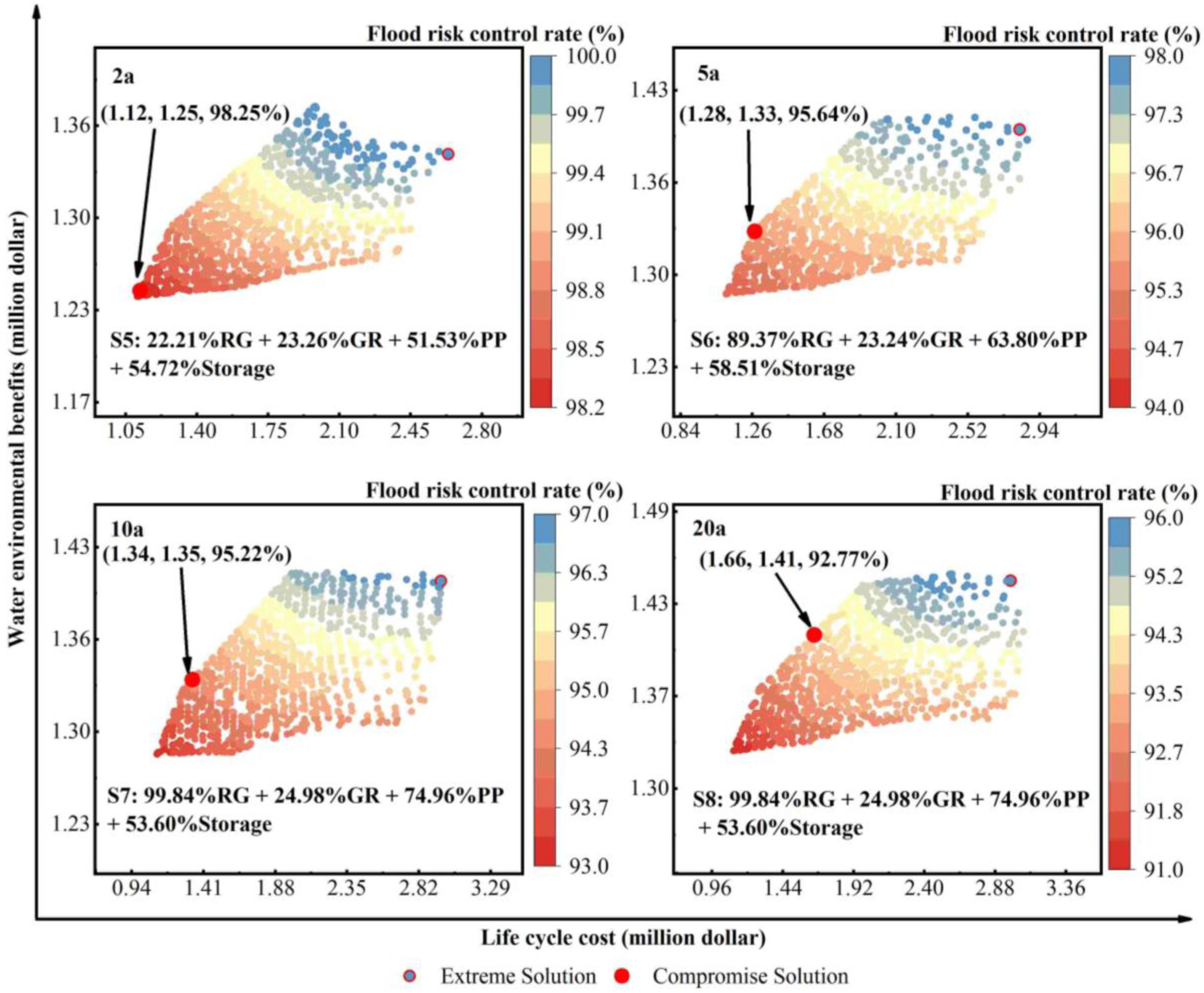
Figure 9 presents the Pareto fronts for GGI under the 2-, 5-, 10-, and 20-year return periods, along with the identified optimal compromise solutions and their corresponding spatial configurations. Based on these Pareto fronts, the performance maintenance capability of the best compromise solutions was significantly enhanced. The WEB of GGI steadily improved across return periods, while the FRCR consistently remained above 92.74%, with only a 5.6 percentage point decline from the 2-year to the 20-year event. Under equivalent LCC conditions of 1.12 million USD, the FRCR of GGI scenarios reached 91.01%, compared to only 61.58% for pure GI scenarios—an improvement of 29.43 percentage points.
In terms of spatial configuration, storage tanks dominated the solutions with stable proportions, maintaining 53.6–58.5% across all return periods, indicating a consistent dependence on centralized storage. Rain gardens, green roofs, and permeable pavements exhibited complementary roles, with their proportions varying to balance cost and performance under different rainfall intensities.
To further quantify the advantages of GGI over GI, Figure 10 provides a direct comparison of the Pareto front upper boundaries between the two infrastructure types under the four return periods. For GGI, the upper boundaries achieved LCC values of 2.75, 2.89, 3.05, and 3.16 million USD, respectively, with corresponding FRCR values of 99.64%, 97.82%, 95.71%, and 96.93%, and WEB values of 1.35, 1.40, 1.42, and 1.46 million USD. Compared to the pure GI scenarios, these values represent increases of 7.00–14.08% in LCC, 0.75–12.31% in WEB, and 7.07–23.34% in FRCR across the four return periods. The most substantial improvement was observed for the 20-year event, where FRCR increased by 23.34% at a 14.08% higher LCC. The comparison of the upper boundaries in Figure 10 confirms that integrating grey infrastructure overcomes GI’s performance bottlenecks, consistent with the Pareto front evolution shown in Figure 9.
To verify the actual disaster reduction effectiveness of the optimal solutions, the compromise solution under the 20-year return period was applied to the study area to evaluate its improvement on the baseline risk pattern.

3.3. Disaster Reduction Benefit Assessment of Optimal Solutions

Applying the GGI compromise solution with the highest flood risk control rate (FRCR) for the 20-year return period significantly alleviated waterlogging pressure across the study area. As summarized in Table 3 and illustrated in Figure 11a, this intervention led to a substantial downward shift in risk levels. The high-risk area contracted sharply from 1.21 ha to 0.23 ha, an 80.99% reduction. The medium-high risk area decreased from 1.86 ha to 0.89 ha, a 52.15% reduction. The medium-risk area experienced a slight increase from 1.83 ha to 1.85 ha, corresponding to a 1.09% increase. Concurrently, safer zones expanded considerably: the medium-low risk area increased from 1.18 ha to 2.54 ha, a 115.25% increase, and the low-risk area grew from 1.44 ha to 2.01 ha, a 39.58% increase. Figure 10b presents the difference map between the baseline and post-optimization scenarios. Areas in green indicate grid cells where the flood risk class decreased, accounting for 88.12% of the study area. These results demonstrate that the proposed grey-green infrastructure configuration effectively mitigates runoff intensity and successfully reclassifies high-vulnerability zones into manageable risk categories under extreme rainfall conditions.

4. Discussion

4.1. Cost-Effectiveness and Scale Effects of Grey-Green Infrastructure Coupling

The water environmental benefits (WEB) of single green infrastructure (GI) reached their peak (1.34 million USD) at the 5-year return period and subsequently declined due to saturation of infiltration and purification capacity, with flood risk control rate (FRCR) capped at 78.31%. In practice, this limitation reflects the scarcity of retrofittable space in dense urban environments, where land constraints make it difficult to install GI at scale [43,44]. If life cycle cost (LCC) and spatial allocation of GI were further increased, GI performance under higher return periods would likely improve. However, the introduction of storage tanks provided necessary system resilience by overcoming spatial capacity constraints.
The impact of grey-green infrastructure coupling on system performance varied significantly across different return periods. As rainfall intensity increased, the return on investment (ROI) for flood control of grey-green infrastructure exhibited nonlinear growth. Under low return periods (2-year), the improvement in FRCR (7.07%) was nearly equivalent to the increase in LCC (7.00%), yielding an ROI of only 1.01. However, when rainfall reached the 20-year return period, the FRCR improvement surged to 23.34%, far exceeding the 14.08% investment increase, with ROI significantly rising to 1.66. This finding that GGI substantially outperforms GI under extreme events corroborates the work of Zeng et al. [45] and Vo et al. [46], who demonstrated that grey infrastructure is essential for peak flow control when GI reaches its saturation point. During frequent small-scale rainfall events, operational efficiency may be compromised due to underutilization of facility capacity. However, when responding to high-intensity rainfall events, this reserve capacity effectively accommodates runoff peaks that exceed the carrying capacity of green infrastructure, demonstrating strong risk resilience.
In contrast, WEB exhibited distinctly different evolution characteristics. Although WEB increased with longer return periods (0.75–12.31%), its growth rate consistently lagged behind the LCC investment rate. Even under the 20-year return period, its ROI was only 0.87, failing to cross the break-even point. This phenomenon further confirms the functional differentiation of storage facilities: under high return periods, partial water quality benefits are sacrificed to prioritize flood control safety—a trade-off also observed by Yao et al. [47] in their analysis of multi-objective GGI optimization.
These findings have important implications for urban stormwater management in high-density contexts. The nonlinear ROI pattern suggests that the value of grey infrastructure emerges primarily under extreme events, supporting the theoretical proposition that spatial allocation and infrastructure capacity are equally vital for effective flood risk management. This framework provides a transferable decision-support tool for other high-density cities facing similar land scarcity and flood risks.

4.2. Hierarchical Deployment of Green Infrastructure Under Optimal Configurations

In grey-green coupled solutions, the capacity of storage tanks exhibited a significant monotonic increasing trend as return periods lengthened, reflecting an enhanced system dependence on grey infrastructure for managing intensified runoff. This finding aligns with the conclusions of Chen et al. [48], confirming that grey infrastructure remains an indispensable terminal control measure for mitigating extreme flood risks. However, the internal composition of green infrastructure (GI) displayed distinct cost-effectiveness differentiation, with the best compromise solutions showing a strong preference for specific GI types based on their functional positioning and economic efficiency.
This preference is primarily driven by the interplay between construction costs, spatial availability, and hydrologic performance. Rain gardens (RG) approached saturation (99.72–100.00%) across all scenarios, emerging as the most cost-effective “no-regret” strategy. This is attributed to their low unit cost ($45.58/m2) relative to their synergistic ability to provide substantial depression storage, enhanced infiltration through engineered soil, and pollutant removal. This finding is consistent with Sharma et al. [49], who identified rain gardens as the most versatile GI type for multi-objective performance in water-sensitive urban design.
Conversely, green roofs (GR) remained stable at relatively low levels (~22.5%), constrained by the highest unit cost ($57.16/m2) and the most limited retrofittable area (1.23 km2) in the study area. These factors create a “cost–benefit ceiling” where further investment in GR yields diminishing marginal returns. This echoes the observations of Ode Sang et al. [50], who found that green roof cost-effectiveness is highly dependent on building stock suitability and may not be optimal in all urban contexts.
Meanwhile, pervious pavement (PP), with the lowest unit cost ($21.86/m2), served as an “adaptive buffer.” Its coverage generally increased (from 71.26% to 88.36%) with rainfall intensity to capture distributed runoff as centralized facilities like RG approached their capacity limits. Although PP showed minor non-monotonic fluctuations—likely due to complex non-linear trade-offs between cost, environmental benefits, and risk control during Pareto optimization—its role as the primary variable for adaptation remains clear.
Collectively, these dynamics reveal a hierarchical GI deployment framework: a core layer (RG) that maximizes multi-functional benefits as the system’s backbone; a supplementary layer (GR) maintained at its economic and spatial threshold; and an adaptive layer (PP) that dynamically scales to meet scenario-specific demands. This hierarchical framework contributes to urban hydrology theory by demonstrating that optimal GI configuration is not merely about total coverage, but about the strategic composition of different GI types based on their functional roles—a perspective that extends beyond conventional volume-based design approaches.

4.3. Performance Evaluation and Constraint Analysis of GGI Configuration

The significant reduction in high-risk areas (80.99%) and medium-high risk areas (52.15%) under the optimal GGI configuration demonstrates the effectiveness of the H-E-V-based spatial targeting strategy. This substantial risk reclassification can be attributed to the integration of hazard–exposure–vulnerability assessment into facility siting, which ensures that resources are concentrated in the most vulnerable zones—specifically, critical urban functional zones such as schools, hospitals, and transportation hubs where flood exposure and potential losses are highest. This finding supports the hypothesis that strategic spatial allocation is as vital as infrastructure capacity for effective urban flood risk management, a concept increasingly recognized in the recent literature [51,52].
However, the facility layout strategy based on risk classification could not completely eliminate residual risks caused by inherent urban vulnerability. Grey-green infrastructure primarily reduces flood hazard (H) through runoff reduction, while having a limited impact on exposure (E) and vulnerability (V). Similarly to the findings of Rezvani et al. [53], the grey-green coupled infrastructure in this study mainly reduced H by decreasing inundation depth, but had minimal impact on E (such as population density and building distribution) and V (such as topographic conditions and socioeconomic characteristics).
Therefore, risk reduction effectiveness varied significantly across different areas. In areas dominated by node overflow, risk levels decreased significantly by 1–2 grades. However, in areas dominated by static factors (such as low-lying areas with high flood sensitivity), even when inundation was completely eliminated, comprehensive risk remained at medium-high levels. This limitation highlights an important direction for future research: integrating non-structural measures (e.g., land use planning, early warning systems, insurance mechanisms) with GGI to address the exposure and vulnerability dimensions of flood risk more comprehensively. Additionally, future studies could incorporate climate change scenarios and long-term performance degradation of green infrastructure to further refine the optimization framework.

4.4. Integration of Surrogate Model Accuracy and Hydraulic Simulation Outcomes

The surrogate models achieved R2 > 0.85 across all eight scenarios (Figure 5 and Figure 6). This exceeds the commonly accepted threshold of 0.80 for surrogate-assisted hydrological modelling [54,55], and confirms that the quadratic polynomial surrogates capture the nonlinear input–output relationships of SWMM with minimal information loss.
This statistical accuracy has a direct physical implication. The validation points in Figure 5 and Figure 6 cluster tightly around the 1:1 line, showing close agreement between surrogate predictions and SWMM-simulated flood risk control rates (FRCR). The optimal GGI configurations identified by NSGA-III are therefore likely to perform as predicted when re-evaluated by the full hydraulic model. Low MSE and RMSE values further confirm that prediction errors are negligible relative to the scale of WEB and FRCR, supporting the reliability of the cost-effectiveness rankings in Section 3.2.
In summary, the surrogate models are both computationally efficient and sufficiently accurate for space-constrained GGI planning. Future applications should validate surrogate performance against benchmark hydraulic simulations before proceeding to multi-objective optimization.

4.5. Limitations and Future Research Directions

Several limitations of this study should be acknowledged.
First, the framework was developed and validated using Suqian City as a single case study. Its applicability to cities with different hydro-climatic and socio-economic conditions requires further validation. Future work should apply the framework across multiple cities with contrasting rainfall regimes and urban morphologies, and establish a standardized parameterization protocol to facilitate cross-city comparison.
Second, the framework does not account for erosion and sedimentation. Sediment accumulation in storage tanks and rain gardens can clog infiltration surfaces and reduce storage capacity over time. Future studies should incorporate soil erosion models such as the Revised Universal Soil Loss Equation (RUSLE) to assess long-term GGI performance under changing land use and climate conditions.
Third, this study used quadratic polynomial regression as the sole surrogate modelling approach. Future research should compare alternative machine learning models—such as Random Forest, Artificial Neural Networks, and XGBoost—to further improve predictive accuracy and robustness.

5. Conclusions

The surrogate-assisted optimization framework developed in this study provides a computationally efficient tool for multi-objective grey-green infrastructure (GGI) planning. The framework is methodologically transferable to other high-density cities facing similar land constraints and flood risks. Before application, local calibration of the Storm Water Management Model (SWMM) is necessary. Site-specific risk indicators should also be selected and the surrogate models retrained to reflect local conditions.
(1)
Grey-green coupling outperforms green infrastructure alone under extreme rainfall. GI alone reached only 78.59% FRCR at the 20-year return period. Adding grey infrastructure (storage tanks) raised FRCR above 92.74% across all return periods. The ROI for flood control grows nonlinearly with rainfall intensity: at the 20-year event, FRCR improved by 23.34% against a 14.08% LCC increase. However, this gain involves a trade-off—water environmental benefits are partially sacrificed to prioritize flood safety under intense events.
(2)
Optimal GI configuration follows a three-tier hierarchy. Rain gardens (RG) serve as the core backbone, with deployment ratios approaching 100% across all scenarios. Green roofs (GR) act as a supplementary layer, held stable at 22.5–23.0% due to high unit costs and limited retrofittable area. Pervious pavement (PP) functions as an adaptive buffer, scaling from 71.26% to 88.36% as rainfall intensity increases. This framework reframes GI design around functional composition rather than total coverage.
(3)
Risk-driven site selection effectively reduces urban flood vulnerability. By integrating hazard-exposure-vulnerability (H-E-V) assessment into spatial allocation, the optimal GGI configuration reduced high-risk areas by 80.99% (from 1.21 km2 to 0.23 km2) and medium-high risk areas by 52.15% (from 1.86 km2 to 0.89 km2) under the 20-year return period. Low- and medium-low risk areas expanded by 39.58% and 115.25%, respectively. However, GGI primarily reduces flood hazard (H) by lowering inundation depth. Its effect on urban exposure (E) and socio-economic vulnerability (V) remains limited.
(4)
The surrogate-assisted optimization framework is computationally efficient and transferable. Validated with R2 > 0.85 across all eight scenarios, it achieves a 240-fold speedup over direct SWMM simulation. This makes it a practical tool for multi-objective GGI planning in other high-density cities facing land constraints and flood risk. Long-term urban resilience will, however, require integrated management strategies that extend beyond infrastructure optimization alone.

Author Contributions

Conceptualization, X.Q. and H.X.; methodology, X.Q. and P.Y.; software, H.X. and M.W.; validation, X.Q.; formal analysis, H.X.; investigation, H.X.; resources, X.Q. and P.Y.; data curation, X.Q. and P.Y.; writing—original draft preparation, H.X.; writing—review and editing, H.X. and S.-T.K.; visualization, H.X.; supervision, S.-T.K. and M.W. All authors have read and agreed to the published version of the manuscript.

Funding

This work was funded by the National Key R&D Program of China (2021YFC3001400).

Data Availability Statement

The original contributions presented in this study are included in the article. Further inquiries can be directed to the corresponding author.

Acknowledgments

The authors acknowledge the financial support of the National Key R&D Program of China (2021YFC3001400). We also thank the anonymous reviewers and the associated editor for providing insightful comments that helped to improve the manuscript.

Conflicts of Interest

The authors declare no conflicts of interest. The funders had no role in the design of the study; in the collection, analyses, or interpretation of data; in the writing of the manuscript; or in the decision to publish the results.

References

  1. Chan, F.K.S.; Griffiths, J.A.; Higgitt, D.; Xu, S.; Zhu, F.; Tang, Y.T.; Thorne, C.R. “Sponge City” in China—A breakthrough of planning and flood risk management in the urban context. Land Use Policy 2018, 76, 772–778. [Google Scholar] [CrossRef]
  2. Wu, W.; Huang, Y.; Zhang, Y.; Zhou, B. Research on the coupling relationship and interaction between urbanization and eco-environment in urban agglomerations: A case study of the Chengdu-Chongqing urban agglomeration. PLoS ONE 2024, 19, e0301287. [Google Scholar] [CrossRef]
  3. Yan, P.; Zhang, F.; Zhang, F.; Geng, L. A systematic review and conceptual framework of urban infrastructure cascading disasters using scientometric methods. Buildings 2025, 15, 1011. [Google Scholar] [CrossRef]
  4. Peng, C.; Li, B.; Nan, B. An analysis framework for the ecological security of urban agglomeration: A case study of the Beijing-Tianjin-Hebei urban agglomeration. J. Clean. Prod. 2021, 315, 128111. [Google Scholar] [CrossRef]
  5. Fletcher, T.D.; Shuster, W.; Hunt, W.F.; Ashley, R.; Butler, D.; Arthur, S.; Mikkelsen, P.S. SUDS, LID, BMPs, WSUD and more—The evolution and application of terminology surrounding urban drainage. Urban Water J. 2015, 12, 525–542. [Google Scholar] [CrossRef]
  6. Dong, X.; Guo, H.; Zeng, S. Enhancing future resilience in urban drainage system: Green versus grey infrastructure. Water Res. 2017, 124, 280–289. [Google Scholar] [CrossRef] [PubMed]
  7. Sheng, B.; Cushing, D.; Satherley, S.; Ozgun, K. Green infrastructure in water management: Stakeholder perceptions from South East Queensland, Australia. Cities 2023, 137, 104346. [Google Scholar] [CrossRef]
  8. Dong, J.; Guo, R.; Lin, M.; Guo, F.; Zheng, X. Multi-objective optimization of green roof spatial layout in high-density urban areas—A case study of Xiamen Island, China. Sustain. Cities Soc. 2024, 115, 105827. [Google Scholar] [CrossRef]
  9. Wen, L.; Jiang, R.; Wu, H.; Xie, J.; Zhao, Y.; Yang, M.; Li, F.; Lu, X. A new spatial optimization layout framework for urban LID facilities in response to climate change impacts. Sustain. Cities Soc. 2025, 131, 106686. [Google Scholar] [CrossRef]
  10. Eckart, K.; McPhee, Z.; Bolisetti, T. Performance and implementation of low impact development—A review. Sci. Total Environ. 2017, 607, 413–432. [Google Scholar] [CrossRef]
  11. UN-Habitat. World Cities Report 2020: The Value of Sustainable Urbanization; United Nations Human Settlements Programme: Nairobi, Kenya, 2020. [Google Scholar]
  12. Sun, C.; Rao, Q.; Xiong, Z.; Liu, M.; Liu, Y.; Fan, C.; Zhang, Y.; Hou, J.; Wu, J.; Zhang, D. Optimized resilience coupled with cost-effectiveness for grey and green infrastructure: A case study in a historical and cultural area, Guangzhou, China. Ecol. Indic. 2024, 167, 112684. [Google Scholar] [CrossRef]
  13. Liang, C.; Guan, M.; Guo, K.; Yu, D.; Yin, J. Dynamic flood risk modeling in urban metro systems considering station configuration. Reliab. Eng. Syst. Saf. 2026, 266, 111760. [Google Scholar] [CrossRef]
  14. Du, J.; Qian, L.; Rui, H.; Zuo, T.; Zheng, D.; Xu, Y.; Xu, C.-Y. Assessing the effects of urbanization on annual runoff and flood events using an integrated hydrological modeling system for Qinhuai River basin, China. J. Hydrol. 2012, 464–465, 127–139. [Google Scholar] [CrossRef]
  15. Duvat, V.K.E. Compound climate events and cascading impacts in the IPCC AR6: Analysis of gaps and avenues for the AR7. WIREs Clim. Change 2026, 17, e70046. [Google Scholar] [CrossRef]
  16. Khatooni, K.; Hooshyaripor, F.; MalekMohammadi, B.; Noori, R. A new approach for urban flood risk assessment using coupled SWMM–HEC-RAS-2D model. J. Environ. Manag. 2025, 374, 123849. [Google Scholar] [CrossRef]
  17. Li, Q.; Wang, F.; Yu, Y.; Huang, Z.; Li, M.; Guan, Y. Comprehensive performance evaluation of LID practices for the sponge city construction: A case study in Guangxi, China. J. Environ. Manag. 2019, 231, 10–20. [Google Scholar] [CrossRef]
  18. Wang, J.; Liu, J.; Yang, Z.; Mei, C.; Wang, H.; Zhang, D. Green infrastructure optimization considering spatial functional zoning in urban stormwater management. J. Environ. Manag. 2023, 344, 118407. [Google Scholar] [CrossRef] [PubMed]
  19. Wang, J.; Zhang, P.; Yang, L.; Huang, T. Cadmium removal from urban stormwater runoff via bioretention technology and effluent risk assessment for discharge to surface water. J. Contam. Hydrol. 2016, 185–186, 42–50. [Google Scholar] [CrossRef] [PubMed]
  20. Deely, J.; Hynes, S. Blue-green or grey, how much is the public willing to pay? Landsc. Urban Plan. 2020, 203, 103909. [Google Scholar] [CrossRef]
  21. Toscano-Pulido, G.; Razavi, H.; Nejadhashemi, A.P.; Deb, K.; Linker, L. Large-scale multiobjective optimization for watershed planning and assessment. IEEE Trans. Syst. Man Cybern. Syst. 2024, 54, 3471–3483. [Google Scholar] [CrossRef]
  22. Sun, H.; Dong, Y.; Lai, Y.; Li, X.; Ge, X.; Lin, C. The multi-objective optimization of low-impact development facilities in shallow mountainous areas using genetic algorithms. Water 2022, 14, 2986. [Google Scholar] [CrossRef]
  23. Deb, K.; Jain, H. An evolutionary many-objective optimization algorithm using reference-point-based nondominated sorting approach, part I: Solving problems with box constraints. IEEE Trans. Evol. Comput. 2014, 18, 577–601. [Google Scholar] [CrossRef]
  24. Torres, M.N.; Fontecha, J.E.; Walteros, J.L.; Zhu, Z.; Ahmed, Z.; Rodríguez, J.P.; Rabideau, A.J. City-scale optimal location planning of Green Infrastructure using piece-wise linear interpolation and exact optimization methods. J. Hydrol. 2021, 601, 126540. [Google Scholar] [CrossRef]
  25. Luo, D.; Huang, J.; Su, G.; Tao, H. A dynamic Gaussian process surrogate model-assisted particle swarm optimisation algorithm for expensive structural optimisation problems. Eur. J. Environ. Civ. Eng. 2023, 27, 416–436. [Google Scholar] [CrossRef]
  26. Lu, W.; Xia, W.; Shoemaker, C.A. Surrogate global optimization for identifying cost-effective green infrastructure for urban flood control with a computationally expensive inundation model. Water Resour. Res. 2022, 58, e2021WR030928. [Google Scholar] [CrossRef]
  27. Yang, J.; Huang, X. The 30 m annual land cover dataset and its dynamics in China from 1990 to 2019. Earth Syst. Sci. Data 2021, 13, 3907–3925. [Google Scholar] [CrossRef]
  28. Rahman, M.R.; Kang, S.; Lee, S.; Lee, J. A Green Infrastructure Planning Approach for Enhanced Flood Control and Resilience in Urban Areas. Land Use Policy 2025, 149, 107535. [Google Scholar] [CrossRef]
  29. Xu, J.; Dai, J.; Wu, X.; Wu, S.; Zhang, Y.; Wang, F.; Gao, A.; Tan, Y. Urban Rainwater Utilization: A Review of Management Modes and Harvesting Systems. Front. Environ. Sci. 2023, 11, 1025665. [Google Scholar] [CrossRef]
  30. Yang, Y.; Li, Y.; Huang, Q.; Xia, J.; Li, J. Surrogate-based multiobjective optimization to rapidly size low impact development practices for outflow capture. J. Hydrol. 2023, 616, 128848. [Google Scholar] [CrossRef]
  31. Qi, X.; Khu, S.T.; Yu, P.; Liu, Y.; Cai, T.Y.; Wang, M. Assessing the impact of incomplete stormwater network data on uncertainty in simulation results. J. Hydrol. 2025, 661, 133788. [Google Scholar] [CrossRef]
  32. Yao, Y.; Li, J.; Li, N.; Jiang, C. Optimizing the layout of coupled grey-green stormwater infrastructure with multi-objective oriented decision making. J. Clean. Prod. 2022, 367, 133061. [Google Scholar] [CrossRef]
  33. Environmental Protection Tax Law of the People’s Republic of China. Available online: http://www.npc.gov.cn/englishnpc/c23934/202012/98394e503373400a94d8122f6d0f507b.shtml (accessed on 18 February 2026).
  34. Suqian Municipal Bureau of Housing and Urban-Rural Development. Proactively Disclosed Information on Water Supply by United Water. Available online: https://zjj.suqian.gov.cn/szjj/gsgq/202409/8603ff3dd73b4a2bad46ae807e82aa46.shtml (accessed on 27 August 2025).
  35. Xu, C.; Rahman, M.; Haase, D.; Wu, Y.; Su, M.; Pauleit, S. Surface runoff in urban areas: The role of residential cover and urban growth form. J. Clean. Prod. 2020, 262, 121421. [Google Scholar] [CrossRef]
  36. Wang, J.; Liu, J.; Mei, C.; Wang, H.; Lu, J. A multi-objective optimization model for synergistic effect analysis of integrated green-gray-blue drainage system in urban inundation control. J. Hydrol. 2022, 609, 127725. [Google Scholar] [CrossRef]
  37. Zhou, H.; Gao, C.; Luan, Q.; Shi, L.; Lu, Z.; Liu, J. Multi-objective optimization of distributed green infrastructure for effective stormwater management in space-constrained highly urbanized areas. J. Hydrol. 2024, 644, 132065. [Google Scholar] [CrossRef]
  38. Wang, B.; Gong, Y.; Li, X.; Zhang, Y.; Li, Z. Multi-objective optimization of urban stormwater systems. J. Environ. Manag. 2025, 386, 125671. [Google Scholar] [CrossRef] [PubMed]
  39. Ma, C.; Yuan, C.; Zhang, Y.; Hu, H. Mapping utilizable rooftop areas to meet food security goal in four high-density cities: A deep learning and GIS integrated approach. Sustain. Cities Soc. 2025, 118, 106066. [Google Scholar] [CrossRef]
  40. Brunetti, G.; Šimůnek, J.; Turco, M.; Piro, P. On the use of surrogate-based modeling for the numerical analysis of Low Impact Development techniques. J. Hydrol. 2017, 548, 263–277. [Google Scholar] [CrossRef]
  41. Xu, L.; Gao, L. A hybrid surrogate model for real-time oastal urban flood prediction: An application to Macao. J. Hydrol. 2024, 642, 131863. [Google Scholar] [CrossRef]
  42. Zhang, Z.; Tian, W.; Lu, C.; Liao, Z.; Yuan, Z. Graph neural network-based surrogate modelling for real-time hydraulic prediction of urban drainage networks. Water Res. 2024, 263, 122142. [Google Scholar] [CrossRef]
  43. Wang, H.; Zhang, X.; Skitmore, M. Implications for sustainable land use in high-density cities: Evidence from Hong Kong. Habitat Int. 2015, 50, 23–34. [Google Scholar] [CrossRef]
  44. Zeng, J.; Lin, G.; Huang, G. Evaluation of the cost-effectiveness of Green Infrastructure in climate change scenarios using TOPSIS. Urban For. Urban Green. 2021, 64, 127287. [Google Scholar] [CrossRef]
  45. Vo, Q.T.; So, J.M.; Bae, D.H. An integrated framework for extreme drought assessments using the natural drought index, copula and Gi statistic. Water Resour. Manag. 2020, 34, 1353–1368. [Google Scholar] [CrossRef]
  46. Wang, J.; Zha, C.; Wang, W.; Chen, G.; Liu, L. Simulation-based optimization of urban water storage tank operations: Balancing hydraulic stability, water quality, and energy conservation. J. Water Process Eng. 2025, 71, 107162. [Google Scholar] [CrossRef]
  47. Chen, W.; Wang, W.; Mei, C.; Chen, Y.; Zhang, P.; Cong, P. Multi-objective decision-making for green infrastructure planning: Impacts of rainfall characteristics and infrastructure configuration. J. Hydrol. 2024, 628, 130572. [Google Scholar] [CrossRef]
  48. Sharma, R.; Malaviya, P. Management of stormwater pollution using green infrastructure: The role of rain gardens. WIREs Water 2021, 8, e1507. [Google Scholar] [CrossRef]
  49. Liu, W.; Feng, Q.; Engel, B.A.; Zhang, X. Cost-effectiveness analysis of extensive green roofs for urban stormwater control in response to future climate change scenarios. Sci. Total Environ. 2023, 856, 159127. [Google Scholar] [CrossRef]
  50. Ode Sang, Å.; Thorpert, P.; Fransson, A.-M. Planning, designing, and managing green roofs and green walls for public health—An ecosystem services approach. Front. Ecol. Evol. 2022, 10, 804500. [Google Scholar] [CrossRef]
  51. Wang, M.; Zhao, J.; Xiong, Z.; Zhang, M.; Wang, L.; Tan, S.K. Strategic deployment of nature-based solutions for urban flood management in high-density urban landscapes. Ecol. Indic. 2025, 176, 113681. [Google Scholar] [CrossRef]
  52. Rezvani, S.; Falcão, M.J.; Komljenovic, D.; de Almeida, N.M. A systematic literature review on urban resilience enabled with asset and disaster risk management approaches and GIS-based decision support tools. Appl. Sci. 2023, 13, 2223. [Google Scholar] [CrossRef]
  53. Lux, M.P.; Böhme, S.; Hücherig, S.; Jeratsch, U.; Kürschner, N.; Lüftner, D. Surrogate threshold effect based on a meta analysis for the predictive value of progression-free survival for overall survival in hormone receptor-positive, HER2-negative metastatic breast cancer. Breast Cancer Res. Treat. 2019, 176, 495–506. [Google Scholar] [CrossRef]
  54. Cheung, G.W.; Cooper-Thomas, H.D.; Lau, R.S.; Wang, L.C. Reporting reliability, convergent and discriminant validity with structural equation modeling: A review and best-practice recommendations. Asia Pac. J. Manag. 2024, 41, 745–783. [Google Scholar] [CrossRef]
  55. Burszta-Adamiak, E.; Biniak-Pieróg, M.; Dąbek, P.B.; Sternik, A. Rain garden hydrological performance—Responses to real rainfall events. Sci. Total Environ. 2023, 887, 164153. [Google Scholar] [CrossRef] [PubMed]
Figure 1. Overview of the study area. (a) Location of Jiangsu Province within China; (b) Location of Sucheng District, Suqian City, within Jiangsu Province; (c) Land use classification of the study area; (d) SWMM layout of the study area; (e) Digital elevation model (DEM) of the study area.
Water 18 00934 g001
Figure 2. Distribution of critical urban functional zones affecting flood exposure and vulnerability.
Water 18 00934 g002
Figure 3. Urban waterlogging risk assessment indicator framework based on the H-E-V model.
Water 18 00934 g003
Figure 4. Surrogate Model Construction and Validation Workflow.
Water 18 00934 g004
Figure 5. Performance validation of surrogate models for the green-only infrastructure (GI) configuration under different return periods: (a) 2-year; (b) 5-year; (c) 10-year; and (d) 20-year.
Water 18 00934 g005
Figure 6. Performance validation of surrogate models for the grey-green infrastructure (GGI) configuration under different return periods: (a) 2-year; (b) 5-year; (c) 10-year; and (d) 20-year.
Water 18 00934 g006
Figure 7. Spatial analysis for flood mitigation. (a) Waterlogging risk assessment results; (b) Layout of GI; (c) Storage tank layout with semi-transparent risk map background.
Water 18 00934 g007
Figure 8. Optimal scenarios for green infrastructure under 2-, 5-, 10-, and 20-year return periods.
Water 18 00934 g008
Figure 9. Optimal scenarios for grey-green infrastructure under 2-, 5-, 10-, and 20-year return periods.
Water 18 00934 g009
Figure 10. Comparison of Pareto front upper boundaries between GI and GGI under different return periods. (a) Water Environment Benefits; (b) Flood Risk Control Rate; (c) Life Cycle Cost.
Water 18 00934 g010
Figure 11. Evaluation of GGI optimization effectiveness on flood risk redistribution: (a) Risk area changes after optimization; (b) Spatial distribution of flood risk class changes after GGI optimization.
Water 18 00934 g011
Table 1. Weights and data sources of urban flood risk assessment indicators.
IndicatorData SourceSub-IndicatorWeight
HazardSWMM hydrodynamic simulation coupled with Cellular Automata (CA) modelInundation elevation0.266
National Geomatics Center of China (https://www.ngcc.cn/), scale 1:50,000, 2020Distance to river0.115
ExposureWorldPop database (https://www.worldpop.org/), 1 km resolution, 2020Population density0.039
Zenodo database (https://zenodo.org/), vector format, 2020, calculated using 100 m gridNormalized Difference Built-up Index (NBDI)0.167
Baidu Maps API (http://www.amap.com/), POI data, 2024, kernel density search radius 1 km, 30 m resolutionTraffic kernel density0.062
VulnerabilityASTER GDEM (https://www.gscloud.cn/), 2023, 30 m resolutionDEM (Digital Elevation Model)0.201
Extracted by GIS slope toolSurface slope0.059
Baidu Maps API (http://www.amap.com/), POI data, 2024, kernel density search radius 1 km, 30 m resolutionSchool kernel density0.042
Baidu Maps API (http://www.amap.com/), POI data, 2024, kernel density search radius 1 km, 30 m resolutionHospital kernel density0.049
Table 2. Deployment locations and areas for green infrastructure.
GI TypeRecommended LocationsApplicable LocationsNot RecommendedTheoretical Potential Area (km2)Min. Deployment Area (25%)Max. Deployment Area (90%)
Permeable PavementRoads, Parks and Green SpacesResidential AreasIndustrial Areas, Water Bodies3.080.772.77
Green RoofCommercial and Office Areas, Parks and Green SpacesResidential AreasRoads, Water Bodies1.230.311.11
Rain GardenRoadsides/Road VergesAll land uses (except water bodies)Water Bodies2.230.562.00
Table 3. Flood risk mitigation achieved by the optimal grey-green solution under a 20-year return period scenario.
Risk LevelArea Before (km2)Area After (km2)Change (km2)Change Rate * (%)
High risk1.210.23−0.98−80.99%
Medium-high risk1.860.89−0.97−52.15%
Medium risk1.831.85+0.02+1.09%
Medium-low risk1.182.54+1.36+115.25%
Low risk1.442.01+0.57+39.58%
Note: * Change Rate (%) = (Area after − Area before)/Area before × 100%.
Disclaimer/Publisher’s Note: The statements, opinions and data contained in all publications are solely those of the individual author(s) and contributor(s) and not of MDPI and/or the editor(s). MDPI and/or the editor(s) disclaim responsibility for any injury to people or property resulting from any ideas, methods, instructions or products referred to in the content.