Advances in Hybrid Photo-Fenton Processes for Treating Pharmaceutical Contaminants in Water and Wastewater Systems


Abstract
1. Introduction
2. Photo-Fenton Treatment of Pharmaceuticals in Water and Wastewater
2.1. Homogeneous Photo-Fenton
2.1.1. NSAIDs
2.1.2. Antibiotics
2.1.3. Other Drugs
2.1.4. Mixture of Drugs
2.1.5. Real Wastewaters
2.2. Homogeneous Photo-Fenton-like
2.2.1. Single Drugs
2.2.2. Mixture of Drugs
2.2.3. Real Wastewaters
2.3. Heterogeneous Photo-Fenton
2.3.1. NSAIDs
2.3.2. Antibiotics
2.3.3. Mixture of Drugs
2.4. Heterogeneous Photo-Fenton-like
3. Photocatalysis/Photo-Fenton Treatment of Pharmaceuticals in Waters and Wastewaters
3.1. NSAIDs
3.2. Antibiotics
3.3. Mixture of Drugs
3.4. Real Wastewaters
4. Sono-Photo-Fenton Treatment of Pharmaceuticals in Water and Wastewater
4.1. NSAIDs
4.2. Antibiotics
4.3. Other Drugs
5. Assessment of the Change in Toxicity of Treated Pharmaceutical Solutions
6. Challenges and Future Perspectives
- (i)
- Techno-economic analysis should be carried out for the heterogeneous PF and PC/PF treatments proposed to demonstrate their practical interest for drug destruction under synthetic and real wastewater conditions, and to benchmark whether their applicability can be feasible with respect to other available methods for industrial application.
- (ii)
- The research should be initially performed at a small bench scale with drugs in synthetic solutions to know the oxidants produced and their oxidation ability, along with the by-products formed. New and efficient catalysts and photocatalysts should be synthesized for further checking of heterogeneous PF and PC/PF processes to ensure their stability and reusability, as key factors affecting the cost and maintenance of such methods. The treatment of real wastewaters, including natural waters and WWTP effluents contaminated with drugs, should also be assessed to determine, as a first approach, the optimal operating variables for industrial-scale applications. The detoxification of the process should be well-identified to design sequential processes, usually with biological post-treatment, for reuse as irrigation water.
- (iii)
- Efficient pilot flow plants need to be constructed to be further scaled at the industrial level. Solar pilot flow plants to apply heterogeneous PF and PC/PF processes for drug remediation are recommended. It is interesting to note the need to illuminate solar pilot flow plants with UV or Xe lamps in the absence of sunlight to keep them working all day. In this way, cost-effective systems can be built by coupling photovoltaic cells to accumulate sufficient electrical energy in batteries to supply power not only to UV or Xe lamps but also to the flow systems. Solar photo-assisted procedures are expected to accelerate the degradation/mineralization of synthetic and real drug effluents by generating higher levels of oxidizing agents through additional photolysis of by-products.
7. Conclusions
Author Contributions
Funding
Data Availability Statement
Acknowledgments
Conflicts of Interest
References
- Kulistakova, A. Removal of pharmaceutical micropollutants from real wastewater matrices by means of photochemical advanced oxidation processes—A review. J. Water Process Eng. 2023, 53, 103727. [Google Scholar] [CrossRef]
- Pacheco-Alvarez, M.; Picos Benitez, R.; Rodriguez-Narvaez, O.M.; Brillas, E.; Peralta-Hernandez, J.M. A critical review on paracetamol removal from different aqueous matrices by Fenton and Fenton-based processes, and their combined methods. Chemosphere 2022, 303, 134883. [Google Scholar] [CrossRef] [PubMed]
- Zango, Z.U.; Ibnaouf, K.H.; Lawal, M.A.; Aldaghri, O.; Wadi, I.A.; Modwi, A.; Zango, M.U.; Adamu, H. Recent trends in catalytic oxidation of tetracycline: An overview on advanced oxidation processes for pharmaceutical wastewater remediation. J. Environ. Chem. Eng. 2025, 13, 116979. [Google Scholar] [CrossRef]
- Sharma, S.; Sudhaik, A.; Raizada, P.; Ahamad, T.; Thakur, S.; Van Le, Q.; Selvasembian, R.; Nguyen, V.-H.; Mishra, A.K.; Singh, P. Critical review on the tetracycline degradation using photo-Fenton assisted g-C3N4-based photocatalysts: Modification strategies, reaction parameters, and degradation pathway. J. Environ. Chem. Eng. 2024, 12, 112984. [Google Scholar] [CrossRef]
- Brillas, E. A review on the application of single and combined Fenton, photo-Fenton, and electrochemical advanced oxidation processes to remove diclofenac from aqueous media. J. Environ. Chem. Eng. 2025, 13, 115443. [Google Scholar] [CrossRef]
- Lopez-Timoner, R.; Mora, M.; Zuriaga, E.; Climent, J.; Santos-Juanes, L.; Amat, A.M.; Arques, A. UVC-assisted tertiary treatments for the removal of pollutants of emerging concern in real WWTP matrices. Water 2023, 15, 682. [Google Scholar] [CrossRef]
- Conte, F.; Tommasi, M.; Degerli, S.N.; Forame, E.; Parolini, M.; De Felice, B.; Ramis, G.; Rossetti, I. Comparison of different advanced oxidation processes (AOPs) and photocatalysts for the degradation of diclofenac. ChemPhotochem 2024, 8, e202300177. [Google Scholar] [CrossRef]
- Bensaibi, F.; Chabani, M.; Bouafia, S.; Djelal, H. Doxycycline removal by solar photo-Fenton on a pilot-scale composite parabolic collector (CPC) reactor. Processes 2023, 11, 2363. [Google Scholar] [CrossRef]
- Parra-Enciso, C.; Avila, B.S.; Rubio-Clemente, A.; Penuela, G.A. Degradation of carbamazepine by the photo-Fenton process. approach towards the elucidation of degradation by-products. J. Photochem. Photobiol. A-Chem. 2023, 442, 114801. [Google Scholar] [CrossRef]
- Frois, C.F.G.; Becker, R.W.; Luedtke, D.S.; Lima, E.C.; Sirtori, C. Degradation of nitazoxanide by solar photo-Fenton process in various aqueous matrices: Transformation products identification, pathways proposal, and in silico (Q)SAR risk assessment. J. Photochem. Photobiol. A-Chem. 2025, 462, 116228. [Google Scholar] [CrossRef]
- Duoandicoechea, U.; Bilbao-Garcia, E.; Villota, N. Kinetic modeling of sulfamethoxazole degradation by photo-Fenton: Tracking color development and iron complex formation for enhanced bioremediation. Appl. Sci. 2025, 15, 4531. [Google Scholar] [CrossRef]
- Hossain, A.; Nishimura, Y.; Salma, U.; Tokumura, M.; Nishino, T.; Raknuzzaman, M.; Noro, K.; Watanabe, K.; Amagai, T.; Makino, M. Effects of water matrices on the removal of oxytetracycline antibiotic and total organic carbon (TOC) using four different oxidation processes. Results Eng. 2024, 24, 103183. [Google Scholar] [CrossRef]
- Sharif, T.; Ateeq, M.; Ahmad, S.; Ahmad, W.; Zada, A.; Fazil, P.; Shah, N.S.; Al-Anazi, A.; Khan, J.A.; Azizi, S. Degradation of rosuvastatin by UV/H2O2 and UV/H2O2/Fe2+ processes: Kinetics, mechanism, toxicity and economic assessment. Braz. J. Chem. Eng. 2026. [Google Scholar] [CrossRef]
- Andrade de Lucena, A.L.; da Rocha Santana, R.M.; Soares de Oliveira, M.A.; Almeida, L.C.; Duarte, M.M.M.B.; Napoleao, D.C. Evaluation of combined radiation for the treatment of lamivudine and zidovudine via AOP. Chem. Ind. Chem. Eng. Quart. 2022, 28, 179–190. [Google Scholar] [CrossRef]
- Cavalheri, P.S.; Machado, B.S.; da Silva, T.F.; de Oliveira, K.R.W.; Magalha, F.J.C.; Nazario, C.E.; Cavalcante, R.P.; de Oliveira, S.C.; Machulek, A. Ketoprofen and diclofenac removal and toxicity abatement in a real scale sewage treatment plant by photo-Fenton process with design of experiments. J. Environ. Chem. Eng. 2023, 11, 110699. [Google Scholar] [CrossRef]
- Calus-Makowska, K.; Dziubinska, J.; Grosser, A.; Grobelak, A. Application of the Fenton and photo-Fenton processes in pharmaceutical removal: New perspectives in environmental protection. Des. Water Treat. 2025, 321, 100949. [Google Scholar] [CrossRef]
- da Silva, T.H.G.; Furtado, R.X.D.S.; Zaiat, M.; Azevedo, E.B. Removing diclofenac, ranitidine, and simvastatin from a biologically-treated domestic sewage coupling the photo-Fenton process. Braz. J. Chem. Eng. 2025, 42, 945–955. [Google Scholar] [CrossRef]
- Kumar, S.N.; Ramalingam, R.J.; Karnan, M.; Kavitha, N.P. Degradation of organic/inorganic pollutants through photo-Fenton membrane bioreactor (PFMBR) and lumped kinetic modeling in pharmaceutical effluent. Chem. Eng. Process.-Process Intens. 2023, 185, 109305. [Google Scholar] [CrossRef]
- de Oliveira, I.H.M.; Fantinati, L.; de Carvalho, J.F.; Ribeiro, K.; de Moraes, J.E.F. Sodium percarbonate: An alternative oxidizing agent applied for the degradation of amoxicillin antibiotic in wastewaters using advanced oxidation processes. Braz. J. Chem. Eng. 2024, 41, 827–839. [Google Scholar] [CrossRef]
- Maniakova, G.; Salmeron, I.; Aliste, M.; Polo-Lopez, M.I.; Oller, I.; Malato, S.; Rizzo, L. Solar photo-Fenton at circumneutral pH using Fe(III)-EDDS compared to ozonation for tertiary treatment of urban wastewater: Contaminants of emerging concern removal and toxicity assessment. Chem. Eng. J. 2022, 431, 133474. [Google Scholar] [CrossRef]
- Aliste, M.; Leon-Moran, L.O.; Martinez-Escudero, C.M.; Garrido, I.; Contreras, F.; Hellin, P.; Flores, P.; Fenoll, J. Solar photo-Fenton with Fe3+-EDDS and Fe3+-NTA at neutral pH for removal of ibuprofen, diclofenac and their main transformation products in wastewater. Catal. Today 2025, 446, 115139. [Google Scholar] [CrossRef]
- Nunez-Tafalla, P.; Salmeron, I.; Oller, I.; Venditti, S.; Malato, S.; Hansen, J. Micropollutant elimination by sustainable technologies: Coupling activated carbon with solar photo-Fenton as pre-oxydation step. J. Environ. Chem. Eng. 2024, 12, 113305. [Google Scholar] [CrossRef]
- Li, X.; Zhu, W.; Sun, S.-P. Peracetic acid-based UVA photo-Fenton reaction: Dominant role of high-valent iron species toward efficient selective degradation of emerging micropollutants. J. Hazard. Mater. 2023, 454, 131448. [Google Scholar] [CrossRef] [PubMed]
- Jimenez-Bambague, E.M.; Madera-Parra, C.A.; Rangel-Delgado, M.F.; Quintero-Martinez, I.; Miranda-Mosquera, D.; Aristizabal-Apolinar, J.S.; Machuca-Martinez, F. Photo-Fenton and electro-Fenton performance for the removal of pharmaceutical compounds in real urban wastewater. Electrochim. Acta 2023, 442, 141905. [Google Scholar] [CrossRef]
- Guo, J.; Zhang, Y.; Li, J.; Wu, F.; Luo, L. Molecular oxygen activation by citric acid boosted pyrite-photo-Fenton process for degradation of PPCPs in water. Molecules 2023, 28, 607. [Google Scholar] [CrossRef]
- Nour, M.M.; Tony, M.A. The environmental oxidation of acetaminophen in aqueous media as an emerging pharmaceutical pollutant using a chitosan waste-based magnetite nanocomposite. Resources 2024, 13, 47. [Google Scholar] [CrossRef]
- Yao, H.; Zhang, X.; Liu, F.; Sun, S. Removal of carbamazepine (CBZ) from synthetic urine by FeOCl-coated ceramic membrane: The study of kinetic modeling. Chemosphere 2022, 298, 134222. [Google Scholar] [CrossRef]
- Roccamante, M.; Miralles-Cuevas, S.; Cabrera-Reina, A.; Oller, I.; Malato, S. Evaluation of commercial zerovalent iron sources in combination with solar energy to remove microcontaminants from natural water at circumneutral pH. Chemosphere 2022, 286, 131557. [Google Scholar] [CrossRef]
- Yildiz, O.C.; Palas, B.; Ersoz, G. Environmental remediation of sulfamethazine wastewaters by iron doped perylene diimide supramolecular catalysts in a Visible light driven photocatalytic process: Optimization and kinetic approach. J. Cluster Sci. 2025, 36, 107. [Google Scholar] [CrossRef]
- Li, J.; Li, C.; dos Santos, N.D.O.; Teixeira, L.A.; Campos, L.C. Removal of diethyltoluamide, paracetamol, caffeine and triclosan from natural water by photo-Fenton process using powdered zero-valent iron. J. Water Process Eng. 2022, 48, 102907. [Google Scholar] [CrossRef]
- Silva, M.; Baltrus, J.P.; Williams, C.; Knopf, A.; Zhang, L.; Baltrusaitis, J. Heterogeneous photo-Fenton-like degradation of emerging pharmaceutical contaminants in wastewater using Cu-doped MgO nanoparticles. Appl. Catal. A-Gen. 2022, 630, 118468. [Google Scholar] [CrossRef]
- Yu, Y.; Lin, G.; Dai, H.; Li, Q.; Huang, C.; Song, Y. Photocatalytic activation of peroxyacetic acid by MnFe2O4 for efficient caffeine degradation: Efficacy, mechanisms and reusability. J. Environ. Chem. Eng. 2025, 13, 120261. [Google Scholar] [CrossRef]
- Pamula, J.; Karnas, M.; Paluch, A.; Styszko, K. Comparative study on classical and modified UV/H2O2 and Fenton reaction based methods for the removal of chemical pollutants in water treatment. Des. Water Treat. 2022, 275, 92–102. [Google Scholar] [CrossRef]
- Bilbao-Garcia, E.; Duoandicoechea, U.; Villota, N. Dissolved oxygen changes in wastewater during sulfamethoxazole degradation by photo-Fenton treatment. Sustainability 2025, 17, 3333. [Google Scholar] [CrossRef]
- Garcia-Segura, S.; Brillas, E. Redesigning electrochemical-based Fenton processes: An updated review exploring advances and innovative strategies using phenol degradation as key performance indicator. Appl. Catal. O Open 2024, 194, 206980. [Google Scholar] [CrossRef]
- Zawadzki, P. Visible light-driven advanced oxidation processes to remove emerging contaminants from water and wastewater: A review. Water Air Soil Pollut. 2022, 233, 374. [Google Scholar] [CrossRef]
- Miele, R.G.; de Carvalho, J.F.; de Almeida, J.; de Oliveira, J.H.M.; de Franca Parise, B.; de Moraes, J.E.F. Photo-Fenton process applied for the treatment of industrial wastewaters containing diclofenac: Optimization with low iron ions concentrations and without pH control. J. Environ. Sci. Health A 2023, 58, 550–562. [Google Scholar] [CrossRef]
- Ozturk, E.; Ates, A.E.; Selcuk, H.; Ates, S. Treatment of real pharmaceutical industry wastewater by photo-Fenton oxidation using the response surface methodology, evaluation of diclofenac degradation and toxicity. Eng. Sci. Technol. Int. J. 2025, 64, 102004. [Google Scholar] [CrossRef]
- Parra-Enciso, L.C.; Rubio-Clemente, A.; Avila Taborda, B.S.; Penuela, G.A. Identification of by-products in the degradation process of diclofenac in water using solar photo-Fenton process. J. Hazard. Mater. Adv. 2025, 20, 100924. [Google Scholar] [CrossRef]
- Mejia, G.H.; Penuela, G.A.; Mueses, M.A. Evaluation of a helicoidal flux photoreactor applied in the dicloxacillin degradation by UV-C/H2O2 and UV-A/photo-Fenton including the effect of photon absorption. Results Eng. 2022, 15, 100519. [Google Scholar] [CrossRef]
- Boucherit, N.; Hanini, S.; Ibrir, A.; Laidi, M.; Roubehie-Fissa, M. Removal of chlortetracycline chlorhydrate by photo-Fenton process: Experimental study and ann modelling. J. Chem. Chem. Eng. 2023, 72, 627–637. [Google Scholar] [CrossRef]
- Azizpour, M.; Ghaedi, H.; Yengejeh, R.J.; Saberi, M. Investigating the efficiency of photo-Fenton (UV/H2O2/Fe2+) in removing the indomethacin antibiotic from aqueous solutions. Main Group Chem. 2024, 23, 219–235. [Google Scholar] [CrossRef]
- Ouahiba, E.; Chabani, M.; Assadi, A.A.; Abdeltif, A.; Florence, F.; Souad, B. Mineralization and photodegradation of oxytetracycline by UV/H2O2/Fe2+ and UV/PS/Fe2+ process: Quantification of radicals. Res. Chem. Intermed. 2023, 49, 1–21. [Google Scholar] [CrossRef]
- Mundi, A.P.; Santoke, H. Photodegradation of tylosin tartrate by advanced oxidation processes. Photochem. Photobiol. Chem. 2024, 23, 1687–1695. [Google Scholar] [CrossRef] [PubMed]
- Cunha-Filho, F.J.V.; Silva, D.D.N.; Oller do Nascimento, C.A.; Chiavone-Filho, O.; Mota-Lima, A. Stoichiometric excesses of H2O2 as dosimetry strategy: Proof of concept for UVC-H2O2, dark-Fenton, and UVC-Fenton. Environ. Sci. Pollut. Res. 2023, 30, 14860–14872. [Google Scholar] [CrossRef]
- Marques Cavalcanti, V.D.O.; da Rocha Santana, R.M.; Silva, F.S.; Andrade de Lucena, A.L.; Lima, V.E.; de Melo Neto, A.A.; do Nascimento, G.E.; Napoleao, D.C. Degradation of mixtures of pressure-regulating drugs present in different matrices using magnetite/Fenton. Chem. Papers 2022, 76, 6297–6308. [Google Scholar] [CrossRef]
- Anjali, R.; Shanthakumar, S. Synergistic effects on the degradation of a mixture of pharmaceutical pollutants in aqueous solution, raw sewage, and hospital wastewater using UV light-assisted Fenton process. J. Water Process Eng. 2023, 54, 104025. [Google Scholar] [CrossRef]
- Moura, M.M.M.S.; Napoleao, D.C.; Lima, M.V.; Melo, A.M.M.A.; Neves, N.S.C.S.; Duarte, M.M.M.B. Performance of steel wool residue as an iron source for the photo-Fenton process in pharmaceuticals degradation. Braz. J. Chem. Eng. 2024, 41, 309–323. [Google Scholar] [CrossRef]
- Gimenez, B.N.; Conte, L.O.; Duarte, S.A.; Schenone, A.V. Improvement of ferrioxalate assisted Fenton and photo-Fenton processes for paracetamol degradation by hydrogen peroxide dosage. Environ. Sci. Pollut. Res. 2024, 31, 13489–13500. [Google Scholar] [CrossRef]
- Gimenez, B.N.; Schenone, A.V.; Conte, L.O. Exploring the role of hydrogen peroxide dosage strategies in the photo-Fenton process: Scaling from lab-scale to pilot plant solar reactor. Chem. Eng. J. Adv. 2024, 19, 627. [Google Scholar] [CrossRef]
- Lopez-Vinent, N.; Cruz-Alcalde, A.; Lai, C.; Gimenez, J.; Esplugas, S.; Sans, C. Role of sunlight and oxygen on the performance of photo-Fenton process at near neutral pH using organic fertilizers as iron chelates. Sci. Total Environ. 2022, 803, 149873. [Google Scholar] [CrossRef] [PubMed]
- Hinojosa, M.; Oller, I.; Quiroga, J.M.; Malato, S.; Egea-Corbacho, A.; Acevedo-Merino, A. Solar photo-Fenton optimization at neutral pH for microcontaminant removal at pilot plant scale. Environ. Sci. Pollut. Res. 2023, 30, 96208–96218. [Google Scholar] [CrossRef] [PubMed]
- Garrido, I.; Martinez-Escudero, C.M.; Aliste, M.; Moran, L.O.L.; Contreras, F.; Hellin, P.; Flores, P.; Fenoll, J. Degradation of macrolide antibiotics in wastewater and soil by different advanced oxidation technologies. J. Environ. Manag. 2025, 392, 126859. [Google Scholar] [CrossRef] [PubMed]
- Manrique-Losada, L.; Santanilla-Calderon, H.L.; Serna-Galvis, E.A.; Torres-Palma, R.A. Improvement of solar photo-Fenton by extracts of amazonian fruits for the degradation of pharmaceuticals in municipal wastewater. Environ. Sci. Pollut. Res. 2022, 29, 42146–42156. [Google Scholar] [CrossRef]
- La Manna, P.; De Carluccio, M.; Iannece, P.; Vigliotta, G.; Proto, A.; Rizzo, L. Chelating agents supported solar photo-Fenton and sunlight/H2O2 processes for pharmaceuticals removal and resistant pathogens inactivation in quaternary treatment for urban wastewater reuse. J. Hazard. Mater. 2023, 452, 131235. [Google Scholar] [CrossRef]
- Maniakova, G.; Rizzo, L. Pharmaceuticals degradation and pathogens inactivation in municipal wastewater: A comparison among UVC photo-Fenton with chelating agents, UVC/H2O2 and ozonation. J. Environ. Chem. Eng. 2023, 11, 111356. [Google Scholar] [CrossRef]
- Salgado, S.Y.A.; Yanez-Aulestia, A.; Ramirez-Zamora, R.M. The direct formation of an iron citrate complex using a metallurgical slag as an iron source for micropollutant removal via the photo-Fenton process. Catalysts 2024, 14, 426. [Google Scholar] [CrossRef]
- Valles, I.; Juanes, L.S.; Amat, A.-M.; Palma, D.; Laurenti, F.; Prevot, A.B.; Arques, A. Humic acids as complexing agents to drive photo-Fenton at mild pH in saline matrices: Process performance and mechanistic studies. J. Environ. Chem. Eng. 2023, 11, 111391. [Google Scholar] [CrossRef]
- Subelzu, N.; Mozziconacci, O.; Schöneich, C. Near UV and visible light-induced degradation of IgG2: Photo-Fenton reaction in citrate buffer. Pharm. Res. 2026. [Google Scholar] [CrossRef]
- Wang, C.; Li, Y.; Wang, Z.; Lei, J.; Sun, S.-P. High-valent ferryl intermediates generation, reactivity and kinetic characterization with contaminants of emerging concern via a facile photo-Fenton competition kinetic methodology. J. Hazard. Mater. 2025, 492, 138216. [Google Scholar] [CrossRef]
- Feng, Z.; Zhang, Y.; Tian, X.; Lu, W.; Wang, Q.; Zhang, Z.; Wang, A. Vacuum ultraviolet light-driven, FeOCl-catalyzed heterogeneous photo-Fenton process for enhanced degradation of acetaminophen in water: Efficacy and mechanism. Environ. Res. 2026, 289, 123373. [Google Scholar] [CrossRef] [PubMed]
- Alvarez, D.M.E.; Gerbaldo, M.V.; Modesti, M.R.; Mendieta, S.N.; Crivello, M.E. Artificial neural networks for modelling the degradation of emerging contaminants process. Top. Catal. 2022, 65, 1440–1446. [Google Scholar] [CrossRef]
- Sun, M.; Sun, Q.; Zhao, C.; Huang, Y.; Jiang, J.; Ding, W.; Zheng, H. Degradation of diclofenac sodium with low concentration from aqueous milieu through polydopamine-chitosan modified magnetic adsorbent-assisted photo-Fenton process. Sep. Purif. Technol. 2022, 289, 120771. [Google Scholar] [CrossRef]
- Dihingia, H.; Pathak, S.; Lalmalsawmdawngliani, L.; Tiwari, D.; Kim, D.-J. A sustainable solution for diclofenac degradation from water by heterojunction bimetallic nanocatalyst. J. Taiwan Inst. Chem. Eng. 2025, 166, 105096. [Google Scholar] [CrossRef]
- Klanovicz, N.; Khurana, P.; Ramos, B.; Treichel, H.; Brar, S.K.; Teixeira, A.C.S.C. Efficient degradation of carbamazepine in continuous and batch modes by laccase-photo-Fenton-intensified hybrid treatment. ACS ES&T Water 2025, 5, 7253–7266. [Google Scholar] [CrossRef]
- Mohammadi, F.; Jamshidi, R.; Rahimi, S. Optimization of photo-Fenton process with Fe@Fe2O3 nanowires for carbamazepine degradation in wastewater. Des. Water Treat. 2025, 324, 101573. [Google Scholar] [CrossRef]
- Babaei, S.; Rokhbakhsh-Zamin, F.; Ahmadian, M.; Kalantar-Neyestanaki, D.; Kazemipour, N. Photo-Fenton like catalyst system with CuCOFe2O4@AC nanoparticles for ciprofloxacin removal from aqueous solutions and effluent toxicity assessment by Escherichia coli and Enterococcus faecalis bacteria. Appl. Water Sci. 2024, 14, 199. [Google Scholar] [CrossRef]
- Fuentes, P.A.; Pailanir, M.K.; Mella, S.R.; Quijon, M.-E.G.; Bernardi, T.M.; Lemus, M.C. Development of bifunctional biochar/iron oxide composites for tetracycline removal from synthetic wastewater. J. Water Process Eng. 2024, 64, 105509. [Google Scholar] [CrossRef]
- Wang, F.-X.; Zhang, Z.W.; Zhang, Z.-C.; Li, K.-X.; Li, Y.; Chu, H.-Y.; Wang, C.-C.; Wang, J.-F.; Chen, L.; Liu, W.; et al. Prussian blue analogue nanospheres immobilized on self-floating biochar for micropollutant degradation via photo-Fenton process. Chem. Eng. J. 2024, 487, 150506. [Google Scholar] [CrossRef]
- de Jesus, J.H.F.; Lima, K.V.L.; Hammer, P.; Nogueira, R.F.P. Wastewater sludge recycling: An efficient catalyst for photo-Fenton degradation of antibiotics and effluent disinfection. Chem. Eng. J. 2023, 467, 143380. [Google Scholar] [CrossRef]
- Skvortsova, L.N.; Bolgaru, K.A.; Kazantseva, K.I.; Tikhonova, I.A.; Reger, A.A.; Dychko, K.A. Photocatalytic degradation of pharmaceutical pollutants under UV and visible light using iron containing metal-ceramic composites. Russ. Phys. J. 2023, 65, 1947–1957. [Google Scholar] [CrossRef]
- Lima, K.V.L.; de Jesus, J.H.F.; Nogueira, R.F.P. Powerful sand photocatalyst for solar photo-Fenton degradation of antibiotics in wastewater treatment plant effluent. J. Environ. Chem. Eng. 2025, 13, 117658. [Google Scholar] [CrossRef]
- Qin, G.; Song, X.; Chen, Q.; He, W.; Yang, J.; Li, Y.; Zhang, Y.; Wang, J.; Dionysiou, D.D. Novel durable and recyclable Cu@MoS2/polyacrylamide/copper alginate hydrogel photo-Fenton-like catalyst with enhanced and self-regenerable adsorption and degradation of high concentration tetracycline. Appl. Catal. B-Environ. Energy 2024, 344, 123640. [Google Scholar] [CrossRef]
- Wu, G.; Bian, S.; Wang, J.; Wu, F.; Sun, W.; Pan, Y.; Zhao, C.; Xing, W.; Huang, Y. Construction of biochar modified multi-morphologies Fe2O3 for efficient boosting photo-Fenton organic antibiotic pollutants degradation: Mechanism and toxicity evaluation in degradation pathways. Ind. Crops Prod. 2024, 222, 119726. [Google Scholar] [CrossRef]
- Choi, J.; Lee, H.; Choi, Y.; Kim, S.; Lee, S.; Lee, S.; Choi, W.; Lee, J. Heterogeneous photocatalytic treatment of pharmaceuticalmicropollutants: Effects of wastewater effluent matrix andcatalyst modifications. Appl. Catal. B-Environ. 2014, 147, 8–16. [Google Scholar] [CrossRef]
- Suchithra, P.S.; Carleer, R.; Ananthakumar, S.; Yperman, J. A hybridization approach to efficient TiO2 photodegradation of aqueous benzalkonium chloride. J. Hazard. Mater. 2015, 293, 122–130. [Google Scholar] [CrossRef]
- Brillas, E.; Garcia-Segura, S. Recent progress of applied TiO2 photoelectrocatalysis for the degradation of organic pollutants in wastewaters. J. Environ. Chem. Eng. 2023, 11, 109635. [Google Scholar] [CrossRef]
- Zhang, Z.; Dong, H.; Cao, Q.; Chu, S.; Zhang, H. Photocatalytic activation of peroxymonosulfate by Ti-oxo clusters grafted carbon nitride: Enhanced charge transfer and bisphenol A degradation efficiency. Chem. Eng. J. 2024, 497, 154921. [Google Scholar] [CrossRef]
- Li, Y.; Li, X.; Wang, B. Controlling metal clusters in breathing metal-organic framework nanostructures for boosting visible-light-induced middot OH radical formation. ACS Appl. Nano Mater. 2022, 5, 2510–2521. [Google Scholar] [CrossRef]
- Fang, Z.; Liu, Y.; Qi, J.; Xu, Z.-F.; Qi, T.; Wang, L. Establishing a high-speed electron transfer channel via CuS/MIL-Fe heterojunction catalyst for photo-Fenton degradation of acetaminophen. Appl. Catal. B-Environ. Energy 2023, 320, 121979. [Google Scholar] [CrossRef]
- Ramos-Delgado, N.A.; Pino-Sandoval, D.A.; Lopez-Velazquez, K.; Englezos, C.; Villanueva-Rodriguez, M.; Gracia-Pinilla, M.-A.; Boscher, N.D.; Gardeniers, H.J.G.E.; Susarrey-Arce, A. Acetaminophen oxidation under solar light using Fe-BiOBr as a mild photo-Fenton catalyst. J. Photochem. Photobiol. A-Chem. 2024, 446, 115124. [Google Scholar] [CrossRef]
- Khoramshahi, H.; Karimi, M.; Teshnizi, M.S.; Markazi, S.A. Novel MOF-based visible-light-driven photo-Fenton membrane for enhanced degradation of pharmaceuticals and dyes with self-cleaning performance. J. Environ. Chem. Eng. 2025, 13, 118992. [Google Scholar] [CrossRef]
- Nguyen, V.M.; Dang, T.T.; Pham, T.M.H.; Nguyen, X.H.; Nguyen, T.H. Facile synthesis of Fe2O3/Pt/TiO2 nanowire arrays composite for photo-Fenton-like degradation of antibiotics norfloxacin. Catal. Lett. 2025, 155, 307. [Google Scholar] [CrossRef]
- Zheng, S.; Shen, Q.; Chen, Q.; Lu, C.; Sheng, J.; Li, Y.; Yang, H. Construction of stable photo-Fenton system with efficient removal capability of ciprofloxacin by accelerating in-situ photoreduction of Fe3+ in MIL-100(Fe). Environ. Technol. 2024, 45, 4635–4644. [Google Scholar] [CrossRef]
- Li, Y.; Li, X.; Wang, B. Constructing tunable coordinatively unsaturated sites in Fe-based metal-organic framework for effective degradation of pharmaceuticals in water: Performance and mechanism. Chemosphere 2023, 310, 136816. [Google Scholar] [CrossRef]
- Li, X.; Yao, Y.; Wang, B. Incorporating Fe-O cluster in multivariate (MTV) metal-organic frameworks for promoting visible-light photo-Fenton degradation of micropollutants from water. Chem. Eng. J. 2022, 446, 137446. [Google Scholar] [CrossRef]
- Imran, M.; Abdullah, A.M.; Arishi, M.; Ali, S.K.; Khan, M.E.; Fellah, M.; Chaudhary, A.A. Enhanced photo-Fenton degradation of ciprofloxacin using novel CuO/g-C3N4/MXene ternary nanocomposite: Synthesis, characterization and mechanistic insights. Ceram. Int. 2025, 51, 44598–44611. [Google Scholar] [CrossRef]
- Li, X.; Gan, X. Photo-Fenton degradation of multiple pharmaceuticals at low concentrations via Cu-doped-graphitic carbon nitride (g-C3N4) under simulated solar irradiation at a wide pH range. J. Environ. Chem. Eng. 2022, 10, 108290. [Google Scholar] [CrossRef]
- Cui, K.-P.; Yang, T.-T.; Chen, Y.-H.; Weerasooriya, R.; Li, G.H.; Zhou, K.; Chen, X. Magnetic recyclable heterogeneous catalyst Fe3O4/g-C3N4 for tetracycline hydrochloride degradation via photo-Fenton process under visible light. Environ. Technol. 2022, 43, 3341–3354. [Google Scholar] [CrossRef]
- Imran, M.; Abdullah, A.Z.; Khan, M.E.; Kim, Y.M.; Khan, F. Excellent successive photo-induced degradation of tetracycline using CuO/g-C3N4 nanocomposites: Synergistic effects of CuO integration and H2O2 in a photo-Fenton system. J. Taiwan Inst. Chem. Eng. 2025, 171, 106068. [Google Scholar] [CrossRef]
- Zhou, G.; Zhang, H.; Zhang, Z.; Wang, C.; Li, G.; Bei, K. Degradation of tetracycline in pharmaceutical wastewater via FeMoO4/g-C3N4 photo-Fenton catalysis. Vacuum 2026, 244, 114907. [Google Scholar] [CrossRef]
- Shi, S.; Wang, J.; Xu, C.; Mao, J.; Bai, Y. Selective FeOx deposition on BiVO4 (010) facet: Boosting visible-light-driven photo-Fenton degradation of PPCPs. J. Environ. Chem. Eng. 2025, 13, 117284. [Google Scholar] [CrossRef]
- Wang, R.; Wang, A.; Pan, Y.; Ni, J.; Deng, Y.; Tao, Z.; Liang, X.; Tang, J.; Tian, X.; Zha, T.; et al. Construction of an S-scheme electron transfer channel in Cu0/CuFe2O4 magnetic plate column reactor for the LEV degradation: New strategy of visible photo-Fenton system application. J. Hazard. Mater. 2024, 476, 135173. [Google Scholar] [CrossRef] [PubMed]
- Chai, Q.; Dong, J.; Yu, X.; Zhang, X.; Li, J.; Guo, S.; Yang, Y. Photocatalytic activation of oxalic acid over FeOOH loaded FeWO4/WO3 heterojunction for high-efficient degradation of tetracycline. J. Environ. Chem. Eng. 2024, 12, 111728. [Google Scholar] [CrossRef]
- Brindha, B.; Syed, A.; Balakrishnaraja, R.; Elgorban, A.M.; Abid, A.I.; Wong, L.S.; Khan, S.S. Stabilize the oxygen vacancies in ZnO via altering local electronic structure by Co and Ni doping: A novel strategy for achieving durable visible light driven photo-Fenton degradation of chloramphenicol. Colloids Surf. A-Physicochem. Eng. Aspects 2025, 707, 135796. [Google Scholar] [CrossRef]
- Zhu, X.; Dong, Z.; Liu, L.; Hu, N.; Wu, D.; Wei, Y.; An, Y. Optimizing 3d electronic structure of LaCoO3 based on spin state tuning for enhancing photo-Fenton activity on tetracycline degradation. J. Colloid Interfaces Sci. 2025, 678, 313–324. [Google Scholar] [CrossRef]
- Hernandez-Olono, J.T.; Vargas-Hernandez, D.; Castro-Campoy, D.A.; Ibarra-Espinoza, A.; Perez-Cruz, M.A.; Garrafa-Galvez, H.E.; Herrera-Urbina, J.R.; Tanori-Cordova, J.C. Photo-catalytic activity of iron nanoparticles supported on SBA-15 for degradation of organic pollutants. J. Photochem. Photobiol. A-Chem. 2025, 469, 116597. [Google Scholar] [CrossRef]
- Ahmed, Y.; Zhong, J.; Wang, Z.; Wang, L.; Yuan, Z.; Guo, J. Simultaneous removal of antibiotic resistant bacteria, antibiotic resistance genes, and micropollutants by FeS2@GO-based heterogeneous photo-Fenton process. Environ. Sci. Technol. 2022, 56, 15156–15166. [Google Scholar] [CrossRef]
- He, X.; Wen, S.; Zhang, X.; Yang, Y. Cyano-group-rich carbon nitride supported interlayer single-atomic Fe-N4 sites for photo-Fenton degradation of emerging organic pollutants. Sep. Purif. Technol. 2025, 357, 130181. [Google Scholar] [CrossRef]
- Duan, W.-L.; Li, Y.-X.; Li, W.-Z.; Luan, J. Controllable synthesis of copper-organic frameworks via ligand adjustment for enhanced photo-Fenton-like catalysis. J. Colloid Interface Sci. 2023, 646, 107–117. [Google Scholar] [CrossRef]
- Li, X.; Chen, X.; Wang, B.; Yu, G. Boosting Fe (II) generation in MOFs under visible-light irradiation for accumulated micropollutants decomposition. J. Environ. Chem. Eng. 2022, 10, 108833. [Google Scholar] [CrossRef]
- Adityosulindro, S.; Julcour, C.; Riboul, D.; Barthe, L. Degradation of ibuprofen by photo-based advanced oxidation processes: Exploring methods of activation and related reaction routes. Int. J. Environ. Sci. Technol. 2022, 19, 3247–3260. [Google Scholar] [CrossRef]
- Yildiz, S.; Mihciokur, H.; Olabi, A. Experimental study of oxytetracycline degradation using Fenton-like processes. Int. J. Environ. Sci. Technol. 2023, 20, 11049–11060. [Google Scholar] [CrossRef]
- Castaneda-Juarez, M.; Linares-Hernandez, I.; Martinez-Miranda, V.; Teutli-Sequeira, E.A.; Mier-Quiroga, M.D.L.A.; -Suarez, L.A. Commercial dexamethasone degradation by heterogeneous sono/photo-Fenton process using iron zeolite catalyst by an electrodeposition method. Environ. Technol. 2025, 46, 2376–2393. [Google Scholar] [CrossRef] [PubMed]
- Eshaq, G.; Amer, M.; Khan, M.A.; Alothman, Z.A.; Sillanpaa, M. A novel Sm doped Cr2O3 sesquioxide-decorated MWCNTs heterostructured Fenton-like with sonophotocatalytic activities under visible light irradiation. J. Hazard. Mater. 2022, 426, 127812. [Google Scholar] [CrossRef]
- Gracia-Pinilla, M.A.; Ramos-Delgado, N.A.; Rosero-Arias, C.; Sanders, R.; Bartling, S.; Winczewski, J.; Gardeniers, H.; Susarrey-Arce, A. Additive manufacturing of hollow connected networks for solar photo-Fenton-like catalysis. RSC Sustain. 2024, 2, 3897–3908. [Google Scholar] [CrossRef]
- Alanis, C.; Padilla-Rivera, A.; Romero, R.; Ramirez-Serrano, A.; Natividad, R. Life cycle assessment of a Cu/Fe-pillared clay catalyzed photo-Fenton process for paracetamol removal. Processes 2025, 13, 3165. [Google Scholar] [CrossRef]
- Li, Q.; Zhao, T.; Zhu, J.; Ma, M.; Hou, G.; Fang, M.; Shen, Y.; Zhao, X.; Tang, Z.; Wu, F. Designing ultrathin single and multilayered Ti3C2TX MXene as photocatalysts for enhanced acetaminophen degradation in photo-Fenton-like reactions. Chem. Eng. J. 2025, 516, 163691. [Google Scholar] [CrossRef]
- Guettaia, D.; Gaffour, H. Photocatalytic degradation of paracetamol using a novel photocatalyst Zr-WO3 doped charcoal. React. Kinet. Mech. Catal. 2025, 138, 533–550. [Google Scholar] [CrossRef]
- Guettaia, D.; Zazoua, H.; Bachari, K.; Boudjemaa, A. A facile fabrication a novel photocatalyst (Fe-TUD-1) with enhanced photocatalytic degradation of ibuprofen. React. Kinet. Mech. Catal. 2022, 135, 3359–3374. [Google Scholar] [CrossRef]
- Hazarika, B.; Hazarika, B.J.; Ahmed, M.J.K. Visible-light induced photo-Fenton-like degradation of pharmaceuticals via advanced oxidation process using Ag@SnO2 nanocomposite fabricated via a green in-situ strategy. J. Cluster Sci. 2025, 36, 233. [Google Scholar] [CrossRef]
- Morante, N.; Marocco, A.; Monfreda, V.; Padua, A.; Sisti, M.; Arletti, R.; Sannino, D.; Pansini, M.; Esposito, S.; Vaiano, V. Fe0/Fe3O4/ultra-stable Y zeolite for energy-efficient solar photo-Fenton degradation and mineralization of chloramphenicol in aqueous matrices. J. Water Process Eng. 2025, 79, 108938. [Google Scholar] [CrossRef]
- Paiva, A.E.; Guin, J.P.; Vasquez, J.F.B.; Thampi, K.R.; Sullivan, J.A.; Borsagli, F.G.L.M.; Morris, M.A. Degradation of an antibiotic via a photo-Fenton process on block copolymer-nanopatterned iron oxide coated substrates. Chem. Eng. J. 2023, 466, 142925. [Google Scholar] [CrossRef]
- Asif, A.H.; Rafique, N.; Hirani, R.A.K.; Wu, H.; Shi, L.; Zhang, S.; Wang, S.; Yin, Y.; Saunders, M.; Sun, H. Morphology/facet-dependent photo-Fenton-like degradation of pharmaceuticals and personal care products over hematite nanocrystals. Chem. Eng. J. 2022, 432, 134429. [Google Scholar] [CrossRef]
- Yan, C.; Cheng, Z.; Wei, J.; Xu, Q.; Zhang, X.; Wei, Z. Efficient degradation of antibiotics by photo-Fenton reactive ceramic membrane with high flux by a facile spraying method under visible LED light. J. Clean. Prod. 2022, 366, 132849. [Google Scholar] [CrossRef]
- Wang, D.; Giannakis, S.; Tang, J.; Luo, K.; Tang, J.; He, Z.; Song, S.; Wang, L. Effect of rGO content on enhanced photo-Fenton degradation of venlafaxine using rGO encapsulated magnetic hexagonal FeTiO3 nanosheets. Chem. Eng. J. 2023, 478, 147319. [Google Scholar] [CrossRef]
- Sun, S.; Hu, Y.; Li, Z. Fe-MOFs nanosheets for photo-Fenton degradation of carbamazepine. Chemosphere 2024, 364, 143240. [Google Scholar] [CrossRef]
- Ortega-Moreno, G.A.; Ayala-Duran, S.C.; Barbero, B.P.; Narda, G.E.; Bernini, M.C.; Pupo Nogueira, R.F. Photo-Fenton degradation of sulfamethoxazole using MIL-53(Fe) under UVA LED irradiation and natural sunlight. J. Environ. Chem. Eng. 2022, 10, 107678. [Google Scholar] [CrossRef]
- Jahanshahi, M.; Rayen, N.A.M. Magnetic S-C3N4/MnFe2O4-S, N-CQDs heterostructure from apple waste for photo-Fenton degradation of furazolidone: Toward ecosystem protection and a circular bioeconomy. Bioresour. Technol. Rep. 2025, 32, 102347. [Google Scholar] [CrossRef]
- Garg, T.; Renu, N.; Kumar, V.; Tikoo, K.; Singh, B.; Rana, S.; Singhal, S. Intercalation of novel Ocimum Sanctum leaves derived carbon dots between g-C3N4/CoFe2O4 Z-scheme heterojunction system for boosting the radicals’ generation in photo-Fenton degradation and synchronized electrochemical sensing of sulfamethoxazole antibiotic. Process Saf. Environ. Prot. 2024, 191, 1059–1076. [Google Scholar] [CrossRef]
- Sun, X.; Huang, L.; Wang, G.; Feng, H.; Zhou, S.; Zhao, R.; Wang, D.; Li, Z. Efficient degradation of tetracycline under the conditions of high-salt and coexisting substances by magnetic CuFe2O4/g-C3N4 photo-Fenton process. Chemosphere 2022, 308, 136204. [Google Scholar] [CrossRef] [PubMed]
- Qin, H.; Huang, Y.; Cheng, Q.; Yan, S.; Wang, K. Boosting charge transfer at inorganic/organic S-scheme interface for photo-Fenton degradation of antibiotics and bacterial inactivation. Chin. J. Catal. 2025, 72, 106–117. [Google Scholar] [CrossRef]
- Wang, X.; Wu, L.; Wang, J.; Zhou, Y.; Wang, Y.; Wu, W.D.; Li, W.; Wu, Z. Oxygen vacancies and interfacial iron sites in hierarchical BiOCl nanosheet microflowers cooperatively promoting photo-Fenton. Chemosphere 2022, 307, 135967. [Google Scholar] [CrossRef] [PubMed]
- John, S.; Rathinavelu, S.; Mary, I.M.; Babu, S.M.; Thomas, T.; Singh, S. Solar-driven hybrid photo-Fenton degradation of persistent antibiotic ciprofloxacin by zinc ferrite-titania heterostructures: Degradation pathway, intermediates, and toxicity analysis. Environ. Sci. Pollut. Res. 2023, 30, 39605–39617. [Google Scholar] [CrossRef]
- Chellapandi, T.; Subramanian, A.; Madhumitha, G.; Elamathi, M.; Roopan, S.M. Interface engineering of 1D/2D FeVO4/MoS2 hetero-structured nanocomposite with effective interfacial charge transfer: Facile synthesis and antibiotic drug degradation. Mater. Lett. 2024, 363, 136322. [Google Scholar] [CrossRef]
- Janani, B.; Sre, V.V.; Syed, A.; Elgorban, A.-M.; Abid, I.; Wong, L.S.; Khan, S.S. Constructing bifunctional interfacial electric field triggered NiCo2S4 loaded 3D nanoflower CuFe LDH as self-cascade nanoreactor photo-Fenton system to efficiently degrade ciprofloxacin. Surf. Interfaces 2025, 64, 106289. [Google Scholar] [CrossRef]
- Haitosa, H.H.; He, L.; Chen, P.; Kabtamu, D.M.; Zelekew, O.A.; Wu, Y.-N. Visible-light-driven Fe-doped UiO-66-NH2@CuO p-n heterojunctions: Synergistic photo-Fenton catalysis for sustainable water remediation. J. Environ. Chem. Eng. 2025, 13, 120296. [Google Scholar] [CrossRef]
- Yang, Z.; Wang, J. Photo-Fenton degradation of sulfamethazine using self-assembled CdS nanorods with in-situ production of H2O2 at pH range. Chem. Eng. J. 2022, 450, 138024. [Google Scholar] [CrossRef]
- Zhou, H.; Wang, S.; Jiang, J.; Shao, L.; Li, D.; Yuan, J.; Xu, F. Magnetic Fe3S4/MoS2 with visible-light response as an efficient photo- Fenton-like catalyst: Validation in degrading tetracycline hydrochloride under mild pH conditions. J. Alloys Comp. 2022, 921, 166023. [Google Scholar] [CrossRef]
- Bai, B.; Cheng, G.; Chen, J.; Chen, X.; Wang, Q. Strong magnetic p-n heterojunction Fe3O4-FeWO4 for photo-Fenton degradation of tetracycline hydrochloride. Catalysts 2024, 14, 453. [Google Scholar] [CrossRef]
- Nga, P.T.T.; Nhan, P.C.; Huyen, T.T.T.; Nhu, P.T.T. Facile fabrication of LaFeO3/zeolite composite for degradation of tetracycline with enhanced photo-Fenton catalytic activity under visible light. Vietnam J. Chem. 2022, 60, 76–83. [Google Scholar] [CrossRef]
- Jiteshwaran, T.; Okla, M.K.; Janani, B.; Abdel-Maksoud, M.A.; Alwasel, Y.A.; Alatar, A.A.; Al-Amri, S.S.; Khan, S.S. Harnessing iron-rich biochar boosted single crystalline Co2VO4 nano-hexagons: A green photo-Fenton catalyst for rifampicin remediation and byproduct toxicity evaluation. Surf. Interfaces 2024, 45, 103828. [Google Scholar] [CrossRef]
- Swedha, M.; Okla, M.K.; Abdel-Maksoud, M.A.; Kokilavani, S.; Kamwilaisak, K.; Sillanpaa, M.; Khan, S.S. Photo-Fenton system Fe3O4/NiCu2S4 QDs towards bromoxynil and cefixime degradation: A realistic approach. Surf. Interfaces 2023, 38, 102764. [Google Scholar] [CrossRef]
- Zhu, Z.; Zhou, N.; Li, Y.; Zhang, X.; Zhang, L. Step scheme Fe2O3/S doped g-C3N4 heterojunction photocatalysts for photo-Fenton norfloxacin and tetracycline degradation. Mater. Sci. Semicond. Process. 2023, 160, 107423. [Google Scholar] [CrossRef]
- Phan, T.T.N.; Nikoloski, T.A.N.; Bahri, P.A.; Li, D. Rational design of rare-earth orthoferrite LnFeO3 via Ln variation towards high photo-Fenton degradation of organics. Adv. Nano Res. 2024, 16, 41–52. [Google Scholar] [CrossRef]
- Prieto-Laria, P.; Jimenez-Rodriguez, A.; Ruiz-Salvador, A.R.; Canosa, I.; Flores, A.; Coll, Y.; Borrego, K.; Nunez, N.O.; Alonso, E.; Fernandez-Ibanez, P.; et al. From the lab to the river: Bimetallic clinoptilolite photocatalyst for antibiotic-resistant bacteria and emerging contaminants removal. J. Environ. Chem. Eng. 2025, 13, 116663. [Google Scholar] [CrossRef]
- Parra-Enciso, C.; Avila, B.S.; Rubio-Clemente, A.; Penuela, G.A. Degradation of diclofenac through ultrasonic-based advanced oxidation processes at low frequency. J. Environ. Chem. Eng. 2022, 10, 108296. [Google Scholar] [CrossRef]
- Celis-Llamoca, K.; Serna-Galvis, E.A.; Torres-Palma, R.A.; Nieto-Juarez, J.L. Sono-photo-Fenton action is improved by the addition of Passiflora edulisf flavicarpa Degener (yellow passion fruit). Environ. Sci. Pollut. Res. Int. 2024, 31, 64974–64986. [Google Scholar] [CrossRef]
- Mishra, A.; Priyadarshini, N.; Parida, K. Synergistic interplay between oxygen-vacancy and S-scheme charge transfer dynamics in an LaFeO3/FeOOH heterojunction towards sono-assisted photo-Fenton antibiotic degradation and water splitting. Inorg. Chem. Front. 2025, 12, 5369–5388. [Google Scholar] [CrossRef]
- do Nascimento, G.E.; Barbosa, J.P.M.; de Freitas, R.A.; da Silva, P.M.; Paiva, P.M.G.; Pena Garcia, R.R.; Rodriguez-Diaz, J.M.; Duarte, M.M.M.B. Comparison of the processes photo-Fenton and photocatalysis with TiO2 supported on non-woven fabric using a LED radiation in the degradation of the pharmaceutical meloxicam. Environ. Sci. Pollut. Res. 2026, 33, 2618–2633. [Google Scholar] [CrossRef]


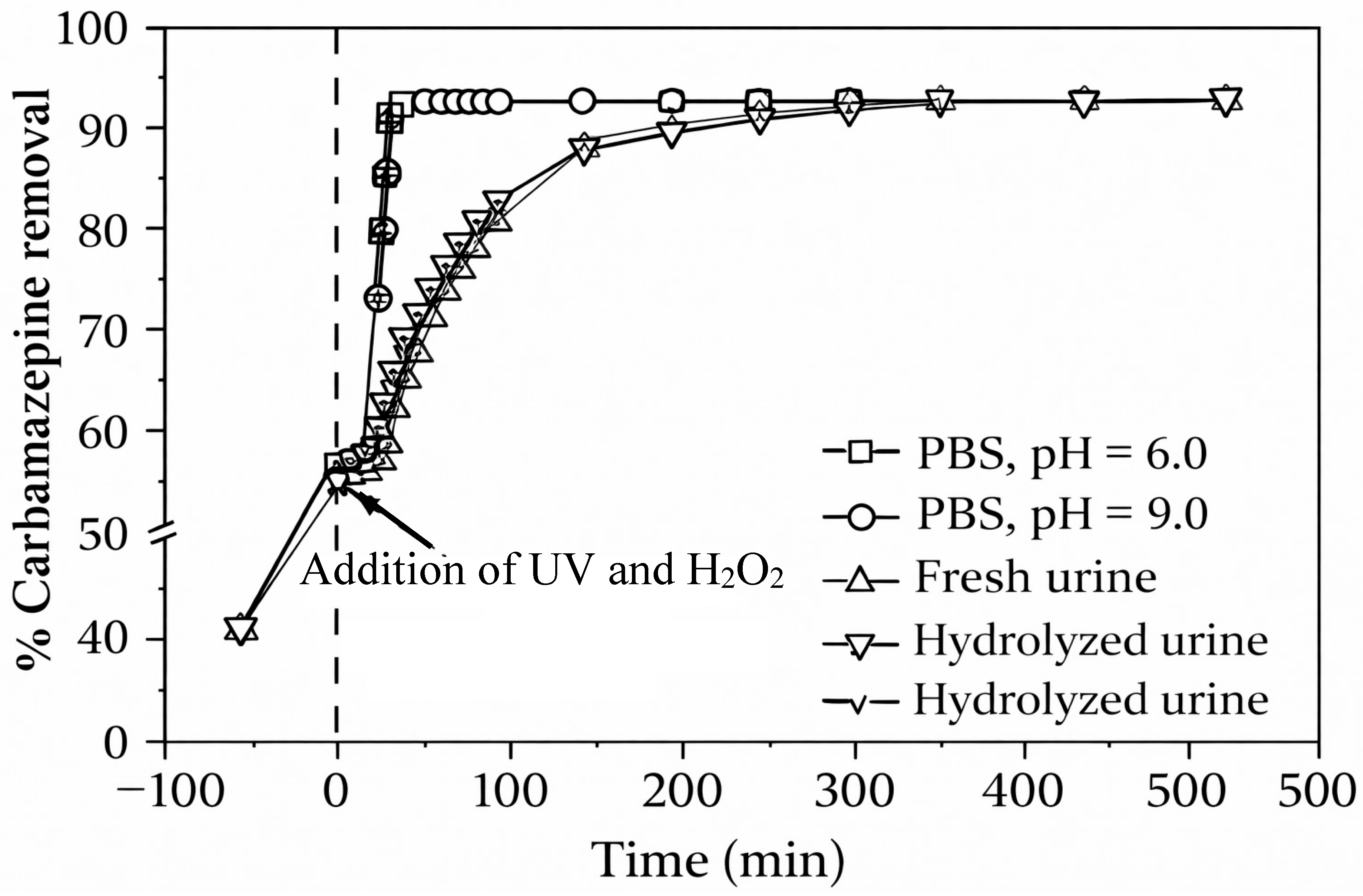
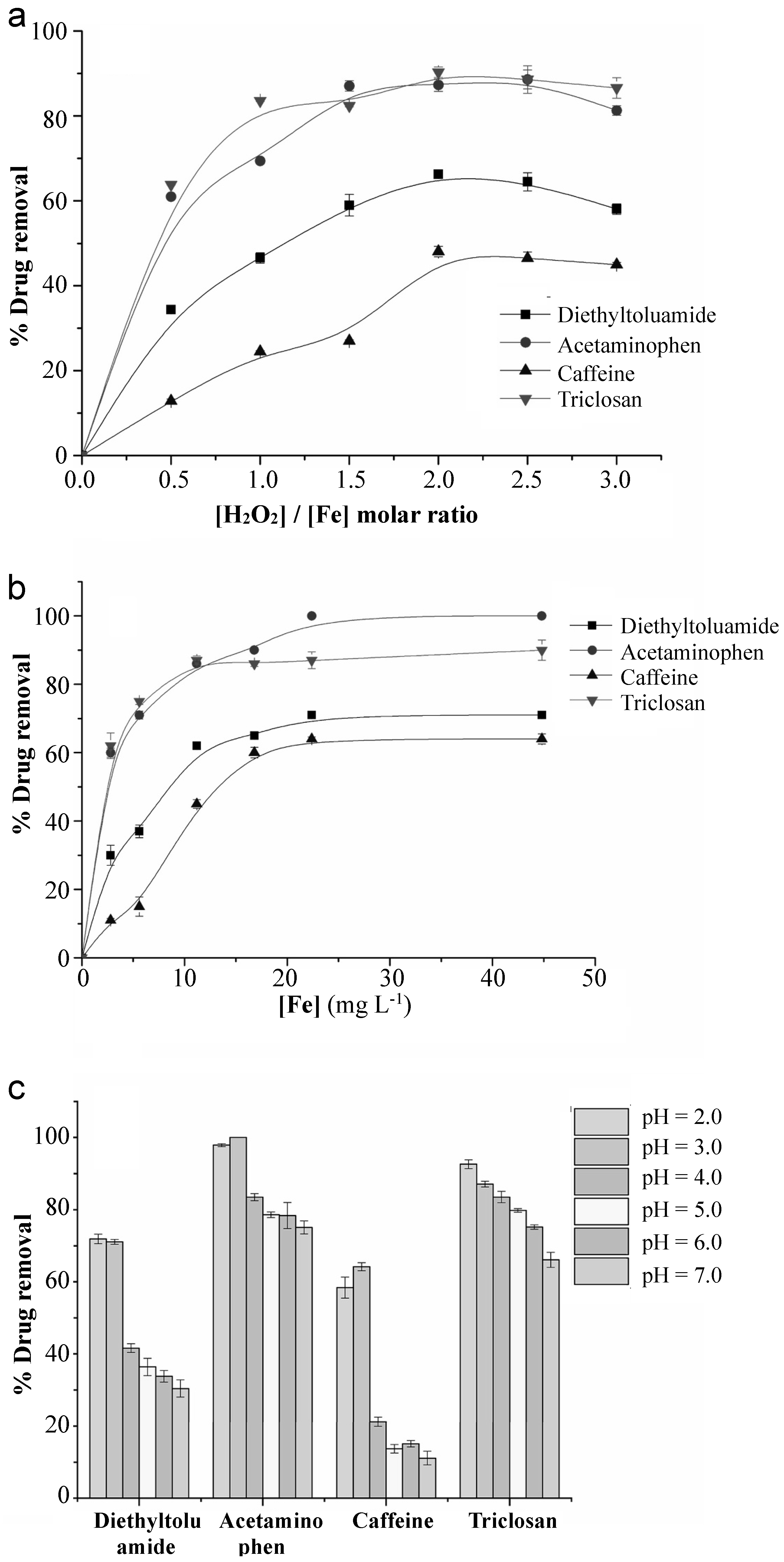


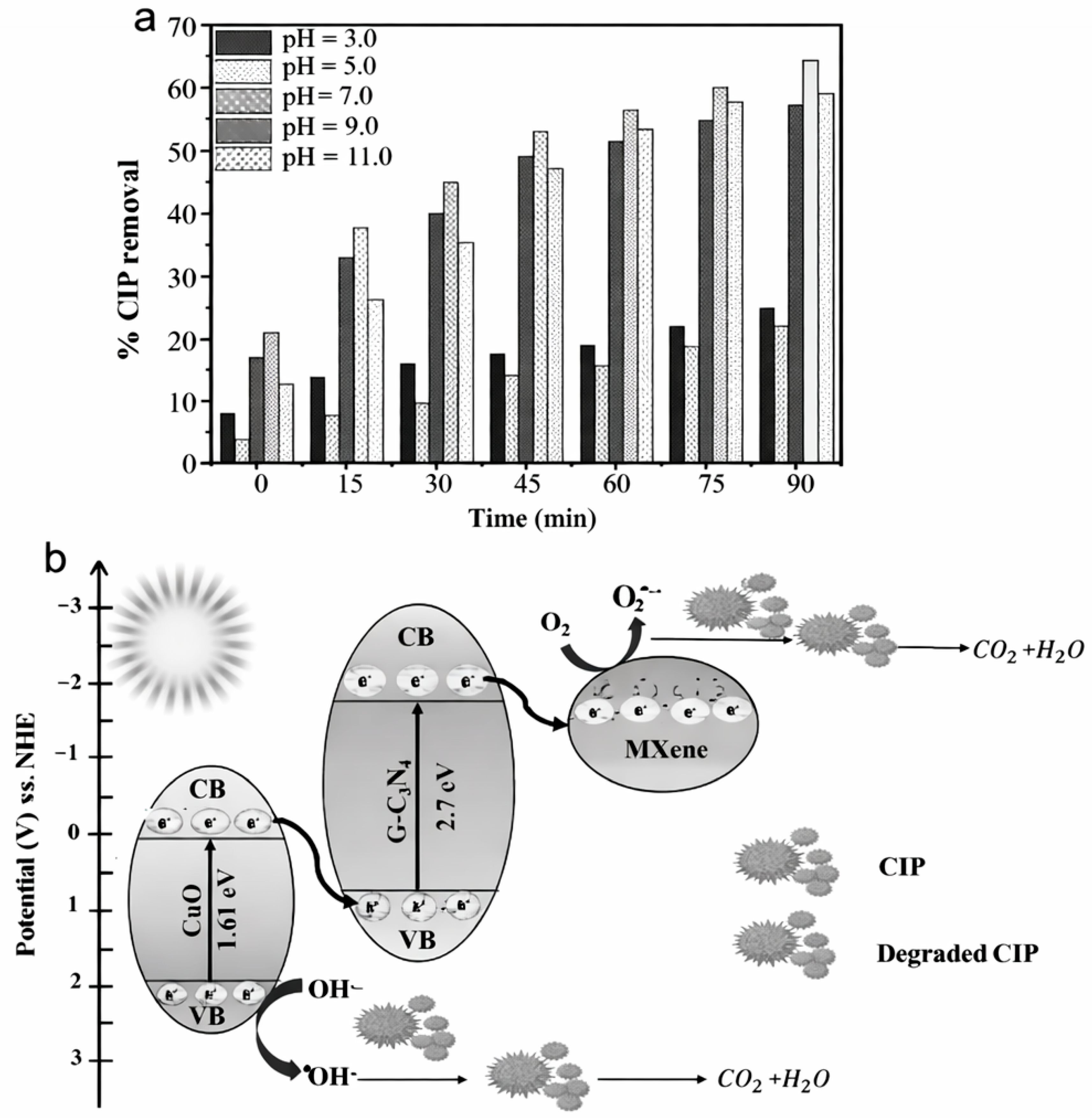


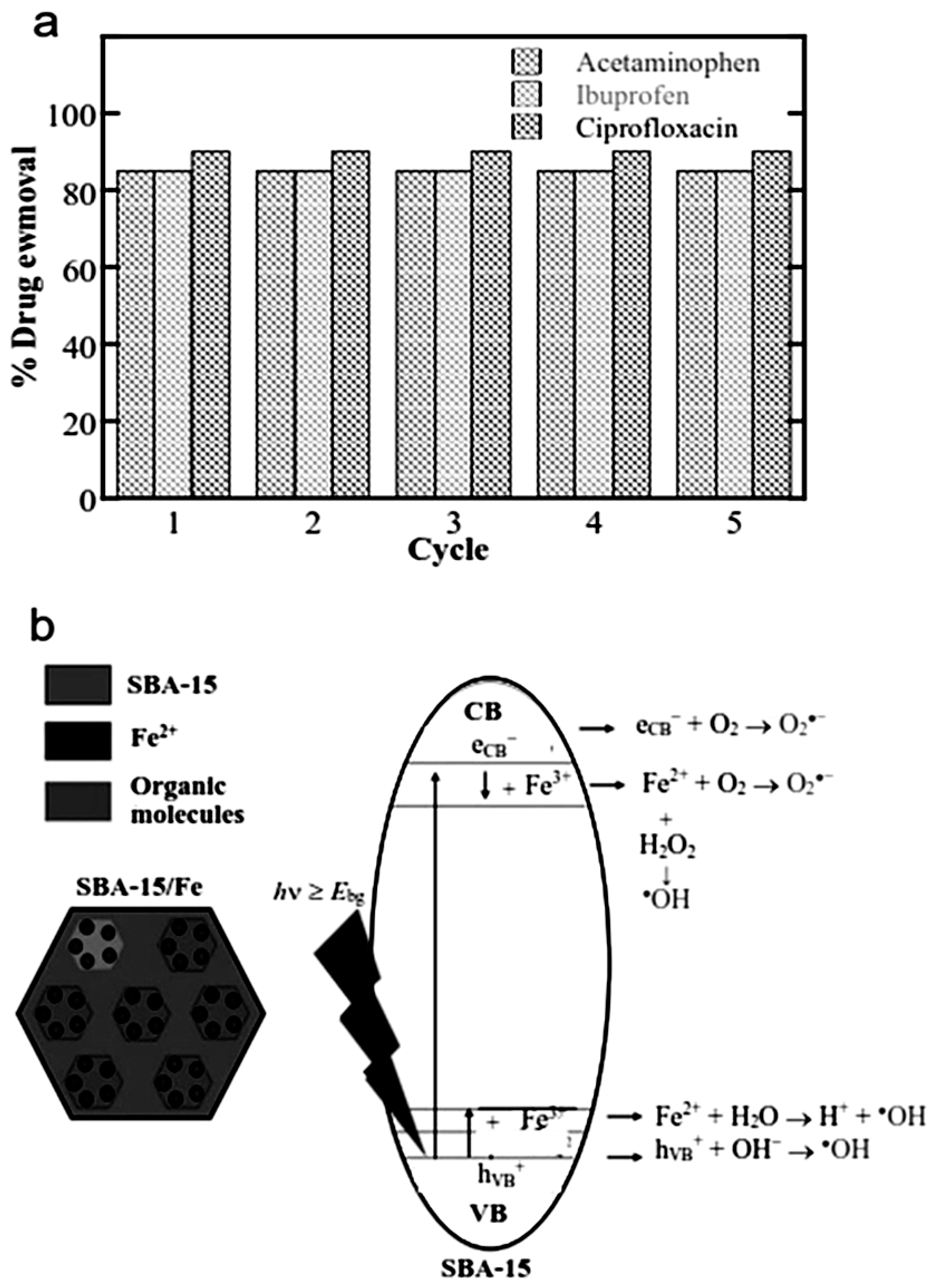
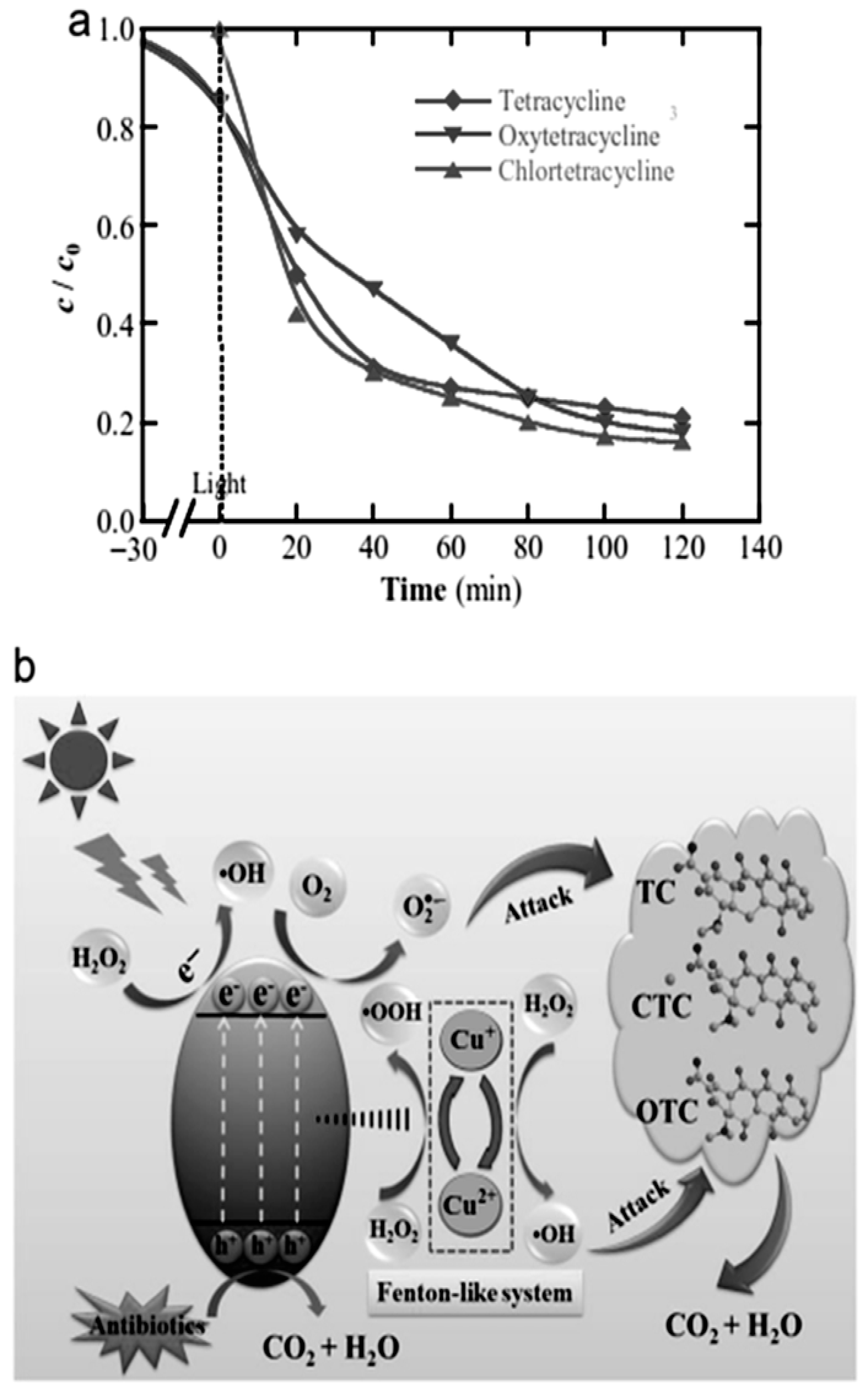
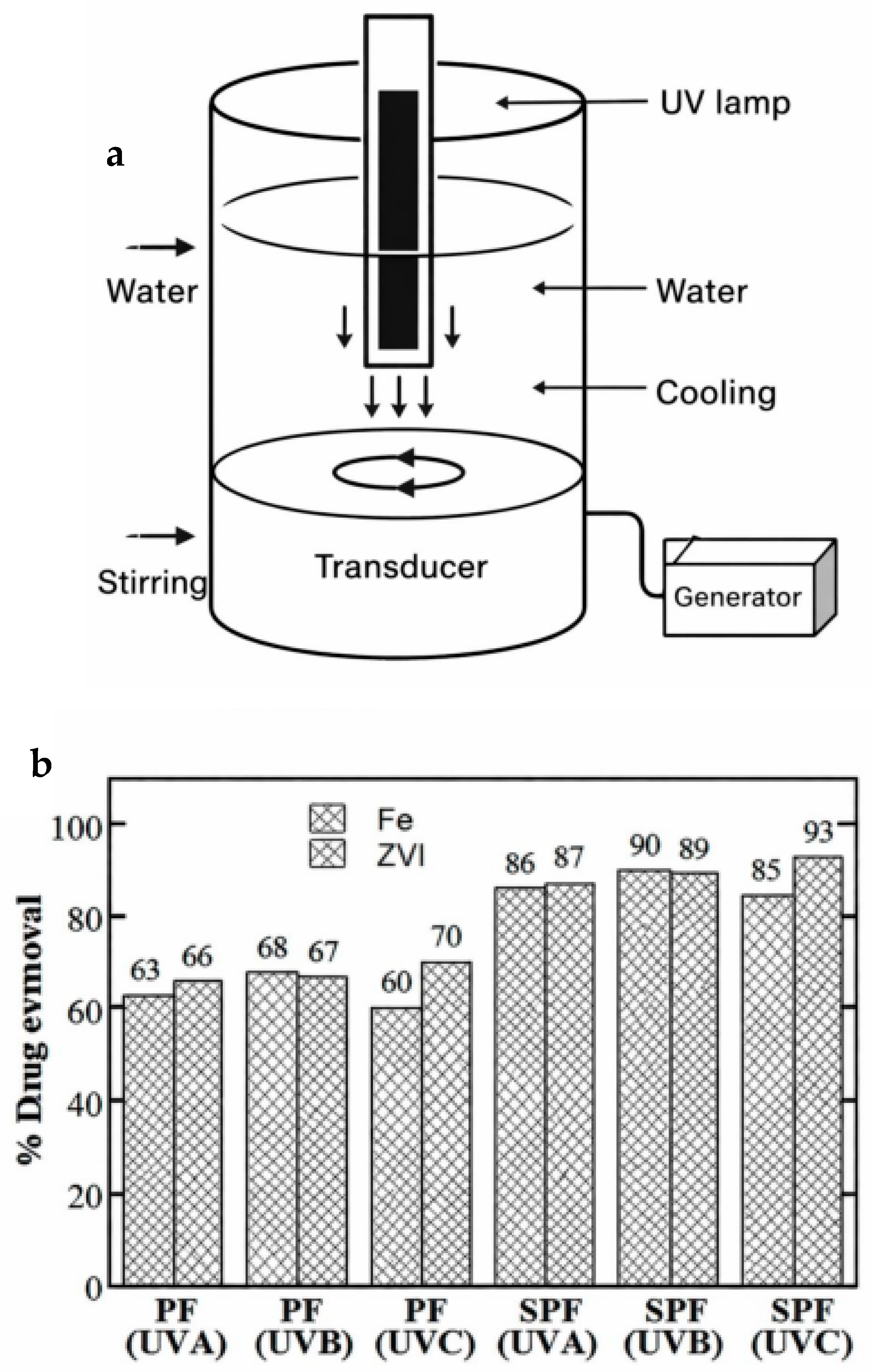
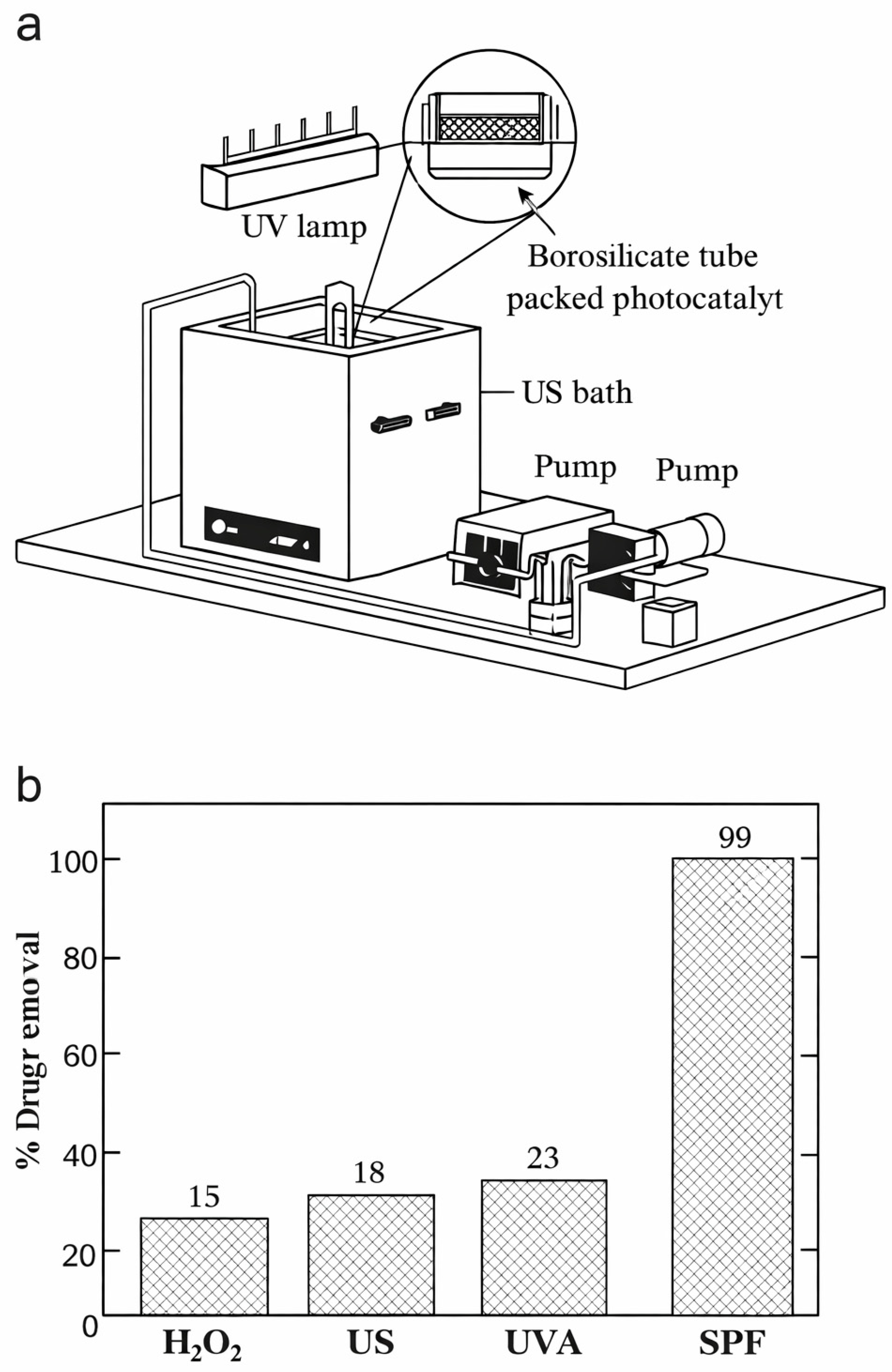
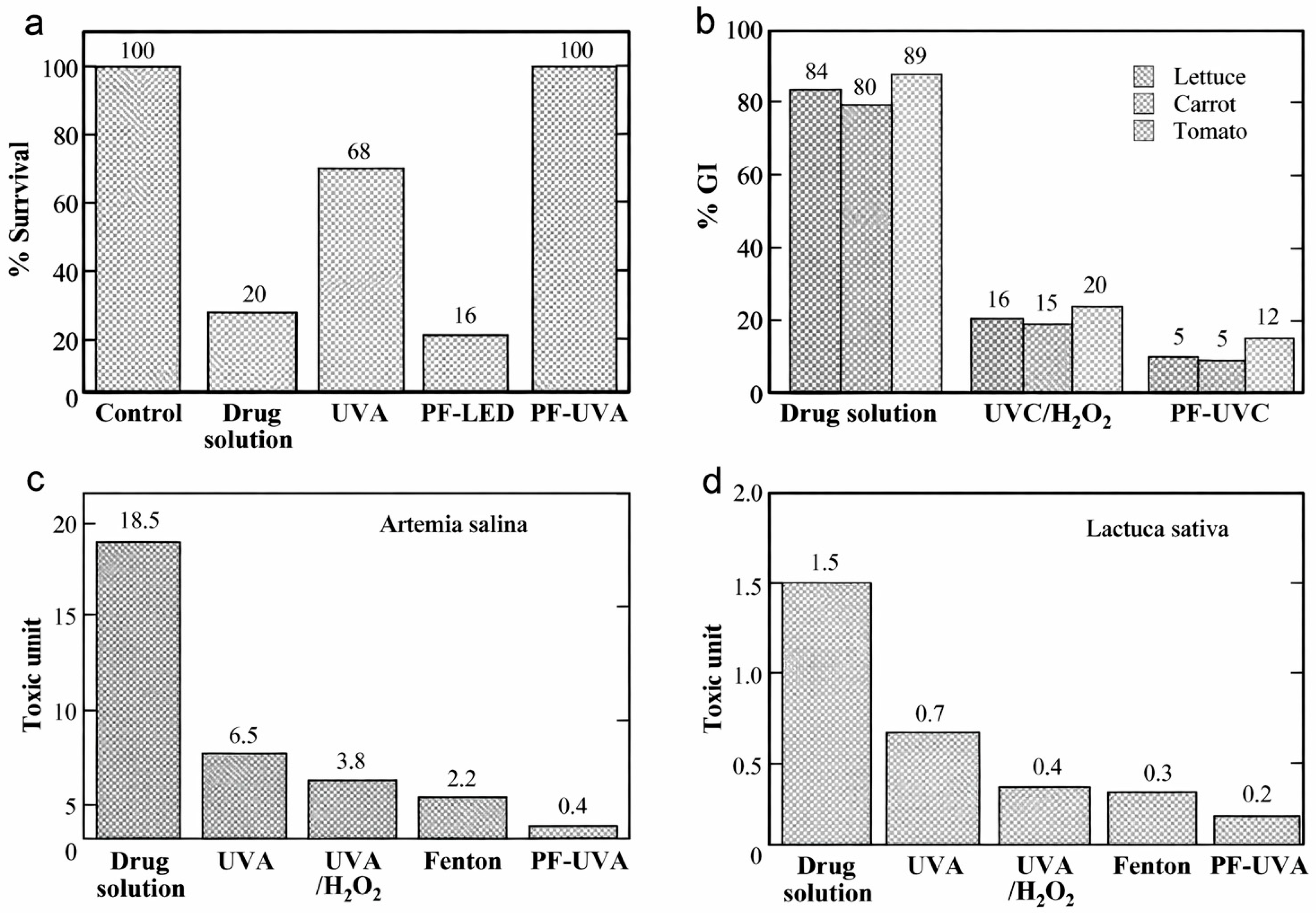

| Pollutant | System | Experimental Remarks | Best Results | Ref. |
|---|---|---|---|---|
| Homogeneous PF | ||||
| NSAIDs | ||||
| Acetaminophen | Stirred-tank photoreactor, H2O2, Fe2+, 15 W UVC | 100 mL of 1 mg L−1 drug in WWTP effluent, 0–107 mM H2O2, 0–29 μM Fe2+, pH = 7.2, 25 °C, 20 min | Overall degradation in 8 min with 21 mM H2O2 and 2.4 μM Fe2+ | [6] |
| Diclofenac | Stirred-tank photoreactor, H2O2, Fe2+, 80 W Vis-LED or 125/250 W UVA | 1 L with Vis-LED and 250 mL with UVA. 100 mg L−1 drug in pure water, 1 eq H2O2, 45 mg L−1 Fe2+, pH = 6.5. Room temperature for 330 min | 88% degradation for Vis-LED at 330 min and 78% degradation for UVA at 220 min | [7] |
| Antibiotics | ||||
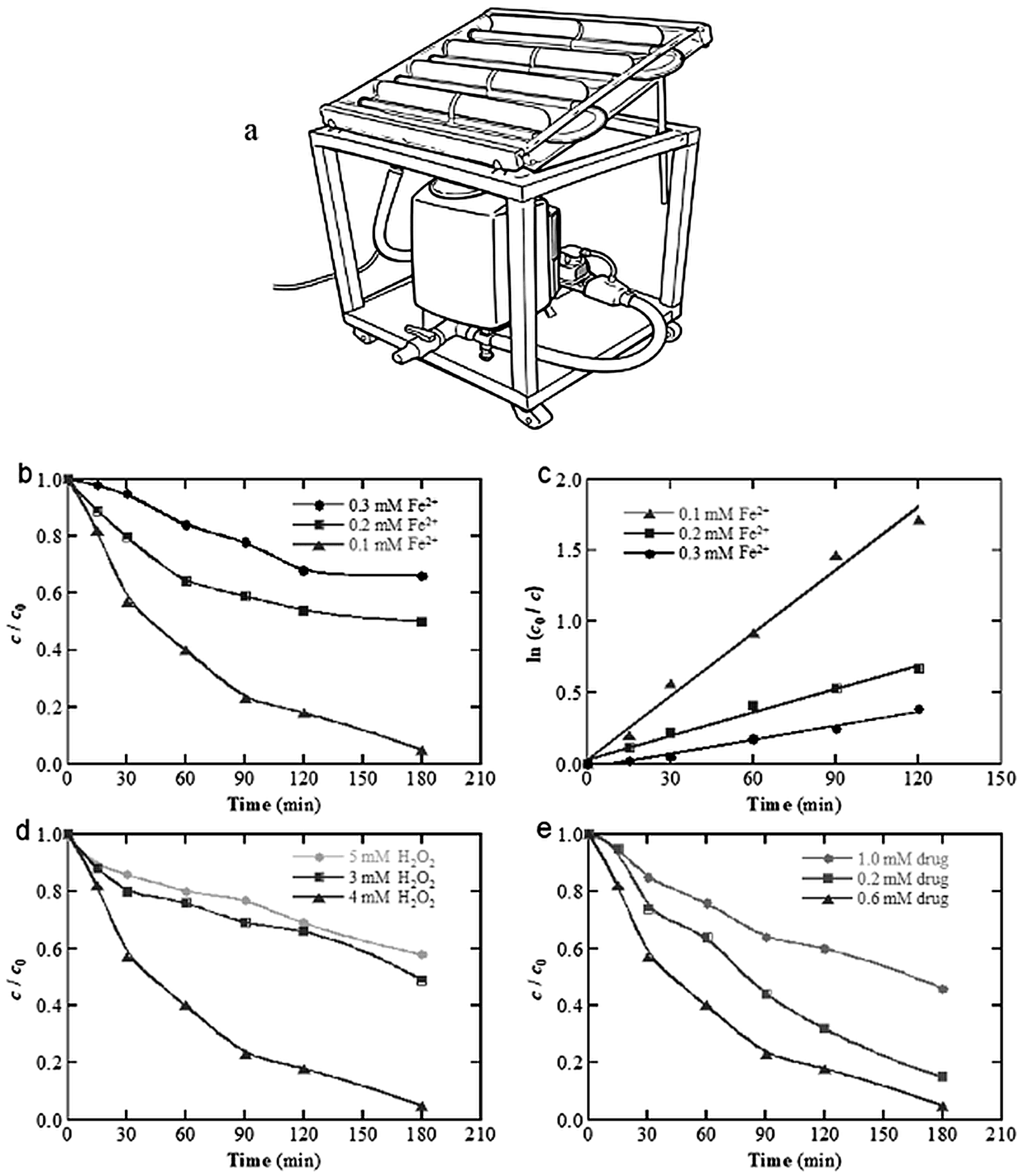
| Doxycycline | Pilot flow plant with solar CPC a photoreactor of Figure 2a, H2O2, Fe2+, sunlight | 4 L of 0.06 mM drug in pure water, 4 mM H2O2, 0.1 mM Fe2+, pH = 3.0. Room temperature, liquid flow rate = 30.6 L min−1, 180 min | 95% removal with k1 = 0.0142 min−1. 81% and 73% of COD and TOC reductions | [8] |
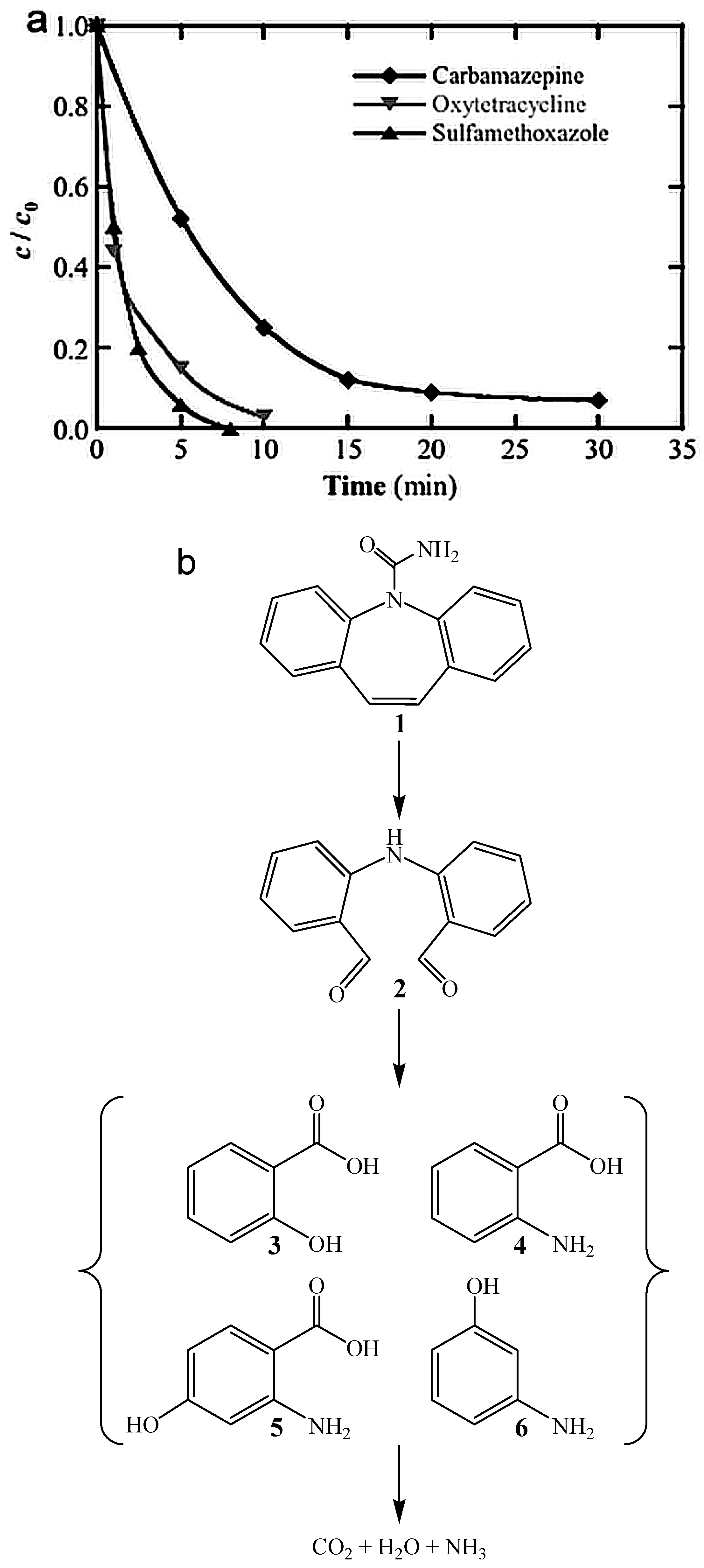
| Carbamazepine | Stirred-tank photoreactor, H2O2, Fe2+, 1500 W Xe | 200 mL of 1 mg L−1 drug in pure water, 0.75 mg L−1 H2O2, 0.15 mg L−1 Fe2+, pH = 3.0. 35 °C, 30 min | 93% decay with k1 = 0.0422 min−1 and 14% TOC removal. Detection of 5 by-products by LC-MS | [9] |
| Nitazoxanide | Stirred-tank photoreactor, H2O2, Fe2+, sunlight | 1 L of 1.5 mg L−1 drug in pure water and hospital wastewater, 55 mg L−1 H2O2, 10 mg L−1 Fe2+, pH = 2.8, room temperature, 105 min | Total degradation in 40 min for pure water and 105 min for hospital wastewater. Detection of 15 by-products by LC-QTOF-MS | [10] |
| Sulfamethoxazole | Stirred-tank photoreactor, H2O2, Fe2+, 150 W UV-Vis lamp (λ = 350–570 nm) | 1 L of 50 mg L−1 drug in pure water, 2 mM H2O2, 5 mg L−1 Fe2+, pH = 3.0, 30 °C, 30 min | Complete removal with k1 = 1.0379 min−1 in 8 min. Release of SO42− and NO3− | [11] |
| Oxytetracycline | Stirred-tank photoreactor, H2O2, Fe2+, 18 W UVA | 250 mL of 0.1 mM drug in pure water and WWTP effluent, 100 mg L−1 H2O2, 3 mg L−1 Fe2+, pH = 3.0, room temperature, 30 min | 97% abatement with k1 = 0.81 min−1 in 10 min for pure water and 95% decay with k1 = 0.59 min−1 in 15 min for WWTP effluent. 68% and 75% TOC reduction, respectively. Evolution of ●OH concentration | [12] |
| Other drugs | ||||
| Rosuvastatin | Stirred-tank photoreactor, H2O2, Fe2+, 35 W UVC | 20 mg L−1 drug in pure water, 0.3 mM H2O2, 0.1 mg L−1 Fe2+, pH = 3.0, room temperature, 120 min | Total degradation with k1 = 0.1764 min−1 in 15 min and 79% TOC removal in 120 min. Total cost = 13.0678 US$ m−3 | [13] |
| Mixture of drugs | ||||
| Lamivudine, Zidovudine | Stirred-tank photoreactor, H2O2, Fe2+, 96 W UVC, 20 W UVA, 300 W Xe | 50 mL of 15 mg L−1 of each drug in pure water, 600 mg L−1 H2O2, 0.5 mg L−1 Fe2+, pH = 2.0–3.0, room temperature, 60 min | 82% degradation of the mixture with UVC with k1 = 0.035 min−1 > 65% with k1 = 0.016 min−1 for photolysis | [14] |
| Diclofenac, Ketoprofen | Stirred-tank photoreactor, H2O2, Fe2+, 81 W UVA | 600 mL of 12.5 mg L−1 of each drug in domestic sewage, 10–30 mg L−1 H2O2, 3–15 mg L−1 Fe2+, pH = 3.0, 23 °C, 150 min | Optimization by response surface methodology = 78% COD and 62% BOD removals for 10 mg L−1 H2O2, and 15 mg L−1 Fe2+, for Fenton, 65% and 60%, respectively | [15] |
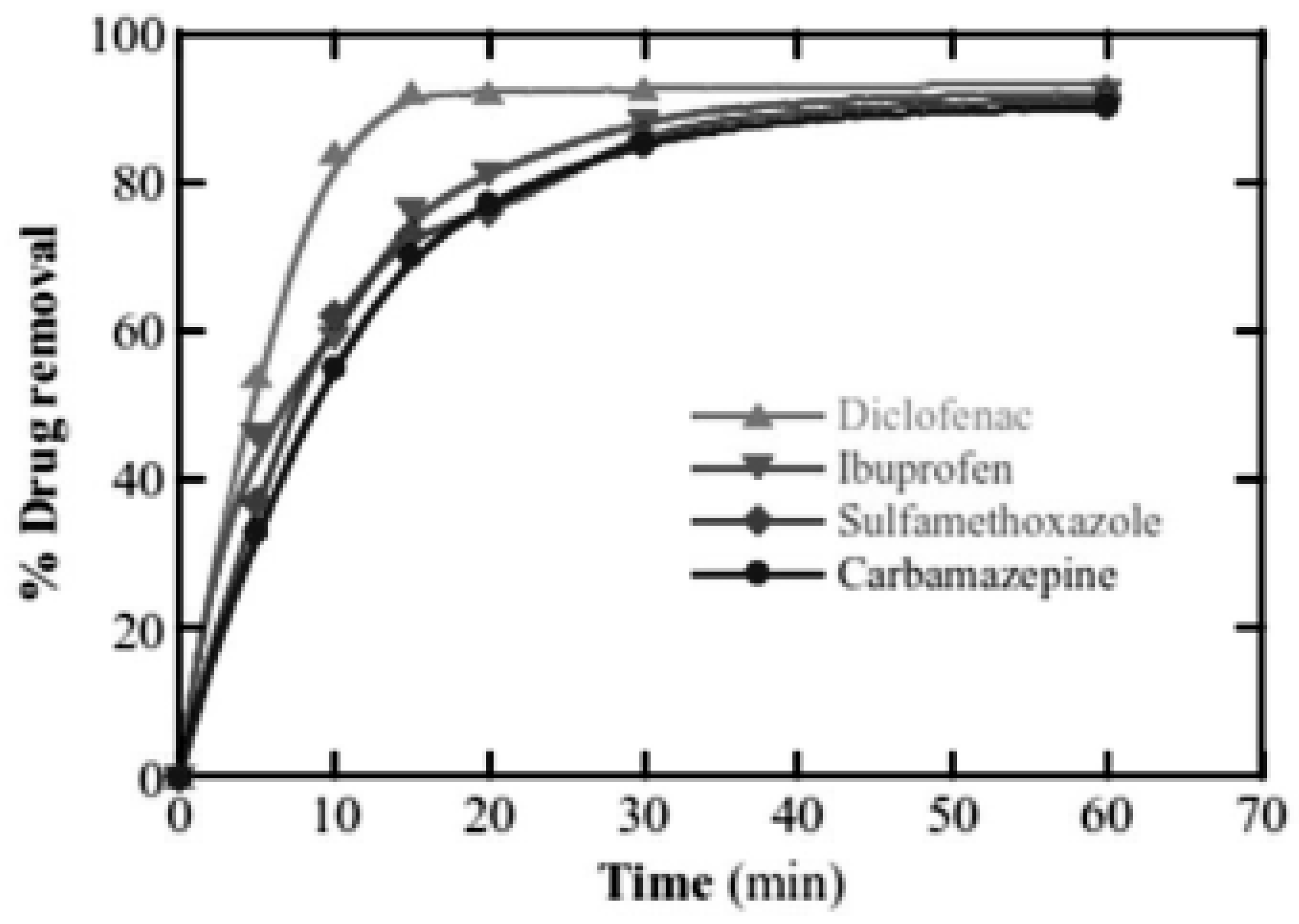
| Carbamazepine, Diclofenac, Ibuprofen, Sulfamethoxazole | Stirred-tank photoreactor, H2O2, Fe2+, 15 W UVC | 500 mL of 25 mg L−1 of each drug in pure water, 0,24 mL L−1 of concentrated H2O2, 20 times lower for Fe2+, pH = 3.0, 20 °C, 60 min | More than 90% degradation of all drugs | [16] |
| Diclofenac, Ranitidine, Simvastatin | Stirred-tank photoreactor, H2O2, Fe3+, 56 W UVA | 1.654 L of 50 μg L−1 of each drug in domestic sewage (TOC0 = 21 mg C L−1), 40 mg L−1 H2O2, 3 mg L−1 Fe3+, pH = 7.2, room temperature, 10 min | Degradation = 97% simvastatin < 100% for diclofenac and ranitidine. 72% mineralization | [17] |
| Real wastewaters | ||||
| Pharmaceutical wastewater | Stirred-tank photoreactor, H2O2, Fe2+, 80 W Xe | 1 L of wastewater (COD0 = 4000 mg O2 L−1), 1:10 Fe2+/H2O2, pH = 4.0, 35 °C, 60 min | 88% COD reduction | [18] |
| Homogeneous PF-like | ||||
| Antibiotics | ||||
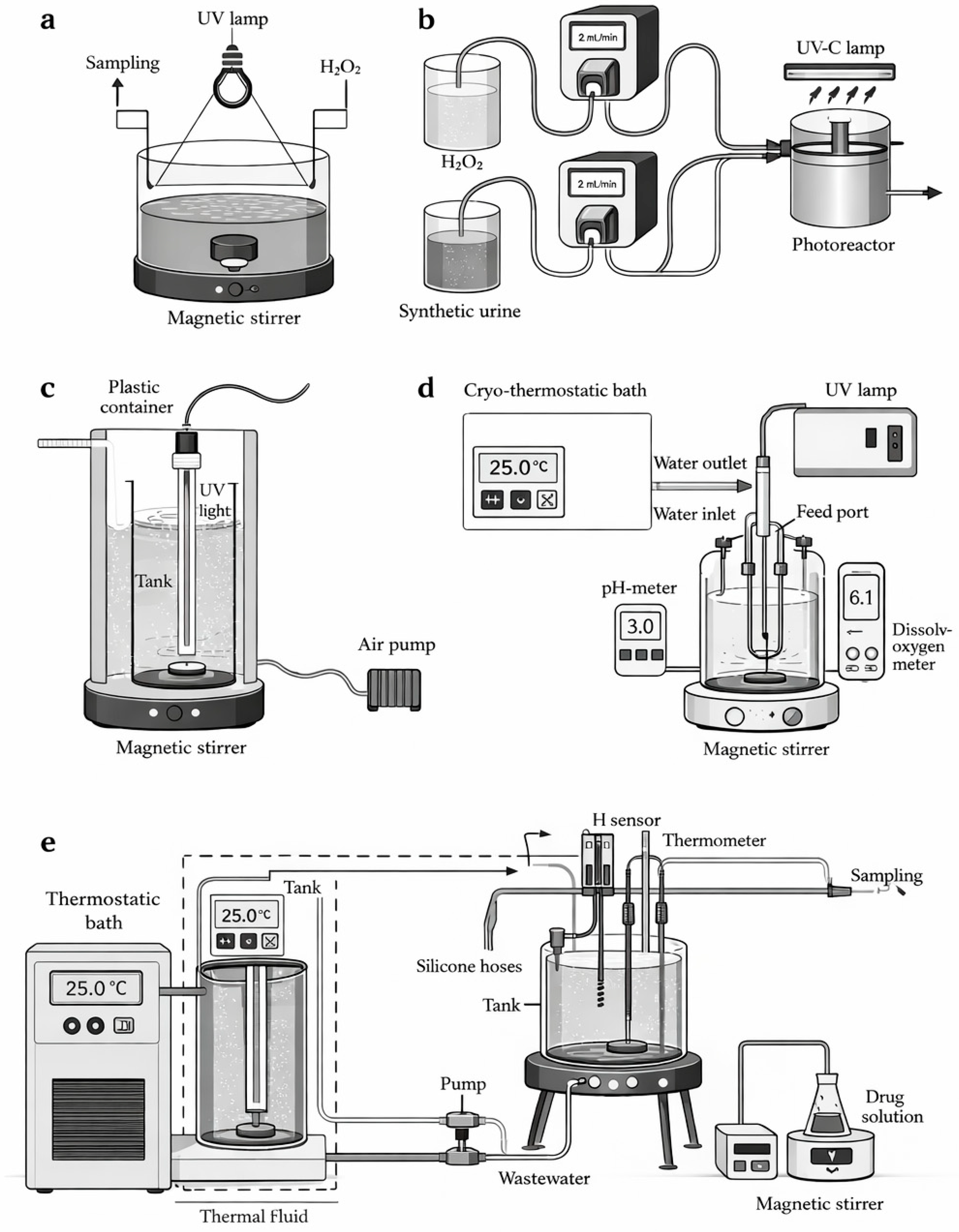
| Amoxicillin | Figure 1e, sodium percarbonate, Fe3+, UV-Vis (λ = 200–500 nm) | 3.6 L of 100 mg L−1 drug in pure water, 1.470 mM min−1 H2O2, 1.560 mM Fe3+, pH = 3.0, 35 °C, 120 min | Optimization by response surface methodology yielding 90% TOC removal | [19] |
| Mixture of drugs | ||||
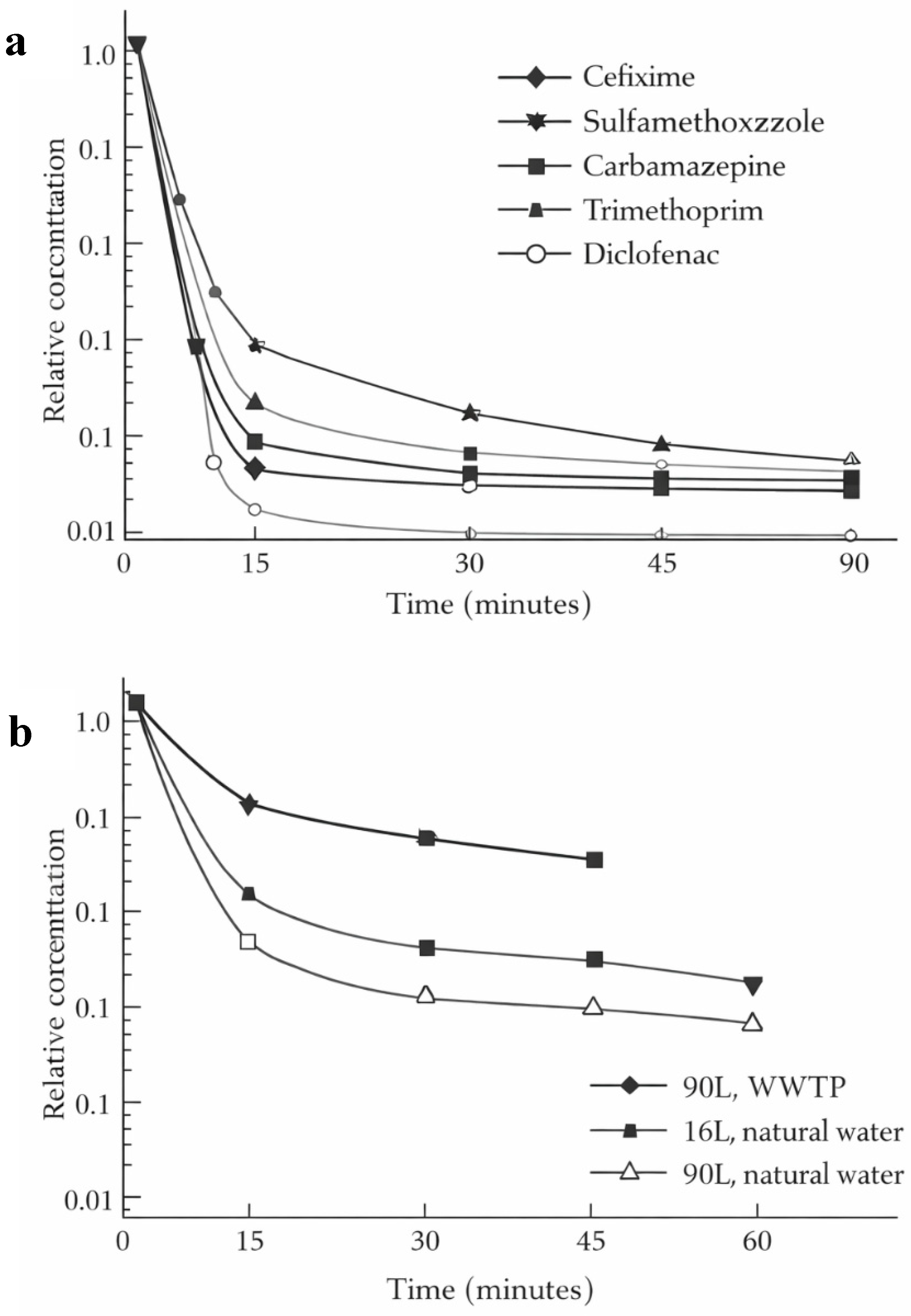
| Caffeine, Carbamazepine, Diclofenac, Sulfamethoxazole, Trimethoprim | Raceway pond photoreactor of Figure 5a, H2O2, Fe(III)-EDDS b, sunlight | 100 μg L−1 of each drug in WWTP effluent (TOC0 = 15,5 mg C L−1), 50 mg L−1 H2O2, 0.1 mM Fe3+, 0.1 mM EDDS, pH = 7.6, room temperature, 60 min | Degradation = 87% for caffeine <92% for sulfamethoxazole and carbamazepine <97% for trimethoprim <100% at 45 min for diclofenac | [20] |
| Diclofenac, Ibuprofen | Stirred-tank photoreactor, H2O2, Fe(III)-EDDS, Fe(III)-NTA c, 32 W fluorescent bulb | 500 mL of 200 μg L−1 of each drug in WWTP effluent (TOC0 = 2.5 mg C L−1), 1.47 mM H2O2, 0.1 mM Fe3+, 0.1 mM EDDS, 0.1 mM NTA, pH = 6.3, room temperature, 360 min | Degradation = 90% and 48% for diclofenac, and 95% and 47% for ibuprofen using Fe(III)-EDDS and Fe(III)-NTA. Detection of 2 and 1 by-products for diclofenac and ibuprofen, respectively | [21] |
| Benzotriazole, Carbamazepine, Diclofenac | Raceway pond photoreactors of Figure 5a,b, H2O2, Fe(III)-citrate, 30 W cm−2 Xe (λ > 290 nm) | 100 μg L−1 of each drug in WWTP effluent (TOC0 = 25 mg C L−1), 40 mg L−1 H2O2, 6 mg L−1 Fe3+, 12 mg L−1 citric acid, pH = 6.3, room temperature, 45 min | About 25% removal for benzotriazole and carbamazepine <60% for diclofenac with WWTP effluent | [22] |
| Carbamazepine, Diclofenac, Naproxen, Sulfamethoxazole, Trimethoprim | Stirred-tank photoreactor, peracetic acid, Fe2+. 9 W UVA | 200 mL of 1 μM of each drug in pure water, 25 μM peracetic acid, 2.5 μM Fe3+, pH = 4.0, 25 °C, 15 min | Degradation = 30% for sulfamethoxazole <45% for carbamazepine <62% for trimethoprim, and <100% for naproxen and diclofenac. Corresponding k1-values = 0.02, 0.04, 0.06, 0.30, and 0.36 min−1. FeIVO2+ and ●OH as oxidants detected by specific scavengers | [23] |
| Real wastewaters | ||||
| WWTP effluent | Stirred-tank photoreactor, H2O2, Fe3+. humic acid, 32 W fluorescent bulb | 250 mL of WWTP effluent (TOC0 = 82.1 mg C L−1), 100 mg L−1 H2O2, 1:6.8 Fe3+/humic acid, pH = 7.4, room temperature, 30 min | Removal of between 8.5% and 56% of all drugs. 31% TOC reduction | [24] |
| Heterogeneous PF | ||||
| NSAIDs | ||||
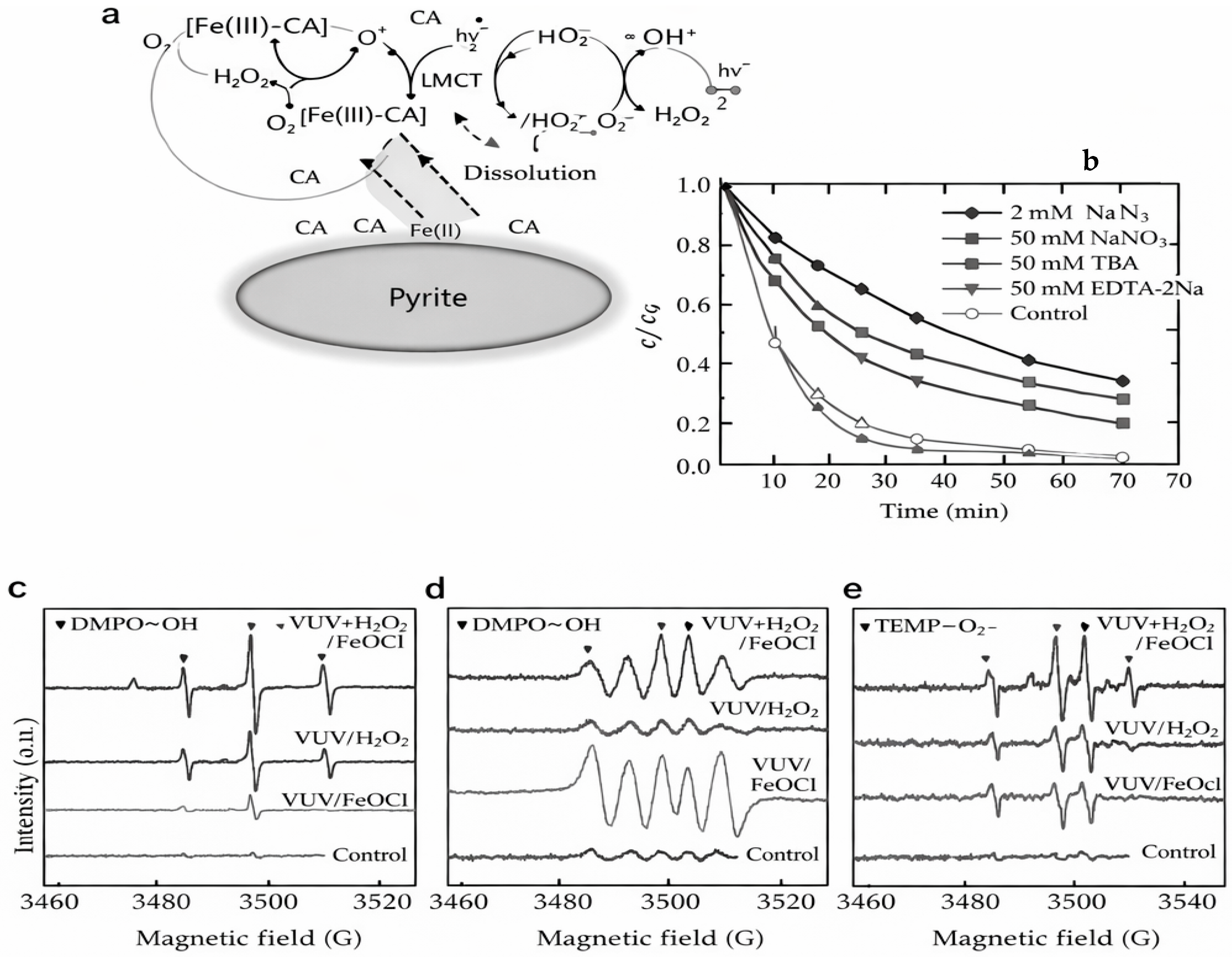
| Acetaminophen | Stirred-tank photoreactor, H2O2 generated, pyrite catalyst, citric acid, 70 W Xe (λ > 350 nm) | 250 mL of 30 μM drug in pure water, 1 g L−1 pyrite, 0.6 mM citric acid, pH = 6.0. 25 °C, 30 min | Total drug removal, 27 μM of Fe released and 75% citric acid destroyed. ●OH as oxidant detected by specific scavengers. Moderate reusability, losing 18% degradation after 4 consecutive cycles | [25] |
| Acetaminophen | Stirred-tank photoreactor, H2O2, chitosan/Fe3O4 catalyst, 15 W UVC | 100 mL of 5–100 mg L−1 drug in pure water, 50–400 mg L−1 H2O2, 5–100 mg L−1 catalyst, pH = 2.0–6.0. 26–60 °C, 60 min | 95% abatement for 10 mg L−1 drug, 200 mg L−1 H2O2, 20 mg L−1 catalyst, pH = 2.0, and 26 °C. Ea = 36.3 kJ mol−1. Moderate reusability, losing 20% degradation after 4 consecutive cycles | [26] |
| Antibiotics | ||||
| Carbamazepine | Figure 1b, H2O2. ceramic membrane/FeOCl catalyst, 1.6 mW cm−2 UVC | 10 μM drug in fresh synthetic urine (pH = 6) and hydrolyzed urine (pH = 9), 8 mM H2O2, 0.2 cm of membrane, room temperature, liquid flow rate = 2 mL min−1 | Total removal after 360 min in both matrices. ●OH as oxidant | [27] |
| Imidacloprid | Stirred-tank photoreactor, H2O2. ZVI catalyst, sunlight | 2 L of 1 mg L−1 drug in natural water, 3 mM H2O2, 55.8 mg L−1 catalyst, pH = 7.4, room temperature, 180 min | 86% degradation with k1 = 0.0110 min−1 | [28] |
| Sulfamethazine | Stirred-tank photoreactor, H2O2. perylene diimide/Fe catalyst, 100 W halogen lamp | 200 mL of 10 mg L−1 drug in pure water, 5–10 mM H2O2, 0.1–1 mg L−1 catalyst, pH = 3.0–7.0, 25 °C, 120 min | Optimization by response surface methodology = 92% abatement for 6.46 mM H2O2, 0.45 mg L−1 catalyst, and pH = 3.0. 1.344 mg L−1 Fe leached. ●OH as oxidant detected by specific scavengers | [29] |
| Mixture of drugs | ||||
| Acetaminophen, Caffeine, Diethyltoluamide, Triclosan | Stirred-tank photoreactor, H2O2, ZVI catalyst, 11 W UVC | 500 mL of 2 μg L−1 of each drug in natural water, 0.2 mM H2O2, 0.4 mM catalyst, pH = 3.0, 25 °C, 30 min | Removal at pH = 3.0 = 98% for acetaminophen >86% for triclosan >70% for diethyltoluamide, and >65% for caffeine. 19% TOC reduction | [30] |
| Heterogeneous PF-like | ||||
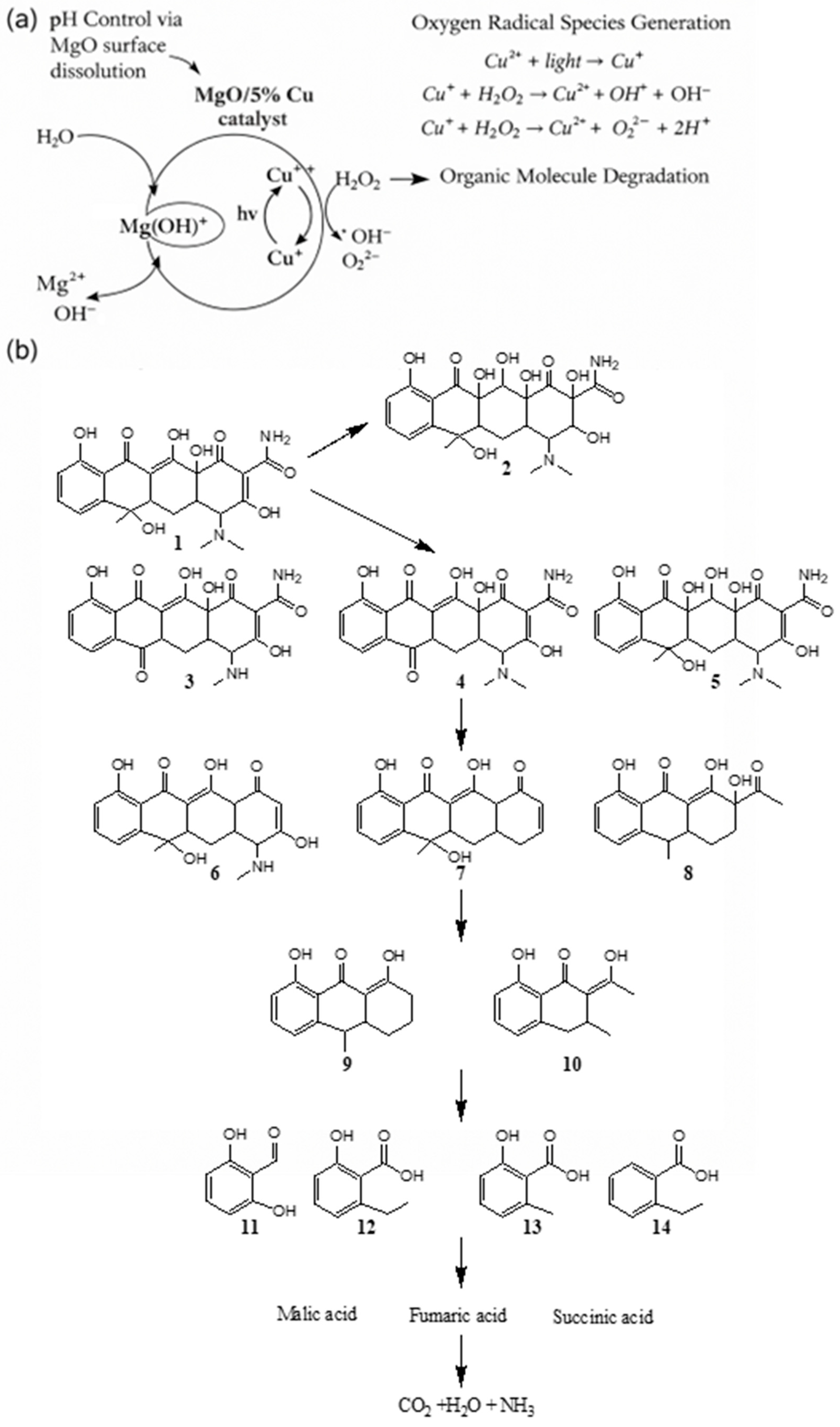
| Tetracycline | Stirred-tank photoreactor, H2O2, MgO/5% Cu catalyst, 350 W Xe | 100 mL of 25 mg L−1 drug in pure water, 60 mM H2O2, 500 mg L−1 catalyst, natural pH, 25 °C, 125 min | Total removal in 5 min. Release of 40.7 mg L−1 of Mg2+, Detection of oxidants ●OH and O2●− by specific scavengers, Identification of 16 by-products by LC-MS | [31] |
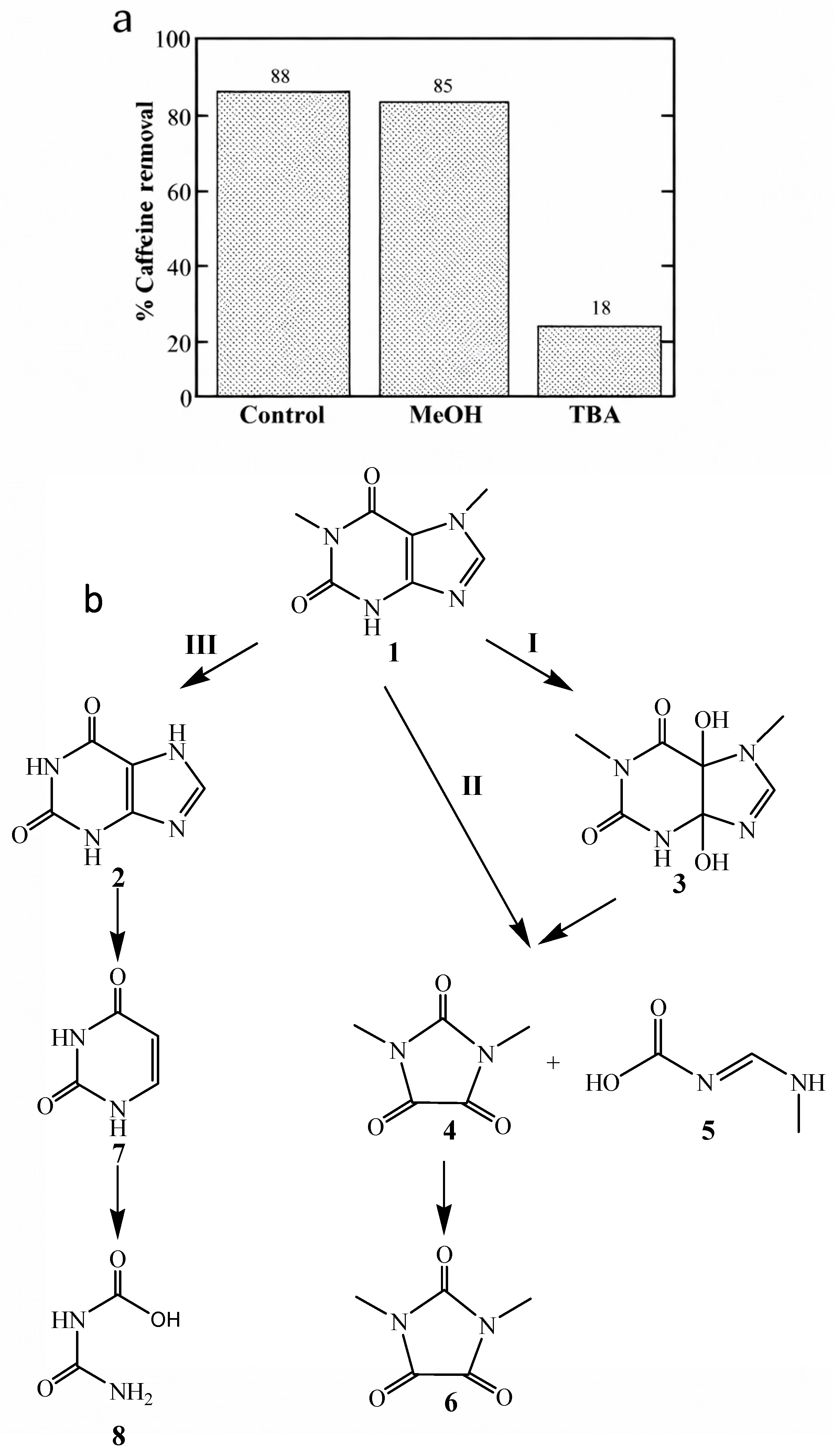
| Caffeine | Stirred-tank photoreactor, peracetic acid, MnFe2O4 catalyst, 4 W VUV lamp (λ = 185 nm) | 0.5 mg L−1 drug in pure water, 2 mM peracetic acid, 250 mg L−1 catalyst, pH = 7.0, 25 °C, 20 min | 88% abatement with k1 = 0.243 min−1 in 8 min. Detection of oxidants ●OH and CH3CO3● by specific scavengers and EPR. 7 by-products identified by LC-MS. Moderate reusability with a loss of 10% degradation after 5 successive runs | [32] |
| Pollutant | System | Experimental Remarks | Best Results | Ref. |
|---|---|---|---|---|
| PC/PF | ||||
| NSAIDs | ||||
| Acetaminophen | Stirred-tank photoreactor, H2O2, MIL-53(Fe) photocatalyst, 300 W Xe (λ > 400 nm) | 100 mL of 20 mg L−1 drug in pure water, 3–10 mM H2O2, 100 mg L−1 photocatalyst, pH = 7.0. 25 °C, 60 min | 96% removal with k1 = 0.085 min−1 for 7 mM H2O2. Leaching of 1.3 mg L−1 Fe, and detection of ●OH and O2●− as oxidants by specific scavengers and EPR; 8 by-products identified by GC-MS. Good reusability, losing 4% degradation after four consecutive cycles | [79] |
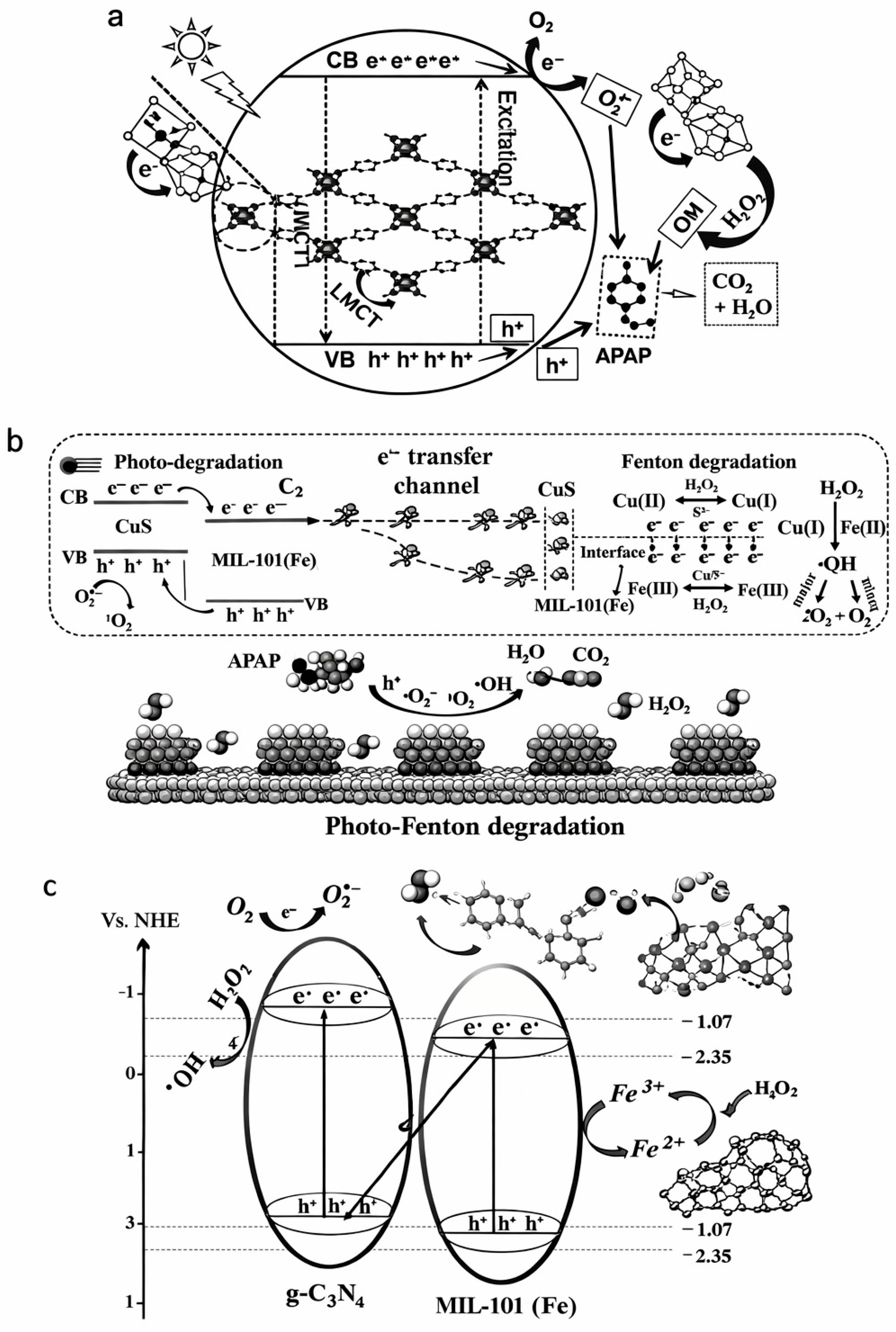
| Acetaminophen | Stirred-tank photoreactor, H2O2, CuS/MIL-101(Fe) photocatalyst, 300 W Xe | 100 mL of 5 mg L−1 drug in pure water, 10 mM H2O2, 100 mg L−1 photocatalyst, pH = 3.0–11.0. 25 °C, 30 min | Complete abatement with k1 = 0.2099 min−1 at pH = 5.0. ●OH, O2●−, and 1O2 as oxidants detected by specific scavengers and EPR, with seven by-products identified by LC-MS. Moderate reusability with a loss of 10% degradation after five successive runs | [80] |
| Acetaminophen | Stirred-tank photoreactor, H2O2, Fe-BiOBr photocatalyst, sunlight | 100 mL of 15 mg L−1 drug in pure water, 10 mM H2O2, 250 mg L−1 photocatalyst, pH = 3.0, room temperature, 240 min | Overall degradation and 58% TOC removal. ●OH and O2●− as oxidants detected by specific scavengers | [81] |
| Phenazopyridine | Stirred-tank photoreactor, H2O2, g-C3N4/MIL-101(Fe) membrane photocatalyst, 100 W Vis-LED | 60 mL of 15 mg L−1 drug in pure water, 60 μM concentrated H2O2, 250 mg L−1 photocatalyst, pH = 6.5, room temperature, 70 min | 97% removal. Detection of ●OH and O2●− as oxidants detected by specific scavengers. Identification of 10 by-products by LC-MS. Good reusability with a loss of 8% degradation after five successive steps | [82] |
| Antibiotics | ||||
| Norfloxacin | Stirred-tank photoreactor, H2O2, Fe2O3/Pt/TiO2 photocatalyst, 300 W fluorescent lamp | 20 mL of 4 mg L−1 drug in pure water, 50 mM H2O2, 50 mM Na2SO4, 1 cm−2 photocatalyst, pH = 6.7, 25 °C, 30 min of previous dark, 120 min | 88% removal. ●OH and O2●− as oxidants. Moderate reusability, losing 10% degradation after five successive steps | [83] |
| Ciprofloxacin | Stirred-tank photoreactor, H2O2, MIL-100(Fe) photocatalyst, 300 W Xe (λ > 420 nm) | 50 mL of 20 mg L−1 drug in pure water, 4 mg L−1 H2O2, 100 mg L−1 photocatalyst, pH = 6.4, 25 °C, 30 min of previous dark, 120 min | 94% degradation and 68% TOC reduction. ●OH as the main oxidant detected by specific scavengers and EPR. Moderate reusability with a loss of 10% degradation after five consecutive cycles | [84] |
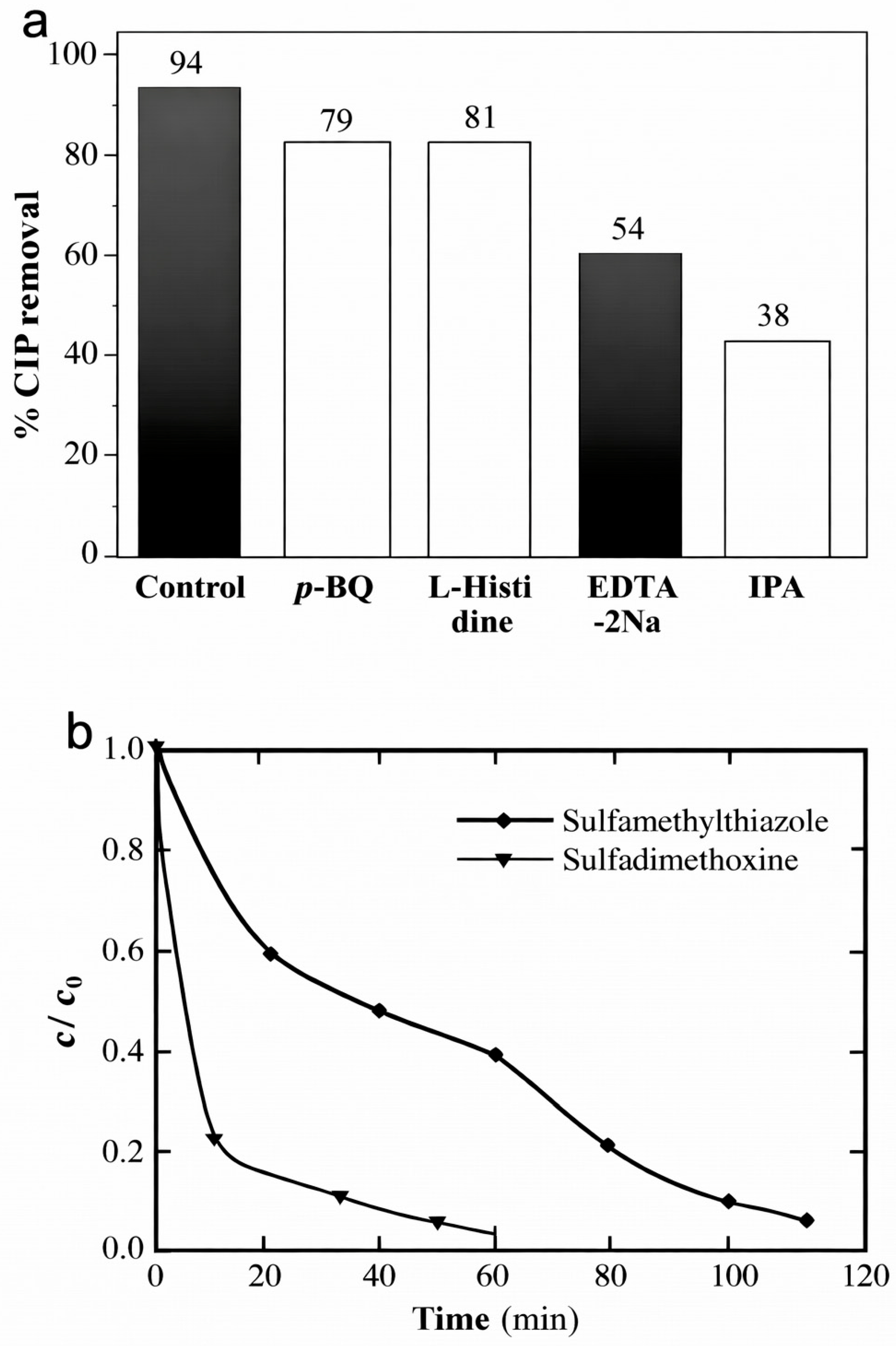
| Sulfadimethoxine | Stirred-tank photoreactor, H2O2, MIL-53(Fe) photocatalyst, 300 W Xe (λ > 400 nm) | 30 mL of 20 mg L−1 drug in pure water, 20 μL concentrated H2O2, 165 mg L−1 photocatalyst, pH = 7.0, 25 °C, 60 min of previous dark, 50 min | Complete abatement. ●OH, O2●−, 1O2, and holes detected as oxidants by specific scavengers and EPR. Identification of 7 by-products by LC-QTOF-MS. Moderate reusability, losing 10% degradation after 4 consecutive runs | [85] |
| Sulfamethylthiazole | Stirred-tank photoreactor, H2O2, MIL-100(Fe) photocatalyst, 300 W Xe | 20 mL of 10 mg L−1 drug in pure water, 38.8 mM H2O2, 5 g L−1 photocatalyst, pH = 6.8, 25 °C, 100 min | 98% decay with k1 = 0.0315 min−1. ●OH, O2●−, and 1O2 detected as oxidants by EPR. Identification of 14 by-products by LC-MS. Good reusability with a loss of 8% degradation after three successive runs | [86] |
| Ciprofloxacin | Stirred-tank photoreactor, H2O2, g-C3N4/MXene/CuO photocatalyst, 400 W sodium lamp (λ > 400 nm) | 100 mL of 5–30 mg L−1 drug in pure water, 10–40 μL concentrated H2O2, 5–30 mg L−1 photocatalyst, pH = 3.0–11.0, room temperature, 90 min | 87% abatement with k1 = 0.0178 min−1 for 10 mg L−1 drug. 20 μL concentrated H2O2, 10 mg L−1 photocatalyst, and pH = 9.0. ●OH, O2●−, and mainly holes detected as oxidants by specific scavengers. Good reusability, losing 7% degradation after four successive cycles | [87] |
| Sulfadimethoxine | Stirred-tank photoreactor, H2O2, g-C3N4/Cu photocatalyst, 300 W Xe | 20 mL of 20 mg L−1 drug in pure water, 1.65 mM H2O2, 1 g L−1 photocatalyst, pH = 10.0, room temperature, 50 min | Overall decay. ●OH, O2●−, and 1O2 detected as oxidants by specific scavengers and EPR | [88] |
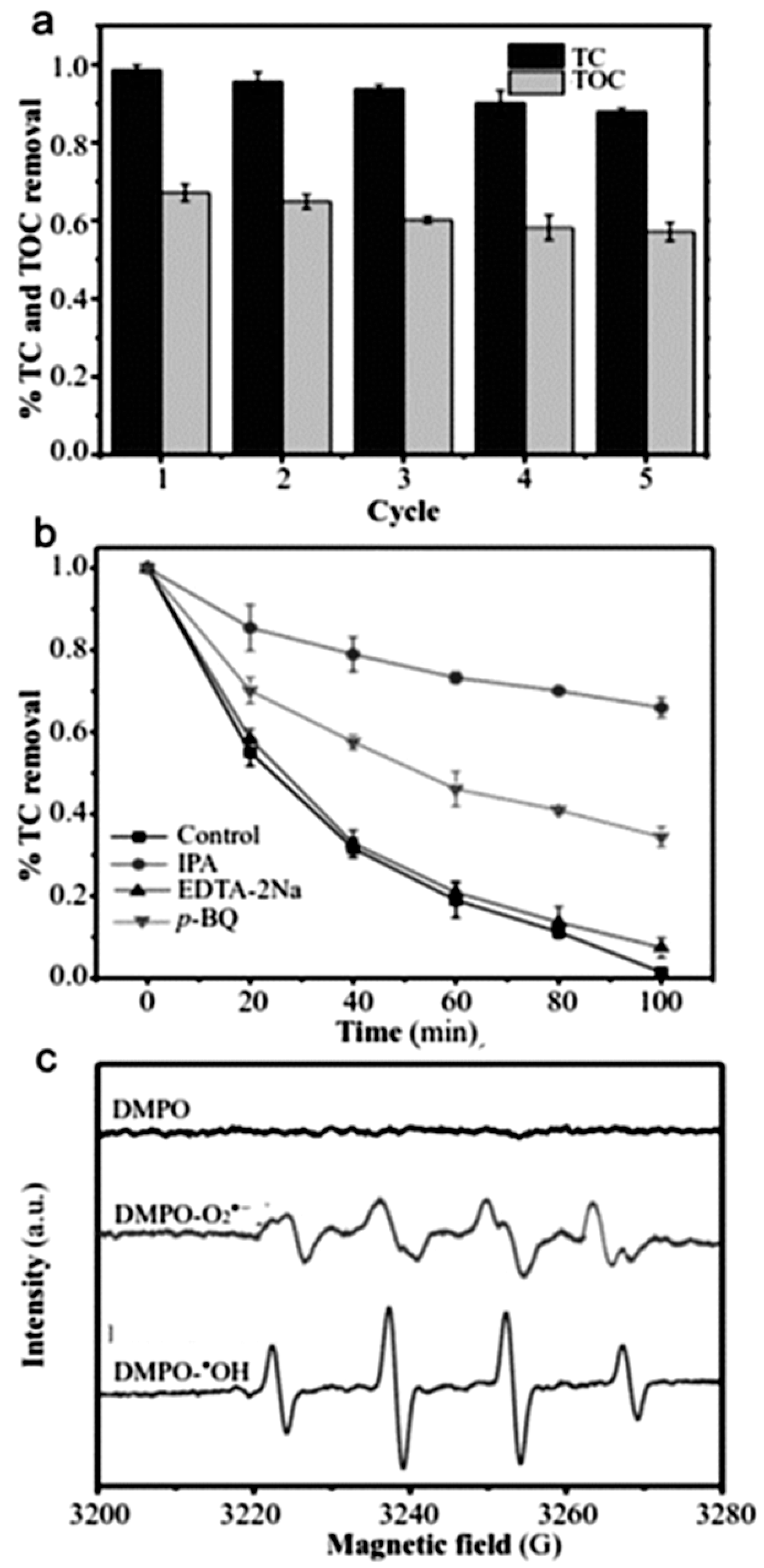
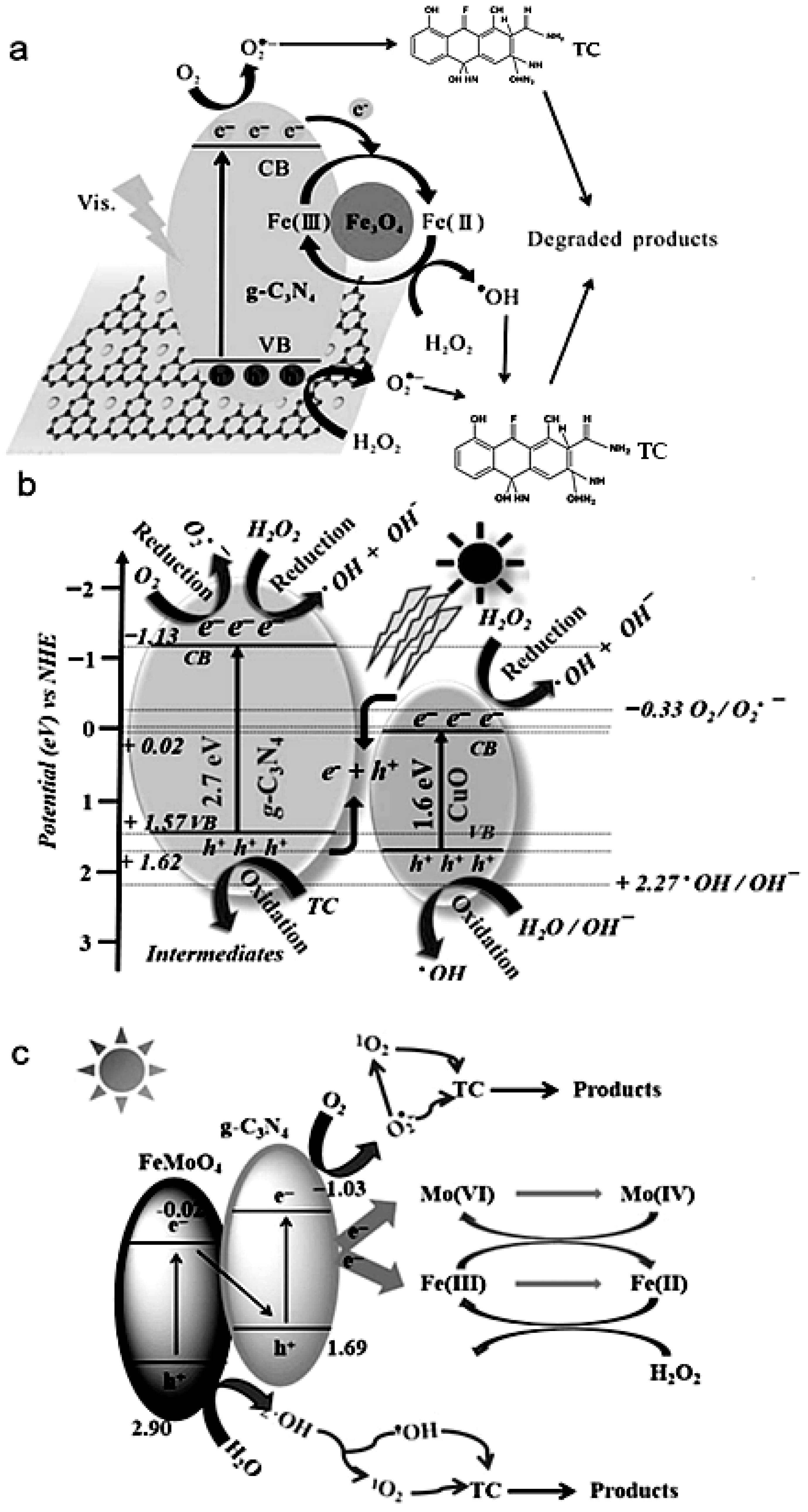
| Tetracycline | Multi-test tube photoreactor, H2O2, g-C3N4/Fe3O4 photocatalyst, 500 W Xe (λ < 420 nm) | 50 mL of 25 mg L−1 drug in pure water, 5 mM H2O2, 1 g L−1 photocatalyst, pH = 3.0, 18 °C, 100 min | Total degradation with k1 = 0.03907 min−1 and 67% TOC reduction. ●OH and O2●− as oxidants detected by specific scavengers and EPR. Eight by-products identified by LC-MS. Good reusability, losing 9% degradation after five successive runs | [89] |
| Tetracycline | Stirred-tank photoreactor, H2O2, g-C3N4/CuO photocatalyst, 400 W Na lamp (λ > 400 nm) | 100 mL of 5–40 mg L−1 drug in pure water, 0.1–0.4 mL L−1 H2O2, 25–300 mg L−1 photocatalyst, pH = 3.0–11.0, room temperature, 15 min of previous dark, 15 min | Complete abatement with k1 = 0.1242 min−1 for 10 mg L−1 drug, 0.3 mL L−1 H2O2, 200 mg L−1 photocatalyst, and pH = 9.0. Detection of oxidants ●OH, O2●−, and holes by specific scavengers, and 11 by-products identified by LC-MS. Excellent reusability after four successive cycles | [90] |
| Tetracycline | Stirred-tank photoreactor, H2O2, g-C3N4/FeMoO4 photocatalyst, 500 W Xe (λ > 420 nm) | 100 mL of 31.2 mg L−1 drug in pure water, 1.31 mM H2O2, 1.24 g L−1 photocatalyst, pH = 7.0, 25 °C, 60 min of previous dark, 120 min | 98% degradation determined by response surface technology. Detection of oxidants ●OH, O2●−, and 1O2 by specific scavengers and EPR. Identification of 10 by-products by LC-MS. Moderate reusability with a loss of 10% degradation after 11 successive runs | [91] |
| Carbamazepine | Stirred-tank photoreactor, H2O2, BiVO4/FeOx photocatalyst, 300 W Xe (λ > 420 nm) | 40 mL of 10 mg L−1 drug in pure water, 0.6 mM H2O, 500 mg L−1 photocatalyst, natural pH, room temperature, 20 min | Total abatement with k1 = 0.317 min−1. ●OH, O2●−, and holes detected as oxidants by specific scavengers and EPR. Moderate reusability with a loss of 15% degradation after three successive runs | [92] |
| Levofloxacin | Stirred-tank photoreactor, H2O2, Cu0/CuFe2O4 photocatalyst, 300 W Xe (λ > 420 nm) | 50 mL of 10 mg L−1 drug in pure water, 2–150 mM H2O2, 50–600 mg L−1 photocatalyst, pH = 3.0–11.0, room temperature, 90 min | 92% abatement with k1 = 0.033 min−1 for 10 mg L−1 drug. 30 mM H2O2, 200 mg L−1 photocatalyst, and pH = 6.7. ●OH, O2●−, electrons, and holes detected as oxidants by specific scavengers and EPR. 10 intermediates identified by LC-MS. Excellent reusability after four consecutive cycles | [93] |
| Tetracycline | Stirred-tank photoreactor, FeWO4/WO3/FeOOH photocatalyst, oxalic acid, 100 W LED (λ = 420 nm) | 50 mL of 50 mg L−1 drug in pure water, 1 mM oxalic acid, 400 mg L−1 photocatalyst, pH = 3.0, 25 °C, 30 min | Total drug removal with k1 = 0.117 min−1 and 72% oxalic acid decay. ●OH, O2●−, 1O2, and holes as oxidants detected by specific scavengers and EPR. 17 by-products identified by LC-MS. Excellent reusability after six successive runs | [94] |
| Chloramphenicol | Stirred-tank photoreactor, H2O2, Zn1-x-yCoxNiyO nanorods photocatalyst, 500 W halogen lamp | 20 mL of 20 mg L−1 drug in pure water, 0.1 mL concentrated H2O2, 50 mg L−1 photocatalyst, pH = 7.0, room temperature, 450 min | 88% removal. ●OH and holes detected as oxidants by specific scavengers. GC-MS analysis revealed the formation of four by-products. Excellent reusability after six successive runs | [95] |
| Tetracycline | Stirred-tank photoreactor, H2O2, Ce-LaCoO3 photocatalyst, 500 W Xe | 100 mL of 10 mg L−1 drug in pure water, 100 mM H2O2, 400 mg L−1 photocatalyst, pH = 7.0, room temperature, 120 min | 92% decay. ●OH, O2●−, and holes as oxidants detected by specific scavengers and EPR. 13 by-products identified by LC-MS. Excellent reusability after five consecutive steps | [96] |
| Mixture of drugs | ||||
| Acetaminophen, Ciprofloxacin, Ibuprofen | Stirred-tank photoreactor, H2O2, SBA-15/Fe photocatalyst, 400 W Xe (λ > 390 nm) | 450 mL of 20 mg L−1 of all drugs in pure water, 1 mM H2O2, 330 mg L−1 photocatalyst, pH = 7.0, room temperature, 30 min | Degradation = 95% for ciprofloxacin, and >86% for ibuprofen and acetaminophen. Respective k1-values = 0.0633, 0.0431, and 0.0194 min−1. Detection of oxidants ●OH and O2●− by specific scavengers. Excellent reusability after five consecutive runs | [97] |
| Carbamazepine, Diclofenac, Mecoprop, Sulfamethoxazole | Stirred-tank photoreactor, H2O2. rGO/FeS2 photocatalyst, 300 W Xe | 50 mL of 10 μg L−1 of each drug in pure water, 1 mM H2O2, 250 mg L−1 photocatalyst, pH = 7.4, room temperature, 10 min | Total degradation of all drugs. ●OH, O2●−, 1O2, electrons, and holes identified as oxidants by EPR | [98] |
| Acetaminophen, Atenolol, Levofloxacin, Sulfamethoxazole | Stirred-tank photoreactor, H2O2, g-C3N4/Fe photocatalyst, 300 W Xe (λ > 400 nm) | 50 mL of 10 mg L−1 of each drug, except 5 mg L−1 sulfamethoxazole, in pure water, 50 mM H2O2, 1 g L−1 photocatalyst, pH = 7.46, room temperature, 60 min of previous dark, 60 min | Degradation = 100% at 20 min for levofloxacin, >92% for atenolol, >74% for sulfamethoxazole, and >63% for acetaminophen. Total TOC decay at 12 h. Detection of oxidants ●OH, O2●−, 1O2, and holes by specific scavengers and EPR | [99] |
| Chlortetracycline, Tetracycline, Oxytetracycline | Stirred-tank photoreactor, H2O2, MOF-Cu photocatalyst, 300 W Xe (λ > 420 nm) | 100 mL of 50 mg L−1 of each drug in pure water, 40 mM H2O2, 500 mg L−1 photocatalyst, natural pH, room temperature, 30 min of previous dark, 120 min | Degradation = 84% for chlortetracycline, >82% for oxytetracycline, and >79% for tetracycline. ●OH, O2●−, and holes identified as oxidants by specific scavengers. Good reusability, losing up to 8% degradation after five consecutive runs | [100] |
| Real wastewaters | ||||
| WWTP effluent | Stirred-tank photoreactor, H2O2, MOF-100(Fe) photocatalyst, 300 W Xe (λ > 420 nm) | 40 mL of 24 pharmaceuticals at μg L−1 in WWTP effluent (TOC0 = 7.9 mg C L−1), 20 mM H2O2, 100 mg L−1 photocatalyst, pH = 7.2, 25 °C, 10 h | Complete removal of all drugs. Leaching of 0.3 mg L−1 Fe. Oxidants ●OH, O2●−, and 1O2 detected by specific scavengers and EPR | [101] |
| SPF | ||||
| NSAIDs | ||||
| Ibuprofen | Stirred-tank photoreactor/sono-reactor, H2O2, Fe2+, 6 W UVC or 150 W Xe, 20 kHz US | Circulation at 150 mL min−1 between 500 mL in PF and 1 L in US, 1.5 L of 20 mg L−1 drug in pure water, 1.6–22.4 mM H2O2, 0.134 mM Fe2+, pH = 2.6, 25 °C, 180 min | Overall degradation with k1 = 0.0130 min−1 in 60 min and 60% TOC decay in 180 min for 6.4 mM H2O2 and 150 W Xe. Detection of 12 by-products by LC-MS | [102] |
| Antibiotics | ||||
| Oxytetracycline | Figure 18a, H2O2, Fe2+ or ZVI catalyst, UVA, UVB, or UVC, 40 kHz US | 10 mg L−1 drug in pure water, 60 mg L−1 H2O2, 8 mg L−1 Fe2+ or ZVI, pH = 4.0, room temperature, 60 min | Degradation with Fe2+ or ZVI = 86% or 87% for UVA, 90% or 89% for UVB, and 85% or 93% for UVC. 11 transformation products identified by GC-MS | [103] |
| Dexamethasone | Continuous-flow sono-photoreactor of Figure 19a, H2O2, zeolite/Fe catalyst, 5 W UVA (λ = 380–400 nm), 140 kHz US | 1.2–9.7 mg L−1 drug in pure water, 9.8–35.1 mg L−1 H2O2, packed catalyst, pH = 7.0, 20 °C, hydraulic retention time = 39.5–140 min | Optimization by response surface methodology = 99% removal and 74% COD reduction for 5.5 mg L−1 drug, 22.5 mg L−1 H2O2, and hydraulic retention time = 140 min | [104] |
| Other drugs | ||||
| Metoprolol | Stirred-tank sono-photoreactor, H2O2, MWCNTs a/Cr2O3-Sm photocatalyst, 350 W Xe, 20 kHz US | 110 mL of 10 mg L−1 drug in pure water, 50 mM H2O2, 300 mg L−1 photocatalyst, pH = 7.0, 25 °C, 60 min | Complete degradation and 95% TOC removal. Detection of oxidants ●OH, O2●−, 1O2, and holes by specific scavengers and EPR. Three by-products identified by GC-MS | [105] |
Disclaimer/Publisher’s Note: The statements, opinions and data contained in all publications are solely those of the individual author(s) and contributor(s) and not of MDPI and/or the editor(s). MDPI and/or the editor(s) disclaim responsibility for any injury to people or property resulting from any ideas, methods, instructions or products referred to in the content. |
© 2026 by the authors. Licensee MDPI, Basel, Switzerland. This article is an open access article distributed under the terms and conditions of the Creative Commons Attribution (CC BY) license.
Share and Cite
Brillas, E.; Peralta-Hernández, J.M. Advances in Hybrid Photo-Fenton Processes for Treating Pharmaceutical Contaminants in Water and Wastewater Systems. Water 2026, 18, 920. https://doi.org/10.3390/w18080920
Brillas E, Peralta-Hernández JM. Advances in Hybrid Photo-Fenton Processes for Treating Pharmaceutical Contaminants in Water and Wastewater Systems. Water. 2026; 18(8):920. https://doi.org/10.3390/w18080920
Chicago/Turabian StyleBrillas, Enric, and Juan M. Peralta-Hernández. 2026. "Advances in Hybrid Photo-Fenton Processes for Treating Pharmaceutical Contaminants in Water and Wastewater Systems" Water 18, no. 8: 920. https://doi.org/10.3390/w18080920
APA StyleBrillas, E., & Peralta-Hernández, J. M. (2026). Advances in Hybrid Photo-Fenton Processes for Treating Pharmaceutical Contaminants in Water and Wastewater Systems. Water, 18(8), 920. https://doi.org/10.3390/w18080920