Systematic Review

Black Sea Planktonic Organisms as Bioindicators for Biological Early Warning Systems: A Systematic Review


by
Iuliia Baiandina
,
Aleksandr Grekov
and
Elena Vyshkvarkova
*
A. O. Kovalevsky Institute of Biology of the Southern Seas Russian Academy of Sciences (IBSS), Sevastopol 299011, Russia
*
Author to whom correspondence should be addressed.
Water 2026, 18(8), 899; https://doi.org/10.3390/w18080899
Submission received: 3 March 2026 / Revised: 30 March 2026 / Accepted: 7 April 2026 / Published: 9 April 2026
(This article belongs to the Section Biodiversity and Functionality of Aquatic Ecosystems)

Abstract

This is the first systematic review evaluating Black Sea plankton as biosensor organisms for Biological Early Warning Systems (BEWS)—real-time monitoring approaches that detect sublethal behavioral or physiological responses to pollutants before irreversible ecosystem damage occurs. The systematic literature review was guided by the PRISMA (Preferred Reporting Items for Systematic Reviews and Meta-Analyses) approach, ensuring methodological transparency and applicability. A total of 140 publications from databases (Web of Science Core Collection, Scopus, PubMed, and Google Scholar databases) were included in the final analysis. We assess nine native planktonic taxa as candidates for automated video-based water quality monitoring, using a multi-criteria framework encompassing biological sensitivity, technical detectability, and practical feasibility. Three species emerge as the most suitable candidates: Aurelia aurita as a universal indicator (sensitive to copper, surfactants, petroleum, and microplastics; its large size enables standard video detection); Acartia tonsa for trace contamination (reproductive toxicity at metal concentrations 4–33× below regulatory standards); and Mnemiopsis leidyi for metal-specific discrimination (bioluminescent responses: 650% Zn, 430% Cu, and 350% Hg at 0.001 mg/L). Analysis of 140 publications reveals critical gaps: 33% of species lack toxicological data, 95% of studies test single toxicants despite natural mixture exposure, and microplastic methodology varies 1000-fold in particle size. Threshold analysis suggests planktonic sublethal stress at “safe” concentrations under current standards, suggesting inadequate protection of marine food webs. A complementary monitoring approach integrating these species with computer vision algorithms offers autonomous early-warning capability for Black Sea environmental management.

1. Introduction

The Black Sea is the world’s largest meromictic water body with permanent stratification of the water column and anaerobic conditions below 150–200 m [1,2]. Limited water exchange through the Bosphorus (surface outflow ~600 km3/year, deep inflow ~300 km3/year [3,4,5]) combined with significant river discharge (350–400 km3/year), primarily from the Danube, Dnieper, and Dniester rivers [6,7], creates the unique hydrological conditions of the Black Sea with a pronounced salinity gradient: from 17.5 to 18.8‰ in the open sea to less than 16‰ in areas influenced by rivers [8,9] and down to 10‰ in estuarine regions [1,10].
Long-term monitoring programs span multiple Black Sea sectors: Romanian (northwest), Crimean (northeast), Turkish (southwest), and Caucasian (east). These programs reveal pronounced spatial gradients in zooplankton community structure, driven by salinity, nutrient loads, and thermal regimes [11,12,13,14,15,16,17]. For example, Danube-affected coastal zones show chronic eutrophication and elevated bioaccumulation of heavy metals and organic pollutants [18,19], while the Crimean shelf is characterized by strong seasonal thermohaline stratification and recurrent hypoxia influencing copepod and ctenophore dynamics [14,20], and the southeastern coastal zone exhibits warmer, more saline, and oligotrophic conditions shaping distinct gelatinous zooplankton assemblages [15,16,21].
This basin-wide heterogeneity (from the highly productive, Danube-influenced northwestern shelf to the more oligotrophic central and southern basins) implies that BEWS calibration may require subregional adaptation—especially given documented evidence of intraspecific variation in pollutant tolerance [22]. Baseline conditions, species composition, and sensitivity thresholds may differ substantially between regions, necessitating region-specific validation and potentially adaptive monitoring strategies.
The ecosystem is subject to complex anthropogenic pressures: eutrophication, pollution by petroleum products, heavy metals, pesticides, microplastics, and biological invasions [11,17,23]. Since the 1960s, progressive eutrophication has been observed, particularly in the northwestern part, where nitrate and phosphate concentrations have increased significantly compared to the pre-industrial period [24,25].
Long-term monitoring programs across all riparian states—including multi-decadal datasets documenting zooplankton community shifts in response to eutrophication and climate warming [12,26]—have confirmed basin-wide ecological degradation despite regional variation in stressor intensity. This has led to a structural reorganization of planktonic communities, an increase in the frequency and intensity of phytoplankton blooms, including toxic algal species, and the development of hypoxic events [27,28,29].
Traditional monitoring methods, based on periodic sampling and laboratory analysis, do not provide sufficient temporal and spatial resolution for the prompt detection of environmental disturbances [30]. Biological Early Warning Systems (BEWS), which record the physiological and behavioral responses of organisms in real-time, represent a promising approach for the continuous monitoring of aquatic environmental quality [31,32]. BEWS offer a fundamentally different approach. Rather than measuring pollutant concentrations directly, these systems employ living organisms as biosensors that detect integrated biological effects in real-time [31,32].
The development of effective biomonitoring approaches for the Black Sea is particularly relevant in the context of international environmental policy frameworks. The Marine Strategy Framework Directive (MSFD, 2008/56/EC) [17], which guides marine environmental protection across European coastal states, establishes 11 descriptors of Good Environmental Status. Among these, Descriptor 4 (Food webs) requires that “all elements of the marine food webs occur at normal abundance and diversity,” while Descriptor 8 (Contaminants) mandates that “concentrations of contaminants are at levels not giving rise to pollution effects” [17]. Planktonic organisms, as the base of marine food webs and sensitive indicators of contamination, are directly relevant to both descriptors. The Black Sea riparian states participating in MSFD implementation (Bulgaria, Romania) and those aligned with its principles through the Bucharest Convention (all six coastal states) would benefit from standardized biosensor approaches capable of providing continuous, real-time assessment of these environmental quality objectives.
Planktonic organisms possess a number of advantages as bioindicators: short life cycles, high sensitivity to environmental changes, a key role in marine food webs, and the potential for automated recording of their abundance and behavior [33,34]. The advancement of underwater videography technologies and computer vision algorithms opens up new possibilities for creating automated monitoring systems based on planktonic organisms [35,36].
The aim of this review is to provide a comprehensive analysis of the potential of various Black Sea plankton groups for use in monitoring systems, to assess their sensitivity to major pollutant types, and to substantiate approaches for integrating biological and technical components of monitoring systems. This systematic review—the first to specifically address BEWS potential for the Black Sea—synthesizes evidence from across the entire basin, with particular attention to ensuring representative coverage of all coastal nations’ research contributions.

2. Materials and Methods

2.1. Literature Search Strategy

This systematic review was conducted and reported in accordance with the Preferred Reporting Items for Systematic Reviews and Meta-Analyses (PRISMA) 2020 statement [37]. No review protocol was prospectively registered prior to the commencement of this review. A systematic literature search was conducted on the Web of Science Core Collection (Clarivate Analytics, London, UK), Scopus (Elsevier, Amsterdam, The Netherlands), PubMed (NLM, NIH, Bethesda, MD, USA), and Google Scholar (Google LLC, Mountain View, CA, USA) databases for the period from January 2000 to October 2025. Reference lists in key review articles and materials from specialized conferences were also analyzed. Search results from all databases were imported into reference management software (Mendeley v2.45.0). Duplicates were identified using DOI matching, title comparison, and author–year combinations, and then manually verified and removed.
The full search strings used for each database were as follows:
  • Web of Science Core Collection: TS=((“Black Sea”) AND (“plankton”) AND (“biomonitor*” OR “bioindicat*” OR “pollution” OR “contamina*” OR “video monitor*” OR “behavior*”)).
  • Scopus: TITLE-ABS-KEY((“Black Sea”) AND (“plankton”) AND (“biomonitor*” OR “bioindicat*” OR “pollution” OR “contamina*” OR “video monitor*” OR “behavior*”)).
  • PubMed: (“Black Sea”[All Fields]) AND (“plankton”[All Fields]) AND (“biomonitor*”[All Fields] OR “bioindicat*”[All Fields] OR “pollution”[All Fields] OR “contamina*”[All Fields] OR “behavior*”[All Fields]).
  • Google Scholar: “Black Sea” plankton (biomonitor OR bioindicator OR pollution OR contamination OR “video monitoring” OR behavior).
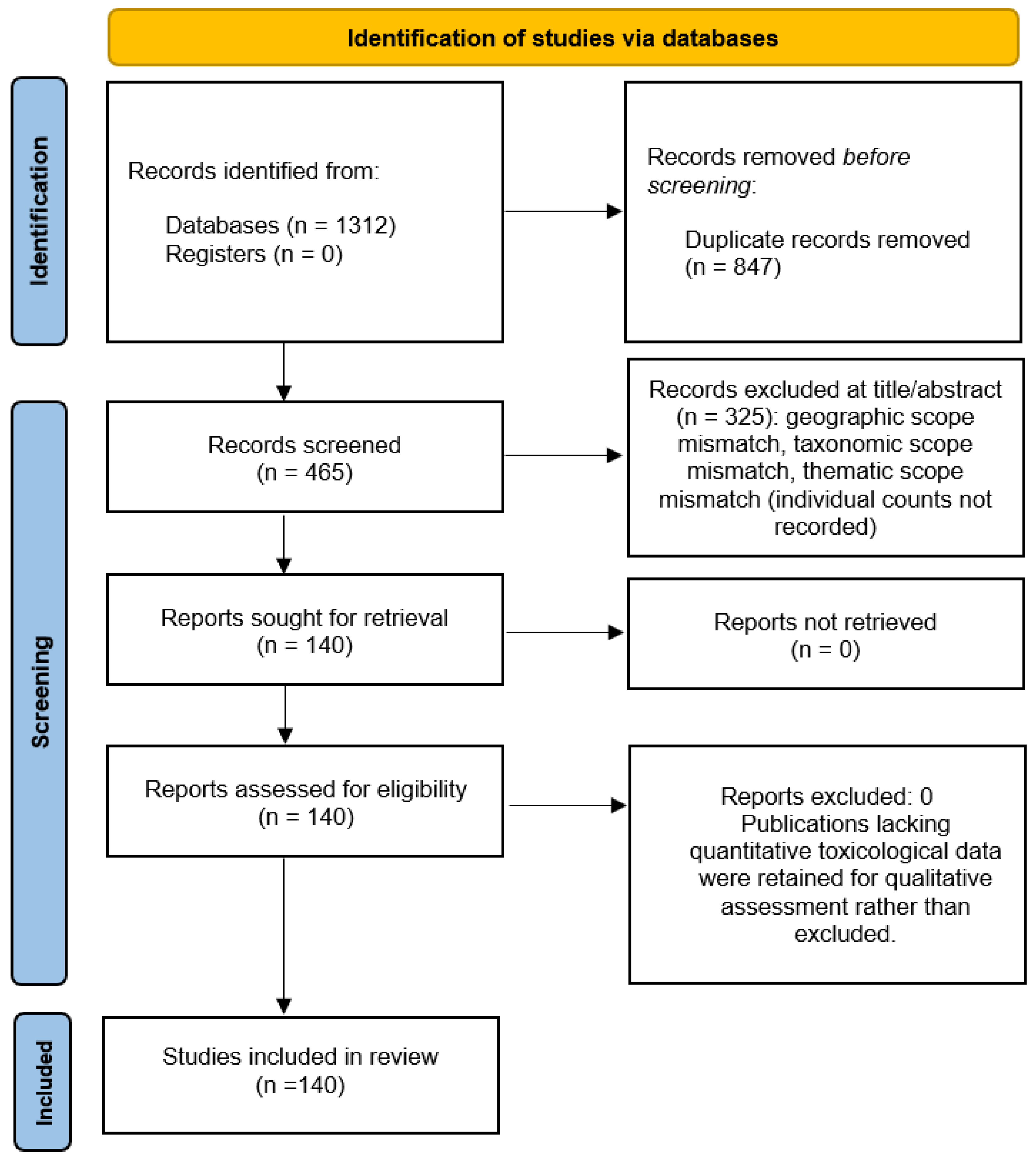
Hand-searching of reference lists of key review articles and conference materials was performed as an additional source. A total of 847 duplicates were eliminated from the initial 1312 records retrieved.
Records in languages other than English (n = 43, primarily Russian, Turkish, and Romanian) were screened by title and abstract: Russian-language records (n = 31) directly by the native-speaker authors, and Turkish and Romanian records (n = 12) using automated translation tools. The screening and selection process comprised two stages with distinct exclusion criteria.
Stage 1—Title and abstract screening (n = 465). Records were excluded if they met any of the following criteria: (a) geographic scope mismatch—studies conducted outside the Black Sea basin; (b) taxonomic scope mismatch—studies on non-planktonic organisms without relevance to pelagic food webs; and (c) thematic scope mismatch—publications with no biomonitoring or toxicology content. A total of 325 records were excluded at this stage. Individual counts per reason for exclusion were not separately recorded, which is a limitation of the current review.
Stage 2—Full-text assessment (n = 140). No additional records were excluded. All 140 publications were retained but classified into three types, each assigned a distinct role in the synthesis: (a) original experimental studies (n = 42) provided quantitative toxicological data (EC50, LC50, and MEC) and served as the sole source for all numerical values reported in Section 3.5 and Section 3.6; (b) field observation reports (n = 34) contributed population dynamics, spatial distribution, and seasonal availability data used for the Availability and Ecological Representativeness criteria in Section 3.6; and (c) reviews and methodological papers (n = 64) provided ecological context, BEWS design principles, and assessment framework, but were never used as primary sources for toxicological values. This classification was carried forward into the evidence-weighting system (Section 2.3).
This review was performed in accordance with the PRISMA (Preferred Reporting Items for Systematic Reviews and Meta-Analyses) guidelines with registration on the Open Science Framework (https://doi.org/10.17605/OSF.IO/BT3GD). The PRISMA 2020 flow diagram for the systematic literature search is shown in Figure 1. The PRISMA-ScR Checklist and Abstract Checklist are in Supplementary Files.

2.2. Inclusion and Exclusion Criteria

Inclusion criteria:
  • Original research articles and reviews published in peer-reviewed journals;
  • Publications containing quantitative data on plankton responses to pollutants (LC50, EC50, behavioral endpoints, and physiological measurements);
  • Studies on Black Sea planktonic species or closely related taxa from similar brackish/marine environments;
  • Publications in English (primary language);
  • Studies with clear methodology and measurable endpoints.
Exclusion criteria:
  • Publications lacking quantitative data (excluded from quantitative analysis but retained for qualitative assessment);
  • Conference abstracts without full papers;
  • Gray literature without peer review;
  • Duplicate records;
  • Studies on non-planktonic organisms without relevance to pelagic food webs.

2.3. Quality Assessment and Evidence Weighting

Studies were categorized by evidence strength:
1. Direct experimental data with quantitative endpoints (EC50, LC50, and behavioral thresholds) received highest weight;
2. Field observations with quantitative measurements received moderate weight;
3. Extrapolations from related taxa were clearly flagged as indirect evidence. Where multiple studies reported values for the same species–pollutant combination, ranges are provided rather than single values. Temperature, salinity, and life stage are specified where reported in original studies.
Evidence Classification Logic:
Tier 1: Direct measurements on target species under controlled conditions.
Tier 2: Mechanistic or review data applicable across species (e.g., surfactant theory).
Tier 3: Data from proxy species requiring extrapolation (same genus = QS 7; different genus = QS 5–6).
Tier 4: Confirmatory presence/absence data without dose–response.
  • Quality Score Transparency. All scores are justified based on:
    • Study design rigor (validated methods = +points).
    • Multiple life stages tested = +points.
    • Peer review status = baseline requirement.
    • Taxonomic distance of proxy = score reduction for Tier 3.
    • Single vs. comprehensive study = affects reproducibility confidence.
    • Evidence Classification System:
      • Tier 1: Direct experimental data on target species.
      • Tier 2: Review/mechanistic data applicable to target species.
      • Tier 3: Proxy species data requiring extrapolation.
      • Tier 4: Confirmatory data only (e.g., bioluminescence presence).
      • Supporting: Ecological, methodological, or contextual references.
    • Quality Score System (1–11):
      • 11: Tier 1, multiple life stages, fully validated methods.
      • 10: Tier 1, standard protocols, peer-reviewed, direct measurements.
      • 9: Tier 1, good quality with minor limitations.
      • 8: Tier 1, acceptable, but methodological concerns.
      • 7: Tier 2 OR Tier 3 (congeneric species, same genus).
      • 6: Tier 3 (different genus, same family/order).
      • 5: Tier 3 (significant taxonomic distance).
      • 4: Tier 4 (highly uncertain extrapolations).
      • 3: Tier 4, highly uncertain extrapolations with significant taxonomic distance.
      • 2: Tier 4, minimal relevance, single unvalidated observation.
      • 1: Tier 4, speculative inference only, no empirical basis.
      • 0: Supporting references (no toxicological data).
Note: Quality scores 1–3 are not used in this review because no included studies met criteria for evidence weaker than Tier 4 extrapolations (QS = 4) yet stronger than purely supporting references (QS = 0). This reflects the minimum evidentiary threshold applied during study selection.
A list of publications by planktonic taxa, tiers, toxicants, direct toxicological data, and supporting evidence, as well as a list of supporting literature, is presented in Tables S1–S3 in Supplementary Materials.
Reporting bias assessment. The potential for reporting bias (selective non-publication of negative or null results) was assessed qualitatively. Given the applied focus of BEWS research and the dominance of ecotoxicological studies reporting positive dose–response relationships, publication bias toward studies showing measurable toxic effects cannot be excluded. The absence of toxicological data for three species (C. euxinus, P. setosa, and P. pileus) likely reflects a genuine research gap rather than suppression of null findings, as these species have received limited ecotoxicological attention in the literature. No formal funnel plot analysis was conducted due to the qualitative nature of the synthesis and the heterogeneity of endpoints across studies.

2.4. Data Extraction

Data extraction was performed independently by one reviewer (Iu.B.) and verified by a second reviewer (A.G.). The following variables were extracted from each included study: (1) species name and life stage tested; (2) pollutant class and specific compound; (3) exposure concentration and duration; (4) biological endpoint (behavioral, physiological, reproductive, or lethal); (5) effect metric (EC50, LC50, NOEC, LOEC, or minimum effective concentration); (6) environmental conditions (temperature, salinity); and (7) evidence tier and quality score (as defined in Section 2.3). Discrepancies between reviewers were resolved by consensus. For studies reporting multiple endpoints, the most sensitive (lowest effective concentration) endpoint was selected as the primary value for comparative sensitivity of species to pollutants (Section 3.5).

2.5. Data Synthesis

A total of 140 publications were included in the final analysis: 42 contained direct experimental data (Tier 1), 34 contained field observations (Tier 2), and 64 were reviews or methodological publications (supporting references). Data were synthesized narratively, organized by planktonic taxon and pollutant class. Where multiple studies reported values for the same species–pollutant combination, ranges are provided rather than pooled means, given the heterogeneity of exposure conditions. Minimum effective concentrations (MECs) were used as the primary comparative metric, defined as the lowest concentration inducing any statistically or biologically detectable response. A sensitivity heatmap (Section 3.5) was constructed to visualize cross-species and cross-pollutant patterns. No meta-analytic pooling was performed due to substantial methodological heterogeneity across studies. Certainty of evidence for each species was assessed using the four-tier quality scoring system described in Section 2.3. Only Tier 1 experimental studies contributed quantitative values to the comparative tables (Section 3.5 and Section 3.6) and the species scoring (Section 3.6); reviews and field reports informed contextual interpretation but were excluded from all numerical syntheses.

2.6. Species Selection Criteria and Evaluation Framework

To systematize the evaluation of potential biosensor organisms, three groups of criteria were developed: biological, technical, and practical. This framework was applied consistently across all candidate species to enable a comparative assessment of their suitability for BEWS applications.
An optimal biosensor species should meet the following biological requirements:
  • Sensitivity to pollutants—the ability to exhibit clear dose-dependent behavioral or physiological responses at concentrations significantly below lethal levels. Behavioral and physiological endpoints can manifest at concentrations 10 to 1000 times lower than those causing mortality, making them suitable for early pollution detection [31,32].
  • Response specificity—the presence of distinguishable reactions to different classes of stressors. This enables pollutant discrimination (e.g., metal-specific bioluminescence patterns in ctenophores, differential behavioral responses to neurotoxins vs. membrane-disrupting agents).
  • Reproducibility—low individual variability in baseline behavior under control conditions. High variability reduces statistical power to detect significant changes upon exposure [31]. While a specific coefficient of variation (CV < 30%) is not explicitly cited in Gerhardt [31], it aligns with practical recommendations for systems like Multispecies Freshwater Biomonitor® (MFB), where signal stability is critical for automated interpretation.
  • Ecological representativeness—the species’ involvement in key trophic interactions and ecosystem functioning. Using species that play important roles in natural communities (e.g., the amphipod Corophium volutator as prey for birds and fish) enhances the ecological relevance of monitoring data [32]. This criterion ensures biosensor responses reflect risks to key ecosystem components, including commercial and protected species, linking technical signals to ecological outcomes.
  • Availability—high abundance, wide geographical distribution, and feasibility for laboratory maintenance. This ensures standardization and reproducibility of experiments across different laboratories and regions [31].
The suitability of an organism for use in automated biosensor systems is determined by the following technical parameters [31,32,38,39]:
  • Organism size—optimally 5–30 mm (sometimes up to 50 mm) to ensure reliable signal detection in standard biosensor measuring chambers (e.g., MFB). Organisms < 3 mm (e.g., Daphnia pulex) may produce weak signals, while those > 50 mm may not fit in chambers or may disrupt flow hydrodynamics.
  • Contrast and morphology—presence of contrasting structures (pigmentation, gonads), unique morphology, or physiological signals (e.g., bioluminescence) that facilitate automated detection and tracking in video-based or optical sensor systems.
  • Stereotyped, quantifiable response patterns—rhythmic or predictable behaviors such as valve closure in mussels, pulsations in jellyfish, or characteristic swimming trajectories. These generate reproducible signals sensitive to pollutant exposure that form the basis for automated detection [38,39].
  • Response and movement speed compatible with system sampling frequency—most commercial biosensors record signals at 1–10 Hz. Organisms with very fast, chaotic movements (e.g., some fish) are more challenging to analyze than those with slow, rhythmic movements [31,38].
Practical applicability is determined by:
  • Resilience to laboratory conditions—high survival rates (>90% over 48 h) under standard holding conditions (temperature, light, and hydrodynamics) are essential to minimize background stress and ensure baseline signal stability. Organisms that demonstrate resilience to controlled operating conditions of a biosensor help prevent false alarms caused by adaptation stress [38].
  • Ease of culturing—the ability to maintain laboratory cultures without complex requirements for feeding, temperature regimes, or photoperiod. Species that do not require specialized housing conditions and reproduce readily in artificial environments provide a reliable and continuous supply of test organisms, which is critical for long-term monitoring [31].
  • Protocol standardization—the availability of validated methodologies for organism preparation, exposure conditions, and signal interpretation. Standardization ensures comparability of results between different laboratories and facilitates integration of data into regulatory and management processes [38].
  • Cost-effectiveness—minimal expenses associated with acquisition, maintenance, and regular replacement of organisms. Organisms with high fecundity and low infrastructure requirements reduce operational costs and make biomonitoring systems economically viable for widespread implementation [39].

2.7. Multi-Criteria Scoring Procedure

While Section 2.5 describes 13 criteria across three categories (5 biological, 4 technical, and 4 practical), the qualitative assessment was streamlined to 10 key parameters that are most critical for biosensor functionality and feasibility (Table 1). Reproducibility (biological criteria) was integrated into the assessment of “Stereotyped, quantifiable response patterns” (technical criterion 7) rather than evaluated as a separate biological parameter, as low baseline behavioral variability is a prerequisite for generating quantifiable, reproducible biosensor signals. All technical criteria from Section 2.5 were retained in the assessment.
Protocol standardization and cost-effectiveness (practical criteria) were not evaluated as species-specific parameters because: (a) protocol standardization is a methodological development issue rather than an inherent species characteristic—protocols can be developed for any species given sufficient research effort; and (b) cost-effectiveness is highly context-dependent on local infrastructure, labor costs, and implementation scale, making cross-species comparison methodologically problematic without specific deployment scenarios.
This 10-parameter framework focuses assessment on intrinsic biological and physiological species’ characteristics that directly determine biosensor suitability, while excluding criteria that are either methodologically addressable or context-dependent.
The scoring rubric (Table 1) assigns 1–3 points per criterion.

3. Results

3.1. Mechanisms of Toxic Effects of Pollutants on Aquatic Organisms

Analysis of the literature data revealed the main biochemical and physiological mechanisms that determine plankton sensitivity to different classes of pollutants (Petroleum hydrocarbons and polycyclic aromatic hydrocarbons, heavy metals, pesticides, and microplastics).
Petroleum hydrocarbons and polycyclic aromatic hydrocarbons (PAHs) represent a significant group of toxicants in the aquatic environment. The water-soluble fraction of petroleum products contains PAHs capable of penetrating the tissues of aquatic organisms and accumulating in lipid components. In aquatic organisms, PAHs induce oxidative stress through the activation of metabolic pathways, including the cytochrome P450 system, leading to lipid peroxidation and damage to cell membranes. An increase in the level of malondialdehyde (MDA) serves as a reliable biomarker of such oxidative damage [43,44]. Furthermore, exposure to PAHs is accompanied by the formation of 8-oxo-2′-deoxyguanosine (8-oxo-dG)—a specific marker of oxidative DNA damage—indicating the genotoxic potential of these compounds [45,46].
Heavy metals, such as copper and cadmium, exert toxic effects on aquatic organisms by disrupting ionic homeostasis and the function of key enzyme systems. In response to heavy metal exposure, metallothioneins—proteins involved in detoxification—are induced in aquatic invertebrates [47,48]. Both metals inhibit the activity of Na+/K+-ATPase and Ca2+-ATPase in gill cells and other tissues, which disrupts ion transport and, consequently, neuromuscular transmission. Heavy metal exposure also inhibits acetylcholinesterase (AChE) activity, which serves as an integrated biomarker of neurotoxic stress in marine organisms [49]. Due to its ionic radius being similar to that of Ca2+, cadmium competes with calcium for binding to proteins and enzymes, disrupting calcium metabolism and intracellular signaling [50]. The protective potential of metallothioneins is limited at high metal concentrations [51,52]. The generally accepted hierarchy of heavy metal toxicity for aquatic invertebrates follows the sequence: mercury > copper > cadmium > lead > zinc [53].
Pesticides, including organochlorine and organophosphorus compounds, are highly toxic to aquatic organisms even at low concentrations. Their primary mechanism of action is the inhibition of acetylcholinesterase (AChE) in nervous tissue, leading to the accumulation of acetylcholine in synapses and disruption of neuromuscular transmission [54,55]. For example, chlorpyrifos causes a significant reduction in AChE activity in crustaceans at concentrations in the nanogram to microgram per liter range, making this group of organisms particularly sensitive to this insecticide [56]. Pyrethroids, in turn, act on neuronal sodium channels, prolonging the depolarization phase and disrupting normal electrical activity in the nervous system [57].
Microplastics (particles sized 10–500 μm) represent a growing threat to aquatic ecosystems. Aquatic organisms can ingest microplastics through filter-feeding or active predation, particularly particles in the 10–100 μm range, which are more efficiently retained in the digestive system. The accumulation of microplastics can cause mechanical damage to tissues, impair digestion, and increase the energy expenditure required for their elimination, thereby reducing the energy available for growth and reproduction [58]. Although some organisms can excrete microplastics within hours or days, chronic or high-concentration exposure may lead to physiological disruptions and reduced viability.

3.2. Methods of Detection in Biosensor Systems

BEWS are based on the principle of detecting sublethal effects of pollutants before irreversible changes occur in the ecosystem [31]. The hierarchy of biological responses includes: molecular → cellular → physiological → behavioral → population → ecosystem levels [59]. Behavioral responses occupy an intermediate position, providing a balance between sensitivity and ecological relevance [60]. These systems are broadly categorized into optical and non-optical methods.
Optical methods, particularly video-based tracking, are considered the gold standard for obtaining detailed behavioral data. The method is based on the use of underwater cameras and computer vision algorithms for the automated recording of position, movement trajectories, speed, pulsation frequency, and other quantitative behavioral parameters [39]. Modern approaches include both two-dimensional (2D) and three-dimensional (3D) tracking using deep neural networks (e.g., YOLO, ByteTrack, and transformers), enabling the analysis of behavior even under conditions of high organism density and partial occlusions [39]. Optical methods provide a non-invasive, cost-effective, and scalable monitoring approach suitable for assessing feeding, hypoxic stress, abnormal behavior, and vertical migration [39]. However, their effectiveness is significantly limited in conditions of turbid water, low light, strong reflections, or dynamic backgrounds, which reduces the reliability of segmentation and tracking [39,61]. These limitations necessitate the combination of optical methods with alternative detection methods, especially in industrial systems where data stability and reliability are critical for management decision-making.
Non-optical sensing technologies offer simpler and often less expensive alternatives. These can be classified into several types, including electrical sensing and proximity sensing. Electrical sensing measures signals from muscle contractions during activities like ventilation. Proximity sensing is commonly used with bivalve mollusks, like mussels, to quantify their water filtration behavior by tracking the opening and closing of their shells. This is achieved using techniques such as high-frequency electromagnetic induction (HFEI) or Hall-effect sensors [62]. Another advanced non-optical method is quadrupole impedance conversion technology, a modernized version of bipolar and tetrapolar systems. In this technique, organisms are placed in a test chamber with two pairs of electrodes. One pair generates a high-frequency alternating current, while the second pair detects changes in impedance caused by the animal activity. This allows for the creation of discrete behavioral fingerprints for locomotive and ventilatory actions. These varied sensing principles, from sophisticated video analysis to simpler impedance measurements, provide a range of options for the continuous, real-time monitoring of water quality [62].
Acoustic methods, including Passive Acoustic Monitoring (PAM) and active acoustic telemetry, enable the tracking of fish behavior in conditions of low visibility, at night, and at great depths. Passive monitoring utilizes sounds produced by fish during feeding, stress, or mating to assess their behavioral state [39]. In contrast, active telemetry involves the use of acoustic tags attached to the fish’s body, allowing for real-time tracking of its three-dimensional trajectory, depth, and activity, even within industrial marine cages [61]. Despite the invasiveness of the tagging procedure, acoustic methods demonstrate high reliability in complex hydrological conditions where optical systems prove ineffective.
Modern biosensor systems are increasingly being implemented as multimodal platforms that integrate several detection methods. This approach compensates for the limitations of individual technologies and provides a comprehensive assessment of the state of aquatic organisms and the water environment, thereby enhancing the reliability and ecological relevance of monitoring.

3.3. Hierarchy of Behavioral Responses in Aquatic Organisms to Toxic Exposure

Behavioral responses are among the earliest and most sensitive indicators of aquatic pollution, manifesting significantly earlier than traditional toxicological endpoints such as lethality or impaired reproductive function [31,32]. The observed sequence of behavioral changes reflects the progression of toxic stress—from reversible physiological adaptations to irreversible systemic disruptions—and can be structured as follows:
  • Altered locomotor activity (minutes). The initial signs of toxicant exposure are quantitative changes in locomotor activity: modifications to speed, frequency, and amplitude of movements. Such reactions are detected within minutes of contact with a pollutant and indicate disruptions in neuromuscular transmission or energy metabolism. Locomotor activity represents one of the most reliable and reproducible parameters for automated biomonitoring, as it is easily quantified and demonstrates clear dose-dependence even at sublethal concentrations of pollutants [31].
  • Impaired orientation responses (tens of minutes). At the next stage, taxes—directed behavioral responses to external stimuli, including phototaxis, geotaxis, and rheotaxis—become impaired. These responses require the integration of sensory information and coordination of motor patterns, making them particularly vulnerable to neurotoxic agents. The loss of orientation ability reduces organisms’ capacity to avoid unfavorable microenvironments (e.g., areas of hypoxia or elevated toxicity), which has direct ecological consequences for population distribution and survival [60].
  • Altered vertical distribution and migratory behavior (hours). Within hours of the onset of exposure, disruptions in spatial behavior are observed, including anomalies in vertical migrations. Benthic and planktonic organisms, such as amphipods and gastropods, lose their ability to perform diel migratory rhythms in response to sediment pollution, indicating a deepening of stress and a disruption of circadian regulation or energy homeostasis [32].
  • Impaired feeding (hours–days). A reduction in feeding efficiency is a key sublethal endpoint, reflecting the simultaneous impairment of sensory and motor functions. In filter-feeding organisms, this manifests as a decrease in the frequency and intensity of filtration; in predators, it appears as a reduction in the accuracy and frequency of prey capture. Such changes directly impact the energy balance and can precede slowed growth, reduced immune reactivity, and overall viability [32].
  • Reproductive impairments (days–weeks). Under chronic toxicant exposure, reproductive impairments develop, including reduced fecundity, altered mating behavior, and disrupted embryonic development. These effects are categorized as late-stage behavioral responses (Category E3 in the behavioral sensitivity classification) and are critical for the long-term sustainability of populations [32].
  • Lethality (days–weeks). Mortality is the ultimate toxic endpoint and typically occurs at pollutant concentrations significantly exceeding the thresholds for behavioral responses. Behavioral changes can manifest at concentrations 10 to 1000 times lower than lethal levels, underscoring their value as early-warning indicators of aquatic pollution [31,32].

3.4. Black Sea Planktonic Organisms as Potential Bioindicators

The plankton community of the Black Sea includes approximately 150 species of phytoplankton and over 70 species of zooplankton, which is significantly lower than the species diversity of the Mediterranean Sea due to reduced salinity and the presence of a hydrogen sulfide zone [40,63,64].
The phytoplankton of the Black Sea is dominated by diatoms, dinoflagellates, and coccolithophores [29,65,66,67].
The zooplankton is represented by copepods (70–90% of biomass), cladocerans, chaetognaths, appendicularians, and gelatinous organisms [41,67]. Key copepod species include Acartia clausi, A. tonsa, Calanus euxinus, Pseudocalanus elongatus, and Paracartia latisetosa [14].
The gelatinous plankton is represented by jellyfish (Aurelia aurita, Rhizostoma pulmo, and Chrysaora hysoscella), ctenophores (Mnemiopsis leidyi, Beroe ovata, and Pleurobrachia pileus), and siphonophores (Lensia subtilis) [16,21,68].
In the species assessments below, all quantitative toxicological values (EC50, LC50, and MEC) derive from Tier 1 evidence (direct experimental data on target species) unless explicitly marked as extrapolated from related taxa. Extrapolated assessments are flagged throughout the text and reflected in reduced quality scores (Tiers 3–4).

3.4.1. Dinoflagellates (Noctiluca scintillans (Macartney) Kofoid & Swezy, 1921)

Morphofunctional features. N. scintillans is a heterotrophic dinoflagellate, size 0.2–2 mm [66]. Bioluminescence upon mechanical stimulation occurs due to the activation of scintillons—specialized organelles numbering 1–5 × 10⁴ per cell, each emitting approximately 105 photons with an emission maximum of λmax = 474 nm [69,70,71]. Mass aggregations (“red tides”) reach concentrations of 105–106 cells/L [66].
In the Black Sea, N. scintillans inhabits the upper 20 m layer primarily, with maximum concentration in the 0–10 m layer [66,72]. It prefers coastal waters, where concentrations can be 10–100 times higher than in the open sea, especially in upwelling zones and estuaries. It is capable of active vertical migrations: at night, it rises to the surface, while during the day, it descends to depths of 10–15 m [73]. It is a eurythermic species, found at temperatures of 10–25 °C, with an optimum of 12–18 °C [72]. In the Black Sea and the Sea of Marmara, two abundance peaks are observed: the main one in April–May at temperatures of 10–15 °C (up to 105–106 cells/L), and a secondary one in September–October at 15–18 °C (104–105 cells/L) [66,74]. Mass bloom formation is driven by spring peaks in diatom and copepod prey availability [75].
Sensitivity to pollutants. N. scintillans is capable of actively ingesting crude oil droplets ranging in size from 1 to 86 μm. At oil concentrations of 1 μL/L (typical after spills), 28% to 90% of cells contain oil droplets. Oil uptake at a rate of ~0.37 µg-oil/µg-C−1/day−1 does not inhibit cell growth during short-term exposure, but may promote bioaccumulation of toxic PAHs and the transfer of petroleum products into the food chain via fecal pellets [76]. Exposure to copper and other heavy metals causes inhibition of bioluminescence and reduced cell viability at concentrations of 0.05–1 mg/L [77,78]. Direct data on the effects of pesticides on N. scintillans are lacking. However, studies of related bioluminescent dinoflagellates show that organophosphate insecticides, herbicides, and PAHs inhibit bioluminescence and cellular respiration at concentrations > 0.05–0.1 mg/L [79,80,81]. At concentrations of microplastics close to natural levels (~8–88 particles/mL), no statistically significant effects on growth and feeding rates were observed. However, at high concentrations (>4000 particles/mL), up to 65% of N. scintillans cells ingested microplastic particles 1.7–6 μm in size, indicating a nonspecific feeding pattern. At extreme microplastic concentrations (food: microplastic ratio 1:1), a reduction in feeding efficiency is observed, which may lead to energy deficiency [82].
The dinoflagellate N. scintillans possesses several key features that make it suitable for biomonitoring. Its large size, reaching up to 2 mm, makes it one of the largest single-celled organisms, allowing it to be easily resolved with standard underwater cameras without the need for microscopy [39]. A prominent characteristic is its bright bioluminescence, which acts as a sensitive physiological indicator; this light emission responds to mechanical stimulation and is suppressed under stressful conditions, including exposure to pollutants [70,83]. Furthermore, the visibility of its mass aggregations is a key advantage, as these blooms give the water a distinct pink-orange hue, enabling detection through simple RGB cameras and even satellite observations [83]. However, its role as a bioindicator is complicated by its strong food dependence, as its abundance is directly tied to the availability of prey like diatoms and copepods. This means population fluctuations often reflect natural changes in the food web rather than pollution levels, making it a less reliable indicator of environmental contaminants [73,75].
The following features can be considered as limitations in use for biomonitoring: Unpredictability of blooms—they occur episodically, depending on hydrology and food supply, making them unreliable for continuous monitoring [40]; difficulty of cultivation—an obligate heterotroph, it requires live prey, making standardization difficult [40]; and high physiological variability—the bloom state is highly dependent on temperature, illumination, and food status, reducing signal reproducibility [40].
Summary for BEWS Application:
Interpretation: Bioluminescence provides sensitive detection capability, but strong food-web dependence complicates signal interpretation.
Limitations: Unpredictable bloom dynamics; obligate heterotrophy prevents laboratory standardization; and high physiological variability.
BEWS Role: Not recommended for routine monitoring; potential for episodic bloom-based assessments only.

3.4.2. Copepods (Copepoda)

Acartia tonsa Dana, 1849
Morphofunctional features. This euryhaline species, tolerant of salinities of 5–35‰, colonized the Black Sea in the 1970s after arriving from the Atlantic [84,85]. The body length of females is 1.0–1.5 mm, and that of males is 0.8–1.2 mm. In the Black Sea, A. tonsa is found primarily in the coastal zone at depths of 0–30 m, with maximum concentrations in the upper 10 m layer. It prefers estuarine and freshwater waters with a salinity of 10–25‰. In open waters with salinities > 17‰, it is outnumbered by the native species A. clausi [14]. It is a eurythermal species, active at temperatures of 5–30 °C, with an optimum of 18–25 °C [86]. Two population peaks are observed in Sevastopol Bay: a primary peak in August–September at 22–25 °C, and a secondary peak in May–June at 15–18 °C [14]. In winter, at temperatures < 10 °C, the population declines, but is not completely eliminated due to the production of resting eggs [87].
The characteristic “jump-and-sink” movement pattern involves rapid leaps propelled by the thoracic limbs and antennules, alternating with passive submersion [88]. At a temperature of ~20–22 °C, the maximum escape reaction speed was 54.0 ± 8.9 cm/s (540 mm/s), the average escape reaction speed was 30.4 ± 7.2 cm/s (304 mm/s), the push duration was 5.9 ± 0.8 ms, and the jump distance was 1.79 ± 0.42 mm [88].
Sensitivity to pollutants. Water-soluble fraction (WSF) of petroleum products (0.05 mg/L) reduces jumping frequency by 40% and increases turning angle from 30° to 75° [76]. EC50 for swimming activity = 0.12 mg/L [89]. Lethal dose LC50 (48 h) for Sodium Decyl Sulfate (SDS) = 2.8 mg/L, and behavioral changes at 0.5 mg/L [90]. The most sensitive indicator of heavy metals when exposed through the food chain (the diet of Thalassiosira pseudonana pre-incubated with metals for 7 days) is reproduction. EC20 for reduction in nauplii production (metal concentration in algae culture medium): Ag—0.64 μg/L (in algae 5.44 μg/g), Zn—0.30 μg/L (in algae 0.55 μg/g), Cu—1.20 μg/L (in algae 22.3 μg/g), and Ni—2.43 μg/L (in algae 15.3 μg/g) [91]. These values are below or near current U.S. water quality criteria. Chronic exposure to the organophosphate pesticide chlorpyrifos at concentrations of 0.1 μg/L (low) and 1.0 μg/L (high) causes significant sublethal effects: egg production decreased by ~25% at 0.1 μg/L and by ~40% at 1.0 μg/L; clearance rates on diatoms dropped by ~30%; reduced swimming activity and slower escape responses increase vulnerability to predation [92]. Extreme sensitivity to the pesticide chlorpyrifos (0.01 μg/L) was found, which reduced the rate by 60% [56], and cypermethrin concentration LC50 = 0.001–0.01 μg/L [93]. Data on sensitivity to microplastics have been obtained on the closely related species Calanus helgolandicus. At a concentration of 75 particles/mL polystyrene (20 μm, 24 h–9 days) there is a 40% decrease in carbon uptake from algae (p < 0.01), a decrease in egg size on days 7–9 (p < 0.001), a decrease in hatching success on day 6 (p < 0.05), and a doubling of the energy deficit (from −4.4 to −9.1 μg C individual−1 day−1). Copepods consumed ~3278 microplastic particles on an individual−1 day−1 [94]. Similar effects are likely for A. tonsa, but require experimental confirmation.
The advantages of using A. tonsa for biomonitoring include: high sensitivity to pesticides (sublethal effects at environmentally relevant concentrations 0.1–1.0 μg/L); rapid response (15–30 min); automated trajectory analysis is possible; sensitivity to thermal anomalies (warming bioindicator); and high sensitivity to heavy metals in water via the food chain (reproductive disorders at metal concentrations below official water quality standards).
The following features can be considered as limitations in use for biomonitoring: small size (~0.9 mm prosome length) requires microscopic equipment or macro lenses; high movement speed (escape up to 540 mm/s) requires high-speed cameras with a frame rate of ≥100 fps for accurate analysis; difficulty in in vivo species identification (differentiation from A. clausi); and the intermittent nature of the movement complicates automatic tracking.
Summary for BEWS application:
Interpretation: exceptional sensitivity to trace metals and pesticides makes this species ideal for detecting low-level contamination affecting food-web base.
Limitations: small size (~1 mm) and high escape velocity (up to 540 mm/s) require specialized micro-videography equipment (≥100 fps).
BEWS role: specialized biosensor for trace metal and pesticide detection; requires technical adaptation but offers unmatched sensitivity.
Calanus euxinus Hulsemann, 1991
Morphofunctional features. Endemic to the Black Sea, this cold-water relict species ranges from 1.2 to 1.8 mm in body length in females. This deep-water species (20–100 m) undergoes summer diapause and is stenothermic (optimum 7–12 °C), with peak abundance in March–April [20].
Sensitivity to pollutants. Direct toxicological data for C. euxinus on susceptibility to petroleum products, heavy metals, and pesticides are lacking. Extrapolation from other copepod species is methodologically flawed due to significant differences in species sensitivity (by orders of magnitude). Direct data for C. euxinus on sensitivity to microplastics are lacking. For the closely related species Calanus helgolandicus, exposure to 75 particles/mL polystyrene (20 μm, 24 h–9 days exposure) was shown to reduce carbon uptake from algae by 40% (p < 0.01), shift feeding toward smaller phytoplankton cells, and reduce egg size and survival during long-term exposure [94]. In coastal areas, microplastic concentrations can reach 100 particles/L, making this an ecologically significant issue [82]. Given the similar feeding biology, similar effects are likely for C. euxinus, but require experimental confirmation.
The advantages of using C. euxinus for biomonitoring include: larger size (1.2–1.8 mm) compared to A. tonsa (0.85–1.5 mm), which facilitates detection; pronounced vertical migrations are an ecologically significant parameter for assessing population status, and characteristic cruising behavior using antennules. The following features can be considered as limitations in use for biomonitoring: deep-sea lifestyle (the bulk of the population at depths of 20–100 m) complicates continuous video monitoring; seasonal diapause (July–September) at depths of 50–100 m; endemicity limits extrapolation of data to other regions; high sensitivity of the population to climatic and trophic changes may complicate the interpretation of toxicological effects; and lack of experimental toxicological data.
Summary for BEWS application:
Interpretation: endemic status provides regional ecological relevance, but deep-water habitat limits monitoring feasibility.
Limitations: complete absence of direct toxicological data; seasonal diapause; deep-water distribution (20–100 m).
BEWS role: not recommended until toxicological data become available. Extrapolated assessments only.

3.4.3. Chaetognatha

Parasagitta setosa (J. Müller, 1847)
Morphofunctional features. It is a predator measuring 5–15 mm in length, with a transparent arrow-shaped body and paired lateral fins, and characterized by a distinctive S-shaped hunting posture. In the Black Sea, P. setosa is a significant component of the mesozooplankton: in certain months (October 2005, September 2009), it can account for up to 63% of mesozooplankton biomass, despite relatively low numerical abundance (0.1–2.4% of total organisms), which is attributed to its large body size [67].
P. setosa inhabits the 0–50 m layer and performs oxygen-dependent diurnal vertical migrations, with a swimming speed of 20–40 mm/s in well-oxygenated waters [15]. Peak abundance occurs in summer–autumn (June–November), when it can constitute over 60% of mesozooplankton biomass [67].
Sensitivity to pollutants. Direct toxicological data for P. setosa on susceptibility to petroleum products, heavy metals, and pesticides are lacking. Direct data on the sensitivity of P. setosa to microplastics are lacking. As an ambush predator that uses mechanosensory detection of prey (without the use of vision), P. setosa could potentially capture irregularly shaped microplastic particles that mimic the movement of copepods. Studies on copepods (Calanus helgolandicus, Acartia tonsa) have shown that the shape of microplastics and the presence of adsorbed infochemicals (dimethyl sulfide, DMS) significantly influence the likelihood of ingestion: particles with adsorbed DMS (a chemical signal from phytoplankton) were ingested significantly more often [95]. Given that P. setosa feeds on these same copepods and inhabits the same pelagic zones, similar mechanisms of microplastic ingestion are likely, but require experimental confirmation.
Chaetognaths, including species closely related to P. setosa, produce tetrodotoxin (TTX), a potent sodium channel-blocking neurotoxin used to paralyze prey [96]. However, this was demonstrated for other Sagittidae species, not directly for P. setosa. Recent molecular analysis of Spadella cephaloptera has revealed the presence of a complex neurochemical system in chaetognaths, including cholinergic (acetylcholine receptors, synaptotagmin), glutamatergic/glycinergic (GLT-1, glycine receptors), GABAergic (GAT-2 transporter), and neuropeptide (FMR-amide receptor) signaling pathways [97]. This complex neurochemical organization suggests chaetognaths could be potentially sensitive to neurotoxic pollutants (organophosphates, pyrethroids) that affect ion channels or acetylcholinesterase. However, quantitative experimental data are lacking.
The advantages of using P. setosa for biomonitoring include: characteristic S-shaped posture is easily recognized; sharp contrast between resting and attacking; large size for planktonic organisms (5–15 mm) facilitates detection; possibility of acoustic monitoring (120–200 kHz) to track vertical migrations and biomass [15]; and unique pattern of diurnal migrations (early emergence in the evening, and late dive in the morning compared to copepod prey). The following features can be considered limitations in use for biomonitoring: different behavior of adults and juveniles complicates data interpretation; high body transparency requires special lighting; cannibalism in experimental conditions complicates laboratory maintenance; lack of direct toxicological data significantly limits the assessment of the species as a bioindicator of chemical pollution; and strong dependence of vertical distribution on oxygen concentration may mask the toxic effects of pollutants.
Summary for BEWS application:
Interpretation: distinctive S-shaped hunting posture and oxygen-dependent migration provide quantifiable behavioral endpoints.
Limitations: complete absence of direct toxicological data; oxygen dependence may mask pollutant effects.
BEWS role: not recommended until toxicological data become available. Extrapolated assessments only.

3.4.4. Jellyfish

Aurelia aurita (Linnaeus, 1758)
Morphofunctional features. A. aurita is a cosmopolitan species that dominates the plankton of the Black Sea. Its life cycle includes alternating polypoid (benthic) and medusoid (pelagic) stages. Jellyfish reach 5–40 cm in diameter and have a flattened umbrella with four horseshoe-shaped gonads, visually distinguishable through the translucent mesoglea. Water content exceeds 97% of wet weight; organic matter constitutes a small fraction of dry weight [98]. In the Black Sea, A. aurita lives mainly in the upper part of the mixed layer (0–50 m). Biomass varies from 82 to 224 g/m2. Jellyfish abundance peaks in late spring and summer [99,100].
Sensitivity to pollutants. Exposure to WAF of crude oil showed no acute toxicity (LC50 > 100% WAF) at total PAH concentrations of 21.1–152 μg/L. However, chemically dispersed oil (CEWAF) using Corexit 9500 dispersant showed significant toxicity at concentrations of 184–736 μg PAH/L. Dispersant alone: LC50 = 32.3 μL/L. Changes in morphology and muscle contractions were observed as early as 24 h at subtoxic concentrations [101]. Bioaccumulation factors (BAFs) of PAHs in A. aurita ranged from 4 to 313 depending on PAH type and oil concentration, with the highest bioaccumulation for chrysene and pyrene. Abnormal swimming behavior was observed when exposed to dissolved petroleum hydrocarbons [102].
The anionic surfactant sodium dodecyl sulfate (SDS) showed pronounced dose-dependent effects on A. aurita ephyrae. Concentrations above 1 mg/L caused significant immobilization, with behavioral changes observed at concentrations lower than lethal effects [103]. The mechanism of toxicity is related to the solubilization of lipid components of cell membranes [104]. Heavy metals Cu and Ag are the most toxic to A. aurita ephyrae. Based on Faimali et al. [103]: Cu—24 h EC50 (immobilization) = 0.065 mg/L, 24 h EC50 (pulsation frequency) = 0.021 mg/L; and SDS—24 h EC50 (immobilization) = 2.5 mg/L, 24 h EC50 (pulsation frequency) = 0.85 mg/L. At low concentrations (5–10 μg/L), a hormetic effect (stimulation of polyp budding) is observed. Chronic copper exposure causes degradation of statoliths in the rhopalia (sensory organs), leading to disruption of gravitational orientation and motor coordination [105].
Based on Mercado et al. [106], the following EC50 values have been determined for A. aurita ephyrae for synthetic food additives: For 2-Methyl-1-phenylpropan-2-ol, 48 h LC50 = 2.5 mg/L (classified as medium toxicity). For 1-Phenylethan-1-ol, 48 h LC50 = 77 mg/L (classified as low toxicity). Both compounds significantly altered pulsation frequency at sublethal concentrations. Data on traditional pesticides for A. aurita require further verification. Atrazine (a herbicide) reduced ephyra size and pulse rate. Carry-over effects were observed: ephyrae whose parent polyps were exposed to pesticides showed metabolomic changes even after transfer to clean water [107].
Polystyrene nanoplastics (50 nm) induce oxidative stress in polyps at concentrations of 0.1–1.0 mg/L, causing an increase in the activity of antioxidant enzymes (SOD, CAT, and GPx) and inhibition of asexual reproduction [108,109,110]. Adult jellyfish actively ingest microplastics (1–4 μm), making them bioindicators of plastic pollution [111].
The advantages of using A. aurita for biomonitoring include: large size (5–40 cm) ensures reliable detection at standard video resolution; translucent body with contrasting gonads facilitates automatic tracking; rhythmic pulsations are easily quantified by computer vision algorithms [112]; changes in pulsation frequency are a sensitive biomarker [103,113]; high water content (>97%) [99] may ensure rapid diffusion of toxicants through tissue; wide availability—present from March to October, peaking May–July; shallow habitat depth (0–50 m) facilitates collection and observation; and microplastic bioindicator—active non-selective absorption of particles allows for the assessment of spatio-temporal gradients of pollution [111].
The following features can be considered as limitations in use for biomonitoring: seasonal fluctuations in abundance (maximum May–July); temperature dependence of pulsation frequency requires standardization of conditions or temperature correction; and the need to take into account age stage (ephyrae are more sensitive).
Summary for BEWS application:
Interpretation: comprehensive toxicological data across multiple pollutant classes, combined with large size and rhythmic behavior, establish this species as the most suitable general-purpose biosensor.
Limitations: seasonal availability (March–October); temperature-dependent pulsation requires standardization.
BEWS role: primary screening biosensor for general pollution detection; suitable for standard video systems (Full HD, 30 fps).
Rhizostoma pulmo (Macri, 1778)
Morphofunctional features. The rootmouth R. pulmo is the largest jellyfish in the Black Sea, reaching 60 cm in diameter [114]. It has a massive, bell-shaped umbrella with eight branched oral lobes that fuse at the base to form a single mouth apparatus, the manubrium [114]. The characteristic violet or blue-violet pigmentation of the umbrella margin is due to pigments in the jellyfish’s own tissues. Powerful rhythmic pulsations of the massive bell ensure efficient locomotion. In the Black Sea, R. pulmo lives mainly in the upper 20 m layer, preferring coastal waters with depths of 5–30 m [115]. The optimal temperature range is 18–24 °C, which explains the summer peak of abundance (June–September). At temperatures < 15 °C, activity decreases sharply. Temperature is a key regulator of asexual reproduction of polyps and strobilation [116]. Diurnal vertical migrations are less pronounced than in A. aurita—the amplitude is 5–10 m. During the day, jellyfish are concentrated at a depth of 10–15 m, and at night, they rise to the surface (0–5 m), which is associated with the vertical distribution of planktonic prey. The mechanism of surfactant toxicity is associated with the solubilization of lipid components of cell membranes; however, the low total lipid content in jellyfish tissues may modify the nature of the toxic response compared to lipid-rich organisms [104].
Sensitivity to pollutants. Toxicological data for R. pulmo are extremely limited. Based on studies of other scyphozoan jellyfish and the biochemical characteristics of the species, the following can be hypothesized. Specific data on the sensitivity of R. pulmo to petroleum products is unavailable. Based on research of the jellyfish A. aurita [101], it can be inferred that the WAF of pure oil does not exhibit acute toxicity at PAH concentrations of up to 150 μg/L. In contrast, CEWAF is significantly more toxic, causing changes in morphology and motor activity at PAH concentrations between 184 and 736 μg/L over 24 h. The larger size and greater body mass of R. pulmo may reduce the specific concentration of accumulated toxicants. Furthermore, its low lipid content (less than 3% [98]) limits the bioaccumulation of hydrophobic PAHs compared to lipid-rich organisms like fish and crustaceans.
Behavioral changes (decreased swimming speed, altered heart rate) in closely related species are observed at surfactant concentrations of 0.1–10 mg/L [117]. The mechanism of surfactant toxicity is associated with the solubilization of lipid components of cell membranes; however, the low total lipid content in jellyfish tissues may modify the nature of the toxic response compared to lipid-rich organisms.
Specific data on the sensitivity of R. pulmo to heavy metals is unavailable. For R. pulmo, the threshold concentrations are likely higher than for A. aurita [117] due to its greater body mass. No data exists on R. pulmo’s sensitivity to pesticides and microplastics. However, its large size indicates a potentially lower specific rate of toxicant accumulation.
The advantages of using R. pulmo for biomonitoring include the following features. The large size of the jellyfish (up to 60 cm) ensures excellent visibility, a feature further enhanced by its contrasting pigmentation, which improves automatic recognition. Its powerful pulsations create distinct hydrodynamic disturbances.
The use of R. pulmo as a bioindicator species presents several challenges. Its presence is restricted to a narrow seasonal window from June to September, and its population abundance is dependent on both the thermal regime and the accumulation of polyps in preceding years. From a practical research standpoint, its large size necessitates exceptionally large holding tanks for maintenance and behavioral observation. Furthermore, unlike A. aurita, it cannot be cultured in a laboratory, which prevents the establishment of standardized toxicological assays. Its value as a bioindicator is also limited for specific contaminants, as its low lipid content (under 3%) restricts the bioaccumulation of hydrophobic pollutants like PCBs and other persistent organic compounds.
Summary for BEWS application:
Interpretation: large size and contrasting pigmentation facilitate detection, but toxicological data are insufficient.
Limitations: narrow seasonal window (June–September); cannot be cultured; and low lipid content limits bioaccumulation monitoring.
BEWS role: not recommended due to data gaps and practical constraints. Extrapolated assessments only.

3.4.5. Comb jelly (Ctenophora)

Mnemiopsis leidyi A. Agassiz, 1865
Morphofunctional characteristics. The comb jelly M. leidyi is an invasive species first recorded in the Black Sea in 1982 [118]. It has an oval, semi-transparent body, ranging from 1 to 18 cm in length, typically 7–12 cm, and possesses eight rows of comb plates. These plates create a characteristic iridescence as they move, caused by light refraction on their cilia.
M. leidyi primarily inhabits the upper 30 m layer, with maximum concentrations found at depths of 5–20 m during the summer and autumn [119,120]. It exhibits diel vertical migration, descending to 40–50 m during the day to avoid bright light and predators, and ascending at night to concentrate in the surface layer (0–10 m) as it follows the vertical migrations of its copepod prey [121]. Its population peaks from August to October when surface water temperatures reach 22–25 °C, with biomass reaching 92–250 g/m3 during this period of maximum seasonal development [16,21,122,123].
The species is highly sensitive to temperature. Metabolism slows sharply below 12 °C, and below 8 °C, the comb jellies enter a state of anabiosis and sink to depths of 40–70 m to overwinter [124]. The population begins to increase again in spring, typically in May, when the water warms to about 15 °C. The bioluminescence of M. leidyi is produced by a Ca2+-dependent photoprotein called mnemiopsin, with a peak emission wavelength (λmax) of 485–488 nm [125]. This light emission is normally triggered by mechanical stimulation, causing all of the organism’s photocytes to flash synchronously [125].
Sensitivity to pollutants. M. leidyi exhibits an LC50 (96 h) of 12.5–18.7 mg/L for the WAF of oil, 7.9–11.7 mg/L for CEWAF, and 4.2–7.8 mg/L for the dispersant Corexit 9500A alone. Behavioral changes in swimming are observed at lower concentrations of 2–5 mg/L [126]. Toxicity is temperature-dependent, being higher at 23 °C than at 15 °C. The species primarily accumulates high-molecular-weight polycyclic aromatic hydrocarbons and can act as a vector for hydrocarbons within food webs [102]. Its relatively low sensitivity is attributed to its diffuse nerve net organization.
Data on the specific effects of surfactants on M. leidyi are limited and require further investigation. Exposure to heavy metals induces a paradoxical enhancement of bioluminescence at low concentrations: Zn (0.001 mg/L) stimulates up to 650% of the control level, Cu (0.001 mg/L) up to 430%, and Hg (0.001 mg/L) up to 350%. In contrast, Pb causes complete suppression at all tested concentrations (0.001–0.1 mg/L). At concentrations exceeding 1 mg/L, a complete suppression of bioluminescence occurs within 24 h [127]. The stimulation mechanism is linked to the disruption of Ca2+ regulation in the photoprotein reaction.
Specific data about pesticides are unavailable. The diffuse organization of its nervous system—a subepithelial nerve net without centralization—suggests a potentially reduced sensitivity to neurotoxic pesticides (e.g., organophosphates, carbamates, and pyrethroids) that target the complex nervous systems of vertebrates and arthropods. However, the basal neurotransmitter systems of ctenophores may possess unique sensitivity mechanisms, which require experimental confirmation.
M. leidyi accumulates microplastics internally in digested tissues [128]. Quantitative data on the physiological effects of this ingestion are currently lacking.
The species possesses several traits advantageous for biomonitoring. The iridescence of its ctene rows is visible under standard lighting conditions, while its bioluminescence can be quantified in darkness using photomultiplier tubes. Furthermore, its slow swimming speed of 5–15 mm/s facilitates the tracking of individuals and behavioral analysis. The use of M. leidyi as a bioindicator is constrained by several factors. Its invasive status means its presence and population dynamics do not reflect the natural state of the ecosystem. Its utility is also limited by a strong seasonality, as it is only active in waters warmer than 15 °C. Additionally, its high tolerance to eutrophication reduces its sensitivity as an indicator for this specific type of environmental stress.
Summary for BEWS application:
Interpretation: metal-specific bioluminescence responses enable discrimination between Zn, Cu, and Hg at trace concentrations (0.001 mg/L).
Limitations: invasive status reduces ecological representativeness; seasonal presence (June–October); and narrow pollutant spectrum.
BEWS role: specialized biosensor for heavy metal detection and discrimination; complements A. aurita screening.
Beroe ovata Bruguière, 1789
Morphofunctional features. The ctenophore B. ovata is a specialized predator of other comb jellies (M. leidyi). It was first recorded in the Black Sea in 1997 and, by the end of August 1999, had spread throughout the northeastern part, acting as a natural control agent for the invasive M. leidyi and contributing to ecosystem recovery [119,123]. It has a sac-like body, 6–15 cm in size, lacking lobes and tentacles. It possesses pronounced bioluminescence, more intense than that of M. leidyi due to a higher density of photocytes.
B. ovata inhabits the upper 40 m layer, closely following the distribution of its primary prey, M. leidyi [129]. Its maximum concentrations are recorded at depths of 10–25 m during the day and 0–15 m at night [122]. Unlike M. leidyi, it is capable of deeper dives (down to 60–80 m) while searching for prey [42].
Its seasonal appearance in the Black Sea begins in July when water temperatures exceed 20 °C, which is 2–3 months later than M. leidyi [129]. Population peaks occur from September to November at temperatures of 18–22 °C, with biomass reaching 50–200 g/m2 [16]. The maximum abundance of B. ovata is observed 4–6 weeks after the peak of its prey, reflecting a clear predator–prey dynamic [129]. The critical minimum temperature is 12–14 °C; below this threshold, B. ovata ceases feeding and dies within 2–3 weeks [42]. Due to climate warming, its seasonal presence in the plankton has increased from 2 to 3 months during the initial years of introduction (1999–2000) to 8 months by 2019–2020.
B. ovata feeds exclusively on planktonic ctenophores, primarily M. leidyi and Pleurobrachia pileus, and rarely on Bolinopsis spp. Its average daily consumption is about 45% of its own body mass [122].
Sensitivity to pollutants. Data on the sensitivity of B. ovata to oil products are limited. Based on its analogy to M. leidyi, a comparable tolerance is expected, with a predicted LC50 of approximately 15–20 mg/L. However, this requires experimental confirmation. The bioluminescence of B. ovata demonstrates a higher sensitivity to metals than that of M. leidyi. At low concentrations (0.001 mg/L), Zn stimulates bioluminescence up to 850% of the control level, Cu up to 430%, and Hg up to 350% [127]. In contrast, lead (Pb) causes complete suppression at all tested concentrations (0.001–0.1 mg/L). Concentrations exceeding 1 mg/L result in the complete suppression of bioluminescence within 24 h [127]. No specific data are available for B. ovata regarding its sensitivity to surfactants, pesticides, and microplastics.
B. ovata possesses several distinctive features that make it a potential candidate for biomonitoring. Its bioluminescence is notably intense, measuring 2–3 times stronger than that of M. leidyi (up to 3 × 10⁹ photons/s). It exhibits exceptional sensitivity to certain heavy metals, particularly zinc, with its bioluminescence increasing by up to 850% at concentrations as low as 0.001 mg/L. Furthermore, its large size, ranging from 6 to 15 cm, facilitates the tracking and observation of individual specimens. The primary limitation for using B. ovata in biomonitoring is its highly specialized trophic role. Its restricted diet, which is dependent almost exclusively on the ctenophore M. leidyi, creates a strong correlation between its own population dynamics and that of its prey. This dependency reduces its suitability for consistent, year-round monitoring programs.
Summary for BEWS application:
Interpretation: extreme Zn sensitivity (850% bioluminescence enhancement at 0.001 mg/L) offers unique detection capability.
Limitations: critical dependence on M. leidyi prey; and temperature sensitivity (minimum 12–14 °C).
BEWS role: specialized biosensor for heavy metal detection via bioluminescence; and complementary/alternative to M. leidyi with higher Zn sensitivity.
Pleurobrachia pileus (O.F. Müller, 1776)
Morphofunctional features. P. pileus is a native species, characterized by its small, spherical body (1–2 cm) and two long hunting tentacles. Its population has shown recovery following the decline caused by the invasive M. leidyi [129,130]. In the Black Sea, this ctenophore primarily inhabits the upper 50 m layer, with maximum concentrations found at depths of 15–30 m [131]. Unlike the invasive ctenophores, P. pileus can tolerate lower temperatures and is found at greater depths—down to 100–150 m, near the boundary of the hydrogen sulfide zone [68].
A eurythermic species (6–24 °C, optimum 10–15 °C), with population peaks in spring (March–May) and a secondary peak in autumn [68,132,133,134]. Furthermore, its numbers remain minimal from July to September, the period of M. leidyi dominance, due to a combination of competition and predation [118]. Its feeding behavior is distinctive; it typically “hovers” in the water column with its tentacles spread wide, making rapid lunges to capture prey [135].
Sensitivity to pollutants. While no specific data exists for P. pileus, its expected tolerance to oil products is high (LC50 > 10 mg/L) based on analogy with other ctenophore species. The confirmed presence of bioluminescence in P. pileus [136] suggests its potential use as a bioindicator for heavy metals, similar to other ctenophores. An enhancement of bioluminescence upon metal exposure is anticipated (extrapolated from [127]), but this requires experimental validation as no direct data is available. No information on the sensitivity of P. pileus to surfactants, pesticides, and microplastics is currently available in the scientific literature.
P. pileus exhibits distinct behavioral patterns that could serve as biomarkers. Its characteristic “hovering” posture with extended tentacles and rapid lunges (up to 50 mm/s) during prey capture are quantifiable behaviors that could be monitored for changes induced by pollutants.
The use of P. pileus in biomonitoring faces significant challenges. Its small size and high transparency complicate visual detection and tracking without specialized lighting systems. Furthermore, its complex and subtle behavioral patterns make it difficult to isolate and analyze specific behavioral changes in response to contaminant exposure. From a practical standpoint, the species is difficult to maintain in laboratory conditions, and its long tentacles are highly susceptible to damage under stress, which can alter natural behavior. Most critically, the complete absence of foundational toxicological data for this species presents a major barrier to developing standardized bioassay protocols.
Summary for BEWS application:
Interpretation: native species with confirmed bioluminescence, but the complete absence of toxicological data prevents assessment.
Limitations: small size (1–2 cm); high transparency; fragile tentacles; and no culture protocols.
BEWS role: not recommended until toxicological data become available. Extrapolated assessments only.

3.5. Comparative Sensitivity of Species to Pollutants

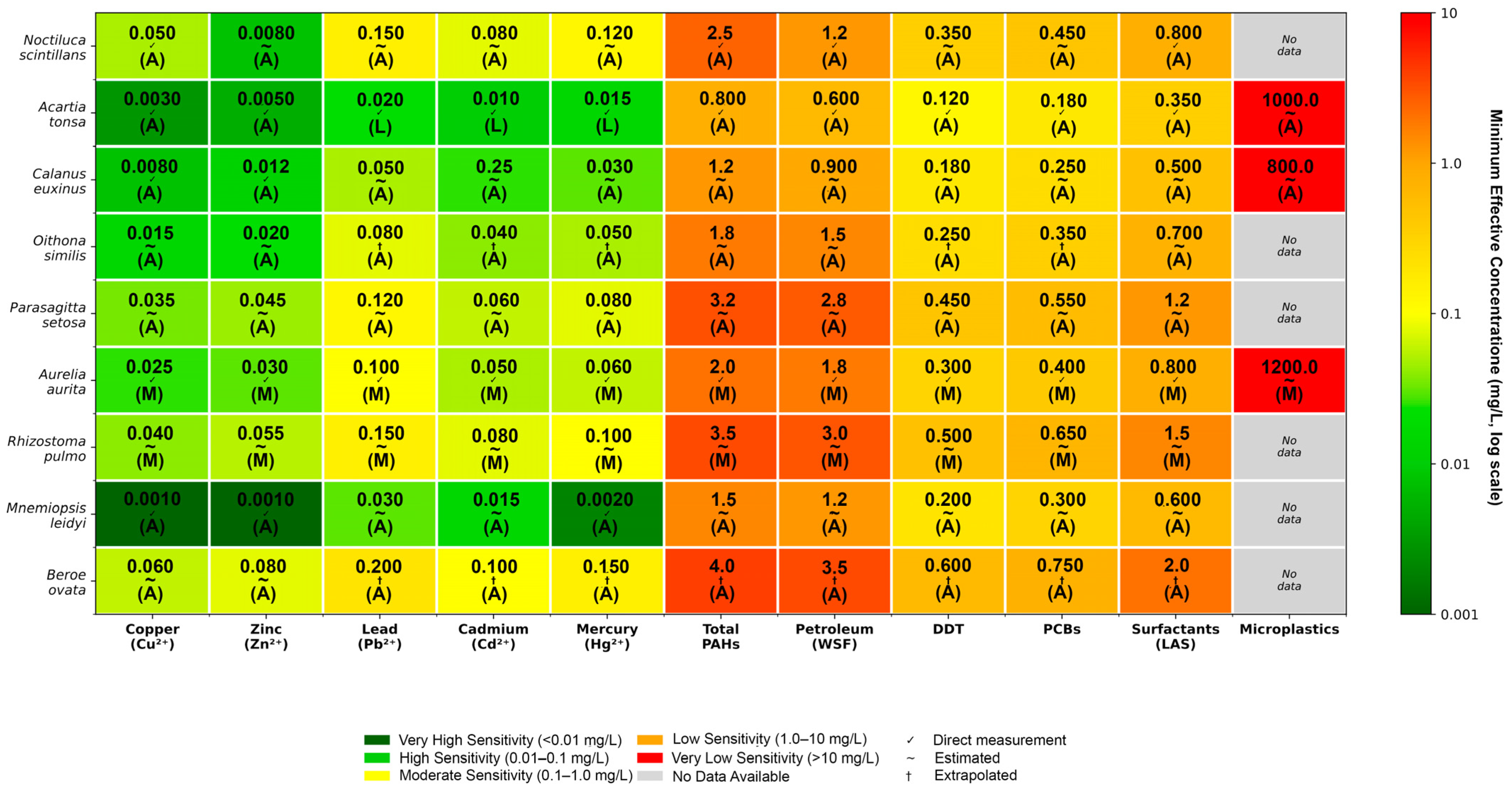
Threshold concentrations inducing detectable behavioral or physiological responses vary markedly across species and pollutant classes (Table 2). To facilitate rapid visual synthesis of these patterns, we present a sensitivity heatmap (Figure 2), followed by four concise, observation-based insights derived directly from the data.
For consistency across diverse experimental designs, we define minimum effective concentration (MEC) as the lowest reported concentration inducing any statistically or biologically detectable response (behavioral, physiological, reproductive, or lethal). This approach prioritizes the most sensitive endpoint for each species–pollutant pair, aligning with the BEWS objective of early-warning detection.
Table 2. Minimum effective concentrations (MEC) of pollutants across biological endpoints (mg/L or particles/mL).
SpeciesEffect Type 1Petroleum ProductsCuZnAgCdSDSPesticidesMicro
Plastics
Source
Acartia tonsaDecreased fertility (EC20)n.d.0.00120.00030.00064n.d.n.d.n.d.n.d.[91]
Acartia tonsaBehavioral changes0.05n.d.n.d.n.d.n.d.0.50.00001–0.001 1,675 particles/mL 7[56,76,94,137]
Acartia tonsaMortality (LC50)0.12n.d.n.d.n.d.n.d.2.80.000001–0.00001n.d.[89,91,93]
Calanus euxinus---n.d.n.d.n.d.n.d.n.d.n.d.n.d.n.d.
Parasagitta setosa---n.d.n.d.n.d.n.d.n.d.n.d.n.d.n.d.
Aurelia aurita (ephyrae)Reducing pulsation (EC50)>1500.021n.d.n.d.n.d.0.852.5–77 5n.d.[103,106]
Aurelia aurita (ephyrae)Immobilization (EC50)>210.065n.d.n.d.n.d.2.5n.d.n.d.[103]
Aurelia aurita (polyps)Metabolomic changesn.d.n.d.n.d.n.d.n.d.n.d.Atrazine (qualitative) 2n.d.[107]
Aurelia aurita (polyps)Oxidative stressn.d.n.d.n.d.n.d.n.d.n.d.n.d.0.01–1.0 3,4[108,109,110]
Rhizostoma pulmo---n.d.n.d.n.d.n.d.n.d.n.d.n.d.n.d.
Mnemiopsis leidyiEnhanced bioluminescencen.d.0.0010.001n.d.0.001n.d.n.d.n.d.[127]
Mnemiopsis leidyiChange in swimming2–5n.d.n.d.n.d.n.d.n.d.n.d.n.d.[126]
Mnemiopsis leidyiMortality (LC50, 96 h)12.5–18.7n.d.n.d.n.d.n.d.n.d.n.d.n.d.[126]
Beroe ovataEnhanced bioluminescencen.d.0.0010.001n.d.0.001n.d.n.d.n.d.[127]
Beroe ovataMortality (LC50)~15–20 (estimated)n.d.n.d.n.d.n.d.n.d.n.d.n.d.Extrapolated from M. leidyi
Pleurobrachia pileus---n.d.n.d.n.d.n.d.n.d.n.d.n.d.n.d.
Notes: n.d.—no data in the analyzed sources; 1 chlorpyrifos (organophosphate); 2 atrazine (triazine herbicide); 3 50 nm polystyrene nanoparticles, concentration in mg/L; 4 tetracycline in combination with microplastics, mg/L; 5 2-methyl-1-phenylpropan-2-ol (synthetic food additive, not a classic pesticide); 6 chlorpyrifos, chronic exposure for 7 days; 7 20 μm polystyrene; for microplastics, particles/mL are used due to the impossibility of direct conversion to mass concentration.
Figure 2. Sensitivity heatmap of candidate biosensor species in the Black Sea. Values reflect experimental conditions closest to typical Black Sea summer conditions (~20 °C, ~18‰), though full standardization was precluded by reporting gaps in original studies. Reported minimum effective concentrations (MECs); color scale indicates sensitivity rank (green = high, red = low). Life stages: A = Adult, L = Larvae/Nauplii, and M = Medusa. Microplastics in particles/mL; all other pollutants in mg/L.
Water 18 00899 g002
Key observations from Table 2 and Figure 2:
  • Highest sensitivity to metals: Acartia tonsa (Zn EC20 = 0.3 μg/L) and Mnemiopsis leidyi (Zn MEC = 1 μg/L) show responses in the sub-μg/L range, visualized as darkest green in the heatmap.
  • Broad-spectrum detection: Aurelia aurita exhibits measurable responses to all tested pollutant classes (metals, surfactants, petroleum, and microplastics), with EC50 values in the 0.02–77 mg/L range (yellow-to-orange tones).
  • Critical microplastic data gap: Six species (C. euxinus, P. setosa, R. pulmo, B. ovata, P. pileus, and N. scintillans) lack experimental microplastic toxicity data.
  • Class-specific sensitivity pattern: Metals consistently elicit responses at lower concentrations (greens) than organic pollutants (SDS, pesticides: yellows/oranges), enabling class-level discrimination.
Section 3.5 provides a detailed comparative analysis of these sensitivity patterns, while Section 3.6, Section 3.7 and Section 3.8 address regulatory implications, geographic considerations, and normalization requirements.
Interpretation of sensitivity patterns: Analysis of threshold concentrations reveals species-specific sensitivity patterns with critical regulatory implications. The copepod Acartia tonsa demonstrates exceptional metal sensitivity, with reproductive effects at Zn 0.30 μg/L (0.03× regulatory standards [11]) and Cu 1.20 μg/L (0.24× standards)—concentrations 33× and 4× below limits established primarily for fish and crustacean protection. For pesticides, acute behavioral effects in A. tonsa occur at chlorpyrifos concentrations as low as 0.01 μg/L [55], which equals the regulatory standard, indicating that the current standard may not provide a sufficient safety margin for sublethal endpoints. Chronic exposure at 0.1 μg/L further exacerbates reproductive and feeding impairments [92]. Aurelia aurita polyps exhibit subtle metabolomic carry-over effects following parental exposure to chlorpyrifos at 0.04 μg/L and atrazine at 2.5 μg/L [107], concentrations considered “low risk” under current guidelines. Ctenophore bioluminescence provides instantaneous metal discrimination: Beroe ovata responds to Zn at 1 μg/L (0.1× standard) with 850% signal enhancement [127].
Comparison with regulatory standards: Using Black Sea regional standards [11] (Cu: 5 μg/L, Zn: 10 μg/L, and chlorpyrifos: 0.01 μg/L) comparable to international frameworks [138] indicates that planktonic communities experience sublethal stress at concentrations currently deemed “safe,” suggesting existing water quality criteria may be insufficient to protect marine food-web bases.
Critical data gaps: Critical data gaps include the complete absence of toxicological data for three species (Pleurobrachia pileus, Parasagitta setosa, and Calanus euxinus), fragmentary information (1–2 pollutant classes) for four others (Beroe ovata, Rhizostoma pulmo, Noctiluca scintillans, and Mnemiopsis leidyi), and a near-total lack of synergistic mixture studies (95% single-toxicant experiments). Furthermore, microplastic toxicity comparisons are hindered by significant methodological variations in particle size (20 μm vs. 50 nm), shape, and polymer composition across studies.
Certainty of evidence summary. Overall certainty of evidence is rated as moderate for Aurelia aurita (multiple Tier 1 studies across pollutant classes) and Acartia tonsa (Tier 1 reproductive and behavioral data), low for Mnemiopsis leidyi and Beroe ovata (Tier 1 data limited to heavy metals), and very low for Calanus euxinus, Parasagitta setosa, and Pleurobrachia pileus (no direct toxicological data; Tier 3 extrapolation only). Evidence certainty was downgraded where single-laboratory studies with no replication were the sole source, where exposures were conducted at temperatures or salinities substantially different from Black Sea conditions, or where data were extrapolated from different genera.

3.6. Comprehensive Assessment of Planktonic Organisms as Potential Test Objects in BEWS

For each species, a qualitative assessment was conducted for each criterion based on direct data (quantitative threshold concentrations, behavioral descriptions, and survival data) or indirect evidence (extrapolation from closely related taxa, morpho-functional analogies).
This approach allows for moving from subjective statements to a structured comparative analysis, ensuring transparency and reproducibility of conclusions regarding the suitability of each species as a test subject for automated biomonitoring systems (Table 3).
The results of the multi-criteria assessment are presented in Table 4. The maximum possible score is 30 points (10 criteria x 3 points).
Aurelia aurita (26/30) stands out as the only species achieving a maximum score in biological criteria (12/12), providing universal screening capability for all pollutant classes. Its overall rating is slightly reduced by the necessity for regular collection from wild populations and the moderate contrast of its translucent body for video analysis, yet it remains the most suitable candidate for standard video systems from March to October. In contrast, Acartia tonsa (21/30) exhibits exceptional sensitivity to trace concentrations of metals and pesticides, coupled with the advantage of year-round culturing. However, its small size and high speed present a critical technical limitation, requiring specialized equipment for detection. Mnemiopsis leidyi (22/30) is a balanced candidate with the unique asset of metal-specific bioluminescence, though its utility is constrained by a narrower pollutant spectrum, its invasive status, and a seasonal presence from June to October. Finally, Beroe ovata (21/30), while showing the most extreme sensitivity to Zinc, is critically dependent on M. leidyi as a food source and has low tolerance for colder temperatures, with availability tracking for M. leidyi prey dynamics (July–November), functioning as a complementary biosensor for heavy metal discrimination.
A comparative analysis of the key parameters relevant for BEWS design—including detection methods, response times, seasonal availability, organism supply, and pollutant discrimination capability—is presented in Table 5.
For the correct interpretation of biosensor signals, normalization for temperature and salinity is critically necessary. Temperature significantly influences behavior, with A. aurita’s swimming efficiency increasing 1.5-fold between 13 °C and 21 °C [139], while M. leidyi’s bioluminescence can decrease by a factor of 4 at 30 °C and by 20 times at 10 °C compared to its 26 °C optimum [127]; B. ovata has a very narrow optimum around 22 °C with a critical minimum of 12–14 °C [42]. Furthermore, jellyfish and ctenophores require an acclimation period of 30–60 min for every 1–2‰ change in salinity. Essential technical solutions to manage these factors include using a constant hydrostatic pressure chamber to minimize artifacts from depth collection, implementing continuous monitoring of temperature and salinity with direct integration into signal processing algorithms, and applying standardized correction tables for pulsation frequency in A. aurita and bioluminescence intensity in ctenophores based on temperature.
Long-term datasets from Romanian waters (2008–2023) document distinct environmental conditions: chronic eutrophication in Danube-influenced zones [12], elevated bioaccumulation of heavy metals and organic pollutants in planktonic food webs [18,19], and spatial zonation of zooplankton assemblages across salinity gradients [26]. However, no studies have experimentally tested whether candidate species (A. tonsa, A. aurita, and M. leidyi) from these waters exhibit similar toxicity thresholds as conspecifics from other Black Sea sectors. Intraspecific variation in pollutant tolerance due to local adaptation or chronic exposure history can alter EC50 values by factors of 2–10×—a pattern observed repeatedly in terrestrial and aquatic invertebrates [22], and likely relevant for marine zooplankton as well. For BEWS applications, this means biosensor alert thresholds calibrated with organisms from one subregion may require adjustment for deployment elsewhere. Future implementations should include comparative calibration studies using organisms from multiple Black Sea sectors to quantify geographic variability and develop region-specific correction factors if needed.

3.7. Geographic Distribution of Data and Regional Considerations

An important limitation of the current synthesis is the geographic concentration of toxicological data. Most experimental studies (Table S1) utilized organisms from Turkish, Bulgarian, or Russian Black Sea waters, while other coastal sectors remain underrepresented in experimental ecotoxicology despite extensive field monitoring programs [12,26].
Intraspecific variation in pollutant tolerance due to local adaptation or chronic exposure history can alter EC50 values by factors of 2–10×—a pattern observed repeatedly in terrestrial and aquatic invertebrates [22], and likely relevant for marine zooplankton as well. For BEWS applications, biosensor alert thresholds calibrated with organisms from one subregion may require adjustment for deployment elsewhere.
Future implementations should include comparative calibration studies using organisms from multiple Black Sea sectors to quantify geographic variability and develop region-specific correction factors if needed.

3.8. Normalization Requirements for Biosensor Signal Interpretation

For the correct interpretation of biosensor signals, normalization for temperature and salinity is critically necessary. Without such correction, seasonal temperature shifts (e.g., 22 °C in summer to 12 °C in autumn) could suppress M. leidyi bioluminescence by ~20×—a magnitude comparable to Pb-induced signal loss—leading to false-positive pollution alerts in field deployments.
Temperature effects vary substantially among candidate species: A. aurita pulsation frequency increases 1.5-fold between 13 °C and 21 °C [139]; M. leidyi bioluminescence decreases 4-fold at 30 °C and 20-fold at 10 °C compared to its 26 °C optimum [127]; B. ovata has a narrow optimum around 22 °C with a critical minimum of 12–14 °C [42]. A Q10-based correction is recommended as the standard approach for normalizing these temperature-dependent responses [33]: Rnorm = Robs × Q10^((Tref − Tobs)/10), where Tref is the reference temperature (recommended 20 °C for Black Sea summer conditions). Preliminary Q10 estimates derived from the data above suggest Q10 ≈ 2.0 for A. aurita pulsation, with higher values likely for ctenophore bioluminescence; however, precise species-specific coefficients require experimental calibration across the full Black Sea temperature range (10–24 °C).
Salinity correction is less critical within the typical open Black Sea range (16–18.5‰) but becomes necessary for estuarine deployments (10–16‰). Jellyfish and ctenophores require acclimation periods of 30–60 min for every 1–2‰ change in salinity.
Technical solutions include:
  • Constant hydrostatic pressure chambers to minimize depth-collection artifacts.
  • Continuous temperature and salinity monitoring with direct integration into signal processing algorithms.
  • Standardized correction tables for pulsation frequency (A. aurita) and bioluminescence intensity (ctenophores)—a practice already validated in Mediterranean BEWS [104,137] and recommended for adaptation to Black Sea conditions (18‰, 10–24 °C).

4. Discussion

4.1. Comparison with Previous BEWS Studies

Freshwater BEWS using Daphnia magna, Gammarus spp., and fish are well established [31,38], but marine applications lag behind. Freshwater biosensors benefit from decades of protocol standardization and regulatory integration, whereas marine BEWS development is still in the early stages. The Black Sea presents unique challenges not encountered in freshwater or fully marine Mediterranean systems: pronounced salinity gradients (10–18‰), seasonal thermal stratification, periodic hypoxia in coastal zones, and the ecological dominance of invasive gelatinous species.
Mediterranean BEWS studies using Aurelia aurita ephyrae [103] established baseline toxicological protocols that are directly applicable to Black Sea populations. However, the lower salinity of the Black Sea (17–18‰ vs. 36–38‰ in the Mediterranean) may alter species sensitivity thresholds, necessitating region-specific calibration before operational deployment.
The three-species complementary approach proposed in this review—combining A. aurita for broad screening, M. leidyi for metal discrimination, and A. tonsa for trace detection—represents an advancement over single-species BEWS designs, offering both redundancy and pollutant-specific diagnostic capability.
Comparative analysis of the top-ranked candidates (Table 5) reveals functional complementarity: A. aurita provides broad-spectrum screening (5/5 pollutant classes) via standard video, M. leidyi enables metal-specific discrimination through bioluminescence patterns, and A. tonsa offers unmatched trace sensitivity (Zn EC20 = 0.3 μg/L, 33× below regulatory standards) at the cost of specialized micro-videography. No single species meets all criteria simultaneously, reinforcing the need for multi-species BEWS designs. Regarding organism supply, only A. tonsa supports year-round laboratory culture; A. aurita polyps can be maintained in the laboratory while medusae require seasonal field collection; M. leidyi and B. ovata are most practical to collect in situ during the warm season (>15 °C), which coincides with peak anthropogenic pressure in coastal zones.

4.2. Implications for Environmental Policy

The findings have direct relevance for the Marine Strategy Framework Directive (MSFD) [17] implementation in the Black Sea region, particularly Descriptors 4 (Food webs) and 8 (Contaminants). The demonstrated sensitivity of planktonic organisms at concentrations below current regulatory standards raises questions about the adequacy of existing water quality criteria for protecting marine food-web bases.
Integration of plankton-based BEWS with existing chemical-monitoring programs could provide complementary biological validation of water quality assessments. Real-time biosensor data may also support rapid response protocols for pollution incidents, enabling earlier intervention than conventional sampling-based approaches.
The Black Sea exhibits pronounced regional heterogeneity that must inform the BEWS deployment strategy. The northwestern shelf, shaped by the Danube, Dnieper, and Dniester discharges [6,7], is characterized by chronic eutrophication, reduced salinity (down to 10‰), and elevated contaminant loads in planktonic food webs [18,19,24,27]. The Turkish coast presents contrasting conditions: higher salinity (17–18‰), warmer temperatures, and exposure to intensive shipping traffic through the Bosphorus and Dardanelles straits [2,11]. The Kerch Strait zone, connecting the Black Sea with the shallow, brackish Sea of Azov (10–12‰), adds another dimension—seasonal influx of Azov waters alters local salinity, temperature, and plankton composition, creating a dynamic transitional environment [40]. These gradients directly affect the candidate biosensor species: A. tonsa dominates in brackish coastal waters (10–25‰) and may exhibit different baseline behavior and sensitivity thresholds across subregions [14], while M. leidyi and A. aurita population dynamics vary by several weeks between regions [16,21]. Long-term monitoring datasets confirm that zooplankton community structure differs substantially across these sectors [12,14], and intraspecific variation in pollutant tolerance due to local adaptation can alter EC50 values by factors of 2–10× [22]. For practical BEWS implementation, this means that alert thresholds calibrated in one subregion require validation before deployment elsewhere. Priority deployment sites should be selected based on the combination of anthropogenic pressure intensity and availability of candidate species—including major ports, industrial zones, the Bosphorus approaches, and the Kerch Strait area [11].

4.3. Practical Implementation Framework

Integrating plankton-based BEWS into existing Black Sea monitoring infrastructure does not require building parallel systems. The monitoring networks operated by riparian states under the Bucharest Convention and MSFD already include fixed coastal stations conducting regular water quality and biodiversity sampling [11]. These stations can serve as deployment sites for BEWS modules, enabling direct correlation between biological responses and conventional chemical measurements.
The three recommended species correspond to distinct, modular sensor configurations: video-based tracking of A. aurita pulsation (standard HD cameras, 30–60 fps), bioluminescence quantification for M. leidyi (dark chamber with photosensitive detectors at 485–488 nm), and high-speed micro-videography for A. tonsa (≥100 fps with macro optics). Each module can be housed in standard underwater enclosures compatible with existing cabled observatories or autonomous platforms. This modularity allows phased deployment: initial systems based on A. aurita alone can be expanded to multi-species arrays as operational experience and infrastructure capacity develop.
A phased pilot approach is recommended: Phase 1: deploying A. aurita at 2–3 sentinel stations across distinct Black Sea subregions to validate biosensor-chemical correlations and establish region-specific alert thresholds; Phase 2: adding M. leidyi during the warm season for metal-specific discrimination; and Phase 3: introducing A. tonsa for trace-level detection at facilities equipped with specialized imaging. Throughout all phases, raw behavioral data should undergo temperature and salinity normalization (Section 3.8) before analysis, and alert thresholds should incorporate safety margins reflecting the sublethal sensitivity of planktonic organisms documented in this review (Section 3.5). Standardized data formats compatible with Black Sea Commission reporting systems would facilitate integration of continuous biosensor time-series with existing MSFD Descriptor 8 assessments.

4.4. Limitations

This review has several limitations that should be considered when interpreting the findings.
Geographic data bias. Experimental toxicological studies are concentrated in Turkish, Bulgarian, Romanian, and Russian Black Sea waters. Other coastal sectors, despite extensive field monitoring programs, lack species-specific experimental data. Intraspecific variation in pollutant tolerance due to local adaptation may require region-specific threshold calibration [22]. Until comparative toxicological data for the same species across multiple Black Sea subregions become available, spatial variability cannot be quantitatively incorporated into the scoring framework and remains a descriptive contextual factor.
Single-toxicant experimental design. Approximately 33% of evaluated species lack experimental toxicological data; 95% of reviewed studies tested individual pollutants in isolation, whereas natural contamination typically involves complex mixtures. Synergistic or antagonistic interactions between pollutants remain largely unexplored for Black Sea plankton.
Methodological heterogeneity. The heterogeneity of toxicological studies—varying in exposure duration (24 h to 7 days), life stages tested (juveniles vs. adults, ephyrae vs. medusae), and environmental conditions (temperature, salinity)—limits direct quantitative comparisons across species and pollutants. This is particularly evident for microplastic toxicity data, where direct comparison is hindered by 1000-fold variation in particle size (50 nm to 20 μm), differences in polymer composition, and inconsistent exposure protocols [140].
Potential reporting bias. The literature base is likely subject to publication bias favoring studies with positive or statistically significant toxicological findings. Studies demonstrating no effect at environmentally relevant concentrations may be underrepresented in the indexed databases searched. This may lead to an overestimation of sensitivity thresholds for some species–pollutant pairs. Future systematic updates of this review should include gray literature and conference proceedings to mitigate this bias.
Extrapolation uncertainty. Biosensor suitability scores for three species (C. euxinus, P. setosa, and P. pileus) rely entirely on indirect evidence extrapolated from related taxa, introducing uncertainty that can only be resolved through direct experimental testing.
Scoring methodology. The multi-criteria scoring system uses equal weighting for all ten criteria, as there are currently no empirical grounds to assign different weights. This means the rankings are indicative rather than absolute: they are best used as a tool for prioritizing further research and pilot deployments. If criteria were weighted differently—for example, giving more importance to sensitivity for trace-level monitoring, or to year-round availability for continuous operation—the species rankings could change. The final choice of biosensor species should therefore be guided by the specific objectives and conditions of each monitoring site. A scenario-based sensitivity analysis—applying different weighting schemes tailored to specific monitoring objectives (e.g., continuous surveillance vs. event-triggered screening)—represents a priority for future work once pilot deployment data are available to inform empirically grounded weight assignment.

5. Conclusions

This systematic review identifies Black Sea planktonic organisms as promising candidates for automated water quality monitoring systems. Based on multi-criteria assessment across 10 biological, technical, and practical parameters, three species are recommended for BEWS implementation:
Aurelia aurita—primary universal biosensor for general pollution screening (Cu EC50 = 0.021 mg/L for pulsation frequency; SDS EC50 = 0.85 mg/L; suitable for standard Full HD video systems, 30 fps).
Mnemiopsis leidyi—specialized biosensor for heavy metal detection and discrimination via bioluminescence (650% enhancement for Zn, 430% for Cu, and 350% for Hg at 0.001 mg/L).
Acartia tonsa—specialized biosensor for trace contamination detection (reproductive effects at Zn 0.30 μg/L and Cu 1.20 μg/L—concentrations 4–33× below regulatory standards [11]).
Priority research directions:
  • Standardized multi-laboratory protocols for the three recommended biosensor species;
  • Expanded toxicological testing of A. aurita, M. leidyi, and A. tonsa for pollutant classes with limited data (pesticides, microplastics);
  • Synergistic mixture studies at ecologically relevant concentrations;
  • Comparative calibration across Black Sea subregions to quantify geographic variability in sensitivity thresholds, since organisms from different coastal sectors (e.g., Danube-influenced shelf vs. Crimean coast) may respond differently to the same pollutant concentrations due to local environmental conditions [22];
  • Pilot BEWS deployments integrating biosensor signals with continuous chemical monitoring;
  • The integration of these biosensor species with computer vision and machine learning algorithms [141] offers a promising framework toward autonomous early-warning systems for Black Sea environmental management, directly supporting MSFD Descriptors 4 (Food webs) and 8 (Contaminants) objectives, pending field validation and subregional calibration.

Supplementary Materials

The following supporting information can be downloaded at: https://www.mdpi.com/article/10.3390/w18080899/s1, Table S1: Direct Toxicological Data; Table S2: Supporting Evidence for BEWS Candidate Species Selection; Table S3: List of supporting references; Table S4: PRISMA_2020_abstract_checklist; Table S5: PRISMA_2020_checklist.

Author Contributions

Conceptualization, I.B., E.V. and A.G.; methodology, I.B.; writing—original draft preparation, I.B. and A.G.; writing—review and editing, I.B. and E.V.; supervision, E.V.; project administration, E.V.; funding acquisition, E.V. All authors have read and agreed to the published version of the manuscript.

Funding

The study was supported by a grant from the Russian Science Foundation № 25-19-00551, https://rscf.ru/project/25-19-00551/ (accessed on 6 April 2026).

Data Availability Statement

No new data were created or analyzed in this study. Data sharing is not applicable to this article, as it is a systematic review synthesizing previously published studies. All data discussed in this review are available in the original publications cited in the reference list.

Conflicts of Interest

The authors declare no conflicts of interest.

Abbreviations

The following abbreviations are used in this manuscript:
BEWSBiological Early-Warning Systems
MFBMultispecies Freshwater Biomonitor®
PAHsPolycyclic aromatic hydrocarbons
MDAMalondialdehyde
DNADeoxyribonucleic acid
AChEAcetylcholinesterase
HFEIHigh-frequency electromagnetic induction
PAMPassive acoustic monitoring
WSFWater-soluble fraction
SDSSodium decyl sulfate
DMSDimethyl sulfide
TTXTetrodotoxin
BAFsBioaccumulation factors
PCBsPolychlorinated biphenyls
CEWAFChemically dispersed oil
MECMinimum effective concentrations
MACMaximum allowable concentration
MSFDMarine Strategy Framework Directive

References

  1. Murray, J.W.; Top, Z.; Özsoy, E. Hydrographic properties and ventilation of the Black Sea. Deep-Sea Res. 1991, 38, S663–S689. [Google Scholar] [CrossRef] [Scilit]
  2. Oguz, T.; Gilbert, D. Abrupt transitions of the top-down controlled Black Sea pelagic ecosystem during 1960-2000: Evidence for regime-shifts under strong fishery exploitation and nutrient enrichment modulated by climate-induced variations. Deep-Sea Res. I 2007, 54, 220–242. [Google Scholar] [CrossRef] [Scilit]
  3. Ünlüata, Ü.; Oğuz, T.; Latif, M.A.; Özsoy, E. On the physical oceanography of the Turkish Straits. In The Physical Oceanography of Sea Straits; NATO ASI Series; Pratt, L.J., Ed.; Springer: Dordrecht, The Netherlands, 1990; pp. 25–60. [Google Scholar] [CrossRef] [Scilit]
  4. Özsoy, E.; Sur, H.I.; Goryachkin, Y. A review of the exchange flow regime and mixing in the Bosphorus Strait. Bull. L’institut Océanographique Monaco 1996, 18, 157–184. [Google Scholar]
  5. Özsoy, E.; Ünlüata, Ü. The Black Sea. In The Sea; Robinson, A.R., Brink, K., Eds.; John Wiley: New York, NY, USA, 1998; Volume 11, pp. 889–914. [Google Scholar]
  6. Jaoshvili, S. The Rivers of the Black Sea; Technical Report No. 71; European Environment Agency: Copenhagen, Denmark, 2002. [Google Scholar]
  7. Ludwig, W.; Dumont, E.; Meybeck, M.; Heussner, S. River discharges of water and nutrients to the Mediterranean and Black Sea: Major drivers for ecosystem changes during past and future decades? Prog. Oceanogr. 2009, 80, 199–217. [Google Scholar] [CrossRef] [Scilit]
  8. Stanev, E.V.; Peneva, E.; Chtirkova, B. Climate change and regional ocean water mass disappearance: Case of the Black Sea. J. Geophys. Res. Ocean. 2019, 124, 4803–4819. [Google Scholar] [CrossRef] [Scilit]
  9. Grégoire, M.; Alvera-Azcaráte, A.; Buga, L.; Capet, A.; Constantin, S.; D’ortenzio, F.; Doxaran, D.; Faugeras, Y.; Garcia-Espriu, A.; Golumbeanu, M.; et al. Monitoring Black Sea environmental changes from space: New products for altimetry, ocean colour and salinity. Potentialities and requirements for a dedicated in-situ observing system. Front. Mar. Sci. 2023, 9, 998970. [Google Scholar] [CrossRef] [Scilit]
  10. Özsoy, E.; Ünlüata, Ü. Oceanography of the Black Sea: A review of some recent results. Earth-Sci. Rev. 1997, 42, 231–272. [Google Scholar] [CrossRef] [Scilit]
  11. BSC. State of the Environment of the Black Sea (2009–2014/5); Krutov, A., Ed.; Publications of the Commission on the Protection of the Black Sea Against Pollution (BSC): Istanbul, Turkey, 2019; Available online: https://www.researchgate.net/publication/339788230_BSC_2019_State_of_the_Environment_of_the_Black_Sea_2009-20145_Edited_by_Anatoly_Krutov_Publications_of_the_Commission_on_the_Protection_of_the_Black_Sea_Against_Pollution_BSC_2019_Istanbul_Turkey_811_ (accessed on 13 September 2025).
  12. Bisinicu, E.; Lazar, L. Planktonic Trophic Transitions in the Black Sea: Functional Perspectives and Ecosystem Policy Relevance. Phycology 2025, 5, 39. [Google Scholar] [CrossRef] [Scilit]
  13. Ristea, E.; Bisinicu, E.; Lavric, V.; Parvulescu, O.C.; Lazar, L. A Long-Term Perspective of Seasonal Shifts in Nutrient Dynamics and Eutrophication in the Romanian Black Sea Coast. Sustainability 2025, 17, 1090. [Google Scholar] [CrossRef] [Scilit]
  14. Gubanova, A.; Altukhov, D.; Stefanova, K.; Arashkevich, E.; Kamburska, L.; Prusova, I.; Svetlichny, L.; Timofte, F.; Uysal, Z.A.H.İ.T. Species composition of Black Sea marine planktonic copepods. J. Mar. Syst. 2014, 135, 44–52. [Google Scholar] [CrossRef] [Scilit]
  15. Mutlu, E. Diel vertical migration of Sagitta setosa as inferred acoustically in the Black Sea. Mar. Biol. 2006, 149, 573–584. [Google Scholar] [CrossRef] [Scilit]
  16. Finenko, G.A.; Romanova, Z.A.; Abolmasova, G.I.; Anninsky, B.E.; Pavlovskaya, T.V.; Bat, L.; Kideys, A. Ctenophores-invaders and their role in the trophic dynamics of the planktonic community in the coastal regions off the Crimean coasts of the Black Sea (Sevastopol Bay). Oceanology 2006, 46, 472–482. [Google Scholar] [CrossRef] [Scilit]
  17. European Union. Directive 2008/56/EC of the European Parliament and of the Council of 17 June 2008 establishing a framework for community action in the field of marine environmental policy (Marine Strategy Framework Directive). Off. J. Eur. Union L 2008, 164, 19–40. Available online: https://eur-lex.europa.eu/legal-content/EN/TXT/?uri=CELEX:32008L0056 (accessed on 13 September 2025).
  18. Coatu, V.; Damir, N.; Lazăr, L.; Oros, A. Bioaccumulation of contaminants in the main links of the pelagic trophic chain at the Romanian Black Sea coast. Cercet. Mar.-Rech. Mar. 2018, 48, 118–134. [Google Scholar]
  19. Damir, N.; Coatu, V.; Danilov, D.; Lazăr, L.; Oros, A. From Waters to Fish: A Multi-Faceted Analysis of Contaminants’ Pollution Sources, Distribution Patterns, and Ecological and Human Health Consequences. Fishes 2024, 9, 274. [Google Scholar] [CrossRef] [Scilit]
  20. Hubareva, E.S. The Population Characteristics of the Copepod Calanus euxinus Hulsemann, 1991 off the Crimea Coast (Black Sea). Russ. J. Mar. Biol. 2025, 51, 201–210. [Google Scholar] [CrossRef] [Scilit]
  21. Shiganova, T.A.; Legendre, L.; Kazmin, A.S.; Nival, P. Interactions between invasive ctenophores in the Black Sea: Assessment of control mechanisms based on long-term observations. Mar. Ecol. Prog. Ser. 2014, 507, 111–123. [Google Scholar] [CrossRef] [Scilit]
  22. Posthuma, L.; Van Straalen, N.M. Heavy-metal adaptation in terrestrial invertebrates: A review of occurrence, genetics, physiology and ecological consequences. Comp. Biochem. Physiol. Part C Pharmacol. Toxicol. Endocrinol. 1993, 106, 11–38. [Google Scholar] [CrossRef] [Scilit]
  23. Strokal, M.; Strokal, V.; Kroeze, C. The future of the Black Sea: More pollution in over half of the rivers. Ambio 2022, 52, 339–356. [Google Scholar] [CrossRef] [Scilit]
  24. Yunev, O.A.; Carstensen, J.; Moncheva, S.; Khaliulin, A.; Ærtebjerg, G.; Nixon, S. Nutrient and phytoplankton trends on the western Black Sea shelf in response to cultural eutrophication and climate changes. Estuar. Coast. Shelf Sci. 2007, 74, 63–76. [Google Scholar] [CrossRef] [Scilit]
  25. Strokal, M.; Kroeze, C. Nitrogen and phosphorus inputs to the Black Sea in 1970–2050. Reg. Environ. Change 2013, 13, 179–192. [Google Scholar] [CrossRef] [Scilit]
  26. Bișinicu, E.; Harcotă, G.E.; Filimon, A.; Abaza, V.; Tănase, M.C.; Timofte, F. Mesozooplankton Dynamics in The Romanian Black Sea Waters During 2020-2021. Cercet. Mar.-Rech. Mar. 2023, 53, 39–58. [Google Scholar] [CrossRef] [Scilit]
  27. Moncheva, S.; Gotsis-Skretas, O.; Pagou, K.; Krastev, A. Phytoplankton Blooms in Black Sea and Mediterranean Coastal Ecosystems Subjected to Anthropogenic Eutrophication: Similarities and Differences. Estuar. Coast. Shelf Sci. 2001, 53, 281–295. [Google Scholar] [CrossRef] [Scilit]
  28. Mikaelyan, A.S.; Kubryakov, A.A.; Silkin, V.A.; Pautova, L.A.; Chasovnikov, V.K. Regional climate and patterns of phytoplankton annual succession in the open waters of the Black Sea. Deep Sea Res. Part I Oceanogr. Res. Pap. 2018, 142, 44–57. [Google Scholar] [CrossRef] [Scilit]
  29. Yunev, O.; Carstensen, J.; Suslin, V.; Belokopytov, V.; Stelmakh, L.; Zhuk, E. Temporal variability of phytoplankton biomass and algae blooms in the open Black Sea. Prog. Oceanogr. 2025, 237, 103541. [Google Scholar] [CrossRef] [Scilit]
  30. Depledge, M.H.; Galloway, T.S. Healthy animals, healthy ecosystems. Front. Ecol. Environ. 2005, 7, 251–258. [Google Scholar] [CrossRef] [Scilit]
  31. Gerhardt, A. Aquatic behavioral ecotoxicology—Prospects and limitations. Hum. Ecol. Risk Assess. 2007, 13, 481–491. [Google Scholar] [CrossRef] [Scilit]
  32. Hellou, J. Behavioural ecotoxicology, an “early warning” signal to assess environmental quality. Environ. Sci. Pollut. Res. 2011, 18, 1–11. [Google Scholar] [CrossRef] [Scilit]
  33. Richardson, A.J. In hot water: Zooplankton and climate change. ICES J. Mar. Sci. 2008, 65, 279–295. [Google Scholar] [CrossRef] [Scilit]
  34. Lombard, F.; Boss, E.; Waite, A.M.; Vogt, M.; Uitz, J.; Stemmann, L.; Sosik, H.M.; Schulz, J.; Romagnan, J.-B.; Picheral, M.; et al. Globally consistent quantitative observations of planktonic ecosystems. Front. Mar. Sci. 2019, 6, 196. [Google Scholar] [CrossRef] [Scilit]
  35. Schmid, M.S.; Aubry, C.; Grigor, J.; Fortier, L. The LOKI underwater imaging system and an automatic identification model for the detection of zooplankton taxa in the Arctic Ocean. Methods Oceanogr. 2016, 15, 129–160. [Google Scholar] [CrossRef] [Scilit]
  36. Irisson, J.O.; Ayata, S.D.; Lindsay, D.J.; Karp-Boss, L.; Stemmann, L. Machine learning for the study of plankton and marine snow from images. Annu. Rev. Mar. Sci. 2022, 14, 277–301. [Google Scholar] [CrossRef] [Scilit]
  37. Page, M.J.; McKenzie, J.E.; Bossuyt, P.M.; Boutron, I.; Hoffmann, T.C.; Mulrow, C.D.; Shamseer, L.; Tetzlaff, J.M.; Akl, E.A.; Brennan, S.E.; et al. The Prisma 2020 Statement: An Updated Guideline for Reporting Systematic Reviews. BMJ 2021, 372, n71. [Google Scholar] [CrossRef] [Scilit]
  38. Gerhardt, A.; Schmidt, S. The Multispecies Freshwater Biomonitor: A potential new tool for sediment biotests and biomonitoring. J. Soils Sediments 2002, 2, 67–70. [Google Scholar] [CrossRef] [Scilit]
  39. Cui, M.; Liu, X.; Liu, H.; Zhao, J.; Li, D.; Wang, W. Fish tracking, counting, and behaviour analysis in digital aquaculture: A comprehensive survey. Rev. Aquac. 2025, 17, e13001. [Google Scholar] [CrossRef] [Scilit]
  40. Kovalev, A.V.; Skryabin, V.A.; Zagorodnyaya, Y.A.; Bingel, F.; Kideyş, A.E.; Niermann, U.; Uysal, Z. The Black Sea zooplankton: Composition, spatial/temporal distribution and history of investigations. Turk. J. Zool. 1999, 23, 195–210. [Google Scholar]
  41. Shiganova, T.A.; Alekseenko, E.; Kazmin, A.S. Predicting range expansion of invasive ctenophore Mnemiopsis leidyi A. Agassiz 1865 under current environmental conditions and future climate change scenarios. Estuar. Coast. Shelf Sci. 2019, 227, 106347. [Google Scholar] [CrossRef] [Scilit]
  42. Anninsky, B.E.; Finenko, G.A.; Abolmasova, G.I.; Hubareva, E.S.; Svetlichny, L.S.; Bat, L.; Kideys, A.E. Effect of starvation on the biochemical compositions and respiration rates of ctenophores Mnemiopsis leidyi and Beroe ovata in the Black Sea. J. Mar. Biol. Assoc. United Kingd. 2005, 85, 549–561. [Google Scholar] [CrossRef] [Scilit]
  43. Valavanidis, A.; Vlahogianni, T.; Dassenakis, M.; Scoullos, M. Molecular biomarkers of oxidative stress in aquatic organisms in relation to toxic environmental pollutants. Ecotoxicol. Environ. Saf. 2009, 64, 178–189. [Google Scholar] [CrossRef] [Scilit]
  44. Correia, A.D.; Costa, M.H.; Luis, O.J.; Livingstone, D.R. Age-related changes in antioxidant enzyme activities, fatty acid composition and lipid peroxidation in whole body Gammarus locusta (Crustacea: Amphipoda). J. Exp. Mar. Biol. Ecol. 2003, 289, 83–101. [Google Scholar] [CrossRef] [Scilit]
  45. Machado, A.A.S.; Wood, C.M.; Bianchini, A.; Bianchini, A.; Gillis, P.L. Responses of biomarkers in wild freshwater mussels chronically exposed to complex contaminant mixtures. Ecotoxicology 2014, 23, 1345–1358. [Google Scholar] [CrossRef] [Scilit]
  46. Marczynski, B.; Rihs, H.-P.; Rossbach, B.; Hölzer, J.; Angerer, J.; Scherenberg, M.; Hoffmann, G.; Bruning, T.; Wilhelm, M. Analysis of 8-oxo-7,8-dihydro-2′-deoxyguanosine and DNA strand breaks in white blood cells of occupationally exposed workers: Comparison with ambient monitoring, urinary metabolites and enzyme polymorphisms. Carcinogenesis 2002, 23, 273–281. [Google Scholar] [CrossRef] [Scilit]
  47. Viarengo, A.; Burlando, B.; Cavaletto, M.; Ponzano, E. Role of metallothionein against oxidative stress in the mussel Mytilus galloprovincialis. Am. J. Physiol.-Regul. Integr. Comp. Physiol. 1993, 265, R1430–R1434. [Google Scholar] [CrossRef] [Scilit]
  48. Viarengo, A.; Ponzano, E.; Dondero, F.; Fabbri, R. A simple spectrophotometric method for metallothionein evaluation in marine organisms: An application to Mediterranean and Antarctic molluscs. Mar. Environ. Res. 1997, 44, 69–84. [Google Scholar] [CrossRef] [Scilit]
  49. Lionetto, M.G.; Giordano, M.E.; Pascariello, M.F.; Schettino, T. Integrated use of biomarkers (acetylcholinesterase and antioxidant enzyme activities) in Mytilus galloprovincialis and Mullus barbatus in an Italian coastal marine area. Mar. Pollut. Bull. 2003, 46, 324–330. [Google Scholar] [CrossRef] [Scilit] [PubMed]
  50. Thévenod, F.; Lee, W.K. Cadmium and cellular signaling cascades: Interactions between cell death and survival pathways. Arch. Toxicol. 2013, 87, 1743–1786. [Google Scholar] [CrossRef] [Scilit] [PubMed]
  51. Amiard, J.-C.; Amiard-Triquet, C.; Barka, S.; Pellerin, J.; Rainbow, P.S. Metallothioneins in aquatic invertebrates: Their role in metal detoxification and their use as biomarkers. Aquat. Toxicol. 2006, 76, 160–202. [Google Scholar] [CrossRef] [Scilit]
  52. Rainbow, P.S. Trace metal concentrations in aquatic invertebrates: Why and so what? Environ. Pollut. 2002, 120, 497–507. [Google Scholar] [CrossRef] [Scilit] [PubMed]
  53. Wang, W.-X. Rainbow Comparative approaches to understand metal bioaccumulation in aquatic animals. Comp. Biochem. Physiol. Part C Toxicol. Pharmacol. 2008, 148, 315–323. [Google Scholar] [CrossRef] [Scilit]
  54. Fukuto, T.R. Mechanism of action of organophosphorus and carbamate insecticides. Environ. Health Perspect. 1990, 87, 245–254. [Google Scholar] [CrossRef]
  55. Barron, M.G.; Woodburn, K.B. Ecotoxicology of chlorpyrifos. Rev. Environ. Contam. Toxicol. 1995, 144, 1–93. [Google Scholar] [CrossRef] [Scilit]
  56. Barata, C.; Solayan, A.; Porte, C. Role of B-esterases in assessing toxicity of organophosphorus (chlorpyrifos, malathion) and carbamate (carbofuran) pesticides to Daphnia magna. Aquat. Toxicol. 2004, 66, 125–139. [Google Scholar] [CrossRef] [Scilit] [PubMed]
  57. Soderlund, D.M. Molecular mechanisms of pyrethroid insecticide neurotoxicity: Recent advances. Arch. Toxicol. 2012, 86, 165–181. [Google Scholar] [CrossRef] [Scilit] [PubMed]
  58. Wieczorek, A.M.; Croot, P.L.; Lombard, F.; Sheahan, J.N.; Doyle, T.K. Microplastic Ingestion by Gelatinous Zooplankton May Lower Efficiency of the Biological Pump. Environ. Sci. Technol. 2019, 53, 5387–5395. [Google Scholar] [CrossRef] [Scilit]
  59. Adams, S.M. Assessing cause and effect of multiple stressors on marine systems. Mar. Pollut. Bull. 2005, 51, 649–657. [Google Scholar] [CrossRef] [Scilit] [PubMed]
  60. Melvin, S.D.; Wilson, S.P. The utility of behavioral studies for aquatic toxicology testing: A meta-analysis. Chemosphere 2013, 93, 2217–2223. [Google Scholar] [CrossRef] [Scilit]
  61. Brijs, J.; Hjelmstedt, P.; Sundell, E.; Berg, C.; Sandblom, E.; Gräns, A. Effects of electrical and percussive stunning on neural, ventilatory and cardiac responses of rainbow trout. Aquaculture 2025, 594, 741387. [Google Scholar] [CrossRef] [Scilit]
  62. Bownik, A.; Wlodkowic, D. Advances in real-time monitoring of water quality using automated analysis of animal behaviour. Sci. Total Environ. 2021, 789, 147796. [Google Scholar] [CrossRef] [Scilit]
  63. Nesterova, D.; Moncheva, S.; Mikaelyan, A.; Vershinin, A.; Akatov, V.; Boicenco, L.; Gvarishvili, T. State of the Environment of the Black Sea; Publications of the Commission on the Protection of the Black Sea Against Pollution (BSC): Istanbul, Turkey, 2008. [Google Scholar]
  64. Finenko, G.A.; Abolmasova, G.I.; Romanova, Z.A.; Datsyk, N.A.; Anninsky, B.E. Population dynamics of the ctenophore Mnemiopsis leidyi and its impact on the zooplankton in the coastal regions of the Black Sea of the Crimean coast in 2004-2008. Oceanology 2013, 53, 80–88. [Google Scholar] [CrossRef] [Scilit]
  65. Silkin, V.A.; Pautova, L.A.; Pakhomova, S.V.; Lifanchuk, A.V.; Yakushev, E.V.; Chasovnikov, V.K. Environmental control on phytoplankton community structure in the NE Black Sea. J. Exp. Mar. Biol. Ecol. 2014, 461, 267–274. [Google Scholar] [CrossRef] [Scilit]
  66. Turkoglu, M. Red tides of the dinoflagellate Noctiluca scintillans associated with eutrophication in the Sea of Marmara (the Dardanelles, Turkey). Oceanologia 2013, 55, 709–732. [Google Scholar] [CrossRef] [Scilit]
  67. Üstün, F.; Bat, L.; Mutlu, E. Seasonal variation and taxonomic composition of mesozooplankton in the southern Black Sea (off Sinop) between 2005 and 2009. Turk. J. Zool. 2018, 42, 541–556. [Google Scholar] [CrossRef] [Scilit]
  68. Anninsky, B.E.; Finenko, G.A.; Datsyk, N.A. Alternative conditions of mass appearance of the scyphozoan jellyfish, Aurelia aurita (Linnaeus, 1758), and the ctenophore, Pleurobrachia pileus (OF Muller, 1776), in plankton of the Black Sea. South Russ. Ecol. Dev. 2020, 15, 35–47. [Google Scholar] [CrossRef] [Scilit]
  69. Eckert, R.; Reynolds, G.T. The subcellular origin of bioluminescence in Noctiluca miliaris. J. Gen. Physiol. 1967, 50, 1429–1458. [Google Scholar] [CrossRef] [Scilit]
  70. Valiadi, M.; de Rond, T.; Amorim, A.; Gittins, J.R.; Gubili, C.; Moore, B.S.; Iglesias-Rodriguez, M.D.; Latz, M. Molecular and biochemical basis for the loss of bioluminescence in the dinoflagellate Noctiluca scintillans along the west coast of the U.S.A. Limnol. Oceanogr. 2019, 64, 2709–2724. [Google Scholar] [CrossRef] [Scilit]
  71. Park, S.A.; Jeong, H.J.; Ok, J.H.; Kang, H.C.; You, J.H.; Eom, S.H.; Yoo, Y.D.; Lee, M.J. Estimation of bioluminescence intensity of the dinoflagellates Noctiluca scintillans, Polykrikos kofoidii, and Alexandrium mediterraneum populations in Korean waters using cell abundance and water temperature. Algae 2024, 39, 1–16. [Google Scholar] [CrossRef] [Scilit]
  72. Harrison, P.J.; Furuya, K.; Glibert, P.M.; Xu, J.; Liu, H.B.; Yin, K.; Lee, J.H.W.; Anderson, D.M.; Gowen, R.; Al-Azri, A.R.; et al. Geographical distribution of red and green Noctiluca scintillans. Chin. J. Oceanol. Limnol. 2011, 29, 807–831. [Google Scholar] [CrossRef] [Scilit]
  73. Fonda Umani, S.; Milani, L.; Borme, D.; de Olazabal, A.; Parlato, S.; Precali, R.; Kraus, R.; Lučić, D.; Njire, J.; Totti, C.; et al. Inter-annual variations of planktonic food webs in the northern Adriatic Sea. Sci Total Env. 2005, 353, 218–231. [Google Scholar] [CrossRef] [Scilit]
  74. Mikaelyan, A.S.; Malej, A.; Shiganova, T.A.; Turk, V.; Sivkovitch, A.E.; Musaeva, E.I.; Kogovšek, T.; Lukasheva, T.A. Populations of the red tide forming dinoflagellate Noctiluca scintillans (Macartney): A comparison between the Black Sea and the northern Adriatic Sea. Harmful Algae 2014, 33, 29–40. [Google Scholar] [CrossRef] [Scilit]
  75. Kiørboe, T.; Titelman, J. Feeding, prey selection and prey encounter mechanisms in the heterotrophic dinoflagellate Noctiluca scintillans. J. Plankton Res. 1998, 20, 1615–1636. [Google Scholar] [CrossRef] [Scilit]
  76. Almeda, R.; Connely, T.L.; Buskey, E.J. Novel insight into the role of heterotrophic dinoflagellates in the fate of crude oil in the sea. Sci. Rep. 2014, 4, 7560. [Google Scholar] [CrossRef] [Scilit]
  77. Okamoto, K.O.; Shao, L.; Hastings, J.W.; Colepicolo, P. Acute and chronic effects of toxic metals on viability, encystment and bioluminescence in the dinoflagellate Gonyaulax polyedra. Comp. Biochem. Physiol. Part C Pharmacol. Toxicol. Endocrinol. 1999, 123, 75–83. [Google Scholar] [CrossRef] [Scilit]
  78. Rosen, G.; Osorio-Robayo, A.; Rivera-Duarte, I.; Lapota, D. Comparison of Bioluminescent Dinoflagellate (QwikLite) and Bacterial (Microtox) Rapid Bioassays for the Detection of Metal and Ammonia Toxicity. Arch. Environ. Contam. Toxicol. 2008, 54, 606–611. [Google Scholar] [CrossRef] [Scilit] [PubMed]
  79. Lapota, D.; Galt, C.; Losee, J.R.; Huddell, H.D.; Orzech, J.K.; Nealson, K.H. Observations and measurements of planktonic bioluminescence in and around a milky sea. J. Exp. Mar. Biol. Ecol. 1988, 119, 55–81. [Google Scholar] [CrossRef] [Scilit]
  80. Lapota, D.; Osorio, A.R.; Liao, C.; Bjorndal, B. The use of bioluminescent dinoflagellates as an environmental risk assessment tool. Mar. Pollut. Bull. 2007, 54, 1857–1867. [Google Scholar] [CrossRef] [Scilit]
  81. Perin, L.S.; Moraes, G.V.; Galeazzo, G.A.; Oliveira, A.G. Bioluminescent Dinoflagellates as a Bioassay for Toxicity Assessment. Int. J. Mol. Sci. 2022, 23, 13012. [Google Scholar] [CrossRef] [Scilit] [PubMed]
  82. Tang, C.H.; Chen, J. Effects of microplastics exposure on the feeding of the heterotrophic dinoflagellate species Noctiluca scintillans. Water Air Soil Pollut. 2024, 235, 799. [Google Scholar] [CrossRef] [Scilit]
  83. Qi, L.; Tsai, S.-F.; Chen, Y.; Le, C.; Hu, C. In search of red Noctiluca scintillans blooms in the East China Sea. Geophys. Res. Lett. 2019, 46, 5997–6004. [Google Scholar] [CrossRef] [Scilit]
  84. Gubanova, A. Occurrence of Acartia tonsa Dana in the Black Sea. Was it introduced from the Mediterranean? Mediterr. Mar. Sci. 2000, 1, 105–110. [Google Scholar] [CrossRef] [Scilit]
  85. Gubanova, A.D.; Altukhov, D. Establishment of Oithona brevicornis Giesbrecht, 1892 (Copepoda: Cyclopoida) in the Black Sea. Aquat. Invasions 2007, 2, 407–410. [Google Scholar] [CrossRef] [Scilit]
  86. Holste, L.; Peck, M.A. The effects of temperature and salinity on egg production and hatching success of Baltic Acartia tonsa (Copepoda: Calanoida): A laboratory investigation. Mar. Biol. 2006, 148, 1061–1070. [Google Scholar] [CrossRef] [Scilit]
  87. Drillet, G.; Frouël, S.; Sichlau, M.H.; Jepsen, P.M.; Højgaard, J.K.; Joardar, A.K.; Hansen, B.W. Status and recommendations on marine copepod cultivation for use as live feed. Aquaculture 2011, 315, 155–166. [Google Scholar] [CrossRef] [Scilit]
  88. Svetlichny, L.; Larsen, P.S.; Kiørboe, T. Kinematic and dynamic scaling of copepod swimming. Fluids 2020, 5, 68. [Google Scholar] [CrossRef] [Scilit]
  89. Cohen, J.H.; McCormick, L.R.; Burkhardt, S.M. Effects of dispersant and oil on survival and swimming activity in a marine copepod. Bull. Environ. Contam. Toxicol. 2014, 92, 381–387. [Google Scholar] [CrossRef] [Scilit]
  90. Lewis, M.A. Chronic and sublethal toxicities of surfactants to aquatic animals: A review and risk assessment. Water Res. 1991, 25, 101–113. [Google Scholar] [CrossRef] [Scilit]
  91. Bielmyer, G.K.; Grosell, M.; Brix, K.V. Toxicity of silver, zinc, copper, and nickel to the copepod Acartia tonsa exposed via a phytoplankton diet. Environ. Sci. Technol. 2006, 40, 2063–2068. [Google Scholar] [CrossRef] [Scilit]
  92. Almeda, R.; Baca, S.; Hyatt, C.; Buskey, E.J. Ingestion and sublethal effects of physically and chemically dispersed crude oil on marine planktonic copepods. Ecotoxicology 2014, 23, 988–1003. [Google Scholar] [CrossRef] [Scilit]
  93. Medina, M.; Barata, C.; Telfer, T.; Baird, D.J. Age- and sex-related variation in sensitivity to the pyrethroid cypermethrin in the marine copepod Acartia tonsa Dana. Arch. Environ. Contam. Toxicol. 2002, 42, 17–22. [Google Scholar] [CrossRef] [Scilit]
  94. Cole, M.; Lindeque, P.; Fileman, E.; Halsband, C.; Galloway, T.S. The impact of polystyrene microplastics on feeding, function and fecundity in the marine copepod Calanus helgolandicus. Environ. Sci. Technol. 2015, 49, 1130–1137. [Google Scholar] [CrossRef] [Scilit]
  95. Botterell, Z.L.R.; Beaumont, N.; Cole, M.; Hopkins, F.E.; Steinke, M.; Thompson, R.C.; Lindeque, P.K. Bioavailability of microplastics to marine zooplankton: Effect of shape and infochemicals. Environ. Sci. Technol. 2020, 54, 12024–12033. [Google Scholar] [CrossRef] [Scilit] [PubMed]
  96. Thuesen, E.V.; Kogure, K.; Hashimoto, K.; Nemoto, T. Poison arrowworms: A tetrodotoxin venom in the marine phylum Chaetognatha. J. Exp. Mar. Biol. Ecol. 1988, 116, 249–256. [Google Scholar] [CrossRef] [Scilit]
  97. Barrera Grijalba, L.; Ordoñez, J.F.; Montenegro, J.; Wollesen, T. Insights into adhesive and neuronal cell populations of the chaetognath Spadella cephaloptera using a single-nuclei transcriptomic atlas and genomic resources. bioRxiv 2025. [Google Scholar] [CrossRef] [Scilit]
  98. Pitt, K.A.; Welsh, D.T.; Condon, R.H. Influence of jellyfish blooms on carbon, nitrogen and phosphorus cycling and plankton production. Hydrobiologia 2009, 616, 133–149. [Google Scholar] [CrossRef] [Scilit]
  99. Anninsky, B.E.; Finenko, G.A.; Datsyk, N.A.; Ignatyev, S.M.A. Gelatinous Macroplankton in the Black Sea in the Autumn of 2010. Oceanology 2013, 53, 676–685. Available online: https://link.springer.com/article/10.1134/S0001437013060015 (accessed on 13 September 2025). [CrossRef] [Scilit]
  100. Barz, K.; Hirche, H.-J. Seasonal development of scyphozoan medusae and the predatory impact of Aurelia aurita on the zooplankton community in the Bornholm Basin (central Baltic Sea). Mar. Biol. 2005, 147, 465–476. [Google Scholar] [CrossRef] [Scilit]
  101. Forth, H.P.; Mitchelmore, C.L.; Morris, J.M.; Lay, C.R.; Lipton, J. Characterization of dissolved and particulate phases of water accommodated fractions used to conduct aquatic toxicity testing in support of the Deepwater Horizon natural resource damage assessment. Environ. Toxicol. Chem. 2017, 36, 1460–1472. [Google Scholar] [CrossRef] [Scilit]
  102. Almeda, R.; Wambaugh, Z.; Chai, C.; Wang, Z.; Liu, H.; Buskey, E.J. Effects of crude oil exposure on bioaccumulation of polycyclic aromatic hydrocarbons and survival of adult and larval stages of gelatinous zooplankton. PLoS ONE 2013, 8, e74476. [Google Scholar] [CrossRef] [Scilit]
  103. Faimali, M.; Garaventa, F.; Piazza, V.; Costa, E.; Greco, G.; Mazzola, V.; Beltrandi, M.; Bongiovanni, E.; Lavorano, S.; Gnone, G. Ephyra jellyfish as a new model for ecotoxicological bioassays. Mar. Environ. Res. 2014, 93, 93–101. [Google Scholar] [CrossRef] [Scilit]
  104. Heerklotz, H. Interactions of surfactants with lipid membranes. Q. Rev. Biophys. 2008, 41, 205–264. [Google Scholar] [CrossRef] [Scilit]
  105. Lucas, C.H.; Horton, A.A. Short-term effects of the heavy metals, Silver and copper, on polyps of the common jellyfish, Aurelia aurita. J. Exp. Mar. Biol. Ecol. 2014, 461, 154–161. [Google Scholar] [CrossRef] [Scilit]
  106. Mercado, B.; Vila, B.; Roca-Pérez, L.; Duran-Giner, N.; Boluda-Hernández, R.; Andreu-Sánchez, O. Aurelia aurita as a Model for Ecotoxicologically Assessing Food Additives: 2-Methyl-1-phenylpropan-2-ol and 1-Phenylethan-1-ol. Toxics 2025, 13, 572. [Google Scholar] [CrossRef] [Scilit] [PubMed]
  107. Olguín-Jacobson, C.; Pitt, K.A.; Carroll, A.R.; Melvin, S.D. Chronic pesticide exposure elicits a subtle carry-over effect on the metabolome of Aurelia coerulea ephyrae. Environ. Pollut. 2021, 275, 116641. [Google Scholar] [CrossRef] [Scilit] [PubMed]
  108. Zhang, W.; Gu, J.; Lin, J.; Feng, S.; Wang, Z.; Gao, Z. Photocatalytic degradation of jellyfish polyps: A sustainable approach to combat jellyfish blooms. Mar. Pollut. Bull. 2025, 218, 118154. [Google Scholar] [CrossRef] [Scilit]
  109. Song, M.; Wei, Z.; Wang, J.; Li, L.; Li, X.; Ma, X.; Pozzolini, M.; Liu, X.; Xiao, L.; Zhong, P. Polystyrene nanoplastics induce oxidative stress in Aurelia coerulea polyps, polyps, microglia, and mice. Front. Immunol. 2025, 16, 1609208. [Google Scholar] [CrossRef] [Scilit]
  110. Wu, X.; Zhang, X.; Liao, H.; Guo, J.; Ma, Z.; Fu, Z. Microplastics and tetracycline affecting apoptosis and oxidative stress in Aurelia aurita polyps. Front. Mar. Sci. 2025, 12, 1545131. [Google Scholar] [CrossRef] [Scilit]
  111. Macali, A.; Bergami, E. Jellyfish as innovative bioindicator for plastic pollution. Ecol. Indic. 2020, 115, 106375. [Google Scholar] [CrossRef] [Scilit]
  112. Costello, J.H.; Colin, S.P.; Dabiri, J.O. Medusan morphospace: Phylogenetic constraints, biomechanical solutions, and ecological consequences. Invertebr. Biol. 2008, 127, 265–290. [Google Scholar] [CrossRef] [Scilit]
  113. Costa, E.; Gambardella, C.; Piazza, V.; Greco, G.; Lavorano, S.; Beltrandi, M.; Bongiovanni, E.; Gnone, G.; Faimali, M.; Garaventa, F. Effect of neurotoxic compounds on ephyrae of Aurelia aurita jellyfish. Hydrobiologia 2015, 759, 75–84. [Google Scholar] [CrossRef] [Scilit]
  114. Prieto, L.; Armani, A.; Macias, D. Recent strandings of the giant jellyfish Rhizostoma luteum Quoy and Gaimard, 1827 (Cnidaria: Scyphozoa: Rhizostomeae) on the Atlantic and Mediterranean coasts. Mar. Biol. 2013, 160, 3241–3247. [Google Scholar] [CrossRef] [Scilit]
  115. Fuentes, V.; Straehler-Pohl, I.; Atienza, D.; Franco, I.; Tilves, U.; Gentile, M.; Acevedo, M.; Olariaga, A.; Gili, J.M. Life cycle of the jellyfish Rhizostoma pulmo (Scyphozoa: Rhizostomeae) and its distribution, seasonality and inter-annual variability along the Catalan coast and the Mar Menor (Spain, NW Mediterranean). Mar. Biol. 2011, 158, 2247–2266. [Google Scholar] [CrossRef] [Scilit]
  116. Prieto, L.; Astorga, D.; Navarro, G.; Ruiz, J. Environmental control of phase transition and polyp survival of a massive-outbreaker jellyfish. PLoS ONE 2010, 5, e13793. [Google Scholar] [CrossRef] [Scilit]
  117. Faimali, M.; Gambardella, C.; Costa, E.; Piazza, V.; Morgana, S.; Estevez-Calvar, N.; Garaventa, F. Old model organisms and new behavioral end-points: Swimming alteration as an ecotoxicological response. Mar. Environ. Res. 2017, 128, 36–45. [Google Scholar] [CrossRef] [Scilit] [PubMed]
  118. Shiganova, T.A.; Bulgakova, Y.V.; Volovik, S.P.; Mirzoyan, Z.A.; Dudkin, S.I. The new invader Beroe ovata Mayer 1912 and its effect on the ecosystem in the northeastern Black Sea. Hydrobiologia 2001, 451, 187–197. [Google Scholar] [CrossRef] [Scilit]
  119. Mutlu, E. Recent distribution and size structure of gelatinous organisms in the southern Black Sea and their interactions with fish catches. Mar. Biol. 2009, 156, 935–957. [Google Scholar] [CrossRef] [Scilit]
  120. Anninsky, B.E.; Finenko, G.A.; Datsyk, N.A.; Kideys, A.E. Trophic ecology and assessment of the predatory impact of the Moon jellyfish Aurelia aurita (Linnaeus, 1758) on zooplankton in the Black Sea. Cah. Biol. Mar. 2020, 61, 33–46. [Google Scholar] [CrossRef]
  121. Purcell, J.E.; Shiganova, T.A.; Decker, M.B.; Houde, E.D. The ctenophore Mnemiopsis in native and exotic habitats: U.S. estuaries versus the Black Sea basin. Hydrobiologia 2001, 451, 145–176. [Google Scholar] [CrossRef] [Scilit]
  122. Finenko, G.A.; Romanova, Z.A.; Abolmasova, G.I.; Anninsky, B.E.; Svetlichny, L.S.; Hubareva, E.S.; Bat, L.; Kideys, A.E. Population dynamics, ingestion, growth and reproduction rates of the invader Beroe ovata and its impact on plankton community in Sevastopol Bay, the Black Sea. J. Plankton Res. 2003, 25, 539–549. [Google Scholar] [CrossRef] [Scilit]
  123. Finenko, G.A.; Anninsky, B.E.; Datsyk, N.A. Mnemiopsis leidyi A. Agassiz, 1865 (Ctenophora: Lobata) in the Inshore Areas of the Black Sea: 25 Years after Its Outbreak. Russ. J. Biol. Invasions 2018, 9, 86–93. [Google Scholar] [CrossRef] [Scilit]
  124. Costello, J.H.; Sullivan, B.K.; Gifford, D.J.; Van Keuren, D.; Sullivan, L.J. Seasonal refugia, shoreward thermal amplification, and metapopulation dynamics of the ctenophore Mnemiopsis leidyi in Narragansett Bay, Rhode Island. Limnol. Oceanogr. 2006, 51, 1819–1831. [Google Scholar] [CrossRef] [Scilit]
  125. Haddock, S.H.D.; Moline, M.A.; Case, J.F. Bioluminescence in the sea. Annu. Rev. Mar. Sci. 2010, 2, 443–493. [Google Scholar] [CrossRef] [Scilit] [PubMed]
  126. Peiffer, R.F.; Cohen, J.H. Lethal and sublethal effects of oil, chemical dispersant, and dispersed oil on the ctenophore Mnemiopsis leidyi. Aquat. Biol. 2015, 23, 237–250. [Google Scholar] [CrossRef] [Scilit]
  127. Mashukova, O.; Tokarev, Y.; Skuratovskaya, E. Heavy metals influence on the ctenophores Mnemiopsis leidyi and Beroe ovata bioluminescence. Ecol. Montenegrina 2017, 14, 109–118. [Google Scholar] [CrossRef] [Scilit]
  128. Otegui, M.B.P.; Zamprogno, G.C.; Ocaris, E.R.Y.; da Costa, M.B. Initial discovery of microplastic pollution in Mnemiopsis leidyi (Ctenophora: Lobata). Water Biol. Secur. 2023, 2, 100140. [Google Scholar] [CrossRef] [Scilit]
  129. Shiganova, T.A.; Musaeva, E.I.; Bulgakova, Y.V.; Mirzoyan, Z.A.; Martynyuk, M.L. Invaders Ctenophores Mnemiopsis leidyi (A. Agassiz) and Beroe ovata Mayer 1912, and Their Influence on the Pelagic Ecosystem of Northeastern Black Sea. Biol. Bull. 2003, 30, 180–190. [Google Scholar] [CrossRef] [Scilit]
  130. Shiganova, T.A.; Malej, A. Native and non-native ctenophores in the Gulf of Trieste, Northern Adriatic Sea. J. Plankton Res. 2009, 31, 61–71. [Google Scholar] [CrossRef] [Scilit]
  131. Mutlu, E.; Bingel, F. Distribution and abundance of ctenophores, and their zooplankton food in the Black Sea. I. Pleurobrachia pileus. Mar. Biol. 1999, 135, 589–601. [Google Scholar] [CrossRef] [Scilit]
  132. Fraser, J.H. The ecology of the ctenophore Pleurobrachia pileus in Scottish waters. J. Cons. Int. L’exploration Mer 1970, 33, 149–168. [Google Scholar] [CrossRef] [Scilit]
  133. Mutlu, E.; Bingel, F.; Gücü, A.C.; Melnikov, V.V.; Niermann, U.; Ostr, N.A.; Zaika, V.E. Distribution of the new invader Mnemiopsis sp. and the resident Aurelia aurita and Pleurobrachia pileus populations in the Black Sea in the years 1991–1993. ICES J. Mar. Sci. 1994, 51, 407–421. [Google Scholar] [CrossRef] [Scilit]
  134. Kideys, A.E.; Romanova, Z. Distribution of gelatinous macrozooplankton in the southern Black Sea during 1996-1999. Mar. Biol. 2001, 139, 535–547. [Google Scholar] [CrossRef] [Scilit]
  135. Gibbons, M.J.; Painting, S.J. The effects and implications of container volume on clearance rates of the ambush entangling predator Pleurobrachia pileus (Ctenophora: Tentaculata). J. Exp. Mar. Biol. Ecol. 1992, 163, 199–208. [Google Scholar] [CrossRef] [Scilit]
  136. Melnik, A.; Silakov, M.; Mashukova, O.; Melnik, L. Research into bioluminescence of the Black Sea ctenophores Pleurobrachia pileus OF Müller, 1776. Luminescence 2023, 38, 1477–1484. [Google Scholar] [CrossRef] [Scilit]
  137. Seuront, L. Behavioral fractality in marine copepods: Endogenous rhythms versus exogenous perturbations. Phys. A Stat. Mech. Its Appl. 2011, 390, 250–256. [Google Scholar] [CrossRef] [Scilit]
  138. ANZECC/ARMCANZ. Australian and New Zealand Guidelines for Fresh and Marine Water Quality; Australian and New Zealand Environment and Conservation Council and Agriculture and Resource Management Council of Australia and New Zealand: Canberra, Australia, 2000. Available online: https://www.waterquality.gov.au/ (accessed on 13 September 2025).
  139. Nawroth, J.C.; Feitl, K.E.; Colin, S.P.; Costello, J.H.; Dabiri, J.O. Phenotypic plasticity in juvenile jellyfish medusae facilitates effective animal–fluid interaction. Biol. Lett. 2010, 6, 389–393. [Google Scholar] [CrossRef] [Scilit] [PubMed]
  140. Botterell, Z.L.R.; Beaumont, N.; Dorrington, T.; Steinke, M.; Thompson, R.C.; Lindeque, P.K. Bioavailability and effects of microplastics on marine zooplankton: A review. Environ. Pollut. 2019, 245, 98–110. [Google Scholar] [CrossRef] [Scilit] [PubMed]
  141. Bachimanchi, H.; Midtvedt, B.; Midtvedt, D.; Selander, E.; Volpe, G. Deep-learning-powered data analysis in plankton ecology. Limnol. Oceanogr. Lett. 2024, 9, 569–590. [Google Scholar] [CrossRef] [Scilit]
Figure 1. PRISMA 2020 flow diagram for the systematic literature search.
Water 18 00899 g001
Table 1. Planktonic organism assessment system.
CriterionPointsRatingData Sources
Biological criteria (maximum 12 points)
Sensitivity to pollutants★★★Availability of experimental data for ≥3 pollutant classes with threshold concentrations ≤ 10× MACTable 2 of this review; experimental EC50, LC50, and (MEC) values
★★Data available for 1–2 pollutant classes, or threshold concentrations > 10× MAC
Lack of direct toxicological data, requiring extrapolation from closely related species
Response specificity★★★Differences in the pattern of biological response to different classes of pollutants are documented OR specific dose-dependent responses within a single class with the ability to differentiate (e.g., different degrees of bioluminescence enhancement for Zn, Cu, Cd)For species with data for a single class of pollutants (ctenophores—metals), within-class specificity was assessed
★★Uniform response pattern across different toxicants (e.g., only inhibition of activity) or data for a single class without internal differentiation
No data on response specificity
Ecological representativeness★★★Key component of the plankton community; accounts for a significant proportion of zooplankton biomass (>30%); participates in major trophic chains[14,40,41]
★★Regular but not dominant component of the community
Invasive species, episodically occurring species, or species with a narrow ecological niche
Availability and distribution★★★Widely distributed in coastal and open waters; present ≥5 months per year; high abundance (regular aggregations)Seasonal dynamics from Section 3.4.1, Section 3.4.2, Section 3.4.3, Section 3.4.4 and Section 3.4.5 of this review
★★Limited distribution (only coastal or only open water)
OR 3–4 month season
Narrow season (<3 months), low abundance, or unpredictable occurrence
Technical criteria (maximum 12 points)
Size★★★5–50 mm—optimal range, reliable detection without microscopy
★★2–5 mm or >50 mm—requires adaptation of optics or large reservoirs
<2 mm—requires microscopy or macro objectives
Contrast and morphology★★★Contrasting structures (pigmentation, gonads), unique morphology, bioluminescence
★★Moderate contrast, requires special lighting
High transparency, absence of characteristic features
Predictable behavior★★★Rhythmic or strictly repetitive patterns (pulsations, characteristic “hovering” posture)Indirect assessment based on behavioral descriptions in the literature in the absence of quantitative data on the coefficient of variation
★★Moderately predictable behavior with periods of activity/rest
Chaotic movement, low predictability of trajectories
Movement speed★★★<30 mm/s—accurate tracking at 30 fpsDirect swimming speed measurements from Section 3.4.1, Section 3.4.2, Section 3.4.3, Section 3.4.4 and Section 3.4.5
★★30–100 mm/s—60 fps required
>100 mm/s—high-speed filming ≥100 fps required
Practical criteria (maximum 6 points)
Laboratory stability★★★Survival > 90% at 48 h under standard conditionsDirect experimental data from toxicology studies; [42]
★★Survival 70–90% or specific conditions required (narrow T, S range)
Survival < 70% or critical sensitivity to stress (e.g., T < 12–14 °C for B. ovata)
Ease of cultivation★★★Availability of validated culture protocols; high fecundity; production of dormant eggs
★★Possibility of short-term maintenance with food supply; regular collection from the wild
Impossibility of culture (specialized predators); dependence on prey; lack of protocols
Notes: ★★★—3 points (fully meets the criterion), ★★—2 points (partially meets the criterion, moderate limitations), ★—1 point (weakly meets the criterion, significant deficiencies).
Table 3. Qualitative assessment of the considered species of Black Sea plankton as potential test objects for biomonitoring systems.
SpeciesSensitivity to PollutantsResponse SpecificityEcological RepresentativenessAvailability and DistributionSizeContrast and MorphologyPredictable BehaviorMovement SpeedLaboratory Stability Ease of Cultivation
Aurelia aurita**************************
Rhizostoma pulmo***************
Mnemiopsis leidyi**********************
Beroe ovata**********************
Pleurobrachia pileus************
Acartia tonsa*********************
Calanus euxinus******************
Parasagitta setosa*******************
Noctiluca scintillans******************
Notes: ***—fully meets the criterion, **—partially meets the criterion (moderate limitations), *—weakly meets the criterion (significant deficiencies); absence of asterisks is not used; even minimal compliance is scored as *.
Table 4. Integrated assessment of compliance of planktonic species of the Black Sea with the requirements for test objects in biomonitoring systems.
SpeciesCriterionTotalStatus
Biological 1Technical 2Practical 3
Aurelia aurita1210426Priority
Mnemiopsis leidyi99422Recommended
Acartia tonsa124521Specialized
Beroe ovata99321Alternative
Calanus euxinus88218Not recommended
Noctiluca scintillans88218Not recommended
Parasagitta setosa69217Not recommended
Rhizostoma pulmo48214Not recommended
Pleurobrachia pileus64212Not recommended
Notes: 1 Sensitivity, specificity, ecological representativeness, and availability; 2 Size, contrast, predictability, and speed; 3 Stability and cultivation.
Table 5. Comparative analysis of top-ranked candidate biosensor species for Black Sea BEWS.
ParameterA. auritaA. tonsaM. leidyiB. ovata
Quality Score (Table 4)26/3021/3022/3021/30
Detectable pollutant classesMetals, SDS, petroleum, pesticides, microplastics (5/5)Metals, SDS, petroleum, pesticides (4/5)Metals, petroleum (2/5)Metals only (1/5)
Most sensitive endpointPulsation frequency (EC50 = 0.021 mg/L Cu)Reproduction (EC20 = 0.0003 mg/L Zn)Bioluminescence (MEC = 0.001 mg/L Zn; 650% enhancement)Bioluminescence (MEC = 0.001 mg/L Zn; 850% enhancement)
Response timeMinutes (pulsation); hours (immobilization)15–30 min (swimming); days (reproduction)Minutes (bioluminescence)Minutes (bioluminescence)
Detection methodVideo (Full HD, 30 fps)Micro-video (≥100 fps, macro lens)Video (iridescence, standard lighting) + bioluminescence quantification (dark conditions)Video + bioluminescence quantification (dark conditions)
Body size50–400 mm0.8–1.5 mm10–180 mm (typically 70–120 mm)20–150 mm
(typically 60–120 mm)
Seasonal availabilityMarch–October (8 months)Year-round (culturable)June–October (5 months)July–November (up to 5 months; peak Sep–Nov)
Organism supplyPolyps maintained in lab; medusae from wild (Mar–Oct)Year-round laboratory cultureField collection during warm season (>15 °C)Field collection; tracks M. leidyi availability
Pollutant discrimination capabilityLimited (broad-spectrum response)Metal- and pesticide-specific reproductive effectsMetal-specific (Zn/Cu/Hg/Pb distinguishable by bioluminescence pattern)Metal-specific (Zn/Cu/Hg/Pb distinguishable; higher sensitivity than M. leidyi)
Key limitationTemperature-dependent pulsation requires correctionSmall size requires specialized opticsNarrow pollutant range; seasonal (June–October); temperature-sensitive bioluminescenceDependent on M. leidyi prey; availability tracks prey dynamics
Proposed BEWS rolePrimary universal screenerTrace metal/pesticide specialistSpecialized biosensor for heavy metal detection and discrimination via bioluminescence; complements A. aurita screeningSpecialized biosensor for heavy metal detection via bioluminescence; complementary/alternative to M. leidyi with higher Zn sensitivity
Notes: MEC values from Table 2; detection methods from Section 3.2; seasonal data from Section 3.4.1, Section 3.4.2, Section 3.4.3, Section 3.4.4 and Section 3.4.5. Pollutant classes: metals, surfactants (SDS), petroleum products, pesticides, and microplastics. “Detectable” = direct experimental evidence of measurable response exists (Table 2).
Disclaimer/Publisher’s Note: The statements, opinions and data contained in all publications are solely those of the individual author(s) and contributor(s) and not of MDPI and/or the editor(s). MDPI and/or the editor(s) disclaim responsibility for any injury to people or property resulting from any ideas, methods, instructions or products referred to in the content.