Article

Designing Water Distribution Networks in Quasi-Real and Real-World Scenarios Using the Fractal-Based Approach


Department of Water Supply and Wastewater Disposal, Faculty of Environmental Engineering and Energy, Lublin University of Technology, Nadbystrzycka 40B, 20-618 Lublin, Poland
*
Author to whom correspondence should be addressed.
Water 2026, 18(7), 828; https://doi.org/10.3390/w18070828
Submission received: 30 January 2026 / Revised: 9 March 2026 / Accepted: 30 March 2026 / Published: 31 March 2026
(This article belongs to the Special Issue Optimal Design of Water Distribution Systems)

Abstract

The primary objective of water supply systems is to ensure a reliable delivery of water in appropriate quantity, quality, and pressure. Designing water supply networks involves determining their geometric layout and capacity by selecting suitable pipe routes and sizes. Since the network layout influences pipe diameters, routing and sizing should be conducted simultaneously. This paper presents an application of the fractal-based method for designing water distribution networks (WDNs) in which the pipe routes and diameters are mathematically justified. The proposed approach takes into account the total pipe length, the total angular change in pipeline routing, construction costs, and water delivery priorities. Additionally, the method was tested under both quasi-real conditions (in the virtual city of Micropolis) and in real-world complex settlement. The results of the sizing process were also compared with those obtained using the genetic algorithm approach. Verification of the proposed method in both quasi-real and real-world scenarios showed a smaller total pipe length (by 9.53% and 12.17%), a lower maximum water age (11 and 87 h), and a comparable energy demand. The SRS method enables simultaneous determination of pipe diameters and layout routing, while ensuring proper hydraulic performance of the network due to the application of evolution theory rules which results in quasi-optimal solutions for WDN designing.

1. Introduction

The design of water distribution networks (WDNs) is a fundamental task in urban water engineering, directly affecting public health, economic development, and environmental sustainability [1]. As cities continue to expand and densify, water utilities are required to deliver reliable services under increasingly complex conditions, including rapid urbanization, undetected leaks and mechanical failures [2], evolving consumption patterns [3], and heightened expectations regarding infrastructure resilience [4]. These challenges place growing demands on the planning and design of WDNs, which must simultaneously ensure hydraulic performance, water quality, and long-term economic efficiency [5]. Addressing these issues requires design approaches that go beyond traditional minimum-cost solutions and explicitly account for network structure as well as adaptability [6].
Achieving the proper hydraulic performance of the network is inherently linked to the geometric configuration of the network and the selection of pipe diameters. Network layout determines flow paths and pipe lengths, while pipe sizing governs hydraulic losses, energy consumption, and investment costs. The process of determining appropriate pipe dimensions in water networks belongs to the class of NP-hard combinatorial problems [7], which makes it necessary to address it using optimization methods. Consequently, network geometry and diameter selection are strongly coupled design variables [8,9], and should be solved simultaneously.
Despite this interdependence, conventional WDN design practice typically follows a sequential approach [1]. In the first stage, the geometric layout of the network is defined, often based on heuristic rules, engineering experience, or alignment with existing roads and urban infrastructure. In the second stage, hydraulic calculations are performed to determine suitable pipe diameters that satisfy pressure and velocity constraints. While this approach is intuitive and widely adopted, it implicitly assumes that the predefined routing is close to optimal, an assumption that is rarely verified. Separating routing and sizing can result in oversized or undersized pipes, unnecessary total pipe length, and network geometries that lack a formal mathematical justification. Interest in developing new approaches remains strong, since optimizing the geometric structure of a water network can generate greater benefits than those achieved by adjusting pipe diameters alone [10].
In response to these limitations, numerous optimization-based methods have been proposed over the past decades to improve the WDN design, including deterministic [11,12,13,14], heuristic [15,16], metaheuristic [17,18,19,20,21,22,23,24,25,26], and multi-objective optimization approaches [27,28,29,30,31,32]. Deterministic optimization methods, offering advantages in terms of mathematical rigor and repeatability, are usually restricted to simplified problem formulations, and they are most focused on diameter optimization for a fixed topology. Extending deterministic approaches to simultaneously address network routing and sizing remains challenging due to the combinatorial nature of the problem. The metaheuristic methods are flexible and capable of handling nonlinear, discrete, and multi-objective formulations. However, their practical application is often hindered by high computational costs, stochastic behavior, and sensitivity to algorithm-specific parameters. As a result, there is still no widely accepted, mathematically grounded method that integrates routing and sizing into a unified framework suitable for practical WDN design.
An alternative perspective on network design can be drawn from natural systems. Many biological distribution networks, such as blood vessels, leaf venation, or tree root systems, efficiently transport resources while minimizing energy expenditure [33,34,35,36]. These systems are often described using fractals, which provide a mathematical framework for representing self-similar and hierarchical geometries. In WDNs, fractal approaches are employed to enhance network performance, covering areas from reliability and connectivity to redundancy and operational management [37,38,39]. In the context of water distribution, a fractal-based approach can be used both as a descriptive tool for network hierarchization and as a generative mechanism for creating network topologies. By embedding geometric principles directly into the design process, the fractal approach enables simultaneous routing and defining pipe diameters.
This paper presents a novel fractal-based method for simultaneous routing and sizing (SRS) of water networks, tested in both quasi-real and real-world scenarios to verify its accuracy against reference results and evaluate the hydraulic performance. The additional goal of the performed research was to evaluate the quasi-optimal results obtained by the application of the evolution theory rules (modified Murray’s law) with the genetic algorithm results. By doing so, this work sought to demonstrate that a fractal-based framework can provide a mathematically justified and practically viable alternative for the integrated routing and sizing of water distribution networks.

2. Materials and Methods

The studies reported in this paper belong to a larger research initiative with the goal of developing a novel, fractal-based approach to designing WDNs. The novelty of the proposed simultaneous routing and sizing (SRS) method, its scientific background and application in artificial settlement conditions have already been published [40]. The full scope of research is presented in Figure 1. In this section of the manuscript, a brief description of the developed method was presented, together with its main assumptions and conclusions from tests conducted in artificial settlements conditions, description of the quasi-real and real networks and results evaluation methodology including comparison of sizing results with the genetic algorithm approach. Quasi-real test cases allow controlled evaluation of the method under increasing levels of complexity, while real-world urban layouts provide a rigorous assessment under realistic spatial and demand constraints.

2.1. Description of the Simultaneous Routing and Sizing (SRS) Designing Method

The SRS method [41] is a modification of the original approach proposed in [42], with its main innovation being the simultaneous execution of routing and sizing. Following its fractal-based concept, the routing stage involves replicating and rotating the base segment (the initial pipeline directly linked to the water source) using affine transformations, followed by a mathematical assessment of potential connection paths. During the routing process, the connections generated between two specified water nodes should correspond to minimum paths according to two fundamental criteria: the total pipe length (ΣL) and the sum of rotation angles (Σα) of the base pipe section. Furthermore, the SRS method introduces a third criterion to determine the most economically advantageous route: the total construction cost (ΣK) of a particular connection, which is applied when the criteria ΣL and Σα do not provide a decisive result. Comprehensive definitions of minimum routing paths are provided in Formulas (1)–(3) in [40].
L = m i n L 1 = j = 1 p i = 1 r L j i , ,   L k = j = 1 p i = 1 t L j i  
= m i n α 1 = j = 1 p i = 1 r α j i , ,   α z = j = 1 p i = 1 t α j i
K = m i n K 1 = K L 1 + K α 1 ,   , K w = K L w + K α w
where ΣL—total length of water sections, k—number of alternative water supply paths to nodes of a given class, p—number of nodes of a given class, r, t—the number of bifurcations necessary to connect the base section with a given node, z—number of alternative paths satisfying Formula (2), Σα—total sum of the rotation angles of the base sections in subsequent bifurcations, ΣK—total cost of construction of a given section, w—number of alternative paths satisfying Formulas (2) and (3), K L w —cost of constructing a straight pipe in the w-th section, K α w —cost of constructing the pipe elbows in the w-th section.
The sizing stage in the SRS method determines pipe diameters either through a modified Murray’s law [43,44] or by selecting diameters from a predefined pipe series, depending on the iteration. Originally formulated in the 1920s, Murray’s law describes tree-like natural networks, such as blood vessels, optimizing their structure for efficient flow. The relationship between volumetric flow rate Q and vessel diameter d (Formula (4)) indicates that total energy expenditure is minimized when the exponent x equals 3, defining diameter ratios across successive generations of an optimal network (Formula (5)). Applied to water supply systems, the law implies that each branch results in smaller downstream pipe diameters. Due to practical engineering constraints, the law is typically modified: child pipes are reduced by one size relative to the parent within the adopted pipe series. This adjustment maintains the core principle of Murray’s law while enabling quasi-optimal network designs.
Q = b · d x ,
d 0 x =   d 1 x + d 2 x ,
where Q—volumetric flow, b—a certain constant, the same before and after the division of vessels, d—vessel diameter, x—positive exponent, d0—parent vessel diameter, d1, d2—child vessel diameter.
The proposed SRS method is applied recursively, with routing and sizing repeated across successive groups (classes) of demand nodes, ranked according to water demand and supply priority. Each iteration progressively refines the network, with repeated transformations of the base pipeline segment referred to as bifurcations within a given iteration. Key inputs for implementation include: (i) the settlement layout, including street network and water source locations and capacities; (ii) spatial distribution of demand nodes; and (iii) unit costs of constructing pipelines. A detailed description and calculation example are provided in [40]. Tests under artificial settlement scenarios demonstrate the method’s versatility, producing consistent results regardless of variations in the number or distribution of sources and consumers. Distinctive features of the SRS method include the following:
  • Simultaneous routing and sizing of pipelines.
  • Benchmarking mechanism for classifying demand nodes by consumption and supply priority.
  • Design path selection based on total pipeline length, cumulative rotation of the base segment, and construction cost (newly introduced criterion).
  • Pipe diameter selection using the modified Murray’s law.
  • Applicability to single- and multi-source systems.
  • Network routing that respects predefined capacities of water sources.
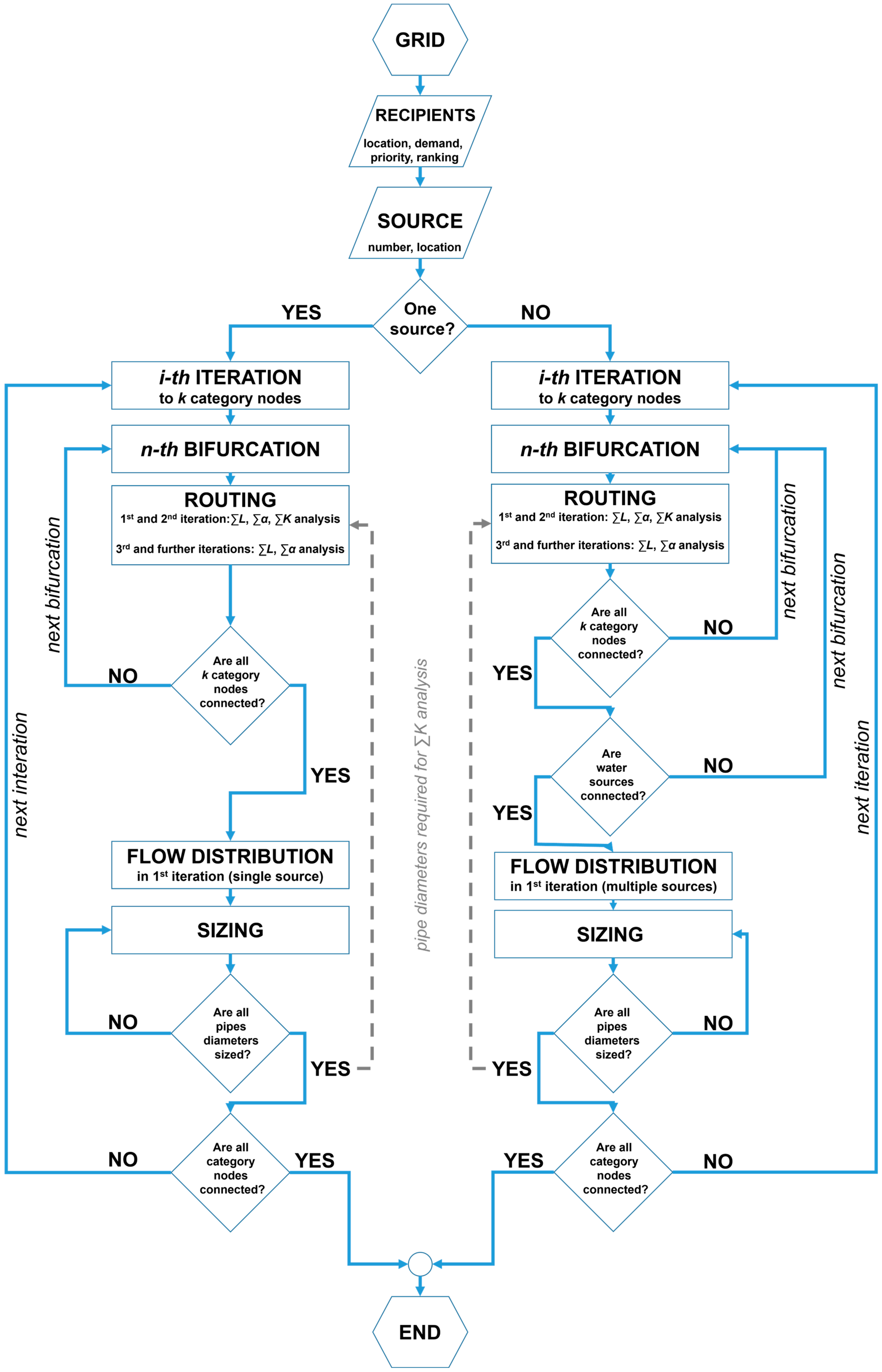
The block diagram of the method’s consecutive steps is shown in Figure 2 [40].

2.2. Quasi-Real Settlement

After application of the SRS method under artificial networks conditions [40], the method was tested under quasi-real (virtual) conditions treated as a reference network. The use of a reference network was intended to verify the applicability of the SRS method and to assess whether the results obtained with its use can be considered comparable. Quasi-real networks, located in so-called virtual cities, are gaining increasing popularity due to the fact that the water supply data of real water distribution networks are treated as sensitive data. Virtual cities are publicly available spatial data sets describing the geographical structure, technical infrastructure, and demographic characteristics of a hypothetical settlement unit. The essence of creating virtual cities lies not only in developing an appropriate spatial structure, but also in endowing the city with a historical character by modeling the development of its individual parts in specifically dated periods in the past. The synthetic settlement created in this way may constitute a close approximation of an existing settlement. Popular examples of virtual cities are as follows: C-Town [45], D-Town [46], Exnet [47], Micropolis and Mesopolis [48], KL [49], and Jilin [50], and Ideal City [51].
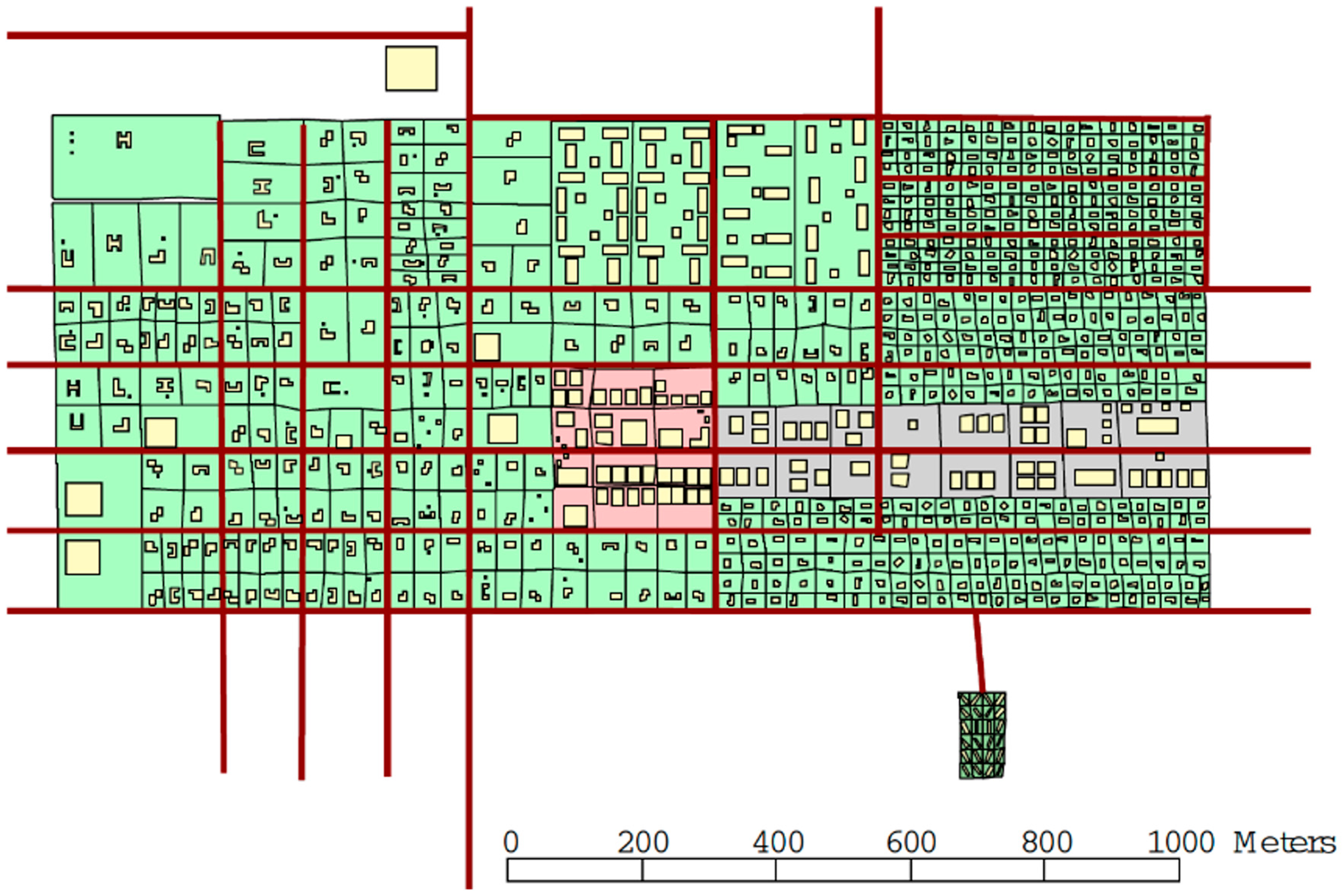
In this paper, a network located in the virtual city of Micropolis was used as the reference network. It was developed by Brumbelow et al. [48] for a hypothetical town with a population of approximately 5000. The synthetic city of Micropolis has not only a defined urban structure, but also a reconstructed process of its development. The age of Micropolis is estimated at about 130 years; over this period, the town underwent gradual expansion with the addition of new areas and building types. The material and age structure of the distribution network includes gray cast iron pipes (year: 1910), asbestos cement pipes (1950), and ductile iron pipes (1980). The diameters of the water pipes are DN50–DN300. The Micropolis elevation ranges from 309.07 to 321.26 m above sea level. The urban structure of the virtual city of Micropolis is shown in Figure 3.
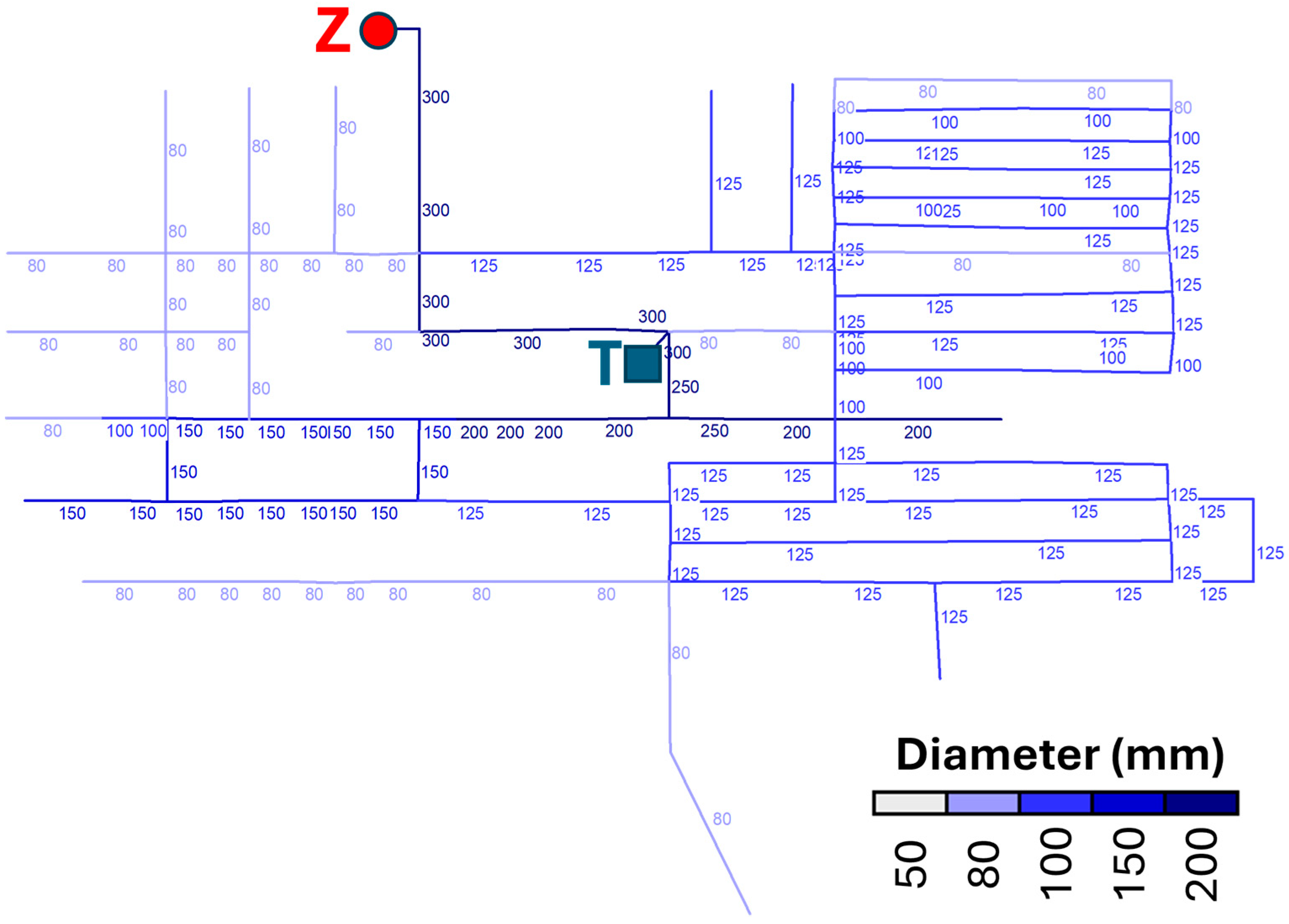
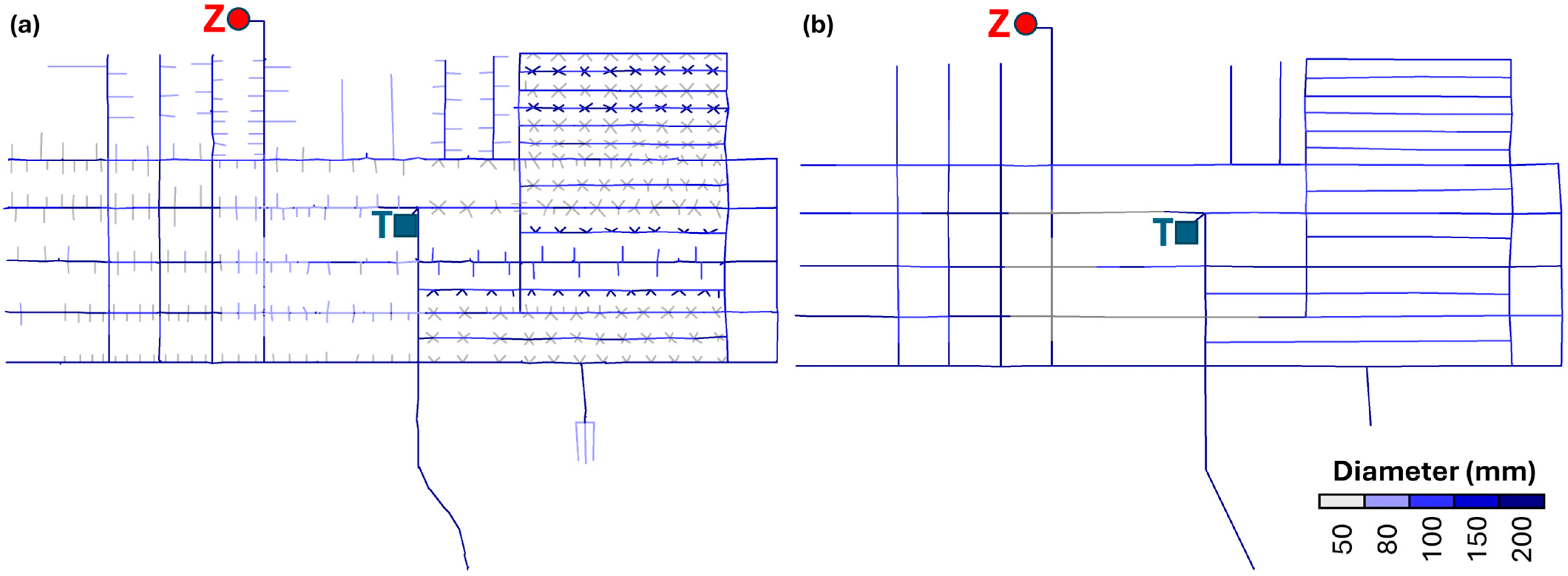
The water distribution network of Micropolis was represented by a EPANET numerical hydraulic model, developed at a detailed level, including hydrants, valves, and service connections. The model representation of the Micropolis system consisted of 1823 pipes, 1574 nodes, 2 intakes, 1 storage unit and specified control rules for pump-tank operation. The average hourly water demand (Qhavg) of Micropolis was 68 L/s. In this paper, to easily compare the results of the SRS method with the reference network, the original geometric structure of the network was simplified by removing all service connections, hydrant laterals and valves from the model. Water demands were aggregated, while the total water demand remained unchanged. In addition, the location of the reservoirs and tank was preserved, along with the pumping station and the pump-tank control rules included in the reference model. The simplified geometric structure comprised 181 pipes and 145 nodes. The geometric structure of the original Micropolis WDN and simplified skeletonized Micropolis network is presented in Figure 4.
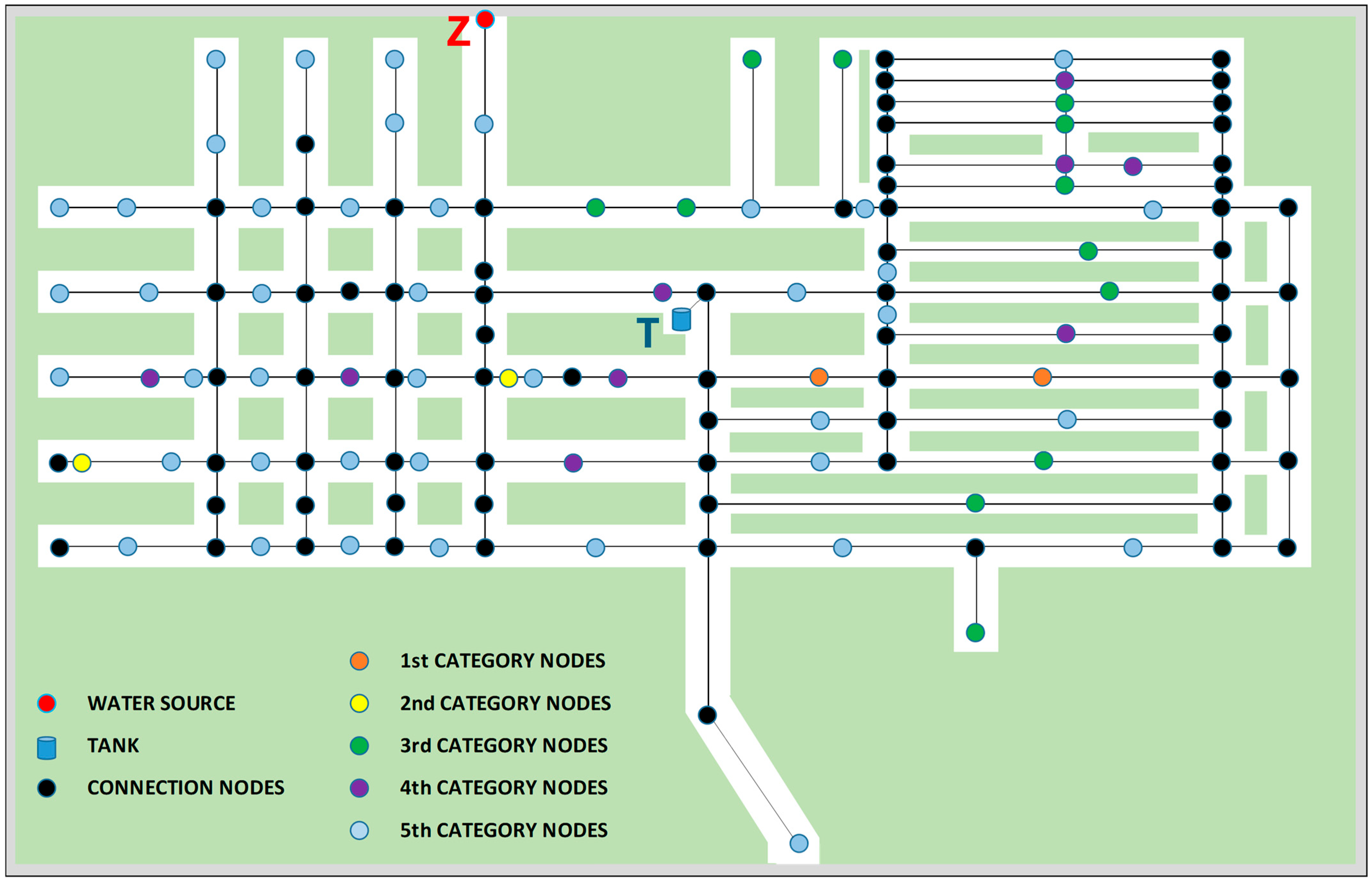
The application of the SRS method requires water demand classification into ranking, considering the demand quantity and priority of water supply. In the original Micropolis network, the nodes with water demand accounted for 43.52% of all nodes (685 demand nodes out of 1574 total nodes), while in the skeletonized network the corresponding share was 46.90% (68 out of 145). This indicates that the proportion of demand nodes in the skeletonized network did not change significantly compared to the detailed network. In the skeletonized network, the demand nodes were assigned to categories according to water demand (KQ1–KQ3) and delivery priority (KP1–KP3). The largest consumers (KQ1) with the water base demand higher than 1% of the total network demand (Qt) were assigned a weight of 3, while medium (KQ2) and smallest (base demand lower than 0.5% of Qt) (KQ3) consumers were assigned weights of 2 and 1, respectively. On the basis of the water demand patterns assigned to the nodes, three categories of water supply priority were defined: high (KP1: industrial consumers, priority weight 3), medium (KP2: service/commercial consumers, weight 2), and low (KP3: residential consumers, weight 1). On the basis of both water demand categories and supply priority categories, the demand nodes were classified into five classes: Class I (6 points, 2 nodes), II (5 points, 2 nodes), III (4 points, 12 nodes), IV (3 points, 9 nodes), V (2 points, 43 nodes). Additionally, the water tank was assigned to Class I. The structure of the settlement grid, with locations of potential connection nodes (street crossings) and demand nodes, is shown in Figure 5. This Micropolis settlement grid was further used for the routing and dimensioning of a new network using the SRS method.

2.3. Real Settlement

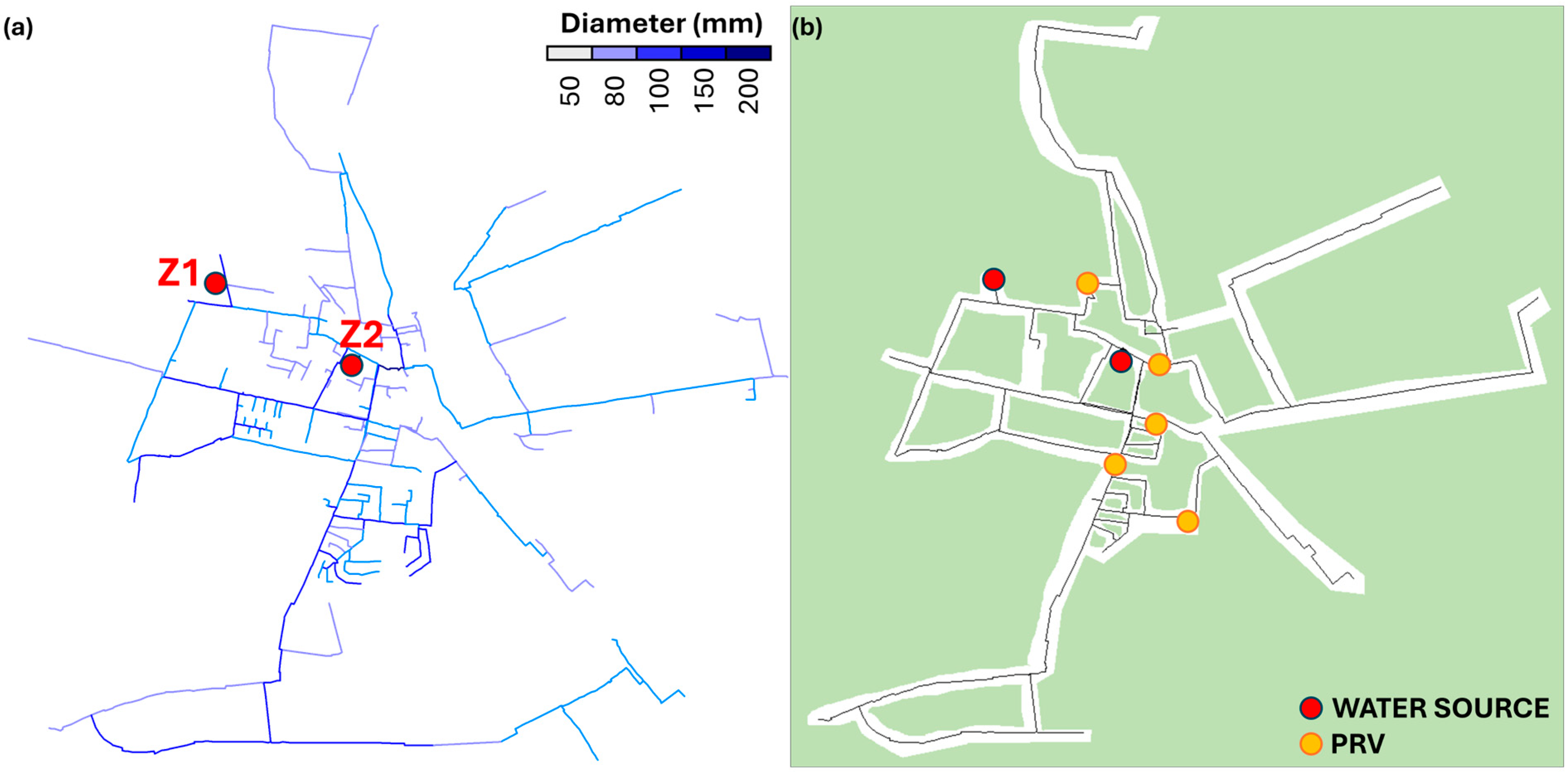
The next stage of the research involved verifying the applicability of the SRS method under real-world conditions. For this purpose, a real settlement (named XYZ) of approximately 10,000 inhabitants was selected for analysis. The real-world network has two operating pumping stations, with separate groundwater intakes. The capacities of the pumping stations exhibit a 60/40% ratio in favor of pumping station Z1. However, this ratio is not reflected in the diameters of the supply pipes from pumping stations, which are DN150 for Z1 and DN200 for Z2. The geometric structure of the graph network can be classified as looped-branched. The model representation of the network corresponds to a basic structure, including only distribution and main pipes (939 sections and 911 nodes). The total length of the pipes in the network is 52.63 km. The diameters of the distribution pipes are DN50–DN200. The average hourly water demand (Qhavg) of the XYZ settlement amounts to 51.22 L/s. The XYZ area is characterized by varied topography (elevation range of 129.88–169.64 m above sea level); therefore, five pressure-reducing valves (PRVs) have been installed in the network. The geometric structure of the original XYZ network is presented in Figure 6a, with pumping stations (Z1, Z2) marked with red dots.
Similarly to quasi-real conditions, the reference real-world network was simplified from a detailed level to a skeletal one, consisting in reducing the number of pipes and nodes forming the network. The model of the original XYZ network included 939 pipes and 911 nodes. After simplification, the model structure consisted of 585 pipes and 574 nodes. The total water demand remained unchanged (4425 m3/d). In the simplified model, the locations and settings of 5 PRVs as well as the operating parameters of pumping stations (including settings, curves and control rules) were preserved. Additionally, it was assumed that all 574 nodes are potential connection nodes.
In the simplified XYZ network, nodes with base water demand accounted for 48.78% of all nodes (280 demand nodes out of 574 total nodes). All 280 demand nodes in the skeletonized network were categorized by water consumption (KQ1–KQ3) and delivery priority (KP1–KP3). The largest consumers (KQ1) with the base demand higher than 1% of the total network demand (Qt) were assigned a weight of 3 points, while medium (KQ2) and smallest (base demand lower than 0.5% of Qt) (KQ3) consumers were assigned weights of 2 and 1, respectively. On the basis of the water demand patterns assigned to the nodes, three categories of water supply priority were defined: high (KP1: industrial consumers, priority weight 3), medium (KP2: service/commercial consumers, weight 2), and low (KP3: residential consumers, weight 1). On the basis of both water demand categories and supply priority categories, the demand nodes were classified into five classes: Class I (6 points, 2 nodes), II (5 points, 9 nodes), III (4 points, 95 nodes), IV (3 points, 94 nodes), V (2 points, 80 nodes). The structure of the settlement grid is shown in Figure 6b. This XYZ settlement grid was further used for the routing and dimensioning of a new network using the SRS method.

2.4. Evaluation Methodology of the SRS Approach

The networks generated using the SRS method were compared with their quasi-real and real reference networks to evaluate the similarity of results. The assessment focused on two main aspects: network geometry and hydraulic performance. Geometric evaluation included the total pipe length (ΣL), the number of iterations and bifurcations required for network routing, the cumulative rotation angles (Σα) of the base segment in the first two iterations, and the range of pipe diameters. Additionally, the network’s geometric structure was quantified using the fractal dimension (Formula (6)), calculated with Fractalyze 3.0 [52] following the box-counting method. Fractal dimension characterizes how a fractal fills space and the complexity of its arrangement [53].
D b F = lim δ 0 log N δ F log δ ,
where F—a non-empty bounded subset of a finite-dimensional Euclidean space, D b F —the box-counting dimension of the set F, N δ F —the smallest number of sets of diameters δ covering F.
Hydraulic performance was assessed using numerical steady-state models representing the average demand hour, simulated in EPANET 2.2 [54]. Model settings included L/s flow units, Darcy–Weisbach head loss formula, and a pipe roughness of 1.5 mm. Pipe velocities were analyzed using a unified scale, varying only by the maximum value. Network pressures and water age were evaluated in terms of minimum, maximum, and average values, while energy requirements for pumps were calculated assuming 75% efficiency. Pumping station parameters remained unchanged from the original networks, enabling a direct comparison with reference WDNs. Water age was determined using Extended Period Simulation (EPS) with a specified simulation duration.

2.5. Diameters Comparison with Genetic Algorithm Results

The final research step was to compare the pipe diameters selected using the SRS method with the diameter values determined using an optimization method based on a genetic algorithm (GA). Pipe sizing with the genetic algorithm was carried out using the Darwin Designer module, which is part of Bentley’s OpenFlows WaterGEMS 2022 software [55]. The Darwin Designer is a tool intended for sizing new or existing pipelines by searching for solutions that satisfy adopted objective functions: cost minimization, profit maximization, or a compromise solution between costs and profits. The implemented genetic algorithm enables the search for a local optimum across successive generations of solutions, in accordance with the principles of natural selection observed in nature [56]. The verification involved two networks, the quasi-real Micropolis and the real-world XYZ network, for which the sizing process was performed while preserving the original geometric structure of the pipe system. The obtained results were compared with those achieved using the SRS method by evaluating water velocities in the pipes, pressure head distribution, and the spatial structure of water age in the analyzed networks.
The use of the Darwin Designer requires the definition of initial assumptions to narrow the search space for the optimal solution and to ensure that the required hydraulic operating conditions of the designed/sized network are met. The initial assumption applies to defining pipes subject to modification (all network), specifying the allowable minimum and maximum velocity (0.3–3.0 m/s) and pressure (20–60 m H2O) in the network, and finally defining the pipe type series (DN80–DN900) and corresponding unit construction costs of the individual pipe. According to the operating principle of the genetic algorithm, pipe diameters are assigned uniformly to all objects within a given design group. Therefore, the sections in the original networks were grouped based on shared characteristic features, such as pipe material, pipe age, location, and function. A total of 12 different pipe groups were identified in the Micropolis network and 19 in the XYZ network. The selection of pipe diameters using Darwin Designer was carried out in multiple scenarios, applying different objective functions, as well as varying parameters of the genetic algorithm (maximum era number: 6, era generation number: 150, population size: 50, cut probability: 1.7%, splice probability: 60.0%, mutation probability: 1.5%, random seed: 0.5, penalty factor: 1,000,000). The presented results were evaluated as the best solutions and were further compared with the original network and the one obtained using the SRS method.

3. Results and Discussion

3.1. Application of SRS Method in Quasi-Real Conditions—Micropolis Virtual City

The routing process of the new network via SRS method on the Micropolis grid comprised five iterations and 21 bifurcations. The newly created network was characterized by a total pipe length (ΣL) of 18,352.20 m. As a result of the first iteration, connections to two Class I nodes and a water tank were obtained at eight bifurcations. One supply pipeline was led out from the water source, and its diameter was determined using the continuity equation and the known flow rate (Qt) with an assumed water velocity of v = 1 m/s. The diameter of the designed supply pipeline was DN300. The subsequent sizing process was carried out in accordance with the principles of the SRS method, using a standard pipe type series (DN300, DN250, DN200, DN150, DN125, DN100, DN80). The last two diameters in the series were assigned to iterations 4 and 5 arbitrarily. The DN80 diameter was the minimum diameter required due to the obligatory fire protection safety regulations. The total rotation of the base segment (Σα) after the first two iterations reached 720°, and the resulting network layout with the chosen diameters is illustrated in Figure 7.
The original Micropolis network and the network designed using the SRS method were evaluated in terms of differences in their geometric structures and hydraulic operating conditions. The first significant difference between the analyzed networks is the total length of water pipes. In the case of the original Micropolis network, the total length was 20,895.50 m (excluding service connections), whereas the newly developed network had a total length of 18,352.20 m. This means that the network routed using the SRS method was more than 2500 m shorter. This is related to the fact that the original network has a more looped character—in the new network, there are no pipelines located on the right-hand side of the area. The range of pipe diameters was DN50–DN300 in the original network and DN80–DN300 in the newly routed network. The fractal dimension of the Micropolis network developed using the SRS method was equal to 1.186, which is a non-integer number, which confirms that the geometric structure of the network created using the SRS method possess the properties of fractal figures.
A detailed comparison of water velocities in the pipelines of both networks is presented in Table 1. An analysis of the listed values shows that, in both cases, pipelines with the lowest velocities (up to 0.3 m/s) constitute the dominant share. In the original Micropolis network this share is 71.14%, while in the newly developed network it is 81.36%. An increase in the proportion of pipelines with the lowest velocities should theoretically be interpreted as a deterioration of the network’s hydraulic performance. However, considering the pipe diameters used in the analyzed networks, it should be noted that in the original network the water velocities may be overestimated due to the presence of DN50 pipes, whereas in the new network the lower velocities result from the use of DN80 pipes in order to ensure the possibility of connecting fire hydrants to the network. Additionally, it is worth emphasizing that in the newly routed network the length of pipes in which the velocity exceeded 2.0 m/s was reduced. In the original Micropolis network, there were also pipes with velocities above 3.0 m/s, whereas in the network developed using the SRS method the maximum water velocity is 2.25 m/s. This value occurs only in the main supply pipeline (from the water source) during periods of supplying the water tank; during the remaining time, the average velocity was 0.73 m/s.
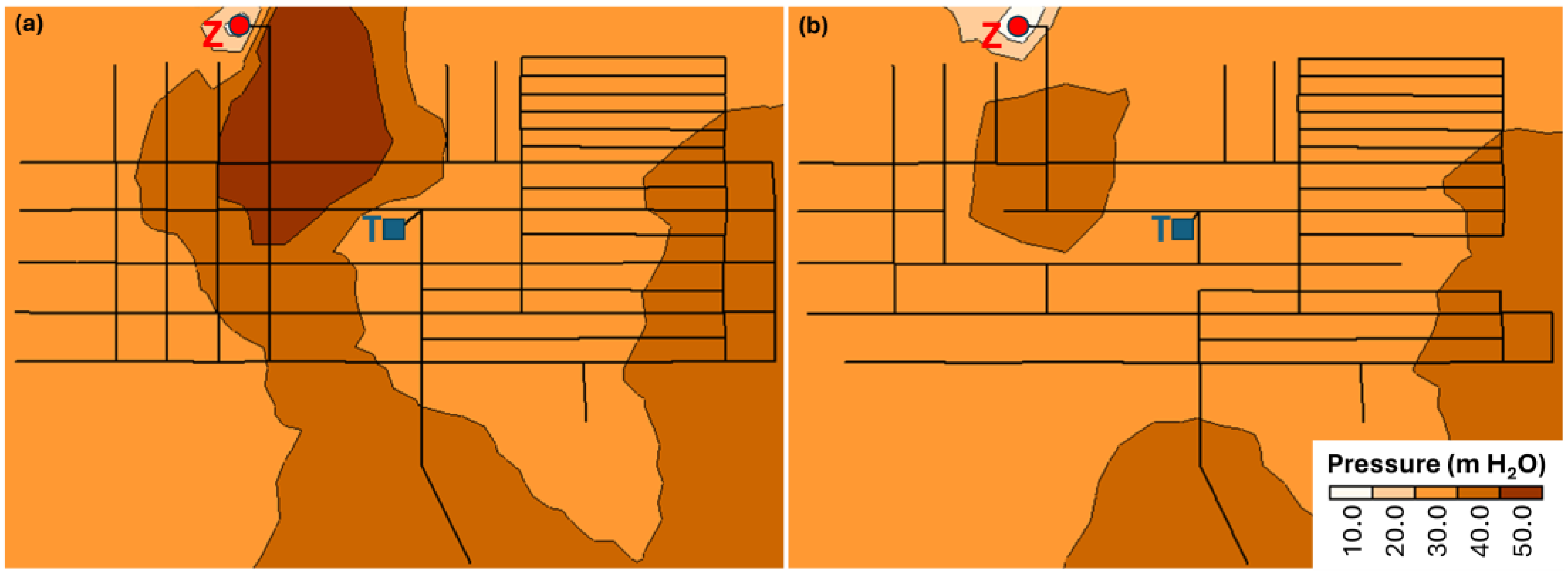
Significant differences between the analyzed networks become apparent when comparing the distributions of pressure head. The original Micropolis network is characterized by a large pressure amplitude: the minimum pressure head in the network was 32.89 m H2O, while the maximum pressure head reached 81.54 m H2O. The network developed using the SRS method exhibits a lower amplitude. The minimum pressure head occurring in this network is 31.17 m H2O, whereas the maximum value is 48.05 m H2O. The average pressure head values are 40.71 m H2O for the original network and 37.54 m H2O for the network routed using the SRS method. Contour maps of pressure head for the original Micropolis network and the new designed network are shown in Figure 8.
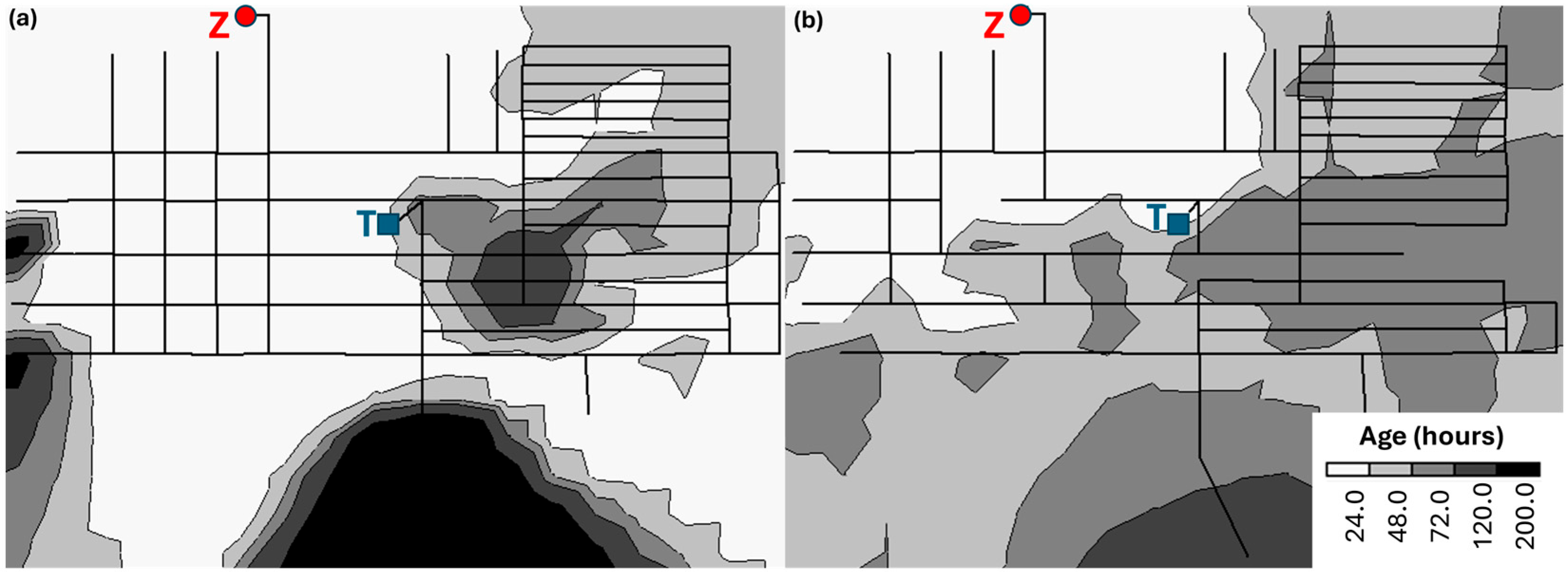
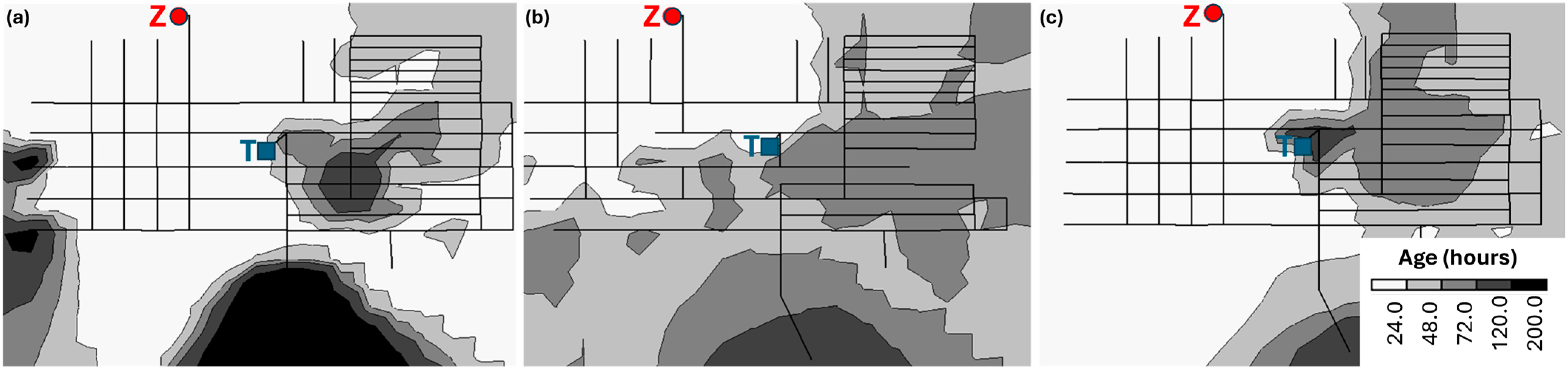
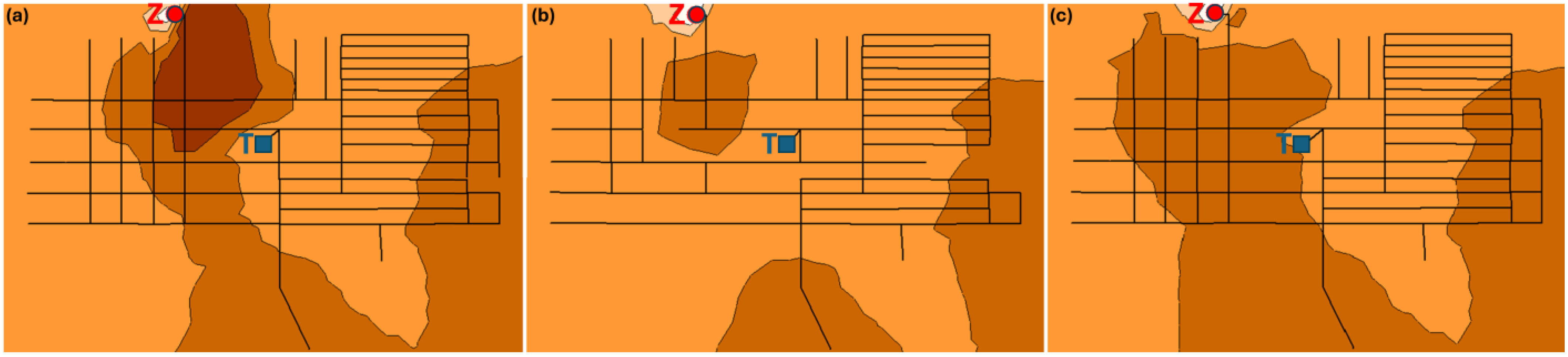
The water age in the original Micropolis network and new designed network is presented in the form of contour maps in Figure 9. In the original Micropolis network, water is supplied to the majority of the system within 48 h; however, selected nodes exhibit water stagnation, with water age exceeding 150 h. In the newly developed network designed using the SRS method, a significant reduction in water age can be observed. The maximum water age (excluding the water tank and demand nodes with zero water consumption) is approximately 67 h. However, the average water age was 23 h in the original network and 33 h in the network developed using the SRS method. This difference in favor of the original network may indicate areas where water is delivered very efficiently (high velocities), as well as areas of considerable water stagnation. This difference is a result of designed pipe diameters and water velocities in pipes—in the original network there were DN50 pipes (with higher velocities), while in the newly designed network the minimum applied diameter was DN80 due to the fire safety regulations, resulting in lower velocities and therefore higher water ages. In both cases, the part of the network located close to the supply source is characterized by a low water age. It can also be observed that in the newly developed network, water age gradually increases with increasing distance from the water source. In contrast, in the original network, two areas with significantly increased water age can be identified—one in the center of the system and another at the edge of the area (where consumers with zero water demand are located, resulting in a lack of ensured flow). The required energy demand of the pumping station in the original network amounted to 56.39 kW, whereas in the newly routed network it was 27.86 kW. A detailed comparison of the parameters of the Micropolis networks is presented in Table 2.
Compared to the original Micropolis network, the network designed using the SRS method was characterized by:
  • A similar geometric structure;
  • A lower total length of pipeline sections;
  • The presence of all pipe diameters from the DN/ID standard type series within the range DN80–DN300;
  • A twofold lower average water velocity in the network pipelines;
  • A reduced share of pipelines with velocities exceeding 2 m/s;
  • An increased share of pipelines with velocities below 0.3 m/s;
  • A less differentiated distribution of water pressure head at network nodes (lower average pressure head in the network and a smaller amplitude);
  • A more than twofold lower maximum water age time in the network, accompanied by a higher average water age;
  • A more than twofold lower power demand required for pump operation.
Considering the results obtained under the conditions of the reference Micropolis settlement, it can be concluded that the developed SRS method enables the routing and sizing of water distribution networks under quasi-real conditions. The newly routed network exhibited characteristics similar to those of the original Micropolis network (regarding both the geometric structure of the network and its operating conditions, including hydraulic performance). It is also worth noting that classifying the water tank as one of the consumer-node classes made it possible to route the network to this facility and ensure its proper operation within the newly developed network.

3.2. Application of the SRS Method Under Real-World Conditions

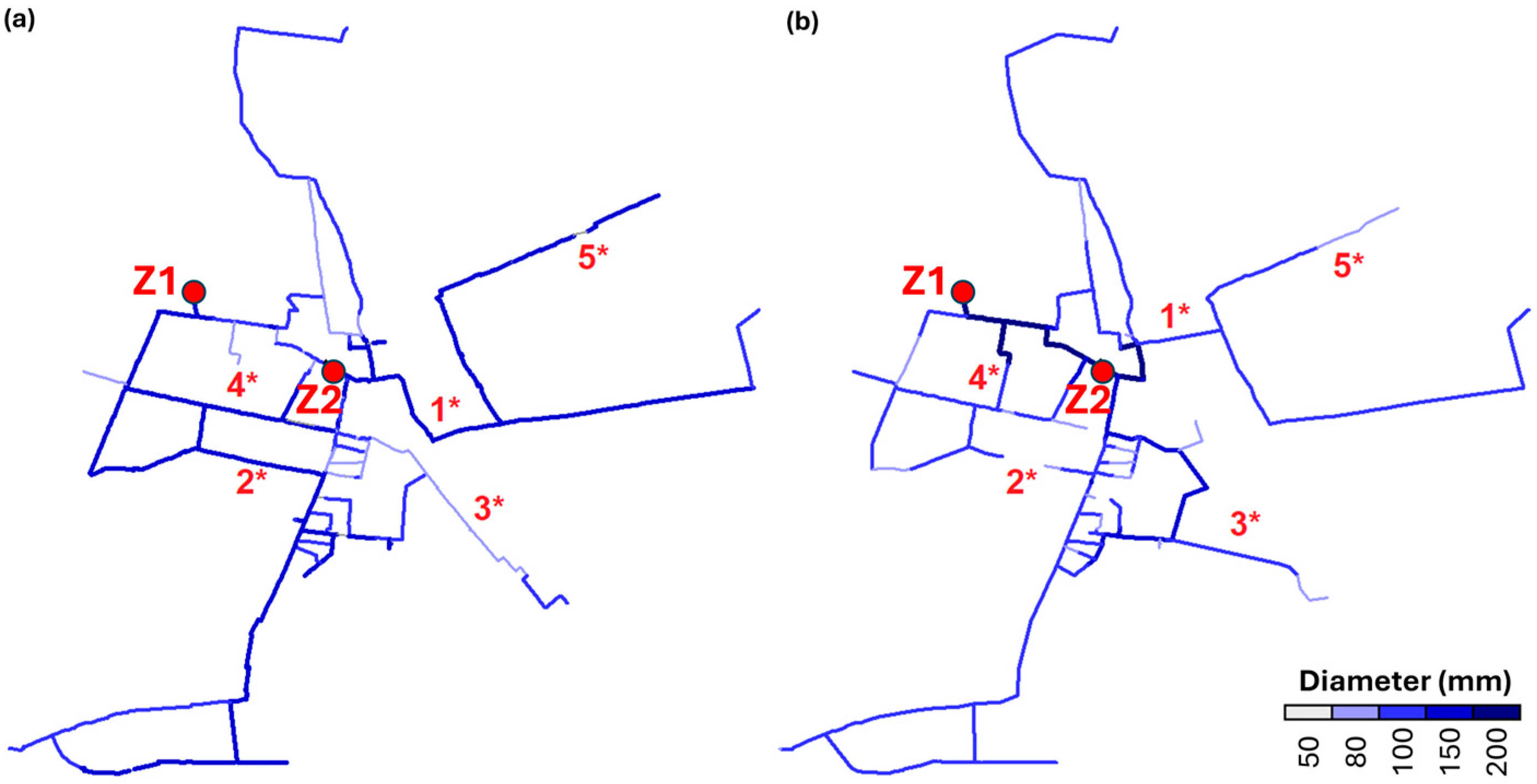
The newly developed network was characterized by a total pipe length ∑L of 29,508.23 m. The network routing process on the XYZ grid was carried out in five iterations, aiming to connect all 280 consumers. As a result of the first iteration, connections were obtained with all first-class nodes as well as between the pumping stations. In total, 165 bifurcations were performed to route the entire network, including 19 bifurcations in the first iteration, 27 bifurcations in the second iteration, 83 bifurcations in the third iteration, 25 bifurcations in the fourth iteration and 11 bifurcations in the fifth iteration. Figure 10 shows a comparison between the original XYZ network structure and the network designed with the SRS approach.
Main supply pipelines were routed from pumping stations Z1 and Z2, maintaining the original 60/40% capacity split. Flow rates for each pipeline were calculated, and pipe diameters were derived using the continuity equation with a target velocity of 1 m/s. Using the selected ductile iron pipe series, the Z1 line was sized DN200 and the Z2 line DN150. For pipelines in the first two SRS iterations, a modified Murray’s law was applied, while standard pipe sizes from the series were assigned in later iterations.
The first significant difference between the analyzed networks is the total length of pipes. The total length of the new network (29,508.23 m) is approximately 3100 m shorter than that of the original XYZ network (32,617.45 m). This results from the less looped character of the new network. The pipe diameters’ range was DN50–DN200 in the original network and DN80–DN200 in the newly designed network. The differences in the network’s shape are also marked in Figure 9 (1*–5*). Selected water pipelines were routed along different streets than in the original network (cases 1* and 3*). Additionally, in the new network, the geometric structure formed by individual pipes is not fully closed into a looped system (cases 2* and 4*). A separate case is 5*—in the original XYZ network, the pipe diameter gradation is non-uniform. For example, a pipeline may consist of DN150 pipes but also include a DN100 constriction. Such a situation may result from maintenance and operational activities. In the new network, a decreasing diameter gradation is preserved—pipelines farther from the source have smaller diameters. The fractal dimension of the XYZ network developed using the SRS method was equal to 1.119. The fractal dimension is defined as a non-integer number, which confirms that the geometric structure of the network created by the SRS method possesses the properties of fractal figures.
A detailed summary of water velocities in the analyzed networks is presented in Table 3. In both cases, the pipes with the lowest velocities (up to 0.3 m/s) constitute the predominant share. In the original XYZ network, they account for 69.18%, whereas in the newly developed network they represent 65.76% of the total pipe length. The average velocity in the pipes was 0.27 m/s in the original network and 0.30 m/s in the new network.
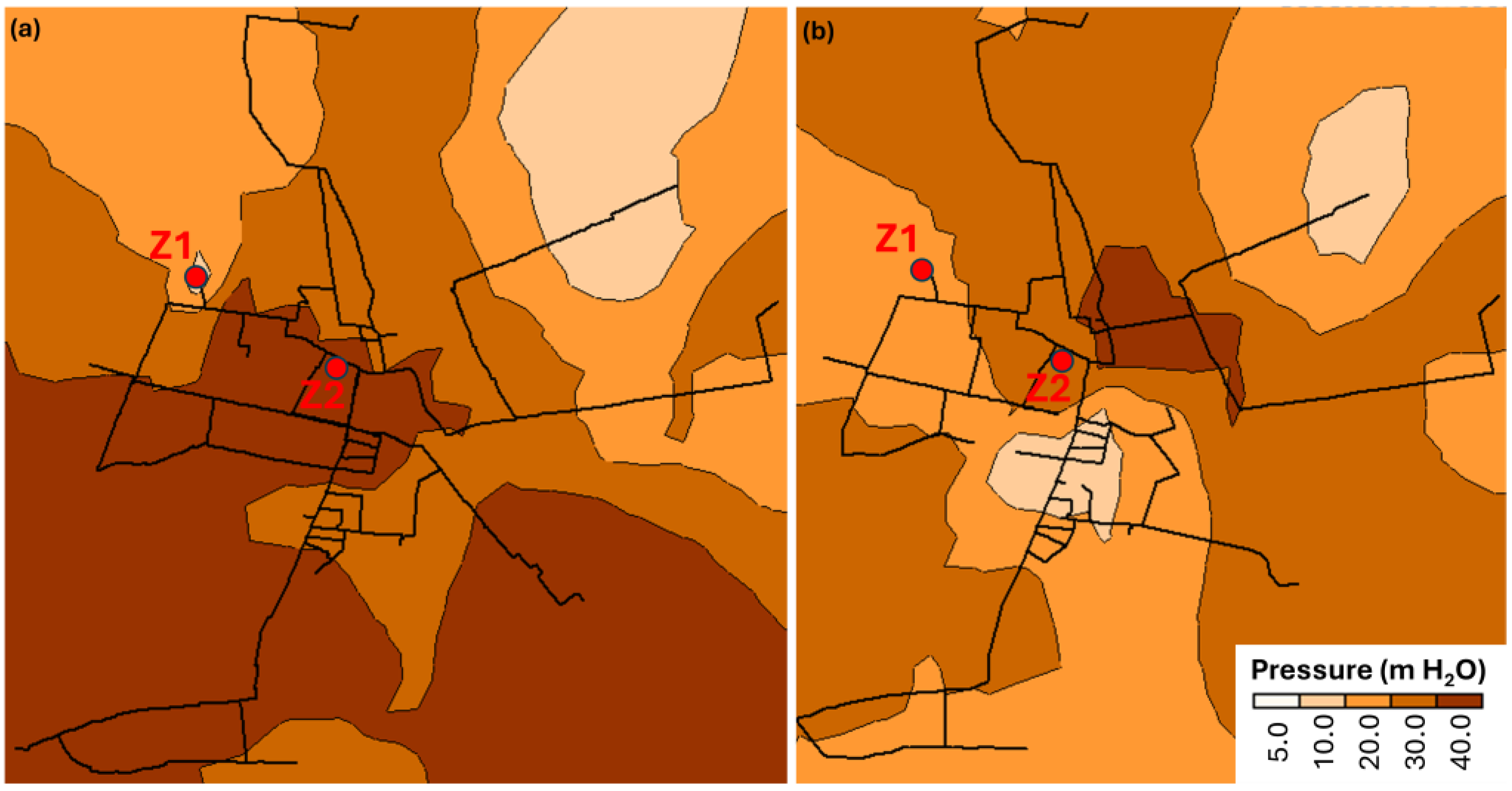
When comparing pressure at the nodes, certain differences between the analyzed networks can be observed. The range of pressure head variations in the original XYZ network was 4.63–46.31 m H2O. In the original network, the presence and settings of five PRVs resulted in the occurrence of areas where the pressure head was lower than the minimum value (20 m H2O). During network routing according to the SRS method, the locations of the pressure-reducing valves were retained as in the original network to match the comparison as close as possible. However, due to the presence of different water flow paths (a different geometric structure of the network), their operation proved to be improper. Four out of the five pressure-reducing valves showed an inactive computational status in the simulations, meaning that the pressure downstream of the valve was lower than the set value of the given valve. Under these circumstances, the performance of the new network was analyzed assuming that the pressure-reducing valves were not operating (status: open). This means that in the newly designed network using the SRS method, the presence of previously installed pressure-reducing valves is unnecessary. The network developed according to the SRS method was characterized by a pressure head range of 12.65–43.45 m H2O. The average pressure head values were 28.10 m H2O in the original network and 29.70 m H2O in the network routed according to the SRS method. Contour maps of pressure for the original XYZ network and the network routed according to the SRS method are shown in Figure 11.
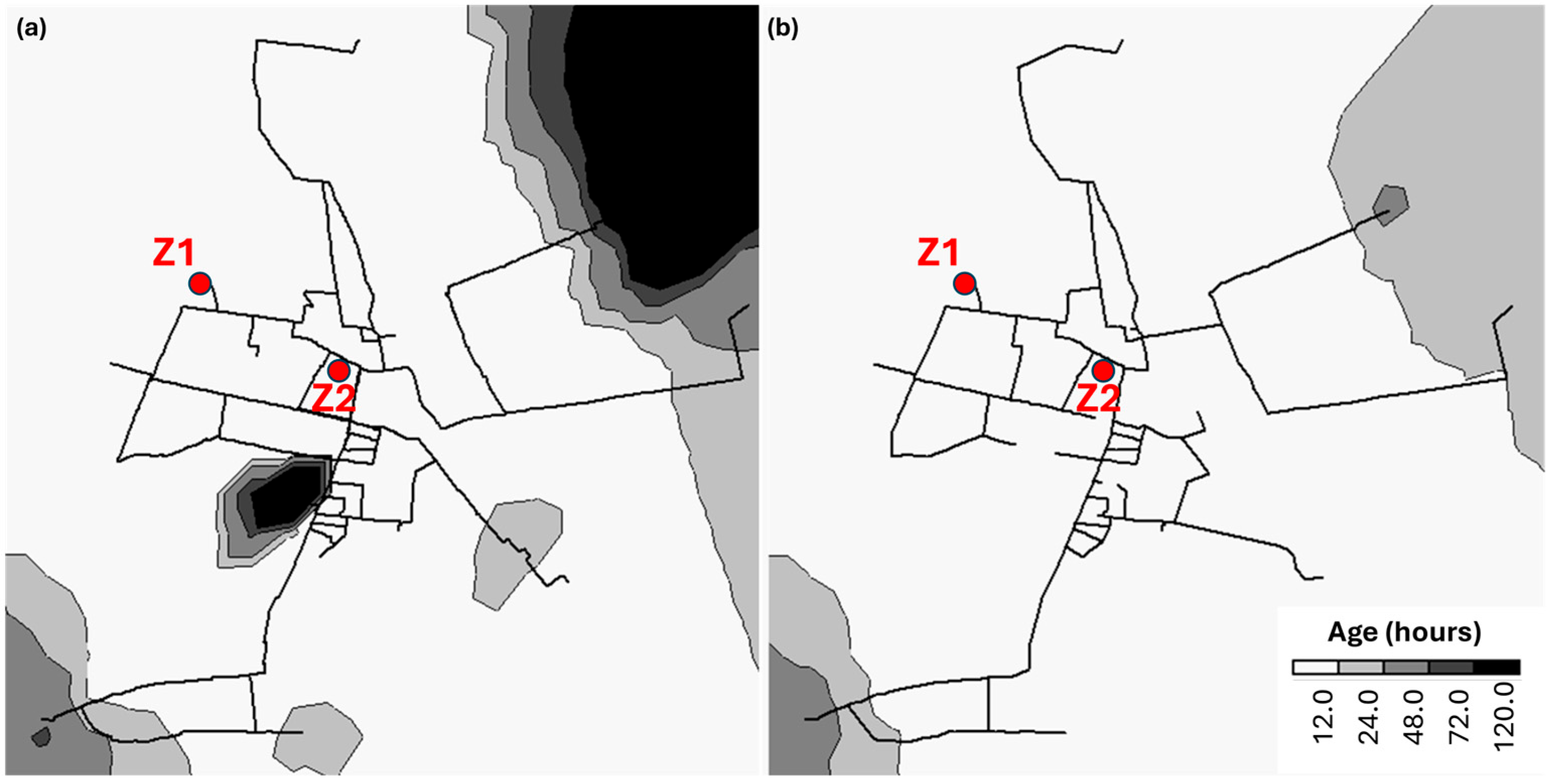
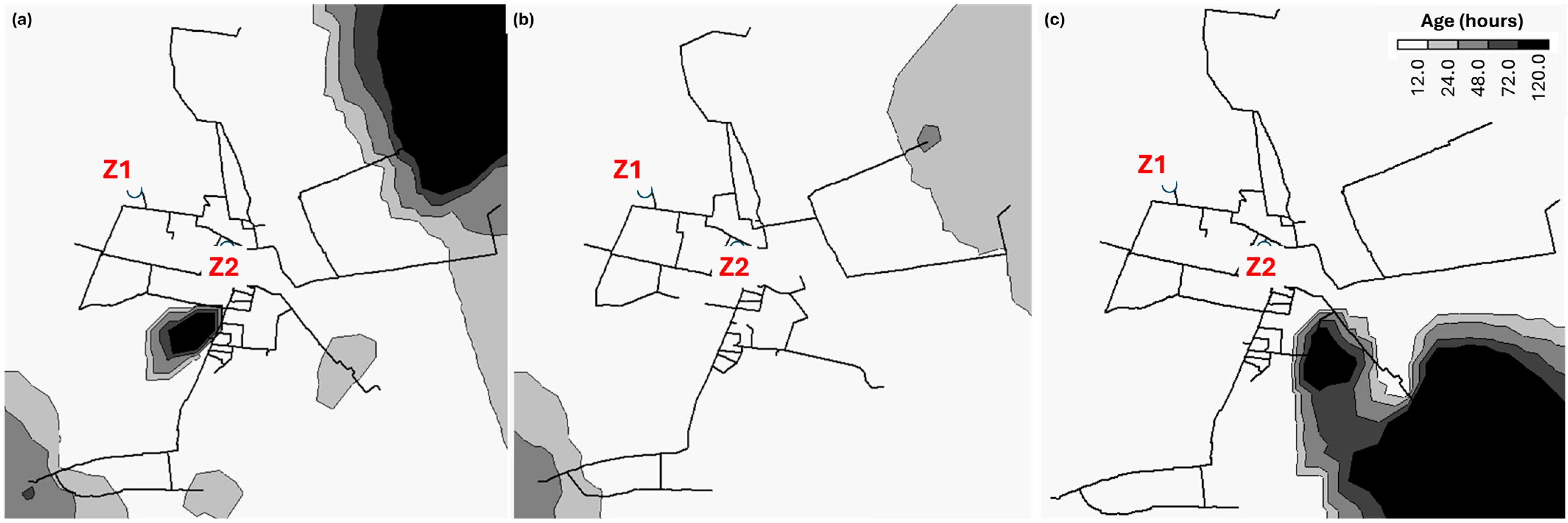
To evaluate the water age in the analyzed networks, it was necessary to change the type of simulation to an EPS with a duration of 240 h (10 days). In the original XYZ network, water is supplied to consumers within 24 h over a large portion of the system. However, the original network also contains areas of water stagnation (exceeding 96 h—4 days), located relatively close to pumping station Z2. In the newly developed network, water age gradually increases with increasing distance from the pumping station. The maximum observed water ages in the networks were approximately 124 h in the original XYZ network and approximately 113 h in the new network. Comparing the average water age in both networks, it can be noted that it is lower in the network developed using the SRS method (3.32 h compared to 4.02 h in the original network) even while the diameters in the newly designed pipes are higher (DN80–DN200) than in the original network (DN50–DN200). Contour maps of age in the analyzed networks are shown in Figure 12.
The energy demand of the pumping stations in both analyzed networks was similar: in the original network it amounted to 23.38 kW, whereas in the network developed using the SRS method it was 25.04 kW. In the original network, the output ratio of the pumping stations was 57.91% to 42.09%. The corresponding ratio in the newly routed network was 64.26% to 35.74% of the total capacity. A comparative summary of the parameters of the XYZ network and the newly designed network is presented in Table 4.
Compared to the original XYZ network, the network designed using the SRS method was characterized by the following:
  • A similar geometric structure;
  • A lower total length of pipeline sections;
  • The presence of all pipe diameters from the DN/ID standard type series within the range DN80–DN200;
  • A higher average water velocity in the network;
  • A reduced share of pipes with velocities below 0.3 m/s;
  • A higher average pressure in the networks;
  • A lower average water age in the network and a lower maximum value;
  • A similar level of energy demand required for pump operation.
Considering the results obtained under the conditions of the real settlement XYZ, it can be concluded that the developed SRS method enables the routing and sizing of water supply networks under real-world conditions. The results showed that the newly developed water supply network is similar to the original network, both in terms of the resulting geometric structure and the hydraulic operating conditions. The tests conducted under real network conditions also demonstrated that the presence, location, and settings of pressure-reducing valves in the original network should be analyzed individually for the newly developed network. Changes in the geometric structure of the newly designed network may necessitate new locations for PRVs or the removal of existing ones. A similar situation may also occur regarding closed sectional (zonal) gate valves.

3.3. Dimensioning Results Comparison with Genetic Algorithm Results

3.3.1. Quasi-Real Conditions

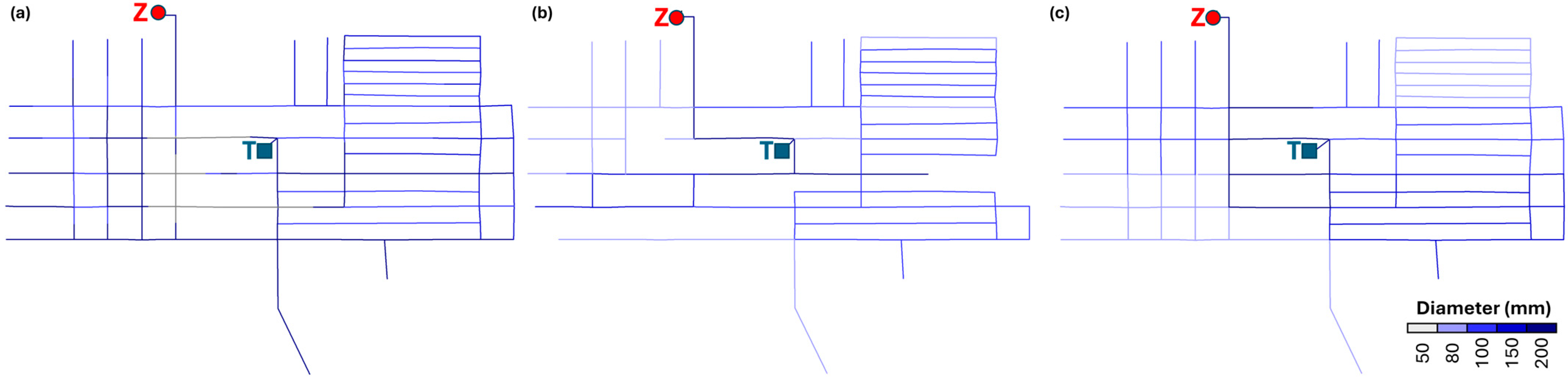
As a result of sizing the pipes in the original Micropolis network using the Darwin Designer, a geometric structure with diameters ranging from DN80 to DN350 was obtained. The pipes with diameters DN80 and DN100 had the largest share in the network sized using the genetic algorithm, accounting for approximately 34% and 32% of the total pipe length, respectively. Comparing the dimensional structure of this network with the network designed according to the SRS method, it can be observed that the maximum diameter increased from DN300 to DN350. Among the selected pipes from the available diameter series, diameters DN125 and DN250 were not used. In comparison, in the network developed according to the SRS method, the DN125 diameter had a dominant share (about 45%) of all sized pipes. Comparing results obtained using the SRS method and the Darwin Designer to the diameters present in the original networks, it can be noted that the total length of pipes with the largest diameters (DN300 and DN350) decreased significantly. In the original network, pipes with these diameters had a combined length of almost 4600 m, whereas in the network routed according to the SRS method they accounted for less than 900 m, and in the network sized using the genetic algorithm amounted to approximately 820 m. Additionally, the individual Micropolis networks were characterized by providing the pipe construction cost, calculated based on the unit prices for installing 1 m of pipe of a given diameter. The construction costs of the network designed via the SRS method turned out to be the lowest, mainly due to the smallest total length of pipe sections. The detailed summary of the selected diameters is presented in Table 5, while the geometric structures of Micropolis networks are presented in Figure 13.
In the network sized using the Darwin Designer, similarly to the original network and the network sized using the SRS method, the predominant share was occupied by pipes with the lowest velocities (up to 0.3 m/s). In the case of the original network, this was 71.14%; in the network developed according to the SRS method, 81.36%; and in the network sized using the genetic algorithm, 69.08%. In the remaining velocity ranges considered, relatively small differences (less than a 10% share of length) can be observed between the networks with diameters selected according to the SRS method and the network sized using the Darwin Designer. Among the analyzed cases, the highest velocity (4.22 m/s) was recorded in the network sized using the genetic algorithm. This value is almost twice as high as the maximum velocity occurring in the network sized according to the SRS method. It is also worth noting that despite the recommended velocity range (0.9–1.1 m/s) and the allowable minimum and maximum velocity limits (0.3 m/s and 3.0 m/s), which served as input data for the Darwin Designer, the obtained results do not always fall within the expected ranges. A detailed list of water flow velocities in all three analyzed cases of the Micropolis network is presented in Table 6.
The original Micropolis network was characterized by a large pressure amplitude (32.89–81.54 m H2O). The networks developed according to the SRS method and sized using the Darwin Designer exhibited a less varied distribution of pressure (amplitudes of 16.88 and 14.77 m H2O, respectively). When comparing the average pressure head values in the analyzed networks, it can be observed that they are similar in all cases. In the original network and the network sized using the Darwin Designer, the average pressure was approximately 40 m H2O, while in the network developed according to the SRS method the average value was approximately 37.5 m H2O. Contour maps of pressure in the analyzed networks are shown in Figure 14.
Similarly to pressure head, changes in water age also showed certain similarities in the analyzed networks. In both the networks developed according to the SRS method and the network sized using the Darwin Designer, the maximum water age was significantly reduced (67 h and 92 h, respectively) compared to the original network (max. 154 h). In the network with diameters selected using the Darwin Designer, despite a higher maximum water age, a lower average water age was recorded than in the network developed according to the SRS method. These values were 25 h and 33 h, respectively. The lower value in the network sized using the Darwin Designer results from the selected diameters: in this network, the predominant diameters were DN80 and DN100, while in the network developed according to the SRS method the dominant diameter was DN125. This, in turn, led to higher water flow velocities and consequently to a lower water age. Contour maps of water age in the analyzed networks are shown in Figure 15. When analyzing the shape of the contour distribution of water age, a clear division into the “left” and “right” sides of the network is visible. On the “left” side there are sections with diameters DN80 and DN100, while the “right” side consists of pipes with diameters DN150–DN200. The area of increased water age occurring in the center of the system is associated with the presence of a tank and the storage of water in it.
The power consumption of the pumping station in the original network was 56.39 kW, in the network developed according to the SRS method it was 27.86 kW, and in the network sized using the genetic algorithm it was 25.04 kW. Thus, both newly developed networks showed a similar reduction in energy demand (more than a twofold decrease) compared to the energy demand in the original network. A detailed summary of the parameters of the analyzed networks is presented in Table 7.

3.3.2. Real-World Conditions

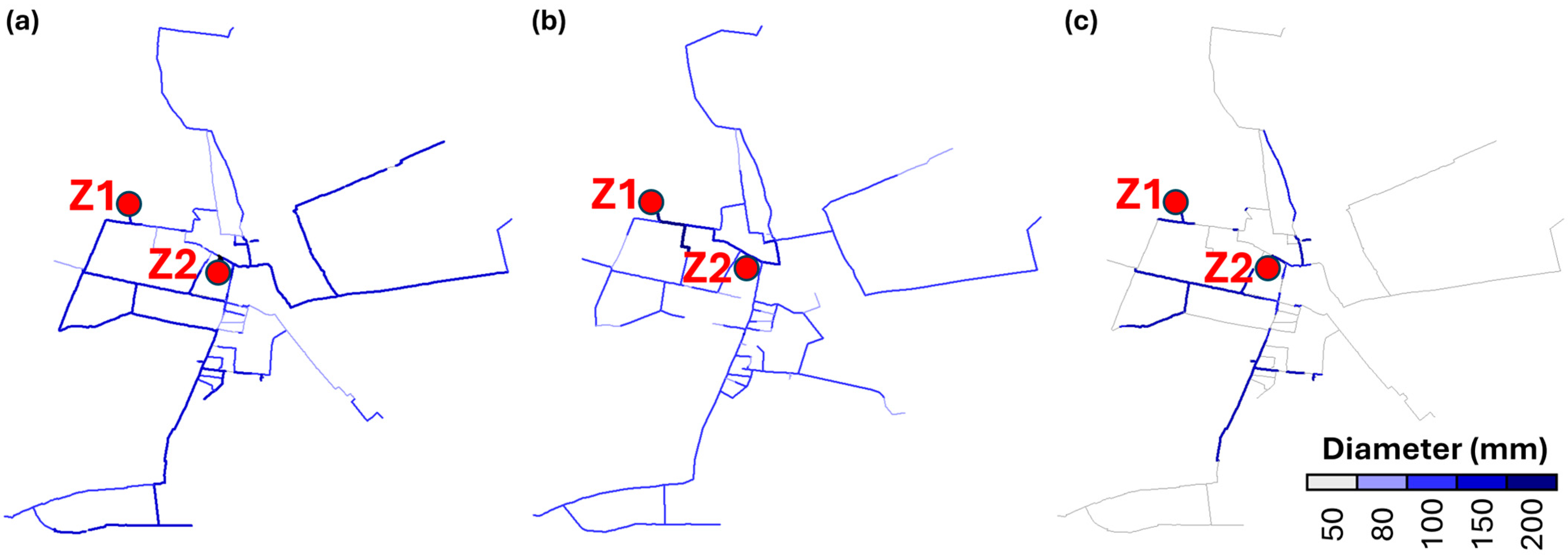
As a result of using the Darwin Designer to size the pipes of the XYZ network, pipes with diameters DN80–DN350 were determined. The supply pipe from pumping station Z1 was assigned a diameter of DN150, while the supply pipe from pumping station Z2 was assigned DN350. In the original XYZ network, the main pipes had diameters DN150 (Z1) and DN200 (Z2). In the network developed according to the SRS method, the diameters were determined as DN200 (Z1) and DN150 (Z2). As a consequence of the selected supply pipe diameters in the network sized using the Darwin Designer, a reversal of the pumping station capacity ratio can be observed. In the original XYZ network, this ratio was 58% to 42% in favor of Z1; in the network developed according to the SRS method, the ratio was 64% to 36%; whereas in the network sized with the genetic algorithm, the ratio was 32% to 68%. However, despite the initial diameter of DN350, the subsequent diameters determined by the genetic algorithm in the vicinity of pumping station Z1 were DN150, DN100, and DN80. Among the selected diameters, diameters such as DN125, DN250, and DN300 from the available pipe type series were not used. The geometric structures of XYZ networks are presented in Figure 16.
In the original XYZ network, the dominant diameter was DN150, which accounted for over 50% of the entire network. Similarly, in the newly designed network according to the SRS method, the pipes with a diameter of DN125 accounted for almost 64%. The share of the DN80 diameter was approximately 15% and 12% in the original network and in the network designed according to the SRS method, respectively. In the network sized using the Darwin Designer, the DN80 diameter was clearly dominant, constituting over 75% of the total pipe length in the network. Additionally, individual XYZ networks were characterized by providing the pipe construction cost, calculated based on the unit prices for installing 1 m of pipe of a given diameter. The construction costs of the network designed via the SRS method turned out to be lower than the cost of the original network, while also slightly higher than the cost of the network sized via Darwin Designer. The network sized by genetic algorithm is characterized by a significant share of the DN80 diameter and it results in smaller total construction costs. A detailed summary of the selected diameters in the analyzed networks is presented in Table 8.
The water velocities in the network sized using the Darwin Designer show strong similarities to the original network and the network designed according to the SRS method. In all three analyzed networks, the largest percentage was made up of pipes in which the velocity fell within the range <0.0; 0.29> m/s. This was 69.18% of the total pipe length in the original XYZ network, 65.76% in the network developed according to the SRS method, and 66.18% in the network sized using the Darwin Designer. Comparing the average velocities in the networks, the lowest velocity (0.27 m/s) occurred in the original network, while in the remaining networks it was 0.30 m/s (SRS method network) and 0.33 m/s (Darwin Designer network). Similarly to the Micropolis network, despite the recommended velocity range (0.9–1.1 m/s) and the expected minimum velocity (0.3 m/s) applied during the operation of the module using the genetic algorithm, the obtained results do not always fall within the expected ranges. Table 9 provides a detailed list of water velocities in all three analyzed cases of the XYZ network.
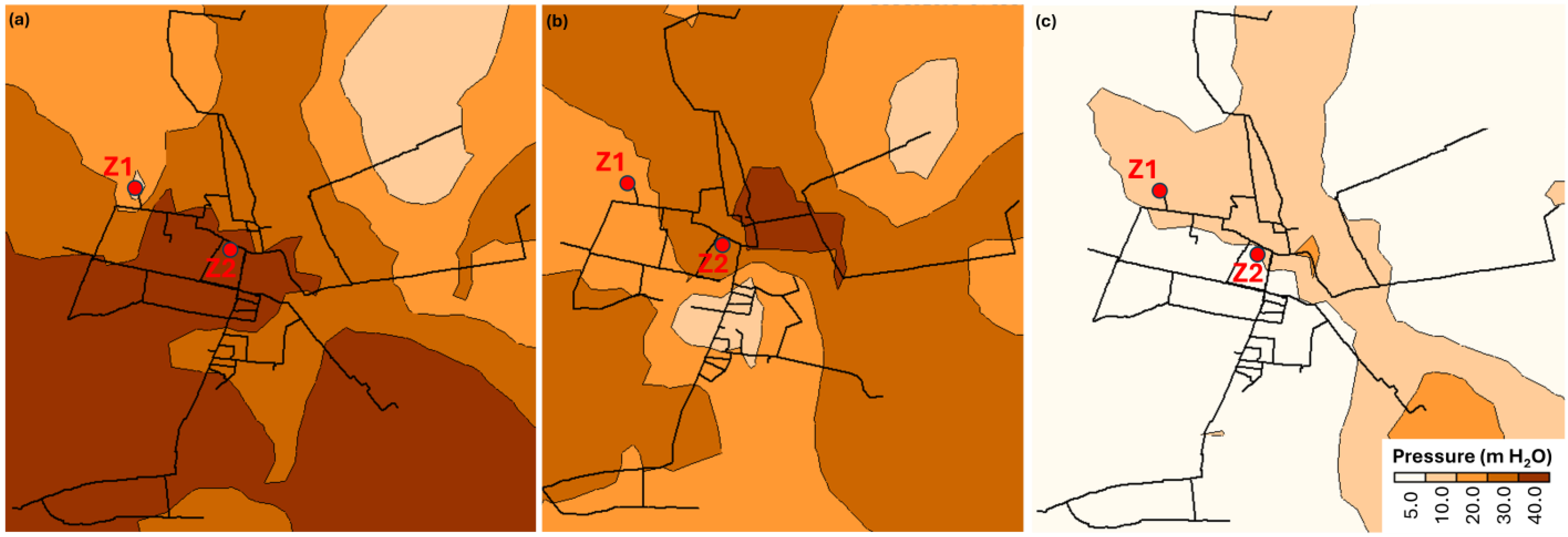
When analyzing the pressure distribution in the considered networks, significant differences can be observed. The network sized using the genetic algorithm mechanism exhibits significantly lower pressure heads. The average pressure head in the network sized with the Darwin Designer was 5.05 m H2O, whereas in the original network it was 28.10 m H2O, and in the network developed according to the SRS method it was 29.70 m H2O. A reduction in the maximum pressure head is also noticeable, from approximately 45 m H2O in the original network and the network developed according to the SRS method to about 24 m H2O. The reduced pressure head values, evaluated under the same conditions of water demand, indicate an increase in flow resistance and thus a decrease in the hydraulic capacity of the XYZ network sized using the genetic algorithm. This is a consequence of the selected pipe diameters, which do not exhibit a decreasing gradation within the standard diameter series, as well as the occurrence of so-called bottlenecks in the network, which constitute significant constraints on water flow. Additionally, in the network sized using the Darwin Designer, there are areas with pressure heads significantly below the minimum required domestic pressure head (20 m H2O). Moreover, in the network designed using the Darwin Designer, zones of negative pressure also occur, which means that, with the pump station settings maintained as in the original network, it is not possible to supply water to all network nodes. The contour maps of pressure head for the analyzed networks are presented in Figure 17.
In all the analyzed networks, the average water age was similar: 4.02 h in the original network, 3.32 h in the network developed according to the SRS method, and 6.00 h in the network sized using the Darwin Designer. In the network with diameters determined by the genetic algorithm, one area of water stagnation occurs in the lower right corner of the analyzed network. The maximum water age values in this location reach 240 h, which is equal to the duration of the simulation. This area is also characterized by reduced pressure as well as the occurrence of negative pressure in the network, which means that water is not supplied to these locations (with the original pump station settings maintained). The contour maps of water are shown in Figure 18.
The power consumption of pumping stations Z1 and Z2 in the network developed using the Darwin Designer amounted to a total of 8.85 kW, which is lower than in the case of the original XYZ network and the network sized according to the SRS method. However, it should be noted that the network sized using the genetic algorithm mechanism, while maintaining the original settings of the pumping station, does not ensure water supply to all consumers in the network. Due to significant constrictions in the geometric structure and the resulting flow resistances, the head provided by individual pumping stations does not guarantee an adequate water pressure head in the network. To assess the demand for electrical energy required for pump operation, it would be necessary to redefine the operating parameters of the pumping stations, which constitutes an additional task for the designer. A detailed summary of the parameters of the analyzed networks is presented in Table 10.

3.3.3. Diameters Sizing Discussion

The original Micropolis and XYZ networks displayed features considered unfavorable for hydraulic performance, such as pipe diameters below DN80, excessive velocities, and large pressure variations. Consequently, the newly designed networks were evaluated not only for their similarity to the originals but also for compliance with recommended hydraulic operating conditions.
A comparison of pipe diameter selection using the SRS method for the Micropolis and XYZ networks indicates that it produces results comparable to those obtained with the Darwin Designer genetic algorithm. In both cases, networks designed with the SRS method and Darwin Designer showed similar pipe diameters, flow velocities, pressure head ranges, average and maximum water ages, and pump energy demand. Notably, both methods produced comparable changes relative to the original networks, such as a reduced share of the largest-diameter pipes in Micropolis and an increase in average water velocity in both networks. However, both approaches have limitations: despite the adopted assumptions, it is not always possible to select diameters that keep water velocities within the recommended range, due to the restricted pipe series, minimum allowable diameters, and, in the GA approach, the division of the network into design groups of pipe sections.
Additionally, during the sizing of the real XYZ network using the Darwin Designer, a specific situation was observed: diameters were assigned to individual design groups without reference to the diameters of upstream pipes. As a result of this approach (independent assignment of diameters to design groups), the geometric structure of the XYZ network was characterized by an irregular arrangement of diameters, without maintaining a decreasing diameter gradation from water sources toward the network endpoints. Furthermore, in the network sized using the genetic algorithm, numerous constrictions (so-called bottlenecks) occurred, constituting significant hydraulic resistances to water flow. This led to improper hydraulic operating conditions in the network and necessitated modifications to the settings of the pumping stations. Such a situation is undesirable in water supply networks—in practice, networks are expected to be sized in accordance with a decreasing diameter gradation, where the largest diameters occur near the water supply sources (pumping stations) and the smallest at the network endings. In this respect, an advantage of the proposed SRS method over the Darwin Designer can be demonstrated. Achieving the desired dimensional structure of the network in the Darwin Designer would be possible through user (designer) intervention; however, it would require additional design groups during sizing or the arbitrary imposition of specific diameters in the sized network. Such a necessity did not arise when applying the SRS method.
In summary, the conducted verification of the pipe diameter selection method proposed in the SRS method of simultaneous routing and sizing of water supply network structures makes it possible to obtain results similar to those achieved using a method based on an implemented genetic algorithm. Testing the SRS method under both quasi-real and real-world network conditions allows drawing the conclusion that the proposed sizing approach is universal and enables achieving the results that ensure correct hydraulic operating conditions of water supply networks.

4. Conclusions

Based on the results, it can be concluded that the main objectives of this study have been achieved. The proposed simultaneous routing and sizing (SRS) method produces network geometries and hydraulic performance comparable to the reference systems. Key features of the SRS method include: (1) simultaneous routing and sizing, (2) a benchmarking mechanism for classifying demand nodes by water consumption and supply priority, (3) a new water path selection criterion based on pipeline construction cost, (4) pipe diameter determination via a modified Murray’s law, (5) applicability to single- and multi-source systems, and (6) routing that respects the predefined capacities of water sources.
On the basis of the conducted research, it can be concluded that the developed method provides a mathematical foundation for the process of shaping a water supply network while simultaneously determining the diameters of its individual pipelines, under both single-source and multi-source water supply conditions. In each application of the SRS method, routed and sized networks characterized by hydraulic operating conditions ensure proper functioning and reliable water supply to all consumers. The results achieved using this method are comparable to those obtained with advanced pipe sizing methods based on genetic algorithms. The developed method has certain limitations, leaving room for further research. Potential directions include evaluating how different demand node weights and priorities affect network configuration, exploring alternative ranking categories, and developing software implementing the SRS method.

Supplementary Materials

The following supporting information can be downloaded at https://www.mdpi.com/article/10.3390/w18070828/s1. Supplementary Materials contain a detailed presentation of the individual iterations and bifurcations performed during the routing and sizing of networks and hydraulic models of networks designed via SRS method.

Author Contributions

Conceptualization, P.S. and D.K.; methodology, P.S.; validation, P.S.; formal analysis, P.S.; investigation, P.S.; data curation, P.S.; writing—original draft preparation, P.S.; writing—review and editing, P.S. and D.K.; visualization, P.S.; supervision, D.K.; project administration, P.S.; funding acquisition, P.S. and D.K. All authors have read and agreed to the published version of the manuscript.

Funding

This research was funded by internal projects of Lublin University of Technology, Poland (numbers FD-20/IS-6/034 and FD-20/IS-6/017).

Data Availability Statement

The original contributions presented in this study are included in the article/Supplementary Materials. Further inquiries can be directed to the corresponding author.

Conflicts of Interest

The authors declare no conflicts of interest.

References

  1. Mays, L.W. Water Distribution System Handbook, 1st ed.; McGraw-Hill: New York, NY, USA, 2000. [Google Scholar]
  2. Mazumder, R.K.; Salman, A.M.; Li, Y.; Yu, X. Asset Management Decision Support Model for Water Distribution Systems: Impact of Water Pipe Failure on Road and Water Networks. J. Water Resour. Plan. Manag. 2021, 147, 04021022. [Google Scholar] [CrossRef]
  3. Gomes, R.; Sousa, J.; Marques, A.S. Influence of Future Water Demand Patterns on the District Metered Areas Design and Benefits Yielded by Pressure Management. Procedia Eng. 2014, 70, 744–752. [Google Scholar] [CrossRef]
  4. Cassottana, B.; Balakrishnan, S.; Aydin, N.Y.; Sansavini, G. Designing resilient and economically viable water distribution systems: A multi-dimensional approach. Resilient Cities Struct. 2023, 2, 19–29. [Google Scholar] [CrossRef]
  5. García Baigorri, A.; Parada, R.; Monzon Baeza, V.; Monzo, C. Leveraging Urban Water Distribution Systems with Smart Sensors for Sustainable Cities. Sensors 2024, 24, 7223. [Google Scholar] [CrossRef]
  6. Duan, B.; Gao, J.; Cao, H.; Hu, S. Energy-Efficient Management of Urban Water Distribution Networks Under Hydraulic Anomalies: A Review of Technologies and Challenges. Energies 2025, 18, 2877. [Google Scholar] [CrossRef]
  7. Gupta, I.; Bassin, J.K.; Gupta, A.; Khanna, P. Optimization of water distribution system. Environ. Softw. 1993, 8, 101–113. [Google Scholar] [CrossRef]
  8. Bragalli, C.; D’Ambrosio, C.; Lee, J.; Lodi, A.; Toth, P. An MINLP Solution Method for a Water Network Problem. In Algorithms–ESA 2006 (ESA 2006); Azar, Y., Erlebach, T., Eds.; Lecture Notes in Computer Science; Springer: Berlin/Heidelberg, Germany, 2006; Volume 4168. [Google Scholar] [CrossRef]
  9. Reca, J.; Martinez, J. Genetic algorithms for the design of looped irrigation water distribution networks. Water Resour. Res. 2006, 42, W05416. [Google Scholar] [CrossRef]
  10. Razei, G.; Afshar, M.H.; Rohani, M. Layout optimization of looped networks by constrained ant colony optimization algorithm. Adv. Eng. Softw. 2014, 70, 123–133. [Google Scholar] [CrossRef]
  11. Alperovits, E.; Shamir, U. Design of Optimal Water Distribution Systems. Water Resour. Res. 1977, 13, 885–900. [Google Scholar] [CrossRef]
  12. Fujiwara, O.; Jenchaimahakoon, B.; Edrisinghe, N.C.P. A modified linear programming gradient method for optimal design of looped water distribution networks. Water Resour. Res. 1987, 23, 977–982. [Google Scholar] [CrossRef]
  13. Uma, R. Optimal Design of Water Distribution Network Using Differential Evolution. Int. J. Sci. Res. 2016, 5, 1515–1520. Available online: https://www.ijsr.net/archive/v5i11/ART20163145.pdf (accessed on 20 January 2026).
  14. Gakpo, E.; Tsephe, J.; Nwonwu, F.; Viljoen, M. Application of stochastic dynamic programming (SDP) for the optimal allocation of irrigation water under capacity sharing arrangements. Agrekon 2005, 44, 436–451. [Google Scholar] [CrossRef][Green Version]
  15. Land, A.H.; Doig, A.G. An automatic method of solving discrete programming problems. Econometrica 1960, 28, 497–520. [Google Scholar] [CrossRef]
  16. Sherali, H.D.; Smith, E.P. A global optimization approach to a water distribution network design problem. J. Glob. Optim. 1997, 11, 107–132. [Google Scholar] [CrossRef]
  17. Kirkpatrick, S.; Gelatt, C.D.; Vecchi, M.P. Optimization by simulated annealing. Science 1983, 220, 671–680. [Google Scholar] [CrossRef]
  18. Cisty, M. Hybrid Genetic Algorithm and Linear Programming Method for Least-Cost Design of Water Distribution Systems. Water Resour. Manag. 2010, 24, 1–24. [Google Scholar] [CrossRef]
  19. Geem, Z.W.; Kim, J.H.; Loganathan, G.V. A new heuristic optimization algorithm: Harmony search. Simulation 2001, 76, 60–68. [Google Scholar] [CrossRef]
  20. Fanni, A.; Liberatore, S.; Sechi, G.M.; Soro, M.; Zuddas, P. Optimization of water distribution systems by a Tabu Search metaheuristic. In Computing Tools for Modeling, Optimization and Simulation; Laguna, M., Velarde, J.L.G., Eds.; Operations Research/Computer Science Interfaces Series; Springer: Boston, MA, USA, 2000; Volume 12, pp. 279–298. [Google Scholar] [CrossRef]
  21. Simpson, A.R.; Maier, H.R.; Foong, W.K.; Phang, K.Y.; Seah, H.Y.; Tan, C.L. Selection of parameters for ant colony optimization applied to the optimal design of water distribution systems. In Proceedings of the International Congress on Modelling and Simulation, Modelling and Simulation Society of Australia, Canberra, Australia, 10–13 December 2001. [Google Scholar]
  22. Montalvo, I.; Izaquierdo, J.; Perez, R.; Tung, M.M. Particle Swarm Optimization applied to the design of water supply systems. Comput. Math. Appl. 2008, 56, 769–776. [Google Scholar] [CrossRef]
  23. Abdel-Gawad, H. Modified Jaya Algorithm for Optimal Design of Water Distribution Network. Mansoura Eng. J. 2021, 46, 41–57. [Google Scholar] [CrossRef]
  24. Djebedjian, B.; Abdel-Gawad, H.A.A.; Ezzeldin, R.M. Global performance of metaheuristic optimization tools for water distribution networks. Ain Shams Eng. J. 2021, 12, 223–239. [Google Scholar] [CrossRef]
  25. Najarzadegan, M.R.; Moeini, R. Optimal Design of Water Distribution Network Using Improved Artificial Bee Colony Algorithm. Iran. J. Sci. Technol. Trans. Civ. Eng. 2023, 47, 3123–3136. [Google Scholar] [CrossRef]
  26. Salto, C.; Minetti, G.; Alfonso, H.; Zurita, E.; Hernandez, J.; Carnero, M. Optimal Design ofWater Distribution Network Using Two Different Metaheuristics. Chem. Eng. Trans. 2023, 100, 691–696. [Google Scholar] [CrossRef]
  27. Sirsant, S.; Reddy, M.J. Improved MOSADE Algorithm Incorporating Sobol Sequences for Multi-Objective Design of Water Distribution Networks. Appl. Soft Comput. 2022, 120, 108682. [Google Scholar] [CrossRef]
  28. Hajibabaei, M.; Hesarkazzazi, S.; Minaei, A.; Savić, D.; Sitzenfrei, R. Pareto-optimal design of water distribution networks: An improved graph theory-based approach. J. Hydroinform. 2023, 25, 1909–1926. [Google Scholar] [CrossRef]
  29. Ramani, K.; Rudraswamy, G.K.; Umamahesh, N.V. Optimal Design of Intermittent Water Distribution Network Considering Network Resilience and Equity in Water Supply. Water 2023, 15, 3265. [Google Scholar] [CrossRef]
  30. Riyahi, M.M.; Bakhshipour, A.E.; Haghighi, A. Probabilistic warm solutions-based multi-objective optimization algorithm, application in optimal design of water distribution networks. Sustain. Cities Soc. 2023, 91, 104424. [Google Scholar] [CrossRef]
  31. Shmaya, T.; Ostfeld, A. Conjunctive optimal design of water and power networks. J. Hydrol. 2024, 643, 131932. [Google Scholar] [CrossRef]
  32. Bahrami Chegeni, I.; Riyahi, M.M.; Bakhshipour, A.E.; Azizipour, M.; Haghighi, A. Developing Machine Learning Models for Optimal Design of Water Distribution Networks Using Graph Theory-Based Features. Water 2025, 17, 1654. [Google Scholar] [CrossRef]
  33. Perttunen, J.; Sievanen, R. Incorporating Lindenmayer systems for architectural development in a functional-structural tree model. Ecol. Model. 2005, 181, 479–491. [Google Scholar] [CrossRef]
  34. Strahler, A.N. Quantitative analysis of watershed geomorphology. Trans. Am. Geophys. Union 1957, 8, 913–920. [Google Scholar] [CrossRef]
  35. Ubertosi, F.; Delay, F.; Bodin, J.; Porel, G. A new method for generating a pipe network to handle channelled flow in fractured rocks. Comptes Rendus. Geosci. 2007, 339, 682–691. [Google Scholar] [CrossRef]
  36. Gabryś, E.; Rybaczek, M.; Kędzia, A. Blood flow simulation through fractal models of circulatory system. Chaos Solitons Fractals 2006, 27, 1–7. [Google Scholar] [CrossRef]
  37. Daio, K.; Butler, D.; Ulanicki, B. Fractality in Water Distribution Networks: Application to Criticality Analysis and Optimal Rehabilitation. Urban Water J. 2021, 18, 885–895. [Google Scholar] [CrossRef]
  38. Di Nardo, A.; Di Natale, M.; Giudicianni, C.; Greco, R.; Santonastaso, G.F. Complex Network and Fractal Theory for the Assessment of Water Distribution Network Resilience to Pipe Failures. Water Supply 2018, 18, 767–777. [Google Scholar] [CrossRef]
  39. Gomez, S.; Salcedo, C.; Gonzalez, L.; Saldarriaga, J. Fractal Dimension as a Criterion for the Optimal Design and Operation of Water Distribution Systems. Water 2025, 17, 1318. [Google Scholar] [CrossRef]
  40. Suchorab, P.; Kowalski, D.; Iwanek, M. Fractal-Based Approach to Simultaneous Layout Routing and Pipe Sizing of Water Supply Networks. Water 2025, 17, 2745. [Google Scholar] [CrossRef]
  41. Suchorab, P. The Method of Simultaneous Routing and Sizing of Water Supply Network’s Structures. Ph.D. Thesis, Lublin University of Technology, Lublin, Poland, 2023. Available online: https://rock.pollub.pl/entities/publication/42fe04ac-2b09-43b8-88d8-9421fd4d5338 (accessed on 24 September 2025). (In Polish)
  42. Kowalski, D.; Kowalska, B.; Suchorab, P. A proposal for the application of fractal geometry in describing the geometrical structures of water supply networks. In Urban Water; Mambretti, S., Brebbia, C.A., Eds.; WIT Press: London, UK, 2014; pp. 75–90. Available online: https://www.witpress.com/Secure/elibrary/papers/UW14/UW14007FU1.pdf (accessed on 25 October 2025).
  43. Murray, C.D. The physiological principle of minimum work: I. The vascular system and the cost of blood volume. Proc. Natl. Acad. Sci. USA 1926, 12, 207–214. [Google Scholar] [CrossRef] [PubMed]
  44. Murray, C.D. The physiological principle of minimum work applied to the angle of branching of arteries. J. Gen. Physiol. 1926, 9, 835–841. [Google Scholar] [CrossRef]
  45. Raei, E.; Ehsan Shafiee, M.; Nikoo, M.; Berglund, E. Placing an ensemble of pressure sensors for leak detection in water distribution networks under measurement uncertainty. J. Hydroinform. 2019, 21, 223–239. [Google Scholar] [CrossRef]
  46. Rasekh, A.; Ehsan Shafiee, M.; Zechman, E.; Brumbelow, K. Sociotechnical risk assessment for water distribution system contamination threats. J. Hydroinform. 2014, 16, 531–549. [Google Scholar] [CrossRef]
  47. Farmani, R.; Savic, D.A.; Walters, G.A. “EXNET” Benchmark Problem for Multi-Objective Optimization of Large Water Systems, Modelling and Control for Participatory Planning and Managing Water Systems. In Proceedings of the IFAC Workshop on Modelling and Control for Participatory Planning and Managing Water Systems, Venice, Italy, 29 September–1 October 2004. [Google Scholar]
  48. Brumbelow, K.; Torres, J.; Guikema, S.; Bristow, E.; Kanta, L. Virtual cities for water distribution and infrastructure system research. In World Environmental and Water Resources Congress 2007: Restoring Our Natural Habitat; American Society of Civil Engineers: Reston, VA, USA, 2007; pp. 1–7. [Google Scholar] [CrossRef]
  49. Kang, D.; Lansey, K. Revisiting optimal water-distribution system design: Issues and a heuristic hierarchical approach. J. Water Resour. Plan. Manag. 2012, 138, 208–217. [Google Scholar] [CrossRef]
  50. Bi, W.; Dandy, G.C. Optimization of water distribution systems using online retrained metamodels. J. Water Resour. Plan. Manag. 2014, 140, 04014032. [Google Scholar] [CrossRef]
  51. Bianco, M.; Cimellaro, G.; Wilkinson, S. Virtual city for water distribution research in crisis management. In Proceedings of the COMPDYN 2017–Proceedings of the 6th International Conference on Computational Methods in Structural Dynamics and Earthquake Engineering, Athens, Greece, 15–17 June 2017; Institute of Structural Analysis and Antiseismic Research: Athens, Greece, 2017; pp. 2075–2088. [Google Scholar] [CrossRef][Green Version]
  52. Fractalyse 3.0, Gilles Vuidel at Th’eMA Laboratory (CNRS–University of FrancheComt’e, Besançon, France). Available online: https://thema.univ-fcomte.fr/productions/software/fractalyse/ (accessed on 14 March 2022).
  53. Falconer, K. Fractal Geometry: Mathematical Foundations and Applications, 3rd ed.; John Wiley & Sons: Chichester, UK, 2014. [Google Scholar]
  54. Rossman, L.; Woo, H.; Tryby, M.; Shang, F.; Janke, R.; Haxton, T. EPANET 2.2 User Manual; EPA/600/R-20/133; U.S. Environmental Protection Agency: Washington, DC, USA, 2020. Available online: www.epa.gov/water-research/epanet (accessed on 14 March 2022).
  55. Bentley Systems. OpenFlows WaterGEMS 2022. Available online: www.bentley.com/software/openflows-watergems (accessed on 14 March 2022).
  56. Bentley Institute Press. Computer Applications in Hydraulic Engineering, 8th ed.; Haestad Methods Water Solution: Exton, PA, USA, 2013. [Google Scholar]
Figure 1. Research workflow diagram.
Water 18 00828 g001
Figure 2. Block diagram of the developed SRS method [40].
Water 18 00828 g002
Figure 3. Spatial structure of land use in the virtual city of Micropolis [48] (land use: green—residential, pink—service, gray—industrial, yellow—buildings).
Water 18 00828 g003
Figure 4. Geometric structure of the (a) original Micropolis water supply network [48] and (b) simplified network with marked pipes diameters (Z—water source, T—tank).
Water 18 00828 g004
Figure 5. Layout of the Micropolis settlement network, showing the positions of potential connection points (street intersections) and demand nodes.
Water 18 00828 g005
Figure 6. Geometric structure of the (a) real-world network XYZ (Z1, Z2—pumping stations); (b) XYZ settlement grid (white—streets, black—simplified WDN, orange dots—PRVs).
Water 18 00828 g006
Figure 7. Geometric structure of a network designed via SRS method (Z—water source, T—tank).
Water 18 00828 g007
Figure 8. Pressure contour maps of the analyzed Micropolis networks: (a) original, (b) designed via the SRS method (Z—water source, T—tank).
Water 18 00828 g008
Figure 9. Contour maps of water age in the Micropolis networks: (a) original, (b) designed via the SRS method (Z— water source, T—tank).
Water 18 00828 g009
Figure 10. Geometric structures of the XYZ networks: (a) original, (b) designed via the SRS method (Z1, Z2—pumping stations, 1*–5*—differences in the XYZ network’s shape).
Water 18 00828 g010
Figure 11. Pressure contour maps of the analyzed XYZ networks: (a) original, (b) designed via SRS method (Z1, Z2—pumping stations).
Water 18 00828 g011
Figure 12. Contour maps of water age in the analyzed XYZ networks: (a) original, (b) designed via SRS method (Z1, Z2—pumping stations).
Water 18 00828 g012
Figure 13. Geometric structures of the Micropolis networks: (a) original, (b) designed via SRS method, (c) designed via Darwin Designer (Z—water source, T—tank).
Water 18 00828 g013
Figure 14. Pressure contour maps of the analyzed Micropolis networks: (a) original, (b) designed via SRS method, (c) designed via Darwin Designer (Z—water source, T—tank).
Water 18 00828 g014
Figure 15. Contour maps of water age in the Micropolis networks: (a) original, (b) designed via SRS method, (c) designed via Darwin Designer (Z—water source, T—tank).
Water 18 00828 g015
Figure 16. Geometric structures of the XYZ networks: (a) original, (b) designed via SRS method, (c) designed via Darwin Designer (Z1, Z2—pumping stations).
Water 18 00828 g016
Figure 17. Pressure contour maps of the analyzed XYZ networks: (a) original, (b) designed via SRS method, (c) designed via Darwin Designer (Z1, Z2—pumping stations).
Water 18 00828 g017
Figure 18. Contour maps of water age in the XYZ networks: (a) original, (b) designed via SRS method, (c) designed via Darwin Designer (Z1, Z2—pumping stations).
Water 18 00828 g018
Table 1. Velocities in the original network and in the network designed via the SRS method.
VelocityOriginal Micropolis
Network
New Network Designed
via SRS Method
Length
m/sm%m%
≥2.01139.905.46386.872.11
1.0–1.991428.776.841196.296.52
0.7–0.991311.746.2800
0.3–0.692149.4310.281836.7110.01
0.0–0.2914,865.6671.1414,932.3381.36
ΣL20,895.5010018,352.21100
Average
velocity (m/s)
0.600.29
Table 2. Characteristics of the analyzed Micropolis networks.
Micropolis NetworkΣLDNVelocity
(Average)
Pressure
(Average)
Water AgeEnergy
Demand
MaxAverage
mmmm/sm H2OHoursHourskW
Original20,895.5050–3000.6040.711542356.39
New18,352.2080–3000.2937.54673327.86
Table 3. Velocities in the original XYZ network and in the network designed via the SRS method.
VelocityOriginal XYZ
Network
New Network Designed
via SRS Method
Length
m/sm%m%
≥1.5223.700.69537.211.65
1.0–1.49934.132.86617.361.89
0.7–0.991661.725.091158.033.55
0.3–0.697231.7422.175747.1617.62
0.0–0.2922,566.1669.1821,448.4765.76
ΣL32,617.4510029,508.23100
Average
velocity (m/s)
0.270.30
Table 4. Characteristics of the analyzed XYZ networks.
XYZ
Network
ΣLDNVelocity
(Average)
Pressure
(Average)
Water AgeEnergy
Demand
MaxAverage
mmmm/sm H2OHoursHourskW
Original32,617.4550–2000.2728.101244.0223.38
New29,508.2380–2000.3029.701133.3225.04
Table 5. Pipe diameters in network Micropolis (original and sized via SRS and Darwin Designer).
DiameterOriginal
Micropolis
Sized
via SRS Method
Sized
via Darwin Designer
mmm%m%m%
DN501474.067.05n/an/an/an/a
DN80--5077.3627.667010.3233.55
DN1007802.6237.351845.4310.066593.6531.56
DN125--8359.4945.55--
DN1504702.3722.501238.216.754869.3123.30
DN2002335.4211.18691.063.771605.927.68
DN250--257.941.41--
DN3004581.0321.92882.714.8074.660.36
DN350----741.643.55
Total20,895.5010018,352.2010020,895.50100
Costs11.49 m PLN8.97 m PLN9.89 m PLN
Table 6. Water velocities in Micropolis networks (original and sized via SRS and Darwin Designer).
VelocityOriginal Micropolis
Network
Network Sized
via SRS Method
Network Sized via
Darwin Designer
Length
m/sm%m%m%
≥2.01139.905.46386.872.11567.122.71
1.0–1.991428.776.841196.296.521688.858.08
0.7–0.991311.746.2800861.624.12
0.3–0.692149.4310.281836.7110.013344.1516.01
0.0–0.2914,865.6671.1414,932.3381.3614,433.7669.08
ΣL20,895.5010018,352.2110020,895.50100
Average
velocity (m/s)
0.600.290.43
Maximum
velocity(m/s)
3.172.254.22
Table 7. Comparison of the characteristics of the analyzed Micropolis networks.
Micropolis NetworkΣLDNVelocity
(Average)
Pressure
(Average)
Water AgeEnergy
Demand
MaxAverage
mmmm/sm H2OHoursHourskW
Original20,895.5050–3000.6040.711542356.39
SRS method18,352.2080–3000.2937.54673327.86
Darwin
Designer
20,895.5080–3500.4340.93922525.04
Table 8. Pipe diameters in the XYZ network (original and sized via SRS and Darwin Designer).
DiameterOriginal
XYZ
Sized via the
SRS Method
Sized via
Darwin Designer
mmm%m%m%
<DN80581.511.78n/an/an/an/a
DN804727.3214.493465.8011.7524,787.2775.99
DN10010,101.5130.974947.4116.772288.087.01
DN125531.461.6318,839.4663.84--
DN15016,644.4251.031460.204.955510.8616.90
DN20031.240.10795.362.70--
DN250------
DN300------
DN350----31.240.10
Total32,617.4510029,508.2310032,617.45100
Costs14.87 m PLN13.99 m PLN13.58 m PLN
Table 9. Water velocities in XYZ networks (original and sized via SRS and Darwin Designer).
VelocityOriginal XYZ
Network
Network Sized
via SRS Method
Network Sized via
Darwin Designer
Length
m/sm%m%m%
≥1.5223.700.69537.211.65697.502.14
1.0–1.49934.132.86617.361.891628.754.98
0.7–0.991661.725.091158.033.551678.955.14
0.3–0.697231.7422.175747.1617.627048.0321.56
0.0–0.2922,566.1669.1821,448.4765.7621,629.7066.18
ΣL32,617.4510029,508.2310032,617.45100
Average
velocity (m/s)
0.270.300.33
Table 10. Comparison of the characteristics of the analyzed XYZ networks.
XYZ
Network
ΣLDNVelocity
(Average)
Pressure
(Average)
Water AgeEnergy
Demand
MaxAverage
mmmm/sm H2OHoursHourskW
Original32,617.4550–2000.2728.101244.0223.38
SRS method29,508.2380–2000.3029.701133.3225.04
Darwin
Designer
32,617.4580–3500.335.052406.008.85
Disclaimer/Publisher’s Note: The statements, opinions and data contained in all publications are solely those of the individual author(s) and contributor(s) and not of MDPI and/or the editor(s). MDPI and/or the editor(s) disclaim responsibility for any injury to people or property resulting from any ideas, methods, instructions or products referred to in the content.