Article

Rapid Removal of Ibuprofen from Aqueous Solutions by Pyrolysed Rice-Husk Modified with Bacillus cereus Biocomposite


Department of Engineering and Chemical Technology, Cracow University of Technology, 24 Warszawska St., 31-155 Kraków, Poland
*
Author to whom correspondence should be addressed.
Water 2026, 18(7), 824; https://doi.org/10.3390/w18070824
Submission received: 25 February 2026 / Revised: 27 March 2026 / Accepted: 28 March 2026 / Published: 30 March 2026
(This article belongs to the Special Issue Novel Sorbents for Water Treatment)

Abstract

The presence of pharmaceutical residues, such as ibuprofen, in aquatic environments poses a growing environmental challenge due to their persistence and potential ecotoxicological effects. In this study, a novel biohybrid composite based on pyrolysed rice husk (biochar) modified with Bacillus cereus cells was developed for the efficient removal of ibuprofen from aqueous solutions. The material was comprehensively characterised using SEM, BET, TGA, CHN analysis, and FTIR spectroscopy. Pyrolysis significantly increased the surface area (up to 300 m2 g−1) and porosity compared to raw rice husk, while bacterial immobilisation introduced additional functional groups, enhancing surface heterogeneity. Batch adsorption experiments demonstrated a clear improvement in adsorption capacity in the order of rice husk < biochar < composite. The maximum Langmuir adsorption capacities were 4.86, 11.68, and 13.73 mg g−1 for rice husk, biochar, and the composite, respectively. Isotherm modelling indicated that ibuprofen adsorption was best described by the Langmuir and the Freundlich models, suggesting a combination of monolayer adsorption and heterogeneous surface interactions. Isotherm analyses (D–R energy values < 9 kJ mol−1) indicate that ibuprofen removal occurs predominantly through physisorption, governed by π–π interactions, hydrogen bonding, and surface heterogeneity rather than chemisorption. Kinetic studies revealed rapid adsorption behaviour, with pseudo-first-order and pseudo-second-order models providing the best fit (R2 up to 0.997). The Weber–Morris model confirmed that intraparticle diffusion contributed to the process but was not the sole rate-limiting step. The enhanced performance of the composite is attributed to synergistic effects between physicochemical adsorption on the porous carbon matrix and interactions with bacterial cell wall functional groups. The developed composite represents a low-cost, sustainable, and highly effective material for ibuprofen removal from contaminated water.

1. Introduction

Pharmaceuticals are increasingly recognised as contaminants of emerging concern in aquatic environments, with non-steroidal anti-inflammatory drugs (NSAIDs) among the most frequently detected classes. Ibuprofen (IBP), widely used for pain and fever management, is consistently found in wastewater effluents and surface waters worldwide due to incomplete metabolism and continuous discharge from domestic and industrial sources [1]. Its persistence and poor biodegradability pose ecological risks, including chronic toxicity to aquatic organisms, endocrine disruption, and bioaccumulation potential even at trace concentrations. Conventional wastewater treatment plants (WWTPs) typically achieve only partial removal of IBP, leaving residual concentrations that contribute to long-term environmental exposure [2].
Among the broad range of pharmaceuticals present in the aquatic environment—including antibiotics, hormones, and analgesics—ibuprofen stands out as one of the most relevant contaminants for several reasons. Ibuprofen is one of the most widely consumed NSAIDs worldwide, leading to continuous discharge and its frequent detection in rivers, groundwater, treated wastewater, and surface waters, often ranging from nanograms to tens of micrograms per litre. Environmental surveys consistently report ibuprofen as one of the most prevalent and most studied pharmaceuticals in aquatic ecosystems, accounting for nearly one-third of ecotoxicological investigations among common over-the-counter anti-inflammatories. Moreover, ibuprofen is recognized as an emerging contaminant of concern due to its documented cytotoxic, genotoxic, and oxidative effects on aquatic life, coupled with its significant global consumption, incomplete metabolism, and challenging environmental degradation. Because of this combination of high usage, environmental prevalence, and ecological risk, ibuprofen has been identified as a priority compound in recent environmental policy initiatives, including proposals for inclusion in updated EU priority contaminant lists. These factors collectively justify its selection as a model pharmaceutical for evaluating sustainable sorbents and hybrid bio-based remediation materials.
Advanced treatment technologies such as advanced oxidation processes (AOPs) and activated carbon adsorption have demonstrated high removal efficiencies for IBP. Although numerous treatment techniques—such as chlorination, ozonation, UV-based advanced oxidation processes, Fenton reactions, photocatalysis, electrochemical oxidation, biochar adsorption, and various nanomaterial-based approaches—have been explored for the removal of antibiotics from water, their efficiency is often limited by factors such as long treatment times, operational conditions, and incomplete degradation of target compounds. Additionally, while recent studies demonstrate promising removal efficiencies for ciprofloxacin using advanced adsorbents, including biochars and UV-based post-treatment methods, challenges remain regarding cost-effectiveness, stability, and reusability of these materials in practical applications. Therefore, a clear research gap persists in developing high-performance, recyclable, and environmentally friendly adsorbents, which underscores the importance of the present study on hydrogel-based metal–organic framework composites for efficient antibiotic removal [3]. However, these methods are often constrained by high energy demand, chemical consumption, and the formation of potentially toxic transformation products, as well as challenges in adsorbent regeneration and cost scalability. These limitations underscore the urgent need for innovative, sustainable, and cost-effective solutions that can deliver rapid and complete removal of pharmaceutical contaminants. Biochar-based adsorbents, derived from agricultural residues, have emerged as promising alternatives due to their low cost, renewability, and favourable physicochemical properties [4].
Pyrolysis of biomass produces carbon-rich materials with a high surface area, a porous structure, and abundant functional groups, enabling efficient adsorption of organic pollutants through mechanisms such as π–π interactions, hydrogen bonding, and electrostatic attraction [5]. Among various feedstocks, rice husk (RH) is particularly attractive because of its global abundance and high carbon and silica content. Pyrolysed rice husk (PRH) biochar has demonstrated strong adsorption performance for pharmaceuticals under optimised conditions [6]. The interaction of ibuprofen with carbonaceous sorbents is strongly influenced by functional groups such as hydroxyl (–OH), carboxyl (–COOH), carbonyl (C=O), amino (–NH2), and phosphate groups (–PO4), all of which can participate in hydrogen bonding, π–π stacking, and electrostatic interactions that govern adsorption efficiency. Furthermore, its production aligns with circular economy principles by valorising agricultural waste into high-value environmental materials. Despite these advantages, most existing studies focus solely on abiotic adsorption, overlooking the potential of biological synergy to enhance pollutant removal. In the context of developing a synergistic biosorbent, such as a composite, kinetic and isotherm analyses are essential for understanding how the combination of pyrolysed rice husk and microbial surface functionalities influences the adsorption process. Kinetic modelling enables evaluation of the rate at which ibuprofen migrates to and interacts with the composite surface, providing insight into how microbial immobilisation alters surface heterogeneity, accessibility of binding sites, and physicochemical interaction pathways relative to abiotic biochar. Likewise, adsorption isotherms elucidate how ibuprofen molecules distribute between the liquid phase and the composite at equilibrium, revealing whether cooperative effects between the carbon matrix and bacterial functional groups enhance biosorption. Together, these models allow assessment of whether the biocomposite exhibits improved affinity, faster uptake, or more efficient site utilization relative to conventional biochars, thus determining the true contribution of the synergistic material to ibuprofen removal.
Recent research highlights that immobilising microorganisms onto biochar scaffolds can create hybrid systems that combine rapid adsorption with microbial biotransformation, offering multi-mechanistic removal pathways [7]. Such composites stabilise microbial communities, prevent washout, and enable degradation of adsorbed pollutants, thereby improving overall treatment efficiency and reducing secondary contamination risks. Within this context, B. cereus emerges as a promising candidate for biofunctionalisation [8]. This metabolically versatile bacterium has demonstrated the ability to degrade pharmaceuticals, including NSAIDs, through enzymatic pathways involving monooxygenases and dioxygenases. When immobilised on biochar, B. cereus exhibits enhanced pollutant removal performance, as shown in studies targeting antibiotics and nitrates [9]. However, its application in pharmaceutical remediation remains underexplored, particularly for IBP, and requires careful biosafety considerations due to its pathogenic potential. The aromatic structure and acidic functional group of IBP (pKa ≈ 4.9) favour adsorption onto carbonaceous surfaces via π–π stacking, hydrogen bonding, and electrostatic interactions, modulated by solution pH and surface charge [10].
Pyrolysed rice husk provides a porous, functionalized matrix that supports these interactions [11]. Biofunctionalisation with B. cereus introduces enzymatic activity capable of transforming IBP and its intermediates, creating a synergistic system where adsorption concentrates the pollutant near active microbial sites, accelerating biodegradation and reducing desorption risks. The novelty of this work lies in the development and application of a B. cereus-modified pyrolyzed rice husk composite—a dual-function material that integrates rapid physicochemical adsorption with targeted microbial transformation to achieve efficient ibuprofen removal. Unlike conventional adsorbents or single-mode bioremediation strategies, this hybrid system leverages adsorption, enabling faster removal kinetics, higher capacity sustainability, and improved environmental safety. To our knowledge, this is the first study to investigate PRH biochar systematically functionalized with B. cereus for IBP abatement, including comprehensive characterisation, kinetic and isotherm modelling, mechanistic elucidation, and biosafety assessment.

2. Materials and Methods

2.1. Chemical Reagents

In this study, all of the used chemicals (Ibuprofen, C13H18O2) were of analytical grade and purchased from Sigma Aldrich (Schnelldorf, Germany) and Carl Roth (Karlsruhe, Germany).

2.2. General Methods

Surface morphology was examined using a Hitachi TM-3000 tabletop SEM (Tokyo, Japan) operated at an accelerating voltage of 15 kV under high-vacuum mode. EDX spectra were collected at the same voltage using a silicon-drift detector (SDD) for elemental characterisation. Additionally, the materials were analysed using FTIR-ATR spectroscopy with a Thermo Scientific Nicolet iS5 spectrometer and ATR iD7 accessory (Thermo Scientific, Waltham, MA, USA). Spectra were recorded in the 400–4000 cm−1 range at a resolution of 0.5 cm−1. Ibuprofen concentrations were measured directly in filtered material solutions using UV–Vis (Rayleigh 1800) (Beijing, China). To ensure that UV–Vis measurements were not affected by the presence of B. cereus, absorbance spectra of the culture medium were recorded before and after the biosorption process. No additional peaks, baseline shifts, or spectral broadening was observed within the ibuprofen analytical window (190–800 nm), indicating that soluble bacterial components—such as proteins, nucleic acids, or secondary metabolites—did not accumulate in the supernatant at levels that could interfere with UV detection. The preservation of a clean, undistorted ibuprofen absorption peak confirms that the observed decrease in absorbance reflects the actual removal of ibuprofen from solution. Therefore, the results of this work should be interpreted strictly as evidence of biosorption and not biodegradation, since UV–Vis cannot distinguish between ibuprofen and potential transformation products. The elemental analysis CHN was performed using a Perkin Elmer CHN analyser type 2400 (Perkin Elmer, Waltham, MA, USA). Initially, the materials were dried at 110 °C under a helium atmosphere for 8 h, followed by an additional 8 h of drying at 100 °C under a high vacuum of 0.0001 Torr. The thermal stability of the resulting sample was evaluated using an EXSTAR SII TG/DTA 7300 (Hitachi, Tokyo, Japan) instrument operating under argon. Measurements were carried out at a heating rate of 20 °C/min over a temperature range of 20 to 1000 °C.

2.3. Pyrolysis Process

Pyrolysis was performed using a laboratory tube furnace (Strohlein Ofen 85, Strohlein, Düsseldorf, Germany). A total of 50 g of dried rice husk was loaded into a quartz tube with an outer diameter of 100 mm. The tube was enclosed within an electric heating jacket and insulating layers to maintain a constant temperature of 650 °C during the process. An inert atmosphere was ensured by continuously supplying argon gas at a controlled flow rate of 10 L/h. The pyrolysis reaction was allowed to proceed for about 2 h, after which the system was gradually cooled to room temperature (approximately 25 °C) [12]. The resulting biochar had a final mass of 6.3 g, corresponding to a yield of roughly 12%.

2.4. Bacterial Strain Preparation

The B. cereus strain was purchased from DSMZ-German Collection of Microorganisms and Cell Cultures GmbH, Leibniz Institute. In the first step, freeze-dried biomass was subjected to 0.4 L liquid growth medium YCU (Yeast extract 1 g, peptone 1 g, glucose 8 g, and 30 mL of mineral salts solution was added—(NH4)2SO4 30 g, MgSO4 3 g, KH2PO4 5 g, CaCl2 1.2 g, pH adjusted to ~7.0). Then, 40 mL of sterile medium was added to an autoclaved Erlenmeyer flask, and the bacterial strain was inoculated into it. The proliferation of prepared cells was performed on a rotary shaker (150 rpm) for 24 h at 37 °C. After that time, cells were centrifuged (5000 rpm, 10 min). After supernatant disposal, the remaining pellet was resuspended in physiological salt solution to acquire the concentration of cells at a level equal to 1.5 × 10⁹ CFU.

2.5. Tests of Bacterial Strain Viability

The viability of B. cereus exposed to ibuprofen was carried out using liquid medium incubation and plate-count analysis. The viability test was conducted in triplicate, and the results were averaged. The standard error was lower than 3%. The previously prepared bacterial inoculum was subjected to 5 sterile Erlenmeyer flasks (1 mL of suspension) containing 40 cm3 of YCU liquid medium. Ibuprofen was added to each flask to obtain final concentrations of 75, 100, 150, 200, and 300 mg/L. The cultures were then incubated at 37 °C on a rotary shaker at 150 rpm. Throughout the incubation period, samples were collected at predetermined intervals to assess cell survival and growth. To evaluate the immediate effects of ibuprofen exposure, sampling was carried out as follows: The main stage focused on short-term toxicity and included measurements taken after 24, 48, and 72 h. At each time point, a portion of the liquid culture was aseptically removed. Serial dilutions were prepared using physiological saline, and 100 µL of suitable dilutions was plated onto ibuprofen-free YPD agar (g/L: peptone 20 g, yeast extract 10 g, glucose 20 g, agar 20 g), which had been sterilised by autoclaving at 121 °C and 3 kPa for 15 min [13]. The plates were incubated at 37 °C for 24 h to allow colony formation. Following incubation, colonies were counted manually, and only plates containing 30–300 colonies were included in the analysis to ensure statistical robustness. Viable cell numbers in the original cultures were determined by calculating colony-forming units using standard microbiological methods. This approach ensured that CFU values accurately represented the number of living cells in ibuprofen-treated cultures at each sampling point. The inclusion of both early and late time points enabled assessment of acute ibuprofen (II) toxicity.

2.6. Preparation of Biocomposite (Pyrolysed Rice Husk Modified with B. cereus Cells)

The pyrolysed material, before the bioremediation process, was ground in a mill to obtain a uniform material with a higher surface area. After grinding, the material was sieved through a [0.5 mm/35 mesh] sieve to standardize particle size. The impurities occurring after the carbonisation process were removed by washing the material with demineralised water until a clear filtrate was obtained. After this phase, the material was dried at 75 °C for 48 h. The PRH modification with B. cereus bacterial cells was carried out in the subsequent steps. The process involved immobilising metabolically active B. cereus cells on the surface of pyrolysed rice husk (PRH). The bacterial suspension (1.5 × 10⁹ CFU mL−1), collected during the logarithmic phase of growth, was mixed with 50 g of PRH and incubated at 37 °C for 24 h to enable cell adhesion and immobilisation. The working hypothesis behind this modification was that coupling a porous carbon matrix with viable B. cereus cells would generate a hybrid biosorbent in which physicochemical adsorption by PRH is complemented by additional binding sites and potential microbial transformation provided by the bacterial cell walls and enzymatic activity. This synergy is expected to enhance the overall removal efficiency of ibuprofen from aqueous solutions.

2.7. Batch Biosorption

The sorption of ibuprofen was carried out in a dynamic bath setup. The experiments were performed in aqueous solutions containing different concentrations of ibuprofen: 75, 100, 150, 200, and 300 mg/L. To perform the process, 40 mL of YCU medium was poured into 5 sterile Erlenmeyer flasks, and then 20 mg of dry biomass was added to each flask. An appropriate amount of ibuprofen was added to each flask containing the culture, which was then placed on a rotary shaker (150 rpm) and filtered after 5, 10, 15, 30, 60, and 90 min (0.45 µm cellulose–nitrate membrane). After the process, the filtrates were measured using UV–Vis (200–600 nm). Based on the obtained results, Langmuir, Freundlich, Dubinin–Radushkevich and Temkin isotherms were calculated. Additionally, to acquire information about the nature and kinetics of the process, pseudo-first-rate, pseudo-second-rate, the Weber–Morris intraparticle diffusion model, and the Elovich model were incorporated. To quantify the amount of ibuprofen removed by rice husk, biochar, and the biocomposite, the adsorption capacity was calculated using the standard equation [14]:
q e = ( C 0 C e )   V m
where:
q e —adsorption capacity at equilibrium (mg/g),
C 0 —initial ibuprofen concentration in solution (mg/L),
C e —ibuprofen concentration at equilibrium (mg/L),
V —volume of the solution (L),
m —mass of dry biosorbent (g).

2.8. Sorption Equilibrium

The equations used for the calculation of biosorption properties and ibuprofen removal were used to fit 4 different isotherm models. Table 1 provides the linear presentation of chosen models.
The Langmuir isotherm model assumes a chemisorption mechanism but cannot fully capture the physical adsorption process [19]. It describes the formation of a monolayer on the material surface and its maximum adsorption capacity, assuming that all sites have the same energy and that there is no transmigration of the adsorbate. The next model used in the study is the Freundlich model. It is a phenomenological model used to explain adsorption behaviour on energetically diverse surfaces. It assumes that adsorption occurs at sites with different affinities, resulting in a variable heat of adsorption [20]. In contrast to the Langmuir model, it does not impose a maximum adsorption capacity and supports the possibility of multilayer formation. This model suggests that the amount of adsorbed species increases with rising concentration and is particularly suitable for systems characterised by surface heterogeneity and non-uniform adsorption energies. The Temkin isotherm accounts for adsorbent–adsorbate interactions by positing that the adsorption energy decreases linearly with surface coverage, assuming an even distribution of binding energies across the surface [21]. In contrast, the Dubinin–Radushkevich isotherm explains adsorption on porous or energetically heterogeneous materials by relating the process to the adsorption free energy, with uptake governed primarily by the filling of micropore volumes [22].

2.9. Kinetic Modelling

All experiments were conducted in triplicate. Statistical treatment of the data included calculation of standard errors, which remained below 5% for all measurements, confirming high reproducibility. Non-linear regression for kinetic and isotherm models was performed using a least-squares fitting algorithm in OriginPro (OriginLab, Northampton, MA, USA). Goodness-of-fit was evaluated through R2, adjusted R2, and residual distribution analysis.
To elucidate the mechanism of the adsorption process, kinetic modelling was performed. In this study, 3 kinetic models were used to characterise the biosorption process: pseudo-first-order, pseudo-second-order and the Weber–Morris intraparticle diffusion model. Table 2 presents the equations of the chosen models.

3. Results and Discussion

3.1. Material Characterisation

The compositional analysis of rice husk, pyrolysed rice husk (biochar), and Bacillus cereus biomass was conducted to determine the elemental and mineral constituents relevant to adsorption performance. The corrected and finalised values are presented in Table 3. Importantly, the earlier reported “31% dry-weight” figure for biochar has been removed, as it reflected the mass fraction remaining relative to the original biomass after pyrolysis and was not representative of the composition of the final material. Thermogravimetric analysis (TGA) confirmed that approximately 70% of the initial rice husk mass is lost during pyrolysis at 650 °C. This loss arises from the release of volatile organic compounds, the release of light gases (CO2, CO, CH4, H2), and the decomposition of hemicellulose, cellulose, and part of the lignin fraction. These volatile products do not remain in the final solid; thus, they do not constitute a compositional fraction of the biochar. The final biochar is therefore composed mainly of fixed carbon and a substantial mineral (ash) fraction, consistent with the high silica content characteristic of rice husk feedstock. As shown in Table 3, the biochar contains 91.7% carbon and 47% mineral content, indicating that the carbonised matrix retains a significant proportion of thermally stable inorganic constituents. The negligible hydrogen content (0.1%) reflects extensive dehydrogenation during pyrolysis. Nitrogen and phosphorus remain at low levels, consistent with their low concentrations in the precursor biomass and the absence of chemical activation.
Table 4 shows the parameters of the BET analysis of all materials used in this study. Analysing the obtained results, it can be concluded that the used biomass had mesopores and micropores. BET analysis revealed a substantial increase in surface area after pyrolysis, with rice husk biochar exhibiting a surface area of up to 300 m2/g compared to less than 10 m2/g for raw rice husk, indicating the formation of a highly porous structure suitable for adsorption applications, which is in accordance with the literature [26]. Microbial cells generally exhibit very low BET surface areas, since adsorption is governed more by surface chemistry (functional groups) than by porosity [27].
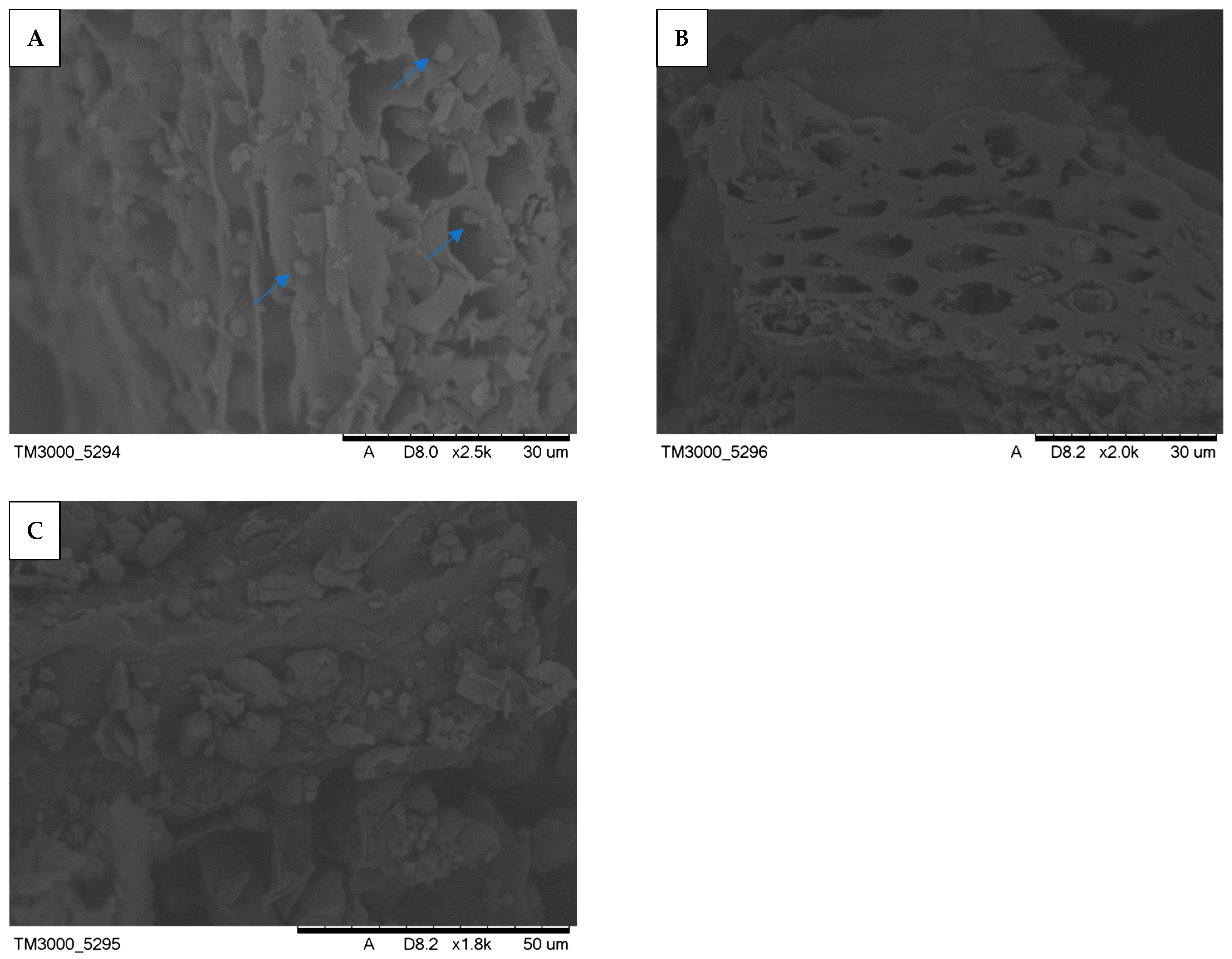
The SEM image (Figure 1) shows the surface morphology of the biocomposite; the biochar is characterized by a well-developed and irregular structure typical of carbonised materials. The sorbent surface appears porous and heterogeneous, with numerous cavities and fissures of varying sizes, which promote adsorption and facilitate microbial immobilisation [1]. Numerous structures consistent with the morphology of B. cereus cells are visible on the biochar surface, with dimensions on the order of several micrometres. The cells exhibit irregular shapes, likely resulting from intensive drying of the material after microbial adsorption and the low moisture content of the sample. The microorganisms are distributed unevenly, occurring both individually and in small clusters, indicating effective bacterial adhesion to the sorbent surface. Their presence within pores and along structural edges suggests that the rough and porous nature of the biochar provides a favourable environment for bacterial attachment and stabilisation. Although the SEM images appear similar at low magnification, this does not contradict the BET results. SEM visualizes only surface-level morphology, whereas BET surface area includes micro- and mesopores formed during pyrolysis that are too small to be visible in SEM images. This explains why the BET surface area of the biochar is substantially higher even though its macro-scale appearance remains comparable to the raw husk.
The raw rice husk exhibits a compact, layered, and distinctly heterogeneous structure. Irregularly arranged fragments with a plate-like and angular morphology form a matrix with limited porosity compared to the biochar and composite materials. The surface appears relatively smooth and is locally covered with fine particles and agglomerates, which may correspond to naturally occurring mineral constituents, particularly silica embedded within the husk structure. The observed cracks and fissures are localised and do not constitute a well-developed pore network. This structural configuration suggests a relatively low specific surface area and limited accessibility of active sorption sites. Consequently, structural modification such as carbonisation is required to enhance the material’s adsorption performance. In the present study, carbonisation at 650 °C was sufficient to generate substantial structural modification in rice husk, as confirmed by the >50-fold increase in BET surface area (from 5.52 m2 g−1 to 300 m2 g−1) and the highly porous architecture visible in SEM images. Although activation processes can further enhance pore development, our goal was not to produce a highly activated carbon but rather to obtain a biochar with adequate pore structure to facilitate effective adhesion and immobilisation of B. cereus cells. The pores formed during pyrolysis were fully sufficient for this purpose, enabling bacterial attachment within cavities and along rough structural edges. Therefore, carbonisation alone achieved the level of porosity required for the intended biological modification.
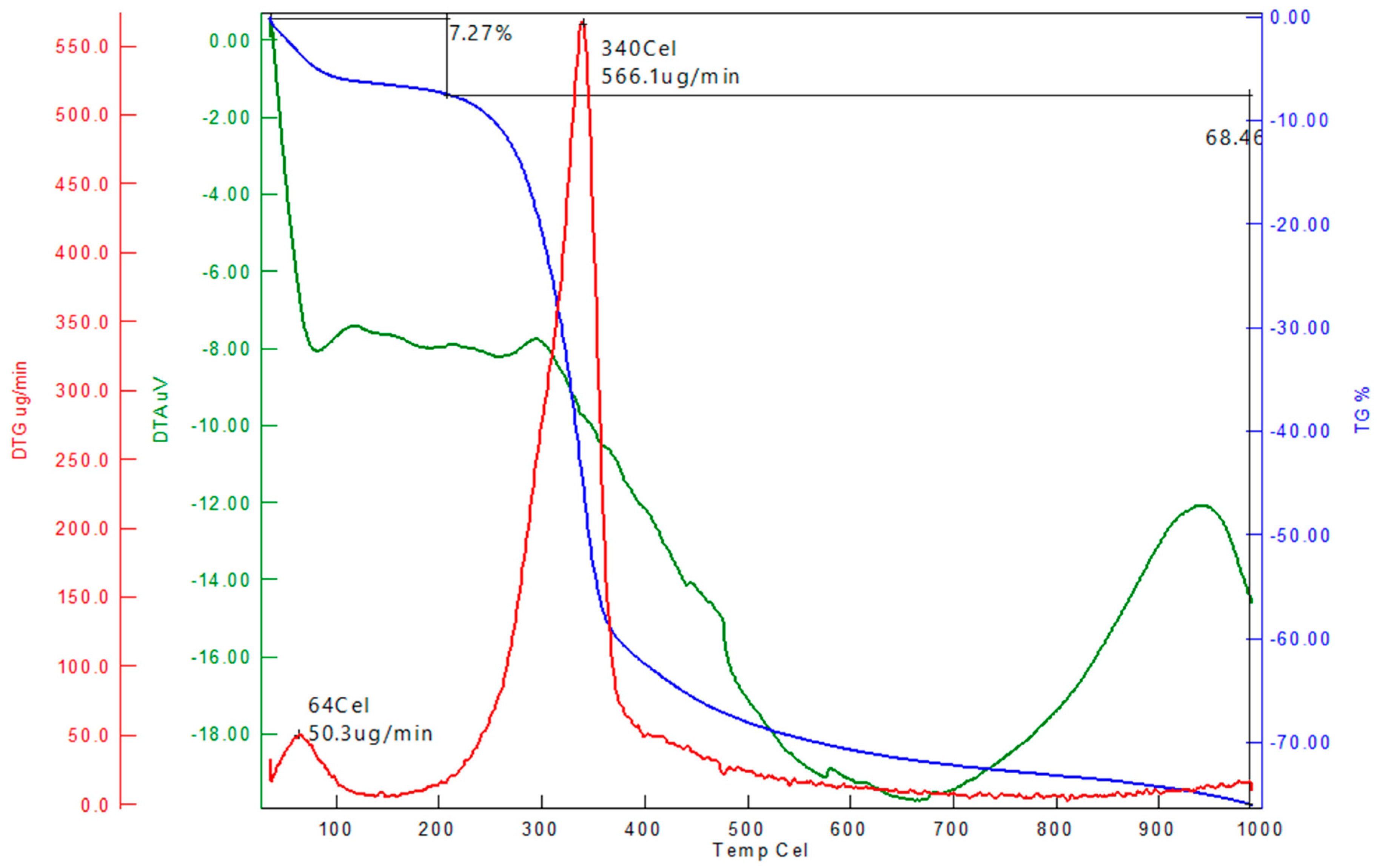
Based on thermogravimetric analysis (TGA/DTG/DTA), rice husk can be characterised as a lignocellulosic organic material with a complex composition, exhibiting a multistage thermal degradation pattern (Figure 2). The TGA profile of rice husk shows an initial mass loss below 100 °C, attributed to the removal of physically adsorbed moisture and light volatile compounds. The main thermal degradation stage occurs between 200 and 400 °C and corresponds to the decomposition of hemicellulose and cellulose and the partial decomposition of lignin. The maximum mass loss rate, observed at approximately 340 °C on the DTG curve, indicates rapid breakdown of the organic matrix and represents the principal stage governing thermal stability.
Above 400 °C, a slower and gradual mass decline is observed, associated with lignin decomposition and carbonisation processes. The substantial solid residue remaining at 1000 °C confirms the high mineral content, predominantly silica, characteristic of rice husk. Overall, the TGA, DTG, and DTA results demonstrate the thermally heterogeneous nature of the material, arising from the coexistence of organic and inorganic fractions, which significantly influences its suitability for pyrolysis and sorption applications.
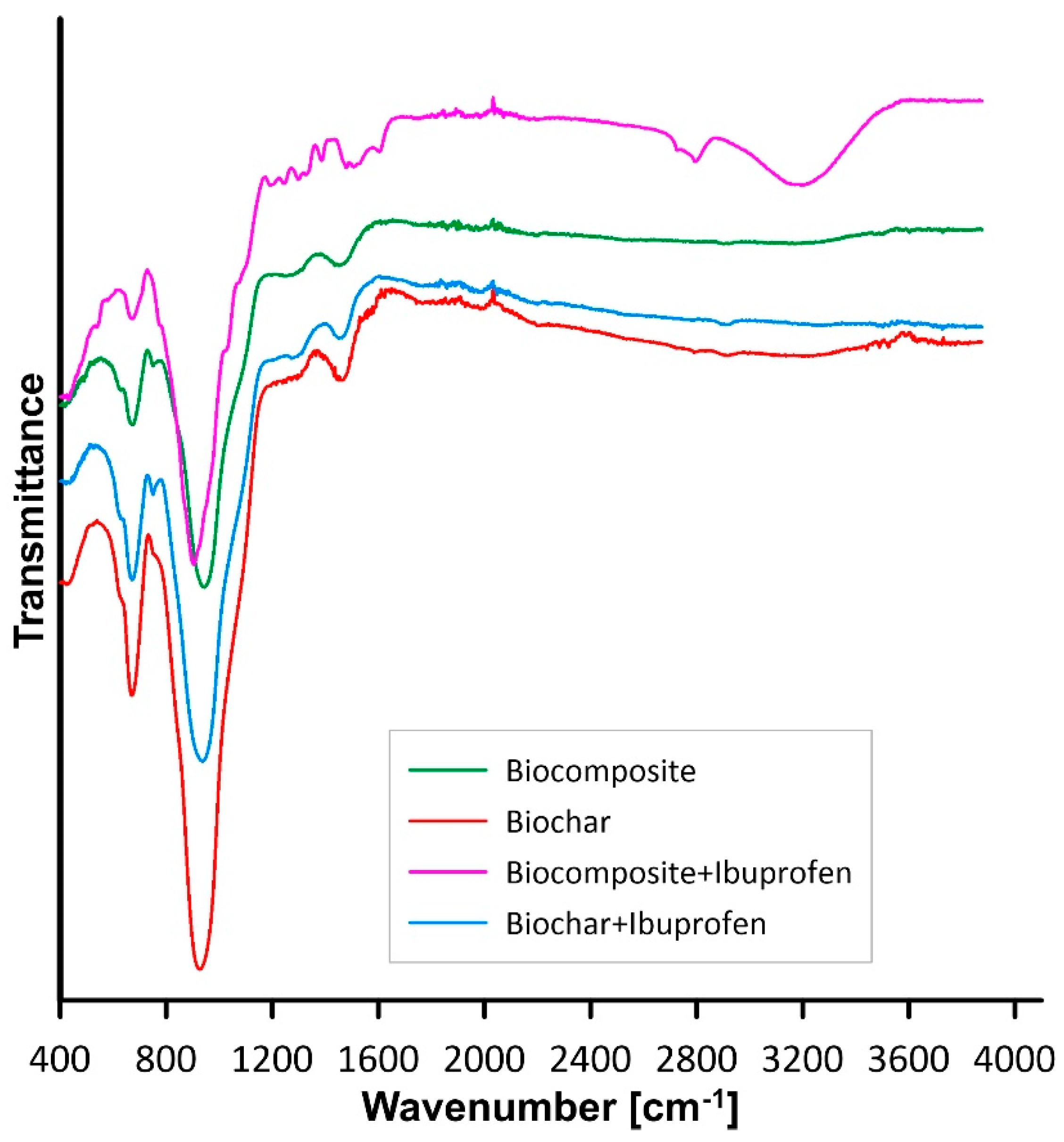
FT-IR analysis of the rice husk, biochar, and the biocomposite enabled identification of key functional groups and structural modifications introduced by pyrolysis and microbial immobilisation (Figure 3). The spectrum of raw rice husk shows a broad O–H stretching band at 3600–3000 cm−1, originating from cellulose, hemicellulose, lignin, and physically adsorbed water. This band decreases markedly in the biochar due to dehydration and dehydroxylation during pyrolysis. In the biocomposite, the O–H band remains present but exhibits altered intensity and shape, reflecting contributions from both the carbonised matrix and the bacterial cell wall.
The FTIR spectra (4000–400 cm−1) further show characteristic vibrations of the biochar and the biocomposite before and after ibuprofen adsorption. In the biochar, O–H stretching appears at 3400–3200 cm−1, aliphatic C–H stretching at 2920–2850 cm−1, carbonyl (C=O) stretching at 1700–1600 cm−1, and aromatic C=C vibrations near 1580–1500 cm−1, confirming the aromatic character of the carbonised material. Bands observed between 1200–1000 cm−1 are assigned to C–O stretching of phenolic and ether groups. The biocomposite exhibits a more intense O–H band and stronger C–O–C/C–O signals at 1100–1000 cm−1, consistent with microbial functional groups and successful immobilisation. After ibuprofen loading, modifications appear in the aromatic and carboxylate regions. Although no strong, isolated shift is visible near ~1700 cm−1 because ibuprofen’s C=O stretch overlaps with pre-existing carbonyl and aromatic bands of the biochar, more pronounced changes occur between 1600 and 1400 cm−1, where ibuprofen’s characteristic aromatic C=C, COO asymmetric (≈1550–1600 cm−1), and COO symmetric stretching (≈1400 cm−1) modes are located. These bands are highly sensitive to adsorption due to hydrogen bonding and π–π interactions with the carbonaceous microbial surface. Additional contributions from ibuprofen occur between 1200 and 1000 cm−1, associated with C–O and C–O–C stretching, visible as subtle band broadening. The absence of new absorption peaks in the ibuprofen-loaded materials confirms that the interaction mechanism is dominated by physisorption, rather than covalent bond formation. Together, the observed spectral changes demonstrate successful ibuprofen adsorption and highlight the complementary roles of carbonyl, aromatic, hydroxyl, and carboxylate functionalities in the sorption process.

3.2. B. cereus Viability

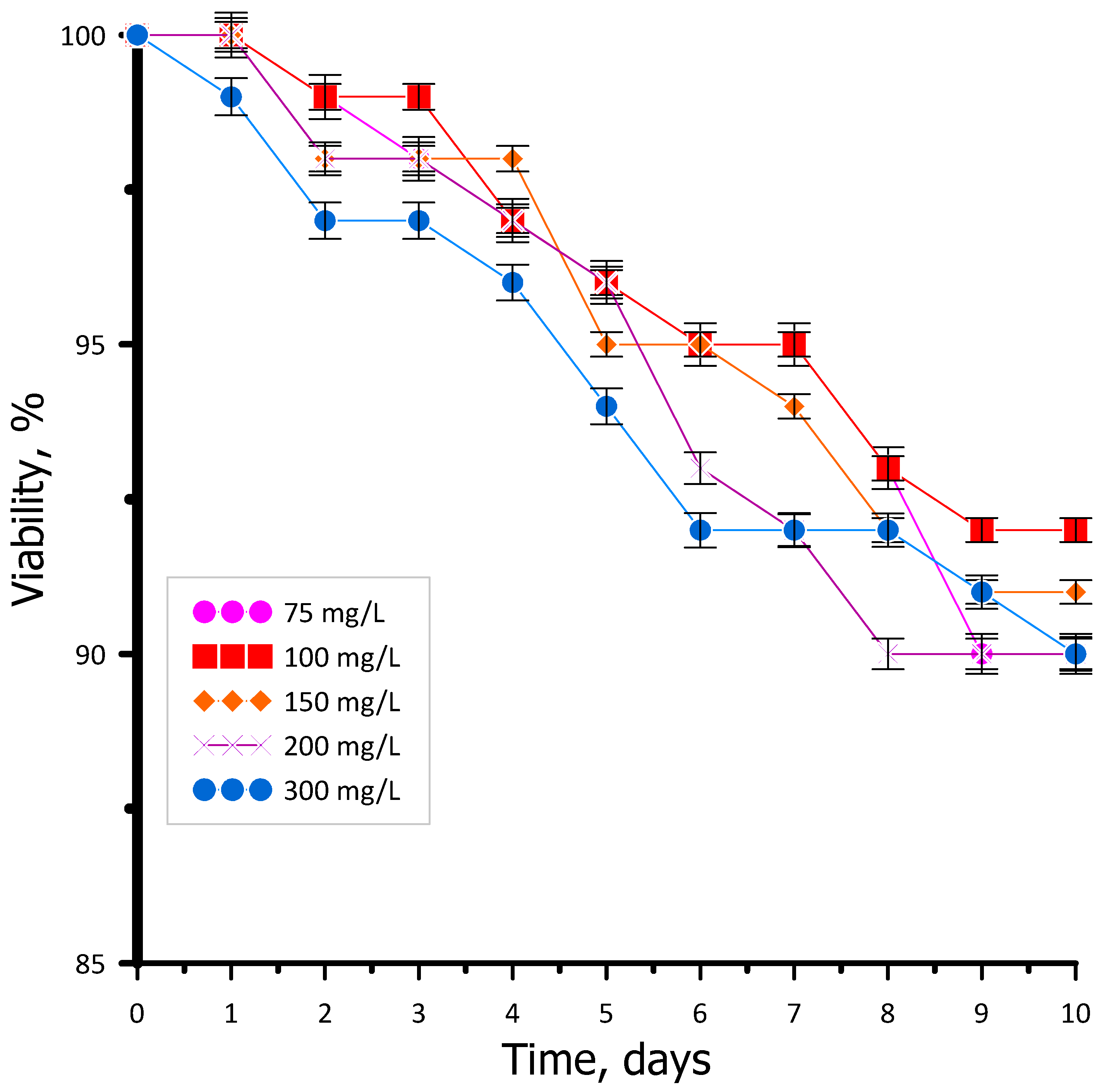
Based on the results obtained throughout the viability experiments, which are shown in Figure 4, it can be stated that ibuprofen does not have a large negative impact on the viability of B. cereus cells. On all of the incubation days, there was no visible effect of ibuprofen on bacterial cell growth at any of the used concentrations, which shows that there was no toxic effect of the adsorbate on the proliferation of chosen microorganisms. The low decrease in viability is a normal phenomenon occurring in the breeding of microorganisms and does not correlate with the presence of ibuprofen.

3.3. Biosorption of Ibuprofen in a Batch System

To check the ability of chosen materials to bioprocess the ibuprofen, data obtained in equilibrium were further analysed. In this particular study, the Langmuir, Freundlich, Temkin and Dubinin–Radushkevich models were chosen. In Table 5, the calculated parameters are presented.
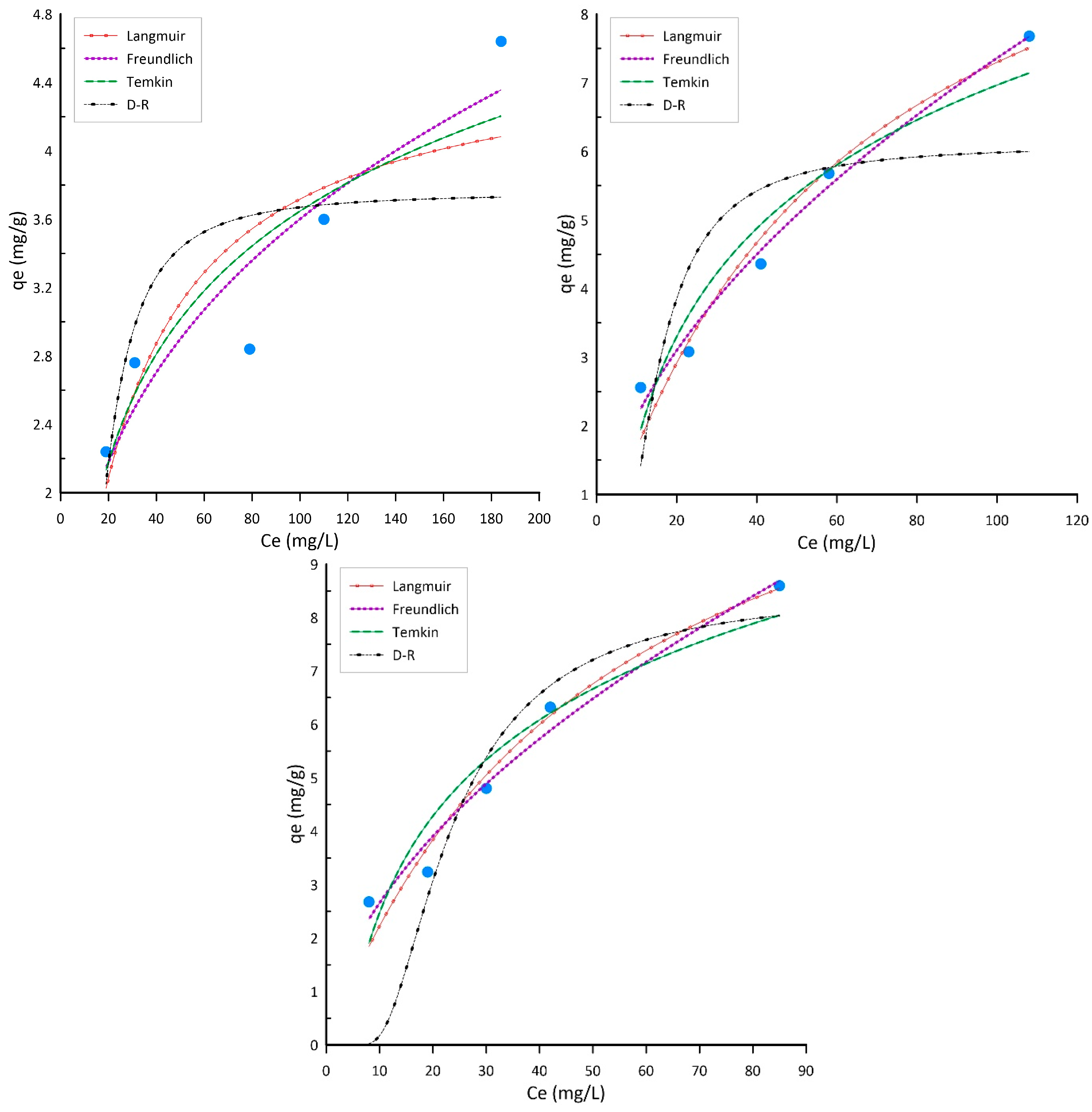
The nonlinear adsorption isotherms for ibuprofen adsorption onto rice husk, biochar, and the composite were analysed using the Langmuir, Freundlich, Temkin, and Dubinin–Radushkevich (D–R) models to describe the equilibrium behaviour and adsorption mechanisms (Figure 5). For the raw rice husk, the adsorption capacity of ibuprofen increases gradually with equilibrium concentration, reaching approximately 4.2 mg g−1. The Langmuir and Freundlich models exhibit similar trends over the entire concentration range, indicating that ibuprofen adsorption occurs through a combination of monolayer adsorption and heterogeneous surface interactions. The Freundlich model predicts slightly higher adsorption capacities at elevated concentrations, suggesting the presence of heterogeneous binding sites on the rice husk surface. The Temkin model shows good agreement in the intermediate concentration range, indicating that adsorbate–adsorbent interactions influence ibuprofen adsorption. In contrast, the D–R model shows an early plateau near approximately 3.6 mg g−1, suggesting limited micropore filling and indicating that surface functional groups mainly control adsorption on rice husk. For the biochar derived from rice husk pyrolysis (Figure 2), a significantly higher ibuprofen adsorption capacity is observed, reaching approximately 7.5 mg g−1. The Langmuir and Freundlich models closely follow the adsorption behaviour, indicating adsorption on surfaces with both homogeneous and heterogeneous active sites. The Freundlich model slightly overestimates adsorption at higher concentrations, reflecting increased surface heterogeneity after pyrolysis. The Temkin model provides a reasonable description at moderate concentrations but slightly underestimates adsorption at higher equilibrium concentrations. The D–R model shows a rapid initial increase followed by a plateau near approximately 6 mg g−1, suggesting that micropore filling contributes to ibuprofen adsorption but does not represent the sole adsorption mechanism. The improved adsorption capacity of biochar compared to raw rice husk is attributed to increased porosity, surface area, and aromatic structures formed during pyrolysis, which enhance interactions with ibuprofen molecules. For the composite, the ibuprofen adsorption capacity further increases, reaching approximately 8.5–8.8 mg g−1 at higher equilibrium concentrations. This enhanced performance indicates the beneficial effect of immobilising bacterial cells onto the biochar surface. The Langmuir and Freundlich models provide very similar curves across the concentration range, suggesting that ibuprofen adsorption occurs through both monolayer coverage and heterogeneous surface interactions. The Freundlich model predicts slightly higher adsorption capacities at higher concentrations, indicating increased surface heterogeneity due to the presence of bacterial cell wall functional groups such as hydroxyl, carboxyl, amino, and phosphate groups. The Temkin model follows the general adsorption trend but slightly underestimates adsorption at higher concentrations. The D–R model shows a delayed increase followed by a plateau near approximately 8 mg g−1, indicating that micropore filling contributes to adsorption but is supplemented by surface interactions involving biological functional groups. Comparison of the three materials shows a clear increase in ibuprofen adsorption capacity in the order of rice husk < biochar < composite. The enhanced adsorption observed for biochar is mainly due to structural changes induced by pyrolysis, including increased porosity and the development of aromatic carbon surfaces that favour interactions with ibuprofen molecules. The further improvement observed for the biochar–bacterial composite is attributed to the introduction of additional active binding sites from bacterial cell walls, which increases adsorption affinity and surface heterogeneity. Overall, the nonlinear isotherm analysis indicates that ibuprofen adsorption on all three materials is best described by the Langmuir and the Freundlich models, suggesting a combination of monolayer adsorption and heterogeneous surface adsorption mechanisms. The results demonstrate that the composite provides the highest adsorption efficiency and represents a promising adsorbent for ibuprofen removal from aqueous solutions. In addition to the equilibrium adsorption capacity (qₑ), several isotherm parameters provide important insight into the nature and strength of ibuprofen adsorption. In the Dubinin–Radushkevich (D–R) model, the parameter E (mean free energy of adsorption) indicates the type of adsorption interaction. Values below 8 kJ mol−1 are characteristic of physisorption, whereas values between 8 and 16 kJ mol−1 may indicate ion-exchange or weak chemisorption. In this study, E ranged from 3.71 to 8.52 kJ mol−1, confirming that ibuprofen removal by the rice husk, biochar, and biocomposite occurs predominantly via physisorption, driven by π–π interactions, hydrogen bonding, and surface heterogeneity. In the Temkin isotherm, the constant BT is related to the heat of adsorption and reflects the decrease in adsorption energy as coverage increases. Low BT values are typical for heterogeneous carbon surfaces, indicating weak adsorbate–adsorbent interactions consistent with physisorption. The parameter KT denotes the Temkin equilibrium binding constant, which quantifies the sorbent surface’s affinity for ibuprofen. Higher KT values correspond to stronger binding affinity. In this study, the biocomposite exhibited the highest KT among the materials tested, confirming that microbial immobilisation increases the density and diversity of surface functional groups, thereby enhancing the interaction strength with ibuprofen relative to abiotic biochar. When comparing the performance of the composite with published ibuprofen sorbents, the benefit of microbial immobilisation becomes clear. Typical adsorption capacities for unactivated or mildly activated biochars reported in the literature range from 9.69 to 309 mg/g, depending on precursor and modification strategy. Higher capacities are generally associated with chemically activated materials (e.g., ZnCl2, H3PO4 or KOH-treated biochars), magnetic biochars (qmax ≈ 140–167 mg/g), or high-temperature (800–900 °C) carbons [4]. In contrast, the biochar used in the present study was produced without chemical activation and at a moderate pyrolysis temperature, yielding a qmax of 11.68 mg/g, which is consistent with values reported for non-activated lignocellulosic biochars. Importantly, immobilising B. cereus increased the adsorption capacity to 13.73 mg/g, representing a significant improvement over PRH alone. This enhancement is attributable to the additional hydroxyl, carboxyl, amino, and phosphate functional groups contributed by the microbial cells, which increase surface heterogeneity and strengthen interactions with ibuprofen, as shown by FTIR analysis. Unlike highly engineered sorbents that require chemical activation or metal doping, the composite achieves this improvement through a simple, low-cost, and environmentally sustainable modification. Thus, microbial immobilisation provides measurable functional benefits beyond the base biochar and justifies the use of the hybrid material [28,29]. Although the BET surface area of the biocomposite is lower than that of the PRH biochar, its higher adsorption capacity can be attributed to the chemical contribution of the immobilised B. cereus cells. BET primarily reflects micro- and mesopore structures, whereas surface functional groups strongly influence ibuprofen adsorption. The bacterial cell wall introduces additional –OH, –COOH, –NH2, and –PO4 groups that enhance ibuprofen binding through hydrogen bonding, π–π interactions, and electrostatic interactions. Such functionalities have been widely reported to enhance ibuprofen sorption on modified biochars, even when the BET surface area does not increase proportionally. Thus, the enhanced qₘ of the biocomposite arises from increased surface chemical heterogeneity rather than physical surface area, and may also include minor contributions from biosorption by the microbial biomass. It should be noted that the first isotherm (rice husk) displays limited curvature within the concentration range tested, resulting in a near-linear qₑ–Cₑ relationship. This can reduce the robustness of Langmuir and Freundlich parameter estimation, as the data do not approach saturation. Such linearity is commonly observed in low-affinity or low-capacity sorbents when the experimental concentration range remains within the initial linear portion of the isotherm. Although the model could still be fitted mathematically, the fitted constants should be interpreted with caution and viewed as comparative rather than absolute descriptors. Future work including at least one additional concentration point at the upper end of the range may help improve curvature and provide stronger isotherm resolution.

3.4. Kinetic Studies

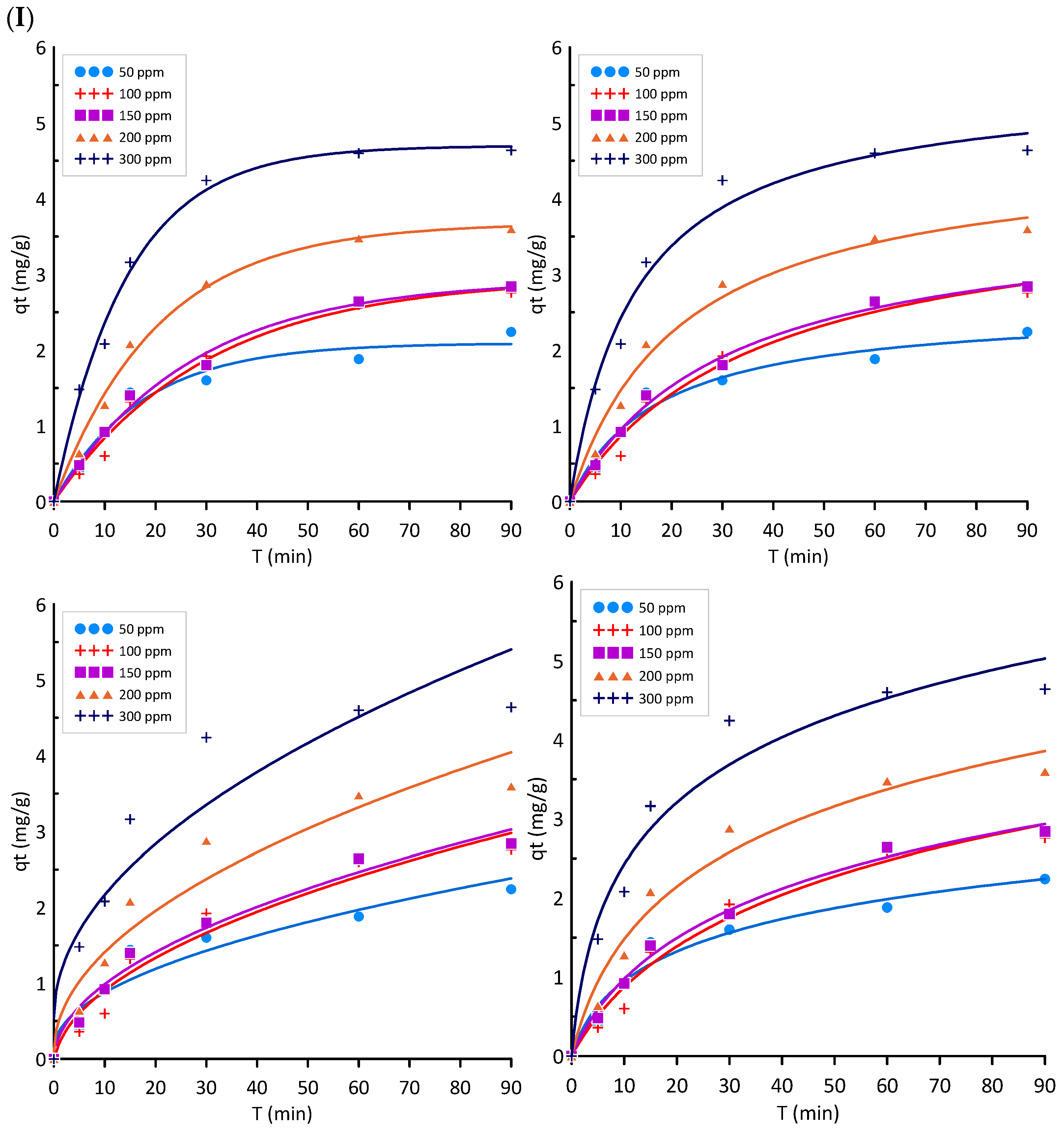
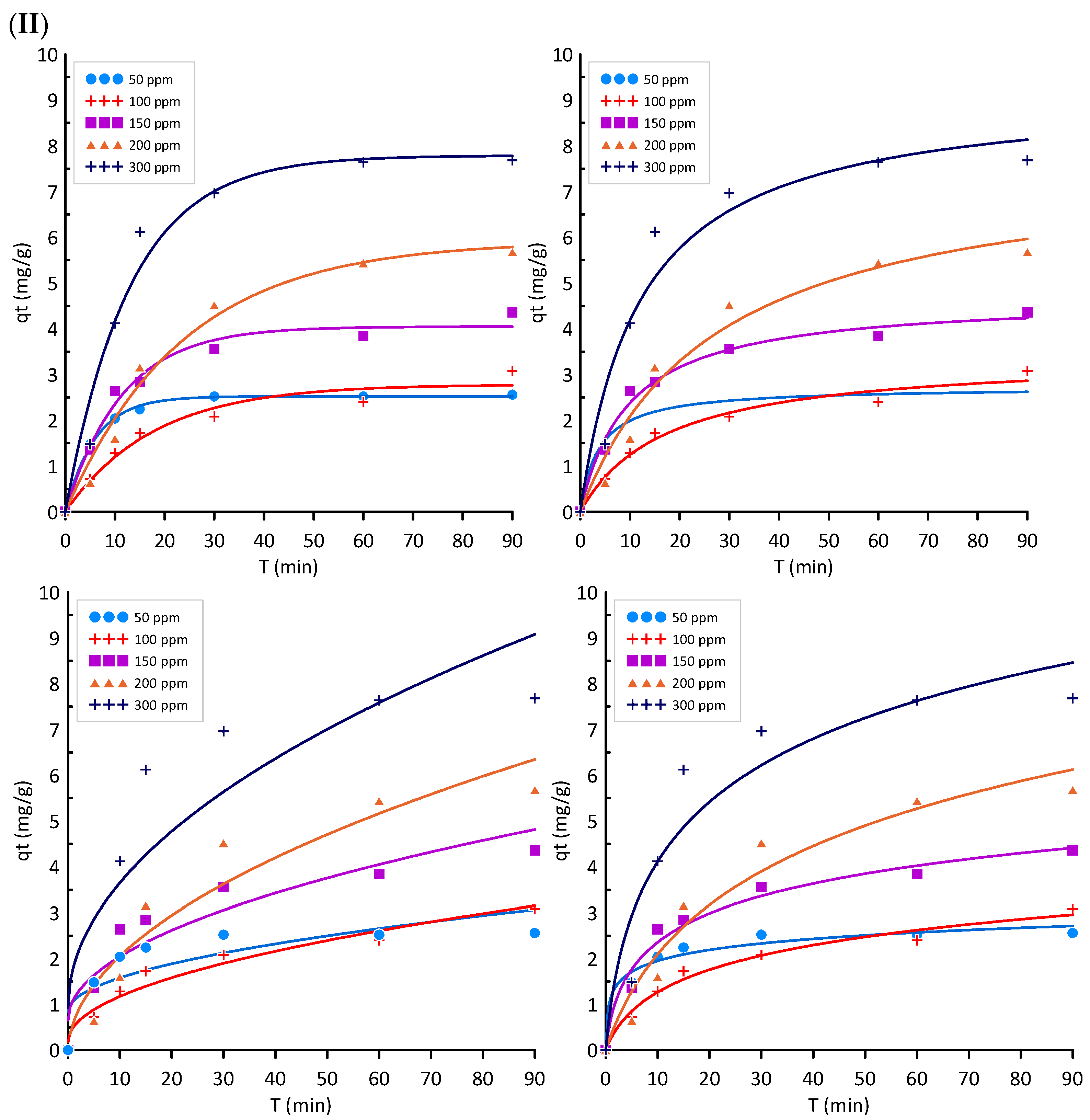
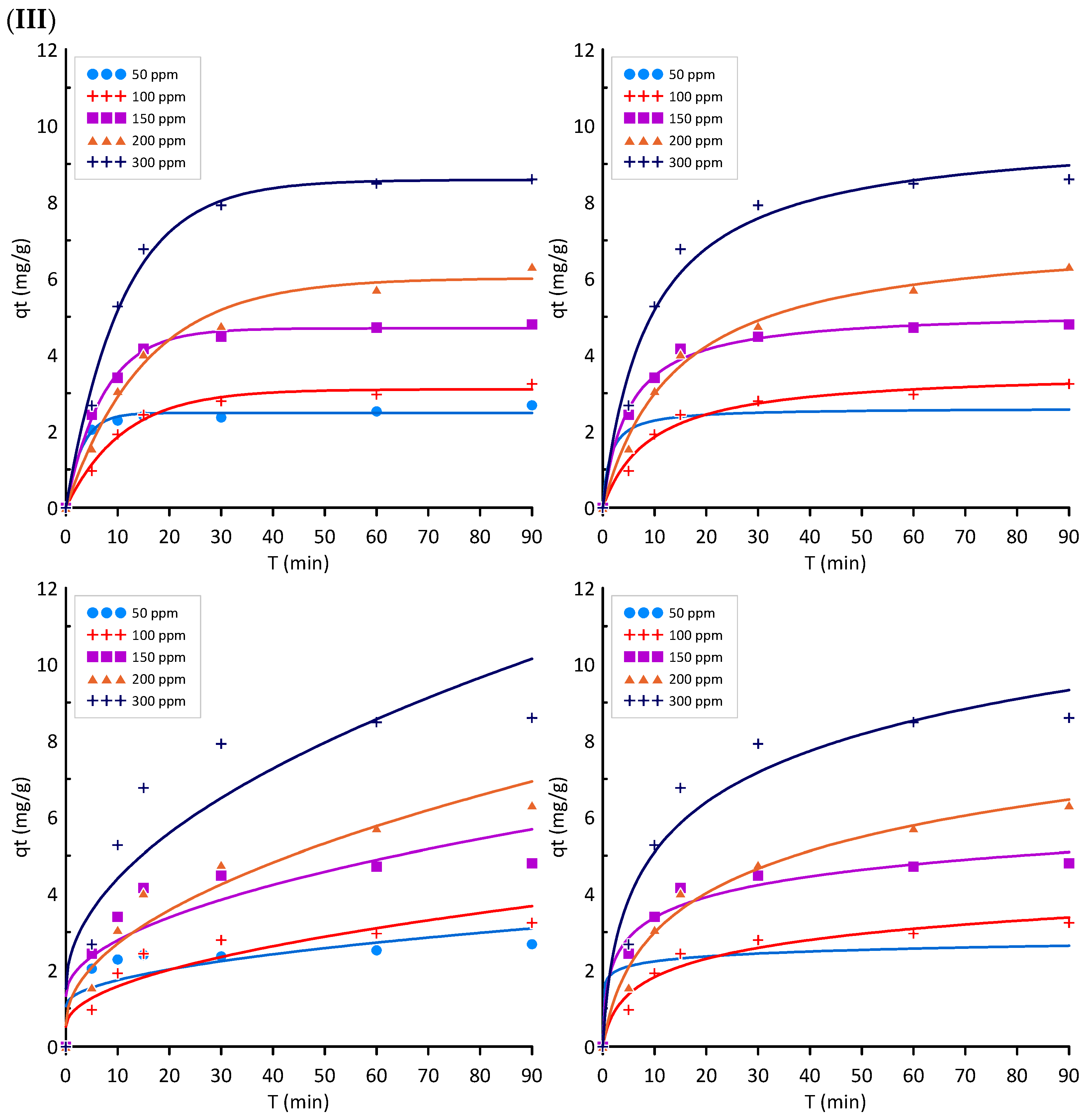
To obtain additional information on the characteristics of ibuprofen biosorption, kinetic studies were carried out. In this study, four different models were used: the pseudo-first-order rate, pseudo-second-order rate, Weber–Morris intraparticle diffusion, and Elovich models. In Figure 6, the nonlinear forms of the models used for the bioprocessing of ibuprofen using rice husk, biochar, and composite are shown.
The kinetic parameters for ibuprofen adsorption onto rice husk, biochar, and the composite at initial concentrations of 50–250 mg dm−3 were evaluated using pseudo-first-order, pseudo-second-order, Weber–Morris intraparticle diffusion, and Elovich kinetic models (Table 6). The results provide insight into the adsorption rate and controlling mechanisms. The pseudo-first-order model shows relatively good correlation coefficients (R2 = 0.981–0.997) for all three adsorbents, indicating that this model can reasonably describe the adsorption kinetics. The equilibrium adsorption capacities (qₑ) predicted by the pseudo-first-order model increase with increasing initial ibuprofen concentration for all materials, reaching maximum values of 4.69 mg g−1 for rice husk, 7.78 mg g−1 for biochar, and 8.58 mg g−1 for the at 250 mg dm−3. The rate constant k1 is generally higher for biochar and the composite than for rice husk, indicating faster adsorption kinetics after pyrolysis and bacterial immobilisation. The relatively high R2 values suggest that diffusion-controlled processes contribute significantly to ibuprofen adsorption. The pseudo-second-order model also shows high correlation coefficients (R2 = 0.974–0.996), comparable to or slightly higher than those obtained from the pseudo-first-order model. The calculated equilibrium adsorption capacities from the pseudo-second-order model generally agree well with experimental values and increase with increasing initial concentration, reaching 5.56 mg g−1 for rice husk, 9.21 mg g−1 for biochar, and 9.86 mg g−1 for the composite at 250 mg dm−3. The pseudo-second-order rate constant k2 decreases with increasing initial ibuprofen concentration, which is typical for adsorption systems where active sites become progressively occupied. The good agreement of this model suggests that chemisorption or strong surface interactions contribute to the adsorption process. The Weber–Morris intraparticle diffusion model indicates that intraparticle diffusion plays a role in ibuprofen adsorption but is not the only rate-controlling step. The intraparticle diffusion constants (Kid) increase with increasing initial concentration for all adsorbents, indicating enhanced diffusion at higher concentration gradients. The composite shows the highest K_id values (up to 0.90 mg g−1 min0.5), followed by biochar and rice husk, reflecting improved pore accessibility and mass transfer. However, the intercept values (I) are not equal to zero, indicating that intraparticle diffusion is accompanied by boundary layer diffusion. The relatively lower R2 values for this model (0.759–0.988) compared with the kinetic models further confirm that intraparticle diffusion alone does not control the adsorption rate. The Elovich model also provides a good description of the adsorption kinetics, particularly for the biochar and composite systems, with R2 values up to 0.997. The parameter α, representing the initial adsorption rate, generally increases with increasing ibuprofen concentration and is higher for biochar and the composite than for rice husk, indicating more rapid adsorption on modified surfaces. The β parameter, which is related to surface coverage and activation energy, varies with concentration but is generally higher for the composite, suggesting greater surface heterogeneity due to the presence of bacterial functional groups. Overall, the kinetic analysis indicates that ibuprofen adsorption proceeds fastest on the biochar–B. cereus composite, followed by biochar and raw rice husk. Both pseudo-first-order and pseudo-second-order models describe the adsorption process well, suggesting that ibuprofen adsorption involves a combination of physical adsorption and surface interactions. The Weber–Morris analysis confirms that intraparticle diffusion contributes to the adsorption mechanism but is not the sole rate-limiting step. The Elovich model results indicate that adsorption occurs on heterogeneous surfaces, particularly for biochar and the bacterial composite. These findings demonstrate that pyrolysis and bacterial immobilisation significantly improve adsorption kinetics and capacity for ibuprofen removal. All biosorption experiments were carried out at a controlled laboratory temperature of 25 ± 1 °C, with no variation in temperature during the batch tests. It is important to emphasise that the contact times used in this study (5–90 min) are appropriate for characterising physicochemical adsorption but are not sufficient to support active microbial metabolism or enzymatic degradation of ibuprofen. The rapid removal observed for the biocomposite, therefore, reflects enhanced biosorption rather than biodegradation. The presence of B. cereus contributes additional surface functional groups—such as hydroxyl, carboxyl, amino, and phosphate groups—that increase surface heterogeneity and strengthen interactions with ibuprofen molecules. This aligns with the kinetic results, which show fast uptake driven by surface interactions and pore accessibility rather than biological transformation. Accordingly, the enhanced performance of the composite should be interpreted as a synergistic effect of the porous carbon matrix and the biosorptive properties of the bacterial cell wall, not the enzymatic breakdown of the pollutant.

4. Conclusions

This study demonstrates that pyrolysed rice husk (PRH) and its biofunctionalized composite with Bacillus cereus are effective, low-cost materials for removing ibuprofen from water. The adsorption capacities obtained (4.86 mg g−1 for rice husk, 11.68 mg g−1 for PRH, and 13.73 mg g−1 for the composite) fall within the typical range reported for non-activated biochars (generally 9.69–309 mg g−1, depending on precursor and modification). Although higher capacities are often achieved by chemically activated or metal-modified biochars (e.g., 140–167 mg g−1 for magnetic biochars), these require complex, energy-intensive treatments.
In contrast, the composite improves performance without chemical activation, benefiting from additional functional groups on microbial surfaces (–OH, –COOH, –NH2, –PO4) that enhance surface heterogeneity and ibuprofen affinity. This is consistent with reports showing that oxygen- and nitrogen-containing groups strengthen NSAID adsorption. The faster uptake and strong fit to the pseudo-second-order kinetic model also align with typical ibuprofen adsorption behaviour on carbonaceous sorbents. Overall, immobilising B. cereus yields a measurable and sustainable improvement over biochar alone, without resorting to high-energy or chemical treatments as used in other sorbent systems. The composite therefore represents a practical, environmentally friendly alternative for removing ibuprofen—one of the most consumed and environmentally persistent NSAIDs—from contaminated waters.
Although the composite demonstrated measurable improvements in adsorption capacity and affinity compared with the unmodified biochar, several areas require further investigation. First, the adsorption capacities remain modest relative to chemically activated or metal-modified sorbents reported in the literature, indicating that additional optimisation—such as surface activation, pH adjustment, or composite modification—may further enhance performance. Second, the present study focused solely on physisorption under isothermal conditions; therefore, future work should include multi-temperature experiments to establish full thermodynamic profiles. Third, mechanistic insight would benefit from chromatographic confirmation (e.g., HPLC/LC-MS) to clearly distinguish ibuprofen from potential transformation products. Finally, long-term stability, reusability, and performance in real wastewater matrices should be evaluated to assess the practical applicability of the biocomposite. These improvements will help strengthen the environmental relevance and scalability of this sustainable sorbent system.

Author Contributions

Conceptualization, J.C.; Methodology, J.C., P.N., W.R., J.W. and P.S.; Validation, J.C. and P.N.; Formal analysis, P.S.; Investigation, J.W.; Data curation, J.C. and W.R.; Writing—original draft, J.C.; Writing—review & editing, J.C.; Visualization, J.C.; Supervision, J.C.; Project administration, J.C. All authors have read and agreed to the published version of the manuscript.

Funding

This research received no external funding.

Data Availability Statement

The original contributions presented in this study are included in the article. Further inquiries can be directed to the corresponding author.

Conflicts of Interest

The authors declare no conflict of interest.

References

  1. Osman, A.I.; Ayati, A.; Farghali, M.; Krivoshapkin, P.; Tanhaei, B.; Karimi-Maleh, H.; Krivoshapkina, E.; Taheri, P.; Tracey, C.; Al-Fatesh, A.; et al. Advanced adsorbents for ibuprofen removal from aquatic environments: A review. Environ. Chem. Lett. 2023, 22, 373–418. [Google Scholar] [CrossRef]
  2. Chopra, S.; Kumar, D. Ibuprofen as an emerging organic contaminant in environment, distribution and remediation. Heliyon 2020, 6, e04087. [Google Scholar] [CrossRef]
  3. Almas; Shahzadi, T.; Riaz, T.; Zaib, M.; Kashif Uddin, M. Hydrogel-based metal–organic frameworks doped into Mn/Ni oxide for the effective removal of ciprofloxacin antibiotic from water. Water Environ. J. 2025, 39, 106–123. [Google Scholar] [CrossRef]
  4. Haris, M.; Amjad, Z.; Usman, M.; Saleem, A.; Dyussenova, A.; Mahmood, Z.; Dina, K.; Guo, J.; Wang, W. A review of crop residue-based biochar as an efficient adsorbent to remove trace elements from aquatic systems. Biochar 2024, 6, 47. [Google Scholar] [CrossRef]
  5. Kim, W.-K.; Shim, T.; Kim, Y.-S.; Hyun, S.; Ryu, C.; Park, Y.-K.; Jung, J. Characterization of cadmium removal from aqueous solution by biochar produced from a giant Miscanthus at different pyrolytic temperatures. Bioresour. Technol. 2013, 138, 266–270. [Google Scholar] [CrossRef]
  6. Bushra, B.; Remya, N. Biochar from pyrolysis of rice husk biomass—Characteristics, modification and environmental application. Biomass Convers. Biorefin. 2020, 14, 5759–5770. [Google Scholar] [CrossRef]
  7. Najim, A.A.; Radeef, A.Y.; al-Doori, I.; Jabbar, Z.H. Immobilization: The promising technique to protect and increase the efficiency of microorganisms to remove contaminants. J. Chem. Technol. Biotechnol. 2024, 99, 1707–1733. [Google Scholar] [CrossRef]
  8. Crickmore, N.; Berry, C.; Panneerselvam, S.; Mishra, R.; Connor, T.R.; Bonning, B.C. A structure-based nomenclature for Bacillus thuringiensis and other bacteria-derived pesticidal proteins. J. Invertebr. Pathol. 2021, 186, 107438. [Google Scholar] [CrossRef] [PubMed]
  9. Sharma, R.; Jasrotia, T.; Umar, A.; Sharma, M.; Sharma, S.; Kumar, R.; Alkhanjaf, A.A.M.; Vats, R.; Beniwal, V.; Kumar, R.; et al. Effective removal of Pb(II) and Ni(II) ions by Bacillus cereus and Bacillus pumilus: An experimental and mechanistic approach. Environ. Res. 2022, 212, 113337. [Google Scholar] [CrossRef] [PubMed]
  10. Rahman, M.M.; Afrin, M.F.; Zong, C.; Ichihara, G.; Kimura, Y.; Haque, M.A.; Wahed, M.I.I. Modification of ibuprofen to improve the medicinal effect; structural, biological, and toxicological study. Heliyon 2024, 10, e27371. [Google Scholar] [CrossRef] [PubMed]
  11. Rajamani, S.; Kolla, S.S.N.; Gudivada, R.; Raghunath, R.; Ramesh, K.; Jadhav, S.A. Valorization of Rice Husk to Value-Added Chemicals and Functional Materials. Int. J. Environ. Res. 2023, 17, 22. [Google Scholar] [CrossRef]
  12. Uddin, M.K.; Abd Malek, N.N.; Jawad, A.H.; Sabar, S. Pyrolysis of rubber seed pericarp biomass treated with sulfuric acid for the adsorption of crystal violet and methylene green dyes: An optimized process. Int. J. Phytorem. 2023, 25, 393–402. [Google Scholar] [CrossRef]
  13. Liu, X.; Xiao, C.; Yu, X.; Zheng, L.; Zhao, M.; Huang, M. Peptone source effects on recombinant protease production and cellular responses in yeast. Enzym. Microb. Technol. 2025, 189, 110674. [Google Scholar] [CrossRef]
  14. Özacar, M.; Şengil, I.A.; Türkmenler, H. Equilibrium and kinetic data, and adsorption mechanism for adsorption of lead onto valonia tannin resin. Chem. Eng. J. 2008, 143, 32–42. [Google Scholar] [CrossRef]
  15. Langmuir, I. The adsorption of gases on plane surfaces of glass, mica and platinum. J. Am. Chem. Soc. 1918, 40, 1361–1403. [Google Scholar] [CrossRef]
  16. Freundlich, H. Ueber Kolloidfällung und Adsorption. Z. Für Chem. Und Ind. Kolloide 1907, 1, 321–331. [Google Scholar] [CrossRef]
  17. Temkin, M.; Pyzhev, V. Kinetics of Ammonia Synthesis on Promoted Iron Catalysts. Acta Physicochim. U.R.S.S. 1940, 12, 327–356. [Google Scholar]
  18. Dubinin, M.M.; Radushkevich, L.V. Equation of the Characteristic Curve of Activated Charcoal. Proc. Acad. Sci. USSR Phys. Chem. Sect. 1947, 55, 331–333. [Google Scholar]
  19. Yusuff, A.S.; Lala, M.A.; Thompson-Yusuff, K.A.; Babatunde, E.O. ZnCl2-modified eucalyptus bark biochar as adsorbent: Preparation, characterization and its application in adsorption of Cr(VI) from aqueous solutions. S. Afr. J. Chem. Eng. 2022, 42, 138–145. [Google Scholar] [CrossRef]
  20. Es-Sahbany, H.; Hsissou, R.; El Hachimi, M.L.; Allaoui, M.; Nkhili, S.; Elyoubi, M.S. Investigation of the adsorption of heavy metals (Cu, Co, Ni and Pb) in treatment synthetic wastewater using natural clay as a potential adsorbent (Sale-Morocco). Mater. Today Proc. 2021, 45, 7290–7298. [Google Scholar] [CrossRef]
  21. Maia, L.S.; Duizit, L.D.; Pinhatio, F.R.; Mulinari, D.R. Valuation of banana peel waste for producing activated carbon via NaOH and pyrolysis for methylene blue removal. Carbon Lett. 2021, 31, 749–762. [Google Scholar] [CrossRef]
  22. Tripathy, S.; Sahu, S.; Patel, R.K.; Panda, R.B.; Kar, P.K. Efficient removal of Cr(VI) by polyaniline modified biochar from date (Phoenix dactylifera) seed. Groundw. Sustain. Dev. 2021, 15, 100653. [Google Scholar] [CrossRef]
  23. Lagergreen, S. Zur Theorie der sogenannten Adsorption gelöster Stoffe—(Bihang A. K. Svenske Vet. Ak. Handl. 24, II. Nr. 4, S. 49; 1899; Z. physik. Ch. 32, 174–175; 1900.). Z. Für Chem. Und Ind. Kolloide 1907, 2, 15. [Google Scholar] [CrossRef]
  24. Blanchard, G.; Maunaye, M.; Martin, G. Removal of heavy metals from waters by means of natural zeolites. Water Res. 1984, 18, 1501–1507. [Google Scholar] [CrossRef]
  25. Weber, W.J., Jr.; Morris, J.C. Kinetics of Adsorption on Carbon from Solution. J. Sanit. Eng. Div. 1963, 89, 31–59. [Google Scholar] [CrossRef]
  26. Hussain, M.; Aadil, M.; Cochran, E.W.; Zulfiqar, S.; Hassan, W.; Kousar, T.; Somaily, H.H.; Mahmood, F. Facile synthesis of a porous sorbent derived from the rice husk biomass: A new and highly efficient material for water remediation. Inorg. Chem. Commun. 2024, 160, 112010. [Google Scholar] [CrossRef]
  27. Yin, H.; Zhang, M.; Xu, X.; Chen, X. Modulation of biomass-based anode specific surface area and electrical conductivity on the enhancement of microbial fuel cell power generation capacity. J. Chem. Technol. Biotechnol. 2026, 101, 355–366. [Google Scholar] [CrossRef]
  28. Zhan, D.; Ye, A.; Hou, T. Research progress on biochar-based material adsorption and removal of ibuprofen. Front. Environ. Sci. 2023, 11, 1327000. [Google Scholar] [CrossRef]
  29. Ngernyen, Y.; Petsri, D.; Sribanthao, K.; Kongpennit, K.; Pinijnam, P.; Pedsakul, R.; Hunt, A.J. Adsorption of the non-steroidal anti-inflammatory drug (ibuprofen) onto biochar and magnetic biochar prepared from chrysanthemum waste of the beverage industry. RSC Adv. 2023, 13, 14712–14728. [Google Scholar] [CrossRef]
Figure 1. SEM microphotographs of biocomposite (A), biochar (B), and rice husk (C). Blue arrows indicate B. cereus cells immobilised on the biochar.
Water 18 00824 g001
Figure 2. TGA analysis of rice husk.
Water 18 00824 g002
Figure 3. FTIR analysis of the materials before and after the sorption process.
Water 18 00824 g003
Figure 4. Viability of B. cereus cells over 10 days of incubation with various concentrations of ibuprofen.
Water 18 00824 g004
Figure 5. Nonlinear isotherm curves for ibuprofen adsorption onto rice husk, biochar, and the composite, respectively. The optimum adsorption capacities (qₘ) obtained from the Langmuir model were 4.86 mg g−1 (rice husk), 11.68 mg g−1 (biochar), and 13.73 mg g−1 (biocomposite).
Water 18 00824 g005
Figure 6. Nonlinear kinetic model plots (pseudo-first-order, pseudo-second-order, Weber–Morris, and Elovich) for rice husk (I), biochar (II), and the composite (III). The optimum contact time for maximum ibuprofen uptake was 90 min for all adsorbents.
Water 18 00824 g006aWater 18 00824 g006bWater 18 00824 g006c
Table 1. The equations of the Langmuir, Freundlich and Temkin isotherm models.
ModelEquationReference
Langmuir q e = q m K L C e 1 + K L C e         (2)[15]
Freundlich q e = K F   C e 1 / n (3)[16]
Temkin q e = B   l n ( K t C e ) , B = R T b t (4)(Temkin, 1940) [17]
Dubinin–Radushkevich q e = q d exp K a d ε 2 ,
ε = R T   l n 1 1 C e
(5)(Dubinin, Radushkevich, 1947) [18]
Notes: Ce—ibuprofen concentration in equilibrium (mg/dm3); qe—sorption capacity in equilibrium (mg/g); KF—Freundlich constant (mg1−(1/n)(dm3)1/ng−1); n—heterogeneity coefficient; Kt—Temkin equilibrium binding constant, which reflects the affinity of the adsorbate toward the adsorbent surface (dm3/g); B—constant associated with the sorption heat (J/mol); R—gas constant (8.314 J mol/K); T—temperature (K); bt—Temkin isotherm constant; Kad—Dubinin–Radushkevich isotherm constant (mol2/kJ2); ɛ—D-R isotherm constant.
Table 2. Equations of kinetic models used in the study.
ModelEquationReference
Pseudo-first-order q t = q 1 1 e k 1 t (6)(Lagergreen, 1907) [23]
Pseudo-second-order q t = t 1 k 2 q 2 2 + t q 2 (7)[24]
Weber–Morris (intraparticle diffusion) q t = K id   t 1 / 2 + I   (8)[25]
Notes: k1—pseudo-first-order kinetics constant (1/min); k2—pseudo-second-order kinetics constant; Kid—the intraparticle diffusion rate constant (mg/g min0.5); I—Intercept of the line in the Weber–Morris model.
Table 3. Composition of the used materials.
MaterialMineral Content (%)Total N
(% d.w.)
Total P
(% d.w.)
Total C
(% d.w.)
Total H
(% d.w.)
B. cereus7.405.80.954.25.7
Rice husk14.600.60.438.04.7
Biochar470.30.691.70.1
Table 4. BET surface area and porosity of materials.
ParameterRice HuskBiocharB. cereus
Surface area (m2/g)5.52 ± 0.18299.64 ± 4.51.56 ± 0.05
Pore volume (cm3/g)0.040 ± 0.0030.32 ± 0.010.0050 ± 0.0003
Pore size (nm)3.21 ± 0.118.21 ± 0.261.85 ± 0.07
Table 5. Parameters obtained from the isotherm models.
Model/ParameterRice HuskBiocharBiocomposite
Langmuir
q max  (mg/g)4.8611.6813.73
K F  (dm3/g)0.030.010.01
R 2 0.8870.9770.978
Freundlich
n 2.821.861.80
K F  (mg1−(1/n)(dm3)1/ng−1)0.690.620.74
R 2 0.9590.9920.986
Temkin
K T  (dm3 g−1)0.992.272.59
B T 0.370.210.25
R 2 0.9260.9610.954
Dubinin–Radushkevich
E  (kJ mol−1)3.716.098.52
q d  (mg g−1)0.100.070.17
R 2 0.7360.7760.800
Table 6. Parameters calculated from different kinetic models.
Kinetic Model/Parameter50 mg dm−3 100 mg dm−3 150 mg dm−3 200 mg dm−3 300 mg dm−3
Rice husk/biochar/composite
Pseudo-first-order
q e (mg/g)2.09/2.46/2.472.95/3.78/3.092.92/4.04/4.693.67/5.55/6.014.69/7.78/8.58
k 1 (min−1)0.058/0.17/0.320.062/0.03/0.090.03/0.08/0.130.04/0.04/0.060.06/0.07/0.09
R 2 0.983/0.997/0.9920.993/0.981/0.9940.996/0.990/0.9980.996/0.981/0.9930.996/0.985/0.996
Pseudo-second-order
q e (mg/g)2.57/2.67/2.614.05/ 3.41/3.573.85/4.69/5.164.65/7.21/7.215.56/ 9.21/9.86
k 2 (g/mg min−1)0.02/0.10/0.260.01/0.01/0.020.01/ 0.02/0.030.01/0.01/0.010.01/0.01/0.01
R 2 0.985/0.971/0.9960.990/0.989/9900.996/0.993/0.9960.992/0.978/0.9950.991/0.974/0.989
Weber–Morris
I 0.12/0.81/1.060.13/0.18/0.520.03/0.65/1.330.08/−0.03/0.570.54/0.93/1.51
K id (mg/g min0.5)0.238/0.23/0.210.32/0.31/0.330.32/0.43/0.450.41/0.64/0.670.51/0.85/0.90
R 2 0.961/0.836/0.7590.975/0.979/0.9200.988/0.940/0.8660.966/0.955/0.9650.941/0.907/0.908
Elovich model
β (g/mg)1.51/2.96/5.340.77/1.16/1.350.88/1.02/1.270.78/0.47/0.580.78/0.73/0.50
α (mg/g min)0.21/1.02/0.270.12/0.28/0.790.15/0.99/5.780.27/0.35/0.800.732/1.26/2.35
R 2 0.981/0.989/0.9970.986/0.991/0.9770.995/0.987/0.9840.985/0.971/0.9910.980/0.956/0.973
Disclaimer/Publisher’s Note: The statements, opinions and data contained in all publications are solely those of the individual author(s) and contributor(s) and not of MDPI and/or the editor(s). MDPI and/or the editor(s) disclaim responsibility for any injury to people or property resulting from any ideas, methods, instructions or products referred to in the content.