Analysis of the Combined Load-Bearing Mechanical Characteristics of the Combined Structure of “Inner Tensioned Steel Ring–Segment–Surrounding Rock” in a TBM Pressurized Water Conveyance Tunnel

Abstract
1. Introduction
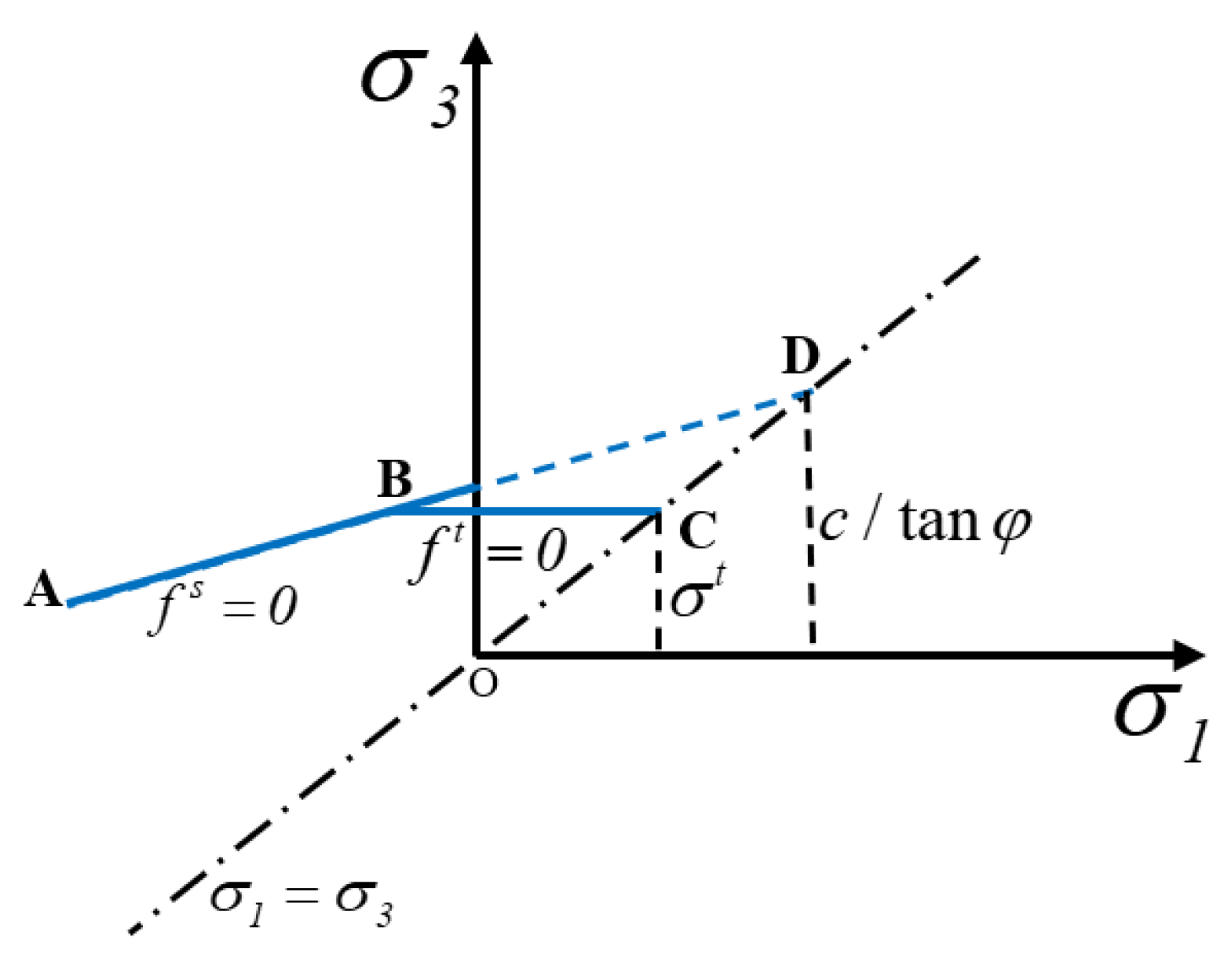
2. Basic Theory
3. Establishment of the Tunnel Structure Simulation Model
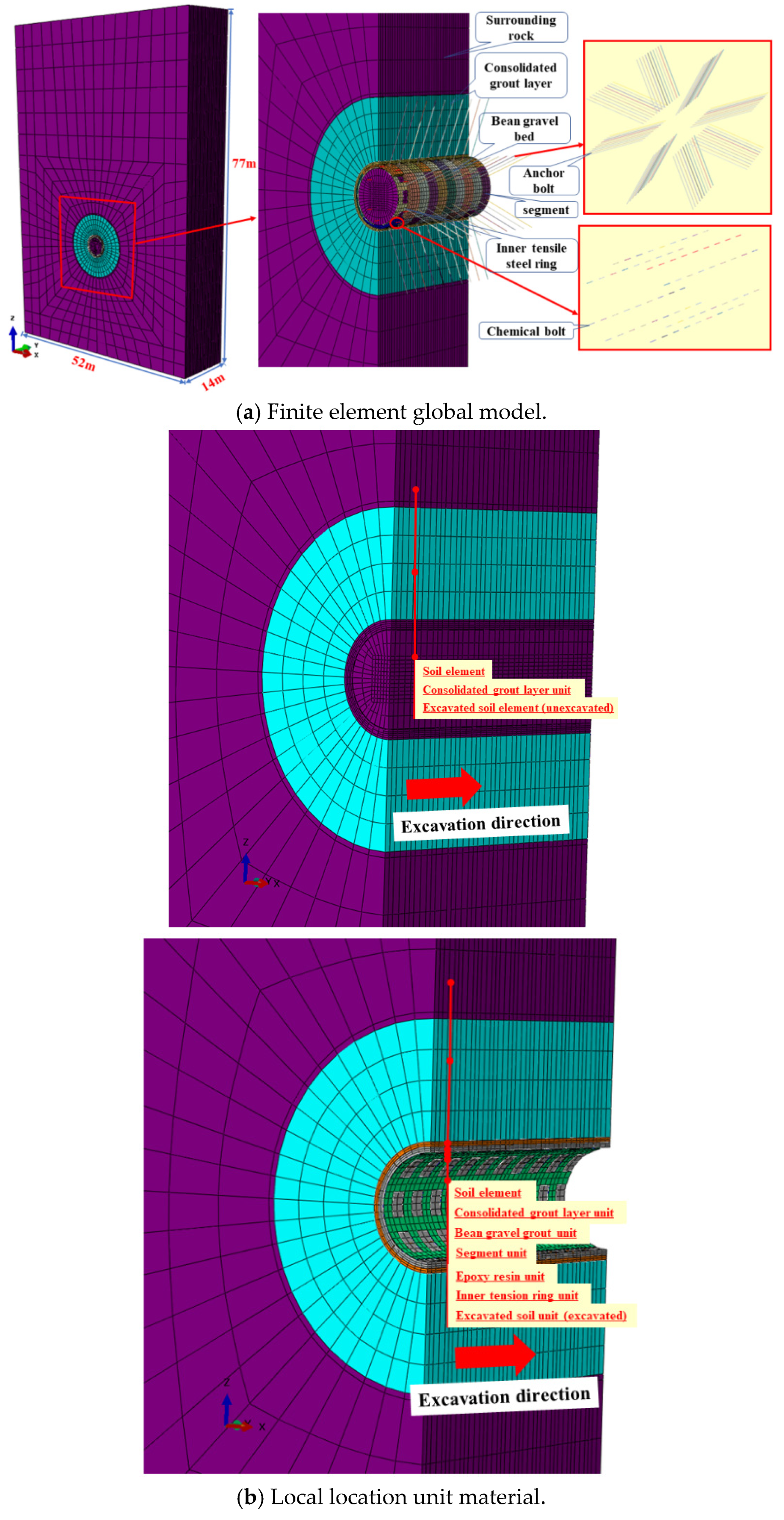
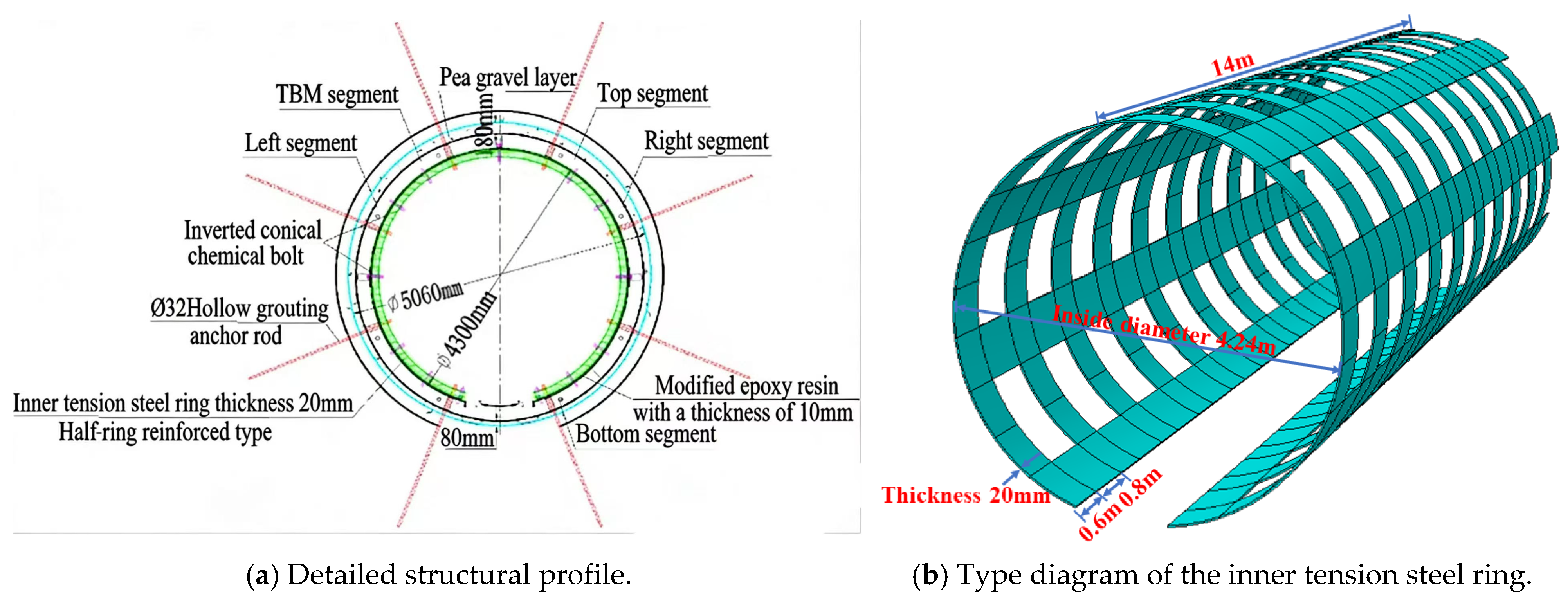
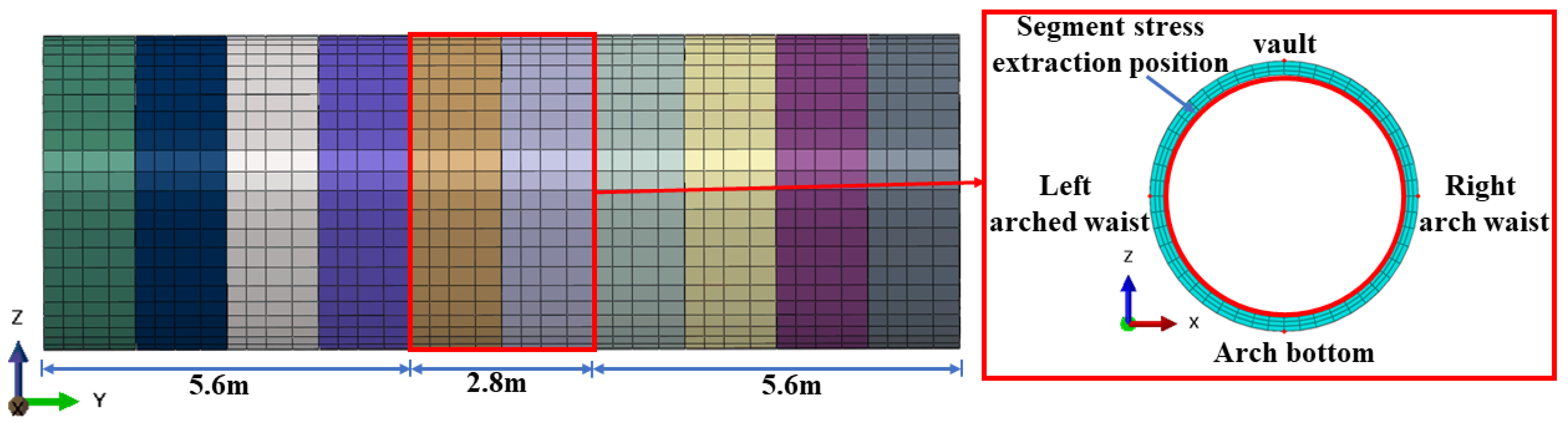
3.1. Finite Element Model and Boundary Conditions
3.2. Material Parameters and Contact Relationship
3.3. Loading Mode
4. Analysis of the Influence of Internal Water Pressure on the Mechanical Properties of Composite Structures
4.1. Effects of Internal Water Pressure on the Mechanical Properties of Tunnel Segments
4.2. Influence of the Internal Water Pressure on the Mechanical Properties of the Connection Bolts
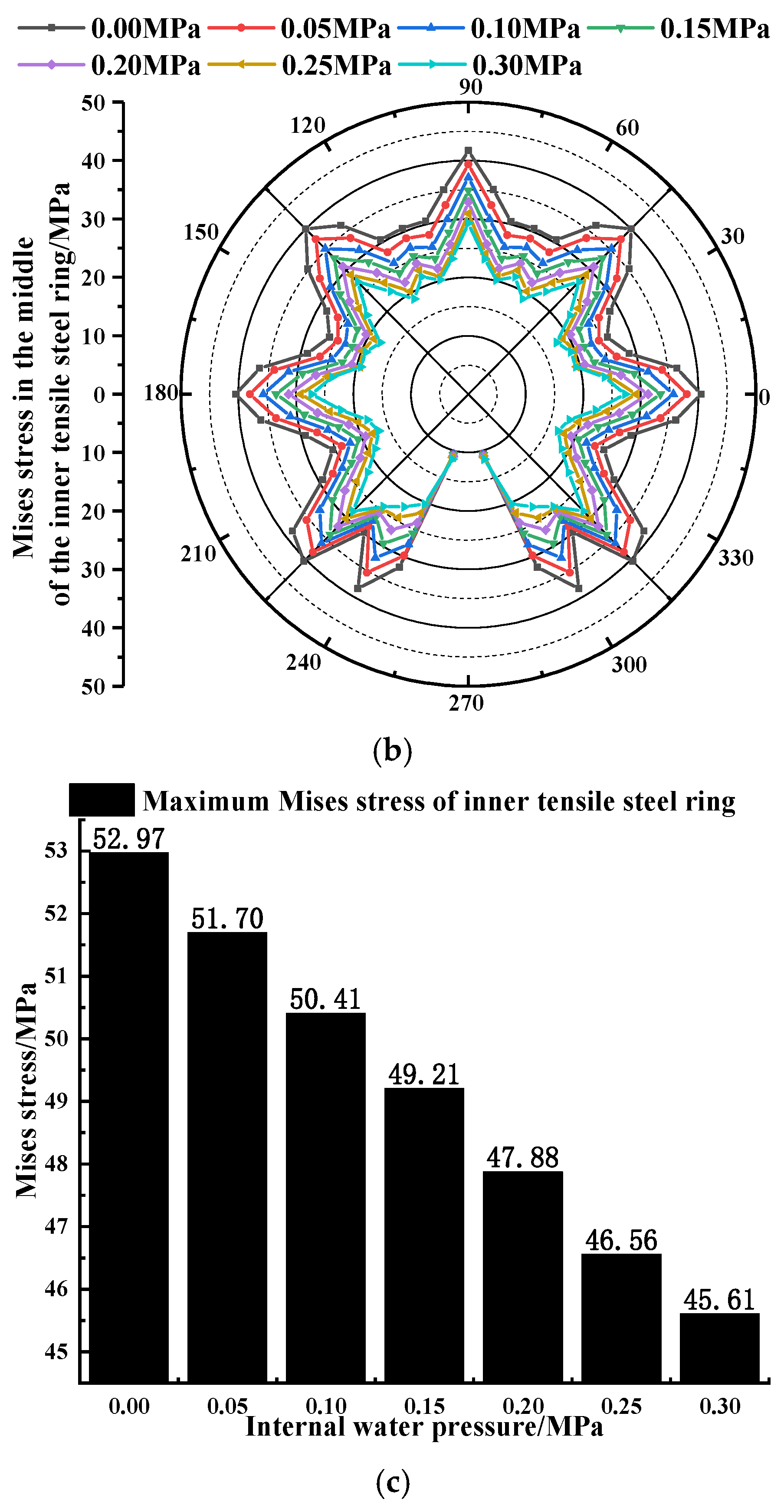
4.3. The Effect of the Internal Water Pressure on the Mechanical Properties of the Inner Tensioned Steel Rings
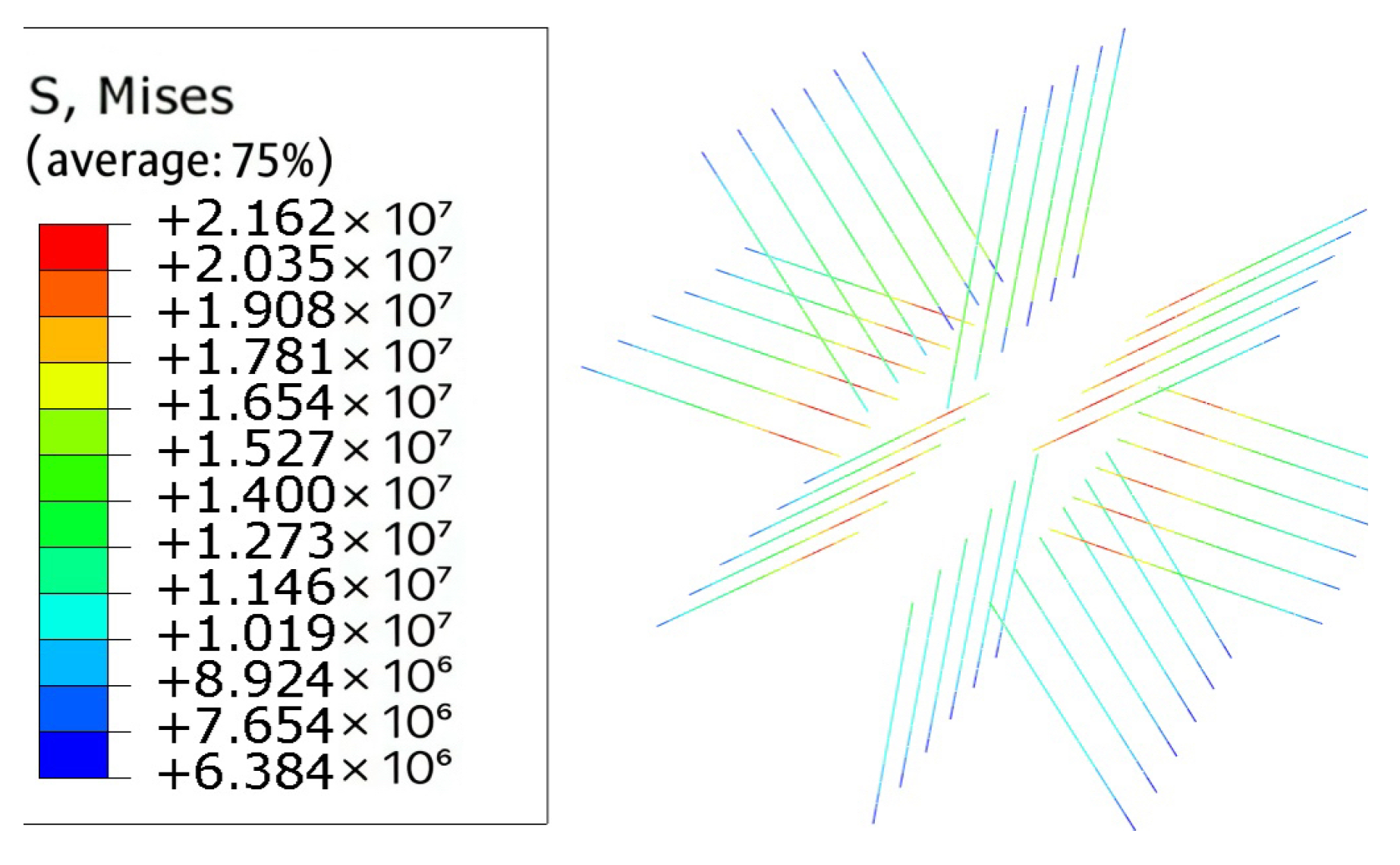
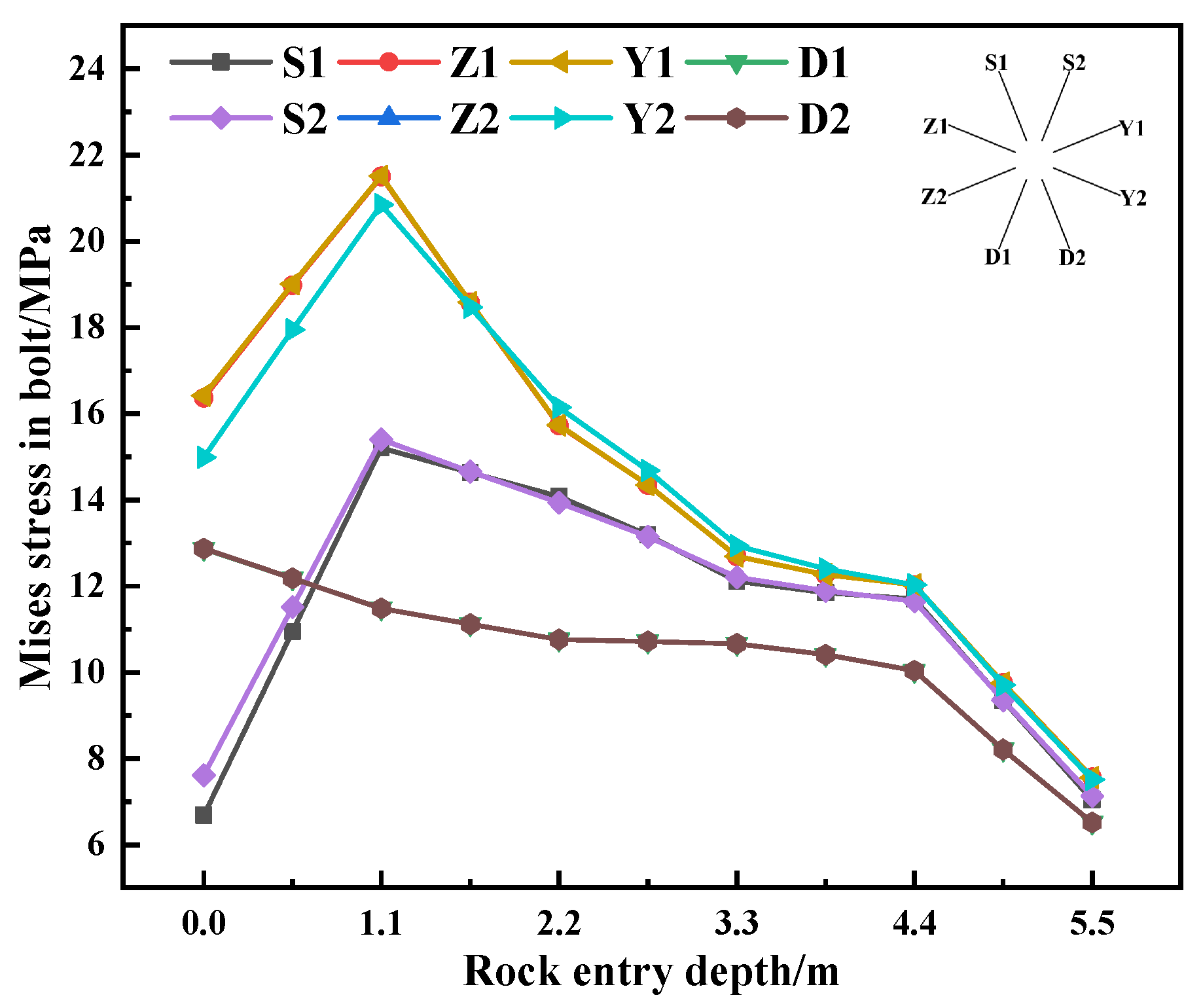
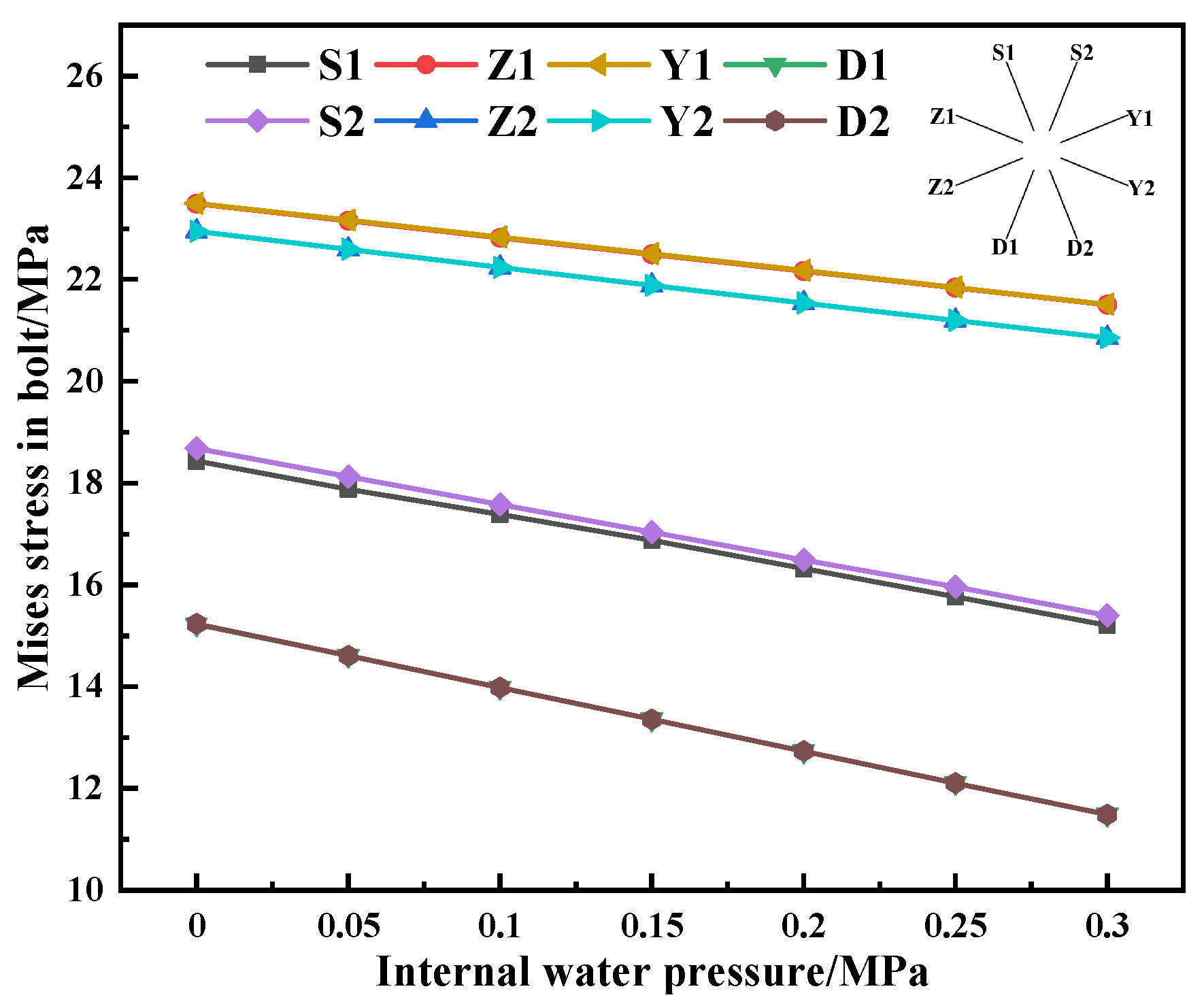
4.4. Influence of the Internal Water Pressure on the Mechanical Characteristics of the Bolt
5. Analysis of the Influence of Surrounding Rock Type on the Load-Bearing Mechanical Properties of Composite Structures
5.1. The Influence of the Surrounding Rock Types on the Mechanical Properties of Segments
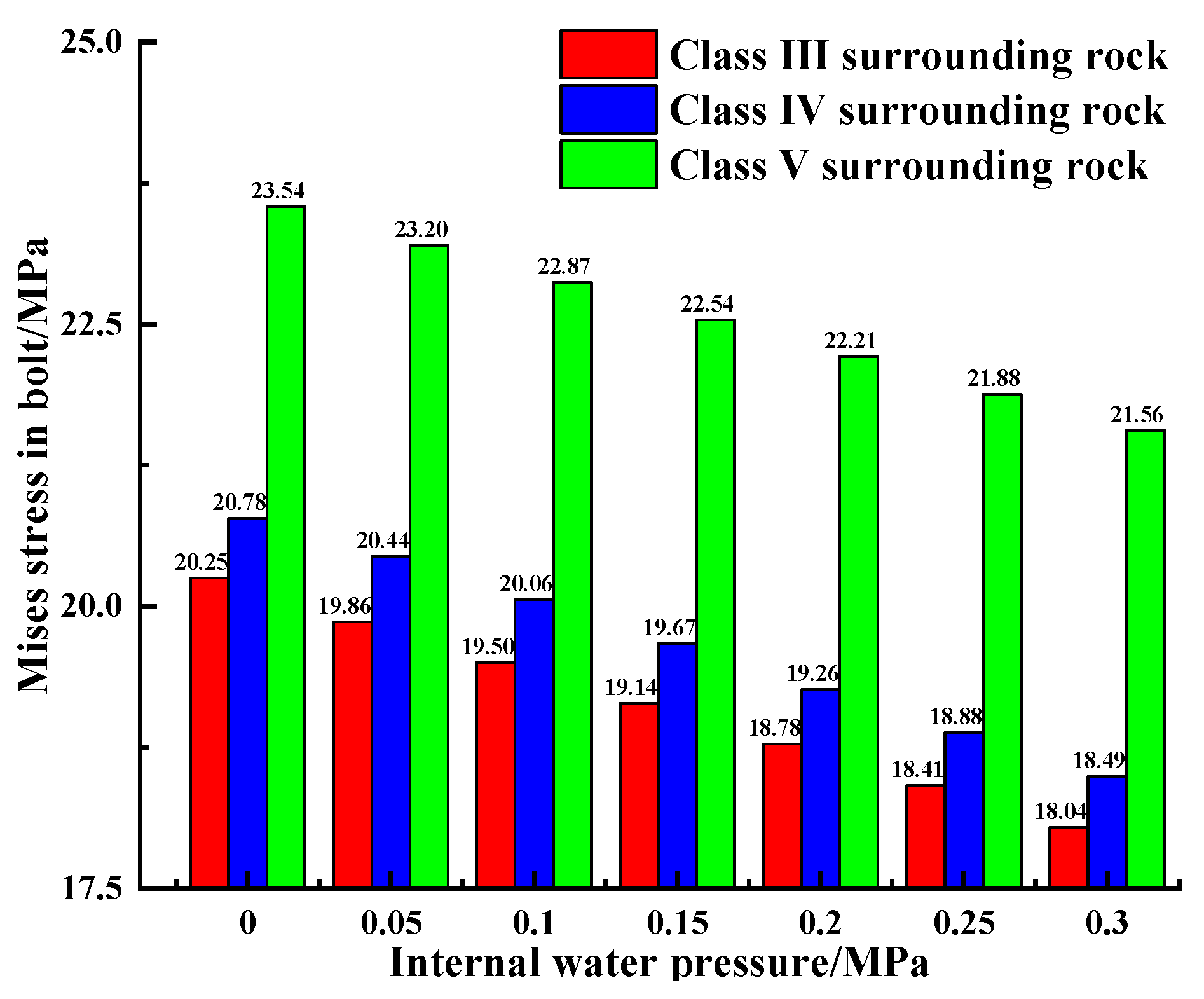
5.2. The Influence of the Surrounding Rock Type on the Mechanical Properties of Connecting Bolts
5.3. The Influence of the Surrounding Rock Types on the Mechanical Properties of Internally Tensioned Steel Rings
5.4. The Influence of Surrounding Rock Type on the Mechanical Properties of Bolts
6. Analysis of the Influence of Tunnel Buried Depth on Composite Structures
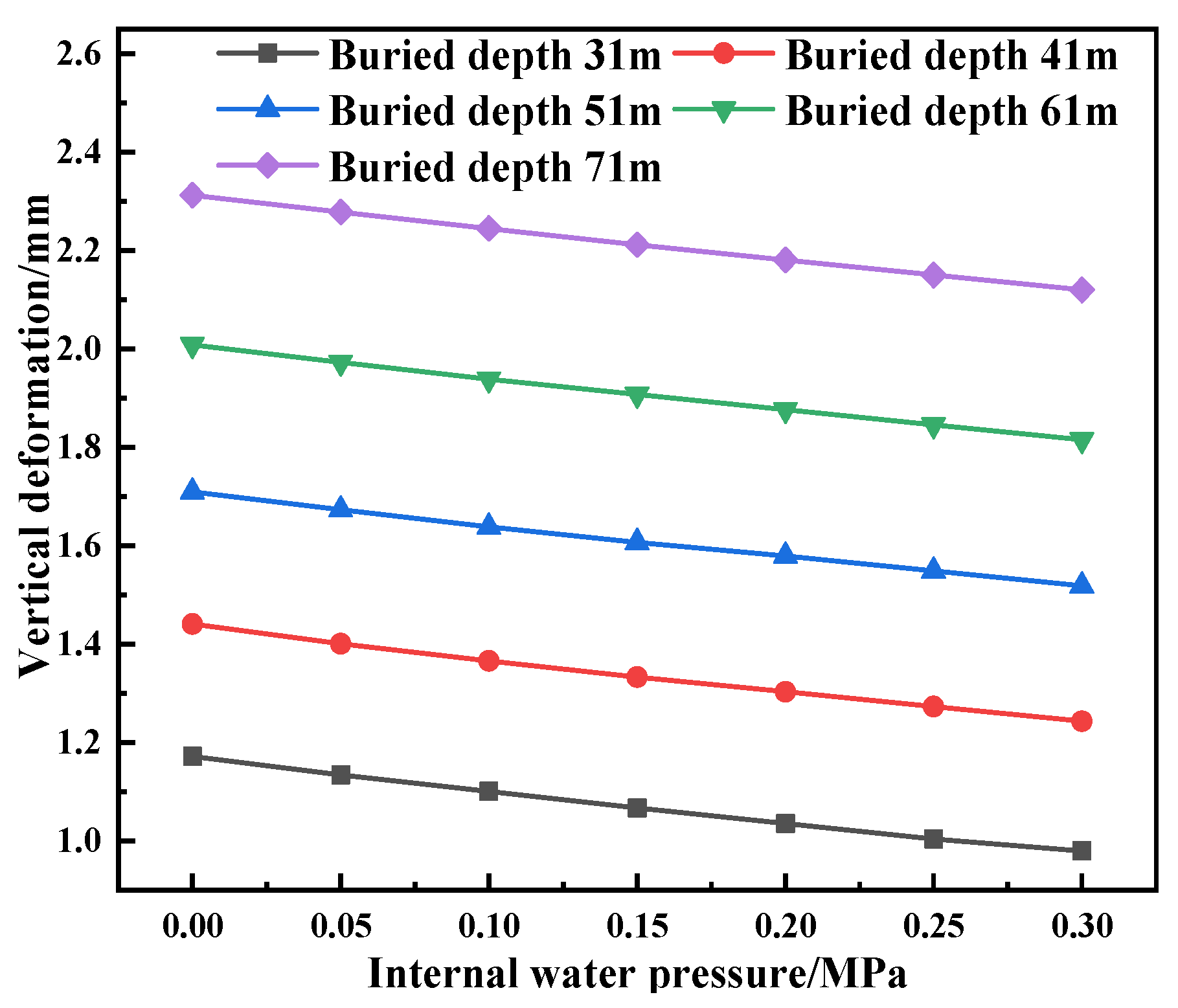
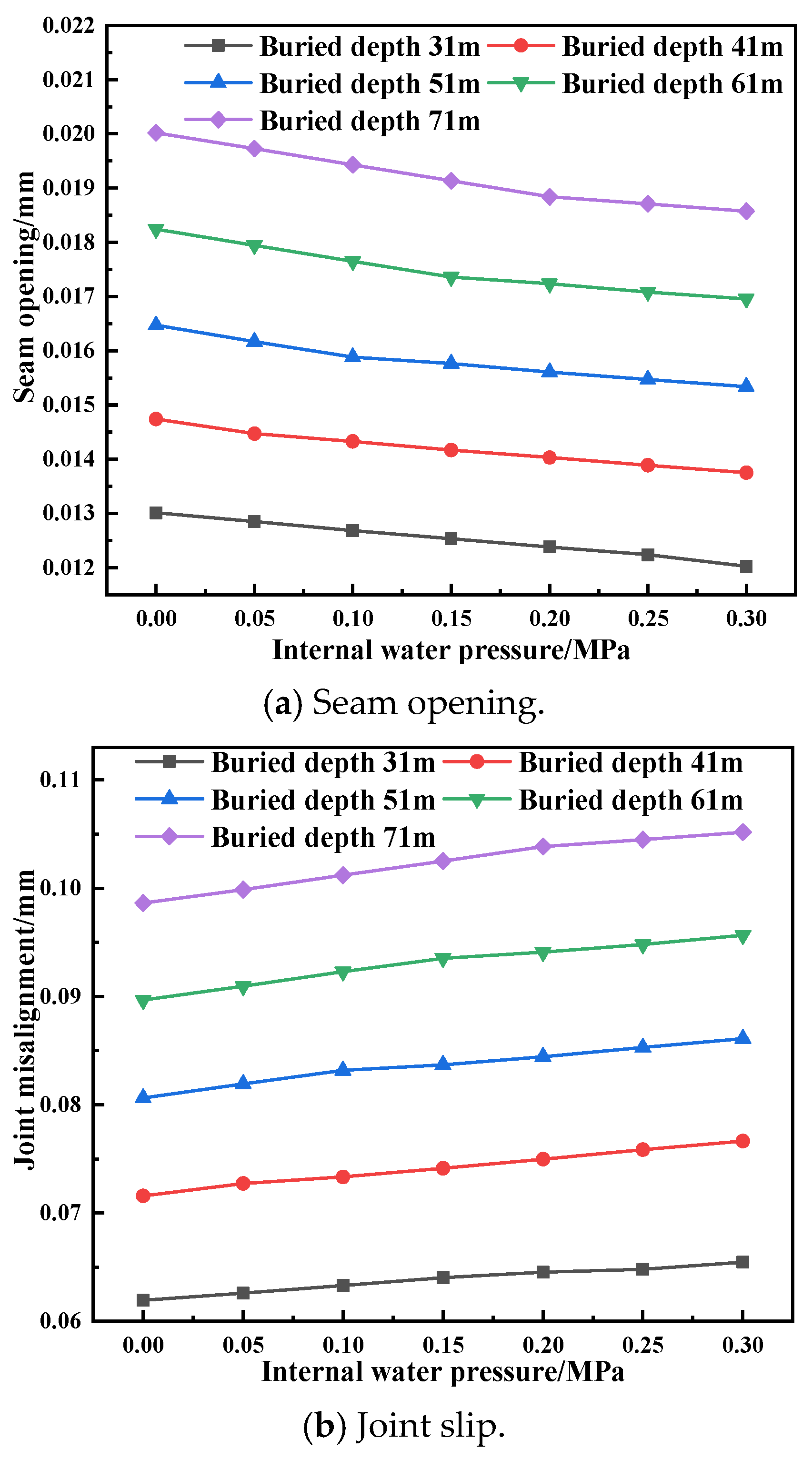
6.1. Influence of the Tunnel Buried Depth on the Mechanical Properties of the Segments
6.2. The Influence of Tunnel Burial Depth on the Mechanical Properties of Connecting Bolts
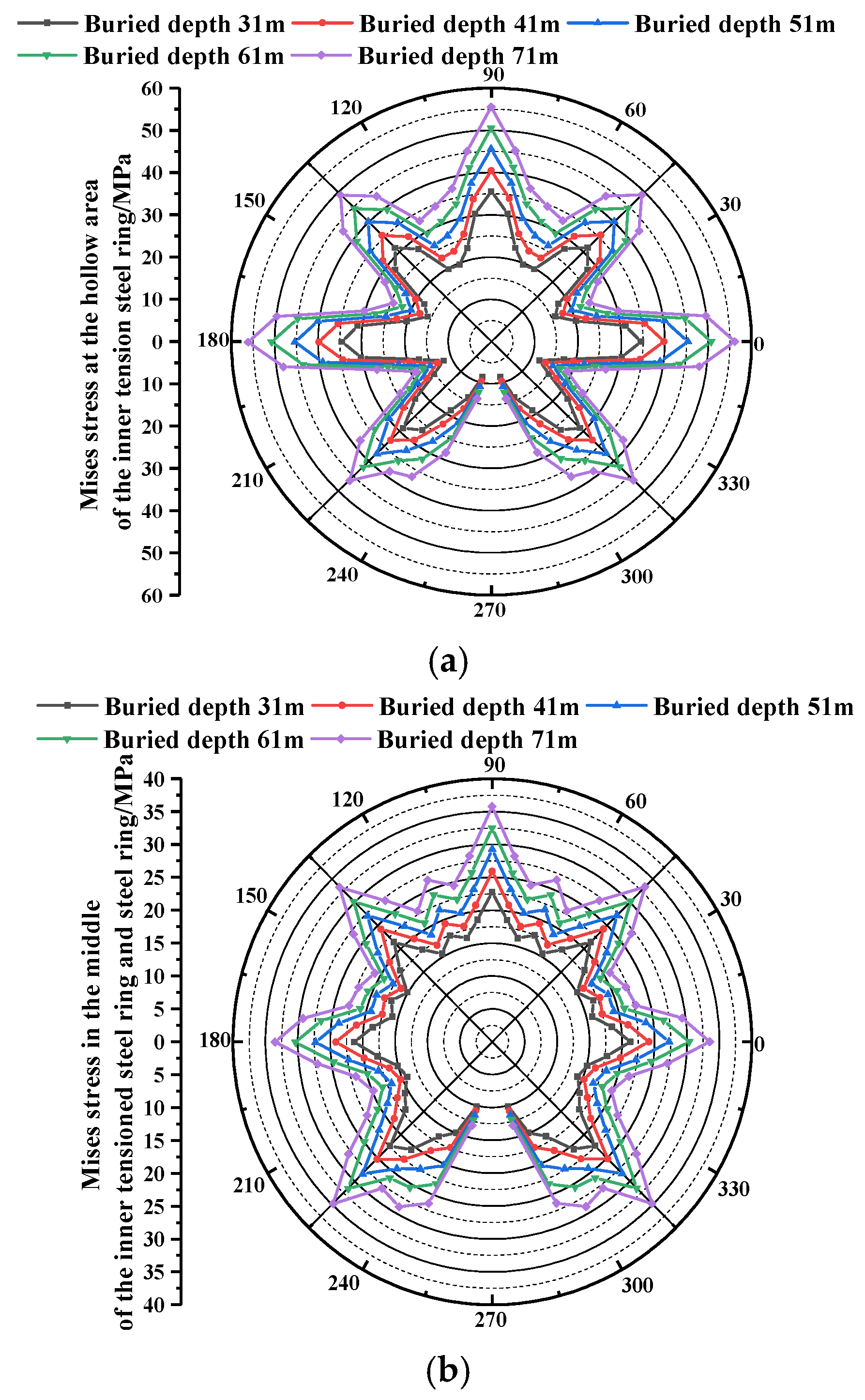
6.3. Influence of the Buried Depth of the Tunnel on the Mechanical Properties of the Inner Tensioned Steel Ring
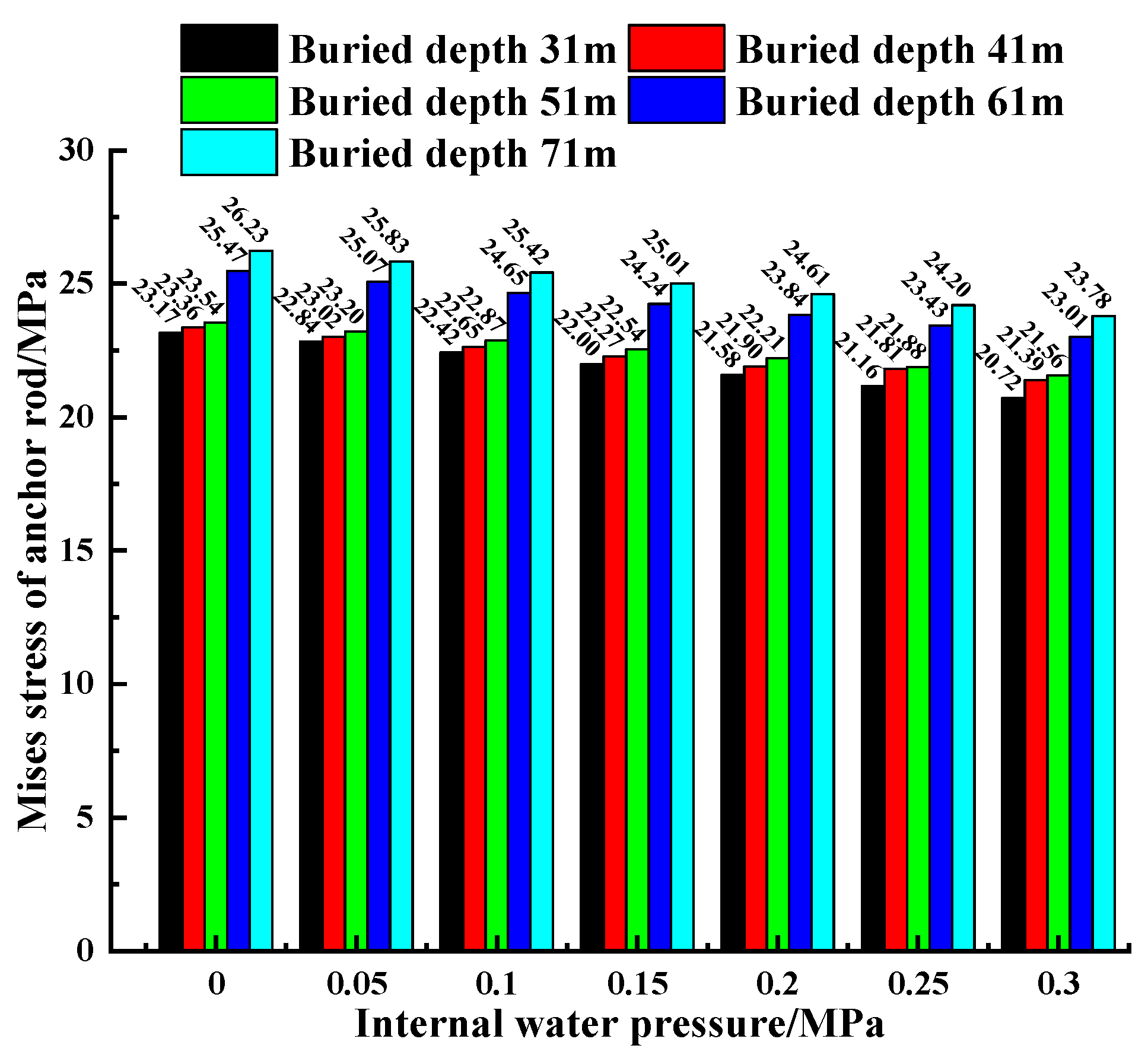
6.4. The Influence of Tunnel Burial Depth on the Mechanical Properties of Anchor Rods
7. Analysis of Load-Sharing Rate of Water Conveyance Tunnel Composite Structure
7.1. Calculation Method for the Load-Sharing Rate
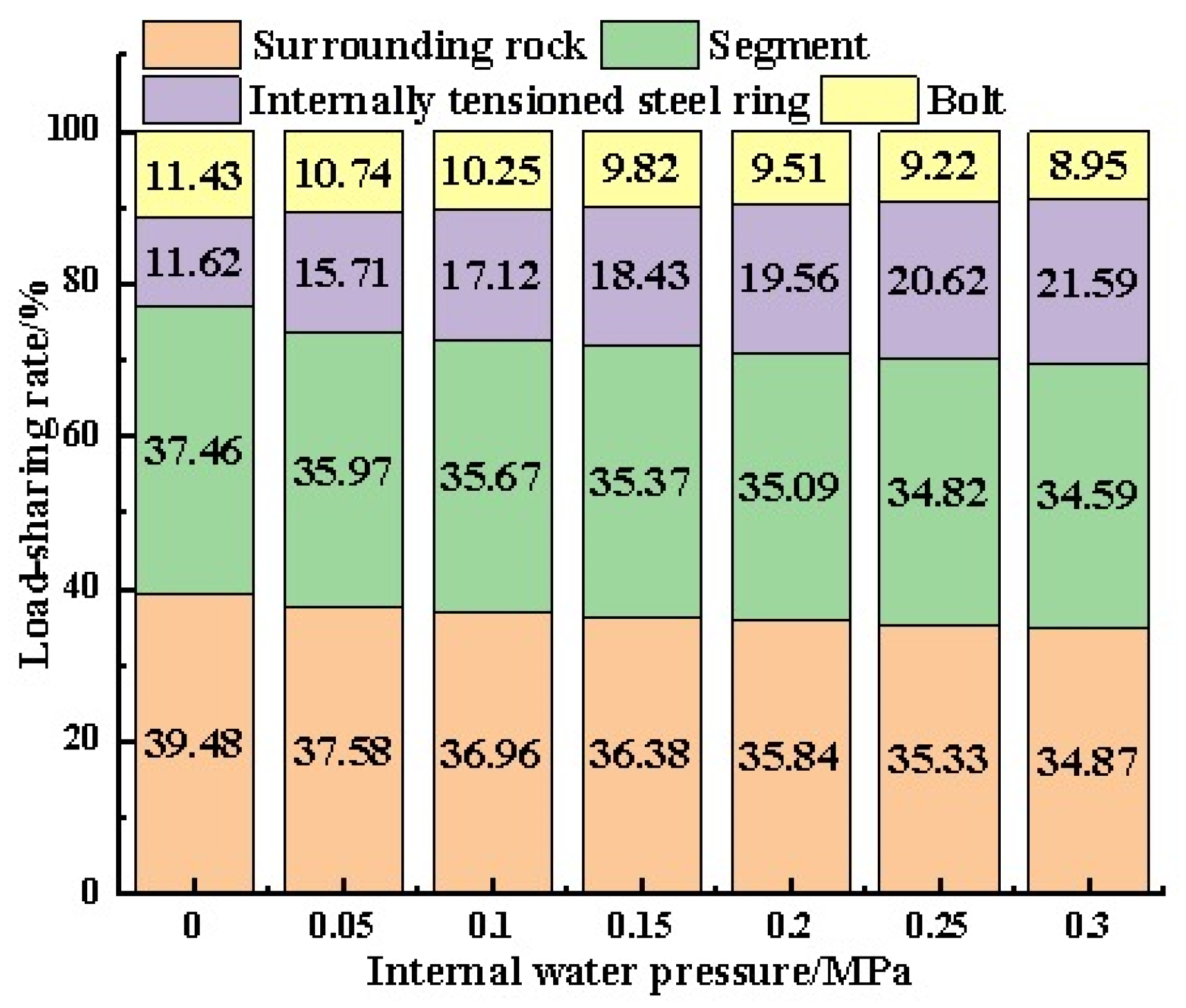
7.2. Analysis of the Influence of the Internal Water Pressure on the Load-Sharing Rate of the Composite Structures
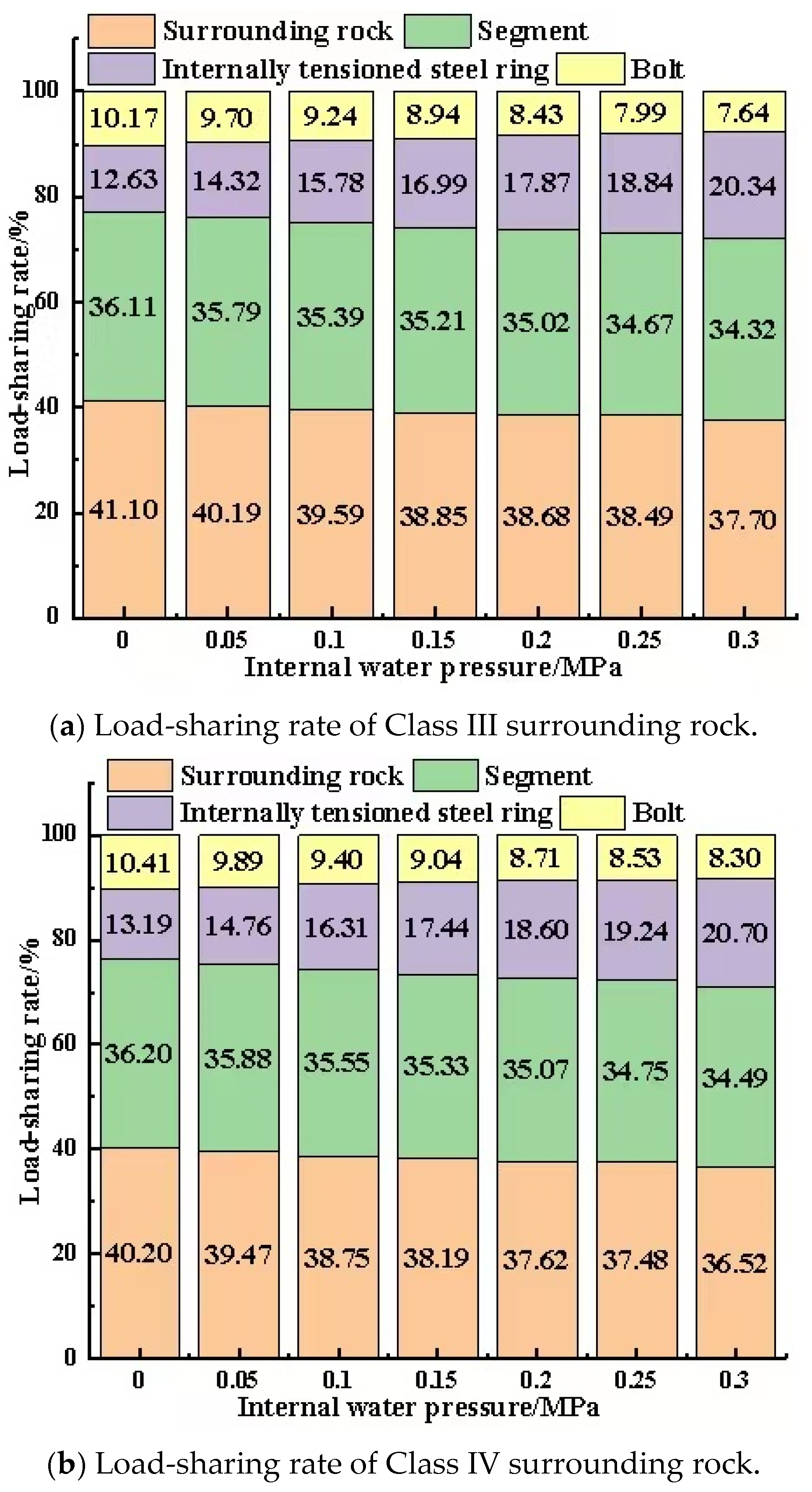
7.3. Analysis of the Influence of the Surrounding Rock Types on the Load-Sharing Rate of Composite Structures
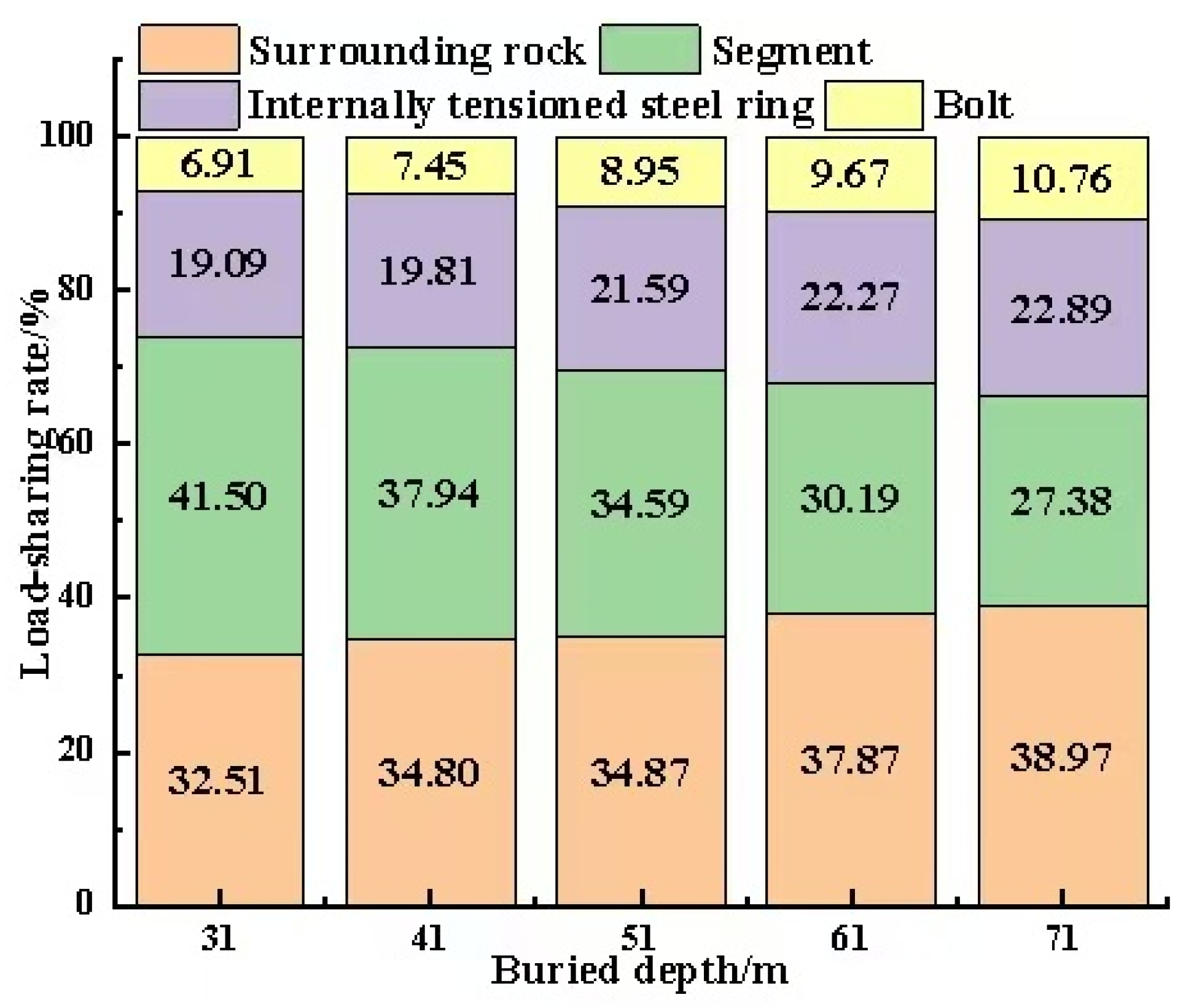
7.4. Analysis of the Influence of the Tunnel Burial Depth on the Load-Sharing Rate of Composite Structures
8. Conclusions
- (1)
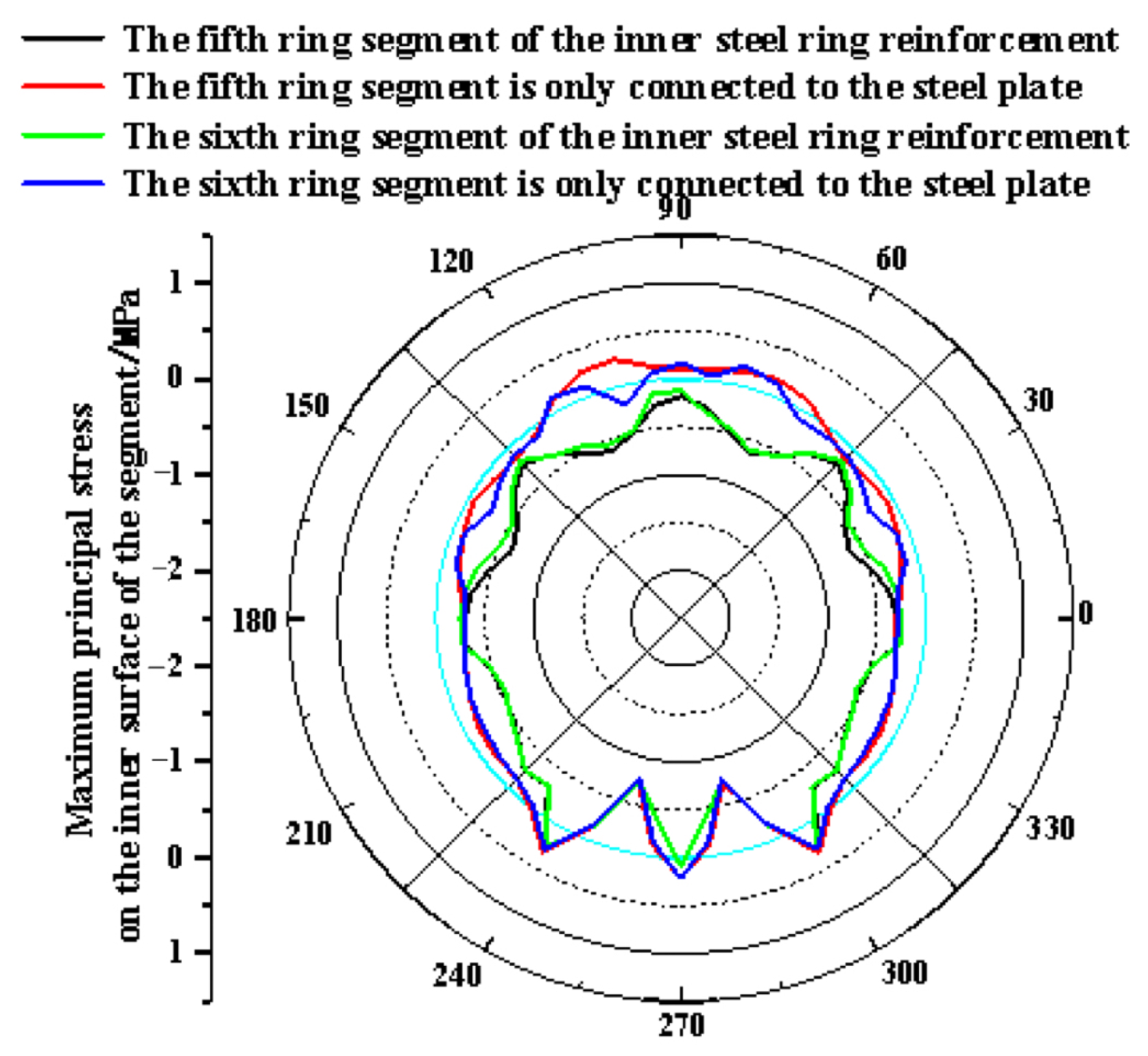
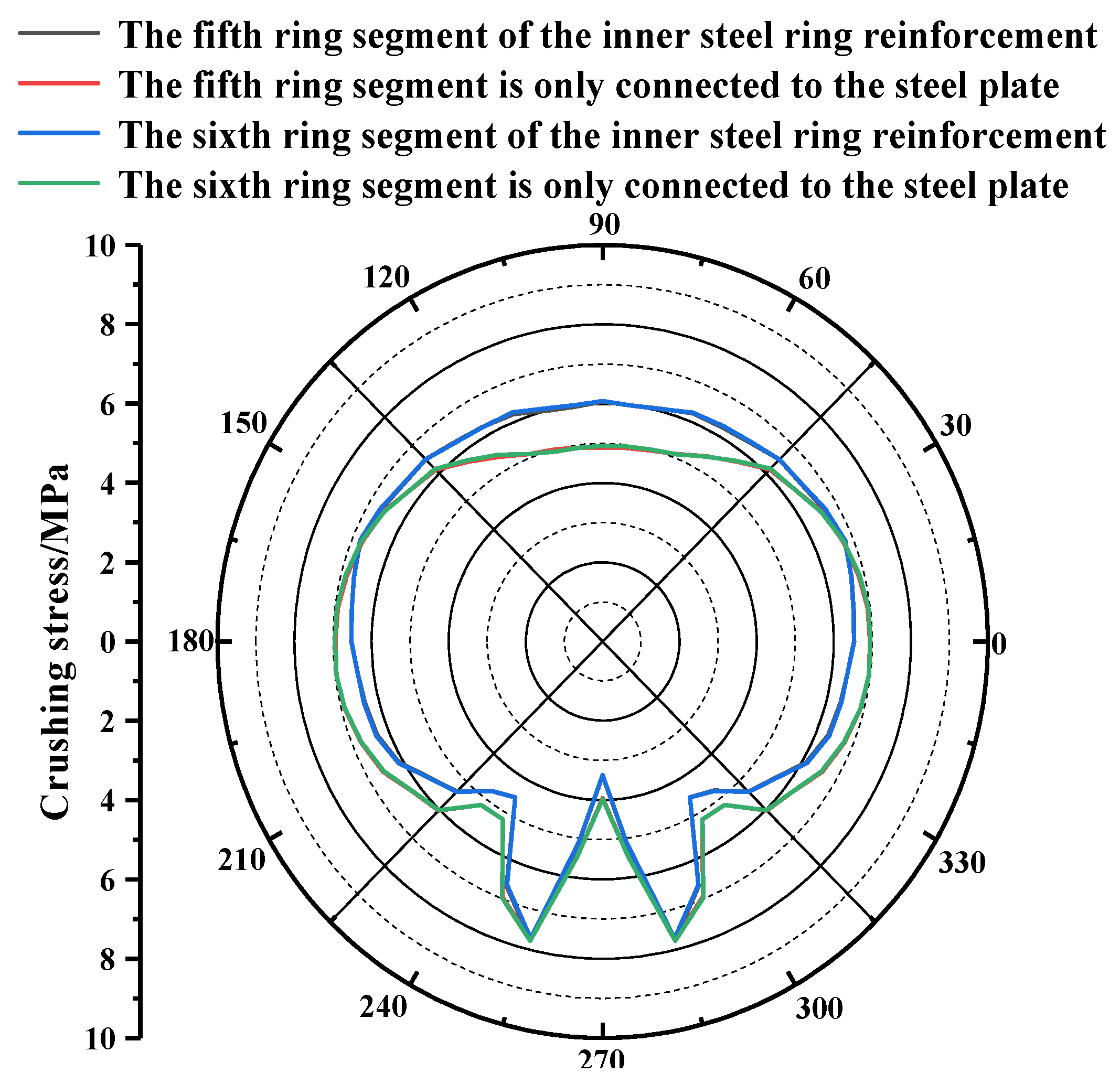
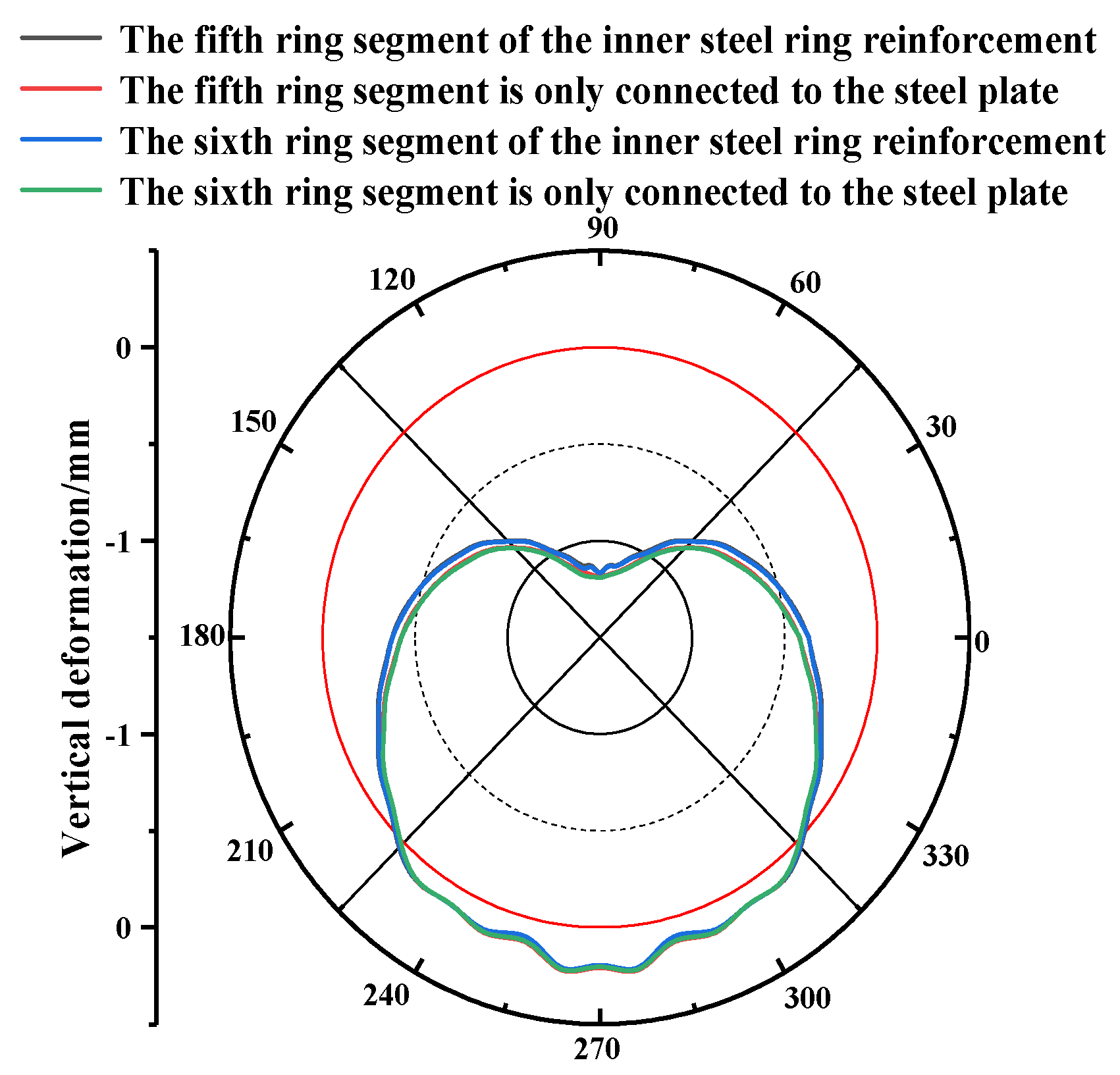
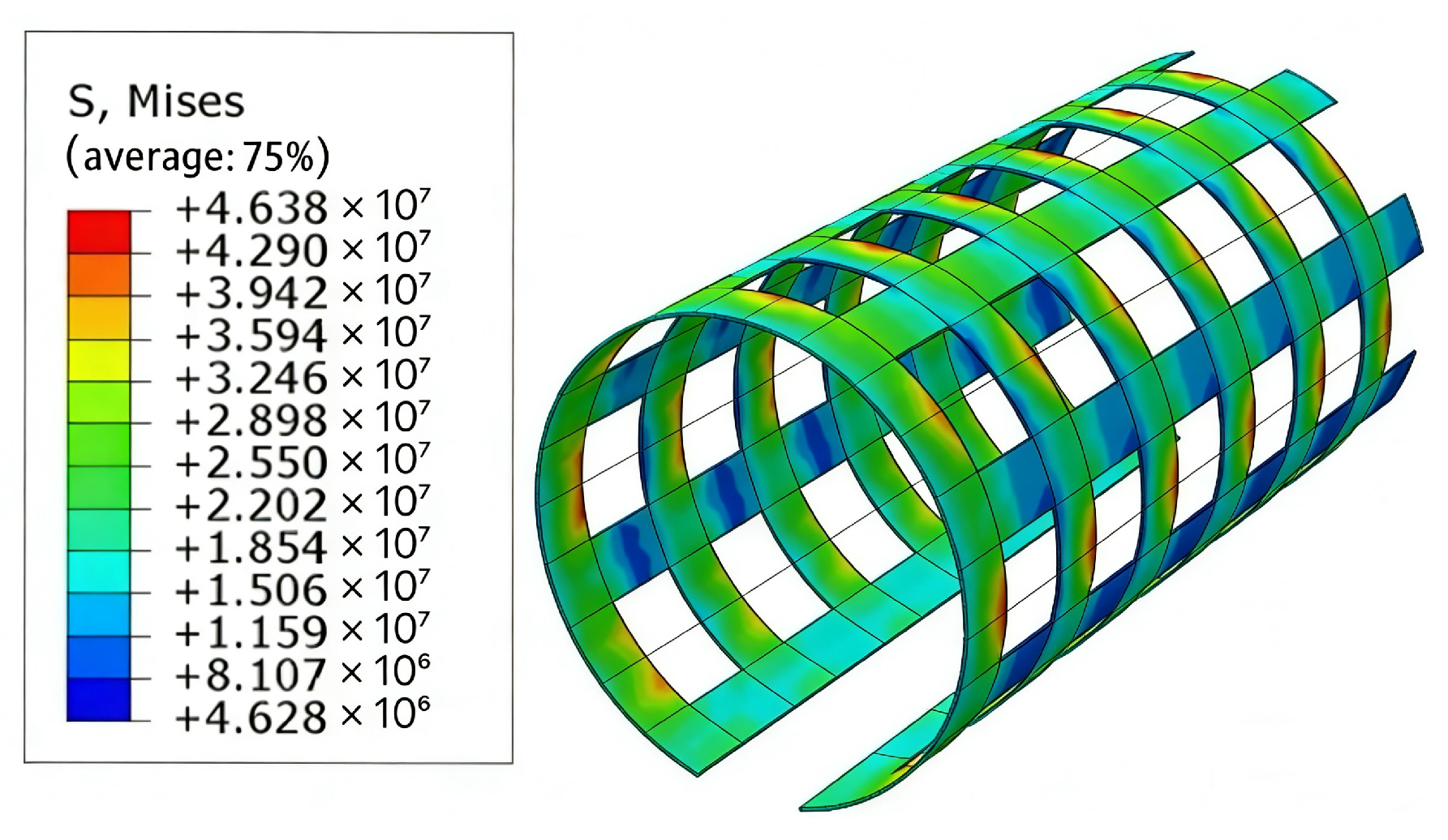
- Under the combined action of external water–soil pressure and internal water pressure, the “inner tensioned steel ring–segment–surrounding rock” composite structure presents an inward-converging “horizontal oval” deformation mode. Compared with the section connected only by steel plates, the tensile stress and the range of the tensile zone in the reinforced section of the inner tensioned steel ring are both reduced, which effectively restrains surface cracking of the section. The compressive stress of the top segment increases by approximately 12.05%. The vertical deformation of the pipe segment decreases by approximately 6.14%, indicating that the internal tension steel ring reinforcement method improves the structural bearing capacity and makes tunnel engineering projects safer and more stable.
- (2)
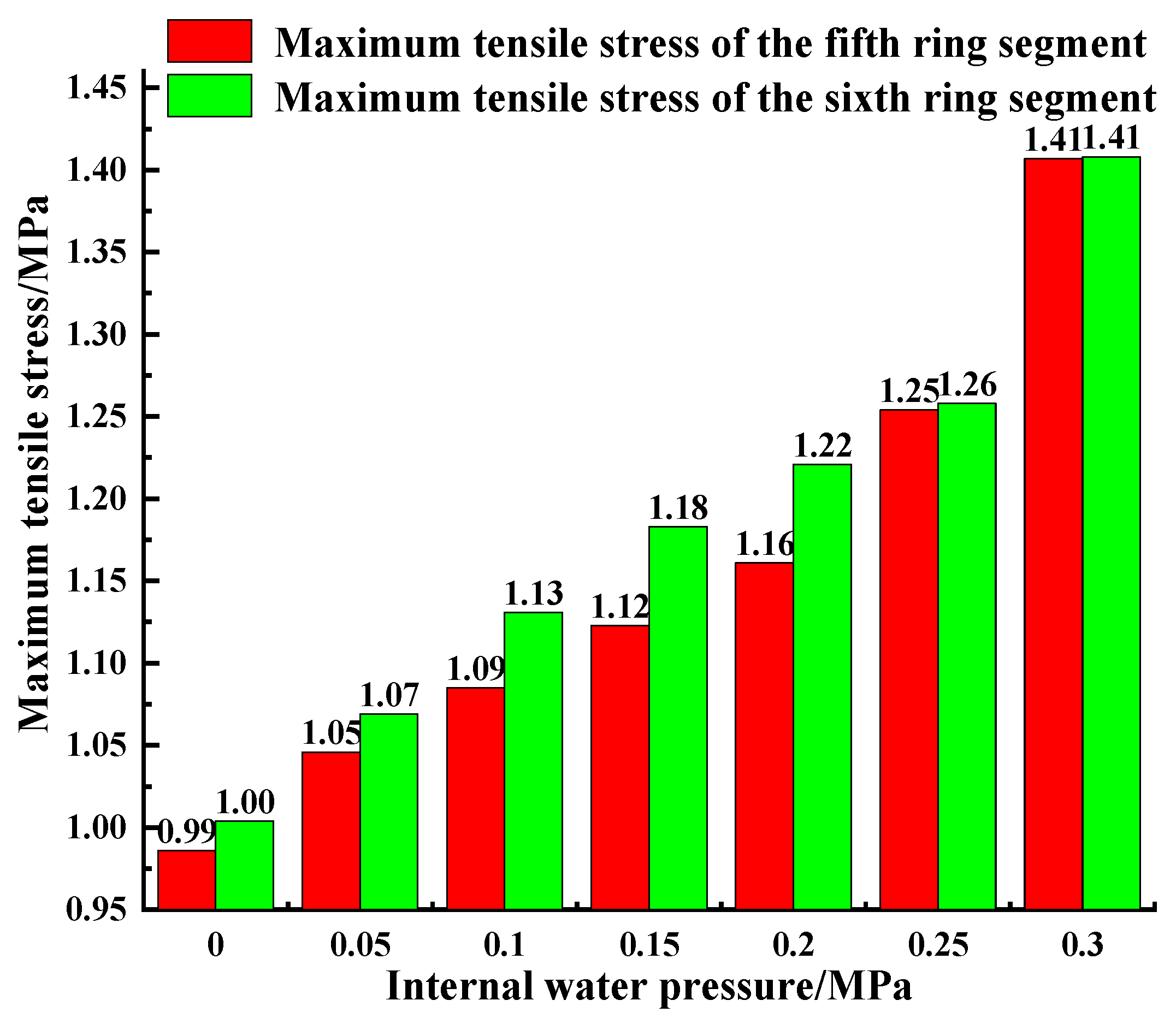
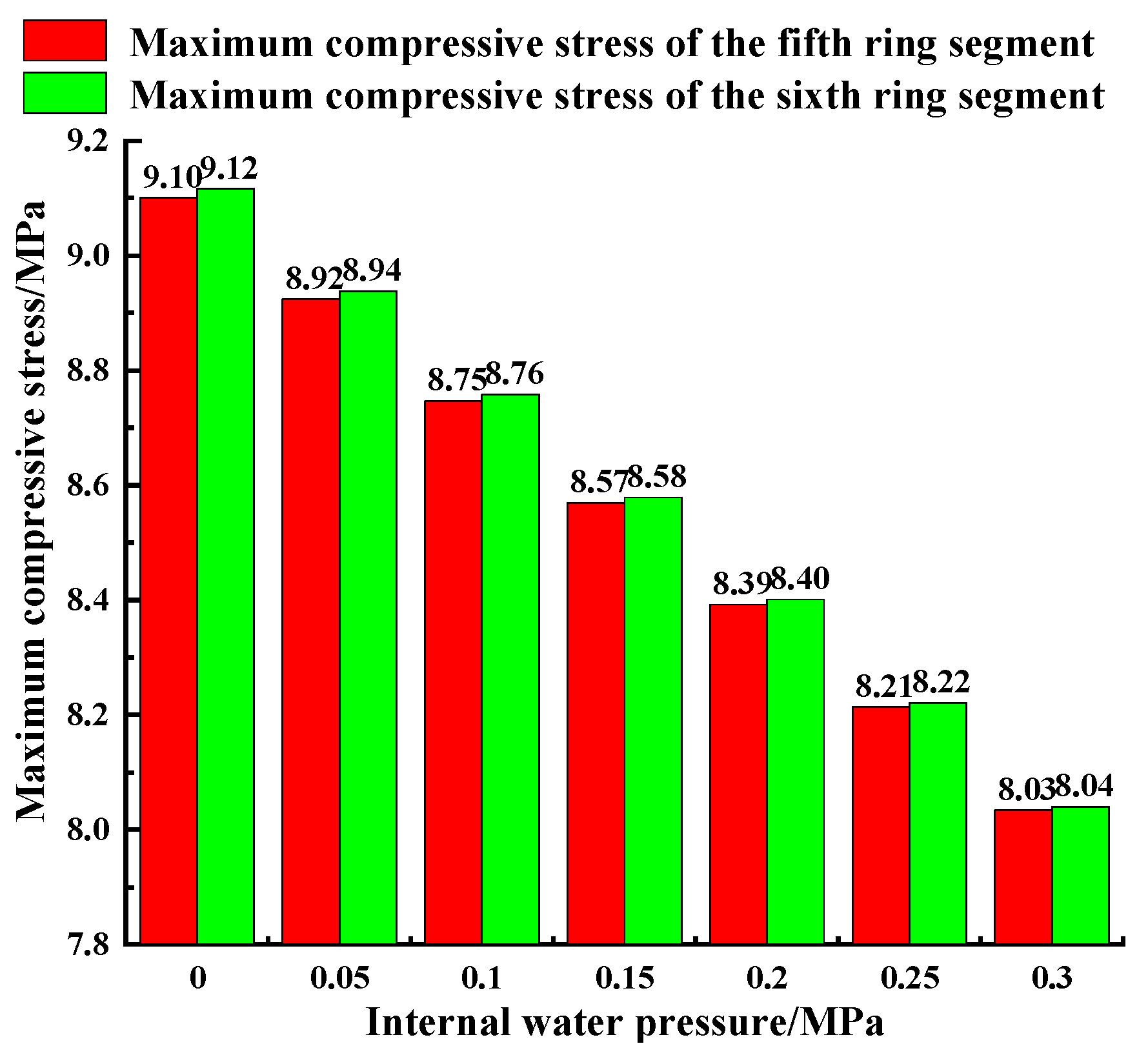
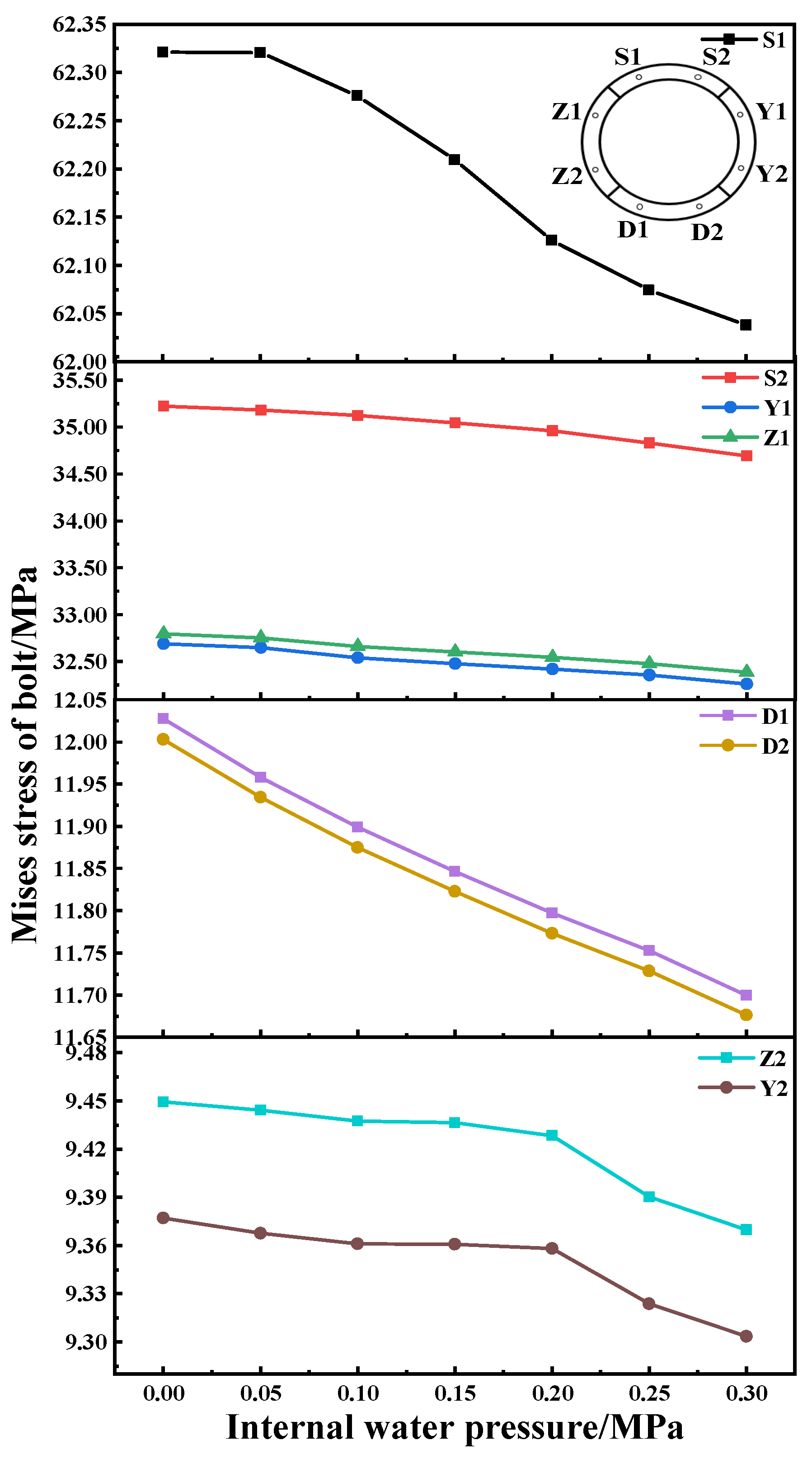
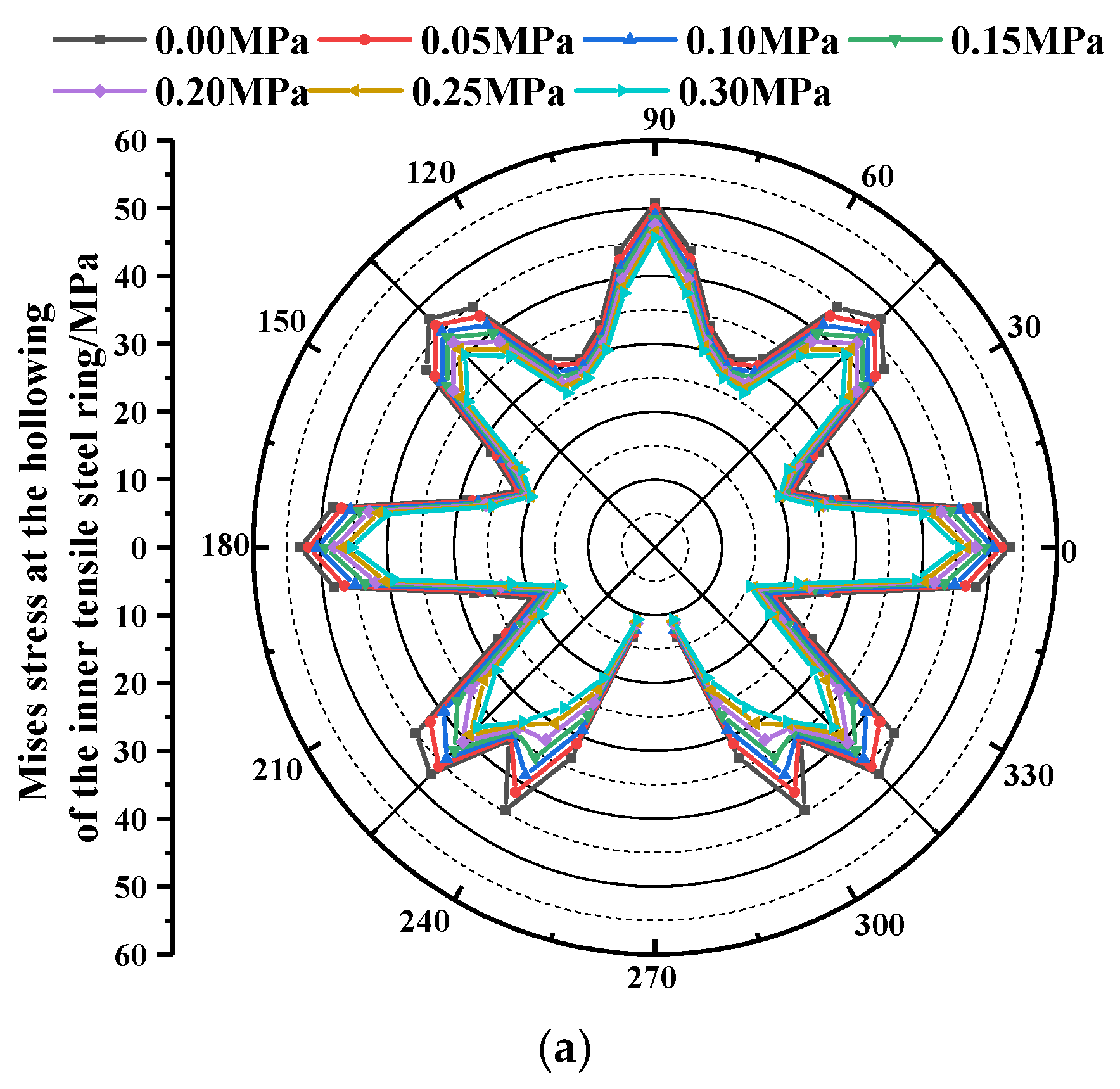
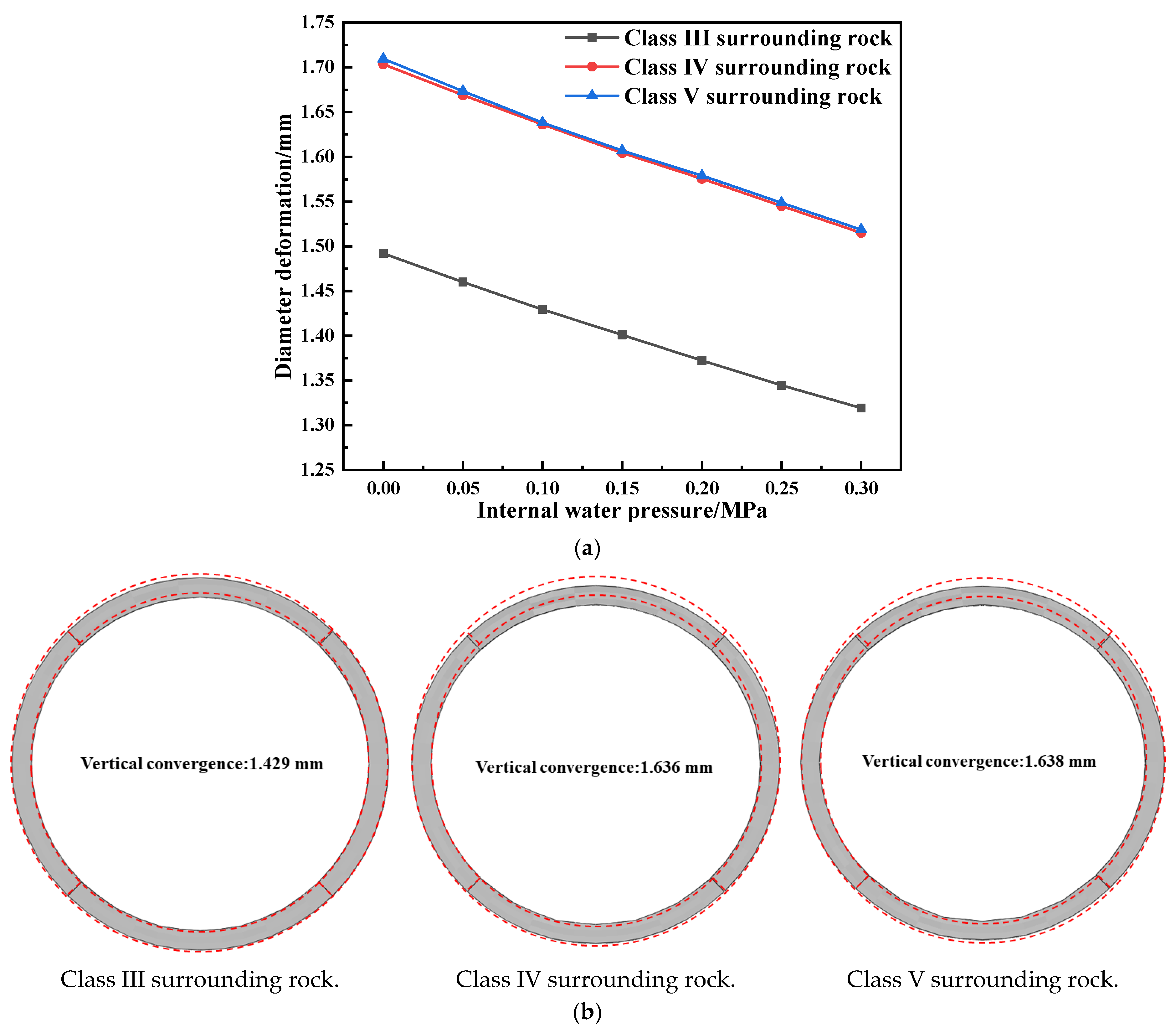
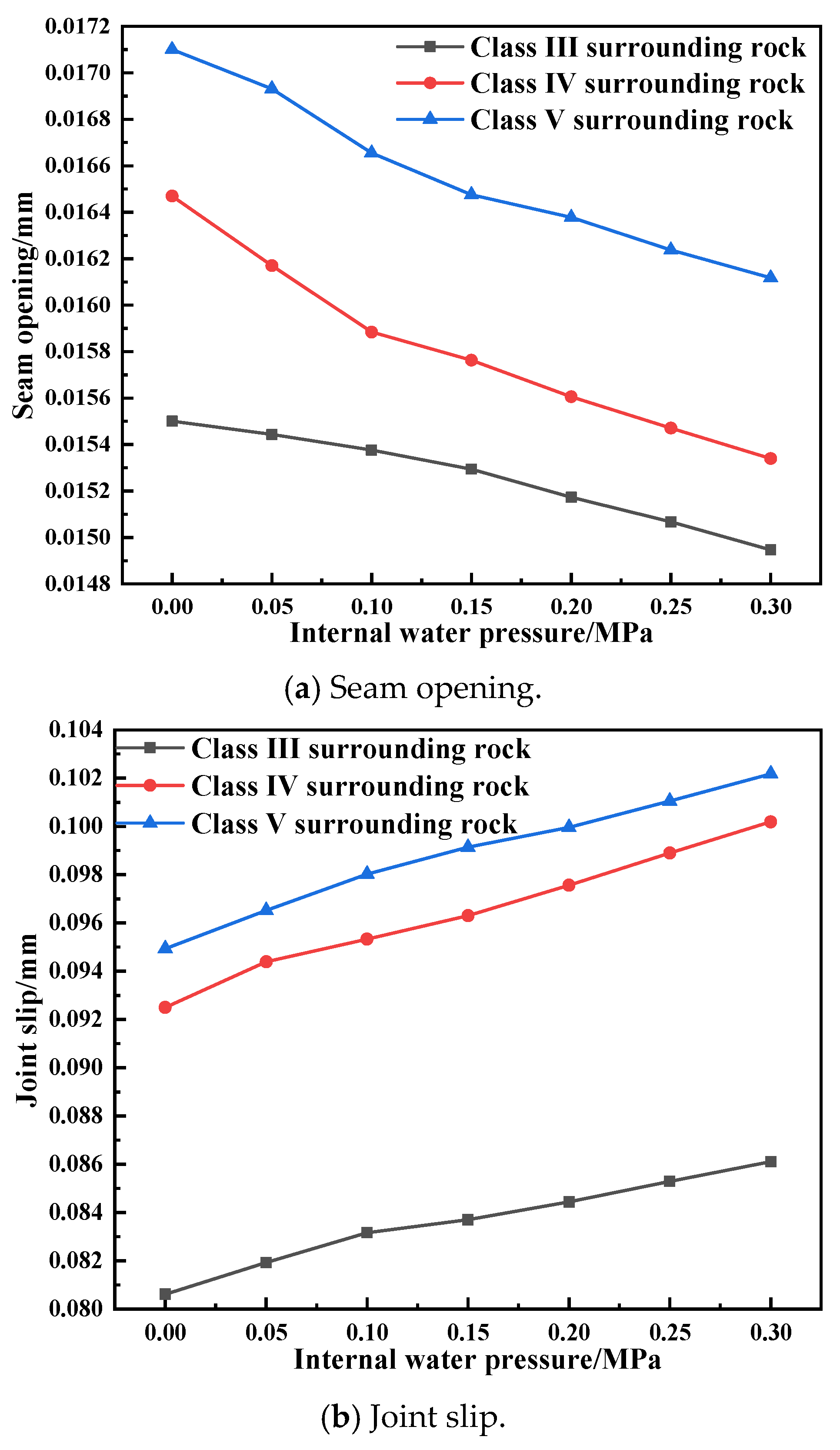
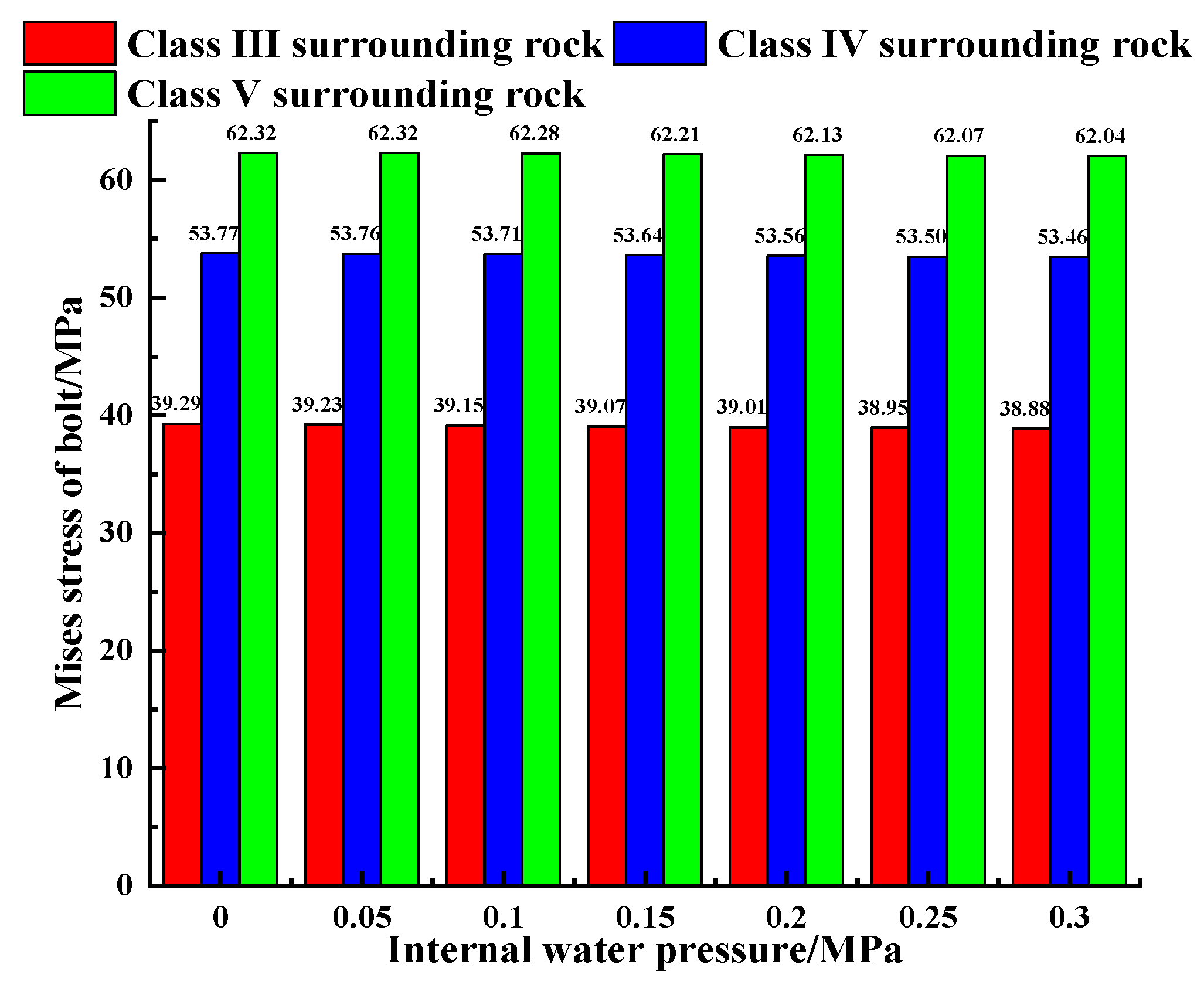
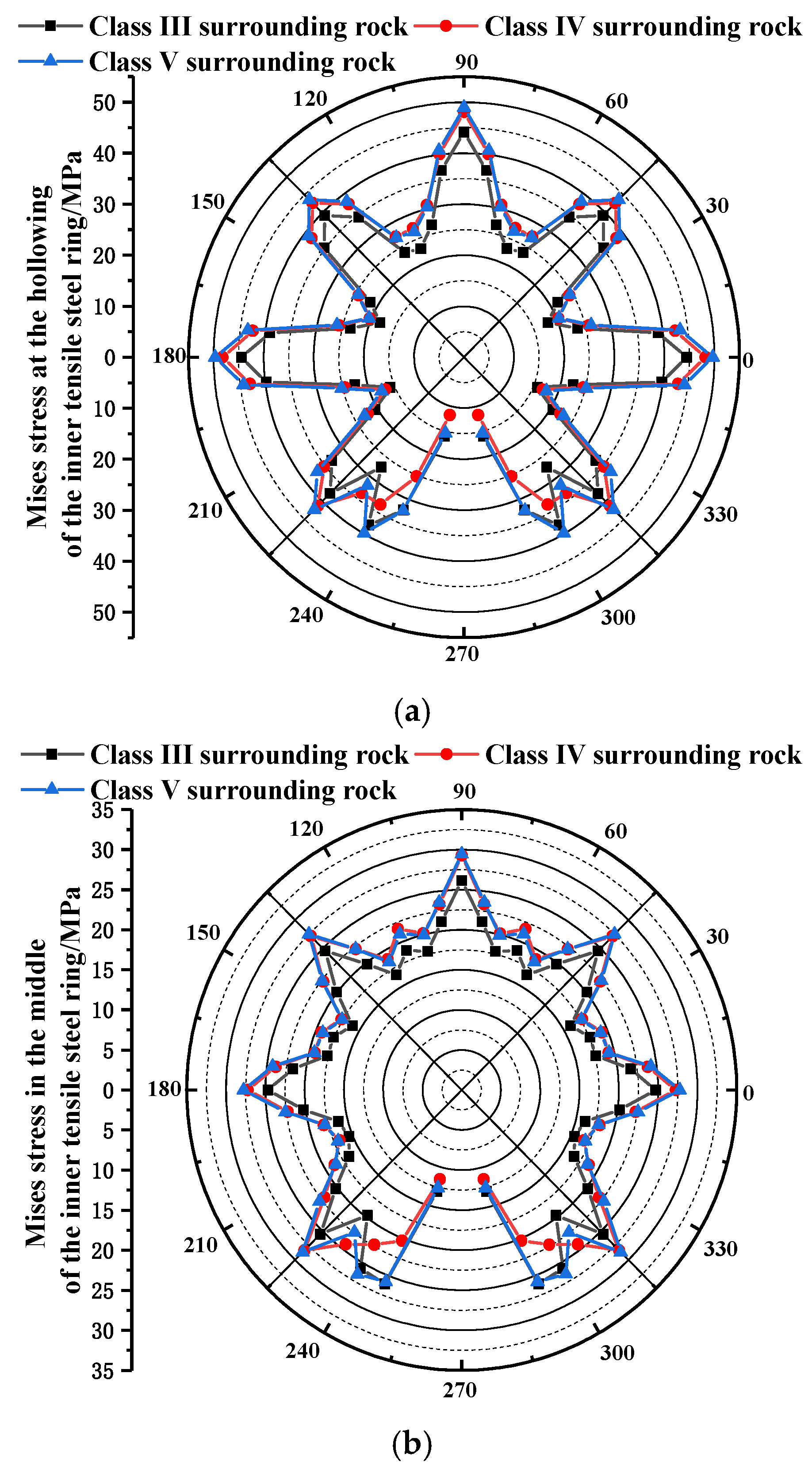
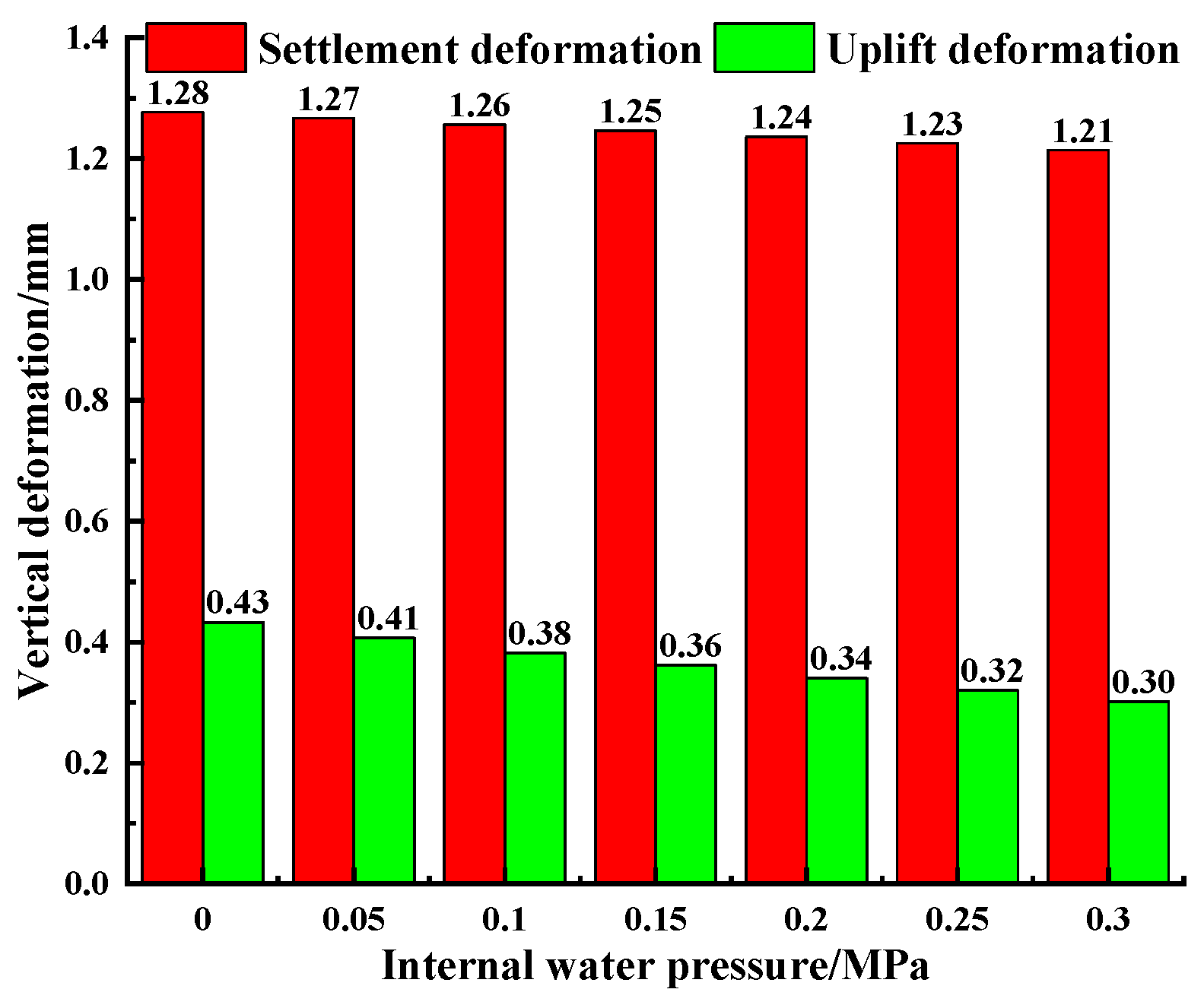
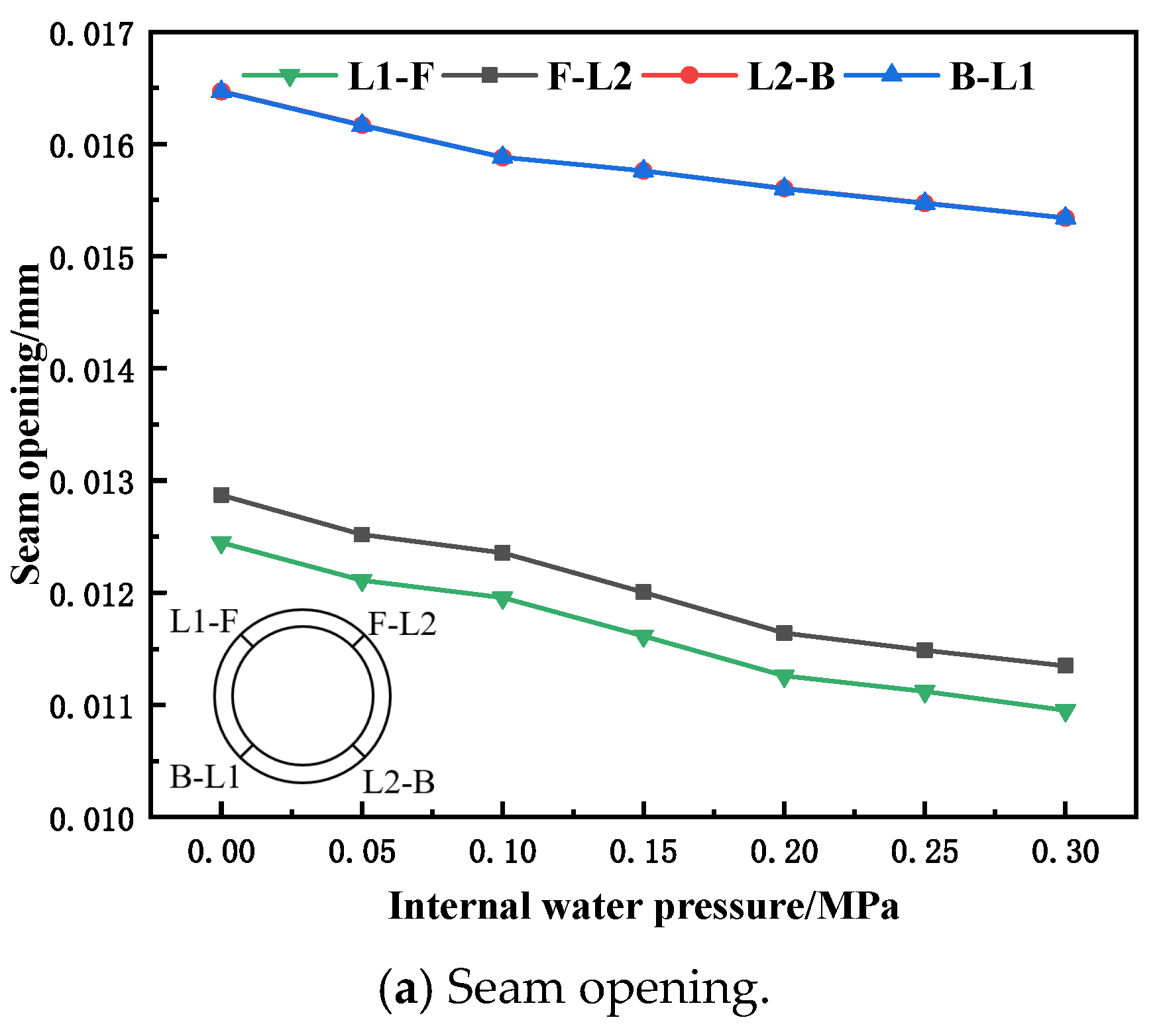
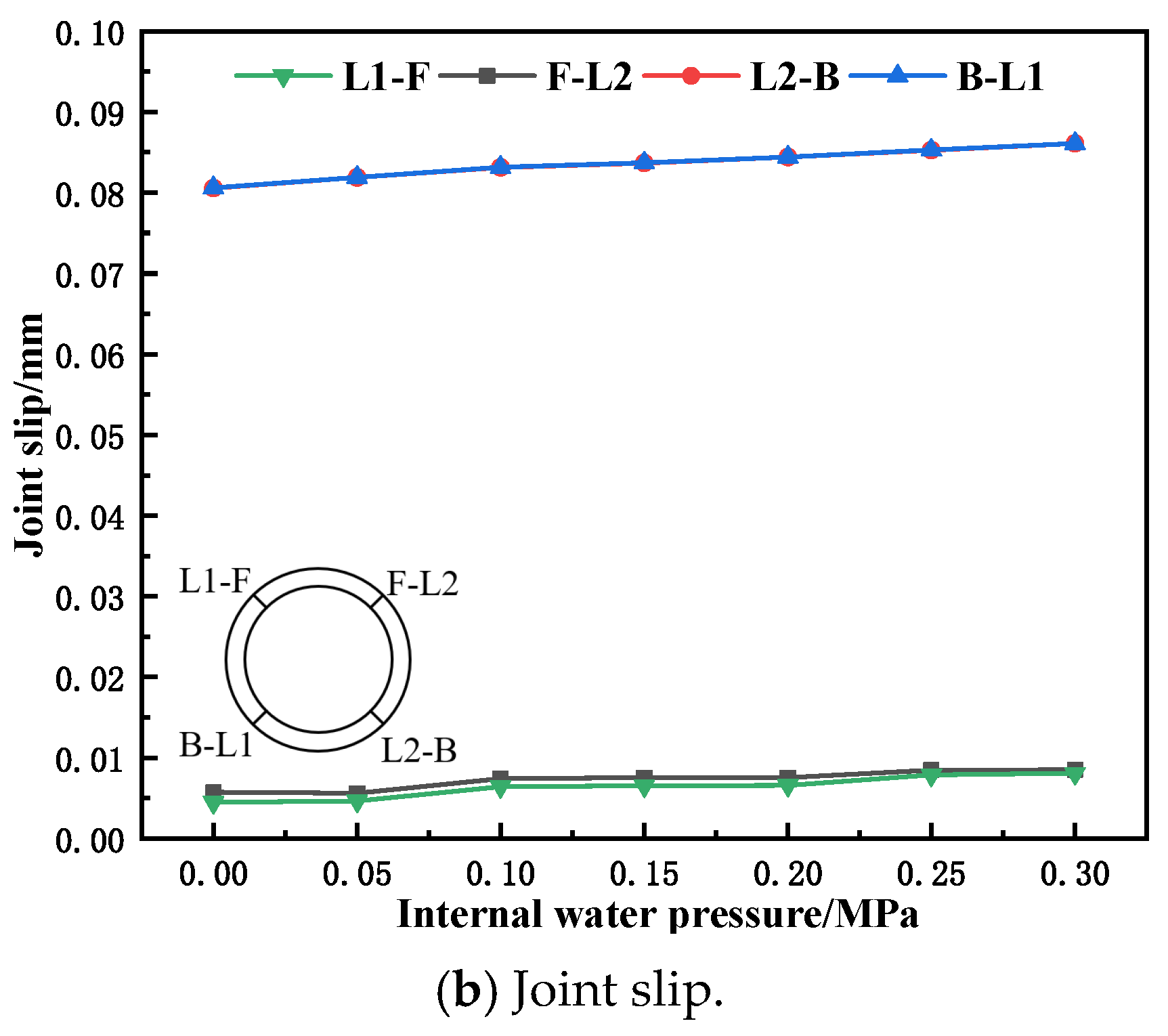
- The emergence of internal water pressure gradually causes the composite structure to tend to expand outward. The compressive stress of the pipe segment, vertical deformation, joint opening, connecting bolt stress, internal tension steel ring stress, and anchor rod stress all decrease. However, when the internal water pressure is 0.30 MPa, compared to the state without internal water, the tensile stress of the pipe segment increases by 41.47%, and the joint misalignment increases by 64.27%. Therefore, during the water filling operation, the internal water pressure should be properly controlled to avoid pipe cracking and the further development of joint dislocation.
- (3)
- Under the combined action of the external water and soil pressures and the internal water pressure, the tensile stress, compressive stress, vertical deformation, joint opening, joint misalignment, connection bolt stress, internal tensile steel ring stress, and anchor bolt stress of Class V surrounding rock increased by 3.96%, 6.91%, 12.92%, 9.36%, 15.75%, 37.16%, 11.21%, and 15.12%, respectively, compared to those of Class III surrounding rock. The change in the surrounding rock type has the greatest impact on the stress of the connection bolts. The second is the deformation of the pipe segment joints and the stress of the anchor rods. Therefore, in the transition areas of different types of surrounding rocks, key monitoring should be carried out on the stress of connecting bolts, deformation of pipe joints, and stress of anchor bolts.
- (4)
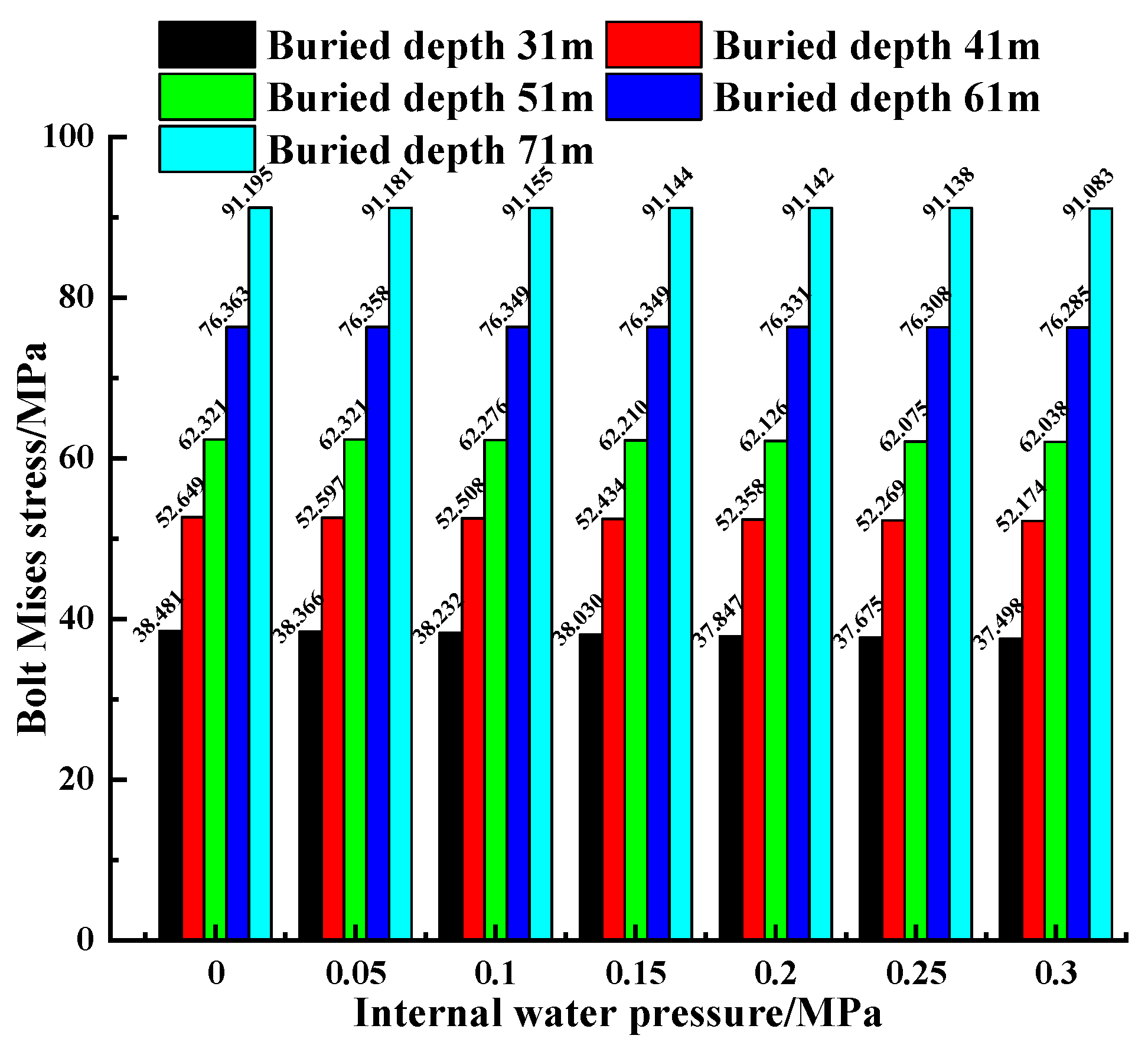
- Under the combined action of external water and soil pressures and internal water pressure, the tensile stress, compressive stress, vertical deformation, joint opening, joint misalignment, connection bolt stress, internal tensile steel ring stress, and anchor rod stress of the tunnel segment at a depth of 71 m increased by 22.64%, 59.29%, 107%, 55%, 60.61%, 140%, 57.77%, and 13.79%, respectively, compared to those at a depth of 31 m. The change in the tunnel burial depth has the greatest impact on the stress of the connection bolt. The second is the vertical deformation of the pipe segment and the deformation of the joint misalignment. Therefore, when designing tunnels with different burial depths, special attention should be given to the stress of the connecting bolts, vertical deformation of pipe segments, and staggered deformation of the pipe segment joints.
- (5)
- Under the combined action of external water and soil pressure and internal water pressure, the load-sharing ratio of the inner tensioned steel ring increases by approximately 85.80% with the rise of internal water pressure. The effect of the internal water pressure improves the load-sharing effect of the internally tensioned steel ring. With the improvement of the physical and mechanical properties of the surrounding rock, the ability of the surrounding rock to share the load becomes stronger. The proportion of the surrounding rock to share the load under Class III surrounding rock increased by approximately 7.14% compared to that under Class V surrounding rock, and the proportion of the pipe segments and anchor rods to share the load decreased by approximately 0.97% and 11.28%, respectively. As the burial depth of the tunnel increases, the composite structure bears greater external loads, and the role of the internally tensioned steel ring and anchor rod as reserve-bearing components becomes increasingly apparent. When the burial depth of the tunnel is 71 m, the load-sharing rates of the internally tensioned steel ring and anchor rod increase by 19.91% and 55.72%, respectively, compared to those at a burial depth of 31 m.
- (6)
- Discussion and Inferences: Beyond the quantitative findings summarized above, this study provides further insights into the behavior of the semi-ring reinforced composite structure. The significant load redistribution caused by internal water pressure highlights its role as an active stabilizing mechanism. Furthermore, the strong dependence of bolt stress on burial depth underscores that for deep tunnels, connecting bolts become critical components requiring careful design. These inferences, drawn from the integrated analysis of internal pressure, rock type, and depth, offer practical guidance for optimizing the design and monitoring strategies of similar TBM-pressurized tunnels.
- (7)
- Limitations and Scope of the Study: This study has certain limitations that should be acknowledged. The numerical model is based on simplified assumptions, including the use of the Mohr–Coulomb constitutive model for the surrounding rock and ideal elastic behavior for other materials. The analysis focused on a specific composite structure (semi-ring reinforcement) under static loading conditions, and the effects of dynamic loads (e.g., seismic activity) or the time-dependent behavior (creep) of the surrounding rock were not considered. Additionally, the range of parameters investigated (e.g., internal water pressure up to 0.30 MPa, burial depths up to 71 m) is tied to the specific engineering case. Future research could extend this work by incorporating more complex material models, considering construction sequences, and exploring a wider range of geological and loading conditions.
Author Contributions
Funding
Data Availability Statement
Conflicts of Interest
References
- Ibrahim, B.; Mousa, S.; Mohamed, H.M.; Benmokrane, B. Performance of Precast FRC Tunnel Lining Segments Reinforced with GFRP Bars under Quasi-Static Cyclic Flexural Loading. J. Compos. Constr. 2023, 27, 04023059. [Google Scholar] [CrossRef]
- Cao, Y.; Wang, P.; Jin, X.; Yang, Y. Tunnel structure analysis using the multi-scale modeling method. Tunn. Undergr. Space Technol. Inc. Trenchless Technol. Res. 2012, 28, 124–134. [Google Scholar] [CrossRef]
- Du, J.M.; Fang, Q.; Wang, G.; Zhang, D.L.; Chen, T.L. Fatigue damage and residual life of secondary lining of high-speed railway tunnel under aerodynamic pressure wave. Tunn. Undergr. Space Technol. Inc. Trenchless Technol. Res. 2021, 111, 103851. [Google Scholar] [CrossRef]
- Xu, G.; He, C.; Chen, Z.; Yang, Q. Transversely isotropic creep behavior of phyllite and its influence on the long-term safety of the secondary lining of tunnels. Eng. Geol. 2020, 278, 105834. [Google Scholar] [CrossRef]
- Gao, C.L.; Zhou, Z.Q.; Li, Z.H.; Li, L.P.; Cheng, S. Peridynamics simulation of surrounding rock damage characteristics during tunnel excavation. Tunn. Undergr. Space Technol. 2020, 97, 103289. [Google Scholar] [CrossRef]
- Burd, H.J.; Yiu, W.N.; Acikgoz, S.; Martin, C.M. Soil-foundation interaction model for the assessment of tunnelling-induced damage to masonry buildings. Tunn. Undergr. Space Technol. Inc. Trenchless Technol. Res. 2022, 11, 104208. [Google Scholar] [CrossRef]
- Li, Z.; Zeng, Y. Design Principle and Method of Underground Structure; Southwest Jiaotong University Press: Chengdu, China, 2003. (In Chinese) [Google Scholar]
- Liu, X.; Bai, Y.; Yuan, Y.; Mang, H.A. Experimental investigation of the ultimate bearing capacity of continuously jointed segmental tunnel linings. Struct. Infrastruct. Eng. 2016, 12, 1364–1379. [Google Scholar] [CrossRef]
- Lu, C.; Huang, J. Damage analysis of the new Sanyi railway tunnel in the 1999 Chi-Chi earthquake: Necessity of second lining reinforcement. Tunn. Undergr. Space Technol. 2018, 73, 48–59. [Google Scholar] [CrossRef]
- Li, S.; Zhang, Y.; Feng, S.K. Void detection and void defect control methods for large-scale immersed steel shell–concrete tunnels. Tunn. Undergr. Space Technol. Inc. Trenchless Technol. Res. 2023, 134, 105006. [Google Scholar] [CrossRef]
- Zhang, S.; Huo, H.; Wang, X.; Wang, C. Research on Distribution and Influencing Factors of Segment Dislocation Based on Three-dimensional Discontinuous Contact Model. Railw. Stand. Des. 2018, 62, 94–99. (In Chinese) [Google Scholar]
- Providence, H.; Yanyong, X. A 3-D analytical continuous upper bound limit analysis for face stability of shallow shield tunneling in undrained clays. Comput. Geotech. 2023, 164, 105779. [Google Scholar] [CrossRef]
- Ren, L.X.; Wei, Z.F.; Liang, N.H.; Liu, X.R.; Deng, Z.Y. Mechanical behavior of multi-scale fiber-reinforced concrete for secondary tunnel lining: Field test and numerical simulation. Case Stud. Constr. Mater. 2022, 17, e01669. [Google Scholar] [CrossRef]
- Song, W.L.; Lai, H.P.; Liu, Y.Y.; Yang, W.H.; Zhu, Z.D. Field and laboratory study of cracking and safety of secondary lining for an existing highway tunnel in loess ground. Tunn. Undergr. Space Technol. Inc. Trenchless Technol. Res. 2019, 88, 35–46. [Google Scholar] [CrossRef]
- Zhang, J.; Wang, M.; Luo, L.; Ji, Y. Analysis of influence of support removal on safety of initial support in shallow buried long-span tunnel. Rock Soil Mech. 2009, 30, 497–502. (In Chinese) [Google Scholar]
- Wang, S.; Wang, Y.; Lin, Z.; Song, Z.; Wang, X.; Peng, X. Analysis of the influence of the thickness insufficiency in secondary lining on the mechanical properties of Double-layer lining of shield tunnel. Eng. Fail. Anal. 2022, 141, 106663. [Google Scholar] [CrossRef]
- Wu, Y.; Zhuang, G.; Liang, W.; Huang, L. Safety Analysis of Secondary Lining of Yulinzi Tunnel Based on Field Monitoring. Appl. Sci. 2023, 13, 8328. [Google Scholar] [CrossRef]
- Xu, Q. Support Structure and Design of Underground Engineering; China Water Resources and Hydropower Press: Beijing, China, 2013. (In Chinese) [Google Scholar]
- Zhou, J.; Yang, X. An analysis of the support loads on composite lining of deep-buried tunnels based on the Hoek-Brown strength criterion. Tunn. Undergr. Space Technol. Inc. Trenchless Technol. Res. 2021, 118, 104174. [Google Scholar] [CrossRef]
- Zhou, J.; Yang, X.; Ma, M.; Li, L. The support load analysis of deep-buried composite lining tunnel in rheological rock mass. Comput. Geotech. 2021, 130, 103934. [Google Scholar] [CrossRef]
- Du, J.; Shu, Y.; Xu, G.; He, C.; Yao, C. Study on the influence of geo-stress field on the fracture pattern of secondary tunnel lining. Eng. Fail. Anal. 2023, 152, 107467. [Google Scholar] [CrossRef]
- Trunda, V.; Hilar, M. Natm tunnels-consideration of the partly damage primary lining impact for the secondary lining evaluation. Acta Polytech. 2020, 60, 145–150. [Google Scholar] [CrossRef]
- Zhou, J.; Yang, X.; Chu, Z. Load laws of composite lining in mountain tunnel model tests and numerical simulation validation. J. Mt. Sci. 2023, 20, 2041–2057. [Google Scholar] [CrossRef]
- Liu, S.; Duan, J.; Fan, J.; Zhu, Y. Stress and Displacement of Deep-Buried Composite Lining Tunnel under Different Contact Conditions. Math. Probl. Eng. 2023, 2023, 7467290. [Google Scholar] [CrossRef]
- Zhang, Z.; Liu, W.; Zhuang, Q.; Huang, X.; Wang, S.; Zhang, C.; Zhu, Y.; Kwok, C. A novel testing setup for determining the flexural properties of tunnel segmental joints: Development and application. Arch. Civ. Mech. Eng. 2019, 19, 724–738. [Google Scholar] [CrossRef]
- Zheng, H.B.; Peng, F.; Ma, G.W. Stability analysis of the middle soil pillar for asymmetric parallel tunnels by using model testing and numerical simulations. Tunn. Undergr. Space Technol. 2021, 108, 103686. [Google Scholar] [CrossRef]
- Zhang, X.D.; Wang, J.C.; Chen, Q.J.; Lin, Z.J.; Gong, X.N.; Yang, Z.X.; Xu, R.Q. Analytical Method for Segmental Tunnel Linings Reinforced by Secondary Lining Considering Interfacial Slippage and Detachment. Int. J. Geomech. 2021, 21, 04021084. [Google Scholar] [CrossRef]
- Xu, F.; Li, S.; Zhang, Q.; Li, L.; Shi, S. A new type support structure introduction and its contrast study with traditional support structure used in tunnel construction. Tunn. Undergr. Space Technol. Inc. Trenchless Technol. Res. 2016, 63, 171–182. [Google Scholar] [CrossRef]
- Xu, G.W.; He, C.; Yang, Q.H.; Wang, B. Progressive failure process of secondary lining of a tunnel under creep effect of surrounding rock. Tunn. Undergr. Space Technol. Inc. Trenchless Technol. Res. 2019, 90, 76–98. [Google Scholar] [CrossRef]
- Zhang, Y.; Huang, H.; Zhang, D.; Ayyub, B. Deformation recoverability of longitudinal joints in segmental tunnel linings: An experimental study. Tunn. Undergr. Space Technol. Inc. Trenchless Technol. Res. 2022, 124, 104475. [Google Scholar] [CrossRef]
- Zhang, N.; Fang, Q.; Li, Y.; Zhang, D. Mechanical Analysis of Secondary Lining of High-Speed Railway Tunnel. KSCE J. Civ. Eng. 2018, 22, 2384–2389. [Google Scholar] [CrossRef]







| Material Parameter | Density kg/m3 | Modulus of Elasticity GPa | Poisson’s Ratio | Cohesive Force MPa | Angle of Internal Friction |
|---|---|---|---|---|---|
| Material Name | |||||
| Class V surrounding rock | 2550 | 1.75 | 0.33 | 0.075 | 27.5 |
| Consolidated grout layer | 2610 | 4.50 | 0.30 | 0.20 | 32.5 |
| Bean gravel grout layer | 2360 | 17.50 | 0.30 | —— | —— |
| Segment (C55 concrete) | 2500 | 35.50 | 0.20 | —— | —— |
| Epoxy resin | 2000 | 1.00 | 0.38 | —— | —— |
| Inner tensile steel ring | 7850 | 206 | 0.30 | —— | —— |
| Connecting bolt | 7850 | 206 | 0.30 | —— | —— |
| Anchor bolt | 7850 | 206 | 0.30 | —— | —— |
| Condition Number | Calculated Load | |
|---|---|---|
| External Water Pressure/MPa | Internal Water Pressure/MPa | |
| 1 | 0.27 | —— |
| 2 | 0.27 | 0.05 |
| 3 | 0.27 | 0.10 |
| 4 | 0.27 | 0.15 |
| 5 | 0.27 | 0.20 |
| 6 | 0.27 | 0.25 |
| 7 | 0.27 | 0.30 |
| Material Parameter | Density kg/m3 | Modulus of Elasticity GPa | Poisson’s Ratio | Cohesive Force MPa | Angle of Internal Friction |
|---|---|---|---|---|---|
| Type of Surrounding Rock | |||||
| III | 2640 | 10 | 0.25 | 0.95 | 37.5 |
| IV | 2610 | 4.5 | 0.3 | 0.2 | 32.5 |
| V | 2550 | 1.75 | 0.33 | 0.075 | 27.5 |
| Surrounding Rock Type | Internal Water Pressure | ||||||
|---|---|---|---|---|---|---|---|
| 0.00 | 0.05 | 0.10 | 0.15 | 0.20 | 0.25 | 0.30 | |
| Class III surrounding rock | 1.002 | 1.033 | 1.100 | 1.166 | 1.229 | 1.292 | 1.355 |
| Class IV surrounding rock | 1.039 | 1.069 | 1.131 | 1.183 | 1.221 | 1.258 | 1.397 |
| Class V surrounding rock | 1.043 | 1.086 | 1.150 | 1.212 | 1.275 | 1.337 | 1.408 |
| Surrounding Rock Type | Internal Water Pressure | ||||||
|---|---|---|---|---|---|---|---|
| 0.00 | 0.05 | 0.10 | 0.15 | 0.20 | 0.25 | 0.30 | |
| Class III surrounding rock | 9.116 | 9.080 | 8.955 | 8.284 | 8.242 | 8.152 | 8.061 |
| Class IV surrounding rock | 9.319 | 9.23 | 9.145 | 8.938 | 8.758 | 8.579 | 8.401 |
| Class V surrounding rock | 9.914 | 9.808 | 9.233 | 9.070 | 8.901 | 8.759 | 8.656 |
| Condition Number | The Depth of the Tunnel/MPa | Surrounding Rock Type |
|---|---|---|
| 1 | 31 | Category V |
| 2 | 41 | Category V |
| 3 | 51 | Category V |
| 4 | 61 | Category V |
| 5 | 71 | Category V |
| Internal Water Pressure | The Depth of the Tunnel | ||||
|---|---|---|---|---|---|
| 31 m | 41 m | 51 m | 61 m | 71 m | |
| 0 | 0.980 | 0.989 | 1.043 | 1.102 | 1.249 |
| 0.05 | 1.032 | 1.040 | 1.086 | 1.115 | 1.263 |
| 0.10 | 1.044 | 1.092 | 1.150 | 1.166 | 1.277 |
| 0.15 | 1.074 | 1.156 | 1.212 | 1.226 | 1.308 |
| 0.20 | 1.091 | 1.200 | 1.275 | 1.292 | 1.366 |
| 0.25 | 1.194 | 1.243 | 1.337 | 1.341 | 1.426 |
| 0.30 | 1.231 | 1.374 | 1.408 | 1.442 | 1.485 |
| Internal Water Pressure | The Depth of the Tunnel | ||||
|---|---|---|---|---|---|
| 31 m | 41 m | 51 m | 61 m | 71 m | |
| 0 | 7.187 | 8.212 | 9.914 | 10.186 | 11.246 |
| 0.05 | 7.058 | 8.083 | 9.808 | 10.082 | 11.086 |
| 0.10 | 6.997 | 8.075 | 9.233 | 10.008 | 11.069 |
| 0.15 | 6.864 | 7.959 | 9.070 | 9.955 | 10.956 |
| 0.20 | 6.815 | 7.894 | 8.901 | 9.829 | 10.891 |
| 0.25 | 6.634 | 7.714 | 8.759 | 9.651 | 10.713 |
| 0.30 | 6.486 | 7.535 | 8.656 | 9.472 | 10.534 |
Disclaimer/Publisher’s Note: The statements, opinions and data contained in all publications are solely those of the individual author(s) and contributor(s) and not of MDPI and/or the editor(s). MDPI and/or the editor(s) disclaim responsibility for any injury to people or property resulting from any ideas, methods, instructions or products referred to in the content. |
© 2026 by the authors. Licensee MDPI, Basel, Switzerland. This article is an open access article distributed under the terms and conditions of the Creative Commons Attribution (CC BY) license.
Share and Cite
Ye, H.; Huang, J.; Xiao, J.; Zhang, J.; Chen, L. Analysis of the Combined Load-Bearing Mechanical Characteristics of the Combined Structure of “Inner Tensioned Steel Ring–Segment–Surrounding Rock” in a TBM Pressurized Water Conveyance Tunnel. Water 2026, 18, 825. https://doi.org/10.3390/w18070825
Ye H, Huang J, Xiao J, Zhang J, Chen L. Analysis of the Combined Load-Bearing Mechanical Characteristics of the Combined Structure of “Inner Tensioned Steel Ring–Segment–Surrounding Rock” in a TBM Pressurized Water Conveyance Tunnel. Water. 2026; 18(7):825. https://doi.org/10.3390/w18070825
Chicago/Turabian StyleYe, Hexin, Jinlin Huang, Jing Xiao, Jianwei Zhang, and Lei Chen. 2026. "Analysis of the Combined Load-Bearing Mechanical Characteristics of the Combined Structure of “Inner Tensioned Steel Ring–Segment–Surrounding Rock” in a TBM Pressurized Water Conveyance Tunnel" Water 18, no. 7: 825. https://doi.org/10.3390/w18070825
APA StyleYe, H., Huang, J., Xiao, J., Zhang, J., & Chen, L. (2026). Analysis of the Combined Load-Bearing Mechanical Characteristics of the Combined Structure of “Inner Tensioned Steel Ring–Segment–Surrounding Rock” in a TBM Pressurized Water Conveyance Tunnel. Water, 18(7), 825. https://doi.org/10.3390/w18070825