Article

Temporal and Spatial Changes of Extreme Precipitation Indices in Jilin Province During 1960–2019 and Future Projections Under CMIP6 Scenarios

1
College of Geography and Ocean Sciences, Yanbian University, Hunchun 133300, China
2
Jilin Provincial Joint Key Laboratory of Changbai Mountain Wetland & Ecology, Yanbian University, Hunchun 133300, China
*
Authors to whom correspondence should be addressed.
Water 2026, 18(7), 820; https://doi.org/10.3390/w18070820
Submission received: 27 February 2026 / Revised: 23 March 2026 / Accepted: 27 March 2026 / Published: 30 March 2026
(This article belongs to the Special Issue China Water Forum, 4th Edition)

Highlights

What are the main findings?
  • Past trends show more frequent but less intense extreme precipitation events.
  • Future high emissions will increase both the frequency and intensity of extremes.
  • Southeast Jilin is a high-risk hotspot due to monsoon and terrain effects.
  • Key turning points are linked to EASM, AO, and PDO phase shifts.
What are the implications of the main findings?
  • Provides outlook for agriculture and water security in China's breadbasket.
  • Urgent need for updated infrastructure to manage future flood and drought risks.
  • Regional water management must focus on the high-risk southeastern area.

Abstract

Extreme precipitation constitutes one of the most devastating climatic resulting from global climate change. Jilin Province, a significant commodities grain base in China by a temperate monsoon climate, is particularly susceptible to flood disasters caused by extreme precipitation, usually occurring from late July to early August. The 2010 flood impacted moreover 5.12 million individuals and resulted in direct economic damages amounting to 45.1 billion CNY. However, research on the spatiotemporal characteristics and future trends of extreme precipitation in Jilin Province is still quite inadequate. This study examined the spatiotemporal distribution and future forecasts of extreme precipitation utilizing daily meteorological data from 31 stations (1960–2019) and three CMIP6 models (CanESM5, MPI-ESM1-2-HR, FGOALS-g3) under SSP2-4.5 and SSP5-8.5 scenarios. Eleven extreme precipitation indices, as specified by the WMO, were analyzed utilizing linear regression, the Mann–Kendall test, wavelet analysis, and inverse distance weighting interpolation. The findings indicated that from 1960 to 2019, extreme precipitation demonstrated traits of “increased frequency and total amount, decreased intensity”, with a significant decline in CDD (−2.184 d·(10a)−1, p < 0.001), a notable increase in PRCPTOT (1.493 mm·(10a)−1, p < 0.05), and a significant reduction in SD II (−0.016 mm·d−1·(10a)−1, p < 0.01). The majority of indicators had a predominant cycle of 30 to 50 years. A significant northwest-to-southeast gradient characterized most indicators, with PRCPTOT varying from 327.5 mm in Baicheng to 824.3 mm in Tonghua. Future projections (2025–2100) suggested scenario-dependent intensification. Under SSP5-8.5, all three models forecast substantial increases in precipitation amount indices (PRCPTOT: 2.071–2.457 mm·(10a)−1) and SD II (0.010–0.013 mm·d−1·(10a)−1), reversing the past downward trend in intensity. The anticipated alterations exhibited a northwest-to-southeast gradient, with PRCPTOT increases above 230 mm in the central and southeastern regions. These findings offer a scientific basis for flood management and climate change adaptation in Jilin Province and analogous areas.

1. Introduction

The Sixth Assessment Report of the Intergovernmental Panel on Climate Change (IPCC) unequivocally states that the rate and magnitude of changes in the current global climate system have surpassed historical records. The rise in the global average surface temperature, primarily driven by human activities (with a rise of 0.8–1.3 °C from 2010 to 2019 compared to pre-industrial levels), stands as the principal factor contributing to the frequent occurrence of extreme weather events [1].
Extreme precipitation events, among the most catastrophic meteorological disasters related to global climate change, are occurring with greater frequency and intensity. In recent years, secondary disasters including floods, landslides, and debris flows induced by excessive precipitation have occurred often worldwide. These disasters have resulted in significant mortality and extensive property destruction, while also imposing irrevocable effects on regional water resource security, agricultural practices, and ecological equilibrium [2,3]. In light of this severe scenario, rigorous study on extreme precipitation has become an urgent necessity to tackle climate change and foster regional sustainable development.
Recent years have witnessed substantial progress in studies on extreme precipitation at global, national, and regional scales. Studies have revealed a notable upward trend in the frequency and intensity of global extreme precipitation from 1980 to 2020, with distinct regional differences [4]. China is one of the countries most severely affected by extreme precipitation. In southern China, the frequency of hourly extreme precipitation the frequency increased in southern China, intensity mainly increased in northern China has increased; in northern China, the intensity has mainly risen; and in the southeastern region, the total daily precipitation has continued to increase [5]. In the arid northwestern part of China, despite an increase in the number of consecutive drought days, both average and extreme precipitation have shown an upward trend [6,7]. The frequency of extreme weather and climate events in Northeast China has increased significantly, which is considered a direct consequence of global warming has had impacts on regional food production [8]. Existing studies suggest that extreme precipitation in Northeast China is likely to become more frequent and intense in the future [9].
To date, research on extreme precipitation has evolved into a comprehensive multi-scale and multi-method system. The academic community extensively uses the 11 extreme precipitation indices endorsed by the World Meteorological Organization (WMO) as analytical parameters [10,11], thereby establishing these indices as standard instruments for the analysis of extreme precipitation [12].
The Mann–Kendall trend test, a non-parametric method first introduced by Mann [13] and later refined by Kendall [14], has been extensively utilized for identifying monotonic trends in hydroclimatic time series owing to its robustness, and lack of assumptions regarding data normality. Wavelet analysis has been progressively utilized to discern localized periodicities, long-term trends, and non-stationary characteristics in climate series, particularly for managing noisy hydrological data during climate change [15,16]. The empirical orthogonal function (EOF) method effectively identifies predominant spatial modes by decomposing multivariate fields into principal components that optimize variance contribution [17]. Meanwhile, inverse distance weighting (IDW) interpolation effectively reconstructs the spatial distribution of precipitation indices from discrete station observations, thereby elucidating regional heterogeneity [18].
Accurate prediction of future trends in extreme precipitation forms the basis for developing medium- and long-term climate adaptation strategies. The Coupled Model Intercomparison Project (CMIP) has entered its sixth phase (CMIP6). Compared to previous generations, CMIP6 demonstrates improvements in the number of models, data accuracy, and simulation ability [19,20,21].
Jilin Province is located at the geographical center of Northeast Asia and serves as a major commercial grain production base in China [22]. Studies conducted in Jilin Province and neighboring regions have shown that the Northeast Asian region experienced a decadal abrupt increase in summer water vapor deficit in the late 1990s [23]; extreme precipitation in southern Eastern Siberia and Mongolia exhibits a northwestward shift [24]; summer precipitation anomalies in the Selenga River basin are the primary cause of low-flow periods [25]; extreme precipitation events in Liaoning Province showed a decreasing trend from 1991 to 2021, although some regions still experienced an increase frequency and intensity [21].
Due to its geographical location, with the western part bordering the arid Inner Mongolia Plateau and being far from the ocean, the western region of Jilin Province from water shortages. The southeastern region is also prone to drought because of the barrier formed by the Changbai Mountains. However, the eastern mountainous areas are adjacent to the Songhua River and the Sea of Japan. Warm, moist air currents from the southwest influence, northeastward movement of water vapor by the southwest monsoon, leading to significant moisture in the region [26,27]. Consequently, the region is also susceptible to extreme precipitation events such as floods and waterlogging. Given Jilin Province’s climate sensitivity and its heavy reliance on agriculture, it holds a unique position in the study of extreme precipitation [28,29].
Nonetheless, there has been relatively limited research on spatiotemporal characteristics and future trends of extreme precipitation in Jilin Province. In light of this, the specific objectives of this study are as follows: (1) Based on daily meteorological observation data from 31 weather stations in Jilin Province from 1960 to 2019, this study will employ the 11 extreme precipitation indices recommended by the WMO, combined with methods such as simple linear regression, the Mann–Kendall test, IDW interpolation, and wavelet analysis, to systematically describe the spatiotemporal evolution of extreme precipitation during this period. (2) This study will utilize data from the CanESM5, MPI-ESM1-2-HR, and FGOALS-g3 models within the CMIP6 project to extract daily grid data for 31 meteorological stations from 2025 to 2100, aiming to analyze future spatiotemporal trends of various extreme precipitation indicators under distinct climate scenarios. This work establishes a scientific foundation for disaster prevention programs in Jilin Province and analogous climatic regions as well as for forecasting future alterations in extreme precipitation events.

2. Materials and Methods

2.1. Study Area

Jilin Province is located at the geometric center of Northeast Asia (40°50′–46°19′ N, 121°38′–131°19′ E). Northeast Asia includes Japan, Russia, North Korea, South Korea, Mongolia, and northeastern China. The province spans 769.62 km from east to west and 606.57 km from north to south, covering a total land area of 187,400 km2, approximately 2% of China’s territorial expanse. Geomorphologically, Jilin Province exhibits a pronounced southeast-to-northwest gradient, characterized by elevated terrains in the southeast and lower elevations in the northwest. It largely comprises two principal geomorphic units: the eastern mountainous region and the central-western plains. The Changbai Mountains in the southeast and the low-lying plains in the west create notable topographic variations throughout the province, affecting the spatial distribution of precipitation. located on the eastern side of the Eurasian continent in the mid-latitudes, Jilin Province has a moderate continental monsoon climate characterized by four distinct seasons with simultaneous periods of rainfall and warmth. Annual precipitation generally varies from 400 to 600 mm, exhibiting significant seasonal and geographical disparities, with approximately 80% occurring in summer and the eastern section of the province having the highest levels of precipitation [30].

2.2. Data

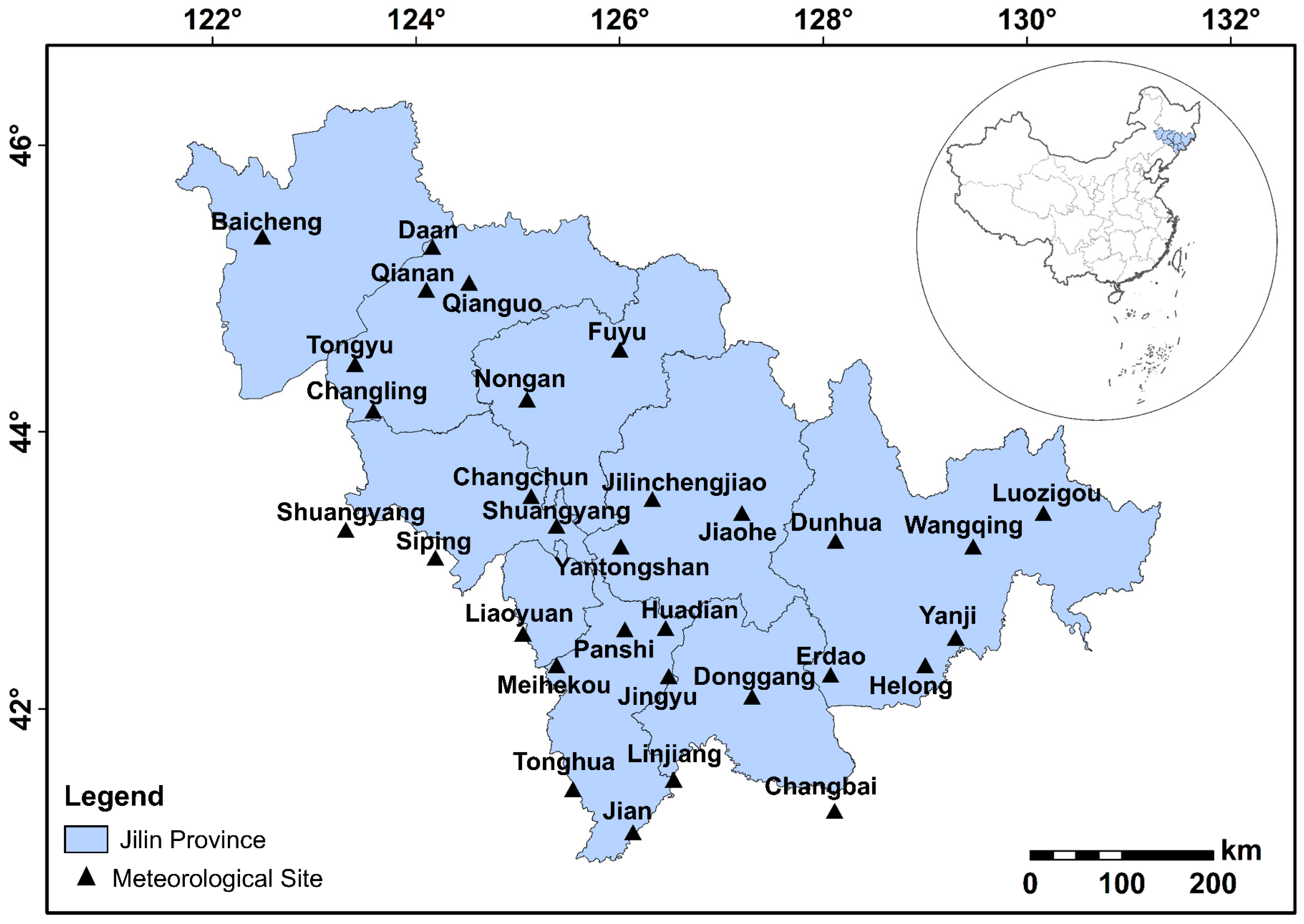
This study employed daily precipitation, maximum temperature, and minimum temperature data gathered from 31 national-level ground observation stations in Jilin Province (Appendix A Table A1), covering the years from 1960 to 2019. Precipitation data were obtained from the China Meteorological Science Data Sharing Service Platform (http://data.cma.cn/, accessed on 26 February 2026) and subjected to stringent quality control measures. Figure 1 depicts the geographical distribution of Jilin Province and its meteorological stations. The areal mean precipitation for Jilin Province was calculated utilizing the inverse distance weighting (IDW) approach.
This research, building on prior studies, selected three commonly utilized and validated CMIP6 climate models for northern China: CanESM5, MPI-ESM1-2-HR, and FGOALS-g3 [31,32]. The SSP2-4.5 and SSP5-8.5 scenarios were selected for examination. Daily precipitation and temperature data from 2025 to 2100 were obtained from grid points associated with 31 meteorological stations or their nearest grid cells (Appendix A Table A1). These data were sourced from the China Regional CMIP6 Downscaled Precipitation [33], Temperature, and Wind Speed Dataset maintained by the National Qinghai-Tibet Plateau Science Data Center (http://data.tpdc.ac.cn, accessed on 26 February 2026). This dataset underwent bias-correction at a resolution of 0.25°, utilizing the equidistant cumulative distribution function (EDCDF) approach, referencing the China Meteorological Driving Force Dataset (CMDF) as the observational standard. Upon rectification, the correlation between model outputs and observations for monthly precipitation nears unity, validating the dependability of the downscaled data for regional climate study. In accordance with the official CMIP6 recommendation, the period from 1995 to 2014 was established as the baseline for quantifying future alterations in extreme precipitation indices.

2.3. Methods

2.3.1. Extreme Precipitation Indicators

The definition and criteria for extreme precipitation occurrences differ among research, typically involve the development of specified thresholds for precipitation intensity, duration, and regional distribution. This study utilized 11 extreme precipitation indices as specified by the Expert Group on Climate Change Detection and Indices (EGCCDI) of the World Meteorological Organization [34]. Table 1 provides comprehensive information regarding the names, abbreviations, and definitions of these indexes. These indices can be classified into three categories [35]: (1) extreme precipitation day indices (R10, R20, R50, CDD, CWD), which measure the occurrence of extreme precipitation occurrences. R10, R20, and R50 quantify the number of days with precipitation at specified intensities, while CDD and CWD signify the frequencies of dry and wet spells, respectively; (2) extreme precipitation quantity indices (R95p, R99p, Rx1day, Rx5day, PRCPTOT) represent the total precipitation volume and the overall characteristics of extreme heavy precipitation events; and (3) the extreme precipitation intensity index (SD II) denotes the concentration of precipitation.

2.3.2. Inverse Distance Weighting Interpolation

Spatial interpolation was conducted using the inverse distance weighting (IDW) method, wherein the estimated value at an unsampled location is computed as a weighted average of surrounding observations, with weights diminishing as the distance from the prediction point increases. The interpolated value at location x 0 is expressed as:
Z ( x 0 ) = i = 1 n w i Z ( x i ) i = 1 n w i
where Z ( x i ) is the observed value at location x i and w i is the weight assigned to point x i . The weight is defined as:
w i = 1 d x i , x 0 p
where d ( x i , x 0 ) is the distance between the known point x i and the prediction location x 0 , and p is the power parameter controlling the rate of distance decay. In this study, the optimal value of this parameter was determined to be 2.75 using leave-one-out cross-validation based on the minimum interpolation error criterion [18].

2.3.3. Mann–Kendall Trend Test and Change-Point Detection

The Mann–Kendall (MK) test is a non-parametric method widely used to detect monotonic trends in time series [36]. For a time, series X = ( x 1 , x 2 , , x n ) , the MK statistic S is calculated as:
S = i = 1 n 1 j = i + 1 n s g n ( x j x i )
S g n ( x j x i ) = 1 , x j > x i 0 , x j = x i 1 , x j < x i
A positive value of S indicates an increasing trend, whereas a negative value indicates a decreasing trend. For n > 8 , S approximately follows a normal distribution with variance:
Var S = n n 1 2 n + 5 k = 1 n t k t k 1 2 t k + 5 18
where n is the number of tied groups and t k is the number of data points in the k -th tied group. The standardized test statistic Z is given by
Z M K = S 1 V a r ( S ) , S > 0 0 , S = 0 S + 1 V a r ( S ) , S < 0
An upward trend is identified when Z > 0 , and a downward trend is identified when Z < 0 . The trend is considered statistically significant at the 95% confidence level when Z > 1.96 .
Potential abrupt changes in the time series were further examined using the sequential Mann–Kendall (SQMK) test and the Bai–Perron structural breakpoint test. The SQMK test was utilized to initially identify potential change sites by examining the intersection of the forward ( U F k ) and backward ( U B k ) standardized statistics. Intersections occurring within the critical boundaries of ± 1.96 were considered significant at the 0.05 level. The Bai–Perron test was utilized to detect and confirm structural changes in the series by identifying one or more statistically significant breakpoints and establishing the best segmentation of the time series. By integrating the results of the SQMK and Bai–Perron tests, the abrupt change years were determined [37].

2.3.4. Morlet Wavelet Analysis

Wavelet analysis was utilized to discern localized temporal characteristics of the precipitation series, encompassing multi-scale variability and periodic oscillations. The discrete wavelet representation is as follows [38]:
W f a , b = 1 a k = 1 N f k Δ t Δ t Ψ ¯ k Δ t b a
where a and b denote the scale and translation factors; ψ is the mother wavelet function; f is the variable time sequence. Positive and negative real parts of the wavelet coefficients indicate relatively wet and dry conditions, respectively, at a given time and scale.
To identify the dominant periodicities, the wavelet variance was calculated as:
w f a = w f a , b 2 d b
where w f ( a ) represents the distribution of signal energy across scales. Wavelet variances were employed to discern the predominant periodicities in the precipitation series.

2.3.5. Spatial Modal Analysis

Empirical orthogonal function (EOF) decomposition was used to identify the dominant spatial patterns of extreme precipitation and their associated temporal variations [17]. The precipitation indices were arranged into a matrix X with m spatial points and n temporal observations. EOF decomposition of the covariance matrix yielded eigenvalues and eigenvectors, and the eigenvector of the j -th mode is expressed as:
W j = W 1 j , W 2 j , , W m j T
where W j represents the spatial pattern of the j -th EOF mode. The corresponding temporal coefficients were calculated as:
P = W T X
where P is the matrix of temporal coefficients.

3. Results

3.1. Characteristics of Temporal Change Trend of Extreme Precipitation

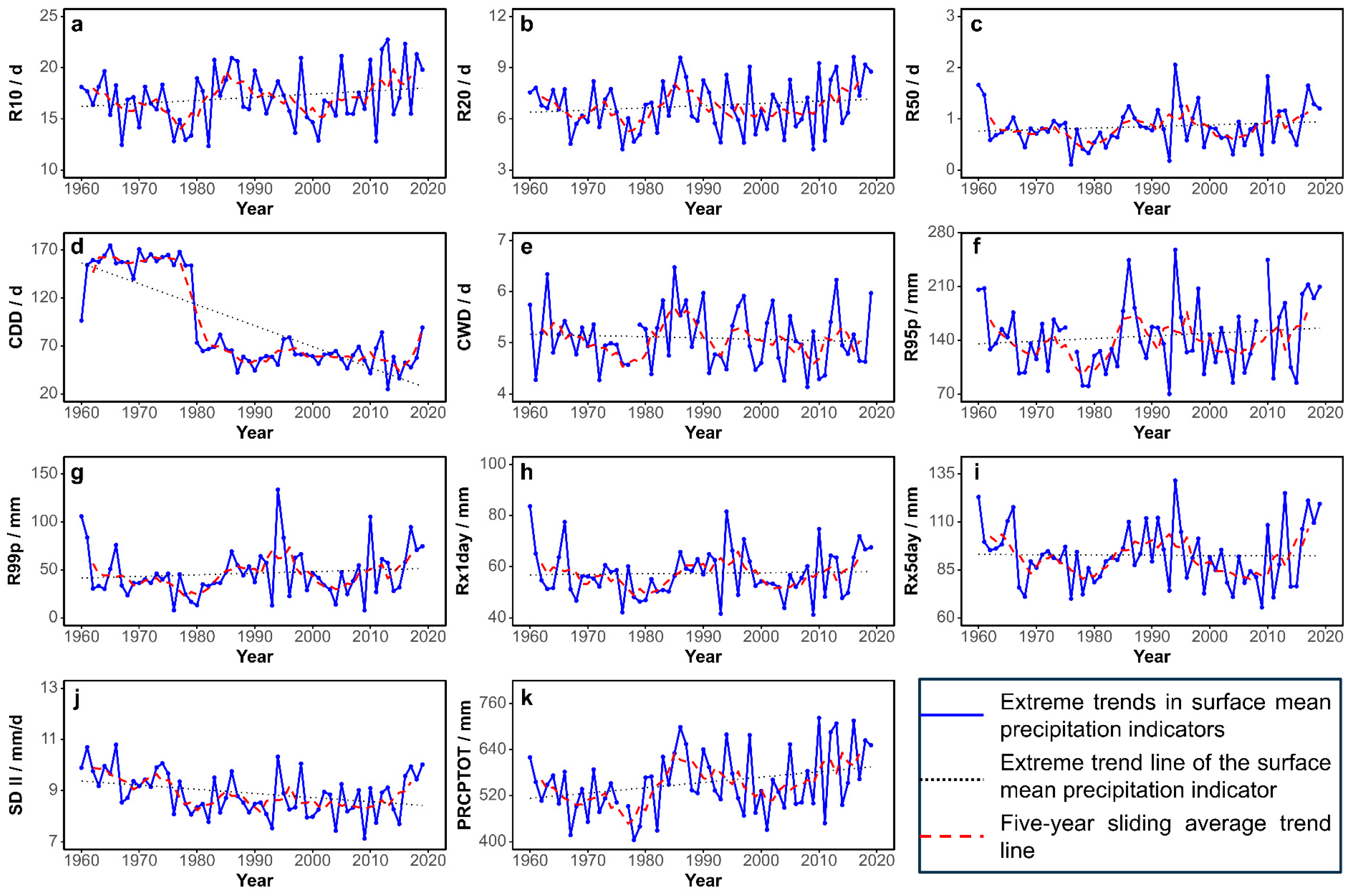
From 1960 to 2019, the extreme precipitation indices in Jilin Province exhibited notable temporal patterns. R10, R20, and R50 (Figure 2a–c) demonstrated minor, non-significant rising trends (0.003–0.03 d·(10a)−1), whereas CWD (Figure 2e) saw a tiny reduction (−0.001 d·(10a)−1). CDD (Figure 2d) exhibited a significant reduction of −2.184 d·(10a)−1 (p < 0.001), signifying a considerable decrease in the duration of consecutive dry spells. Among the indices of precipitation quantity, R95p, R99p, and Rx1day (Figure 2f–h) exhibited a non-significantly rise, whereas Rx5day (Figure 2i) experienced a minor fall. PRCPTOT (Figure 2k) increased considerably at a rate of 1.493 mm·(10a)−1 (p < 0.05). The intensity index SD II (Figure 2j) exhibited a substantial decrease of −0.016 mm·d−1·(10a)−1 (p < 0.01). The 5-year moving average indicated that CDD and SD II were comparatively elevated throughout the 1960s and 1970s; R10, R20, R50, CWD, R95p, and PRCPTOT attained their zenith the 1980s–1990s, whereas R99p, Rx1day, and Rx5day peaked in the 2010s. Overall, only CDD and SD II exhibited significant decreases, whereas PRCPTOT demonstrated a substantial rise, indicating that the frequency and total amount of extreme precipitation usually grew, although precipitation intensity diminished over the study period.
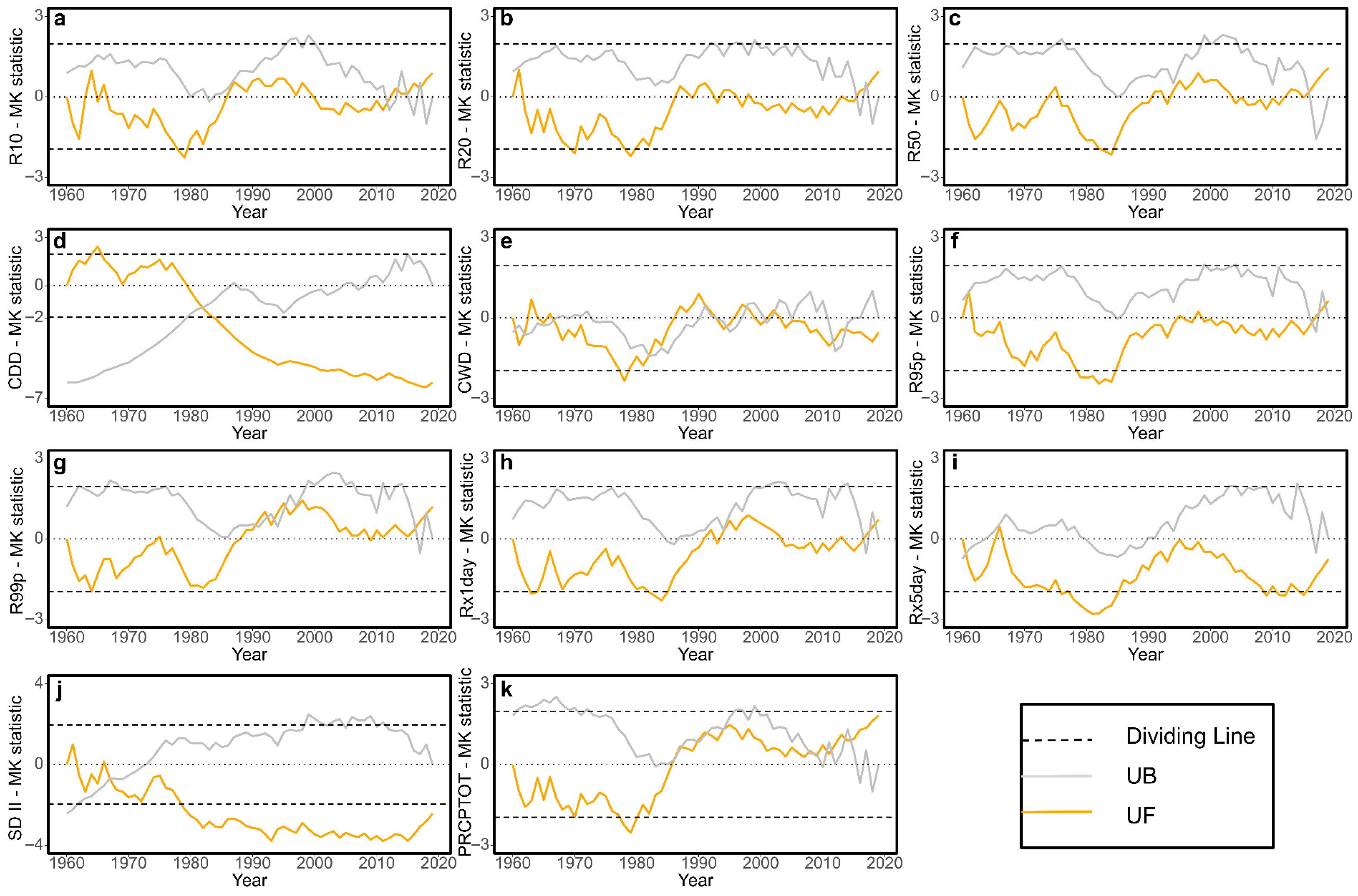
The Mann–Kendall mutation test, in conjunction with the Bai–Perron structural breakpoint test, was utilized to identify abrupt change points (Figure 3 and Table 2). The UF curves for the majority of indices exhibited fluctuations devoid of distinct turning points. Discernible rapid changes were detected for CDD (1979), SDII (1975), and PRCPTOT (1982), with CDD and SD II exhibiting statistically significant z-values that corroborate their long-term declining patterns, whereas the z-value for PRCPTOT lacked significance. For the remaining indices, although the UF and UB curves overlap multiple times within the 95% confidence interval, the trends preceding and after these intersections rarely achieve significance, suggesting an absence of meaningful abrupt change.

3.2. Characterization of Extreme Precipitation Cycle Change Trends

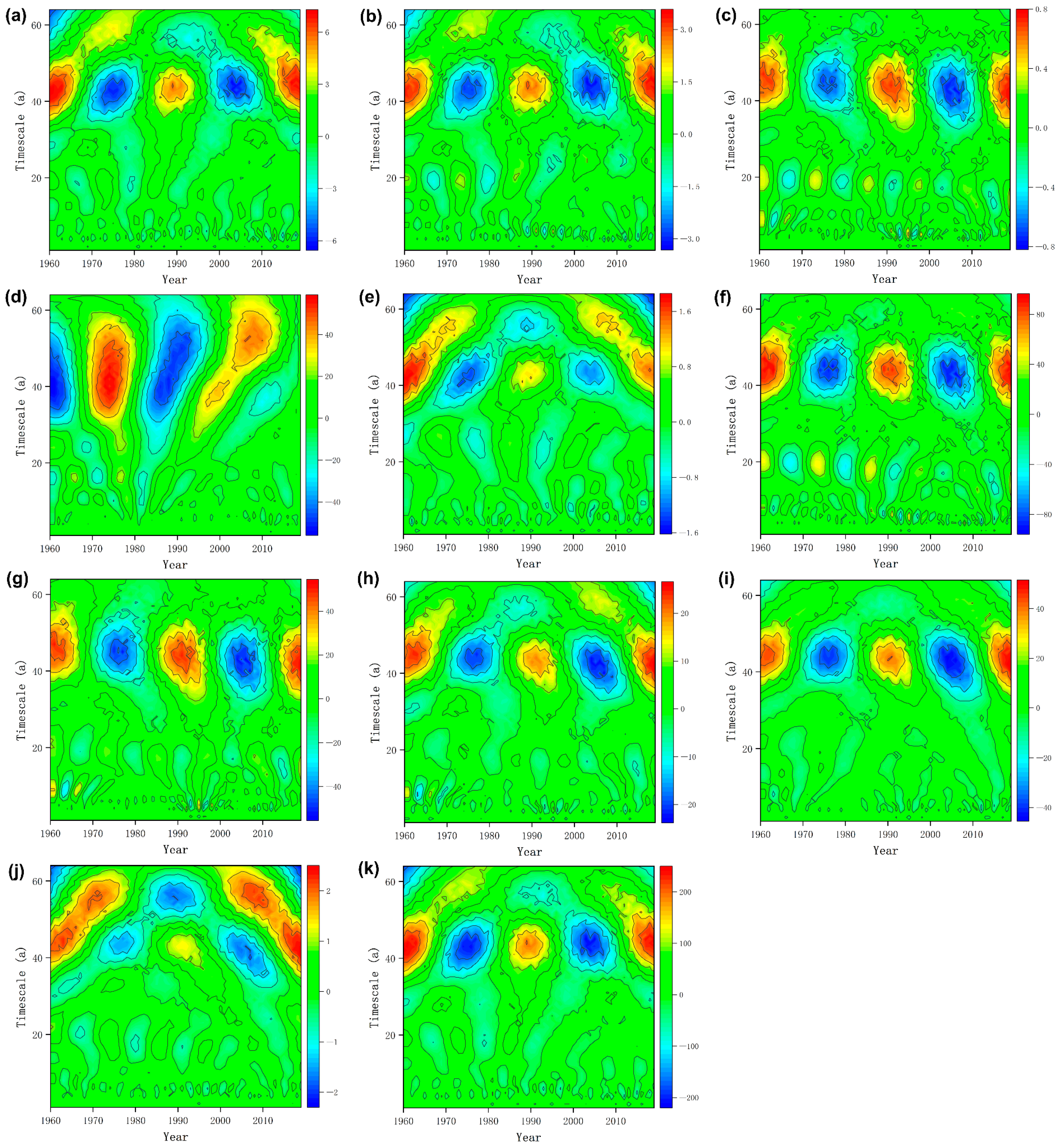
Wavelet analysis (Figure 4) revealed multi-scale rhythmic features across all 11 indices, demonstrating a common short-term cycle of 10–20 years. R10, R50, CWD, R99p, Rx1day, and Rx5day (Figure 4a,c,e,g–i) exhibited a three-tier periodic structure comprising a brief cycle of 10–20 years, a predominant cycle of 35–50 years, and an extended cycle of 50–60 years. R20, R95p, and PRCPTOT (Figure 4b,f,k) exhibited a similar structure, but with a reduced dominant cycle of 30–45 years. CDD (Figure 4d) exhibited a predominant cycle of 35–45 years and a secondary cycle of 45–60 years. SD II (Figure 4j) had a brief cycle of 10–20 years and an interdecadal cycle of 30–45 years, with feeble signals over extended time scales. Dominant cycles were primarily seen within the 30–50-year range, with the intensity of the periodic signal fluctuating with time, indicating the quasi-periodic characteristics of intense precipitation variability.

3.3. Characterization of Spatial Trends in Extreme Precipitation

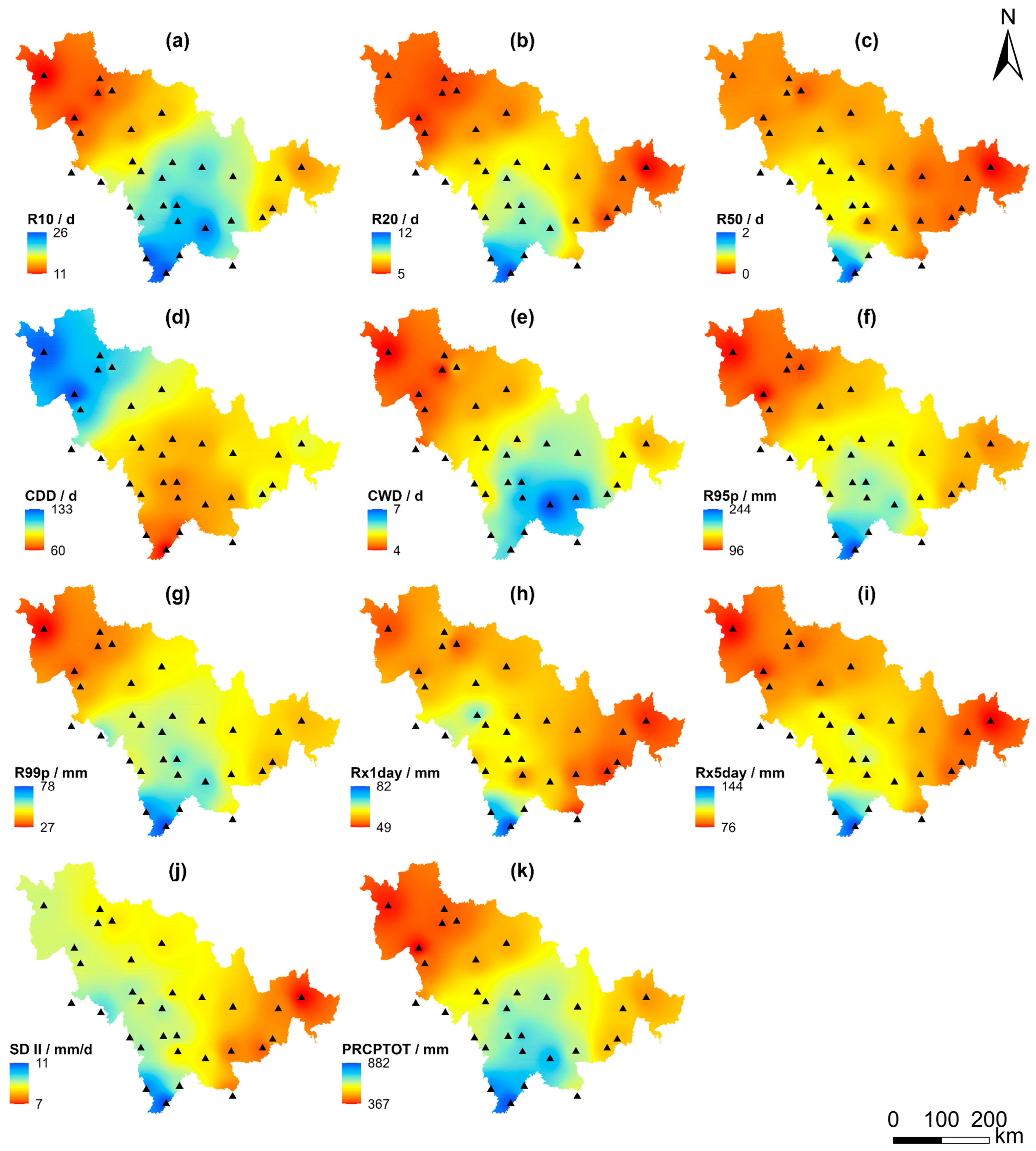
All extreme precipitation indices, with the exception of SD II, exhibited a notable northwest-to-southeast increasing gradient (Figure 5a–i,k). Stations in the northwest, exemplified by Baicheng, consistently displayed the lowest metrics (e.g., R10: 11.2 d; R20: 5.4 d; R95p: 96.4 mm; PRCPTOT: 327.5 mm), while southeastern stations such as Ji’an and Tonghua exhibited the highest values (e.g., R10: 26.1 d at Ji’an; R20: 12.2 d at Tonghua; R95p: 244.1 mm at Ji’an; PRCPTOT: 824.3 mm at Tonghua). Rx1day and Rx5day displayed slight discrepancies, with eastern locations, such as Yanji (Rx1day: 51 mm) and Luozigou (Rx5day: 75.8 mm), recording relatively low values, indicating a more complex spatial arrangement. In contrast, SD II (Figure 5j) demonstrated an increase from east to west, with heightened intensity at western and southwestern stations, including Ji’an (11.1 mm·d−1), Changchun (9.4 mm·d−1), and Baicheng (9.3 mm·d−1), while diminished intensity was noted at eastern stations such as Wangqing (8.0 mm·d−1) and Luozigou (7.5 mm·d−1).
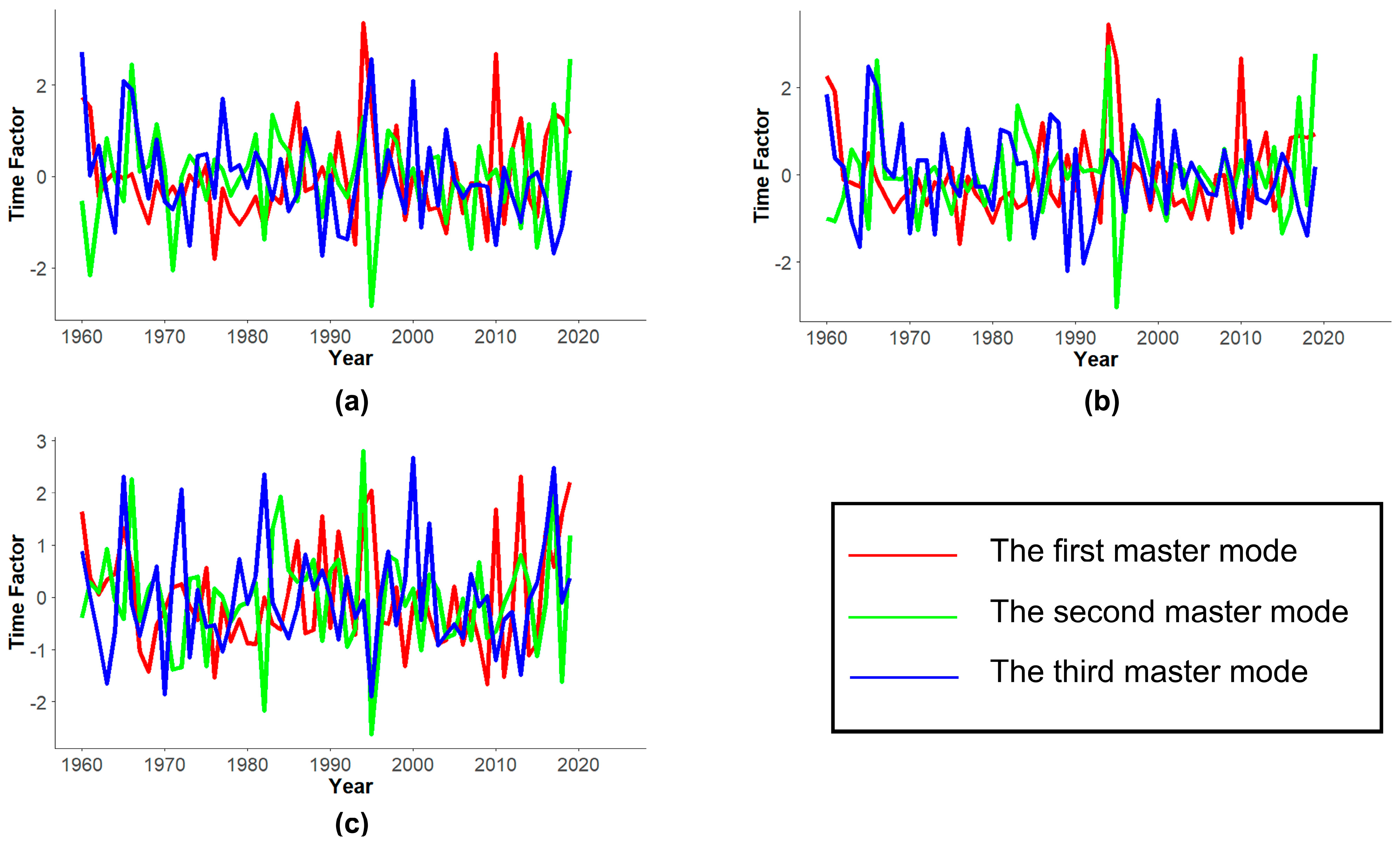
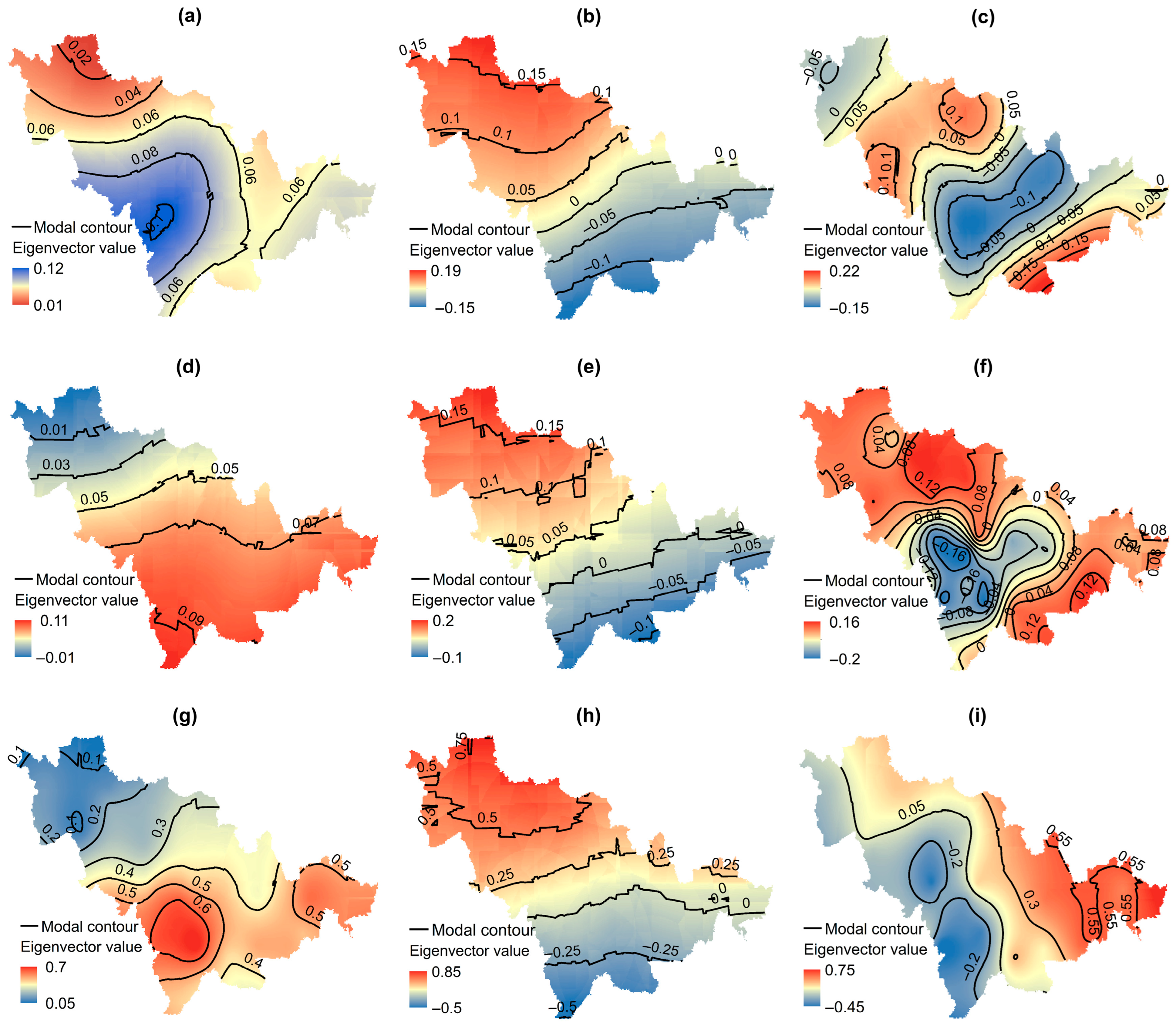
An EOF decomposition of R50, R99p, and Rx5day further analyzed the principal spatial modes (Appendix A Table A2). The cumulative variance contributions of the first three principal components were 36.9%, 36.488%, and 43.225%, respectively. The preliminary mode of all three indices (Figure 6a,d,g) demonstrated heightened precipitation in the central-southern and southern regions, particularly near Liaoyuan, Jilin, and Tonghua. The correlated temporal coefficients (Figure 7a) were predominantly negative from 1960 to 1980 and shifted to positive values after 1990, signifying a prolonged intensification of extreme precipitation in these regions. The second mode (Figure 6b,e,h) exhibited a north–south spatial disparity, with temporal coefficients (Figure 7b) fluctuating consistently between positive and negative values during the study period, indicating alternating dry and wet conditions. The third mode (Figure 6c,f,i) was centered in the southeastern region, with significant fluctuations in time coefficients (Figure 7c) that indicated intense precipitation activity in this area. All three indices exhibited largely consistent spatial patterns across the three modes, implying cohesive large-scale influences on extreme precipitation.

3.4. Analysis of Changes in Extreme Precipitation Indices Under Future Scenarios

3.4.1. Projected Temporal Trends

The extreme precipitation indices forecasted by the CanESM5, MPI-ESM1-2-HR, and FGOALS-g3 models displayed diverse patterns under the SSP2-4.5 and SSP5-8.5 scenarios (Appendix A Table A3, Table A4 and Table A5).
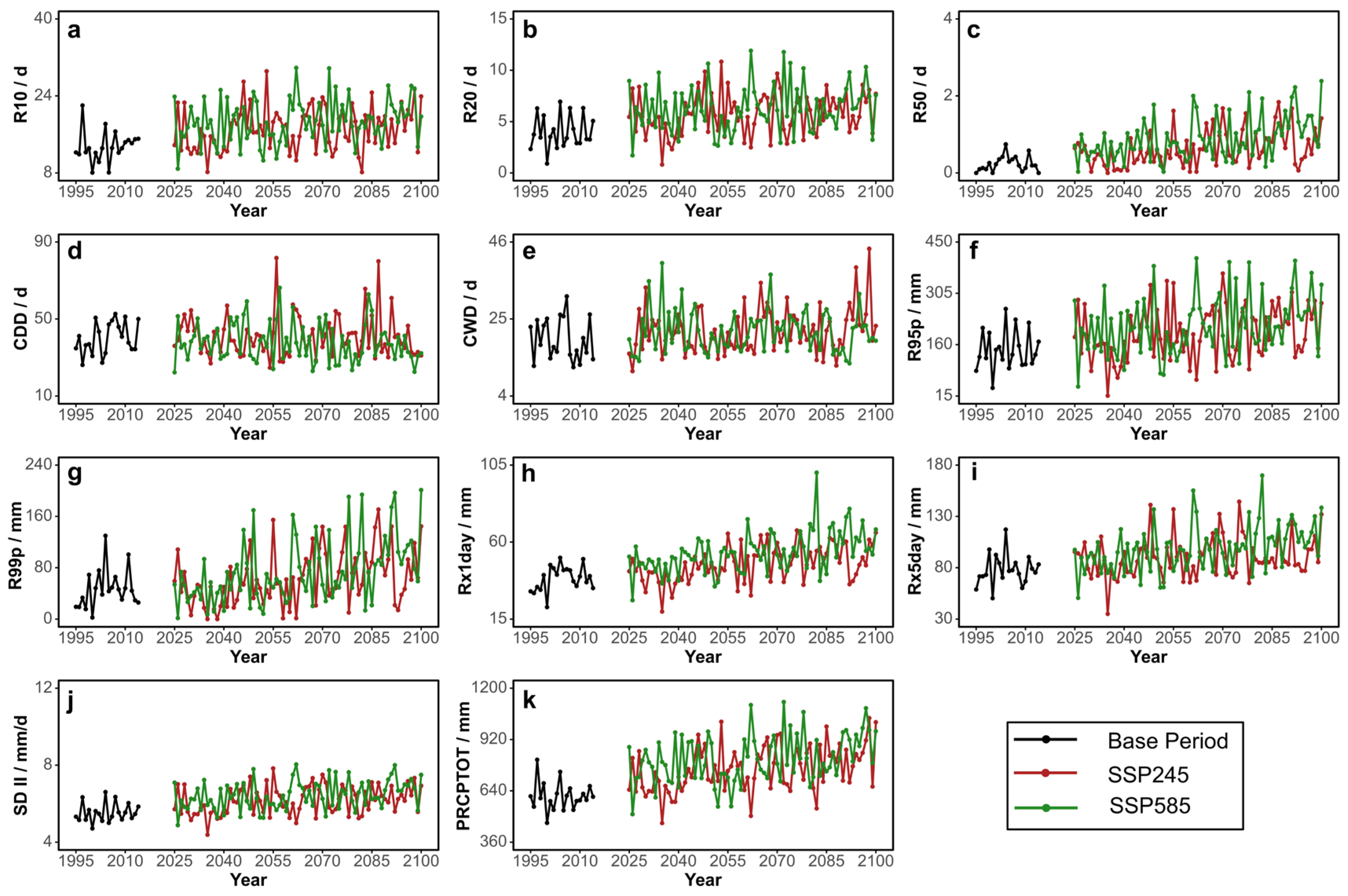
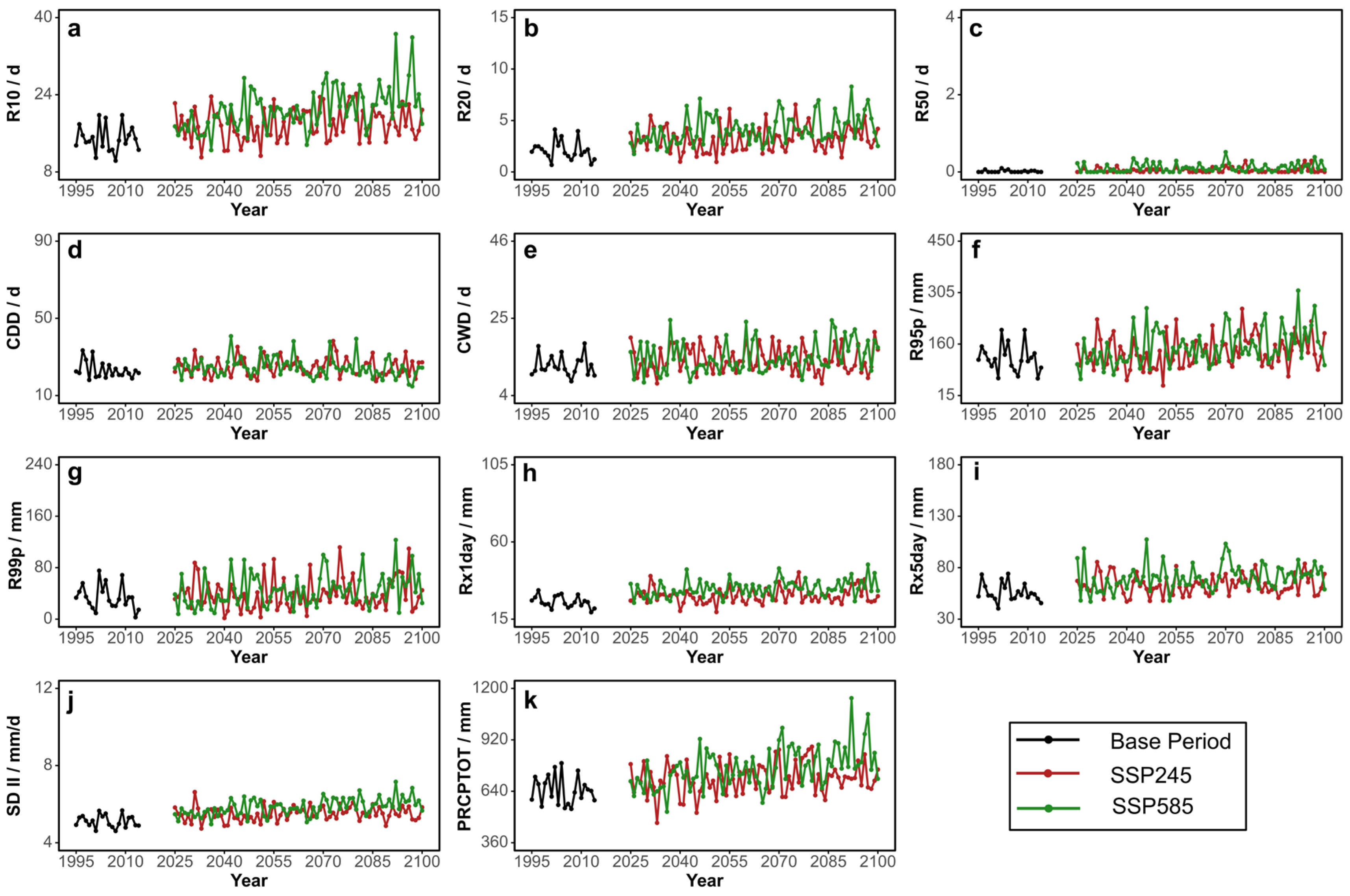
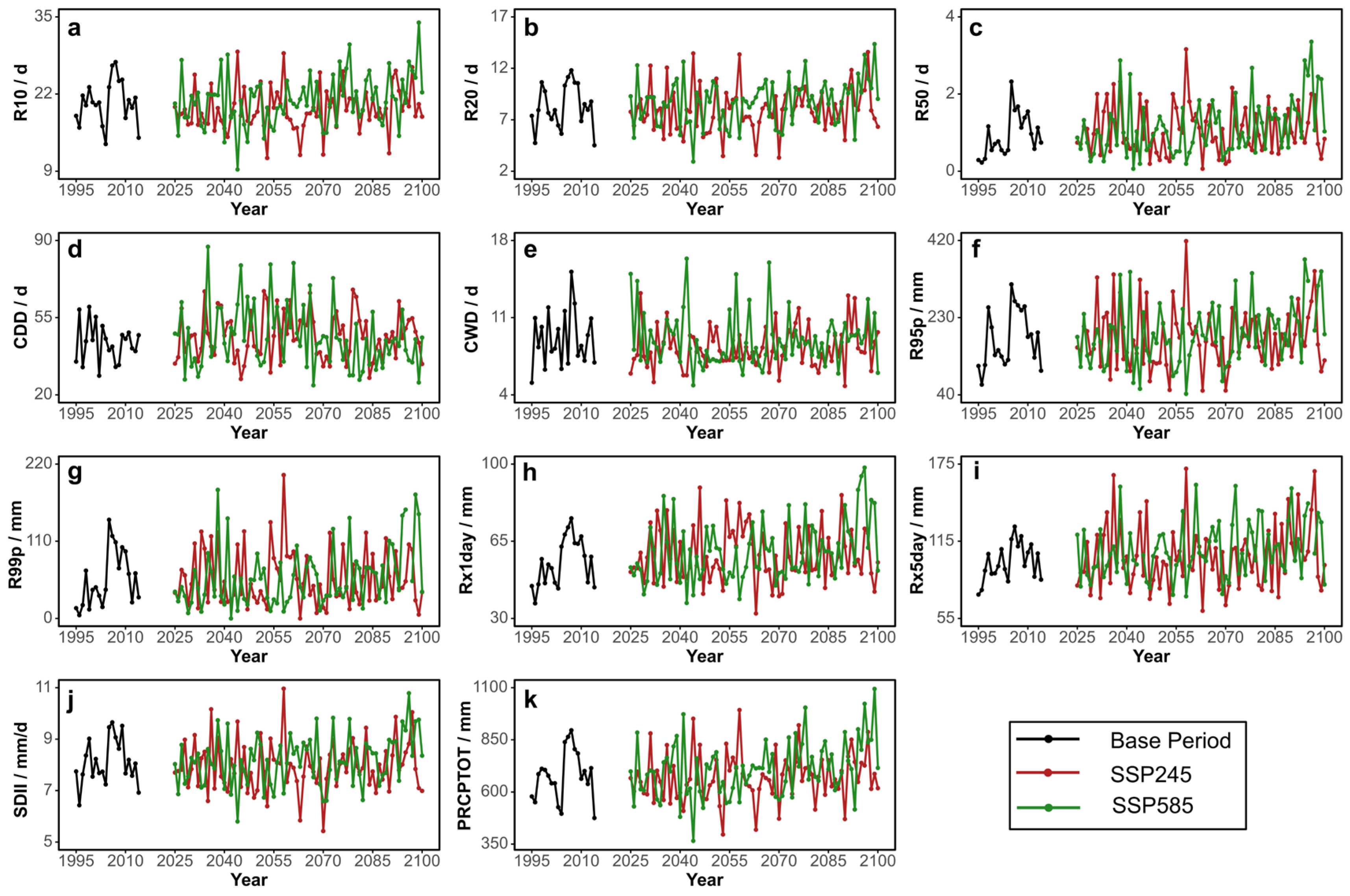
Under SSP2-4.5, the majority of indicators exhibited mild, non-significant trends across all three models. The exception was CanESM5 (Figure 8), where R99p (0.746 mm·(10a)−1, p < 0.001; Figure 8g), Rx1day (0.216 mm·(10a)−1, p < 0.001; Figure 8h), PRCPTOT (2.360 mm·(10a)−1, p < 0.001; Figure 8k), and SD II (0.0095 mm·d−1·(10a)−1, p < 0.05; Figure 8j) exhibited substantial increases. MPI-ESM1-2-HR (Figure 9) and FGOALS-g3 (Figure 10) exhibited inconclusive albeit statistically insignificant trends.
Under the SSP5-8.5 scenario, all three models projected notable increases in precipitation amount indices and SD II. R99p, Rx1day, Rx5day, and PRCPTOT demonstrated statistically significant increases across all models (p < 0.05 to p < 0.001; Figure 8g–i,k, Figure 9g–i,k and Figure 10g–i,k). The trends of PRCPTOT varied from 2.071 to 2.457 mm·(10a)−1, while those of R99p ranged from 0.325 to 1.048 mm·(10a)−1. R95p attained significance in MPI-ESM1-2-HR (0.845 mm·(10a)−1, p < 0.001; Figure 9f) and FGOALS-g3 (1.272 mm·(10a)−1, p < 0.01; Figure 10f) but not in CanESM5. SD II exhibited a substantial rise across all models, varying from 0.010 to 0.013 mm·d−1·(10a)−1 (Figure 8j, Figure 9j and Figure 10j). The frequency indices exhibited model-dependent variations: R10, R20, and R50 generally increased, with notable trends in MPI-ESM1-2-HR (e.g., R10: 0.101 d·(10a)−1, p < 0.001; Figure 9a) and FGOALS-g3 (e.g., R50: 0.012 d·(10a)−1, p < 0.001; Figure 10c), whereas only R50 attained significance in CanESM5 (0.011 d·(10a)−1, p < 0.001; Figure 8c). CWD exhibited a substantial rise solely in MPI-ESM1-2-HR (0.051 d·(10a)−1, p < 0.05; Figure 9e). CDD diminished across all models although did not attain statistical significance (Figure 8d, Figure 9d and Figure 10d).

3.4.2. Projected Spatial Distribution

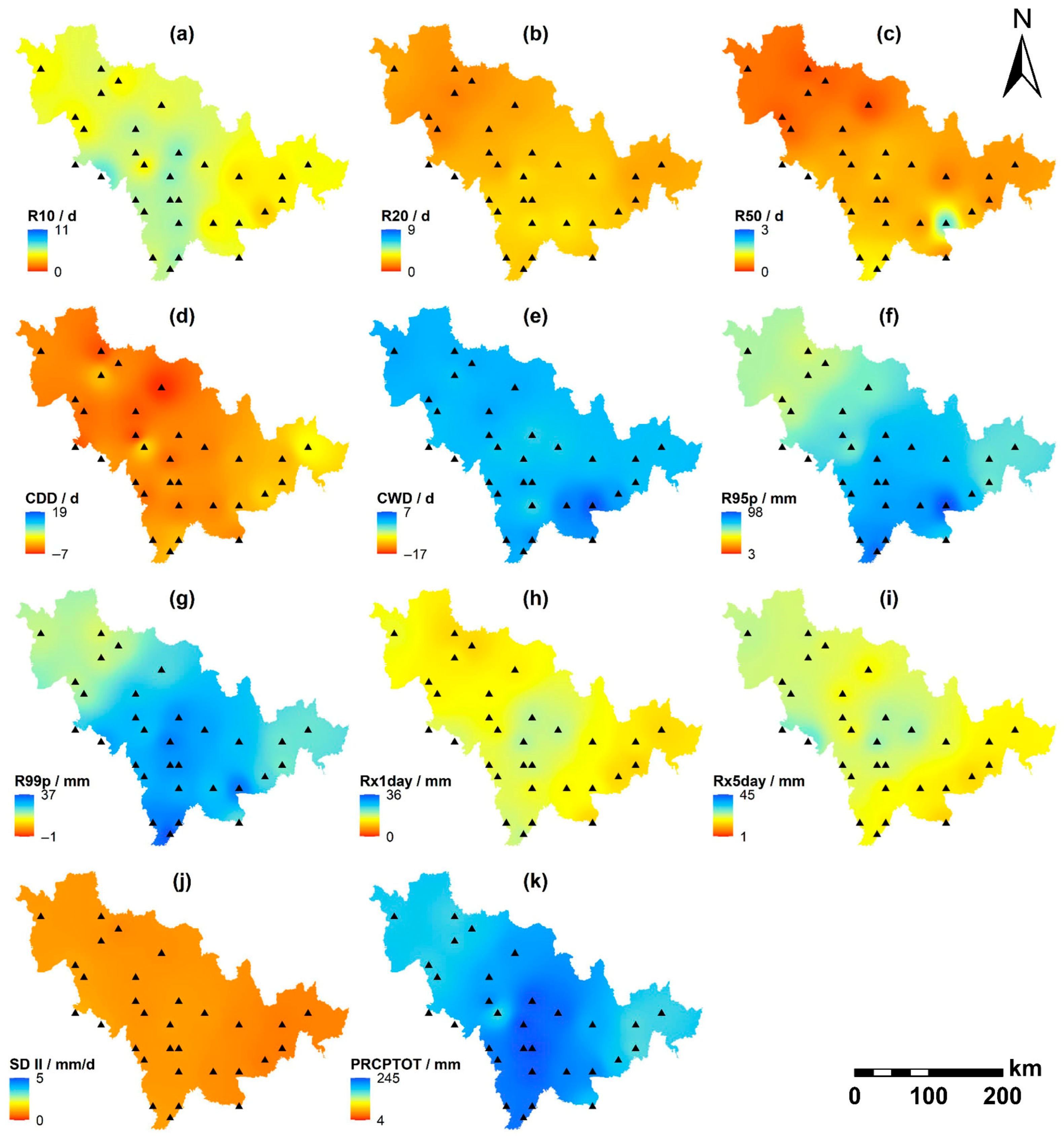
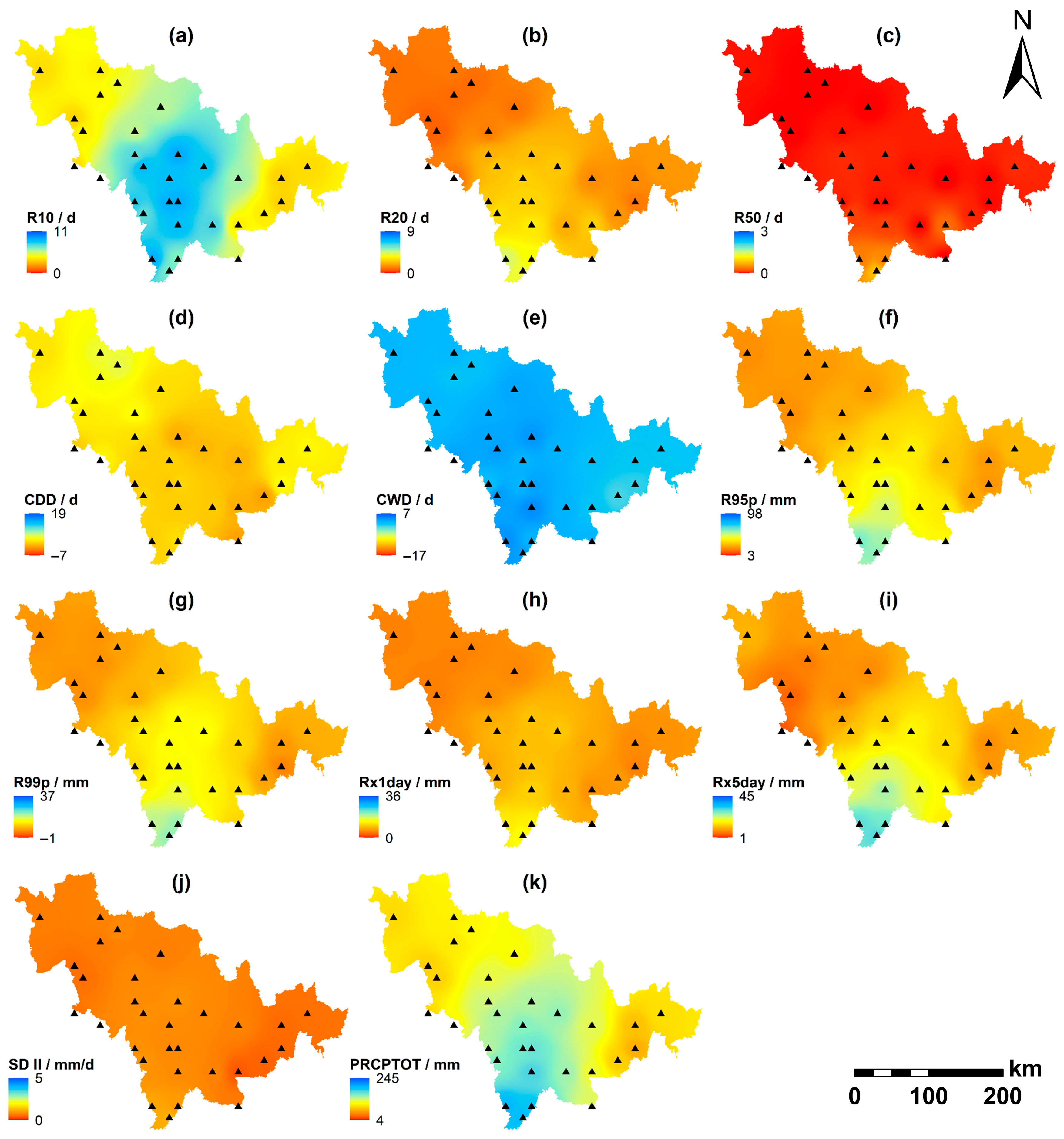
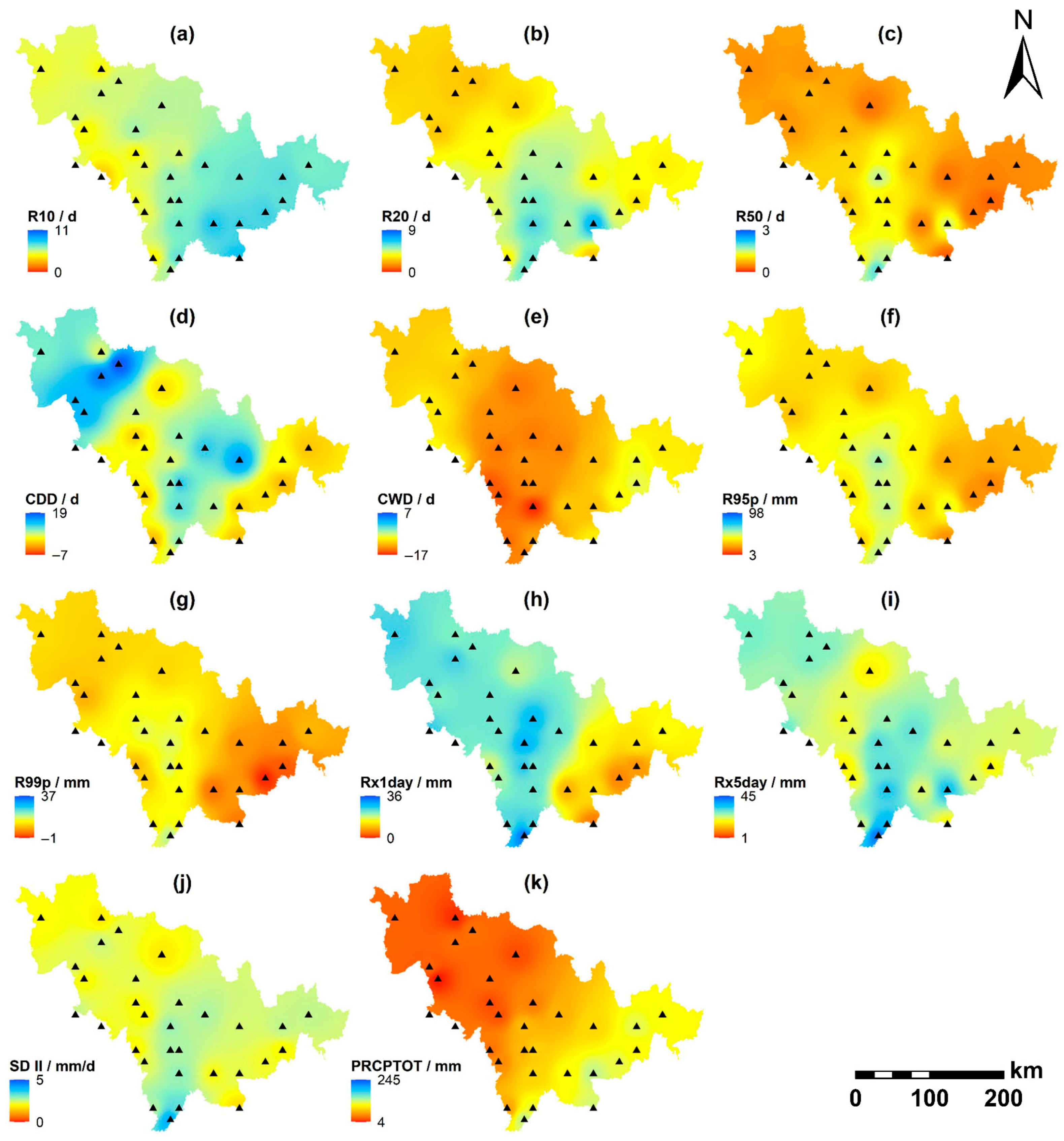
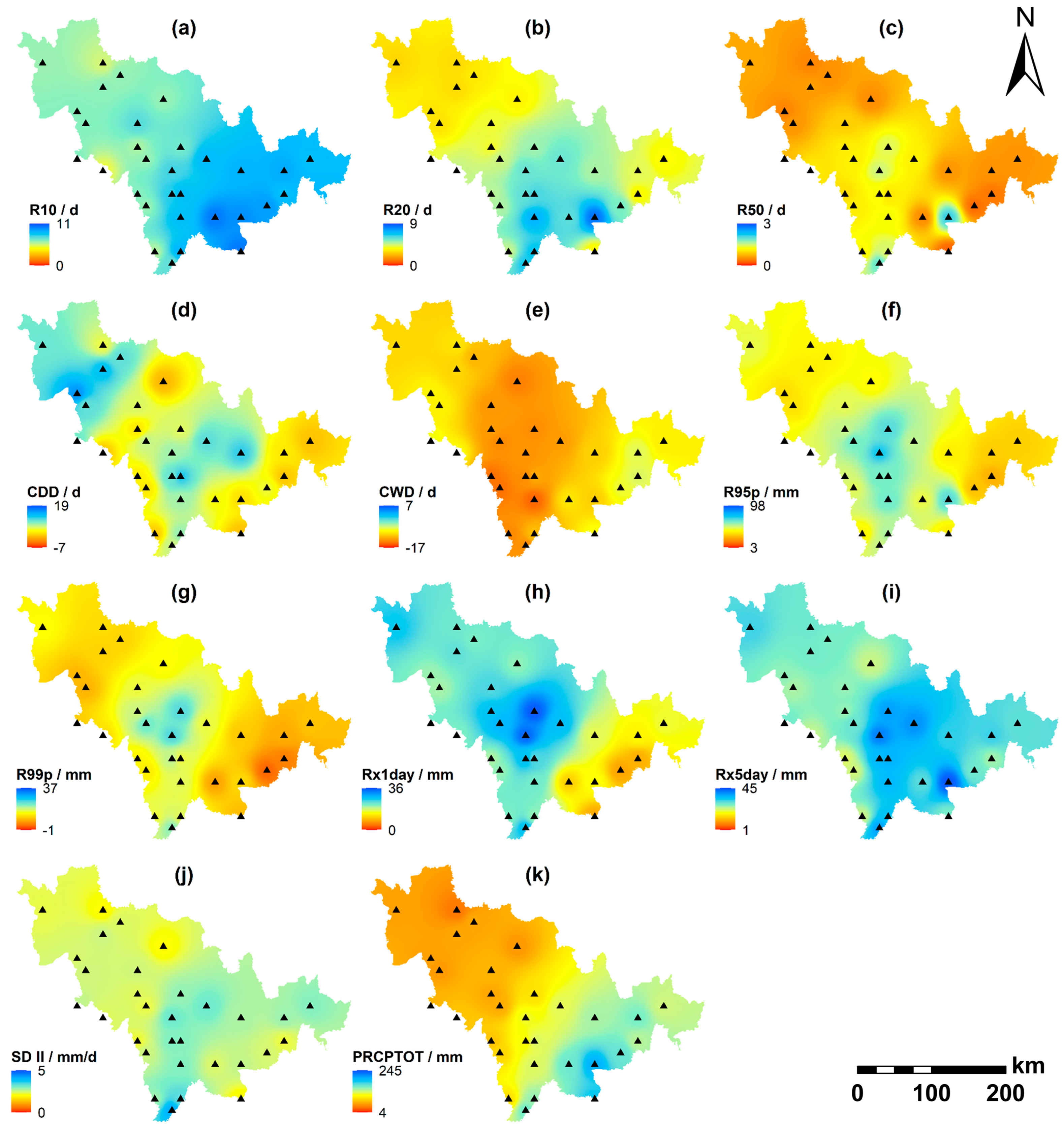
Projected changes relative to the baseline period (1995–2014) were analyzed at grid points corresponding to or nearest to observational stations (Figure 11, Figure 12, Figure 13, Figure 14, Figure 15 and Figure 16).
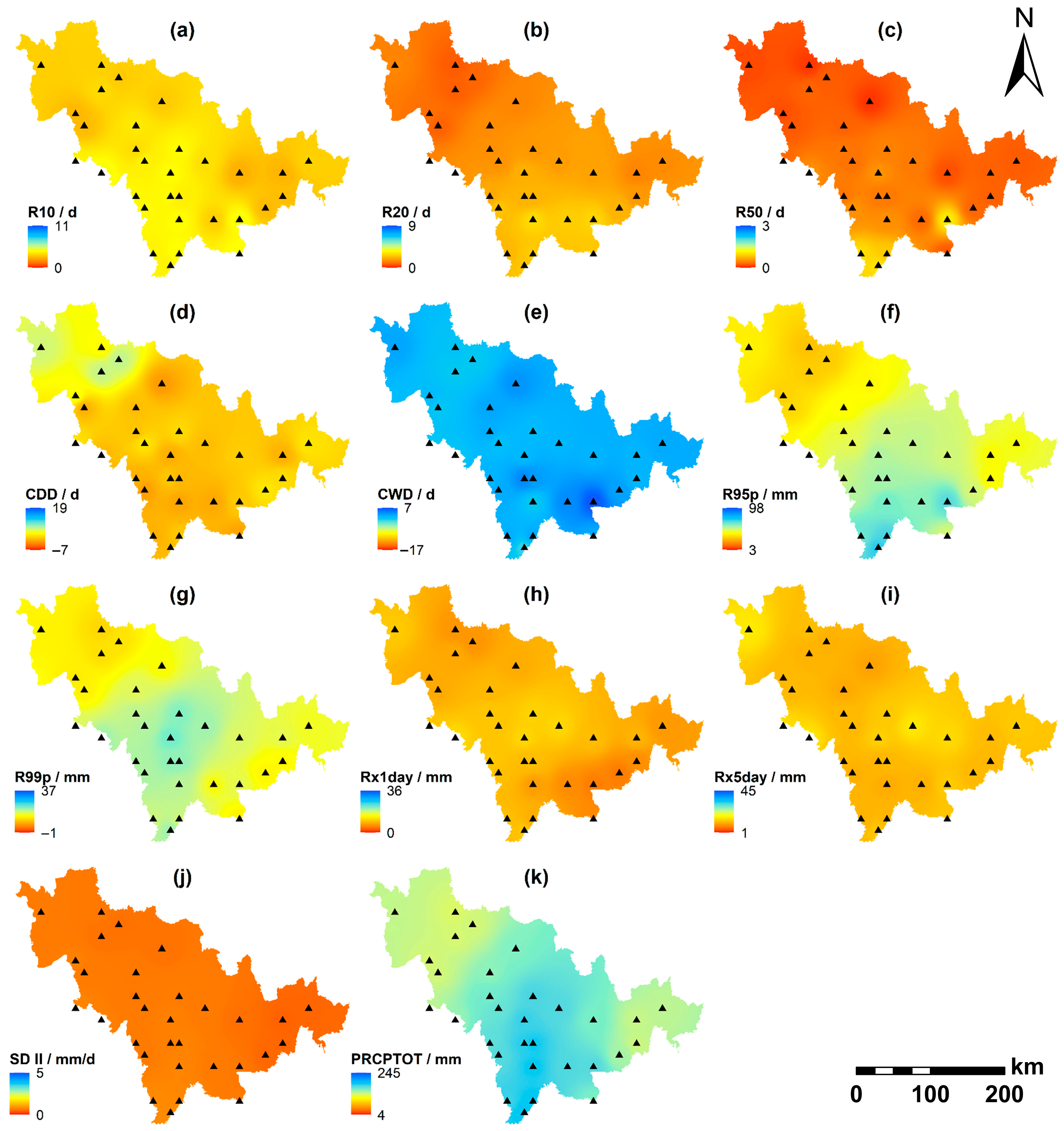
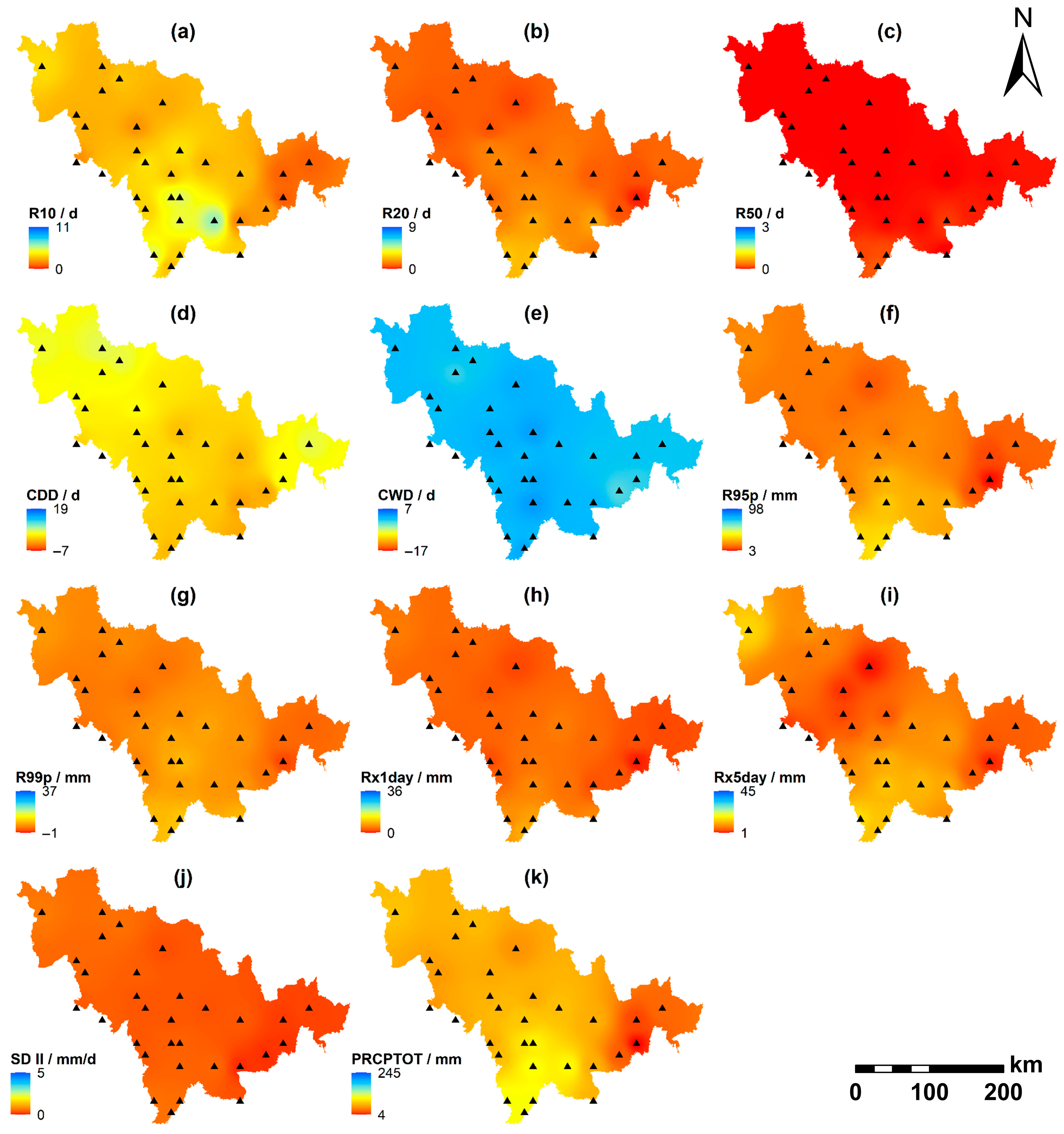
Under SSP2-4.5, the majority of indices exhibited minimal variation with restricted spatial coherence. CanESM5 projected the most significant increases in PRCPTOT, varying from 119.37 mm in Da’an to 183.97 mm in Ji’an (Figure 11k). CWD exhibited notable inter-model divergence: CanESM5 and MPI-ESM1-2-HR projected overall increases, but FGOALS-g3 projected extensive decreases (e.g., Jingyu: −16.37 d) (Figure 11e, Figure 13e and Figure 15e).
Under SSP5-8.5, all models projected more extensive and spatially consistent alterations. The indices of precipitation amounts demonstrated a steady gradient of increase from northwest to southeast. PRCPTOT rises above 230 mm at central and southeastern grid points in CanESM5 (e.g., Huadian: 244.08 mm), 190 mm in MPI-ESM1-2-HR (e.g., Tonghua: 195.78 mm), and 200 mm in FGOALS-g3 (e.g., Erdao: 200.47 mm), while northwestern grid points exhibited lesser increases (Figure 12k, Figure 14k and Figure 16k). CDD decreased more significantly than in SSP2-4.5, with the most pronounced reductions noted in CanESM5 (e.g., Fuyu: −6.28 d; Changchun: −5.37 d) (Figure 12d, Figure 14d and Figure 16d). SD II escalated throughout the province, with elevated values in the southwestern and southeastern regions (e.g., Shuangliao: 1.16 mm·d−1 in CanESM5; Ji’an: 1.18 mm·d−1 in MPI-ESM1-2-HR) (Figure 12j, Figure 14j and Figure 16j). The inter-model disparity in CWD continued: FGOALS-g3 projected extensive reductions (e.g., Jingyu: −14.78 d), whereas CanESM5 and MPI-ESM1-2-HR projected overall increases (Figure 12e, Figure 14e and Figure 16e).
Overall, the precipitation amount indices exhibited a northwest-to-southeast increasing gradient under both scenarios, with the most significant increases occurring in the middle and southeastern regions. SD II exhibited the most significant growth in the southwest and southeast regions. CDD transitioned from model-dependent patterns under SSP2-4.5 to extensive reductions under SSP5-8.5. The most significant inter-model divergence was CWD, with FGOALS-g3 projecting declines, whereas the other two models projected increases.

4. Discussion

4.1. Temporal Evolution Patterns of Extreme Precipitation

From 1960 to 2019, extreme precipitation events in Jilin Province demonstrated a complex and heterogeneous trend. Specifically, both the frequency and total volume of extreme precipitation generally exhibited an upward trend, whereas the intensity of precipitation showed a declining tendency. This pattern was in line with the relationship between inter-decadal variation of summer precipitation in East Asia and the intensity of the Asian summer monsoon [39,40]. The increasing trends were consistent with the Clausius–Clapeyron equation, as global warming enhanced the atmospheric water-holding capacity and the water vapor transport capacity of the East Asian summer monsoon [41,42,43]. The concurrent decreases in SD II and CDD were in accordance with observations across China. After the 1970s, the inter-decadal weakening of the East Asian Summer Monsoon reduced its northward transport capacity, resulting in precipitation becoming more dispersed rather than concentrated [44,45,46]. Comparable trends observed in Heilongjiang Province (1958–2017) reflected common characteristics across Northeast China [47].
The abrupt change in CDD around 1979 was consistent with the inter-decadal transition of the East Asian monsoon in the late 1970s, where enhanced northward movement led to shorter dry spells [45,48]. The transition of SD II around 1975 may have been associated with the AO phase shift from negative to positive. During the positive phase, stable mid-to high latitude westerly circulation inhibited severe convective weather [49,50]. Moreover, AO-driven circulation adjustments could also indirectly affect regional precipitation by modulating the East Asian winter monsoon [51]. The turning point of PRCPTOT around 1982 was attributed to the PDO phase change from cold to warm [52]. Only CDD, SD II, and PRCPTOT showed significant changes, indicating that these indices were more sensitive to climate forcing, while others were more influenced by local factors [45,53].
Wavelet analysis revealed a multi-cycle superposition pattern. The dominant 30–50-year cycles corresponded to PDO transitions [52,54]. The 10–20-year short cycles reflected the effects of the ENSO and solar activity, as warm ENSO events tended to increase summer precipitation through air–sea coupling processes [55,56,57]. The 50–60-year-long cycles were likely related to the AMO, which triggered Rossby wave trains to enhance monsoon water vapor transport. Additionally, the out-of-phase effect between AMO and PDO could amplify inter-decadal precipitation fluctuations [58,59]. SD II exhibited a simpler periodic structure, possibly because precipitation intensity was more sensitive to underlying surface changes, such as grassland degradation in western Jilin and forest coverage changes in eastern Jilin [60].
Furthermore, Antokhina et al. [24] identified a regime shift in circulation patterns associated with extreme precipitation over Eastern Siberia and Mongolia around the late 1990s. This shift was characterized by a transition from subtropical-only PV gradient inversion to simultaneous wave breaking at both subtropical and mid-latitude levels. It was accompanied by enhanced East Asian summer monsoon moisture transport, providing a large-scale dynamic context for the intensification of extreme precipitation observed in Jilin Province after 1990.

4.2. Spatial Distribution Mechanism of Extreme Precipitation

The growing gradient of extreme precipitation from northwest to southeast in Jilin Province is primarily influenced by the combined effects of Changbai Mountains’ morphology and the East Asian Summer Monsoon [61]. Long-term observational data have validated this trend, attributing it to the water vapor movement by monsoon and the topography blocking effect [62]. Numerical simulations indicate that the Changbai Mountains obstruct southerly airflow during summer, resulting in a 26% augmentation of precipitation on the southern windward slopes, such as Tonghua and Ji’an, while producing a rain shadow on the leeward side [63,64]. The anisotropic topography facilitates the ascension of water vapor, leading to frequent orographic precipitation in the southeast and a reduced number of precipitation days in the northwest [65]. This aligns with prior observations in Jilin Province from 1961 to 2015 [66]. The piedmont region functions as a high-frequency zone for summer convective clouds, induced by orographic uplift [67]. A case study of Super Typhoon Maysak demonstrated that the Changbai Mountains augment precipitation via forced uplift, resulting in an increase in severe rainfall by 6.8 mm/h, which constitutes 41% of the total rainfall [67].
The comparatively low values of Rx1day and Rx5day at specific eastern locations are ascribed to inadequate water vapor delivery. This is attributable to their distance from the Sea of Japan and the obstructive influence of local topography, namely the Laoyeling Mountains [53]. The east-to-west gradient of SD II is associated with the thermal disparities of the underlying surface. The western plain grasslands, characterized by little vegetation, underwent accelerated surface warming, leading to brief but intense precipitation events. Conversely, the eastern woodlands demonstrated diminished convective activity. The elevated precipitation intensity in Ji’an is attributable to the synergistic effects of orographic uplift and localized thermal conditions, as the intricate piedmont topography amplifies dynamic uplift and thermal instability [68].
The first mode derived from EOF analysis designates the southern region as the principal area for extreme precipitation variability. The temporal coefficients of this mode turn positive post-1990, signifying an escalation of intense precipitation. Tonghua and Ji’an are classified as high-risk zones [26,69]. The second mode encapsulates the north–south anti-phase variation, illustrating the interannual discrepancies in the northward progression of the summer monsoon [70]. This alternating pattern aligns with the precipitation seesaw mode observed between Mongolia and Eastern Siberia, influenced by the upper-tropospheric Rossby wave configurations and related wave-breaking occurrences. These occurrences result in a significant redistribution of moisture throughout the region [24]. The third mode is centered in the southeast, with increased variations, underscoring the necessity to monitor flood hazards in this region [71].

4.3. Trends and Limitations of Extreme Precipitation in Future Scenarios

All three models exhibited a comparable trend: an increased emission intensity led to a more significant amplification of extreme precipitation. This discovery aligns with studies performed in other areas of China [72,73]. The phenomenon adheres to the Clausius-Clapeyron connection, wherein the augmented water vapor transfer by the East Asian Summer Monsoon [74], in conjunction with the orographic uplift of the Changbai Mountains, collectively exacerbated exceptional precipitation episodes. In the SSP5-8.5 scenario, the extreme precipitation indices were markedly elevated compared to those in the SSP2-4.5 scenario, aligning with the scenario-driven patterns noted in other basins [75,76]. The declining trend in CDD under SSP5-8.5 indicates an intensified water vapor cycle, marked by reduced dry intervals and more intense precipitation events [10,77].
The anticipated regional alterations in extreme precipitation were predominantly aligned with historical trends. Significant increases were noted in grid sites in the central and southeastern regions, reflecting the persistent impact of topography and the monsoon. The highest significant inter-model variation among the extreme precipitation indices was noted in CWD. The FGOALS-g3 model forecasted a broad reduction in CWD, but the CanESM5 and MPI-ESM1-2-HR models anticipated increases. The disparities amongst the models were mainly primarily evident in simulated conservatism under the SSP2-4.5 scenario [78,79]. The CanESM5 model had an earlier response, with multiple indices attaining statistical significance, while only a limited number of indices were significant for the other two models. These inconsistencies align with the inter-model variations observed in the CMIP6 assessments for China [80,81].
While the models identified the principal patterns in extreme precipitation, uncertainties remain. Disparities in feedback mechanisms between CMIP6 models influence forecasts, and multi-model ensemble evaluations can offer more reliable support [10]. Furthermore, elements such as greenhouse gas emissions, urbanization, and alterations in land cover have substantially influenced extreme weather phenomena [82,83,84,85]. Consequently, subsequent study should concentrate on clarifying the impact of human activities on regional extreme climate change.

5. Conclusions

This study comprehensively examined the spatiotemporal characteristics and future projections of extreme precipitation in Jilin Province using observational data (1960–2019) and three CMIP6 models under SSP2-4.5 and SSP5-8.5 scenarios. Over the period from 1960 to 2019, extreme precipitation in Jilin Province exhibited the following characteristics: an increase in frequency and total amount, along with a decrease in intensity. The CDD showed a significant decreasing trend at a rate of −2.184 (d·(10a)−1, p < 0.001), the PRCPTOT increased significantly at a rate of 1.493 (mm·(10a)−1, p < 0.05), while the SD II decreased significantly at a rate of −0.016 (mm·d−1·(10a)−1, p < 0.01). Most of the extreme precipitation indices shared a dominant cycle of 30–50 years. Spatially, a prominent northwest-to-southeast increasing gradient was observed for most of the indices. For instance, the PRCPTOT ranged from 327.5 mm at Baicheng to 824.3 mm at Tonghua.
The future projections for the period from 2025 to 2100 indicated a scenario-dependent intensification of extreme precipitation. Under the SSP5-8.5 scenario, all three models projected significant increases in the precipitation amount indices, PRCPTOT: increasing at a rate of 2.071–2.457 mm·(10a)−1, and the SD II increasing at a rate of 0.010–0.013 mm·d−1·(10a)−1, reversing the historical decreasing trend in intensity. Spatially, the projected changes maintained the northwest-to-southeast gradient, with PRCPTOT increases exceeding 230 mm in the southeast.
However, this study possesses multiple drawbacks. Initially, there exist inter-model discrepancies among the CMIP6 models employed, which may generate errors in the projections. Secondly, potential biases may emerge from the alignment between grid cells and in the models and observation stations. Thirdly, the study did not specifically address the impacts of urbanization. To mitigate these constraints, subsequent study should utilize multi-model ensemble techniques to enhance the reliability of projections and examine the driving mechanisms of extreme precipitation, including the effects of land-use alterations.

Author Contributions

All authors contributed meaningfully to this study. Y.Z. was responsible for the methodology and writing the original draft. Y.J., C.Y. and R.J. conducted the investigation and data curation. W.Z. and W.X. were responsible for funding acquisition and the review and editing of the manuscript. All authors have read and agreed to the published version of the manuscript.

Funding

This research was funded by National Natural Science Foundation of China (U24A20585), and Natural Science Foundation of Jilin Province (20230101274JC).

Data Availability Statement

The data presented in this study are available in China Meteorological Science Data Sharing Service Platform at http://data.cma.cn (accessed on 26 February 2026), and the National Qinghai-Tibet Plateau Science Data Center at http://data.tpdc.ac.cn (accessed on 26 February 2026).

Conflicts of Interest

The authors declare no conflicts of interest.

Appendix A

Table A1. Information for the 31 meteorological stations in Jilin Province and their corresponding CMIP6 grid points.
NumberStation NameStation Latitude (°N)Station Longitude (°E)Grid Latitude
(°N)
Grid Longitude (°E)
50936Baicheng45.37122.4945.375122.375
50945Daan45.3124.1645.375124.125
50948Qianan45124.144.875124.125
50949Qianguo45.05124.5245.125124.625
54041Tongyu44.48123.444.375123.375
54049Changling44.15123.5844.125123.625
54063Fuyu44.5812644.625125.875
54064Nongan44.23125.0944.125125.125
54142Shuangliao43.3123.3143.375123.375
54157Siping43.1124.1943.125124.125
54161Changchun43.54125.1343.625125.125
54165Shuangyang43.33125.3843.375125.375
54169Yantongshan43.18126.0143.125126.125
54172Jilinchengjiao43.52126.3243.625126.375
54181Jiaohe43.42127.243.375127.125
54186Dunhua43.22128.1243.125128.125
54192Luozigou43.42130.1643.375130.125
54195Wangqing43.18129.4743.125129.375
54260Liaoyuan42.55125.0542.625125.125
54263Panshi42.58126.0542.625126.125
54266Meihekou42.32125.3842.375125.375
54273Huadian42.59126.4542.625126.375
54276Jingyu42.24126.4842.125126.375
54284Donggang42.09127.342.125127.375
54285Erdao42.25128.0742.125128.125
54286Helong42.3212942.375128.875
54292Yanji42.52129.342.625129.375
54363Tonghua41.41125.5441.375125.625
54374Linjiang41.48126.5341.375126.375
54377Jian41.09126.1341.125126.125
54386Changbai41.25128.1141.375128.125
Table A2. Cumulative variance contribution rates of the first three principal component eigenvalues for R50, R99p, and Rx5day.
Extreme Precipitation IndexModalEigenvalueCumulative Variance Contribution Rate/%
R5015.89819.027
23.17529.268
32.36636.9
R99p15.68118.325
23.25528.824
32.37636.488
Rx5day16.40720.668
24.26334.421
32.72943.225
Table A3. Statistical Values of the CanESM5 Future Extreme Precipitation Index for Jilin Province.
IndexBaselineSSP245SSP585
Regression ScopeT-Test p-ValueRegression ScopeT-Test p-ValueRegression ScopeT-Test p-Value
R100.0780.5420.0440.0620.0430.068
R200.0290.6550.0160.1180.0160.175
R500.0050.4950.008 ***<0.0010.011 ***<0.001
CDD0.4910.129−0.00070.990−0.0600.253
CWD−0.1630.4800.0630.047−0.0100.727
R95p1.0600.6350.8740.0241.0900.011
R99p1.1090.3570.746 ***<0.0011.048 ***<0.001
Rx1day0.3850.1770.216 ***<0.0010.260 ***<0.001
Rx5day0.3530.5540.1800.0770.459 ***<0.001
SD II0.0120.5440.0095 *<0.050.011 **<0.01
PRCPTOT−0.7960.7972.360 ***<0.0012.071 **<0.01
Notes: “*” indicates that passed the significance level of 95%; “**” the significance level of 99%; “***” the significance level of 99.99%.
Table A4. Statistical Values of the MPI-ESM1-2-HR Future Extreme Precipitation Index for Jilin Province.
IndexBaselineSSP245SSP585
Regression ScopeT-Test p-ValueRegression ScopeT-Test p-ValueRegression ScopeT-Test p-Value
R10−0.0160.8880.0300.0830.101 ***<0.001
R20−0.0340.3600.0080.1910.022 **<0.01
R50−0.00030.7850.00040.2120.00090.119
CDD−0.2500.1390.00060.981−0.0420.117
CWD−0.0180.872−0.0110.5640.051 *<0.05
R95p−1.1450.4640.3880.1010.845 ***<0.001
R99p−0.8770.2510.1210.3410.325 *<0.05
Rx1day−0.2300.0810.0230.3200.071 **<0.01
Rx5day−0.3950.2640.0130.7900.129 *<0.05
SD II−0.0060.6510.0020.1930.010 ***<0.001
PRCPTOT−1.6260.6010.6730.1322.457 ***<0.001
Notes: “*” indicates that passed the significance level of 95%; “**” the significance level of 99%; “***” the significance level of 99.99%.
Table A5. Statistical Values of the FGO-ALS-g3 Future Extreme Precipitation Index for Jilin Province.
IndexBaselineSSP245SSP585
Regression ScopeT-Test p-ValueRegression ScopeT-Test p-ValueRegression ScopeT-Test p-Value
R100.0570.7000.0260.1820.057 *<0.05
R200.0330.7010.0140.2400.026 *<0.05
R500.042 *<0.050.0010.9560.012 ***<0.001
CDD−0.1640.6370.0130.845−0.1390.052
CWD0.0420.6760.0100.280−0.0060.620
R95p3.1290.2580.1680.7381.272 **<0.01
R99p2.8070.066−0.0370.7350.780 ***<0.001
Rx1day0.7610.070−0.0040.8750.221 **<0.01
Rx5day0.9530.0890.1330.3280.333 **<0.01
SD II0.0220.5310.0020.6820.013 *<0.05
PRCPTOT3.1810.5040.6930.2732.088 **<0.01
Notes: “*” indicates that passed the significance level of 95%; “**” the significance level of 99%; “***” the significance level of 99.99%.

References

  1. Fan, X.; Qin, Y.Y.; Gao, X. Interpretation of the main conclusions and suggestions of IPCC AR6 Working Group I Report. Environ. Prot. 2021, 49, 44–48. [Google Scholar] [CrossRef]
  2. Dave, R.; Subramanian, S.S.; Bhatia, U. Extreme precipitation induced concurrent events trigger prolonged disruptions in regional road networks. Environ. Res. Lett. 2021, 16, 104050. [Google Scholar] [CrossRef]
  3. Ma, J.; Wei, K.; Chen, W.; Wang, T.; Shi, D. The southward movement preference of large-scale persistent extreme precipitation events over the Yangtze River Valley during Mei-yu period. Clim. Dyn. 2022, 60, 3729–3747. [Google Scholar] [CrossRef]
  4. Park, T.; Hashimoto, H.; Wang, W.; Thrasher, B.; Michaelis, A.R.; Lee, T.; Brosnan, I.G.; Nemani, R.R. What does global land climate look like at 2 °C warming? Earth’s Future 2023, 11, e2022EF003330. [Google Scholar] [CrossRef]
  5. Qi, Y.M.; Huang, D.Q.; Chen, J.; Zeng, J.W.; Liu, A.Q. Variations and comparisons in hourly and daily precipitation extremes over eastern China in recent warming periods. Int. J. Climatol. 2024, 44, 5192–5206. [Google Scholar] [CrossRef]
  6. Guan, J.Y.; Yao, J.Q.; Li, M.Y.; Li, D.; Zheng, J.H. Historical changes and projected trends of extreme climate events in Xinjiang, China. Clim. Dyn. 2022, 59, 1753–1774. [Google Scholar] [CrossRef]
  7. Wang, Y.J.; Zhou, B.T.; Qin, D.H.; Wu, J.; Gao, R.; Song, L.C. Changes in mean and extreme temperature and precipitation over the Arid Region of Northwestern China: Observation and projection. Adv. Atmos. Sci. 2017, 34, 289–305. [Google Scholar] [CrossRef]
  8. Li, H.T.; Dong, M.Q.; Zhao, J.; Tang, J.; Yang, X.G. Temporal and spatial variations of extreme temperature and precipitation events in the cropping region across Northeast China. Chin. J. Agrometeorol. 2025, 46, 145–156. [Google Scholar] [CrossRef]
  9. Sun, P.; Bian, Y.J.; Yu, S.F.; Yao, R.; Wang, Z.T.; Zhang, Q.; Chen, W.H.; Ge, C.H.; Ma, Z.C.; Du, W.Y. Are longer and more intense heatwaves more prone to extreme precipitation? Glob. Planet. Change 2024, 236, 104428. [Google Scholar] [CrossRef]
  10. Chu, X.L.; Wu, W.; Yang, X.Q.; Wang, H.X. Extreme climate change and future trend prediction in the Tumen River Basin in recent 60 years. Water Resour. Hydropower Eng. 2024, 55, 24–37. (In Chinese) [Google Scholar] [CrossRef]
  11. Gimeno, L.; Sorí, R.; Vázquez, M.; Stojanovic, M.; Algarra, I.; Eiras-Barca, J.; Gimeno-Sotelo, L.; Nieto, R. Extreme precipitation events. WIREs Water 2022, 9, e1611. [Google Scholar] [CrossRef]
  12. Gao, G.; Li, J.Z.; Feng, P.; Liu, J.; Wang, Y.C. How extreme hydrological events correspond to climate extremes in the context of global warming: A case study in the Luanhe River Basin of North China. Int. J. Climatol. 2024, 44, 2391–2405. [Google Scholar] [CrossRef]
  13. Mann, H.B. Nonparametric Tests Against Trend. Econometrica 1945, 13, 245–259. [Google Scholar] [CrossRef]
  14. Kendall, M. Rank Correlation Methods; Griffin, C., Ed.; Springer: London, UK, 1975. [Google Scholar]
  15. Kuang, C.P.; Su, P.; Gu, J.; Chen, W.J.; Zhang, J.L.; Zhang, W.L.; Zhang, Y.F. Multi-time scale analysis of runoff at the Yangtze estuary based on the Morlet Wavelet Transform method. J. Mt. Sci. 2014, 11, 1499–1506. [Google Scholar] [CrossRef]
  16. Li, Y.J.; Lv, H.Q. Effect of agricultural meteorological disasters on the production corn in the Northeast China. Acta Agron. Sin. 2022, 48, 1537–1545. [Google Scholar] [CrossRef]
  17. Shang, S.W.; Wang, L.Z.; Wang, Y.T.; Deng, P.X.; Gai, Y.W.; Jie, S.Q. Analysis of spatial and temporal evolution characteristics of extreme precipitation in Chengdu area from 1960 to 2019. Water Resour. Prot. 2023, 39, 195–204. [Google Scholar] [CrossRef]
  18. Ligas, M.; Lucki, B.; Banasik, P. A crossvalidation-based comparison of kriging and IDW in local GNSS/levelling quasigeoid modelling. Rep. Geod. Geoinformatics 2022, 114, 1–7. [Google Scholar] [CrossRef]
  19. Chen, H.P.; Sun, J.Q.; Lin, W.Q.; Xu, H.W. Comparison of CMIP6 and CMIP5 models in simulating climate extremes. Sci. Bull. 2020, 65, 1415–1418. [Google Scholar] [CrossRef] [PubMed]
  20. Chen, W.; Jiang, D.B.; Wang, X.X. Evaluation and projection of CMIP6 models for climate over the Qinghai-Xizang (Tibetan) Plateau. Plateau Meteorol. 2021, 40, 1455–1469. [Google Scholar] [CrossRef]
  21. Zhang, W.Y.; Sun, X.B.; Lin, Y.; Song, J.; Li, B.; Zhang, M.M.; Li, J.N.; Lv, J.X. Analysis of extreme precipitation and temperature characteristics in Liaoning province from 1991 to 2021 based on ETCCDI indices. J. Meteorol. Environ. 2024, 40, 72–79. (In Chinese) [Google Scholar] [CrossRef]
  22. Yang, J.; Zhang, F.; Zhao, C.L.; Li, M.T.; Zhang, J.Q.; Hao, P.F.; Chen, X.L. Temporal and spatial distribution of maize water profit and loss, drought and flood in Jilin Province from 1981 to 2018. J. Catastrophology 2024, 39, 195–202. [Google Scholar] [CrossRef]
  23. Song, Z.; Sun, C.; Xiao, D.; Dong, M.; Lou, W.; Shi, L. Abrupt vapor pressure deficit changes over Northeast Asia during 1990s linked to combined Mediterranean-Pacific SST shifts. Atmos. Res. 2025, 322, 108124. [Google Scholar] [CrossRef]
  24. Antokhina, O.; Antokhin, P.; Gochakov, A.; Zbirannik, A.; Gazimov, T. Atmospheric Circulation Patterns Associated with Extreme Precipitation Events in Eastern Siberia and Mongolia. Atmosphere 2023, 14, 480. [Google Scholar] [CrossRef]
  25. Berezhnykh, T.V.; Marchenko, O.Y.; Abasov, N.V.; Mordvinov, V.I. Changes in the summertime atmospheric circulation over East Asia and formation of long-lasting low-water periods within the Selenga river basin. Geogr. Nat. Resour. 2012, 33, 223–229. [Google Scholar] [CrossRef]
  26. Liu, C.K.; Chen, D.H.; Guo, G.; Huang, W.Z.; Guo, L.; Shang, K.Z. Analysis on characteristics of summer extreme precipitation events in Jilin Province. J. Catastrophology 2020, 35, 102–108. [Google Scholar] [CrossRef]
  27. Zhang, Y.D.; Guo, E.L.; Wang, Y.F.; Gu, X.L.; Kang, Y. The Effects of Extreme Precipitation Events on Maize Yield in Jilin Province. Chin. Rur. Water Hydropower 2023, 65, 52–61. [Google Scholar] [CrossRef]
  28. Cui, N.B.; Yin, Q.L. Impacts of climate change on grain production in Northeast China and countermeasures. J. Catastrophology 2022, 37, 52–57. [Google Scholar] [CrossRef]
  29. Yu, S.; Zhang, X.L.; Wang, Y.; Shen, Y.J. Review of research on the impacts of climate change on staple grain crops in the three provinces of Northeast China. Chin. J. Eco-Agric. 2024, 32, 970–985. [Google Scholar] [CrossRef]
  30. Ma, Y.F.; Gao, Z.T.; Wu, Y.J.; Wu, D.; Gao, Y.; Xu, X.C. Spatial and temporal evolution of NPP and Its relationship with temperature and precipitation in Jilin Province from 2000 to 2020. Meteorol. Environ. Sci. 2024, 47, 65–74. [Google Scholar] [CrossRef]
  31. Feng, A.L.; Zhang, Q.; Song, J.B.; Wang, G.; Wu, W.H. Spationtemporal characteristics of extreme precipitation in the Yellow River Basin based on CMIP6. J. Beijing Norm. Univ. (Nat. Sci.) 2024, 60, 270–284. [Google Scholar] [CrossRef]
  32. Wang, H.; Xiao, D.P.; Zhao, Y.X.; Bai, H.Z.; Zhang, K.H.; Tang, J.Z.; Liu, J.F.; Guo, F.H.; Liu, D.L. Evaluation and projection of extreme temperature indices in the North China Plain based on CMIP6 Models. Geogr. Geo-Inf. Sci. 2021, 37, 86–94+142. [Google Scholar] [CrossRef]
  33. Devadarshini, E.; Geethalakshmi, V.; McDermid, S.P.; Bhuvaneswari, K.; Mohan Kumar, S.; Sathyamoorthy, N.K.; Senthilnathan, S.; Senthilraja, K.; Anandhi, V. A systematic review of climate downscaling and extremes in Coupled Model Intercomparison Project 6 (CMIP6). Environ. Dev. 2025, 56, 101280. [Google Scholar] [CrossRef]
  34. Yang, W.T.; Sun, J.G.; Kang, Y.T.; Ma, H.L.; Xu, R.Z. Temporal and spatial changes of extreme weather indices in the Loess Plateau. Arid Land Geogr. 2020, 43, 1456–1466. (In Chinese) [Google Scholar] [CrossRef]
  35. Ji, D.; Yuan, Y.; Han, J. Spatial-temporal changes and trend predictions of extreme precipitation events in China. China Rural Water Hydropower 2022, 10, 74–80. [Google Scholar] [CrossRef]
  36. Zhang, Y.X.; Yao, C.H.; Wang, G. Precipitation analysis in Tai’an based on M-K method and SPI index. Haihe Water Resour. 2022, 41, 97–100. [Google Scholar] [CrossRef]
  37. Feng, Y.; Cui, N.B.; Zhao, L.; Gong, D.Z.; Zhang, K.D. Spatiotemporal variation of reference evapotranspiration during 1954–2013 in Southwest China. Quat. Int. 2017, 441, 129–139. [Google Scholar] [CrossRef]
  38. Zhang, Y.Z.; Duan, Y.K.; Guo, C.M.; Peng, G.H. Study on precipitation based on Morlet wavelet in Henan Province during the period of 1951–2012. Yellow River 2015, 37, 25–28. [Google Scholar] [CrossRef]
  39. Ding, Y.H.; Wang, Z.Y.; Sun, Y. Inter-decadal variation of the summer precipitation in East China and its association with decreasing Asian summer monsoon. Part I: Observed evidences. Int. J. Climatol. 2007, 28, 1139–1161. [Google Scholar] [CrossRef]
  40. Pfahl, S.; O’Gorman, P.A.; Fischer, E.M. Understanding the regional pattern of projected future changes in extreme precipitation. Nat. Clim. Change 2017, 7, 423–427. [Google Scholar] [CrossRef]
  41. Allan, R.P.; Soden, B.J. Atmospheric warming and the amplification of precipitation extremes. Science 2008, 321, 1481–1484. [Google Scholar] [CrossRef]
  42. Luo, Y.L.; Li, L.Y.; Johnson, R.H.; Chang, C.-P.; Chen, L.S.; Wong, W.-K.; Chen, J.; Furtado, K.; McBride, J.L.; Tyagi, A.; et al. Science and prediction of monsoon heavy rainfall. Sci. Bull. 2019, 64, 1557–1561. [Google Scholar] [CrossRef] [PubMed]
  43. Yin, J.B.; Guo, S.L.; Gu, L.; Yang, G.; Wang, J.; Yang, Y. Thermodynamic response of precipitation extremes to climate change and its impacts on floods over China. Chin. Sci. Bull. 2021, 66, 4315–4325. [Google Scholar] [CrossRef]
  44. You, Q.L.; Kang, S.C.; Aguilar, E.; Pepin, N.; Flügel, W.-A.; Yan, Y.P.; Xu, Y.W.; Zhang, Y.J.; Huang, J. Changes in daily climate extremes in China and their connection to the large scale atmospheric circulation during 1961–2003. Clim. Dyn. 2010, 36, 2399–2417. [Google Scholar] [CrossRef]
  45. Yang, H.W.; Gong, Z.Q.; Wang, X.J.; Feng, G.L. Analysis of the characteristics and causes of interdecadal changes in the summer extreme precipitation over Eastern China. Chin. J. Atmos. Sci. 2021, 45, 683–696. [Google Scholar] [CrossRef]
  46. Yang, S.L.; Dong, X.X.; Xiao, J.L. The East Asian Monsoon since the Last Glacial Maximum: Evidence from geological records in northern China. Sci. China Earth Sci. 2018, 49, 1169–1181. [Google Scholar] [CrossRef]
  47. Wang, X.N.; Yue, D.P.; Zhao, J.B.; Su, M.; Wang, D.J. Temporal and spatial variations and disaster effect of extreme precipitation from 1958 to 2017 in Heilongjiang Province. Res. Soil Water Conserv. 2020, 27, 138–146. [Google Scholar] [CrossRef]
  48. Qian, W.H.; Fu, J.L.; Zhang, W.W.; Lin, X. Changes in mean climate and extreme climate in China during the last 40 years. Adv. Earth Sci. 2007, 22, 673–684. (In Chinese) [Google Scholar]
  49. Liu, S.; Wang, H.J. Transition of zonal asymmetry of the Arctic Oscillation and the Antarctic Oscillation at the end of 1970s. Adv. Atmos. Sci. 2013, 30, 41–47. [Google Scholar] [CrossRef]
  50. Zhan, N.; Zeng, F.G.; Li, Q.; Xie, M.M.; Hao, R.X.; Pingping, L.; Wen, R.L.; Wang, L.; Sun, Q.; Chu, G.Q. Temperature variability in northeastern China over the Past 2000 Years: Linkages with the Arctic oscillation and solar activity. Quat. Int. 2025, 733–734, 109829. [Google Scholar] [CrossRef]
  51. Han, Q.C.; Zhang, R.H.; Zhou, Z.-Q. Interdecadal shift in the influence of East Asian Winter Monsoon on El Niño: The role of the Arctic Oscillation. J. Clim. 2025, 38, 1769–1778. [Google Scholar] [CrossRef]
  52. Gao, X.Y.; Zheng, F.L.; Hu, W.T.; Zheng, R.H.; Fu, J.X.; Zhang, J.Q.; Liu, G.; Li, Z. Response of spatial and temporal patterns of water erosion dynamic factors to the main atmospheric and oceanic circulation patterns in the Chinese Mollisol region during 1960–2020. J. Soil Water Conserv. 2024, 38, 102–115. [Google Scholar] [CrossRef]
  53. Zhao, S.S.; Chen, X.Y.; Zou, X.K.; Ding, Y.H.; Song, Y.F.; Jiang, Y.D. Spatiotemporal characteristics of extreme continuous precipitation processes in China during 1961–2022. Hydro-Sci. Eng. 2026, 48, 23–33. [Google Scholar] [CrossRef]
  54. Gu, Y.Y.; Zhao, W.J.; Wu, S.Q. Temporal and spatial variations of drought in the Yellow River Basin from 1980 to 2020. Chin. J. Agrometeorol. 2025, 46, 1192–1205. [Google Scholar] [CrossRef]
  55. Meng, X.; Zhang, Y.; Gao, S.Y.; Xu, L.L.; Shan, L.L.; Fan, X.B. Characteristics of midsummer precipitation in Northeast China during the last 60 Years and its relationship with different types EI Niño events. Res. Soil Water Conserv. 2022, 29, 170–178. [Google Scholar] [CrossRef]
  56. Zhang, R.H.; Yin, L.Y.; Gao, C.; Wang, H.N.; Liu, S.Y.; Zhi, H.; Chen, L.; Kang, X.B.; Yu, Y.Q.; Song, Z.Y.; et al. A review of progress in coupled ocean-atmosphere model developments for ENSO studies: Taking three coupled general circulation models in China as an example. Oceanol. Limnol. Sin. 2025, 56, 475–501. [Google Scholar] [CrossRef]
  57. Zhang, X.L.; Ma, Y.X. Progresses of El Niño and Southern Oscillation research. Chin. Sci. Bull. 2024, 69, 1047–1057. [Google Scholar] [CrossRef]
  58. Jiang, D.B.; Si, D.; Miao, J.P. Impacts of Atlantic Multidecadal Oscillation on the East Asian climate: A Review. Chin. J. Atmos. Sci. 2024, 48, 261–272. [Google Scholar] [CrossRef]
  59. Yang, L.P.; Wu, Q.G.; Hu, Y.T.; Aixue, H. A Comparison on the contributions of interdecadal SST variability over the Pacific and North Atlantic Oceans to regional and seasonal trends of Antarctic Sea Ice from 1979 to 2014. Chin. J. Atmos. Sci. 2025, 49, 814–834. [Google Scholar] [CrossRef]
  60. Li, Y.H.; Wang, W.J.; Fei, L.; Su, R.G.G.; Sun, H.C.; Zhang, J.; Ba, S.J. Spatial-temporal variations and driving factors of ecosystem services in western Jilin Province. Chin. J. Ecol. 2025, 44, 240–249. [Google Scholar] [CrossRef]
  61. Li, B.D.; Zhou, X.; Zhao, Z.J.; Wang, J.H.; Wang, S.G.; Shang, K.Z.; Li, P. Change features of different types and grades of precipitation event in Northeast China in recent 50 years. Plateau Meteorol. 2013, 32, 1414–1424. (In Chinese) [Google Scholar] [CrossRef]
  62. Wu, J.H.; Sheng, Z.L.; Du, J.Q.; Zhang, Y.C.S.; Zhang, J. Spatiotemporal change patterns of temperature and precipitation in Northeast China from 1956 to 2017. Res. Soil Water Conserv. 2021, 28, 340–347+415. [Google Scholar] [CrossRef]
  63. He, B.H.; Sun, J.Q.; Yu, E.T.; Wang, H.J.; Zhang, M.Q.; Hua, W. Simulation study on the influence of the Great Khingan Strip and Changbai Mountain on summer rainfall in Northeast China. Clim. Enviromental Res. 2020, 25, 268–280. (In Chinese) [Google Scholar] [CrossRef]
  64. Wang, L.; Miao, G.Q.; Liu, X.H. Analysis of heavy rain affected by topography in Jilin Province. Hydrology 2000, 45, 52–54. [Google Scholar] [CrossRef]
  65. Liang, L.; Ai, W.X.; Yang, X.D.; Zhao, L.Q. Research on the terrain characteristics of Changbai Mountain and their impact on precipitation and wind distribution. Atmosphere 2024, 15, 272. [Google Scholar] [CrossRef]
  66. Ren, J.Q.; Guo, C.M.; Liu, Y.X.; Wang, L.W.; Li, Q. Spatiotemporal change characteristics of extreme precipitation indices in Jilin Province from 1961 through 2015. J. Glaciol. Geocryol. 2017, 39, 1004–1011. [Google Scholar] [CrossRef]
  67. Wang, J.Y.; Wang, Z.Y.; Cong, Y.C.; Jia, F.N.; Zhang, T. Analysis on characteristics of extreme short-term heavy precipitation in mountainous areas of the eastern Jinlin Province. Meteorol. Hydrol. Mar. Instrum. 2024, 41, 91–95. [Google Scholar] [CrossRef]
  68. Chi, J.; Zhou, Y.S.; Ran, L.K.; Zhou, K.; Shen, X.Y. Numerical simulation analysis on the generation and evolution of the dynamic and thermodynamic processes of an extreme rainfall in Jilin Province. Chin. J. Atmos. Sci. 2021, 45, 1400−1414. [Google Scholar] [CrossRef]
  69. Dong, W.; Liu, H.F.; Zhu, Y.X. Characteristic analysis of summer extreme precipitation events in Jilin Province. J. Nat. Disasters 2012, 21, 69–75. [Google Scholar] [CrossRef]
  70. Huang, S.J.; Li, X.Z.; Wen, Z.P. Interannual variation of Northern Edge of Summer monsoon in Eastern China: Zonal discrepancies and impact factors. Chin. J. Atmos. Sci. 2019, 43, 1068–1080. [Google Scholar] [CrossRef]
  71. Gao, S.Y.; Zhao, T.T.; Song, L.L.; Bai, H.; Xu, L.L.; Li, R.H.; Meng, X. Transporting characteristics of snowstorm water vapor over Liaoning Province in winter. J. Glaciol. Geocryol. 2020, 42, 439–446. [Google Scholar] [CrossRef]
  72. Ao, X.; Zhai, Q.F.; Zhao, C.Y.; Cui, Y.; Geng, S.J.; Yu, Y.Q.; Zhou, X.Y.; Li, J.W. Projected changes of extreme precipitation in Liaohe River Basin at global warming levels of 1.5 °C and 2.0 °C. J. Meteorol. Environ. 2023, 39, 69–79. (In Chinese) [Google Scholar] [CrossRef]
  73. Tang, Z.F.; Yang, T.; Chen, X.C.; Li, X.X.; Lin, X.; He, F.; Wen, Z.Z. Simulation and prediction of future extreme precipitation in Fujian province under SSPs scenarios. J. Meteorol. Environ. 2023, 30, 26–36. [Google Scholar] [CrossRef]
  74. Ling, S.N.; Chen, W.; Lu, R.Y.; Gao, Z.T. Interannual variation of summer rainfall at the Tianchi Station in the Changbai Mountains and its associated circulation anomalies. Chin. J. Atmos. Sci. 2021, 45, 499–512. [Google Scholar] [CrossRef]
  75. Cao, X.; Ru, N.; Dong, Z.Q.; Ma, C.H.; Liu, H.; Hu, H.C. Analysis of spatial and temporal evolution characteristics of history and future precipitation in the Yalu River Basin. J. China Inst. Water Resour. Hydropower Res. 2024, 22, 601–611. [Google Scholar] [CrossRef]
  76. Liu, J.H.; Yuan, X.S.; Li, Y.M.; Li, X.X. Spatio-temporal characteristics of extreme precipitationin the Ili River Basin based on CMIP6. Arid Land Geogr. 2025, 48, 1329–1341. [Google Scholar] [CrossRef]
  77. Shu, Z.K.; Li, W.X.; Zhang, J.Y.; Jin, J.L.; Xue, Q.; Wang, Y.T.; Wang, G.Q. Historical changes and future trends of extreme precipitation and high temperature in China. Chin. J. Eng. Sci. 2022, 24, 116–125. [Google Scholar] [CrossRef]
  78. Huang, Z.L.; Wu, X.F.; Mao, J.Y. An evaluation for impacts of the horizontal resolution of CMIP6 models on simulating extreme summer rainfall over Southwest China. Plateau Meteorol. 2021, 40, 1470–1483. (In Chinese) [Google Scholar] [CrossRef]
  79. Wu, J.; Xia, J.; Zeng, S.D.; Liu, X.; Fan, D. Evaluation of the performance of CMIP6 models and future changes over the Yangtze River Basin. Resour. Environ. Yangtze Basin 2023, 32, 137–150. (In Chinese) [Google Scholar] [CrossRef]
  80. Wang, Y.; Li, H.X.; Wang, H.J.; Sun, B.; Chen, H.P. Evaluation of CMIP6 model simulations of extreme precipitation in China and comparison with CMIP5. Acta Agron. Sin. 2021, 79, 369–386. [Google Scholar] [CrossRef]
  81. Zhou, J.Y.; Lu, H.; Yang, K.; Jiang, R.J.; Yang, Y.; Wang, W.; Zhang, X.J. Projection of China’s future runoff based on the CMIP6 mid-high warming scenarios. Sci. China Earth Sci. 2023, 66, 528–546. [Google Scholar] [CrossRef]
  82. Gu, X.H.; Zhang, Q.; Li, J.F.; Singh, V.P.; Sun, P. Impact of urbanization on nonstationarity of annual and seasonal recipitation extremes in China. J. Hydrol. 2019, 575, 638–655. [Google Scholar] [CrossRef]
  83. Lin, L.J.; Gao, T.; Luo, M.; Ge, E.J.; Yang, Y.J.; Liu, Z.; Zhao, Y.Q.; Ning, G.C. Contribution of urbanization to the changes in extreme climate events in urban agglomerations across China. Sci. Total Environ. 2020, 744, 140264. [Google Scholar] [CrossRef] [PubMed]
  84. Min, S.-K.; Zhang, X.B.; Zwiers, F.W.; Hegerl, G.C. Human contribution to more-intense precipitation extremes. Nature 2011, 470, 378–381. [Google Scholar] [CrossRef]
  85. Wu, L.Y.; Zhang, J.Y.; Dong, W.J. Vegetation effects on mean daily maximum and minimum surface air temperatures over China. Chin. Sci. Bull. 2011, 56, 900–905. [Google Scholar] [CrossRef]
Figure 1. Geographic location of Jilin Province and distribution of meteorological stations.
Water 18 00820 g001
Figure 2. Time-series trend of extreme precipitation indices in Jilin Province from 1960 to 2019. (Among them, (a) is R10, (b) is R20, (c) is R50, (d) is CDD, (e) is CWD, (f) is R95p, (g) is R99p, (h) is Rx1day, (i) is Rx5day, (j) is SD II, and (k) is PRCPTOT).
Water 18 00820 g002
Figure 3. Results of Mann–Kendall significance test for extreme precipitation indices in Jilin Province from 1960 to 2019. (Among them, (a) is R10, (b) is R20, (c) is R50, (d) is CDD, (e) is CWD, (f) is R95p, (g) is R99p, (h) is Rx1day, (i) is Rx5day, (j) is SD II, and (k) is PRCPTOT).
Water 18 00820 g003
Figure 4. Wavelet real part contour map of extreme precipitation indices in Jilin Province from 1960 to 2019. (Among them, (a) is R10, (b) is R20, (c) is R50, (d) is CDD, (e) is CWD, (f) is R95p, (g) is R99p, (h) is Rx1day, (i) is Rx5day, (j) is SD II, and (k) is PRCPTOT).
Water 18 00820 g004
Figure 5. Spatial variation trends of extreme precipitation indices in Jilin Province from 1960 to 2019. (Among them, (a) is R10, (b) is R20, (c) is R50, (d) is CDD, (e) is CWD, (f) is R95p, (g) is R99p, (h) is Rx1day, (i) is Rx5day, (j) is SD II, and (k) is PRCPTOT). Black triangles indicate meteorological stations.
Water 18 00820 g005
Figure 6. Spatial distribution modes of the first three principal components for R50, R99p, and Rx5day. (Among them, (a) is the first principal mode of R50, (b) is the second principal mode of R50, (c) is the third principal mode of R50, (d) is the first principal mode of R99p, (e) is the second principal mode of R99p, (f) is the third principal mode of R99p, (g) is the first principal mode of Rx5day, (h) is the second principal mode of Rx5day, and (i) is the third principal mode of Rx5day).
Water 18 00820 g006
Figure 7. Temporal coefficients of the first three principal component distribution modes for R50, R99p, and Rx5day. (Among them, (a) is R50, (b) is R99p, (c) is Rx5day).
Water 18 00820 g007
Figure 8. Temporal variation trends of extreme precipitation indices in Jilin Province under the CanESM5 model from 2025 to 2100. (Among them, (a) is R10, (b) is R20, (c) is R50, (d) is CDD, (e) is CWD, (f) is R95p, (g) is R99p, (h) is Rx1day, (i) is Rx5day, (j) is SD II, and (k) is PRCPTOT).
Water 18 00820 g008
Figure 9. Temporal variation trends of extreme precipitation indices in Jilin Province under the MPI-ESM1-2-HR model from 2025 to 2100. (Among them, (a) is R10, (b) is R20, (c) is R50, (d) is CDD, (e) is CWD, (f) is R95p, (g) is R99p, (h) is Rx1day, (i) is Rx5day, (j) is SD II, and (k) is PRCPTOT).
Water 18 00820 g009
Figure 10. Temporal variation trends of extreme precipitation indices in Jilin Province under the FGOALS-g3 model from 2025 to 2100. (Among them, (a) is R10, (b) is R20, (c) is R50, (d) is CDD, (e) is CWD, (f) is R95p, (g) is R99p, (h) is Rx1day, (i) is Rx5day, (j) is SD II, and (k) is PRCPTOT).
Water 18 00820 g010
Figure 11. Spatial distribution of changes in Jilin Province from 2025 to 2100 compared to the baseline period under the SSP245 scenario of the CanESM5 model. (Among them, (a) is R10, (b) is R20, (c) is R50, (d) is CDD, (e) is CWD, (f) is R95p, (g) is R99p, (h) is Rx1day, (i) is Rx5day, (j) is SD II, and (k) is PRCPTOT). Black triangles indicate the grid points corresponding to meteorological stations.
Water 18 00820 g011
Figure 12. Spatial distribution of changes in Jilin Province from 2025 to 2100 compared to the baseline period under the SSP585 scenario of the CanESM5 model. (Among them, (a) is R10, (b) is R20, (c) is R50, (d) is CDD, (e) is CWD, (f) is R95p, (g) is R99p, (h) is Rx1day, (i) is Rx5day, (j) is SD II, and (k) is PRCPTOT). Black triangles indicate the grid points corresponding to meteorological stations.
Water 18 00820 g012
Figure 13. Spatial distribution of changes in Jilin Province from 2025 to 2100 compared to the baseline period under the SSP245 scenario of the MPI-ESM1-2-HR model. (Among them, (a) is R10, (b) is R20, (c) is R50, (d) is CDD, (e) is CWD, (f) is R95p, (g) is R99p, (h) is Rx1day, (i) is Rx5day, (j) is SD II, and (k) is PRCPTOT). Black triangles indicate the grid points corresponding to meteorological stations.
Water 18 00820 g013
Figure 14. Spatial distribution of changes in Jilin Province from 2025 to 2100 compared to the baseline period under the SSP585 scenario of the MPI-ESM1-2-HR model. (Among them, (a) is R10, (b) is R20, (c) is R50, (d) is CDD, (e) is CWD, (f) is R95p, (g) is R99p, (h) is Rx1day, (i) is Rx5day, (j) is SD II, and (k) is PRCPTOT). Black triangles indicate the grid points corresponding to meteorological stations.
Water 18 00820 g014
Figure 15. Spatial distribution of changes in Jilin Province from 2025 to 2100 compared to the baseline period under the SSP245 scenario of the FGOALS-g3 model. (Among them, (a) is R10, (b) is R20, (c) is R50, (d) is CDD, (e) is CWD, (f) is R95p, (g) is R99p, (h) is Rx1day, (i) is Rx5day, (j) is SD II, and (k) is PRCPTOT). Black triangles indicate the grid points corresponding to meteorological stations.
Water 18 00820 g015
Figure 16. Spatial distribution of changes in Jilin Province from 2025 to 2100 compared to the baseline period under the SSP585 scenario of the FGOALS-g3 model. (Among them, (a) is R10, (b) is R20, (c) is R50, (d) is CDD, (e) is CWD, (f) is R95p, (g) is R99p, (h) is Rx1day, (i) is Rx5day, (j) is SD II, and (k) is PRCPTOT). Black triangles indicate the grid points corresponding to meteorological stations.
Water 18 00820 g016
Table 1. Definition of extreme precipitation index.
Indicator NameIndexDefinitionUnits
Number of heavy precipitation daysR10Annual count of days with RR ≥ 10 mmdays
Number of very heavy precipitation daysR20Annual count of days with RR ≥ 20 mmdays
Number of extreme heavy precipitation daysR50Annual count of days with RR ≥ 50 mmdays
Consecutive dry daysCDDMaximum number of consecutive days with RR < 1 mmdays
Consecutive wet daysCWDMaximum number of consecutive days with RR ≥ 1 mmdays
Very wet daysR95pTotal annual precipitation from days with RR > 95th percentilemm
Extreme wet daysR99pTotal annual precipitation from days with RR > 99th percentilemm
Max 1-day precipitation amountRx1dayAnnual maximum 1-day precipitation amountmm
Max 5-day precipitation amountRx5dayAnnual maximum 5-day precipitation amountmm
Simple precipitation intensity indexSD IIThe ratio annual total wet-day precipitation to the number of wet daysmm/day
Annual total wet-day precipitationPRCPTOTTotal annual precipitation from days with RR ≥ 1 mmmm
Table 2. Statistical values of extreme precipitation index characteristics in Jilin Province from 1960 to 2019.
IndexRegression ScopeT-Test p-ValueMK z-ValueMK TrendsMK p-ValuePoint of ChangeYear
R100.030.1240.8740.382
R200.0130.2420.9380.348
R500.0030.2951.0780.281
CDD−2.184 ***<0.001−6.002 ***<0.00111979
CWD−0.0010.748−0.5290.597
R95p0.3080.3770.6440.519
R99p0.1680.3741.1930.233
Rx1day0.0210.7650.7210.471
Rx5day−0.0130.911−0.7330.463
SD II−0.016 **<0.01−2.417 *<0.0511975
PRCPTOT1.493 *<0.051.8180.069111982
Notes: “*” indicates that passed the significance level of 95%; “**” the significance level of 99%; “***” the significance level of 99.99%. ↑ indicates an increasing trend, and ↓ indicates a decreasing trend.
Disclaimer/Publisher’s Note: The statements, opinions and data contained in all publications are solely those of the individual author(s) and contributor(s) and not of MDPI and/or the editor(s). MDPI and/or the editor(s) disclaim responsibility for any injury to people or property resulting from any ideas, methods, instructions or products referred to in the content.