Spatiotemporal Evolution and Key Factors of Coupling Coordination Between Water Ecological Carrying Capacity and Urbanization Quality: A Case Study of Hubei Province in the Yangtze River Economic Belt


Abstract
1. Introduction
2. Materials and Data Resources
2.1. Study Area
2.2. Data Resources
3. Research Methods
3.1. Establishment of Index System
3.1.1. Index System for UQ
- (1)
- Demographic Urbanization (DE). The degree of population and innovation capacity, which are fundamental driving forces for regional development [1]. Proportion of urban population (DE1) indicates the level of population agglomeration in urban areas. College students (per 10,000 people) (DE2) and invention patents (per 10,000 people) (DE3) represent the innovation potential and technological advancement capacity of a region, which are critical for sustainable development [24,26].
- (2)
- Economic Urbanization (EC). Economic development plays a crucial role in urbanization by creating job opportunities, improving infrastructure, and attracting investment. It drives migration from rural to urban areas, as people seek better their living standards and employment prospects. Per capita GDP (E1) is adopted to represent the overall economic development level [27,28,29]. The Theil index (E2) reflects the balance and rationality of the economy [24,30,31]. To evaluate market vitality and the upgrading process of the industrial structure—key determinants of urbanization quality—the consumer market activity index (E3) and high-tech industry proportion in GDP (E4) are selected [24,32,33].
- (3)
- Infrastructure Urbanization (IF). Some scholars argue that regional infrastructure development should be reflected from two dimensions: physical infrastructure construction and soft infrastructure development [33]. Therefore, for infrastructure urbanization, we consider dimensions such as cultural facility development, urban air quality levels, and food supply stability levels. The public library collection size (per 10,000 people) (IF1) represents the cultural infrastructure level [32,33]. The urban air quality composite index (IF2) reflects environmental infrastructure quality [34,35,36]. Per capita staple food production (IF3) is chosen to evaluate food security, which provides essential support for residents’ well-being [29].
- (4)
- Social Urbanization (SO). This dimension reflects the social security system and public health service level, which are important guarantees for residents’ quality of life [4,32]. Health technicians (per 10,000 people) (SO1) serves as a critical indicator for assessing a city’s public health level, as it directly determines the accessibility, quality, and equity of medical services. The proportion of urban residents in elderly care insurance (SO2) [21,37] and per capita government expenditure (SO3) represent social security coverage and government investment in public services [25,38]. These indicators reflect the levels of social welfare and protection.
- (5)
- City–Countryside Coordination Urbanization (CC). Empirical studies confirm that both income inequality and financial development have significant ecological effects [39]. Thus, it is necessary to incorporate equity indicators into research. City–countryside coordination is crucial for achieving comprehensive regional development. The urban–rural resident balance (C1), city–countryside registered resident population (C2), primary distribution of income ratio (C3), and per capita rural resident medical expenditure (C4) are adopted to evaluate the coordination level between urban and rural development, which helps to reduce regional disparities and promote equitable development [14,31,37,39].
3.1.2. Index System for WECC
- (1)
- Driver (D). This subsystem reflects the stress on water resource consumption and aquatic ecosystem disturbances resulting from human activities [6]. Water consumption per unit of GDP (D1) and electricity consumption per unit of GDP (D2) represent the resource utilization efficiency and consumption pressure [4,40,41]. Caught Per Unit Effort (D3) is a core indicator in fishery assessments; more fish caught per unit of effort indicates a greater abundance of fish in the water [41,42,43].
- (2)
- Pressure (P). Pressure is the direct exertion of force to alter environmental conditions. Per capita water consumption (P1) and per capita aquatic product yield (P2) indicate the direct pressure on water resources [10,16,19]. Per capita industrial wastewater discharge (P3) and the pollution monitoring exceedance rate (P4) are selected to evaluate the pollution pressure on aquatic ecosystems [41].
- (3)
- State (S). State indicates changes in the physical, chemical, or biological conditions of water resources and aquatic ecosystem. Per capita water resources (S1) and the water yield modulus (S2) [29,43,44,45] represent the water resource availability. Invasive alien species (S3) and the fish species number (S4) indicate the biodiversity status. Total nitrogen (S5) [24,43,46], total phosphorus (S6) [17,19], and the pH in water (S7) are adopted to reflect the water quality status, as these are critical indicators for assessing aquatic ecosystem health [43,46].
- (4)
- Impact (I). This criterion reflects the ecological consequences and biological responses resulting from environmental pressures on aquatic ecosystems. The dissolved oxygen saturation status in water (I1) represents the fundamental condition for aquatic life [43,46]. The proportion of fish-eating fish (I2) and the Shannon–Wiener index of fish (I3) are selected to evaluate the fish community structure and ecosystem functioning, which indicate the overall impact on aquatic biodiversity and ecosystem stability [43,47]. River water quality (I4) indicators measure the health of a river, determining its safety for ecosystems and humans [39].
- (5)
- Response (R). This criterion reflects the management measures and policy interventions implemented to protect water resources and restore aquatic ecosystems [4]. Water consumption per industrial value added (R1) represents the improvement in water use efficiency [48,49]. The energy intensity reduction rate per unit GDP (R2) reflects the efforts to reduce environmental pressures through technological advancement [26]. Government environmental protection expenditure (R3) is adopted to evaluate the investment in environmental governance and restoration, which demonstrates a commitment to aquatic ecosystem protection and sustainable water resource management [4,21].
3.2. Improved TOPSIS
- (1)
- Data Normalization
- (2)
- Entropy Calculation
- (3)
- AHP Method
- (4)
- CRITIC method
- (5)
- Integrated Weighting Approach
3.3. Coupling Coordination Degree Model
- (1)
- Coupling Degree Model
- (2)
- Comprehensive Development Index
- (3)
- CCD Model
3.4. Spatial Autocorrelation Analysis
3.4.1. Global Moran’s I
3.4.2. Local Moran’s I
3.5. Key Factor Analysis Method
3.5.1. Grey Relational Analysis
3.5.2. Spatial Durbin Model
4. Results and Discussion
4.1. Temporal Evolution of UQ and WECC
4.2. Spatial Variation in UQ and WECC
4.3. Spatial–Temporal Variations in CCD
4.4. Identification of Key Factors for CCD
4.4.1. Grey Relational Analysis of Key Factors Influencing CCD
4.4.2. Mechanism Analysis of Key Factors Influencing CCD
5. Conclusions
- (1)
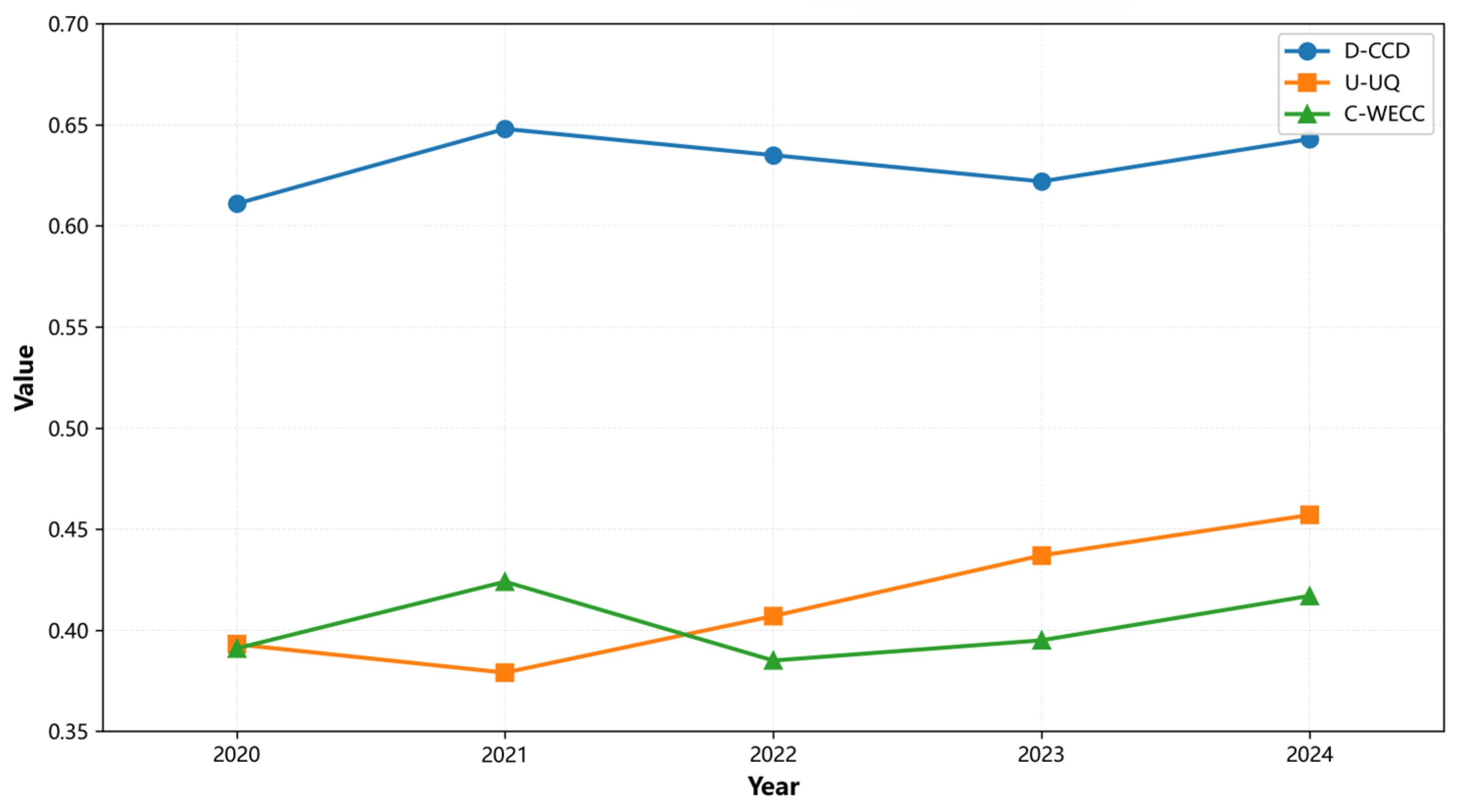
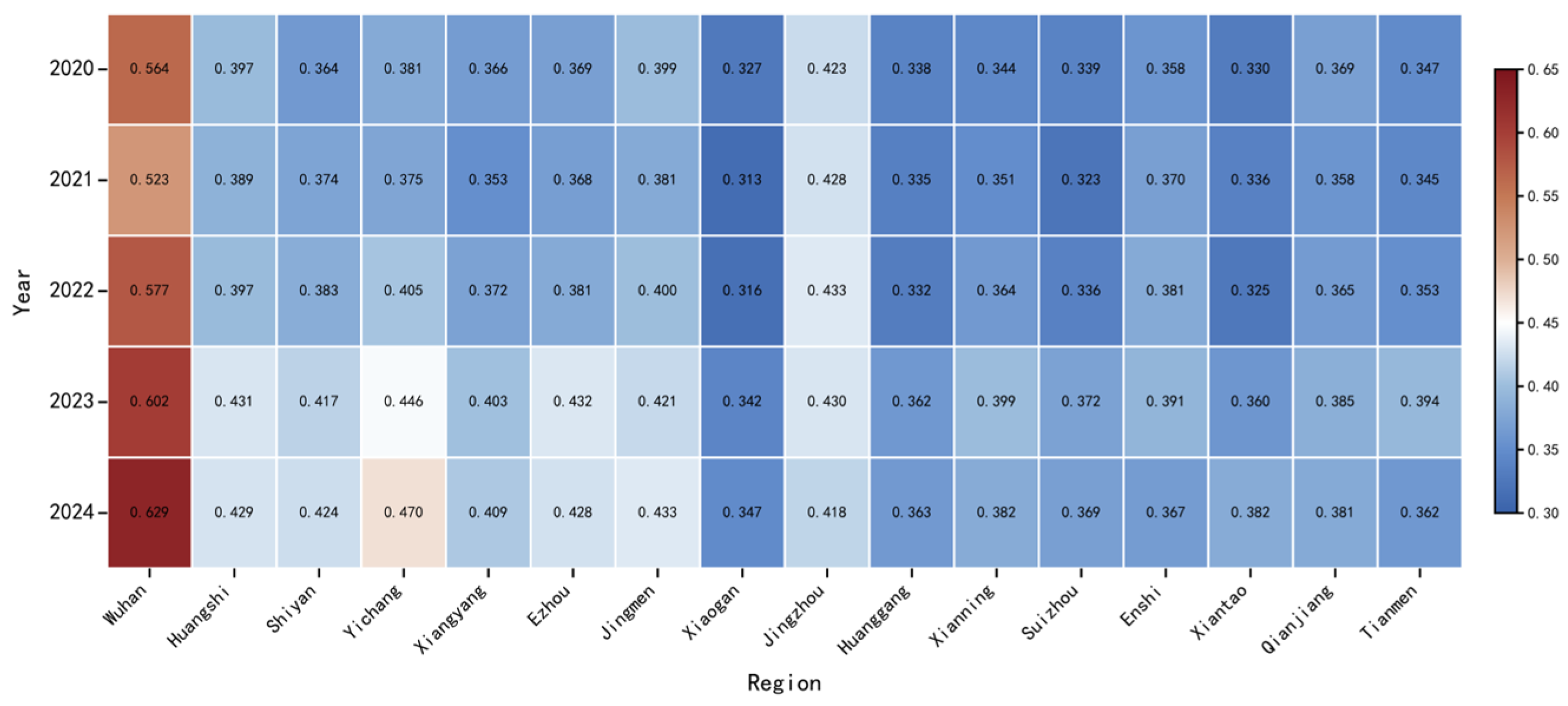
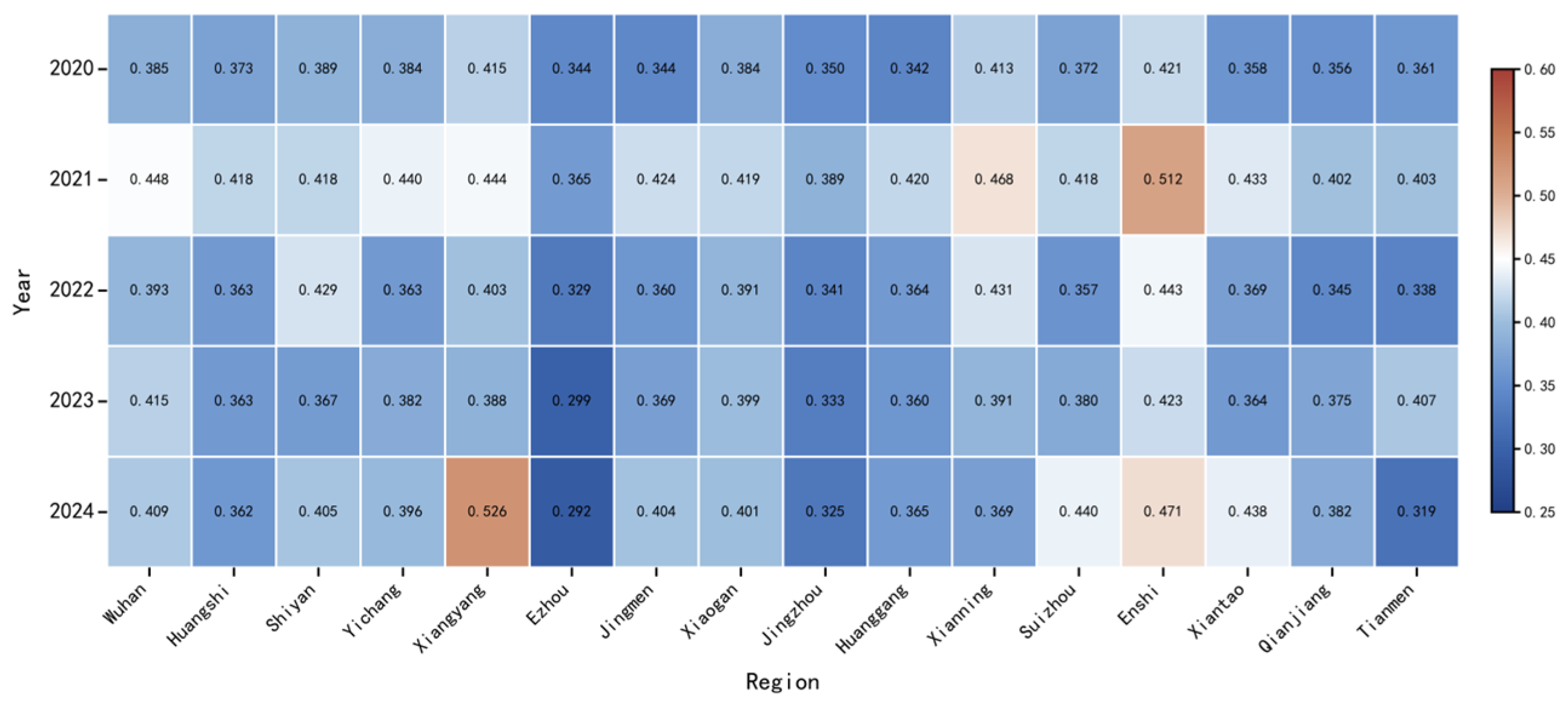
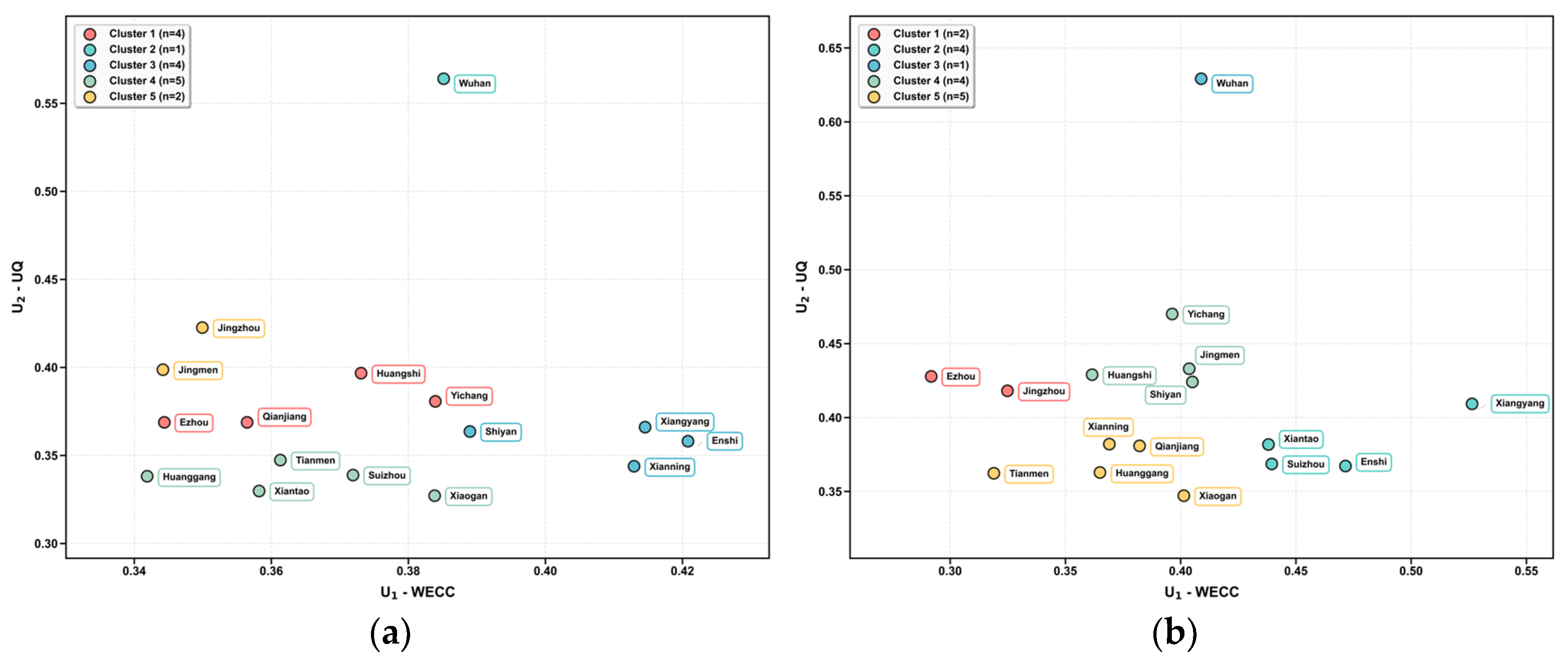
- Hubei Province exhibits a dual-track, divergent evolution in both UQ and WECC over time. UQ steadily increased from 0.369 in 2020 to 0.409 in 2024. Wuhan remained the absolute leader and further widened its gap with other cities, showing spatial disparities that first narrowed and then widened. WECC showed a fluctuating trend consisting of “first rising, then declining, and then rising again”. Other cities showed insufficient coordination between two systems. In other words, although the future development momentum will continue, the regional divergence trend will be enhanced.
- (2)
- The spatial distribution of UQ and WECC in Hubei Province exhibits a pronounced “core–periphery” clustering effect and a gradient differentiation pattern. The Global Moran’s I analysis shows that there is a significant positive spatial correlation between the two systems. The Local Moran’s I analysis results show that Wuhan has formed a network connecting surrounding prefecture-level cities, Xiangyang–Yichang forms the second growth pole, and the cities on Jianghan Plain form an “L-L” aggregation depression.
- (3)
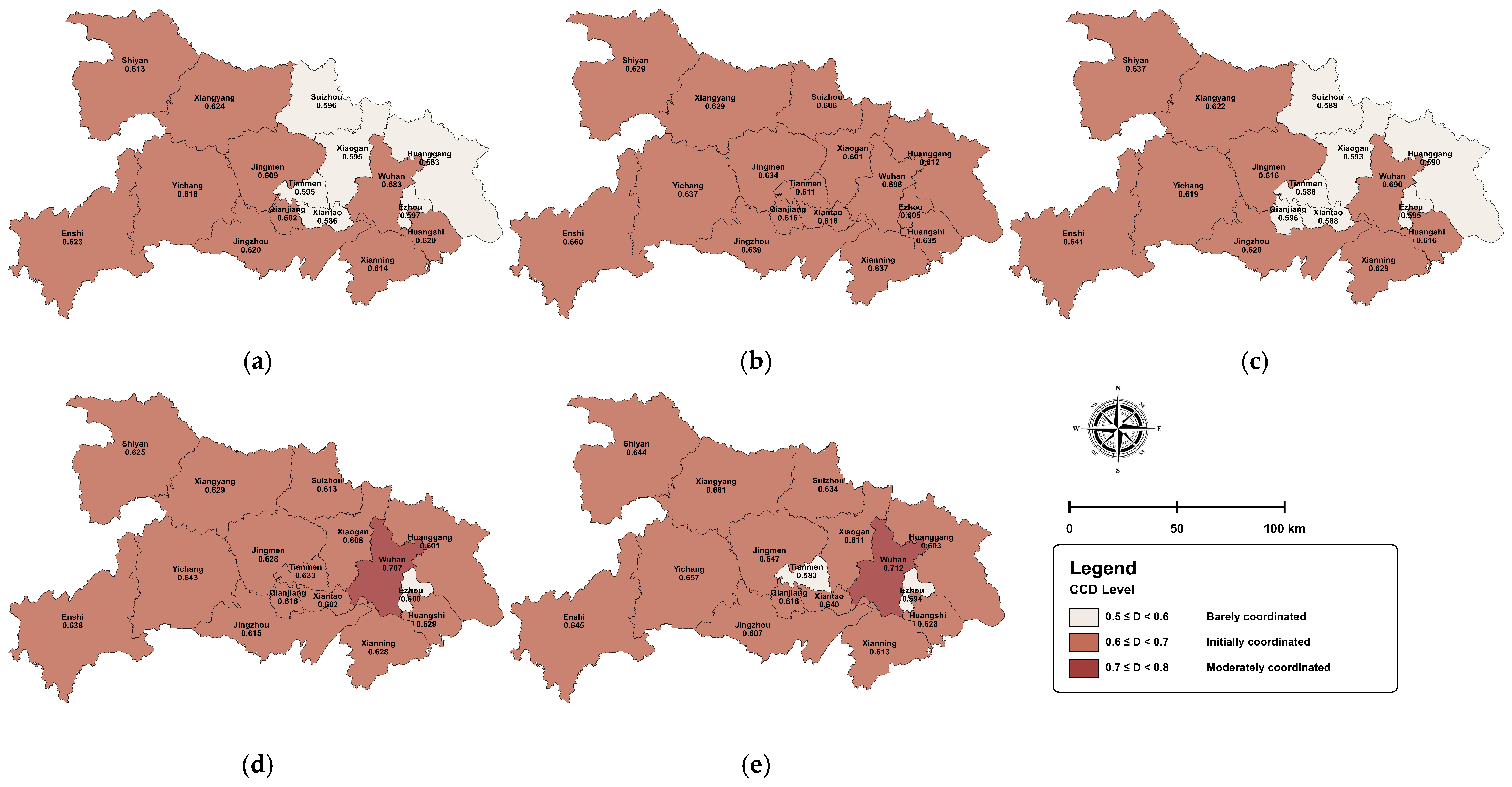
- The CCD between UQ and WECC in Hubei Province remains at the initially coordinated stage, while steadily advancing toward the moderately coordinated stage. Hubei’s CCD rose from 0.626 in 2020 to 0.661 in 2024. Wuhan was the first city to enter the moderately coordinated stage, and the CCD for 81.25% of the cities indicate that they are in the initially coordinated stage. While the remain cities remain at barely coordinated stage.
- (4)
- The WECC system represents the primary constraint on CCD development in Hubei Province, with the piscivore biomass ratio (proportion of fish-eating fish) serving as a critical bioindicator of ecosystem health (p < 0.05). The proportion of urban residents participating in elderly care insurance (SO2) (γ = 0.752) is the dominant socioeconomic factor. The SDM analysis demonstrates significant positive spillover effects (ρ = 0.4743), while per capita water resources exhibits competitive dynamics (W × S1 = −0.1527). Achieving sustainable development requires integrated approaches addressing both aquatic ecosystem restoration and comprehensive social security system development.
6. Study Limitations and Future Prospects
Author Contributions
Funding
Data Availability Statement
Conflicts of Interest
References
- Ernstson, H.; van der Leeuw, S.E.; Redman, C.L.; Meffert, D.J.; Davis, G.; Alfsen, C.; Elmqvist, T. Urban transitions: On urban resilience and human-dominated ecosystems. Ambio 2010, 39, 531–545. [Google Scholar] [CrossRef]
- Xue, J.; Wang, Q.; Zhang, M. A review of non-point source water pollution modeling for the urban-rural transitional areas of China: Research status and prospect. Sci. Total Environ. 2022, 826, 154146. [Google Scholar] [CrossRef]
- Kojima, R. Urbanization Quality in China. Dev. Econ. 1995, 33, 151–154. [Google Scholar] [CrossRef] [PubMed]
- Wu, Y.; Zong, T.; Shuai, C.; Liao, S.; Jiao, L.; Shen, L. Does resource environment carrying capacity have a coercive effect on urbanization quality? Evidence from the Yangtze River Economic Belt, China. J. Clean. Prod. 2022, 365, 132612. [Google Scholar] [CrossRef]
- Xia, J.; Li, Z.; Zeng, S.; Zou, L.; She, D.; Cheng, D. Perspectives on eco-water security and sustainable development in the Yangtze River Basin. Geosci. Lett. 2021, 8, 18. [Google Scholar] [CrossRef]
- Zhang, Y.; Sun, M.; Yang, R.; Li, X.; Zhang, L.; Li, M. Decoupling water environment pressures from economic growth in the Yangtze River Economic Belt, China. Ecol. Ind. 2021, 122, 107314. [Google Scholar] [CrossRef]
- Djuwansyah, M.R. Environmental sustainability control by water resources. In IOP Conference Series: Earth and Environmental Science; IOP Publishing Ltd.: Bristol, UK, 2017. [Google Scholar]
- Wan, W.; Gadd, G.M.; Gu, J.D.; Liu, W.; Chen, P.; Zhang, Q.; Yang, Y. Beyond biogeographic patterns: Processes shaping the microbial landscape in soils and sediments along the Yangtze River. mLife 2023, 2, 89–100. [Google Scholar] [CrossRef] [PubMed]
- Yao, S.; Yao, L. Analysis and Countermeasures for Water Security Assurance in the Yangtze River Basin. Yangtze River 2025, 56, 1–7. [Google Scholar]
- Yang, L.; Chen, Y.; Lu, H.; Qiao, Y.; Peng, H.; He, P.; Zhao, Y. Cloud model driven assessment of interregional water ecological carrying capacity and analysis of its spatial-temporal collaborative relation. J. Clean. Prod. 2023, 384, 135562. [Google Scholar] [CrossRef]
- Feng, Z.; Sun, T.; Yang, Y.; Yan, H. The Progress of Resources and Environment Carrying Capacity: From Single-factor Carrying Capacity Research to Comprehensive Research. J. Resour. Ecol. 2018, 9, 125–134. [Google Scholar] [CrossRef]
- Van Rees, C.B.; Reed, J.M. Opportunities for Translational Water Research in Global Biodiversity Conservation. Water Resour. Res. 2025, 61, e2025WR040493. [Google Scholar] [CrossRef]
- Arrow, K.; Bolin, B.; Costanza, R.; Dasgupta, P.; Folke, C.; Holling, C.S.; Jansson, B.O.; Levin, S.; Maler, K.G.; Perrings, C.; et al. Economic Growth, Carrying Capacity, and the Environment. Science 1995, 268, 520–521. [Google Scholar] [CrossRef]
- Zhu, Y.; Chen, M.; Pan, M.; Ren, Z. Beyond funding: How income inequality shapes international clean energy finance’s influence on ecological carrying capacity in 114 developing countries. J. Environ. Manag. 2025, 393, 127045. [Google Scholar] [CrossRef] [PubMed]
- Balsalobre-Lorente, D.; Ibáñez-Luzón, L.; Usman, M.; Shahbaz, M. The environmental Kuznets curve, based on the economic complexity, and the pollution haven hypothesis in PIIGS countries. Renew. Energy 2022, 185, 1441–1455. [Google Scholar] [CrossRef]
- Li, S.; Qian, H.; Xu, P.; Gao, Y.; Chen, J.; Shi, X.; Liu, Y.; Wu, P.; Ma, Y. Insight into the water resource carrying capacity of the central water tower in China: Integrating the driving-pressure-state-impact-response frame and obstacle degree recognition. Ecol. Ind. 2024, 167, 112730. [Google Scholar] [CrossRef]
- Campos, C.A.; Tonin, A.M.; Sena, G.; Gonçalves Júnior, J.F. Progressing a river health assessment framework to tropical waters. Front. Water 2024, 6, 1423458. [Google Scholar] [CrossRef]
- Vellend, M. Conceptual Synthesis in Community Ecology. Q. Rev. Biol. 2010, 85, 183–205. [Google Scholar] [CrossRef]
- Kutyla, S.; Kolada, A.; Lawniczak-Malinska, A. Hydromorphological pressure explains the status of macrophytes and phytoplankton less effectively than eutrophication but contributes to water quality deterioration. Water Res. 2025, 268, 122669. [Google Scholar] [CrossRef]
- Li, J.; Lei, X.; Fu, Q.; Li, T.; Qiao, Y.; Chen, L.; Liao, W. Multi-scale research of time and space differences about ecological footprint and ecological carrying capacity of the water resources. Appl. Water Sci. 2018, 8, 22. [Google Scholar] [CrossRef]
- Ding, K.J.; Gilligan, J.M.; Yang, Y.C.E.; Wolski, P.; Hornberger, G.M. Assessing food–energy–water resources management strategies at city scale: An agent-based modeling approach for Cape Town, South Africa. Resour. Conserv. Recycl. 2021, 170, 105573. [Google Scholar] [CrossRef]
- Zare, F.; Elsawah, S.; Bagheri, A.; Nabavi, E.; Jakeman, A.J. Improved integrated water resource modelling by combining DPSIR and system dynamics conceptual modelling techniques. J. Environ. Manag. 2019, 246, 27–41. [Google Scholar] [CrossRef] [PubMed]
- Abdelkader, E.M.; Zayed, T.; Elshaboury, N. A novel hybrid fuzzy analytical hierarchy process–game theory model for prioritizing factors affecting the deterioration of water pipelines. Appl. Water Sci. 2024, 14, 265. [Google Scholar] [CrossRef]
- Wang, Z.; Liang, L.; Sun, Z.; Wang, X. Spatiotemporal differentiation and the factors influencing urbanization and ecological environment synergistic effects within the Beijing-Tianjin-Hebei urban agglomeration. J. Environ. Manag. 2019, 243, 227–239. [Google Scholar] [CrossRef]
- Chen, Y.; Wang, L.; Yu, P.; Nie, N.; Yang, X.; Chen, Y. Spatiotemporal Linkages between Administrative Division Adjustment and Urban Form: Political Drivers of the Urban Polycentric Structure. Land 2023, 12, 1674. [Google Scholar] [CrossRef]
- Zou, C.; Zhu, J.; Lou, K.; Yang, L. Coupling coordination and spatiotemporal heterogeneity between urbanization and ecological environment in Shaanxi Province, China. Ecol. Ind. 2022, 141, 109152. [Google Scholar] [CrossRef]
- Li, W.; Wang, Y.; Xie, S.; Cheng, X. Coupling coordination analysis and spatiotemporal heterogeneity between urbanization and ecosystem health in Chongqing municipality, China. Sci. Total Environ. 2021, 791, 148311. [Google Scholar] [CrossRef] [PubMed]
- Song, Q.; Zhou, N.; Liu, T.; Siehr, S.A.; Qi, Y. Investigation of a “coupling model” of coordination between low-carbon development and urbanization in China. Energy Policy 2018, 121, 346–354. [Google Scholar] [CrossRef]
- He, J.; Wang, S.; Liu, Y.; Ma, H.; Liu, Q. Examining the relationship between urbanization and the eco-environment using a coupling analysis: Case study of Shanghai, China. Ecol. Ind. 2017, 77, 185–193. [Google Scholar] [CrossRef]
- Gan, C.; Zheng, R.; Yu, D. The Impact of Industrial Structure Change on Economic Growth and Fluctuation in China. Econ. Res. J. 2011, 46, 4–16+31. [Google Scholar]
- Yu, W.; Zhang, P.; Ji, Z. Regional Differences, Distribution Dynamics and Convergence of Ecological Efficiency in China’s Urban Agglomerations. J. Quant. Tech. Econ. 2021, 38, 23–42. [Google Scholar]
- Qu, X.; Zhang, H.; Bi, G.; Su, K.; Zhang, Z.; Qian, Y.; Yang, Q. Spatial Effects of the Land Supply Scale of Different Industrial Sectors on High-Quality Development in the Yangtze River Economic Belt. Land 2022, 11, 1898. [Google Scholar] [CrossRef]
- Wei, M.; Li, S. Measurement of the High-Quality Development Level of China’s Economy in the New Era. J. Quant. Tech. Econ. 2018, 35, 3–20. [Google Scholar]
- Tang, R.; Hou, G.; Chen, Y.; Liu, X.; Chu, S.; Li, L. Spatial and temporal characteristics and driving mechanisms of recreational ecosystem services supply-demand mismatch in rapidly urbanizing areas: Evidence from the Yangtze River Delta. Ecol. Ind. 2025, 171, 113153. [Google Scholar]
- Zhao, C.; Wang, B. How does new-type urbanization affect air pollution? Empirical evidence based on spatial spillover effect and spatial Durbin model. Environ. Int. 2022, 165, 107304. [Google Scholar] [CrossRef] [PubMed]
- Fan, X.; Liu, B.; Wang, K.; Feng, T.; Zhou, Z. Research on the spatiotemporal characteristics of RECC in resource-based cities based on the EWM-CPM: A case study of Sichuan Province, China. Ecol. Ind. 2023, 147, 109979. [Google Scholar] [CrossRef]
- Ren, F. The Economic Impact of Population Aging in China: Effectiveness of Delayed Retirement. In Lecture Notes in Education Psychology and Public Media; EWA Publishing: Oxford, UK, 2023. [Google Scholar]
- Xu, L.; Wang, C.; Ba, N.; Hao, Y. On the urban resource and environment carrying capacity in China: A sustainable development paradigm. J. Environ. Manag. 2023, 342, 118212. [Google Scholar] [CrossRef]
- Duro, J.A.; Teixidó-Figueras, J. Ecological footprint inequality across countries: The role of environment intensity, income and interaction effects. Ecol. Econ. 2013, 93, 34–41. [Google Scholar] [CrossRef]
- Peng, T.; Deng, H.; Lin, Y.; Jin, Z. Assessment on water resources carrying capacity in karst areas by using an innovative DPESBRM concept model and cloud model. Sci. Total Environ. 2021, 767, 144353. [Google Scholar] [CrossRef] [PubMed]
- Liu, S.; Ding, P.; Xue, B.; Zhu, H.; Gao, J. Urban Sustainability Evaluation Based on the DPSIR Dynamic Model: A Case Study in Shaanxi Province, China. Sustainability 2020, 12, 7460. [Google Scholar] [CrossRef]
- Wang, X.; Wang, W.; Yan, C.; Gao, J. Driving effects of spatiotemporal evolution of the water resources carrying capacity in the Yellow River Basin (Henan section). Sci. Rep. 2024, 14, 29340. [Google Scholar] [CrossRef]
- Wang, H.; Wang, F.Q.; Pan, L.D. Study on the evaluation of water environmental carrying capacity in the Manghe River Jiyuan section. People’s Yellow River 2019, 41, 95–98+102. [Google Scholar]
- Song, Q.; Wang, Z.; Wu, T. Risk Analysis and Assessment of Water Resource Carrying Capacity Based on Weighted Gray Model with Improved Entropy Weighting Method in the Central Plains Region of China. Ecol. Ind. 2024, 160, 111907. [Google Scholar] [CrossRef]
- Li, Z.; Cao, L.; Wang, S.; Liu, Z.; Ma, M. Spatiotemporal evolution and coupling coordination of multi-objective and multi-dimensional water resources carrying capacity. Ecol. Ind. 2025, 178, 113965. [Google Scholar] [CrossRef]
- Jayanthi, M.; Thirumurthy, S.; Samynathan, M.; Manimaran, K.; Duraisamy, M.; Muralidhar, M. Assessment of land and water ecosystems capability to support aquaculture expansion in climate-vulnerable regions using analytical hierarchy process based geospatial analysis. J. Environ. Manag. 2020, 270, 110952. [Google Scholar] [CrossRef]
- Ye, S.; Wei, C.; Wang, Z.Q. Coupling coordination between resource and environmental carrying capacity and social development quality and its influence mechanism. Ecol. Ind. 2025, 179, 114151. [Google Scholar]
- Yang, M.Y.; Qu, D.Y.; Shen, Y.; Yang, S.Q.; Liu, B.; Lu, W.J. Evaluation of Water Resources Carrying Capacity of Zhangye City Based on Combined Weights and TOPSIS Modeling. Water 2023, 15, 4229. [Google Scholar] [CrossRef]
- Lu, L.; Lei, Y.; Wu, T.; Chen, K. Evaluating water resources carrying capacity: The empirical analysis of Hubei Province, China 2008–2020. Ecol. Ind. 2022, 144, 109454. [Google Scholar] [CrossRef]
- Liu, N.; Liu, C.; Xia, Y.; Da, B. Examining the coordination between urbanization and eco-environment using coupling and spatial analyses: A case study in China. Ecol. Ind. 2018, 93, 1163–1175. [Google Scholar] [CrossRef]
- Zhang, Y.; Ullah Khan, S.; Swallow, B.; Liu, W.; Zhao, M. Coupling coordination analysis of China’s water resources utilization efficiency and economic development level. J. Clean. Prod. 2022, 373, 133874. [Google Scholar] [CrossRef]
- Anselin, L. Local Indicators of Spatial Association–LISA. Geogr. Anal. 1995, 27, 93–115. [Google Scholar] [CrossRef]
- Tan, Z.; Li, H.; Song, Q.; Wang, Z.; Cao, Y. Synergistic Optimization and Interaction Evaluation of Water-Energy-Food-Ecology Nexus under Uncertainty from the Perspective of Urban Agglomeration. Sustain. Cities Soc. 2025, 124, 106291. [Google Scholar] [CrossRef]




| System | Criterion | Indicator | Attribute | Weight | Reference |
|---|---|---|---|---|---|
| Urbanization Quality (UQ) | Demographic (DE) | Proportion of urban population (DE1) | + | 0.033 | [24] |
| College Students (per 10,000 people) (DE2) | + | 0.088 | [26] | ||
| Invention Patents (per 10,000 people) (DE3) | + | 0.095 | [24] | ||
| Economic (EC) | Per capita GDP (CNY/person) (E1) | + | 0.063 | [27,28,29] | |
| Theil index in Industrial Structure (E2) | + | 0.062 | [24,30,31] | ||
| Consumer Market Activity Index (E3) | + | 0.068 | [32] | ||
| High-Tech Industry Proportion in GDP (E4) | + | 0.05 | [24,33] | ||
| Infrastructure (IF) | Public Library Collection Size (per 10,000 people) (IF1) | + | 0.069 | [32,33] | |
| Urban Air Quality Composite Index (IF2) | − | 0.045 | [34,35,36] | ||
| Per Capita Staple Food Production (IF3) | + | 0.072 | [29] | ||
| Social (SO) | Health Technicians (per 10,000 people) (SO1) | + | 0.065 | [4,32] | |
| Proportion of Urban Residents in Elderly Care Insurance (SO2) | + | 0.062 | [21,37] | ||
| Per Capita Government Expenditure (SO3) | + | 0.051 | [25,38] | ||
| City–Countryside Coordination (CC) | Urban–Rural Resident Balance (CC1) | − | 0.048 | [31,39] | |
| Registered Resident Population (CC2) | − | 0.023 | [14] | ||
| Primary Distribution of Income Ratio (CC3) | + | 0.063 | [14,39] | ||
| Per Capita Rural Resident Medical Expenditure (CC4) | − | 0.045 | [14,37] |
| System | Criterion | Indicator | Attribute | Weight | Reference |
|---|---|---|---|---|---|
| Water Ecological Carrying Capacity (WECC) | Driver (D) | Wastewater Discharged Per Unit of GDP (D1) | − | 0.047 | [4,6,41] |
| Electricity Consumption Per Unit of GDP (D2) | − | 0.018 | [41,42] | ||
| Fishy Caught Per Unit Effort (D3) | − | 0.068 | [43] | ||
| Pressure (P) | Per Capita Water Use (P1) | − | 0.038 | [10,16] | |
| Per Capita Aquatic Product Yield (P2) | − | 0.049 | [10,19] | ||
| Per Capita Industrial Wastewater Discharge (P3) | + | 0.033 | [41] | ||
| Pollution Monitoring Exceedance Rate (P4) | + | 0.026 | - | ||
| State (S) | Per Capita Water Resources (S1) | − | 0.075 | [29,44] | |
| Water Yield Modulus (S2) | + | 0.071 | [43,45] | ||
| Invasive Alien Species (S3) | − | 0.027 | - | ||
| Fish Species Number (S4) | − | 0.057 | [43] | ||
| Total Nitrogen (mg/L) (S5) | − | 0.025 | [24,46] | ||
| Total Phosphorus (mg/L) (S6) | + | 0.023 | [17,19] | ||
| pH in Water (S7) | + | 0.044 | [43,46] | ||
| Impact (I) | Dissolved Oxygen Saturation Status in Water (I1) | + | 0.060 | [43,46] | |
| Proportion of Fish-Eating Fish (I2) | + | 0.101 | [43] | ||
| Shannon–Wiener Index of Fish (I3) | − | 0.050 | [47] | ||
| River Water Quality (I4) | − | 0.071 | [39] | ||
| Response (R) | Water Consumption Per Industrial Value Added (R1) | − | 0.030 | [48,49] | |
| Energy Intensity Reduction Rate Per Unit GDP (R2) | − | 0.027 | [26] | ||
| Government Environmental Protection Expenditure (R3) | + | 0.063 | [4,21] |
| D Classification | D Range | D Classification | D Range |
|---|---|---|---|
| Severely misaligned | 0 ≤ D < 0.1 | Barely coordinated | 0.5 ≤ D < 0.6 |
| Seriously misaligned | 0.1 ≤ D < 0.2 | Initially coordinated | 0.6 ≤ D < 0.7 |
| Moderately misaligned | 0.2 ≤ D < 0.3 | Moderately coordinated | 0.7 ≤ D < 0.8 |
| Mildly misaligned | 0.3 ≤ D < 0.4 | Well coordinated | 0.8 ≤ D < 0.9 |
| Nearly misaligned | 0.4 ≤ D < 0.5 | Highly coordinated | 0.9 ≤ D ≤ 1 |
| System | Year | K-Value | Moran’s I | SD | Z | p-Value |
|---|---|---|---|---|---|---|
| WECC | 2020 | 5 | 0.552 *** | 0.027 | 0.164 | 3.760 |
| WECC | 2021 | 5 | 0.277 ** | 0.019 | 0.137 | 2.510 |
| WECC | 2022 | 5 | 0.595 *** | 0.027 | 0.165 | 4.013 |
| WECC | 2023 | 5 | 0.179 * | 0.020 | 0.142 | 1.729 |
| WECC | 2024 | 5 | 0.481 *** | 0.023 | 0.151 | 3.623 |
| UQ | 2020 | 5 | 0.242 *** | 0.005 | 0.068 | 4.545 |
| UQ | 2021 | 5 | 0.278 *** | 0.010 | 0.100 | 3.440 |
| UQ | 2022 | 5 | 0.289 *** | 0.008 | 0.092 | 3.858 |
| UQ | 2023 | 5 | 0.272 *** | 0.006 | 0.079 | 4.297 |
| UQ | 2024 | 5 | 0.225 *** | 0.007 | 0.082 | 3.545 |
| No. | Indicator | Grey Relational Grade |
|---|---|---|
| 1 | Proportion of fish-eating fish (I2) | 0.988 ** |
| 2 | Water consumption per industrial value added (R1) | 0.783 ** |
| 3 | Per capita water resources (S1) | 0.767 * |
| 4 | Proportion of urban residents in elderly care insurance (SO2) | 0.752 *** |
| 5 | Total nitrogen (mg/L) (S5) | 0.730 ** |
| 6 | Water yield modulus (S2) | 0.715 * |
| 7 | Pollution monitoring in exceedance rate (P4) | 0.699 *** |
| 8 | Total phosphorus (mg/L) (S6) | 0.785 |
| Variable | Fixed Effects (FE) | Random Effects (RE) | ||
|---|---|---|---|---|
| Coe | t | Coe | z | |
| I2 | −0.007 ** | (−2.36) | −0.005 * | (−1.74) |
| R1 | 0.000 | (0.03) | −0.009 | (−1.42) |
| S1 | 0.072 *** | (3.10) | 0.080 *** | (2.91) |
| SO2 | 0.066 ** | (2.49) | 0.071 *** | (2.79) |
| W × I2 | −0.007 | (−1.13) | 0.005 | (0.88) |
| W × R1 | 0.001 | (0.06) | −0.007 | (−0.69) |
| W × S1 | −0.153 ** | (−2.56) | −0.088 ** | (−1.41) |
| W × SO2 | −0.021 | (−0.35) | −0.0478 | (−0.88) |
| ρ (W × Y) | 0.139 | (1.01) | 0.474 | |
| Log-likelihood | 274.77 | 228.28 | ||
| AIC | −489.54 | −436.56 | ||
| BIC | −418.08 | −412.74 | ||
| Hausman Test | χ2 = 2.26 | p = 0.972 | ||
| Variable | Direct Effect | Indirect Effect | Total Effect | Indirect Effect (%) |
|---|---|---|---|---|
| I2 | −0.005 | 0.004 | −0.001 | 45.82 |
| R1 | −0.011 | −0.020 | −0.031 | 64.09 |
| S1 | 0.072 | −0.087 | −0.015 | 54.79 |
| SO2 | 0.069 | −0.025 | 0.044 | 26.39 |
Disclaimer/Publisher’s Note: The statements, opinions and data contained in all publications are solely those of the individual author(s) and contributor(s) and not of MDPI and/or the editor(s). MDPI and/or the editor(s) disclaim responsibility for any injury to people or property resulting from any ideas, methods, instructions or products referred to in the content. |
© 2026 by the authors. Licensee MDPI, Basel, Switzerland. This article is an open access article distributed under the terms and conditions of the Creative Commons Attribution (CC BY) license.
Share and Cite
Wen, J.; Liu, L.; Chen, T. Spatiotemporal Evolution and Key Factors of Coupling Coordination Between Water Ecological Carrying Capacity and Urbanization Quality: A Case Study of Hubei Province in the Yangtze River Economic Belt. Water 2026, 18, 782. https://doi.org/10.3390/w18070782
Wen J, Liu L, Chen T. Spatiotemporal Evolution and Key Factors of Coupling Coordination Between Water Ecological Carrying Capacity and Urbanization Quality: A Case Study of Hubei Province in the Yangtze River Economic Belt. Water. 2026; 18(7):782. https://doi.org/10.3390/w18070782
Chicago/Turabian StyleWen, Junlin, Li Liu, and Tinggui Chen. 2026. "Spatiotemporal Evolution and Key Factors of Coupling Coordination Between Water Ecological Carrying Capacity and Urbanization Quality: A Case Study of Hubei Province in the Yangtze River Economic Belt" Water 18, no. 7: 782. https://doi.org/10.3390/w18070782
APA StyleWen, J., Liu, L., & Chen, T. (2026). Spatiotemporal Evolution and Key Factors of Coupling Coordination Between Water Ecological Carrying Capacity and Urbanization Quality: A Case Study of Hubei Province in the Yangtze River Economic Belt. Water, 18(7), 782. https://doi.org/10.3390/w18070782