Article

Drivers of Farmers’ Intention of Water-Saving Irrigation Technology Adoption: A Social–Ecological Systems Perspective

1
School of Public Administration, North China University of Water Resources and Electric Power, Zhengzhou 450046, China
2
School of Business and Management, Yellow River Conservancy Technical University, Kaifeng 475004, China
3
College of Humanities and Development Studies, China Agricultural University, Beijing 100193, China
*
Author to whom correspondence should be addressed.
Water 2026, 18(5), 551; https://doi.org/10.3390/w18050551
Submission received: 15 January 2026 / Revised: 20 February 2026 / Accepted: 23 February 2026 / Published: 26 February 2026

Abstract

Addressing the challenges of agricultural water scarcity requires widespread adoption of water-saving irrigation technologies (WSIT) by farmers, yet actual adoption rates remain persistently low. To investigate farmers’ intention to adopt WSIT, this study employs the social–ecological systems framework and analyzes samples of 3007 farmers using a mixed-methods approach combining binary logistic regression and fuzzy-set qualitative comparative analysis (fsQCA). The results indicate that cognitive levels, social environment, production conditions, grassroots governance, and policy environment exert significant positive effects on farmers’ intention to adopt WSIT. The study identifies several conditional configurations leading to high adoption intention, including endowment-driven, governance-substitution, internalization-driven, contextual configuration, and resilience-compensation pathways. Further analysis reveals that an integrated “soft power” enablement system, which is composed of effective grassroots governance, deep individual cognition, targeted policy support, and a favorable social environment, could effectively overcome constraints posed by limited production conditions or exposure to natural risk. These findings provide critical insights for relevant sectors to develop differentiated policies to promote WSIT adoption.

1. Introduction

Global water scarcity is increasingly becoming a critical bottleneck constraining sustainable agricultural development [1]. As the world’s largest water-consuming sector, agriculture accounts for 70% of total human water use [2]. Its inefficient water use patterns not only challenge the stability of ecological balance but also place pressure on long-term food security [3]. China faces particularly acute challenges: with approximately 7.5% of the world’s arable land and 6% of global water resources, it supports roughly 17% of the global population (1.4 billion people). Thus, water scarcity has become a key factor limiting national food security and threatening the sustainable development of social–ecological systems [4]. Given these challenges, promoting water-saving irrigation technologies (WSIT), such as drip and sprinkler irrigation, to improve agricultural water use efficiency has become an urgent priority for alleviating water resource conflicts and ensuring ecological and food security [5]. Currently, government-led technology extension services and subsidy policies have been widely implemented across countries to incentivize farmers to adopt efficient WSIT [3,6]. However, a striking adoption paradox has emerged globally: despite the theoretically significant economic and ecological benefits of WSIT and increasing policy supports, actual adoption rates at the farm level remain universally low [7,8]. This substantial gap between policy expectations and actual outcomes reveals potential deep-seated contradictions between research and policy practices. Farmers’ decisions to adopt WSIT are not simply passive responses to technology or policy, but rather a systematic trade-off that is deeply embedded in their complex social, economic, and ecological contexts. This necessitates constructing a more comprehensive analytical framework to deeply understand the key drivers of farmers’ WSIT adoption and their complex interactive mechanisms.
The existing literature has conducted extensive research on farmers’ WSIT adoption behavior from multiple dimensions. From the technology acceptance perspective, numerous studies confirm that farmers’ technological cognition is a key driver, with “perceived ease of use” and “perceived usefulness” widely recognized as core variables influencing farmers’ intention to adopt WSIT [9,10], exerting significant positive effects on technology adoption [11]. Perceived ease of use refers to farmers’ perceptions of the simplicity of technology installation and maintenance, while perceived usefulness concerns expectations of whether the technology can reduce costs and increase efficiency [12]. However, relying solely on individual farmer cognition is often insufficient to overcome practical barriers to technology adoption. Therefore, from a government intervention perspective, external support systems are viewed as crucial pathways for breaking through adoption barriers. Given the strong positive externalities of agricultural water-saving technologies, government intervention is considered a necessary measure [13]. Initiatives such as technology subsidies that reduce initial investment costs [14], provision of financial support [15], low-cost technical training [16], and organization of demonstration projects to enhance farmer confidence [17] have all been proven effective in promoting WSIT adoption [18]. Additionally, socioeconomic factors (such as education level, income, farm size), psychological factors (such as personal innovativeness and risk preference), and the institutional environment [19,20] also exert important influences on farmers’ adoption decisions.
While existing research has identified important factors influencing farmers’ WSIT adoption, most studies adopt fragmented theoretical perspectives that explain farmer behavior from single dimensions, overlooking the joint effects of multiple factors. Farmers’ intention to adopt WSIT is not driven by a single decisive factor but rather emerges from the interactive effects of their social, economic, ecological, and institutional environments—a process that is achievable through multiple equifinal pathways [6]. Previous studies have failed to capture the multi-level, cross-scale influences faced by farmers as core actors within a social–ecological system [21], lacking an integrative theoretical framework. Moreover, mainstream quantitative methods (such as regression analysis) focus on estimating the net effects of individual factors [22], which cannot capture how multiple antecedent conditions combine in complex ways to jointly produce outcomes—the configurational mechanisms that operate in the real world [23]. Therefore, to deeply understand farmers’ WSIT adoption behavior, we must not only construct a systematic theoretical framework integrating multidimensional factors but also develop innovative methods that reveal how these factors combine. This approach will provide more precise empirical evidence for policymaking.
To bridge these research gaps, this study introduces and operationalizes Ostrom’s Social–Ecological System (SES) framework and employs a mixed-methods approach combining binary logistic regression with fuzzy-set qualitative comparative analysis (fsQCA). The SES framework offers a holistic perspective for integrating ecological constraints, resource characteristics, institutional arrangements, human agency, and broader contextual factors [24]. It moves the research beyond fragmented explanation by examining how multiple subsystems interact to shape farmers’ adoption decisions. The mixed-methods strategy complements this framework. Logistic regression identifies the net effects of individual factors. Meanwhile, fsQCA reveals how factor combinations jointly produce high adoption intention. Together, these methods capture the equifinal and conjunctural characteristics of farmers’ decision-making processes.
The objective of this study is to explore a core theoretical mechanism: when hard constraints such as resource endowments and production conditions are insufficient, an integrated soft power composed of effective governance, deep cognition, and positive social norms exhibits a significant association with farmers’ adoption of WSIT. Using 3007 valid survey samples collected in North China, multiple equifinal pathways to Chinese farmers’ WSIT adoption are revealed within the SES framework. This study makes three marginal contributions. At the theoretical level, it advances the SES framework from natural resource management into agricultural technology adoption. The framework diagnoses the adoption paradox by revealing multi-level, cross-scale interactions. Methodologically, combining variable-oriented and configuration-oriented methods provides both depth and breadth. Logistic regression captures net effects while fsQCA identifies equifinal pathways, which addresses the limitations of single-method approaches. At the practical level, the study identifies multiple pathways to high adoption intention under varying resource and governance conditions, which enables differentiated, context-specific policy recommendations, rather than one-size-fits-all prescriptions.
The remainder of the paper is organized as follows: Section 2 elaborates on the SES analytical framework, constructs the research model, and proposes hypotheses. The research design and analytical methods are presented in Section 3. The empirical results are offered in Section 4. Section 5 discusses the findings in depth and articulates the study’s theoretical contributions and practical implications. Section 6 concludes the paper and offers prospects for future research.

2. Theoretical Framework and Research Hypotheses

2.1. Research Framework

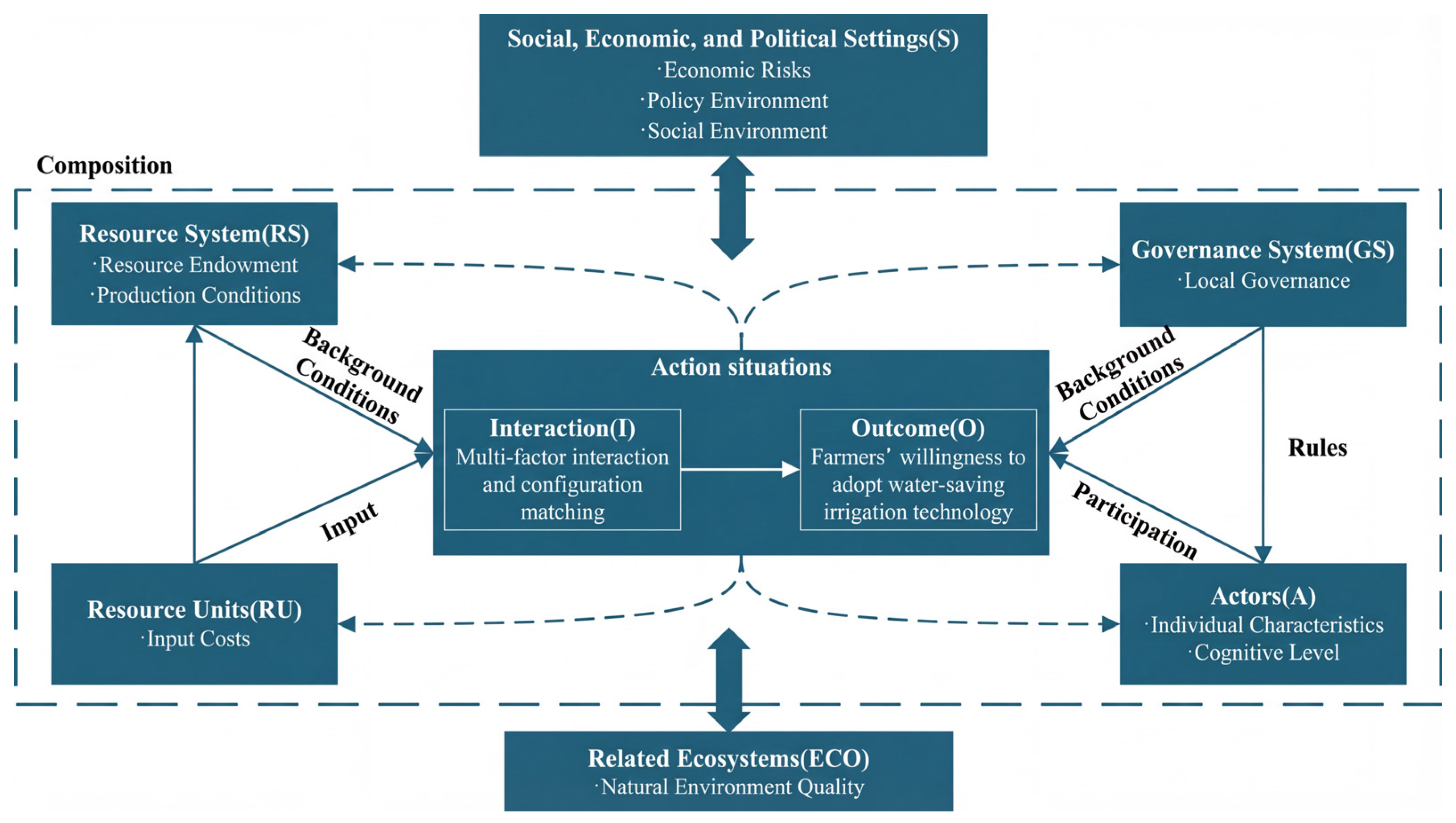
The Social–Ecological System (SES) framework, pioneered by Nobel laureate Elinor Ostrom, provides a powerful analytical lens for diagnosing complex problems in common-pool resource management [24]. It analyzes interactions between human actors and their social and biophysical environments as integrated systems, rather than isolated factors [6]. It posits that sustainable outcomes emerge from the dynamic interactions among four core first-tier subsystems: Resource System (RS), Resource Units (RU), Governance System (GS), and Actors (A). These subsystems are embedded within and influenced by broader Social, Economic, and Political Settings (S) and related Ecosystems (ECO). The SES framework’s multi-level structure allows researchers to identify and operationalize variables at different levels for diagnosing specific problems. This approach emphasizes feedback loops and subsystems interactions, which has been widely applied in forestry, fisheries, and typically, water resource management [5].
In the context of agricultural water use, the framework is particularly useful for understanding farmers’ decisions to adopt WSIT. Research shows that this decision is shaped by complex combinations of ecological constraints, resource characteristics, governance rules, and actor attributes, rather than a single factor. This study defines WSIT adoption intention as farmers’ willingness and readiness to invest in and adopt modern irrigation technologies such as drip, sprinkler, or micro-irrigation to improve water use efficiency in agricultural production. This intention precedes actual adoption and reflects a shift from traditional to modern practices. Figure 1 illustrates the WSIT-SES framework, which includes six subsystems, with the core constructs and measurement indicators for each detailed in Table 1.
Based on the specific research topic, we have selected core constructs from each subsystem that are directly relevant to farmers’ micro-level decision-making for operationalization and analysis. A certain degree of potential deviation between the comprehensiveness of the theoretical framework and the focused nature of empirical operationalization is inevitable. To mitigate the impact of this issue on research rigor, this study employs a two-step optimization approach to effectively bridge theory and empirics: first, based on the existing literature review and expert consultation, we precisely define and operationalize the selected core constructs to ensure that the chosen variables accurately reflect the core characteristics of each SES subsystem; second, leveraging the complementarity of mixed methods, we use binary logistic regression to test the independent effects of individual constructs, and then employ fsQCA to explore the configurational effects of construct combinations, using micro-level configurational analysis to echo the systemic thinking of the SES framework and compensate for the limitations of single-dimensional measurement.

2.2. Research Hypotheses

2.2.1. Resource System and WSIT Adoption Intention

The Resource System (RS) encompasses the biophysical structure of resources and related infrastructure. Following the second-tier variable system of the SES framework and adapting it to the agricultural production context, this study operationalizes RS into two dimensions: resource endowment and production conditions.
Resource endowment comprises three components: agricultural planting structure, irrigation water scarcity, and land quality. Together, these define the basic agricultural production environment. A higher proportion of high-value cash crops such as vegetables, fruits, and greenhouse crops, increases demand for precise irrigation. To secure yield and quality, farmers are more inclined to adopt WSIT, forming a production demand-resource matching mechanism [23,25]. Water scarcity creates resource constraint pressure that influences farmers’ water-saving awareness. When farmers perceive water scarcity, they are more likely to actively seek technological solutions to optimize water use efficiency [26,27]. Additionally, land quality relates to crop productivity, and high-quality land represents greater production potential. Out of self-interest, farmers are more willing to adopt technologies like WSIT for long-term investment and land protection, preventing soil degradation.
Production conditions, including basic water conservancy facilities, housing status, and agricultural mechanization level, provide the hardware support and economic foundation for technology adoption. Well-developed water infrastructure, such as convenient irrigation canal systems, significantly reduces WSIT installation and operational costs by eliminating physical barriers [28,29]. Housing status serves as a direct indicator of the farmer’s economic capital. Research shows that better housing conditions typically indicate stronger financial capacity, better risk-bearing ability, and higher intention to adopt new technologies. Moreover, both agricultural mechanization and water-saving irrigation belong to the category of modern agricultural technology. Farmers with higher mechanization levels tend to be more receptive to modern production methods, thereby lowering psychological barriers to WSIT adoption. Therefore, we propose the following hypotheses:
H1. 
Resource endowment has a positive effect on farmers’ WSIT adoption intention.
H2. 
Production conditions have a positive effect on farmers’ WSIT adoption intention.

2.2.2. Resource Units and WSIT Adoption Intention

In the SES framework, resource units refer to the actual resource units that actors appropriate, characterized by mobility and economic value. In the context of WSIT adoption, input costs are a critical variable that farmers must weigh in their decisions. Previous research confirms that when short-term costs—including equipment investment, installation, and maintenance—exceed farmers’ economic capacity, adoption intention is directly suppressed [30,31]. Especially for small holders, the sharp conflict between high upfront investment and uncertain long-term returns may lead them to forgo adoption due to short-term financial pressure [32]. Perceived technology costs constitute a direct financial barrier. Thus, the following hypothesis is proposed:
H3. 
Input costs have a negative effect on farmers’ WSIT adoption intention.

2.2.3. Governance System and WSIT Adoption Intention

The governance system (GS) comprises rules, norms, and organizations that regulate resource use behavior. As the institutional unit closest to farmers, grassroots governance is critical. Farmers’ perception of fairness in water allocation is a key factor. A fair institutional environment strengthens farmers’ trust in GS, thereby lowering psychological barriers to adopting officially promoted technologies [33]. Meanwhile, formal organizations such as Water User Associations (WUAs) provide important channels for technology diffusion. Through collective negotiation and unified procurement, these organizations significantly reduce individual costs and mitigate information asymmetry risks [21]. Research shows that organizational support and government subsidies exhibit significant synergistic effects, more powerfully driving farmers to adopt WSIT [19]. Additionally, effective regulation by government agencies and regulatory bodies of irrational water use practices—such as flood irrigation—reduces free-riding behavior and safeguards the expected returns for technology adopters. Consequently, this study proposes the following hypothesis:
H4. 
Grassroots governance has a positive effect on farmers’ WSIT adoption intention.

2.2.4. Actors and WSIT Adoption Intention

Actors refer to individuals and groups who interact with the social–ecological system. In technology adoption research, farmers’ individual characteristics and cognitive levels are core intrinsic drivers of their decisions [24].
In terms of individual characteristics, farmers with a higher education have stronger information-processing abilities and better understand the dual economic and ecological value of WSIT [34,35]. Village officials, as community opinion leaders, often gain a first-mover advantage in technology promotion through their social capital and demonstration roles. While generational differences may exist across age groups, education and social status generally enhance resource integration capabilities, which reinforce positive evaluations of WSIT adoption [36].
At the cognitive level, behavioral intentions are shaped primarily by subjective value judgments. Farmers’ perceptions of WSIT’s importance, effectiveness, and ease of use align closely with the Technology Acceptance Model (TAM) [37]. When farmers recognize the technology’s effectiveness (perceived usefulness), they see clear expected benefits, which strengthens adoption intention. When they perceive the technology as easy to use (perceived ease of use), learning costs and psychological risks decrease, further reinforcing perceived usefulness [38]. These two perceptions form the psychological foundation for farmers’ WSIT adoption intention. Hence, we propose the following hypotheses:
H5. 
Individual characteristics have a positive effect on farmers’ WSIT adoption intention.
H6. 
Cognitive level has a positive effect on farmers’ WSIT adoption intention.

2.2.5. Related Ecosystems and WSIT Adoption Intention

Related ecosystems encompass broader environmental dynamics, such as climate change and pollution. This study finds that perceived natural environment quality, particularly water resource availability and quality, is a key ecological variable influencing farmers’ WSIT adoption intention [39]. A high-quality natural environment provides stable expectations for agricultural production, while environmental degradation directly threatens this foundation. For example, farmers in water-abundant areas show weaker water-saving intentions, whereas water scarcity in arid regions creates strong external pressure, compelling them to adopt water-saving measures to sustain livelihoods [40]. Similarly, water pollution reduces the available water quality and increases the irrigation costs, prompting farmers to adopt WSIT to improve the clean water efficiency. Environmental degradation thus acts as a “problem signal,” heightening the perceived necessity of technology adoption. Therefore, this study proposes the following hypothesis:
H7. 
Perceived pressure from natural environmental quality has a positive effect on farmers’ WSIT adoption intention.

2.2.6. Social, Economic, and Political Settings and WSIT Adoption Intention

Social, economic, and political settings constitute the macro-level environment in which actors operate [41]. This study focuses on economic risks, policy environment, and social environment as key variables.
Economic risks concern the stability of farmers’ production income. Price volatility, sales difficulties, and uncertain returns from new technologies can increase potential income losses [42], making farmers more risk-averse and reducing their willingness to invest in new technologies. Then, the policy environment reflects institutional guidance and support for technology adoption. Government promotion, technical training, and financial subsidies can significantly enhance adoption intention by lowering adoption costs and increasing their expected returns [4,13]. The social environment reflects the influence of social networks and norms. Interactions with relatives and friends, participation in collective activities, and trust in village organizations constitute farmers’ social capital. Research shows that social interaction promotes technology adoption through knowledge sharing, joint decision-making, and peer pressure [43]. When communities fosters a pro-conservation atmosphere, farmers are subtly encouraged to form cognitions aligned with social expectations, strengthening adoption intention [44]. Accordingly, we propose the next three hypotheses:
H8. 
Economic risks have a negative effect on farmers’ WSIT adoption intention.
H9. 
The policy environment has a positive effect on farmers’ WSIT adoption intention.
H10. 
The social environment has a positive effect on farmers’ WSIT adoption intention.

3. Research Design and Methods

3.1. Overall Research Strategy

To systematically investigate the mechanisms driving farmers’ WSIT adoption within the SES framework, this study employs a sequential explanatory mixed-methods approach. The strategy proceeds in two phases. First, binary logistic regression analysis of large-sample survey data identifies the net effects of individual antecedent conditions on adoption intention, thereby pinpointing key factors. Recognizing that farmers’ decisions result not from isolated variables but from complex interactions among multiple factors, the second phase utilizes fsQCA. From a configurational perspective, this phase explores how different antecedent conditions jointly produce high adoption intention through multiple conjunctural pathways. This integrated design not only tests the statistical significance of individual variables but also reveals the complex causal pathways and equifinality underlying technology adoption. Compared to single-method approaches, it provides a more comprehensive explanatory framework that addresses the analytical demands of examining causal complexity within the SES framework.

3.2. Study Area, Sampling, and Data Collection

3.2.1. Study Area

Data collection for this research was conducted as part of the Ministry of Water Resources’ comprehensive research project on deepening agricultural water price reform. The study area is the North China Plain, encompassing four major grain-producing provinces: Hebei, Henan, Shandong, and Anhui. As one of China’s primary breadbaskets, this region faces an increasingly acute conflict between agricultural production and water scarcity, making it a key focus area for national water-saving agriculture policies. This context provides a typical setting for examining social–ecological system vulnerability and farmers’ adaptive behaviors.

3.2.2. Sampling Method

To ensure the breadth and representativeness, this study employed a multi-stage stratified random sampling method. The specific steps were as follows:
Stage 1 (county-level sampling): Based on agricultural economic development, water resource endowment, and water-saving technology promotion, 1–2 representative counties (or county-level cities) were randomly selected from each province, yielding a total of 5 county-level units. The distribution was: 1 county in Hebei, 2 counties in Henan, 1 county in Shandong, and 1 county in Anhui.
Stage 2 (township-level sampling): Based on the irrigation conditions (e.g., well-irrigated vs. canal-irrigated areas) and primary agricultural types (e.g., grain crop vs. cash crop zones—cash crops mainly including cotton, peanuts, cucumbers, tomatoes and other greenhouse vegetables, as well as apples, pears and other fruit crops, all widely cultivated in the North China Plain with representative water demands and irrigation needs, reflecting the actual agricultural production characteristics of the study area), four townships were randomly selected from each county/city, totaling 20 townships.
Stage 3 (village-level sampling): Based on village size and industrial structure, five administrative villages were randomly selected from each township, totaling 100 administrative villages.
Stage 4 (household-level sampling): Within each village, using the latest household registration information provided by the village committee and employing systematic or simple random sampling, the survey team randomly visited 10–15 households that were primarily engaged in agricultural production. A total of 1432 households and 3156 individuals were surveyed.
The survey structure strictly followed a five-level nested framework—region–county (city)–township–administrative village–household—corresponding to the sampling process to ensure systematic coverage. The sample size was determined based on research precision requirements, combined with agricultural population distribution characteristics across the four provinces and sample size standards from similar studies on farmer technology adoption, setting a target of over 3000 samples to meet the requirements for large-sample empirical analysis and mixed-methods research. Data collection strictly followed proportional sampling principles, referencing the household numbers and agricultural planting area statistics published by the provincial departments of agriculture and rural affairs. Sample quotas were allocated proportionally across the four provinces and within counties, based on household numbers and agricultural area, ensuring that the sample distribution was proportional to the actual household scale and agricultural development patterns in each province, thereby minimizing sampling bias and enhancing sample representativeness and data reliability.

3.2.3. Data Collection Process

To ensure the reliability and validity, the collection process strictly adhered to the principle of triangulation, integrating data from multiple sources (see Table 2). Core data were obtained through standardized household surveys conducted from January to December 2024. To facilitate communication and information accuracy, the survey team comprised university researchers, local agricultural and water conservancy department staff, and village officials. All enumerators received standardized training prior to the fieldwork. A total of 3156 questionnaires were collected. After excluding invalid questionnaires with critical missing information, logical contradictions, or uniform response patterns, 3007 valid questionnaires were obtained, yielding a valid response rate of 95.3%. Sample demographic characteristics are presented in Table 3.
Notably, 15.4% of respondents in this sample were under 18 years old (age range 15–17, n = 463). This demographic composition reflects the specific context of rural China, where agricultural production operates as a family-based collective decision-making process, rather than individual behavior. Adolescents aged 15–18 typically complete compulsory education and have a better understanding of new technologies than other family members, so they become active participants in expressing their ideas in adopting WSIT. More importantly, when adopting new technologies requiring learning capacity (such as WSIT), they play a crucial role as “information gatekeepers.” Due to lower educational attainment, older parents tend to defer to the opinions of their better-educated children, aligning household decisions with modern trends. Additionally, capturing this cohort’s intentions is essential for understanding the intergenerational transmission mechanism of technology adoption, as they represent the future labor force of Chinese agriculture [45]. To ensure data quality, we applied rigorous screening criteria, confirming that all respondents (including those under 18) were actual participants in household agricultural production and decision-making discussions. Their inclusion thus provides policy-relevant insights into both the current household dynamics and future adoption patterns.
To deepen understanding of the quantitative data and implement cross-validation, semi-structured in-depth interviews were conducted. The interviewees included 70 representative farmers (covering different ages, incomes, and adoption intentions), village officials, and grassroots water conservancy technology extension personnel. In addition, archival data, such as village meeting minutes, government water use reports, and subsidy distribution lists, were collected and analyzed for supplementary analysis. All respondents were informed of the research purpose, data use, and anonymity protections before participation, and they signed informed consent forms. For respondents under 18, the survey team also obtained written consent from their guardians. All data were anonymized and used solely for academic research purposes.

3.3. Variable Measurement

3.3.1. Outcome Variable

The outcome variable is farmers’ WSIT adoption intention. Drawing on the Theory of Planned Behavior [46] and prior research on WSIT adoption [47], we operationalized it as a dichotomous variable. It was measured by the question, “Do you intend to adopt WSIT?” (1 = Yes, 0 = No).

3.3.2. Antecedent Conditions

Guided by the SES framework, this study examined ten key variables from the six core subsystems (see Table 4). The measurement followed the established academic standards and drew on the authoritative literature. Specifically, measurement items for resource endowment and production conditions were adapted from classic farmer production factor questionnaires, such as the World Bank’s Living Standards Measurement Study (LSMS). Input cost perception referenced the literature on cost–benefit analysis of technology adoption [48]. Grassroots governance drew on Ostrom’s classic research on common-pool resource (CPR) governance, focusing on rule fairness, information transparency, and monitoring intensity [24]. The three dimensions of cognitive level (importance, effectiveness, ease of use) were derived from the classic measurements of perceived usefulness and perceived ease of use in the Technology Acceptance Model [49]. Natural and economic risk measurement referred to the established scales in farmer risk perception research [50]. The social environment was measured based on social capital theory, assessing social networks, social participation, and institutional trust. The policy environment adopted common methods for evaluating policy implementation effectiveness, focusing on farmers’ direct perceptions of government promotion, training, and subsidy policies.
It should be noted that the “perceived cost” rather than the “actual amount” was measured, based on both theoretical and practical considerations. Theoretically, the Technology Acceptance Model (TAM) and Diffusion of Innovation (DOI) theory demonstrate that subjective perception predicts adoption behavior more reliably than objective amounts [48,51]. Practically, farmers often cannot accurately report specific technology investment amounts (such as precise allocation of self-funded capital, government subsidies, and maintenance costs). They can, however, provide reliable responses to perceptual questions such as “whether it is difficult to afford.”
Most variables in this study rely on subjective perception measures, using Likert scales. This choice was based on several theoretical and practical considerations. Farmers’ technology adoption is fundamentally a subjective decision-making process. Cognition, attitudes, and perceptions largely determine behavior, giving subjective measures strong predictive validity [52]. Contextually, the study covers a broad region across four provinces and multiple counties, with significant variations in natural environment, economic development, and policy implementation. Objective data—standardized land quality scores or water resource quantities—may fail to capture how farmers in different regions actually experience their circumstances. Subjective perception data better reflect these relative differences. The same land quality might be rated “average” in economically developed areas but “good” in less developed regions. This relative perception drives farmer decisions.
We acknowledge limitations of this measurement approach. Subjective measures may suffer from social desirability bias, where respondents give answers they believe conform to social norms or surveyor expectations. Collecting all variables from a single questionnaire may also artificially inflate correlations. To mitigate these issues, we implemented several safeguards: anonymous surveys to reduce social desirability bias, dispersed question arrangement to avoid obvious logical connections, and reverse-scored items to control acquiescence bias. Future research could combine objective data (such as remotely sensed land quality assessments and official water resource statistics) with subjective perception data to provide more robust evidence.

3.4. Analytical Methods

3.4.1. Reliability and Validity Test

Before formal analysis, core constructs measured with multiple items (e.g., local governance, cognitive level, social environment) were tested for reliability and validity. Cronbach’s α coefficient assessed internal consistency reliability using SPSS 26.0 Software. An α coefficient above 0.7 indicated good reliability. Confirmatory factor analysis (CFA) then tested the construct validity. Key indicators are tested by AMOS 26.0, including composite reliability (CR) and average variance extracted (AVE). Following Fornell and Larcker, CR values should exceed 0.7, AVE values should exceed 0.5, and the square root of each construct’s AVE should exceed its correlation coefficients with other constructs [53]. These criteria confirm good convergent and discriminant validity.
Multicollinearity was assessed using variance inflation factor (VIF) values (see Table 5). VIF values below 10 (or more strictly, below 5) indicate no multicollinearity issues. All VIF values ranged between 1 and 2, confirming the absence of multicollinearity among independent variables.

3.4.2. Binary Logistic Regression Model

The dependent variable—farmers’ WSIT adoption intention—is dichotomous, making binary logistic regression ideal for examining the independent effects of each antecedent condition. This model does not directly predict event probability but performs linear regression on the log odds. This approach effectively handles the non-normal distribution of the dependent variable. The model quantifies each independent variable’s relative contribution to adoption intention probability while controlling for other variables, identifying statistically significant drivers. The model is expressed as follows:
Logit ( P )   = ln ( P 1     P )   =   α   +   x 1 β 1 +   x 2 β 2 +     +   x n β n
where P expresses the probability of the dependent variable being 1, and 1 − P denotes the probability of it being 0. Thus, ln P 1 P is the natural logarithm of the odds ratio of WSIT adoption intention. α signifies the constant term, β1, β2, …, βn represent the regression coefficients, and x1, x2, …, xn are the independent variables.

3.4.3. Fuzzy-Set Qualitative Comparative Analysis (fsQCA)

Regression analysis cannot reveal the synergistic effects among multiple factors, yet farmers’ WSIT adoption decisions typically result from combined influences. Therefore, this study employs fsQCA to explore condition configurations leading to high adoption intention [53]. Based on set theory and Boolean algebra, fsQCA treats cases as configurations of different conditions and identifies multiple, equifinal causal paths, producing the same outcome from a holistic perspective.
fsQCA is particularly suited to this study for three reasons. The SES framework emphasizes nonlinear interactions and emergent properties among subsystems. fsQCA’s configurational perspective captures these complex relationships, especially its capacity to identify equifinality [54]. The significant regional heterogeneity across the North China Plain means that different regions may display high adoption intention through different condition combinations, and fsQCA reveals these multiple pathways. Moreover, fsQCA’s asymmetric causal logic aligns with SES assumptions, recognizing that conditions promoting adoption may differ fundamentally from those inhibiting it. This addresses our core research question: “What condition combinations are sufficient to produce high farmer adoption intention for water-saving technologies?”
This study followed the standard analytical procedures of fsQCA [55], including three core steps. Data calibration transformed raw variables into fuzzy-set membership scores (0 to 1). Then, necessary condition analysis tested whether any single condition constitutes a prerequisite for the outcome. Sufficient configurational analysis constructed and minimized a truth table to identify condition combinations that were consistently associated with high adoption intention, distinguishing core conditions (present in both parsimonious and intermediate solutions) from peripheral conditions (present only in intermediate solutions). Robustness checks validated the result stability. Section 4 presents detailed procedures and findings.

4. Empirical Analysis

4.1. Descriptive Statistical Analysis

All constructs met the standard reliability and validity criteria. Table 6 presents reliability and validity test results, descriptive statistics, and the correlation matrix for core variables. All constructs met the standard criteria (Cronbach’s α, CR, and AVE), confirming good scale reliability and validity.

4.2. Results of Binary Logistic Regression Analysis

This study employed SPSS 26.0 to conduct a binary logistic regression analysis on the ten antecedent conditions influencing farmers’ WSIT adoption intention, aiming to identify the net effects on WSIT adoption. Model diagnostic results (see Table 7) reveal that after including all independent variables, the −2 Log-Likelihood of the final model significantly decreases from 1000.476 in the baseline model to 693.219 (χ2 = 307.257, p < 0.001). The Nagelkerke R2 value is 0.455, indicating a good overall model fit, explaining 45.5% of the variance in farmers’ WSIT adoption intention.
The regression results (see Table 8) provide empirical support for six of the ten proposed hypotheses (H2, H4, H6, H7, H9, H10). Specifically, the production conditions (β = 1.161, p < 0.05), grassroots governance (β = 1.139, p < 0.05), cognitive level (β = 1.369, p < 0.05), policy environment (β = 0.529, p < 0.05), and social environment (β = 1.443, p < 0.01) show a significant positive effect on farmers’ WSIT adoption intention. Among these, the driving effects of the social environment (OR = 4.231) and cognitive level (OR = 3.931) are particularly prominent, highlighting the critical roles of social networks and individual cognition in the decision-making process. Meanwhile, a solid material foundation, fair and effective community governance, profound recognition of the technology’s value, positive policy incentives, and normative support from social networks are the core impetuses for adoption. Conversely, natural risks (β = −1.783, p < 0.05) significantly inhibit adoption intention. This finding uncovers a profound paradox: although water-saving technology is designed to cope with environmental risks like water scarcity, a higher perception of risks may prompt farmers to adopt more conservative production strategies and avoid the uncertainties associated with new technologies in practice. The Hosmer–Lemeshow goodness-of-fit test was used to assess the model fit. According to the test results, the p-value is 0.330, which is greater than 0.05, indicating that the model fits well.
Notably, the remaining four hypotheses (H1, H3, H5, H8) concerning resource endowment, input costs, individual characteristics, and economic risk were not supported at conventional significance levels. However, this does not imply that these factors are irrelevant to farmers’ adoption decisions. Rather, it strongly suggests that their influence is nonlinear and context-dependent—they may not act independently but instead interact with other factors under specific configurational combinations to jointly affect the outcome. This causal complexity represents a fundamental limitation of symmetric analytical methods like binary logistic regression and is precisely the core issue that fsQCA is designed to explore in depth through subsequent analysis.

4.3. Robustness Analysis

Although the benchmark regression results have preliminarily confirmed our hypotheses, to further ensure the reliability and non-randomness of the findings, this study conducted robustness checks using three strategies: altering the sample scope, substituting the estimation model, and handling outliers (see Table 9). Specifically, (1) sub-sample analysis: The logistic regression was re-run after excluding samples under the age of 18 to eliminate potential interference from cognitive biases in minor respondents. (2) Alternative model specification: A binary Probit model was employed to re-estimate the results, testing whether the conclusions were sensitive to specific distributional assumptions. (3) Winsorization: All continuous variables were winsorized at the 1% and 99% levels to mitigate the impact of extreme outliers. The results indicate that across all three scenarios, the direction of the coefficients and the significance levels of the core explanatory variables did not undergo substantial changes. Furthermore, model goodness-of-fit indicators remained stable. These findings suggest that the empirical results of this paper are robust and the conclusions are reliable.

4.4. fsQCA Results Analysis

To move beyond linear causal assumptions and delve into how various antecedent conditions engage in multiple conjunctural causation to lead to high adoption intention, we introduced fsQCA to analyze the conditions.

4.4.1. Data Calibration

This study employed the direct calibration method [54] for data calibration, using the 75th, 50th, and 25th percentiles as thresholds to determine full membership, the crossover point, and full non-membership values [56]. The advantage of using the median over the mean is that the median is less sensitive to outliers. After calibration, the raw variable data were transformed into fuzzy membership scores ranging from zero to one. The calibration anchors for each variable are detailed in Table 10.

4.4.2. Analysis of Necessary Conditions

Before conducting the configurational analysis, a test was conducted to determine whether any single condition could serve as a “necessary condition” for farmers’ high WSIT adoption intention. As shown in Table 11, all individual conditions had consistency scores below the standard threshold of 0.9. The results indicate that no single factor is an indispensable prerequisite for farmers to develop high WSIT adoption intention, providing strong support for adopting a configurational perspective to explore the equifinality of different factor combinations.

4.4.3. Configurational Analysis

In the sufficiency analysis, following the approach of Du et al. [57], the raw consistency threshold was set at 0.8, the PRI consistency threshold at 0.70, and the case frequency threshold at five. Seven distinct combinations of conditions were identified that consistently led to high farmers’ WSIT adoption intention (see Table 12). The overall solution consistency for these seven configurations was 0.958, well above the 0.8 benchmark. The overall solution coverage of 0.583 indicates that these seven pathways explain over 58% of cases where farmers exhibited high WSIT adoption intention.
Based on the core conditions and theoretical logic, these configurations can be summarized into five pathways:
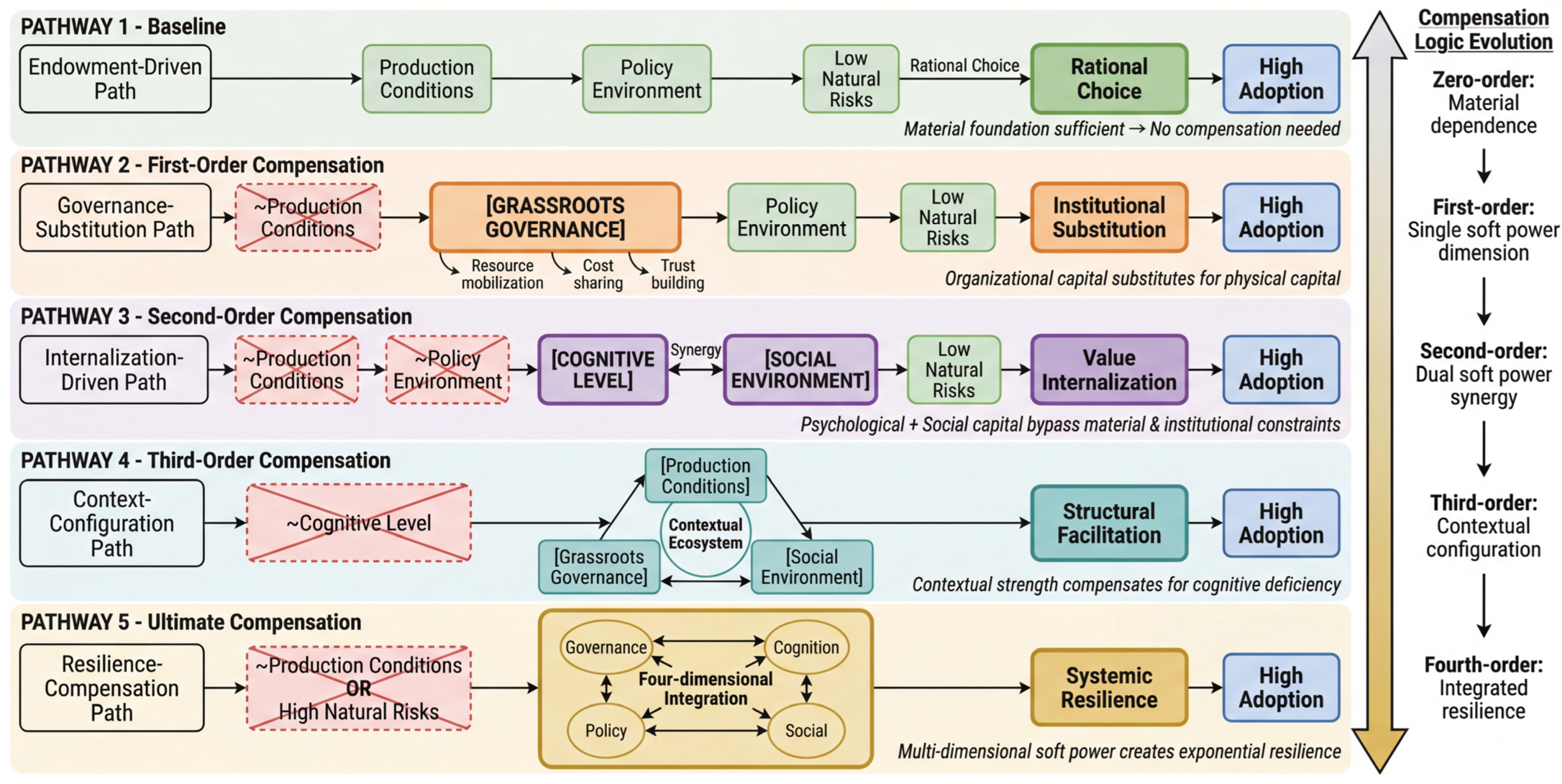
Path 1: Endowment-driven path. This path corresponds to configuration S1: production conditions * ~natural risks * policy environment. It reveals a classic rational choice model in which superior material endowments and favorable institutional environments systematically reduce decision-making costs and risks. When farmers have adequate production infrastructure, face minimal natural risks, and receive clear policy incentives, adopting new technology becomes a rational economic choice. Good production conditions enhance the technology’s “perceived ease of use” [12], while low risk exposure and policy support strength both enhance “perceived usefulness” and return certainty [25]. As the Technology Acceptance Model and Theory of Planned Behavior demonstrate, farmers evaluate technologies based on existing knowledge and experience, adopting them only when their value is clearly recognized [9]. This path validates this logic and uses fsQCA to demonstrate the synergistic effects among material foundation, institutional incentives, and low-risk environments. Together, these three elements create a robust “opportunity structure” that drives rational adoption decisions. As a baseline model, this path shows that when hard constraints (production conditions) are adequately met, technology adoption follows traditional rational choice logic, establishing a reference point that highlights the compensation mechanisms in subsequent paths.
Path 2: Governance substitution path. This path corresponds to configuration S2: grassroots governance * ~natural risks * policy environment. Its theoretical proposition is that “organization substitutes for material conditions”, showing that even when production conditions are limited, strong grassroots governance can drive technology adoption. Here, effective grassroots organizations (such as village committees and water user associations) serve dual roles as “resource converters” and “trust intermediaries.” They deliver macro-level policy resources through three mechanisms: (1) information brokerage—translating abstract policies into actionable guidance to reduce information asymmetry; (2) cost sharing—organizing collective procurement and installation to lower individual financial burdens [16]; and (3) risk pooling—providing collective insurance against technology failure through mutual aid networks. By offering technical training and organizing demonstration projects [17], these organizations effectively compensate for individual farmers’ deficiencies in information, skills, and capital.
Given the significant positive externalities of agricultural water conservation, grassroots organizations become important channels for government policy implementation, while low natural risks provide a safety margin for policy investment and organizational operations. This path reveals the substitution effect of organizations and social capital for physical capital. The effectiveness of formal policies depends heavily on grassroots governance structures’ “last-mile” conversion capacity: by providing collective bargaining platforms, reducing transaction costs, and enhancing information symmetry, grassroots organizations transform macro-level policy resources into tangible support that farmers can perceive and access. Thus, even with limited production conditions, these organizations enable farmers to make technology adoption decisions. This finding provides micro-level evidence for institutional theories, particularly Ostrom’s polycentric governance framework [24], showing how nested governance structures bridge the gap between policy design and behavioral outcomes. This path offers first-order evidence for the “soft power compensates for hard constraints” proposition. It demonstrates that when physical capital is absent, the combination of organizational capital and institutional support can serve as an effective substitute to drive adoption intention. The high consistency score (0.968) validates the robustness of this compensation mechanism, laying the foundation for understanding how single-dimension soft power overcomes material limitations.
Path 3: Internalization-driven path. This path corresponds to configurations S3 and S4: cognitive level * ~natural risks * social environment. It depicts an endogenous motivation model driven by both internal beliefs and external norms, with “cognition-norm synergy” as its core mechanism. When farmers possess strong cognition of water-saving technology’s value and utility while embedded in a positive social environment that encourages adoption, strong adoption intention emerges spontaneously. Research shows that enhancing farmers’ cognitive levels—especially their perceptions of usefulness and ease of use—effectively promote technology adoption [10,11]. Notably, this path’s activation does not depend on direct policy incentives or superior production conditions, highlighting the decisive role of non-economic factors. This echoes the debate between studies emphasizing subsidies and institutional support versus those emphasizing psychological and social determinants [7,13].
In the configuration, low natural risks act as a “cognitive stabilizer”. According to prospect theory, individuals tend toward risk aversion in high-risk situations; even with clear technology cognition, they may delay decisions due to environmental uncertainty concerns. Conversely, low-risk environments reduce loss aversion psychology, allowing farmers to make choices based on rational assessment rather than fear. Under these conditions, the positive driving forces of individual cognition and social norms are fully released, forming a stable “belief → intention” conversion channel. This path deepens social influence theory, showing that social networks shape desirability norms while individual cognition internalizes these external norms into personal beliefs, forming resilient value-driven adoption logic. The high consistency scores of S3 (0.976) and S4 (0.971) empirically validate this internalization mechanism’s robustness. Unlike Path 2’s reliance on formal institutions, this path demonstrates “soft power compensation” through individual psychological capital (cognition) and social capital (norms) alone—a bottom-up pathway that complements Path 2’s top-down organization-policy approach. Critically, even when both production conditions and policy support are absent, this compensation mechanism remains effective, demonstrating the autonomous driving force of internalized motivation and social norms.
Path 4: Context-configuration path. This corresponds to configurations S5 and S6: production conditions * grassroots governance * social environment. It reveals the mechanism of “context-shaping behavior”, uniquely showing that even when farmers have low individual cognitive and lack explicit policy incentives, technology adoption intention can still be effectively stimulated. The core lies in constructing a comprehensive adoption context featuring high convenience (production conditions), strong organization (grassroots governance), and a supportive atmosphere (social environment). Adequate production conditions lower the difficulty of technology installation and maintenance, reducing adoption barriers [45]. Effective grassroots governance provides organizational mobilization and trust endorsement. A positive social environment creates conformity social pressure through peer effects. This path’s uniqueness lies in constructing a “low-cognitive threshold” adoption ecosystem. Unlike Path 3’s internalization drive, the behavioral change here does not stem from deep value internalization but relies on the triple external support of behavioral convenience (production conditions), organizational mobilization (grassroots governance), and social demonstration (social environment). Social learning theory suggests that when observational learning costs are lower than cognitive processing costs, individuals tend to imitate rather than deliberate [43]. In this configuration, adequate infrastructure makes technology “look easy”, grassroots organizations provide a collective action framework, and the social environment creates normative pressure that non-adoption means falling behind. These three elements synergistically reduce dependence on individual cognitive capacity. While the existing literature often treats technology attributes, socioeconomic conditions, cultural influences, and policy support as multiple factors [6,58], it rarely examines how they combine to form a powerful “contextual pathway”. This path supplements the traditional linear “cognition–attitude–behavior” paradigm, showing that strong “contextual strength” can directly shape behavior, partially bypassing complex individual cognitive processes. Grassroots governance acts as “context architect,” integrating material resources and social norms to make technology adoption simple, natural, and rational. This reveals a unique compensation logic: contextual strength compensates for cognitive deficiencies. When external environmental design is sufficiently strong, behavioral change occurs through structural facilitation rather than cognitive persuasion, complementing Path 3’s internal belief transformation with external context shaping.
Path 5: Resilience-compensation path. This corresponds to configuration S7: grassroots governance * cognitive level * policy environment * social environment. As the configuration with the broadest coverage (raw coverage = 0.471), this path demonstrates the ultimate driving model formed by high integrated multidimensional “soft power” elements. Its core insight is that an integrated social capital network woven from effective organization, firm beliefs, sound institutions, and deep culture can endow a social–ecological system with powerful resilience, which is sufficient to compensate for hardware (production conditions) deficiencies or address high natural risk threats. This path responds to calls in the existing research for more integrated analytical frameworks to crack the “adoption paradox” [21,43], revealing how different factors jointly lead to outcomes through multiple conjunctural causation. It demonstrates the compensation mechanism of the “soft power multiplier effect”. When four dimensions are highly synergistic, the result is not simple addition but the exponential enhancement of system resilience: (1) grassroots governance integrates fragmented resources, providing organizational scaffolding; (2) policy environment provides institutional legitimacy and material support [25]; (3) individual cognition internalizes external support into a subjective initiative; and (4) the social environment strengthens sustained motivation through collective efficacy. This “four-in-one” structure enables the system to maintain high adoption intention through mutual substitution and reinforcement among elements when facing hardware deficiencies or environmental shocks. Among these factors, grassroots governance plays the role of “super-integrator”, fusing the legitimacy of policy [25], the internality of cognition, and the normativity of social environment into an integrated, multi-level empowerment system that drives the most stable and sustainable technology adoption intention, providing key insights for designing more effective strategies to promote farmers’ sustainable irrigation practices. Unlike Path 2’s two-dimensional “organization–policy” compensation and Path 3’s two-dimensional “cognition–social” compensation, Path 5 constructs the most resilient compensation mechanism through comprehensive synergy of four-dimensional soft power (grassroots governance + cognitive level + policy environment + social environment).

4.4.4. Robustness Tests

To validate the reliability of our fsQCA results, we conducted three robustness checks: adjusting consistency thresholds, PRI consistency testing, and solution type comparison.
When varying the consistency threshold from 0.80 to 0.75 and 0.85, the core configurations of all seven paths remained stable, with only minor changes to peripheral conditions. This suggests that our findings are robust to threshold selection. All PRI values exceeded the 0.70 threshold, confirming that no contradictory configurations exist. The intermediate and parsimonious solutions showed identical core conditions, further validating the theoretical and methodological foundations of our results (Table 13). We additionally tested robustness for farmers’ high WSIT adoption willingness. Raising the raw consistency threshold from 0.80 to 0.85, increasing PRI consistency from 0.70 to 0.75, and adjusting the case frequency threshold from five to eight all produced configurations that were subsets of our original results. These consistent outcomes across multiple validation tests confirm the robustness of our findings.

5. Discussion

This study combines binary logistic regression with fsQCA to examine the drivers of WSIT adoption among Chinese farmers. The integration of these methods reveals a dual nature of technology adoption decisions: both universal independent factors and context-dependent configurational effects shape farmer behavior.

5.1. Complementary Insights from Regression and Configurational Analysis

Binary logistic regression identifies key factors influencing WSIT adoption from a net-effect perspective. Social environment and cognitive level emerge as the strongest independent predictors, while production conditions, grassroots governance, and policy environment also show significant positive effects. Natural risk perception exhibits a particularly strong negative effect, with an odds ratio of 0.168, indicating that high risk perception dramatically reduces adoption willingness. These findings align with the existing research emphasizing individual cognition, social norms, material foundations, and institutional support [39,51]. Notably, resource endowment (p = 0.092), input costs (p = 0.095), individual characteristics (p = 0.058), and economic risk (p = 0.051) fail to reach statistical significance in the regression. This does not imply that these factors are irrelevant to farmer decisions; rather, it reflects fundamental differences between regression and configurational analysis. Regression focuses on net effects assuming independent factor contributions, while fsQCA examines joint effects revealing synergistic and substitutive relationships. Subsequent configurational analysis confirms that these regression-insignificant factors play critical roles within specific combinations, demonstrating the context-dependent nature of social–ecological system decisions: certain factors activate only within particular configurations.
The fsQCA identifies seven pathways (all with consistency >0.87, coverage 0.266–0.471) demonstrating significant heterogeneity in adoption decisions. Configuration S1 (consistency 0.970, coverage 0.276) centers on production conditions, policy environment, and low natural risk, predominantly in cash crop regions like Shandong Province. Configuration S2 (consistency 0.968, coverage 0.266) highlights the synergy between grassroots governance and policy environment, which is particularly effective in water-scarce areas like Hebei Province. Configurations S3 and S4 (consistency 0.976 and 0.971) emphasize combinations of cognitive level, social environment, and low natural risk, showing strong effects in regions with high WSIT awareness like Henan Province, with S4 additionally incorporating policy support. Configurations S5 and S6 (consistency 0.906 and 0.894) present contextual arrangements of production conditions, grassroots governance, and social environment, operating through cognition-driven (S5) and policy-driven (S6) mechanisms, respectively. Configuration S7 (consistency 0.873, coverage 0.471) represents a four-dimensional integration of grassroots governance, cognitive level, policy environment, and social environment, covering nearly half of the high-willingness cases.

5.2. Mechanisms of Soft Power Driving Technology Adoption

This study’s core theoretical contribution lies in revealing how “soft power compensates for hard constraints” and its operational boundaries. The identified pathways form a continuum from “material foundation-driven” to “multi-dimensional soft power compensation” (Figure 2), challenging the “material determinism” in traditional technology diffusion research by demonstrating that social–ecological systems can achieve adoption through soft power configurations, even under infrastructure or funding constraints.
The analysis clarifies the binary logic dividing material foundations from soft power compensation. Pathway 1 (endowment-driven) validates the rational choice baseline: abundant material capital and clear institutional incentives drive adoption through linear cost–benefit logic. Pathway 2 (governance substitution) reveals how institutional capital functionally replaces material capital—strong grassroots governance reduces transaction costs and distributes risks through organizational mobilization, creating quasi-public good effects, even when production conditions are lacking. This extends Ostrom’s polycentric governance thesis, showing grassroots organizations’ function as “resource converters,” transforming macro-level resources into micro-level capabilities through collective action mechanisms.
Pathways 3 and 4 reveal two heterogeneous logics of soft power compensation. Pathway 3 (internalization-driven) shows that the cognitive level and social norms can bypass material incentives, triggering voluntary adoption through value identification, rather than external rewards. Pathway 4 (contextual configuration) demonstrates a structural nudging mechanism where production convenience, organizational mobilization, and social pressure construct low-cognition-threshold adoption contexts. This transforms adoption from a complex rational calculation into an environmental default option, showing that soft power operates both by activating internal agency and optimizing external structures.
Pathway 5 (resilience compensation) represents the ultimate soft power integration. When grassroots governance, policy environment, cognition, and social norms achieve high coordination, the system exhibits a multiplier effect, exceeding simple summation. This multi-dimensional integration builds self-reinforcing cycles, resisting external shocks through functional complementarity and redundancy protection.
However, Pathway 5’s relatively lower consistency reveals a hardware threshold effect. Soft and hard power exhibit nonlinear complementarity, rather than pure substitution. When material foundations fall below critical thresholds, social capital alone cannot bridge infrastructure gaps [59]. This suggests that technology promotion strategies must align with regional social–ecological characteristics: in resource-abundant regions, soft power enhances the existing foundations; in constrained regions, policy should activate dominant soft power pathways (strengthening organizations, reshaping norms), rather than pursuing standardized material inputs.

5.3. Managerial Implications

Based on these findings, we propose three recommendations for water-saving technology promotion policy.
First, policy interventions should shift from single-tool promotion to place-based configuration cultivation. Different regions exhibit differentiated social–ecological configurations, requiring governments to adjust policy combinations according to core pathways. For endowment-driven regions (Pathway 1), such as large irrigation districts, governments should optimize supply-side factors by ensuring subsidy and credit stability. Mengjin County in Henan Province developed over 20,000 acres of red globe grape ecological agriculture through irrigation upgrades, demonstrating how economic incentives effectively promote adoption in well-infrastructured hilly areas. For regions where governance substitution (Pathway 2) or contextual configuration (Pathway 4) dominates, governments should empower local organizations by devolving resources and autonomy to grassroots entities. Yellow River irrigation districts in Shandong Province established water user associations and farmer cooperatives, achieving organized promotion and collective procurement that reduced individual adoption costs. For internalization-driven regions (Pathway 3), policy should focus on cultivating demonstration households and establishing farmer field schools to leverage peer effects. The Huiyao water-saving demonstration project in Zhuolu County, Hebei Province, achieved low-cost diffusion through acquaintance networks using these approaches.
Government roles should transform from technology salesperson to ecosystem cultivator. Traditional promotion focuses on single-technology publicity and subsidies while neglecting the social–ecological system health underlying adoption decisions. Effective strategies should build comprehensive ecosystems encompassing cognitive enhancement, social trust, institutional safeguards, and cultural support. The soft power compensation mechanism identified here offers underdeveloped regions leapfrogging development possibilities. Governments should avoid hardware-only thinking and invest in systematic social engineering—enhancing grassroots governance capacity, farmer cognition, policy inclusiveness, and social environment optimization to build resilient institutional foundations under resource constraints.
Moreover, governance evaluation should shift from outcome orientation to process and configuration orientation. Governments should transcend single-indicator assessments like technology coverage rates by establishing dynamic evaluation systems reflecting configurational effectiveness. This requires regularly identifying regional pathway changes and adjusting policy combinations accordingly. Agricultural, water conservancy, and fiscal departments need data-sharing and collaboration mechanisms for policy coordination, aligning with Ostrom’s polycentric governance philosophy of flexible strategy adjustment, based on system states. Specific measures include strengthening farmer education to enhance water-saving cognition; supporting cooperatives and water user associations to increase network density and trust; improving water rights and agricultural insurance systems to reduce barriers and risks; and shaping pro-conservation cultures through demonstration households and recognition programs. Comprehensive implementation may create virtuous adoption cycles, transforming from government-driven to farmer-initiated technology uptake.

6. Conclusions

The adoption of water-saving technologies in rural areas plays a critical role in the sustainable development of agricultural production and ecological systems. Drawing on the SES framework, this study employed a mixed-methods approach combining binary logistic regression with fsQCA to systematically investigate the drivers of Chinese farmers’ willingness to adopt WSIT. Based on 3007 valid questionnaires collected from the Shandong, Hebei, Henan, and Anhui provinces, the study reveals the dual nature of technology adoption decisions: both universal independent factors and context-dependent configurational effects shape adoption outcomes.
Regression analysis identifies social environment (β = 1.443) and cognitive level (β = 1.369) as the strongest independent drivers, with production conditions, grassroots governance, and policy environment also demonstrating significant positive effects, while natural risk (β = −1.783) emerges as a significant negative constraint. The fsQCA further identifies five equifinal pathways to high adoption willingness, confirming that cognitive, social, institutional, material, and ecological conditions work synergistically through different configurational combinations. This finding underscores the complexity and equifinality that is inherent in social–ecological system decision-making.
The study makes two principal theoretical contributions. First, through an innovative application of mixed methods, it reveals the complementary value of regression and configurational analysis. Several conditions (such as resource endowment, input costs, and economic risk) that failed to reach significance in regression emerged as critical configurational elements in fsQCA, reflecting the fundamental distinction between net effects and joint effects and offering methodological insights for understanding context-dependency and causal complexity in social–ecological systems. Second, through in-depth analysis of the five pathways, this study proposes and preliminarily validates the theoretical proposition of “soft power compensating for hard constraints.” The findings suggest that an integrated social capital network—comprising effective organizations, strong beliefs, favorable institutions, and supportive culture—can effectively offset traditional “hard constraints” such as weak material foundations or harsh natural environments. This finding challenges the “material primacy” assumption that is prevalent in technology adoption research and provides a new theoretical lens for technology diffusion in less-developed regions.
At the practical level, these findings call for a governance paradigm shift in government water-saving technology promotion strategies—moving from singular “technology extension” toward more comprehensive and dynamic “social–ecological system cultivation.” The key to policy design lies not in identifying universal interventions, but in recognizing and nurturing the most effective configurational combinations for different regions, transforming the government’s role from “salesperson” to “gardener” who cultivates healthy adoption ecosystems.
Of course, this study also has certain limitations. The cross-sectional design and reliance on self-reported data constrain our ability to establish causal relationships and may introduce subjective bias. Additionally, some measurements were simplified for practical reasons—for example, cost was coded as a binary variable, and perceptions were captured using Likert scales—which may reduce analytical precision. Future research could address these limitations by employing longitudinal designs to track behavioral changes over time, incorporating objective indicators (such as actual water consumption records or documented adoption rates) to complement self-reported measures, and using more refined measurement scales to capture the nuanced variations in farmers’ perceptions and decision-making processes.

Author Contributions

Conceptualization, Z.S. and H.F.; methodology, Y.L.; software, Z.S. and J.C.; validation, Z.S. and H.F.; formal analysis, Z.S.; investigation, Y.L. and J.C.; resources, Z.S.; data curation, Z.S. and J.C.; writing—original draft preparation, H.F.; writing—review and editing, H.F.; visualization, Z.S.; supervision, Z.S.; project administration, J.C.; funding acquisition, H.F. All authors have read and agreed to the published version of the manuscript.

Funding

The authors acknowledge with gratitude the Philosophy and Social Science Planning Youth Project of Universities in Henan Province (2023JJX263, 2024CJJ241) and the Science and Technology Research and Development Breakthrough Program of Henan Province (252102321153). This study would not have been possible without their financial support.

Informed Consent Statement

Informed consent was obtained from all subjects involved in the study.

Data Availability Statement

The data of this study are available from the corresponding author upon request.

Conflicts of Interest

The authors declare that there are no conflicts of interest regarding the publication of this paper.

References

  1. Hamdy, A.; Ragab, R.; Scarascia-Mugnozza, E. Coping with Water Scarcity: Water Saving and Increasing Water Productivity. Irrig. Drain. 2003, 52, 3–20. [Google Scholar] [CrossRef]
  2. Yazdanpanah, M.; Hayati, D.; Hochrainer-Stigler, S.; Zamani, G.H. Understanding Farmers’ Intention and Behavior Regarding Water Conservation in the Middle-East and North Africa: A Case Study in Iran. J. Environ. Manag. 2014, 135, 63–72. [Google Scholar] [CrossRef]
  3. Zhang, D.; Guo, P. Integrated Agriculture Water Management Optimization Model for Water Saving Potential Analysis. Agric. Water Manag. 2016, 170, 5–19. [Google Scholar] [CrossRef]
  4. Xiuling, D.; Qian, L.; Lipeng, L.; Sarkar, A. The Impact of Technical Training on Farmers Adopting Water-Saving Irrigation Technology: An Empirical Evidence from China. Agriculture 2023, 13, 956. [Google Scholar] [CrossRef]
  5. Monteiro, M.A.; Bahta, Y.T.; Jordaan, H. A Systematic Review on Drivers of Water-Use Behaviour Among Agricultural Water Users. Water 2024, 16, 1899. [Google Scholar] [CrossRef]
  6. Pronti, A.; Auci, S.; Berbel, J. Water Conservation and Saving Technologies for Irrigation. A Structured Literature Review of Econometric Studies on the Determinants of Adoption. Agric. Water Manag. 2024, 299, 108838. [Google Scholar] [CrossRef]
  7. Alam, M.F.; McClain, M.; Sikka, A.; Pande, S. Subsidies Alone Are Not Enough to Increase Adoption of Agricultural Water Management Interventions. Front. Water 2024, 6, 1444423. [Google Scholar] [CrossRef]
  8. Alcon, F.; de Miguel, M.D.; Burton, M. Duration Analysis of Adoption of Drip Irrigation Technology in Southeastern Spain. Technol. Forecast. Soc. Change 2011, 78, 991–1001. [Google Scholar] [CrossRef]
  9. Karahanna, E.; Straub, D.W.; Chervany, N.L. Information Technology Adoption across Time: A Cross-Sectional Comparison of Pre-Adoption and Post-Adoption Beliefs. MIS Q. 1999, 23, 183–213. [Google Scholar] [CrossRef]
  10. Venkatesh, V. Determinants of Perceived Ease of Use: Integrating Control, Intrinsic Motivation, and Emotion into the Technology Acceptance Model. Inf. Syst. Res. 2000, 11, 342–365. [Google Scholar] [CrossRef]
  11. Aubert, B.A.; Schroeder, A.; Grimaudo, J. IT as Enabler of Sustainable Farming: An Empirical Analysis of Farmers’ Adoption Decision of Precision Agriculture Technology. Decis. Support Syst. 2012, 54, 510–520. [Google Scholar] [CrossRef]
  12. Adrian, A.M.; Norwood, S.H.; Mask, P.L. Producers’ Perceptions and Attitudes Toward Precision Agriculture Technologies. Comput. Electron. Agric. 2005, 48, 256–271. [Google Scholar] [CrossRef]
  13. Zhang, J.; Song, J. The Impact of Government Support and Farmers’ pro-Environmental Intention on Water-Saving Irrigation Techniques Adoption: Evidence Using Propensity Score Matching. Water Policy 2024, 26, 154–169. [Google Scholar] [CrossRef]
  14. Dinar, A.; Yaron, D. Adoption and Abandonment of Irrigation Technologies. Agric. Econ. 1992, 6, 315–332. [Google Scholar] [CrossRef]
  15. Zou, Q.; Zhang, Z.; Yi, X.; Yin, C. The Direction of Promoting Smallholders’ Adoption of Agricultural Green Production Technologies in China. J. Clean. Prod. 2023, 415, 137734. [Google Scholar] [CrossRef]
  16. Alauddin, M.; Sarker, M.A.R.; Islam, Z.; Tisdell, C. Adoption of Alternate Wetting and Drying (AWD) Irrigation as a Water-Saving Technology in Bangladesh: Economic and Environmental Considerations. Land Use Policy 2020, 91, 104430. [Google Scholar] [CrossRef]
  17. Tanti, P.C.; Jena, P.R.; Timilsina, R.R.; Rahut, D.B. Enhancing Crop Yields and Farm Income through Climate-Smart Agricultural Practices in Eastern India. Mitig. Adapt. Strateg. Glob. Change 2024, 29, 35. [Google Scholar] [CrossRef]
  18. Xu, J.; Cui, Z.; Wang, T.; Wang, J.; Yu, Z.; Li, C. Influence of Agricultural Technology Extension and Social Networks on Chinese Farmers’ Adoption of Conservation Tillage Technology. Land 2023, 12, 1215. [Google Scholar] [CrossRef]
  19. Deng, Y.; Lu, Q.; Cha, J. The Influence of the Industrial Organization on Farmers’ Willingness to Adopt Water-Saving Irrigation Technologies: A Perspective of Organizational Support. Water Policy 2024, 26, 978–1001. [Google Scholar] [CrossRef]
  20. Pino, G.; Toma, P.; Rizzo, C.; Miglietta, P.P.; Peluso, A.M.; Guido, G. Determinants of Farmers’ Intention to Adopt Water Saving Measures: Evidence from Italy. Sustainability 2017, 9, 77. [Google Scholar] [CrossRef]
  21. Guo, Y.; Zhang, K.; Jia, X. A Multilevel Analysis of Farmers’ Adoption of Water-Saving Irrigation Technology: Evidence from the North China Plain. Sage Open 2025, 15, 21582440251316100. [Google Scholar] [CrossRef]
  22. Jin, Y.; Lin, Q.; Mao, S. Tanzanian Farmers’ Intention to Adopt Improved Maize Technology: Analyzing Influencing Factors Using SEM and fsQCA Methods. Agriculture 2022, 12, 1991. [Google Scholar] [CrossRef]
  23. Li, T.; Lu, H.; Luo, Q.; Li, G.; Gao, M. The Impact of Rural Population Aging on Agricultural Cropping Structure: Evidence from China’s Provinces. Agriculture 2024, 14, 586. [Google Scholar] [CrossRef]
  24. Ostrom, E. A General Framework for Analyzing Sustainability of Social-Ecological Systems. Science 2009, 325, 419–422. [Google Scholar] [CrossRef]
  25. Dinar, A.; Campbell, M.B.; Zilberman, D. Adoption of Improved Irrigation and Drainage Reduction Technologies Under Limiting Environmental Conditions. Environ. Resour. Econ. 1992, 2, 373–398. [Google Scholar] [CrossRef]
  26. Ullah, A.; Ullah, R.; Khair, S.M.; Ali, A.; Samie, A. Synergizing Socioeconomic, Technological, and Environmental Factors Influencing the Adoption of High-Efficiency Irrigation Systems (HEIS): Insights from Highland Balochistan, Pakistan. J. Econ. Impact 2024, 6, 202–209. [Google Scholar] [CrossRef]
  27. Wang, Y.; Zhao, Y.H.; Li, B.; Fan, X.Y. Affecting Factors of Farmers’ Willingness to Adopt Water-Saving Technology in Northwest Arid Region of China-Case Study of Middle Reaches of Heihe River. Water Sav. Irrig. 2012, 11, 50–54. [Google Scholar]
  28. Huang, Q.; Wang, J.; Li, Y. Do Water Saving Technologies Save Water? Empirical Evidence from North China. J. Environ. Econ. Manag. 2017, 82, 1–16. [Google Scholar] [CrossRef]
  29. Tang, J.; Folmer, H.; Xue, J. Adoption of Farm-Based Irrigation Water-Saving Techniques in the Guanzhong Plain, China. Agric. Econ. 2016, 47, 445–455. [Google Scholar] [CrossRef]
  30. Gebremeskel, G.; Gebremicael, T.G.; Hagos, H.; Gebremedhin, T.; Kifle, M. Farmers’ Perception towards the Challenges and Determinant Factors in the Adoption of Drip Irrigation in the Semi-Arid Areas of Tigray, Ethiopia. Sustain. Water Resour. Manag. 2018, 4, 527–537. [Google Scholar] [CrossRef]
  31. Heumesser, C.; Fuss, S.; Szolgayová, J.; Strauss, F.; Schmid, E. Investment in Irrigation Systems under Precipitation Uncertainty. Water Resour. Manag. 2012, 26, 3113–3137. [Google Scholar] [CrossRef]
  32. Tai, X.; Feng, F.; Sun, F. Farmers’ Willingness and Adoption of Water-Saving Agriculture in Arid Areas: Evidence from China. Sustainability 2024, 16, 8112. [Google Scholar] [CrossRef]
  33. Mekonnen, M.; Abeje, T.; Addisu, S. Integrated Watershed Management on Soil Quality, Crop Productivity and Climate Change Adaptation, Dry Highland of Northeast Ethiopia. Agric. Syst. 2021, 186, 102964. [Google Scholar] [CrossRef]
  34. Fanak, D.A.; Rezaei, R.; Hashemi, M. How Do Cognitive Biases Influence Farmers’ Participation in Water Conservation at Lake Urmia? Insights from Social Norms Theory. Agric. Water Manag. 2025, 313, 109476. [Google Scholar] [CrossRef]
  35. Quintana-Ashwell, N.; Gholson, D.M.; Krutz, L.J.; Henry, C.G.; Cooke, T. Adoption of Water-Conserving Irrigation Practices Among Row-Crop Growers in Mississippi, USA. Agronomy 2020, 10, 1083. [Google Scholar] [CrossRef]
  36. Chebil, A.; Thabet, C.; Rached, Z.; Koussani, W.; Souissi, A.; Setti, M. Explaining Drivers of Farmers’ Willingness for Early Adoption of Enhanced Irrigation Technologies: Case of Tunisia. New Medit 2024, 23, 95–102. [Google Scholar] [CrossRef]
  37. Wang, Y.; Wang, Z.; Zhao, M.; Li, B. The Influence of Technology Perceptions on Farmers’ Water-Saving Irrigation Technology Adoption Behavior in the North China Plain. Water Policy 2024, 26, 170–188. [Google Scholar] [CrossRef]
  38. Tang, J.; Folmer, H.; Xue, J. Technical and Allocative Efficiency of Irrigation Water Use in the Guanzhong Plain, China. Food Policy 2015, 50, 43–52. [Google Scholar] [CrossRef]
  39. Cai, X.; Yao, L. Assessing the Option Water-Saving Willingness of Irrigation Areas Considering Farmers’ Risk Tolerance. Risk Anal. 2024, 44, 70–86. [Google Scholar] [CrossRef]
  40. Apio, A.T.; Thiam, D.R.; Dinar, A. Farming Under Drought: An Analysis of the Factors Influencing Farmers’ Multiple Adoption of Water Conservation Practices to Mitigate Farm-Level Water Scarcity. J. Agric. Appl. Econ. 2023, 55, 432–470. [Google Scholar] [CrossRef]
  41. Mooney, D.F.; Hoag, D.L.; Rasul, Z.I.; Gao, S. More Risk, More Money: When Are Payments for Water Savings from Limited Irrigation Profitable for Farmers? Water Resour. Econ. 2022, 40, 100212. [Google Scholar] [CrossRef]
  42. Hong, N.B.; Yabe, M. Improvement in Irrigation Water Use Efficiency: A Strategy for Climate Change Adaptation and Sustainable Development of Vietnamese Tea Production. Environ. Dev. Sustain. 2017, 19, 1247–1263. [Google Scholar] [CrossRef]
  43. Wang, G.; Xu, M. The Role of Social Interaction in Farmers’ Water-Saving Irrigation Technology Adoption: Testing Farmers’ Interaction Mechanisms. Sci. Rep. 2024, 14, 24969. [Google Scholar] [CrossRef]
  44. Dan, Q.; Qian, L.U.; Tao, X.U. Social Network, Extension Service and Farmers Water-Saving Irrigation Technology Adoption in Minqin County. Resour. Sci. 2017, 39, 441–450. [Google Scholar]
  45. Warner, D.; Moonsammy, S.; Joseph, J. Factors That Influence the Use of Climate Information Services for Agriculture: A Systematic Review. Clim. Serv. 2022, 28, 100336. [Google Scholar] [CrossRef]
  46. Ajzen, I. The Theory of Planned Behavior. Organ. Behav. Hum. Decis. Process. 1991, 50, 179–211. [Google Scholar] [CrossRef]
  47. Valizadeh, N.; Bijani, M.; Hayati, D.; Fallah Haghighi, N. Social-Cognitive Conceptualization of Iranian Farmers’ Water Conservation Behavior. Hydrogeol. J. 2019, 27, 1131–1142. [Google Scholar] [CrossRef]
  48. Marra, M.; Pannell, D.J.; Ghadim, A.A. The Economics of Risk, Uncertainty and Learning in the Adoption of New Agricultural Technologies: Where Are We on the Learning Curve? Agric. Syst. 2003, 75, 215–234. [Google Scholar] [CrossRef]
  49. Davis, F.D. Perceived Usefulness, Perceived Ease of Use, and User Acceptance of Information Technology. MIS Q. 1989, 13, 319–340. [Google Scholar] [CrossRef]
  50. Feder, G.; Just, R.E.; Zilberman, D. Adoption of Agricultural Innovations in Developing Countries: A Survey. Econ. Dev. Cult. Change 1985, 33, 255–298. [Google Scholar] [CrossRef]
  51. Hu, L.; Channa, A.; Liu, X.; Lakhan, G.R.; Meraj, M.; Lu, Q.; Wang, Q. Risk Characteristics, Government Subsidies and Farmers’ Willingness to Adopt Water-Saving Irrigation Techniques. Irrig. Drain. 2022, 71, 255–267. [Google Scholar] [CrossRef]
  52. Wagner, C.R.H.; Greenhalgh, S.; Niles, M.T.; Zia, A.; Bowden, W.B. Evaluating Water Quality Regulation as a Driver of Farmer Behavior: A Social-Ecological Systems Approach. Ecol. Soc. 2020, 25, 35. [Google Scholar] [CrossRef]
  53. Fornell, C.; Larcker, D.F. Evaluating Structural Equation Models with Unobservable Variables and Measurement Error. J. Mark. Res. 1981, 18, 39–50. [Google Scholar] [CrossRef]
  54. Ragin, C.C. Redesigning Social Inquiry: Fuzzy Sets and Beyond; University of Chicago Press: Chicago, IL, USA, 2009. [Google Scholar]
  55. Fiss, P.C. Building Better Causal Theories: A Fuzzy Set Approach to Typologies in Organization Research. Acad. Manag. J. 2011, 54, 393–420. [Google Scholar] [CrossRef]
  56. Greckhamer, T.; Gur, F.A. Disentangling Combinations and Contingencies of Generic Strategies: A Set-Theoretic Configurational Approach. Long Range Plan. 2021, 54, 101951. [Google Scholar] [CrossRef]
  57. Du, Y.; Liu, Q.; Cheng, J. What Kind of Ecosystem for Doing Business Will Contribute to City-Level High Entrepreneurial Activity? A Research Based on Institutional Configurations. J. Manag. World 2020, 36, 141–155. [Google Scholar]
  58. Kakkavou, K.; Gemtou, M.; Fountas, S. Drivers and Barriers to the Adoption of Precision Irrigation Technologies in Olive and Cotton Farming—Lessons from Messenia and Thessaly Regions in Greece. Smart Agric. Technol. 2024, 7, 100401. [Google Scholar] [CrossRef]
  59. Peng, Q.; He, W.; Kong, Y.; Shen, J.; Yuan, L.; Ramsey, T.S. Spatio-Temporal Analysis of Water Sustainability of Cities in the Yangtze River Economic Belt Based on the Perspectives of Quantity-Quality-Benefit. Ecol. Indic. 2024, 160, 111909. [Google Scholar] [CrossRef]
Figure 1. Theoretical analysis framework.
Water 18 00551 g001
Figure 2. Soft power compensation for hard constraints.
Water 18 00551 g002
Table 1. SES analytical framework and indicators for farmers’ WSIT adoption.
SES First-Level SubsystemCore Construct Specific Measurement Indicators/Variables
Resource System (RS)Resource EndowmentPlanting structure (proportion of high-value cash crops), perception of irrigation water scarcity, land quality assessment
Production ConditionsCondition of basic water conservancy facilities, housing status, level of agricultural mechanization
Resource Units (RU)Input CostsPerceived initial investment, installation, and maintenance costs of WSIT
Governance System (GS)Grassroots GovernancePerceived fairness of water distribution, participation in the Water User Association (WUA), effectiveness of regulating irrigation violations
Actors (A)Individual CharacteristicsEducation level, status as a village official, age
Cognitive LevelPerception of technology importance, perception of technology effectiveness, perception of technology ease of use
Social, Economic, and Political Settings (S)Economic RisksPerception of agricultural product price volatility and sales risks
Policy EnvironmentIntensity of government technology promotion, participation in technical training, awareness of subsidy policies
Social EnvironmentSocial network (kin and friend interactions), social participation (frequency of collective activities), social trust (trust in village organizations)
Related Ecosystems (ECO)Natural Environment QualityPerceived frequency of droughts, water pollution status
Table 2. Summary of data collection.
Collection MethodsPrimary SourcesDetailed Description
In-Depth InterviewsVillage officials, town officials, village representatives, water facility managersInterviews were conducted in three stages, covering core questionnaire topics. A total of 24 village officials, 18 town officials, 70 representative households (including young, middle-aged, and elderly), and 12 water facility managers were interviewed, generating approximately 83,000 words of transcripts.
Questionnaire SurveyGeneral farmers, cooperative membersStratified random sampling was used to select samples within villages. Cross-validation was employed to ensure data authenticity.
Non-Participant ObservationVillage public activities, daily interaction scenesFocusing on farmers’ WSIT adoption intention, researchers observed 34 events, including village council meetings, water-saving technology promotion sessions, and skill training, recording real-life situations in observation logs.
Internal DocumentsGovernment internal reports, village-level archives(1) Government internal reports: e.g., water usage ledgers from the Water Resources Bureau, subsidy lists from the Agriculture Bureau, promotion logs from agricultural technology extension stations.
(2) Village-level archives: e.g., village committee meeting minutes, cooperative’s water-saving facility procurement contracts, irrigation team inspection forms.
External Public DataGovernment websites, academic databases, media reports(1) Policy texts: Provincial water-saving irrigation plans, central government policies.
(2) Research reports: Assessment reports on farmers’ WSIT adoption intention from universities and think tanks.
(3) Media coverage: In-depth case studies of typical farmer adoptions from mainstream media.
Table 3. Demographic characteristics of the sample.
VariablesCategoryFrequencyPercentage (%)
GenderMale162353.97
Female138446.03
Age<18 years46315.40
18–30 years101333.69
31–60 years110636.78
>60 years42514.13
Household Size11153.82
273024.28
360720.19
463721.18
555318.39
62759.15
7902.99
Ratio of Resident Population0–20%34611.51
21–40%90730.16
41–60%72724.18
61–80%65421.75
81–100%37312.40
Monthly Household Income<¥20001364.52
¥2001–¥5000104034.59
¥5001–¥800056718.86
¥8001–¥12,000101933.89
>¥12,0002458.15
Table 4. Variables, operational definitions, and measurement items.
SubsystemVariables Measurement ItemsMeasurement Standard
Resource System
(RS)
Resource Endowment
(RE)
The agricultural planting structure is dominated by cash crops.1 = Strongly disagree; 2 = Disagree; 3 = Neutral; 4 = Agree; 5 = Strongly agree
Perceived scarcity of irrigation water.1 = Very scarce; 2 = Scarce; 3 = Neutral; 4 = Sufficient; 5 = Very sufficient
Quality of land.1 = Very poor; 2 = Poor; 3 = Average; 4 = Good; 5 = Very good
Production Conditions
(PC)
Condition of basic water conservancy facilities.1 = Very poor; 2 = Poor; 3 = Average; 4 = Good; 5 = Very good
Housing condition.1 = Very poor; 2 = Poor; 3 = Average; 4 = Good; 5 = Very good
Farming mechanization.1 = Very poor; 2 = Poor; 3 = Average; 4 = Good; 5 = Very good
Resource Units (RU)Input Costs
(IC)
Is there a risk in investing in water-saving technology?1 = Yes, 0 = No
Is there a self-funded portion for the technology investment?1 = Yes, 0 = No
Is it difficult to afford the investment cost of WSIT?1 = Yes, 0 = No
Governance System (GS)Grassroots Governance
(GG)
Perceived fairness of irrigation water distribution.1 = Very unfair; 2 = Unfair; 3 = Neutral; 4 = Fair; 5 = Very fair
Satisfaction with the transparency of village information.1 = Very dissatisfied; 2 = Dissatisfied; 3 = Neutral; 4 = Satisfied; 5 = Very satisfied
Intensity of supervision over irrational agricultural practices.1 = None; 2 = Very low; 3 = Moderate; 4 = High; 5 = Very high
Actors (A)Individual Characteristics (ICH)Age1 = [60, +∞); 2 = [50, 60); 3 = [40, 50); 4 = [30, 40); 5 = [18, 30)
Education level1 = Primary school or below; 2 = Junior high; 3 = Senior high/vocational; 4 = Junior college; 5 = Bachelor’s or above
Health status1 = Chronically ill; 2 = Frequently ill; 3 = Average; 4 = Occasionally ill; 5 = Never ill
Are you a village public official?1 = Yes, 0 = No
Cognitive Level (CL)I think WSIT is important.1 = Strongly disagree; 2 = Disagree; 3 = Neutral; 4 = Agree; 5 = Strongly agree
I think WSIT is effective.1 = Strongly disagree; 2 = Disagree; 3 = Neutral; 4 = Agree; 5 = Strongly agree
I think WSIT is easy to use.1 = Strongly disagree; 2 = Disagree; 3 = Neutral; 4 = Agree; 5 = Strongly agree
Ecosystems
(ECO)
Natural Risks
(NR)
Overall quality of the natural environment.1 = Very good; 2 = Good; 3 = Average; 4 = Poor; 5 = Very poor
Severity of climate drought.1 = None; 2 = Not severe; 3 = Moderate; 4 = Severe; 5 = Very severe
Severity of water pollution.1 = None; 2 = Not severe; 3 = Moderate; 4 = Severe; 5 = Very severe
Social–Economic- Political Settings
(SEPS)
Economic Risk (ER)Frequency of experiencing unsalable agricultural products.1 = Never; 2 = Rarely; 3 = Sometimes; 4 = Often; 5 = Very often
Degree of crop price fluctuation.1 = None; 2 = Very small; 3 = Moderate; 4 = Large; 5 = Very large
Frequency of agricultural losses.1 = Never; 2 = Rarely; 3 = Sometimes; 4 = Often; 5 = Very often
Policy Environment
(PE)
Does the government frequently promote WSIT?1 = Yes, 0 = No
Social Environment
(SE)
Relationship with relatives and friends.1 = Very distant; 2 = Distant; 3 = Neutral; 4 = Close; 5 = Very close
OutcomeWSIT Adoption IntentionDo you intend to adopt WSIT?1 = Yes, 0 = No
Note: The variable ‘whether serving as a village public official’ was not directly asked through questionnaire questions, but was obtained during the basic information collection phase of the survey to ensure data objectivity and accuracy.
Table 5. Variance inflation factor (VIF) test results.
VariablesVIFTolerance
RE1.5260.655
PC1.7140.583
IC1.5370.651
GG1.5900.629
ICH1.5810.632
CL1.6930.591
NR1.5130.661
ER1.6900.592
PE1.5140.661
SE1.6910.591
Note: RE—resource endowment; PC—production condition; IC—input costs; GG—grassroots governance; ICH—individual characteristics; CL—cognitive level; NR—natural risks; ER—economic risk; PE—policy environment; and SE—social environment.
Table 6. Mean, standard deviation, and correlation matrix of variables.
VariablesMeanSDREPCICGGICHCLNRERPESE
RE0.6360.1931
PC0.5400.2280.447 **1
IC0.5880.4360.417 **0.433 **1
GG0.5120.2220.397 **0.449 **0.422 **1
ICH0.6070.1740.417 **0.456 **0.436 **0.447 **1
CL0.6710.1900.425 **0.476 **0.432 **0.502 **0.438 **1
NR0.6740.1460.376 **0.429 **0.396 **0.406 **0.433 **0.466 **1
ER0.5710.2010.441 **0.482 **0.408 **0.436 **0.459 **0.466 **0.387 **1
PE0.6790.4060.412 **0.457 **0.424 **0.389 **0.420 **0.408 **0.422 **0.388 **1
SE0.5190.2260.450 **0.481 **0.434 **0.447 **0.432 **0.451 **0.447 **0.502 **0.406 **1
Note: ** denotes significance at 0.01 level. RE—resource endowment; PC—production condition; IC—input costs; GG—grassroots governance; ICH—individual characteristics; CL—cognitive level; NR—natural risks; ER—economic risk; PE—policy environment; and SE—social environment.
Table 7. Likelihood ratio test results of the binary logistic regression model.
Model−2 Log LikelihoodChi-SquaredfpAICBIC
Intercept Only1000.476
Final Model693.219307.257100.000715.219766.171
Notes: df = degrees of freedom; p = p-value; AIC = Akaike information criterion; BIC = Bayesian information criterion.
Table 8. Summary of binary logistic regression analysis results.
VariableBS.E.Z-ValueWald χ2p-ValueOR95% CI for OR
RE0.9570.5681.6872.8440.0922.6050.856–7.923
PC1.1610.5522.1034.4230.0353.1931.082–9.420
IC0.0820.0491.6712.7910.0951.0850.986–1.194
GG1.1390.5352.1264.5210.0333.1231.093–8.919
ICH−1.2240.646−1.8943.5880.0580.2940.083–1.043
CL1.3690.6252.1914.7990.0283.9311.155–13.380
NR−1.7830.836−2.1334.5490.0330.1680.033–0.865
ER−1.0970.561−1.9553.8210.0510.3340.111–1.003
PE0.5290.2492.1204.4930.0341.6971.041–2.767
SE1.4430.5422.6627.0860.0084.2311.463–12.239
Hosmer–Lemeshow goodness-of-fit testχ2 = 9.153, p = 0.330 > 0.05
McFadden R20.307
Cox & Snell R20.333
Nagelkerke R20.455
Note: RE—resource endowment; PC—production condition; IC—input costs; GG—grassroots governance; ICH—individual characteristics; CL—cognitive level; NR—natural risks; ER—economic risk; PE—policy environment; SE—social environment; OR—odds ratio; 95% CI for OR = 95% confidence interval for odds ratio.
Table 9. Robustness check results.
VariableSub-Sample TestModel Specification TestExtreme Value Treatment
Excluding Samples Under Age 18Binary Probit Regression1% Winsorization
RE1.047 (1.861)0.603 (1.859)1.038 (1.872)
PC1.191 * (2.025)0.690 * (2.019)1.184 * (1.997)
IC0.067 (1.326)0.044 (1.469)0.068 (1.333)
GG1.178 * (2.133)0.710 * (2.234)1.174 * (2.119)
ICH−0.897 (−1.230)−0.533 (−1.259)−0.876 (−1.186)
CL1.409 * (2.41)0.819 * (2.381)1.934 * (2.239)
NR−1.971 * (−2.296)−1.173 * (−2.362)−1.429 * (−2.424)
ER−1.150 (−1.779)−0.618 (−1.647)−1.150 (−1.775)
PE0.622 * (2.395)0.373 * (2.405)0.627 * (2.415)
SE1.383 * (2.474)0.826 * (2.536)1.394 * (2.493)
Constant −0.540 (−0.459)−0.300 (−0.438)1.058 (1.882)
Likelihood Ratio Testχ2 (10) = 279.850, p = 0.000χ2 = 281.325, p = 0.000χ2 = 279.168, p = 0.000
Hosmer–Lemeshow testχ2 (8) = 9.153, p = 0.330χ2 = 6.943, p = 0.543χ2 = 8.709, p = 0.367
McFadden R20.3050.3070.304
Cox & Snell R20.3290.3300.328
Nagelkerke R20.4510.4530.450
Note: * denotes significance at 0.05 level; RE—resource endowment; PC—production condition; IC—input costs; GG—grassroots governance; ICH—individual characteristics; CL—cognitive level; NR—natural risks; ER—economic risk; PE—policy environment; and SE—social environment.
Table 10. Calibration anchors for variables.
SetCalibration Anchors
Full Non-MembershipCrossover PointFull Membership
Production Conditions0.33330.46670.7333
Grassroots Governance0.33330.46670.7000
Cognitive Level0.53330.66670.8333
Natural Risks0.60000.66670.8000
Policy Environment0.33330.66671.0000
Social Environment0.33330.46670.7333
Table 11. Consistency and coverage.
ConditionsConsistency Coverage Conditions (Negation)Consistency Coverage
PC0.6493310.778266~PC0.3506690.465364
GG0.611150.778474~GG0.3888470.48436
CL0.8396650.704228~CL0.1603350.405355
NR0.7357110.580266~NR0.2642890.825958
PE0.8105440.752311~PE0.1894560.371148
SE0.6260050.787531~SE0.3739950.471637
Note: PC—production condition; GG—grassroots governance; CL—cognitive level; NR—natural risks; PE—policy environment; and SE—social environment.
Table 12. Configurations of conditions leading to high adoption intention.
Path 1Path 2Path 3Path 4Path 5Path 6Path 7
Production Conditions
Grassroots Governance
Cognitive Level
Natural Risks
Policy Environment
Social Environment
Raw Coverage0.2760120.2663330.2783440.2756160.4626470.4273820.470647
Unique Coverage0.0051080.0026820.0023560.0054810.0203850.0019130.034239
Consistency0.9697620.9679580.9762760.9709150.9062910.8944210.872869
Overall Solution Consistency0.95812
Overall Solution Coverage0.58344
Note: The symbol “●” indicates the presence of core conditions, “○” expresses the absence of core conditions; the symbol “▲” denotes the presence of peripheral conditions, and a blank space represents the absence of peripheral conditions.
Table 13. Summary of robustness test results.
Test MethodSpecific OperationOverall ConsistencyOverall Coverage
Raw Consistency Threshold AdjustmentAdjusted threshold from 0.80 to 0.850.95900.5754
PRI Consistency Threshold AdjustmentIncreased PRI consistency from 0.70 to 0.750.95870.5792
Case Frequency Threshold AdjustmentAdjusted case frequency threshold from 5 to 80.95720.5578
Disclaimer/Publisher’s Note: The statements, opinions and data contained in all publications are solely those of the individual author(s) and contributor(s) and not of MDPI and/or the editor(s). MDPI and/or the editor(s) disclaim responsibility for any injury to people or property resulting from any ideas, methods, instructions or products referred to in the content.