Article

Factors and Mechanisms Influencing Reclaimed Water Prices in China

1
School of Economics and Management, Xiangnan University, Chenzhou 423000, China
2
School of Business, Hohai University, Nanjing 211100, China
*
Author to whom correspondence should be addressed.
Water 2026, 18(4), 526; https://doi.org/10.3390/w18040526
Submission received: 4 December 2025 / Revised: 2 February 2026 / Accepted: 18 February 2026 / Published: 23 February 2026

Abstract

Under the new water control philosophy, reclaimed water utilization is an important strategic measure to increase water supply and reduce water environmental pollution. This has important implications for addressing the water crisis in urban development. The scientific and reasonable price of reclaimed water has a positive effect on promoting the utilization of reclaimed water and improving the utilization rate of urban reclaimed water. Therefore, this study extracted the influencing factors of reclaimed water price through grounded theory and used the ISM method to elucidate the logical hierarchy and investigate their influencing mechanisms. The results indicate that the structural system of factors affecting the price of reclaimed water was composed of 16 factors, which could be divided into four hierarchical levels. Among them, the external value of reclaimed water utilization, the technical level of reclaimed water processes, the regional economic development level, and the quality differences between reclaimed water and conventional water were the deep-rooted factors that affect the price of reclaimed water. In the end, the policy implications regarding the management of reclaimed water prices were proposed from the perspectives of surface-level direct factors, middle-level indirect factors, and deep-rooted factors.

1. Introduction

Under the combined influence of intensified climate warming, accelerated urbanization, and the rapid development of social economies, issues such as water scarcity, water ecological damage, and water environmental pollution have become progressively more severe [1,2]. These challenges have emerged as critical bottlenecks impeding the development of ecological civilization and the sustainable progress of the economy and society in China [3,4,5]. In response to water scarcity and deteriorating water environment, the Chinese government first proposed the concept of “wastewater recycling” in 1988, and subsequently introduced a series of policies and initiatives, including “the Action Plan for Water Pollution Control” (State Council Document No. 17 [2015], “Water Ten Measures”), “the National Water Conservation Action Plan” (NDRC Document No. 695 [2019]), and “the Trial Plan for the Utilization and Allocation of Reclaimed Water in Key Areas” (Ministry of Water Resources Document No. 377 [2021]). Wastewater recycling and reuse not only enables the treatment of substantial volumes of sewage and reduces pollutant discharges into water bodies but also provides alternative water sources to mitigate regional water supply shortages. As such, it represents a critical strategy for effectively addressing urban water resource scarcity and the deterioration of aquatic environments [6,7]. Therefore, as an alternative water source, the development and utilization of reclaimed water hold substantial significance in addressing the water resource crisis in the context of urban development [8].
With the advancement of policies and technologies for reclaimed water utilization in China, significant progress has been made; however, due to an inadequate allocation management system, the insufficient and unbalanced utilization in various regions remains prominent [5,9,10], and the overall scale of use still falls short of national requirements. The price of reclaimed water is a crucial element for the effective implementation of the reclaimed water utilization and allocation plan [11,12]. To effectively enhance the utilization rate of regional reclaimed water and achieve optimal allocation of reclaimed water resources, establishing a rational reclaimed water pricing system has become a focal point of interest for both governmental authorities and the academic community.
Systematic and comprehensive studies on the influencing factors of reclaimed water pricing remain scarce both domestically and internationally. Existing research predominantly focused on analyzing these factors from a single perspective, with cost-related factors being the most extensively studied. This is consistent with the principle that water pricing should be determined on the basis of cost recovery. For instance, Pujol et al. [13] analyzed the private costs of water reuse in an experimental micro-irrigation area and concluded that the price of reclaimed water should take into account the private costs. Some other scholars analyzed water production costs based on the differences in treatment processes of reclaimed water, and indirectly emphasized the importance of water production costs from the perspective of the quality of reclaimed water [14,15]. Apart from cost factors, some scholars from the perspective of the demand side pointed out that the willingness of water users to pay for the price of reclaimed water is also one of the factors that need to be considered when determining the price of reclaimed water. For example, Duan [16,17] argued that when water treatment companies independently determine the pricing of reclaimed water, the users’ willingness to pay for the price of reclaimed water cannot be ignored. Lazaridou et al. [18] assessed farmers’ willingness to pay for irrigation with reclaimed water using the contingent valuation method (CVM). The research results indicated that farmers were only willing to pay an average of 20.54 euros per hectare per year for using reclaimed water for irrigation. Considering that a reasonable price ratio between reclaimed water and conventional water can effectively promote the scale of reclaimed water utilization [19], some scholars have highlighted, from the perspective of substitute water sources, that the price of reclaimed water should be set lower than that of tap water [20,21,22].
However, the formation of the price for reclaimed water is the result of the combined effect of multiple factors [23]. Wu et al. [24] established a price-competition model for the vertically differentiated duopoly market of tap water and reclaimed water by introducing quality differences into the Hotelling linear urban model. They analyzed and concluded the factors influencing the demand for reclaimed water and the equilibrium price of competition, including the substitution coefficient, the subjective preference coefficient of consumers for water quality, the objective function of water resources, the degree of shared use, and the cost of water transmission networks. Some scholars also considered the externalities of reclaimed water and pointed out that, in addition to market factors such as the cost of reclaimed water, the willingness of water users to pay for reclaimed water prices, and tap water prices, the government played a leading role in regulating reclaimed water pricing. Specifically, this included regulating the price difference between reclaimed water and conventional water and formulating policies such as financial subsidies and incentives to motivate producers and water users [25,26].
From the existing research, to our knowledge, there are still several limitations: (1) prior studies have primarily conducted qualitative analyses of individual factors affecting reclaimed water prices from a unidimensional perspective, with insufficient systematic examination of the comprehensive set of influencing factors; (2) although reclaimed water pricing results from the interaction and interdependence of multiple factors, limited scholarly attention has been devoted to understanding the complex relationships among these factors and the underlying pathways of the price formation mechanism. To address this knowledge gap, this study proceeded from the logic of “clarifying the influencing factors of reclaimed water prices” → “elucidating the hierarchical structure relationship among the influencing factors of reclaimed water prices”, and based on grounded analysis, combined the interpretive structural model (ISM) to explore the logical hierarchical structure among the various influencing factors of reclaimed water prices, and thereby revealed the mechanism of price formation of reclaimed water.
The article is organized as follows. Section 2 introduces the overall research design. Section 3 demonstrates the research procedure step by step and analyzes the hierarchical structure for the influencing factors of reclaimed water price. Section 4 provides the discussion on the influencing mechanisms on reclaimed water price, limitations, and future research directions. Section 5 presents the main conclusions and provides policy implications regarding the management of reclaimed water prices.

2. Methodology

2.1. Overall Research Design

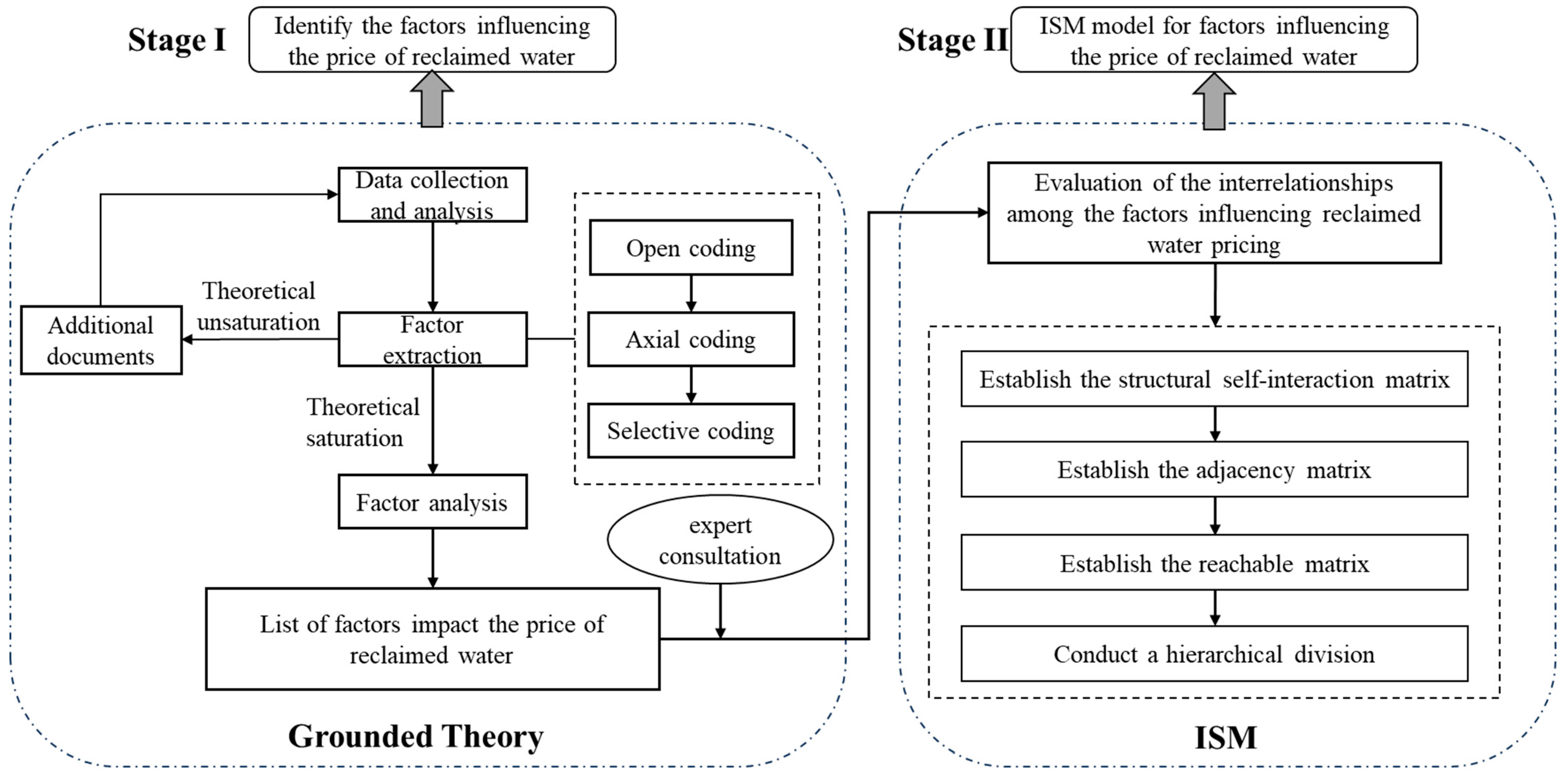
This study adopted a combinatorial approach integrating qualitative and quantitative methods, as outlined in Figure 1. First, by applying the grounded theory method, the study identified and extracted the key factors that influence the price of reclaimed water. Subsequently, through expert consultation, a list of key influencing factors for reclaimed water pricing was identified, and the interrelationships among these factors were evaluated. Finally, a hierarchical model of the factors influencing the price of reclaimed water was constructed by the ISM method.

2.1.1. Stage I—Grounded Theory

The grounded theory method is a qualitative research approach that involves systematically collecting, summarizing, and repeatedly comparing empirical data in order to construct a foundational theory [27]. It is widely applied to problems such as identifying influencing factors, interpreting process-related issues, and conducting exploratory research on emerging phenomena [28]. In addition to the grounded theory method, academic research often employs quantitative approaches such as Structural Equation Modeling (SEM) [29,30] and econometric models [31,32] to identify and extract influencing factors. Compared to these quantitative empirical research methods, the grounded theory method does not require researchers to establish explicit research hypotheses in advance. Instead, it emphasizes the inductive summarization of raw data through a comprehensive and relatively standardized operational procedure, thereby constructing substantive theories from empirical data in a bottom-up manner that allows findings to emerge naturally. Consequently, this approach does not serve as a mere replication or validation of existing theories but is particularly suitable for research domains where established theoretical frameworks are still lacking. In view of the fact that the theoretical underpinnings of reclaimed water pricing remain at a nascent stage, and considering its operability and research objectives, this study adopts the proceduralized grounded theory method to conduct an exploratory investigation on the influencing factors of reclaimed water prices. The main steps involve the hierarchical coding of the collected data, which are, respectively, open coding, axial coding, and selective coding, as illustrated in Stage I of Figure 1.

2.1.2. Stage II—Interpretive Structural Model (ISM)

The interpretive structural model (ISM) was developed by Professor Warfield of the United States to analyze complex socioeconomic systems. It is a systematic analytical approach that integrates expert knowledge and computational processing to identify hierarchical structural relationships among various influencing factors within complex systems. As a conceptual modeling tool, its primary advantage lies in its ability to clarify seemingly disordered and ambiguous interrelationships, visually representing the complex dependencies and causal pathways among factors through ISM diagrams. This provides decision-makers with a more robust foundation for informed decision-making. The ISM has been applied broadly across diverse fields. Some scholars applied it to project management domains, such as renewable energy generation development [33], project risk management [34,35], and project communication elements [36]. Other scholars have used the ISM to study satisfaction and behavioral intentions, including customer satisfaction [37,38], sustained participation intentions in user innovation communities [39], public participation intentions in urban water environment governance [40], and sorting and recycling intentions and behaviors for express packaging [41]. Additionally, some researchers have applied the ISM to price management studies. For example, He et al. [42] introduced the ISM into the electricity price chain system to refine the coal–electricity price linkage mechanism by analyzing the hierarchical structure of factors influencing the price chain. Fu et al. [43] explored factors affecting agricultural product prices in China since the 21st century, as well as their transmission mechanisms, using the ISM. They identified superficial, intermediate, and deep factors influencing agricultural price fluctuations. Given the numerous factors identified and extracted through grounded theory methods, along with their complex interrelationships and potential correlations or causal links, this paper further analyzed the correlations and hierarchical structure among the influencing factors of reclaimed water prices using the ISM. The following steps outline the ISM process, as illustrated in Stage II of Figure 1:
(1) Further identify the set of factors influencing the pricing of reclaimed water: Based on the factors influencing the price of reclaimed water that were initially identified and extracted through the grounded theory method, this paper adopted the expert consultation to solicit opinions from experts in the relevant fields. Thus, the set of factors influencing the price of reclaimed water was further determined and is denoted as S , as described in Equation (1).
S = S i i = 1 ,   2 ,   3 , x
(2) Establish a structural self-interaction matrix (SSIM): A binary analysis and expert consultation were used to evaluate the interrelationships among the factors influencing reclaimed water pricing. The pairwise interaction relationships between row elements S i and column elements S j are established, with the bivariate relationships among the influencing factors represented by four symbols ( V , U , X , O ), as described in Equation (2).
  V = factor   S i   has   a   direct   impact   on   factor   S j U = factor   S j   has   a   direct   impact   on   factor   S i X = factors   S i   and   factor   S j   mutually   Influence   each   other O = factors   S i   and   factor   S j   have   no   influence   on   each   other
(3) Establish an adjacency matrix: Based on the SSIM, create an adjacency matrix A for the price of reclaimed water by substituting the relationships in SSIM with binary digits (1 or 0), as described in Equation (3).
A = a i j , a i j = 1 , If   factor   S i   has   a   direct   causal   relationship   with   factor   S j 0 , other   conditions
(4) Establish a reachability matrix: The reachable matrix is used to represent the direct or indirect influence relationships among various influencing factors, specifically indicating whether a channel exists connecting one influencing factor to another. The matrix   M = m i j for factors influencing reclaimed water pricing is calculated using Boolean algebra rules based on the adjacency matrix   A of these factors and the identity matrix   I . In the event that the matrix M satisfies Equation (4), the matrix   M is designated the reachable matrix for the factors influencing the water price.
M = ( A + I ) n + 1 = ( A + I ) n A + I n 1 ( A + I )
(5) Conduct a hierarchical division: To further determine the hierarchical relationships among the various factors influencing reclaimed water pricing, a hierarchical division was applied to the accessibility matrix of these pricing factors. The set of column elements corresponding to all matrix elements “1” in each row of the reachability matrix   M is defined as the reachability set B S i . The set of row elements corresponding to all matrix elements “1” in each column of the reachability matrix   M is defined as the precedence set D S i , as shown in Equations (5)–(6). The hierarchical division of factors influencing the price of reclaimed water is carried out step by step, according to Equation (7).
  B S i = S j m i j = 1
D S i = S j m j i = 1
  L l = S i B S i D S i = B S i
When the condition L l = S i B S i D S i = B S i is satisfied, the factors influencing reclaimed water pricing can be extracted step by step.
(6) Establish an ISM for the price of reclaimed water: Based on the above hierarchical relationship, a multi-level recursive structure model was constructed to explore the formation mechanism of reclaimed water prices.

2.2. Data Source and Processing

The data sources for this study were primarily policy documents related to reclaimed water from national and provincial local governments, as well as domestic and international journal literature regarding reclaimed water and related topics. This study first searched for policy documents related to “reclaimed water”, “reclaimed water utilization”, “reclaimed water management”, and “reclaimed water price management” during the period from 1 January 2000 to 30 June 2025, and those that were “currently valid” and available in the North University Law and Regulation Database. Subsequently, this study conducted a comprehensive literature review of over two decades of studies by searching for these keywords in the databases of CNKI and Web of Science. Based on the research content of this study, after eliminating policy documents and literature materials that did not contain relevant information about the price of reclaimed water, a total of 64 policy documents and 120 journal articles [12,13,16,17,18,20,21,22,24,25,44,45,46,47,48,49,50,51,52,53,54,55,56,57,58,59,60,61,62,63,64,65,66,67,68,69,70,71,72,73,74,75,76,77,78,79,80,81,82,83,84,85,86,87,88,89,90,91,92,93,94,95,96,97,98,99,100,101,102,103,104,105,106,107,108,109,110,111,112,113,114,115,116,117,118,119,120,121,122,123,124,125,126,127,128,129,130,131,132,133,134,135,136,137,138,139,140,141,142,143,144,145,146,147,148,149,150,151,152,153] were selected as the materials for analysis. The details of the source of policy documents and journal articles are listed in the Supplementary Material (Tables S1 and S2). According to the requirements of the theoretical saturation test, 58 policy documents and 112 journal articles were randomly selected from the above materials for coding analysis, while the remaining policy documents and journal articles were used as the samples for the theoretical saturation test.

3. Research Process and Results

3.1. Identification of Influencing Factors of Reclaimed Water Prices Based on Grounded Theory

(1)
Open coding
Open coding is a process of organizing, coding, and extracting initial concepts from the raw data, and then defining categories. It requires researchers to adopt an open attitude and conduct a basic organization of the most original data [154]. This study primarily relied on manual coding and was supplemented with the utilization of NVivo 12 qualitative analysis software to perform three-level coding on the original materials regarding reclaimed water prices. From 58 policy text materials and 112 journal literature materials, the original data sentences related to the price of reclaimed water were sorted out and conceptualized. For the initial concepts that appeared less frequently (less than three times) or were repetitive, they were merged or eliminated. In the open coding phase, 48 significant and/or frequent initial conceptualizations were generated from the text materials and journal literature materials. Eventually, 16 categories were obtained. Due to space limitations, this study only presents some of the results of the open coding (Table 1).
(2)
Axial coding
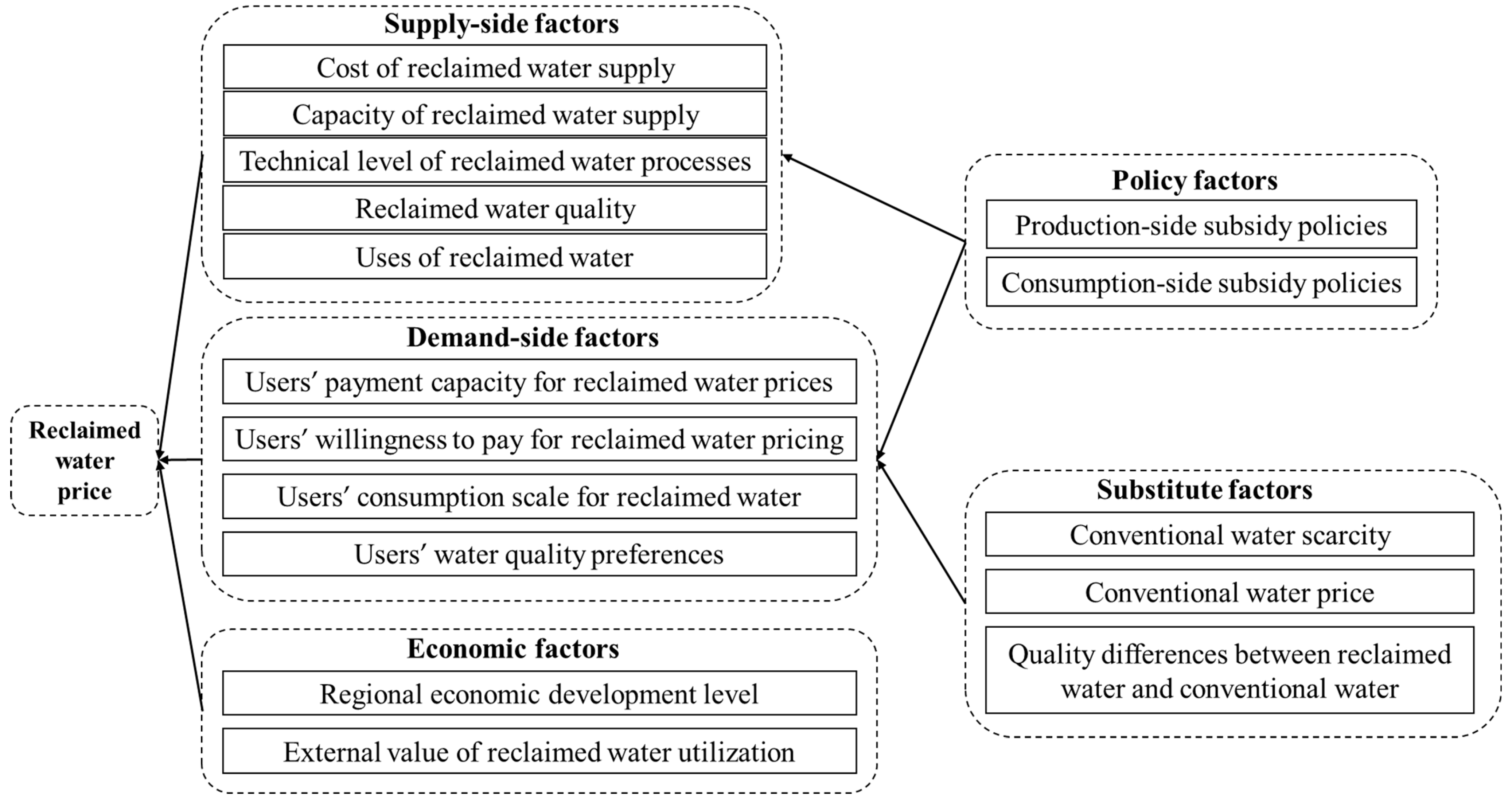
Axial coding is an additional abstraction and convergence based on open coding. It reorganizes and summarizes the categories formed by open coding. On this basis, it delves into the logical relationships and interconnections among these categories and further synthesizes similar categories into primary categories. Through the repeated comparison and analysis of the initial concepts and categories extracted from open coding, this study identified five primary categories as follows: supply-side factors, demand-side factors, substitute factors, economic factors, and policy factors. The various primary categories, their corresponding categories, and the essence of the categories are shown in Table 2.
(3)
Selective coding
Selective coding is a process that progressively elevates the level of conceptual abstraction from axial coding. It employs a “storyline” system to analyze the intrinsic logic and interconnections among various categories, thereby formulating a theoretical framework. Through a review of relevant policy documents and journal literature, and in alignment with the research objectives, this study identified “influencing factors of reclaimed water pricing” as its core category. Selective coding was carried out on the above five main categories; the relationships among these main categories were analyzed, and the interaction paths among them were explored. The results of the selective coding were presented in Table 3. Based on these findings, a theoretical model of the influencing factors of reclaimed water pricing was constructed and elaborated, as illustrated in Figure 2.
(4)
Saturation test
The theoretical model developed through grounded theory should be evaluated for theoretical saturation. As noted by Jia and Tan [155], theoretical saturation is achieved when the coding and analysis of additional data yield no new concepts, categories, or relational structures. To ensure the reliability and validity of the research findings, this study applied the aforementioned coding and analytical procedures to a reserved set of six policy documents and eight domestic and international literature articles. The results indicated no emergence of new concepts, categories, or relational structures. Therefore, it can be concluded that the “theoretical model for the influencing factors of reclaimed water prices” derived from grounded theory in this study has passed the theoretical saturation test.
Regarding the abovementioned open coding, axial coding, selective coding, and saturation test, this paper has derived a list of core factors influencing the price of reclaimed water (Table 4).

3.2. Construction of the ISM for the Price of Reclaimed Water

(1)
Identify the set of factors influencing the pricing of reclaimed water
To ensure the accuracy and credibility of the influencing factors of reclaimed water prices, this study disseminated expert consultation questionnaires via face-to-face delivery, WeChat, and other means, or carried out telephone interviews to collect expert opinions. The criteria for expert selection were as follows: a minimum of a bachelor’s degree; university scholars or government officials with professional backgrounds in water resources management, reclaimed water management, or water pricing management. Through rigorous selection, a total of 20 experts in the field were invited to further validate the list of factors influencing the price of reclaimed water and to examine the relationships among these factors.
(2)
Establish the structural self-interaction matrix (SSIM) and the adjacency matrix
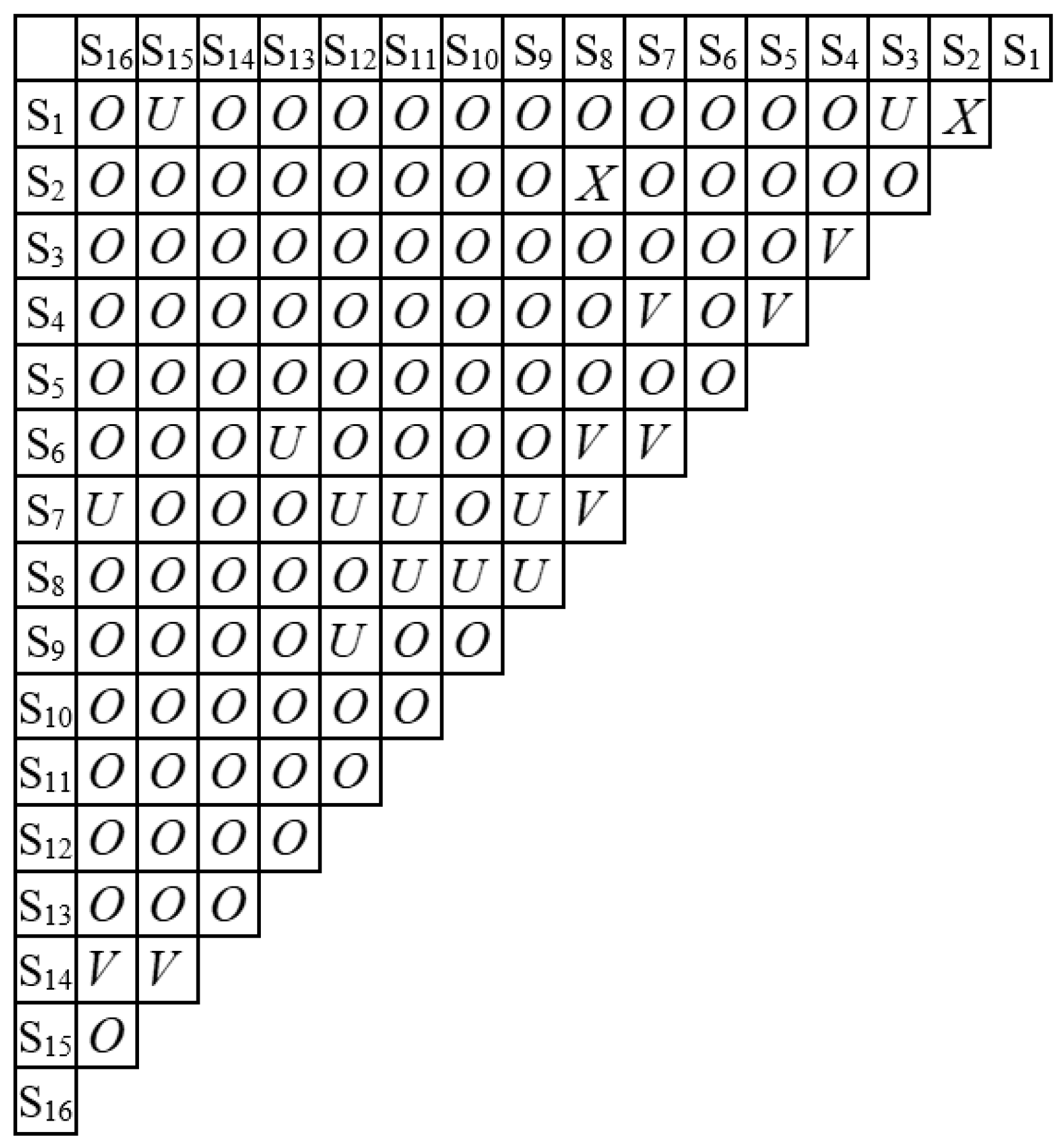
Based on the set of factors influencing the price of reclaimed water, this study incorporated expert opinions and applied the principles outlined in Equation (2) to determine the interrelationships among various factors affecting reclaimed water pricing. Considering the potential inconsistency in expert opinions, a 75% judgment threshold was established to determine whether an influence relationship exists between two factors, following the approach of Zhao and Xing [156]. Figure 3 (SSIM) illustrates the aggregated relationship assessment of 16 factors that influence the pricing of reclaimed water.
According to the binary relationship results shown in Figure 3, the symbols (V, U, X, O) in SSIM were converted into a binary digit through Equation (3), thereby obtaining an adjacency matrix   A A = a i j . Specifically, if factor S i has a direct causal relationship with the factor S j , then a i j = 1 ; otherwise, a i j = 0 .
(3)
Construct the reachable matrix
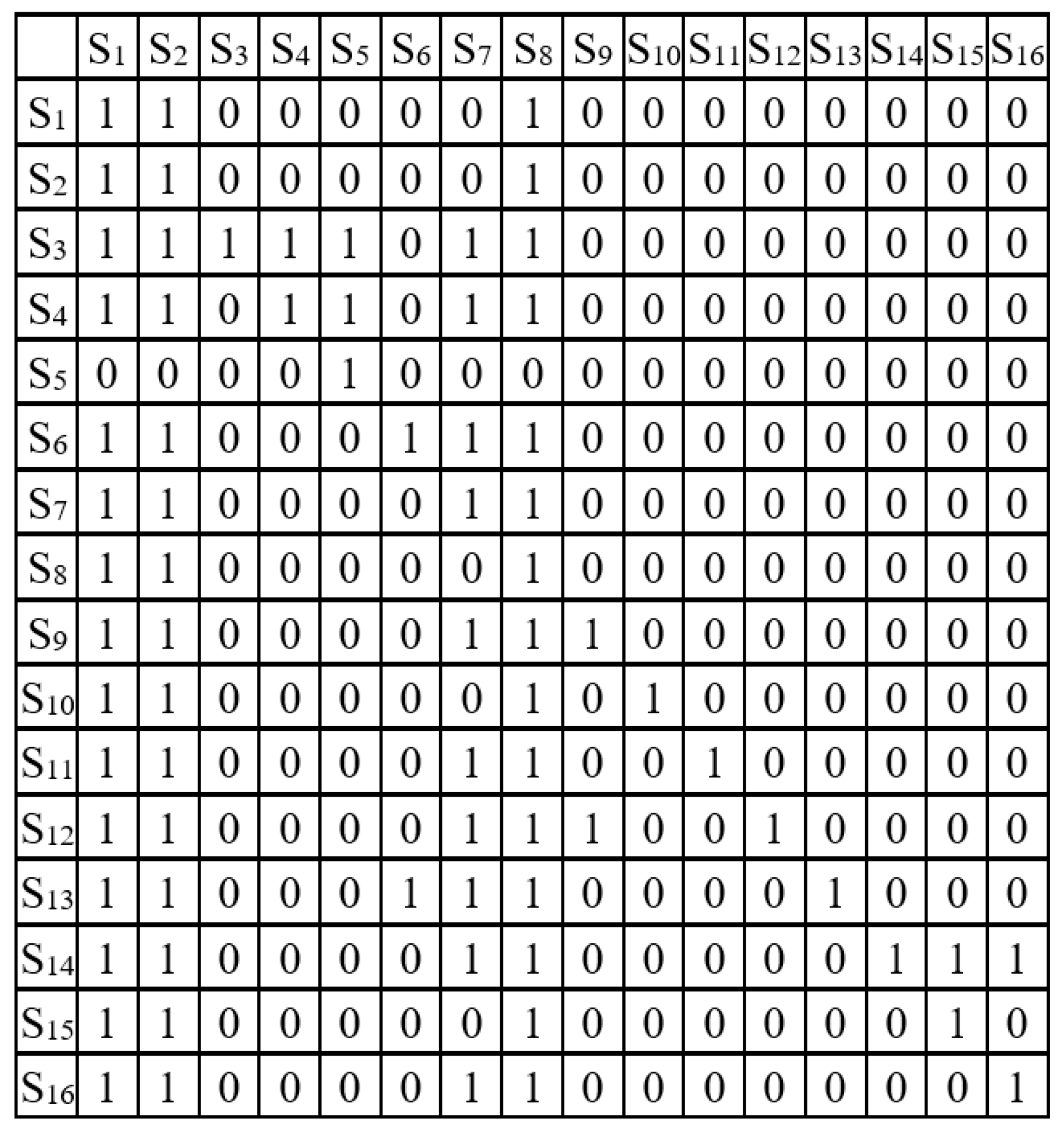
Following the Boolean algebra rules outlined in Equation (4), the reachable matrix   M was obtained. Specifically, based on the summation of the adjacency matrix and the identity matrix of the factors influencing the price of reclaimed water, the matrix is subjected to power operations, and iterative calculations are performed in a loop until Equation (4) is satisfied. This study utilized MATLAB R2022a to obtain the reachable matrix   M of reclaimed water pricing factors, as shown in Figure 4.
(4)
Conduct a hierarchical division
The reachable matrix M of reclaimed water pricing is the basis for hierarchical division. Based on the reachability matrix and following the steps outlined in Equations (5)–(7), the influencing factors of reclaimed water prices were extracted level by level. Firstly, B S i , D S i and B S i D S i were calculated based on the reachability matrix   M and Equations (5) and (6). If Equation (7) is satisfied, that is,   L l = S i B S i D S i   = B S i , then the top-level factor is identified, as shown in Table 5.
As can be observed from Table 5, the first level of influencing factors on the price of reclaimed water are S1, S2, S5, and S8. Subsequently, this study removed the row and column elements of the influencing factors of reclaimed water price S1, S2, S5, and S8, and then, following Equations (5)–(7), a new top-level factor was found from the remaining matrix   M . Similar iterations were repeated until all factors’ levels were determined (Table 6, Table 7 and Table 8).
As seen in Table 5, Table 6, Table 7 and Table 8, the four levels of the factors were L 1 = S 1 , S 2 , S 5 , S 8 , L 2 = S 7 , S 10 , S 15 , L 3 = S 4 , S 6 , S 9 , S 11 , S 16 , L 4 = S 3 , S 12 , S 13 , S 14 .
(5)
Establish an interpretive structural model (ISM) of the reclaimed water price
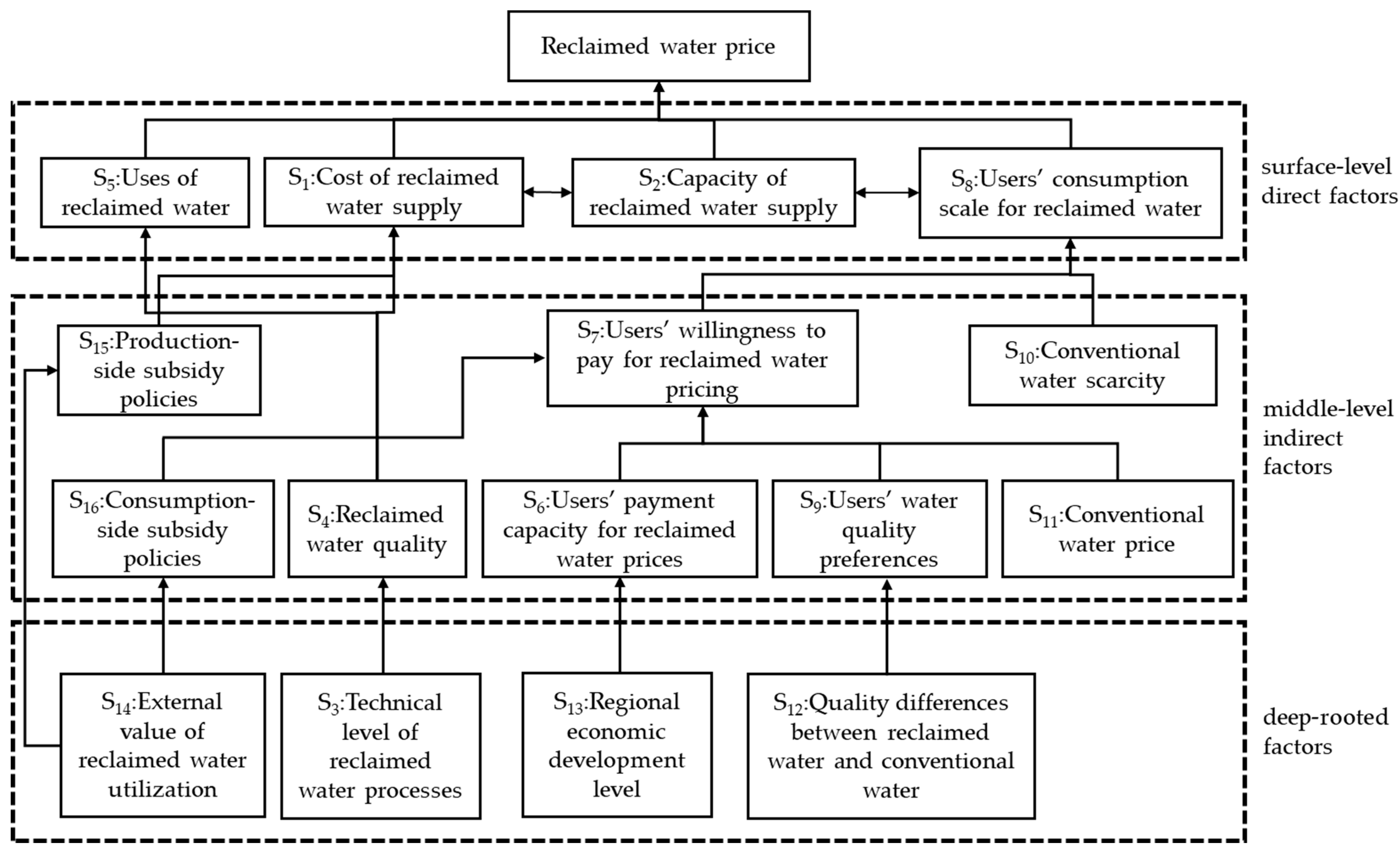
Based on the adjacency matrix, reachable matrix, and hierarchical division results of the influencing factors of reclaimed water pricing, an interpretive structural model (ISM) of these influencing factors was constructed, as illustrated in Figure 5.

3.3. Analysis of Different Hierarchical Levels

As demonstrated in Figure 5, the factors that exert influence were divided into four hierarchical levels, thereby establishing a top-down structural relationship based on the priority of their transmission pathways. Based on the logical relationship among the system factors and the hierarchical structure theory of the interpretive structural model, the study further classified the hierarchical structure of the influencing factors of reclaimed water price into three layers: surface-level, middle-level, and deep-level [157]. These factors interacted in a stepwise manner from the lower to the higher levels, collectively shaping the formation of reclaimed water pricing.
(1)
Analysis of surface-level direct factors
The surface-level direct factors, including the “uses of reclaimed water”, the “costs of reclaimed water supply”, the “capacity of reclaimed water supply”, and the “users’ consumption scale for reclaimed water”, represented the ultimate manifestation of the formation of reclaimed water prices. However, their changes and impacts depended on the transmission and support of underlying factors. Among them, the “costs of reclaimed water supply” served as the pricing basis, which adheres to the principle of cost recovery and reasonable profit. Moreover, there was a binary relationship in which the “capacity of reclaimed water supply” and the “costs of reclaimed water supply” influence each other. On the one hand, excessively high water treatment costs for reclaimed water may compel producers to reduce production volumes in order to sustain normal operational activities. On the other hand, the economies of scale achieved through increased production could significantly lower the unit cost of reclaimed water supply. The research also found an interactive relationship between the “capacity of the reclaimed water supply” and the “users’ consumption scale for reclaimed water”. They refer to the supply and demand of reclaimed water. In other words, the relationship between the supply and demand of reclaimed water had an impact on the price of reclaimed water. This conforms to the economic theory that “supply and demand determine price” [158] and is consistent with the government’s gradual relaxation of pricing regulations, which allows reclaimed water manufacturers and users to negotiate prices based on quality. As shown in Figure 5, it was evident that the “uses of reclaimed water” is also one of the direct factors affecting the price of reclaimed water. In China, the specific applications of reclaimed water encompass agricultural irrigation, industrial reuse, municipal miscellaneous, ecological water replenishment for rivers and lakes, and groundwater recharge, among other aspects. Nevertheless, the water quality standards required by users in different sectors vary.
(2)
Analysis of middle-level indirect factors
The factors at the second and third levels played a bridging role in the entire explanatory structure model and were therefore classified as middle-level indirect factors. This complex interplay of factors could directly influence the development and changes in the surface-level factors of the reclaimed water price, and was also influenced by the deep-rooted factors of the reclaimed water price. From the perspective of its category, its composition was quite complex, incorporating not only supply-side factors and demand-side factors but also policy factors and substitute factors.
The second-level factors included the “production-side subsidy policies”, the “users’ willingness to pay for reclaimed water pricing”, and “conventional water scarcity”. Subsidy policies implemented at the production end had an impact on the production cost of reclaimed water. This implies that the government employs non-market economic measures to encourage manufacturers to produce reclaimed water. Research findings suggested that the scarcity of conventional water resources and the users’ willingness to pay for reclaimed water primarily influence the scale of reclaimed water utilization by users. Owing to the uneven temporal and spatial distribution of water resources in China, regions or seasons with relatively abundant water resources can largely satisfy the regional water demand, resulting in a lower demand for reclaimed water utilization. In contrast, in regions or seasons with relatively scarce water resources, the regional water demand cannot be fulfilled, leading to a higher demand for reclaimed water utilization. Consequently, the scarcity of conventional water resources is a crucial factor affecting the demand for reclaimed water.
The third-level factors were numerous. Among them, the “users’ payment capacity for reclaimed water prices”, “users’ water quality preferences”, and “conventional water price”, collectively influenced the users’ willingness to pay for reclaimed water. It was also evident from Figure 5 that the quality of reclaimed water within the third-level factors determined the “uses of reclaimed water” and the “costs of reclaimed water supply”. Considering the practices of reclaimed water utilization in China and the national “Urban Wastewater Reuse” series of standards, different user groups have distinct requirements for the quality of reclaimed water. To more effectively mitigate the risks associated with reclaimed water utilization, reclaimed water can only be reused for a specific purpose if it meets the minimum water quality standards for that purpose. Furthermore, disparities in the production costs of reclaimed water were attributable to divergent water quality levels. Under normal circumstances, the cost of reclaimed water supply is generally proportional to the water quality standard. Therefore, it is evident that the quality of reclaimed water will indirectly influence the price of reclaimed water by determining its uses and the cost of supply.
(3)
Analysis of deep-rooted factors
The deep-rooted factors encompassed the “external value of reclaimed water utilization”, the “technical level of reclaimed water processes”, the “regional economic development level”, and the “quality differences between reclaimed water and conventional water”. These factors exerted an indirect influence on the price of reclaimed water via the middle-level factors and were the root causes that determined the price of reclaimed water. As shown in Figure 5, the external value of reclaimed water utilization was mainly influenced by policy factors. This suggested that, given the externality of reclaimed water, the government should adopt non-market economic measures for intervention and internalize the externality of reclaimed water to address the shortcomings resulting from the pure market mechanism. Moreover, the technological level of reclaimed water treatment processes imposed a fundamental constraint on the selection of reclaimed water applications and the cost of water supply by determining the quality of reclaimed water. The regional economic development level primarily influenced the users’ payment capacity for reclaimed water, which reflected the impact of the regional economy on the affordability of reclaimed water. The research also revealed that the quality differences between reclaimed water and conventional water have an indirect effect by influencing users’ water quality preferences. Overall, deep-rooted factors exerted their influence on reclaimed water prices through the mediation of middle-level factors. This reflects the fundamental causes and driving forces inherent in the model, representing systemic elements that necessitate long-term consideration.

4. Discussion

4.1. Mechanisms Influencing the Reclaimed Water Price

Unlike the previous research, this study, which adopted grounded theory and interpretive structural modeling, discovered that the formation of reclaimed water prices is not directly determined by a single factor. Instead, it is a complex process where deep-rooted factors, middle-level indirect factors, and surface-level direct factors interact and transmit in a step-by-step manner. Although the mechanisms through which these deep-rooted factors operate are concealed and difficult to detect directly, they are the fundamental driving forces that influence the price system.
Firstly, the external value of reclaimed water utilization is a fundamental factor that cannot be overlooked, as it influences both the production-end and the consumption-end subsidy policy. The utilization of reclaimed water exhibits distinct positive external effects, specifically encompassing water-saving benefits, sewage discharge reduction benefits, ecological water replenishment benefits, and social benefits [159]. In order to ensure the effective allocation of reclaimed water resources, it is essential that the government intervenes in the pricing process to address the limitations of the pure market mechanism. As Wang Feng et al. [141] have indicated, the government can effectively foster the long-term development of the reclaimed water market by internalizing the externalities associated with reclaimed water utilization through financial subsidies provided to relevant entities. Essentially, the production-end subsidy policy indirectly reduces the costs borne by reclaimed water producers, thereby enhancing the price competitiveness of reclaimed water. Meanwhile, the consumption-end subsidy indirectly reduces the cost for recycled water users, thereby stimulating consumption and increasing users’ willingness to pay for recycled water. For example, the local government has been actively exploring various forms of incentive and subsidy policies and has reduced the income tax of 21 enterprises by 26.43 million yuan in Binzhou City, Shandong Province. Although these enterprises continue to pay water fees in accordance with the established pricing, their actual water-usage costs have witnessed a substantial decline when the comprehensive tax reductions are taken into consideration. Therefore, the externality of reclaimed water utilization is of pivotal significance in relation to price mechanisms, which is consistent with a study conducted by Thomas et al. [160].
Next, the technological level of reclaimed water processes is the fundamental and decisive factor for the price of reclaimed water. It essentially determines the water quality grade, the production cost of reclaimed water, and its uses. Among them, the quality of reclaimed water is a pivotal factor in determining the cost of production and the scope of its uses. Drawing upon the empirical evidence of reclaimed water utilization in China, as well as the national series of standards entitled “Urban Sewage Reuse”, it is acknowledged that disparate user groups possess distinct requirements with regard to the quality of reclaimed water. In order to more effectively mitigate the risks associated with the utilization of reclaimed water, it is imperative that its reuse is contingent upon its alignment with the stipulated minimum water quality standards for the designated purpose. For example, the water quality requirements for agricultural and forestry use are relatively lower, and secondary treatment and appropriate disinfection are usually sufficient to meet these requirements. By contrast, industrial water use has higher requirements for water quality stability and often requires advanced treatment (such as reverse osmosis) to prevent equipment scaling or corrosion. Consequently, the technological level of reclaimed water treatment processes typically exhibits a positive correlation with investment costs, operating expenses, and the quality of the final effluent [14]. In other words, the utilization of advanced technological processes generally yields reclaimed water that is characterized by enhanced stability, safety, and quality. However, it should be noted that such processes necessitate a greater initial capital investment and result in higher operating expenses. Thus, this chain relationship of “technology → water quality → cost/uses” forms the logical foundation for the pricing of reclaimed water.
Moreover, the level of regional economic development is a concentrated reflection of the payment capacity and willingness of reclaimed water users, directly determining the effective demand and economic feasibility of the reclaimed water market. It is important to note that the payment capacity of users should not be confused with their payment willingness. The users’ payment capacity represents an objective economic constraint, which refers to the maximum price that a user can afford based on their income or financial budget. In contrast, the users’ willingness to pay is a subjective value judgment, indicating the price that the user is willing to pay based on their assessment of the value of reclaimed water, personal preferences, and available alternatives. From the analysis results of the ISM, the level of regional economic development exerts a significant influence on the users’ propensity to pay for reclaimed water. This, in turn, has an indirect effect on the psychological acceptance of reclaimed water prices. As Gu et al. [60] have previously observed, individuals with higher income levels are more inclined to utilize reclaimed water and are more willing to pay for it. Furthermore, users’ willingness to pay for reclaimed water prices determines users’ consumption scale for reclaimed water, which further supports that low willingness to pay for reclaimed water affects the conclusion of reclaimed water transactions [161].
Then, the objective disparities in water quality between reclaimed water and conventional water fundamentally limit its market pricing scope and serve as a constraining factor influencing its market acceptance. It is an undeniable fact that despite the acquisition of reclaimed water through advanced technical treatment, due to the constraints of sewage treatment processes and technologies, some pollutants inevitably persist in the reclaimed water, presenting certain risks to human health, ecological environment, and industrial production [162,163]. Owing to concerns regarding water quality safety, users are inclined to favor conventional water during the decision-making process. This inclination reduces their willingness to pay for reclaimed water, thereby directly suppressing the actual demand for reclaimed water. In addition to users’ water price payment capacity and water quality preferences, the price of conventional water also has an impact on users’ willingness to pay for reclaimed water. Existing research has indicated that the price of fresh water plays a crucial role in determining the willingness of farmers in the agricultural sector to pay for reclaimed water [164].
Finally, it is important to note that the ISM unveils the overall theoretical framework of the formation mechanism of reclaimed water prices. Nevertheless, during the application process in various fields, the weight assumptions of different influencing factors should be adjusted according to the specific uses of reclaimed water. Thus, this article, in conjunction with the primary domains of reclaimed water reuse in China, underscores the pivotal factors that ought to be prioritized in the pricing mechanism for diverse reuse sectors. (1) For agricultural irrigation, particularly small-scale farming, both the ability and willingness to pay for water have a relatively weak impact on the price of reclaimed water. Therefore, the reuse of reclaimed water in agriculture is more dependent on government subsidies to compensate for the limited payment capacity and willingness of small-scale farming. (2) For industrial reuse, it is of greater significance to determine the price based on the cost of reclaimed water production and the water quality level. In accordance with the stipulations set out in the “Water reuse guidelines—Reclaimed water classification” (GB/T 41018-2021) [165], industrial water reuse has stricter requirements for water quality compared to other application fields to ensure the safety and effectiveness. Particularly in the case of boiler feed water, it is essential to comply with the A-level water quality standard, which is necessary to adopt advanced treatment and disinfection processes in addition to the tertiary treatment. Therefore, taking into account the substantial disparities in treatment processes and water quality standards for industrial reuse, a tiered pricing system ought to be implemented in practice. (3) For municipal miscellaneous and ecological water replenishment, greater emphasis should be placed on the external value of reclaimed water utilization. For example, in Foshan City, with regard to the ecological water replenishment and landscape environment water use of rivers, lakes, and wetlands that offer public ecological environment services and utilize reclaimed water, the government is recommended to adopt the service-purchasing approach to facilitate the resource utilization of sewage. In contrast to agricultural and industrial reuse, it places greater emphasis on ecological benefits and social public value and consequently necessitates a differentiated policy support model.

4.2. Limitations and Future Research Directions

This study examines the determinants influencing the price of reclaimed water. However, several deficiencies persist. First, the identification of influencing factors and the establishment of factor relationships were reliant on documentary materials and expert opinions. The domestic case studies and empirical analysis could be pursued to validate the model and conclusions, solidifying the causal links among various factors influencing the price of reclaimed water. Additionally, while the significant role of the external value of reclaimed water utilization was underscored in the pricing mechanism, empirical validation remains pending. Future research could build upon the findings of this study by taking into account the internalization of the externalities of reclaimed water and investigating the development of pricing models for reclaimed water tailored to different types of users. Finally, in terms of policy factors, it is advisable to explore the effects of mandatory quotas for reclaimed water and analyze the impact of quota changes on reclaimed water prices via scenario simulation in future research work.

5. Conclusions and Policy Implications

The utilization of reclaimed water constitutes a pivotal strategic measure within the paradigm of contemporary water management, with the overarching objective being the augmentation of water resources and the mitigation of water contamination. It is of great significance for alleviating the contradiction between regional water supply and demand, improving the water ecological environment, and promoting the comprehensive green transformation of economic and social development. Currently, the price of reclaimed water in China is undergoing a critical phase of transition from government-set prices to market-regulated prices. However, research on the theoretical methods for pricing reclaimed water, which takes into account China’s national conditions, water situation, and the characteristics of reclaimed water, is still relatively scarce. Thus, this study first extracted the factors influencing the price of reclaimed water through grounded theory from a systematic perspective. Then, the interrelationships of the key factors were assessed by 20 experts, and an ISM was employed to elucidate the logical hierarchy and analyze their influencing mechanisms. The results indicate the following. (1) A theoretical model for the influencing factors of reclaimed water prices has been established. It specifically included five main categories, such as supply-side factors, demand-side factors, substitute factors, economic factors, and policy factors, along with their corresponding 16 sub-categories. (2) The 16 influencing factors were divided into four levels based on the ISM for reclaimed water pricing, and were further classified into surface level, middle level, and deep level. (3) The external value of reclaimed water utilization, the technical level of reclaimed water processes, the regional economic development level, and the quality differences between reclaimed water and conventional water were the deep-rooted factors that drive the formation of the price of reclaimed water.
In light of the aforementioned research conclusions, the study put forward the following policy implications regarding the management of reclaimed water prices:
(1) From the perspective of surface-level direct factors, it is suggested that attention should be paid to reducing the cost of reclaimed water and increasing the demand for reclaimed water. In terms of cost reduction, first, efforts should be made to accelerate the establishment of a scientific and standardized cost accounting system for reclaimed water supply, providing a true and comparable cost basis for price setting. Second, strategic investment in the large-scale construction of infrastructure such as reclaimed water plants and water supply networks is essential to achieve cost efficiencies through economies of scale. In terms of increasing demand, first, it is essential to enhance users’ trust in the safety of reclaimed water and their willingness to utilize it by improving water quality supervision and information disclosure mechanisms. Given that users’ willingness to pay for reclaimed water is a critical intermediate factor, efforts should be made to strengthen the enforcement of water quality standards, enhance terminal water quality monitoring, and improve information transparency. These measures will increase users’ acceptance of reclaimed water quality and their confidence in its safety, thereby promoting the utilization rate of regional reclaimed water. Second, there is a need to expedite the establishment of a differentiated pricing model for reclaimed water based on “graded water supply and tiered pricing”. Such a differentiated pricing system is more conducive to driving the successful promotion of reclaimed water.
(2) From the perspective of middle-level indirect factors, a coordinated price subsidy and incentive system involving both production and consumption sides should be established. On the production side, a dedicated fund for research and development of reclaimed water technologies can be established, focusing on supporting key technologies and optimizing processes in reclaimed water treatment. This would guide enterprises to reduce costs and enhance efficiency through technological advancements, thereby alleviating upward price pressures on reclaimed water from the source. On the consumption side, the use of reclaimed water can be integrated into the green credit system, with policy incentives provided to enterprises that utilize reclaimed water through measures such as reductions in environmental taxes, priority access to green credit, and preferential water usage quotas. By synergizing cost reduction on the production side with incentives on the consumption side, the price mechanism for reclaimed water can enhance its regulatory effect on both supply and demand, promoting stable operation within a reasonable price range.
(3) From the perspective of deep-rooted factors, it is imperative to accelerate the establishment of an external value accounting system for reclaimed water utilization and promote the internalization of its external value. Given that the external value of reclaimed water utilization is a root factor influencing its pricing and primarily operates through policy mechanisms, it is essential to develop a scientific and systematic method for accounting for this external value, including quantifying benefits such as resource conservation, pollution reduction, ecological water replenishment, and socioeconomic gains. On this basis, diverse approaches to internalize the external value of reclaimed water should be actively explored, including mechanisms such as reclaimed water rights trading and ecological compensation for the utilization of reclaimed water.

Supplementary Materials

The following supporting information can be downloaded at: https://www.mdpi.com/article/10.3390/w18040526/s1. Table S1: The list detailing the source of policy documents; Table S2: The list detailing the source of journal articles.

Author Contributions

Z.S.: data curation, conceptualization, methodology, writing—original draft preparation. K.H.: validation, software, writing—review and editing. Y.H.: writing—review and editing. C.F.: writing—review and editing. Y.J.: writing—review and editing. All authors have read and agreed to the published version of the manuscript.

Funding

This research was supported by the Humanities and Social Sciences Youth Foundation, Ministry of Education of the People’s Republic of China, Grant No. 25YJCZH210; High-Level Talent Supporting Fund of Xiangnan University, Grant No. 6012402.

Data Availability Statement

The original contributions presented in this study are included in the article and Supplementary Material. Further inquiries can be directed to the corresponding author.

Acknowledgments

We thank the reviewers and editors involved in the review process.

Conflicts of Interest

The authors declare no conflicts of interest.

References

  1. Tra, T.V.; Thinh, N.X.; Greiving, S. Combined top-down and bottom-up climate change impact assessment for the hydrological system in the Vu Gia-Thu Bon River Basin. Sci. Total Environ. 2018, 630, 718–727. [Google Scholar] [CrossRef]
  2. Mehrazar, A.; Bavani, A.R.; Gohari, A.; Mashal, M.; Rahimikhoob, H. Adaptation of water resources system to water scarcity and climate change in the suburb area of megacities. Water Resour. Manag. 2020, 34, 3855–3877. [Google Scholar] [CrossRef]
  3. Zhao, X.; Zhang, H.; Li, T.; Ye, Z.; Xue, C.; Zhang, Y.; Yang, Z. Types identification and development tracking of urban water scarcity in China: A case study of 32 major cities. J. Nat. Resour. 2023, 38, 2619–2636. [Google Scholar] [CrossRef]
  4. Sun, Y.; Zhang, Z.; Zhou, L. The spatio-temporal evolution of industrial pollution control efficiency and its spatial network in the Yangtze River Delta region. Geogr. Res. 2025, 44, 2509–2533. [Google Scholar] [CrossRef]
  5. Wang, X.; Wu, F. Assessment of reclaimed water utilization in water-scarce regions of China: A multi-dimensional-multi-agent coupling and nesting perspective. J. Clean. Prod. 2024, 450, 141815. [Google Scholar] [CrossRef]
  6. Ricart Casadevall, S.; Amorós, A. Assessing technical and social driving factors of water reuse in agriculture: A review on risks, regulation and the yuck factor. Agric. Water Manag. 2019, 217, 426–439. [Google Scholar] [CrossRef]
  7. Qu, J.; Wang, H.; Wang, K.; Yu, G.; Ke, B.; Yu, H.-Q.; Ren, H.; Zheng, X.; Li, J.; Li, W.-W.; et al. Municipal wastewater treatment in China: Development history and future perspectives. Front. Environ. Sci. Eng. 2019, 13, 88. [Google Scholar] [CrossRef]
  8. Tortajada, C.; van Rensburg, P. Drink more recycled wastewater. Nature 2020, 577, 26–28. [Google Scholar] [CrossRef]
  9. Feng, Y.; Liu, F. Reclaimed water utilization efficiency evaluation in China under the view of green development concept: Based on Dynamic SBM Method and Metafrontier Model. Econ. Prob. 2022, 7, 71–79. [Google Scholar] [CrossRef]
  10. Chen, X.; Wu, F.; Wang, X. Coupling coordination analysis between reclaimed water utilization capacity and effect in China. Water 2024, 16, 3283. [Google Scholar] [CrossRef]
  11. Delorit, J.D.; Block, P.J. Promoting competitive water resource use efficiency at the water-market scale: An intercooperative demand equilibrium-based approach to water trading. Water Resour. Res. 2018, 54, 5394–5421. [Google Scholar] [CrossRef]
  12. Han, Y.; Wu, F.; Wang, W.; Ji, Y.; Wang, R.; Wang, X. Research on the basic elements and theoretical model of reclaimed water allocation. J. Nat. Resour. 2024, 39, 1450–1472. [Google Scholar] [CrossRef]
  13. Pujol, J.; Duran-Ros, M.; Arbat, G.; Ramirez de Cartagena, F.; Puig-Bargués, J. Private micro-irrigation costs using reclaimed water. Span. J. Agric. Res. 2011, 9, 1120–1129. [Google Scholar] [CrossRef][Green Version]
  14. Li, M.; Jin, Y. Developing mechanism of reuse water price. J. Hebei Univ. Eng. 2005, 2, 90–92. [Google Scholar] [CrossRef]
  15. Zhang, Y.; Zhao, Y.; Xiong, G. Study on the cost and pricing of domestic sewage treatment from the perspective of scale economy-analysis of relationship between sewage treatment cost and processing capacity. Price Theory Pract. 2017, 7, 96–99. [Google Scholar] [CrossRef]
  16. Duan, T. Study on the independent pricing problem and method of urban recycled water. J. Nat. Resour. 2014, 29, 719–725. [Google Scholar] [CrossRef]
  17. Duan, T. A review of urban recycled water pricing theories and practices. Price Theory Pract. 2017, 10, 85–88. [Google Scholar] [CrossRef]
  18. Lazaridou, D.; Michailidis, A.; Mattas, K. Evaluating the willingness to pay for using recycled water for irrigation. Sustainability 2019, 11, 5220. [Google Scholar] [CrossRef]
  19. Chen, Y.; Zhao, H.; Nie, H.; Yang, J. Analysis of the pricing formation mechanism for recycled water. J. Econ. Water Res. 2015, 33, 50–52+79. [Google Scholar]
  20. Petousi, I.; Fountoulakis, M.S.; Stentiford, E.I.; Manios, T. Farmers’ experience, concerns and perspectives in using reclaimed water for irrigation in a semi-arid region of Crete, Greece. Irrig. Drain. 2015, 64, 647–654. [Google Scholar] [CrossRef]
  21. Cherchi, C.; Kesaano, M.; Badruzzaman, M.; Schwab, K.; Jacangelo, J.G. Municipal reclaimed water for multi-purpose applications in the power sector: A review. J. Environ. Manag. 2019, 236, 561–570. [Google Scholar] [CrossRef]
  22. Yang, S.; Duan, Z. Research on the price relations between reclaimed water and tap water supply in Qingdao. J. Tech. Econ. Manag. 2018, 7, 23–27. [Google Scholar]
  23. Fagundes, T.S.; Marques, R.C. Challenges of recycled water pricing. Util. Policy 2023, 82, 101569. [Google Scholar] [CrossRef]
  24. Wu, Y.; Song, J.; Zheng, C. Reclaimed water demand based on product differentiation and market pricing model. Stat. Decis. 2011, 14, 48–51. [Google Scholar] [CrossRef]
  25. Zhang, T.; Guna, A.; Yu, W.; Shen, D. The recycled water use policy in China: Evidence from 114 cities. J. Clean. Prod. 2022, 344, 131038. [Google Scholar] [CrossRef]
  26. Wang, W.; Wu, F.; Yu, H.; Wang, X. Assessing the effectiveness of intervention policies for reclaimed water reuse in China considering multi-scenario simulations. J. Environ. Manag. 2023, 335, 117519. [Google Scholar] [CrossRef]
  27. Wolfswinkel, J.; Furtmueller, E.; Wilderom, C. Using Grounded Theory as a Method for Rigorously Reviewing Literature. Eur. J. Inform. Syst. 2013, 22, 45–55. [Google Scholar] [CrossRef]
  28. Strauss, A.L. Qualitative Analysis for Social Scientists; Cambridge University Press: Cambridge, UK, 1987. [Google Scholar]
  29. Chai, J.; Wang, Y.; Li, X.; Zhang, X. Research on the core influencing factors of income gap in China and their nonlinear dynamic impact effects. Mod. Econ. Sci. 2023, 45, 74–88. [Google Scholar] [CrossRef]
  30. Chuah, S.H.W.; Tseng, M.L.; Wu, K.J.; Cheng, C.F. Factors influencing the adoption of sharing economy in B2B context in China: Findings from PLS-SEM and fsQCA. Resour., Conserv. Recycl. 2021, 175, 105892. [Google Scholar] [CrossRef]
  31. Xu, J.; Lv, T.; Hou, X.; Deng, X.; Li, N.; Liu, F. Spatiotemporal characteristics and influencing factors of renewable energy production in China: A spatial econometric analysis. Energy Econ. 2022, 116, 106399. [Google Scholar] [CrossRef]
  32. Tang, H.; Xia, W.; Huang, Y. Research on the identification of influencing factors and breakthrough paths for the synergistic agglomeration of manufacturing and logistics industries in the western land-sea new corridor. Chin. Soft Sci. 2022, 8, 131–139. [Google Scholar]
  33. Zhao, Z.; Chen, Y.; Li, H. What Affects the development of renewable energy power generation projects in China: ISM analysis. Renew. Energ. 2019, 131, 506–517. [Google Scholar] [CrossRef]
  34. Guan, L.; Abbasi, A.; Ryan, M. Analyzing green building project risk interdependencies using interpretive structural Modeling. J. Clean. Prod. 2020, 256, 120372. [Google Scholar] [CrossRef]
  35. Sheng, Y.; Luo, L.; Cho, H.; Cho, K. Supply chain sustainability risk management in China’s iron and steel industry: A hybrid fuzzy DEMATEL-ISM Approach. Asia Pac. Bus. Rev. 2025, 1–26. [Google Scholar] [CrossRef]
  36. Shakeri, H.; Khalilzadeh, M. Analysis of factors affecting project communications with a hybrid DEMATEL-ISM approach (A case study in Iran). Heliyon 2020, 6, e04430. [Google Scholar] [CrossRef]
  37. Miao, X.; Chen, Y.; Mi, C. Study on consumer satisfaction of Tangshan hotsprings based on lSM and online reviews. Chin. J. Manag. Sci. 2019, 27, 186–194. [Google Scholar] [CrossRef]
  38. Xiao, L.; Mi, C.; Chen, Y.; Huang, L. Understanding the determinants of consumer satisfaction with B&B hotels: An Interpretive Structural Modeling Approach. Int. J. Web Serv. Res. 2019, 16, 21–39. [Google Scholar] [CrossRef]
  39. Wang, Y.; Yang, Q.; Cao, C. Research on the influence factors of continuous participation in user lnnovation community based on interpretive structure modeling. Chin. J. Syst. Sci. 2019, 27, 112–116+129. [Google Scholar]
  40. Shen, J.; Wang, Y.; Zhao, Z. Factors influencing public participation in urban water environmental governance: Based on the survey data in BeiJing, Shanghai, and Guangzhou. Resour. Sci. 2021, 43, 2289–2302. [Google Scholar] [CrossRef]
  41. Jia, Y.; Zhang, X. Influence of environmental cognition and perceived benefits on the deviation between consumers’ willingness and behavior to participate in the classified recovery of express packaging. Resour. Sci. 2022, 44, 2060–2073. [Google Scholar] [CrossRef]
  42. He, Y.; Xia, T.; Xiong, W.; Wang, B.; Liu, Y. Risk transmission assessment of electricity price chain in China based on ISM and ECM. Int. J. Elec. Power 2013, 46, 274–282. [Google Scholar] [CrossRef]
  43. Fu, L.; Deng, Q.; Zhou, L.; Weng, Y. Research on factors influencing price fluctuation of agricultural products based on ism model. Soft Sci. 2014, 28, 112–116. [Google Scholar] [CrossRef]
  44. Tang, S.; Yue, D.; Li, X. Comparison of engineering costs of raw freshwater, reclaimed water and seawater for toilet flushing in Hong Kong. Water Environ. J. 2006, 20, 240–247. [Google Scholar] [CrossRef]
  45. Yan, X.U.; Lin-Bo, Y.U.; Hong-Qi, Z. Current situation and prospect of reclaimed water reuse. Environ. Sci. Technol. 2009, 295–298, 1880–1884. [Google Scholar] [CrossRef]
  46. Zhu, Z.; Dou, J. Current status of reclaimed water in China: An overview. J. Water Reuse Desalin. 2018, 8, 293–307. [Google Scholar] [CrossRef]
  47. López-Serrano, M.J.; Velasco-Muñoz, J.F.; Aznar-Sánchez, J.A.; Román-Sánche, I.M. Economic analysis of the use of reclaimed water in agriculture in southeastern spain, a mediterranean region. Agronomy 2021, 11, 2218. [Google Scholar] [CrossRef]
  48. Adapa, S. Factors influencing consumption and anti-consumption of recycled water: Evidence from Australia. J. Clean. Prod. 2018, 201, 624–635. [Google Scholar] [CrossRef]
  49. López-Serrano, M.J.; Velasco-Muñoz, J.F.; Aznar-Sánchez, J.A.; Román-Sánche, I.M. Farmers’ attitudes towards irrigating crops with reclaimed water in the framework of a circular economy. Agronomy 2022, 12, 435. [Google Scholar] [CrossRef]
  50. Stillwell, A.; Webber, M. Geographic, technologic, and economic analysis of using reclaimed water for thermoelectric power plant cooling. Environ. Sci. Technol. 2014, 48, 4588–4595. [Google Scholar] [CrossRef]
  51. Iftekhar, S.; Blackmore, L.; Fogarty, J. Non-residential demand for recycled water for outdoor use in a groundwater constrained environment. Resour. Conserv. Recycl. 2020, 164, 105168. [Google Scholar] [CrossRef]
  52. Zhu, Z.; Wang, H.; Li, A. On the factors influencing public knowledge and acceptance of reclaimed water from a survey of three cities in northern China. J. Water Reuse Desalin. 2018, 9, 193–202. [Google Scholar] [CrossRef]
  53. Chen, Y.; Chen, C. The optimal reuse of reclaimed water: A mathematical model analysis. Water Resour. Manag. 2014, 28, 2035–2048. [Google Scholar] [CrossRef]
  54. Yi, L.; Jiao, W.; Chen, X.; Chen, W. An overview of reclaimed water reuse in China. J. Environ. Sci. 2011, 23, 1585–1593. [Google Scholar] [CrossRef] [PubMed]
  55. Chen, W.; Bai, Y.; Zhang, W.; Lyu, S.; Jiao, W. Perceptions of different stakeholders on reclaimed water reuse: The case of Beijing, China. Sustainability 2015, 7, 9696–9710. [Google Scholar] [CrossRef]
  56. Amponsah, O.; Vigre, H.; Braimah, I.; Schou, T.W.; Abaidoo, R.C. The policy implications of urban open space commercial vegetable farmers’ willingness and ability to pay for reclaimed water for irrigation in Kumasi, Ghana. Heliyon 2016, 2, e00078. [Google Scholar] [CrossRef]
  57. Hamilton, A.J.; Boland, A.M.; Stevens, D.; Kelly, J.; Radcliffe, J.; Ziehrl, A.; Dillon, P.; Paulin, B. Position of the australian horticultural industry with respect to the use of reclaimed water. Agric. Water Manag. 2005, 71, 181–209. [Google Scholar] [CrossRef]
  58. Verhoest, P.; Gaume, B.; Bauwens, J.; Braak, P.; Huysmans, M. Public acceptance of recycled water: A survey of social attitudes toward the consumption of crops grown with treated wastewater. Sustain. Prod. Consum. 2022, 34, 467–475. [Google Scholar] [CrossRef]
  59. Zhu, Z.; Li, A.; Wang, H. Public perception and acceptability of reclaimed water: The case of Shandong province, China. J. Water Reuse Desalin. 2017, 8, 308–330. [Google Scholar] [CrossRef]
  60. Gu, Q.; Chen, Y.; Pody, R.; Cheng, R.; Zheng, X.; Zhang, Z. Public perception and acceptability toward reclaimed water in Tianjin. Resour. Conserv. Recycl. 2015, 104, 291–299. [Google Scholar] [CrossRef]
  61. Pinjing, H.; Phan, L.; Guowei, G.; Hervouet, G. Reclaimed municipal wastewater—A potential water resource in China. Water Sci. Technol. 2001, 43, 51–58. [Google Scholar] [CrossRef] [PubMed]
  62. Dolničar, S.; Saunders, C. Recycled water for consumer markets—A marketing research review and agenda. Desalination 2006, 187, 203–214. [Google Scholar] [CrossRef]
  63. Fu, H.; Li, Z.; Liu, Z.; Wang, Z. Research on big data digging of hot topics about recycled water use on micro-blog based on particle swarm optimization. Sustainability 2018, 10, 2488. [Google Scholar] [CrossRef]
  64. Li, X.; Li, X.; Li, Y. Research on reclaimed water from the past to the future: A review. Environ. Dev. Sustain. 2022, 24, 112–137. [Google Scholar] [CrossRef]
  65. Jjemba, P.; Johnson, W.; Bukhari, Z.; LeChevallier, M. Review of the leading challenges in maintaining reclaimed water quality during storage and distribution. J. Water Reuse Desalin. 2014, 4, 209–237. [Google Scholar] [CrossRef]
  66. Zheng, J.; Liu, J.; Ma, T.; Peng, A.; Deng, X. An sem-rem-based study on the driving and restraining mechanisms and potential of reclaimed water utilization in China. Water 2021, 14, 52. [Google Scholar] [CrossRef]
  67. Wang, C.; Wu, F.; Wang, R.; Zhang, L.; Wang, W. Shadow price estimation of reclaimed water: A nonlinear supply-demand coupled model considering market benefits norm. J. Hydrol. 2025, 656, 132995. [Google Scholar] [CrossRef]
  68. Wang, S.; Fu, L.; Peng, H.; Wang, J.; Hua, Y.; Gui, Z. Study on an equilibrium water price system based on cooperative game technology. Water 2023, 15, 2354. [Google Scholar] [CrossRef]
  69. Li, X.; Huang, Y.; Li, N.; Wen, C.; Xu, H. Sustainable water management on reclaimed water use—A case of Tianjin. Adv. Mater. Res. 2013, 726–731, 3517–3520. [Google Scholar] [CrossRef]
  70. Estevez, E.; Cabrera, M.C.; Fernandez-Vera, J.R.; Hernandez-Moreno, J.M.; Mendoza-Grimon, V.; Palacios-Diaz, M.P. Twenty-five years using reclaimed water to irrigate a golf course in Gran Canaria. Span. J. Agric. Res. 2010, 8, S95–S101. [Google Scholar] [CrossRef]
  71. Hurlimann, A.; McKay, J. Urban australians using recycled water for domestic non-potable use—An evaluation of the attributes price, saltiness, colour and odour using conjoint analysis. J. Environ. Manag. 2007, 83, 93–104. [Google Scholar] [CrossRef]
  72. Xuejian, X.; He, X. Use of reclaimed water in China: Management issues and strategies. Manag. Sci. Eng. 2010, 3, 17–25. [Google Scholar] [CrossRef]
  73. Takeuchi, H.; Tanaka, H. Water reuse and recycling in Japan—History, current situation, and future perspectives. Water Cycle 2020, 1, 1–12. [Google Scholar] [CrossRef]
  74. Ogoshi, M.; Suzuki, Y.; Asano, T. Water reuse in japan. Water Sci. Technol. 2001, 43, 17–23. [Google Scholar] [CrossRef] [PubMed]
  75. Campbell, A.C.; Scott, C.A. Water reuse: Policy implications of a decade of residential reclaimed water use in Tucson, Arizona. Water Int. 2011, 36, 908–923. [Google Scholar] [CrossRef]
  76. Wang, J.; Li, X.; Pan, T.; Wen, Y.; Li, A. Analysis of reclaimed water reuse strategies in Beijing. Water Wastewater Eng. 2013, 49, 208–213. [Google Scholar] [CrossRef]
  77. Ma, D.; Tang, Y.; Yu, Z. Research on the development countermeasures of reclaimed water utilization in Beijing. J. Northwest Univ. (Nat. Sci. Ed.) 2020, 50, 779–786. [Google Scholar] [CrossRef]
  78. Duan, T. Research on marginal opportunity cost pricing methods for urban reclaimed water. Ecol. Econ. 2013, 7, 138–139+66. [Google Scholar]
  79. Duan, T.; Liu, X. Analysis of urban reclaimed water demand. Ecol. Econ. 2007, 4, 151–153. [Google Scholar]
  80. Gao, X.; Liu, X. Research on the development and utilization of urban regenerated water resources: A case study of Xi’an city. Bull. Soil Water Conserv. 2007, 5, 141–143. [Google Scholar] [CrossRef]
  81. Zhang, B.; Chang, D. Countermeasures to promote the development and utilization of reclaimed water in handan city. Environ. Prot. 2012, 7, 69–70. [Google Scholar] [CrossRef]
  82. Zhang, Q.; Zhao, K. Study on potential development capacity zoning in pilot areas of reclaimed water allocation in typical regions. Water Wastewater Eng. 2024, 60, 12–16. [Google Scholar] [CrossRef]
  83. Kou, J.; Jin, J.; Mu, Y.; Kang, R.; Wen, H. A practical study on implementing regional reclaimed water recycling in typical water-scarce cities: A case study of lanzhou new area. Environ. Pollut. Control 2025, 47, 73–79. [Google Scholar] [CrossRef]
  84. Li, Y.; Xiong, H.; Wang, Y.; Zhao, J.; Liu, L. Research on the utilization of reclaimed water and the formation mechanism of its pricing in typical water-shortage areas. Jiangsu Water Resour. 2025, 9–12. [Google Scholar] [CrossRef]
  85. Xu, K.; Tang, T.; Xu, Y. Reflections on water price reform in china: With a discussion on perfecting the basic framework for reform. Price: Theory Pract. 2003, 11, 9–11. [Google Scholar] [CrossRef]
  86. Xue, L. Research on the legal issues of urban wastewater reuse in the context of public-private partnership: An analysis based on the operation of sewage treatment facilities in several cities in northwest China. Lanzhou Acad. J. 2016, 6, 139–148. [Google Scholar]
  87. Yin, S. Reflections on water price reform. Chin. Cadres Trib. 2007, 7, 59–60. [Google Scholar]
  88. Niu, X.; Zhang, F.; Li, K. Research hotspots and trends of tiered water pricing both domestically and internationally. J. Econ. Water Resour. 2025, 43, 55–61. [Google Scholar]
  89. Zhou, Q.; Dong, Z.; Hao, C.; Ma, T.; Li, Z. Research on improving the quality of urban reclaimed water recycling in the lanzxi urban agglomeration (Gansu section) of the yellow river basin. Environ. Prot. 2022, 50, 61–65. [Google Scholar] [CrossRef]
  90. Li, X.; Jia, J.; Gao, Z.; Ma, X.; Tang, Z. Analysis and selection of wastewater reuse models in industrial parks of cities in the middle and upper reaches of the yellow river. Chin. Water Wastewater 2024, 40, 19–23. [Google Scholar] [CrossRef]
  91. Zhang, A.; Huo, X.; Li, J.; Que, L. Study on the benefit distribution mechanism for reclaimed water reuse based on the shapley value method. Water Resour. Power 2022, 40, 58–61. [Google Scholar]
  92. Liu, S.; Hu, C.; Wang, S.; Guo, X.; Niu, C.; Quan, L.; Li, M. Research on water pricing mechanism for multiple water sources and multiple users based on dynamic game model: A case study of Yiwu city. Chin. Rural Water Hydropower 2024, 169–175. [Google Scholar]
  93. Li, X. An optimal pricing model and its application for reclaimed water (recycled water) based on multi-objective programming. Water Resour. Power 2022, 40, 33–36. [Google Scholar]
  94. Shi, J.; Yu, Y.; Li, L.; Zhou, H.; Yao, J. Pricing for reclaimed water in industrial water supply projects based on cost-benefit analysis. Yangtze River 2024, 55, 134–138. [Google Scholar] [CrossRef]
  95. Zhang, A.; Que, L.; Li, X.; Wang, Y.; Cui, W. A stakeholder perspective-based cost-benefit evaluation model and its application for reclaimed water projects. Water Resour. Power 2021, 39, 136–139. [Google Scholar] [CrossRef]
  96. Luo, F.; Wu, X. Evaluation of external value of urban reclaimed water based on fuzzy matter-element model. Ecol. Econ. 2018, 34, 119–123. [Google Scholar]
  97. Wang, N.; Fang, Z.; Xie, J. Evaluation of reclaimed water value based on matter-element analysis theory. Eng. J. Wuhan Univ. 2013, 46, 52–56. [Google Scholar]
  98. Liu, X.; Fu, H.; Luo, X. Improvement of public-private partnership financing model for reclaimed water industry based on shadow pricing. Bull. Soil Water Conserv. 2014, 34, 169–172. [Google Scholar]
  99. Duan, T. Research on market pricing formulas and application examples for reclaimed water based on quality difference models. Ecol. Econ. 2015, 31, 109–111+24. [Google Scholar]
  100. Wu, F.; Wang, W. Can price subsidies and water quality information disclosure supervision solve the problem of “long-term promotion but not widespread”: Based on abm policy simulation. Soft Sci. 2025, 39, 93–100. [Google Scholar] [CrossRef]
  101. Zhao, X. Establishing the water pricing mechanism for sustainable water resource utilization. Macroeconomics 2004, 6, 7–10+20. [Google Scholar] [CrossRef]
  102. Gao, D.; Yang, G.; Guo, H.; Yang, Y.; Cheng, Z.; Zhao, L. Discussion on investment models for constructing reclaimed water utilization facilities. Water Wastewater Eng. 2013, 49, 267–271. [Google Scholar] [CrossRef]
  103. Hu, H. Focusing on contradictions, implementing targeted policies to comprehensively enhance the level of wastewater resource utilization. Water Wastewater Eng. 2021, 57, 1–3. [Google Scholar]
  104. Gao, X.; Guo, J.; Liu, Q. The impact of government subsidies on reclaimed water reuse considering environmental benefits. Ind. Water Treat. 2021, 41, 54–60+135. [Google Scholar]
  105. Gao, Y.; Chen, C.; Wu, L.; Yang, Y.; Cheng, Z.; Zhao, L. Research on the demand for urban reclaimed water considering the impact of water quality and water price. J. Water Resour. Water Eng. 2024, 35, 60–70+82. [Google Scholar]
  106. Wu, F.; Wang, W.; Yu, H. Decision on reclaimed water use of industrial enterprises considering water rights trading and tiered subsidy. Syst. Eng. Theory Pract. 2025, 45, 1660–1672. [Google Scholar]
  107. Qiu, G. A brief discussion on using price leverage to “pry open” the construction of a conservation-oriented society. Mark. Mod. 2007, 6, 398–399. [Google Scholar]
  108. Niu, R. Study on the comparative pricing policy of five water sources in Shanxi province. Price:Theory Pract. 2013, 2, 29–34. [Google Scholar] [CrossRef]
  109. Zhou, Z.; Ba, X.; Jiang, B.; Zhang, J.; Sun, Q. Comprehensive evaluation of social capital’s involvement in urban regenerated water resources projects: A case study of Beijing. Chin. Rural Water Hydropower 2016, 3, 69–73. [Google Scholar]
  110. Qiao, Y. Issues and recommendations for reclaimed water utilization by industrial enterprises in pingshan district, Shenzhen. Tech. Superv. Water Resour. 2025, 9, 336–340. [Google Scholar]
  111. Hu, A.; Yang, S.; Ren, X. Review and prospect of reclaimed water work in Shenzhen city. Chin. Water Wastewater 2021, 37, 18–23. [Google Scholar] [CrossRef]
  112. Song, G.; Tan, Y.; Xie, L.; Liang, H.; Xiao, G.; Su, D.; Han, L. Analysis of the current status and discussion on utilization strategies for reclaimed water in the Shenzhen special economic zone. Water Sav. Irrig. 2009, 9, 33–37. [Google Scholar]
  113. Dong, Z.; Long, F.; Tian, X.; Bi, F. Reform of the water environment resource pricing mechanism promotes high-quality development in the yangtze river basin. Environ. Prot. 2021, 49, 58–60. [Google Scholar] [CrossRef]
  114. Chen, J.; Lu, X.; Chen, B.; Lü, Z.; Yang, Y. Research on the promotion strategies of urban sewage reuse in the southern Jiangsu region. Chin. Water Wastewater 2014, 30, 57–60. [Google Scholar] [CrossRef]
  115. Li, D.; Li, Y.; Jiang, W.; Zhang, L. Analysis of the experience and current situation of wastewater reuse in Tianjin city. Chin. J. Environ. Eng. 2011, 5, 1227–1231. [Google Scholar]
  116. Zhai, H. Promoting water price reform and building a water-saving society. Macroeconomics 2005, 12, 38–41. [Google Scholar] [CrossRef]
  117. Ji, P.; Zhang, L. Enhancing the water supply pricing system and strengthening the government’s management of water prices. Macroeconomics 2014, 7, 3–9+33. [Google Scholar] [CrossRef]
  118. Liu, C. Improving pricing in the resource and environmental protection industry: Reflections based on process-based pricing for wastewater treatment in Jinzhong city, Shanxi province. Price: Theory Pract. 2010, 6, 18–19. [Google Scholar] [CrossRef]
  119. Guo, Y.; Wang, X.; Zhou, Z. Investigation and research on urban wastewater treatment and reuse in China. Environ. Sci. 2012, 33, 3881–3884. [Google Scholar] [CrossRef]
  120. Chang, M.; Li, D. Research on comprehensive water conservation economic policies in Chinese cities. Chin. J. Popul., Resour. Environ. 2010, 20, 174–177. [Google Scholar]
  121. Chu, J.; Chen, J.; Wang, C.; Fu, P. Optimization analysis of the potential for wastewater reuse in China. Chin. Water Wastewater 2004, 8, 1–4. [Google Scholar]
  122. Wu, D.; Zhao, Y.; Pei, Y.; Geng, H. Recommendations for the management of reclaimed water utilization in China. Water Resour. Hydropower Eng. 2010, 41, 10–14. [Google Scholar] [CrossRef]
  123. Zhang, J.; Li, J.; Wu, R.; Liu, X.; Song, Y. Reclaimed water recycling and utilization in China: Current status, trends, and countermeasures. Environ. Sci. 2024, 45, 7031–7040. [Google Scholar] [CrossRef]
  124. Xu, Z.; Wei, H.; Huang, T. Economic comparison of centralized versus decentralized wastewater treatment and reuse. Chin. Water Wastewater 2007, 6, 79–83. [Google Scholar]
  125. Gao, X.; Wu, S. Research on public awareness and acceptance intentions of reclaimed water in Xi’an. J. Arid Land Res. Manag. 2019, 33, 63–69. [Google Scholar] [CrossRef]
  126. Li, M.; Huang, T.; Wang, X. Analysis of water resource reuse in arid and semi-arid regions of western China. Chongqing Environ. Sci. 2003, 12, 22–24+29–208. [Google Scholar]
  127. Li, M.; Huang, T.; Song, W.; Ma, C. Feasibility study on the reutilization of wastewater resources in arid regions of western China: A case study of Xining city. J. Arid Land Res. Manag. 2003, 3, 90–94. [Google Scholar] [CrossRef]
  128. Hou, C.; Zhang, M.; Zhao, X.; Fu, H. The influence mechanism of user comments on public willingness to consume reclaimed water from the perspective of consumers: Evidence from eye movement experiments. Acta Ecol. Sin. 2023, 43, 5753–5763. [Google Scholar]
  129. Li, X. Study on the formation mechanism of water pricing in a circular economy. Yellow River 2015, 37, 40–42. [Google Scholar]
  130. Shen, H.; Lu, M.; Tao, Y.; Wang, X.; Wang, Z. Discussion on wastewater resource utilization planning with a ”demand-side” focus: A case study of a district in suzhou city. Water Wastewater Eng. 2024, 60, 27–34. [Google Scholar] [CrossRef]
  131. Zhang, J. Promoting water resource management in Baotou city through water price reform. Yangtze River 2008, 15, 101–103. [Google Scholar] [CrossRef]
  132. Tian, W.; Chen, Y.; Zhou, Z. Research on the estimation and allocation of reclaimed water utilization potential in the urban area of Yinchuan city. Chin. Rural Water Hydropower 2018, 3, 40–43. [Google Scholar]
  133. Wang, X. Study on factors influencing autonomous pricing and pricing methods for urban reclaimed water. Prices Mon. 2017, 10, 15–18. [Google Scholar] [CrossRef]
  134. Wang, W. Reflections on promoting resource conservation and environmental protection via price leverage. Chin. Econ. Trade Her. 2008, 5, 38–39. [Google Scholar]
  135. Li, F. Using price leverage to advance water price reform and vigorously promote sustainable water resource utilization. Price: Theory Pract. 2012, 8, 17–18. [Google Scholar] [CrossRef]
  136. Che, W.; Yang, K.; Liu, J.; Zhong, J.; Qiu, G.; Gu, G.; Wen, Y. A cost-benefit evaluation model and its application for jointly constructed reclaimed water treatment systems. Water Resour. Power 2017, 35, 148–152. [Google Scholar] [CrossRef]
  137. Liu, X.; Ding, C. Construction and application of a reclaimed water pricing model: A case study of Xi’an city. Price: Theory Pract. 2012, 9, 26–27+40. [Google Scholar] [CrossRef]
  138. Wei, T.; Liu, X. Analysis of market system construction for reclaimed water reuse through game theory. J. Anhui Agric. Sci. 2011, 39, 7411–7413. [Google Scholar] [CrossRef]
  139. Ding, C.; Fu, H.; He, Y.; Wang, Z.; Wu, S.; Wang, M. Simulation of the effect of policy guidance on reclaimed water reuse behavior. Chin. J. Popul., Resour. Environ. 2021, 31, 161–170. [Google Scholar]
  140. Wu, D. Research on water rights management for reclaimed water utilization. Chin. J. Popul., Resour. Environ. 2011, 21, 92–97. [Google Scholar]
  141. Wang, F.; Wang, H.; Lai, W.; Zeng, M. Research on incentive mechanism of reclaimed water utilization. Water Resour. Prot. 2022, 38, 112–118+146. [Google Scholar] [CrossRef]
  142. Sun, B.; Wang, N.; Xie, J.; Zhang, J.; Li, C. Game analysis of the trading advantages in reclaimed water utilization. J. Shenyang Agric. Univ. 2010, 41, 195–198. [Google Scholar]
  143. Hu, S.; Yang, K.; Jiang, L.; Chen, J.; Wang, Q.; Sun, J. A cost-benefit model and its application for economic evaluation of reclaimed water utilization systems. Water Resour. Power 2017, 35, 58–62. [Google Scholar] [CrossRef]
  144. Li, M.; Huang, T. The construction of cost price model for reclaimed water resources. J. Xian Univ. Archit. Technol. (Nat. Sci. Ed.) 2004, 2, 160–162. [Google Scholar] [CrossRef]
  145. Song, J.; Wu, Y.; Zheng, C. Analysis of the supply-demand cycle system model of reclaimed water resources. J. Arid Land Res. Manag. 2011, 25, 112–117. [Google Scholar] [CrossRef]
  146. Huang, T.; Li, M.; Wang, X. The establishment of theories and models for the value of reclaimed water resources. Chin. Water Wastewater 2002, 12, 22–24. [Google Scholar]
  147. Hao, S.; Chen, Z.; Liu, F.; Lei, X.; Sun, L.; Yan, H.; Hu, H. Analysis of reclaimed water utilization status, potential, and implementation strategies in the upper reaches of the Yangtze River: A case study of Luzhou city. Environ. Eng. 2025, 43, 47–61. [Google Scholar] [CrossRef]
  148. Li, Y.; Wan, F.; Zhang, W. The development trends and strategies for the efficient utilization of water resources in industrial parks within the Yangtze River delta region. J. Hohai Univ. (Nat. Sci.) 2023, 51, 1–9. [Google Scholar]
  149. Chen, Z.; Xu, P. Key factors constraining the promotion and utilization of urban reclaimed water in China. Water Resour. Power 2021, 39, 76–80. [Google Scholar] [CrossRef]
  150. Wang, L.; Jiang, X. Study on urban reclaimed water utilization and pricing policies in China. Water Wastewater Eng. 2021, 57, 48–53+59. [Google Scholar] [CrossRef]
  151. Zhang, B.; Zhang, S. The composition and practical significance of reclaimed water pricing. Price: Theory Pract. 2003, 4, 26–27. [Google Scholar] [CrossRef]
  152. Wang, G.; Tan, L. Research on the reuse mode and environmental economic benefits of recycled water in Chongqing area. Bull. Soil Water Conserv. 2012, 32, 312–316. [Google Scholar] [CrossRef]
  153. Sun, L.; Su, Y.; Gui, L. Study on pricing methods for reclaimed water resources. Yellow River 2007, 3, 48+50. [Google Scholar]
  154. Jia, X.; Heng, L. The “jungle”, history, and approach road of the grounded theory. Sci. Res. Manag. 2020, 41, 151–163. [Google Scholar] [CrossRef]
  155. Jia, X.; Tan, X. The actual value of the classical grounded theory and its spirit to China management research. Chin. J. Manag. 2010, 7, 656–665. [Google Scholar]
  156. Zhao, J.; Xing, H. Research on operation cost pricing and influencing factors of ppp project of urban utility tunnel—A analysis based on the ISM model. Price Theory Pract. 2020, 9, 132–135. [Google Scholar] [CrossRef]
  157. Song, X.; Wang, S.; Deng, J. Analysis on the interpretative structural modeling of the influence factors of the quality of archival document compilation products in the digital age. Lib. Inf. Serv. 2020, 64, 4–11. [Google Scholar] [CrossRef]
  158. Liu, F.; Qu, J. A comparative study of the relationship between supply and demand in marxist political economy and western economics-concurrently discussing China’s supply side structural reform. Structural Reform. Econ. Rev. J. 2019, 3, 8–15+12. [Google Scholar] [CrossRef]
  159. Urkiaga, A.; de las Fuentes, L.; Bis, B.; Chiru, E.; Balasz, B.; Hernandez, F. Development of analysis tools for social, economic and ecological effects of water reuse. Desalination 2008, 218, 81–91. [Google Scholar] [CrossRef]
  160. Thomas, S.J.; Haribhau Bade, M.; Sahoo, S.S.; Thomas, S.; Kumar, A.; Awad, M.M. Urban water management with a full cost recovery policy: The impact of externalities on pricing. Sustainability 2022, 14, 14495. [Google Scholar] [CrossRef]
  161. Deh-Haghi, Z.; Bagheri, A.; Fotourehchi, Z.; Damalas, C.A. Farmers’ acceptance and willingness to pay for using treated Wastewater in crop irrigation: A Survey in western Iran. Agric. Water Manag. 2020, 239, 106262. [Google Scholar] [CrossRef]
  162. Chen, R.; Ao, D.; Ji, J.; Wang, X.C.; Li, Y.-Y.; Huang, Y.; Xue, T.; Guo, H.; Wang, N.; Zhang, L. Insight into the risk of replenishing urban landscape ponds with reclaimed wastewater. J. Hazard. Mater. 2017, 324, 573–582. [Google Scholar] [CrossRef]
  163. Deng, S.; Yan, X.; Zhu, Q.; Liao, C. The utilization of reclaimed water: Possible risks arising from waterborne contaminants. Environ. Pollut. 2019, 254, 113020. [Google Scholar] [CrossRef]
  164. Menegaki, A.N.; Hanley, N.; Tsagarakis, K.P. The social acceptability and valuation of recycled water in crete: A study of consumers’ and farmers’ attitudes. Ecol. Econ. 2007, 62, 7–18. [Google Scholar] [CrossRef]
  165. GB/T 41018-2021; Water Reuse Guidelines-Reclaimed Water Classification. State Administration for Market Regulation: Beijing, China, 2021. Available online: https://openstd.samr.gov.cn/bzgk/gb/newGbInfo?hcno=B179A57225A7696CCB89909434192AC (accessed on 1 February 2026).
Figure 1. Research design.
Water 18 00526 g001
Figure 2. A theoretical model for the influencing factors of reclaimed water prices based on grounded theory.
Water 18 00526 g002
Figure 3. The structural self-interaction matrix (SSIM) of factors influencing reclaimed water pricing.
Water 18 00526 g003
Figure 4. The reachable matrix of factors influencing reclaimed water pricing.
Water 18 00526 g004
Figure 5. Interpretive structural model (ISM) for the influencing factors of reclaimed water prices.
Water 18 00526 g005
Table 1. Partial open coding results.
CategoryInitial ConceptExcerpt from Original Data Statement
Reclaimed water usage scaleReverse tiered water pricingEstablish a reverse-ladder price for reclaimed water (the more you use, the greater the price preference).
Regressive pricing mechanismExplore and implement the mechanism of regressive pricing.
Reclaimed water
demand
The price of reclaimed water may fluctuate with increased demand. However, as a major customer with decades of consistent demand, the thermal power plant may be able to secure a lower fixed price from a wastewater treatment company.
Capacity of reclaimed water supplyWater supply
capacity
Price reclaimed water reasonably, taking the scale of reclaimed water supply into account.
Water treatment
capacity
The amount of reclaimed water that is treated is increasing, and the costs associated with this treatment are starting to decrease.
Water production
capacity
Desalinated water costs half as much to produce as seawater desalination, and it costs less than tap water. As production scales continue to grow, the cost of production will decrease further.
Technical level of reclaimed water processesReclaimed water utilization technologyAs reclaimed water utilization technology has advanced, the scale of water treatment has gradually expanded, and costs have steadily decreased.
Limitations in the technical level of reclaimed water treatment processesIn reality, the cost of treating reclaimed water remains relatively high due to constraints such as the treatment processes and technologies involved. Therefore, the price cannot be too low.
Enhancement of technical capabilitiesEncourage reclaimed water enterprises to improve their technology continuously and reduce costs to provide a stable supply of affordable, high-quality reclaimed water.
Quality differences between reclaimed water and conventional waterSubstandard
substitute
Reclaimed water is an inferior substitute for tap water. Market pricing for reclaimed water depends on the differentiation between the two types of water.
Water quality determines the extent of the substitutionThe characteristics of the water’s quality determine that reclaimed water can only replace natural and tap water in specific applications.
Reclaimed water is of lower quality than tap waterReclaimed water is of poorer quality than tap water, and its quality is indeed unstable and fails to meet standards.
Table 2. Primary categories formed by axial coding.
Primary
Categories
Corresponding
Category
SymbolThe Essence of the Category
Supply-side factorsCost of reclaimed water supplyS1The cost of reclaimed water supply refers to the total cost of the reclaimed water project, encompassing all direct costs and indirect expenses incurred throughout the project’s lifecycle from construction to operation.
Capacity of reclaimed water supplyS2The capacity of reclaimed water supply refers to the production capacity of reclaimed water manufacturers, that is, the production volume of reclaimed water.
Technical level of
reclaimed water
processes
S3The technological level of reclaimed water processes refers to the sophistication and efficiency of the treatment processes and treatment techniques.
Reclaimed water
quality
S4Reclaimed water quality is defined by its physical, chemical, and biological characteristics. The content of pollution factors varies in reclaimed water of different quality levels.
Uses of reclaimed
water
S5Reclaimed water is mainly used in various fields such as industrial production, agricultural irrigation, municipal miscellaneous use, ecological water replenishment, and groundwater recharge.
Demand-side factorsUsers’ payment
capacity for reclaimed water prices
S6The users’ payment capacity for reclaimed water prices refers to the affordability of reclaimed water, that is, the price that can be objectively paid based on their financial resources.
Users’ willingness to pay for reclaimed water pricingS7The users’ willingness to pay for reclaimed water refers to the psychological tolerance level towards the price of reclaimed water, that is, the subjective price they are willing to pay.
Users’ consumption scale for reclaimed
water
S8The users’ consumption scale for reclaimed water refers to the amount of reclaimed water used; it can also be called the demand for reclaimed water.
Users’ water quality preferencesS9The users’ water quality preferences refer to the type of water they are more inclined to use, such as tap water or different types of reclaimed water.
Substitute
factors
Conventional water scarcityS10The conventional water scarcity refers to the extent of the shortage of freshwater resources.
Conventional water priceS11The price of conventional water refers to the unit cost incurred by various users for the acquisition of water rights and services for freshwater sources (such as surface and groundwater) that meet their specific needs.
Quality differences between reclaimed water and conventional waterS12The quality differences between reclaimed water and conventional water refer to the quality disparity between the two types of water resources. Generally, the quality of reclaimed water is lower than that of conventional water sources.
Economic
factors
Regional economic
development level
S13The level of regional economic development refers to the scale and speed of regional economic growth.
External value of
reclaimed water
utilization
S14The external value of reclaimed water utilization refers to its positive externalities, specifically its potential to alleviate water shortages and improve the water environment.
Policy factorsProduction-side
subsidy policies
S15The production-side subsidy policies refer to the government providing cost subsidies to water reclamation companies, such as preferential electricity prices, tax exemptions, and financial subsidies.
Consumption-side
subsidy policies
S16The consumption-side subsidy policies refer to the government providing price subsidies to users of reclaimed water. That is, the government offers cash subsidies or implements preferential prices for users of reclaimed water.
Table 3. The typical relationship structure is formed by selective coding.
Typical Relationship StructureThe Implications of the Relationship Structure
Supply-side factors→
Reclaimed water price
The supply-side factors are a fundamental determinant of reclaimed water pricing, with the cost of water supply being a primary consideration. Specifically, variations in supply costs are influenced by four key factors: the capacity of reclaimed water supply, the technical level of reclaimed water processes, the quality of the reclaimed water, and its designated end-use applications.
Demand-side factor→
Reclaimed water price
The demand-side factors are significant determinants of the reclaimed water price from the consumers’ perspective. Factors such as users’ ability and willingness to pay, as well as their water quality preferences, all influence the price of reclaimed water.
Substitute factors→
Reclaimed water price
The competitive landscape of the reclaimed water market is influenced by the availability of substitutes, which in turn affects reclaimed water pricing.
Substitute factors→
Demand-side factors→
Reclaimed water price
The availability of substitute products is also an indirect determinant influencing the price of reclaimed water. It exerts an indirect impact on the price of reclaimed water by affecting the demand for reclaimed water or water users’ willingness to pay for the price of reclaimed water.
Economic factors→
Reclaimed water price
The pricing of reclaimed water should comprehensively consider the regional economic development level and the external value of reclaimed water utilization, and enhance the price formation mechanism for reclaimed water.
Policy factors→
Reclaimed water price
The government serves as a driving force in facilitating the utilization of reclaimed water. Through its intervention in the reclaimed water market, it intends to address the shortcomings of the pure market mechanism for reclaimed water.
Policy factors→
Supply-side factors/Demand-side factors→
Reclaimed water price
The government formulates subsidy policies for the production side to reduce the supply cost of reclaimed water, enabling it to have a price advantage. Additionally, the government formulates subsidy policies for the consumption side to stimulate the demand of reclaimed water users, thus influencing the price of reclaimed water.
Table 4. Key factors influencing the price of reclaimed water were identified based on grounded theory.
CodeFactors Influencing the Price of Reclaimed WaterCodeFactors Influencing the Price of Reclaimed Water
S1Cost of reclaimed water supplyS9Users’ water quality preferences
S2Capacity of reclaimed water supplyS10Conventional water scarcity
S3Technical level of reclaimed water processesS11Conventional water price
S4Reclaimed water qualityS12Quality differences between reclaimed water
and conventional water
S5Uses of reclaimed waterS13Regional economic development level
S6Users’ payment capacity for reclaimed water pricesS14External value of reclaimed water utilization
S7Users’ willingness to pay for reclaimed water pricingS15Production-side subsidy policies
S8Users’ consumption scale for reclaimed waterS16Consumption-side subsidy policies
Table 5. The first level of influencing factors of reclaimed water prices.
Factors B S i D S i B S i D S i
S11, 2, 81, 2, 3, 4, 6, 7, …, 161, 2, 8
S21, 2, 81, 2, 3, 4, 6, 7, …, 161, 2, 8
S31, 2, 3, 4, 5, 7, 833
S41, 2, 4, 5, 7, 83, 44
S553, 4, 55
S61, 2, 6, 7, 86, 136
S71, 2, 7, 83, 4, 6, 7, 9, 11, 12, 13, 14, 167
S81, 2, 81, 2, 3, 4, 6, 7, …, 161, 2, 8
S91, 2, 7, 8, 99, 129
S101, 2, 8, 101010
S111, 2, 7, 8, 111111
S121, 2, 7, 8, 9, 121212
S131, 2, 6, 7, 8, 131313
S141, 2, 7, 8, 14, 15, 161414
S151, 2, 8, 1514, 1515
S161, 2, 7, 8, 1614, 1616
L 1 = S 1 , S 2 , S 5 , S 8
Table 6. The second level of influencing factors of reclaimed water prices.
Factors B S i D S i B S i D S i
S33, 4, 733
S44, 73, 44
S66, 76, 136
S773, 4, 6, 7, 9, 11, 12, 13, 14, 167
S97, 99, 129
S10101010
S117, 111111
S127, 9, 121212
S136, 7, 131313
S147, 14, 15, 161414
S151514, 1515
S167, 1614, 1616
L 2 = S 7 , S 10 , S 15
Table 7. The third level of influencing factors of reclaimed water prices.
Factors B S i D S i B S i D S i
S33, 433
S443, 44
S666, 136
S999, 129
S11111111
S129, 121212
S136, 131313
S1414, 161414
S161614, 1616
L 3 = S 4 , S 6 , S 9 , S 11 , S 16
Table 8. The fourth level of influencing factors of reclaimed water prices.
Factors B S i D S i B S i D S i
S3333
S12121212
S13131313
S14141414
L 4 = S 3 , S 12 , S 13 , S 14
Disclaimer/Publisher’s Note: The statements, opinions and data contained in all publications are solely those of the individual author(s) and contributor(s) and not of MDPI and/or the editor(s). MDPI and/or the editor(s) disclaim responsibility for any injury to people or property resulting from any ideas, methods, instructions or products referred to in the content.