Article

Numerical Simulation and Hazard Zoning of Land Subsidence in an Arid Oasis: A PS-InSAR-Constrained MODFLOW-SUB Approach


1
College of Hydraulic and Civil Engineering, Agricultural University, Urumqi 830052, China
2
Xinjiang Key Laboratory of Hydraulic Engineering Security and Water Disasters Prevention, Urumuqi 830052, China
3
China Water Resources Pearl River Planning, Surveying, Design and Designing Co., Ltd., Guangzhou 510610, China
*
Author to whom correspondence should be addressed.
Water 2026, 18(4), 525; https://doi.org/10.3390/w18040525
Submission received: 5 January 2026 / Revised: 18 February 2026 / Accepted: 19 February 2026 / Published: 23 February 2026
(This article belongs to the Section Hydrogeology)

Abstract

Land subsidence induced by excessive groundwater abstraction has emerged as a major geo-environmental hazard in arid oasis regions, calling for reproducible methods to quantitatively assess the abstraction-reduction–subsidence response and to support zoned management. This study integrates Sentinel-1A PS-InSAR deformation data with groundwater-level measurements to develop and calibrate a MODFLOW-SUB model that couples three-dimensional groundwater flow and one-dimensional skeletal compaction. The InSAR deformation field is used to constrain the conceptual model and key parameters. Four abstraction-reduction scenarios (20%, 40%, 60%, and 80%) are designed to characterize response curves using indicators such as maximum cumulative subsidence, annual subsidence rate, and the area exceeding specified thresholds. In addition, a multi-criteria composite index integrating driving forces, geological susceptibility, and exposure is applied for hazard zoning and scenario comparison. The results show that PS-InSAR constraints improve the spatial agreement of the simulations. The time-series RMSE between simulated and InSAR-derived deformation is approximately 20 mm, and the end-of-period cumulative subsidence error is within 10 mm. From 2019 to 2020, the maximum cumulative subsidence reached 166 mm, and the peak subsidence rate reached 101 mm/a. A clear lag between groundwater-level fluctuations and subsidence is observed, with the maximum correlation occurring at ~35 days for ACJ-1 and ~59–83 days for ACJ-2. This spatial variability is associated with the thickness and permeability of clay layers. Forecasts for 2021–2028 indicate that, under business-as-usual abstraction, maximum subsidence may reach 695 mm. Across scenarios, subsidence mitigation exhibits diminishing marginal returns with increasing abstraction reduction. Under the adopted model settings, a 20% reduction in abstraction yields substantial decreases in maximum subsidence and high-hazard area, representing a practical trade-off between mitigation benefits and water-use costs. Overall, the integrated workflow of monitoring, inversion, coupled modeling, scenario analysis, and zoning, together with the resulting zoned management recommendations, provides decision support for land-subsidence mitigation and water-allocation planning in arid oasis regions.

1. Introduction

Land subsidence is a geohazard primarily caused by excessive anthropogenic extraction of subsurface fluids (e.g., groundwater, oil, and natural gas) [1]. Its key characteristics include subtle onset, prolonged duration, high spatial heterogeneity, and severe impacts [2,3]. Among the multiple contributing factors, groundwater overexploitation is typically the dominant driver [4]. Extended pumping leads to a continuous groundwater-level decline, causing pore-water pressure dissipation and the redistribution of effective stress. This promotes aquifer compaction/consolidation and structural deformation of weakly cemented sediments, eventually resulting in gradual surface lowering [5]. In oasis regions, where agricultural irrigation is largely dependent on groundwater, this process is often compounded by intensive human water usage [6], causing the subsidence hazard to evolve in a progressive accumulation–threshold amplification manner [7].
Since it was introduced in 1989 [8], interferometric synthetic aperture radar (InSAR) has been widely used to monitor surface deformation at large scales, including land subsidence, earthquakes, and landslides, owing to its all-weather imaging capability, broad spatial coverage, high measurement precision, and fine spatial resolution [9,10]. In particular, persistent scatterer interferometry (PS-InSAR) enhances phase stability and the reliability of phase unwrapping by selecting coherent targets, and it can alleviate spatiotemporal decorrelation and atmospheric-delay effects, thereby enabling more robust subsidence time series and spatial patterns [11,12]. For subsidence-mitigation studies, PS-InSAR not only supports the delineation of subsidence bowls, the characterization of subsidence-rate fields, and the reconstruction of spatiotemporal evolution, but also provides spatially distributed observational constraints for numerical models [13], helping reduce parameter non-uniqueness and improve the credibility of scenario-based projections [14].
Numerical simulations grounded in compaction theory, including coupled groundwater-flow–compaction frameworks such as MODFLOW-SUB, provide an important means to quantitatively evaluate the abstraction-regulation–subsidence response [15,16]. MODFLOW-SUB couples a three-dimensional groundwater-flow model (MODFLOW) with a one-dimensional compaction module to simulate land subsidence driven by aquifer-system compression in response to groundwater-level change. This coupling enables the prediction of the time-evolving subsidence process and is particularly useful in arid regions, where groundwater overexploitation is a primary driver of subsidence. Under scenario-based settings, such models can simulate groundwater-level dynamics, stress evolution, and cumulative subsidence, and are widely used for parameter identification and management-threshold analysis [17,18]. However, regional applications face two major sources of uncertainty. First, strong spatial heterogeneity in hydrogeological parameters, combined with limited observational constraints, often yields non-unique calibration solutions (equifinality). Second, the spatial pattern of subsidence is difficult to constrain using only sparse borehole-compaction measurements or piezometric records, which hampers uncertainty characterization for scenario projections and may propagate uncertainty into hazard zoning. Therefore, integrating InSAR-derived deformation fields for joint constraint and evaluation, establishing a reproducible calibration workflow, and translating model outputs into operational management metrics are crucial for improving the practical utility and transferability of subsidence studies [19].
In addition to parameter uncertainty, the delayed response of subsidence to groundwater-level change can affect the assessment of regulation effectiveness [20,21]. Hydraulic conductivity and compressibility govern the time scale of pore-pressure dissipation and effective-stress adjustment; consolidation is slower in fine-grained, low-permeability layers and often manifests as more pronounced time-lagged subsidence [22,23]. Accordingly, quantifying lag characteristics and estimating characteristic time scales from groundwater-level and subsidence time series [24], and interpreting the results in the context of stratigraphic architecture, can provide complementary evidence for mechanism interpretation and for evaluating the plausibility of scenario-based projections [25]. In this study, lag analysis is performed as an independent time-series statistical assessment to explain differences in subsidence evolution, rather than as an explicit component of the numerical solution.
Building on the considerations outlined above, this study focuses on the plain area of Changji City. By integrating Sentinel-1A PS-InSAR deformation monitoring, groundwater-level observations, and hydrogeological data, we develop a PS-InSAR-constrained MODFLOW-SUB model that couples three-dimensional groundwater flow with one-dimensional compaction. The model is subsequently used to forecast subsidence responses and assess associated hazards under multiple pumping-reduction scenarios for the 2021–2028 period. In contrast to regional studies that rely on sparse in situ constraints or evaluate subsidence without spatially continuous deformation data, we jointly constrain and evaluate a MODFLOW-SUB model using PS-InSAR deformation along with groundwater heads, further translating scenario outputs into operational hazard metrics. The main contributions of this study are as follows: (1) the InSAR-derived spatial pattern of deformation is used to jointly validate the model and constrain parameters, thereby improving the spatial consistency and interpretability of subsidence simulations; (2) through time-series comparison between monitoring-well groundwater-level changes and PS-InSAR deformation variations, the groundwater-level–deformation lag is quantitatively identified, and its geological controls are discussed; and (3) changes in maximum cumulative subsidence and the extent of hazard zones under pumping-reduction scenarios are quantified, providing an evidence-based foundation for zoned mitigation and decision support for groundwater regulation and subsidence-hazard management in arid oasis regions.

2. Materials and Methods

2.1. Study Area and Data Sources

2.1.1. Study Area

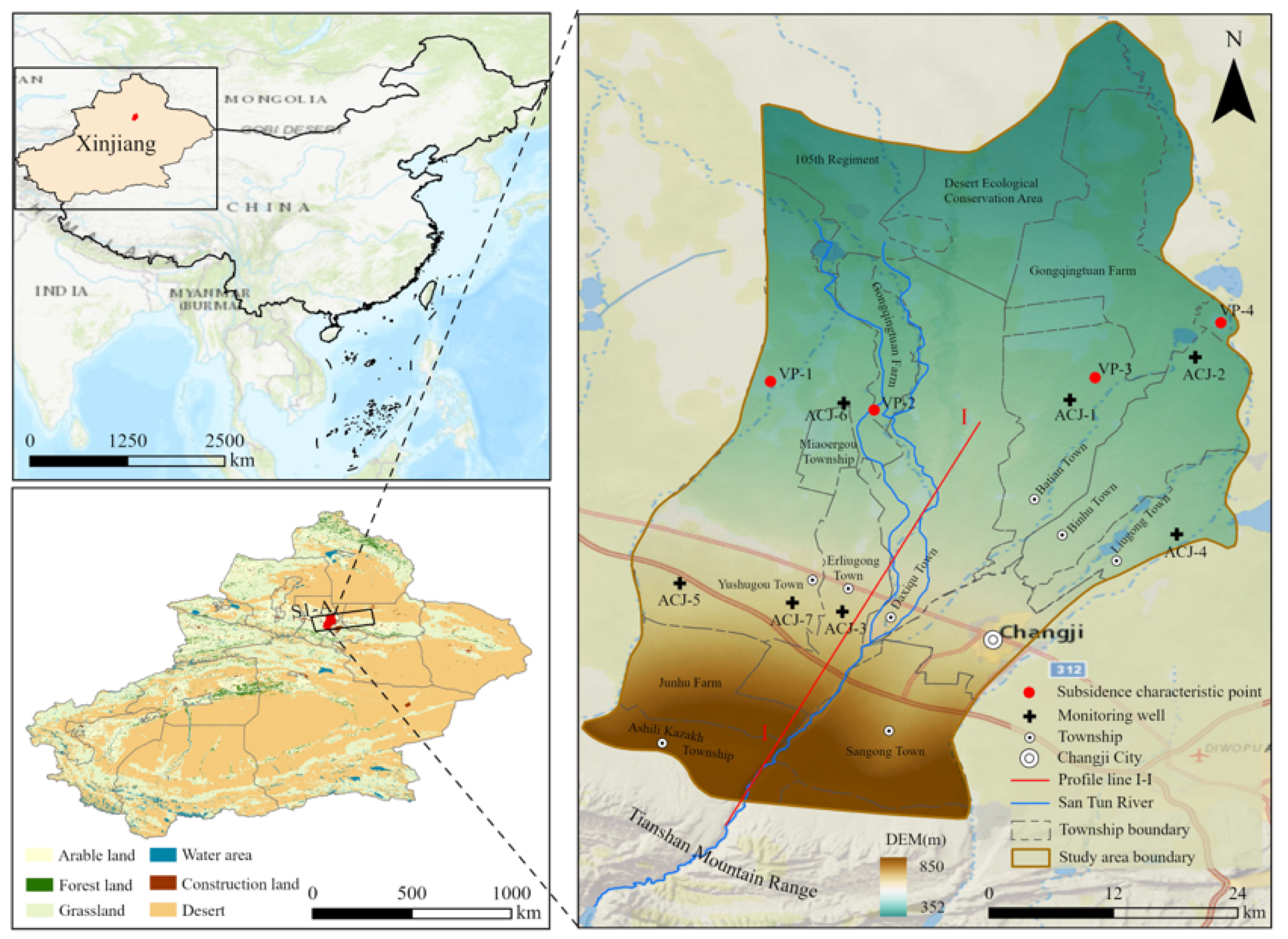
The study area is located in the alluvial–proluvial plain of Changji City, Xinjiang, situated at the transitional zone between the western segment of the northern Tianshan Mountains and the southern margin of the Junggar Basin. It extends from 86°24′ to 87°37′ E and from 43°06′ to 45°20′ N, covering a total area of 2036 km2 (Figure 1). The region experiences a temperate continental climate, with an average annual precipitation of approximately 190 mm. Precipitation is concentrated in the summer, with significantly lower amounts in the winter. It gradually decreases from the southern mountainous area toward the northern plain, while overall climatic conditions remain relatively uniform across the study area.
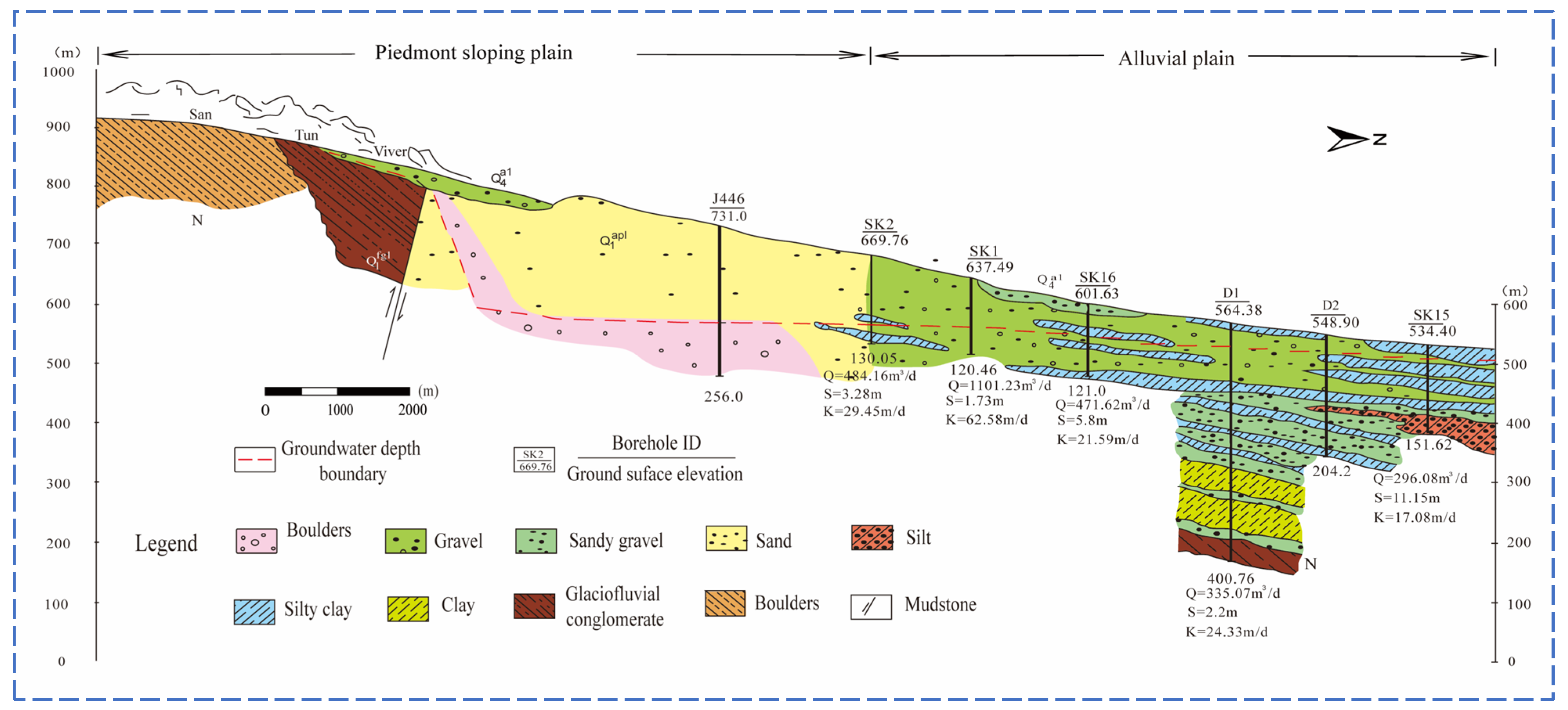
The plain area of Changji City is located within the piedmont depression zone of the Tianshan Mountains, influenced by deep-seated major faults. Thick Quaternary unconsolidated sediments are widespread and form the primary groundwater storage. The groundwater system exhibits clear vertical stratification. In the upper part of the alluvial–proluvial fan (burial depth > 50 m) and the middle section (20–50 m), the aquifers are primarily composed of gravel and sandy gravel, which have high water-bearing capacity. In the transition zone from the fan margin to the lacustrine plain (burial depth < 20 m), interbedded silty sand and clay are developed, forming a transitional zone between unconfined and confined aquifers. Groundwater discharge is mainly due to artificial pumping, with additional contributions from evaporation and lateral outflow. The thickness of the aquifer system is approximately 10–30 m, as shown in the geological cross-section in Figure 2.
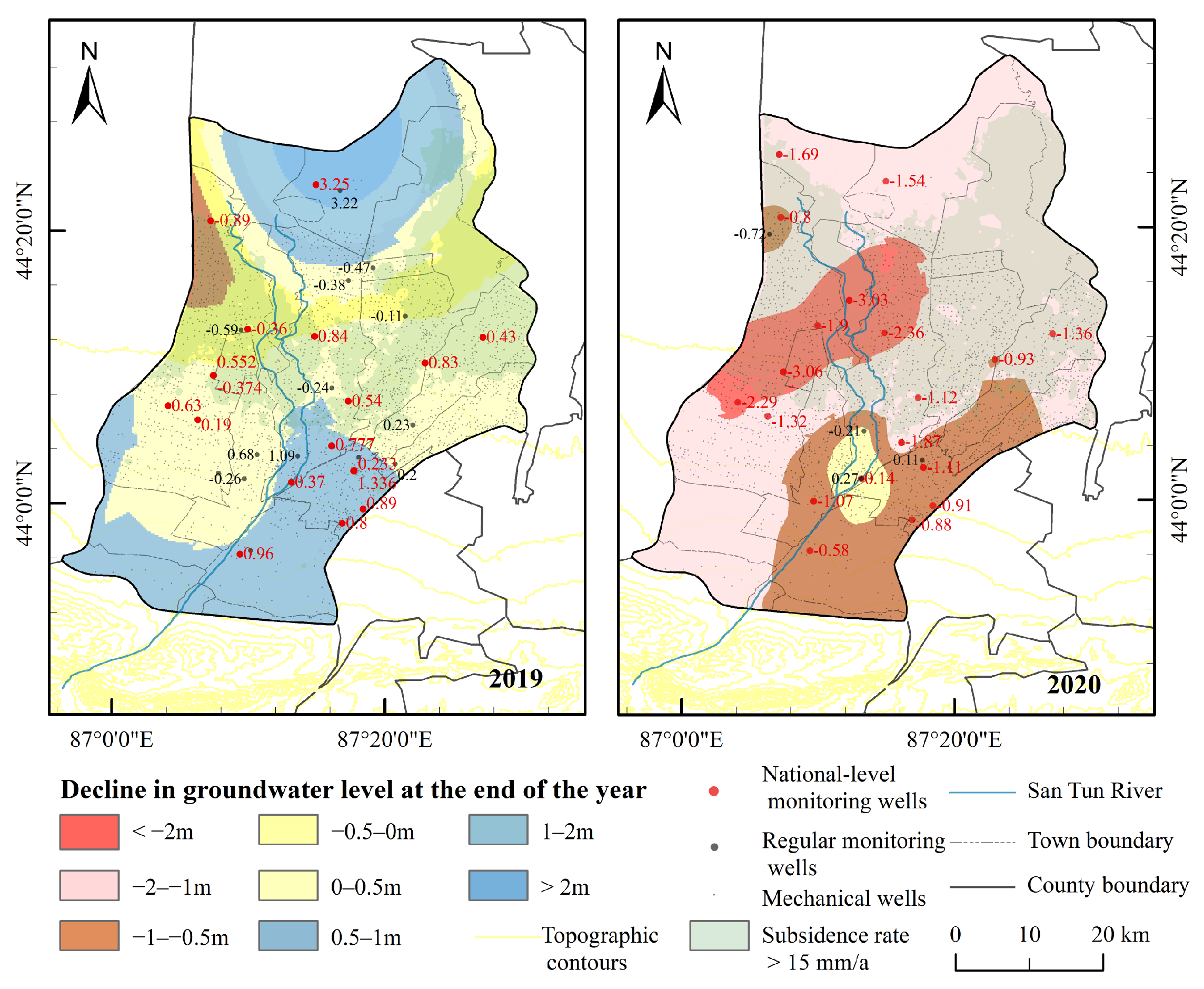
In 2019, groundwater extraction in Changji City reached 2.88 × 10⁸ m3, increasing to 3.22 × 10⁸ m3 in 2020, with 87.53% of the total being attributed to agricultural water use. Monitoring data indicate that groundwater levels in Changji City exhibit a clear and significant declining trend. Areas experiencing extreme groundwater decline are mainly located in the northwestern part of the study area, forming a belt that extends across Yushugou Town, Miaoergou Township, Gongqingtuan Farm, and Daxiqu Township. Areas with severe decline are concentrated in the irrigated region north of the Wukui Expressway, while most areas south of the expressway show a relatively moderate decline.
As a mountain–gobi–oasis composite ecosystem, Changji City is ecologically fragile and heavily dependent on groundwater resources. Large-scale groundwater extraction has led to continuous groundwater-level decline, which in turn induces geological structural degradation and regional land subsidence, posing a significant threat to the stability and security of the oasis ecosystem.

2.1.2. Data Sources

In this study, a total of 22 national-level groundwater monitoring wells and 26 regular monitoring wells were established in the plain area of Changji City. These wells cover an area of approximately 2036 km2, resulting in a monitoring density of 24 wells per 103 km2. This density meets the requirements outlined in the Technical Standard for Groundwater Monitoring Engineering (GB/T 51040–2023) [26] for groundwater quality monitoring stations in overexploited alluvial–proluvial plain areas, which recommends a density of 12–18 wells per 103 km2. Groundwater monitoring data were provided by the Xinjiang Uygur Autonomous Region Institute of Geological Environment Monitoring and Xinjiang Agricultural University.
The land-subsidence information was derived from a PS-InSAR time-series product generated from Sentinel-1A imagery, processed by Xinjiang Agricultural University and provided as interpreted results, covering the period from 17 April 2017 to 20 October 2020, with a spatial resolution of 30 m × 30 m. The 2020 land-use dataset, with a resolution of 1 km × 1 km, was obtained from the Resource and Environment Science and Data Center, Chinese Academy of Sciences.

2.2. Technical Methods

In this study, simulations were conducted using a coupled “PS-InSAR-constrained MODFLOW-SUB” framework. The period from January 2019 to December 2020 was used as the validation period, while 2021–2028 was set as the prediction period. Two types of constraints were applied: (i) groundwater-level hydrographs from monitoring wells ACJ-3 to ACJ-6, and (ii) the 2019–2020 subsidence time series and spatial distribution derived from PS-InSAR, with four additional subsidence verification points (VP1–VP4) placed in areas of concentrated subsidence. A stepwise calibration strategy was employed. First, parameters in the groundwater-flow model—horizontal hydraulic conductivity (HK), specific yield of the unconfined aquifer (Sy), specific storage of the confined aquifer (Ss), and vertical anisotropy (VANI)—were adjusted to reproduce groundwater-level dynamics. Subsequently, parameters in the SUB compaction module—SFE, SFV, and preconsolidation head, among others—were calibrated to match the magnitude and spatial pattern of the InSAR-derived subsidence. Model performance for groundwater levels was primarily evaluated using R2 and RMSE (with overall acceptable agreement except for a few wells influenced by strong seasonal fluctuations). Subsidence performance was assessed using two complementary metrics: (1) time-series RMSE and (2) end-of-period cumulative subsidence error, with a time-series RMSE of approximately 20 mm and end-of-period errors controlled within 10 mm. Calibration was terminated once the performance metrics satisfied the predefined threshold criteria. Based on the calibrated model, four pumping-reduction scenarios (20%, 40%, 60%, and 80%) were designed. Outputs, including maximum cumulative subsidence, subsidence rate, and area exceeding specified thresholds, were generated for scenario comparison and zoned evaluation.

2.2.1. PS-InSAR Technique

The basic principle of PS-InSAR assumes that N + 1 SAR images covering the same area are available. One image is selected as the master image based on temporal and spatial coherence, while all remaining images are co-registered and resampled to the pixel space of the master image. By constraining the temporal and spatial baselines, the SAR images are combined to form interferometric pairs. In this way, N + 1 SAR images generate N interferograms. The phase of each interferogram can be expressed as:
Ψ = Ψ flat + Ψ def + Ψ top + Ψ atm + Ψ noi
where Ψ f l a t denotes the flat-earth phase, Ψ d e f is the deformation phase (the signal of interest in this study), Ψ t o p represents the topographic phase, Ψ a t m is the atmospheric-delay phase, and Ψ n o i refers to the noise-related phase. The deformation phase is related to the line-of-sight (LOS) displacement d L O S by:
Ψ def = 4 π λ d LOS
Among commonly used time-series InSAR approaches, such as PS-InSAR and SBAS-type methods, we adopted a StaMPS-based PS-InSAR strategy because it is more effective at identifying phase-stable scatterers and retrieving long-term deformation under spatially heterogeneous coherence conditions, making it well-suited for oasis plains with mixed land cover. For this dataset, 39 Sentinel-1A IW-mode SLC scenes (VV polarization) acquired on an ascending track (relative orbit 113) from 17 April 2017 to 20 October 2020 were used. The deformation product, containing 91,991 deformation points, was resampled to a 30 m × 30 m grid for subsequent analysis.
We implemented a time-series PS-InSAR workflow with SNAP (v9.0) for interferometric preprocessing and StaMPS (v4.1) for PS time-series inversion. Preprocessing included precise orbit refinement using ESA Precise Orbit Ephemerides (POD), co-registration to a master scene, and interferogram generation under baseline constraints. Through phase decomposition and correction, the flat-earth and topographic contributions were corrected/removed, while atmospheric artifacts and noise were further suppressed as much as possible via time-series processing. We also mitigated tropospheric delays using GACOS to improve deformation accuracy. Due to its high spatiotemporal resolution and regional coverage, PS-InSAR provides an efficient means to map subsidence over large regions [27], overcoming the limitations of conventional surveying methods in rapidly acquiring deformation data at regional scales [28].
After these corrections, StaMPS was used to retrieve the deformation time series in the radar line-of-sight (LOS) direction. Because only a single (ascending) viewing geometry is available, the InSAR product strictly represents LOS displacement, not true vertical displacement. Nevertheless, in the plain area, where vertical compaction is expected to dominate, we use the term “subsidence” for brevity, while ensuring that all model–data comparisons and constraints are performed consistently in the same reference direction (LOS).

2.2.2. Three-Dimensional Groundwater Flow Model

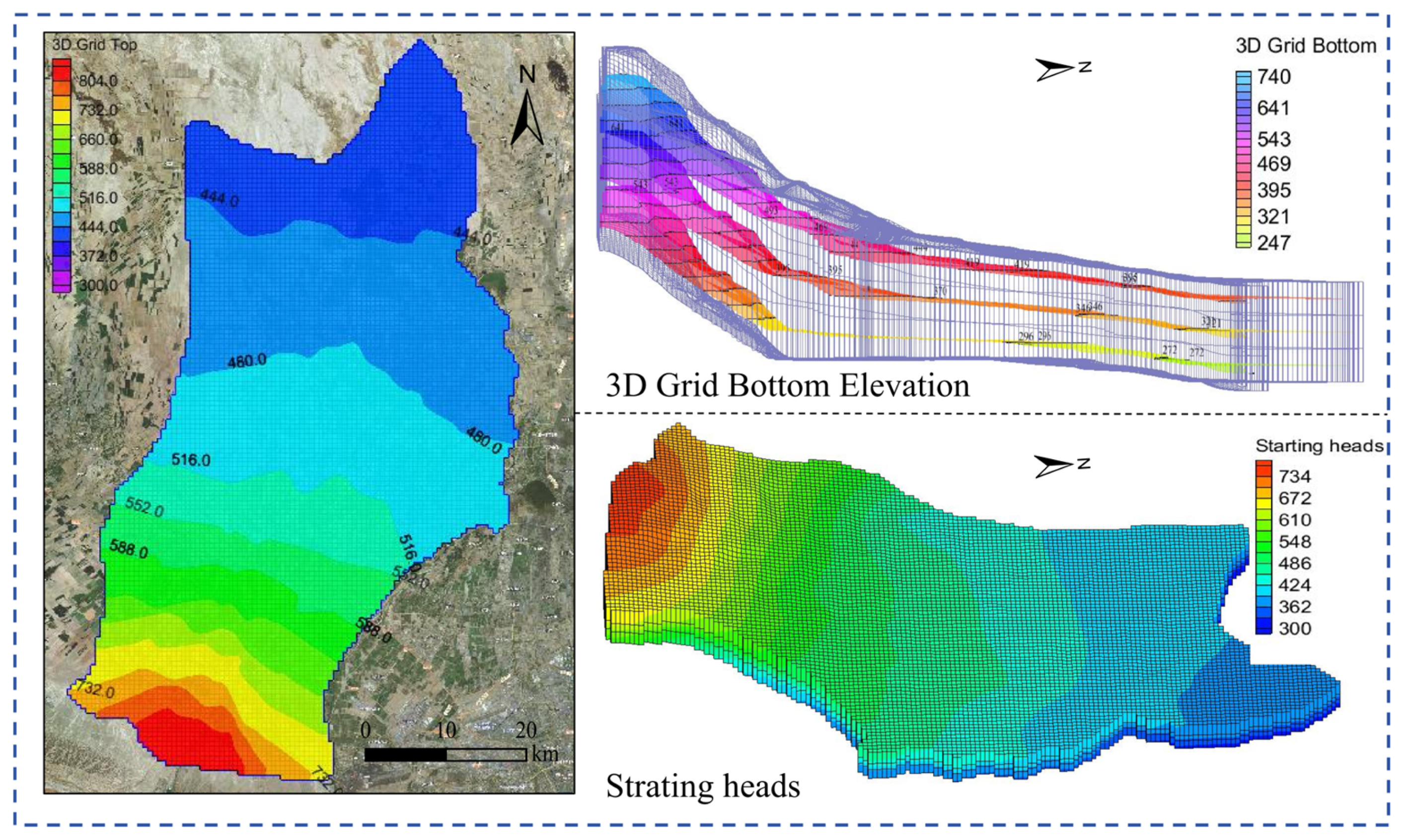
Based on borehole logs, hydrogeological cross-sections, and regional expert reports, a conceptual model of the study area was developed using the GMS (Groundwater Modeling System) platform. According to lithologic assemblages and hydraulic connectivity, the aquifer system was simplified into three hydrostratigraphic units: Layer 1 represents the unconfined aquifer (Figure 3), primarily composed of piedmont alluvial–proluvial sand–gravel deposits and valley alluvial sands; Layers 2–3 represent the confined aquifer system, mainly consisting of medium-to-fine sands and sand–gravel deposits interbedded with silt/clay lenses [29]. In the study area, sand-rich strata are dominant, while aquitards typically occur as lenticular bodies or discontinuous layers, which are difficult to trace consistently at the regional scale [30]. Therefore, no laterally continuous aquitard layer was explicitly represented in the model; instead, vertical leakage and confined behavior were represented through vertical hydraulic conductivity and anisotropy parameters (Kh/Kv).
Groundwater flow was simulated using MODFLOW. Under Darcy’s law and mass conservation [31], the governing equation for transient three-dimensional groundwater flow can be written as:
x K x x H x + y K y y H y + x K z z H z + W = S s H t
where x ,   y ,   z Ω , K xx , K yy , K zz are the anisotropy ratios of hydraulic conductivity along the principal directions (m/d), W is the source/sink term (m/d), H is the hydraulic head at point x ,   y ,   z at time t (m), and S s is the specific storage (m−1).
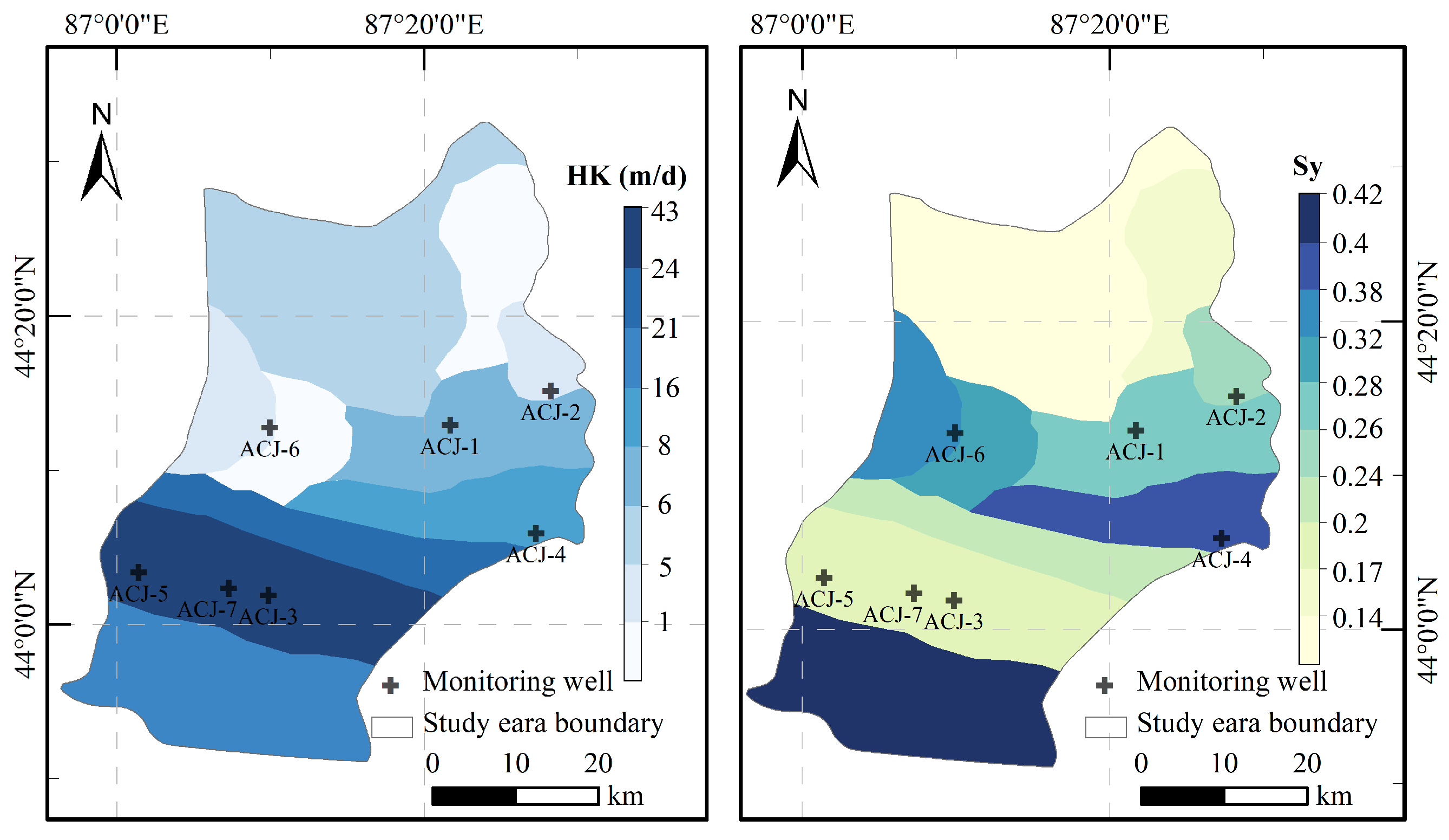
Within the groundwater-flow equation framework, the model was constrained using monitoring-well groundwater-level hydrographs and the regional groundwater head field implied by these observations, in order to correct initial heads and calibrate key hydrogeological parameters. During manual parameter calibration, parameters such as HK for both the unconfined and confined aquifers, Sy (unconfined aquifer), and Ss (confined aquifer) were adjusted by zones within their prior ranges until the simulated heads at monitoring wells met the required accuracy (the parameter ranges and final values are listed in Table 1). Near borehole D1, a coarse gravel–cobble layer, approximately 100 m thick, is present below the shallow zone (at depths greater than 20 m). Given its large pore spaces and favorable drainage conditions, the effective drainable porosity in this zone is relatively high. Therefore, a larger Sy value (0.4) was assigned to the unconfined aquifer in this zone to represent its strong drainage capacity [32,33] and high effective porosity (Figure 4).

2.2.3. One-Dimensional Compaction Model

The physical basis of land subsidence lies in changes in pore-water pressure induced by groundwater-level variations, which, in turn, lead to the redistribution of effective stress in the soil/strata [34]. The fundamental relationship between effective stress and pore-water pressure can be expressed as:
σ = C : ε α p I
where σ is the total stress tensor, C is the elastic stiffness tensor, ε is the strain tensor, α is the Biot–Willis coefficient, p is the pore-fluid pressure, and I is the identity tensor. Groundwater-level variations affect the stress state of the soil skeleton primarily by altering the pore-water pressure p. Under the assumption that the overburden load remains approximately constant over short time scales, the increment of total stress can be taken as σ 0 ; therefore, a decrease in pore pressure ( p < 0 ) directly leads to an increase in effective stress of the skeleton (e.g., σ α p ). Because pore pressure and hydraulic head satisfy p = ρ g h , a decline in head corresponds to an increase in effective stress [35], which drives compaction and ultimately manifests as land subsidence at the ground surface [36]. Given that subsidence in the study area is dominated by vertical compaction, the MODFLOW SUB Package is employed to compute subsidence under the one-dimensional compaction assumption. Deformation is decomposed into elastic (recoverable) and inelastic (irrecoverable) components, controlled by SFE and SFV, respectively. A preconsolidation head h p c is further introduced to determine the onset of inelastic compaction; the corresponding formulation is given in Equation (5).
s e = S s k e σ s v = S s k v σ
where S s k e and S s k v correspond to SFE (elastic skeletal specific storage) and SFV (inelastic skeletal specific storage) in the SUB package of GMS, respectively (m−1), and s is the subsidence increment. After the groundwater-flow model met the required fitting accuracy, compaction parameters in the SUB package were further calibrated. The key parameters SFE (elastic skeletal specific storage) and SFV (inelastic skeletal specific storage) were calibrated manually. Using 2019–2020 as the validation period, we iteratively adjusted SFE and SFV so that the simulated subsidence magnitude and its spatial pattern matched the InSAR-derived observations and the verification-point measurements [37]. The preconsolidation head ( h p c ) was used to distinguish between elastic and inelastic compaction [38]. In this study, the minimum groundwater level observed at the monitoring wells during the validation period was taken as an approximate value of h p c and consistency checks were performed during subsidence calibration to ensure a reasonable identification of consolidation behavior.

3. Results and Model Validation

3.1. Ground Subsidence Characteristics and Influencing Factors in Changji City

3.1.1. Distribution Characteristics of Land Subsidence in Changji City

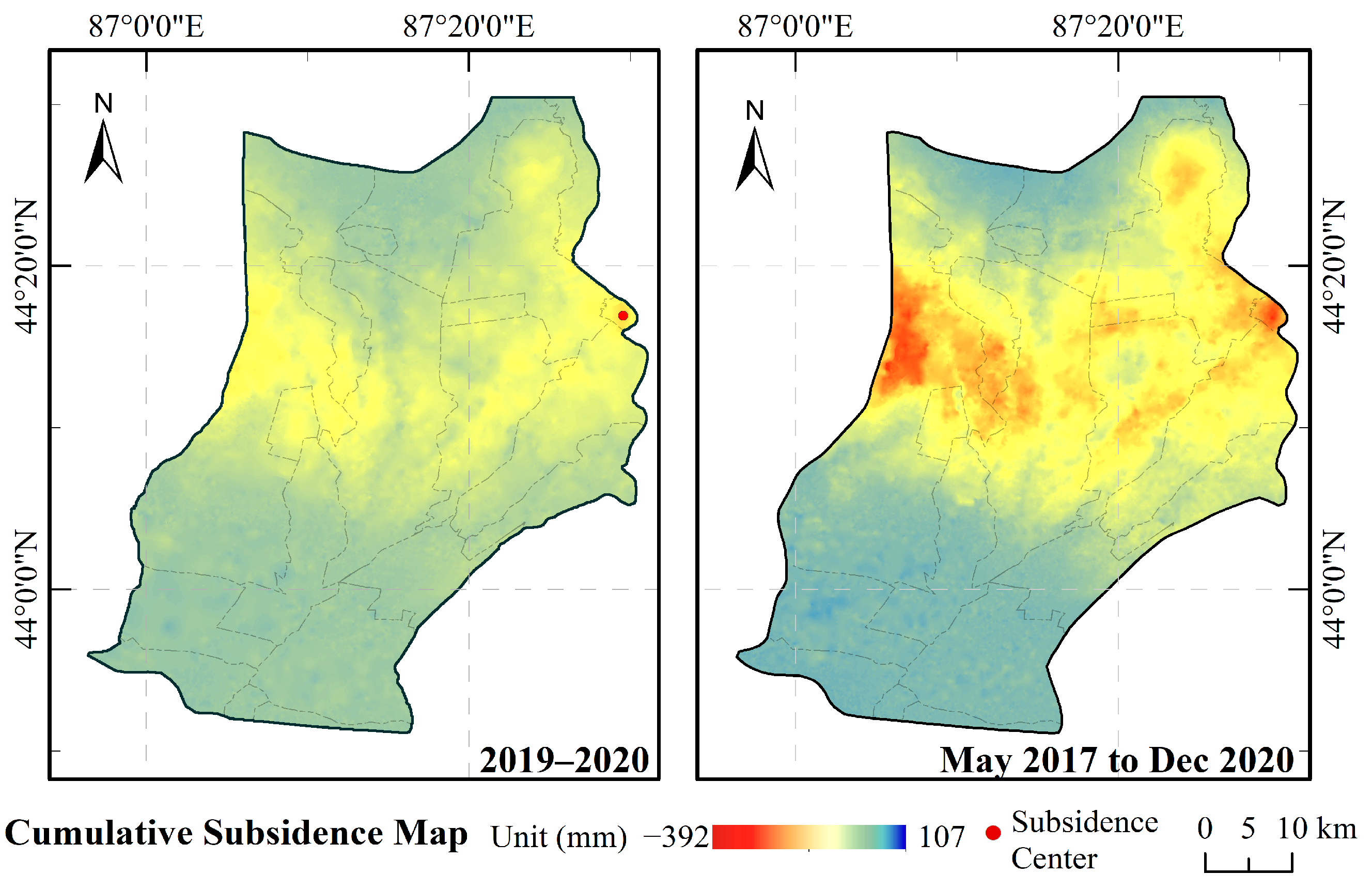
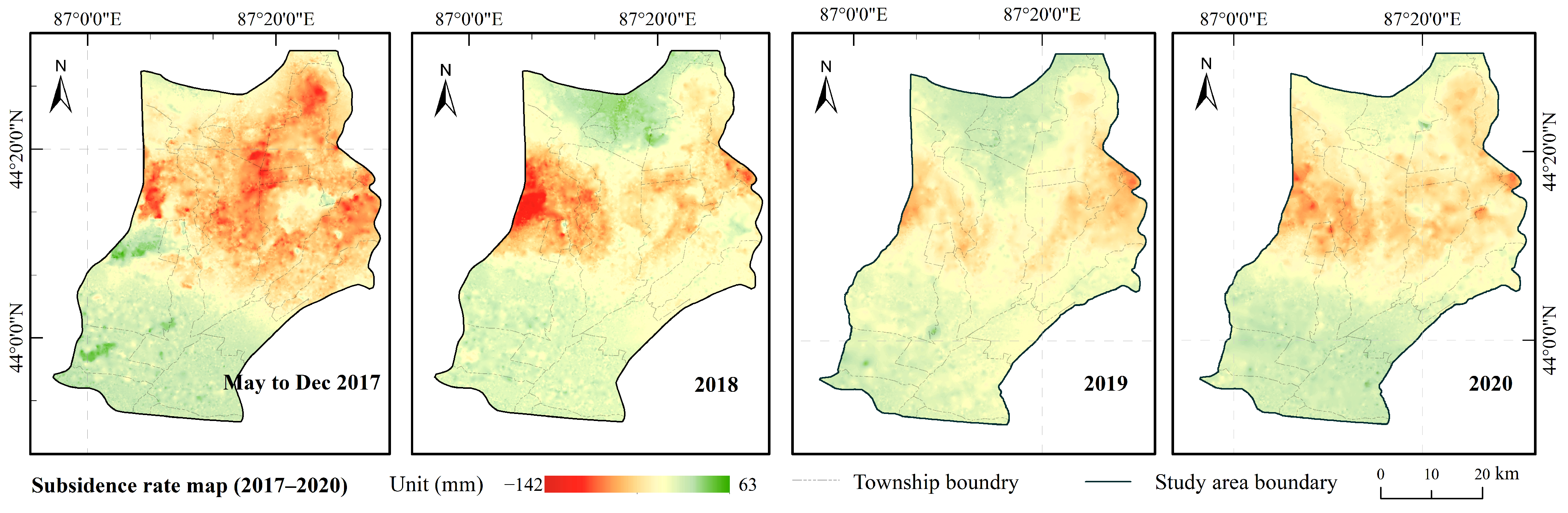
By integrating and analyzing PS-InSAR interpretation data, significant spatial differences in land subsidence were identified in Changji City. Compared to 2019–2020, land subsidence was more severe in 2017–2018 (Figure 5). Specifically, the maximum subsidence rates in 2017 and 2018 were −142 mm/year and −139 mm/year, respectively, while in 2019 and 2020, they were −83 mm/year and −101 mm/year. The most extensive subsidence occurred in 2017, with the plains area being most significantly affected, especially in regions such as Gongqingtuantuan Farm, Yushugou Town, Daxiqu Town, and Binhuzhen, where subsidence was particularly severe. In 2018, the spatial distribution of subsidence became more concentrated, primarily in Yushugou Town. Although land subsidence showed a slowing trend in 2019–2020, the subsidence rate in 2020 increased compared to 2019, and the subsidence area expanded from the east and west sides toward the center.
From May 2017 to December 2020, the maximum cumulative subsidence in Changji City reached −392 mm, with an average annual subsidence rate of −93 mm/year, consistent with the subsidence development trend observed in 2019–2020 (Figure 6). Between 2019 and 2020, the maximum cumulative subsidence was −166 mm, with the subsidence center located around North Sanxi Street, at the junction of Binhuzhen and Wujiaqu City. Since the implementation of the strictest water resource management policies in Changji Prefecture in 2015, the severe trend of land subsidence has been significantly suppressed. Following this policy shift, the data from 2019 to 2020 show a more stable subsidence trend, which better reflects the actual situation. Therefore, this study selects data from this period as the basis for simulating, validating, and predicting the GMS model, aiming to enhance the practical reference value of the model results and ensure more accurate and reliable predictions.

3.1.2. Factors Influencing Land Subsidence in Changji City

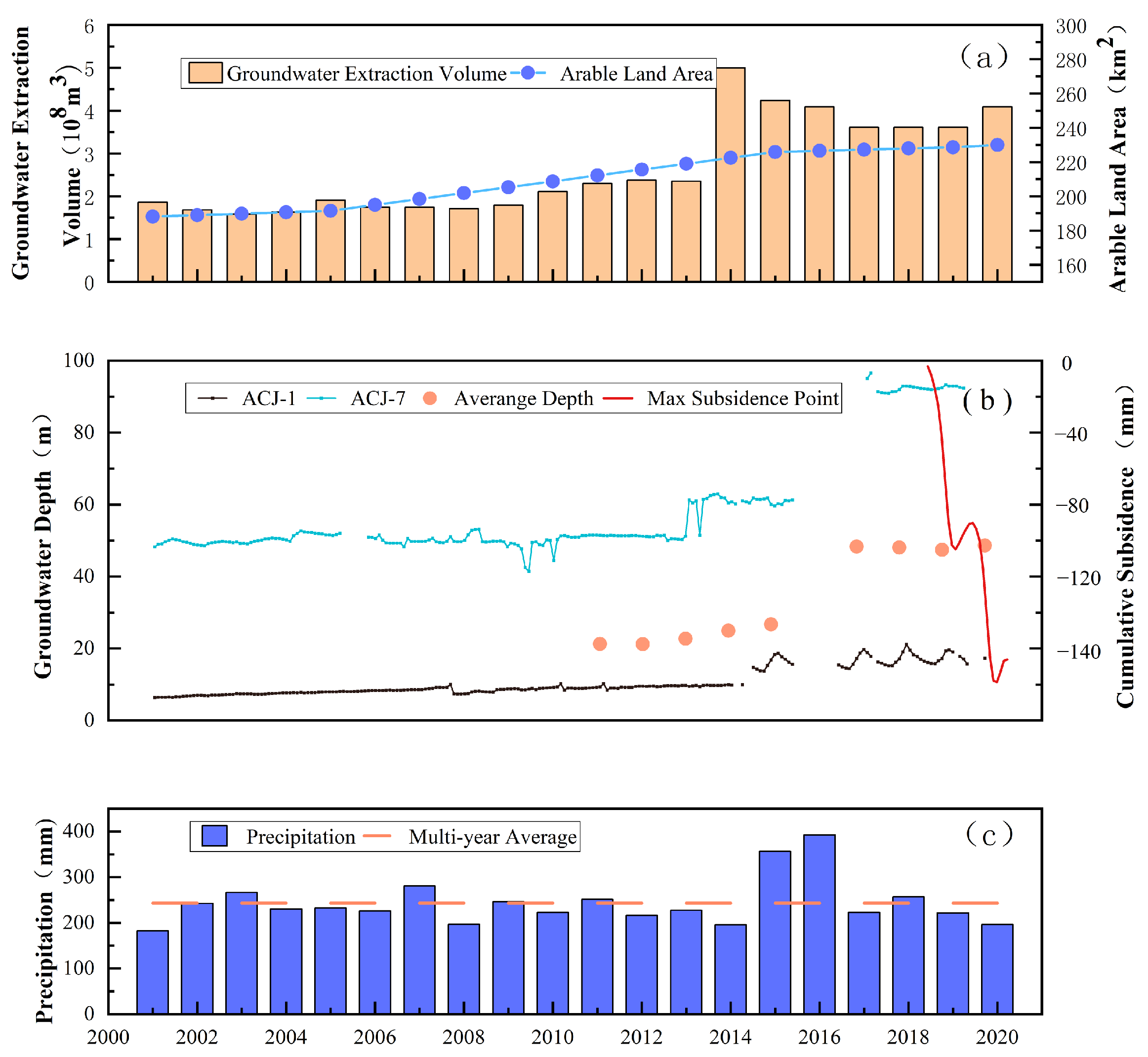
According to monitoring data from 2001 to 2020, the cultivated land area in Changji City exhibited an overall linear increasing trend, accompanied by a year-on-year rise in groundwater abstraction during 2001–2014 (Figure 7). It should be noted that, in this arid oasis setting, direct recharge from precipitation is inherently limited; thus, climate variability exerts a relatively weaker direct influence on groundwater levels compared to pumping. Instead, climate signals mainly affect the groundwater system indirectly by altering surface-water availability and irrigation water demand. In 2014, an exceptionally dry year, reduced surface-water supply, coupled with increased crop water demand, led to a substantial irrigation deficit, which was largely compensated by groundwater pumping, driving annual abstraction to approximately 5 × 10⁸ m3, the highest value over the past two decades. This drought-amplified pumping, combined with reduced effective recharge, accelerated groundwater-level decline, increased effective stress within compressible layers, and consequently promoted aquifer-system compaction and land subsidence.
To address this, Changji Prefecture implemented the strictest water resource management policies in 2015, adopting several measures to reduce groundwater extraction. From 2015 to 2020, the rapid growth of groundwater extraction was effectively curbed. However, since 2016, groundwater extraction has resumed a slow upward trend due to the increase in cultivated land area and the decrease in rainfall, leading to the further development of land subsidence.
Although groundwater recharge in 2020 was lower than the multi-year average, approaching the lowest level in nearly 20 years, and decreased by 169 million cubic meters compared to 2019 (estimated based on the recharge area and water supply coefficient, approximately resulting in a 0.15 m drop in water levels), the reduction in recharge was not the primary cause of the increased groundwater-level decline in 2020. The significant increase in groundwater extraction was the direct and primary cause of the average groundwater level drop in 2020 (−1.22 m), which far exceeded the increase in 2019 (+0.66 m) (Figure 8). The enlarged decline in groundwater levels in 2020 further worsened the land subsidence development trend, expanding the affected area and accelerating the subsidence rate.
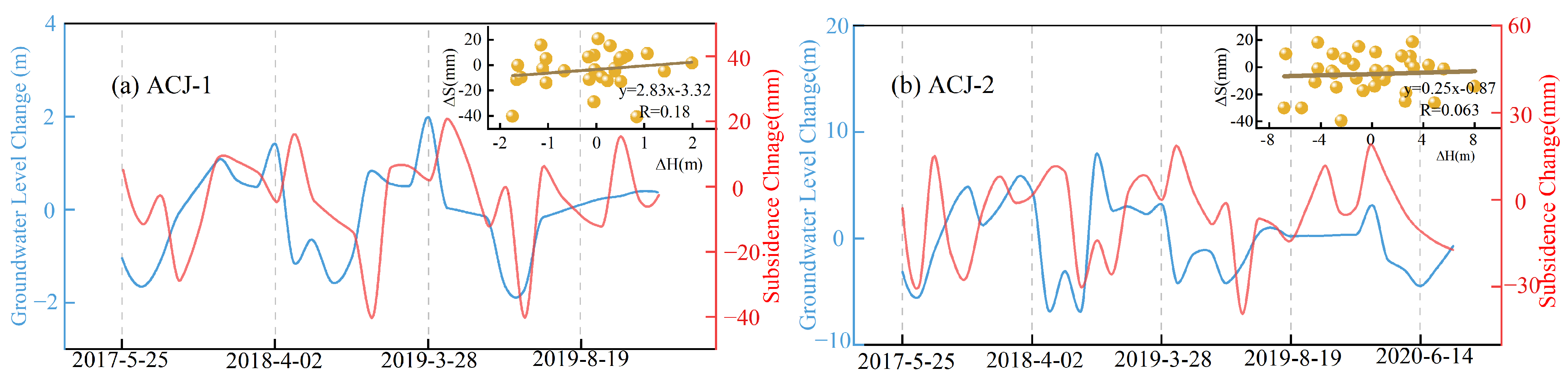
To further investigate the relationship between groundwater-level variations and land subsidence, two monitoring wells with continuous records (ACJ-1 and ACJ-2) were selected to analyze the correlation and lag response between groundwater-level change (ΔH) and the change in subsidence rate (ΔS). To minimize time-series inconsistencies introduced by different data sources (groundwater-level monitoring data and PS-InSAR measurements), the monthly groundwater-level data (recorded on the first day of each month) were reconstructed to the PS-InSAR acquisition dates using linear interpolation. To quantify the strength and the most probable time lag of the groundwater–subsidence response, we employed Pearson correlation with lag shifting. More complex methods (e.g., wavelet coherence or causality-based tests) generally require longer and more uniformly sampled time series as well as additional parameter settings, and are therefore reserved for future research.
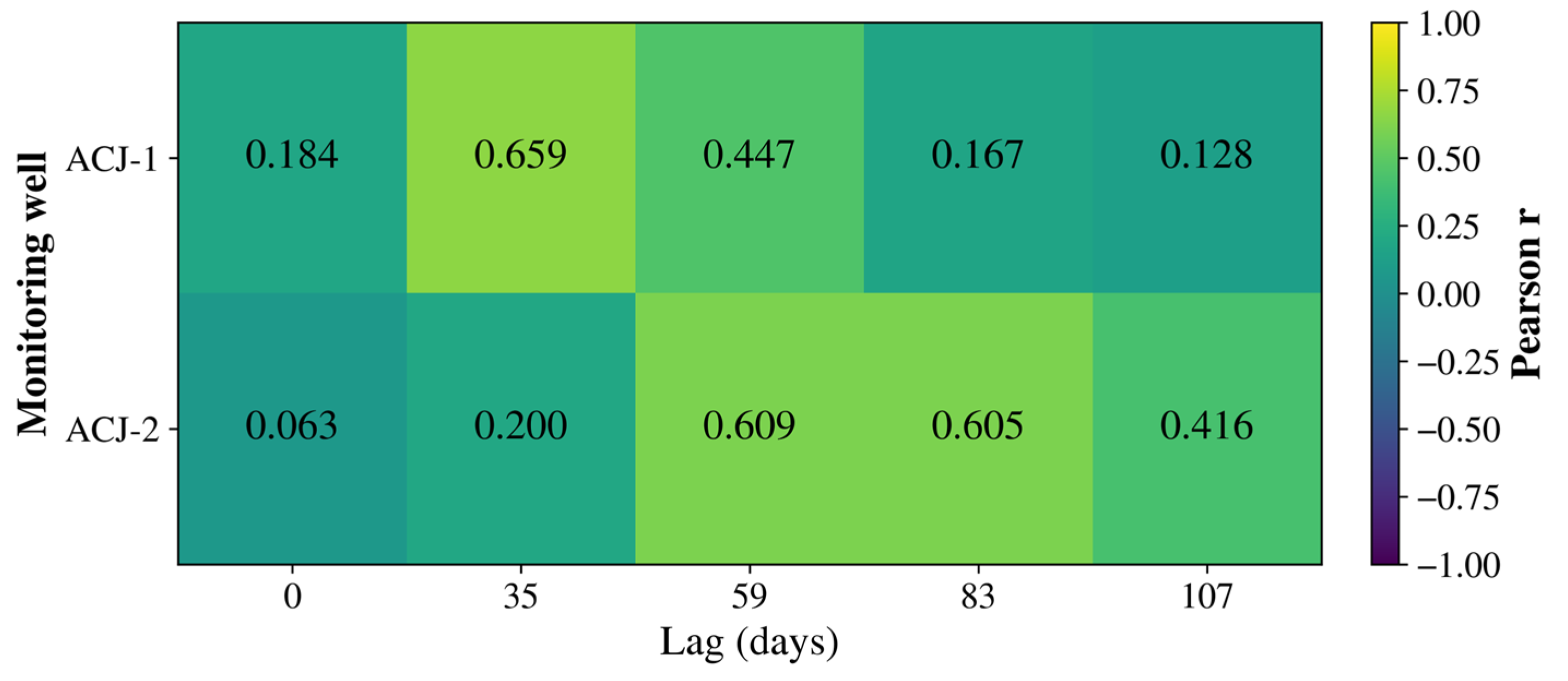
Without considering the lag effect, the correlation between groundwater-level changes and land subsidence changes was 0.18 and 0.063, respectively (Figure 9), indicating that the correlation was not significant. When lag effects were considered, a shifted Pearson correlation approach was applied: ΔH and ΔS were shifted and matched according to the PS-InSAR acquisition dates before computing the correlation. The correlation between groundwater-level changes and subsidence-rate changes increased markedly, and the two wells exhibited distinct response characteristics.
For the ACJ-1 monitoring well, the correlation between land subsidence and groundwater level changes reached its maximum value of 0.659 at a 35-day lag, after which the correlation gradually decreased (Figure 10). The linear regression equation derived from the groundwater level and land subsidence data with a 35-day lag, calculated using the least squares method, is: ΔS = 10.09ΔH − 2.94. This equation indicates that for every 1 m decrease in groundwater level, the land subsidence increases by 10.09 mm. At this well and during this period, land subsidence responded rapidly to changes in groundwater level.
n contrast, for the ACJ-2 monitoring well, the correlation between land subsidence and groundwater-level changes reached relatively higher values at 59 days and 83 days (0.609 and 0.605, respectively). The linear regression equation at a 59-day lag is: ΔS = 2.35ΔH − 4.02, This equation indicates that for every 1 m decrease in groundwater level, land subsidence increases by 2.35 mm. At this well and during this period, the subsidence response to groundwater-level variations may be associated with the pore-pressure dissipation time scale [39] of low-permeability, fine-grained layers.

3.2. InSAR-Constrained Three-Dimensional Groundwater Flow and One-Dimensional Compaction Model

3.2.1. Accuracy Validation of the Three-Dimensional Groundwater Flow Model

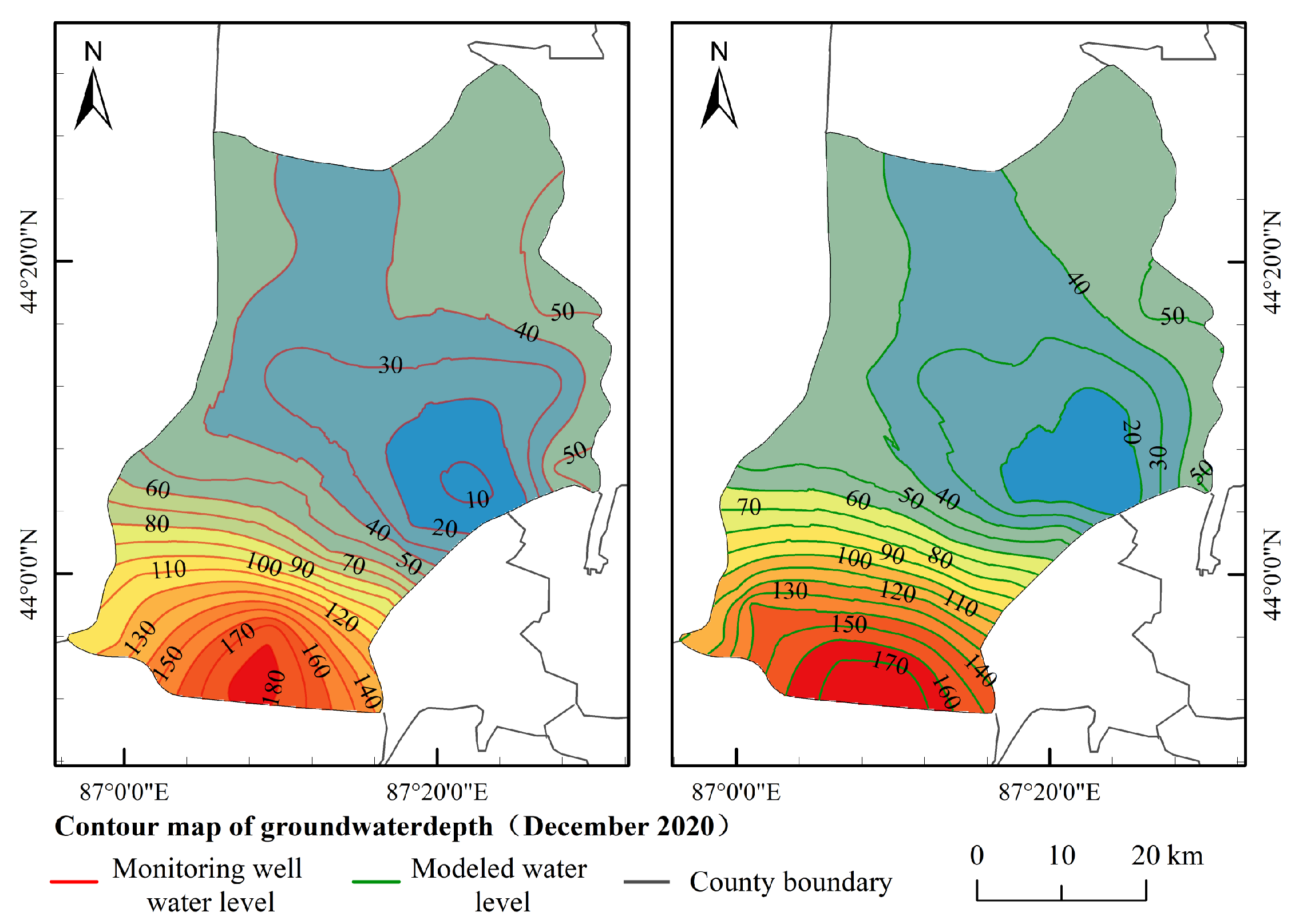
The period from January 2019 to December 2020 was used for model validation, and the land subsidence development trend from 2021 to 2028 was predicted. The groundwater level in the monitoring well in January 2019 was taken as the initial condition, while the groundwater level in December 2020 was used as the fitting condition for the groundwater flow field (Figure 11). The fitting of the groundwater flow field is consistent and meets the model requirements.
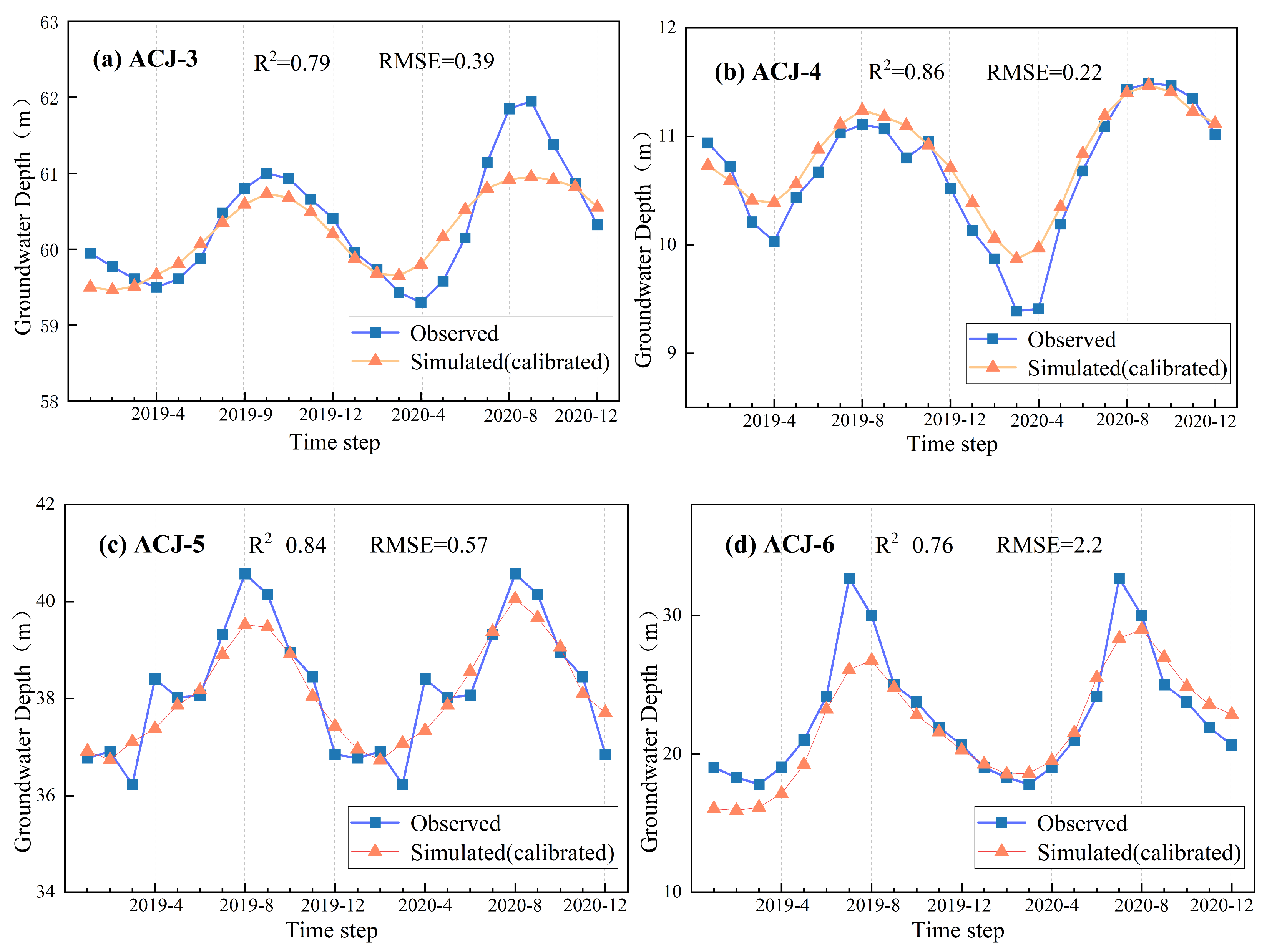
To meet the needs of land subsidence and regional coverage, four monitoring wells (ACJ-3 to ACJ-6) with good data quality were selected for data validation in the simulation area. However, there were missing groundwater level data for 2020 at wells ACJ-5 and ACJ-6, but continuous data for 2019 were available. Therefore, the 2019 groundwater level data were used to replace the 2020 data (Figure 12). The simulated groundwater levels for December 2020 are generally consistent with the actual groundwater levels. The actual groundwater levels exhibit significant seasonal fluctuations [40], and at well ACJ-6, where the seasonal variation is particularly strong, the maximum RMSE is 2.2 m, indicating some discrepancy in peak fitting, but still within an acceptable range. The R2 values for all four wells are above 0.7, indicating a high degree of model fit. The simulated groundwater levels show strong explanatory power for the observed levels, with RMSE values of less than 1 m for all wells except ACJ-6, demonstrating the model’s high reliability and meeting the fitting requirements.

3.2.2. Parameter Sensitivity Analysis of Groundwater Depth Simulation

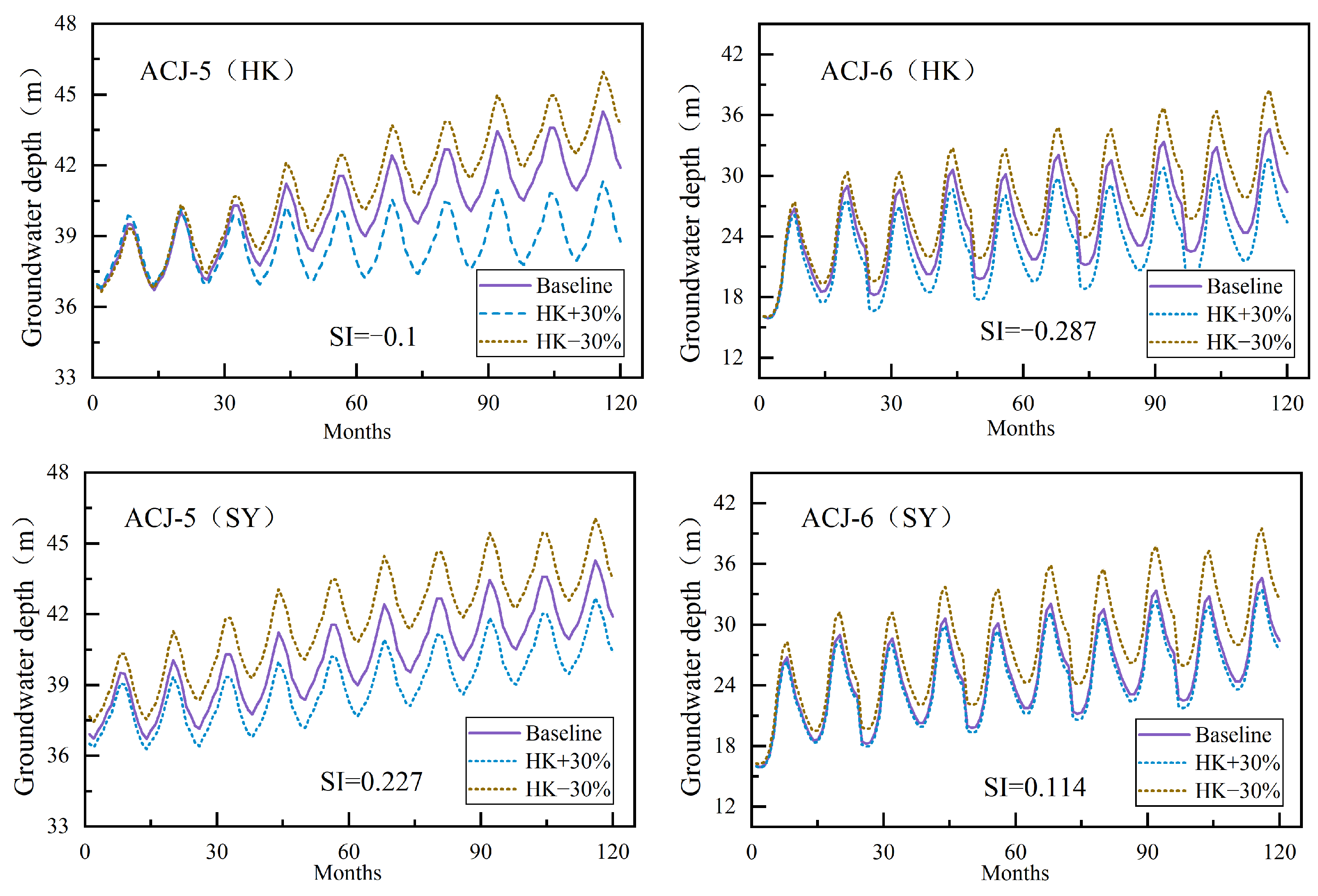
A parameter sensitivity analysis was performed to examine the robustness of the calibrated model and to identify the key hydrogeological controls on simulated groundwater depth. We adopted a one-at-a-time (OAT) approach by perturbing horizontal hydraulic conductivity (HK) and specific yield (Sy) by ±30%, while keeping all stresses (pumping, recharge) and boundary conditions unchanged. The transient model was then re-run, and the simulated groundwater-depth time series at representative monitoring wells (ACJ-5 and ACJ-6) were compared against the baseline simulation. The overall deviation from the baseline was quantified using the root-mean-square deviation (RMSD), and a normalized sensitivity index (SI) was computed as:
R M S D = 1 N i = 1 N ( X i X 0 ) 2   ,         S I = ( X ¯ + X ¯ ) p 2 X ¯ 0 p
where X 0 denotes simulated groundwater depth for the baseline case, X + and X denote simulations with increased and decreased parameter values, respectively, N is the number of stress periods, p / p is the relative perturbation (0.30 in this study).
The results show that ±30% perturbations in HK and Sy lead to systematic shifts in simulated groundwater depth at both ACJ-5 and ACJ-6, while the seasonal cycle remains in phase. The timing of peaks and troughs does not change, indicating that the model response is both physically consistent and numerically stable. Parameter perturbations mainly affect the magnitude of groundwater depth, altering its overall offset and fluctuation amplitude, but not the seasonal pattern.
The sensitivity to HK is stronger at ACJ-6, with an SI of −0.287, compared to a weaker sensitivity at ACJ-5 (SI = −0.1). For Sy, sensitivity is moderate at ACJ-5 (SI = 0.227) and weaker at ACJ-6 (SI = 0.114). Overall, the sensitivity indices range from 0.1 to 0.3, indicating weak-to-moderate sensitivity and suggesting that the simulated groundwater-depth dynamics are relatively robust to plausible uncertainty in HK and Sy (Figure 13).

3.2.3. Accuracy Validation of the One-Dimensional Compaction Model

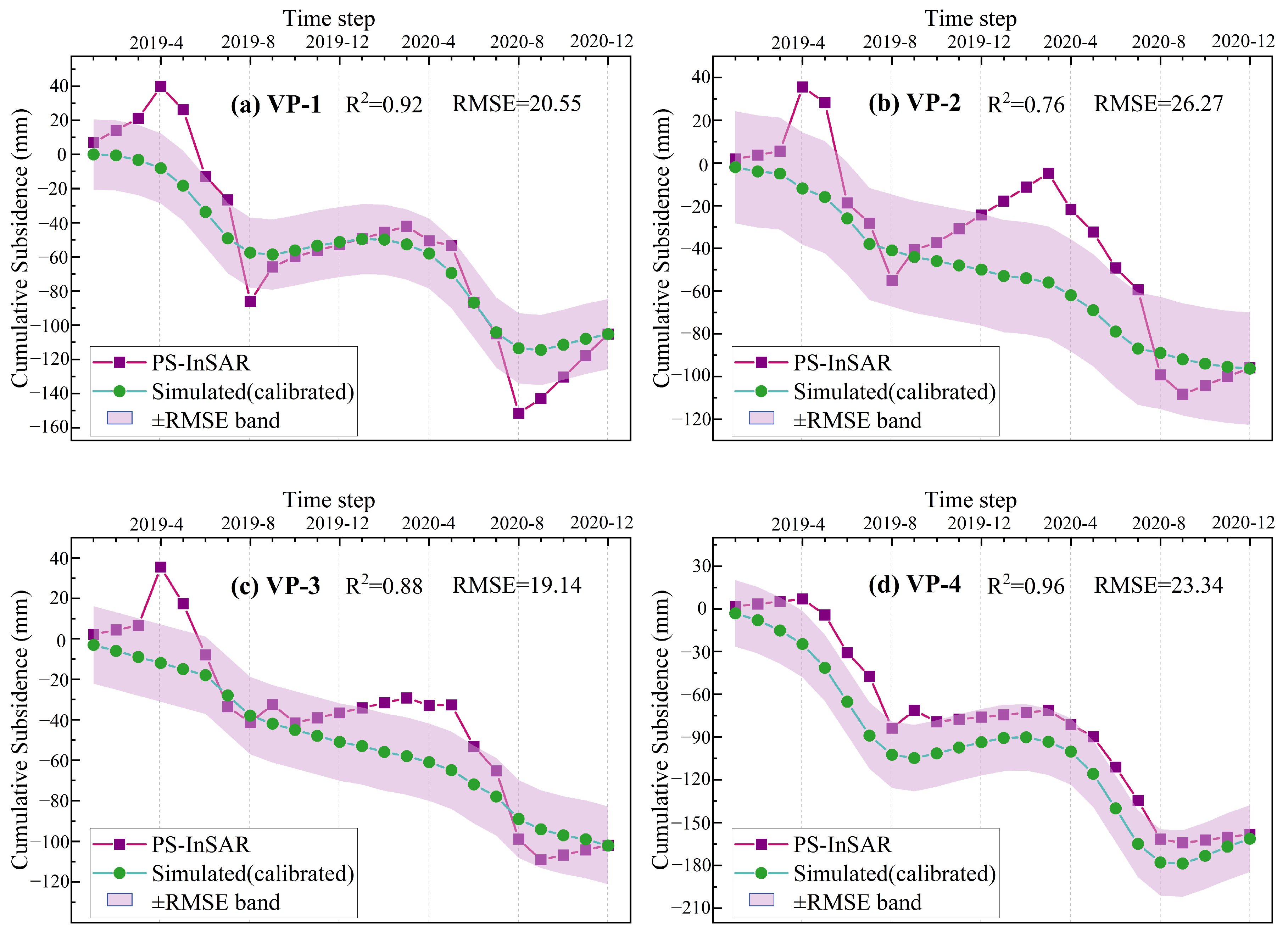
In the SUB package of the GMS software, the initial subsidence was set as the cumulative subsidence from January 2019 to December 2020. The InSAR monitoring results from 2019 to 2020 were compared with the model simulation results, and model parameters were adjusted accordingly. To better illustrate the land subsidence simulation results in different regions, four validation points (VP1–VP4) were selected in areas with significant subsidence, and the subsidence simulation results for each validation point were compared and validated against the 2019–2020 InSAR monitoring results (Figure 14). Due to the significant seasonal variation in subsidence data, although there were some differences between the simulation process and the monitoring data, with an RMSE of around 20 mm, the error between the simulation results and the monitoring values was less than 10 mm, with R2 values ranging from 0.76 to 0.96. This indicates a good to excellent correlation and explanatory power between the model simulation results and the observed data, demonstrating that the numerical model accurately reflects the actual land subsidence trend.
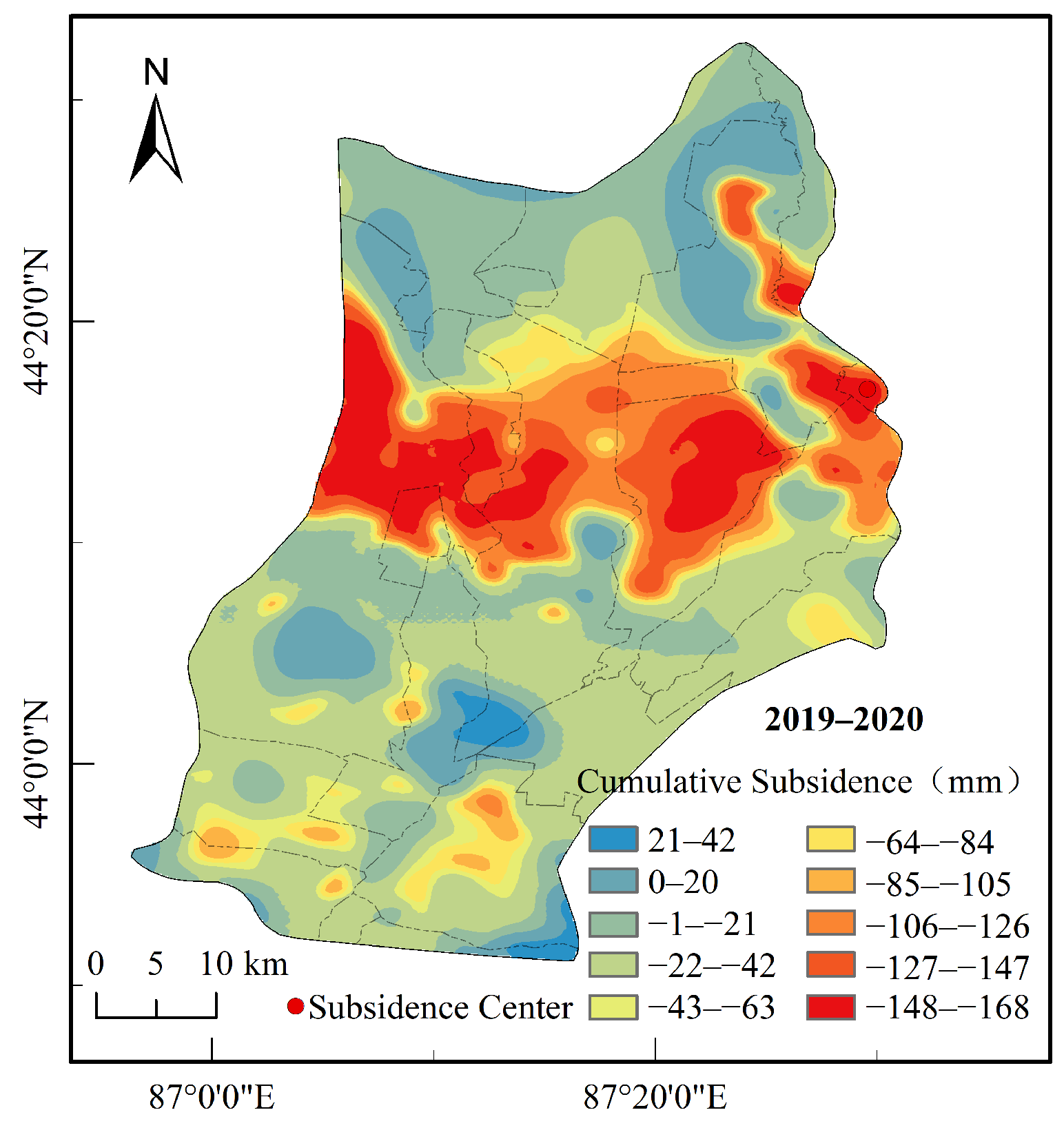
After optimization, the maximum subsidence at the subsidence center in the simulated results is 169.3 mm (Figure 15), with a discrepancy of 3.3 mm compared to the maximum subsidence of 166 mm from the monitoring data. The area with cumulative subsidence greater than 60 mm from 2019 to 2020 in the study area is 662 km2, which differs by only 5.02% from the 697 km2 obtained from InSAR monitoring, meeting the error requirement. This confirms that using PS-InSAR monitoring data as a constraint to improve the simulation accuracy of the land subsidence model is effective, and it can accurately reflect the distribution characteristics of land subsidence in Changji City, meeting the needs for subsidence prediction and subsequent analysis.

4. Analysis and Discussion

4.1. Impact of Soil Structure on the Lag Effect Between Land Subsidence and Groundwater Level Changes

The observed time lag effect between groundwater level decline and land subsidence is closely related to the characteristics of the underlying soil structure [41]. Changes in groundwater levels alter pore water pressure, which in turn affects effective stress. In low-permeability soils or fine-grained layers, pore water dissipation and soil particle rearrangement require time, leading to a delayed subsidence response. Previous studies have confirmed this mechanism: compared to coarse-grained materials, fine-grained, low-permeability soils exhibit more significant subsidence lag effects. Additionally, as per [42], analysis based on InSAR data shows that land subsidence typically lags behind groundwater fluctuations, with the degree of lag influenced by local soil structure and stratigraphic characteristics [43]. These findings demonstrate that soil compressibility and pore structure play an important role in controlling the lag behavior between groundwater level changes and surface subsidence.
At the ACJ-1 monitoring well, the land subsidence change reached its maximum value of 0.659 on the 35th day, with the impact of groundwater level changes on subsidence being more pronounced in the short term. According to the geological data from the “Changji City Groundwater Overexploitation Zoning Report,” the aquifer lithology north of the line connecting Caimao Farm, Daxiqu Pasture, and Binhuzhen is predominantly coarse sand, with clay and silty clay serving as the aquitard. The depth of the aquifer and the aquitard increase gradually from south to north. ACJ-1 is located near Longhe Liu Village in Daxiqu, where the clay layer is relatively thin, about 30 m, and beneath it is a thick layer of medium to fine sand. The high permeability of the sand layer, combined with the relatively thin clay layer, results in a faster subsidence response to groundwater level changes at ACJ-1. In contrast, ACJ-2 is located in the northern part of Binhuzhen, where the clay layer is thicker, about 120 m. The high thickness and low permeability of the clay layer lead to lower compressibility, making it more difficult to compact, and the lag effect is more pronounced [44]. This explains the differences in subsidence responses at ACJ-1 and ACJ-2 to groundwater level decline, validating the conclusions of previous studies.

4.2. Prediction of Land Subsidence Evolution Trend

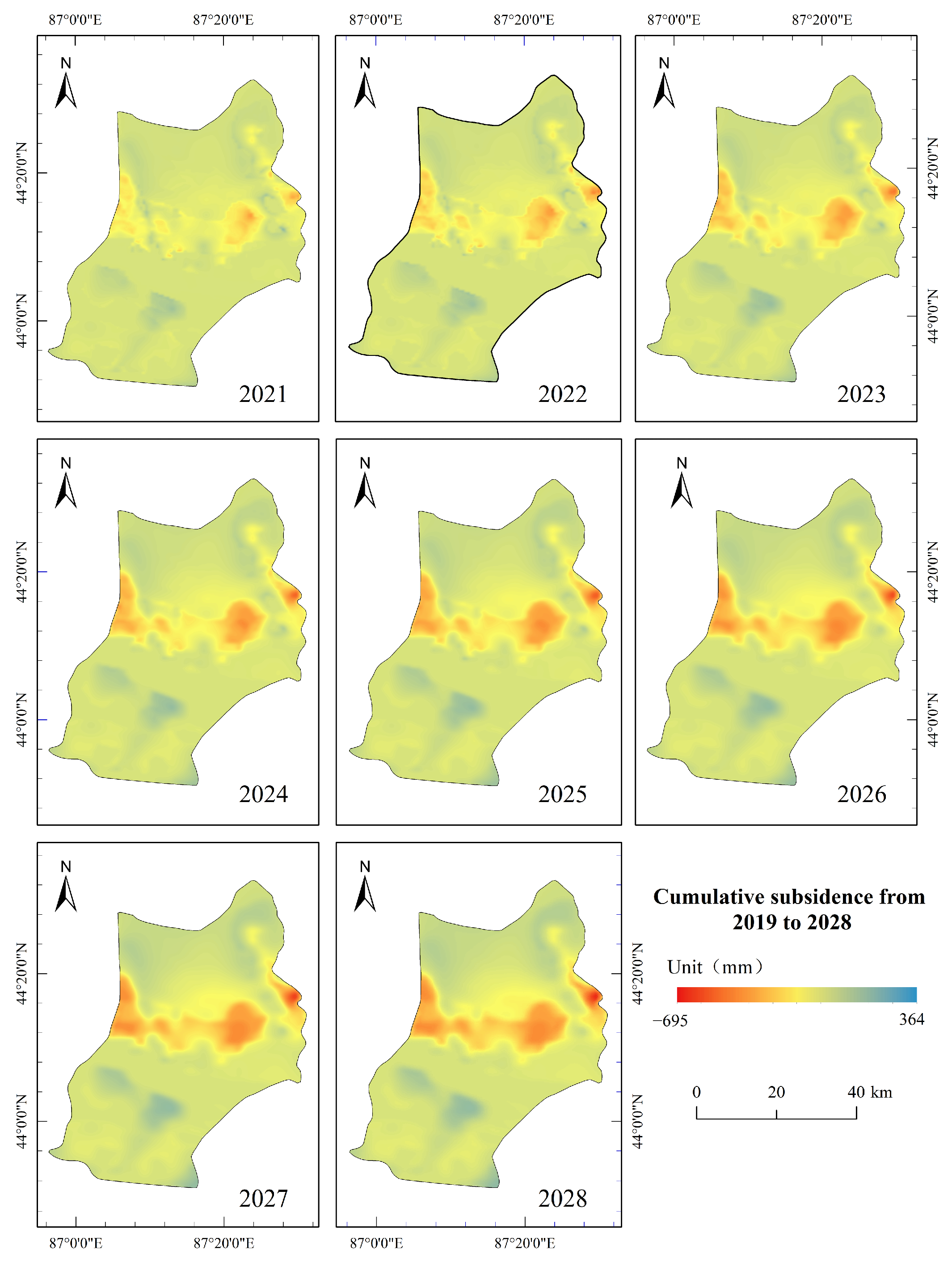
Based on the MODFLOW-SUB model jointly calibrated against groundwater levels and InSAR-derived subsidence for 2019–2020, we set January 2019 as the reference epoch for cumulative subsidence and projected land-subsidence evolution during 2021–2028 under the business-as-usual pumping scenario. The results indicate that the subsidence bowl continues to develop under current pumping conditions, and the spatial location of the high-subsidence zone remains broadly stable. Influenced by recharge from the Santun River, subsidence rates on both sides of the river are relatively reduced; however, cumulative subsidence still shows an overall increasing trend.
By December 2028, the maximum cumulative subsidence is expected to reach 695 mm (Figure 16). The subsidence center remains near the boundary between Binhu Town and Wujiaqu, where pumping-well density is high, and cropland is extensive. Local irrigation relies heavily on groundwater abstraction, leading to persistent groundwater-level decline. In addition, the area is close to the Wujiaqu Industrial Park, where industrial water demand is high. The combined agricultural and industrial water use contributes to the severe development of land subsidence in this area. In the northeastern part of Binhu Town, the northern part of Dianba Town, and the northwestern part of Yushugou Town, the maximum cumulative subsidence is also projected to exceed 500 mm.
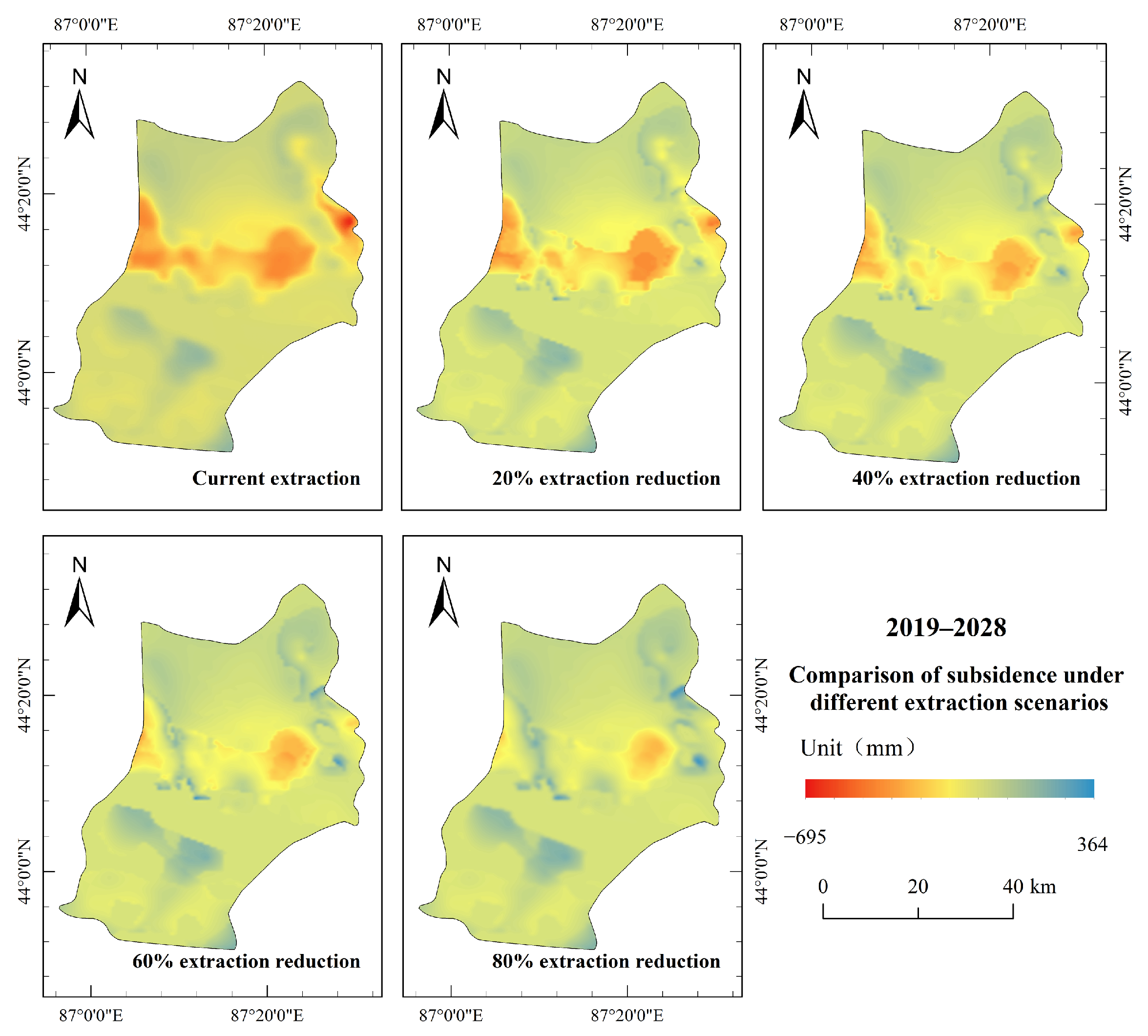
On this basis, four pumping-reduction scenarios (20%, 40%, 60%, and 80%) were designed for 2021–2028, using pumping rates during 2019–2020 as the baseline (Figure 17). Under the 20%, 40%, 60%, and 80% reduction scenarios, the projected maximum cumulative subsidence decreases to 419 mm, 345 mm, 300 mm, and 263 mm, respectively. Relative to the business-as-usual pumping scenario, the corresponding reduction rates are 39.7%, 50.4%, 56.8%, and 62.2%. With increasing pumping reductions, both the magnitude and spatial extent of the subsidence bowl shrink, and the hazard-zone area (defined as regions with cumulative subsidence > 150 mm) continuously decreases (Table 2).
Taking the 40% pumping-reduction scenario as an example, the maximum cumulative subsidence decreases from 695 mm to 345 mm (a 50.4% reduction), accompanied by the most pronounced shrinkage of the subsidence bowl. Meanwhile, subsidence along both banks of the Santun River weakens, consistent with local groundwater-level recovery induced by river recharge. When pumping is reduced by 80%, cumulative subsidence at the subsidence center decreases to 263 mm (a 62.2% reduction relative to the business-as-usual case), and slight uplift of approximately 5–10 mm yr−1 appears in localized areas in the north. This may be associated with the elastic recovery of the aquifer system and/or delayed rebound processes. Overall, the “pumping reduction–subsidence” response exhibits a typical pattern of diminishing marginal returns: increasing the reduction from 20% to 40% further decreases the maximum subsidence by 74 mm (419 → 345 mm), whereas the additional reduction from 60% to 80% yields only a 37 mm decrease (300 → 263 mm), indicating that in some areas (e.g., around Donggou and Xigou villages, Dianba Town) subsidence becomes less responsive to further pumping cuts.

4.3. Subsidence Hazard Zones

This study delineates five hazard levels using a “dynamic mechanism–geological response–exposure” multidimensional integration framework [45]. The weights of the integrated index were assigned based on expert judgment: since the subsidence rate provides a more immediate indication of engineering hazard, it was given a higher weight; historical cumulative subsidence represents the long-term deformation background; and the forecast increment reflects future development trends. Accordingly, we set ω r a t e = 0.40, ω c u m = 0.30, ω t r e n d = 0.30. After standardizing the three indicators, they were aggregated through weighted summation to construct a composite hazard index, which was then used to classify five hazard [46,47] levels using threshold values (Table 3).
The Level I (extremely high hazard) threshold was defined based on the Technical Code Assessment of Geological Hazard, where a subsidence rate > 50 mm/a is typically considered indicative of actively progressing subsidence, and 500 mm is a key reference value in cumulative-subsidence grading. Since our forecast period covers 2021–2028, we adopt “predicted cumulative subsidence > 0.5 m” as a conservative, management-oriented warning criterion for Level I. The remaining hazard levels were derived by applying equal-interval classification to the standardized composite index, ensuring consistent and comparable scenario evaluation. While the multidimensional framework and indicator system are transferable to other regions for systematic hazard assessment, the specific classification thresholds should be recalibrated based on local deformation patterns, hydrogeological settings, and management objectives to ensure appropriate zonation outcomes.
To test the robustness of the conclusions, a ±10% one-factor-at-a-time perturbation was applied to each weight. After perturbation, the remaining weights were redistributed proportionally [48] and renormalized to ensure ω i = 1 [49]. The area of the combined high-hazard classes (Levels I + II) showed moderate sensitivity to weight variations, and the overall conclusions remained robust (Table 4). Under the ±10% perturbations, the relative change in the area of Levels I + II ranged from −5.0% to +5.9%. Perturbations in ω r a t e and ω t r e n d produced larger area changes (up to ~5–6%), whereas the effect of ω c u m was smaller (approximately −0.9% to +2.4%), indicating that the zoning results are generally robust with respect to the chosen weights.
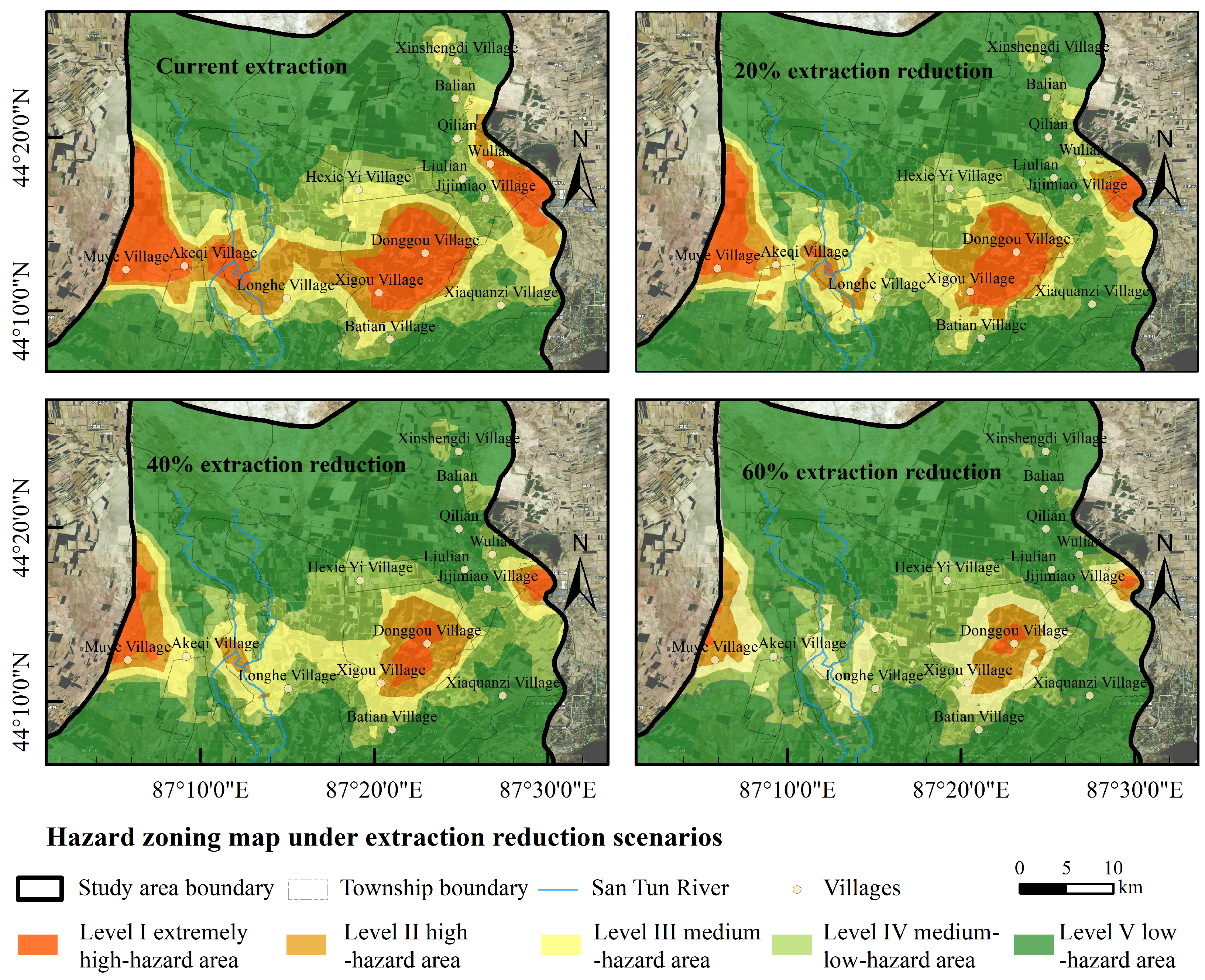
The zoning results were evaluated using a spatial autocorrelation test (Moran’s I = 0.32, p < 0.03), indicating significant spatial clustering of high-hazard areas (Figure 18). Combined with the scenario-based projections, the change pattern in hazard-area extent is consistent across pumping-reduction scenarios (Table 5), suggesting that controlling groundwater abstraction is effective in reducing subsidence hazard.
Results indicate that, across different pumping scenarios, changes in the areal extent of hazard zones under groundwater pumping-reduction scenarios follow a highly consistent pattern, demonstrating that controlling groundwater abstraction is directly effective for mitigating subsidence hazards.
Under the business-as-usual pumping scenario, the total area of the extremely high-hazard (Level I) and high-hazard (Level II) zones is 240.07 km2. Under the 20% reduction scenario, the combined high-hazard area decreases to 156.13 km2, representing a sharp contraction of ~35%; under the 40% reduction scenario, the reduction reaches 56.7%, indicating a substantial mitigation effect. As pumping reduction increases to 60%, the area of the extremely high-hazard (Level I) zone decreases by 94.6% relative to the business-as-usual scenario, suggesting that this hazard class is highly sensitive to pumping control. Meanwhile, the low-hazard (Level V) area expands from 1414.66 km2 to 1638 km2, indicating an overall decline in regional hazard level. Overall, groundwater pumping reduction and the contraction of high-hazard zones exhibit a clear dose–response relationship [29]. A 20% reduction can achieve significant hazard reduction under a controllable cost, providing quantitative support for zoned and graded management.
For Level I–II high-hazard zones, we recommend a combined strategy of “shutdown–substitution–recharge”: prioritize closure (or strict pumping limits) of abstraction wells in Level I zones and implement at least a 30% pumping reduction in Level II zones, while simultaneously promoting surface-water substitution and managed recharge. For Level III–IV zones, a flexible management approach of “monitoring–early warning–control” is suggested: densify monitoring networks and apply threshold-based early-warning management, strictly restrict new abstraction wells, promote water-saving irrigation, and enhance incentives for conservation through mechanisms such as water-rights trading, thereby preventing upward migration of hazard classes.

5. Conclusions

Using the plain area of Changji City as a case study, we jointly constrained the model with Sentinel-1A PS-InSAR deformation time series and monitoring-well groundwater-depth observations, and developed and calibrated an InSAR-constrained MODFLOW-SUB framework coupling three-dimensional groundwater flow with one-dimensional compaction. Based on the calibrated model, we projected land-subsidence evolution for 2021–2028 under multiple pumping-reduction scenarios and compared hazard zoning outcomes to quantitatively evaluate the “pumping reduction–subsidence” response. The results further support zoned and graded management recommendations for groundwater regulation and subsidence-hazard mitigation. The main conclusions are as follows:
(1)
Using a stepwise calibration strategy under dual constraints from the PS-InSAR deformation field and monitoring-well heads, we developed a MODFLOW-SUB groundwater flow–compaction-coupled model applicable to the Changji Plain. Validation indicates that the model reliably reproduces both the subsidence time series and spatial pattern: the time-series RMSE is ~20 mm, the end-of-period cumulative-subsidence error is within 10 mm, and the deviation in the exceedance area defined by a cumulative-subsidence threshold of >60 mm is 5.02%. These results demonstrate that the InSAR constraint effectively improves the spatial consistency and credibility of subsidence simulations.
(2)
During 2019–2020, the subsidence center remained stable near the boundary between Binhu Town and Wujiaqu, with a maximum cumulative subsidence of 166 mm and a peak subsidence rate of 101 mm yr−1. Subsidence exhibits pronounced spatial heterogeneity and clustering. A clear lag exists between groundwater-level change and subsidence response, with typical lag times of ~35 days and 59–83 days. The lag variability is related to stratigraphic structure, such as clay-layer thickness and permeability, indicating that pore-pressure dissipation and compaction processes play an important role in controlling subsidence evolution.
(3)
For the prediction period (2021–2028), the maximum cumulative subsidence under business-as-usual pumping is projected to reach 695 mm. Under the 20%/40%/60%/80% pumping-reduction scenarios, the maximum cumulative subsidence decreases to 419/345/300/263 mm, respectively. The incremental mitigation benefit diminishes as reduction intensity increases, exhibiting a typical pattern of diminishing marginal returns. This suggests that further pumping reductions can continue to suppress subsidence, but the subsidence-reduction gain per unit reduction becomes progressively smaller.
(4)
A composite hazard index was constructed for zoning based on subsidence rate, historical cumulative subsidence, and forecast increment, and robustness was tested through ±10% weight perturbations (the area of combined Levels I–II high-hazard zones varies by −5.0% to +5.9%). Under business-as-usual pumping, the area of Levels I–II high-hazard zones is 240.07 km2. A 20% reduction alone decreases this area to 156.13 km2 (35% reduction), achieving substantial hazard compression at relatively low reduction intensity. This represents a practicable phased compromise between subsidence-mitigation effectiveness and water-use constraints and can serve as a near-term priority target for zoned management.
(5)
Limited by data availability, the PS-InSAR results were derived from an existing interpreted product, and a systematic sensitivity/uncertainty analysis was not conducted. Future work should obtain a complete InSAR processing chain and denser groundwater-level–subsidence observations to strengthen parameter identifiability, and perform joint uncertainty assessments for recharge and pumping scenarios (e.g., river/canal seepage, irrigation return flow, and shifts in water-use structure). In addition, incorporating exposure indicators such as population, infrastructure, and land use would enable a more updatable, dynamic risk-zoning framework to support refined management.

Author Contributions

Model establishment, initial draft writing and revision, Z.T.; Article proofreading, revision, funding, and providing the article writing approach, M.D.; Data provision, B.W. and M.D.; Model construction and discussion, C.Z., S.H., Y.L. and X.M. All authors have read and agreed to the published version of the manuscript.

Funding

This research received no external funding.

Data Availability Statement

The groundwater data analyzed in this study were obtained from a collaborative research project and are not publicly available due to privacy and confidentiality regulations concerning water resource management in Xinjiang. Reasonable requests for access to the data for verification or collaborative research purposes can be directed to the first author via email at: 16699188612@163.com.

Conflicts of Interest

Author Changjiang Zou is employed by China Water Resources Pearl River Planning, Surveying and Designing Co., Ltd. The remaining authors declare that the research was conducted in the absence of any commercial or financial relationships that could be construed as a potential conflict of interest.

References

  1. Karami, J.; Babaee, F.; Mahmoudnia, P.; Sharifi-kia, M. Integrated spatiotemporal data mining and DInSAR for improved understanding of subsidence related to groundwater depletion impacts. J. Geogr. Sci. 2025, 35, 598–618. [Google Scholar] [CrossRef]
  2. Wu, S.; Wei, W.; Li, L.; Cheng, B.; Zhang, S.; Xie, H. Effect of alluvial thickness on the surface subsidence characteristics at deeply buried mining area with thin bedrock: A case study. J. Mt. Sci. 2025, 22, 1499–1515. [Google Scholar] [CrossRef]
  3. Narges, B.; Erfan, S.; Reza, N.H. Evaluating the characteristics of geological structures in karst groundwater inflow, Nowsud Tunnel. J. Mt. Sci. 2024, 21, 3434–3452. [Google Scholar] [CrossRef]
  4. Hasan, M.F.; Smith, R.; Vajedian, S.; Pommerenke, R.; Majumdar, S. Global land subsidence mapping reveals widespread loss of aquifer storage capacity. Nat. Commun. 2023, 14, 6180. [Google Scholar] [CrossRef]
  5. An, Y.; Shen, Q.; Shum, C.K.; Gao, F.; Zhang, X.; Jiang, L.; Wang, H. TS-InSAR assessment of groundwater overexploitation-land subsidence linkage: Hengshui case study. J. Hydrol. Reg. Stud. 2025, 60, 102489. [Google Scholar] [CrossRef]
  6. Ding, Q.; Zhou, J.; Zhang, H.; Huang, J.; Sun, Y.; Bai, F.; Tu, Z.; Li, J. Study on groundwater dynamics and its relationship with land subsidence in Turpan Basin. Earth Sci. 2025, 50, 737–751. [Google Scholar]
  7. Lyu, M.; Li, X.; Ke, Y.; Jiang, J.; Zhu, L.; Go, L.; Guang, H.; Chen, B.; Xu, Z.; Zhang, K.; et al. Reconstruction of spatially continuous time-series land subsidence based on PS-InSAR and improved MLS-SVR in Beijing Plain area. Giscience Remote Sens. 2023, 60, 2230689. [Google Scholar] [CrossRef]
  8. Hu, J.; Chen, B.; Chu, X.; Gong, H.; Zhou, C.; Yang, Y.; Su, X.; Zhao, D. Simulation and prediction of land subsidence in Decheng District under the constraint of InSAR deformation information. Front. Earth Sci. 2024, 12, 1458416. [Google Scholar] [CrossRef]
  9. Noura, D.; Mona, K.; Maglay, K.; Gaber, A. Assessing the Accuracy of ALOS/PALSAR-2 and Sentinel-1 Radar Images in Estimating the Land Subsidence of Coastal Areas: A Case Study in Alexandria City, Egypt. Remote Sens. 2021, 13, 1838. [Google Scholar] [CrossRef]
  10. He, Y.; Qian, Z.; Deng, J.; Li, D.; Yang, T.; Li, H.; Lin, Z.; Peng, Y.; Yu, P. An integrated framework for monitoring and predicting coastal land subsidence: A case study of Xiamen, China. Ecol. Indic. 2025, 180, 114369. [Google Scholar] [CrossRef]
  11. Guo, J.; Xi, W.; Yang, Z.; Shi, Z.; Huang, G.; Yang, Z.; Yang, D. Landslide hazard susceptibility evaluation based on SBAS-InSAR technology and SSA-BP neural network algorithm: A case study of Baihetan Reservoir Area. J. Mt. Sci. 2024, 21, 952–972. [Google Scholar] [CrossRef]
  12. Sajjad, M.M.; Wang, J.; Ge, D.; Khan, R.; Ahmed, I.; Zada, K. Assessing the potential landslide hazard identification in the northern section of CPEC route Pakistan based on Multi-Temporal InSAR approaches. J. Mt. Sci. 2024, 21, 4131–4148. [Google Scholar] [CrossRef]
  13. Shi, X.; Zhu, T.; Tang, W.; Jiang, M.; Jiang, H.; Yang, C.; Zhan, W.; Ming, Z.; Zhang, S. Inferring decelerated land subsidence and groundwater storage dynamics in Tianjin–Langfang using Sentinel-1 InSAR. Int. J. Digit. Earth 2025, 15, 1526–1546. [Google Scholar] [CrossRef]
  14. Mengistu, T.D.; Chung, I.; Kim, M.; Chang, S.W. Coupled SWAT-MODFLOW model for assessing watershed responses to groundwater sustainability: A novel ensemble approach. J. Hydrol. Reg. Stud. 2025, 61, 102689. [Google Scholar] [CrossRef]
  15. Li, H.; Guo, Z.; Chen, K.; Zhan, Y.; Ding, C.; Lu, C.; Zheng, C. Modeling Land Subsidence Under Future Water Stress: The Influence of Groundwater Exploitation, Climate Change, and Inter-Basin Water Diversion. Water Resour. Res. 2025, 61, e2025WR041105. [Google Scholar] [CrossRef]
  16. Adams, K.H.; Reager, J.T.; Rosen, P.; Wiese, D.N.; Farr, T.G.; Rao, S.; Haines, B.J.; Argus, D.F.; Liu, Z.; Smith, R.; et al. Remote Sensing of Groundwater: Current Capabilities and Future Directions. Water Resour. Res. 2022, 58, e2022WR032219. [Google Scholar] [CrossRef]
  17. Cui, T.; Schoning, G.; Gallagher, M.; Aghighi, M.A.; Pandey, S. A Coupled Hydro-Mechanical Modeling Framework toConcurrently Simulate Coal Seam Gas Induced Subsidence and Groundwater Impacts. Water Resour. Res. 2025, 61, e2024WR039280. [Google Scholar] [CrossRef]
  18. Bockstiegel, M.; Richard-Cerda, J.; Muñoz-Vega, E.; Haghihi, M.H.; Motagh, M.; Lalehzari, R.; Schulz, S. Simulation of present and future land subsidence in the Rafsanjan plain, Iran, due to groundwater overexploitation using numerical modeling and InSAR data analysis. Hydrogeol. J. 2024, 32, 289–305. [Google Scholar] [CrossRef]
  19. Raheem, A.; Ahmad, I.; Arshad, A.; Liu, J.; Rehman, Z.U.; Shafeeque, M.; Rahman, M.M.; Saifullah, M.; Lqbal, U. Numerical Modeling of Groundwater Dynamics and Management Strategies for the Sustainable Groundwater Development in Water-Scarce Agricultural Region of Punjab, Pakistan. Water 2024, 16, 34. [Google Scholar] [CrossRef]
  20. Li, X.; Zhou, T.; Wang, Y.; Han, J.; Wang, Y.; Tong, F.; Li, D.; Wen, J. Response Analysis of Deep Foundation Excavation and Dewatering on Surface Settlements. Adv. Civ. Eng. 2020, 2020, 8855839. [Google Scholar] [CrossRef]
  21. Zhu, M.; Lu, X.; Chen, F.; Yang, L.; Shen, Z. An explorative study on document type assignment of review articles in Web of Science, Scopus and journals’ websites. J. Data Inf. Sci. 2024, 9, 11–36. [Google Scholar] [CrossRef]
  22. Fan, B.; Shi, X.; Luo, G.; Hellwich, O.; Ma, X.; Sshang, M.; Wang, Y.; OCHEGE, F.U. Ground subsidence and disaster hazard induced by groundwater overexploitation: A comprehensive assessment from arid oasis regions. Int. J. Disaster Risk Reduct. 2025, 119, 105328. [Google Scholar] [CrossRef]
  23. Dong, X.; Zhu, L.; Jin, W.; Xu, W.; Zhao, Y.; Wang, J.; Ma, Z. Study on the coupling model of seepage-land subsidence considering variationsin total stress and soil parameters during foundation pit dewatering. Chin. J. Rock Mech. Eng. 2024, 43, 4052–4061. [Google Scholar] [CrossRef]
  24. Li, G.; Liu, S.; Ma, F.; Guo, J.; Hui, X. Ground subsidence mechanism of a filling mine with a steeply inclined ore body. J. Mt. Sci. 2023, 20, 2358–2369. [Google Scholar] [CrossRef]
  25. Zhang, Y.; Zhang, Y.; Wu, H.; Liu, Q.; Wei, J.; Kang, Y. Stuy on elastic skeleton storage coefficient in Beijing-Tianjin-Hebei region combining satellite and ground data. Acta Geod. Cartogr. Sin. 2023, 52, 660–669. [Google Scholar] [CrossRef]
  26. GB/T 51040–2023; Technical Standard for Groundwater Monitoring Engineering. A National Standard of the People’s Republic of China: Beijing, China, 2023.
  27. Cui, J.; Cui, S.; Zhang, J.; Sun, F. Spatial Characteristics of Land Subsidence in ArchitecturalHeritage Sites of Beijing’s Royal Gardens Based on Remote Sensing. Heritage 2025, 8, 113. [Google Scholar] [CrossRef]
  28. Chai, L.; Xie, X.; Wang, C.; Sun, F. Ground subsidence risk assessment method usingPS-InSAR and LightGBM: A case study of Shanghaimetro network. Int. J. Digit. Earth 2024, 17, 2297842. [Google Scholar] [CrossRef]
  29. Yang, P.; Dong, Y.; Zhang, Y.; Wu, G.; Yao, Y. Research on prevention and control methods of land subsidence induced by groundwater overexploitation based on three-dimensional fluid solid coupling model—A case study of Guangrao County. Front. Earth Sci. 2023, 10, 1010134. [Google Scholar] [CrossRef]
  30. Lo, W.; Purnomo, S.; Dewanto, B.; Sarah, D.; Sumiyanto. Integration of Numerical Models and InSAR Techniques to Assess Land Subsidence Due to Excessive Groundwater. Water 2022, 14, 201. [Google Scholar] [CrossRef]
  31. Chen, H.; Xue, Y.; Qiu, D. Numerical simulation of the land subsidence induced by groundwater. Clust. Comput. 2023, 26, 3647–3656. [Google Scholar] [CrossRef]
  32. Shi, X.; Tao, H.; Ren, J.; Chai, Y.; Jing, H. Numerical Simulation of Flow Characteristics in Elbow Sediment Flow Based on CFD-Eulerian Model. J. Basic Sci. Eng. 2021, 29, 1418–1428. [Google Scholar] [CrossRef]
  33. Wang, C.; Wang, Y.; Dong, C.; Wu, P.; Zhang, Z. Analysis of land subsidence patterns based on time series clustering andgranular model. Rock Soil Mech. 2024, 45, 631–644. [Google Scholar] [CrossRef]
  34. Arif, A.; Takeo, I. Present-day land subsidence over Semarang revealed by time series InSAR new small baseline subset technique. Int. J. Appl. Earth Obs. Geoinf. 2023, 125, 103579. [Google Scholar] [CrossRef]
  35. Ji, H.; Luo, M.; Fan, X.; Chen, C.; Yang, H.; Huang, K.; Wan, J.; Wei, S.; Zhao, H. High-frequency magnesium anomalies reveal structural controls on water cycle and runoff variations in karst systems. J. Earth Sci. 2025, 1–32. [Google Scholar]
  36. Xu, Z.; Liu, A.; Ren, F.; Yan, Y.; Zhang, Z.; Wang, X. Collapse characteristics and mechanisms of shallow cross roadways under mining blasting disturbance. J. Mt. Sci. 2025, 22, 1101–1118. [Google Scholar] [CrossRef]
  37. Wang, L.; Shi, B.; Zhou, Y.; Sheng, H.; Gao, Y.; Fan, L.; Yang, Z. Radial velocity of ocean surface current estimated from SAR Doppler frequency measurements—A case study of Kuroshio in the East China Sea. Acta Oceanol. Sin. 2021, 40, 135–147. [Google Scholar] [CrossRef]
  38. Duan, H.; Wu, Y.; Yang, K.; Huang, F. Numerical simulation of drop weight impact sensitivity evaluation criteria for pressed PBXs. Def. Technol. 2023, 19, 76–90. [Google Scholar] [CrossRef]
  39. Liu, G.; Xie, Y.; Li, C. Design and mechanical optimization of multidirectional pressure-preserved coring system for deep-earth resource exploration. Int. J. Min. Sci. Technol. 2025, 35, 719–735. [Google Scholar] [CrossRef]
  40. Yang, S.; Qian, H.; Xu, P.; Zhao, W.; Liu, Y.; Shen, Y.; Zang, Y.; Wang, Q.; Cao, Z. Hydrogeochemical mechanism and interconversion processes of groundwater-surface water in the Chan River Basin:A new perspective from hydrochemistry and isotopes. J. Environ. Sci. 2025, 157, 890–907. [Google Scholar] [CrossRef]
  41. He, Q.; Liu, H.; Wei, L.; Ding, Q.; Sun, H.; Zhang, Z. Monitoring the Time-Lagged Response of Land Subsidence to Groundwater Fluctuations via InSAR and Distributed Fiber-Optic Strain Sensing. Appl. Sci. 2025, 15, 7991. [Google Scholar] [CrossRef]
  42. Zhao, X.; Tang, W.; Hao, G.; Zhao, H.; Xiong, W. Characterizing aquifer properties in the Taiyuan Basin, Northern China, using ground deformation from Sentinel-1 InSAR time series analysis. J. Hydrol. Reg. Stud. 2025, 58, 102313. [Google Scholar] [CrossRef]
  43. Chen, B.; Gong, H.; Lei, K.; Li, J.; Zhou, C.; Gao, M.; Huan, H.; Lv, W. Land subsidence lagging quantification in the main exploration aquifer layers in Beijing plain, China. Int. J. Appl. Earth Obs. Geoinf. 2019, 75, 54–67. [Google Scholar] [CrossRef]
  44. Li, Z.; Zhou, Z.; Li, M.; Zhang, B.; Dai, B. Delayed Drainage of a Largely Deformed Aquitard due to Abrupt Water Head Decline in Adjacent Aquifer. Geofluids 2018, 2018, 2326491. [Google Scholar] [CrossRef]
  45. Zhan, Y.; Zhang, Y.; Zhang, J.; Xu, J.; Chen, H.; Liu, G.; Wan, Z. Risk assessment of land subsidence in Shanghai municipality based on AHP and EWM. Sci. Rep. 2025, 15, 7339. [Google Scholar] [CrossRef]
  46. Chai, L.; Wei, L.; Cai, P.; Kang, J.; Zhang, Z. Risk assessment of land subsidence based on GIS in the Yongqiao area, Suzhou City, China. Sci. Rep. 2024, 14, 11377. [Google Scholar] [CrossRef]
  47. Masi, M.; Biundo, F.; Fiou, A.; Racchi, M.; Pascale, A.; Buoso, E. The Labyrinthine Landscape of APP Processing: State of the Art and Possible Novel Soluble APP-Related Molecular Players in Traumatic Brain Injury and Neurodegeneration. Int. J. Mol. Sci. 2023, 24, 6639. [Google Scholar] [CrossRef] [PubMed]
  48. Wang, L.; Chen, Y.; Wang, W.; Bai, Z. The control of Moho uplift over the distribution of the oil-gas-rich sag belt in the Beibu Gulf Basin. Acta Oceanol. Sin. 2025, 44, 110–125. [Google Scholar] [CrossRef]
  49. Niyogakiza, A.; Liu, Q. GIS-Driven Multi-Criteria Assessment of Rural Settlement Patterns and Attributes in Rwanda’s Western Highlands (Central Africa). Sustainability 2025, 17, 6406. [Google Scholar] [CrossRef]
Figure 1. Geographical location and distribution of validation points.
Water 18 00525 g001
Figure 2. Hydrogeological profile of the Santun River alluvial fan in Changji City.
Water 18 00525 g002
Figure 3. Geological modeling mesh discretization diagram.
Water 18 00525 g003
Figure 4. Zonation and assigned values of horizontal hydraulic conductivity (HK) and specific yield (Sy) for the unconfined aquifer.
Water 18 00525 g004
Figure 5. Interannual variation in subsidence rate monitored by InSAR (2017–2020).
Water 18 00525 g005
Figure 6. InSAR-monitored cumulative subsidence diagram.
Water 18 00525 g006
Figure 7. Relationship between groundwater extraction and land subsidence. (a) Groundwater extraction and agricultural development. (b) Interannual variations in monitoring well water level and groundwater depth. (c) Interannual variation in rainfall.
Water 18 00525 g007
Figure 8. Chart of groundwater level change and land subsidence development trends.
Water 18 00525 g008
Figure 9. Comparison of groundwater level changes (ΔH) and land subsidence changes (ΔS) at ACJ-1 and ACJ-2.
Water 18 00525 g009
Figure 10. Correlation and lag analysis (R) between groundwater level changes (ΔH) and land subsidence rate Land Subsidence Rate (ΔS).
Water 18 00525 g010
Figure 11. Water level validation diagram for the 3D groundwater flow model.
Water 18 00525 g011
Figure 12. Comparison of simulated and observed water levels from monitoring wells for 3D groundwater flow model validation.
Water 18 00525 g012
Figure 13. Sensitivity of simulated groundwater depth to HK and Sy perturbations at monitoring wells ACJ-5 and ACJ-6.
Water 18 00525 g013
Figure 14. Comparison of subsidence simulation from a 1D compaction model and InSAR-derived data.
Water 18 00525 g014
Figure 15. Numerically simulated land subsidence map of the study area (2019–2020).
Water 18 00525 g015
Figure 16. Predicted land subsidence map of the study area (2021–2028) from numerical simulation.
Water 18 00525 g016
Figure 17. Prediction maps of numerical simulations under different pumping reduction scenarios.
Water 18 00525 g017
Figure 18. Map of land subsidence hazard zone.
Water 18 00525 g018
Table 1. Groundwater-flow model parameters and calibrated values.
Layer NumberAquifer TypeStratum Thickness (m)HK (m/d)Kh/KvSy (−)Ss (m−1)
Layer 1Unconfined60–1401–43200.14–0.421 × 10⁻⁵
Layer 2Confined50–1002–2750 1 × 10⁻⁵–4 × 10⁻⁵
Layer 3Confined40–1201–2565 1 × 10⁻⁶–3 × 10⁻⁶
Table 2. Cumulative land subsidence under different groundwater pumping-reduction scenarios (2019–2028).
Current Extraction20% Reduction40% Reduction60% Reduction80% Reduction
Fmax (mm)695419345300263
S (km2)35125517812862
RF (%) 39.750.456.862.2
RS (%) 27.449.363.582.3
Table 3. Weight-perturbation scenarios, renormalized weights, and relative changes in high-hazard area (Levels I–II).
Perturbation ScenarioWeights After Perturbation ( ω r a t e ,   ω c u m ,   ω t r e n d )I + II Area (km2)Relative Change in Area (%)
Baseline Scenario(0.4, 0.3, 0.3)240.070
ω rate + 10%(0.44, 0.28, 0.28)229.47−4.4
ω rate − 10%(0.36, 0.32, 0.42)253.515.6
ω cum + 10%(0.385, 0.33, 0.285)238.02−0.9
ω cum − 10%(0.415, 0.27, 0.315)245.882.4
ω trend + 10%(0.385, 0.285, 0.33)254.145.9
ω trend   − 10%(0.415, 0.315, 0.27)228.13−5
Table 4. Hazard zoning classification criteria.
Hazard ZoneCriteria for Delineation
Level I Extremely High Hazard (>120)Rate > 50 mm/a or predicted subsidence > 500 mm
Level II High Hazard (90–120)High subsidence rate with a clear development trend
Level III Medium Hazard (60–90)Threat to high-yield farmland with significant future development
Level IV Medium-Low Hazard (30–60)Low compressibility strata with a gradual development trend
Level V Low Hazard (<30)Background noise area (bedrock or uninhabited area)
Table 5. Statistics of hazard zoning results.
Current Extraction20% Reduction40% Reduction60% Reduction
Level I Extremely High Hazard Area (km2)136.5479.6735.617.31
Level II High Hazard Area (km2)103.5376.4668.2552.57
Level III Medium Hazard Area (km2)125.30131.46125.69103.24
Level IV Medium-Low Hazard Area (km2)255.98218.88218.52234.88
Level V Low Hazard Area (km2)1414.661529.521587.941638.00
Disclaimer/Publisher’s Note: The statements, opinions and data contained in all publications are solely those of the individual author(s) and contributor(s) and not of MDPI and/or the editor(s). MDPI and/or the editor(s) disclaim responsibility for any injury to people or property resulting from any ideas, methods, instructions or products referred to in the content.