Article

Optimizing Per- and Polyfluoroalkyl Substance Removal from Aqueous Film-Forming Foam-Impacted Airport Stormwater Runoff: Adsorber Bed Design


1
Department of Chemical Engineering, Texas Tech University, Lubbock, TX 79409, USA
2
Department of Civil, Environmental, and Construction Engineering, Texas Tech University, Lubbock, TX 79409, USA
*
Author to whom correspondence should be addressed.
Water 2026, 18(4), 517; https://doi.org/10.3390/w18040517
Submission received: 24 January 2026 / Revised: 18 February 2026 / Accepted: 19 February 2026 / Published: 21 February 2026
(This article belongs to the Section Water Quality and Contamination)

Abstract

Per- and Polyfluoroalkyl substances (PFAS) are commonly detected in airport stormwater runoff due to historical and ongoing use of aqueous film-forming foams (AFFFs). Conventional stormwater control measures (SCMs) are generally effective at removing PFAS associated with the particulate fraction, but may provide limited removal of dissolved-phase PFAS. Sorbent polishing beds represent a potential downstream treatment option; however, their applicability and performance for PFAS in stormwater have not been well studied. In this study, measured PFAS concentrations and runoff volumes from an AFFF-affected airport apron were combined with literature-derived sorption parameters to develop a screening-level framework for evaluating adsorber beds as polishing units for SCM effluent. Bed sizing was calculated using a representative empty bed contact time (EBCT) of 10 min and a design volume based on the 85th percentile storm event. Sorbent performance was evaluated using literature equilibrium partition coefficients (Kd) for activated carbons, ion exchange resins, and specialty materials to estimate operational lifetimes prior to regeneration or replacement. Model-based results indicated lifetimes ranging from approximately 7 years for activated carbon to more than 50 years for specialty materials, depending on PFAS chain length and affinity. Sensitivity analysis using quartile Kd ranges showed predicted lifetimes spanning orders of magnitude, emphasizing the screening-level nature of the estimates. This work links field monitoring data with conceptual adsorber design to support early-stage evaluation of sorbent polishing strategies for airport runoff management, supporting compliance under tightening discharge regulations.

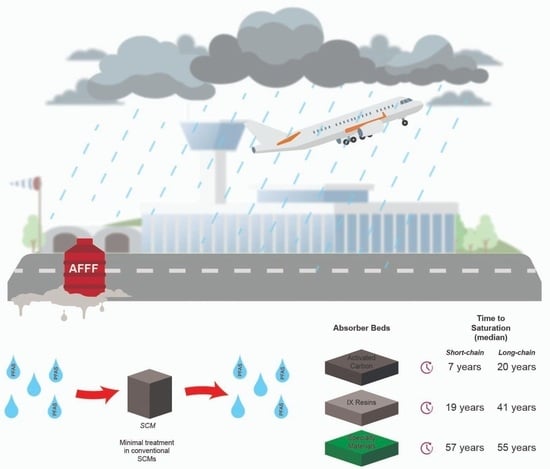
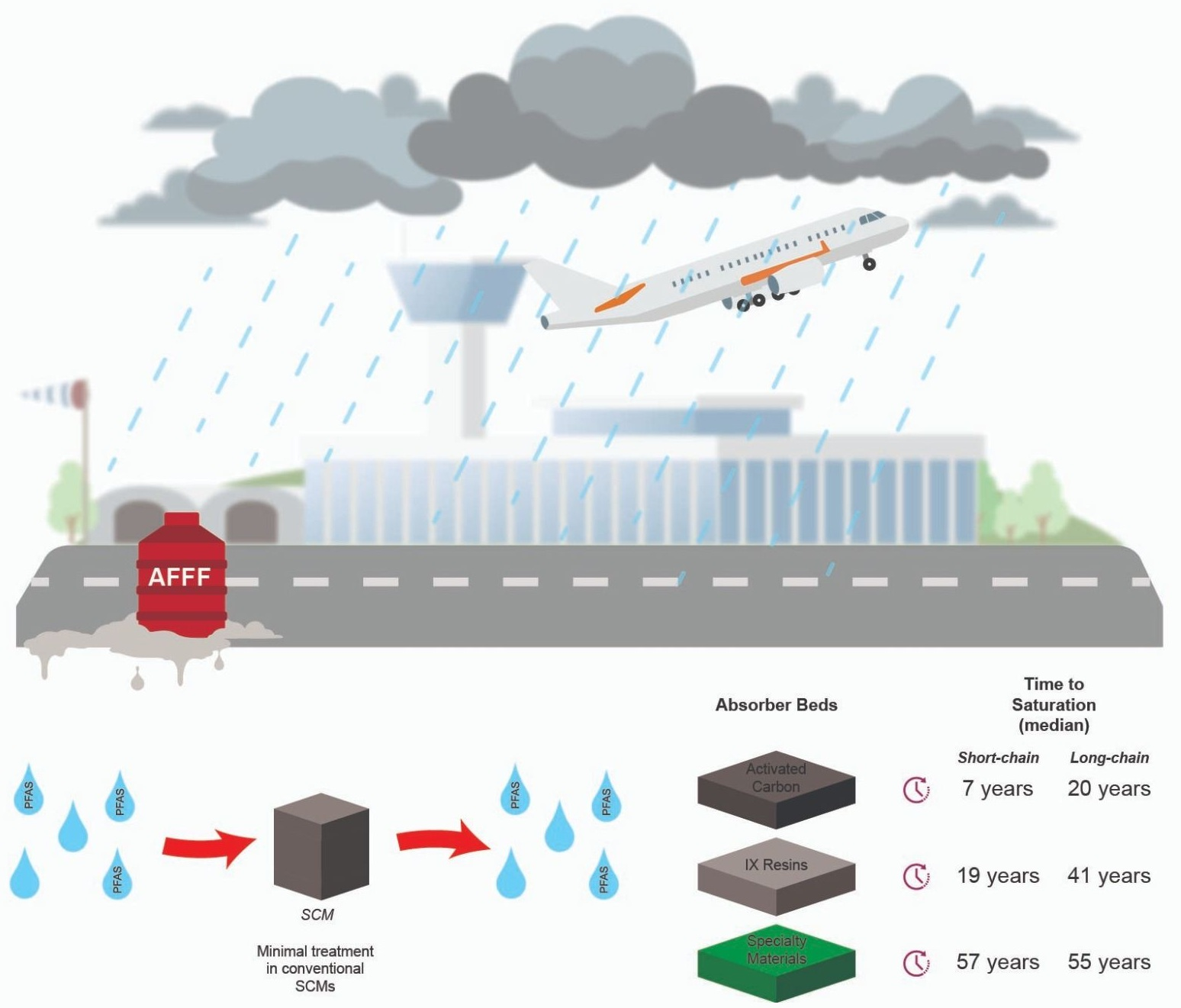
Graphical Abstract

1. Introduction

Per- and polyfluoroalkyl substance (PFAS) contamination has become an increasing global concern due to their high resistance to degradation and adverse impacts on ecological and human health [1,2,3]. PFAS have been found in nearly all environmental matrices, including surface water, stormwater, groundwater, sediment, and air [4,5,6,7]. Airport environments are particularly prone to PFAS contamination due to the historical use of aqueous film-forming foam (AFFF) in firefighting operations, which has led to substantial legacy contamination of PFAS in soils and infrastructure [8,9]. Other routine airport activities, such as aircraft and runway maintenance, de-icing operations, and the use of PFAS-containing industrial coatings, further contribute to PFAS contamination and perpetuate onsite reservoirs [9]. Although many airports are transitioning toward fluorine-free firefighting foams and implementing operational and regulatory measures to reduce PFAS use, legacy contamination remains embedded within pavement, soils, and drainage infrastructure, continuing to serve as a long-term source to stormwater runoff [8].
Stormwater runoff particularly serves as a critical non-point source pathway for PFAS migration, mobilizing these compounds from contaminated surfaces into drainage networks and receiving waters [10,11]. Common stormwater control measures (SCMs) used to treat stormwater runoff in airports include detention-based systems (e.g., retention ponds), infiltration practices, vegetated filters (e.g., biofilters), media filters, and structural treatment systems such as hydrocyclones [12]. These SCMs are generally effective in removing particle-bound contaminants but allow dissolved-phase PFAS to pass through largely untreated [13,14]. As regulatory agencies tighten discharge limits and public health concerns escalate [9,15,16], there is an urgent need to improve SCM performance, particularly for dissolved PFAS. Typical PFAS compounds found in airport runoff include perfluorooctanesulfonic (PFOS) acid and perfluorooctanoic acid (PFOA), among other long- and short-chain species [13,17]. Reported concentrations vary widely depending on site conditions, but levels in the nanogram to microgram per liter range have been documented, often exceeding regulatory levels of concern (e.g., a 4 ng/L maximum contaminant level for PFOS and PFOA in drinking water) [13,17,18].
A variety of sorbents have been evaluated for PFAS removal from water, ranging from conventional materials, such as activated carbon, to more advanced options, including ion exchange (IX) resins and proprietary sorbents [19,20,21,22]. These materials have significant variations in PFAS affinity, removal efficiency, cost, and longevity. Activated carbons and biochars are of particular interest from a sustainability perspective, as they can be produced from renewable biomass or waste residues, offering potential economic and environmental advantages. Adsorber beds, which are fixed-bed units packed with a selected sorbent, are a well-established water treatment approach and can serve as a polishing step for PFAS-contaminated effluents [23,24,25]. When properly designed, these systems can provide a site-specific, cost-effective enhancement to existing SCMs, targeting dissolved PFAS fractions. However, performance data on PFAS removal by different sorbents is scattered across the literature, and there is currently no standardized method to compare or select the most appropriate sorbent for airport stormwater applications. Moreover, no studies have evaluated multiple sorbents and created design-scale adsorbers to estimate bed size and lifetime using sampled stormwater runoff volumes and concentrations.
To address this gap, this study investigates the use of adsorber beds as a supplemental treatment step to treat conventional SCM effluent and enhance PFAS removal. The performance of several sorbents, including activated carbons, IX resins, and specialty materials, is evaluated based on literature-derived sorption parameters. Using runoff volumes and PFAS concentration data from stormwater runoff from an airport with known AFFF legacy contamination, the operational lifespans under standard empty bed contact time (EBCT) assumptions were calculated for the different sorbent categories. The objective is to equip airport environmental managers with practical guidance to optimize PFAS treatment strategies within existing SCM frameworks and provide bed lifetime values that can easily be compared. The analysis acknowledges that optimal sorbent selection and design will ultimately depend on site-specific conditions, contaminant profiles, and operational constraints but is designed to illustrate performance and limitations of sorbent-based SCMs for managing runoff from sources of incidental PFAS contamination at airports. The analysis does not directly address highly concentrated runoff from major source areas such AFFF training areas.

2. Materials and Methods

2.1. Runoff Area Characteristics

The study sites, including the AFFF-affected airport apron, have been previously characterized for organic contaminants and PFAS [13,14]. Briefly, the catchment areas comprised mostly commercial and industrial land use, and included an aircraft parking apron, boarding/unboarding and light maintenance areas. SCMs evaluated for stormwater treatment included a retention pond, biofilters, media filters and hydrodynamic separators. A summary of the study sites, treatment systems and SCM features is included in Table 1.
The AFFF-affected site is located in the southwestern United States, a region characterized by infrequent but intense storm events. Based on precipitation data from the sampling period (2019 to 2024), shown in Figure 1, daily rainfall depths typically ranged from 0.5 mm (1st quartile) to 10 mm (3rd quartile) [26]. The 85th percentile rainfall depth, a commonly used design parameter for SCMs, was 14 mm, while the maximum recorded storm reached 48 mm. Runoff analyzed in this study originated from a 46 cm diameter piped stormwater system draining approximately 32 hectares of mostly impervious surface, including a 14-hectare former aircraft parking apron historically associated with AFFF use and believed to be the primary PFAS source. Runoff was calculated using the United States Department of Agriculture curve number approach [27]. The corresponding stormwater runoff volumes generated over the catchment area were approximately 18 m3 for a 0.05 mm rainfall event, 1450 m3 for a 10 mm event, 2300 m3 for a 14 mm (85th percentile) event, and 10,750 m3 for the 48 mm maximum storm observed during the study period. In a single year, the total expected runoff from the AFFF-affected drainage area, using rainfall depths from the study period, is ~47,500 m3. The piped system that drains the apron discharges into a 1.6-hectare retention pond, which serves as the primary SCM for this area. In addition to the AFFF-impacted storm drain, the pond receives flow from two other pipe systems and flow from sheet flow of the surrounding green area, but these drain areas are not historically associated with AFFF use and were expected to present background concentration levels. Due to the high levels of contamination within the pond, all outlets were closed and volume and contaminant concentrations are only dependent on volume changes and fate processes [13].

2.2. Stormwater Sampling

Stormwater sampling was conducted to characterize PFAS concentrations and phase distribution across multiple SCMs. Sampling protocols followed the methodology established in previous work [14,28], with key details summarized here for interpretation of treatment performance. Influent and effluent stormwater samples were collected using 3700C (Teledyne ISCO, Lincoln, NE, USA) automated composite samplers deployed at the selected SCMs to capture event-scale PFAS loads and evaluate removal efficiency. An average of three storm events was sampled per SCM, and samples were only retained when an antecedent dry period of at least 48 h was met. Composite sampling was used to account for temporal variability in PFAS concentrations during runoff and to establish representative influent–effluent comparisons for each SCM. At the retention pond, composite samples were collected at the three primary inlets, while grab samples were collected from the pond water column before and after storm events to represent bulk pond conditions.
Field blanks and equipment blanks were collected to assess potential contamination. No PFAS were detected in field or equipment blanks above method detection limits, which were approximately 1 ng/L. Stormwater samples were processed to quantify the distribution of PFAS between the filtered-water phase (<0.7 μm) and particulate phase (>0.7 μm). The fraction of PFAS in the particulate phase was defined by difference between filtered and unfiltered samples. Sediment samples were collected from the retention pond to assess long-term PFAS accumulation. Surface sediments were collected from the upper 5–10 cm of deposited material using a stainless-steel scoop, targeting recently accumulated sediments most representative of ongoing inputs. Sediment samples were homogenized, placed in PFAS-free containers, and stored frozen until analysis. Detailed descriptions of the sampling and filtration procedures, including quality control measures, are provided in [13,14].

2.3. PFAS Analysis

Aqueous stormwater samples were prepared for analysis in 50 mL disposable polypropylene centrifuge tubes. A 5 mL aliquot of each sample was combined with 2.1 mL of LC–MS-grade methanol and a mass-labeled PFAS internal standard mixture to achieve a final internal standard concentration of 200 ng/L. The resulting solution, prepared at a 70:30 water-to-methanol ratio, was vortex-mixed for 1 min to ensure complete homogenization and then centrifuged at 5000 rpm for 20 min. Following centrifugation, 1.8 mL of the supernatant was transferred to autosampler vials for instrumental analysis. PFAS quantification was performed using high-performance liquid chromatography coupled with quadrupole time-of-flight mass spectrometry (HPLC–QTOF–MS; Sciex X500R, Framingham, MA, USA) operated in negative electrospray ionization (ESI−) mode. A 500 μL aliquot of each prepared sample was injected onto a C18 column maintained at 40 °C and eluted using a binary mobile phase consisting of HPLC-grade water with 20 mM ammonium acetate and LC–MS-grade methanol at a flow rate of 600 μL/min, delivered by an Exion AC pump (Shimadzu, Kyoto, Japan). Data was acquired using multiple reaction monitoring high-resolution (MRMHR) mode. Quantification was conducted using isotope dilution with calibration standards ranging from 0.5 to 5000 ng/L (R2 > 0.99). Continuous calibration verification standards were analyzed every ten samples to confirm instrument stability. Quality control acceptance was based on recovery of mass-labeled internal standards, with acceptable recoveries defined as 70–130%; samples outside this range were reanalyzed. Calibration standards and mass-labeled internal standards were obtained from Wellington Laboratories (Guelph, ON, Canada).
A total of 26 PFAS were targeted, including perfluoroalkyl carboxylic acids (PFCAs; C4–C14), perfluoroalkyl sulfonic acids (PFSAs; C4–C10), sulfonamides (FBSA, FHxSA, PFOSA), fluorotelomer sulfonates (4:2, 6:2, and 8:2 FTS), and sulfonamidoacetic acids (N-MeFOSAA and N-EtFOSAA). Of these, 16 compounds were consistently detected above method detection limits (typically 1–10 ng/L) and included in subsequent data analysis: PFBA, PFPeA, PFHxA, PFHpA, PFOA, PFNA, PFDA, PFBS, PFPeS, PFHxS, PFOS, FBSA, FHxSA, PFOSA, 6:2 FTS, and 8:2 FTS. Compounds not detected in any samples included PFTrDA, PFTeDA, PFNS, PFDS, N-MeFOSAA, and N-EtFOSAA.

2.4. Selected Sorbents

A variety of sorbents were selected for this study to evaluate their potential for removing dissolved-phase PFAS from airport stormwater runoff. PFAS in the particulate phase were assumed to be removed through primary treatment within an existing SCM. Sorbent selection included both widely used conventional sorbents and more innovative or proprietary materials that have shown promise in the recent literature. These sorbents fell into three main categories: activated carbons, ion exchange resins, and engineered specialty materials. Sorbent selection was guided by performance data available in the peer-reviewed literature or manufacturer documentation, with additional consideration for practical factors such as bulk density and compatibility with stormwater applications. A key property used in this study to characterize sorbent performance is the partition coefficient (Kd). The Kd value describes the equilibrium partitioning of a compound between the sorbent phase and the aqueous phase and is typically expressed in units of L/kg. Higher Kd values indicate stronger sorption affinity and, therefore, greater potential for removal of dissolved contaminants providing a useful metric for comparing sorbents. However, Kd values can vary based on water chemistry, competing ions, and site-specific conditions, a concept discussed further in Section 3.4. This study evaluates the feasibility of several of these materials for integration as polishing steps for treatment of dissolved-phase PFAS.
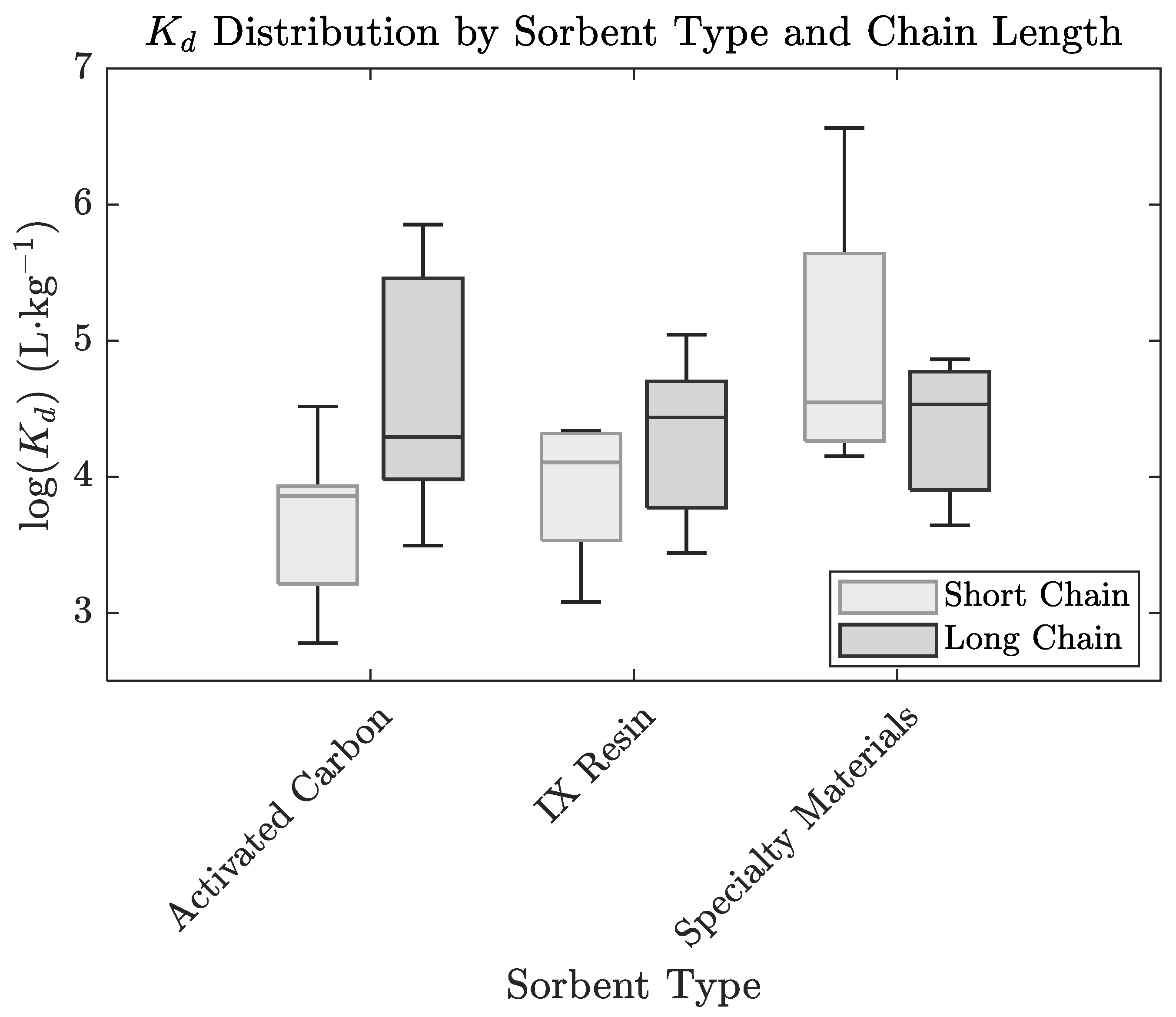
When evaluating treatment options, it is also essential to distinguish between commercially available or developed technologies and those that are still in scale, prototype, or field-testing stages. As technologies mature, are field-tested, and become accepted by regulatory agencies, more PFAS treatment options will become commercially available. The sorbent characteristics used for evaluations in this study are summarized in Table 2, while Figure 2 presents the range of Kd values obtained from the literature.

2.4.1. Activated Carbons

Activated carbon (AC), particularly in granular form (GAC), is one of the most widely used sorbents for PFAS removal in water treatment applications [21,29]. Its adsorption capacity is primarily attributed to its high surface area (typically 800–2000 m2/g), microporous structure, and hydrophobic surface chemistry [30]. AC is typically derived from coal, coconut shells, or wood, with coal-based and coconut-based carbons being the most used for PFAS remediation. These materials differ in pore size distribution and surface characteristics, which affect their performance for different PFAS species. Longer-chain PFAS (e.g., PFOS, PFOA) are more readily adsorbed due to stronger hydrophobic interactions and greater van der Waals forces [31,32], while shorter-chain PFAS (e.g., PFBA, PFHxA) exhibit reduced sorption efficiencies and are more susceptible to early breakthrough, making them more challenging to manage with traditional GAC systems [29].

2.4.2. Ion Exchange (IX) Resins

Ion exchange (IX) resins remove PFAS by replacing anionic PFAS species in water with benign counter-ions such as chloride (Cl), hydroxide (OH), or bicarbonate (HCO3) held on the resin matrix. These polymer-based resins incorporate cationic functional groups (most commonly quaternary or tertiary ammonium) that selectively bind negatively charged PFAS compounds through electrostatic interactions [33]. IX resins are typically categorized by their polymer matrix (styrenic or acrylic), pore structure (gel or macroporous), and functional group chemistry [33]. Macroporous resins offer enhanced sorption capacity compared to gel-based alternatives [34]. Resin design has a strong influence on performance; factors such as chain length selectivity, ionic strength, and competing organic matter all affect PFAS uptake. In PFAS applications, IX resins are available in single-use or regenerable formats. Single-use resins, particularly those engineered explicitly for PFAS, are increasingly preferred due to their higher affinity and broader compatibility with environmental pH ranges. In contrast, regenerable resins often require low-pH solutions for effective regeneration and may be less practical in some field settings. Studies have shown that IX resins may outperform other sorbents, such as activated carbon, for short-chain PFAS, which are otherwise challenging to remove [19]. IX resins are often implemented in lead–lag column configurations, where water is first passed through a GAC column for initial removal of long-chain PFAS and organic matter, followed by an IX resin column to polish effluent and extend the system lifespan. In some applications, air mixing is introduced upstream to improve PFAS contact and distribution in the aqueous phase, enhancing overall removal efficiency. The final separation of spent resin or particulates can be achieved using a lamella separator, a settling tank designed to remove solids through gravity. For in situ stormwater applications, IX resins may also be embedded into granular beds, alongside materials such as zeolites, modified clays, or GAC, as part of a passive treatment barrier. These systems act as reactive zones within drainage infrastructure, capturing PFAS as water flows through. However, these in situ systems can suffer from hydraulic limitations, including fouling, reduced flow capacity, and potential overflow risks, which must be carefully considered during design [9].

2.4.3. Engineered Specialty Materials

In recent years, several engineered specialty sorbents have emerged as promising alternatives to conventional materials for removing PFAS from water. These materials are specifically designed or modified to enhance PFAS binding affinity. Some examples include modified clays, such as organoclays, which are produced by exchanging inorganic cations in natural clay minerals with organic surfactants, thereby increasing their affinity for nonpolar and anionic contaminants [35,36]. Biochar, a carbon-rich product derived from the pyrolysis of biomass, has also been explored for PFAS removal. Its performance depends heavily on materials, pyrolysis temperature, and surface modification. Specialized polymeric resins feature functional groups or pore structures designed to enhance electrostatic or hydrophobic interactions. Some proprietary formulations, such as FluoroSorb®, have shown high removal efficiencies across a range of PFAS chain lengths under short contact times. These resins are typically more expensive than conventional sorbents but can offer advantages in bed life and performance consistency.

2.5. Adsorber Design Considerations

The design and analysis of the sorbent bed in this study is based on runoff characteristics for the AFFF-affected area described in Section 2.1. To assess the feasibility and effectiveness of a polishing step for dissolved PFAS, a mass balance approach was applied to estimate bed life, defined as the time required for the sorbent media to become saturated. The design goal was to establish an adsorber bed volume to satisfy hydraulic constraints and to evaluate the associated sorbent mass and time to PFAS saturation. In an adsorber bed, the placement of granular media can impede flow, potentially causing flooding and exacerbating contamination issues, while at the same time, the granular media could become fouled with solids over time, also reducing hydraulic capacity [9]. To ensure hydraulic feasibility and sustained treatment performance, two design constraints were considered. First, the empty bed contact time (EBCT), which represents a theoretical residence time for PFAS mass transfer and sorption, calculated as the bed volume divided by the design flow rate, was maintained within an appropriate range. An EBCT in the range of 5 to 25 min was targeted, consistent with common practice in water treatment applications [37]. Second, the surface loading rate, defined as the volumetric flow rate per unit area of the bed, was targeted within 5 to 15 m per hour, which balances treatment efficiency with hydraulic feasibility. For compounds such as PFAS, where the adsorption capacity rather than mass transfer limitations is often the limiting step, the surface loading rate plays a secondary role but remains an important design consideration. Additionally, systems should be designed to accommodate the maximum expected flow [37].
In this study, a linear sorption isotherm was assumed, which is likely appropriate given the low PFAS concentrations typically observed (µg/L levels or below) but remains an approximation that depends on the specific kinetic constraints in each site. The time to saturation (τs) was calculated using Equation (1):
τ s =   ρ b × W s * × A × L Q a × C a ( 0 )
where τ s is the time between regeneration or replacement of the sorbent within the bed. ρb is the bulk density of the sorbent (kg/m3). W s * is the mass of contaminant that can be sorbed into the solid at a given inlet concentration (kg PFAS/kg adsorbent). A is cross sectional area (m2), L is length (m), Q a is the volumetric flow at the inlet (m3/h), and C a ( 0 ) is the initial concentration of the contaminant (kg/m3). The values of Ws* were obtained through literature K d values and the study inlet concentrations, as shown in Equation (2):
W S * =   K d × C a ( 0 )
Here, K d represents the equilibrium partition coefficient between the sorbent and the aqueous phase. A range of K d values was calculated from literature-reported values [19,38] and grouped by PFAS chain length (short- and long-chain, here defined as ≤7 alkyl carbons and >7, respectively). Median K d values for each group were then used to define representative sorption capacities for subsequent analyses, while quartile data was used to perform a sensitivity analysis of the variation in adsorber bed lifetime with K d changes.
Table 2. Sorbent characteristics.
Sorbent NameBulk Density (kg/m3)Chain Length and Characteristics
Short Chain (C ≤ 7)Long Chain (C > 7)
Median logKdWs (ng PFAS/g Adsorbent)Median logKdWs (ng PFAS/g Adsorbent)
AC
IX Resin
5003.8632504.298775
7504.157004.4412,280
Specialty Material8004.5515,7854.5315,280
Note: Performance information was obtained from [19,38].
The adsorber bed was modeled as a fixed-bed unit, housed in a cast-in-place, rectangular concrete structure, operating under gravity flow. In practice, gravity-driven flow to the adsorber bed may be achieved through elevation differences, controlled diversion from existing SCM outlets, or passive overflow structures integrated into stormwater infrastructure. The specific conveyance configuration is inherently site-dependent and would be determined by site managers based on hydraulic constraints, available space, cost considerations, and regulatory requirements. The selected bed geometry followed standard engineering practices, utilizing a length-to-width ratio of approximately 2:1 to support compatibility with typical retrofit conditions at airport facilities [37]. A bed depth of 2 m was selected, consistent with typical design ranges of 1–2 m for granular adsorber systems. This configuration offers a conservative yet practical estimate of required bed volume and sorbent mass, ensuring continued PFAS removal under site-specific stormwater conditions. It supports long-term infrastructure planning while enabling the integration of specialized sorbents into existing SCMs for improved treatment outcomes.

3. Results

3.1. Particulate Removal by SCMs

When considering the integration of adsorber beds as a secondary or polishing treatment for PFAS, effective upstream removal of suspended particulates is critical. Particulate matter that enters adsorber beds can promote pore clogging and increased head loss, leading to reduced hydraulic capacity and premature media exhaustion. Effective upstream particulate control therefore directly influences the long-term performance and maintenance frequency of adsorber systems. A recent evaluation of representative airport SCMs, including a retention pond, biofilters, and treatment trains incorporating hydrodynamic separators and media filters, demonstrated the particulate removal capabilities across system types [14]. Removal was achieved through a combination of physical processes, including sedimentation and filtration, with varying levels of effectiveness, influenced by design configuration, flow conditions, and maintenance practices. The retention pond exhibited particulate removal near 100%, likely due to extended residence times and effective settling. Biofilters and hydrodynamic separators had varying levels of removal, ranging from near complete removal (>90%) to minimal change in concentrations, particularly in cases such as high-intensity storm events and in poorly maintained systems where media degradation and particulate breakthrough were observed. Overall, these findings indicate that SCMs are generally effective at retaining suspended solids; however, performance is significantly diminished in the absence of routine maintenance and during overflow events.

3.2. PFAS Removal by SCMs

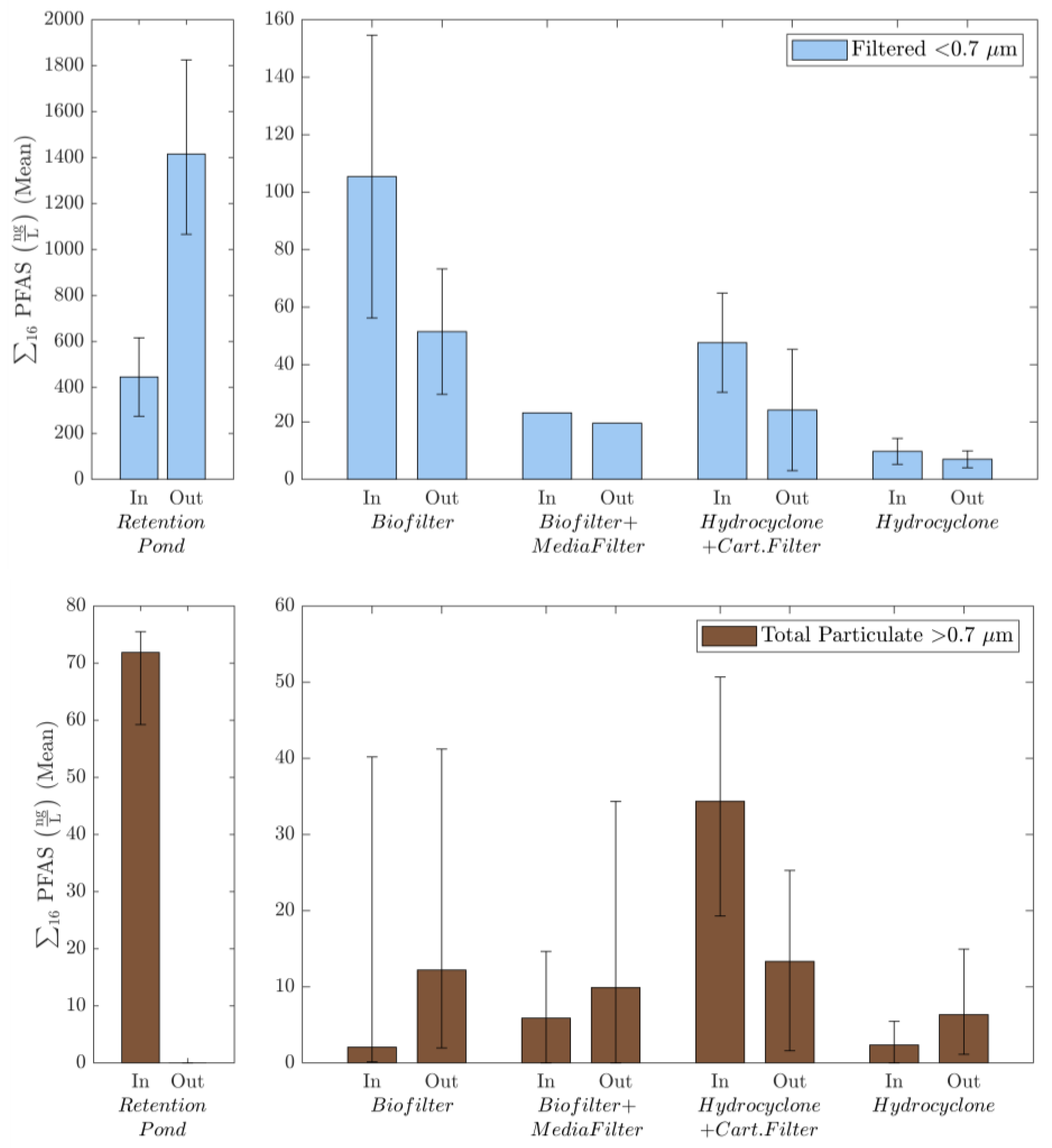
PFAS removal across the different SCMs was generally limited, as summarized in Figure 3. In most systems, PFAS were predominantly present in the filtered-water fraction, accounting for approximately 50% to over 90% of the total concentration. Removal of filtered PFAS was minimal, and effluent concentrations generally ranged between 10 and 50 ng/L. The retention pond (within an AFFF affected catchment) exhibited distinct behavior relative to other systems, with filtered-water PFAS concentrations increasing from approximately 450 ng/L in incoming stormwater to nearly 1400 ng/L in the pond. Due to the lack of a true outlet, during extended periods without discharge, water losses through evaporation concentrated PFAS within the pond, demonstrating how such systems can function as long-term PFAS reservoirs rather than treatment units in the absence of active discharge or management. Although contaminated sediments are not detected in water samples due to deposition, PFAS are not expected to degrade and will pose concerns for sediment accumulation, which will lead to future management concerns.
SCMs without a known direct AFFF source generally exhibited runoff concentrations below 100 ng/L. Among these systems, only biofilters showed measurable reductions in filtered-water PFAS, near 50% to 50 ng/L, likely due to sorption to mulch- and peat-amended media and interactions with organic matter within the biofiltration soil media. Hydrocyclone and cartridge filter systems exhibited variable PFAS removal that was largely dependent on maintenance status. Recently maintained systems showed measurable reductions in filtered-water PFAS, whereas poorly maintained systems showed little to no removal, likely due to solid accumulation, hydraulic short-circuiting, and reduced contact between stormwater and the filter media. All other SCMs showed little to no filtered-phase PFAS removal, reinforcing the fact that these systems are not designed to target dissolved-phase PFAS.
Overall, these results suggest that while traditional SCMs can be effective for particulate removal, they offer limited benefit for dissolved PFAS, which comprise the dominant fraction of PFAS in airport stormwater. Observed performance declines were consistently linked to inadequate maintenance, reinforcing the importance of routine inspection and solid removal to preserve treatment function. Together, these findings show the need for targeted polishing steps, such as adsorber beds, to address the dissolved fraction of PFAS in airport stormwater.

3.3. Characteristics of AFFF-Affected Stormwater

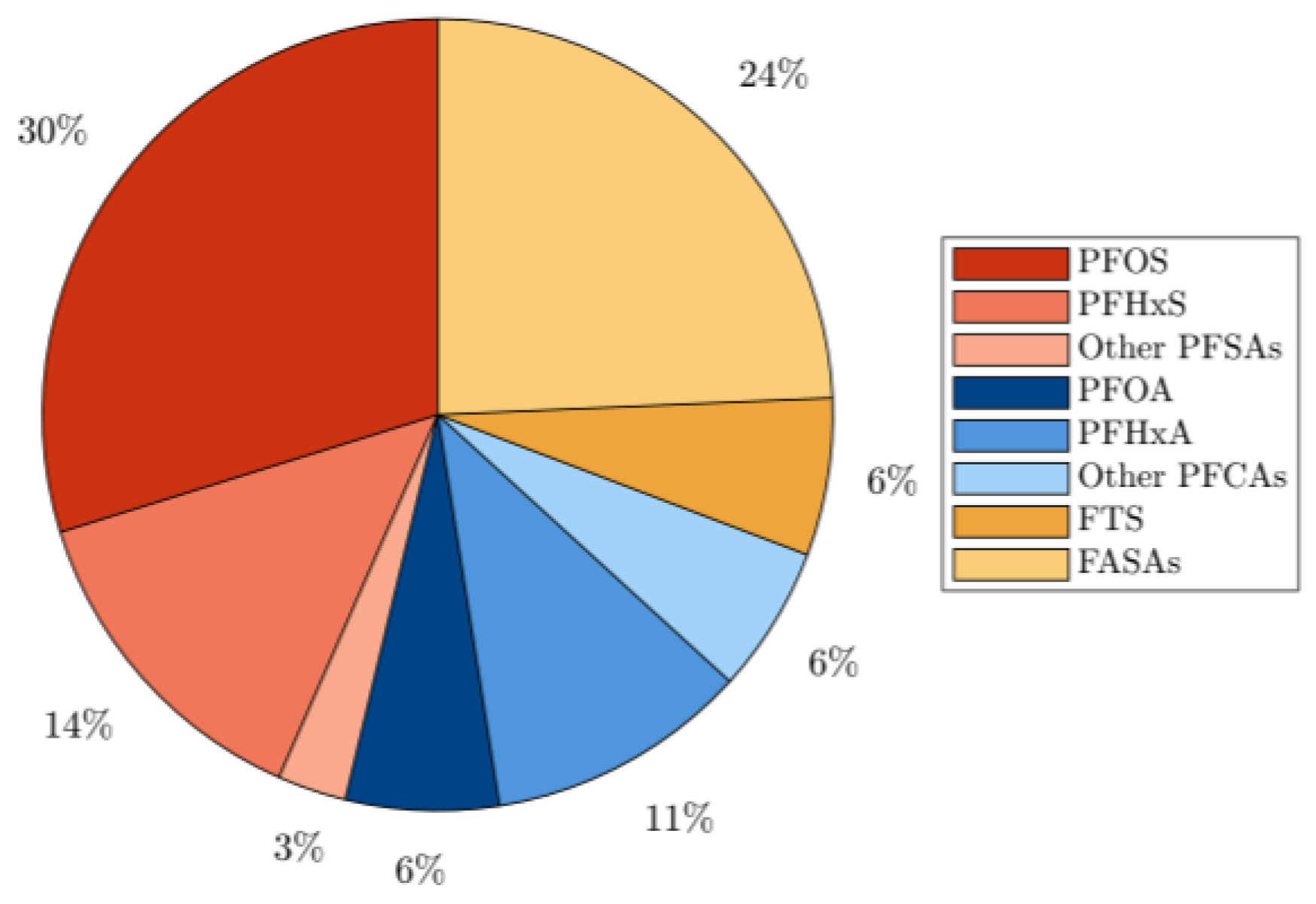
Runoff from the AFFF-impacted system exhibited elevated PFAS concentrations, with total influent levels of approximately 450 ng/L in the dissolved phase and 70 ng/L in the particulate phase. Across storm events ranging from 0.05 to 14 mm of rainfall, PFAS concentrations varied by less than a factor of two, suggesting a relatively consistent source strength [13]. As shown in Figure 4, PFAS distribution in the dissolved phase consisted of a mix of precursor and terminal compounds. Fluorotelomer sulfonates (FTSs) and fluoroalkyl sulfonamides (FASAs) accounted for 30% of the total concentration, indicating a substantial precursor contribution. Of the terminal PFAS, the dominant species were perfluorooctanesulfonic acid (PFOS), with 30%, and perfluorohexanesulfonic (PFHxS) acid, with 14% of the total. Perfluorohexanoic acid (PFHxA) and perfluorooctanoic acid (PFOA) accounted for an additional 11% and 6%, respectively. This profile is consistent with distributions previously reported in the literature [8].

3.4. Sorbent Performance and Bed Design

As demonstrated in Section 3.1 and Section 3.2, and previous work [13,14], conventional SCMs are generally effective at removing particulates from stormwater but show limited capability in treating dissolved-phase PFAS. As the majority of PFAS in AFFF affected stormwater runoff occurs in the dissolved phase, an additional treatment step is necessary to target removal of contaminants in this phase. This section presents the performance of sorbent-based adsorber beds implemented as a downstream polishing treatment for dissolved PFAS following primary stormwater treatment.
Sorbent bed performance was evaluated using the measured dissolved PFAS concentration of 450 ng/L from the AFFF-impacted stormwater system (Section 2.1) as the basis for contaminant loading, in combination with common adsorber design parameters (Section 2.5). An empty bed contact time (EBCT) of 10 min was selected, which is within the range commonly used for adsorption-based treatment systems (5–25 min). The design flow was based on the 85th percentile storm event, corresponding to a total runoff volume of approximately 2300 m3. Using the average storm duration in the study area (4 h), this resulted in a representative flow rate of 9.6 m3/min. Based on the selected EBCT and design flow, the required adsorber bed volume was calculated to be approximately 96 m3. Assuming a bed depth of 2 m, this volume corresponds to a surface loading rate of approximately 12 m/h, which lies within the recommended range for adsorption systems (5–15 m/h) [37]. As storms smaller than the 85th percentile account for most runoff events, operating conditions for those storms are expected to occur at lower flow rates, resulting in longer effective contact times and lower surface loading rates than those used for design.
Performance was evaluated using a mass balance approach to estimate the time required for each adsorber bed to reach saturation. Annual PFAS mass loading was calculated from measured influent PFAS concentrations and total annual stormwater runoff volumes. Bed volume and sorbent bulk density were then used to determine the total mass of sorbent contained within each adsorber system. Sorption capacity was estimated using literature-reported distribution coefficients (Kd), assuming equilibrium between dissolved-phase PFAS in the influent and the sorbent. For each sorbent, Kd values were combined with influent PFAS concentrations to calculate an effective adsorption capacity (Ws). This capacity, together with the total sorbent mass in the bed, was used to estimate the maximum PFAS mass that could be retained before media replacement or regeneration would be required. Although equilibrium conditions may not be fully achieved under all storm conditions, the selected EBCT was assumed to provide sufficient contact to support relative performance comparisons among sorbents.
Time to saturation was calculated by dividing the total sorptive capacity of the bed by the estimated annual PFAS mass loading. This approach provided a consistent basis for comparing sorbent performance under identical hydraulic and contaminant loading conditions. Table 3 summarizes the resulting operational lifetimes for each sorbent, separated by short- and long-chain PFAS. To evaluate uncertainty associated with sorption affinity, a sensitivity analysis was conducted using the first quartile, median, and third quartile log Kd values obtained from the compiled literature dataset. These values were used to represent lower-bound, typical, and upper-bound sorption behavior and to estimate the corresponding range of expected adsorber lifetimes.
Calculated lifetimes varied by PFAS chain length and sorbent type, generally increasing with the sorbent specialty. For short-chain PFAS, which have less sorbing and are typically more challenging to remove, median Kd values showed that specialty materials exhibited the longest lifetimes (approximately 57 years), highlighting the advantages of targeted sorption mechanisms, albeit at higher material costs. Ion exchange resins also showed extended lifetimes (approximately 20 years) relative to activated carbon due to strong electrostatic interactions, while activated carbon, despite being less selective, still offered meaningful lifetimes (approximately 7 years) and remains a practical, low-cost option that can be readily implemented. Across the sensitivity range, short-chain PFAS lifetimes increased substantially with sorbent specificity, with activated carbon ranging from approximately 2–8 years, ion exchange resins from roughly 5–30 years, and specialty materials from approximately 30 years to several hundred years under upper-quartile Kd conditions. These results illustrate the strong dependence of predicted performance on sorbent affinity. Because Kd is expressed in logarithmic units, an increase of a single log unit corresponds to an order-of-magnitude increase in partitioning, which can translate into large increases in estimated operational lifetime.
For long-chain PFAS, which are generally easier to adsorb, median values show that activated carbon and ion exchange resins provided substantial lifetimes (approximately 20–40 years), while specialty materials extended lifetimes to around 55 years. Under these conditions, the incremental gains from specialty sorbents may not justify their higher cost, making more frequent media replacement a viable strategy. Sensitivity results further showed that long-chain PFAS lifetimes for activated carbon ranged from roughly 10 years to several hundred years depending on Kd, while ion exchange resins ranged from approximately 9–75 years and specialty materials from about 13 to nearly 100 years. This indicates that activated carbons located in the upper range of reported Kd values can be highly sorptive and may provide a cost-effective alternative to more specialized materials in systems dominated by long-chain PFAS.
It is important to note that the results are screening-level lifetimes, and additional considerations such as fouling, competitive adsorption, and hydraulic variability can hinder performance and reduce lifetime. Additionally, longer modeled lifetimes derived from higher Kd values should be interpreted cautiously, as extended operation increases the likelihood of fouling, pore blockage, and performance decline that are not captured in equilibrium-based estimates. In the AFFF-impacted stormwater used for this analysis, long-chain PFAS constituted the majority of total PFAS (>75%), while short-chain compounds were present at lower concentrations. This predominance of long-chain species suggests that less selective sorbents, such as activated carbon, can still achieve substantial removal and serve as a practical treatment option. It is important to note that the presented results are based on the studied AFFF- impacted site, including site-specific rainfall patterns and PFAS profiles. Varying conditions might affect overall performance or sorbent selection that is most appropriate for a site. Overall, these results emphasize that sorbent selection can be optimized based on PFAS composition, balancing removal efficiency, cost, and regeneration frequency. Additionally, as long-chain PFAS are generally more strongly retained by sorbents, they can occupy most available adsorption sites. This can lead to earlier breakthroughs of short-chain PFAS, which are less strongly sorbed, even if the total bed capacity has not been exceeded. As a result, the timing and extent of short-chain PFAS breakthrough will vary depending on influent composition, sorbent type, and operational conditions, and must be evaluated on a case-by-case basis when planning sorbent replacement or setting effluent targets.

3.5. Additional Considerations

In addition to sorbent selection and effective upstream solid removal, several site-specific and water chemistry factors can significantly influence PFAS treatment performance and should be considered when interpreting the modeled adsorber lifetimes presented in this study. These factors primarily act by altering hydraulic behavior, reducing available sorption sites, or lowering the effective sorption capacity assumed in the equilibrium-based design framework. Considering these conditions during design and implementation helps improve reliability and cost-effectiveness. This summary provides site managers with key considerations that can impact PFAS removal and overall treatment efficiency.
Stormwater systems are inherently characterized by variable rainfall intensity and intermittent flow conditions, which produce fluctuating hydraulic loading and contact times within adsorber beds. During high-intensity storm events, reduced residence time and potential bypass or short-circuiting may limit equilibrium sorption, whereas extended low-flow periods may increase apparent treatment efficiency, introducing additional uncertainty into modeled lifetime predictions.
Dissolved organic matter can enhance the sorption of long-chain PFAS, due to the formation of hydrophobic aggregates that increase the effective sorbent affinity; however it can also compete for adsorption sites and contribute to gradual fouling of sorbent media, effectively lowering the partition coefficient [19]. Elevated solid loads in stormwater can further accelerate fouling, leading to pore blockage, increased head loss, and reduced sorption surface area leading to a shortened bed lifetime. Adequate pretreatment and routine maintenance of SCMs are therefore critical to maintaining hydraulic capacity and preserving adsorption performance over time. In mixed-contaminant systems, competitive sorption can further influence performance. Among PFAS, long-chain compounds are typically preferentially retained due to stronger hydrophobic and electrostatic interactions, which can reduce the availability of sorption sites for short-chain PFAS and lead to earlier breakthrough of weaker-affinity compounds even when total bed capacity has not been reached. In addition, co-contaminants commonly present in stormwater, such as hydrocarbons and other anionic species, may compete directly with PFAS for adsorption or ion exchange sites. These interactions can lower the effective sorption capacity, thereby reducing operational lifetimes compared with modeled estimates.
Water matrix chemistry further affects sorption efficiency and introduces uncertainty into the modeled predictions. Variations in pH, ionic strength, and the presence of competing anions all lead to reduced efficiency. Removal of anionic PFAS by ion exchange resins tends to decline at higher pH values due to reduced electrostatic attraction, while competing anions such as sulfate or bicarbonate can occupy exchange sites and reduce sorption capacity. These factors highlight the importance of considering site-specific water chemistry when selecting and sizing sorbent systems and their effects on different PFAS chain lengths [33]. Modern AFFF formulations also increasingly contain short-chain PFAS, which generally have lower sorption affinity than long-chain compounds. This shift can reduce effective sorbent capacity and shorten operational lifetimes, particularly for adsorbents optimized for long-chain PFAS.
Handling of PFAS-rich regeneration solutions or saturated sorbents is another practical consideration that must be made. Regeneration of sorbents, particularly IX resins, produces concentrated PFAS waste streams that require appropriate management. Common strategies include off-site disposal, incineration, or high-temperature destruction, with emerging technologies such as supercritical water oxidation and electrochemical treatment also under investigation. These secondary waste management requirements may influence decisions between regenerable and single-use sorbents.
Bed configuration strategies provide additional flexibility for managing uncertainty in breakthrough behavior. A single sorbent bed is often optimal for minimizing sorbent exhaustion and simplifying operation. However, in scenarios where effluent quality must be tightly controlled, such as sensitive receiving waters or strict discharge permits, multi-stage configurations using fixed beds in series can enhance overall performance. Sorbents can be combined within this configuration to target both long- and short-chain PFAS. The selection of such configurations ultimately depends on regulatory criteria, influent PFAS composition, and cost considerations.
While detailed cost data for sorbents is highly variable and often proprietary, general trends indicate that activated carbons and biochars are typically lower cost but may exhibit shorter bed life for short-chain PFAS, whereas IX resins and engineered materials might offer longer lifetimes and consistent performance at a higher material cost. Final cost–benefit evaluations must therefore be conducted on a site-specific basis.
Non-watertight storm sewers can also allow PFAS-contaminated groundwater to enter the system and be discharged with stormwater, introducing an unaccounted source of contamination that must be handled before adsorber bed implementation [8].
Together, these considerations highlight that the calculated adsorber lifetimes represent screening-level estimates under simplified equilibrium conditions. Variability in stormwater flow, intermittent operation, competitive adsorption, and fouling processes can all reduce effective sorption capacity and should be incorporated into detailed design or pilot-scale validation prior to full-scale implementation. Integrating these practical uncertainties with the modeling framework strengthens interpretation of the results and supports informed application of sorbent polishing within existing SCM systems.

4. Conclusions

Airports remain a critical hotspot for PFAS contamination due to the historic use of aqueous film-forming foam (AFFF) and the persistence of these compounds in infrastructure and surrounding environments. Monitoring of stormwater runoff within several conventional stormwater control measures (SCMs) showed effective reduction in particulates; however, performance depended strongly on regular maintenance to prevent particle accumulation and remobilization. Additionally, these systems consistently failed to remove dissolved-phase PFAS, which represented approximately 50–90% of total PFAS concentrations. Within a studied AFFF-impacted airport, stormwater runoff concentrations averaged approximately 400 ng/L total PFAS, indicating that additional treatment beyond conventional SCMs is necessary.
To address this dissolved fraction, a conceptual adsorber polishing system was developed using measured runoff volumes and PFAS concentrations from the study site. Adsorber beds were sized using a representative empty bed contact time (EBCT) of 10 min and design criteria corresponding to treatment of the 85th-percentile storm event, resulting in an estimated design volume of approximately 96 m3 under site conditions. Sorption performance was evaluated using literature-derived equilibrium partition coefficients (Kd), for activated carbons (ACs), ion exchange (IX) resins, and specialty sorbents.
Model-based lifetime estimates varied substantially by sorbent type and PFAS chain length, reflecting differences in sorption affinity. Under site-specific conditions, AC exhibited median estimated lifetimes of approximately 7–20 years, IX resins approximately 20–40 years, and specialty sorbents greater than 50 years. Sensitivity analysis using reported ranges of Kd values produced lifetime estimates spanning orders of magnitude, emphasizing that predicted performance is highly dependent on sorption affinity and represents screening-level expectations rather than field-validated service lives. Operational factors such as fouling, competitive adsorption, and hydraulic variability are expected to reduce achievable lifetimes in practice. Sorbent selection must therefore balance sorption performance, replacement frequency, and material cost within site-specific hydraulic and contaminant conditions.
As the regulatory landscape evolves and PFAS limits become more stringent, integrating sorbent-based polishing offers a scalable and cost-conscious downstream treatment for managing elevated PFAS levels in runoff. By combining measured stormwater PFAS concentrations with simple adsorber bed design calculations, the study provides a practical framework for site managers and engineers to compare sorbents, estimate operational lifetimes, and make informed decisions on PFAS mitigation strategies.

Author Contributions

Conceptualization, C.G.-Á., B.R. and D.R.; methodology, C.G.-Á., B.R. and D.R.; software, C.G.-Á.; validation, C.G.-Á., B.R. and D.R.; formal analysis, C.G.-Á.; investigation, C.G.-Á.; resources D.R.; data curation, C.G.-Á.; writing—original draft preparation, C.G.-Á.; writing—review and editing, C.G.-Á., B.R. and D.R.; visualization, C.G.-Á.; supervision, B.R. and D.R.; project administration, B.R. and D.R.; funding acquisition, C.G.-Á., B.R. and D.R. All authors have read and agreed to the published version of the manuscript.

Funding

Airport Cooperative Research Program (ACRP) sponsored by the Federal Aviation Administration (FAA); and the JF Maddox Foundation.

Data Availability Statement

The original contributions presented in this study are included in the article. Further inquiries can be directed to the corresponding author.

Acknowledgments

This work was supported by the ACRP; and the JF Maddox Foundation.

Conflicts of Interest

The funders had no role in the design of the study; in the collection, analyses, or interpretation of data; in the writing of the manuscript; or in the decision to publish the results.

Correction Statement

This article has been republished with a minor correction to resolve spelling and grammatical errors. This change does not affect the scientific content of the article.

References

  1. Suja, F.; Pramanik, B.K.; Zain, S.M. Contamination, bioaccumulation and toxic effects of perfluorinated chemicals (PFCs) in the water environment: A review paper. Water Sci. Technol. 2009, 60, 1533–1544. [Google Scholar] [CrossRef] [PubMed]
  2. Buck, R.C.; Franklin, J.; Berger, U.; Conder, J.M.; Cousins, I.T.; De Voogt, P.; Jensen, A.A.; Kannan, K.; Mabury, S.A.; van Leeuwen, S.P. Perfluoroalkyl and polyfluoroalkyl substances in the environment: Terminology, classification, and origins. Integr. Environ. Assess. Manag. 2011, 7, 513–541. [Google Scholar] [CrossRef] [PubMed]
  3. Kissa, E. Fluorinated Surfactants and Repellents; CRC Press: Boca Raton, FL, USA, 2001; Volume 97. [Google Scholar]
  4. Ahmed, M.; Johir, M.; McLaughlan, R.; Nguyen, L.N.; Xu, B.; Nghiem, L.D. Per-and polyfluoroalkyl substances in soil and sediments: Occurrence, fate, remediation and future outlook. Sci. Total Environ. 2020, 748, 141251. [Google Scholar] [CrossRef] [PubMed]
  5. Bach, C.; Dauchy, X.; Boiteux, V.; Colin, A.; Hemard, J.; Sagres, V.; Rosin, C.; Munoz, J.-F. The impact of two fluoropolymer manufacturing facilities on downstream contamination of a river and drinking water resources with per-and polyfluoroalkyl substances. Environ. Sci. Pollut. Res. 2017, 24, 4916–4925. [Google Scholar] [CrossRef]
  6. Dauchy, X.; Boiteux, V.; Bach, C.; Rosin, C.; Munoz, J.-F. Per-and polyfluoroalkyl substances in firefighting foam concentrates and water samples collected near sites impacted by the use of these foams. Chemosphere 2017, 183, 53–61. [Google Scholar] [CrossRef]
  7. Domingo, J.L.; Nadal, M. Human exposure to per-and polyfluoroalkyl substances (PFAS) through drinking water: A review of the recent scientific literature. Environ. Res. 2019, 177, 108648. [Google Scholar] [CrossRef]
  8. Anderson, J.K.; Schneider, D.; Knutson, M.; Puchacz, Z.J. PFAS Source Differentiation Guide for Airports; Transportation Research Board: Washington, DC, USA, 2023. [Google Scholar]
  9. National Academies of Sciences, Engineering, and Medicine. PFAS Management at Airports: A Guide; The National Academies Press: Washington, DC, USA, 2024. [Google Scholar]
  10. Codling, G.; Yuan, H.; Jones, P.D.; Giesy, J.P.; Hecker, M. Metals and PFAS in stormwater and surface runoff in a semi-arid Canadian city subject to large variations in temperature among seasons. Environ. Sci. Pollut. Res. 2020, 27, 18232–18241. [Google Scholar] [CrossRef]
  11. Kali, S.E.; Österlund, H.; Viklander, M.; Blecken, G.-T. Stormwater discharges affect PFAS occurrence, concentrations, and spatial distribution in water and bottom sediment of urban streams. Water Res. 2025, 271, 122973. [Google Scholar] [CrossRef]
  12. Allerton, K.; Johnson, A.; Lengel, J.A.; Knecht, M.; Seal, D.; Esposito, P.; Griffin, G. Balancing Airport Stormwater and Bird Hazard Management; Transportation Research Board: Washington, DC, USA, 2015. [Google Scholar]
  13. Gomez-Avila, C.; Hussain, T.; Rao, B.; Pitt, R.; Guelfo, J.; Zhou, H.; Reible, D. PFAS in Stormwater Control Measures: Removal, distribution, and long-term Fate. Water Res. 2026, 289, 124795. [Google Scholar] [CrossRef]
  14. Gomez-Avila, C.; Rao, B.; Hussain, T.; Zhou, H.; Pitt, R.; Colvin, M.; Hayman, N.; DeMyers, M.; Reible, D. Particle size-based evaluation of stormwater control measures in reducing solids, polycyclic aromatic hydrocarbons (PAHs) and polychlorinated biphenyls (PCBs). Water Res. 2025, 277, 123299. [Google Scholar] [CrossRef]
  15. Brennan, N.M.; Evans, A.T.; Fritz, M.K.; Peak, S.A.; von Holst, H.E. Trends in the regulation of per-and polyfluoroalkyl substances (PFAS): A scoping review. Int. J. Environ. Res. Public Health 2021, 18, 10900. [Google Scholar] [CrossRef] [PubMed]
  16. EPA. Final PFAS National Primary Drinking Water Regulation. 2024. Available online: https://www.epa.gov/sdwa/and-polyfluoroalkyl-substances-pfas (accessed on 20 January 2026).
  17. Liu, J.; Zhao, Z.; Li, J.; Hua, X.; Zhang, B.; Tang, C.; An, X.; Lin, T. Emerging and legacy perfluoroalkyl and polyfluoroalkyl substances (PFAS) in surface water around three international airports in China. Chemosphere 2023, 344, 140360. [Google Scholar] [CrossRef] [PubMed]
  18. Liu, M.; Munoz, G.; Vo Duy, S.; Sauvé, S.; Liu, J. Per-and polyfluoroalkyl substances in contaminated soil and groundwater at airports: A Canadian case study. Environ. Sci. Technol. 2021, 56, 885–895. [Google Scholar] [CrossRef] [PubMed]
  19. Gagliano, E.; Sgroi, M.; Falciglia, P.P.; Vagliasindi, F.G.; Roccaro, P. Removal of poly-and perfluoroalkyl substances (PFAS) from water by adsorption: Role of PFAS chain length, effect of organic matter and challenges in adsorbent regeneration. Water Res. 2020, 171, 115381. [Google Scholar] [CrossRef]
  20. Vo, H.N.P.; Nguyen, T.M.H.; Ngo, H.H.; Guo, W.; Shukla, P. Biochar sorption of perfluoroalkyl substances (PFASs) in aqueous film-forming foams-impacted groundwater: Effects of PFASs properties and groundwater chemistry. Chemosphere 2022, 286, 131622. [Google Scholar] [CrossRef]
  21. Liu, C.J.; Werner, D.; Bellona, C. Removal of per-and polyfluoroalkyl substances (PFASs) from contaminated groundwater using granular activated carbon: A pilot-scale study with breakthrough modeling. Environ. Sci. Water Res. Technol. 2019, 5, 1844–1853. [Google Scholar] [CrossRef]
  22. Zhang, Z.; Joudiazar, S.; Satpathy, A.; Fernando, E.; Rahmati, R.; Kim, J.; de Falco, G.; Datta, R.; Sarkar, D. Removal of Per-and Polyfluoroalkyl Substances Using Commercially Available Sorbents. Materials 2025, 18, 1299. [Google Scholar] [CrossRef]
  23. Worch, E. Adsorption Technology in Water Treatment; De Gruyter Brill: Berlin, Germany, 2012; Volume 10. [Google Scholar]
  24. Hand, D.W.; Crittenden, J.C.; Arora, H.; Miller, J.M.; Benjamin, W.L., Jr. Designing fixed-bed adsorbers to remove mixtures of organics. J.-Am. Water Work. Assoc. 1989, 81, 67–77. [Google Scholar] [CrossRef]
  25. Ali, I.; Gupta, V. Advances in water treatment by adsorption technology. Nat. Protoc. 2006, 1, 2661–2667. [Google Scholar] [CrossRef]
  26. Mesonet, W.T. Daily Precipitation Data. 2025. Available online: https://www.mesonet.ttu.edu/ (accessed on 15 February 2025).
  27. USDA. Engineering field handbook: Chapter 2-estimating runoff. In National Engineering Handbook; USDA: Washington, DC, USA, 1991. [Google Scholar]
  28. Hussain, T.; Athanasiou, D.; Rao, B.; Bejar, M.; Rakowska, M.; Drygiannaki, I.; Chadwick, D.B.; Colvin, M.A.; Hayman, N.T.; Rosen, G.H. Sediment recontamination potential and biological impacts of hydrophobic organics from stormwater in a mixed-use watershed. Sci. Total Environ. 2024, 906, 167444. [Google Scholar] [CrossRef]
  29. McCleaf, P.; Englund, S.; Östlund, A.; Lindegren, K.; Wiberg, K.; Ahrens, L. Removal efficiency of multiple poly-and perfluoroalkyl substances (PFASs) in drinking water using granular activated carbon (GAC) and anion exchange (AE) column tests. Water Res. 2017, 120, 77–87. [Google Scholar] [CrossRef] [PubMed]
  30. Hu, Z.; Srinivasan, M. Mesoporous high-surface-area activated carbon. Microporous Mesoporous Mater. 2001, 43, 267–275. [Google Scholar] [CrossRef]
  31. Guelfo, J.L.; Higgins, C.P. Subsurface transport potential of perfluoroalkyl acids at aqueous film-forming foam (AFFF)-impacted sites. Environ. Sci. Technol. 2013, 47, 4164–4171. [Google Scholar] [CrossRef] [PubMed]
  32. Higgins, C.P.; Luthy, R.G. Sorption of perfluorinated surfactants on sediments. Environ. Sci. Technol. 2006, 40, 7251–7256. [Google Scholar] [CrossRef]
  33. Dixit, F.; Dutta, R.; Barbeau, B.; Berube, P.; Mohseni, M. PFAS removal by ion exchange resins: A review. Chemosphere 2021, 272, 129777. [Google Scholar] [CrossRef]
  34. Banks, D.; Jun, B.-M.; Heo, J.; Her, N.; Park, C.M.; Yoon, Y. Selected advanced water treatment technologies for perfluoroalkyl and polyfluoroalkyl substances: A review. Sep. Purif. Technol. 2020, 231, 115929. [Google Scholar] [CrossRef]
  35. Yariv, S. Introduction to organo-clay complexes and interactions. Organo-Clay Complexes Interact. 2002, 8, 39–112. [Google Scholar]
  36. De Paiva, L.B.; Morales, A.R.; Díaz, F.R.V. Organoclays: Properties, preparation and applications. Appl. Clay Sci. 2008, 42, 8–24. [Google Scholar] [CrossRef]
  37. American Water Works Association; American Society of Civil Engineers. Water Treatment Plant Design, 4th ed.; Baruth, E.E., Ed.; McGraw Hill: Columbus, OH, USA, 2005. [Google Scholar]
  38. Yan, B.; Munoz, G.; Sauvé, S.; Liu, J. Molecular mechanisms of per-and polyfluoroalkyl substances on a modified clay: A combined experimental and molecular simulation study. Water Res. 2020, 184, 116166. [Google Scholar] [CrossRef]
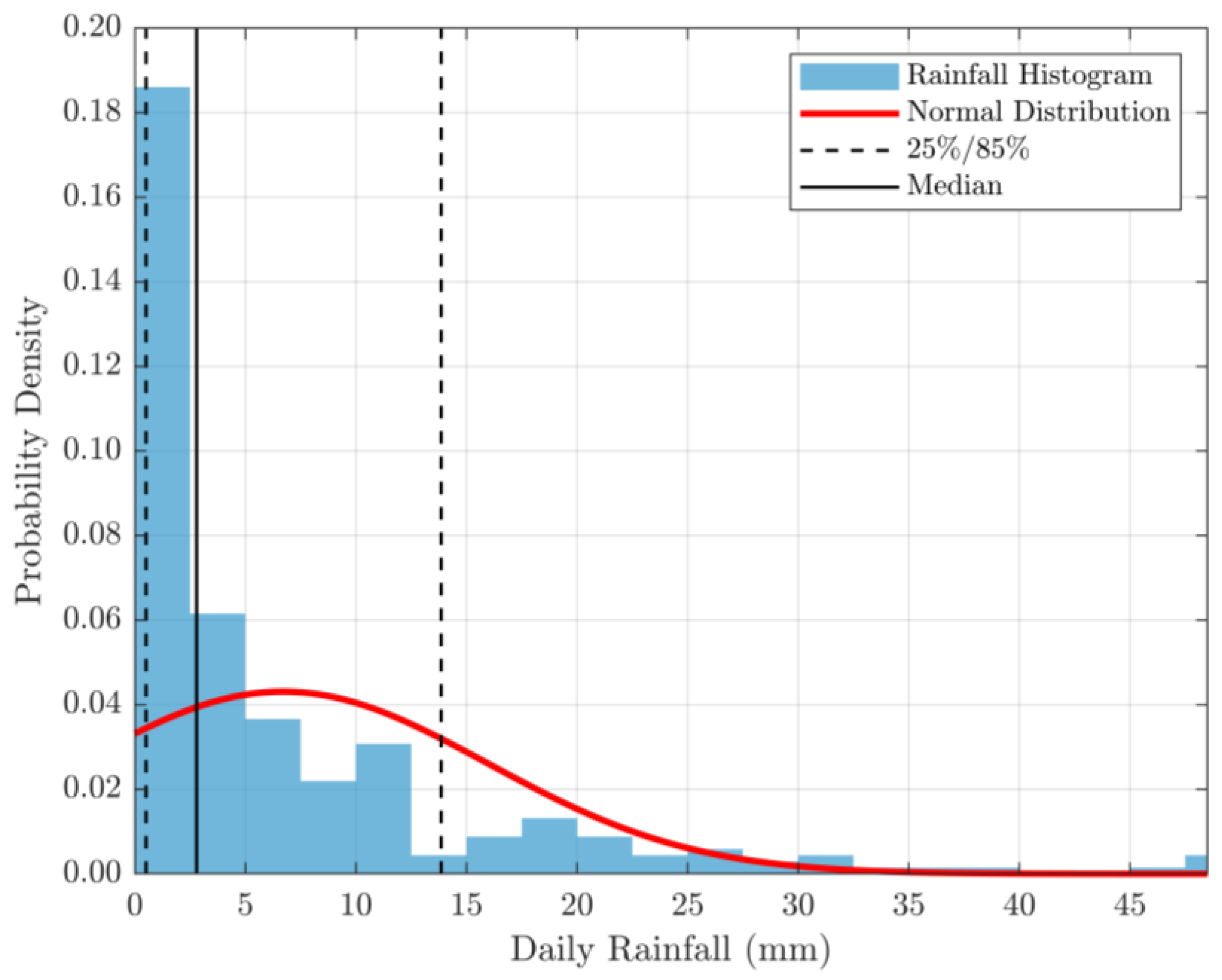
Figure 1. Rainfall distribution with normal curve and quartiles within the study area (2019–2024).
Water 18 00517 g001
Figure 2. Kd distribution by chain length and sorbent type.
Water 18 00517 g002
Figure 3. Mean inlet and outlet concentrations of the Σ16 PFAS within the sampled SCMs for the filtered (<0.7 µm) and total particulate phases (>0.7 µm).
Water 18 00517 g003
Figure 4. Relative abundance of PFAS in the AFFF-impacted stormwater runoff.
Water 18 00517 g004
Table 1. Summary description of study sites and SCMs.
Land Use TypePervious/Impervious CompositionSCM DescriptionDrainage Area (Hectares)Previously Known AFFF Contamination
Aircraft parking apron, commercial and green space>85% impervious in the parking apron, 50–75% impervious in the commercial zone and pervious green space16,000 m2 retention pondAircraft apron + adjacent areas—32
Commercial—60, green space—12
Yes
Parking lot>95% impervious37 m2 biofilter0.15No
Metal fabrication facility>95% impervious19 m2 biofilter + polishing bone char and iron-coated activated alumina media filter0.34No
Industrial/loading dock100% imperviousHydrodynamic separator + 23 zeolite, perlite, and granular activated carbon (ZPG) cartridge filters1.3No
Industrial100% imperviousHydrodynamic separator1.4No
Table 3. Sorbent characteristics and corresponding adsorber lifetimes.
PFAS Chain LengthStatisticMetricACIX ResinSpecialty Material
Short Chain (C ≤ 7)1st quartilelog Kd3.213.534.26
Ws (ng PFAS/g adsorbent)73715328208
Lifetime (years)1.75.229.4
Medianlog Kd3.864.104.55
Ws (ng PFAS/g adsorbent)3250572015,780
Lifetime (years)7.319.256.6
3rd quartilelog Kd3.934.325.64
Ws (ng PFAS/g adsorbent)38309359196,432
Lifetime (years)8.631.5704.6
Long Chain (C > 7)1st quartilelog Kd3.983.773.90
Ws (ng PFAS/g adsorbent)429726563599
Lifetime (years)9.68.912.9
Medianlog Kd4.294.444.53
Ws (ng PFAS/g adsorbent)877412,28015,283
Lifetime (years)19.741.354.8
3rd quartilelog Kd5.464.704.77
Ws (ng PFAS/g adsorbent)129,18522,60526,559
Lifetime (years)289.676.095.3
Disclaimer/Publisher’s Note: The statements, opinions and data contained in all publications are solely those of the individual author(s) and contributor(s) and not of MDPI and/or the editor(s). MDPI and/or the editor(s) disclaim responsibility for any injury to people or property resulting from any ideas, methods, instructions or products referred to in the content.