Article

Typing of Legionella Species Using FT-IR Spectroscopy
1
Department of Infectious Diseases, Medical Microbiology and Hygiene, Medical Faculty Heidelberg, Heidelberg University, Im Neuenheimer Feld 324, 69120 Heidelberg, Germany
2
Institute of Medical Microbiology and Virology, University Hospital Dresden, Dresden University of Technology, Fetscherstraße 74, 01307 Dresden, Germany
*
Author to whom correspondence should be addressed.
These authors contributed equally to this work.
Water 2026, 18(4), 515; https://doi.org/10.3390/w18040515
Submission received: 27 December 2025 / Revised: 13 February 2026 / Accepted: 18 February 2026 / Published: 20 February 2026
(This article belongs to the Special Issue Advances in Swimming Pool Hygiene Safety and Spa Research)

Abstract

Legionella species are ubiquitous bacteria found worldwide in water, moist environments, soils, and compost. Infection occurs through the inhalation of aerosols, leading to either Pontiac fever or Legionnaires’ disease (LD). Current routine diagnostics typically combine culture-based isolation with Matrix-Assisted Laser Desorption Ionization Time-of-Flight Mass Spectrometry (MALDI-TOF MS) for species identification and the Latex Agglutination Test (LAT) for serotyping. However, this workflow is fragmented: MALDI-TOF MS lacks serogroup-specific resolution, while LAT relies on subjective visual interpretation. Therefore, this study evaluated Fourier-transform infrared spectroscopy (FT-IR) as a rapid, high-resolution typing method for Legionella isolates to assess its potential as a single-step diagnostic tool. A total of 200 clinical and environmental Legionella isolates were analyzed using FT-IR, including L. pneumophila serogroups (SG) 1–15 and various non-pneumophila species. Spectral data were analyzed using Principal Component Analysis (PCA) and Linear Discriminant Analysis (LDA). While MALDI-TOF MS provided accurate species identification, FT-IR spectroscopy demonstrated superior typing capabilities by successfully distinguishing L. pneumophila SG 1 distinct from the SG 2–15 complex and allowing for clear discrimination of most non-pneumophila species. Additionally, FT-IR resolved isolates that showed ambiguous or non-reactive results in LAT. These findings demonstrate that FT-IR overcomes the serotyping limitations of MALDI-TOF MS and offers a more objective, cost-efficient extension to the current multi-step routine, potentially closing the diagnostic gap between simple species identification and deep strain characterization.

1. Introduction

Legionella species are Gram-negative bacteria naturally inhabiting aquatic environments such as groundwater and soil, where they persist within biofilms or by replicating intracellularly in protozoa [1,2,3]. While typically harmless in their natural habitat, they can proliferate in man-made water systems (e.g., cooling towers, plumbing) at temperatures between 25 °C and 45 °C [4]. Infection occurs through the inhalation of aerosols containing bacteria in their virulent, motile phase, leading to Legionnaires’ disease or Pontiac fever [5]. Although cutaneous infections have been described in rare cases, pulmonary infection remains the primary route. The genus Legionella currently comprises more than 70 species [6]. Among them, Legionella pneumophila is the most significant pathogen, with SG 1 responsible for most LD cases (84.7%), followed by SG 2–15 (7.4%) and other L. species (8–10%) like L. longbeachae or L. bozemanii [7]. Incidence rates have been rising globally. In Germany, the Robert Koch Institute (RKI) registered over 2000 cases in 2023 [8], corresponding to an increasing trend also observed by the European Centre for Disease Prevention and Control (ECDC). Risk groups include immunocompromised individuals and the elderly, with mortality rates ranging from 15% to 80% depending on patient status [9,10].
The “gold standard” for diagnosis remains culture, as it allows for the isolation of living strains essential for epidemiological typing. Current routine identification relies heavily on MALDI-TOF MS [11,12]. While MALDI-TOF MS allows for rapid and robust species identification [13,14,15,16], it faces significant limitations in subtyping: it cannot differentiate between L. pneumophila serogroups due to the high similarity of ribosomal proteins [17]. Consequently, laboratories must rely on secondary methods like LAT or the Dresden Panel for serotyping [18]. Although LAT is established and fast, it relies on the production of costly polyclonal antibodies and subjective visual interpretation, which can be prone to errors in cases of weak agglutination or cross-reactions [19,20]. Other diagnostic tools, such as the Urinary Antigen Test (UAT) or Polymerase Chain Reaction (PCR), are valuable for initial clinical screening but have limitations in typing depth, differentiation between clinical and environmental strains, and the distinction between live and dead cells [21,22].
This diagnostic gap becomes critical during outbreak investigations or routine monitoring of hospital water systems. Effective risk assessment requires a comprehensive strain characterization approach: matching clinical isolates with environmental strains rapidly to identify the source of infection. Current high-resolution methods like Whole-Genome Sequencing (WGS) are powerful but time-consuming and expensive for routine screening [23]. Therefore, there is a need for a method that combines the speed of MALDI-TOF MS with the typing depth of serological or molecular methods. Fourier-Transform Infrared Spectroscopy might be a promising tool in this context. By analyzing the unique infrared absorption patterns of cellular components, particularly lipopolysaccharides (LPS), FT-IR creates a reproducible, physicochemical “fingerprint” of the microorganism [24,25,26,27,28]. In contrast to MALDI-TOF MS, which primarily targets ribosomal proteins, FT-IR spectroscopy is highly sensitive to cell wall polysaccharides, allowing it to resolve the structural differences that define specific serogroups [29,30,31,32].
The objective of this study was a first evaluation of FT-IR spectroscopy as a rapid, high-throughput typing method for Legionella. Specifically, we aimed to assess its ability to differentiate L. pneumophila serogroups and non-pneumophila species in a diverse set of clinical and environmental isolates, thereby determining its suitability as a cost-efficient tool for routine surveillance and outbreak response.

2. Materials and Methods

2.1. Bacterial Strains and Cultivation Conditions

In this study, an initial collection of 211 Legionella isolates was screened. However, 11 isolates were excluded from the final analysis: nine due to insufficient growth and two due to discordant identification results. Consequently, the final data set comprised 200 isolates, including L. pneumophila SG 1-15 and nine different non-pneumophila species. The isolate collection included both environmental strains (n = 120, originating from routine water analysis at Heidelberg University Hospital) and clinical as well as environmental isolates provided by the Reference Laboratory for Legionella (n = 80, from Carl Gustav Carus University Hospital Dresden). A detailed overview of all strains, including their species, serogroups, and origin (clinical vs. environmental), is provided in Table 1.
Prior to the study, all isolates were stored at −80 °C in a skim milk solution. For analysis, strains were cultured on Buffered Charcoal Yeast Extract (BCYE) agar plates without antibiotic supplement (Thermo Scientific™, Waltham, MA, USA). Based on a preliminary evaluation of incubation times ranging from 2 to 7 days, a standardized incubation period of 72 h ± 1 h at 37 °C ± 1 °C was established as optimal. Preliminary results indicated that this timeframe yielded the highest log-scores for MALDI-TOF MS, the most distinct agglutination reactions for LAT, and the most consistent identification results for FT-IR. In cases of slow growth, the incubation time was initially extended to 96 h solely to generate sufficient biomass. These isolates were then subcultured onto fresh media and incubated for the standardized 72 h ± 1 h period prior to measurement. This protocol ensured that all spectral data reflected the same metabolic growth phase, minimizing variations in polysaccharide composition.

2.2. Reference Methods: MALDI-TOF MS and Latex Agglutination Test

To validate species identification, MALDI-TOF MS was performed for each isolate. Colony material was extracted using the formic acid extraction by 1 µL of 70% formic acid (Carl Roth GmbH, Karlsruhe, Germany) overlaid with 1 µL of α-cyano-4-hydroxycinnamic acid matrix (Sigma-Aldrich, St. Louis, MO, USA) on a 96-well steel target (Bruker Daltonics GmbH & Co. KG, Bremen, Germany). Measurements were carried out on MALDI Biotyper® smart and MALDI Biotyper® Sirius one instruments (Bruker Daltonics GmbH & Co. KG, Bremen, Germany). For automated species identification, spectra were analyzed using the MBT Compass Library Revision K (released 2022), which covers 4274 species/entries (containing 11,897 reference spectra). Species identification was interpreted according to the manufacturer’s criteria, where log score values ≥2.00 indicate secure species identification. Scores between 1.70 and 1.99 were accepted as valid for genus identification or confirmed species identification if consistent with morphological and serological findings. Serogroup determination was performed using the LAT (Oxoid™, Basingstoke, UK). The test was conducted according to the manufacturer’s instructions, utilizing specific reagents for the detection of SG 1, SG 2–15, and a multi-species reagent covering seven non-pneumophila species (L. anisa, L. bozemanii, L. dumoffii, L. gormanii, L. jordanis, L. longbeachae and L. micdadei). Results were visually evaluated as positive by agglutination or negative by non-agglutination.

2.3. FT-IR Spectroscopy: Sample Preparation and Data Acquisition

For FT-IR analysis, bacterial suspensions were prepared following the manufacturer’s standard protocol (Bruker Daltonics GmbH). A defined amount of cell material of 1–2 µL loopfuls was harvested from BCYE agar plates and suspended in 50 µL of 70% ethanol (Carl Roth GmbH, Karlsruhe, Germany) to inactivate bacteria and fix cell surface structures. The suspension was homogenized in vials containing metal stirring rods (Bruker Daltonics GmbH) using a vortex mixer to ensure complete resuspension. Subsequently, 50 µL of deionized water was added to optimize the volume and surface tension.
From each biological isolate, five technical replicates of 15 µL each were spotted onto a 96-well silicon plate (Bruker Daltonics GmbH) and dried at 37 °C until a transparent film was formed within 15–20 min. This redundancy ensures that at least three spectra meet the strict absorption quality criteria required for reliable and reproducible classification. Accounting for these replicates and the obligatory positions for Internal Quality Control standards (IRTS 1 and 2 (Bruker Daltonics GmbH)) and background reference measurements, the effective throughput is 17 biological isolates per analytical run. To ensure instrument performance and spectral reproducibility, Escherichia coli reference strains were utilized as infrared test standards (IRTS) 1 and 2. IRTS were included in duplicate in each run.
Infrared spectra were recorded in transmission mode in the mid-infrared spectral range (4000–500 cm−1) using the IR Biotyper® system (Bruker Daltonics GmbH). For each measurement, 32 scans were averaged to enhance the signal-to-noise ratio. Automatic quality control criteria were applied: spectra were considered valid only if absorption values were within the defined range (0.4 to 2.0) and technical consistency was achieved in at least three out of five replicates, as well as for the test standards.

2.4. Data Processing and Statistical Analysis

Acquisition, processing, and statistical evaluation of infrared spectra were performed using IR Biotyper® software version 4.0 and OPUS software version 8.2 (Bruker Daltonics GmbH). For final data evaluation, all technical replicates passing the absorption quality criteria were individually classified. A measurement was considered valid only if at least three replicates passed these quality control parameters.
For the construction of classification models, the analysis utilized the pre-determined ‘Carbo_Lipids’ method within the OPUS software 8.2 (Bruker Daltonics GmbH), which selects spectral windows exhibiting maximal variance. Specifically, the analysis targeted three distinct wavenumber ranges: (1) Region 1 (1200–900 cm−1), covering the polysaccharide dominated fingerprint region with C–O–C and C–O–P stretching vibrations typical of cell wall carbohydrates; (2) Region 2 (3000–2800 cm−1), corresponding to the C–H stretching region of lipid fatty acid chains; and (3) Region 3 (1500–1400 cm−1), covering the second fatty acid region (C–H deformation). This multi-region approach ensures a comprehensive evaluation of both the variable O-antigen structures (serogrouping) and membrane lipid profiles (species identification).
For automated typing, the manufacturer-specific “Legionella species + (linSVM)” classifier module (Bruker Daltonics GmbH) was applied. This classifier utilizes Support Vector Machines (SVM) and Linear Discriminant Analysis (LDA) for hierarchical classification. The performance and composition of the training data set underlying this classifier are detailed in Supplementary Table S1. This data set comprises 3218 spectra, explicitly covering L. pneumophila SG 1, the L. pneumophila SG 2-15 complex, and diverse non-pneumophila species. To assess the robustness of the classification under the modified cultivation conditions (72 h, no CO2), the reliability of identification was evaluated based on the consistency of technical replicate. For each biological isolate, five technical replicates were measured. Identification was considered ‘Consistent’ if the same top-ranking species or serogroup was assigned in at least 4 out of 5 replicates (Hit Rate ≥ 80%). This metric prioritizes the reproducibility of the spectral fingerprint and the stability of the classification result, ensuring reliable identification even under protocol variations.
Visualization of spectral similarities and cluster analysis were performed using Principal Component Analysis (PCA) and Linear Discriminant Analysis (LDA). Specifically, PCA was applied as a data reduction step to compress high-dimensional spectral information into uncorrelated variables (Principal Components). Subsequently, LDA was performed on these PCs to maximize the separation distinctness between different Legionella species and serogroups. For this visualization and dimensionality reduction step, a standardized set of three high-quality spectra per biological isolate was selected. This selection ensures balanced group sizes for PCA and LDA, preventing statistical bias driven by unequal replicate numbers. The resulting clustering patterns were visualized as 2D and 3D scatterplots.

3. Results

This section summarizes the results of a comparative analysis of 200 successfully cultured Legionella isolates using MALDI-TOF MS, LAT, and FT-IR spectroscopy.

3.1. Cultivation Success and Data Set Composition

Out of the 211 isolates originally used for this study, 200 (94.8%) were included in the final analysis. Eleven isolates were excluded: nine due to insufficient growth on BCYE agar after standardized incubation, and two due to discordant identification results between the reference laboratory and internal quality control (misclassification). The final dataset comprised 120 L. pneumophila isolates and 80 non-pneumophila isolates representing nine different species (Table 1).

3.2. Performance of the Routine Methods MALDI-TOF MS and LAT

MALDI-TOF MS provided reliable identification at the species level for 97.5% of the isolates, correctly identifying all L. pneumophila strains. However, as expected, it could not differentiate between serogroups. The LAT allowed for the differentiation of L. pneumophila into SG 1 and SG 2–15. While generally reliable, the test showed limitations with certain non-pneumophila species: L. quinlivanii and L. birminghamensis consistently yielded negative or ambiguous results with the standard kit, highlighting a diagnostic gap for these rare environmental species.

3.3. Differentiation by FT-IR Spectroscopy

FT-IR spectroscopy, combined with Linear Discriminant Analysis, demonstrated high resolution in discriminating Legionella isolates. The method successfully reproduced the established taxonomic groups and provided additional sub-differentiation levels.
Regarding the automated classification, the analysis focused on the reproducibility of identification across technical replicates (Table 1). The method showed excellent reproducibility for L. pneumophila, where 100% of SG 1 (47/47) and SG 2-15 (73/73) isolates were correctly identified with high consistency (≥4/5 replicates), confirming that serogroup differentiation remains robust despite culture variations. Among the non-pneumophila species, high consistency was observed for distinct species such as L. micdadei, L. bozemanii, and L. nautarum. However, phylogenetically closely related species exhibited expected spectral cross-identification patterns; specifically, 35% (12/34) of L. anisa isolates were consistently identified as L. bozemanii, while the L. quinlivanii and L. birminghamensis isolates formed a unified spectral cluster. Furthermore, isolates not explicitly covered by the manufacturer’s classifier, such as L. longbeachae and L. taurinensis, were consistently assigned to the “Other non-pneumophila” category. While not providing a specific species designation, this assignment reliably excludes L. pneumophila, thereby satisfying the primary clinical requirement for a rapid screening tool.

3.3.1. Differentiation of Legionella pneumophila Serogroups

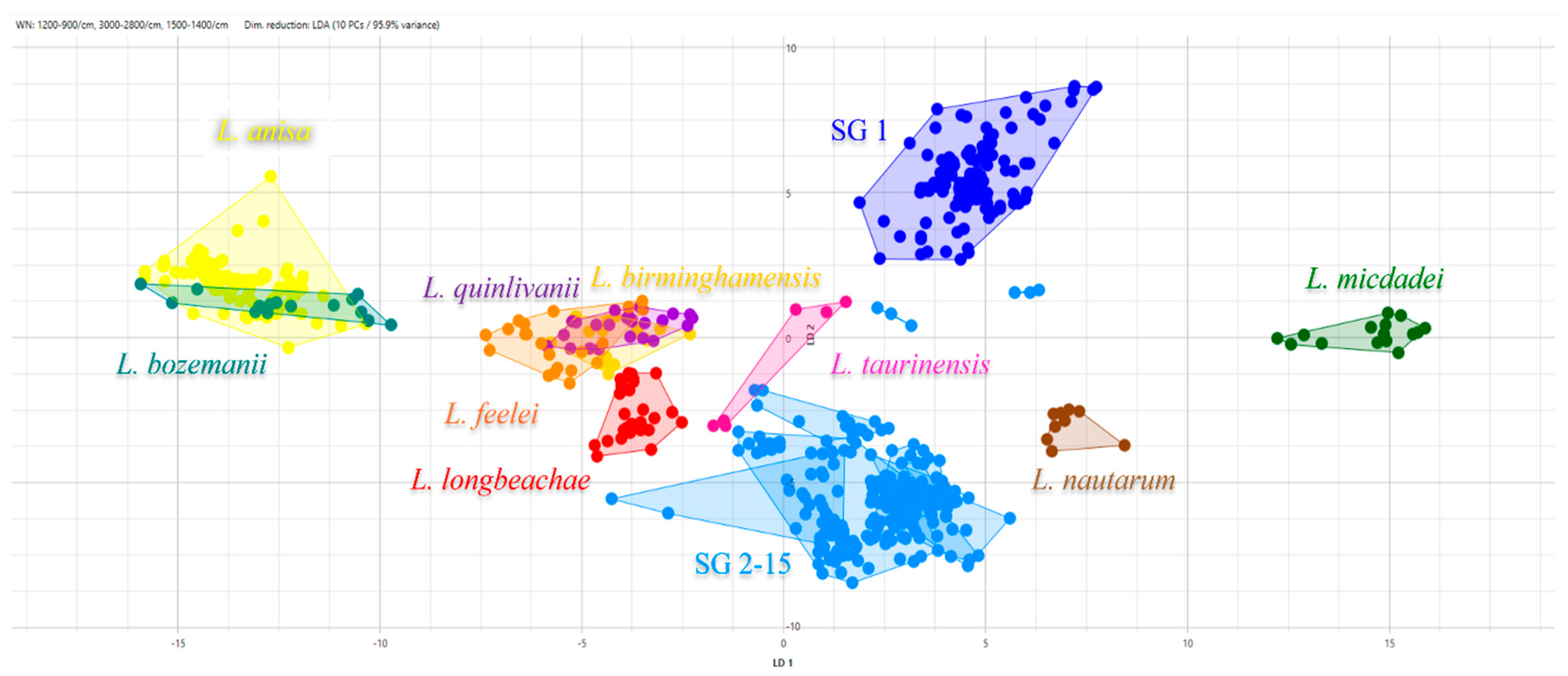
As shown in the 2D scatter plot (Figure 1), FT-IR analysis achieved a clear spectral separation between SG 1 and SG 2–15. The SG 1 isolates (n = 47) formed a compact, distinct cluster (dark blue) that was significantly separated from the broader cloud of SG 2–15 isolates (n = 73).
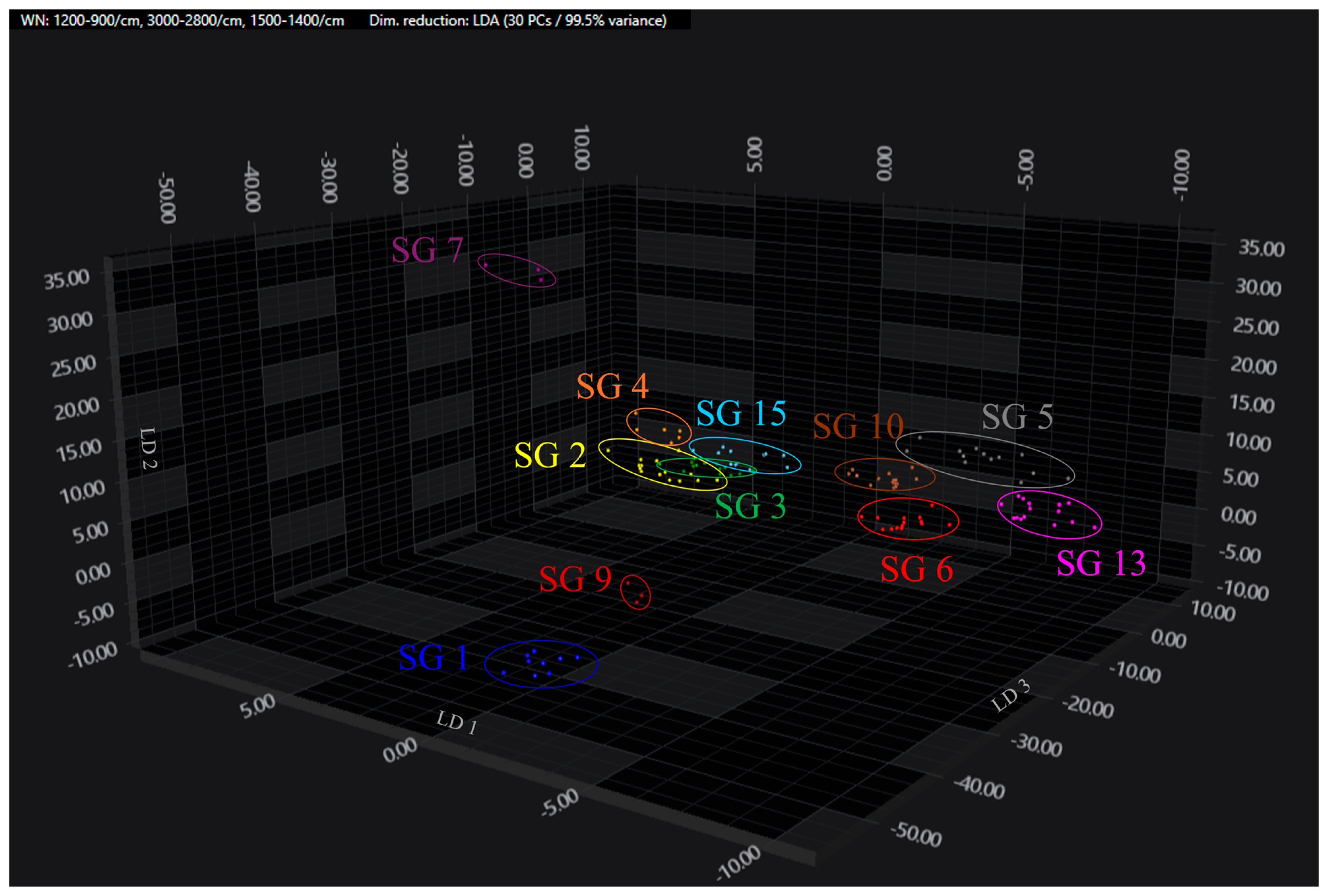
Further analysis of the L. pneumophila population in a three-dimensional scatter plot (Figure 2) revealed higher spectral heterogeneity within the SG 2–15 group compared to the homogenous SG 1 cluster. While the SG 2–15 group remained distinct from SG 1 and non-pneumophila species, the internal differentiation showed mixed results: Serogroups 4, 5, 6, 7, 10, and 13 showed tendencies to form distinct sub-clusters, whereas Serogroups 2, 3, and 15 exhibited stronger spectral overlap. One isolate, phenotypically showing a cross-reaction characteristic for SG 9 (positive for SG 1 and SG 2–15 in LAT), formed a separate cluster in the FT-IR analysis (dark red cluster in Figure 2).

3.3.2. Differentiation of Non-Pneumophila Species

The analysis of non-pneumophila species (n = 80) yielded predominantly well-defined species-specific clusters. Distinct species such as L. micdadei, L. nautarum, and L. longbeachae were clearly separated from L. pneumophila and from each other in the LDA method. However, spectral similarities were observed among phylogenetically closely related species, reflecting the similarity in their cell wall composition:
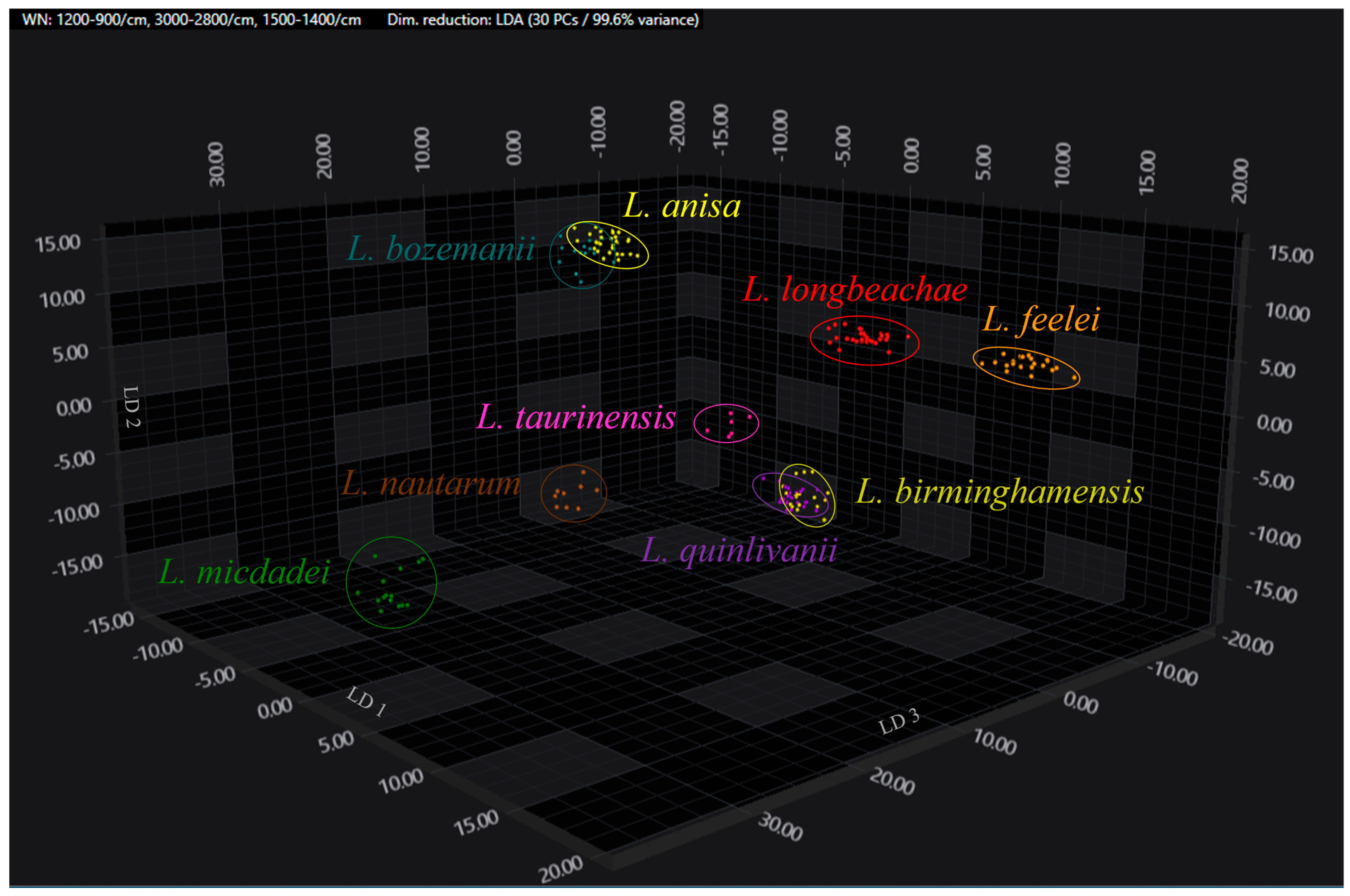
  • Cluster 1: L. anisa and L. bozemanii exhibited significant spatial proximity with partial spectral overlap in the 3D representation (Figure 3, yellow vs. turquoise).
  • Cluster 2: L. quinlivanii and L. birminghamensis formed a coherent “super-cluster” that could not be fully separated by LDA. This finding aligns with the known high genetic similarity between these two species, which often complicates differentiation even by sequencing methods. Consequently, FT-IR identifies these as a specific L. quinlivanii/birminghamensis cluster.
One isolate, initially identified only as Legionella species by MALDI-TOF MS, was assigned to the spectral group “Other non-pneumophila” by FT-IR analysis. Subsequent validation by 16S rRNA sequencing confirmed the isolate as L. taurinensis, demonstrating the method’s potential to recognize rare species that fall outside standard library spectra.

3.3.3. Robustness of FT-IR Against MALDI-TOF MS Variations

We further analyzed the relationship between MALDI-TOF MS log-scores and FT-IR classification performance to assess potential dependency. Among the isolates with lower reliable MALDI scores (log-score 1.70–1.99, n = 61), FT-IR spectroscopy achieved a high identification consistency, yielding consistent results (≥ 4/5 replicates) for 100% (61/61) of these isolates. This demonstrates that FT-IR profiling remains robust even when the proteomic signal used by MALDI-TOF MS is near the reliability threshold.
In the “high confidence” MALDI group (log-score ≥ 2.00, n = 136), the identification consistency was 93.4% (127/136). The slight reduction in consistency compared to the low-score group was driven exclusively by the L. anisa isolates (n = 9), which exhibited spectral cross-identification with the phylogenetically related L. bozemanii (as detailed in Table 1). Furthermore, L. longbeachae isolates (n = 10) in this group were consistently assigned to the “Other non-pneumophila” category. While technically recorded as a discordance in terms of species naming, this assignment correctly rules out L. pneumophila serogroups. These findings confirm that FT-IR classification success is largely independent of the spectral quality metrics used by MALDI-TOF MS, with discrepancies reflecting biological proximity rather than technical failure.
A comprehensive comparison of the diagnostic performance characteristics between MALDI-TOF MS, LAT, and FT-IR spectroscopy is summarized in Table 2.

4. Discussion

The primary objective of this study was to evaluate FT-IR spectroscopy not merely as an alternative, but as a potential “one-stop” typing solution for Legionella to bridge the gap between routine species identification and epidemiological characterization. Our results demonstrate that FT-IR spectroscopy successfully distinguishes L. pneumophila serogroups and non-pneumophila species within the isolates examined. A comparison of the methods’ performance characteristics is summarized in Table 2.
It is well documented that MALDI-TOF MS is not able to differentiate L. pneumophila serogroups due to the high similarity of ribosomal proteins [11]. Our study confirms that FT-IR spectroscopy bypasses this limitation by targeting cell surface LPS, which exhibits high structural variability. This approach aligns with successful applications of FT-IR for other bacterial pathogens, where the method has been proven to resolve capsular types in Klebsiella pneumoniae and Streptococcus pneumoniae, or serovars in Salmonella enterica that are indistinguishable by mass spectrometry [33,34,35,36]. By transferring this concept to Legionella, we established a workflow that provides serogroup-level resolution without the need for additional antibody-based tests.
The performance disparity between the two technologies stems from fundamental biological and technical distinctions. Routine MALDI-TOF MS identification relies on a static reference library, in this study, the MBT Compass Library (Revision K, 2022), where mass spectra are matched against a database to generate a log-score. While this library provided robust species-level identification for 4274 entries, it inherently lacks serogroup-specific resolution because the target analytes (ribosomal proteins) are highly conserved across L. pneumophila Serogroups 1–15 [11]. Consequently, MALDI-TOF MS is unable to differentiate on an intra-species level. In contrast, FT-IR spectroscopy bypasses this limitation by targeting cell surface lipopolysaccharides (LPS), which exhibit high structural variability. This approach aligns with successful applications of FT-IR for resolving capsular types in Streptococcus pneumoniae, Klebsiella pneumoniae or serovars in Salmonella enterica [33,34,35,36]. By transferring this concept to Legionella, we established a workflow that provides serogroup-level resolution without the need for additional antibody-based tests.
A critical advantage of the FT-IR system is its classifier-based architecture (utilizing Support Vector Machines) rather than simple spectral matching. Crucially, the manufacturer’s “Legionella species + (linSVM)” classifier successfully assigned isolates to the correct target groups, demonstrating robustness even when using our modified incubation protocol (72 h without CO2) compared to the manufacturer’s standard (48 h with 2.5% CO2). Furthermore, unlike the closed architecture of routine MALDI libraries, the FT-IR system allows users to create custom classifiers. By incorporating confirmed local isolates into the training set, the system evolves from a static research tool into an adaptive diagnostic solution tailored to the local epidemiological landscape.
A key finding of our study is the successful differentiation of SG 1 from the SG 2–15 group, consistent with the fundamental work by Pascale et al. [28]. While their study provided a detailed spectral characterization using reference strains, our data validates these findings in a routine diagnostic setting using a diverse set of biological replicates from clinical and environmental sources. This robust data set allowed us to observe distinct clustering tendencies for Serogroups 4, 5, 6, 9, 10, and 13. Furthermore, the remaining spectral overlaps observed between Serogroups 2, 3, and 15 likely reflect genuine structural similarities in the lipopolysaccharide O-chains of these serogroups, rather than methodological failure. This suggests that FT-IR classification models trained on biological variability can achieve a realistic and high-resolution typing depth that exceeds current latex-based standards.
The analysis of non-pneumophila species highlighted a significant strength of FT-IR: the ability to reflect phylogenetic relationships. While LAT yielded negative results for species like L. quinlivanii and L. birminghamensis, FT-IR correctly assigned them to a specific cluster. The observed spectral overlap between these two species, forming a “L. quinlivanii/L. birminghamensis cluster”, mirrors their high genetic similarity, which often poses challenges even for 16S rRNA sequencing. Instead of viewing this as a limitation, it should be interpreted as a high-fidelity representation of the cell wall biochemistry. Importantly, this overlap does not hinder clinical decision-making. Since the indicated antibiotic regimen is identical for both species, the reliable assignment of these isolates to the non-pneumophila Legionella group is the clinically decisive factor [37]. Therefore, FT-IR provides the necessary diagnostic information to initiate effective therapy immediately, fulfilling the primary requirement of a rapid screening method.
Our data demonstrates that FT-IR spectroscopy is capable of reliable species-level identification, theoretically allowing it to function as a standalone diagnostic method provided the underlying classifier is sufficiently comprehensive. However, the decision to implement FT-IR in a clinical workflow depends on a careful weighting of operational factors. While MALDI-TOF MS relies on extensive, static reference databases to provide unsurpassed speed and cost-efficiency for primary species identification, FT-IR utilizes dynamic classifiers trained on specific spectral datasets. This structural difference offers a distinct advantage in research and outbreak settings. Therefore, laboratories must balance the need for rapid, automated high-throughput screening against the adaptive depth provided by FT-IR spectroscopy. Given that MALDI-TOF MS cannot differentiate L. pneumophila serogroups, the distinct value of FT-IR lies in its capability for qualitative differentiation: it serves as a ‘one-stop’ typing solution that simultaneously confirms species identity and resolves serogroups or phylogenetic clusters. Consequently, FT-IR is best positioned not as a replacement, but as a high-resolution extension of the diagnostic pipeline, effectively replacing manual agglutination tests rather than mass spectrometry.
Despite the promising results, certain limitations must be considered when interpreting the data. FT-IR spectroscopy is intrinsically sensitive to culture conditions; variations in incubation time or medium thickness can influence spectral features, necessitating strict adherence to standardized protocols [38]. Furthermore, while the measurement itself is rapid, the method remains culture dependent. Regarding the timeline for environmental analysis, it is important to note that Legionella species are slow-growing bacteria, typically requiring 3 to 10 days for primary isolation from water samples, depending on the background flora and bacterial load. Therefore, direct confirmation via FT-IR after only 48 h of total incubation is generally not feasible. In a standard workflow, suspected colonies from primary plates (incubated for 3–5 days) must be subcultured to obtain sufficient biomass and metabolic uniformity. Under the manufacturer’s protocol, this subculture step requires 48 h, whereas our optimized protocol utilizes a 72-h incubation to ensure robust growth for all serogroups. While extending the turnaround time by one day, this approach eliminates the need for CO2 incubation equipment, thereby increasing the method’s accessibility for routine water analysis laboratories and simplifying workflow management during high-throughput outbreak investigations. Consequently, the total time-to-result is dictated by the intrinsic growth rate of the organism, making the method a confirmatory tool for isolated colonies rather than a rapid primary screening method for raw water samples. Finally, our current data set relies on a limited number of isolates for rare species (e.g., L. taurinensis), which may not yet fully represent the intraspecific variability of these groups.
Future research should focus on validating and expanding these findings by incorporating a broader range of clinical and environmental isolates from diverse geographic regions into the reference database. A particularly promising path is the application of Artificial Intelligence (AI) and Machine Learning algorithms. These advanced computational models could help to further resolve the subtle spectral differences observed within the SG 2–15 complex or between closely related species, potentially surpassing the resolution of current linear discriminant analyses. Additionally, a stepwise diagnostic algorithm could be established, where FT-IR serves as a rapid screening tool and molecular methods are reserved for resolving phylogenetically indistinguishable species.

5. Conclusions

This study highlights FT-IR spectroscopy as a powerful, cost-efficient potential complement to routine MALDI-TOF MS diagnostics. By exploiting the variability of cell surface lipopolysaccharides, the method successfully bridges the diagnostic gap where proteomic typing fails, offering reliable discrimination of L. pneumophila serogroups and non-pneumophila species.
Furthermore, FT-IR demonstrated superior robustness compared to the Latex Agglutination Test, particularly in the detection of rare environmental isolates and the phylogenetic resolution of the L. quinlivanii/L. birminghamensis cluster.
The method’s value becomes particularly evident during outbreak investigations, which typically involve a high influx of isolates from diverse clinical and environmental sources. Unlike LAT, which relies on manual recording, the IR Biotyper®® system integrates metadata (e.g., location, date, sample type, temperature, etc.) directly with the spectral data. This traceability allows for the rapid correlation of patient isolates with contaminated water samples, enabling the identification of potential transmission routes. While rigorous standardization of culture conditions remains essential, FT-IR could become a promising high-throughput screening tool, with the potential to provide epidemiological insights to prioritize samples before confirmation via definitive, yet time-consuming, Whole-Genome Sequencing (WGS).

Supplementary Materials

The following supporting information can be downloaded at https://www.mdpi.com/article/10.3390/w18040515/s1. Supplementary Table S1: Confusion matrix and training data set information for the “Legionella species + (linSVM)” classifier (Bruker Daltonics GmbH). The table names reference spectra used to train and validate the Support Vector Machine (SVM) model. The data set demonstrates the classifier’s specific training to distinguish between Legionella pneumophila SG 1 (516 spectra), Legionella pneumophila SG 2-15 (1212 spectra), and various non-pneumophila species (1490 spectra).

Author Contributions

Conceptualization and design of the experiments, J.K., M.Z., and S.Z.; data analysis, M.Z.; validation, M.Z. and J.K.; performed the experiments, M.Z. and J.K.; prepared isolates from Dresden, S.U. and L.W.; provided identification information from Dresden, S.U., L.W., and M.P.; writing—original draft preparation, M.Z. and J.K.; writing—review and editing, J.K. and M.P.; visualization, M.Z.; supervision, S.Z. All authors have read and agreed to the published version of the manuscript.

Funding

This research received no external funding. The APC was funded by Heidelberg University, Medical Faculty Heidelberg, Department of Infectious Diseases, Medical Microbiology and Hygiene, Im Neuenheimer Feld 324, 69120 Heidelberg, Germany.

Data Availability Statement

All data supporting the findings of this study are available upon reasonable request to the corresponding author.

Acknowledgments

The translation into English and linguistic editing of this manuscript were assisted by generative artificial intelligence (AI) to optimize readability and grammatical style. The authors have reviewed and edited the output and take full responsibility for the content of this publication.

Conflicts of Interest

The authors declare no conflicts of interest.

Abbreviations

The following abbreviations are used in this manuscript:
AIArtificial Intelligence
BCYEBuffered Charcoal Yeast Extract
ECDCEuropean Centre for Disease Prevention and Control
FT-IRFourier-Transform Infrared (Spectroscopy)
IRTSInfrared Test Standard
LATLatex Agglutination Test
LDALinear Discriminant Analysis
LPSLipopolysaccharide
MabMonoclonal Antibody (Subtype of SG1)
MALDI-TOF MSMatrix-Assisted Laser Desorption/Ionization Time-of-Flight Mass Spectrometry
NGSNext-Generation Sequencing
PCAPrincipal Component Analysis
PCRPolymerase Chain Reaction
rRNARibosomal Ribonucleic Acid
SGSerogroup
SVMSupport Vector Machine
UATUrinary Antigen Test
VBNCViable but nonculturable

References

  1. Bayerisches Landesamt für Gesundheit und Lebensmittelsicherheit. Infektionsgefährdung Durch Einatmen von Legionellen-haltigem Aerosol. Available online: https://www.lgl.bayern.de/gesundheit/umweltbezogener_gesundheitsschutz/biologische_umweltfaktoren/bioaerosole/legionellen.htm (accessed on 10 December 2025).
  2. Rowbotham, T.J. Preliminary Report on the Pathogenicity of Legionella pneumophila for Freshwater and Soil Amoebae. J. Clin. Pathol. 1980, 33, 1179–1183. [Google Scholar] [CrossRef] [PubMed]
  3. Fields, B.S.; Benson, R.F.; Besser, R.E. Legionella and Legionnaires’ Disease: 25 Years of Investigation. Clin. Microbiol. Rev. 2002, 15, 506–526. [Google Scholar] [CrossRef] [PubMed]
  4. Dennis, P.J.; Green, D.; Jones, B.P.C. A Note on the Temperature Tolerance of Legionella. J. Appl. Bacteriol. 1984, 56, 349–350. [Google Scholar] [CrossRef] [PubMed]
  5. Prussin, A.J.; Schwake, D.O.; Marr, L.C. Ten Questions Concerning the Aerosolization and Transmission of Legionella in the Built Environment. Build. Environ. 2017, 123, 684–695. [Google Scholar] [CrossRef] [PubMed]
  6. Springston, J.P.; Yocavitch, L. Existence and Control of Legionella Bacteria in Building Water Systems: A Review. J. Occup. Environ. Hyg. 2017, 14, 124–134. [Google Scholar] [CrossRef]
  7. Yu, V.L.; Plouffe, J.F.; Pastoris, M.C.; Stout, J.E.; Schousboe, M.; Widmer, A.; Summersgill, J.; File, T.; Heath, C.M.; Paterson, D.L.; et al. Distribution of Legionella Species and Serogroups Isolated by Culture in Patients with Sporadic Community-Acquired Legionellosis: An International Collaborative Survey. J. Infect. Dis. 2002, 186, 127–128. [Google Scholar] [CrossRef]
  8. Robert Koch Institute. Infektionsepidemiologisches Jahrbuch Meldepflichtiger Krankheiten Für 2023; Robert Koch Institute: Berlin, Germany, 2025; 246p. [Google Scholar] [CrossRef]
  9. Cunha, B.A.; Burillo, A.; Bouza, E. Legionnaires’ Disease. Lancet 2016, 387, 376–385. [Google Scholar] [CrossRef]
  10. European Centre for Disease Prevention and Control. Legionnaires’ Disease—Annual Epidemiological Report for 2020. Available online: https://www.ecdc.europa.eu/en/publications-data/legionnaires-disease-annual-epidemiological-report-2020 (accessed on 10 December 2025).
  11. Gaia, V.; Casati, S.; Tonolla, M. Rapid Identification of Legionella Spp. by MALDI-TOF MS Based Protein Mass Fingerprinting. Syst. Appl. Microbiol. 2011, 34, 40–44. [Google Scholar] [CrossRef]
  12. Blanco, S.; Sanz, C.; Gutiérrez, M.P.; Simarro, M.; López, I.; Escribano, I.; Eiros, J.M.; Zarzosa, P.; Orduña, A.; López, J.C.; et al. A New MALDI-TOF Approach for the Quick Sequence Type Identification of Legionella pneumophila. J. Microbiol. Methods 2021, 188, 106292. [Google Scholar] [CrossRef]
  13. Bizzini, A.; Greub, G. Matrix-Assisted Laser Desorption Ionization Time-of-Flight Mass Spectrometry, a Revolution in Clinical Microbial Identification. Clin. Microbiol. Infect. 2010, 16, 1614–1619. [Google Scholar] [CrossRef]
  14. Fujinami, Y.; Kikkawa, H.S.; Kurosaki, Y.; Sakurada, K.; Yoshino, M.; Yasuda, J. Rapid Discrimination of Legionella by Matrix-Assisted Laser Desorption Ionization Time-of-Flight Mass Spectrometry. Microbiol. Res. 2011, 166, 77–86. [Google Scholar] [CrossRef]
  15. Svarrer, C.W.; Uldum, S.A. The Occurrence of Legionella Species Other than Legionella pneumophila in Clinical and Environmental Samples in Denmark Identified by Mip Gene Sequencing and Matrix-Assisted Laser Desorption Ionization Time-of-Flight Mass Spectrometry. Clin. Microbiol. Infect. 2012, 18, 1004–1009. [Google Scholar] [CrossRef] [PubMed]
  16. Lavigne, J.-P.; Espinal, P.; Dunyach-Remy, C.; Messad, N.; Pantel, A.; Sotto, A. Mass Spectrometry: A Revolution in Clinical Microbiology? Clin. Chem. Lab. Med. 2013, 51, 257–270. [Google Scholar] [CrossRef]
  17. Kyritsi, M.A.; Kristo, I.; Hadjichristodoulou, C. Serotyping and Detection of Pathogenecity Loci of Environmental Isolates of Legionella pneumophila Using MALDI-TOF MS. Int. J. Hyg. Environ. Health 2020, 224, 113441. [Google Scholar] [CrossRef]
  18. Helbig, J.H. Pan-European Study on Culture-Proven Legionnaires’ Disease. Eur. J. Clin. Microbiol. Infect. Dis. 2002, 21, 710–716. [Google Scholar] [PubMed]
  19. Suvarna, S.K.; Layton, C.; Bancroft, J.D. Bancroft’s Theory and Practice of Histological Techniques; Elsevier: Amsterdam, The Netherlands, 2019; ISBN 978-0-7020-6887-4. [Google Scholar]
  20. Harrison, T.G.; Taylor, A.G. A Laboratory Manual for Legionella; John Wiley & Sons: New York, NY, USA, 1988; ISBN 0-471-91861-X. [Google Scholar]
  21. Helbig, J.H.; Uldum, S.A.; Bernander, S.; Lück, P.C.; Wewalka, G.; Abraham, B.; Gaia, V.; Harrison, T.G. Clinical Utility of Urinary Antigen Detection for Diagnosis of Community-Acquired, Travel-Associated, and Nosocomial Legionnaires’ Disease. J. Clin. Microbiol. 2003, 41, 838–840. [Google Scholar] [CrossRef] [PubMed]
  22. Delgado-Viscogliosi, P.; Solignac, L.; Delattre, J.-M. Viability PCR, a Culture-Independent Method for Rapid and Selective Quantification of Viable Legionella pneumophila Cells in Environmental Water Samples. Appl. Environ. Microbiol. 2009, 75, 3502–3512. [Google Scholar] [CrossRef]
  23. Moran-Gilad, J.; Prior, K.; Yakunin, E.; Harrison, T.G.; Underwood, A.; Lazarovitch, T.; Valinsky, L.; Lück, C.; Krux, F.; Agmon, V.; et al. Design and Application of a Core Genome Multilocus Sequence Typing Scheme for Investigation of Legionnaires’ Disease Incidents. Eurosurveillance 2015, 20, 21186. [Google Scholar] [CrossRef]
  24. Lin, S.F.; Schraft, H.; Griffiths, M.W. Identification of Bacillus Cereus by Fourier Transform Infrared Spectroscopy (FTIR). J. Food Prot. 1998, 61, 921–923. [Google Scholar] [CrossRef]
  25. Dziuba, B.; Babuchowski, A.; Nałęcz, D.; Niklewicz, M. Identification of Lactic Acid Bacteria Using FTIR Spectroscopy and Cluster Analysis. Int. Dairy J. 2007, 17, 183–189. [Google Scholar] [CrossRef]
  26. Zarnowiec, P.; Lechowicz, L.; Czerwonka, G.; Kaca, W. Fourier Transform Infrared Spectroscopy (FTIR) as a Tool for the Identification and Differentiation of Pathogenic Bacteria. Curr. Med. Chem. 2015, 22, 1710–1718. [Google Scholar] [CrossRef] [PubMed]
  27. Cordovana, M.; Mauder, N.; Join-Lambert, O.; Gravey, F.; LeHello, S.; Auzou, M.; Pitti, M.; Zoppi, S.; Buhl, M.; Steinmann, J.; et al. Machine Learning-Based Typing of Salmonella enterica O-Serogroups by the Fourier-Transform Infrared (FTIR) Spectroscopy-Based IR Biotyper System. J. Microbiol. Methods 2022, 201, 106564. [Google Scholar] [CrossRef]
  28. Pascale, M.R.; Bisognin, F.; Mazzotta, M.; Girolamini, L.; Marino, F.; Dal Monte, P.; Cordovana, M.; Scaturro, M.; Ricci, M.L.; Cristino, S. Use of Fourier-Transform Infrared Spectroscopy with IR Biotyper® System for Legionella pneumophila Serogroups Identification. Front. Microbiol. 2022, 13, 866426. [Google Scholar] [CrossRef] [PubMed]
  29. Helm, D.; Labischinski, H.; Schallehn, G.; Naumann, D. Classification and Identification of Bacteria by Fourier-Transform Infrared Spectroscopy. Microbiology 1991, 137, 69–79. [Google Scholar] [CrossRef] [PubMed]
  30. Baker, M.J.; Trevisan, J.; Bassan, P.; Bhargava, R.; Butler, H.J.; Dorling, K.M.; Fielden, P.R.; Fogarty, S.W.; Fullwood, N.J.; Heys, K.A.; et al. Using Fourier Transform IR Spectroscopy to Analyze Biological Materials. Nat. Protoc. 2014, 9, 1771–1791. [Google Scholar] [CrossRef]
  31. Chen, Y.; Zou, C.; Mastalerz, M.; Hu, S.; Gasaway, C.; Tao, X. Applications of Micro-Fourier Transform Infrared Spectroscopy (FTIR) in the Geological Sciences—A Review. Int. J. Mol. Sci. 2015, 16, 30223–30250. [Google Scholar] [CrossRef]
  32. Blank, M.H.; Silva, V.C.; Rui, B.R.; Novaes, G.A.; Castiglione, V.C.; Garcia Pereira, R.J. Beneficial Influence of Fetal Bovine Serum on In Vitro Cryosurvival of Chicken Spermatozoa. Cryobiology 2020, 95, 103–109. [Google Scholar] [CrossRef]
  33. Rakovitsky, N.; Frenk, S.; Kon, H.; Schwartz, D.; Temkin, E.; Solter, E.; Paikin, S.; Cohen, R.; Schwaber, M.J.; Carmeli, Y.; et al. Fourier Transform Infrared Spectroscopy Is a New Option for Outbreak Investigation: A Retrospective Analysis of an Extended-Spectrum-Beta-Lactamase-Producing Klebsiella Pneumoniae Outbreak in a Neonatal Intensive Care Unit. J. Clin. Microbiol. 2020, 58, e00098-20. [Google Scholar] [CrossRef]
  34. Orlandi Barth, P.; Mörschbächer Wilhelm, C.; Castro Pereira, D.; Czekster Antochevis, L.; Francisco Martins, A.; Barth, A.L. Use of IR Biotyper as a Feasible Methodology to Type Klebsiella pneumoniae. Microbiol. Spectr. 2025, 13, e01146-25. [Google Scholar] [CrossRef]
  35. Burckhardt, I.; Sebastian, K.; Mauder, N.; Kostrzewa, M.; Burckhardt, F.; Zimmermann, S. Analysis of Streptococcus Pneumoniae Using Fourier-Transformed Infrared Spectroscopy Allows Prediction of Capsular Serotype. Eur. J. Clin. Microbiol. Infect. Dis. 2019, 38, 1883–1890. [Google Scholar] [CrossRef]
  36. Fredes-García, D.; Jiménez-Rodríguez, J.; Piña-Iturbe, A.; Caballero-Díaz, P.; González-Villarroel, T.; Dueñas, F.; Wozniak, A.; Adell, A.D.; Moreno-Switt, A.I.; García, P. Development of a Robust FT-IR Typing System for Salmonella enterica, Enhancing Performance through Hierarchical Classification. Microbiol. Spectr. 2025, 13, e00159-25. [Google Scholar] [CrossRef]
  37. Muder, R.R.; Yu, V.L. Infection Due to Legionella Species Other Than L. pneumophila. Clin. Infect. Dis. 2002, 35, 990–998. [Google Scholar] [CrossRef]
  38. Yang, H.; Shi, H.; Feng, B.; Wang, L.; Chen, L.; Alvarez-Ordóñez, A.; Zhang, L.; Shen, H.; Zhu, J.; Yang, S.; et al. Protocol for Bacterial Typing Using Fourier Transform Infrared Spectroscopy. STAR Protoc. 2023, 4, 102223. [Google Scholar] [CrossRef]
Figure 1. 2D scatter plot based on Linear Discriminant Analysis (LDA) of the investigated Legionella isolates. The axes represent the first two Linear Discriminants (LD 1 and LD 2), which maximize the separation between the defined groups. The axis scales represent dimensionless discriminant scores calculated from the linear combination of the principal components. The analysis was performed using the first 10 Principal Components (PCs) to reduce spectral dimensionality, accounting for 95.9% of the total variance. The plot shows a clear distinction between the three main groups: L. pneumophila SG 1, L. pneumophila SG 2-15, and various Legionella species. The colored polygons serve as visual aids to delineate clusters and do not represent statistical confidence intervals. Color code: SG 1 (dark blue), SG 2-15 (light blue), L. anisa (yellow), L. bozemanii (turquoise), L. nautarum (brown), L. micdadei (green), L. taurinensis (pink), L. feelei (orange), L. longbeachae (red), L. birminghamensis (gold), and L. quinlivanii (violet).
Water 18 00515 g001
Figure 2. 3D scatter plot (LDA) of L. pneumophila isolates. The axes represent the first three Linear Discriminants (LD 1, LD 2, and LD 3). The model utilized 30 PCs (accounting for 99.5% variance) for data reduction prior to Linear discriminant analysis. The plot demonstrates a clear separation of SG 1 (dark blue) from the heterogeneous SG 2–15 group. Within the SG 2-15 group (SG 4, 5, 6, 7, 9, 10, 13, and 15), some form recognizable sub-clusters, while others (SG 2, 3, 15) show distinct spectral overlap. Cluster boundaries are for visualization purposes only. Color code: SG 2 (yellow), SG 3 (green), SG 4 (orange), SG 5 (grey), SG 6 (red), SG 7 (purple), SG 9 (dark red), SG 10 (brown), SG 13 (magenta), SG 15 (light blue).
Water 18 00515 g002
Figure 3. 3D scatter plot (LDA) of L. non-pneumophila species. The axes represent the first three Linear Discriminants (LD 1, LD 2, and LD 3). Analysis was performed on 30 PCs (99.6% variance). The plot shows predominantly isolated clusters but reveals significant spatial overlap between phylogenetically related groups (L. quinlivanii/L. birminghamensis and L. anisa/L. bozemanii). Ellipses/polygons indicate visual grouping of species clusters and do not imply statistical significance. Color code: L. anisa (yellow), L. bozemanii (turquoise), L. micdadei (green), L. nautarum (brown), L. taurinensis (pink), L. feelei (orange), L. longbeachae (red), L. birminghamensis (gold), L. quinlivanii (violet).
Water 18 00515 g003
Table 1. Isolate Characteristics and Routine Diagnostic Results. Comparison of the identification performance of MALDI-TOF MS, LAT and FT-IR Spectroscopy for the investigation of L. pneumophila serogroups and non-pneumophila species. The table displays the concordance between standard diagnostic methods and FT-IR classification using the manufacturer’s “Legionella species + (linSVM)” classifier. FT-IR performance is evaluated based on the consistency of technical replicates (≥4/5 matching results) as the criterion for identification reliability.
Species aOrigin
(Clinical/Environmental)
nMALDI-TOF MS
Identification b
LATFT-IR Identification
Consistency c
(Best Hit Matches)
L. pneumophila
Serogroup 1
 
0/47
 
47
 
L. pneumophila
 
Positive (SG 1)
 
46× (5/5 C); 1× (4/5 C)
Serogroup 2–1514/5973L. pneumophilaPositive (SG 2-15)72× (5/5 C); 1× (4/5 C)
Non-pneumophila
L. anisa
 
0/34
 
34
 
L. anisa
 
Positive (Species)
 
13 (5/5 C); 12 (5/5 L. bozemanii) *;
9 (Mixed hits)
L. bozemanii4/26L. bozemaniiPositive (Species)6× (5/5 C)
L. longbeachae10/010L. longbeachaePositive (Species)10× (5/5 “Other”) **
L. micdadei1/45L. micdadeiPositive (Species)5× (5/5 C)
L. birminghamensis0/77L. birminghamensisNegative 7× (5/5 Cluster) ***
L. feelei0/77L. feeleiNegative2× (5/5 C); 5× (5/5 “Other”)
L. nautarum0/33L. nautarumNegative3× (5/5 C)
L. quinlivanii0/77L. quinlivaniiNegative7× (5/5 Cluster) ***
L. taurinensis0/11L. taurinensisNegative1× (5/5 “Other”) **
Total29/171200
Note: a Identity confirmed by reference laboratory standards, including monoclonal antibody typing using the Dresden Panel [18] and Whole Genome Sequencing [23]. b MALDI-TOF MS identified L. pneumophila isolates at the species level only, without serogroup differentiation. c FT-IR Identification Consistency: Calculated based on 5 technical replicates per biological isolate. C = Correct (The top-ranking identification matched the specific target species). “Other” = Assigned to “Other non-pneumophila”. “Cluster” = Assigned to the L. quinlivanii/birminghamensis spectral group. * L. anisa isolates frequently cross-identified as L. bozemanii, reflecting known phylogenetic proximity (see Section 3.3). ** L. longbeachae and L. taurinensis are not currently included as distinct targets in the manufacturer’s classifier; assignment to “Other non-pneumophila” represents the correct exclusion of L. pneumophila. *** L. quinlivanii and L. birminghamensis are identified as a combined spectral cluster.
Table 2. Comparison of diagnostic performance characteristics between MALDI-TOF MS, Latex Agglutination Test (LAT), and FT-IR Spectroscopy. The performance of each method was evaluated qualitatively based on laboratory standards. Color coding indicates the performance level: Green (High suitability/performance), Yellow (Limited suitability), and Red (Low suitability/performance).
FeatureMALDI TOF MSLATFT-IR Spectroscopy
Species Identification[+]
High (Reference Standard)
[~]
Limited (Only specific species)
[+]
High (Comparable to MALDI)
Serogroup Typing[−]
No
[~]
Limited (SG 1 vs. SG 2–15)
[+]
Yes (High Resolution)
Rare Species Detection[~]
Limited (Library dependent)
[−]
Low (Diagnostic Gaps)
[+]
High (Distinct clusters)
Time-to-Result *[+]
Fast (~15–25 min)
[+]
Very Fast (~5–10 min)
[~]
Moderate (~25–35 min)
Instrument Cost[−]
High (Capital Equipment)
[+]
None (No device required)
[~]
Moderate (Significantly < MALDI TOF)
Cost per Sample[+]
Low
[−]
High (Reagent costs)
[+]
Low (Reagent-free)
Automation[+]
High
[−]
No (Manual/Visual)
[~]
Moderate
* Note: Time-to-result includes sample preparation, drying/incubation, and measurement/read-out for one isolate.
Disclaimer/Publisher’s Note: The statements, opinions and data contained in all publications are solely those of the individual author(s) and contributor(s) and not of MDPI and/or the editor(s). MDPI and/or the editor(s) disclaim responsibility for any injury to people or property resulting from any ideas, methods, instructions or products referred to in the content.