Article

Optimizing Irrigation and Fertilization for Greenhouse Pepper Under Slightly Saline Water in Arid Regions

1
School of Water Conservancy and Architectural Engineering, Tarim University, Alar 843300, China
2
South Xinjiang Geotechnical Engineering Research Center, Tarim University, Alar 843300, China
*
Authors to whom correspondence should be addressed.
Water 2026, 18(4), 488; https://doi.org/10.3390/w18040488
Submission received: 5 January 2026 / Revised: 8 February 2026 / Accepted: 11 February 2026 / Published: 14 February 2026
(This article belongs to the Special Issue Synergistic Management of Water, Fertilizer, and Salt in Arid Regions)

Abstract

Water scarcity and soil salinization are major challenges for sustainable agriculture in arid regions, affecting crop growth, yield, and quality. In greenhouse systems, optimizing irrigation and nutrient management under brackish (slightly to moderately saline) irrigation water (1–5 g L−1) is essential for maintaining productivity and resource efficiency. This study investigated the effects of irrigation water salinity, irrigation volume, and nitrogen, phosphorus, and potassium application on growth, yield, fruit quality, and water–nutrient use efficiency of greenhouse-grown pepper (Capsicum annuum L., cv. ‘Qilin 99’) in southern Xinjiang. A five-factor, five-level half-fractional quadratic orthogonal rotatable design was employed. Pepper yield showed a unimodal response to increasing salinity, peaking at 3 g L−1 with 4800 m3 ha−1 irrigation and N, P2O5, K2O rates of 225, 160, and 500 kg ha−1, respectively. Water use efficiency and fertilizer partial factor productivity decreased significantly with increasing salinity and irrigation amount, reaching maximum under moderate irrigation water mineralization combined with low and medium irrigation levels, respectively. Fruit quality traits, including vitamin C, capsaicin, and free amino acids, were enhanced under moderate to relatively high salinity levels, whereas fruit size and single fruit weight were highest at lower salinity combined with higher irrigation. Irrigation water salinity was identified as the main limiting factor for yield and quality. Overall, greenhouse pepper exhibited a nonlinear dual-threshold response to combined water, nutrient, and salinity management, with an optimal threshold around 3 g L−1. These findings provide practical guidance for improving water and nutrient use efficiency in greenhouse agriculture under slightly saline irrigation.

1. Introduction

Xinjiang contains approximately 3.9 × 10⁸ mu of non-arable land, including Gobi deserts and saline–alkali lands, mainly distributed in southern Xinjiang, particularly in the Hotan, Kashgar, and Aksu regions [1]. Southern Xinjiang features abundant solar radiation and large diurnal temperature variations [2], which support the development of protected agriculture. Pepper (Capsicum annuum L.) is widely consumed in China, and the regional climatic conditions are suitable for its cultivation [3]. As a result, pepper has become an important economic crop in southern Xinjiang, and the region has developed into a major production base in China in terms of planting area, processing capacity, and export volume [4].
However, southern Xinjiang is characterized by an arid climate with low precipitation, and annual evaporation far exceeds precipitation [5,6]. Agricultural irrigation accounts for more than 80% of total regional water consumption [7], making water scarcity a critical constraint on agricultural development [8]. Under freshwater shortages, slightly saline (brackish) water with a mineralization degree of 2–5 g L−1 has been increasingly considered as an alternative irrigation resource [9,10]. Although brackish water can supplement irrigation supply [11,12], it may alter the root zone water–salinity environment and affect crop nutrient uptake and utilization [13]. Therefore, integrated regulation of irrigation and fertilization that coordinates water, nutrients, and salinity is essential for mitigating salt stress while improving water and nutrient use efficiency. Substrate cultivation is an important approach for protected production because it can alleviate soil salinization constraints [14,15,16,17], improve the root zone environment [18], and enable precise regulation of water, nutrients, and gas supply [19], thereby enhancing yield and quality [20]. In southern Xinjiang, yellow sand–slag composite substrates are increasingly used due to their porosity and leaching capacity, together with the local availability of yellow sand resources, which supports their wider application in substrate-based cultivation systems.
Pepper is regarded as a moderately salt-sensitive economic crop, and its growth is highly responsive to the synergistic effects of the soil water–salinity environment and nutrient supply [21,22]. Slightly saline water irrigation can suppress pepper root development through osmotic stress and ion toxicity, resulting in reduced leaf photosynthetic efficiency [23,24]. Nevertheless, appropriate irrigation and fertilization management can substantially mitigate salt-induced stress and improve resource use efficiency [25]. Existing studies under slightly saline irrigation consistently show that coordinated regulation of irrigation and fertilization can improve yield, quality, and resource use efficiency across crops: sufficient irrigation combined with rational fertilization increased rice yield components and yield [26]; systematic water–nutrient–salinity management enhanced vitamin C content and yield in watermelon [27]; high-frequency fertigation under slightly saline drip irrigation achieved high potato yield with relatively high water and nutrient use efficiency [28,29]; and both irrigation frequency and fertilization level significantly affected nitrogen uptake and yield of pepper [30]. For pepper, nutrient management practices such as phosphorus application and nitrogen fertilization timing have also been reported to influence yield and fruit quality under comparable irrigation conditions [21,31]. Similar responses have been observed in processing tomato under slightly saline drip irrigation, where different water–fertilizer ratios markedly affected water and nutrient use efficiency and yield [20,32,33].
Most studies on salinity–water–nutrient regulation in greenhouse crops have been conducted under soil-based cultivation, and the resulting salinity thresholds and water–fertilizer optimization strategies may not be directly transferable to soilless substrates. In arid, salt-affected regions such as southern Xinjiang, quantitative evidence on how irrigation water salinity affects pepper yield, fruit quality, and water–nutrient use efficiency under yellow sand–slag composite substrates remains limited. Therefore, this study investigated greenhouse pepper cultivated in a yellow sand–slag composite substrate system using a five-factor, five-level half-fractional quadratic orthogonal rotatable design. Specifically, it aimed to: (i) quantify the main effects of irrigation water salinity, irrigation amount, and N–P–K application on growth, yield, fruit quality, and water–nutrient use efficiency; (ii) provide management implications for alleviating salinity-related constraints under slightly saline irrigation in southern Xinjiang; and (iii) reduce resource waste associated with excessive irrigation and fertilization in substrate-based greenhouse production.

2. Materials and Methods

2.1. Experimental Site Description

From July to December of 2024, the experimental work was performed within a solar greenhouse situated in Ayikule Town, Aksu City, Xinjiang, China (40°59′02.41″ N, 80°07′05.26″ E; altitude 1025 m). The greenhouse was oriented north–south with an east–west extension, 152 m in length and 11 m in span, and was of a steel-framed tunnel-type structure. The region receives an annual total solar radiation of approximately 550–620 kJ cm−2 and an annual average sunshine duration ranging from 2800 to 3200 h. During the experimental period, the greenhouse air temperature was maintained between 15 and 36 °C, with a relative humidity ranging from 45% to 65%. A soilless cultivation system was adopted in this study. The growth substrate consisted of a yellow sand–slag mixture at a volumetric ratio of 5:3, with a substrate depth of 40 cm. Before commencing the experiment, the physicochemical properties of the substrate were analyzed: pH 7.12, electrical conductivity (EC) 1.03 mS cm−1, and mean bulk density 1.45 g cm−3. Baseline fertility analysis indicated that the substrate had 62.41 mg kg−1 available N, 7.42 mg kg−1 available P, and 124.32 mg kg−1 available K, while the organic matter content was 96.24 g kg−1. Hydrophysical characterization showed that the substrate had a bulk density of 1.324 g cm−3, a total porosity of 27.45%, an air-filled porosity of 12.34%, and a water-holding porosity of 16.62%.

2.2. Experimental Design

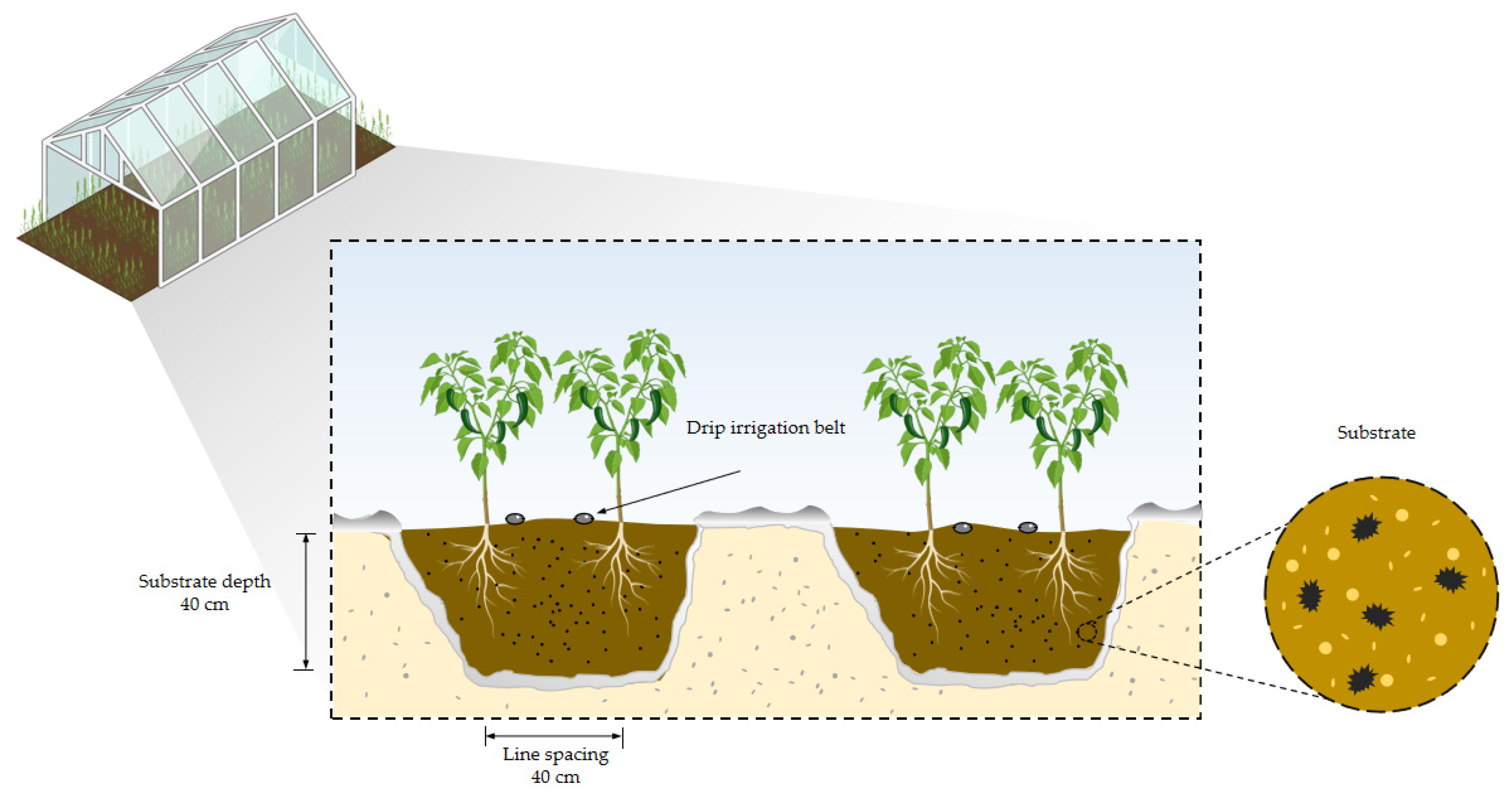
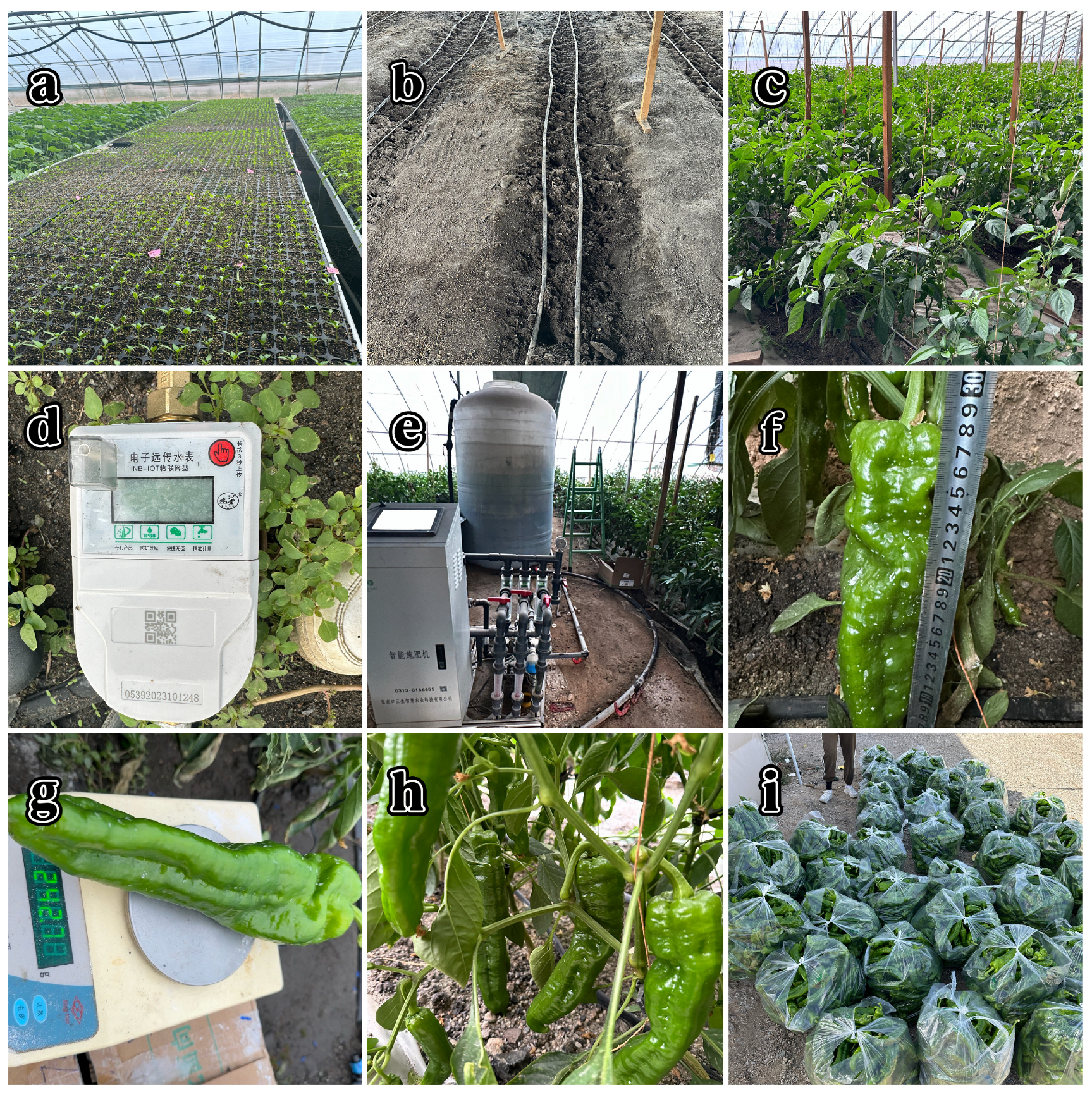
The pepper cultivar ‘Qilin 99’ was used in this experiment. Seedlings were raised in plug trays using a substrate medium and transplanted into the greenhouse at the three-leaf–one-heart stage. Transplanting was conducted on 19 August 2024, and all substrates were fully saturated prior to transplanting. Plants were planted in a twin-row arrangement on each ridge, with rows 40 cm apart and plants 35 cm apart within rows, and each row was equipped with its own drip line. For detailed information, see Figure 1. Irrigation amounts in each experimental plot were controlled using an intelligent water metering system in combination with solenoid valves. The system utilized a single-wing labyrinth drip tape. The emitters, spaced 0.3 m apart, had a flow rate of 1.38 L h−1 each. The polythene labyrinth structure enhances mechanical durability and operational reliability of the tape by reducing breakage and damage, helping maintain stable discharge and improving irrigation use efficiency; similar links between improved structural/material reliability and more stable, efficient operation have been reported for pipeline/flow systems [34,35,36,37]. To ensure successful establishment after transplanting, 45 mm of water was applied immediately following transplanting. The irrigation interval was 3–4 days, and the irrigation amount per event was controlled according to the experimental design, ranging from 45 to 90 m3 ha−1. An intelligent fertigation system was employed. For each irrigation event, fertilizers were dissolved in a 10 L fertilization tank and applied simultaneously with irrigation water to each plot, with one fertilization tank assigned to each treatment. The pepper growth period was divided into two stages: the vegetative growth stage from 19 August to 5 October, and the reproductive growth and harvesting stage from 5 October 2024 to 18 January 2025. Harvesting began 62 days after transplanting (20 October), and a total of three harvests were conducted during the entire growth period. All treatments received identical field management practices throughout the experiment, including pest control and plant training. For detailed information, see Figure 2.
A half fractional quadratic orthogonal rotatable design was adopted in this experiment. Five experimental factors were considered: irrigation water salinity, irrigation amount, nitrogen application rate, phosphorus application rate, and potassium application rate. The factor levels and their corresponding coded values are presented in Table 1. The coded levels were −2, −1, 0, 1, and 2, representing low, relatively low, medium, relatively high, and high levels of irrigation water salinity, irrigation amount, and fertilization rates, respectively (Table 2). All treatments were replicated three times within a randomized block design. Nitrogen fertilizer was supplied as urea (CH4N2O, 46% N). Phosphorus and potassium were applied using potassium dihydrogen phosphate (KH2PO4; 28.72% K2O and 22.75% P2O5) and a macronutrient water-soluble fertilizer (10% N, 13% P2O5, and 37%K2O). Conversion between oxide and elemental forms: elemental P was obtained by dividing P2O5 by 2.29, and elemental K by dividing K2O by 1.20. Conversely, P2O5 equals elemental P × 2.29 and K2O equals elemental K × 1.20. Calculation of fertilizer amounts: fertilizer amounts were calculated from the target nutrient rates using the nutrient mass fractions declared on fertilizer labels. For compound fertilizers, the contributions of each nutrient were accounted for separately and combined to meet the preset targets. The ionic composition and concentration of the irrigation water were formulated to simulate typical irrigation water in southern Xinjiang, with a salt composition of NaHCO3, Na2SO4, NaCl, CaCl2, and MgCl2 in a ratio of 1:8:8:1:1. To ensure successful seedling establishment, freshwater irrigation was applied during the seedling stage of pepper.

2.3. Measurements and Calculations

After a 10-day establishment period, 15 uniformly growing pepper plants were randomly chosen and tagged in each treatment. Morphological parameters were subsequently assessed in a one-time measurement. Subsequently, measurements were conducted at 7-day intervals, for a total of 12 measurement events.

2.3.1. Growth Parameters

Plant height was measured as the linear distance from the stem base to the apical meristem using a measuring tape. Stem diameter was recorded at the basal internode immediately below the first lateral branch using a vernier caliper (resolution: 0.01 mm). For dry matter determination, three plants with uniform growth and representative vigor were destructively sampled at final harvest. Plants were separated into roots, stems, leaves, and fruits, rinsed to remove adhering impurities, and oven-dried following a two-step protocol: samples were first heated at 105 °C for 30 min to inactivate metabolic activity, and then dried at 80 °C to constant mass. The dry weight of each organ was quantified using an analytical balance (resolution: 0.01 g), and organ-specific dry matter accumulation was calculated accordingly.
Peppers were harvested at the green-mature stage, i.e., when fruits reached the cultivar-typical marketable green maturity. Maturity was determined by uniform glossy green color without color break, fully developed and stable fruit shape/length, and firm texture. Harvesting followed a unified protocol by the same trained personnel and was aligned with the routine commercial practice of experienced local growers to ensure consistency with local production and minimize operator-related variation. After pepper plants entered the peak fruiting stage, mature fruits were harvested at 4-day intervals. Single fruit weight was measured as a parameter using a 0.01 g precision electronic balance. Plant yield was determined by summing the weights of all harvested fruits from an individual. Plot yield was then estimated by multiplying the mean plant yield (from random samples) by the total plant count per plot.

2.3.2. Water and Nutrient Use Efficiency

Irrigation water use efficiency (IWUE) was quantified as the ratio of greenhouse pepper yield to the total irrigation water input. IWUE was calculated as follows [38]:
I W U E = Y / I
where Y is the pepper yield, kg ha−1; I is the total irrigation water applied, m3 ha−1.
Nitrogen partial factor productivity (PFPN) represents the amount of crop yield produced per unit of nitrogen fertilizer applied. PFPN was calculated as follows [39]:
P F P N = Y / N
where N is the nitrogen application rate, kg ha−1.
The computation of PFPP and PFPK was identical to that of PFPN, except that the nitrogen input term was replaced by the corresponding phosphorus or potassium application rate.

2.3.3. Fruit Quality

Quantification of free amino acids was performed using an automatic amino acid analyzer (Model LA8080, Tokyo, Japan) [40]. Vitamin C (VC) concentration was measured using the molybdenum blue colorimetric method [41]. Briefly, oxalic acid–EDTA solution was added to the samples, followed by grinding, centrifugation of the homogenate, and collection of the supernatant. Color intensity was then measured using a UV-2500 spectrophotometer (Shimadzu, Kyoto, Japan). VC was calculated as follows [41]:
V C = C × V t V s × F W × 100 %
where C (mg) is the vitamin C amount determined from the standard curve, Vt (mL) is the total extract volume, Vs (mL) is the aliquot volume used for determination, and FW (g) is the sample fresh weight.
Capsaicin and dihydrocapsaicin were quantified using high-performance liquid chromatography coupled with triple quadrupole tandem mass spectrometry (HPLC–MS/MS) [42]. Pepper samples were dried and ground into powder, and capsaicinoids were extracted using methanol. The extracts were purified by liquid–liquid extraction to remove interfering compounds other than capsaicinoids. The purified extracts were then subjected to filtration using a 0.45 μm membrane filter to eliminate particulate matter. Samples were subsequently analyzed by HPLC, and capsaicin concentrations were determined using calibration curves.

2.3.4. Data Analysis

Data were organized in Microsoft Excel 2019 and analyzed using IBM SPSS Statistics 27.1. Normality and homogeneity of variances were checked using the Shapiro–Wilk test and Levene’s test, respectively; because assumptions were met, no data transformation was applied. Treatment effects were evaluated by ANOVA, and mean separation was performed using Duncan’s multiple range test at p < 0.05. For integrated (multi-criteria) assessment, principal component analysis (PCA) was conducted using seven variables (yield, IWUE, PFPN, vitamin C, non-hydrolyzed free amino acids, capsaicin, and dihydrocapsaicin). Variables were standardized (z-scores) before PCA, and the correlation matrix was computed using Pearson’s correlation coefficients. Three principal components were retained because the cumulative contribution rate exceeded 85%. Comprehensive scores were calculated as a weighted sum of principal component scores using eigenvalue-based weights, and treatment rankings are provided in Table 3. All figures were prepared using OriginPro 2025. Design-Expert 13.0.5 was used to fit quadratic polynomial models and perform ANOVA. Irrigation water salinity (A), irrigation amount (B), and fertilization rates of N (C), K (D), and P (E) were set as independent variables. The models included linear, interaction, and quadratic terms, and the significance of each effect and the overall model was evaluated using p-values to identify key factors and their linear/nonlinear responses.

3. Results

3.1. Growth Parameters of Pepper Under Different Treatments

3.1.1. Plant Height of Pepper

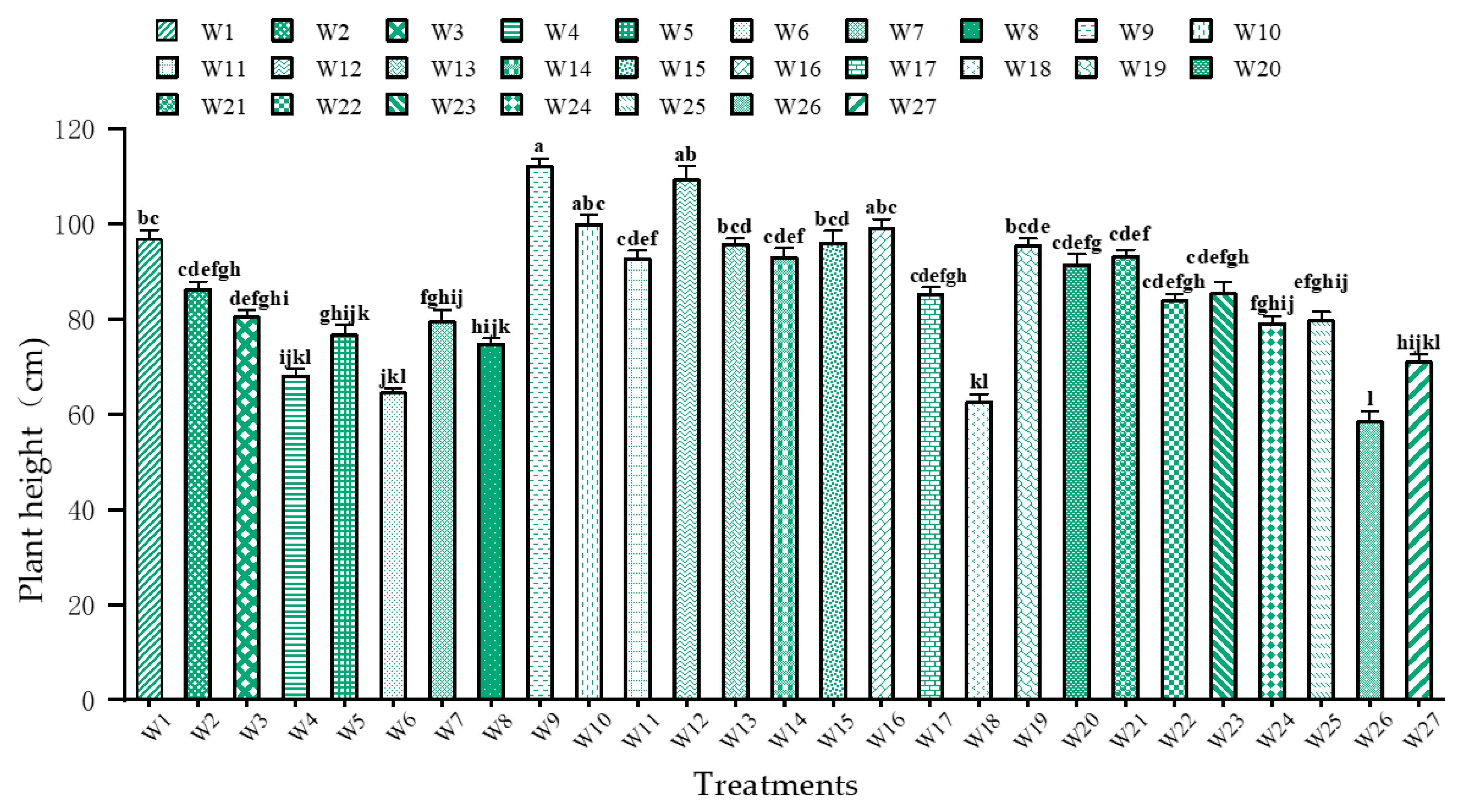
Pepper plant height responses are shown in Figure 3. Plant height decreased with increasing irrigation water salinity, declining by 27%, 26%, and 25% at 3, 4, and 5 g L−1, respectively, compared with 2 g L−1, indicating strong salinity-induced growth suppression. The maximum plant height occurred in W9 (2 g L−1; 5400 m3 ha−1; N 375 kg ha−1, P 170 kg ha−1, K 450 kg ha−1) and was significantly higher than that in the other treatments. In contrast, the minimum plant height was observed in W26 (3 g L−1 with K 600 kg ha−1), suggesting that excessive potassium input may further constrain vegetative growth under saline drip irrigation. Overall, irrigation water salinity was the dominant factor affecting plant height, while appropriate irrigation and fertilization management partially mitigated the inhibitory effects of slightly saline irrigation.

3.1.2. Stem Diameter of Pepper

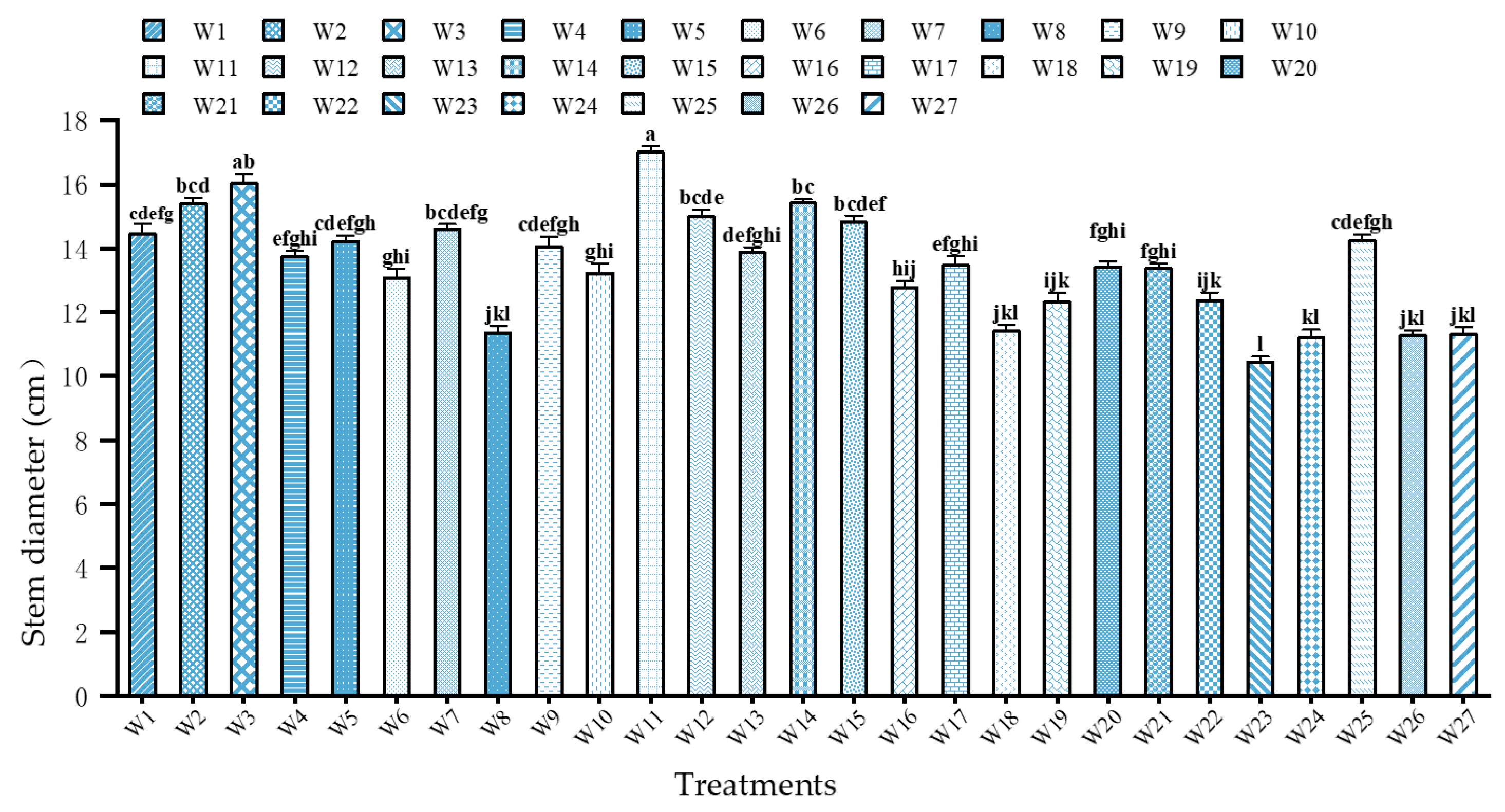
Stem diameter responses across treatments are presented in Figure 4. Overall, lower irrigation water salinity combined with higher irrigation amounts created more favorable conditions for radial (lateral) stem growth in pepper. Among all treatments, W11 (salinity 2 g L−1; irrigation amount 5400 m3 ha−1; N 275 kg ha−1, P 170 kg ha−1, K 550 kg ha−1) produced the maximum stem diameter, which was significantly greater than that of the other treatments (p < 0.05). By contrast, W23 (salinity 3 g L−1; P 140 kg ha−1) resulted in the minimum stem diameter (10.43 mm), markedly lower than those observed under the remaining treatments. This result suggests that insufficient phosphorus application may be associated with reduced lateral stem growth in pepper.

3.1.3. Dry Matter Accumulation of Pepper

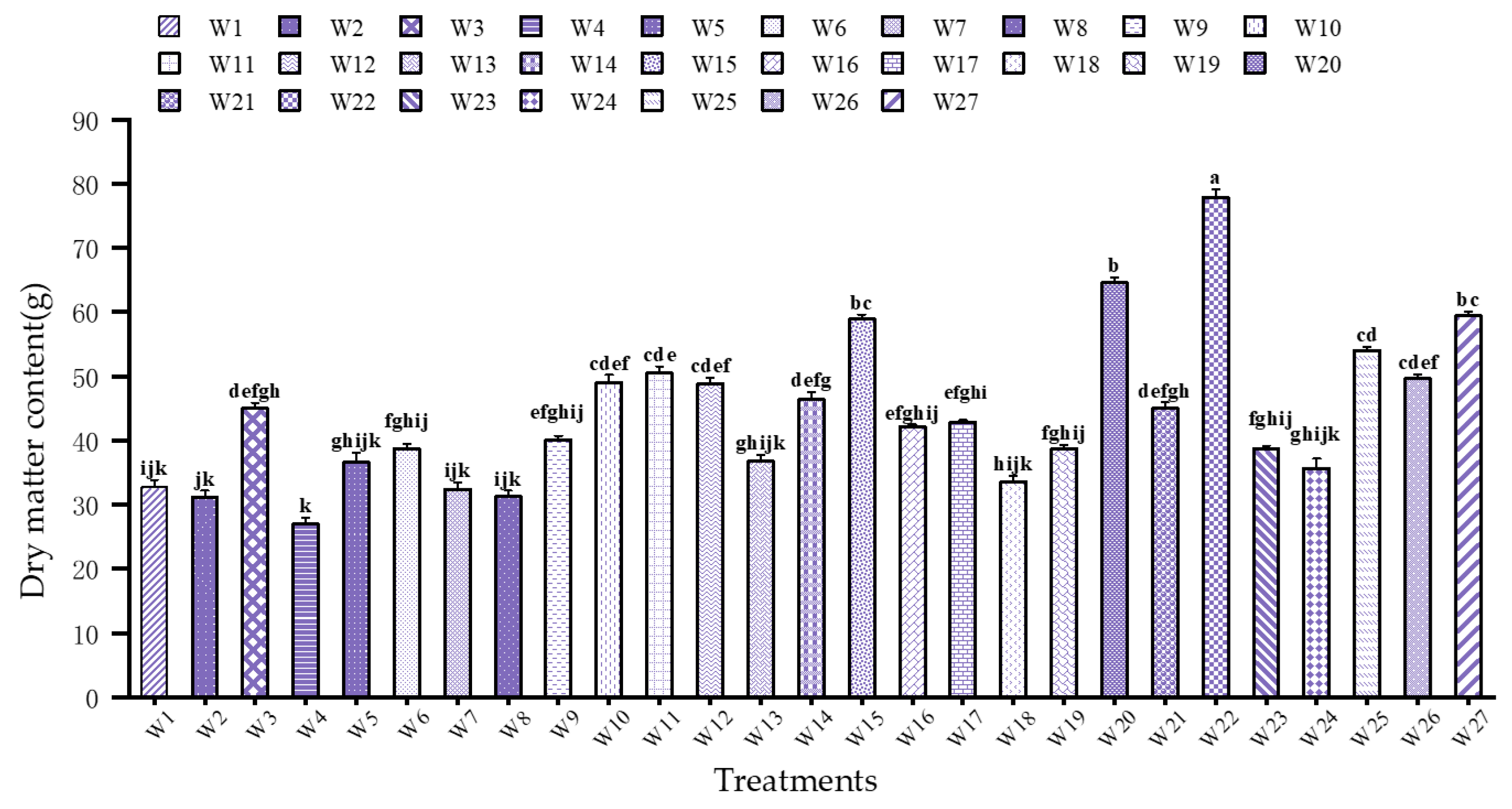
Pepper dry matter accumulation responses are shown in Figure 5. Dry matter accumulation differed significantly among treatments (p < 0.05), ranging from 27.01 ± 0.92 g to 77.89 ± 1.29 g. Overall, dry matter accumulation was maximized under moderate irrigation water salinity with adequate nitrogen supply, highlighting the importance of coordinated water–nutrient management under saline drip irrigation. The highest dry matter accumulation occurred in W22 (3 g L−1; 4800 m3 ha−1; N 425 kg ha−1, P 160 kg ha−1, K 500 kg ha−1), whereas the lowest value was observed in W4 (4 g L−1; 5400 m3 ha−1; N 275 kg ha−1; P 150 kg ha−1). In addition, several treatments implemented under 4 g L−1 salinity (e.g., W2, W7, and W8) showed similarly low dry matter accumulation (31.12–32.71 g), further indicating that elevated salinity constrained biomass formation despite irrigation and fertilization inputs. Overall, an appropriate combination of salinity, irrigation amount, and fertilization rates alleviated salt-stress inhibition and promoted biomass accumulation in greenhouse pepper.

3.1.4. Pepper Yield

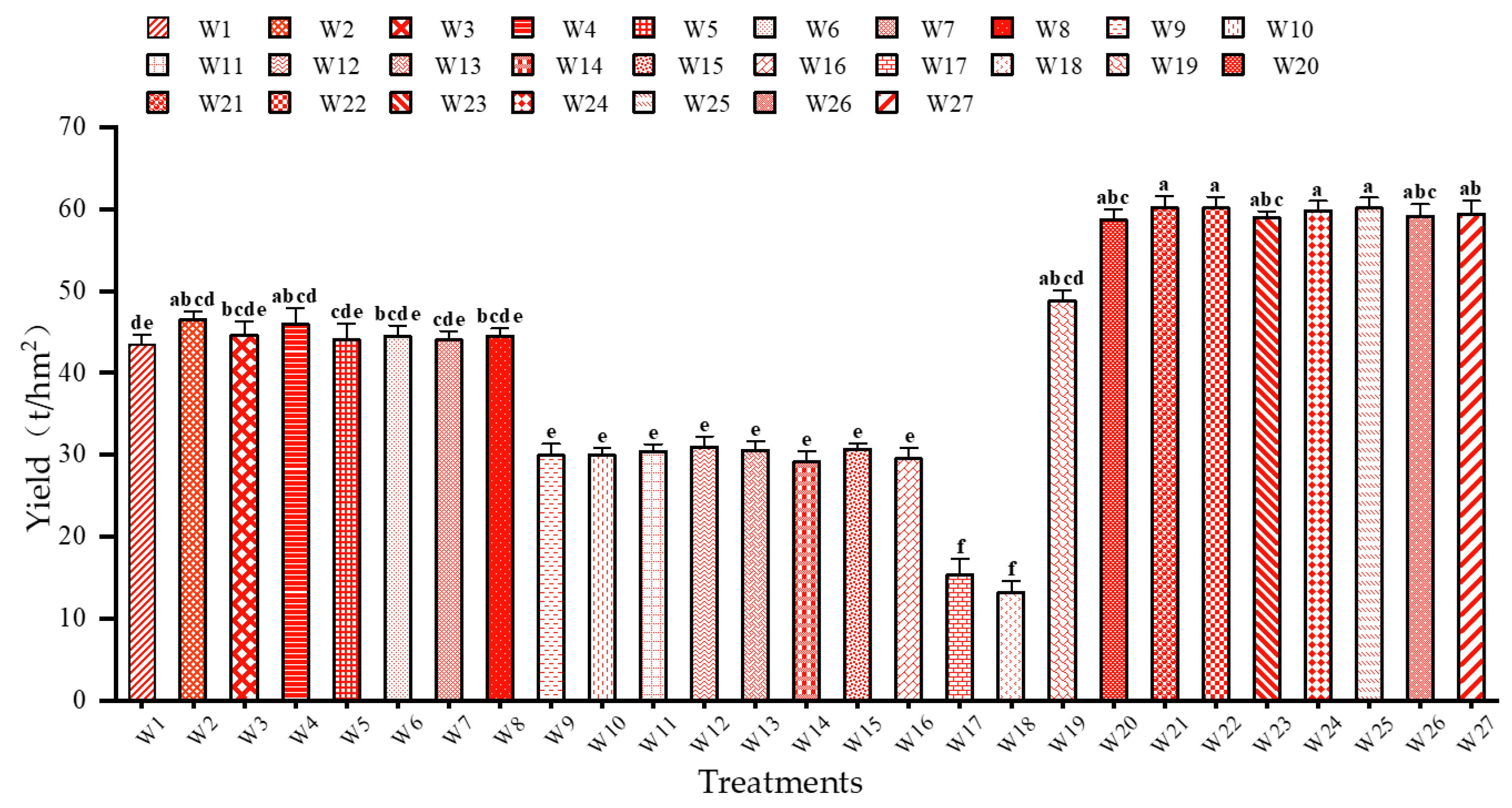
Pepper yield responses across treatments are presented in Figure 6. Irrigation water salinity exerted a highly significant effect on yield, displaying a clear unimodal (hump-shaped) pattern in which yield increased initially and then decreased as salinity rose. Under low salinity conditions (≤2 g L−1), yield remained relatively low across treatments W9–W17. When salinity increased to 3 g L−1, yield increased markedly (W19–W27), and W21 achieved the highest yield. Specifically, W21 combined an irrigation water salinity of 3 g L−1, an irrigation amount of 4800 m3 ha−1, and fertilization rates of N 225 kg ha−1, P 160 kg ha−1, and K 500 kg ha−1. Within the 3 g L−1 salinity group, W19 produced an approximately 18% lower yield than the higher-yielding treatments (W20–W27), which was associated with the substantially reduced irrigation amount under the same salinity level. The lower water input may have contributed to greater salt accumulation in the root zone, potentially increasing osmotic stress and thereby being linked to reduced yield formation.
When salinity increased further to 4 g L−1, yield declined sharply, showing an approximately 30% reduction relative to 2 g L−1 (W1–W8). At the highest salinity level (5 g L−1), yield reached the minimum (W18), suggesting that the yield advantage observed under moderate salinity may not persist under higher salinity levels.

3.1.5. Regression Model Development and Analysis of Factor Effects

Quadratic polynomial models for key growth and yield indicators—plant height, stem diameter, dry matter accumulation, and yield—were developed using Response Surface Methodology (RSM) with a Box–Behnken design in Design-Expert software 13.0.5. ANOVA confirmed all models were significant (p < 0.05) with non-significant lack-of-fit, validating their reliability for analyzing factor effects and optimizing cultivation. Because greenhouse productivity is governed by multi-parameter and coupled interactions among water–salt conditions and nutrient inputs, the RSM framework enables coupled optimization by jointly searching factor combinations that maximize crop performance under constrained operating conditions, rather than tuning one factor at a time. Similar multi-parameter, dynamic, and coupled optimization strategies have been widely used to improve the performance of complex engineered systems [43,44,45]. The specific regression models with respect to irrigation water salinity (A), irrigation amount (B), N (C), P (D), and K (E) fertilization amounts are as follows:
Plant height = 70.52 − 17.97A + 4.86B + 0.55C + 1.89D − 6.20E + 1.45AB + 4.45AC + 11.03AD + 3.51AE +
16.03BC + 0.50BD − 7.32BE + 9.94CD + 2.54CE + 7.63DE + 5.97A2 + 25.61B2 + 20.68C2 + 14.39D2 + 1.23E2
(R2 = 0.974, Adjusted R2 = 0.943, Predicted R2 = 0.856, Adeq Precision = 26.75, CV% = 2.12);
Stem diameter = 11.20 − 0.68A + 0.93B − 0.28C + 0.82D − 0.86E + 1.06AB + 1.17AC + 0.39AD + 0.11AE −
2.13BC − 0.10BD − 0.08BE − 2.48CD − 1.29CE + 1.07DE + 2.16A2 + 2.59B2 + 2.59C2 + 0.54D2 + 2.49E2
(R2 = 0.981, Adjusted R2 = 0.967, Predicted R2 = 0.915, Adeq Precision = 23.67, CV% = 2.23);
Dry matter accumulation = 59.80 − 9.69A + 4.40B + 3.42C + 1.04D − 3.15E − 1.84AB + 7.92AC + 4.65AD +
0.69AE − 3.10BC + 1.53BD + 4.32BE − 14.19CD + 8.76CE − 6.82DE − 24.30A2 − 10.82B2 − 1.04C2 − 25.26D2
10.61E2 (R2 = 0.985, Adjusted R2 = 0.939, Predicted R2 = 0.830, Adeq Precision = 25.43, CV% = 2.67);
yield = 60.04 + 9.32A + 2.04B − 0.23C − 0.13D − 0.35E + 0.51AB + 0.34AC − 1.84AD − 0.37AE − 0.40BC −
1.69BD − 0.54BE − 0.21CD − 0.12CE + 0.08DE − 51.14A2 − 11.63B2 − 5.24C2 − 6.01D2 − 5.77E2
(R2 = 0.992, Adjusted R2 = 0.984, Predicted R2 = 0.921, Adeq Precision = 32.12, CV% = 1.35).
Note: In Equations (4)–(7), A denotes irrigation water salinity, B denotes irrigation amount, and C, D, and E denote the application rates of N, P, and K fertilizers, respectively. Terms such as AB, AC, … represent pairwise interaction effects between factors, while A2, B2, … represent quadratic effects capturing non-linear responses. The reported Adjusted R2 values indicate the goodness-of-fit of each regression model after accounting for the number of terms included, and were used to evaluate model reliability for multi-factor coupled optimization in the greenhouse system.
The results indicated that irrigation water salinity exhibited a dual effect of “inhibiting vegetative growth while promoting yield formation.” Irrigation volume consistently had a positive effect on all growth indicators. The effects of nitrogen, phosphorus, and potassium fertilization showed differentiated characteristics, with potassium application demonstrating a generally inhibitory effect within the experimental range. Significant interactive effects were observed among the factors, particularly the synergistic effect of water and nitrogen on plant height, while the interaction between nitrogen and phosphorus significantly inhibited dry matter accumulation. All quadratic coefficients in the models were negative, confirming that the influence of each factor on the response indicators followed parabolic patterns, with clearly defined optimal thresholds. This reveals that crop growth and yield formation result from the nonlinear interactions of multiple factors, providing a theoretical basis for cultivation management through the coordination of water–salt relationships and the optimization of water–fertilizer ratios.

3.2. Water and Nutrient Use Efficiency Under Different Treatments

3.2.1. IWUE

Under the same irrigation water salinity, IWUE increased as irrigation amount decreased, indicating that deficit irrigation improved irrigation water productivity. The highest IWUE was observed in W19 (3 g L−1; 3600 m3 ha−1; N 325 kg ha−1, P 160 kg ha−1, K 500 kg ha−1). Across salinity levels of 2–4 g L−1, reducing irrigation amount increased IWUE by approximately 22–24% relative to the corresponding higher-irrigation treatments. When salinity increased, IWUE exhibited a unimodal pattern—increasing first and then decreasing, with a maximum at 3 g L−1, consistent with the salinity-dependent yield response. In contrast, W18 (5 g L−1; 4800 m3 ha−1) showed the lowest IWUE, coinciding with a markedly reduced yield (13.14 ± 1.53 t ha−1), suggesting that the reduced water use efficiency may be associated with the combined effects of high salinity and yield suppression (Table 4).

3.2.2. PFPN

PFPN was primarily improved by moderate salinity coupled with reduced nitrogen input, indicating that optimized N supply enhanced nitrogen use efficiency. The highest PFPN occurred in W21 (3 g L−1; 4800 m3 ha−1; N 225 kg ha−1), which was significantly higher than the other treatments (p < 0.05) while maintaining a high yield (60.17 ± 1.44 t ha−1). Overall, under 3 g L−1 salinity and 4800–6000 m3 ha−1 irrigation, appropriate nitrogen reduction was generally associated with higher PFPN without an apparent yield penalty (W20,W24,W25,W26,W27). By contrast, W18 (5 g L−1) exhibited the lowest PFPN together with low yield, suggesting that high salinity may be linked to reduced effectiveness of nitrogen use (Table 4).

3.2.3. PFPP

PFPP tended to be higher under moderate salinity when the phosphorus fertilizer application rate was appropriately adjusted, suggesting an association between rational phosphorus fertilization management and improved apparent phosphorus use efficiency under brackish irrigation. The highest PFPP was recorded in W23 (3 g L−1; 4800 m3 ha−1; P150 kg ha−1). Several other treatments conducted at 3 g L−1 salinity and approximately 4800 m3 ha−1 irrigation also maintained relatively high PFPP values, with mean PFPP only about 14% lower than that of W23. These results show that high PFPP can be sustained within this salinity–irrigation management range. By contrast, PFPP was lowest under high salinity conditions (e.g., W18, 5 g L−1), suggesting that higher salinity was associated with reduced apparent phosphorus use efficiency (Table 4).

3.2.4. PFPK

PFPK was highest in W25 (3 g L−1; 4800 m3 ha−1; K 400 kg ha−1), significantly exceeding the other treatments. Under 3 g L−1 salinity with 4800–6000 m3 ha−1 irrigation, PFPK varied substantially even when potassium fertilizer inputs were similar, suggesting that apparent K use efficiency was more closely associated with the combined irrigation and salinity conditions than with K input alone. Consistent with other efficiency indices, high salinity (5 g L−1) was associated with the lowest PFPK (e.g., W18), coinciding with strong yield suppression and thus lower apparent K use efficiency (Table 4).

3.2.5. Regression Model Development and Analysis of Factor Effects

Based on a Box–Behnken design, quadratic polynomial models for key resource use efficiency indicators (IWUE, PFPN, PFPP, PFPK) were developed via Response Surface Methodology using Design-Expert software. ANOVA confirmed all models were significant (p < 0.05) with non-significant lack-of-fit, validating their reliability for analyzing factor effects and optimizing water and fertilizer management. The specific regression models with respect to irrigation water salinity (A), irrigation amount (B), and N (C), P (D), K (E) fertilization amounts are as follows:
IWUE = 12.51 + 1.97A − 1.87B − 0.05C − 0.02D − 0.07E − 0.66AB + 0.07AC −
0.39AD − 0.08AE − 0.07BC − 0.34BD − 0.09BE − 0.04CD + 0.02CE + 0.01DE −
10.66A2 − 1.96B2 − 1.09C2 − 1.25D2 − 1.20E2 (R2 = 0.984, Adjusted R2 = 0.952,
Predicted R2 = 0.881, Adeq Precision = 21.45, CV% = 2.65);
PFPN = 184.86 + 29.35A + 6.38B − 45.90C − 0.39D − 1.07E + 1.56AB − 13.03AC −
5.52AD − 0.35AE − 1.84BC − 5.15BD − 0.83BE − 0.24CD − 0.15CE + 0.01DE −
158.59A2 − 37.02B2 + 2.04C2 − 19.73D2 − 18.98E2 (R2 = 0.991, Adjusted R2 = 0.977,
Predicted R2 = 0.868, Adeq Precision = 21.53, CV% = 2.87);
PFPP = 375.26 + 58.74A + 13.00B − 1.44C − 36.09D − 2.21E + 3.22AB + 2.32AC
− 22.92AD − 2.18AE − 2.39BC − 11.08BD − 3.55BE − 1.01CD − 1.00CE +
0.72DE − 319.88A2 − 72.92B2 − 32.97C2 − 32.27D2 − 36.29E2 (R2 = 0.986,
Adjusted R2 = 0.939, Predicted R2 = 0.916, Adeq Precision = 23.53, CV% = 2.47);
PFPK = 120.11 + 18.87A + 4.13B − 0.46C − 0.27D − 19.08E + 1.06AB + 1.02AC −
3.63AD − 6.62AE − 0.44BC − 3.48BD − 1.34BE − 0.51CD − 0.12CE + 0.34DE −
102.61A2 − 23.58B2 − 10.79C2 − 12.34D2 − 6.67E2 (R2 = 0.994, Adjusted R2 = 0.988,
Predicted R2 = 0.904, Adeq Precision = 23.79, CV% = 2.72).
Note: In Equations (8)–(11), A denotes irrigation water salinity, B denotes irrigation amount, and C, D, and E denote the application rates of N, P, and K fertilizers, respectively. Terms such as AB, AC, … represent pairwise interaction effects between factors, while A2, B2, … represent quadratic effects capturing non-linear responses. The reported Adjusted R2 values indicate the goodness-of-fit of each regression model after accounting for the number of terms included, and were used to evaluate model reliability for multi-factor coupled optimization in the greenhouse system.
The results indicated that irrigation water salinity had a significant positive effect on improving water and fertilizer partial factor productivity, but its strong negative quadratic response warned of the risk of excessive salinity. Increasing irrigation volume enhanced fertilizer production efficiency but reduced water use efficiency. The application rates of nitrogen, phosphorus, and potassium all showed significant negative main effects on the partial factor productivity of their respective nutrients, reflecting a clear law of diminishing returns. Antagonistic interactions were commonly observed among the factors, with the inhibitory effect of salt-nitrogen interaction on nitrogen use efficiency being particularly pronounced. The influence of all factors on resource efficiency followed a parabolic pattern, confirming the existence of clear optimal thresholds for water, fertilizer, and salt. This provides a quantitative basis for achieving efficient resource utilization through coordinated regulation.

3.3. Fruit Quality Under Different Treatments

3.3.1. VC

As shown in Table 5, VC content differed significantly among treatments. Overall, VC accumulation tended to be higher under moderate irrigation water salinity combined with higher phosphorus input, suggesting an association between phosphorus supply under a moderate salinity background and increased VC levels. The highest VC content occurred in W24 (3 g L−1; 4800 m3 ha−1; N 325 kg ha−1; P 180 kg ha−1), whereas the lowest VC content was observed in W26 (3 g L−1 with K 600 kg ha−1), indicating that excessive potassium input may suppress VC-related metabolism. Treatments implemented under low to moderate salinity with relatively high phosphorus fertilizer application rates (e.g., W13 and W11) generally showed higher VC levels, suggesting an association between phosphorus supply and VC accumulation under brackish irrigation.

3.3.2. Non-Hydrolyzed Free Amino Acid Content

Non-hydrolyzed free amino acids (free amino acid monomers extracted directly from pepper tissues) showed significant variation among treatments, ranging from 22.35 ± 1.34 to 46.08 ± 1.00 μmol g−1 (Table 5). Amino acid content was generally higher under higher salinity, suggesting an association with osmotic adjustment responses under salt stress. The maximum content was recorded in W1 (4 g L−1; 5400 m3 ha−1; N 375 kg ha−1; P 170 kg ha−1; K 550 kg ha−1). Several other treatments under 4 g L−1 (e.g., W2, W6, and W7) also exhibited elevated amino acid levels, suggesting that the higher salinity conditions were associated with increased amino acid accumulation.

3.3.3. Capsaicin and Dihydrocapsaicin Contents

Capsaicin content increased with increasing irrigation water salinity (Table 5), suggesting that higher salinity conditions were associated with greater accumulation of pungency-related secondary metabolites in pepper. Capsaicin remained relatively low under 2 g L−1 (W9–W17) but increased at 3 g L−1 by 37–72% compared with 2 g L−1, and further increased at 4 g L−1, with a mean increase of 56% relative to the 3 g L−1 treatments. The highest capsaicin content was observed in W1 (4 g L−1; 5400 m3 ha−1; N 375 kg ha−1; P 170 kg ha−1; K 550 kg ha−1), whereas the lowest content occurred in W15 (2 g L−1 with N 275 kg ha−1), suggesting that insufficient nutrient supply may limit capsaicin synthesis under low salinity.
Dihydrocapsaicin showed a similar response, ranging from 0.55 ± 0.06 to 1.80 ± 0.05 g kg−1 (Table 5) and generally increasing under higher salinity. The maximum dihydrocapsaicin content was also recorded in W1, and treatments exposed to 4 g L−1 typically maintained relatively high dihydrocapsaicin levels (Table 5), supporting the salinity-promoted accumulation pattern.

3.3.4. Weight and Length of Single Fruits

As shown in Table 5, single fruit weight and single fruit length of pepper differed significantly among treatments (p < 0.05). Under lower irrigation water salinity, a moderate irrigation amount provided sufficient water supply and coincided with a reduced fruit number (resulting in a relatively low yield of 15.32 ± 1.99 t ha−1), which was associated with greater assimilate accumulation in individual fruits. The highest single fruit weight occurred in W17 (1 g L−1; 4800 m3 ha−1; N 325 kg ha−1; P 160 kg ha−1; K 500 kg ha−1), which was accompanied by a relatively low yield (15.32 ± 1.99 t ha−1), indicating that a lower fruit load likely promoted assimilate allocation to individual fruits. By contrast, the lowest single fruit weight was observed in W4 (4 g L−1; 5400 m3 ha−1), suggesting that this reduction may be associated with the high salinity conditions together with limited nutrient supply.
Fruit length ranged from 12.11 ± 0.45 to 22.49 ± 0.31 cm (Table 5). Longer fruits were generally observed under low to moderate salinity together with higher irrigation amounts and higher nitrogen input, suggesting that these conditions were associated with improved water availability and reduced osmotic limitation. The longest fruits were produced in W9 (2 g L−1; 5400 m3 ha−1; N 375 kg ha−1; P 170 kg ha−1; K 450 kg ha−1), while treatments under 2–3 g L−1 also tended to maintain relatively high fruit length (Table 5).

3.3.5. Regression Model Development and Analysis of Factor Effects

Through Response Surface Methodology (RSM) with a Box–Behnken design (BBD), quadratic polynomial models were developed using Design-Expert software for key quality and morphological traits: vitamin C, non-hydrolyzed free amino acids, capsaicin, dihydrocapsaicin, single fruit weight, and fruit length. All models were statistically significant (p < 0.05) with non-significant lack-of-fit, confirming their reliability for analyzing factor effects and optimizing cultivation parameters. The specific regression models with respect to irrigation water salinity (A), irrigation amount (B), N (C), P (D), and K (E) fertilization amounts are as follows:
VC = 344.24 + 9.26A + 21.11B − 0.76C + 24.84D + 24.60E + 26.64AB − 6.11AC + 16.80AD − 77.55AE −
9.69BC + 19.84BD + 17.28BE + 6.18CD + 28.12CE − 3.17DE + 8.37A2 + 8.18B2 + 7.81C2 + 39.35D2 − 45.03E2
(R2 = 0.979, Adjusted R2 = 0.966, Predicted R2 = 0.896, Adeq Precision = 24.25, CV% = 2.36);
Non-hydrolyzed free amino acids = 42.23 + 8.46A − 0.15B + 0.01C − 0.20D + 0.14E + 1.05AB + 2.16AC +
1.85AD − 0.60AE + 1.62BC + 1.64BD − 2.28BE + 1.44CD − 1.20CE − 1.22DE + 1.56A2 − 2.02B2 − 2.02C2
2.02D2 − 2.77E2 (R2 = 0.982, Adjusted R2 = 0.955, Predicted R2 = 0.911, Adeq Precision = 23.15, CV% = 2.18);
Capsaicin = 1.97 + 0.53A + 0.31B − 0.02C + 0.09D + 0.21E − 0.22AB − 0.09AC + 0.38AD − 0.02AE −
0.34BC − 0.01BD + 0.11BE + 0.03CD + 0.10CE + 0.25DE + 0.30A2 + 0.42B2 + 0.22C2 + 0.13D2 + 0.05E2
(R2 = 0.984, Adjusted R2 = 0.978, Predicted R2 = 0.869, Adeq Precision = 25.45, CV% = 2.10);
Dihydrocapsaicin = 0.94 + 0.06A + 0.01B − 0.08C + 0.06D + 0.15E − 0.19AB − 0.09AC + 0.18AD + 0.13AE −
0.17BC − 0.04BD + 0.11BE + 0.11CD + 0.09CE + 0.02DE + 0.02A2 + 0.10B2 + 0.09C2 + 0.05D2 + 0.00E2
(R2 = 0.977, Adjusted R2 = 0.936, Predicted R2 = 0.878, Adeq Precision = 23.55, CV% = 2.78);
Single fruit weight = 155.49 − 18.24A + 1.65B + 0.46C − 1.54D − 4.36E − 0.41AB − 2.69AC − 0.40AD + 4.78AE
− 2.26BC + 0.43BD + 6.35BE − 3.17CD − 3.49CE + 0.21DE − 15.30A2 − 12.49B2 − 1.80C2 − 6.21D2 − 10.38E2
(R2 = 0.983, Adjusted R2 = 0.964, Predicted R2 = 0.931, Adeq Precision = 24.75, CV% = 2.45);
Fruit length = 19.25 − 0.99A + 0.08B + 0.63C + 0.29D − 0.21E − 1.53AB − 0.54AC − 0.20AD − 0.55AE +
0.39BC − 0.65BD − 0.51BE + 0.05CD + 0.08CE − 0.77DE − 2.01A2 − 0.48B2 − 0.22C2 − 0.13D2 − 0.03E2
(Adjusted R2 = 0.972, Adjusted R2 = 0.948, Predicted R2 = 0.832, Adeq Precision = 23.26, CV% = 2.67).
Note: In Equations (12)–(17), A denotes irrigation water salinity, B denotes irrigation amount, and C, D, and E denote the application rates of N, P, and K fertilizers, respectively. Terms such as AB, AC, … represent pairwise interaction effects between factors, while A2, B2, … represent quadratic effects capturing non-linear responses. The reported Adjusted R2 values indicate the goodness-of-fit of each regression model after accounting for the number of terms included and were used to evaluate model reliability for multi-factor coupled optimization in the greenhouse system.
The results showed that appropriately increasing irrigation water salinity and irrigation volume significantly enhanced the synthesis of flavor and nutritional compounds such as vitamin C and capsaicin, while simultaneously inhibiting morphological development, including single fruit weight and fruit length. Analysis of key interactions revealed that water–salinity synergy had a significant positive effect on vitamin C accumulation, and the salinity–phosphorus combination promoted capsaicin synthesis, whereas high salinity combined with high potassium strongly suppressed vitamin C content. The influence of each factor on quality indicators varied (e.g., phosphorus showed a sustained promoting trend on vitamin C), but all followed a parabolic response for single fruit weight and fruit length. This indicates that achieving both high quality and high yield requires differentiated strategies: optimizing water–salinity and salinity–phosphorus ratios for targeted enhancement of intrinsic quality, while strictly controlling each factor level to ensure desirable fruit morphology.

3.4. Correlation Analysis

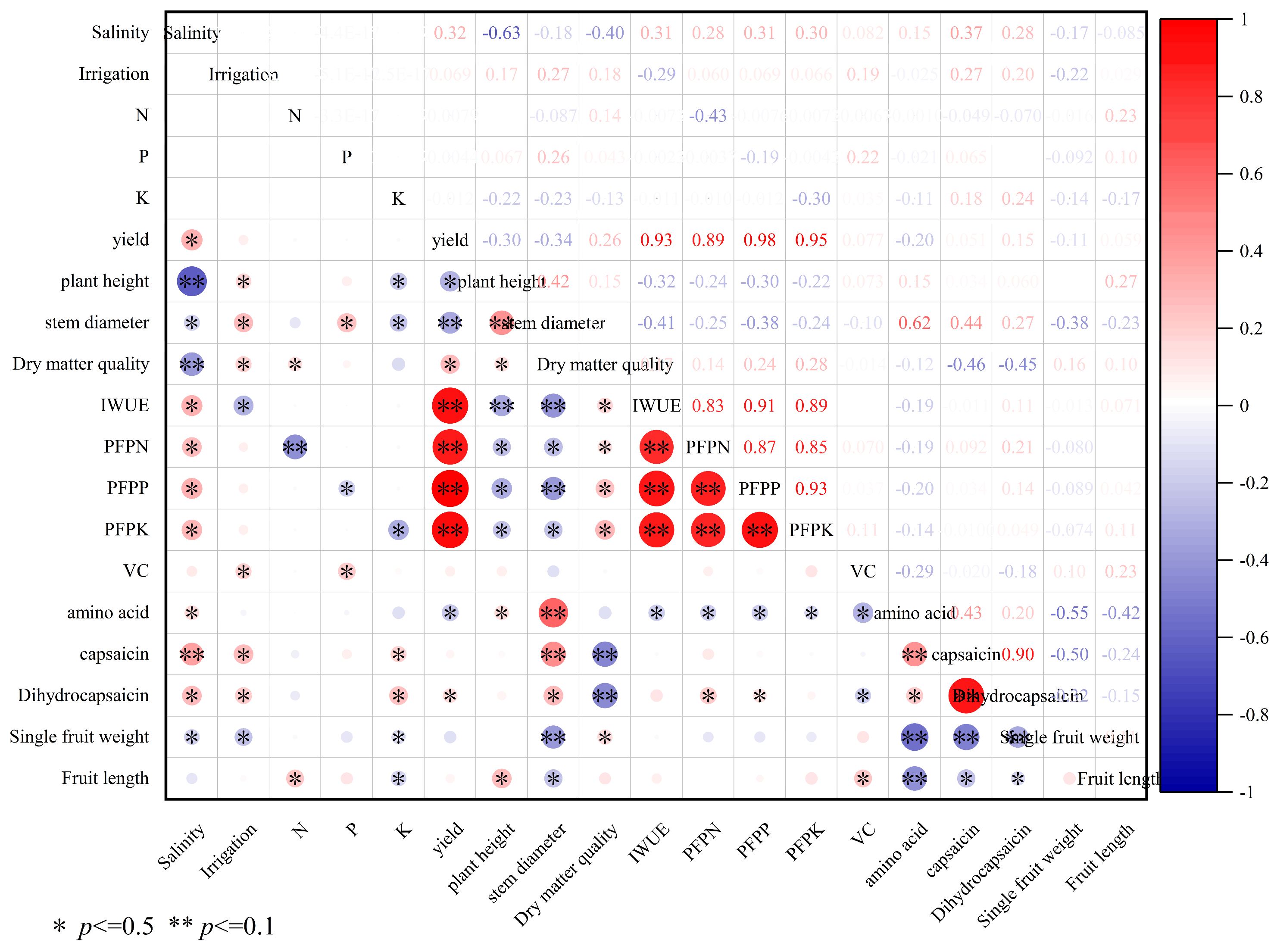
Correlation analysis under combined water–nutrient–salinity conditions (Figure 7) revealed a clear modular structure among pepper growth, yield, quality, and resource use traits. Irrigation water salinity showed systematic associations with multiple variables: it was moderately positively correlated with yield (r ≈ 0.32) and positively correlated with irrigation water use efficiency and partial factor productivity of nitrogen, phosphorus, and potassium (r ≈ 0.28–0.31), and showed significant negative correlations with plant height (r ≈ −0.63) and dry matter accumulation (r ≈ −0.40). These relationships indicated that increasing salinity promoted yield formation mainly through improved water and nutrient use efficiency, while simultaneously suppressing vegetative growth via a “dwarfing–reduced biomass” pathway. In addition, irrigation water salinity was positively correlated with capsaicin (r ≈ 0.37) and non-hydrolyzed free amino acids (r ≈ 0.15), suggesting enhanced secondary metabolism under saline conditions.
Dry matter accumulation exhibited a relatively independent correlation pattern. It showed weak positive correlations with irrigation amount, nitrogen input, and phosphorus input (r ≈ 0.14–0.18), a slight negative correlation with potassium input (r ≈ −0.13), and weak to moderate positive correlations with yield, plant height, and stem diameter (r ≈ 0.15–0.26), indicating that biomass accumulation was associated with plant stature and yield increase, although the promotion effect was limited. Dry matter accumulation was weakly correlated with vitamin C, but strongly positively correlated with non-hydrolyzed free amino acids (r ≈ 0.62), and moderately to weakly correlated with capsaicin and dihydrocapsaicin (r ≈ 0.44 and 0.27), reflecting coordinated enhancement of nitrogen metabolism and capsaicinoid synthesis. At the individual fruit scale, dry matter accumulation was moderately negatively correlated with single fruit weight (r ≈ −0.38) but slightly positively correlated with fruit length (r ≈ 0.27), indicating a tendency toward “longer but lighter” fruits, with assimilates preferentially allocated to structural components and internal metabolites rather than fruit mass.
Irrigation water use efficiency exhibited very strong positive correlations with the partial factor productivity of nitrogen, phosphorus, and potassium, which were also highly interrelated (r ≈ 0.85–0.91), whereas irrigation amount was significantly negatively correlated with irrigation water use efficiency, suggesting that higher irrigation inputs were associated with lower yield per unit of water applied. Irrigation water use efficiency and partial factor productivity indices showed moderate negative correlations with dry matter accumulation (r ≈ −0.41 to −0.24), suggesting that excessive vegetative biomass did not translate into higher resource use efficiency. Plant height was moderately positively correlated with stem diameter (r ≈ 0.42) but negatively correlated with yield (r ≈ −0.30), implying competitive effects between vegetative and reproductive growth. Capsaicin and dihydrocapsaicin were strongly positively correlated (r ≈ 0.90), capsaicin was moderately positively correlated with vitamin C (r ≈ 0.43), while vitamin C showed a significant negative correlation with non-hydrolyzed free amino acids, highlighting trade-offs among primary nitrogen metabolism, antioxidant synthesis, and secondary metabolite accumulation.

3.5. Comprehensive Assessment

Because the overall performance of pepper under different water–nutrient–salinity combinations could not be adequately characterized by a single indicator, principal component analysis (PCA) was applied using seven variables, including yield, irrigation water use efficiency, nitrogen partial factor productivity, vitamin C content, non-hydrolyzed free amino acid content, capsaicin content, and dihydrocapsaicin content. The dataset was suitable for PCA, as indicated by an excellent Kaiser–Meyer–Olkin (KMO) value of 0.93 and a significant Bartlett’s test of sphericity (p < 0.05), confirming adequate sampling and sufficient inter-variable correlations. The eigenvalues, contribution rates, and cumulative contribution rates of the principal components are shown in Table 6. Based on the criterion that the cumulative contribution rate exceeded 85%, three principal components were extracted. As presented in Table 6, the first principal component had an eigenvalue of 2.87, explaining 41% of the total variance; the second principal component had an eigenvalue of 2.1407, increasing the cumulative explained variance to 71%; and the third principal component had an eigenvalue of 1.0587, raising the cumulative explained variance to 86%. The first three principal components accounted for 86% of the cumulative variance, indicating that they effectively represented approximately 86% of the information contained in the original seven variables. Therefore, these three mutually independent principal components were used to replace the original indicators for comprehensive evaluation of the different water–nutrient–salinity treatments, achieving dimensionality reduction while retaining most of the original information. Beyond ranking treatments, the PCA loadings provide a biologically interpretable structure of the multi-trait responses under combined water–nutrient–salinity management. In this study, principal component 1 (PC1) primarily reflects the “yield–resource use efficiency” dimension, with treatments scoring high on PC1 (e.g., W21) showing higher yield and better water and fertilizer efficiency. Principal component 2 (PC2) is associated with “pungency/secondary metabolism,” indicating that this component represents the accumulation of capsaicinoids. High PC2 values correspond to higher secondary metabolite levels, but are not directly related to yield and efficiency, highlighting trade-offs between production goals. Principal component 3 (PC3) is linked to “antioxidant quality (e.g., vitamin C),” suggesting that different quality traits respond differently to water, salinity, and fertilization combinations.
As shown in Table 7, principal component 1 was mainly dominated by the yield-related variables, principal component 2 was primarily associated with the capsaicin-related variables, and principal component 3 was mainly characterized by the vitamin C content.
By using the ratio of the eigenvalue of each principal component to the sum of all eigenvalues as weighting coefficients, a comprehensive principal component scoring model was constructed as follows:
D = 0.410002     F 1 + 0.305812     F 2 + 0.15124     F 3
Comprehensive scores and rankings integrating yield and fruit quality of greenhouse pepper under different water–nutrient–salinity combinations were calculated (Table 3).
The results showed that treatment W21, which combined an irrigation water salinity of 3 g L−1, an irrigation amount of 4800 m3 ha−1, and fertilization rates of 225 kg ha−1 N, 160 kg ha−1 P, and 500 kg ha−1 K, achieved the highest comprehensive score, reaching 1.398. Considering the abundant solar radiation, large diurnal temperature differences, and severe water scarcity in southern Xinjiang, an optimal water–nutrient–salinity coupling scheme for greenhouse pepper production under slightly saline water irrigation was preliminarily proposed. This scheme, consisting of an irrigation water salinity of 3 g L−1, an irrigation amount of 4800 m3 ha−1, and fertilization rates of 225 kg ha−1 N, 160 kg ha−1 P, and 500 kg ha−1 K, achieved high yield, high resource use efficiency (water and nutrients), and superior fruit quality, thereby providing a scientific basis for precision irrigation and fertilization management of greenhouse pepper in southern Xinjiang.

4. Discussion

Reasonable coordination of water, nutrient, and salinity management is widely recognized as a prerequisite for achieving high crop productivity [46,47,48]. Optimized water–nutrient–salinity regulation can improve water and nutrient use efficiency while simultaneously enhancing crop yield and quality [49,50]. In this study, when irrigation water salinity exceeded 3 g L−1, pepper plant height and stem diameter declined to varying degrees, indicating that excessive salinity constrained vegetative growth, although the underlying physiological mechanisms require further investigation. Pepper yield exhibited a clear unimodal response to increasing irrigation water salinity, increasing initially and then decreasing, which indicates a pronounced threshold-like pattern in the yield response to salinity. This hump-shaped response can be interpreted as a shift from stress acclimation to stress damage. Under moderate salinity (around 3 g L−1), plants may maintain cell turgor via osmotic adjustment, for example, through the accumulation of compatible solutes such as amino acids and sugars, thereby alleviating osmotic stress [51]. At the same time, moderate salinity may induce adaptive responses that help sustain growth and resource use performance [52]. By contrast, when salinity increases further, stress intensity may approach or exceed an ion-toxicity threshold; excessive Na+ and Cl accumulation can disturb the plant’s internal ion balance, inhibit photosynthesis and reproductive development, and ultimately be associated with yield decline. Similar threshold responses have been reported previously [53]; for example, Baath et al. [54] observed relatively high pepper yield under irrigation water salinity above 1.6 g L−1, whereas in the present study the optimal yield occurred at 3 g L−1, suggesting that the yield–salinity relationship is strongly dependent on cultivation system and management conditions.
The differences between the present study and previous reports may be largely attributed to irrigation regime and cultivation system. Appropriate irrigation amounts facilitated salt leaching from the pepper root zone [55], thereby reducing salt accumulation and alleviating osmotic stress, which improved the root zone water potential. Compared with soil cultivation, substrate cultivation exhibits higher permeability and drainage capacity [56], allowing salts to be more effectively leached under moderate irrigation water salinity combined with suitable irrigation amounts. As a result, salt accumulation in deeper substrate layers was avoided, and the root zone environment remained relatively favorable for nutrient uptake. Consistent with the findings of Ma et al. [57], who reported that increased irrigation and nitrogen input under slightly saline water irrigation enhanced aboveground biomass accumulation in drip-irrigated processing tomato, the present study also showed that under moderate salinity conditions, higher irrigation amounts combined with nitrogen application promoted dry matter accumulation in greenhouse pepper. These results collectively indicate that the optimal water–salinity–fertilizer combination identified in this study represents a coordinated regulation range that balances salt leaching and nutrient availability under substrate cultivation.
With respect to resource use efficiency, irrigation water use efficiency and fertilizer partial factor productivity exhibited unimodal responses to irrigation water salinity, reaching their maximum values at 3 g L−1. Under moderate salinity conditions combined with moderate irrigation amounts, water use efficiency was optimized, whereas excessive irrigation reduced yield per unit of water applied, consistent with previous findings [25]. Moderate salinity also enhanced nitrogen uptake by pepper plants, thereby increasing nitrogen partial factor productivity. In addition, appropriate irrigation amounts promoted the dissolution and availability of phosphorus and potassium in the growth medium, enhancing nutrient uptake and transport by roots [58]. Notably, the highest fertilizer use efficiency was achieved at relatively low fertilization levels (level-2), with treatment W21 showing the highest PFPN at 225 kg ha−1 N, treatment W23 showing the highest PFPP at 150 kg ha−1 P, and treatment W25 showing the highest PFPK at 400 kg ha−1 K. These results indicate that under moderate irrigation water salinity and appropriate irrigation amounts, reducing fertilizer inputs can simultaneously maintain yield and substantially improve resource use efficiency, providing a practical basis for precision irrigation and fertilization management in greenhouse pepper production in southern Xinjiang.
Recent studies have demonstrated that an appropriate level of salinity stress can improve fruit quality [59,60,61]. Shams et al. [62] reported that saline–alkaline stress promoted the synthesis of capsaicin and dihydrocapsaicin in pepper, which was in agreement with the results of the present study. Under an irrigation water salinity of 4 g L−1, capsaicin and dihydrocapsaicin accumulation was significantly enhanced. Meanwhile, non-hydrolyzed free amino acid content in pepper fruits reached its peak at 4 g L−1, exhibiting an initial increase followed by a decrease with increasing irrigation water salinity. In contrast, under low-salinity irrigation conditions, single fruit weight and single fruit length showed superior performance, which is consistent with the findings reported by Qiu et al. [55]. This response may be attributed to the ability of crops to maintain higher photosynthetic rates and longer functional periods under low-salinity conditions, leading to increased carbohydrate synthesis. In combination with adequate irrigation, such conditions provided an optimal environment for fruit cell division, elongation, and expansion. Furthermore, vitamin C content was highest under moderate salinity stress, whereas higher salinity levels constrained nutrient uptake [63], resulting in nutrient imbalance and reduced vitamin C synthesis in pepper fruits.
The PCA-based comprehensive assessment clarified the multi-objective responses of greenhouse pepper to water–nutrient–salinity management. PC1 mainly represented yield and resource use efficiency, PC2 reflected capsaicinoid-related quality, and PC3 was dominated by vitamin C. W21 ranked first because it performed strongly on PC1 while maintaining relatively balanced performance on PC2 and PC3, resulting in the best overall compromise among yield, efficiency, and quality. In contrast, treatments with higher scores on the pungency axis often coincided with reduced yield or efficiency, whereas low-salinity or high-water input conditions could favor some market traits but did not necessarily optimize IWUE and fertilizer partial factor productivity, highlighting trade-offs among these targets. Overall, the PCA results support the management implication that moderate salinity combined with appropriate irrigation and optimized fertilization is conducive to coordinated improvements in yield, resource use efficiency, and fruit quality in this substrate-based system.

5. Conclusions

Irrigation water salinity was a primary environmental factor governing pepper yield. Under low salinity conditions, a relatively high root zone osmotic potential created a mild and stable growth environment that supported photosynthesis and assimilate production, resulting in vigorous plant growth and favorable single fruit weight and fruit length, although yield improvement remained limited. When irrigation water salinity increased to approximately 3 g L−1, yield reached its maximum, as moderate salinity-induced osmotic adjustment enhanced the coordinated uptake of water and mineral nutrients. In combination with appropriate irrigation amounts that promoted uniform salt distribution and partial leaching in the substrate, the root zone environment was optimized, biomass accumulation was enhanced, and pepper yield increased significantly.
Under moderate salinity, crops exhibited markedly improved resource use efficiency, characterized by a low-input, high-efficiency response. Appropriate salinity enhanced root activity, nutrient uptake and assimilation, promoted fertilizer availability, and reduced ion antagonism, thereby increasing the partial factor productivity of nitrogen, phosphorus, and potassium. These findings underscore the coupled regulation of salinity, irrigation, and fertilization in achieving efficient crop production.
Moderate salinity exerted a positive inductive effect on fruit quality, particularly when irrigation water salinity increased to 4 g L−1, at which capsaicin, dihydrocapsaicin, and free amino acid accumulation was significantly enhanced. This indicated that an appropriate level of salinity promoted the formation of quality-related metabolites. However, when salinity exceeded the tolerance threshold, photosynthetic capacity, nutrient uptake, and metabolic balance were disrupted, leading to declines in quality components such as vitamin C. Therefore, moderate salinity should be regarded as a key regulatory factor for quality improvement rather than merely a stressor, with its optimal range jointly determined by irrigation and fertilization conditions.
Based on the comprehensive evaluation of yield and fruit quality using principal component analysis, the optimal water–nutrient–salinity combination for greenhouse pepper production under the yellow sand substrate cultivation system was identified as treatment W21, consisting of an irrigation water salinity of 3 g L−1, an irrigation amount of 4800 m3 ha−1, and fertilization rates of 225 kg ha−1 N, 160 kg ha−1 P, and 500 kg ha−1 K. It should be noted that this optimization is derived from a single-season, single-site experiment using one cultivar (‘Qilin 99’), and its broader applicability warrants further validation through multi-season, multi-site, and multi-cultivar studies.

Supplementary Materials

The following supporting information can be downloaded at: https://www.mdpi.com/article/10.3390/w18040488/s1, Table S1. Treatment code–factor level mapping table.

Author Contributions

Conceptualization, X.H. and S.L.; methodology, S.L.; software, S.L.; validation, S.L. and F.L.; formal analysis, S.L. and Y.M.; investigation, S.L. and F.L.; resources, Y.G.; data curation, S.L.; writing—original draft preparation, S.L.; writing—review and editing, S.L.; visualization, S.L. and R.G.; supervision, Y.G.; project administration, Y.G.; funding acquisition, Y.G. All authors have read and agreed to the published version of the manuscript.

Funding

This research was funded by the Vegetable Industry Technology System of Xinjiang Uygur Autonomous Region (XJARS-07-12), Key Industry Innovation Development Support Program in Southern Xinjiang of Xinjiang Production and Construction Corps, grant number 2021DB017, Development and application of specialized membranes and equipment for the desalination of shallow saline water of Xinjiang Production and Construction Corps, grant number 2025AB077.

Data Availability Statement

The original contributions presented in the study are included in the article; further inquiries can be directed to the corresponding author.

Conflicts of Interest

The authors declare no conflicts of interest.

Abbreviations

The following abbreviations are used in this manuscript:
IWUEIrrigation water use efficiency
PFPNNitrogen partial factor productivity
PFPPPhosphorus partial factor productivity
PFPKPotassium partial factor productivity
VCVitamin C

References

  1. Xia, N.; Hai, W.; Tang, M.; Song, J.; Quan, W.; Zhang, B.; Ma, Y. Spatiotemporal evolution law and driving mechanism of production–living–ecological space from 2000 to 2020 in Xinjiang, China. Ecol. Indic. 2023, 154, 110807. [Google Scholar] [CrossRef]
  2. Jin, L.; Jin, N.; Wang, S.; Huang, S.; Yang, X.; Xu, Z.; Jiang, S.; Lyu, J.; Yu, J. Moderate salt stress aids in the enhancement of nutritional and flavor quality in tomato (Solanum lycopersicum L.) fruits. Food Chem. X 2025, 26, 102330. [Google Scholar] [CrossRef]
  3. Zhao, X.; Zhu, A.L.; Liu, X.; Li, H.; Tao, H.; Guo, X.; Liu, J. Current status, challenges, and opportunities for sustainable crop production in Xinjiang. iScience 2025, 28, 112114. [Google Scholar] [CrossRef]
  4. Zhang, X.; Lian, C.; Song, W.; Guo, T.; Du, X.; Xu, J.; Zhang, X.; Sun, Z.; Liao, X.; Zhao, L. Quality Analysis of Key Nodes of Natural Drying Chilis in Xinjiang Region. Shipin Gongye Ke-Ji 2023, 44, 90–101. [Google Scholar]
  5. Yao, J.; Chen, Y.; Guan, X.; Zhao, Y.; Chen, J.; Mao, W. Recent climate and hydrological changes in a mountain–basin system in Xinjiang, China. Earth-Sci. Rev. 2022, 226, 103957. [Google Scholar] [CrossRef]
  6. Du, H.; Zhou, C.; Tang, H.; Jin, X.; Chen, D.; Jiang, P.; Li, M. Simulation and estimation of future precipitation changes in arid regions: A case study of Xinjiang, Northwest China. Clim. Change 2021, 167, 43. [Google Scholar] [CrossRef]
  7. Chen, R.; Duan, K.; Shi, P.; Shang, W.; Yang, J.; He, J.; Meng, Y.; Dou, M.; Li, L. Amplification of warming-wetting in high mountains and associated mechanisms during the 21st century in Xinjiang, Central Asia. Clim. Change 2024, 177, 177. [Google Scholar] [CrossRef]
  8. Guo, Y.; Wang, Y.; Zhao, C.; Liu, M.; Zhang, X.; Shen, Y. Modelling the impact of agriculture expansion on water scarcity in Xinjiang, China. Ecol. Indic. 2025, 177, 113779. [Google Scholar] [CrossRef]
  9. Jiang, Y.; Wang, L.; Li, Y.; Li, H.; Xue, R. Effect of Alternate Sprinkler Irrigation with Saline and Fresh Water on Soil Water–Salt Transport and Corn Growth. Agronomy 2025, 15, 1854. [Google Scholar] [CrossRef]
  10. Guo, L.; Wang, Z.; Šimůnek, J.; He, Y.; Muhamma, R. Optimizing the strategies of mulched brackish drip irrigation under a shallow water table in Xinjiang, China, using HYDRUS-3D. Agric. Water Manag. 2023, 283, 108303. [Google Scholar] [CrossRef]
  11. Wu, J.; Feng, Z.; Kong, X.; Zhang, S.; Liu, M.; Zhao, X.; Liu, K.; Ren, Z.; Wu, J. Multi-Scenario Analysis of Brackish Water Irrigation Efficiency Based on the SBM Model. Water 2025, 17, 2860. [Google Scholar] [CrossRef]
  12. Wei, K.; Zhang, J.; Wang, Q.; Guo, Y.; Mu, W. Irrigation with ionized brackish water affects cotton yield and water use efficiency. Ind. Crops Prod. 2021, 175, 114244. [Google Scholar] [CrossRef]
  13. Ding, B.; Cao, H.; Bai, Y.; Guo, S.; Zhang, J.; He, Z.; Wang, B.; Jia, Z.; Liu, H. Effect of biofertilizer addition on soil physicochemical properties, biological properties, and cotton yield under water irrigation with different salinity levels in Xinjiang, China. Field Crops Res. 2024, 308, 109300. [Google Scholar] [CrossRef]
  14. Fussy, A.; Papenbrock, J. An Overview of Soil and Soilless Cultivation Techniques—Chances, Challenges and the Neglected Question of Sustainability. Plants 2022, 11, 1153. [Google Scholar] [CrossRef]
  15. Bihari, C.; Ahamad, S.; Kumar, M.; Kumar, A.; Kamboj, A.D.; Singh, S.; Srivastava, V.; Gautam, P. Innovative Soilless Culture Techniques for Horticultural Crops: A Comprehensive Review. Int. J. Environ. Clim. Change 2023, 13, 4071–4084. [Google Scholar] [CrossRef]
  16. Sabatino, L. Increasing Sustainability of Growing Media Constituents and Stand-Alone Substrates in Soilless Culture Systems. Agronomy 2020, 10, 1384. [Google Scholar] [CrossRef]
  17. Tuxun, A.; Xiang, Y.; Shao, Y.; Son, J.E.; Yamada, M.; Yamada, S.; Tagawa, K.; Baiyin, B.; Yang, Q. Soilless Cultivation: Precise Nutrient Provision and Growth Environment Regulation Under Different Substrates. Plants 2025, 14, 2203. [Google Scholar] [CrossRef] [PubMed]
  18. Constantin, C.G.; Zugravu, M.M.; Georgescu, M.; Constantin, M.F.; Moț, A.; Paraschiv, M.; Dobrin, A. The Impact of the Growing Substrate on Morphological and Biochemical Features of Salicornia europaea L. Appl. Sci. 2023, 13, 10835. [Google Scholar] [CrossRef]
  19. Zhang, J.-L.; Lu, X.; Li, J.-M. Influence of coupling irrigation volume and organic nutrient solution formula on yield, quality, and water utilization efficiency of greenhouse tomatoes. Ying Yong Sheng Tai Xue Bao J. Appl. Ecol. 2025, 36, 1431–1439. [Google Scholar] [CrossRef]
  20. Wang, X.; Tian, W.; Zheng, W.; Shah, S.; Li, J.; Wang, X.; Zhang, X. Quantitative relationships between salty water irrigation and tomato yield, quality, and irrigation water use efficiency: A meta-analysis. Agric. Water Manag. 2023, 280, 108213. [Google Scholar] [CrossRef]
  21. Bouras, H.; Devkota, K.P.; Mamassi, A.; Loudari, A.; Choukr-Allah, R.; El-Jarroudi, M. Unveiling the Synergistic Effects of Phosphorus Fertilization and Organic Amendments on Red Pepper Growth, Productivity and Physio-Biochemical Response under Saline Water Irrigation and Climate-Arid Stresses. Plants 2024, 13, 1209. [Google Scholar] [CrossRef]
  22. Khan, M.A.; Abdullah, Z. Salinity–sodicity induced changes in reproductive physiology of rice (Oryza sativa) under dense soil conditions. Environ. Exp. Bot. 2003, 49, 145–157. [Google Scholar] [CrossRef]
  23. Lycoskoufis, I.H.; Savvas, D.; Mavrogianopoulos, G. Growth, gas exchange, and nutrient status in pepper (Capsicum annuum L.) grown in recirculating nutrient solution as affected by salinity imposed to half of the root system. Sci. Hortic. 2005, 106, 147–161. [Google Scholar] [CrossRef]
  24. Aragão, J.; Lima, G.S.d.; Lima, V.L.A.d.; Silva, A.A.R.d.; Capitulino, J.D.; Caetano, E.J.M.; Silva, F.d.A.d.; Soares, L.A.d.A.; Fernandes, P.D.; Farias, M.S.S.d.; et al. Effect of Hydrogen Peroxide Application on Salt Stress Mitigation in Bell Pepper (Capsicum annuum L.). Plants 2023, 12, 2981. [Google Scholar] [CrossRef]
  25. Baath, G.S.; Shukla, M.K.; Bosland, P.W.; Walker, S.J.; Saini, R.K.; Shaw, R. Water Use and Yield Responses of Chile Pepper Cultivars Irrigated with Brackish Groundwater and Reverse Osmosis Concentrate. Horticulturae 2020, 6, 27. [Google Scholar] [CrossRef]
  26. Zhao, T.; Wang, J.; Li, R.; Zhang, P.; Guo, X.; Qi, Y.; Li, Y.; Cheng, S.; Ji, J.; He, A.; et al. Effects of Nitrogen Fertilizer Types and Planting Density on the Yield and Nitrogen Use Efficiency of Salt-Tolerant Rice Under Salt Stress Conditions. Plants 2025, 4, 501. [Google Scholar] [CrossRef]
  27. Wang, Z.; Yu, S.; Zhang, H.; Lei, L.; Liang, C.; Chen, L.; Su, D.; Li, X. Deficit mulched drip irrigation improves yield, quality, and water use efficiency of watermelon in a desert oasis region. Agric. Water Manag. 2022, 277, 108103. [Google Scholar] [CrossRef]
  28. Ati, A.S.; Wahaib, H.A.; Saleh, H.S.; Majeed, S.S. Sustainability the Water Productivity and Quality of Potato as Effect of Saline Water Irrigation and Mineral Fertilization under Surface Drip System. IOP Conf. Ser. Earth Environ. Sci. 2025, 1487, 012034. [Google Scholar] [CrossRef]
  29. Li, H.; Mei, X.; Wang, J.; Huang, F.; Hao, W.; Li, B. Drip fertigation significantly increased crop yield, water productivity and nitrogen use efficiency with respect to traditional irrigation and fertilization practices: A meta-analysis in China. Agric. Water Manag. 2021, 244, 106534. [Google Scholar] [CrossRef]
  30. Ashwani; Kumar, S.; Jhorar, R.K.; Makkar, R. Response of chilli crop to different nitrogen fertigation and irrigation frequency under drip system using marginally saline water. Int. J. Chem. Stud. 2020, 8, 1557–1566. [Google Scholar] [CrossRef]
  31. Villa-Castorena, M.; Ulery, A.L.; Catalán-Valencia, E.A.; Remmenga, M.D. Salinity and Nitrogen Rate Effects on the Growth and Yield of Chile Pepper Plants. Soil Sci. Soc. Am. J. 2003, 67, 1781–1789. [Google Scholar] [CrossRef]
  32. Ma, J.; Liu, J.; Wen, Y.; Ma, Z.; Zhang, J.; Yin, F.; Javed, T.; Zhang, J.; Wang, Z. Enhancing the yield and water use efficiency of processing tomatoes (Lycopersicon esculentum Miller) through optimal irrigation and salinity management under mulched drip irrigation. J. Integr. Agric. 2025, 24, 2410–2424. [Google Scholar] [CrossRef]
  33. Wang, H.; Xiang, Y.; Zhang, F.; Tang, Z.; Guo, J.; Zhang, X.; Hou, X.; Wang, H.; Cheng, M.; Li, Z. Responses of yield, quality and water-nitrogen use efficiency of greenhouse sweet pepper to different drip fertigation regimes in Northwest China. Agric. Water Manag. 2021, 260, 107279. [Google Scholar] [CrossRef]
  34. Xu, K.; Fan, L.; Chen, C.; Shen, C.; Jiang, Z.; Wei, Y. Analysis of dynamic coupling characteristics and multi-constraint optimization of a proton exchange membrane fuel cell considering membrane degradation. Fuel 2025, 404, 136275. [Google Scholar] [CrossRef]
  35. Su, H.; Zio, E.; Zhang, J.; Li, X.; Chi, L.; Fan, L.; Zhang, Z. A method for the multi-objective optimization of the operation of natural gas pipeline networks considering supply reliability and operation efficiency. Comput. Chem. Eng. 2019, 131, 106584. [Google Scholar] [CrossRef]
  36. He, L.; Gong, W.; Zhao, J. Research on fuel injection quantity fluctuation characteristics and optimization improvement of dual-fuel engines. Energy 2025, 324, 135953. [Google Scholar] [CrossRef]
  37. Su, H.; Zio, E.; Zhang, J.; Li, X. A systematic framework of vulnerability analysis of a natural gas pipeline network. Reliab. Eng. Syst. Saf. 2018, 175, 79–91. [Google Scholar] [CrossRef]
  38. Mačkić, K.; Bajić, I.; Pejić, B.; Vlajić, S.; Adamović, B.; Popov, O.; Simić, D. Yield and Water Use Efficiency of Drip Irrigation of Pepper. Water 2023, 15, 2891. [Google Scholar] [CrossRef]
  39. He, X.; Zhu, H.; Shi, A.; Wang, X. Optimizing Nitrogen Fertilizer Management Enhances Rice Yield, Dry Matter, and Nitrogen Use Efficiency. Agronomy 2024, 14, 919. [Google Scholar] [CrossRef]
  40. Seo, D.; Yoon, W.-J.; Lee, H.; Hwang, J.; Yang, M.-O. Determination of structural amino acid contents in bamboo shoot, tomato and corn undergoing different cooking methods using automated amino acid analyzer. In The Abstracts of Papers of the American Chemical Society; American Chemical Society: Washington, DC, USA, 2016. [Google Scholar]
  41. He, Z.; Li, M.; Cai, Z.; Zhao, R.; Hong, T.; Yang, Z.; Zhang, Z. Optimal irrigation and fertilizer amounts based on multi-level fuzzy comprehensive evaluation of yield, growth and fruit quality on cherry tomato. Agric. Water Manag. 2021, 243, 106360. [Google Scholar] [CrossRef]
  42. Garcés-Claver, A.; Arnedo-Andrés, M.S.; Abadía, J.; Gil-Ortega, R.; Álvarez-Fernández, A. Determination of capsaicin and dihydrocapsaicin in capsicum fruits by liquid chromatography-electrospray/time-of-flight mass spectrometry. J. Agric. Food Chem. 2006, 54, 9303–9311. [Google Scholar] [CrossRef]
  43. Su, H.; Zhang, J.; Zio, E.; Yang, N.; Li, X.; Zhang, Z. An integrated systemic method for supply reliability assessment of natural gas pipeline networks. Appl. Energy 2017, 209, 489–501. [Google Scholar] [CrossRef]
  44. Su, H.; Zio, E.; Zhang, Z.-J.; Xiong, C.-Z.; Dai, Q.-S.; Wu, Q.-W.; Zhang, J.-J. Development of an integrated dynamic model for supply security and resilience analysis of natural gas pipeline network systems. Pet. Sci. 2021, 19, 761–773. [Google Scholar] [CrossRef]
  45. Su, H.; Zio, E.; Zhang, J.; Yang, Z.; Li, X.; Zhang, Z. A systematic hybrid method for real-time prediction of system conditions in natural gas pipeline networks. Gas Sci. Eng. 2018, 57, 31–44. [Google Scholar] [CrossRef]
  46. Wang, M.; Wang, R.; Sun, Q.; Li, Y.; Xu, L.; Wang, Y. Integrated Drip Irrigation Regulates Soil Water–Salt Movement to Improve Water Use Efficiency and Maize Yield in Saline–Alkali Soil. Water 2024, 16, 2509. [Google Scholar] [CrossRef]
  47. Wang, Y.; Shi, W.; Jing, B. Optimizing brackish water and nitrogen application regimes for soil salinity, yield, fertilizer and water productivity of a mulched drip irrigated cotton cropping system. Field Crops Res. 2023, 302, 109097. [Google Scholar] [CrossRef]
  48. Li, Y.; Xu, X.; Hu, M.; Chen, Z.; Tan, J.; Liu, L.; Xiong, Y.; Huang, Q.; Huang, G. Modeling water−salt−nitrogen dynamics and crop growth of saline maize farmland in Northwest China: Searching for appropriate irrigation and N fertilization strategies. Agric. Water Manag. 2023, 282, 108271. [Google Scholar] [CrossRef]
  49. Chen, L.; Yue, S.; Sun, L.; Gao, M.; Wang, R. Study on the Effects of Irrigation Quotas and Amendments on Salinized Soil and Maize Growth. Water 2024, 16, 2194. [Google Scholar] [CrossRef]
  50. Wu, H.; Kang, S.; Li, X.; Guo, P.; Hu, S. Optimization-Based Water-Salt Dynamic Threshold Analysis of Cotton Root Zone in Arid Areas. Water 2020, 12, 2449. [Google Scholar] [CrossRef]
  51. Azeem, M.; Pirjan, K.; Qasim, M.; Mahmood, A.; Javed, T.; Muhammad, H.; Yang, S.; Dong, R.; Ali, B.; Rahimi, M. Salinity stress improves antioxidant potential by modulating physio-biochemical responses in Moringa oleifera Lam. Sci. Rep. 2023, 13, 2895. [Google Scholar] [CrossRef]
  52. Mansour, M.M.F.; Emam, M.M.; Salama, K.H.A.; Morsy, A.A. Sorghum under saline conditions: Responses, tolerance mechanisms, and management strategies. Planta 2021, 254, 24. [Google Scholar] [CrossRef] [PubMed]
  53. Balasubramaniam, T.; Shen, G.; Esmaeili, N.; Zhang, H. Plants’ Response Mechanisms to Salinity Stress. Plants 2023, 12, 2253. [Google Scholar] [CrossRef]
  54. Baath, G.S.; Shukla, M.K.; Bosland, P.W.; Steiner, R.L.; Walker, S.J. Irrigation water salinity influences at various growth stages of Capsicum annuum. Agric. Water Manag. 2017, 179, 246–253. [Google Scholar] [CrossRef]
  55. Qiu, R.; Yang, Z.; Jing, Y.; Liu, C.; Luo, X.; Wang, Z. Effects of Irrigation Water Salinity on the Growth, Gas Exchange Parameters, and Ion Concentration of Hot Pepper Plants Modified by Leaching Fractions. HortScience 2018, 53, 1050–1055. [Google Scholar] [CrossRef]
  56. Wang, Z.; Hou, S.; Liao, B.; Yao, Z.; Zhu, Y.; Liu, H.; Feng, J. Improving Lunar Soil Simulant for Plant Cultivation: Earthworm-Mediated Organic Waste Integration and Plant-Microbe Interactions. Plants 2025, 14, 1046. [Google Scholar] [CrossRef]
  57. Ma, J.; Li, Z.; Jiang, W.; Liu, J. Effects of Different Salinity Levels in Drip Irrigation with Brackish Water on Soil Water-Salt Transport and Yield of Protected Tomato (Solanum lycopersicum). Agronomy 2023, 13, 2442. [Google Scholar] [CrossRef]
  58. Trejo-Paniagua, B.O.; Caamal-Chan, M.G.; Cruz-Rodríguez, R.I.; Lam-Gutiérrez, A.; Ruiz-Lau, N. Physiological, Biochemical, and Molecular Response in Siete Caldos Chili Pepper Plants (Capsicum frutescens) Exposed to Water Deficit. Horticulturae 2024, 10, 558. [Google Scholar] [CrossRef]
  59. Meza, S.L.R.; Egea, I.; Massaretto, I.L.; Morales, B.; Purgatto, E.; Egea-Fernández, J.M.; Bolarin, M.C.; Flores, F.B. Traditional Tomato Varieties Improve Fruit Quality Without Affecting Fruit Yield Under Moderate Salt Stress. Front. Plant Sci. 2020, 11, 587754. [Google Scholar] [CrossRef]
  60. Denaxa, N.-K.; Nomikou, A.; Malamos, N.; Liveri, E.; Roussos, P.A.; Papasotiropoulos, V. Salinity Effect on Plant Growth Parameters and Fruit Bioactive Compounds of Two Strawberry Cultivars, Coupled with Environmental Conditions Monitoring. Agronomy 2022, 12, 2279. [Google Scholar] [CrossRef]
  61. Tzortzakis, N.; Pitsikoulaki, G.; Stamatakis, A.; Chrysargyris, A. Ammonium to Total Nitrogen Ratio Interactive Effects with Salinity Application on Solanum lycopersicum Growth, Physiology, and Fruit Storage in a Closed Hydroponic System. Agronomy 2022, 12, 386. [Google Scholar] [CrossRef]
  62. Shams, M.; Yuksel, E.A.; Agar, G.; Ekinci, M.; Kul, R.; Turan, M.; Yildirim, E. Biosynthesis of capsaicinoids in pungent peppers under salinity stress. Physiol. Plant. 2023, 175, e13889. [Google Scholar] [CrossRef] [PubMed]
  63. Julien, H.M.; Vivien, N.G.; Brice, T.L.; Désiré, T.V.; Emmanuel, Y. Nutrient Composition, Antioxidant Components and Ascorbic Acid Content Response of Pepper Fruit (Capsicum annuum L.) Cultivars Grown under Salt Stress. Open Access Libr. J. 2021, 8, 1. [Google Scholar] [CrossRef]
Figure 1. Experimental layout schematic.
Water 18 00488 g001
Figure 2. Experimental flow chart. Note: (a) is the suspended substrate seedling cultivation; (b) is the test matrix layout; (c) is the chili pepper flowering period; (d) is the experimental electronic water meter; (e) is the intelligent water and fertilizer equipment; (f) is the measurement of chili pepper length; (g) is the capsicum fruit weight measurement; (h) is the measurement of fruit number per pepper plant; (i) is the chili pepper yield determination.
Water 18 00488 g002
Figure 3. Variation in plant height of pepper under different water, fertilizer, and salinity coupling treatments. Note: values are means ± SD (n = 8). Error bars represent ± SD. Different lowercase letters indicate significant differences among treatments at p < 0.05 (Duncan’s multiple range test). Treatments represent combinations of irrigation water salinity (g L−1), irrigation amount (m3 ha−1), and N–P–K application rates (kg ha−1); the mapping between treatment codes and factor levels is provided in Table S1. Units are shown on the axes (cm).
Water 18 00488 g003
Figure 4. Changes in the stem diameter of chili peppers under different water, fertilizer, and salt coupling treatments. Note: values are means ± SD (n = 8). Error bars represent ± SD. Different lowercase letters indicate significant differences among treatments at p < 0.05 (Duncan’s multiple range test). Treatments represent combinations of irrigation water salinity (g L−1), irrigation amount (m3 ha−1), and N–P–K application rates (kg ha−1); the mapping between treatment codes and factor levels is provided in Table S1. Units are shown on the axes (cm).
Water 18 00488 g004
Figure 5. Effects of coupled irrigation, fertilization, and salinity regimes on pepper dry matter accumulation. Note: values are means ± SD (n = 8). Error bars represent ± SD. Different lowercase letters indicate significant differences among treatments at p < 0.05 (Duncan’s multiple range test). Treatments represent combinations of irrigation water salinity (g L−1), irrigation amount (m3 ha−1), and N–P–K application rates (kg ha−1); the mapping between treatment codes and factor levels is provided in Table S1. Units are shown on the axes (g).
Water 18 00488 g005
Figure 6. Variation in chili yield under different water–fertilizer–salinity coupling treatments. Note: values are means ± SD (n = 8). Error bars represent ± SD. Different lowercase letters indicate significant differences among treatments at p < 0.05 (Duncan’s multiple range test). Treatments represent combinations of irrigation water salinity (g L−1), irrigation amount (m3 ha−1), and N–P–K application rates (kg ha−1); the mapping between treatment codes and factor levels is provided in Table S1. Units are shown on the axes (t/hm2).
Water 18 00488 g006
Figure 7. Correlation heatmap of various indicators of facility-grown chili under water–fertilizer–salt coupling.
Water 18 00488 g007
Table 1. Experimental design.
TreatmentSalinityIrrigationNP2O5K2OTreatmentSalinityIrrigationNP2O5K2O
W111111W15−1−1−11−1
W2111−1−1W16−1−1−1−11
W311−11−1W17−20000
W411−1−11W1820000
W51−111−1W190−2000
W61−11−11W2002000
W71−1−111W2100−200
W81−1−1−1−1W2200200
W9−1111−1W23000−20
W10−111−11W2400020
W11−11−111W250000−2
W12−11−1−1−1W2600002
W13−1−1111W2700000
W14−1−11−1−1
Note: Salinity, irrigation, and fertilization factors are coded levels in the quadratic orthogonal rotatable design. Coded levels were −2, −1, 0, 1, and 2, representing the five graded levels from low to high for each factor. “Treatment” denotes the experimental run number (W1–W27). Fertilization rates are reported on a fertilizer basis, i.e., N as N, phosphorus as P2O5, and potassium as K2O (kg ha−1).
Table 2. Levels and coding of experimental factors.
FactorVarying SpacingLevel and Code
−2−1012
Salinity (g/L)112345
Irrigation (m3/hm2)60036004200480054006000
N (kg/hm2)50225275325375425
P2O5 (kg/hm2)10140150160170180
K2O (kg/hm2)50400450500550600
Note: Factor levels were set according to the quadratic orthogonal rotatable design. “Varying spacing” denotes the step size used to construct coded levels. The coded levels (−2, −1, 0, 1, and 2) represent five graded levels from low to high for each factor. Fertilization rates are reported on a fertilizer basis, i.e., N as N, phosphorus as P2O5, and potassium as K2O (kg hm−2).
Table 3. Comprehensive evaluation of yield and quality of greenhouse chili under different water–fertilizer–salt coupling treatments.
TreatmentF1F2F3Overall ScoreRankings
W1−0.11222.64461.16630.9392
W20.06942.122−0.28940.6348
W30.32691.09131.39430.6796
W40.56361.5798−0.09460.7005
W50.29361.95230.10840.7344
W60.0241.3222−1.32020.21515
W70.67892.2426−1.02050.8103
W80.61840.4272−0.3290.33413
W9−2.0363−0.3673−1.2447−1.13523
W10−1.47190.42381.7221−0.21320
W11−1.30060.47561.348−0.18418
W12−1.17132.0975−0.45730.09216
W13−1.3382−0.4641.2206−0.50621
W14−1.7321−0.0048−1.0498−0.87022
W15−1.6131−1.3927−1.8569−1.36825
W16−1.7156−1.1896−0.4668−1.13824
W17−3.2403−0.7038−0.0045−1.54426
W18−3.5117−2.41731.1104−2.01127
W191.5812−0.32750.4580.6179
W201.4983−0.64710.51960.49510
W213.12910.25390.25221.3991
W221.096−1.7394−0.8463−0.21119
W231.9307−1.85510.77220.34112
W242.2633−1.70721.79110.6777
W251.5397−2.3669−0.603−0.18417
W261.9285−0.2952−1.47440.47711
W271.7018−1.1551−0.80580.22314
Table 4. The effect of water–fertilizer coupling on water use efficiency and the productivity of fertilizers (N, P, K) in chili pepper.
TreatmentIWUE/(kg/m3)PFPN/(kg/kg)PFPP/(kg/kg)PFPK/(kg/kg)
W18.04 ± 0.22 cdef115.77 ± 3.24 cde255.38 ± 7.14 cde78.94 ± 2.21 cde
W28.61 ± 0.19 cdef123.95 ± 2.70 cde309.87 ± 6.74 bc103.29 ± 2.25 bc
W38.25 ± 0.31 cdef162.06 ± 6.14 bcd262.15 ± 9.94 cde99.03 ± 3.75 bcd
W48.52 ± 0.37 cdef167.21 ± 7.18 bc306.55 ± 13.16 bc83.60 ± 3.59 cde
W510.50 ± 0.46 abcd117.58 ± 5.13 cde259.37 ± 11.31 cde97.98 ± 4.27 bcd
W610.58 ± 0.32 abc118.50 ± 3.62 cde296.25 ± 9.04 bcd80.80 ± 2.47 cde
W710.48 ± 0.26 abcd160.07 ± 3.99 bcd258.94 ± 6.46 cde80.04 ± 2.00 cde
W810.60 ± 0.22 abc161.89 ± 3.40 bcd296.80 ± 6.23 bcd98.93 ± 2.08 bcd
W95.54 ± 0.26 fg79.85 ± 3.79 ef176.13 ± 8.37 ef66.54 ± 3.16 de
W105.55 ± 0.17 fg79.92 ± 2.41 ef199.80 ± 6.02 e54.49 ± 1.64 ef
W115.64 ± 0.16 fg110.68 ± 3.24 de179.04 ± 5.24 ef55.34 ± 1.62 ef
W125.73 ± 0.24 fg112.60 ± 4.63 cde206.43 ± 8.50 de68.81 ± 2.83 de
W137.27 ± 0.27 def81.47 ± 3.07 ef179.72 ± 6.76 ef55.55 ± 2.09 ef
W146.95 ± 0.32 ef77.79 ± 3.55 ef194.48 ± 8.87 e64.83 ± 2.96 e
W157.31 ± 0.15 def111.70 ± 2.36 cde180.69 ± 3.82 ef68.26 ± 1.44 de
W167.03 ± 0.32 ef107.36 ± 4.93 de196.82 ± 9.04 e53.68 ± 2.47 ef
W173.19 ± 0.41 g47.15 ± 6.12 f95.76 ± 12.43 fg30.64 ± 3.98 f
W182.74 ± 0.32 g40.43 ± 4.72 f82.12 ± 9.59 g26.28 ± 3.07 f
W1913.55 ± 0.35 a150.13 ± 3.87 bcd304.96 ± 7.86 bc97.59 ± 2.51 bcd
W209.78 ± 0.21 bcde180.59 ± 3.87 b366.83 ± 7.86 ab117.39 ± 2.51 b
W2112.54 ± 0.30 ab267.42 ± 6.39 a376.06 ± 8.98 ab120.34 ± 2.87 b
W2212.52 ± 0.30 ab141.42 ± 3.34 bcd375.64 ± 8.86 ab120.21 ± 2.84 b
W2312.28 ± 0.17 ab181.32 ± 2.49 b420.92 ± 5.78 a117.86 ± 1.62 b
W2412.46 ± 0.25 ab183.98 ± 3.69 b332.18 ± 6.66 abc119.59 ± 2.40 b
W2512.53 ± 0.26 ab185.01 ± 3.86 b375.79 ± 7.83 ab150.32 ± 3.13 a
W2612.31 ± 0.32 ab181.79 ± 4.69 b369.27 ± 9.52 ab98.47 ± 2.54 bcd
W2712.38 ± 0.34 ab182.80 ± 5.03 b371.31 ± 10.22 ab118.82 ± 3.27 b
Note: values are means ± SD (n = 8). Different lowercase letters within a column indicate significant differences at p < 0.05 (Duncan’s multiple range test). Treatments represent combinations of irrigation water salinity, irrigation amount, and N–P–K application rates (see Table S1 for code definitions). Units are provided in the table header.
Table 5. Changes in chili quality indicators under different water, fertilizer, and salinity coupling treatments.
TreatmentVC (mg/100 g)Non-Hydrolyzed Free Amino Acids (μmol/g)Capsaicin
(g/kg)
Dihydrocapsaicin (g/kg)Single Fruit Weight (g)Fruit Length (cm)
W1461.15 ± 10.27 abcde46.08 ± 1.00 a4.69 ± 0.15 a1.80 ± 0.05 a76.12 ± 2.21 g12.36 ± 0.32 h
W2303.02 ± 9.86 ghi43.63 ± 1.07 abc4.01 ± 0.11 abc1.66 ± 0.05 abc82.46 ± 2.25 fg15.87 ± 0.38 efg
W3528.45 ± 9.22 ab42.48 ± 1.30 abcd4.33 ± 0.14 ab1.24 ± 0.05 def82.85 ± 2.00 fg14.31 ± 0.47 gh
W4318.55 ± 7.49 fghi39.72 ± 0.58 bcde3.77 ± 0.18 bcd1.60 ± 0.06 abc75.71 ± 2.07 g12.51 ± 0.47 h
W5354.58 ± 9.37 defgh42.61 ± 1.42 abcd4.12 ± 0.12 abc1.64 ± 0.09 abc92.32 ± 2.48 fg18.55 ± 0.36 cde
W6242.68 ± 9.50 hij44.97 ± 0.56 ab3.37 ± 0.14 cdef1.32 ± 0.02 cde77.18 ± 1.99 g16.35 ± 0.40 defg
W7224.84 ± 7.79 ij43.60 ± 1.15 abc3.99 ± 0.11 abc1.67 ± 0.03 abc81.65 ± 1.78 fg15.54 ± 0.48 efg
W8352.39 ± 10.93 defgh39.60 ± 1.08 cde3.22 ± 0.12 defg1.19 ± 0.05 def88.48 ± 1.88 fg14.95 ± 0.36 fgh
W9230.19 ± 4.59 hij37.57 ± 1.23 defg2.14 ± 0.15 ijk0.94 ± 0.06 fgh101.23 ± 1.11 fg22.49 ± 0.31 a
W10485.47 ± 9.58 abc32.44 ± 1.22 ghij1.51 ± 0.12 klm1.43 ± 0.06 bcd75.84 ± 1.15 g22.23 ± 0.15 ab
W11494.09 ± 6.59 abc38.27 ± 1.32 cdef2.03 ± 0.18 ijkl1.23 ± 0.06 def79.82 ± 1.44 fg15.91 ± 0.38 efg
W12230.16 ± 9.08 hij39.87 ± 0.62 bcde2.34 ± 0.16 hij1.71 ± 0.04 ab109.91 ± 1.97 fg16.91 ± 0.37 cdefg
W13494.60 ± 10.27 abc34.17 ± 0.69 fghi1.26 ± 0.16 m1.13 ± 0.06 def94.57 ± 1.86 fg18.57 ± 0.57 cde
W14241.92 ± 8.69 hij37.46 ± 0.90 defgh2.36 ± 0.12 hij1.11 ± 0.03 def99.11 ± 1.60 fg14.44 ± 0.34 gh
W15257.60 ± 8.79 hij41.46 ± 1.10 abcde1.06 ± 0.11 m0.65 ± 0.06 hi96.90 ± 1.53 fg15.68 ± 0.37 efg
W16435.33 ± 15.31 bcdef45.06 ± 0.99 ab1.60 ± 0.08 jklm0.64 ± 0.06 hi102.37 ± 2.21 fg14.73 ± 0.35 gh
W17320.23 ± 7.87 fghi32.23 ± 0.75 hij2.03 ± 0.09 ijkl1.03 ± 0.04 efg123.21 ± 1.72 a12.11 ± 0.45 h
W18473.19 ± 9.40 abcd26.67 ± 1.00 kl1.36 ± 0.12 lm0.65 ± 0.06 hi86.24 ± 0.89 bc16.55 ± 0.32 c
W19381.07 ± 7.74 cdefg26.80 ± 0.31 kl2.92 ± 0.10 efgh1.43 ± 0.04 bcd103.48 ± 1.78 ab17.91 ± 0.38 cdef
W20410.79 ± 10.45 bcdefg29.13 ± 0.93 ijk2.73 ± 0.14 fghi1.23 ± 0.02 def115.45 ± 2.34 efg16.98 ± 0.58 cdefg
W21392.08 ± 7.93 cdefg32.39 ± 0.74 ghij2.95 ± 0.16 efgh1.59 ± 0.07 abc156.46 ± 2.04 cd19.78 ± 0.48 bc
W22396.81 ± 10.80 cdefg37.87 ± 1.00 def3.45 ± 0.19 cdef0.72 ± 0.05 ghi158.00 ± 0.99 cd17.17 ± 0.38 cdefg
W23480.55 ± 5.92 abc25.86 ± 0.78 kl3.51 ± 0.15 cde1.02 ± 0.04 efg146.45 ± 1.19 de18.47 ± 0.45 cde
W24560.68 ± 9.81 a22.35 ± 1.34 l3.79 ± 0.14 bcd1.23 ± 0.06 def102.71 ± 1.33 fg19.24 ± 0.41 cd
W25447.06 ± 7.27 abcde36.76 ± 0.86 efgh2.76 ± 0.18 efghi0.55 ± 0.06 i120.76 ± 1.89 ef18.19 ± 0.42 cde
W26166.10 ± 3.95 j27.53 ± 0.88 jk2.51 ± 0.17 ghi1.32 ± 0.04 cde95.07 ± 1.75 fg14.97 ± 0.47 fgh
W27342.01 ± 9.78 efghi34.13 ± 1.24 fghi2.06 ± 0.18 ijkl0.94 ± 0.03 fgh105.77 ± 2.56 fg16.15 ± 0.47 efg
Note: values are means ± SD (n = 8). Different lowercase letters within a column indicate significant differences at p < 0.05 (Duncan’s multiple range test). Treatments represent combinations of irrigation water salinity, irrigation amount, and N–P–K application rates (see Table S1 for code definitions). Units are provided in the table header.
Table 6. Eigenvalues and contribution rates of principal component analysis for various indicators of facility-grown chili under different water–fertilizer–salt couplings.
Principal FactorEigenvalue (Math.)Eigenvalue (Math.)Cumulative Contribution/%
12.8741.000241.0002
22.140730.581271.5814
31.058715.12486.7054
Table 7. Factor load matrix.
IndicatorF1F2F3
Yield0.5729−0.0489−0.0713
IWUE0.5544−0.0702−0.1623
PFPN0.5557−0.011−0.0402
VC0.0521−0.22020.8412
Non-hydrolyzed free amino acids−0.1460.4254−0.3507
Capsaicin0.08170.63580.3024
Dihydrocapsaicin0.1580.5990.2117
Note: F1 is the yield factor; F2 is the capsaicin factor; F3 is the VC content factor.
Disclaimer/Publisher’s Note: The statements, opinions and data contained in all publications are solely those of the individual author(s) and contributor(s) and not of MDPI and/or the editor(s). MDPI and/or the editor(s) disclaim responsibility for any injury to people or property resulting from any ideas, methods, instructions or products referred to in the content.