Article

Analysis of Hydrofoil Pump Layout and Similarity Theory in Plain River Network Areas

1
Geely Automotive Institute, Hangzhou Polytechnic University, Hangzhou 310018, China
2
College of Mechanical Engineering, Zhejiang University of Technology, Hangzhou 310023, China
*
Author to whom correspondence should be addressed.
Water 2026, 18(4), 447; https://doi.org/10.3390/w18040447
Submission received: 5 December 2025 / Revised: 2 February 2026 / Accepted: 4 February 2026 / Published: 9 February 2026
(This article belongs to the Section Hydraulics and Hydrodynamics)

Abstract

To address the issues of insufficient hydrodynamics and water stagnation in plain river network areas, this study focuses on the typical river network of the Nanxun Campus of Zhejiang College of Water Resources and Hydropower. It aims to optimize the deployment and determine the operational parameters of a bionic hydrofoil pumping device. A 2D hydrodynamic model is built using MIKE21 to simulate flow field characteristics under various conditions, including different placement positions, with or without water-blocking measures, and combinations of flow rate, water level, and flow direction. The impacts of these conditions on system head loss and river velocity are analyzed. Results show that the optimal setup involves deploying the device near the pump house with water-blocking measures, at a flow rate of 1 m3/s, a designed water level of 2.55 m, and a counterclockwise direction. This setup maintains a river velocity of no less than 0.02 m/s, meeting daily water circulation needs. The target hydraulic parameters (flow rate of 1.0 m3/s and head of 0.084 m) are used to propose a similarity theory for hydrofoils, establish scaling relationships, and derive the minimum operational frequency of three serial bionic hydrofoil pumps at 0.268 Hz under this setup. To inhibit algal growth during special periods, the velocity is raised to 0.15 m/s, requiring an increase in frequency to 2.008 Hz. These findings offer a theoretical basis and engineering support for the application and operational parameter design of bionic hydrofoil pumping devices in complex river networks.

1. Introduction

Plain river network areas feature crisscrossing rivers and scattered lakes; however, their flat terrain results in insufficient hydrodynamics, with average flow velocities typically below 0.01 m/s. This leads to prolonged stagnation of wastewater in the river channels, hindering smooth discharge and contributing to water quality deterioration [1,2,3]. In recent years, with the advancement of urbanization, the structure of river networks has shifted from being driven by “natural slope” to “artificial sluice control”. The previously smooth water systems have been divided into multiple discontinuous segments, forming “reservoir-type channels”. This has weakened hydrodynamics, and in some areas, has led to the formation of stagnant water zones [4,5]. Traditional low-head, high-flow pumps have played a crucial role in main river channels. However, for secondary channels, which account for the majority of the water area, there is a need for higher flow rates and lower heads. Therefore, there is an urgent demand for new devices that can effectively improve hydrodynamics and enhance the ecological function of river channels. To address these challenges, our research team has proposed a bionic flapping-wing pump device that mimics the oscillations of fish tails. It features low head, high efficiency, and flexible deployment, enhancing water flow without disrupting the connectivity of the water system. It has proven effective in algal suppression [6], sediment resuspension [7], bank erosion [8], and floating debris discharge [9]. However, further research is needed to explore its deployment and operational performance in full river network systems. When applying the laboratory-scale flapping-wing device to a complete river network system, significant scale differences exist between the prototype and model in terms of span, chord length, amplitude, and frequency. This makes it impossible to directly extrapolate its hydrodynamic performance. Therefore, it is essential to introduce similarity theory to perform similarity transformations of the hydrodynamic characteristics of the bionic flapping-wing pump device and establish a method for determining operational parameters suitable for engineering scales.
At present, hydrological simulation primarily relies on two approaches: physical and numerical modeling [10]. Compared to physical models, numerical models offer several advantages, such as low cost and high accuracy, making them particularly suitable for simulating and analyzing complex flow problems. A variety of numerical models are commonly used in this field, including Fluent, ECOM, Delft 3D, and MIKE, among others. Among these, the MIKE model stands out due to its extensive applicability and flexibility, which has contributed to its widespread use in numerous flow simulation studies [11,12,13]. Zhang et al. [14] used the MIKE 11 model to develop a coupled hydrodynamic and water quality model for the Luotang River catchment area. They simulated various water diversion scenarios and analyzed their impacts on water quality improvement. The results indicated that selecting appropriate water diversion locations and increasing the water diversion volume could significantly enhance water quality. However, during months with high initial pollutant concentrations, the effectiveness of these improvements was relatively limited. Yu et al. [15] investigated the impact of water diversion and flow regulation projects on hydrodynamic control in plain river network regions. Their research highlighted that improving hydrodynamic conditions was closely linked to the distribution of water diversion and discharge outlets, as well as the volume of diverted water. The study demonstrated that ensuring the connectivity of water diversion and discharge outlets across the entire area could more effectively promote water exchange. Doulgeris et al. [16] used the MIKE 11 model to analyze the ecological hydrological conditions of the Strymonas River and Kerkinis Lake, proposing an ecological water management plan. They conducted multiple simulations with different hydraulic scheduling scenarios and found that proper water flow scheduling could significantly improve the ecological functions of the water bodies. Nigussie et al. [17] used the MIKE 21 FM model to simulate the hydrodynamics of the Ayamama River Basin in Istanbul, Turkey, during urbanization. They assessed the impact of urban expansion on flood risk, showing that urbanization significantly increases flood risk and proposed corresponding flood mitigation measures. Petersen et al. [18] used the MIKE 21 software for a two-dimensional hydrodynamic analysis of the Sudd swamps in southern Sudan. They evaluated water flow distribution and water level variations under different flow conditions, showing that water flow scheduling could significantly improve the hydrological conditions and ecological functions of the swamp areas. These studies collectively demonstrate that reasonable water diversion and discharge strategies, combined with effective flow regulation, are crucial for enhancing hydrodynamic conditions in river networks. However, most existing research has focused on the layout of traditional pumping stations, with limited attention given to the deployment and parameter matching of novel bionic flapping-wing pumping devices.
In engineering practice, models and prototypes differ in terms of scale, velocity, and motion patterns, which makes full-scale experiments challenging. Similarity theory acts as a crucial bridge by establishing a system of dimensionless parameters that satisfy geometric, dynamic, and kinematic similarity, thereby enabling the effective extrapolation of model test results to real-world scenarios [19]. Li et al. [20] developed an analysis method for the aerodynamic performance of wind turbine rotors at different scales, performing geometric and dynamic similarity analyses of airfoil structures and proposing a similarity parameter system for scaled wind turbine models. Tan et al. [21] investigated the hydrodynamic performance of tidal stream turbines under various scaling conditions and proposed a similarity criterion system based on Reynolds number, tip-speed ratio, and flow ratio to ensure mechanical similarity between models and prototypes. Lagopoulos et al. [22] proposed a universal scaling law for the transition of drag to thrust in the wake of flapping wings, based on similitude theory. Through two-dimensional numerical simulations, the variations in wake patterns for different motion modes of the flapping wing were analyzed. The study found that by modifying the Strouhal number and other dimensionless parameters, the transition from drag to thrust could be effectively described. Lau et al. [23] also based on the similitude theory, proposed a thrust scaling law for unsteady hydrofoils. They developed a criterion system that incorporates corrections for the Strouhal number and Reynolds number to achieve dynamic similarity between the model and the prototype in terms of hydrodynamic performance. The research demonstrated that through appropriate parameter matching, small-scale experimental results could be reliably extrapolated to full-scale prototypes, providing a theoretical basis for hydrofoil design and performance optimization.
Given the above context, this study focuses on the typical river network of the Nanxun Campus of Zhejiang University of Water Resources and Electric Power. A 2D hydrodynamic model is developed to systematically simulate the impact of various bionic hydrofoil pump deployment plans on the hydrodynamic characteristics of the river network. After identifying the optimal plan, the study further applies similarity theory to bionic hydrofoil pumps. It also derives the minimum frequency for three serially connected bionic hydrofoil pumps to achieve the target hydraulic parameters, providing a theoretical foundation and design reference for the engineering application of bionic hydrofoil pumps in plain river networks.

2. Research Area Design Overview

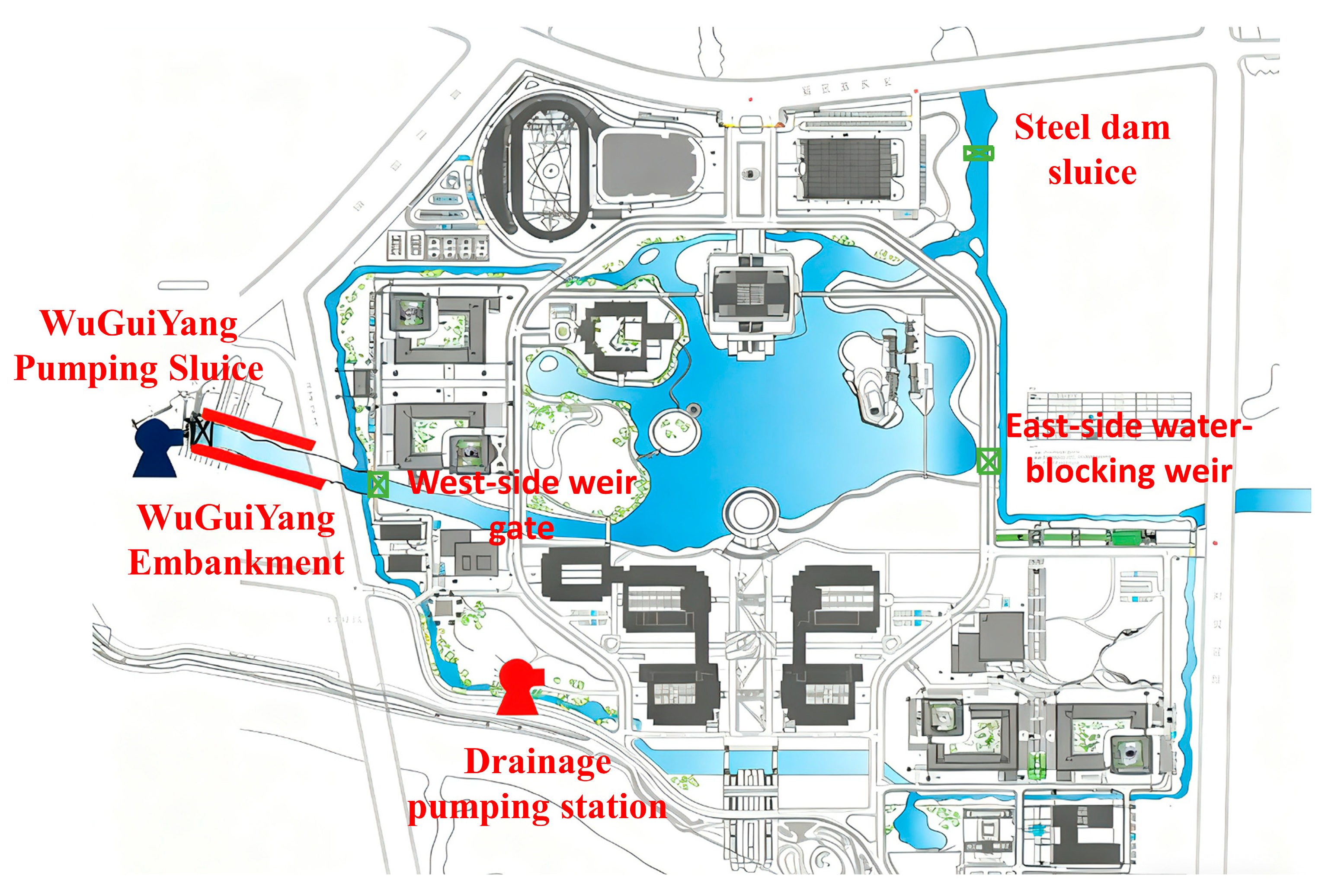
Nanxun District, under the jurisdiction of Huzhou City in Zhejiang Province, is located to the northeast of Hangzhou. With its low-lying, flat terrain crisscrossed by rivers, it is a typical example of a plain river network region. The average elevation of the area is less than 5 m, and the water system is densely distributed [24]. The study area is situated on the Nanxun Campus of Zhejiang University of Water Resources and Electric Power, with the river network layout shown in Figure 1. Within the study area, three rivers connect to the external river network, located on the west, north, and east sides. However, under normal conditions, the three sluice gates are typically kept closed.
The river network in the study area consists of a peripheral river and a central pond. To meet flood control and drainage requirements, the design water level within the computational domain of this study is set at 2.5 m. Given the relatively small domain size and mild river slope, the measured water level is close to 2.5 m; therefore, initializing the water level at 2.5 m can accurately reflect the actual conditions of the computational domain. An eastern weir, with a crest at 2.6 m, prevents flow when the water level is below the designed value. A western sluice gate, with a crest at 2.5 m, is typically closed, halting river flow. Only a small flow passes through the western gate when the water level reaches 2.55 m.

3. Physical Model

3.1. Governing Equation of the Hydrodynamic Module

The hydrodynamic module in the MIKE 21 FM platform is a core computational tool. Based on 2D shallow-water flow theory, it employs 2D unsteady shallow-water equations (a form of the 2D Navier–Stokes equations) to model water flow. Grounded in the Boussinesq and hydrostatic pressure assumptions, it effectively simulates large-scale flow under a free surface [25].
The 2D unsteady shallow-water equations are as follows [25]:
h t + u ¯ x + v ¯ y = h S h u ¯ t + h u ¯ x + v ¯ y = f v ¯ h g h η x h ρ 0 P a x g h 2 2 ρ 0 ρ x + τ s x ρ 0 τ b x ρ 0 1 ρ 0 ( s x x x + s x y y ) + x ( h T x x ) + y ( h T x y ) + h u s S v ¯ t + h u ¯ x + h v ¯ y = f u ¯ h g h η y h ρ 0 P a y g h 2 2 ρ 0 ρ y + τ s y ρ 0 τ b y ρ 0 1 ρ 0 ( s y x x + s y y y ) + x ( h T x y ) + y ( h T y y ) + h v s S
In the equation, h = η + d , where η is the riverbed elevation and d is the still-water depth. u ¯ and v ¯ represent the depth-averaged velocities in the x and y directions, respectively. t denotes time, f is the Coriolis coefficient, g is the gravitational acceleration, ρ is the density of water, ρ 0 is the relative density of water, and p a is the local atmospheric pressure. S x x ,   S x y ,   S y x ,   S y y are the components of radiation stress, S is the magnitude of point-source flow, and T i j represents the horizontal viscous stress term, which is calculated based on the gradient of the average flow velocity. u s ,   v s are the flow velocities in the x and y directions associated with the source term.

3.2. Mesh Generation and Parameter Settings

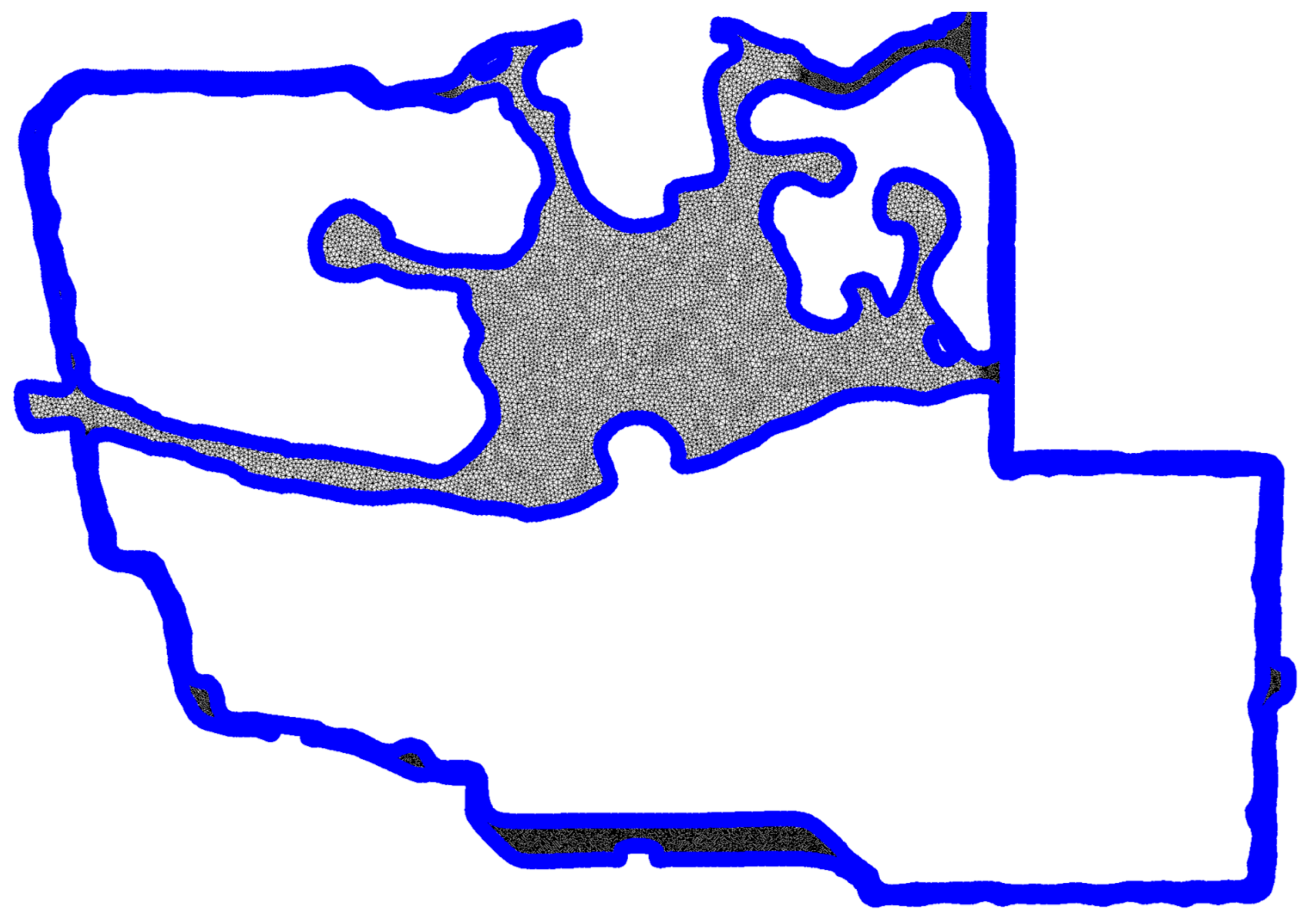
Mesh quality is critical for model accuracy and stability. An unstructured triangular mesh was used in this study due to its flexibility and high adaptability. The mesh size is 2 m in the central lake, 1 m in the river channels, and 0.5 m near narrow channels and hydrodynamic devices. This approach is better suited for complex boundaries and irregular channels, improving the model’s ability to capture local hydrodynamic variations. The meshing process generated 28.6 k nodes and 5.6 k elements. The overall mesh is shown in Figure 2.
The initial water level across the floodplain is set at 2.5 m. The water level limits for the weir gates on the west, north, and east sides, as well as the pumping station flow rates, are specified based on actual engineering conditions to better replicate the hydraulic boundary conditions on-site. Meanwhile, to ensure the stability and accuracy of the model calculations, it is crucial to appropriately define the solution format and various physical parameters.
The numerical solver employs a second-order scheme. The “order” of a numerical scheme determines how fast its truncation error converges as the grid spacing Δx and Δt decrease: for a first-order scheme, the truncation error is proportional to Δx and Δt, whereas for a second-order scheme it is proportional to (Δx)2 and (Δt)2. This implies that, at the same grid resolution, a second-order scheme provides higher accuracy. In the hydrodynamic module, the spatial discretization of the momentum equations and convective terms uses a second-order central-difference scheme. In the software implementation, this scheme is combined with a flux limiter to maintain stability in regions with strong gradients, thereby achieving a good balance between accuracy and robustness overall.
For the selection of key parameters, we referred to the settings used in previous simulations of the same study area. Those earlier studies have already calibrated and validated these key parameters; details can be found in Reference [24], where the discrepancy between the simulated results and the field measurements was controlled within 10%. The key parameter settings are as follows:
  • Time step: 0.01 s.
Setting a minimum time step (e.g., 0.01 s) reflects a trade-off between numerical stability and computational efficiency and serves as a protective measure. In solvers that determine the time step dynamically based on the CFL condition, the model automatically computes the maximum allowable time step from the local grid size and the fastest flow velocity in the current flow field. However, during the initial spin-up stage or in very shallow areas (e.g., near wetting–drying boundaries), the theoretically computed time step can become extremely small (e.g., <0.001 s). Without a lower bound, the simulation may enter an inefficient “creeping” mode, leading to a sharp increase in computational cost. A minimum value of 0.01 s is a widely used empirical lower limit in shallow-water simulations; it allows the model to advance stably and efficiently under most complex conditions while avoiding accumulated round-off errors associated with excessively small time steps.
  • CFL number: 0.8.
The CFL number is a stability criterion for explicit or semi-implicit time-marching schemes. In theory, the stability limit for a one-dimensional problem is 1. However, for the complex two-dimensional nonlinear shallow-water equations, a safety factor smaller than 1 is typically required to ensure global stability over the entire computational domain and throughout the simulation period. A value of 0.8 is a widely validated and reliable empirical choice in CFD and shallow-water modeling. By maintaining an adequate safety margin below the stability limit, it accommodates possible local abrupt changes in velocity or water depth during the run, thereby achieving a practical balance between numerical stability and computational efficiency (i.e., allowing the time step to be as large as possible while remaining stable).
  • Total simulation time: no less than 3 h.
The model is initialized from a quiescent state, and the flow field requires a certain adjustment period to evolve from rest to a quasi-steady, physically forced (often quasi-periodic) state. After approximately 3 h, the simulated water-level time series becomes stable; therefore, only outputs taken after this spin-up period are used for analysis, ensuring that the extracted data reflect the actual hydrodynamic processes in the study area rather than initial-condition transients.
  • Wetting–drying parameters: hdry = 0.0025 m, hflood = 0.05 m, hwet = 0.01 m.
Drying depth: When the water depth in a computational cell falls below this threshold, the cell is flagged as “dry” and its hydrodynamic calculations are suspended. This value should be larger than the level of numerical truncation/round-off errors to prevent small numerical fluctuations from causing high-frequency switching between “dry” and “wet” states, which can lead to instability. Flooding depth: When a “dry” cell is overtopped by water from neighboring “wet” cells and the predicted water depth exceeds this threshold, the cell is reactivated (flooded) and included again in the hydrodynamic computation. This value is set significantly larger than the drying depth to introduce sufficient hysteresis, ensuring that once inundation begins, intertidal flats transition stably to a wet state and avoid unstable toggling near the threshold. Wetting depth: This is an intermediate trigger, typically between the two thresholds, used to more finely control the transition from “dry” to “wet”. Given the relatively smooth water-level variations in this study, the recommended default thresholds for gradually varying flows were adopted.
  • Eddy viscosity coefficient: 0.28.
The eddy viscosity coefficient of 0.28 is specified as the constant parameter in the Smagorinsky subgrid-scale (SGS) turbulence model. In a two-dimensional depth-averaged framework, it is used to parameterize the turbulence effects filtered out by depth averaging, including contributions from three-dimensional turbulence and vertical shear. Under the assumption of homogeneous isotropic turbulence, theoretical analyses and numerical experiments have suggested a value on the order of ~0.2; subsequent studies have widely adopted this approach and commonly calibrate the constant within the range of 0.2–0.3. Therefore, 0.28 is a frequently used standard value within this range.
  • Manning’s coefficient: 0.025.
Manning’s coefficient (n) is a key parameter representing bed and bank roughness. In this study, the channel is primarily an artificially excavated earthen channel with slight vegetation and minor surface irregularities; therefore, n was set to 0.025.

3.3. Derivation of Hydrofoil Similarity Criteria

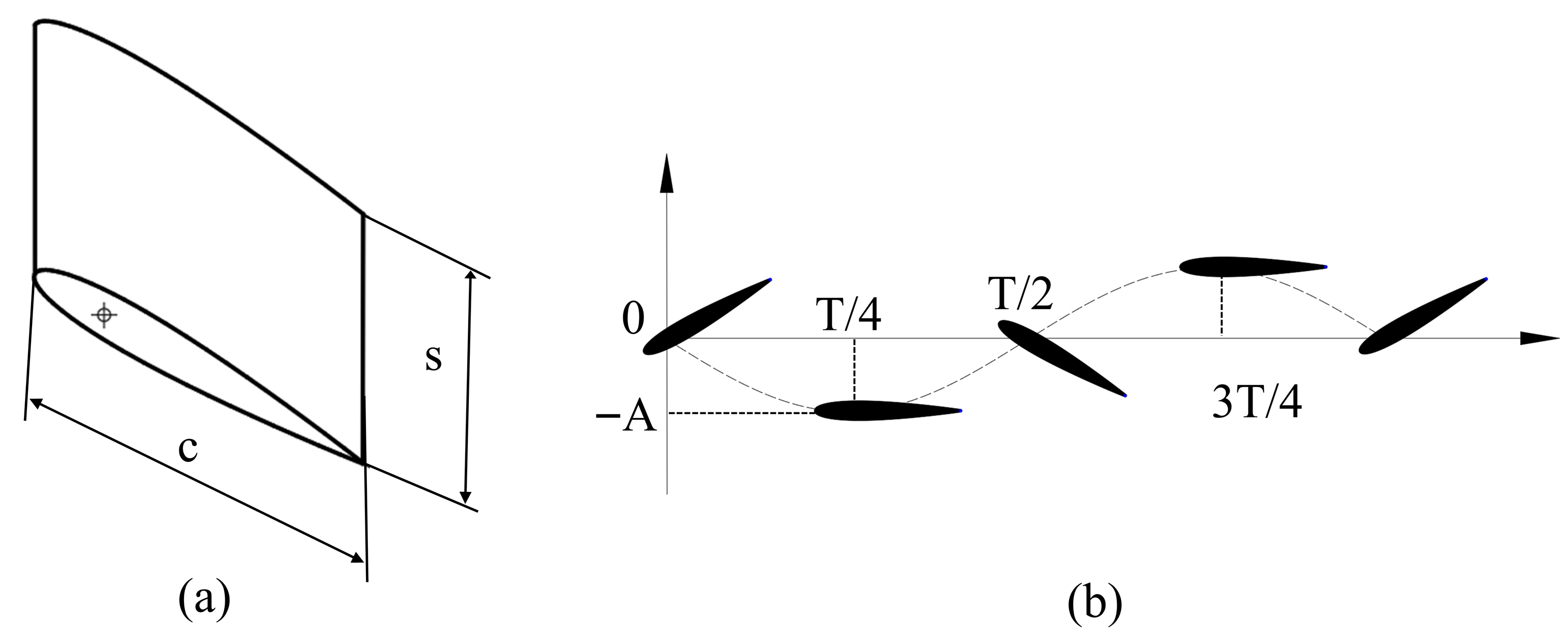
Figure 3 illustrates the geometry and motion of the bionic hydrofoil. As shown in Figure 3a, the hydrofoil adopts a standard NACA0012 profile. The NACA0012 airfoil is a classic symmetric airfoil with a maximum thickness of 12% of the chord length. Featuring a simple structure and stable hydrodynamic performance, it is widely used in bionic hydrofoils and underwater propulsion applications [26,27,28]. where c denotes the chord length and s the span. Figure 3b depicts the hydrofoil’s motion over a period, comprising coupled heaving and pitching harmonic motions. Its position varies with time according to specific equations (see [29] for details). Here, A is the heaving amplitude and T is the motion period.
Similarity theory is widely applied in large-scale turbomachinery, such as wind turbines and aero engines, with many mature criteria developed. To map parameters between experimental and engineering scales, this study adapts traditional similarity theory to bionic hydrofoil pumps, considering their unsteady vortex shedding, low Reynolds numbers, and non-geometric similarity [30,31,32]. The derived similarity principles include redefining dimensionless parameters, deriving scaling relationships for key physical quantities, and developing frequency design methods.
  • Redefinition of dimensionless parameters
The typical dimensionless parameters of a hydrofoil system include:
Strouhal number [27]:
S t = f A v
In the equation, f is the flapping frequency of the hydrofoil, and v is the characteristic velocity.
Reynolds number [27]:
Re = ρ f A c μ
In the equation, ρ and μ denote the fluid density and dynamic viscosity, respectively, and c is the chord length of the hydrofoil.
2.
Derived Similarity Law Formulas
The similarity derivation for flapping wing devices follows a process similar to that for traditional blade pumps, both being based on the similarity of internal flow kinematics. Unlike conventional rotating machinery, which typically employs the diameter D as the characteristic parameter, the characteristic parameter for flapping wing devices must be jointly determined by the chord length c and span length s. Therefore, by referencing the similarity criteria of conventional machinery, similarity criteria suitable for flapping wing devices are derived.
  • Scaling relationship for head H
Head is primarily influenced by amplitude and frequency, showing no direct relationship with chord length c or span R. Its scaling relationship is expressed as [33]:
H 2 = H 1 ( f 2 A 2 f 1 A 1 ) 2
  • Scaling relationship for flow rate Q
Flow depends on the sweeping area (A,R,c) and frequency f. Its scaling relationship is as follows [33]:
Q 2 = Q 1 f 2 A 2 R 2 c 2 f 1 A 1 R 1 c 1
  • Scaling relationship for power P
Power is determined by both head and flow rate, and its scaling relationship is expressed as follows [33]:
P 2 = P 1 f 2 3 A 2 3 R 2 c 2 f 1 3 A 1 3 R 1 c 1
3.
Determine the hydrofoil flapping frequency
To ensure vortex shedding similarity, the Strouhal number (St) must be kept constant. This leads to the following relationship [33]:
f 2 = f 1 A 1 A 2
If Reynolds number (Re) similarity must also be achieved, the following relationship can be derived [33]:
f 2 = f 1 A 1 c 1 A 2 c 2
If Reynolds number matching is also required, the Reynolds number (Re) must remain consistent. However, in practical engineering, Strouhal number similarity is typically prioritized, allowing Reynolds number to vary within an order of magnitude. Therefore, Strouhal number similarity is usually satisfied first.

4. Results and Discussion

This section aims to evaluate how different layouts of bionic hydrofoil devices influence the hydrodynamic characteristics of the river network in the study area. The flow velocity threshold is set based on the original river channel design scheme, where forced circulation by pumping stations maintains water flow velocity between 0.02 and 0.35 m/s. Therefore, this study aims to achieve a flow velocity of at least 0.02 m/s in the recirculating channel to identify the optimal layout scheme for flapping wing devices. After determining the required hydraulic parameters for the optimal layout, the minimum operating frequency of the hydrofoil device is derived using similarity theory, based on the target hydraulic parameters under the recommended conditions.

4.1. Effects of Different Hydrofoil Layouts and Operating Conditions on River Hydrodynamics

To analyze how different layouts and operating conditions of hydrofoil devices affect river hydrodynamics, based on the fact that the designed flow rate of the existing drainage pump station can achieve a river flow velocity greater than 0.02 m/s, this study designs seven typical scenarios for 2D hydrodynamic numerical simulations. The main control factors include device layout, water-blocking measures, flow rate, water level, and flow direction. Table 1 provides details on the device location, isolation status, flow rate, water level, and flow direction for each scenario. By comparing water surface elevation contours and local velocity distributions across scenarios, this study systematically evaluates the impact of different layouts on water circulation and hydraulic head loss, with the aim of identifying the optimal layout for low energy consumption and stable operation. This will provide a foundation for subsequent device parameter matching and operational optimization.

4.1.1. East-Side Channel Layout

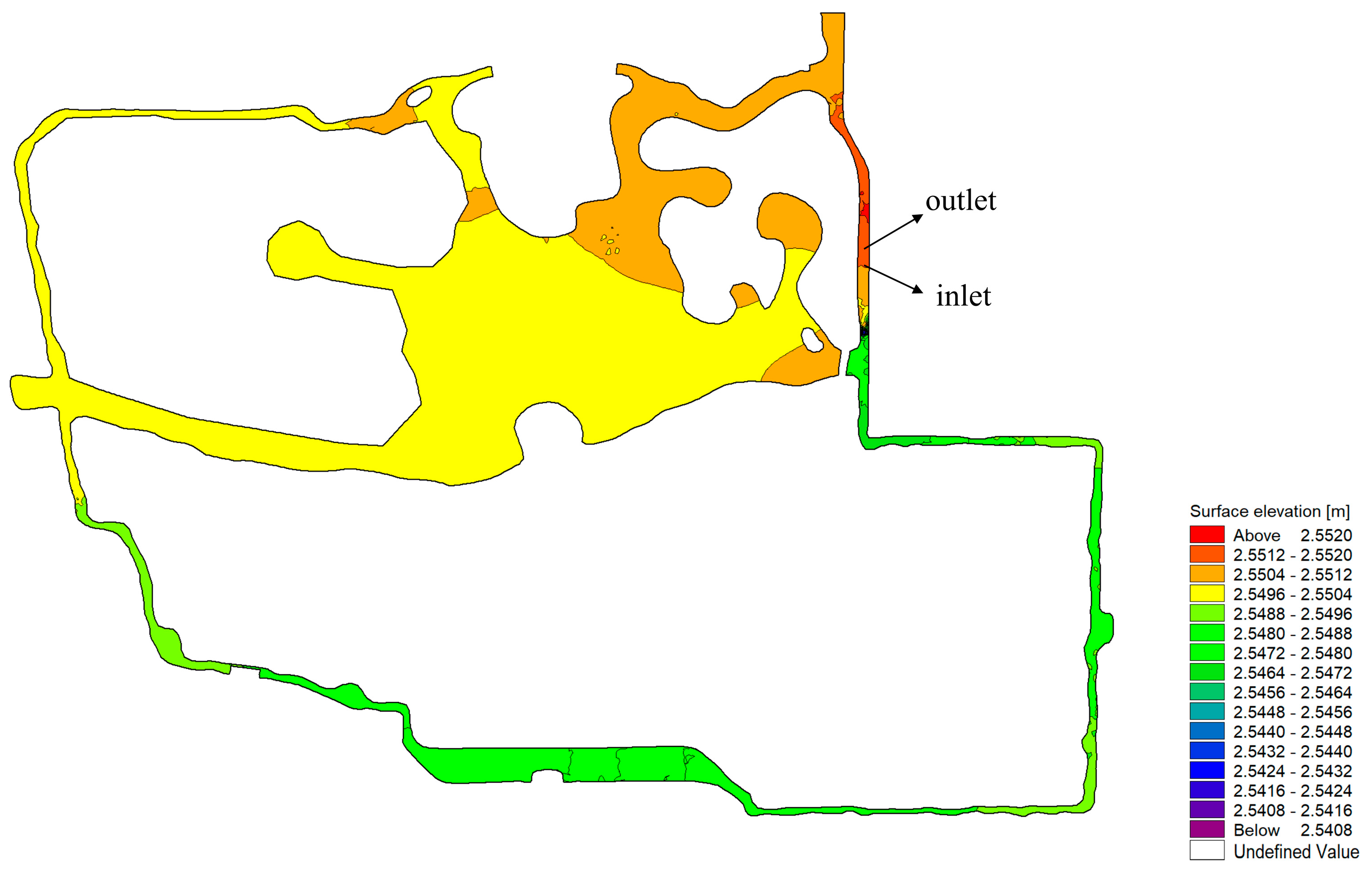
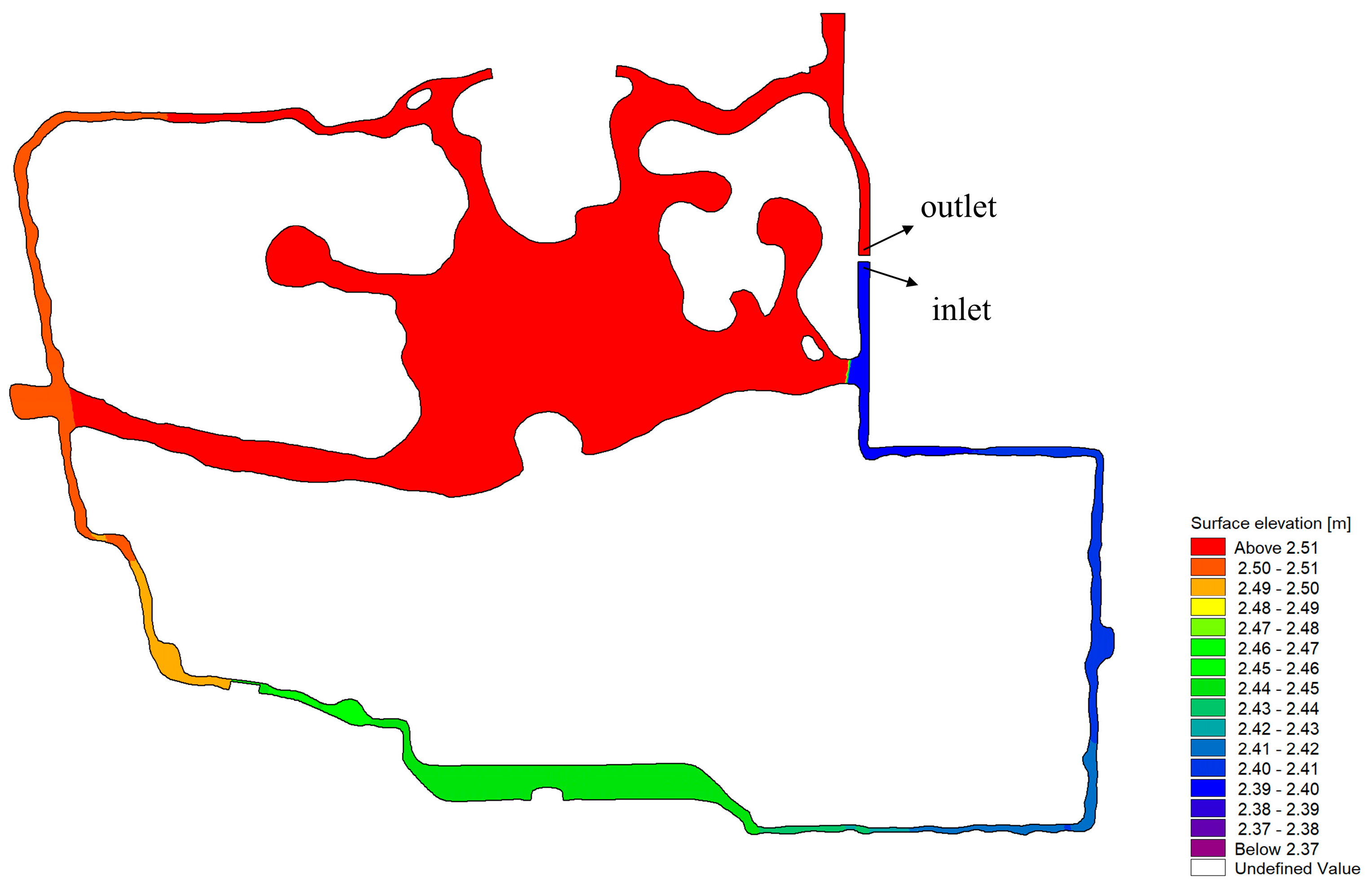
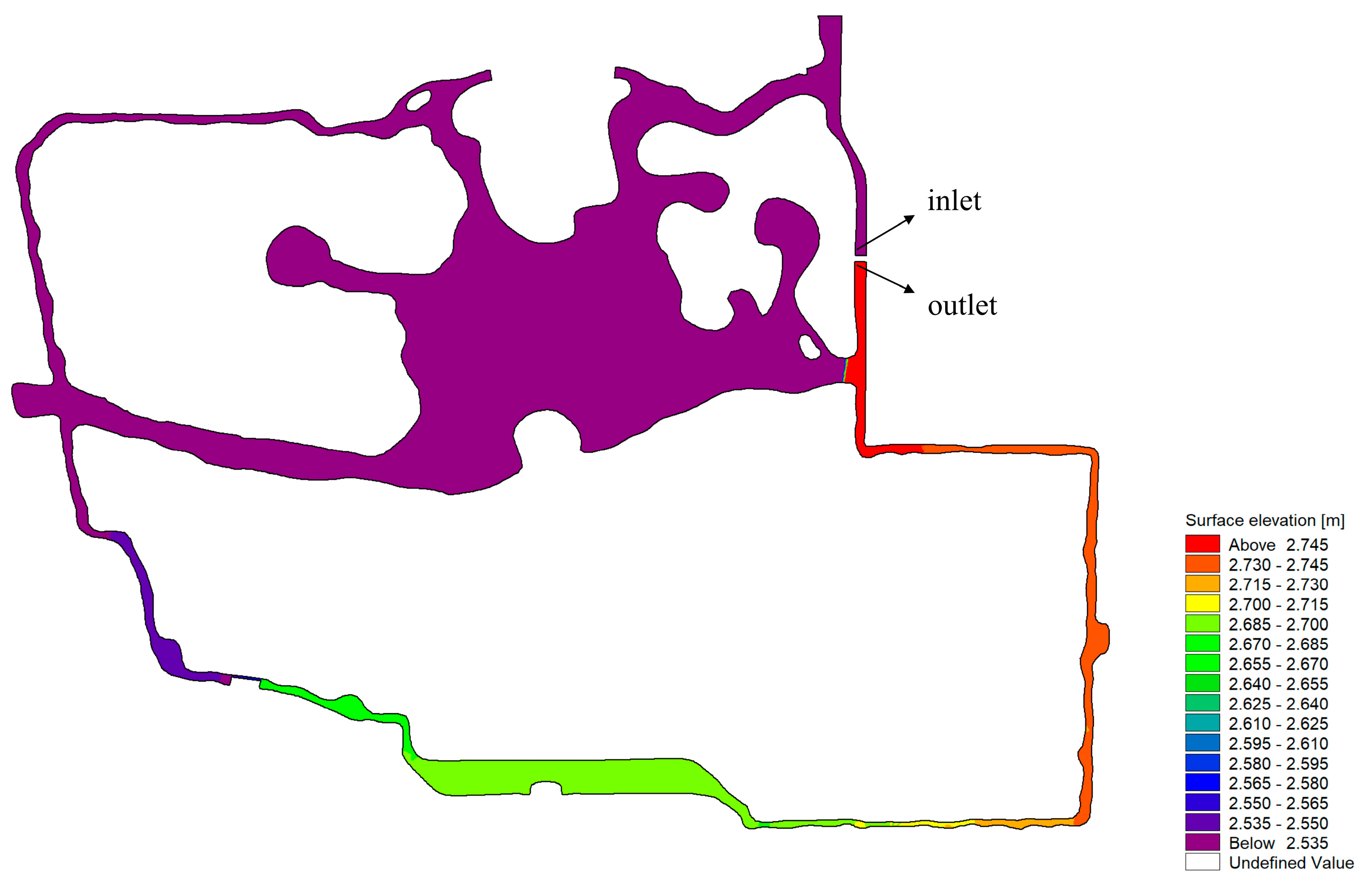
The bionic hydrofoil pumping device is deployed in the east-side channel, with five typical cases designed both with and without water-blocking measures to explore the flow field response and hydraulic characteristics under different flow rates, directions, and water levels. In cases with water-blocking, the flow rate is set to 1 m3/s, the water level to 2.5 m, and the flow direction to counterclockwise. The water surface elevation contour for this case is shown in Figure 4. A stable closed-loop flow path is formed, with a counterclockwise water level gradient in the outer channel. The inlet/outlet water level difference is approximately 0.14 m, indicating efficient energy utilization and a certain degree of system circulation.
In the absence of water-blocking measures, the flow rate is set to 2 m3/s, the water level to 2.5 m, and the flow direction to counterclockwise. The contour plot of water surface elevation for this operating condition is shown in Figure 5. As can be observed, the water level difference between the inlet and outlet is only about 0.01 m, indicating that overall water body circulation is difficult to promote and the energy utilization efficiency is low.
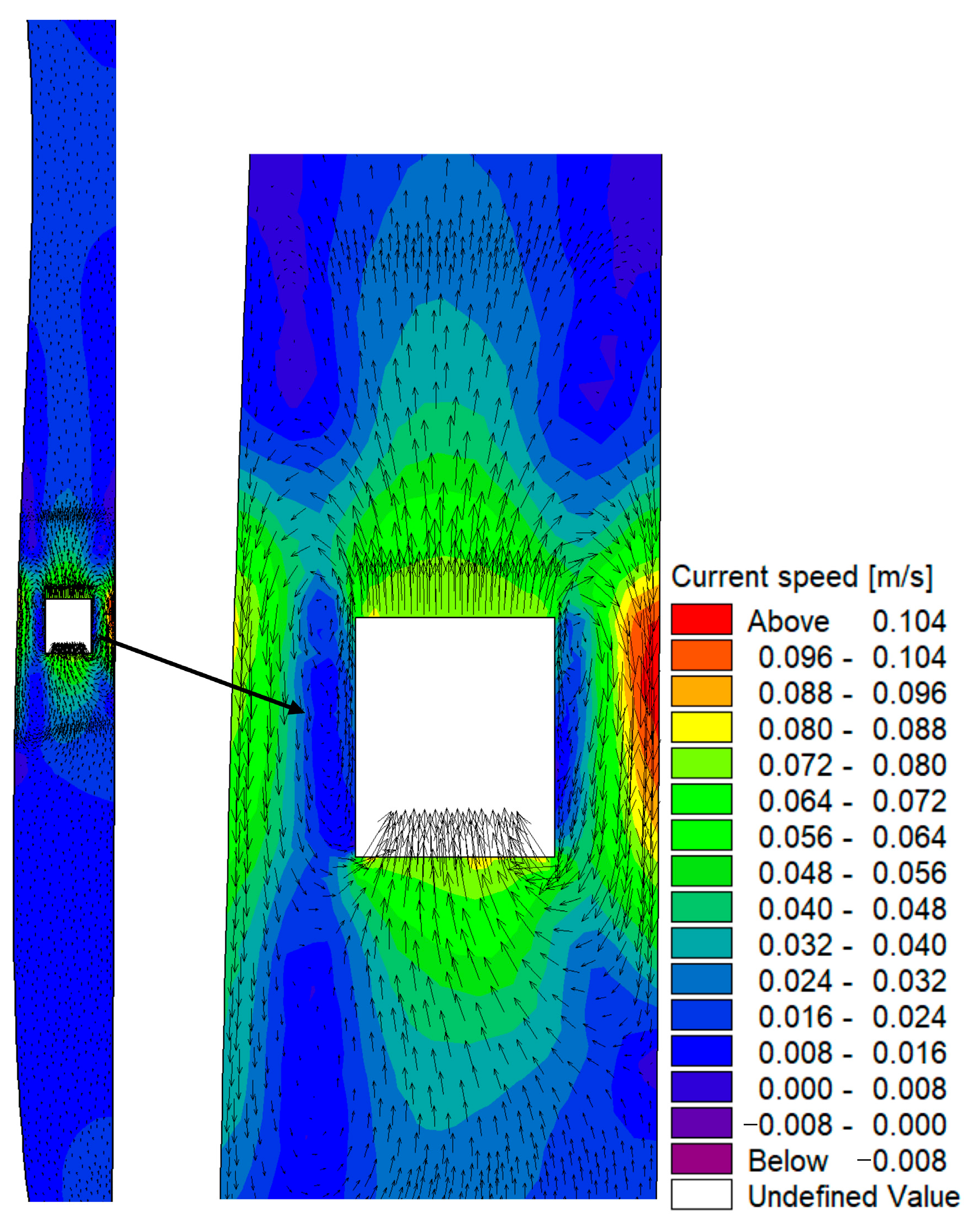
To further analyze the reasons for the extremely low water level difference between the inlet and outlet without water separation measures, the local velocity of the flapping wing device needs to be analyzed. The contour plot of its local velocity is shown in Figure 6. While distinct velocities appear upstream and downstream of the device, the water is pushed outward only to recirculate at the sides, failing to sustain flow throughout the channel. Symmetrical recirculation zones form on both sides of the device, trapping energy and preventing its downstream propagation. This stagnant pattern indicates minimal promotion of the overall flow. With a mere 0.01 m difference in water level between the system’s inlet and outlet, it is clear that overall water circulation is not significantly enhanced and energy utilization is inefficient.
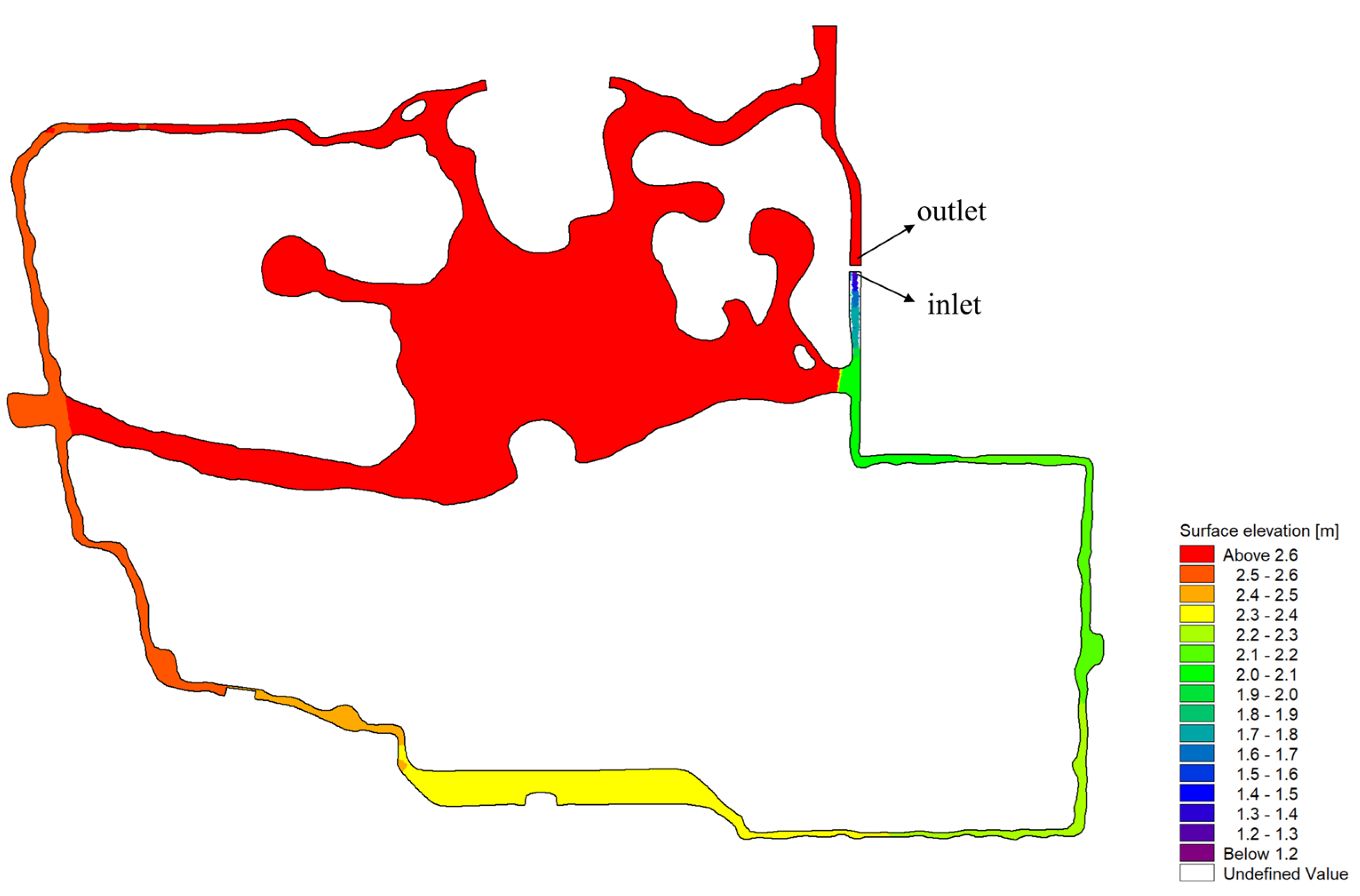
When water-blocking measures are in place, raising the water level to 2.55 m while keeping the flow rate at 2 m3/s and the flow direction counterclockwise, the water surface elevation contour (Figure 7) shows a significant 1.2 m difference in water level between the inlet and the main channel. The inlet water level is noticeably lower than that of the main channel, creating a hydraulic gradient within the system. Although this case demonstrates water movement into the main channel, the large water level difference impacts system stability and controllability, making it unsuitable as a recommended layout for practical engineering applications.
As shown in Figure 8, when the flow direction is changed from counterclockwise to clockwise under water-blocking conditions, with a flow rate of 2 m3/s and a water level of 2.55 m, the water surface elevation distribution changes. Compared to the counterclockwise case, the inlet water level rises, the outlet water level decreases slightly, and the hydraulic gradient between them diminishes, reducing the system’s water level difference to approximately 0.21 m. This indicates lower overall hydraulic losses, a more stable and continuous flow path, and improved flow organization.
Further raising the initial water level to 2.60 m yields the water surface elevation distribution shown in Figure 9. The system’s water level pattern closely resembles the previous case, with no significant change in the inlet/outlet water level difference, which remains approximately 0.21 m. This indicates that minor adjustments to the initial water level between 2.55 m and 2.60 m, under the current layout and flow direction, have a limited impact on the system’s flow characteristics.

4.1.2. Layout of Channels near the Pump House

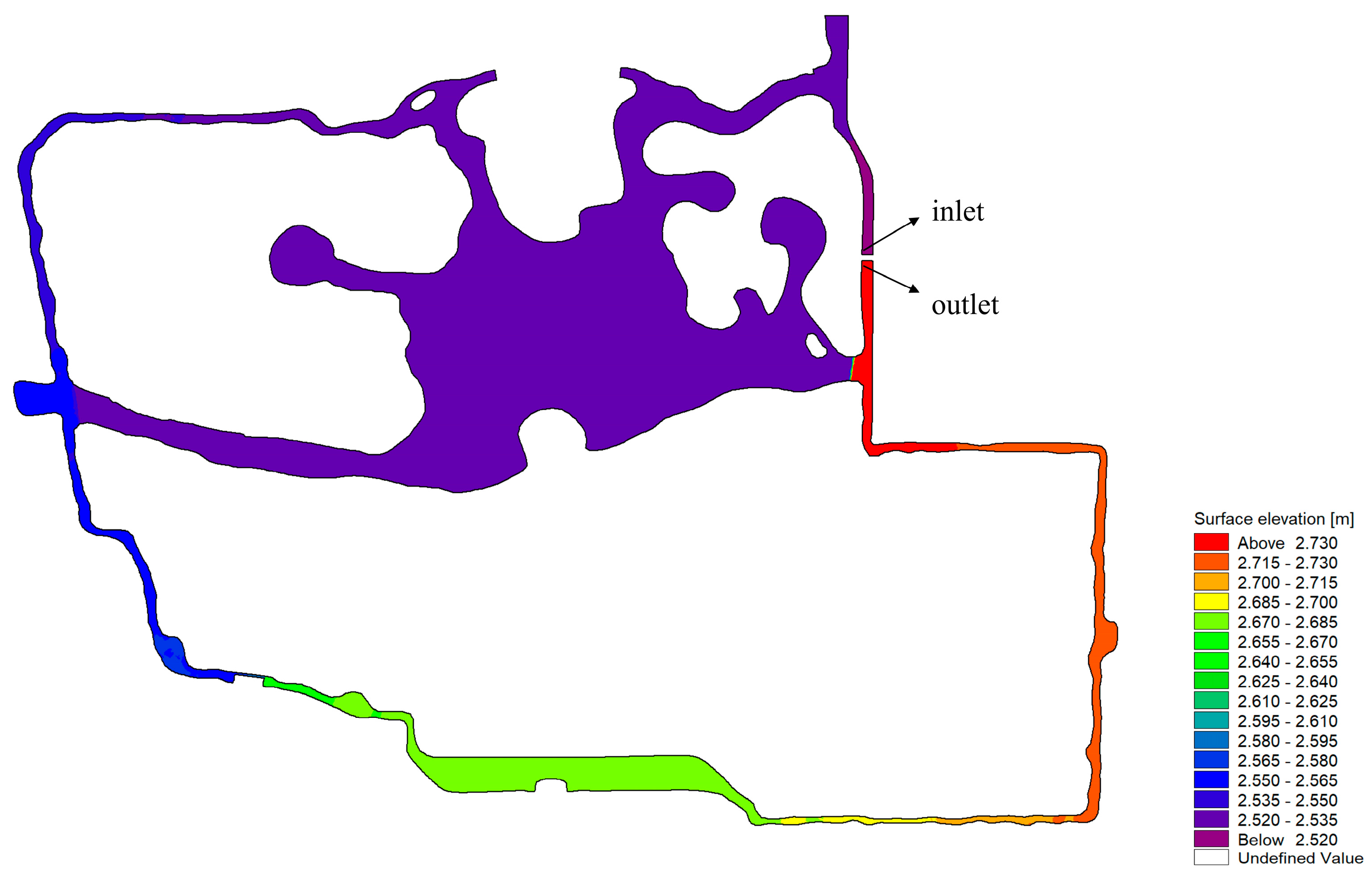
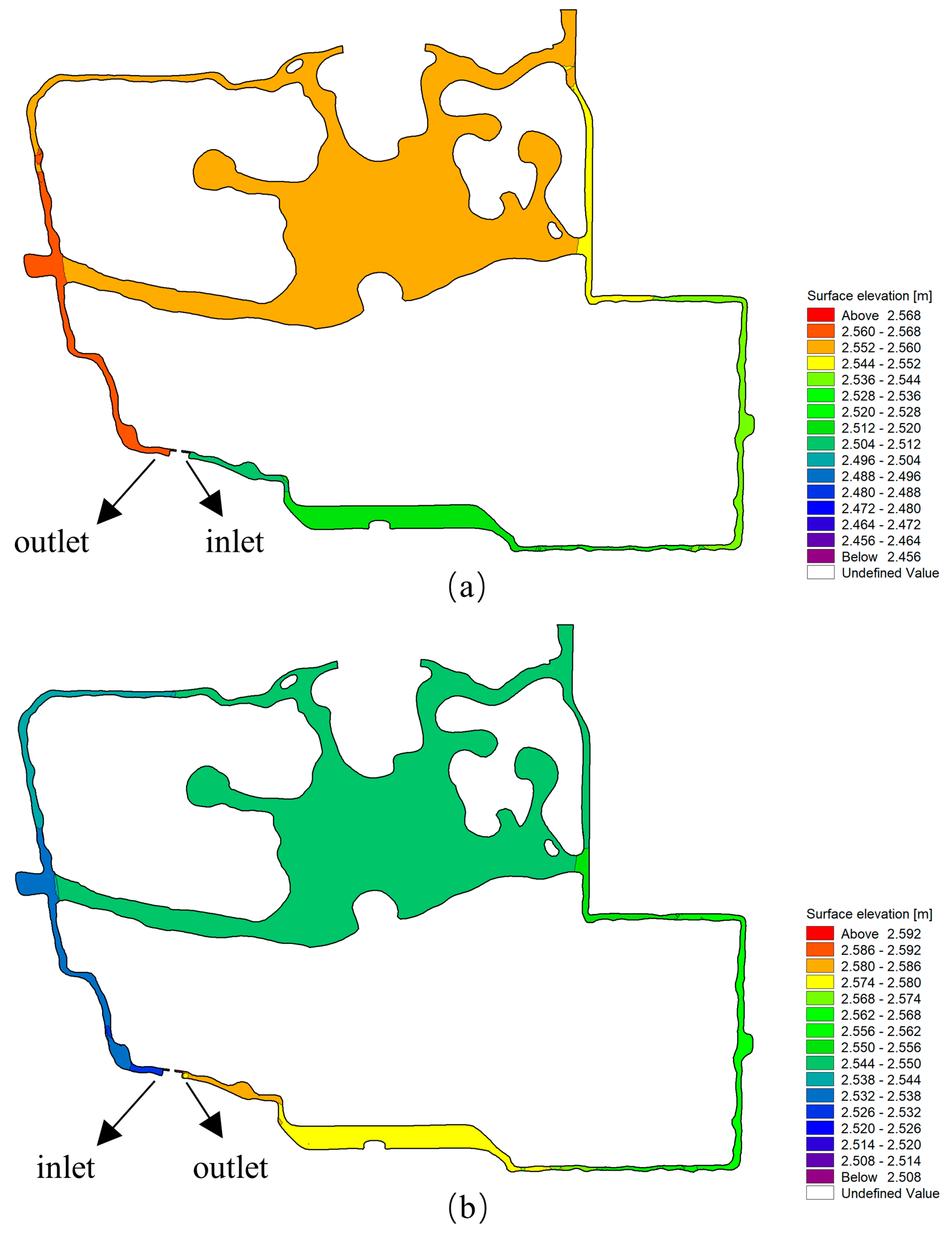
The bionic hydrofoil pumping device was deployed in a narrow channel near the original pump station. With water-blocking measures in place, simulations were conducted at a flow rate of 1 m3/s and a designed water level of 2.55 m for both clockwise and counterclockwise flow scenarios. The results are shown in Figure 10. Under clockwise flow, the water level difference between the inlet and outlet of the device was approximately 0.13 m, while under counterclockwise flow, this difference was further reduced to 0.084 m. The small water level differences under both flow directions are primarily due to the narrow channel, which facilitates rapid replenishment of the inlet flow due to the high flow velocity generated by the device during operation.
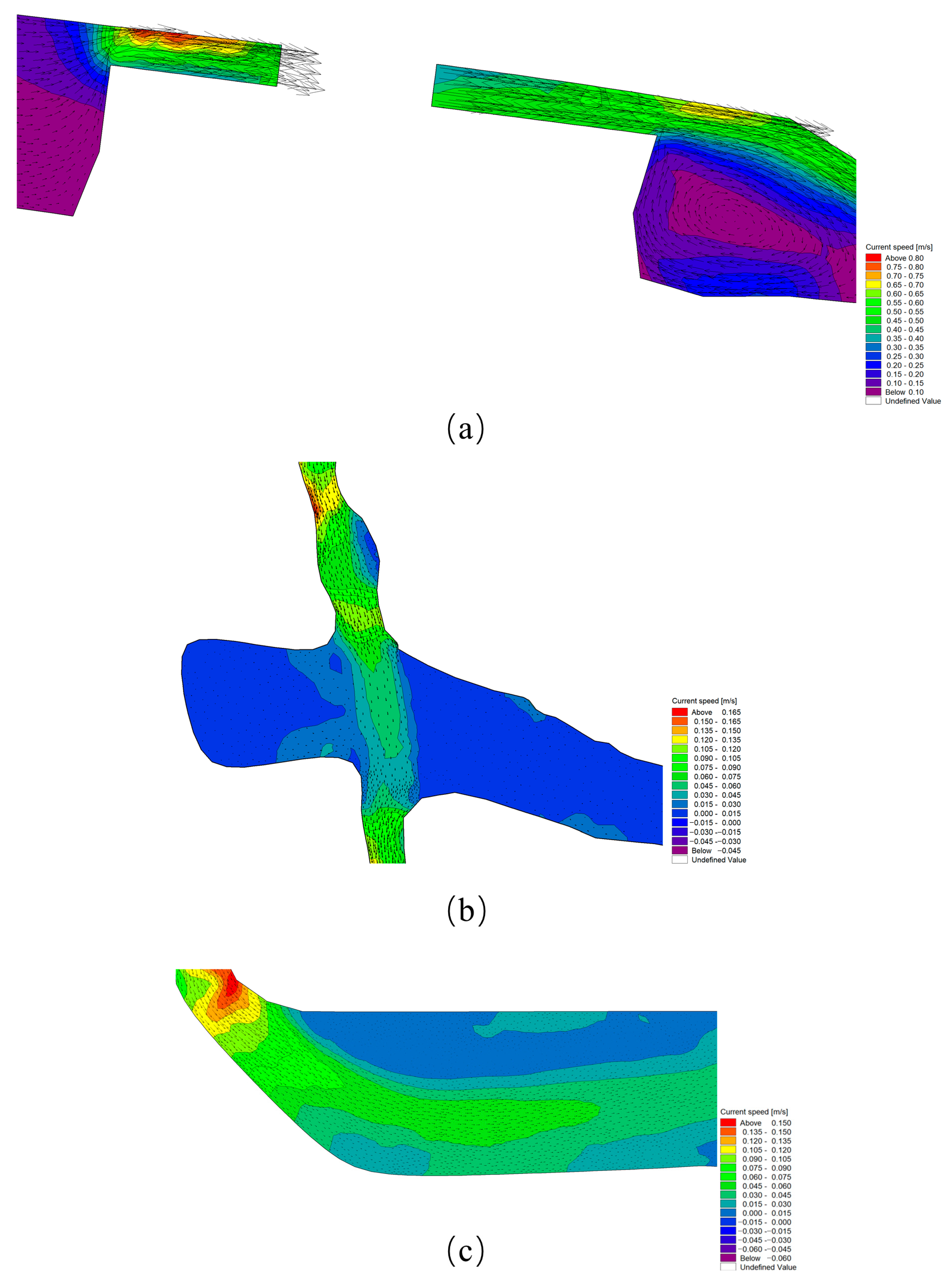
To verify whether the hydrodynamic response under this condition meets the basic water circulation requirements, local velocity distributions were analyzed in the layout area, the west-side gate, and its downstream area. The results are shown in Figure 11. Velocities in these critical zones are all above the minimum velocity standard of 0.02 m/s, indicating that the system has stable and continuous flow, ensuring effective water renewal.
Compared with other east-side channel layouts under the same flow and water level conditions, the “narrow channel near the pump house + water-blocking measures + counterclockwise flow” configuration results in the smallest water level difference, the lowest hydraulic losses, and the lowest required head, making it the most energy-efficient option. Overall, the “pump-house channel layout + water-blocking measures + 1 m3/s flow + 2.55 m water level + counterclockwise flow” configuration is identified as the optimal layout and operation strategy for this study.

4.2. Hydrofoil Device Operational Parameter Calculations

To refine the optimal layout of the “narrow channel near the pump house + counterclockwise flow,” it is essential to determine the operational parameters of three serial bionic hydrofoil pumps. This ensures the system meets the total flow rate of 1.0 m3/s and a head of 0.084 m while maximizing energy efficiency. Since existing experimental data is based on prototypes with different dimensions and frequency conditions, this study applies revised similarity formulas for hydrofoil devices. By establishing performance-scaling relationships, the minimum working frequency required for real-world applications is calculated.
According to previous experimental and simulation research [29], the prototype hydrofoil device uses a NACA0012 profile. Its geometric parameters are as follows: span R1 = 1 m, chord length c1 = 0.3 m, amplitude A1 = 0.15 m, and frequency f1 = 1 Hz. The corresponding head-flow data is shown in Table 2. It is observed that the head decreases gradually with increasing flow rate, being extremely low at higher flow rates, whereas the efficiency first increases and then decreases with increasing flow rate, being extremely low at lower flow rates. After polynomial fitting, the head-flow performance curve is obtained:
H 1 = 0.0385 Q 1 2 0.0087 Q 1 + 0.0242
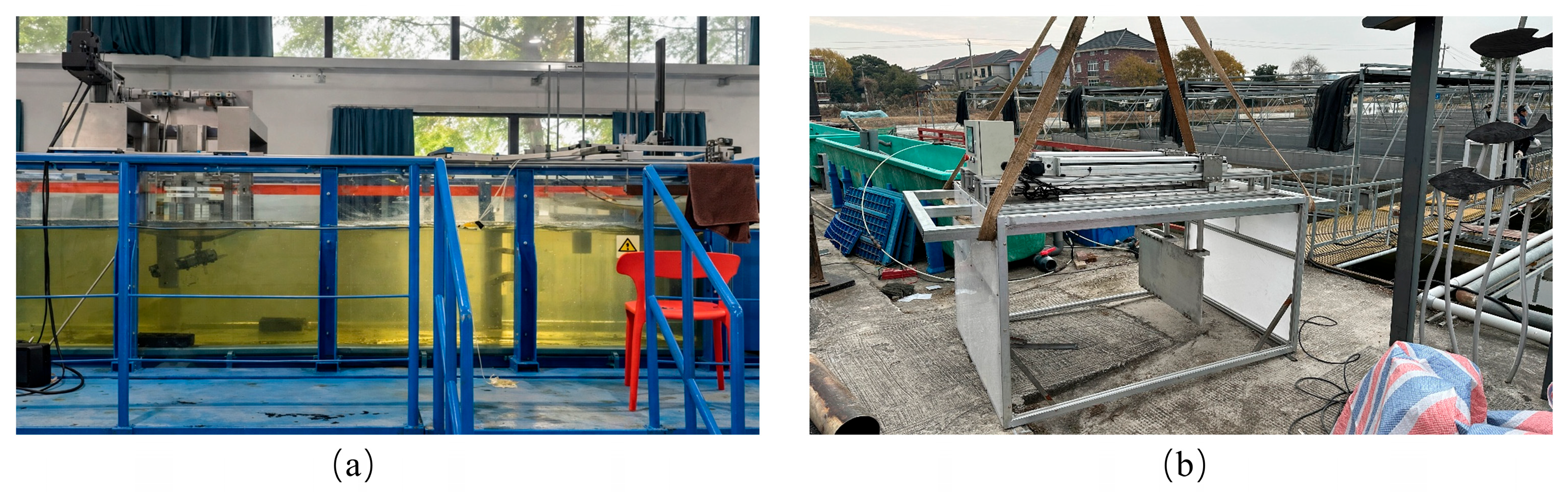
The previous experimental setup was only validated in an indoor environment, and the measurements in reference [29] were conducted using this equipment in a similar indoor setting, as shown in Figure 12a. The current study aims to apply the device in an actual river environment. Considering that the width of the river channels in the plain river network area and the study area typically ranges from 5 to 10 m, it is necessary to further increase the geometric parameters of the device, as shown in Figure 12b.
The geometric parameters of the hydrofoil device used in the river are as follows: span length R2 = 0.5 m, chord length c2 = 1.0 m, and amplitude A2 = 0.8 m. The three devices are arranged in series, and the frequency f2 required to meet the optimal operating conditions is calculated, where f2 = f, with f being the frequency to be determined. For ease of engineering calculations, all numerical results in this paper are rounded to three decimal places. The calculation is performed using the similitude conversion formula:
Head similarity transformation:
H 2 H 1 = f 2 A 2 f 1 A 1 2 = 0.8 f 0.15 2 = 28.444 f 2
Flow Similarity Transformation:
Q 2 Q 1 = f 2 A 2 R 2 c 2 f 1 A 1 R 1 c 1 = 0.4 f 0.045 = 8.889 f
By combining Equations (9)–(11), an expression for H2 can be obtained. Therefore, the performance expression of the target device is as follows:
H 2 = 0.01386 Q 2 2 0.02784 f Q 2 + 0.688 f 2
The three devices are connected in series, with the system head being additive and the flow rate remaining the same. Therefore, the total head Htotal is the direct sum of the heads of the three devices, and the total head Htotal expression is as follows:
H t o t a l = 3 H 2 = 0.04158 Q 2 2 0.08352 f Q 2 + 2.064 f 2
For river channels, the hydraulic loss induced by water flow driven by flapping wing devices is in the quadratic resistance region, where hydraulic loss is proportional to the square of the flow rate. Although various local losses occur due to sudden cross-section changes and flow channel turning, these local loss increments are typically proportional to the square of flow velocity, and consequently to the square of flow rate. The final river channel hydraulic loss model is as follows:
h f = s Q 2
Given the flow rate Q = 1 m3/s and a head loss of 0.084 m, the hydraulic loss fitting coefficient s = 0.084 is obtained for the river channel. The operating condition satisfies Htotal = h, so a quadratic equation is constructed to solve for Q2:
0.04158 Q 2 2 0.08352 f Q 2 + 2.064 f 2 = 0.084 Q 2 2
Treating f as a function of Q2, the two roots of the quadratic equation can be solved as f1 = 0.268 Q2 and f2 = −0.228Q2 (the latter does not match the actual operating conditions and is therefore discarded).
Substituting the conventional flow requirement Q = 1 m3/s in the river, the operating frequency is calculated to be 0.268 Hz. At this point, the system’s total flow Q2 = 1 m3/s and total head Htotal = 0.084 m, which satisfies the hydraulic requirements of the optimal layout condition.
When the water demand increases, the operating frequency of the device can be increased to achieve the required flow rate. In this study, for the daily water circulation demand with nearly zero head, the hydrofoil device can meet the daily water circulation requirement with low energy consumption. During special periods, if algal growth needs to be suppressed, the river velocity must be increased to 0.15 m/s [34], and the flow rate must be increased to 7.5 m3/s. The operating frequency can be raised from 0.268 Hz to 2.008 Hz. At this point, the average velocity of the hydrofoil’s flapping motion is 3.2 m/s, and the instantaneous maximum velocity is 4.53 m/s, which will not cause cavitation. When the power and structural stability of the device meet the requirements, it can effectively meet the engineering application requirements.

5. Conclusions

Based on MIKE21 numerical simulations and similarity theory, this study analyzed the impact of hydrofoil pump layouts on river network hydrodynamics and derived relevant similarity criteria. After identifying the optimal deployment scenario, the operational frequency required for the device to meet hydraulic requirements was calculated. The key conclusions are as follows:
  • When operating a hydrofoil pumping device, it is essential to use water-blocking measures. Without them, recirculation zones form around the device, leading to local energy loss and hindering the establishment of a sustained, system-wide water circulation pattern.
  • Analysis of different deployment cases shows that placing the device in a narrow channel near the pump house, with water-blocking measures, a flow rate of 1 m3/s, a designed water level of 2.55 m, and a counterclockwise flow direction, results in the lowest energy consumption and hydraulic loss while meeting velocity targets. This configuration represents the optimal deployment strategy for the study area.
  • Based on previous experimental data and the proposed hydrofoil similarity theory, a suitable similarity formula for hydrofoils is established. By clarifying the geometric parameters of the three serially connected hydrofoil devices, it is derived that the minimum operating frequency for the system to meet the design flow (1.0 m3/s) and head (0.084 m) is 0.268 Hz.
  • To meet the requirements for algal bloom suppression during special periods, the velocity in the channel must be increased to 0.15 m/s. The device’s operating frequency must be raised to 2.008 Hz to effectively inhibit algal growth and improve overall water quality management.
This study investigates the impact of bionic hydrofoil pumps on the hydrodynamic performance of rivers within the Zhejiang University of Water Resources and Electric Power campus, considering various factors such as placement positions, water-blocking measures, flow rates, water levels, and flow directions. Based on the flow velocity required for daily water management and algal control during special periods, the necessary flow rates were calculated. Additionally, using similarity theory and prior experimental data, the frequency required for the device to meet the target hydraulic conditions was derived.
The study currently focuses on the impact of three bionic hydrofoil pumps on the hydrodynamic performance of the entire river system under a concentrated layout. The results indicate that while a single device requires a lower operating frequency for daily water management, a higher frequency is needed to suppress algal growth during special periods. Future research will involve deploying multiple devices across different river sections, rather than the current concentrated layout, which will help reduce the frequency required for single pumps during algal control and explore how different deployment strategies can more effectively optimize water flow and hydrodynamic performance. Meanwhile, the frequencies required for the experimental setup in this study are calculated based on the specific chord length, span, and amplitude of the current large-scale apparatus; if the dimensions change, the calculations must be performed again. Furthermore, we have derived operating parameters suitable for engineering-scale applications based on similarity theory. However, scale differences between the experimental model and actual engineering, along with simplifications of some boundary conditions, may affect simulation accuracy. Therefore, in subsequent engineering applications, we will conduct prototype experiments and field validation to further verify and optimize the model’s applicability. This study primarily focuses on the layout configuration and hydraulic performance analysis of bionic flapping wing pump devices in river network systems, but has not yet thoroughly investigated the influence of variations in key motion parameters—such as device displacement and angle of attack—on flow patterns. The absence of these parameters may affect the device’s local flow characteristics. Therefore, we plan to incorporate these factors in future research to comprehensively enhance the performance evaluation of bionic flapping wing pumps.

Author Contributions

Conceptualization, E.H. and R.X.; methodology, E.H. and X.W.; software, R.X.; validation, R.X.; formal analysis, R.X.; investigation, R.X.; resources, R.X.; data curation, R.X.; writing—original draft preparation, R.X. and X.W.; writing—review and editing, R.X. and X.W.; visualization, R.X.; supervision, E.H.; project administration, E.H.; funding acquisition, E.H. All authors have read and agreed to the published version of the manuscript.

Funding

This research was funded by the Zhejiang Provincial Key Research and Development Project (Grant No. 2021C03019).

Data Availability Statement

Data are contained within the article.

Acknowledgments

The authors gratefully thank the Zhejiang Provincial Key Research and Development Project for their financial support.

Conflicts of Interest

The authors declare no conflicts of interest.

References

  1. Liang, C.; Wang, J.; Zhang, X.; Liu, L.; Wu, F. Research on Simulation of Drainage in Plain River Network Areas Based on Hydrological and Hydrodynamic Models. China Rural Water Hydropower 2025, 5, 17–23. [Google Scholar]
  2. Jiang, H.; Shi, Y.; Jiang, Z. Study on Scheme of Returning Polder to Lake in Xinghua Based on the Hydrodynamic Model of Plain River Network. China Rural Water Hydropower 2025, 5, 155–160+170. [Google Scholar]
  3. Wang, J.; Jiang, Y.; Zhang, L.; Li, Y.; Meng, N.; Qin, C. Schemes for Smooth Flow and Active Water in Plain River Network Polder Areas Considering Hydrodynamic Conditions and Water System Connectivity. Water Resour. Power 2024, 42, 39–42+61. [Google Scholar]
  4. Wang, J. Numerical Simulation on Hydrodynamics and Water Environment in Strongly Disturbed Region. Master’s Thesis, Wuhan University, Wuhan, China, 2017. [Google Scholar]
  5. Ma, C.; Yu, B.; Bin, L.-L.; Qiao, Y.-N. Construction and Key Techniques of Circulating Water Purification System Connected with Urban River Networks. J. Water Resour. Water 2021, 32, 7–14. [Google Scholar]
  6. Hua, E.; Wu, X.; Lin, Y.; Li, S. Parameter Optimization of Bionic Hydrofoil System and Its Application in Algal Bloom Control in Plain River Networks. Water 2025, 17, 3012. [Google Scholar] [CrossRef]
  7. Hua, E.; Song, Y.; Lu, C.; Xiang, M.; Wang, T.; Sun, Q. Numerical Study on the Influence of Installation Height and Operating Frequency of Biomimetic Pumps on the Incipient Motion of Riverbed Sediment. Water 2024, 16, 1925. [Google Scholar] [CrossRef]
  8. Hua, E.; Lu, C.; Xiang, M.; Song, Y.; Wang, T.; Sun, Q. Study on the Influence of Relative Chord Length and Frequency of Flapping Hydrofoil Device on Hydrodynamic Performance and Bank Slope Scour. Water 2025, 17, 1026. [Google Scholar] [CrossRef]
  9. Hua, E.; Wang, T.; Xiang, M.; Lu, C.; Song, Y.; Sun, Q. Study on the Influence of Chord Length and Frequency of Hydrofoil Device on the Discharge Characteristics of Floating Matter in Raceway Aquaculture. J. Mar. Sci. Eng. 2024, 12, 1584. [Google Scholar] [CrossRef]
  10. Hu, W.; Zhou, S.; Xu, Z.; Pan, W.; Cong, X.; Li, Y. Hydrodynamic Simulation and Flood Risk Analysis of Tide-Sensitive Section of Xiaoqing River Estuary Based on MIKE 21 Model. J. Univ. Jinan Sci. Technol. 2025, 39, 346–354. [Google Scholar]
  11. Wang, L.; Liao, G.; Chen, C.; Feng, J.; Yin, X.; Qi, X. Simulation of Residence Time and Eutrophication in a Pumped-Storage Reservoir Based on MIKE21 ECOLab. J. Lake Sci. 2025, 37, 1548–1562. [Google Scholar]
  12. Le Ngo, L.; Madsen, H.; Rosbjerg, D.; Pedersen, C.B. Implementation and Comparison of Reservoir Operation Strategies for the Hoa Binh Reservoir, Vietnam Using the Mike 11 Model. Water Resour. Manag. 2008, 22, 457–472. [Google Scholar] [CrossRef]
  13. Tansar, H.; Babur, M.; Karnchanapaiboon, S.L. Flood Inundation Modeling and Hazard Assessment in Lower Ping River Basin Using MIKE FLOOD. Arab. J. Geosci. 2020, 13, 934. [Google Scholar] [CrossRef]
  14. Zhang, K.; Wu, D.; Li, Y.; Chen, X.; Cheng, H. Research on Precision Water Diversion Scheme for Improving Water Quality in Plain River Networks Based on Numerical Simulation. Water Resour. Power 2024, 42, 64–68. [Google Scholar]
  15. Yu, S.; Li, Y.; Cheng, Y.; Shi, Y.; Cheng, Y.; Huang, Y.; Zhu, Y.; Pan, H.; Yue, Z.; Zheng, K. The Impacts of Water Diversion on Hydrodynamic Regulation of Plain River Network. J. Lake Sci. 2021, 33, 462–473. [Google Scholar] [CrossRef]
  16. Doulgeris, C.; Georgiou, P.; Papadimos, D.; Papamichail, D. Ecosystem Approach to Water Resources Management Using the MIKE 11 Modeling System in the Strymonas River and Lake Kerkini. J. Environ. Manag. 2012, 94, 132–143. [Google Scholar] [CrossRef] [PubMed]
  17. Nigussie, T.A.; Altunkaynak, A. Modeling the Effect of Urbanization on Flood Risk in Ayamama Watershed, Istanbul, Turkey, Using the MIKE 21 FM Model. Nat. Hazards 2019, 99, 1031–1047. [Google Scholar] [CrossRef]
  18. Petersen, G.; Fohrer, N. Two-Dimensional Numerical Assessment of the Hydrodynamics of the Nile Swamps in Southern Sudan. Hydrol. Sci. J. 2010, 55, 17–26. [Google Scholar] [CrossRef]
  19. Coutinho, C.P.; Baptista, A.J.; Rodrigues, J.D. Reduced Scale Models Based on Similitude Theory: A Review up to 2015. Eng. Struct. 2016, 119, 81–94. [Google Scholar] [CrossRef]
  20. Li, R.; Liu, S.; Li, D.; Li, Y.; Liu, X. Aerodynamic Characteristics Analysis of Wind Turbine Based on Similarity Theory. Acta Energiae Solaris Sin. 2015, 36, 2916–2921. [Google Scholar]
  21. Tan, J.; Wang, P.; Yuan, P.; Wang, S.; Si, X. Research on Analysis of Tidal Turbine Force-Related Characteristics Based on Similarity Theory. Acta Energiae Solaris Sin. 2019, 40, 456–461. [Google Scholar]
  22. Lagopoulos, N.S.; Weymouth, G.D.; Ganapathisubramani, B. Universal Scaling Law for Drag-to-Thrust Wake Transition in Flapping Foils. J. Fluid Mech. 2019, 872, R1. [Google Scholar] [CrossRef]
  23. Lau, T.C.W.; Kelso, R.M. A Scaling Law for Thrust Generating Unsteady Hydrofoils. J. Fluids Struct. 2016, 65, 455–471. [Google Scholar] [CrossRef]
  24. Xu, C.; Ren, Z.; Li, Z.; Zhao, Z.; Zi, Y.; Xu, H.; Hu, X. Study of Hydrodynamic and Water Quality Coupling Simulation of River Network in Nanxun District Based on Software MIKE21. Environ. Sci. Technol. 2022, 45, 51–59. [Google Scholar]
  25. Feng, D. Optimization and Analysis of the Operation Mode of an Artificial Lake Based on MIKE21 Numerical Simulation. Master’s Thesis, Taiyuan University of Technology, Taiyuan, China, 2019. [Google Scholar]
  26. Gupta, S.; Sharma, A.; Agrawal, A.; Thompson, M.C.; Hourigan, K. Role of Shape and Kinematics in the Hydrodynamics of a Fish-like Oscillating Hydrofoil. J. Mar. Sci. Eng. 2023, 11, 1923. [Google Scholar] [CrossRef]
  27. Read, D.A.; Hover, F.S.; Triantafyllou, M.S. Forces on Oscillating Foils for Propulsion and Maneuvering. J. Fluids Struct. 2003, 17, 163–183. [Google Scholar] [CrossRef]
  28. Kant, R.; Bhattacharyya, A.; Siddiqui, M.A. Hydrodynamic Performance of Pitching Foils with Two Leading-Edge Protuberances. Ocean Eng. 2024, 309, 118470. [Google Scholar] [CrossRef]
  29. Hua, E.; Chen, W.; Tang, S.; Xie, R.; Guo, X.; Xu, G. Water Pushing Flow Characteristics of Flapping Hydrofoil Device in Small River. Trans. Chin. Soc. Agric. Mach. 2022, 53, 154–162. [Google Scholar]
  30. Zhang, X.; Zhang, L.; Wang, K.; Cui, X.; Liu, Z. Aerodynamic-Structural Similarity Criteria for Scaled-down Models of Ultra-Long Wind Turbine Blade. Renew. Energy 2026, 256, 124184. [Google Scholar] [CrossRef]
  31. Prasad, D. Aerodynamic Similarity Principles and Scaling Laws for Windmilling Fans. J. Turbomach. 2018, 140, 121004. [Google Scholar] [CrossRef]
  32. Brusca, S.; Lanzafame, R.; Messina, M. Flow Similitude Laws Applied to Wind Turbines through Blade Element Momentum Theory Numerical Codes. Int. J. Energy Environ. Eng. 2014, 5, 313–322. [Google Scholar] [CrossRef]
  33. Wu, S.; Wang, Y.; Han, X.; Zhao, H.; Wu, L. Similarity Conversion Model Test and Performance Study of Water Jet Propulsion Pump. Ship Eng. 2022, 44, 81–85+128. [Google Scholar]
  34. Zhang, H.; Chen, R.; Li, F.; Chen, L. Effect of Flow Rate on Environmental Variables and Phytoplankton Dynamics: Results from Field Enclosures. Chin. J. Ocean. Limnol. 2015, 33, 430–438. [Google Scholar] [CrossRef]
Figure 1. Layout of the study area river network.
Water 18 00447 g001
Figure 2. Mesh generation for simulation domain.
Water 18 00447 g002
Figure 3. Hydrofoil geometry and motion schematic: (a) configuration diagram; (b) motion schematic at different times.
Water 18 00447 g003
Figure 4. Case 2: Water surface elevation contour plot.
Water 18 00447 g004
Figure 5. Case 1: Water surface elevation contour plot.
Water 18 00447 g005
Figure 6. Velocity contour near the hydrofoil device under non-isolated conditions.
Water 18 00447 g006
Figure 7. Case 3: Water surface elevation contour plot.
Water 18 00447 g007
Figure 8. Case 4: Water surface elevation contour plot.
Water 18 00447 g008
Figure 9. Case 5: Water surface elevation contour plot.
Water 18 00447 g009
Figure 10. Water surface elevation contour: (a) Case 6; (b) Case 7.
Water 18 00447 g010
Figure 11. Local velocity distributions in different areas: (a) Local velocity around the hydrofoil device; (b) Local velocity near the west-side gate; (c) Local velocity downstream of the west-side gate.
Water 18 00447 g011
Figure 12. Two experimental setups of different sizes: (a) Indoor experimental setup; (b) Setup suitable for river environment.
Water 18 00447 g012
Table 1. Parameter settings for each case.
CaseDevice LocationIsolationFlow Rate Q (m3/s)Water Level (m)Flow Direction
1East-side channelNo22.5Counterclockwise
2East-side channelYes12.5Counterclockwise
3East-side channelYes22.55Counterclockwise
4East-side channelYes22.55Clockwise
5East-side channelYes22.6Clockwise
6pump house channelYes12.55Clockwise
7pump house channelYes12.55Counterclockwise
Table 2. Preliminary data: trend of head and efficiency variation with flow rate.
Flow Rate Q (m3/s)Head H (m)Efficiency
000
0.077970.02420.06462
0.15710.021030.13304
0.23640.020510.20684
0.31540.017490.27395
0.391740.01460.32236
0.47220.01290.36114
0.54850.011040.3777
0.62120.009060.36968
0.68890.006770.32074
0.76120.004320.23904
Disclaimer/Publisher’s Note: The statements, opinions and data contained in all publications are solely those of the individual author(s) and contributor(s) and not of MDPI and/or the editor(s). MDPI and/or the editor(s) disclaim responsibility for any injury to people or property resulting from any ideas, methods, instructions or products referred to in the content.