Review

Multi-Stable Isotope Constraints on the Sources and Evolution of Potash-Forming Fluids in the Mahai Basin, Qinghai–Tibetan Plateau


1
Qinghai Geological Survey, Technology Innovation Center for Exploration and Exploitation of Strategic Mineral Resources in Plateau Desert Region, Ministry of Natural Resources, Xining 810001, China
2
Key Laboratory for Water Quality and Conservation of the Pearl River Delta, Ministry of Education, School of Environmental Science and Engineering, Guangzhou University, Guangzhou 510006, China
3
State Key Laboratory of Environmental Geochemistry, Institute of Geochemistry, Chinese Academy of Sciences, Guiyang 550081, China
4
Key Laboratory of Green and High-end Utilization of Salt Lake Resources, Qinghai Institute of Salt Lakes, Chinese Academy of Sciences and Qinghai Provincial Key Laboratory of Geology and Environment of Salt Lakes, Xining 810016, China
5
Key Laboratory of Tibetan Plateau Land Surface Processes and Ecological Conservation, Ministry of Education, Academy of Plateau Science and Sustainability, Qinghai Normal University, Xining 810008, China
6
State Key Laboratory of Plateau Ecology and Agriculture, Qinghai University, Xining 810016, China
*
Authors to whom correspondence should be addressed.
Water 2026, 18(4), 443; https://doi.org/10.3390/w18040443
Submission received: 11 January 2026 / Revised: 4 February 2026 / Accepted: 6 February 2026 / Published: 7 February 2026

Abstract

The Mahai Basin (MHB), situated in the northern Qaidam Basin on the Qinghai–Tibetan Plateau, hosts significant Quaternary potash resources. Nevertheless, the sources and evolutionary pathways of potash-forming fluids remain controversial. In this study, a comprehensive multi-isotope dataset and online-first publications spanning the period from 2015 to 2025 were compiled to constrain the end-member characteristics and evolution of brines in the MHB. δD-δ18O indicates that the initial fluids were derived mainly from Qilian Mountains precipitation and snowmelt, delivered via surface runoff and concentrated through prolonged evaporation under arid, semi-closed conditions, forming a river-lake-brine evolution sequence. δ7Li (+7‰ to +40‰) systematically increases with salinity and K content, reflecting long-term low-temperature water–rock interactions and selective 6Li adsorption by secondary clays, while deep Ca-Cl brines represent highly evolved endmembers. Elevated 87Sr/86Sr ratios (0.7113–0.7122) confirm silicate weathering contributions, with intercrystalline brines acting as key intermediate end members. B, S, and Cl isotopes further highlight deep fluid ascent along faults and anticlines, driving K co-enrichment, while sandy–gravel brines inherit highly evolved paleo-lake signatures. These multi-isotope constraints define an integrated evolutionary model involving surface runoff recharge, evaporation-driven concentration with water–rock interaction, deep fluid mixing, lateral migration, and final potash precipitation.

1. Introduction

Potassium (K) is an essential nutrient for plant growth and a key component of agricultural fertilizers, playing a critical role in global food security [1]. Globally, more than 90% of K production is consumed by the fertilizer industry, with the remainder used for industrial purposes [1,2]. Although China ranks fourth worldwide in terms of K resource reserves [3], domestic production satisfies only approximately 50% of national demand, resulting in a strong reliance on imports [4]. Consequently, the identification and development of new K resources are of strategic importance for ensuring sustainable agricultural development and national food security in China [5,6].
K resources in China are mainly distributed in the Qaidam Basin (QB), Lop Nur in Xinjiang, salt lakes of the Tibetan Plateau, and the Mengyejing area in Yunnan [2,7]. Among these regions, the QB, located on the northeastern margin of the Qinghai–Tibet Plateau, is a Mesozoic–Cenozoic intermontane sedimentary basin containing 33 salt lakes. Proven K reserves in this basin account for more than 65% of the national total [3,4,8]. The basin hosts abundant solid and liquid K resources [9] and represents the most important base for K exploitation in China [10]. Therefore, investigations into the K metallogenic mechanisms of the QB are of fundamental significance for advancing theoretical models of continental K mineralization.
In the QB, K is predominantly concentrated in salt lake brines [9,11]. The Mahai Basin (MHB), located in the northern QB, hosts the second-largest medium-scale K deposit after the Qarhan Salt Lake [12]. K mineralization in this area occurs in solid–liquid assemblages developed at surface to shallow subsurface levels [13,14,15]. Multiple types of K-rich brines are present, including confined brines, sandy–gravel brines, anticline-related brines, and oilfield brines [15,16,17]. Different brine types in the MHB exhibit distinct hydrochemical characteristics [7,17,18], making it an ideal natural laboratory for integrated studies of the hydrogeochemical characteristics and formation processes of K-rich brines [5]. These features provide fundamental insights into the deposition and provenance of brine and evaporites. Consequently, investigations into the genesis and occurrence mechanisms of K-rich brines in the MHB are of particular importance, especially for constraining the sources of ore-forming materials and refining metallogenic models for K resources in the Qaidam Basin.
In recent years, extensive research has been conducted on the genesis, occurrence patterns, spatial distribution, and exploration strategies of potash deposits in the MHB. These studies encompass brine hydrochemical classifications [5,10,19], mineralogical characteristics [7,12,20], and simulations of evaporative precipitation processes [21]. As a result, abundant datasets have been accumulated and relatively mature theoretical frameworks have been established [15,19,22]. With the rapid development of non-traditional stable isotope techniques, multi-isotopic systems have become powerful tracers for investigating material sources and enrichment mechanisms in salt lake systems [3,9,19,21,23]. Isotopic studies have significantly advanced our understanding of fluid sources, evolutionary pathways, and metallogenic processes in the MHB [7,8,21,24,25].
Despite these advances, several key issues remain insufficiently synthesized, including the identification of fluid end members, quantitative evaluation of their relative contributions, and the mechanisms governing multi-source fluid mixing. This study aims to systematically review recent stable isotope geochemical studies in the MHB, with a focus on: (1) the isotopic compositional characteristics of different brine types; (2) constraints imposed by isotopic evidence on fluid sources; and (3) isotopic implications for fluid evolution processes. This synthesis is expected to enhance our understanding of ore-forming fluid end members and their evolution in the MHB, thereby providing a robust theoretical basis for elucidating potash metallogenic processes in the MHB and the Qaidam Basin as a whole.

2. Geological and Hydrological Settings

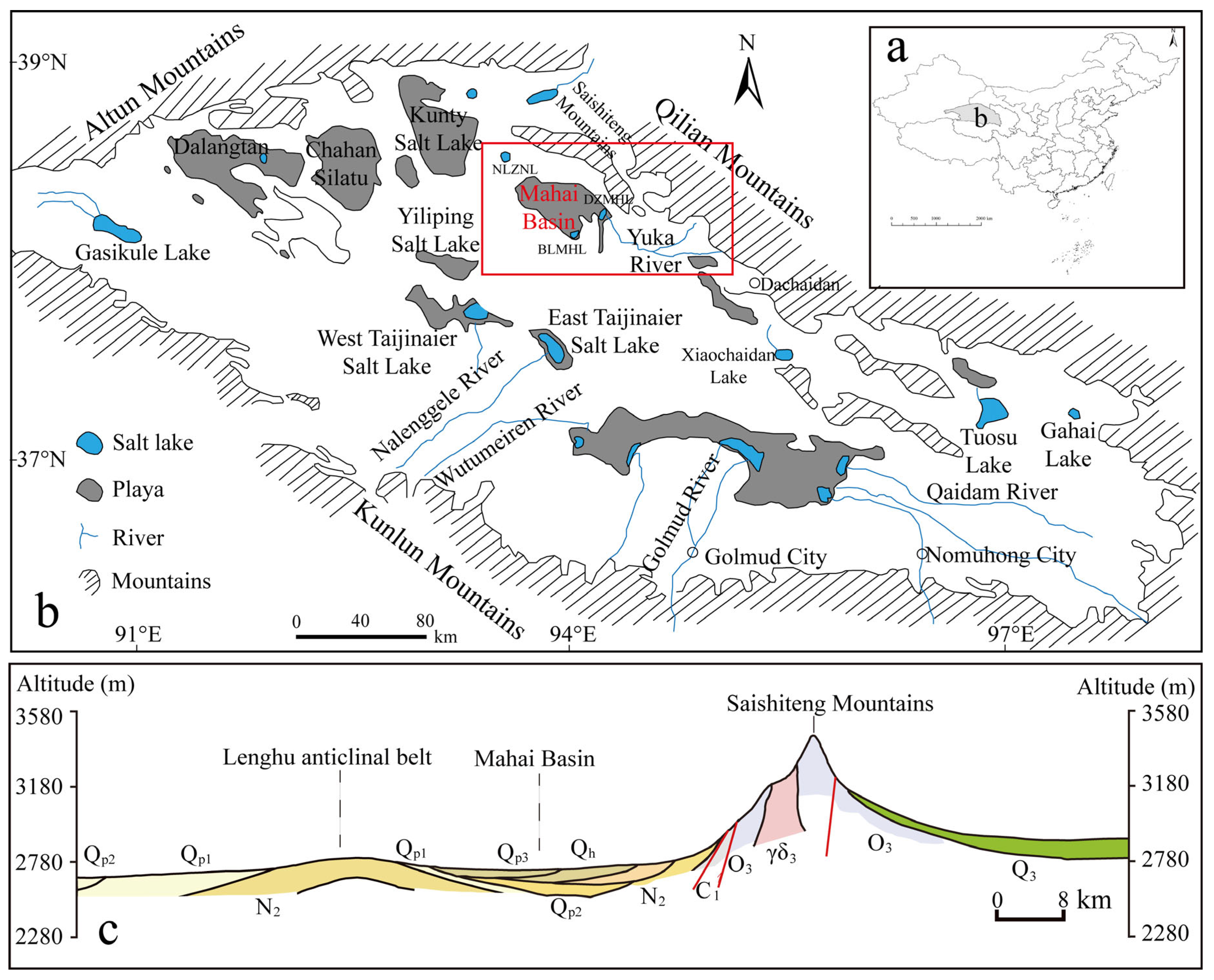
The MHB, situated in the northeastern QB, is an inland sedimentary basin that formed during the Cenozoic era in response to the tectonic uplift of the Tibetan Plateau (Figure 1a,b) [10,26]. It is bounded by the Saishiteng Mountains to the north, the Altun Mountains to the northwest, and the Lenghu and Nanbaxian anticline belts to the southwest and south, respectively. The basin covers an area of approximately 3700 km2 and is structurally controlled by rhombic fault systems [13,20]. The MHB is characterized by an extremely arid climate, with a mean annual precipitation of only 29.61 mm and a potential evaporation rate of up to ~3040 mm/yr [5]. Most of the basin surface is covered by dry salt flats, with a total evaporite-bearing area of approximately 843 km2 [13]. The southeastern part of the basin represents the lowest topographic area and hosts modern lakes and marshes, whereas the northwestern part forms a narrow valley connecting the Niulang-Zhinu Lakes (NLZNL) [21,27].
Quaternary strata in the MHB are dominated by lacustrine deposits (Figure 1c), including Early Middle Pleistocene, Late Pleistocene, and Holocene sediments, which are generally unconformable with Paleogene–Neogene anticline structures along the basin margins [10]. The marginal hills are composed mainly of the Paleogene Lower Ganchaigou Formation (E3) and the Neogene Upper Ganchaigou Formation (N1) and Upper Youshashan Formation (N2). The E3 unit consists predominantly of deep lacustrine mudstone, siltstone, and marly limestone; the N1 unit comprises semi-deep lacustrine mudstone and sandstone; and the N2 unit is characterized by shallow lacustrine gray mudstone, sandy mudstone, and locally developed gypsum layers [28]. The Saishiteng Mountain range along the northern basin margin is composed mainly of the Precambrian Dakendaban Group and the Lower Paleozoic Tanjianshan Group. Multiple phases of mafic, intermediate, and felsic intrusive rocks are widely developed, dominated by granodiorite and monzogranite, reflecting tectono-magmatic activities from the Caledonian to Yanshanian periods [29]. The Quaternary deposits within the basin are dominated by lacustrine–evaporitic clastic sediments, forming saline successions composed of interbedded silt, clay, and halite. The principal minerals include halite, gypsum, mirabilite, and various K minerals. K brine deposits are widely distributed throughout the basin, whereas solid K deposits are mainly concentrated in the northeastern part of the MHB [5,6,14].
The MHB represents a regional convergence and discharge zone for surface water and groundwater. Brines are mainly hosted in Quaternary salt layers and marginal clastic sediments [10,26]. Influenced by neotectonic activity, the subsidence center, evaporite development, and brine resources are predominantly concentrated in the northeastern part of the basin [30]. Dezong Mahai Lake (DZMHL), Balun Mahai Lake (BLMHL), and NLZNL, together with their surrounding salt flats, constitute an integrated surface brine-intercrystalline brine system [5]. Based on occurrence medium, burial depth, and hydrochemical characteristics, brines in the MHB can be classified into surface brine, intercrystalline brine, confined brine, sand-gravel brine, and anticline-related brine. The K+ concentration across these water bodies varies significantly from 0.01 to 20.54 g/L (Table S2). Specifically, the deep confined brines exhibit the highest potassium enrichment, whereas lake waters remain relatively dilute. In terms of hydrochemical facies, surface brine and intercrystalline brine are dominated by the Cl-SO4 type and are mainly distributed in the central northern basin and the DZMHL area. Sandy–gravel brine and anticline-related brine are characterized by the Ca-Cl type and occur in the piedmont alluvial fans of the Saishiteng Mountains and the Lenghu anticline belt, respectively. In addition, some surface water and shallow groundwater exhibit an Na-HCO3-SO4 hydrochemical type [26,31]. Deep confined brines are mainly distributed below 18.5 m within multilayer Quaternary confined aquifer systems. Their spatial distribution is jointly controlled by active faults and unconformities between Paleogene–Neogene strata and Quaternary deposits [21,28]. Regional water sources are primarily derived from snowmelt and groundwater recharged from the Saishiteng Mountains and surrounding highlands, as well as runoff from the Yuka River. The Yuka River is the only perennial river in the region; it directly recharges DZMHL and indirectly influences the water volume and hydrochemical composition of BLMHL through groundwater overflow.

3. Data Collection

A systematic collection of stable isotope datasets was conducted to represent various fluid end-members in the MHB, encompassing peer-reviewed and online-first publications spanning the period from 2015 to 2025. Literature searches were conducted across multiple bibliographic databases, including Web of Science, Google Scholar, and the China National Knowledge Infrastructure (CNKI), using a systematic search logic with Boolean operators (e.g., “AND” and “OR”). Key search terms encompassed geographic identifiers (“Mahai”, “Qaidam Basin”), target substances (“potash”, “brine”), and specific isotopic tracers (“stable isotopes”, “isotope geochemistry”).
Compiled isotope data and associated metadata were extracted directly from published tables, text, and Supplementary Materials. In instances where numerical data were unavailable in the manuscript body and only presented graphically, data were digitized using the GetData Graph Digitizer to ensure high fidelity to the original results. For each entry, we recorded comprehensive information, including sample types, isotope compositions, reference standards, and the specific laboratories or analytical facilities involved. No recalculation or normalization of isotope values was applied beyond the original publications to maintain data integrity.
To ensure comparability among datasets from various sources, data were screened based on reported analytical techniques (e.g., IRMS, MC-ICP-MS, and TIMS) and uncertainty ranges. Values lacking detailed methodological descriptions or analytical precision were excluded. It was maintained that the original authors and journal editors had implemented rigorous quality assurance measures; nonetheless, cross-isotope consistency checks were performed where it was feasible to further validate the data. As this study provides a literature-based synthesis, the analysis emphasizes comparative evaluation—including isotope ranges, clustering patterns, and cross-isotope correlations—rather than formal statistical modeling. The resulting dataset encompasses major isotopic systems essential for tracing fluid evolution in the MHB, including hydrogen–oxygen isotopes (δD-δ18O, n = 214, Table S1), lithium isotopes (δ7Li, n = 70, Table S2), strontium isotopes (87Sr/86Sr, n = 46, Table S3), boron isotopes (δ11B, n = 6, Table S4), sulfur isotopes (δ34S, n = 5, Table S5), and chlorine isotopes (δ37Cl, n = 18, Table S6).

4. Results and Discussion

Although some hydrochemical and isotopic parameters of the studied brines overlap with ranges reported for marine systems, such overlap alone is not diagnostic of a marine origin [32,33]. In evaporite basins, isotope ratios and elemental compositions are process-sensitive rather than source-exclusive, and similar signatures can be generated through evaporation, burial diagenesis, clay mineral reactions, and residual brine evolution in closed continental settings. In the Mahai Basin, stratigraphic and sedimentological evidence consistently indicates a non-marine depositional environment, precluding a marine source for K-forming fluids. Accordingly, isotopic systems in this study are interpreted as tracers of fluid evolution processes rather than indicators of marine inheritance. This process-oriented approach provides a geologically consistent framework for explaining the observed isotopic characteristics without invoking ancient marine deposits.

4.1. Hydrogen–Oxygen Isotopes and Fluid Evolution

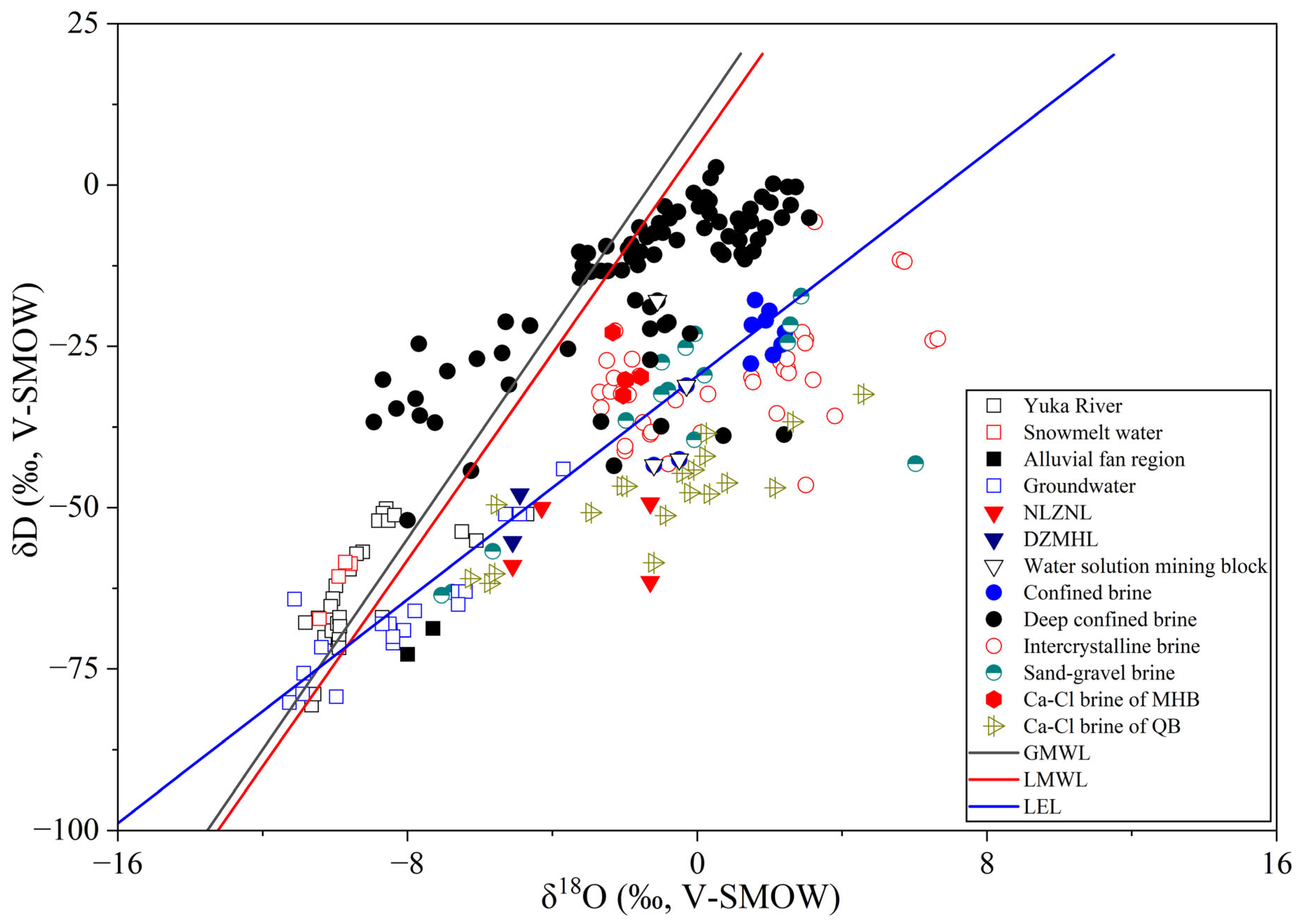
Stable hydrogen and oxygen isotopes are effective tracers of evaporation, halite dissolution, water–rock interaction, and external water mixing, and therefore provide critical constraints on brine evolution, origin, and material sources [34,35]. Different types of brines in the MHB show well-defined clustering in δD-δ18O space, corresponding to distinct hydrological end members and reflecting the coupled influence of meteoric recharge, lacustrine evaporation, and deep fluid modification (Figure 2; Table S1).
Initial recharge waters, represented by the Yuka River and alluvial fan groundwater, display δD values of −89‰ to −51‰ and δ18O values of −12.4‰ to −6.3‰ [8,19,21,36,37]. These values plot close to the Global Meteoric Water Lines (GMWL) [38] and Local Meteoric Water Lines (LMWL) [29] and are isotopically lighter than waters from nearby Dachaidan (δD −84.4‰ to −65.8‰) (Figure 1b). Their relatively low d-excess values (mean ~10.7‰) suggest recharge from higher elevations or colder climatic conditions [8]. Elevation effect calculations indicate a dominant recharge altitude of ~3440 m [6], implying that brine precursors primarily originated from high-elevation precipitation and snowmelt from the Qilian, Altyn Tagh, and Saishiteng Mountains [19,39], with minimal evaporation or water–rock interaction during initial recharge.
After entering low-lying lake depressions, surface waters undergo intense evaporation under arid climatic conditions. Lake waters from DZMHL and NLZNL show systematic enrichment in heavy isotopes along the Local Evaporation Line (LEL) [18], with δD values of −61.5‰ to −47.9‰ and δ18O values of −5.1‰ to −1.3‰. This pattern reflects kinetic fractionation during non-equilibrium evaporation and represents the primary concentration stage of brines [5,18,21].
Intercrystalline and sand-gravel brines derived from infiltrated lake waters exhibit even more pronounced isotopic enrichment (intercrystalline brines: δD −41.2‰ to +5.5‰; δ18O −2.0‰ to +6.5‰), accompanied by markedly reduced d-excess values. These features indicate prolonged and intensified evaporation relative to surface waters [15,39]. Along the hydrological pathway from alluvial fan recharge to highly mineralized brines, isotopic values increase progressively, suggesting burial and preservation of early evaporative brines under semi-closed conditions with limited water–rock interaction. These brines represent key transitional end members linking surface evaporation systems to deep reservoirs [5,7,21,35]. Deep sand-gravel brines exhibit δD values of −56.9‰ to −17.6‰ and δ18O values of −5.7‰ to +6.0‰ and generally plot to the right of the LEL. This distribution indicates that they are not derived from direct infiltration of modern surface waters but instead inherit isotopic signatures from intercrystalline brines or paleo-lake brines after evaporation. Some confined brines show positive δ18O values (+1.5‰ to +2.4‰), reflecting isotopic exchange during deep circulation and water–rock interaction. These features suggest downward migration of evaporatively concentrated surface brines and their storage in deep sandy–gravel reservoirs [7,19,25,35,40].
Although evaporation dominates the overall isotopic evolution, anomalous δD-δ18O signatures in deep brines indicate additional contributions from multi-source mixing and water–rock interaction. Some deep waters (e.g., thermal waters beneath NLZNL) show very low δD values (down to −72.7‰) combined with significantly positive δ18O values (+1.50‰ to +2.40‰), deviating strongly from the LMWL [15,21]. Their atypical δ18O-Cl-relationships [19] indicate mixing between meteoric waters and deep Ca-Cl-type fluids that have undergone extensive water–rock interaction. The positive δ18O shifts reflect isotopic exchange with surrounding rocks during deep circulation [6,19,21,25], suggesting late-stage involvement of deep Ca-Cl brines or structurally focused upwelling fluids in the evolution of MHB brines.

4.2. Lithium Isotopes and Fluid–Rock Interaction

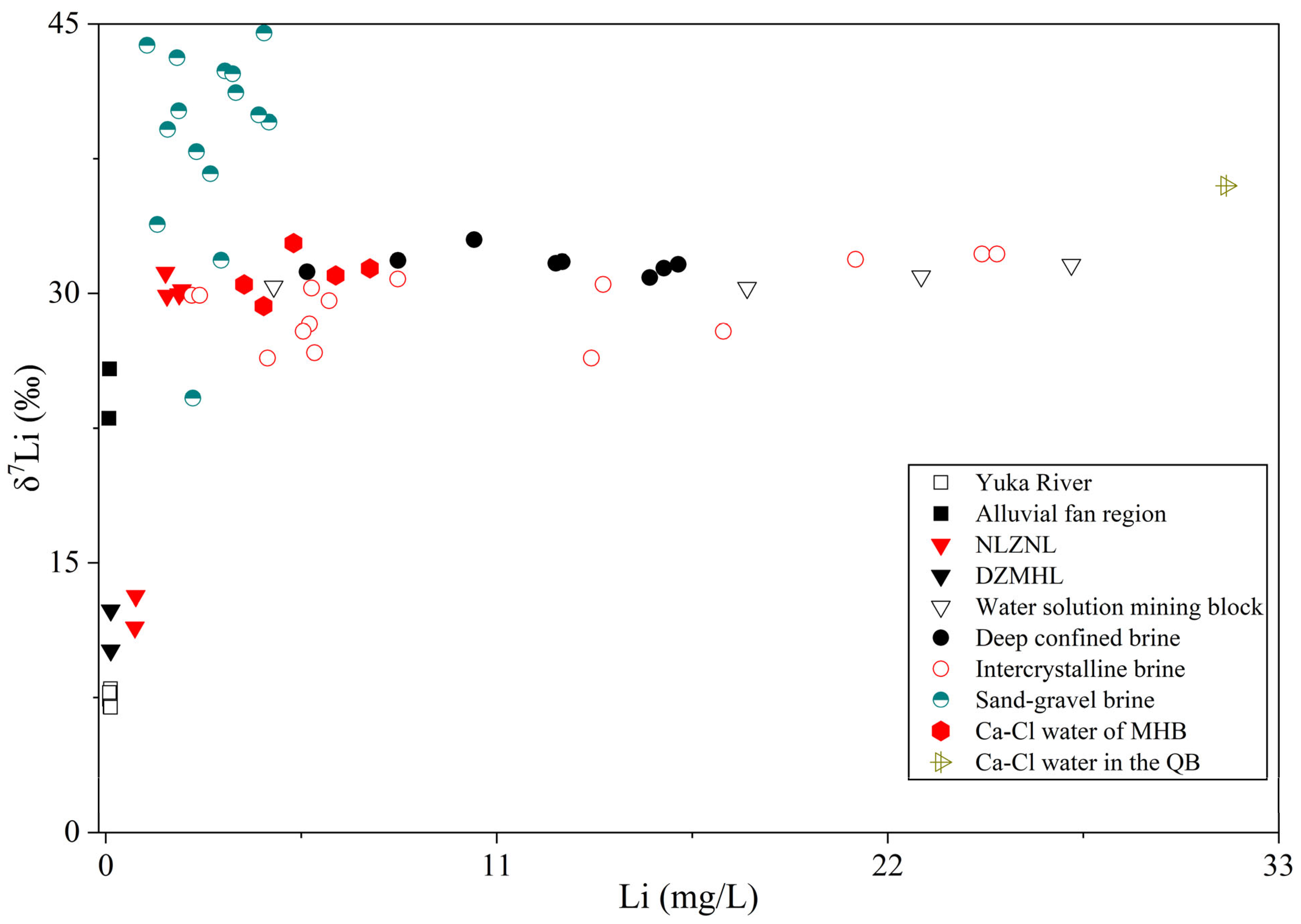
In evaporitic lake systems, K is transported and concentrated predominantly as K+ in highly saline brines, and its mineralization is strongly controlled by fluid sources and evolutionary pathways. δ7Li is particularly sensitive to low-temperature water–rock interaction and progressive fluid evolution [41,42]; thus, it can provide an effective tracer for the geochemical processes governing K-forming fluids. Mantle-derived or high-temperature deep fluids typically exhibit low δ7Li values (−5‰ to 0‰), whereas fluids derived from continental weathering, surface runoff, and evaporative brine systems are characterized by elevated δ7Li values (+2‰ to +15‰) [11,43]. In the MHB (Figure 3; Table S2), river waters from the Yuka River display δ7Li values of +7‰ to +8‰ [19,21], comparable to those of clay-rich sediments from the DZMHL (+10.96‰) [24]. This consistency indicates that the initial solute load of K-forming fluids was primarily derived from near-surface silicate weathering, with meteoric precipitation and fluvial recharge as the dominant water sources, rather than mantle or magmatic inputs.
Relative to river water end members, alluvial fan region groundwater exhibits significantly higher δ7Li values (+20.0‰ to +22.2‰), suggesting that K-forming fluids had already undergone substantial low-temperature water–rock interaction during early shallow migration. During this process, secondary clay minerals preferentially incorporate 6Li, progressively enriching residual fluids in 7Li [21,44,45]. Along the hydrological gradient from recharge zones toward the basin interior, δ7Li values increase from river water to lake water and alluvial fan region groundwater (approximately +10‰ to +26‰), corresponding to a stage when potassium begins to accumulate but major evaporite minerals have not yet precipitated [24,25]. In the basin center, intercrystalline brines and deep confined brines reach the highest δ7Li values (+26‰ to +32‰), reflecting highly evolved and high-salinity brines associated with K mineralization stages [21]. The continuous increase in δ7Li from recharge areas to the basin center indicates long-term fluid evolution within closed to semi-closed systems. Under low-temperature water–rock interaction conditions, a progressive enrichment of 7Li in residual fluids occurs [11,41,42], whereas evaporation and halite precipitation exert only minor fractionation effects on lithium isotopes [19,46]. The gradual isotopic enrichment, coupled with synchronous increases in K+, Cl, and total dissolved solids [15,19,24], indicates that K-forming fluids in the MHB evolved through sustained transport and progressive geochemical modification, rather than being dominated by short-lived or episodic fluid inputs. Consequently, the elevated δ7Li values of basin brines primarily record cumulative low-temperature water–rock interaction during prolonged migration through Paleogene–Neogene strata, rather than simple evaporative fractionation.
Deep Ca-Cl-type brines and sand–gravel brines have even higher δ7Li values, averaging +36‰ and reaching up to +40.2‰, as a result of prolonged fluid–rock interaction at low to moderate temperatures, rather than a surface water source modified solely by geothermal heating [7,19]. The δ7Li values of intercrystalline brines and deep confined brines fall between those of river water and Ca-Cl-type brines, suggesting that their isotopic compositions are governed primarily by mixing between these two end members rather than by a single evaporative trajectory [7]. Sand-gravel brines exhibit δ7Li values as high as +33.84‰ to +43.82‰, effectively excluding shallow halite dissolution or modern evaporative re-fractionation as dominant controls. Instead, their high δ7Li combined with moderate Li concentrations indicates inheritance from deeply evolved interstitial or paleo-lake brines, subsequently transported laterally into alluvial-fan reservoirs while preserving deep-brine isotopic signatures [7,19,21].
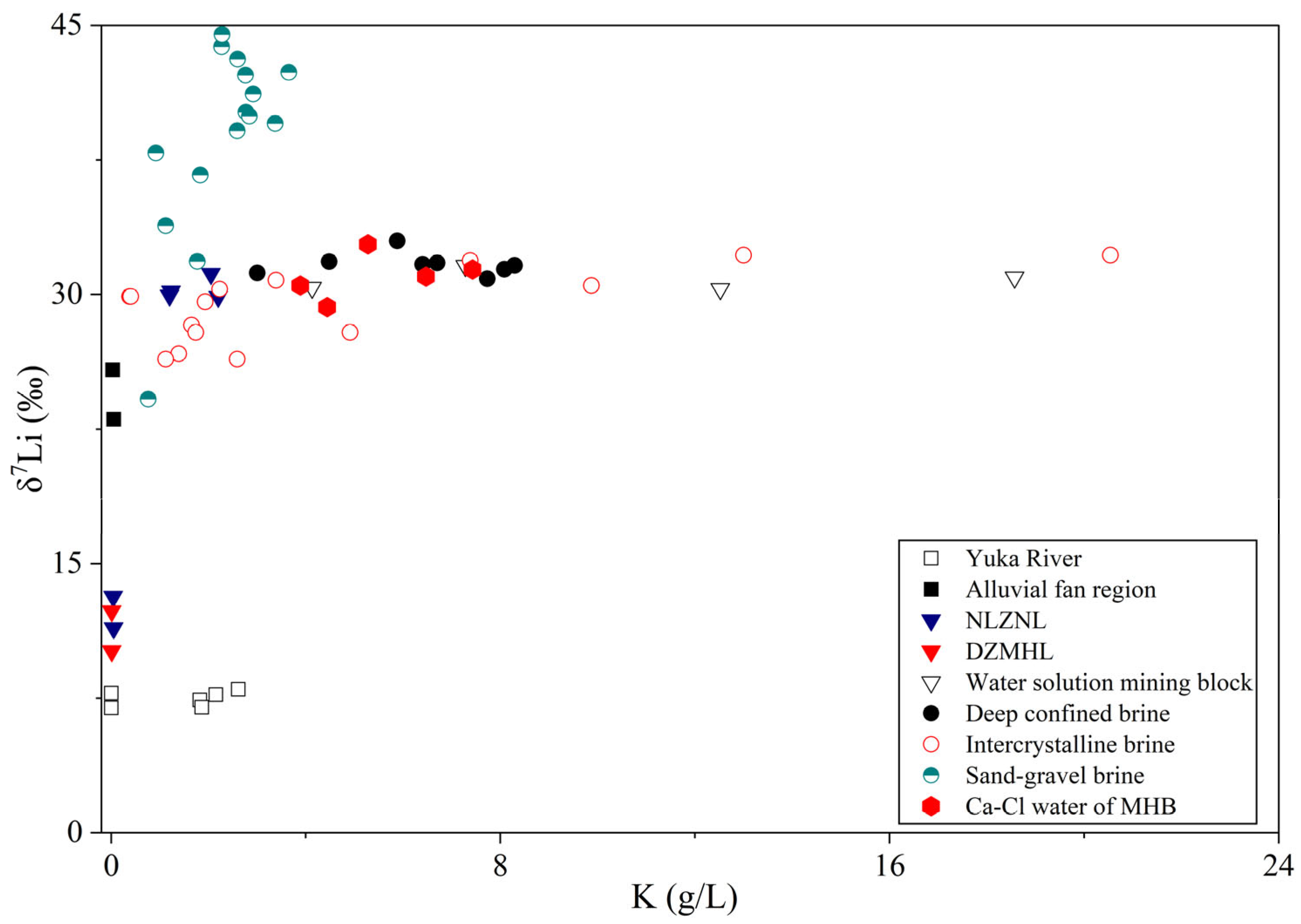
Taken together, an empirical positive trend is observed between δ7Li values and K+ concentrations across different hydrological compartments in the study area. From recharge zones to the basin center, both δ7Li and K+ concentrations systematically increase, following the sequence of Yuka River waters < DZMHL < NLZNL < solution-mined brines < deep confined brines (Figure 4; Table S2) [21]. However, it is important to emphasize that no direct geochemical correlation or causal control exists between δ7Li and K concentrations. Instead, lithium isotopes act as an independent tracer that records the mixing proportions between two contrasting water sources, namely surface-derived waters and deep Ca-Cl waters, whereas the mixing process itself constitutes the primary mechanism governing potassium enrichment in brines [19]. The near-conservative behavior of lithium isotopes during mixing in high-salinity systems further supports this interpretation and suggests that K mineralization in the MHB represents a continuous, multistage evolutionary process. This process initiates with meteoric and fluvial recharge, followed by prolonged evaporation and low-temperature water–rock interaction, and is subsequently modified by mixing with deep Ca-Cl waters. K enrichment is therefore inherited and amplified during fluid evolution within favorable structural and depositional settings, rather than being directly controlled by lithium isotope fractionation.

4.3. Strontium Isotopic Evolution of Brine

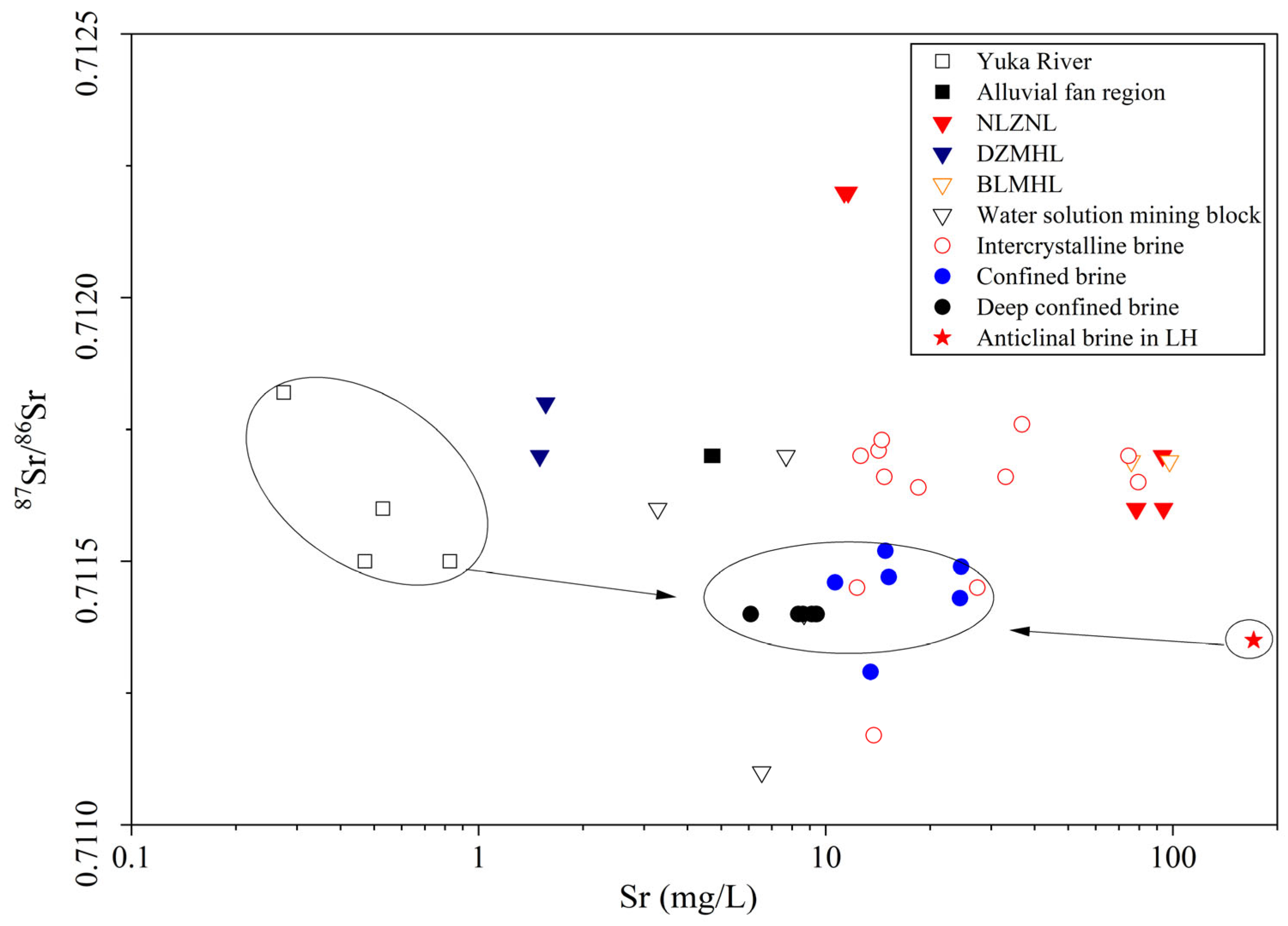
The 87Sr/86Sr ratios of different waters and brines in the MHB range from 0.71106 to 0.71217 (Figure 5; Table S3), distinctly higher than those of mantle-derived materials (0.7035) and modern seawater (0.70939) [46,47], but slightly lower than typical upper continental silicate rocks (0.71190) [48]. This distribution indicates that K-forming fluids in the MHB are dominated by crustal Sr inputs and controlled by multi-end-member mixing rather than mantle-derived contributions [6].
River water from the Yuka River and alluvial fan region groundwater exhibits relatively high 87Sr/86Sr ratios (0.71150–0.71183) [15,21], although still lower than those of clay-rich sediments from the DZMHL area (0.71239–0.71406) [24]. These values represent a surface recharge end member derived from weathering and leaching of old silicate rocks surrounding the Qilian Mountains. In contrast, deep brines and oilfield waters within the Lenghu anticlinal belt show slightly lower 87Sr/86Sr ratios (~0.71135) but markedly elevated Sr concentrations, reflecting prolonged water–rock interaction in a deep, relatively closed system, involving dissolution of ancient evaporites and carbonate rocks and associated isotopic exchange [37]. The high 87Sr/86Sr ratios in riverine end members and the low 87Sr/86Sr ratios in deep brine end members constitute the fundamental source framework of K-forming fluids in the MHB.
Deep confined brines in the basin are characterized by a narrow range of 87Sr/86Sr ratios (0.7113–0.7115) [15,21], indicating a relatively uniform strontium isotopic composition. These values fall between those of surface waters and deep brines reported from the Lenghu anticlinal belt [49], yet they do not define discrete isotopic end-members or resolvable mixing proportions. Rather, the limited isotopic variability suggests a homogenized Sr source produced by long-term basin-scale fluid circulation and extensive water–rock interaction. When considered together with hydrochemical characteristics (e.g., elevated K concentrations and depleted Ca and Sr contents) [15] and hydrogen–oxygen isotopic evidence [21], the Sr isotope data indicate that meteoric and fluvial inputs, represented by the Yuka River, constitute the ultimate recharge source of the confined brines. However, these surface-derived signatures have been substantially modified during prolonged subsurface residence, with chemically evolved deep anticlinal brines acting as an additional contributing component rather than a distinct mixing end-member. Notably, the 87Sr/86Sr ratios of the deep confined brines are generally lower than those of all potential surface waters, including rivers, alluvial-fan groundwaters, lake waters, and intercrystalline brines. This feature precludes simple surface-water mixing as the dominant formation mechanism. Instead, extensive water–rock interaction with surrounding strata, particularly early-formed evaporites, likely played a critical role in lowering 87Sr/86Sr ratios through mineral dissolution and ion-exchange processes. The wide range of 87Sr/86Sr ratios reported for halite at different depths (0.71124–0.71177) [21] further supports this interpretation, indicating that deep confined brines represent mixtures of paleo-brines from different geological periods that were progressively homogenized during multistage salt-lake evolution.
Intercrystalline brines are regarded as a key end member in the evaporate evolution sequence of the MHB. Their 87Sr/86Sr ratios range from 0.71164 to 0.71183, significantly higher than those of local halite and gypsum (0.71126–0.71153) [37] and deep confined brines (0.71130–0.71152), indicating that Sr in intercrystalline brines is not solely derived from evaporite dissolution [15,21,37]. The broad variability of halite 87Sr/86Sr ratios in MHB (0.71124–0.71177) [37] suggests repeated mixing of paleo-lake brines and ongoing halite dissolution ion exchange processes. Moreover, the similarity of 87Sr/86Sr ratios between interstitial brines and clay-rich sediments in the DZMHL area (0.71239–0.71406) [24] indicates a strong control from silicate weathering products sourced from the surrounding Qilian Mountains. Considering their shallow burial depth, Sr isotopic composition, and hydrochemical characteristics, intercrystalline brines in the MHB likely formed through mixing of surface runoff with minor deep Ca-Cl-type paleo-brines, followed by intense evaporative concentration and limited water–rock interaction in a relatively open near-surface environment. This evolutionary pathway resulted in highly evolved brines characterized by elevated 87Sr/86Sr ratios and Ca-Cl-type chemistry. Their isotopic compositions inherit and amplify the radiogenic Sr signal derived from silicate weathering in the Qilian Mountains, clearly distinguishing them from deep confined brines and highlighting their role as a key end member in the multi-stage evolution of the basin brine system. Overall, Sr isotope evidence demonstrates that K-forming fluids in the MHB are mainly derived from mixing between surface-derived waters and deep structural fluids, effectively excluding large-scale direct mantle involvement in K mineralization.
Based on 87Sr/86Sr mass balance modeling, intercrystalline brines can be interpreted as typical two-end-member mixtures, with surface water from the Yuka River contributing approximately 58–77% and deep Ca-Cl-type fluids accounting for 23–42% [37]. Spatially, pronounced heterogeneity is observed: brines located near anticlines and fault zones show Sr isotopic compositions and Sr concentrations closer to the deep end member, whereas brines farther from structural belts predominantly reflect river water recharge [37].

4.4. Constraints from Boron, Sulfur, and Chlorine Isotopes

Boron isotopes provide critical constraints on fluid sources and water–rock interaction processes in the MHB. Brines associated with anticlinal structures exhibit highly positive δ11B values (+26‰ to +37‰), similar to those of BLMHL (+31.4‰) and NLZNL (+23.7‰ to +24.5‰), whereas Yuka River water (−5.7‰), DZMHL (−4.0‰), and the Nanbaxian salt pits (−12‰ to −24‰) show low to extremely low δ11B values (Table S4) [22,23]. This wide isotopic range indicates the involvement of at least three distinct boron end members. The close agreement between δ11B values of DZMHL and the Yuka River suggests that low δ11B boron derived from continental weathering is continuously supplied to lakes and shallow brine systems through surface runoff and shallow infiltration. In contrast, the high δ11B values of NLZNL and BLMHL overlap with those of deep paleo-brines from the Lenghu anticlinal belt [18,22,23], reflecting prolonged water–rock interaction and brine evolution under deep, closed conditions. These deep fluids play a key role in the co-enrichment of K. Extremely low δ11B values in Nanbaxian brines and solution-phase sediments (−34.71‰ to −6.14‰) [22], comparable to those of solid borates in the Dachaidan Lake area, indicate a dominant contribution from weathering and leaching of rocks in ultra-high-pressure metamorphic belts [22]. Overall, the evolution of ore-forming fluids in the MHB is governed by coupling between low δ11B surface runoff, high δ11B deep paleo-brines, and structurally controlled fluid inputs. This pattern contrasts sharply with the central QB, where mineralization is dominated by low δ11B volcanic geothermal fluids [18]. The markedly high δ11B values in western MHB brines (up to +31.4‰) provide clear evidence for the ascent of deep paleo-brines along structural pathways, representing a primary driving force for depth-dependent enrichment of K and the formation of highly mineralized brines and K deposits.
Sulfur isotopes further constrain redox conditions and external inputs during brine evolution. Deep confined brines in the MHB show δ34S values of 12.02–16.57‰ [25], higher than those of modern shallow salt lakes such as Lop Nor and Qarhan (6.66–19.9‰) [50,51], but lower than those of deep gravel-hosted brines and Paleogene–Neogene solid sulfates in western Qaidam (20.84–39.2‰) (Table S5) [18,52]. These intermediate δ34S values indicate a balance between enrichment driven by bacterial sulfate reduction and water–rock interaction in semi-closed deep reservoirs and dilution caused by leaching of sulfate-bearing strata in the northern basin margin and by meteoric recharge (8.65‰) [25]. Thus, sulfur isotopes reveal a unique evolutionary regime in which K-forming fluids evolved predominantly under closed conditions but remained subject to limited external freshwater input.
Chlorine isotopes provide decisive evidence for the origin of sand-gravel brines. Their δ37Cl values range from −0.26‰ to +0.25‰, significantly lower than those of halite (+0.41‰ to +0.74‰) in MHB (Table S6) [7]. The Na/Cl molar ratios of sand-gravel brines (0.80–0.82) [7] are far below the theoretical value of 1 expected for simple halite dissolution. These independent geochemical indicators rule out Neogene halite dissolution as the primary source of sand-gravel brines [53]. During progressive evaporation and halite precipitation in evaporitic lake systems, 37Cl is preferentially incorporated into solid halite, leading to progressively lower δ37Cl values in residual brines [54]. The depleted δ37Cl signatures of sand-gravel brines are therefore consistent with their interpretation as highly evolved residual fluids. By contrast, freshwater sources such as precipitation and river water typically exhibit positive δ37Cl values (+0.74‰ to +4.48‰) in MHB [54], clearly distinct from freshwater sources and sand-gravel brines in isotopic space, confirming their deep origin. The δ37Cl values of sand-gravel brines closely overlap with those of intercrystalline brines (DZMHL) or subsurface brine, indicating inheritance of geochemical signatures from deeply evolved brines and a common genetic origin [7]. Integrating δ37Cl and Na/Cl systematics allows reconstruction of the evolutionary pathway of sand-gravel brines: meteoric waters with high δ37Cl underwent strong evaporation and halite precipitation (Table S6), during which 37Cl was preferentially removed into solid salts, producing low δ37Cl deep interstitial brines; these highly evolved fluids subsequently migrated laterally and were finally stored within gravel reservoirs [7]. This isotopic evidence conclusively excludes a shallow dissolution origin and identifies sand-gravel brines as residual products of continuous deep brine evolution with clear metallogenic significance.

4.5. Cross-Isotope Constraints on Fluid End-Members and Evolutionary Processes

Integrated constraints from multiple isotope systems (δD-δ18O, δ7Li, 87Sr/86Sr, δ11B, δ34S, and δ37Cl) allow the evolution of K-forming fluids in the MHB to be evaluated within a unified geochemical framework, rather than through separate isotope-by-isotope interpretations. Cross-isotope synthesis indicates that fluid evolution in the basin can be reasonably described by interactions among three conceptual end-members: (1) a meteoric surface-recharge end-member, (2) a highly evolved intercrystalline brine end-member, and (3) a deep-seated Ca-Cl waters end-member. These end-members represent evolutionary stages and dominant processes rather than discrete, chemically fixed fluids.
During the initial concentration stage, hydrogen–oxygen isotopes display systematic enrichment trends along the Local Evaporation Line (LEL), indicating strong evaporative control under arid climatic conditions [6,8,21,25,29,35,40]. This behavior is closely aligned with a moderate increase in δ7Li values [19,24], suggesting that while evaporation dominated the hydrological evolution, low-temperature water–rock interaction had already begun to influence solute compositions. In this stage, δD-δ18O isotopes primarily record physical water loss, whereas lithium isotopes are sensitive to early-stage fluid–mineral interaction. Radiogenic 87Sr/86Sr ratios (0.7115–0.7118) observed in shallow waters and early brines further support a meteoric recharge origin, reflecting interaction with silicate-rich lithologies of the Qilian Mountains [6,15]. The consistent behavior of H-O, Li, and Sr isotopes at this stage indicates that surface-derived waters underwent basin-scale evaporation and initial geochemical modification prior to deeper circulation.
As fluids evolved and migrated into deeper parts of the basin, their isotopic compositions progressively deviated from simple evaporation trajectories. Deep confined brines and sand-gravel brines exhibit a pronounced positive δ18O shift [7,25,35], accompanied by elevated δ7Li values (up to ~+40‰) [7,21] and high δ11B values (+26‰ to +37‰) [18,22]. When considered jointly, these signals indicate prolonged residence times and intense fluid–rock interaction within deep reservoirs, rather than continued surface evaporation. Although some isotope signatures may appear contradictory when considered individually, for example, depleted δ37Cl values in sand-gravel brines compared with positive δ37Cl values in surface waters, these differences can be reconciled through fractionation processes associated with halite precipitation. Preferential incorporation of 37Cl into halite during late-stage evaporation results in isotopically light residual brine [54]. Consequently, low δ37Cl values represent a diagnostic feature of highly evolved residual brines, rather than evidence against deep-fluid involvement. In this context, chlorine isotopes provide a complementary constraint on the advanced evolutionary state of deep fluids that are critical for K enrichment.
Cross-isotope consistency is further demonstrated by the combined behavior of strontium and boron isotopes. Variations in 87Sr/86Sr ratios suggest that intercrystalline brines reflect mixing between surface-derived fluids and deep Ca-Cl-type fluids, with relative contributions varying spatially and structurally across the basin [15,21,37]. These interpretations are independently supported by δ11B systematics [18], which indicate that potassium co-enrichment is closely associated with the upward migration of boron-rich deep paleo-brines along structural pathways. Rather than relying on a single isotope system, the convergence of Sr and B isotope evidence strengthens the inference that deep-fluid modification played a key role in the late-stage evolution of K-forming fluids. Importantly, the inferred mixing relationships should be viewed as semi-quantitative constraints that capture first-order processes rather than exact mass balance solutions.
By integrating multiple isotope systems across successive evolutionary stages, the apparent complexity and partial decoupling among isotopic signals can be reconciled within a coherent framework. K mineralization in the MHB is best understood as the cumulative outcome of high-altitude meteoric recharge, basin-scale evaporation, and subsequent deep fluid modification. Each isotope system records a different aspect of this evolution, and their combined behavior provides mutually reinforcing constraints on the sources, pathways, and transformation processes of K-forming fluids. This integrated cross-isotope framework establishes a complete metallogenic chain of “surface runoff recharge, intense evaporative fractionation, deep fluid mixing, lateral migration and storage”, providing a robust basis for developing a tectonic-fluid-mineralization coupling model for the MHB, and for guiding exploration of concealed gravel-type K deposits in arid inland basins.

5. Conclusions

Multi-stable isotope analysis (δD-δ18O, δ7Li, 87Sr/86Sr, δ11B, δ34S, and δ37Cl) indicates that K mineralizing fluids in the MHB represent a multi-source, long-lived, and evolutionarily complex system. δD-δ18O reveals that the initial water was mainly derived from atmospheric precipitation and snowmelt in the Qilian Mountains and surrounding highlands, delivered via river runoff, and subsequently concentrated through prolonged evaporation under arid and semi-closed basin conditions, forming a continuous evolution from river water to lake water to brine, with late-stage δ18O enrichment reflecting mixing with deep circulating fluids and water–rock isotope exchange. δ7Li systematically increases along the evolution sequence and correlates with salinity and K content, indicating long-term low-temperature water–rock interactions and selective adsorption of 6Li by secondary clay minerals, while deep Ca-Cl brines with exceptionally high δ7Li represent highly evolved endmembers from deep cycling. Elevated 87Sr/86Sr values exclude significant mantle contributions, confirming that solutes mainly originate from weathering of Qilian silicate rocks, with interstitial brines acting as key intermediate endmembers between surface and deep fluids. δ11B, δ34S, and δ37Cl further indicate that deep fluids ascending along anticlines and fault zones drive K enrichment, whereas sand-gravel brines represent highly evolved residual fluids inheriting paleo-lake evaporation signatures. These combined multi-isotope constraints establish a comprehensive evolutionary model for MHB K mineralization, in which surface runoff supplies the initial water, followed by intensive evaporation and low-temperature water–rock interaction, mixing with deep Ca-Cl paleo-brines along structural conduits, lateral transport and interlayer entrapment, ultimately leading to K precipitation.

Supplementary Materials

The following supporting information can be downloaded at: https://www.mdpi.com/article/10.3390/w18040443/s1. Table S1: The hydrogen and oxygen isotope composition in different samples of Mahai Basin; Table S2: The potash, lithium, and lithium isotope composition in different samples of Mahai Basin; Table S3: The strontium and strontium isotope composition in different samples of Mahai Basin; Table S4: The boron isotope composition in different samples of Mahai Basin; Table S5: The sulfur isotope composition in different samples of Mahai Basin; Table S6: The chlorine isotope composition in different samples of Mahai Basin.

Author Contributions

Conceptualization, Z.W., Q.W., and X.L.; methodology, Z.W. and Q.W.; formal analysis, Z.W.; investigation, Z.W., Z.N., and W.S.; data curation, Z.W. and Y.M. (Ying Ma); software, Y.M. (Ying Ma) and Y.M. (Yujun Ma); validation, Z.W., Q.W., and X.L.; resources, E.X. and X.L.; writing—original draft preparation, Z.W.; writing—review and editing, Q.W. and X.L.; visualization, Z.W. and Y.M. (Yujun Ma); supervision, Q.W. and X.L.; project administration, Q.W.; funding acquisition, Q.W. and X.L. All authors have read and agreed to the published version of the manuscript.

Funding

This research was funded by the Key Research and Development and Transformation Program Project of the Qinghai Provincial Department of Science and Technology (2024-QY-207).

Data Availability Statement

No new data were created or analyzed in this study.

Conflicts of Interest

The authors declare no conflicts of interest.

References

  1. Zheng, M.P.; Hou, X.H.; Yu, C.Q.; Li, H.P.; Yin, H.W.; Zhang, Z.; Deng, X.L.; Zhang, Y.S.; Guo, T.F.; Wei, Z.; et al. The leading role of salt formation theory in the breakthrough and important progress in potash deposit prospecting. Acta Geosci. Sin. 2015, 36, 129–139. [Google Scholar]
  2. Zhang, Y.; Zheng, M. Metallogenic models of potassium ore deposits in China and demonstration of deep exploration technology. Earth Sci. Front. 2021, 28, 1–9. [Google Scholar]
  3. He, M.Y.; Cheng, Y.Y.; Chen, J.; Li, Z.Y.; Deng, L.; Ren, T.X.; Luo, J.X.; Rao, H.H. Potassium isotope constraints on brine sources and evolution in Qaidam Basin, Tibetan Plateau. Ore Geol. Rev. 2025, 181, 106632. [Google Scholar] [CrossRef]
  4. Zhang, X.; Li, Q.; Qin, Z.; Fan, Q.; Du, Y.; Wei, H.; Gao, D.; Shan, F. Boron isotope geochemistry of a brine-carbonate system in the Qaidam Basin, western China. Sediment. Geol. 2019, 383, 293–302. [Google Scholar] [CrossRef]
  5. Bai, H.; Pan, T.; Han, G.; Fan, Q.; Miao, Q.; Bu, H. Hydrochemical Characteristics and Genesis of Sand–Gravel Brine Deposits in the Mahai Basin of the Northern Qinghai–Tibetan Plateau. Water 2024, 16, 3562. [Google Scholar] [CrossRef]
  6. Zhang, F.; Qin, X.; Ma, Y.; Pan, T.; Chen, J.; Ding, C.; Jiang, Z.; Zhang, D.; Liu, C.; Li, Q.; et al. The Genesis of the Shallow Intercrystalline Brine in the Qaidam Dezong Mahai Basin as Indicated by Hydrochemistry and Hydrogen, Oxygen and Strontium Isotope Compositions. Geol. J. 2025, 60, 1998–2018. [Google Scholar] [CrossRef]
  7. Fan, Q.; Han, G.; Chen, T.; Pang, T.; Bai, H.; Liu, J.; Miao, Q.; Zhang, X.; Yang, H.; Li, Q. Inheritance recharge of subsurface brine constrains on formation of K-bearing sand-gravel brine in the alluvial fan zone of mountain-basin system on the Qinghai-Tibetan Plateau. J. Hydrol. 2024, 645, 132029. [Google Scholar] [CrossRef]
  8. Yang, N.; Wang, G.; Liao, F.; Dang, X.; Gu, X. Insights into moisture sources and evolution from groundwater isotopes (2H, 18O, and 14C) in Northeastern Qaidam Basin, Northeast Tibetan Plateau, China. Sci. Total Environ. 2023, 864, 160981. [Google Scholar] [CrossRef]
  9. Fan, Q.; Lowenstein, T.K.; Wei, H.; Yuan, Q.; Qin, Z.; Shan, F.; Ma, H. Sr isotope and major ion compositional evidence for formation of Qarhan Salt Lake, western China. Chem. Geol. 2018, 497, 128–145. [Google Scholar] [CrossRef]
  10. Hu, S.; Xiao, C.; Liang, X.; Zhao, Q.; Wang, G.; Zhang, J.; Feng, J. Porosity distribution characteristics and geological analysis of brine storage medium in the Qaidam Basin, Western China. Chin. Geogr. Sci. 2018, 28, 707–716. [Google Scholar] [CrossRef]
  11. He, M.Y.; Luo, C.G.; Yang, H.J.; Kong, F.C.; Li, Y.L.; Deng, L.; Zhang, X.; Yang, K.Y. Sources and a proposal for comprehensive exploitation of lithium brine deposits in the Qaidam Basin on the northern Tibetan Plateau, China: Evidence from Li isotopes. Ore Geol. Rev. 2020, 117, 103277. [Google Scholar] [CrossRef]
  12. Long, P.; Zhao, X.; Zhao, Y.; Woo, I.; Du, J.; Wang, Z.; Hu, Y. Influence of Low-Grade Solid Potash Mineral Composition on Potassium Extraction and Lithium Distribution During Solution Mining in Mahai Salt Lake, Qaidam Basin. Geol. J. 2025, 60, 1812–1824. [Google Scholar] [CrossRef]
  13. Pan, T.; Chen, J.; He, M.Y.; Ding, C.; Ma, Y.; Liang, H.; Zhang, T.; Du, X. Characterization and resource potential of Li in the clay minerals of Mahai Salt Lake in the Qaidam Basin, China. Sustainability 2023, 15, 14067. [Google Scholar] [CrossRef]
  14. Kong, Z.; Wang, G.; Li, Q.; Zhao, Q.; Hu, S. Dynamic characteristics and evolution laws of underground brine in Mahai salt lake of Qaidam Basin during mining process. Sci. Rep. 2024, 14, 10778. [Google Scholar] [CrossRef]
  15. Yang, F.; Fan, Q.; Han, G.; Wang, W.; Liu, J.; Bai, H. Origin and evolution of deep K-rich confined brine in Mahai Basin, Qinghai–Tibet Plateau. Aquat. Geochem. 2024, 30, 239–258. [Google Scholar] [CrossRef]
  16. Tan, H.; Rao, W.; Ma, H.; Chen, J.; Li, T. Hydrogen, oxygen, helium and strontium isotopic constraints on the formation of oilfield waters in the western Qaidam Basin, China. J. Asian Earth Sci. 2011, 40, 651–660. [Google Scholar] [CrossRef]
  17. Ren, Q.; Li, B.; Zhang, Y.; Wu, H. Origin and evolution of intercrystalline brine in the northern Qaidam Basin based on hydrochemistry and stable isotopes. Front. Environ. Sci. 2023, 11, 1106181. [Google Scholar] [CrossRef]
  18. Li, J.; Li, T.; Ma, Y.; Chen, F. Distribution and origin of brine-type Li-Rb mineralization in the Qaidam Basin, NW China. Sci. China Earth Sci. 2022, 65, 477–489. [Google Scholar] [CrossRef]
  19. Song, H.; Fan, Q.; Li, Q.; Han, G.; Chen, T.; Yang, H.; Wei, Q. Ca-high water recharge and mixing constrain on evolution and K enrichment of brine deposits in the evaporite basin: Case and analogue study in the Qaidam Basin, Qinghai-Tibet Plateau. J. Hydrol. 2024, 632, 130883. [Google Scholar] [CrossRef]
  20. Long, P.; Zhao, Y.; Hu, Y.; Du, J. Deposition characteristics and genesis of polyhalite in low-grade solid potash ores from the Mahai Salt Lake, Qaidam Basin, China. Geosci. J. 2025, 29, 533–547. [Google Scholar] [CrossRef]
  21. Zhao, Y.; Wang, N.; Shen, L.; Li, R.; Liu, C.; Jiao, P.; Hu, Y.; Zhao, X. Contribution of deep material sources to shallow potash formation of the Quaternary Mahai Salt Lake in the Qaidam Basin: Evidence from isotopes and trace elements. Ore Geol. Rev. 2024, 171, 106166. [Google Scholar] [CrossRef]
  22. Xiang, H.; Fan, Q.; Li, Q.; Du, Y.; Han, G.; Liu, J.; Bai, H. Source and Formation of Boron Deposits in Mahai Basin on the Northern Qinghai-Tibet Plateau: Clues from Hydrochemistry and Boron Isotopes. Aquat. Geochem. 2024, 30, 143–161. [Google Scholar] [CrossRef]
  23. Xiao, Y.K.; Shirodkar, P.V.; Liu, W.G.; Wang, Y.H.; Jin, L. Boron isotope geochemistry of salt lake in Qaidam Basin, Qinghai Province. Prog. Nat. Sci. 1999, 07, 38–44. [Google Scholar]
  24. Ma, Y.; Qin, X.; Pan, T.; Chen, J.; Jiang, Z.; Ding, C.; Zhang, D.; Zhang, F.; Feng, N.; Ren, E. Sedimentary Environment and Source Analysis of Sedimentary Lithium Deposits in Dezong Mahai Salt Lake, Qaidam Basin. Sustainability 2024, 16, 10561. [Google Scholar] [CrossRef]
  25. Chen, J.; Wang, Q.; Chen, J.; Song, G.; Zhang, M.; Lu, L. Discussion on genesis of Pleistocene deep pore brine of sand-gravel type in Mahai area, northern margin of Qaidam Basin. Geol. Rev. 2025, 71, 1653–1665. [Google Scholar]
  26. Wei, X.J.; Jiang, J.X.; Wang, M.L. Quaternary sedimentation and saline lake evolution of Mahai potash deposit. Qinghai Land Resour. 1992, 1, 40–52. [Google Scholar]
  27. Zhang, M.; Cui, Z.; Zhao, Y.; Wang, N.; Yao, F.; Wang, Q.; Hu, S. Exploration Methods for Potassium-Rich and Lithium-Rich Brine in the Mihai Mining Area, Qaidam Basin, Qinghai. Geol. J. 2025, 60, 1986–1997. [Google Scholar] [CrossRef]
  28. Jiao, P.C.; Zhang, J.W.; Yao, F.J.; Zhao, L. Progress in deep brine potash exploration in the Mahai deposit. Miner. Depos. 2016, 6, 1305–1308. [Google Scholar]
  29. Zhu, P.C. Groundwater Circulation Model of the Yuka–Mahai Basin. Ph.D. Thesis, Jilin University, Changchun, China, 2015. [Google Scholar]
  30. Ren, J.; Zhao, Q.; Hu, S. Characteristics and Origin of Brine Aquifers Porosity in Quaternary Salt Lake: A Case Study in Mahai Salt Lake, Qaidam Basin. Aquat. Geochem. 2024, 30, 259–271. [Google Scholar] [CrossRef]
  31. Yue, X.; Liu, X.X.; Lu, L.; Zhang, X.D.; Fan, Z.L.; Yu, X.L. Hydrochemical characteristics and origin of deep pore brine deposits in Mahai Baisn. Acta Sedimentol. Sin. 2019, 37, 532–540. [Google Scholar]
  32. Musashi, M.; Markl, G.; Kreulen, R. Stable chlorine-isotope analysis of rock samples: New aspects of chlorine extraction. Anal. Chim. Acta 1998, 362, 261–269. [Google Scholar] [CrossRef]
  33. Eastoe, C.J.; Peryt, T. Stable chlorine isotope evidence for non-marine chloride in Badenian evaporites, Carpathian mountain region. Terra Nova 1999, 11, 118–131. [Google Scholar] [CrossRef]
  34. Kloppmann, W.; Négrel, P.; Casanova, J.; Klinge, H.; Schelkes, K.; Guerrot, C. Halite dissolution derived brines in the vicinity of a Permian salt dome (N German Basin). Evidence from boron, strontium, oxygen, and hydrogen isotopes. Geochim. Cosmochim. Acta 2001, 65, 4087–4101. [Google Scholar] [CrossRef]
  35. Zhang, M.; Hu, Y.; Wang, N.; Zhao, Y.; Wang, Q.; Wang, Z. Hydrogen and Oxygen Isotopes as Key Monitoring Indexes for Deep Confined Brine Mining: Insights from Mahai Salt Lake, Qaidam Basin. Water 2024, 17, 78. [Google Scholar] [CrossRef]
  36. Zheng, Z.; Zhang, H.; Chen, Z.; Li, X.; Zhu, P.; Cui, X. Hydrogeochemical and isotopic indicators of hydraulic fracturing flowback fluids in shallow groundwater and stream water, derived from dameigou shale gas extraction in the northern qaidam basin. Environ. Sci. Technol. 2017, 51, 5889–5898. [Google Scholar] [CrossRef]
  37. Feng, N.; Qin, X.; Ma, Y.; Pan, T.; Chen, J.; Ding, C.; Jiang, Z.; Zhang, D.; Liu, C.; Zhang, F. Origin of Intercrystalline Brine Formation in the Balun Mahai Basin, Qaidam: Constraints from Geochemistry and H-O-Sr Isotopes. Water 2024, 16, 3286. [Google Scholar] [CrossRef]
  38. Craig, H. Isotopic variations in meteoric waters. Science 1961, 133, 1702–1703. [Google Scholar] [CrossRef]
  39. Feng, N.; Qin, X.; Ma, Y.; Pan, T.; Chen, J.; Ding, C.; Zhang, F. Origin and mineralization potential evaluation of intercrystalline brine formation of the BalunMahai Basin, Qaidam. J. Lake Sci. 2026, in press. [Google Scholar]
  40. Han, G.; Bai, H.; Yang, F.; Pan, T.; Chen, T.; Fan, Q.; Zhang, X. Hydrochemical characteristics and provenance relationship of deep sand-gravel brines in Mahai basin, northern Qaidam basin. J. Lake Sci. 2026, in press. [Google Scholar]
  41. Weynell, M.; Wiechert, U.; Schuessler, J.A. Lithium isotopes and implications on chemical weathering in the catchment of Lake Donggi Cona, northeastern Tibetan Plateau. Geochim. Cosmochim. Acta 2017, 213, 155–177. [Google Scholar] [CrossRef]
  42. Godfrey, L.V.; Herrera, C.; Gamboa, C.; Mathur, R. Chemical and isotopic evolution of groundwater through the active Andean arc of Northern Chile. Chem. Geol. 2019, 518, 32–44. [Google Scholar] [CrossRef]
  43. Tomascak, P.B. Developments in the understanding and application of lithium isotopes in the earth and planetary sciences. Rev. Mineral. Geochem. 2004, 55, 153–195. [Google Scholar] [CrossRef]
  44. Wunder, B.; Meixner, A.; Romer, R.L.; Heinrich, W. Temperature-dependent isotopic fractionation of lithium between clinopyroxene and high-pressure hydrous fluids. Contrib. Mineral. Petrol. 2006, 151, 112–120. [Google Scholar] [CrossRef]
  45. Millot, R.; Scaillet, B.; Sanjuan, B. Lithium isotopes in island arc geothermal systems: Guadeloupe, Martinique (French West Indies) and experimental approach. Geochim. Cosmochim. Acta 2010, 74, 1852–1871. [Google Scholar] [CrossRef]
  46. Munk, L.A.; Boutt, D.F.; Hynek, S.A.; Moran, B.J. Hydrogeochemical fluxes and processes contributing to the formation of lithium-enriched brines in a hyper-arid continental basin. Chem. Geol. 2018, 493, 37–57. [Google Scholar] [CrossRef]
  47. Hofmann, A.W.; Hart, S.R. An assessment of local and regional isotopic equilibrium in the mantle. Earth Planet. Sci. Lett. 1978, 38, 44–62. [Google Scholar] [CrossRef]
  48. Palmer, M.R.; Edmond, J.M. The strontium isotope budget of the modern ocean. Earth Planet. Sci. Lett. 1989, 92, 11–26. [Google Scholar] [CrossRef]
  49. Cao, W.H.; Wu, C. Brine Resources and Technology of Comprehensive Utilization; Geological Press: Beijing, China, 2004; pp. 57–125. [Google Scholar]
  50. Liu, C.L.; Wang, M.L.; Jiao, P.C. Hydrogen, oxygen, strontium, and sulfur isotopes of Lop Nur salt lake and implications for potash mineralization. Miner. Depos. 1999, 18, 268–275. [Google Scholar]
  51. Li, Q. Sulfur Isotope Geochemistry of Brines from Qarhan Salt Lake and Its Controlling Factors. Ph.D. Thesis, Chinese Academy of Sciences, Beijing, China, 2016. [Google Scholar]
  52. Chen, Q.L.; Zhang, X.J.; Huang, C.G.; Xiang, L. Sulfur isotopic composition of sulphate in Oligocene Series in Yingxi area, Qaidam Basin, and its geological significance. Geol. Rev. 2019, 65, 558–572. [Google Scholar]
  53. Eggenkamp, H.G.M.; Kreulen, R.; Van Groos, A.K. Chlorine stable isotope fractionation in evaporites. Geochim. Cosmochim. Acta 1995, 59, 5169–5175. [Google Scholar] [CrossRef]
  54. Liu, W.G.; Xiao, Y.K.; Wang, Q.Z.; Qi, H.P.; Wang, Y.H.; Zhou, Y.M.; Shirodkar, P.V. Chlorine isotopic geochemistry of salt lakes in the Qaidam Basin, China. Chem. Geol. 1997, 136, 271–279. [Google Scholar] [CrossRef]
Figure 1. (a) Map showing the location of the Qaidam Basin (shaded in gray) on the northern margin of the Qinghai–Tibetan Plateau. (b) Distribution of the Mahai Basin (indicated by the red box) within the QB and the location of the study area (modified from [20]). (c) Hydrogeological cross-section from the Saishiteng Mountains to the Lenghu (LH) anticline belt (Yellow shading denotes confined groundwater, while green shading represents pore water in unconsolidated sediments. Red blocks indicate intrusive bodies, light grey blocks signify metamorphic rocks, and red lines represent faults.).
Water 18 00443 g001
Figure 2. Hydrogen–oxygen isotope distribution in various waters in Mahai Basin [6,7,15,19,21,25,29,35,36,37,38,39].
Water 18 00443 g002
Figure 3. Lithium isotope distribution in various waters in MHB [7,19,21,24,25].
Water 18 00443 g003
Figure 4. Lithium isotope vs potassium distribution in various waters in MHB [7,19,21,24,25].
Water 18 00443 g004
Figure 5. Strontium isotope distribution in various waters in MHB (The black ellipse represents the variation range of the Yu-ka River water; the blue ellipse denotes the distribution range of confined brines, and the red ellipse indicates the extent of brines from the Lenghu anticline.) [15,21,24,35].
Water 18 00443 g005
Disclaimer/Publisher’s Note: The statements, opinions and data contained in all publications are solely those of the individual author(s) and contributor(s) and not of MDPI and/or the editor(s). MDPI and/or the editor(s) disclaim responsibility for any injury to people or property resulting from any ideas, methods, instructions or products referred to in the content.