Article

Enhanced Photocatalytic Degradation of Tetracycline over Alcohol-Assisted Bi2O3/TiO2 Composite Heterojunction Under UV Irradiation

1
Jiangsu Collaborative Innovation Center of Atmospheric Environment and Equipment Technologies, Jiangsu Key Laboratory of Atmospheric Environmental Monitoring & Pollution Control, School of Environmental Science & Engineering, Nanjing University of Information Science & Technology, Nanjing 210044, China
2
Reading Academy, Nanjing University of Information Science & Technology, Nanjing 210044, China
3
School of Environmental Science and Engineering, Nanjing University of Information Science & Technology, Nanjing 210044, China
4
Department of Geography and Environmental Science, University of Reading, Whiteknights, Reading RG6 6AB, UK
*
Author to whom correspondence should be addressed.
Water 2026, 18(6), 759; https://doi.org/10.3390/w18060759
Submission received: 12 February 2026 / Revised: 13 March 2026 / Accepted: 21 March 2026 / Published: 23 March 2026
(This article belongs to the Special Issue Water Treatment Technology for Emerging Contaminants, 2nd Edition)

Abstract

The widespread presence of antibiotic residues in aquatic environments poses severe ecological risks. While photocatalytic oxidation offers a promising, eco-friendly remediation technology, developing stable and high-efficiency photocatalysts remains a significant challenge. This study investigates the synthesis of Bi2O3/TiO2 heterojunction with tailored morphological structures to enhance the degradation of tetracycline (TC). A series of Bi2O3/TiO2 photocatalysts were prepared via a solvothermal method using mixed alcohol solvents (ethylene glycol and ethanol) to regulate morphology. Comprehensive characterization was performed using XRD, BET, TEM, XPS, UV-Vis, and PL spectroscopy. Photocatalytic activity was evaluated by monitoring TC removal efficiency under light irradiation. The optimized catalyst of BT5-EG3 (n(Bi)/n(Ti) = 0.05; V(EG):V(ethanol) = 1:3) achieved the highest TC conversion of 93.9% within 120 min. This superior performance is attributed to a large specific surface area, abundant lattice oxygen, and a narrowed band gap of 2.52 eV, which significantly promoted the spatial separation of photogenerated charge carriers and suppressed their ultrafast recombination. The reaction followed pseudo-first-order kinetics, and the catalyst demonstrated excellent stability, providing a robust strategy for treating antibiotic-polluted water.

1. Introduction

Antibiotics have been extensively utilized alongside the rapid development of the medical and healthcare sectors, as well as in agriculture, forestry, and animal husbandry [1,2]. However, such antibiotics, veterinary drugs, and pharmaceutical products can readily enter the environment through various pathways, including consumption and improper disposal, leading to severe water pollution. As a result, antibiotic contamination has emerged as a major global environmental concern [3,4,5]. Current treatment strategies mainly fall into three categories: physical, chemical, and biological methods. Physical approaches include adsorption [6], membrane separation [7], and coagulation [8], among others. Biological treatment primarily relies on the metabolic activity of microorganisms such as bacteria, fungi, and algae to break down antibiotics into inorganic compounds [9,10]. Chemical treatment typically involves the generation of highly reactive free radicals with strong oxidative capacity, which non-selectively degrade antibiotics. Photocatalytic advanced oxidation processes represent a promising technique developed on this basis, offering advantages such as high treatment efficiency, low cost, and minimal secondary pollution [11]. Recently, the application of nanomaterials has expanded significantly across various fields, particularly highlighting their paramount importance in environmental remediation and biomedical sectors. Novel eco-friendly approaches, specifically green synthesis methods utilizing plant extracts (e.g., Dracaena reflexa and Elettaria cardamomum), have been rapidly developed to fabricate advanced metal oxide nanoparticles such as TiO2 and ZnO. These biogenic nanomaterials exhibit exceptional dual-functional capabilities, demonstrating remarkable efficiency in both the photocatalytic degradation of water pollutants and potent antibacterial applications [12,13,14].
Among these, TiO2 has become the most widely used semiconductor photocatalyst owing to its excellent chemical stability, strong redox capability, corrosion resistance, non-toxicity, and low cost. However, Wu et al. [15] reported that TiO2 alone removed only 25.1% of tetracycline (TC) under 700 nm light irradiation, and further investigated the corresponding degradation products and mechanism. The practical application of TiO2 in photocatalysis was nevertheless limited by its narrow spectral response range, low solar light utilization efficiency, and tendency to agglomerate. To enhance its photocatalytic performance, various modification strategies have been adopted, including co-doping with metal ions or non-metal atoms (e.g., sulfur, carbon, and nitrogen) [16,17]. Notably, constructing composite structures or forming heterojunctions with bismuth-based semiconductors can effectively reduce the bandgap energy of TiO2, promote the separation of photogenerated electron and hole pairs, and significantly improve its oxidation activity [18].
For instance, Hou et al. fabricated a graphene-supported Bi2O3 quantum dots/TiO2 nanosheet composite for degrading rhodamine B dye under visible light in aqueous solution [19]. The composite exhibited markedly higher activity than pure TiO2 nanosheets, which was attributed to the synergistic effect between TiO2 and Bi2O3 quantum dots. Sood et al. synthesized a heterojunction of anatase TiO2 and monoclinic α-Bi2O3 via a hydrothermal method and evaluated its performance for ofloxacin degradation under natural sunlight [20]. The Bi2O3/TiO2 heterojunction demonstrated superior photocatalytic activity compared to individual TiO2 or α-Bi2O3, achieving complete mineralization of ofloxacin within 120 min, likely due to its well-defined crystalline structure, enhanced visible-light response, and high specific surface area. Wang et al. [21] further improved the photocatalytic degradation of sulfamethazine by developing a two-step calcination method to prepare Bi2O3/TiO2 composites (denoted as Bi-Ti/PAC-2), involving first calcination in air at 300 °C followed by treatment in nitrogen. Under natural sunlight, the degradation efficiency of sulfamethazine in river and lake water using Bi-Ti/PAC-2-700 exceeded 85%, primarily owing to the synergistic action of superoxide radicals, holes, and hydroxyl radicals, with superoxide radicals playing a dominant role. Recently, a novel deep eutectic solvent-assisted route was established for the facile and green synthesis of a (Bi2O3/Bi2O2.33)/TiO2 S-scheme heterojunction (BBTO). Compared with pure Bi2O3/Bi2O2.33 or TiO2, all BBTO catalysts displayed significantly enhanced activity toward TC degradation, which can be ascribed to the formation of multiple heterojunction interfaces and the presence of oxygen vacancy defects. Moreover, BBTO-0.4 exhibited excellent universality, achieving nearly 100% degradation within 60 min for several other common antibiotics. Based on these findings, a detailed S-scheme charge-transfer mechanism and possible TC degradation pathways were proposed [22].
While the construction of Bi2O3/TiO2 heterojunctions has been proven effective in enhancing the photocatalytic degradation of antibiotics, precisely tailoring their morphological structure and surface oxygen species to further inhibit electron–hole recombination remains a significant challenge. To bridge this gap, this study proposes a facile mixed-solvent (ethylene glycol and ethanol) sol–gel strategy to synthesize highly dispersed Bi2O3/TiO2 heterojunctions with small particle sizes and high specific surface areas. Specifically, during the synthesis, the Bi precursor is converted in situ into highly dispersed Bi2O3 nanoclusters that are intimately anchored onto the TiO2. The coexistence of the Bi2O3 and TiO2 phases, along with the mixed anatase and brookite phases of TiO2, constructs a highly synergistic Bi2O3/TiO2 heterojunction interface. This tailored approach effectively regulates the microstructure, enriches surface oxygen vacancies, and enhances light absorption.
Therefore, a series of Bi2O3/TiO2 photocatalysts with different n(Bi)/n(Ti) mole ratios and alcohol solvent compositions were systematically prepared. The photocatalytic degradation of tetracycline over these composites under UV irradiation was evaluated, and their structural, optical, and electronic properties were comprehensively characterized using XRD, BET, TEM, UV-Vis, PL, and XPS spectroscopy. The results demonstrated that the optimized BT5-EG3 catalyst exhibited the highest performance owing to its large surface area, abundant oxygen vacancies, narrowed band gap, and significantly suppressed recombination of photogenerated charge carriers. This work provides new insights into the interfacial engineering of Bi2O3/TiO2 heterojunctions for efficient environmental remediation.

2. Experimental

2.1. Preparation of Catalysts

The Bi2O3/TiO2 catalysts with different Bi/Ti molar ratios and alcohol solvents were prepared by sol–gel. The underlying chemistry of this sol–gel process involves the controlled hydrolysis and subsequent polycondensation of the titanium precursor to build a three-dimensional titanium/oxygen framework. First, 13.3 mL of absolute ethanol was added into a beaker and 0.8 g of bismuth nitrate was added into the ethanol accompanied by stirring until completely dissolved. In this step, bismuth nitrate serves as the source for the Bi2O3 phases. Then, 11.2 mL of tetrabutyl titanate and 5.2 mL of acetic acid were dropped into the above solution with vigorous stirring for 20 min to obtain a uniform mixed solution. Subsequently, the obtained mixed solutions were aged for 48 h until the gels were formed. This aging period allows for the completion of the polycondensation reactions. After that, the obtained gels were dried at 110 °C for 6 h, and calcined at 450 °C for 4 h, denoted as Bi2O3/TiO2 catalysts (BT). The drying step effectively removes the residual solvents, while the calcination process induces the crystallization of the amorphous gel into the desired photoactive phases. The BT photocatalysts with different molar ratios of Bi/Ti (n(Bi):n(Ti) = 0.01, 0.03, 0.05, 0.07, 0.09) were recognized as BT1, BT3, BT5, BT7, and BT9, respectively. The BT catalysts were synthesized by using different volume ratios of ethylene glycol or glycerol/ethanol (V(ethylene glycol or glycerol)/V(ethanol) = 1:1, 1:3, 1:5, 1:7, 1:9) designated as BT3-EG1, BT3-EG3, BT3-EG5, BT3-EG7, and BT3-EG9, or BT3-G1, BT3-G3, BT3-G5, BT3-G7, and BT3-G9, respectively.

2.2. Performance Evaluation

The performances of BT catalysts for TC degradation were investigated by using a photocatalytic reactor under UV irradiation. A total of 0.5 g of catalysts was dispersed into the 500 mL of 50 mg/L TC solution in a photocatalytic reactor. The TC solution was stirred in darkness for 30 min until adsorption/desorption equilibrium with these photocatalysts was obtained. After that, the photocatalytic degradation of TC was carried out under UV irradiation for 120 min. During the reaction process, the TC solution was taken out, filtered and measured the concentration of TC with the UV-Visible spectrophotometer (355 nm) every 20 min. To accurately determine the exact concentration of TC, a standard calibration curve was established prior to the degradation experiments. A series of TC standard solutions of known concentrations were prepared, and their absorbance at 355 nm was measured. A robust linear relationship between absorbance and concentration (A = kC + b) was obtained, which was then used to translate the measured absorbance into the exact residual concentration (Ct) of the experimental samples at each time interval. The degradation rate was calculated by the following formula [23].
E = C 0 C t C 0
where E is the TC degradation rate, C0 is the initial concentration of TC, and Ct is the concentration of TC at different times.

2.3. Characterization

The crystal phases of these photocatalysts were characterized by X-ray diffraction analysis (XRD-6100, Shimadzu Corporation, Kyoto, Japan) with a scan speed of 4°/min using a Cu-target X-ray tube and a diffraction angle (2θ) ranging from 10° to 80°. The specific surface area and pore volume of the catalyst samples were obtained via the BET (ASAP 2460, Micromeritics Instrument Corp., Norcross, GA, USA) and the pore size was computed based on the Barrett–Joyner–Halenda (BJH) method. The microstructures of these samples were examined by transmission electron microscopy (TEM, FEI Company, Hillsboro, OR, USA). The optical properties of these BT catalysts characterized by the UV-Visible spectra (Cary 100, Agilent Technologies, Santa Clara, CA, USA) equipped with an integrating sphere, scanning from 250 to 800 nm with BaSO4. The excited states of these catalysts’ composite were detected using photoluminescence (MicOS, HORIBA Scientific, Piscataway, NJ, USA). The chemical binding energies of the Bi, Ti, and O were analyzed with the X-ray photoelectron spectrometer (ESCALAB 250XI, Thermo Fisher Scientific, Waltham, MA, USA) using Al Kα radiation at 30.0 eV.

3. Results and Discussion

3.1. Structure of Catalysts

3.1.1. XRD

The XRD patterns of the TiO2, BT5, and BT5-EG3 catalysts are shown in Figure 1. The diffraction peaks located at 2θ = 25.3°, 37.8°, 48.1°, 53.9°, 55.1°, and 62.7° were assigned to the (101), (004), (200), (105), (211), and (204) crystal planes of anatase TiO2 (JCPDS No. 84-1286), respectively, and these photocatalysts were mainly identified as anatase TiO2. However, the characteristic peaks at 25.3°, 25.7°, 30.8°, and 48.1° correspondingly designated to the (210), (111), (211), and (321) planes of brookite TiO2 (JCPDS No. 01-0737) indicated the strong interaction between Bi2O3 and TiO2. The result suggested that Bi2O3 induced the formation of brookite TiO2. It is noteworthy that no distinct diffraction peaks corresponding to Bi2O3 were detected in the XRD patterns. This absence is primarily attributed to the low Bi loading amount (n(Bi)/n(Ti) = 0.05) and the highly dispersed nature of the Bi2O3 clusters on the TiO2 surface, rendering them below the detection limit of conventional XRD. Nevertheless, the presence of Bi species (or Bi2O3 phase) was unequivocally confirmed in our subsequent XPS analysis, which corroborates the successful formation of the Bi2O3/TiO2 heterojunction. The mixed phases of TiO2 (anatase and brookite) were generally considered to show a higher TC degradation activity than pure phase. However, no diffraction peaks of brookite TiO2 could be detected in the BT5-EG3 sample, with the decrease in intensity of anatase TiO2 diffraction peaks perhaps attributed to the partial replacement of ethanol by ethylene glycol during the photocatalyst preparation process. From this point of view, it could be deduced that BT5-EG3 exhibited a higher surface area and a lower average particle size owing to the introduction of ethylene glycol.
To quantitatively confirm this deduction and avoid speculative claims, the average crystallite sizes of the synthesized catalysts were calculated using the Scherrer equation according to the following formula based on the prominent anatase (101) diffraction peaks.
D = K     λ β     cos ( θ )
where D is the average crystallite size, K is the shape factor (0.9 for spherical particles), λ is the wavelength of the X-ray used, β is the full width at half maximum (FWHM) of the diffraction peak (in radians), and θ is the Bragg angle (in radians).
The calculated average crystallite size for the optimized BT5-EG3 sample is 14.9 nm, which is significantly smaller than the 23.4 nm calculated for pure TiO2. This quantitative reduction in crystallite size provides direct structural evidence that the synergistic effect of Bi2O3 incorporation and the introduction of mixed alcohol solvents (ethylene glycol) successfully restricts crystal growth. Consequently, this restricted growth directly supports the highly competitive specific surface area (120.0 m2/g) and smaller particle sizes observed in the subsequent BET and TEM analyses.

3.1.2. BET Analysis

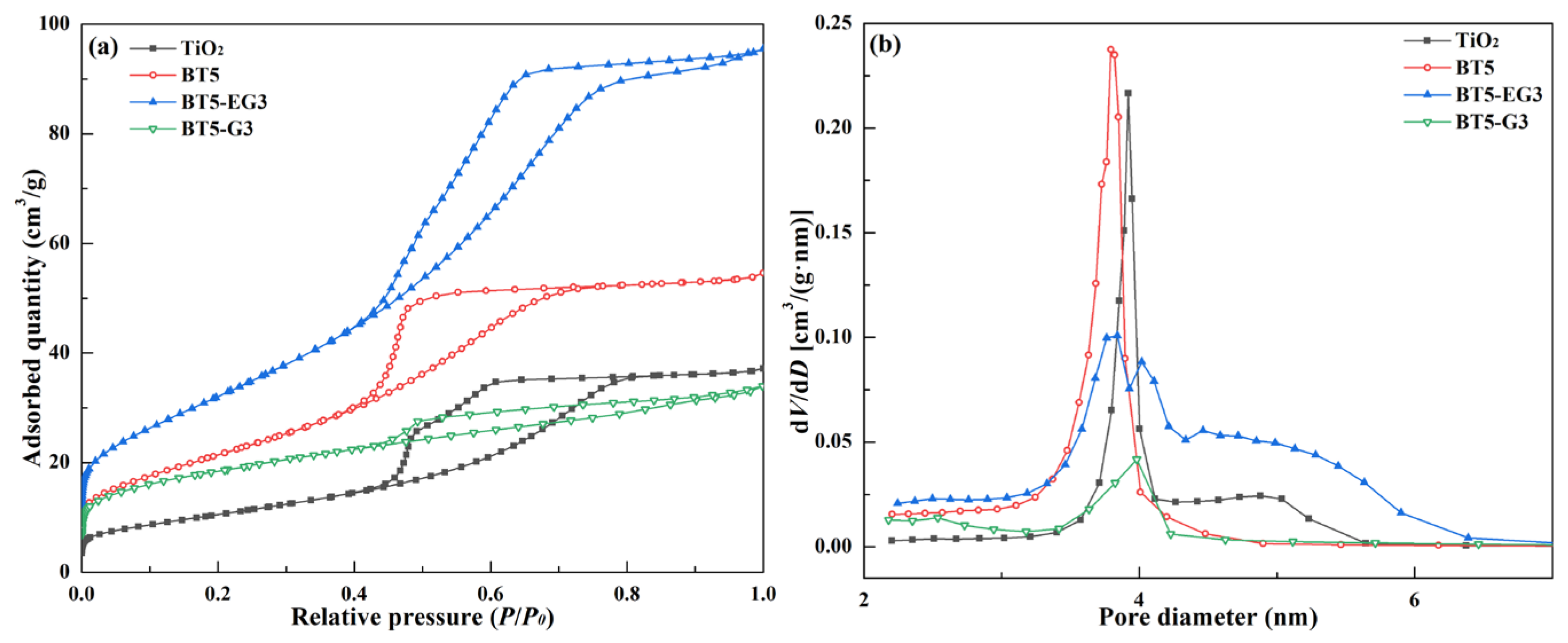
The surface area, pore volume, and average pore size of these photocatalysts are summarized in Table 1. The results showed that the BT catalysts all displayed a higher specific surface areas and pore volume than TiO2, which was beneficial for improving the performance ascribed to the Bi2O3 supporting amount. Meanwhile, the specific surface areas of BT samples increased first and then decreased with the increasing Bi2O3 supporting amount. Among them, BT5 displayed the highest specific surface area (79.9 m2/g) and the lowest average pore size (4.2 nm), resulting in higher oxidation performance in these BT catalysts. Moreover, compared with BT5, the BT5-EG1, BT5-EG3 and BT5-EG9 samples significantly increased the specific surface areas and pore volume due to the addition of ethylene glycol and the changes in the microstructure. However, for BT5-EG9, the specific surface area decreased with the continuously increasing amount of ethylene glycol. Furthermore, the BT catalysts with the addition of glycerol were not conducive to increasing the specific surface area and improving the oxidation activity. Among these samples, BT5-EG3, with an average pore size of 4.9 nm, showed the highest surface area and pore volume and effectively improved the photocatalytic degradation of TC attributed to the low diffusion resistance and more active sites.
Figure 2a displays the N2 adsorption/desorption isotherms and pore size distribution of these BT catalysts. All these catalysts, particularly TiO2, BT5, and BT5-EG3, show typical H4 adsorption/desorption isotherms combined with the H2-hysteresis loop, indicating that these catalysts belong to mesoporous materials, and are characteristic of mesoporous materials’ “inkbottle” pores or the gap among tight spheres. The surface area and pore volume increased remarkably with the Bi2O3 supporting amount and the addition of ethylene glycol. Figure 2b shows the pore size distribution curve of these catalysts. It could be found that BT-G3 displayed the lowest average pore size in these samples. However, the BT5-EG3 exhibited a wider range of pore sizes compared to TiO2 and BT5, which was also beneficial for improving adsorption and oxidation performance.

3.1.3. TEM

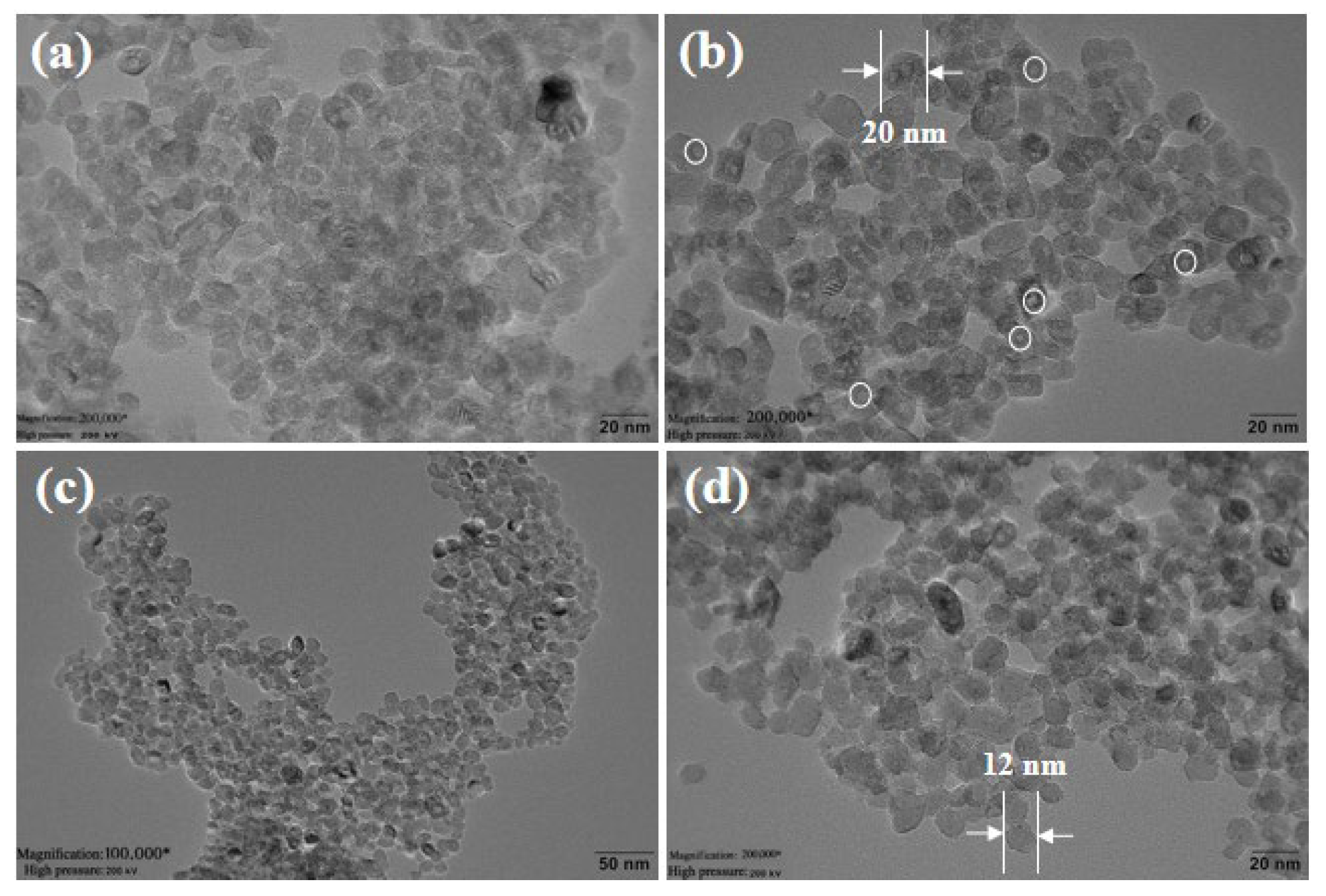
The morphology characterizations of the TiO2, BT5, and BT5-EG3 catalysts were analyzed by TEM. As shown in Figure 3, TiO2 and BT5 showed an irregular sphere or ellipsoid structure with a particle size of about 20 nm. Furthermore, BT5-EG3 exhibited smaller particle sizes around 12 nm and a higher dispersion than TiO2 and BT5. The highest surface areas and microstructure of BT5-EG3 were the main reason for the efficient degradation of TC in water by these photocatalysts.

3.2. UV-Vis and PL Spectrum Analysis

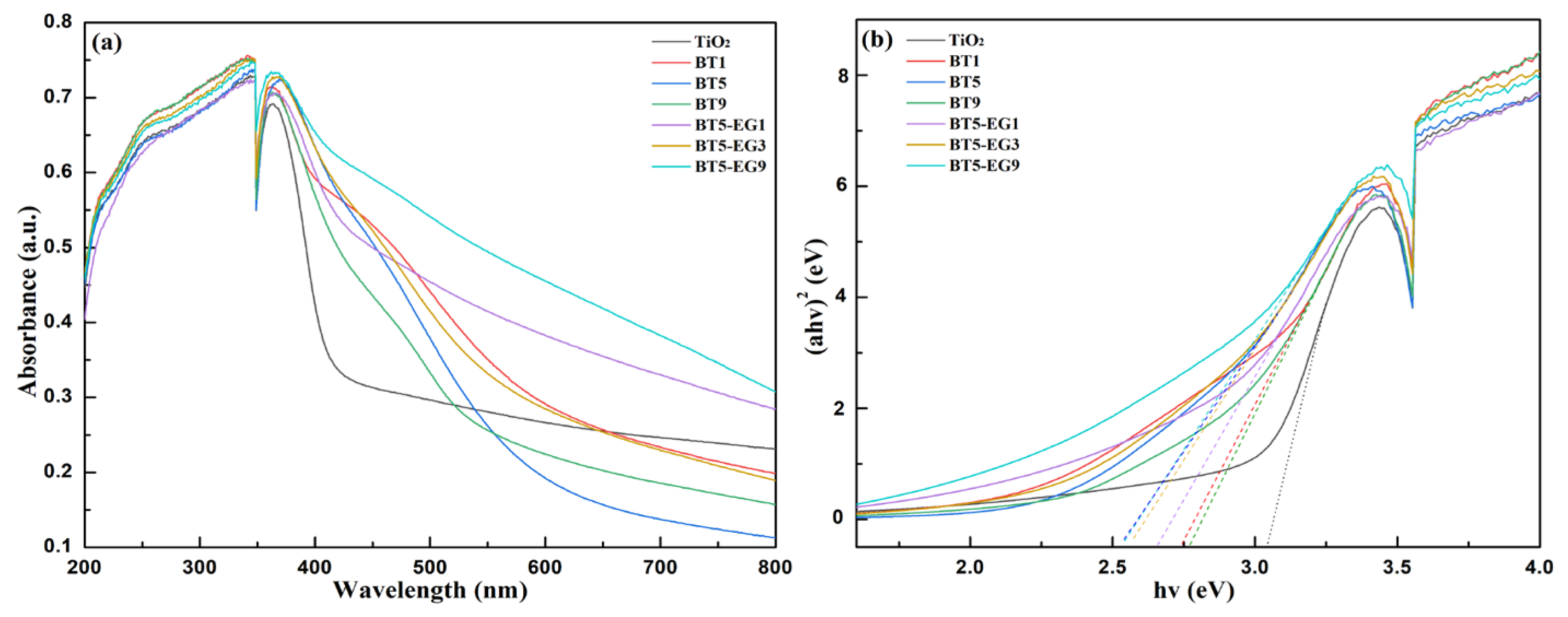
To evaluate the optical properties and band gap energy of the synthesized catalysts, the UV-Vis diffuse reflectance spectroscopy of TiO2 and BT catalysts was studied. As depicted in Figure 4a, compared with TiO2, BT catalysts with Bi2O3 coupling could absorb more visible light due to the red-shifted absorption edges [24,25,26,27]. In particular, BT5-EG1, BT5-EG3 and BT5-EG9 showed that the stronger full-spectrum absorbance than BT attributed to the smaller particle sizes and the higher specific surface area effectively promoted adsorption capacity under UV irradiation. In order to determine the band gap energy (Eg) of these samples, Eg was calculated according to the following formula.
E g = 1240 / λ max
As shown in Figure 4b, the band gap energy of TiO2, BT1, BT5, BT9, BT5-EG1, BT5-EG3, and BT5-EG9 was 3.1, 2.74, 2.52, 2.76, 2.62 eV, 2.52, and 2.52 eV, respectively. The Eg diminished first and then increased with the enhancing Bi2O3 supporting amount and BT exhibited the lowest Eg (2.52 eV) in these BT samples. Among them, BT5-EG3 and BT5-EG9, with the highest surface areas following the addition of ethylene glycol, displayed the highest adsorption capacity in the UV-Vis light area, attributed to the lowest band gap energy and structural properties. The outcomes indicated that the enhancement of UV-Vis absorption and the decrease in band gap energy facilitated the movement of photogenerated electron and hole, thereby enhancing the photocatalytic degradation of TC under UV irradiation.
To further highlight the structural and optical advantages of the optimized BT5-EG3 catalyst, a comprehensive comparison with pure TiO2, as well as other recently reported advanced nanomaterials (such as green-synthesized CuO and ZnO nanoparticles), is summarized in Table 2. Notably, the precisely controlled mixed-solvent sol–gel strategy employed in this study yields BT5-EG3 with a uniquely small crystallite size and a highly competitive specific surface area (120.0 m2/g). This surface area is significantly larger than that of pure TiO2 (39.2 m2/g) and recently reported phyto-engineered CuO nanomaterials (34.5 m2/g) [28]. Furthermore, the narrowed band gap of BT5-EG3 (2.52 eV) demonstrates excellent visible-light responsiveness compared to pure TiO2 (3.10 eV) and biogenic ZnO (3.33 eV) [14]. These comparisons clearly confirm that the synergistic effect of the heterojunction of Bi2O3 and TiO2 and mixed-solvent regulation successfully tailors the morphological structure and electronic properties of the catalyst, thereby providing abundant active sites for enhanced photocatalytic performance.
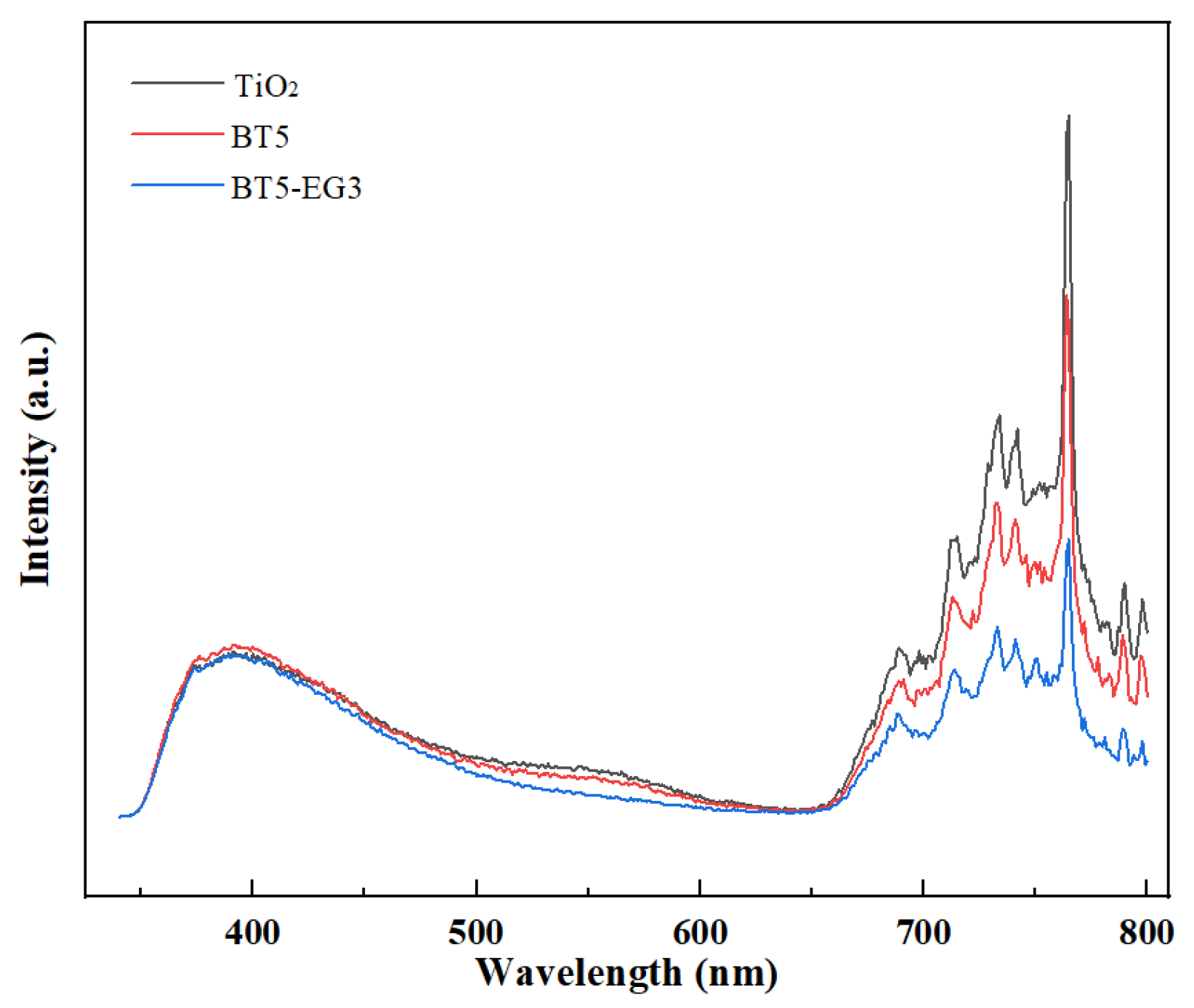
The PL spectrum is often utilized to explore the charge transfer efficiency of photocatalysts, which can reveal the separation and recombination rate of photogenerated electron and hole. As depicted in Figure 5, the PL spectra exhibited the emission bands located at 650–800 nm for TiO2, BT5 and BT5-EG3, suggesting that Bi2O3 introduction or the addition of ethylene glycol did not produce extra emission signal and only changed the intensity. Compared with TiO2 and BT5, BT5-EG3 exhibited a significant quenching of the PL emission intensity, which unambiguously indicates a substantially suppressed radiative recombination of photogenerated electron–hole pairs. This is primarily attributed to the efficient spatial charge separation across the intimate contact interface of the Bi2O3/TiO2 heterojunction. Furthermore, the addition of ethylene glycol optimized the microstructure, thereby prolonging the lifetime of the charge carriers and enhancing the ultimate photodegradation activity for TC.

3.3. XPS Analysis

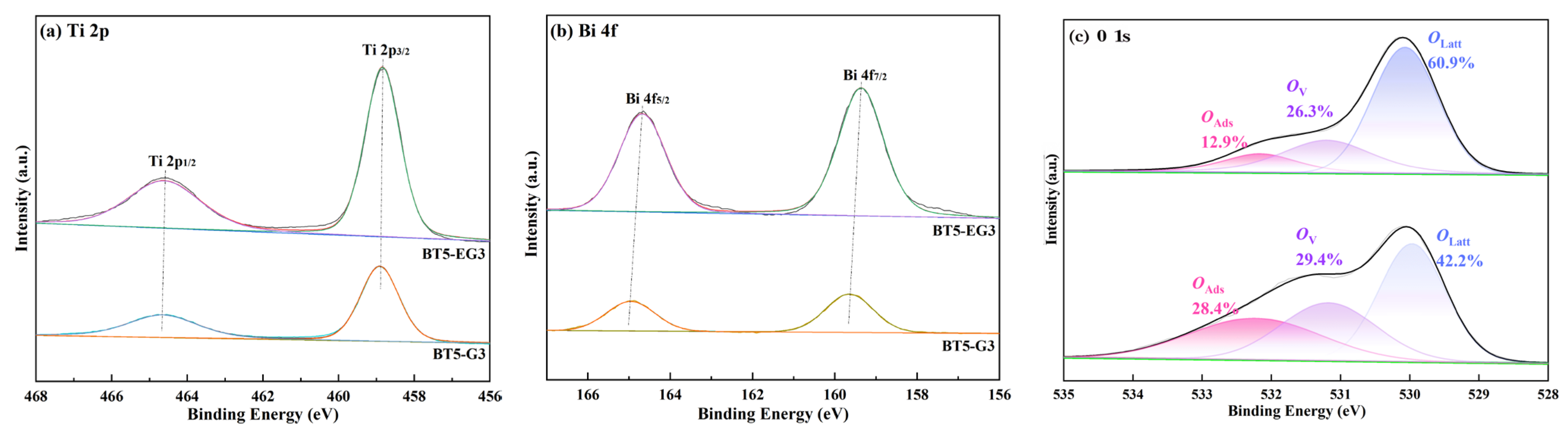
In order to further investigate the effects of ethylene glycol or glycerol replacement on the element composition and electron state of Bi2O3/TiO2, XPS was performed to characterize the binding energy of the Ti 2p, Bi 4f, O 1s of the BT5-EG3 and BT5-G3 samples (Figure 6). The peaks located at about 458.8 and 464.6 eV corresponded to Ti 2p1/2 and Ti 2p3/2 spin-orbit splitting of Ti4+, separately [29]. To further elucidate the strong interfacial electronic interactions within the heterojunction, a high-resolution peak deconvolution of the Ti 2p spectra was performed. The results showed that the signal intensity of Ti4+ of BT5-EG3 was significantly higher than BT5-G3, indicating that more Ti4+ active sites of BT5-EG3 were exposed than BT5-G3. Consequently, the overall binding energy of Ti 2p of BT5-EG3 shifts toward a lower energy direction compared to BT5-G3, confirming the increased electron cloud density around Ti atoms induced by this robust interfacial electronic coupling of Bi and Ti [30]. Figure 6b shows the XPS spectrum of Bi 4f, and the peaks at around 159.4 and 164.7 eV could be attributed to Bi 4f7/2 and Bi 4f5/2, respectively. Similarly, BT5-EG3 was shifted in the direction of the lower binding energy relative to BT5-G3 [31], indicating a stronger electronic interaction at the Bi2O3/TiO2 interface in BT5-EG3. The O 1s spectra were not symmetrical for both the BT5-EG3 and BT5-G3 samples, implying the coexistence of several oxidation states of oxygen atoms on the surface. The fitted peaks of O 1s were deconvoluted into three components: lattice oxygen (OLatt), oxygen vacancies (OV), and surface adsorbed oxygen/hydroxyl groups (OAds) [32]. To quantitatively analyze the variations in surface oxygen species induced by the heterojunction formation and solvent regulation, the relative ratios of these oxygen species were calculated based on their integrated peak areas (Figure 6c). The quantitative analysis demonstrates a significant evolution in the oxygen composition. For the BT5-G3 sample, the proportions of OLatt, OV, and OAds are 60.9%, 26.3%, and 12.9%, respectively. In contrast, the optimized BT5-EG3 sample exhibits a substantial decrease in lattice oxygen (42.2%) and a concomitant significant increase in both oxygen vacancies (29.4%) and adsorbed oxygen species (28.4%). The generation of these abundant oxygen vacancies is an inherent interfacial defect response driven by the intimate contact within the Bi2O3 and TiO2 heterojunction, as well as the localized reducing environment provided by ethylene glycol during the calcination process. Therefore, BT5-EG3 possesses a much higher surface oxygen adsorption capacity and oxygen vacancy concentration than BT5-G3. This significantly facilitates the robust generation of reactive radical species (·O2, ·OH), thereby boosting the photocatalytic degradation efficiency of TC. It can be concluded that BT5-EG3 exhibits optimized surface structural characteristics, enhanced interfacial coupling, and more efficient separation of photogenerated electron–hole pairs [33]. Furthermore, this high concentration of reactive surface oxygen species (O, ·OH) and defect sites significantly facilitates the robust generation of radical species, thereby boosting the photocatalytic degradation efficiency of TC. Therefore, BT5-EG3 possessed a higher surface oxygen adsorption amount (O, ·OH) and higher oxygen vacancy concentration than BT5-G3 with a slight shift toward lower binding energy. Meanwhile, the high concentration of surface oxygen species (O, ·OH) favored the oxidation activity of TC degradation.

3.4. Photocatalytic Performance

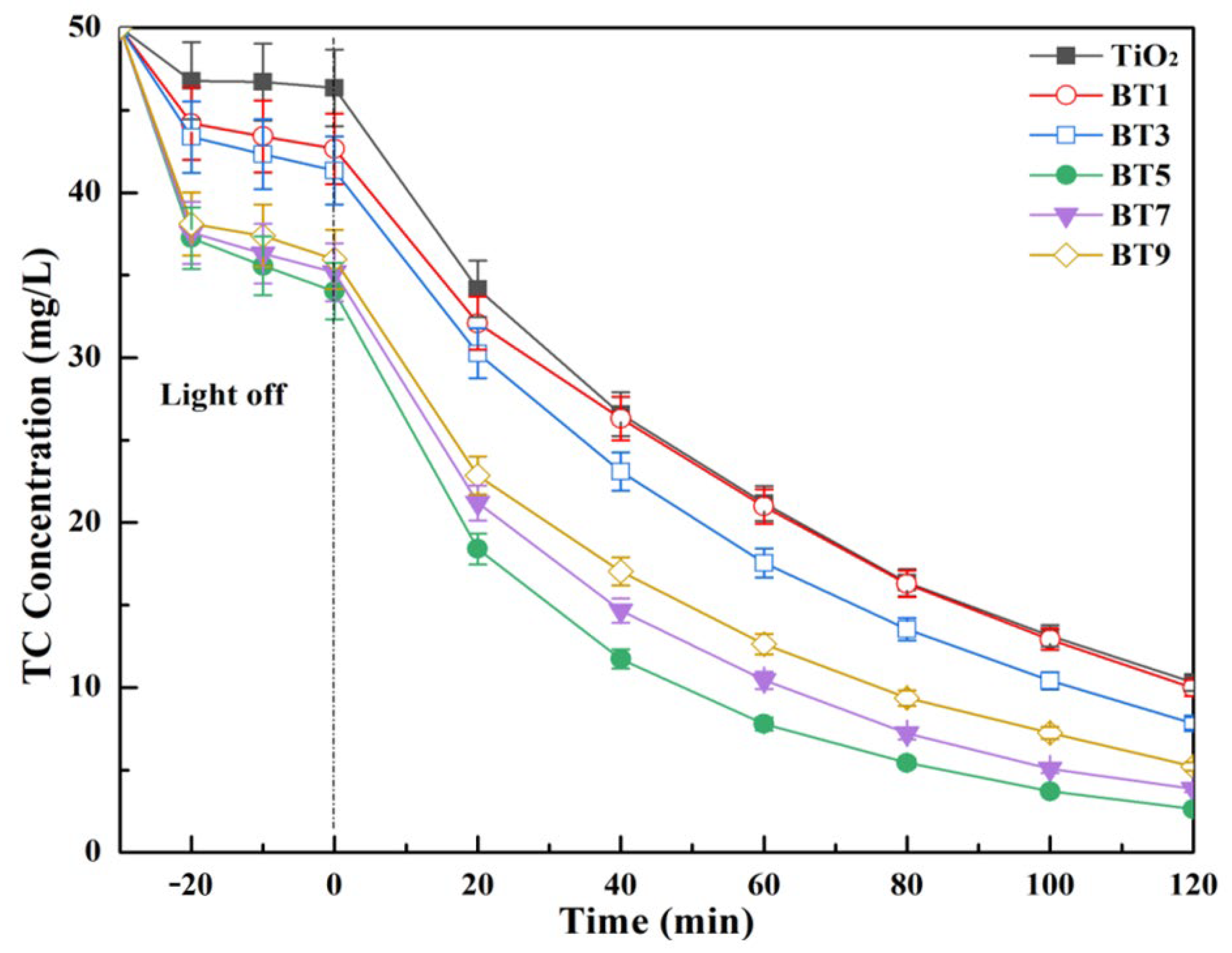
The photocatalytic degradation of TC over various BT catalysts is shown in Figure 7. It showed the photocatalytic degradation of TC over TiO2, BT1, BT2, BT3, BT4, BT5, BT6, and BT9 catalysts at different reaction times. It could be seen that the adsorption/desorption equilibrium for all samples was obtained in darkness after 30 min, and then the concentration of TC remained relatively stable. It could be also found that the oxidation activities of BT series catalysts were all higher than TiO2 after illumination for 120 min. As the Bi2O3 supporting amount of these BT catalysts continuously increased, the degradation efficiency for TC first increased and then decreased. Among them, BT5 showed the highest degradation rate (92.3%), resulting in a final TC concentration of 2.6 mg/L, while it was only 58.4% for TiO2. The higher oxidation performance of BT catalysts benefited from the higher specific surface area. Meanwhile, the strong interfacial coupling between Bi2O3 and TiO2 produced new modification energy levels, enhanced UV-Vis light absorbance, and reduced band gap energy with the Bi2O3 supporting amount. In addition, the robust formation of the Bi2O3/TiO2 heterojunction induced a strong synergistic effect that significantly facilitated the interfacial migration and spatial separation of photogenerated electron–hole pairs, thereby effectively retarding their recombination and prolonging the lifetime of the reactive charge carriers. This was consistent with the results obtained from XRD, BET, and UV-Vis characterization.
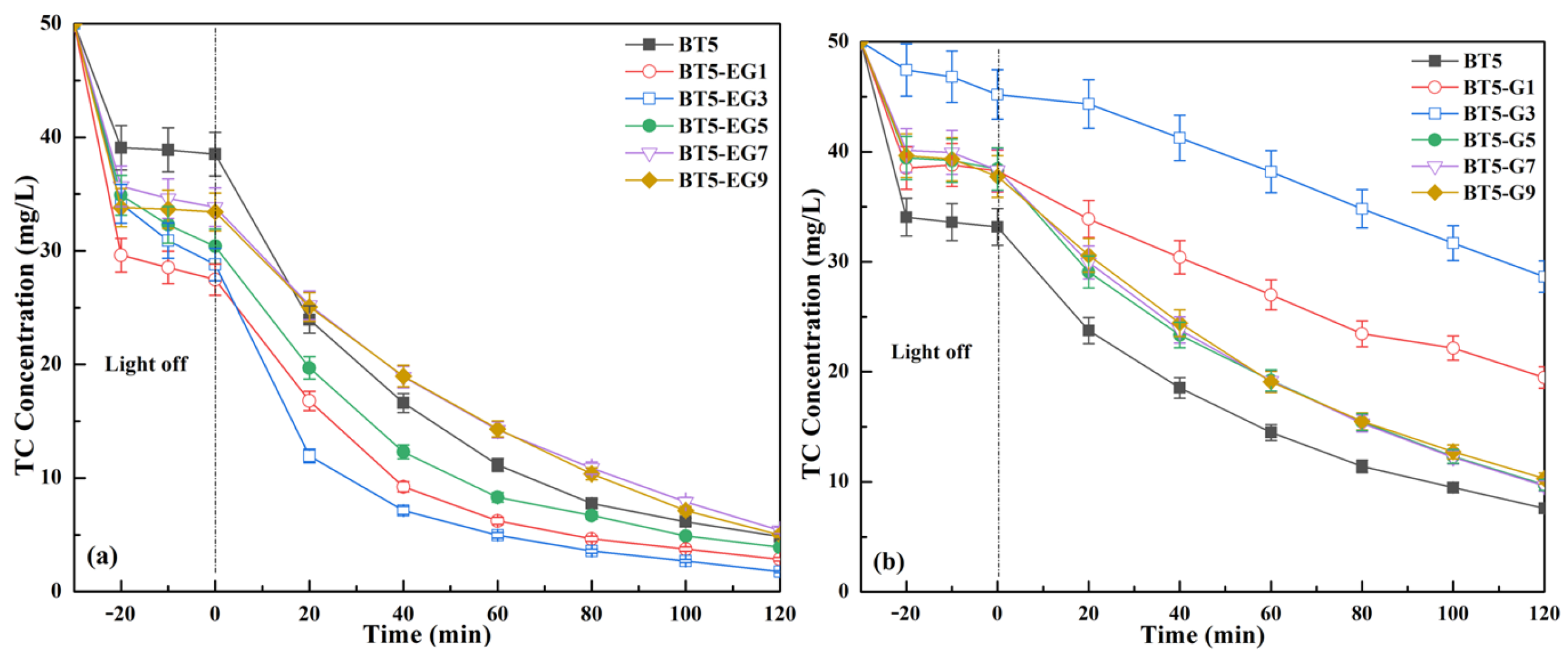
In order to further promote the oxidation activity of BT5 catalysts, BT5-EG and BT5-G prepared with the addition of ethylene glycol or glycerol were also investigated for photocatalytic degradation of TC (Figure 8). As shown in Figure 8a, the TC degradation performance increased first and then decreased subsequently for BT5-EG photocatalysts with an increasing amount of ethylene glycol, even worse than BT5, including the BT5-EG7 and BT5-EG9 samples. Among them, BT5-EG3 indicated the highest oxidation performance (93.9%) owing to the high specific surface area, amount of adsorbed oxygen and lattice oxygen, and modification of the microstructure with the addition of ethylene glycol. In contrast, as displayed in Figure 8b, all BT5-G samples showed lower oxidation efficiency than BT5, maybe due to the structure and shape change resulting in the low surface area, pore volume/size, and reduced content of active sites on the surface. In conclusion, the difference of structural characteristics of BT5-EG and BT5-G with the addition of ethylene glycol or glycerol was considered to be mainly responsible for the variation in adsorption properties and photocatalytic performances of TC removal.
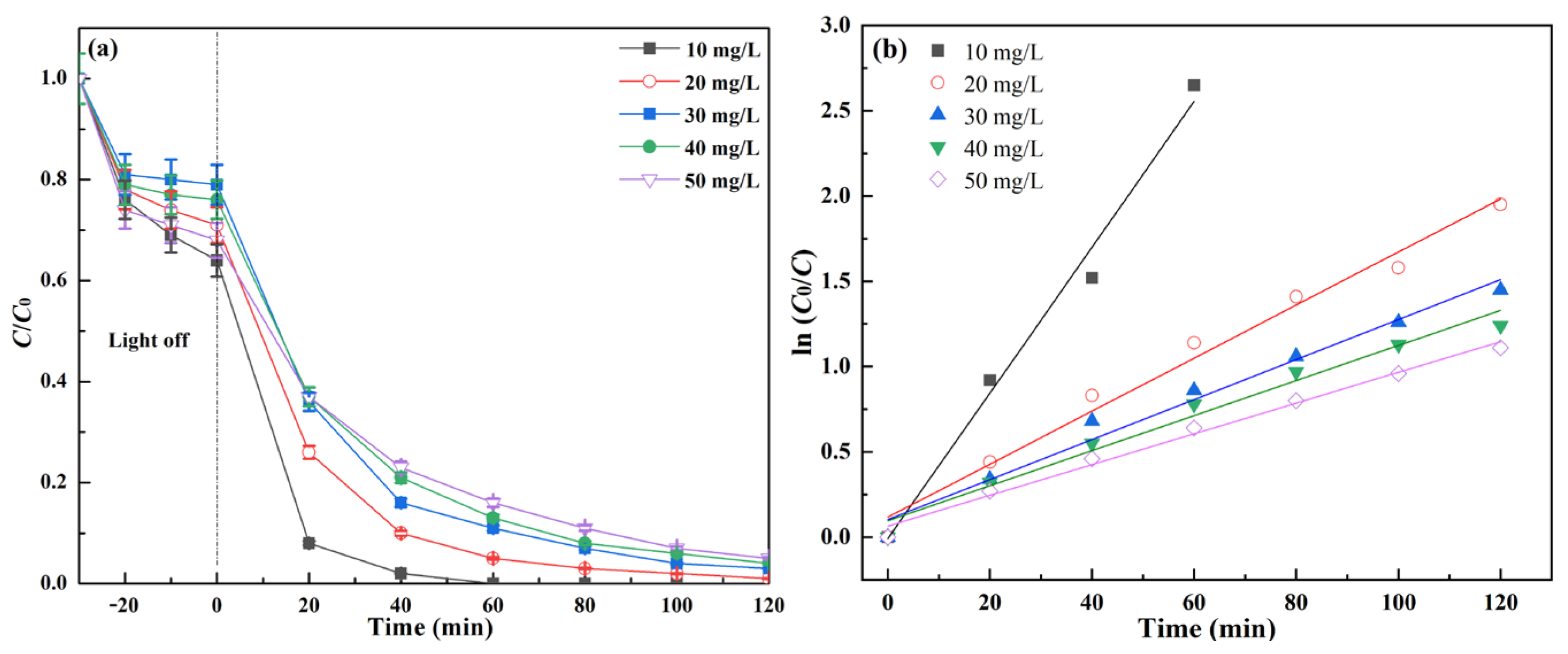
Simultaneously, photocatalytic degradation and pseudo-first-order kinetics modeling of various initial concentrations of TC over BT5-EG3 is shown in Figure 9. It could be found that the degradation efficiency and speed decreased gradually with the increasing initial concentrations of TC from 10 to 50 mg/L due to the high TC concentration affecting the adsorption of these catalysts and occupying the active sites during the adsorption process. Furthermore, the catalysts of the saturated state greatly influenced the degradation rate of TC. Therefore, the photocatalytic active sites were limited and blocked under the high concentration of TC. Therefore, the high initial concentrations of TC required a greater amount of catalysts or longer time to achieve complete degradation.
To emphasize the uniqueness and superior performance of the proposed method, the experimental parameters and degradation results of the synthesized Bi2O3/TiO2 heterojunction were compared with recent studies involving TiO2, ZnO, and other metal oxide-based photocatalytic systems (Table 3). Compared to other photocatalysts that often require either higher catalyst dosages, extended irradiation times, or additional chemical promoters, the alcohol-assisted Bi2O3/TiO2 composite developed in this work demonstrates a highly competitive removal efficiency (93.9%) for a relatively high concentration of tetracycline (50 mg/L) within 120 min. This substantial activity can be attributed to the synergistic effect of the heterojunction formed between Bi2O3 and TiO2, which significantly accelerates the pseudo-first-order kinetic rate and promotes effective charge carrier separation under UV irradiation.
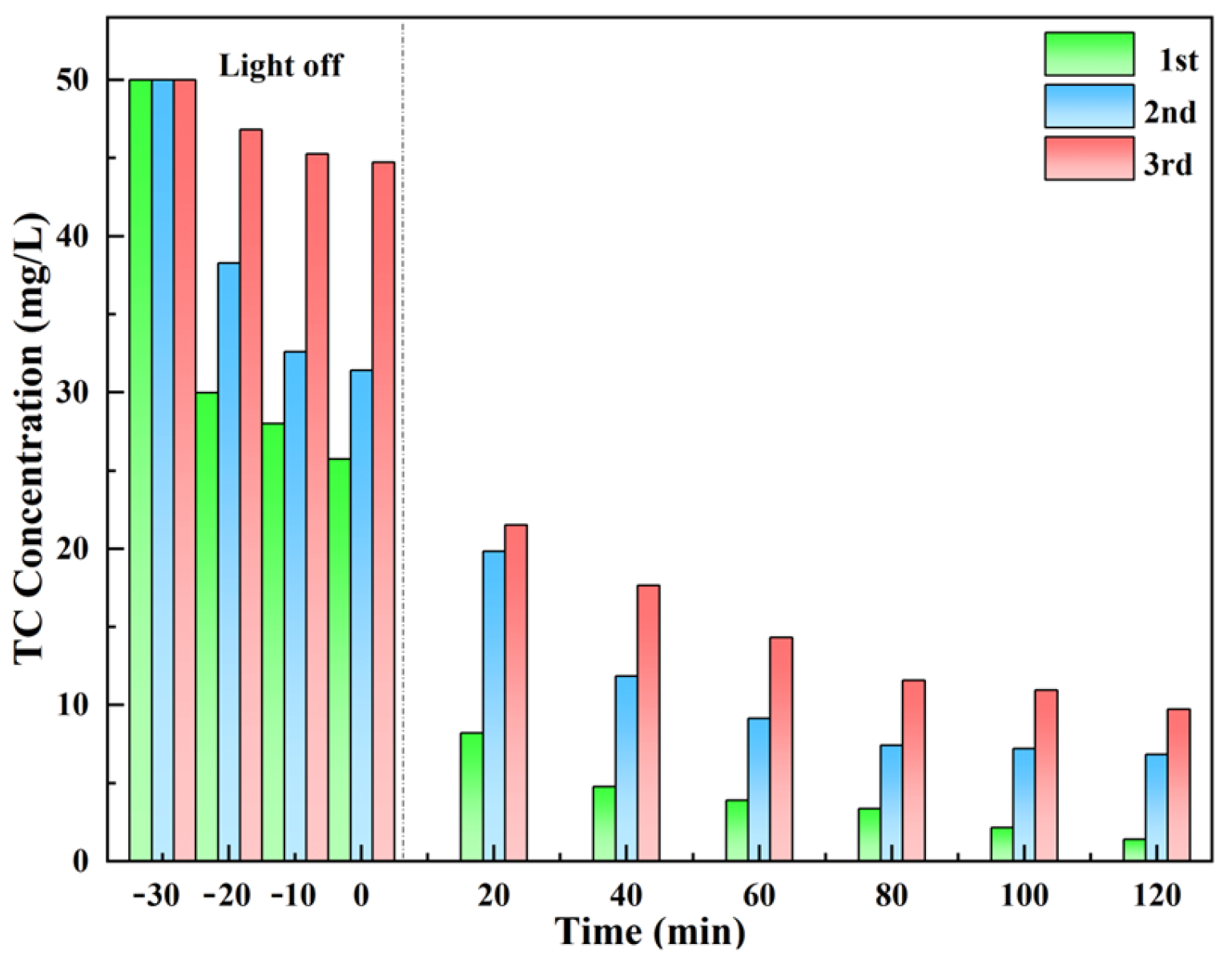
Figure 10 shows the photocatalytic degradation stability of TC over BT5-EG3 with three recycles. It was easy to find that the degradation rate over BT5-EG3 declined slowly, mainly attributed to the reduced adsorption in repeated reaction. In addition, the TC adsorbed onto the surface of the catalyst reduced the light-harvesting ability, resulting in the increasing of electron–hole recombination. Therefore, it required a longer reaction time for BT5-EG3 to reach above 90% degradation efficiency.

3.5. Photocatalytic Oxidation Mechanism

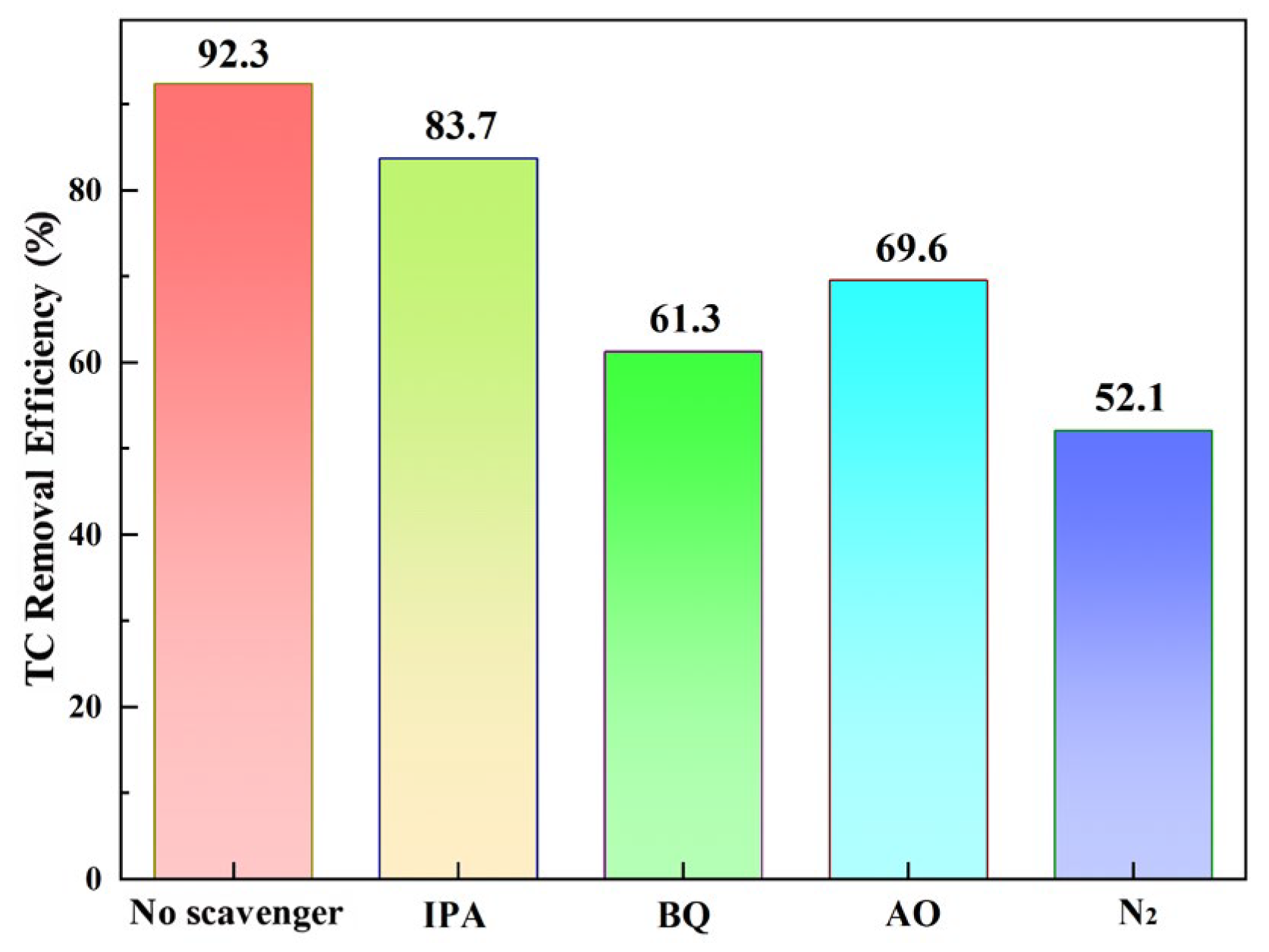
To identify the main active species, isopropanol (IPA, 5 mM), benzoquinone (BQ, 0.2 mM), and ammonium oxalate (AO, 5 mM) were added to the photocatalytic reaction as the scavengers of ·OH, ·O2, and h+, respectively. The effect of different scavengers for photocatalytic degradation of TC over BT5-EG3 is shown in Figure 11. The results demonstrated that the degradation efficiency of TC over BT5-EG3 was 92.3% without the scavenger. However, the degradation efficiencies decreased by 9.3%, 30.2%, and 15.6% with the adding of IPA, BQ, and AO, respectively, indicating that ·O2 was the dominant active species for TC degradation over BT5-EG3. Furthermore, it revealed a significant decrease in the TC photodegradation rate under nitrogen protection without oxygen. The results further confirmed that ·O2 played an important role during the TC degradation process.
Based on related reports [15,21] and the above experimental results, the possible reactions involved are as follows:
B T + h ν h + ( T i O 2 ) ( V B ) + e ( B i ) ( C B ) h + ( T i O 2 ) ( V B ) + H 2 O O H + H + e ( B i ) ( C B ) + O 2 O 2 O 2 + H + H O 2 2 H O 2 H 2 O 2 + O 2 T C + O 2 C O 2 + H 2 O
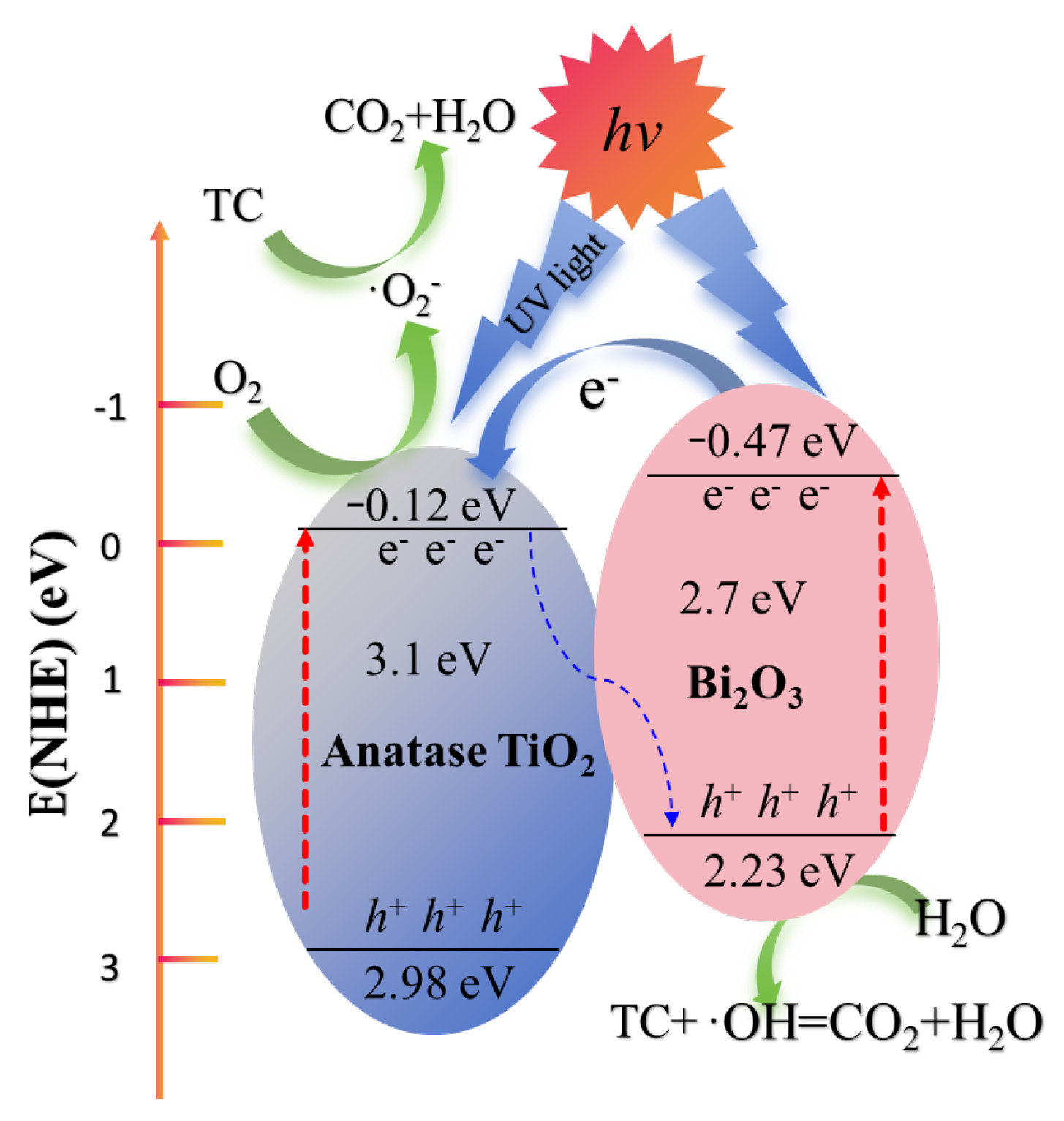
The possible mechanism of photocatalytic degradation of TC over the BT5-EG3 composite is presented in Figure 12. The enhanced photocatalytic performance of the BT5-EG3 composite is primarily attributed to the construction of a robust heterojunction architecture between the Bi2O3 and TiO2 phases, which facilitates the spatial separation of photogenerated electron–hole pairs. During the synthesis, the Bi precursor crystallizes into highly dispersed Bi2O3 phases that form an intimate contact with the TiO2. This large contact interface between the two phases is highly beneficial for accelerating charge transfer and separation. Furthermore, this phase coexistence promotes a reduction in the band gap energy to 2.52 eV. Under UV light irradiation, both Bi2O3 and TiO2 are excited to generate electron–hole pairs. Based on the staggered band alignment characteristic of a conventional type II heterojunction, the conduction band (CB) and valence band (VB) levels of Bi2O3 are higher than the corresponding levels of TiO2. Driven by this specific band alignment, the photogenerated electrons on the CB of Bi2O3 thermodynamically migrate to the CB of TiO2, while the photogenerated holes migrate to or remain on the VB of Bi2O3. This spatial separation process effectively accelerates the migration of charge carriers across the heterojunction interface and overcomes the ultrafast electron–hole recombination typically observed in single semiconductors. Consequently, the spatially separated electrons accumulated on the CB of TiO2 are captured by adsorbed O2 to produce superoxide radicals (·O2), and H2O molecules accept holes (h+) to generate ·OH radicals. Ultimately, the TC molecules adsorbed onto the surface of BT5-EG3 are successively oxidized under the synergistic action of these highly reactive radical species (·O2 and ·OH).
While the BT5-EG3 catalyst demonstrated excellent efficiency in degrading TC under UV irradiation, a limitation of this study is the reliance on a single antibiotic model in a controlled matrix. The HRTEM image for resolved fringes and SAED pattern will be further researched to master the structural morphology of BT5-EG3 catalysts. Simultaneously, the catalytic oxidation mechanism will be investigated using LC-MS, in situ IR, Mott–Schottky and VB-XPS analyses, electrochemical impedance spectroscopy (EIS) and so on. Additionally, real-world aquatic environments contain complex matrices and co-existing pollutants that may interfere with the photocatalytic process. Future work will focus on evaluating the performance of these heterojunctions under natural sunlight and in actual wastewater matrices.

4. Conclusions

In this work, a series of Bi2O3/TiO2 composites catalysts prepared by the sol–gel method with different Bi/Ti molar ratio and alcohol solvent have been studied for photocatalytic degradation of TC under UV irradiation. Among these photocatalysts, BT5-EG3 displayed the highest oxidation activity (93.9%) for TC removal due to the higher surface area, adsorption (BET), and amount of adsorbed and lattice oxygen (XPS) attributed to the different structure with the assistance of alcohol solvents. According to the results of the analysis, the introduction of Bi species promoted the in situ growth of highly dispersed Bi2O3 nanoclusters on the TiO2 surface, resulting in the formation of robust Bi2O3/TiO2 heterojunctions and the partial induction of brookite phase. This unique structure, coupled with the lower bandgap energy (2.52 eV) was highly beneficial for optimizing the band alignment and facilitating the spatial separation of electron–hole pairs. Consequently, as corroborated by the PL spectra, the recombination of charge carriers in the BT5-EG3 composite was remarkably retarded, thereby maximizing the generation and utilization of highly reactive radical species (·OH and ·O2) for efficient TC degradation. The potential photocatalytic oxidation mechanism demonstrated that ·O2 was the main active species during the photocatalytic reaction process. The oxidation ability, stability and pseudo-first-order kinetics model of BT5-EG3 were also investigated under the different initial concentrations of TC. The present investigation provided a useful strategy for the design of efficient TiO2 photocatalysts and new insights for controlling antibiotic pollution in water.

Author Contributions

Methodology, Y.L., L.Z., Z.Y., J.S. and X.T.; Validation, Y.L., L.Z., J.S. and X.T.; Formal analysis, R.L., S.Z. and Q.H.; Data curation, R.L.; Writing—original draft, R.L.; Writing—review and editing, S.Z. and Q.H.; Visualization, Z.Y.; Supervision, S.Z., Q.H. and H.Y.; Funding acquisition, S.Z. and Q.H. All authors have read and agreed to the published version of the manuscript.

Funding

This research was funded by the National Natural Science Foundation of China (Nos. 21501097, 52000101 and 51902166), Natural Science Foundation of Jiangsu Province (Nos. BK20170954, BK20150890 and BK20190786), the Qing Lan Project of the Jiangsu Higher Education Institutions and the Priority Academic Program Development of Jiangsu Higher Education Institutions (PAPD). It was also funded by the Postgraduate Research & Practice Innovation Program of Jiangsu Province (KYCX23_1384) and NUIST-Reading Research Institute Pump-Priming Project.

Data Availability Statement

The original contributions presented in this study are included in the article. Further inquiries can be directed to the corresponding author.

Conflicts of Interest

The authors declare no conflicts of interest.

References

  1. Yang, H.; Paruch, L.; Chen, X.; van Eerde, A.; Skomedal, H.; Wang, Y.; Liu, D.; Clarke, J.L. Antibiotic Application and Resistance in Swine Production in China: Current Situation and Future Perspectives. Front. Vet. Sci. 2019, 6, 136. [Google Scholar] [CrossRef]
  2. Li, S.; Zhang, X.; Huang, Y. Zeolitic imidazolate framework-8 derived nanoporous carbon as an effective and recyclable adsorbent for removal of ciprofloxacin antibiotics from water. J. Hazard. Mater. 2017, 321, 711–719. [Google Scholar] [CrossRef] [PubMed]
  3. Kalli, M.; Noutsopoulo, C.; Mamais, D. The fate and occurrence of antibiotic-resistant bacteria and antibiotic resistance genes during advanced wastewater treatment and disinfection: A review. Water 2023, 15, 2084. [Google Scholar] [CrossRef]
  4. Kivits, T.; Broers, H.P.; Beeltje, H.; van Vliet, M.; Griffioen, J. Presence and fate of veterinary antibiotics in age-dated groundwater in areas with intensive livestock farming. Environ. Pollut. 2018, 241, 988–998. [Google Scholar] [CrossRef] [PubMed]
  5. Liu, X.; Liu, Y.; Lu, S.; Guo, X.; Lu, H.; Qin, P.; Bi, B.; Wan, Z.; Xi, B.; Zhang, T.; et al. Occurrence of typical antibiotics and source analysis based on PCA-MLR model in the East Dongting Lake, China. Ecotoxicol. Environ. Saf. 2018, 163, 145–152. [Google Scholar] [CrossRef]
  6. Wang, X.; Li, Y.; Zhang, J.; Chen, Z. Efficient adsorption of a sulfonamide antibiotic in aqueous solutions with N-doped magnetic biochar: Performance, mechanism, and reusability. ACS Omega 2023, 8, 879–892. [Google Scholar] [CrossRef]
  7. Nasrollahi, N.; Vatanpour, V.; Khataee, A. Removal of antibiotics from wastewaters by membrane technology: Limitations, successes, and future improvements. Sci. Total Environ. 2022, 838, 156010. [Google Scholar] [CrossRef]
  8. He, Z.; Wang, X.; Luo, Y.; Zhu, Y.; Lai, X.; Shang, J.; Chen, J.; Liao, Q. Effects of suspended particulate matter from natural lakes in conjunction with coagulation to tetracycline removal from water. Chemosphere 2021, 277, 130327. [Google Scholar] [CrossRef]
  9. Lu, Z.; Liu, G.; Xie, H.; Zhai, Y.; Li, X. Advances and solutions in biological treatment for antibiotic wastewater with resistance genes: A review. J. Environ. Manag. 2024, 368, 122115. [Google Scholar] [CrossRef]
  10. Bai, X.; Chen, W.; Wang, B.; Sun, T.; Wu, B.; Wang, Y. Photocatalytic degradation of some typical antibiotics: Recent advances and future outlooks. Int. J. Mol. Sci. 2022, 23, 8130. [Google Scholar] [CrossRef]
  11. Liang, X.; Yu, S.; Meng, B.; Wang, X.; Yang, C.; Shi, C.; Ding, J. Advanced TiO2-based photoelectrocatalysis: Material modifications, charge dynamics, and environmental–energy applications. Catalysts 2025, 15, 542. [Google Scholar] [CrossRef]
  12. Shrivastav, H.; Kaur, H.; Kumar, S.; Sur, D.; Sadaf, S.; Kaur, R.; Kumar, C.; Patial, P.; Awad, M.; Alam, M.W. A new horizon in green synthesis for metal oxides: Dracaena reflexa-derived TiO2 nanoparticles for photocatalytic activity and antibacterial application. Catalysts 2026, 466, 115679–115703. [Google Scholar] [CrossRef]
  13. Kaur, H.; Kumar, S.; Kaur, G.; Kaur, N.; Badru, R.; Saini, R. An emerging expanse: Novel and eco-friendly-biogenic synthesis of E. cardamomum-wrapped TiO2 nanoparticles for environmental and biological applications. Environ. Res. 2023, 234, 116599–116611. [Google Scholar] [CrossRef] [PubMed]
  14. Kaur, H.; Sharma, A.; Anand, K.; Panday, A.; Tagotra, S.; Kakran, S.; Singh, A.K.; Alam, M.W.; Kumar, S.; Bouzid, G.; et al. Green synthesis of ZnO nanoparticles using E. cardamomum and zinc nitrate precursor: A dual-functional material for water purification and antibacterial applications. RSC Adv. 2025, 15, 16742–16765. [Google Scholar] [CrossRef] [PubMed]
  15. Wu, S.; Hu, H.; Lin, Y.; Zhang, J.; Hu, Y.H. Visible light photocatalytic degradation of tetracycline over TiO2. Chem. Eng. J. 2020, 382, 122842. [Google Scholar] [CrossRef]
  16. Mao, T.; Zha, J.; Hu, Y.; Chen, Q.; Zhang, J.; Luo, X. Research progress of TiO2 modification and photodegradation of organic pollutants. Inorganics 2024, 12, 178. [Google Scholar] [CrossRef]
  17. Chen, X.; Chen, W.; Gao, H.; Yang, Y.; Shangguan, W. In situ photodeposition of NiOx on CdS for hydrogen production under visible light: Enhanced activity by controlling solution environment. Appl. Catal. B-Environ. 2014, 152, 68–72. [Google Scholar] [CrossRef]
  18. Wang, M.; Li, C.; Liu, B.; Qin, W.; Xie, Y. Facile synthesis of nano-flower β-Bi2O3/TiO2 heterojunction as photocatalyst for degradation RhB. Molecules 2023, 28, 882. [Google Scholar] [CrossRef]
  19. Yin, Z.; Zhang, X.; Yuan, X.; Wei, W.; Xiao, Y.; Cao, S. Constructing TiO2@Bi2O3 multi-heterojunction hollow structure for enhanced visible-light photocatalytic performance. J. Clean. Prod. 2022, 375, 134112. [Google Scholar] [CrossRef]
  20. Sood, S.; Mehta, S.K.; Sinha, A.S.K.; Kansal, S.K. Bi2O3/TiO2 heterostructures: Synthesis, characterization and their application in solar light mediated photocatalyzed degradation of an antibiotic, ofloxacin. Chem. Eng. J. 2016, 290, 45–52. [Google Scholar] [CrossRef]
  21. Wang, N.; Li, X.; Yang, Y.; Zhou, Z.; Shang, Y.; Zhuang, X.; Zhang, T. Two-stage calcination composite of Bi2O3-TiO2 supported on powdered activated carbon for enhanced degradation of sulfamethazine under solar irradiation. J. Water Process Eng. 2020, 35, 101220. [Google Scholar] [CrossRef]
  22. Yang, J.; Wang, X.H.; Yan, S.; Huang, F.; Xia, X.Y.; Zhao, Y.Q.; Hao, P.; Cui, G.W.; Wang, Q. Facile construction of (Bi2O3/Bi2O2.33)/TiO2 S-scheme heterojunction by deep eutectic solvent-regulated strategy for enhanced photocatalytic tetracycline degradation. J. Alloy Compd. 2025, 1020, 179400–179407. [Google Scholar] [CrossRef]
  23. Mäntele, W.; Deniz, E. UV–Vis absorption spectroscopy: Lambert-Beer reloaded. Spectrochim. Acta A 2017, 173, 965–968. [Google Scholar] [CrossRef] [PubMed]
  24. Meng, J.; Ashry, A.G.; Abou-Elyazed, A.S.; Zhang, Z.; Li, X.; Sharara, T.Z.; El-Demerdash, S.H. Highly efficient visible-light photocatalysts: Bi2O3@TiO2 derived from Ti-MOFs for Eriochrome Black T degradation. Catalysts 2024, 14, 829. [Google Scholar] [CrossRef]
  25. Ma, A.; Wei, Y.; Zhou, Z.; Xu, W.; Ren, F.; Ma, H.; Wang, J. Preparation Bi2S3-TiO2 heterojunction/polymer fiber composites and its photocatalytic degradation of methylene blue under Xe lamp irradiation. Polym. Degrad. Stabil. 2012, 97, 125–131. [Google Scholar] [CrossRef]
  26. Sood, S.; Umar, A.; Mehta, S.K.; Kansal, S.K. α-Bi2O3 nanorods: An efficient sunlight active photocatalyst for degradation of Rhodamine B and 2, 4, 6-trichlorophenol. Ceram. Int. 2015, 41, 3355–3364. [Google Scholar] [CrossRef]
  27. Yang, L.; Sun, W.; Luo, S.; Luo, Y. White fungus-like mesoporous Bi2S3 ball/TiO2 heterojunction with high photocatalytic efficiency in purifying 2, 4-dichlorophenoxyacetic acid/Cr (VI) contaminated water. Appl. Catal. B-Environ. 2014, 156, 25–34. [Google Scholar] [CrossRef]
  28. Kaur, H.; Alam, M.W.; Alsawat, M.; Kumar, S.; Kaur, R.; Yewale, M.A.; Kumar, C.; Sridevi, C.; Bouzid, G.; Sillanpaa, M. Phyto-engineered CuO using Elettaria cardamomum: A visible-light-driven photocatalyst with antibacterial potential for environmental and biomedical applications. Catal. Today 2026, 467, 115697. [Google Scholar] [CrossRef]
  29. Liu, Y.; Zhu, G.; Gao, J.; Hojamberdiev, M.; Zhu, R.; Wei, X.; Guo, Q.; Liu, P. Enhanced photocatalytic activity of Bi4Ti3O12 nanosheets by Fe3+-doping and the addition of Au nanoparticles: Photodegradation of phenol and bisphenol A. Appl. Catal. B-Environ. 2017, 200, 72–82. [Google Scholar] [CrossRef]
  30. Senthil, R.A.; Theerthagiri, J.; Selvi, A.; Madhavan, J. Synthesis and characterization oflow-cost g-C3N4/TiO2 composite with enhanced photocatalytic performance under visible-light irradiation. Opt. Mater. 2017, 64, 533–539. [Google Scholar] [CrossRef]
  31. Wang, N.; Li, X.; Yang, Y.; Guo, T.; Zhuang, X.; Ji, S.; Zhang, T.; Shang, Y.; Zhou, Z. Enhanced photocatalytic degradation of sulfamethazine by Bi-doped TiO2 nano-composites supported by powdered activated carbon under visible light irradiation. Sep. Purif. Technol. 2019, 211, 673–683. [Google Scholar] [CrossRef]
  32. Huang, Q.; Ye, J.; Si, H.; Yang, B.; Tao, T.; Zhao, Y.; Chen, M.; Yang, H. Differences of characteristics and performance with Bi3+ and Bi2O3 doping over TiO2 for photocatalytic oxidation under visible light. Catal. Lett. 2020, 150, 1098–1110. [Google Scholar] [CrossRef]
  33. Zhang, Z.; Huang, J.; Xia, H.; Dai, Q.; Gu, Y.; Lao, Y.; Wang, X. Chlorinatedvolatile organic compound oxidation over SO42−/Fe2O3 catalysts. J. Catal. 2018, 360, 277–289. [Google Scholar] [CrossRef]
  34. Faraji, M.; Mostafazadeh, N.; Dadashi, R.; Esmailpour, S.; Bahram, M. UV-assisted fabrication of CdS-decorated porous ZnO-PEG disk photocatalysts for efficient dye degradation. Results Eng. 2026, 29, 109748. [Google Scholar] [CrossRef]
  35. Huynh, T.V.; Nguyen, S.T.; Nguyen, V.H.; Nguyen, O.T.K. Zinc-doped BiOBr microspheres as an efficient photocatalyst for tetracycline antibiotic degradation under LED light. J. Phys. Chem. Solids 2026, 214, 113669. [Google Scholar] [CrossRef]
  36. Dolatshah, M.; Zinatizadeh, A.A.; Zinadini, S. A novel hierarchical TiO2@S-AZMB/ZnTi-LDH Z-scheme photocatalyst for enhanced metronidazole degradation. Appl. Mater. Today 2026, 48, 103097. [Google Scholar] [CrossRef]
  37. Diego-Lopez, A.; Cabezuelo, O.; Tamarit, L.; Bosca, F.; Marin, M.L. Activation of H2O2; PMS, and PDS over anatase TiO2-supported photocatalysts for efficient pollutant mineralization in water. Catal. Today 2026, 468, 115724. [Google Scholar] [CrossRef]
  38. Jahangiri, M.; Jalili, M.; Salavati-Niasari, M.; Dawid, E.A. Heterogeneous kinetic study of Ce-Ag-ZnO nano-photocatalyst for degradation of reactive red (RR120) dyes. Environ. Technol. Innov. 2026, 41, 104842. [Google Scholar] [CrossRef]
  39. Li, W.; Li, X.; Zhang, Y.; Xu, Y.; Wen, Z.; Huang, J.; Peng, M. Performance optimization and degradation mechanism elucidation of Fe-doped BiOBr photocatalysts for enhanced photocatalytic activity. J. Alloys Compd. 2025, 1038, 182837. [Google Scholar] [CrossRef]
  40. Saadati, A.; Habibi-Yangjeh, A.; Khataee, A. A facile synthesis of S-scheme TiO2-x/FeTiO3 heterojunction photocatalyst for multifunctional hazardous pollutants degradations. J. Alloys Compd. 2026; in press. [Google Scholar] [CrossRef]
  41. Hu, L.; Huang, Q.; Li, M.; Zhang, J.; Xue, Q.; Wang, J.; Li, C. A novel Z-scheme ZnO/N-Cu-MOF photocatalyst for efficient inactivation of Hematodinium dinospores. J. Environ. Chem. Eng. 2026, 14, 120629. [Google Scholar] [CrossRef]
  42. Bouchabou, M.; Brocani-Pasino, S.A.; Belda-Marco, S.; Román-Martínez, M.C.; Lillo-Rodenas, M.A. Photoreforming with Cu/TiO2 and Ni/TiO2 photocatalysts: Production of hydrogen and revalorization of biomass substrates. Int. J. Hydrogen Energy 2026, 216, 153568. [Google Scholar] [CrossRef]
  43. Verma, M.K.; Sharma, M.; Shozi, M.L.; Kumar, R. A comprehensive review on recent advances in bismuth chalcogenide-based heterostructured photocatalysts for pesticide degradation. Chem. Eng. J. Green Sustain. 2026, 2, 100045. [Google Scholar] [CrossRef]
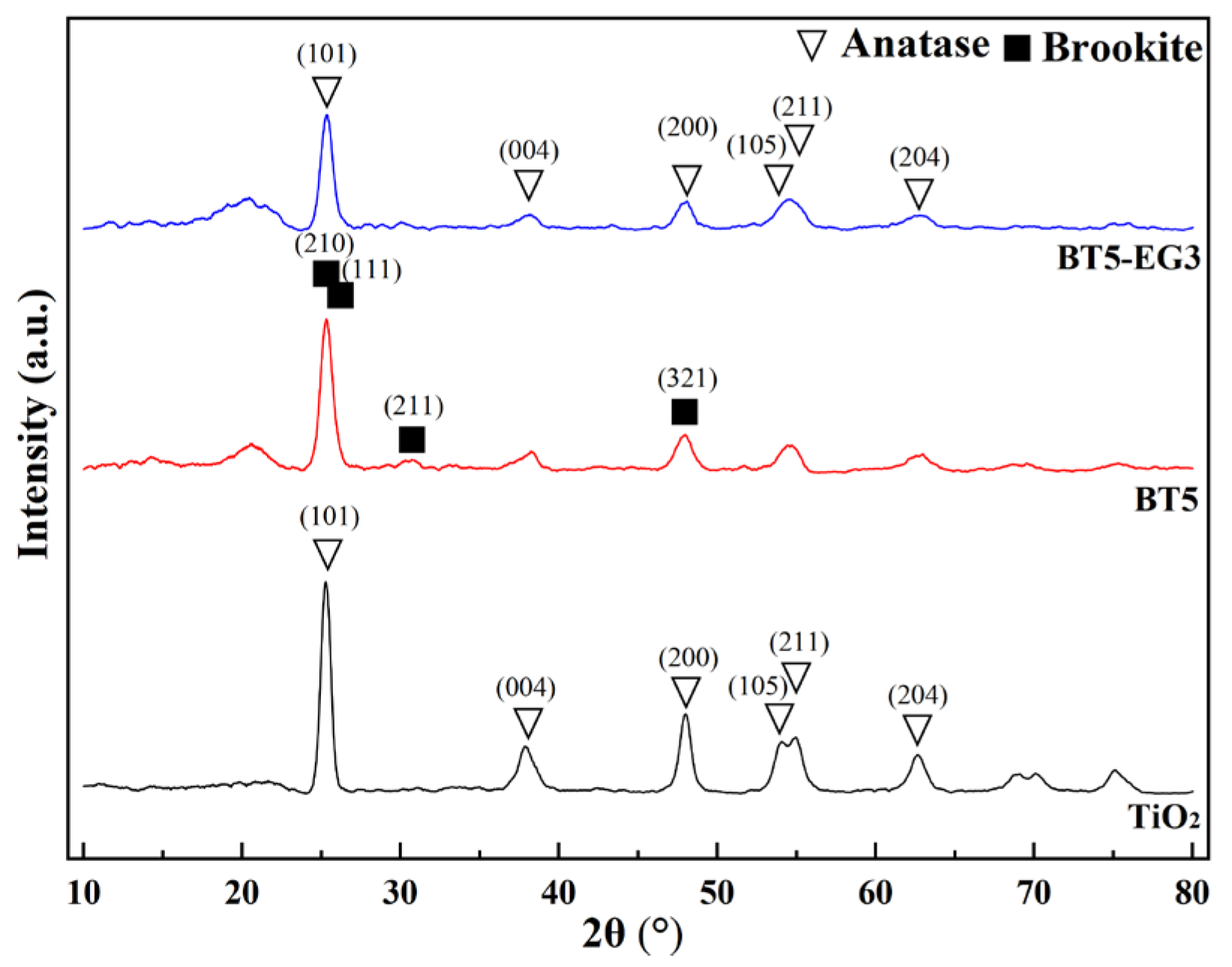
Figure 1. XRD patterns of TiO2, BT5, and BT5-EG3.
Water 18 00759 g001
Figure 2. N2 adsorption/desorption isotherms (a) and pore size distribution of these catalysts (b).
Water 18 00759 g002
Figure 3. TEM images ((a) TiO2, (b) BT5, and (c,d) BT5-EG3).
Water 18 00759 g003
Figure 4. UV-Vis spectrum (a) and bandgap estimation (b) of these catalysts.
Water 18 00759 g004
Figure 5. Photoluminescence spectra of TiO2, BT5, and BT5-EG3.
Water 18 00759 g005
Figure 6. XPS spectra of BT5-EG3 and BT5-G3 catalysts ((a) Ti 2p, (b) Bi 4f, and (c) O 1s).
Water 18 00759 g006
Figure 7. Photocatalytic degradation of TC over BT catalysts.
Water 18 00759 g007
Figure 8. Photocatalytic degradation of TC over BT5-EG (a) and BT5-G (b) catalysts.
Water 18 00759 g008
Figure 9. Photocatalytic degradation of the various initial concentrations of TC over BT5-EG3 (a), and pseudo-first-order kinetics (b).
Water 18 00759 g009
Figure 10. Photocatalytic degradation stability of TC over BT5-EG3.
Water 18 00759 g010
Figure 11. The effect of different scavengers on the photocatalytic degradation of TC over BT5-EG3.
Water 18 00759 g011
Figure 12. Possible photocatalytic reaction mechanism of TC over BT5-EG3.
Water 18 00759 g012
Table 1. Specific surface areas, pore volumes, and average pore sizes of the photocatalysts.
SamplesSBET (m2/g)Vp (cm3/g)Dp (nm)
TiO239.20.0575.8
BT168.50.0844.9
BT579.90.0844.2
BT974.30.0864.6
BT5-EG1121.60.1334.4
BT5-EG3120.00.1474.9
BT5-EG9101.90.1044.1
BT5-G364.10.0523.2
Table 2. Comparison of crystallite size, particle size, specific surface area, and band gap of the synthesized catalysts with recent reports in the literature.
CatalystsSynthesis MethodCrystallite Size
(nm)
Particle Size
(nm)
Surface Area
(m2/g)
Band Gap
(eV)
Ref.
TiO2Sol–gel23.4~2039.23.1This work
BT5-EG3Mixed-solvent sol–gel14.9~121202.52This work
CuO NPsGreen synthesis (E. cardamomum)11.7335–60034.52.36[28]
ZnO NPsGreen synthesis (E. cardamomum)20.879–71Not reported3.33[14]
Table 3. Comparison of photocatalytic degradation parameters of the present catalyst with recently reported photocatalysts.
PhotocatalystTarget Pollutant
(Conc.)
Catalyst DoseLight Source
(Wavelength)
Time
(min)
Removal Efficiency
(%)
Kinetic RateRef.
Bi2O3/TiO2Tetracycline (50 mg/L)1.0 g/LUV light12093.9Pseudo-first-orderThis work
CdS/porous ZnO-PEGMethylene blue (5 mg/L)1 disk (0.5 cm2)UV lamp (250 W)3080.85-[34]
Zn-doped BiOBrTetracycline (10 mg/L)0.2 g/LVisible LED (60 W)18075.94-[35]
TiO2@S-AZMB/ZnTi-LDHMetronidazole (20 mg/L)1.5 g/LXenon lamp (300 W)180940.0191 min−1[36]
SiO2@TiO2 (with PMS)ortho-Phenylphenol (17 mg/L)1.0 g/LUV-A (352 nm)12095-[37]
Ce-Ag-ZnOReactive red 120 (20 mg/L)0.1 g/LUV lamp60>99.0Pseudo-first-order[38]
Fe-doped BiOBrCrystal violet (20 mg/L)-Visible light6096.8-[39]
TiO2-x/FeTiO3Tetracycline (~27.5 mg/L)0.5 g/LVisible LED (50 W)-High-[40]
ZnO/N-Cu-MOFH. perezi (106 cells/mL)1.01 mg/LVisible (400–700 nm)120IC50 (Inactivation)-[41]
Cu/TiO2Milled cellulose-UV light-H2 evolution-[42]
Bi2O3 NPsAtrazine (5 mg/L)0.8 g/LUV-A light6092.1-[43]
Disclaimer/Publisher’s Note: The statements, opinions and data contained in all publications are solely those of the individual author(s) and contributor(s) and not of MDPI and/or the editor(s). MDPI and/or the editor(s) disclaim responsibility for any injury to people or property resulting from any ideas, methods, instructions or products referred to in the content.