Article

From Identification to Guiding Action: A Systematic Heuristic to Prioritise Drivers of Change for Water Management


Centre for Environmental Governance, University of Canberra, Canberra 2617, Australia
*
Author to whom correspondence should be addressed.
Water 2026, 18(2), 278; https://doi.org/10.3390/w18020278
Submission received: 29 October 2025 / Revised: 18 December 2025 / Accepted: 16 January 2026 / Published: 21 January 2026

Abstract

Global water management faces a critical challenge: whilst scholarly consensus recognises that multiple, interacting drivers fundamentally shape water availability and management capacity, operational governance frameworks fail to systematically incorporate this understanding. This disconnect is particularly acute in public good contexts where incomplete knowledge, diverse stakeholder values, and statutory planning mandates create distinct challenges. Using Australia’s Murray–Darling Basin as a pilot case, this research develops and demonstrates a rapid, policy-relevant heuristic for identifying, prioritising, and incorporating drivers of change in complex socio-ecological water systems. Through structured participatory deliberation with 70 experts spanning research, policy, industry, and community sectors across three sequential workshops and 15 semi-structured interviews, we systematically identified key drivers across environmental, governance, economic, social, and legacy dimensions. A risk and sensitivity assessment framework enabled prioritisation based on impact, vulnerability, and urgency. Climate change, drought, water quality events, and cumulative impacts emerged as the highest-priority future drivers, with climate change acting as a threat multiplier, whilst governance drivers show declining relative significance. Using these methodological innovations, we synthesise the I-PLAN heuristic: five interdependent dimensions (Integrative Knowledge, Prioritisation for Management, Linkages between Drivers, Adaptive Agendas, and Normative Collaboration) that provide water planners with a transferable, operational tool for driver identification and bridging to planning and management in data-sparse contexts.

1. Introduction

Global water systems face intensifying stress from climate variability, population growth, infrastructure degradation, and governance failures [1], with “Day Zero Drought” events projected by the 2030s [2]. These crises arise from multiple, interacting drivers that compound climatic impacts [3,4]. There is now an established and diverse body of literature that finds multiple factors, including economic development, population growth, uptake of new technologies, climate variability and change, forest clearing, and invasive species, are acting as drivers of change that affect the health of particular water systems (e.g., [5,6]). Despite consensus that understanding regionally influential drivers is essential for adaptive management in water systems [7,8], the incorporation of such knowledge into implementation remains slow [9,10,11]. Water managers globally lack methods for rapidly identifying priority drivers that integrate all key knowledge systems—a critical gap, as water systems across regions and countries must adapt under escalating uncertainty [10,12].
Australia’s Murray–Darling Basin (MDB), a region of around 1 million square kilometres that contains the country’s largest river system and produces a large portion of its food and fibre, has characteristics that provide a useful context to examine how drivers of change can be identified, understood, and applied. The Basin has long experience with responding to water allocation challenges under conditions of scarcity, with the severe impacts of the Millennium Drought (2001–2010) driving major reforms to improve water security and cost-effective water management [13]. Nevertheless, substantial changes continue to occur in the MDB, including from climate change impacts; governance reforms; demographic changes; and global agricultural technology, market, and investment changes [14]. A need remains for a robust understanding of which drivers of change are likely to significantly affect water management objectives and how undesirable impacts can be constrained.
While many studies have explored particular changes in the MDB and their drivers, there has been little consolidated research on identifying the most significant drivers of change across the Basin, how they can be characterised, and which need consideration for effective water management. A recent synthesis of scholarly literature on drivers of change in the MDB identified that multiple knowledge gaps make it difficult to understand the relative significance of drivers and attribute observed changes to specific drivers [15]. This is a challenge with implications within and beyond the MDB, as the continued absence of such understanding could jeopardise achievement of natural resource management, productivity, and sustainability objectives, and obstruct management reforms targeted at maintaining system resilience.
This article addresses this gap in knowledge of key drivers and the lack of integration of that knowledge in management by developing and demonstrating a rapid, policy-relevant approach for identifying, characterising, and prioritising drivers of change in complex socio-ecological water systems. Using the MDB as a pilot case, this research has three aims:
  • To identify, for the first time, the key drivers of change affecting the MDB;
  • To prioritise these drivers of change for water management in the MDB;
  • To develop a transferable heuristic for rapidly identifying and characterising drivers of change in complex socio-ecological water systems.
In line with the multi-disciplinary scope of drivers of change in water socio-ecological systems, this research draws on diverse literature, the insights of expert and community stakeholders, and qualitative analytic approaches in responding to its aims. The rest of this article is structured as follows. Section 2 provides the research context, providing conceptual grounding for the approach and pilot case, and Section 3 outlines the methods employed in the research. Recognising the need for policy and management understanding of drivers, the methods used position industry, practitioner, and government agency decision-maker knowledge on an equal footing with research expertise. Section 4 then presents the research findings, and Section 5 explores their wider implications, noting in particular the relevance of considering drivers of change in the design of future water management and climate change adaptation interventions. The article concludes with a consideration of areas where further research is needed.
This research builds upon and extends our previous literature synthesis [15] in three key ways. First, whilst the synthesis identified gaps in the scholarly literature, this study systematically incorporates practitioner and community knowledge through participatory deliberation to ensure the breadth of relevant insights is captured on significant drivers of change—addressing the limitations of more narrowly scoped modelling studies. Second, we develop a risk and sensitivity assessment framework that enables prioritisation of drivers for management action, moving beyond descriptive cataloguing. Third, based on these methodological steps, we synthesise the I-PLAN heuristic—providing water managers with a practical, transferable approach for systematic driver prioritisation in contexts of incomplete knowledge and contested resource allocation. This research has relevance to water management in other countries as it helps frame approaches that inform the management of significant risks to freshwater availability, which are large in scale, increasing, driven by multiple factors, and will potentially increase societal tensions and management challenges [1].

2. Context

This section presents key contextual information on the extent to which an emerging scholarly understanding of drivers of change influences water management, as well as information on the Murray–Darling Basin as a useful applied case study on the topic.

2.1. Drivers of Change in Water Management: From Conceptual Recognition to Implementation

The global water management community has achieved significant conceptual sophistication in recognising that multiple, interacting drivers fundamentally reshape water systems. Climate change, demographic pressures, economic development, land use transitions, and governance reforms are all drivers of change that are demonstrably altering water availability, demand, and management capacity worldwide [1,3,16,17]. Scholarly consensus is unequivocal: understanding these drivers and their interactions is essential for effective water management under uncertainty [4,7]. Yet this conceptual recognition has not been translated into practice. As Ward [1] and others demonstrate, anticipatory management options that systematically incorporate driver understanding remain conspicuously absent from operational water governance frameworks [8,11]. Prosser et al. [9] provide a critical assessment of this disconnect in the Australian context: despite transformative adaptive approaches being proposed for years, water management policies fail to incorporate key drivers of change.
This gap between conceptual recognition and implementation represents the central challenge for contemporary water resources management. To understand this disconnect, the literature review is structured around four main themes: first, the conceptual recognition that establishes our theoretical understanding of water as a socio-ecological system; and second, the importance of drivers of change and their interactions in water management. Specifically, strong research reveals that drivers of change can shift the functioning of a social-ecological system and that humans are key drivers of change in water availability [4,11,18,19,20]. Third and fourth, then, the integrative implementation weaknesses or failures that characterise current water planning practice call for new adaptive approaches to research water systems and to manage water resources, particularly in the context of climate change [7,19,20,21]. This structure exposes the knowledge and capacities needed to bridge between what we know and what we do, establishing the imperative for systematic frameworks that bring theory to practice. Table 1 presents key literature across these themes, demonstrating the evolution from theoretical advances to critical assessments of management and the adaptive approaches to governance and implementation needed for dynamic contexts.
These key articles identify the importance of knowledge of drivers, future-oriented planning, and adaptive water governance for addressing implementation gaps. The MDB provides an insightful case to explore these conceptual and implementation issues. Despite being subject to substantial governance reforms and benefiting from sophisticated water planning frameworks, the Basin Plan has inadequately incorporated a systematic understanding of multiple, interacting drivers, such as likely climate impacts that challenge planning assumptions [9,20].

2.2. The Murray–Darling Basin as a Case Study

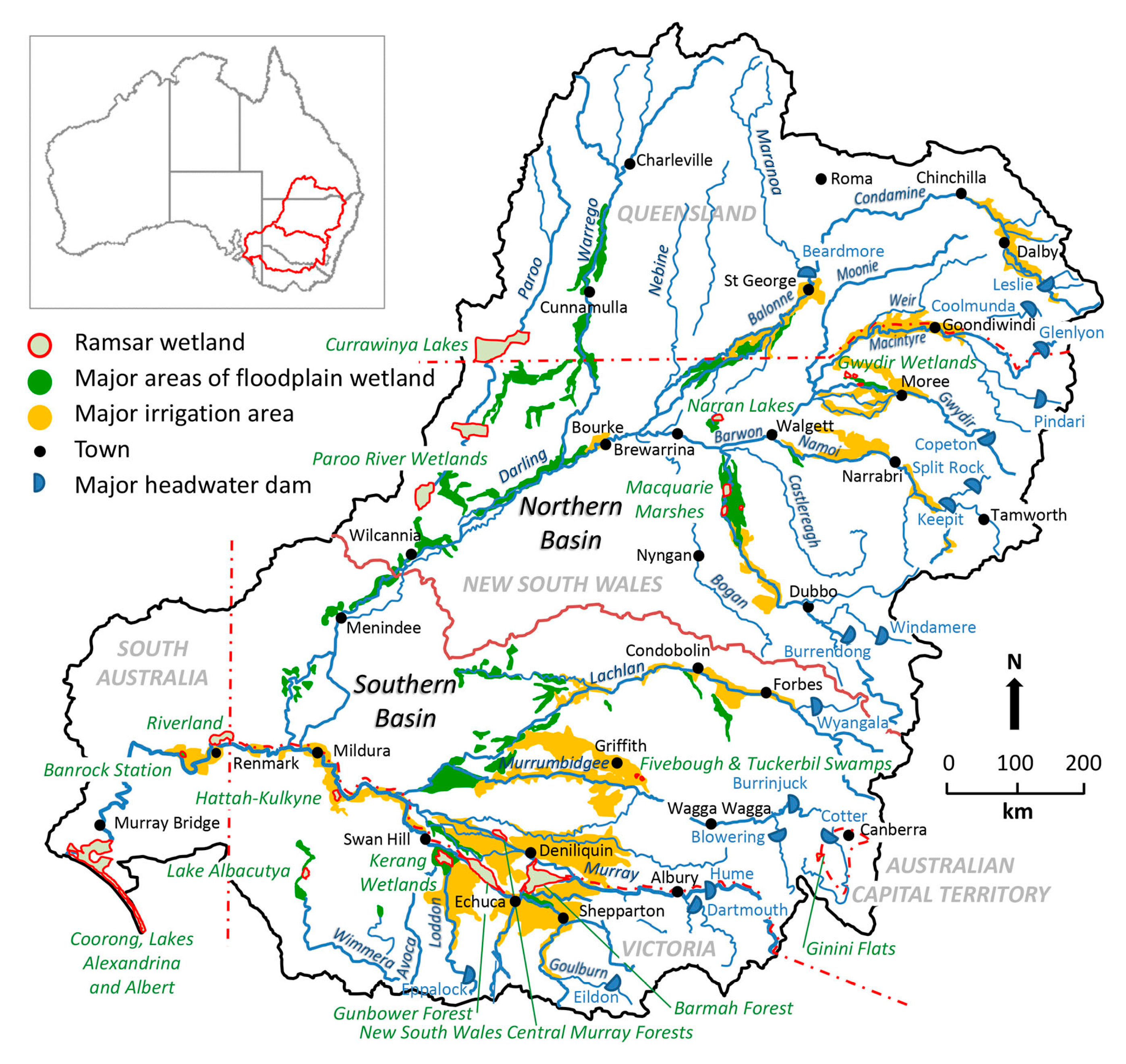
Concerns about the over-allocation of water, growing demand, and the health of the river system over the past 40 years have positioned water management in the MDB as a matter of national and interjurisdictional focus. Figure 1 below shows the location of the MDB in Australia as well as its key natural and social characteristics. The devastating Millennium Drought triggered multiple governance reforms, including the Water Act 2007, which established key national institutions for water management and trade in the Basin. Water market reforms enable the more efficient allocation of water to higher-value commodities under conditions of scarcity [30] and improve transparency. Changes in land use, water demand, and cropping type followed the establishment of the water market, including a general shift from broadacre farming and irrigated pasture to horticulture, and an increase in the demand for water for cotton and almonds in the southern Basin, along with a decrease in demand for rice, dairy, and grapevines [31]. The Basin Plan 2012 provides the overarching governance framework, drawing on multiple sources of information to manage the Basin’s water as a connected system, and specifying water extraction levels and environmental allocations. Implementation of the Plan occurs through water resource planning by Basin states, and adjustment of sustainable diversion limits, water trading, and environmental water managed nationally. Adaptive management is enabled through a review of the Plan every 10 years.
Even with substantial water governance reforms and funding (some USD 13 billion has been committed by Australian Governments for water reform projects in the MDB since 2007 [33]) to enhance the sustainability of the Basin, demand for water continues to grow, and tensions are emerging in response to the land and water use transitions underway. Market governance arrangements have increased water use efficiency and business flexibility, but also appear to have created winners and losers, with those having prior rights and greater economic influence gaining more, and the social values of equity and justice have been variably adversely impacted [14,34]. Larger and more economically diverse communities have also benefited more from the reforms than remote, smaller, and highly agriculture-dependent communities [35]. Divergent stakeholder views are now apparent for water allocations between industry/agriculture and the environment, and between centralised (top-down) and distributed governance [36,37]. Such tensions could increase and further test the Basin’s water governance, as climate change will challenge existing assumptions of water access, and explicit management for climate change and in interactions with other drivers in the Basin Plan (currently under review) has been inadequate [9,20]. This is despite robust evidence of the risks of climate change tailored to the region [38,39].
Scholarly literature on drivers of change in the MDB is diverse but fragmented, skewed towards the impacts of major interventions or events, such as the Millennium Drought or water market, and inconsistently contextualised [10]. Consequently, identified DoC are not comparable, and their relative significance cannot be ascertained. Further, critical gaps in the DoC literature can also be identified, with, for example, many studies not considering the range of plausible climate futures or focusing narrowly on single drivers without attention to their interactions and interdependencies. This article addresses the implementation gap by examining how drivers of change can be systematically incorporated into water planning and management processes, using evidence from the MDB to demonstrate both the necessity and feasibility of such integration.

3. Methodology

The diverse drivers of change (DoC) in the MDB, the complex and contradictory perspectives on ways forward, and the growing importance of ensuring that understanding of the impact of drivers informs management and policy call for a methodology that can recognise perspectives from multiple research disciplines as well as policy and practitioner expertise [40,41]. In the context of the MDB, key stakeholder groups include government agency decision-makers and water managers; experts in economic, technology, social, environmental, and cultural dimensions of the Basin; and industry organisations, property managers, communities, and NGOs across the Basin’s geographical regions.
A qualitative deliberative approach was selected to explore DoC, as it is well suited to considering complex issues where stakeholders have diverse views and values, where a collective exploration of the issues, opportunities, and emerging trade-offs is sought, and where outcomes need to reflect multiple perspectives and knowledge systems [42,43]. Deliberative approaches are also valuable in incomplete data contexts for complex land use systems because they leverage diverse stakeholder knowledge to inform decision making, foster social learning, and integrate values that formal data often misses. Importantly, deliberative approaches can be designed to provide frameworks for managing power asymmetries, ensuring that less powerful stakeholders, who may have valuable knowledge but lack formal data access or advocacy platforms, are heard and included in the decision-making process [44,45]. In this way, deliberative approaches can ultimately support the generation of more equitable solutions that are grounded in local realities.
The method for this research received approval by the University of Canberra’s Human Research Ethics Committee (Protocol #13751) prior to the commencement of any data collection in 2024. All participants provided written or verbal informed consent prior to participation and were assured of confidentiality in data handling and reporting. Three deliberative workshops were convened: (i) with 25 technical and strategic experts from across disciplines and the Basin to identify and characterise key DoC; (ii) with 25 technical and strategic experts to prioritise DoC and explore strategies to manage their adverse consequences; and (iii) with 30 community leaders and practitioners to review and further develop outputs from the first two workshops and build a shared understanding of the lived experience of DoC, their impacts, and potential management strategies. Participants were carefully selected to ensure expertise and span across multiple disciplines, geographic regions, and institutional perspectives, informed by the literature review, discussions with the Murray–Darling Basin Authority, and professional networks. Participants in workshop (iii) spanned irrigators, dryland farmers, local government representatives, tourism business managers, and community organisation leaders. The key questions developed to focus the workshops were as follows:
  • What are the key drivers of change that are affecting the MDB?
  • How can these drivers of change be classified and understood?
  • What are the key linkages or inter-dependencies between these drivers?
  • How can the priority drivers of change be identified?
  • Can you share examples of community experience in living with drivers of change?
  • What strategies are needed to manage the adverse consequences of drivers of change?
In addition, semi-structured interviews were conducted with key informants (n = 15) selected through purposive sampling based on their expertise in Basin or catchment management. Such interviews enable a deeper exploration of issues and decision approaches of diverse experts, including underlying reasoning, assumptions, and relevant behavioural factors [46,47]. Participants included senior policy makers, academic experts, and community leaders. Interviews followed a standardised topic guide, informed by an analysis of findings from a review of recent literature, and focused on drivers of change identification and prioritisation.
Data analysis occurred through an iterative and multi-pronged process. Literature review findings informed interview protocols and workshop structures. Workshop discussions were recorded, with thematic analysis conducted manually. Findings were triangulated across the literature review, stakeholder engagement, and analysis phases of the project to ensure robustness in the understanding of relevant Basin system dynamics. This approach allowed for the validation of findings across different knowledge sources and perspectives.
The analysis utilised established frameworks, drawing particularly from risk and sensitivity assessment methodologies, which were adapted to address the specific context and requirements of the MDB [48]. Classification of the identified drivers also drew upon the Millennium Ecosystem Assessment framework, which enables underlying drivers of change that typically operate at wider or global scales to be distinguished from direct drivers of change operating in the Basin, and from policy and institutional factors which seek to manage the impacts of current or historic drivers [49]. A risk assessment was first undertaken, recognising that risk management is embedded in MDBA, state government, and industry operations and planning processes, where priority for management response is informed by impact, vulnerability, and urgency, assessed on a 3-point scale (high, medium, low). The importance of the DoC for management response was then further analysed in a sensitivity assessment drawing on expert judgement of the temporal trend of the magnitude of driver impact and the sensitivity of the water assets to those drivers. A scale of 1–5 was used to rate magnitude in this integrated analysis, with 1 indicating the lowest magnitude or sensitivity and 5 indicating the highest magnitude or sensitivity. The ratings followed a structured process: (1) thematic coding of transcripts and notes to identify mentioned drivers and their characteristics, (2) independent coding by two researchers with assessment of inter-coder reliability, (3) consolidation of driver lists across workshops with duplicate removal and categorisation using the MEA framework and informed by workshop discussions of its structural limitations, and (4) synthesis of risk and sensitivity ratings.

4. Results

The findings of this research include a summary of the diverse DoC in the MDB identified through deliberation (Section 4.1), classification of the drivers by theme and nature (Section 4.1 and Section 4.2), and identification of which drivers are most important for water asset management now and into the future (Section 4.3).
Initial exploration of the framing of DoC in strategic and technical deliberations, involving researchers and senior policy and water management experts, delivered multiple conceptual insights that deepened a shared understanding of drivers of change and their importance in the context of water management in the MDB. Of note, an understanding emerged of drivers as relationships between system variables, or the variables themselves, and that multiple interactions of drivers can shape the future in desirable or undesirable ways. The varied time and scale dimensions of drivers of change were also identified as needing explicit thinking and recognition. For example, the MDB is a highly modified system that has changed substantially from past effects of DoC, such as flow regulation, which provides important context for understanding the operation and impact of current and future drivers. With this framing, DoC can help reveal the multiple factors that influence decision making and where monitoring or management interventions may be needed. Further, DoC can add useful dimensions to the theory of change processes on the breadth of interacting factors that affect the realisation of desired outcomes.

4.1. Key MDB Drivers of Change Identified Through Deliberation

Given the complexity of the MDB as a social–ecological system, with interconnecting environmental, social, cultural, and economic values, it is unsurprising that numerous important DoC would be identified for the Basin. Table 2 provides a summary of the key DoC identified from the Basin-scale deliberation process (involving expert and community workshops) that have a lasting influence on the Basin and its water resources, and are informed by the literature. The drivers are categorised into five themes—environment and climate, policy and governance, economic and technological, people and society, and legacy.
Political will and leadership were also identified in the deliberative process as a driver of change with significant implications for water management. However, there was ultimately a lack of resolution on the optimal way to represent political will and leadership in the context of longer-term drivers. There is no doubt that the volatility of political will and leadership in Australia has had many major short-term impacts on approaches to water governance. There were also opinions that the ongoing political challenges and pressures from the lack of bi-partisanship and the fragmented nature of Australia’s federal system have impacted the long-term effectiveness of the Basin Plan and steps towards water reform, and continue to challenge integrated management. In this way, the longer-term implications of political will have been reflected in the identified governance and policy, as well as legacy drivers of change.
There were considerable similarities in the identification of key DoC from experts across disciplines and the community participants in the deliberation, particularly concerning the more biophysical environment and climate DoC, where damaging climate events, invasive species, and water quality were identified by all sources. Nuanced differences were also apparent concerning climate variability and change, where, e.g., the community participants emphasised more event-based drought and flooding, and the experts and literature identified climate change.
Deeper differences in emphasis, however, were apparent between the three sources on the more human-focused governance, economic, and social drivers. The literature on governance focused strongly on policy reform and the impacts and outcomes from those reforms [14]. The experts emphasised further opportunities for policy reform and the potential change capacities that can emerge from more devolved and integrated governance. In contrast, the community workshop participants highlighted more of how government policy was driving change in the Basin and communities. Political factors were also noted extensively by communities and in the literature.
Economic drivers of change were identified specifically by experts and in the literature, with both recognising links to governance and policy, such as market establishment, but were understood more indirectly by community participants. Experts also focused more on the potential of policy initiatives on carbon-nature markets and renewable energy to drive economic diversification and future land use change in the Basin.
There were also differences in emphasis given within the people and society theme. The literature gives strong attention to diversity and inclusion, along with trust and social capital, reflecting a growing scholarly focus on these topics in alignment with wider social attitudes [34]. Somewhat differently, the experts placed greater emphasis on agency in communities, spanning community preferences as well as the potential for change from more devolved governance and regional leadership. The community data suggests a perception of relatively less capacity to drive change, with governance approaches and community engagement, for example, identified as strategies needed to manage drivers of change rather than being drivers themselves.
Finally, communities had different views from experts and researchers on driver priority over temporal dimensions and how the impact of drivers would shift over time. Community participants had a strong narrative on the legacy implications of major changes to policy and the environment, including those from decision making from more than half a century ago, which are perceived to have ongoing consequences that need to be coped with alongside new drivers of change. In contrast, the expert participants prioritised newer areas of policy to fully realise outcomes, as well as climate change, with its growing future implications for the Basin.

4.2. Classification of Types of DoC in the MDB

One widely used conceptual framework for DoC is that developed for the Millennium Ecosystem Assessment (MEA) [49], in which direct drivers that affect ecosystem services and, through those services, human well-being are, in turn, influenced by indirect drivers, which operate at large scales and fundamentally shape the context of the ecosystems. Changes in ecosystem services are understood to be caused by multiple, interacting drivers that work over space and time, and areas for strategies and interventions are illustrated in spaces in between drivers and services. Participants in this study diverged from the MEA conceptual framework in several ways. Perhaps most importantly, there was strong agreement that policies and institutions are important drivers of change, whose purpose is to drive changes in behaviour to achieve wider societal objectives. In addition, experts assessed that the distinction between underlying and direct drivers was of little importance in understanding the key DoC operating in the MDB, and as a socio-ecological system, the health of the MDB was seen to span human well-being and ecosystem services dimensions (separated in the MEA), as well as cultural values.
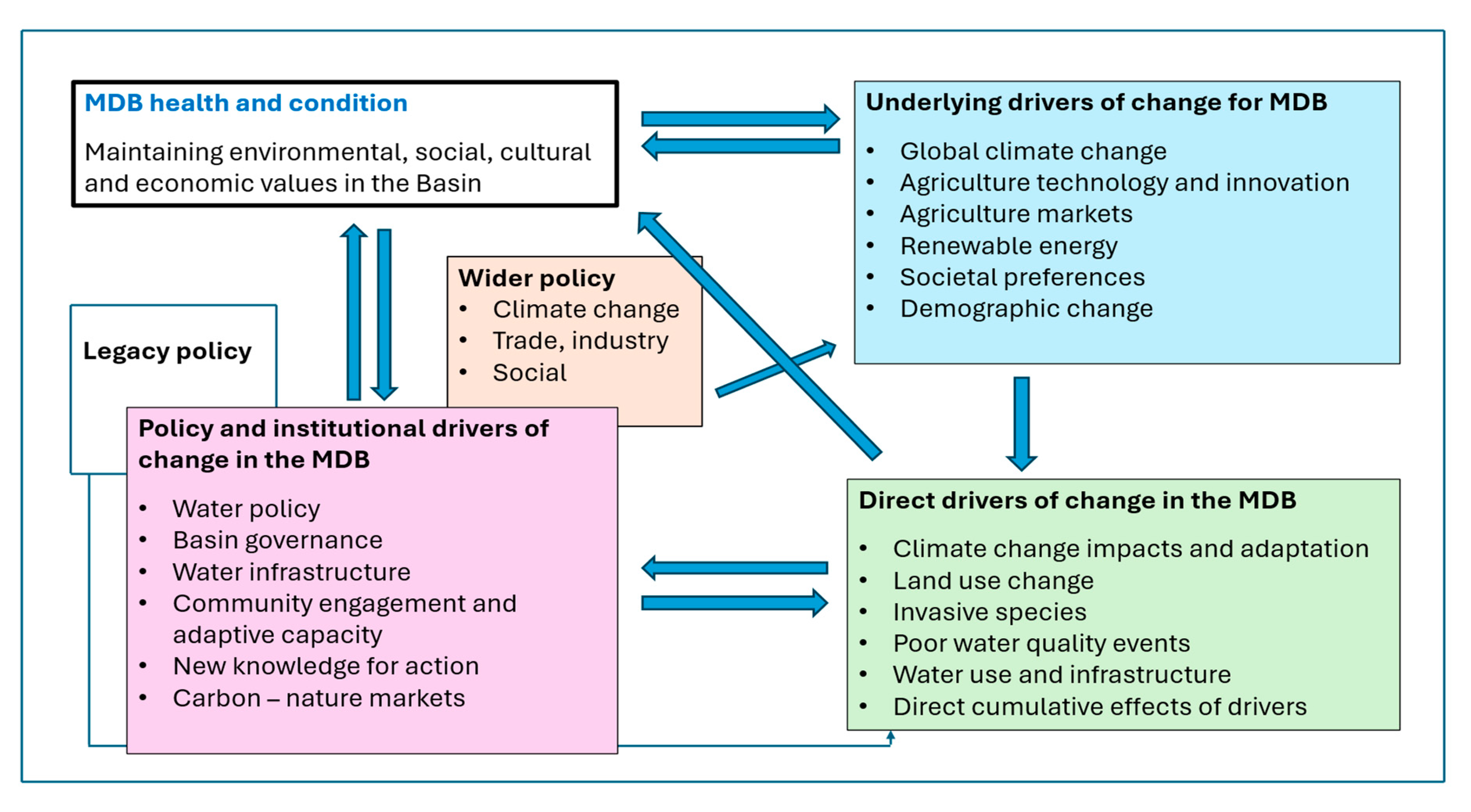
Figure 2 illustrates how the varied underlying, direct, and policy and institutional drivers of change in the MDB link to each other, including where influence is one- or two-way directional. Underlying and direct drivers have been separated in this illustration, not as a matter of importance but more as a reflection of the sources and scale of relevant policies and institutions that can influence the change realised.
Underlying drivers of change in the MDB include global climate change, agricultural technological advancements, global markets, and wider social factors such as changing consumer preferences or demographic changes. Direct drivers, in contrast, which manifest observable impacts on the Basin system, include climate change impacts, water infrastructure development, invasive species, and changes in land use patterns.
Policy and institutional drivers form a distinct category that shapes management responses and governance frameworks. They emerge from political contexts and established and negotiated institutions and include water allocation policies, environmental protection measures, and market-based instruments. The change outcomes of these drivers depend heavily on their design, implementation, and the broader institutional context in which they operate. They represent society’s intentional efforts to guide and manage change within the Basin system.
Importantly, as illustrated in Figure 2, policy and institutional drivers of change can directly affect the health and condition of the MDB, as well as the direct DoC that acts upon it. In contrast, Basin-scale policy and institutional drivers in the MDB have relatively little capacity to alter the identified underlying DoC, a factor relevant to prioritisation. Wider national policies that can (to varying extents) influence underlying DoC are also noted in Figure 2.

4.3. Risk Assessment of Drivers for Water Assets and Management in the MDB

In determining important DoC for management of water and water assets in the MDB, a risk assessment approach was drawn upon, informed by the deliberation process and aligned with current policy prioritisation approaches. Key in this risk assessment were an assessment of (a) the historical (2005–2025) and the future or expected magnitude of change (2025–2050); (b) the magnitude of impact of the driver on water assets, including geographical scale of influence of the driver; (c) the temporal distribution of the impact, particularly the magnitude of likely future impacts; and (d) the sensitivity of the water asset to the impacts of the driver. In the absence of comparative data across all drivers, the researchers drew on insights and expert judgements from the deliberation workshops and the literature review to subjectively rate the relative sensitivity of the drivers. As shown in Table 3, the importance of a driver of change (I) was determined for each time period as a function of impact magnitude (M) and averaged sensitivity (S).
Analysis of the data reveals several drivers of change that are particularly significant for water assets and management in the Basin. Within the environment and climate theme, four critical drivers emerge: climate change and drought (which are closely interlinked), invasive species, and water quality events. The increasing frequency and severity of drought conditions, exacerbated by climate change, present a fundamental challenge to water management. Similarly, the proliferation of invasive species and deteriorating water quality events pose significant threats to ecosystem health and water security.
In the policy and governance sphere, two drivers stand out as particularly influential: water policy frameworks and water use infrastructure. These drivers are complex, as they represent both historical pressures on the Basin and potential mechanisms for system repair and adaptation. Water policy, including allocation frameworks and environmental flow requirements, shapes how water resources are managed and distributed. Meanwhile, water use infrastructure—encompassing both legacy systems and modern developments—significantly influences the Basin’s capacity for effective water management.
Notably, the cumulative effects of these drivers create additional complexities beyond their individual impacts. The interaction between climate-driven changes, governance frameworks, and infrastructure capabilities produces compound challenges that require integrated management approaches. Understanding these cumulative impacts is crucial for developing robust, adaptive management strategies.
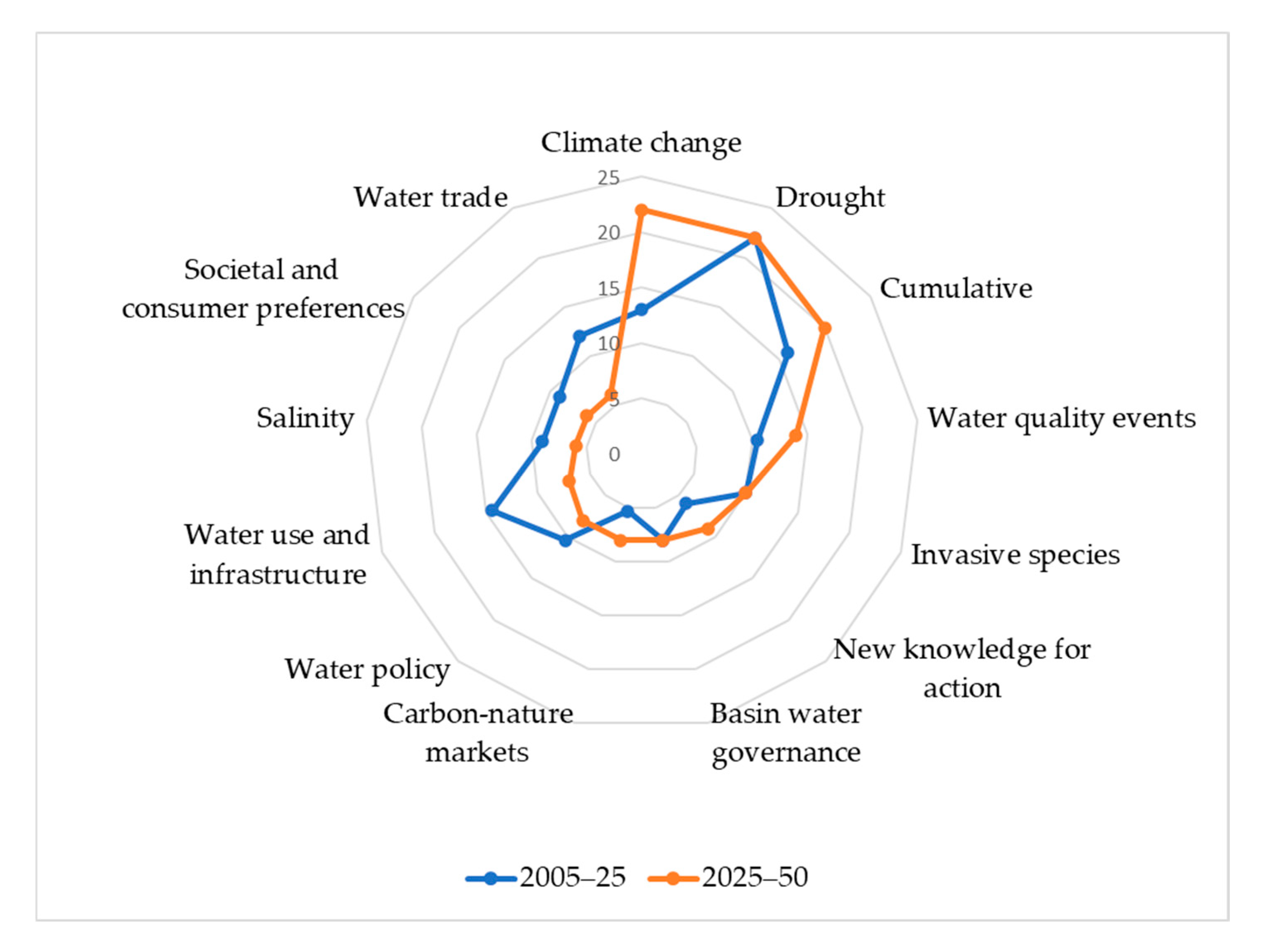
Analysis of trend data indicates that several drivers will become increasingly significant in shaping the Basin’s future through to 2050 (see Figure 3). Within the environment and climate theme, several drivers show particularly strong trajectories of growing importance. Climate change emerges as the most dramatically increasing influence, whilst drought continues to have a high level of importance, and water quality issues demonstrate heightened significance over time. The intensification of these environmental pressures suggests a future requiring robust adaptive management strategies.
The governance landscape is also likely to evolve, with the analysis suggesting that if approaches to water policy framings and water use infrastructure remain unchanged, their relative importance in the Basin will decline. In contrast, devolved and integrated governance approaches were identified as gaining prominence in the MDB. Similarly, First Nations water management, emerging from the people and society theme, is assessed as able to become increasingly influential. Both these drivers have the potential to reach critical threshold levels of impact by 2050, reflecting growing recognition of the importance of inclusive, locally responsive management approaches and Indigenous water rights.
Perhaps most significantly, the cumulative effects of multiple interacting drivers are anticipated to become more pronounced. This is particularly evident in the intensifying relationship between climate change and other drivers, creating complex feedback loops within the system. These compounding interactions suggest that future management strategies will need to address not only individual drivers but also their synergistic effects on the Basin system.
The analysis of current and emerging DoC in the MDB reveals a complex landscape requiring prioritisation to inform management. Whilst environmental drivers—particularly climate change—show clear trajectories of increasing importance, the significance of governance approaches and First Nations water management suggests opportunities for transformative responses. The intensifying nature of cumulative impacts, especially the interaction between climate change and other drivers, emphasises the urgent need for integrated management approaches. These insights provide a crucial foundation that needs to inform policy interventions and management strategies, which are explored in the next section.

5. Discussion

Water management faces a well-documented implementation gap: whilst scholarly consensus recognises that multiple, interacting drivers fundamentally shape water availability and management capacity [1,7], these drivers remain poorly integrated into operational water governance [8,9]. This gap is particularly acute in public good water management contexts, where incomplete knowledge, diverse stakeholder values, and statutory planning mandates create distinct challenges for systematic driver incorporation.
The methodology employed in this research provides a useful demonstration of how to draw on diverse research and practitioner expertise to rapidly identify key drivers of change in the context of incomplete knowledge. Socio-ecological systems that provide critical water resources are being subject to multiple changes around the world, and approaches that can help identify drivers that most require management responses quickly are of value. In this research, the breadth of participating expertise and the deliberation process were critical, ensuring that drivers were identified across disciplines and sectors, and that relative prioritisation could be based on a shared understanding of their nature and impact. Placing insights from the community, industry, and water management agencies on an equal footing to researcher insights also helped address the skew in the scholarly literature towards larger events or interventions.
In response to research aim 1, application of this method to the MDB enabled identification for the first time of the breadth of key drivers of change that can be comparatively considered regarding their impact and significance, including their spatial dimensions and trends over time. Importantly, key drivers identified were diverse and spanned environment and climate, policy and governance, economic and technological, social and people, and legacy themes, revealing the complexity of management in a social–ecological system. This comprehensive identification of DoC led to a deliberative prioritisation of these DoC for water management in the MDB, including how the importance of key drivers can usefully be temporally understood, e.g., changes in the near-to-mid-term future or past (research aim 2). Notably, the most significant current drivers concerned the environment and climate and governance and policy. Looking to the future, climate change, drought, water quality events, and cumulative drivers, in large part exacerbated by climate change, have the highest importance ratings. Changed invasive species, water use and infrastructure, water policy, carbon-nature markets, and new knowledge for action were also assessed to be of considerable importance in driving change in the future.
Significantly, the identification of drivers likely to have increasing or changing future impact informs strategies for adaptive water management, including the need for reform. In this research, the fact that drivers in the governance and policy category lose relative importance over time likely reflects two issues; first, that these drivers have already underpinned major change in the current time period (2005–2025) and that looking forward their function is more normalised, and second, that the current framing of these drivers needs further reform into the future to ensure that they align with changing societal expectations. For example, lower sensitivity scores for water policy concerning aquatic ecosystems highlight an opportunity for policy development to align with emerging water management priorities. Further, both significantly increasing and relatively low importance ratings in the risk assessment can signify a deficiency in current governance and policy. Concerning the MDB, this analysis suggests that further strategies for adaptive water management are needed to address the increasing risks from (i) future climate change, (ii) increasing water quality events, and (iii) cumulative impacts, and to enhance opportunities for (iv) First Nations water management, (v) community adaptive capacity, and (vi) devolved and integrated governance. Without the incorporation of climate change and its dynamic interactions with other influential drivers of change, this research suggests that the Basin Plan risks implementation failure, a finding that aligns with the conceptual foundation of the implementation gap between leading theory and practice [9,20].
Identifying the temporal dimensions of drivers of change allows for more targeted, effective measures for longer-term resilience and climate change adaptation by helping to understand both the underlying and most significant causes of change and where resilience may be challenged by the growing impact of drivers with likely major future implications. Exploring drivers of change simultaneously over current and future time horizons helps prioritise adaptation actions that will have more long-term impact, such as ensuring carbon-nature markets and water use and infrastructure strategies reflect future climate change and drought risks. Increasing risks of adverse water quality events also highlight a need for greater attention to MDB water policy over time, particularly as a warming climate is likely to increase their frequency (Table 2). Engagement of community and industry management expertise, including through new knowledge for action, also helps communities understand the drivers and impacts they face and to develop future-focused anticipatory strategies that build resilience to climate variability and longer-term change.
Further, identifying drivers is central to a “theory of change” for adaptation, encouraging a more comprehensive, systems perspective that links current conditions to desired futures and points to the actions needed to get there. Approaches to adaptation that are framed predominantly by the biophysical impacts of climate change could overlook the operation of other drivers that strongly influence behaviour, and as a result, be ineffective or maladaptive. The integrative scale of such a systems perspective will likely challenge more sectoral siloed institutional elements in MDB governance and call for enhanced capacity to more robustly consider wider factors that will strongly influence water resource planning. In response to research aim 3, we present the I-PLAN heuristic: a practical heuristic for bridging from driver identification to planning integration in public good water management. The I-PLAN heuristic is a practical heuristic for systematically incorporating drivers of change into public good water management (Table 4). The I-PLAN heuristic comprises five interdependent dimensions: Integrative Knowledge addresses fragmented, event-driven literature by combining multiple epistemic sources; Prioritisation for Management translates comprehensive driver lists into defensible management priorities; Linkages between Drivers moves beyond single-driver approaches to recognise interactions and cascading effects; Adaptive Agendas builds wider support for adaptive governance; and Normative Collaboration ensures the process has social licence in public good contexts, specifically focused on deliberative legitimacy. Collectively, these dimensions provide a transferable approach for water planners working in contexts of incomplete knowledge, diverse stakeholder values, and contested resource allocation.
Overall, this research represents the first approach to comprehensively identify drivers of change in the MDB, using straightforward steps in a deliberation process. While this research stops short of implementation, it contributes in several ways to its enablement. While there is little coherence in the literature on how change in societal systems can be triggered or characterised, it is clear that varied drivers can deliver change in either slow, steady processes or sudden jumps, and that change may be undesirable, costly, or inequitable [50,51]. Achieving implementation of governance that can facilitate deliberate steps towards desired outcomes hinges on multiple factors, including an understanding of key drivers of change, their impacts, and how governance mechanisms can influence them; leadership and political will for action; and a social license for reform [51]. Capacities and approaches that emerge from this study and the I-PLAN heuristic that contribute to enabling such implementation span (i) a systems approach to researching the river Basin, which can reduce the potential for oversight of key change dimensions, (ii) collaborative and cross-disciplinary interactions that recognise relevant knowledges and build wider community appreciation of the impacts of drivers over time and where current policy settings may become insufficient, (iii) active shared learning about the impacts of historic drivers, and (iv) an anticipatory or future focus. These capacities align strongly with those in the scholarly literature on adaptive and anticipatory governance [26,27,28]. In the MDB context, this research to date has contributed to recognition of drivers of change in the recently released Sustainable Rivers Audit [52], and strengthening of expert advice on priority drivers that need recognition in the forthcoming Murray–Darling Basin Outlook report and ongoing monitoring and evaluation work.
Several limitations of this research merit acknowledgement. The majority of published literature focuses on single or limited numbers of drivers, exacerbating gaps in knowledge regarding driver interactions. This makes it difficult to robustly incorporate cumulative, synergistic, or other interactive effects within a rapid deliberative process. Similarly, drivers of change—individually or in combination—can cause threshold effects or bring forward known thresholds into closer time periods, the likelihood of which requires further research to enable ready consideration in deliberative frameworks. Additionally, demonstrating the I-PLAN heuristic within the Murray–Darling Basin alone—a relatively data-rich system with mature governance structures—limits generalisability claims. Validation in contrasting contexts, including developing countries, transboundary basins, and data-sparse regions, is needed to establish broader transferability. Participant selection may introduce bias despite efforts to ensure diverse representation, and the temporal snapshot captured in this study requires periodic updating as driver trajectories evolve and new drivers emerge.
Despite these limitations, this research makes substantive contributions to both scholarship and practice in water management. First, it extends the conceptual framework for drivers of change developed in the Millennium Ecosystem Assessment to better suit social–ecological systems by recognising policies and institutions as drivers of change in their own right, with the capacity to manage risks and incentivise desirable change. Bringing legacy policy and decisions into the same assessment framework emphasises their lasting and cross-dimensional effects. Second, the multi-perspective deliberative approach demonstrates a rapid and robust methodology for identifying and prioritising drivers of change in basin systems where management decisions have increasing urgency, but knowledge remains incomplete. This represents a dual contribution to both policy and scholarly literature. Third, our contribution positions the challenge of identifying key drivers within the I-PLAN heuristic—a practical tool that can help develop wider dialogue about the importance of understanding the causes of change and inform practical steps to incorporate those drivers into water management frameworks.

6. Conclusions

This study targets a critical gap in water management practice: whilst scholarly consensus recognises that multiple, interacting drivers fundamentally shape water systems, operational governance frameworks fail to systematically incorporate this understanding. Through a structured deliberative approach with 70 experts and community leaders across the Murray–Darling Basin, we identified for the first time the breadth of key drivers affecting this complex social–ecological system—spanning climate and environmental factors, governance reforms, economic transitions, social changes, and legacy effects. Applying risk and sensitivity assessment frameworks enabled prioritisation of these drivers for water management based on their magnitude, vulnerability, and temporal trajectories. Climate change, drought, water quality events, and cumulative impacts emerged as the highest-priority future drivers, with climate change functioning as a threat multiplier across the system. Significantly, governance drivers show declining relative significance unless reforms align with emerging priorities, highlighting opportunities for transformative policy development in areas such as First Nations water management, community adaptive capacity, and devolved governance.
From these methodological advances, we synthesised the I-PLAN heuristic: five interdependent dimensions—Integrative Knowledge, Prioritisation for Management, Linkages between Drivers, Adaptive Agendas, and Normative Collaboration—that provide water planners with a transferable, operational tool for systematically incorporating drivers of change in public good water management contexts. The heuristic contributes to addressing the implementation gap between conceptual recognition and practice by foregrounding the importance of combining multiple knowledge systems, enabling defensible prioritisation, acknowledging driver interactions, building support for adaptive governance, and ensuring deliberative legitimacy. This represents not merely a methodological contribution but a practical bridge from theory to implementation.
Future research should address driver interactions and threshold effects more comprehensively, validate I-PLAN in contrasting governance and data contexts—particularly in developing countries, transboundary basins, and data-sparse regions—and develop adaptive frameworks for periodic driver reassessment as trajectories evolve. There is an opportunity to integrate wider approaches to understanding driver impacts in developing adaptation strategies that respond effectively to multiple drivers operating across different temporal and spatial scales. For the Murray–Darling Basin specifically, this research provides foundational evidence for incorporating climate change and its dynamic interactions with other drivers into the Basin Plan, addressing a critical implementation failure identified in recent assessments. More broadly, as freshwater systems worldwide face escalating pressures from climate change, demographic shifts, and governance challenges, the I-PLAN heuristic offers water managers a practical pathway for anticipatory, systems-oriented planning that can enhance resilience and support sustainable water futures.

Author Contributions

Conceptualisation, J.M. and L.J.P.; methodology, J.M. and L.J.P.; validation, J.M. and L.J.P.; formal analysis, J.M. and L.J.P.; investigation, J.M. and L.J.P.; data curation, J.M. and L.J.P.; writing—original draft preparation, J.M. and L.J.P.; writing—review and editing, J.M. and L.J.P.; visualisation, J.M. and L.J.P.; project administration, J.M. and L.J.P.; funding acquisition, J.M. and L.J.P. All authors have read and agreed to the published version of the manuscript.

Funding

This research was funded by the Murray–Darling Basin Authority, grant number MDBO2401/BPR202415, as part of the project “Resilience, Adaptation and Drivers of Change in the Murray–Darling Basin”. The APC was funded by the University of Canberra, the Centre for Environmental Governance.

Institutional Review Board Statement

This study was conducted in accordance with the Declaration of Helsinki and approved by the University of Canberra, The Human Research Ethics Committee (13751—“Resilience, Adaptation & Drivers of Change (RAD) in the Murray Darling Basin” (MDB)/2024/03/028).

Informed Consent Statement

Informed consent was obtained from all subjects involved in this study.

Data Availability Statement

The data presented in this study are individually identifiable. All synthesis and analysis are contained within the paper. Due to Human Research Ethics Committee approval requirements (Protocol #13751), primary data cannot be shared. However, the corresponding author may be contacted to address specific queries or points of clarification.

Acknowledgments

The Murray–Darling Basin Authority provided expertise that contributed to this research. We are grateful to the 70 expert, industry, and community participants who generously shared their insights into change in the Murray–Darling Basin through workshops and interviews. During the preparation of this manuscript, the authors used Claude (Anthropic AI, version 4) for purposes of copy-editing, grammar checking, and refining sentence structure. The authors have reviewed and edited the output and take full responsibility for the content of this publication.

Conflicts of Interest

The authors declare no conflicts of interest.

Abbreviations

The following abbreviations are used in this manuscript:
MDBMurray–Darling Basin
DoCDrivers of change
MDBAMurray–Darling Basin Authority

Appendix A

Criteria for Importance Assessment
Categorisation of water assets. As the MDB is large and diverse, it is useful to differentiate the water in the catchment into three categories, identified below, and accompanied by encompassed hydrological and management features and characteristics.
1. Aquatic ecosystem. This is a whole basin water hydrological cycle health approach. It includes wetland requirements, river health indicators, cultural flows, ecosystem services, groundwater health and connectivity, unregulated flows, and environmental flows
2. Water in channel. This focuses on direct water management of regulated flows and includes regulated flows, allocated water, trading volumes, infrastructure efficiency, and delivery capacity.
3. Water quality. This specifically focuses on the water across the basin, such as temperature, turbidity, clarity, sediment, and chemical parameters (e.g., salinity, nutrient levels—P, N, K, C, DO, and acidity).

Magnitude: The degree of change a driver causes to water asset functions or services, measured from minimal effects to complete system transformation.
5—Complete transformation: The system undergoes fundamental change, creating an entirely new operational state with multiple parameters altered.
4—Major alteration: Substantial changes occur while the system remains recognisable, with significant shifts in multiple parameters.
3—Notable modification: Clear measurable changes affect key parameters, while core functions maintain.
2—Minor change: Small but detectable changes occur with limited parameter effects.
1—Minimal effect: Changes are barely measurable, affecting single parameters without system alteration.
Sensitivity: The inherent responsiveness of a water asset to change, based on its buffering capacity, self-regulation mechanisms, and proximity to critical thresholds.
5—Highly responsive: The system lacks any buffering capacity and responds immediately to changes, operating at critical thresholds.
4—Responsive: Limited buffering exists with quick responses and few self-regulating mechanisms.
3—Moderately stable: A partial buffering capacity enables gradual responses with some self-regulation.
2—Stable: A strong buffering capacity allows delayed responses with multiple self-regulating mechanisms.
1—Highly stable: Robust buffering and self-regulation create significant resistance to change.
When combining these scales in the 5 × 5 matrix, experts can assess both the level of change (magnitude) and the system’s ability to cope (sensitivity) independently, leading to a combined impact score. High magnitude paired with high sensitivity (5,5) indicates critical priority requiring immediate intervention, while low scores in both (1,1) suggest minimal management needs.

References

  1. Ward, F.A. Addressing global water challenges in 2025: An integrated framework for research, policy, and resource management. Water Resour. Manag. 2025, 39, 7885–7918. [Google Scholar] [CrossRef]
  2. Yoon, J.H.; Ravinandrasana, V.; Kim, J.; Franzke, C.L.E. The first emergence of unprecedented global water scarcity in the Anthropocene. Nat. Commun. 2025, 16, 8281. [Google Scholar] [CrossRef]
  3. Rockström, J.; Falkenmark, M.; Allan, T.; Folke, C.; Gordon, L.; Jägerskog, A.; Kummu, M.; Lannerstad, M.; Meybeck, M.; Molden, D.; et al. The unfolding water drama in the Anthropocene: Towards a resilience-based perspective on water for global sustainability. Ecohydrology 2014, 7, 1249–1261. [Google Scholar] [CrossRef]
  4. Folke, C. Resilience: The emergence of a perspective for social-ecological systems analyses. Glob. Environ. Change 2006, 16, 253–267. [Google Scholar] [CrossRef]
  5. Vidal-Abarca Gutierrez, M.R.; Nicolás-Ruiz, N.; Sánchez-Montoya, M.D.; Suárez Alonso, M.L. Ecosystem services provided by dry river socio-ecological systems and their drivers of change. Hydrobiologia 2023, 850, 2585–2607. [Google Scholar] [CrossRef]
  6. Schlegel, R.; Bartsch, I.; Bischof, K.; Bjørst, L.R.; Dannevig, H.; Diehl, N.; Duarte, P.; Hovelsrud, G.K.; Juul-Pedersen, T.; Lebrun, A.; et al. Drivers of change in Arctic fjord socio-ecological systems: Examples from the European Arctic. Camb. Prism. Coast. Futures 2023, 1, e13. [Google Scholar] [CrossRef]
  7. Pahl-Wostl, C. The implications of complexity for integrated resources management. Ecol. Soc. 2007, 12, 24. [Google Scholar] [CrossRef]
  8. Palmer, M.A.; Reidy Liermann, C.A.; Nilsson, C.; Flörke, M.; Alcamo, J.; Lake, P.S.; Bond, N. Climate change and the world’s river basins: Anticipating management options. Front. Ecol. Environ. 2008, 6, 81–89. [Google Scholar] [CrossRef]
  9. Prosser, I.P.; Chiew, F.H.S.; Stafford Smith, M. Adapting water management to climate change in the Murray–Darling Basin, Australia. Water 2021, 13, 2504. [Google Scholar] [CrossRef]
  10. Gain, A.K.; Hossain, S.; Benson, D.; Di Baldassarre, G.; Giupponi, C.; Huq, N. Social-ecological system approaches for water resources management. Int. J. Sustain. Dev. World Ecol. 2021, 28, 109–124. [Google Scholar] [CrossRef]
  11. Akamani, K. The roles of adaptive water governance in enhancing the transition towards ecosystem-based adaptation. Water 2023, 15, 2341. [Google Scholar] [CrossRef]
  12. Everard, M. A socio-ecological framework supporting catchment-scale water resource stewardship. Environ. Sci. Policy 2019, 91, 50–59. [Google Scholar] [CrossRef]
  13. Bark, R.; Kirby, M.; Connor, J.D.; Crossman, N.D. Water allocation reform to meet environmental uses while sustaining irrigation: A case study of the Murray–Darling Basin, Australia. Water Policy 2014, 16, 739–754. [Google Scholar] [CrossRef]
  14. Wheeler, S.A.; Xu, Y.; Zuo, A.; Haensch, J.; Seidl, C. Identifying the Water-Related Economic Values of the Murray–Darling Basin and Rating the Quality of Water Economic Studies; University of Adelaide: Adelaide, Australia, 2023. [Google Scholar]
  15. Mummery, J.; Pearson, L.J. Resilience, Adaptation and Drivers of Change in the Murray–Darling Basin: Synthesis of the Literature; Report to the Murray–Darling Basin Authority; University of Canberra: Canberra, Australia, 2024. [Google Scholar] [CrossRef]
  16. Li, Z.; Quiring, S.M. Identifying the dominant drivers of hydrological change in the contiguous United States. Water Resour. Res. 2021, 57, e2021WR029738. [Google Scholar] [CrossRef]
  17. Qiao, J.; Zhang, Q.; Shao, J.; Cao, Q.; Liu, H.; Lv, F. Spatial and temporal variation of water stress in China and its driving factors: A multi-scale analysis. Ecol. Indic. 2024, 169, 112820. [Google Scholar] [CrossRef]
  18. Martinez-Fernandez, J.; Banos-Gonzalez, I.; Esteve-Selma, M.A. An integral approach to address socio-ecological systems sustainability and their uncertainties. Sci. Total Environ. 2021, 762, 144457. [Google Scholar] [CrossRef]
  19. Grafton, R.Q.; Pittock, J.; Williams, J.; Jiang, Q.; Possingham, H.; Quiggin, J. Water planning and hydro-climatic change in the Murray–Darling Basin, Australia. AMBIO 2014, 43, 1082–1092. [Google Scholar] [CrossRef]
  20. Pittock, J. National climate change policies and sustainable water management: Conflicts and synergies. Ecol. Soc. 2011, 16, 25. [Google Scholar] [CrossRef]
  21. Ludwig, F.; van Slobbe, E.; Cofino, W. Climate change adaptation and Integrated Water Resource Management in the water sector. J. Hydrol. 2014, 518, 235–242. [Google Scholar] [CrossRef]
  22. Gomez-Jaramillo, Y.; Berrouet, L.; Villegas-Palacio, C.; Berrio-Giraldo, L. Conceptual framework for analyzing the sustainability of socio-ecological systems with a focus on ecosystem services that support water security. Sustain. Dev. 2024, 32, 2298–2313. [Google Scholar] [CrossRef]
  23. Han, Z.; Wei, Y.; Meng, J.; Zou, Y.; Wu, Q. Integrated water security and coupling of social-ecological system to improve river basin sustainability. Sci. Total Environ. 2023, 905, 167182. [Google Scholar] [CrossRef]
  24. Itzkin, A.; Scholes, M.C.; Clifford-Holmes, J.K.; Rowntree, K.; van der Waal, B.; Coetzer, K. A social-ecological systems understanding of drivers of degradation in the Tsitsa River Catchment to inform sustainable land management. Sustainability 2021, 13, 516. [Google Scholar] [CrossRef]
  25. Huitema, D.; Mostert, E.; Egas, W.; Moellenkamp, S.; Pahl-Wostl, C.; Yalcin, R. Adaptive water governance: Assessing the institutional prescriptions of adaptive (co-)management from a governance perspective and defining a research agenda. Ecol. Soc. 2009, 14, 26. [Google Scholar] [CrossRef]
  26. Wyborn, C. Co-productive governance: A relational framework for adaptive governance. Glob. Environ. Change 2015, 30, 56–67. [Google Scholar] [CrossRef]
  27. Hurlbert, M.; Gupta, J. Adaptive governance, uncertainty, and risk: Policy framing and responses to climate change, drought, and flood. Risk Anal. 2016, 36, 339–356. [Google Scholar] [CrossRef]
  28. Muiderman, K.; Zurek, M.; Vervoort, J.; Gupta, A.; Hasnain, S.; Driessen, P. The anticipatory governance of sustainability transformations: Hybrid approaches and dominant perspectives. Glob. Environ. Change 2022, 73, 102452. [Google Scholar] [CrossRef]
  29. Yazdanparast, M.; Ghorbani, M.; Salajegheh, A.; Kerachian, R. Development of a water security conceptual model by combining human-environmental system (HES) and system dynamic approach. Water Resour. Manag. 2023, 37, 1695–1709. [Google Scholar] [CrossRef]
  30. Goesch, T.; Legg, P.; Donoghoe, M. Murray–Darling Basin Water Markets: Trends and Drivers 2002–03 to 2018–19; ABARES Research Report 20.5; Commonwealth of Australia: Canberra, Australia, 2020. [Google Scholar]
  31. Wheeler, S.A.; Hatton MacDonald, D.; Boxall, P. Water policy debate in Australia: Understanding the tenets of stakeholders’ social trust. Land Use Policy 2017, 63, 246–254. [Google Scholar] [CrossRef]
  32. Colloff, M.J.; Pittock, J. Mind the gap! Reconciling environmental water requirements with scarcity in the Murray–Darling Basin, Australia. Water 2022, 14, 208. [Google Scholar] [CrossRef]
  33. Department of Climate Change, Energy, the Environment and Water. Water Reform Funding in the Murray–Darling Basin. 2025. Available online: https://www.dcceew.gov.au/water/policy/programs/water-reform/mdb-funding (accessed on 19 November 2025).
  34. Jackson, S.; Wyborn, C.; Annand-Jones, R. Relational Values of the Murray-Darling Basing: A Literature Review; Research Report; Griffith University: Brisbane, Australia; Australian National University: Canberra, Australia, 2023. [Google Scholar]
  35. Schirmer, J.; Mylek, M. Thriving, Surviving, or Declining Communities: Socio-Economic Change in Murray–Darling Basin Communities; University of Canberra: Canberra, Australia, 2020. [Google Scholar]
  36. Alexandra, J. Evolving Governance and Contested Water Reforms in Australia’s Murray Darling Basin. Water 2018, 10, 113. [Google Scholar] [CrossRef]
  37. New South Wales Parliament. Water in the Murray–Darling Basin: Key Issues for the 58th Parliament; Research Paper: 2023-07; Parliamentary Research Service: Canberra, Australia, 2023.
  38. Whetton, P.; Chiew, F. Climate change in the Murray–Darling Basin. In Murray–Darling Basin, Australia; Elsevier: Amsterdam, The Netherlands, 2021; pp. 253–274. [Google Scholar]
  39. CSIRO. Climate and Water Availability in South-Eastern Australia: A Synthesis of Findings from Phase 2 of the South Eastern Australian Climate Initiative (SEACI); CSIRO: Canberra, Australia, 2012. [Google Scholar]
  40. Eaton, W.M.; Brasier, K.J.; Burbach, M.E.; Whitmer, W.; Engle, E.W.; Burnham, M.; Quimby, B.; Kumar Chaudhary, A.; Whitley, H.; Delozier, J.; et al. A conceptual framework for social, behavioral, and environmental change through stakeholder engagement in water resource management. Soc. Nat. Resour. 2021, 34, 1111–1132. [Google Scholar] [CrossRef]
  41. Plummer, R.; Dzyundzyak, A.; Baird, J.; Bodin, O.; Armitage, D.; Schultz, L. How do environmental governance processes shape evaluation of outcomes by stakeholders? A causal pathways approach. PLoS ONE 2017, 12, e0185375. [Google Scholar] [CrossRef] [PubMed]
  42. Pigmans, K.; Aldewereld, H.; Dignum, V.; Doorn, N. The role of value deliberation to improve stakeholder participation in issues of water governance. Water Resour. Manag. 2019, 33, 4067–4085. [Google Scholar] [CrossRef]
  43. Karpowitz, C.F.; Mansbridge, J. Disagreement and consensus: The need for dynamic updating in public deliberation. J. Public Deliberation 2005, 1, 348–364. [Google Scholar] [CrossRef]
  44. Choi, T.; Robertson, P.J. Deliberation and decision in collaborative governance: A simulation of approaches to mitigate power imbalance. J. Public. Adm. Res. Theory 2014, 24, 495–518. [Google Scholar] [CrossRef]
  45. Neef, A. Transforming rural water governance: Towards deliberative and polycentric models? Water Altern. 2009, 2, 53–60. [Google Scholar]
  46. Bartkowski, B.; Beckmann, M.; Bednář, M.; Biffi, S.; Domingo-Marimon, C.; Mesaroš, M.; Schüßler, C.; Šarapatka, B.; Tarčak, S.; Václavík, T.; et al. Adoption and potential of agri-environmental schemes in Europe: Cross-regional evidence from interviews with farmers. People Nat. 2023, 5, 1610–1621. [Google Scholar] [CrossRef]
  47. Belina, A. Semi-structured interviewing as a tool for understanding informal civil society. Volunt. Sect. Rev. 2023, 14, 331–347. [Google Scholar] [CrossRef]
  48. Shukla, P.R.; Skea, J.; Calvo Buendia, E.; Masson-Delmotte, V.; Pörtner, H.O.; Roberts, D.C.; Zhai, P.; Slade, R.; Connors, S.; van Diemen, R.; et al. (Eds.) Climate Change and Land: An IPCC Special Report on Climate Change, Desertification, Land Degradation, Sustainable Land Management, Food Security, and Greenhouse Gas Fluxes in Terrestrial Ecosystems; Intergovernmental Panel on Climate Change: Geneva, Switzerland, 2019. [Google Scholar]
  49. Millennium Ecosystem Assessment (MEA). Ecosystems and Human Well-Being: Synthesis; Island Press: Washington, DC, USA, 2003. [Google Scholar]
  50. Green, D. How Change Happens; Oxford University Press: Oxford, UK, 2024. [Google Scholar]
  51. Linnér, B.O.; Wibeck, V. Drivers of sustainability transformations: Leverage points, contexts and conjunctures. Sustain. Sci. 2021, 16, 889–900. [Google Scholar] [CrossRef]
  52. Murray–Darling Basin Authority. Basin Plan Review: A Summary of the 2025 Sustainable Rivers Audit; Australian Government: Canberra, Australia, 2025.
Figure 1. Key natural and social characteristics within the Murray–Darling Basin, notably tributaries, wetlands, irrigation areas, and headwater dams, with inset showing the location of the Basin within Australia. Source: [32] (p. 2). Notes: the red dashed lines show jurisdictional borders, and the brown line demarcates the Northern Basin from the Southern Basin.
Water 18 00278 g001
Figure 2. Classification of nature of drivers of change in the Murray–Darling Basin and their key linkages. Notes: arrows indicate the direction of influence, with arrow width representing the magnitude of effect. Thinner arrows indicate lesser effects; thicker arrows indicate greater effects.
Water 18 00278 g002
Figure 3. Change in key Murray–Darling Basin drivers of change over two time periods (past, 2005–2025, and future, 2025–2050).
Water 18 00278 g003
Table 1. Key themes in scholarly literature relevant to water management in the context of multiple drivers of change.
Key Issues/InsightsConceptual ExamplesCitations
Theme 1: Recognition that System Approaches Are Needed for Water Management
Shift from focus on single issue (water access or supply) to water with socio-ecological systemsWater management must shift from supply-side thinking to addressing multiple drivers.
Global water systems are under intensifying stress from multiple drivers—climate, population, institutional fragmentation, and deteriorating infrastructure—and coordinated responses are critical.
[1,3]
Growing understanding that water access emerges from interactions between natural and social systemsThe two-way relationships between natural and social systems must be recognised for water security.
River basin sustainability depends on coordinated understanding and management of water security, socioeconomic conditions, and land use factors within SES context.
[22,23]
Theme 2: Appreciation That Drivers of Change Can Shift Functioning of Socio-Ecological Systems, and Need to Be Understood to Inform Management
Operation of drivers can exceed resilience thresholds and threaten functioning of SESDrivers of change can challenge thresholds that enable ecological functionality.
Socio-cultural and economic drivers of change affect capacity of dry rivers to provide ecosystem services the most.
[5,6,22]
Critical to understand which drivers of change are important for management actionUnderstanding the multiple processes that operate simultaneously to cause and exacerbate catchment degradation are critical to identifying where planning and management need to be targeted to improve landscape and livelihoods.
Sustainable water management depends on understanding multiple drivers, their interactions, and how they will shift supply–demand relationships.
Water management sustainability depends on analysis of the interaction of climate change as a key driver, its policies, and water management decisions to identify where conflicts or synergies are created.
[20,23,24]
Theme 3: New Research Approaches Needed to Explore Water Management in SES
Transdisciplinary synthesis methods provide useful insightsTransdisciplinary studies that enable assessment of where governance is effective or not are more appropriate for research into future adaptation of needs of SES.[6]
Method development needed for systems studiesThe non-inclusion of inherent SES characteristics that determine critical thresholds is a challenge in studies and water management studies seeking water security.
The application of systemic approaches in real SES to address sustainability challenges is less frequent than desirable.
Dynamic SES attributes essential for managing complex water resources problems are still not widely considered in interdisciplinary water management approaches—rethinking and reframing are needed.
[10,18,22]
Approaches to address uncertainty urgentlyResilience-based approaches needed to manage water under conditions of increasing uncertainty and multiple interacting drivers.
New insights needed into how institutional arrangements need to change to enable adaptive governance that can accommodate uncertainty.
[3,25]
Theme 4: Emerging Research Insights for Reformed Water Management Approaches
Implementation gap observed that needs priority attentionTraditional management approaches are insufficient for dynamic, uncertain water systems—implementation of management must become more flexible.
Despite powerful drivers critically affecting water systems and the evidence-based call for transformative change, current management policies remain largely unchanged.
Conventional command and control water management approaches are not adaptive and fail to address challenges from multiple, interacting drivers of change.
[7,9,11]
Adaptive and integrative governance approaches now essentialCollaborative decision making, social learning, cross-scale linkages, and dealing with uncertainty central to adaptive governance.
Adaptive governance can recognise potential for disturbance to create opportunities for renewal and reorganisation.
Adaptive decision processes have forward-looking dimensions to anticipate, learn from, and respond to change.
Adaptive management and institutional innovation enhance resilience under multiple interacting drivers of change.
Institutional reforms are needed for adaptive governance that accommodate climatic, social, and economic drivers of change in water management.
[4,11,18,25,26,27,28]
Wider participation and active learning needed in science–managementNew conceptual approaches needed that focus on the relationships between science and management in real SES call for participatory approaches from the initial steps.
Learning informed by practice concerned with human–environmental interactions is critical for understanding system complexity and water management in water-scarce countries.
Co-production processes help identify often undervalued ecosystem services and social–cultural factors that affect river SES, and are important for reconciling people and dry rivers.
[5,11,18,29]
Systems approaches to management needed to identify trade-offs and often-overlooked externalitiesPositioning the assessment of technology choices within SES framework can enable recognition of often-overlooked or disregarded externalities of water management techniques.
More complete approaches to understanding water use in SES enables examination of trade-offs between consumptive and environmental water and improved water planning.
[12,19]
Table 2. Key long-term drivers of change in the MDB, organised into themes.
Environment and Climate
DriverScaleTemporal DynamicsState and TrendEvidence Strength
Climate changeBasin-wide, northern and southernLong-term/ongoing relevance and impact. Importance increasing significantlyRisks becoming apparent and likely to increaseRobust evidence at larger Basin scales
DroughtBasin-wide, northern and/or southernEvents can last for months or many yearsLikely increasing severity into futureRobust evidence at Basin and sub-Basin scales
Land use changeBasin-wide and multi-scaleStrong legacy driver. Some new change responding to changing policy and preferencesChanges in economic drivers important. Recent intensification and cropping shiftsStrong in terms of historical legacy impacts.
Emerging in response to recent shifts
Invasive speciesSpecies- and location-dependentSubstantial legacy issuesFuture trends are uncertainModerate
Water quality eventsSub-Basin regionalIndividual events can be triggered quickly and last for monthsIncreasing likelihood of events in future with warming climateStrong regarding individual events. Lower regarding predictive capacity
Governance and Policy
Nature of DriverScaleTemporal DynamicsState and TrendEvidence Strength
Water policy (commodification and trade)Basin, particularly catchments in southern Basin with greater water demandTradingWater market activity increasing in recent decadesRobust
Water use and infrastructureBasin-wide. Some northern and southern Basin differencesOngoing, substantial historic/legacy driverDeeply embedded. New reform opportunities with ageing plantStrong regarding water infrastructure. Emerging regarding e-water
Basin water governanceMulti-scale or polycentricFormal change can be quick, but longer time horizons are needed for full effectOngoing and likely further reforms over timeModerate
Devolved and integrated governanceMulti-scale regional (sub-Basin)Formal change can be quick, but longer time horizons are needed for full effectMixed, jurisdiction-dependent. Capacity for increased trendSubstantial
Economic and Technological
Nature of DriverScaleTemporal DynamicsState and TrendEvidence Strength
Agriculture technology and innovationBasin-wide, can reflect global developments and Basin incentivesSignificant historical impact, ongoing effects on labour, jobs, and production
Uptake can be slow
Ongoing and further changes can be expected over timeStrong historical evidence
Changes in agriculture marketsBasin-wide and sector-dependentOngoing history of rising costs relative to returnLong term trend of rising input costs and downward market price pressuresStudies show long-term trend
Carbon—nature marketsBasin-wideGrowing interest, but can follow boom–bust cyclesGrowing interest and activity (subject to political influence)Increasing evidence; debate remains on effectiveness
Renewable energyLocal to BasinGrowing investment and marketGrowing shift to renewables, possible accelerationMany studies; strong
Water tradeLocal to BasinSubstantial impact in recent decades. Ongoing more stable dynamicTrade market maturingStrong
People and Society
Nature of DriverScaleTemporal DynamicsState and TrendEvidence Strength
Societal and consumer preferencesAcross Basin as part of societal shifts, network scales important for transmissionPreferences can change both rapidly and over generationsTrends varied; no specific desired state. Multiple trends—towards polarisation, environment concernsModerate, strong theory. Predictive capacity?
Community leadership and adaptive capacityHuman and social capital regional and community scalesLeadership capacity as a community “stock” evolves slowlyDecline in recent decades in response to other driversSubstantial
First Nations water managementLocalPotential for growing impact over timeRecognition limited to date; increasing trend likelyEmerging
New knowledge for actionRegional to local, often industry or community scale uptakeOften lag periods in knowledge uptake; uptake rates can be slowVarious. Ongoing industry researchStrong in industry; moderate community
Demographic and community changeLocal to regionalGenerally gradual changeMultiple, often larger more diverse communities growing; smaller remote communities decliningStrong evidence of spatially variable change
Legacy
Nature of DriverScaleTemporal DynamicsState and TrendEvidence Strength
River intervention and wetland drainageWetland, catchment, and BasinSignificant historical impact that transformed water stocks and flows in the BasinStable in recent decades in transformed stateRobust
Land division (small scale)Local to BasinSignificant historical impactSmaller farming properties declining. Trend for increasing property amalgamationRobust
SalinityBasinMajor legacy driver; now mostly adequately controlledOngoing. Rising groundwater from historic land clearing continue to bring salt to the surface and into riversRobust
CumulativeLocal to BasinEffects of multiple events can last for months or yearsRisks becoming apparent and likely to increaseModerate, strong theory
Table 3. Importance of DoC to water assets and management in the MDB.
Driver of ChangeImpact Magnitude
(M)
2005–2025
Impact Magnitude
(M)
2025–2050
Sensitivity (S)Importance
(I)
05–25
Importance
(I)
25–50
Aquatic EcosystemWater in ChannelWater Quality
Environment and Climate
Climate change355441322
Drought555442222
Land use change2242366
Invasive species333431010
Water quality events3434 10.514
Governance and Policy
Water policy4324210.48
Water use and infrastructure42 (stable)44314.47
Basin water governance3233285
Devolved and integrated governance1243236
Economic and Technological
Agriculture technology and innovation3Stable (ongoing)2–331–277
Changes in agricultural markets3 1–2326.56.5
Carbon-nature markets234225.38
Renewable energy2312134
Water trade42342126
People and Society
Societal and consumer preferences32396
Community leadership and adaptive capacity221–322–6
First Nations water management121–321–6
New knowledge for action23369
Demographic and community change23246
Legacy
River intervention and wetland drainage22244
Land division22244
Salinity32396
Cumulative4541620
Note: Risk ratings represent modal scores from authors’ expert assessments, based on expert judgements in the deliberations. A rating of 1 represents lowest magnitude or sensitivity, and 5 represents highest magnitude or sensitivity. Further information on criteria used for importance assessment is in Appendix A.
Table 4. The I-PLAN Heuristic for systematic consideration of drivers of change in public good water management.
DimensionKey ElementsMDB Application EvidenceAddresses Literature Gap
Integrative Knowledge
Addresses fragmented, event-driven understanding of drivers by systematically combining multiple knowledge systems and epistemic sources
  • Multi-disciplinary expertise (environmental, social, economic, governance, technological)
  • Equal epistemic weighting: research, practitioner, policy, industry, and community knowledge
  • Explicit inclusion of lived experience alongside scientific evidence
  • Sectoral comprehensiveness across all relevant domains
  • Workshop (i): 25 technical/strategic experts across disciplines
  • Workshop (iii): 30 community practitioners, including irrigators, local government, and tourism operators
  • Semi-structured interviews (n = 15) with policy makers, academics, and community leaders
  • Deliberative design ensured all voices are weighted equally
Fragmented DoC literature skewed towards major events [15]; failure to integrate practitioner knowledge into planning processes
Prioritisation for Management
Translates comprehensive driver identification into actionable management priorities aligned with statutory mandates and governance objectives
  • Risk assessment framework (impact, vulnerability, urgency)
  • Sensitivity analysis (magnitude of driver, sensitivity of water assets)
  • Alignment with statutory planning requirements and policy mandates
  • Context-specific weighting reflecting governance arrangements
  • Defensible, transparent criteria for resource allocation
  • Three-point risk scale (high–medium–low) adapted from IPCC methodologies
  • Five-point sensitivity rating for integrated analysis
  • Assessment criteria aligned with MDBA and state government planning frameworks
  • Workshop (ii) focused explicitly on prioritisation and management strategies
Need to move from comprehensive lists to management priorities; alignment with adaptive management cycles [7]
Linkages Between Drivers
Moves beyond single-driver approaches to recognise interdependencies, synergies, conflicts, and cascading effects
  • Systematic exploration of driver interactions and interdependencies
  • Identification of synergies (drivers that amplify each other)
  • Recognition of conflicts (drivers working in opposition)
  • Assessment of cascading and non-linear effects
  • Temporal dynamics of how interactions evolve
  • Workshop question 3 explicitly explored “key linkages or inter-dependencies between drivers”
  • Triangulation across literature review, stakeholder workshops, and interviews
  • MEA framework distinguished underlying from direct drivers enabling interaction analysis
  • Iterative refinement through three sequential workshops
Critical gap in single-driver approaches [1]; need to understand driver interactions for effective adaptation [11,21]
Adaptive Agendas
Builds agreement for reform and supports implementation by enhancing coherence of driver understanding and its links into statutory planning cycles and adaptive management mechanisms
  • Alignment with formal planning review cycles (e.g., 10-year Basin Plan review)
  • Integration into scenario planning and stress-testing exercises
  • Translation of driver trajectories into allocation and environmental flow decisions
  • Mechanisms for updating assessments as new information emerges
  • Institutional and governance arrangements enabling responsive and anticipatory adaptation
  • Temporal framing examined past (baseline), current, and future driver trajectories • Classification using MEA framework enables direct translation to policy levers
  • Findings structured to inform Basin Plan review process
  • Framework designed for iterative application as knowledge improves
Core implementation capacity: anticipatory management options remain poorly integrated into governance considerations [1,8,9]
Normative Collaboration
Ensures driver incorporation has social licence, addresses power asymmetries, and reflects public good mandate for equitable, defensible decisions
  • Adequate deliberation time for shared understanding
  • Transparent, open-ended questioning avoiding predetermined outcomes
  • Active facilitation managing power dynamics and ensuring marginalised voices are heard
  • Integration of diverse value systems (not only economic efficiency)
  • Accountability to affected communities, not only technical experts
  • Three sequential workshops with facilitated deliberation
  • Workshop (iii) specifically engaged community leaders to validate and extend technical outputs
  • Open-ended questions (e.g., “What are key drivers?” not “Rank these predetermined drivers”)
  • Community lived experience explicitly solicited
  • Equal platform for diverse stakeholder groups
Public good water management requirements for legitimacy; concerns about winners/losers in MDB reforms [14,34]; need to address power asymmetries
Disclaimer/Publisher’s Note: The statements, opinions and data contained in all publications are solely those of the individual author(s) and contributor(s) and not of MDPI and/or the editor(s). MDPI and/or the editor(s) disclaim responsibility for any injury to people or property resulting from any ideas, methods, instructions or products referred to in the content.