Article

Research on the Evaluation Method of Urban Water Resources Resilience Based on the DPSIR Model: A Case Study of Dalian City


1
China Institute of Geological Environmental Monitoring, Beijing 100081, China
2
Key Laboratory of Mining Ecological Effects and System Restoration, Ministry of Natural Resources, Beijing 100081, China
3
Chinese Academy of Geological Sciences, Beijing 100037, China
*
Authors to whom correspondence should be addressed.
Water 2026, 18(1), 72; https://doi.org/10.3390/w18010072
Submission received: 12 November 2025 / Revised: 17 December 2025 / Accepted: 23 December 2025 / Published: 26 December 2025

Abstract

Under global climate change and urbanization, enhancing urban water resources resilience (WRR) is crucial. As a typical water-scarce city, Dalian in China faces significant challenges in water security. However, systematic assessments of WRR that integrate spatial and temporal dimensions remain limited. This study develops a novel evaluation framework integrating the Driving Force-Pressure-State-Impact-Response (DPSIR) model with the resilience process encompassing the pre-disturbance, during-disturbance, and post-disturbance to quantify the spatiotemporal evolution of WRR in Dalian from 2010 to 2022. The comprehensive Water Resources Resilience Index (WRRI) was calculated using the entropy weight method. The Geodetector and an obstacle degree model were used to identify key driving factors and obstacles. Results indicate an average WRRI of 0.47 with significant fluctuations. Spatially, resilience displayed a “high in the south, low in the north” pattern, with most areas at low-to-moderately low levels. Socio-economic factors such as water resources development and utilization rate, water use per 10,000 yuan of GDP, and proportion of the tertiary industry in GDP, along with natural factors like per capita water resources, were identified as the primary drivers. Obstacle factors varied spatially, reflecting distinct water management challenges across different counties. This study highlights the importance of integrating the resilience process into WRR evaluation and provides a scientific basis for developing targeted strategies to enhance urban water security and sustainable resource management.

1. Introduction

Against the backdrop of an accelerating globalization process and deepening urbanization, water resources, as the cornerstone of human survival and development, have seen their sustainable utilization and management become a focus of attention from all sectors of society. With climate change, population growth, and industrialization, issues such as water scarcity, water pollution, and frequent water-related disasters are becoming increasingly severe, posing significant challenges to the stable operation and sustainable development of cities. In this context, establishing an urban water resources resilience evaluation system and enhancing cities’ adaptive and restorative capacities in the face of water crises have become crucial for ensuring urban security and promoting sustainable development.
The concept of resilience originates from the Latin word “resilio”, denoting the ability of a system to return to its original state after experiencing a shock or disturbance [1,2,3]. It has gone through research phases such as engineering resilience and psychological resilience. Holling [4] introduced it into ecology to describe the capacity of an ecosystem to maintain stability after being disturbed. Subsequently, with progressive interdisciplinary development, resilience research expanded into multiple fields such as disaster science, socio-economics, environmental science, ecology, and water science [5,6,7,8,9], and was gradually applied in urban management, forming the concept of “urban resilience” [10,11]. Regarding water resources systems, resilience thinking gradually emerged and gained attention. When a water resources system faces shocks such as natural disasters or economic fluctuations, the system relies on its self-stabilizing and restorative capacities to resist external risks, gradually recovering its original structure and function, and through self-adjustment, adaptation, and innovation, reaches a new equilibrium state, achieving stable and sustainable development. Urban water resources resilience concerns not only the physical supply and security of water resources but also the flexibility, adaptability, and innovativeness of the water resources management system, representing a new concept and direction in urban water resources management.
During ongoing in-depth exploration, the understanding of resilience has increasingly enriched. Resilience has been integrated with concepts such as vulnerability, transformation, and adaptability, collectively forming a diverse and closely interconnected theoretical framework [12,13,14]. Based on previous research on resilience, this study defines Water Resources Resilience (WRR) as the capacity of a water resources system to rapidly recover and adapt to a new state after resisting shocks such as natural and human-induced disasters. It is characterized by resistance, recovery, and adaptability. These three characteristics have reached a basic consensus in previous WRR studies and serve as the entry point for constructing indicator systems in many studies [15,16,17].
The core of assessing WRR lies in balancing “the evolution of system structures driven by multiple factors” and “the dynamic process-based responses under disturbances.” The integration of the DPSIR model and resilience processes is theoretically aligned precisely with this core requirement. First, the two approaches are theoretically complementary. In essence, the DPSIR model, centered on the causal chain of “Driving Force-Pressure-State-Impact-Response”, excels in deconstructing the hierarchical transmission relationships among multidimensional factors in complex systems. In contrast, resilience processes focus on the dynamic evolution across “pre-disturbance, during-disturbance, and post-disturbance” phases, with the core aim of capturing the complete trajectory of a system from a stable state to disturbance-induced decline and then to recovery and adaptation. This addresses the shortcomings of traditional assessment methods in adequately characterizing “dynamic response capabilities.” Second, there is a clear logical mapping between the two: the pre-disturbance phase corresponds to “Driving force-Pressure” (the stage of systemic pressure accumulation), the during-disturbance phase corresponds to “State-Impact” (the stage of systemic disturbance and abrupt change), and the post-disturbance phase corresponds to “Response” (the stage of systemic recovery and adaptation). This correspondence forms the core logic of the integrated framework.
The resilience assessment of water resources systems has become a key technique for addressing climate change and extreme disasters. Current mainstream assessment methods primarily include the comprehensive indicator system evaluation method and the process simulation method. The former first constructs an evaluation indicator system, then assigns weights to indicators through methods such as the entropy weight method [18] or the analytic hierarchy process [19], and subsequently conducts integrated evaluation using methods like the variable fuzzy set method [16] or the TOPSIS method [20], ultimately yielding a comprehensive resilience index or grade, suitable for regional-scale overall resilience assessment. The latter focuses on simulating the dynamic response process of the system under disturbance, using physical mechanism models such as MODFLOW (Modular Three-Dimensional Groundwater Flow Model), SWAT (Soil and Water Assessment Tool), and SWMM (Storm Water Management Model) to reveal the feedback pathways of resilience formation. For instance, extreme precipitation can alter groundwater recharge paths through the “piston effect,” triggering complex chemical reactions and leading to abrupt deterioration of water quality [21]; blockage of urban drainage networks can change surface-subsurface water exchange paths through the “overflow bottleneck effect,” causing non-linear jumps in road surface inundation depth and leading to the collapse of traffic network resilience [22]. These two methods complement each other in terms of data requirements, spatiotemporal scales, and application scenarios, jointly supporting the refined resilience management of water resources systems.
However, existing WRR research still has notable gaps that need to be addressed. First, most studies adopting the comprehensive indicator system evaluation method prioritize resilience characteristics (e.g., resistance, recoverability, and adaptability) or system dimensions (e.g., the water resources system, socio-economic system, and ecological environment) when constructing indicator systems, but pay insufficient attention to the resilience process itself. This leads to static evaluation results that fail to reflect the dynamic evolution of systems across pre-disturbance, during-disturbance, and post-disturbance phases. Second, existing studies based on the DPSIR model primarily use it as a static framework for indicator classification, lacking deep integration with the dynamic nature of resilience. They fail to establish logical connections between the model’s five elements and the resilience process, resulting in a disconnect between evaluation frameworks and the core attributes of resilience. Third, most assessments adopt administrative boundaries as research units, which cannot effectively capture spatial heterogeneity in resilience within regions, limiting the precision of driving factor analysis and targeted policy formulation. Fourth, for typical water-scarce coastal cities like Dalian, which face dual pressures of natural stressors like seawater intrusion and precipitation variability, and human activities like high development and utilization rates and rapid urbanization, existing research rarely systematically reveals the spatiotemporal patterns and evolution mechanisms of their WRR, lacking applicable analysis paradigms and strategy references for similar cities.
To address these gaps, this study innovatively integrates the DPSIR model with the resilience process to construct a new evaluation system. This integration transforms the DPSIR model from a static indicator classification tool to a dynamic process characterization framework, enabling it to capture the core attributes of resilience. Furthermore, breaking free from the limitations of administrative unit-based assessments, this study adopts 1 km grid cells for spatially refined analysis, combined with long-term time series data from 2010 to 2022, to comprehensively characterize the spatiotemporal evolution of WRR in Dalian. By integrating multi-source data and employing methods such as the entropy weight method, Geodetector, and obstacle degree model, this study not only quantifies WRR levels but also identifies key driving factors and obstacle factors. It aims to fill the research gap in systematic WRR assessment for water-scarce coastal cities, provide a scientific basis for targeted water security enhancement strategies in Dalian, and offer a replicable analysis paradigm and practical reference for resilience improvement in similar cities worldwide.

2. Materials and Methods

2.1. Study Area

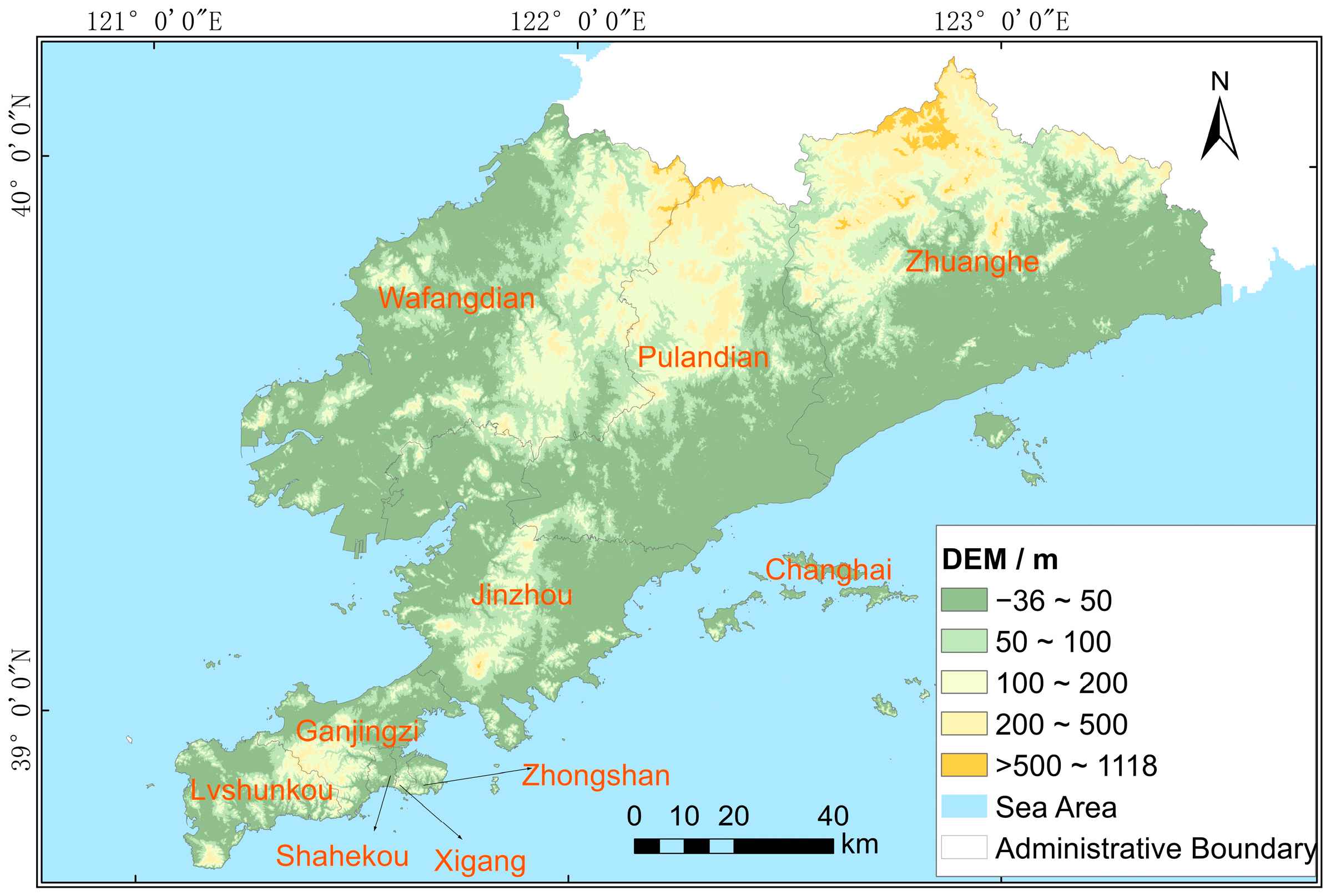
Located at the southern tip of the Liaodong Peninsula in China, Dalian is a coastal city bordering the Yellow Sea and the Bohai Sea. It is backed by the vast hinterland of Northeast China and faces the Shandong Peninsula across the sea. Its geographic coordinates are 38°43′–40°10′ N and 120°58′–123°31′ E. Administratively, the city consists of ten districts and counties: Zhongshan, Xigang, Shahekou, Ganjingzi, Lvshunkou, Jinzhou, Pulandian, Wafangdian, Zhuanghe, and Changhai. The total land area is 13,792.34 km2 (Figure 1). The terrain of Dalian slopes from northeast to southwest, characterized by low mountainous and hilly topography. It experiences a warm temperate continental monsoon climate, with an average annual temperature of 10.5 °C and a long-term average annual precipitation of 739 mm. Dalian is a typical resource-based water-scarce city. The per capita available water resources stand at 599 m3, which is only one-quarter of the national average. Water resources in Dalian are unevenly distributed both spatially and temporally, and this distribution does not align with the layout of the population and economic activities. Spatially, water resources decrease from northeast to southwest, whereas the population, industries, and urban development are predominantly concentrated in the southwestern part of the city.

2.2. Data Sources

The data utilized in this study include water resources data, land use data, meteorological data, GDP, population density, seawater intrusion data, water quality data, and other statistical data, covering the period from 2010 to 2022. All datasets were rasterized and resampled to a uniform resolution of 1 km. The data sources and descriptions are presented in Table 1.

2.3. Methods

2.3.1. DPSIR Model

This study employs the Driving Force-Pressure-State-Impact-Response (DPSIR) model as its core analytical framework. This model effectively describes the complex causal chain underlying the research issue and its potential solutions, and has been widely applied in fields such as ecological environmental management and resource sustainability assessment [24,25].
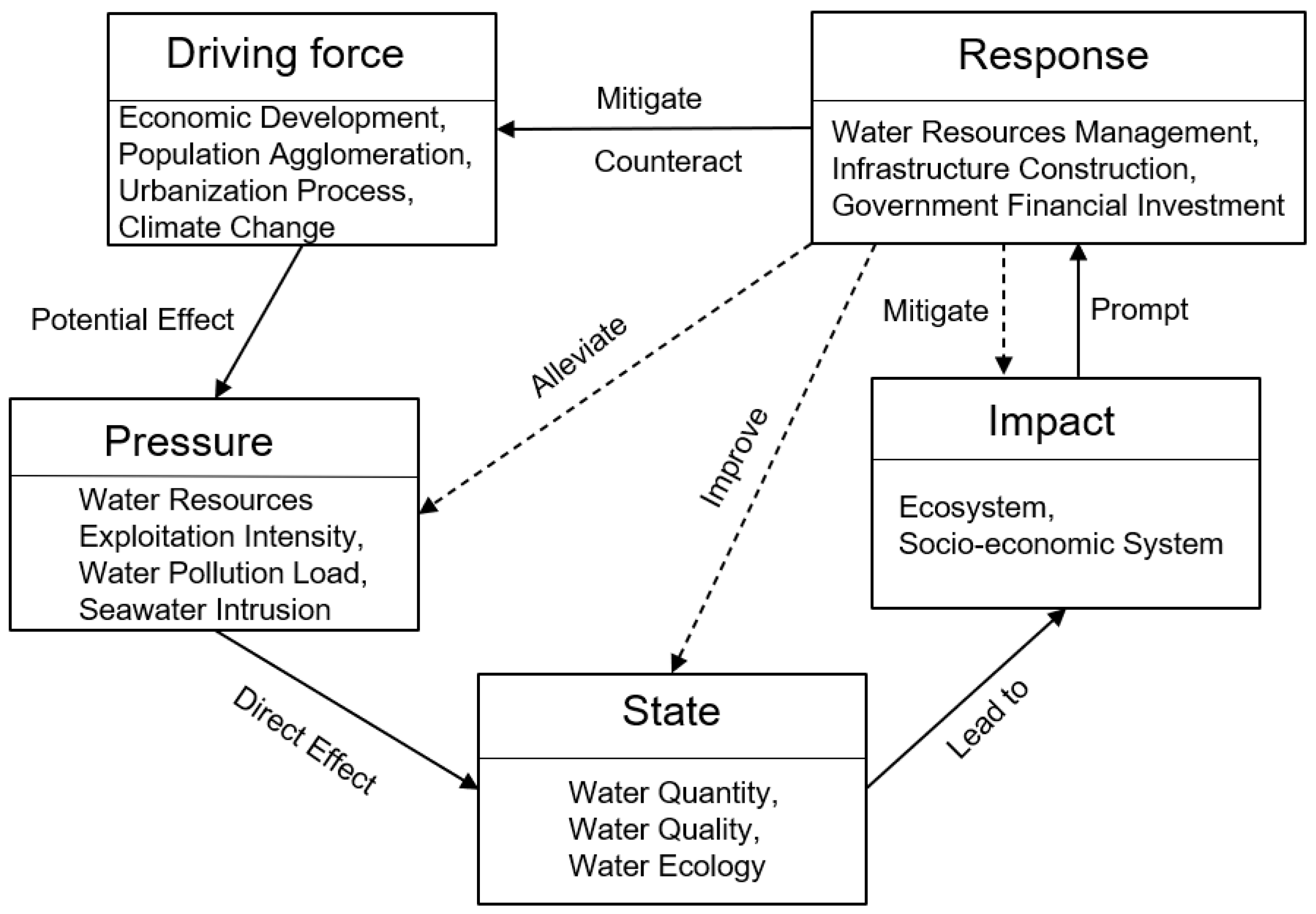
In the context of WRR research, the driving forces primarily include economic development, population agglomeration, urbanization, and climate change. These factors exert potential pressures on the water resources system, manifested as increased intensity of water resources development, higher pollution loads, and elevated risks of seawater intrusion. These pressures directly alter the state of the system, reflected in changes to water quantity, water quality, and aquatic ecosystems. This, in turn, leads to a series of impacts on both ecological and socio-economic systems. The resulting impacts prompt human society to formulate responses, such as implementing improved water resources management, upgrading water infrastructure, and increasing governmental financial investment. These responses can subsequently mitigate or even counteract the original driving forces, thereby forming a closed feedback loop. Furthermore, the response measures can also directly influence other components of the framework, for instance, by alleviating pressures, improving the state, and reducing negative impacts (Figure 2).
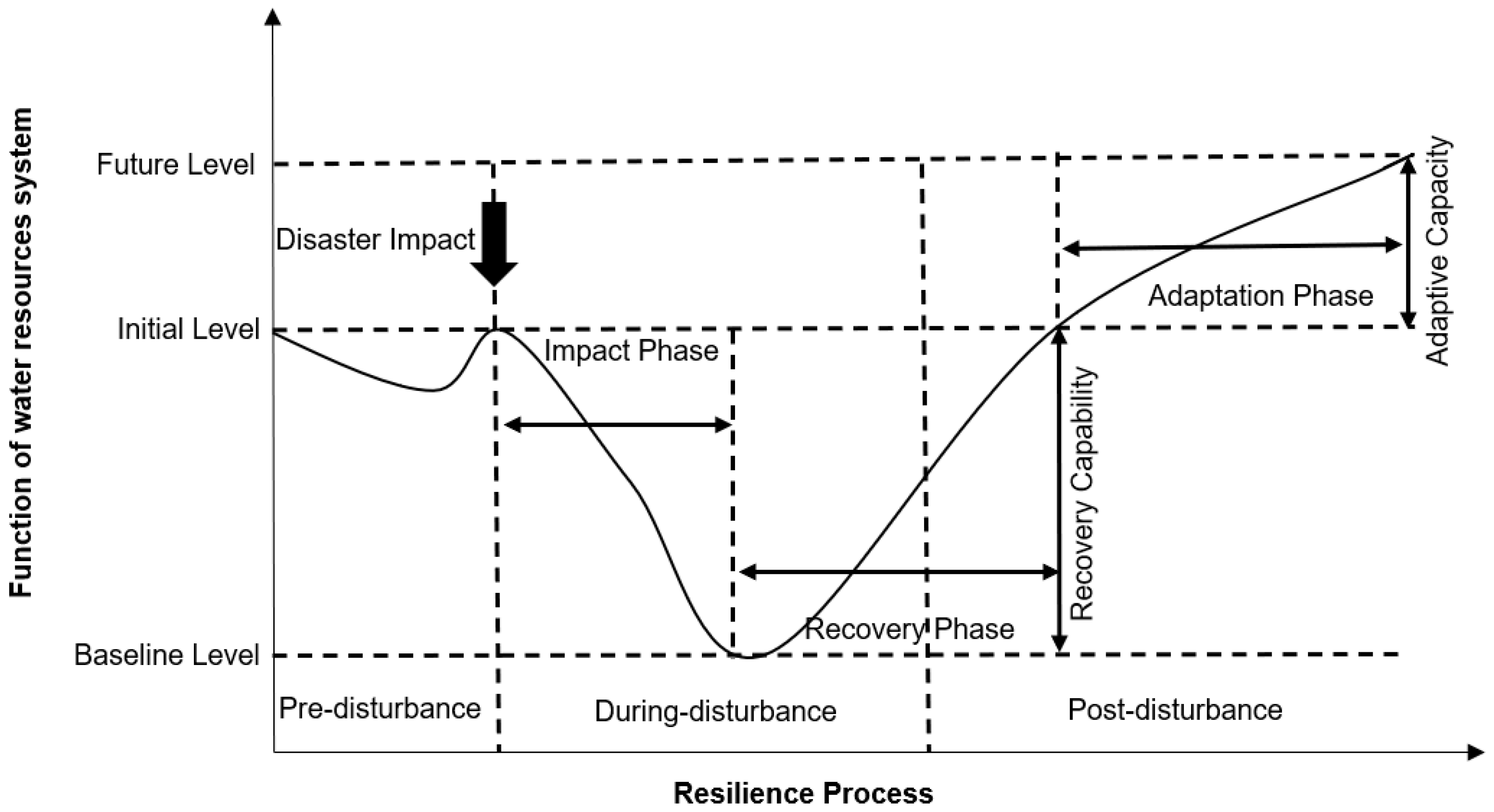
The process of WRR is typically divided into three stages: pre-disturbance, during disturbance, and post-disturbance. Here, “disturbance” refers to natural disasters such as floods and human-induced disasters such as major water pollution incidents affecting the system, both internally and externally. Before a disturbance, the system’s functionality remains at its initial level. After being impacted, the system’s functionality plummets to its lowest point, then gradually recovers through its inherent restorative capacity and human intervention. By adjusting its own structure, the system enhances its adaptability and eventually reaches a new stable state (Figure 3).
To precisely define the core stages of the resilience process, this study provides clear definitions for the impact, recovery, and adaptation phases. The impact phase refers to the process in which system functionality rapidly declines from its initial level to a critical threshold following natural or anthropogenic disturbances, characterized by abrupt changes in system state and functional loss. The recovery phase describes the process by which system functionality gradually returns to its baseline level after reaching its lowest point, driven by inherent self-stabilizing capacities and external interventions, with core features being functional restoration and loss mitigation. The adaptation phase denotes the process in which, after recovering to the baseline level, the system achieves a new stable state through structural optimization, characterized by enhanced disturbance resistance and systemic upgrading. The above elaboration is based on the following underlying assumptions. First, the water resource system possesses intrinsic recovery potential, and external disturbances do not exceed the system’s irreversible threshold. Second, human response measures can effectively accelerate recovery and promote adaptation, functioning synergistically with the system’s self-stabilizing capacity without antagonistic effects.
By mapping this resilience process onto the DPSIR model, a logical correspondence becomes evident. The pre-disturbance phase aligns with the driving force (D) and pressure (P) components of the DPSIR framework. It should be noted that associating driving force (D) and pressure (P) primarily with the pre-disturbance phase represents a conceptual simplification. This approach aims to emphasize their underlying role in shaping cumulative pressures, while in dynamic reality, driving forces persist throughout all stages of resilience evolution. The during-disturbance phase corresponds to the state (S) and impact (I) components. It should be clarified that state and impact do not occur simultaneously. State (S) refers to the immediate changes in the attributes of the water resources system under the direct influence of a disturbance, while impact represents the chain reactions triggered by these state changes—a lagged effect of the water resource system’s alterations on the external ecological and socio-economic systems. In this study, both state and impact are considered together under the during-disturbance phase, primarily because, in a regional annual-scale comprehensive assessment, they are often closely interconnected and jointly characterize the immediate functional decline and primary consequences of the system following a disturbance. Together, they constitute the complete chain of effects exerted by the disturbance on the system. The post-disturbance phase is reflected in the response (R) component. This alignment establishes the logical validity of applying the DPSIR model to evaluate WRR.

2.3.2. Indicator System

Water resources systems are intrinsically linked to socioeconomic and ecological environments. Assessing their resilience requires considering a complex interaction of determinants, from natural water endowment and ecological conditions to socioeconomic drivers and policy responses. The outcome of any resilience evaluation is contingent upon the chosen indicators. This study constructs a composite assessment system within the DPSIR model framework, grounded in the core concept and processes of resilience. The indicator selection is guided by principles of scientific validity, systematic completeness, and operational practicality, ensuring it captures the essential qualities of resilience—namely, resistance, recovery, and adaptability.
This study investigates the WRR of Dalian City from both temporal and spatial dimensions. Due to their distinct focuses and difficulties in data acquisition, the evaluation indicator systems for these two dimensions differ slightly. For instance, the following indicators lack spatial data and are thus excluded from the spatial assessment: water supply coverage rate, density of water supply and drainage pipelines in built-up areas, investment in water conservancy, environment and public facilities per unit area, and water quality compliance rate. Where feasible, substitute indicators were employed: groundwater quality classification replaced the water quality compliance rate, and fixed-asset investment per unit area served as a proxy for the specific sectoral investment. Furthermore, per capita grain production was omitted from the spatial evaluation due to its strong influence by the functional zoning of each district, which limits its spatial comparability. Conversely, for the temporal dimension assessment, indicators such as meteorological disaster grade and groundwater level depth were excluded because of the difficulty in obtaining their long-term time-series data. Despite these differences in the indicator sets between the two dimensions, the overall rationality and validity of the comprehensive evaluation remain unaffected.
Based on the above, the WRR evaluation index system consists of 20 indicators in the time dimension and 19 indicators in the spatial dimension (Table 2).

2.3.3. Entropy Weight Method

This study applied the entropy weight method to determine indicator weights. This method quantifies the amount of information inherent in each indicator’s dataset by calculating its information entropy. A higher information entropy corresponds to a lower degree of dispersion in the indicator’s data, implying it provides less informational value and thus should be assigned a smaller weight in the comprehensive evaluation. In contrast, a lower entropy value signifies greater variability in the data, indicating a higher informational contribution, and consequently, the indicator is assigned a larger weight [27]. The computational procedure was as follows:
(1)
The range method was applied to standardize the indicator data. The processed data are all dimensionless values, which mitigates computational difficulties arising from differences in data magnitude and units.
The calculation formulas for positive and negative indicators are presented as follows:
For positive indicators:
r i j = x i j m i n ( x ) i j m a x ( x ) i j m i n ( x ) i j
For negative indicators:
r i j = m a x ( x ) i j x i j m a x ( x ) i j m i n ( x ) i j
where rij denotes the standardized value, xij represents the original data value, max(x)ij refers to the maximum value and min(x)ij denotes the corresponding minimum value.
(2)
Calculate the entropy value for the j-th indicator.
e j = 1 ln n i = 1 n ( f i j ln f j i )
f i j = r i j i = 1 n r i j
where ej represents the entropy value of the j-th indicator, n is the sample number of the j-th indicator, and fij is the proportion of the i-th sample value under the j-th indicator.
(3)
Calculate the weight wj for each indicator:
w j = 1 e j j = 1 m ( 1 e j )
where wj is the weight of the j-th indicator, m is the total number of indicators.

2.3.4. Calculation of the Water Resources Resilience Index (WRRI) and Classification Criteria

The Water Resources Resilience Index (WRRI) was calculated by weighting the normalized values of each evaluation factor according to their importance. The computation was performed using the following formula:
W R R I = i = 1 n A ( i ) · Q ( i )
where n is the total number of evaluation factors, A(i) represents the weight assigned to the i-th evaluation factor, and Q(i) is the normalized value of the i-th evaluation factor.
The classification criteria were shown in Table 3.

2.3.5. Geodetector Method

The Geodetector is a statistical method specifically designed to detect and quantify spatial stratified heterogeneity and to reveal the underlying driving factors. Originally developed by the research team of Professor Wang in 2010 [28], it has been extensively applied across various disciplines such as geography, environmental science, regional economics, and land spatial planning [29,30]. This study utilizes two functional modules of the Geodetector: the factor detector and the interaction detector.
(1)
Factor Detector
The factor detector quantifies the explanatory power of each independent variable on the dependent variable, measured by the q-value. The expression is as follows:
q = 1 h = 1 L N h σ h 2 N σ 2
In the above formula, q indicates the strength of explanatory power of each factor on WRR, with a value range of [0, 1]. A higher value represents stronger explanatory power [31]. N denotes the number of samples, L represents the number of strata or categories into which the independent variable is divided, and Nh is the number of samples in the h-th stratum (h = 1, 2,…, L). σ2 and σh2 represent the variance of the dependent variable in the entire study area and the variance within the h-th stratum, respectively. They are used to measure the variations of the dependent variable overall and within each stratum.
(2)
Interaction Detector
The interaction detector is used to identify the influence of interactions between different independent variables on dependent variables. This is achieved by comparing the q-value of a single factor with the q-value after the interaction of two factors. The outcomes are typically described as follows: non-linear weaken, single-factor non-linear weaken, bi-factor enhance, independent, and non-linear enhance [32].

2.3.6. Obstacle Degree Model

The obstacle degree model is employed to identify the primary limiting factors affecting system development. It has been widely applied across various fields, including regional economic development and ecological environment assessment [33,34], proving particularly effective in diagnosing constraints and clarifying directions for improvement.
P i j = w j ( 1 r i j ) j = 1 n w j ( 1 r i j )
In the formula, Pij denotes the obstacle degree of the j-th indicator to the i-th evaluation object (e.g., region, year). A higher value indicates a stronger obstructive effect of this indicator on WRR; wj represents the weight of the j-th indicator; rij is the standardized value of the j-th indicator for the i-th evaluation object; and n signifies the total number of indicators.

3. Results

3.1. Temporal Dynamics of WRR

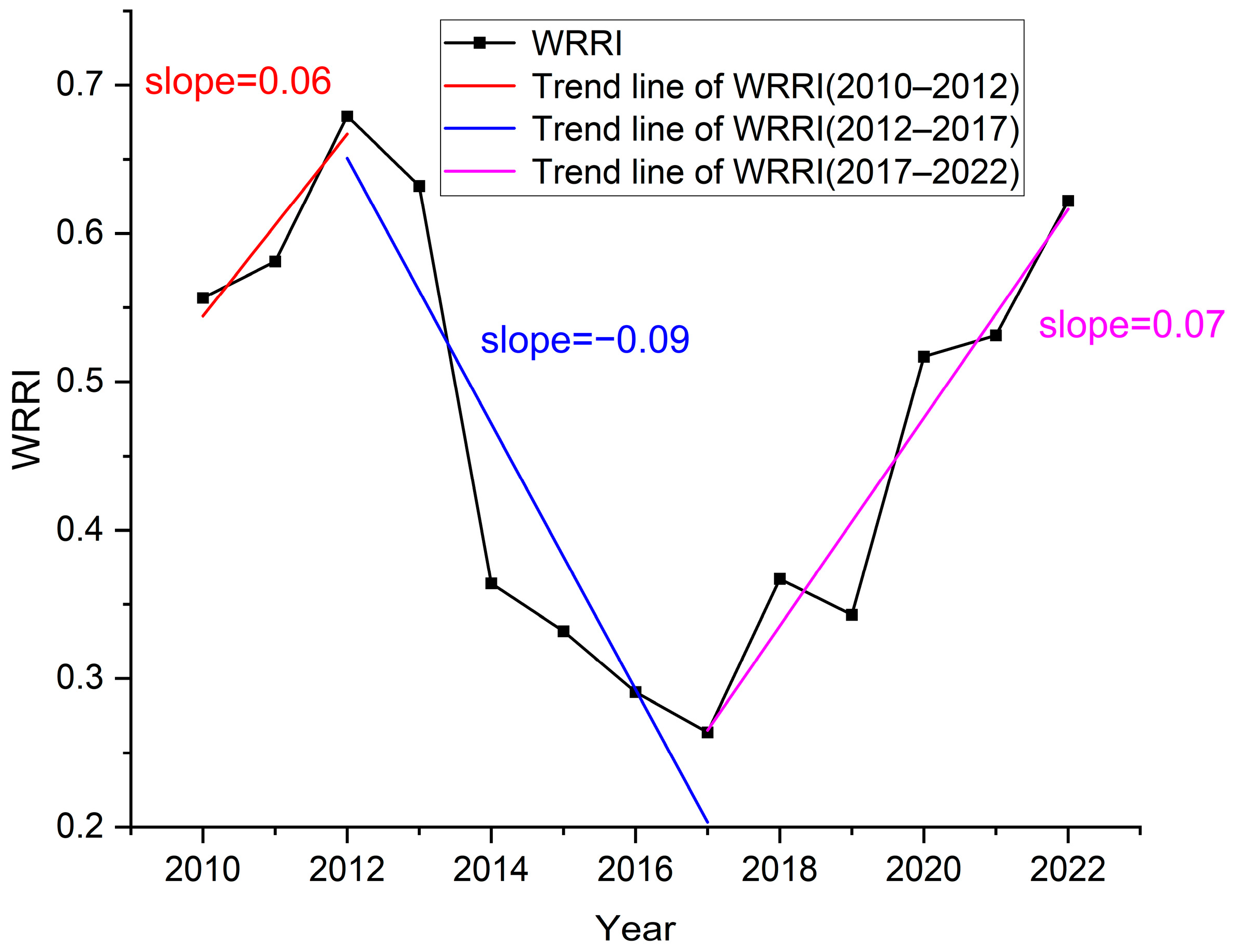
The average WRRI from 2010 to 2022 was 0.47. The lowest value, 0.26, occurred in 2017, while the peak value of 0.68 was observed in 2012. The temporal variation of the WRRI during this period can be divided into three distinct phases: a rising trend from 2010 to 2012, with a growth rate of 22.03%; a declining trend from 2012 to 2017, marked by a decrease of 61.16%; and a subsequent recovery from 2017 to 2022, showing a significant increase of 135.81% (Figure 4).
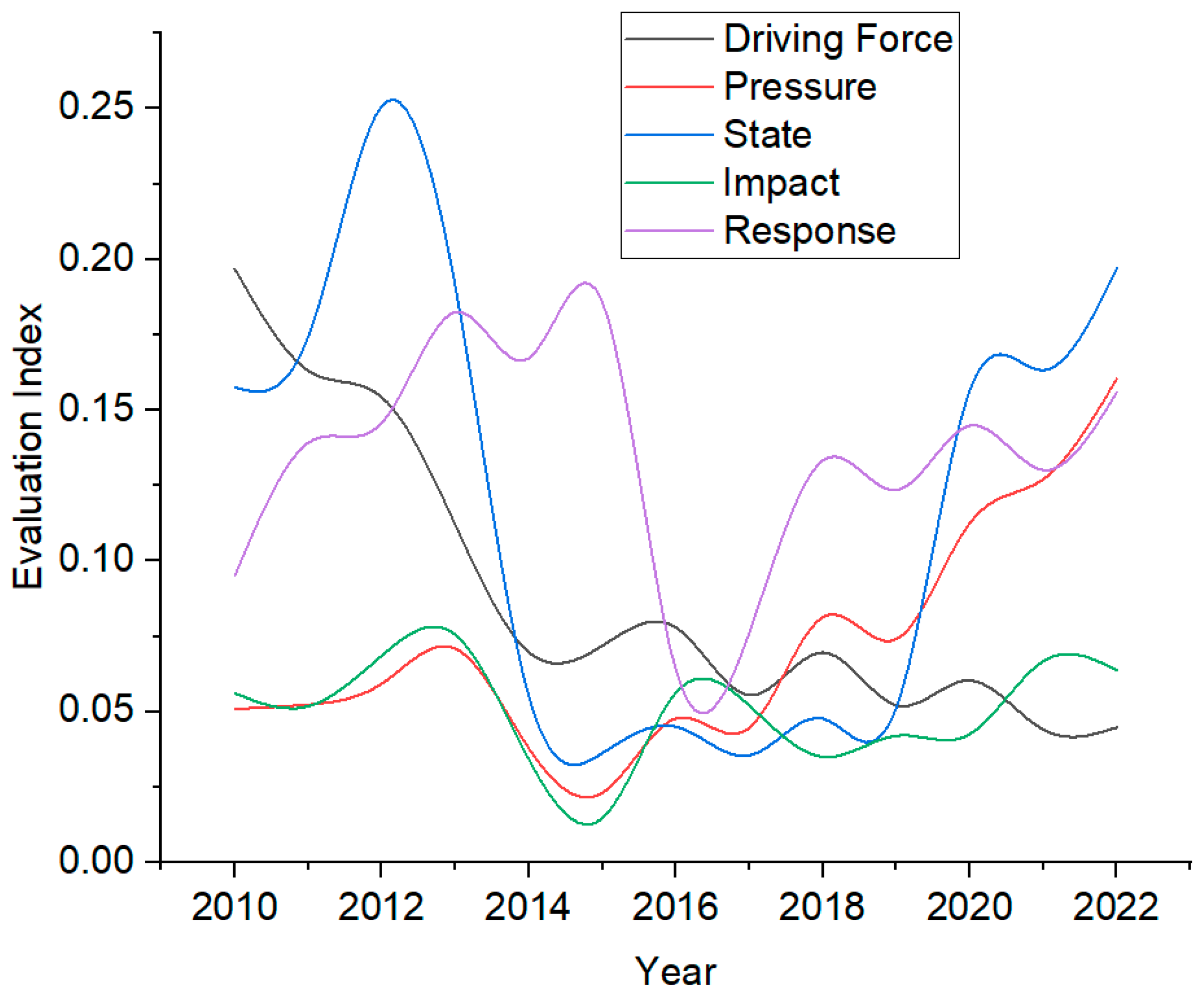
Results from the individual criterion layers reveal the following patterns (Figure 5). The evaluation index for the driving force layer exhibited an overall downward trend, indicating that economic development, population aggregation, and urbanization processes exerted a suppressive effect on the overall resilience. The evaluation index for the pressure layer showed an upward trend. Although the pressure on the water resources system intensified due to population and economic agglomeration driven by urbanization, this was counteracted by a significant reduction in the seawater intrusion area, leading to a net positive trend. The evaluation index for the state layer displayed considerable fluctuation, following a pattern of increase-decrease-stable fluctuation-increase. This trend was primarily governed by water resources modulus and per capita water resources, closely aligning with variations in precipitation. The evaluation index for the impact layer demonstrated relatively minor fluctuations throughout the study period. The response layer exhibited significant variability, characterized by an increase-decrease-increase trajectory, which was largely influenced by water resources management measures and governmental financial investment.

3.2. Spatial Distribution Characteristics of WRR in 2020

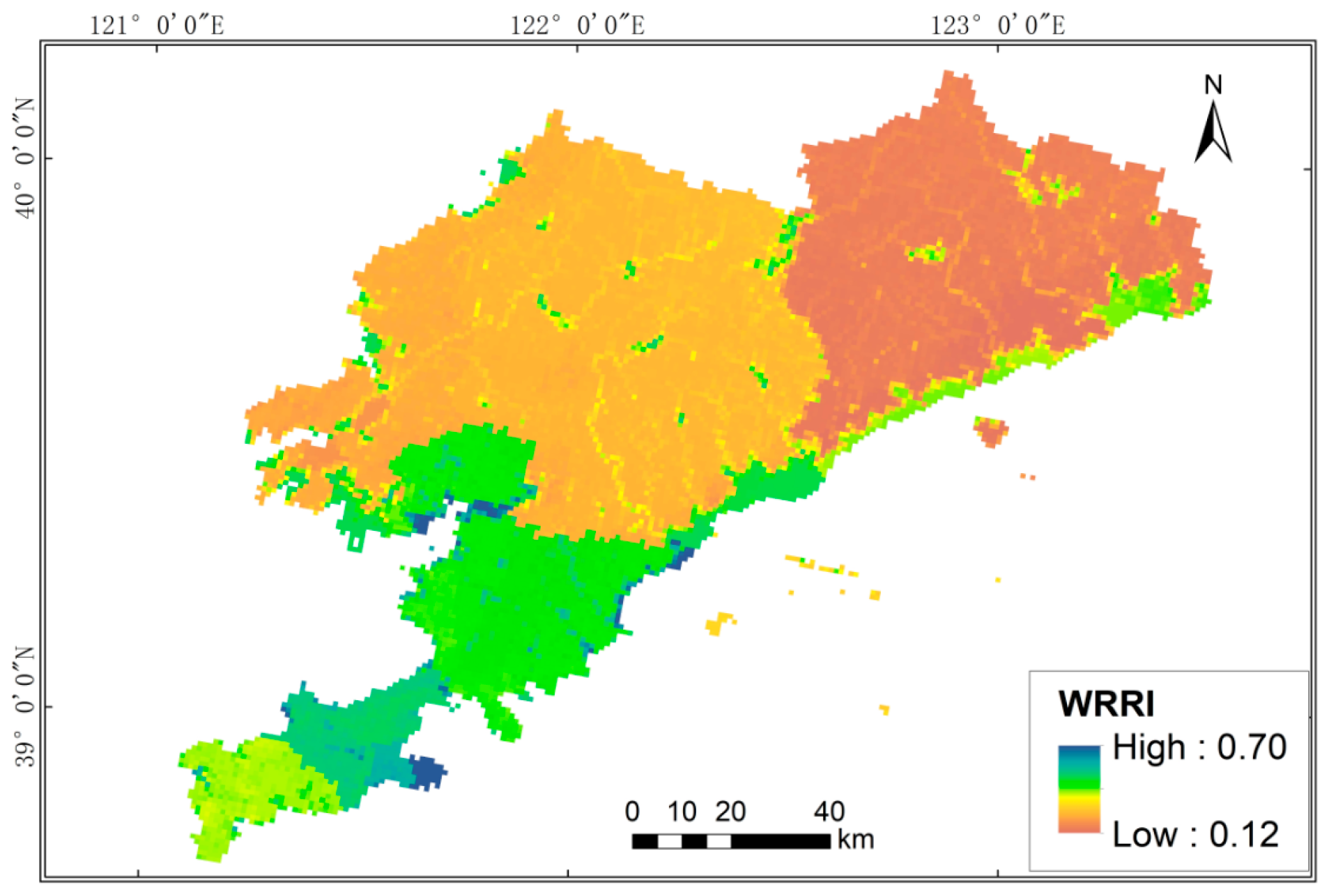
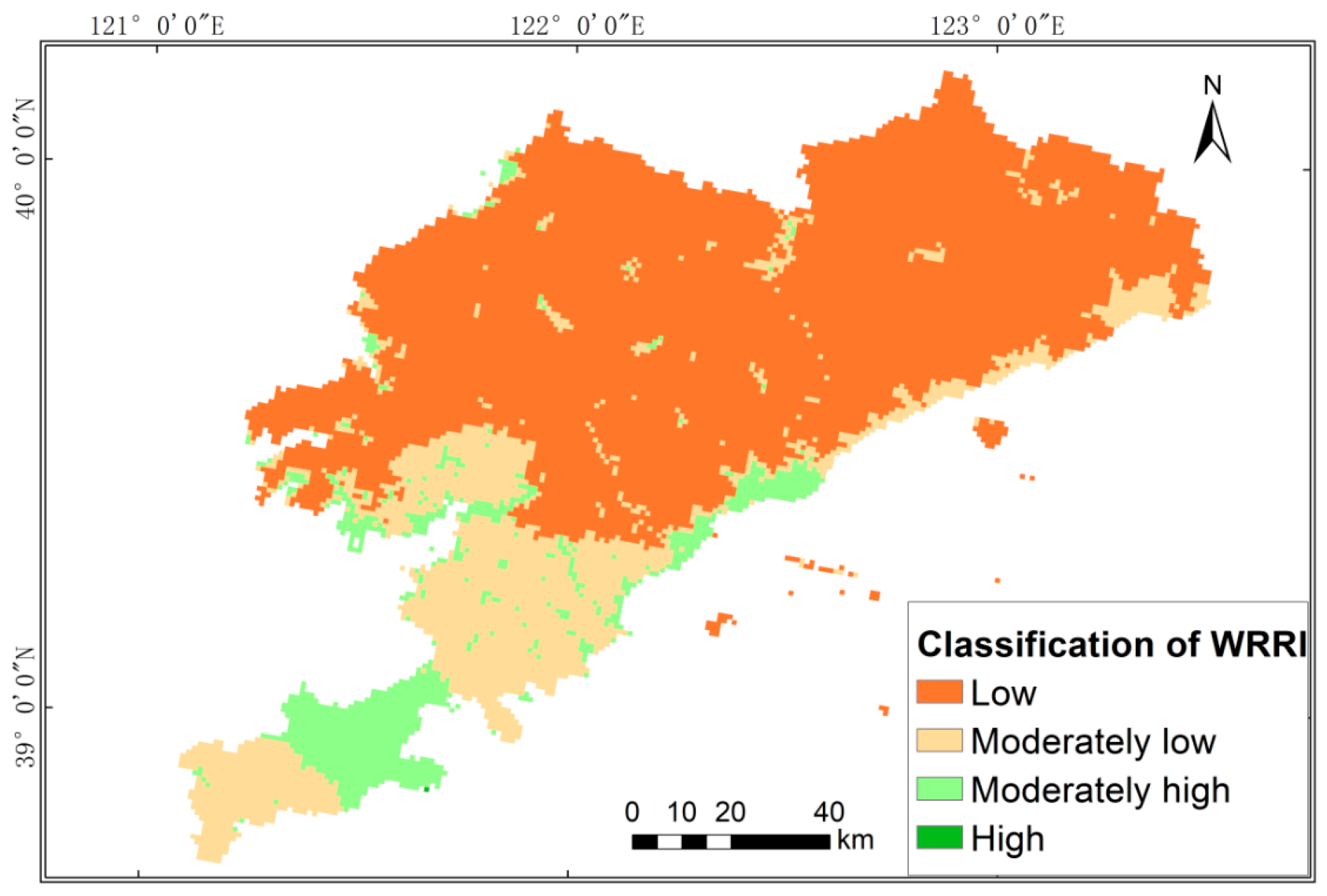
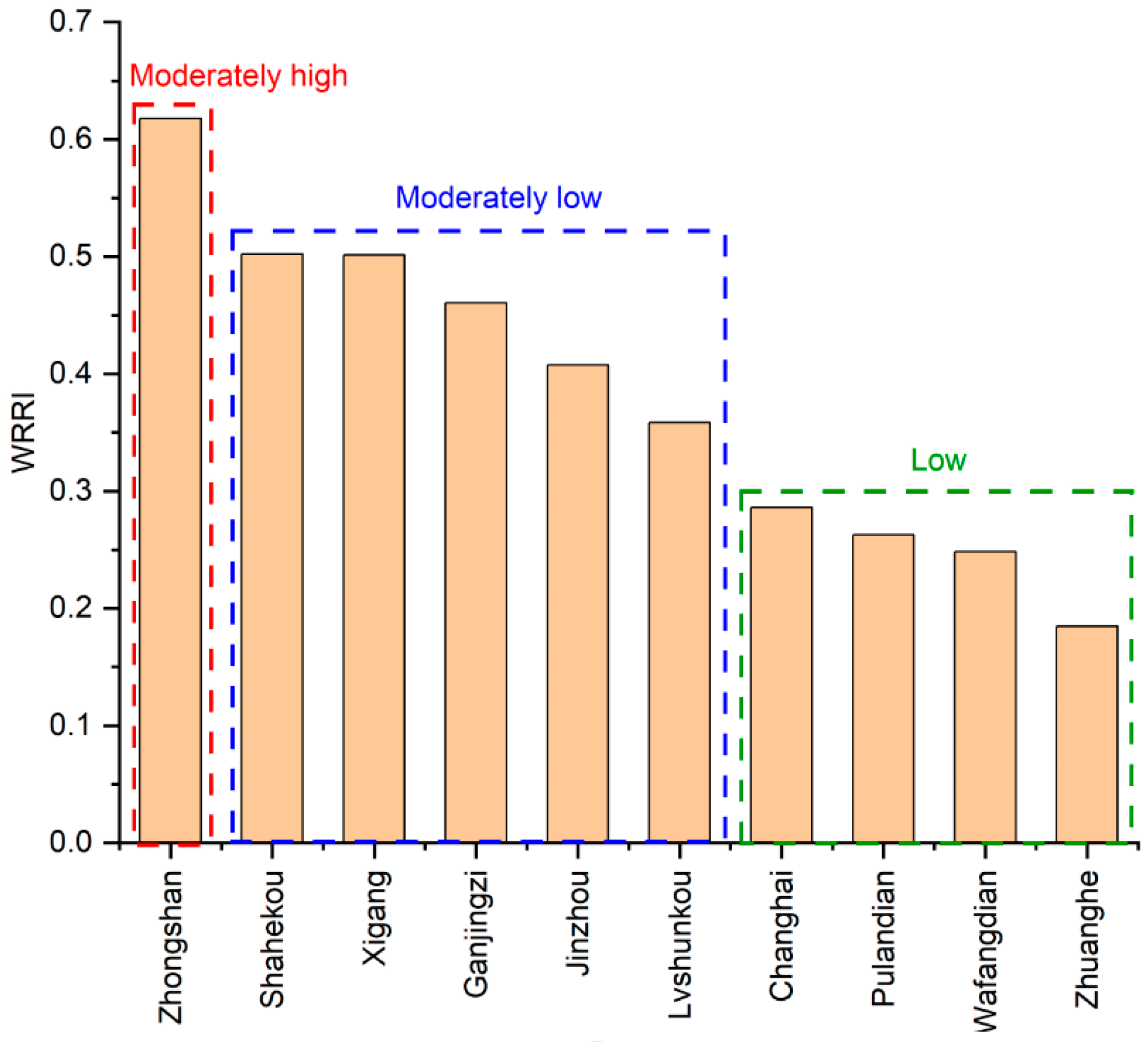
The spatial distribution of WRRI in Dalian City exhibits significant variation, with minimum and maximum values of 0.12 and 0.70, respectively (Figure 6). The spatial pattern is characterized by higher resilience in the southern areas and lower resilience in the northern areas. Based on the established threshold criteria for classification, the WRR is categorized into four grades. The low and moderately low grades account for a high proportion of the total area, at 70.66% and 21.10%, respectively. In contrast, the moderately high and high grades comprise only 8.23% and 0.01% of the area, indicating an overall low level of WRR (Figure 7). Evaluation at the administrative district level reveals that Zhongshan demonstrates a moderately high level of resilience, whereas Xigang, Shahekou, Ganjingzi, Lvshunkou, and Jinzhou exhibit moderately low levels. Pulandian, Wafangdian, Zhuanghe, and Changhai are classified as having low resilience levels (Figure 8).

3.3. Driving Factors Analysis of Spatial Heterogeneity in WRR

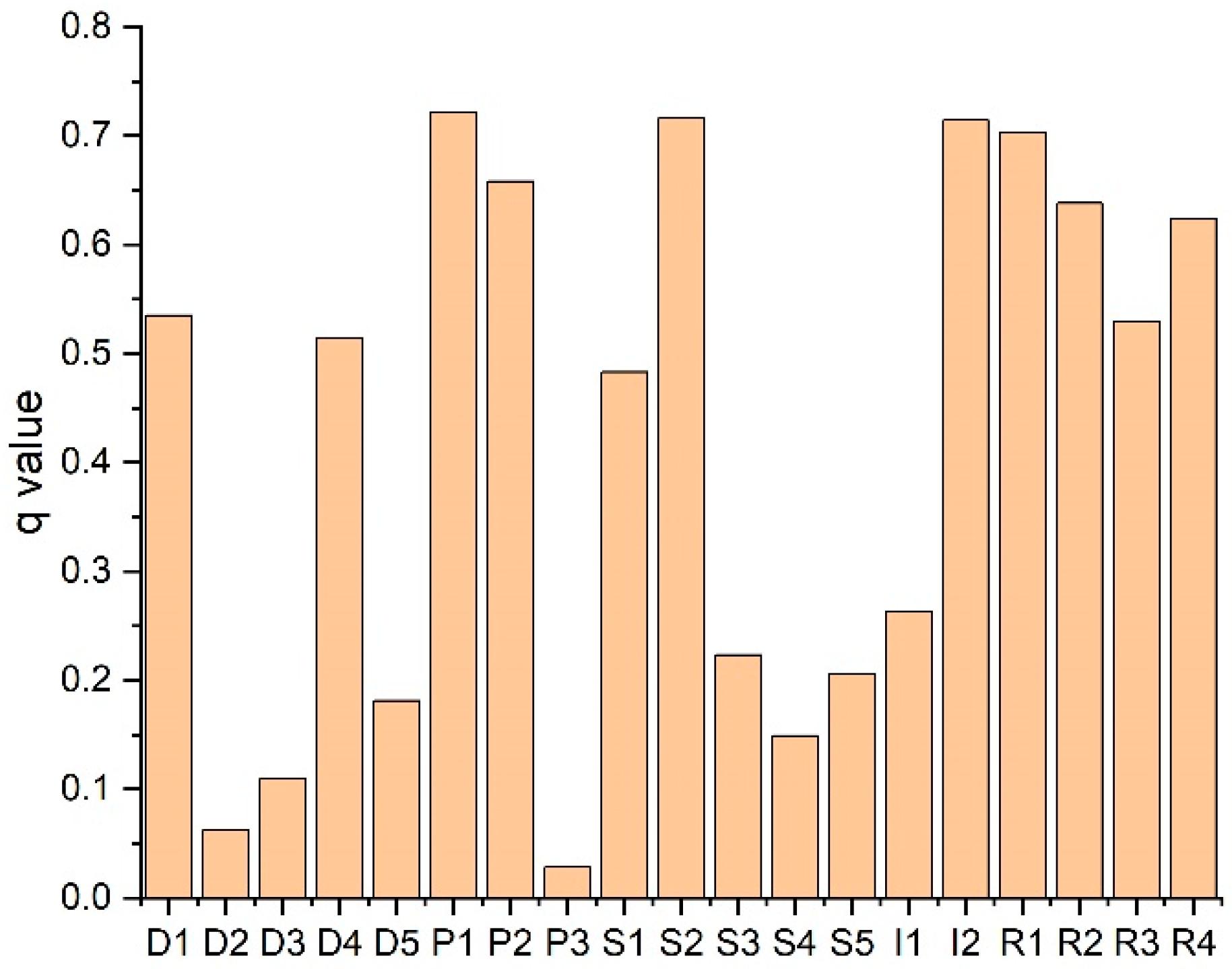
This study employs the Geodetector method to analyze the explanatory power of various driving factors on the spatial heterogeneity of WRR. The results of factor detection are shown in Figure 9. The results indicate that the explanatory power of each factor on the spatial distribution of WRR varies significantly.
Specifically, the water resources development and utilization rate, per capita water resources, proportion of the tertiary industry, and water use per 10,000 yuan of GDP exhibit substantial influences on the spatial heterogeneity of water resource resilience, with q-values of 0.722, 0.716, 0.714, and 0.703, respectively. In contrast, factors such as seawater intrusion grade, population density, proportion of built-up area, and proportion of water area have relatively weak effects, with q-values of 0.028, 0.062, 0.110, and 0.149, respectively.
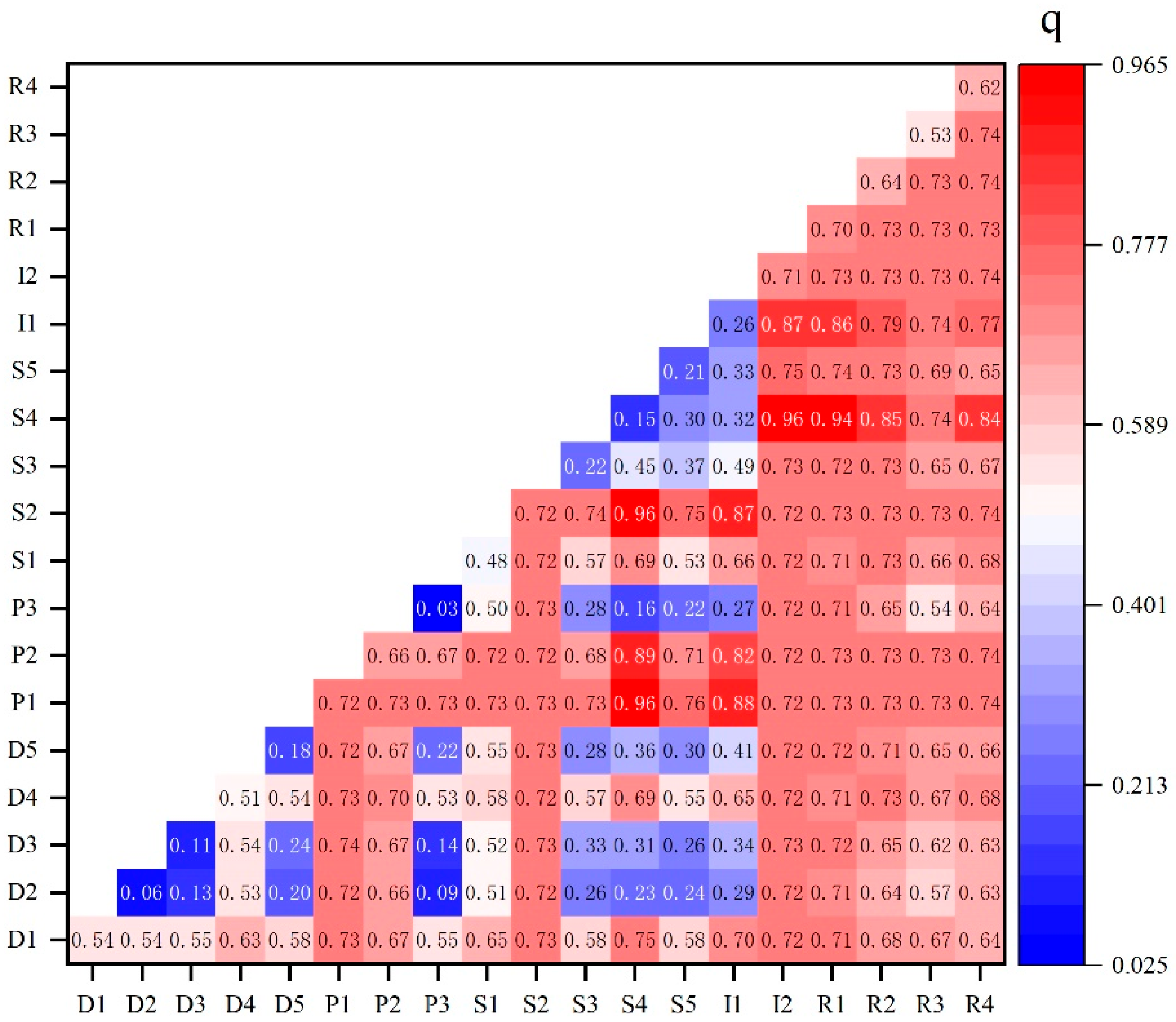
Interaction detection analysis (Figure 10) reveals that the interaction between any two variables yields greater explanatory power than that of any single variable alone, indicating that the influencing factors of WRR are characterized by a complex interplay. The strongest interaction is observed between the proportion of water area and the water resources development and utilization rate, with a q-value of 0.96. Conversely, the interaction between seawater intrusion grade and population density is the weakest, with a q-value of 0.09.
Furthermore, the proportion of water area is identified as a highly pivotal and leveraging driver. Its interactions with most other factors manifest as non-linear enhancement, suggesting that it is not merely an ordinary explanatory variable but rather a factor that closely couples with nearly all other socio-economic and natural factors, playing an important role in regulating their combined effects on WRR.

3.4. Obstacle Degree Analysis

This study conducted a diagnostic analysis of obstacles at two levels: first, identifying annual obstacle factors over the period 2010–2022 from a temporal trend perspective, and second, detecting primary obstacles in respective counties from a spatial dimension.

3.4.1. Analysis of Obstacle Degrees to WRR from 2010 to 2022

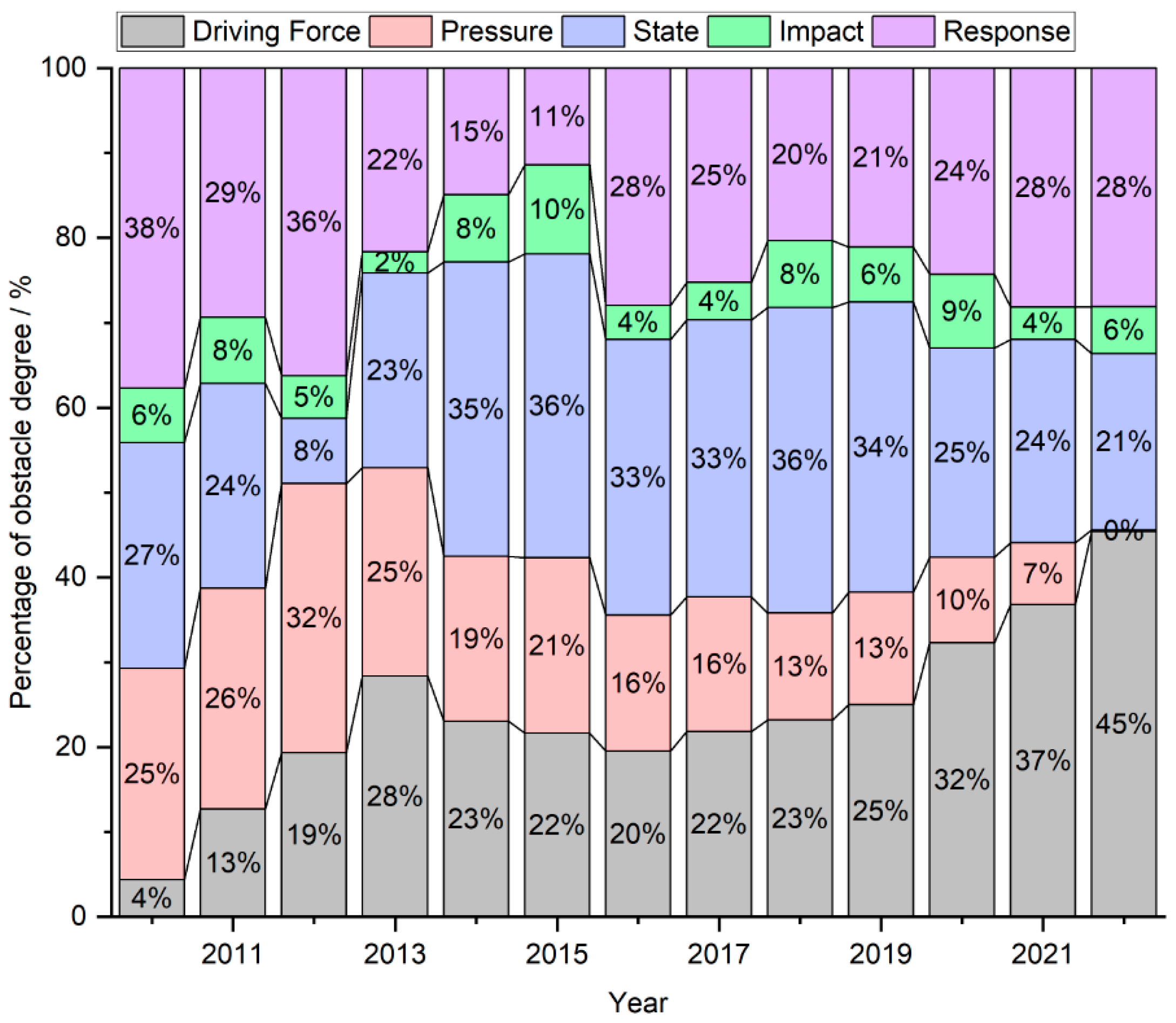
From the perspective of individual criterion layers, the average obstacle degree percentages for the driving force, pressure, state, impact, and response layers during 2010–2022 were 21.12%, 17.12%, 27.42%, 6.22%, and 25.12%, respectively (Figure 11). The percentage for the driving force layer obstacle degree showed an upward trend, increasing from 4.39% in 2010 to 45.39% in 2022. The percentage for the pressure layer obstacle degree exhibited a downward trend, decreasing from 24.89% in 2010 to 0.21% in 2022. The percentage for the state layer obstacle degree fluctuated, demonstrating an overall trend of decline-rise-stabilization-decline. The percentage for the impact layer obstacle degree remained relatively stable. The percentage for the response layer obstacle degree also fluctuated, but with an overall descending trend.
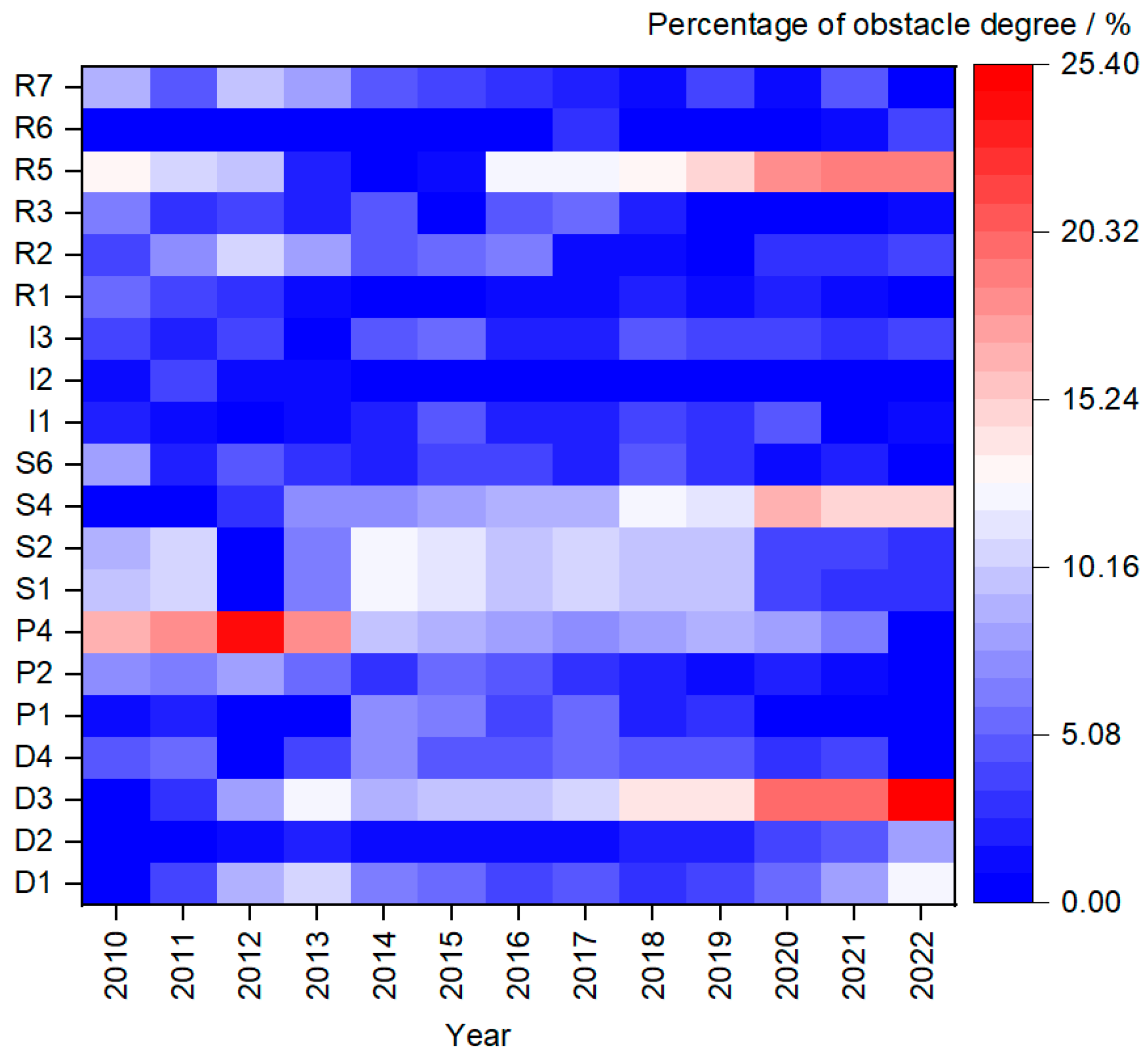
From the perspective of individual factor layers, the top three obstacle factors were the proportion of built-up area, total investment in water conservancy, environment and public facilities management, and the seawater intrusion area, with average obstacle degree percentages of 11.94%, 11.26%, and 10.84%, respectively (Figure 12). The primary obstacle factor during 2010–2013 was seawater intrusion, while it shifted to the proportion of built-up area from 2018 to 2022. From 2010 to 2022, the proportion of built-up area in Dalian increased by 17.25%, and its obstacle degree rose from nearly 0 to 25.30%. Meanwhile, the seawater intrusion area decreased by 51.58%, with its obstacle degree dropping from 16.39% to nearly 0. During 2010–2013, the primary obstacle factor was seawater intrusion, with an average obstacle degree of 19.16%. In contrast, during 2018–2022, the proportion of built-up area has become a prominent obstacle factor, with an average obstacle degree of 18.64%. These data clearly confirm that urbanization-driven expansion of built-up area has emerged as a key constraint affecting WRR in recent years.

3.4.2. Analysis of Obstacle Degrees to WRR at the Country Level

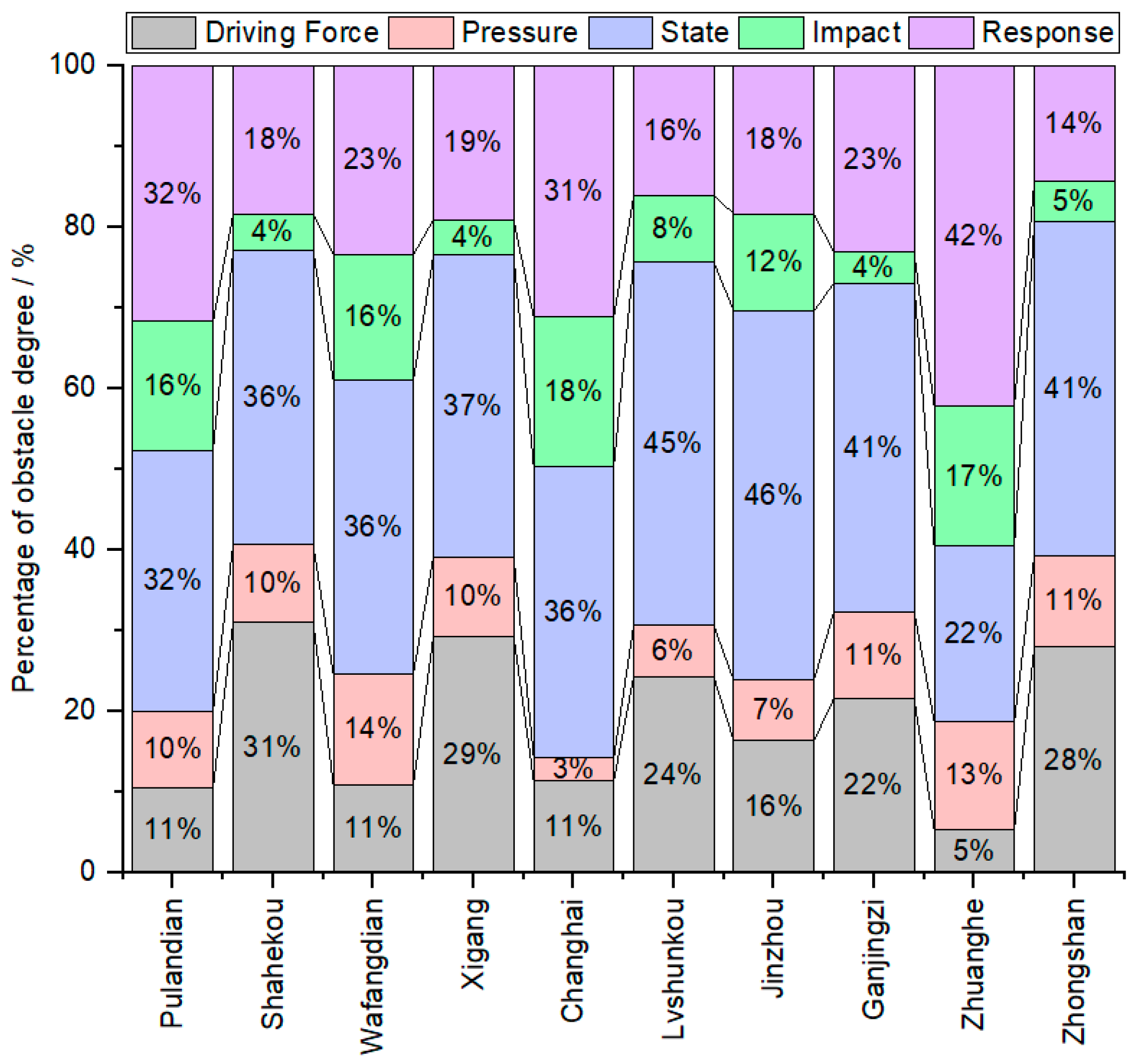
From the perspective of individual criterion layers, the obstacle degree percentages for the driving force, pressure, state, impact, and response layers were 18.9%, 9.47%, 37.32%, 10.54%, and 23.78%, respectively (Figure 13). The primary obstacle layers in Pulandian were state and response, with respective contributions of 32.17% and 31.7%. Shahekou was primarily constrained by the state and driving force, which accounted for 36.48% and 31.06% of the total obstacle degree. In Wafangdian, the dominant obstacle layers were identified as state and response, representing 36.39% and 23.38%, respectively.
Xigang obstacle profile showed state and driving force as the main layers, at 37.32% and 29.34%. Changhai demonstrated a similar pattern to Pulandian, with state and response constituting 36.14% and 31.13% of its obstacle degree. Lvshunkou was characterized by state and driving force as its primary constraints, contributing 45.04% and 24.30%.
Jinzhou’s main obstacle layers were state and response, making up 45.73% and 18.33% of its total. In Ganjingzi, state and response were also the dominant layers, accounting for 40.72% and 23.14%. Zhuanghe presented a distinct configuration where response and state were the primary obstacle layers, at 42.17% and 13.28%, respectively. Finally, Zhongshan was predominantly affected by the state and driving force, which represented 41.40% and 28.01% of its obstacle degree.
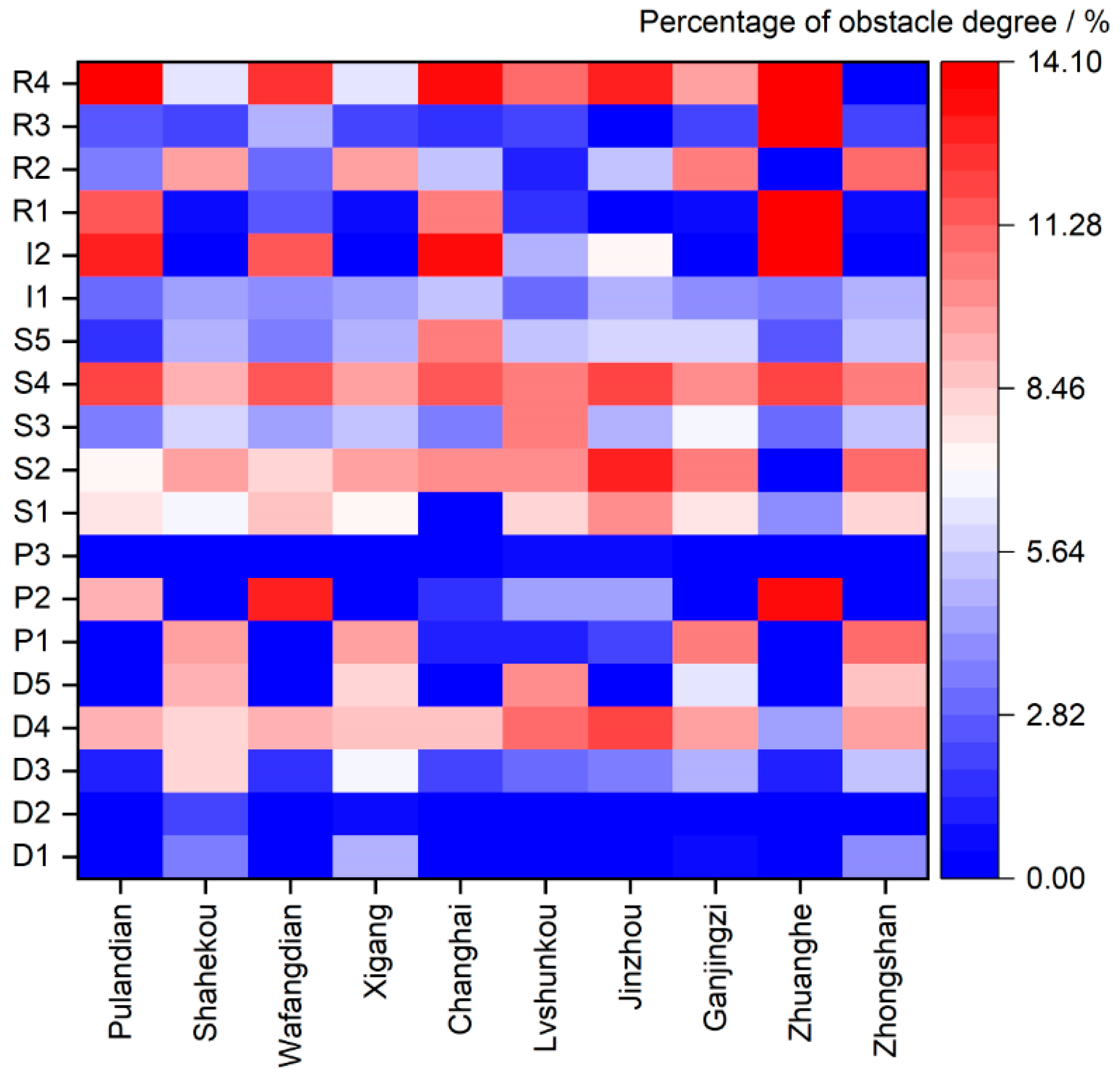
From the perspective of individual factor layers, the primary obstacle factors in Zhongshan, Xigang, Shahekou, and Ganjingzi were the water resources development and utilization rate, accounting for 11.27%, 9.84%, 9.59%, and 10.5%, respectively, followed by per capita water resources, with contributions of 11.27%, 9.84%, 9.59%, and 10.5%, respectively (Figure 14). This pattern arises because urban areas concentrate population and industry while having limited water resources, leading to high development and utilization rates and low per capita availability, thereby reducing WRR. In Lvshunkou, the main obstacle factors were annual precipitation and fixed-asset investment per unit area, representing 10.89% and 10.84%, respectively. Jinzhou was primarily constrained by fixed-asset investment per unit area and per capita water resources, at 12.82% and 12.72%. Pulandian’s key obstacles were fixed-asset investment per unit area and the proportion of the tertiary industry, accounting for 13.92% and 12.84%. Wafangdian showed groundwater use proportion and fixed-asset investment per unit area as its main obstacles, contributing 12.94% and 12.51%. Zhuanghe was predominantly limited by water use per 10,000 yuan of GDP and urban sewage treatment rate, both at 14.07%. Changhai’s primary obstacle factors were the proportion of the tertiary industry and fixed-asset investment per unit area, representing 13.29% and 13.24% respectively.

4. Discussion

This study, focusing on Dalian City from 2010 to 2022, reveals the spatiotemporal heterogeneity of WRR and analyzes the complex interactions among various driving factors. Within the broader context of urban water security and sustainable development, this paper interprets and discusses these key findings.

4.1. Discussion on the Trend and Spatial Distribution of WRR Changes

The time-series analysis of the WRRI revealed a generally fluctuating trend, with a multi-year average remaining at a relatively low level of 0.47, indicating substantial pressure on the water resources system. The sharp decline between 2012 and 2017 was primarily driven by a 53.7% reduction in precipitation and a 54.6% decrease in per capita water resources. Precipitation, as a key natural driver of water quantity, directly influences water resources modulus and per capita water availability—core components of the state layer evaluation index. Consequently, the state layer index exhibited considerable fluctuation during the study period, closely aligning with precipitation variations. This aligns with global studies confirming that water-scarce cities are highly vulnerable to climate-induced disturbances, which directly impact water availability and system state [35]. The subsequent recovery from 2017 to 2022 was attributed to both the rebound in precipitation and per capita water resources, as well as human-induced improvements: water use per 10,000 yuan of GDP decreased by 37.19%, and total investment in water conservancy, environment, and public facilities increased by 135.43%. These results highlight the high sensitivity of Dalian’s water resources system to both climatic variability and human management interventions. On the other hand, this also reflects a departure from the model of hyper-arid coastal cities, such as those on the Arabian Peninsula [36], which rely heavily on large-scale desalination. This contrast underscores Dalian’s climatic advantage—its moderate temperate climate enables the city to optimize water-use efficiency while leveraging natural hydrological restoration.
From the perspective of criterion layers, the driving force layer index showed a continuous downward trend, confirming that pressures from climate change, rapid urbanization, and economic development on the water resources system are still intensifying [37]—a pattern consistent with many cities at similar developmental stages [38]. In contrast, the pressure layer index decreased, primarily due to a significant reduction in seawater intrusion area, indicating that prevention and control measures and geological environment management have yielded positive outcomes [39]. The impact layer index remained relatively stable, while the response layer index exhibited significant fluctuation with a notable late-period improvement—reflecting the crucial role of policy interventions and financial investments in building water resources resilience [40].
The spatial distribution of the WRR in 2020 exhibited a distinct north–south disparity, characterized by higher values in the south and lower values in the north. The spatial pattern of WRR stems from the interplay of hydrological conditions, industrial structure, and governance practices. First, while water resources are naturally more abundant in the northeast, southern urban areas offset local scarcity through inter-basin water transfers and seawater desalination. Northern areas, reliant on rainfall and groundwater with limited regulation infrastructure, face greater supply instability during droughts. Second, the service and high-tech dominated south exhibits higher water-use efficiency, whereas the agriculture and manufacturing reliant north follows more water-intensive practices, straining the system. Third, as the administrative and economic core, the south benefits from greater governance investment, higher wastewater treatment rates, and earlier adoption of policies like sponge city initiatives, strengthening its regulatory and adaptive capacity. The overwhelming dominance of low and relatively low resilience areas, collectively accounting for 91.76%, indicates that water insecurity is a widespread challenge across most of Dalian. The higher resilience observed in Zhongshan can be attributed to its urban core status, which likely benefits from superior infrastructure, more robust financial capacity for water management, and potentially less direct reliance on local natural water sources compared to agricultural or industrial hinterlands. Conversely, northern regions such as Pulandian, Wafangdian, and Zhuanghe, characterized by extensive agricultural and industrial activities, experience water demands that exceed the capacity of both their water infrastructure and natural systems.

4.2. Discussion on the Driving Factors of WRR

Our application of the Geodetector model yielded critical insights into the forces shaping the spatial heterogeneity of water resilience. The results indicate that anthropogenic socioeconomic factors, such as water resources development and utilization rate, water use per 10,000 yuan of GDP, and the proportion of the tertiary industry, and key natural endowment factors, such as per capita water resources, possess the strongest explanatory power, with q-values exceeding 0.7. The water resources development and utilization rate directly reflects the supply-demand tension. A high rate indicates the system is nearing or exceeding its sustainable withdrawal limit, compromising natural hydrological regulation. This leaves minimal water reserves during droughts, drastically reducing recovery capacity and making it the strongest explanatory factor for resilience spatial heterogeneity. Per capita water resources measure natural endowment. Low levels signify high inherent vulnerability and limited personal buffer capacity. Under similar demand or pollution shocks, such areas see system function drop more readily below critical thresholds, with costlier and slower recovery. The proportion of the tertiary industry and water use per 10,000 yuan of GDP jointly indicate economic structure and water-use efficiency. A higher tertiary share allows greater economic adaptability during water crises, while lower water intensity bolsters the system’s ability to sustain socio-economic stability with limited resources, both directly enhancing resilience. This demonstrates that water resilience in Dalian is not solely a natural hydrological issue but is profoundly shaped by water use efficiency, economic structure, and the balance between water demand and supply. These findings align with and are reinforced by previous scholarly work that has similarly underscored the critical influence of water use efficiency and economic structure on the water resources system [41,42].
The interaction detection results revealed that the q-value for any two-factor interaction exceeded that of any single factor. This prevalent pattern of bifactor enhancement or non-linear enhancement indicates that WRR is not determined by a single factor alone. Instead, the findings collectively portray it as a typical complex adaptive system. Such complexity necessitates integrated management strategies rather than single-factor solutions, a perspective further corroborated by existing research on water resources management [43].
The most critical finding is that the interaction between the proportion of water area and most other factors exhibits a non-linear enhancement effect, highlighting its role as more than a common influencing factor, but rather a strategic regulatory or amplifying factor. The strongest interaction was observed between the proportion of water area and the water resources development and utilization rate. The proportion of water area represents Dalian’s natural water resources endowment, acting as the supply side and buffer for resilience, while the water resources development and utilization rate reflects the degree of human intervention in and dependence on the natural system, representing the demand side and pressure source for resilience. These two factors reflect the fundamental interaction between natural baseline conditions and human-induced stress. Therefore, an interaction q-value approaching 1 indicates that the spatial coupling relationship between the two is closely associated with the distribution pattern of WRR across regions, which underscores the close correlation between this “supply-demand” spatial coupling and the spatial heterogeneity of WRR. The weakest interaction was found between the seawater intrusion grade and population density, suggesting a spatial mismatch in risk distribution. Areas with high population density may primarily rely on external water diversion or reservoir supplies rather than direct groundwater over-extraction, resulting in relatively limited direct exposure to seawater intrusion risks. In contrast, some coastal industrial or agricultural areas with intensive groundwater extraction may have relatively low population density but are severely affected by seawater intrusion. This mismatch between risk distribution and population exposure indicates the need for targeted risk management and cannot simply allocate prevention and control resources based on population density alone.
Spatially, the heterogeneous distribution of obstacles to WRR across Dalian’s counties stems from inherent differences in natural endowments, socio-economic structures, and governance capacities, with distinct causal mechanisms shaping constraints in each region. The primary obstacle factors in core urban districts such as Zhongshan, Xigang, Shahekou, and Ganjingzi are the water resources development and utilization rate, and per capita water resources. As the economic and population hub, these areas concentrate dense industrial activities and residential populations, creating intense water demand. However, their local water endowments are inherently limited, and the over-reliance on external water transfers has not fully offset the gap. This leads to development and utilization rates approaching or exceeding sustainable thresholds, compromising the natural hydrological regulation capacity of the water system. The high utilization rate directly reflects the strained balance between supply and demand: post-2005 socio-economic expansion has outpaced existing water-saving capacities [44], amplifying the vulnerability of the system to even minor disturbances such as seasonal precipitation fluctuation and suppressing overall resilience.
In northern counties such as Pulandian, Wafangdian, Zhuanghe, and Changhai, unlike the core urban areas, water scarcity is no longer the primary issue. Instead, the key constraints lie in inefficient resource utilization and an irrational industrial structure. The low proportion of the tertiary industry and the high water use per 10,000 yuan of GDP indicate that these regions remain reliant on water-intensive agriculture and traditional manufacturing. Furthermore, insufficient fixed-asset investment limits the upgrading of water-saving technologies and infrastructure, while excessive dependence on groundwater further undermines the stability of the water system. This shift from resource scarcity to structural inefficiency highlights the need for targeted interventions aligned with their developmental stage.
The temporal shift in primary obstacles—from seawater intrusion in the early 2010s to built-up area proportion in recent years—neatly captures the evolving nature of water challenges in Dalian. This finding resonates with international research on water resource resilience in water-scarce coastal cities and arid regions. Similar to studies in Barcelona [45], urbanization-driven demand growth and seawater intrusion have emerged as key resilience constraints. At the same time, the successful mitigation of these challenges through multi-source water supply and groundwater regulation validates universal management pathways.

4.3. Discussion on Enhancing WRR Strategies

The primary objective of conducting WRR assessments is to enhance systemic risk prevention and control capabilities. Conceptually, risk and resilience exhibit a counterbalancing relationship: risk reflects the likelihood of a system facing potential adverse consequences, while resilience characterizes the system’s ability to withstand, adapt to disturbances, and recover from their impacts. The perturbation risk assessment framework proposed by the United Nations Office for Disaster Risk Reduction posits an inverse relationship between resilience and risk. Therefore, drawing on previous urban resilience research methodologies [46]. This study provides a formula expression for the resiliency of the city water system.
R C W S = f u n c . t , r V
In the formula, RCWS denotes the resiliency of the city water system, while t, V, and r refer to the disturbance, vulnerability, and resilience factors, respectively.
The resiliency of the city water system is determined by three factors: disturbance, vulnerability, and resilience. For a given city, disturbances denoted as t are objective realities, encompassing both internal and external disruptions to the urban water resources system. Therefore, efforts must focus on vulnerability denoted as V and resilience denoted as r. Enhancing the resiliency of the city water system can be achieved in two ways: either by reducing vulnerability or by improving resilience.
In terms of reducing vulnerability, this involves identifying the manifestations of vulnerability caused by disturbances in the urban water resources system. In the DPSIR model, this corresponds to mitigating drivers and pressures, thereby establishing a “pressure release” mechanism. In terms of improving resilience, this means enhancing the capacity to respond to disturbances, recover, and adapt. In the DPSIR model, this corresponds to improving states, impacts, and responses, thereby forming a “capacity enhancement” mechanism.
Based on the actual conditions in Dalian, we propose countermeasures for both mechanisms. For the pressure release mechanism, the key is shifting from passive pressure-bearing to active pressure reduction. For instance, in response to meteorological disasters, we implement source control and pressure interception measures, such as strengthening ecological barrier construction and promoting sponge city initiatives. To address high water resources development utilization rates and the proportion of groundwater use, we adopt pressure dispersion and diversification strategies. This includes establishing a multi-source water supply structure, optimizing inter-basin water transfers, and developing unconventional water sources—such as seawater desalination, reclaimed water reuse, and rainwater harvesting—to reduce reliance on traditional surface and groundwater sources.
The capacity enhancement mechanism primarily aims to improve the ability to respond to disturbances, recover, and transform, focusing on three key aspects: first, implementing strict ecological space management and water system protection, increasing the proportion of water surface area, preserving and restoring the regulatory and storage capacity of natural aquatic ecosystems, stabilizing groundwater levels, and enhancing water conservation capabilities, while also strengthening pollution source control, advancing groundwater remediation technologies, and protecting groundwater source areas; second, optimizing industrial layout by prioritizing the development of low-water-consumption, high-value-added industries and increasing the proportion of the tertiary industry; third, boosting investment in water conservation, environmental protection, and ecological restoration, promoting water-saving practices, and improving water use efficiency, with indicators such as water use per 10,000 yuan of GDP and per capita domestic water use considered for inclusion as binding targets in national economic and social development plans as well as territorial spatial planning.
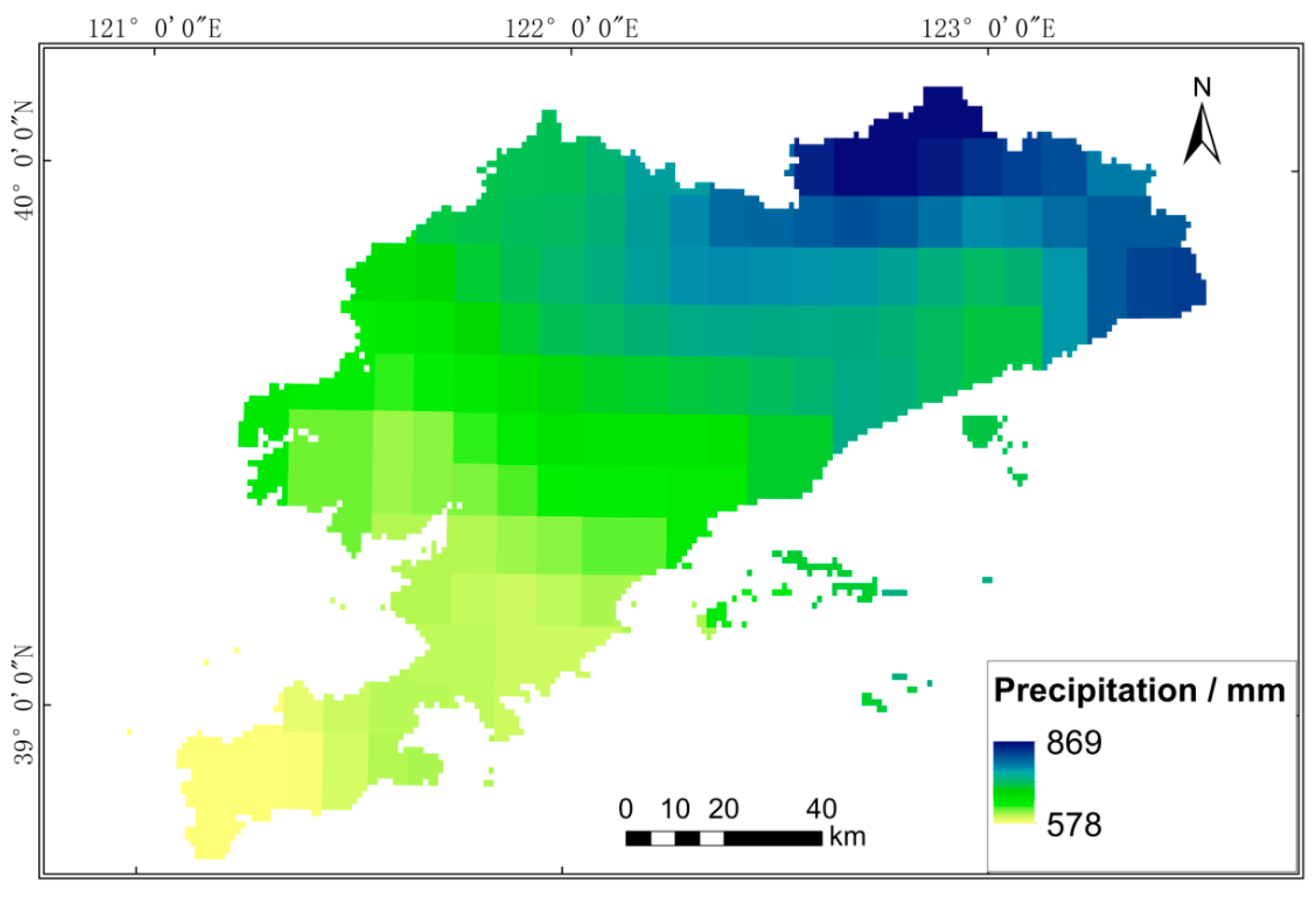
To address the identified obstacles and translate them into actionable strategies, we integrate the obstacle degree analysis results with the two core mechanisms proposed earlier. A targeted intervention framework is established by mapping spatial obstacles to specific measures. For core urban districts, the key challenges of high water exploitation rates and low per capita water resources are addressed through an integrated intervention strategy combining “pressure release” and “capacity enhancement.” Specific measures include: implementing inter-basin water transfer by coordinating water supply from the Biliu River and Yingna River reservoirs, mandating the adoption of water-saving equipment in high-water-consumption industries. Meanwhile, the third-tier residential water price will be raised by 50% to encourage water conservation through economic incentives. For northern counties, obstacles center on insufficient investment, low tertiary industry proportion, and inefficient water use. Capacity enhancement measures include: Increasing investment in water infrastructure, optimizing the industrial structure, promoting low-water-consumption industries, and popularizing drip irrigation technology, among other measures. For Lvshunkou and Jinzhou, obstacles include low precipitation (Figure 15) and insufficient investment. Interventions combine pressure release and capacity enhancement. Measures include: constructing rainwater storage projects, building regional emergency water sources for drought resilience, and implementing groundwater recharge projects.
This countermeasure system, grounded in resiliency assessment, facilitates multi-level risk prevention and control—spanning from regional to local scales and from structural to functional aspects—thereby holistically enhancing the sustainability and adaptive capacity of the urban water system.

4.4. Limitations and Uncertainties

While this study provides a comprehensive spatio-temporal assessment of WRR and its driving mechanisms in Dalian City, several limitations and associated uncertainties should be acknowledged, pointing to directions for future research.

4.4.1. Data Availability and Indicator Representation

The construction of the evaluation index was constrained by data availability. Certain ideal indicators, such as the popularization rate of water supply and the density of the urban drainage network, were excluded from the spatial assessment due to a lack of spatially explicit data. Although proxy indicators were used, they may not fully capture the intended attributes of the water infrastructure system, introducing some uncertainty. Furthermore, the accuracy of the assessment is inherently dependent on the quality and resolution of the statistical and remote sensing data used, which may contain errors or may not be fully representative at the 1 km grid scale.

4.4.2. Methodological Constraints of Indicator Standardization and Weighting

The range method for indicator standardization and the entropy weight method for weighting are core steps in both WRR evaluation and obstacle degree analysis, and their inherent limitations introduce uncertainties to both results. First, the range method assumes a linear relationship between raw data and normalized values, which may fail to capture non-linear responses of the water resources system. This linear transformation could moderate the actual impacts of such indicators, leading to slight deviations in both the WRRI calculation and obstacle degree ranking. Second, consistent with the limitation of the entropy weight method, weights are assigned based on data dispersion rather than physical or managerial importance. Indicators with high temporal or spatial fluctuation may be overemphasized, while ecologically critical but stable indicators may be underestimated. These biases affect the reliability of both comprehensive resilience evaluation and obstacle factor diagnosis. Future research could mitigate these uncertainties by integrating non-linear standardization methods, such as fuzzy membership functions, and combined weighting approaches, such as entropy-AHP integration.

4.4.3. Static Nature of the Assessment Framework

The current DPSIR-based comprehensive assessment method using an indicator system offers a valuable static snapshot of resilience capacity at specific points in time. However, it does not explicitly simulate the dynamic feedback processes and non-linear interactions within the water resources system when subjected to a specific disturbance. For example, the model cannot quantitatively depict how an extreme rainfall event propagates through the system, causing infrastructure failure and socioeconomic impacts, nor can it simulate the recovery trajectory. Integrating process-based models with the indicator framework would be a significant step toward a more dynamic and mechanistic understanding of WRR.

5. Conclusions

This study constructed a novel evaluation framework for WRR by integrating the DPSIR model with the conceptual paradigm of the resilience process. Applying this framework to Dalian City, a water-scarce coastal metropolis in China, from 2010 to 2022, we quantitatively assessed the spatio-temporal evolution of WRR and elucidated its underlying driving mechanisms. The main conclusions are as follows:
(1)
The WRR of Dalian exhibited significant fluctuations over the study period, with a multi-year average indicating a generally low resilience level. The sharp decline observed between 2012 and 2017, followed by a rapid recovery, underscores the high sensitivity of the city’s water system to climatic variability and the critical impact of human management interventions. The divergent trends among the DPSIR criteria layers—notably the increasing pressure from socio-economic drivers and the crucial counterbalancing role of policy responses—reveal the complex interplay of forces shaping the system’s trajectory.
(2)
Spatially, WRR demonstrated a pronounced “high in the south, low in the north” pattern. The overwhelming predominance of areas with low and moderately low resilience highlights the pervasiveness of water security challenges across most of Dalian. The spatial heterogeneity, driven by a combination of natural endowment and socio-economic factors, necessitates a departure from one-size-fits-all water governance policies.
(3)
The Geodetector analysis identified water resources development and utilization rate, per capita water resources, proportion of the tertiary industry, and water use per 10,000 yuan of GDP as the most influential factors governing the spatial heterogeneity of WRR. A key finding is that the interaction of any two factors produced a non-linear enhancement effect, demonstrating that WRR is shaped by complex, synergistic drivers rather than isolated variables. This result strongly advocates for integrated and adaptive management strategies.
(4)
The obstacle degree model effectively diagnosed distinct primary constraints for different districts and counties. Core urban areas are primarily constrained by high water resources development utilization and low per capita water availability, while northern counties are significantly affected by obstacles associated with water use efficiency, industrial structure, and infrastructure investment. This granular diagnosis provides a solid scientific basis for formulating precise, location-specific resilience enhancement strategies.
In conclusion, this research confirms the validity and utility of a process-oriented DPSIR framework for evaluating urban WRR. The findings highlight that enhancing Dalian’s water resilience requires a dual-track approach: A pressure release mechanism focused on reducing systemic drivers and pressures, and a capacity enhancement mechanism aimed at strengthening the system’s state, impact tolerance, and response capabilities. Future research should build on this diagnostic baseline by incorporating dynamic modeling to simulate resilience under specific disturbance scenarios, particularly those informed by future climate projections. Extending the comparative analysis to other types of coastal cities would further validate and generalize the framework.

Author Contributions

Conceptualization, N.Y.; data curation, formal analysis, and methodology, M.G.; writing—original draft preparation, M.G.; writing—review and editing, Q.L.; visualization, supervision, and validation, Y.W. All authors have read and agreed to the published version of the manuscript.

Funding

This research was funded by China Institute of Geological Environmental Monitoring through the grant for the Geological Survey Project of National Water Resources Zoning, grant number DD20251300104.

Data Availability Statement

The original contributions presented in this study are included in the article. Further inquiries can be directed at the corresponding author.

Acknowledgments

We appreciate the Dalian Municipal Bureau of Natural Resources and Dalian Territorial Spatial Planning and Design Co., Ltd. for providing data support and policy recommendations.

Conflicts of Interest

The authors declare no conflicts of interest.

References

  1. Rose, A. Economic resilience to natural and man- made disasters: Multidisciplinary origins and contextual dimensions. Environ. Hazards 2007, 7, 383–398. [Google Scholar] [CrossRef]
  2. Martin, R. Regional economic resilience, hysteresis and recessionary shocks. J. Econ. Geogr. 2012, 12, 1–32. [Google Scholar] [CrossRef]
  3. Reggiani, A. Network resilience for transport security: Some methodological considerations. Transp. Policy 2013, 28, 63–68. [Google Scholar] [CrossRef]
  4. Holling, C.S. Resilience and stability of ecological systems. Annu. Rev. Ecol. Syst. 1973, 4, 1–23. [Google Scholar] [CrossRef]
  5. Morrison, A.; Westbrook, C.; Noble, B. A review of the flood risk management governance and resilience literature. J. Flood Risk Manag. 2018, 11, 291–304. [Google Scholar] [CrossRef]
  6. Simmie, J.; Martin, R. The economic resilience of regions: Towards an evolutionary approach. Camb. J. Reg. Econ. Soc. 2010, 3, 27–43. [Google Scholar] [CrossRef]
  7. Marchese, D.; Reynolds, E.; Bates, M.E.; Morgan, H.; Clark, S.S.; Linkov, I. Resilience and sustainability: Similarities and differences in environmental management applications. Sci. Total Environ. 2018, 613–614, 1275–1283. [Google Scholar] [CrossRef] [PubMed]
  8. Zhang, Q.R.; Ma, H.Z.; Zhu, X.T.; Xu, S.J. The driving effects of ecosystem services on urban ecological resilience in urban agglomeration. Ecosyst. Health Sustain. 2024, 3, 0207. [Google Scholar] [CrossRef]
  9. Herrera-Franco, G.; Carrion-Mero, P.; Aguilar-Aguilar, M.; Morante-Carballo, F.; Jaya-Montalvo, M.; Morillo-Balsera, M.C. Groundwater resilience assessment in a communal coastal aquifer system: The case of Manglaralto in Santa Elena, Ecuador. Sustainability 2020, 12, 8290. [Google Scholar] [CrossRef]
  10. Jiao, L.D.; Luo, Z.R.; Han, B.W.; Wu, L.; Huo, X.S.; Zhang, Y.; Wu, Y. Resilient urbanization assessment framework: A new perspective on urban resilience. Urban Clim. 2025, 61, 102481. [Google Scholar] [CrossRef]
  11. Rahimi, F.; Sadeghi-Niaraki, A.; Ghodousi, M.; Choi, S.M. Spatial-temporal modeling of urban resilience and risk to earthquakes. Sci. Rep. 2025, 15, 8321. [Google Scholar] [CrossRef]
  12. Sweya, N.L.; Wilkinson, S. A tool for measuring environmental resilience to floods in Tanzania water supply systems. Ecol. Indic. 2020, 112, 106165. [Google Scholar] [CrossRef]
  13. Sun, J.W.; Sun, X.Y. Research progress of regional economic resilience and exploration of its application in China. Econ. Geogr. 2017, 37, 1–9. [Google Scholar]
  14. Deng, M.J.; Huang, Q.; Chang, J.X.; Huang, S.Z.; Guo, A.J. The connotation, process and dimension of generalized ecological water conservancy. Adv. Water Sci. 2020, 31, 775–792. [Google Scholar] [CrossRef]
  15. An, M.; Song, M.F.; He, W.J.; Huang, J.; Fang, X. Evaluate cities’ urban water resources system resilience along a river and identify its critical driving factors. Environ. Sci. Pollut. Res. Int. 2022, 30, 16355–16371. [Google Scholar] [CrossRef]
  16. Zhao, Z.L.; Yang, Y.F.; Xu, D.M.; Liu, C.M.; Wang, H.R. Resilience evaluation and regulation model of water resources system based on two-level fuzzy comprehensive evaluation and its application. Water Resour. Power 2022, 40, 39–43. [Google Scholar] [CrossRef]
  17. Yang, Y.F.; Wang, H.R.; Zhao, Y.; Gong, S.X. A three-way decision approach for water resources system resilience evaluation and its application. Water Resour. 2022, 49, 1093–1104. [Google Scholar] [CrossRef]
  18. Zhou, S.B.; Wang, X.Y.; Tong, J. Resilience analysis of water resources system of the Yangtze River Basin based on pressure-state-response model. J. Econ. Water Resour. 2023, 41, 23–28. [Google Scholar] [CrossRef]
  19. Hu, Y.; Zaoyang, X.Z.; Lei, J.Y.; Shi, Y.Y.; Chen, Y.L. Research on the construction and spatiotemporal evolution of urban resilience evaluation system in the four major urban areas of Chongqing. Theor. Res. Urban Constr. 2024, 31, 211–215. [Google Scholar] [CrossRef]
  20. Wang, S.L.; Na, R.; Guo, E.L.; Bu, R.; Te, L.; Cheng, Z.Y.; Bai, J.W. Research on urban resilience evaluation in Inner Mongolia based on entropy weight TOPSIS model. J. Chifeng Univ. (Nat. Sci. Ed.) 2022, 38, 17–21. [Google Scholar] [CrossRef]
  21. Sun, Q.M.; Gao, M.S.; Hou, G.H.; Liu, Z.L.; Liu, X.G.; Ren, R. Response of hydrodynamics and hydrochemistry at multiple-water quality interfaces to extreme rainfall on a muddy coast. J. Clean. Prod. 2025, 513, 145746. [Google Scholar] [CrossRef]
  22. Wu, J.R.; Zhou, Y.; Lei, J.Q. Coupling the stormwater management model with long short-term memory networks to predict node overflow. Desalination Water Treat. 2025, 323, 101378. [Google Scholar] [CrossRef]
  23. Yang, J.; Huang, X. The 30 m annual land cover dataset and its dynamics in China from 1990 to 2019. Earth Syst. Sci. Data 2021, 13, 3907–3925. [Google Scholar] [CrossRef]
  24. Geng, X.L. Application and comparison of multiple models on agricultural sustainability assessments: A case study of the Yangtze River Delta Urban Agglomeration, China. Sustainability 2021, 13, 121. [Google Scholar] [CrossRef]
  25. Liu, J.P.; Tian, Y.; Huang, K.; Yi, T. Spatial-temporal differentiation of the coupling coordinated development of regional energy-economy-ecology system: A case study of the Yangtze River Economic Belt. Ecol. Indic. 2021, 124, 107394. [Google Scholar] [CrossRef]
  26. GB/T 14848-2017; Standard for Groundwater Quality. China Standard Press: Beijing, China, 2017.
  27. Gu, T.; Ren, P.Y.; Jin, M.Z.; Wang, H. Tourism destination competitiveness evaluation in Sichuan province using TOPSIS model based on information entropy weights. Am. Inst. Math. Sci. 2019, 12, 771–782. [Google Scholar] [CrossRef]
  28. Wang, J.F.; Li, X.H.; Christakos, G.; Liao, Y.L.; Zhang, T.; Gu, X.; Zheng, X.Y. Geographical detectors-based health risk assessment and its application in the neural tube defects study of the Heshun Region, China. Int. J. Geogr. Inf. Sci. 2010, 24, 107–127. [Google Scholar] [CrossRef]
  29. Liu, C.; Li, W.; Zhu, G.; Zhou, H.; Yan, H.; Xue, P. Land use/land cover changes and their driving factors in the Northeastern Tibetan Plateau based on Geographical Detectors and Google Earth Engine: A case study in Gannan Prefecture. Remote Sens. 2020, 12, 3139. [Google Scholar] [CrossRef]
  30. Shamuxi, A.; Han, B.; Jin, X.B.; Wusimanjiang, P.; Abudukerimu, A.; Chen, Q.L.; Zhou, H.T.; Gong, M. Spatial pattern and driving mechanisms of dryland landscape ecological risk: Insights from an integrated geographic detector and machine learning model. Ecol. Indic. 2025, 172, 113305. [Google Scholar] [CrossRef]
  31. Li, M.R.; Abuduwaili, J.; Liu, W.; Feng, S.; Saparov, G.; Ma, L. Application of geographical detector and geographically weighted regression for assessing landscape ecological risk in the Irtysh River Basin, Central Asia. Ecol. Indic. 2024, 158, 111540. [Google Scholar] [CrossRef]
  32. Nie, T.; Dong, G.T.; Jiang, X.H.; Lei, Y.X. Spatio-temporal changes and driving forces of vegetation coverage on the Loess Plateau of Northern Shaanxi. Remote Sens. 2021, 13, 613. [Google Scholar] [CrossRef]
  33. Li, J.H.; Han, Y.P.; Zhao, M.D.; Jiang, Z. Collaborative optimization path of the “water-carbon-ecology” system in the Yellow River Basin: Spatio-temporal evolution and driving factors. Front. Ecol. Evol. 2025, 13, 1586301. [Google Scholar] [CrossRef]
  34. Tan, Y.M.X.; Zhou, Y.F.; Zhou, H.B.; Gao, L.J.; Shi, L.Y. Analysis of the coordinated development and influencing factors between urban population and environment: A case study of 35 metropolises in China. Sustain. Cities Soc. 2025, 121, 106160. [Google Scholar] [CrossRef]
  35. Bates, B.C.; Kundzewicz, Z.W.; Wu, S.; Palutikof, J.P. Climate Change and Water; IPCC Secretariat: Geneva, Switzerland, 2008. [Google Scholar]
  36. Sherif, M.; Liaqat, M.U.; Baig, F.; Al-Rashed, M. Water resources availability, sustainability and challenges in the GCC countries: An overview. Heliyon 2023, 9, e20543. [Google Scholar] [CrossRef]
  37. Borah, G. Urban water stress: Climate change implications for water supply in cities. Water Conserv. Sci. Eng. 2025, 10, 20. [Google Scholar] [CrossRef]
  38. O’Connell, E. Towards adaptation of water resource systems to climatic and socio-economic change. Water Resour. Manag. 2017, 31, 2965–2984. [Google Scholar] [CrossRef]
  39. Li, C.; Ni, J.; Song, Q.C.; Ma, H.W.; Wu, M.J.; Wang, F.G. Suitability and rational utilization strategy of groundwater supply in a typical seawater intrusion area of Dalian. Water Sav. Irrig. 2023, 7, 65–70. [Google Scholar]
  40. Pahl-Wostl, C. Transitions towards adaptive management of water facing climate and global change. Water Resour. Manag. 2007, 21, 49–62. [Google Scholar] [CrossRef]
  41. An, Z.Y.; Yan, J.J.; Sha, J.H.; Ma, Y.F.; Mou, S.Y. Dynamic simulation for comprehensive water resources policies to improve water-use efficiency in coastal city. Environ. Sci. Pollut. Res. 2021, 28, 25628–25649. [Google Scholar] [CrossRef] [PubMed]
  42. Valle-García, Á.; Montilla López, N.M.; Parrado, R.; Berbel, J.; Martínez-Dalmau, J.; Kahil, T.; Gutiérrez-Martín, C. Integrated assessment of resilience to drought by coupling hydro-economic and macroeconomic models. J. Hydrol. 2025, 661, 133549. [Google Scholar] [CrossRef]
  43. Sivapalan, M.; Blöschl, G. Time scale interactions and the coevolution of humans and water. Water Resour. Res. 2015, 51, 6988–7022. [Google Scholar] [CrossRef]
  44. Zhang, Q.; Wang, B.D.; Cao, M.L. Analysis of water resource utilization change based on factor decomposition model. J. Nat. Resour. 2011, 26, 1209–1216. [Google Scholar] [CrossRef]
  45. Cambra, M.M.P.; Santafé, M.D.M.; Cladera, J.R. Exploring the mitigation of compound events in Barcelona: Urban water scarcity, flood risk and reduction of surface temperatures through water-sensitive urban design. Urban Clim. 2025, 59, 102298. [Google Scholar] [CrossRef]
  46. Chen, Z.D.; Qiu, B.X.; Chen, H. Research on resiliency level promotion and robustness strategy of resilient city system: From complex adaptive system (CAS) perspective. Urban Stud. 2021, 28, 1–9. [Google Scholar] [CrossRef]
Figure 1. Geographic Location Map of Dalian.
Water 18 00072 g001
Figure 2. Driving Force-Pressure-State-Impact-Response (DPSIR) model framework for water resources resilience (WRR). Solid arrows represent the direct effects of the core causal chain in the DPSIR model, while dashed arrows represent the key feedback regulation pathways of the system.
Water 18 00072 g002
Figure 3. Conceptual model of the WRR process.
Water 18 00072 g003
Figure 4. Trend of Water Resources Resilience Index (WRRI).
Water 18 00072 g004
Figure 5. Trend of the evaluation index for each criterion layer.
Water 18 00072 g005
Figure 6. Spatial distribution of WRRI in 2020.
Water 18 00072 g006
Figure 7. Classification of WRRI in 2020.
Water 18 00072 g007
Figure 8. WRRI results across different counties.
Water 18 00072 g008
Figure 9. Factor detection result.
Water 18 00072 g009
Figure 10. Interaction detection analysis result.
Water 18 00072 g010
Figure 11. Percentage of obstacle degrees for each criterion layer from 2010 to 2022.
Water 18 00072 g011
Figure 12. Percentage of obstacle degrees for each factor layer from 2010 to 2022.
Water 18 00072 g012
Figure 13. Percentage of obstacle degrees for each criterion layer across the counties of Dalian City.
Water 18 00072 g013
Figure 14. Percentage of obstacle degrees for each factor layer across the counties of Dalian City.
Water 18 00072 g014
Figure 15. Distribution map of mean annual precipitation in Dalian.
Water 18 00072 g015
Table 1. Data sources and description.
Type Description Data Sources
Water resources dataIncluding data on water resources quantity, total water usage, and water usage structure.Dalian Water Resources Bulletin, Dalian Water Resources Investigation and Assessment Report
Meteorological dataIncluding data on precipitation and extreme weather events, such as extreme high and low temperatures.China Meteorological Data Service Center (https://data.cma.cn)
Land use dataLand use data with 30 m spatial resolution, providing the construction land and water area data required for this studythe annual China Land Cover Dataset [23]
NDVI dataAt a spatial resolution of 1 kmResource and Environmental Science Data Platform (https://www.resdc.cn/Default.aspx (accessed on 2 March 2025))
GDP dataAt a spatial resolution of 1 km in 2020, the GDP statistical dataResource and Environmental Science Data Platform (https://www.resdc.cn/Default.aspx);
Dalian Statistical Yearbook
Population dataPopulation density data with 1 km spatial resolution, Population density statisticsWorldpop Center (https://hub.worldpop.org/),
Dalian Statistical Yearbook
Seawater intrusion dataThe distribution and area of seawater intrusion.Dalian City Hydrogeological and Engineering Geological Survey and Assessment Project, Dalian City Seawater Intrusion Zoning Map (1:250,000)
Water quality dataGroundwater quality, Water quality compliance rateObservation Data from Groundwater Monitoring Wells in China, Dalian Statistical Yearbook
Other statistical dataIncluding the proportion of the tertiary industry in GDP, grain production, urban sewage treatment rate, water supply coverage rate, length of water supply and drainage networks in built-up areas, fixed-asset investment, etc.Dalian Statistical Yearbook
Table 2. Water resources resilience (WRR) indicator system.
Target Layer Criteria Layer Indicator Focus Indicator Layer Meaning of Index Unit Attribute Time Space
Water resources resilience (WRR)Driving force (D)Economic developmentGDP per capita [D1]The ratio of a region’s gross domestic product (GDP) to its total population.Yuan/
person
Negative
Population agglomerationPopulation density [D2]The number of people living per unit of land area.persons/
km2
Negative
Urbanization processProportion of built-up area [D3]The percentage of land area occupied for construction purposes.%Negative
Climate changeAnnual precipitation [D4]Annual precipitation in a region.mmPositive
Meteorological disaster grade [D5]A classification based on the intensity, spatial extent, and duration of meteorological disasters.%Negative×
Pressure (P)Water resources exploitation intensityWater resources development and utilization rate [P1]The ratio of the total annual water withdrawal to the total annual water resources in a region.%Negative
Proportion of groundwater utilization [P2]The share of groundwater extraction in the total water consumption.%Negative
Seawater intrusionSeawater intrusion degree [P3]The extent to which seawater has advanced into continental freshwater aquifers, often measured by indicators like groundwater chloride concentration.UnitlessNegative×
Seawater intrusion area [P4]The geographical area affected by seawater intrusion.km2Negative×
State (S)Water quantityWater resources modulus [S1]The amount of water resources per unit area.10,000 m3/km2Positive
Per capita water resources [S2]The ratio of total water resources to the total population.m3/personPositive
Groundwater level depth [S3]The vertical distance from the land surface to the groundwater table.mPositive×
Water ecologyProportion of water area [S4]The percentage of a region’s total area covered by water bodies.%Positive
Water qualityGroundwater quality categories [S5]A classification of groundwater quality according to national standards.UnitlessNegative×
Water quality compliance rate [S6]The percentage of monitored water quality sections that meet predetermined water quality standards.%Positive×
Impact (I)EcosystemNormalized Difference Vegetation Index (NDVI) [I1]A normalized difference vegetation index calculated from remote sensing data.UnitlessPositive
Socio-economic systemProportion of the tertiary industry in GDP [I2]The share of the value-added from the tertiary industry in the GDP.%Positive
Per capita Grain production [I3]The ratio of total grain production to the total population.kg/personPositive×
Response (R)Water resources managementWater use per 10,000 yuan of GDP [R1]The amount of water consumed to generate every 10,000 Yuan of GDP.m3/10,000 YuanNegative
Per capita domestic water use [R2]The average annual water consumption per person for domestic activities.m3/(person·year)Negative
Urban sewage treatment rate [R3]The proportion of urban sewage that is treated before discharge.%Positive
Infrastructure constructionFixed-asset investment per unit area [R4]The amount of fixed asset investment per unit of land area.10,000 Yuan/km2Positive×
Investment per unit area in water conservancy, environment, and public facilities [R5]The amount of investment in water conservancy, environment, and public facilities per unit of land area.10,000 Yuan/km2Positive×
Government financial investmentWater supply coverage rate [R6]The percentage of the population with access to centralized water supply services.%Positive×
Density of water supply and drainage pipelines in built-up areas [R7]The total length of water supply and drainage pipelines per unit area within urban built-up areas.km/km2Positive×
Notes: The √ symbol denotes an adopted indicator, while the × symbol denotes an excluded indicator. Groundwater quality categories [S5] are classified into five classes according to the Groundwater Quality Standards (GB/T 14848-2017) [26], with a higher class number indicating poorer water quality.
Table 3. Classification Criteria.
Classification WRRI
Low0–0.3
Moderately low0.3–0.5
Moderately high0.5–0.7
High0.7–1
Disclaimer/Publisher’s Note: The statements, opinions and data contained in all publications are solely those of the individual author(s) and contributor(s) and not of MDPI and/or the editor(s). MDPI and/or the editor(s) disclaim responsibility for any injury to people or property resulting from any ideas, methods, instructions or products referred to in the content.