From Identification to Guiding Action: A Systematic Heuristic to Prioritise Drivers of Change for Water Management



Abstract
1. Introduction
- To identify, for the first time, the key drivers of change affecting the MDB;
- To prioritise these drivers of change for water management in the MDB;
- To develop a transferable heuristic for rapidly identifying and characterising drivers of change in complex socio-ecological water systems.
2. Context
2.1. Drivers of Change in Water Management: From Conceptual Recognition to Implementation
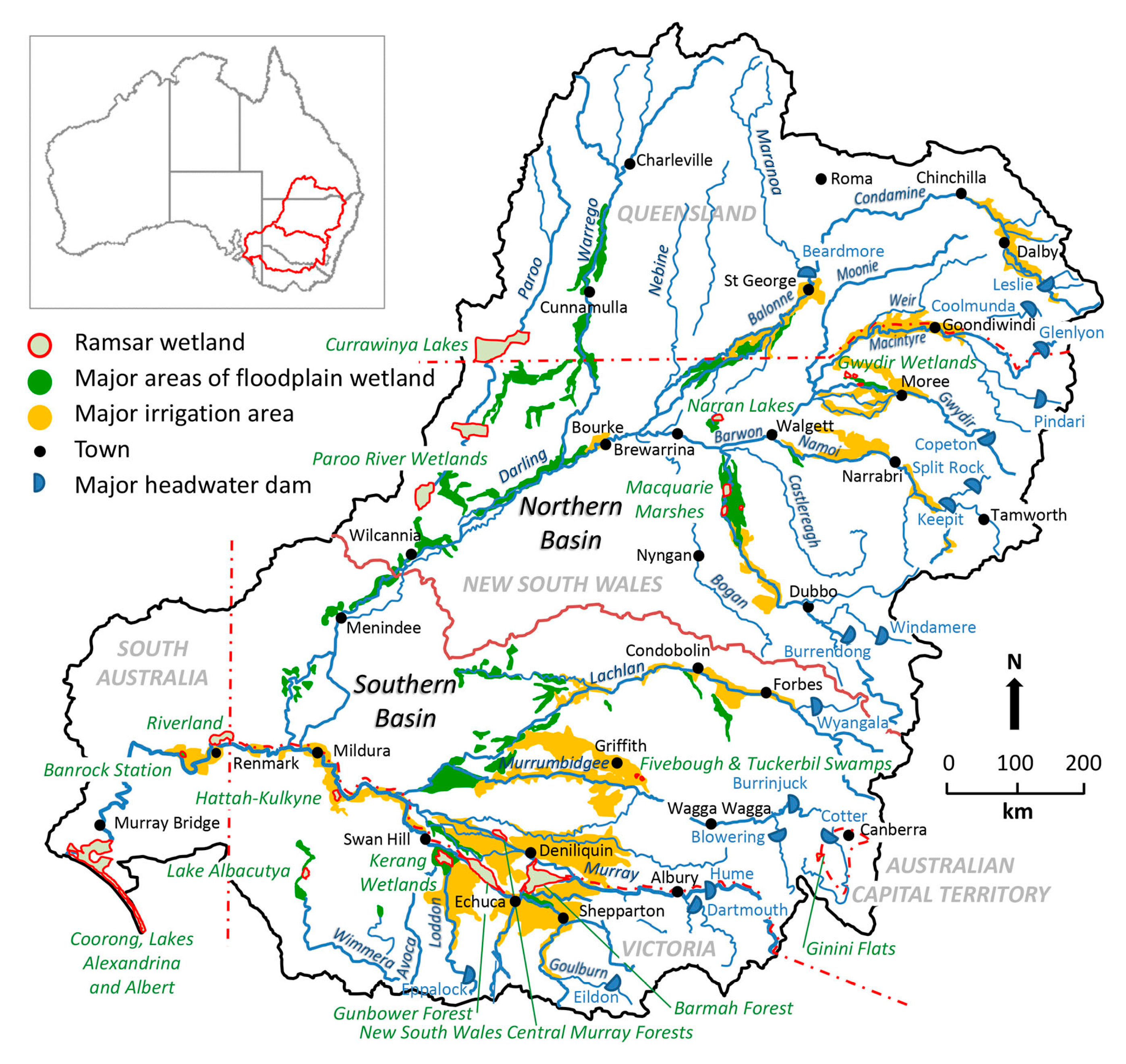
2.2. The Murray–Darling Basin as a Case Study
3. Methodology
- What are the key drivers of change that are affecting the MDB?
- How can these drivers of change be classified and understood?
- What are the key linkages or inter-dependencies between these drivers?
- How can the priority drivers of change be identified?
- Can you share examples of community experience in living with drivers of change?
- What strategies are needed to manage the adverse consequences of drivers of change?
4. Results
4.1. Key MDB Drivers of Change Identified Through Deliberation
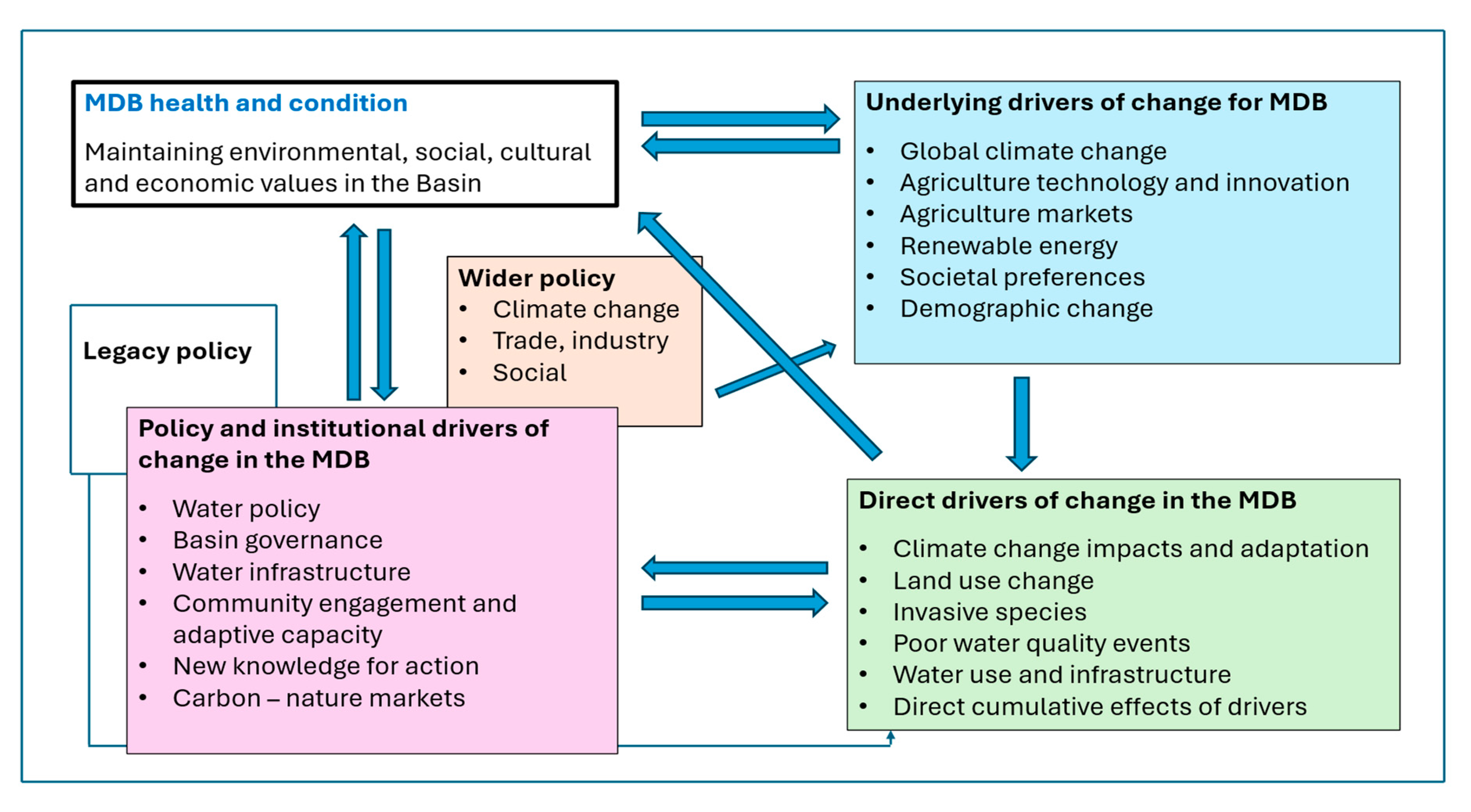
4.2. Classification of Types of DoC in the MDB
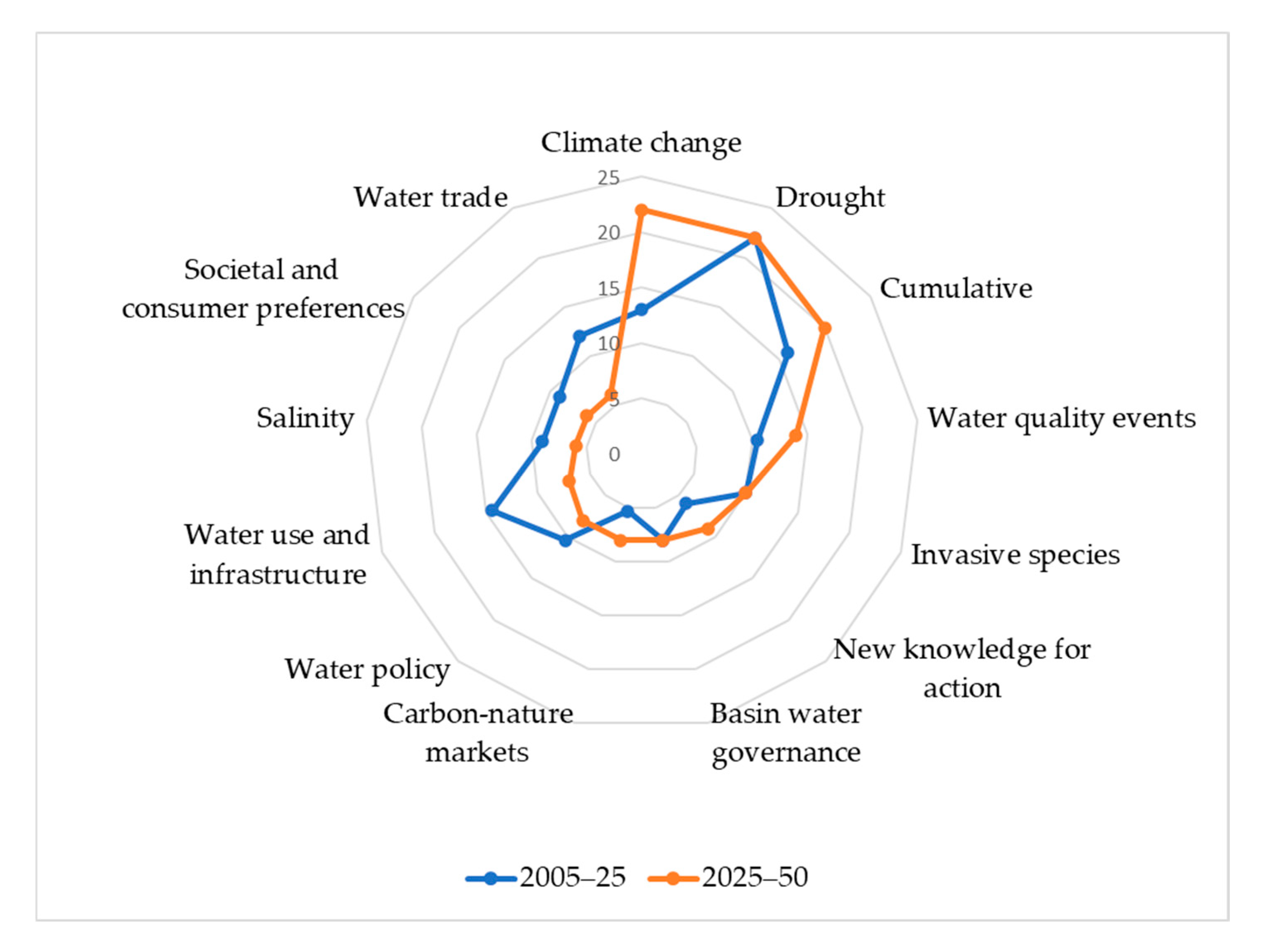
4.3. Risk Assessment of Drivers for Water Assets and Management in the MDB
5. Discussion
6. Conclusions
Author Contributions
Funding
Institutional Review Board Statement
Informed Consent Statement
Data Availability Statement
Acknowledgments
Conflicts of Interest
Abbreviations
| MDB | Murray–Darling Basin |
| DoC | Drivers of change |
| MDBA | Murray–Darling Basin Authority |
Appendix A
| Criteria for Importance Assessment |
| Categorisation of water assets. As the MDB is large and diverse, it is useful to differentiate the water in the catchment into three categories, identified below, and accompanied by encompassed hydrological and management features and characteristics. 1. Aquatic ecosystem. This is a whole basin water hydrological cycle health approach. It includes wetland requirements, river health indicators, cultural flows, ecosystem services, groundwater health and connectivity, unregulated flows, and environmental flows 2. Water in channel. This focuses on direct water management of regulated flows and includes regulated flows, allocated water, trading volumes, infrastructure efficiency, and delivery capacity. 3. Water quality. This specifically focuses on the water across the basin, such as temperature, turbidity, clarity, sediment, and chemical parameters (e.g., salinity, nutrient levels—P, N, K, C, DO, and acidity). Magnitude: The degree of change a driver causes to water asset functions or services, measured from minimal effects to complete system transformation. 5—Complete transformation: The system undergoes fundamental change, creating an entirely new operational state with multiple parameters altered. 4—Major alteration: Substantial changes occur while the system remains recognisable, with significant shifts in multiple parameters. 3—Notable modification: Clear measurable changes affect key parameters, while core functions maintain. 2—Minor change: Small but detectable changes occur with limited parameter effects. 1—Minimal effect: Changes are barely measurable, affecting single parameters without system alteration. Sensitivity: The inherent responsiveness of a water asset to change, based on its buffering capacity, self-regulation mechanisms, and proximity to critical thresholds. 5—Highly responsive: The system lacks any buffering capacity and responds immediately to changes, operating at critical thresholds. 4—Responsive: Limited buffering exists with quick responses and few self-regulating mechanisms. 3—Moderately stable: A partial buffering capacity enables gradual responses with some self-regulation. 2—Stable: A strong buffering capacity allows delayed responses with multiple self-regulating mechanisms. 1—Highly stable: Robust buffering and self-regulation create significant resistance to change. When combining these scales in the 5 × 5 matrix, experts can assess both the level of change (magnitude) and the system’s ability to cope (sensitivity) independently, leading to a combined impact score. High magnitude paired with high sensitivity (5,5) indicates critical priority requiring immediate intervention, while low scores in both (1,1) suggest minimal management needs. |
References
- Ward, F.A. Addressing global water challenges in 2025: An integrated framework for research, policy, and resource management. Water Resour. Manag. 2025, 39, 7885–7918. [Google Scholar] [CrossRef]
- Yoon, J.H.; Ravinandrasana, V.; Kim, J.; Franzke, C.L.E. The first emergence of unprecedented global water scarcity in the Anthropocene. Nat. Commun. 2025, 16, 8281. [Google Scholar] [CrossRef]
- Rockström, J.; Falkenmark, M.; Allan, T.; Folke, C.; Gordon, L.; Jägerskog, A.; Kummu, M.; Lannerstad, M.; Meybeck, M.; Molden, D.; et al. The unfolding water drama in the Anthropocene: Towards a resilience-based perspective on water for global sustainability. Ecohydrology 2014, 7, 1249–1261. [Google Scholar] [CrossRef]
- Folke, C. Resilience: The emergence of a perspective for social-ecological systems analyses. Glob. Environ. Change 2006, 16, 253–267. [Google Scholar] [CrossRef]
- Vidal-Abarca Gutierrez, M.R.; Nicolás-Ruiz, N.; Sánchez-Montoya, M.D.; Suárez Alonso, M.L. Ecosystem services provided by dry river socio-ecological systems and their drivers of change. Hydrobiologia 2023, 850, 2585–2607. [Google Scholar] [CrossRef]
- Schlegel, R.; Bartsch, I.; Bischof, K.; Bjørst, L.R.; Dannevig, H.; Diehl, N.; Duarte, P.; Hovelsrud, G.K.; Juul-Pedersen, T.; Lebrun, A.; et al. Drivers of change in Arctic fjord socio-ecological systems: Examples from the European Arctic. Camb. Prism. Coast. Futures 2023, 1, e13. [Google Scholar] [CrossRef]
- Pahl-Wostl, C. The implications of complexity for integrated resources management. Ecol. Soc. 2007, 12, 24. [Google Scholar] [CrossRef]
- Palmer, M.A.; Reidy Liermann, C.A.; Nilsson, C.; Flörke, M.; Alcamo, J.; Lake, P.S.; Bond, N. Climate change and the world’s river basins: Anticipating management options. Front. Ecol. Environ. 2008, 6, 81–89. [Google Scholar] [CrossRef]
- Prosser, I.P.; Chiew, F.H.S.; Stafford Smith, M. Adapting water management to climate change in the Murray–Darling Basin, Australia. Water 2021, 13, 2504. [Google Scholar] [CrossRef]
- Gain, A.K.; Hossain, S.; Benson, D.; Di Baldassarre, G.; Giupponi, C.; Huq, N. Social-ecological system approaches for water resources management. Int. J. Sustain. Dev. World Ecol. 2021, 28, 109–124. [Google Scholar] [CrossRef]
- Akamani, K. The roles of adaptive water governance in enhancing the transition towards ecosystem-based adaptation. Water 2023, 15, 2341. [Google Scholar] [CrossRef]
- Everard, M. A socio-ecological framework supporting catchment-scale water resource stewardship. Environ. Sci. Policy 2019, 91, 50–59. [Google Scholar] [CrossRef]
- Bark, R.; Kirby, M.; Connor, J.D.; Crossman, N.D. Water allocation reform to meet environmental uses while sustaining irrigation: A case study of the Murray–Darling Basin, Australia. Water Policy 2014, 16, 739–754. [Google Scholar] [CrossRef]
- Wheeler, S.A.; Xu, Y.; Zuo, A.; Haensch, J.; Seidl, C. Identifying the Water-Related Economic Values of the Murray–Darling Basin and Rating the Quality of Water Economic Studies; University of Adelaide: Adelaide, Australia, 2023. [Google Scholar]
- Mummery, J.; Pearson, L.J. Resilience, Adaptation and Drivers of Change in the Murray–Darling Basin: Synthesis of the Literature; Report to the Murray–Darling Basin Authority; University of Canberra: Canberra, Australia, 2024. [Google Scholar] [CrossRef]
- Li, Z.; Quiring, S.M. Identifying the dominant drivers of hydrological change in the contiguous United States. Water Resour. Res. 2021, 57, e2021WR029738. [Google Scholar] [CrossRef]
- Qiao, J.; Zhang, Q.; Shao, J.; Cao, Q.; Liu, H.; Lv, F. Spatial and temporal variation of water stress in China and its driving factors: A multi-scale analysis. Ecol. Indic. 2024, 169, 112820. [Google Scholar] [CrossRef]
- Martinez-Fernandez, J.; Banos-Gonzalez, I.; Esteve-Selma, M.A. An integral approach to address socio-ecological systems sustainability and their uncertainties. Sci. Total Environ. 2021, 762, 144457. [Google Scholar] [CrossRef]
- Grafton, R.Q.; Pittock, J.; Williams, J.; Jiang, Q.; Possingham, H.; Quiggin, J. Water planning and hydro-climatic change in the Murray–Darling Basin, Australia. AMBIO 2014, 43, 1082–1092. [Google Scholar] [CrossRef]
- Pittock, J. National climate change policies and sustainable water management: Conflicts and synergies. Ecol. Soc. 2011, 16, 25. [Google Scholar] [CrossRef]
- Ludwig, F.; van Slobbe, E.; Cofino, W. Climate change adaptation and Integrated Water Resource Management in the water sector. J. Hydrol. 2014, 518, 235–242. [Google Scholar] [CrossRef]
- Gomez-Jaramillo, Y.; Berrouet, L.; Villegas-Palacio, C.; Berrio-Giraldo, L. Conceptual framework for analyzing the sustainability of socio-ecological systems with a focus on ecosystem services that support water security. Sustain. Dev. 2024, 32, 2298–2313. [Google Scholar] [CrossRef]
- Han, Z.; Wei, Y.; Meng, J.; Zou, Y.; Wu, Q. Integrated water security and coupling of social-ecological system to improve river basin sustainability. Sci. Total Environ. 2023, 905, 167182. [Google Scholar] [CrossRef]
- Itzkin, A.; Scholes, M.C.; Clifford-Holmes, J.K.; Rowntree, K.; van der Waal, B.; Coetzer, K. A social-ecological systems understanding of drivers of degradation in the Tsitsa River Catchment to inform sustainable land management. Sustainability 2021, 13, 516. [Google Scholar] [CrossRef]
- Huitema, D.; Mostert, E.; Egas, W.; Moellenkamp, S.; Pahl-Wostl, C.; Yalcin, R. Adaptive water governance: Assessing the institutional prescriptions of adaptive (co-)management from a governance perspective and defining a research agenda. Ecol. Soc. 2009, 14, 26. [Google Scholar] [CrossRef]
- Wyborn, C. Co-productive governance: A relational framework for adaptive governance. Glob. Environ. Change 2015, 30, 56–67. [Google Scholar] [CrossRef]
- Hurlbert, M.; Gupta, J. Adaptive governance, uncertainty, and risk: Policy framing and responses to climate change, drought, and flood. Risk Anal. 2016, 36, 339–356. [Google Scholar] [CrossRef]
- Muiderman, K.; Zurek, M.; Vervoort, J.; Gupta, A.; Hasnain, S.; Driessen, P. The anticipatory governance of sustainability transformations: Hybrid approaches and dominant perspectives. Glob. Environ. Change 2022, 73, 102452. [Google Scholar] [CrossRef]
- Yazdanparast, M.; Ghorbani, M.; Salajegheh, A.; Kerachian, R. Development of a water security conceptual model by combining human-environmental system (HES) and system dynamic approach. Water Resour. Manag. 2023, 37, 1695–1709. [Google Scholar] [CrossRef]
- Goesch, T.; Legg, P.; Donoghoe, M. Murray–Darling Basin Water Markets: Trends and Drivers 2002–03 to 2018–19; ABARES Research Report 20.5; Commonwealth of Australia: Canberra, Australia, 2020. [Google Scholar]
- Wheeler, S.A.; Hatton MacDonald, D.; Boxall, P. Water policy debate in Australia: Understanding the tenets of stakeholders’ social trust. Land Use Policy 2017, 63, 246–254. [Google Scholar] [CrossRef]
- Colloff, M.J.; Pittock, J. Mind the gap! Reconciling environmental water requirements with scarcity in the Murray–Darling Basin, Australia. Water 2022, 14, 208. [Google Scholar] [CrossRef]
- Department of Climate Change, Energy, the Environment and Water. Water Reform Funding in the Murray–Darling Basin. 2025. Available online: https://www.dcceew.gov.au/water/policy/programs/water-reform/mdb-funding (accessed on 19 November 2025).
- Jackson, S.; Wyborn, C.; Annand-Jones, R. Relational Values of the Murray-Darling Basing: A Literature Review; Research Report; Griffith University: Brisbane, Australia; Australian National University: Canberra, Australia, 2023. [Google Scholar]
- Schirmer, J.; Mylek, M. Thriving, Surviving, or Declining Communities: Socio-Economic Change in Murray–Darling Basin Communities; University of Canberra: Canberra, Australia, 2020. [Google Scholar]
- Alexandra, J. Evolving Governance and Contested Water Reforms in Australia’s Murray Darling Basin. Water 2018, 10, 113. [Google Scholar] [CrossRef]
- New South Wales Parliament. Water in the Murray–Darling Basin: Key Issues for the 58th Parliament; Research Paper: 2023-07; Parliamentary Research Service: Canberra, Australia, 2023.
- Whetton, P.; Chiew, F. Climate change in the Murray–Darling Basin. In Murray–Darling Basin, Australia; Elsevier: Amsterdam, The Netherlands, 2021; pp. 253–274. [Google Scholar]
- CSIRO. Climate and Water Availability in South-Eastern Australia: A Synthesis of Findings from Phase 2 of the South Eastern Australian Climate Initiative (SEACI); CSIRO: Canberra, Australia, 2012. [Google Scholar]
- Eaton, W.M.; Brasier, K.J.; Burbach, M.E.; Whitmer, W.; Engle, E.W.; Burnham, M.; Quimby, B.; Kumar Chaudhary, A.; Whitley, H.; Delozier, J.; et al. A conceptual framework for social, behavioral, and environmental change through stakeholder engagement in water resource management. Soc. Nat. Resour. 2021, 34, 1111–1132. [Google Scholar] [CrossRef]
- Plummer, R.; Dzyundzyak, A.; Baird, J.; Bodin, O.; Armitage, D.; Schultz, L. How do environmental governance processes shape evaluation of outcomes by stakeholders? A causal pathways approach. PLoS ONE 2017, 12, e0185375. [Google Scholar] [CrossRef] [PubMed]
- Pigmans, K.; Aldewereld, H.; Dignum, V.; Doorn, N. The role of value deliberation to improve stakeholder participation in issues of water governance. Water Resour. Manag. 2019, 33, 4067–4085. [Google Scholar] [CrossRef]
- Karpowitz, C.F.; Mansbridge, J. Disagreement and consensus: The need for dynamic updating in public deliberation. J. Public Deliberation 2005, 1, 348–364. [Google Scholar] [CrossRef]
- Choi, T.; Robertson, P.J. Deliberation and decision in collaborative governance: A simulation of approaches to mitigate power imbalance. J. Public. Adm. Res. Theory 2014, 24, 495–518. [Google Scholar] [CrossRef]
- Neef, A. Transforming rural water governance: Towards deliberative and polycentric models? Water Altern. 2009, 2, 53–60. [Google Scholar]
- Bartkowski, B.; Beckmann, M.; Bednář, M.; Biffi, S.; Domingo-Marimon, C.; Mesaroš, M.; Schüßler, C.; Šarapatka, B.; Tarčak, S.; Václavík, T.; et al. Adoption and potential of agri-environmental schemes in Europe: Cross-regional evidence from interviews with farmers. People Nat. 2023, 5, 1610–1621. [Google Scholar] [CrossRef]
- Belina, A. Semi-structured interviewing as a tool for understanding informal civil society. Volunt. Sect. Rev. 2023, 14, 331–347. [Google Scholar] [CrossRef]
- Shukla, P.R.; Skea, J.; Calvo Buendia, E.; Masson-Delmotte, V.; Pörtner, H.O.; Roberts, D.C.; Zhai, P.; Slade, R.; Connors, S.; van Diemen, R.; et al. (Eds.) Climate Change and Land: An IPCC Special Report on Climate Change, Desertification, Land Degradation, Sustainable Land Management, Food Security, and Greenhouse Gas Fluxes in Terrestrial Ecosystems; Intergovernmental Panel on Climate Change: Geneva, Switzerland, 2019. [Google Scholar]
- Millennium Ecosystem Assessment (MEA). Ecosystems and Human Well-Being: Synthesis; Island Press: Washington, DC, USA, 2003. [Google Scholar]
- Green, D. How Change Happens; Oxford University Press: Oxford, UK, 2024. [Google Scholar]
- Linnér, B.O.; Wibeck, V. Drivers of sustainability transformations: Leverage points, contexts and conjunctures. Sustain. Sci. 2021, 16, 889–900. [Google Scholar] [CrossRef]
- Murray–Darling Basin Authority. Basin Plan Review: A Summary of the 2025 Sustainable Rivers Audit; Australian Government: Canberra, Australia, 2025.



| Key Issues/Insights | Conceptual Examples | Citations |
|---|---|---|
| Theme 1: Recognition that System Approaches Are Needed for Water Management | ||
| Shift from focus on single issue (water access or supply) to water with socio-ecological systems | Water management must shift from supply-side thinking to addressing multiple drivers. Global water systems are under intensifying stress from multiple drivers—climate, population, institutional fragmentation, and deteriorating infrastructure—and coordinated responses are critical. | [1,3] |
| Growing understanding that water access emerges from interactions between natural and social systems | The two-way relationships between natural and social systems must be recognised for water security. River basin sustainability depends on coordinated understanding and management of water security, socioeconomic conditions, and land use factors within SES context. | [22,23] |
| Theme 2: Appreciation That Drivers of Change Can Shift Functioning of Socio-Ecological Systems, and Need to Be Understood to Inform Management | ||
| Operation of drivers can exceed resilience thresholds and threaten functioning of SES | Drivers of change can challenge thresholds that enable ecological functionality. Socio-cultural and economic drivers of change affect capacity of dry rivers to provide ecosystem services the most. | [5,6,22] |
| Critical to understand which drivers of change are important for management action | Understanding the multiple processes that operate simultaneously to cause and exacerbate catchment degradation are critical to identifying where planning and management need to be targeted to improve landscape and livelihoods. Sustainable water management depends on understanding multiple drivers, their interactions, and how they will shift supply–demand relationships. Water management sustainability depends on analysis of the interaction of climate change as a key driver, its policies, and water management decisions to identify where conflicts or synergies are created. | [20,23,24] |
| Theme 3: New Research Approaches Needed to Explore Water Management in SES | ||
| Transdisciplinary synthesis methods provide useful insights | Transdisciplinary studies that enable assessment of where governance is effective or not are more appropriate for research into future adaptation of needs of SES. | [6] |
| Method development needed for systems studies | The non-inclusion of inherent SES characteristics that determine critical thresholds is a challenge in studies and water management studies seeking water security. The application of systemic approaches in real SES to address sustainability challenges is less frequent than desirable. Dynamic SES attributes essential for managing complex water resources problems are still not widely considered in interdisciplinary water management approaches—rethinking and reframing are needed. | [10,18,22] |
| Approaches to address uncertainty urgently | Resilience-based approaches needed to manage water under conditions of increasing uncertainty and multiple interacting drivers. New insights needed into how institutional arrangements need to change to enable adaptive governance that can accommodate uncertainty. | [3,25] |
| Theme 4: Emerging Research Insights for Reformed Water Management Approaches | ||
| Implementation gap observed that needs priority attention | Traditional management approaches are insufficient for dynamic, uncertain water systems—implementation of management must become more flexible. Despite powerful drivers critically affecting water systems and the evidence-based call for transformative change, current management policies remain largely unchanged. Conventional command and control water management approaches are not adaptive and fail to address challenges from multiple, interacting drivers of change. | [7,9,11] |
| Adaptive and integrative governance approaches now essential | Collaborative decision making, social learning, cross-scale linkages, and dealing with uncertainty central to adaptive governance. Adaptive governance can recognise potential for disturbance to create opportunities for renewal and reorganisation. Adaptive decision processes have forward-looking dimensions to anticipate, learn from, and respond to change. Adaptive management and institutional innovation enhance resilience under multiple interacting drivers of change. Institutional reforms are needed for adaptive governance that accommodate climatic, social, and economic drivers of change in water management. | [4,11,18,25,26,27,28] |
| Wider participation and active learning needed in science–management | New conceptual approaches needed that focus on the relationships between science and management in real SES call for participatory approaches from the initial steps. Learning informed by practice concerned with human–environmental interactions is critical for understanding system complexity and water management in water-scarce countries. Co-production processes help identify often undervalued ecosystem services and social–cultural factors that affect river SES, and are important for reconciling people and dry rivers. | [5,11,18,29] |
| Systems approaches to management needed to identify trade-offs and often-overlooked externalities | Positioning the assessment of technology choices within SES framework can enable recognition of often-overlooked or disregarded externalities of water management techniques. More complete approaches to understanding water use in SES enables examination of trade-offs between consumptive and environmental water and improved water planning. | [12,19] |
| Environment and Climate | ||||
| Driver | Scale | Temporal Dynamics | State and Trend | Evidence Strength |
| Climate change | Basin-wide, northern and southern | Long-term/ongoing relevance and impact. Importance increasing significantly | Risks becoming apparent and likely to increase | Robust evidence at larger Basin scales |
| Drought | Basin-wide, northern and/or southern | Events can last for months or many years | Likely increasing severity into future | Robust evidence at Basin and sub-Basin scales |
| Land use change | Basin-wide and multi-scale | Strong legacy driver. Some new change responding to changing policy and preferences | Changes in economic drivers important. Recent intensification and cropping shifts | Strong in terms of historical legacy impacts. Emerging in response to recent shifts |
| Invasive species | Species- and location-dependent | Substantial legacy issues | Future trends are uncertain | Moderate |
| Water quality events | Sub-Basin regional | Individual events can be triggered quickly and last for months | Increasing likelihood of events in future with warming climate | Strong regarding individual events. Lower regarding predictive capacity |
| Governance and Policy | ||||
| Nature of Driver | Scale | Temporal Dynamics | State and Trend | Evidence Strength |
| Water policy (commodification and trade) | Basin, particularly catchments in southern Basin with greater water demand | Trading | Water market activity increasing in recent decades | Robust |
| Water use and infrastructure | Basin-wide. Some northern and southern Basin differences | Ongoing, substantial historic/legacy driver | Deeply embedded. New reform opportunities with ageing plant | Strong regarding water infrastructure. Emerging regarding e-water |
| Basin water governance | Multi-scale or polycentric | Formal change can be quick, but longer time horizons are needed for full effect | Ongoing and likely further reforms over time | Moderate |
| Devolved and integrated governance | Multi-scale regional (sub-Basin) | Formal change can be quick, but longer time horizons are needed for full effect | Mixed, jurisdiction-dependent. Capacity for increased trend | Substantial |
| Economic and Technological | ||||
| Nature of Driver | Scale | Temporal Dynamics | State and Trend | Evidence Strength |
| Agriculture technology and innovation | Basin-wide, can reflect global developments and Basin incentives | Significant historical impact, ongoing effects on labour, jobs, and production Uptake can be slow | Ongoing and further changes can be expected over time | Strong historical evidence |
| Changes in agriculture markets | Basin-wide and sector-dependent | Ongoing history of rising costs relative to return | Long term trend of rising input costs and downward market price pressures | Studies show long-term trend |
| Carbon—nature markets | Basin-wide | Growing interest, but can follow boom–bust cycles | Growing interest and activity (subject to political influence) | Increasing evidence; debate remains on effectiveness |
| Renewable energy | Local to Basin | Growing investment and market | Growing shift to renewables, possible acceleration | Many studies; strong |
| Water trade | Local to Basin | Substantial impact in recent decades. Ongoing more stable dynamic | Trade market maturing | Strong |
| People and Society | ||||
| Nature of Driver | Scale | Temporal Dynamics | State and Trend | Evidence Strength |
| Societal and consumer preferences | Across Basin as part of societal shifts, network scales important for transmission | Preferences can change both rapidly and over generations | Trends varied; no specific desired state. Multiple trends—towards polarisation, environment concerns | Moderate, strong theory. Predictive capacity? |
| Community leadership and adaptive capacity | Human and social capital regional and community scales | Leadership capacity as a community “stock” evolves slowly | Decline in recent decades in response to other drivers | Substantial |
| First Nations water management | Local | Potential for growing impact over time | Recognition limited to date; increasing trend likely | Emerging |
| New knowledge for action | Regional to local, often industry or community scale uptake | Often lag periods in knowledge uptake; uptake rates can be slow | Various. Ongoing industry research | Strong in industry; moderate community |
| Demographic and community change | Local to regional | Generally gradual change | Multiple, often larger more diverse communities growing; smaller remote communities declining | Strong evidence of spatially variable change |
| Legacy | ||||
| Nature of Driver | Scale | Temporal Dynamics | State and Trend | Evidence Strength |
| River intervention and wetland drainage | Wetland, catchment, and Basin | Significant historical impact that transformed water stocks and flows in the Basin | Stable in recent decades in transformed state | Robust |
| Land division (small scale) | Local to Basin | Significant historical impact | Smaller farming properties declining. Trend for increasing property amalgamation | Robust |
| Salinity | Basin | Major legacy driver; now mostly adequately controlled | Ongoing. Rising groundwater from historic land clearing continue to bring salt to the surface and into rivers | Robust |
| Cumulative | Local to Basin | Effects of multiple events can last for months or years | Risks becoming apparent and likely to increase | Moderate, strong theory |
| Driver of Change | Impact Magnitude (M) 2005–2025 | Impact Magnitude (M) 2025–2050 | Sensitivity (S) | Importance (I) 05–25 | Importance (I) 25–50 | ||
|---|---|---|---|---|---|---|---|
| Aquatic Ecosystem | Water in Channel | Water Quality | |||||
| Environment and Climate | |||||||
| Climate change | 3 | 5 | 5 | 4 | 4 | 13 | 22 |
| Drought | 5 | 5 | 5 | 4 | 4 | 22 | 22 |
| Land use change | 2 | 2 | 4 | 2 | 3 | 6 | 6 |
| Invasive species | 3 | 3 | 3 | 4 | 3 | 10 | 10 |
| Water quality events | 3 | 4 | 3 | 4 | 10.5 | 14 | |
| Governance and Policy | |||||||
| Water policy | 4 | 3 | 2 | 4 | 2 | 10.4 | 8 |
| Water use and infrastructure | 4 | 2 (stable) | 4 | 4 | 3 | 14.4 | 7 |
| Basin water governance | 3 | 2 | 3 | 3 | 2 | 8 | 5 |
| Devolved and integrated governance | 1 | 2 | 4 | 3 | 2 | 3 | 6 |
| Economic and Technological | |||||||
| Agriculture technology and innovation | 3 | Stable (ongoing) | 2–3 | 3 | 1–2 | 7 | 7 |
| Changes in agricultural markets | 3 | 1–2 | 3 | 2 | 6.5 | 6.5 | |
| Carbon-nature markets | 2 | 3 | 4 | 2 | 2 | 5.3 | 8 |
| Renewable energy | 2 | 3 | 1 | 2 | 1 | 3 | 4 |
| Water trade | 4 | 2 | 3 | 4 | 2 | 12 | 6 |
| People and Society | |||||||
| Societal and consumer preferences | 3 | 2 | 3 | 9 | 6 | ||
| Community leadership and adaptive capacity | 2 | 2 | 1–3 | 2 | 2–6 | ||
| First Nations water management | 1 | 2 | 1–3 | 2 | 1–6 | ||
| New knowledge for action | 2 | 3 | 3 | 6 | 9 | ||
| Demographic and community change | 2 | 3 | 2 | 4 | 6 | ||
| Legacy | |||||||
| River intervention and wetland drainage | 2 | 2 | 2 | 4 | 4 | ||
| Land division | 2 | 2 | 2 | 4 | 4 | ||
| Salinity | 3 | 2 | 3 | 9 | 6 | ||
| Cumulative | 4 | 5 | 4 | 16 | 20 | ||
| Dimension | Key Elements | MDB Application Evidence | Addresses Literature Gap |
|---|---|---|---|
| Integrative Knowledge Addresses fragmented, event-driven understanding of drivers by systematically combining multiple knowledge systems and epistemic sources |
|
| Fragmented DoC literature skewed towards major events [15]; failure to integrate practitioner knowledge into planning processes |
| Prioritisation for Management Translates comprehensive driver identification into actionable management priorities aligned with statutory mandates and governance objectives |
|
| Need to move from comprehensive lists to management priorities; alignment with adaptive management cycles [7] |
| Linkages Between Drivers Moves beyond single-driver approaches to recognise interdependencies, synergies, conflicts, and cascading effects |
|
| Critical gap in single-driver approaches [1]; need to understand driver interactions for effective adaptation [11,21] |
| Adaptive Agendas Builds agreement for reform and supports implementation by enhancing coherence of driver understanding and its links into statutory planning cycles and adaptive management mechanisms |
|
| Core implementation capacity: anticipatory management options remain poorly integrated into governance considerations [1,8,9] |
| Normative Collaboration Ensures driver incorporation has social licence, addresses power asymmetries, and reflects public good mandate for equitable, defensible decisions |
|
| Public good water management requirements for legitimacy; concerns about winners/losers in MDB reforms [14,34]; need to address power asymmetries |
Disclaimer/Publisher’s Note: The statements, opinions and data contained in all publications are solely those of the individual author(s) and contributor(s) and not of MDPI and/or the editor(s). MDPI and/or the editor(s) disclaim responsibility for any injury to people or property resulting from any ideas, methods, instructions or products referred to in the content. |
© 2026 by the authors. Licensee MDPI, Basel, Switzerland. This article is an open access article distributed under the terms and conditions of the Creative Commons Attribution (CC BY) license.
Share and Cite
Mummery, J.; Pearson, L.J. From Identification to Guiding Action: A Systematic Heuristic to Prioritise Drivers of Change for Water Management. Water 2026, 18, 278. https://doi.org/10.3390/w18020278
Mummery J, Pearson LJ. From Identification to Guiding Action: A Systematic Heuristic to Prioritise Drivers of Change for Water Management. Water. 2026; 18(2):278. https://doi.org/10.3390/w18020278
Chicago/Turabian StyleMummery, Jo, and Leonie J. Pearson. 2026. "From Identification to Guiding Action: A Systematic Heuristic to Prioritise Drivers of Change for Water Management" Water 18, no. 2: 278. https://doi.org/10.3390/w18020278
APA StyleMummery, J., & Pearson, L. J. (2026). From Identification to Guiding Action: A Systematic Heuristic to Prioritise Drivers of Change for Water Management. Water, 18(2), 278. https://doi.org/10.3390/w18020278