Article

Scenario-Based Projections and Assessments of Future Terrestrial Water Storage Imbalance in China


1
Bureau of Hydrology, Changjiang Water Resources Commission, Wuhan 430010, China
2
Changjiang Survey, Planning, Design and Research Co., Ltd., Wuhan 430010, China
3
School of Computer Science, Wuhan Vocational College of Software and Engineering, Wuhan 430205, China
4
State Key Laboratory of Information Engineering in Surveying, Mapping and Remote Sensing, Wuhan University, Wuhan 430079, China
*
Author to whom correspondence should be addressed.
Water 2026, 18(2), 169; https://doi.org/10.3390/w18020169
Submission received: 4 December 2025 / Revised: 29 December 2025 / Accepted: 6 January 2026 / Published: 8 January 2026
(This article belongs to the Section Water Resources Management, Policy and Governance)

Abstract

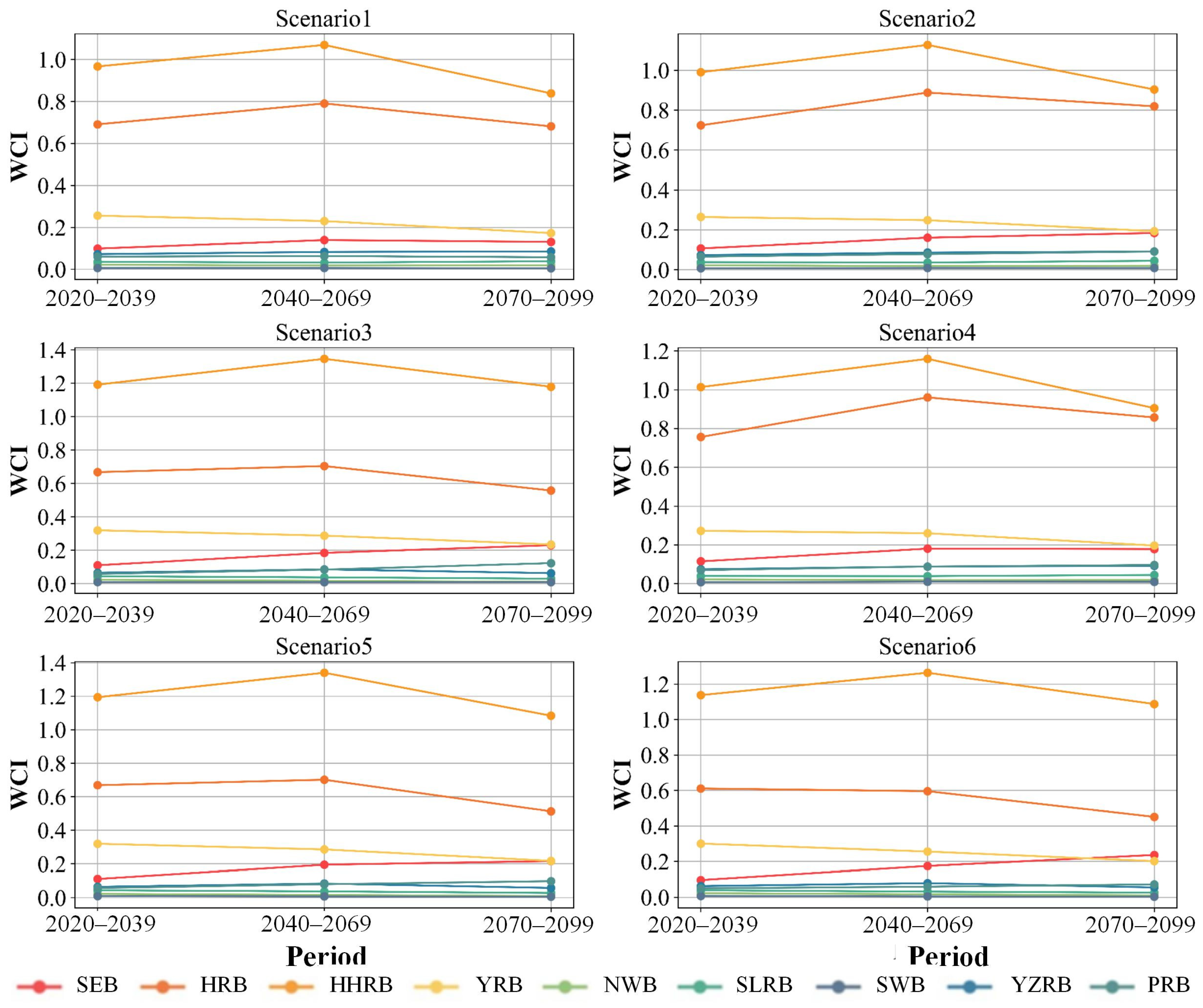
The combined effects of climate change and socio-economic development have intensified the risk of water supply–demand imbalance in China. To project future trends, this study develops a multi-scenario coupled prediction framework integrating climate, socio-economic, and human activity drivers, combining data-driven and physically based modeling approaches to assess terrestrial water storage imbalance in nine major river basins under six representative SSP–RCP scenarios through the end of the 21st century. Using ISIMIP multi-model runoff outputs along with GDP and population projections, agricultural, industrial, and domestic water demands were estimated. A Water Conflict Index was proposed by integrating the Water Supply–Demand Stress Index and the Standardized Hydrological Runoff Index to identify high-risk basins. Results show that under high-emission scenarios, the WCI in the Yellow River, Hai River, and Northwest Rivers remains high, peaking during 2040–2069, while low-emission scenarios significantly alleviate stress in most basins. Water allocation inequity is mainly driven by insufficient supply in arid northern regions and limited redistribution capacity in resource-rich southern basins. Targeted strategies are recommended for different risk types, including inter-basin water transfer, optimization of water use structure and pricing policies, and the development of resilient management systems, providing scenario-based quantitative support for future water security and policy-making in China.
Keywords: terrestrial water storage; multi-scenario prediction; climate change; socio-economic scenarios; water resources management terrestrial water storage; multi-scenario prediction; climate change; socio-economic scenarios; water resources management