Article

On-Site Detection of Crude Oil Bioavailability and Genotoxicity at Crude Oil-Contaminated Sites Using a Whole-Cell Bioreporter Assay

1
School of Soil and Water Conservation, Southwest Forestry University, Kunming 650224, China
2
Key Laboratory of Ecological Environment Evolution and Pollution Control in Mountainous & Rural Areas of Yunnan Province, Kunming 650224, China
3
Zhanyi Karst Ecosystem Observation and Research Station, Kunming 650224, China
4
Key Laboratory of Groundwater Resources and Environment, Ministry of Education, Jilin University, Changchun 130021, China
5
College of New Energy and Environment, Jilin University, Changchun 130021, China
6
Key Laboratory of Regional Environment and Eco-Restoration, Ministry of Education, Shenyang University, Shenyang 110044, China
*
Author to whom correspondence should be addressed.
Water 2026, 18(2), 142; https://doi.org/10.3390/w18020142
Submission received: 4 December 2025 / Revised: 31 December 2025 / Accepted: 4 January 2026 / Published: 6 January 2026
(This article belongs to the Special Issue Soil and Groundwater Quality and Resources Assessment, 3rd Edition)

Abstract

Crude oil contamination occurs frequently in soil; thus, on-site measurement of oil content is critical for controlling petroleum contamination, but it is challenging. Conventional chemical analysis requires complicated sample pretreatment and high-cost facilities, requiring on-site and cost-effective approaches. This study innovated a whole-cell bioreporter assay by combining Acinetobacter-hosted n-alkane and genotoxicity bioreporters to directly and simultaneously evaluate the contamination level and genotoxicities of crude oil in contaminated soils. Ultrasound pretreatment was employed to accelerate the measurement process, and the first-order release kinetic model was used to calculate crude oil content in an easy operation. The detection limit of the bioreporters was satisfactory at 0.1 mg/L, and the quantification range was 0.1–10 mg/L. The developed bioreporter assay effectively assessed the bioavailability and toxicity of crude oil in real contaminated soils and recognized distinct toxicities after soil weathering. Our findings highlight the feasibility of using the whole-cell bioreporter assay to evaluate the bioavailability and toxicity of crude oil, offering supporting data for the selection of remediation strategies.

1. Introduction

Crude oil, also called petroleum, is a naturally occurring, toxic, and flammable liquid consisting of a complex mixture of hydrocarbons of various molecular weights and other organic compounds [1]. It is collected mostly through oil drilling and refined into a large number of consumer products, from gasoline, kerosene, mineral oil, and paraffin to asphalt and other chemicals used to make plastics and pharmaceuticals. With the development of modern industry, more crude oil is being exploited, transported, stored, and manufactured [2]. Throughout this production line, oil spills occur frequently, threatening both human health and ecology [3,4]. After release into the environment, crude oil is subjected to a variety of weathering process, including evaporation, dissolution, dispersion, photochemical oxidation, water/oil emulsion, microbial degradation, and adsorption on soil particles, producing complex metabolites and posing toxicity to organisms [5,6,7].
Alkanes are saturated hydrocarbons, representing the main constituents of crude oil, usually up to 50% [8], and typical chemical analytical methods can accurately and reliably be used to describe and predict the behavior of spilled oil in the environment [9]. Gravimetric and infrared spectroscopic methods are conventional cost-effective methods that are used to determine the contents of total petroleum hydrocarbons (TPHs); nevertheless, they cannot identify TPH compositions in detail [10]. Chromatographic target-compound methods can measure the concentrations of individual TPH components, but they do not profile unrecognizable components and their environmental impacts [11]. In addition, all these chemical analytical methods require solvent extraction, complex manipulation, and a long time for measurement. Accordingly, they are laborious, time-consuming, and costly, and these disadvantages limit their application for the on-site detection of oil contamination in real environmental samples [12]. It is therefore urgent to develop on-site measurement tools, which can be used to take fast responsive action for accidental spill events.
To address the above challenges, biosensors, or bioreporters, have recently been developed, showing potential in both scientific study and engineering applications for assessing the presence of particular crude oil components and their ecological impacts [13]. Among them, Acinetobacter baylyi ADP1 is a soil bacterium that can recognize C6–C11 alkanes [14] and degrade n-alkanes with long chain lengths up to C40 [15,16]. Accordingly, they are used as a host for alkane bioreporters [17,18] and are applied in crude oil detection with a satisfactory detection limit [19]. To solve problems related to the lag response (12 h) to n-alkanes [20,21], a novel PalkM promoter mutation can be used to broaden its response range from C7 to C36 and shorten the response time to 30 min [22,23]. Nevertheless, further validation of the newly developed bioreporters’ potential is required for them to be combined in biological assays to assess both contaminant bioavailability and toxicity in environmental monitoring.
In this study, we developed a direct detection method for the on-site and rapid determination of the bioavailability and genotoxicity of crude oil in contaminated soils using a whole-cell bioreporter assay combining Acinetobacter-hosted alkane bioreporter ADPWH_alk [22] and genotoxicity bioreporter ADPWH_recA [24]. The key novelties of this work are the employment of an ultrasonic pretreatment to release n-alkanes from soil particles with a satisfactory limit of detection of 0.1 mg/L and a range of detection from 0.1 mg/L to 10 mg/L, as well as a first-order release kinetic model to calculate the crude oil content. Our findings show that bioreporter application can be optimized to evaluate crude oil contamination in soils and to provide data for the selection of remediation strategies.

2. Materials and Methods

2.1. Chemicals and Contaminated Sites

All chemicals used in this study were of analytical grade and purchased from Sigma-Aldrich (St. Louis, MO, USA). Crude oil was provided by Daqing oil field (DQ for short) and Baise oil field (BS for short). Crude oil-contaminated soils were collected from DQ (124°15′–125°45′ E, 45°30′–46°45′ N) and BS (107°3′–107°6′ N, 23°42′–23°44′ N) from 1 to 20 April 2025.

2.2. Bioreporter Strains and Cultivation

ADPWH_alk is a chromosome-based Acinetobacter bioreporter, able to detect alkanes of different chain lengths from C7 to C36 [22]. ADPWH_recA is a previously developed genotoxicity bioreporter with mitomycin C (MMC) as the standard genotoxic chemical [24]. Both bioreporter cells were grown in LB at 30 °C overnight, harvested by centrifugation at 3000 rpm for 10 min at 4 °C, washed, and resuspended in 0.85% NaCl solution with the same volume as the bioreporter stock solution. They were stored at 4 °C. These cells can remain active for at least 8 weeks [25]. For measurement, 1 mL ADPWH_alk stock solution (about 108 CFU/mL) was centrifuged at 4000 rpm for 5 min and resuspended into a 1 mL mineral medium with 20 mM sodium succinate as the carbon source (MMS) [26]. For ADPWH_recA, 1 mL of cells was resuspended into a 10 mL LB medium (40 g lysogeny broth powder in 1 L deionized water) with the same centrifugation conditions.

2.3. Crude Oil-Contaminated Sample Preparation for Calibration Curve

Different oil mixtures, including 50.0 mg of DQ crude oil, BS crude oil, paraffin (58.1 µL, d = 0.860 g/mL), and hexane (75.9 µL, d = 0.659 g/mL), were added to 200 mL deionized water, respectively. The mixtures were then homogenized using a 40 KHz ultrasound for 30 s to make a 200 mg/L oil stock solution. The stock solutions were diluted to the final series concentrations with deionized water (Table 1). Different amounts of DQ and BS crude oil were added into 10 mL of chloroform, mixed with 10 g of standard soils, and volatilized at 30 °C for 24 h to remove chloroform and attain the final oil contents (Table 1). Then, 900 μL of water stock solution or supernatants from soils were mixed with ADPWH_alk for crude oil bioavailability in 100 μL MMS or ADPWH_recA for genotoxicity in 8.1 mL LB [27].
Ultrasound is a widely studied and accepted approach to obtain target chemicals from natural products or media [28]. Since its parameters to extract n-alkanes and PAHs have been previously reported [29], this work took the suggested conditions and did not test other parameters, except for the best ultrasonic exposure time for sufficient crude oil extraction from soils. For this, 500 mg of 1%, 5%, and 15% BS crude oil-contaminated soils were added into 5 mL of deionized water, respectively. Each treatment was divided equally into eight parts of different concentrations (Table 1) and exposed to a 40 kHz ultrasound for 0, 30, 60, 120, 300, 600, 900, and 1200 s. After static settlement for 10 min, the supernatants of the soil/water mixtures were recovered carefully using pipettes.

2.4. Bioluminescence Detection

Mixtures of ADPWH_alk/ADPWH_recA with target samples (200 μL) were added into each well of a black clear-bottom 96-well microplate (Corning, Corning, NY, USA), and six replicates were carried out for each sample. The microplate was incubated at 30 °C and monitored for 4 h. The bioluminescence was measured every 10 min using a SpectraMax M5 multimode microplate reader (Molecular Devices, San Jose, CA, USA). The induced bioluminescence of ADPWH_alk was obtained by averaging five monitored bioluminescence data points between 60 and 90 min, while the induced bioluminescence of ADPWH_recA was attained by averaging five monitored bioluminescence data points between 180 and 210 min. The bioluminescence response ratio was calculated by dividing the induced bioluminescence by the original bioluminescence (time = 0) [30]. The relevant bioluminescence response ratio was evaluated by dividing the induced bioluminescence by the control [30]. The OD600 was taken twice, before and after bioluminescence detection, to determine the cell growth status.

2.5. Chemical Analysis

The crude oil in soils was extracted using ultrasound-aided Soxhlet extraction and determined using GC-MS method, as described previously [31]. Original crude oil was dissolved in chloroform and cleaned using an anhydrous sodium sulfate column to remove water and undissolved solids. Both the soil extracts and original crude oil were cleaned using open alumina oxide–silica gel columns. Briefly, 30–80 mg of the crude oil/soil extract was dissolved in 5 mL of n-hexane and loaded into a glass column (20 cm × 1 cm i.d.) packed with 3 g of silica gel (60–80 mesh, pre-activated at 145 °C for 8 h) and 2 g of neutral alumina oxide (100–200 mesh, pre- activated at 450 °C for 4 h). The saturated fraction was eluted with 30 mL of 95% n-hexane, concentrated to 1 mL, and analyzed on an Agilent 7890A GC (Agilent, Santa Clara, CA, USA) coupled with an Agilent 5975C MS (Agilent, Santa Clara, CA, USA) operated in the electron impact mode (70 eV). An HP-5ms capillary column (30 m × 0.25 mm × 0.25 μm) was used, and helium was used as the carrier gas at 1 mL/min. The oven temperature program was 60 °C (holding for 1 min), rising to 300 °C at 5 °C/min and holding at 300 °C for 20 min; the spectra were obtained in scan mode from 40 m/z to 600 m/z. The temperatures of the injector, interface, and ion source were 300 °C, 280 °C, and 230 °C, respectively. A 1 μL aliquot of sample was injected using an Agilent 7693A automatic liquid sampler (Agilent, Santa Clara, CA, USA) in the splitless mode with purging at 1.5 min. GC-MS was calibrated using solutions of n-C9 to n-C40 alkane standard compounds at seven different concentrations (0.5–25 ng/μL). 5α-Androstane was used as the internal standard.

2.6. Data Analysis

Unless specifically stated, all experiments were carried out in six replicates, and data are reported as the mean ± standard error in all figures. Significance tests were conducted using one-way analysis of variance (ANOVA) and the least significant difference (LSD) test using R software (v 3.5.0) [32], and Spearman correlation analysis was conducted using SPSS 19.0 (IBM, Armonk, NY, USA).

3. Results and Discussion

3.1. ADPWH_alk Response to Crude Oil in Water

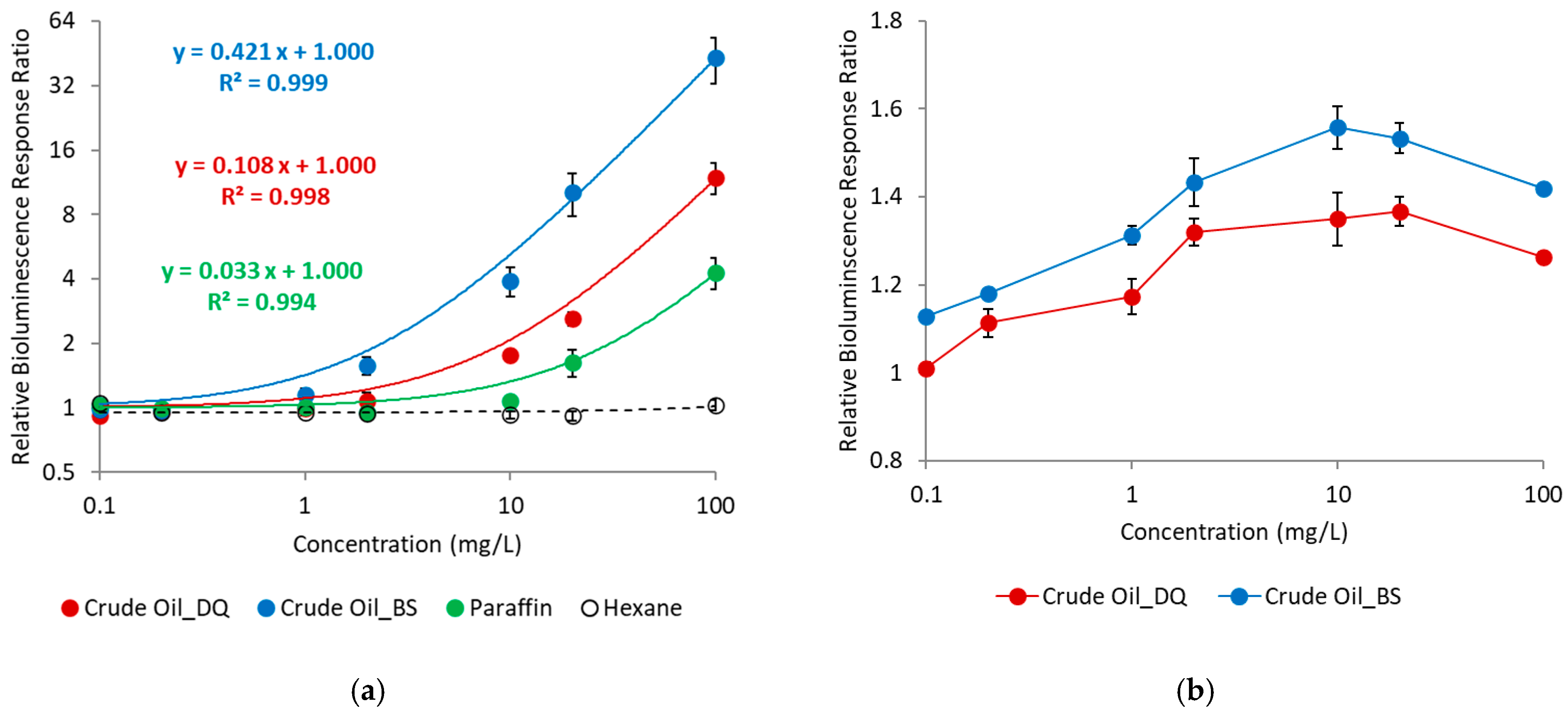
ADPWH_alk exhibited a significant response to DQ crude oil, BS crude oil, and paraffin, but it did not respond to hexane (Figure 1a), consistent with a previous study [22], in which only n-alkanes with a carbon chain length between 7 and 36 could recognize transcriptional activator AlkR and trigger alkM gene expression to produce biological signals. Hexane has a chain length of six, which was not long enough to combine the active site of the AlkR protein to shift the electron cloud of the DNA binding site. Paraffin is a mixture of alkanes with a carbon chain length between 20 and 40, considered a synonymously defined standard oil and hydrocarbon mixture covering most n-alkanes that induce ADPWH_alk.
The relative bioluminescence response ratio showed a linear relationship with crude oil content in the range of 2 mg/L to 100 mg/L. The relative bioluminescence response ratio of ADPWH_alk to DQ and BS crude oil was different (Figure 1a), possibly explained by the difference in the carbon chain length distribution of n-alkanes between the two sites. From the GC-MS profiles illustrated in Figure S1, n-alkanes with carbon chain lengths of 13, 15, 16, 17, 19, 20, 21, and 24 showed distinct levels between BS and DQ crude oil, and they were all n-alkanes with a high sensitivity to bioreporter ADPWH_alk [22]. Accordingly, BS crude oil showed a higher bioluminescence response than DQ crude oil, owing to a higher percentage of C13- to C19-alkanes. These results suggested that the response of ADPWH_alk to alkanes or crude oil is dependent on carbon chain length, which is affected by natural weathering processes.
As the most accurate detection approach for crude oil, gravimetric methods determine the total amount of crude oil, but they do not provide further information about its molecular composition. The GC-MS method can show the detailed composition of individual n-alkanes and some specific PAHs molecules; however, only parts of TPHs are recognizable using GC-MS, and cross-interactions between complex hydrocarbon molecules affect its sensitivity and accuracy [33]. Additionally, GC-MS requires complex manipulation, expensive instruments, normalized data analysis, and practiced technicians. Both gravimetric and GC-MS analytical methods depend on the oil extraction procedure, and they may not distinguish bioavailable contaminants from other inert components trapped by soil particles [34]. As a novel, alternative, and rapid detection method, the whole-cell bioreporter can assess the bioavailability of n-alkanes [22]. This offers the opportunity to evaluate crude oil weathering process and the interactions with living organisms. In addition, bioreporter data can be obtained by directly mixing oil-contaminated soils and cell suspensions, offering easily operated and on-site measurement alternatives.

3.2. ADPWH_recA Response to Crude Oil in Water

No genotoxicity was found for paraffin and hexane using whole-cell bioreporter ADPWH_recA, as n-alkanes including mineral oil are reported to have limited cytotoxicity but no genotoxicity [35]. Crude oil is a complex mixture of alkanes, naphthalene, polycyclic aromatic hydrocarbons (PAHs), and asphaltics, of which PAHs are regarded as DNA-damaging compounds with high genotoxicity [36]. Thus, there were strong responses of ADPWH_recA to DQ and BS crude oil (Figure 1b). More precisely, the relative bioluminescence response ratio was positive and proportional with the crude oil content of either BS or DQ in ranges from 0.1 mg/L to 10 mg/L. At higher concentrations, the cytotoxicity of PAHs became more predominant and suppressed the bioreporter’s activities, explaining the significant bioluminescence damping in Figure 1b. Similar to the data from ADPWH_alk, BS crude oil exhibited higher genotoxicity than DQ crude oil at the same concentration (Figure 1b).
The limit of detection for crude oil genotoxicity was 0.2 mg/L in water, comparable to the previously reported sensitivity [37]. The strong positive relationship between the bioavailability (ADPWH_alk) and toxicity (ADPWH_recA) of crude oil confirmed the significant negative impacts of crude oil contamination on environmental ecology [38]. Some studies have reported positive correlations between TPH availability and toxicity in an aqueous environment. For instance, the bioavailability and toxicities of naphthalene in groundwater exhibited positive correlations at a PAH-contaminated site [39]. The findings in this study further validate this interrelationship and highlight the importance of using a whole-cell bioreporter assay in environmental monitoring and risk assessment.

3.3. Effects of Ultrasonic Pretreatment on Bioreporter Response

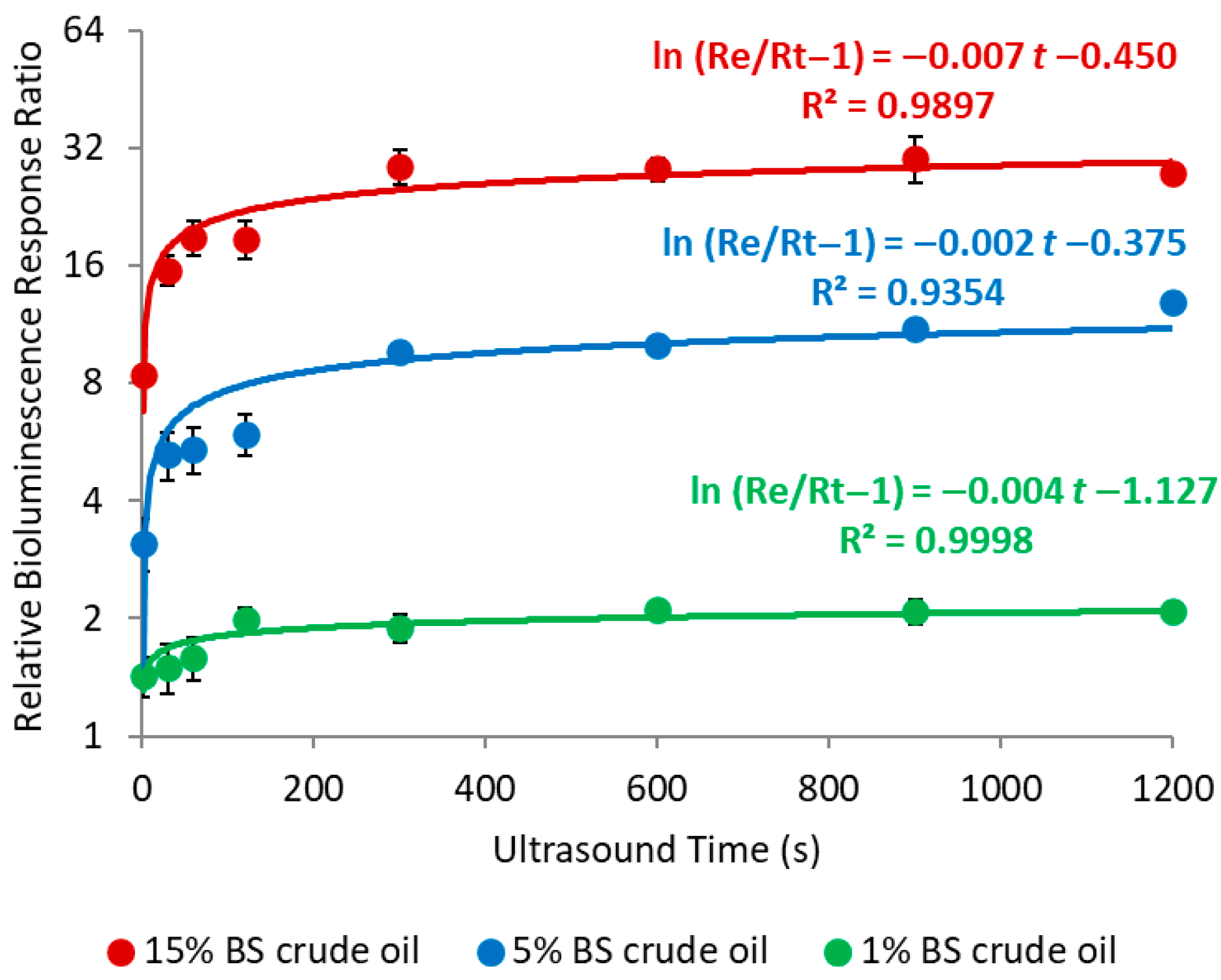
In real soil contaminated with crude oil, petroleum hydrocarbon molecules are adsorbed in porous medium, micropores, or interfaces of fissure, increasing their stability and reducing the bioavailability for bacterial access. In addition, they are less likely to penetrate into bioreporter cells to trigger luxCDABE gene expression. To solve this problem, ultrasound was used for contaminated soil pretreatment, which extracted crude oil from the soil into the water solution. The bioluminescence response ratio exhibited exponential proportions with the ultrasonic pretreatment time in all samples (Figure 2), suggesting a first-order release kinetic model of crude oil from contaminated soils. Here, the first-order release consistently ranged from 0.002 s−1 (5%) to 0.007 s−1 (15%), suggesting slow and time-dependent behavior. According to the experimental data, a 300 s ultrasonic pretreatment could release the majority of crude oil in soils, and it was selected as the optimal condition for the following measurements.
Ultrasound is reported to accelerate the release of bioavailable TPH molecules from soil particles [40], and it is widely used for oil-contaminated soil pretreatment for chemical analysis, biological analysis, or even bioremediation. Compared with a 12 h pretreatment for solvent extraction in chemical analysis, ultrasound pretreatment shortened the response time of the whole-cell bioreporter to n-alkanes to <30 min [22], allowing for rapid detection after emergency accidents such as an oil spill or pipeline leakage. Combining data from ADPWH_alk and ADPWH_recA, this assay could simultaneously assess the bioavailability and toxicity of crude oil and evaluate their ecological impacts. The first-order release kinetic model helped to determine the bioavailability of n-alkanes in soils, and the easy operation procedure of bioreporter application gives it strong potential for on-site application.

3.4. Application of the Whole-Cell Bioreporter Assay to Measure the Crude Oil Bioavailability and Toxicity in Real Contaminated Soils

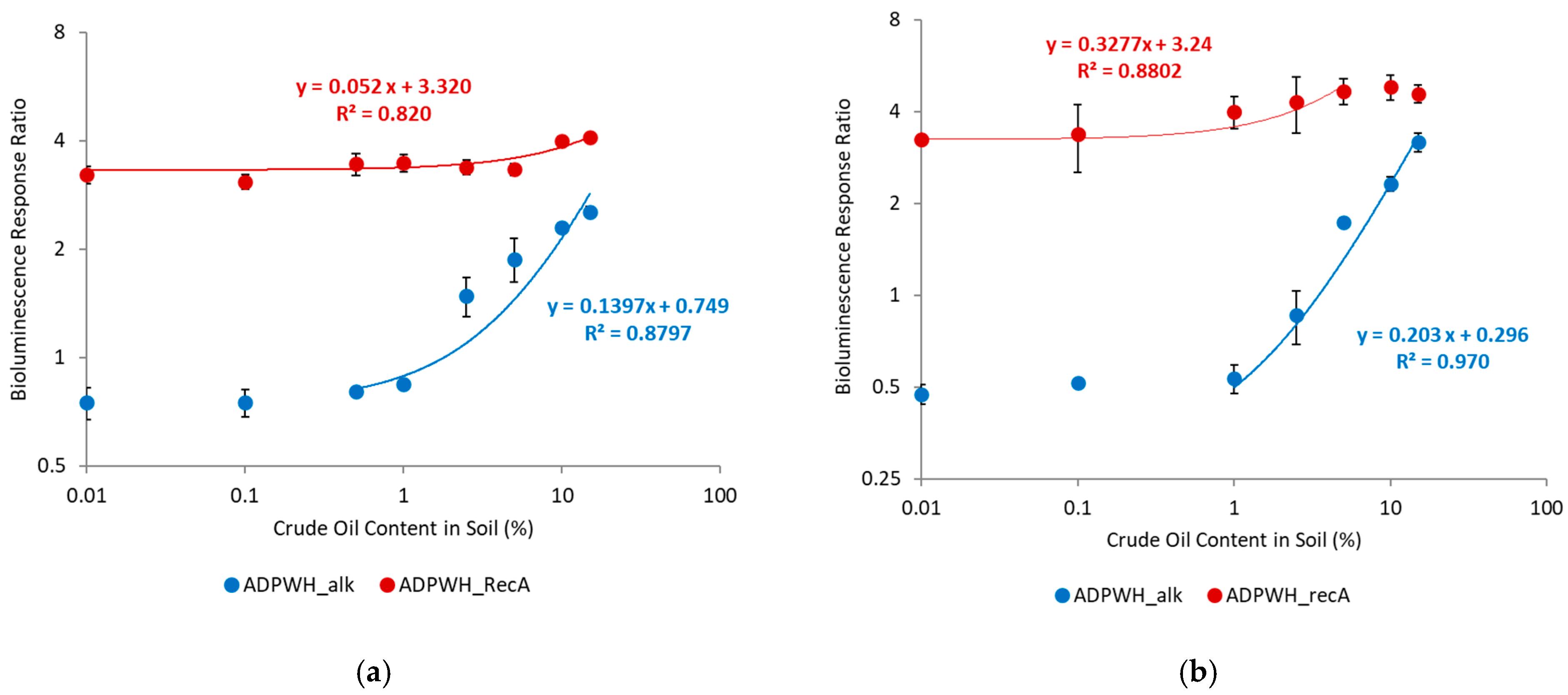
Artificially contaminated soils were used to determine the relationships between crude oil bioavailability/genotoxicity and the bioluminescence response of ADPWH_alk/ADPWH_recA (Figure 3). For DQ crude oil, the bioluminescence response ratio of both ADPWH_alk (crude oil bioavailability) and ADPWH_recA (genotoxicity) exhibited positive linear relationships with a crude oil content in the range of 0.5% to 15% and 0.0% to 15%, respectively (Figure 3a). As for BS crude oil, the response ratio of ADPWH_alk and ADPWH_recA had a linear relationship with the crude oil content from 1.0% to 15% and 0.0% to 5.0%, respectively (Figure 3b).
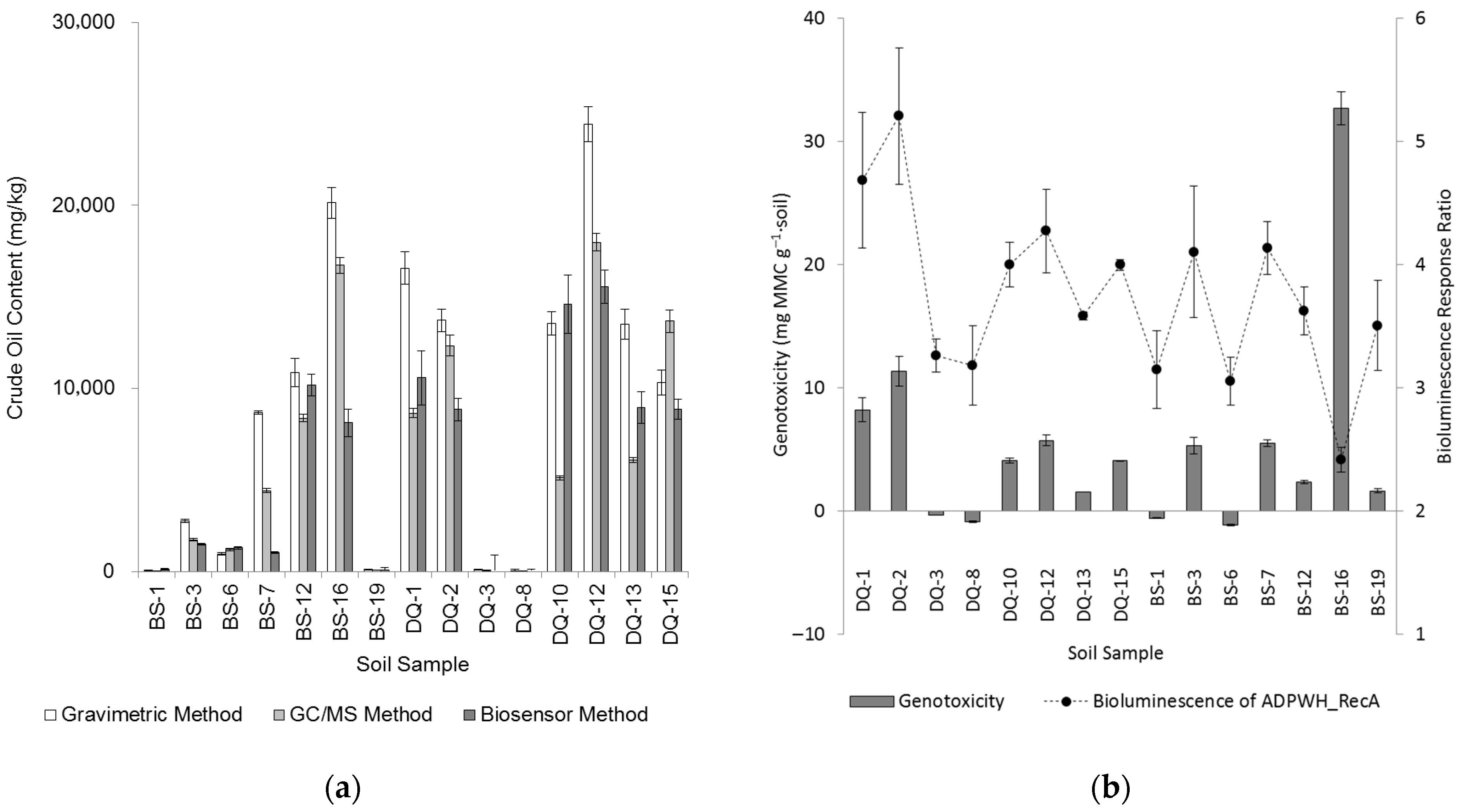
Using the calibration curves and first-order kinetics in ultrasonic pretreatment obtained above, the crude oil bioavailability and genotoxicity in real contaminated soils from DQ and BS oil fields were detected, as shown in Figure 4. There were some significant differences between the total amount (gravimetric method) and bioavailability (bioreporter method) of crude oil (Figure 4a), suggesting different impacts of weathering and soil physicochemical properties on crude oil availability in soils [41]. All crude oil-contaminated soil exhibited remarkable toxicity, according to the positive bioluminescence response of ADPWH_recA (Figure 4b). Thus, the genotoxicity was calculated according to maximum response ratio at 10%, which was equal to 3 μM (1 mg/L) MMC from a previous report [24], while the depressed proportion was converted to extra MMC. Converted to standard genotoxic MMC, BS-16 and DQ-2 samples were of the highest crude oil bioavailability (evaluated by ADPWH_alk) and genotoxicity (estimated by ADPWH_recA), suggesting their strongest and most negative impacts on the ecosystem.
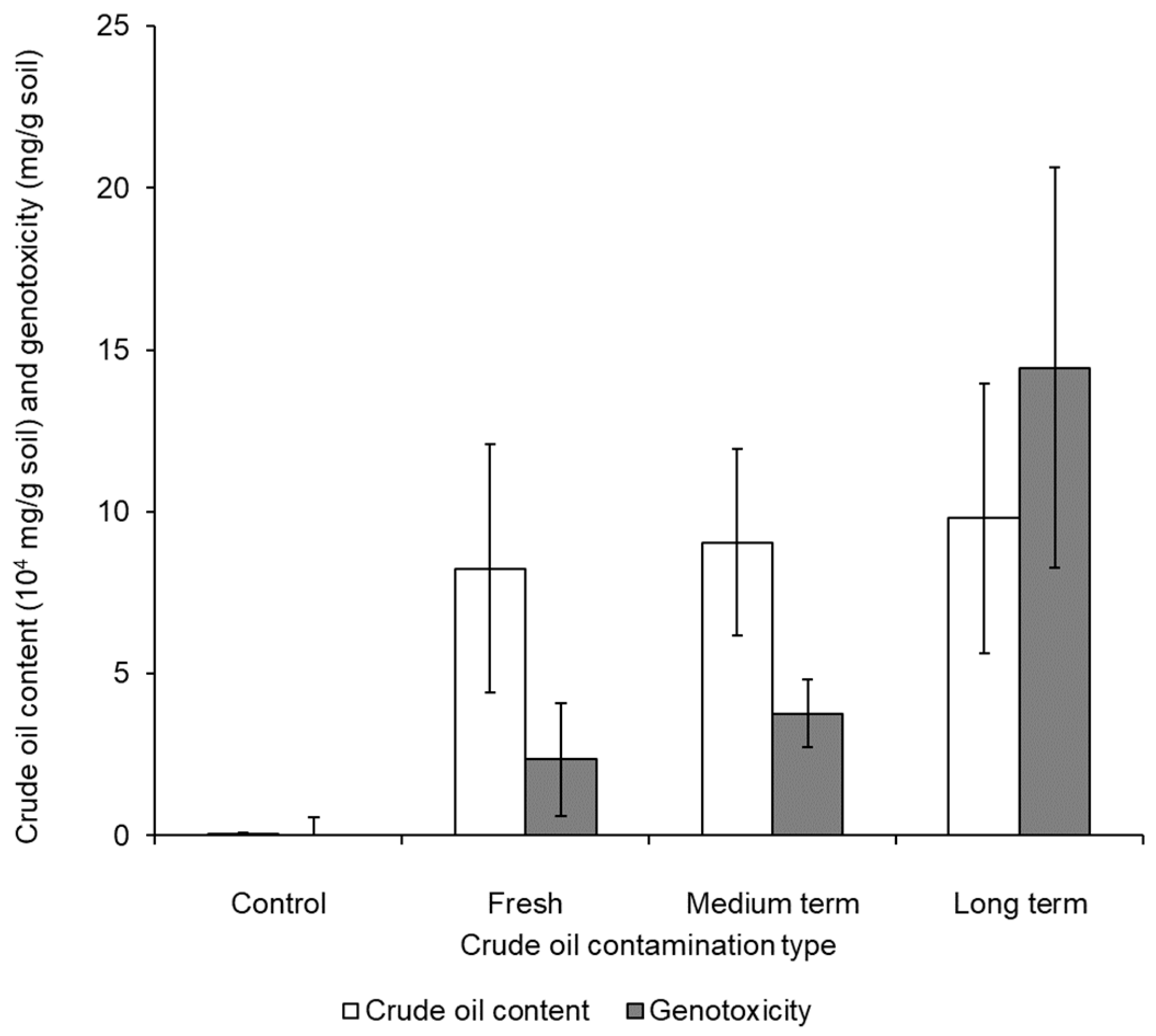
The results from GC-MS, gravimetric measurement, and whole-cell bioreporter methods can be combined to profile the biological process during the crude oil weathering and degradation processes (Figure 5). Here, all soil samples were categorized into three groups based on their contamination history, including fresh (<2 years contamination, (8.252 ± 3.851) × 104 mg/g soil), medium term (2–5 years contamination, (9.058 ± 2.894) × 104 mg/g soil), and long term (>5 years contamination, (9.795 ± 4.176) × 104 mg/g soil). The contamination levels of these soils were all significantly higher than the background of (0.053 ± 0.031) × 104 mg/g soil, but there was no significant difference across the three groups. Instead, crude oil toxicities assessed using ADPWH_recA exhibited positive correlations with contamination history, suggesting the importance of crude oil weathering on their ecological impacts. After weathering or bioremediation, crude oil is reported to become less toxic in contaminated soils [42,43] due to the declining contents of low-molecular-weight and bioavailable fractions by oxidation [44] or biodegradation [45,46]. Thus, the residual TPH contents in real contaminated soils are not proportional to their toxicities, and this challenges conventional chemical analytical methods for risk assessment. The developed bioreporter assay in this study simultaneously measured crude oil bioavailability and toxicity, showing strong potential in contaminated site management.

4. Conclusions

Crude oil-contaminated soils have significant impacts on the ecological system and human health, with rapid detection and risk assessment of crude oil remaining challenging. This study combined Acinetobacter-hosted whole-cell bioreporters in a biological assay for alkane bioavailability and genotoxicity. Under optimized ultrasonic pretreatment conditions, this assay has a satisfactory detection limit (0.1 mg/L) and quantification range (0.1–10 mg/L) and is easily operated. Additionally, this assay recognized the key differences in crude oil contamination levels and toxicities after a distinct weathering process, highlighting its applicability to evaluate the bioremediation potential at contaminated sites. Although this study presented a state-of-the-art whole-cell bioreporter assay, there are some limitations that require further study. Firstly, the suspended solids in a soil–water mixture may reduce bioluminescence signals; thus, 10 min of static settlement is required to improve the sensitivity of the whole-cell bioreporter. To address this challenge, some alternative methods could be employed, such as functionalization with magnetic nanoparticles (MNPs) [47], which could harvest bioreporter cells from dirty samples and porous media via a magnetic field [48] to enhance the responsive signals and reduce the pretreatment duration. Secondly, data from ADPWH_alk and ADPWH_recA were analyzed separately in the developed assay, and it is difficult to directly distinguish the source of toxicities. Toxicity source apportionment [49] should be further employed to fill this knowledge gap and link the bioavailability and toxicity of crude oil in situ. Finally, the results from the bioreporter assay require further independent validation using the Ames test or Comet assay. This was not included in this study due to their unsatisfactory performance in real environmental samples containing organic matter and other ions. Future studies to compare different toxicity assessment methods are suggested. The whole-cell bioreporter assay presented in this study is an easy-to-operate and cost-effective approach to assess crude oil contamination in soils, providing data for effective contaminated site management.

Supplementary Materials

The following supporting information can be downloaded at https://www.mdpi.com/article/10.3390/w18020142/s1. Figure S1. GC-MS profiles of DQ crude oil and BS crude oil. Differences in main peaks representing n-alkanes between DQ crude oil and BS crude oil.

Author Contributions

Conceptualization, D.Z.; methodology, D.Z.; validation, X.W.; formal analysis, X.W.; investigation, X.W.; resources, D.Z.; data curation, X.W.; writing—original draft preparation, X.W.; writing—review and editing, X.W. and D.Z.; visualization, X.W.; supervision, D.Z.; project administration, X.W.; funding acquisition, X.W. All authors have read and agreed to the published version of the manuscript.

Funding

Natural Science Research Start-Up Fund of Southwest Forestry University (110225073/01102).

Data Availability Statement

The data presented in this study are available on request from the first or corresponding authors.

Acknowledgments

D.Z. acknowledges the support of the Chinese Government’s Thousand Talents Plan for Young Professionals.

Conflicts of Interest

The authors declare no conflicts of interest.

References

  1. Marshall, A.G.; Rodgers, R.P. Petroleomics: The next grand challenge for chemical analysis. Acc. Chem. Res. 2004, 37, 53–59. [Google Scholar] [CrossRef]
  2. Bacosa, H.P.; Parmisana, J.R.L.; Sahidjan, N.I.U.; Tumongha, J.M.B.; Valdehueza, K.A.A.; Maglupay, J.R.U.; Mayol, A.P.; Hung, C.C.; Martinico-Perez, M.F.; Watanabe, K.; et al. Navigating the Depths: A Comprehensive Review of 40 Years of Marine Oil Pollution Studies in the Philippines (1980 to 2024). Water 2025, 17, 1709. [Google Scholar] [CrossRef]
  3. Peterson, C.H.; Rice, S.D.; Short, J.W.; Esler, D.; Bodkin, J.L.; Ballachey, B.E.; Irons, D.B. Long-term ecosystem response to the Exxon Valdez oil spill. Science 2003, 302, 2082–2086. [Google Scholar] [CrossRef] [PubMed]
  4. Piatt, J.F.; Lensink, C.J.; Butler, W.; Kendziorek, M.; Nysewander, D.R. Immediate impact of the Exxon Valdez oil-spill on marine birds. Auk 1990, 107, 387–397. [Google Scholar] [CrossRef]
  5. Seifert, W.K.; Moldowan, J.M. Effect of biodegradation on steranes and terpanes in crude oils. Geochim. Cosmochim. Acta 1979, 43, 111–126. [Google Scholar] [CrossRef]
  6. Venosa, A.D.; Suidan, M.T.; Wrenn, B.A.; Strohmeier, K.L.; Haines, J.R.; Eberhart, B.L.; King, D.; Holder, E. Bioremediation of an experimental oil spill on the shoreline of delaware bay. Environ. Sci. Technol. 1996, 30, 1764–1775. [Google Scholar] [CrossRef]
  7. Wang, W.H.; Liu, B.J.; Guo, Z.; Zhang, Z.W.; Chen, C. Numerical Modeling and Sea Trial Studies of Oil Spills in the Sea Area from Haikou to Danzhou. Water 2025, 17, 1379. [Google Scholar] [CrossRef]
  8. Rojo, F. Degradation of alkanes by bacteria. Environ. Microbiol. 2009, 11, 2477–2490. [Google Scholar] [CrossRef] [PubMed]
  9. Swannell, R.P.J.; Lee, K.; McDonagh, M. Field evaluations of marine oil spill bioremediation. Microbiol. Rev. 1996, 60, 342–365. [Google Scholar] [CrossRef]
  10. Wise, S.A.; Rodgers, R.P.; Reddy, C.M.; Nelson, R.K.; Kujawinski, E.B.; Wade, T.L.; Campiglia, A.D.; Liu, Z.F. Advances in Chemical Analysis of Oil Spills Since the Deepwater Horizon Disaster. Crit. Rev. Anal. Chem. 2023, 53, 1638–1697. [Google Scholar] [CrossRef]
  11. Wang, Z.D.; Fingas, M. Developments in the analysis of petroleum hydrocarbons in oils, petroleum products and oil-spill-related environmental samples by gas chromatography. J. Chromatogr. A 1997, 774, 51–78. [Google Scholar] [CrossRef]
  12. Samsuria, N.N.C.; Ismail, W.Z.W.; Nazli, M.; Aziz, N.A.A.; Ghazali, A.K. Problems, Effects, and Methods of Monitoring and Sensing Oil Pollution in Water: A Review. Water 2025, 17, 1252. [Google Scholar] [CrossRef]
  13. Jiang, B.; Song, Y.Z.; Liu, Z.J.; Huang, W.E.; Li, G.H.; Deng, S.Q.; Xing, Y.; Zhang, D.Y. Whole-cell bioreporters for evaluating petroleum hydrocarbon contamination. Crit. Rev. Environ. Sci. Technol. 2021, 51, 272–322. [Google Scholar] [CrossRef]
  14. Li, H.B.; Martin, F.L.; Zhang, D.Y. Quantification of Chemotaxis-Related Alkane Accumulation in Acinetobacter baylyi Using Raman Microspectroscopy. Anal. Chem. 2017, 89, 3909–3918. [Google Scholar] [CrossRef] [PubMed]
  15. Tanaka, D.; Takashima, M.; Mizuta, A.; Tanaka, S.; Sakatoku, A.; Nishikawa, A.; Osawa, T.; Noguchi, M.; Aizawa, S.I.; Nakamura, S. Acinetobacter sp. Ud-4 Efficiently Degrades Both Edible and Mineral Oils: Isolation and Characterization. Curr. Microbiol. 2010, 60, 203–209. [Google Scholar] [CrossRef] [PubMed]
  16. Kennedy, R.S.; Finnerty, W.R.; Sudarsanan, K.; Young, R.A. Microbial assimilation of hydrocarbons. 1. Fine-structure of a hydrocarbon oxidizing Acinetobacet sp. Arch. Microbiol. 1975, 102, 75–83. [Google Scholar] [CrossRef]
  17. Zhang, D.; Zhao, Y.; He, Y.; Wang, Y.; Zhao, Y.; Zheng, Y.; Wei, X.; Zhang, L.; Li, Y.; Jin, T.; et al. Characterization and Modeling of Transcriptional Cross-Regulation in Acinetobacter baylyi ADP1. ACS Synth. Biol. 2012, 1, 274–283. [Google Scholar] [CrossRef]
  18. Sticher, P.; Jaspers, M.C.M.; Stemmler, K.; Harms, H.; Zehnder, A.J.B.; vanderMeer, J.R. Development and characterization of a whole-cell bioluminescent sensor for bioavailable middle-chain alkanes in contaminated groundwater samples. Appl. Environ. Microbiol. 1997, 63, 4053–4060. [Google Scholar] [CrossRef]
  19. Tecon, R.; Beggah, S.; Czechowska, K.; Sentchilo, V.; Chronopoulou, P.M.; McGenity, T.J.; van der Meer, J.R. Development of a Multistrain Bacterial Bioreporter Platform for the Monitoring of Hydrocarbon Contaminants in Marine Environments. Environ. Sci. Technol. 2010, 44, 1049–1055. [Google Scholar] [CrossRef] [PubMed]
  20. Ratajczak, A.; Geissdorfer, W.; Hillen, W. Alkane hydroxylase from Acinetobacter sp. strain ADP1 is encoded by alkM and belongs to a new family of bacterial integral-membrane hydrocarbon hydroxylases. Appl. Environ. Microbiol. 1998, 64, 1175–1179. [Google Scholar] [CrossRef]
  21. Liu, Y.Q.; Zhao, X.H.; Wang, X.Z.; Ding, A.Z.; Zhang, D.Y. Application of whole-cell bioreporters for ecological risk assessment and bioremediation potential evaluation after a benzene exceedance accident in groundwater in Lanzhou, China. Sci. Total. Environ. 2024, 906, 167846. [Google Scholar] [CrossRef]
  22. Zhang, D.; He, Y.; Wang, Y.; Wang, H.; Wu, L.; Aries, E.; Huang, W.E. Whole cell bacterial bioreporter for actively searching and sensing of alkanes and oil spills. Microb. Biotechnol. 2012, 5, 87–97. [Google Scholar] [CrossRef] [PubMed]
  23. Zhang, D.; Ding, A.; Cui, S.; Hu, C.; Thornton, S.F.; Dou, J.; Sun, Y.; Huang, W.E. Whole cell bioreporter application for rapid detection and evaluation of crude oil spill in seawater caused by Dalian oil tank explosion. Water Res. 2013, 47, 1191–1200. [Google Scholar] [CrossRef] [PubMed]
  24. Song, Y.Z.; Li, G.H.; Thornton, S.F.; Thompson, I.P.; Banwart, S.A.; Lerner, D.N.; Huang, W.E. Optimization of Bacterial Whole Cell Bioreporters for Toxicity Assay of Environmental Samples. Environ. Sci. Technol. 2009, 43, 7931–7938. [Google Scholar] [CrossRef]
  25. Yang, Q.Y.; Li, G.H.; Jin, N.F.; Zhang, D.Y. Synergistic/antagonistic toxicity characterization and source-apportionment of heavy metals and organophosphorus pesticides by the biospectroscopy-bioreporter-coupling approach. Sci. Total Environ. 2023, 905, 167057. [Google Scholar] [CrossRef]
  26. Jiang, B.; Xing, Y.; Li, G.H.; Zhang, N.N.; Lian, L.N.; Sun, G.D.; Zhang, D.Y. iTRAQ-Based Comparative Proteomic Analysis of Acinetobacter baylyi ADP1 Under DNA Damage in Relation to Different Carbon Sources. Front. Microbiol. 2020, 10, 2906. [Google Scholar]
  27. Jin, N.F.; Liu, Y.Q.; Wang, X.Z.; Yang, K.; Zhang, D.Y.; Ding, A.Z. In-vitro toxicity assessment of Eucalyptus robusta Smith extracts via whole-cell bioreporter. Ecotoxicol. Environ. Saf. 2022, 240, 113704. [Google Scholar]
  28. Chemat, F.; Rombaut, N.; Sicaire, A.G.; Meullemiestre, A.; Fabiano-Tixier, A.S.; Abert-Vian, M. Ultrasound assisted extraction of food and natural products. Mechanisms, techniques, combinations, protocols and applications. A review. Ultrason. Sonochem. 2017, 34, 540–560. [Google Scholar] [CrossRef]
  29. Song, G.Q.; Lu, C.; Lin, J.M. Application of surfactants and microemulsions to the extraction of pyrene and phenanthrene from soil with three different extraction methods. Anal. Chim. Acta 2007, 596, 312–318. [Google Scholar] [CrossRef] [PubMed]
  30. Jin, N.F.; Yang, K.; Li, J.Y.; Song, Y.Z.; Ding, A.Z.; Sun, Y.J.; Li, G.H.; Zhang, D.Y. Toxicity Characterization of Environment-Related Pollutants Using a Biospectroscopy-Bioreporter-Coupling Approach: Potential for Real-World Toxicity Determination and Source Apportionment of Multiple Pollutants. Anal. Chem. 2023, 95, 4291–4300. [Google Scholar]
  31. Ejenavi, O.; Teng, T.T.; Huang, W.X.; Wang, X.Z.; Zhang, W.J.; Zhang, D.Y. Online detection of alkanes by a biological-phase microextraction and biosensing (BPME-BS) device. J. Hazard. Mater. 2023, 452, 131316. [Google Scholar] [CrossRef]
  32. Jiang, B.; Adebayo, A.; Jia, J.L.; Xing, Y.; Deng, S.Q.; Guo, L.M.; Liang, Y.T.; Zhang, D.Y. Impacts of heavy metals and soil properties at a Nigerian e-waste site on soil microbial community. J. Hazard. Mater. 2019, 362, 187–195. [Google Scholar] [CrossRef] [PubMed]
  33. Wang, Z.D.; Stout, S.A.; Fingas, M. Forensic fingerprinting of biomarkers for oil spill characterization and source identification. Environ. Forensics 2006, 7, 105–146. [Google Scholar] [CrossRef]
  34. Almutairi, M.S. Determination of total petroleum hydrocarbons (TPHs) in weathered oil contaminated soil. Environ. Eng. Res. 2022, 27, 210324. [Google Scholar] [CrossRef]
  35. Liu, Z.F.; Liu, J.Q.; Zhu, Q.Z.; Wu, W. The weathering of oil after the Deepwater Horizon oil spill: Insights from the chemical composition of the oil from the sea surface, salt marshes and sediments. Environ. Res. Lett. 2012, 7, 226–247. [Google Scholar] [CrossRef]
  36. Xue, W.L.; Warshawsky, D. Metabolic activation of polycyclic and heterocyclic aromatic hydrocarbons and DNA damage: A review. Toxicol. Appl. Pharmacol. 2005, 206, 73–93. [Google Scholar] [CrossRef] [PubMed]
  37. Jin, N.F.; Liu, Q.W.; Song, J.S.; Hou, Y.; Ding, A.Z.; Zhang, D.Y. A bioreporter-toxicity-characteristic-leaching-procedure (Bio-TCLP) test battery approach for risk assessment and Cr-remediation performance optimization. Bioresour. Technol. 2026, 442, 133740. [Google Scholar] [CrossRef]
  38. Sheng, Y.Z.; Liu, Y.; Yang, J.J.; Dong, H.L.; Liu, B.; Zhang, H.; Li, A.Y.; Wei, Y.Q.; Li, G.H.; Zhang, D.Y. History of petroleum disturbance triggering the depth-resolved assembly process of microbial communities in the vadose zone. J. Hazard. Mater. 2021, 402, 124060. [Google Scholar] [CrossRef] [PubMed]
  39. Sun, Y.J.; Zhao, X.H.; Zhang, D.Y.; Ding, A.Z.; Chen, C.; Huang, W.E.; Zhang, H.C. New naphthalene whole-cell bioreporter for measuring and assessing naphthalene in polycyclic aromatic hydrocarbons contaminated site. Chemosphere 2017, 186, 510–518. [Google Scholar] [CrossRef] [PubMed]
  40. Pee, G.Y.; Na, S.M.; Wei, Z.S.; Weavers, L.K. Increasing the bioaccessibility of polycyclic aromatic hydrocarbons in sediment using ultrasound. Chemosphere 2015, 122, 265–272. [Google Scholar] [CrossRef]
  41. Jiang, B.; Li, G.H.; Xing, Y.; Zhang, D.Y.; Jia, J.L.; Cui, Z.S.; Luan, X.; Tang, H. A whole-cell bioreporter assay for quantitative genotoxicity evaluation of environmental samples. Chemosphere 2017, 184, 384–392. [Google Scholar] [CrossRef] [PubMed]
  42. Finch, B.E.; Wooten, K.J.; Smith, P.N. Embryotoxicity of weathered crude oil from the gulf of Mexico in Mallard ducks (Anas Platrhynchos). Environ. Toxicol. Chem. 2011, 30, 1885–1891. [Google Scholar] [CrossRef] [PubMed]
  43. Salanitro, J.P.; Dorn, P.B.; Huesemann, M.H.; Moore, K.O.; Rhodes, I.A.; Jackson, L.M.R.; Vipond, T.E.; Western, M.M.; Wisniewski, H.L. Crude oil hydrocarbon bioremediation and soil ecotoxicity assessment. Environ. Sci. Technol. 1997, 31, 1769–1776. [Google Scholar] [CrossRef]
  44. Heintz, R.A.; Short, J.W.; Rice, S.D. Sensitivity of fish embryos to weathered crude oil: Part II. Increased mortality of pink salmon (Oncorhynchus gorbuscha) embryos incubating downstream from weathered Exxon Valdez crude oil. Environ. Toxicol. Chem. 1999, 18, 494–503. [Google Scholar] [CrossRef]
  45. Teng, T.; Wang, X.; Liu, Y.; Zhao, X.; Sun, Y.; Ding, A.; Pan, J.Y.; Zhang, D. Distinct bacterial community structure, assembly and functions between aged and multiple petroleum-contaminated sites. Environ. Chem. Ecotoxicol. 2026, 8, 408–417. [Google Scholar] [CrossRef]
  46. Jia, W.J.; Deng, Z.M.; Papini, M.P.; Cheng, L.R.; Jin, N.F.; Zhang, D.; Li, Z.Y.; Zhang, D.Y.; Zhu, Y.; Ding, A.Z. Long-term response mechanism of bacterial communities to chemical oxidation remediation in petroleum hydrocarbon contaminated groundwater. J. Hazard. Mater. 2025, 488, 137239. [Google Scholar] [CrossRef]
  47. Zhang, D.; Fakhrullin, R.F.; Özmen, M.; Wang, H.; Wang, J.; Paunov, V.N.; Li, G.; Huang, W.E. Functionalization of whole-cell bacterial reporters with magnetic nanoparticles. Microb. Biotechnol. 2011, 4, 89–97. [Google Scholar] [CrossRef]
  48. Teng, T.T.; Huang, W.E.; Li, G.H.; Wang, X.Z.; Song, Y.Z.; Tang, X.Y.; Dawa, D.; Jiang, B.; Zhang, D.Y. Application of magnetic-nanoparticle functionalized whole-cell biosensor array for bioavailability and ecotoxicity estimation at urban contaminated sites. Sci. Total Environ. 2023, 896, 165292. [Google Scholar] [CrossRef]
  49. Jin, N.F.; Song, J.X.; Wang, Y.Y.; Yang, K.; Zhang, D.Y. Biospectroscopic fingerprinting phytotoxicity towards environmental monitoring for food security and contaminated site remediation. J. Hazard. Mater. 2024, 465, 133515. [Google Scholar] [CrossRef]
Figure 1. Direct detection of crude oil and genotoxicity in water samples. (a) Detection of DQ and BS crude oil in water samples using ADPWH_alk, with paraffin and hexane as the positive and negative controls. (b) Genotoxicity assessment of DQ and BS crude oil in water samples using ADPWH_recA. Data are presented as the mean ± standard error (n = 6).
Water 18 00142 g001
Figure 2. Ultrasound pretreatment optimization for crude oil extraction from soil samples. Exponential relationships between the bioluminescence response ratio (Rt) and the extraction time indicate the first-order release kinetics of crude oil via ultrasound. Three hundred seconds was sufficient for oil dissolution in soil pretreatment. Data are presented as the mean ± standard error (n = 6).
Water 18 00142 g002
Figure 3. Calibration curve for the crude oil bioavailability and genotoxicity in soil samples. (a) Linear relationships of DQ crude oil with the bioluminescence response ratio of ADPWH_alk (availability) and ADPWH_recA (genotoxicity) in the ranges of 0.5% to 15% and 0.0% to 15%. (b) Linear relationships of BS crude oil with the bioluminescence response ratio of ADPWH_alk (availability) and ADPWH_recA (genotoxicity) in the ranges of 1.0% to 15% and 0.0% to 5.0%. Data are presented as the mean ± standard error (n = 6).
Water 18 00142 g003
Figure 4. Bioavailability and genotoxicity of crude oil in real soil samples. (a) Crude oil bioavailability between gravimetric and bioreporter methods (p = 0.203). (b) Bioluminescence response ratio and genotoxicity (mitomycin C equivalent, mg/g soil), according to ADPWH_recA in soil samples. Data are presented as the mean ± standard error (n = 6).
Water 18 00142 g004
Figure 5. The impacts of weathering and biodegradation on the bioavailability and genotoxicity of crude oil in soil samples. Fresh represents soils with a contamination history <2 years; medium term represents the occurrence of crude oil contamination over 2–5 years; long term represents soils with a contamination history >5 years. Data are presented as the mean ± standard error (n = 6).
Water 18 00142 g005
Table 1. Crude oil concentration series for calibration curves.
SampleWaterSoilUltrasonic Pretreatment Optimization
Crude oil
concentration series
0.0 mg/L0.0%0 mg/mL
0.1 mg/L0.1%1 mg/mL
0.2 mg/L0.25%2 mg/mL
1.0 mg/L0.5%3 mg/mL
2.0 mg/L1.0%5 mg/mL
10 mg/L2.5%10 mg/mL
20 mg/L5.0%20 mg/mL
100 mg/L10%30 mg/mL
-15%40 mg/mL
Disclaimer/Publisher’s Note: The statements, opinions and data contained in all publications are solely those of the individual author(s) and contributor(s) and not of MDPI and/or the editor(s). MDPI and/or the editor(s) disclaim responsibility for any injury to people or property resulting from any ideas, methods, instructions or products referred to in the content.