1. Introduction
The geophysical characterization of subsurfaces faces a fundamental challenge: translating indirect observations into consistent models that can guide technical and management decisions. Among the available techniques, TDEM Soundings stand out for their ability to reach depths of several hundred meters with relatively simple logistics and robustness against cultural noise [
1,
2].
In the context of hydrogeophysics, the application of TDEM has multiplied in recent years to identify lithological contrasts, delineate aquifers, and select drilling sites [
3,
4,
5]. However, one of the recurrent problems of electromagnetic methods is the non-uniqueness of the inversion solution, which produces families of equally plausible models [
6]. This aspect limits interpretation when results are considered in 1D TDEM models.
A methodological improvement is achieved when data are integrated into geomatic modeling platforms, such as Oasis Montaj 2025.1 (Seequent,
https://www.seequent.com/products-solutions/geosoft-oasis-montaj/, accessed on 5 December 2025), which allow interpolation, visualization, and analysis of resistivity volumes. The construction of a 3D model does not eliminate non-uniqueness but adds spatial coherence and facilitates the identification of continuous trends at depth [
7]. These volumetric visualizations facilitate the identification of continuous resistivity trends that support drilling-site selection beyond point-by-point analysis.
The Alfaro area, in the eastern sector of La Rioja, lies within the Ebro Basin and presents a thick package of Tertiary materials, mainly clays, marls, and silts, with interbedded sandstones and conglomerates. This stratigraphy constitutes an ideal environment to evaluate the performance of TDEM and to assess the extent to which 3D modeling can help optimize the selection of drilling points.
Several previous studies in Spanish basins have demonstrated the potential of this technique: Ruiz-Constán et al. [
8] applied TDEM to prospecting in the Jaen area; Carrasco-García et al. [
5] documented its usefulness in Mesozoic formations; and Porras et al. [
9] evaluated evaporitic domains in Barbastro. At the international level, Gao et al. [
10] explored the capacity of 3D modeling to improve the detection of heterogeneities, while Stumm et al. [
11] applied TDEM to characterize contaminated soils and conductive transitions.
Although TDEM data have been incorporated into three-dimensional workflows in numerous hydrogeophysical and exploration studies, many practical surveys, particularly those with limited station density, still rely predominantly on independent 1D inversions and qualitative cross-sections. In such contexts, constructing a pseudo-3D resistivity volume by spatially interpolating validated 1D inversion results can provide a useful first-order representation of lateral trends and support decision-making for groundwater exploration. However, this approach does not replace a true 3D inversion, as lateral constraints are not solved within the inversion and complex geology may require fully 3D/2D constrained inversion strategies. The contribution of this study is therefore to present and evaluate a transparent 1D-to-pseudo-3D geomatic workflow, including explicit quality control of the 1D results and reliability diagnostics of the kriging-based volumetric representation, aimed at operational groundwater targeting in heterogeneous sedimentary settings.
2. Materials and Methods
The methodological design of this study combines the acquisition of TDEM data in the field with three-dimensional modeling. This integrated approach enables the generation of local 1D resistivity models and their subsequent transformation into a continuous pseudo-3D volumetric representation, which is essential for interpreting the spatial distribution of geoelectrical units and identifying the most suitable sectors for groundwater drilling.
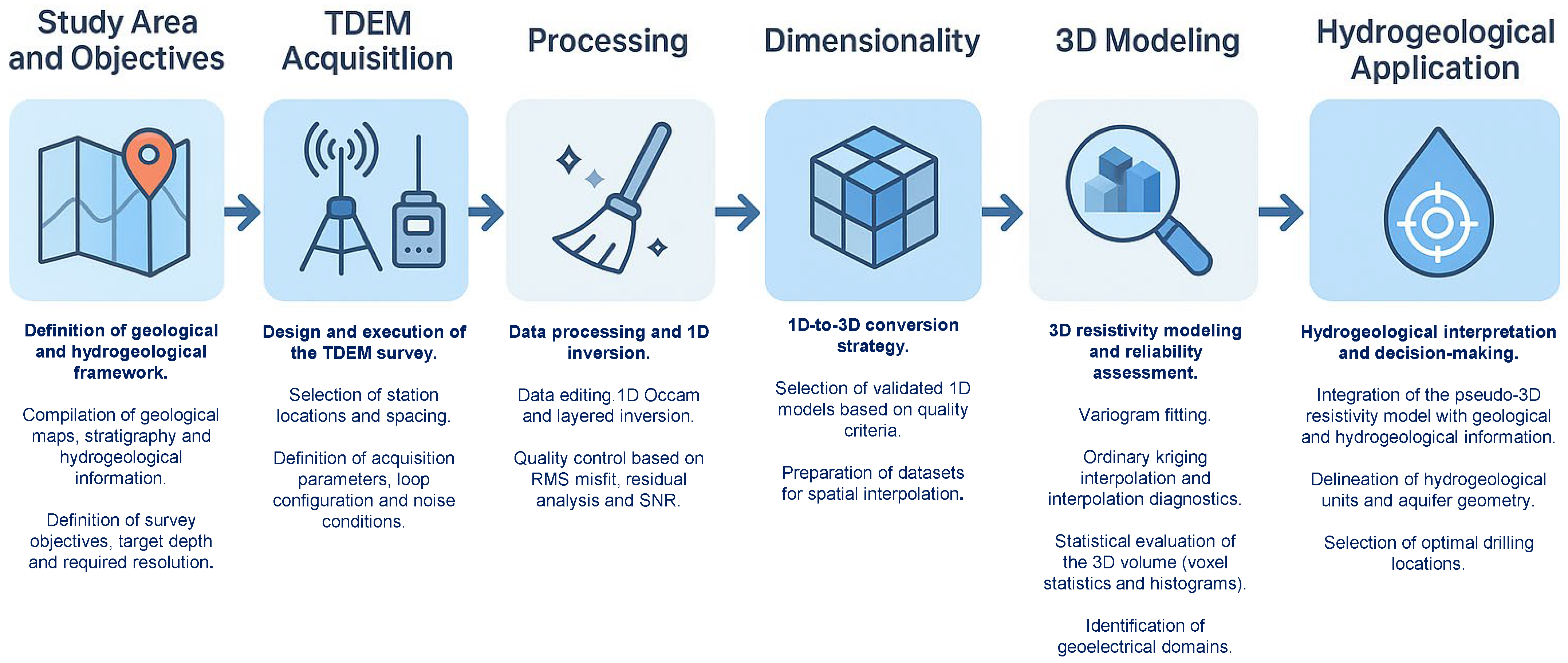
Figure 1 summarizes the main steps of the methodological workflow adopted in this study.
Given the central role of TDEM in this workflow, it is useful to briefly outline the fundamentals of the method. TDEM is a transient electromagnetic technique in which the current circulating through a transmitter loop is abruptly switched off, causing the collapse of the primary magnetic field and inducing secondary eddy currents in the subsurface. The temporal decay of these currents, recorded by the receiver, reflects the resistivity distribution with depth: early-time measurements are mainly influenced by shallow, more resistive materials, whereas late-time windows provide sensitivity to deeper and typically more conductive formations. This depth-dependent response makes TDEM particularly effective for groundwater exploration, as permeable, resistive aquifer bodies and clay-rich, conductive aquitards produce distinct transient signatures. In addition, the method offers logistical efficiency, robust performance in the presence of moderate cultural noise, and investigation depths reaching several hundred meters, making it a reliable foundation for subsequent inversion and pseudo-3D geoelectrical modeling [
1,
2,
3].
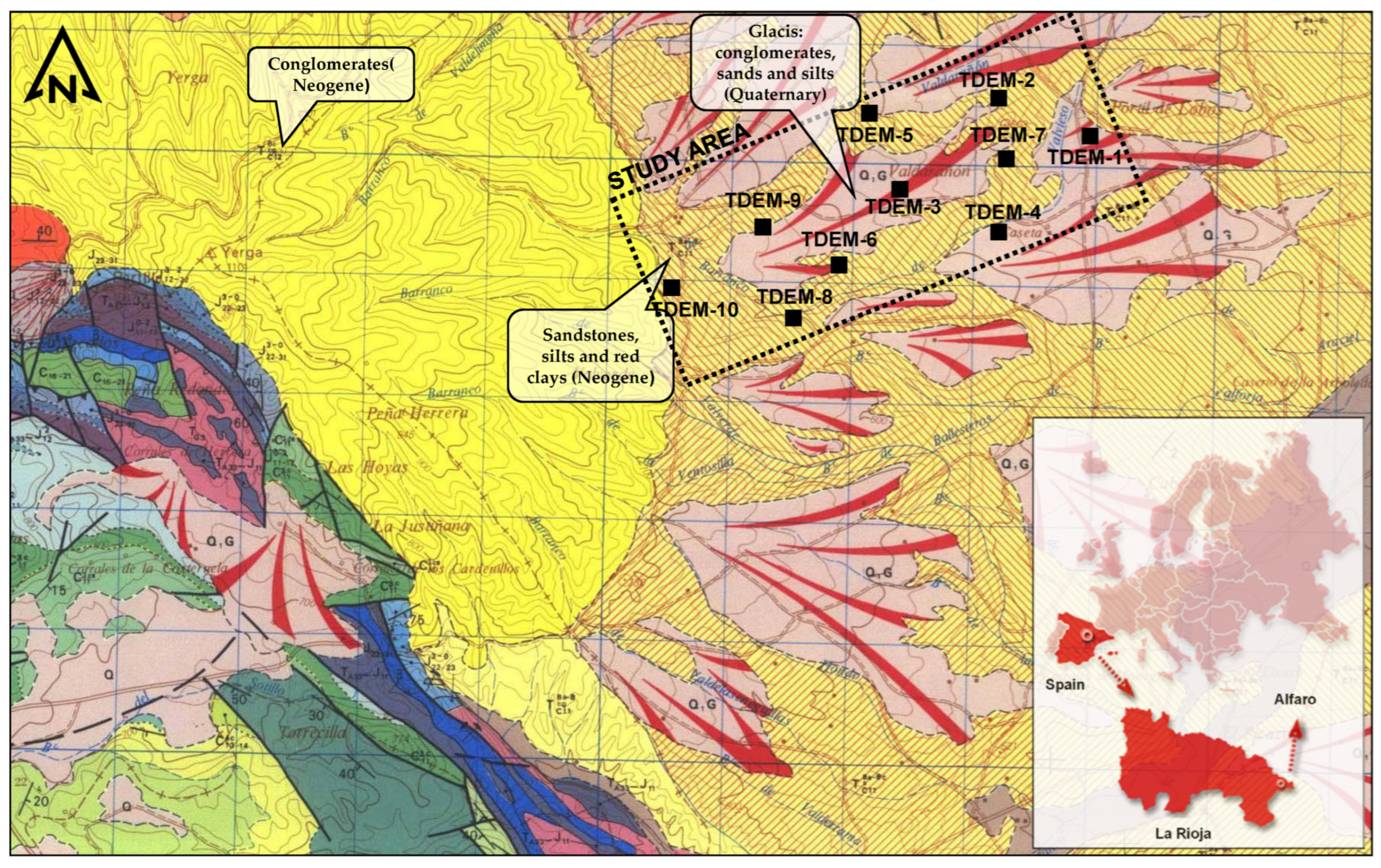
The study area is located in the municipality of Alfaro, in the southeastern sector of La Rioja, within the Ebro Basin. It corresponds to a Tertiary depression filled with Miocene materials (
Figure 2), mainly red clays and marls, with interbedded silts, sandstones, and conglomerates [
12]. These lithological units form a sedimentary environment where moderate resistivity contrasts are expected, but with sufficient lateral variability to justify a three-dimensional analysis.
In addition to the geological characteristics, the hydrogeological framework of the area plays a key role in interpreting geoelectrical data. According to groundwater assessments published by the Confederación Hidrográfica del Ebro (CHE), the eastern Ebro Basin hosts a multilayer detrital aquifer system developed within these Miocene deposits [
13]. The alternation of sandstone and conglomerate bodies with marly and clay-rich units produces a succession of permeable and low-permeability horizons that give rise to unconfined to semi-confined aquifer conditions, depending on the spatial distribution of the units.
CHE hydrogeological documents describe the sandstone–conglomerate intervals as the main productive aquifer levels in this region due to their higher relative permeability and regional lateral continuity, while the marls and silts act as aquitards that restrict vertical flow and compartmentalize the system. Borehole information compiled by the agency indicates the presence of substantial saturated thicknesses and confirms the repeated alternation of coarse-grained permeable layers with fine-grained confining units, consistent with the geological framework observed in the Alfaro sector.
This hydrostratigraphic configuration corresponds well with the geoelectrical behavior expected from Time-Domain Electromagnetic soundings: resistive domains are commonly associated with sandstone–conglomeratic aquifer bodies, whereas conductive signatures reflect clay-rich Miocene formations. The integration of this regional hydrogeological information strengthens the interpretation of the pseudo-3D resistivity model and provides a more robust basis for identifying the most favorable zones for groundwater abstraction within the study area.
2.1. Instrumentation and Data Acquisition
Data were acquired using a Terra-TEM system (Monex GeoScope Co., Ltd., Perth, Australia;
https://www.monexgeoscope.com.au/index.php/terratem/, accessed on 5 December 2025) of the latest generation, equipped with a transmitter capable of injecting up to 10 A of current and a high-dynamic-range receiver. Each station consisted of a 200 × 200 m square transmitter loop in single-loop configuration. The transmitter operated at 24 V, generating a nominal current of 6.7 A. A base frequency of 12.5 Hz and a ramp time of approximately 327 µs were used during acquisition. This setup allows investigation depths between ~350 and 450 m in media of average resistivity [
2,
14].
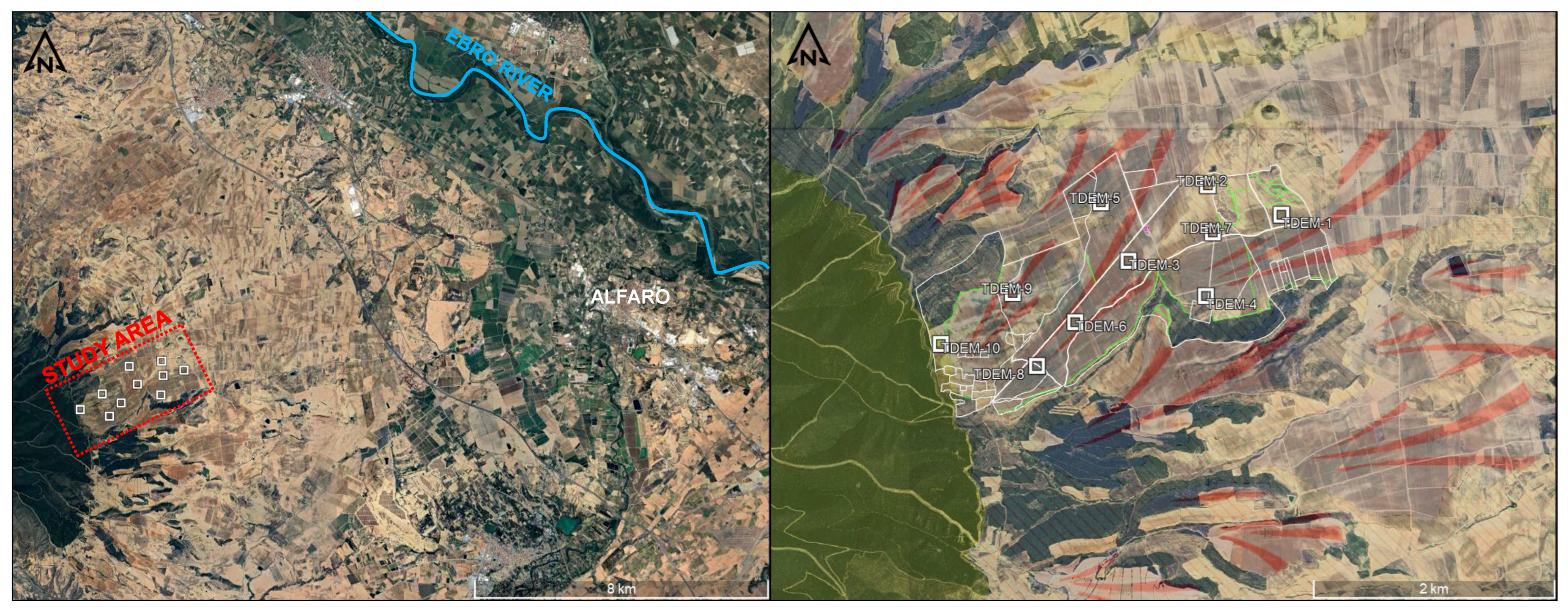
A total of 10 stations were acquired (
Figure 3), distributed along a W–E profile and two short N–S branches. The average spacing between loop centers was ~700 m, adapted to terrain accessibility. The orientation was designed to minimize coupling with metallic infrastructures and power lines, although in two stations close to roads, slightly higher electromagnetic noise was recorded.
During each acquisition, between 500 and 5000 stacking cycles were executed depending on noise conditions. The objective was to ensure a sufficient signal-to-noise ratio (SNR) in the late-time windows, a fundamental criterion to achieve adequate depths of investigation [
3].
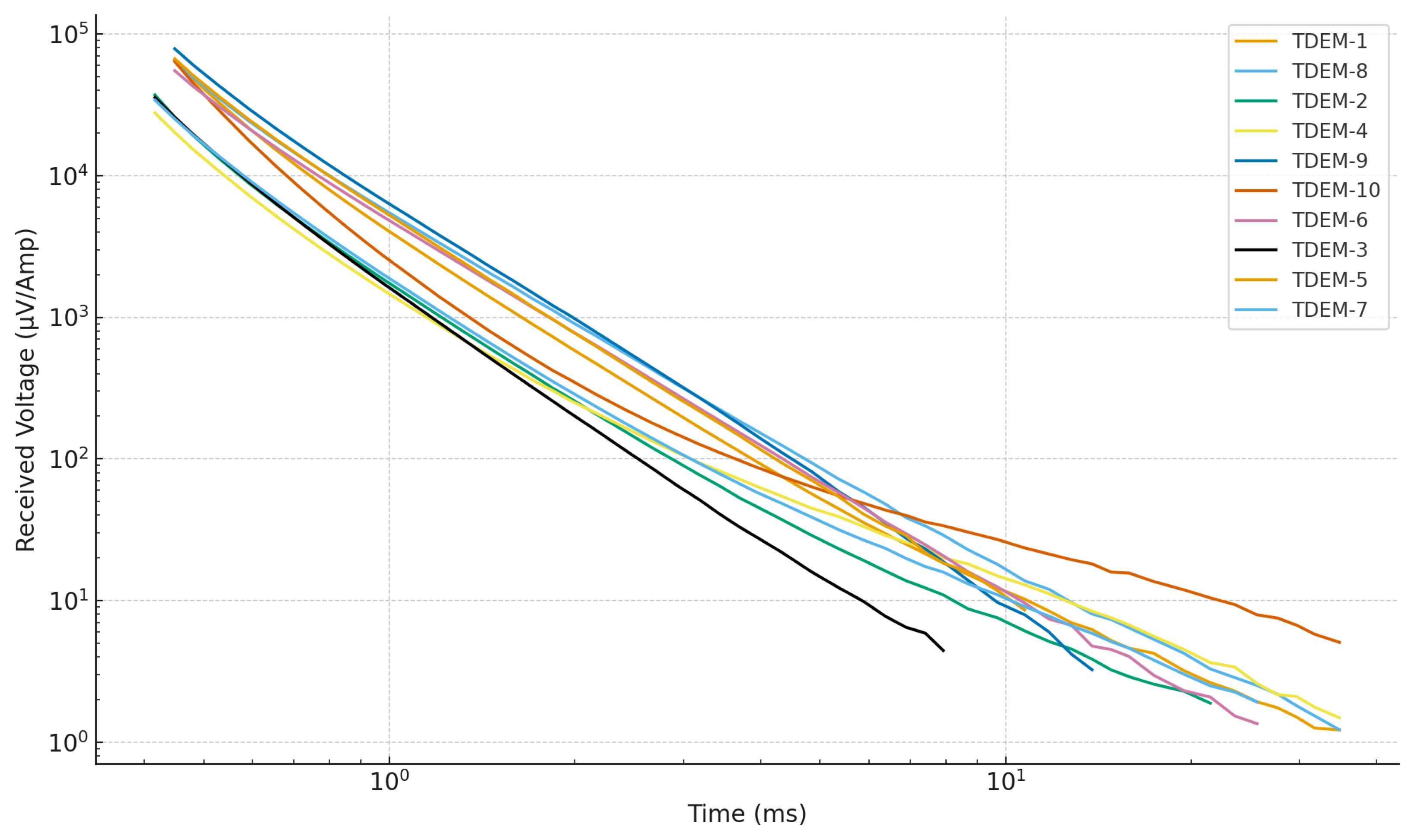
A representative set of the ten decay curves acquired in the field is shown in
Figure 4, illustrating the signal quality and the consistency of the transient responses across the survey area.
2.2. Data Processing
All TDEM soundings were exported in USF format using the TEMPLot software provided by Monex GeoScope (
https://www.monexgeoscope.com.au, version 2.0.0, accessed on 5 December 2025). The raw TEM records were subjected to a rigorous quality-control workflow before inversion. First, anomalous spikes and contaminated cycles were identified and removed to suppress cultural and instrumental noise. Subsequently, the data were normalized using the true magnetic moment of the loop, calculated as the product of the average current and the effective area, thus ensuring consistency among all stations. Time-shift corrections associated with transmitter triggering were also applied, following standard recommendations in transient electromagnetic processing [
1,
14].
Finally, the variance per window was estimated from the statistical dispersion of the stacked cycles, which provided an objective measure of data uncertainty to be incorporated into the inversion process [
15]. As a result of this preprocessing, the final transients exhibited a notable reduction in dispersion and greater stability, and were therefore fully suitable for subsequent inversion and three-dimensional integration.
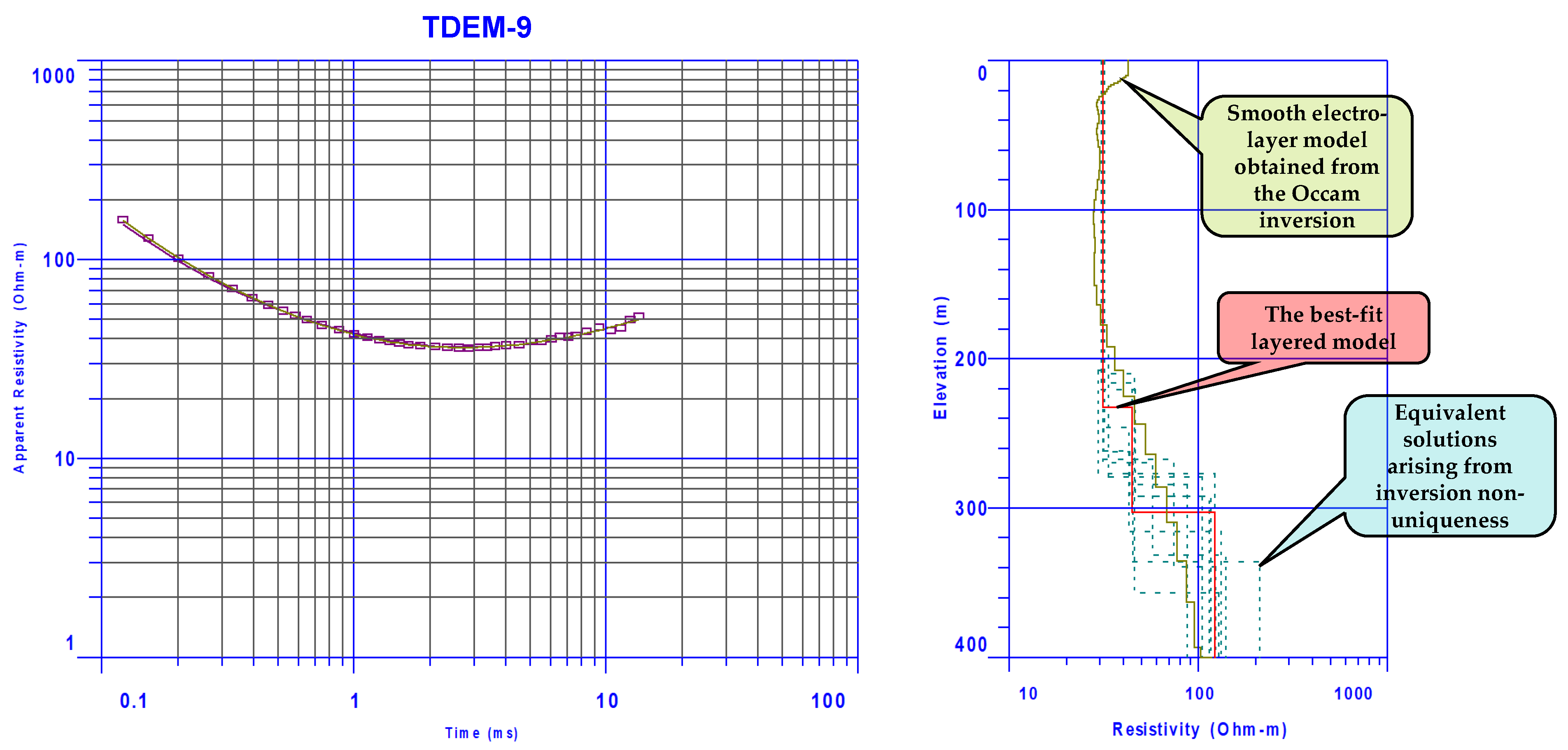
The 1D inversion was carried out using the IX1D software (Interpex Limited, Golden, CO, USA; available online:
https://www.interpex.com/ix1d.html, version 3.44, accessed on 5 December 2025) (
Figure 5). The Occam inversion algorithm implemented in IX1D 3.44 was used to obtain the smoothest model compatible with the measured transients, avoiding unjustified oscillations. Occam’s inversion was preferred because it provides stable results for TDEM datasets with moderate station density and variable noise levels, producing the smoothest conductivity model consistent with the measured transients. In contrast, Marquardt or damped least-squares approaches tend to generate models with stronger layer-to-layer contrasts, which can lead to instability or overfitting when late-time uncertainties are significant. Smoothness-constrained least-squares methods also require careful tuning of regularization parameters, whereas Occam’s formulation determines the smoothest acceptable model automatically, reducing subjectivity in parameter selection. However, Occam’s method has limitations: the resulting models may oversmooth sharp geological boundaries and suppress localized resistive or conductive bodies. For this reason, complementary layered models were also generated to evaluate non-uniqueness and better understand potential sharp contrasts.
To assess inversion non-uniqueness, IX1D 3.44 was used to generate families of equivalent models that fit the data within acceptable RMS thresholds. These model ensembles (represented by the dashed curves in the inversion figures) provide a measure of parameter uncertainty and illustrate the range of plausible resistivity structures compatible with the recorded transients. In addition, the comparison between smooth Occam models and discrete layered models served as a practical sensitivity analysis, allowing us to evaluate the stability of key resistivity contrasts. Lateral coherence between adjacent soundings was also used as an additional constraint to mitigate non-uniqueness. Although a full probabilistic inversion was beyond the scope of this study, the combined use of model ensembles, layered inversions, and 3D spatial consistency provides a robust framework for assessing and reducing inversion uncertainty.
Additionally, discrete layered models with equal thickness were explored to evaluate non-uniqueness. The quality of each inversion was assessed using three complementary criteria: a root mean square (RMS) misfit typically below 5–8%, randomly distributed residuals with no systematic trends, and lateral coherence of inversion results between adjacent soundings. These conditions ensured the stability and reliability of the inverted models and allowed their integration into the subsequent 3D interpretation.
2.3. Three-Dimensional Modeling
The key step was the integration of the 1D models into a three-dimensional volume. To accomplish this, the authors used the Oasis Montaj 2025.1 software, a widely used tool in applied geophysics for handling large datasets and producing interactive visualizations. In addition to its geophysical capabilities, the software served as a geomatic environment that enabled the spatial integration, interpolation, and visualization of the inverted models within a coherent 3D framework.
The workflow for generating the pseudo-3D resistivity volume consisted of several steps. First, the inverted 1D resistivity columns (depth versus resistivity) were exported in a compatible format. These columns were then interpolated using ordinary kriging with a voxel size of 25 × 25 × 25 m. A spherical variogram model was selected after testing exponential and Gaussian structures, as it provided the most stable and geologically consistent representation of lateral resistivity trends. The fitted variogram parameters were nugget = 0, sill ≈ 279.8, and range ≈ 2534.5 m, obtained from the experimental semivariogram. Ordinary kriging was chosen because it assumes a locally constant mean within the search neighborhood, an appropriate condition for TDEM-derived resistivity values that vary smoothly at intermediate scales while preserving localized contrasts. This approach minimizes interpolation bias and avoids introducing artificial gradients. The resulting interpolated grid was subsequently assembled into a pseudo-3D resistivity model from which cross-sections, depth slices, and isosurfaces were extracted for interpretation.
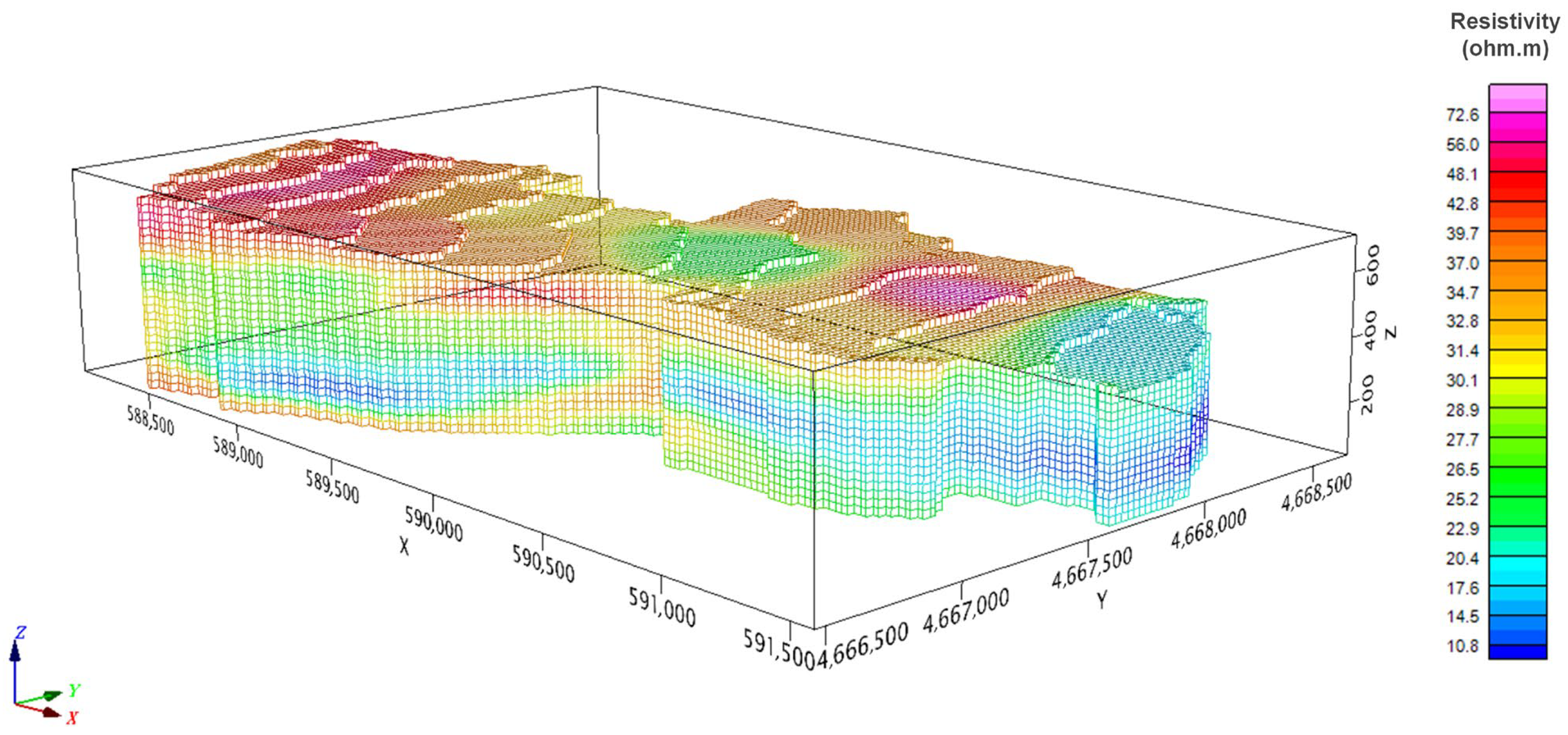
This volume (
Figure 6) made it possible to visualize the continuous distribution of resistivities, identify thickenings and wedges, and analyze lateral trends with greater clarity than through the interpretation of isolated 1D columns.
The reliability of the 1D-to-3D conversion was further evaluated using statistical diagnostics of the kriging-based interpolation applied to construct the volumetric resistivity model. Voxel statistics indicate a well-constrained distribution of resistivity values, with a mean of approximately 34 ohm·m and a standard deviation of about 18 ohm·m, consistent with the expected variability of heterogeneous Miocene sedimentary deposits. The resulting histogram shows a smooth, unimodal distribution without artificial clustering or extreme outliers, suggesting that the interpolation process does not introduce spurious resistivity values. These characteristics, together with the use of a well-defined variogram model, support the robustness of the kriging interpolation and confirm that the resulting pseudo-3D model provides a reliable spatial representation of the resistivity structure inferred from the 1D TDEM inversions.
2.4. Justification of the Approach
The choice of a workflow based on 1D inversion followed by 3D interpolation reflects the need to balance computational efficiency with interpretative robustness. Although full 3D inversion can provide more detailed and physically consistent results, its implementation requires high station density and substantial computational resources, making it impractical for many exploratory surveys [
7]. In contrast, constructing a pseudo-3D resistivity volume from interpolated 1D models offers a reliable and efficient alternative, capable of producing a continuous subsurface representation and revealing regional resistivity patterns of interpretative value. This approach also facilitates the identification of favorable drilling zones by providing spatial coherence without the demanding requirements of full 3D inversion. Previous studies have suggested that combining 1D-based spatial interpolation with more advanced inversion strategies can help mitigate some of the limitations inherent to independent 1D modeling approaches [
16].
3. Results
The integration of the TDEM survey in Alfaro provided a high-quality dataset that enabled the construction of a robust pseudo-3D model. The main results are presented below, organized into four sections: data quality, models, 3D volume construction, and analysis of geoelectrical domains with hydrogeological potential.
3.1. Data Quality
The acquired transients generally showed a high SNR, especially at stations located away from electrical infrastructures. In eight out of ten stations, an SNR greater than 5 was achieved in at least three late-time windows, a criterion that, following Fitterman and Stewart [
3], ensures an effective depth of investigation greater than 350 m.
At stations near roads and medium-voltage power lines, it was necessary to increase the number of stacking cycles to more than 4000, which stabilized the tail of the transient. This strategy is consistent with Herckenrath et al. [
17], who recommend adaptive stacking in environments affected by cultural noise.
Inversion quality was evaluated through a quantitative analysis of the residuals between observed and calculated transient responses, together with standard data-quality indicators. Residual statistics computed from normalized differences for each time gate are summarized in
Table 1, along with SNR, stacking cycles, and RMS misfit values for both layered and Occam inversion models. Mean residuals are close to zero for all soundings, and the associated standard deviations remain within values consistent with data quality and late-time noise levels, indicating the absence of systematic bias in the inversion results and supporting the reliability of the obtained models.
3.2. One-Dimensional Inverted Models
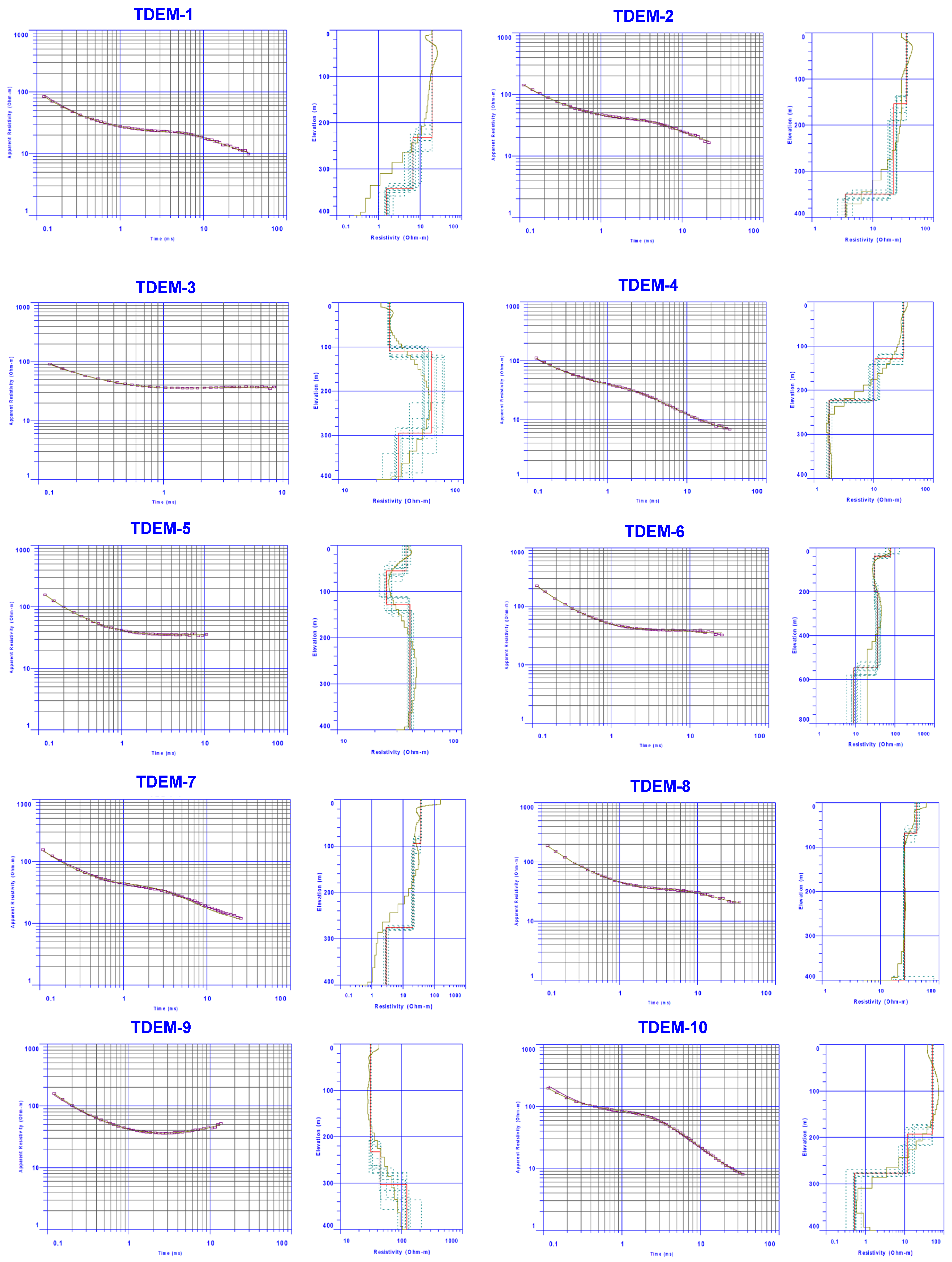
The 1D TDEM models revealed a general pattern characterized by a coherent geoelectrical stratigraphy, although not always with uniform behavior across all stations. The most prominent feature is the presence of a resistive domain, with values ranging between 40 and 80 ohm·m, which shows lateral continuity and significant thicknesses over most of the area. This interval is interpreted as cleaner deposits (sandstones and conglomerates) with high permeability and therefore constitutes the primary hydrogeological target for groundwater extraction.
In the upper part, more conductive levels (20–40 ohm·m) were recognized, which may correspond to silty sands and materials of lower relative permeability, while at greater depths, resistivities below 20 ohm·m dominate, associated with Miocene marls and clays acting as a confining base.
This behavior is consistent with observations by Carrasco-García et al. [
5] in the Duero Basin, where resistive intervals were identified as aquifer horizons of interest. Similarly, Porras et al. [
9] documented in Barbastro how deep conductive domains limit the effective aquifer thickness, reinforcing the idea that intermediate resistive zones are the most promising for exploitation.
All ten inverted TDEM models, including the electro-layer structure, are presented in
Figure 7 to provide a complete view of the subsurface resistivity distribution obtained from the 1D inversion.
3.3. Construction of the 3D Volume
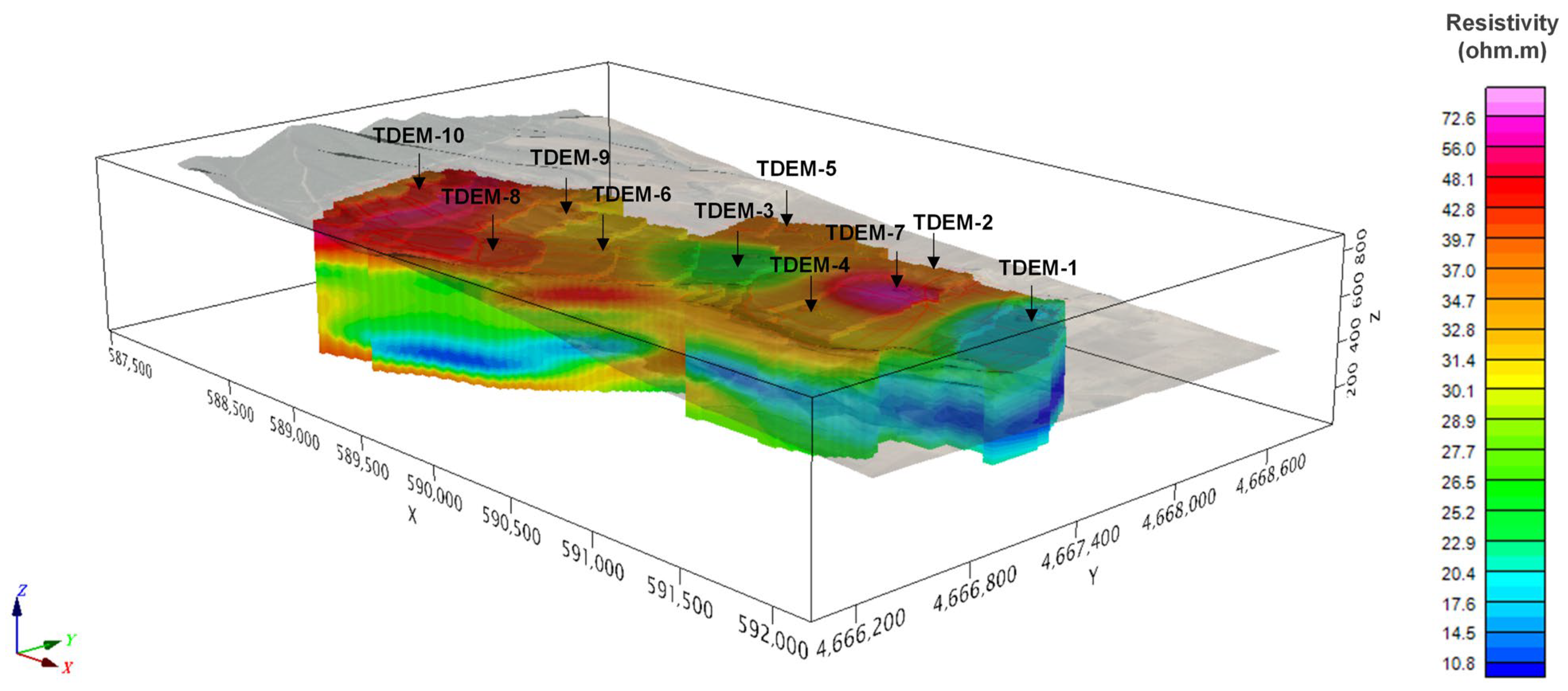
The transition from 1D models to a 3D cube (
Figure 8) represented a significant step forward. Interpolation allowed continuous visualization of domain geometry, highlighting trends that were not evident in the station-by-station interpretation.
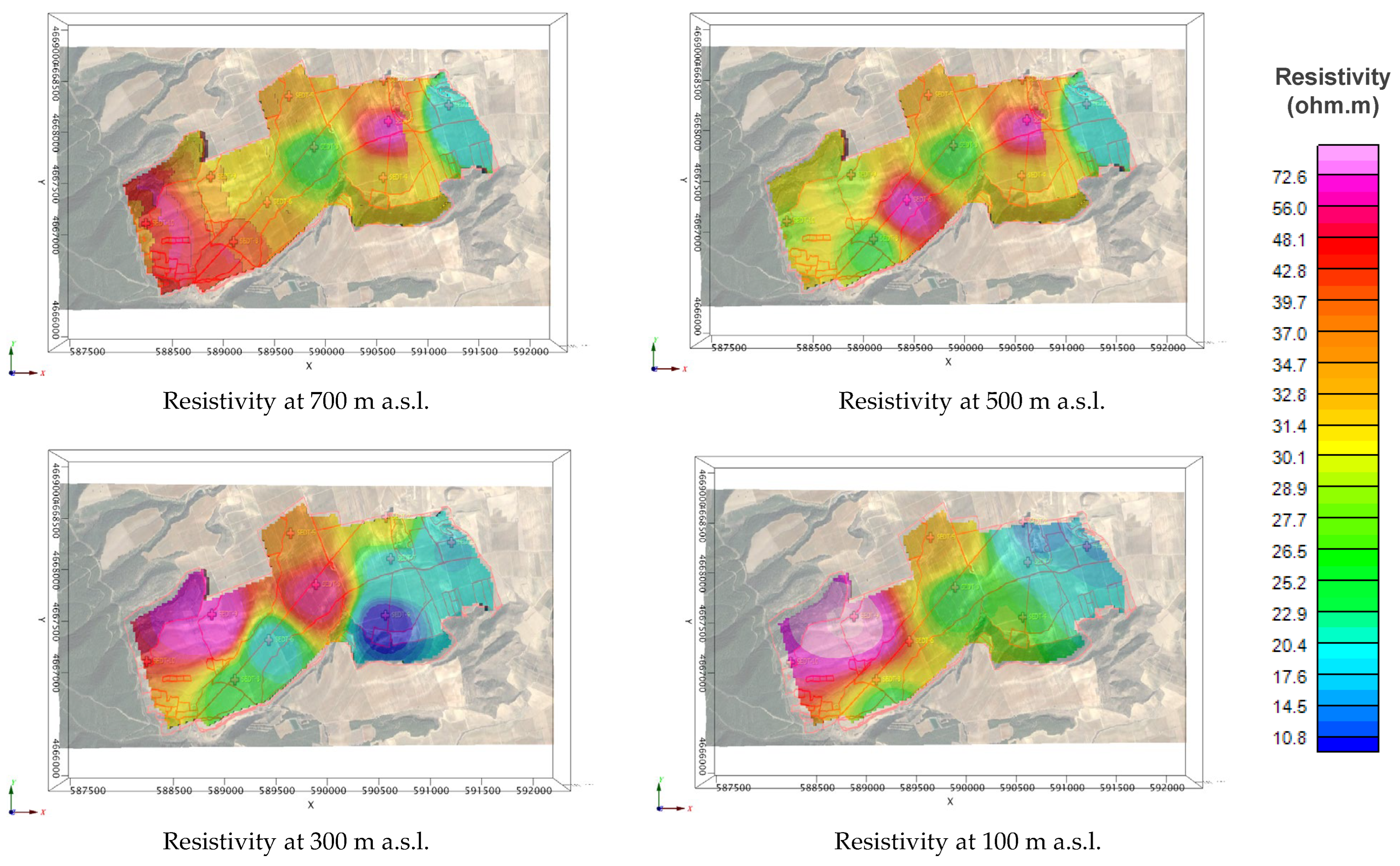
Horizontal slices at different elevations (700, 500, 300, 100 m a.s.l.) revealed a W–E lateral gradient toward lower resistivities (
Figure 9), suggesting an increase in fine-grained materials in the eastern sector. This gradient had already been indicated by regional studies [
9], but the pseudo-3D modeling made it evident with greater detail.
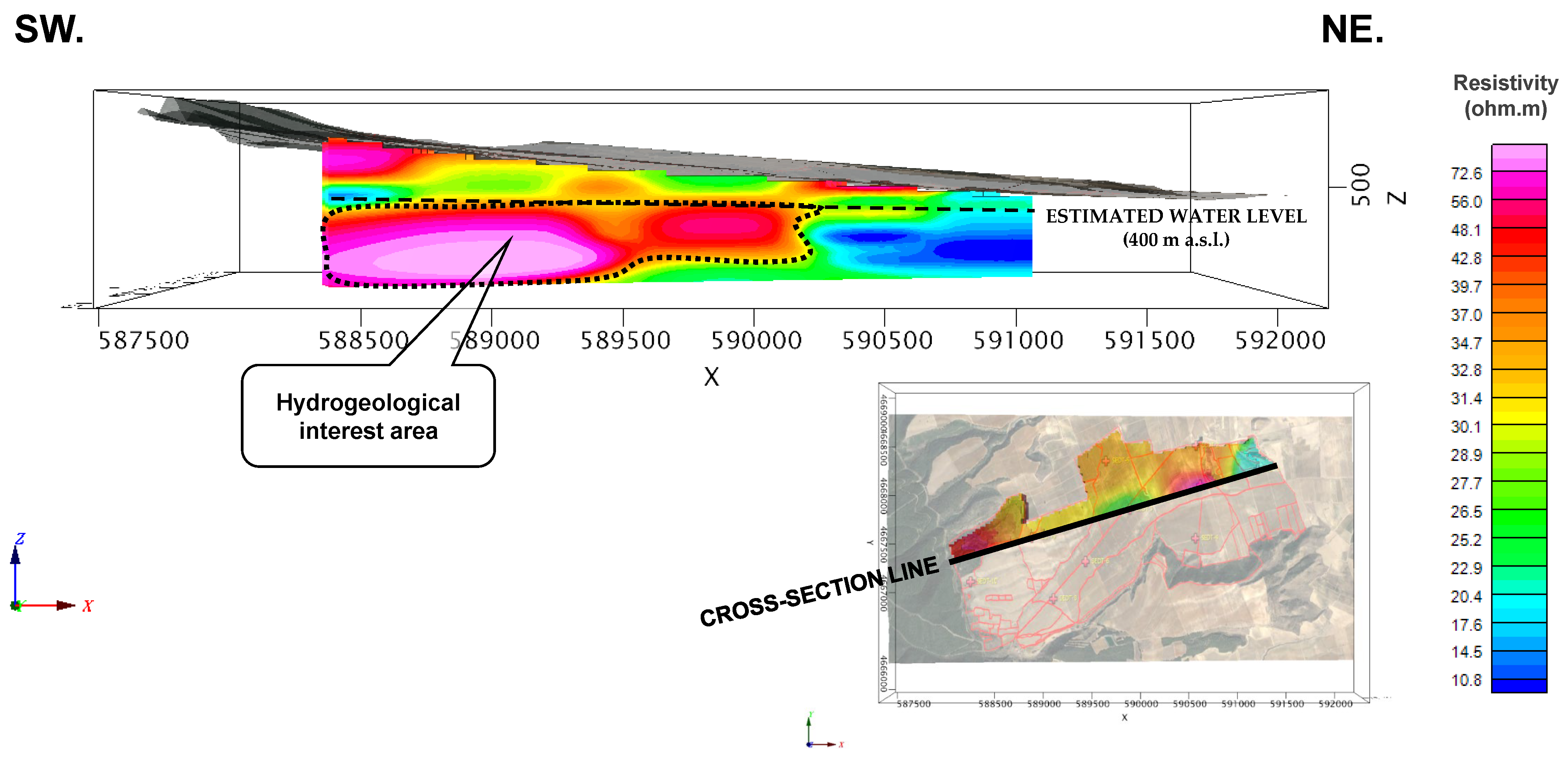
The SW–NE cross-section (
Figure 10) highlighted the wedge-shaped thickening of the upper domain (40–80 ohm·m), which expands toward the central and western part of the site below the water table. This wedge constitutes a priority drilling target, as it represents the unit with the greatest lateral continuity and thickness, consistent with recommendations by Herckenrath et al. [
17] in hydrogeophysical joint-inversion studies.
3.4. Identification of Geoelectrical Domains
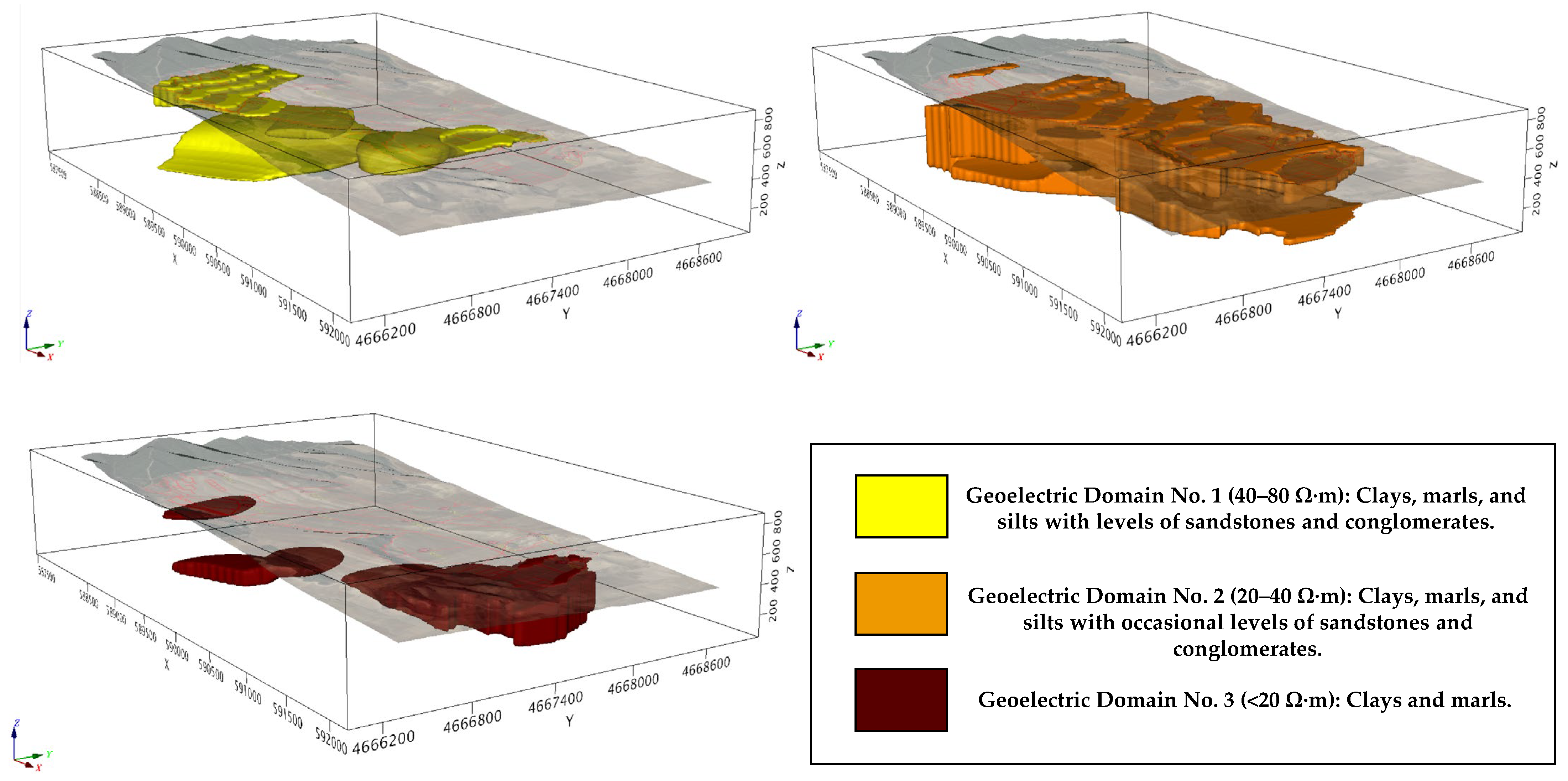
The pseudo-3D model clearly differentiated three geoelectrical domains (
Figure 11):
Geoelectrical Domain No. 1 (40–80 ohm·m): Defined by resistivity values between 40 and 80 ohm·m. The most resistive intervals are associated with higher concentrations of sandstones and conglomerates, while the more conductive zones correspond to clay-rich layers. This unit occurs most frequently in the western part of the site and represents the main drilling target.
Geoelectrical Domain No. 2 (20–40 ohm·m): Defined by resistivity values between 20 and 40 ohm·m. The more resistive intervals are linked to sandstones and conglomerates, while the more conductive intervals are linked to higher clay content. Overall, this unit presents greater clayey composition than Domain No. 1.
Geoelectrical Domain No. 3 (<20 ohm·m): Extensively developed toward the east, associated with Miocene marls and clays. Its low resistivity rules it out as a useful reservoir but makes it an effective hydrogeological base.
Volumetric analysis indicated that Domain No. 1 occupies approximately 35% of the total modeled volume, concentrated in the central and western sectors. The identification of this domain as the main drilling target is consistent with previous works that highlight resistivities of 40–80 ohm·m as the optimal range in fluvial and lacustrine sediments [
4,
17].
4. Discussion
4.1. Comparison with Previous Studies
The results obtained in Alfaro are consistent with observations from other sedimentary contexts both in the Iberian Peninsula and internationally. Carrasco-García et al. [
5] documented in the Duero Basin the presence of high-resistivity domains that proved to be the most favorable for hydrogeothermal exploration. Porras et al. [
9], in Barbastro, observed how the presence of deep conductive domains (<20 ohm·m) acted as seals, limiting the effective thickness of aquifers.
At the international level, studies such as those by Auken et al. [
4] and Herckenrath et al. [
17] have pointed out that the correlation between high resistivity and greater relative permeability is repeated in multiple sedimentary contexts. Yin et al. [
11], through 3D TDEM modeling in heterogeneous environments, demonstrated that the lateral continuity of resistive domains is a robust indicator of hydrogeological interest zones.
4.2. Advantages of Pseudo-3D Modeling over 1D Interpretations
The added value of this work lies in the integration of the results into a pseudo-3D volume. While 1D inversion provides an initial diagnostic, three-dimensional interpolation:
Reduces spatial uncertainty by showing continuous trends instead of isolated columns;
Facilitates the identification of drilling targets, since thicknesses and continuities are assessed volumetrically;
Allows the generation of intuitive visualizations, useful not only for geophysicists but also for drilling engineers and resource managers.
This aspect is consistent with Christiansen and Auken [
7], who argue that the transition from 1D interpretations to volumetric visualizations marks a qualitative shift in the usefulness of electromagnetic data.
4.3. Limitations of the Approach
Despite its advantages, the approach of constructing a pseudo-3D model from 1D data has limitations that must be acknowledged:
Nevertheless, these drawbacks are outweighed by the interpretative gain provided by a pseudo-3D volume. Moreover, recent studies [
15] suggest that the combination of 3D interpolation with advanced inversion algorithms will further reduce these limitations in the future.
4.4. Selection of the Best Drilling Site
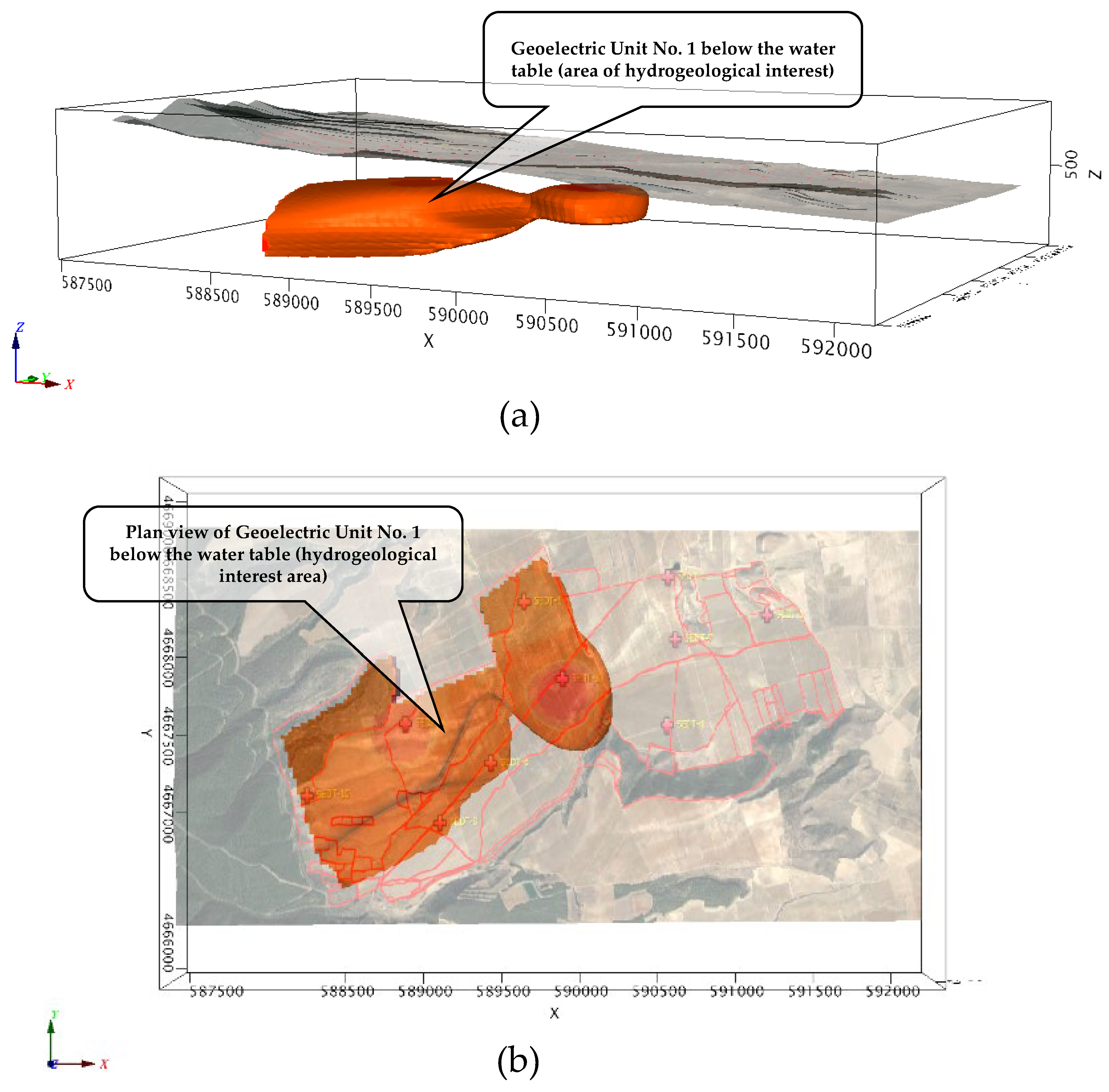
The ultimate goal of this study was to determine the best point to drill for groundwater (
Figure 12). Volumetric analysis identified that Geoelectrical Domain No. 1 (40–80 ohm·m) presents:
Greater thickness in the central–western sector;
Sustained lateral continuity, reducing the risk of drilling into isolated bodies;
Direct contact with more resistive shallow domains, which favors recharge.
These criteria are consistent with the methodological approach of Herckenrath et al. [
17], who advocated for the integration of TDEM with hydrogeological flow models to optimize decision-making. They are also in line with the experiences of Ren [
18], who highlighted the value of volumetric models to reduce uncertainty.
In short, the main strength of 3D modeling is that it transforms a set of decay curves into an objective volumetric map that facilitates strategic decision-making.
4.5. Practical Implications
This approach has direct implications for water resource management:
Cost reduction: locating optimal zones avoids failed drillings;
Greater technical confidence: volumetric analysis provides additional support for recommendations;
Transferability: the methodology can be applied in other sedimentary basins, adjusting acquisition parameters.
Although the resistivity domains have been hydrogeologically interpreted, the study area currently lacks borehole or pumping-test data that would allow a direct validation of these interpretations. Future work will incorporate lithological and hydraulic information as soon as it becomes available, which will enable a more robust calibration of the geophysical model.
The findings of this study directly support the objectives of the United Nations Sustainable Development Goal 6 (Clean Water and Sanitation), particularly targets 6.4 and 6.5, which focus on increasing water-use efficiency and improving integrated water resources management. By providing a robust pseudo-3D geoelectrical model that reduces uncertainty in the identification of productive aquifer zones, this methodology enhances groundwater exploration efficiency and minimizes the risk of unsuccessful drilling. The integration of TDEM soundings into a geomatic platform contributes to more sustainable groundwater planning, offering decision-makers a reliable tool for managing water resources in sedimentary environments facing increasing pressure from climate change and overextraction.
5. Conclusions
The present study conducted in Alfaro (La Rioja, Spain) highlights the high potential of TDEM soundings when combined with three-dimensional modeling techniques. The use of 200 × 200 m loops enabled investigation depths of up to 450 m, which proved sufficient to characterize the thick Tertiary sedimentary sequence of the area.
The geoelectrical results revealed a coherent structure defined by three main domains: a resistive domain, an intermediate domain, and a clearly conductive domain. Among them, the resistive domain stood out as the most hydrogeologically relevant horizon, showing significant thicknesses, lateral continuity, and favorable contact with more permeable units.
The three-dimensional interpolation of 1D models generated a continuous resistivity volume. This spatial representation not only allowed the optimal drilling zones to be identified with greater confidence but also provided an objective basis for technical decision-making.
Overall, the study demonstrates that the integration of TDEM data with pseudo-3D modeling strengthens the role of geomatics as an integrative framework for the management and planning of water resources in complex sedimentary environments. This methodology is shown to be effective, economically viable, and transferable to other sedimentary basins, consolidating itself as a valuable tool for applied hydrogeology and the planning of groundwater abstraction.
6. Recommendations
Based on the results obtained in the Alfaro study, several practical recommendations can be proposed for future groundwater exploration projects and for improving the integration of TDEM data within geomatic platforms:
Increase station density in heterogeneous areas: Although the present survey achieved robust regional characterization, adding more stations in zones with strong lateral variability would enhance the resolution of the interpolated 3D volume.
Combine TDEM with targeted borehole information: The inclusion of lithological logs or pumping-test data will allow calibration of resistivity domains and reduce the uncertainty associated with inversion non-uniqueness.
Use volumetric modeling as a standard exploratory tool: The integration of 1D inversion results into a 3D geomatic framework proves highly effective for identifying drilling targets, and should be incorporated routinely in groundwater exploration workflows.
Apply hydrogeophysical coupling when feasible: Integrating hydrological parameters may further reduce ambiguity and improve the prediction of aquifer properties.
Prioritize drilling in areas where resistive domains show maximum thickness and lateral continuity: In the Alfaro case, these conditions occur in the central–western sector, making it the most suitable zone for groundwater extraction.
Replicate the methodology in other sedimentary basins: The workflow used here is transferable and cost-effective, making it applicable to similar Miocene or detrital environments.
Author Contributions
Conceptualization, P.C.-G.; methodology, P.C.-G.; software, P.C.-G.; validation, P.C.-G., J.C.-G., J.L.H.-P. and P.H.; formal analysis, P.C.-G.; investigation, P.C.-G., J.C.-G., J.L.H.-P. and P.H.; resources, P.C.-G., J.C.-G., J.L.H.-P. and P.H.; data curation, P.C.-G., J.C.-G., J.L.H.-P. and P.H.; writing—original draft preparation, P.C.-G.; writing—review and editing, P.C.-G., J.C.-G., J.L.H.-P. and P.H.; visualization, P.C.-G., J.C.-G., J.L.H.-P. and P.H.; supervision, P.C.-G.; project administration, P.C.-G.; funding acquisition, P.C.-G., J.C.-G., J.L.H.-P. and P.H. All authors have read and agreed to the published version of the manuscript.
Funding
This research has been funded by the research project PID2022-14713NB-100 of the MCIN/AEI/10.13039/501100011033/ and FEDER “Una manera de hacer Europa”.
Data Availability Statement
The original contributions presented in this study are included in the article. Further inquiries can be directed to the corresponding author.
Acknowledgments
The authors would like to acknowledge Seequent for their support and the use of Oasis Montaj 2025.1 software, which was essential for the development of this work. Generative AI tools (ChatGPT by OpenAI) were used to assist in improving the English language, grammar, and style of the manuscript.
Conflicts of Interest
Author Javier Carrasco-García was the director of the company Técnicas Geofísicas S.L. The remaining authors declare that the research was conducted in the absence of any commercial or financial relationships that could be construed as a potential conflict of interest.
References
- Nabighian, M.N. Electromagnetic Methods in Applied Geophysics; Society of Exploration Geophysicists: Tulsa, OK, USA, 1988. [Google Scholar] [CrossRef]
- Spies, B.R. Depth of investigation in electromagnetic sounding methods. Geophysics 1989, 54, 872–888. [Google Scholar] [CrossRef]
- Fitterman, D.V.; Stewart, M.T. Transient electromagnetic sounding for groundwater. Geophysics 1986, 51, 995–1005. [Google Scholar] [CrossRef]
- Auken, E.; Christiansen, A.V.; Jacobsen, B.H.; Foged, N.; Sørensen, K.I. Piecewise 1D Laterally Constrained Inversion of Resistivity Data. Geophys. Prospect. 2005, 53, 497–506. [Google Scholar] [CrossRef]
- Carrasco-García, P.; Martín-Nieto, I.; Sáez-Blázquez, C.; Farfán-Martín, A.R.; González-Aguilera, D.; Carrasco-García, J. Geophysical Prospecting for Geothermal Resources in the South of the Duero Basin (Spain). Energies 2020, 13, 5397. [Google Scholar] [CrossRef]
- Constable, S.C.; Parker, R.L.; Constable, C.G. Occam’s inversion: A practical algorithm for generating smooth models from electromagnetic sounding data. Geophysics 1987, 52, 289–300. [Google Scholar] [CrossRef]
- Christiansen, A.V.; Auken, E. A global measure for depth of investigation in EM soundings. Geophysics 2012, 77, WB171–WB177. [Google Scholar] [CrossRef]
- Ruiz-Constán, A.; Pedrera, A.; Martos-Rosillo, S.; Galindo-Zaldívar, J.; Martín-Montañés, C.; González de Aguilar, J.P. Structure of a Complex Carbonate Aquifer by Magnetic, Gravity and TDEM Prospecting in the Jaén Area, Southern Spain. Geol. Acta 2015, 13, 191–203. [Google Scholar] [CrossRef]
- Porras, D.; Carrasco, J.; Carrasco, P.; Herrero-Pacheco, J.L. A Case Study of the Barbastro Saline-Evaporitic Formation Using Deep TDEM. Appl. Sci. 2023, 13, 6385. [Google Scholar] [CrossRef]
- Yin, C.; Gao, Z.; Su, Y.; Liu, Y.; Huang, X.; Ren, X.; Xiong, B. 3D Airborne EM Forward Modeling Based on Time-Domain Spectral Element Method. Remote Sens. 2021, 13, 601. [Google Scholar] [CrossRef]
- Stumm, F.; Como, M.D.; Zuck, M.A. Use of Time Domain Electromagnetic Soundings and Borehole Electromagnetic Induction Logs to Delineate the Freshwater/Saltwater Interface on Southwestern Long Island, New York, 2015–17; Open-File Report, 2020–1093; U.S. Geological Survey: Reston, VA, USA, 2020. [Google Scholar] [CrossRef]
- IGME. Mapa Geológico de España 1:50.000 (MAGNA), Hoja 281 Cervera del Río Alhama, 2nd ed.; Instituto Geológico y Minero de España: Madrid, Spain, 1983. [Google Scholar]
- Confederación Hidrográfica del Ebro (CHE). Groundwater and Hydrogeological Information of the Ebro Basin. Available online: https://www.chebro.es (accessed on 5 December 2025).
- Macnae, J.C.; Lamontagne, Y.; West, G.F. Noise processing techniques for time-domain electromagnetic systems. Geophysics 1984, 49, 934–948. [Google Scholar] [CrossRef]
- Correa, J.L.; Régis, C. Spatially Constrained 1D Inversions of Common-Midpoint Marine Controlled-Source Electromagnetic Data to Create a 3D Electrical Model. Appl. Sci. 2024, 14, 11281. [Google Scholar] [CrossRef]
- Haber, E.; Ascher, U.; Oldenburg, D.W. Inversion of 3D electromagnetic data in frequency and time domain using an inexact all-at-once approach. Geophysics 2004, 69, 1216–1228. [Google Scholar] [CrossRef]
- Herckenrath, D.; Fiandaca, G.; Auken, E. Sequential and joint hydrogeophysical inversion using coupled TDEM and flow. Hydrol. Earth Syst. Sci. 2013, 17, 4043–4060. [Google Scholar] [CrossRef]
- Ren, Z.; Kalscheuer, T. Uncertainty and Resolution Analysis of 2D and 3D Inversion Models Computed from Geophysical Electromagnetic Data. Surv. Geophys. 2020, 41, 47–112. [Google Scholar] [CrossRef]
| Disclaimer/Publisher’s Note: The statements, opinions and data contained in all publications are solely those of the individual author(s) and contributor(s) and not of MDPI and/or the editor(s). MDPI and/or the editor(s) disclaim responsibility for any injury to people or property resulting from any ideas, methods, instructions or products referred to in the content. |





 ,
,