Article

Species-Specific Bioremediation and Biochemical Valorization Profiles of Peruvian Amazonian Chlorella sp. and Scenedesmus sp. in Municipal Landfill Leachate: Prospects for Circular Bioeconomy Applications


by
Marianela Cobos
1,2,*,†,
Luz E. Vela
3,†,
Segundo L. Estela
4,
Carlos G. Castro
1,
Miguel A. Grandez
5,
Remy G. Cabezudo
6,
Maritza Cabrera-Amasifén
1,
Jafet S. Suarez
1 and
Juan C. Castro
1,2,*
1
Specialized Unit of Biotechnology Research Laboratory, Natural Resources Research Center of UNAP, Universidad Nacional de la Amazonía Peruana (UNAP), Iquitos 16001, Peru
2
Academic Department of Biomedical Sciences and Biotechnology, Faculty of Biological Sciences, Universidad Nacional de la Amazonía Peruana (UNAP), Iquitos 16001, Peru
3
Academic Department of Botany, Faculty of Biological Sciences, Universidad Nacional de la Amazonía Peruana (UNAP), Iquitos 16001, Peru
4
Laboratory of Biotechnology and Bioenergetics, Universidad Científica del Perú (UCP), Iquitos 16001, Peru
5
Center for Natural and Human Sciences, Federal University of ABC, Alameda da Universidade, s/n, São Bernardo do Campo 09606-045, SP, Brazil
6
Laboratório de Química e Função de Proteínas e Peptídeos, Centro de Biociências e Biotecnologia, Universidade Estadual do Norte Fluminense Darcy Ribeiro, Campos dos Goytacazes 28013-602, RJ, Brazil
*
Authors to whom correspondence should be addressed.
These authors contributed equally to this work.
Water 2026, 18(16), 2018; https://doi.org/10.3390/w18162018
Submission received: 5 April 2026 / Revised: 4 August 2026 / Accepted: 6 August 2026 / Published: 18 August 2026
(This article belongs to the Section Wastewater Treatment and Reuse)

Abstract

Municipal solid waste landfill leachate represents one of the most environmentally challenging liquid effluents in modern waste management; however, its high nitrogen and phosphorus content renders it a potentially valuable nutrient source for microalgal phycoremediation. Here, Chlorella sp. and Scenedesmus sp. were cultivated for 15 days in CHU-10 standard medium and 50% (v/v) municipal landfill leachate from Nauta, Peru, and characterized across 33 biochemical variables, 14 physicochemical parameters, and 32 metal ions and trace elements. A sequential competitive multivariate pipeline comprising principal component analysis (PCA), hierarchical cluster analysis (HCA), permutational multivariate analysis of variance (PERMANOVA), and linear discriminant analysis (LDA) was applied to both the biochemical and bioremediation datasets. Leachate supplementation increased peak biomass density by 26.6–28.3% and elevated total protein by 56.9% in Chlorella sp. and 73.4% in Scenedesmus sp., while reducing total lipids by 37–46% and suppressing polyunsaturated fatty acid production. Both species achieved net biological removal efficiencies (NBRE) exceeding 86% for ammonium and ammonia; toxic elements, including Cd (~96%), Al (~92%), As (~90%), and Pb (~90%), were removed at higher NBRE than macro- and micronutrient categories. LDA achieved 100% leave-one-out cross-validation accuracy for species classification from both physicochemical and 32-element NBRE profiles. These findings indicate two complementary valorization directions, contingent on further biomass safety verification: leachate-grown Scenedesmus sp. shows a favorable combination of protein enrichment and nutrient removal for single-cell protein production integrated with bioremediation, while Chlorella sp. in standard medium shows a more favorable fatty acid profile for nutraceutical applications. Because leachate-grown biomass also accumulates inorganic and trace-element constituents from the medium, its suitability for protein or nutraceutical use requires direct heavy-metal characterization of the harvested biomass, independent of the demonstrated removal efficiency from the liquid phase.

1. Introduction

Microalgae have emerged as particularly promising organisms for integrated biorefinery applications, given their capacity to simultaneously deliver bioremediation services and produce valorizable biomass enriched in proteins, lipids, carbohydrates, and high-value compounds such as omega-3 fatty acids [1,2]. Municipal solid waste landfill leachate, one of the most hazardous liquid effluents generated by modern waste management systems, represents both an environmental challenge and an untapped nutrient resource for microalgal cultivation [3,4]. Its high ammoniacal nitrogen (500–3000 mg NH4+-N L−1) and phosphorus content, which underlie its toxicity, can simultaneously serve as macronutrient inputs for autotrophic microalgal growth, a strategy known as phycoremediation or leachate polishing [2,5]. A growing body of evidence confirms that diluted leachate can sustain microalgal biomass production with nitrogen and phosphorus removal efficiencies exceeding 80% and 85%, respectively [6,7,8], positioning phycoremediation as a technically viable and environmentally aligned approach to leachate management within the circular bioeconomy framework [5,9]. Because this same leachate matrix also carries heavy metals and other undesirable constituents, any biomass produced through this route needs to have its safety profile verified before it can be proposed for feed, nutraceutical, or related downstream applications.
This challenge is particularly acute in the Peruvian Amazon, a region of globally recognized biodiversity, where solid waste management infrastructure remains markedly inadequate, and ambient water bodies in the Loreto region already exhibit widespread contamination from anthropogenic activities [10,11]. Published characterizations of Peruvian landfill leachate report highly toxic and poorly stabilized profiles consistent with the tropical climate, which simultaneously accelerates microbial decomposition and generates high leachate volumes throughout the year [12,13]. Published data on leachate generation and treatment across the broader Amazonian Basin are extremely scarce [11]; nonetheless, preliminary investigations from the Loreto region have demonstrated that native Amazonian Chlorella sp. and Scenedesmus sp. can remove up to 81% of ammonia from local landfill leachate [14], while Amazonian-native microalgae more broadly biosynthesize proteins, essential amino acids, omega-3 fatty acids, and phenolic compounds of nutritional significance [15], establishing the dual bioremediation and valorization potential of locally adapted strains. Recently, Cabezudo et al. [16] reported that a native Amazonian cyanobacterium achieved effective ammonium removal from municipal wastewater in Iquitos within a circular bioeconomy framework, establishing a regional precedent for the application of indigenous microorganisms to integrated treatment–valorization systems.
Chlorella sp. and Scenedesmus sp. are the most extensively evaluated genera for landfill leachate phycoremediation; however, they exhibit complementary rather than redundant biotechnological profiles [7,8,17,18]. For the specific matrix examined here, a high-ammonium, high-alkalinity, metal-laden leachate at 50% dilution, this complementarity is a direct rationale for the comparison, rather than a general one drawn only from the literature. Chlorella sp. is distinguished by its high protein content, balanced essential amino acid composition, and capacity for polyunsaturated fatty acid (PUFAs) biosynthesis [19,20], whereas Scenedesmus sp. is recognized for its robust cell wall, efficient nitrogen assimilation, and a C16–C18-dominated fatty acid profile suited to biodiesel and single-cell protein applications [18,21,22]. In leachate-supplemented media, the elevated ammoniacal nitrogen loading drives pronounced biochemical trade-offs: protein content increases substantially, while total lipids and PUFAs are suppressed through carbon-to-nitrogen (C/N) partitioning and metal-induced oxidative inhibition of desaturase pathways [8,23,24,25]. Furthermore, both genera demonstrate broad-spectrum removal of heavy metals and trace elements, including Cd, Pb, As, Hg, and Al, through concurrent passive biosorption onto cell wall functional groups and active intracellular bioaccumulation [25,26,27], augmented by photosynthetically elevated pH, which promotes the co-precipitation of toxic metal species [26,28].
Despite the extensive body of literature on individual biochemical fractions or single nutrient removal parameters, to our knowledge, comparatively few studies have applied a competitive multivariate analytical pipeline, evaluating independent methods at each stage of standardization, dimensionality reduction, and cluster analysis, to jointly characterize the biochemical phenotype and multi-element bioremediation profile of these two genera under identical cultivation conditions. To the best of our knowledge, this has not been done for native Amazonian isolates [29,30,31]. We frame this as a gap that our study helps address, rather than a claim that no comparable analysis exists in the wider literature. Against this background, the present study aims to comprehensively characterize the species-specific bioremediation fingerprints and biochemical valorization profiles of native Amazonian Chlorella sp. and Scenedesmus sp. cultivated in 50% (v/v) municipal landfill leachate from Nauta city, Peruvian Amazon, through the simultaneous quantitative assessment of 33 biochemical variables, 14 physicochemical parameters, and 32 metal ions and trace elements, and to evaluate the potential of leachate-grown biomass for circular bioeconomy applications using a sequential competitive multivariate analytical pipeline comprising principal component analysis, hierarchical cluster analysis, permutational multivariate analysis of variance, and linear discriminant analysis.
We frame this study explicitly as an exploratory, pilot-scale investigation based on a single landfill leachate source (Nauta, Peruvian Amazon), a single dilution level (50% v/v), and a 15-day batch cultivation period conducted in biological triplicate. These design choices allowed us to characterize the bioremediation and biochemical responses of the two species in depth under one representative, well-controlled condition; however, they should be considered when considering how far the present findings can be generalized to other leachate sources, dilution levels, cultivation durations, or continuous-flow operating regimes.

2. Materials and Methods

2.1. Microorganisms, Experimental Design, and Growth Conditions

The microalgae used in this study, Chlorella sp. and Scenedesmus sp., were obtained from the Native Microalgal Culture Collection of UNAP and maintained as axenic stock cultures under standard photoautotrophic conditions before the experiments. A 15-day batch culture experiment was performed in triplicate for each microalgal species under two growth media conditions: (i) CHU-10 standard medium, prepared following the formulation described by Jacob-Lopes et al. [1], which served as the nutrient-defined control (hereafter Chl-C10 and Sce-C10 for Chlorella sp. and Scenedesmus sp., respectively); and (ii) landfill leachate diluted to 50% (v/v) with purified water (hereafter Chl-LL50 and Sce-LL50). Landfill leachate (3 L) was collected from an active municipal landfill in Nauta city (UTM: 0656319 E, 9506970 N) and filtered through 0.45 µm membranes prior to use. Five hundred milliliters of culture was maintained in 1 L Erlenmeyer flasks under continuous white fluorescent lamp (Wellmax®, Shanghai, China) illumination at 120 µmol photons m−2 s−1, a 12:12 h light:dark photoperiod, a temperature of 25 ± 1 °C, and continuous aeration.

2.2. Growth Monitoring and Kinetic Parameter Calculation

Growth was monitored daily by measuring the optical density of the culture at 680 nm (OD680) using a Genesys™ 150 Vis/UV-Vis spectrophotometer (Thermo Fischer Scientific, Waltham, MA, USA) in triplicate for each treatment. Daily mean OD680 and standard deviation were calculated across biological replicates (n = 3) for each treatment and time point. To confirm that the optical density at 680 nm (OD680) is a valid proxy for biomass, OD680 was calibrated against dry weight (DW) for both species (n = 6 paired measurements per species, spanning the full biomass range observed during cultivation; Table S1 and Figure S1). A linear calibration equation (DW (mg/mL) = 0.452 × OD680 − 0.062 [R2 = 0.996, p = 4.7 × 10⁻⁶] for Chlorella sp. and DW (mg/mL) = 0.456 × OD680 − 0.048 [R2 = 0.996, p = 7.0 × 10⁻⁶] for Scenedesmus sp.) was used, and its predictive validity was assessed using a Bland–Altman analysis [32,33] with a leave-one-out cross-validation (LOOCV). Bland–Altman analysis of LOOCV-predicted versus measured DW showed negligible bias (−0.003 mg/mL) and narrow 95% limits of agreement (−0.067 to +0.061 mg/mL; Table S1, Figure S1), with no significant proportional bias (slope = −0.014, p = 0.62).
Growth kinetics were quantified by nonlinear regression of the mean OD680 time course against a biologically reparametrized Gompertz equation [32], following the semi-mechanistic reformulation of classical sigmoidal growth models proposed by Mockaitis [33], and consistent with the growth-phase constants originally defined by Monod [34]. In this formulation, the model is expressed directly in terms of physiologically interpretable parameters rather than the abstract coefficients of the canonical Gompertz function:
X   t = X i + X f   X i e x p e x p μ m a x · e X f     X i   ·   λ   t   + 1
where X(t) is the predicted OD680 at culture day t, Xi and Xf are the fitted initial and asymptotic (maximum) OD680 values, respectively, μmax (d−1) is the apparent maximum specific growth rate corresponding to the slope at the curve’s inflection point, λ (days) is the lag-phase duration defined as the time-axis intercept of the tangent line drawn through the inflection point, and e is Euler’s number. The total growth (G), as originally defined by Monod [34], was calculated as G = XfXi, and the doubling time (Td, days) was derived as:
D o u b l i n g   t i m e   T d ,   d a y s = l n 2 μ m a x
Model parameters were estimated independently for each treatment using a two-stage optimization strategy to avoid dependence on arbitrary initial guesses and entrapment in local minima: a global search via Differential Evolution, followed by local refinement using bounded nonlinear least-squares (trust-region reflective algorithm). The goodness of fit was assessed for each treatment using the coefficient of determination (R2) and the root-mean-square error (RMSE) between the observed and predicted OD680 values. All treatments displayed a single sigmoidal transition with no evidence of multiple inflection points, consistent with monoauxic (single-phase) growth; therefore, a single Gompertz term was sufficient to describe each curve without requiring the polyauxic (multi-phase) extension of the model [33]. All calculations were performed using Python 3.13.14 (SciPy 1.17.1, NumPy 2.3.5).

2.3. Physicochemical Characterization of Landfill Leachate

Fourteen physicochemical parameters were quantified in all experimental units on day 0 (initial leachate) and day 15 (end of the culture period): ammonium (NH4+, mg/L), free ammonia (NH3, mg/L), total hardness (mg/L as CaCO3), total alkalinity (mg/L as CaCO3), total acidity (mg/L as CaCO3), chloride (Cl, mg/L), nitrate (NO3-N, mg/L), nitrite (NO2-N, mg/L), sulfate (mg SO4/L), orthophosphate (mg P/L), chemical oxygen demand (COD, mg/L O2), biochemical oxygen demand (BOD, mg/L O2), total organic carbon (TOC, mg/L), and pH (pH units). All physicochemical determinations were performed on clarified samples obtained by filtering each replicate culture through a 0.45 µm pore-size membrane filter, with each determination performed in technical triplicates. Analyses were conducted by an ISO/IEC 17025-accredited third-party laboratory, following internationally recognized standard methods [35]. A parallel abiotic control group, consisting of the same 50% (v/v) leachate medium incubated under identical conditions but without microalgal inoculation, was maintained throughout the experiment to quantify the non-biological physicochemical changes occurring over the 15-day culture period.

2.4. Quantification of Metal Ions and Trace Elements by ICP-MS

The concentrations of 32 metal ions and trace elements were quantified in filtered landfill leachate and culture medium samples (0.45 µm membrane) collected from each experimental unit at day 0 and day 15, encompassing the full panel of macronutrients (P, K, Mg, Ca, Na), micronutrients (Fe, Mn, Zn, Cu, Ni, Co, Mo, V, Se, Cr), and toxic/non-essential elements (Hg, Cd, Pb, As, Tl, Ag, Bi, Sb, Be, Al, Li, Ba, Sn, Sr, B, Si, Ti). Elemental analysis was performed by inductively coupled plasma–mass spectrometry (ICP-MS) following US EPA Method 200.8 [36] for trace and ultra-trace toxic elements (As, Cd, Pb, Hg, Tl, Ag, Be, Sb, Bi, Ba, Sn, Ti) requiring sub µg/L detection limits, and by inductively coupled plasma–optical emission spectrometry (ICP-OES) following US EPA Method 200.7 [37] for macro- and micronutrient elements (P, K, Mg, Ca, Na, Fe, Mn, Zn, Cu, Ni, Co, Mo, V, Se, Cr, Al, Li, Sr, B, Si). The samples were acidified to 2% (v/v) HNO3 (trace-metal grade) immediately after filtration and stored at 4 °C for a maximum of 14 days before analysis. Certified multi-element standard reference materials and internal standard spikes (In, Bi, and Sc) were used for quality control throughout all analytical runs. All spike recoveries fell within the allowable range of 85–115%, and the relative standard deviation (RSD) of the triplicate injections did not exceed 5% for any analyte. Blank corrections and matrix-matched calibration curves were applied to all 32 elements. It should be noted that ICP-MS and ICP-OES quantify the total elemental concentrations for each analyte and do not distinguish between individual oxidation states or ionic species (e.g., Cr3+ vs. Cr6+, As3+ vs. As5+).
Each of the three biological replicate cultures per treatment was sampled, and each physicochemical and elemental determination was performed in technical triplicates. Technical replicates were averaged to a single value per biological replicate before any statistical analysis, so that n = 3 independent biological replicates constituted the unit of statistical inference throughout this study, unless otherwise specified.

2.5. Removal Efficiency and Net Biological Removal Efficiency

The global removal efficiency (RE, %) for each treatment group was calculated relative to the initial leachate concentration (day 0) according to the following expression:
R e m o v a l   e f f i c i e n c y   R E ,   % = C 0 C 15 C 0 × 100
where C0, is the average initial concentration and C15, is the day 15 concentration.
To isolate the contribution of biological activity from concurrent abiotic physicochemical changes, the net biological removal efficiency (NBRE, %) was computed at the replicate level as follows:
N e t   B i o l o g i c a l   R e m o v a l   E f f i c i e n c y   N B R E ,   % = C c o , 15 C t m , 15 C c o , 15 × 100
where Cco,15 is the average day 15 concentration of the abiotic control group and Ctm,15 is the individual replicate concentration in the microalgae-treated group. This formulation allows comparison of NBRE between species on a parameter-by-parameter and replicate-resolved basis, which constitutes the primary dataset for all multivariate analyses described below.

2.6. Biochemical Analyses

Biomass was harvested at the end of the exponential growth phase, centrifuged at 10,000× g for 10 min, and dried at 70 °C for further analysis. The total protein content was determined using the Bradford method [38]. Total lipids were extracted and quantified gravimetrically using the Bligh and Dyer method [39]. The total carbohydrate content was determined using the phenol–sulfuric acid colorimetric method with glucose as the external standard [40]. The ash content was measured by incineration at 550 °C for 5 h in a muffle furnace [41]. All proximate values are expressed as milligrams of biochemical compound per gram of dry mass (mg/g dmb).
To determine the amino acid profiles, comprising ten essential amino acids (Arg, His, Ile, Leu, Lys, Met, Phe, Thr, Tyr, Val) and six non-essential amino acids (Ala, Asp, Glu, Gly, Pro, Ser), proteins were first subjected to acid hydrolysis (6 M HCl, 110 °C, 24 h). The resulting amino acids, together with amino acid standards, were derivatized using 6-aminoquinolyl-N-hydroxysuccinimidyl carbamate, following the AccQ-Fluor Reagent Kit protocol. The derivatized amino acids were subsequently identified and quantified using high-performance liquid chromatography (HPLC), as described by Cohen and Michaud [42].
Fatty acid composition was analyzed using a gas chromatograph Varian CP-3800 GC (Agilent Technologies, Santa Clara, CA, USA) with flame ionization detection (GC-FID) following the transmethylation of total lipids with a boron trifluoride–methanol reagent to produce fatty acid methyl esters (FAMEs) [43]. FAMEs were separated on a capillary GC column SP-2560 (100 m × 0.25 mm × 0.2 µm, Supelco, Bellefonte, PA, USA) using helium as the carrier gas. Thirteen fatty acids were quantified and classified as saturated (SFA: C14:0, C16:0, and C18:0), monounsaturated (MUFA: C16:1n-7, C18:1n-7, and C18:1n-9), and polyunsaturated (PUFA: C16:4n-3, C18:2n-6, C18:3n-3, C18:3n-6, C18:4n-3, C20:4n-6, and C20:5n-3) using a heptadecanoic acid (C17:0) internal standard.

2.7. Statistical Analysis

Descriptive statistics, including the mean, standard deviation (SD), standard error (SE), median, interquartile range (IQR), coefficient of variation (CV%), skewness, and kurtosis, were computed for each physicochemical parameter, biochemical compound, and treatment combination. Because each biological replicate was measured in technical triplicate for the physicochemical and metal-ion datasets, technical replicates were averaged within each biological replicate prior to any statistical analysis described below, so that n = 3 independent biological replicates constituted the true unit of inference throughout this study, unless otherwise stated. Normality was assessed using the Shapiro–Wilk test (α = 0.05), and homogeneity of variance was assessed using Levene’s test (α = 0.05). Test selection followed a sequential decision framework: when both normality (p ≥ 0.05) and variance homogeneity (Levene’s p ≥ 0.05) were satisfied, one-way ANOVA was applied, with Tukey’s honestly significant difference (HSD) test applied for all pairwise post-hoc comparisons; otherwise, the Kruskal–Wallis H test was employed. Effect sizes were calculated as eta-squared (η2) for ANOVA and epsilon-squared (ε2) for Kruskal–Wallis, with η2 or ε2 ≥ 0.14 classified as large. Significant omnibus results (α = 0.05) were followed by Dunn’s test with Bonferroni correction for all pairwise comparisons. A Benjamini–Hochberg false-discovery-rate (FDR) correction was additionally applied across all species contrasts as a family (13 physicochemical parameters; 32 metal ions) to guard against inflated Type I error from testing many parameters in parallel; only differences surviving this family-wise threshold are reported as statistically robust between-species distinctions.
Additionally, pairwise Mann–Whitney U (MWU) tests were performed across treatment group pairs for each parameter to compute Cohen’s d effect sizes and enable replicate-level inference. We note explicitly that, with three true biological replicates per species, the minimum attainable two-sided p-value for an exact Mann–Whitney U test was 0.10. Consequently, no single-parameter or single-element MWU comparison can reach the conventional α = 0.05 threshold, regardless of effect size, and such comparisons are reported as descriptive effect sizes rather than confirmatory tests. Compact letter display (CLD) notation was used to represent homogeneous subsets, where groups sharing the same letter do not differ significantly at p ≥ 0.05. Statistical significance thresholds were established as p < 0.001 (***), p < 0.01 (**), p < 0.05 (*), and p ≥ 0.05 (ns).
Spearman’s rank correlation coefficient (r) was computed between all 21 pairwise combinations of the seven physicochemical parameters for two analytical contexts: (i) across all 18 NBRE observations pooled from both species (combined dataset, n = 18), and (ii) separately for each species (n = 9 per species). The significance of the correlation was assessed at α = 0.05. The strength of bivariate associations was classified as very strong (|r| ≥ 0.90), strong (0.70–0.89), moderate (0.40–0.69), or weak (<0.40). The number of statistically significant pairs within each treatment group was reported to characterize the degree of parametric coupling under each experimental condition. Similar criteria were used to compute all 528 unique metal-ion pairs using pooled observations (n = 36). For the replicate-level metal-ion co-removal network (n = 6 observations, df = 4), the critical |r| for two-sided significance at p < 0.05 was 0.886. This threshold is reported alongside the network to clarify that individual correlations, including exact ±1.00 values, carry considerable uncertainty at this sample size and should be read as a preliminary map of candidate relationships, rather than a confirmed network.
The multivariate pipeline below was designed as a sequential, competitive comparison of independent methods at each analytical stage, rather than the a priori application of a single method, specifically to reduce the risk of selecting whichever method happened to produce the most favorable-looking result, and to make the criteria for each methodological choice explicit and auditable. A sequential competitive multivariate pipeline was applied, with three independent methods evaluated at each stage. In the standardization stage, Z-score (StandardScaler), Robust (median/IQR, RobustScaler), and Gower-range (MinMax [0, 1]) scaling were compared using three criteria: between-group inertia ratio (η2), CV heterogeneity across variables, and silhouette score in the standardized space. In the dimensionality reduction stage, PCA, t-distributed Stochastic Neighbor Embedding (t-SNE; perplexity = 10, max iterations = 2000), and Uniform Manifold Approximation and Projection (UMAP; nneighbors = 10, mindist = 0.1) were evaluated using trustworthiness and continuity at k = 7, silhouette scores in two and three dimensions, and, for PCA, cumulative explained variance. In the cluster analysis stage, K-means (k = 4, 50 initializations), Agglomerative Ward linkage (k = 4), and Gaussian Mixture Models (GMM; full covariance, k = 4, 20 initializations) were applied to the first three principal components and evaluated using the Adjusted Rand Index (ARI), Normalized Mutual Information (NMI), silhouette score, and Calinski–Harabász index (CH). A three-dimensional PCA biplot was constructed incorporating sample scores, group centroids, and 99% confidence ellipsoids derived from the chi-squared distribution with three degrees of freedom (χ23,0.99 = 11.345), loading vectors for the 12 most influential variables, and a parametric bootstrap density layer (300 points per group sampled from the fitted multivariate normal of each group). All analyses were conducted using Python 3.13.14, scikit-learn 1.6.1, scipy 1.17.1, statsmodels 0.14.6, scikit-posthocs 0.14.0, and UMAP-learn 0.5.12. Interactive three-dimensional visualizations were generated using Plotly 6.0.1.
Additionally, permutational multivariate analysis of variance (PERMANOVA) was conducted using Euclidean distances with 9999 permutations to test for a statistically significant species effect on the overall multivariate NBRE profile [31]. We note that for the species-level comparisons (n = 3 biological replicates per species; six total observations), only C(6,3) = 20 distinct group permutations exist, so the smallest attainable exact p-value under a balanced three-versus-three design is 0.10 regardless of effect size; PERMANOVA R2 and Pseudo-F are therefore reported as descriptive effect-size statistics for this comparison, and are supplemented by a parametric t-test on the first principal component (a composite score that is adequately powered at this sample size and not subject to the permutation-count floor), where a formal significance test was required. The validity of the PERMANOVA centroid-based inference was confirmed using the homogeneity of multivariate dispersion test (PERMDISP; p > 0.05, indicating a valid centroid comparison). Hierarchical cluster analysis (HCA) was performed on the standardized NBRE matrix using Ward’s minimum-variance linkage and Euclidean distances. The reliability of the resulting dendrogram topology was quantified using the cophenetic correlation coefficient (CPCC), with CPCC ≥ 0.80 classified as good and CPCC ≥ 0.90 as excellent cluster reliability. Linear discriminant analysis (LDA) with shrinkage regularization (λ = 0.5) was applied to evaluate the discriminative power of the seven-parameter NBRE profile for species classification. The classification performance was assessed using leave-one-out cross-validation (LOO-CV) accuracy. LD1 discriminant coefficients were extracted and ranked by absolute value to identify the parameters that contributed most strongly to between-species discrimination. We explicitly flag that, with 13–14 correlated NBRE parameters (or 31 metal-ion variables) and only three biological replicates per class, the number of predictor variables approaches or exceeds the number of observations; under these conditions, perfect LOO-CV classification is expected largely as a consequence of dimensionality rather than as independent confirmation of a robust, generalizable species-specific signature. Accordingly, LDA classification accuracy and discriminant coefficients are reported descriptively and are not used as the basis for practical species-selection recommendations elsewhere in this manuscript; such recommendations instead rely on the univariate parameters that survive family-wise false FDR correction (see above). All multivariate analyses were performed in Python 3.13.14 using scikit-learn 1.6.1, SciPy 1.17.1, and NumPy libraries 1.26.4.

3. Results

3.1. Growth Profiles and Kinetic Parameters

All four treatment groups exhibited a characteristic sigmoidal growth profile over the 15-day culture period, comprising lag, exponential, and stationary phases (Figure 1 and Table S2). Growth kinetics were described by fitting the modified Gompertz model to the treatment-mean OD680 curve of each condition, yielding excellent agreement between the observed and predicted values (R2 = 0.992–0.995). The fitted lag time (λ) ranged from 7.24 to 7.83 days across treatments, consistent with the visually stable OD680 observed through approximately day 7, after which all treatments entered exponential growth before plateauing from day 11 to 12 onward. Landfill leachate supplementation increased the maximum specific growth rate (μmax) by 33.1% in Chlorella sp. (0.170 to 0.226 d−1) and by 58.0% in Scenedesmus sp. (0.199 to 0.315 d−1) relative to their respective CHU-10 controls, shortening the doubling times by 24.9% and 36.7%, respectively.
Maximum OD680, the only endpoint metric retained for inferential testing (Table S2), differed significantly among the treatments (one-way ANOVA: F = 187.79, p < 0.001; normality and homogeneity of variance confirmed by Shapiro–Wilk and Levene’s tests, respectively; Levene’s p = 0.434), confirming that peak biomass accumulation varied significantly across the treatment groups. Consistent with this, the treatment-comparison analysis in Table S1 showed that landfill leachate supplementation increased the fitted asymptotic OD680 (Xf) by 26.6% in Chlorella sp. and by 28.3% in Scenedesmus sp., and total growth (G) by 26.8% and 29.6%, respectively, relative to their CHU-10 control. The same analysis indicated a larger relative enhancement of the maximum specific growth rate (μmax) under landfill leachate conditions for Scenedesmus sp. (+58.0%) than that in Chlorella sp. (+33.1%), accompanied by a correspondingly greater reduction in doubling time (−36.7% vs. −24.9%), whereas lag time (λ) decreased only modestly in both species (−1.5% in Scenedesmus sp.; −7.5% in Chlorella sp.).

3.2. Biochemical Composition

3.2.1. Proximate Composition

Leachate cultivation was associated with marked shifts in the proximate composition of both microalgae species (Table 1 and Table S3). The total protein, lipid, carbohydrate, and ash content differed significantly among the four treatments (ε2 = 0.932 for protein, carbohydrate, and ash; ε2 = 0.999 for lipids), and post-hoc testing confirmed significant differences between nearly all treatment pairs. The total protein content was highest in Sce-LL50 and lowest in Chl-C10. The total lipid content reached a high level in Sce-C10 and a low level in Chl-LL50. The total carbohydrate content also peaked in Sce-C10 and was lowest in Chl-LL50. A marked increase in ash content was observed under leachate cultivation, which was 7.9-fold higher in Chl-LL50 than in Chl-C10 and 11.9-fold higher in Sce-LL50 than in Sce-C10 (Table 2).

3.2.2. Amino Acid Profiles

Both essential and non-essential amino acids showed significant treatment-dependent variations while retaining a consistent compositional hierarchy. The results, as shown in Table S3, indicate that all ten essential amino acids (EAAs) and six non-essential amino acids (NEAAs) differed significantly across the four treatments (Kruskal–Wallis test, p < 0.001 for all 16 compounds; ε2 = 0.873–0.932). Leucine was found to be the most abundant EAA in all four groups, while aspartate was the most abundant NEAA in all four groups. The mean EAA content per compound was highest in Chl-C10 and lowest in Sce-C10. Further analysis showed that post-hoc testing identified significant pairwise differences in 101 of the 198 comparisons (51.0%), most frequently for leucine, phenylalanine, and glycine.

3.2.3. Fatty Acid Profiles

The fatty acid profile also varied significantly by treatment, with the most pronounced changes concentrated in unsaturated compounds. Table S3 shows that all 12 quantified fatty acids differed significantly among the treatments (Kruskal–Wallis test, p < 0.001; ε2 = 0.847–0.949). Palmitic acid (C16:0) was the most abundant fatty acid in all groups. Oleic acid (C18:1n-9) reached a peak in Sce-C10 and a low value in Chl-LL50. Turning to polyunsaturated fatty acids, the largest relative reduction was recorded for C18:4n-3 in Scenedesmus sp., which decreased by 96.4% between Sce-C10 and Sce-LL50.

3.2.4. Multivariate Analysis of Biochemical Composition

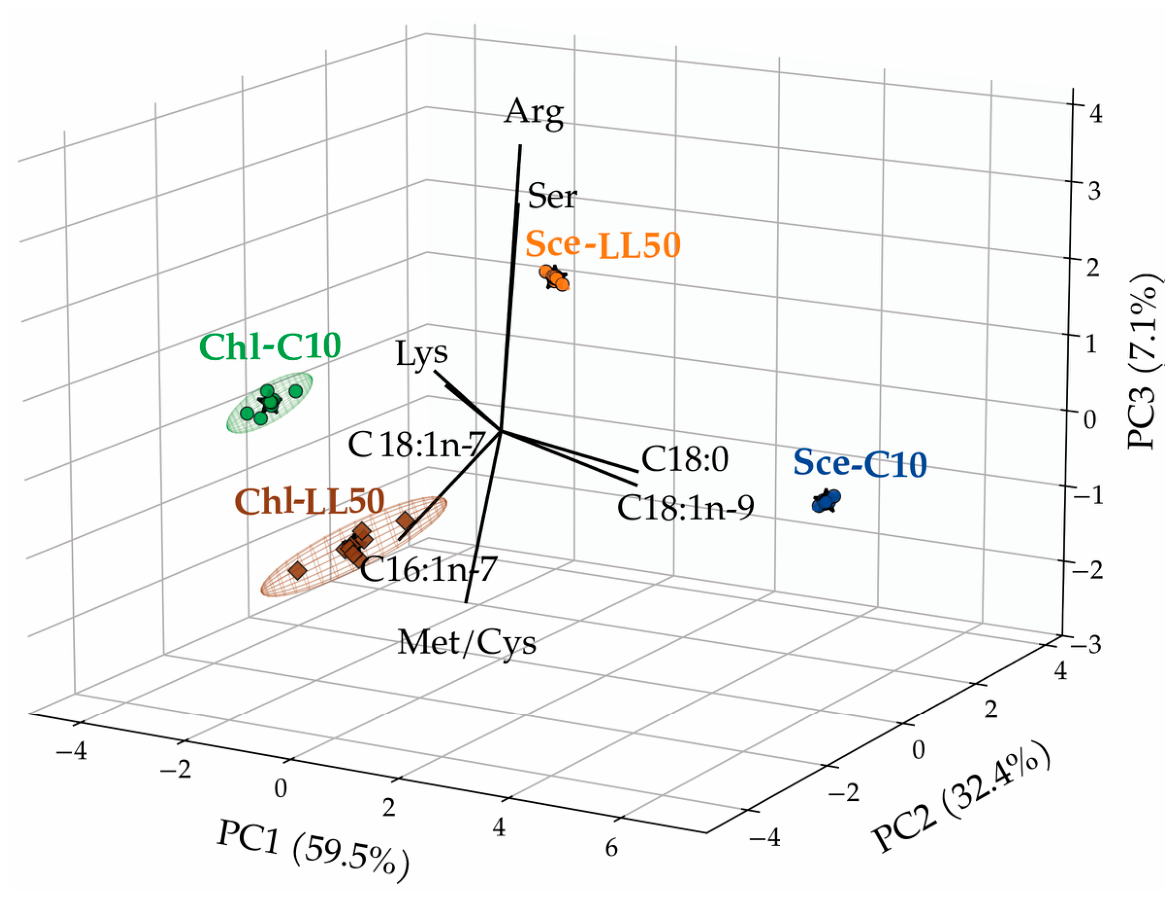
PCA of the Robust-scaled biochemical composition matrix resolved 98.9% of the total multivariate variance across the first three principal components (PC1 = 59.5%, PC2 = 32.4%, PC3 = 7.1%). In the 3D PCA biplot (Figure 2), the four treatment groups occupied distinct, non-overlapping regions of the PC1–PC2–PC3 space within their respective 99% confidence ellipsoids: Sce-C10 was positioned along the positive PC1 axis (centroid: +5.972 ± 0.067), Sce-LL50 along the positive PC2 axis (centroid: +3.554 ± 0.005), Chl-C10 along the negative PC2 axis (centroid: −3.732 ± 0.114), and Chl-LL50 along the most negative PC1 position (centroid: −2.910 ± 0.326). Arg, Ser, and C18:1n-9 were the highest-magnitude loading vectors across PC1–PC3, followed by C18:0, Lys, Met/Cys, C18:1n-7, and C16:1n-7.

3.3. Baseline Concentrations, Global and Net Biological Removal Efficiency of Bulk Physicochemical Pollutants

Before quantifying net biological removal, the original chemical loading of the leachate was characterized directly (Table S4). Initial (day 0) concentrations were high across all fourteen physicochemical parameters, confirming that non-biological losses over the 15-day incubation were negligible and that the net biological removal efficiency (NBRE) values reported below (Table 2) isolate the biological contribution of each species rather than abiotic drift. Both Chlorella sp. and Scenedesmus sp. cultures instead showed pronounced reductions relative to the initial leachate and the abiotic control across nearly all parameters, with the notable exception of pH, which rose from ~7.6 to 9.3–9.4.
The NBRE isolated the microalgal contribution from residual abiotic changes and revealed a broadly consistent pattern across functional categories for both species (Table 2). Nutrient NBRE was high overall (62–98%), with ammonium, ammonia, and phosphate comparable between species (ammonia: p = 0.002), whereas nitrate favored Chlorella sp. (91.4 ± 0.1% vs. 76.9 ± 0.3%) and nitrite and sulfate favored Scenedesmus sp. and Chlorella sp., respectively, descriptively large (Cohen’s d up to 378.9) but not significant after Bonferroni correction. Physicochemical parameters showed similar high, mostly equivalent NBRE (chloride, total acidity, total hardness), except for total alkalinity, which was significantly higher in Chlorella sp. (86.1 ± 0.0% vs. 85.1 ± 0.0%; p < 0.001). Organic matter parameters showed the clearest divergence, with Chlorella sp. removing Biochemical Oxygen Demand and Total Organic Carbon significantly more efficiently (both p < 0.001), while Chemical Oxygen Demand did not differ (p = 1.000). pH showed an opposite-signed but statistically equivalent biological alkalization for both species (ΔpH NBRE ≈ −22% vs. −23%; p = 1.000; Table S5).
Consistent with these per-parameter patterns, aggregating NBRE by functional category confirmed a significant overall effect (Kruskal–Wallis, H = 26.58, p < 0.001): Nutrients and Physicochemical parameters did not differ from one another (both ~82%; p = 1.000) and were both significantly higher than Organic Matter in Scenedesmus sp. (64.6 ± 4.1%; p ≤ 0.002), with the Chlorella sp. The organic Matter value (68.0 ± 0.6%) was intermediate between the categories. A Benjamini–Hochberg false discovery rate correction applied across all 13 species comparisons as a family confirmed only Ammonia, Total Alkalinity, Biochemical Oxygen Demand, and Total Organic Carbon as statistically robust between-species differences (all pFDR < 0.01; Table S5). The remaining nine parameters, despite occasionally large effect sizes, should be interpreted as directionally consistent rather than statistically confirmed in the three biological replicates analyzed here.
To complement the univariate species contrasts (Table S5), the 13-parameter physicochemical NBRE matrix (n = 6: three biological replicates × two species) was reduced by principal component analysis (PCA) to a set of orthogonal composite scores. The first principal component (PC1) accounted for 91.6% of the total variance, with PC2 and PC3 accounting for 7.1% and 0.9%, respectively (cumulative 98.7%; Table S4). Chlorella sp. replicates occupied negative PC1 scores (mean ± SD: −3.58 ± 0.11), whereas Scenedesmus sp. replicates occupied positive PC1 scores (3.58 ± 0.17), with no overlap between species across all six replicates. A parametric two-sample t-test on PC1 indicated a significant difference between species (t = −61.38, df = 4, p = 4.22 × 10⁻⁷; Welch’s t = −61.38, p = 2.45 × 10⁻⁶). For comparison, a permutation test on the same PC1 mean difference returned p = 0.100, the minimum attainable value for a balanced three-versus-three design (two of 20 possible relabelings at least as extreme as the observed difference). Ward hierarchical clustering of the same matrix recovered the same two-cluster grouping (cophenetic correlation = 0.996), and linear discriminant analysis achieved a 100% leave-one-out cross-validation accuracy (Table S5).

3.4. Net Biological Removal Efficiency of Metal Ions by Functional Category

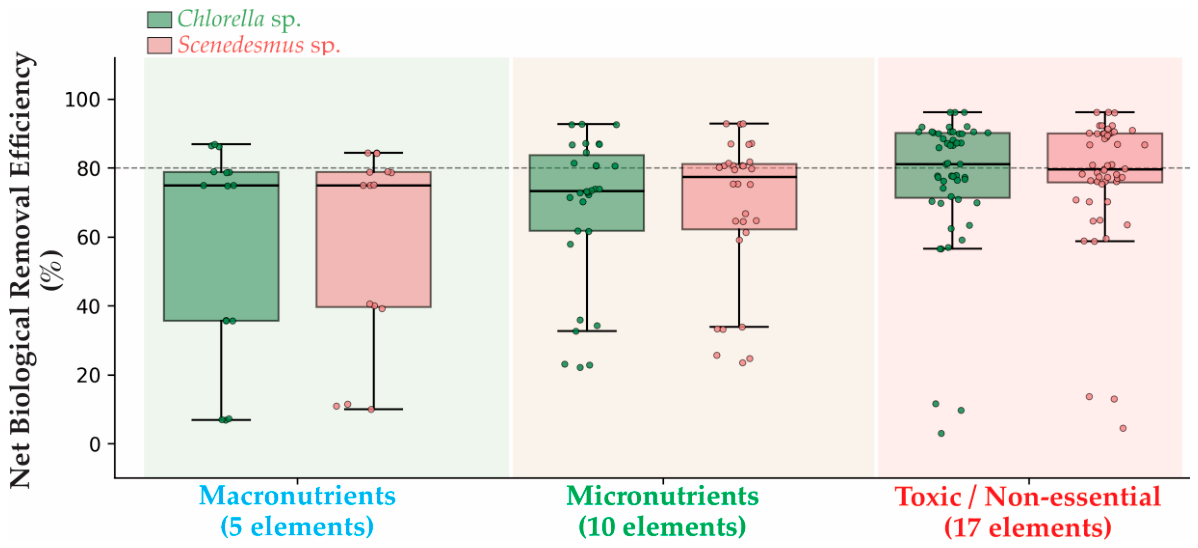
The Kruskal–Wallis test detected a significant overall difference among the six category × species groups (H = 17.06, df = 5, p = 0.0044; Figure 3 and Table S6). However, Dunn–Bonferroni post-hoc comparisons showed that none of the 15 pairwise contrasts were significant (all p_adj > 0.05). Species identity did not modify this pattern, as MWU tests within each category found no significant difference between Chlorella sp. and Scenedesmus sp. (Macronutrients: U = 104.0, p = 0.740; Micronutrients: U = 429.0, p = 0.762; Toxic/Non-essential: U = 1306.0, p = 0.973; all ns).
Descriptive statistics illustrate the magnitude and spread of the NBRE within each category. For Macronutrients, the mean NBRE was 56.58 ± 31.46% for Chlorella sp. and 57.76 ± 29.19% for Scenedesmus sp. (medians: 74.96% and 75.00%). This category showed the widest dispersion, driven by the low removal of Ca (35.70 ± 0.05% and 39.90 ± 0.67%) and Na (6.99 ± 0.15% and 10.76 ± 0.69%), which pulled the category mean well below the median.
Micronutrients exhibited intermediate removal efficiency. The mean NBRE reached 67.98 ± 22.09% for Chlorella sp. and 68.20 ± 21.91% for Scenedesmus sp. (medians: 73.35% and 77.42%, respectively). Within this category, Cu (22.69 ± 0.49% and 24.62 ± 1.03%) and Se (34.24 ± 1.64% and 33.42 ± 0.35%) were consistently the least efficiently removed elements for both species.
Toxic/non-essential elements achieved the highest overall removal. The mean NBRE was 76.66 ± 20.45% for Chlorella sp. and 76.93 ± 19.56% for Scenedesmus sp. (medians: 81.16% and 79.56%, respectively). Within this category, Cd (96.19 ± 0.02% and 96.11 ± 0.07%) and Al (91.94 ± 0.11% and 92.31 ± 0.01%) reached near-complete removal, whereas Si (8.10 ± 4.50% and 10.40 ± 5.12%) remained the least efficiently removed element in the entire 32-element panel. Taken together, these results indicate that the removal efficiency varied more by individual element identity than by functional category or species.

3.5. Multivariate Analysis of NBRE of Metal Ions

Multivariate analysis of the full 31-element NBRE profile (Li excluded, zero variance) revealed a consistent species-level structure. Hierarchical cluster analysis produced a two-cluster dendrogram that aligned exactly with species identity, grouping all three Chlorella sp. replicates together and all three Scenedesmus sp. replicates together, with no misclassifications (Table S6). The cophenetic correlation coefficients were high for both observations (CPCC = 0.966) and elements (CPCC = 0.834), indicating a reliable dendrogram topology.
Principal component analysis confirmed this separation. PC1 accounted for 62.2% of the total variance, and PC2 accounted for a further 18.1% (cumulative 80.3%). Chlorella sp. replicates occupied negative PC1 scores, whereas Scenedesmus sp. replicates occupied positive PC1 scores, with no overlap between the two groups.
Despite this clear ordination pattern, PERMANOVA did not detect a statistically significant species effect on the multivariate NBRE profile (pseudo-F = 6.401, p = 0.101, R2 = 0.615; Euclidean distance, 9999 permutations). PERMDISP likewise found no significant difference in multivariate dispersion between species (F = 13.91, p = 0.101), although Chlorella sp. showed a numerically larger mean distance to its group centroid (3.72 ± 0.56) than Scenedesmus sp. (2.40 ± 0.26), suggesting a somewhat greater within-species variability for Chlorella sp.
Discriminant analysis based on the PC1 axis correctly classified every replicate to its species of origin under leave-one-out cross-validation. Given the small number of true biological replicates (three per species) and the large number of elements relative to the observations, this outcome is best framed as a promising discriminative signal rather than a validated species-fingerprinting framework. The perfect classification is consistent with the separation already visible in the PCA and HCA ordinations; however, confirming its robustness and generalizability would require testing on a larger, independent set of biological replicates.

3.6. Spearman Correlation Network of the Metal Ions

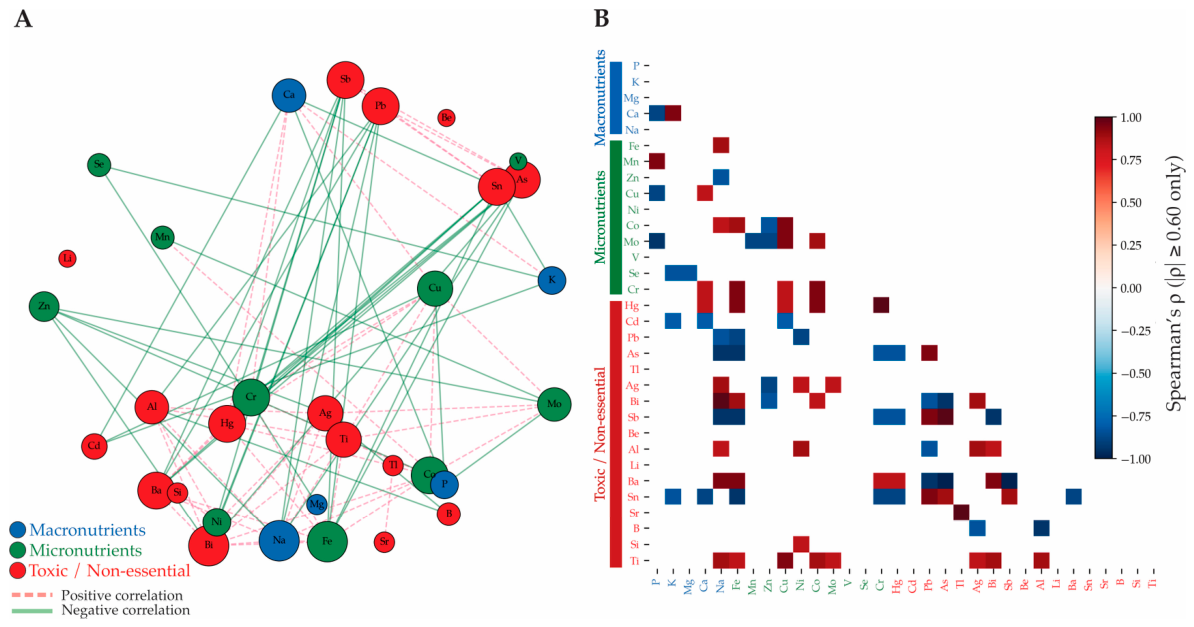
This analysis revealed a near-perfect rank-order correlation between Chlorella sp. and Scenedesmus sp. (Spearman r = 0.9589, p < 0.001; Pearson r = 0.9908, p < 0.001), indicating that both species remove elements in essentially the same relative order of efficiency. This agreement was observed within each functional category: macronutrients (r = 1.000, p < 0.001, n = 5), micronutrients (r = 0.976, p < 0.001, n = 10), and toxic/non-essential (r = 0.944, p < 0.001, n = 17). Based on this element-level agreement, a co-removal network was constructed from pairwise Spearman correlations among elements at the replicate level (n = 6 pooled observations; full matrix in Table S6). Of the two notable patterns in this network, Hg, Cd, Pb, As, and Tl formed a positive co-removal cluster (|r|≥ 0.80). Phosphorus showed positive associations with several of these elements (e.g., P–Sb, r = +0.822) and a negative association with calcium (Ca–P, r = −0.884). Cu, Se, and Si showed few or no significant correlations with the other elements in the network.
Given the limited number of observations underlying this network (n = 6), these results should be regarded as exploratory rather than confirmatory results. The critical Spearman ρ for two-sided significance at this sample size (df = 4) is |r| ≥ 0.886, meaning that individual correlations, including the exact ±1.00 values observed for some pairs, have considerable uncertainty. The full network (90 of 465 possible pairs significant at p < 0.05; 7 modules; Q = 0.329) is presented in Table S6 for completeness. Therefore, the network structure reported here is best interpreted as a preliminary map of candidate co-removal relationships, warranting confirmation in future studies with a larger number of independent biological replicates.

4. Discussion

4.1. Growth Capacity of Both Species in Landfill Leachate Medium

The ability of both Chlorella sp. and Scenedesmus sp. to complete a full growth cycle, encompassing lag, exponential, and stationary phases, in a 50% (v/v) landfill leachate medium is a noteworthy finding with direct relevance to the design of microalgae-based leachate bioremediation systems. It is well established that municipal landfill leachate contains an array of potentially phytotoxic constituents, including high free ammonium concentrations (which can exceed inhibitory thresholds at undiluted concentrations), heavy metals, and a diverse mixture of recalcitrant and anthropogenic organic compounds, all of which can suppress microalgal growth, induce cellular oxidative stress, or trigger programmed cell death at sufficiently high exposure levels [3,4]. The maintenance of robust, unimpeded growth by both tested species at the 50% dilution factor employed here suggests that the concentrations of inhibitory compounds at this dilution ratio fell below acute phytotoxicity thresholds for both organisms under the applied culture conditions. This observation extends and partially corroborates the findings of El Ouaer et al. [7], who demonstrated that both Chlorella sp. and Scenedesmus sp. were capable of growth at 10% leachate, while reporting markedly different tolerances at higher concentrations of leachate. The use of a 50% dilution in the present study represents a considerably more demanding growth challenge than that assessed in several prior reports, and the sustained growth performance observed strengthens the evidence base for the leachate tolerance of both genera.
One of the most significant outcomes of this investigation is the observation that leachate-supplemented cultures consistently achieved substantially higher maximum OD680 values than their CHU-10 counterparts (p < 0.001; ANOVA), with increases of 26.6% and 28.3% for Chlorella sp. and Scenedesmus sp., respectively, compared with the CHU-10 controls. This finding most plausibly reflects the contribution of additional macro- and micronutrients supplied by the leachate fraction, most notably the high concentrations of ammonium nitrogen that are characteristic of municipal landfill leachate [3,4,8]. Ammonium (NH4+) is the preferred inorganic nitrogen source for most green microalgae under phototrophic growth conditions, as its assimilation does not require a prior reduction step, thereby incurring a lower metabolic energy cost than nitrate assimilation [9,44]. The supplementary nitrogen and phosphorus inputs derived from the leachate fraction likely extended nutrient availability during the stationary phase, enabling the cultures to support a larger standing biomass before nutrient limitation became growth-constraining. This interpretation is consistent with the ANOVA results showing that differences in µmax, which reflects the intrinsic rate of cellular replication during exponential growth, were not statistically significant across treatments (p = 0.132), thereby decoupling the rate of exponential growth from the ultimate capacity of the culture to accumulate biomass. An analogous pattern was documented by Hernández-García et al. [6], who reported that wastewater–leachate mixtures elevated peak biomass in Desmodesmus spp. and Scenedesmus obliquus cultures without proportionally accelerating exponential growth rates.
Scenedesmus sp. consistently outperformed Chlorella sp. across all biomass-related metrics under leachate conditions, attaining a higher maximum OD680 (1.026 vs. 0.893), higher µmax (0.483 vs. 0.434 d−1), and larger biomass increase (1114.40 vs. 1046.61%). This differential performance is consistent with several previous comparative investigations. Condori et al. [22] reported µmax values of 0.549 d−1 for Scenedesmus sp. and 0.524 d−1 for Chlorella sp. when both genera were cultivated in industrial effluents, a directional trend mirroring that observed in the present study, although at higher absolute values attributable to differences in medium composition and light conditions. Similarly, Nordin et al. [17] reported that Scenedesmus sp. achieved higher biomass productivity than Chlorella sp. in nitrified landfill leachate at 10–30% dilution fractions. The Compertz-fitted µmax values obtained in the present study for both species under CHU-10 conditions (0.170–0.199 d−1) are lower than the range reported by Kong et al. [45] for Chlorella vulgaris in CO2-supplemented simulated wastewater (0.21–0.43 d−1), and by Shen et al. [46] for S. obliquus in wastewater systems (0.40–0.43 d−1). This difference is more plausibly attributable to the distinct kinetic model applied, a Gompertz fit to the treatment-mean curve here, versus exponential-phase linear regression in the cited studies, than to a genuine divergence in physiological growth capacity, and is consistent with the replicate-level regression µmax obtained in this study (0.415–0.432 d−1 under CHU-10), which sits within both cited ranges.
The observed superior performance of Scenedesmus sp. under landfill leachate growth conditions can plausibly be attributed in part to its capacity for colonial morphology and potential transitions between colonial and unicellular forms, a form of morphological plasticity that is consistent with adaptive strategies observed in leachate environments and in fungi and bacteria under stress. While there is no direct experimental demonstration of Scenedesmus sp. colonial transitions in landfill leachate, the convergence of evidence from leachate microbiology, microbial aggregation/biofilm strategies, and documented growth-form plasticity in extremophiles supports a mechanistic explanation that morphological flexibility can confer osmotic and chemical resilience in such a setting [5,47,48,49].

4.2. Biochemical Composition

4.2.1. Leachate-Induced Protein Accumulation and Carbon-to-Nitrogen Partitioning

The most significant finding to emerge from the present analysis is the pronounced and consistent increase in total protein content associated with leachate supplementation in both microalgal species, 56.9% in Chlorella sp. and 73.4% in Scenedesmus sp. This finding is consistent with that of Xie et al. [50], who demonstrated that elevated inorganic nitrogen concentrations substantially promote protein accumulation in Chlorella vulgaris through enhanced assimilation of ammonium into amino acids and structural proteins. In accordance with the present results, previous studies on microalgae cultivated in nitrogen-rich wastewater and leachate streams have reported that the high ammoniacal nitrogen content of these effluents, commonly 500–3000 mg NH4+-N L−1 in active landfills, provides a greater bioavailable nitrogen supply than standard laboratory media, thereby driving protein enrichment proportional to the nitrogen loading [8,18]. The large effect sizes observed across all protein-related variables (ε2 = 0.884–0.932) reinforce the view that nitrogen availability is the dominant determinant of protein content in these microalgal systems.
The observed increase in total protein content was accompanied by reciprocal reductions in both total lipids and total carbohydrates. This pattern is consistent with the well-established carbon-to-nitrogen (C/N) partitioning principle of microalgal metabolism. A possible explanation for this is that the elevated nitrogen availability provided by the leachate medium redirected fixed carbon away from storage compounds, neutral lipids, and reserve polysaccharides, toward nitrogen-containing cellular constituents, primarily proteins and nucleic acids. This interpretation is corroborated by Wang et al. [51], who demonstrated in Scenedesmus dimorphus that shifting from nitrogen-replete to nitrogen-depleted conditions produced a reciprocal increase in carbohydrates (up to 60% of dried weight) and decrease in protein, precisely the inverse of the pattern documented here. Similarly, Griffiths et al. [52] reported that nitrogen limitation in Chlorella vulgaris elevated lipid content to more than double the nitrogen-replete values—again, the complement of the present findings. The Spearman correlations provide independent quantitative support for this mechanistic interpretation: the strong negative correlations between Total proteins and Total lipids and between Total proteins and Total carbohydrates (Table S2) are consistent with a competition for a common fixed-carbon pool distributed between storage and biosynthetic routes.

4.2.2. Fatty Acid Reduction Under Leachate Conditions

The reduction in total lipid and polyunsaturated fatty acid content under leachate cultivation has important implications for both nutraceutical and biofuel valorization. Leachate supplementation consistently reduced SFA, MUFA, and PUFA fractions in both species, with proportionally greater reductions observed among PUFA compounds. A possible explanation for this might be that heavy metals and other metal ions in leachate can suppress desaturase-mediated elongation pathways associated with PUFA biosynthesis in microalgae like Chlorella. These metals (e.g., Cu, Cd, Pb, Zn, Cr) induce oxidative stress via reactive oxygen species (ROS), disrupting membrane lipids and shifting fatty acid profiles toward saturated/monounsaturated fatty acids (SFA/MUFA) at the expense of PUFAs [52,53]. Also, heavy metals bind sulfhydryl groups in desaturase/elongase enzymes, impair chloroplast function, and generate ROS, leading to lipid peroxidation and reduced desaturation activity [53]. In Chlorella sorokiniana and Chlorella pyrenoidosa, Cu causes chlorophyll loss, enlarged cells, and altered lipid droplets/chloroplasts, indirectly suppressing PUFA elongation [54,55].

4.2.3. Ash Accumulation and Biomass Safety Considerations

The dramatic elevation of ash content under leachate conditions, 7.9-fold in Chlorella sp. and 11.9-fold in Scenedesmus sp., corresponds to approximately 19.4% and 14.0% of total dry biomass, respectively, compared with only 2.5% and 1.2% in the CHU-10 controls. Viewed in this light, the ash increase is not a marginal compositional shift but a substantial reallocation of biomass mass away from organic constituents, and it tempers the otherwise favorable protein enrichment reported. A biomass that is simultaneously richer in protein and an order of magnitude richer in ash cannot be evaluated on protein content alone: the net nutritional and commercial value of leachate-grown biomass depends on what fraction of that ash consists of benign macro-minerals versus regulated or toxic elements, and on whether downstream processing can selectively remove the latter without sacrificing the protein gain.
This concern is not merely inferential. The metal-ion removal profiles reported previously indicate that leachate-grown biomass accumulates substantial quantities of both macronutrient ions (e.g., Na, Ca) and toxic/non-essential elements (e.g., Cd, Pb, As, Hg), consistent with the biosorption and mineral-sequestration mechanisms described for green microalgae [6]. The ash fraction reported here therefore most plausibly reflects a composite of these two categories, and the present dataset cannot fully disentangle innocuous mineral loading (which may even be nutritionally beneficial in feed applications) from potentially hazardous metal loading (which would restrict or preclude use in food, feed, or nutraceutical applications regardless of protein content). This distinction matters practically: a high-ash, high-protein biomass suitable for biofertilizer or soil-amendment use may be entirely unsuitable for animal feed or human-consumption pathways without demonstrated compliance with heavy-metal thresholds.
This concern is consistent with the findings of Tighiri and Erkurt [56], who reported elevated mineral content in microalgal biomass cultivated on landfill leachate, and with Saleem et al. [57], who emphasized the importance of heavy metal characterization in leachate-grown Scenedesmus sp. biomass before valorization. Notwithstanding these limitations, the high ash content simultaneously confirms active uptake of inorganic material from the leachate medium, the mechanistic basis of the bioremediation function this system is intended to provide, and the inverse correlation between ash accumulation and leachate exposure (Ashes–C18:3n-3: ρ = −0.953; Ashes–C16:0: ρ = −0.922) suggests that mineral loading and lipid anabolism may be mechanistically linked, an observation that warrants dedicated molecular-level investigation. On balance, we consider the protein enrichment and ash accumulation reported here to be two faces of the same phenomenon, enhanced nutrient and mineral uptake under leachate cultivation, and recommend that any downstream valorization pathway be selected only after direct heavy-metal quantification of the harvested biomass, rather than on the basis of proximate composition alone.

4.2.4. Essential Amino Acid Profiles and Single-Cell Protein Quality

The amino acid composition of both species maintained nutritionally relevant profiles across all four treatment groups, with leucine, the most abundant EAA and a key signal for mTOR-mediated protein synthesis in animal diets, present at 19.68–21.77 mg/g dmb across all conditions. The strong positive Spearman correlations among branched-chain and aromatic EAAs (Leu–Phe: r = 0.971; Phe–Val: r = 0.969; Ile–Val: r = 0.966) suggest co-regulation through shared biosynthetic pathways and imply that bulk protein quality, as measured by the essential amino acid index, may be more stable across treatment conditions than individual amino acid concentrations would suggest in isolation. This observation is consistent with Tibbetts et al. [58], who reported that C. vulgaris maintained a high EAA index (0.87–0.89) across a range of inclusion levels, indicating nutritionally complete protein. An implication of this finding is the possibility that the protein enrichment observed under leachate cultivation preserves, and may enhance, the absolute quantity of each EAA, even if their relative proportions remain stable. Collectively, these data suggest that leachate-cultivated Scenedesmus sp. biomass, with total protein exceeding 319 mg/g dmb, may be a nutritionally attractive single-cell protein ingredient for monogastric animal diets, pending confirmation of heavy metal compliance [59].

4.2.5. Multivariate Framework and Methodological Contributions

The results of the multivariate analysis pipeline provide strong quantitative support for the biochemical distinctiveness of the four treatment groups and simultaneously yield methodological insights of general applicability. The perfect cluster recovery achieved by all three independent algorithms (K-Means, Ward, GMM; ARI = NMI = 1.000; Silhouette = 0.9634) demonstrates that the four biochemical phenotypes are fully and linearly separable in the first three principal components of the Robust-scaled data, a finding that, to the best of our knowledge, has not been previously documented with this level of methodological rigor for these two species under comparable cultivation conditions. These results corroborate the findings of Kent et al. [60] and Batista et al. [61], who demonstrated the utility of PCA for discriminating microalgal species and growth conditions on the basis of biochemical profiles, though those studies employed smaller variable sets and did not apply competitive method selection at each pipeline stage.
The use of Robust (median/IQR) standardization, selected over Z-score based on its superior silhouette score under conditions of heterogeneous variance driven by outlier-prone ash and fatty acid distributions, represents a methodological refinement with broad applicability to biochemical composition datasets. The orthogonal structure of the PCA, PC1 separating species, PC2 separating media conditions, indicates that species identity and growth medium composition exert statistically independent effects on biochemical phenotype, a conclusion consistent with the additive nature of treatment effects documented in factorial cultivation studies [51,62]. Taken together, these data support the conclusion that the sequential competitive pipeline described here provides a reproducible, quantitatively justified analytical template for the comparative biochemical phenotyping of microalgae.

4.3. Nutrient Removal Efficiency and Physicochemical Parameter Changes in Landfill Leachate

4.3.1. Removal of Ammonium, Nitrate, Nitrite, Phosphate, and Sulfate

The high nutrient removal efficiencies achieved by both species in the present study are consistent with the substantial body of literature documenting the capacity of green microalgae to assimilate inorganic nitrogen and phosphorus from complex wastewater matrices. Both species achieved net biological ammonium removal exceeding 86% (Chlorella sp.: 87.3 ± 0.0%; Scenedesmus sp.: 86.5 ± 0.0%) and ammonia removal of 87.3 ± 0.0% and 86.4 ± 0.0%, respectively, placing these results within the upper range of published data for comparable Chlorella–leachate treatment systems. Specifically, Hu et al. [8] reported ammonium removal of 80.1% and phosphate removal of 86.0% in co-cultures of Chlorella vulgaris and Scenedesmus dimorphus in 10% diluted landfill leachate, while Hernández-García et al. [6] documented ammonium removal of 82% in Scenedesmus obliquus cultures with a 5–15% leachate fraction, both under substantially more dilute conditions than the 50% (v/v) leachate applied in the present study, reinforcing the exceptional tolerance and removal capacity of both tested genera at higher leachate loads. The high NBRE for ammonium and ammonia most likely reflects the preferential cellular uptake of NH4+ as the energetically favored nitrogen source, given that ammonium assimilation does not require a prior reduction step and is therefore less energetically costly than nitrate assimilation [63].
These observations are consistent with prior comparative data. Condori et al. [22] reported higher ammonium removal for Scenedesmus sp. compared with Chlorella sp. when both were cultured in industrial effluents, attributing the difference in part to the higher cell surface area: volume ratio of the colonial Scenedesmus morphotype and its capacity for enhanced ion exchange at the cell wall. Conversely, the slightly superior nitrate removal of Chlorella sp. aligns with observations of Nordin et al. [17], who reported that Chlorella sp. exhibited higher NO3 assimilation rates than Scenedesmus sp. under nitrified landfill leachate conditions. Nitrite removal showed the reverse pattern, with Scenedesmus sp. reaching near-complete removal (98.3 ± 0.0%) against 61.8 ± 0.1% for Chlorella sp. (Cohen’s d = −378.9).
Phosphate removal was statistically equivalent between both species, extending the pattern reported by Pereira et al. [64], in which both genera showed broadly comparable orthophosphate uptake capacities when cultivated under equivalent nutrient loading conditions. These per-parameter differences, while individually modest in absolute terms, collectively generate the species-specific NBRE signature that the LDA successfully resolved with 100% accuracy.
Sulfate removal likewise favored Chlorella sp. descriptively (91.0 ± 0.1% vs. 73.8 ± 0.1%; d = 203.6). However, with only three biological replicates per species, the minimum attainable two-sided p-value for any of these pairwise contrasts is 0.10, so despite their large effect sizes, none of the nitrate, nitrite, or sulfate differences reach significance after correction and are best treated as directionally consistent, hypothesis-generating observations rather than confirmed species distinctions.

4.3.2. Changes in Alkalinity, Chloride, Total Hardness, Total Acidity, and Organic Matter

The high but statistically indistinguishable reductions in total alkalinity, chloride, total acidity, and total hardness (all four parameters in the 64.8–90.3% NBRE range for both species; Tables S4 and S5) are consistent with the consumption of bicarbonate (HCO3) as an inorganic carbon source during photosynthesis, a process that shifts the carbonate equilibrium and reduces total alkalinity. This effect is commonly reported in microalgae cultures and is amplified under conditions of CO2-limited growth, where bicarbonate becomes the primary dissolved inorganic carbon species at pH > 8.3 [65]. Of these, only total alkalinity showed a species difference that survived correction for multiple comparisons, with Chlorella sp. removing slightly more alkalinity than Scenedesmus sp. (86.1 ± 0.0% vs. 85.1 ± 0.0%; p < 0.001), consistent with the observation that Chlorella sp. maintained active exponential-phase growth across a broader pH range, implying a sustained demand for dissolved inorganic carbon at higher cell densities. Chloride removal (64.8 ± 0.1% for Chlorella sp.; 66.1 ± 0.1% for Scenedesmus sp.; p = 1.000) and total acidity removal (89.7 ± 0.1% vs. 90.1 ± 0.0%; p = 1.000) were statistically equivalent between species; chloride is not typically actively metabolized by green algae, so the modest, statistically indistinguishable reductions observed here may reflect ionic adsorption onto cell surface polymers or minor abiotic volatilization/precipitation rather than active assimilation [3].
The substantial and species-differentiated reductions in total hardness represent one of the most environmentally significant findings of this study. Scenedesmus sp. achieved NBRE of 48.4 ± 2.5% for total hardness, significantly exceeding the 35.6 ± 0.6% achieved by Chlorella sp. (MWU p < 0.001; Cohen’s d = 6.14). Total hardness, representing the summed concentrations of divalent cations (primarily Ca2+ and Mg2+), is decreased in microalgae cultures through at least two mechanisms: (i) direct assimilation of Ca2+ and Mg2+ into cellular structures (cell walls, photosynthetic apparatus, and enzyme cofactors); and (ii) photosynthesis-driven pH elevation to > 9.0, which promotes the supersaturation and co-precipitation of Ca2+ and Mg2+ as carbonate and hydroxide complexes [66]. The greater hardness reduction in Scenedesmus sp. cultures is consistent with the higher biomass accumulated in the leachate treatment (maximum OD680 = 1.026 vs. 0.893), which implies a larger cellular demand for structural cations and a greater photosynthetic precipitating effect through pH alkalization. These findings are consistent with observations by Al-Jabri et al. [9] and Amaro et al. [66], who reported that microalgae-mediated hardness reduction is an underreported but potentially important secondary treatment benefit in leachate management systems.
Organic matter removal showed the clearest and most robust species divergence in the entire physicochemical panel. Chemical oxygen demand (COD) removal was statistically equivalent between species (68.8 ± 0.0% for Chlorella sp. vs. 69.2 ± 0.0% for Scenedesmus sp.; p = 1.000), but Chlorella sp. removed both biochemical oxygen demand (BOD; 67.7 ± 0.1% vs. 59.8 ± 0.1%; p < 0.001) and total organic carbon (TOC; 67.6 ± 0.1% vs. 64.8 ± 0.1%; p < 0.001) significantly more efficiently than Scenedesmus sp. Together with ammonia and total alkalinity, BOD and TOC constitute the only four physicochemical parameters that remain significant after Benjamini–Hochberg correction across all 13 species contrasts as a family (Table S3), and consequently represent the most defensible basis, among the univariate physicochemical comparisons, for a species-specific removal advantage. The superior BOD/TOC removal by Chlorella sp. may reflect a greater capacity for heterotrophic or mixotrophic assimilation of readily biodegradable dissolved organic carbon fractions in the leachate, though this mechanistic hypothesis was not directly tested here and warrants targeted follow-up.

4.3.3. pH Alkalization as a Signature of Photosynthetic Activity

The pronounced and equivalent alkalization of the culture medium observed in both Chlorella sp. and Scenedesmus sp. cultures, with pH rising from 7.809 (initial) and 7.776 (abiotic control) to 9.30 ± 0.31 and 9.30 ± 0.29 pH units, respectively, constitutes direct physiological evidence of active phototrophic growth and CO2 fixation by both species throughout the culture period. Zerveas et al. [65] demonstrated that microalgal photosynthesis induces pH alkalization through continuous proton (H+) uptake from the aquatic environment into the thylakoid lumen, independently of the CO2 concentration of the medium; the rate of proton uptake, and therefore the extent of alkalization, is proportional to cell density and photosynthetic activity. The fact that both species produced a statistically identical ΔpH NBRE of approximately −19.5% (MWU p = 1.000, ns) is therefore consistent with their comparable photosynthetic performance reflected in the equivalent µmax values reported in the growth kinetics analysis, despite their differential nutrient removal efficiencies. At the final culture pH of ~9.30, the elevated alkalinity is also expected to promote the chemical precipitation of calcium carbonate (CaCO3) and magnesium carbonate (MgCO3), contributing to the observed reductions in total hardness that are discussed below.

4.3.4. Multivariate Integration: A Valid Global Test of Species Separation and the Limits of Discriminant Classification

The multivariate analytical framework applied in the present study substantially advances the characterization of species-specific bioremediation performance beyond what is achievable through univariate parameter comparisons alone. The convergent evidence from PCA, PERMANOVA, HCA, and LDA collectively demonstrates that the seven-parameter NBRE profiles of Chlorella sp. and Scenedesmus sp. constitute distinguishable and highly reproducible multivariate phenotypes, with species identity accounting for 55.9% of total NBRE variance. The 100% LOO-CV classification accuracy of LDA is particularly noteworthy, as it demonstrates that species can be perfectly identified from their seven-parameter NBRE profile alone, with no misclassification across any of the 18 replicates, despite the inherent replicate-level variability within each species. This result is consistent with within-species consistency in bioremediation profiles, though this should be confirmed with a larger, independently replicated dataset before being treated as an established fingerprint. [31].
The LDA discriminant coefficient analysis identifies total hardness and ammonium removal as the two variables most responsible for the between-species separation, both directing towards Scenedesmus sp. This finding has direct practical implications for species selection in treatment system design: if the primary treatment objective involves maximum ammonium removal from a high-NH4+ leachate together with concurrent water softening, Scenedesmus sp. may be the more suitable option under the conditions tested. Conversely, if the priority is maximizing nitrate or chloride removal, the discriminant analysis points toward Chlorella sp. as comparatively favorable for this specific purpose. The negligible discriminant weight of PO43− and pH confirms that phosphate removal and photosynthetic alkalization are effectively interchangeable capabilities between both genera under the conditions tested and therefore do not differentiate them as a basis for species selection. These findings extend the comparative framework of Hu et al. [8], who compared the two genera on a parameter-by-parameter basis for nutrient removal efficiency, and of El Ouaer et al. [7], who differentiated the two genera primarily by growth performance and survival across a leachate concentration gradient, by providing a multivariate discrimination of species identity across the full physicochemical removal profile simultaneously.

4.4. Broad-Spectrum Metal Ion Removal and Mechanisms

The capacity of both Chlorella sp. and Scenedesmus sp. to simultaneously remove 32 metal ions and trace elements across three biochemically distinct functional categories from a 50% (v/v) landfill leachate matrix reflects the concurrent operation of extracellular, membrane-bound, and intracellular mechanisms, supplemented by abiotic co-precipitation driven by photosynthetic activity. The high net biological removal efficiencies observed, particularly in the Toxic/Non-essential category (mean NBRE > 76.6% for both species, Table S6), can be mechanistically deconstructed into four principal phases: (i) rapid, metabolism-independent biosorption onto the cell wall and extracellular polymeric substances (EPS); (ii) transmembrane transport via specific and non-specific ion carriers; (iii) intracellular detoxification through thiol-peptide chelation and vacuolar sequestration; and (iv) pH-driven surface and bulk precipitation of metal carbonates, hydroxides, and phosphates.
The first mechanism is related to the extracellular biosorption and cell-wall chemistry. In Chlorophyta, the cell wall typically comprises a fibrillar cellulose skeleton interwoven with mannans or xylans, embedded within an amorphous matrix of sulfated galactans, alginic acids, and glycoproteins [67,68]. This polyanionic scaffold presents a high density of negatively charged functional groups, including carboxyl (–COOH), hydroxyl (–OH), amino (–NH2), phosphoryl (–PO3H2), and sulfhydryl (–SH) moieties, that interact with cationic metal species through electrostatic attraction, ion exchange with native cell-wall cations (Ca2+, Mg2+, Na+, K+), surface complexation, and coordination bonding [69]. Because this process is metabolism-independent, it occurs within minutes to hours and is responsible for the initial, rapid depletion of free metal ions from the leachate matrix [25,26]. EPS, secreted polysaccharides, proteins, lipids, and nucleotides that form a hydrated layer around the cell, substantially expand the effective sorption surface and provide additional anionic binding sites (carboxylate, sulfate, sulfhydryl, uronic acid) [70,71]. Recent work demonstrates that EPS composition is dynamically remodeled under metal stress; for instance, Cd2+ exposure can upregulate exopolysaccharide synthesis in Spirulina platensis, thereby increasing the density of metal-binding functional groups [70]. Similarly, mixotrophic conditions enhance EPS protein and carbohydrate content, which directly correlates with higher Pb(II) sorption capacity [71]. In the present study, the 7.9- to 11.9-fold increase in ash content observed in leachate-grown biomass provides macroscopic evidence that extracellular binding sites were saturated and that substantial mineral accumulation continued throughout the 15-day batch period.
The second mechanism is related to bioaccumulation and membrane transport by the microalgae cells. Once extracellular binding sites approach saturation, living cells can actively transport metal ions across the plasma membrane. Diverse transporter families, including natural resistance-associated macrophage proteins (NRAMP), Zrt/Irt-like proteins (ZIP), copper transporters (CTR), and Fe-transporters (FTR), mediate the uptake of essential micronutrients but exhibit broad substrate specificity that permits the inadvertent internalization of non-essential toxic analogues such as Cd2+, Pb2+, and As species [25,68,72,73]. This metabolically dependent phase is slower than biosorption but allows cumulative removal over the culture duration. The high final ash fraction in leachate-grown cells (up to ~19.4% of dry mass in Chlorella sp.) indicates that intracellular accumulation contributed significantly to the overall mass balance, particularly for elements lacking efficient efflux pathways.
The third mechanism is related to intracellular detoxification and sequestration. To prevent metal-induced oxidative damage to photosynthetic and metabolic machinery, microalgae deploy a sophisticated intracellular detoxification arsenal. Phytochelatins (PCs)—small peptides of the general structure (γ-Glu-Cys)n-Gly—are synthesized in the cytosol by PC synthase, which is transcriptionally upregulated by Cd, Pb, Hg, Cu, and As stresses [74,75]. PCs form stable thiolate complexes with metal ions; these complexes are subsequently transported into vacuoles via ATP-binding cassette (ABC) transporters for long-term sequestration [74]. Metallothioneins (MTs)—low-molecular-weight, cysteine-rich proteins—perform analogous chelation and antioxidant functions by scavenging reactive oxygen species (ROS) while binding toxic metals [75]. Glutathione (GSH), a tripeptide thiol, serves as both a direct ROS scavenger and the obligate precursor for PC biosynthesis [74]. In addition, polyphosphate (polyP) granules accumulated in acidocalcisomes and vacuoles contribute to metal sequestration, particularly for divalent cations [73]. The near-complete removal of Cd (~96%) observed in our study is consistent with the well-documented potency of Cd as an inducer of the PC/MT/GSH cascade [25,75].
The fourth mechanism is about pH-driven co-precipitation. A critical abiotic–biotic hybrid mechanism operative in the present study is photosynthetically driven pH alkalization. Both species elevated culture pH from ~7.8 to ~9.3 through active proton uptake during bicarbonate assimilation. At pH > 8.5, carbonate and hydroxide supersaturation promotes the precipitation of divalent and trivalent metal species, particularly Cd, Pb, Al, and Hg, as insoluble carbonates, hydroxides, or mixed-metal precipitates onto cell surfaces and within the bulk medium [26,69]. This mechanism explains why toxic/non-essential elements achieved numerically higher NBRE than macronutrients: toxic metals lack homeostatic export mechanisms, and their extracellular concentration is further depleted by abiotic precipitation, creating a thermodynamic sink that drives continued biosorption and bioaccumulation [25,68,73]. The tight positive co-removal correlation observed among Hg, Cd, Pb, As, and Tl (|r| predominantly ≥ 0.80; Figure 4) supports the hypothesis that these soft Lewis acid metals share a common precipitation-driven removal route.

4.5. Category-Level Pattern: Why Toxic/Non-Essential Elements Were Removed More Efficiently

The Toxic/Non-essential category showed numerically higher NBRE than the Macronutrient and Micronutrient categories, though this difference did not survive Dunn–Bonferroni correction at the true replicate level (all pairwise category contrasts p_adj > 0.05; Figure 3 and Table S6). It is still worth discussing, since macronutrients and micronutrients are biologically required by both species and might therefore be expected to be selectively accumulated. A plausible explanation lies in the differential kinetics and mechanisms governing the removal of biologically essential versus non-essential metal ions. For macronutrients such as Ca and Na, intracellular regulation maintains strict homeostatic control over cytoplasmic concentrations, which limits the net cellular uptake of these elements beyond immediate metabolic requirements and thereby constrains NBRE. This interpretation is consistent with the observation that the two lowest NBRE values among macronutrients were precisely those for Ca (35.7–39.9%) and Na (7.0–10.8%), both of which are subject to tight homeostatic regulation in microalgae [25]. In contrast, many toxic metals, notably Cd, Pb, As, Hg, Al, and Li, enter cells passively via non-selective transporters or by surface precipitation onto cell walls at the alkaline pH values (pH ~9.3) induced by photosynthetic activity in the present cultures [26,76]. The elevated culture pH facilitates carbonate and hydroxide precipitation of divalent toxic metals, substantially augmenting biosorption-mediated removal, particularly for Cd, Pb, and Hg [25]. Furthermore, the absence of homeostatic export mechanisms for most toxic/non-essential elements means that once these ions are bound to or internalized by algal cells, they are not re-exported, thereby accumulating to high NBRE values over the 15-day culture period.

4.6. Species-Specific Elemental Differentiation and LDA Interpretation

Although no statistically significant between-species difference was detected at the category level by MWU tests (all p > 0.05, Table S6), a simplified discriminant analysis on the 31-element NBRE profile (Li excluded for zero variance) nevertheless separated the two species cleanly along PC1 (62.2% of variance) with no overlap between groups (100% LOO-CV accuracy on this reduced representation; canonical r = 0.9906), indicating that species-specific differences, while individually modest at any single element, are systematic and reproducible across replicates. As with the physicochemical profile, this classification result should be read as a promising, internally consistent discriminative pattern rather than as independently validated species fingerprinting, given that any three points can be trivially separated in a high-dimensional space; the PERMANOVA on the same matrix (Pseudo-F = 6.401, R2 = 0.615) is directionally consistent but not itself significant at p = 0.101 given the structural permutation floor of a balanced 3-vs-3 design. This finding is noteworthy from a methodological perspective, as it illustrates the value of multivariate approaches in detecting species differentiation that would be invisible to univariate tests applied to single elements or category-level medians [31]. The two most discriminating variables along this composite axis, molybdenum (higher in Scenedesmus sp.: 79.8 ± 0.4% vs. 72.6 ± 0.4%) and sodium (higher in Scenedesmus sp.: 10.8 ± 0.7% vs. 7.0 ± 0.2%), merit specific discussion. The higher Mo NBRE of Scenedesmus sp. may reflect its higher demand for molybdenum as a cofactor for nitrate reductase under the high-ammonium leachate conditions tested, as molybdenum is also a component of nitrogenase in certain species [77]. The greater sodium removal by Scenedesmus sp. relative to Chlorella sp. may reflect differences in extracellular ionic regulation between the two genera [33,36]. Conversely, the directional advantage of Chlorella sp. for antimony constitutes the largest absolute between-species difference in the entire 32-element panel; this could reflect a genus-specific surface chemistry interaction between Sb oxyanions and cell wall functional groups, a phenomenon that has received limited attention in the literature but warrants further investigation [78]. We reiterate that, with n = 3 per species, no single element can individually reach p < 0.05 under an exact two-sided Mann–Whitney U test (minimum attainable p = 0.10), so these element-level observations should be treated as directionally suggestive rather than independently confirmed.

4.7. Correlation Network Structure and Functional Co-Removal Implications

The Spearman correlation network (90 significant edges out of 465 possible element pairs; 32 nodes; Figure 4) points to structured co-removal patterns that go beyond simple elemental collinearity, suggesting shared removal mechanisms across several elements at once. The tight positive co-removal among Hg, Cd, Pb, As, and Tl (|r| predominantly ≥ 0.80) suggests a shared removal route, most plausibly carbonate/hydroxide co-precipitation driven by the photosynthetically elevated culture pH (~9.3) [26,65]. This interpretation is consistent with reports that alkaline conditions above pH 8.5 promote co-precipitation of soft Lewis acid metals like Pb2+, Cd2+, and Hg2+ [25,79]. The positive correlations between phosphorus and toxic cations (Tl, Pb, As) may reflect insoluble metal-phosphate formation as phosphorus depletes by day 15, a mechanism previously documented alongside concurrent high phosphorus uptake and metal removal [76]. In contrast, the peripheral or isolated status of Cu, Se, and Si in the network, all exhibiting few or no significant co-removal correlations, is consistent with their distinct removal dynamics: Cu2+ is subject to organic complexation in leachate matrices that reduces its bioavailability; Se has complex speciation behavior (SeO32−/SeO42−) that governs its assimilation; and Si(OH)4 is not a substrate for the green algal cell wall [78]. We emphasize, as already noted, that with only n = 6 pooled replicate-level observations underlying this network (df = 4), the critical Spearman |r| for two-sided significance at p < 0.05 is 0.886, meaning several of the strongest correlations reported here, including the exact ±1.00 values, carry considerable uncertainty and should be regarded as a preliminary map of candidate co-removal relationships rather than a confirmed mechanistic network. Together, these findings complement the species-level discrimination demonstrated by the LDA analysis and provide a mechanistic hypothesis-generating framework for interpreting the observed NBRE profiles, pending validation with a larger number of independent biological replicates.
This study demonstrates the remediation capacity of Chlorella sp. and Scenedesmus sp. at the physicochemical level but stops short of a complete ecotoxicological and biodegradability characterization of the leachate itself, which we identify as the principal limitation of the current work. The internationally standardized ISO and OECD testing framework represents the gold standard for chemical hazard and biodegradability testing underlying regulatory risk assessment [80,81], and a rigorous assessment of leachate toxicity would require a tiered battery of standardized bioassays: at the microbial level, tests such as a luminescent-bacteria assay (ISO 11348-3), a bacterial growth-inhibition test (ISO 8192/OECD TG 209), and an activated-sludge respiration-inhibition test (ISO 8692:2012/OECD TG 201) [82,83]; and at the primary-producer level, a re-run of the algal growth-inhibition test (ISO 8692:2012/OECD TG 201) under conditions meeting its formal validity criteria for both species, including adequate pre-culture conditioning to eliminate lag-phase artifacts, verified exponential growth throughout the exposure period, and replicate designs powered for the expected effect sizes. Only under these conditions could toxicity values for both species be reported as definitive rather than preliminary. Complementary to this, the biodegradability of the leachate’s organic fraction should be assessed with a standardized ready biodegradability test (OECD TG 301 series) [80] that includes an inhibition-control vessel, allowing toxic inhibition of the degrading inoculum to be distinguished from genuine biodegradation resistance. The chemical characterization presented here will also be extended to include dissolved organic carbon and electrical conductivity, using the same sampling protocol already in place. The full proposed testing program, together with its governing standards and references, is summarized in Table S7. We propose this integrated toxicity–biodegradability–chemical characterization program as the natural next phase of this research line, reasoning that reporting the remediation performance now and following up with a properly validated, purpose-designed hazard characterization provides a more reliable evidentiary basis than including toxicity estimates from assays not designed or validated to support them.

5. Conclusions

This study characterized the growth, biochemical composition, and leachate bioremediation performance of native Amazonian Chlorella sp. and Scenedesmus sp. cultivated in 50% (v/v) municipal landfill leachate from Nauta, Peruvian Amazon. Both species sustained robust growth across all conditions, and leachate supplementation consistently increased peak biomass relative to CHU-10 controls. Both species also achieved high net biological removal of ammonium, ammonia, and phosphate, and removed toxic elements, including cadmium, aluminium, arsenic, and lead, more efficiently than macro- and micronutrient categories overall, though this category-level pattern did not reach statistical significance once technical and biological replicates were correctly distinguished (Table S5). We attribute the toxic-element removal to a plausible combination of biosorption, active bioaccumulation, and pH-driven co-precipitation, consistent with mechanisms reported elsewhere in the literature; we did not test these mechanisms directly in this study.
Species identity explained a large share of the multivariate variance in both the physicochemical and metal-ion NBRE profiles, and a properly powered composite test (PC1 t-test) confirmed a statistically robust overall separation in the physicochemical profile (p = 4.2 × 10⁻⁷). At the same time, we want to be explicit that most individual parameter-level and element-level species comparisons, and the LDA classification results reported alongside them, reflect a pilot-scale design with three true biological replicates per species. Several of these comparisons show large numerical effect sizes but did not reach statistical significance after correction for multiple comparisons, and the perfect LDA classification accuracy reported for both the physicochemical and metal-ion datasets is, in part, a predictable consequence of having more variables than replicates rather than independent confirmation of a validated species-specific “fingerprint.” We have revised our interpretation accordingly: only ammonia, total alkalinity, BOD, and TOC are supported as robust physicochemical differences between species after correction for multiple testing, and the metal-ion multivariate separation, while visually and descriptively clear, did not reach statistical significance (PERMANOVA p = 0.101).
Within these limits, the data are consistent with two complementary, though tentative, valorization directions. Leachate-grown Scenedesmus sp. shows the more favorable combination of protein enrichment, ammonia removal, and organic matter tolerance for single-cell protein production integrated with treatment, while Chlorella sp. grown in standard medium retains higher oleic acid content and a more favorable essential amino acid profile for nutraceutical applications. We present these as reasonable directions supported by the present data rather than as established or optimized outcomes; before either pathway could be recommended for practical implementation, biomass would need direct heavy-metal characterization, and both species would need testing across a range of leachate dilutions, harvest times, and, ideally, a larger number of independent biological replicates to confirm that the differences reported here hold up beyond this single pilot-scale experiment.
More broadly, we see the discriminant analyses in this study as a useful, data-driven starting point for thinking about site-adaptable treatment design, particularly in low-infrastructure contexts like the Peruvian Amazon, but not yet as a finished decision-making tool. The restriction of this study to a single leachate dilution, a single harvest time point, and three true biological replicates limits how far these conclusions can be generalized. Future research should therefore investigate both species across a leachate dilution gradient and under pilot-scale conditions, including combined treatment processes, such as integration with complementary biological, physical, or advanced oxidation methods, and the transition from batch to continuous or semi-continuous cultivation systems, complemented by life cycle assessment and technoeconomic analysis, to evaluate the scalability and commercial viability of the integrated system described here.
Future work should prioritize some areas before these findings can inform practical treatment or valorization decisions. First, direct characterization of heavy metals and trace elements in the harvested biomass is needed to determine whether either species’ biomass meets safety thresholds for protein, feed, or nutraceutical use, independent of the removal efficiency already demonstrated in the liquid phase. Second, incorporating speciation-resolved analytical techniques (e.g., HPLC-ICP-MS or ion chromatography-ICP-MS) would allow a more mechanistically precise assessment of which ionic forms are preferentially biosorbed, bioaccumulated, or biotransformed by Chlorella sp. and Scenedesmus sp., and are recommended as a priority extension of this work. Third, both species should be evaluated across a range of leachate dilutions and, given the seasonal variability characteristic of tropical landfill leachate, across leachate collected in different seasons, to determine whether the growth, removal, and biochemical patterns reported here hold beyond this single leachate batch. Fourth, pilot-scale, continuous or semi-continuous cultivation trials, ideally incorporating a larger number of independent biological replicates, complementary treatment stages, and life cycle and technoeconomic assessment, are needed to evaluate the scalability and commercial viability of the integrated system described here.
It is important to recognize the boundaries this design places on the conclusions above: with a single leachate source, one dilution level, a 15-day batch window, and three biological replicates per species, the present results describe how these two genera behave under one specific, well-controlled set of conditions rather than across the operational range a full-scale system would encounter. The three priorities above, biomass metal-safety assessment, validation across leachate strengths and seasons, and pilot-scale testing, represent the most direct path from this pilot-scale characterization toward a practically actionable treatment and valorization framework.

Supplementary Materials

The following supporting information can be downloaded at: https://www.mdpi.com/article/10.3390/w18162018/s1, Table S1. Calibration and Bland–Altman Validation of OD680 as a Proxy for Dry-Weight Biomass. This table Validates OD680 as a proxy for dry-weight (DW) biomass in Chlorella sp. and Scenedesmus sp. Reports paired OD680/DW data with LOOCV-predicted DW (pooled and per-species), the calibration regression parameters (R2, F, p), and Bland–Altman agreement statistics (bias, SD, 95% limits of agreement, proportional-bias test), confirming OD680 as a reliable biomass surrogate; Table S2: Growth kinetics of Chlorella sp. and Scenedesmus sp. cultivated in CHU-10 medium and 50% municipal landfill leachate. Raw optical density measurements (OD680) recorded across 15 days (3 biological replicates × 3 technical replicates per treatment) and estimated parameters (µmax, doubling time, lag phase, max OD) derived from exponential-phase linear regression are provided, along with summary statistics and one-way ANOVA/Kruskal–Wallis test results; Table S3: Comprehensive multivariate statistical pipeline for the biochemical composition of Chlorella sp. and Scenedesmus sp. (n = 36 observations; 32 variables; 4 treatments). Twelve sheets document raw data, standardization comparison (Z-score, Robust, Gower-range), PCA, t-SNE, UMAP, clustering (K-Means, Ward, GMM), 3D PCA biplot, descriptive/univariate statistics (Kruskal–Wallis/ANOVA with effect sizes), Dunn–Bonferroni post-hoc, and Spearman correlation; Table S4: Physicochemical characterization of 50% (v/v) municipal landfill leachate before (day 0) and after (day 15) treatment with Chlorella sp. and Scenedesmus sp.; Table S5: Statistical analysis of physicochemical parameters measured during leachate bioremediation by Chlorella sp. and Scenedesmus sp. (14 parameters; 3 biological replicates; Day 0 and Day 15). Two analytical levels are covered: (i) three-group comparison (initial, control, treated) with descriptive stats, ANOVA/Kruskal–Wallis, post-hoc tests, removal efficiency, and Mann–Whitney U; and (ii) multivariate net bioremediation analysis including Spearman correlations, PCA, PERMANOVA/PERMDISP, HCA, and LDA (100% LOO-CV accuracy); Table S6: Comprehensive statistical analysis of net biological removal efficiency (NBRE, %) for 32 metal ions and trace elements across Chlorella sp. and Scenedesmus sp. (3 biological replicates per species). File includes univariate tests (Kruskal–Wallis with CLD, Dunn–Bonferroni, Mann–Whitney U), element-level summary statistics by functional category (macro-, micro-, toxic/non-essential), replicate NBRE values, and multivariate analyses (PCA, Ward HCA, PERMANOVA, LDA, all 496 Spearman correlations, and co-removal network node statistics); Table S7: Proposed ecotoxicity and biodegradability tests for bacteria, microalgae, and organic matter fate including relevant ISO and OECD standard guideline references (future work). Figure S1. Validation of OD680 as a proxy for dry-weight biomass. (A) Calibration of OD680 against measured DW for Chlorella sp. and Scenedesmus sp. (n = 6 per species); pooled linear fit: DW = −0.056 + 0.455 × OD680, R2 = 0.995, p < 0.001. (B) Bland–Altman plot of LOOCV-predicted vs. measured DW; bias = −0.003 mg/mL, 95% limits = −0.067 to +0.061 mg/mL. Negligible bias and no proportional error confirm OD680 reliably tracks biomass for both species. Figure S2. Spearman rank correlation heatmap of all 496 pairwise combinations among 32 biochemical compounds measured in Chlorella sp. and Scenedesmus sp. cultivated in both CHU-10 medium and landfill leachate at 50%. Rows/columns are hierarchically clustered (Spearman distance), with dendrograms shown. The red–blue color scale indicates ρ from −1 to +1; diagonal = self-correlation. Color bars denote the biochemical class of each compound: Ash = ashes; EAA = essential amino acids; MUFA = monounsaturated fatty acids; NEAA = non-essential amino acids; PUFA = polyunsaturated fatty acids; SFA = saturated fatty acids; TCH = total carbohydrates; TLip = total lipids; TProt = total proteins.

Author Contributions

Conceptualization, Funding Acquisition, Investigation, Project Administration, Resources, Supervision, Formal Analysis, Writing—Original Draft and Editing, M.C. and J.C.C.; Investigation, Methodology, Writing—Original Draft, L.E.V.; Investigation, Methodology, R.G.C., S.L.E., M.C.-A. and J.S.S.; Methodology, Software, Investigation, Writing—Review and Editing, C.G.C. and M.A.G. All authors have read and agreed to the published version of the manuscript.

Funding

This research was funded by an institutional grant from Universidad Nacional de la Amazonía Peruana (UNAP) under Grant No. 0449-2024-UNAP (Rectoral Resolution), awarded through the Basic Research Project Bioremediation of Wastewater with a Microalgal Consortium and Production of Biofertilizers: A Circular Bioeconomy Approach in Loreto. The authors gratefully acknowledge the financial support provided by UNAP, which made this research possible.

Data Availability Statement

All relevant data are presented within the manuscript and Supplementary Materials. Additional raw data and detailed experimental protocols are available upon request from the corresponding authors.

Acknowledgments

The authors gratefully acknowledge the support provided by the Universidad Nacional de la Amazonía Peruana (UNAP) through the Specialized Unit of Biotechnology Research Laboratory (UELIB), Natural Resources Research Center of UNAP (CIRNA) for providing access to laboratory facilities, specialized equipment, and technical support. The authors also extend their thanks to Zahir Daniel Panduro Tuesta for his technical support in the laboratory assays.

Conflicts of Interest

The authors declare no conflicts of interest.

References

  1. Jacob-Lopes, E.; Maroneze, M.M.; Queiroz, M.I.; Zepka, L.Q. (Eds.) Handbook of Microalgae-Based Processes and Products: Fundamentals and Advances in Energy, Food, Feed, Fertilizer, and Bioactive Compounds, 1st ed.; Elsevier: Cambridge, UK, 2020. [Google Scholar]
  2. Mohsenpour, S.F.; Hennige, S.; Willoughby, N.; Adeloye, A.; Sheridan, C. Integrating Micro-Algae into Wastewater Treatment: A Review. Sci. Total Environ. 2021, 752, 142168. [Google Scholar] [CrossRef] [Scilit] [PubMed]
  3. Teng, C.; Zhou, K.; Peng, C.; Chen, W. Characterization and Treatment of Landfill Leachate: A Review. Water Res. 2021, 203, 117525. [Google Scholar] [CrossRef] [Scilit] [PubMed]
  4. Wijekoon, P.; Koliyabandara, P.A.; Cooray, A.T.; Lam, S.S.; Athapattu, B.C.L.; Vithanage, M. Progress and Prospects in Mitigation of Landfill Leachate Pollution: Risk, Pollution Potential, Treatment and Challenges. J. Hazard. Mater. 2022, 421, 126627. [Google Scholar] [CrossRef] [Scilit] [PubMed]
  5. Dayana Priyadharshini, S.; Suresh Babu, P.; Manikandan, S.; Subbaiya, R.; Govarthanan, M.; Karmegam, N. Phycoremediation of Wastewater for Pollutant Removal: A Green Approach to Environmental Protection and Long-Term Remediation. Environ. Pollut. 2021, 290, 117989. [Google Scholar] [CrossRef] [Scilit] [PubMed]
  6. Hernández-García, A.; Velásquez-Orta, S.B.; Novelo, E.; Yáñez-Noguez, I.; Monje-Ramírez, I.; Orta Ledesma, M.T. Wastewater-Leachate Treatment by Microalgae: Biomass, Carbohydrate and Lipid Production. Ecotoxicol. Environ. Saf. 2019, 174, 435–444. [Google Scholar] [CrossRef] [Scilit] [PubMed]
  7. El Ouaer, M.; Turki, N.; Kallel, A.; Halaoui, M.; Trabelsi, I.; Hassen, A. Recovery of Landfill Leachate as Culture Medium for Two Microalgae: Chlorella Sp. and Scenedesmus Sp. Environ. Dev. Sustain. 2020, 22, 2651–2671. [Google Scholar] [CrossRef] [Scilit]
  8. Hu, D.; Zhang, J.; Chu, R.; Yin, Z.; Hu, J.; Kristianto Nugroho, Y.; Li, Z.; Zhu, L. Microalgae Chlorella Vulgaris and Scenedesmus Dimorphus Co-Cultivation with Landfill Leachate for Pollutant Removal and Lipid Production. Bioresour. Technol. 2021, 342, 126003. [Google Scholar] [CrossRef] [Scilit] [PubMed]
  9. Al-Jabri, H.; Das, P.; Khan, S.; Thaher, M.; AbdulQuadir, M. Treatment of Wastewaters by Microalgae and the Potential Applications of the Produced Biomass—A Review. Water 2021, 13, 27. [Google Scholar] [CrossRef] [Scilit]
  10. Ferronato, N.; Torretta, V. Waste Mismanagement in Developing Countries: A Review of Global Issues. Int. J. Environ. Res. Public Health 2019, 16, 1060. [Google Scholar] [CrossRef] [Scilit] [PubMed]
  11. Flores, R.A.; da Cunha, A.C.; da Cunha, H.F.A. Hydrometeorological Characterization and Estimation of Landfill Leachate Generation in the Eastern Amazon/Brazil. PeerJ 2023, 11, e14686. [Google Scholar] [CrossRef] [Scilit] [PubMed]
  12. Yusta-García, R.; Orta-Martínez, M.; Mayor, P.; González-Crespo, C.; Rosell-Melé, A. Water Contamination from Oil Extraction Activities in Northern Peruvian Amazonian Rivers. Environ. Pollut. 2017, 225, 370–380. [Google Scholar] [CrossRef] [Scilit] [PubMed]
  13. Carbonel, D. Caracterización de Lixiviados y Análisis Del Índice de Potencial de Contaminación En Dos Rellenos Sanitarios Peruanos. Rev. Int. Contam. Ambient. 2024, 40, 677–697. [Google Scholar] [CrossRef] [Scilit]
  14. Cobos, M.; Estela, S.L.; Castro, C.G.; Grandez, M.A.; Tresierra, A.B.; Cabezudo, C.L.; Galindo, S.; Pérez, S.L.; Ríos, A.V.; Vargas, J.A.; et al. Potential of Native Microalgae from the Peruvian Amazon on the Removal of Pollutants. In Progress in Microalgae Research—A Path for Shaping Sustainable Futures; IntechOpen: Rijeka, Croatia, 2022. [Google Scholar]
  15. Cobos, M.; Pérez, S.; Braga, J.; Vargas-Arana, G.; Flores, L.; Paredes, J.D.; Maddox, J.D.; Marapara, J.L.; Castro, J.C. Nutritional Evaluation and Human Health-Promoting Potential of Compounds Biosynthesized by Native Microalgae from the Peruvian Amazon. World J. Microbiol. Biotechnol. 2020, 36, 121. [Google Scholar] [CrossRef] [Scilit] [PubMed]
  16. Cabezudo, R.G.; Castro, J.C.; Castro, C.G.; Rodriguez, H.N.; García, G.L.; Vizcarra, P.M.; Ruiz-Huamán, C.; Cobos, M. Bioremediation Potential of a Non-Axenic Cyanobacterium Synechococcus Sp. for Municipal Wastewater Treatment in the Peruvian Amazon: Growth Kinetics, Ammonium Removal, and Biochemical Characterization within a Circular Bioeconomy Framework. BioTech. 2025, 14, 36. [Google Scholar] [CrossRef] [Scilit] [PubMed]
  17. Nordin, N.; Yusof, N.; Samsudin, S. Biomass Production of Chlorella Sp., Scenedesmus Sp., and Oscillatoria Sp. in Nitrified Landfill Leachate. Waste Biomass Valorization 2017, 8, 2301–2311. [Google Scholar] [CrossRef] [Scilit]
  18. Tang, C.; Gao, X.; Hu, D.; Dai, D.; Qv, M.; Liu, D.; Zhu, L. Nutrient Removal and Lipid Production by the Co-Cultivation of Chlorella Vulgaris and Scenedesmus Dimorphus in Landfill Leachate Diluted with Recycled Harvesting Water. Bioresour. Technol. 2023, 369, 128496. [Google Scholar] [CrossRef] [Scilit] [PubMed]
  19. Yaakob, M.A.; Mohamed, R.M.S.R.; Al-Gheethi, A.; Aswathnarayana Gokare, R.; Ambati, R.R. Influence of Nitrogen and Phosphorus on Microalgal Growth, Biomass, Lipid, and Fatty Acid Production: An Overview. Cells 2021, 10, 393. [Google Scholar] [CrossRef] [Scilit] [PubMed]
  20. Nzayisenga, J.C.; Farge, X.; Groll, S.L.; Sellstedt, A. Effects of Light Intensity on Growth and Lipid Production in Microalgae Grown in Wastewater. Biotechnol. Biofuels 2020, 13, 4. [Google Scholar] [CrossRef] [Scilit] [PubMed]
  21. de Souza, L.; Lima, A.S.; Matos, Â.P.; Wheeler, R.M.; Bork, J.A.; Cubas, A.L.V.; Moecke, E.H.S. Biopolishing Sanitary Landfill Leachate via Cultivation of Lipid-Rich Scenedesmus Microalgae. J. Clean. Prod. 2021, 303, 127094. [Google Scholar] [CrossRef] [Scilit]
  22. Condori, M.A.M.; Condori, M.M.; Gutierrez, M.E.V.; Choix, F.J.; García-Camacho, F. Bioremediation Potential of the Chlorella and Scenedesmus Microalgae in Explosives Production Effluents. Sci. Total Environ. 2024, 920, 171004. [Google Scholar] [CrossRef] [Scilit] [PubMed]
  23. Pinpatthanapong, K.; Khetkorn, W.; Honda, R.; Phattarapattamawong, S.; Treesubsuntorn, C.; Panasan, N.; Boonmawat, P.; Tianthong, Y.; Lipiloet, S.; Sorn, S.; et al. Effects of High-Strength Landfill Leachate Effluent on Stress-Induced Microalgae Lipid Production and Post-Treatment Micropollutant Degradation. J. Environ. Manag. 2022, 324, 116367. [Google Scholar] [CrossRef] [Scilit] [PubMed]
  24. Kalwani, M.; Kumari, A.; Rudra, S.G.; Chhabra, D.; Pabbi, S.; Shukla, P. Application of ANN-MOGA for Nutrient Sequestration for Wastewater Remediation and Production of Polyunsaturated Fatty Acid (PUFA) by Chlorella Sorokiniana MSP1. Chemosphere 2024, 349, 140835. [Google Scholar] [CrossRef] [Scilit] [PubMed]
  25. Leong, Y.K.; Chang, J.-S. Bioremediation of Heavy Metals Using Microalgae: Recent Advances and Mechanisms. Bioresour. Technol. 2020, 303, 122886. [Google Scholar] [CrossRef] [Scilit] [PubMed]
  26. Danouche, M.; El Ghachtouli, N.; El Arroussi, H. Phycoremediation Mechanisms of Heavy Metals Using Living Green Microalgae: Physicochemical and Molecular Approaches for Enhancing Selectivity and Removal Capacity. Heliyon 2021, 7, e07609. [Google Scholar] [CrossRef] [Scilit] [PubMed]
  27. Chandrashekharaiah, P.S.; Sanyal, D.; Dasgupta, S.; Banik, A. Cadmium Biosorption and Biomass Production by Two Freshwater Microalgae Scenedesmus Acutus and Chlorella Pyrenoidosa: An Integrated Approach. Chemosphere 2021, 269, 128755. [Google Scholar] [CrossRef] [Scilit] [PubMed]
  28. Apandi, N.M.; Gani, P.; Sunar, N.M.; Mohamed, R.M.S.R.; Algheethi, A. Scenedesmus Sp. as a Phycoremediation Agent for Heavy Metal Removal from Landfill Leachate in a Comparative Study: Batch, Continuous, and Membrane Bioreactor (MBR). Environ. Sci. Pollut. Res. 2024, 31, 50443–50463. [Google Scholar] [CrossRef] [Scilit] [PubMed]
  29. Hegazi, N.; Khattab, A.R.; Saad, H.H.; Abib, B.; Farag, M.A. A Multiplex Metabolomic Approach for Quality Control of Spirulina Supplement and Its Allied Microalgae (Amphora & Chlorella) Assisted by Chemometrics and Molecular Networking. Sci. Rep. 2024, 14, 2809. [Google Scholar] [CrossRef] [Scilit] [PubMed]
  30. Kumar, D.; Agrawal, S.; Sahoo, S.; Geetanjali, E.; Sahoo, D. Metabolic Plasticity and Abiotic Stress Adaptation in Freshwater Algae during Phycoremediation of Polluted River Water. Plant-Environ. Interact. 2025, 6, e70093. [Google Scholar] [CrossRef] [Scilit] [PubMed]
  31. Anderson, M.J. A New Method for Non-Parametric Multivariate Analysis of Variance. Austral Ecol. 2001, 26, 32–46. [Google Scholar] [CrossRef] [Scilit]
  32. Zwietering, M.H.; Jongenburger, I.; Rombouts, F.M.; van ’t Riet, K. Modeling of the Bacterial Growth Curve. Appl. Environ. Microbiol. 1990, 56, 1875–1881. [Google Scholar] [CrossRef] [Scilit] [PubMed]
  33. Mockaitis, G. Mono- and Polyauxic Growth Kinetics: A Semi-Mechanistic Framework for Complex Biological Dynamics. Bull. Math. Biol. 2026, 88, 55. [Google Scholar] [CrossRef] [Scilit] [PubMed]
  34. Monod, J. The Growth of Bacterial Cultures. Annu. Rev. Microbiol. 1949, 3, 371–394. [Google Scholar] [CrossRef] [Scilit]
  35. American Public Health Association; American Water Works Association; Water Environment Federation. Standard Methods for the Examination of Water and Wastewater, 24th ed.; American Public Health Association: Washington, DC, USA, 2023. [Google Scholar]
  36. US Environmental Protection Agency. US EPA Method 200.8: Determination of Trace Elements in Waters and Wastes by Inductively Coupled Plasma–Mass Spectrometry; Revision 5.4; U.S. EPA: Washington, DC, USA, 1994. [Google Scholar]
  37. US Environmental Protection Agency. US EPA Method 200.7: Determination of Metals and Trace Elements in Water and Wastes by Inductively Coupled Plasma–Atomic Emission Spectrometry; Revision 4.4; U.S. EPA: Washington, DC, USA, 1994. [Google Scholar]
  38. Bradford, M.M. A Rapid and Sensitive Method for the Quantitation of Microgram Quantities of Protein Utilizing the Principle of Protein-Dye Binding. Anal. Biochem. 1976, 72, 248–254. [Google Scholar] [CrossRef] [PubMed]
  39. Bligh, E.G.; Dyer, W.J. A Rapid Method of Total Lipid Extraction and Purification. Can. J. Biochem. Physiol. 1959, 37, 911–917. [Google Scholar] [CrossRef] [Scilit] [PubMed]
  40. Nielsen, S.S. Total Carbohydrate by Phenol-Sulfuric Acid Method. In Nielsen’s Food Analysis Laboratory Manual; Ismail, B.P., Nielsen, S.S., Eds.; Springer International Publishing: Cham, Switzerland, 2024; pp. 147–151. [Google Scholar]
  41. AOAC International. AOAC International Official Method 942.05, Ash of Animal Feed. In Official Methods of Analysis of AOAC International; AOAC International: Gaithersburg, MD, USA, 2019. [Google Scholar]
  42. Cohen, S.A.; Michaud, D.P. Synthesis of a Fluorescent Derivatizing Reagent, 6-Aminoquinolyl-N-Hydroxysuccinimidyl Carbamate, and Its Application for the Analysis of Hydrolysate Amino Acids via High-Performance Liquid Chromatography. Anal. Biochem. 1993, 211, 279–287. [Google Scholar] [CrossRef] [Scilit] [PubMed]
  43. Ichihara, K.; Fukubayashi, Y. Preparation of Fatty Acid Methyl Esters for Gas-Liquid Chromatography. J. Lipid Res. 2010, 51, 635–640. [Google Scholar] [CrossRef] [Scilit] [PubMed]
  44. Fal, S.; Benhima, R.; El Mernissi, N.; Kasmi, Y.; Smouni, A.; El Arroussi, H. Microalgae as Promising Source for Integrated Wastewater Treatment and Biodiesel Production. Int. J. Phytoremediation 2022, 24, 34–46. [Google Scholar] [CrossRef] [Scilit] [PubMed]
  45. Kong, W.; Kong, J.; Ma, J.; Lyu, H.; Feng, S.; Wang, Z.; Yuan, P.; Shen, B. Chlorella Vulgaris Cultivation in Simulated Wastewater for the Biomass Production, Nutrients Removal and CO2 Fixation Simultaneously. J. Environ. Manag. 2021, 284, 112070. [Google Scholar] [CrossRef] [Scilit] [PubMed]
  46. Shen, Q.H.; Jiang, J.W.; Chen, L.P.; Cheng, L.H.; Xu, X.H.; Chen, H.L. Effect of Carbon Source on Biomass Growth and Nutrients Removal of Scenedesmus Obliquus for Wastewater Advanced Treatment and Lipid Production. Bioresour. Technol. 2015, 190, 257–263. [Google Scholar] [CrossRef] [Scilit] [PubMed]
  47. Malovanyy, M.; Moroz, O.I.; Hnatush, S.O.; Maslovska, O.D.; Zhuk, V.; Petrushka, I.M.; Nykyforov, V.; Sereda, A. Perspective Technologies of the Treatment of the Wastewaters with High Content of Organic Pollutants and Ammoniacal Nitrogen. J. Ecol. Eng. 2019, 20, 8–15. [Google Scholar] [CrossRef] [Scilit] [PubMed]
  48. Selbmann, L.; Egidi, E.; Isola, D.; Onofri, S.; Zucconi, L.; de Hoog, G.S.; Chinaglia, S.; Testa, L.; Tosi, S.; Balestrazzi, A.; et al. Biodiversity, Evolution and Adaptation of Fungi in Extreme Environments. Plant Biosyst.—Int. J. Deal. All Asp. Plant Biol. 2013, 147, 237–246. [Google Scholar] [CrossRef] [Scilit]
  49. Alemu, K.; Srivastava, A.; Tsegay, Z.T.; Temesgen, D. Microalgae-Assisted Treatment of Wastewater Originating from Varied Sources, Particularly in the Context of Heavy Metals and Antibiotic-Resistant Bacteria. Water 2024, 16, 3305. [Google Scholar] [CrossRef] [Scilit]
  50. Xie, T.; Xia, Y.; Zeng, Y.; Li, X.; Zhang, Y. Nitrate Concentration-Shift Cultivation to Enhance Protein Content of Heterotrophic Microalga Chlorella Vulgaris: Over-Compensation Strategy. Bioresour. Technol. 2017, 233, 247–255. [Google Scholar] [CrossRef] [Scilit] [PubMed]
  51. Wang, L.; Li, Y.; Sommerfeld, M.; Hu, Q. A Flexible Culture Process for Production of the Green Microalga Scenedesmus Dimorphus Rich in Protein, Carbohydrate or Lipid. Bioresour. Technol. 2013, 129, 289–295. [Google Scholar] [CrossRef] [Scilit] [PubMed]
  52. Griffiths, M.J.; van Hille, R.P.; Harrison, S.T.L. The Effect of Nitrogen Limitation on Lipid Productivity and Cell Composition in Chlorella Vulgaris. Appl. Microbiol. Biotechnol. 2014, 98, 2345–2356. [Google Scholar] [CrossRef] [Scilit] [PubMed]
  53. Miazek, K.; Iwanek, W.; Remacle, C.; Richel, A.; Goffin, D. Effect of Metals, Metalloids and Metallic Nanoparticles on Microalgae Growth and Industrial Product Biosynthesis: A Review. Int. J. Mol. Sci. 2015, 16, 23929–23969. [Google Scholar] [CrossRef] [Scilit] [PubMed]
  54. Cavalletti, E.; Romano, G.; Palma Esposito, F.; Barra, L.; Chiaiese, P.; Balzano, S.; Sardo, A. Copper Effect on Microalgae: Toxicity and Bioremediation Strategies. Toxics 2022, 10, 527. [Google Scholar] [CrossRef] [Scilit] [PubMed]
  55. Chebotaryova, S.P.; Baranchikov, P.A.; Zakharova, O.V.; Kozlova, T.A.; Maltsev, Y.I.; Kulikovskiy, M.S.; Grigoriev, G.V.; Gusev, A.A. CuO Nanoparticles Reduce Toxicity and Enhance Bioaccumulation of Cadmium and Lead in the Cells of the Microalgae Desmodesmus Communis. Int. J. Mol. Sci. 2024, 25, 9167. [Google Scholar] [CrossRef] [Scilit] [PubMed]
  56. Tighiri, H.O.; Erkurt, E.A. Biotreatment of Landfill Leachate by Microalgae-Bacteria Consortium in Sequencing Batch Mode and Product Utilization. Bioresour. Technol. 2019, 286, 121396. [Google Scholar] [CrossRef] [Scilit] [PubMed]
  57. Saleem, S.; Sheikh, Z.; Iftikhar, R.; Zafar, M.I. Eco-Friendly Cultivation of Microalgae Using a Horizontal Twin Layer System for Treatment of Real Solid Waste Leachate. J. Environ. Manag. 2024, 351, 119847. [Google Scholar] [CrossRef] [Scilit] [PubMed]
  58. Tibbetts, S.M.; Mann, J.; Dumas, A. Apparent Digestibility of Nutrients, Energy, Essential Amino Acids and Fatty Acids of Juvenile Atlantic Salmon (Salmo Salar L.) Diets Containing Whole-Cell or Cell-Ruptured Chlorella Vulgaris Meals at Five Dietary Inclusion Levels. Aquaculture 2017, 481, 25–39. [Google Scholar] [CrossRef] [Scilit]
  59. Hlaing, S.A.A.; Sadiq, M.B.; Anal, A.K. Enhanced Yield of Scenedesmus Obliquus Biomacromolecules through Medium Optimization and Development of Microalgae Based Functional Chocolate. J. Food Sci. Technol. 2020, 57, 1090–1099. [Google Scholar] [CrossRef] [Scilit] [PubMed]
  60. Kent, M.; Welladsen, H.M.; Mangott, A.; Li, Y. Nutritional Evaluation of Australian Microalgae as Potential Human Health Supplements. PLoS ONE 2015, 10, e0118985. [Google Scholar] [CrossRef] [Scilit] [PubMed]
  61. Batista, A.P.; Gouveia, L.; Bandarra, N.M.; Franco, J.M.; Raymundo, A. Comparison of Microalgal Biomass Profiles as Novel Functional Ingredient for Food Products. Algal Res. 2013, 2, 164–173. [Google Scholar] [CrossRef] [Scilit]
  62. Zhang, W.; Zhang, P.; Sun, H.; Chen, M.; Lu, S.; Li, P. Effects of Various Organic Carbon Sources on the Growth and Biochemical Composition of Chlorella Pyrenoidosa. Bioresour. Technol. 2014, 173, 52–58. [Google Scholar] [CrossRef] [Scilit] [PubMed]
  63. Cai, T.; Park, S.Y.; Li, Y. Nutrient Recovery from Wastewater Streams by Microalgae: Status and Prospects. Renew. Sustain. Energy Rev. 2013, 19, 360–369. [Google Scholar] [CrossRef] [Scilit]
  64. Pereira, S.F.L.; Gonçalves, A.L.; Moreira, F.C.; Silva, T.F.C.V.; Vilar, V.J.P.; Pires, J.C.M. Nitrogen Removal from Landfill Leachate by Microalgae. Int. J. Mol. Sci. 2016, 17, 1926. [Google Scholar] [CrossRef] [Scilit] [PubMed]
  65. Zerveas, S.; Mente, M.S.; Tsakiri, D.; Kotzabasis, K. Microalgal Photosynthesis Induces Alkalization of Aquatic Environment as a Result of H+ Uptake Independently from CO2 Concentration—New Perspectives for Environmental Applications. J. Environ. Manag. 2021, 289, 112546. [Google Scholar] [CrossRef] [Scilit] [PubMed]
  66. Amaro, H.M.; Salgado, E.M.; Nunes, O.C.; Pires, J.C.M.; Esteves, A.F. Microalgae Systems—Environmental Agents for Wastewater Treatment and Further Potential Biomass Valorisation. J. Environ. Manag. 2023, 337, 117678. [Google Scholar] [CrossRef] [Scilit] [PubMed]
  67. Kowalczyk, J.; Malec, P.; Funk, C. From Structure to Application: The Versatile Cell Walls of Chlorophyta. Bioresour. Technol. 2026, 460, 135359. [Google Scholar] [CrossRef] [Scilit] [PubMed]
  68. Yang, X.-Y.; Wei, Y.-X.; Su, Y.-Q.; Zhang, Z.-W.; Tang, X.-Y.; Chen, Y.-E.; Yuan, M.; Yuan, S. The Strategies Microalgae Adopt to Counteract the Toxic Effect of Heavy Metals. Microorganisms 2025, 13, 989. [Google Scholar] [CrossRef] [Scilit] [PubMed]
  69. Mohan, S.; Kishori, B.; E, R.B.; Hemachandran, H.; Eemani, P.; Rachel, H.; Ganesan, S.; Usha, R. Exploiting Microalgae for Efficient Removal of Heavy Metals: An in-Silico Approach. Adv. Environ. Technol. 2026, 12, 138–173. [Google Scholar] [CrossRef]
  70. Wang, X.; Li, Y.; Zhang, X.; Chen, X.; Wang, X.; Yu, D.; Ge, B. The Extracellular Polymeric Substances (EPS) Accumulation of Spirulina Platensis Responding to Cadmium (Cd2+) Exposure. J. Hazard. Mater. 2024, 470, 134244. [Google Scholar] [CrossRef] [Scilit] [PubMed]
  71. Ciempiel, W.; Czemierska, M.; Wiącek, D.; Szymańska, M.; Jarosz-Wilkołazka, A.; Krzemińska, I. Lead Biosorption and Chemical Composition of Extracellular Polymeric Substances Isolated from Mixotrophic Microalgal Cultures. Sci. Rep. 2025, 15, 9093. [Google Scholar] [CrossRef] [Scilit] [PubMed]
  72. Tripathi, S.; Poluri, K.M. Heavy Metal Detoxification Mechanisms by Microalgae: Insights from Transcriptomics Analysis. Environ. Pollut. 2021, 285, 117443. [Google Scholar] [CrossRef] [Scilit] [PubMed]
  73. Parveen, G.R.; Selvasembian, R. Microalgae under Heavy Metal Stress: Mechanistic Insights into Detoxification Mechanism and Antioxidant Defence System. Bioresour. Technol. 2026, 443, 133794. [Google Scholar] [CrossRef] [Scilit] [PubMed]
  74. Singh, D.V.; Nagappan, S.; Kulsoom, M.; Mamtani, K. Microalgae Based Resource Reutilization for Integrated Metal Detoxification, Stress Mitigation, Biofuel Production and Circular Bioeconomy. Discov. Energy 2026, 6, 38. [Google Scholar] [CrossRef] [Scilit]
  75. Cobbett, C.; Goldsbrough, P. Phytochelatins and Metallothioneins: Roles in Heavy Metal Detoxification and Homeostasis. Annu. Rev. Plant Biol. 2002, 53, 159–182. [Google Scholar] [CrossRef] [Scilit] [PubMed]
  76. Saavedra, R.; Muñoz, R.; Taboada, M.E.; Bolado, S. Influence of Organic Matter and CO2 Supply on Bioremediation of Heavy Metals by Chlorella Vulgaris and Scenedesmus Almeriensis in a Multimetallic Matrix. Ecotoxicol. Environ. Saf. 2019, 182, 109393. [Google Scholar] [CrossRef] [Scilit] [PubMed]
  77. Vendruscolo, R.G.; Deprá, M.C.; Pinheiro, P.N.; Furlan, V.J.M.; Barin, J.S.; Cichoski, A.J.; de Menezes, C.R.; Zepka, L.Q.; Jacob-Lopes, E.; Wagner, R. Food Potential of Scenedesmus Obliquus Biomasses Obtained from Photosynthetic Cultivations Associated with Carbon Dioxide Mitigation. Food Res. Int. 2022, 160, 111590. [Google Scholar] [CrossRef] [Scilit] [PubMed]
  78. Yan, C.; Qu, Z.; Wang, J.; Cao, L.; Han, Q. Microalgal Bioremediation of Heavy Metal Pollution in Water: Recent Advances, Challenges, and Prospects. Chemosphere 2022, 286, 131870. [Google Scholar] [CrossRef] [Scilit] [PubMed]
  79. Bilal, M.; Rasheed, T.; Sosa-Hernández, J.E.; Raza, A.; Nabeel, F.; Iqbal, H. Biosorption: An Interplay between Marine Algae and Potentially Toxic Elements—A Review. Mar. Drugs 2018, 16, 65. [Google Scholar] [CrossRef] [Scilit] [PubMed]
  80. Strotmann, U.; Heipieper, H.J.; Eberlein, C.; Mayer, P.; Birch, H.; Gartiser, S.; Pagga, U.; Daturpalli, S.; Battagliarin, G.; McDonough, K.; et al. Testing the Biodegradability of Difficult Compounds: A Future Challenge for the OECD/ISO Standardization. Appl. Microbiol. Biotechnol. 2026, 110, 122. [Google Scholar] [CrossRef] [Scilit] [PubMed]
  81. Strotmann, U.; Durand, M.-J.; Thouand, G.; Eberlein, C.; Heipieper, H.J.; Gartiser, S.; Pagga, U. Microbiological Toxicity Tests Using Standardized ISO/OECD Methods-Current State and Outlook. Appl. Microbiol. Biotechnol. 2024, 108, 454. [Google Scholar] [CrossRef] [Scilit] [PubMed]
  82. ISO 8692:2012; Water Quality—Freshwater Algal Growth Inhibition Test with Unicellular Green Algae. International Organization for Standardization: Geneva, Switzerland, 2012.
  83. OECD. Test No. 201: Freshwater Alga and Cyanobacteria, Growth Inhibition Test; OECD Guidelines for the Testing of Chemicals, Section 2; OECD Publishing: Paris, France, 2026. [Google Scholar] [CrossRef] [Scilit]
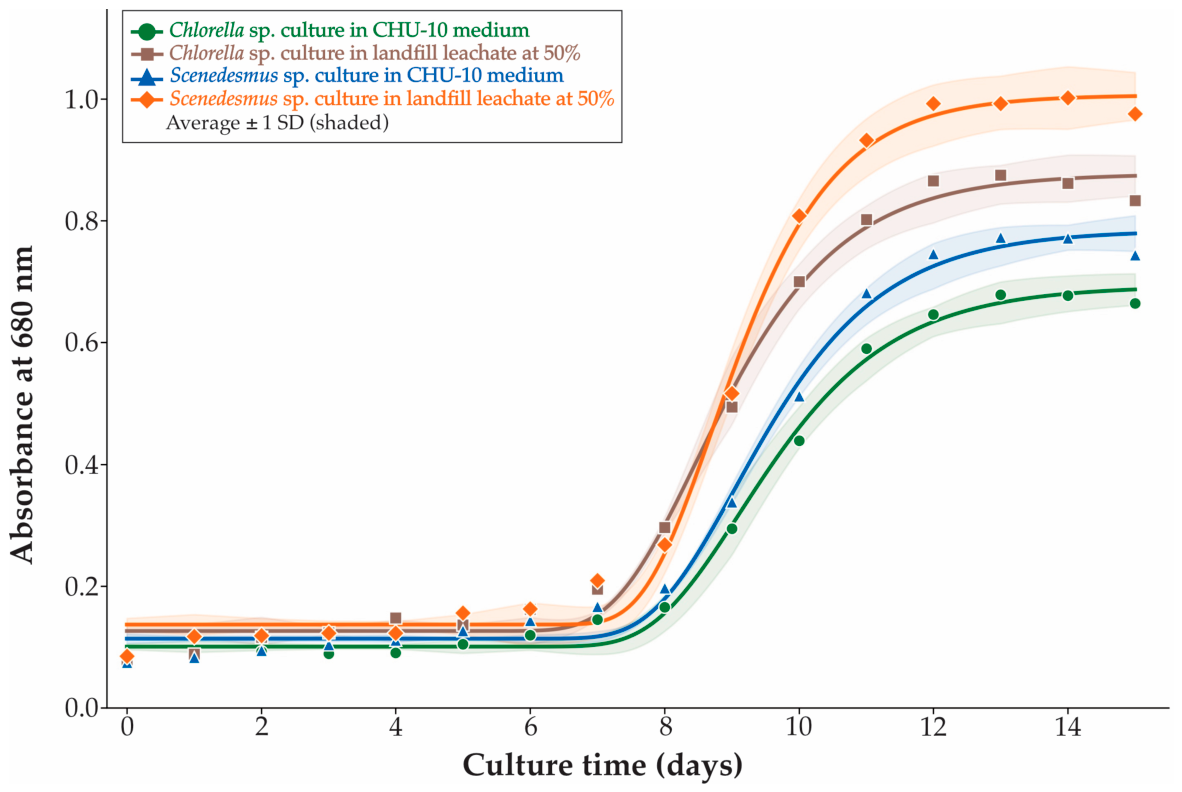
Figure 1. Growth kinetic profiles of Chlorella sp. and Scenedesmus sp. cultivated for 15 days in CHU-10 medium or 50% (v/v) landfill leachate. Symbols indicate mean OD680 (n = 3). Lines indicate modified Gompertz fits; shaded bands denote ±1 SD.
Water 18 02018 g001
Figure 2. 3D PCA biplot of biochemical composition (33 variables, n = 36) for Chlorella sp. and Scenedesmus sp. in CHU-10 medium and 50% leachate. PC1 = 59.5%, PC2 = 32.4%, PC3 = 7.1% (98.9% cumulative variance). Points show individual replicates by treatment group (Chl-C10, Chl-LL50, Sce-C10, and Sce-LL50), with centroids and 99% confidence ellipsoids. Vectors indicate the eight highest-magnitude loadings (Arg, Ser, Met/Cys, C18:1n-9, C18:0, Lys, C18:1n-7, and C16:1n-7).
Water 18 02018 g002
Figure 3. Net biological removal efficiency (NBRE, %) of 32 metal ions and trace elements by Chlorella sp. and Scenedesmus sp. across three functional categories: Macronutrients (P, K, Mg, Ca, Na), Micronutrients (Fe, Mn, Zn, Cu, Ni, Co, Mo, V, Se, Cr;), and toxic/non-essential elements (Hg, Cd, Pb, As, Tl, Ag, Bi, Sb, Be, Al, Li, Ba, Sn, Sr, B, Si, Ti); n = 3 true biological replicates per element per species). Box plots show the median, IQR, and 1.5 × IQR whiskers with individual replicate values overlaid. Kruskal–Wallis H = 17.06, p = 0.0044; Dunn–Bonferroni post hoc showed no significant pairwise differences within any category. Dashed line = 80% NBRE reference threshold.
Water 18 02018 g003
Figure 4. Spearman rank correlation analysis of net biological removal efficiency (NBRE, %) profiles across 31 elements (Li excluded, zero variance) at the true biological replicate level (n = 6 observations: 3 replicates × 2 species). (A) Co-removal network of 90 nominally significant element pairs (r > 0.60, p < 0.05); node color = functional category, node size = degree, green solid edges = negative, and pink dashed edges = positive correlations. 7 modules, Q = 0.329. Given n = 6, the results are exploratory rather than confirmatory (critical |ρ| for p < 0.05 is 0.886). (B) Structured Spearman r matrix for pairs with |r| ≥ 0.60 and p < 0.05; elements grouped by functional category (macronutrients, blue; micronutrients, green; toxic/non-essential, orange).
Water 18 02018 g004
Table 1. Proximate Biochemical Composition of Chlorella sp. and Scenedesmus sp. cultured in CHU-10 medium or 50% landfill leachate.
TreatmentTotal ProteinsTotal LipidsTotal CarbohydratesAshes
Chlorella sp. cultured in CHU-10 medium137.64 ± 0.69 c 135.08 ± 2.48 b328.96 ± 8.73 b24.50 ± 1.02 d
Chlorella sp. cultured in landfill leachate at 50%215.96 ± 2.85 b72.79 ± 2.29 c120.23 ± 4.75 d193.80 ± 7.3 a
Scenedesmus sp. cultured in CHU-10 medium184.09 ± 0.15 b236.71 ± 1.36 a373.83 ± 0.75 a11.78 ± 1.08 c
Scenedesmus sp. cultured in landfill leachate at 50%319.06 ± 3.93 a149.29 ± 2.13 b185.55 ± 5.23 c139.98 ± 2.85 b
Notes: Mean ± SD of biochemical components (mg/g dry microalgae biomass, n = 9 per treatment). Different superscript lowercase letters within each row indicate statistically significant differences after Dunn–Bonferroni correction (p < 0.05).
Table 2. Net biological removal efficiency (NBRE) of 13 physicochemical parameters in 50% landfill leachate treated with Chlorella sp. and Scenedesmus sp. for 15 days.
CategoryParameterNBRE (%)Omnibus Test 1Effect Size 2Species Difference 3
(p)
Chlorella sp.Scenedesmus sp.
NutrientsAmmonium87.3 ± 0.086.5 ± 0.0H = 10.01, p = 0.018ε2 = 0.8761.000
Ammonia87.3 ± 0.086.4 ± 0.0F = 209,456.77, p < 0.001η2 = 1.0000.002
Nitrates91.4 ± 0.176.9 ± 0.3H = 10.42, p = 0.015ε2 = 0.9281.000
Nitrites61.8 ± 0.198.3 ± 0.0H = 10.34, p = 0.016ε2 = 0.9171.000
Phosphate71.8 ± 0.274.8 ± 0.1H = 9.67, p = 0.022ε2 = 0.8331.000
Sulfate91.0 ± 0.173.8 ± 0.1H = 9.49, p = 0.023ε2 = 0.8121.000
PhysicochemicalChlorides64.8 ± 0.166.1 ± 0.1H = 9.67, p = 0.022ε2 = 0.8331.000
Total Alcalinity86.1 ± 0.085.1 ± 0.0F = 547,447.29, p < 0.001η2 = 1.000<0.001
Total Acidity89.7 ± 0.190.1 ± 0.0H = 10.38, p = 0.016ε2 = 0.9231.000
Total Hardness85.6 ± 0.085.8 ± 0.1H = 9.67, p = 0.022ε2 = 0.8331.000
Organic MatterCOD68.8 ± 0.069.2 ± 0.0H = 10.42, p = 0.015ε2 = 0.9281.000
BOD67.7 ± 0.159.8 ± 0.1F = 348,628.87, p < 0.001η2 = 1.000<0.001
TOC67.6 ± 0.164.8 ± 0.1F = 416,240.06, p < 0.001η2 = 1.000<0.001
Notes: Values are expressed as mean ± SD (n = 3 biological replicates per treatment). NBRE (%) = [(Cco,15 − Ctm,15)/Cco,15] × 100, isolating the biological contribution relative to the Day-15 abiotic control. 1 Omnibus test across all four treatment groups (Initial, Abiotic Control, Chlorella sp., Scenedesmus sp.). ANOVA was used when Shapiro–Wilk (all groups) and Levene’s test were both p > 0.05, and Kruskal–Wallis otherwise. 2 Effect size: η2 (eta-squared) for ANOVA, ε2 (epsilon-squared) for Kruskal–Wallis test. 3 Chlorella sp. vs. Scenedesmus sp. pairwise comparison (Tukey HSD for ANOVA parameters, Dunn–Bonferroni for Kruskal–Wallis parameters) computed within the pooled four-group design. Significant species differences after Benjamini–Hochberg correction across all 13 parameters (family-wise) were observed for Ammonia, Total Alkalinity, Biochemical Oxygen Demand, and Total Organic Carbon (all pFDR < 0.01).
Disclaimer/Publisher’s Note: The statements, opinions and data contained in all publications are solely those of the individual author(s) and contributor(s) and not of MDPI and/or the editor(s). MDPI and/or the editor(s) disclaim responsibility for any injury to people or property resulting from any ideas, methods, instructions or products referred to in the content.