1. Introduction
The Water–Energy–Food (WEF) Nexus constitutes the fundamental system underpinning human survival, economic activity, and social stability [
1,
2]. Water availability enables food production and energy generation; energy is essential for water abstraction, treatment, transport, and food supply chains [
3]; and food systems depend simultaneously on water, energy, and land resources [
4]. Because of these strong interdependencies, disturbances in any single component can propagate rapidly through the system, generating cascading failures and systemic vulnerabilities [
5,
6,
7].
In recent decades, apparent resource security in many regions has been achieved through the expansion of centralized infrastructure networks, long-distance supply chains, and fossil-fuel-based energy systems. While these arrangements have increased short-term efficiency and reliability, they have also intensified dependence on external resources and reduced the capacity of local systems to cope with disruptions [
8,
9,
10,
11]. Climate variability, ecosystem degradation, geopolitical instability, and energy price volatility increasingly expose the fragility of such configurations, particularly in rural and peripheral areas where redundancy and adaptive capacity are limited [
12,
13,
14,
15,
16].
Within this context, local self-sufficiency has re-emerged as a critical dimension of resilience. Self-sufficiency is not interpreted here as isolation or autarky, but rather as the capacity of a system to meet essential needs—water, energy, and food—through nearby, accessible, and preferably renewable resources [
17,
18,
19,
20]. From a resilience perspective, reducing reliance on distant resources enhances the system’s ability to absorb shocks, adapt to stressors, and maintain core functions under conditions of uncertainty [
20,
21,
22].
Despite the growing recognition of the WEF Nexus, existing approaches often suffer from three key limitations [
23,
24,
25,
26]. First, assessments frequently focus on individual sectors—such as water scarcity, energy security, or food availability—without explicitly accounting for cross-sectoral dependencies. Second, many indicators remain static, aggregate, or purely volumetric, failing to capture the role of infrastructure, energy coupling, and spatial proximity. Third, resilience is often discussed qualitatively, without being translated into operational, comparable metrics that can support planning and scenario analysis [
19].
Several studies have proposed composite indices or footprint-based measures to evaluate sustainability within the WEF Nexus. However, such approaches often obscure physical causality, allow compensatory effects between fundamentally constrained resources, or neglect the spatial dimension that is central to local resilience [
14]. In practice, high performance in one sector cannot offset critical deficiencies in another; a community with abundant food-producing land, for example, cannot be considered resilient if water or energy inputs are unavailable [
23].
This study addresses these gaps by introducing a quantitative, spatially explicit framework for assessing self-sufficiency and resilience in the WEF Nexus. The proposed methodology is based on normalized, per capita indicators that explicitly distinguish between local versus external resources and renewable versus non-renewable sources, while incorporating physical availability, energy requirements, infrastructural configurations, and land-use constraints. While non-compensatory approaches and minimum-operator aggregation have been discussed in sustainability science and multi-criteria decision analysis, the present framework distinguishes itself through (a) its explicit hierarchical nesting of constraints (water → food, with energy as the enabler), (b) the integration of spatial proximity and land-use competition into the per capita indicators, and (c) its dynamic two-stage evaluation (existing versus optimized infrastructure) that enables direct scenario comparison. In this sense, it moves beyond existing composite or footprint-based nexus indices by maintaining physical interpretability and avoiding compensatory trade-offs that obscure critical vulnerabilities [
24,
25,
26,
27].
The objectives of this paper are threefold:
To develop physically grounded indicators for water, energy, and food self-sufficiency that reflect resilience-relevant constraints.
To integrate these indicators within a spatial framework capable of capturing land-use competition, population density, and infrastructural choices.
To demonstrate the applicability of the methodology through a rural case study, highlighting both current vulnerabilities and feasible pathways toward increased resilience.
By reframing the WEF Nexus through the lens of local self-sufficiency and hierarchical constraints, the proposed framework offers a practical tool for resilience-oriented planning, particularly in data-limited contexts and regions exposed to climatic and systemic stress. In this study, self-sufficiency is used as a proxy indicator of resilience, focusing specifically on the system’s capacity to maintain essential functions under resource constraints. This does not capture all dimensions of resilience (e.g., governance, adaptability, or recovery) but provides a physically grounded and quantifiable component.
While non-compensatory approaches and constraint-based thinking have been discussed in resilience and WEF nexus literature, the present study introduces a distinct contribution by (i) explicitly linking self-sufficiency to spatially explicit, per capita physical thresholds, (ii) embedding water–energy–food dependencies in a hierarchical, non-compensatory structure, and (iii) integrating land-use constraints and distance-based resource accessibility into a unified indicator framework. This combination enables a direct translation of nexus interactions into physically interpretable and planning-relevant metrics, which is not commonly achieved in existing approaches.
2. Conceptual Framework and Evaluation Stages
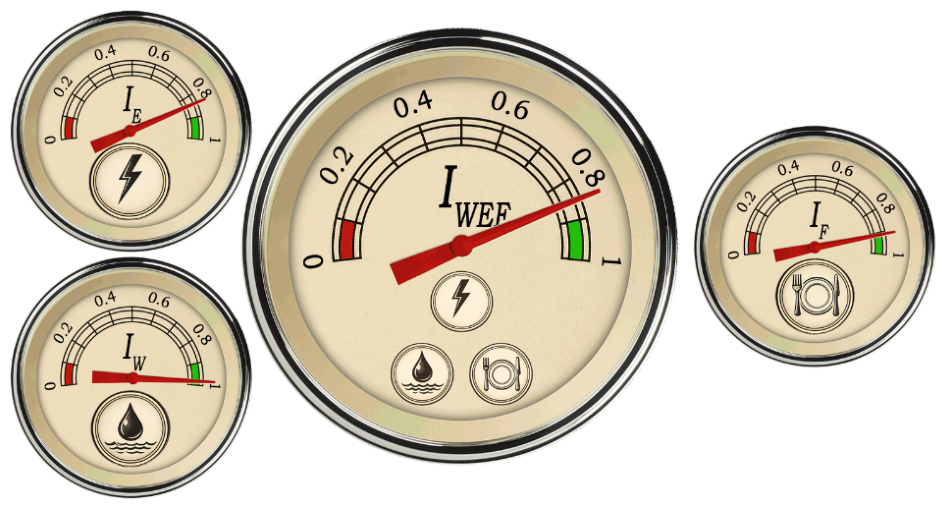
The proposed framework conceptualizes self-sufficiency and resilience in the Water–Energy–Food (WEF) Nexus as emergent properties of physically constrained resource systems. Rather than treating water, energy, and food as independent or symmetrically interacting sectors, the framework adopts a modular and hierarchical structure that reflects the underlying causal relationships between resource flows, infrastructure, and spatial organization (
Figure 1).
All indicators are defined on a per capita basis, allowing direct comparison across different spatial scales, population densities, and settlement types. Depending on data availability and analytical needs, indicators can be aggregated at the level of households, settlements, or larger regions. Within this framework, resilience is interpreted as the capacity of a system to maintain the provision of essential services under conditions of resource scarcity, infrastructural disruption, or external shocks, without assuming unlimited access to distant or imported resources.
2.1. Conceptual Structure
The framework is built around four core principles:
Locality and renewability of resources.
Self-sufficiency is assessed based on the degree to which essential needs are met using resources that are locally available within the system boundaries and, where possible, renewable. Reliance on distant, imported, or non-renewable resources is explicitly treated as a source of vulnerability.
Physical and infrastructural constraints.
Resource availability alone is insufficient to ensure self-sufficiency. Energy requirements for water abstraction, treatment, transport, food production, and distribution are explicitly incorporated, together with land-use availability and infrastructural configurations.
The framework can support infrastructural prioritization and spatial planning decisions by identifying critical trade-offs between water-energy and food nexus.
2.2. Hierarchical Dependency Within the WEF Nexus
The WEF Nexus is represented as a nested system of constraints rather than a fully compensatory or circular interaction. Water availability is constrained by energy inputs; food production is constrained by both water and energy availability; energy production is treated as an independent driver, except in cases where biomass pathways introduce feedbacks. Unlike conventional additive composite indices, the proposed framework preserves critical physical constraints and interdependencies between water, energy, and food systems. Thus, surpluses in one subsystem cannot compensate for deficits in another, preventing artificial inflation of resilience values through compensatory aggregation. The framework is intended as a proof of concept demonstrating the applicability of a physically constrained and spatially explicit WEF resilience assessment.
2.3. Evaluation Stages
The assessment is performed in two distinct stages to evaluate both the current situation and potential improvements.
2.3.1. Stage 1: Existing Infrastructure
This stage assesses the WEF Nexus under the prevailing conditions, including current water supply sources, energy mixes, food production practices, and existing infrastructure. It explicitly identifies the degree of dependence on external inputs such as imported electricity, fossil fuels, fertilizers, and groundwater abstraction.
2.3.2. Stage 2: Optimized Infrastructure
At each stage, the water, energy, and food self-sufficiency indicators are first calculated independently and then combined through a non-compensatory hierarchical aggregation. All indicators are normalized between 0 and 1, where 0 denotes full dependence on external resources and 1 denotes full local self-sufficiency. Intermediate values arise from mixed resource portfolios, energy requirements, and spatial constraints. The per capita, physically grounded formulation ensures transparency and interpretability.
2.4. Indicator Logic and Interpretation
At each stage, water, energy, and food self-sufficiency indicators are calculated independently before being integrated through a hierarchical aggregation scheme. All indicators are normalized on a scale from 0 to 1, where 0 represents complete dependence on external resources and 1 represents full local self-sufficiency under the specified conditions.
Intermediate values emerge naturally from mixed resource portfolios, partial coverage, energy penalties, and spatial constraints. Because indicators are defined per capita and grounded in physical processes, they retain a clear and interpretable meaning, avoiding the opacity often associated with composite indices.
3. Minimal Needs for a Functional Nexus
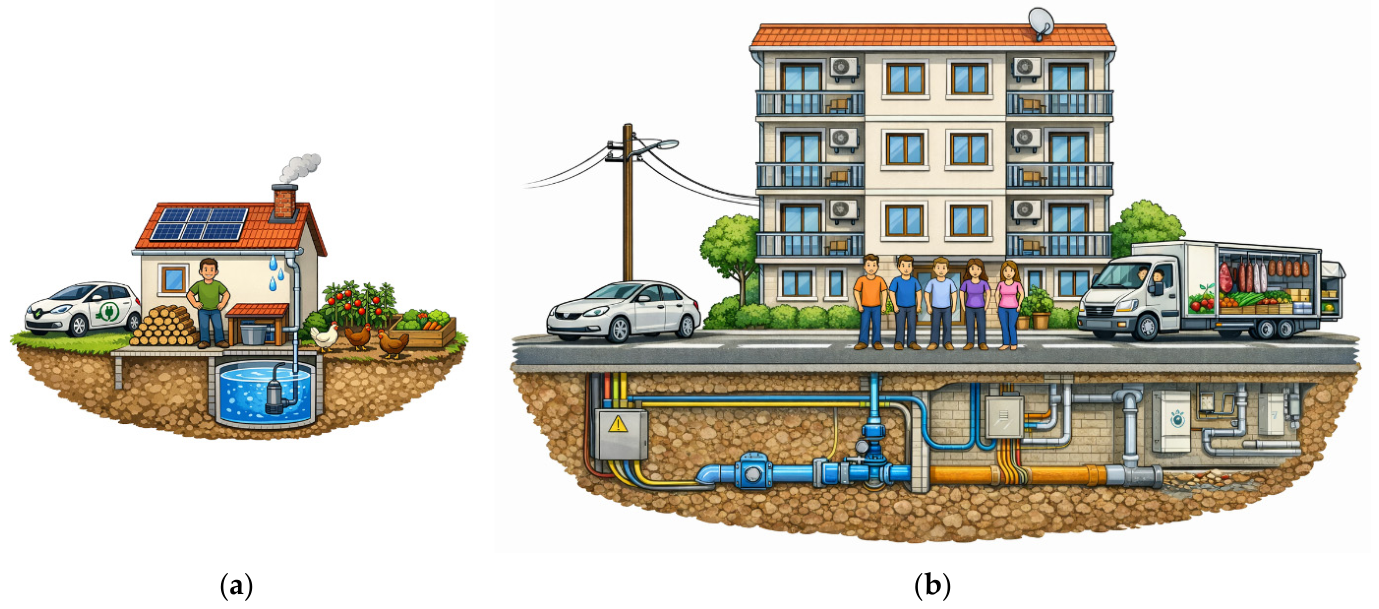
To evaluate self-sufficiency and resilience in a consistent and comparable manner, it is necessary to define a set of minimum per capita requirements that ensure the functional integrity of the Water–Energy–Food (WEF) Nexus. These requirements do not represent consumption-intensive or lifestyle-driven targets (
Figure 2), but rather threshold conditions under which basic human needs and core societal functions can be maintained under resource-constrained or crisis conditions.
In this study, minimum needs are defined at the per capita level and are explicitly linked to physical resource flows and infrastructural requirements. The adopted values aim to balance three competing considerations: (i) physiological survival and public health standards, (ii) basic societal well-being compatible with long-term habitation, and (iii) robustness against external disruptions.
The selected parameter values (e.g., per capita land requirements, water demand, and energy thresholds) are based on a combination of literature sources and conservative assumptions aimed at representing minimum functional conditions. Where ranges exist in the literature, mid-range values were selected to ensure internal consistency rather than optimization.
3.1. Residential Space Assumption
A residential floor area of 20 m
2 per capita is adopted as a baseline assumption [
28]. This value represents a compact yet adequate living standard consistent with resilience-oriented planning and multi-person households. The assumption is used exclusively for estimating space-related energy needs (heating) and land-use requirements and does not imply normative housing standards.
3.2. Water Demand Structure and Thresholds
Water demand within the Water–Energy–Food (WEF) Nexus is defined as the minimum per capita volume required to sustain hygienic living conditions and enable local food production under resource-constrained conditions. In the context of resilience-oriented assessment, water demand is not treated as a reflection of contemporary consumption patterns, but as a functional threshold that ensures the operational integrity of the nexus.
3.2.1. Domestic Water Demand
Domestic water demand includes water required for drinking, food preparation, personal hygiene, and basic household activities. International health guidelines commonly identify 50 L per capita per day as the minimum volume necessary to maintain acceptable hygienic standards. This corresponds to an annual requirement of 18.5 m
3 per capita and is considered the absolute survival threshold [
29].
To ensure basic societal well-being and long-term habitability—without assuming consumption-intensive lifestyles—this study adopts a higher yet still conservative reference value of 42.5 m
3 per capita per year (equivalent to 124 L/day) [
30,
31]. This value is used consistently across all calculations and scenarios, provided that basic survival needs are satisfied.
3.2.2. Agricultural (Irrigation) Water Demand
Agricultural water demand corresponds to irrigation requirements for the cultivated land needed to meet per capita food needs. Irrigation demand is estimated as a function of climatic conditions, crop characteristics, and effective precipitation, ensuring consistency between water availability, energy requirements, and food production.
For resilience-oriented planning, irrigation water demand is directly linked to the adopted cultivated area of 0.2 ha per capita (full documentation of the selection in
Section 3.4.2). This approach allows water demand to scale transparently with population size and land-use availability and avoids dependence on crop-specific yield assumptions that may vary significantly across contexts.
To estimate the daily irrigation requirements for the cultivated area, we use an evapotranspiration-based approach, appropriate for data-limited conditions, using the climatic data for a typical year (2017). Reference evapotranspiration (ETo) was approximated using daily air temperature and incoming solar radiation.
The daily evapotranspiration demand
(m
3 day
−1) is computed with the simplified Equation (1) by Malamos et al. [
32]:
where
ETo is the reference evapotranspiration in kg m
−2, which is equivalent to mm,
Ra (kJ m
−2) is the extraterrestrial radiation,
T (°C) is the mean air temperature, and
a (kg kJ
−1), and
c (°C
−1) are model parameters that must be inferred through calibration against evapotranspiration data, either modeled or measured.
Net irrigation demand was then calculated as the difference between crop evapotranspiration and effective rainfall Pe and converted to volumetric units assuming a cultivated area of 1 ha. Daily net irrigation requirements were estimated as ETo − Pe, where ETo will be derived from the two-parameter model [
33].
3.2.3. Integrated Water Demand
Total per capita water demand is defined as the sum of domestic and agricultural components. This integrated demand forms the reference against which water self-sufficiency indicators are calculated. By explicitly linking water demand to both basic living standards and food production requirements, the framework ensures that water availability is evaluated in a manner consistent with the functional requirements of the entire WEF Nexus.
3.3. Energy Demand Structure and Thresholds
Energy demand within the Water–Energy–Food (WEF) Nexus is defined as the minimum per capita final energy required to sustain essential living conditions and enable the functional operation of water supply and food production systems under resource-constrained conditions. In line with a resilience-oriented perspective, energy demand is not derived from prevailing consumption patterns, but from threshold requirements necessary to maintain core societal functions.
All energy demand components are expressed on a per capita basis and aggregated to form a unified reference demand against which energy self-sufficiency is subsequently evaluated.
3.3.1. Energy Demand Components
Total per capita energy demand is structured into five distinct components:
This component includes electricity required for lighting, communication, refrigeration, and basic appliances. Electricity demand is derived from national per capita statistics (ENTSO-E database [
34]) and adjusted to represent essential rather than discretionary consumption.
- 2.
Space heating demand
Heating energy is considered critical for survival and long-term habitability, even in Mediterranean climates. Heating demand is estimated using the degree-day approach, which quantifies cumulative deviations of ambient temperature below a defined comfort threshold. Heating demand is linked explicitly to the assumed residential floor area of 20 m2 per capita and representative thermal performance parameters.
- 3.
Space cooling demand
Cooling demand is excluded from the resilience assessment. While relevant for comfort and quality of life, cooling is not considered essential for maintaining basic functionality of the nexus under crisis or scarcity conditions.
- 4.
Transportation energy demand
Transportation energy represents the minimum mobility required to access essential services and economic activities. A conservative daily travel distance is estimated using average Greek mobility patterns and consumption statistics and converted into per capita energy units. Considering an average move is 20 km/day [
35]; fuels’ consumption is 7 L/100 km; 1 L fuel corresponds to ~9 kWh; electrical vehicles 17 kWh/100 km: this corresponds to 6.3 kWh (fuels) or 1.7 kWh (electricity) for a minimal transportation 10 km/day with limitation of resources.
Energy demand is calculated independently of the transport energy carrier (fuel or electricity), which is addressed later in the normalization stage.
- 5.
Energy embedded in food production
This component includes energy associated with agricultural machinery and agrochemical inputs (e.g., fertilizers), expressed as final energy equivalents per unit cultivated area. Energy demand is directly linked to the adopted agricultural land requirement of 0.2 ha per capita.
3.3.2. Energy Demand for Heating
Heating and cooling energy demand is estimated using the degree-day approach, which quantifies the cumulative deviation of ambient temperature from defined thermal comfort thresholds over time [
36,
37]. Degree-days (°C·day) represent the combined effect of temperature difference (°C) and duration (days) and are widely used as a proxy for building energy demand. Annual heating energy consumption is calculated with Equation (2):
while cooling energy demand is given by Equation (3):
where
A = 20 m
2 represents the residential floor area per capita, and for
kh and
kc have been used 0.12 and 0.05 respectively, which can be considered as general values. However, cooling is not considered as critical for survival, therefore in the present study will be ignored [
38].
3.3.3. Energy Demand for Water Supply
Energy required for water abstraction, pumping, or treatment is included in the total energy demand only where such processes are necessary to meet the defined water demand thresholds. Gravity-fed water supply systems incur negligible energy demand, while groundwater abstraction or desalination introduce additional energy requirements that are quantified separately and added to the per capita energy balance.
3.3.4. Threshold Interpretation
The resulting total energy demand represents the minimum functional energy threshold required to sustain the WEF Nexus. It does not imply energy autonomy, nor does it prescribe specific technologies or energy carriers. Instead, it establishes a physically grounded baseline that allows energy self-sufficiency to be evaluated consistently across different infrastructural configurations and scenarios.
3.4. Food Demand Structure and Thresholds
Food demand within the Water–Energy–Food (WEF) Nexus is defined as the minimum per capita nutritional requirement necessary to sustain human survival and basic well-being, expressed in terms of agricultural land area required for production. In a resilience-oriented framework, food demand is not formulated in terms of dietary preferences or consumption patterns, but as a functional threshold that can be met under conditions of limited resources and infrastructural constraints.
Rather than adopting crops or diet-specific assumptions, food demand is translated into land-use requirements, allowing direct integration with spatial analysis and land availability constraints.
3.4.1. Nutritional Basis
Human caloric requirements are commonly estimated to range between 1800 and 3000 kcal per day, depending on age, activity level, and climatic conditions [
39]. For the purposes of resilience assessment, food demand is defined as the minimum caloric intake necessary to sustain long-term habitation without malnutrition, independent of dietary composition.
3.4.2. Land-Use Representation of Food Demand
Food demand is expressed as the agricultural land area required per capita to meet the defined caloric needs under typical Mediterranean agro-climatic conditions.
Reference values indicate that:
Highly optimized, low-input plant-based systems may require as little as 0.04–0.06 ha per capita [
40,
41].
Modern, resource-intensive dietary systems may exceed 0.6 ha per capita [
42,
43].
For resilience-oriented planning, an intermediate and conservative value of 0.2 ha per capita is adopted. This value reflects a mixed, low-input agricultural system capable of covering essential nutritional needs while avoiding assumptions of high external inputs or luxury consumption.
3.4.3. Threshold Interpretation
The adopted land-use threshold represents a minimum functional condition for food provision within the nexus. It does not imply dietary uniformity, agricultural specialization, or optimal productivity, but provides a physically grounded and spatially explicit benchmark that can be consistently applied across different regions and population densities.
3.5. Functional Interpretation
The minimum needs defined above establish a coherent baseline for evaluating the functionality of the WEF Nexus. They represent necessary conditions for maintaining essential services rather than aspirational targets. By anchoring all subsequent indicators to these thresholds, the framework ensures that self-sufficiency and resilience are evaluated in physically meaningful and socially interpretable terms.
4. Water–Energy–Food Self-Sufficiency Sources and Normalization
Subsequently, water, energy, and food self-sufficiency are evaluated by explicitly accounting for the origin and renewability of the resources involved. The primary objective of the proposed indicators is to assess the degree to which essential needs can be satisfied through locally available and renewable resources, which are considered fundamental attributes of resilience.
For the purposes of normalization, a binary criterion is adopted as a reference framework. Resources that are locally available within the study area are assigned a normalized value of 1, whereas resources that are imported from outside the system boundaries are assigned a value of 0, reflecting complete external dependence. Similarly, renewable resources are assigned a value of 1, while non-renewable or externally supplied resources are assigned a value of 0.
Renewable and local resources considered in the analysis include surface water, rainwater harvesting, and renewable energy sources such as solar, wind, and sustainably harvested biomass. In contrast, imported electricity, fossil fuels, externally supplied fertilizers [
44], are treated as non-local and non-renewable within the system boundaries. Water obtained through non-renewable underground aquifer is treated as local but non-renewable.
Initially, the present function of water, energy and food nexus is evaluated. Furthermore, physical potential of the study area to meet water, energy, and food requirements using exclusively local and renewable resources is assessed.
Subsequently, this potential is examined in relation to land-use availability, infrastructural constraints, and energy requirements.
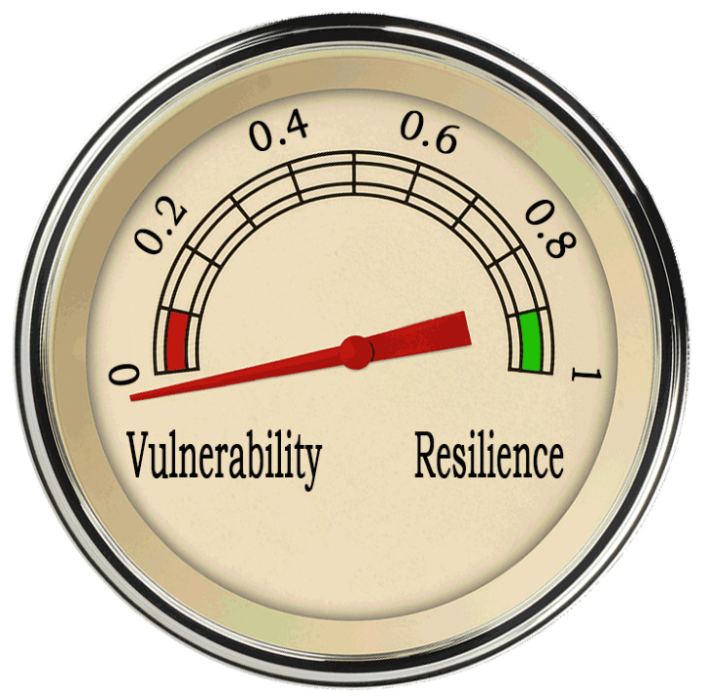
Intermediate indicator values between 0 and 1 emerge from the weighted contribution of local versus imported resources and from penalties associated with energy intensity, depth of abstraction, and spatial constraints, while preserving the fundamental interpretation that full self-sufficiency corresponds to a value of 1 and full dependence to a value of 0 (
Figure 3).
The binary categorization serves as a conceptual and analytical reference structure rather than a complete representation of resilience complexity. Intermediate conditions are partially captured through energy penalties, infrastructure constraints, and temporal variability in resource availability.
4.1. Water Normalization
Water self-sufficiency is defined as the ability of a system to meet its total per capita water demand—domestic and agricultural—using locally available water resources with minimal dependence on external inputs and energy-intensive processes. From a resilience perspective, water availability alone is insufficient; the origin, renewability, and energy requirements of water supply pathways are equally critical.
Accordingly, the water normalization indicator is designed to reflect not only volumetric adequacy, but also the degree of dependence on non-renewable sources and external energy support.
4.1.1. Normalization Principle
The water self-sufficiency indicator is normalized on a continuous scale from 0 to 1:
Indicator = 1 corresponds to full water self-sufficiency, where total water demand is met using local and renewable sources with negligible energy requirements.
Indicator = 0 corresponds to complete dependence on external or non-renewable water sources that require sustained energy inputs not available within the system boundaries.
Intermediate values emerge from mixed supply portfolios and from depth of abstraction, and renewability constraints.
4.1.2. Classification of Water Sources
Water sources are classified according to two primary attributes:
The following categories are distinguished:
- 3.
Local, renewable sources.
These include surface water from upstream basins, springs, and rainwater harvesting systems that deliver water by gravity or require negligible pumping. Such sources are assigned a normalization value close to 1, as they represent the most resilient water supply pathways.
Groundwater abstraction from confined or slowly recharging aquifers is treated as local but non-renewable within the resilience time horizon. The normalization value decreases as a function of pumping depth, reflecting both increased energy requirements and depletion risk. Shallow groundwater abstraction results in moderate penalties, while deep aquifers incur severe reductions.
Seawater desalination is treated as renewable in volumetric terms but highly energy-intensive. As such, it is not penalized at the water normalization stage for renewability, but its energy requirements are explicitly transferred to the energy indicator, ensuring consistency with the hierarchical WEF structure.
Water imported across system boundaries through large-scale transfer schemes is treated as non-local and assigned a normalization value of 0, reflecting complete external dependence.
4.1.3. Computation of the Water Indicator
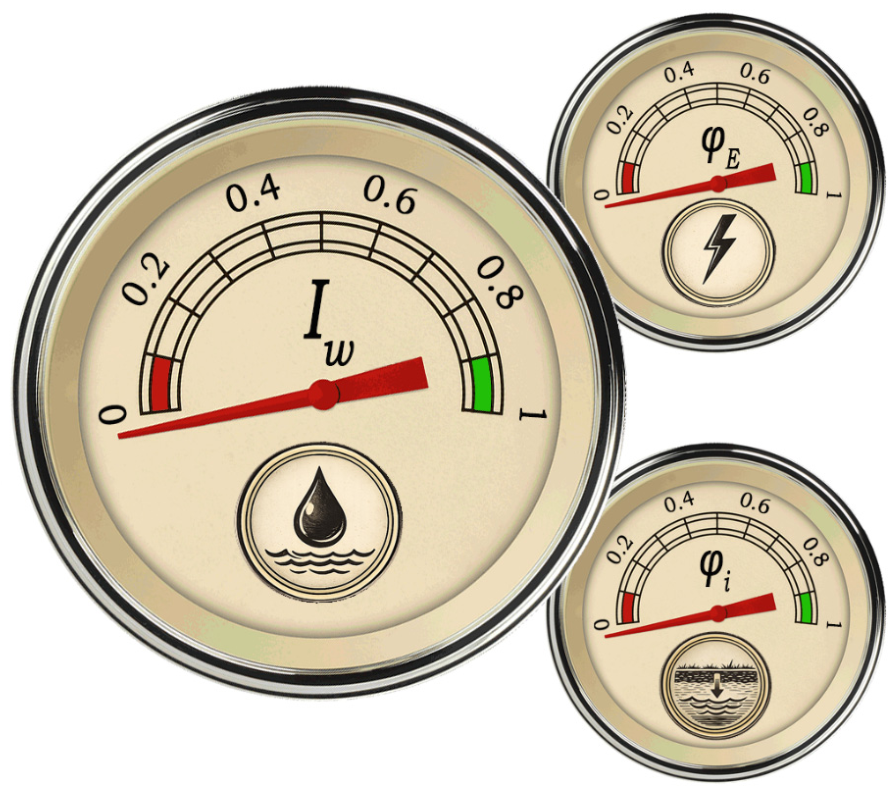
The normalized water self-sufficiency indicator (
Figure 4) is calculated as a weighted sum of the contribution of each water source to total per capita demand:
where
is the annual volume supplied by source i.
is the total annual per capita water demand.
is the normalization factor associated with water supply processes and it is based in energy self-sufficiency indicator.
is the normalization factor representing the combined effect of locality and renewability for source i. It is considered as 1 if the water is coming from surface sources and decreases proportionally to 0 following the formula , if the water comes from underground aquifers. 100 m or more below the underground aquifer is considered 0.
Figure 4.
Factors considered for the calculation of the water resilience indicator.
Figure 4.
Factors considered for the calculation of the water resilience indicator.
4.1.4. Interpretation
The resulting water normalization indicator captures the extent to which water demand can be satisfied through resilient, low-dependency pathways. A high indicator value signifies not only sufficient water availability, but also robustness against energy shortages, infrastructure failures, and long-term resource depletion. Conversely, low values reveal structural vulnerabilities that cannot be resolved through volumetric abundance alone.
4.2. Energy Normalization
Energy self-sufficiency is defined as the degree to which the total per capita energy demand can be met using locally available and renewable energy resources within the system boundaries. From a resilience perspective, the form, origin, and temporal availability of energy are as important as total energy quantities.
Accordingly, the energy normalization indicator reflects the balance between locally supplied renewable energy and externally imported or non-renewable energy sources.
4.2.1. Normalization Principle
The energy self-sufficiency indicator is normalized on a scale from 0 to 1:
Indicator = 1 corresponds to full energy self-sufficiency, where total energy demand is met exclusively by local and renewable sources.
Indicator = 0 corresponds to complete dependence on externally supplied or non-renewable energy sources.
Intermediate values result from mixed energy portfolios and partial coverage of demand by local resources.
4.2.2. Classification of Energy Sources
Energy sources are classified based on two attributes:
Energy produced within the spatial boundaries of the system is considered local. Imported electricity, fossil fuels, and externally produced fertilizers are classified as non-local and are classified with 0.
- 2.
Renewability
Renewable sources include solar, wind, sustainably harvested biomass, and other energy flows that can be maintained over the resilience time horizon are evaluated according to the coverage of percentage of time of energy needs.
The availability of renewable energy resources is treated as a binary condition: local availability corresponds to an indicator value of 1, which decreases proportionally with the time frame that covers the needs, while complete dependence on supply from abroad corresponds to 0.
Local energy sources can be categorized in following categories:
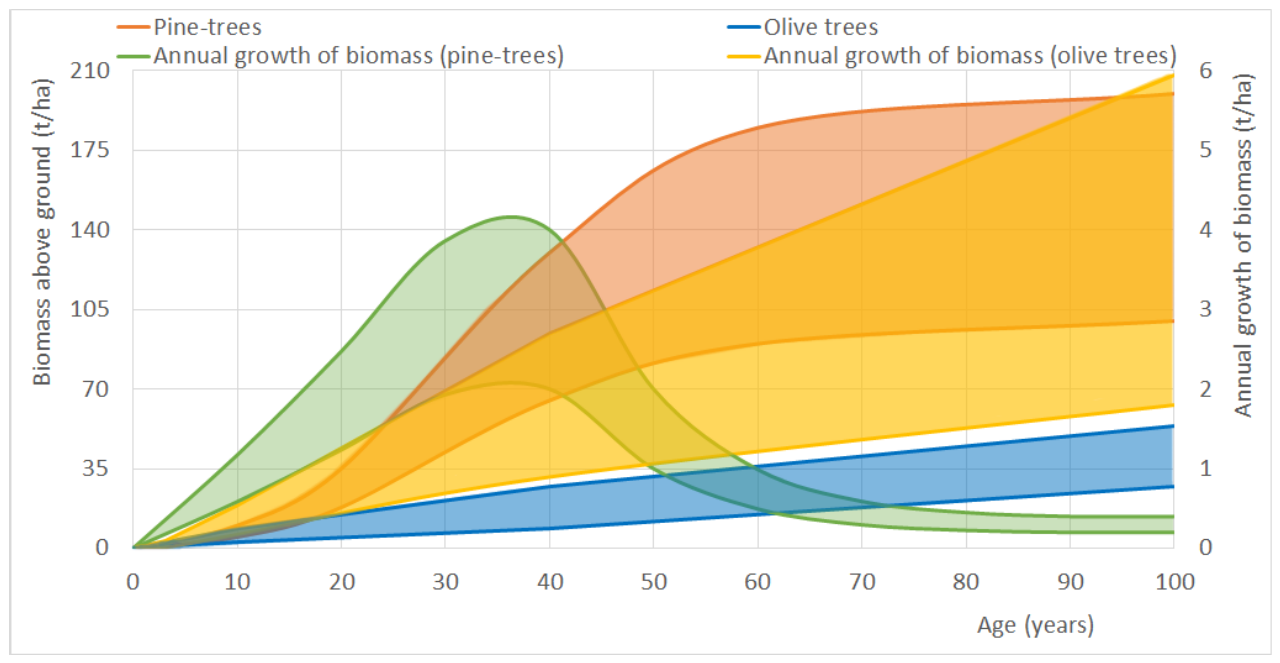
Biomass availability is evaluated from forests [
45,
46], olive groves, and agricultural residues [
47,
48,
49,
50]. The indicator considers sustainable regeneration rates (
Figure 5), accessibility and transport distance.
- 2.
Renewable Energy Potential
Renewable energy resources include solar and wind energy. The assessment accounts for:
Technically exploitable production potential.
Stochastic availability and temporal mismatch between supply and demand.
Storage requirements (battery capacity) necessary to ensure continuity of supply.
4.2.3. Treatment of Temporal Variability and Storage
Although a binary classification (local/non-local, renewable/non-renewable) is used as a reference, intermediate values emerge through energy penalties, temporal coverage, and depth-related functions, partially capturing system complexity.
Because renewable energy production is inherently variable, temporal mismatch between energy supply and demand is explicitly accounted. The normalization factor assigned to each renewable source reflects the fraction of total energy demand that can be covered over time without external imports, given the available generation capacity and storage infrastructure.
Energy storage systems (e.g., batteries) are treated as enabling technologies that increase the effective availability of renewable energy, thereby increasing the normalization value without altering the underlying demand structure.
4.2.4. Computation of the Energy Indicator
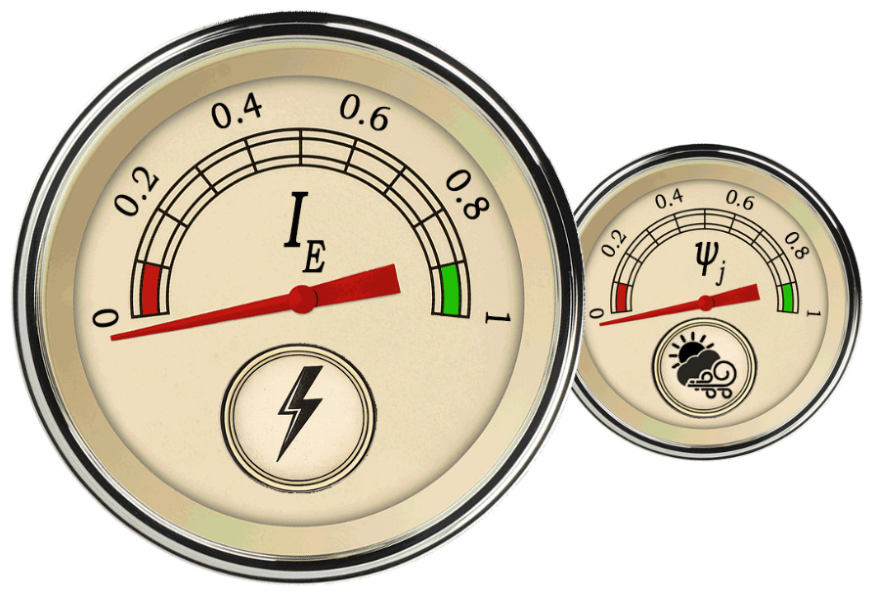
The normalized energy self-sufficiency indicator (
Figure 6) is computed as a weighted sum:
where
is the per capita energy production associated with component j.
is the total per capita energy demand.
is the normalization factor representing the combined effect of locality and renewability. It is considered as 1 if the energy is coming from renewable sources and decreases to 0 following the formula , given the stochastic dynamics of energy demand coverage.
Figure 6.
Factors considered for the calculation of the energy indicator.
Figure 6.
Factors considered for the calculation of the energy indicator.
4.2.5. Interpretation
A high energy normalization value indicates not only sufficient renewable energy potential, but also infrastructural and temporal robustness against external energy disruptions. Low values reveal structural dependence on imported fuels, fertilizers, or electricity, even if local renewable resources are physically abundant.
Energy self-sufficiency is evaluated against the total final energy demand of an average inhabitant, including:
Electricity.
Heating and cooling.
Transportation.
Water desalination and pumping (domestic and irrigation).
Agricultural activities (fertilizers, fuels).
In the scope of resilience design perspective, the energy needs for cooling are ignored.
5. Food Normalization
5.1. Energy Requirements for Food
Food self-sufficiency is defined as the degree to which the per capita food demand, expressed as agricultural land requirement, can be met through locally available production systems without reliance on external food imports. From a resilience perspective, food availability is constrained not only by land, but also by water supply, energy inputs, and transport distance.
Accordingly, food normalization evaluates the feasibility of local food provision after accounting for these constraints, rather than merely the presence of sufficient agricultural land.
5.1.1. Normalization Principle
The food self-sufficiency indicator is normalized on a scale from 0 to 1:
Indicator = 1 corresponds to full food self-sufficiency, where the required agricultural land is available locally and food production is not constrained by water, energy, or transport dependencies.
Indicator = 0 corresponds to complete dependence on external food supply.
Intermediate values arise from partial land availability, energy- or water-related limitations, and transport-related penalties.
5.1.2. Local Production and Transport Distance
Food produced within the immediate vicinity of consumption is assigned the highest normalization value. As production distance increases, the indicator is progressively reduced to reflect additional energy requirements for transport and increased dependence on external systems.
Transport-related penalties are applied proportionally to distance, based on typical energy consumption per unit mass and distance. Food imported from outside the system boundaries is assigned a normalization value of 0.
5.1.3. Energy Constraints on Food Production
Energy requirements for food production include energy embedded in fertilizers [
51] and fuels, as well as energy used for agricultural machinery. Where these energy inputs cannot be met through local and renewable energy sources, the food normalization indicator is reduced accordingly.
Typical energy requirements for modern cultivation are fertilizers (NH
3) 200–300 kg/ha equal to 12–18 GJ/ha or ~3000–5000 kWh (1 kg equal to 60 MJ); 50–100 L oil equal to 1.9–3.8 GJ or ~500–1000 kWh (1 L equal to 38 MJ). Using average values, we estimate the energy needs to ~3000 kWh/ha (fertilizers) and ~1000 kWh/ha (fuels) [
11].
5.1.4. Water Constraints on Food Production
Irrigation water availability constitutes a critical constraint on food self-sufficiency. Where agricultural water demand cannot be met using local and resilient water sources, food production is penalized proportionally.
Water-related penalties are applied independently of energy penalties, reflecting the dual dependency of food on both water and energy inputs.
5.2. Spatial Proximity and Transport
Food transport distance directly affects resilience through energy consumption:
5.2.1. Computation of the Food Indicator
The normalized food self-sufficiency indicator (
Figure 7) is expressed as:
where
represents the distance of required agricultural land. Zero-distance production yields an indicator value of 1 which is decreased proportional to 0 in a distance of 600 km. Water- and energy-constrained food indicators:
is associated with the energy for food production based in related energy self-sufficiency indicators and
represents is associated with the water self-sufficiency indicators for water supply processes.
5.2.2. Interpretation
A high food normalization value indicates that food demand can be met locally in a manner robust to external disruptions. Low values reveal structural dependencies on imported food, fertilizers, fuels, or water resources, even where agricultural land may be abundant.
6. Hierarchical Embedding of Water–Energy–Food Components
The Water–Energy–Food (WEF) relationship is not treated as a symmetric or circular interaction, but rather as a hierarchically structured system of constraints.
The underlying logic is as follows:
Water self-sufficiency depends on energy availability, due to the energy requirements associated with abstraction, pumping, transport or desalination.
Food self-sufficiency depends on both water and energy, through irrigation requirements, fertilizer production, fuel use, and transport.
Energy self-sufficiency does not directly depend on water or food, unless explicitly defined through biomass-based pathways.
As a result, the WEF nexus is represented through structured nesting rather than equal interdependence, reflecting the physical causality of the system.
6.1. Level 1—Primary Indicators
Three primary self-sufficiency indicators are defined:
: Water self-sufficiency
: Energy self-sufficiency
: Food self-sufficiency
All indicators are normalized within the interval .
6.2. Level 2—Integrated WEF Resilience Indicator
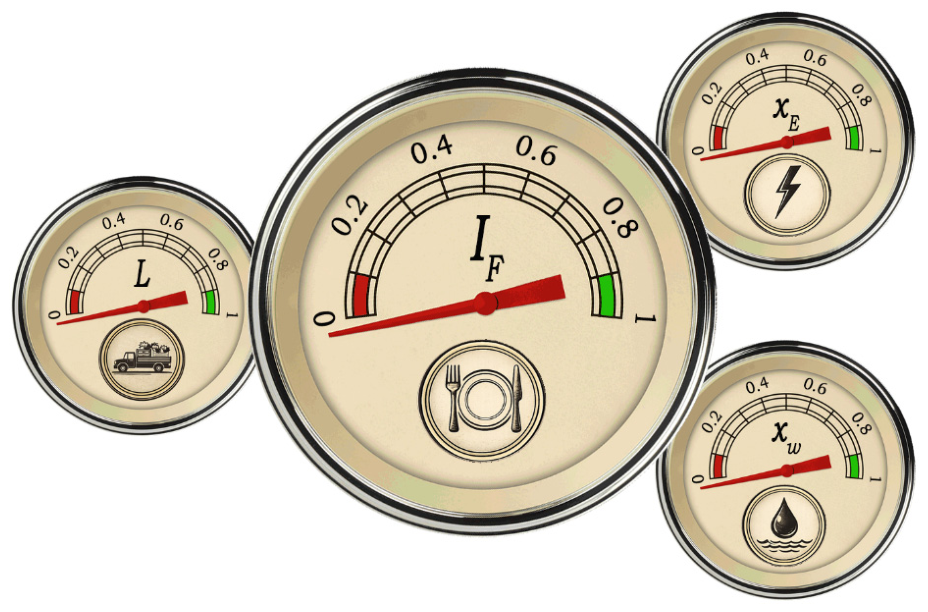
The overall Water–Energy–Food resilience system indicator (
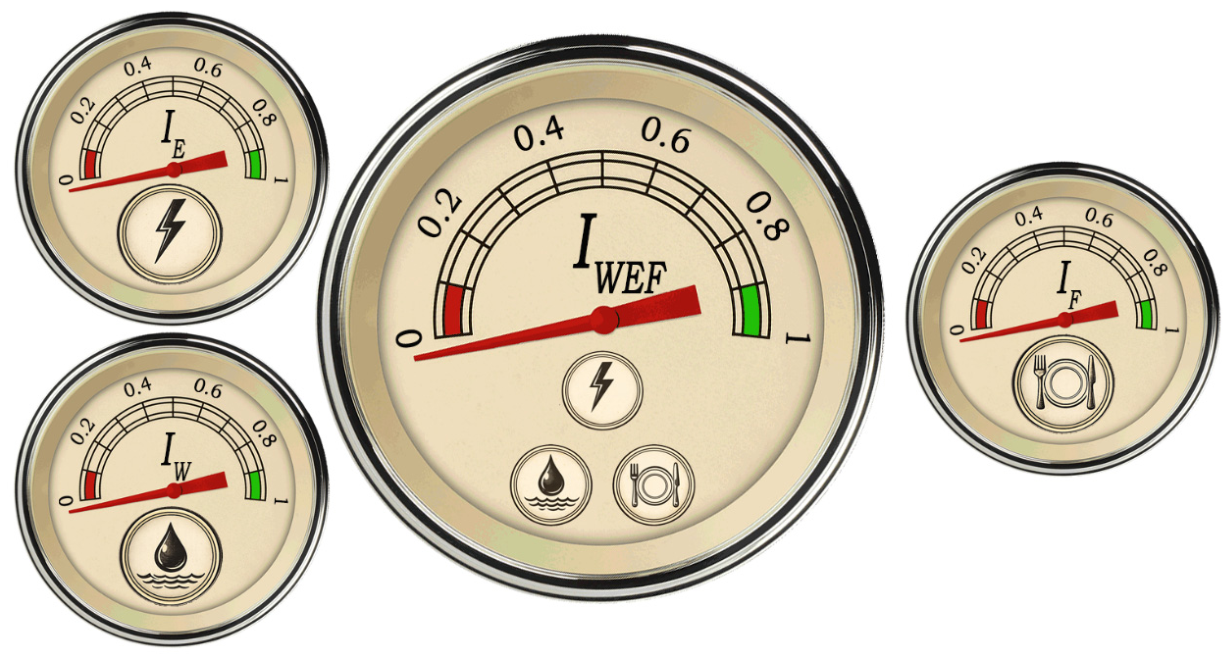
Figure 8) is derived using a non-compensatory aggregation, expressed as:
Thus, the system’s capacity is ultimately limited by its weakest component, and high performance in one sector cannot compensate for critical deficiencies in another.
Figure 8.
Indicators considered for the calculation of the water–energy–food indicator.
Figure 8.
Indicators considered for the calculation of the water–energy–food indicator.
7. Case Study Description
7.1. Study Area
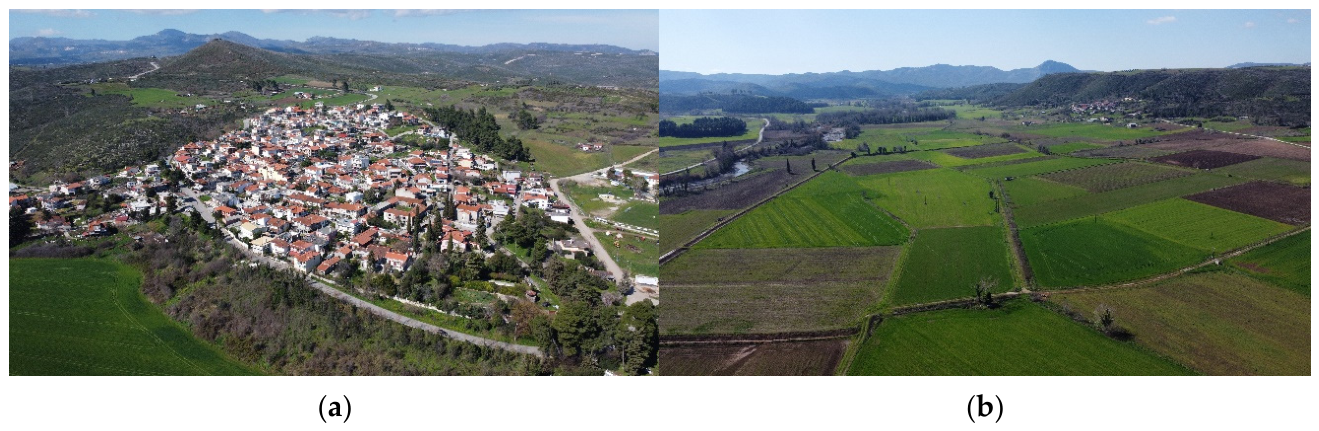
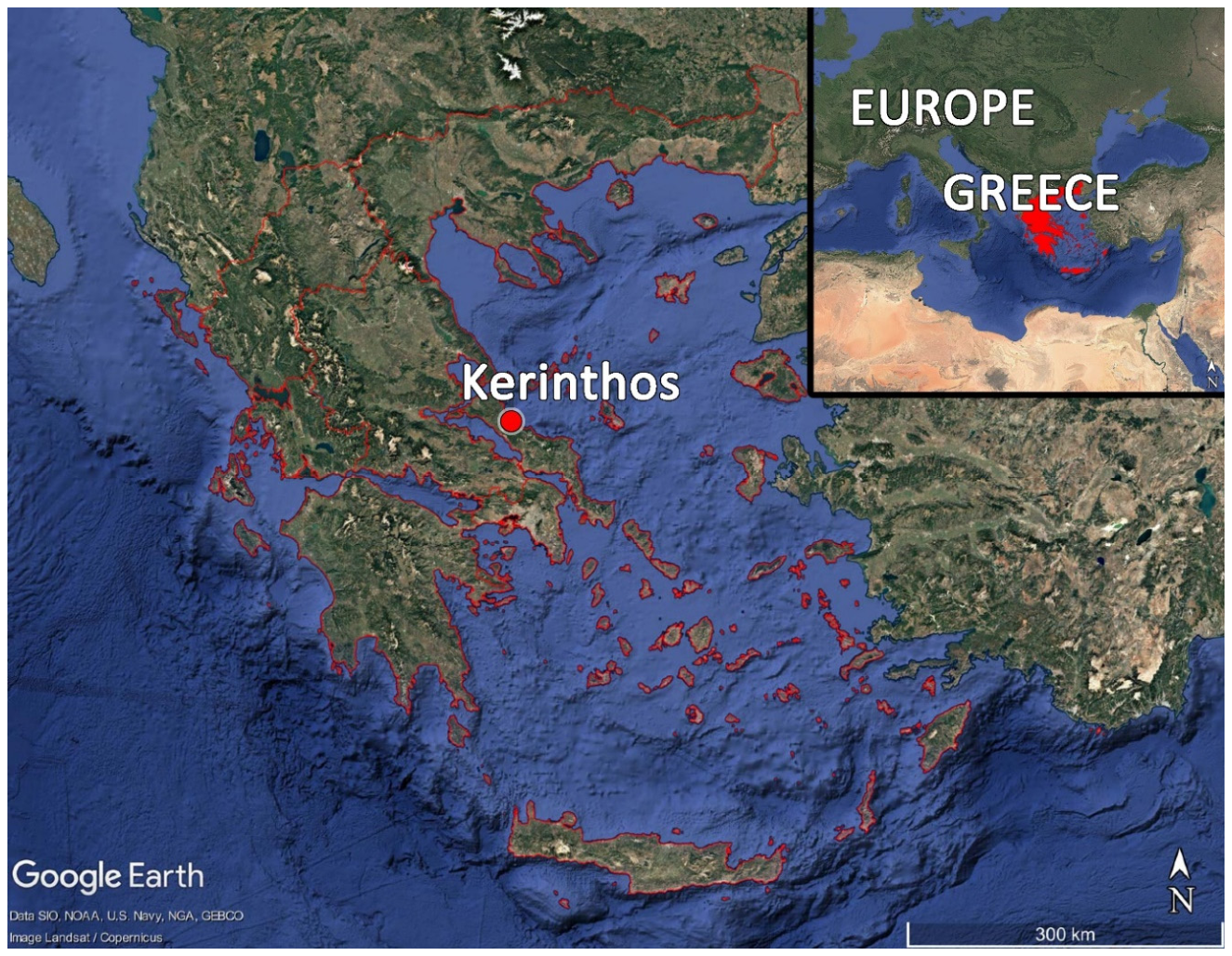
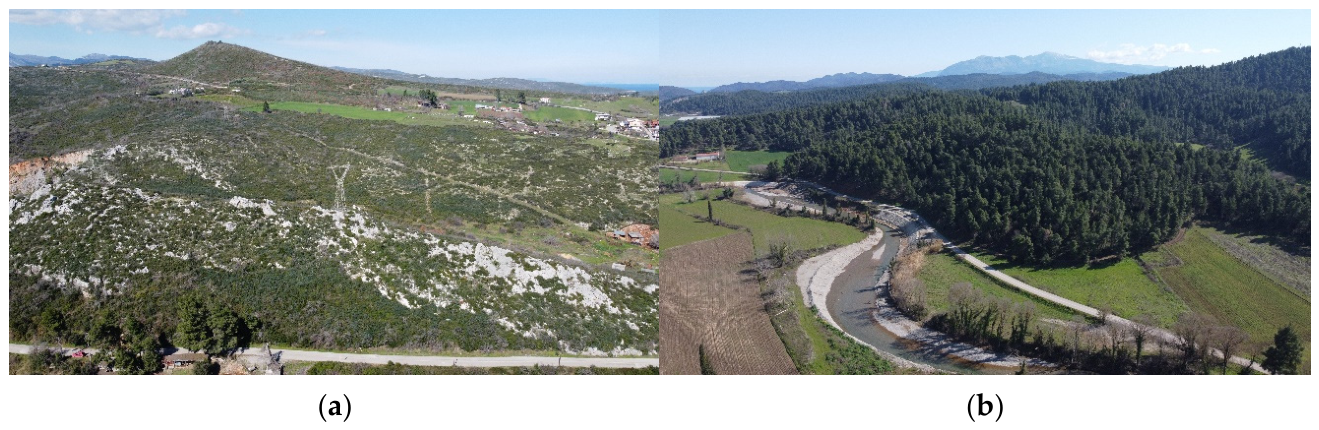
The proposed framework is applied to the rural village of Kerinthos, located in North Euboea, Greece, as a proof-of-concept case study (
Figure 9). Kerinthos is a small settlement with a permanent population of approximately 600 inhabitants and is representative of many rural Mediterranean communities characterized by low population density, mixed land uses, and partial dependence on centralized infrastructure systems.
The selected case study is not intended to be representative, but illustrative, allowing transparent demonstration of the framework’s mechanics under real-world conditions.
North Euboea is a region with pronounced exposure to climatic variability, seasonal water stress, and ecological disturbance, most notably following large-scale wildfires in recent years [
53]. At the same time, the area exhibits substantial availability of natural resources, including surface water, groundwater, agricultural land, forests, and renewable energy potential. This combination of resource abundance and infrastructural vulnerability makes the region particularly suitable for resilience-oriented assessment within the Water–Energy–Food (WEF) Nexus.
Spatial analysis integrates data on precipitation, soil properties, land use, renewable energy potential, and consumption patterns. In order to explain the outcomes of the maps, graphical examples in the section show the outcomes and different aspects of the results.
Figure 9.
Location of the case study area of Kerinthos [
54].
Figure 9.
Location of the case study area of Kerinthos [
54].
7.2. Physical and Climatic Characteristics
The study area is characterized by a Mediterranean climate, with mild, wet winters and hot, dry summers. Precipitation is strongly seasonal, resulting in pronounced intra-annual variability in surface water availability and irrigation demand. The hydrological system includes ephemeral and perennial streams, groundwater aquifers of varying depth, and nearby coastal zones, providing multiple potential water supply pathways.
Land cover in the wider area consists primarily of olive groves, mixed agricultural fields, pine-dominated forests, and post-fire regeneration zones. Agricultural activity is dominated by small-scale, low-intensity cultivation, while forested areas constitute a significant potential source of sustainably harvested biomass.
7.3. Socio-Economic and Infrastructural Context
Kerinthos exhibits characteristics typical of peripheral rural settlements: limited centralized infrastructure, reliance on groundwater for domestic and agricultural water supply, and partial dependence on imported electricity, fuels, and agricultural inputs. Space heating is predominantly covered by biomass, reflecting both cultural practices and limited access to alternative energy carriers.
Food production takes place locally and in the surrounding plains, but remains embedded in broader supply chains due to dependence on fertilizers, fuels, and transport infrastructure. Transportation patterns are primarily car-based, reflecting limited public transport availability and spatial dispersion of services.
7.4. Rationale for Case Study Selection
The selection of Kerinthos as a case study is motivated by three main considerations:
The settlement reflects a broader class of rural and peri-urban communities in Mediterranean regions, where resource availability is high but infrastructural resilience is limited.
- 2.
Data availability and spatial clarity
The relatively small population size and well-defined spatial boundaries allow per capita resource flows, land-use requirements, and infrastructure configurations to be assessed transparently.
- 3.
Relevance to resilience planning
Ongoing environmental recovery, combined with increasing exposure to climate-related stressors, creates a realistic context in which alternative WEF configurations and self-sufficiency pathways can be meaningfully explored.
7.5. Data Sources and Computational Procedure
The proposed methodology combines climatic, hydrological, land-use, demographic, and energy-related datasets in order to estimate the Water–Energy–Food (WEF) resilience indicators under both baseline and optimized infrastructural scenarios. The complete computational workflow, equations, symbols, and assumptions are summarized in
Appendix A.
Climatic variables, including daily air temperature, precipitation, and solar radiation, were obtained from the NASA POWER database [
55] for the period 2001–2025 using the geographical coordinates corresponding to the study area of Kerinthos, North Euboea, Greece. Daily climatic values were used for the estimation of evapotranspiration, irrigation demand, heating demand, photovoltaic energy production, and renewable energy temporal variability.
Electricity consumption statistics were derived from ENTSO-E datasets [
34] and national Greek energy statistics. National per capita electricity consumption values were downscaled in order to represent minimum functional energy demand conditions consistent with the resilience-oriented assumptions of the study.
Land-use information was derived from satellite imagery, regional land-cover datasets, and local spatial observations, including agricultural land, olive groves, forested areas, residential areas, and post-fire regeneration zones. Spatial analysis was performed using distance-based buffering around the settlement center in order to evaluate land-use sufficiency, resource accessibility, and transport-related constraints.
The computational workflow of the framework consists of the following sequential steps:
Estimation of minimum per-capita water, energy, and food requirements.
Estimation of irrigation demand, heating demand, transport energy, and agricultural energy requirements.
Quantification of local renewable and non-renewable resource availability.
Classification of resources according to locality and renewability.
Normalization of water, energy, and food contributions.
Spatial assessment of land-use sufficiency and transport distance.
Aggregation of indicators using the non-compensatory WEF formulation.
Comparison between baseline and optimized infrastructural scenarios.
The main assumptions adopted for the case study are summarized in
Appendix A.2, including residential area per capita, domestic water demand, cultivated land demand, biomass requirements, photovoltaic area requirements, and mobility assumptions.
8. Land-Use Patterns and Spatial Constraints
8.1. Spatial Constraints in Land Use for Water–Energy–Food Self-Sufficiency
Land availability and spatial configuration constitute fundamental constraints on self-sufficiency and resilience within the Water–Energy–Food (WEF) Nexus. Even when sufficient water, energy, and food production potential exists in aggregate, the spatial distribution of land uses relative to population centers critically influences the feasibility and resilience of local resource provision.
Land-use patterns are explicitly incorporated to capture spatial proximity, land competition, and population density effects, thereby translating per capita resource requirements into physically meaningful spatial extents.
8.1.1. Per Capita Land Requirements
Based on the demand thresholds defined earlier, land requirements are expressed on a per capita basis for the following functions:
Agricultural land required to meet minimum caloric needs, fixed at 0.2 ha per capita.
- 2.
Biomass-based energy supply:
Land required for sustainably harvested biomass to cover space heating demand. Based on local forest and olive grove productivity, this corresponds to approximately 0.3 ha per capita for pine-dominated forests or 0.5 ha per capita for olive groves.
- 3.
Renewable energy installations:
Land required for photovoltaic (PV) systems, where applicable, is estimated at approximately 20 m2 (0.002 ha) per capita and is assumed to be integrated within residential or adjacent land, minimizing competition with food production.
These land requirements form the basis for evaluating spatial sufficiency and land-use competition under different infrastructural scenarios.
8.1.2. Spatial Proximity and Distance-Based Assessment
To evaluate the spatial feasibility of meeting land requirements, a distance-based approach is adopted. Concentric buffer zones are generated around the settlement center, with progressively increasing radio. Within each zone, available land-use classes relevant to food production, biomass harvesting, and renewable energy installation are cumulatively summed.
This approach allows identification of the minimum distance from the settlement at which per capita land requirements are satisfied for a given population size. Land ownership and administrative boundaries are not treated as limiting factors; instead, the analysis focuses on physical accessibility and functional proximity.
8.1.3. Results of Land-Use Pattern Analysis
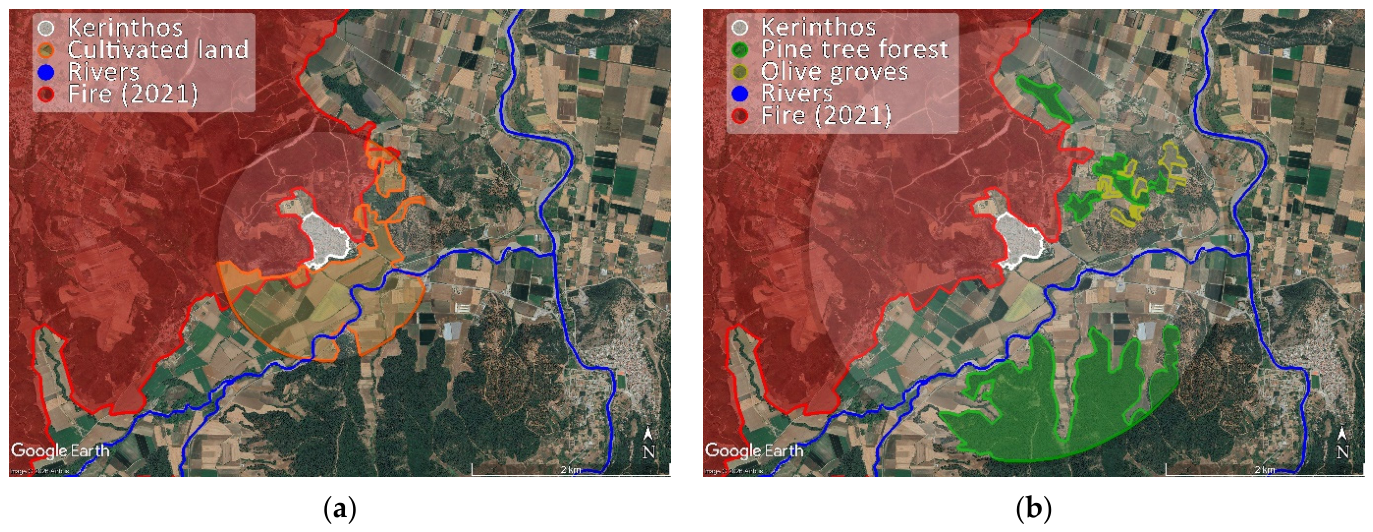
For the population of approximately 600 inhabitants, the total agricultural land required to meet food demand amounts to roughly 120 hectares. This requirement is satisfied within a radius of approximately 1050 m from the settlement center (
Figure 10a).
In contrast, land required to sustain biomass-based heating demand—primarily pine forests and olive groves—amounts to approximately 180 hectares. This requirement is satisfied within a radius of approximately 2100 m (
Figure 10b).
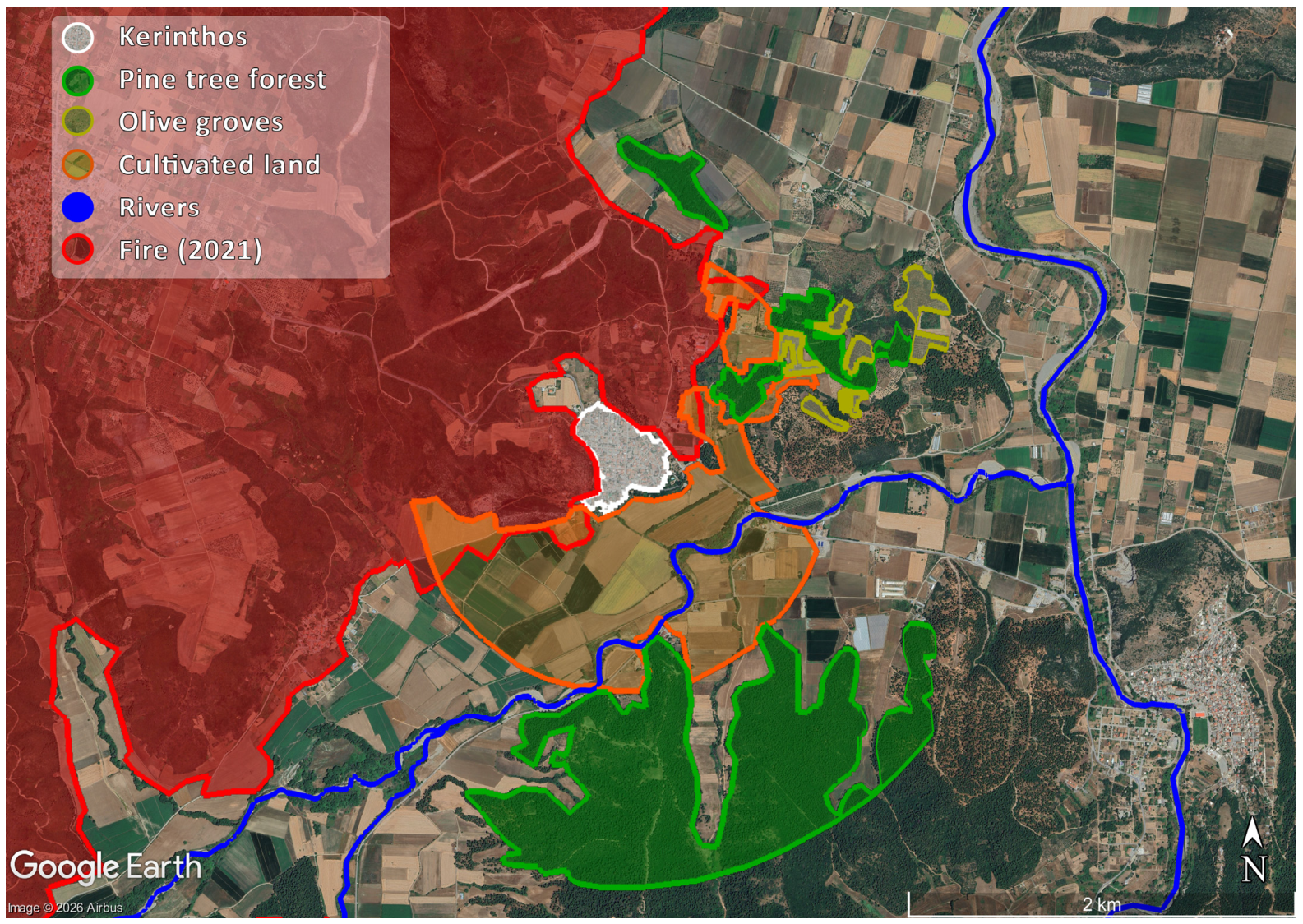
These results indicate that food production can be spatially integrated relatively close to the settlement, while biomass-based energy supply requires access to a broader hinterland. Renewable electricity generation through PV systems can be accommodated largely within the residential zone, avoiding direct competition with agricultural land (
Figure 11,
Figure 12 and
Figure 13).
8.1.4. Implications for Resilience and Spatial Planning
The land-use pattern analysis reveals that local self-sufficiency is not limited by absolute land scarcity, but by the spatial arrangement and competition between land uses. As population density increases, the required radii expand nonlinearly, rapidly increasing transport energy requirements and reducing resilience.
These findings underscore the importance of spatial planning in resilience-oriented design. Compact settlement structures, protection of nearby agricultural land, and sustainable forest management emerge as critical factors for maintaining feasible land-use configurations under local self-sufficiency scenarios.
Within the hierarchical WEF framework, land-use patterns act as a structural constraint that conditions the feasibility of water, energy, and food self-sufficiency simultaneously, reinforcing the need for integrated spatial and infrastructural planning.
8.2. Analytical Scope
The analysis focuses on the settlement and its surrounding hinterland, defined by progressively expanding distance zones used to assess land-use availability and spatial proximity of resources. Administrative boundaries are not treated as limiting factors; instead, the assessment emphasizes physical accessibility and functional relationships between population, resources, and infrastructure.
All indicators are evaluated on a per capita basis and subsequently aggregated to the settlement scale. Two configurations are examined: the current infrastructure state and an optimized scenario aimed at enhancing local self-sufficiency and resilience.
8.3. Results—Water
8.3.1. Baseline Conditions (Existing Infrastructure)
Under existing conditions, water supply for the settlement of Kerinthos in North Euboea, Greece, relies exclusively on groundwater abstraction. Domestic water is supplied from a deep aquifer at approximately 124 m below ground level (thus = 0), using nonrenewable electric sources (thus = 0) while irrigation water for surrounding cultivations is abstracted from a shallower aquifer at approximately 20 m depth.
According to meteorological data [
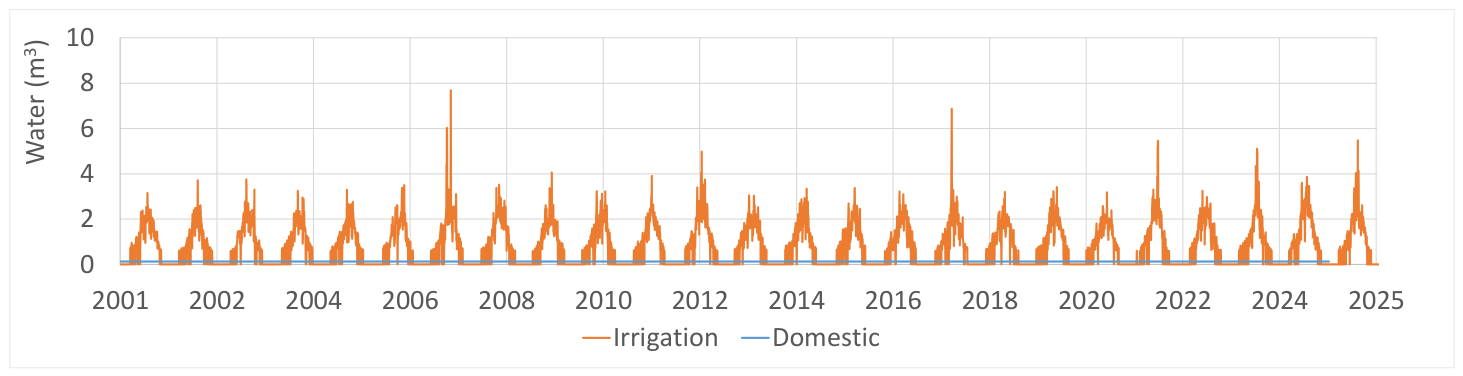
54] and the irrigation model, the estimated irrigation for the period 2001–2025 per 0.2 ha (cultivated area for the needs of one capita in which the half of the area is irrigated) are presented in
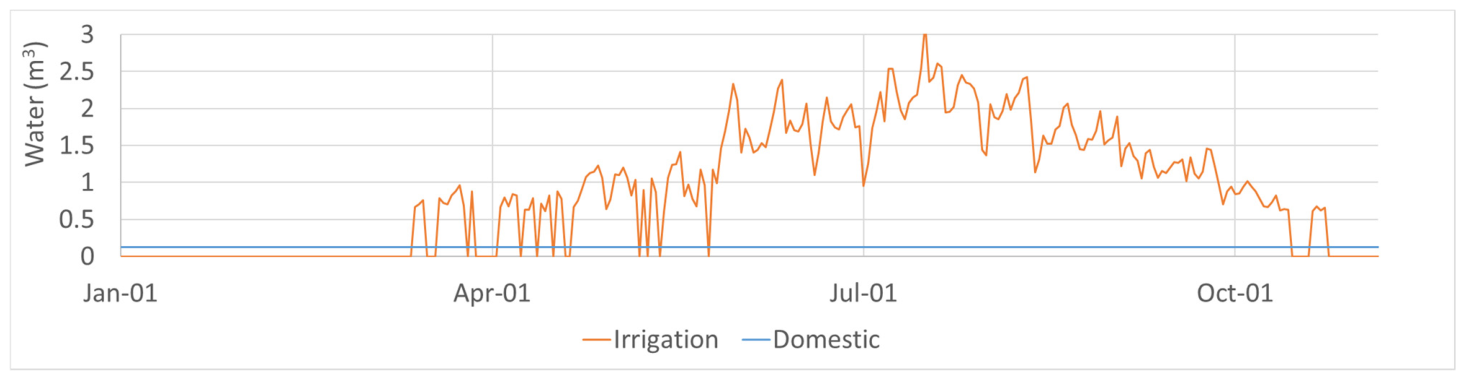
Figure 14, and in
Figure 15 for a more detailed, annual analysis which is approximately 316 m
3/capita (domestic and irrigation).
Table 1 shows the calculations’ steps for the estimation of water index.
Total per capita water demand, combining domestic consumption and irrigation requirements for the adopted cultivated area of 0.2 ha per capita, is estimated at approximately 329 m3 per year. Of this total, irrigation accounts for roughly 90% of demand, highlighting the dominant role of agricultural water use in the local water balance.
When normalized according to source characteristics, groundwater abstraction is treated as local but non-renewable within the resilience time horizon and penalized proportionally to abstraction depth. As a result, the water self-sufficiency indicator under baseline conditions is low, despite the physical availability of water volumes.
In addition, when energy constraints are applied, the effective water indicator collapses further. Because groundwater pumping requires sustained external energy inputs that are not locally secured under baseline energy conditions, the energy-constrained water indicator corresponds to 0.
This result indicates that, in resilience terms, the current water supply configuration cannot be considered functionally self-sufficient, even though it meets present-day demand.
8.3.2. Optimized Scenario (Surface Water Utilization)
In the optimized scenario, water supply for both domestic use and irrigation is assumed to be shifted from groundwater abstraction to surface water sources. Hydrological analysis of the nearby River Nileas indicates that the minimum summer discharge in August is 0.35 m3/s (approximately 30,250 m3/day), sufficient to cover the combined domestic and agricultural water demand of the village, even during dry periods (estimated maximum needs: 8 m3/day per capita; 4700 m3/day for the village).
Under this configuration, water is supplied from renewable surface water sources and delivered predominantly by gravity, eliminating the need for pumping. Consequently, both domestic and irrigation water are classified as local, renewable, and low-energy sources.
Recalculation of the water normalization indicator under these assumptions yields: .
This result represents a complete structural shift from an energy-dependent and non-renewable water supply regime to a resilient, renewable configuration, achieved without increasing total water demand.
8.3.3. Interpretation
The contrast between baseline and optimized scenarios highlights a key insight of the proposed framework: water vulnerability in the study area is not driven by insufficient hydrological resources, but by infrastructural configuration and energy coupling. Under baseline conditions, groundwater abstraction masks a fundamentally fragile water system that collapses once energy constraints are applied. In contrast, surface water utilization transforms the same demand profile into a fully resilient configuration.
These results demonstrate the importance of evaluating water self-sufficiency not solely in volumetric terms, but through the combined lens of source renewability, energy dependence, and infrastructural design. In the hierarchical WEF framework, improving water resilience emerges as a necessary—but not sufficient—condition for overall system resilience, as subsequent results for energy and food further demonstrate.
8.4. Results—Energy
8.4.1. Baseline Conditions (Existing Energy System)
Under baseline conditions, the energy system serving the settlement of Kerinthos in North Euboea, Greece, is characterized by strong dependence on external energy inputs. Electricity is imported through the national grid, transportation relies predominantly on fossil fuels, and agricultural production depends on externally supplied fuels and fertilizers. Space heating constitutes a notable exception, as it is largely covered by locally available biomass from surrounding forests and olive groves.
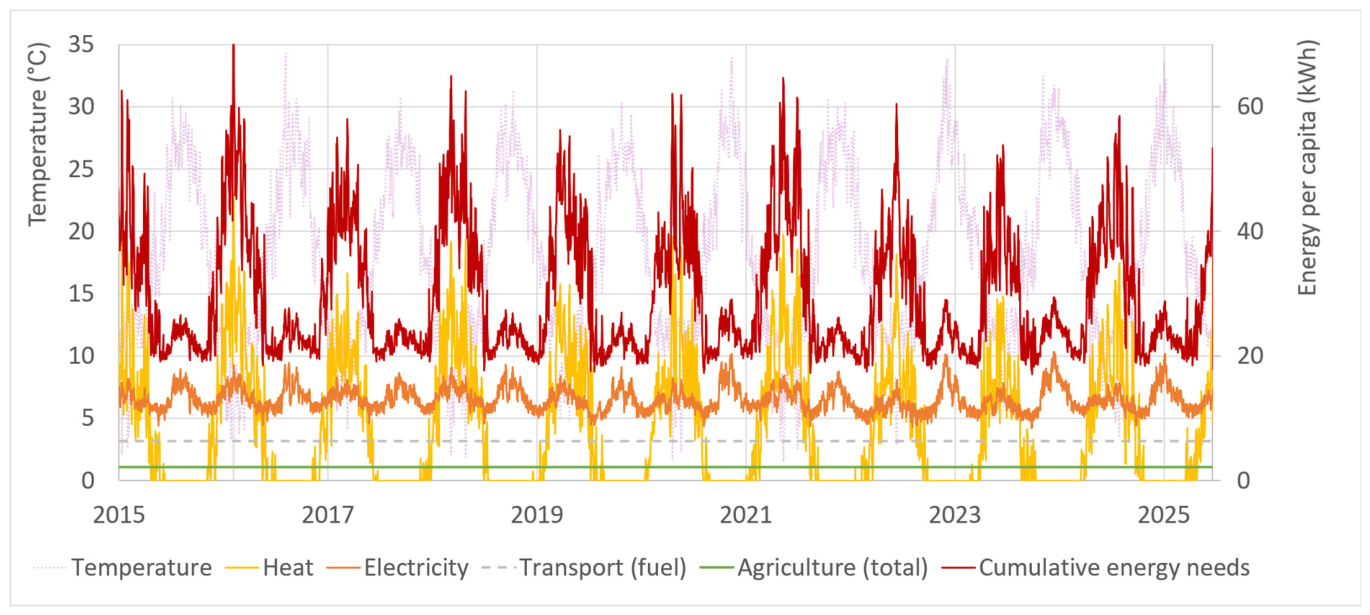
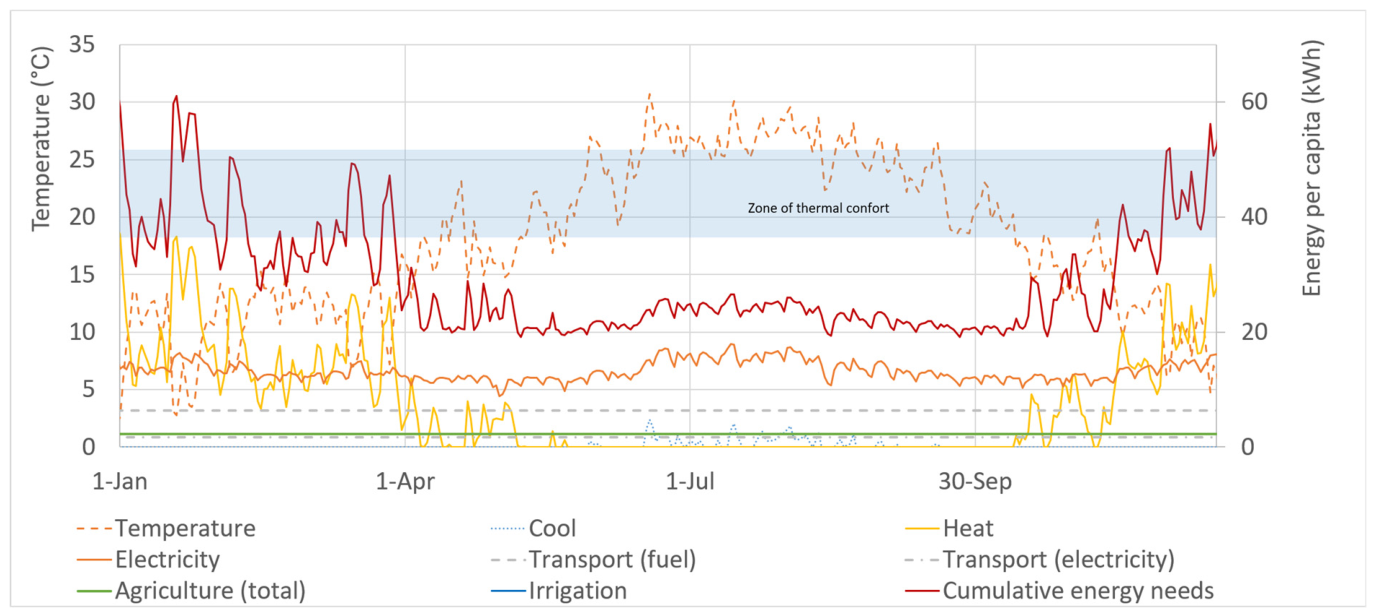
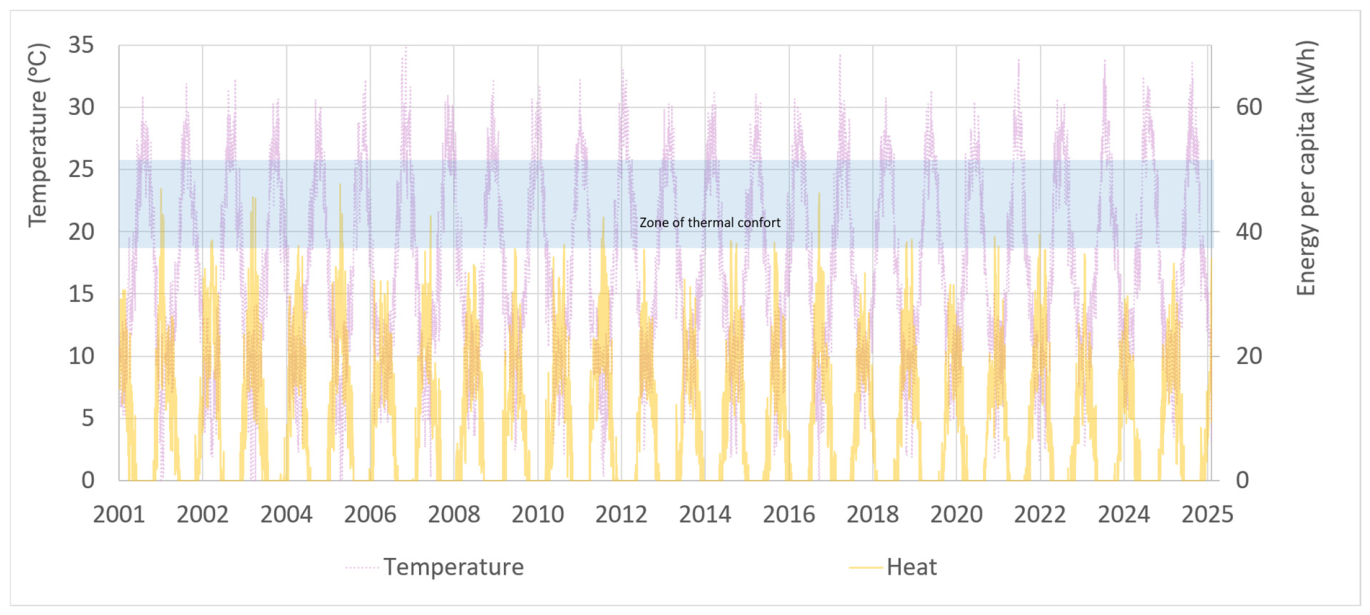
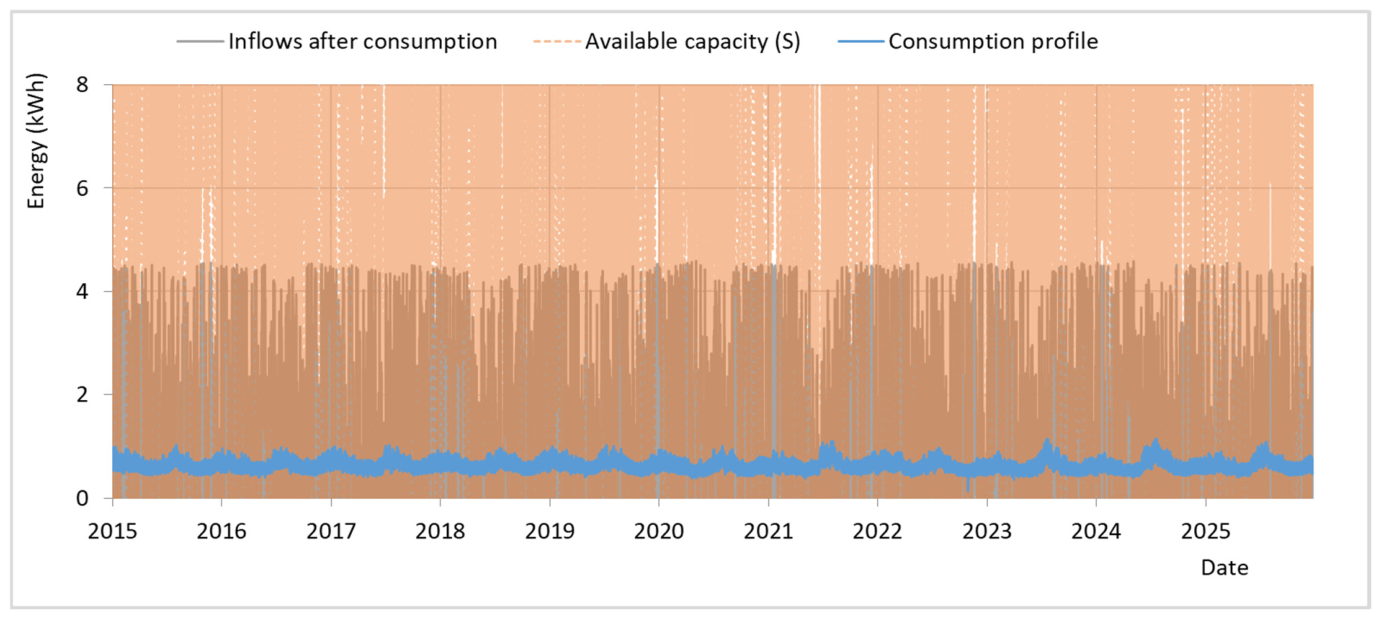
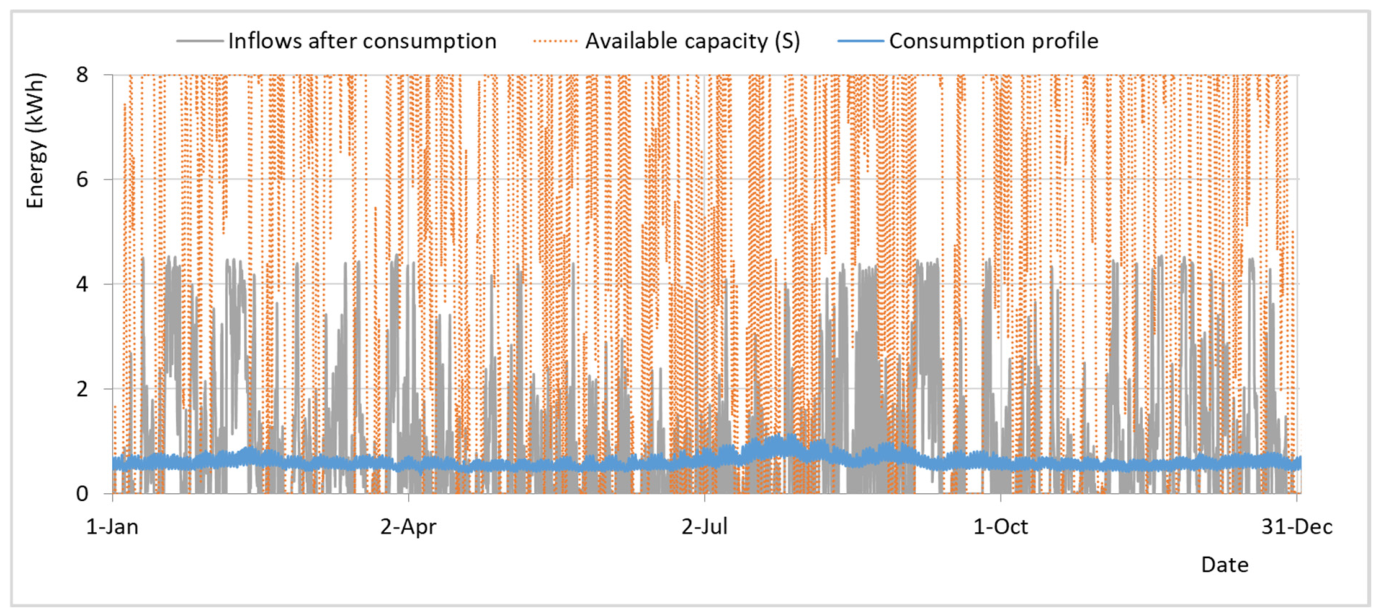
Climatic data have been used to estimate the energy needs per capita (heating-cooling) with daily step in
Figure 16 for the period 2015–2025, and in
Figure 17 for a more detailed annual analysis of a typical year. The shaded area in
Figure 17 represents the thermal comfort zone, within no heating or cooling is required.
In present, heating needs in the area are covered by biomass. Electricity consumption was estimated by downscaling national per capita electricity use for the same period. Energy for transportation and energy required for agricultural activities (for cultivated area 0.2 ha) were distributed evenly throughout the year.
The results highlight the critical importance of the energy mix. Although specific energy resources are required, differences in their forms (electricity, biomass, fuels, fertilizers) make simplification particularly challenging. Nevertheless, an aggregated assessment is performed by estimating the share of energy demand that can be met by locally available resources and the proportion that must be imported in the form of fertilizers or fossil resources.
Even in the Mediterranean context where the winters are considered smooth, heating needs are drivers of the variability of energy mix and are related to the temperature (
Figure 18). Therefore, a resilience view prioritizes covering these needs from local resources.
In the area of the case study, there is a forest that consists mainly of pine stands, approximately 30 years old, while there are also extensive olive groves with an average age of about 30 years. For the pine forests, the expected biomass yield that is consistent with the natural regeneration rate is estimated at 3 tonnes per hectare, whereas for the olive groves it is approximately 2 tonnes per hectare (
Figure 5).
Assuming that one tonne of dry biomass contains approximately 4500 kWh of primary energy and applying a reasonable conversion efficiency of 70%, the resulting useful energy potential is about 9500 kWh per hectare of pine forest and about 6300 kWh per hectare of olive groves. Considering that heating needs per capita are 3100 kWh (0.7 tonnes), the needed areas are 0.3 ha of pine forest per capita, or 0.5 ha of olive trees per capita.
The energy requirements associated with the production of the necessary food (0.2 ha per capita), based on average standard values, are very significant and are comparable to per capita electricity demand.
As explained above, the largest share of these energy requirements corresponds to embedded (embodied) energy, primarily contained in fertilizers, while a smaller share is associated with fuel consumption for agricultural machinery. Replacing this energy with locally produced or renewable alternatives would require substantial technological adaptation, which is inherently time-consuming.
Therefore, this energy demand is considered to be imported energy, estimated at approximately 800 kWh per capita per year.
Depending on the mode of transportation, energy resources may be either domestic (if we assume electricity is produced from renewable energy sources and electric vehicles are used) or imported. In general, the transition to electric mobility is still at a relatively early stage. It is worth noting that if transportation relies on fossil fuels, the required energy demand according the assumed mobility patterns (10 km/day), is estimated at approximately 2308 kWh per capita per year, whereas if electric mobility is adopted, the corresponding energy requirement is reduced to around 620 kWh per capita per year.
The annual energy needs and the calculation of energy index are summarized in
Table 2.
When normalized according to source origin and renewability, only the energy share associated with biomass-based heating is classified as both local and renewable. All other components—electricity, transport fuels, and agricultural energy inputs—are treated as externally supplied and non-renewable within the system boundaries.
As a result, the baseline energy self-sufficiency indicator is low: .
This value indicates that less than one-third of the minimum required energy demand can be met through resilient, locally available resources. The result reveals a structurally energy-dependent system, even though total energy demand is modest in absolute terms.
8.4.2. Optimized Scenarios (Renewable Energy Integration)
Two representative scenarios for the exploitation of renewable energy sources include wind turbines and photovoltaic (PV) systems. It is first noted that the share of the energy mix covered by biomass for space heating significantly reduces variability in overall energy demand. Under an energy mix that assumes the use of electric vehicles and electrically powered agricultural equipment, electricity demand becomes the dominant component of energy consumption, while thermal demand is largely decoupled from seasonal fluctuations due to biomass utilization. The houses could be considered as land use areas for PV panels.
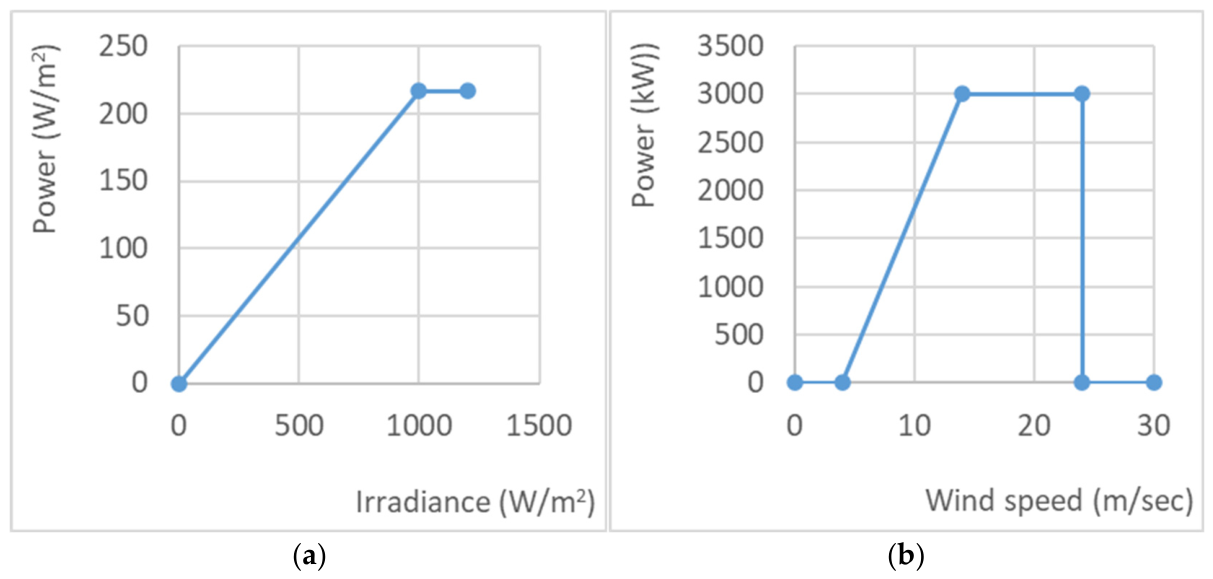
The intermittent nature of renewable energy sources creates significant challenges in energy management and is highly dependent on the climatic conditions of each region. For the specific area under study, we estimated the land area required for the installation of photovoltaic (PV) systems, as well as the number of people whose electricity demand can be met by a typical wind turbine of 3 MW. The efficiency power curves of PV systems and wind turbines are presented in
Figure 19.
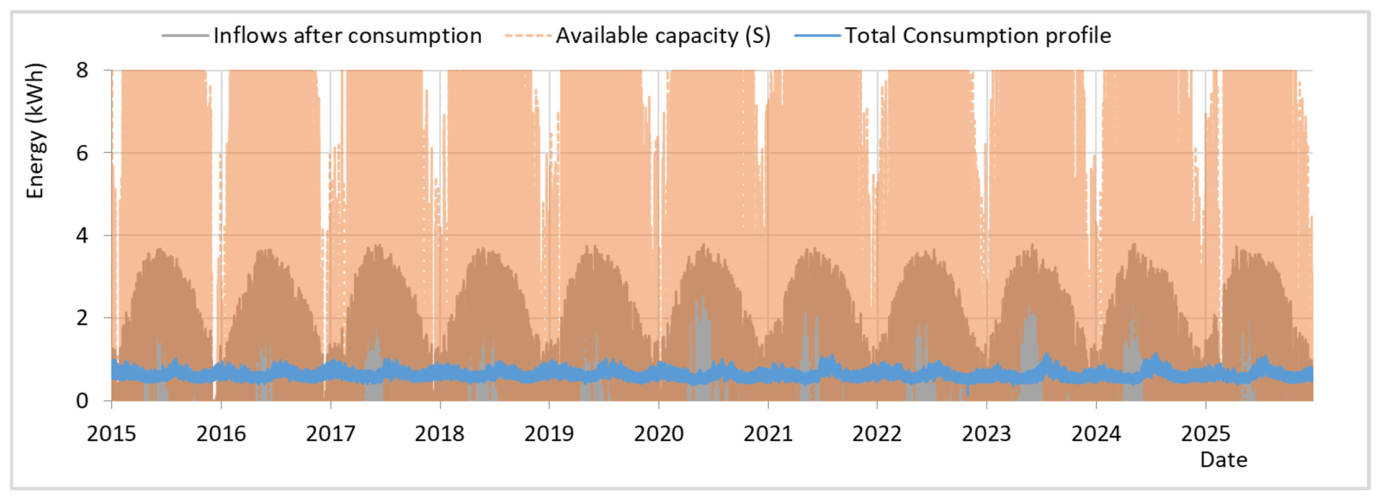
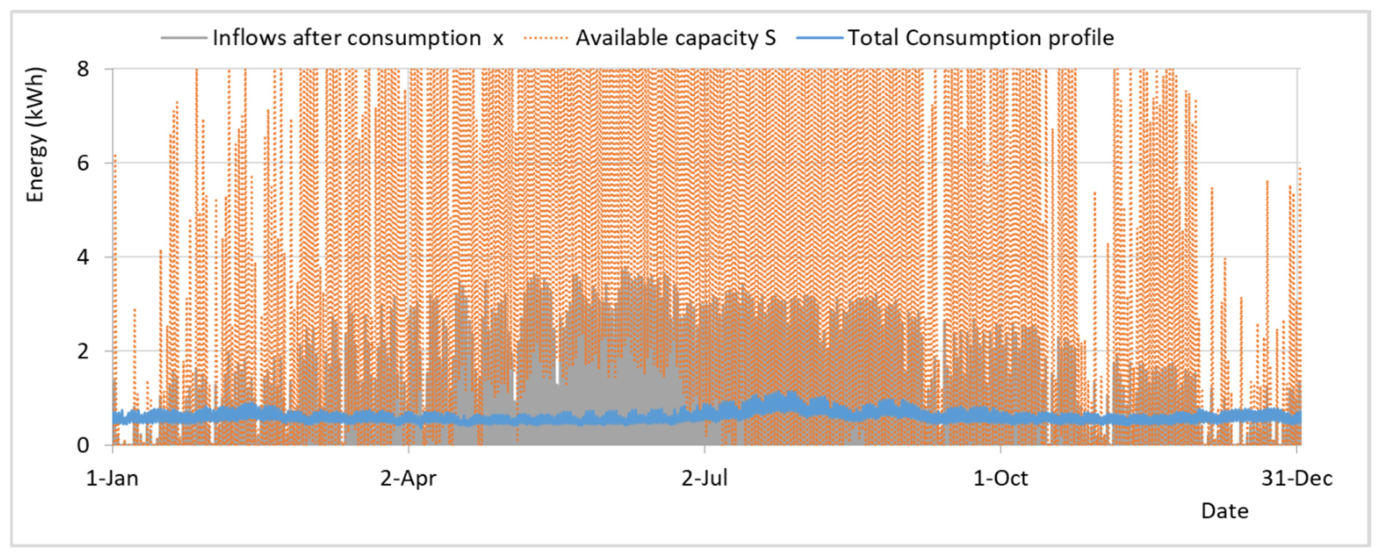
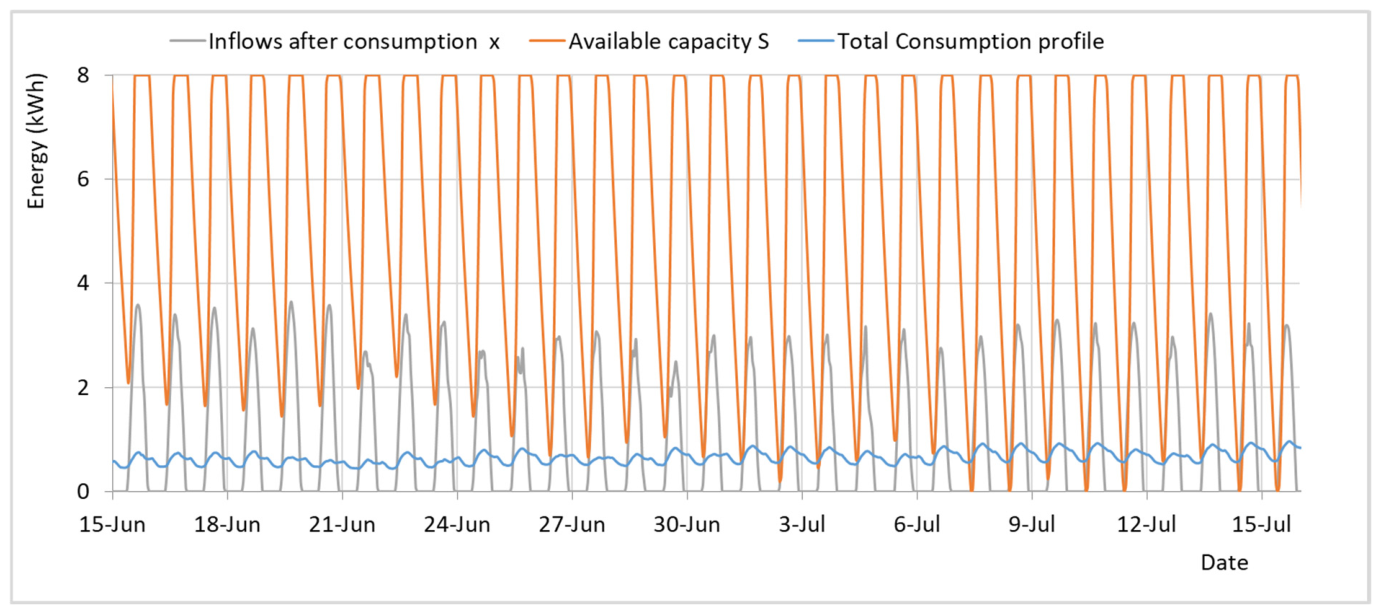
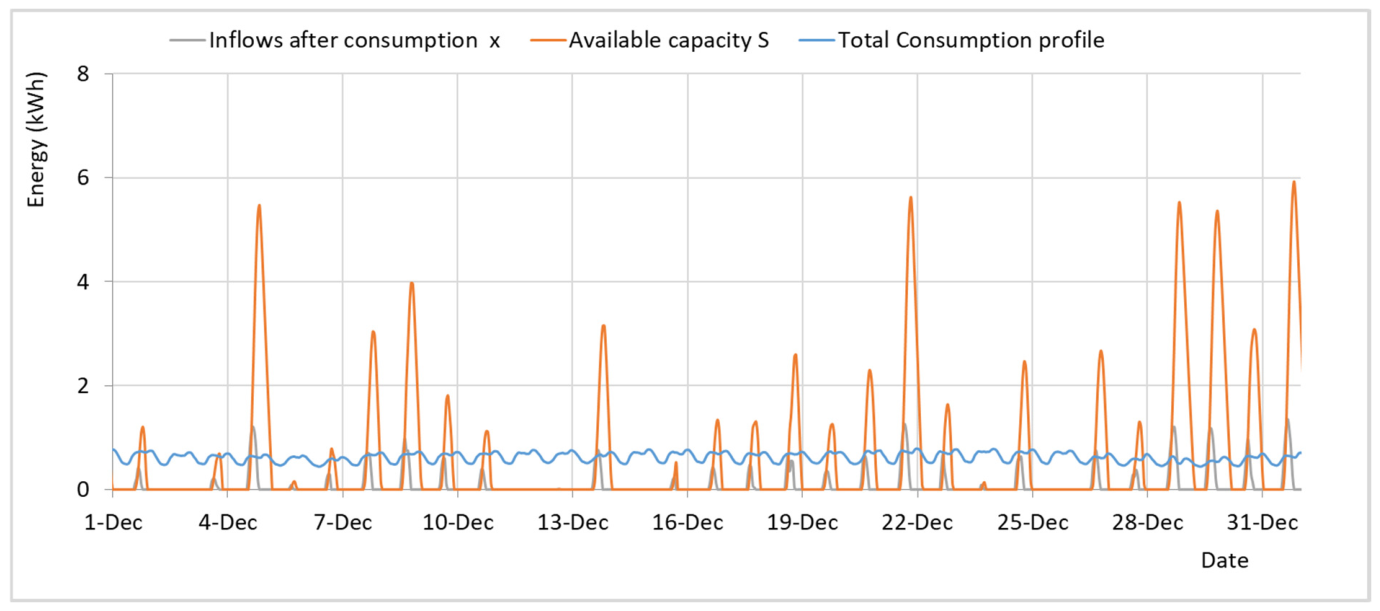
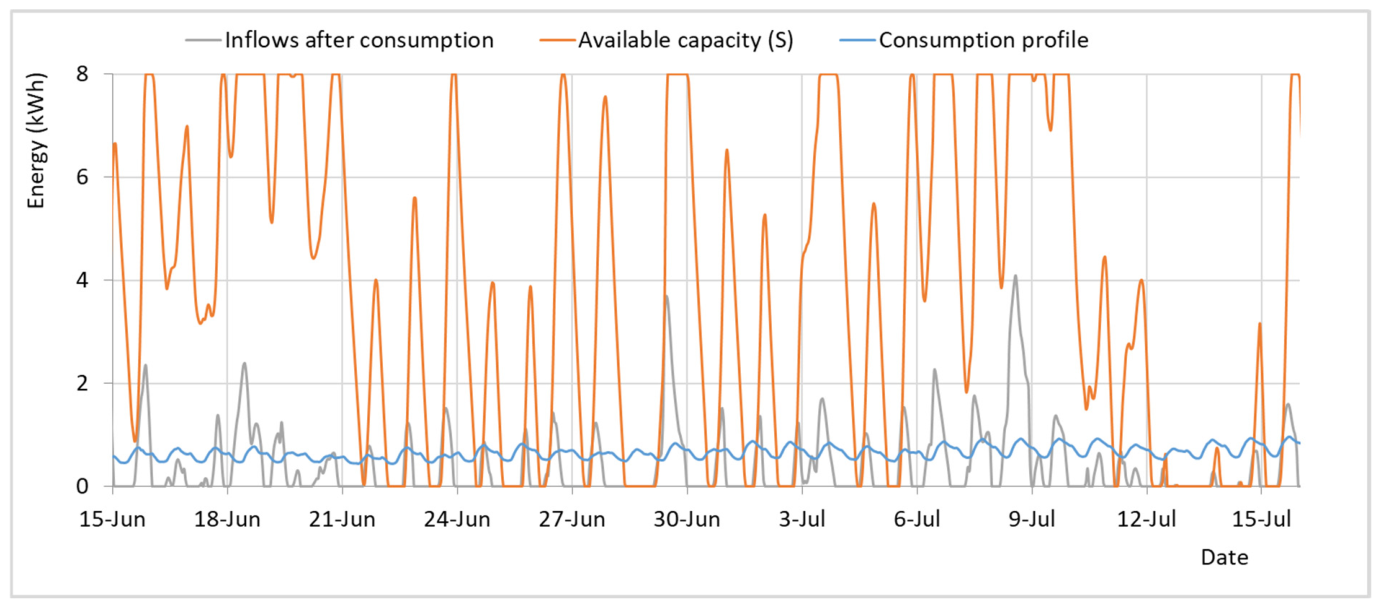
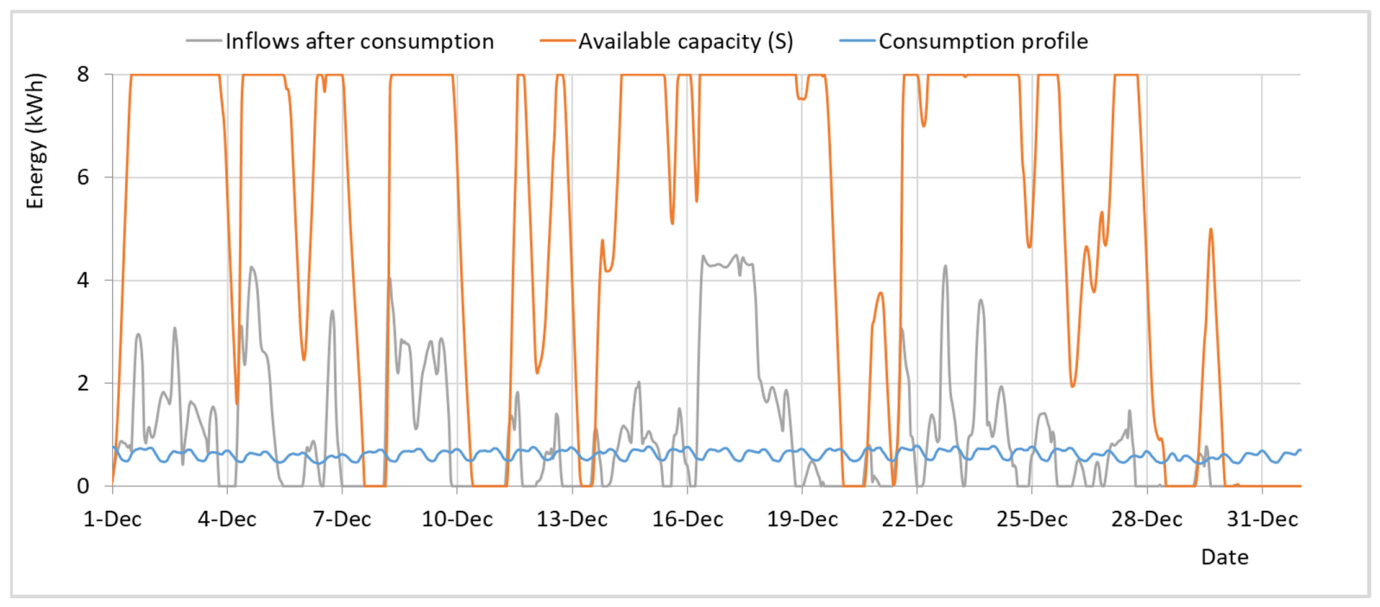
Subsequently, the duration for which electricity demand can be covered using energy storage systems of different capacities was calculated. To describe the operation of the energy storage system, we employ a model described by the processes defined in Equations (8) and (9) [
56,
57].
where
T is time;
K is the storage capacity of the system;
is the energy remaining after withdrawal;
is the inflow to the energy storage system after consumption;
is the energy demand; and
is the actual amount of taken energy in an attempt to satisfy energy demand during the time period (t − 1, t) after accounting for efficiency losses, which are estimated with
. When there is a sufficient amount of energy in the storage energy system,
equals demand
; otherwise,
<
.
Assuming that each resident requires 20 m2 of living space and that the total residential area is 15.4 ha, housing is developed at a single level. Under these assumptions, each resident is allocated 0.03 ha per capita within the residential zone.
An area of 20 m2 (0.002 ha) of PV panels per capita is considered; however, this configuration satisfies energy needs for approximately 35% of the time. When energy storage is introduced in the form of a battery sized at half of the average daily consumption, demand coverage increases to 77% of the time.
In the case of a single 3 MW wind turbine serving a population of 600 residents, energy demand is satisfied for 58% of the time. When combined with a battery sized at half of the average daily consumption, coverage increases to 82%.
The revised calculation for energy index is in
Table 3 (PV) and
Table 4 (wind turbine).
8.4.3. Interpretation
The energy results reveal energy availability as the principal limiting factor of WEF resilience under baseline conditions. While local biomass resources provide a stable foundation for space heating, the absence of local electricity generation and storage results in systemic dependence on external energy supplies.
The optimized scenarios demonstrate that relatively modest renewable energy interventions can transform the energy system from structurally dependent to largely self-sufficient. Crucially, energy storage emerges as a decisive enabling factor: without storage, renewable generation substantially improves performance but fails to ensure continuity of supply; with storage, the system approaches full functional energy autonomy.
Within the hierarchical WEF framework, these findings confirm energy as the primary enabling resource. Improvements in water self-sufficiency become operationally meaningful only once energy availability is secured, while food self-sufficiency remains conditionally dependent on both energy form and reliability.
8.5. Results—Food
8.5.1. Baseline Conditions (Existing Food System)
Under baseline conditions, food demand for the settlement of Kerinthos in North Euboea, Greece, can be met in volumetric terms through locally available agricultural land which proximity is in average 500 m to the settlement to satisfy the adopted threshold of 0.2 ha per capita, indicating that land availability alone does not constitute a limiting factor.
Accordingly, the primary food self-sufficiency indicator based solely on land proximity yields .
However, once hierarchical constraints are applied, this apparent self-sufficiency is substantially reduced. Agricultural production under baseline conditions depends on externally supplied energy inputs, primarily in the form of fuels for machinery and embedded energy in fertilizers. In addition, irrigation water is supplied from groundwater sources that are both non-renewable and energy-dependent.
When energy constraints are introduced, the effective energy availability factor for food production collapses to zero, reflecting full dependence on imported energy inputs. Simultaneously, the water availability factor is reduced due to reliance on groundwater abstraction.
As a result, the water- and energy-constrained food indicator under baseline conditions becomes: .
This outcome indicates that, despite the presence of sufficient agricultural land, the food system is structurally non-resilient under baseline conditions once water and energy dependencies are accounted for.
8.5.2. Optimized Scenario (Integrated Local Production)
Although sufficient agricultural land is available in close proximity to the village, achieving food self-sufficiency under the optimized scenario requires targeted technological adaptations. In particular, agricultural machinery must transition to electric operation, supplied by locally generated renewable electricity. While this transition is technically feasible, nutrient inputs—especially nitrogen—remain a structural challenge due to the high energy intensity and external dependence of synthetic fertilizer production.
A partial mitigation pathway is provided through circular nutrient recovery from biomass residues. Wood ash generated from the combustion of locally harvested biomass for space heating can be returned to agricultural soils as a low-grade fertilizer and liming agent. Although wood ash contains negligible nitrogen, it is rich in potassium, phosphorus, calcium, and magnesium, with typical fertilizer equivalents of approximately 0–1–3 to 0–1–5 (N–P–K). Calcium carbonate equivalents of 25–60% further enhance soil pH regulation in acidic soils.
From the combustion of approximately 1 tonne of dry wood per capita per year, ash yields of 20–30 kg can be expected under efficient conditions. This corresponds to the recovery of roughly 1–1.5 kg of potassium (as K2O), 0.2–0.4 kg of phosphorus (as P2O5), and several kilograms of calcium and magnesium. When applied at appropriate rates (typically 1–5 t ha−1 based on soil testing), these nutrient flows can partially offset imported fertilizers, enhance soil fertility, and reduce environmental pressures associated with synthetic nutrient production, provided that potential contaminants are monitored.
Within the optimized scenario, food production is therefore evaluated under the assumption that irrigation water is supplied from renewable surface water sources and that a substantial share of agricultural energy demand is met through local renewable electricity, while nutrient cycling remains only partially closed. This reflects a realistic upper bound of food self-sufficiency achievable under current technological and biochemical constraints, consistent with a resilience-oriented rather than autarkic framing.
Under these assumptions, the water constraint on food production is fully relaxed, yielding a water availability factor of unity. Energy availability, however, remains a partial constraint, reflecting both the temporal variability of renewable energy production and the continued challenge associated with nitrogen-based fertilizer inputs.
Two energy configurations for machinery (25% of total demanded energy for agriculture) are considered, consistent with the energy results:
For the case of solar panels, in the absence of energy storage, renewable electricity availability supports agricultural production for approximately 75% of the required energy demand over time. This results in a constrained food indicator of: .
When energy storage is introduced, the effective availability of energy increases to approximately 85%, yielding: .
These values reflect the fact that, while land and water constraints are fully resolved in the optimized scenario, food self-sufficiency remains conditionally dependent on the reliability and continuity of energy supply.
8.5.3. Interpretation
The food results underscore a central insight of the hierarchical WEF framework: food self-sufficiency is the most constrained and conditionally dependent component of the nexus. Under baseline conditions, apparent food adequacy based on land availability is rendered irrelevant once water and energy dependencies are considered. In resilience terms, the food system collapses even before energy constraints propagate to other sectors.
In the optimized scenarios, food self-sufficiency improves substantially but does not automatically reach unity. Energy reliability—rather than land or water availability—emerges as the dominant limiting factor. Even modest disruptions in energy supply propagate directly into food production capacity, reinforcing the role of energy as the primary enabling resource within the nexus.
These findings demonstrate that strategies aimed at enhancing food resilience must extend beyond land-use planning and local production. Without parallel investments in renewable energy generation, storage, and nutrient cycling, local food systems remain structurally vulnerable to external shocks.
9. Integrated WEF Resilience Results
9.1. Baseline Integrated Resilience
Under baseline conditions, the three constrained indicators take the following values:
Energy self-sufficiency: .
Energy-constrained water self-sufficiency: .
Water- and energy-constrained food self-sufficiency: .
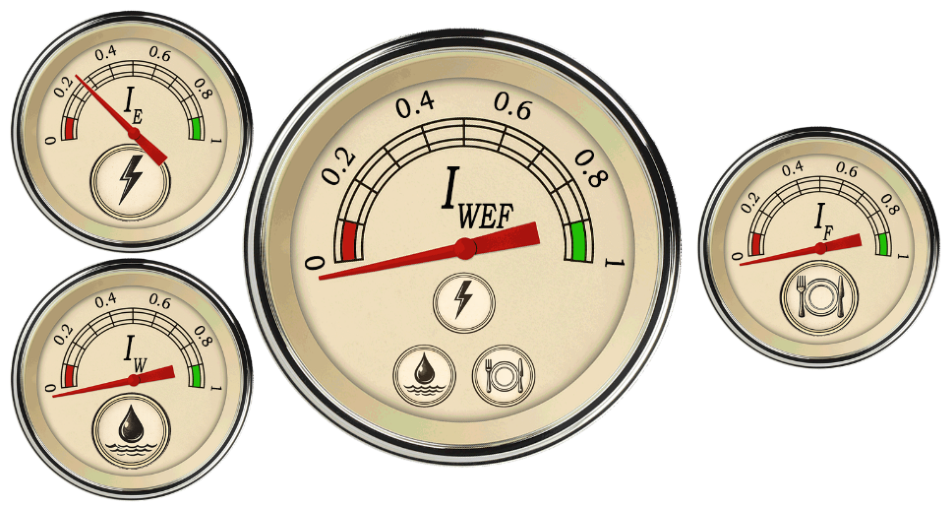
Accordingly, the integrated WEF resilience indicator collapses to: .
This result (
Figure 28) indicates that, despite the presence of abundant natural resources, the WEF Nexus in its current configuration is functionally non-resilient. Dependence on external energy inputs propagates through the system, rendering both water and food provision vulnerable under conditions of disruption. In resilience terms, the system cannot sustain its core functions without continuous external support.
9.2. Optimized Scenario Without Energy Storage
In the optimized scenario where surface water replaces groundwater abstraction and renewable electricity is introduced without storage, the constrained indicators improve substantially:
Energy self-sufficiency: .
Energy-constrained water self-sufficiency: .
Water- and energy-constrained food self-sufficiency: .
The integrated resilience indicator becomes: .
This result (
Figure 29) represents a transition from a non-functional to a partially resilient WEF system. While water constraints are fully resolved, temporal variability in renewable energy supply limits both energy continuity and food production capacity.
9.3. Optimized Scenario with Energy Storage
When short-term energy storage is added to the optimized renewable energy configurations, further improvements are observed:
Energy self-sufficiency: .
Energy-constrained water self-sufficiency: .
Water- and energy-constrained food self-sufficiency: .
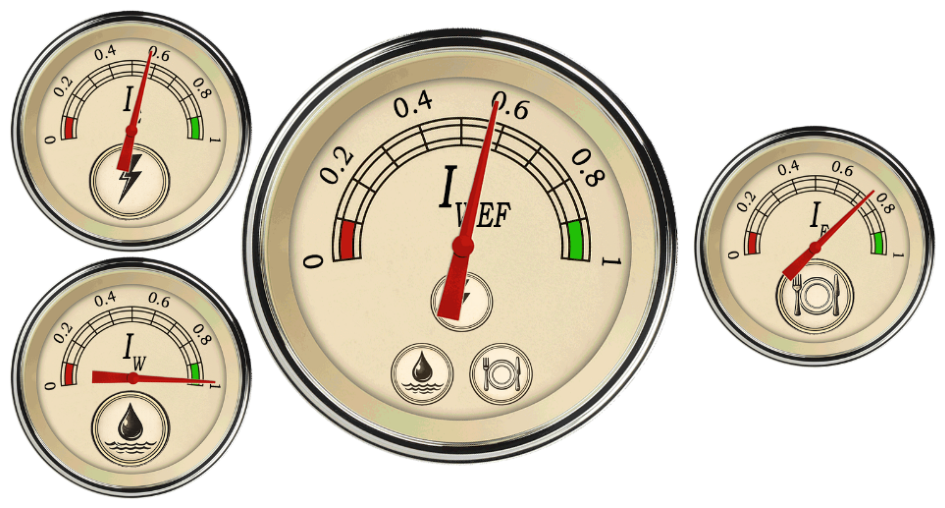
The integrated WEF resilience indicator increases to: .
This result (
Figure 30) indicates a highly resilient configuration, in which all essential nexus functions can be maintained for the majority of the time using local and renewable resources. Residual vulnerability remains primarily associated with energy reliability and nutrient cycling rather than with water or land availability.
9.4. Synthesis and Implications
The integrated results demonstrate that resilience within the WEF Nexus is not determined by resource abundance alone, but by the alignment of infrastructure, energy form, and spatial configuration. In the case study area in North Euboea, Greece, the transition from groundwater-based water supply and imported energy to surface water utilization and renewable electricity fundamentally restructures system resilience.
Most importantly, the results highlight the validity of the hierarchical framework. Improvements in water availability alone do not enhance resilience unless energy constraints are addressed, and food self-sufficiency remains conditionally dependent on both water and energy reliability. The non-compensatory aggregation ensures that such dependencies are neither obscured nor diluted.
9.5. Sensitivity Analysis and Scenario Boundary Conditions
The sensitivity analysis reveals a critical disconnect between the area’s physical resource endowment and its current self-sufficiency status. Given the low-density and predominantly horizontal residential layout observed in the study area (
Figure 12a), the potential for rooftop photovoltaic (PV) integration is particularly favorable. Under the assumption that future development maintains the existing settlement pattern, the available rooftop area scales approximately with population, allowing local renewable electricity generation capacity to remain largely proportional to demand.
In the optimized scenario, a decentralized battery storage capacity of approximately 8 kWh per capita was found sufficient to provide a high degree of temporal matching between renewable electricity production and demand. Consequently, moderate variations in population size do not substantially alter the overall conclusions regarding energy self-sufficiency. Similarly, biomass resources are located in close proximity to the settlement and substantially exceed the minimum requirements for local heating demand. As a result, moderate changes in population or food production requirements do not fundamentally alter the contribution of biomass to energy self-sufficiency within the examined range of conditions.
The analysis also highlights the importance of settlement morphology. If future development were to shift towards denser residential structures, such as apartment blocks, the available rooftop area per capita would decrease. Assuming a reduction in rooftop PV area per capita by 25%, would decrease by approximately 9%. A reduction in rooftop PV area by 50% would result in a decrease of approximately 14%. Conversely, increasing the available rooftop PV area by 20% and 50% would increase by approximately 6% and 9%, respectively.
Energy storage emerges as another critical component of resilience. Reducing storage capacity by 25% would decrease by approximately 7%, while a reduction of 50% would decrease by approximately 17%. Conversely, increasing storage capacity by 25% and 50% would increase by approximately 4% and 5%, respectively.
Regarding water security, the Nileas River represents a major strategic resource for the study area. Analysis of the critical summer period indicates that even during August, when water availability is at its seasonal minimum, river discharge remains approximately six times greater than the combined domestic and irrigation requirements of the settlement. Therefore, provided that the necessary abstraction, conveyance, storage, and management infrastructure is available, the river could theoretically support agricultural production and water demand for a population approximately six times larger than the current one.
The sensitivity analysis therefore indicates that the resilience of the examined system is controlled less by absolute resource scarcity and more by infrastructure availability, technological configuration, and resource management practices. This conclusion is further reinforced by the contrast between the baseline and optimized scenarios. Despite the presence of productive agricultural land, nearby biomass resources, surface water availability, and substantial renewable energy potential, the current system remains highly dependent on external energy, water, and food supply chains.
This finding highlights an important but often overlooked aspect of rural resilience: vulnerability may remain hidden even in resource-rich regions. Modern production methods, dependence on imported energy carriers and fertilizers, and centralized infrastructure systems create significant structural vulnerabilities. Consequently, the transition towards resilient communities requires not only the availability of local resources but also systematic investment in renewable energy systems, energy storage, decentralized water infrastructure, and integrated resource management strategies within the WEF nexus framework.
10. Discussion
This study proposes and demonstrates a resilience-oriented assessment of the Water–Energy–Food (WEF) Nexus that departs from conventional composite index approaches. Instead of aggregating sectoral performance through compensatory metrics, the framework explicitly embeds hierarchical dependencies among water, energy, food, and land, reflecting the functional structure of real-world socio-ecological systems.
Temporal variability is partially captured through the analysis of multi-year climatic data (2001–2025) and seasonal energy dynamics. However, future work could incorporate fully dynamic simulations at finer temporal resolution.
10.1. Beyond Volumetric Sufficiency
A central finding of the analysis is that apparent resource sufficiency can be misleading when evaluated solely on a volumetric basis. In the case study, water and food demands could be met quantitatively under baseline conditions; however, once energy dependence and source characteristics were introduced, both systems collapsed in resilience terms. This highlights a critical limitation of many WEF assessments that emphasize resource availability while neglecting infrastructural coupling and energy dependency.
The results demonstrate that resilience is not determined by how much water, energy, or land is available, but by how these resources are accessed, transformed, and interlinked. Groundwater abstraction, for example, provided sufficient volumes but introduced hidden fragility through energy dependence and non-renewability, which became apparent only through hierarchical normalization.
10.2. Comparative Validation Against Compensatory WEF Composite Aggregation
To further evaluate the added value of the proposed non-compensatory framework, the case-study results were compared with conventional composite aggregation schemes commonly used in indicator-based assessments. Composite indices are widely used for benchmarking complex systems, including WEF security, because they condense multiple dimensions into a single interpretable score [
58,
59,
60,
61]. However, their aggregation structure is critical: arithmetic aggregation is fully compensatory, meaning that high performance in one dimension can offset low performance in another, while geometric aggregation is only partially compensatory [
58,
59,
60]. For resilience assessment, this distinction is important, because the failure of one essential subsystem may compromise the functionality of the entire Water–Energy–Food nexus.
For this comparison, the same normalized water, energy, and food indicators calculated in the case study were aggregated using three alternative formulations. The first is an equal-weight arithmetic composite index (Equation (10)):
where
is the arithmetic composite index, and
,
and
are the energy, water, and food self-sufficiency indicators, respectively.
The second is a geometric composite index (Equation (11)):
where
reduces, but does not entirely remove, compensation among dimensions. These two indicators were compared with the proposed non-compensatory integrated WEF resilience indicator (Equation (7)) which reflects the limiting subsystem and prevents surplus performance in one sector from compensating for failure in another.
The comparison is shown in
Table 5.
The results demonstrate the practical significance of the non-compensatory formulation. Under baseline conditions, the arithmetic composite produces a positive score of 0.09, despite the fact that the water and food indicators collapse to zero once energy dependence and groundwater-based supply constraints are considered. Although this score remains low, it still represents partial system performance, whereas the proposed framework correctly identifies the baseline configuration as functionally non-resilient.
The difference becomes more evident in the optimized scenario without storage. Because the water constraint is resolved through surface water use, the arithmetic composite increases to 0.71–0.81. However, the system remains limited by temporal variability in renewable energy availability, which constrains both energy continuity and food production. The proposed non-compensatory indicator therefore remains at 0.56–0.72, explicitly identifying the remaining energy–food bottleneck. Similarly, in the optimized scenario with storage, all aggregation methods indicate improvement, but the proposed framework still reports the limiting food-related value of approximately 0.85 rather than averaging it with higher-performing dimensions.
As an additional illustrative stress-test, consider a hypothetical configuration in which water and energy self-sufficiency are both complete, while local food self-sufficiency is severely constrained but not entirely absent, i.e., ( = 1), ( = 1), and ( = 0.10). In this case, the arithmetic composite index would yield: while the geometric composite index would yield: .
By contrast, the proposed non-compensatory indicator would yield: .
This example highlights the limitations of compensatory aggregation. The arithmetic index suggests a relatively high overall performance despite the severe food constraint. The geometric index reduces this compensatory effect, but still increases the overall score substantially above the limiting subsystem value. In contrast, the proposed framework preserves the physical interpretation that the resilience of the WEF nexus is constrained by its weakest essential component. Thus, even when two subsystems perform optimally, a severe deficit in the third remains visible as a vulnerability hotspot rather than being diluted through aggregation.
This comparison shows that the proposed framework does not merely summarize average WEF performance. Instead, it identifies the subsystem that limits overall resilience. This is particularly relevant for vulnerability hotspot detection: compensatory indices can smooth or mask critical dependencies, while the non-compensatory structure preserves the physical causality of the nexus. Therefore, the proposed indicator is better suited for resilience-oriented planning, where the primary objective is not only to benchmark overall performance, but also to identify the specific water, energy, food, or land-use constraint that must be addressed through infrastructure or policy intervention.
It should be noted that this comparison is methodological rather than a direct recalculation of a national-scale WEF index. Mainstream WEF indices, such as the WEF Nexus Index, are designed primarily for country-level benchmarking using broad access, availability, and sustainability datasets [
61]. In contrast, the present framework operates at local scale and explicitly incorporates infrastructure, spatial proximity, renewability, and hierarchical physical constraints. The comparison therefore focuses on aggregation logic, demonstrating how different index structures interpret the same local WEF indicator values.
10.3. The Role of Spatial Configuration
The explicit incorporation of land-use patterns and distance-based assessment further underscores the importance of spatial structure in resilience planning. While sufficient land existed to meet food and biomass energy needs, feasibility depended strongly on proximity to the settlement. As distances increased, transport energy requirements and infrastructural complexity would rapidly erode resilience.
This spatial dimension is often absent from nexus studies that rely on national or regional aggregates. By translating per capita demands into physical land extents and radii, the proposed approach bridges the gap between abstract indicators and planning-relevant spatial constraints.
10.4. Methodological Implications
The non-compensatory aggregation employed in this framework prevents strong performance in one sector from masking critical vulnerabilities in another. Unlike composite indices that allow trade-offs between water, energy, and food, the minimum-based formulation reflects the reality that failure in any essential subsystem compromises overall functionality.
While this approach may yield lower headline resilience scores compared to compensatory methods, it provides a more conservative and policy-relevant assessment of system robustness under stress conditions.
10.5. Limitations and Future Research
The proposed scenarios require coordinated decision-making structures capable of managing resource trade-offs across sectors and spatial scales. In this context, the historical perspective introduced by Wittfogel’s theory of “hydraulic societies” [
62] remains conceptually relevant, as large-scale management of essential resources, has historically depended on centralized or highly coordinated institutional arrangements capable of organizing labor, regulating allocation, maintaining critical infrastructure, and enabling economies of scale that reduce unit costs and promote resource abundance [
3,
63].
The optimized scenarios depend on shifts in water source, energy infrastructure, storage, land-use allocation, and agricultural production and WEF resilience is widely understood as a governance problem as well as an ecological resource problem. Lebel et al. [
64] illustrates that nexus outcomes are shaped by governance arrangements, actor interactions, and project-level decision processes. Leong et al. [
65] likewise demonstrate that complex environmental policy mixes at the water-forestry-energy-climate nexus are governed through institutional bricolage, and that resilience is contingent on the interaction of overlapping institutions. Jones-Crank [
66] further shows that collaborative WEF governance can support sustainability, but that the extent and effectiveness of integration vary across governance levels. In light of this literature, the present study should be interpreted primarily as a physically constrained infrastructural and biophysical WEF resilience framework, intended to support future integration with broader socio-ecological, institutional, and governance-oriented resilience approaches.
The framework intentionally adopts conservative thresholds and simplified representations of food systems, energy carriers, and nutrient cycles. Future research could extend the approach by incorporating dynamic temporal modeling, crop diversity, circular nutrient flows, and multi-scale governance interactions. Additionally, empirical validation across different climatic and socio-economic contexts would further strengthen the generalizability of the framework.
The above analysis can also be implemented in a GIS environment using population density and land-use datasets as primary inputs. Population demand can be calculated dynamically by multiplying population density values by per capita land requirements for food production and biomass supply. Land-use classes can be reclassified according to their functional role, distinguishing agricultural land for food production and olive groves and pine forests for biomass provision.
A spatial expansion approach could be applied by generating concentric distance zones centered on the population clustering. For each incrementally increasing radius, eligible land-use areas could be spatially intersected with the distance zones and cumulatively summed, while population demand within the same zones was simultaneously aggregated. The minimum radius at which available land area met or exceeded the corresponding cumulative demand could be identified as the critical distance for land-use sufficiency. This method allows the required spatial extent for food and energy self-sufficiency to emerge directly from population distribution and land-use availability, independent of administrative boundaries or land ownership constraints.
A simple sensitivity analysis was performed on key parameters (per capita land requirement ±20%, energy demand ±20%, and irrigation demand variability). Results indicate that energy availability remains the dominant controlling factor, as variations in land and water parameters did not alter the hierarchy of constraints or the overall system classification.
The framework is directly transferable to other contexts (urban, arid, high-density) by adapting per capita thresholds, land-use constraints, and resource availability. In dense urban systems, land constraints dominate, while in arid regions water availability becomes the primary limiting factor. From a policy perspective, the framework highlights clear trade-offs between land use, energy storage, and infrastructure investments. For example, increasing energy storage improves resilience but requires additional material and spatial resources, while biomass-based heating competes with agricultural land use.
11. Conclusions
This study introduces a hierarchical, resilience-oriented framework for assessing the Water–Energy–Food Nexus and demonstrates its application through a rural Mediterranean case study. By explicitly embedding energy and water constraints into food production and adopting a non-compensatory aggregation logic, the framework reveals structural vulnerabilities that remain hidden in conventional nexus assessments.
The results show that baseline conditions, despite apparent resource sufficiency, correspond to a functionally non-resilient system due to deep energy dependence. In contrast, relatively modest infrastructural reconfigurations—namely surface water utilization, renewable electricity generation, and short-term energy storage—enable a transition toward high resilience without increasing total resource demand.
Three key conclusions emerge:
Resource abundance alone does not ensure resilience; infrastructural configuration and energy coupling are decisive.
- 2.
Energy is the primary enabler of WEF resilience
Without reliable and locally available energy, water and food self-sufficiency remain fragile and conditional.
- 3.
Non-compensatory indicators provide clearer policy signals
Hierarchical aggregation prevents the masking of vulnerabilities and offers a conservative yet realistic basis for resilience planning.
By integrating spatial land-use constraints and hierarchical dependencies, the proposed framework bridges the gap between conceptual nexus thinking and actionable planning tools. It is particularly suited to rural and peri-urban contexts where local self-sufficiency and resilience to external shocks are increasingly relevant.
Ultimately, the study demonstrates that enhancing WEF resilience is less a question of expanding resource supply and more a matter of aligning infrastructure, spatial configuration, and energy form with the functional requirements of the system.