Climate Simulation and Projection of Rainfall–Runoff Dynamics Using the GR4J Model in the Oti Sub-Basin: The Case of the Porga, Mandouri and Mango Outlets

 ,
,  , , ,
, , ,  and
and
Abstract
1. Introduction
2. Materials and Methods
2.1. Data
2.2. Complementary Methods for Assessing Bias
2.3. Methods for Correcting Bias
- Statistical Evaluation of Methods for Correcting Rainfall Measurement Bias
- ○
- Statistical significance test
- ▪
- () represents the sum of the ranks associated with the positive differences;
- ▪
- () represents the sum of the ranks associated with the negative differences.
- ○
- Analysis of extreme rainfall events
2.4. Method for Regionalising Data
2.5. Hydrological Modelling
3. Results
3.1. Trend Analysis of Observed Data and Model Data
- Average monthly rainfall
- Average monthly temperature
3.2. CMIP6 Model Performance Evaluation
- Average monthly rainfall
- Monthly average temperatures
3.3. Application of Bias Correction Methods on Three First Best Models
- Average monthly rainfall
- Statistical evaluation and analysis of extreme rainfall events
- Average monthly temperature
3.4. Calibration and Validation of the GR4J Model
3.4.1. Calibration and Validation Parameters
3.4.2. GR4J Model Performance Evaluation
- Quantitative performance criteria
- Analysis of overall performance criteria [KGE and NSE criteria]
- Analysis broken down by flow rate range
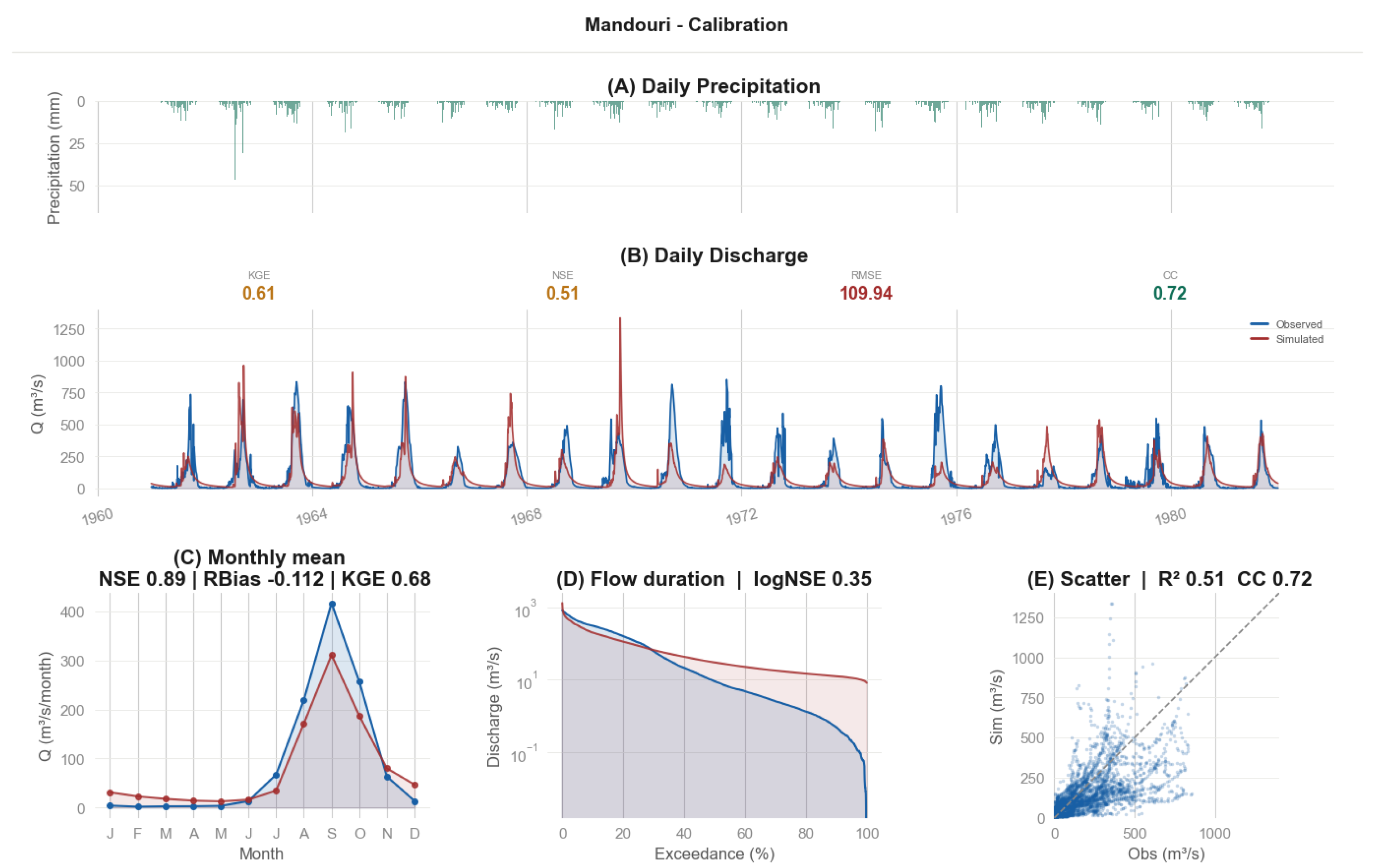
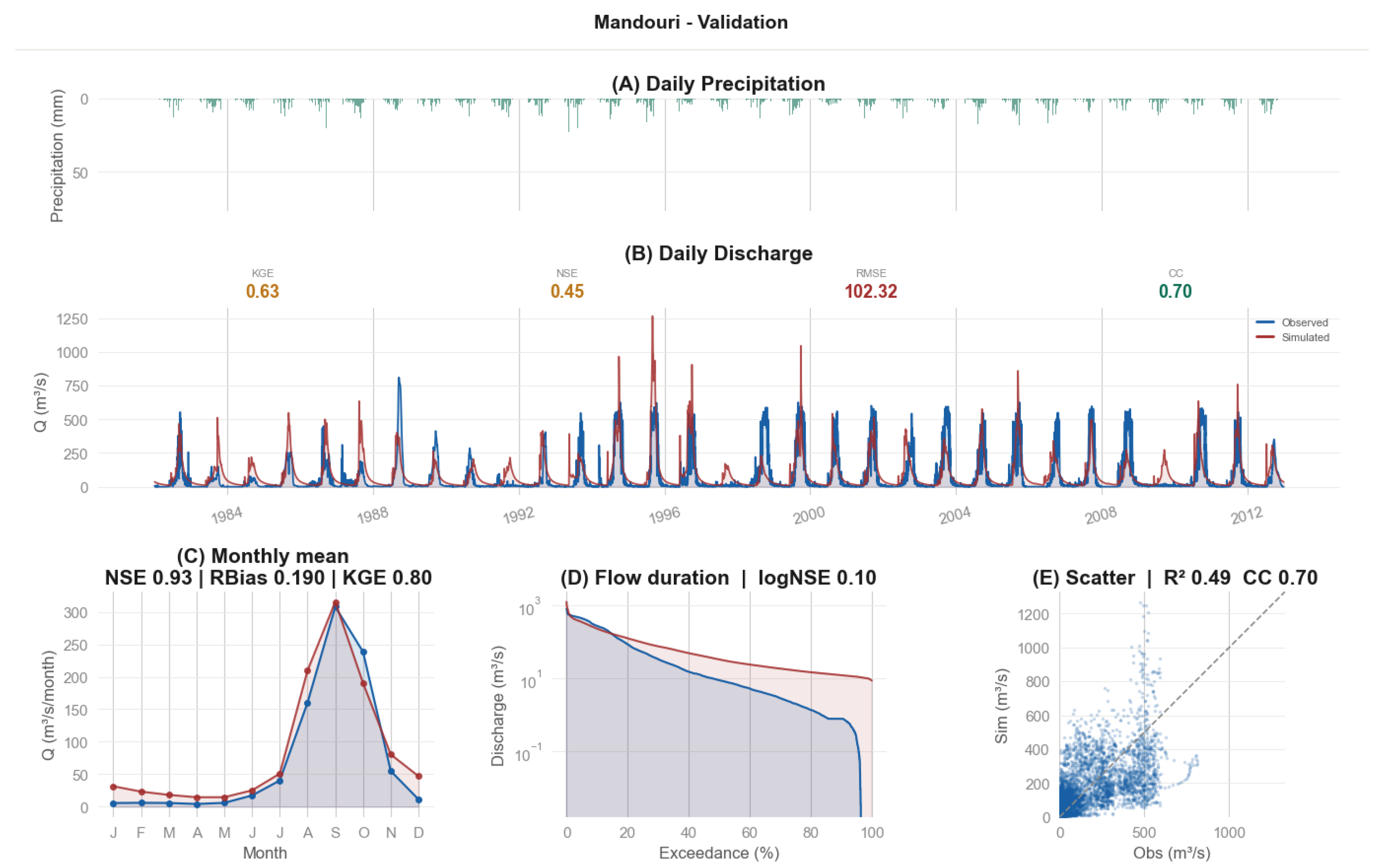
- High flows (KGE. raw NSE): Acceptable performance in calibration for all three stations. Peak flood flows, which are often underestimated (BIAS < 1 in calibration at Mandouri and Mango), reflect the limitation of the GR4J single-path routing reservoir in reproducing the rapid surface runoff processes (Horton) prevalent during extreme events in the Sahelian zone [49].
- Intermediate flows (KGE[√Q]. NSE[√Q]): The values of NSE[√Q] are consistently higher than the raw NSE values (e.g., Mandouri: 0.638 vs. 0.507), indicating that the square root transformation mitigates the effect of extreme peaks and that the model accurately reproduces the dynamics of recession flows. These values remain stable between calibration and validation, confirming the model’s robustness for simulating median flows.
- Low-water flows (KGE[1/Q]. NSE[1/Q]): The highly negative values (KGE[1/Q] ≈ −0.65 to −0.71, NSE[1/Q] ≈ 0) represent the model’s major structural weakness showing that the model is inferior to the simple average. They indicate an inability of the GR4J model to correctly reproduce low-flow discharges, due in particular to the absence of an explicit groundwater module. This result is consistent with the findings of [50] which show that simple-structured global conceptual models systematically underestimate low flows in African basins where groundwater–river interactions are decisive. The addition of an underground reservoir (the GR6J model in [51] could significantly improve this performance. A KGE[1/Q] lower than the −0.41 benchmark of the mean-flow predictor [42] means that, for the inverse-flow signature, the model is statistically worse than simply using the long-term mean low flow. The consequences for the present projections are twofold. The absolute magnitude of future low flows under SSP2-4.5 and SSP5-8.5 cannot be assessed with confidence and the projected values during the December–May dry months must be regarded as illustrative rather than quantitative. However, the projection of peak flows in September on which our main conclusions are based is affected only marginally by this limitation, because high flows are governed by saturation-excess and rapid runoff processes that are well captured by the X1–X3–X4 reservoirs of GR4J, and not by the baseflow component that GR4J does not explicitly resolve. A test of the six-parameter version GR6J [52], which adds an additional underground reservoir and exchange parameter, was outside the scope of the present work and is identified as a priority for follow-up studies; such a comparison would allow a quantitative assessment of how much the structural simplification of GR4J biases dry-season projections in the Sudano-Sahelian context. Implications for drought-period water management should therefore be drawn from GR4J outputs only with explicit caveats.
3.4.3. Graphical Evaluation
3.5. Climate Projections and Their Impacts on Streamflow
3.6. Summary and Recommendations
4. Discussion
5. Conclusions
Author Contributions
Funding
Data Availability Statement
Acknowledgments
Conflicts of Interest
Abbreviations
| DRE-Togo | Water Resources Directorate-Togo |
| CMIP6 | Coupled Model Intercomparison Project Phase 6 |
| CDS | Climate Data Store |
| ERA5 | ECMWF Reanalysis v5 |
| NSE | Nash–Sutcliffe Efficiency |
| KGE | Kling–Gupta Efficiency |
| MAE | Mean Absolute Error |
| VS | Variance Scaling |
| QM | Quantile Mapping |
| QDM | Quantile Delta Mapping |
| Qobs | Observed Discharge |
| Qsim | Simulated Discharge |
| RMSE | Root Mean Square Error |
| Q | Discharge |
| LS | Linear Scaling |
| °C | Degree Celsius |
| mm | Millimetre |
| % | Percent |
| SSP2-4.5 | Shared Socioeconomic Pathway 2–4.5 W/m2 |
| SSP5-8.5 | Shared Socioeconomic Pathway 5–8.5 W/m2 |
| GR4J | Génie Rural à 4 paramètres Journalier (Daily four-parameter hydrological model) |
| GCMs | Global climate models |
| IPCC | Intergovernmental Panel on Climate Change |
References
- IPCC. Climate Change 2021—The Physical Science Basis. In Contribution of Working Group I to the Sixth Assessment Report of the Intergovernmental Panel on Climate Change; Masson-Delmotte, V., Zhai, P., Pirani, A., Connors, S.L., Péan, C., Berger, S., Caud, N., Chen, Y., Goldfarb, L., Gomis, M.I., et al., Eds.; Cambridge University Press: Cambridge, UK, 2021; pp. 1–17. Available online: https://search.informit.org/doi/10.3316/informit.315096509383738 (accessed on 26 April 2026).
- Niang, I.; Ruppel, O.C.; Abdrabo, M.A.; Essel, A.; Lennard, C.; Padgham, J.; Urquhart, P. Africa. In Climate Change 2014: Impacts, Adaptation, and Vulnerability; Cambridge University Press: Cambridge, UK, 2014; pp. 1199–1265. Available online: https://www.scirp.org/reference/referencespapers?referenceid=1544123 (accessed on 26 April 2026).
- Mahé, G.; Lienou, G.; Descroix, L.; Bamba, F.; Paturel, J.E.; Laraque, A.; Meddi, M.; Habaieb, H.; Adeaga, O.; Dieulin, C.; et al. The rivers of Africa: Witness of climate change and human impact on the environment. Hydrol. Process. 2013, 27, 2105–2114. [Google Scholar] [CrossRef]
- Nicholson, S.E. The ITCZ and the seasonal cycle over equatorial Africa. Bull. Am. Meteorol. Soc. 2018, 99, 337–348. [Google Scholar] [CrossRef]
- Koungbanane, D.; Totin Vodounon, S.H.; Amoussou, E.; Zahiri, P.E.; Laré, L.Y. Variabilité hydro-climatique et risques d’inondation dans le bassin versant de l’Oti au Togo. Rev. Géogr. Univ. Ouagadougou 2019, 8, 1–17. [Google Scholar]
- Bienibuor, A.K.; Preko, K.; Aning, A.A.; Menyeh, A.; Wemegah, D.D.; Appiah, M.K. Groundwater potential and quality assessment of the Oti-Pendjari and Obosum Groups of the Atebubu municipality. Appl. Water Sci. 2025, 15, 195. [Google Scholar] [CrossRef]
- Barry, B.; Obuobie, E.; Andreini, M.; Andah, W.; Pluquet, M. The Volta River Basin: Comprehensive Assessment of Water Management in Agriculture; International Water Management Institute: Colombo, Sri Lanka, 2005. [Google Scholar]
- Idiéti, M.E.; Vissin, E.W.; Amoussou, E. Contraintes hydro-climatiques dans le bassin versant béninois de la Pendjari (Nord-Ouest du Bénin). Clim. Dév. 2011, 11, 34–45. [Google Scholar] [CrossRef]
- Eyring, V.; Bony, S.; Meehl, G.A.; Senior, C.A.; Stevens, B.; Stouffer, R.J.; Taylor, K.E. Overview of the Coupled Model Intercomparison Project Phase 6 (CMIP6) experimental design and organization. Geosci. Model Dev. 2021, 14, 1937–1958. [Google Scholar] [CrossRef]
- Samuel, S.; Wang, X.; Iyakaremye, V.; Rao, Y.; Mind’je, R.; Ayugi, B.O. Assessment of historical and future mean and extreme precipitation over Sub-Saharan Africa using NEX-GDDP-CMIP6: Part I—Evaluation of historical simulation. Int. J. Climatol. 2025, 45, e8672. [Google Scholar] [CrossRef]
- Diedhiou, A.; Bichet, A.; Wartenburger, R.; Seneviratne, S.I.; Rowell, D.P.; Sylla, M.B.; Janicot, S. Changes in climate extremes over West and Central Africa at 1.5 °C and 2 °C global warming. Environ. Res. Lett. 2018, 13, 065020. [Google Scholar] [CrossRef]
- Dosio, A.; Jury, M.W.; Almazroui, M.; Ashfaq, M.; Diallo, I.; Engelbrecht, F.A.; Tamoffo, A.T. Projected future daily characteristics of African precipitation based on global (CMIP5, CMIP6) and regional (CORDEX, CORDEX-CORE) climate models. Clim. Dyn. 2021, 57, 3135–3158. [Google Scholar] [CrossRef]
- Perrin, C.; Michel, C.; Andréassian, V. Improvement of a parsimonious model for streamflow simulation. J. Hydrol. 2003, 279, 275–289. [Google Scholar] [CrossRef]
- Oudin, L.; Hervieu, F.; Michel, C.; Perrin, C.; Andréassian, V.; Anctil, F.; Loumagne, C. Which potential evapotranspiration input for a lumped rainfall–runoff model? Part 2—Towards a simple and efficient potential evapotranspiration model for rainfall–runoff modelling. J. Hydrol. 2005, 303, 290–306. [Google Scholar] [CrossRef]
- Mik-Meyer, V.; Doyle, E.E.H.; Dahl Larsen, M.A.; Kool, R.; Drews, M. Uncertainty Representation and Propagation in Flood Risk Modeling Under Climate Change: A Systematic Review. Wiley Interdiscip. Rev. Clim. Change 2026, 17, e70045. [Google Scholar] [CrossRef]
- Climate Data Store. CMIP6 Climate Projections; Copernicus Climate Change Service (C3S): Reading, UK, 2021. [Google Scholar] [CrossRef]
- Copernicus Climate Change Service. ERA5 Post-Processed Daily Statistics on Single Levels from 1940 to Present; Climate Data Store (CDS): Reading, UK, 2024. [Google Scholar] [CrossRef]
- Steinkopf, J.; Engelbrecht, F. Verification of ERA5 and ERA-Interim precipitation over Africa at intra-annual and interannual timescales. Atmos. Res. 2022, 280, 106427. [Google Scholar] [CrossRef]
- Bodjrenou, R.; Cohard, J.; Hector, B.; Lawin, E.A.; Chagnaud, G.; Danso, D.K.; N’tcha M’po, Y.; Badou, F.; Ahamide, B. Evaluation of Reanalysis Estimates of Precipitation, Radiation, and Temperature over Benin (West Africa). J. Appl. Meteor. Climatol. 2023, 62, 1005–1022. [Google Scholar] [CrossRef]
- Zhuang, J.; Dussin, R.; Huard, D.; Bourgault, P.; Burt, A.; Cherian, D.A.; Malevich, S.B. pangeo-data/xESMF: V0.9.2—Third Time’s a Charm. Zenodo 2025. [Google Scholar] [CrossRef]
- Python Software Foundation. Python Language Reference, Version 3.12; Python Software Foundation: Wilmington, DE, USA, 2023; Available online: https://www.python.org/ (accessed on 24 February 2026).
- Beck, H.E.; van Dijk, A.I.J.M.; de Roo, A.; Dutra, E.; Fink, G.; Orth, R.; Schellekens, J. Global evaluation of runoff from 10 state-of-the-art hydrological models. Hydrol. Earth Syst. Sci. 2016, 20, 2881–2903. [Google Scholar] [CrossRef]
- Teutschbein, C.; Seibert, J. Bias correction of regional climate model simulations for hydrological climate-change impact studies: Review and evaluation of different methods. J. Hydrol. 2012, 456–457, 12–29. [Google Scholar] [CrossRef]
- Maraun, D. Bias correcting climate change simulations—A critical review. Curr. Clim. Change Rep. 2016, 2, 211–220. [Google Scholar] [CrossRef]
- Cannon, A.J.; Sobie, S.R.; Murdock, T.Q. Bias correction of GCM precipitation by quantile mapping: How well do methods preserve changes in quantiles and extremes? J. Clim. 2015, 28, 6938–6959. [Google Scholar] [CrossRef]
- Hengl, T. A Practical Guide to Geostatistical Mapping; University of Amsterdam: Amsterdam, The Netherlands, 2009; Available online: https://publications.jrc.ec.europa.eu/repository/handle/JRC38153 (accessed on 23 March 2026).
- Homsi, R.; Shiru, M.S.; Shahid, S.; Ismail, T.; Harun, S.B.; Al-Ansari, N.; Chau, K.-W.; Yaseen, Z.M. Precipitation projection using a CMIP5 GCM ensemble model: A regional investigation of Syria. Eng. Appl. Comput. Fluid Mech. 2020, 14, 90–106. [Google Scholar] [CrossRef]
- Burrough, P.A.; McDonnell, R.A.; Lloyd, C.D. Principles of Geographical Information Systems, 3rd ed.; Oxford University Press: Oxford, UK, 2015. [Google Scholar]
- Gudmundsson, L.; Bremnes, J.B.; Haugen, J.E.; Engen-Skaugen, T. Technical note: Downscaling RCM precipitation to the station scale using statistical transformations—A comparison of methods. Hydrol. Earth Syst. Sci. 2012, 16, 3383–3390. [Google Scholar] [CrossRef]
- Wilcoxon, F. Individual comparisons by ranking methods. Biom. Bull. 1945, 1, 80–83. [Google Scholar] [CrossRef]
- Vischel, T.; Lebel, T. Assessing the water balance in the Sahel: Impact of small scale rainfall variability on runoff. Part 2: Idealized modeling of runoff sensitivity. J. Hydrol. 2007, 333, 340–355. [Google Scholar] [CrossRef]
- Wilks, D.S. Statistical Methods in the Atmospheric Sciences, 3rd ed.; Academic Press: Cambridge, MA, USA, 2011. [Google Scholar]
- Tebaldi, C.; Knutti, R. The use of the multi-model ensemble in probabilistic climate projections. Philos. Trans. R. Soc. A 2007, 365, 2053–2075. [Google Scholar] [CrossRef] [PubMed]
- Mbaye, M.L.; Hagemann, S.; Haensler, A.; Stacke, T.; Gaye, A.T.; Afouda, A. Assessment of Climate Change Impact on Water Resources in the Upper Senegal Basin (West Africa). Am. J. Clim. Change 2015, 4, 77–93. [Google Scholar] [CrossRef]
- Edijatno; Michel, C. Un modèle pluie-débit journalier à trois paramètres. La Houille Blanche 1989, 2, 113–121. [Google Scholar] [CrossRef]
- Knutti, R.; Furrer, R.; Tebaldi, C.; Cermak, J.; Meehl, G.A. Challenges in combining projections from multiple climate models. J. Clim. 2010, 23, 2739–2758. [Google Scholar] [CrossRef]
- Fang, G.H.; Yang, J.; Chen, Y.N.; Zammit, C. Comparing bias correction methods in downscaling meteorological variables for a hydrologic impact study in an arid area in China. Hydrol. Earth Syst. Sci. 2015, 19, 2547–2559. [Google Scholar] [CrossRef]
- Duan, Q.; Sorooshian, S.; Gupta, V. Effective and efficient global optimization for conceptual rainfall-runoff models. Water Resour. Res. 1992, 28, 1015–1031. [Google Scholar] [CrossRef]
- Oudin, L.; Andréassian, V.; Mathevet, T.; Perrin, C. Dynamic averaging of rainfall-runoff model simulations from complementary model parameterizations. Water Resour. Res. 2006, 42, W07410. [Google Scholar] [CrossRef]
- Gupta, H.V.; Kling, H.; Yilmaz, K.K.; Martinez, G.F. Decomposition of the mean squared error and NSE performance criteria. J. Hydrol. 2009, 377, 80–91. [Google Scholar] [CrossRef]
- Knoben, W.J.M.; Freer, J.E.; Woods, R.A. Technical note: Inherent benchmark or not? Comparing Nash–Sutcliffe and Kling–Gupta efficiency scores. Hydrol. Earth Syst. Sci. 2019, 23, 4323–4331. [Google Scholar] [CrossRef]
- Sylla, M.B.; Elguindi, N.; Giorgi, F.; Wisser, D. Projected robust shift of climate zones over West Africa in response to anthropogenic climate change for the late 21st century. Clim. Change 2018, 134, 241–253. [Google Scholar] [CrossRef]
- Leblanc, M.J.; Favreau, G.; Massuel, S.; Tweed, S.O.; Loireau, M.; Cappelaere, B. Land clearance and hydrological change in the Sahel: SW Niger. Glob. Planet. Change 2009, 61, 135–150. [Google Scholar] [CrossRef]
- Pushpalatha, R.; Perrin, C.; Le Moine, N.; Mathevet, T.; Andréassian, V. A downward structural sensitivity analysis of hydrological models to improve low-flow simulation. J. Hydrol. 2011, 411, 66–76. [Google Scholar] [CrossRef]
- Moriasi, D.N.; Arnold, J.G.; Van Liew, M.W.; Bingner, R.L.; Harmel, R.D.; Veith, T.L. Model evaluation guidelines for systematic quantification of accuracy in watershed simulations. Trans. ASABE 2007, 50, 885–900. [Google Scholar] [CrossRef]
- Bossa, A.; Kpossou, M.; Hounkpè, J.; Badou, F. Multi-Model Approach for Assessing the Influence of Calibration Criteria on the Water Balance in Ouémé Basin. J. Water Resour. Prot. 2024, 16, 207–218. [Google Scholar] [CrossRef]
- Ismail, M.F.; Naz, B.S.; Wortmann, M.; Disse, M.; Bowling, L.C.; Bogacki, W. Comparison of two model calibration approaches and their influence on future projections under climate change in the Upper Indus Basin. Clim. Change 2020, 163, 1227–1246. [Google Scholar] [CrossRef]
- Hirpa, F.A.; Salamon, P.; Beck, H.E.; Lorini, V.; Alfieri, L.; Zsoter, E.; Dadson, S.J. Calibration of the Global Flood Awareness System (GloFAS) using daily streamflow data. J. Hydrol. 2018, 566, 595. [Google Scholar] [CrossRef] [PubMed]
- Lebel, T.; Ali, A. Recent trends in the Central and Western Sahel rainfall regime (1990–2007). J. Hydrol. 2009, 375, 52–64. [Google Scholar] [CrossRef]
- Pushpalatha, R.; Perrin, C.; Le Moine, N.; Andréassian, V. A review of efficiency criteria suitable for evaluating low-flow simulations. J. Hydrol. 2012, 420–421, 171–182. [Google Scholar] [CrossRef]
- Akinsanola, A.A.; Kooperman, G.J.; Pendergrass, A.G.; Hannah, W.M.; Reed, K.A. Evaluation of CMIP6 models in simulating the statistics of extreme precipitation over Eastern Africa. J. Geophys. Res. Atmos. 2021, 126, e2021JD035161. [Google Scholar]
- Jehn, F.U.; Chamorro, A.; Houska, T.; Breuer, L. Trade-offs between parameter constraints and model realism: A case study. Sci. Rep. 2019, 9, 10729. [Google Scholar] [CrossRef] [PubMed]
- Biasutti, M. Rainfall trends in the African Sahel: Characteristics, processes, and causes. Wiley Interdiscip. Rev. Clim. Change 2019, 10, e591. [Google Scholar] [CrossRef] [PubMed]
- Taylor, C.M.; Belušić, D.; Guichard, F.; Parker, D.J.; Vischel, T.; Bock, O.; Grandpeix, J.Y. Frequency of extreme Sahelian storms tripled since 1982 in satellite observations. Nature 2017, 544, 475–478. [Google Scholar] [CrossRef] [PubMed]
- Berghuijs, W.R.; Woods, R.A.; Hutton, C.J.; Sivapalan, M. Dominant flood generating mechanisms across the United States. Geophys. Res. Lett. 2016, 43, 4382–4390. [Google Scholar] [CrossRef]
- Gleckler, P.J.; Taylor, K.E.; Doutriaux, C. Performance metrics for climate models. J. Geophys. Res. Atmos. 2008, 13, 6. [Google Scholar] [CrossRef]
- Paeth, H.; Hall, N.M.J.; Gaertner, M.A.; Alonso, M.D.; Moumouni, S.; Polcher, J.; Rummukainen, M. Progress in regional downscaling of West African precipitation. Atmos. Sci. Lett. 2011, 12, 75–82. [Google Scholar] [CrossRef]
- Dioha, M.O.; Onyenekwe, C.S.; Kelechukwu, V.A.; Adeyeri, O.E. Future precipitation change in West Africa using NEX-GDDP-CMIP6 models based on multiple machine learning algorithms. Int. J. Climatol. 2025, 45, e8930. [Google Scholar] [CrossRef]
- Favreau, G.; Cappelaere, B.; Massuel, S.; Leblanc, M.; Boucher, M.; Boulain, N.; Leduc, C. Land clearing, climate variability, and water resources increase in semiarid southwest Niger: A review. Water Resour. Res. 2009, 45, W00A16. [Google Scholar] [CrossRef]
- Bobde, V.; Adeyeri, O.E.; Cudjoe, B.; Tamoffo, A.T.; Diba, I.; Sylla, M.B. Projected regional changes in mean and extreme precipitation over Africa in CMIP6 models. Environ. Res. Lett. 2024, 19, 074009. [Google Scholar] [CrossRef]
- Sylla, M.B.; Nikiema, P.M.; Gibba, P.; Kebe, I.; Klutse, N.A.B. Climate change over West Africa: Recent trends and future projections. In Adaptation to Climate Change and Variability in Rural West Africa; Springer: Cham, Switzerland, 2016; pp. 25–40. [Google Scholar] [CrossRef]





| Indicator | Mathematical Formula |
|---|---|
| NSE (Nash–Sutcliffe Efficiency) | avec Yi: simulated value; Xi: observed value; : average of the observations and n: number of data points |
| KGE (Kling–Gupta Efficiency) | with r = corr(X. Y). (standard deviation ratio) et (biais relatif); σ: standard deviation |
| MAE (Mean Absolute Error) | avec simulated value and Xi: observed value |
| Method | Mathematical Formula |
|---|---|
| Linear Scaling (LS) | (rainfall) (Temperature) with |
| Variance Scaling (VS) | avec |
| Quantile Mapping (QM) | avec et |
| Quantile Delta Mapping (QDM) | (Temperature) (Rainfall) With . More precisely, τ = Fsim,fut(Xsim,fut) ∈ [0, 1] denotes the non-exceedance probability associated with the simulated future value Xsim,fut, computed from the empirical cumulative distribution function of the future simulation; F−1(τ) is the inverse CDF (quantile function) evaluated at this probability, both for the observations (Fobs−1) and the historical simulation (Fsim,hist−1) over the reference period. |
| Criterion | Formula | Interpretation |
|---|---|---|
| KGE | ; with r = Corr(. ). (standard deviation ratio) et (biais relatif); σ: standard deviation | The closer the KGE/NSE values are to 1, the better the model. |
| NSE | NSE = | |
| RMSE | An RMSE close to 0 indicates a perfect model. | |
| BIAS(Qsim/Qobs) | BIAS = | If BIAS > 1 = Overestimation If BIAS < 1 = Underestimation If BIAS = 1 = Perfect |
| Stations | Warm-Up | Calibration Period | Validation Period | Screening Period |
|---|---|---|---|---|
| Mandouri | 1960-01-01:1960-12-31 | 1961-01-01:1981-12-30 | 1982-01-01:2012-12-30 | 2022-01-01:2100-12-30 |
| Mango | 1961-01-01:1970-12-30 | 1974-01-01:1984-12-30 | ||
| Porga | 1961-01-01:1990-12-30 | 1991-01-01:2013-01-25 |
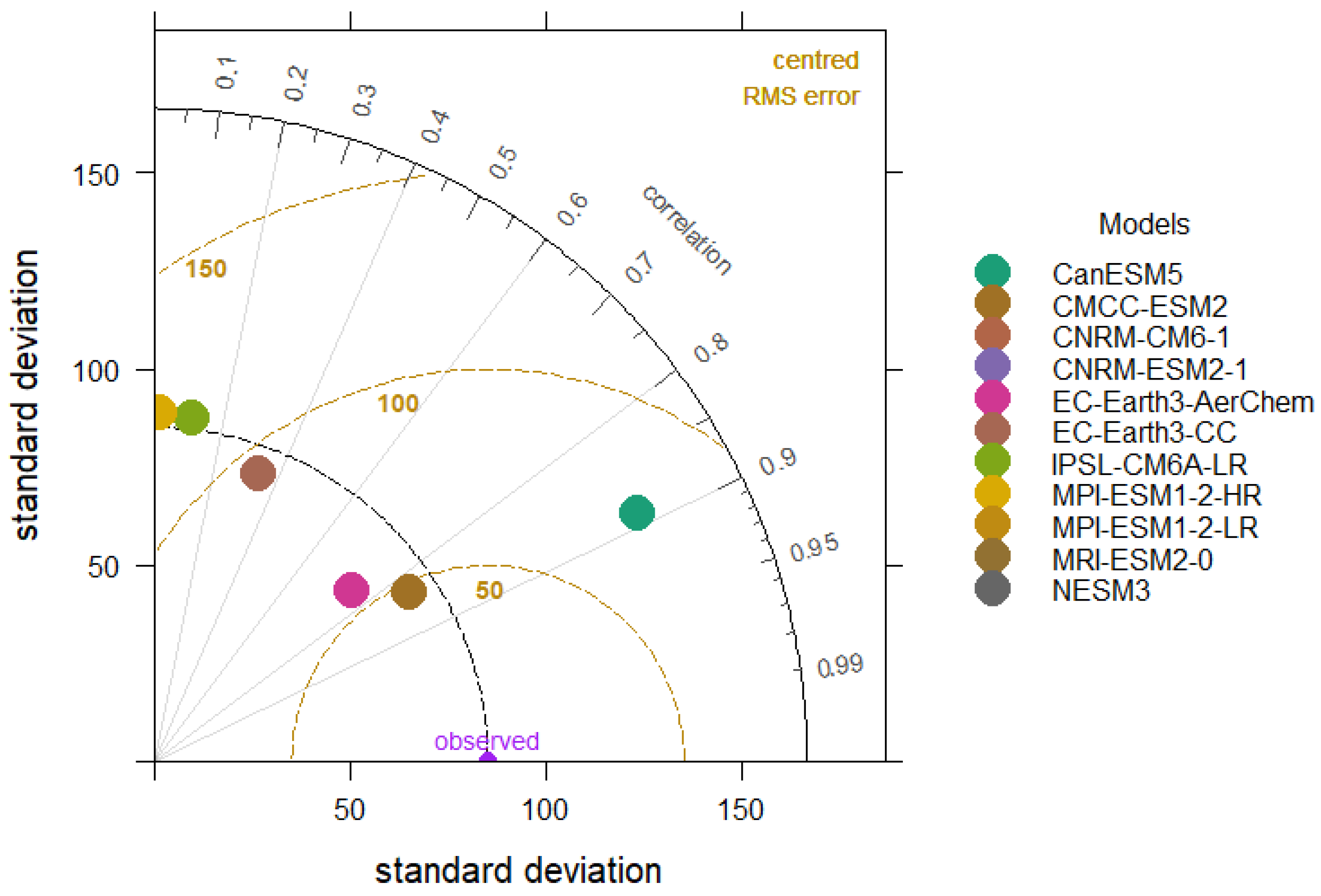
| Model | NSE | KGE | MAE | Global Ranking |
|---|---|---|---|---|
| IPSL-CM6A-LR | 0.98 | 0.96 | 8.83 | 1 |
| CMCC-ESM2 | 0.96 | 0.91 | 12.12 | 2 |
| MPI-ESM1-2-LR | 0.96 | 0.86 | 13.26 | 3 |
| MPI-ESM1-2-HR | 0.82 | 0.75 | 25.52 | 4 |
| CNRM-CM6-1 | 0.81 | 0.80 | 26.49 | 5 |
| CNRM-ESM2-1 | 0.81 | 0.77 | 25.79 | 6 |
| MRI-ESM2-0 | 0.75 | 0.81 | 27.63 | 7 |
| EC-Earth3-CC | 0.78 | 0.66 | 29.38 | 8 |
| EC-Earth3-AerChem | 0.75 | 0.58 | 32.30 | 9 |
| NESM3 | 0.66 | 0.48 | 32.96 | 10 |
| CanESM5 | 0.09 | 0.20 | 51.29 | 11 |
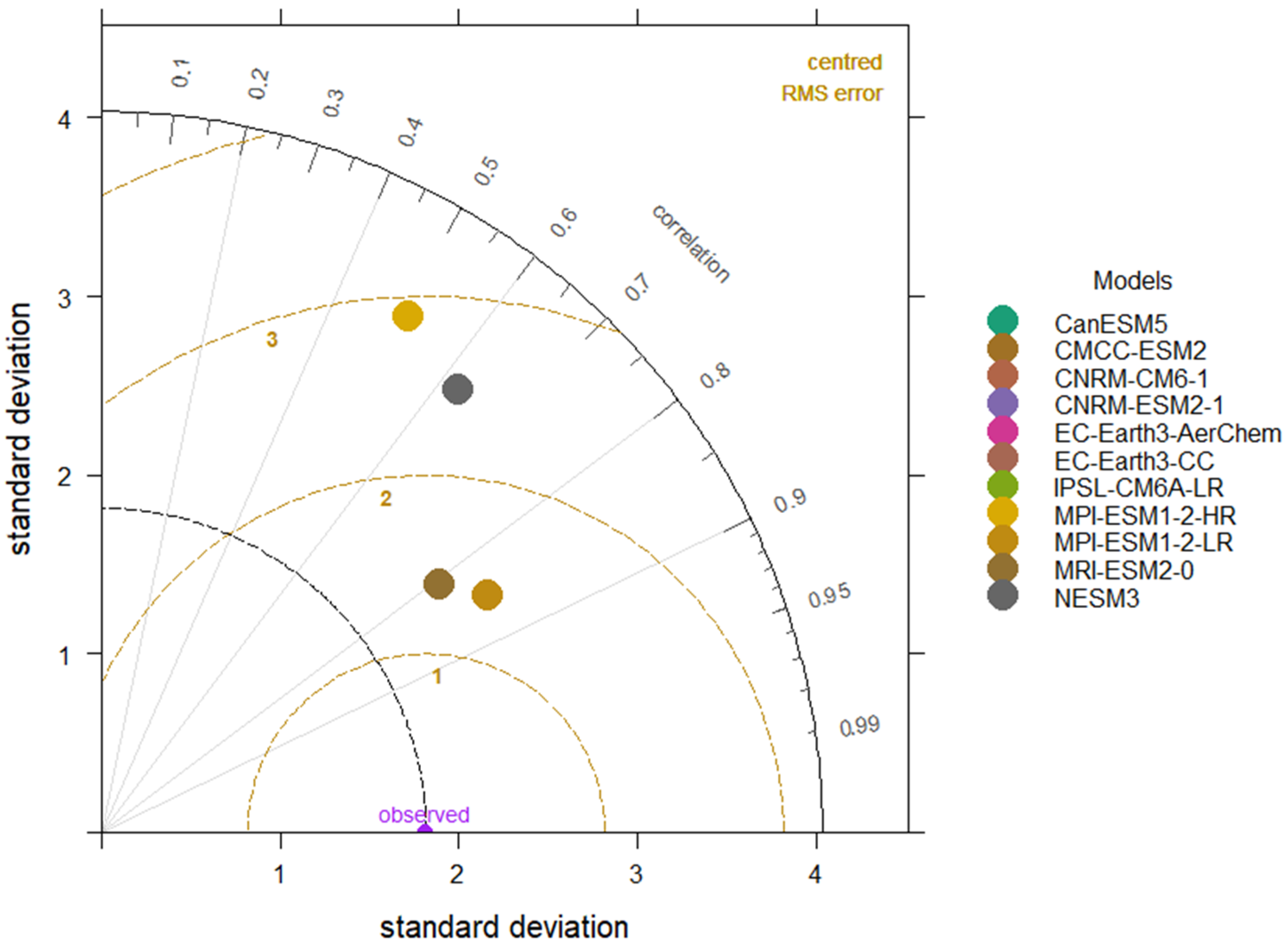
| Model | NSE | KGE | MAE | Global Ranking |
|---|---|---|---|---|
| CNRM-CM6-1 | 0.669 | 0.864 | 0.901 | 1 |
| MPI-ESM1-2-LR | 0.638 | 0.597 | 0.882 | 2 |
| CMCC-ESM2 | 0.326 | 0.793 | 1.218 | 3 |
| CNRM-ESM2-1 | 0.389 | 0.731 | 1.237 | 4 |
| EC-Earth3-AerChem | 0.014 | 0.581 | 1.417 | 5 |
| MRI-ESM2-0 | −0.172 | 0.664 | 1.684 | 6 |
| EC-Earth3-CC | −0.250 | 0.462 | 1.735 | 7 |
| IPSL-CM6A-LR | −0.313 | 0.425 | 1.475 | 8 |
| NESM3 | −1.007 | 0.218 | 1.852 | 9 |
| MPI-ESM1-2-HR | −0.806 | 0.134 | 1.875 | 10 |
| CanESM5 | −1.191 | 0.191 | 2.008 | 11 |
| Method | Model | Bias | Absolute Bias | RMSE | Correlation |
|---|---|---|---|---|---|
| Linear Scaling | CMCC-ESM2 | 2.73 × 10⁻⁸ | 2.73 × 10⁻⁸ | 35.25 | 0.904 * |
| IPSL-CM6A-LR | 5.98 × 10⁻⁷ | 5.98 × 10⁻⁷ | 38.12 | 0.889 | |
| MPI-ESM1-2-LR | −4.18 × 10⁻⁷ | 4.18 × 10⁻⁷ | 37.50 | 0.892 | |
| Mean | −4.53 × 10⁻⁷ | 4.53 × 10⁻⁷ | 30.33 | 0.927 | |
| Variance Scaling | CMCC-ESM2 | −6.79 × 10⁻⁸ | 6.79 × 10⁻⁸ | 39.19 | 0.884 |
| IPSL-CM6A-LR | 1.06 × 10⁻⁶ | 1.06 × 10⁻⁶ | 40.97 | 0.874 | |
| MPI-ESM1-2-LR | −4.66 × 10⁻⁷ | 4.66 × 10⁻⁷ | 43.51 | 0.861 | |
| Mean | −4.03 × 10⁻⁸ | 4.03 × 10⁻⁸ | 42.35 | 0.867 | |
| Quantile Mapping | CMCC-ESM2 | 6.04 | 6.04 | 39.42 | 0.884 |
| IPSL-CM6A-LR | 2.96 | 2.96 | 42.25 | 0.891 | |
| MPI-ESM1-2-LR | −6.84 | 6.84 | 46.65 | 0.873 | |
| Mean | 7.17 | 7.17 | 46.57 | 0.899 | |
| Quantile Delta Mapping | CMCC-ESM2 | 1.03 | 1.03 | 39.24 | 0.880 |
| IPSL-CM6A-LR | −0.53 | 0.53 | 43.55 | 0.885 | |
| MPI-ESM1-2-LR | −4.56 | 4.56 | 46.58 | 0.875 | |
| Mean | 1.36 | 1.36 | 49.07 | 0.888 |
| Comparaison | n | ΔRMSE (LS − comp.) | W | p-Value |
|---|---|---|---|---|
| LS vs. QM | 4 | −8.42 mm/mois | 0.0 | 0.0625 |
| LS vs. QDM | 4 | −9.31 mm/mois | 0.0 | 0.0625 |
| Method | GCM | Sim. P90 | Sim. P95 | Sim. P99 | Biais P90 (%) | Biais P95 (%) | Biais P99 (%) |
|---|---|---|---|---|---|---|---|
| Reference data | ERA5 | 208.92 | 233.93 | 279.61 | - | - | - |
| Linear Scaling (LS) | CMCC-ESM2 | 204.18 | 239.54 | 276.37 | −2.27 | 2.40 | −1.16 |
| Mean | 205.21 | 224.19 | 268.07 | −1.77 | −4.17 | −4.13 | |
| Quantile Mapping (QM) | CMCC-ESM2 | 209.92 | 241.15 | 287.12 | 0.48 | 3.09 | 2.69 |
| Mean | 248.93 | 299.67 | 389.59 | 19.15 | 28.10 | 39.33 | |
| Quantile Delta Mapping (QDM) | CMCC-ESM2 | 204.90 | 236.26 | 284.29 | −1.92 | 0.99 | 1.67 |
| Mean | 249.89 | 303.48 | 394.81 | 19.61 | 29.73 | 41.20 |
| Method | Model | Bias | Absolute Bias | RMSE | Correlation |
|---|---|---|---|---|---|
| Linear Scaling | CMCC-ESM2 | −8.75 × 10⁻⁸ | 8.75 × 10⁻⁸ | 1.57 | 0.740 |
| CNRM-ESM2-1 | 2.83 × 10⁻⁷ | 2.83 × 10⁻⁷ | 1.86 | 0.669 | |
| MPI-ESM1-2-LR | −8.08 × 10⁻⁹ | 8.08 × 10⁻⁹ | 1.89 | 0.666 | |
| Mean | 1.90 × 10⁻¹⁰ | 1.90 × 10⁻¹⁰ | 1.37 | 0.790 * | |
| Variance Scaling | CMCC-ESM2 | −4.21 × 10⁻⁸ | 4.21 × 10⁻⁸ | 1.54 | 0.748 |
| CNRM-ESM2-1 | 1.90 × 10⁻⁷ | 1.90 × 10⁻⁷ | 1.63 | 0.719 | |
| MPI-ESM1-2-LR | −1.14 × 10⁻⁹ | 1.14 × 10⁻⁹ | 1.65 | 0.717 | |
| Mean | −9.50 × 10⁻¹¹ | 9.50 × 10⁻¹¹ | 1.55 | 0.748 | |
| Quantile Mapping | CMCC-ESM2 | −2.05 × 10⁻⁴ | 2.05 × 10⁻⁴ | 1.84 | 0.633 |
| CNRM-ESM2-1 | 1.93 × 10⁻⁴ | 1.93 × 10⁻⁴ | 1.78 | 0.667 | |
| MPI-ESM1-2-LR | −2.05 × 10⁻⁴ | 2.05 × 10⁻⁴ | 1.81 | 0.671 | |
| Mean | 3.12 × 10⁻⁴ | 3.12 × 10⁻⁴ | 1.57 | 0.746 | |
| Quantile Delta Mapping | CMCC-ESM2 | 1.60 × 10⁻⁴ | 1.60 × 10⁻⁴ | 1.84 | 0.633 |
| CNRM-ESM2-1 | −1.99 × 10⁻⁵ | 1.99 × 10⁻⁵ | 1.78 | 0.667 | |
| MPI-ESM1-2-LR | 1.10 × 10⁻⁴ | 1.10 × 10⁻⁴ | 1.81 | 0.671 | |
| Mean | 2.38 × 10⁻⁶ | 2.38 × 10⁻⁶ | 1.57 | 0.746 |
| Stations | Parameters | BV Sup (km2) | Centre-of-Mass Latitude | |||
|---|---|---|---|---|---|---|
| X1 | X2 | X3 | X4 | |||
| Porga | 0.0105 | −29.778 | 470.2 | 4.505 | 21,907.418 | 11.372 |
| Mandouri | 0.0079 | −18.016 | 411.46 | 5.278 | 29,046.2417 | 11.412 |
| Mango | 150.91 | 1.7 | 40.86 | 7.65 | 35,394.433 | 11.293 |
| Mandouri | Mango | Porga | ||||
|---|---|---|---|---|---|---|
| Calibration | Validation | Calibration | Validation | Calibration | Validation | |
| KGE | 0.609 * | 0.632 * | 0.657 * | 0.522 ** | 0.668 * | 0.55 ** |
| NSE | 0.507 * | 0.451 ** | 0.334 *** | 0.235 *** | 0.566 ** | 0.428 ** |
| RMSE | 109.938 | 102.324 | 223.539 | 123.889 | 108.838 | 105.134 |
| BIAS (Qsim/Qobs) | 0.887 # | 1.189 ## | 0.921 # | 1.202 ## | 1.031 ## | 1.369 ## |
| Intermediate flow rates | ||||||
| KGE[√Q] | 0.616 * | 0.524 ** | 0.594 ** | 0.318 *** | 0.539 * | 0.469 ** |
| NSE[√Q] | 0.638 * | 0.489 ** | 0.57 ** | 0.254 *** | 0.602 * | 0.485 ** |
| Low flow rates | ||||||
| KGE[1/Q] | −0.679 | −0.668 | −0.71 | −0.705 | −0.545 | −0.642 |
| NSE[1/Q] | −0.003 | −0.038 | −0.001 | −0.003 | −0.119 | −0.083 |
| Station | Peak Change (Only for September) | |
|---|---|---|
| SSP245 | SSP585 | |
| Porga | +6.40% | −1.60% |
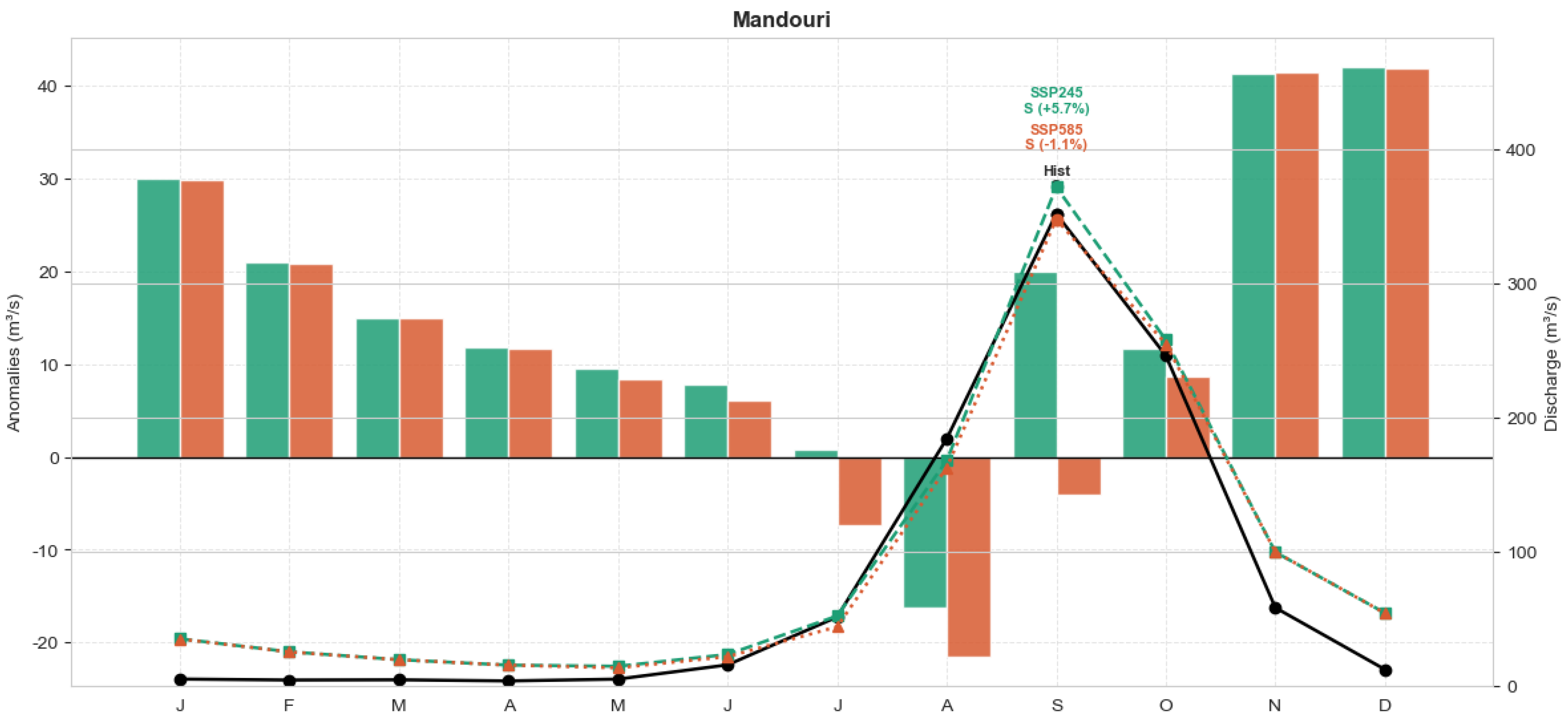
| Mandouri | +5.70% | −1.10% |
| Mango | +16.70% | −3.60% |
Disclaimer/Publisher’s Note: The statements, opinions and data contained in all publications are solely those of the individual author(s) and contributor(s) and not of MDPI and/or the editor(s). MDPI and/or the editor(s) disclaim responsibility for any injury to people or property resulting from any ideas, methods, instructions or products referred to in the content. |
© 2026 by the authors. Licensee MDPI, Basel, Switzerland. This article is an open access article distributed under the terms and conditions of the Creative Commons Attribution (CC BY) license.
Share and Cite
Houanyé, A.K.; Amoussou, F.T.; Amoussou, E.; Todé, R.; Totin Vodounon, H.S.; Baco, M.N.; Kodja, J.D.; Akponikpè, P.I.; Mahé, G.; Paturel, J.-E. Climate Simulation and Projection of Rainfall–Runoff Dynamics Using the GR4J Model in the Oti Sub-Basin: The Case of the Porga, Mandouri and Mango Outlets. Water 2026, 18, 1501. https://doi.org/10.3390/w18121501
Houanyé AK, Amoussou FT, Amoussou E, Todé R, Totin Vodounon HS, Baco MN, Kodja JD, Akponikpè PI, Mahé G, Paturel J-E. Climate Simulation and Projection of Rainfall–Runoff Dynamics Using the GR4J Model in the Oti Sub-Basin: The Case of the Porga, Mandouri and Mango Outlets. Water. 2026; 18(12):1501. https://doi.org/10.3390/w18121501
Chicago/Turabian StyleHouanyé, Armand K., Félix T. Amoussou, Ernest Amoussou, Richard Todé, Henri S. Totin Vodounon, Mohamed N. Baco, Japhet D. Kodja, Pierre I. Akponikpè, Gil Mahé, and Jean-Emmanuel Paturel. 2026. "Climate Simulation and Projection of Rainfall–Runoff Dynamics Using the GR4J Model in the Oti Sub-Basin: The Case of the Porga, Mandouri and Mango Outlets" Water 18, no. 12: 1501. https://doi.org/10.3390/w18121501
APA StyleHouanyé, A. K., Amoussou, F. T., Amoussou, E., Todé, R., Totin Vodounon, H. S., Baco, M. N., Kodja, J. D., Akponikpè, P. I., Mahé, G., & Paturel, J.-E. (2026). Climate Simulation and Projection of Rainfall–Runoff Dynamics Using the GR4J Model in the Oti Sub-Basin: The Case of the Porga, Mandouri and Mango Outlets. Water, 18(12), 1501. https://doi.org/10.3390/w18121501