Article

Characteristics of Polycyclic Aromatic Hydrocarbon Contamination, Sources, and Risk Assessment in Farmland Soil Across Different River Basins in China


Key Laboratory of Ecological Restoration of Regional Contaminated Environment, Ministry of Education, College of Environment, Shenyang University, Shenyang 110044, China
*
Author to whom correspondence should be addressed.
Water 2026, 18(12), 1489; https://doi.org/10.3390/w18121489
Submission received: 15 May 2026 / Revised: 9 June 2026 / Accepted: 15 June 2026 / Published: 17 June 2026

Abstract

Polycyclic aromatic hydrocarbons (PAHs) in farmland soils pose potential ecological and human health risks, yet their contamination characteristics and source-related risks in farmland soils across different river basins in China remain insufficiently understood. This present study analyzed 84 farmland soil samples from northeast (primarily the middle and lower reaches of the Songhua River and Liao River basin), central (primarily the middle reaches of the Yellow River basin and Dongting Lake system), northwest (primarily the middle and upper reaches of the Yellow River and Yarlung Zangbo River basin), and southern (primarily the upper reaches of the Pearl River and Yangtze River basin) China in order to assess the contamination characteristics, sources, ecological risks, and human health risks associated with 16 US EPA priority PAHs in the samples. The findings suggest that the 16 aggregate PAHs’ concentrations in Chinese farmland soils varied from 63.9 to 9637.7 μg/kg, with an average of 1919.3 μg/kg. A gradual decline was observed from north to south, with dibenz[a,h]anthracene (DahA) accounting for the highest proportion at 14.3%. Correlation analysis, principal component analysis, and positive matrix factorization jointly indicated that fossil fuel combustion, high-temperature combustion, and traffic-related emissions were the main PAH inputs to farmland soils. The results of the ecological risk assessment indicated that the northeastern region exhibited the highest PAH ecological risk, with 41.2% of sample plots demonstrating severe PAH contamination. Conversely, the southern region exhibited the lowest PAH ecological risk, with 73.9% of the sample plots demonstrating no ecological risk. The human health risk assessment found that non-carcinogenic risks for both children and adults were within safe limits, while carcinogenic risks for both groups were relatively high. DahA was identified as the primary carcinogen, accounting for 45.9% and 70.3% of the total carcinogenic risk for children and adults, respectively. Oral ingestion was the primary route of exposure. This study provides an integrated basin-scale assessment of PAH contamination and source-related risks in Chinese farmland soils, supporting targeted management of PAH inputs in agricultural environments.

1. Introduction

Polycyclic aromatic hydrocarbons (PAHs) are a class of persistent organic pollutants that originate from both natural and anthropogenic sources [1]. PAHs are characterized by hydrophobicity, resistance to degradation, and potential carcinogenicity [2,3]. Farmland soils are important sinks for PAHs, and they are also the basic environmental medium for agricultural production [4]. PAHs can enter crops through various pathways and are ingested by humans via the food chain, thereby affecting human health [5]. Therefore, it is of great importance to clarify the contamination characteristics, sources, and potential risks of PAHs.
In recent years, significant progress has been made in PAH soil research, but different types of studies still have their limitations. Some studies focus on specific local areas or agricultural scenarios, such as straw-burning areas in northeast China, vegetable soils in Changchun, roadside farmland near Guangzhou, farmland in Helan, and the black soil regions of northeast China. While such studies reveal the concentration levels, compositional characteristics, sources, and associated health risks of PAHs, their scope is limited [6,7,8,9,10]. Other studies have examined large-scale or comprehensive analyses. For example, He et al. assessed the contamination patterns of PAHs in surface soil across the country based on 14,161 soil samples reported in the literature between 2000 and 2020. Against the backdrop of the “dual carbon” goals, Wang et al. analyzed trends in PAH contamination in soils across the country. Liu et al. carried out a cross-regional comparison of PAHs in paddy soil in three typical rice planting areas in China [11,12,13,14,15]. This type of research has a large spatial coverage advantage, which is helpful for understanding the macro pattern of PAH contamination. However, because many large-scale assessments are based on compiled datasets or model-based estimates, heterogeneity in sampling design, analytical protocols, and data quality may limit their comparability. Another strand of literature has examined the risks posed by PAHs in soil–crop systems. For example, studies on soil–wheat systems in Henan Province, soil–vegetable systems in Urumqi vegetable bases, farmland soil–crop systems around Urumqi Industrial Park, and paddy soil–rice exposure risk in typical rice planting areas have shown that crop intake may be a significant path for human exposure to PAHs [7,10,13,15,16]. These studies have strengthened the relationship between PAHs in farmland soil and food safety. However, most of the studies focused on specific crops, specific regions, or specific pollution sources, and the systematic analysis of the species composition, regional source differences, and source contributions of PAHs in farmland soil is still relatively insufficient.
To address these gaps, this study investigated PAHs in farmland soils from typical agricultural areas across different river basins in northeast, central, northwest, and south China using a unified sampling, analytical, source apportionment, and risk evaluation framework. The objectives were to (i) compare PAH concentrations, composition, and spatial differences among regions; (ii) identify major sources using principal component analysis and positive matrix factorisation; and (iii) employ a unified standard framework to assess PAH risks, including concentration-based, toxicity-equivalent, and human health risk indicators for multiple exposure pathways. The soil quality standards for Environmental and Human Health Effects, issued by the Canadian Council of Ministers of the Environment (CCME, 2010), were selected as the assessment criteria. This is because China’s agricultural soil risk control standard (GB 15618-2018) only lists benzo[a]pyrene as a screening parameter for organic pollutants and does not provide specific threshold values for most priority PAHs or total PAHs [17].

2. Materials and Methods

2.1. Study Area and Sampling

Soil sampling was conducted from July to August 2024 in northeast (primarily the middle and lower reaches of the Songhua River and Liao River basin), central (primarily the middle reaches of the Yellow River basin and Dongting Lake system), northwest (primarily the middle and upper reaches of the Yellow River and Yarlung Zangbo River basin), and south (primarily the upper reaches of the Pearl River and Yangtze River basin) China.
Samples were collected using random sampling and the five-point sampling method. First, we divided the sampling area into 20 km × 20 km grid cells. In areas where farmland was highly fragmented, the grid size was reduced to 10 km × 10 km. Sampling sites were then randomly selected within grid cells that met the land use stability criteria. Each sampling site was located in the central part of contiguous farmland and was selected to avoid field ridges, ditches, roads, and other obvious sources of anthropogenic disturbance. For each sampling point, a five-point sampling method was used to collect five subsamples within a 10 m radius and at depths ranging from 0 to 10 cm. Equal portions of the subsamples were combined and homogenized to generate one representative composite sample. Overall, 84 surface farmland soil samples were obtained, including 17 samples from northeastern China, 27 from central China, 17 from northwestern China, and 23 from southern China [18,19,20].
Before sampling, we cleared the surface vegetation and collect soil samples to a depth of 10 cm. After air-drying, the soil samples were ground to pass through a 1 mm sieve and were then stored properly at −20 °C.

2.2. Sample Extraction and Analysis

This study analyzed 16 US EPA PAHs, including naphthalene (Nap), acenaphthylene (Acl), acenaphthene (Acn), fluorene (Flu), phenanthrene (Phe), anthracene (Ant), fluoranthene (Flr), pyrene (Pyr), benzo[a]anthracene (BaA), chrysene (Chr), benzo[b]fluoranthene (BbF), benzo[k]fluoranthene (BkF), benzo[a]pyrene (BaP), dibenz[a,h]anthracene (DahA), indeno[1,2,3-cd]pyrene (IcdP), and benzo[g,h,i]perylene (BghiP).
PAHs were extracted from soil samples using a modified QuEChERS method [21,22,23]. A precisely weighed amount of air-dried and sieved soil sample was placed in a 50 mL polypropylene centrifuge tube, to which 10 μL of the surrogate standard solution, p-terphenyl-d14, and 30 mL of extraction solvent were added. The extraction solvent was a mixture of acetonitrile and water in a 2:1 volume ratio. After thoroughly mixing the sample using a vortex mixer, we performed sonication-assisted extraction. Subsequently, we added 8 g of anhydrous MgSO4 and 2 g of NaCl, and immediately shook vigorously to allow the sample to fully salt out and separate into layers. Then, we centrifuged at 4000 rpm for 10 min.
Then, 1.5 mL of the upper organic phase was transferred to a 2 mL polypropylene centrifuge tube containing 50 mg of diatomaceous earth and 150 mg of anhydrous MgSO4, vortex mixed, and solid-phase extraction purification was performed. Then, the purified sample was centrifuged at 8000 rpm for 10 min. Subsequently, 1.0 mL of the supernatant was transferred to a gas chromatography injection vial, and 200 μL of an internal standard solution with a concentration of 80 μg/mL was added; the internal standards include acenaphthene-d10 and perylene-d12. After mixing, qualitative and quantitative analysis of the PAHs was performed using a Trace 1300/TSQ 8000 Evo GC–QqQ–MS system (Thermo Scientific, Waltham, MA, USA) in selected ion monitoring mode. To ensure the reliability of the sample analysis results and to avoid background interference or cross-contamination, one blank sample was intercalated for every 12 actual samples during the testing process. The target compounds were not detected in any of the blank samples, nor were they below the instrument’s detection limit. To ensure the stability of the method, the surrogate standard p-triphenyl-d14 was added prior to sample extraction for recovery rate calibration throughout the process; the recovery rates ranged from 80.32% to 101.28%. The method detection limits for the PAHs ranged from 0.39 to 1.53 μg/kg dry weight. The relative standard deviations were all controlled within 15%.
The 16 PAHs, p-terphenyl-d14, acenaphthene-d10, and perylene-d12 standards, were purchased from Supelco (Bellefonte, PA, USA); Acetonitrile, MgSO4, NaCl, and diatomaceous earth were purchased from Sigma-Aldrich (St. Louis, MO, USA).

2.3. Analytical Method of Pollution Source

2.3.1. Principal Component Analysis (PCA)

This study used SPSS Statistics 26.0 software to perform principal component analysis (PCA) to identify representative comprehensive environmental indicators. The closer the variance of the principal component for a selected indicator is to 1, the more difficult it is for that indicator’s information to be replaced by other indicators [24]. Prior to PCA, the dataset comprising 84 soil samples and 16 PAH variables was checked for missing or non-numeric values, which were not detected. Potential outliers were evaluated using Z-scores and Mahalanobis distance, and were retained as they represented spatial variability rather than analytical errors. Suitability of the data for PCA was confirmed by a Kaiser–Meyer–Olkin value of 0.844 and Bartlett’s test of sphericity (χ2 = 1780.906, df = 120, p < 0.001). All variables were standardized using Z-score transformation prior to PCA.

2.3.2. Positive Definite Matrix Factorization Model (PMF)

This study employed the US EPA PMF 5.0 model, with the maximum number of iterations set to 500 [25,26], to perform source apportionment for the PAHs [27]. The formula is as follows:
  X ij   =   k = 1 p g ik f kj   +   e ij
Q = i = 1 n j = 1 m X ij     k = 1 p g ik f kj u ij
where Xij denotes the concentration of the jth element in the ith sample; gik and fkj denote, respectively, the contribution rate of pollution source k to the first i samples and the concentration of the jth element in source k; eij is the residual; Q is the objective function; and uij is the uncertainty value of the concentration of the jth element in the ith sample. The number of factors was determined by finding the smallest Q value in order to ensure the reasonableness of the analysis. The run was considered stable if the robust Q value was close to the theoretical Q value and the scaled residuals were between −3 and + 3.
MDL refers to the limit of detection. When the concentration is lower than or equal to the MDL, the uncertainty (uij) is calculated using Formula (3); when it is higher than the MDL, it is calculated using Formula (4). Species with poor agreement between observed and predicted concentrations were down-weighted or excluded from the model.
    u ij = 5 6 MDL
u ij = ( EF   ×   c ) 2 + 0.5   ×   MDL 2

2.4. Risk Assessment Model

2.4.1. Toxicity Equivalent Concentration (TEQBaP) Method

The TEQBaP method is utilized to evaluate the ecological risks posed by PAHs in soil [28]. The TEFs for PAHs are outlined in Table 1. The calculation formula is as follows:
    TEQ Bap = C soil   ×   TEF i
P = C soil   ×   TEF i S soil   ×   TEF i
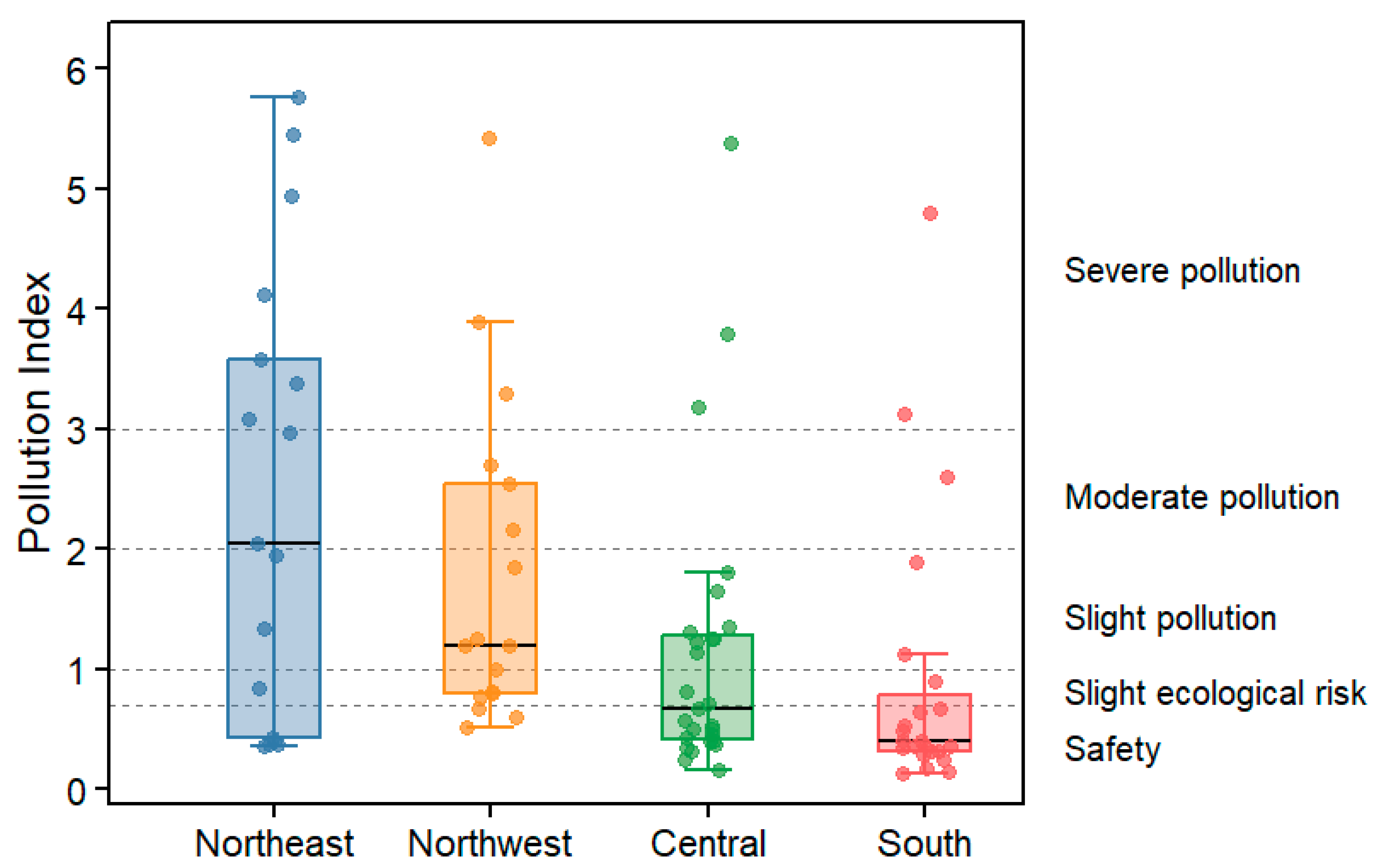
where Csoil is the exposure concentration of the ith PAHs; Ssoil is the environmental health value for the PAHs specified in Canada’s soil quality standards (Table 1); TEFi is the toxic equivalent factor corresponding to the ith PAHs [29,30]. Let P be the pollution index. When p > 3.0, pollution is severe; when 2.0 < p ≤ 3.0, pollution is moderate; when 1.0 < p ≤ 2.0, pollution is mild; and when 0.7 < p ≤ 1.0, there is a certain level of risk. When p ≤ 0.7, the ecological risk is low, and conditions are generally safe [31].

2.4.2. Methods for Assessing Risks to Human Health

This study primarily assessed the health risks associated with PAHs through oral ingestion, skin contact, and inhalation.
Based on the carcinogenic and non-carcinogenic toxicity of 16 PAHs, the health risks associated with PAHs are categorized into carcinogenic risk (CR) and non-carcinogenic risk (HQ) [32,33,34], calculated using the following formulas:
CR   =   C soil   ×   IR   ×   CF   ×   ED   ×   EF BW   ×   AT   ×   SF o + C soil   ×   CF   ×   SA   ×   AF   ×   ABS   ×   ED   ×   EF BW   ×   AT   ×   SF s + C soil   ×   HR   ×   ED   ×   EF PEF   ×   BW   ×   AT   ×   SF i
  HQ = C soil   ×   IR   ×   CF   ×   ED   ×   EF BW   ×   AT   × 1   RfD o + C soil   ×   CF   ×   SA   ×   AF × ABS   ×   ED   ×   EF BW   ×   AT   ×   1 RfD s + C soil   ×   HR   ×   ED   ×   EF PEF   ×   BW   ×   AT   ×   1 RfD i
In the aforementioned equation, Csoil signifies the concentration of PAHs in soil, expressed in μg/kg. IR denotes the intake rate, whilst EF represents the exposure frequency. ED signifies the duration of exposure, BW denotes body weight, AT denotes the average exposure time, HR denotes the frequency of soil dust absorption, and PEF denotes the soil dust diffusion coefficient. SA denotes the skin area in contact with soil, whilst AF denotes the skin adsorption coefficient for soil. ABS denotes the skin adsorption coefficient, dimensionless, and CF denotes the conversion factor, 10−6. SFo, SFs, and SFi are the carcinogenic slope factors for oral intake, dermal contact, and inhalation of PAHs, respectively, expressed in (kg·d)/mg; RfDo, RfDs, and RfDi are the reference doses for oral intake, skin contact, and inhalation of PAHs, respectively, expressed in mg/(kg·d), for children (under 18 years of age) and adults (18 years of age and older). The relevant coefficients can be found in Table 2 and Table 3 [35].
Monte Carlo simulations were performed using Oracle Crystal Ball 11.1, with a total of 10,000 simulation runs. In each run, values were randomly sampled from the defined input distributions, and the corresponding health risk values for adults and children were calculated. The 2.5th and 97.5th percentiles of the simulated risk distribution were used to define the 95% uncertainty interval. A sensitivity analysis was performed using sensitivity charts in Crystal Ball 11.1 to identify the key parameters affecting the health risk results [23].

3. Results and Discussion

3.1. Characteristics of PAH Pollution in China’s Surface Farmland Soils

The distribution of PAHs across different regions is shown in Table 4. The minimum, maximum, mean, and median values for the total content of 16 polycyclic aromatic hydrocarbons (Σ16PAHs) were 63.9, 9637.7, 1919.3, and 36.4 μg/kg, respectively. Among the 16 PAHs, DahA, IcdP, BkF, and NaP had the highest concentrations, at 274.3, 261.0, 253.9, and 237.8 μg/kg, respectively, accounting for 14.3%, 13.6%, 13.2%, and 12.4% of Σ16PAHs.
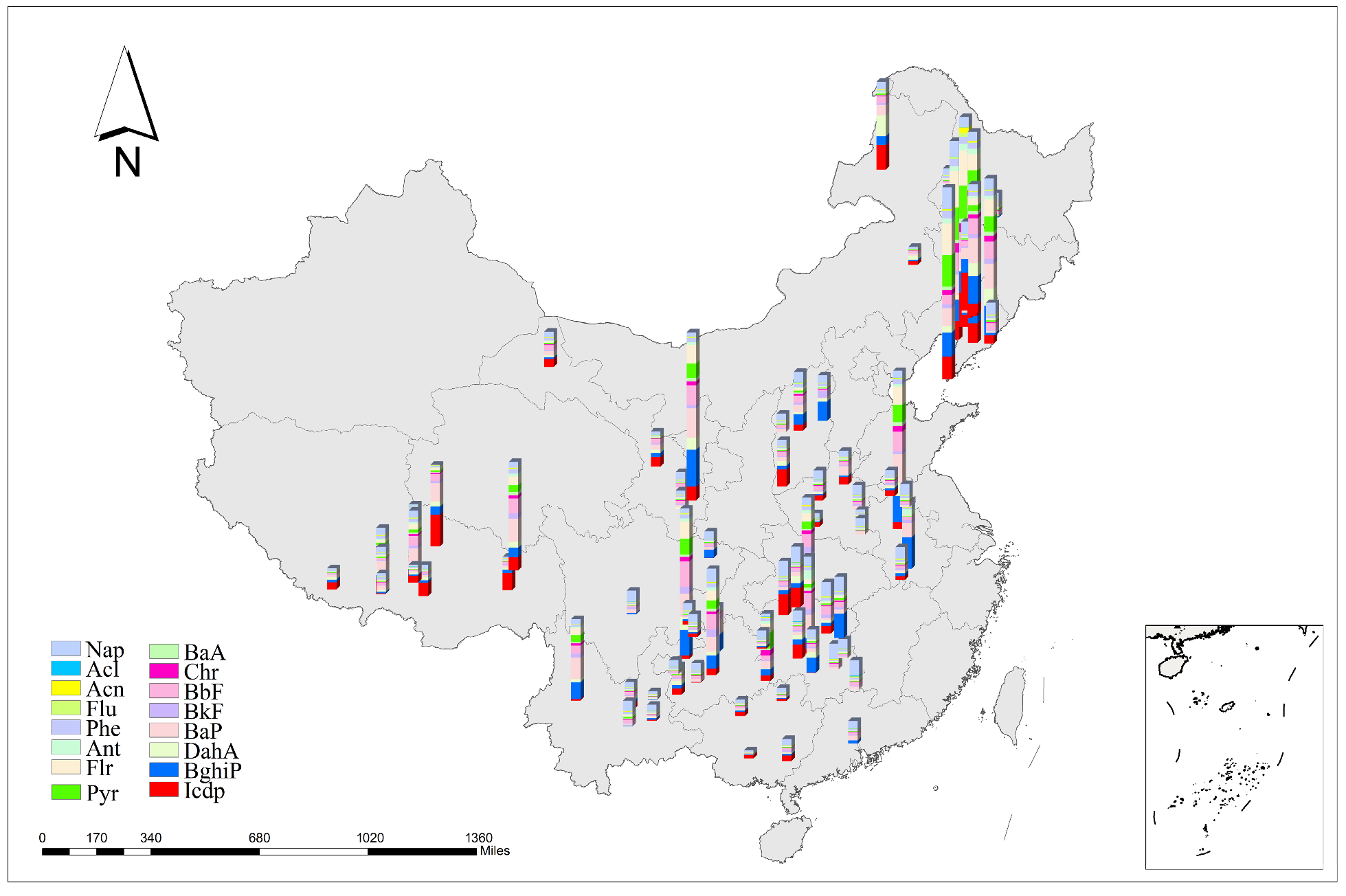
Furthermore, calculations of the average PAH concentrations across China’s regions reveal that the Σ16PAHs concentration in the northeast is 3276.1 μg/kg, the northwest region has a Σ16PAHs concentration of 1736 μg/kg, the central region has a Σ16PAHs concentration of 1521.4 μg/kg, and the southern region has a Σ16PAHs concentration of 1441 μg/kg. Compared with other regions globally, concentrations in the northeast and northwest are significantly higher than those in Iran (1241 μg/kg) [36] and Germany (1448 μg/kg) [37]. PAH concentrations in the central region are similar to those in both countries, while concentrations in the southern region are significantly lower than in both. As demonstrated in Figure 1, the results indicate significant regional variations in the concentrations of Σ16PAHs in surface farmland soils in China, characterized by a gradual decrease in concentration from north to south. This may be attributed to the presence of high-concentration PAH-contaminated areas in the northeast, which serves as a major historical industrial base in China. However, factors such as low light levels [38] and high coal consumption for winter heating [39] have led to the accumulation of PAHs. The higher PAH concentrations in the northwest region may be attributed to its higher altitude and latitude, resulting in lower annual average temperatures, which slow the volatilization and degradation of PAHs [40]. In contrast, southern China’s low latitudes and high solar radiation result in high degradation rates of PAHs, making them less likely to accumulate [41]. Additionally, as the economic system is dominated by light industry, PAH emissions are relatively low [40].

3.2. Analysis of the Sources of PAHs in Farmland Soil

3.2.1. Correlation Analysis

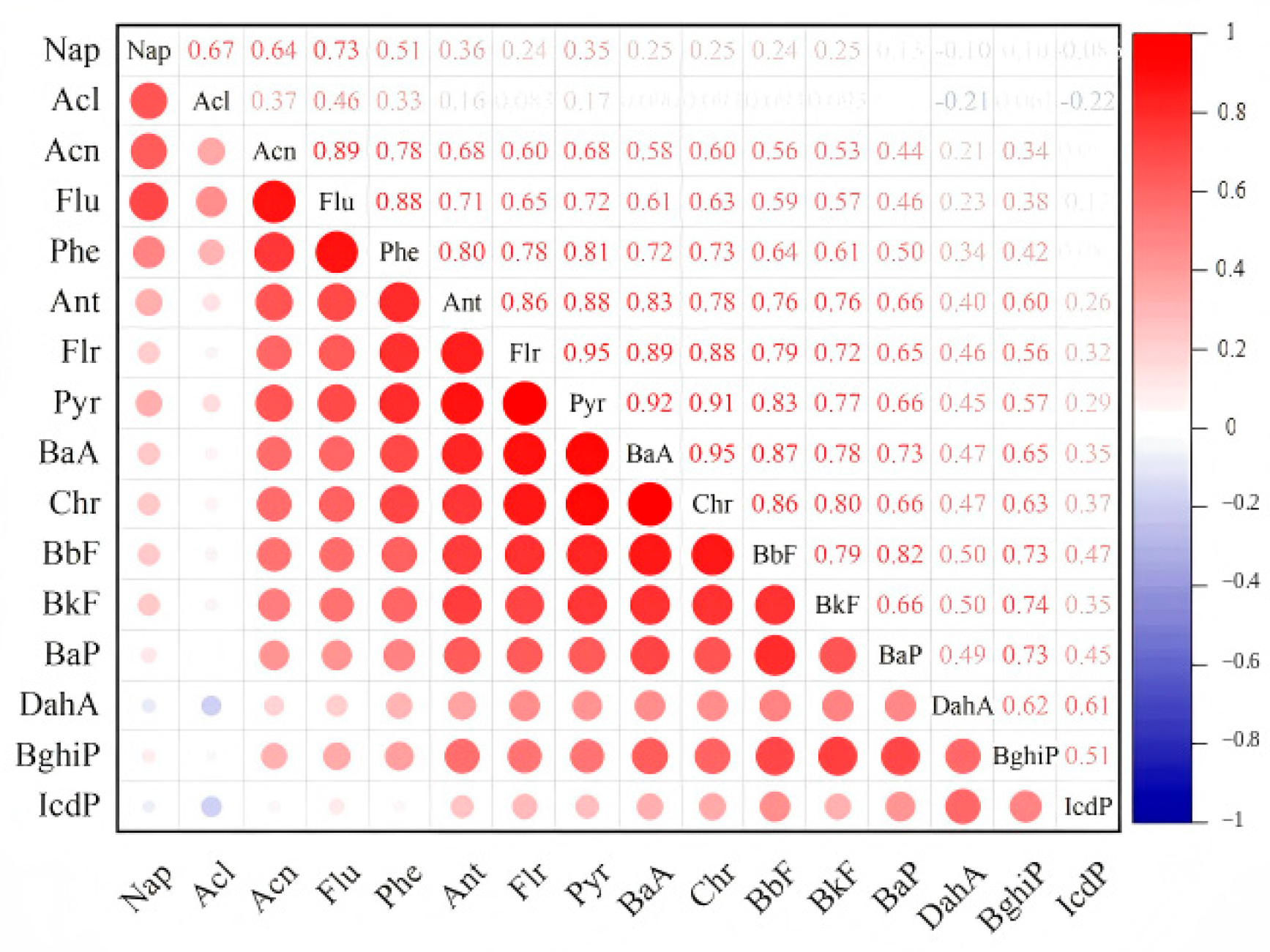
As shown in Figure 2, in the correlation analysis of PAH components, the correlations within the low-ring PAHs group (Nap, Acl, Acn, and Flu) and between this group and the medium- and high-ring PAH groups were weak, indicating that they originate from different pollution sources. The strong positive correlations within the medium- and high-ring PAH groups (Phe, Ant, Fla, Pyr, BaA, Chr, BkF, BaP, DahA, BghiP, and IcdP) suggest that they originate from similar pollution sources.

3.2.2. PCA

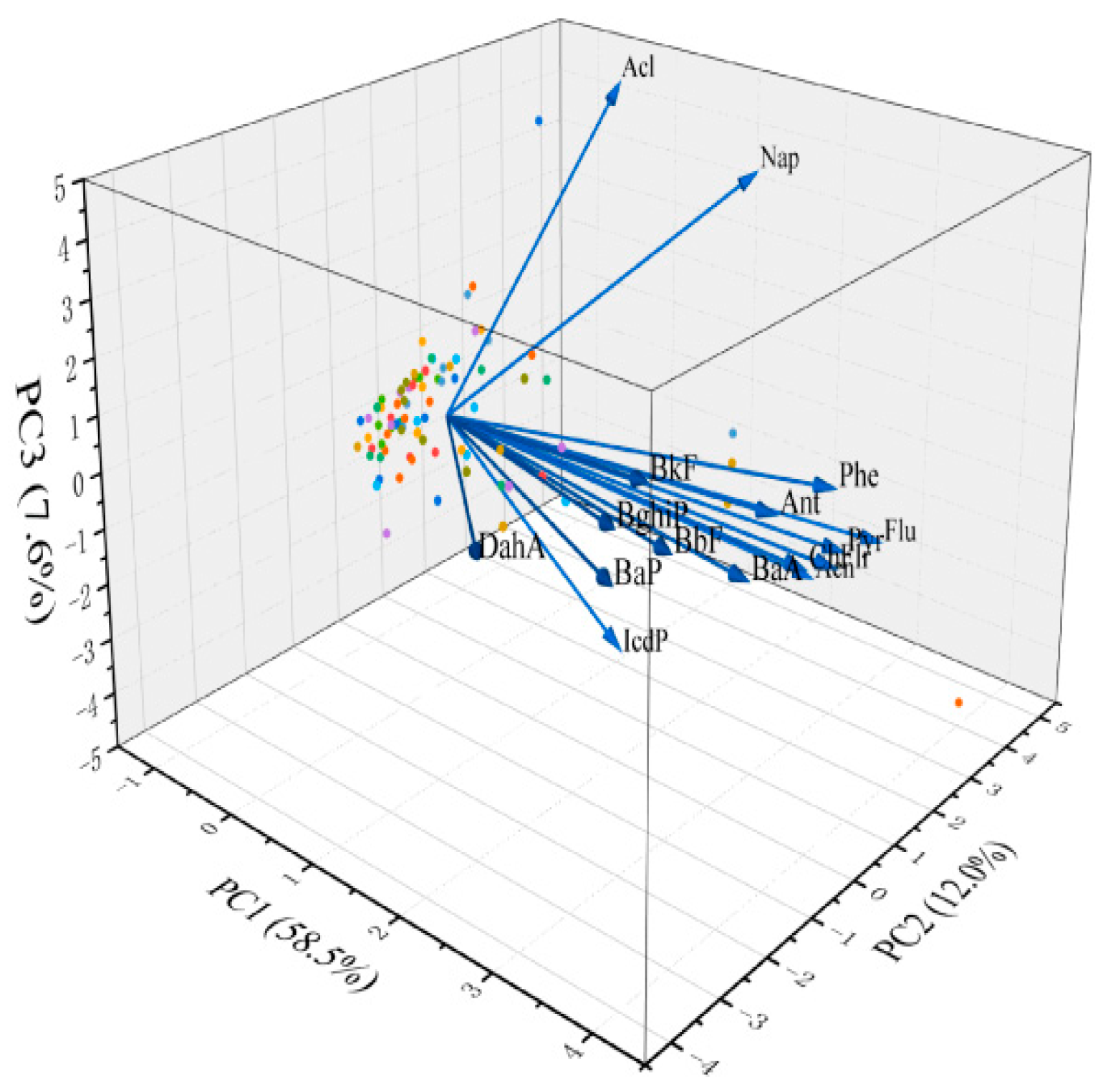
The Kaiser orthogonal rotation method was used to extract PC1, PC2, and PC3, and the loadings of each principal component are shown in Figure 3. PC1, PC2, and PC3 explain 58.5%, 12.0%, and 7.6% of the total variance, respectively.
PC1 consists primarily of Acn, Flu, Phe, Ant, Flr, Pyr, BaA, Chr, BbF, BkF, BaP, DahA, BghiP, and IcdP. Furthermore, Phe, Ant, Pyr, Flu, and Chr are characteristic components of biomass combustion emissions [28], while BaA is caused by the incomplete combustion of gasoline and diesel [42]. Flr and BaP originate from high-temperature coal and fossil fuel combustion [43], while Phe and Ant are primarily caused by the burning of wood and straw [44]. The high correlation among the components in PC1 indicates that they share a common origin, suggesting that PC1 is related to the combustion processes of biomass, diesel, and natural gas.
The main components of PC2 and PC3 are low-ring PAHs (Nap and Acl). Nap originates from vehicle exhaust emissions, gasoline volatilization, and petroleum-related inputs [45]. The high correlation between Nap and Acl suggests that they may share a common source. PC2 and PC3 are tentatively interpreted as emissions from transportation and light biomass burning.

3.2.3. PMF

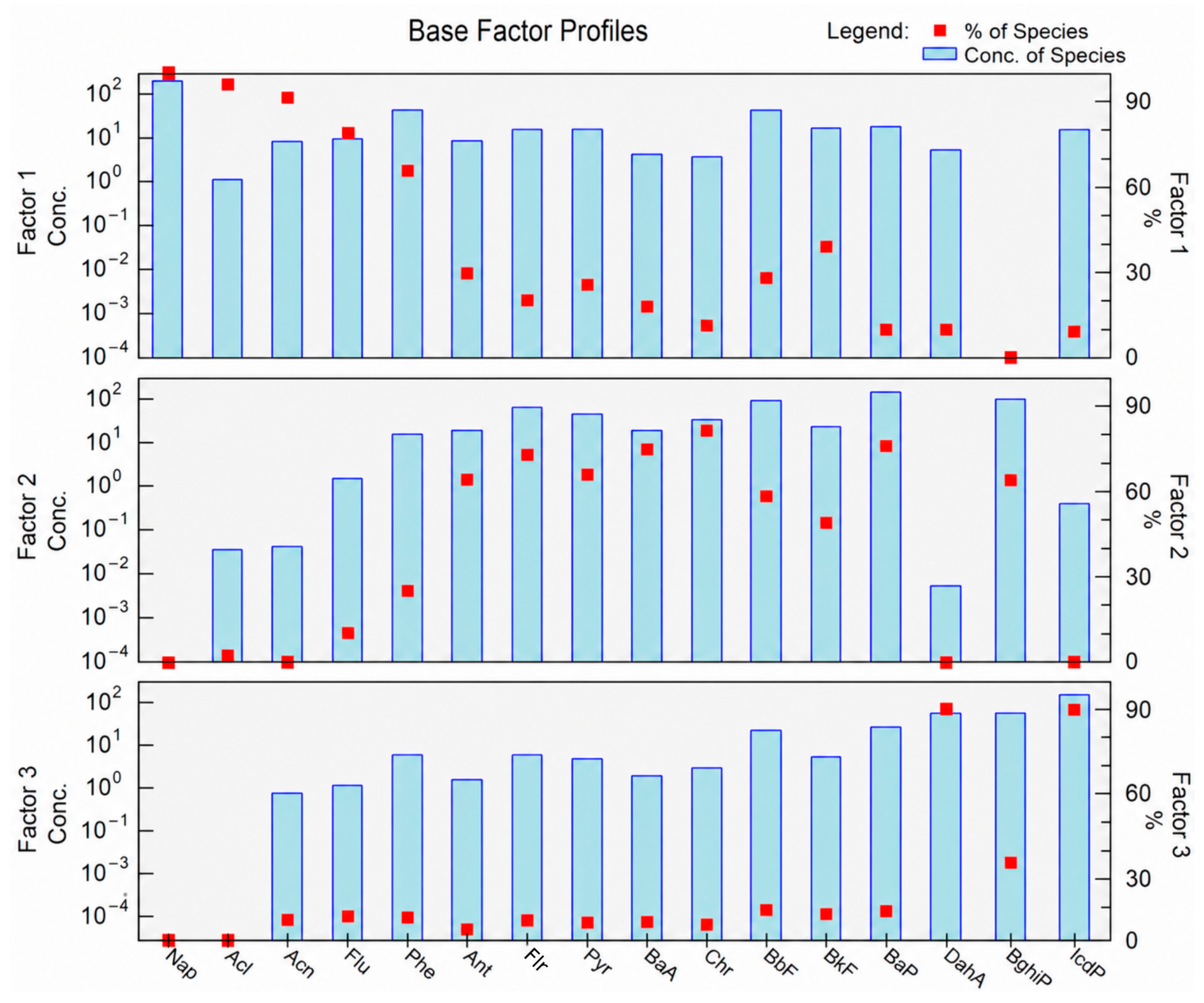
The PMF analysis identified three factors, the composition of which is shown in Figure 4. Factor 1 consists primarily of low-ring PAHs (such as Nap, Acl, and Acn) and is similar to PC2. These PAHs typically originate from the volatilization and leakage of petroleum products [45]; therefore, Factor 1 is attributed to traffic emissions. Factor 2 consists mainly of medium- and high-ring PAHs, such as Chr, BaA, and Bap, similar to PC1, with significant correlations among individual PAHs. Chr and Bap are associated with the combustion of fossil fuels such as coal [46,47]; therefore, Factor 2 is attributed to fossil fuel combustion sources. Factor 3 is dominated by high-ring-count PAHs (such as Daha, Icdp, and BghiP). Similarly to PC1, there is a significant correlation among the individual PAHs. These PAHs are characteristic emissions from biomass combustion, characterized by high ring counts and chemical stability [48,49,50], and primarily originate from high-temperature combustion processes [51,52]. Therefore, Factor 3 represents a high-temperature combustion source.
Although PCA is used to identify clusters of related compounds and provide qualitative information on potential sources, and PMF is used to quantitatively analyze source characteristics and their contributions, both methods identified three factors corresponding to traffic emissions, fossil fuel combustion, and high-temperature biomass combustion. Specifically, PC1 showed strong loadings of medium-ring and high-ring PAHs associated with fossil fuel and biomass combustion, which corresponded well with PMF Factors 2 and 3. In contrast, PC2 and PC3 were dominated by low-ring PAHs, consistent with PMF Factor 1 and indicative of petroleum-related traffic emissions. This integrated interpretation strengthens the reliability of the source apportionment results.

3.3. Ecological Risk of PAHs in Farmland Soils

The TEQBap values for PAHs in the soil of each region are shown in Table 5. In the northeast region, the maximum, minimum, and average toxicity equivalents for Σ16PAHs were 40.76, 1418, and 453.47 μg/kg, respectively. In the northwest region, the maximum, minimum, and average toxicity equivalents for Σ16PAHs were 81.71, 1563.54, and 492.34 μg/kg, respectively. In the central region, the maximum, minimum, and average toxicity equivalents for Σ16PAHs were 13.91, 1540.65, and 309.43 μg/kg, respectively. In the southern region, the maximum, minimum, and average toxicity equivalents for Σ16PAHs were 12.95, 1280.96, and 243.06 μg/kg, respectively. In these four regions, the seven carcinogenic PAHs (Σ7PAHs) accounted for 99.7%, 99.86%, 98.7%, and 99.72% of the total toxicity, respectively. It is evident that the Σ7PAHs classified by the IARC as having definite carcinogenicity are the primary contributors to the toxicity of the Σ16PAHs.
The pollution index (P) for PAHs in 84 farmland soil samples from China is shown in Figure 5, ranging from 0.13 to 5.77. In the present study, 15 sets were found to be severely polluted (p > 3.0), including 7 sets in the northeast, 3 in the northwest, 3 in the central region, and 2 in the south. Six sets were moderately polluted (2.0 < p ≤ 3.0), including two in the northeast, three in the northwest, and one in the south. Furthermore, 16 sets were slightly polluted (1.0 < p ≤ 2.0), including 2 in the northeast, 4 in the northwest, 8 in the central region, and 2 in the south. Finally, eight groups exhibited a certain level of ecological risk (0.7 < p ≤ 1.0), with one group in the northeast, four in the northwest, two in the central region, and one in the south. In addition, 39 groups showed no ecological risk (p ≤ 0.7), with 5 in the northeast region recording three cases, the northwest region 14, the central region 17, and the south region 3 [53]. The risk associated with PAHs in China’s farmland surface soil showed a gradual decrease from north to south. The northeast region poses the highest risk, with farmland soil presenting severe ecological risks; the southern region has the lowest ecological risk, with 73.9% of soil samples posing no ecological risk. This phenomenon may be attributed to the distinct economic structures and emission pathways that are characteristic of each region. It is evident that among the 16 PAHs, 7 of these are considered to be carcinogenic and thus the most toxic. In the northeast, the development of heavy industry and high consumption of fuels such as coal have resulted in elevated levels of emissions of highly toxic PAHs, including DahA and IcdP. Conversely, the predominant source of PAHs in southern regions is transportation-related emissions, principally from vehicles. This is because compared to northern regions, southern cities have made faster progress in energy transition, leading to a reduction in PAHs emissions; therefore, economic development and urbanization can also effectively mitigate PAH risks [54].

3.4. Human Health Risks from PAHs in Farmland Soils

3.4.1. Non-Carcinogenic Risk

The non-cancer risks associated with PAHs are shown in Table 6. The data follow a log-normal distribution. Based on Monte Carlo simulations, the 95th percentile of the non-cancer risk is 1.13 × 10⁻¹ for children and 7.19 × 10⁻² for adults. The non-cancer risk to children from surface soil in Chinese farmlands is approximately twice that for adults. However, since both values are less than the threshold of 1 set by the Agency for Toxic Substances and Disease Registry, they fall within an acceptable range.
Among the individual PAHs, for children, the Nap monomer exhibited the highest contribution rate at 62.1%, followed by BghiP at 19.9%, while the contribution rates of the remaining PAH monomers were comparatively low. For adults, the BghiP monomer exhibited the highest contribution rate at 36.2%, followed by Nap and Pyr at 32.1% and 13.3%, respectively.
With regard to exposure routes, dermal contact constitutes the primary exposure route for children with regard to non-carcinogenic risks from soil PAHs, with a contribution rate at 61.4%. The next most significant route is oral ingestion, with a contribution rate at 38.1%. For adults, oral ingestion is the primary exposure route, accounting for 97.4% of the total non-carcinogenic risk. Skin contact and inhalation are negligible, accounting for only 2.6% of the total.

3.4.2. Carcinogenic Risk

The carcinogenic risks associated with PAHs are shown in Table 7. The data follow a log-normal distribution. The 95th percentile of the carcinogenic risk for children, as determined by calculations employing the Monte Carlo model, is estimated to be 1.64 × 10⁻⁴. For adults, this figure is calculated to be 1.45 × 10⁻⁴. The carcinogenic risk for children is higher than that for adults, primarily due to their lower body weight and higher dose per unit of body weight [55]. Furthermore, children are more likely to come into contact with surface soil and dust during daily activities and engage in more frequent hand-to-mouth contact, thereby increasing the likelihood of oral ingestion of contaminants [56]. However, the cancer risk for both groups exceeds the US EPA threshold of 1 × 10⁻⁴, indicating a high risk of cancer [57].
Among the individual PAHs, for children, the DahA monomer exhibited the highest contribution rate at 45.9%, followed by BaP at 43.9%, while the contribution rates of the remaining PAH monomers were comparatively low. For adults, the DahA monomer exhibited the highest contribution rate at 70.3%, followed by BaP and IcdP at 9.9% and 9.8%, respectively. The results of the Monte Carlo sensitivity analysis also suggest that uncertainty in human health risks is primarily influenced by PAH concentrations. With regard to carcinogenic risk, BaP and DahA were identified as the main sources, accounting for 86.86% together. This is consistent with the results of PCA and PMF, indicating that fossil fuel combustion and biomass combustion are the primary sources of PAHs in the study area. These sources are characterized by a high proportion of high-ring PAHs, such as Bap, DahA, and IcdP.
With regard to exposure routes, for both children and adults, oral ingestion constitutes the primary route of exposure to PAHs in soil, accounting for 99.9% of the total carcinogenic risk; carcinogenic risks resulting from dermal contact and inhalation are negligible. Oral ingestion as the primary exposure route should be prioritized. It is the responsibility of regulatory agencies charged with the oversight of environmental and public health issues to undertake the necessary monitoring procedures in order to ascertain the impact of human activities within the region. Thereafter, the implementation of effective measures to reduce health risks to residents resulting from exposure to pollutants must be effected [55].

4. Conclusions

This study investigated PAH contamination, source apportionment, and associated ecological and health risks in 84 farmland soil samples from different river basins in China. The mean concentration of Σ16PAHs was 1919.3 μg/kg, with DahA being the largest individual contributor, accounting for 14.3% of the total PAHs. Overall, pollution from PAHs exhibits significant spatial heterogeneity, with pollution levels gradually decreasing from the northeast to the south. The correlation analysis, PCA, and PMF indicated that PAHs in farmland soils were mainly derived from transportation emissions, fossil fuel combustion, and high-temperature combustion. Risk assessment showed that ecological risk was highest in northeast China, where 41.2% of the sampling sites were classified as severely contaminated, whereas south China showed the lowest ecological risk, with 73.9% of sites showing no obvious ecological risk. Non-carcinogenic risks for both children and adults were within acceptable limits. However, carcinogenic risks were non-negligible, mainly driven by DahA, which contributed 45.9% and 70.3% of the total carcinogenic risk for children and adults, respectively. Oral ingestion was the dominant exposure pathway, accounting for approximately 99.9% of total exposure. These results highlight the need to control combustion-related PAH inputs and to strengthen risk management in high-contamination agricultural regions.

Author Contributions

Conceptualization, Q.L.; methodology, Y.J., S.H. and L.Y.; formal analysis, X.Z. and Q.H.; investigation, Y.J.; writing—original draft preparation, Y.Z. and Q.H.; writing—review and editing, Q.L.; supervision, Q.L.; project administration, Q.L.; funding acquisition, Q.L. All authors have read and agreed to the published version of the manuscript.

Funding

This research was funded by the Liaoning Revitalization Talents Program, grant number XLYC2203141.

Data Availability Statement

The original contributions presented in this study are included in the article. Further inquiries can be directed to the corresponding author.

Conflicts of Interest

The authors declare no conflicts of interest.

References

  1. Jiang, Y.; Yves, U.J.; Sun, H.; Hu, X.; Zhan, H.; Wu, Y. Distribution, Compositional Pattern and Sources of Polycyclic Aromatic Hydrocarbons in Urban Soils of an Industrial City, Lanzhou, China. Ecotoxicol. Environ. Saf. 2016, 126, 154–162. [Google Scholar] [CrossRef] [PubMed]
  2. Ren, A.; Qiu, X.; Jin, L.; Ma, J.; Li, Z.; Zhang, L.; Zhu, H.; Finnell, R.H.; Zhu, T. Association of Selected Persistent Organic Pollutants in the Placenta with the Risk of Neural Tube Defects. Proc. Natl. Acad. Sci. USA 2011, 108, 12770–12775. [Google Scholar] [CrossRef] [PubMed]
  3. Tobiszewski, M.; Namieśnik, J. PAH Diagnostic Ratios for the Identification of Pollution Emission Sources. Environ. Pollut. 2012, 162, 110–119. [Google Scholar] [CrossRef] [PubMed]
  4. Wang, J.; Zhang, X.; Ling, W.; Liu, R.; Liu, J.; Kang, F.; Gao, Y. Contamination and Health Risk Assessment of PAHs in Soils and Crops in Industrial Areas of the Yangtze River Delta Region, China. Chemosphere 2017, 168, 976–987. [Google Scholar] [CrossRef] [PubMed]
  5. Jia, J.; Bi, C.; Guo, X.; Wang, X.; Zhou, X.; Chen, Z. Characteristics, Identification, and Potential Risk of Polycyclic Aromatic Hydrocarbons in Road Dusts and Agricultural Soils from Industrial Sites in Shanghai, China. Environ. Sci. Pollut. Res. 2017, 24, 605–615. [Google Scholar] [CrossRef]
  6. Wang, J.; Chen, Y.; Pan, D.; Zhang, J.; Zhang, Y.; Lu, Z. Source and Health Risk Assessment of Soil Polycyclic Aromatic Hydrocarbons under Straw Burning Condition in Changchun City, China. Sci. Total Environ. 2023, 894, 165057. [Google Scholar] [CrossRef] [PubMed]
  7. Cui, Z.; Wang, Y.; Du, L.; Yu, Y. Contamination Level, Sources, and Health Risk of Polycyclic Aromatic Hydrocarbons in Suburban Vegetable Field Soils of Changchun, Northeast China. Sci. Rep. 2022, 12, 11301. [Google Scholar] [CrossRef] [PubMed]
  8. Zhang, X.; Lu, W.; Xu, L.; Wu, W.; Sun, B.; Fan, W.; Zheng, H.; Huang, J. Environmental Risk Assessment of Polycyclic Aromatic Hydrocarbons in Farmland Soils near Highways: A Case Study of Guangzhou, China. Int. J. Environ. Res. Public Health 2022, 19, 10265. [Google Scholar] [CrossRef]
  9. Zhang, R.; Wang, Y.; Zhang, Y.; Bai, Y. Distribution, Sources, and Health Risk of Polycyclic Aromatic Hydrocarbons in Farmland Soil of Helan, China. Sustainability 2023, 15, 16667. [Google Scholar] [CrossRef]
  10. Ailijiang, N.; Cui, X.; Mamat, A.; Mamitimin, Y.; Zhong, N.; Cheng, W.; Li, N.; Zhang, Q.; Pu, M. Levels, Source Apportionment, and Risk Assessment of Polycyclic Aromatic Hydrocarbons in Vegetable Bases of Northwest China. Environ. Geochem. Health 2023, 45, 2549–2565. [Google Scholar] [CrossRef] [PubMed]
  11. He, M.; Shangguan, Y.; Zhou, Z.; Guo, S.; Yu, H.; Chen, K.; Zeng, X.; Qin, Y. Status Assessment and Probabilistic Health Risk Modeling of Polycyclic Aromatic Hydrocarbons (PAHs) in Surface Soil across China. Front. Environ. Sci. 2023, 11, 1114027. [Google Scholar] [CrossRef]
  12. Wang, W.; Chen, S.; Chen, L.; Wang, L.; Chao, Y.; Shi, Z.; Lin, D.; Yang, K. Effects of Chinese “Double Carbon Strategy” on Soil Polycyclic Aromatic Hydrocarbons Pollution. Environ. Int. 2024, 188, 108741. [Google Scholar] [CrossRef] [PubMed]
  13. Liu, D.; Niu, L.; Guo, Z.; Mao, S.; Liu, S.; Xu, D.; Xu, C.; Sun, X.; Yu, H.; Liu, W. Polycyclic Aromatic Hydrocarbons in Paddy Soils: Distribution, Source Apportionment, and Risk Assessment in Major Rice-Growing Regions of China. Environ. Chem. Ecotoxicol. 2025, 7, 935–943. [Google Scholar] [CrossRef]
  14. Li, J.; Xue, J.; Tan, Y.; Jia, M.; Feng, J.; Feng, X.; Zheng, N.; Fan, H.; Yao, H. Distribution Characteristics, Source Analysis and Ecological Risk Assessment of PAHs in Tea Garden Soil in China. Environ. Res. 2025, 266, 120559. [Google Scholar] [CrossRef] [PubMed]
  15. Feng, J.; Li, X.; Zhao, J.; Sun, J. Distribution, Transfer, and Health Risks of Polycyclic Aromatic Hydrocarbons (PAHs) in Soil-Wheat Systems of Henan Province, a Typical Agriculture Province of China. Environ. Sci. Pollut. Res. 2017, 24, 18195–18203. [Google Scholar] [CrossRef] [PubMed]
  16. Li, S.; Jiang, Z.; Wei, S. Interaction of Heavy Metals and Polycyclic Aromatic Hydrocarbons in Soil-Crop Systems: The Effects and Mechanisms. Environ. Res. 2024, 263, 120035. [Google Scholar] [CrossRef] [PubMed]
  17. GB 15618-2018; Soil Environmental Quality—Risk Control Standard for Soil Contamination of Agricultural Land (Trial). Ministry of Ecology and Environment of the People’s Republic of China: Beijing, China, 2018. (In Chinese)
  18. Lohr, S.L. Sampling: Design and Analysis, 3rd ed.; Chapman and Hall/CRC: Boca Raton, FL, USA, 2021. [Google Scholar]
  19. Li, S.; Deng, Y.; Du, X.; Feng, K.; Wu, Y.; He, Q.; Wang, Z.; Liu, Y.; Wang, D.; Peng, X.; et al. Sampling Cores and Sequencing Depths Affected the Measurement of Microbial Diversity in Soil Quadrats. Sci. Total Environ. 2021, 767, 144966. [Google Scholar] [CrossRef] [PubMed]
  20. Lin, N.; Mei, X.; Li, J.; Jiang, R.; Wu, M.; Zhang, W. Estimating and Mapping the Soil Total Nitrogen Contents in Black Soil Region Using Hyperspectral Images towards Environmental Heterogeneity. Front. Environ. Sci. 2024, 12, 1401107. [Google Scholar] [CrossRef]
  21. Tian, W.; Guo, P.; Li, H.; Zhang, G. Probability Risk Assessment of Soil PAH Contamination Premised on Industrial Brownfield Development: A Case from China. Environ. Sci. Pollut. Res. 2022, 29, 1559–1572. [Google Scholar] [CrossRef]
  22. Li, Y.; Tian, F.; Zhong, R.; Zhao, H. Source Characteristics of Polycyclic Aromatic Hydrocarbons and Polychlorinated Biphenyls in Surface Soils of Shenyang, China: A Comparison of Two Receptor Models Combined with Monte Carlo Simulation. J. Hazard. Mater. 2024, 462, 132805. [Google Scholar] [CrossRef] [PubMed]
  23. Zhang, Y.; Wang, L.; Zhang, T. Sources and Ecological and Health Risks of Polycyclic Aromatic Hydrocarbons in Urban Soil of Industrial Cities Based on Positive Matrix Factorization and Monte Carlo Simulation. Environ. Geochem. Health 2025, 47, 553. [Google Scholar] [CrossRef] [PubMed]
  24. Singaraja, C.; Chidambaram, S.; Srinivasamoorthy, K.; Anandhan, P.; Selvam, S. A Study on Assessment of Credible Sources of Heavy Metal Pollution Vulnerability in Groundwater of Thoothukudi Districts, Tamilnadu, India. Water Qual. Expo. Health 2015, 7, 459–467. [Google Scholar] [CrossRef]
  25. Wang, X.-T.; Chen, L.; Wang, X.-K.; Lei, B.-L.; Sun, Y.-F.; Zhou, J.; Wu, M.-H. Occurrence, Sources and Health Risk Assessment of Polycyclic Aromatic Hydrocarbons in Urban (Pudong) and Suburban Soils from Shanghai in China. Chemosphere 2015, 119, 1224–1232. [Google Scholar] [CrossRef] [PubMed]
  26. Zhao, L.; Hou, H.; Shangguan, Y.; Cheng, B.; Xu, Y.; Zhao, R.; Zhang, Y.; Hua, X.; Huo, X.; Zhao, X. Occurrence, Sources, and Potential Human Health Risks of Polycyclic Aromatic Hydrocarbons in Agricultural Soils of the Coal Production Area Surrounding Xinzhou, China. Ecotoxicol. Environ. Saf. 2014, 108, 120–128. [Google Scholar] [CrossRef] [PubMed]
  27. Paatero, P.; Tapper, U. Positive Matrix Factorization: A Non-negative Factor Model with Optimal Utilization of Error Estimates of Data Values. Environmetrics 1994, 5, 111–126. [Google Scholar] [CrossRef]
  28. Agarwal, T.; Khillare, P.S.; Shridhar, V.; Ray, S. Pattern, Sources and Toxic Potential of PAHs in the Agricultural Soils of Delhi, India. J. Hazard. Mater. 2009, 163, 1033–1039. [Google Scholar] [CrossRef] [PubMed]
  29. Zhao, Y.; Wu, Y.; Qi, Y.; Li, J.; Huang, X.; Hou, Y.; Hao, H.; Zhu, S. Characteristics, Sources, and Risk Assessment of Polycyclic Aromatic Hydrocarbons in Soils and Sediments in the Yellow River Delta, China. Land 2025, 14, 1608. [Google Scholar] [CrossRef]
  30. Moon, H.G.; Bae, S.; Chae, Y.; Kim, Y.-J.; Kim, H.-M.; Song, M.; Bae, M.-S.; Lee, C.-H.; Ha, T.; Seo, J.-S.; et al. Assessment of Potential Ecological Risk for Polycyclic Aromatic Hydrocarbons in Urban Soils with High Level of Atmospheric Particulate Matter Concentration. Ecotoxicol. Environ. Saf. 2024, 272, 116014. [Google Scholar] [CrossRef] [PubMed]
  31. Huang, Q.; Xu, M.; Zhu, Y.; Li, X.; Xu, J.; Li, X.; Lu, Y. Vehicular Mediated Emissions of Polycyclic Aromatic Hydrocarbons in Roadside Soils of Shanghai. Sci. Rep. 2025, 15, 10981. [Google Scholar] [CrossRef] [PubMed]
  32. Wang, C.; Wu, H.; Zhao, W.; Zhu, B.; Yang, J. Effects of Polycyclic Aromatic Hydrocarbons on Soil Bacterial and Fungal Communities in Soils. Diversity 2024, 16, 675. [Google Scholar] [CrossRef]
  33. Rigi, P.; Kamani, H.; Ansari, H.; Mohammadi, L.; Dargahi, A. Health Risk Assessment of Polycyclic Aromatic Hydrocarbon Compounds (PAHs) in Grilled Meats in Zahedan City of Iran. Sci. Rep. 2025, 15, 24267. [Google Scholar] [CrossRef] [PubMed]
  34. Aihemaitijiang, G.; Zhang, L.; Li, M.; Chen, Y.; Zhang, J.; Zhang, F.; Zhao, C. PAH Contamination, Sources and Health Risks in Black Soil Region of Jilin Province, China. Toxics 2024, 12, 937. [Google Scholar] [CrossRef]
  35. Maliszewska-Kordybach, B.; Smreczak, B.; Klimkowicz-Pawlas, A.; Terelak, H. Monitoring of the Total Content of Polycyclic Aromatic Hydrocarbons (PAHs) in Arable Soils in Poland. Chemosphere 2008, 73, 1284–1291. [Google Scholar] [CrossRef] [PubMed]
  36. Ashjar, N.; Keshavarzi, B.; Moore, F.; Soltani, N.; Hooda, P.S.; Mahmoudi, M.R. TPH and PAHs in an Oil-Rich Metropolis in SW Iran: Implication for Source Apportionment and Human Health. Hum. Ecol. Risk Assess. Int. J. 2021, 28, 58–78. [Google Scholar] [CrossRef]
  37. Aichner, B.; Bussian, B.M.; Lehnik-Habrink, P.; Hein, S. Regionalized Concentrations and Fingerprints of Polycyclic Aromatic Hydrocarbons (PAHs) in German Forest Soils. Environ. Pollut. 2015, 203, 31–39. [Google Scholar] [CrossRef] [PubMed]
  38. Ma, W.-L.; Liu, L.-Y.; Tian, C.-G.; Qi, H.; Jia, H.-L.; Song, W.-W.; Li, Y.-F. Polycyclic Aromatic Hydrocarbons in Chinese Surface Soil: Occurrence and Distribution. Environ. Sci. Pollut. Res. 2015, 22, 4190–4200. [Google Scholar] [CrossRef]
  39. Sun, J.; Pan, L.; Tsang, D.C.W.; Zhan, Y.; Zhu, L.; Li, X. Organic Contamination and Remediation in the Agricultural Soils of China: A Critical Review. Sci. Total Environ. 2018, 615, 724–740. [Google Scholar] [CrossRef] [PubMed]
  40. Zhang, Y.; Peng, C.; Guo, Z.; Xiao, X.; Xiao, R. Polycyclic Aromatic Hydrocarbons in Urban Soils of China: Distribution, Influencing Factors, Health Risk and Regression Prediction. Environ. Pollut. 2019, 254, 112930. [Google Scholar] [CrossRef] [PubMed]
  41. Zhang, P.; Chen, Y. Polycyclic Aromatic Hydrocarbons Contamination in Surface Soil of China: A Review. Sci. Total Environ. 2017, 605–606, 1011–1020. [Google Scholar] [CrossRef] [PubMed]
  42. Bi, X.; Luo, W.; Gao, J.; Xu, L.; Guo, J.; Zhang, Q.; Romesh, K.Y.; Giesy, J.P.; Kang, S.; de Boer, J. Polycyclic Aromatic Hydrocarbons in Soils from the Central-Himalaya Region: Distribution, Sources, and Risks to Humans and Wildlife. Sci. Total Environ. 2016, 556, 12–22. [Google Scholar] [CrossRef] [PubMed]
  43. Xing, X.; Qi, S.; Zhang, J.; Wu, C.; Zhang, Y.; Yang, D.; Odhiambo, J.O. Spatial Distribution and Source Diagnosis of Polycyclic Aromatic Hydrocarbons in Soils from Chengdu Economic Region, Sichuan Province, Western China. J. Geochem. Explor. 2011, 110, 146–154. [Google Scholar] [CrossRef]
  44. Simcik, M.F.; Eisenreich, S.J.; Lioy, P.J. Source Apportionment and Source/Sink Relationships of PAHs in the Coastal Atmosphere of Chicago and Lake Michigan. Atmos. Environ. 1999, 33, 5071–5079. [Google Scholar] [CrossRef]
  45. Hu, N.; Huang, P.; Liu, J.; Ma, D.; Shi, X.; Mao, J.; Liu, Y. Characterization and Source Apportionment of Polycyclic Aromatic Hydrocarbons (PAHs) in Sediments in the Yellow River Estuary, China. Environ. Earth Sci. 2014, 71, 873–883. [Google Scholar] [CrossRef]
  46. Li, A.; Jang, J.-K.; Scheff, P.A. Application of EPA CMB8.2 Model for Source Apportionment of Sediment PAHs in Lake Calumet, Chicago. Environ. Sci. Technol. 2003, 37, 2958–2965. [Google Scholar] [CrossRef] [PubMed]
  47. Chen, Y.; Sheng, G.; Bi, X.; Feng, Y.; Mai, B.; Fu, J. Emission Factors for Carbonaceous Particles and Polycyclic Aromatic Hydrocarbons from Residential Coal Combustion in China. Environ. Sci. Technol. 2005, 39, 1861–1867. [Google Scholar] [CrossRef] [PubMed]
  48. Cao, J.; Liu, Y.; Yu, S. The Concentrations and Sources of PAHs and PCBs in Soil from an Oil Field and Estuary in the Yellow River Delta, China. Front. Environ. Sci. 2022, 10, 1028299. [Google Scholar] [CrossRef]
  49. Liu, X.; Bai, Z.; Yu, Q.; Cao, Y.; Zhou, W. Polycyclic Aromatic Hydrocarbons in the Soil Profiles (0–100 cm) from the Industrial District of a Large Open-Pit Coal Mine, China. RSC Adv. 2017, 7, 28029–28037. [Google Scholar] [CrossRef]
  50. Ribeiro, J.; Silva, T.; Filho, J.G.M.; Flores, D. Polycyclic Aromatic Hydrocarbons (PAHs) in Burning and Non-Burning Coal Waste Piles. J. Hazard. Mater. 2012, 199–200, 105–110. [Google Scholar] [CrossRef] [PubMed]
  51. Mai, B.; Fu, J.; Zhang, G.; Lin, Z.; Min, Y.; Sheng, G.; Wang, X. Polycyclic Aromatic Hydrocarbons in Sediments from the Pearl River and Estuary, China: Spatial and Temporal Distribution and Sources. Appl. Geochem. 2001, 16, 1429–1445. [Google Scholar] [CrossRef]
  52. Mai; Qi; Zeng, E.Y.; Yang; Zhang, G.; Fu; Sheng; Peng; Wang. Distribution of Polycyclic Aromatic Hydrocarbons in the Coastal Region off Macao, China: Assessment of Input Sources and Transport Pathways Using Compositional Analysis. Environ. Sci. Technol. 2003, 37, 4855–4863. [Google Scholar] [CrossRef] [PubMed]
  53. Li, Y.; Zhang, Q.; Guo, D.; Dang, J. Characteristics and Risk Assessment of PAH Pollution in Soil of a Retired Coking Wastewater Treatment Plant in Taiyuan, Northern China. Toxics 2023, 11, 415. [Google Scholar] [CrossRef]
  54. Yu, H.; Li, T.; Liu, Y.; Ma, L. Spatial Distribution of Polycyclic Aromatic Hydrocarbon Contamination in Urban Soil of China. Chemosphere 2019, 230, 498–509. [Google Scholar] [CrossRef] [PubMed]
  55. Jiménez-Oyola, S.; Escobar Segovia, K.; García-Martínez, M.-J.; Ortega, M.; Bolonio, D.; García-Garizabal, I.; Salgado, B. Human Health Risk Assessment for Exposure to Potentially Toxic Elements in Polluted Rivers in the Ecuadorian Amazon. Water 2021, 13, 613. [Google Scholar] [CrossRef]
  56. Yang, B.; Li, W.; Xiong, J.; Yang, J.; Huang, R.; Xie, P. Health Risk Assessment of Heavy Metals in Soil of Lalu Wetland Based on Monte Carlo Simulation and ACPS-MLR. Water 2023, 15, 4223. [Google Scholar] [CrossRef]
  57. Shamsedini, N.; Dehghani, M.; Samaei, M.; Azhdarpoor, A.; Hoseini, M.; Fararouei, M.; Bahrany, S.; Roosta, S. Health Risk Assessment of Polycyclic Aromatic Hydrocarbons in Individuals Living near Restaurants: A Cross-Sectional Study in Shiraz, Iran. Sci. Rep. 2022, 12, 8254. [Google Scholar] [CrossRef] [PubMed]
Figure 1. Distribution of PAH concentrations in China.
Water 18 01489 g001
Figure 2. Correlation analysis of PAHs.
Water 18 01489 g002
Figure 3. PCA of PAHs.
Water 18 01489 g003
Figure 4. Positive matrix factorization analysis of PAHs.
Water 18 01489 g004
Figure 5. Risk distribution of PAHs in topsoil across different regions.
Water 18 01489 g005
Table 1. Canadian soil standards for PAHs and TEF.
PAHsTEFCanadian PAHs Standards
(μg/kg)
PAHsTEFCanadian PAHs Standards
(μg/kg)
Nap0.00150Chr0.01100
Acl0.00150BbF0.1300
Acn0.00180BkF0.150
Phe0.01190BaP1100
Ant0.00150IcdP0.1150
Flr0.00150DahA1110
Pyr0.001240BghiP0.01200
BaA0.1100BkF0.150
Table 2. Carcinogenic slope factors and reference doses for 16 PAHs.
PAHsSFoSFsSFiPAHsRfDoRfDsRfDi
Chr7.30 × 10−33.10 × 10−31.46 × 10−2Nap4.00 × 10−28.57 × 10−42.00 × 10−2
BaA7.30 × 10−13.10 × 10−11.46Acl6.00 × 10−23.00 × 10−23.00 × 10−2
BbF7.30 × 10−13.10 × 10−11.46Acn6.00 × 10−23.00 × 10−23.00 × 10−2
BkF7.30 × 10−23.10 × 10−21.46 × 10−1Flu4.00 × 10−22.00 × 10−22.00 × 10−2
BaP7.303.1014.6Phe3.00 × 10−21.50 × 10−21.50 × 10−2
IcdP7.30 × 10−13.10 × 10−11.46Ant3.00 × 10−11.50 × 10−11.50 × 10−1
DahA7.303.1014.6Flr4.00 × 10−22.00 × 10−22.00 × 10−2
Pyr3.00 × 10−21.50 × 10−21.50 × 10−2
BghiP3.00 × 10−21.50 × 10−21.50 × 10−2
Table 3. Exposure parameters for health risk assessment of PAHs in soil.
IndexDistribution TypeChildrenAdults
Mean ValueStandard DeviationMean ValueStandard Deviation
IR(mg/day)Log-normal23.851.8826.951.88
EF(day/year)Log-normal2521.012521.01
ED(year)653
BW(kg)Log-normal32.411.0859.781.07
HR(m3/day)Log-normal7.711.279.011.26
SA(cm2/day)Log-normal21961.0830671.06
AF(mg/cm2)Log-normal0.043.40.022.67
AT(d)25,550 (Carcinogenic compounds)
2190 (Non-carcinogenic compounds)
25,550 (Carcinogenic compounds)
8760 (Non-carcinogenic compounds)
PEF(m3/kg)1.4 × 1091.4 × 109
ABSLog-normal0.131.260.131.26
Table 4. Table of 16 PAHs in farmland soil in four regions of China (μg/kg).
PAHsNortheast (n = 17)Central (n = 27)Northwest (n = 17)South (n = 23)China (n = 84)
Min–MaxMeanMedianMin–MaxMeanMedianMin–MaxMeanMedianMin–MaxMeanMedianMin–MaxMeanMedian
Nap39.5–699.7309.5307.8105.8–516.4308.1291.823.3–256.3131.0132.154.0–431.5202.4198.323.3–699.7237.8227.5
Acl0.2–3.72.02.10.3–31.44.62.30.1–1.50.70.70.3–16.42.92.20.1–31.42.61.51
Acn0–180.024.412.24.6–41.512.612.53.9–17.19.27.218.8–22.48.47.20–180.013.79.41
Flu2.8–131.427.116.45.4–25.115.315.27.1–24.112.110.92.6–28.311.110.82.6–131.416.412.6
Phe12.2–255.0116.376.819.4–167.567.558.832.2–148.665.248.29.6–133.953.347.99.6–255.075.652.9
Ant9.0–236.585.033.35.1–294.440.417.47.7–99.430.418.70.9–101.423.612.10.9–294.444.917.4
Flr15.8–1188.2351.785.913.5–597.169.731.715.7–611.3106.338.86.3–551.679.824.76.3–1188.2151.933.7
Pyr16.9–1080.7332.062.312.4–558.860.427.514.0–467.077.027.17.7–524.483.820.97.7–1080.7138.327.3
BghiP6.0–159.266.241.12.7–134.020.79.93.3–116.330.511.01.3–99.518.26.31.3–159.233.998.0
BaA7.9–317.2104.560.01.8–182.530.817.64.3–149.738.614.40.9–177.528.99.50.9–317.250.711.0
Chr46.0–591.1282.2225.80–640.8157.1113.029.1–649.2189.0121.310.1–822.3128.177.90–822.3189.117.6
BbF13.2–154.575.753.36.8–217.666.044.510.4–169.351.730.00.0–240.649.028.90–240.660.6113.0
BkF33.4–818.8371.4337.512.0–931.5181.898.051.8–958.0300.6177.811.2–771.9161.668.311.2–958.0253.940.6
BaP0–829.7200.4117.20–423.178.145.825.5–381.7125.694.80–411.253.130.70–829.7114.3110.5
IcdP32.3–1195.4458.5451.50–1031.4239.190.10–1210.0188.7105.60–836.3157.651.10–1210.0261.0193.7
DahA0–1239.9469.2377.40–694.2169.2142.90–1021.9379.4344.30–204.279.259.30–1239.9274.360.6
Σ16PAHs235.2–7039.03276.175.8189.8–6487.31521.428.96228.4–6281.1173688.9123.7–5373.4114123.063.9–9637.71919.036.4
Table 5. TEQBap (μg/kg) of PAHs in Chinese soils.
PAHsNortheast (n = 17)Northwest (n = 17)Central (n = 27)South (n = 23)
RangeMeanRangeMeanRangeMeanRangeMean
NaP0.04–0.450.2370.02–0.260.1310.1–0.520.3080.05–0.430.202
Acl0.0002–0.0040.0020.0001–0.0010.0010.0003–0.0310.0050.0003–0.0160.003
ACn0–0.0290.0110.004–0.020.0090.005–0.0410.0120.002–0.0220.008
Flu0.003–0.0510.0160.007–0.020.0120.005–0.0250.0150.003–0.0280.011
Phe0.01–0.250.0870.03–0.150.0650.02–0.170.0660.01–0.130.053
Ant0.09–1.790.5820.07–0.990.3040.05–2.940.3960.009–1.010.236
Flr0.02–1.030.2150.02–0.610.1060.01–0.600.0680.006–0.550.08
Pyr0.02–1.020.2070.01–0.470.0770.01–0.560.0590.008–0.520.084
BaA0.6–13.104.8110.3–11.633.0520.3–13.402.0410.1–9.951.815
Chr0.08–2.260.6940.04–1.500.3860.02–1.820.3030.008–1.770.289
BbF4.6–51.6721.382.9–64.9218.890–64.0815.731–82.2212.81
BkF1.3–13.585.7771–16.935.1650.7–21.766.5620–24.064.895
BaP33.4–672.94275.851.8–957.96300.612–931.46189.911.2–771.93161.6
DahA0–561.43111.825.5–381.69125.60–423.1476.620–411.1853.06
BghiP0.3–8.973.3090–12.11.8870–10.312.3770–8.361.576
IcdP0–80.4631.850–102.1937.940–69.4317.340–20.427.915
7PAHs40.28–1404.41452.1181.54–1548.92491.6313.72–1525.09308.5012.31–1269.89242.38
16PAHs40.76–1418453.4781.7–1563.54492.3413.91–1540.65309.4312.95–1280.96243.06
Table 6. The 95th percentile non-carcinogenic risk from PAHs in surface soil of farmland across different regions.
PAHsChildrenAdults
Oral IngestionSkin ContactInhalationTotalOral IngestionSkin ContactInhalationTotal
Nap6.16 × 10−36.39 × 10−23.02 × 10−67.01 × 10−28.94 × 10−31.42 × 10−24.29 × 10−62.31 × 10⁻²
Acl7.78 × 10−51.44 × 10−53.39 × 10−89.22 × 10−59.83 × 10−54.31 × 10−64.27 × 10−81.03 × 10⁻⁴
Acn2.57 × 10−47.02 × 10−51.21 × 10−73.27 × 10−43.46 × 10−41.92 × 10−51.71 × 10−73.65 × 10⁻⁴
Flu4.23 × 10−41.52 × 10−41.96 × 10−75.75 × 10−45.94 × 10−44.1 × 10−52.87 × 10−76.35 × 10⁻⁴
Phe2.83 × 10−31.11 × 10−31.41 × 10−63.94 × 10−33.94 × 10−32.28 × 10−41.94 × 10−64.17 × 10⁻³
Ant2.33 × 10−43.66 × 10−51.13 × 10−72.7 × 10−43.00 × 10−49.78 × 10−61.47 × 10−73.1 × 10⁻⁴
Flr6.90 × 10−39.51 × 10−42.34 × 10−67.85 × 10−37.39 × 10−32.02 × 10−42.87 × 10−67.59 × 10⁻³
Pyr6.16 × 10−37.63 × 10−43.09 × 10−66.93 × 10−39.25 × 10−33.15 × 10−44.26 × 10−69.57 × 10⁻³
BghiP2.01 × 10−22.37 × 10−37.82 × 10−62.25 × 10−22.51 × 10−28.59 × 10−41.23 × 10−52.6 × 10⁻²
Σ9PAHs4.31 × 10−26.94 × 10−21.81 × 10−51.13 × 10−15.60 × 10−21.59 × 10−22.63 × 10−57.19 × 10⁻²
Table 7. The 95th percentile of carcinogenic risk from PAHs in surface soil of farmland across different regions.
PAHsChildrenAdults
Oral IngestionSkin ContactInhalationTotalOral IngestionSkin ContactInhalationTotal
BaA9.38 × 10−92.33 × 10−124.23 × 10−129.39 × 10−91.22 × 10−81.18 × 10−125.98 × 10−121.22 × 10⁻⁸
Chr1.05 × 10−82.75 × 10−144.77 × 10−101.10 × 10−81.20 × 10−81.27 × 10−145.99 × 10−101.26 × 10⁻⁸
BbF1.01 × 10−51.92 × 10−114.69 × 10−91.01 × 10−51.39 × 10−58.25 × 10−127.09 × 10−91.39 × 10−5
BkF3.60 × 10−76.67 × 10−131.65 × 10−103.60 × 10−74.90 × 10−72.76 × 10−132.24 × 10−104.90 × 10⁻⁷
BaP7.15 × 10−51.42 × 10−103.26 × 10−87.15 × 10−51.42 × 10−51.03 × 10−104.99 × 10−81.43 × 10−5
IcdP7.00 × 10−61.12 × 10−113.54 × 10−97.00 × 10−61.42 × 10−56.34 × 10−126.15 × 10−91.42 × 10−5
DahA7.52 × 10−51.54 × 10−103.38 × 10−87.52 × 10−51.02 × 10−47.48 × 10−114.93 × 10−81.02 × 10−4
Σ7PAHs1.64 × 10−43.29 × 10−87.53 × 10−81.64 × 10−41.45 × 10−41.94 × 10−101.13 × 10−71.45 × 10−4
Disclaimer/Publisher’s Note: The statements, opinions and data contained in all publications are solely those of the individual author(s) and contributor(s) and not of MDPI and/or the editor(s). MDPI and/or the editor(s) disclaim responsibility for any injury to people or property resulting from any ideas, methods, instructions or products referred to in the content.