Article

Characterization of Heavy Metal Pollution in Urban Wetland Sediments and Evaluation of Human Health Risk


1
School of Environmental Science and Engineering, China West Normal University, Nanchong 637000, China
2
College of Environmental Science and Engineering, Guilin University of Technology, Guilin 541006, China
*
Authors to whom correspondence should be addressed.
Water 2026, 18(11), 1384; https://doi.org/10.3390/w18111384
Submission received: 2 April 2026 / Revised: 19 May 2026 / Accepted: 27 May 2026 / Published: 5 June 2026

Abstract

Urban wetlands are transitional sub-ecosystems, which have an important part in connecting the city sources of heavy metal pollution with freshwater ecosystems, and numerous studies have studied the nature of heavy metal pollution, though only several have investigated the consequences of heavy metals on the health of city dwellers residing in urban wetlands. The Monte Carlo simulation-based method of assessing health risks was employed to calculate the health risks related to the population residing within the study site as one of the measures taken within the framework of the present research to identify the health risks faced by the population when using the sediments of Huixian Wetland Mudong Lake, Guilin City, to evaluate health outcomes. The results showed that Cd and As had the highest geoaccumulation index values and were the most seriously polluted metals. The northeastern and northwestern areas of the lake exhibited a strong level of ecological risk, likely due to their proximity to anthropogenic pollution sources and slower water exchange rates. Non-carcinogenic risk indices (HI) for both adults and children were below 1, with children facing higher risk than adults. For carcinogenic risk, As, Cd, Cr, and Pb posed greater risks to children than adults, with 99.96% of the total carcinogenic risk (TCR) values exceeding the USEPA threshold of 1.00 × 10⁻⁴, indicating an unacceptable risk to children. Sensitivity analysis revealed that the hand–oral intake rate (IRing), As, and Cr were the main factors affecting the human health risk. These findings provide clear guidance for targeted risk control; priority should be given to pollution control of Cd and As, as well as protective measures in high-risk zones, to reduce children’s exposure. The results of this study provide a scientific basis for precise risk control and remediation measures in the region.

1. Introduction

The existence of heavy metals spoils the vast volume of media in the natural environment, since they are highly poisonous, and it is convenient to accumulate and stockpile great volumes of these materials. It can be assumed that heavy metals will be transmitted via the food chain, which may potentially cause severe damage to the flora and fauna of ecosystems, as well as human beings [1]. It has been noted that, recently (and particularly in recent years), due to the development of urbanization and the rapid growth of the industrialization process, coupled with the fact that pollution of lakes by industries due to a lack of adequate regulation is occurring, there has been an observable rise in the amount of heavy metals present in wetland systems, particularly those that are resistant to toxicity, where the accumulative heavy metals can be easily bound by sediments and flocs. The availability of large quantities of heavy metals in such systems poses a significant threat to aquatic ecosystems [2,3].
Wetlands in urban environments are three primary forms of global ecosystems, which can play a very crucial role in stabilizing ecological cycles by shielding the soil surface against erosion and cleaning up contaminants. However, due to the growing economy, serious environmental damage has been caused due to a reduction in wetland coverage, as well as pollution of lakeshore wetlands [4,5]. Sedimentation is only one such characteristic of the lake ecosystem; it is not a suitable habitat for benthos organisms or macrophytes, but it is a source of nutrients for lake biomes. After the completion of adsorption, accumulation, and sedimentation processes, the sedimentation effect varies as it enters the lake and subsequently undergoes the very same sequence of adsorption and deposition with other suspended particles in the water body. It is then reintroduced into the water body when variations in external environmental variables of the water body exist, such as sediment that is contaminated by heavy metals. Even the smallest shift in outside environmental conditions affecting the water body can cause a phenomenon in which discharged heavy metals are redeposited into the sediment of a water body, causing secondary pollution that alters the quality of water and ecological equilibrium [6,7,8].
The largest and most representative example of the low-altitude karst wetlands is the Guilin Huixian wetland, also known as the Kidney of the Lijiang. Its wetlands are composed of Fen Shui Tang, Mudong Lake, and the old Guiliu Canal, which is not part of the Lijiang water system, and it is crucial in the ecological rehabilitation process of the Guilin district of Guangxi [9]. Currently, large parts of the wetland are being destroyed by people in the form of rice fields and dams, and, over time, the ecosystem decreases. Examples of eutrophication and the least amount of the area are the drastic smells and only large ponds and Lakes like Mudong and Fengjia Lake. The existing wetland area (less than 6 sq. km) is now a matter of emergency, which requires immediate intervention in order to save and heal the ecosystem in the wetland of Huixin [10,11,12]. As the core functional zone of the Huixian Wetland, Mudong Lake plays a critical role in maintaining the wetland’s ecological functions. However, due to its unique location and hydrological conditions, it is also particularly vulnerable to heavy metal pollution and human disturbance. Therefore, this study focused on Mudong Lake to conduct a comprehensive assessment of heavy metal pollution and health risks.
Heavy metal pollution in aquatic sediments has been widely studied worldwide, with current research primarily focusing on distribution characteristics, pollution levels, ecological risk assessment, and preliminary source identification in rivers, lakes, and reservoirs [13,14]. These studies have laid a solid foundation for understanding heavy metal contamination in aquatic environments. However, existing research still has notable gaps. Previous studies on heavy metal pollution in the Huixian Wetland have primarily focused on describing the distribution and ecological risk of heavy metals across the entire wetland area. However, several key knowledge gaps remain: (1) Most studies lack detailed human health risk assessments, especially probabilistic evaluations using Monte Carlo simulation to quantify uncertainty, which is critical for understanding potential risks to vulnerable groups such as children. (2) Existing research has rarely conducted targeted assessments of core functional zones like Mudong Lake, leaving the pollution status and risks of this ecologically sensitive area unclear. (3) Spatial analysis of heavy metal pollution and associated risks in the wetland sediments is insufficient, limiting the ability to support precise pollution control [15,16,17].
Therefore, this study focused specifically on surface sediments in Mudong Lake to investigate heavy metal contamination and conduct a comprehensive human health risk assessment, including both non-carcinogenic and carcinogenic risks, with uncertainty analysis using Monte Carlo simulation. The results will not only provide a scientific basis for the targeted protection and restoration of the Huixian Wetland but also offer a valuable reference for understanding and managing heavy metal risks in other similar karst wetland ecosystems worldwide.

2. Materials and Methods

2.1. Study Areas

Mudong Lake (25°5′42″ N,110°12′26.6″ E) is a lake in Hui Xian Town, Lingui County, Guilin City, Guangxi Zhuang Autonomous Region, China, and it is within 30 km north of the city of Guilin and occupies the middle section of the ancient canal, the Guiliucun Canal. It is also one of the sites of most interest in the Huixian wetland, where the main sources of the water are karst groundwater and river with over 1000 ponds and streams. The average dry season is between 0.3 and 0.7 m, and the average wet season is 2 m. The weather can be described as a monsoon sub-tropical climate, with an average annual temperature between 16.5 and 20.5 °C; the majority of Mudong Lake is heavily vegetated, and water plants predominate the bulk of the vegetation that covers approximately 90 percent of the lake, with reeds, huakraksha, and long bracted bromeliad being some examples. According to this current research, it can be stated that Mudong Lake is within the Huixian Wetland as its significant part of this area.
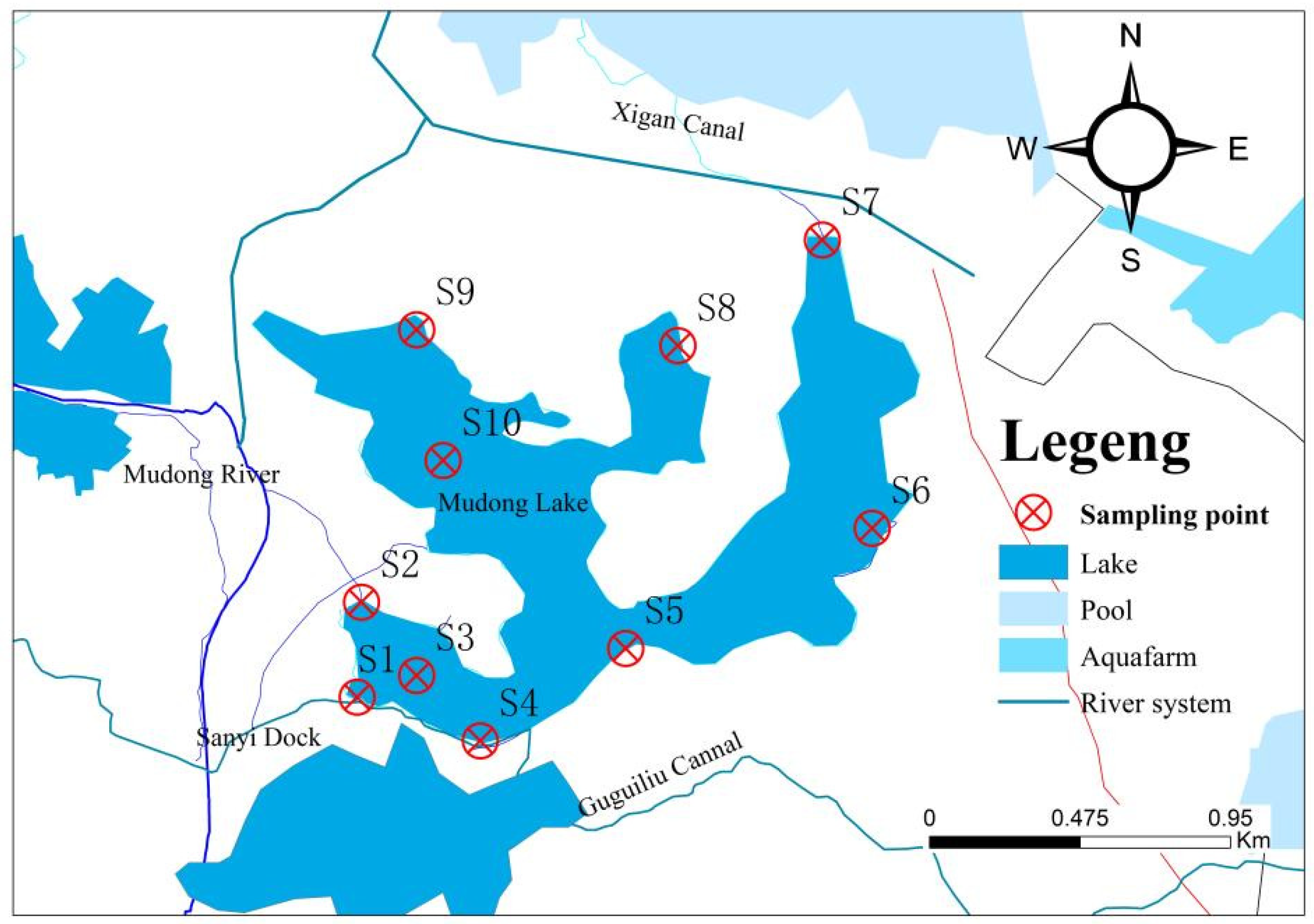
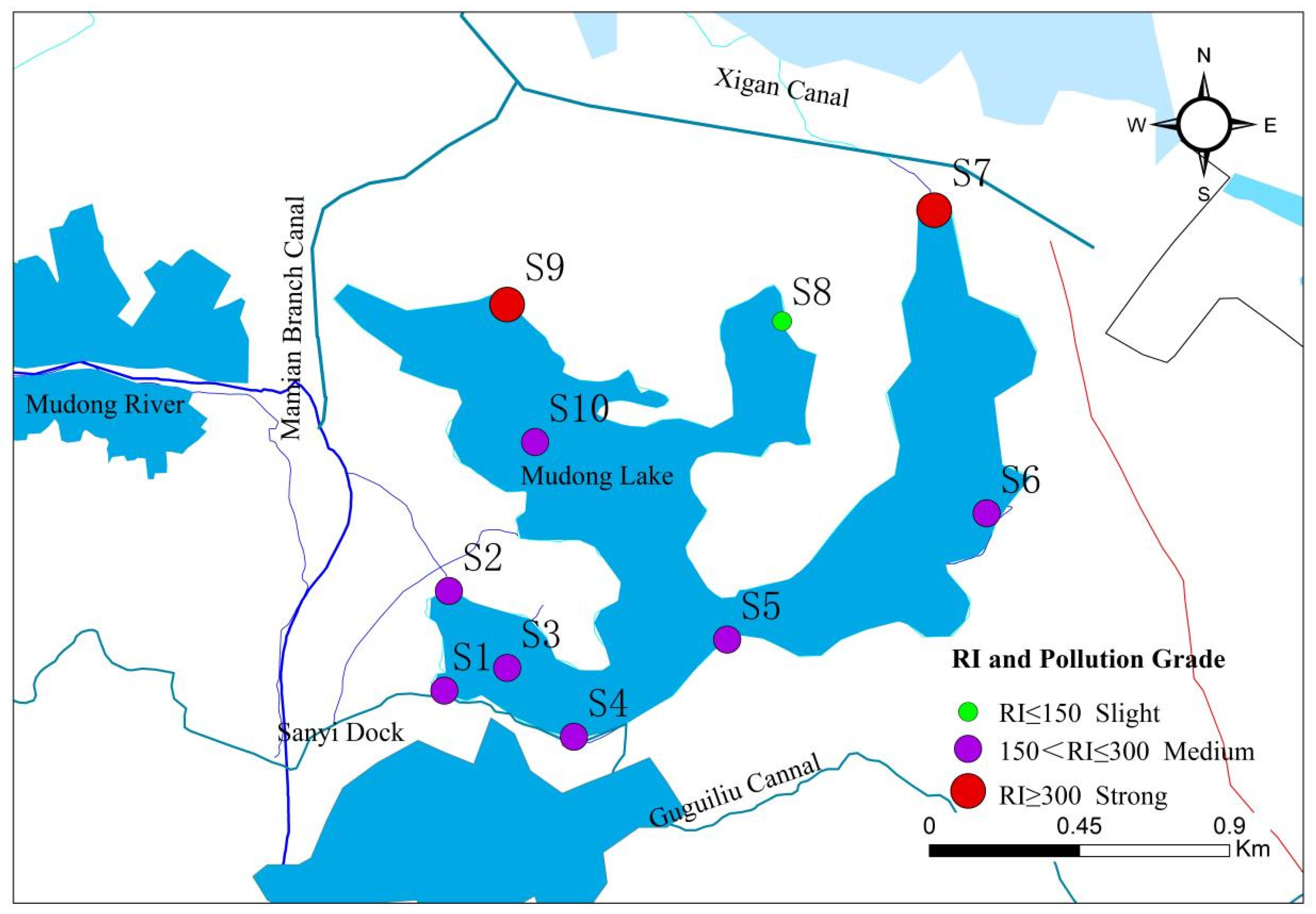
In this study, a total of 10 sampling sites were established in Mudong Lake of the Huixian Wetland using a purposive stratified sampling strategy, which combines systematic grid sampling with targeted placement near potential pollution sources. This design ensured that sampling points were evenly distributed across the lake, covering the northeastern, northwestern, central, and southern regions, with an average spacing of approximately 0.5–1 km (Figure 1). The number of sampling sites was determined based on the lake’s area (approximately 1.5 km2) and hydrological complexity, which is sufficient to capture the spatial variability of heavy metal pollution. Sediment samples were collected in January 2022 (dry season). At each site, three replicate sediment cores (0–10 cm depth) were collected and homogenized into a single composite sample to reduce sampling error. The sampling layout was guided by the distribution of potential pollution sources in the vicinity, including farmland, livestock farms, wharves, fishponds, and residential areas, to ensure that the sampling scheme could comprehensively characterize the spatial variability of heavy metal pollution in the lake.
It should be noted that sampling sites were selected in open water areas without vegetation cover due to the high density and deep root systems of reeds and other aquatic plants in the wetland, which may limit the representativeness of the samples to some extent. Previous studies have shown that vegetation can affect the geochemical behavior of heavy metals in sediments by changing redox conditions, pH, and organic matter content [18,19]. Therefore, the results of this study mainly reflect the heavy metal pollution status in non-vegetated open water areas of Mudong Lake and may not fully represent the situation in densely vegetated zones. This sampling limitation should be considered when interpreting the results.

2.2. Sample Collection and Treatment

2.2.1. Sample Collection

At each sampling point, three grab samples of surface sediment (0–10 cm depth) were collected using a sediment corer. The three grabs were then homogenized into a single composite sample to reduce micro-scale variability within the site, and only the composite sample was analyzed in the laboratory. This approach is widely used in sediment pollution studies to obtain a representative value for each sampling location.
Water systems which can be planted and supplied with water due to the invasion of water are not considered as one of the selected sampling points since identical circumstances are encountered in water systems where the major wetland vegetation, such as rush, huacraza and other water species, is characterized by density, root abundance, and depth of burial. Each one of these sites has been identified with GPs, and the sediments obtained were washed in order to remove contaminants and put into sterile air-tight polypropylene bags, which were left at room temperature until they were moved to the laboratory [20].

2.2.2. Sample Preparation

A clean, cool and ventilated testing board was used to place the samples, which would then be allowed to dry naturally or to be cleaned with wood sticks in order to minimize other pollutants like gravel, shells, and weeds and ultimately crushed into an autoclave stainless-steel multi-purpose pulverizer capable of passing the samples through 10-mesh and 100-mesh sieves each weighing about 50 g and 450 g, respectively, to measure heavy metal content of the sediments [21,22].

2.2.3. Sample Treatment

Sediment preparation samples were mainly used for the determination of seven heavy metals (As, Cd, Cr, Ni, Cu, Zn and Pb). Six heavy metals, Cd, Cr, Ni, Cu, Zn and Pb, were determined via aqua regia extraction—inductively coupled plasma–mass spectrometry (ICP-MS), and As in the sediment samples was determined using atomic fluorescence [23,24].
In this study, the certified reference material, GBW-07310 (Guangxi greywacke area water system sediment), was used for quality control [25]. The measured values of heavy metals in the samples were in good agreement with the certified values, with recoveries ranging from 80% to 120%. The relative standard deviation (RSD) of duplicate samples was less than 10%, indicating good analytical precision. All glassware was soaked in dilute HNO3 (10%) for at least 24 h and rinsed with ultrapure water before use to avoid contamination. Reagents used in the analysis were of guaranteed reagent grade.
Procedural blanks were analyzed alongside the samples, and no significant contamination was detected, confirming the reliability of the analytical process. The limits of detection (LOD) and limits of quantification (LOQ) for each heavy metal were calculated based on three- and ten-times the standard deviation of the blank measurements, respectively. All measured heavy metal concentrations in the samples were above the corresponding LOQ, ensuring accurate and reliable quantification [26,27].

2.3. Risk Assessment

2.3.1. Geocumulation Index

The Index of Geocumulation (Igeo) or the Mull index is an extra index that represents the heaviness of a metal in research samples, as opposed to real heaviness of metals in environmental media, which would be the geological background levels of the same heaviness metal (Igeo), which represents the Geocumulative Index (Igeo) or Mull index [28]. What must be done at this point is the use of the following formula:
Igeo = log2 [Ci/(K×Bi)]
Correction coefficients K are constant, implying that the dependence will be on the properties of the soil layer and the variability of rocks, among others, and will typically be 1.5-times as much as the correlation coefficient in the formula; i is the content of heavy metals (mg/kg) in the sediment. In this study, the soil heavy metal background values of Guilin City were selected as the reference baseline, as reported in the regional geochemical survey of Guangxi Zhuang Autonomous Region. Geochemically, these background values are representative of the local karst geological background of the Huixian Wetland area and are widely used in previous studies on heavy metal pollution assessment in karst wetland sediments [29]. Given that the sediment in Mudong Lake is derived from the surrounding karst soil, the use of local soil background values provides a more accurate baseline for distinguishing anthropogenic pollution from natural enrichment than generic national or sediment-specific values [17].
There are seven overall steps in the general ground accumulation index method, but its classification system for the ground accumulation index method is mentioned in Table 1.

2.3.2. Potential Ecological Hazard Index Method

Ecological risk index can be described in terms of how much potentially high-molecule pollution can affect an ecosystem ecologically; it has been commonly employed as an ecological risk indicator with respect to high molecules [30]. The formula to calculate it is presented below
C f i = C 0 i C n i
E r i = T r i × C f i
R I = i = 1 n E r i
The ecological risk index of every i heavy metal element in the equation includes the following: the pollution of the i th heavy metal element, the background/sediment of the i th heavy metal element, the pollution of the i th heavy metal element, mg/kg content of the i th heavy metal element background/sediment. Ecological risk index of heavy metal element is represented by i; toxin response factor of heavy metal element is i. Response factor biotoxicity values of heavy metals (Cd), (As), (Pb), (Cu), (Ni), (Cr), and (Zn) were found to be 30, 10, 5, 5, 5, 3, and 1, respectively [31,32,33]. Table 2 presents the benchmarks that were taken into account when evaluating the heavy metal pollution and its subdivisions.

2.3.3. Health Risk Assessment Model

Based on the human health risk assessment model proposed by the USEPA, an estimation of what effects carcinogenic and non-carcinogenic chemicals caused on people taking part in the activity at Mudong Lake has been made [34]. The current study considers two forms of oral ingestion (dermal ingestion) such as ingestion of wetland sediment are extremely unlikely, and this calculation was performed with the help of [35,36]:
C D D i n g = c k × E D × E F × C F × I R i n g B W × A T
C D D d r e m = c k × S A × A F × A B S × E D × E F × C F B W × A T
where CDDing and CDDderm refer to the mean daily dose of hands–mouth and dermal pathways, respectively (mg/kg-d); CK represents the measured concentration of element k (mg/kg); IRing refers to the hand–oral contact rate; EF is exposure frequency; ED is exposure time; BW is the body weight of the exposed individual in kilograms; AT is average exposure time; AF is the adherent fraction of skin; SA is the area of skin exposed to the source; ABS is a subset of the skin absorption parameter set; and CF is the unit conversion factor.
The exposure parameters used in this study were primarily derived from local epidemiological surveys and environmental exposure studies conducted in Guilin and the Guangxi region, making them representative of the local population characteristics [37]. Body weight (BW) values were taken from the latest local health statistics for children and adults in Guilin, reflecting the actual physiological conditions of the study population. The ingestion rate (IRing) and exposure frequency (EF) were adjusted based on the wetland-specific environment of Huixian Wetland. For example, EF was set to 180–365 days/year to account for both regular recreational activities and seasonal agricultural work near the lake. Other parameters, such as skin surface area (SA) and skin adherence factor (AF), were adapted from Chinese national exposure factor manuals, which are widely accepted and applicable to the Chinese population. This combination of local data and standard guidelines ensures that the exposure assessment is both context-specific and scientifically sound.
Table 3 demonstrates the outcomes of Monte Carlo simulations depending on the exposure parameters.
The calculated rate of people with cancer associated with sediments with high levels of heavy metals in sediments covering the Mudong Lake is as follows:
H I = H Q i j = C D D i j R f D i j
Here, HI denotes the total non-carcinogenic risk, and quantities of HQi j and Rfdi j are non-carcinogenic risks related to heavy metal i and the type j of exposure routes, respectively.
The investigation aimed at determining the carcinogenicity of heavy metals residing in surface sediments of Mudong Lake utilized various populations:
T C R = C R i j = C D D i j × S F i j
Measuring the total cancer risk by using a measure called TCR, CRi-j and SFi-j may be considered as the value of cancer risk due to i heavy metals through j exposure route and the value of the slope factor of carcinogenicity of i heavy metals through j exposure route, respectively. HI (HQ) values greater than 1 can be interpreted as evidence that sediment heavy metals are no longer a carcinogenic hazard to humans, whereas HI (HQ) less than or equal to 1 would mean that sediment heavy metals are insignificant threats to humans based on a non-carcinogenic hazard context. A TCR value that is less than 1 (CRij) indicates that human carcinogenesis is not significant due to the existence of heavy metals in sediments, and a value of TCR between 1 and 10,000 means that there is a slight carcinogen risk that can be deemed unacceptable when the value exceeds 100,000. Slope non-carcinogenicity factors of heavy metals are presented in Table 4.

2.4. Monte Carlo

As the deterministic variables (toxicity response coefficients, background values and exposure to risks) can be applied to evaluate heavy metal pollution controls, which can either result in an overestimated or underestimated value of a specific evaluation because of the deterministic quality of these variables, Monte Carlo simulation was also utilized as part of the present research in order to predict and simulate heavy metal pollution and risk evaluation [48,49,50]. The evaluation process followed such steps: (1) development of the probability density distribution function; (2) identification of the distribution type of each heavy metal; (3) large random sample simulation and run; (4) analysis of the output of the simulator generated by this model. It is performed with 10,000 repeated trials, in 95% confidence intervals.

2.5. Statistical Analysis

Experimental data were recorded and calculated using Excel; correlation and principal component analyses were performed using SPSS software (IBM SPSS Statistics 26.0 (Armonk, NY, USA)); the Monte Carlo simulation was performed with Orace Crystal Ball, and interpolation was used to predict values. An overall image of the region was drawn in ArcGIS 10.8, and the other maps were created with the help of Origin 2022.

3. Results and Discussion

3.1. Characterization of Heavy Metal Content in Sediments

Using the heavy metal soil background values of northeastern Guangxi as the reference standard, the statistical characteristics of heavy metal concentrations in surface sediments of Mudong Lake were analyzed, as shown in Table 5. The average content of each heavy metal was ranked as Zn > Cr > As > Ni > Pb > Cu > Cd. Compared with the regional geochemical background values, Ni, Zn, Cd and As were all significantly enriched, with relatively high over-standard rates, indicating obvious accumulation characteristics in sediments, while Pb, Cr and Cu showed relatively low over-standard degrees [51].
The coefficient of variation (Cv) reflects the spatial heterogeneity of heavy metal content and the degree of human interference. The Cv values of seven heavy metals in the study area were ranked as Cd > Cr > Pb > Ni > Cu > Zn > As. Among them, Cd, Cr and Pb presented highly variable characteristics with obvious spatial distribution differences, implying they were greatly affected by regional human activities. In contrast, Ni, Zn, Cu and As had relatively lower coefficients of variation, with relatively stable spatial distribution and less impact from local point-source pollution.
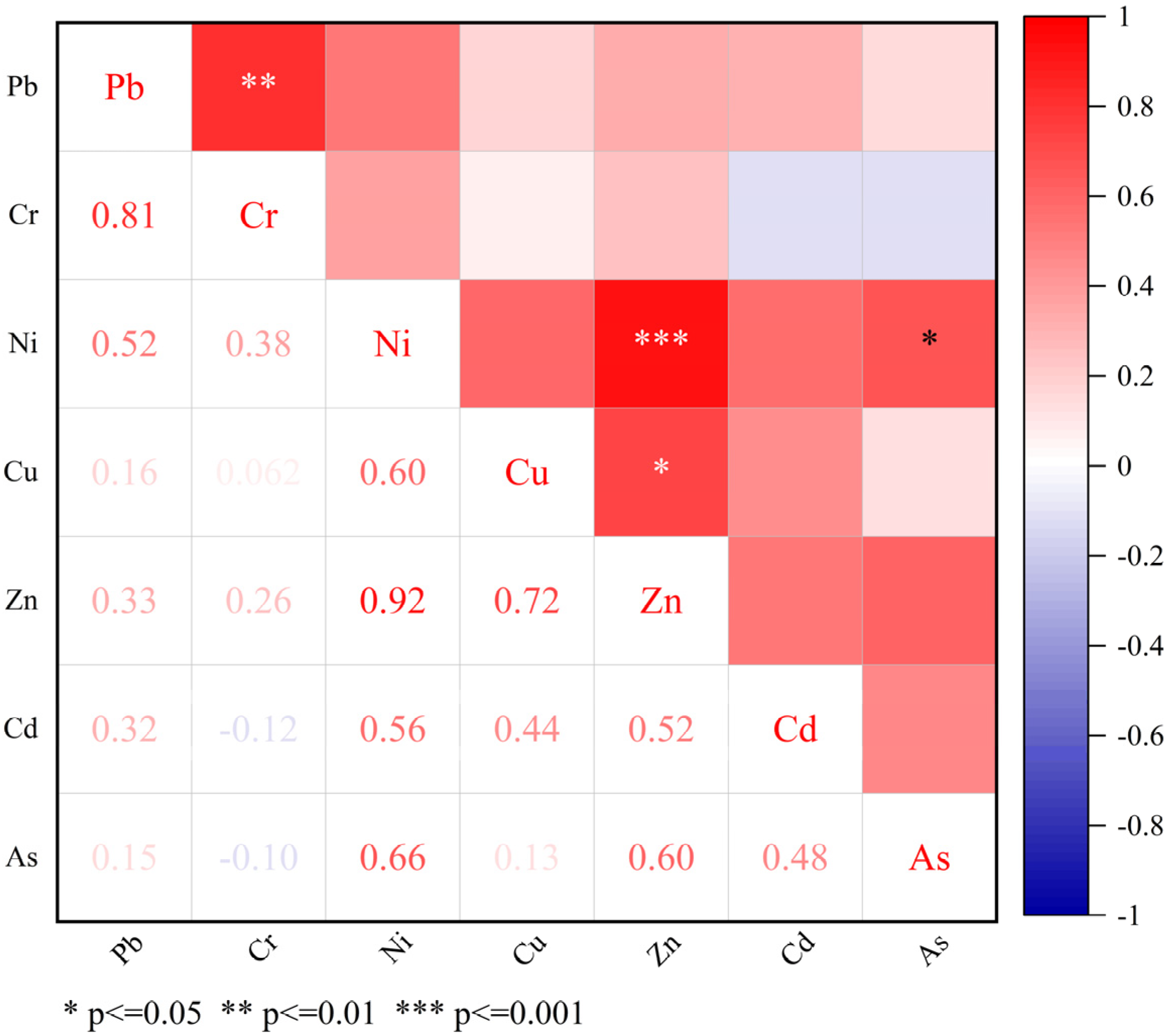
Combined with correlation analysis and principal component analysis (PCA), the source characteristics of heavy metals were further discriminated (Table 6). PCA extracted two principal components, with a cumulative variance contribution of 75.26%, which could well reflect the overall information of the original data. PC1 explained 51.42% of the total variance and was mainly loaded with Ni, Zn, Cu, Cr and As, which were closely related to the weathering of karst parent material and the regional geochemical background. Combined with the correlation results (Figure 2), As was significantly correlated with Ni and Zn, further confirming that the enrichment of As was predominantly controlled by the natural geological background, which is consistent with the high geochemical baseline of karst areas [52,53].
PC2 accounted for 23.85% of the variance and was mainly dominated by Cd and Pb. Combined with their high Cv values and prominent spatial variability, it can be inferred that Cd and Pb were mainly affected by anthropogenic inputs, such as agricultural farming, livestock manure application and human living emissions. Although As also showed a moderate correlation with Cd, suggesting a certain superposition effect of agricultural activities, the overall results indicated that the natural geochemical background was the dominant factor for As enrichment, while Cd and Pb were mainly controlled by human disturbance [54,55].

3.2. Evaluation of Heavy Metal Contamination of Sediments

3.2.1. Evaluation of the Geoaccumulation Index

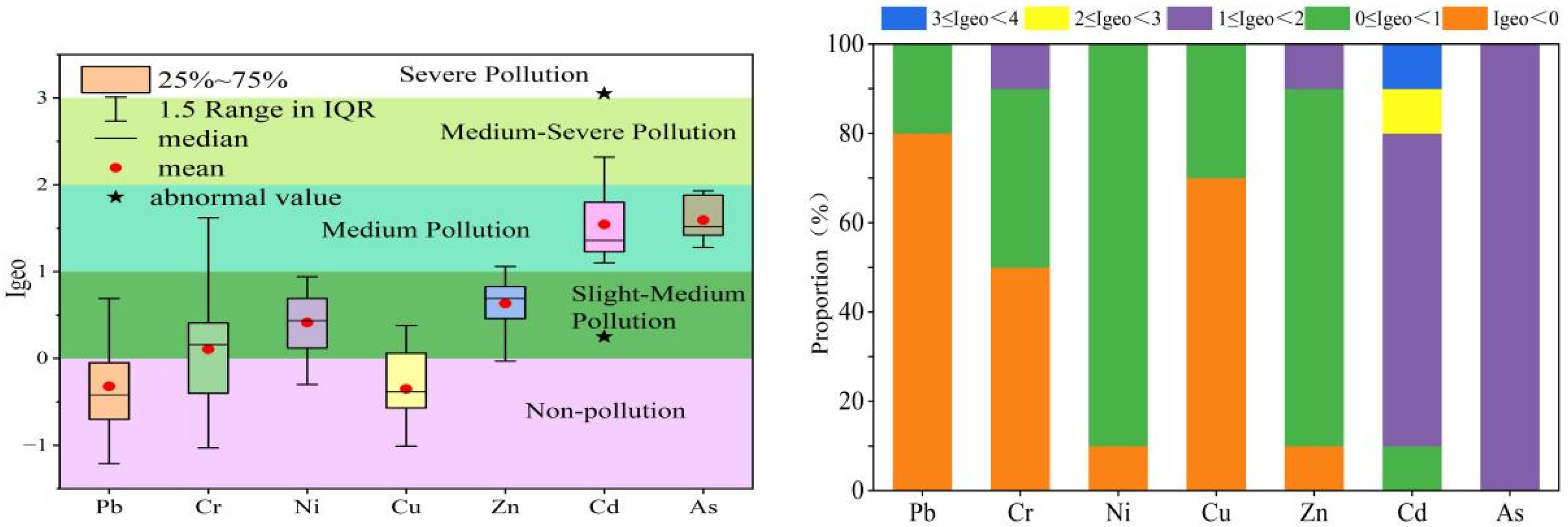
Figure 3 shows the result of box plots of the mean I geo of all the heavy metals present in the surface mud of the Mudong Lake sediment and the contamination rates of these elements. The average As (1.59) and Cadmium (Cd) (1.54, 1.64, 1.171.01–0.32) accumulation rate of the heaviest metal As has the highest level of contamination, 1.59, and another level of contamination of the heavier metal Cadmium is 1.54, which falls into the moderately contaminated category. In all of them, moderate pollution levels were found, and the lowest soil accumulation index of five heavy metals including Pb was observed, which was not highly polluted. Pb, Cr, Ni, Cu, and Zn also indicated a decreasing trend of heavy metal contamination by 80, 50, 10, 70 and 10, respectively, indicating that the level of heavy metal contamination in the upper layer of Mudong Lake sediment was not too contaminated but relatively low compared to the level of heavy metal contamination present in the sediment because of heavy metal Cd. The Cr, Zn, Cd, and As heavy metals were measured as 10, 10, 70 and 100, respectively, showing that the level of heavy metal pollution on the surface mud of the Mudong Lake is moderate. By looking at the box plot and percentage of pollution, there can be an inference made that the most polluted heavy metals in the top sediments of Mudong Lake are Cd and As, followed by Cr, Ni, Zn, Pb and Cu, which are the least polluted.

3.2.2. Evaluation of the Potential Ecological Hazard Index Method

(1) Individual potential ecological risk evaluation
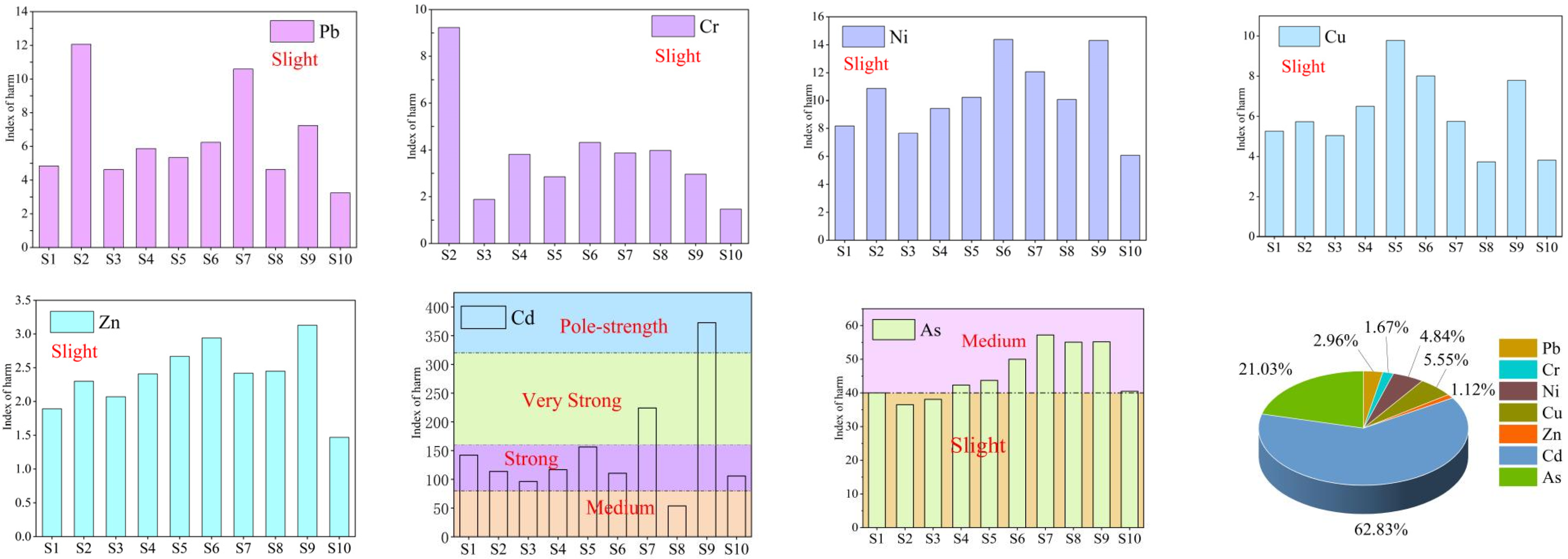
Every individual entity of ecological risks values is reflected in Figure 4.
Ecological Risks. The ecological indices (Ei r) of the heavy metals are as follows: Cd (149.21) > As (45.86) > Ni (10.32) > Pb (6.47) > Cu (6.14) > Cr (3.36) > Zn (2.37). All have been put into the mildly hazardous to ecosystems category according to where they were collected; Arsenic (As) at 80% of sampling sites posed moderate ecological risk, with a maximum risk value of 57.21. Metal Cd has four levels of risk, including moderate, strong, very strong, and extremely strong, which comprise 10, 70, 10 and 10 percent, respectively. RI comprises the largest amount of the heavy metal element, which is Cd (66.59%), followed by As (20.47), and the remaining two heavy metals contribute the least to the percentages (1.06 and 1.64 percent, respectively) in the pie charts, as presented in the figures below. It is important to note that Cd’s dominant contribution to the RI (66.59%) is significantly influenced by its high toxicity coefficient (Tᵣ = 30), rather than its measured concentration alone. While Cd’s concentration is elevated, its outsized role in the RI reflects both its abundance and its high inherent toxicity, as defined using the Hakanson method [56]. A sensitivity analysis would show that reducing the toxicity coefficient for Cd would proportionally decrease its contribution, highlighting the dependence of RI results on the choice of Tᵣ values [57]. This is a known limitation of the Hakanson index, and we, therefore, interpret the results cautiously, emphasizing that Cd poses the greatest ecological risk, primarily due to its high toxicity, even if its absolute concentration is not the highest among the metals studied.
According to Table 1, the mean Igeo and Eir of seven heavy metals are present in Mudong Lake mud sediments. The result was inconclusive because the toxicity and biosensitization of the metals were used with different parameters of the toxic response to nullify the influence of the ecological risk factor [58].
As was the heavy metal with the highest geoaccumulation index in this study. To further distinguish its natural and anthropogenic sources, correlation analysis and principal component analysis (PCA) were performed (Figure 2, Table 6).
Correlation analysis showed that As was significantly correlated with Ni (r = 0.66) and Zn (r = 0.60), elements typically derived from natural weathering processes [59]. PCA further confirmed this finding, identifying two main components. As had the highest loading on the first component, which explained 51.4% of the variance and included most naturally derived elements. These results provide direct evidence that the dominant source of As enrichment is the local karst geological background, which is known to contain naturally high As concentrations due to high geochemical background values [60]. Additionally, As showed a moderate correlation with Cd (r = 0.48), suggesting some influence from agricultural activities. In karst areas, intensive farming practices, including the application of livestock manure as organic fertilizer, may contribute to secondary As accumulation in the environment [61]. However, the strong correlation with geogenic elements indicates that the geological background remains the primary driver of elevated As levels in this study [62,63].
This research shows that Cd was initially ranked as such in the context of the pollution index, not necessarily because it was the most toxic element, with a toxicity response ratio of 30, whereas all other elements had toxicity response coefficients that may be several fold, if not dozens, higher, and its ecological risk coefficient would, therefore, be relatively easy to raise, but also because it is a dominant contaminant of arable lands in China, a lot of which has been introduced due to human activity in agriculture [64].
(2) RI
The predicted rates of the total possible ecological risk index were drawn and are shown in Figure 5, with the mean of 224.04 covering all the areas sampled with medium risk or more, and the RI was between 155.65 and 463.24. Put another way, in the context of spatial subdivision, the areas located near the historic Guiliu Canal are relatively moderately risky, and those located on the northeastern and northwestern side of Mudong Lake are heavily risky, i.e., the RI values are 316.11 (316.11) and 463.24 (463.24), respectively, which are at least 5.37 and 54.41 multiplied by the critical values of maximum risk; therefore, these regions require specific consideration. The higher risk in the northeastern and northwestern regions is likely related to their hydrological and land use characteristics. The northwestern sampling site (S9) is located in a stagnant bay near the canal, where weak hydrodynamic conditions favor the deposition of heavy metal-bearing sediments. Meanwhile, the northeastern site (S7) is adjacent to agricultural and residential areas, which may contribute additional Cd inputs through surface runoff. A comparison of the RI values shows that these two sites are significantly higher than the average of the remaining sites (p < 0.05), confirming the spatial pattern of elevated risk in these areas. These findings suggest that local hydrological conditions and human activities are key drivers of the observed spatial variability in ecological risk.

3.3. Human Health Risk Assessment

3.3.1. Evaluation of Non-Carcinogenic Health Risks

Table 7 shows an assessment of non-carcinogenic health effects due to metals in the Mudong Lake sediment. Both the non-cancer risk index and adult and child values were found to be less than 1. Mean HQ values in the two groups of the mean HQ value ranked As > Cr > Pb > Ni > Cd > Cu > Zn between both adults and children, and it was observed that the total non-cancer risk index of adults was lower than in children. This will be the overall non-carcinogenic health risk index (HI): the mean HI levels between adults and children are 9.12E−02 and 1.04E−01, respectively, with children HI being statistically significant at the same risk level as adults. In summary, non-cancer risk indices of adults did not exceed 1, and those of children had a certain level of risk in non-cancer risk indices.

3.3.2. Carcinogenic Health Risk Assessment

The cultivation of rice alongside wild rice occurs at the edge of Mudong Lake because rice can be cultivated by farmers, and some other farmers can raise chickens as the primary source of water in an irrigated field and as a source of water in Mudong Lake, replacing water and excess heavy metal sedimentation in fields. If the heavy metal levels are higher than the limits, they enter into human food crops and pesticides used by humans and can, eventually, result in cancer [65].
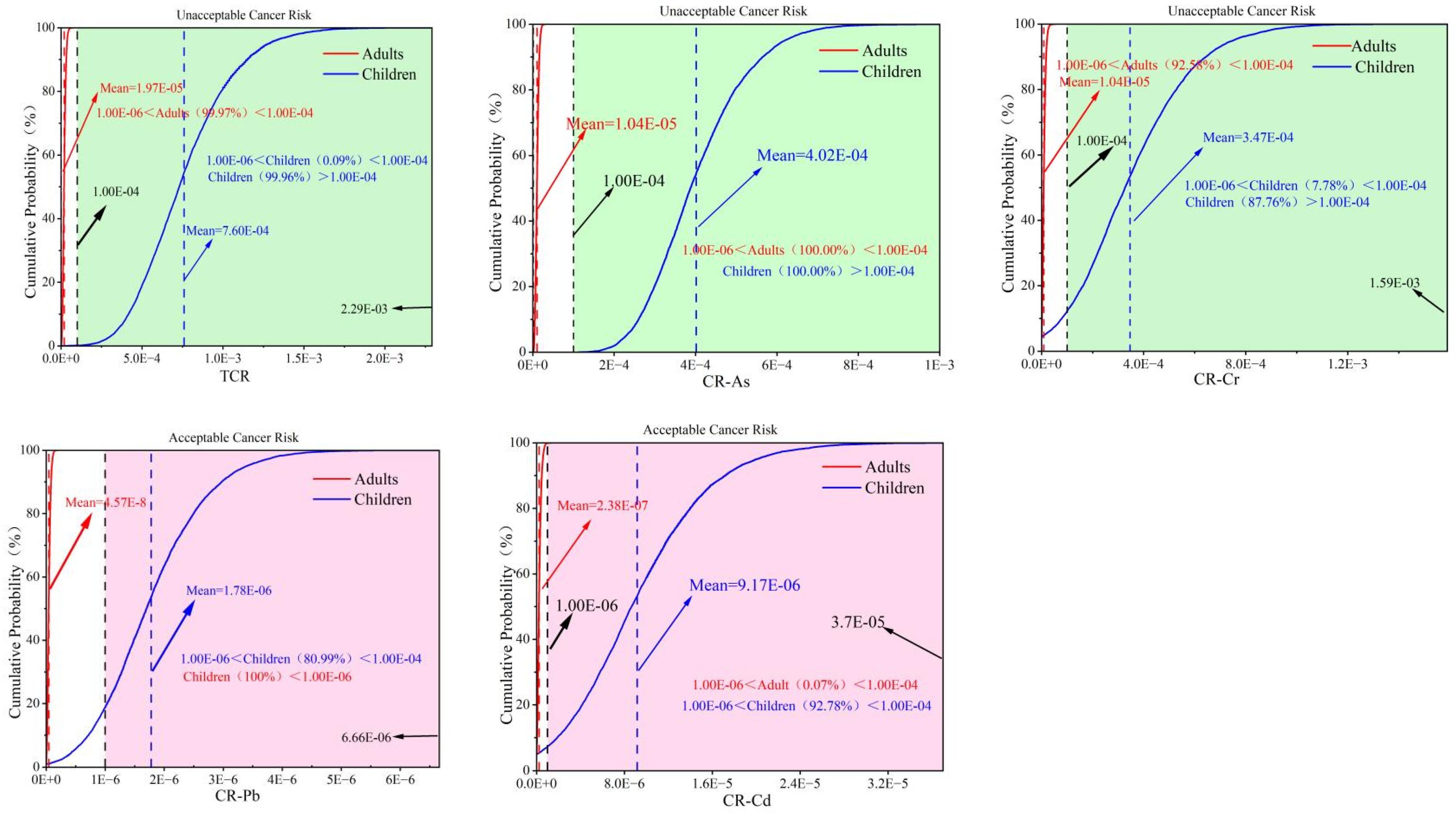
The results of the health risk assessment for heavy metal carcinogenicity in the surface sediments of Mudong Lake are shown in Figure 6. Only four heavy metals (CR of As is greater than Cr, which is greater than Cd and, finally, Pb), As, Cd, Cr, and Pb, were studied, with all four heavy metals having higher rates of cancer among children than in adults; the average CR of the Cd and Pb among children was 1.00E−06 to −1.00E−04, which is a normal cancer risk, and the average CR of the As and Cr averaged over 1.00E−04, which is a non-normal cancer risk. Both metal CRs, CR of Cd and Pb, were below 1.00E−04, which may be regarded as reasonable carcinogenic threats, and the mean of the two metal CRs, CR of As and Cr, was 1.00E−04, which is an unacceptable carcinogenic threat. Pb, As, Cr, and CR levels of 100 80.99 and 92.58 percent of CR, respectively, are acceptable carcinogenic risks, and the values of CR of Cad is lower than 1.00E−04, with only 0.07 percent of 1.00E−06, and the CR of Cad is lower than 1.00E−04, indicating the negligibility of the carcinogenic risk of Cd to adults. The result of this evaluation is the fact that adult populations have insignificant carcinogenic risks, and 99.97 out of 100 TCR values will be 1.00E−06–1.00E−04, and, therefore, it can be seen that the level of carcinogenic risk posed by these four heavy metals to adults is within safe limits, with Cr and As being the most carcinogenic, contradicting the findings of the ground cumulative evaluation method and environmental risk assessment, which can be explained by the large slope factors of carcinogenicity (SF) of Cr and As used in this model that are bigger [66,67].
Based on the literature, AS is considered one of the additive pollutants with potential to inhibit different systems of the human body, yet long-standing exposure might lead to the formation of tumors in most body organs, including the lungs, liver and kidneys; the manufacture of a chemical fertilizer requires the use of Cr as well as one of the ingredients used in the process, and it is discharged into the atmosphere during the course of agricultural production, which pollutes the environment and, in addition to that, can easily be taken up by humans who may have been influenced positively or negatively through their lifestyles through the food chain [68,69,70].
Considering children, it should be apparent that only 0.09 of the observed TCR value had a value greater than 1.00E−06 due to the fact that, with an extremely large probability (99.96 percent), the measured TCR value will exceed 1.00E−04, which means that metal exposure could be a major threat to the health of children [38]. This is similar to what other researchers have found, which is also related to the characteristics of such children and others who are prone to become vulnerable to pollution effects [71,72].
It should be noted that this conclusion is based on Monte Carlo simulation with 10,000 iterations at the 95% confidence level, which inherently involves several uncertainties. First, the simulation was performed using probability distributions of exposure parameters (e.g., IRing, AF, BW) derived from the literature, rather than locally measured data. Variations in these parameters within their defined distributions may lead to minor fluctuations in risk estimates. Second, the model assumes constant exposure frequency and duration over the exposure period, which may not fully capture the dynamic behavior of children in the wetland area. Despite these limitations, the 99.96% exceedance rate of the USEPA threshold (1.00 × 10⁻⁴) remains robust across 10,000 simulations, indicating high probability of an unacceptable carcinogenic risk to children. Future studies with site-specific exposure data would help reduce the uncertainty of the assessment [43].
The implication is also that the presence of heavy metals on the sedimentary surface at Mudong Lake has a carcinogenic effect on people, which means that both adults and children are at risk; however, children are more likely to develop cancer due to the high levels of carcinogenicity that originate mainly because of As and Cr.

3.3.3. Parameter Sensitivity Analysis

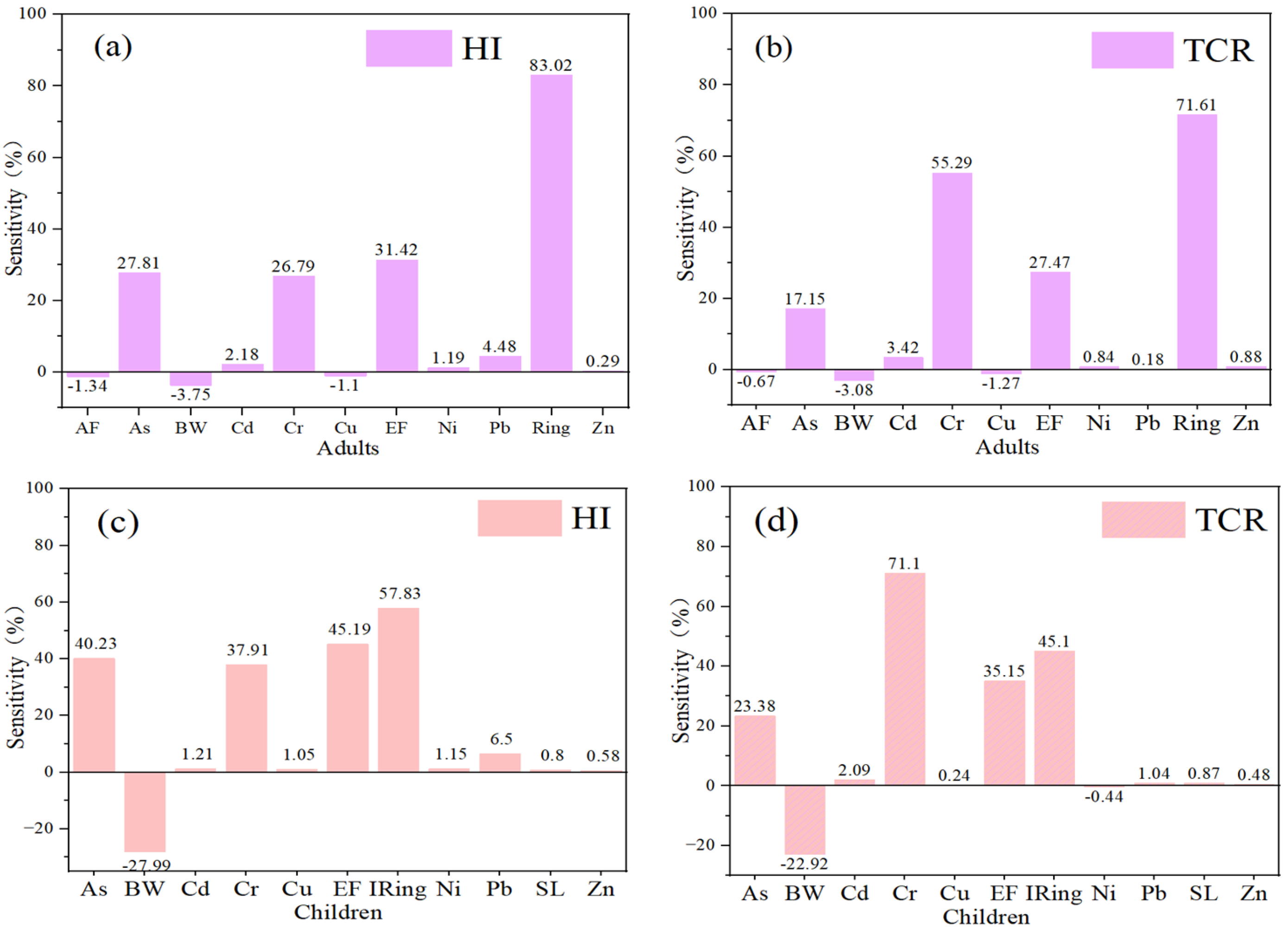
Based on sensitivity analysis, it is important to specify to what extent each of the parameters can be changed due to a specific level of risk, and such high sensitivity also means a greater impact on the outcomes of the risk. In the case of positive sensitivity, it denotes positive correlation between them, and negative sensitivity indicates negative correlation between them [73]. Having conducted a sensitivity analysis of carcinogenic and non-carcinogenic risks related to heavy metals present in the surface sediments of Mudong Lake, the results are summarized in Figure 7.
Moreover, in the case of non-cancerous risk assessment, a negative correlation of BW with sensitivity was detected in both adults and children. The highest sensitivity was observed for IRing (83.02% for adults and 57.83% for children), followed by EF, As, and Cr, which showed similar trends. In contrast, Cd, Cu, Ni, Pb, and Zn showed negligible sensitivity, indicating that variations in these parameters have little impact on the final risk estimates. This confirms that hand–oral intake is the dominant exposure pathway contributing to non-carcinogenic risk in the study area, consistent with previous studies on wetland sediments that also identified IRing as the key factor for children’s health risk [74,75].
The results revealed that BW also showed a negative correlation with carcinogenic risk sensitivity in both populations. For adults, IRing had the highest sensitivity (71.61%), followed by Cr (55.29%), EF (27.47%), and As (17.15%). For children, Cr was the most sensitive parameter (71.1%), followed by IRing (45.1%), EF (35.15%), and As (23.38%). These findings indicate that Cr and IRing contribute most significantly to carcinogenic risk, followed by EF and As. The high sensitivity of Cr and As is consistent with their known carcinogenic properties and elevated concentrations in karst wetland sediments reported in other studies, further highlighting the need for targeted pollution control of these elements [76,77].
According to the data provided by the sensitivity analysis, Cr and As were identified as the most susceptible to the carcinogenic risk out of seven heavy metals, and, thus, additional measures should be made to regulate and address Cr and As pollution; other factors with a significant sensitivity to carcinogenic risk comprised Ring, with the highest sensitivity level, followed by exposure frequency (EF), with the next highest sensitivity level, which coincides with the findings of Chen et al. [78], who observed that the difference between hand–mouth and dermal and inhalation exposure was statistically significant, and both forms of hand–mouth contact and exposure frequency should be reduced to the lowest level possible [79].
The sensitivity analysis results have important implications for risk management and environmental policy in the study area. First, since the hand–oral intake rate (IRing) showed the highest sensitivity to both non-carcinogenic and carcinogenic risks, measures to reduce children’s direct contact with sediments, such as setting up protective fences and improving environmental education on hand hygiene, should be prioritized. Second, as As and Cr were identified as the key heavy metals driving carcinogenic risk, targeted pollution control measures for these elements are needed, including investigating their specific sources (e.g., agricultural runoff, industrial emissions) and implementing source reduction strategies. Finally, the relatively high sensitivity of exposure frequency (EF) indicates that limiting the exposure time of children in the wetland area can effectively reduce health risks. These findings provide practical guidance for formulating site-specific risk management measures and protecting the health of local residents, especially vulnerable children.

4. Conclusions

In this study, we conducted a comprehensive investigation of heavy metal pollution and associated risks in sediments of Mudong Lake, a core zone of the Huixian Wetland, providing key insights for pollution control and ecological protection in karst wetland systems. The main findings are as follows:
(1) The mean concentrations of Ni, Zn, Cd, As, Pb, Cr, and Cu in sediments exceeded the regional background values, with Ni, Zn, Cd, and As being the most prominent exceedances. Significant spatial variability was observed in heavy metal distribution, and Pb, Cr, and Cd were strongly influenced by anthropogenic activities, indicating potential pollution sources related to human activities in the wetland watershed.
(2) Geoaccumulation index assessment revealed that As and Cd were the most severe pollutants, followed by Cr, Ni, and Zn. The single pollution index identified Cd as the primary pollutant, while the comprehensive potential ecological risk index indicated a moderate overall ecological risk in Mudong Lake sediments, with the northeastern and northwestern areas exhibiting strong ecological risk. These results highlight the need for targeted risk management in high-risk zones.
(3) Human health risk assessment showed that non-carcinogenic risk indices for both adults and children were below 1, suggesting no significant non-carcinogenic risk. However, children faced higher non-carcinogenic risks than adults. For carcinogenic risk, As, Cd, Cr, and Pb posed greater risks to children than adults, with 99.96% of the total carcinogenic risk (TCR) values exceeding the USEPA threshold of 1.00 × 10⁻⁴, indicating an unacceptable carcinogenic risk for children. This finding underscores the vulnerability of children to heavy metal exposure in wetland environments.
(4) Sensitivity analysis demonstrated that the hand–oral intake rate (IRing), exposure frequency (EF), As, and Cr were the main factors influencing non-carcinogenic risk, while Cr and IRing were the dominant factors affecting carcinogenic risk, followed by EF and As. Overall, IRing, As, and Cr were the key drivers of human health risk, emphasizing the importance of reducing children’s direct contact with sediments and controlling As and Cr pollution sources.
This study provides a detailed baseline of heavy metal pollution in Mudong Lake, filling the gap in targeted risk assessment for core zones of the Huixian Wetland. The findings offer practical guidance for local environmental management, including prioritizing pollution control of As and Cr, setting up protective facilities in high-risk areas, and implementing health education to reduce children’s exposure. Future research should focus on identifying specific pollution sources and conducting long-term monitoring to assess the effectiveness of mitigation measures.

Author Contributions

T.T.: Conceptualization, methodology; L.M.: writing—review and editing, funding acquisition, critical revision of the manuscript, writing—original draft, data curation; L.Q.: investigation, visualization; J.D.: resources, supervision, project administration; D.W.: validation, software; Q.L.: data analysis, formal analysis. All authors have read and agreed to the published version of the manuscript.

Funding

This research received no external funding. The APC was funded by the authors.

Data Availability Statement

The original contributions presented in this study are included in the article. Further inquiries can be directed to the corresponding authors.

Acknowledgments

The authors sincerely thank the editors and anonymous reviewers for their valuable comments and constructive suggestions to improve the quality of this manuscript. We are grateful for the administrative and technical support provided during the sample collection, experimental analysis and data processing of this study. We also appreciate the relevant institutions and colleagues who offered assistance with field investigation and laboratory testing in the research process. During the preparation of this manuscript, the authors used mainstream academic writing auxiliary tools for language polishing and structural optimization. The authors have fully reviewed, revised and optimized all generated content and take complete responsibility for the accuracy and integrity of the full text and all research results. No additional financial support, material donations or in-kind contributions related to this study are involved beyond the funded projects and author contributions stated above.

Conflicts of Interest

The authors declare no conflicts of interest. The funders had no role in the design of the study; in the collection, analyses, or interpretation of data; in the writing of the manuscript; or in the decision to publish the results.

References

  1. Zhou, B.; Zhang, T.J.; Wang, F. Microbial-Based Heavy Metal Bioremediation: Toxicity and Eco-Friendly Approaches to Heavy Metal Decontamination. Appl. Sci. 2023, 13, 8439. [Google Scholar] [CrossRef]
  2. Nimmi, N.; Shiji, M.; Harikumar, P.S. Assessment of heavy metal contamination and ecological risk of core sediments in a coastal wetland of India. Soil Sediment Contam. 2022, 31, 886–904. [Google Scholar] [CrossRef]
  3. Luo, Q.; Gu, L.; Shan, Y.; Wang, H.; Sun, L. Distribution, source apportionment, and health risk assessment of polycyclic aromatic hydrocarbons in urban soils from Shenyang, China. Environ. Geochem. Health 2019, 42, 1817–1832. [Google Scholar] [CrossRef] [PubMed]
  4. Zhou, Y.; Zhao, L.; Li, Z. Wetland Ecological Restoration and Payment for Ecosystem Service Standard: A Case Study of Ganjiangyuan National Wetland Park. Wetlands 2023, 43, 22. [Google Scholar] [CrossRef]
  5. Luo, Q.; Gu, L.; Wu, Z.; Shan, Y.; Wang, H.; Sun, L.-n. Distribution, source apportionment and ecological risks of organophosphate esters in surface sediments from the Liao River, Northeast China. Chemosphere 2020, 250, 126297. [Google Scholar] [CrossRef] [PubMed]
  6. Wang, S.; Wang, W.; Chen, J.; Zhao, L.; Zhang, B.; Jiang, X. Geochemical baseline establishment and pollution source determination of heavy metals in lake sediments: A case study in Lihu Lake, China. Sci. Total Environ. 2018, 657, 978–986. [Google Scholar] [CrossRef]
  7. Qin, B.; Deng, J.; Shi, K.; Wang, J.; Brookes, J.; Zhou, J.; Zhang, Y.; Zhu, G.; Paerl, H.W.; Wu, L. Extreme Climate Anomalies Enhancing Cyanobacterial Blooms in Eutrophic Lake Taihu, China. Water Resour. Res. 2021, 57, e2020WR029371. [Google Scholar] [CrossRef]
  8. He, Z.; Li, F.; Dominech, S.; Wen, X.; Yang, S. Heavy metals of surface sediments in the Changjiang (Yangtze River) Estuary: Distribution, speciation and environmental risks. J. Geochem. Explor. 2019, 198, 18–28. [Google Scholar] [CrossRef]
  9. Wang, D.; Li, M.; Liao, C.; Dong, K.; Yao, Y. The Occurrence Characteristics and Ecological Risks of Antibiotics in Surface Water and Groundwater of the Huixian Wetland. Toxics 2025, 13, 460. [Google Scholar] [CrossRef] [PubMed]
  10. Gao, H.; Chen, H.; Jin, Y.; Gao, R.; Wei, C.; Zhang, C.; Zhang, W. Occurrence and Speciation of Pollutants in Guilin Huixian Wetland: Nutrients, Microplastics, Heavy Metals, and Emerging Contaminants. Water 2024, 16, 2816. [Google Scholar] [CrossRef]
  11. Yu, Y.; Xing, X.-L.; Cheng, C.; Liu, W.-J.; Zhang, B.; Kong, X.-S.; Li, M.; Yu, H.-K.; Luo, W.-Q.; Qi, S.-H. Pollution Characteristics of Organochlorine Pesticides in Water and Sediments of Huixian Karst Wetland in Guilin. Huan Jing Ke Xue 2023, 44, 1387–1396. [Google Scholar] [CrossRef]
  12. Luo, Q.; Wu, Z.; Wang, C.; Gu, L.; Li, Y.; Wang, H. Seasonal variation, source identification, and risk assessment of organophosphate ester flame retardants and plasticizers in surficial sediments from Liao River estuary wetland, China. Mar. Pollut. Bull. 2021, 173, 112947. [Google Scholar] [CrossRef] [PubMed]
  13. Wang, J.; Wang, B.; Zhao, Q.; Cao, J.; Xiao, X.; Zhao, D.; Chen, Z.; Wu, D. Sources analysis and risk assessment of heavy metals in soil in a polymetallic mining area in southeastern Hubei based on Monte Carlo simulation. Ecotoxicol. Environ. Saf. 2024, 290, 117607. [Google Scholar] [CrossRef] [PubMed]
  14. Zhang, H.; Zhao, S.; Shi, X.; Sun, B.; Cui, Z.; Zhao, Y.; Zhang, J. Distribution characteristics, risk assessment, and source analysis of heavy metals in typical lake sediments in Inner Mongolia, China. Ecol. Indic. 2024, 166, 112341. [Google Scholar] [CrossRef]
  15. Tian, T.; Mo, L.; Qin, L.; Dai, J.; Wang, D.; Lu, Q. Water Quality Assessment and Pollution Source Analysis of Lake Wetlands Using WQI and APCS-MLR—A Case Study of Mudong Lake in Huixian Wetland, Guilin. Water 2026, 18, 1071. [Google Scholar] [CrossRef]
  16. Zhang, L.; Xu, B.; Wei, Z.; Liang, X.; Chen, Y.; Ru, X.; Zhang, Q.; Zhong, S. Atmospheric microplastic deposition in Guilin karst wetlands: Sources and agricultural impact. Atmos. Pollut. Res. 2025, 16, 102537. [Google Scholar] [CrossRef]
  17. Liu, T.; Du, W.; Yu, S.; Zhang, W. Distribution, sources, and probabilistic risk assessment of heavy metals in the wetland water–sediment system: Based on CEWQI, PLI, PMF, and two-dimensional Monte Carlo method. J. Contam. Hydrol. 2025, 276, 104753. [Google Scholar] [CrossRef]
  18. Abbas, A.; Ahmad, M.; Yousaf, M.; Pan, L.; Xu, D. Synergistic role of microbes and wetland plants in an advanced-acclimatized constructed wetland for enhanced removal of heavy metals. Gondwana Res. 2025, 150, 274–286. [Google Scholar] [CrossRef]
  19. Zhang, P.; Hu, L.; Gao, B.; Gao, F.; Zhu, X.; Li, Y.; Yao, H. Spatial–temporal variation and source analysis of heavy metals in different land use types in Beilun District (2015 and 2022). Sci. Rep. 2024, 14, 15127. [Google Scholar] [CrossRef]
  20. Liu, T.; Zhang, Y.; Liu, Y.; Chen, B. Multi-indicator assessment of heavy metal pollution in Qinzhou Harbour sediments: Unraveling ecological and human health risks. Mar. Pollut. Bull. 2024, 211, 117442. [Google Scholar] [CrossRef]
  21. El-Sorogy, A.S.; Al-Hashim, M.H.; Almadani, S.A.; Giacobbe, S.; Nour, H.E. Potential contamination and health risk assessment of heavy metals in Hurghada coastal sediments, Northwestern Red Sea. Mar. Pollut. Bull. 2023, 198, 115924. [Google Scholar] [CrossRef]
  22. Luo, Q.; Wang, C.; Gu, L.; Wu, Z.; Li, Y. Temporal trends of organophosphate esters in a sediment core from the tidal flat of Liao River estuary, Northeast China. Front. Mar. Sci. 2023, 10, 1160371. [Google Scholar] [CrossRef]
  23. Li, K.; Yang, H.; Yuan, X.; Zhang, M. Recent developments of heavy metals detection in traditional Chinese medicine by atomic spectrometry. Microchem. J. 2021, 160, 105726. [Google Scholar] [CrossRef]
  24. Xiong, R.; Li, Y.; Gao, X.; Xue, Y.; Huang, J.; Li, N.; Chen, C.; Chen, M. Distribution and migration of heavy metals in the sediment-plant system: Case study of a large-scale constructed wetland for sewage treatment. J. Environ. Manag. 2023, 349, 119428. [Google Scholar] [CrossRef]
  25. GBW-07310; Certified Reference Material for Stream Sediment (GSD-10, Guangxi Greywacke Area). Institute of Geophysical and Geochemical Exploration, Chinese Academy of Geological Sciences: Langfang, China, 2007.
  26. Fang, T.; Wang, H.; Liang, Y.; Cui, K.; Yang, K.; Lu, W.; Li, J.; Zhao, X.; Gao, N.; Yu, Q.; et al. Source tracing with cadmium isotope and risk assessment of heavy metals in sediment of an urban river, China. Environ. Pollut. 2022, 305, 119325. [Google Scholar] [CrossRef]
  27. Luo, Q.; Zhao, X.; Li, Y.; Deng, Y.; He, Q.; Dai, W. Aging alters the physicochemical properties of biochar, enhances its adsorption performance for tris-(1-chloro-2-propyl) phosphate, and changes the adsorption mechanism. Environ. Technol. Innov. 2025, 37, 104053. [Google Scholar] [CrossRef]
  28. Panda, D.; Ghosh, A.K.; Ballesta, R.J.; Espinosa, M.T.R.; Pradhan, S.N.; Patra, A. Heavy Metals in the Sediments of the Chilika Lake, India: Contamination, Source and Toxicity Analysis. Water Air Soil Pollut. 2024, 235, 415. [Google Scholar] [CrossRef]
  29. Xiao, H.; Shahab, A.; Li, J.; Xi, B.; Sun, X.; He, H.; Yu, G. Distribution, ecological risk assessment and source identification of heavy metals in surface sediments of Huixian karst wetland, China. Ecotoxicol. Environ. Saf. 2019, 185, 109700. [Google Scholar] [CrossRef] [PubMed]
  30. Sun, W.; Yang, K.; Li, R.; Chen, T.; Xia, L.; Sun, X.; Wang, Z. Distribution characteristics and ecological risk assessment of heavy metals in sediments of Shahe reservoir. Sci. Rep. 2022, 12, 16239. [Google Scholar] [CrossRef] [PubMed]
  31. Ba, J.; Gao, F.; Peng, C.; Li, J. Characteristics of nitrate and heavy metals pollution in Huixian Wetland and its health risk assessment. Alex. Eng. J. 2022, 61, 9031–9042. [Google Scholar] [CrossRef]
  32. Zhu, A.; Liu, J.; Qiao, S. Regional background determination and pollution assessment of heavy metals in the semi-closed Bohai Sea sediments. Mar. Pollut. Bull. 2022, 186, 114444. [Google Scholar] [CrossRef]
  33. Yakovlev, E.; Puchkov, A.; Malkov, A.; Bedrina, D. Assessment of heavy metals distribution and environmental risk parameters in bottom sediments of the Pechora River estuary (Arctic Ocean Basin). Mar. Pollut. Bull. 2022, 182, 113960. [Google Scholar] [CrossRef]
  34. Gupta, S.; Gupta, S.K. Application of Monte Carlo simulation for carcinogenic and non-carcinogenic risks assessment through multi-exposure pathways of heavy metals of river water and sediment, India. Environ. Geochem. Health 2022, 45, 3465–3486. [Google Scholar] [CrossRef]
  35. Rind, K.H.; Aslam, S.; Memon, N.H.; Raza, A.; Saeed, M.Q.; Mushtaq, A.; Ujan, J.A.; Habib, S.F.; Al-Rejaie, S.S.; Mohany, M. Heavy Metal Concentrations in Water, Sediment, and Fish Species in Chashma Barrage, Indus River: A Comprehensive Health Risk Assessment. Biol. Trace Elem. Res. 2024, 203, 2226–2239. [Google Scholar] [CrossRef]
  36. Sathish, V.; Chandrasekaran, A.; Manjunatha; Bennal, A.S. Geochemical contamination of heavy metals and health risk assessment of coastal sediments along the North Chennai to Pondicherry, India using total reflection X-ray fluorescence spectroscopy (TXRF). Mar. Pollut. Bull. 2023, 197, 115722. [Google Scholar] [CrossRef]
  37. Bhat, N.A.; Ghosh, P.; Ahmed, W.; Naaz, F.; Darshinee, A.P. Heavy metal contamination in soils and stream water in Tungabhadra basin, Karnataka: Environmental and health risk assessment. Int. J. Environ. Sci. Technol. 2022, 20, 3071–3084. [Google Scholar] [CrossRef]
  38. Li, G.; Xu, Z.; Zheng, J.; Xie, Y.; Li, L.; Peng, Y.; Luo, K.; Liu, Y. Heavy Metal Pollution and Risk Assessment of Sediments in Liuye Lake Based on Monte Carlo Simulation. Toxics 2026, 14, 298. [Google Scholar] [CrossRef]
  39. Yang, S.; Zhao, J.; Chang, S.X.; Collins, C.; Xu, J.; Liu, X. Status assessment and probabilistic health risk modeling of metals accumulation in agriculture soils across China: A synthesis. Environ. Int. 2019, 128, 165–174. [Google Scholar] [CrossRef]
  40. Huang, J.; Wu, Y.; Sun, J.; Li, X.; Geng, X.; Zhao, M.; Sun, T.; Fan, Z. Health risk assessment of heavy metal(loid)s in park soils of the largest megacity in China by using Monte Carlo simulation coupled with Positive matrix factorization model. J. Hazard. Mater. 2021, 415, 125629. [Google Scholar] [CrossRef]
  41. Chen, R.; Chen, H.; Song, L.; Yao, Z.; Meng, F.; Teng, Y. Characterization and source apportionment of heavy metals in the sediments of Lake Tai (China) and its surrounding soils. Sci. Total Environ. 2019, 694, 133819. [Google Scholar] [CrossRef]
  42. Huang, Y.-N.; Dang, F.; Li, M.; Zhou, D.-M.; Song, Y.; Wang, J.-B. Environmental and human health risks from metal exposures nearby a Pb-Zn-Ag mine, China. Sci. Total Environ. 2019, 698, 134326. [Google Scholar] [CrossRef]
  43. Du, X.; Jiang, R.; Sun, W.; Tian, D.; Zheng, Z. Heavy metal risk assessment of 53-day accumulated road-deposited sediments from different roads in Beijing using Monte Carlo simulation. Environ. Monit. Assess. 2026, 198, 222. [Google Scholar] [CrossRef]
  44. Han, Y.; Shi, X.; Zhao, S.; Yu, H.; Wang, S. Health assessment and pollution guidance of heavy metals in soils based on Monte Carlo simulation. Environ. Geochem. Health 2025, 48, 57. [Google Scholar] [CrossRef]
  45. Pan, X.; Weng, X.; Zhang, L.; Chen, F.; Li, H.; Zhang, Y. Spatiotemporal characteristics and Monte Carlo simulation-based human health risk of heavy metals in soils from a typical coal-mining city in eastern China. Front. Environ. Sci. Eng. 2024, 18, 122. [Google Scholar] [CrossRef]
  46. Akbari, N.; Aslani, R.; Sadighara, P.; Yazdanfar, N.; Yousefi, M. Heavy metals in canned eggplant in Tehran, Iran: A health risk assessment study using Monte Carlo simulation. J. Agric. Food Res. 2025, 21, 101996. [Google Scholar] [CrossRef]
  47. Fallahizadeh, S.; Hosseini gousheh, S.N.; Hossaini motlagh, A.; Zarei, M.; Rahimi, N.; Sadat, S.A. Health risk assessment of heavy metals in drinking water reservoirs of Yasuj Iran using Monte Carlo simulation and sensitivity analysis. J. Food Compos. Anal. 2025, 148, 108398. [Google Scholar] [CrossRef]
  48. Li, Y.; Chen, H.; Teng, Y. Source apportionment and source-oriented risk assessment of heavy metals in the sediments of an urban river-lake system. Sci. Total Environ. 2020, 737, 140310. [Google Scholar] [CrossRef]
  49. Guo, P.; Li, H.; Zhang, G.; Tian, W. Contaminated site–induced health risk using Monte Carlo simulation: Evaluation from the brownfield in Beijing, China. Environ. Sci. Pollut. Res. 2021, 28, 25166–25178. [Google Scholar] [CrossRef]
  50. Cheng, Y.; Zheng, X.; Jiang, Y.; Xiao, Q.; Luo, Q.; Ding, Y. Key genes and microbial ecological clusters involved in organophosphate ester degradation in agricultural fields of a typical watershed in southwest China. J. Hazard. Mater. 2025, 492, 138076. [Google Scholar] [CrossRef]
  51. Tian, J.; Du, Y.; Yu, C.; Liu, W.; Zou, R.; Zhao, Y.; Zhang, T.; Jiang, Y.; Tian, Z. The influences of heavy metals on soil microbial C, N, P cycling and heavy metal resistance under different fertilization regimes. Environ. Pollut. 2025, 370, 125915. [Google Scholar] [CrossRef]
  52. Chen, Y.; Wang, J.; Wang, C.; Zhu, D.; Niu, L.; Zhang, J. Chlorella-actinomycetes symbiotic system for heavy metal wastewater remediation: Influence of initial heavy metal concentration and remediation time. J. Water Process Eng. 2025, 76, 108183. [Google Scholar] [CrossRef]
  53. Pan, Z.; Gong, T.; Liang, P. Heavy Metal Exposure and Cardiovascular Disease. Circ. Res. 2024, 134, 1160–1178. [Google Scholar] [CrossRef]
  54. De Silva, M.; Cao, G.; Tam, K.C. Nanomaterials for the removal and detection of heavy metals: A review. Environ. Sci. Nano 2025, 12, 2154–2176. [Google Scholar] [CrossRef]
  55. Elleuch, J.; Elleuch, F.; Hmani, R.; Thabet, J.; Michaud, P.; Fendri, I.; Abdelkafi, S. Insights into microalgae-based systems for heavy metal removal. J. Appl. Phycol. 2025, 38, 365–383. [Google Scholar] [CrossRef]
  56. Wang, X.; Liu, L.; Xie, K.; Feng, X.; Gao, L.; Sun, M.; Wang, J.; Yan, Y.; Linbo, X.; Li, Y.; et al. Cross-regional assessment of heavy metal contamination and Cd exceedance risk in specialty vegetable-producing soils across China. Environ. Res. 2026, 301, 124540. [Google Scholar] [CrossRef]
  57. Zhen, F.; Zhou, H.; Han, L.; Zhang, Y.; Pang, Y.; Xing, T.; Li, L. Impacts of the combined application of digestate-based compost and biochar on the heavy metal Cd distribution and stress in the plant-soil system. Biochem. Eng. J. 2025, 221, 109773. [Google Scholar] [CrossRef]
  58. Wu, Z.; Liu, L.; Zhang, X.; Jiang, S.; Gao, J.; Zhang, S. Distribution and pollution assessment of heavy metals in surface sediments along the Weihai coast, China. Mar. Pollut. Bull. 2023, 190, 114885. [Google Scholar] [CrossRef]
  59. Zeng, H.; Ding, M.; Zhang, H.; Wu, Y.; Xu, X.; Chen, H.; Chen, L.; Jiang, Y.; Wang, P.; Huang, G. External drivers of heavy metal bioavailability and probabilistic ecological risk in water-level-fluctuating wetlands. Ecol. Indic. 2025, 177, 113777. [Google Scholar] [CrossRef]
  60. Dong, K.; Yang, J.; Li, H.; Lam, S.-M.; Sin, J.-C.; Xu, Y.; Wang, D. Source identification and health risks of heavy metals in Huixian Karst wetland sediments: A multi-model approach. Environ. Geochem. Health 2026, 48, 155. [Google Scholar] [CrossRef]
  61. Yang, X.; An, N.; Luo, H.; Zheng, J.; Wu, J.; Yang, D. Phragmites australis elevated concentrations of soil-bound heavy metals and magnetic particles in a typical urban plateau lake wetland, China. Heliyon 2024, 11, e41528. [Google Scholar] [CrossRef]
  62. Mai, X.; Tang, J.; Tang, J.; Zhu, X.; Yang, Z.; Liu, X.; Zhuang, X.; Feng, G.; Tang, L. Research progress on the environmental risk assessment and remediation technologies of heavy metal pollution in agricultural soil. J. Environ. Sci. 2024, 149, 1–20. [Google Scholar] [CrossRef] [PubMed]
  63. Guo, G.; Wang, Y.; Zhang, D.; Lei, M. Source-specific ecological and health risks of potential toxic elements in agricultural soils in Southern Yunnan Province and associated uncertainty analysis. J. Hazard. Mater. 2021, 417, 126144. [Google Scholar] [CrossRef]
  64. Obiri-Nyarko, F.; Duah, A.A.; Karikari, A.Y.; Agyekum, W.A.; Manu, E.; Tagoe, R. Assessment of heavy metal contamination in soils at the Kpone landfill site, Ghana: Implication for ecological and health risk assessment. Chemosphere 2021, 282, 131007. [Google Scholar] [CrossRef]
  65. Panda, B.P.; Mohanta, Y.K.; Paul, R.; Prusty, B.A.K.; Parida, S.P.; Pradhan, A.; Saravanan, M.; Patowary, K.; Jiang, G.; Joshi, S.J.; et al. Assessment of environmental and carcinogenic health hazards from heavy metal contamination in sediments of wetlands. Sci. Rep. 2023, 13, 16314. [Google Scholar] [CrossRef] [PubMed]
  66. Peng, J.-y.; Zhang, S.; Han, Y.; Bate, B.; Ke, H.; Chen, Y. Soil heavy metal pollution of industrial legacies in China and health risk assessment. Sci. Total Environ. 2021, 816, 151632. [Google Scholar] [CrossRef]
  67. Shi, J.; Zhao, D.; Ren, F.; Huang, L. Spatiotemporal variation of soil heavy metals in China: The pollution status and risk assessment. Sci. Total Environ. 2023, 871, 161768. [Google Scholar] [CrossRef] [PubMed]
  68. Ruan, Y.; Fang, X.; Guo, T.; Liu, Y.; Hu, Y.; Wang, X.; Hu, Y.; Gao, L.; Li, Y.; Pi, J.; et al. Metabolic reprogramming in the arsenic carcinogenesis. Ecotoxicol. Environ. Saf. 2021, 229, 113098. [Google Scholar] [CrossRef]
  69. Sahu, N.; Shukla, S.; Chaudhary, V.K.; Kumar, S. Removal of Hexavalent Chromium from Aqueous Solution by Iron-Oxide-Based Biochar Composite Derived from Agricultural-Waste: Kinetics, Mechanisms, and Cost Analysis. Water Air Soil Pollut. 2025, 236, 783. [Google Scholar] [CrossRef]
  70. Murthy, M.K.; Khandayataray, P.; Padhiary, S.; Samal, D. A review on chromium health hazards and molecular mechanism of chromium bioremediation. Rev. Environ. Health 2022, 38, 461–478. [Google Scholar] [CrossRef]
  71. Gao, H.; Gong, J.; Yang, J.; Chen, G.; Ye, T. Heavy metal pollution and ecological risk under different land use types: Based on the similarity of pollution sources and comparing the results of three evaluation models. Stoch. Environ. Res. Risk Assess. 2023, 37, 3893–3913. [Google Scholar] [CrossRef]
  72. Muhammad, S.; Raza, Z.; Ali, W.; Ahmad, A.; Tokatli, C.; Din, I.U. Water Quality deterministic and Probabilistic Health Risks Assessment using Monte Carlo Simulation: Case Study from a Semi-Arid Region. Water Air Soil Pollut. 2025, 237, 141. [Google Scholar] [CrossRef]
  73. Zhu, H.; Liu, X.; Wang, Q.; Zhang, B.; Xu, C.; Wang, Z.; Chen, H. Heavy metals pollution of soil in central plains urban agglomeration (CPUA), China: Human health risk assessment based on Monte Carlo simulation. Environ. Geochem. Health 2023, 45, 8063–8079. [Google Scholar] [CrossRef] [PubMed]
  74. Li, X.; Ding, D.; Wang, X.; Li, M.; Chen, Y.; Zhou, Y.; Deng, S.; Xie, W.; Kong, L. Integration of self-organizing map and Monte Carlo simulation for ecological risk prediction of heavy metal attenuation in groundwater. Ecotoxicol. Environ. Saf. 2025, 302, 118761. [Google Scholar] [CrossRef] [PubMed]
  75. Dutta, S.; Jain, M.K.; Kumar, D. Evaluation of soil heavy metals in Raniganj open-cast coal mines in India: Spatial distribution, Positive Matrix Factorization and Monte Carlo Simulation. Process Saf. Environ. Prot. 2024, 194, 1038–1055. [Google Scholar] [CrossRef]
  76. Xiao, M.; Qian, L.; Yang, B.; Zeng, G.; Ren, S. Risk assessment of heavy metals in agricultural soil based on the coupling model of Monte Carlo simulation-triangular fuzzy number. Environ. Geochem. Health 2024, 46, 62. [Google Scholar] [CrossRef]
  77. Eid, M.H.; Eissa, M.; Mohamed, E.A.; Ramadan, H.S.; Tamás, M.; Kovács, A.; Szűcs, P. New approach into human health risk assessment associated with heavy metals in surface water and groundwater using Monte Carlo Method. Sci. Rep. 2024, 14, 1008. [Google Scholar] [CrossRef]
  78. Chen, G.; Wang, X.; Wang, R.; Liu, G. Health risk assessment of potentially harmful elements in subsidence water bodies using a Monte Carlo approach: An example from the Huainan coal mining area, China. Ecotoxicol. Environ. Saf. 2019, 171, 737–745. [Google Scholar] [CrossRef]
  79. Kharazi, A.; Leili, M.; Khazaei, M.; Alikhani, M.Y.; Shokoohi, R. Human health risk assessment of heavy metals in agricultural soil and food crops in Hamadan, Iran. J. Food Compos. Anal. 2021, 100, 103890. [Google Scholar] [CrossRef]
Figure 1. Sampling points distribution map.
Water 18 01384 g001
Figure 2. Correlation of heavy metal elements.
Water 18 01384 g002
Figure 3. Igeo and proportion of heavy metal pollution degree.
Water 18 01384 g003
Figure 4. Individual potential risk value and contribution rate.
Water 18 01384 g004
Figure 5. Distribution of evaluation results of potential ecological risk index.
Water 18 01384 g005
Figure 6. Probability distribution for carcinogenic risk in sediment.
Water 18 01384 g006
Figure 7. Sensitivity analysis result: (a) sensitivity contribution of each input parameter to adult HI values; (b) sensitivity contribution of each input parameter to adult TCR values; (c) sensitivity contribution of each input parameter to children HI values; (d) sensitivity contribution of each input parameter to children TCR values.
Water 18 01384 g007
Table 1. Scaling of the land accumulation index (Igeo).
IgeoGradePollution Level
Igeo < 00I
0~11II
1~22III
2~33IV
3~44V
4~55VI
5~66VII
Notes: I: Non-pollution; II: Mild poisoning pollution; III: Moderate pollution; IV: Moderate to strong pollution; V: Strong pollution; VI: Strong pollution, extremely severe pollution; VII: Extreme pollution.
Table 2. Classification of heavy metal pollution evaluation index.
EirRIGrade
Eir < 40RI < 150L
40~80150~300M
80~160300~600S
160~320600~1200V
Eir ≥ 320RI ≥ 1200E
Notes: L: Low; M: Moderate; S: Strong; V: Very Strong; E: Extremely Strong.
Table 3. Simulation of exposure parameter information [38].
ParametersUnitProbability DistributionChildrenAdultsDocument
IRingmg/dTriangle66 (103, 161)4 (30, 52)[39]
EDaPoint624[40]
EFd/aTriangle180 (345, 365)[41]
BWKgLogarithm16.68 ± 1.4857.03 ± 1.18[42]
ABSPoint0.001 (Non-carcinogenic) 0.01 (Carcinogenic)[43]
SAm2Triangle0.230.54[44]
AFmg/cm2Logarithm0.65 ± 1.20.49 ± 0.54[45]
CFPoint1.00E−06[17]
AT
(Non-carcinogenic)
dPoint365 × ED[46]
AT (Carcinogenic)dPoint370 × 70
Note: Triangle: Most probable value (Min, Max); Logarithm: Mean ± SD.
Table 4. Reference dose (RfD) and slope factor (SF) of heavy metals used for health risk assessment [47].
ElementsRfDSF
IngDermalIngDermal
As3.00 × 10−41.23 × 10−41.50 × 1003.66 × 100
Cd1.00 × 10−31.00 × 10−51.80 × 1013.80 × 10−1
Cr3.00 × 10−36.00 × 10−55.00 × 10−120
Cu4.00 × 10−21.20 × 10⁻²————
Ni2.00 × 10−25.40 × 10−31.742.5
Pb3.50 × 10−35.25 × 10−38.50 × 10−30.017
Zn3.00 × 10−16.00 × 10⁻²————
Table 5. Table of statistics on heavy metals in surface sediments, mg/kg.
PbCrNiCuZnCdAs
Min
(mg/kg)
19.42 51.54 28.39 17.75 105.08 0.34 39.50
Max
(mg/kg)
72.25 323.75 67.20 46.53 224.45 2.36 61.90
Mean
(mg/kg)
38.74 128.55 48.25 29.21 170.04 0.95 49.62
Cv0.41 0.56 0.25 0.30 0.20 0.57 0.16
Background
(mg/kg)
29.95 70.18 23.37 23.78 71.61 0.19 10.82
Exceed rate (%)29.3483.17106.4422.84137.45397.37358.60
Table 6. Principal component analysis of heavy metals.
ComponentInitial EigenvalueExtract the Sum of Square Loads
TotalVariance
(%)
Cumulative
(%)
TotalVariance (%)Cumulative
(%)
13.59951.41651.4163.59951.41651.416
21.66923.84875.2631.66923.84875.263
30.88912.69387.957
40.6268.94896.905
50.1331.89698.8
60.0520.73799.537
70.0320.463100
Table 7. Non-carcinogenic health risk indices in sediment.
ElementsAdultsChildren
MeanMinMaxMeanMinMax
HI9.12E−021.05E−022.87E−011.04E−012.71E−022.52E−01
As6.72E−026.91E−031.89E−017.66E−022.13E−021.93E−01
Cd3.86E−04−8.24E−041.81E−034.37E−04−8.49E−041.76E−03
Cr1.76E−02−2.22E−021.05E−011.98E−02−2.63E−029.05E−02
Cu2.97E−04−5.66E−059.76E−043.38E−04−6.56E−051.06E−03
Ni9.83E−045.94E−053.02E−031.12E−03−1.99E−053.07E−03
Pb4.48E−03−2.98E−031.89E−025.14E−03−2.95E−031.92E−02
Zn2.30E−041.03E−056.72E−042.62E−043.18E−056.70E−04
Disclaimer/Publisher’s Note: The statements, opinions and data contained in all publications are solely those of the individual author(s) and contributor(s) and not of MDPI and/or the editor(s). MDPI and/or the editor(s) disclaim responsibility for any injury to people or property resulting from any ideas, methods, instructions or products referred to in the content.