A Simplified Whole-Plant Model to Predict Biosorption in a High-Rate Biological Contactor—Activated Sludge Process

Abstract
1. Introduction
2. Materials and Methods
2.1. EPS Conversion to COD
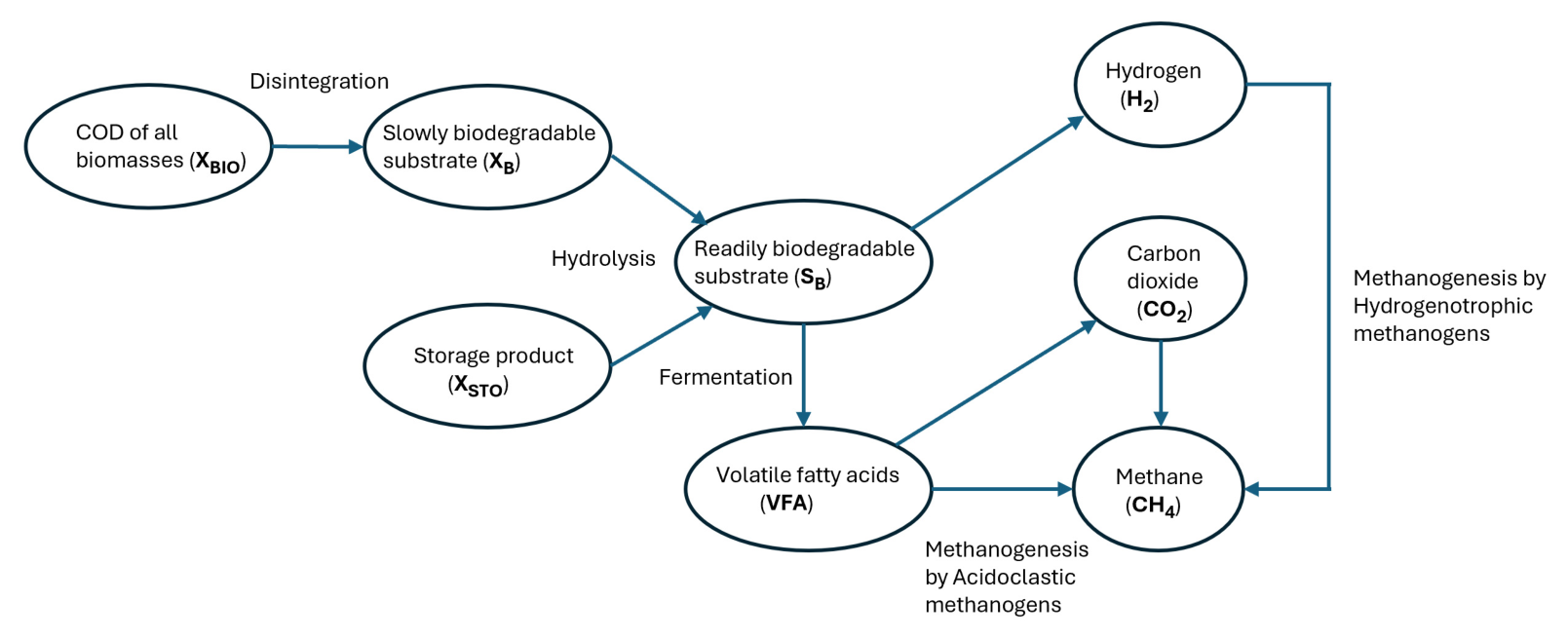
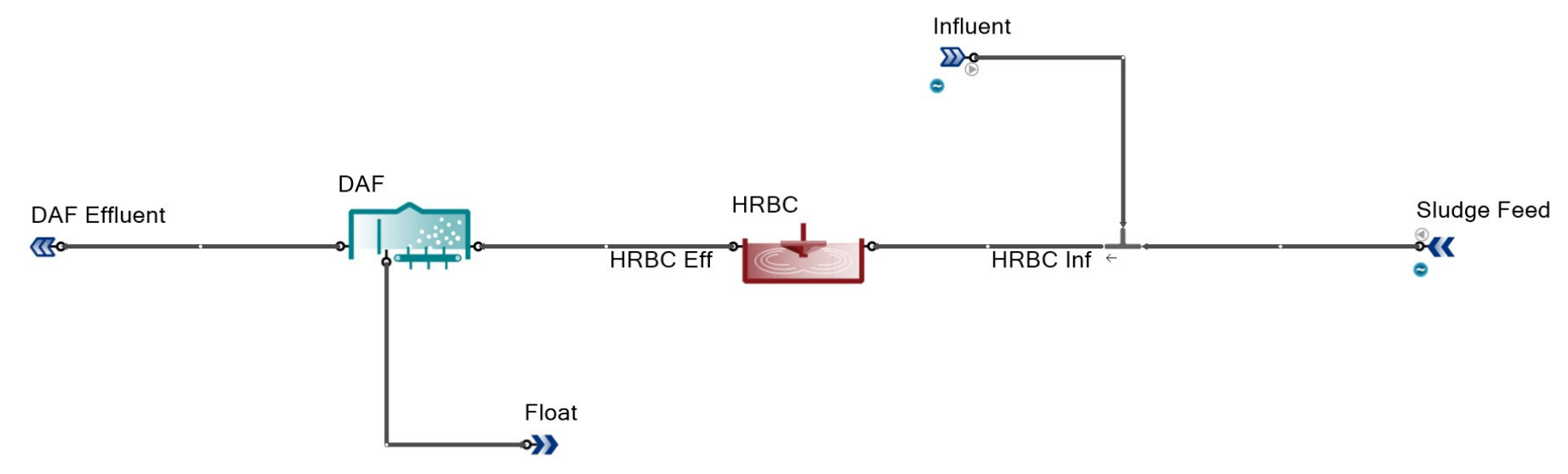
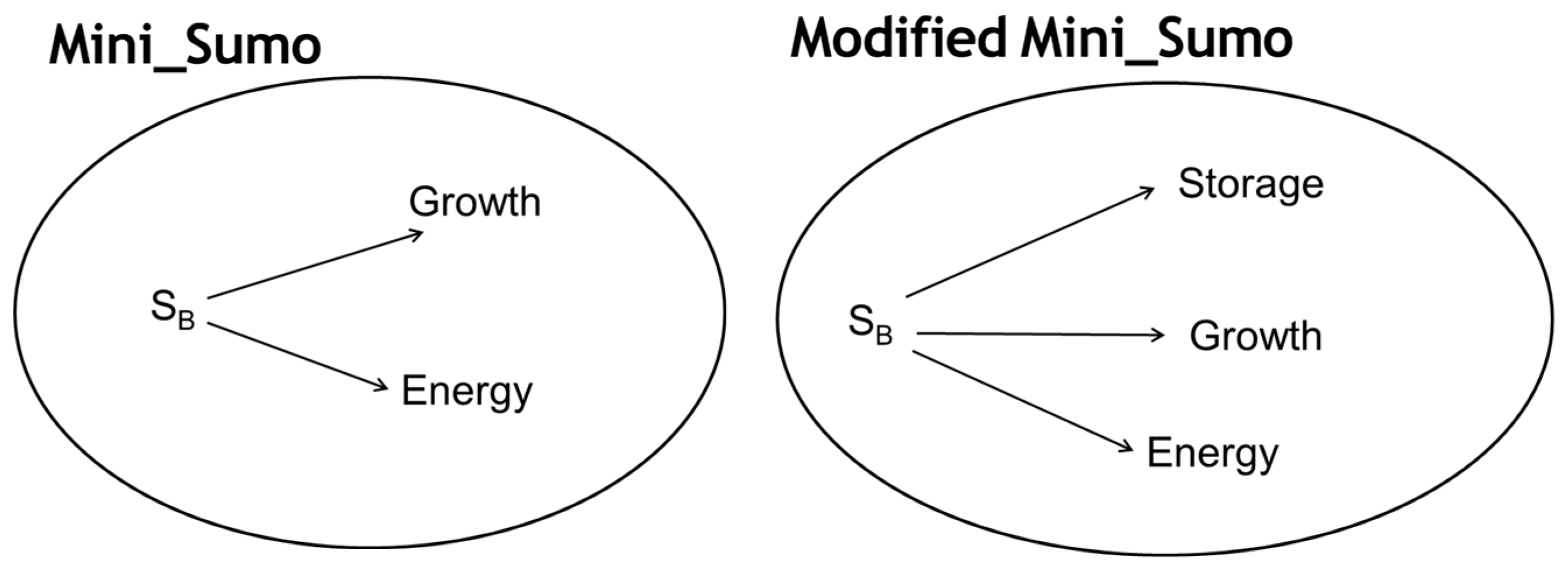
2.2. Model Description
(SALK/(KSALK + SALK)) × XOHO
3. Results and Discussion
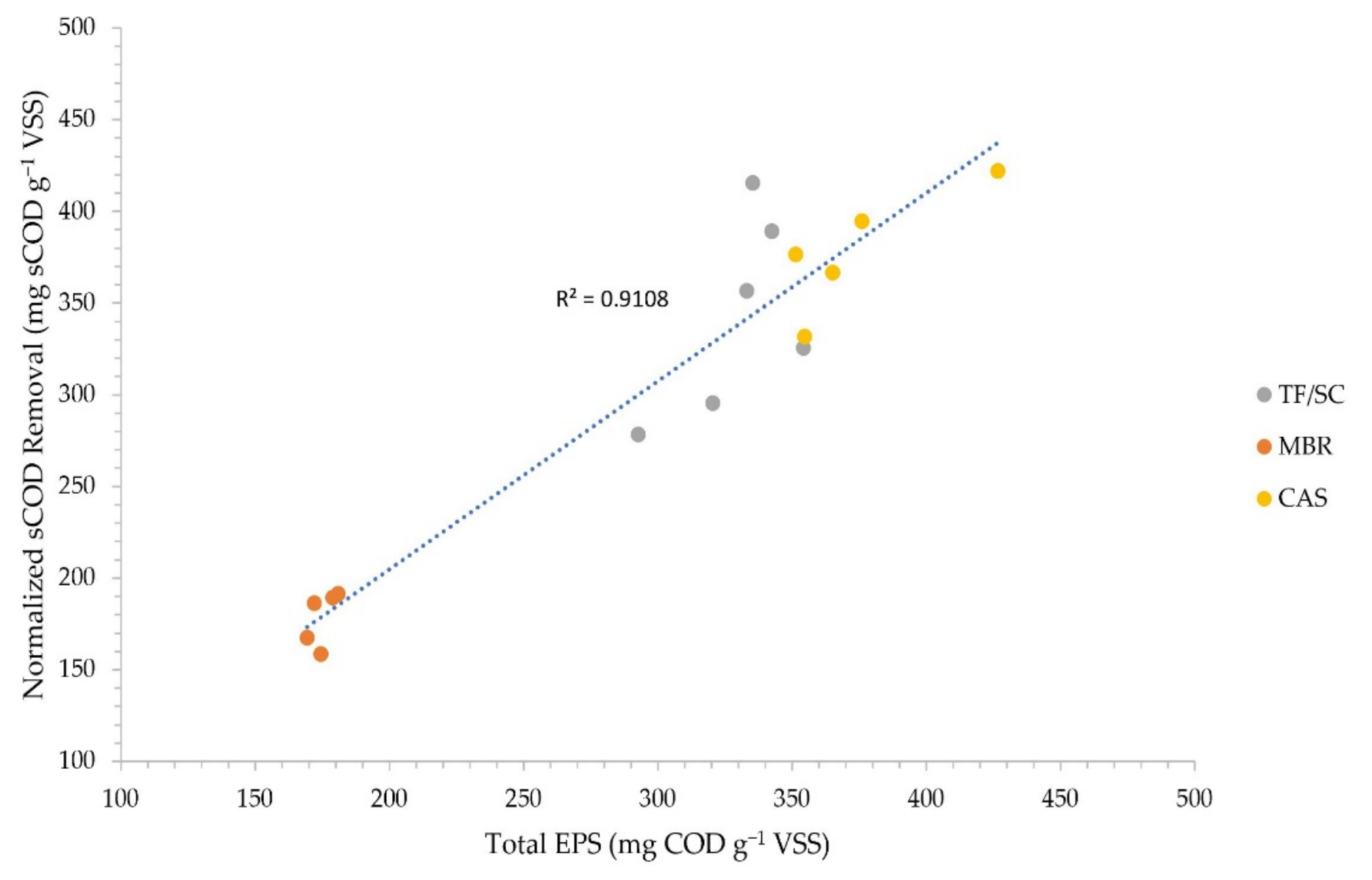
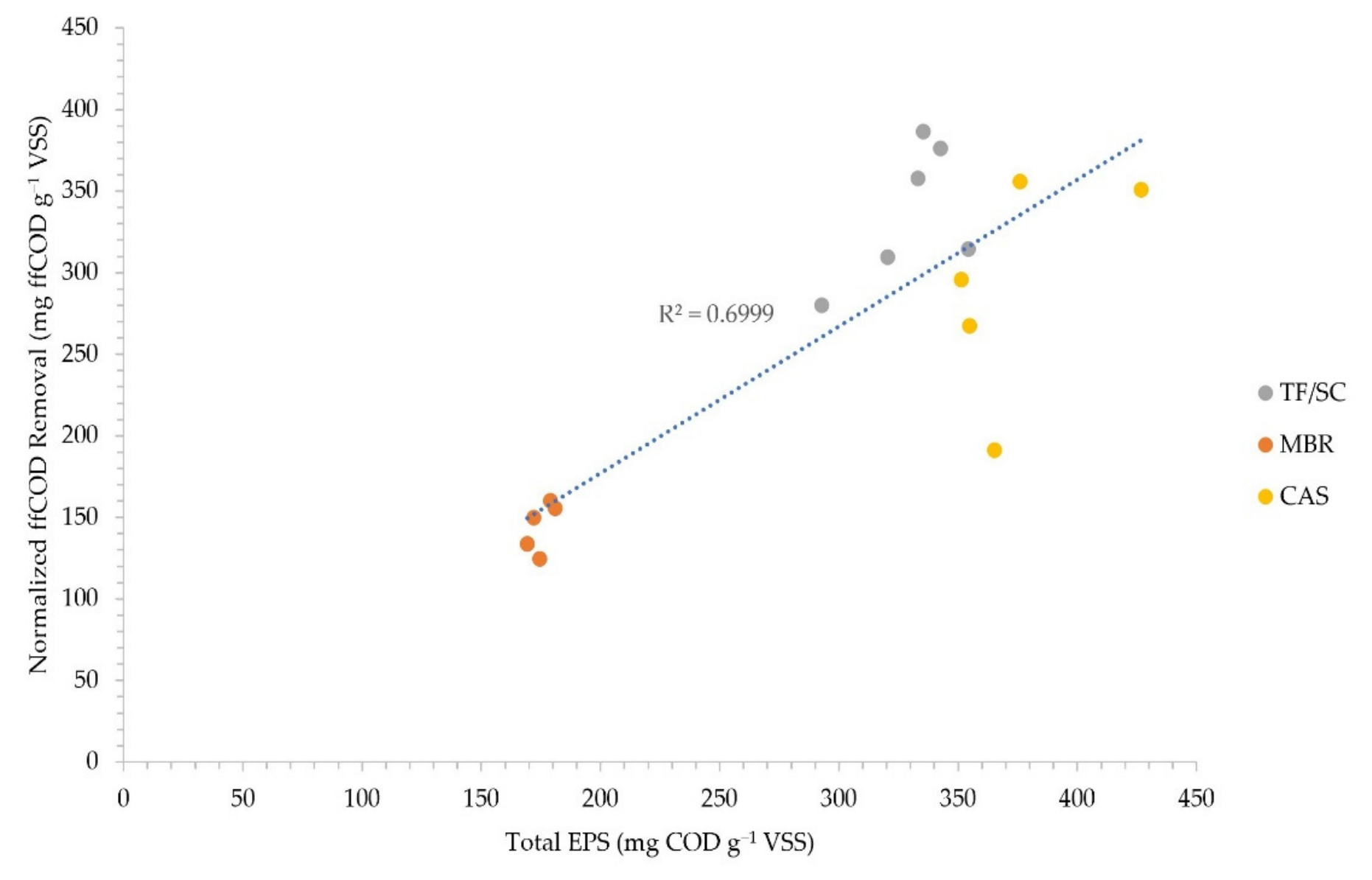
3.1. EPS in COD Correlation with sCOD and ffCOD Removal
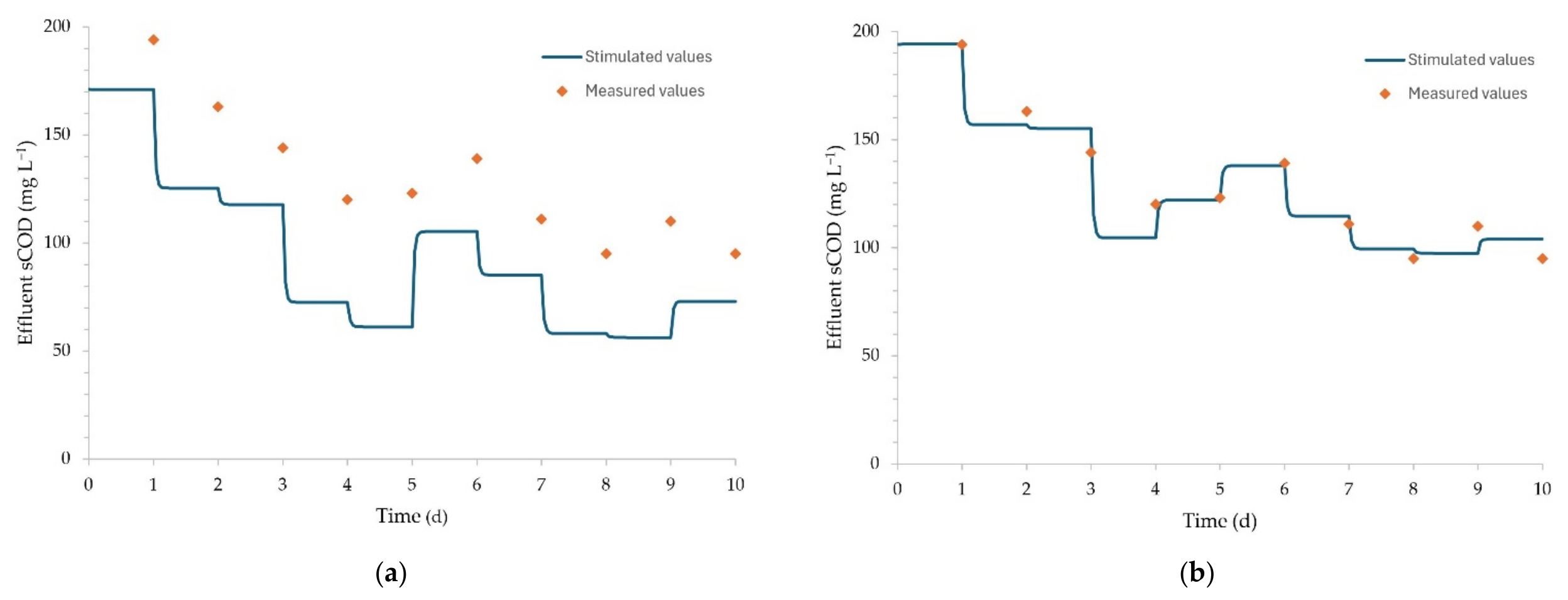
3.2. HRBC Model Calibration Using Pilot Test Data
3.3. Full-Scale HRBC Design Prediction
4. Conclusions
Author Contributions
Funding
Data Availability Statement
Acknowledgments
Conflicts of Interest
References
- Guven, H.; Dereli, R.K.; Ozgun, H.; Ersahin, M.E.; Ozturk, I. Towards sustainable and energy efficient municipal wastewater treatment by up-concentration of organics. Prog. Energy Combust. Sci. 2019, 70, 145–168. [Google Scholar] [CrossRef]
- Bellation, S.; Guerin, S.; Pautremat, N.; Bernier, J.; Muller, M.; Motellet, S.; Azimi, S.; Pauss, A.; Rocher, V. Early assessment of a rapid alternative method for the estimation of the biomethane potential of sewage sludge. Bioresour. Technol. 2016, 206, 279–284. [Google Scholar] [CrossRef] [PubMed]
- Caliskaner, O.; Tchobanoglous, G.; Wu, Z.; Young, R.; Paez, C.; Davis, B.; Mansell, B.; Ackman, P.; Reid, T.; Dyson, J. Performance of full scale and demonstration-scale primary filtration projects. In WEFTEC 2018; Water Environment Federation: Washington, DC, USA, 2018; pp. 70–84. [Google Scholar]
- Wong, T.P.; Babcock, R.W., Jr.; Hu, B.; Schneider, J.; Milan, S. High-rate biological contactor system using waste activated sludge from trickling filter/solids contact process. Water Sci. Technol. 2020, 81, 2202–2210. [Google Scholar] [CrossRef] [PubMed]
- Wong, T.P.; Babcock, R.W., Jr.; Uekawa, T.; Schneider, J. Extracellular polymeric substance composition effects on biosorption for primary carbon diversion. Water 2024, 16, 1116. [Google Scholar] [CrossRef]
- Doyle, M.; Erdogan, A.; Antonneau, N.; Johnson, B.; Babcock, R.; Wong, T.P.; Eljerdi, H.B. Biological enhanced primary treatment: A summary of experience from pilot, demonstration, and full-scale system. In Residuals and Biosolids Conference 2018; Water Environment Federation: Washington, DC, USA, 2018. [Google Scholar]
- Hauduc, H.; Al-Omari, A.; Wett, B.; Jimenez, J.; Clippeleir, H.D.; Rahman, A.; Wadhawan, T.; Takacs, I. Colloids, flocculation and carbon capture—A comprehensive plant-wide model. Water Sci. Technol. 2019, 79, 15–25. [Google Scholar] [CrossRef] [PubMed]
- Nogaj, T.; Randall, A.; Jimenez, J.; Takacs, I.; Bott, C.; Miller, M.; Murthy, S.; Wett, B. Modeling of organic substrate transformation in the high-rate activated sludge process. Water Sci. Technol. 2015, 71, 971–979. [Google Scholar] [CrossRef] [PubMed]
- Smitshuijzen, J.; Perez, J.; Duin, O.; van Loosdrecht, M.C. A simple model to describe the performance of highly-loaded aerobic COD removal reactors. Biochem. Eng. J. 2016, 112, 94–102. [Google Scholar] [CrossRef]
- What’s New in Sumo19. Available online: https://dynamita.com/uploads/What%E2%80%99s-new-in-Sumo19.pdf (accessed on 17 November 2024).
- Canals, J.; Cabrera-Codony, A.; Carbom, O.; Toran, J.; Martin, M.; Baldi, M.; Gutierrez, B.; Poch, M.; Ordonez, A.; Monclus, H. High-rate activated sludge at very short SRT: Key factors for process stability and performance of COD fractions removal. Water Res. 2023, 231, 119610. [Google Scholar] [CrossRef] [PubMed]
- Dynamita. Sumo22.1 Technical Reference. 2023. Available online: https://dynamita.com/sumo22.1/Sumo22.1%20documentation.pdf (accessed on 11 June 2026).
- Waterborg, J.H.; Matthews, H.R. The Lowry Method for Protein Quantitation. In Methods in Molecular Biology, 1st ed.; Walker, J.M., Ed.; Humana Press: Clifton, NJ, USA, 1984; Volume 1, pp. 1–3. [Google Scholar]
- Gaudy, A.F., Jr. Colorimetric Determination of Protein and Carbohydrate. Ind. Water Wastes 1962, 7, 17–22. [Google Scholar]
- Frolund, B.; Griebe, T.; Nielsen, P.H. Enzymatic activity in the activated-sludge floc matrix. Appl. Microbiol. Biotechnol. 1995, 43, 755–761. [Google Scholar] [CrossRef] [PubMed]
- Kintner, P.K., III; Buren, J.P.V. Carbohydrate Interference and Its Correction in Pectin Analysis Using the m-Hydroxydiphenyl Method. J. Food Sci. 1982, 47, 756–759. [Google Scholar] [CrossRef]
- Liu, H.; Fang, H.H.P. Extraction of extracellular polymeric substances (EPS) of sludges. J. Biotechnol. 2002, 95, 249–256. [Google Scholar] [CrossRef] [PubMed]
- Schneider, J.; Babcock, R.W., Jr.; Wong, T.P.; Hu, B. Effects of mixing ratio, contact time and dissolved oxygen on efficiency of biosorption for primary carbon diversion. Int. J. Water Wastewater Treat 2020, 6, 1–7. [Google Scholar]
- Guellil, A.; Thomas, F.; Block, J.C.; Bersillon, J.L.; Ginestet, P. Transfer of organic matter between wastewater and activated sludge flocs. Water Res. 2001, 35, 143–150. [Google Scholar] [CrossRef] [PubMed]




| mg COD g VSS−1 | ||||||
|---|---|---|---|---|---|---|
| WWTP | Process | fEPS (%) | Carbohydrate | Protein | Humic Acid | Uronic Acid |
| A | TF/SC | 33 ± 2.1 | 34 ± 2.1 | 133 ± 16.8 | 160 ± 12.4 | 3 ± 0.6 |
| B | MBR | 18 ± 0.5 | 29 ± 1.6 | 86 ± 2.0 | 56 ± 2.1 | 5 ± 0.2 |
| C | CAS | 37 ± 3.1 | 50 ± 5.9 | 186 ± 18.4 | 135 ± 28.8 | 4 ± 0.7 |
| mg Removed per mg Total EPS 1 | mg Removed per mg Total CODEPS | ||||
|---|---|---|---|---|---|
| WWTP | Process | sCOD | ffCOD | sCOD | ffCOD |
| A | TF/SC | 1.41 ± 0.16 | 1.33 ± 0.15 | 1.04 ± 0.13 | 1.02 ± 0.10 |
| B | MBR | 1.39 ± 0.08 | 1.11 ± 0.08 | 1.02 ± 0.07 | 0.83 ± 0.07 |
| C | CAS | 1.50 ± 0.18 | 1.14 ± 0.21 | 1.01 ± 0.05 | 0.78 ± 0.16 |
| Average | 1.43 ± 0.15 | 1.20 ± 0.18 | 1.02 ± 0.11 | 0.88 ± 0.16 | |
| Time | Flow | TCOD | sCOD | BOD | TSS | VSS |
|---|---|---|---|---|---|---|
| [Day] | [L Min−1] | [mg L−1] | [mg L−1] | [mg L−1] | [mg L−1] | [mg L−1] |
| 1 | 833 | 622 | 220 | 270 | 200 | 192 |
| 2 | 833 | 617 | 170 | 247 | 340 | 328 |
| 3 | 833 | 521 | 190 | 263 | 252 | 136 |
| 4 | 833 | 501 | 137 | 234 | 244 | 196 |
| 5 | 681 | 540 | 166 | 253 | 200 | 148 |
| 6 | 833 | 511 | 170 | 259 | 196 | 172 |
| 7 | 833 | 496 | 148 | 240 | 196 | 176 |
| 8 | 719 | 657 | 142 | 312 | 553 | 513 |
| 9 | 712 | 687 | 135 | 296 | 400 | 300 |
| 10 | 833 | 663 | 137 | 448 | 433 | 380 |
| Time | Flow | TCOD | sCOD | TSS | VSS |
|---|---|---|---|---|---|
| [Day] | [L Min−1] | [mg L−1] | [mg L−1] | [mg L−1] | [mg L−1] |
| 1 | 37.9 | 3940 | 105 | 2420 | 2380 |
| 2 | 64.3 | 4972 | 387 | 2140 | 2040 |
| 3 | 41.6 | 6656 | 180 | 4180 | 3560 |
| 4 | 41.6 | 8420 | 84 | 3640 | 3080 |
| 5 | 64.3 | 3952 | 312 | 3140 | 2740 |
| 6 | 41.6 | 4656 | 122 | 3460 | 3100 |
| 7 | 41.6 | 4716 | 87 | 3220 | 2800 |
| 8 | 37.9 | 5016 | 54 | 3700 | 3267 |
| 9 | 38.6 | 4804 | 137 | 3500 | 3133 |
| 10 | 47.3 | 3732 | 48 | 2933 | 2633 |
| Time [d] | Measured Effluent sCOD [mg L−1] | Modeled Effluent sCOD [mg L−1] | Model Error |
|---|---|---|---|
| 1 | 194 | 194.3 | 0.1% |
| 2 | 163 | 157.1 | −3.6% |
| 3 | 144 | 155.5 | 8.0% |
| 4 | 120 | 104.9 | −12.6% |
| 5 | 123 | 122.5 | −0.4% |
| 6 | 139 | 138.1 | −0.6% |
| 7 | 111 | 114.8 | 3.4% |
| 8 | 95 | 99.7 | 4.9% |
| 9 | 110 | 97.7 | −11.2% |
| 10 | 95 | 104.2 | 9.7% |
| Raw Wastewater Plus Return Flows | WAS | |
|---|---|---|
| Flow [MLD] | 142.33 | 7.72 |
| Total COD [mg L−1] | 541 | 2549 |
| sCOD [mg L−1] | 224 | 40 |
| TSS [mg L−1] | 269 | 2131 |
| VSS [mg L−1] | 241 | 1762 |
| Total Kjeldahl nitrogen, TKN [mg N L−1] | 46 | 126 |
| Ammonia [mg N L−1] | 40 | 2 |
| Nitrite + Nitrate [mg N L−1] | 0 | 10 |
| Total phosphorus [mg P L−1] | 10 | 91 |
| Ortho-phosphates [mg P L−1] | 6 | 4 |
| Proprietary Model | Modified Model | |||
|---|---|---|---|---|
| HRBC Influent | DAF Effluent | HRBC Influent | DAF Effluent | |
| Flow [MLD] | 150.05 | 150.05 | 150.05 | 150.05 |
| Total COD [mg L−1] | 644 | 309 | 644 | 320 |
| Particulate COD [mg L−1] | 429 | 140 | 429 | 140 |
| sCOD [mg L−1] | 215 | 169 | 215 | 180 |
| TSS [mg L−1] | 364 | 117 | 367 | 118 |
| VSS [mg L−1] | 319 | 102 | 321 | 104 |
| TKN [mg N L−1] | 50 | 42 | 50 | 43 |
| Ammonia [mg N L−1] | 38 | 37 | 38 | 38 |
| Nitrite + Nitrate [mg N L−1] | 1 | 1 | 1 | 1 |
| Total phosphorus [mg P L−1] | 14 | 8 | 14 | 8 |
| Ortho-phosphates [mg P L−1] | 6 | 6 | 6 | 6 |
Disclaimer/Publisher’s Note: The statements, opinions and data contained in all publications are solely those of the individual author(s) and contributor(s) and not of MDPI and/or the editor(s). MDPI and/or the editor(s) disclaim responsibility for any injury to people or property resulting from any ideas, methods, instructions or products referred to in the content. |
© 2026 by the authors. Licensee MDPI, Basel, Switzerland. This article is an open access article distributed under the terms and conditions of the Creative Commons Attribution (CC BY) license.
Share and Cite
Wong, T.P.; Babcock, R.W., Jr.; Uekawa, T.; Schneider, J. A Simplified Whole-Plant Model to Predict Biosorption in a High-Rate Biological Contactor—Activated Sludge Process. Water 2026, 18, 1472. https://doi.org/10.3390/w18121472
Wong TP, Babcock RW Jr., Uekawa T, Schneider J. A Simplified Whole-Plant Model to Predict Biosorption in a High-Rate Biological Contactor—Activated Sludge Process. Water. 2026; 18(12):1472. https://doi.org/10.3390/w18121472
Chicago/Turabian StyleWong, Tiow Ping, Roger W. Babcock, Jr., Theodore Uekawa, and Joachim Schneider. 2026. "A Simplified Whole-Plant Model to Predict Biosorption in a High-Rate Biological Contactor—Activated Sludge Process" Water 18, no. 12: 1472. https://doi.org/10.3390/w18121472
APA StyleWong, T. P., Babcock, R. W., Jr., Uekawa, T., & Schneider, J. (2026). A Simplified Whole-Plant Model to Predict Biosorption in a High-Rate Biological Contactor—Activated Sludge Process. Water, 18(12), 1472. https://doi.org/10.3390/w18121472