Performance Comparison of Three Photobioreactor Systems Differing in Scale, Geometry, and Operating Conditions for Landfill Leachate Treatment Using Red Algae: Nutrient Removal and Biomass Growth

 ,
,  and
and
Abstract
1. Introduction
2. Materials and Methods
2.1. Cultivation of G. sulphuraria
2.2. Source and Characteristics of Landfill Leachate
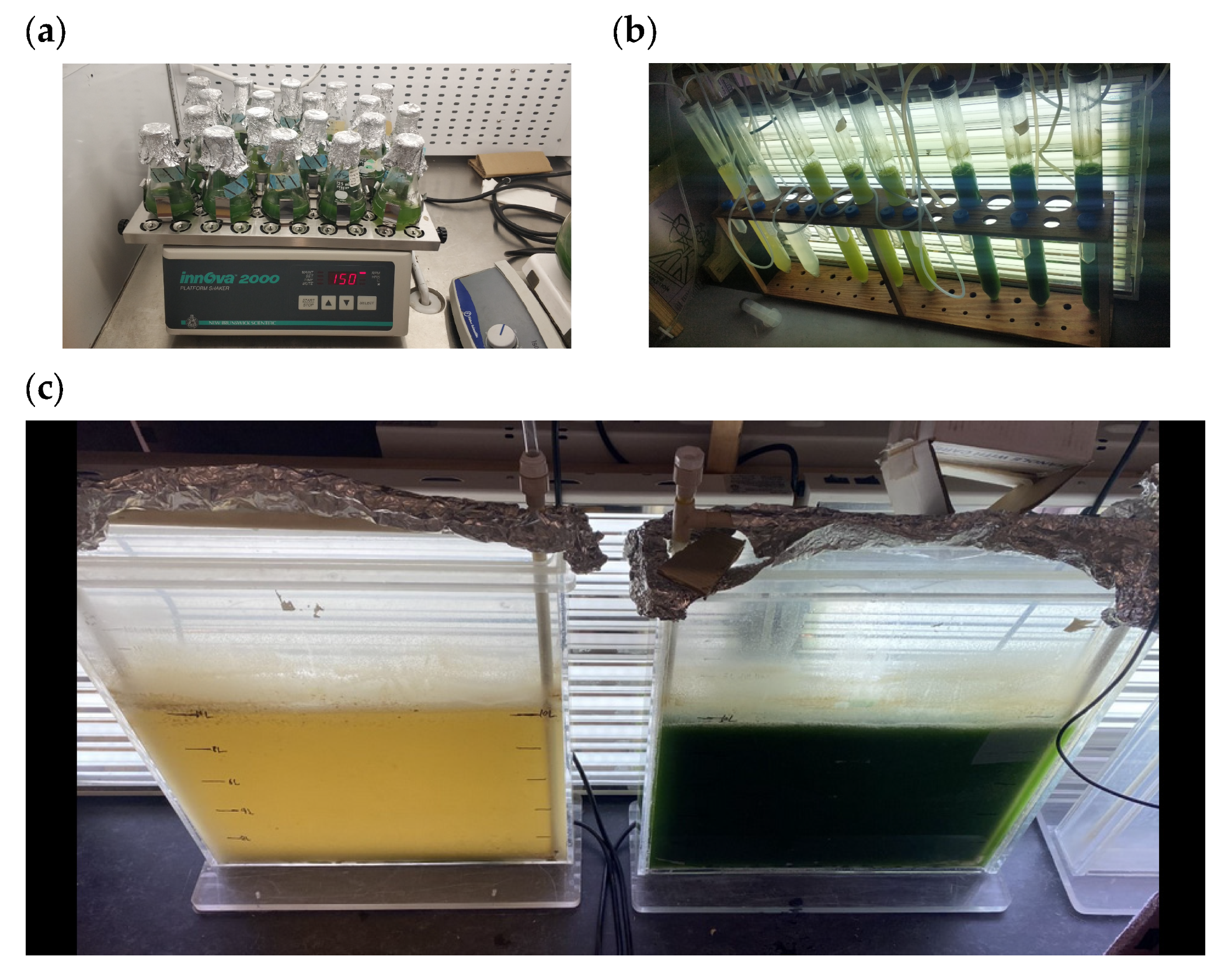
2.3. Experiment Design
2.4. Analytical Methods
2.5. Statistical Analysis
3. Results and Discussion
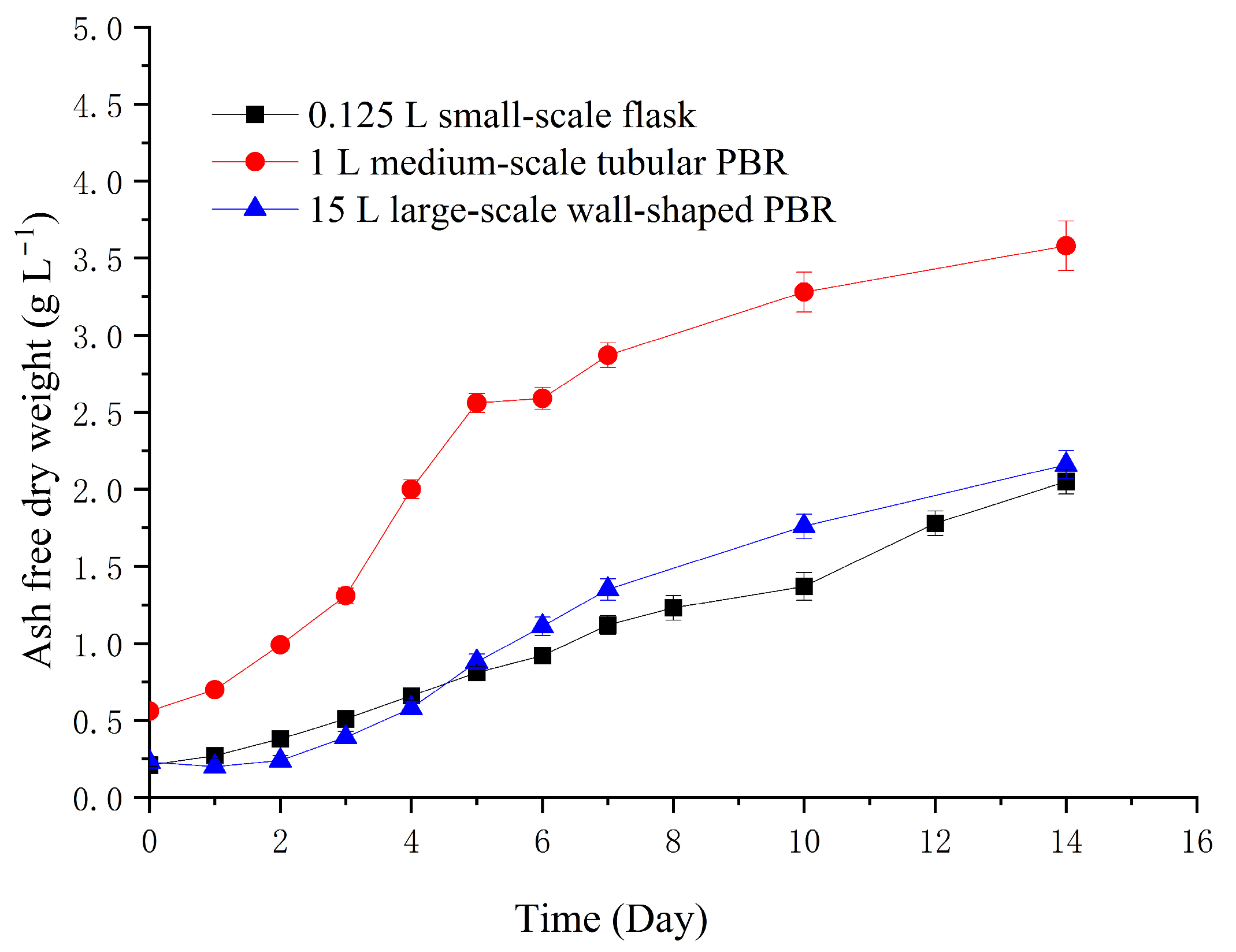
3.1. Biomass Density of Red Algae in LL Under Various Scales and Configurations
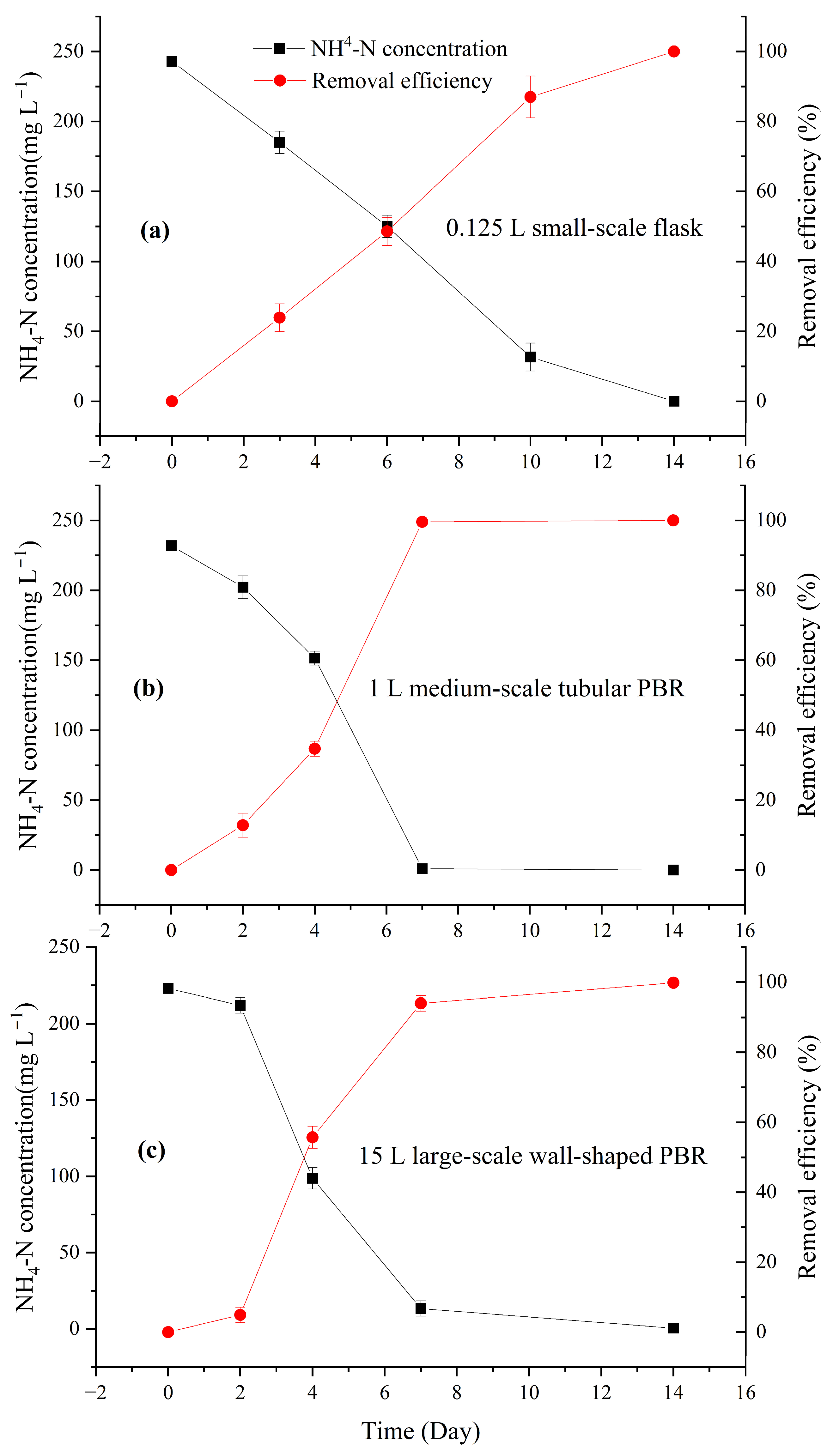
3.2. Performance of Red Algae in Removing Nitrogen from LL Medium Under Various Scales and Configurations
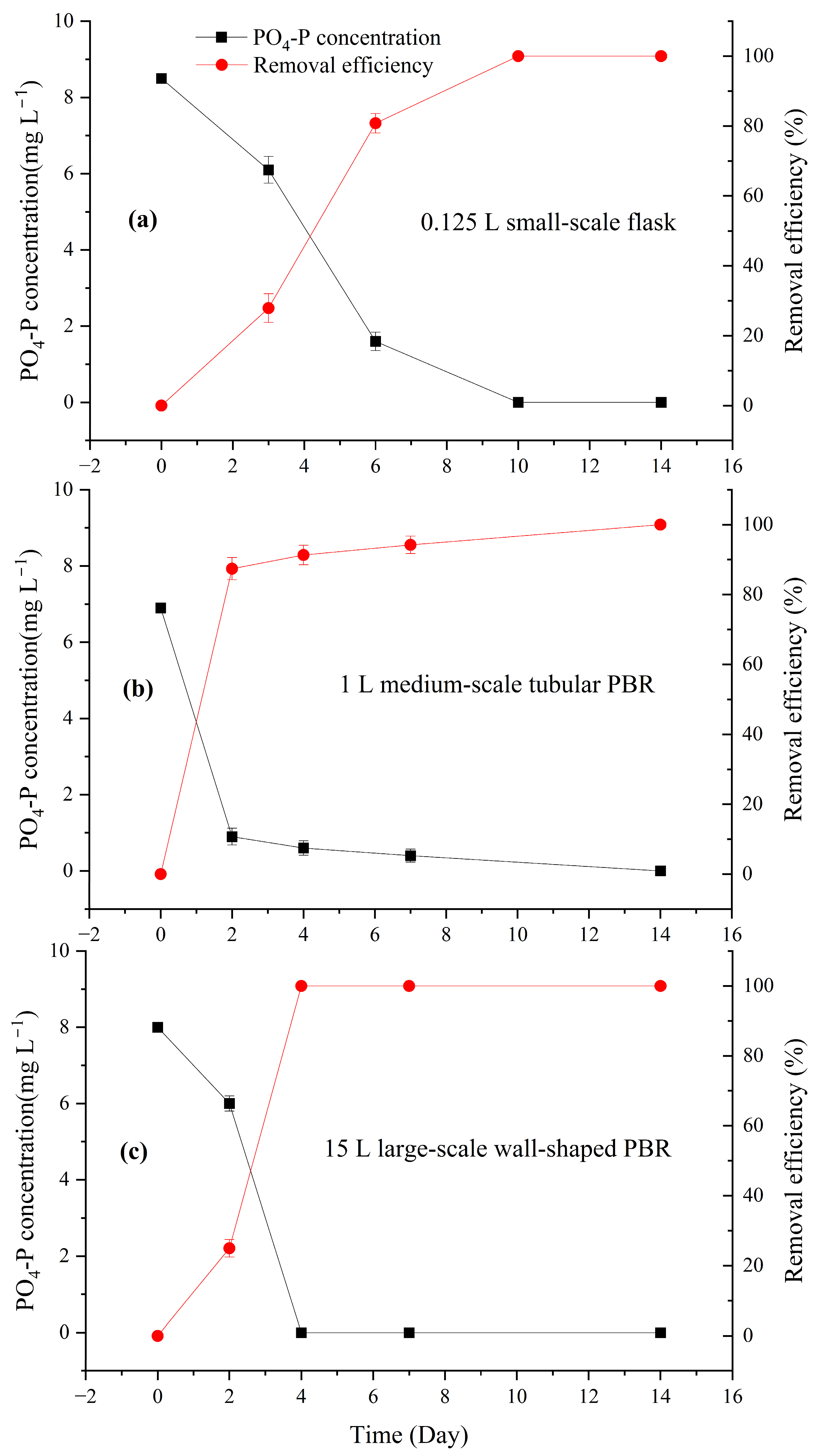
3.3. Performance of Red Algae in Removing Phosphorus from LL Medium Under Various Scales and Configurations
3.4. COD and pH Changes in the Three Bioreactor Scales and Configurations
3.5. Geometric and Operational Parameters of the Three Bioreactor Scales and Configurations
3.6. Practical Implications for Scale-Up Design
- (1)
- The medium-scale tubular reactor (1 L) outperformed both smaller and larger reactors under the specific conditions tested (including higher light intensity, bubbling aeration, and tubular geometry), suggesting that a tubular geometry with bubbling mixing is preferable to flasks or rectangular tanks;
- (2)
- Volumetric optical radiation (VOR) may be a more useful descriptive parameter than surface-area-to-volume ratio;
- (3)
- Direct use of small-scale flask data may underestimate the required light intensity and mixing energy;
- (4)
- Given limited COD removal, post-treatment should be integrated into full-scale designs.
4. Conclusions
- (1)
- Reactor scale is confounded with configuration and operating conditions (light intensity, mixing mode, aeration rate, geometry). Therefore, this study is a comparison of three specific reactor systems rather than a true scale-up experiment.
- (2)
- No-algae or abiotic controls were included, so removal by adsorption or precipitation cannot be fully excluded.
- (3)
- The large-scale reactor had only n = 2 replicates, limiting statistical power.
- (4)
- Initial biomass concentrations were not perfectly equal across reactors. These caveats are discussed in relation to each result in the relevant sections.
Author Contributions
Funding
Data Availability Statement
Acknowledgments
Conflicts of Interest
Abbreviations
| LL | Landfill leachate |
| TEAs | Techno-economic analyses |
| CM | Cyanidium medium |
| OP | Optical density |
| PBR | Photobioreactor |
| LESA | Light-exposed Surface Area |
| COD | Chemical oxygen demand |
| TOC | Total organic carbon |
| BOD5 | Biochemical oxygen demand |
| NH4-N | Ammonia nitrogen |
| NO3-N | Nitrate nitrogen |
| NO2-N | Nitrite nitrogen |
| TN | Total nitrogen |
| PO4-P | Free phosphate phosphorus |
| TP | Total phosphorus |
| VOR | Volumetric optical radiation |
| CCMEE | the Culture Collection of Microorganisms from Extreme Environments |
References
- Renou, S.; Givaudan, J.G.; Poulain, S.; Dirassouyan, F.; Moulin, P. Landfill leachate treatment: Review and opportunity. J. Hazard. Mater. 2008, 150, 468–493. [Google Scholar] [CrossRef] [PubMed]
- Zuorro, A.; Ortiz-Alvarez, M.D.; Lavecchia, R.; Barajas-Ferreira, C.; García-Martínez, J.B.; Barajas-Solano, A.F. A Circular Economy Approach to Landfill Leachate Biotransformation: Application of Microalgae and Cyanobacteria for Environmental Sustainability and Value-Added Products. Water 2026, 18, 462. [Google Scholar] [CrossRef]
- Ghosh, P.; Thakur, I.S. Biosorption of landfill leachate by Phanerochaete sp ISTL01: Isotherms, kinetics and toxicological assessment. Environ. Technol. 2017, 38, 1800–1811. [Google Scholar] [CrossRef]
- Delanka-Pedige, H.M.K.; Munasinghe-Arachchige, S.P.; Cornelius, J.; Henkanatte-Gedera, S.M.; Tchinda, D.; Zhang, Y.Y.; Nirmalakhandan, N. Pathogen reduction in an algal-based wastewater treatment system employing Galdieria sulphuraria. Algal Res.-Biomass Biofuels Bioprod. 2019, 39, 6. [Google Scholar] [CrossRef]
- Mustafa, E.M.; Phang, S.M.; Chu, W.L. Use of an algal consortium of five algae in the treatment of landfill leachate using the high-rate algal pond system. J. Appl. Phycol. 2012, 24, 953–963. [Google Scholar] [CrossRef]
- Martínez, M.E.; Sánchez, S.; Jiménez, J.M.; El Yousfi, F.; Muñoz, L. Nitrogen and phosphorus removal from urban wastewater by the microalga Scenedesmus obliquus. Bioresour. Technol. 2000, 73, 263–272. [Google Scholar] [CrossRef]
- Lin, L.; Chan, G.Y.; Jiang, B.L.; Lan, C.Y. Use of ammoniacal nitrogen tolerant microalgae in landfill leachate treatment. Waste Manag. 2007, 27, 1376–1382. [Google Scholar] [CrossRef]
- Kumari, M.; Ghosh, P.; Thakur, I.S. Landfill leachate treatment using bacto-algal co-culture: An integrated approach using chemical analyses and toxicological assessment. Ecotoxicol. Environ. Saf. 2016, 128, 44–51. [Google Scholar] [CrossRef]
- Costa, R.H.R.; Martins, C.L.; Fernandes, H.; Velho, V.F. Consortia of microalgae and bacteria in the performance of a stabilization pond system treating landfill leachate. Water Sci. Technol. 2014, 70, 486–494. [Google Scholar] [CrossRef]
- Selvaratnam, T.; Pan, S.; Rahman, A.; Tan, M.; Kharel, H.L.; Agrawal, S.; Nawaz, T. Bioremediation of Raw Landfill Leachate Using Galdieria sulphuraria: An Algal-Based System for Landfill Leachate Treatment. Water 2022, 14, 2389. [Google Scholar] [CrossRef]
- Paskuliakova, A.; McGowan, T.; Tonry, S.; Touzet, N. Phycoremediation of landfill leachate with the chlorophyte Chlamydomonas sp SW15aRL and evaluation of toxicity pre and post treatment. Ecotoxicol. Environ. Saf. 2018, 147, 622–630. [Google Scholar] [CrossRef] [PubMed]
- Tang, C.C.; Liu, J.Q.; Cheng, Y.Q.; Hu, Y.R.; He, Z.W.; Wang, W.Q.; Li, Z.H.; Wang, X.C.; Tian, Y. Designing light-guiding carriers in microalgal-bacterial systems: From optimization to integration and development perspectives. Chem. Eng. J. 2025, 525, 15. [Google Scholar] [CrossRef]
- Portillo, F.V.L.; Montenegro-Herrera, C.A.; Porta, H.; Martinez, A. Self-Shading effect caused by high biomass concentration increased phycocyanin accumulation in Galdieria sulphuraria strain UTEX 2919 under autotrophic conditions. J. Appl. Phycol. 2026, 38, 131–140. [Google Scholar] [CrossRef]
- Wang, S.K.; Stiles, A.R.; Guo, C.; Liu, C.Z. Microalgae cultivation in photobioreactors: An overview of light characteristics. Eng. Life Sci. 2014, 14, 550–559. [Google Scholar] [CrossRef]
- Dayanath, W.M.S.; Lim, Y.A.; Ilankoon, I.; Chong, M.N.; Foo, S.C. Flow visualisation in flat panel photobioreactors with optimised gas spargers using fluorescent dyes and microspheres to evaluate mixing mechanisms and microalgae growth. Bioresour. Technol. Rep. 2025, 32, 13. [Google Scholar] [CrossRef]
- Ren, S.Y.; Shao, C.; Zhu, F.F.; Schagerl, M.; Hu, X.J.; Sobhi, M.; Xu, L.; Qian, J.Y.; Huo, S.H. Optimization and synergistic enhancement of microalgae productivity in laboratory raceway ponds via co-regulation of automated light-supplemented mixers and electric field system. Biotechnol. Biofuels Bioprod. 2025, 18, 16. [Google Scholar] [CrossRef]
- Ndiaye, M.; Gadoin, E.; Gentric, C. CO2 gas-liquid mass transfer and kLa estimation: Numerical investigation in the context of airlift photobioreactor scale-up. Chem. Eng. Res. Des. 2018, 133, 90–102. [Google Scholar] [CrossRef]
- Chen, Z.J.; Jiang, Z.Y.; Zhang, X.X.; Zhang, J. Numerical and experimental study on the CO2 gas-liquid mass transfer in flat-plate airlift photobioreactor with different baffles. Biochem. Eng. J. 2016, 106, 129–138. [Google Scholar] [CrossRef]
- Amanna, B.; Bahri, P.A.; Moheimani, N.R. Application of computational fluid dynamics in optimizing microalgal photobioreactors. Algal Res.-Biomass Biofuels Bioprod. 2024, 83, 17. [Google Scholar] [CrossRef]
- Cui, X.Y.; Yang, J.H.; Feng, Y.Z.; Zhang, W.W. Simulation of a Novel Tubular Microalgae Photobioreactor with Aerated Tangent Inner Tubes: Improvements in Mixing Performance and Flashing-Light Effects. Archaea-Int. Microbiol. J. 2020, 2020, 16. [Google Scholar] [CrossRef]
- Bitog, J.P.; Lee, I.B.; Lee, C.G.; Kim, K.S.; Hwang, H.S.; Hong, S.W.; Seo, I.H.; Kwon, K.S.; Mostafa, E. Application of computational fluid dynamics for modeling and designing photobioreactors for microalgae production: A review. Comput. Electron. Agric. 2011, 76, 131–147. [Google Scholar] [CrossRef]
- Toplin, J.A.; Norris, T.B.; Lehr, C.R.; McDermott, T.R.; Castenholz, R.W. Biogeographic and phylogenetic diversity of thermoacidophilic Cyanidiales in Yellowstone National Park, Japan, and New Zealand. Appl. Environ. Microbiol. 2008, 74, 2822–2833. [Google Scholar] [CrossRef]
- Pan, S.; Dixon, K.L.; Nawaz, T.; Rahman, A.; Selvaratnam, T. Evaluation of Galdieria sulphuraria for nitrogen removal and biomass production from raw landfill leachate. Algal Res. 2021, 54, 102183. [Google Scholar] [CrossRef]
- Pan, S. Bioremediation of Landfill Leachate Using an Algal-Based System: An Application of Red Alga Galdieria sulphuraria; Lamar University-Beaumont: Beaumont, TX, USA, 2021. [Google Scholar]
- Singh, S.P.; Singh, P. Effect of temperature and light on the growth of algae species: A review. Renew. Sustain. Energy Rev. 2015, 50, 431–444. [Google Scholar] [CrossRef]
- Sniffen, K.D.; Price, J.R.; Sales, C.M.; Olson, M.S. Influence of Scale on Biomass Growth and Nutrient Removal in an Algal-Bacterial Leachate Treatment System. Environ. Sci. Technol. 2017, 51, 13344–13352. [Google Scholar] [CrossRef]
- Porto, B.; Goncalves, A.L.; Esteves, A.F.; de Souza, S.; de Souza, A.A.U.; Vilar, V.J.P.; Pires, J.C.M. Assessing the potential of microalgae for nutrients removal from a landfill leachate using an innovative tubular photobioreactor. Chem. Eng. J. 2021, 413, 127546. [Google Scholar] [CrossRef]




| Parameters | CM | LL |
|---|---|---|
| pH | 2.50 | 8.08 ± 0.20 |
| Conductivity | 5.55 | 22.47 ± 0.01 |
| Total solids | 2.60 | 23.97 ± 0.24 |
| Chemical oxygen demand (COD) | 0 | 4827 ± 186 |
| Total organic carbon (TOC) | 0 | 743 ± 16 |
| Biochemical oxygen demand (BOD5) | 0 | 650 ± 10 |
| Free phosphate phosphorus (PO4-P) | 61.50 | 4.47 ± 0.11 |
| Total phosphorus (TP) | 61.50 | 18.80 ± 0.20 |
| Ammonia nitrogen (NH4-N) | 280 | 1140 ± 29 |
| Nitrate nitrogen (NO3-N) | 0 | 7.08 ± 0.05 |
| Nitrite nitrogen (NO2-N) | 0 | 0.13 ± 0.02 |
| Total nitrogen (TN) | 280 | 1320 ± 35 |
| Ca | 19 | 148 ± 3 |
| Mg | 25 | 254 ± 7 |
| Na | 47 | >1000 |
| K | 78 | 832 ± 43 |
| Fe | 0.10 | 1.00 ± 0.07 |
| Mn | 0.72 | 0.45 ± 0.01 |
| Zn | 0.11 | 2.36 ± 0.01 |
| Cu | 0.004 | 1.14 ± 0.16 |
| Final Biomass Density | Biomass Growth Rate | Yield | μ ** | CO2 Fixation Rate | NH4-N Removal Efficiency | NH4-N Removal Rate | PO4-P Removal Efficiency | PO4-P Removal Rate | |
|---|---|---|---|---|---|---|---|---|---|
| g L−1 | g L−1day−1 | g gN−1 * | day−1 | g L−1day−1 | % | mg L−1day−1 | % | mg L−1day−1 | |
| small-scale | 2.05 ± 0.08 | 0.146 ± 0.014 | 7.56 | 0.27 | 0.18 | 100 | 21.09 ± 1.48 | 100 | 1.15 ± 0.17 |
| medium-scale | 3.58 ± 0.16 | 0.461 ± 0.076 | 13.02 | 0.32 | 0.58 | 100 | 33.14 ± 0.09 | 100 | 3.05 ± 0.11 |
| large-scale | 2.16 ± 0.09 | 0.222 ± 0.001 | 8.67 | 0.31 | 0.28 | 100 | 29.96 ± 0.16 | 100 | 2.05 ± 0.08 |
| p-Value of Multiple Comparisons | Final Biomass Density | Biomass Growth Rate | NH4-N Removal Rate | PO4-P Removal Rate |
|---|---|---|---|---|
| small-scale vs. medium-scale | <0.0005 | 0.0005 | <0.0005 | <0.0005 |
| small-scale vs. large-scale | 0.716 | 0.1496 | <0.0005 | <0.0005 |
| medium-scale vs. large-scale | <0.0005 | 0.0031 | 0.0096 | <0.0005 |
| Scale | Bioreactor (Working Volume) | Light-Exposed Surface Area (LESA) | LESA:V | Light Intensity (LI) | LESA × LI:V | Mixing Type |
|---|---|---|---|---|---|---|
| m2 | m−1 | lux | ||||
| small | 0.125 L flask (50 mL) | 0.005 | 100 | 4000 | 400,000 | Shaking platform |
| medium | 1 L tubular PBR (500 mL) | 0.022 | 44 | 20,000 | 880,000 | bubbling |
| large | 15 L wall-shape PBR (10 L) | 0.307 | 30 | 20,000 | 600,000 | bubbling |
Disclaimer/Publisher’s Note: The statements, opinions and data contained in all publications are solely those of the individual author(s) and contributor(s) and not of MDPI and/or the editor(s). MDPI and/or the editor(s) disclaim responsibility for any injury to people or property resulting from any ideas, methods, instructions or products referred to in the content. |
© 2026 by the authors. Licensee MDPI, Basel, Switzerland. This article is an open access article distributed under the terms and conditions of the Creative Commons Attribution (CC BY) license.
Share and Cite
Pan, S.; Shi, X.; Ruan, R.; Xu, X.; Selvaratnam, T.; Zhou, D. Performance Comparison of Three Photobioreactor Systems Differing in Scale, Geometry, and Operating Conditions for Landfill Leachate Treatment Using Red Algae: Nutrient Removal and Biomass Growth. Water 2026, 18, 1471. https://doi.org/10.3390/w18121471
Pan S, Shi X, Ruan R, Xu X, Selvaratnam T, Zhou D. Performance Comparison of Three Photobioreactor Systems Differing in Scale, Geometry, and Operating Conditions for Landfill Leachate Treatment Using Red Algae: Nutrient Removal and Biomass Growth. Water. 2026; 18(12):1471. https://doi.org/10.3390/w18121471
Chicago/Turabian StylePan, Shanglei, Xiaoyang Shi, Renjun Ruan, Xiaoping Xu, Thinesh Selvaratnam, and Dongbao Zhou. 2026. "Performance Comparison of Three Photobioreactor Systems Differing in Scale, Geometry, and Operating Conditions for Landfill Leachate Treatment Using Red Algae: Nutrient Removal and Biomass Growth" Water 18, no. 12: 1471. https://doi.org/10.3390/w18121471
APA StylePan, S., Shi, X., Ruan, R., Xu, X., Selvaratnam, T., & Zhou, D. (2026). Performance Comparison of Three Photobioreactor Systems Differing in Scale, Geometry, and Operating Conditions for Landfill Leachate Treatment Using Red Algae: Nutrient Removal and Biomass Growth. Water, 18(12), 1471. https://doi.org/10.3390/w18121471