Article

Quantifying Spatiotemporal Variability in Nanoplastics During Transport in Porous Media Using Low-Field Nuclear Magnetic Resonance


1
School of Earth Sciences and Engineering, Hohai University, Nanjing 210098, China
2
China Water Resources Bei Fang Investigation Design and Research Co., Ltd., Tianjin 300222, China
3
Department of Geological Engineering, Kwame Nkrumah University of Science and Technology, Kumasi AK-385-1973, Ghana
*
Author to whom correspondence should be addressed.
Water 2026, 18(12), 1429; https://doi.org/10.3390/w18121429
Submission received: 6 May 2026 / Revised: 5 June 2026 / Accepted: 7 June 2026 / Published: 10 June 2026
(This article belongs to the Section Water Quality and Contamination)

Abstract

Understanding the spatiotemporal variability of nanoplastics (NPs) in porous media is vital for environmental risk assessment, yet quantitative in-media analysis of NP distributions during transport remains limited. To address this, we innovatively applied low-field nuclear magnetic resonance (LF-NMR) as a non-invasive approach to dynamically monitor magnetic polystyrene nanoplastic (MPSNP) transport in saturated quartz sand. By establishing the relationship between LF-NMR transverse relaxation rate [1/T2,I − 1/T2,0] and MPSNP concentrations, we reconstructed spatiotemporal concentration profiles via T2 inversion. This methodology enabled systematic evaluation of the effects of ionic strength (IS), flow velocity, initial concentration, and flow direction. Three mathematical models were further applied to analyze MPSNP transport behavior. Results revealed IS as the dominant factor; increasing IS (0.001 to 1 mM) dropped mass recovery from 85.7% to 0%, the migration front no longer advanced at IS > 5 mM. Lower flow rates, higher initial concentrations, and horizontal flow also enhanced retention. The two types of two-site kinetic models provide a better fit for the features of the breakthrough curves. This novel use of LF-NMR demonstrates its robust capability to resolve spatial transport heterogeneity, underscoring that flow velocity, flow direction, and ionic strength are critical regulatory parameters that should be carefully accounted for when evaluating nanoplastic transport in porous media.

1. Introduction

Plastic products are increasingly used in modern industrial production and daily life. An estimated 13–25 million tons of plastic waste enter terrestrial ecosystems every year [1]. Plastics exhibit high chemical stability and are resistant to degradation. They only gradually fragment into microplastics (<5 mm) and nanoplastics (NPs) (<1000 nm) under environmental stressors. Environmental micro/nanoplastics (M/NPs) can enter soils through multiple pathways, including sewage sludge application, organic fertilizer use, agricultural irrigation and atmospheric deposition [2], and may subsequently migrate into the underlying aquifers [3]. Numerous studies have documented the occurrence of M/NPs in groundwater systems [4,5]. Among these, NPs, owing to their small size and large specific surface area, exhibit high mobility and a strong tendency to accumulate in groundwater environments [6]. Several studies have shown that NPs act as effective carriers for a wide range of heavy metals and organic contaminants [7], and can directly or indirectly alter the composition and functional activity of microbial communities in soil and groundwater environments [8]. Therefore, understanding and predicting the migration and fate of NPs in groundwater aquifers is essential for evaluating their environmental risks. However, research on how porous media properties and environmental conditions regulate their transport and fate remains limited [9].
At a laboratory scale, packed-column experiments are widely used to investigate the transport behavior of M/NPs in porous media. Polystyrene microplastics are commonly used, and quartz sand columns are typically employed as the porous medium. Numerous studies have used packed-column experiments to examine M/NP transport under varying porous-medium characteristics (grain size, grain shape, functional group and mineralogy), solution chemistry (pH and ionic strength) and hydrodynamic factors (flow velocity and direction) [10,11]. However, most studies monitor only the effluent concentrations and derive transport parameters by fitting a mathematical model to the breakthrough or retention curves [10]. This approach provides only bulk-scale information and fails to resolve the spatial heterogeneity of M/NP transport and deposition within the packed column.
To the spatial distribution and transport of nanoparticles in porous media, various non-invasive techniques have been employed. Microfluidic experiments have been used to examine the effects of characterize flow conditions on polyethylene particle transport in unsaturated porous media [12] and to characterize microplastic deposition patterns in unsaturated groundwater systems [13]. However, microfluidics is primarily limited to pore-scale investigations and is subject to scale effects. Gamma-ray and X-ray microtomography have also been used to investigate fluid distribution [14] and solute transport [15] in porous media, but these methods are costly and require long acquisition times at individual measurement locations. Recent studies have combined micro-computed tomography (μCT) and magnetic resonance velocimetry (MRV) to analyze complex colloid transport processes in porous media [16], but this approach requires expensive instrumentation, involves demanding experimental conditions, and provides relatively limited spatial resolution. Additionally, the integration of computed tomography (CT) with advanced image processing and mathematical frameworks has been successfully utilized to characterize intricate micrometer-scale pore structures and track geometric evolution within complex geological porous media [17].
Nuclear magnetic resonance (NMR) is a non-invasive technique that uses the magnetic properties of atomic nuclei. In recent years, NMR has been increasingly applied to investigate the migration of micro- and nanoparticles in groundwater systems [18,19]. 1H magnetic resonance imaging (MRI) in the aqueous phase provides high sensitivity to particle presence and enables rapid acquisition of images or signal profiles, making it well suited for studying dynamic processes in porous media [20]. Magnetic nanoparticles are often used in NMR, particularly MRI, because they effectively shorten the transverse relaxation time (T2) of water [21,22]. MRI has been used to monitor nanoparticle transport in saturated quartz- and dolomite-packed columns, enabling quantitative analysis of concentration profiles at different transport stages and evaluation of multilayer nanoparticle transport parameters [23]. Coupling MRI with mathematical modeling has further enabled quantitative characterization of the dynamic deposition and transport of colloidal particles in porous media [20]. Such empirical data can provide robust, localized spatiotemporal verification for numerical simulations tracking solute filtration processes with pore-clogging kinetics [24], or evaluating multidimensional contaminant accumulation within the river-aquifer hyporheic zone [25]—a level of validation that traditional effluent monitoring cannot provide.
Low-field nuclear magnetic resonance (LF-NMR) is less affected by internal gradients and exhibits high sensitivity to magnetic nanoparticles. At low magnetic fields, relaxation effects of magnetic nanoparticles dominate signal variations and reduce background interference [26]. Spin-echo single-point imaging (SE-SPI) sequences can monitor the rapid T2 decay induced by paramagnetic nanoparticles, thereby reflecting their transport dynamics [27]. Therefore, LF-NMR demonstrates broader applicability for investigating nanoparticle transport in porous media [28].
In this study, magnetic polystyrene nanoparticles (MPSNPs) were used as model nanoparticles to monitor transient transport in a packed quartz sand column using SE-SPI sequences of LF-NMR. The effects of fluid chemistry (ionic strength and particle concentration), and hydrodynamic factors (flow velocity and direction) on MPSNP transport and retention were systematically investigated. Ionic strengths of 0.001–0.5 mM were selected to represent typical freshwater and low-mineralized groundwater, with additional tests at higher ionic strengths (1–10 mM) to examine deposition behavior. Flow velocities of 0.032, 0.064, and 0.159 cm/min were examined; the first two represent typical aquifer groundwater flow rates, whereas the latter corresponds to flow in foothill or narrow-valley aquifers [29]. The initial suspension concentration was varied at 10–40 mg/L. To simulate complex hydrogeological conditions, MPSNP migration was further investigated under two flow directions (vertical-upward and horizontal). Transverse relaxation time data inversion was used to reconstruct the spatiotemporal distribution of MPSNPs during migration and analyze their evolution in both liquid and solid phases under varying conditions. Experimental data were evaluated using the single-point kinetic model, the two-site kinetic and Langmuirian blocking model, and the two-site kinetic and depth-dependent blocking model, and the fitting accuracy of the three models was compared. This study provides more insights into elucidating the environmental behavior of MPSNPs in saturated porous media and contributes to strategies for mitigating plastic pollution in groundwater.

2. Methods and Materials

2.1. Nanoplastics and Porous Media

The magnetic polystyrene nanoplastics (MPSNPs) used in this study were purchased from Zichuan Microsphere Biotechnology, Nantong, China. The particles have an average size of 215.3 nm and consist of an Fe3O4 core coated with a polystyrene shell. MPSNPs have frequently been employed in previous studies as representative nanoplastics. For example, T2-weighted MRI has been applied to dynamically track NPs and quantify their distribution in mouse macrophages and in vivo organs [30,31]. To minimize alterations in polystyrene properties (e.g., density and surface charge) and avoid pore-scale magnetic field distortions from high concentrations, the Fe3O4 content was limited to 0.33%. According to the manufacturer’s specifications and Fourier transform infrared (FTIR) spectra, the NPs used were standard polystyrene without additional surface functional groups, though trace coatings, surfactants, or low-density surface variations from production may fall below the detection limits of these characterizations. The stock suspension was diluted to the working concentration with the background solution. Ultrasonic treatment was applied to the suspension prior to experimentation to ensure uniform dispersion. The stability of MPSNPs in suspension was confirmed through batch experiments. As the polystyrene shell prevented direct contact between Fe3O4 nanoparticles, no significant concentration change was observed in the upper suspension layer over 12 h, as determined by ultraviolet (UV) spectrophotometry and LF-NMR Carr–Purcell–Meiboom–Gill (CPMG) sequences. Particle size and morphology in suspension were characterized using transmission electron microscopy (TEM, Talos F200X, FEI, Hillsboro, OR, USA). Chemical bonds and functional groups were analyzed using FTIR spectroscopy (Nicolet iS20, Thermo Fisher Scientific, Madison, WI, USA). Zeta potential (ZP) and hydrodynamic diameter (dh) of MPSNPs and quartz sand under different conditions were determined using a Zetasizer Nano ZS90 (Malvern Instruments, Malvern, UK). Elemental composition of the MPSNP surface was examined using X-ray photoelectron spectroscopy (XPS, K-Alpha, Thermo Scientific, Waltham, MA, USA).
Quartz sand (28–48 mesh) used in the transport experiments were obtained from Macklin Biochemical Co., Ltd., Shanghai, China, with an average size of 421.9 μm via a laser diffraction particle size analyzer (Malvern Mastersizer 3000, Malvern Instruments, Malvern, UK), and a density of 2.6 g cm−3. The quartz sand was repeatedly rinsed with deionized water to remove surface dust and impurities, followed by immersion in 1 M HCl for 24 h to eliminate surface metal oxides. It was then washed with ultrapure water until the effluent pH reached 7.0 [10], oven-dried at 105 °C for 24 h, and cooled to room temperature before use in the transport experiments. The zeta potential, FTIR spectra, and SEM images of the quartz sand were also examined.

2.2. Calibration Tests

To determine the relationship between MPSNP concentration and the transverse relaxation rate difference [1/T2,I − 1/T2,0] in porous media, three sets of calibration experiments were performed. In the first set of experiments, the T2 of seven MPSNP suspensions with different concentrations was measured using a LF-NMR CPMG sequence, and a calibration curve was established to relate particle concentration to the T2 signal. The CPMG and SE-SPI sequences were then used to characterize quartz sand columns saturated with MPSNP suspensions of different concentrations, thereby avoiding confounding effects from sequence-dependent variations. Finally, CPMG sequences were performed on KCl solutions at different concentrations to eliminate background-solution interference with T2 values.
The absorbance of MPSNP suspensions at different concentrations was measured at 225 nm using a UV–visible spectrophotometer (DR 5000, Hach Company, Loveland, CO, USA) to establish a quantitative relationship with MPSNP concentration.

2.3. Column Transport Experiment

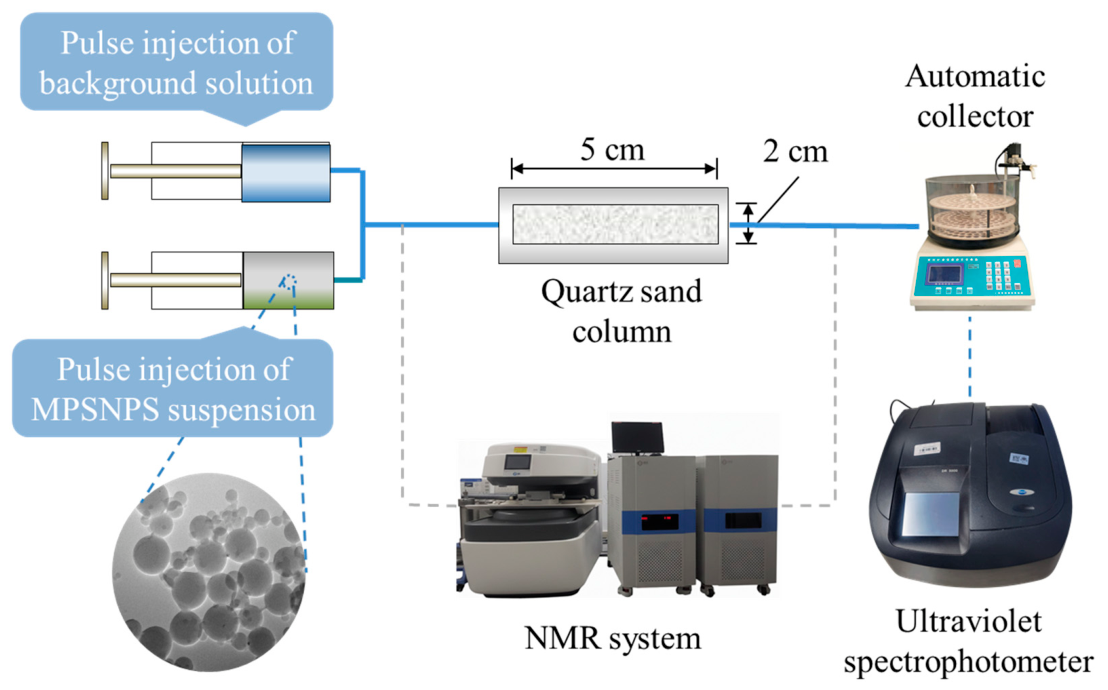
The transport experiment was conducted in a saturated quartz sand column. Quartz sand was wet-packed into a cylindrical polytetrafluoroethylene (PTFE) column with an inner diameter of 2 cm and a length of 5 cm. The sand column was placed horizontally in an NMR monitoring system with a PTFE support (Figure 1). Continuous vibration was applied during packing to prevent stratification and air entrapment. The calculated porosity of the quartz sand column was 0.390. Screens (300 mesh) were placed at both ends of the column to prevent sand loss and ensure uniform inflow of the suspension and background solution. Further details are provided in Text S1 of the Supplementary Materials (SM).
The transverse relaxation time (T2) was measured using a MacroMR12-150H-I NMR system (Niumag Analytical Instrument, Suzhou, China). The system consisted of a permanent magnet with a resonance frequency of 13.0 MHz, a magnetic field strength of 0.3 T, and an operating temperature of 32.0 °C. The experimental parameters included an echo time (TE) of 0.3 ms, echo number of 18,000 (Nech), a waiting time of 6000 ms, 2 accumulated scans, and a magnetic field gradient strength of 0.0573 T/m. During the transport experiments, SE-SPI sequence data were collected at ten uniformly spaced positions along the 5 cm sand column from inlet to outlet, achieving a longitudinal spatial resolution of 5 mm per measurement position, with the measured cross-section determined by the 2 cm inner diameter of the column.

2.4. Characterization of Transverse Relaxation Time (T2)

The CPMG pulse sequence consists of a single 90° RF pulse followed by a series of 180° RF pulses [32,33]. The SE-SPI sequence, similar to the CPMG sequence, employs RF pulses and applies gradients between the 90° pulse and the first 180° pulse to resolve the spatial T2 spectrum [34]. The T2 relaxation time of hydrogen nuclei in pore water within saturated porous media was obtained using the two sequences described above and can be expressed by Equation (1) [35]:
1 T 2 = 1 T 2 B + 1 T 2 D + 1 T 2 S
where T 2 B represents the transverse relaxation time of the fluid in its free state (T); T 2 D denotes the transverse relaxation time associated with diffusion relaxation under gradient magnetic fields (T); and T 2 S corresponds to the transverse relaxation time arising from surface relaxation (T).
For saturated porous media, the transverse relaxation rate of the free-state fluid [ 1 / T 2 B ] is typically very small and can be neglected [36]. Furthermore, to minimize [ 1 / T 2 D ] under low-field conditions, we limited the Fe3O4 loading in the particles to 0.33% and employed a short echo time of 0.3 ms, consistent with previous work [27]. The dominant mechanism of surface relaxation is supported by the strong linearity of the calibration curve presented in Section 3.2. Therefore, in this study, Equation (1) can be simplified to:
1 T 2 = 1 T 2 S ρ 0 S V
where ρ 0 is the transverse surface relaxation strength (LT−1) and S/V is the ratio of pore surface area to pore volume (L−1).
When paramagnetic particles are present in the suspension, local magnetic field fluctuations accelerate the loss of transverse magnetization, thereby shortening the T2 relaxation time of hydrogen nuclei in pore water [37]. This process can be described as [38,39]:
[ C ] = 1 R 1 T 2 , i 1 T 2,0
where T 2,0 is the transverse relaxation time in the absence of paramagnetic NPs (T); T 2 , i is the transverse relaxation time in the presence of paramagnetic NPs (T); [ C ] is the concentration of paramagnetic NPs (ML−3); and R is the transverse relaxation constant (M−1L3T−1).

2.5. Mathematical Models and Computational Methods

2.5.1. Single-Point Kinetic Model

The advection–dispersion equation (ADE), incorporating a single-point adsorption kinetic lag term, is widely used to simulate the transport of NPs in homogeneous porous media [40,41]. This equation assumes a class of identical, homogeneous, and reversible adsorption sites on the medium surface, representing the transport and deposition processes of colloids, as shown below [42]:
C t = v C x + x D C x ρ θ S t
ρ θ S t = k att   C 1 S S m a x
where C represents the particle concentration in the liquid phase (i.e., the suspension) (ML−3), S represents the particle concentration deposited on the solid phase of the porous medium at the longitudinal position x (L) and time t (T) (MM−1); v is the average velocity of pore flow (LT−1); D is the hydrodynamic dispersion coefficient (L2T−1); θ is the porosity of the porous medium; ρ is the bulk density of the porous medium (ML−3); k att   is the attachment rate coefficient of the particles (T−1); S m a x is the maximum solid-phase concentration (MM−1).
In this study, the BTCs from tracer experiments were inverted to obtain the hydrodynamic dispersion coefficient D . Then, the BTCs from MPSNP transport experiments were inverted to derive k att   and S m a x [41,43]. MPSNPs were introduced at the inlet as pulse inputs. The corresponding initial and boundary conditions were defined as follows:
C x , t = 0 = 0
C x = 0 ,   0 < t < t 1 = C 0
C x = 0 , t > t 1 = 0
d C d x x = L = 0

2.5.2. Two-Site Kinetic and Langmuirian Blocking Model

According to the Derjaguin–Landau–Verwey–Overbeek (DLVO) theory, under unfavorable conditions, NPs may undergo weak adsorption corresponding to the secondary energy minimum on porous surfaces, or strong adsorption after overcoming the primary energy barrier and entering the first minimum, as well as adsorption driven by non-DLVO forces. These processes are considered reversible and irreversible, respectively [44]. The two-site kinetic model assumes that the medium contains two dynamically distinct adsorption sites with different adsorption rates—reversible and irreversible sites—allowing a more accurate description of NPs transport under the combined influence of multiple adsorption mechanisms [45,46]. Assuming reversible deposition at Site 1 and irreversible deposition at Site 2, the governing equations are as follows [45]:
θ C t + ρ S 1 t + ρ S 2 t = x θ D C x v θ C x
ρ S 1 t = θ k 1 a t t C ρ k 1 d e t S 1
ρ S 2 t = θ k 2 a t t ψ C
where S1 and S2 denote the particle concentrations deposited on solid surfaces at reversible and irreversible sites within the porous medium at the longitudinal position x (L) and time t (T) (MM−1); k 1 a t t and k 2 a t t are the first-order attachment rate coefficients at Sites 1 and 2 (T−1), respectively; and   k 1 d e t is the first-order detachment rate coefficient at Site 1 (T−1); ψ is the dimensionless retention function describing particle-blocking effects, which can be expressed using the Langmuirian kinetic equation [47]:
ψ = 1 S 2 S 2 m a x
where S 2 m a x   is the maximum MPSNP concentration that can be deposited per unit mass of porous medium at Site 2 (MM−1). The other parameters are defined as before. The parameters, k 1 a t t ,   k 2 a t t ,   k 1 d e t   and   S 2 m a x   , are obtained by inverting the BTCs from MPSNP transport experiments, using the same initial conditions as previously applied.

2.5.3. Two-Site Kinetic and Depth-Dependent Blocking Model

Studies indicate that straining promotes the formation of dead-end pores, and the number of pores decreases as the particle migration distance increases. Consequently, straining is greatest at the sand-column inlet and gradually diminishes with increasing distance from the inlet. The parameter ψ in Equation (12) can be expressed as [48]:
ψ = d 50 + x d 50 β
where β is a dimensionless fitting parameter that controls the spatial distribution of colloids, and the median grain diameter ( d 50 ) of the quartz sand packed in the column is 433.505 μm. The other parameters are defined as before. β was initially chosen as 0.432 and further optimized [49].
The MPSNP transport was simulated using the three models in the HYDRUS-1D [48,50].

2.5.4. DLVO Theory

The interaction energy between MPSNPs and quartz sand was calculated using the DLVO theory, which accounts for van der Waals attraction and electrical double-layer repulsion between particles [51]. The total DLVO interaction energy G tot   (ML2T−2) is the sum of the van der Waals energy G v d W (ML2T−2) and the double-layer energy G D L (ML2T−2). Detailed calculation procedures and results are provided in Text S2 and Tables S2 and S3 in the Supplementary Materials.

2.5.5. Evaluation of Fitting Models

The experimental BTCs were fitted and inverted using the three models described in Section 2.5.1, Section 2.5.2 and Section 2.5.3. The fitting performance was evaluated using two metrics: the coefficient of determination (R2) and the global error (Ej).
E j = 1 N i = 1 N     C i n m C i s i m 2
R 2 = 1 i = 1 N     C i n m C i s i m 2 i = 1 N     C i n m C n m ¯ 2
where j denotes one of the three models; C i n m is the i-th relative particle concentration measured in the column experiment; C i s i m is the i-th simulated relative particle concentration; C n m ¯ represents the average measured relative particle concentration measured in the column experiment; and N is the total number of data points.

3. Results and Discussion

3.1. Characterization of MPSNPs and Quartz Sand Under Different Conditions

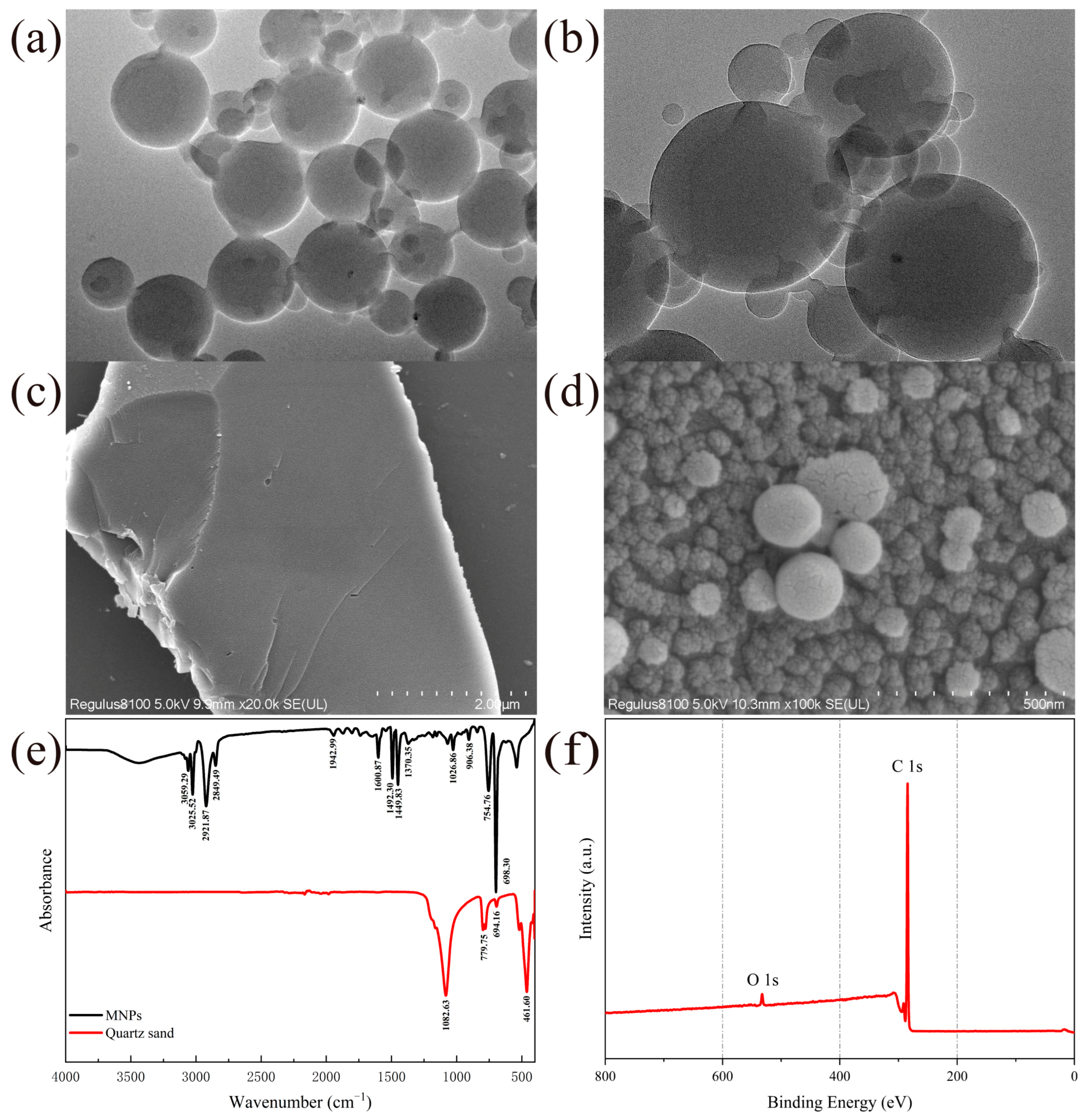
The experimental materials were characterized using multiple analytical techniques. From the TEM image (Figure 2a), MPSNPs exhibit a regular spherical morphology with a relatively uniform size distribution. A distinct core–shell structure is observed in Figure 2b. As shown in Table S1, both MPSNPs and quartz sand exhibit negative zeta potentials under various water chemistry conditions. When the ionic strength increased from 0.001 to 0.5 mM, the hydrodynamic diameter of MPSNPs increased from 215.3 ± 13.8 nm to 243.7 ± 5.7 nm, indicating that MPSNP aggregation remained relatively limited under these conditions. Meanwhile, the zeta potential decreased from −27.6 ± 0.5 mV to −19 ± 0.9 mV, similar to observations for polystyrene particles reported in previous studies [41]. SEM imaging of quartz sand (Figure 2c) shows a clean surface without visible attachments. After the transport experiments at 0.5 mM ionic strength, quartz sand retrieved from the column exhibited substantial particle adhesion on its surface, as shown in the SEM image (Figure 2d). The FTIR spectra of the MPSNPs and quartz sand are shown in Figure 2e. The strong peaks in the black curve correspond to the characteristic peaks of polystyrene, whereas the four strong peaks in the red curve are the characteristic peaks of Si-O bonds in quartz sand [52]. The elemental composition of the MPSNPs surface was analyzed by XPS. As illustrated in Figure 2f, the particle surface is predominantly composed of carbon and oxygen, while the iron signal is negligible. Given the low nominal iron oxide loading (0.33%), it can be inferred that the polystyrene coating dominates the surface matrix. These characterizations demonstrate that the MPSNPs exhibit physical, electrostatic, and surface chemical properties closely resembling those of polystyrene.

3.2. Establishing a Quantitative Relationship for MPSNP Concentration Measurement

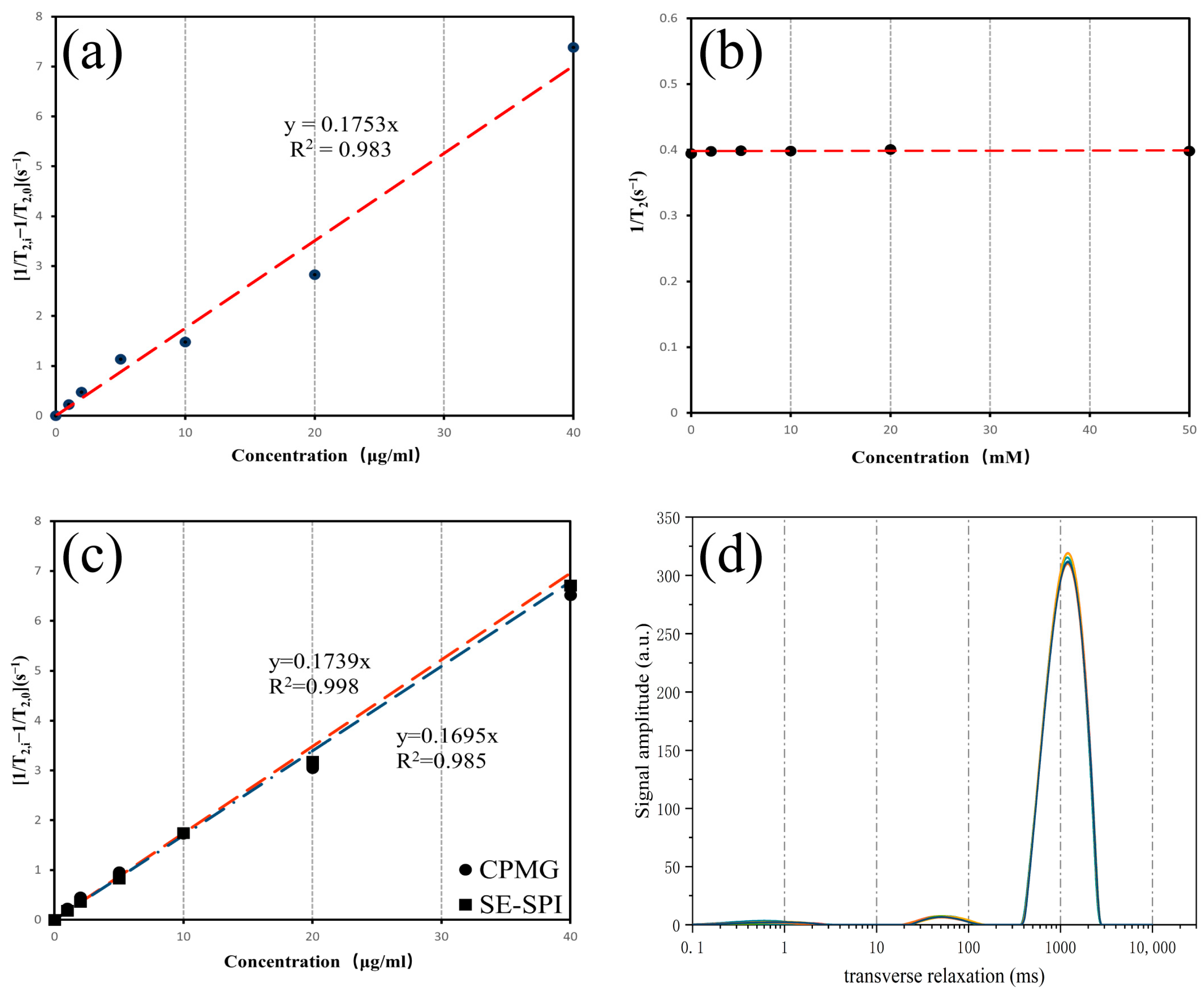
CPMG sequences of low-field NMR were used to measure T2 signals from seven MPSNP suspensions at different concentrations, with each suspension measured three times. Figure 3a illustrates the linear relationship between the transverse relaxation rate [1/T2,i − 1/T2,0] and the MPSNP concentration. The transverse relaxivity constant R of the MPSNPs, obtained through least-squares fitting, is 0.1753 μg−1 mL s−1, with a coefficient of determination (R2) greater than 0.99.
To eliminate potential interference from the background solution on the T2 signal, the CPMG sequence was applied to six KCl solutions with different concentrations, with each solution measured three times. Figure 3b presents the relationship between the transverse relaxation rate 1/T2 and the KCl concentration in the solution. The percentage error of 1/T2 ranged from 0.01% to 0.15%, indicating that KCl does not influence the T2 signal within the experimental concentration range.
To examine the effects of pulse sequences on transverse relaxation rates, NMR T2 experiments were conducted using both CPMG and SE-SPI sequences on quartz sand columns saturated with MPSNP suspensions of varying concentrations. The results (Figure 3c) indicate that the parameter [1/T2,i − 1/T2,0] remained essentially unchanged, confirming its independence from sequence-dependent variations, where the transverse relaxation rate of the water-saturated sand column [1/T2,0] was subtracted as a baseline to eliminate matrix interference. The T2 data obtained from both sequences exhibited strong goodness-of-fit (R2 > 0.97) and substantial overlap. These findings demonstrate that T2 signals provide a reliable indicator for monitoring the transport of paramagnetic nanoparticles in homogeneous porous media.
To ensure stable column packing and reproducible NMR measurements, the quartz sand columns were refilled five times with identical materials and measured under the same conditions (Figure 3d). Comparison showed minimal variation in T2 data among the groups, indicating excellent reproducibility.

3.3. Influence of Key Environmental Factors on MPSNP Transport

3.3.1. Influence of Ionic Strength on MPSNP Transport

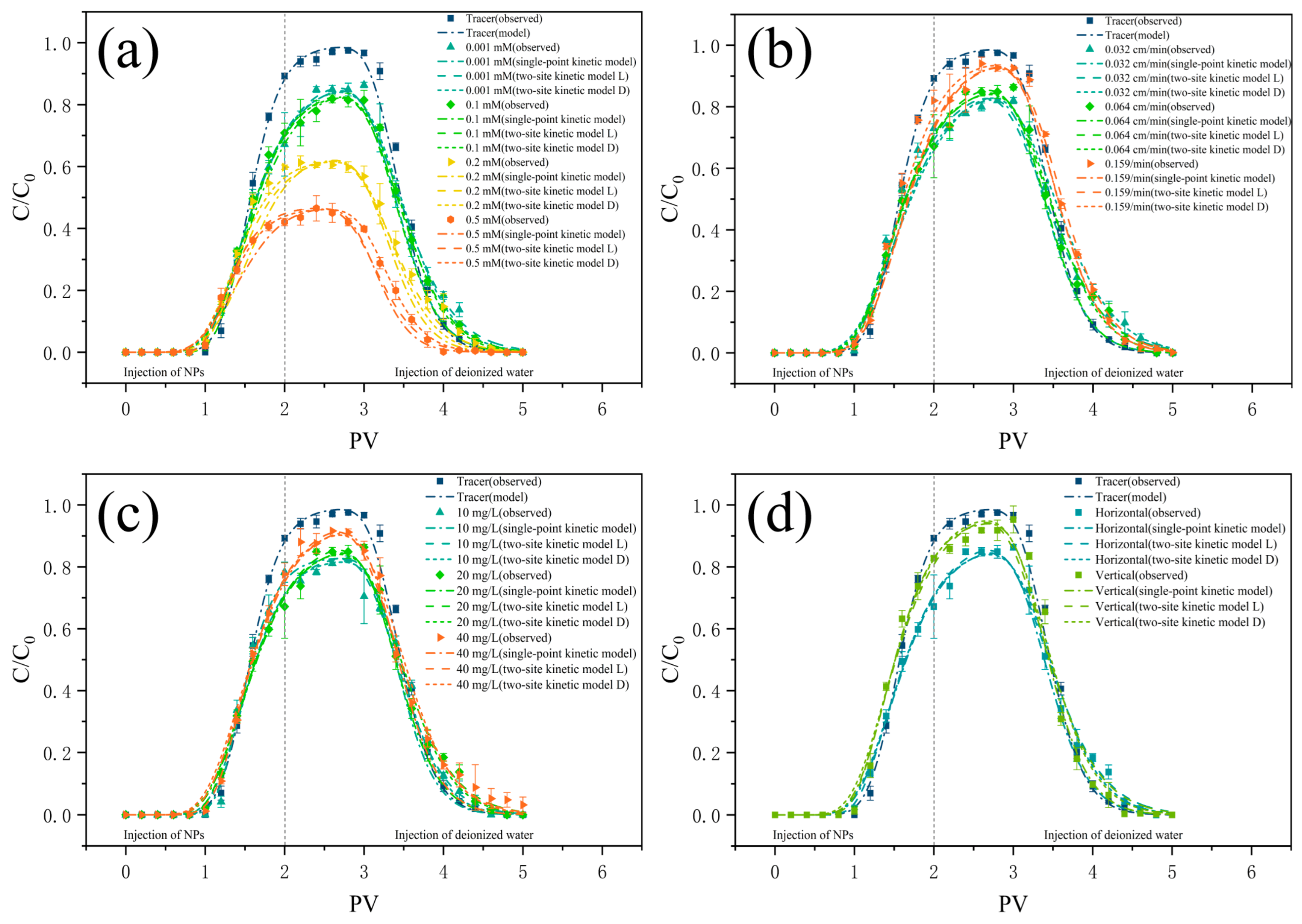
Figure 4a presents the BTCs of MPSNPs in porous media under background solutions with different ionic strengths. The results showed that as the ionic strength increased from 0.001 to 0.5 mM, the migration ability of MPSNPs decreased markedly. The peak C/C0 value of the BTCs decreased from 0.864 to 0.819, 0.613 and 0.465, with corresponding mass recovery rates of 85.7%, 84.4%, 66.4% and 44.7%. This trend is consistent with previous studies reporting inhibited particle migration under high-ionic-strength conditions [53]. In the 0.001 mM and 0.1 mM solutions, the limited adsorption sites in the porous medium were rapidly occupied by previously injected particles. As a result, subsequent MPSNPs passed directly through the porous medium, leading to a continuous increase in effluent concentration over time. Although the variation in ionic strength alone may not provide a direct confirmation of blocking mechanisms, the observed continuous rise in effluent concentration indicates that the BTCs may exhibit blocking phenomena [52]. This phenomenon is further discussed via the initial concentration experiments in Section 3.3.3.
The experimental results were simulated using the single-point kinetic model, the two-site kinetic and Langmuirian blocking model, and the two-site kinetic and depth-dependent blocking model, and the transport parameters are presented in Table 1 and Tables S4 and S5. All models exhibited good fitting performance (R2 > 0.96) (Table 2). For the single-point kinetic model, the attachment rate coefficient ( k att ) reflects the migration capacity of particles in porous media, with smaller k att   values indicating stronger particle mobility [10]. As the ionic strength increased from 0.001 to 0.5 mM, k att   increased from 8.53 × 10⁻³ min−1 to 3.05 × 10⁻² min−1, and S m a x increased from 1.74 × 10⁻² mg·g−1 to 2.31 × 10⁻² mg·g−1, consistent with previous findings [42]. For the two-site kinetic and Langmuirian blocking model, the parameter ranges under different ionic strengths were S 2 m a x = 9.36 × 10⁻³–1.50 × 10⁻² mg·g−1, k 2 a t t = 1.84 × 10⁻¹–5.61 × 10⁻¹ min−1, k 1 a t t = 7.89 × 10⁻²–2.36 × 10⁻¹ min−1, and k 1 d e t = 2.63 × 10⁻¹–5.79 × 10⁻¹ min−1. All parameters increased with ionic strength, indicating reduced migration capacity and enhanced deposition of MPSNPs, consistent with the experimental observations [53]. In the two-site kinetic and depth-dependent blocking model, k 2 a t t , k 1 a t t , and k 1 d e t exhibited the same trend as the former, β   increased from 5.31 × 10⁻¹ to 9.35 × 10⁻¹.
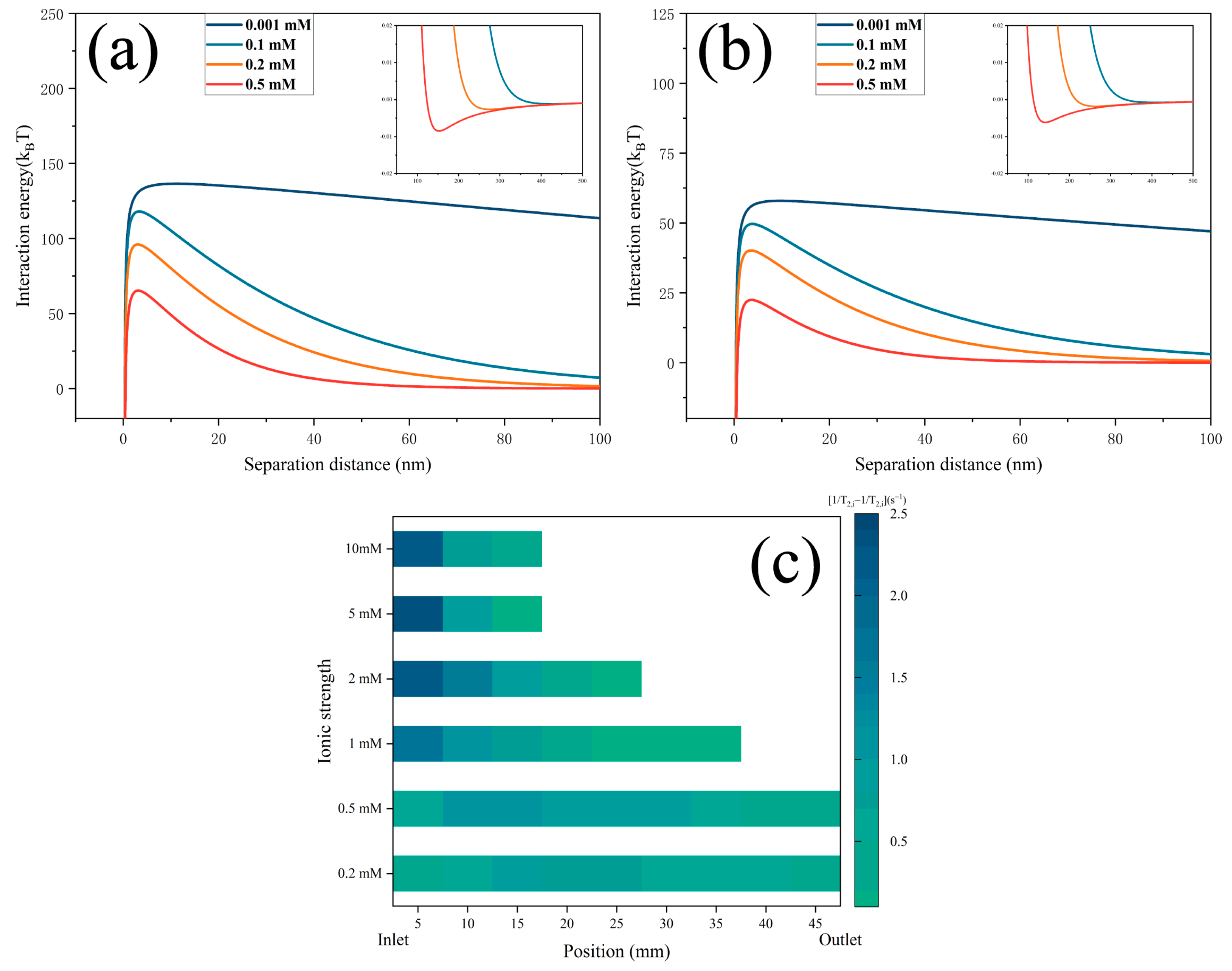
Since both MPSNPs and quartz sand surfaces carry negative charges, deposition at the primary minimum is unfavorable and requires overcoming a significant energy barrier. In addition, a secondary minimum is also present. Figure 5a,b shows the DLVO interaction energy curves at different ionic strengths. As the ionic strength increased from 0.001 to 0.5 mM, the electrical double layer became increasingly compressed. The negative zeta potential of both MPSNPs and quartz sand decreased (Table S1), thereby reducing electrostatic repulsion. The energy barrier between MPSNPs and quartz sand decreased from 136.57 kT to 65.31 kT. The secondary minimum, which previously exhibited no negative interaction energy, developed a shallow attractive well of −8.47 × 10⁻³  kT. This suggests that van der Waals forces increasingly dominate, reducing the mobility of MPSNP and promoting their adsorption onto the quartz sand surface. However, adsorption at the secondary minimum was weak and readily reversible under environmental perturbations. Due to charge-shielding effects, increasing ionic strength compressed the diffuse double layer, thereby reducing electrostatic repulsion between magnetic polystyrene particles. The energy barrier decreased from 57.93 kT to 22.47 kT, and the secondary minimum was consequently deepened. This promotes particle agglomeration and enhances size-exclusion and straining effects [54]. Furthermore, compression of the diffuse double layer reduces the radius of the zone of interaction (RZOI), enabling the rough quartz sand surface to exert a stronger influence on MPSNP deposition [41].
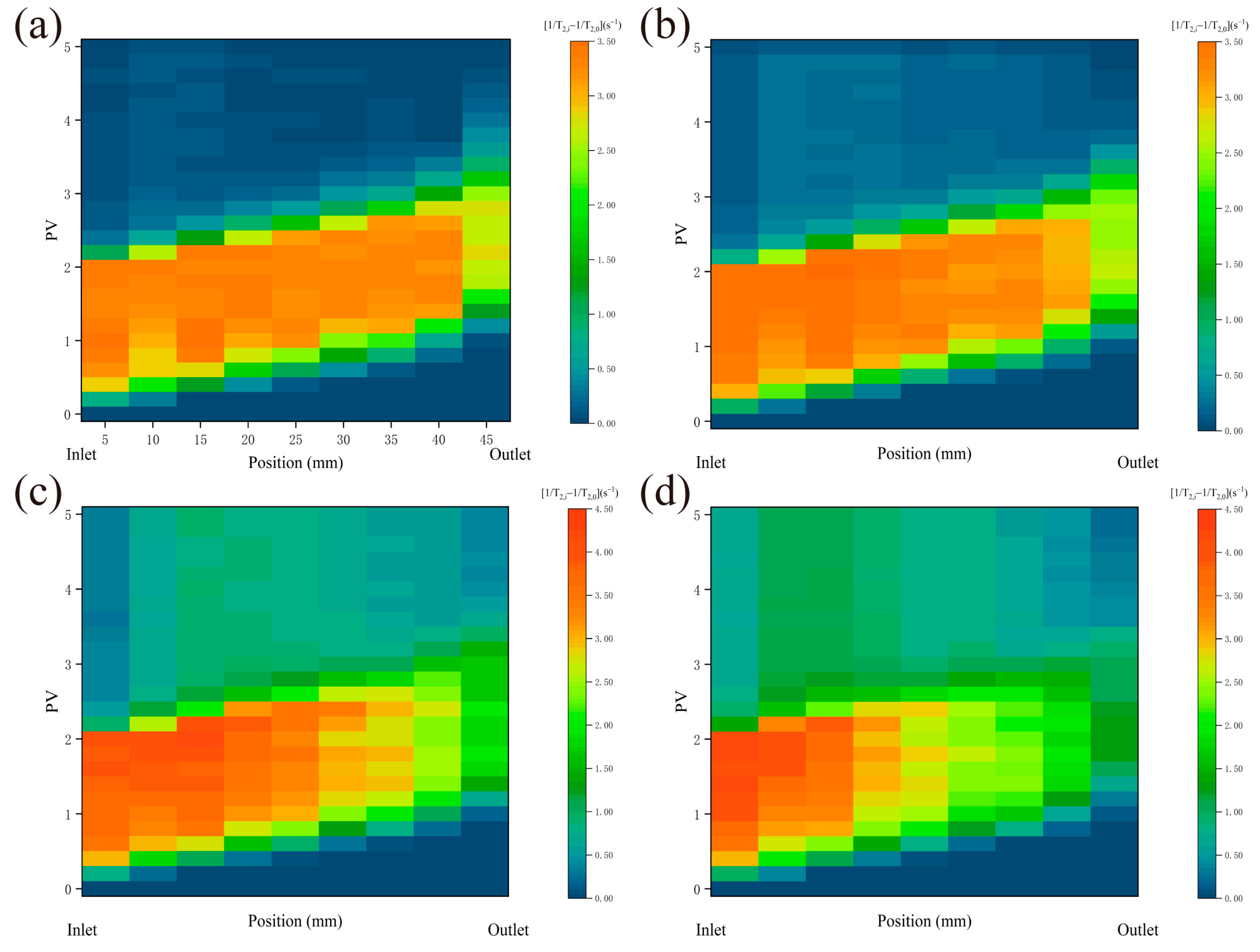
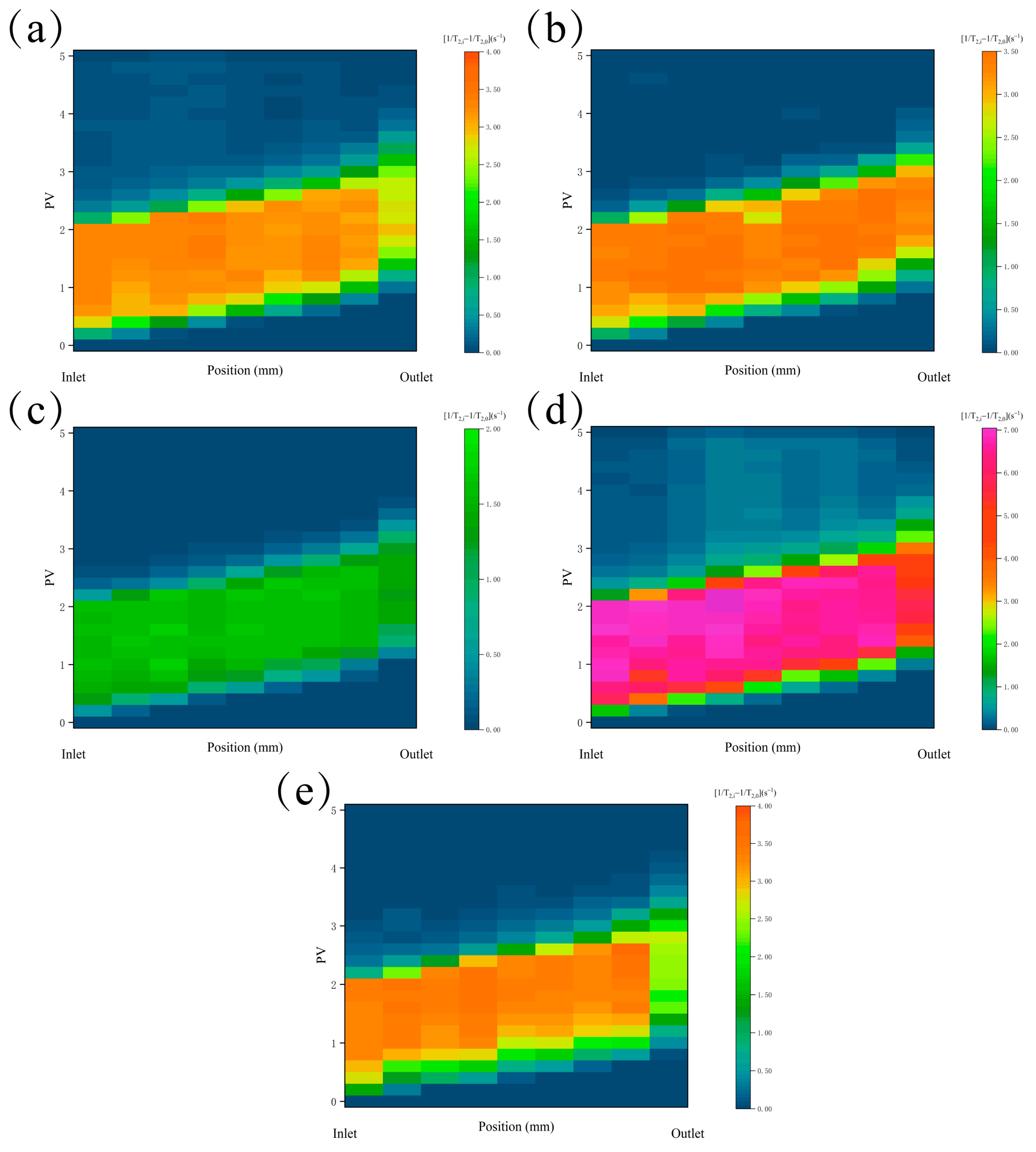
The T2 signal during MPSNP migration was continuously monitored using the SE-SPI sequence, and the transverse relaxation rate [1/T2,i − 1/T2,0] was calculated at 0.2 PV intervals per injection, as shown in Figure 6a–d. During the injection of MPSNP suspensions (0–2 PV), the transverse relaxation rate increased progressively along the sand column as the concentration front migrated from the inlet to the outlet. Owing to surface deposition and straining of MPSNPs, the maximum transverse relaxation rate near the inlet of different sand columns increased with increasing ionic strength. Within each sand column, the maximum transverse relaxation rate decreased with distance from the inlet, and this decline became steeper at higher ionic strength, indicating reduced MPSNP penetration. During background solution injection (3–5 PV), the transverse relaxation rate decreased near the inlet but increased near the outlet as the concentration front moved downstream, and subsequently declined at all positions until reaching a steady state. Notably, after background solution injection, the transverse relaxation rate at several locations did not return to zero. Instead, a stable residual transverse relaxation rate persisted, and its magnitude increased with ionic strength. This suggests that a fraction of MPSNPs remained trapped due to surface deposition, straining, or exchange into slow-flow regions. Such retention behavior was strongly dependent on the ionic strength. Unlike traditional filtration models predicting a monotonic decrease from the entrance [10], the MPSNP retention peaked at approximately 10 mm from the inlet and then declined. Following the research of Chu et al. (2019), this may be driven by intrinsic physicochemical kinetics [47]. Under repulsive conditions, nanoparticles were trapped in the shallower secondary energy minimum. Fluid drag and shear torque then overcome the minor tangential adhesive resistance, driving these particles to slide or roll along grain surfaces down-gradient until they are immobilized at stable downstream sites away from the inlet.
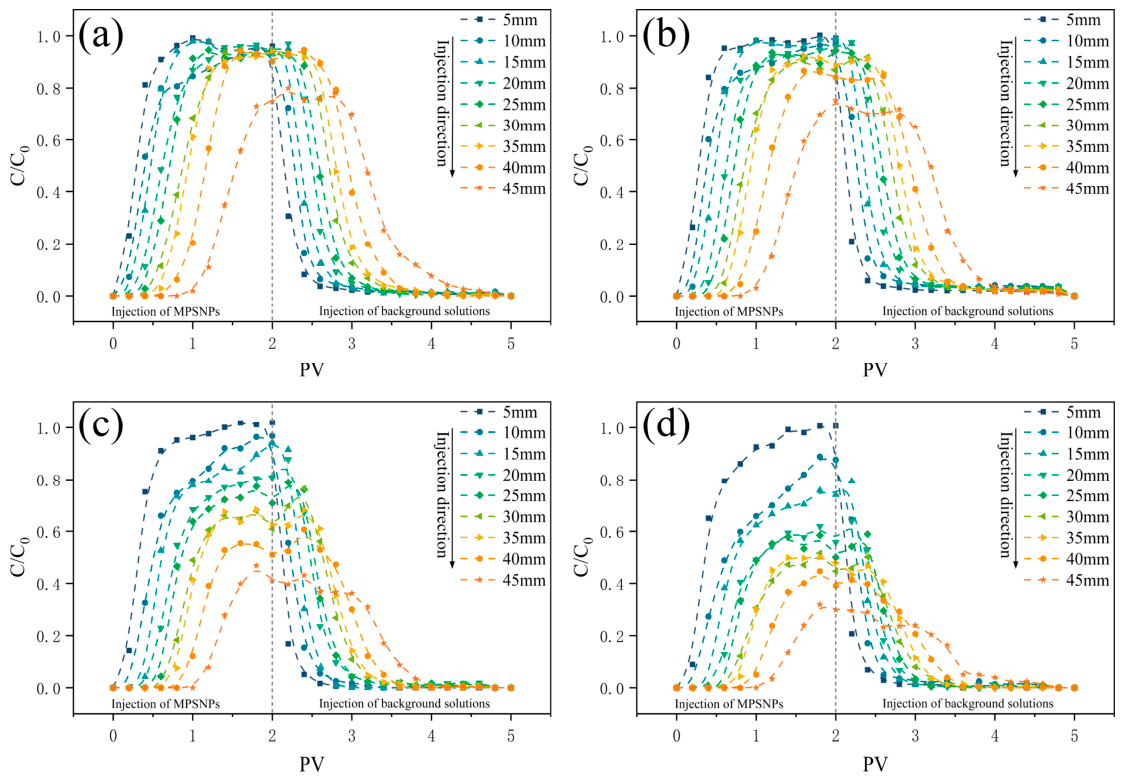
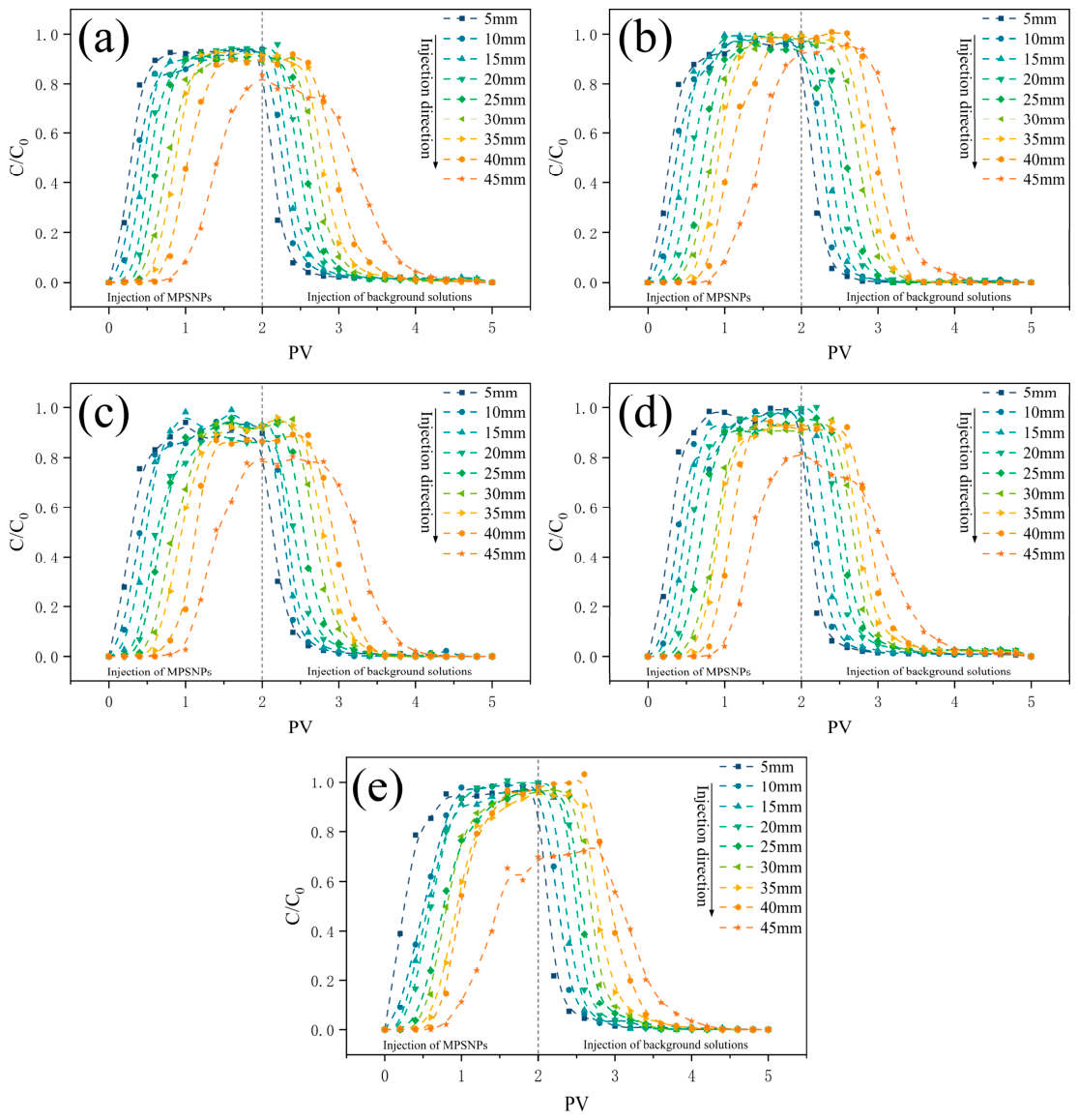
The relative particle concentration (C/C0) of MPSNPs in the liquid phase was calculated from the transverse and residual transverse relaxation rates. Using Equation (3), BTCs at various positions in the quartz sand column under different ionic strengths were obtained (Figure 7). The C/C0 peak decreased from the inlet to the outlet, and the magnitude of this reduction increased with ionic strength. As ionic strength increased from 0.001 to 0.5 mM, the C/C0 peak at the inlet remained essentially unchanged. In contrast, at 40–45 mm from the inlet, the C/C0 peak decreased markedly from 0.946 to 0.447, indicating substantial MPSNP deposition during transport. Relative to 0.001 mM, the C/C0 peak at the outlet decreased by 5.9%, 41.5%, and 60.0% at the higher ionic strengths, respectively.
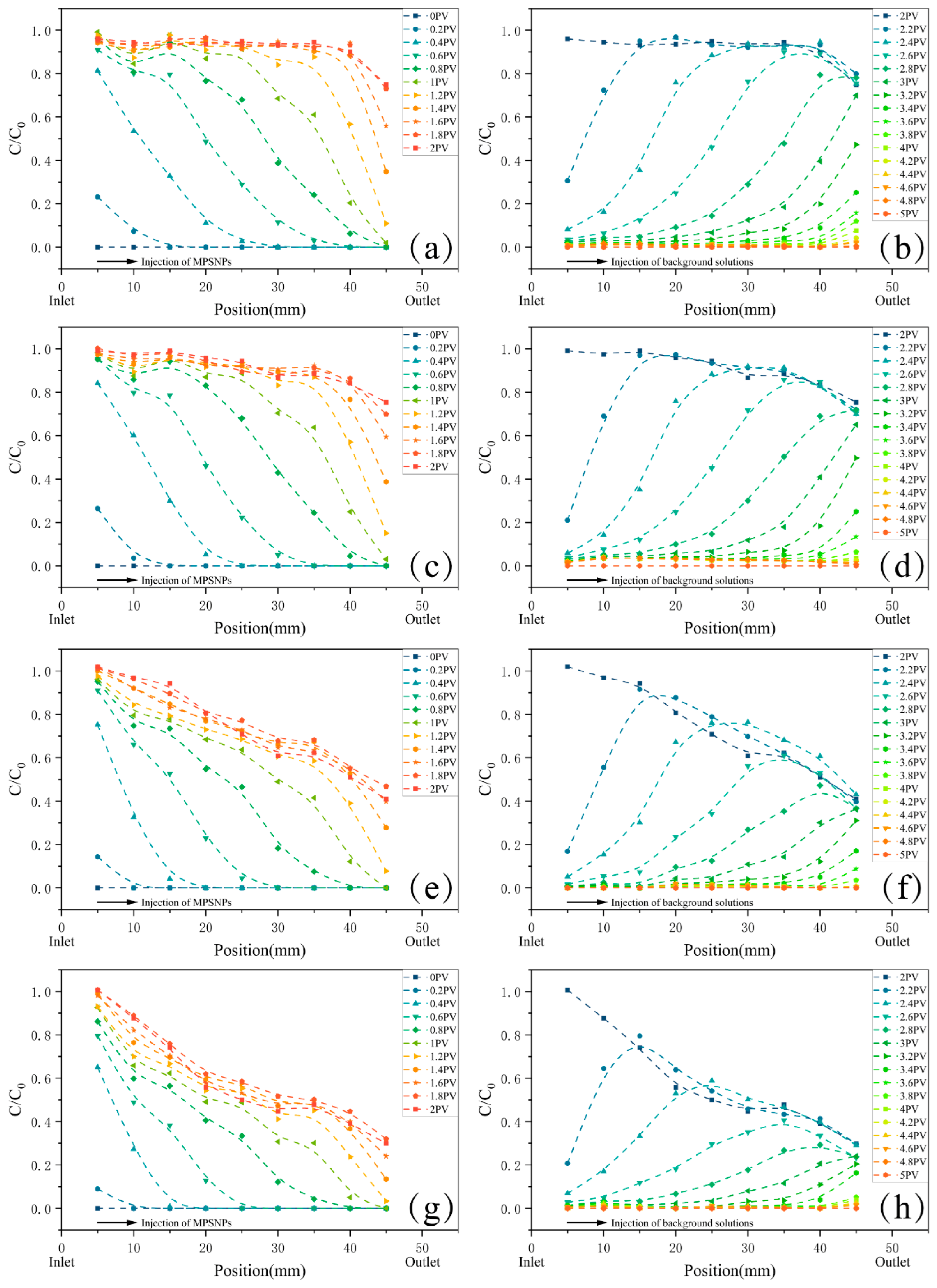
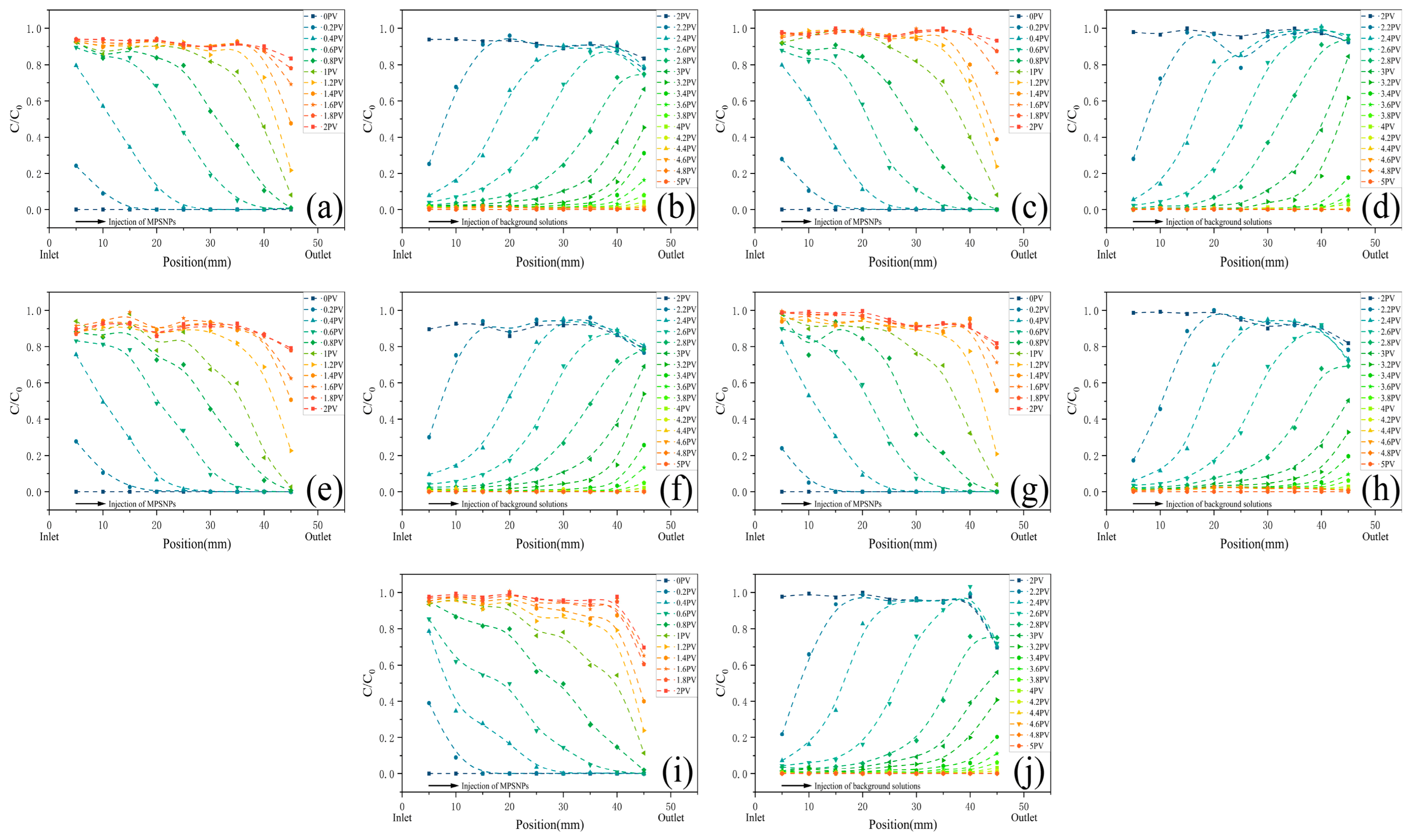
Figure 8 compares the relative concentration distribution of MPSNP in the liquid phase within the quartz sand column under different ionic strengths during equal-volume injections. At ionic strengths of 0.001 and 0.01 mM, MPSNPs reached the column outlet after 1 PV of MPSNP suspension injection. At 0.1 and 0.5 mM, changes at the outlet appeared only after 1.2 PV of injection, indicating that higher ionic strength markedly slowed particle migration in the liquid phase. In a 0.001 mM experimental environment, MPSNPs were detected at 40 mm from the inlet at 0.6 PV, indicating migration faster than the bulk nanoparticle front. This may suggest the presence of preferential flow paths, consistent with previous observations [27]. Under the same injection conditions in a 0.5 mM background solution, MPSNPs migrated only 25 mm from the inlet. This reduced migration was attributed to enhanced deposition under higher ionic strength and to pore-size reduction caused by deposited particles, which increased the likelihood of bridging [55]. During the initial flushing with a high-ionic-strength background solution, MPSNP concentrations increased slightly within the 20–45 mm region of the column. This increase was attributed to the release of particles initially deposited at the secondary minimum during suspension injection, where the deposition is weak and readily desorbed.
To examine the influence of ionic strength on MPSNP deposition, additional column experiments were performed using background solutions with ionic strengths of 1, 2, 5, and 10 mM (Figure 5c). In all four experiments, MPSNPs failed to penetrate the quartz sand column. Residual transverse relaxation rates showed that the maximum migration distance decreased progressively with increasing ionic strength. At 5 mM, MPSNPs were fully deposited within 20 mm from the inlet. Further increases in ionic strength produced no additional change in the residual transverse relaxation rate. These results indicate that, under an initial concentration of 20 mg/L and a flow rate of 0.064 cm/min, when ionic strengths ≥ 5 mM, the adsorption capacity of the porous medium was saturated at the inlet.

3.3.2. Influence of Flow Rate on MPSNP Transport

Figure 4b shows the BTCs of MPSNPs in porous media under different flow rates. As the flow rate increased from 0.032 to 0.159 cm/min, the C/C0 peak rose from 0.820 to 0.940, accompanied by an increase in mass recovery from 87.6% to 98.7%. At lower flow rates, the BTCs exhibited more pronounced tailing.
The measured BTCs were fitted using three models. As the flow rate increased from 0.032 to 0.159 cm/min, k att   decreased from 1.03 × 10⁻² to 6.17 × 10⁻³ min−1, and S m a x declined from 2.04 × 10⁻² to 1.08 × 10⁻² mg·g−1 in the single-point kinetic model. Both katt and Smax exhibited negative correlations with flow rate, consistent with previous findings [42]. In the two-site kinetic and Langmuirian blocking model, S 2 m a x , k 2 a t t , and k 1 a t t decreased with increasing flow velocity, whereas k 1 d e t increased, indicating enhanced MPSNP mobility and reduced deposition. In the two-site kinetic and depth-dependent blocking model, k 2 a t t , k 1 a t t , and k 1 d e t exhibited the same trend as the former, whereas β   decreased from 9.96 × 10⁻¹ to 4.71 × 10⁻¹.
Figure 6a and Figure 9a,b show the transient evolution of the transverse relaxation rate [1/T2,i − 1/T2,0] during MPSNP migration through a quartz sand column under different flow rates. The maximum transverse relaxation rate increased slightly with flow rate, although the overall differences remain small. During MPSNP suspension injection (0–2 PV), the transverse relaxation rate increased progressively from the inlet toward the outlet as the concentration front advanced. The maximum relaxation rate remained relatively uniform at different positions along the column. During background-solution injection (3–5 PV), the relaxation rate initially decreased near the inlet while continuing to rise near the outlet. It then decreased toward a stable value throughout the column, with the magnitude of reduction increasing at higher flow rates. At 0.159 cm/min, [1/T2,i − 1/T2,0] at a given location decayed rapidly during background-solution flushing, leaving almost no residual transverse relaxation rate. Higher flow velocities enhance hydrodynamic drag, reducing the relative influence of gravity and van der Waals forces [56], thereby suppressing adsorption, agglomeration, and bridging of MPSNPs. At lower flow velocities, horizontal diffusion contributes more significantly to microplastic transport [57]. Consequently, MPSNPs migrated more slowly along grain surfaces and exhibited longer residence times. According to colloid-filtration theory, this increases the likelihood of particle–collector collisions and attachment. Microplastic deposition is also governed by torque equilibrium [58]. Lower flow velocities reduce hydrodynamic shear torque, promoting or maintaining surface deposition of MPSNPs. Conversely, higher flow velocities enhance particle desorption, mobilizing particles previously retained by surface deposition or straining.
Figure 7a and Figure 10a,b present the BTCs derived from the inverted transverse relaxation rate at different positions within the sand column under various flow velocities. As the flow velocity increased from 0.032 to 0.159 cm/min, the average peak C/C0 at each position increased from 0.920 to 0.987. At lower flow velocities, slight MPSNP deposition resulted in modest decreases in the peak C/C0 values with increasing distance from the inlet. At 0.159 cm/min, the peak C/C0 remained nearly independent of position, and tailing of the BTC at the outlet was minimal. These observations indicate that deposition or adsorption was negligible, consistent with the experimental findings.
Figure 8a,b and Figure 11a–d show the distribution of MPSNPs in the liquid phase within the quartz sand column during the injection of either MPSNP suspensions or background solutions at different flow rates. During MPSNP suspension injection, the relative particle concentration in the liquid phase was slightly higher under higher flow rates. After 1.4 PV of background-solution flushing, the C/C0 at the outlet decreased by 62.6%, 68.5%, and 81.8% from the peak value as the flow rate increased. Higher flow rates effectively removed more MPSNPs from both the liquid and solid phases, consistent with the preceding analyses.

3.3.3. Influence of Initial Concentration on MPSNP Transport

Figure 4c presents the BTCs of MPSNPs in the porous medium under different initial concentrations. When the initial concentration increased from 10 to 40 mg/L, the peak C/C0 value increased from 0.825 to 0.916, and the mass recovery rose from 83.5% to 92.0%. At higher MPSNP concentrations, the BTC exhibited more pronounced tailing. This observation is consistent with some studies [59] but contradicts others [60]. Our results show that increasing the initial concentration reduced the relative proportion of total input mass retained within the quartz sand column. This may be attributed to the fixed number of available adsorption sites in saturated porous media. At lower initial concentrations, colloidal particles experience less competition for adsorption. As the initial concentration increases, adsorption sites become saturated more rapidly, resulting in a larger fraction of MPSNPs that remain unabsorbed. However, previous studies also highlight limitations to this mechanism. Variations in injection concentration and flow rate may alter the dominant mechanisms governing MPSNP migration and deposition, thereby modifying the role of adsorption-site competition [61].
In the single-point kinetic model, increasing the initial concentration from 10 to 40 mg/L caused k att   to decrease from 1.44 × 10⁻¹ to 8.15 × 10⁻³ min−1, while S m a x increased from 5.72 × 10⁻³ to 2.02 × 10⁻² mg·g−1. Existing studies report inconsistent trends for these parameters. Our findings agree with some studies [10] but differ from others [41]. In both two-site kinetic models, increasing the initial concentration led to general reductions in k 2 a t t , k 1 a t t , and k 1 d e t , whereas S 2 m a x and β increased. This trend indicates a lower relative attachment efficiency per individual particle as available surfaces became rapidly occupied. However, because the total incoming particle flux was substantially larger, the absolute mass of deposited NPs inside the porous matrix expanded significantly.
Figure 6a and Figure 9c,d show the transient evolution of the transverse relaxation rate [1/T2,i − 1/T2,0] during MPSNP migration through the quartz sand column under different initial concentrations. The maximum transverse relaxation rate of the column increased proportionally with the initial concentration, confirming the reliability of the LF-NMR method. During MPSNP suspension injection, the pattern of transverse relaxation rate variation remained consistent across different initial concentrations. During background-solution injection, [1/T2,i − 1/T2,0] decayed rapidly at all positions when the initial concentration was 10 mg/L, with residual values approaching zero. As the initial concentration increased, the residual transverse relaxation rate gradually increased. This behavior reflects the complex mechanisms of MPSNP deposition and migration. According to colloid-filtration theory [62], colloid deposition in porous media is governed by two factors: the frequency of particle–collector collisions and the fraction of collisions that result in adhesion. At low initial concentrations, the probability of particle–collector collisions are low. As the initial concentration increases, more particles collide with collector surfaces, enhancing the collection process. Meanwhile, bridging and straining become more pronounced at higher initial concentrations, reducing pore-scale permeability and promoting greater particle retention.
Figure 7a and Figure 10c,d present the BTCs derived from the inverted transverse relaxation rate at different positions within the sand column under varying initial concentrations. At an initial concentration of 10 mg/L, the relative MPSNP concentration (C/C0) remained similar across positions, indicating no significant particle retention in the porous medium. At 20 and 40 mg/L, the peak C/C0 decreased slightly from the inlet to the outlet, suggesting that higher concentrations induced partial surface deposition or straining. Figure 8a,b and Figure 11e–h show that during MPSNP suspension injection, the temporal variations in the C/C0 within the liquid phase exhibited broadly consistent trends across different initial concentrations. However, after 1.4 PV of background-solution flushing, the reduction in C/C0 at the outlet—relative to its peak value—increased from 68.1% to 76.1% as the injection concentration increased. Because higher initial concentrations led to a greater absolute mass of particle retention within the sand column in this experimental system, the C/C0 at higher concentrations decayed more rapidly under the same flow-rate conditions during background flushing.

3.3.4. Influence of Flow Direction on MPSNP Transport

In recent studies, vertical-upward flow is commonly used to investigate NPs migration in porous media, primarily to minimize the influence of bubble entrapment [63]. However, this configuration does not adequately represent the variable flow directions typical of natural groundwater systems. Therefore, the effect of flow direction on MPSNP transport was examined, and the corresponding BTCs are shown in Figure 4d. The peak widths of the BTCs were comparable under vertical-upward and horizontal flow conditions. The peak C/C0 values were 0.864 under horizontal flow and 0.953 under vertical flow, with corresponding mass recovery rates of 85.7% and 94.7%. More pronounced tailing was observed in the BTCs under horizontal flow conditions. Similar observations have been reported elsewhere, where horizontal flow produced the lowest permeation rates compared with other flow orientations [64].
In the single-point kinetic model, k att decreased from 8.53 × 10⁻³ min−1 under horizontal flow to 1.82 × 10⁻³ min−1 under vertical-upward flow. The corresponding S m a x   value decreased from 1.74 × 10⁻² to 6.60 × 10⁻³ mg·g−1. In both two-site kinetic models, k 2 a t t , k 1 a t t , k 1 d e t ,   S 2 m a x and β were all lower under vertical flow, indicating stronger MPSNP mobility and reduced retention.
Comparison of the transverse relaxation rate [1/T2,i − 1/T2,0] variations under the two flow directions (Figure 6a and Figure 9e) shows that during MPSNP-suspension injection, [1/T2,i − 1/T2,0] followed similar temporal trends. During background-solution injection, [1/T2,i − 1/T2,0] decayed more slowly under horizontal flow and retained a pronounced residual relaxation rate after injection, whereas vertical-upward flow exhibited almost no residual relaxation. This behavior likely reflects the influence of gravity on MPSNP migration. The density of MPSNPs is slightly higher than that of water. At low flow velocities, gravitational settling may occur, whereas drag and shear forces in vertical-upward flow can counteract this effect. Previous studies suggest that flow aligned with gravity can enhance particle dispersion and reduce adsorption driven by fluid resistance [65]. Meanwhile, horizontal flow tends to generate locally slow-flow zones near the outlet of the sand column, promoting surface deposition of MPSNPs and reducing their mobility, thereby producing a more pronounced tailing in the BTC.
Under vertical-upward flow, the overall MPSNP concentration in the liquid phase was higher, with an average peak C/C0 of 0.958 compared with 0.941 under horizontal flow. Moreover, MPSNPs under vertical flow exhibited a noticeable delay in reaching their maximum relative concentration in the latter part of the column (30–45 mm from the inlet), and the BTC tailing at the outlet was less pronounced (Figure 7a and Figure 10e). MPSNP transport behavior also varied between the two flow directions (Figure 8a,b and Figure 11i,j). After flushing with 1.4 PV of background solution, the reduction in C/C0 at the outlet—relative to its peak value—increased from 68.5% under horizontal flow to 73.0% under vertical-upward flow. When the flow direction opposed the gravitational settling direction of the MPSNP, a greater fraction of the MPSNPs was driven to migrate.

3.4. Evaluation of Fitted Models

To investigate the migration dynamics of MPSNPs in porous media, the experimental BTCs were analyzed using the single-point kinetic model, two-site kinetic and Langmuirian blocking model and two-site kinetic and depth-dependent blocking model. The corresponding fitting results are presented in Table 1 and Tables S4 and S5. The performance of each model was quantified and compared based on both statistical indicators (R2 and Ej) (Table 2) and their capability to capture key breakthrough curve features, specifically the peak plateaus and the trailing edge behavior. The single-point kinetic model yielded an average R2 of 0.985 and an average Ej of 0.044; the two-site kinetic and Langmuirian blocking model had an average R2 of 0.990 and an average Ej of 0.034; and the two-site kinetic and depth-dependent blocking model achieved an average R2 of 0.991 and an average Ej of 0.032. While all three mathematical configurations yielded strong global fits (R2 > 0.96), the two-site kinetic frameworks provided a more physically nuanced representation of distinct BTC features. Specifically, the depth-dependent blocking model more accurately captured the peak behavior, whereas the Langmuirian blocking model achieved a superior representation of the late-stage tailing region, indicating that multi-site mechanisms help better resolve localized blocking and retention profiles. These results indicate that MPSNP migration is a complex process governed by multiple interacting mechanisms, with diverse adsorption pathways and dynamic adsorption sites of varying efficiencies coexisting within the porous medium.
Table 2. Statistical results for fitting the measured BTCs with the single-point kinetic model, the two-site kinetic and Langmuirian blocking model, and the two-site kinetic and depth-dependent blocking model.
Pss
(Mesh)
ν
(cm/min)
IS
(mM)
Concentration
(mg/L)
Flow
Direction
Model Parameters
Single-Point Kinetic ModelTwo-Site Kinetic and Langmuirian Blocking ModelTwo-Site Kinetic and Depth-Dependent Blocking Model
R2EjR2EjR2Ej
28–480.0640.0010Horizontal0.9950.030
28–480.0640.00120Horizontal0.9900.0370.9940.0260.9930.028
28–480.0640.00110Horizontal0.9830.0460.9880.0370.9860.039
28–480.0640.00140Horizontal0.9910.0370.9970.0210.9920.032
28–480.0320.00120Horizontal0.9820.0550.9910.0330.9800.046
28–480.1590.00120Horizontal0.9860.0540.9870.0470.9920.036
28–480.0640.120Horizontal0.9920.0360.9950.0250.9980.016
28–480.0640.220Horizontal0.9660.0590.9890.0340.9870.033
28–480.0640.520Horizontal0.9840.0320.9860.0230.9960.014
28–480.0640.00120Vertical0.9910.0370.9850.0490.9890.043
28–480.064120Horizontal
28–480.064220Horizontal
28–480.064520Horizontal
28–480.0641020Horizontal
It should be noted that all three mathematical models assume that all pore fluids are mobile [66], and do not incorporate nanoplastic aggregation or other complex physicochemical processes, and therefore exhibit inherent limitations [67]. Previous studies have shown that T2 correlates with pore diameter in the saturated porous media [27]. Although the diameter ratio between MPSNPs and collector grains in this study is below the 0.0017 threshold associated with colloidal straining in porous media [68], MPSNP deposition under high-ionic-strength conditions may still constrict pore spaces and influence the transverse relaxation rate. Furthermore, elevated ionic strength promotes nanoparticle agglomeration. As the effective particle size increases due to aggregation, the ratio of particle diameter to grain size may eventually exceed the threshold, thereby magnifying the contribution of physical straining to the observed retention behaviors. It also should be noted that although the polystyrene shell dominates surface chemistry, encapsulated Fe3O4 core may alters inherent physical properties (such as density and magnetic susceptibility) compared to pristine environmental nanoplastics. Additionally, due to the scale limitations of the column setup, flow convergence near the outlet generates localized slow-flow regions, which may affect the estimation of MPSNP concentrations. To approximate natural groundwater velocities, a low injection flow rate was employed in the experiment. As a result, averaging concentrations from effluent collected over fixed intervals may lead to deviations from the actual instantaneous values.

4. Conclusions

In this study, the SE SPI sequence of low-field NMR was employed to non-invasively monitor the migration and deposition of magnetic polystyrene nanoparticles (MPSNPs) through porous media under varying environmental conditions. Calibration experiments were conducted to establish the relationship between LF NMR T2 signals and MPSNP relative concentrations. The concentration distributions of MPSNPs at different times and positions were derived by inverting transverse relaxation rate data. The effects of fluid chemistry (ionic strength and particle concentration), and hydrodynamic conditions (flow velocity and direction) on MPSNP transport and retention were systematically investigated. The results showed that transverse relaxation rates effectively captured the migration and retention behaviors of MPSNPs. Increasing ionic strength markedly inhibited MPSNP migration, reduced relative particle concentrations in the liquid phase, and led to higher transverse relaxation rates. Meanwhile, enhanced surface deposition and straining effects increased the residual transverse relaxation rates. Under the experimental conditions, MPSNPs failed to penetrate the sand column when the ionic strength exceeded 1 mM, and the migration distance decreased progressively with further increases in ionic strength. When the ionic strength exceeded 5 mM, the migration distance reached a plateau. Lower flow velocity, higher initial MPSNP concentration, and horizontal flow all enhanced MPSNP retention by altering particle force and torque equilibrium, modifying pore dimensions, increasing particle–collector collision efficiency, and accelerating site coverage, bridging, or straining within the porous medium. Higher flow velocity, higher initial MPSNP concentration, and vertical flow all caused a more pronounced decline in relative MPSNP concentration following 1.4 PV background solution injection. The two types of two-site kinetic models provide a better fit for the features of the breakthrough curves than the single site kinetic model. These findings demonstrate that low-field NMR is a robust, high resolution, and non-invasive approach for characterizing MPSNP transport, retention, and fate in porous media. The findings underscore that flow velocity, flow direction, and ionic strength serve as vital regulatory factors governing nanoplastic migration and deposition inside porous media.

Supplementary Materials

The following supporting information can be downloaded at: https://www.mdpi.com/article/10.3390/w18121429/s1. Text S1: Details of the column experiment [69]; Text S2: DLVO interaction energy calculation; Table S1: The zeta potential and hydrodynamic diameter of MPSNPs and quartz sand under different conditions; Table S2: The key parameters used in DLVO calculations; Table S3: Hamaker constants used in different interaction pair [42,52,63,70,71]; Table S4: The transport parameters of the two-site kinetic and Langmuirian blocking model; Table S5: The transport parameters of the two-site kinetic and depth-dependent blocking model.

Author Contributions

Conceptualization, D.Y. and J.W.; methodology, D.Y. and Z.C.; software, D.Y.; validation, R.L.; formal analysis, D.Y.; investigation, F.Q. and Y.Z.; data curation, Z.C.; writing—original draft preparation, D.Y.; writing—review and editing, A.K.K. and L.C.; supervision, J.W. All authors have read and agreed to the published version of the manuscript.

Funding

This work was funded by the National Key R&D Program of China [No. 2023YFC3706000].

Data Availability Statement

The original contributions presented in this study are included in the article and Supplementary Materials. Further inquiries can be directed to the corresponding author.

Acknowledgments

We thank the Associate Editor and anonymous reviewers for their critical and constructive comments that helped us improve the quality of the paper greatly.

Conflicts of Interest

Author Ruitong Liu was employed by the China Water Resources Bei Fang Investigation Design and Research Co., Ltd. The remaining authors declare that the research was conducted in the absence of any commercial or financial relationships that could be construed as a potential conflict of interest.

References

  1. MacLeo, M.; Arp, H.P.H.; Tekman, M.B.; Jahnke, A. The global threat from plastic pollution. Science 2021, 373, 61–65. [Google Scholar] [CrossRef]
  2. Chang, N.; Chen, L.; Wang, N.; Cui, Q.; Qiu, T.; Zhao, S.; He, H.; Zeng, Y.; Dai, W.; Duan, C.; et al. Unveiling the impacts of microplastic pollution on soil ecosystems: A comprehensive review. Sci. Total Environ. 2024, 951, 175643. [Google Scholar] [CrossRef] [PubMed]
  3. Chia, R.W.; Lee, J.-Y.; Kim, H.; Jang, J. Microplastic pollution in soil and groundwater: A review. Environ. Chem. Lett. 2021, 19, 4211–4224. [Google Scholar] [CrossRef]
  4. Shu, X.; Xu, L.; Yang, M.; Qin, Z.; Zhang, Q.; Zhang, L. Spatial distribution characteristics and migration of microplastics in surface water, groundwater and sediment in karst areas: The case of Yulong River in Guilin, Southwest China. Sci. Total Environ. 2023, 868, 161578. [Google Scholar] [CrossRef] [PubMed]
  5. Patterson, J.; Laju, R.L.; Jeyasanta, K.I.; Shelciya, S.; Esmeralda, V.G.; Asir, N.G.G.; Narmatha, M.; Booth, A.M.M. Hydrochemical quality and microplastic levels of the groundwaters of Tuticorin, southeast coast of India. Hydrogeol. J. 2023, 31, 167–184. [Google Scholar] [CrossRef]
  6. Hu, R.; Zhang, K.; Wang, W.; Wei, L.; Lai, Y. Quantitative and sensitive analysis of polystyrene nanoplastics down to 50 nm by surface-enhanced Raman spectroscopy in water. J. Hazard. Mater. 2022, 429, 128388. [Google Scholar] [CrossRef] [PubMed]
  7. Zhou, X.; Li, A.; Cerne, M.; Macrae, S.; Eggleston, I.; Qiao, H.; Li, X.; Huang, G.; Wang, P.; Zhao, J.; et al. Nanoplastic-mineral heteroaggregation under varying degrees of plastic pollution: Implications for antibiotic adsorption in aquatic systems. Chem. Eng. J. 2025, 503, 158444. [Google Scholar] [CrossRef]
  8. Fang, J.; Sheng, Z.; Liu, J.; Li, C.; Lyu, T.; Wang, Z.; Zhang, H. Interference of microplastics on autotrophic microbiome in paddy soils: Shifts in carbon fixation rate, structure, abundance, co-occurrence, and assembly process. J. Hazard. Mater. 2024, 474, 134783. [Google Scholar] [CrossRef]
  9. Yang, X.; Tang, D.W.S. Modeling microplastic transport through porous media: Challenges arising from dynamic transport behavior. J. Hazard. Mater. 2025, 484, 136728. [Google Scholar] [CrossRef]
  10. Zhang, M.; Hou, J.; Xia, J.; Zeng, Y.; Miao, L. Influences of input concentration, media particle size, metal cation valence, and ionic concentration on the transport, long-term release, and particle breakage of polyvinyl chloride nanoplastics in saturated porous media. Chemosphere 2023, 322, 138130. [Google Scholar] [CrossRef]
  11. Waldschlaeger, K.; Schuettrumpf, H. Infiltration Behavior of Microplastic Particles with Different Densities, Sizes, and Shapes-From Glass Spheres to Natural Sediments. Environ. Sci. Technol. 2020, 54, 9366–9373. [Google Scholar] [CrossRef]
  12. He, H.; Wu, T.; Chen, Y.-F.; Yang, Z. A pore-scale investigation of microplastics migration and deposition during unsaturated flow in porous media. Sci. Total Environ. 2023, 858, 159934. [Google Scholar] [CrossRef] [PubMed]
  13. Wu, T.; Yang, Z.; Hu, R.; Chen, Y.-F.; Zhong, H.; Yang, L.; Jin, W. Film entrainment and microplastic particles retention during gas invasion in suspension-filled microchannels. Water Res. 2021, 194, 116919. [Google Scholar] [CrossRef] [PubMed]
  14. Brusseau, M.L.; Janousek, H.; Murao, A.; Schnaar, G. Synchrotron X-ray microtomography and interfacial partitioning tracer test measurements of NAPL-water interfacial areas. Water Resour. Res. 2008, 44, W01411. [Google Scholar] [CrossRef]
  15. Hofstee, C.; Oostrom, M.; Dane, J.H.; Walker, R.C. Infiltration and redistribution of perchloroethylene in partially saturated, stratified porous media. J. Contam. Hydrol. 1998, 34, 293–313. [Google Scholar] [CrossRef]
  16. Ilzig, T.; Ricke, A.; Siebert, J.M.U.; Wilhelm, M.; Dreher, W.; Odenbach, S. Quantitative analysis of colloid retention and pore fluid flow in monolithic, open-porous media by X-ray computed microtomography and magnetic resonance velocimetry. Chem. Eng. Sci. 2024, 283, 119299. [Google Scholar] [CrossRef]
  17. Xu, D.; Zhang, S.; Qin, Y. Study of the Micromechanical Properties and Dissolution Characteristics of Porous Coral Reef Limestone. J. Geophys. Res.-Solid Earth 2024, 129, e2024JB029131. [Google Scholar] [CrossRef]
  18. Ines, R.; Marc, F.; Eric, K.; Nicolas, P.; Béatrice, L. Clay-induced permeability decline in sandstone reservoirs: Insights from a coupled NMR-SEM experimental approach. Geothermics 2023, 114, 102784. [Google Scholar] [CrossRef]
  19. Haoxuan, T.; Chunsheng, J.; Ziyi, W.; Hao, L.; Zhao, W.; Hongming, T.; Baiyu, Z. Evolution of pore structure during fines migration in sand pack: NMR experimental and numerical investigations. Front. Energy Res. 2024, 12, 1399477. [Google Scholar] [CrossRef]
  20. Lehoux, A.P.; Faure, P.; Lafolie, F.; Rodts, S.; Courtier-Murias, D.; Coussot, P.; Michel, E. Combined time-lapse magnetic resonance imaging and modeling to investigate colloid deposition and transport in porous media. Water Res. 2017, 123, 12–20. [Google Scholar] [CrossRef]
  21. Cuny, L.; Herrling, M.P.; Guthausen, G.; Horn, H.; Delay, M. Magnetic resonance imaging reveals detailed spatial and temporal distribution of iron-based nanoparticles transported through water-saturated porous media. J. Contam. Hydrol. 2015, 182, 51–62. [Google Scholar] [CrossRef]
  22. Lakshmanan, S.; Holmes, W.M.; Sloan, W.T.; Phoenix, V.R. Nanoparticle transport in saturated porous medium using magnetic resonance imaging. Chem. Eng. J. 2015, 266, 156–162. [Google Scholar] [CrossRef][Green Version]
  23. Lakshmanan, S.; Holmes, W.M.; Sloan, W.T.; Phoenix, V.R. Characterization of nanoparticle transport through quartz and dolomite gravels by magnetic resonance imaging. Int. J. Environ. Sci. Technol. 2015, 12, 3373–3384. [Google Scholar] [CrossRef]
  24. Maryshev, B.S.; Khabin, M.R.; Evgrafova, A.V. Identification of Transport Parameters for the Solute Filtration Through Porous Media with Clogging. J. Porous Media 2023, 26, 31–53. [Google Scholar] [CrossRef]
  25. Parshakova, Y.; Ivantsov, A. Dynamics of Pollution in the Hyporheic Zone during Industrial Processing Brine Discharge. Water 2022, 14, 4006. [Google Scholar] [CrossRef]
  26. Minin, A.S.; Uymin, M.A.; Yermakov, A.Y.; Byzov, I.V.; Mysik, A.A.; Rayev, M.B.; Khramtsov, P.V.; Zhakov, S.V.; Volegov, A.V.; Zubarev, I.V. (Eds.) Application of NMR for quantification of magnetic nanoparticles and development of paper-based assay. In Proceedings of the 7th Euro-Asian Symposium on Trends in Magnetism (EASTMAG), Ekaterinburg, Russia, 8–13 September 2019; M.N. Mikheev Institute of Metal Physics of the Ural Branch of the Russian Academy of Sciences: Yekaterinburg, Russia, 2019. [Google Scholar]
  27. Zhang, Q.; Dong, Y.; Deng, H.; Elsworth, D. High-resolution characterization of nanoparticle transport in heterogeneous porous media via low-field nuclear magnetic resonance. J. Hydrol. 2020, 583, 124558. [Google Scholar] [CrossRef]
  28. Mitchell, J.; Chandrasekera, T.C.; Johns, M.L.; Gladden, L.F.; Fordham, E.J. Nuclear magnetic resonance relaxation and diffusion in the presence of internal gradients: The effect of magnetic field strength. Phys. Rev. E 2010, 81, 026101. [Google Scholar] [CrossRef]
  29. Erning, K.; Grandel, S.; Dahmke, A.; Schaefer, D. Simulation of DNAPL infiltration and spreading behaviour in the saturated zone at varying flow velocities and alternating subsurface geometries. Environ. Earth Sci. 2012, 65, 1119–1131. [Google Scholar] [CrossRef]
  30. Zhang, L.; Liu, H.; Xin, Q.; Tang, L.; Tang, J.; Liu, Y.; Hu, L. A quantitative study of nanoplastics within cells using magnetic resonance imaging. Sci. Total Environ. 2023, 886, 164033. [Google Scholar] [CrossRef]
  31. Hou, Y.; Bian, D.; Xiao, Y.; Huang, J.; Liu, J.; Xiao, E.; Li, Z.; Yan, W.; Li, Y. MRI-based microplastic tracking in vivo and targeted toxicity analysis. Sci. Total Environ. 2024, 954, 176743. [Google Scholar] [CrossRef]
  32. Carr, H.Y.; Purcell, E.M. Effects of Diffusion on Free Precession in Nuclear Magnetic Resonance Experiments. Phys. Rev. 1954, 94, 630–638. [Google Scholar] [CrossRef]
  33. Meiboom, S.; Gill, D. Modified Spin-Echo Method for Measuring Nuclear Relaxation Times. Rev. Sci. Instrum. 1958, 29, 688–691. [Google Scholar] [CrossRef]
  34. Li, L.; Han, H.; Balcom, B.J. Spin echo SPI methods for quantitative analysis of fluids in porous media. J. Magn. Reson. 2009, 198, 252–260. [Google Scholar] [CrossRef]
  35. Zhang, P.; Lu, S.; Li, J.; Chen, C.; Xue, H.; Zhang, J. Petrophysical characterization of oil-bearing shales by low-field nuclear magnetic resonance (NMR). Mar. Pet. Geol. 2018, 89, 775–785. [Google Scholar] [CrossRef]
  36. Coates, G. Nmr Logging Principles and Applications; Gulf Professional Publishing: Houston, TX, USA, 1999. [Google Scholar]
  37. Pykett, I.L.; Newhouse, J.H.; Buonanno, F.S.; Brady, T.J.; Goldman, M.R.; Kistler, J.P.; Pohost, G.M. Principles of nuclear magnetic resonance imaging. Radiology 1982, 143, 157–168. [Google Scholar] [CrossRef] [PubMed]
  38. Phoenix, V.R.; Holmes, W.M. Magnetic Resonance Imaging of Structure, Diffusivity, and Copper Immobilization in a Phototrophic Biofilm. Appl. Environ. Microbiol. 2008, 74, 7454. [Google Scholar] [CrossRef]
  39. Bloembergen, N. Proton Relaxation Times in Paramagnetic Solutions. J. Chem. Phys. 1957, 27, 572–573. [Google Scholar] [CrossRef]
  40. Xi, X.; Wang, L.; Zhou, T.; Yin, J.; Sun, H.; Yin, X.; Wang, N. Effects of physicochemical factors on the transport of aged polystyrene nanoparticles in saturated porous media. Chemosphere 2022, 289, 133239. [Google Scholar] [CrossRef]
  41. Ye, X.; Cheng, Z.; Wu, M.; Hao, Y.; Hu, B.X.; Mo, C.; Li, Q.; Xiang, L.; Zhao, H.; Wu, J.; et al. Investigating transport kinetics of polystyrene nanoplastics in saturated porous media. Ecotoxicol. Environ. Saf. 2022, 241, 113820. [Google Scholar] [CrossRef]
  42. Ye, X.; Cheng, Z.; Wu, M.; Hu, B.X.; Mo, C.; Li, Q.; Wu, J.; Wu, J.; Hao, Y.; Lu, G. Determining the mobility of polystyrene nano-plastic in saturated quartz Sand-Limestone porous media. Chem. Eng. Sci. 2022, 260, 117949. [Google Scholar] [CrossRef]
  43. Tan, M.; Liu, L.; Zhang, M.; Liu, Y.; Li, C. Effects of solution chemistry and humic acid on the transport of polystyrene microplastics in manganese oxides coated sand. J. Hazard. Mater. 2021, 413, 125410. [Google Scholar] [CrossRef] [PubMed]
  44. Li, T.; Jin, Y.; Huang, Y.; Li, B.; Shen, C. Observed Dependence of Colloid Detachment on the Concentration of Initially Attached Colloids and Collector Surface Heterogeneity in Porous Media. Environ. Sci. Technol. 2017, 51, 2811–2820. [Google Scholar] [CrossRef] [PubMed]
  45. Wu, Y.; Cheng, Z.; Wu, M.; Hao, Y.; Lu, G.; Mo, C.; Li, Q.; Wu, J.; Wu, J.; Hu, B.X. Quantification of two-site kinetic transport parameters of polystyrene nanoplastics in porous media. Chemosphere 2023, 338, 139506. [Google Scholar] [CrossRef] [PubMed]
  46. Wang, Y.; Wu, M.; Hao, Y.; Li, H.; Mo, C. Surfactant-mediated transport of polyvinyl chloride nanoplastics in porous media: Influence of natural organic matter, natural inorganic ligands and electrolytes. J. Contam. Hydrol. 2025, 273, 104597. [Google Scholar] [CrossRef]
  47. Chu, X.; Li, T.; Li, Z.; Yan, A.; Shen, C. Transport of Microplastic Particles in Saturated Porous Media. Water 2019, 11, 2474. [Google Scholar] [CrossRef]
  48. Bradford, S.A.; Simunek, J.; Bettahar, M.; Van Genuchten, M.T.; Yates, S.R. Modeling colloid attachment, straining, and exclusion in saturated porous media. Environ. Sci. Technol. 2003, 37, 2242–2250. [Google Scholar] [CrossRef]
  49. Li, W.; Brunetti, G.; Zafiu, C.; Kunaschk, M.; Debreczeby, M.; Stumpp, C. Experimental and simulated microplastics transport in saturated natural sediments: Impact of grain size and particle size. J. Hazard. Mater. 2024, 468, 133772. [Google Scholar] [CrossRef]
  50. Schijven, J.F.; Simunek, J. Kinetic modeling of virus transport at the field scale. J. Contam. Hydrol. 2002, 55, 113–135. [Google Scholar] [CrossRef]
  51. Redman, J.A.; Walker, S.L.; Elimelech, M. Bacterial adhesion and transport in porous media: Role of the secondary energy minimum. Environ. Sci. Technol. 2004, 38, 1777–1785. [Google Scholar] [CrossRef]
  52. Ling, X.; Yan, Z.; Lu, G. Vertical transport and retention behavior of polystyrene nanoplastics in simulated hyporheic zone. Water Res. 2022, 219, 118609. [Google Scholar] [CrossRef]
  53. Wu, Y.; Wu, M.; Cheng, Z.; Hao, Y.; Mo, C.; Li, Q.; Wu, J.; Wu, J.; Hu, B.X.; Lu, G. Impact of diatomit on the transport behavior of unmodified and carboxyl-modified nanoplastics in saturated porous media. Environ. Pollut. 2024, 359, 124758. [Google Scholar] [CrossRef]
  54. Beryani, A.; Moghaddama, M.R.A.; Tosco, T.; Bianco, C.; Hosseini, S.M.; Kowsari, E.; Sethi, R. Key factors affecting graphene oxide transport in saturated porous media. Sci. Total Environ. 2020, 698, 134224. [Google Scholar] [CrossRef]
  55. Fei, J.; Xie, H.; Zhao, Y.; Zhou, X.; Sun, H.; Wang, N.; Wang, J.; Yin, X. Transport of degradable/nondegradable and aged microplastics in porous media: Effects of physicochemical factors. Sci. Total Environ. 2022, 851, 158099. [Google Scholar] [CrossRef]
  56. Wei, X.; Shao, M.; Du, L.; Horton, R. Humic acid transport in saturated porous media: Influence of flow velocity and influent concentration. J. Environ. Sci. 2014, 26, 2554–2561. [Google Scholar] [CrossRef]
  57. Braun, A.; Klumpp, E.; Azzam, R.; Neukum, C. Transport and deposition of stabilized engineered silver nanoparticles in water saturated loamy sand and silty loam. Sci. Total Environ. 2015, 535, 102–112. [Google Scholar] [CrossRef] [PubMed]
  58. Sasidharan, S.; Bradford, S.A.; Torkzaban, S.; Ye, X.; Vanderzalm, J.; Du, X.; Page, D. Unraveling the complexities of the velocity dependency of E. coli retention and release parameters in saturated porous media. Sci. Total Environ. 2017, 603, 406–415. [Google Scholar] [CrossRef] [PubMed]
  59. Kasel, D.; Bradford, S.A.; Simunek, J.; Heggen, M.; Vereecken, H.; Klumpp, E. Transport and retention of multi-walled carbon nanotubes in saturated porous media: Effects of input concentration and grain size. Water Res. 2013, 47, 933–944. [Google Scholar] [CrossRef] [PubMed]
  60. Hou, J.; Zhang, M.; Wang, P.; Wang, C.; Miao, L.; Xu, Y.; You, G.; Lv, B.; Yang, Y.; Liu, Z. Transport and long-term release behavior of polymer-coated silver nanoparticles in saturated quartz sand: The impacts of input concentration, grain size and flow rate. Water Res. 2017, 127, 86–95. [Google Scholar] [CrossRef]
  61. Hou, J.; Xu, X.; Lan, L.; Miao, L.; Xu, Y.; You, G.; Liu, Z. Transport behavior of micro polyethylene particles in saturated quartz sand: Impacts of input concentration and physicochemical factors. Environ. Pollut. 2020, 263, 114499. [Google Scholar] [CrossRef]
  62. Yao, K.M.; Habibian, M.T.; O’Melia, C.R.J.E.S. Water and waste water filtration: Concepts and applications. Environ. Sci. Technol. 1971, 5, 1105–1112. [Google Scholar] [CrossRef]
  63. Wang, Y.; Xu, L.; Chen, H.; Zhang, M. Retention and transport behavior of microplastic particles in water-saturated porous media. Sci. Total Environ. 2022, 808, 152154. [Google Scholar] [CrossRef] [PubMed]
  64. Li, J.; Ghoshal, S. Comparison of the transport of the aggregates of nanoscale zerovalent iron under vertical and horizontal flow. Chemosphere 2016, 144, 1398–1407. [Google Scholar] [CrossRef] [PubMed]
  65. Jiang, S.; Bai, B.; Zhang, P.; Li, H.L.; Wang, P. Effect of Gravity and Particle Size Distribution on the Suspended Particle Transport and Deposition in a Saturated Porous Medium. Fresenius Environ. Bull. 2016, 25, 5638–5649. [Google Scholar]
  66. Kwaw, A.K.; Dou, Z.; Wang, J.; Zhang, X.; Chen, Y. Advancing the knowledge of solute transport in the presence of bound water in mixed porous media based on low-field nuclear magnetic resonance. J. Hydrol. 2023, 617, 129059. [Google Scholar] [CrossRef]
  67. Katzourakis, V.E.; Chrysikopoulos, C.V. Modeling the Transport of Aggregating Nanoparticles in Porous Media. Water Resour. Res. 2021, 57, e2020WR027946. [Google Scholar] [CrossRef]
  68. Wang, X.; Diao, Y.; Dan, Y.; Liu, F.; Wang, H.; Sang, W.; Zhang, Y. Effects of solution chemistry and humic acid on transport and deposition of aged microplastics in unsaturated porous media. Chemosphere 2022, 309, 136658. [Google Scholar] [CrossRef]
  69. Dong, S.; Suakollie, E.B.; Cao, S.; Su, X.; Fan, W.; Yu, Y.; Xia, J. Effect of NaNO3, NH4Cl and urea on the fate and transformation of various typical microplastics in porous media. Environ. Pollut. 2024, 341, 123014. [Google Scholar] [CrossRef]
  70. Wang, D.; Jin, Y.; Park, C.M.; Heo, J.; Bai, X.; Aich, N.; Su, C. Modeling the Transport of the "New-Horizon" Reduced Graphene Oxide-Metal Oxide Nanohybrids in Water-Saturated Porous Media. Environ. Sci. Technol. 2018, 52, 4610–4622. [Google Scholar] [CrossRef]
  71. Wang, D.; Park, C.M.; Masud, A.; Rich, N.; Su, C. Carboxymethylcellulose Mediates the Transport of Carbon Nanotube-Magnetite Nanohybrid Aggregates in Water-Saturated Porous Media. Environ. Sci. Technol. 2017, 51, 12405–12415. [Google Scholar] [CrossRef]
Figure 1. Schematic diagram of the column experiment.
Water 18 01429 g001
Figure 2. (a) TEM image of the MPSNPs; (b) TEM image of the MPSNPs at high magnification; (c) SEM image of the quartz sand; (d) SEM image of MPSNPs adsorbed on quartz sand at high magnification; (e) FTIR spectra of the MPSNPs and quartz sand; (f) high-resolution XPS spectrum of the MPSNPs.
Water 18 01429 g002
Figure 3. Variation in the transverse relaxation rate with respect to: (a) MPSNP concentrations in suspension; (b) KCl concentrations in solution; (c) MPSNP concentrations in water-saturated columns packed with 28–48 mesh quartz sand; (d) T2 relaxation time distribution curves from five independent packings of water-saturated quartz sand columns. The points and dashed lines represent the experimental data and fitted curves, respectively.
Water 18 01429 g003
Figure 4. Observed and simulated breakthrough curves (BTCs) of MPSNPs under: (a) different ionic strengths; (b) different flow velocities; (c) different initial concentrations; (d) different flow directions. L and D denote Langmuirian blocking and depth-dependent blocking, respectively.
Water 18 01429 g004
Figure 5. (a) Total interaction energy between MPSNPs and quartz sand at different ionic strengths (ISs); (b) total interaction energy between two MPSNPs at different ISs; (c) residual transverse relaxation rate in quartz sand columns under background solutions with different ISs.
Water 18 01429 g005
Figure 6. Variation in the transverse relaxation rate [1/T2,i − 1/T2,0] with longitudinal position and injection volume during MPSNP transport through a quartz sand column under background solutions with ionic strengths of: (a) 0.001 mM, (b) 0.1 mM, (c) 0.2 mM, (d) 0.5 mM.
Water 18 01429 g006
Figure 7. BTCs at various longitudinal positions in the quartz sand column, derived from the inverted transverse relaxation rate [1/T2,i − 1/T2,0] under background ionic strengths of: (a) 0.001 mM; (b) 0.1 mM; (c) 0.2 mM; (d) 0.5 mM.
Water 18 01429 g007
Figure 8. Spatial distribution of relative MPSNP concentrations in the liquid phase along the quartz sand column under different ionic strengths. Injection of MPSNP suspensions at ionic strengths of: (a) 0.001 mM, (c) 0.1 mM, (e) 0.2 mM, and (g) 0.5 mM; and injection of background solutions at ionic strengths of: (b) 0.001 mM, (d) 0.1 mM, (f) 0.2 mM, and (h) 0.5 mM. The dotted lines connecting the data points serve as visual guides.
Water 18 01429 g008
Figure 9. Variation in the transverse relaxation rate [1/T2,i − 1/T2,0] with longitudinal position and injection volume during MPSNP transport through a quartz sand column under different conditions: (a) flow velocity of 0.032 cm/min; (b) flow velocity of 0.159 cm/min; (c) initial concentration of 10 mg/L; (d) initial concentration of 40 mg/L; (e) vertical-upward flow direction.
Water 18 01429 g009
Figure 10. Breakthrough curves at different longitudinal positions in the quartz sand column, obtained by inverting the transverse relaxation rate [1/T2,i − 1/T2,0] under the following conditions: (a) flow velocity of 0.032 cm/min; (b) flow velocity of 0.159 cm/min; (c) initial concentration of 10 mg/L; (d) initial concentration of 40 mg/L; (e) vertical-upward flow direction.
Water 18 01429 g010
Figure 11. Spatial distribution of relative MPSNP concentrations in the liquid phase along a quartz sand column under different background conditions. MPSNP suspension injections under: (a) flow velocity of 0.032 cm/min; (c) flow velocity of 0.159 cm/min; (e) initial concentration of 10 mg/L; (g) initial concentration of 40 mg/L; (i) vertical-upward flow. Background-solution injections under: (b) flow velocity of 0.032 cm/min; (d) flow velocity of 0.159 cm/min; (f) initial concentration of 10 mg/L; (h) initial concentration of 40 mg/L; (j) vertical-upward flow.
Water 18 01429 g011
Table 1. The transport parameters of the single-point kinetic model.
Pss
(Mesh)
ν
(cm/min)
IS
(mM)
Concentration
(mg/L)
Flow
Direction
Model Parameters
S m a x k att  
(mg · g−1)(min−1)
28–480.0640.0010Horizontal1.61 × 10−24.11 × 10⁻²
28–480.0640.00120Horizontal1.74 × 10−28.53 × 10⁻³
28–480.0640.00110Horizontal5.72 × 10−31.44 × 10⁻¹
28–480.0640.00140Horizontal2.02 × 10−28.15 × 10⁻³
28–480.0320.00120Horizontal2.04 × 10−21.03 × 10⁻²
28–480.1590.00120Horizontal1.08 × 10−26.17 × 10⁻³
28–480.0640.120Horizontal1.97 × 10−21.05 × 10⁻²
28–480.0640.220Horizontal2.09 × 10−22.55 × 10⁻²
28–480.0640.520Horizontal2.31 × 10−23.05 × 10⁻²
28–480.0640.00120Vertical6.60 × 10−31.82 × 10⁻³
28–480.064120Horizontal
28–480.064220Horizontal
28–480.064520Horizontal
28–480.0641020Horizontal
Disclaimer/Publisher’s Note: The statements, opinions and data contained in all publications are solely those of the individual author(s) and contributor(s) and not of MDPI and/or the editor(s). MDPI and/or the editor(s) disclaim responsibility for any injury to people or property resulting from any ideas, methods, instructions or products referred to in the content.