Article

Reuse of Drinking Water in the Cities: Types of Conflict, Legitimacy and Governance

by
Juan Franco-Quintero
*,
Carlos Rizo-Maestre
and
María Dolores Andújar-Montoya
University Institute of the Water and the Environmental Sciences, University of Alicante, San Vicente del Raspeig, 03690 Alicante, Spain
*
Author to whom correspondence should be addressed.
Water 2026, 18(12), 1399; https://doi.org/10.3390/w18121399
Submission received: 13 March 2026 / Revised: 29 May 2026 / Accepted: 3 June 2026 / Published: 7 June 2026
(This article belongs to the Special Issue Water: Economic, Social and Environmental Analysis)

Abstract

Potable water reuse (direct and indirect; DPR/IPR) is increasingly proposed to strengthen urban water security under climate variability, water scarcity, and rising demand. Although technological barriers have decreased considerably, many projects continue to face intense social and political conflicts. By developing a conceptual framework to analyze the conflicts associated with DPR/IPR, this article examines how justification, acceptance, urgency, and actor agency interact to shape why some technically viable reuse initiatives are consolidated, transformed, or blocked. The study proposes three complementary typological matrices: Justification × Acceptance (J × A), Justification × Urgency (J × U), and Demands × Repertoires (D × R). These matrices integrate the structural conditions of the projects with the strategic dynamics of the actors involved. The framework is illustrated by a comparative international corpus of 25 DPR/IPR cases, compiled through a realist synthesis of academic literature, technical reports, institutional documents, and media evidence. The comparative case synthesis suggests that project trajectories do not depend solely on technological maturity or water scarcity. Instead, they are driven by how configuration changes and the strategic capacity of actors shape collective demands, narratives, and repertoires of action. Consequently, the advancement, transformation, or blocking of potable reuse projects is mainly explained by how these strategies shape the legitimacy of water risk governance.

1. Introduction

The current debate on potable water reuse reflects underlying tensions regarding the justification of such projects [1,2]. Following the terminology widely adopted since the NRC (2012) report [3], Direct Potable Reuse (DPR) refers to the transformation of municipal wastewater into water suitable for human consumption through advanced purification technologies, followed by its introduction into a potable water supply system without an intentional environmental buffer. Conversely, Indirect Potable Reuse (IPR) refers to the planned introduction of highly treated reclaimed water into an environmental buffer, such as an aquifer, reservoir, or surface water body, before subsequent abstraction and treatment for potable use.
Within this debate, some approaches argue that potable reuse no longer faces technical barriers [4,5], but rather narrative barriers [1,6,7], where the essential challenge is to build trust and a convincing narrative about its safety [4,7,8]. From this perspective, the problem lies not in treatment capacity [5], but in the ability to communicate risks, benefits, and control guarantees [5,9,10,11].
Conversely, an alternative approach suggests that DPR/IPR is not always the most necessary or efficient as a first option in the face of scarcity [4,12]. Before resorting to this highly expensive and complex alternative, there are non-potable, industrial, agricultural, or environmental uses [13,14] that can be deployed with less investment and greater social acceptance [5,15]. In this regard, overemphasizing DPR/IPR can have three adverse effects: (i) investments with decreasing returns compared to more cost-effective alternatives [15,16]; (ii) increasingly complex and costly regulatory frameworks to implement [17,18]; and (iii) reinforcement of social biases and mistrust toward water reuse in general [9,19]. Along these lines, several authors warn that water urgency alone is not sufficient justification [19,20].
Under this approach, priority should be given to intermediate and scalable solutions that generate immediate benefits and public confidence [1], before moving toward more complex DPR/IPR schemes. An additional layer of conflict arises from regulatory barriers and restrictive environmental standards, which may at times constitute significant bottlenecks. Despite delivering water quality superior to many conventional sources [4], regulatory fragmentation or inflexible criteria can delay or block projects, even when they are technically justified [2,17].
These positions reflect how justification is shaped by public and political deliberation [9,21]. Beyond its technical dimension, potable reuse also constitutes a political field in which power, risks, and benefits are negotiated, disputed, and redefined [19,21]. Urgency, health safety and regulation can be exploited by different actors to accelerate, slow down or redesign projects, making DPR/IPR particularly susceptible to narrative and political disputes [19]. Potable reuse is not a neutral solution, as its justification may be contested and acceptance depends not only on technical performance but also on the capacity to build legitimacy under social, political and economic tensions [9,20].
Conflicts surrounding potable water reuse—both DPR and IPR—are shaped not only by technical or health factors, but also by how these factors are interpreted, framed and politicized [18,19]. The variables that structure these conflicts, such as health and safety, institutional trust, water scarcity urgency, energy costs, or affective aversion, are highly instrumentalized [5,19,22]. Depending on their interests and power dynamics, institutional and political actors, as well as the media, can amplify or minimize any of these variables, thereby shifting the viability of the project entirely into the political arena [8,19,23,24].
This instrumentalization operates through narrative framing, which functions either as a project driver—such as water urgency and security of supply—or as a narrative barrier, such as the “yuck factor”, distrust, and perceived risk [1,22]. In this sense, narratives are strategically deployed to enable or block project viability in the public arena. In contexts of low institutional trust, the “yuck factor” may acquire the capacity for symbolic veto [1,25,26], whereas water urgency can function as a driver that legitimizes accelerated decision-making [20,23]. Moreover, the same factor can be instrumentalized in opposing ways: while water urgency may justify rapid action, it can also be interpreted by opposing actors as a means to limit deliberation and restrict public participation [23,27].
To analyze these dynamics, this study draws on three complementary bodies of scholarship. First, it builds on social conflict theory, in which conflict is understood as a strategic interaction among actors contesting resources, meanings, and power through claims and repertoires of action, as developed by Tilly, Tarrow, and McAdam [28]. Second, it adopts a sociotechnical legitimacy perspective grounded in the broader legitimacy literature, where legitimacy is treated as a constructed and dynamic condition that enables the acceptance and stabilization of infrastructures within institutional contexts, following contributions by Suchman [29] and Binz [30]. Third, it engages with the literature on potable water reuse, which moves beyond individual perception models toward societal legitimacy and social acceptability, where trust, governance, and narratives shape project viability [1,24,31].
Despite these contributions, limited attention has been given to the mechanisms through which conflict, actor agency, and governance arrangements interact to shape potable reuse trajectories [18]. Existing acceptance and legitimacy frameworks have not yet fully developed an integrated account of potable reuse as a socio-politically mediated process in which conflict can emerge, intensify, or redirect project development. In this sense, the framework moves beyond classification by linking typological configurations to conflict mechanisms and trajectory outcomes.
The novelty of the study lies in proposing an explanatory framework that integrates justification, acceptance, urgency, and actor agency to account for differences in potable reuse trajectories. The effects of these dimensions emerge in combination rather than isolation [18,22], with particular emphasis on the mobilization of demands, narratives, and repertoires of action [19,32]. While justification, acceptance, and urgency characterize legitimacy and decision conditions, demands and repertoires of action add the agency layer by showing how actors mobilize claims and forms of action to block, condition, normalize, or transform project trajectories.

2. Methodological Approach

The study of the dynamics and conflicts surrounding potable water reuse requires a framework that articulates its technical, social, political, and strategic dimensions [18,33,34]. This study develops a framework of three comparative matrix typologies to analyze conflicts in potable water reuse (DPR/IPR). It integrates structural conditions with social interaction dynamics that shape project trajectories, following the multidimensional typology approach of Collier et al. [35].
First, the Justification × Acceptance (J × A) typology classifies cases by project soundness and social support, enabling the analysis of alignments and gaps between technical validity and trust. Second, the Justification × Urgency (J × U) typology shows how water crises reconfigure decision thresholds and narratives of need, without implying legitimacy or sustainability. Third, the Demands × Repertoires (D × R) matrix by Paredes [32] was adapted to characterize actor agency and strategy by crossing the dominant orientation of demands (what is being claimed) with the mode of action through which actors seek to influence project trajectories (how it is claimed). These repertoires may be used to oppose, condition, redesign, monitor, legitimize, defend, or stabilize DPR/IPR projects.
To ground and illustrate the framework, a documentary corpus of 25 information-rich cases of direct and indirect potable reuse, DPR/IPR, reported in academic literature, was constructed using a Realist Synthesis approach [36]. It combined academic case studies on potable reuse projects and controversies with grey literature, institutional documentation, and media-reported materials to triangulate and reconstruct conflict dynamics. Cases were selected iteratively until sufficient variation in those dynamics was achieved. Accordingly, the corpus was used for analytical grounding, empirical illustration, and comparative interpretation rather than confirmatory validation.
The search strategy combined academic databases with supplementary source triangulation to support both literature identification and case reconstruction. Google Scholar and Web of Science were used alongside technical, institutional, regulatory, and contextual sources, following the search and triangulation protocol reported in Appendix C. Sources in English and Spanish were considered.
Case studies were included only when sufficient information was available to reconstruct conflict dynamics, including actor demands, repertoires, institutional responses, legitimacy disputes, and contested processes of acceptance or normalization. This encompassed both visible controversy and low-conflict configurations, such as dependence, subordination, or conflict containment. Cases with insufficient documentary or empirical detail were excluded.
This approach is consistent with Flyvbjerg’s emphasis on the strategic selection of information-rich cases for explanatory analysis [37]. While this selection method may introduce a bias toward well-documented and highly visible conflicts, it is entirely appropriate for a process-oriented design focused on conflict dynamics rather than statistical representativeness.
The geographical distribution of the corpus also reflects the current global landscape of potable water reuse. Planned DPR/IPR are significantly more consolidated in the United States, Australia, and parts of Europe, whereas they remain marginal in many developing regions [13]. De facto potable reuse was excluded from this study, as the focus remains on planned DPR/IPR projects.
Cases were qualitatively coded using theory-driven criteria derived from the three typologies: J × A, J × U, and D × R. The analytical coding protocol (provided in Appendix B) specifies the operational criteria used to code justification, acceptance, urgency, demands, and repertoires across all cases.
These matrices function as configurational typologies rather than scalar instruments. Instead of ranking cases along a single continuum or numerical scale, each quadrant represents a qualitative configuration generated by the intersection of two analytical dimensions. Accordingly, the framework does not rank conflicts but reconstructs how specific combinations of justification, acceptance, urgency, demands, and repertoires shape potable reuse trajectories.
To avoid conflating structural sufficiency with conflict dynamics, the protocol distinguishes between two distinct analytical layers:
  • First Layer (Structural Coding): Each justification, acceptance, and urgency factor is structurally coded as sufficient or insufficient, according to its analytical function and the available evidence.
  • Second Layer (Dispute Coding): A complementary coding layer is applied to determine whether the same factor manifests as uncontested, interpretively disputed, substantively disputed, or strategically instrumentalized within the conflict.
This second layer does not add a separate analytical dimension, but records how structurally coded factors become objects of interpretation, contestation, or strategic mobilization by actors. In this way, the protocol treats ambiguity as inherent to sociotechnical conflict and clarifies how contradictory evidence, disputes, perceptions, and interpretive differences are addressed in case classification.
Given that the categorization of cases was carried out through documentary reconstructions, the methodological strategy incorporated an ex-post search protocol guided by the analytical framework. This additional protocol translated the analytical factors coded in Appendix B into searchable terms, Boolean equations, and case-specific documentary queries. Sources were retrieved, examined, and incorporated when they provided traceable information relevant to the coding categories. Appendix C presents this search protocol and includes the resulting evidence corpus, indexed in a traceability matrix. This allows each case classification to be reviewed against the documentary basis supporting its interpretation.
Following Jaakkola [38], typologies are constructed here not only as classificatory devices, but also as explanatory mechanisms. The J × A, J × U, and D × R matrices specify relationships among justification, acceptance, urgency, and agency, enabling the identification of how potable reuse trajectories are generated, blocked, or reconfigured. Each configuration specifies analytical mechanisms and interpretive patterns. These support cross-case comparison and clarify how the framework can be applied, refined, or examined in future empirical research.

3. Results

The analysis of the specialized literature and empirical cases examined yielded three complementary results. First, it identified the analytical dimensions structuring conflicts around potable water reuse (DPR/IPR). Second, it established a typological framework based on three configurational matrices: Justification × Acceptance, Justification × Urgency, and Demands × Repertoires. Third, it classified the 25 DPR/IPR cases from the comparative corpus according to their predominant location within these matrices (J × A, J × U, and D × R), as reported in Appendix A. The analytical dimensions and the typological framework are presented below.

3.1. Conflicts over Potable Water Reuse (DPR/IPR)

Results indicate that controversies surrounding DPR/IPR are structured by two main sets of variables. First, a group of structural variables was found to drive these conflicts, namely psychological aversion [1,39,40,41], risk perceptions [41,42], water scarcity [19,39], costs [15,16], previous experiences [1,20], and notions of justice [21]. Second, instrumental variables linked to management, regulation, and communication emerged as key factors, including institutional trust [9,39], regulatory frameworks [17,18], technological reliability [15,43], transparency [8,18], narratives [7,19,20], and operational capacities [18].
Although heterogeneous, the empirical evidence illustrates that these variables converge into three main analytical dimensions that structure the dynamics of DPR/IPR conflicts: Justification, Acceptance, and Urgency, which are transversally modulated by the legitimacy of governance [2,18]. Consequently, the findings confirm that the technological maturity of treatment systems is insufficient on its own [1,8,10]; rather, the trajectory of each DPR/IPR project is determined by the specific political, social, and regulatory framework that shapes its justification and acceptance [16,17,18].

3.1.1. Justification

Justification emerged from the analysis as a core dimension of DPR/IPR conflict dynamics. It refers to the extent to which a potable reuse project can be defended as necessary, viable, and preferable to available alternatives on the basis of sufficient technical, economic, legal, institutional and environmental evidence [3]. Beyond evidentiary sufficiency, justification also requires reasonableness and proportionality. Reasonableness refers to coherence between the water problem, the supporting evidence and the selected alternative [16,18]. Proportionality refers to an adequate balance between expected benefits, risks, costs, burdens and distributive implications [21,39].
In this framework, justification is analyzed as a composite analytical condition through six evidentiary factors, further specified in Appendix B: techno-sanitary, regulatory-legal, economic-financial, operational-institutional, reasonableness-proportionality, and socio-environmental-territorial.
Together, these factors capture the main evidentiary domains and mechanisms through which a potable reuse project may be defended as safe, feasible, legally grounded, institutionally implementable, economically sustainable, reasonable in relation to alternatives and proportionate in its distribution of risks, costs, burdens and benefits. Techno-sanitary justification concerns the robustness of the treatment system and its capacity to ensure water safety [13,17,43]. Regulatory-legal and operational-institutional justification address the normative basis, institutional capacity and long-term manageability of the project [2,39]. Economic-financial justification evaluates affordability, cost-effectiveness and financial viability [15,16,18]. Reasonableness-proportionality justification examines the coherence of the selected alternative with the water problem and available options [15,16]. Socio-environmental-territorial justification considers environmental and social impacts, territorial vulnerabilities and the distribution of risks, burdens and benefits [15,21].
These factors do not necessarily align; they may operate through different mechanisms, rely on different types of evidence and generate tensions or contradictions [2,16,18]. Thus, a project may be technically robust but financially weak [16], legally feasible but institutionally fragile [17,18], or cost-effective while raising unresolved environmental or distributive concerns [9]. What matters is whether the available evidence on justification, taken as a whole, allows the project to be defended as necessary, viable, and proportional. A single critical weakness may be enough to code justification as insufficient when it seriously affects safety, legality, financing, operation, alternatives, impacts, or distributive effects.
In addition, as evidenced across the reviewed cases, justification may itself become a disputed object, as its underlying factors are interpreted, contested, or strategically mobilized by actors [8,19]. It is therefore not only a structural condition, but also a conflictual claim through which actors support, question, delay, redesign, or delegitimize potable reuse initiatives.

3.1.2. Urgency

The analysis identified urgency as a key dimension that shapes DPR/IPR conflict dynamics. Urgency refers to the water-related pressure that affects the timing, visibility, and decision conditions of a potable reuse project [7,22]. In the cases examined, this pressure is driven by two interconnected components: material urgency and perceived urgency. The material component consists of documented conditions such as drought, supply risk, water-quality deterioration, projected deficits, or hydrological stress. Meanwhile, the perceived component determines whether relevant actors interpret these conditions as immediate, severe, time-sensitive, or requiring action.
The findings illustrate that urgency may act as a catalyst with varied effects. It may modify decision thresholds, increase the importance of reuse on the political agenda, accelerate institutional processes, or make certain costs more acceptable than they would be under ordinary conditions [18,22,44]. It may also intensify disputes when it is perceived as instrumentalization, exceptionality, or a reduction in public deliberation.
Still, urgency operates as a condition that shapes decision-making rather than as a substitute for justification or acceptance. Across the cases examined, urgency helps explain why some projects advance, move more rapidly through administrative channels, or gain political relevance. However, more stable trajectories were observed when urgency was accompanied by evidence that the project was safe, feasible, reasonable, proportionate, and preferable to plausible alternatives [19,20,22]. Cases such as Windhoek illustrate this pattern: sustained material urgency reinforced the DPR/IPR trajectory only in combination with sufficient justification, long-term operational performance, and institutional trust. Conversely, emergency cases such as Wichita Falls show that urgency-driven acceptance may decline once the crisis subsides.

3.1.3. Acceptance

Based on previous literature, acceptance was used as the analytical dimension capturing observable social responses to DPR/IPR projects, including support, tolerance, endorsement, or conditional acceptance by relevant publics and affected groups [2,5,45]. It was interpreted as a relational condition, using elements such as public orientation, institutional credibility, participatory incidence, narrative framing and stigma, conflict repertoire trajectory, affected-group inclusion, and temporal stability.
These elements helped distinguish meaningful social acceptance from a mere appearance of public support. Trust was therefore treated both as one possible mechanism supporting acceptance, particularly when institutions, operators, regulators, or experts were perceived as credible, and as a condition that might contribute to broader governance legitimacy.
Although acceptance is coded in this framework through a sufficient/insufficient threshold, the reviewed cases and the coding protocol show that the social basis behind this threshold takes different forms. When analyzed together with the proposed typologies, acceptance may appear as support, tolerance, conditional acceptance, delegated trust, or low visible opposition, each with different implications for conflict trajectories. Given the heterogeneity of actors and interests that converge in contested reuse projects, acceptance may vary across groups and over time. It may remain sufficient despite residual disagreement when opposition is localized, declining, or institutionally channelled. Conversely, apparent support may be fragile when it depends on urgency, limited agency, information asymmetries, lack of alternatives, or weak opportunities to contest. In such situations, silence or compliance may conceal subordination or dependence rather than meaningful acceptance.
The analysis also illustrates that acceptance can itself become an object of dispute. Actors may contest whether support is genuine, whether silence reflects acceptance or subordination, whether participation was meaningful, or whether trust rests on credible governance, dependence, urgency, or limited alternatives.

3.1.4. Legitimacy

Accordingly, legitimacy is used here as a broader evaluative category linking justification and acceptance. In line with previous literature, legitimacy is understood as a dynamic process of institutional, social, and political construction through which projects are observed, interpreted, and evaluated by social actors [30,31]. The Justification × Acceptance (J × A) matrix was used to organize different legitimacy configurations by examining how these dimensions converge, diverge, or fail simultaneously. Depending on the relationship between justification and acceptance, legitimacy may take the form of consolidated legitimacy, disputed legitimacy, apparent legitimacy, or double deficit.
A key distinction is made between the project’s global legitimacy and governance legitimacy, which refers to the quality of the institutional process itself. In practice, this process depends on governance capacities such as transparency [24], external auditing [46], effective oversight [24] and open spaces for incidental participation beyond the information deficit-based model [20,47]. Together, these capacities support sustained trust and reduce perceived social risk [42,47,48]. Legitimacy is also expressed in the ability to project and sustain perceptions of trust and transparency [1,13], in how institutions are observed, interpreted, and evaluated by social actors [5,42].

3.2. Conflict Configuration

The framework conceptualizes DPR/IPR conflicts as configurations produced by the interaction between actor demands and repertoires of action. Potable reuse projects, both direct (DPR) and indirect (IPR), reconfigure relationships between institutions, communities, and material water flows, generating disputes where technical knowledge, public trust, distributive justice, and risk legitimacy converge [20,49,50,51].
Drawing on Tilly’s [28] understanding of conflict as strategic interaction and adapting Paredes’ framework [32], the D × R matrix organizes these conflicts along two dimensions: the orientation of demands, or what actors claim, and the mode of repertoires of action, or how those claims are pursued. This dual axis allows DPR/IPR conflicts to be interpreted as political expressions of water risk governance, shaped by tensions between necessity, acceptance, and social control.

3.2.1. Demands

The analysis distinguished the classificatory orientation of demands from the substantive issues through which actors justified them.
  • Demand orientations in the D × R matrix
Within the D × R matrix, actor demands were organized into two predominant orientations. Cancellation-oriented demands seek to halt the project when reuse is framed as unacceptable, unsafe, unjust, or institutionally illegitimate [8,16,17]. Conditional or coexistence-oriented demands do not necessarily reject reuse, but require guarantees related to safety, transparency, equity, oversight, participation, or institutional robustness [31,47].
These orientations do not treat health, ecological, distributive, procedural, institutional, economic, territorial, cultural, or technical concerns as equivalent indicators. Rather, they capture the substantive rationales through which actors justify either cancellation or conditional acceptance. Demand orientation therefore performs the classificatory role in the D × R matrix, whereas substantive content and framing explain the mechanisms and drivers behind that orientation.
Following Matland’s Ambiguity × Conflict model [52], potable reuse (DPR/IPR) is predominantly located in the Political Implementation quadrant (low ambiguity and high conflict). In this scenario, although the means and technical standards are clearly defined and validated by science (low ambiguity), the objectives or their implementation face strong opposition from various social actors (high conflict). Therefore, implementation shifts from an engineering challenge to a predominantly political process, where outcomes depend on power relations, coalition strength, and the management of contested legitimacy within the community.
  • Demand Issues
In conflicts associated with water, actors’ demands tend to revolve around different issues. First, health demands focus on the perception or management of risks to human health [20,47]. Second, ecological demands are linked to the protection of aquatic ecosystems and the preservation of their natural dynamics [6,53]. Third, distributive or hydro-social demands question the reconfiguration of flows, access, and rights associated with water [49]. Finally, procedural demands seek to ensure transparency, participation, and legitimacy in water resource governance processes [1].
Demands for cancellation arise when reuse is perceived as a threat to health, purity or environmental integrity [2,21]. Health-based concerns focus on emerging pathogens and contaminants (e.g., drugs, PFAS, microplastics) [13,54,55,56], calling for absolute safety and framing scientific uncertainty as a form of political negligence [5,57]. Cultural and emotional framings invoke the “yuck factor”, linking wastewater-to-drinking-water transitions to transgression and violations of moral purity embedded in shared water imaginaries [1,2,5].
In potable water reuse schemes that interact with aquifers, such as indirect potable reuse (IPR) or managed aquifer recharge (MAR), reclaimed water can alter subsurface geochemistry, mobilizing geogenic contaminants (e.g., arsenic, manganese) [58]. It may also facilitate the transport and persistence of anthropogenic compounds already present or newly introduced into groundwater systems, as recent studies document [59]. This convergence of natural and anthropogenic risks increases the complexity of water quality management and regulatory uncertainty, shifting the emphasis from treatment performance to risk governance and public acceptance [60].
Recent assessments of chemicals of emerging concern (CECs) in water reuse indicate that current regulatory frameworks still only partially capture human and environmental risks, especially for persistent compounds [61]. This concern is reinforced by recent evidence showing that aquatic chemical risk assessment remains fundamentally limited by sparse monitoring, with exposure data available for less than 1% of potentially relevant chemicals. This gap widens the divide between managed risk and actually knowable risk in potable reuse systems [62].
Ecological demands emerge when reuse is perceived to alter the dynamics of receiving bodies (rivers, aquifers, reservoirs), affecting water quality, ecosystem functioning, and associated uses, often coupled with perceived environmental and health risks. In some contexts, reuse is framed as “hydro-social dispossession”, where technological efficiency redefines water rights [49]. In indirect potable reuse (IPR), concerns focus on potential contamination or degradation of aquifers and surface reserves used as environmental buffers or supply sources [13,49]. Risk is thus interpreted not only in health terms but as a loss of ecological and symbolic integrity, as aquifers shift from common goods to instrumental components of the urban water cycle [49]. This transformation generates disputes over environmental quality and the distribution of risks between dependent communities and beneficiaries of reused water [50].
Finally, distributive or environmental justice demands question who bears the risks and who receives the benefits [21]. When affected communities perceive that projects are imposed on their territories while the benefits are concentrated in urban or industrial sectors, rejection turns into an ethical demand for equity and redress [9]. In contexts of water stress or prolonged crisis, acceptance of reuse may become more pragmatic, but conditional [2,63]. To manage this, institutional and regulatory demands call for robust governance frameworks, ongoing audits, public monitoring of critical control points, and multiple safety barriers [24].
Here, legitimacy does not derive from blind trust in engineering, but from transparency and social oversight [1,9]. Economic and distributional demands seek a balance between financial sustainability and social justice. They call for affordable rates, subsidies for vulnerable households, tax incentives for efficient technologies, and mechanisms to prevent water poverty [63]. Recent studies suggest that, in water infrastructures, NIMBY (“not in my backyard”) opposition is driven by perceived proximity and local externalities, whereas in potable reuse, general acceptance declines with direct consumption [64], shifting from a spatial logic (NIMBY) to a bodily one (“not in my body” or “not in my tap”).

3.2.2. Repertoires of Action

Within the D × R matrix, repertoires of action were organized as recognizable modes through which actors translate demands into strategic interaction. These included institutional engagement, civic participation, technical review, public oversight, negotiation, litigation, public mobilization, and media action. As a whole, they capture differences in organizational capacity, strategic alliances, and the ability to influence conflict trajectories [1,8]. In DPR/IPR conflicts, such repertoires operate as mechanisms for expressing agreement, conditional support, opposition, oversight demands, or claims for project redesign across distinct arenas.
Rather than treating these actions uniformly, repertoires are assessed according to their degree of pressure, visibility, institutional consequence, and capacity to reshape project trajectories, not by whether they constitute opposition as such. In DPR/IPR conflicts, they unfold between two conceptual poles: contained or low-disruption actions, such as participation, petitioning, negotiation, monitoring, technical review, and institutional engagement; and high-disruption strategies, such as protest, litigation, boycott, administrative blockade, referendum campaigns, and institutional imposition. In combination with demand orientation, these modes of action yield analytical configurations such as resistance, negotiation, subordination, and dependence.
Disruptive repertoires are specifically characterized by their capacity to alter institutional routines or impose direct political costs on authorities [32]. These include political vetoes, media campaigns, and referendums that have succeeded in halting projects, as observed in Toowoomba (Australia, 2006) or during the initial phases of San Diego [1,8]. Similarly, strategic litigation transfers the conflict to the judicial sphere, challenging permits or licences on the grounds of procedural opacity or deficient public participation [47]. Concurrently, counter-discourses, for their part, introduce narratives of suspicion (privatization, crisis manipulation, technocratic profit) that question the official narrative of necessity and redefine the conflict as a dispute over meaning [19]. By contrast, contained repertoires are not treated as residual or passive forms of action, but as mechanisms through which actors similarly shape implementation, oversight, legitimacy, and conflict transformation.
Some repertoires take the form of opposition, veto, resistance, or blockage. Within this subset, public opposition, political opposition, institutional resistance, and regulatory blockage can be distinguished as specific forms of action operating across diverse arenas.
  • Public opposition manifests as rejection, stigma, protest, or a low willingness to adopt reclaimed water among relevant publics or affected groups [8,44].
  • Political opposition involves party competition, electoral framing, municipal council interventions, referenda, or veto coalitions that politicize, delay, redirect, or block the project [8].
  • Institutional resistance is associated with utilities, operators, administrative agencies, or implementing bodies that delay, resist, or fail to cooperate with project execution [17].
  • Regulatory blockage, by contrast, refers to permit constraints, restrictive standards, legal uncertainty, enforcement challenges, or administrative barriers [16].
Although these forms may overlap in practice, they are distinguished by actor, arena, mechanism, and trajectory effect, following the demands and repertoires coding protocols in Appendix B.6 and Appendix B.7, especially Table A10, Table A11, Table A12 and Table A13.
Contained repertoires, by contrast, operate through institutionally mediated, technical, participatory, or communicative channels. They may still be strategically significant when they reshape safeguards, monitoring arrangements, public narratives, regulatory standards, or governance guarantees [30]. Public communication and the rebranding of water, such as NEWater in Singapore or “reclaimed water” in California, seek to change the symbolic associations of reuse, transforming revulsion into technological pride or narratives of innovation [7,9,25,65]. Finally, regulatory reform constitutes a field of negotiation and gradual institutionalization of conflict, where demands are translated into norms, standards or incentives, becoming part of public policy [17].

3.2.3. Conflict Dynamics

The proposed framework allowed DPR/IPR conflicts to be reconstructed as dynamic trajectories rather than fixed states. Consequently, a single case could be interpreted through different analytical layers, such as justification–acceptance or demands–repertoires. The framework therefore helps interpret case trajectories beyond isolated variables such as health risk, perceived contamination, or institutional trust, by considering how substantive concerns interact with governance conditions, legitimacy disputes, and shifts across arenas.
As urgency and confidence in monitoring, accountability, and participation arrangements vary, actors may reformulate their demands, shifting from a veto position to conditional acceptance, or vice versa. In this process, actors operate strategically on cross-cutting factors, including knowledge management, narrative disputes, alliances and trust-building. These dynamics can amplify or contain conflict and trigger shifts between quadrants as the debate moves across institutional participation, litigation, mobilization, and media arenas [66]. Concurrently, their action repertoires may evolve, transitioning from contained to disruptive forms. Therefore, the typology should not be applied as a rigid framework, but as an analytical tool to track trajectories and identify critical moments where demands, repertoires, and criteria of legitimacy are rearranged.
Actor heterogeneity is central to DPR/IPR conflict dynamics. Factions involved in DPR/IPR conflicts do not operate as homogeneous blocs; rather, they manifest diverse, plural, and occasionally fragmented social responses. Within any single coalition, sub-actors coexist with unequal capacities for agency, divergent frames of meaning, and disparate thresholds for risk and legitimacy [66,67].
Within this analytical framework, agency denotes the uneven capacity of specific sub-actors to influence conflict trajectories through strategic narratives, technical claims, institutional resources, and coalition-building power. This capacity varies strictly according to their relative access to material resources, socio-political credibility, institutional entry points, and broader alliance networks.
Therefore, within the same scenario, different forms of conflict (resistance, negotiation, subordination and dependence) can coexist simultaneously. There is therefore no single pattern of demands or repertoires of action. The same project may face radical veto from some groups and conditional acceptance from others, depending on how each group interprets its grievances and organizes its collective experience [5].
In this context, factions and alliances tend to realign, fragment or modify their strategies, from restrained to disruptive actions and vice versa, as governance conditions and the field of confrontation change. Likewise, the position of the same actor can transform throughout the conflict, shifting between different forms of support, negotiation or resistance as the conditions of the process evolve. In these trajectories, actors can deploy multiple repertoires of action simultaneously or sequentially, alternating between institutional participation, litigation, mobilization and media dispute according to cycles of escalation, negotiation or de-escalation [17].

4. Discussion

Research on potable water reuse has evolved from a focus on public acceptance to broader concerns of legitimacy and governance. Harris-Lovett et al. [31], recast adoption as a problem of societal legitimacy, Binz et al. [30], emphasized the role of institutional work in constructing technological legitimacy, and Al-Saidi [2] systematized social acceptability as a process, while Moesker and Pesch [20] extend the debate toward ethical governance. From a legal perspective, Kenney [23] shows that opposition is shaped by distrust, risk perception, and regulatory design, framing resistance primarily as a governance challenge to be managed within specific institutional contexts.
Building on these contributions, this study shifts the analytical focus from conditions of acceptance and governance design to conflict dynamics. While prior work addresses legitimacy, acceptability and regulation, it rarely treats conflict as a central analytical dimension. Potable reuse is thus conceptualized as a dynamic process in which conflicts, mediated by justification, urgency and actor strategy, shape project trajectories, explaining why technically viable projects are consolidated, reconfigured or blocked across governance contexts.

4.1. Operational Logic of the Three-Matrix Framework

Based on the dimensions identified in the previous section, the framework is articulated through three complementary 2 × 2 typological matrices. J × A establishes the legitimacy condition of the project, J × U qualifies the pressure context under which that condition is interpreted, and D × R explains how actors mobilize demands and repertoires within those conditions. Their joint use allows the framework to move from typological classification to trajectory explanation.
The framework is not sequential in a causal sense. Rather, the matrices provide complementary analytical lenses. Its iterative logic is mainly analytical. The analysis moves back and forth between the structural assessment of each factor and its conflictive status. Evidence is first examined according to the factor’s analytical function, and then revisited through dispute coding when disagreement, contradiction or strategic mobilization affects how that evidence should be interpreted.
The operational logic is detailed in Appendix B. J × A is developed in Appendix B.8, Table A14; J × U in Appendix B.9, Table A15; and D × R in Appendix B.10, Table A16. These matrices are configurational typologies rather than ordinal scales. Their quadrants represent qualitative configurations produced by the intersection of two analytical dimensions.
A key analytical issue is that the dimensions used in the matrices may themselves become objects of dispute. Justification, acceptance and urgency are composite dimensions shaped by heterogeneous factors that may be incomplete, contradictory or strategically mobilized.
For this reason, Appendix B distinguishes structural assessment from complementary dispute coding. Factors are assessed according to their analytical function, while dispute coding provides a traceable basis for interpreting whether disagreement affects the final classification of the factor or dimension.
Demands and repertoires follow a similar logic: demand orientation and repertoire mode determine the D × R configuration, while substantive content, framing, arenas of action and strategic functions support interpretation and traceability. Taken together, the three matrices connect structural sufficiency, pressure conditions and actor agency with observed trajectories of blockage, redesign, normalization or transformation.
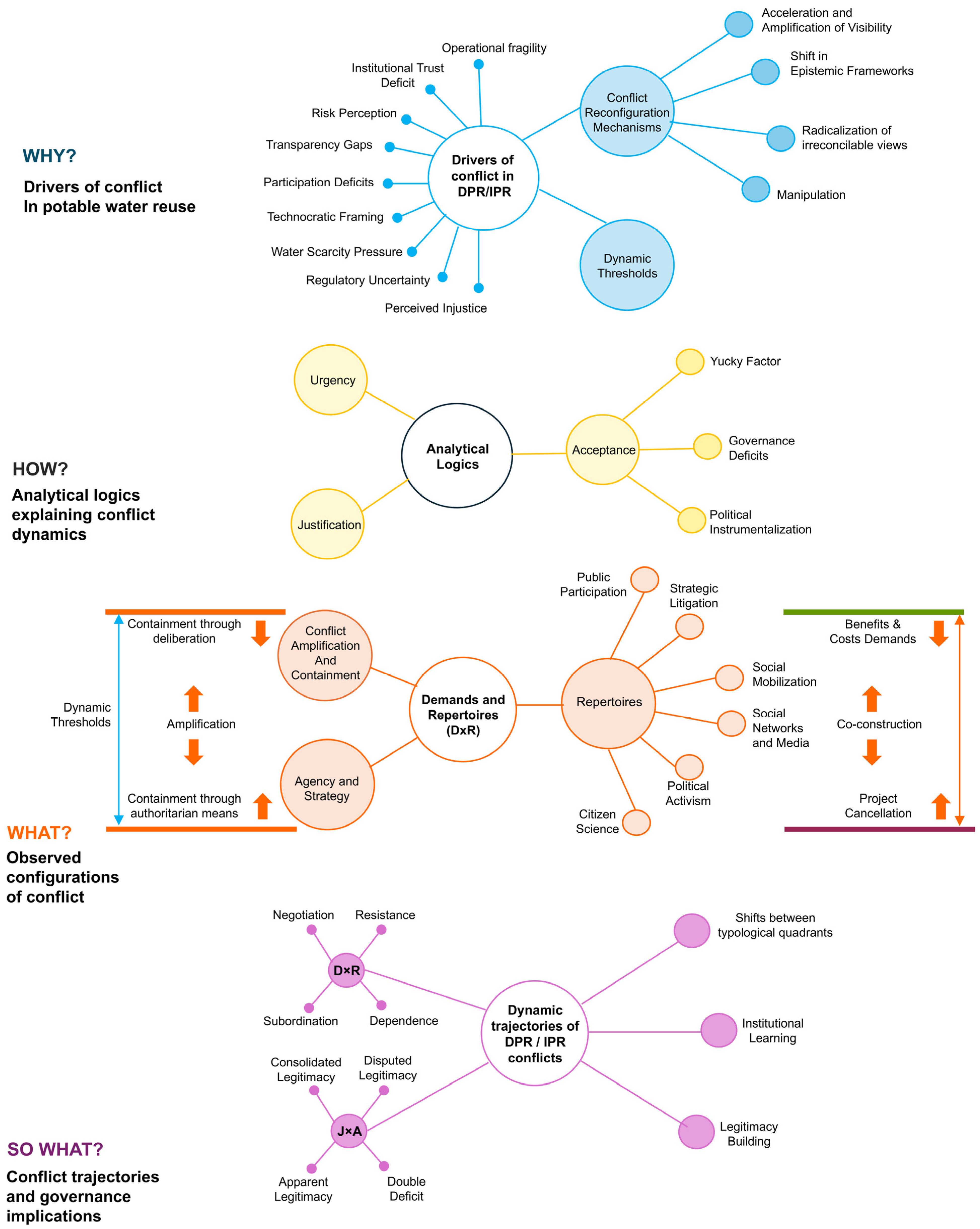
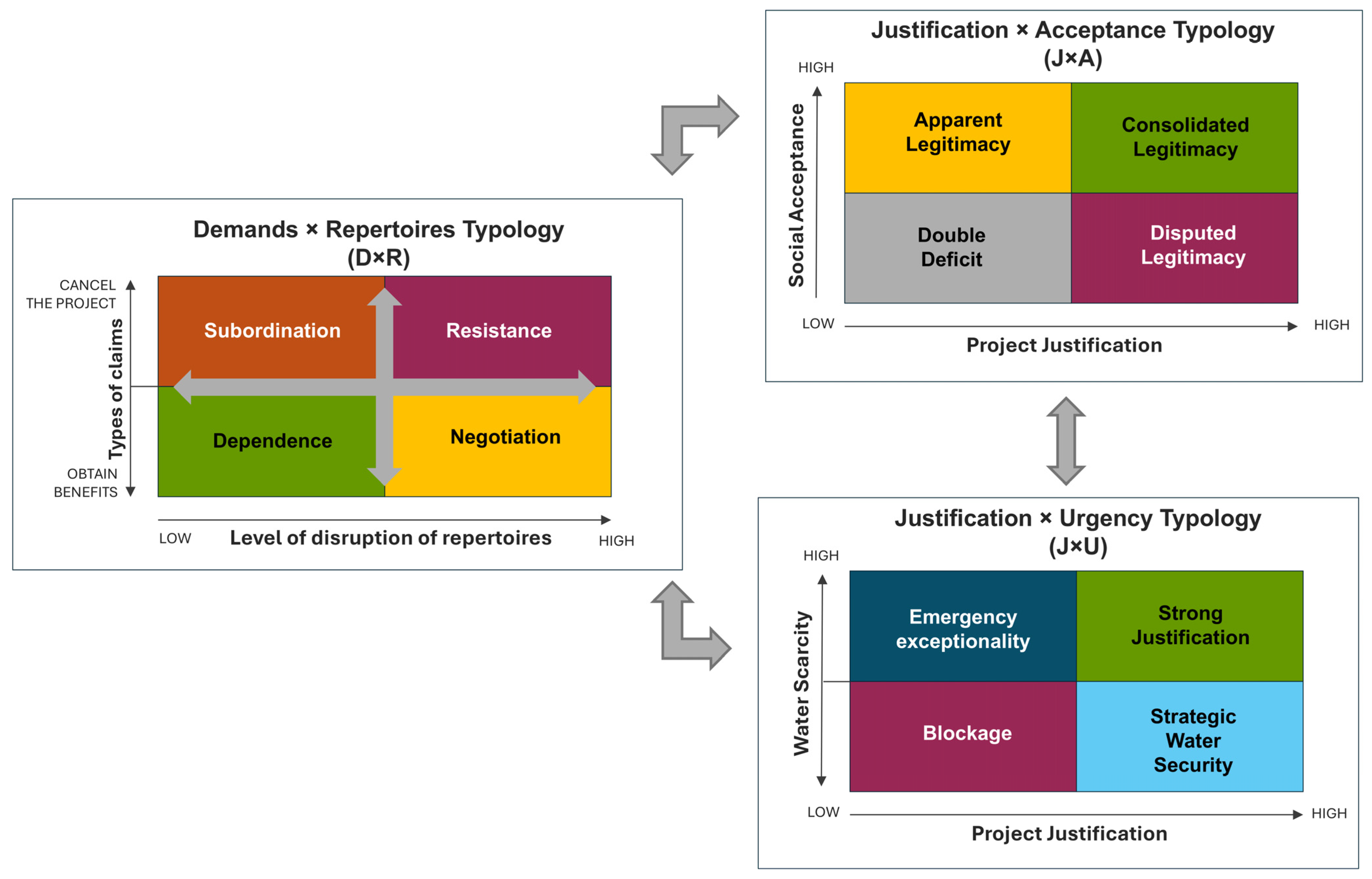
Figure 1 presents the overall conceptual framework linking drivers, analytical logics, observed configurations, and governance implications. Figure 2 presents the integrated typological structure through which the three matrices are jointly applied. This integration enables the identification of mechanisms, the specification of boundary conditions by quadrant, and consistent application and the comparison of these elements with empirical evidence.
The cases discussed in detail in the following subsections function as trajectory-rich illustrations, while the full documented corpus reported in Appendix A anchors the analysis and provides the comparative basis for identifying recurrent configurations across the three matrices. References to non-potable reuse are used only as contextual comparisons to situate DPR/IPR within broader reuse pathways and are not included in the core corpus or in the typological coding.

4.2. Justification × Acceptance

The J × A matrix classifies DPR/IPR projects according to the intersection between project justification and social acceptance. This intersection generates four legitimacy configurations: consolidated legitimacy, disputed legitimacy, apparent legitimacy, and double legitimacy deficit. These quadrants consist of:
  • Consolidated legitimacy (sufficient justification + sufficient acceptance): Projects such as Orange County, which has managed to align technical success with a complete “legitimacy portfolio” [31];
  • Disputed legitimacy (sufficient justification + insufficient acceptance): Projects such as San Diego in the 1990s, where the support of experts and technical panels was not enough to prevent public rejection due to a lack of transparency and participation [42,47];
  • Apparent legitimacy (insufficient justification + sufficient acceptance): Projects with a high risk of reputational collapse as it is based on induced conformity or majority follow-up without real processing of technical information [25];
  • Double legitimacy deficit (insufficient justification + insufficient acceptance): Projects such as certain cases in Spain conditioned by institutional fragmentation and the lack of clear regulatory frameworks for domestic use [24,68].
This typology enables the analysis of project outcomes and helps distinguish genuine acceptance from fragile support. Table 1 summarizes the resulting configurations and provides empirical examples. Case assignment to the quadrants follows the Justification × Acceptance (J × A) coding criteria detailed in Appendix B.

4.2.1. Consolidated Legitimacy

Consolidated legitimacy represents the configuration in which sufficient project justification and sustained social acceptance reinforce one another. In this quadrant, potable reuse no longer operates primarily as a contested innovation, but becomes progressively integrated into the ordinary urban water portfolio. This does not mean that conflict disappears; rather, controversy loses its disruptive capacity because technical reliability, institutional continuity, regulatory compliance, and accumulated public trust stabilize the governance arrangement [30,31].
The cases of Singapore (NEWater), Orange County (GWRS), and Windhoek illustrate how this configuration depends on more than treatment performance alone. In each case, potable reuse was supported by a broader legitimacy infrastructure: operational reliability, public communication, institutional credibility, and narratives of climate resilience or water security [2,5,7,13,31,69]. Reclaimed water becomes normalized not because risk is absent, but because it is made governable, visible, and institutionally manageable.
The main implication of this quadrant is the emergence of reputational resilience. When transparency, monitoring, and regulatory compliance remain credible, minor technical incidents or narrative fluctuations are less likely to escalate into systemic crises [69]. Consolidated legitimacy should therefore be understood not as a final state, but as a stabilized and continuously reproduced arrangement. Its durability depends on the capacity of institutions to sustain trust through verifiable performance, responsiveness, and meaningful participation [9,70].
Table 1. Typology Justification × Acceptance in DPR/IPR: comparative examples.
QuadrantDefinitionExamples/Cases
B1
Sufficient justification +
Sufficient acceptance.
Consolidated legitimacy
Technical and social coherence.
-Windhoek (Namibia): DPR since 1968, legitimized by extreme necessity and transparency [4,43].
Orange County (California, USA): GWRS, intensive education campaigns aimed at building high acceptance [21].
Singapore (NEWater): national pride, positive framing [7,71].
Perth (Australia): Beenyup aquifer recharge project (2010). Justified by a 50-year strategic plan and legitimized after an open data pilot that generated institutional trust [17].
El Paso (Texas): Desert city with a culture of scarcity where 84% of the community supports direct potable reuse due to transparent and diversified resource management [16]
B2
Sufficient justification +
Insufficient acceptance.
Contested legitimacy
Rejection despite technical soundness.
Toowoomba (Australia): Rejected in a 2006 referendum despite severe drought [8].
San Diego (USA, 1990s): projects blocked by “toilet-to-tap” framing [47].
East Valley, Los Angeles (USA): Technically viable 38,000 m3/d IPR project with infrastructure built in the late 1990s. It was blocked politically in 2000 due to criticism of lack of transparency, forcing the water to be redirected to non-potable uses [17].
Canberra, Australia. IPR plan proposed during the Millennium Drought. It was rejected in public consultation, showing that the provision of official scientific information failed to reverse polarization or perceptions of risk among sceptical groups [17].
B3
Insufficient justification +
Sufficient acceptance (superficial or induced).
Apparent legitimacy
Acceptance induced by urgency.
Stability is fragile, collapsing in the face of incidents.
Wichita Falls: Emergency DPR was accepted under extreme drought, but discontinued once reservoirs recovered.
Cape Town/FNWS: Potable reuse gained plausibility during “Day Zero”, but became more disputed after the emergency context shifted.
Brownwood: DPR moved from emergency-driven acceptance toward contested legitimacy.
B4
Insufficient justification +
Insufficient acceptance
Double legitimacy deficit
Projects blocked from the outset. Design flaws, high costs, or lack of urgency, or water scarcity that would make them necessary.
Cloudcroft: DPR proposal moved from disputed legitimacy toward double deficit; the system was not stabilized as operating DPR.
Western Corridor: IPR scheme shifted from emergency-driven legitimacy toward double deficit after the drought rationale weakened.
Wichita Falls: Also illustrates a B4 trajectory once the emergency rationale disappeared and DPR lost practical necessity.

4.2.2. Legitimacy in Dispute

Legitimacy in dispute captures the configuration in which sufficient project justification does not translate into sufficient social acceptance. In this quadrant, the problem is not primarily the absence of technical or regulatory support, but the failure to convert that support into credible social legitimacy. The dispute therefore moves from system performance to institutional trust, perceived contamination, procedural transparency, and the narratives through which actors interpret project risks [1,23,25,42].
This configuration is particularly vulnerable to political instrumentalization. Vested interests, electoral competition, or adversarial framing can turn potable reuse into a broader public controversy, even when technical and institutional conditions are relatively robust [41]. Narratives of suspicion and information manipulation may then delegitimize proposing institutions and question their capacity to sustain the project over time [8,23,47].
The analysis of this quadrant also shows the limits of knowledge-deficit approaches. When institutions assume that opposition reflects technical ignorance, or when they follow a Decide–Announce–Defend (DAD) script, deliberative spaces tend to narrow and perceptions of opacity or technocratic imposition are reinforced [9,20]. This matters because perceived risk is not shaped by technical evidence alone, but also by cultural meanings, local identity, affective responses, and ethical judgments associated with water [5,9,20].
Cases such as the Toowoomba plebiscite, the failed WRP in San Diego, and East Valley in Los Angeles illustrate how technically supported projects may be blocked, redirected, or politically weakened when suspicion campaigns, “toilet-to-tap” framing, procedural transparency deficits, or perceived environmental injustice dominate the public arena [8,23,42,47]. The implication is that project viability depends not only on demonstrating technical performance, but on building the institutional and communicative conditions through which that performance becomes socially credible.

4.2.3. Apparent Legitimacy

Apparent legitimacy is characterized by projects that lack a solid structural basis but enjoy broad public support due to non-technical factors [25]. In this quadrant, insufficient justification manifests itself in the absence of coherent integration of policies, institutions and regulations, ambiguous legal frameworks or financial planning that does not ensure long-term cost recovery [18]. Likewise, weakness may arise from ineffective operational organization, insufficient certified personnel to manage complex technologies, or reliance on temporary subsidies that undermine long-term financial sustainability [22].
On the other hand, sufficient acceptance does not necessarily arise from confidence in the project’s solvency, but from powerful drivers such as climate urgency. Narratives of extreme crisis, such as the “Day Zero” scenario, serve to mobilize the acceptance of reuse as a survival necessity, often overshadowing affective aversion and management concerns [19]. The mechanism of social conformity also operates, as individuals follow majority behaviour or norms imposed by social pressure. This produces pragmatic acceptance even without complete technical information [25].
The main risk of this quadrant is fragility. If urgency declines, if costs become visible, or if a quality incident occurs, apparent support may quickly erode [20,25,67]. This can produce a boomerang effect: not only weakening the specific project trajectory, but also damaging broader trust in future potable reuse initiatives and in the institutions responsible for governing water risk [19,31]. Thus, apparent legitimacy should be read less as a stable achievement than as a warning signal: acceptance without sufficient justification may enable short-term advancement, but it leaves the project exposed to reputational collapse.

4.2.4. Double Legitimacy Deficit

The double legitimacy deficit occurs when potable reuse initiatives lack a coherent strategic basis and face outright social rejection [18,22]. This weakness manifests as a misalignment among policies, institutions, and regulations, leading to fragmentation, unsustainable financial models, and limited legal capacity to guarantee long-term water security [18]. Concurrently, insufficient acceptance is reinforced by systemic mistrust of operating agencies, perceptions of opaque or unfair processes, or past failures in water management [23,42,51].
In this quadrant, recourse to the deficit model operates differently than in cases of disputed legitimacy. There, it tends to aggravate conflict in technically sound projects. Here, it functions as a discursive substitute for weak governance, assuming opposition stems from misunderstanding and relying on information or persuasion rather than correcting structural flaws. By ignoring that perceived risk is a social and psychological judgement, and that opposition reflects real governance deficits, disruptive repertoires are activated.
These include referendums and campaigns of distrust, which impose high political costs and can force project abandonment [8,23,42]. The outcome is institutional paralysis, where reuse is perceived both as a threat and as an indicator of unreliable government management [8,20,22,23,49].
In the absence of an urgency driver, such as a persistent drought that provides strategic justification for the project, these dynamics may tend to generate systemic blockages. Unlike other quadrants, where one dimension can partially compensate for the other, in the double deficit, there is no stabilizing element [22,39]. Without external pressure to reorder political priorities or reframe public perceptions of need, institutional weakness and low social legitimacy reinforce each other [22,70].
As a result, projects then often enter cycles of contention, failed implementation, and rising political costs. Institutional failures, technical incidents, or communication controversies can intensify the spiral of delegitimization, deepening the distance between authorities and citizens, and reinforcing perceptions of risk or injustice [39,44].
Ultimately, these patterns suggest that failures in reuse projects arise not only from symbolic disputes or communication deficits but from deeper governance crises. Under these conditions, strategies to improve communication or expand participation are insufficient unless institutional foundations and operational capacity are first rebuilt.

4.3. Justification × Urgency

The Justification × Urgency matrix further specifies how water pressure modifies the context in which justification is interpreted: it may stabilize potable reuse when supported by robust governance, but expose it to fragility when driven mainly by crisis narratives.

4.3.1. Trajectories Under Different Urgency Conditions

The four quadrants of the Justification × Urgency matrix can be observed through contrasting DPR/IPR trajectories. In contexts where high urgency and sufficient justification converge, potable reuse may become normalized as indispensable infrastructure.
Windhoek illustrates this configuration. Chronic water scarcity and the absence of viable conventional supply alternatives made it possible to sustain a pioneering global model of DPR [4,43]. Extreme aridity helped overcome early resistance, while technical legitimacy was reinforced through continuous safe operation since 1968, visible political endorsement, and a quality-based narrative in which water was judged by performance rather than origin [2]. This case shows how structural necessity, when coupled with sustained institutional and operational performance, can stabilize legitimacy over time.
The contrast with Wichita Falls illustrates a more fragile high-urgency configuration. In 2014, emergency DPR was implemented under stage-4 drought restrictions, when conventional supply options became critically constrained [13]. Urgency enabled rapid institutional alignment, regulatory authorization, technical verification, and public communication around the need to secure supply. However, once record rainfall restored reservoir levels in 2015, perceived necessity declined, the emergency DPR system was discontinued, and the project was reconfigured into an IPR scheme [67,72]. This trajectory shows that urgency-driven legitimacy may be contingent and reversible when it is not converted into a durable strategic justification.
A different trajectory appears where justification is strong but immediate urgency is low. Singapore’s NEWater program was adopted as a long-term water security strategy rather than as a short-term emergency response [7,71]. Since 2003, IPR and DPR have been embedded within a national self-sufficiency agenda supported by strong institutional alignment, technological validation, public engagement, and symbolic repertoires such as the “Four National Taps” narrative. The shift from technical communication to a broader narrative linking water to national survival helped stabilize legitimacy without relying on crisis pressure.
Finally, low urgency can undermine technically well-founded projects when perceived necessity is weak. Early reuse proposals in Los Angeles and San Diego faced rejection partly because potable reuse was not perceived as an immediate need [1,9]. In San Diego, institutional justification coexisted with insufficient social acceptance and fluctuating urgency. Opposition mobilized “toilet-to-tap” narratives and environmental justice claims, eventually converting weak perceived necessity into an effective veto. This case shows that, in low-urgency contexts, technical arguments may be insufficient when actors can successfully contest the necessity, fairness, or symbolic acceptability of potable reuse.

4.3.2. Political and Affective Mechanisms of Urgency

These trajectories show that urgency operates through political, communicational, and affective mechanisms. The divergence between hydrological reality and the public narrative of crisis is not explained by data alone, but by the way scarcity is framed, dramatized, contested, and translated into institutional action [19,51]. Warner and Meissner [19] identify four mechanisms that are especially relevant for DPR/IPR conflicts.
First, scarcity operates as a political framework. Beyond its biophysical basis, it is socially constructed and reflects disputes over distribution, responsibility, and the desired water order [51]. In this context, it can be instrumentalized to legitimize extraordinary interventions that would face greater opposition under normal conditions [20].
Second, urgency functions as an affective condition, in which narratives of extreme crisis channel uncertainty into emotional responses such as anxiety, fear, or solidarity. This generates an “emotional convergence” that facilitates the acceptance of measures and technologies under pressure rather than through rational deliberation [73].
Third, manufactured crises frequently adopt a spectacle dimension, where certain actors semantically intensify the threat to accelerate decisions and break institutional inertia [20]. When the debate shifts from evidence to media drama, the state and project developers may gain capacity for action. However, the risk of a boomerang effect increases if the crisis is deactivated without substantive changes in environmental conditions.
Fourth, the fallacy of predictive certainty consists of setting exact dates for collapse (“a doomsday clock”) to convey a certainty that hydrology, due to its structural uncertainty, rarely allows. Although this narrative may enable extraordinary decisions in the short term, if the forecast does not materialize as announced, technical credibility is eroded. This subsequently creates space for accusations of instrumentalization or fabrication of the crisis [19], and it may also generate a boomerang effect on the agendas initially promoted.
Table 2 operationalizes the Justification × Urgency typology as a distinct but complementary matrix to Justification × Acceptance. It synthesizes how water pressure and technical-institutional strength combine to shape DPR/IPR legitimacy trajectories and decision-making contexts.

4.4. Demands and Repertoires

The Demands × Repertoires matrix extends the discussion beyond whether DPR/IPR projects are technically justified or socially accepted by focusing on how actors seek to shape project trajectories. It relates the objectives advanced by actors—ranging from cancellation to demands for redesign, safeguards, compensation, or benefits—to the modes of action they mobilize, whether disruptive or contained.
From this interaction, four recurrent configurations emerge: resistance, negotiation, subordination, and dependence. These configurations do not merely describe positions toward potable reuse; they also reveal different degrees of social agency [2,20,21] and different ways in which the sociotechnical legitimacy of governance is constructed, contested, or eroded [1,19,30].
This matrix is useful because it avoids reducing opposition to misinformation or a lack of technical understanding. Resistance may express an informed rejection based on actors’ evaluation of evidence, risks, alternatives, distributive effects, or governance conditions [20]. Conversely, low-visibility contestation or apparent passive compliance should not automatically be interpreted as an absence of agency.
From a processual perspective, it may reflect the stabilized outcome of earlier active engagement, where concerns were addressed through participation, institutional response, safeguards, or project redesign. In other cases, silence may result from power asymmetries, dependence on authorities, limited organizational capacity, or restricted opportunities for contestation. Thus, both opposition and compliance must be interpreted as products of sociotechnical interaction rather than as simple indicators of acceptance or deficit [1].
The D × R typology therefore complements the Justification × Acceptance framework by showing that conflict trajectories depend not only on technical robustness or public trust, but also on how collective demands are articulated, strategically pursued, and defended through specific forms of action. In confrontational scenarios, this also includes the capacity of project promoters to defend their project, reorganize alliances, respond to criticism, and sustain legitimacy in both the public and institutional arenas.
Sardana et al. [22] identify technical, institutional, and sociocultural drivers and barriers that can enable or hinder the deployment of DPR/IPR. This analysis shows that these factors do not operate automatically and are instead shaped by actor strategies, agency, and repertoires [32]. Conflicts evolve through critical moments in which perceptions of risk, alliances, narratives, and repertoires are reconfigured [22,32]. From this perspective, the proposed typologies allow DPR/IPR controversies to be analyzed as dynamic processes of strategy, agency, and instrumentalization of conflict factors.
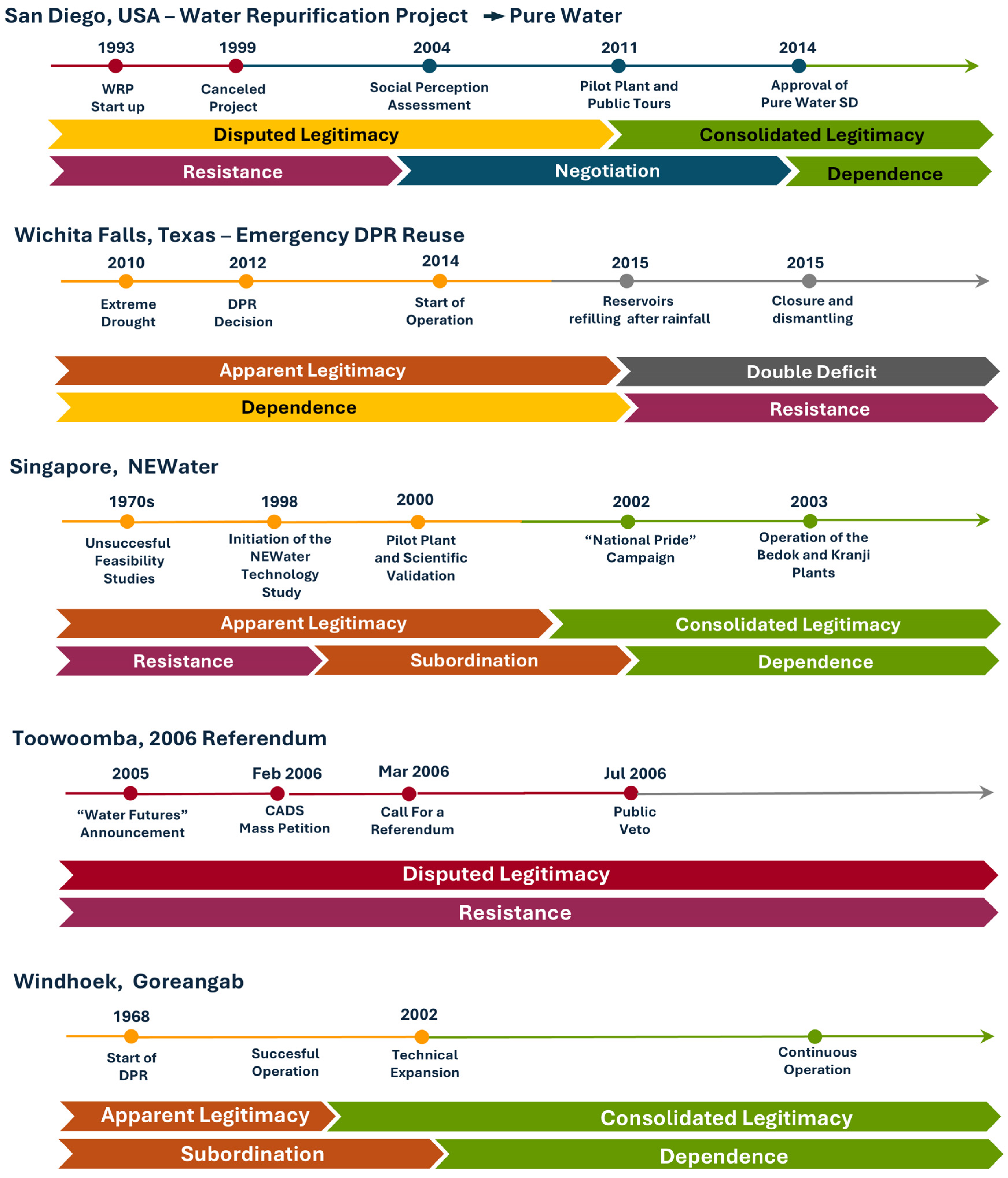
Figure 3 summarizes these dynamics by showing temporal trajectories of conflict and legitimacy in potable reuse projects. The cases analyzed suggest that projects do not always remain in a stable configuration. Many cases transition across quadrants as institutional responses, technological validation, and public narratives underpinning legitimacy evolve.
Ultimately, DPR/IPR outcomes depend not only on the intrinsic strength of the project, but also on the capacity of actors to reorganize alliances, innovate tactically, and shift the balance among opposition, conditional acceptance, redesign, oversight, benefit-sharing, and active pro-project support [32,66].

4.4.1. Resistance

Resistance conflicts emerge when social and opposition actors prioritize cancellation and deploy highly disruptive repertoires, such as media campaigns, protests, blockades, litigation, or referendums [8,22,23]. In this quadrant, conflict remains high and the most likely outcome is cancellation, unless there is a significant change in governance and communication strategies [22,23].
The Toowoomba referendum (Australia, 2006) illustrates this configuration. As discussed above, disruptive repertoires and “toilet-to-tap” framing transformed concerns over risk and injustice into effective political opposition, leading to the project’s rejection [1,22]. A similar trajectory was observed in San Diego during the 1990s, where symbolic contamination narratives eroded public confidence despite technical viability [1,9].
This configuration can be interpreted as a cumulative legitimacy deficit. Perceptions of technical inadequacy, lack of institutional transparency, and distributive injustice combine to erode social recognition of the project [5,30]. When this rupture becomes entrenched, technical rationality is no longer perceived as a legitimate solution. The conflict can then take the form of a sustained veto, in which infrastructure is perceived as a risk or an imposition rather than a response to water scarcity [8].
In these contexts, conflict tends to intensify symbolically [19]. Narratives of risk or stigmatization reinforce opposition, and any technical incident or media controversy can consolidate rejection and hinder its transformation into negotiation [47]. Resistance thus stabilizes as a logic of blockage that transcends the technical evaluation of the project and is inscribed in broader dynamics of institutional mistrust [50].

4.4.2. Subordination

Subordination emerges when DPR/IPR projects face insufficient, ambivalent, or latent acceptance, but opposition does not translate into strong collective action. Weak repertoires may result from limited organizational capacity, a lack of resources, fear of institutional reprisals, or the absence of strategic alliances. It may also reflect high mobilization costs, structural dependence on supply authorities, or a lack of effective repertoires of action to contest decisions under fragmented responsibilities and weak political leadership [24,32]. Thus, subordination reflects a condition in which disagreement exists, but actors lack the capacity, opportunity, or confidence to convert it into effective contestation.
This scenario often occurs in contexts of power asymmetry [20] or weak institutions [24]. In these settings, rejection is manifested as latent mistrust linked to opaque processes or past regulatory failures, or as resigned silence when meaningful opportunities for participation or contestation are absent [5,20].
The dominant mechanism is structural containment of the conflict, where mistrust or scepticism does not disappear but remains at latent levels due to the perception that the opposition lacks political or institutional viability. In this configuration, there is no active conditional acceptance or robust delegated trust. Instead, it reflects a form of resigned compliance in which disagreement does not translate into an effective veto.
This dynamic has been observed in some Texas cases, where a significant share of the population was unaware of project implementation, limiting the capacity for protest and leaving opposition expressed mainly as latent mistrust [75]. A related configuration appears in cases of “de facto reuse,” where treated or untreated wastewater is discharged into rivers that subsequently supply drinking water systems without explicit public deliberation or citizen participation [76,77]. In these situations, apparent acceptance may conceal an invisible or poorly understood health risk. This acceptance is therefore fragile and vulnerable to technical failures, health crises, or media exposure [13,17,30].
Under these conditions, compliance is sustained less by conviction than by disarticulation, institutional weakness, dependence, or a limited capacity to act [32]. DPR/IPR projects may thus advance with limited visible mobilization, even while critical narratives persist informally or symbolically [1,24]. This makes subordination analytically different from consensus: the absence of open protest reflects not necessarily acceptance, but rather the coexistence of latent disagreement with structural constraints on collective action. Trust in authority may remain minimal, instrumental, or merely circumstantial, while implementation depends more on the absence of veto capacity than on consolidated legitimacy.
In contexts of acute water scarcity, this configuration may stabilize temporarily, as necessity reduces incentives for mobilization [39]. However, this stability remains fragile. Technical incidents, media controversies, or shifts in risk perception can reactivate latent mistrust and rapidly transform subordinated disagreement into open resistance.

4.4.3. Negotiation

The Negotiation quadrant is configured when the technical and institutional justification for the project is recognized as sufficient or necessary, but social acceptance remains conditional. Communities do not necessarily seek cancellation. Instead, they accept DPR/IPR conditionally by seeking to redefine the terms under which it is implemented [9]. Conflict does not operate as a veto, but as a strategic resource for reconfiguring the risk governance framework. Its analytical relevance lies in showing that disagreement can become productive when actors leverage pressure, participation, and institutional engagement to redefine safeguards, responsibilities, and criteria of acceptability.
  • Conditional Acceptance and Conflict as Institutional Adjustment
This quadrant shows that conflict in potable reuse projects is not a binary choice between acceptance or rejection; it functions as a mechanism for institutional adjustment [1,32]. In this sense, legitimacy in DPR/IPR tends to take on a transactional and procedural character, built through the redefinition of responsibilities, standards and forms of social control, rather than through the mere technical demonstration of viability [30,31,50].
The repertoires of action may be intense and disruptive, including litigation, political pressure, referendums, media campaigns, or public mobilization. However, their function is not limited to obstruction; they may force institutions to open spaces for dialogue, renegotiate distributive arrangements, strengthen technical and environmental safeguards, or increase the credibility of decision-making processes [23,78].
Actors may recognize the need for water infrastructure, especially under conditions of scarcity or vulnerability, while still questioning technical rigour, operational transparency, meaningful participation, governance arrangements, or water quality monitoring [24]. Consequently, their demands often encompass co-monitoring, institutional adjustments, participatory mechanisms, tariff revisions, additional quality guarantees, supply guarantees, or stronger accountability mechanisms.
When these demands are credibly incorporated, negotiation tends to stabilize acceptance and reduce conflict, shifting cases toward more robust configurations of legitimacy. Conversely, if they are dismissed or perceived as symbolic, trust in dispute can turn into explicit veto, and the conflict shifts to the resistance quadrant.
The case of San Diego illustrates this trajectory. After strong opposition in the 1990s, the program was revived in the mid-2000s and reoriented toward co-creation through demonstration projects, independent expert panels, sustained outreach, and recurrent drought framing [1,16]. Project proponents, including Pure Water San Diego and the Water Reliability Coalition, promoted water independence through “seeing is believing” strategies such as plant tours, taste tests, and rebranding as purified water. The shift from limited stakeholder engagement to broader citywide participation illustrates how anticipatory legitimacy-building and coalition-based agency can transform opposition into support.
  • Varieties, Boundaries, and Reversibility of Negotiation.
Negotiation can transform conflict into a space for institutional learning and trust-building, allowing public support to increase significantly. However, risks of backsliding persist if agreements are not perceived as respected or if the perception of urgency due to drought diminishes [1].
In intensive reuse contexts such as the Segura basin (Murcia) and the Llobregat axis (Catalonia)—although the predominant uses are agricultural and industrial reuse rather than DPR/IPR—the literature shows a consistent logic of transactional negotiation. Actors accept reuse as a strategic resource while conditioning its expansion on disputes over cost recovery, treatment levels, tariffs, and supply assurances in the face of drought [79,80]. These controversies illustrate that the conflict does not necessarily seek to block reuse, but rather to renegotiate its distributive and regulatory frameworks.
This pattern does not apply when acceptance is full and sustained without conditions, in which case negotiation loses its centrality. Nor does it apply when water urgency induces technocratic delegation or “delegated acceptance” based on survival, without demands for institutional redesign [2]. Likewise, it does not describe cases of insufficient technical justification, which tend toward structural blocking or the definitive cancellation of the project [8].
Negotiation can express disputed legitimacy when actors seek to condition or correct a project they consider insufficiently justified or governed. It can also reflect legitimacy under construction, when interaction takes the form of institutional co-creation aimed at building trust, adjusting safeguards, and co-producing conditions of acceptability [1,30].
In this sense, negotiation is not a homogeneous quadrant; it spans configurations from conditioning dispute to collaborative co-construction of legitimacy [32]. Thus, different forms of negotiation can coexist within the same case, from adversarial approaches aimed at imposing conditions to cooperative modes of co-producing trust. Negotiation functions as both a repertoire for containing conflict and a mechanism of transition through which legitimacy can shift from initial dispute to collective construction and eventual consolidation.

4.4.4. Dependency

  • Legitimacy delegated
Conflicts characterized by dependency arise when actors make demands for basic benefits (water security, quality, continuity of service), compensation, or specific adjustments. Such demands are accompanied by low repertoires of action, expressed through institutional and technical channels. This configuration emerges when acceptance is sufficient to allow implementation. It is based mainly on delegated trust in technical authority rather than on intense public deliberation or explicit negotiation of conditions [5,17]. It typically occurs in contexts of extreme water urgency, where the DPR/IPR is perceived as the only viable alternative to ensure supply.
The dominant mechanism is delegated legitimacy based on necessity, in which citizens explicitly or implicitly trust the technical competence of operators and regulators to manage complex risks and guarantee the safety of the system [13,81]. In this scenario, low levels of conflictive mobilization, restrained repertoires, and a public narrative focused on the inevitability or technical rationality of the project predominate.
This dependence does not imply automatic legitimacy, and its stability depends on operators maintaining high technical, regulatory, and communication standards [4,81]. In this framework, dependence refers not to the universal biological need for water, but to socio-institutional reliance on infrastructure and its regime of operation and control. The need for service continuity raises the cost of veto and reduces the political margin for opposition [22]. Unlike subordination, where opposition is absent due to lack of veto power, independence veto is avoided because its cost is too high (risk of shortages) and minimal trust is placed in the operator [31].
Unlike extractive conflicts such as mining, where dependency is typically rentier- based and territorial embedded (e.g., employment, wealth distribution, social investment) and raises the opportunity cost of opposition [32], potable reuse projects are characterized by infrastructural dependency on supply security. In this context, veto implies an immediate risk of shortage of a vital resource [4,43]. Therefore, stability depends less on economic compensation than on verifiable performance, transparency, and the absence of incidents. When these conditions fail, delegation quickly turns into contested trust, triggering negotiation or resistance.
  • Passive and Active Dependency
In passive dependency, acceptance is often resigned but not driven by political or organizational incapacity. Doubts may persist, yet latent rejection is less marked than in subordination. Even when capabilities exist, actors refrain from veto or escalation because the cost of opposition is too high, risking supply continuity, quality, or security under scarcity and lack of alternatives [5,25]. Trust is, therefore, a pragmatic delegation of technical authority (delegated epistemic legitimacy), sustained insofar as operational performance and transparency are maintained [73]. Communities accept the solution out of necessity for service continuity, even without initial conviction. A representative example is Windhoek in its early decades, where acceptance was driven by the lack of water alternatives and extreme aridity. This occurred before public participation was considered crucial for project implementation [22,23].
Active dependence leads to a more consolidated legitimacy in which the population not only accepts but internalizes the DPR/IPR as part of its water identity [25]. In economic terms, the system enters a phase of infrastructural normalization. As verifiable water security benefits (continuity, quality and risk reduction) accumulate and sufficient justification and acceptance are sustained over time, the conflict shifts from a legitimacy dispute (J × A) to routine governance with low repertoires (D × R). Cases such as Singapore (NEWater) and Orange County illustrate this trajectory, where after decades of institutional construction and transparency, reuse stabilizes as a public asset associated with resilience and sustainability [22,23]. Social participation does not disappear, but it takes on a mainly regulatory-informal role of social control (monitoring, surveillance, and verification), rather than active dispute [24,31].
Under this configuration of active dependency, the system tends to stabilize, though not necessarily in a deliberative form. Dependency shifts from resignation to functional institutional trust, reducing the need for social mobilization [72]. This stability depends less on intense participatory procedures than on operational continuity and the absence of health crises or transparency controversies [81]. If such events occur, or if the perceived urgency diminishes significantly, delegated trust can quickly transform into contested trust, shifting the case toward negotiation or even resistance [43].
This configuration does not apply when acceptance is merely apparent and masks underlying mistrust (subordination), or when explicit demands for institutional redesign signal a shift toward conditional acceptance (negotiation). Nor does it describe contexts where technical justification is widely questioned, since in such cases epistemic legitimacy fails to sustain acceptance. This quadrant shows that stability in DPR/IPR projects can, in many cases, be based on a pragmatic delegation of authority rather than on deliberative consensus. Such legitimacy is functional under conditions of scarcity and high need, but it is structurally fragile and susceptible to abrupt reconfigurations in the face of contextual changes or institutional failures [39].

4.5. DPR and IPR as Distinct Conflict Modalities

DPR and IPR do not follow fundamentally separate conflict logics, but they operate as distinct conflict modalities within potable reuse governance. In some cases, opposition to DPR does not seek to cancel potable reuse altogether, but to condition or redesign it toward IPR by introducing environmental, regulatory, or temporal buffers between advanced treatment and human consumption.
These buffers (e.g., aquifers, reservoirs, rivers, blending stages, or time delays) may function not only as technical safeguards, but also as regulatory and symbolic boundaries. IPR can reduce the perceived immediacy of the wastewater-to-drinking-water transition by creating a “passage through nature,” whereas DPR confronts more directly the stigma associated with direct consumption and persistent contamination [1].
Within the framework, both DPR and IPR can generate resistance, negotiation, subordination, or dependence. The main difference lies in the orientation and substantive content of demands. DPR conflicts tend to focus on direct consumption, public trust, health safety, real-time monitoring, and operator reliability. IPR conflicts more often concern the credibility, effectiveness, and governance of environmental mediation. However, IPR projects may still generate DPR-like conflicts when the buffer is perceived as insufficient, illegible, or merely symbolic [22].
The cases of San Diego, Toowoomba, and Brisbane (Western Corridor) illustrate these dynamics. San Diego shows how early opposition contributed to project redesign and legitimacy-building around reservoir augmentation. Toowoomba shows how an IPR project can be rejected when the buffer fails to operate as a credible symbolic safeguard. Finally, Brisbane illustrates a contingent trajectory, in which IPR was justified under drought urgency but lost political centrality once the crisis eased.

4.6. Practical Implications

4.6.1. Implications for Potable Reuse Projects

From an implementation perspective, potable reuse is more likely to succeed when treated as a process of anticipatory legitimacy-building rather than a predefined technical solution. Previous studies highlight governance alignment, participation, and trust as enabling conditions [20,60]. However, the analysis suggests that viability is strongly shaped in early stages. It depends on the capacity of developers to align institutions, frame necessity, build coalitions, and establish credible conditions for participation and trust, even if subsequent interactions reconfigure legitimacy conditions. This implies that early stages should prioritize actor mapping, interest alignment, identification of veto points, and assessment of the strategic capacity of developers.
At the same time, consistent with conflict and governance literature on actor strategies [32], opposing actors mobilize demands, narratives, and repertoires that position projects across configurations of resistance, negotiation, subordination, or dependence. In practical terms, these configurations shape the governance responses required and drive trajectories of escalation or containment. Project developers must therefore anticipate and adapt to evolving opposition, particularly under conditions of low trust or high disruption.
The analysis suggests that viability depends on the capacity to govern conflict as a constitutive dimension of the project rather than an external constraint. Building on approaches that emphasize participation, transparency, and oversight as pillars of legitimacy [17,18,24], the typological framework can be read as a tool to support the sequencing of interventions and respond to shifting legitimacy conditions. Under this perspective, success emerges from the strategic interplay among competing forms of agency, where alignment, contestation, and negotiation define what is politically and socially achievable.

4.6.2. Policy Implications for Water Governance

A central implication of the framework is the need to distinguish between system-level governance and project-level conflict governance. Existing scholarship frames potable reuse governance through regulatory coherence, institutional capacity, technological standards, public trust, risk communication, and water scarcity as structuring conditions of legitimacy [18,30,31]. These factors define baseline governance environments. By contrast, at the project level, these conditions are enacted and contested through actor demands, narratives, and repertoires, so that local disputes reflect broader governance tensions rather than isolated failures.
A key implication of this analysis is that governance should be understood not only as institutional design, but as a field of collective strategic agency. Rather than being defined primarily by formal arrangements emphasized in existing scholarship [17,32], governance here emerges from the interaction of distributed and unequal actor capacities.
From this perspective, the central governance challenge lies in configuring institutional environments capable of absorbing conflict, processing strategic interaction, and sustaining legitimacy across scales. This perspective suggests shifting the evaluation of governance from formal design alone toward agential performance. In this sense, governance is understood as the capacity to activate constructive agency (coalitions, credible spokespersons, mediation, trust-building), channel conflictive agency to prevent escalation into veto or polarization, and contain opportunistic agency that exploits narratives of risk, aversion, urgency, or injustice.
In some cases, this may also imply that failure or blockage reflects a corrective capacity of governance, particularly where reuse projects are poorly justified, prematurely advanced, or institutionally weak [8,18,20]. Governance should therefore be assessed not by whether projects advance, but by its ability to discriminate between viable, fragile, and inappropriate interventions, and to produce the appropriate outcome in each case (stabilization, redesign, containment, or blockage).

5. Conclusions

This article developed an integrated typological framework for analyzing conflicts surrounding direct and indirect potable water reuse (DPR/IPR). Its main theoretical contribution is the advancement of a conflict-oriented explanation of potable reuse governance, moving beyond accounts centred solely on technological feasibility, scarcity, or public acceptance.
By articulating justification and acceptance, justification and urgency, and demands and repertoires, the framework illustrates how technical justification, social acceptance, crisis pressure, and actor agency interact in potable reuse conflicts. These interactions provide an analytical basis for understanding why projects may be blocked, redesigned, normalized, or transformed through disputes over risk, authority, necessity, and legitimacy.
The framework also clarifies how DPR and IPR operate as distinct conflict modalities within a common analytical structure. Both can be examined through the same typological matrices, but DPR tends to make potable reuse socially immediate, concentrating disputes around direct consumption, public trust, health safety, monitoring, and operator reliability. IPR, by contrast, mediates this immediacy through environmental, regulatory, or temporal buffers, whose credibility and governance often become central objects of dispute.
From a practical governance perspective, the framework implies that project viability depends on anticipatory acceptance-building. This long-term, constructive, and conflict-sensitive process may begin years before the formal project announcement and continue until sufficient legitimacy thresholds exist. By combining transparent justification, early actor mapping, meaningful participation, credible monitoring, and responsiveness to evolving demands and repertoires, this approach actively helps prevent costly disputes, blockages, or late-stage redesigns.
Yet, conflict-sensitive governance does not necessarily mean securing approval. Postponing, redesigning, or withdrawing a project must be recognized as a valid governance outcome whenever technical justification, social acceptance, or policy proportionality remain insufficient to support its deployment.
The framework is conceptually and comparatively grounded in a corpus of documented DPR/IPR cases, but its design supports analytical interpretation rather than statistical validation or confirmatory causal testing. In its current scope, it does not incorporate numerical indicators and therefore does not allow for quantitative modelling. The analysis is also conditioned by the availability of documentary evidence, which may favour cases with visible controversy and stronger public records. It also codes dominant configurations, although actor positions and the analytical dimensions themselves may be heterogeneous, contested, and strategically mobilized over time.
Future research could further deepen the study of conflicts in water reuse, while also examining disputes surrounding desalination and broader water-supply systems as objects of study in their own right. This would advance a conflict-oriented agenda to better understand how such tensions emerge, evolve, and may be addressed through resolution or transformation strategies. To operationalize these insights, subsequent inquiries could examine how institutional capacity, regulatory design, media framing, and responses to misinformation shape the emergence, containment, and ultimate outcome of conflict in potable reuse governance [2,30,31].
Furthermore, the proposed typologies should be applied to larger, systematically coded case datasets, including longitudinal analyses capable of tracking shifts between configurations over time. This actor-disaggregated approach could clarify how promoters, regulators, affected communities, and supportive actors mobilize distinct demands and repertoires within the same project [53]. Ultimately, explicit comparisons between DPR and IPR trajectories would help refine a robust framework for comparative and conflict-sensitive water governance.

Author Contributions

Methodology, C.R.-M.; Investigation, J.F.-Q.; Writing—original draft, J.F.-Q.; Writing—review and editing, C.R.-M. and M.D.A.-M. All authors have read and agreed to the published version of the manuscript.

Funding

This research did not receive external funding.

Data Availability Statement

The original contributions presented in this study are included in the article. Further inquiries can be directed to the corresponding author.

Conflicts of Interest

The authors declare that they have no conflicts of interest.

Appendix A. Cases of DPR/IPR Used in the Analysis

This appendix presents the list of cases of potable water reuse that make up the documentary corpus used to define the typological framework developed in this study. The corpus includes 25 documented cases of direct potable reuse (DPR) and indirect potable reuse (IPR) identified from academic literature, technical reports, and contextual sources. Each case was classified according to the three analytical typologies used in the article: Justification × Acceptance (J × A), Justification × Urgency (J × U) and Demands × Repertoires (D × R). The classification reflects the predominant configuration identified from the analysis of the literature and, where possible, the trajectory observed in the evolution of the conflict. The corpus is not intended to be exhaustive, but rather to provide a comparative empirical basis for illustrating the analytical framework and the diversity of governance trajectories associated with potable water reuse projects.
Table A1. DPR/IPR cases used in the analysis.
Case/ProjectCity/RegionCountryType of ReuseReferencesJ × A—QuadrantJ × U—QuadrantD × R—Quadrant
San Diego (1990s)CaliforniaUSAIPR[23,47]B2 (Disputed Legitimacy)A3 (Strategic Security) Resistance
San Diego (Pure Water)San Diego, CAUSAIPR → DPR[9,23,47]B2 → B1 (Disputed Legitimacy → Consolidated Legitimacy)A3 (Strategic Security) → A1 (Justification/High Urgency)Resistance → Negotiation
Toowoomba QueenslandAustraliaIPR[8]B2 (Disputed Legitimacy)A1 (Sufficient
Justification/
High Urgency)
Resistance
Windhoek (Goreangab)WindhoekNamibiaDPR[4,81]B1 (Consolidated Legitimacy)A1 (Sufficient Justification/High Urgency)Subordination
Orange County (GWRS)CaliforniaUSAIPR[10,31,41]B1 (Consolidated Legitimacy)A1 (Sufficient Justification/High Urgency)Negotiation
Singapore (NEWater)SingaporeSingaporeIPR/DPR[7,74]B1 (Consolidated Legitimacy)A3 (Strategic Security)Subordination → Dependency
Wichita Falls (Emergency)TexasUSADPR → IPR[13,43,67]B3 → B4 (Apparent Legitimacy → Double Deficit)A2 (Emergency Exceptionality →
A4
(Structural Blockage)
Dependency
Perth (Beenyup)Western AustraliaAustraliaIPR[17]B1 (Consolidated Legitimacy)A1 (Sufficient Justification/High Urgency)Negotiation
Cape Town (FNWS)Cape TownSouth AfricaIPR/DPR[19,27]B3 → B2 (Apparent legitimacy → Disputed Legitimacy)A2 (Emergency exceptionalism →
A4 (Structural deadlock)
Dependence → Resistance
GeorgeWestern CapeSouth AfricaIPR[13,81]B1 (Consolidated Legitimacy)A2 (Emergency exceptionalism → A3 Strategic SecurityNegotiation → Dependence
AuroraColorado USAIPR[77]B1 (Consolidated legitimacy)A1 (Sufficient Justification/High Urgency)Negotiation → Dependency
Big SpringTexasUSADPR[16,43]B3 → B1(Apparent Legitimacy → Consolidated Legitimacy)A1 (Sufficient Justification/High Urgency)Subordination → Dependency
CloudcroftNew MexicoUSADPR[16,22,43]B2 → B4 (Disputed Legitimacy→ Double Deficit)A1 (Sufficient Justification/High Urgency)Resistance
East Valley (L.A.)Los AngelesUSAIPR[10,17,22]B2 (Disputed Legitimacy)A3 (Strategic Security)Resistance
CanberraCanberraAustraliaIPR[1,17]B2 (Disputed Legitimacy)A1 (Sufficient Justification/High Urgency)Resistance
TampaFloridaUSAIPR[17]B2 (Disputed Legitimacy)A3 (Strategic Security)Resistance
Torelle (Wulpen)FlandersBelgiumIPR[24]B1 (Consolidated legitimacy)A3 (Strategic Security)Dependency
Upper OccoquanVirginiaUSAIPR[60]B1 (Consolidated Legitimacy)A3 (Strategic Security)Negotiation → Dependence
Beaufort WestWestern CapeSouth AfricaDPR[43]B1 (Consolidated legitimacy)A1 (Sufficient Justification/High Urgency)Dependency
BrownwoodTexasUSADPR[16]B3 → B2 (Apparent Legitimacy → Disputed Legitimacy)A2 (Emergency Exceptionalism) → A3 (Strategic Security)Resistance
Monterrey (IHSAP V)MonterreyMexicoDPR/IPR B3 (Apparent LegitimacyA1 (Sufficient Justification/High Urgency)Dependency
El PasoTexasUSADPR[16]B1 (Consolidated Legitimacy)A3 (Strategic Security)Negotiation
Dublin San RamonCaliforniaUSAIPR[48]B2 (Disputed Legitimacy)A3 (Strategic Security)Resistance
Western CorridorQueenslandAustraliaIPR[13,17,39]B3 → B4 (Apparent Legitimacy → Double Deficit)A1 (Sufficient Justification/High Urgency)Resistance
eThekwiniDurbanSouth AfricaDPR[43,51,81]B2 (Disputed Legitimacy)A3 (Strategic SecurityResistance
Pure Water MontereyMonterey County, CaliforniaUSAIPR[48]B1 (Consolidated legitimacy)A3 (Strategic security)Negotiation

Appendix B. Typological Coding Framework

This appendix presents the condensed coding protocol used to classify cases across the three typological matrices developed in the article: Justification × Acceptance (J × A), Justification × Urgency (J × U), and Demands × Repertoires (D × R). The protocol translates the conceptual framework into operational decision rules while preserving the interpretive nature of the analysis.
The purpose of the protocol is not to mechanically score cases, but to make case classification transparent, comparable, and analytically traceable. It provides rules for interpreting heterogeneous, incomplete, and sometimes contradictory evidence, distinguishing structural sufficiency from conflict dynamics, and clarifying how actor demands and repertoires shape project trajectories.

Appendix B.1. Coding Protocol Structure

The protocol is based on five analytical dimensions: Justification, Acceptance, Urgency, Demands, and Repertoires of action. These dimensions are later combined into three configurational typologies.
  • Justification assesses whether a DPR/IPR project can be substantively defended as necessary, viable, reasonable, and proportional in relation to available evidence and alternatives.
  • Acceptance assesses whether the project has a meaningful social basis of support, tolerance, trust, endorsement, or conditional acceptance among relevant publics, users, and affected groups.
  • Urgency assesses whether material or perceived water-related pressure meaningfully shapes the project’s necessity claims, timing, decision thresholds, implementation, contestation, or trajectory.
  • Demands identify the dominant orientation of actor claims toward the project, distinguishing cancellation-oriented demands from conditional or coexistence-oriented demands.
  • Repertoires of action identify how actors seek to influence the project trajectory, distinguishing disruptive repertoires from contained repertoires.
Together, these dimensions connect structural defensibility, social acceptance, crisis pressure, and actor agency.
  • The coding process follows four steps. First, Justification, Acceptance, and Urgency are assessed according to their analytical functions. Second, complementary dispute coding is used to clarify whether relevant factors are uncontested, interpretively disputed, substantively disputed, or strategically mobilized. Third, Demands and Repertoires are coded through their classificatory elements: demand orientation and repertoire mode. Fourth, these dimensions are combined into the three typological matrices.
  • The protocol does not require every case to display the same type or amount of evidence. Clear and uncontested evidence may be classified directly according to the relevant coding threshold. Ambiguous, contradictory, incomplete, or contested evidence is interpreted through the integrated coding rules below.
Table A2. Overview of Coding Dimensions.
DimensionMain Coding ThresholdAnalytical FunctionUsed in
JustificationSufficient/InsufficientAssesses whether the project can be defended as necessary, viable, reasonable, and proportional.J × A;
J × U
AcceptanceSufficient/InsufficientAssesses whether there is a meaningful social basis of support, tolerance, trust, or conditional acceptance.J × A
UrgencyHigh/LowAssesses whether water-related pressure meaningfully shapes the decision context.J × U
DemandsCancellation-oriented/
Conditional-coexistence-oriented
Identifies what actors seek regarding the project.D × R
RepertoiresDisruptive/ContainedIdentifies how actors act to influence the project trajectory.D × R

Appendix B.2. Complementary Dispute Coding

  • Dispute coding is applied as a complementary interpretive step. It does not constitute an additional score and does not automatically modify the structural classification of a factor. Its function is to clarify whether a factor remains a background condition, becomes contested in meaning, reveals substantive weaknesses, or is strategically mobilized by actors.
  • Interpretive or strategic disputes do not automatically reduce Justification, Acceptance, or Urgency. They affect coding only when they reveal substantive gaps, unresolved contradictions, weak evidence, exclusion, unstable support, or other weaknesses that compromise the analytical function of the factor. This distinction is central to the original codebook, which separates structural assessment from the conflictive status of each factor.
Table A3. Complementary Dispute Coding.
Dispute StatusMeaningMethodological Use
Not disputedThe factor does not appear as a relevant object of dispute in the available evidence.Records the absence of visible dispute over the factor.
Interpretively disputedActors disagree over the meaning, relevance, implications, or legitimacy of the factor.Records disagreement over interpretation. It does not automatically change the structural coding.
Substantively disputedThe controversy reveals evidentiary gaps, omissions, contradictions, unaddressed impacts, unevaluated alternatives, or unevenly distributed burdens.May affect the coding of the factor when the dispute undermines its analytical function.
Strategically mobilized/instrumentalizedThe factor, or the dispute around it, is used by actors to legitimize, accelerate, block, redesign, or discredit the project.Functions as an analytical qualifier linking the factor to narratives, repertoires, actor strategies, and conflict trajectories.

Appendix B.3. Justification Coding Protocol

  • Justification is coded as sufficient or insufficient. It is treated as a composite but non-additive dimension. Final coding does not depend on the number of favourable indicators, but on whether the available evidence allows the project to be defended as necessary, viable, reasonable, and proportional.
  • Justification is assessed through six structural factors:
Table A4. Justification Factors.
FactorAnalytical
Function
Observable EvidenceCoding
1. Techno-
sanitary
Assesses the physical and technical robustness of the system.Treatment and disinfection barriers; system performance; monitoring of water quality and emerging contaminants.Sufficient: clear evidence of robust sanitary control.
Insufficient: there is not enough evidence on safety, monitoring, or incident control, or there are relevant technical gaps that prevent sanitary control from being sustained.
2. Regulatory-legalAssesses legal and regulatory certainty.Applicable regulations; water quality standards; permits and authorizations obtained; clarity of competences; compatibility with water, health, and environmental plans.Sufficient: clear regulatory framework and authorizations.
Insufficient: regulatory gap or absence of a clear framework, uncertain permits, or relevant competence conflict.
3. Economic-
financial
Assesses the economic and financial viability of the project.Capital and operating costs; sources of financing; tariff model; affordability for the user; long-term sustainability.Sufficient: economically sustainable financing and operation.
Insufficient: unviable, uncertain, or undemonstrated costs, financing, or economic burdens.
4. Operational-institutionalAssesses management and response capacity.Operational, technical, and institutional resources; maintenance and operational continuity; contingency management; oversight and inter-institutional coordination.Sufficient: operators and institutions with demonstrable capacity.
Insufficient: absence of demonstrable operational, institutional, or contingency capacity, or dependence on uncertain conditions that compromise the safe management of the system.
5. Reasonableness-proportionalityAssesses the logic of the decision in relation to alternatives.Pre-feasibility or feasibility studies; comparison with alternatives; cost–benefit analysis; risk assessment; demonstration of public or social utility.Sufficient: documented necessity, suitability, proportionality, and comparison with alternatives.
Insufficient: necessity, suitability, or proportionality in relation to available alternatives is not demonstrated, or there are relevant gaps regarding alternatives, costs, risks, or benefits.
6. Socio-environmental-territorialAssesses impacts and the distribution of burdens and benefits.Assessment of environmental and social impacts; identification of affected stakeholders and territories; distribution of burdens, risks, and benefits; mitigation, compensation, or redistribution measures.Sufficient: territorial impacts and the distribution of risks, burdens, and benefits are reasonably identified and managed.
Insufficient: relevant impacts, territorial effects, vulnerabilities, or distributive inequalities are omitted, or there are assessment, mitigation, or distribution gaps that compromise the function of the factor.
  • A single critical or limiting factor may lead to insufficient justification when it undermines the project’s defensibility, even if other factors are strong. For example, technical robustness may coexist with financial weakness, legal feasibility with institutional fragility, or cost-effectiveness with unresolved distributive concerns.
Table A5. Integrated Justification Coding.
CodingCoded When
Sufficient JustificationThe available evidence allows the project to be defended as necessary, viable, reasonable, and proportional. Existing gaps are minor or manageable; no critical limiting factor is identified; and controversies do not reveal substantive omissions that compromise this defence.
Insufficient JustificationThe available evidence does not allow the project to be defended as necessary, viable, reasonable, and proportional because of a critical limiting factor, strong contradictions between factors, substantive gaps, or disputes revealing relevant omissions in safety, legality, financing, operation, alternatives, impacts, or distribution.

Appendix B.4. Acceptance Coding

  • Acceptance is coded as sufficient or insufficient. It refers to the observable expression of support, tolerance, trust, endorsement, or conditional acceptance by relevant publics, users, and affected groups. It is not equivalent to the absence of protest, nor is it reduced to survey support.
  • Acceptance is assessed through relational and processual factors:
Table A6. Acceptance Factors.
FactorAnalytical FunctionIndicative EvidenceCoding Threshold
Public
Orientation
Assesses declared support, rejection, tolerance, or willingness to use.Surveys, public statements, electoral behaviour, willingness to drink/use, endorsement or rejection.Sufficient: sustained support, tolerance, or willingness to use.
Insufficient: dominant rejection, fear, stigma, or weak/superficial support.
Trust-related
Credibility
Assesses whether institutions, operators, regulators, and experts are perceived as credible.Acceptance of monitoring, belief in safety claims, credibility of regulators/operators, response to incidents.Sufficient: institutions and safety claims are publicly regarded as reliable.
Insufficient: authorities, monitoring, or safety claims are distrusted.
Participatory
Incidence
Assesses whether affected actors had meaningful opportunities to access information, express concerns, influence safeguards, monitor, or contest decisions.Hearings, consultations, advisory committees, citizen monitoring, deliberative forums, design changes, monitoring agreements.Sufficient: participation is timely, inclusive, and has observable influence.
Insufficient: participation is absent, late, symbolic, exclusionary, inaccessible, or non-responsive.
Narrative Framing and StigmaAssesses how the project is socially named, imagined, morally evaluated, and emotionally framed.“Toilet-to-tap” narratives, health-risk framing, scarcity narratives, media framing, symbolic contamination, resilience narratives.Sufficient: narratives make the project understandable as safe, necessary, acceptable, or conditionally legitimate.
Insufficient: stigmatizing, fear-based, or delegitimizing narratives dominate.
Conflict-repertoire TrajectoryAssesses whether opposition escalates, declines, stabilizes, or becomes conditional.Protest, litigation, referenda, media campaigns, petitions, public hearings, shifts toward redesign or monitoring demands.Sufficient: opposition is absent, limited, declining, institutionally channelled, or transformed into conditional acceptance.
Insufficient: opposition persists or escalates through veto coalitions, cancellation demands, litigation, referenda, or disruptive campaigns.
Affected-group
Inclusion
Assesses whether relevant affected groups are included in the social basis of acceptance.Positions of users, local communities, vulnerable groups, territorial actors, civil society, directly exposed or burdened groups.Sufficient: affected groups are included or their concerns are credibly addressed.
Insufficient: support comes mainly from non-affected or institutional actors while affected groups remain excluded, opposed, distrustful, or subordinated.
Temporal
Stability
Assesses whether acceptance persists beyond crisis, novelty, emergency, political pressure, or temporary scarcity.Support before/during/after drought, post-incident responses, long-term normalization, sustained willingness to use.Sufficient: acceptance persists or consolidates over time.
Insufficient: acceptance is temporary, crisis-induced, reversible, or dependent on exceptional conditions.
  • A single critical or limiting factor may lead to insufficient acceptance when it undermines the project’s meaningful social basis, even if other acceptance factors appear favourable. For example, public tolerance may coexist with institutional mistrust, formal participation with perceived exclusion, or willingness to use with persistent stigma or crisis-induced compliance.
  • Sufficient acceptance does not require consensus. It may coexist with disagreement, residual opposition, interpretive disputes, or conditional support. Conversely, insufficient acceptance does not require total rejection. It may occur when some support exists but affected groups are excluded, trust is structurally weak, stigma dominates public debate, participation is symbolic, or acceptance is unstable and crisis-induced.
  • Passive compliance, silence, or low mobilization are not coded as sufficient acceptance by themselves. They support sufficient acceptance only when triangulated with evidence of meaningful tolerance, credible opportunities to contest, institutional trust, inclusion of affected groups, and absence of coercive or dependency-based conditions.
Table A7. Integrated Acceptance Coding.
CodingCoded When
Sufficient AcceptanceThe available evidence reasonably supports that the project has meaningful support, tolerance, endorsement, trust, or conditional acceptance among relevant publics, users, and affected groups. Existing controversies are minor, localized, manageable, or institutionally channelled; directly affected groups are not systematically excluded or subordinated; and low mobilization is not primarily explained by fear, dependence, fatigue, crisis-induced compliance, or lack of effective capacity to oppose.
Insufficient AcceptanceThe available evidence does not reasonably support a meaningful social basis of support, tolerance, endorsement, trust, or conditional acceptance. This may result from persistent rejection, dominant veto coalitions, structural distrust, symbolic or exclusionary participation, dominant stigma, exclusion or subordination of affected groups, unresolved distributive concerns, crisis-induced compliance, or non-mobilization explained by subordination rather than trust.

Appendix B.5. Urgency Coding Protocol

  • Urgency is coded as high or low. It refers to the degree to which material or perceived water-related pressure shapes the project’s necessity claims, timing, decision thresholds, implementation, contestation, or trajectory.
  • Urgency is broader than scarcity. It may arise from drought, supply risk, water-quality deterioration, contamination, salinity intrusion, groundwater depletion, demand–supply imbalance, climate-related stress, or crisis narratives.
Table A8. Urgency Factors.
FactorAnalytical Function
Material urgencyAssesses whether documented water-related pressure makes potable reuse relevant to the decision context.
Perceived urgencyAssesses whether relevant actors understand the condition as pressing, severe, time-sensitive, or requiring action.
  • Urgency does not substitute for Justification or Acceptance. A project may be urgent but poorly justified, or structurally justified without being urgent. Likewise, stakeholders may recognize water-related urgency while rejecting the proposed DPR/IPR project. When urgency changes over time, cases should be coded by phase rather than averaged across the whole trajectory.
Table A9. Integrated Urgency Coding.
CodingCoded When
High UrgencyThe available evidence shows that material water-related pressure and/or perceived urgency meaningfully shape the project’s necessity claims, timing, decision thresholds, implementation, contestation, or conflict trajectory.
Low UrgencyMaterial or perceived urgency is absent, weak, speculative, long-term, without clear decision relevance, peripheral, or not meaningfully connected to the project’s necessity claims, decision process, public debate, implementation, contestation, or conflict trajectory.

Appendix B.6. Demands Coding Protocol

  • Demands are coded according to their dominant orientation. The protocol distinguishes between the classificatory role of demand orientation and the interpretive role of substantive content and framing.
  • Only demand orientation determines the position of the case within the D × R matrix. Substantive demand content and demand framing explain why the demand emerges, but do not create additional demand categories.
  • When cancellation-oriented and conditional/coexistence-oriented claims coexist, coding follows the dominant orientation among the most relevant actors or conflict phases. Cancellation-oriented demands are prioritized when they have significant capacity to block, suspend, delegitimize, or redirect the project trajectory. Where no dominant orientation can be established, coding should be disaggregated by actor group or conflict phase.
Table A10. Demand Orientation Coding.
Demand OrientationCoded When
Cancellation-orientedActors seek to cancel, suspend, block, reject, or delegitimize the project as unacceptable.
Conditional/
Coexistence-oriented
Actors do not reject potable reuse per se, but demand safeguards, redesign, transparency, monitoring, affordability, compensation, redistribution of risks and benefits, or stronger institutional guarantees.
Table A11. Substantive Contents of Demands.
Substantive ContentObservable Evidence
Health/sanitaryConcerns about drinking-water safety, pathogens, contaminants, exposure, or treatment reliability.
EcologicalConcerns about rivers, aquifers, reservoirs, ecosystems, water quality, or environmental degradation.
Distributive/justiceClaims about unequal distribution of risks, benefits, burdens, costs, or compensation.
ProceduralClaims about participation, transparency, consultation, information access, or accountability.
Institutional/regulatoryConcerns about regulatory gaps, permits, enforcement, audits, operator capacity, or institutional trust.
Economic/affordabilityClaims about tariffs, costs, affordability, subsidies, financial sustainability, or burden-sharing.
Territorial/hydro-socialConcerns about water rights, territorial control, local uses, flow reconfiguration, or dispossession.
Cultural/symbolicClaims involving disgust, purity, moral discomfort, symbolic contamination, or water imaginaries.
Technical-operationalConcerns about treatment performance, infrastructure reliability, operational failures, or contingency capacity.
Table A12. Framing of Demands.
Framing/MechanismObservable Evidence
RiskClaims frame the project as creating health, environmental, technological, or social risks.
Scientific/regulatory uncertaintyClaims emphasize unknowns, incomplete evidence, monitoring gaps, emerging contaminants, or insufficient standards.
Institutional distrustClaims question the credibility, independence, competence, or honesty of operators, regulators, or authorities.
Injustice/inequityClaims emphasize unfair distribution of risks, costs, burdens, or benefits.
Transparency deficitClaims point to secrecy, poor communication, insufficient information, or lack of access to data.
PrecautionClaims argue that the project should not proceed, or should proceed only under strict safeguards.
Moral discomfort/yuck factorClaims invoke disgust, purity, symbolic contamination, or discomfort with wastewater-to-drinking-water transitions.
Rights-basedClaims invoke water, territorial, environmental, human, or community rights.
AffordabilityClaims frame the project as creating excessive costs, tariff burdens, or water poverty risks.
Safeguard/governanceClaims demand stronger controls, audits, monitoring, public oversight, or institutional guarantees.
AlternativesClaims argue that other supply options are preferable, cheaper, less risky, or more legitimate.
Proximity/bodily exposureClaims focus on direct consumption, household exposure, or “not in my tap/body” concerns.

Appendix B.7. Repertoires Coding Protocol

  • Repertoires of action are coded according to their dominant mode. The protocol does not reduce repertoires to opposition or resistance. Repertoires include the recognizable ways through which actors seek to challenge, condition, redirect, legitimize, stabilize, support, or oppose a project.
  • Only repertoire mode determines the position of the case within the D × R matrix. Arenas of action and strategic functions support interpretation but do not determine the classification.
  • The same action may be disruptive or contained depending on its scale, visibility, persistence, confrontational character, institutional effects, and capacity to affect the project trajectory. Litigation, technical review, participation, public campaigns, monitoring, or administrative engagement may operate differently depending on context.
  • Disruptive repertoires do not necessarily imply cancellation, and contained repertoires do not necessarily imply support. Demand orientation defines the substantive position, while repertoire mode captures the degree of pressure, visibility, disruption, and trajectory effect.
Table A13. Repertoire Mode Coding.
Repertoire ModeCoded When
Disruptive repertoireActors use visible, confrontational, legally contentious, politically salient, publicly mobilizing, or institutionally consequential actions capable of generating significant political, legal, technical, social, or reputational pressure and reshaping the project trajectory.
Contained repertoireActors use institutional, participatory, technical, monitoring, oversight-oriented, cooperative, or administratively mediated actions to influence, contest, improve, support, oversee, or stabilize the project without substantially disrupting routines, raising major decision costs, or redirecting the process.

Appendix B.8. Justification × Acceptance (J × A) Coding

Table A14. Justification × Acceptance Coding.
ConfigurationLabelMechanismTypical Trajectory
Sufficient J/
Sufficient A
Consolidated
Legitimacy
Structural robustness and social-relational acceptance mutually reinforce each other.Normalization, stabilization, durable legitimacy.
Sufficient J/
Insufficient A
Disputed
Legitimacy
Structural justification fails to translate into sufficient acceptance because of mistrust, stigma, exclusion, weak participation, or veto coalitions.Delay, blockage, escalation, redesign, or stabilization if acceptance deficits are addressed.
Insufficient J/
Sufficient A
Apparent
Legitimacy
Social support or tolerance coexists with insufficient structural justification.Fragile stabilization, reputational reversal, or collapse of support if weaknesses become visible.
Insufficient J/
Insufficient A
Double
Deficit
Structural weakness and insufficient acceptance mutually reinforce delegitimation.Blockage, abandonment, forced redesign, or escalation.

Appendix B.9. Justification × Urgency (J × U) Coding

Table A15. Justification × Urgency Coding.
ConfigurationLabelMechanismTypical Trajectory
Sufficient J/
High U
Convergent
Necessity
Structural justification and urgency reinforce each other.Prioritization, accelerated implementation, or consolidation, depending on acceptance and governance capacity.
Sufficient J/
Low U
Strategic
Water Security
The project is justified as long-term resilience or preventive planning rather than emergency response.Gradual implementation, contestation over necessity, postponement, or stabilization.
Insufficient J/
High U
Emergency
Exceptionality
Urgency pressures decision thresholds despite insufficient structural justification.Temporary tolerance, compressed deliberation, boomerang effect, redesign, legal challenge, or loss of support once urgency declines.
Insufficient J/
Low U
Structural
Blockage
Neither justification nor urgency provides a sufficient basis for advancement.Paralysis, abandonment, postponement, redesign, or rejection.

Appendix B.10. Demands × Repertoires (D × R) Agency Dynamics

Table A16. Demands × Repertoires Coding.
ConfigurationLabelMechanismTypical Trajectory
Cancellation D/
Disruptive R
ResistanceCancellation-oriented demands are pursued through disruptive repertoires capable of generating political, legal, media, technical, or social pressure.Blockage, suspension, cancellation, escalation, judicialization, or forced redesign.
Conditional-
Coexistence D/
Disruptive R
NegotiationActors do not reject reuse per se, but use high-pressure repertoires to force safeguards, redesign, monitoring, transparency, affordability, compensation, redistribution, or stronger guarantees.Adaptive redesign, negotiated safeguards, institutional reform, delayed implementation, or escalation if conditions are ignored.
Cancellation D/
Contained R
SubordinationActors seek cancellation or rejection, but opposition is expressed through low-pressure, fragmented, or institutionally constrained repertoires.Hidden delegitimation, accumulated grievance, or sudden escalation if actor capacity increases.
Conditional-
Coexistence D/
Contained R
DependenceActors accept or tolerate coexistence through contained repertoires, often relying on delegated trust, technical authority, institutional mediation, necessity, or limited capacity to contest.Fragile stability, institutionalized coexistence, gradual normalization, or transition to negotiation/resistance if trust erodes.

Appendix C. Search Protocol

The search protocol followed a realist synthesis logic. Its purpose was not to conduct an exhaustive systematic review or to validate the framework statistically, but to identify and reconstruct information-rich cases of planned potable reuse where the interaction between context, governance mechanisms, actor responses, and project trajectories could be examined.
The protocol was organized in two stages. First, a preliminary academic search was conducted in Google Scholar and Web of Science to identify relevant literature and candidate cases. Searches combined terms related to potable reuse and social conflict, and were complemented by backward and forward citation tracking. Both English and Spanish sources were considered. The reference Boolean structure was as follows:
(“potable water reuse” OR “potable reuse” OR “direct potable reuse” OR “indirect potable reuse” OR DPR OR IPR OR “purified recycled water” OR “water recycling”) AND (conflict OR controversy OR opposition OR mobilization OR mobilization OR acceptance OR “public perception” OR trust OR legitimacy OR governance)
Second, because the available cases were drawn from existing studies and documents not originally designed for the proposed framework, a case-specific, complementary documentary search was conducted for each case. This stage aimed to reduce the gap between secondary case descriptions and the framework’s analytical categories. It translated the dimensions of Appendix B into searchable terms and case-specific queries, ensuring each classification was checked against its documentary basis rather than assigned solely through unsupported interpretation. The reference Boolean structure was the following:
(“[PROJECT_NAME]” OR “[LOCAL_PROGRAM_NAME]”) AND (“[CITY]” OR “[REGION]”)
AND (“potable reuse” OR “direct potable reuse” OR “indirect potable reuse” OR DPR OR IPR OR “purified recycled water” OR “water recycling” OR “groundwater replenishment” OR “reservoir augmentation”) AND (“[CODING_FACTOR_TERMS]”)
The final block, [CODING_FACTOR_TERMS], was adapted according to the dimension being examined:
Table A17. Indicative Search Terms Used in the Case-Specific Documentary Search.
DimensionIndicative Search Terms Used in [CODING_FACTOR_TERMS]
JustificationTechnical safety, regulation, permits, approval, costs, funding, feasibility, alternatives, operator capacity, environmental impacts, risk assessment.
AcceptancePublic perception, trust, opposition, support, consultation, participation, transparency, stigma, yuck factor, “toilet-to-tap” narratives.
UrgencyDrought, water scarcity, emergency, water security, reservoir depletion, groundwater depletion, climate change, imported water dependency.
DemandsSafety, health, transparency, monitoring, safeguards, equity, environmental justice, tariffs, affordability, compensation, alternatives, redesign.
RepertoiresProtest, referendum, litigation, petitions, media campaigns, public hearings, council votes, administrative appeals, stakeholder coalitions, citizen monitoring, technical review.
The search combined academic and non-academic sources, including journal articles, technical reports, regulatory documents, utility records, government documents, media reports, public consultation materials, NGO statements, organization-produced documents, and historical archives. Sources were retained when they provided case-specific evidence relevant to one or more coding dimensions.
Consistent with a realist-synthesis approach, the protocol prioritized evidence that helped explain how contexts and mechanisms shaped case trajectories. While it did not remove the inherent fuzziness of secondary case reconstruction, it made the interpretive basis of each classification explicit, transparent, and reviewable. Future primary research may refine these classifications through interviews, process tracing, and actor-level case studies designed directly around the framework.

References

  1. Smith, H.M.; Brouwer, S.; Jeffrey, P.; Frijns, J. Public Responses to Water Reuse—Understanding the Evidence. J. Environ. Manag. 2018, 207, 43–50. [Google Scholar] [CrossRef] [PubMed]
  2. Al-Saidi, M. From Acceptance Snapshots to the Social Acceptability Process: Structuring Knowledge on Attitudes Towards Water Reuse. Front. Environ. Sci. 2021, 9, 633841. [Google Scholar] [CrossRef]
  3. National Research Council. Water Reuse: Potential for Expanding the Nation’s Water Supply Through Reuse of Municipal Wastewater; National Academies Press: Washington, DC, USA, 2012. [Google Scholar]
  4. du Pisani, P.L. Direct Reclamation of Potable Water at Windhoek’s Goreangab Reclamation Plant. Desalination 2006, 188, 79–88. [Google Scholar] [CrossRef]
  5. Nkhoma, P.R.; Alsharif, K.; Ananga, E.; Eduful, M.; Acheampong, M. Recycled Water Reuse: What Factors Affect Public Acceptance? Environ. Conserv. 2021, 48, 278–286. [Google Scholar] [CrossRef]
  6. Rosenberg Goldstein, R.E.; Gerdes, M.E.; Fix, S.; Vivino, A.; Rainey, K.; Bernat, E. Evaluating the Impact of Water Reuse Educational Videos on Water Reuse Perceptions Using EEG/Event Related Potential. J. Environ. Manag. 2024, 349, 119560. [Google Scholar] [CrossRef] [PubMed]
  7. Lefebvre, O. Beyond NEWater: An Insight into Singapore’s Water Reuse Prospects. Curr. Opin. Environ. Sci. Health 2018, 2, 26–31. [Google Scholar] [CrossRef]
  8. Hurlimann, A.; Dolnicar, S. When Public Opposition Defeats Alternative Water Projects—The Case of Toowoomba Australia. Water Res. 2010, 44, 287–297. [Google Scholar] [CrossRef]
  9. Mann, A. Public Involvement in Technology Integration: Understanding San Diego’s Successes and Failures with Potable Reuse. Bachelor’s Thesis, University of Virginia, Charlottesville, VA, USA, 2021. [Google Scholar]
  10. Markus, M.R.; Torres, E. How to Overcome Public Perception Issues on Potable Reuse Projects; Orange County Water District: Fountain Valley, CA, USA, 2020. [Google Scholar]
  11. Tortajada, C.; Nambiar, S. Communications on Technological Innovations: Potable Water Reuse. Water 2019, 11, 251. [Google Scholar] [CrossRef]
  12. Stefan, E.; Scapulatempo, C.V. Water Availability and Water Reuse: A New Approach for Water Resources Management. In Water Reuse Within a Circular Economy Context Series II. Global Water Security Issues (GWSI); UNESCO Publishing: Paris, France, 2020. [Google Scholar]
  13. Jeffrey, P.; Yang, Z.; Judd, S.J. The Status of Potable Water Reuse Implementation. Water Res. 2022, 214, 118198. [Google Scholar] [CrossRef]
  14. Akpan, V.E.; Omole, D.O.; Bassey, D.E. Assessing the Public Perceptions of Treated Wastewater Reuse: Opportunities and Implications for Urban Communities in Developing Countries. Heliyon 2020, 6, e05246. [Google Scholar] [CrossRef]
  15. Herman, J.G.; Scruggs, C.E.; Thomson, B.M. The Costs of Direct and Indirect Potable Water Reuse in a Medium-Sized Arid Inland Community. J. Water Process Eng. 2017, 19, 239–247. [Google Scholar] [CrossRef]
  16. Scruggs, C.E.; Thomson, B.M. Opportunities and Challenges for Direct Potable Water Reuse in Arid Inland Communities. J. Water Resour. Plan. Manag. 2017, 143, 04017064. [Google Scholar] [CrossRef]
  17. Mukherjee, M.; Jensen, O. Making Water Reuse Safe: A Comparative Analysis of the Development of Regulation and Technology Uptake in the US and Australia. Saf. Sci. 2020, 121, 5–14. [Google Scholar] [CrossRef]
  18. Rodrigues, P.M.; Pinto, F.S.; Marques, R.C. A Framework for Enabling Conditions for Wastewater Reuse. Sustain. Prod. Consum. 2024, 46, 355–366. [Google Scholar] [CrossRef]
  19. Warner, J.F.; Meissner, R. Cape Town’s “Day Zero” Water Crisis: A Manufactured Media Event? Int. J. Disaster Risk Reduct. 2021, 64, 102481. [Google Scholar] [CrossRef]
  20. Moesker, K.; Pesch, U.; Doorn, N. Public Acceptance in Direct Potable Water Reuse: A Call for Incorporating Responsible Research and Innovation. J. Responsible Innov. 2024, 11, 2304382. [Google Scholar] [CrossRef]
  21. Ormerod, K.J.; Redman, S.; Kelley, S. Public Perceptions of Potable Water Reuse, Regional Growth, and Water Resources Management in the Reno-Sparks Area of Northern Nevada, USA. City Environ. Interact. 2019, 2, 100015. [Google Scholar] [CrossRef]
  22. Sardana, P.; Javernick-Will, A.; Cook, S.M. Facilitators and Barriers of Global Water Reuse: A Systematic Literature Review. ACS ES T Water 2025, 5, 3–19. [Google Scholar] [CrossRef]
  23. Kenney, S. Purifying Water: Responding to Public Opposition to the Implementation of Direct Potable Reuse in California. UCLA J. Environ. Law Policy 2019, 37, 85. [Google Scholar] [CrossRef]
  24. Frijns, J.; Smith, H.M.; Brouwer, S.; Garnett, K.; Elelman, R.; Jeffrey, P. How Governance Regimes Shape the Implementation of Water Reuse Schemes. Water 2016, 8, 605. [Google Scholar] [CrossRef]
  25. Leong, C.; Lebel, L. Can Conformity Overcome the Yuck Factor? Explaining the Choice for Recycled Drinking Water. J. Clean. Prod. 2020, 242, 118196. [Google Scholar] [CrossRef]
  26. Rozin, P.; Haddad, B.; Nemerof, C.; Slovic, P. Psychological Aspects of the Rejection of Recycled Water: Contamination, Purification and Disgust. Judgm. Decis. Mak. 2015, 10, 50–63. [Google Scholar] [CrossRef]
  27. Ziervogel, G.; Franklin, B.; Thorson, J. Unpacking the Cape Town Drought: Lessons Learned; African Centre for Cities: Cape Town, South Africa, 2019. [Google Scholar]
  28. McAdam, D.; Tarrow, S.; Tilly, C. Dynamics of Contention. Soc. Mov. Stud. 2003, 2, 99–102. [Google Scholar] [CrossRef]
  29. Suchman, M.C. Managing Legitimacy: Strategic and Institutional Approaches. Acad. Manag. Rev. 1995, 20, 571. [Google Scholar] [CrossRef]
  30. Binz, C.; Harris-Lovett, S.; Kiparsky, M.; Sedlak, D.L.; Truffer, B. The Thorny Road to Technology Legitimation—Institutional Work for Potable Water Reuse in California. Technol. Forecast. Soc. Change 2016, 103, 249–263. [Google Scholar] [CrossRef]
  31. Harris-Lovett, S.R.; Binz, C.; Sedlak, D.L.; Kiparsky, M.; Truffer, B. Beyond User Acceptance: A Legitimacy Framework for Potable Water Reuse in California. Environ. Sci. Technol. 2015, 49, 7552–7561. [Google Scholar] [CrossRef]
  32. Paredes, M. One Industry, Different Conflicts: A Typology of Mining Mobilization. Extr. Ind. Soc. 2022, 9, 101052. [Google Scholar] [CrossRef]
  33. Sgroi, M.; Vagliasindi, F.G.A.; Roccaro, P. Feasibility, Sustainability and Circular Economy Concepts in Water Reuse. Curr. Opin. Environ. Sci. Health 2018, 2, 20–25. [Google Scholar] [CrossRef]
  34. Dingemans, M.M.L.; Smeets, P.W.M.H.; Medema, G.; Frijns, J.; Raat, K.J.; van Wezel, A.P.; Bartholomeus, R.P. Responsible Water Reuse Needs an Interdisciplinary Approach to Balance Risks and Benefits. Water 2020, 12, 1264. [Google Scholar] [CrossRef]
  35. Collier, D.; LaPorte, J.; Seawright, J. Putting Typologies to Work: Concept Formation, Measurement, and Analytic Rigor. Polit. Res. Q. 2012, 65, 217–232. [Google Scholar] [CrossRef]
  36. Nilsson, D.; Baxter, G.; Butler, J.R.A.; McAlpine, C.A. How Do Community-Based Conservation Programs in Developing Countries Change Human Behaviour? A Realist Synthesis. Biol. Conserv. 2016, 200, 93–103. [Google Scholar] [CrossRef]
  37. Flyvbjerg, B. Five Misunderstandings about Case-Study Research. Qual. Inq. 2006, 12, 219–245. [Google Scholar] [CrossRef]
  38. Jaakkola, E. Designing Conceptual Articles: Four Approaches. AMS Rev. 2020, 10, 18–26. [Google Scholar] [CrossRef]
  39. Duckett, D.; Troldborg, M.; Hendry, S.; Cousin, H. Making Waves: Promoting Municipal Water Reuse without a Prevailing Scarcity Driver. Water Res. 2024, 249, 120965. [Google Scholar] [CrossRef]
  40. Nemeroff, C.; Rozin, P.; Haddad, B.; Slovic, P. Psychological Barriers to Urban Recycled Water Acceptance: A Review of Relevant Principles in Decision Psychology. Int. J. Water Resour. Dev. 2020, 36, 956–971. [Google Scholar] [CrossRef]
  41. Ormerod, K.J. Illuminating Elimination: Public Perception and the Production of Potable Water Reuse. Wiley Interdiscip. Rev. Water 2016, 3, 537–547. [Google Scholar] [CrossRef]
  42. Ross, V.L.; Fielding, K.S.; Louis, W.R. Social Trust, Risk Perceptions and Public Acceptance of Recycled Water: Testing a Social-Psychological Model. J. Environ. Manag. 2014, 137, 61–68. [Google Scholar] [CrossRef]
  43. Aleksić, N.; Šušteršič, V. Future of Water Recycling: A Review of the Direct Potable Water Reuse. Reciklaza i Odrzivi Razvoj 2022, 15, 27–39. [Google Scholar] [CrossRef]
  44. Diodosio, K.; Ripberger, J.; Foltz, M.; Mangalgiri, K.; Gupta, K.; Carlson, N. Is It Still the Yuck Factor? Public Support and Willingness to Pay for Municipal Wastewater Reuse in Oklahoma. Sci. Total Environ. 2025, 986, 179749. [Google Scholar] [CrossRef]
  45. Wester, J.; Timpano, K.R.; Çek, D.; Broad, K. The Psychology of Recycled Water: Factors Predicting Disgust and Willingness to Use. Water Resour. Res. 2016, 52, 3212–3226. [Google Scholar] [CrossRef]
  46. Rodriguez, D.; Van Buynder, P.; Lugg, R.; Blair, P.; Devine, B.; Cook, A.; Weinstein, P. Indirect Potable Reuse: A Sustainable Water Supply Alternative. Int. J. Environ. Res. Public Health 2009, 6, 1174–1209. [Google Scholar] [CrossRef] [PubMed]
  47. Hartley, T.W. Public Perception and Participation in Water Reuse. Desalination 2006, 187, 115–126. [Google Scholar] [CrossRef]
  48. Marks, J.S. Taking the Public Seriously: The Case of Potable and Non Potable Reuse. Desalination 2006, 187, 137–147. [Google Scholar] [CrossRef]
  49. March, H.; Gorostiza, S.; Saurí, D. Redrawing the Hydrosocial Cycle Through Treated Wastewater Reuse in the Metropolitan Area of Barcelona. Water Altern. 2023, 16, 463–479. [Google Scholar]
  50. Ormerod, K.; Scott, C. Drinking Wastewater: Public Trust in Potable Reuse. Sci. Technol. Hum. Values 2013, 38, 351–373. [Google Scholar] [CrossRef]
  51. Kaiser, F.A.C.; Ribeiro, A.R.; Montagner, C.C. Environmental and Socioeconomic Aspects Related to the Acceptance of Direct Potable Reuse in a Metropolitan City in Brazil. J. Clean. Prod. 2024, 466, 142897. [Google Scholar] [CrossRef]
  52. Matland, R.E. Synthesizing the Implementation Literature: The Ambiguity-Conflict Model of Policy Implementation; Public Management Research Association: Lawrence, KS, USA, 1995; Volume 5. [Google Scholar]
  53. Tzanakakis, V.A.; Capodaglio, A.G.; Angelakis, A.N. Insights into Global Water Reuse Opportunities. Sustainability 2023, 15, 13007. [Google Scholar] [CrossRef]
  54. Villacorta-Ranera, C.; Eckstein, G.; Blanco-Gutiérrez, I. Challenges and Prospects of Reclaimed Water Reuse in Spanish Agriculture. Water Int. 2025, 50, 514–534. [Google Scholar] [CrossRef]
  55. Florides, F.; Giannakoudi, M.; Ioannou, G.; Lazaridou, D.; Lamprinidou, E.; Loukoutos, N.; Spyridou, M.; Tosounidis, E.; Xanthopoulou, M.; Katsoyiannis, I.A. Water Reuse: A Comprehensive Review. Environments 2024, 11, 81. [Google Scholar] [CrossRef]
  56. Diniz, V.; Rohwedder, J.J.R.; Rath, S. Direct Potable Reuse: A Prioritization of Emerging Contaminants for Monitoring Strategies and Pilot-Scale Advanced Treatment. In Emerging Pollutants: Protecting Water Quality for the Health of People and the Environment; Springer Nature: Cham, Switzerland, 2025; pp. 425–445. [Google Scholar]
  57. Dolnicar, S.; Hurlimann, A.; Nghiem, L.D. The Effect of Information on Public Acceptance—The Case of Water from Alternative Sources. J. Environ. Manag. 2010, 91, 1288–1293. [Google Scholar] [CrossRef]
  58. Fakhreddine, S.; Prommer, H.; Scanlon, B.R.; Ying, S.C.; Nicot, J.P. Mobilization of Arsenic and Other Naturally Occurring Contaminants during Managed Aquifer Recharge: A Critical Review. Environ. Sci. Technol. 2021, 55, 2208–2223. [Google Scholar] [CrossRef]
  59. Ore, A.; Sigmund, G.; Specker, J.; Helmus, R.; Aguilar-Alarcón, P.; Schriks, M.; van Wezel, A.P.; Sutton, N.B. Removal, Transport, and Transformation of Organic Micropollutants in Managed Aquifer Recharge: Insights from Target and Non-Target Analyses. Water Res. 2025, 287, 124409. [Google Scholar] [CrossRef]
  60. Abbaszadegan, M.; Alum, A.; Kitajima, M.; Fujioka, T.; Matsui, Y.; Sano, D.; Katayama, H. Water Reuse—Retrospective Study on Sustainable Future Prospects. Water 2025, 17, 789. [Google Scholar] [CrossRef]
  61. Specker, J.C.; Praetorius, A.; de Baat, M.L.; Sutton, N.B.; van Wezel, A.P. Risk Characterisation of Chemicals of Emerging Concern in Real-Life Water Reuse Applications. Environ. Int. 2025, 195, 109226. [Google Scholar] [CrossRef]
  62. Bub, S.; Petschick, L.L.; Stehle, S.; Wolfram, J.; Schulz, R. Limitations of Chemical Monitoring Hinder Aquatic Risk Evaluations on the Macroscale. Science 2025, 388, 1301–1305. [Google Scholar] [CrossRef] [PubMed]
  63. LaVanchy, G.T.; Winter, K.J. Water Reuse for Cape Town: Investing in Resilience to Avoid Another “Day Zero”. Wiley Interdiscip. Rev. Water 2025, 12, e70032. [Google Scholar] [CrossRef]
  64. Ubisse, H.; Naval, L.P. Perception and Acceptability of Reusing Treated Wastewater: Determining Factors and Public Engagement Strategies. Water Environ. J. 2025, 39, 387–401. [Google Scholar] [CrossRef]
  65. Mateo-Sagasta, J.; Al-Hamdi, M.; AbuZeid, K. (Eds.) Water Reuse in the Middle East and North Africa; A Sourcebook; International Water Management Institute (IWMI): Colombo, Sri Lanka, 2022; 292p. [Google Scholar] [CrossRef]
  66. Franco-Quintero, J.; Rizo-Maestre, C. When AI Intensifies Conflict: Algorithmic Governance and Socio-Environmental Conflicts in EIA. SSRN 2025. Preprint. [Google Scholar] [CrossRef]
  67. Benjamin, J.A.; Southard, M.; Adams, H.; MacNevin, D.; Zornes, G.; Nix, D.; Ikehata, K. The Emergency DPR Experience: Water Quality Lessons from Wichita Falls, TX. Water Reuse 2026, 16, 122–142. [Google Scholar] [CrossRef]
  68. Moya-Fernández, P.J.; López-Ruiz, S.; Guardiola, J.; González-Gómez, F. Determinants of the Acceptance of Domestic Use of Recycled Water by Use Type. Sustain. Prod. Consum. 2021, 27, 575–586. [Google Scholar] [CrossRef]
  69. van Rensburg, P. Overcoming Global Water Reuse Barriers: The Windhoek Experience. Int. J. Water Resour. Dev. 2016, 32, 622–636. [Google Scholar] [CrossRef]
  70. Moesker, K.; Wiarda, M. Value-Sensitive Design of Potable Water Reuse: Aligning Academic Research with Societal Concerns. Sci. Eng. Ethics 2025, 31, 18. [Google Scholar] [CrossRef]
  71. Tortajada, C.; Bindal, I. Water Reuse in Singapore: The New Frontier in a Framework of a Circular Economy? In Water Reuse Within a Circular Economy Context; Water Research Commission: Pretoria, South Africa, 2020. [Google Scholar]
  72. Scruggs, C.E.; Pratesi, C.B.; Fleck, J.R. Direct Potable Water Reuse in Five Arid Inland Communities: An Analysis of Factors Influencing Public Acceptance. J. Environ. Plan. Manag. 2020, 63, 1470–1500. [Google Scholar] [CrossRef]
  73. Leong, C. The Role of Emotions in Drinking Recycled Water. Water 2016, 8, 548. [Google Scholar] [CrossRef]
  74. Lee, H.; Tan, T.P. Singapore’s Experience with Reclaimed Water: NEWater. Int. J. Water Resour. Dev. 2016, 32, 611–621. [Google Scholar] [CrossRef]
  75. Wester, J.; Broad, K. Direct Potable Water Recycling in Texas: Case Studies and Policy Implications. J. Environ. Policy Plan. 2020, 23, 66–83. [Google Scholar] [CrossRef]
  76. Barnes, J.L.; Krishen, A.S.; Hu, H. Public Tap Water Perceptions and Potable Reuse Acceptance: A Cognitive Dissonance Theoretical Understanding. J. Clean. Prod. 2023, 429, 139587. [Google Scholar] [CrossRef]
  77. Rice, J.; Wutich, A.; White, D.D.; Westerhoff, P. Comparing Actual de Facto Wastewater Reuse and Its Public Acceptability: A Three City Case Study. Sustain. Cities Soc. 2016, 27, 467–474. [Google Scholar] [CrossRef]
  78. Alexander, K.S.; Price, J.C.; Browne, A.L.; Leviston, Z.; Bishop, B.J.; Nancarrow, B.E. Community Perceptions of Risk, Trust and Fairness in Relation to the Indirect Potable Use of Purified Recycled Water in South East Queensland: A Scoping Report. In Urban Water Security Research Alliance, Technical Report No 2; Urban Water Security Research Alliance: City East, QLD, Australia, 2008. [Google Scholar]
  79. Villacorta-Ranera, C.; Blanco-Gutiérrez, I.; Novo, P. Disentangling Social Perspectives on the Use of Reclaimed Water in Agriculture Using Q Methodology. J. Environ. Manag. 2025, 381, 125264. [Google Scholar] [CrossRef]
  80. Hernández-Chover, V.; Castellet-Viciano, L.; Hernández-Sancho, F. A Tariff Model for Reclaimed Water in Industrial Sectors: An Opportunity from the Circular Economy. Water 2022, 14, 3912. [Google Scholar] [CrossRef]
  81. Swartz, C.D. Direct Reclamation of Municipal Wastewater for Drinking Purposes. In Volume 1, Guidance on Monitoring, Management and Communication of Water Quality: Report to the Water Research Commission; Water Research Commission: Pretoria, South Africa, 2015. [Google Scholar]
Figure 1. Conceptual framework for the analysis of conflicts over potable water reuse (DPR/IPR). The framework shows how structural drivers, analytical mechanisms and actor strategies interact to shape the trajectories of conflicts in potable water reuse projects.
Water 18 01399 g001
Figure 2. Integrated typological framework for the analysis of conflicts over potable water reuse (DPR/IPR). The Demands × Repertoires matrix was adapted from Paredes [32].
Water 18 01399 g002
Figure 3. Temporal trajectories of conflict and legitimacy in potable water reuse projects (DPR/IPR).
Water 18 01399 g003
Table 2. Justification × Urgency Typology in DPR/IPR Conflicts—Comparative Examples.
QuadrantDefinitionExamples
A1.
Sufficient justification +
High urgency
Sufficient justification and urgency
Projects perceived as indispensable: solid technical basis and evident water crisis.
Windhoek (DPR):
du Pisani (2006) [4];
van Rensburg (2016) [69];
Aleksić & Šušteršič (2022) [43];
Orange County:
Ormerod et al. [21];
Markus and Torres (2020) [10];
A2.
Insufficient Justification +
High urgency
Emergency exceptionality
Urgency enables hasty solutions: deliberation and safeguards are cut short. Acceptance is pragmatic but volatile; if the crisis subsides or there is an incident, the “boomerang effect” may occur.
Wichita Falls (DPR 2014):
Jeffrey et al. (2022) [13];
Mukherjee & Jensen (2020) [17].
Cape Town:
Warner & Meissner (2021) [19];
Ziervogel (2019) [27]
A3.
Sufficient Justification +
Low Urgency
Strategic Security
Solidity without immediate scarcity. Anticipatory projects for water security and long-term resilience. Legitimacy is built without the coercion of immediate scarcity, often as state policy
Singapore (Netzer):
Lefebvre (2018) [7];
Lee & Tan (2016) [74];
Tortajada & Bindal (2020) [71]
Los Angeles (Operation NEXT):
Binz et al. (2016) [30];
Ormerod et al. (2019) [21]
A4.
Insufficient Justification +
Low Urgency
Structural Blockage
Projects without urgency or sufficient technical basis, exposed to rejection or abandonment. Scenario where counter-narratives (toilet-to-tap stigma) and perceptions of environmental injustice thrive due to insufficient justification to society
San Diego (1990s):
Hartley (2006) [47];
Mann (2021) [9];
Smith (2018) [1]
Disclaimer/Publisher’s Note: The statements, opinions and data contained in all publications are solely those of the individual author(s) and contributor(s) and not of MDPI and/or the editor(s). MDPI and/or the editor(s) disclaim responsibility for any injury to people or property resulting from any ideas, methods, instructions or products referred to in the content.