Article

Comprehensive Ecological Health Assessment of Estuarine and Coastal Ecosystems Based on Remote Sensing and Multi-Source Data: A Case Study of Qinzhou Bay

1
Bureau of Hydrology and Water Resources, Pearl River Water Resources Commission of Ministry of Water Resources, Guangzhou 510611, China
2
Guangdong Provincial Key Laboratory of Remote Sensing and Geographical Information System, Guangzhou Institute of Geography, Guangdong Academy of Sciences, Guangzhou 510070, China
3
Center for Ocean Remote Sensing of Southern Marine Science and Engineering Guangdong Laboratory (Guangzhou), Southern Marine Science and Engineering Guangdong Laboratory (Guangzhou), Guangzhou 511458, China
4
Marine Environmental Monitoring Center of Guangxi, Beihai 536000, China
*
Authors to whom correspondence should be addressed.
Water 2026, 18(12), 1397; https://doi.org/10.3390/w18121397
Submission received: 24 April 2026 / Revised: 2 June 2026 / Accepted: 5 June 2026 / Published: 7 June 2026
(This article belongs to the Special Issue Remote Sensing and GIS in Water Resource Management)

Abstract

Estuarine and coastal ecosystems are facing significant threats from compounded pressures, such as land-based pollution and mariculture activities. These ecosystems confront severe challenges, including increasing environmental burdens and declining ecological health. Traditional evaluation methods that rely on statistical data struggle to meet the requirements for refined management of estuarine and coastal water environments. Taking Qinzhou Bay as a case study, this research incorporated multi-source data (including water quality indicators retrieved from remote sensing imagery, mariculture distribution, and land use information) into an integrated ecological health assessment system that combined remotely sensed data with the Pressure–State–Response (PSR) model. This approach enables a spatially continuous and quantitative evaluation of ecological health conditions for August 2015 (flood season), December 2015 (non-flood season), May 2022 (flood season), and December 2022 (non-flood season). The results indicated significant seasonal differences in the ecological health of Qinzhou Bay, with conditions generally better during the non-flood season than the flood season. Based on a comparison between the indicative estimation for 2015 and the inversion results for 2022, the overall ecological health index in 2022 showed an increasing trend, although some nearshore and estuarine areas experienced a declining trend. This study incorporated multi-source data, including remote sensing, into the PSR model framework, thereby advancing ecological health assessment from conventional discrete station-based evaluation to spatially continuous assessment. The effectiveness of this methodological approach in identifying spatiotemporal variations in the ecological health of estuarine and coastal zones was validated, providing scientific support for the refined management of estuarine and coastal water environments and ecological restoration.

1. Introduction

The coastal zone is a critical land–sea interface that supports exceptionally high biodiversity and significant ecosystem services. It is also the most socio-economically active region. Nearshore waters serve as the ultimate sink for watershed pollutants. Their ecological health status reflects both the cumulative pressures from upstream human activities and the comprehensive effectiveness of watershed management. In recent years, rapid industrialization and urbanization have driven the continuous input of nutrients and organic matter into nearshore waters. These inputs originate from agricultural non-point source pollution, industrial wastewater, and domestic sewage. Consequently, a series of ecological problems has emerged, including eutrophication, hypoxia, and frequent harmful algal blooms. These problems seriously threaten the structural stability and functional integrity of coastal ecosystems [1,2,3,4]. Therefore, conducting ecological health assessments in estuarine and coastal areas is crucial for identifying regional ecological degradation risks and evaluating the effectiveness of watershed management.
Current methods for assessing marine ecosystem health mainly fall into two categories: the indicator species method and the indicator system method. The indicator species method evaluates ecosystem status by monitoring the abundance, distribution, and diversity of specific biological groups, combined with indices such as the Index of Biological Integrity, the AZTI Marine Biotic Index, and BENTIX to determine ecosystem status [5,6,7,8]. While this approach enables rapid assessment based on specific organismal responses to environmental stress, it often fails to comprehensively capture the macro-level structural and functional attributes of the ecosystem. Furthermore, the lack of clear criteria for selecting indicator species can easily introduce assessment bias [9]. Consequently, the indicator species method is most applicable to marine areas with low anthropogenic pressure. In estuarine and nearshore waters under high-intensity human influence, information from a single biological indicator is often insufficient to fully characterize the pattern of ecological health, and the assessment results often lack comprehensiveness.
In contrast, the indicator system method, by constructing a multidimensional indicator framework, can provide a more comprehensive reflection of ecological health status and has become a mainstream assessment approach [10,11,12]. Among these frameworks, the Pressure–State–Response (PSR) model, initially proposed in 1979 and subsequently advanced by the Organisation for Economic Co-operation and Development and the United Nations Environment Programme, has been adapted into various application forms, including comprehensive assessment methods and estuarine trophic status evaluation approaches [13]. Although many alternative analytical frameworks have emerged in later studies, the PSR model remains widely used in coastal and estuarine ecological health assessment. Its enduring popularity stems from its clear logic and simple structure. The model directly reveals the core relationships between anthropogenic pressures, ecosystem states, and societal responses, and has low data requirements [12,14]. Consequently, a wealth of experience has been accumulated through its application in coastal and estuarine ecological health assessment. For instance, based on the PSR model framework, Yanes et al. [15] conducted an ecological risk assessment for the Antioquia coastal zone in Colombia, utilizing literature and planning management data, finding that land use change was a key factor affecting coastal ecosystems. Wu et al. [16] constructed a PSR-based evaluation indicator system using statistical yearbook data to assess the ecological health of the coastal waters of Shanghai, yielding an overall assessment result, which indicated a relatively low ecological health status for the region. Yang et al. [17] and Zhang et al. [18] also used statistical yearbook data to evaluate the ecological health of China’s coastal zone and the Jiaozhou Bay coastal zone at provincial and township administrative levels, respectively. The results indicated that at the provincial scale, provinces such as Zhejiang and Jiangsu exhibited poor overall ecological health, while at the township scale, some townships in the eastern part of Jiaozhou Bay showed poor ecological health. However, these assessments predominantly rely on annual-scale statistical data aggregated by administrative units or on monitoring data from discrete stations. Consequently, the evaluation outcomes tend to emphasize overall regional health status while inadequately capturing the spatiotemporal heterogeneity of ecological health conditions, thereby limiting the precise identification of localized environmental issues.
Nearshore water quality, as a key fundamental factor determining marine ecological health, exhibits significant spatiotemporal heterogeneity [19,20]. Traditional water quality monitoring and assessment primarily rely on fixed-point sampling methods. Although this approach can obtain specific water quality indicator information at monitoring sites, it still falls short of meeting the demands for large-scale, spatially continuous, and high-frequency dynamic monitoring. With the rapid development of remote sensing technology, its advantages in spatial coverage and temporal continuity provide a vital supplementary means for monitoring nearshore water quality. For instance, Yu et al. [21] and Li et al. [22] conducted remote sensing inversion of nitrogen and phosphorus in the Yangtze River Estuary and relevant areas of Shenzhen, respectively, revealing the spatial distribution patterns of nutrients and identifying land-based pollution inputs and urbanization as key drivers of their spatiotemporal variation. Guo et al. [23] performed inversion of total nitrogen in the Pearl River Delta region. The results indicated that the total nitrogen concentration in the eastern part of the region was generally higher than that in the west, and the research methodology could effectively capture the spatial distribution characteristics of total nitrogen in local areas, providing technical support for regional water quality monitoring. Yang et al. [24] conducted remote sensing inversion research on chlorophyll-a concentration in Daya Bay. The findings showed higher concentrations in spring and summer and lower concentrations in autumn and winter, primarily influenced by the Dan’ao River and aquaculture activities in the northeastern part of the bay. Overall, remote sensing inversion techniques for water quality parameters have achieved significant progress in the monitoring and assessment of water quality in estuarine and nearshore waters. However, research has been relatively scarce that deeply integrates remote sensing-derived water quality results with ecological health assessment methods to construct a spatially informed ecological health assessment framework for nearshore waters has been relatively scarce.
In response to the current shortcomings regarding spatial continuity and refined characterization in the ecological health assessment of estuarine and coastal zones, this study aims to integrate remote sensing-based water quality inversion results, geospatial data, and the PSR model to construct an ecological health assessment framework suitable for estuarine and coastal bays. Taking Qinzhou Bay as a case study, it reveals the spatial heterogeneity and seasonal variation characteristics of its ecological health, thereby providing scientific evidence for refined ecological management and regulation.

2. Estuarine and Coastal Ecological Health Assessment Methodology

2.1. Pressure–State–Response Model Framework

The PSR model is a cause-and-effect environmental assessment framework designed to systematically describe the interaction mechanisms between human activities and the ecological environment [25,26]. Pressure refers to the disturbances and stresses exerted on ecosystems by human socio-economic activities. State refers to the changes in an ecosystem’s condition after being subjected to pressure, as well as its adaptive or recovery characteristics. Response refers to the self-regulating behaviors exhibited by an ecosystem to alleviate pressure and restore its state [27,28].

2.2. Assessment Indicator System

Based on the PSR model, this study constructs an ecological health assessment indicator system for estuarine and coastal areas across the three dimensions of Pressure, State, and Response. This framework aims to comprehensively capture the health status and regulatory capacity of bay ecosystems under anthropogenic influence. The indicator selection follows two principles: data availability and ecological significance. That is, all indicators can be spatially and quantitatively assessed based on remote sensing and geospatial data, and they cover the complete causal chain from pollution sources and environmental state to ecological response, thereby ensuring that the indicator system is both scientifically sound and practically applicable.
(1)
Pressure Indicators
These indicators are primarily used to quantify the external stressors exerted on the coastal zone ecosystem by human activities. Existing studies have shown [29,30,31,32] that pollutants in marine areas primarily originate from land-based non-point source pollution transported by rivers and endogenous pollution generated by marine aquaculture activities. Consequently, this study selects land use intensity and marine aquaculture pollution load as indicators for the pressure dimension.
(2)
State Indicators
These indicators directly reflect the actual condition of the marine ecological environment. Among them, Dissolved Inorganic Nitrogen (DIN) and Dissolved Inorganic Phosphorus (DIP) are essential nutrients required for phytoplankton growth; variations in their concentrations directly influence primary productivity levels and thus serve as key nutrient indicators for assessing the degree of water eutrophication. Chemical Oxygen Demand (COD) is a crucial parameter for characterizing the extent of water contamination by reducing substances and provides a comprehensive measure of the organic pollution load. As core parameters representing marine environmental quality, these three indicators directly reflect the state of the ecosystem under prevailing pressures. Therefore, this paper selects DIN, DIP, and COD as state indicators.
(3)
Response Indicators
These indicators are used to characterize the feedback processes and regulatory capacity of the ecosystem under external pressure. Among them, Dissolved Oxygen (DO) serves as a critical parameter reflecting both the self-purification capacity of the water body and the conditions for biological survival; its variation embodies the dynamic equilibrium between re-oxygenation and oxygen consumption processes. Chlorophyll-a (Chla) concentration provides a direct measure of phytoplankton biomass, representing the biological response of the ecosystem to nutrient inputs. Primary Productivity (PP), in turn, reflects the energetic foundation and material production function of the ecosystem. Collectively, these three indicators effectively reveal the feedback mechanisms triggered by state alterations within the ecosystem under external pressure. Consequently, this paper selects DO, Chla, and PP as response indicators.

2.3. Assessment Methodology

The ecological health assessment for estuarine and coastal areas involves four main steps: calculating the assessment indicators, determining their weights, computing the comprehensive ecological health index (EHI), and classifying the health status into different levels.
(1)
Calculating the Assessment Indicators
The calculation methods for the assessment indicators in this study fall into three categories: spatial interpolation, remote sensing-based water quality inversion, and empirical formula methods. The specific calculation method for each indicator is detailed in Table 1.
(a)
Spatial Interpolation Method
To quantitatively characterize the impact of nearshore land use and marine aquaculture activities on the marine ecological environment, this study employs spatial extrapolation and interpolation methods to quantify the relevant driving factors, specifically calculating the Land Use Intensity and Marine Aquaculture Pollution Load indicators.
The Land Use Intensity indicator is calculated by constructing assessment units within the land–sea interface zone to derive a comprehensive land use intensity index. Spatial interpolation is then applied to generate a continuous distribution surface covering the entire study area, thereby revealing the spatial influence of terrestrial development activities on the ecological environment of adjacent waters. A higher value of this indicator signifies a greater intensity of anthropogenic disturbance from land-based activities and, consequently, more pronounced terrestrial source stress on the adjacent coastal waters. The formula for calculating land use intensity is presented in Equation (1), and the land use classification scheme is detailed in Table 2.
S i = i = 1 4 A i   ×   B i
where i is the land use classification category; S i is the land use intensity for land classification category i; A i is the grading index assigned to land classification category i; B i is the proportion of the area occupied by land classification category i relative to the total land area.
The Marine Aquaculture Pollution Load is estimated using the Pollutant Generation and Discharge Coefficient Method to quantify the loads of major pollutants (such as COD and ammonia nitrogen) generated by bay aquaculture activities. A comprehensive Total Aquaculture Pollution Load Index is then constructed. Based on this, and considering regional hydrological conditions and seasonal variations in aquaculture activities, the pollution load is temporally allocated into flood and non-flood seasons. Spatial interpolation is subsequently employed to achieve a quantitative spatial representation of the aquaculture pollution load. A higher index value indicates a heavier pollution load from mariculture and, consequently, greater environmental stress on the ecosystem. The formula for calculating the mariculture pollution load index is presented in Equation (2):
Q   =   q   ×   e   ×   10 - 3
where Q is the regional mariculture pollution load index; q is the regional aquaculture production volume; and e is the pollutant discharge coefficient for regional mariculture, with specific values referenced from the Handbook of Pollutant Generation and Discharge Accounting Methods for Emission Source Statistical Surveys.
(b)
Remote Sensing Water Quality Inversion
Based on previous research on water quality inversion in estuarine and coastal areas [30,33,34,35,36], this study uses Random Forest regression (RF) as the algorithm for water quality inversion. RF is an ensemble learning method that constructs multiple decision trees and integrates their predictions for modeling. By employing random sampling of both samples and features, RF reduces overfitting and enhances model stability and generalization capability. It can effectively characterize the nonlinear relationship between remote sensing spectral information and water quality parameters, and has been widely applied in remote sensing inversion studies of nearshore and estuarine water environments.
Prior to performing water quality remote sensing inversion, accurately extracting the water body extent of the study area is necessary. Existing research indicates [37,38] that compared to the Normalized Difference Water Index (NDWI), the Modified Normalized Difference Water Index (MNDWI) provides higher accuracy in water body identification under complex background conditions. Therefore, this study adopts the MNDWI for water body extraction. Its calculation formula is as follows:
M N D W I = ρ g r e e n ρ s w i r ρ g r e e n + ρ s w i r
where ρ g r e e n is the green band reflectance, corresponding to Sentinel-2 Band 3; ρ s w i r is the shortwave infrared reflectance, corresponding to Sentinel-2 Band 11.
To evaluate the accuracy of the inversion models, the Root Mean Square Error (RMSE), Mean Absolute Error (MAE), Mean Squared Error (MSE), and Coefficient of Determination (R2) are used to assess the precision of each respective indicator. R2 values approaching 1 indicate a better model fit, while lower values of RMSE, MSE, and MAE indicate higher prediction accuracy.
(c)
Empirical Formula Method
To enable rapid estimation of primary productivity indicators across spatial scales, an empirical formula method was employed. Specifically, this method is based on Chla concentration, a benchmark remote sensing parameter that characterizes phytoplankton biomass. By establishing an empirical relationship between this parameter and primary productivity, the method achieves quantitative estimation of PP [39,40]. For semi-enclosed, shallow-water estuarine bays, estimation is generally performed by establishing a linear relationship between Chla concentration and PP [41,42]. The specific form of this linear relationship must be determined according to the hydrodynamic conditions and geographical characteristics of the study area.
(2)
Determining Indicator Weights
Assigning weights to indicators is a crucial step in a comprehensive ecological health assessment. Existing methods for weight determination primarily include subjective weighting approaches (e.g., the Analytic Hierarchy Process and the Delphi method) and objective weighting approaches (e.g., the entropy weight method, the coefficient of variation method, and principal component analysis). To avoid interference from subjective human judgment, this study adopted the interval-valued entropy weight method, an objective weighting technique specifically designed for interval data. This method addresses the characteristic fluctuation of indicators as interval numbers across different spatiotemporal units in multi-temporal assessments by comprehensively assigning weights based on the information entropy derived from both the upper-bound and lower-bound sequences of indicator values for each evaluation unit. By separately extracting the information entropy from the upper and lower bounds, this approach captures the spatiotemporal variability of indicators more fully than the conventional entropy weight method, thereby yielding a more robust and rational weight distribution [43]. As the method relies entirely on the intrinsic characteristics of the data, it enhances the objectivity of the evaluation results. The specific steps are as follows:
(a)
Suppose in a given evaluation system, there are m evaluation objects and n indicators. Let A ij represent the value of the jth indicator (where j = 1, 2, 3, …, n) for the ith evaluation object (where i =1, 2, 3, …, m).
(b)
Standardization processing is as follows:
For   positive   indicators :   X ij = A ij min A 1 j , A 2 j , , A nj max A 1 j , A 2 j , , A nj min A 1 j , A 2 j , , A nj   ×   100
For   negative   indicators :   X ij = max A 1 j , A 2 j , , A nj A ij max A 1 j , A 2 j , , A nj min A 1 j , A 2 j , , A nj   ×   100
where X ij is the standardized value corresponding to A ij .
(c)
Calculate the information entropy of the upper and lower bound sequences:
Information   entropy   of   the   upper   bound   sequence :   E j a = k i = 1 m p ij a ln ( p ij a )
Information   entropy   of   the   lower   bound   sequence :   E j b = k i = 1 m p ij b ln ( p ij b )
where E j a and E j b represent the entropy of the upper bound and lower bound for the jth indicator, respectively; p ij a and p ij b denote the proportion of the upper bound and lower bound for the jth indicator relative to the ith object; and k = 1/ ln n with k > 0.
(d)
Calculate the average information entropy of the upper and lower bound sequences:
E j mean = ( E j a + E j b ) / 2
(e)
Calculate the importance of evaluation indicators for ranking evaluation subjects:
d j = 1 E j mean
(f)
Calculating the entropy weight for interval count metrics:
w j e = d j / j n d j
(3)
Calculating the EHI
To quantify and spatially visualize the ecological health of the study area, this study calculates the EHI. The health status is classified into five grades (I–V), which are assigned normalized values of 1.0, 0.8, 0.6, 0.4, and 0.2, respectively. Based on the normalized value and its corresponding weight for each assessment indicator, the EHI is calculated as follows:
EHI = i = 1 n y i   ×   w i
where y i is the normalized value of the indicator, w i is the weight of the indicator.
Referring to the Guideline for Marine Ecological Health Assessment in Coastal Waters (HY/T 087–2005) and relevant research findings [44,45], this study classified the ecological health status of Qinzhou Bay into five grades to enable a more nuanced characterization of the gradient variation in ecological health conditions. Given that no universally accepted standard currently exists for delineating thresholds of the integrated EHI, the criteria adopted in this study were based on the references [18,46,47]. This grading scheme has been widely employed in the cited literature and in numerous analogous estuarine and coastal ecological health assessments. The classification was derived from an equal-interval method combined with the empirical distribution of EHI values, thereby providing an intuitive representation of the gradual gradient of ecological health status. The specific grading criteria are presented in Table 3.

3. Comprehensive Ecological Health Assessment of Qinzhou Bay

3.1. Overview of the Study Area

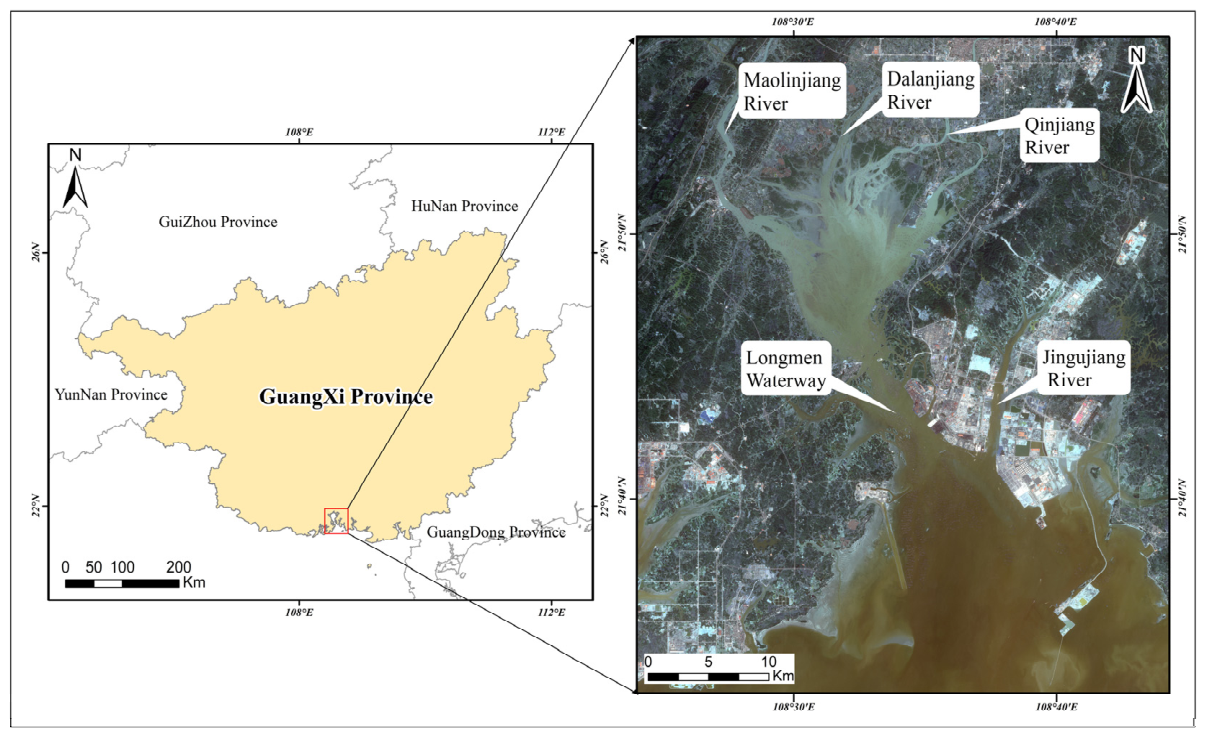
Qinzhou Bay is located in the coastal area of southern Guangxi Zhuang Autonomous Region and serves as a key component of the Beibu Gulf. The bay comprises two parts: the inner bay, Maowei Sea, and the outer bay. The Maowei Sea receives inflows from three main rivers, the Maolingjiang River, Dalanjiang River, and Qinjiang River, while the outer bay connects to the Beibu Gulf and is influenced by runoff from the Jingujiang River. Characterized by a broad trumpet-shaped morphology, Qinzhou Bay is relatively narrow in the middle and wide at both ends, making it a typical semi-enclosed natural bay. The location of the study area is shown in Figure 1.
As a core city surrounding the bay, Qinzhou City has a vibrant economy and a dense population. Several major industrial parks are located along its coastline, including the Qinzhou Port Economic and Technological Development Zone, the Bonded Port Area, and the China-Malaysia Qinzhou Industrial Park, resulting in high-intensity human activity. In 2022, the city’s gross domestic product (GDP) reached 191.7 billion CNY, representing an increase of 102.98% compared with 2015. The total value of the marine-oriented economy of the city amounted to 162.1 billion CNY, an increase of 409.75% relative to 2015. These data indicate that the economy of Qinzhou City, particularly its marine-oriented sector, has undergone rapid growth, accompanied by a continuous intensification of human activities and a corresponding escalation of potential pressures on the estuarine and coastal ecosystem.
The coastal waters of Qinzhou Bay are endowed with abundant natural resources, and mariculture has developed rapidly in the region. In 2022, the city’s total aquatic product output reached 609,300 tonnes, an increase of 12.08% compared with 2015. The total output value of aquatic products amounted to 9.33 billion CNY, representing a growth of 32.82% relative to 2015. The Longmen Seventy-Two Creeks (a network of tidal channels and islets) and its adjacent waters have become a large-scale aquaculture zone for the Hong Kong oyster (Crassostrea hongkongensis), locally known as “Da Hao”, constituting the core distribution area of the Qinzhou oyster industry. In recent years, with the continuous expansion of industrial and agricultural production and marine aquaculture along the coast, nutrient inputs into Qinzhou Bay have steadily increased, leading to significantly heightened pressure on the water environment. As a result, water quality in some areas has remained poor over the long term, accompanied by noticeable algal proliferation and a persistent risk of harmful algal blooms [48,49]. These conditions pose a potential threat to the stability of the regional marine ecosystem and the security of fishery resources. Therefore, conducting a systematic ecological health assessment of Qinzhou Bay is of great significance for scientifically understanding its ecological and environmental status and supporting coastal ecological protection and regional sustainable development.

3.2. Ecological Health Assessment Indicator System for Qinzhou Bay

Based on the estuarine and coastal ecological health assessment indicator system constructed above, this study applied this framework to Qinzhou Bay. The health grade thresholds for each evaluation indicator were primarily established with reference to Sea water quality standard (GB 3097–1997) and Environmental quality standards for surface water (GB 3838–2002), and were appropriately adjusted according to the ecological and environmental characteristics of Qinzhou Bay and the distribution of observed data. Specifically, the thresholds for DIN, DIP, COD, and DO were framed upon the water quality criteria stipulated for each grade in sea water quality standard (GB 3097–1997). Considering the relatively high background concentrations of nutrients in Qinzhou Bay, while maintaining the grade order, individual thresholds were slightly adjusted according to the cumulative frequency distribution of measured data. Primary productivity and chlorophyll-a have no national mandatory standards, and their thresholds were mainly determined with reference to existing studies [50] combined with the percentiles of measured data in Qinzhou Bay. The land use intensity index and mariculture pollution load were automatically classified using the natural breaks method according to the distribution of calculated values for all evaluation units in the study area. The interval entropy weight method was used to calculate the weight of each indicator, thereby reducing the impact of subjective weighting on the assessment results. The health grade thresholds and corresponding weight calculation results for each assessment indicator are summarized in Table 4. It should be noted that, referring to the classification of DIP in the national standard, pixels with DIP concentration exceeding Grade IV (>0.045 mg/L) in Table 4 are uniformly treated as Grade IV in the calculation of the EHI.
The weight calculation results show that the weights assigned to the state-layer indicators are generally higher than those assigned to the pressure-layer and response-layer indicators, indicating that the evaluation results are highly sensitive to changes in marine water environment quality. This is consistent with the high sensitivity of the semi-enclosed bay ecosystem of Qinzhou Bay to changes in water quality and ecological status.

3.3. Data Foundation

3.3.1. Data Sources

Based on multi-source data, this study constructs an ecological health assessment indicator system founded on the PSR model. According to their nature and origin, the data used in this study can be categorized into three types: remote sensing data, in situ water quality data, and other geographic data. Among these, pressure indicators are primarily calculated from other geographic data, while state and response indicators are derived from water quality inversion models using remote sensing imagery and in situ water quality data.
(1)
Remote Sensing Imagery
This study utilizes Sentinel-2 satellite imagery data launched by the European Space Agency (ESA). The satellite constellation consists of two satellites, Sentinel-2A and Sentinel-2B. When operating together, they achieve a 5-day revisit cycle at the equator, providing multi-temporal imagery that enables dynamic monitoring of the bay’s aquatic environment.
This study utilized Sentinel-2 Level-2A surface reflectance products. These data have undergone systematic atmospheric correction via the Sen2Cor algorithm, and the output bands were resampled to a spatial resolution of 10 m. Following image resampling and the extraction of surface reflectance information, the Modified Normalized Difference Water Index (MNDWI) was employed to delineate the water extent of the study area. Subsequently, quantitative retrieval analysis could be directly performed, satisfying the accuracy requirements for deriving water quality parameters in marine waters.
(2)
In situ Water Quality Data
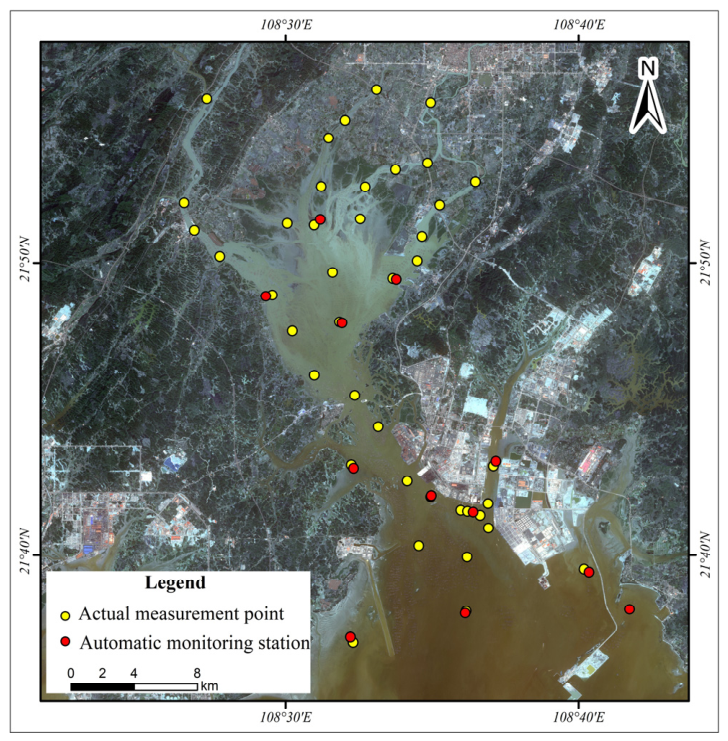
The in situ water quality data used in this study include two categories: manually sampled data and data from automatic seawater quality monitoring stations. Qinzhou Bay is characterized by a southern subtropical maritime monsoon climate with pronounced intra-annual unevenness in precipitation distribution. The flood season extends from May to September, while the non-flood season spans from November to March of the following year. The selection of sampling months in this study fully accounted for the seasonal hydrological regime of Qinzhou Bay and encompassed sample data from both flood and non-flood periods. Field sampling campaigns were conducted in November 2021, May and September 2022, and November 2023. A total of 36 sampling stations were established, and their spatial distribution is illustrated in Figure 2. The sampling network covered the Qinjiang River, Maolingjiang River, Dalanjiang River, Maowei Sea, and portions of the outer bay. During the layout design, dense offshore aquaculture facilities within the bay were deliberately avoided, and the distance between adjacent stations was maintained at approximately 2.5 km. The locations of the sampling stations remained consistent across all sampling campaigns to ensure the comparability of time-series analytical results.
Data from automatic seawater quality monitoring stations were collected from 12 fixed stations deployed within the study area, covering water quality observations from March and October 2017, and October 2018. The selection of this specific temporal dataset was motivated by the spatial overlap between several of the automatic monitoring stations and the manual sampling locations, thereby providing effective supplementary information to the field sample dataset. Both types of in situ data include five water quality indicators: DIN, DIP, DO, COD, and Chla. These data are primarily used for constructing and validating the accuracy of remote sensing water quality inversion models, providing the foundation for the reliability of the inversion results. The aforementioned in situ data collectively spanned periods characterized by varying hydrological conditions and intensities of mariculture activities, thus enabling effective model training and validation under different seasonal regimes.
Owing to constraints imposed by field sampling logistics and the availability of remote sensing imagery, perfect temporal synchronization between in situ measurements and satellite overpasses could not always be achieved. To address this limitation, the temporal offset between manual sampling dates and the corresponding remote sensing image acquisition dates was restricted to within ±5 days. For data from the automatic monitoring stations, daily mean values corresponding to the exact date of satellite overpass were used for matching. This procedure effectively mitigated errors arising from short-term fluctuations in water quality. In addition, to reduce interference from instantaneous conditions, the Sentinel-2 images selected in this study were all clear-sky images with cloud cover less than 10%. Based on regional climate statistics, dates with known extreme rainstorms or typhoon passages were also excluded, thereby ensuring that the selected images can reflect typical hydrometeorological scenarios during both the flood season and the non-flood season.
(3)
Other Geographic Data
This study also collected and compiled multiple sources of geographic data to support the construction of the ecological health assessment system and subsequent data analysis. These data primarily include land use data, distribution data of marine aquaculture in Guangxi, and distribution data of mangroves in Guangxi. The land use data were obtained from the 30 m resolution land use dataset published by the Resource and Environment Science and Data Platform; the Guangxi marine aquaculture distribution data were sourced from the Global Change Scientific Research Data Publishing System; and the Guangxi mangrove distribution data were provided by the Chinese Science Data Bank.

3.3.2. Model Accuracy

Based on in situ water quality data from the nearshore waters of Qinzhou Bay, data from automatic seawater monitoring stations, and concurrent Sentinel-2 remote sensing imagery for the period 2015–2022, this study constructed remote sensing inversion models for five water quality parameters: DIN, DIP, COD, DO, and Chla. The RF algorithm was employed for modeling, and the inversion accuracy was evaluated for both the training set and the test set. The results are presented in Table 5. The coefficients of determination (R2) for the training set ranged from 0.75 to 0.85, while those for the testing set ranged from 0.66 to 0.78, indicating that the models possessed satisfactory explanatory power for the training samples and maintained reasonably stable generalization capability when applied to the testing set. The slightly higher R2 values observed for the training set relative to the testing set were consistent with the general pattern of supervised learning, wherein models learned finite noise from the training data; the overall differences between the two sets were small, and no pronounced overfitting was evident. The mean absolute errors (MAE) for the training set ranged from 0.001 to 0.53, and those for the testing set ranged from 0.02 to 0.94. Although the prediction errors for the testing set exhibited a modest increase compared with those for the training set, they remained within an acceptable range. The root mean square errors (RMSE) for the training set ranged from 0.01 to 0.88, and those for the testing set ranged from 0.02 to 0.94, reflecting relatively low residual fluctuation magnitudes. Collectively, these metrics demonstrated that the retrieval models for all water quality parameters exhibited favorable goodness of fit and robust generalization performance.
In summary, the remote sensing retrieval models for water quality parameters developed in this study adequately met the accuracy requirements of ecological health assessments conducted at the scale of Qinzhou Bay. The models exhibited an acceptable range of prediction error and could therefore serve as a robust data foundation for the subsequent ecological health evaluation.
Therefore, the remote sensing inversion models for water quality parameters constructed in this study meet the accuracy requirements of water quality data for ecological health assessment at the scale of Qinzhou Bay, providing a crucial data foundation for subsequent ecological health evaluation.

3.4. Assessment Results and Analysis

The water quality data used to construct the random forest inversion model were mainly derived from 2017 to 2018 and 2021–2023. The model was then applied to imagery from 2015. Moreover, in the interannual comparison, one image per season per year was used. Under these conditions, the inversion results for 2015 and the interannual comparisons from 2015 to 2022 should be regarded as indicative results based on the current data framework, but they can still effectively support the analysis of spatiotemporal patterns of ecological health.

3.4.1. Uncertainty and Disturbance Analysis

To evaluate the impact of errors in the water quality retrieval model on the EHI, this study takes COD and DO—two parameters with relatively low retrieval accuracy—as examples. Disturbances are applied based on the model’s RMSE to quantitatively investigate changes in the EHI induced by retrieval errors. Given that there is no unified standard for classifying ecological health levels and that threshold setting involves subjectivity, this disturbance analysis focuses on changes in continuous EHI values to avoid misjudging result robustness due to boundary determination. The consistency of values is quantified by calculating the Pearson correlation coefficients (r) of the EHI before and after disturbance across multiple scenarios, thereby objectively assessing the potential impact of model errors. A total of eight disturbance scenarios are established, covering single-parameter disturbances (S1–S4), co-directional joint disturbances (S5–S6), and opposite-direction joint disturbances (S7–S8), as shown in Table 6.
Keeping other indicators unchanged, the EHI under each disturbance scenario was recalculated according to Equation (10). After applying ±RMSE disturbances to COD and DO for the flood and non-flood seasons of 2015 and 2022, respectively, r of the EHI before and after disturbance were calculated for each scenario. The results are shown in Table 7.
Under all disturbance scenarios, the r between the EHI and the original EHI ranged from 0.871 to 0.995, indicating a strongly positive correlation. This suggests that retrieval errors in DO and COD do not substantially alter the spatial distribution pattern of the EHI. It can therefore be considered that the accuracy of the current retrieval model is sufficient to support the study’s conclusions regarding the spatiotemporal patterns of ecological health and that the evaluation results are robust.

3.4.2. Ecological Health Assessment for 2015

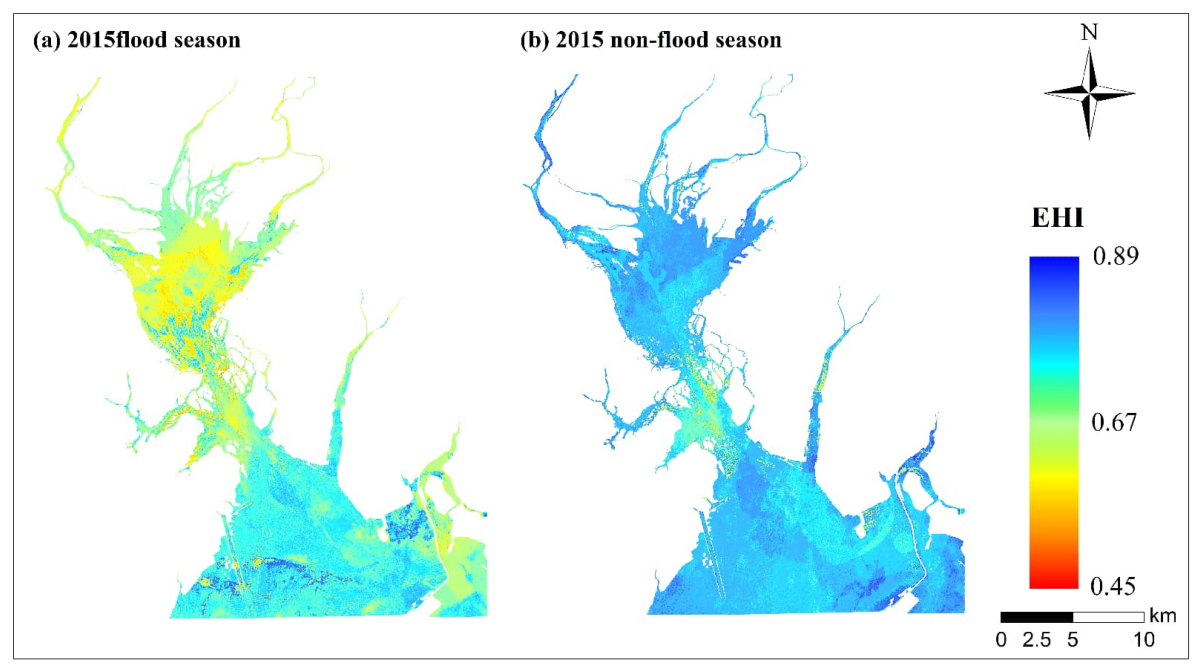
The EHI of Qinzhou Bay is influenced by a combination of hydrological conditions, meteorological factors, and anthropogenic disturbances, leading to pronounced seasonal variations. Figure 3 illustrates the spatial distribution patterns of the comprehensive EHI in Qinzhou Bay during the flood season (August) and the non-flood season (December) of 2015.
Significant seasonal differences were observed in the ecological health status of Qinzhou Bay, with overall health being better during the non-flood season than during the flood season. The graded statistical results of the EHI (Table 8) indicate that the sub-healthy grade accounted for the highest proportion during the flood season, whereas the healthy grade dominated during the non-flood season, and neither the diseased nor the very healthy grade was observed in either the flood or non-flood season, further confirming the improvement in ecological health during the non-flood season. This seasonal pattern was primarily evident in the estuarine areas and the Maowei Sea region, where the EHI was generally lower during the flood season. This variation may be attributed to the increased load of land-based materials associated with enhanced runoff input during the flood season, coupled with the effects of coastal aquaculture activities [51].
Spatially, the distribution of the EHI during the flood and non-flood seasons showed a high degree of overall consistency. Areas with relatively low EHI values in both seasons were concentrated in the Longmen Waterway, the Jingujiang River Estuary, and the nearshore waters on the right side of the outer bay. Existing research indicates that the unique topography of the Longmen Waterway may enhance the retention of sediments and pollutants [52]; changes in land use structure and the intensity of industrial activities in the Jingujiang River watershed may significantly influence the flux of materials entering the sea [53]; furthermore, the discharge of tailwater from the highly concentrated pond aquaculture area on the right side of the outer bay may also exert pressure on the water quality of adjacent waters. These natural conditions and anthropogenic factors align spatially with the areas exhibiting low EHI values. It should be noted that the attribution interpretations presented above are currently based primarily on spatial overlay analysis and indirect corroboration from existing studies, rather than constituting a formal attribution analysis of the spatial heterogeneity of ecological health.

3.4.3. Ecological Health Assessment for 2022

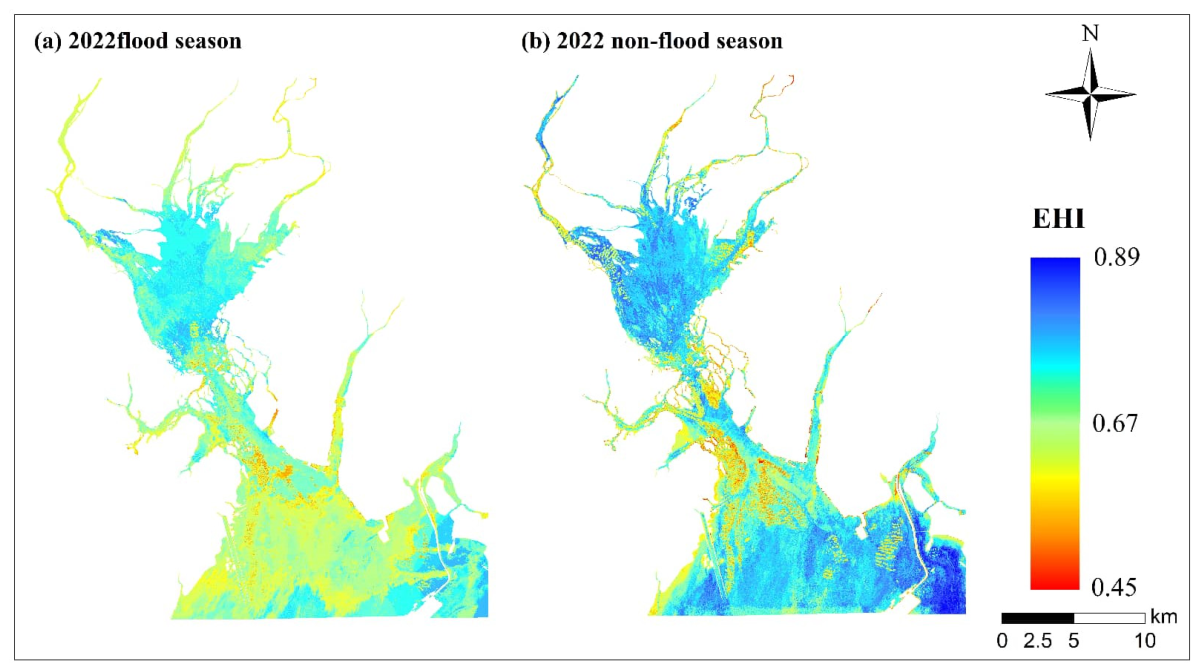
Figure 4 shows the spatial distribution of the comprehensive EHI in the Qinzhou Bay during the flood season (May) and the non-flood season (December) of 2022. Overall, EHI was better in the non-flood season than in the flood season. The graded statistical results of the EHI (Table 9) indicate that the proportion of the healthy grade was higher during the non-flood season. Notably, neither the diseased nor the very healthy grade was observed in either the flood or non-flood season.
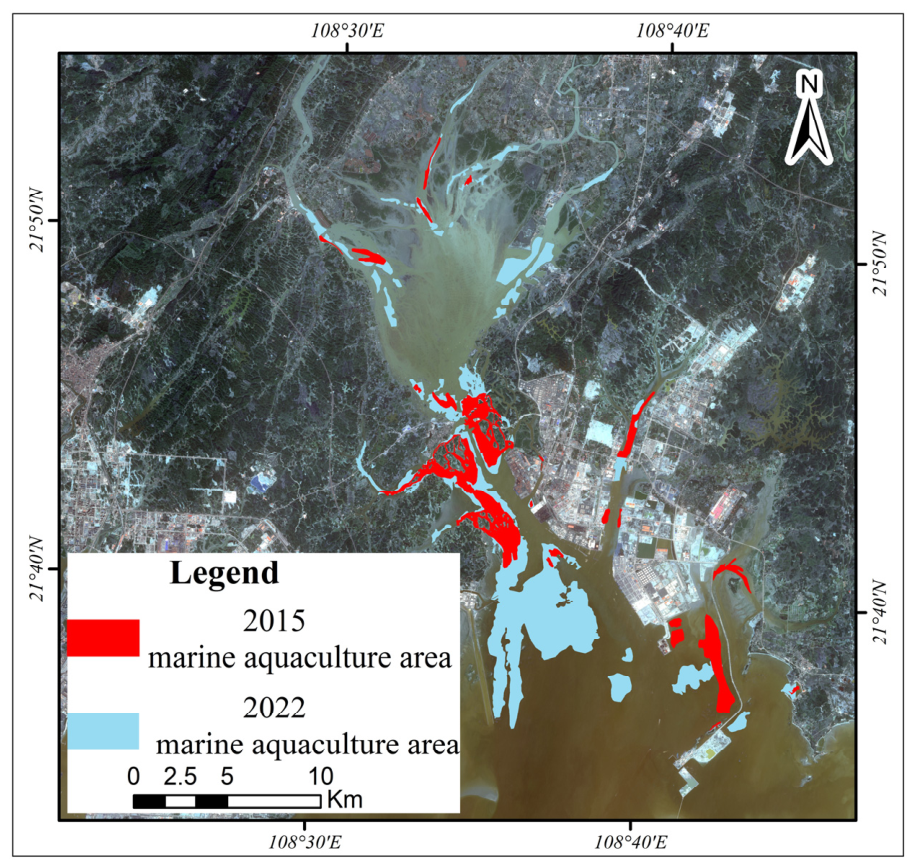
Spatially, the distribution patterns of the EHI during the flood and non-flood seasons of 2022 were largely consistent. This is primarily reflected in the persistently lower EHI values in areas such as inflowing rivers, estuarine zones, the Longmen Waterway, the Jingujiang River Estuary, and parts of the nearshore waters in the outer bay. Notably, these low-EHI areas exhibit a strong spatial coupling with the distribution of marine aquaculture. Figure 5 shows the spatial distribution of marine aquaculture in Qinzhou Bay in 2015 and 2022. In 2015, the mariculture area was approximately 22.24 km2, which expanded to about 63.52 km2 in 2022. The aquaculture areas spread towards the outer bay and nearshore estuarine regions, and their distribution range highly overlapped with the above-mentioned low-value areas of ecological health. Existing studies have indicated [54] that marine aquaculture activities in Qinzhou Bay are mainly concentrated from May to July and from October to December, accompanied by high material inputs and environmental disturbance intensity. Therefore, the expansion of mariculture activities likely constitutes one of the principal drivers contributing to the persistently low EHI values observed in this region. It is important to note that this preliminary inference regarding the association between mariculture activities and ecological health degradation is currently based primarily on the pronounced spatial overlap between mariculture distribution and areas exhibiting low EHI values, as well as on indirect corroboration from existing studies concerning the seasonal discharge characteristics of aquaculture operations. A direct causal relationship has yet to be established.

3.4.4. Analysis of Ecological Health Status Changes

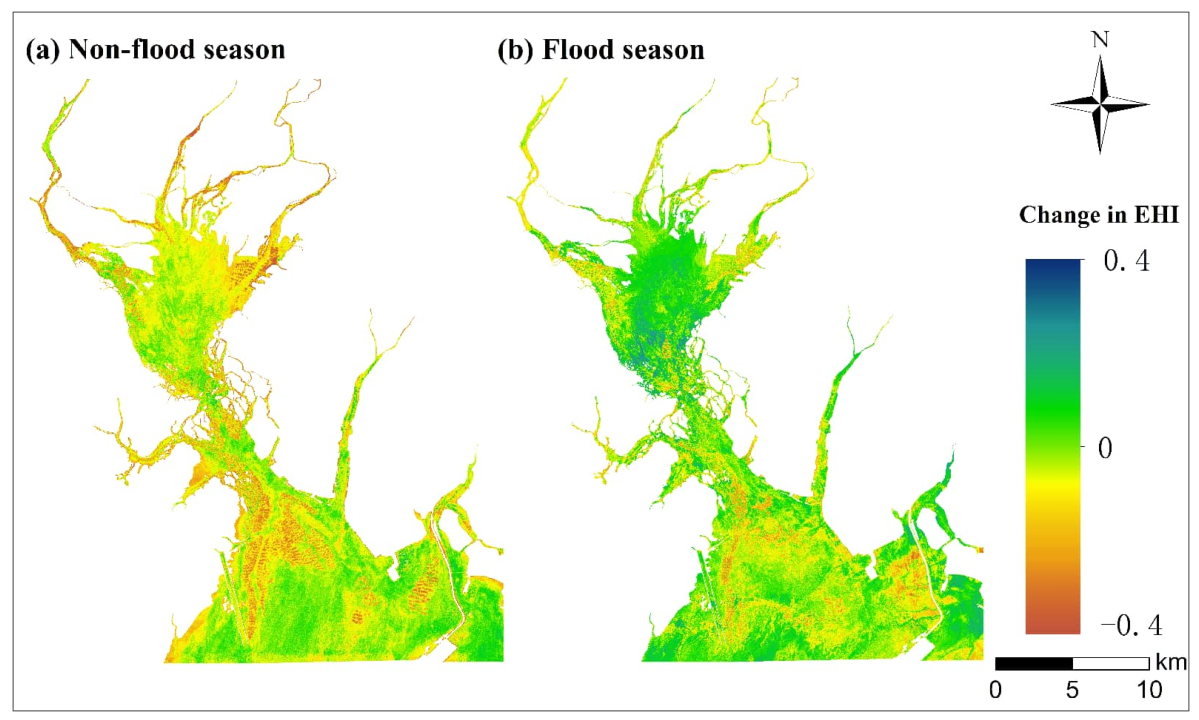
Figure 6 illustrates the spatial distribution of the change in the EHI in Qinzhou Bay from 2015 to 2022, defined as the difference between the two years’ indices. As an exploratory comparison, the overall EHI of Qinzhou Bay showed an increasing trend in 2022 compared to 2015, although some areas exhibited a decline. The areas experiencing a decline were mainly distributed in inflowing rivers and estuarine zones, the Longmen Waterway, and the highly concentrated marine aquaculture waters in the outer bay. In contrast, areas with an increasing trend were primarily concentrated in the Maowei Sea, parts of the Longmen Waterway, and non-aquaculture areas of the outer bay, showing distinct spatial clustering.
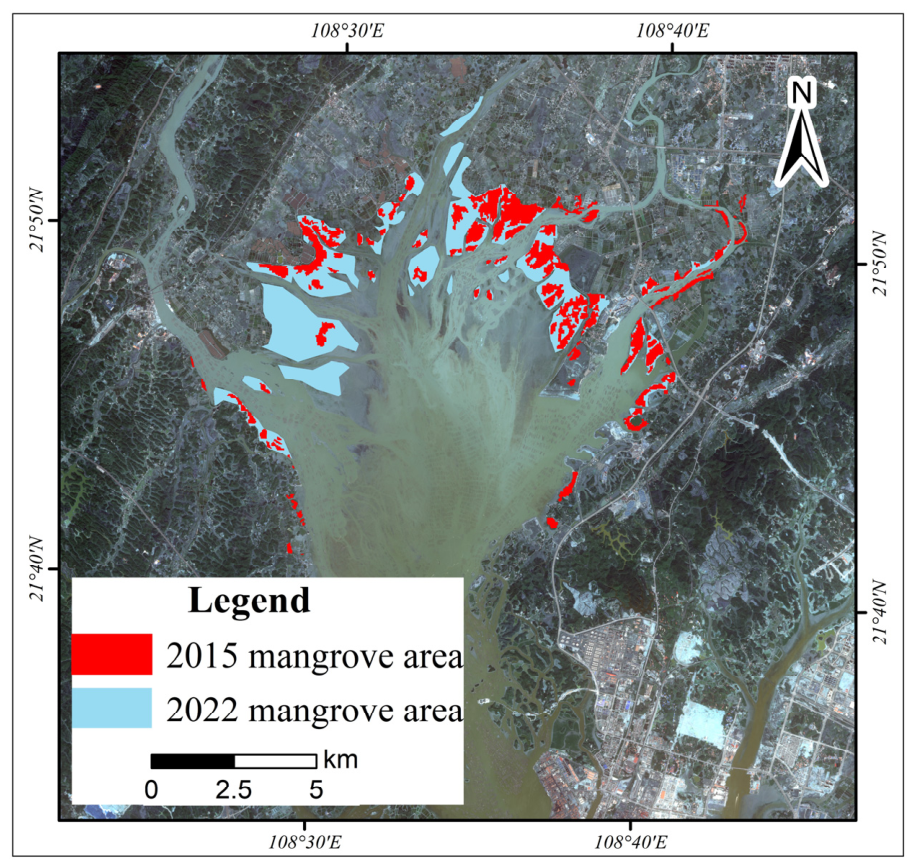
Figure 7 illustrates the changes in the spatial distribution of mangrove forests in the Maowei Sea area between 2015 and 2022. During this period, the mangrove forest area expanded significantly, with a cumulative increase of approximately 12.9 km2. A spatial comparison between the EHI changes and the distribution of mangrove forests reveals a high degree of spatial consistency between the areas of improved ecological health in the Maowei Sea region and the areas of mangrove restoration and expansion. Existing research has indicated that mangrove wetland ecosystems provide significant ecological regulatory functions in reducing land-based nutrient inputs and improving the quality of the nearshore water quality [55,56,57,58]. These findings are consistent with the spatial distribution characteristics of improved ecological health in parts of the Maowei Sea observed in this study, suggesting that mangrove restoration and expansion may have played a positive role in enhancing the regional ecological health grade. Moreover, the reduction in land-based pollutant inputs resulting from measures to control pollution sources entering the sea and environmental governance policies implemented in the region in recent years—such as the 13th Five-Year Plan for Pollution Prevention and Control in the Coastal Waters of Guangxi—coupled with interannual fluctuations in hydro-meteorological conditions, may also have impacted the localized areas of the Maowei Sea. However, these associations still require further validation based on synchronous observation data.

4. Discussion

This study develops a comprehensive ecological health assessment method for estuarine and coastal zones by integrating multi-source remote sensing-derived water quality inversion results and other geospatial data within the PSR model framework. Compared to traditional assessment approaches that primarily rely on statistical yearbook data or fixed-point monitoring, this method offers significant advantages in spatial continuity and scale adaptability, enabling a more comprehensive characterization of the spatial heterogeneity of ecological health conditions in estuarine and coastal areas.
Qinzhou Bay, as a typical semi-enclosed bay, generally exhibits pronounced spatial heterogeneity in the distribution of its ecological health issues. Existing studies [59,60,61,62] have conducted ecological health assessments in the waters of Qinzhou Bay from perspectives such as nutrient status, ecological health, and ecological security. However, these assessments have predominantly relied on data from discrete monitoring stations or statistics aggregated by administrative units, thereby focusing on the overall regional condition and rendering them less capable of accurately capturing the spatial heterogeneity of ecological health. The full-coverage advantage of remote sensing spatial data effectively compensates for information gaps caused by the limited spatial coverage of conventional monitoring stations [63,64]. This significantly enhances the capacity to identify localized ecological degradation in the assessment results, particularly in waters adjacent to inflowing rivers and areas with concentrated marine aquaculture activities. Compared with recent ecological health assessment studies based on the PSR model, Wu et al. [16] only provided an overall health rating of subhealth for the Shanghai coastal area based on statistical yearbook data, which could not reflect the spatial distribution of health status. Yang et al. [17] assessed China’s coastal areas at the provincial level, and the results were influenced by administrative boundaries, with internal heterogeneity being averaged out. Leyva Ollivier et al. [65] used statistical data and existing research data to investigate eutrophication in Chesapeake Bay, but similarly failed to reveal the spatial variation in eutrophication levels. In contrast, this study uses a 10 m grid as the unit, enabling direct identification of areas with poor ecological health, such as the Longmen Waterway. Furthermore, the remote sensing and geospatial data required by this method are accessible in most coastal regions. The indicators and thresholds can be adjusted according to local standards and data distributions, conferring a certain degree of transferability. This method can provide a reference framework for ecological health assessment in other similar semi-enclosed bays. The proposed approach offers significant value for supporting refined zoning management of nearshore waters and precise regulation of key sensitive areas.
At the same time, certain limitations remain in the application of the proposed methodology. Remote sensing inversion faces certain challenges in nearshore waters with complex optical properties (e.g., the limited accuracy of some water quality inversion models in this study), and the estimation of certain assessment indicators (e.g., PP) involves some subjectivity. These factors may introduce uncertainty into the assessment. Given that this study adopted a multi-indicator integrated system based on the PSR framework, the propagation effect of uncertainty from a single indicator to the comprehensive index is relatively limited. Disturbance analysis also indicated that the accuracy of the inversion model has little impact on the spatial pattern and interannual trend of the EHI. In the future, the robustness of the assessment system can be enhanced by supplementing the sample set, comparing multiple machine learning models to optimize water quality inversion, and integrating in situ observation data. Furthermore, although this study did not include independent ecological indicators such as a biodiversity index, the indicator system constructed based on the PSR model already covers three dimensions: human pressure, water quality status, and ecosystem response, thus enabling a comprehensive characterization of ecological health levels. The current assessment results are sufficiently robust and scientifically sound. Subsequent work may incorporate metrics such as the benthic integrity index for multi-dimensional cross-validation to further improve the robustness of the assessment system. Finally, the analysis of the associations between ecological health changes and factors such as mariculture expansion and mangrove restoration in this study is primarily based on spatial overlay and qualitative comparison, aiming to illustrate spatial distribution patterns rather than to establish strict causal inference. Future research can introduce methods such as geodetectors to systematically quantify the contribution of each driving factor, thereby providing more precise scientific support for zone-based management and ecological restoration in estuarine and coastal areas.

5. Conclusions

This study establishes an integrated ecological health assessment framework for estuarine and coastal zones by combining remotely sensed water quality retrieval products, geospatial data, and the PSR model. By incorporating water quality retrieval data and geospatial data with continuous spatial coverage, the approach substantially enhanced the capacity to characterize the spatiotemporal heterogeneity of ecological health in estuarine and coastal environments. It demonstrated the effectiveness of the integrated assessment system combining remote sensing data and the PSR model in spatially continuous assessment, reflecting the innovative contribution of this method in overcoming the limitations of spatial discontinuity inherent in traditional evaluation approaches.
The quantitative assessment results using Qinzhou Bay as a case study show that ecological health exhibits significant seasonal differences, with the non-flood season being better than the flood season. Areas with poor ecological health are mainly concentrated in estuaries and areas with intensive mariculture. It should be noted that, due to the lack of synchronous in situ water quality data for 2015, the results for 2015 should be regarded as indicative. Based on these findings, the following management recommendations are proposed: (1) Strengthen seasonal regulation of land-based pollution sources and mariculture activities. In alignment with policy mandates such as the Pollution Prevention and Control Plan for the Coastal Waters of Qinzhou City and the Detailed Rules for the Supervision and Management of Marine Outfalls in Guangxi (Trial), concentrated investigation and remediation of key pollution sources along the banks of rivers entering the sea should be conducted prior to the flood season. (2) Rigorously enforce the discharge limits stipulated in the Water discharge standard for aquaculture, intensify law enforcement and regulatory oversight, and ensure that mariculture tailwater discharges comply with established standards. (3) Establish and improve a multi-scale monitoring, early warning, and assessment system that integrates multi-source data, thereby enhancing the capacity for dynamic management of ecological health.
This study demonstrated the effectiveness of an ecological health assessment approach that integrates multi-source data, including remote sensing, in identifying spatiotemporal variations in the ecological health status of estuarine and coastal bays. The proposed methodology enables spatially continuous representation of ecological health and allows for the precise identification of localized ecological degradation hotspots and their seasonal response characteristics. It addresses the spatial coverage limitations inherent in conventional fixed-station monitoring and provides a robust data foundation for refined, spatially differentiated management. From an application perspective, it is recommended that remote sensing monitoring be formally incorporated into existing nearshore marine environmental supervision frameworks. This assessment system, by providing spatially continuous and temporally comparable EHI, can effectively support long-term monitoring and evaluation of ecological governance effectiveness in estuarine bay environments. It serves the dynamic tracking and outcome verification of coastal environmental policies (e.g., total pollutant discharge control, implementation assessment of protected area management policies), thereby providing dynamic and quantitative scientific evidence for zone-based management and ecological restoration decision-making.

Author Contributions

Conceptualization and methodology, R.Z. and J.S.; software, R.Z.; formal analysis, R.Z. and H.L.; investigation and resources, R.Z., H.L. and J.S.; data curation, R.Z.; writing—original draft preparation, R.Z. and H.L.; writing—review and editing, R.Z. and H.L.; visualization, W.J.; supervision, H.H. and X.P.; project administration, W.J., W.L. and H.H.; funding acquisition, H.L., J.S., W.L. and X.P. All authors have read and agreed to the published version of the manuscript.

Funding

This research was funded by the Science and Technology Program of Guangdong (2023B1212070031), the Guangxi Key R&D Program of China (GUIKE AB25069453), the Science and Technology Program of Guangdong (2024B1212080002), Beibu Gulf Marine Ecological Environment Observation and Research Station of Guangxi (GUIKE 23-026-271), Guangdong Basic and Applied Basic Research Foundation (2022A1515240041), the PI Project of Southern Marine Science and Engineering Guangdong Laboratory (Guangzhou) (GML2022005), Young Talent Project of GDAS (2024GDASQNRC-0110), GDAS’ Project of Science and Technology Development (2024GDASZH-2024010102), the Science and Technology Program of Guangdong (2023TQ07H628), National Natural Science Foundation of China (42271479).

Data Availability Statement

The original contributions presented in this study are included in the article. Further inquiries can be directed to the corresponding authors.

Conflicts of Interest

The authors declare no conflicts of interest.

References

  1. Zhang, P.; Ou, S.; Zhang, J.; Zhao, L.; Zhang, J. Categorizing numeric nutrients criteria and implications for water quality assessment in the Pearl River Estuary, China. Front. Mar. Sci. 2022, 9, 1004235. [Google Scholar] [CrossRef]
  2. Ristea, E.; Bisinicu, E.; Lavric, V.; Parvulescu, O.C.; Lazar, L. A Long-Term Perspective of Seasonal Shifts in Nutrient Dynamics and Eutrophication in the Romanian Black Sea Coast. Sustainability 2025, 17, 1090. [Google Scholar] [CrossRef]
  3. Malone, T.C.; Newton, A. The Globalization of Cultural Eutrophication in the Coastal Ocean: Causes and Consequences. Front. Mar. Sci. 2020, 7, 670. [Google Scholar] [CrossRef]
  4. Rangel-Buitrago, N.; Galgani, F.; Neal, W.J. Addressing the global challenge of coastal sewage pollution. Mar. Pollut. Bull. 2024, 201, 116232. [Google Scholar] [CrossRef]
  5. Fu, S.; Zhao, L.; Qiao, Z.; Sun, T.; Sun, M.; Hao, Y.; Hu, S.; Zhang, Y. Development of ecosystem health assessment (EHA) and application method: A review. Sustainability 2021, 13, 11838. [Google Scholar] [CrossRef]
  6. Hartati, R.; Widianingsih, W.; Zainuri, M.; Wardiatno, Y. Using macrobenthic community structure and biotic indices to assess the ecological status of Wulan Estuary, Demak, Indonesia. Biodiversitas J. Biol. Divers. 2024, 25, 3073–3087. [Google Scholar] [CrossRef]
  7. Khedhri, I.; Afli, A.; Aleya, L. Structuring factors of the spatio-temporal variability of macrozoobenthos assemblages in a southern Mediterranean lagoon: How useful for bioindication is a multi-biotic indices approach? Mar. Pollut. Bull. 2017, 114, 515–527. [Google Scholar] [CrossRef] [PubMed]
  8. Brauko, K.M.; de Souza, F.M.; Muniz, P.; de Camargo, M.G.; da Cunha Lana, P. Spatial variability of three benthic indices for marine quality assessment in a subtropical estuary of Southern Brazil. Mar. Pollut. Bull. 2015, 91, 454–460. [Google Scholar] [CrossRef]
  9. Li, A.; Li, J.; Liu, F.; Zhu, L.; Liu, L.; Xue, S.; Zhang, M.; Tang, Y.; Mao, Y. Assessment of benthic ecological status and heavy metal contamination in an estuarine intertidal mudflat in the Northern Bohai Sea. Mar. Pollut. Bull. 2024, 203, 116501. [Google Scholar] [CrossRef]
  10. Frashure, K.M.; Bowen, R.E.; Chen, R.F. An integrative management protocol for connecting human priorities with ecosystem health in the Neponset River Estuary. Ocean Coast. Manag. 2012, 69, 255–264. [Google Scholar] [CrossRef]
  11. Moreno, J.; Moreno, F.; Fatela, F.; Leorri, E.; da Conceição Freitas, M.; Leira, M. Estuarine health assessed by sediment biotic and geochemical indices: Insights into sustainable decision-making in the Sado transitional system (SW Portugal). Mar. Environ. Res. 2025, 212, 107513. [Google Scholar] [CrossRef] [PubMed]
  12. Li, Y.; Huang, Y.; Zhang, X.; Jiang, Y.; Jing, X.; Deng, Y.; Li, R.; Jiang, D.; Mu, J. Ecosystem health assessment: A PSR analysis combining AHP and EW methods for Sansha Bay, China. Front. Mar. Sci. 2024, 11, 1396026. [Google Scholar] [CrossRef]
  13. Devlin, M.; Bricker, S.; Painting, S. Comparison of five methods for assessing impacts of nutrient enrichment using estuarine case studies. Biogeochemistry 2011, 106, 177–205. [Google Scholar] [CrossRef]
  14. Li, S.; Liu, C.; Ge, C.; Yang, J.; Liang, Z.; Li, X.; Cao, X. Ecosystem health assessment using PSR model and obstacle factor diagnosis for Haizhou Bay, China. Ocean Coast. Manag. 2024, 250, 107024. [Google Scholar] [CrossRef]
  15. Yanes, A.; Botero, C.M.; Arrizabalaga, M.C.; Vásquez, J.G. Methodological proposal for ecological risk assessment of the coastal zone of Antioquia, Colombia. Ecol. Eng. 2019, 130, 242–251. [Google Scholar] [CrossRef]
  16. Wu, Z.; Chen, R.; Meadows, M.E.; Liu, X. Application of the Ocean Health Index to assess ecosystem health for the coastal areas of Shanghai, China. Ecol. Indic. 2021, 126, 107650. [Google Scholar] [CrossRef]
  17. Yang, W.; Zhang, Z.; Sun, T.; Liu, H.; Shao, D. Marine ecological and environmental health assessment using the pressure-state-response framework at different spatial scales, China. Ecol. Indic. 2021, 121, 106965. [Google Scholar] [CrossRef]
  18. Zhang, S.; Zhang, Z.; Zhang, T.; Ju, H. Assessment of coastal zone ecosystem health in the context of tourism development: A case study of Jiaozhou Bay. Ecol. Indic. 2024, 169, 112874. [Google Scholar] [CrossRef]
  19. Wakwella, A.; Wenger, A.; Jenkins, A.; Lambet, J.; Kuempel, C.D.; Claar, D.; Corbin, C.; Falinski, K.; Rivera, A.; Grantham, H.; et al. Integrated watershed management solutions for healthy coastal ecosystems and people. Camb. Prisms Coast. Futures 2023, 1, e27. [Google Scholar] [CrossRef] [PubMed]
  20. Du, Y.; Ren, Z.; Zhong, Y.; Zhang, J.; Song, Q. Spatiotemporal pattern of coastal water pollution and its driving factors: Implications for improving water environment along Hainan Island, China. Front. Microbiol. 2024, 15, 1383882. [Google Scholar] [CrossRef]
  21. Yu, C.; Lu, C.; Li, Y.; Li, H.; Lin, J.; Chang, L. Spatial and temporal variation of nutrient distribution in the Yangtze River estuary and adjacent waters: Insights from GOCI data analysis. Mar. Environ. Res. 2025, 204, 106895. [Google Scholar] [CrossRef] [PubMed]
  22. Li, H.; Zhang, G.; Zhu, Y.; Kaufmann, H.; Xu, G. Inversion and driving force analysis of nutrient concentrations in the ecosystem of the Shenzhen-Hong Kong Bay area. Remote Sens. 2022, 14, 3694. [Google Scholar] [CrossRef]
  23. Guo, Y.; Deng, R.; Li, J.; Hua, Z.; Wang, J.; Zhang, R.; Liang, Y. Remote Sensing Retrieval of Total Nitrogen in the Pearl River Delta Based on Landsat8. Water 2022, 14, 3710. [Google Scholar] [CrossRef]
  24. Yang, J.; Deng, R.; Ma, Y.; Li, J.; Guo, Y.; Lei, C. Satellite Retrieval and Spatiotemporal Variability in Chlorophyll-a for Marine Ranching: An Example from Daya Bay, Guangdong Province, China. Water 2025, 17, 780. [Google Scholar] [CrossRef]
  25. Hukkinen, J. Sustainability indicators for anticipating the fickleness of human–environmental interaction. Clean Technol. Environ. Policy 2003, 5, 200–208. [Google Scholar] [CrossRef]
  26. Dou, Y.; Chen, R.; Zhou, W. A study on coastal ecosystem health assessment in Qingdao based on press-state-response model. Appl. Mech. Mater. 2014, 522, 487–490. [Google Scholar] [CrossRef]
  27. Fang, J.; Xiong, K.; Chi, Y.; Song, S.; He, C.; He, S. Research Advancement in Grassland Ecosystem Vulnerability and Ecological Resilience and Its Inspiration for Improving Grassland Ecosystem Services in the Karst Desertification Control. Plants 2022, 11, 1290. [Google Scholar] [CrossRef]
  28. Xiao, R.; Qiao, Y.; Dong, X.; Ren, H.; Wang, X.; Zhang, P.; Ye, Q.; Xiao, X. Ecosystem Health Assessment of the Manas River Basin: Application of the CC-PSR Model Improved by Coupling Coordination Degree. Land 2024, 13, 1336. [Google Scholar] [CrossRef]
  29. Dan, S.F.; Xiaolian, Z.; Tang, J. Dissolved N pollution and its biogeochemical constraints along a river-sea continuum of a typical dense oyster mariculture coastal water, northwest South China Sea. J. Hazard. Mater. 2024, 480, 136207. [Google Scholar] [CrossRef]
  30. Zhang, Y.; Jing, W.; Deng, Y.; Zhou, W.; Yang, J.; Li, Y.; Cai, Y.; Hu, Y.; Peng, X.; Lan, W.; et al. Water quality parameters retrieval of coastal mariculture ponds based on UAV multispectral remote sensing. Front. Environ. Sci. 2023, 11, 1079397. [Google Scholar] [CrossRef]
  31. Wu, S.; Tan, Z.; Fu, Y.; Gao, N.; Ni, S.; Zhao, R.; Shi, P.; Han, L.; Su, J.; Zheng, Z.; et al. Impacts of river inputs and aquaculture on nutrient dynamics in Qinglan Bay and adjacent coastal waters in East Hainan, China. Mar. Pollut. Bull. 2025, 214, 117729. [Google Scholar] [CrossRef]
  32. Oh, Y.H.; Kim, Y.; Park, S.R.; Lee, T.; Son, Y.B.; Park, S.E.; Lee, W.C.; Im, D.H.; Kim, T.H. Spatiotemporal change in coastal waters caused by land-based fish farm wastewater-borne nutrients: Results from Jeju Island, Korea. Mar. Pollut. Bull. 2021, 170, 112632. [Google Scholar] [CrossRef]
  33. Nong, X.; He, F.; Chen, L.; Wei, J. Integrated machine learning-based optimization framework for surface water quality index comparing coastal and non-coastal cases of Guangxi, China. Mar. Pollut. Bull. 2025, 213, 117564. [Google Scholar] [CrossRef] [PubMed]
  34. Lazar, L.; Ristea, E.; Bisinicu, E. Smart Solutions for Mitigating Eutrophication in the Romanian Black Sea Coastal Waters Through an Integrated Approach Using Random Forest, Remote Sensing, and System Dynamics. Earth 2026, 7, 13. [Google Scholar] [CrossRef]
  35. Quang, N.H.; Dinh, N.T.; Dien, N.T.; Son, L.T. Calibration of Sentinel-2 Surface Reflectance for Water Quality Modelling in Binh Dinh’s Coastal Zone of Vietnam. Sustainability 2023, 15, 1410. [Google Scholar] [CrossRef]
  36. Li, Y.; Robinson, S.V.; Nguyen, L.H.; Liu, J. Satellite prediction of coastal hypoxia in the northern Gulf of Mexico. Remote Sens. Environ. 2023, 284, 113346. [Google Scholar] [CrossRef]
  37. Xu, N.; Jia, D.; Ding, L.; Wu, Y. Continuously Tracking the Annual Changes of the Hengsha and Changxing Islands at the Yangtze River Estuary from 1987 to 2016 Using Landsat Imagery. Water 2018, 10, 171. [Google Scholar] [CrossRef]
  38. Zhang, F.; Zhang, B.; Li, J.; Shen, Q.; Wu, Y.; Song, Y. Comparative analysis of automatic water identification method based on multispectral remote sensing. Procedia Environ. Sci. 2011, 11, 1482–1487. [Google Scholar] [CrossRef]
  39. Smith, R.C.; Eppley, R.W.; Baker, K.S. Correlation of primary production as measured aboard ship in southern California coastal waters and as estimated from satellite chlorophyll images. Mar. Biol. 1982, 66, 281–288. [Google Scholar] [CrossRef]
  40. Smith, R.C.; Baker, K.S. The bio-optical state of ocean waters and remote sensing 1. Limnol. Oceanogr. 1978, 23, 247–259. [Google Scholar] [CrossRef]
  41. Liu, Z.; Ning, X.; Cai, Y. Primary productivity and standing stock of the phytoplankton in the Hangzhou Bay to the Zhoushan Fishing Ground during autumn. Haiyang XueBao 2001, 02, 93–99. (In Chinese) [Google Scholar]
  42. Chu, Y.; Zhang, Q.; Wang, S.; Wu, D.; He, Y.; Wei, Y.; Zhang, O. Accounting and influencing factors of marine carbon sinks in the nearshore waters of Yantian District, Dapeng Bay, Shenzhen. Environ. Ecol. 2022, 4, 13–22. (In Chinese) [Google Scholar]
  43. Yang, G.; Chen, Y.; Zhang, F.; Luo, Y. Dynamic Evaluation and Early Warning Analysis of Ecological Security in Three Gorges Reservoir Area Based on PSR Model. Ecol. Econ. 2021, 37, 209–214. (In Chinese) [Google Scholar]
  44. Sowrav, S.F.F.; Rahman, S.M.M.; Hafiz, K.B.; Hossain, M. An integrated novel approach to the environmental health assessment of Bangladesh’s coastal ecosystems. Environ. Chall. 2024, 17, 101019. [Google Scholar] [CrossRef]
  45. Wu, S.; Zhu, Q.; Wu, W. An evaluation research on ecological security evaluation of Dalian Bay coastal zone based on the Pressure-State-Response model. Trans. Oceanol. Limnol. 2026, 48, 212–219. (In Chinese) [Google Scholar]
  46. Zhang, B.; Zhang, L.; Chen, B.; Deng, L.; Fu, B.; Yan, M.; Ji, C. Assessment of mangrove health based on pressure–state–response framework in Guangxi Beibu Gulf, China. Ecol. Indic. 2024, 167, 112685. [Google Scholar] [CrossRef]
  47. Wu, N.; Sun, Q.; Huang, H.; Huang, Y.; Pan, J.; Min, T.; Zhang, L.; Chen, M. Assessment of marine ecological risk of Beibu Gulf sea area based on pressure state response model. Trans. Oceanol. Limnol. 2023, 45, 124–132. (In Chinese) [Google Scholar]
  48. Qin, X.; Chen, X.; Chen, C.; Sun, L.; Su, X.; Liang, J.; Chen, B.; Gao, Y. Succession and controlling factors of phytoplankton assemblages during a period with recurrent outbreaks of Phaeocystis globosa blooms in Qinzhou Bay, China. Front. Mar. Sci. 2023, 10, 1120161. [Google Scholar] [CrossRef]
  49. Liu, C.; Ma, N.; Sun, M.; Yang, J.; Li, X.; Nie, W.; Kalhoro, M.A.; Wang, S. Impact of climate change on frequency and community structure of red tide events in the northern South China Sea. Clim. Dyn. 2024, 63, 51. [Google Scholar] [CrossRef]
  50. Kim, Y.O.; Shim, W.J.; Baek, S.H.; Choi, J.W.; Kim, D.; Choi, H.W. Coastal ecosystem health assessment in Korea: Busan case study. Ocean Sci. J. 2019, 54, 165–182. [Google Scholar] [CrossRef]
  51. Huang, Y.; Li, Z.; Sun, C.; Feng, Z.; Li, J.; Wei, D.; Wang, B.; Jiang, S.; Chen, K.; Sun, X. Using the roughness height and manning number in hydrodynamic model to estimate the impact of intensive oyster aquaculture by floating & fixed rafts on water exchange with an application in Qinzhou Bay, China. Ecol. Model. 2023, 476, 110230. [Google Scholar] [CrossRef]
  52. Kang, J.; Lin, Y.; Wang, Y.; Lan, W. Assessment of the Eutrophication Level of the Marine Environment and Its Effect on Phytoplankton Chlorophyll a in Qinzhou Bay. Ocean Dev. Manag. 2020, 37, 67–74. (In Chinese) [Google Scholar]
  53. Zhang, M.; Zeng, F.; Wu, H.; Lu, D.; Mi, J.; Dai, X.; Lu, H.; Zhang, D.; Gao, Y.; Zhu, D.; et al. Impacts of reclamation projects on tidal parameter dynamics in Maowei Sea of Qinzhou Bay, Guangxi. J. Appl. Oceanogr. 2024, 43, 45–54. (In Chinese) [Google Scholar]
  54. Chen, Q.; Huang, F.; Lin, J. Marine Spatial Planning for Estuary of Jingu River in Guangxi. Ocean Dev. Manag. 2016, 33, 63–66. (In Chinese) [Google Scholar]
  55. Tagulao, K.A.; Lai, W.I.; Lebel, A.; Calheiros, C.S.C. Evaluating the Potential of Mangrove Phytoremediation for Mitigating Coastal Water Eutrophication in Macao SAR: A Field and Mesocosm Study. Sustainability 2023, 15, 7830. [Google Scholar] [CrossRef]
  56. Cui, Y.; Dong, J.; Wang, H.; Shang, M.; Xie, H.; Du, Y.; Li, Y.; Wang, Y. Spatiotemporal response of water quality in fragmented mangroves to anthropogenic activities and recommendations for restoration. Environ. Res. 2023, 237, 117075. [Google Scholar] [CrossRef]
  57. Ouyang, X.; Guo, F. Paradigms of mangroves in treatment of anthropogenic wastewater pollution. Sci. Total Environ. 2016, 544, 971–979. [Google Scholar] [CrossRef] [PubMed]
  58. Ma, Y.; Wang, W.; Gao, F.; Yu, C.; Feng, Y.; Gao, L.; Zhou, J.; Shi, H.; Liu, C.; Kong, D.; et al. Acidification and hypoxia in seawater, and pollutant enrichment in the sediments of qi’ao island mangrove wetlands, pearl river estuary, China. Ecol. Indic. 2024, 158, 111589. [Google Scholar] [CrossRef]
  59. Lyu, H.; Song, D.; Zhang, S.; Wu, W.; Bao, X. Compound effect of land reclamation and land-based pollutant input on water quality in Qinzhou Bay, China. Sci. Total Environ. 2022, 826, 154183. [Google Scholar] [CrossRef]
  60. Lu, D.; Zhang, D.; Zhu, W.; Dan, S.F.; Yang, B.; Kang, Z.; Yu, K. Sources and long-term variation characteristics of dissolved nutrients in Maowei Sea, Beibu Gulf, China. J. Hydrol. 2022, 615, 128576. [Google Scholar] [CrossRef]
  61. Zhou, J.; Wang, X.; Lu, D.; Dan, S.F.; Kang, Z.; Xu, Y.; Weng, P.; Wei, Z. Ecological security assessment of Qinzhou coastal zone based on Driving forces-Pressure-State-Impact-Response (DPSIR) model. Front. Mar. Sci. 2022, 9, 1009897. [Google Scholar] [CrossRef]
  62. Lai, J.; Xu, M.; Zhang, R.; Jiang, F.; Lei, F.; Qin, X. Assessment and Analysis on the Marine Ecosystem Health in the Qinzhou Bay, Guangxi Autonomous Region, China. J. Ocean Technol. 2016, 35, 102–108. (In Chinese) [Google Scholar]
  63. Li, Y.; Chai, X.; Guo, F.; Sun, X.; Cheng, Z.; Fu, D.; Liu, D. Spatiotemporal characteristics of the apparent optical spectrum in the coastal waters of Leizhou Peninsula and their comparative analysis. Front. Mar. Sci. 2025, 12, 1610901. [Google Scholar] [CrossRef]
  64. Huang, J.; Wang, D.; Pan, S.; Li, H.; Gong, F.; Hu, H.; He, X.; Bai, Y.; Zheng, Z. A new high-resolution remote sensing monitoring method for nutrients in coastal waters. IEEE Trans. Geosci. Remote Sens. 2023, 61, 4206315. [Google Scholar] [CrossRef]
  65. Leyva Ollivier, M.E.; Newton, A.; Kelsey, H. Socio-ecological analysis of the eutrophication in Chesapeake Bay, USA. Front. Mar. Sci. 2023, 10, 1237493. [Google Scholar] [CrossRef]
Figure 1. Location map of the study area.
Water 18 01397 g001
Figure 2. Map of water quality data points.
Water 18 01397 g002
Figure 3. Distribution of comprehensive EHI in Qinzhou Bay during flood and non-flood seasons in 2015.
Water 18 01397 g003
Figure 4. Distribution of the comprehensive EHI in Qinzhou Bay during flood and non-flood seasons in 2022.
Water 18 01397 g004
Figure 5. Spatial distribution of marine aquaculture in Qinzhou Bay in 2015 and 2022.
Water 18 01397 g005
Figure 6. Spatial distribution of changes in the EHI in Qinzhou Bay between 2015 and 2022.
Water 18 01397 g006
Figure 7. Spatial distribution of mangroves in the Maowei Sea in 2015 and 2022.
Water 18 01397 g007
Table 1. Calculation Methods for Ecological Health Assessment Indicators.
Indicator CategoryAssessment IndicatorSpatial ResolutionCalculation Method
Pressure IndicatorsLand Use Intensity30 mSpatial Interpolation Method
Marine Aquaculture Pollution Load30 m
State IndicatorsDIN10 mRemote Sensing Water Quality Inversion
DIP10 m
COD10 m
Response IndicatorsDO10 mEmpirical Formula Method
Chla10 m
PP10 m
Table 2. Classification and description of land use intensity grades.
Land Use Grade CategoryLand Use TypeGrading Index
1Urban settlement land gradeBuilt-up land4
2Agricultural land gradeCropland, garden plot3
3Grassland, forest, and water land gradeForest land, water area2
4Unused land gradeSandy land, bare land1
Table 3. Classification of the ecological health comprehensive index.
Evaluation LevelVery HealthyHealthySub-HealthyUnhealthyDiseased
EHI>0.90.7–0.90.5–0.70.3–0.5<0.3
Table 4. Ecological health assessment indicator system of Qinzhou Bay.
Assessment IndicatorWeightEvaluation Grade
I
(Very Healthy)
II
(Healthy)
III
(Sub-Healthy)
IV
(Unhealthy)
V
(Diseased)
Pressure IndicatorsLand Use Intensity Value0.126100–200200–250250–300300–350350–400
Marine Aquaculture Pollution Load (kg/t)0.108<0.080.08–0.270.27–0.380.38–1.20>1.20
State IndicatorsDIN (mg/L)0.162<0.150.15–0.30.3–0.50.5–1>1
DIP (mg/L)0.169<0.0150.015–0.030.03–0.045>0.045
COD (mg/L)0.140<22–33–44–5>5
Response IndicatorsChla (μg/L)0.101<11–33–44–5>5
DO (mg/L)0.0916–7.55–63.4–51.8–3.4<1.8
PP (mgC/(m2.d))0.103>500300–500270–300180–270<180
Table 5. Accuracy of the water quality inversion model.
Water Quality ParameterSample SizeTraining SetTest Set
MAERMSER2MAERMSER2
DIN198 0.09 mg/L0.150.780.16 mg/L0.230.69
DIP1720.01 mg/L0.010.750.02 mg/L0.020.68
Chla1500.32 μg/L0.460.850.38 μg/L0.620.78
DO1210.23 mg/L0.320.750.78 mg/L0.830.66
COD1550.53 mg/L0.880.810.94 mg/L1.450.78
Table 6. Disturbance Scenarios.
CategoryDO DisturbanceCOD Disturbance
S1+RMSENormal
S2−RMSENormal
S3Normal+RMSE
S4Normal−RMSE
S5+RMSE+RMSE
S6−RMSE−RMSE
S7+RMSE−RMSE
S8−RMSE+RMSE
Table 7. r of EHI before and after disturbance under each scenario.
Category2015 Flood Season r2015 Non-Flood Season r2022 Flood Season r2022 Non-Flood Season r
S10.9950.9810.9910.996
S20.9960.9590.9820.951
S30.9520.9900.8760.951
S40.9570.9800.9010.952
S50.9400.9710.9200.951
S60.9550.9440.9110.921
S70.9520.9670.8710.942
S80.9470.9470.9120.951
Table 8. Percentage of ecological health classifications in Qinzhou Bay in 2015.
TimeGrade
DiseasedUnhealthySub-HealthyHealthyVery Healthy
2015 flood season0%0.6%73.6%25.8%0%
2015 non-flood season0%0.2%23.3%76.5%0%
Table 9. Percentage of comprehensive EHI classifications in Qinzhou Bay during flood and non-flood seasons in 2022.
TimeGrade
DiseasedUnhealthySub-HealthyHealthyVery Healthy
2022 flood season0%8%64%28%0%
2022 non-flood season0%9.6%52.7%37.7%0%
Disclaimer/Publisher’s Note: The statements, opinions and data contained in all publications are solely those of the individual author(s) and contributor(s) and not of MDPI and/or the editor(s). MDPI and/or the editor(s) disclaim responsibility for any injury to people or property resulting from any ideas, methods, instructions or products referred to in the content.