


Abstract
Groundwater constitutes a vital freshwater resource essential for sustaining agricultural productivity, industrial processes, and domestic water supply. Quantifying spatiotemporal dynamics of Groundwater Storage (GWS) across China provides a critical scientific basis for sustainable water resource management and conservation. Employing a unified methodology combining Gravity Recovery and Climate Experiment (GRACE) observations and global hydrological models (GLDAS, WGHM), this study investigates spatiotemporal variations in Groundwater Storage Anomalies (GWSA) across China and its nine major river basins from February 2003 to December 2019. The results indicate an overall declining trend in China’s GWSA at −2.27 to −0.38 mm/yr. Significant depletion hotspots are identified in northern Xinjiang, southeastern Tibet, and the Haihe River Basin. Conversely, statistically significant increasing trends are detected in the Endorheic Basin of the Tibetan Plateau and the middle reaches of the Yangtze River Basin. Although GWSA inversions derived from different Global Land Data Assimilation System (GLDAS) models show general consistency, there are still pronounced regional heterogeneities in model performance. The findings offer critical scientific foundations for water resources managers and policymakers to formulate sustainable groundwater management strategies in China.
1. Introduction
Groundwater serves as a critical freshwater resource, vital for sustaining human activities and ecosystems, playing an indispensable role in agricultural irrigation, industrial processes, and domestic water security. Globally, groundwater accounts for approximately 43% of irrigation withdrawals, 50% of potable water supply, and 40% of industrial water consumption [1,2], thereby underpinning socioeconomic functioning in numerous regions. However, increasing pressures from population growth, intensified anthropogenic disturbances, accelerated urbanization, and the rising frequency of extreme climate events have led to widespread groundwater over-exploitation, resulting in heterogeneous aquifer depletion across the globe [3,4]. Critical depletion hotspots include the transboundary Northwest India region [5], California’s Central Valley (USA) [6,7,8], and the North China Plain (China) [9,10,11]. Persistent Groundwater Storage (GWS) depletion poses a severe threat to long-term water sustainability and triggers a cascade of environmental consequences, such as river flow cessation, land subsidence, and soil salinization. These interconnected threats not only undermine national water security but also hinder the achievement of sustainable development pathways [9].
Conventional monitoring of GWS dynamics has traditionally relied on in situ well observations. This methodology necessitates stringent spatial density and representativeness across monitoring networks. For instance, despite the installation of over 20,000 groundwater monitoring wells across China, their concentration in the North China and Northeast China Plains leaves vast areas without effective coverage [12]. Additionally, well observations are further constrained by short temporal records, discontinuous data collection, and labor-intensive procedures [3,11]. Consequently, achieving precise quantification of regional-scale GWS variations over extended temporal periods using in situ observations remains a significant methodological challenge.
To address the inherent spatiotemporal limitations of conventional ground-based observations, an increasing body of research has adopted integrated satellite remote sensing and global modeling approaches [13,14,15]. The Gravity Recovery and Climate Experiment (GRACE) satellite mission stands as the pioneering remote sensing technology directly applicable to large-scale GWS assessment, offering a unique methodology for detecting mass variations within Earth’s system [16]. GRACE-derived data have been extensively utilized in global groundwater investigations, including studies in Northwest India [5,17], the U.S. Mississippi River Basin [18], the U.S. High Plains and Central Valley [8,17], and various regions across China [11,13,14]. Although prior investigations have addressed GWS changes across China, existing efforts predominantly remain confined to specific regions [19,20,21,22], and/or rely solely on a single type of data [10,19,21]. These limitations significantly hinder a holistic and robust understanding of China’s complex groundwater dynamics, particularly at broader scales, and inherently lead to significant uncertainties.
This study leverages GRACE observations along with two global models—Global Land Data Assimilation System (GLDAS) and Water GAP Global Hydrology Model (WGHM)—to retrieve Groundwater Storage Anomaly (GWSA) dynamics across mainland China and its nine major river basins during February 2003–December 2019. The specific objectives are: (1) to quantify China’s GWSA changes and their spatiotemporal patterns by integrating GRACE satellite observations and hydrological model outputs; and (2) to compare the performance of different GLDAS models in retrieving the GWSA across China and evaluate their regional applicability. A distinct contribution lies in the comprehensive analysis of GWSA evolution over the past 17 years across the entirety of China. Crucially, this includes in-depth investigations into previously underexplored regions such as the Southeast Basin, Pearl River Basin, and Continental Basin. This study aims to fill critical knowledge gaps regarding the spatiotemporal variability of groundwater storage across mainland China, which will significantly enhance our overall knowledge of China’s groundwater dynamics and provide crucial references for water resources management decisions.
2. Materials and Methods
2.1. Study Area
China’s extensive territory exhibits pronounced spatial heterogeneity in groundwater distribution, shaped by the integrated effects of natural factors—including topography, precipitation, and temperature—as well as anthropogenic activities such as agricultural production [23]. Southern China, with expansive plains and abundant, stable precipitation, generally sustains high groundwater storage capacity [24]. Northwestern China consists mainly of arid and semi-arid high-altitude terrain. With sparse precipitation and high seasonal variability, groundwater storage is constrained and dominated by deep aquifer systems [25].
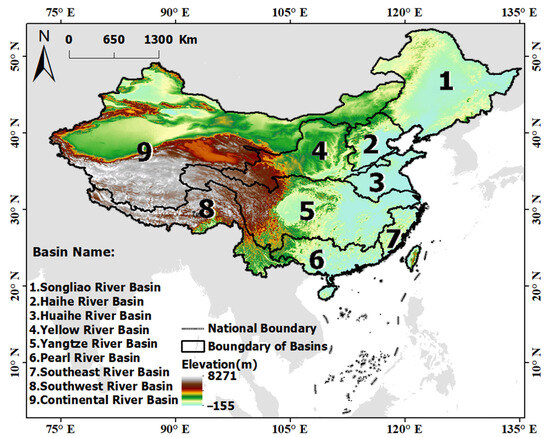
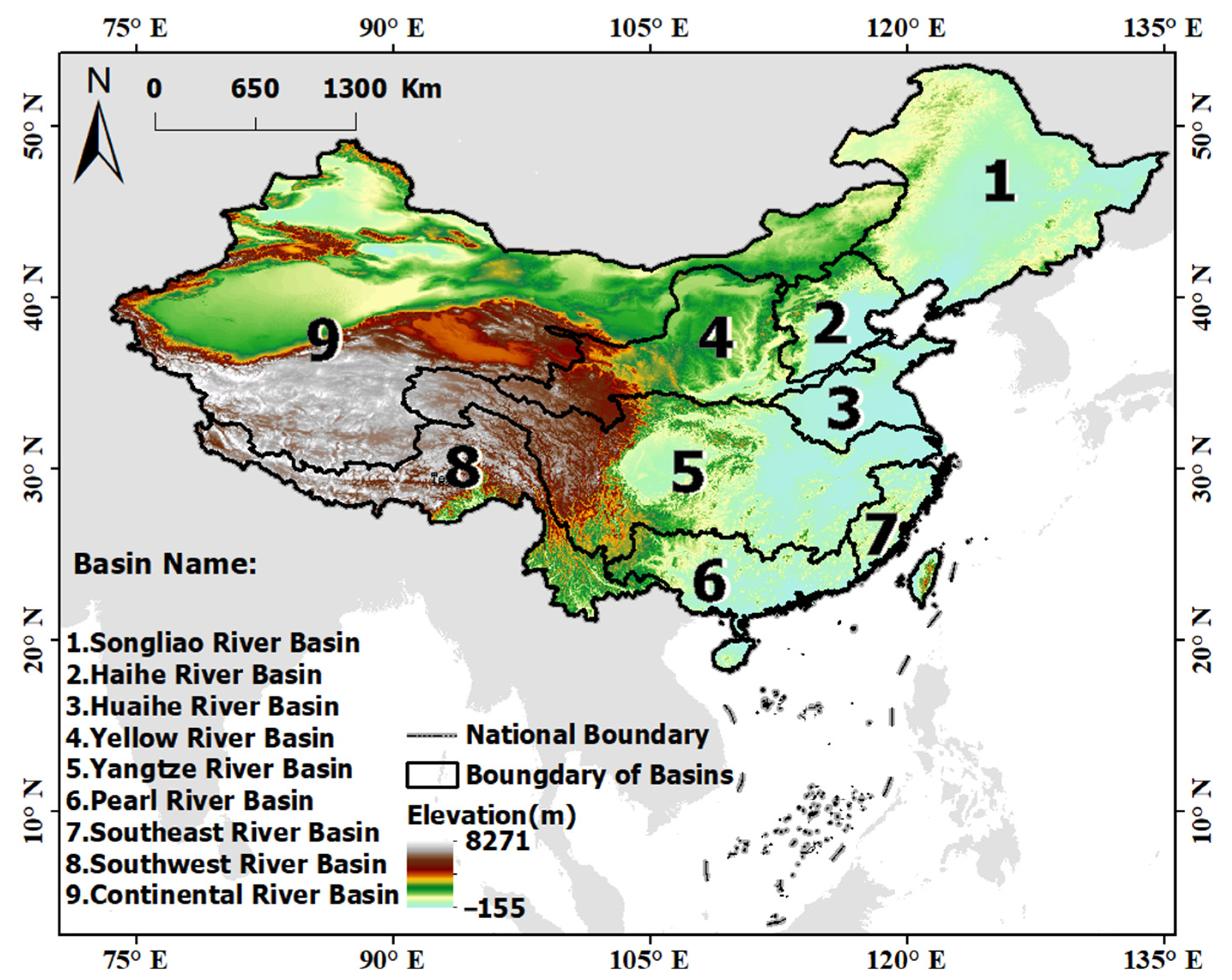
Leveraging the basin classification dataset from China’s National Data Center, this study delineates nine major river basins across China (Figure 1). The Songliao River Basin (SLRB), a vital commodity grain base in China, contains relatively abundant groundwater resources. However, significant spatiotemporal variability leads to moderate water scarcity in subregions [26]. As a primary grain production zone, the Haihe River Basin (HRB) allocates ~70% of water resources to agricultural irrigation [27]. Excessive groundwater abstraction for irrigation, industrial, and domestic uses has induced severe depletion [9]. The climate of the Yellow River Basin (YRB) is mainly dominated by an arid and semiarid continental monsoon [28]. Groundwater in the YRB is primarily replenished by precipitation infiltration, surface water recharge, and irrigation return flows. Influenced by both climate and human activities, its dynamics exhibit pronounced intra-annual unevenness and interannual variability [29]. Characterized by a temperate monsoon climate with distinct seasonal contrasts (cold-dry winters, hot-rainy summers), groundwater dynamics in the Huaihe River Basin (HHRB) are predominantly governed by natural precipitation-evapotranspiration processes [30]. In the subtropical monsoon climate zone of the Southeast Basin (SEB), groundwater dynamics are co-modulated by seasonal precipitation and anthropogenic activities from agriculture and industry [31]. Spanning subtropical to temperate climates, the Yangtze River Basin’s (YZRB) groundwater system receives rapid recharge from precipitation infiltration, glacial meltwater, and surface water bodies, with dynamics controlled by coupled climate-anthropogenic forcings [32]. The Pearl River Basin (PRB) exhibits abundant groundwater resources due to intense precipitation. Aquifer systems comprising fissure, porous, and karst waters respond to dual natural-anthropogenic drivers [33]. The Southwest Basin (SWB) features a complex hydrogeological framework, with groundwater predominantly comprising fissure waters, porous phreatic waters, and karstic waters [34]. The Continental Basin (CB) groundwater is primarily stored within shallow alluvial deposits and fractured bedrock along fluvial systems. Recharge relies on precipitation infiltration, lateral surface water seepage, and high-altitude glacial meltwater, yet demonstrates constrained recharge volume and low recharge rates [35].
Figure 1.
Location map of the study areas: China and nine major river basins (labeled 1–9). Basins’ names are annotated adjacent.
2.2. Data and Processing
This study employs four primary datasets to quantify monthly groundwater storage anomaly (GWSA) variations over the 2003–2019 period: (1) terrestrial water storage anomalies (TWSA) derived from Level-3 GRACE Jet Propulsion Laboratory (JPL) mass concentration (Mascon) solutions; (2) soil moisture storage (SMS), snow water equivalent (SWE), and canopy water storage (CWS) from three GLDAS models: NOAH Land Surface Model (NOAH), the Variable Infiltration Capacity model (VIC), and the Catchment Land Surface Model (CLSM); (3) surface water storage (SWS, comprising lakes, rivers, reservoirs, and wetlands) and groundwater storage (GWS) estimates from the Water GAP Global Hydrology Model (WGHM); (4) groundwater resources quantity (GWRQ) dataset extracted from the Water Resources Bulletin issued by China’s Ministry of Water Resources. Critical attributes of all utilized datasets are summarized in Table 1.
Table 1.
Detailed information on the datasets used in this study.
GRACE satellite data are jointly conducted by the JPL, German Research Centre for Geosciences (GFZ), and the Center for Space Research at the University of Texas at Austin (CSR). The mission enables global-scale monitoring of temporal variations in Earth’s gravity field [16]. Diverging from traditional spherical harmonics (SH)-based approaches, the regional mascon solution has emerged as a novel paradigm for GRACE data processing in recent years [36]. Compared to SH solutions, the mascon solution demonstrates a superior capability to mitigate signal leakage errors and eliminate aliasing effects induced by geophysical signals like glacial isostatic adjustment (GIA), while obviating the need for a posteriori corrections such as destriping filters and empirical smoothing [37]. The mascon solution preserves more spatiotemporal details of GRACE signals, demonstrates superior fidelity in retaining geophysical signals, effectively mitigates mass leakage issues, and achieves significantly higher signal-to-noise ratios (SNR) than SH approaches [37,38]. This study employs JPL’s GRACE Release 06 (RL 06) mascon level-3 product, which offers direct gridded TWSA estimates. The selection of the JPL mascon product is based on its demonstrated superior accuracy in regional studies compared to other widely used mascon datasets, such as those from CSR and GSFC [39].
Data gaps between the GRACE and GRACE-FO records were filled using the Singular Spectrum Analysis (SSA) gap-filling method, following the approach proposed by Yi and Sneeuw [40]. This method is implemented through the following process: initially, short gaps are filled by selecting an appropriate window width (M = 24) and number of modes (K = 12); subsequently, for more complex or extended gaps, grid-level cross-validation is employed for adaptive parameter optimization, ensuring that the parameter combination (M, K) is locally optimal (minimum RMSE, R ≥ 0.85). Thereafter, the iterative SSA algorithm is utilized to dynamically update the imputed values, and a Cumulative Distribution Function (CDF) test is then employed to identify and effectively remove noise modes, thereby ensuring that only statistically significant and physically meaningful reconstructed components are retained. The iterative nature of this SSA method progressively refines the imputation of missing data, ultimately enhancing the completeness and reliability of the dataset for subsequent analysis.
The GLDAS is a global offline land surface modeling system co-developed by the National Aeronautics and Space Administration (NASA) and the National Oceanic and Atmospheric Administration (NOAA) [41]. Employing advanced data assimilation techniques, GLDAS integrates satellite and in situ observations into a unified modeling framework to estimate the global distribution of key states, including soil moisture, snow water equivalent, and runoff [41]. GLDAS incorporates four land surface models: Noah, Mosaic, CLSM, and VIC. In this study, we specifically derived soil moisture, snow water equivalent, and canopy water storage components from the GLDAS-2.1 versions of Noah and VIC, as well as the GLDAS-2.2 version of CLSM. These datasets offer diverse spatial resolutions (0.25° and 1°) and temporal coverages (daily and monthly records). To ensure consistency with the GRACE data, all GLDAS outputs were processed to a uniform 0.5° spatial resolution and monthly temporal scale. Specifically, daily-scale data were aggregated to monthly scale by averaging the daily values within each month. Subsequently, monthly data (from both original 0.25° and 1.0° resolutions) were spatially resampled to the target 0.5° resolution using bilinear interpolation.
The WGHM operates at a 0.5° spatial resolution and monthly temporal resolution, covering the period from 1901 to 2019 [42]. Driven by climatic and geographic inputs, the WGHM simulates the dynamics of components comprising groundwater, soil moisture, snow water equivalent, canopy interception, and surface water storage in lakes, rivers, wetlands, and reservoirs, with the notable exclusion of glacial ice. Furthermore, WGHM integrates an anthropogenic water use module that quantifies both surface water and groundwater abstractions. This integration thereby facilitates the simulation of GWSA evolution driven by the synergistic effects of climate change and human activities [43]. This study quantified SWS by aggregating estimates of rivers, wetlands, reservoirs, and lakes, all derived from the WGHM. Concurrently, WGHM’s groundwater storage output was employed as a distinct dataset for validating or cross-comparing against the GRACE derived GWSA.
The Groundwater Resource Quantity (GWRQ) data utilized in this study were sourced from the China Water Resources Bulletin. The data are organized at the river basin scale and reported as volumetric measurements in units of 108 m3. The dataset quantifies shallow groundwater storage variations and reports several key parameters, including precipitation, quantities of surface water and groundwater resources, total water resources, direct seawater utilization, and sectoral water use (agricultural, industrial, domestic, and ecological). This study used groundwater resources quantity data for the period 2005–2019.
To ensure the temporal consistency of the multi-source data comparative analysis, this study unified the analysis period of all datasets (GRACE, GLDAS, WGHM) to their mutually covered complete period, i.e., from February 2003 to December 2019. For consistent comparison with GRACE TWSA, all hydrological model outputs and in situ statistical data were processed to represent anomaly values. This involved subtracting the long-term monthly mean for the 2004–2009 baseline period (consistent with the GRACE data reference period) from each corresponding monthly observation.
2.3. Methods
2.3.1. Groundwater Storage Estimation
GWSA in this study was determined through two distinct methodologies. The first approach employs the water balance principle, where GWSA is calculated by deducting other terrestrial water storage components from the TWSA observed by GRACE. Conventionally, GRACE TWSA is understood as the sum of GWSA, soil moisture storage anomalies (SMSA), and surface water storage anomalies (SWSA). While SWSA typically encompasses snow water equivalent anomalies (SWEA), vegetation canopy water content anomalies (CWSA), in this study, we defined SWSA to also incorporate anomalies from rivers, lakes, wetlands, and reservoirs. Consequently, GWSA is calculated by removing these individual water storage components and is expressed by the following equation:
Note that the study computes GWSA separately for each of the three different GLDAS model components (i.e., NOAH, VIC, and CLSM). This calculation is performed independently for each GLDAS model.
The second methodology involves directly utilizing GWSA estimates from existing hydrological models and in situ statistics. This includes GWSA outputs from the WGHM, the GLDAS CLSM, and the GWRQ data obtained from the official Water Resources Bulletin.
2.3.2. Evaluation Metrics
This study employed the correlation coefficient (CC) and standard deviation (STD) as performance metrics to assess the estimated GWSA. The CC was applied to evaluate the temporal agreement and co-variability among different GWSA estimates, indicating how well their fluctuations align over time. Concurrently, the STD quantifies the inter-model dispersion among GWSA estimates derived from various data sources, reflecting the magnitude of disagreement in GWSA estimations and highlighting potential systematic biases inherent in the underlying methodologies and models used [44,45]. These two metrics collectively offer a robust assessment of both the temporal consistency (quantified by CC) and the magnitude of divergence in the time series (quantified by STD) among multiple GWSA estimates. The specific formulations are as follows:
In the formula, and denote the two GWSA estimates derived from distinct data sources at month within the study period ; and are their respective temporal means; and and represent an individual estimate from a total of annual GWSA trends and their arithmetic mean, respectively.
2.3.3. Trend Analysis
The linear trend was estimated using a linear regression model, which can be expressed as follows:
where K is the regression coefficient; b is the regression constant; i is the serial number; is the time ; and is the time series data corresponding to , i.e., GWSA in this work. The coefficients of a and b can be estimated by a least squares method as follows:
where n is the total number of data. The coefficient of a (i.e., slope) represents the linear trend, and a > 0 indicates an upward trend, while a < 0 means a downward trend. The magnitude reflects the rate of rise or fall trend. The statistical significance was assessed via a t-test at a 5% significance level (α = 0.05).
3. Results
3.1. Comparison of GRACE-Derived GWSA with Water Resources Bulletin Data
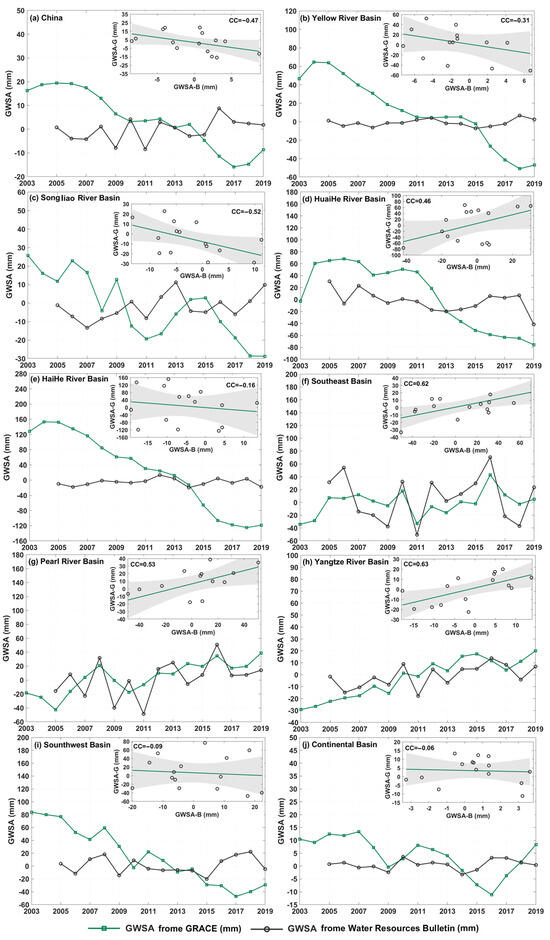
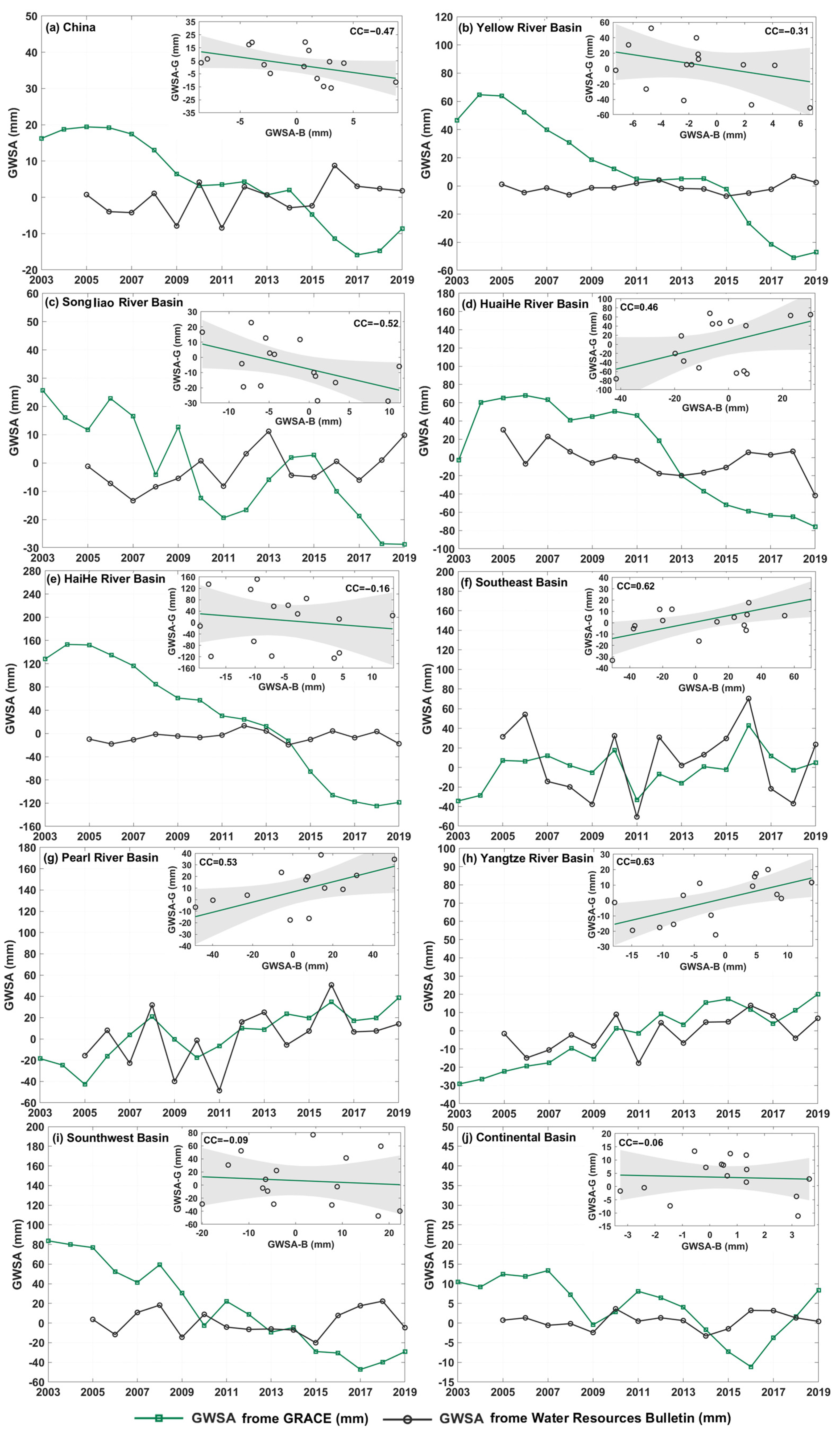
Figure 2 presents an annual-scale comparison between the GWSA derived from GRACE data and those reported in official water resources bulletins. At the national scale, the two datasets generally exhibit divergent trends in GWSA during the 2003–2019 period. Specifically, GRACE derived GWSA revealed a declining trend, while data from the Water Resources Bulletin indicated a slight upward trend. Delving into the sub-basin scale, most basins displayed modest decreasing trends. Notably, the HHRB experienced significant declines ranging from −2.11 to −9.30 mm/yr, and the CB showed decreases of −0.11 to −0.91 mm/yr. Conversely, a few basins, such as the PRB and the YZB, demonstrated increasing trends, with rates of 2.26 to 3.76 mm/yr and 1.16 to 3.0 mm/yr, respectively. However, notable discrepancies in trends are evident in specific basins, including SLRB, YRB, HRB, and SWB.
Figure 2.
Comparison of GWSA-derived GRACE with bulletin-reported GWSA (2003−2019) across China and its nine major basins. In the inset at the upper right corner, GWSA-G denotes GWSA derived from GRACE, and GWSA-B refers to GWSA reported in the Water Resources Bulletin. The shaded area indicates the 95% confidence interval of the linear regression.
Significant positive correlations between GRACE-derived GWSA and bulletin-reported GWSA were observed in the SEB, YZB, PRB, and HHRB, with CC of 0.62, 0.63, 0.53, and 0.46, respectively. This suggests that GRACE effectively monitors dynamic GWSA variations within these regions. Conversely, negative CC values were found in several basins, including the SLB (−0.52), YRB (−0.31), and HRB (−0.16).
3.2. Evaluation of GWSA Across China
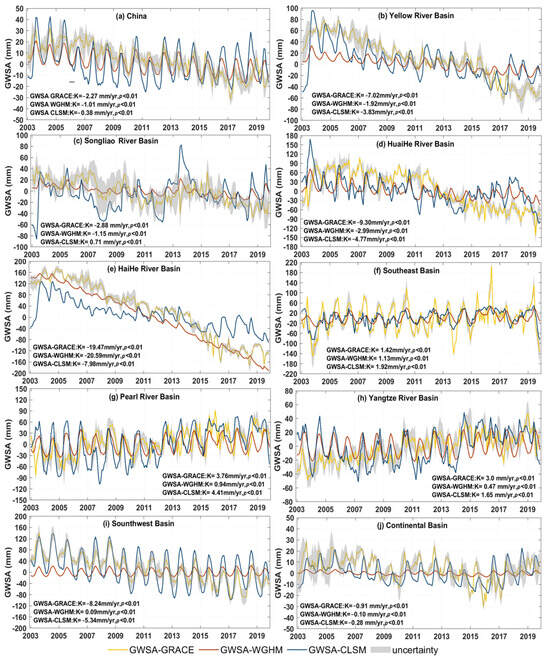
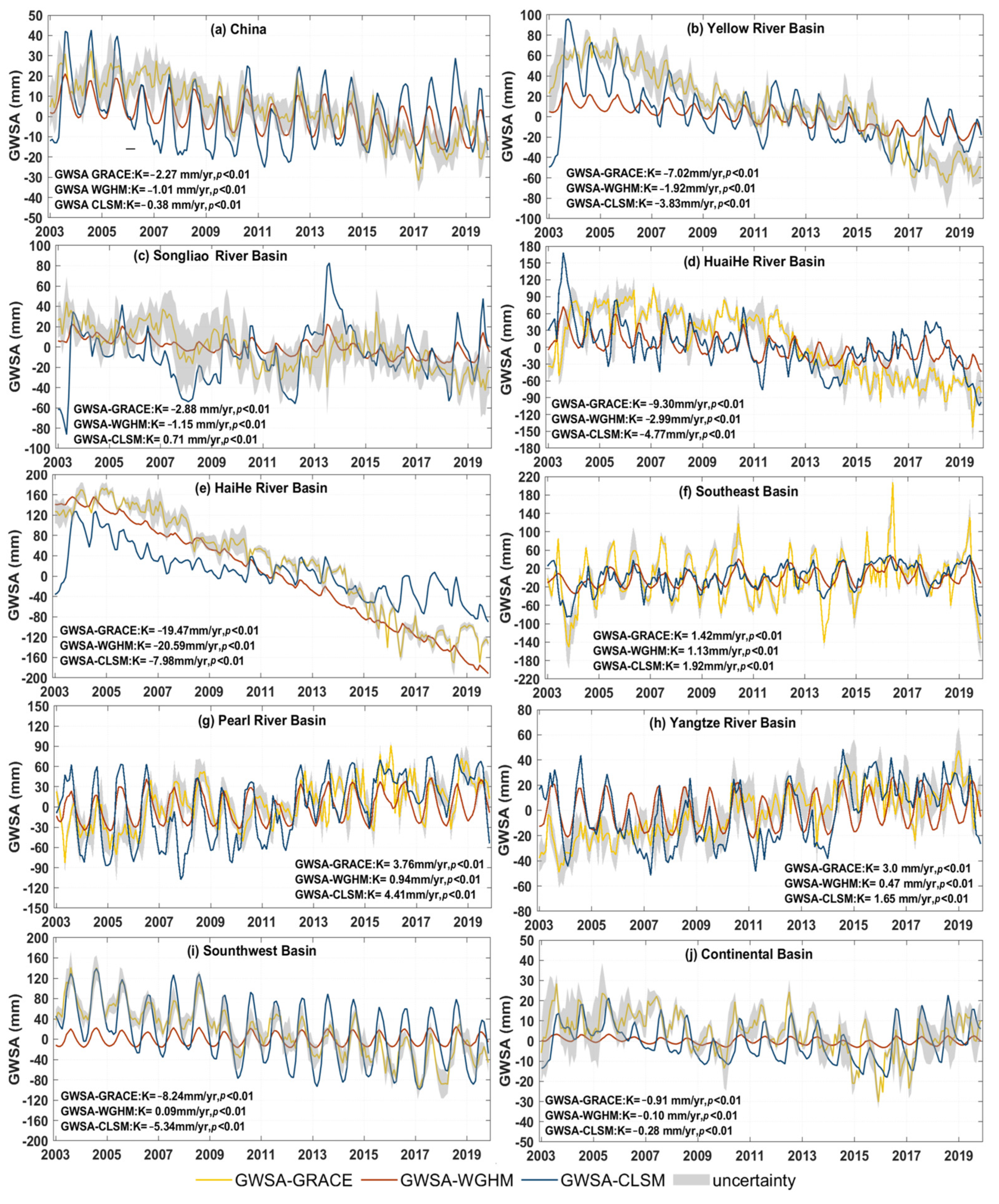
Figure 3 compares the monthly GWSA time series derived from GRACE, WGHM, and GLDAS CLSM. The three datasets exhibit strong temporal consistency, characterized by an overall declining trend with rates ranging from −2.27 to −0.38 mm/yr. Seasonally, annual maxima typically occur in September, while minima are observed in December. An acceptable correlation was found between GRACE-derived GWSA and GWSA from both CLSM and WGHM; detailed correlation coefficients are provided in Table S2 of the Supplementary Materials. Specifically, at the monthly scale, the CC were 0.39 for GRACE-CLSM and 0.69 for GRACE-WGHM. At the annual scale, these correlations further increased to 0.46 and 0.93, respectively (Table S2). The generally higher correlation observed at the annual scale compared to the monthly scale suggests that longer temporal averaging periods effectively mitigate short-term noise and better capture the underlying long-term groundwater dynamics.
Figure 3.
Monthly time series of GWSA derived from GRACE, CLSM, and WGHM across China and its nine major river basins (February 2003-December 2019). GWSA-GRACE represents GRACE-derived GWSA, GWSA-CLSM denotes CLSM-derived GWSA, and GWSA-WGHM indicates WGHM-derived GWSA. The gray shaded areas represent the uncertainties in GWSA-GRACE, calculated as one standard deviation.
Analysis at the river basin scale revealed that a significant declining trend in GWSA was prevalent in the majority of basins. These include the HRB, with declines ranging from −20.59 to −7.98 mm/yr; YRB, from −7.02 to −1.92 mm/yr; HHRB, from −9.30 to −2.99 mm/yr; and CB, from −0.91 to −0.10 mm/yr. Conversely, a significant increasing trend in GWSA was observed in a few basins, notably the PRB (0.94 to 4.41 mm/yr), followed by the YZB (0.47 to 3.0 mm/yr), and the SEB (1.13 to 1.92 mm/yr). However, noticeable discrepancies in the specific trend rates were observed among the different datasets. Overall, the GRACE-inverted GWSA exhibited generally larger trend magnitudes compared to the other models. The WGHM generally produced more conservative or less extreme trend magnitudes in most basins. WGHM-derived GWSA were consistent with the GRACE satellite results over most regions. For instance, strong agreement was observed in the SEB (1.13 mm/yr) and HRB (−20.59 mm/yr). However, WGHM showed smaller trend magnitudes in several other basins, including the YRB (−1.92 mm/yr), the HHRB (−2.99 mm/yr), the PRB (0.94 mm/yr), and the YZB (0.47 mm/yr). The CLSM-derived GWSA generally showed consistency with the GRACE satellite results across most regions, such as the SEB (1.92 mm/yr) and the RRB (4.41 mm/yr). However, CLSM estimates tended to show smaller trend magnitudes in some basins, such as the HRB (−7.98 mm/yr), HHRB (−4.77 mm/yr), YRB (−3.83 mm/yr), and the SWB (−5.34 mm/yr). Significant temporal variability in the relative magnitudes and trends characterizes the different GWSA time series. For instance, in the China region and the SLRB, GRACE-derived GWSA was significantly higher than both CLSM-derived and WGHM-derived GWSA during 2006–2011. Conversely, CLSM-derived GWSA was markedly higher than the other two estimates from 2013 to 2019. In the HRB, the declining trend of CLSM-derived GWSA was substantially weaker than that from the other two estimates for the period 2003–2013. From 2013 to 2017, CLSM-derived GWSA exhibited a slight increasing trend, contrasting with the persistent declining trends observed in the other two datasets.
Seasonal fluctuations were evident in most basins (Figure S1 in the Supplementary Materials), though their magnitudes varied significantly. Pronounced seasonal fluctuations were identified in the SWB, YZB, and CB, indicating strong seasonal groundwater dynamics. Conversely, the SLRB exhibited notably weaker seasonal variations, while other basins like the SEB and YRB showed moderate fluctuations. Generally, the seasonal amplitude of GRACE-derived GWSA is the largest among the estimates in many basins. This likely reflects GRACE’s sensitivity to terrestrial water storage changes, including seasonal variations in deep groundwater that land surface models might not fully capture. WGHM-derived GWSA often exhibits relatively smaller seasonal amplitudes, with its seasonal signal typically being smoother. The seasonal amplitude of CLSM-derived GWSA usually falls between those of GRACE and WGHM, but in certain periods or basins (e.g., SWB and SLRB), its seasonal peaks can sometimes rival or even exceed those of GRACE.
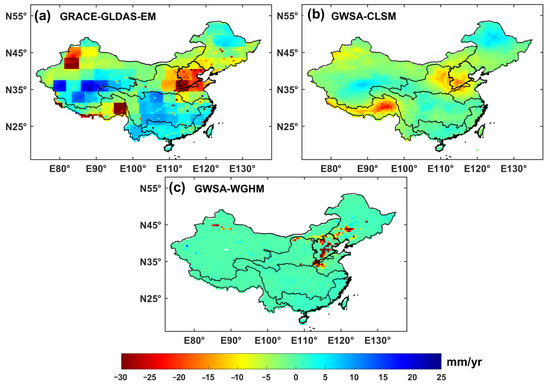
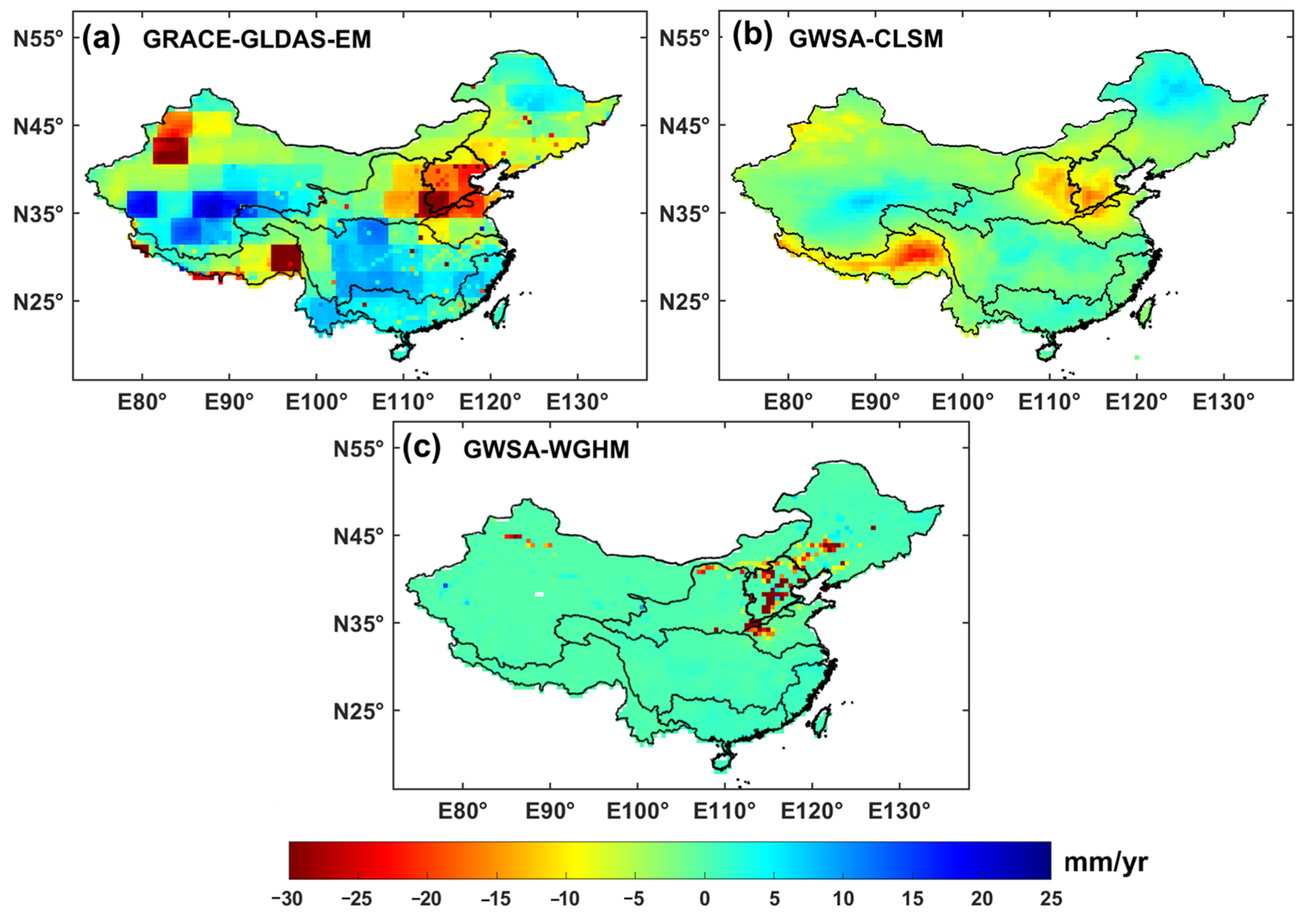
Figure 4 displays the spatial distribution of GWSA trends estimated from different sources. Regions exhibiting a declining trend in groundwater storage are primarily concentrated in three notable areas: parts of Tibet within the SWB, where a peak decline rate of −34.7 mm/yr was observed; the northwestern region of the CB, which also experienced severe GWS depletion, reaching a maximum rate of −33.78 mm/yr; and the HRB, which showed a comparatively lower decline, peaking at −25.39 mm/yr. Conversely, significant increasing trends were identified in several regions, including the middle-lower reaches of the YZRB, the northwestern part of the SLRB, areas of Yunnan within the SWB, and the southwestern CB, encompassing most of Qinghai Province and southern Xinjiang.
Figure 4.
Spatial trends of GWSA across China from February 2003 to December 2019. The trends are presented as: (a) GWSA derived from GRACE; (b) GWSA simulated by the CLSM; and (c) GWSA simulated by the WGHM.
The spatial patterns of trends derived from GRACE-GWSA and CLSM-GWAS are generally consistent. However, notable discrepancies exist in the magnitude of the trends between these two estimates. For instance, in the North China Plain, the maximum rates of GWSA decline were −13.39 mm/yr, whereas GRACE calculated a rate of −25.39 mm/yr. WGHM-derived GWSA exhibits a distinctly speckled distribution pattern, which notably differs from the spatial patterns of the other two estimates. Significant groundwater depletion trends were also detected by WGHM in the North China Plain and northwestern Xinjiang, with magnitudes substantially larger than those derived from the GRACE and CLSM (Figure 4c). However, no notable GWSA changes were identified by WGHM in the TP, which is in contrast to the findings from the other two datasets.
3.3. Comparison of Different GLDAS Models
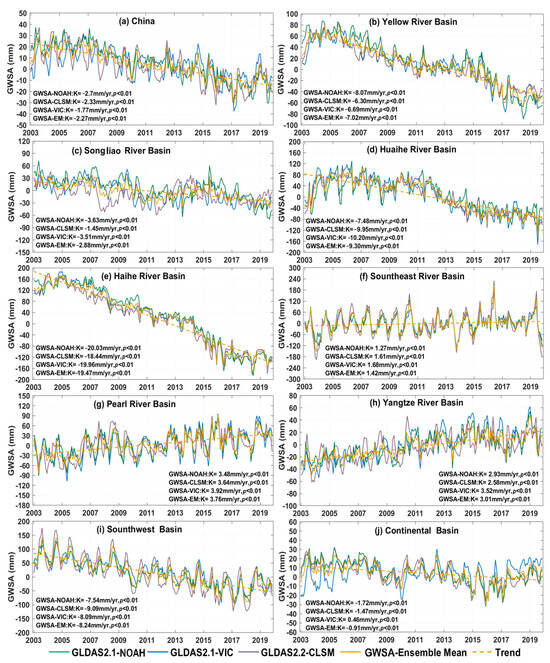
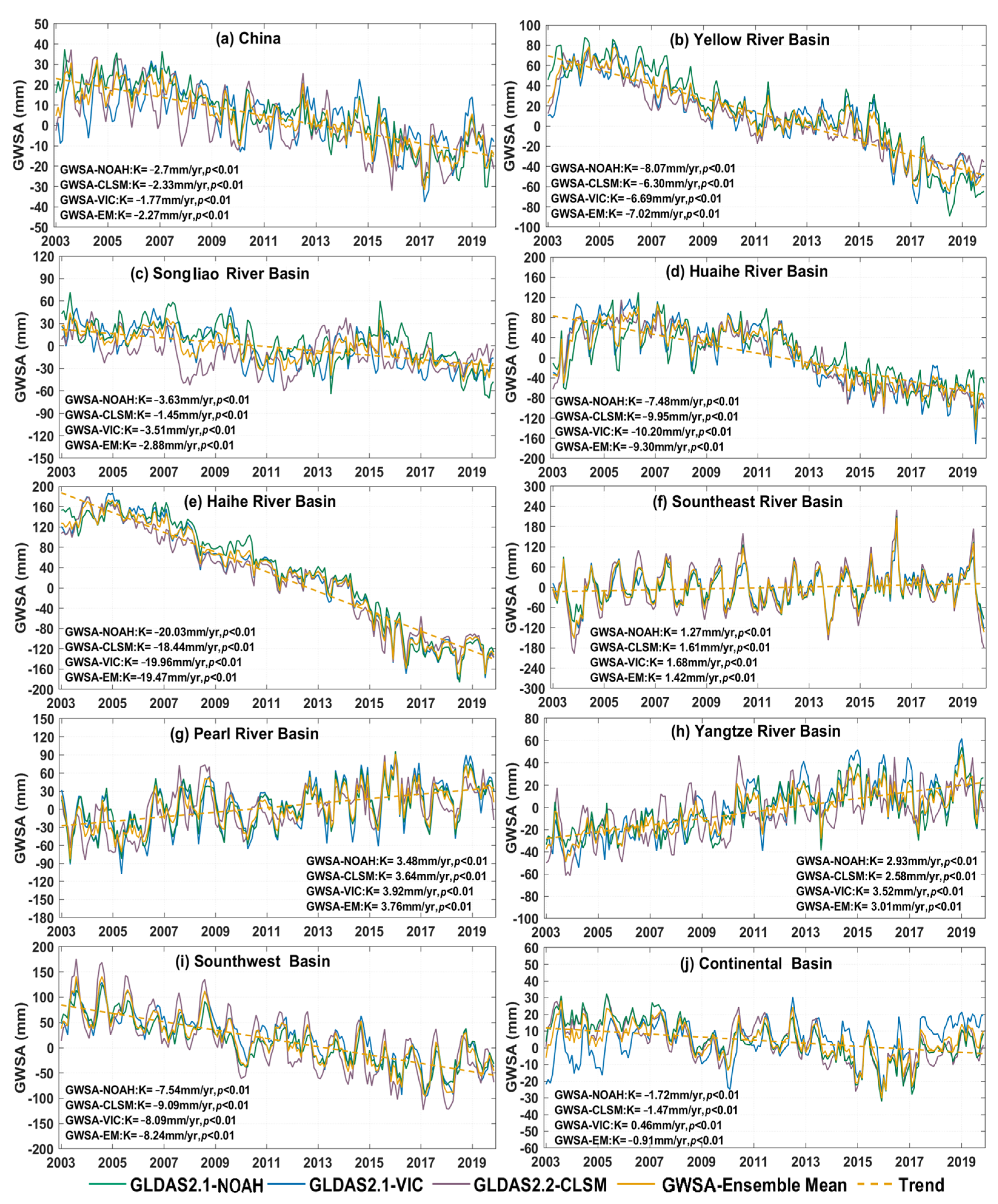
Figure 5 presents a comparison of the monthly GWSA time series from the three GLDAS models (NOAH, VIC, and CLSM) from 2003 to 2019. Detailed trend values are provided in Table S1 in the Supplementary Materials. Overall, GWSA estimates derived from three models based on GLDAS data showed a declining trend in China during 2003–2019 (Figure 5a), and generally exhibited agreement in their GWSA simulations and captured pronounced seasonal cycles across various geographical regions. For instance, in the SEB, trends ranged from 1.27 ± 4.06 to 1.68 ± 4.14 mm/yr (Figure 5f); in the PRB, they ranged from 3.48 ± 2.89 to 3.92 ± 3.37 mm/yr (Figure 5g); and in the HRB, they ranged from −18.44 ± 7.09 to −20.03 ± 8.62 mm/yr (Figure 5e). These narrow ranges underscore the high degree of consistency among the GLDAS models. However, notable discrepancies persisted in some basins. Specifically, in the CB, NOAH-derived GWSA and CLSM showed pronounced declining trends of −1.72 ± 1.04 mm/yr and −1.47 ± 1.02 mm/yr, respectively, while the GWSA derived from VIC exhibited the most substantial uptrend at a rate of 0.46 ± 0.99 mm/yr for the same region (Figure 5j). Furthermore, in the YRB, NOAH-derived GWSA also presented the most pronounced declining trend at −8.07 ± 3.61 mm/yr, followed by VIC-derived GWSA at −6.69 ± 3.15 mm/yr, and CLSM-derived GWSA showing the least decline at −6.30 ± 2.79 mm/yr (Figure 5b). Conversely, in the YZB and HHRB, the VIC-derived GWSA indicated a more pronounced upward trend compared to the other two datasets.
Figure 5.
Monthly GWSA time series for China and its nine major river basins (February 2003–December 2019). The time series were derived from three individual GLDAS models (NOAH, VIC, and CLSM) and their ensemble mean time series. The ensemble mean time series was obtained by averaging the GWSA outputs from these three models. The term ‘EM-Trend’ refers to the linear trend calculated from this ensemble mean GWSA time series. All depicted trends are statistically significant (p < 0.01).
Additionally, significant temporal and inter-model discrepancies were observed for specific periods within certain basins. For instance, in the YRB (Figure 5b), NOAH-derived GWSA was significantly higher from 2004 to 2010 but substantially lower from 2017 to 2019, during which CLSM-derived GWSA became markedly higher. A similar shift was observed in the HHRB (Figure 5d), where NOAH-derived GWSA was significantly smaller than the other two models from 2006 to 2010, yet markedly higher throughout 2012–2019. In the CB (Figure 5j), VIC-derived GWSA notably differed from NOAH and CLSM, being significantly lower from 2003 to 2006 but markedly higher throughout 2012–2019. More complex divergent patterns emerged in the SLRB (Figure 5c). Generally, Noah-derived GWSA estimates consistently exceeded those from both VIC and CLSM. However, the CLSM demonstrates a clear phased pattern: its estimates are markedly lower than those from VIC and Noah in the 2004–2010 period, whereas they are considerably higher in the 2010–2014 period. Further analysis of the trends reveals the opposing change directions between VIC and CLSM, whereas Noah and CLSM exhibit more consistent trend patterns.
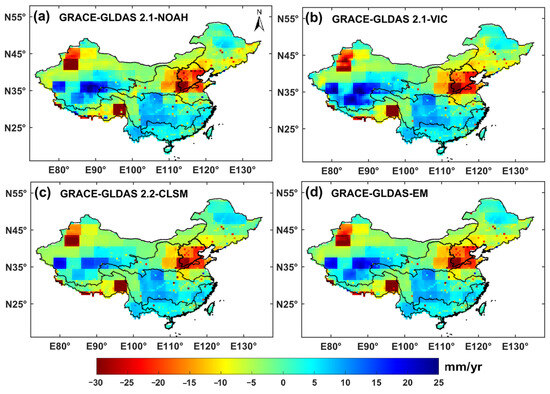
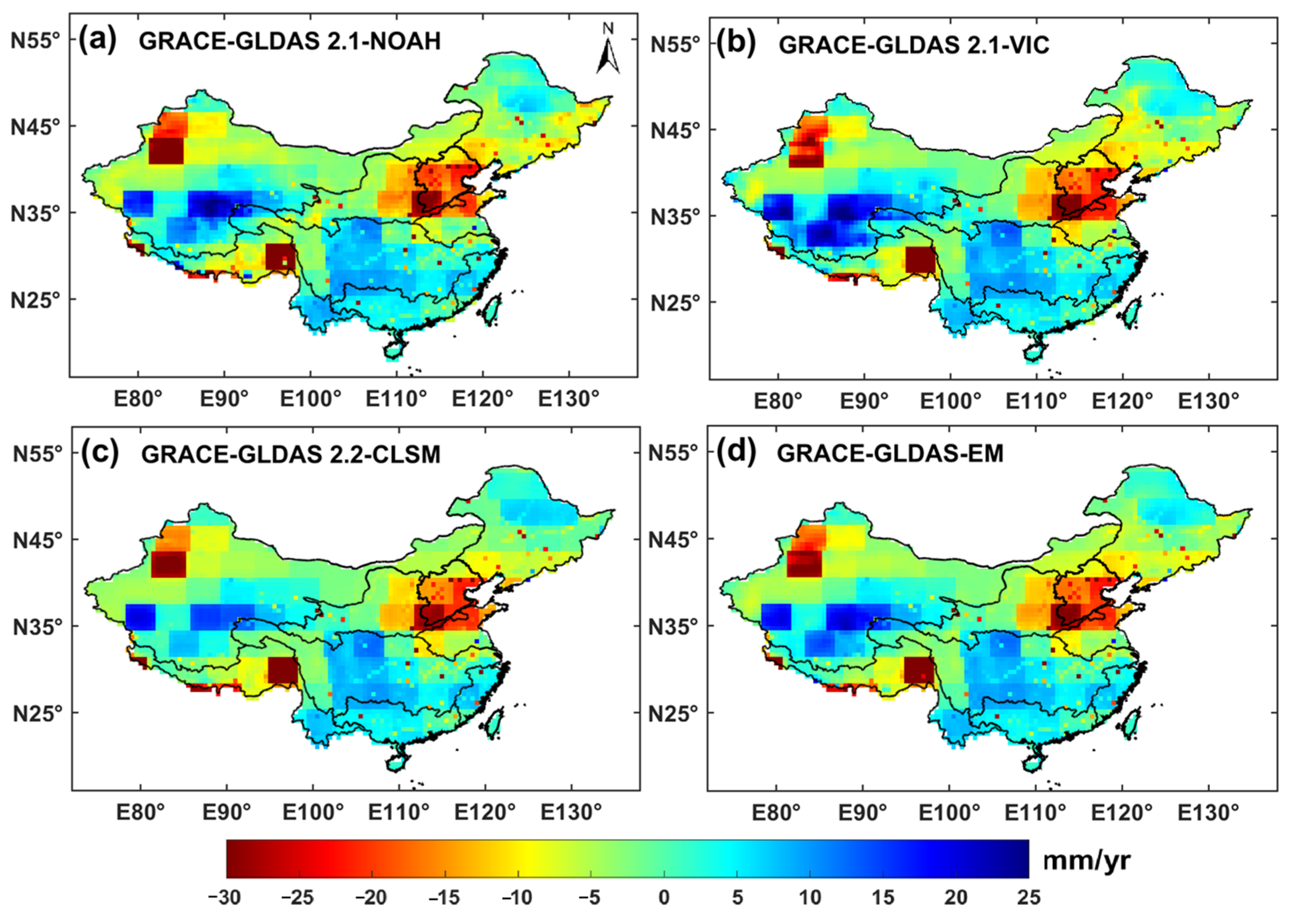
Figure 6 presents the spatial distribution of GWSA trends derived from three GLDAS models (NOAH, VIC, and CLSM). Overall, they exhibited largely consistent spatial patterns: significant declining trends in groundwater storage were observed in the North China Plain, western Xinjiang, and southeastern Tibet. Conversely, noticeable increasing trends were detected in the central Yangtze River Basin, the endorheic basin of the Tibetan Plateau, and the northern Liaohe River Basin (Figure 6d). However, discrepancies were observed in the magnitude and spatial extent of groundwater changes among the models. For instance, in the northern SLRB, CLSM demonstrated a more substantial increasing trend compared to the other two models, while the GWSA depletion trend indicated by the CLSM is significantly weaker than that shown by the other two models in the northern region of the Beijing-Tianjin-Hebei area (Figure 6c). Similarly, in the southern Tibetan Plateau, VIC exhibited the most pronounced increasing trend (Figure 6b), followed by NOAH (Figure 6a), while CLSM showed the slightest increase (Figure 6c). All three models revealed significant declining trends in the Southeastern Tibet of SWB; however, the spatial extent of the declining trend derived from NOAH was considerably more extensive (Figure 6a). In the northwestern Xinjiang, the NOAH-derived GWSA consistently exhibited a more pronounced declining trend compared to the other two models (Figure 6a).
Figure 6.
Spatial distribution of GWSA trends derived from different GLDAS models across China, including: (a) NOAH-derived GWSA, (b) VIC-derived GWSA, (c) CLSM-derived GWSA, and (d) the ensemble mean of the three models. The grid cell characterized by a speckled pattern delineates areas of lakes, reservoirs, and wetlands, as identified by the WGHM.
4. Discussion
4.1. GWSA from Multi-Source Datasets
Strong annual-scale correlations were observed between GRACE-derived GWSA and data reported in the official water resources bulletin. For instance, relatively high correlation coefficients were found in the Yangtze River Basin (correlation coefficient, CC = 0.63) and the Pearl River Basin (CC = 0.53), clearly demonstrating the utility of GRACE data for monitoring regional groundwater dynamic changes. However, notable discrepancies persist between GWSA and bulletin-reported GWSA in certain basins. Specifically, the Haihe River Basin (CC = −0.16) and the Yellow River Basin (CC = −0.31) exhibit much weaker correlations (Figure 2). This notable discrepancy is primarily attributed to intensive human activities, including extensive agricultural irrigation and large-scale projects like the South-to-North Water Diversion Project, which profoundly alter groundwater cycling. Furthermore, inherent uncertainties in GRACE observation and limitations and potential errors in the acquisition and processing of water resources bulletin data, also contribute to these inconsistencies [8,46]. The Bulletin data, derived from monitoring well networks, predominantly reflect water level dynamics in shallow unconfined aquifers. Its point-scale measurements exhibit higher uncertainty when extrapolating to regional-scale changes, particularly in areas with sparse well coverage. In contrast, GRACE observes mass changes integrated over the entire groundwater column, including deep confined aquifers. GRACE data are also affected by errors such as signal leakage. Therefore, the inconsistency between these two methodologies constitutes a probable and significant source of the observed discrepancies.
WGHM-derived GWSA exhibited notable discrepancies compared to other data results across most basins (Figure 3), indicating its limited capacity to fully represent the amplitude of groundwater storage variations, especially during extreme events. This observation aligns with prior findings [3,47]. Specifically, Feng et al. [12] quantitatively confirmed WGHM’s underestimation of the amplitude of temporal variability in the GWS change signal within the LRB. Furthermore, Liu et al. [48] demonstrated substantial trend divergences between GRACE and WGHM in intensively irrigated regions, highlighting model limitations in human-impacted domains. WGHM did not reveal significant GWAS changes in TP (Figure 4); this observation is, however, consistent with previous findings [12,42]. Therefore, applications utilizing WGHM data require careful consideration and interpretation [34,49]. Nevertheless, WGHM distinctively highlighted a more significant GWS depletion compared to the other two data results in the NCP (Figure 4). This finding is consistent with observations from some regional groundwater models [11,50]. This larger depletion trend likely stems from the WGHM’s systematic underestimation of groundwater recharge fluxes in this region [42]. An underestimated recharge would naturally lead the model to simulate a more pronounced net depletion when faced with persistent high extraction rates.
As one of the few physics-based modern land surface models, CLSM simulates shallow GWSA dynamics within 2 m of bedrock depth. Absence of anthropogenic groundwater abstraction parameterization confines CLSM-simulated GWSA to natural regime dynamics [51]. In contrast to WGHM’s sporadic extreme outputs, CLSM v2.2 produces spatially contiguous GWSA trend distributions (Figure 4). Furthermore, the spatial trends of CLSM-GWSA are more consistent with GRACE-GWSA, an agreement likely attributable, in part, to the assimilation of GRACE data in CLSM simulations [52]. However, this discrepancy is particularly pronounced in regions characterized by intensive irrigation (e.g., HRB, HHRB) or rapid urbanization (e.g., PRB, SEB), where the long-term trends show significant underestimation or overestimation relative to the benchmark (Figure 3). This systematic discrepancy stems from a fundamental limitation in the GLDAS framework: these models are designed to simulate natural hydrological regimes, yet they lack explicit coupling with key anthropogenic perturbations, such as groundwater extraction and irrigation [27]. Additional potential drivers for these discrepancies may include GRACE processing artifacts, model simulation uncertainties, and glacial and surface water contributions [12]. Exact causal mechanisms necessitate targeted future research.
A systematic intercomparison of GWSA estimates from GRACE combined with GLDAS models (Noah, VIC, and CLSM) (Figure 5) shows strong consistency in the long-term trends across most regions, reflecting their reliable simulation of hydrological responses to climatic variations. However, significant discrepancies arise in the glacier-rich CB due to differences in how each model partitions glacial meltwater into infiltration, runoff, and groundwater recharge. Specifically, VIC rapidly converts meltwater to surface runoff via its variable infiltration scheme; CLSM’s dynamic root zone enhances vegetation interception and transpiration, while Noah uses a simpler parameterization [51,53]. These differences lead to substantial variation in the estimated long-term meltwater recharge to groundwater in this region. In the SLRB, seasonal frozen soil is the main source of uncertainty. Although CLSM incorporates more complex soil layering, its simulation of the hydrothermal coupling process in the frozen soil-groundwater system remains inadequate, while Noah and VIC models employ even simpler schemes [54]. As a result, significant discrepancies arise among the models in estimating both the timing and magnitude of spring snowmelt recharge. In the HHRB, dominated by extensive irrigation agriculture, human activities substantially modify the natural hydrological cycle [13]. However, the GLDAS models lack integrated modules for human water use, preventing them from capturing groundwater depletion caused by irrigation pumping [10,27]. This structural limitation leads to considerable divergence in the magnitude and trend of GWSA changes across the region.
4.2. Evaluating GWSA in Basins and Comparison with Previous Work
Table 2 summarizes previous studies of GWS changes across river basins in China. The North China Plain (NCP), a globally significant irrigated region primarily situated within the Haihe River Basin, extensively utilizes intensive groundwater irrigation [12]. This intensive reliance has made its aquifer dynamics a subject of considerable research interest, with a broad scientific consensus on the critical nature of observed changes [20,55]. Feng et al. [9] revealed that the NCP underwent substantial groundwater depletion at an average rate of −2.2 ± 0.3 cm/yr during 2003–2010. Huang et al. [56] showed shallow groundwater in the Piedmont Plain(PP)plain exhibited a significant decline at a rate of −46.6 ± 6.8 mm/yr, whereas the deep groundwater in the East-Central Plain(ECP) plain showed a decrease at a rate of −16.9 ± 1.9 mm/yr from 2003 to 2013. Zhao et al. [55] identified a declining trend in the NCP’s groundwater storage with a rate of −17 ± 0.1 mm/yr from 2004 to 2016. The NCP is a primary driver of the groundwater decline in the Haihe River Basin, a conclusion further supported by our results presented in Figure 4 and Figure 6. Our study identifies a significant decreasing trend in GWSA, ranging from −7.98~−20.59 mm/yr from 2003 to 2019. The observed differences between these rates are largely attributable to variations in study periods and data sources. The significant groundwater depletion in the NCP is primarily attributable to persistent decadal droughts coupled with intensive irrigation pumping [57].
The YRB experienced substantial groundwater depletion at −7.02 ± 3.11 mm/yr during the 2003–2019 period (Table S1). This observed trend is consistent with previous research. Huo et al. [58] demonstrated a more significant groundwater storage decline rate of −3.89 cm/yr in the Loess area during 2002–2014 using GLDAS NOAH v2.1 data, noting a spatially decreasing trend from the southeast to northwest. Xie et al. [28] reported a decline in GWS within the YRB at a rate of −4.2 ± 1.0 mm/yr during 2003–2015 by combining GRACE mascons data with GLDAS NOAH v2.1 data. Spatially, our analysis indicates that the groundwater decline in the YRB was primarily concentrated in its southeastern region (Figure 4). This pattern aligns with previous studies and is predominantly driven by intensive anthropogenic groundwater extraction [29]. In the CB, a slight declining trend in groundwater was observed at the rate of −0.91 ± 0.85 mm/yr. However, this rate is notably less pronounced than the more substantial decline of −3.28 mm/yr reported by Yin et al. [3] for the same basin during the period 2002–2016. The observed discrepancy is likely attributable to the extensive glacial coverage within the CB. Specifically, since the water balance components in the GLDAS outputs do not adequately account for glacial processes, the calculated GWSA cannot reliably isolate the hydrological contributions from glacier dynamics [37]. This inherent limitation introduces considerable uncertainty into the derived GWSA for glacier-dominated regions.
For the CB, while our study observed an overall slight declining trend in groundwater storage at a rate of −0.91 ± 0.85 mm/yr, it is noteworthy that specific sub-regions within or adjacent to the CB, such as the northern Tibetan Plateau and the Qaidam Basin, have exhibited an upward trend in GWSA. Yin et al. [3] attributed this recovery to increased precipitation, glacial meltwater, and snowmelt, likely driven by climate change. Su et al. [57] reported an overall declining trend in groundwater storage across the Tarim River Basin at a rate of −2.13 mm/yr during 2003–2019. This decline was most pronounced in the mid-section of the southern slopes of the Tianshan Mountains, whereas the lower reaches exhibited a steady recovery. Yang et al. [11] spatially revealed that groundwater depletion rates within the Tarim River Basin from 2005 to 2016, with rates ranging from −3.8 to −9.4 mm/yr in the northern region, compared to a milder rate of −0.7 mm/yr in the south. Xuan et al. [59] investigated the spatiotemporal evolution of GWS in the Hexi Corridor over the past two decades. Their results indicated a general declining trend from 2005 to 2020, which, however, decelerated markedly after 2014. In conclusion, these findings from previous studies are in good agreement with our results and exhibit a high degree of consistency in their spatial patterns (Figure 4).
The YZB exhibited the most pronounced increasing trend in GWSA, at a rate of 3.01 ± 1.62 mm/yr (Table S1). Jiang et al. [60] documented an increase in groundwater storage within this region at a rate of 1.89 mm/yr during the period 2003–2009. Ferreira et al. [32] confirmed an increase rate of 1.76 mm/yr in this region for the period 2003–2016. Yang et al. [11] reported an increasing trend in GWS across the upper and middle reaches of the YZB, with rates ranging from 0.8 to 8.4 mm/yr during 2005–2016. A consensus has been established regarding the increasing trend of GWSA in the YZB, while the variations in reported increasing rates are primarily attributed to discrepancies in study periods, data sources, and processing methodologies. Furthermore, the ongoing increase in groundwater storage itself likely contributes to these observed differences. Over the past 17 years, the PRB has also experienced an increasing trend in groundwater storage. Employing the same GRACE and GLDAS datasets and the water balance principle, our study derived a GWSA change rate of 3.76 ± 2.76 mm/yr for the period 2003–2019 (Table S1). Lin et al. [61] reported an overall increasing trend in GWSA for this region, with an average rate of 4.3 mm/yr during 2002–2016. In comparison, Yin et al. [3] reported a lower GWSA increase rate of 1.69 mm/yr during 2002–2016. Although a persistent increasing trend in GWSA within the PRB has been consistently observed in previous studies using the same data source and method, the magnitude of this change varies significantly. The discrepancies between our findings and those mentioned above are likely attributed to variations in study periods, data sources, and/or processing methods. In the SEB, our analysis revealed an increasing trend in groundwater storage at a rate of 1.42 ± 4.51 mm/yr over the past 17 years (Table S1). Consistent with previous studies, Yin et al. [3] identified an increase in GWSA within the SEB at a rate of 1.45 mm/yr during 2002–2016.
The SLRB has exhibited a declining trend in groundwater storage at a rate of −2.88 ± 1.66 mm/yr over the past 17 years (Table S1). Previous investigations have predominantly examined the Songhua River Basin (SRB) and the Liaohe River Basin (LRB) as separate entities, analyzing their spatiotemporal dynamics in isolation. For instance, Zhong et al. [62] reported a decline in GWSA within the West Liaohe River Basin (WLRB) at a rate of −3.16 ± 1.80 mm/yr during the period 2005–2015. Yin et al. [3] found that the GWSA in the SRB declined at a rate of −1.75 mm/yr during 2002–2016. Chen et al. [63] demonstrated a general declining trend in GWSA across the SRB from 1998 to 2013, which exhibited a spatially decreasing gradient from the northwest to the southeast. Spatially, Yang et al. [11] revealed that GWS in the SRB exhibited a trend ranging from −5.6 to 2.8 mm/yr between 2005 and 2016. Concurrently, GWS in the LRB decreased at a rate of −5.6 mm/yr. Our analysis revealed GWSA variations ranging from approximately −5 to 5 mm/yr in the SRB and from −10 to 0 mm/yr in the LRB. These findings agree with the results from the aforementioned studies and support pronounced spatial heterogeneity of depletion in the SLRB.
This study employs multi-source data to derive GWSA and mitigates the uncertainties inherent in individual datasets. This integrated approach allows for a more accurate and systematic characterization of the phased variations and spatial heterogeneity of groundwater dynamics across China’s nine major river basins. These findings significantly advance the field by addressing previous spatiotemporal coverage gaps and providing a continuous observational benchmark for data-sparse regions, such as the SEB, the PRB, and CB.
Table 2.
Previous studies on GWS changes in different basins of China.
4.3. Uncertainty and Future Improvements
The GWSA estimates in this study are subject to several sources of uncertainty. Firstly, global hydrological models demonstrate systematic errors in simulating key water storage components. For instance, the GLDAS model exhibits inherent errors in estimating SMS, SWE, and CWS, while the WGHM similarly shows inherent errors in simulating SWS. More specifically, a notable limitation is that GLDAS models typically simulate soil moisture only to a shallow depth (e.g., 2 m). This depth limitation can lead to an underestimation of SMSA in regions characterized by deep soil profiles. Conversely, if simulated SMSA values implicitly include portions of SWSA or even GWSA, it may result in an overestimation of SMSA. Consequently, subtracting the LSM-derived SMSA from the GRACE TWSA may lead to either underestimation or overestimation of the derived GWSA. Secondly, while the GRACE Mascon solution significantly reduces signal leakage and achieves superior signal reconstruction, signal attenuation and spatial leakage (or signal contamination) remain challenging to completely avoid, particularly in complex terrains. This inherent limitation introduces uncertainty into GWSA estimations derived from GRACE data. Furthermore, despite the nominal spatial resolution of GRACE data being 0.5°, its actual effective spatial resolution is considerably coarser, typically around 3° (approximately 300 km). Consequently, the final spatial pattern of GRACE-derived GWSA still reflects this 3° characteristic (Figure 6). This relatively low resolution inherently limits the detail and fine-scale variability captured in the GWSA products.
Spatial resolution discrepancies among different datasets necessitate scale conversion. This process can introduce both information loss and signal distortion, thereby compromising the accuracy of the derived GWSA. Specifically, aggregating high-resolution data onto a coarser grid using the bilinear interpolation method employed in this work tends to average out fine-scale heterogeneity, which can attenuate localized hydrological gradients and extreme values, resulting in signal attenuation [65]. Conversely, interpolating low-resolution data to a finer grid may generate spatial patterns absent from the original data, causing signal distortion and potentially misleading interpretations [66]. Quantitative assessments of the RMSE between GLDAS models before and after resampling (Table S4) demonstrate that interpolation-derived uncertainty varies across different models and regions. Notably, the NOAH generally exhibits relatively lower RMSE compared to the CLSM and VIC models. RMSE offers a preliminary insight; a more precise quantification of uncertainty remains inherently complex and contingent upon detailed processing steps and model-specific characteristics.
Significant opportunities exist to enhance the monitoring of groundwater storage changes in future research. Methodologically, future studies could employ GRACE data with enhanced precision to improve GWSA monitoring accuracy. Additionally, the integration of multi-source geodetic datasets—particularly Interferometric Synthetic Aperture Radar (InSAR) and Global Navigation Satellite System (GNSS) observations—could substantially enhance the spatial resolution and precision of GWSA estimates [3,67]. Furthermore, against the backdrop of evolving global climate patterns and increasing frequency of extreme climate events, particularly in regions dominated by natural conditions, GWSA is largely controlled by climate-driven processes such as glacier retreat and permafrost thaw induced by sustained warming. Future research should leverage GRACE-FO data to quantitatively assess climate change impacts on GWSA variations, elucidate the underlying driving mechanisms, and develop targeted adaptation strategies. Such efforts will deepen our understanding of regional hydrological dynamics and provide a scientific basis for informing water resource management and climate adaptation strategies.
5. Conclusions
This study integrated multi-source data—GRACE observations, three land surface models from the GLDAS, WGHM, and official water resources bulletins—to invert the spatiotemporal dynamics of GWSA across China and its nine major river basins from February 2003 to December 2019. The results indicate a general declining trend in GRACE-derived GWSA across China over the 17-year study period, with a mean rate of −2.27 ± 1.12 mm/yr. Basins exhibiting the most substantial depletion include the HRB, SWB, and HHRB, while significantly increasing trends in GWSA were identified in the YZB, SEB, and PRB. Despite overall consistency among GWSA estimates derived from different datasets, both the CLSM and WGHM tend to underestimate the magnitude of groundwater storage variations relative to GRACE-based estimates. By synthesizing multiple complementary datasets, this study provides more reliable and robust estimates of GWSA, thereby enhancing our understanding of groundwater dynamics across China. These findings offer critical scientific support for informed water resource management and policymaking.
It is important to acknowledge several limitations inherent to this study. These include structural errors within hydrological models, intrinsic constraints of GRACE data, and uncertainties introduced during the scale conversion process of multi-source datasets. Future work should focus on integrating higher-resolution gravity observations, developing hydrological models that incorporate anthropogenic water use modules, and conducting systematic scale-sensitivity analyses to better quantify and reduce uncertainties. Such efforts will be essential to improve the accuracy of regional groundwater storage assessments and to elucidate the underlying mechanisms driving water storage changes.
Supplementary Materials
The following supporting information can be downloaded at: https://www.mdpi.com/article/10.3390/w18020151/s1, Figure S1: Monthly GWSA with trends removed for China and its nine major river basins (February 2003–December 2019); Table S1: Comparison of GWSA estimates derived from different GLDAS models; Table S2: Comparison of CC for GWSA estimates derived from global hydrological models, GLDAS, and water resources bulletin data, relative to the GRACE ensemble mean. Table S3: Comparison of root mean square error (RMSE) for GWSA estimates derived from global hydrological models, GLDAS, and water resources bulletin data, relative to the GRACE ensemble mean. Table S4: RMSE between GLDAS models before and after resampling.
Author Contributions
Conceptualization, Z.S. and L.T.; methodology, L.T.; software, L.T.; validation, L.T. and Z.S.; formal analysis, L.T. and Z.S.; investigation, L.T. and Z.Z.; resources, L.T. and Z.S.; data curation, L.T. and A.S.A.; writing—original draft preparation, L.T.; writing—review and editing, L.T. and Z.S.; visualization, L.T.; supervision, Z.S.; project administration, Z.S.; funding acquisition, Z.S. All authors have read and agreed to the published version of the manuscript.
Funding
This work was funded by the Natural Science Foundation of Sichuan Province (2025ZNSFSC0327), the National Natural Science Foundation of China (42301049), and the Mount Everest Scientific Research Program (2024ZF11422).
Data Availability Statement
The data supporting the findings of this study are currently unavailable as they form part of ongoing research for a master’s thesis. However, they may be obtained upon request from the corresponding author.
Acknowledgments
The authors gratefully acknowledge Bing Tang for providing essential data used in this study. Special thanks are also extended to Yi Xiong and Kaihong Huang for their invaluable guidance on data processing methods. The constructive comments and efforts of the anonymous reviewers and editors are also sincerely appreciated.
Conflicts of Interest
The authors declare no conflicts of interest.
References
- Siebert, S.; Burke, J.; Faures, J.M.; Frenken, K.; Hoogeveen, J.; Döll, P.; Portmann, F.T. Groundwater use for irrigation—A global inventory. Hydrol. Earth Syst. Sci. 2010, 14, 1863–1880. [Google Scholar] [CrossRef] [Scilit]
- Islam, M.S. Hydrogeochemical Evaluation and Groundwater Quality; Springer: Berlin/Heidelberg, Germany, 2023. [Google Scholar] [CrossRef] [Scilit]
- Yin, Z.; Xu, Y.; Zhu, X.; Zhao, J.; Yang, Y.; Li, J. Variations of groundwater storage in different basins of China over recent decades. J. Hydrol. 2021, 598, 126282. [Google Scholar] [CrossRef] [Scilit]
- Wada, Y.; van Beek, L.P.H.; van Kempen, C.M.; Reckman, J.W.T.M.; Vasak, S.; Bierkens, M.F.P. Global depletion of groundwater resources. Geophys. Res. Lett. 2010, 37, L20402. [Google Scholar] [CrossRef] [Scilit]
- Long, D.; Chen, X.; Scanlon, B.R.; Wada, Y.; Hong, Y.; Singh, V.P.; Chen, Y.; Wang, C.; Han, Z.; Yang, W. Have GRACE satellites overestimated groundwater depletion in the Northwest India Aquifer? Sci. Rep. 2016, 6, 24398. [Google Scholar] [CrossRef] [Scilit]
- Scanlon, B.R.; Longuevergne, L.; Long, D. Ground referencing GRACE satellite estimates of groundwater storage changes in the California Central Valley, USA. Water Resour. Res. 2012, 48, W04520. [Google Scholar] [CrossRef] [Scilit]
- Famiglietti, J.S.; Lo, M.; Ho, S.L.; Bethune, J.; Anderson, K.J.; Syed, T.H.; Swenson, S.C.; de Linage, C.R.; Rodell, M. Satellites measure recent rates of groundwater depletion in California’s Central Valley. Geophys. Res. Lett. 2011, 38, L03403. [Google Scholar] [CrossRef] [Scilit]
- Liu, P.W.; Famiglietti, J.S.; Purdy, A.J.; Adams, K.H.; McEvoy, A.L.; Reager, J.T.; Bindlish, R.; Wiese, D.N.; David, C.H.; Rodell, M. Groundwater depletion in California’s Central Valley accelerates during megadrought. Nat. Commun. 2022, 13, 7825. [Google Scholar] [CrossRef] [Scilit] [PubMed]
- Feng, W.; Zhong, M.; Lemoine, J.M.; Biancale, R.; Hsu, H.T.; Xia, J. Evaluation of groundwater depletion in North China using the Gravity Recovery and Climate Experiment (GRACE) data and ground-based measurements. Water Resour. Res. 2013, 49, 2110–2118. [Google Scholar] [CrossRef] [Scilit]
- Vaudry, N.; Sun, Y.; Afolabi, O.O.D. Exploiting constructed wetlands for industrial effluent phytodesalination in Jing-Jin-Ji urban agglomeration, China. Int. J. Phytoremediation 2023, 25, 851–867. [Google Scholar] [CrossRef] [Scilit]
- Yang, J.; Pan, Y.; Zhang, C.; Gong, H.; Xu, L.; Huang, Z.; Lu, S. Comparison of groundwater storage changes over losing and gaining aquifers of China using GRACE satellites, modeling and in-situ observations. Sci. Total Environ. 2024, 938, 173514. [Google Scholar] [CrossRef] [Scilit]
- Feng, W.; Shum, C.K.; Zhong, M.; Pan, Y. Groundwater Storage Changes in China from Satellite Gravity: An Overview. Remote Sens. 2018, 10, 647. [Google Scholar] [CrossRef] [Scilit]
- Hu, F.; Liang, B.; Yang, G.; Lu, Z.; Li, Z.; Fu, Y. Evaluation of groundwater storage variability and relationship with hydrometeorological factors in the Huang-Huai-Hai Plain, China, using GRACE and GLDAS Data (2002–2023). J. Hydrol. Reg. Stud. 2025, 60, 102540. [Google Scholar] [CrossRef] [Scilit]
- Guo, S.; Yao, Y.; Ji, Q.; Jin, H.; Wang, T.; Lancia, M.; Meng, X.; Zheng, C.; Yang, D. Groundwater depletion intensified by irrigation and afforestation in the Yellow River Basin: A spatiotemporal analysis using GRACE and well monitoring data with implications for sustainable management. J. Hydrol. Reg. Stud. 2025, 59, 102324. [Google Scholar] [CrossRef] [Scilit]
- Gautam, P.K.; Chandra, S.; Henry, P.K. Monitoring of the Groundwater Level using GRACE with GLDAS Satellite Data in Ganga Plain, India to Understand the Challenges of Groundwater, Depletion, Problems, and Strategies for Mitigation. Environ. Chall. 2024, 15, 100874. [Google Scholar] [CrossRef] [Scilit]
- Tapley, B.D.; Bettadpur, S.; Watkins, M.; Reigber, C. The gravity recovery and climate experiment: Mission overview and early results. Geophys. Res. Lett. 2004, 31, L09607. [Google Scholar] [CrossRef] [Scilit]
- Chen, J.; Famiglietti, J.S.; Scanlon, B.R.; Rodell, M. Groundwater Storage Changes: Present Status from GRACE Observations. Surv. Geophys. 2016, 37, 397–417. [Google Scholar] [CrossRef] [Scilit]
- Rodell, M.; Chen, J.; Kato, H.; Famiglietti, J.S.; Nigro, J.; Wilson, C.R. Estimating groundwater storage changes in the Mississippi River basin (USA) using GRACE. Hydrogeol. J. 2006, 15, 159–166. [Google Scholar] [CrossRef] [Scilit]
- Qu, W.; Zhang, P.; Chen, P.; Li, J.; Gao, Y. Spatiotemporal Variations and Sustainability Characteristics of Groundwater Storage in North China from 2002 to 2022 Revealed by GRACE/GRACE Follow-On and Multiple Hydrologic Data. Remote Sens. 2024, 16, 1176. [Google Scholar] [CrossRef] [Scilit]
- Xu, Y.; Gong, H.; Chen, B.; Zhang, Q.; Li, Z. Long-term and seasonal variation in groundwater storage in the North China Plain based on GRACE. Int. J. Appl. Earth Obs. Geoinf. 2021, 104, 102560. [Google Scholar] [CrossRef] [Scilit]
- Ren, W.; Gao, Y.; Qian, H.; Ma, Y.; Su, Z.; Ma, W.; Liu, Y.; Xu, P. Spatiotemporal Variation Characteristics of Groundwater Storage and Its Driving Factors and Ecological Effects in Tibetan Plateau. Remote Sens. 2023, 15, 2418. [Google Scholar] [CrossRef] [Scilit]
- Wang, L.; Jia, B.; Yuan, X.; Xie, Z.; Yang, K.; Shi, J. The slowdown of increasing groundwater storage in response to climate warming in the Tibetan Plateau. npj Clim. Atmos. Sci. 2024, 7, 286. [Google Scholar] [CrossRef] [Scilit]
- Li, W.; Li, W.; Zheng, Y.J.; Li, L.; Wang, X. Research on the Disparity and Influencing Factors of Water Resources Distribution in China. 2025. Available online: https://zgstbckx.xml-journal.net/en/article/doi/10.16843/j.sswc.2025213 (accessed on 1 December 2025).
- Zhao, X.B.; Zhong, H.P.; Huang, C.S. Existed Problems and Countermeasures for Development and Utilization of Groundwater in South China. Ground Water 2008, 30, 40–43. [Google Scholar]
- Zhang, G.; Nie, Z.; Cui, H.; Wang, Q.; Yan, M.; Tian, Y.; Wang, J. Main causes and mechanism for the natural oasis degeneration in the lower reaches of northwest inland basins. Hydrogeol. Eng. Geol. 2022, 49, 1–11. [Google Scholar] [CrossRef]
- Wang, Z.; Sun, C.; Jiang, Q.; Liu, C.; Shan, J. Analysis of spatiotemporal variation characteristics of groundwater storage and their influencing factors in three provinces of Northeast China. Adv. Water Sci. 2023, 34, 360–373. [Google Scholar] [CrossRef]
- Long, D.; Yang, W.; Scanlon, B.R.; Zhao, J.; Liu, D.; Burek, P.; Pan, Y.; You, L.; Wada, Y. South-to-North Water Diversion stabilizing Beijing’s groundwater levels. Nat. Commun. 2020, 11, 3665. [Google Scholar] [CrossRef] [Scilit]
- Xie, J.; Xu, Y.-P.; Wang, Y.; Gu, H.; Wang, F.; Pan, S. Influences of climatic variability and human activities on terrestrial water storage variations across the Yellow River basin in the recent decade. J. Hydrol. 2019, 579, 124218. [Google Scholar] [CrossRef] [Scilit]
- Zhang, K.; Xie, X.; Zhu, B.; Meng, S.; Yao, Y. Unexpected groundwater recovery with decreasing agricultural irrigation in the Yellow River Basin. Agric. Water Manag. 2019, 213, 858–867. [Google Scholar] [CrossRef] [Scilit]
- Wang, K.; Li, Y.; Li, C.; Lai, Y.; Yang, C. Variations in groundwater storage in the Huang-Huai-Hai region and attribution analysis based on GRACE data. Hydro-Science and Engineering. Hydro-Sci. Eng. 2023, 6, 24–34. [Google Scholar] [CrossRef]
- Bu, X.; Zhang, S.; Chen, M.; Li, M.; Wang, Y. Spatiotemporal variation analysis of groundwater storage in the southeastern mountainous region of China based on GRACE data. Geod. Geodyn. 2025. [Google Scholar] [CrossRef] [Scilit]
- Ferreira, V.G.; Yong, B.; Tourian, M.J.; Ndehedehe, C.E.; Shen, Z.; Seitz, K.; Dannouf, R. Characterization of the hydro-geological regime of Yangtze River basin using remotely-sensed and modeled products. Sci. Total Environ. 2020, 718, 137354. [Google Scholar] [CrossRef] [Scilit]
- Zhao, L.; Yang, Y.; Cao, J.; Xia, R.; Wang, Z.; Luan, S.; Lin, Y. Groundwater resources evaluation and problem analysis in Pearl River Basin. Geol. China 2021, 48, 1020–1031. [Google Scholar] [CrossRef]
- Huang, Z.; Yeh, P.J.F.; Pan, Y.; Jiao, J.J.; Gong, H.; Li, X.; Güntner, A.; Zhu, Y.; Zhang, C.; Zheng, L. Detection of large-scale groundwater storage variability over the karstic regions in Southwest China. J. Hydrol. 2019, 569, 409–422. [Google Scholar] [CrossRef] [Scilit]
- Yin, L.; Zhang, J.; Wang, Z.; Dong, J.; Chang, L.; Li, C.; Zhang, P.; Gu, X.; Nie, Z. Groundwater circulation patterns and its resources assessment of inland river catchments in northwestern China. Geol. China 2021, 48, 1094–1111. [Google Scholar] [CrossRef]
- Save, H.; Bettadpur, S.; Tapley, B.D. High-resolution CSR GRACE RL05 mascons. J. Geophys. Res. Solid Earth 2016, 121, 7547–7569. [Google Scholar] [CrossRef] [Scilit]
- Scanlon, B.R.; Zhang, Z.; Save, H.; Wiese, D.N.; Landerer, F.W.; Long, D.; Longuevergne, L.; Chen, J. Global evaluation of new GRACE mascon products for hydrologic applications. Water Resour. Res. 2016, 52, 9412–9429. [Google Scholar] [CrossRef] [Scilit]
- Watkins, M.M.; Wiese, D.N.; Yuan, D.N.; Boening, C.; Landerer, F.W. Improved methods for observing Earth’s time variable mass distribution with GRACE using spherical cap mascons. J. Geophys. Res. Solid Earth 2015, 120, 2648–2671. [Google Scholar] [CrossRef] [Scilit]
- Wang, J.; Chen, X.; Hu, Q.; Liu, J. Responses of terrestrial water storage to climate variation in the Tibetan Plateau. J. Hydrol. 2020, 584, 124652. [Google Scholar] [CrossRef] [Scilit]
- Yi, S.; Sneeuw, N. Filling the Data Gaps Within GRACE Missions Using Singular Spectrum Analysis. J. Geophys. Res.-Solid Earth 2021, 126, 22. [Google Scholar] [CrossRef] [Scilit]
- Rodell, M.; Houser, P.R.; Jambor, U.; Gottschalck, J.; Mitchell, K.; Meng, C.J.; Arsenault, K.; Cosgrove, B.; Radakovich, J.; Bosilovich, M.; et al. The Global Land Data Assimilation System. Bull. Am. Meteorol. Soc. 2004, 85, 381–394. [Google Scholar] [CrossRef] [Scilit]
- Döll, P.; Müller Schmied, H.; Schuh, C.; Portmann, F.T.; Eicker, A. Global-scale assessment of groundwater depletion and related groundwater abstractions: Combining hydrological modeling with information from well observations and GRACE satellites. Water Resour. Res. 2014, 50, 5698–5720. [Google Scholar] [CrossRef] [Scilit]
- Doll, A.a.; Henrichs, T.; Kaspar, F.; Lehner, B.; RÖSch, T.; Siebert, S. Development and testing of the WaterGAP 2 global model of water use and availability. Hydrol. Sci. J. 2003, 48, 317–337. [Google Scholar] [CrossRef] [Scilit]
- Gou, J.; Miao, C.; Xu, Z.; Duan, Q. Parameter uncertainty analysis for large-scale hydrological model: Challenges and comprehensive study framework. Adv. Water Sci. 2022, 33, 327–335. [Google Scholar] [CrossRef]
- Zhang, Q.; Zhang, L.; Li, Y. Research progress on uncertainty quantification and constraint methods for climate and hydrological projections. Clim. Change Res. 2025, 21, 317–326. [Google Scholar] [CrossRef]
- Rateb, A.; Scanlon, B.R.; Pool, D.R.; Sun, A.; Zhang, Z.; Chen, J.; Clark, B.; Faunt, C.C.; Haugh, C.J.; Hill, M.; et al. Comparison of Groundwater Storage Changes from GRACE Satellites with Monitoring and Modeling of Major U.S. Aquifers. Water Resour. Res. 2020, 56, e2020WR027556. [Google Scholar] [CrossRef] [Scilit]
- Jin, S.; Feng, G. Large-scale variations of global groundwater from satellite gravimetry and hydrological models, 2002–2012. Glob. Planet. Change 2013, 106, 20–30. [Google Scholar] [CrossRef] [Scilit]
- Liu, R.; She, D.; Li, M.; Wang, T. Using Satellite Observations to Assess Applicability of GLDAS and WGHM Hydrological Mode. Geomat. Inf. Sci. Wuhan Univ. 2019, 44, 1596–1604. [Google Scholar] [CrossRef]
- Hartmann, A.; Gleeson, T.; Rosolem, R.; Pianosi, F.; Wada, Y.; Wagener, T. A large-scale simulation model to assess karstic groundwater recharge over Europe and the Mediterranean. Geosci. Model Dev. 2015, 8, 1729–1746. [Google Scholar] [CrossRef] [Scilit]
- Cao, G.; Zheng, C.; Scanlon, B.R.; Liu, J.; Li, W. Use of flow modeling to assess sustainability of groundwater resources in the North China Plain. Water Resour. Res. 2013, 49, 159–175. [Google Scholar] [CrossRef] [Scilit]
- Koster, R.D.; Suarez, M.J.; Ducharne, A.; Stieglitz, M.; Kumar, P. A catchment-based approach to modeling land surface processes in a general circulation model: 1. Model structure. J. Geophys. Res. Atmos. 2000, 105, 24809–24822. [Google Scholar] [CrossRef] [Scilit]
- Li, B.; Rodell, M.; Kumar, S.; Beaudoing, H.K.; Getirana, A.; Zaitchik, B.F.; de Goncalves, L.G.; Cossetin, C.; Bhanja, S.; Mukherjee, A.; et al. Global GRACE Data Assimilation for Groundwater and Drought Monitoring: Advances and Challenges. Water Resour. Res. 2019, 55, 7564–7586. [Google Scholar] [CrossRef] [Scilit]
- Su, F.; Zhang, L.; Ou, T.; Chen, D.; Yao, T.; Tong, K.; Qi, Y. Hydrological response to future climate changes for the major upstream river basins in the Tibetan Plateau. Glob. Planet. Change 2016, 136, 82–95. [Google Scholar] [CrossRef] [Scilit]
- Painter, S.L.; Moulton, J.D.; Wilson, C.J. Modeling challenges for predicting hydrologic response to degrading permafrost. Hydrogeol. J. 2013, 21, 221–224. [Google Scholar] [CrossRef] [Scilit]
- Zhao, Q.; Zhang, B.; Yao, Y.; Wu, W.; Meng, G.; Chen, Q. Geodetic and hydrological measurements reveal the recent acceleration of groundwater depletion in North China Plain. J. Hydrol. 2019, 575, 1065–1072. [Google Scholar] [CrossRef] [Scilit]
- Huang, Z.; Pan, Y.; Gong, H.; Yeh, P.J.F.; Li, X.; Zhou, D.; Zhao, W. Subregional-scale groundwater depletion detected by GRACE for both shallow and deep aquifers in North China Plain. Geophys. Res. Lett. 2015, 42, 1791–1799. [Google Scholar] [CrossRef] [Scilit]
- Su, Y.; Guo, B.; Zhou, Z.; Zhong, Y.; Min, L. Spatio-Temporal Variations in Groundwater Revealed by GRACE and Its Driving Factors in the Huang-Huai-Hai Plain, China. Sensors 2020, 20, 922. [Google Scholar] [CrossRef] [Scilit]
- Huo, A.; Peng, J.; Chen, X.; Deng, L.; Wang, G.; Cheng, Y. Groundwater storage and depletion trends in the Loess areas of China. Environ. Earth Sci. 2016, 75, 1167. [Google Scholar] [CrossRef] [Scilit]
- Xuan, J.; Zhang, X.; Chen, Q. Spatio-temporal terrestrial water storage changes in the Hexi Corridor derived by GRACE/GRACE-FO gravity satellites over the past 20 years. Prog. Geophys. 2024, 39, 100–110. [Google Scholar] [CrossRef]
- Jiang, Q.; Ferreira, V.G.; Chen, J. Monitoring groundwater changes in the Yangtze River basin using satellite and model data. Arab. J. Geosci. 2016, 9, 500. [Google Scholar] [CrossRef] [Scilit]
- Lin, X.; Li, W.; Wang, H.; Ming, D.; Han, L. Analysis of the groundwater storage variations and their driving factors in the three eastern coastal urban agglomerations of China. Remote Sens. Nat. Resour. 2022, 34, 262–271. [Google Scholar] [CrossRef]
- Zhong, Y.; Zhong, M.; Feng, W.; Zhang, Z.; Shen, Y.; Wu, D. Groundwater Depletion in the West Liaohe River Basin, China and Its Implications Revealed by GRACE and In Situ Measurements. Remote Sens. 2018, 10, 493. [Google Scholar] [CrossRef] [Scilit]
- Chen, H.; Zhang, W.; Nie, N.; Guo, Y. Long-term groundwater storage variations estimated in the Songhua River Basin by using GRACE products, land surface models, and in-situ observations. Sci. Total Environ. 2019, 649, 372–387. [Google Scholar] [CrossRef] [Scilit] [PubMed]
- Liu, J.; Zhou, M.; Shao, W. Spatio-Temporal Characteristics and Influencing Factors Analysis of Groundwater Storage Variations in the Yellow River Basin. Yellow River 2024, 7, 67–73. [Google Scholar] [CrossRef]
- Chen, J.; Cazenave, A.; Dahle, C.; Llovel, W.; Panet, I.; Pfeffer, J.; Moreira, L. Applications and Challenges of GRACE and GRACE Follow-On Satellite Gravimetry. Surv. Geophys. 2022, 43, 305–345. [Google Scholar] [CrossRef] [Scilit]
- Yao, Y.; Chen, X.; Qian, J. A Review on the Methodology of Scale Issues in Quantitative Remote Sensing. Geogr. Sci. 2019, 39, 367–376. [Google Scholar] [CrossRef]
- Castellazzi, P.; Martel, R.; Rivera, A.; Huang, J.; Pavlic, G.; Calderhead, A.I.; Chaussard, E.; Garfias, J.; Salas, J. Groundwater depletion in Central Mexico: Use of GRACE and InSAR to support water resources management. Water Resour. Res. 2016, 52, 5985–6003. [Google Scholar] [CrossRef] [Scilit]

Disclaimer/Publisher’s Note: The statements, opinions and data contained in all publications are solely those of the individual author(s) and contributor(s) and not of MDPI and/or the editor(s). MDPI and/or the editor(s) disclaim responsibility for any injury to people or property resulting from any ideas, methods, instructions or products referred to in the content. |
© 2026 by the authors. Licensee MDPI, Basel, Switzerland. This article is an open access article distributed under the terms and conditions of the Creative Commons Attribution (CC BY) license.